Author: Steve Lafleur

  • Vancouver Olympic Villiage Scandal Gets Worse

    The Vancouver Olympic Village scandal continues to worsen.  During construction, the City of Vancouver was forced to take over financing of the project, as the developer’s initial lender backed out due to cost overruns.  At the end of last August, the developer fell behind its payment schedule, and the City placed the property into receivership in November.  The development has been a spectacular failure, with fewer than half of the 737 units being sold.  The outstanding debt to the city is $743 million.  To make things worse, a quarter of the tenants are now suing the City. 

    One might expect that a billion dollar development for Olympic athletes would be pretty posh.  Prices ranged from $530,900 for a 566 square foot studio, to $4.8 million for three bedroom units.  Even in unaffordable Vancouver, you’d expect that to come with a bedroom big enough to fit a bed.   According to tenants, they didn’t even get that.  What they did get was bizarre leaks, cracking ceilings, and inadequate heating.  The project sounds like something out of Arrested Development, or as the tenants’ legal counsel put it, “It’s like they were sold a BMW and they got a broken Toyota. And even if they manage to fix everything, it’s still a Toyota.”  The units are far from the luxury accommodations buyers were lead to believe they were getting.

    In short, the lawsuits seem perfectly legitimate, and are likely to cost the City another $50 million dollars.  It’s also hard to imagine this quagmire will help the value of the units on the market.  Even before the horrendous conditions of the condo units were made public, reports claimed that the development was worth $150-200 million less than what was owed to the city.  It is hard to imagine a scenario where the city isn’t stuck with hundreds of millions of dollars of losses. 

    Of course, none of this should come as a surprise.  Government housing projects generally fail.  And if governments can’t build adequate housing for the poor, it’s hard to imagine them building upscale housing at a price that the market will bear.  Hence the shoddy work.  The lesson here is a simple one, that history proves again and again: governments make bad landlords.

  • Toronto: Three Cities in More than One Way

    The issue of income disparity in Toronto has once again been brought into the public eye by a December 15th report by University of Toronto Professor David Hulchanski. The report, “The Three Cities Within Toronto,” points to a growing disparity in incomes between Downtown Toronto, the inner suburbs, and the outer suburbs of the city. The report demonstrates that between 1970 and 2005 the residents of the once prosperous outer suburbs have been losing ground compared to the now wealthy downtown core. The results for the inner suburbs have been mixed.

    In 1970, 66% of city neighbourhoods were considered middle income. Only 15% were considered high or very high, and 19% were low or very low. In 2005, only 29% of neighbourhoods were considered middle income. The number of high or very high income neighbourhoods rose to 19%, while low and very low income neighbourhoods made up a staggering 54% of neighbourhoods.
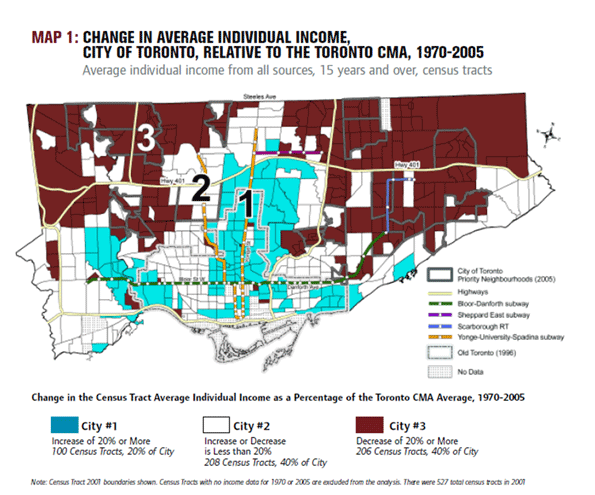
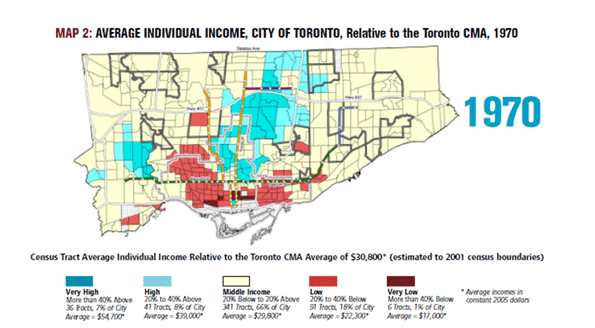
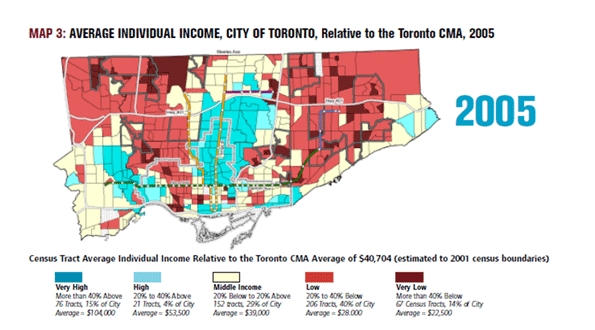
    The news isn’t all bad. After all, the downtown core is now one of the most desirable places to live in North America, and many of the formerly low income neighbourhoods have gentrified, or are in the process of doing so. However, many of the city’s traditional suburbs have been decimated. The former cities of Etobicoke and Scarborough used to be middle class. Not so much anymore.

    In real dollar terms, even the majority of the very low income areas have become wealthier. The trouble with poverty statistics is that they focus on relative poverty, rather than absolute poverty. This means that if Etobicoke’s average income doubled tomorrow, the downtown core would all of a sudden be considered poor. This is a major limitation. Toronto isn’t exactly turning into a Canadian Detroit.

    The report rightly points to the need for greater mobility in the outer suburbs. Given that the most lucrative jobs are typically downtown, many young professionals and recent graduates living outside of the core need to be able to get downtown cheaply and quickly in order to build their careers. Where the report goes wrong is that it recommends stricter land use regulations, stronger rent controls, and the revival of the flawed Transit City plan that Mayor Ford vigorously campaigned against in the recent election.

    It is easy for academics to blame a lack of social welfare spending, or suburbanization for the problem. The real problem is the loss of local policy making power resulting from amalgamation. For the most part, the areas losing ground the fastest are the formerly middle class suburbs amalgamated into the city. In contrast the “exurbs” just outside of city boundaries have thrived. This is no coincidence. The real takeaway from this study is that the suburbs have different needs than the central core. By attempting to accommodate the needs of both, the megacity has benefitted neither. Short of de-amalgamation, the only hope for the city is to substantially decentralize policy making. No amount of spending can make up for the loss of local autonomy.
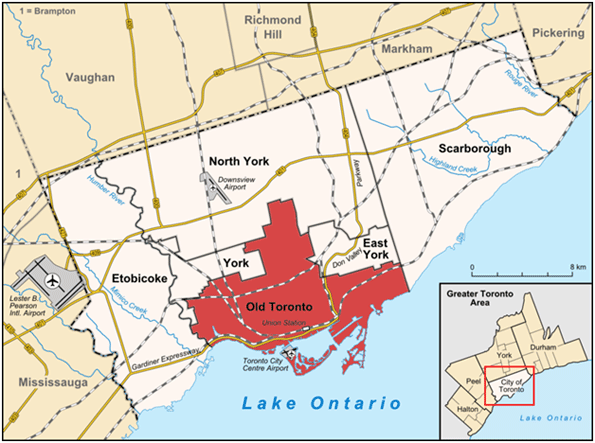
    Policies have different effects in different types of cities. Take the treatment of automobiles. It might make sense to discourage automobile usage in downtown Toronto, but the benefits of doing so in Vaughan or Pickering would be questionable at best. Similarly, mandating that every commercial establishment have a public washroom probably makes sense as a public health measure in downtown, where public urination is an issue, but not so much in suburban Markham, or Richmond Hill.

    Making sensible regulations for a small, relatively homogenous area isn’t all that difficult. Applying these regulations to a large, demographically diverse area can help some areas and hurt others. It’s not that regulations need to be a zero sum game. People in Etobicoke wouldn’t be affected if, say, maximum parking allotments were tightened in the downtown core. They would be affected if they were tightened throughout the entire megacity. Similarly, increasing maximum parking allotments might hurt the core and help the suburbs. The current one size fits all approach sometimes benefits the core and sometimes benefits the suburbs, but ever both.

    Perhaps more important than city wide regulations is the centralization of taxing power. Since the merger, the city now sets tax rates across the entire megacity. This also allows the city to control the ratio of residential to non-residential taxes. The city of Toronto has the highest ratio of non-residential to residential taxes in Ontario. This means that businesses carry a higher share of the tax load in the city than anywhere else in the province. The combination of tax and regulatory policies in the city have lead the Canadian Federation of Independent Businesses to rank Toronto as the second least business friendly city in Canada. On a scale of 1-100, Toronto came in at 33, slightly ahead of Vancouver’s 31. Meanwhile, the rest of the (Greater Toronto Area) GTA is near the top, at 61. Neighbouring Oshawa took the top spot in Ontario with 69.

    GTA Area Cities by CFIB Entrepreneurial Cities Policy Score

    Rank (Ontario)

    City

    Score

    Driving Distance to Yonge and Bloor

    1

    Oshawa

    69

    0:45

    6

    GTA (Excluding Toronto)

    61


        Mississauga

    61

    0:27


        Brampton

    61

    0:41


        Richmond Hill

    61

    0:32


        Markham

    61

    0:32


        Vaughan

    61

    0:32

    16

    Hamilton

    55

    0:58

    19

    Guelph

    54

    1:15

    24

    Barrie

    52

    1:16

    27

    Brantford

    51

    1:20

    30

    Kitchener

    48

    1:23

    33

    Toronto

    33


        Etobicoke

    33

    0:20


        Scarborough

    33

    0:21

    Now the share of non-residential to residential taxes in Toronto may actually make sense downtown. The core is home to the third biggest financial sector in North America. These jobs are heavily concentrated in the downtown core.
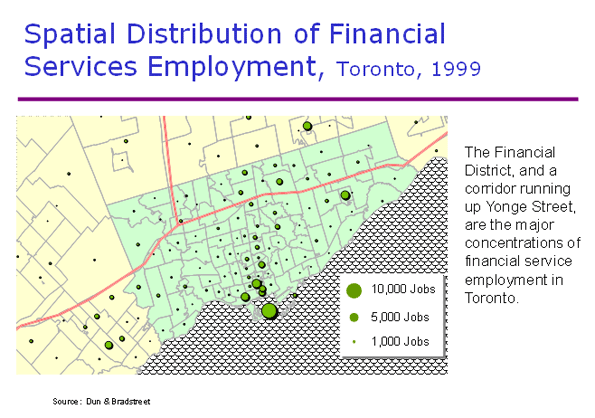
    Downtown Toronto isn’t competing with low tax Vaughan or Barrie for these jobs. They are competing with high tax cities like New York and Chicago. This means that employment in the core is not as easily chased off by taxes and regulations than in the suburbs. But in industries like wholesale and manufacturing, which are far more important outside of the core, employment can easily relocate to Barrie, Mississauga, Oshawa, and so forth. Indeed, jobs have been leaving the city since before the recession hit.
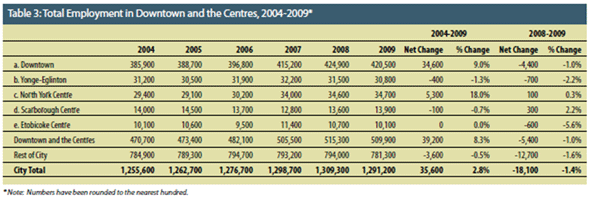
    Since 2004 Downtown and North York have prospered but the rest of the city has lost jobs. This should make the results of the Professor Hulchanski’s report unsurprising. The financial sector isn’t enough to keep the entire city employed or lift wages in the city-controlled suburban rings. As a a result despite the thriving financial sector, Toronto was dead last in the GTA in terms of median incomes.
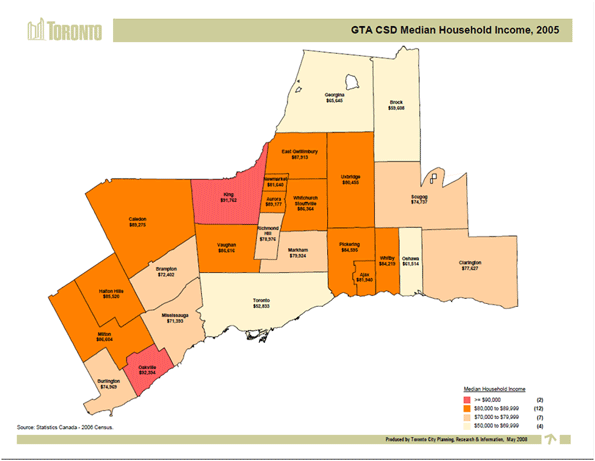
    To turn this around, the city must decentralize decision making power so the suburban communities can come up with their own economic development strategies. No matter how much the city improves transit to the outer suburbs, they will not be able to significantly increase median incomes without creating more jobs. The financial sector will continue to grow, but many of jobs created in this sector require specialized training, and thus go to people from outside of the city. This doesn’t do much for former manufacturing workers in Scarborough and Etobicoke. Growth of the financial sector combined with the dispearance of blue collar jobs together guarantee continuing income disparities in the city.

    Below is previously published data from Professor Hulchanski that highlights how badly blue collar sections of the city have been hit.
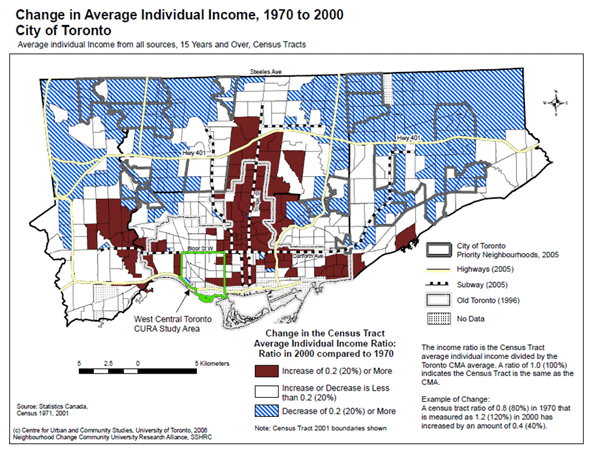
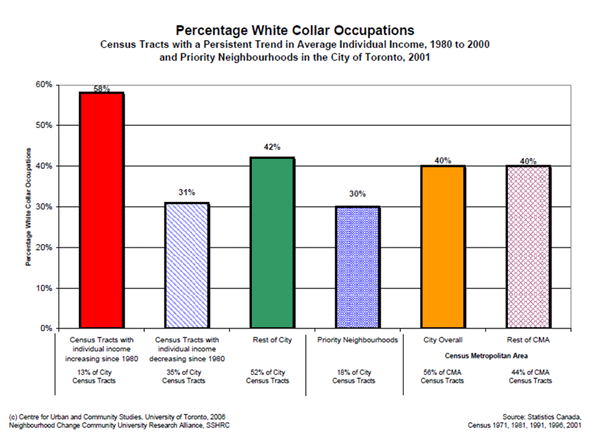
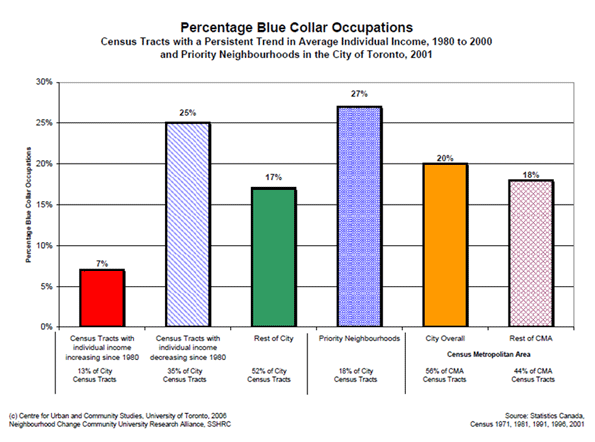
    Fundamentally, a strong focus on financial and other so-called “creative class” jobs will do little for these areas. The above map was created by Richard Florida’s Martin Prosperity Institute. It shows that most creative class jobs are clustered around the subway, but this doesn’t mean that expanding rail transit will expand creative class employment. Building a light rail line through a neighbourhood doesn’t suddenly transform the residents into artists and physicians. It may attract more artists and physicians, but this could actually hurt local residents by driving up rent and property values without creating jobs for them. Below is a map of educational attainment by ward. The darker the colour, the higher the number of residents with a bachelor’s degree or higher.
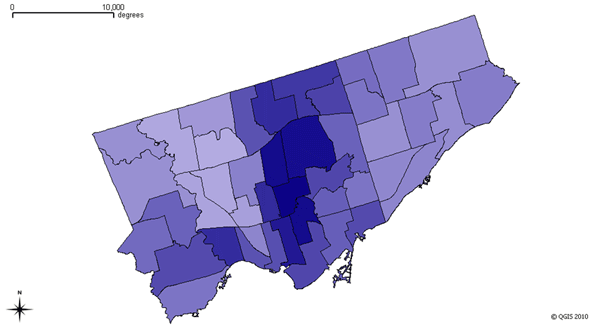
    The real problem is that a focus on elite jobs creates exactly the kind of bifurcation that progressive complain about. Given that city wide business policies are tailored towards creative class type occupations, it is unlikely that price sensitive manufacturers will find any reason to locate within city boundaries, rather than setting up shop in Mississauga or Barrie.

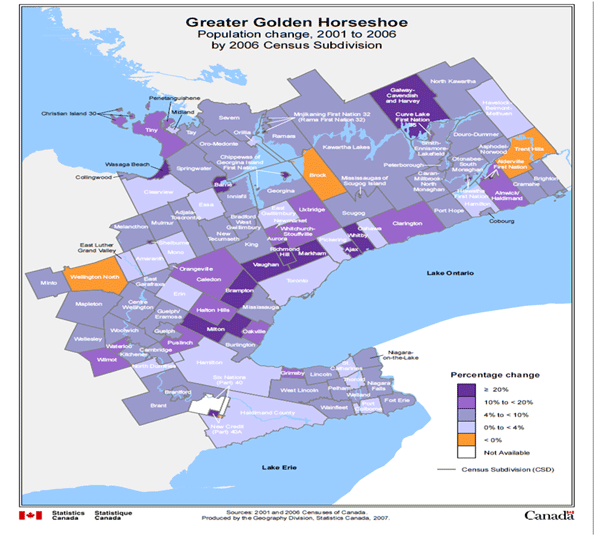
    Indeed, for all the temptation by urbanists to point to Toronto’s suburban ring as an example of the decline of suburbia, the peripheral suburban areas outside of city limits have been booming. Here is a map of growth in the GTA between 2001-2006. While Toronto grew modestly, suburban cities Milton, Brampton, Vaughan, Richmond Hill, Markham, Ajax, and Whitby all grew by at least 20%. Even Oshawa, which was hit hard by the decline of the auto sector, has managed to survive, and indeed maintained a higher median income than Toronto during this period. Regional rival Mississauga eclipsed Toronto’s growth rate, and emerging regional player Barrie grew by over 20%.

    In short, despite its strong financial core, Toronto is losing its standing as the go-to destination in the GTA. And it could get worse. Mississauga is working hard to lure financial services and advanced manufacturing jobs from Toronto. Several other cities, such as Guelph and Waterloo are actually competing for the very creative types that Toronto’s policies are tailored to attract. Other cities, such as Barrie are working hard to cannibalize what is left of Toronto’s manufacturing and distribution sectors. Were it not for amalgamation, Etobicoke or Scarborough could just as easily have undertaken a similar strategy to attract blue collar jobs.
    The Three Cities report identifies serious regional disparities in Toronto. Unfortunately, it doesn’t provide much insight into how to fix the problem. Expanding transit options will only go so far towards this. Building more light rail may raise median incomes by attracting wealthier people to these neighbourhoods. Ironically, this will only widen the income gap. The real challenge is finding out how to create opportunities for blue collar jobs in suburban Toronto. Unfortunately, amalgamation has imposed one size fits all policies that may work downtown, but utterly fail in the suburbs and continue to drive people to the periphery outside the city limits. Ironically, the very policies that seek to halt “sprawl” may well end up exacerbating it.

    Toronto Skyline photo by Smaku

    Steve Lafleur is a public policy analyst and political consultant based out of Calgary, Alberta. For more detail, see his blog.
  • Commissioner Leonard Steps Up Portland’s War on Fun

    Portland is known primarily as a cool city, where people spend their 20s happily working in the service sector, drinking craft beer, eating organic food, and exploring a variety of unconventional lifestyle options. In short, Portland is weird. That’s not just an observation: it’s the city’s marketing strategy. Keep Portland Weird is a pretty common bumper sticker in the city (believe it or not, there are cars in Portland). Yet despite the non-conformist attitude of Portlanders, the municipal government seems bent on destroying everything fun about the city.

    The first attack, which I documented in Reason Magazine, is on craft beer, the city’s primary cultural export. The city attempted to increase the tax on beer producers several fold, though the motion was soundly defeated. It was the only time I’ve ever seen hippies handing out anti-tax fliers in bars on Friday nights. This was followed up by an EPA mandated tampering of the water supply, which may or may not reduce the quality of the world beer capital’s unparalleled beer.

    The second attack is on street vendors. Portland has some of the most liberal rules regarding street vendors. You can find anything from Mexican to Thai food in the nearly 600 Portland street carts. This is one of the things that make the city charming. Street vendors add to the street life of the city. Yet this summer, a story about a little girl having her unlicensed lemonade stand shut down drew international attention. Now City Commissioner Randy Leonard is openly discussing a city wide crackdown on food vendors. The complaint? Many of them are guilty of attaching unlicensed appendages such as awnings and decks.

    Where are the complaints originating from? You guessed it: local restaurants. They claim that street vendors are providing unfair competition, since they don’t have to provide restrooms, be wheelchair accessible, and so forth. This has so alarmed the Commissioner that he’s instructed building inspectors to assign top priority to inspecting street vendors. Ironically, this debate completely ignores the most legitimate question: are street vendors actually hurting anyone? Is their safety record worse than local restaurants? Are they blocking off public sidewalks? The answer to the first question isn’t clear, since the inspection reports aren’t reported in the same way they are for restaurants. Having said that, the health inspectors would shut them down if there were egregious violations. The second question is easier. They aren’t unduly encroaching on sidewalks. If anything, they’re providing sidewalk dwellers shelter from the rain with their unlicensed awnings.

    Quirky things like world class craft beer and street vendors are what make Portland interesting. If the city is going to market itself as a destination for the creative class, it is going to have to stop cracking down on the very things that attract these people in the first place. After all, they sure aren’t moving to Portland because of the local economy.

  • Toronto Election Highlights Failure of Amalgamation

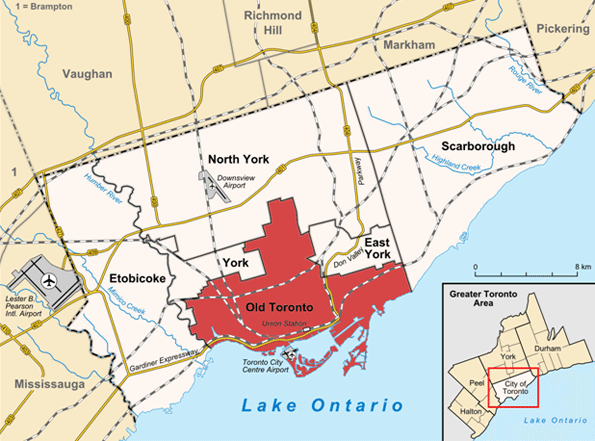
    In my pre-election piece on the Toronto election, I discussed the city’s lingering malaise. It developed slowly but its roots can be traced to the 1998 amalgamation that swallowed up five suburban municipalities. This led to a six folds expansion of city boundaries and a tripling the population base. This amalgamation was initiated by the province of Ontario as a cost saving measure and faced major local opposition. Citizens and politicians were concerned that the benefits of the alleged efficiency saving would be outweighed by the negative impact of losing local decision making powers. The recent Toronto municipal election bore out this concern.

    In the October 25th election, Torontonians were presented with two dramatically different visions. The first vision was presented by former Liberal Ontario cabinet minister George Smitherman. A self-described progressive, Smitherman appealed mainly to voters in the downtown core of Old Toronto. He stood for issues such as improved bicycle lanes, renewal of the downtown waterfront, and improving social housing conditions. The second version was presented by maverick councilor Rob Ford, who represented a ward in the former City of Etobicoke. Ford’s message was simple: it’s time to stop the “gravy train” at City Hall. While he had elaborate platforms on many issues, cutting waste at City Hall was his ubiquitous message.

    Despite Toronto’s social democratic image, Rob Ford won a crushing victory. Ford earned 47% of the vote, while Smitherman ended up with 35%. Far left candidate Joe Pantalone (known primarily for attempting to stop businesses from opening in his own ward) managed to capture 12% of the vote.

    Aside from the shock that a partisan conservative won in Toronto, there are two other significant developments. Both front runners were significantly more fiscally conservative than the current administration. Ford and Smitherman represented constituencies desperately seeking change. Smitherman’s base was frustrated with the inability of the city to provide the services that they want efficiently. Ford’s base was angry that the city is providing many of these services in the first place.

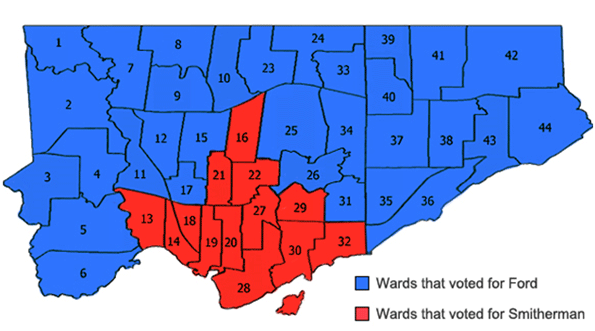
    Not surprisingly the results broke down along specific geographic lines. Ford won an outright majority of votes in every single ward outside of Old Toronto. Within the old boundaries, Smitherman won 13 of the 16 wards. The three Old Toronto wards Ford won are all on the fringes of the Old City.

    In 1997, the newly amalgamated city went to the polls for the first time. Conservative former North York Mayor Mel Lastman narrowly defeated social democratic former Old Toronto Mayor Barbara Hall. Since then, downtown oriented social democrats have controlled the city ever since.

    Clearly this result shows that the concerns expressed by the opponents of amalgamation were largely valid. Amalgamation failed to create cost savings, and has created a dysfunctional megacity. Rather than having six municipalities where voters are focusing on solving local problems, we have one gigantic city with the core and the suburbs fighting for their share of the public purse. This leads to the schizophrenic policy decisions we see today.

    Before amalgamation, there were six different versions of Toronto life that one could choose from. If you didn’t like living in high tax Toronto, you could live in Etobicoke. If Etobicoke’s bylaws and business taxes were hurting your business, you could move to North York. Now all people in the Toronto area can do is vote the bums out on election day, or get out of the area altogether. This isn’t a viable long-term solution.

    The problems are systemic, and cannot be solved so long as the megacity exists. This extends beyond the fact of the impossibility of satisfying the core and the suburbs at the same time. The megacity allows public sector unions to literally hold 2.5 million people hostage whenever they feel like it. A notorious strike last summer lead to a month without garbage collection in the entire city. The 24,000 strikers also shut down parks and recreation services, daycare, provision of municipal licenses, health inspections, animal services, and forced a 25% reduction in ambulance services. In 2008, the transit union called a last minute strike at midnight on a Friday night, grinding the city to a halt. These are just two examples of how powerful Toronto public sector unions have become. The only reason strikes aren’t more frequent is that the city typically gives them whatever they want in order to avoid chaotic strikes. De-amalgamation would not only allow more local control over policy, but would help fray the noose that the unions have tied around the city’s neck.

    Downtown progressives gripe over how Rob Ford is going to destroy their city, but they should take a minute to think about what some of their policies have been doing to suburbanites for years. They have imposed high taxes, and burdensome regulations on the amalgamated cities, as well as a myriad of new bylaws. Some of these policies make sense in Old Toronto. For instance, dissuading automobile usage in the congested core makes sense. Doing so in the suburbs does not. It might make sense to regulate trees on private property in a crowded downtown neighborhood. Not so much in a new subdivision. One-size-fits-all policies don’t work across a city as large and diverse as Metropolitan Toronto.

    Now that the suburbs have wrought their revenge on the old city, progressives need to recognize that de-amalgamation is not just a fantasy of libertarians and angry suburbanites. It is a prerequisite to restoring sound public policy reflecting the preferences of individual communities. Railing against Rob Ford won’t fix the problem. Rob Ford is what the suburbs want. As long as the megacity lives, Toronto will elect a Rob Ford type every now and then.

    The only way to stop this pattern of alternating, divergent visions is by de-amalgamation. Critics will use metaphors such as ‘unscrambling an egg’ to illustrate the difficulties of de-amalgamation. No one should believe that de-amalgamation would be easy. But there will never be a better time than now to take the necessary step of de-amalgamation. A few years of chaotic governance would be worth the long run benefit of restoring local control.

    Downtown Toronto photo by Astro Guy

    Steve Lafleur is a public policy analyst and political consultant based out of Calgary, Alberta. For more detail, see his blog.
  • “Redneck” Calgary Elects Liberal Muslim Academic Mayor: World Doesn’t End

    Calgary municipal politics rarely makes news outside of the city. Going into this year’s municipal election, I had reason to believe this would change. I came to Calgary to manage the campaign of the runner up from the last election. He is a Muslim (specifically Ishmaili), and an outsider to the political establishment. People told me there’s no way someone like that could be elected in Calgary. I’m happy to say that they were proven wrong. Unfortunately, I had nothing to do with this.

    My former candidate is a colorful guy. He had lived in Calgary for less than five years before running for mayor the first time around. His odds were pretty steep. Mayor Dave Bronconnier had garnered over 80% of the vote in the previous election. His closest rival had just over 5%. My candidate spent over a million dollars of his own money to run a viable campaign against the two term incumbent. He finished that election with a quarter of the votes. Internal polling suggested he had a serious chance, until false allegations concerning his past business dealings in Kenya derailed his candidacy.

    He is also a strong believer that Calgary’s redneck image is outdated. Calgarian values are old fashioned in many ways, many of them good. There is no major Canadian city where people are as supportive of free-enterprise as Calgary. Think of it as Houston North. The economy is largely driven by the oil and gas money, and it is perceived as being a very socially conservative, predominately white city. This perception is out of date. Nearly a quarter of Calgarians are members of visible minority groups, and the city elected Canada’s first Muslim Member of Parliament. My candidate mocked this perception. One of his ice breakers with skeptics of his candidacy was to tell them that “redneck Calgary is ready to elect a brown, bald guy from Kenya” as Mayor. It turns out he was right about the “brown” part.

    I ended up leaving that campaign early. We had different visions for the campaign, and the candidate always wins that argument. He wound up pulling out of the race the day before the election officially got underway. I harbored suspicions that the only reason he came in second the last time was that he happened to be the only guy willing to spend a million bucks to run against a popular incumbent. Had he not run, the two term incumbent would have walked to another landslide victory. Some people were angry with the incumbent, and he was the other name on the ballot they recognized.

    My faith that a member of a visible minority group could be elected Mayor of Calgary dwindled. But in the last few weeks of the campaign, something odd began happening in the polls. A man by the name of Naheed Nenshi started to poll at 20%. Few people took his candidacy seriously before this. His numbers began to climb into the 30% range in the final week. I started making long shot bets with friends that Nenshi would win, but I didn’t really expect it to happen. Surely the polling was wrong. Redneck Calgary couldn’t possibly elect a Liberal Muslim academic as Mayor.

    The polling actually was wrong. Since many young people only have cell phones, they are underrepresented in polls. It turns out that the polls massively underestimated Nenshi’s support. He didn’t just sneak by. Turnout was an astonishing 53%–shattering records for the last 3 decades—and he grabbed 40% of the votes. This was supposed to be a two way race between fiscal hawk alderman Ric McIver, and popular news anchor Barb Higgins. Elections don’t always turn out as they’re scripted by the pundits.

    The fact that we’ve actually elected a Muslim Mayor has lead to a serious rethink of Calgary’s redneck reputation. Pundits claim that this represents a shift in the city’s attitude towards immigrants. I disagree. Like its American energy town counterpart Houston, it’s an open, opportunity-oriented city. People don’t care if you’re white, brown, or from Saskatchewan. Calgary is a magnet for entrepreneurial people. It is a city that was built on people from all over the world seeking opportunities. One fifth of Calgarians are immigrants.

    “Go west, young man” is not a mantra that was exclusively adopted by white Protestant men. Nenshi was born and raised in Calgary, but his mayoralty would not have been possible if it weren’t for the hospitable Calgarian attitude.

    Frankly, he’ll probably do an alright job. Nenshi has an impressive business background, and his knowledge of urban public policy and municipal government is extensive. He’s more of a market liberal, than the dogmatic leftist that his critics painted him as. He wants more public amenities, but understands fiscal prudence and the need for efficient regulations.

    No matter how much his critics called him a socialist, Nenshi was the candidate who was able to convince voters that he knew how to provide the necessary services without breaking the bank. Voters wanted a clear vision of the city’s future, and that’s what Nenshi provided. People knew what they were voting for. Frontrunner Ric McIver offered slightly lower tax increases, combined with major spending initiatives. We’ve all seen what happens when politicians promise tax cuts without a plan to reduce spending. This isn’t a vision, so much as a recipe for disappointment.

    Calgarians wanted to elect a Mayor who would clean up City Hall. Nenshi offered that, and people didn’t care what God he worships (or doesn’t). Calgarians didn’t vote for a Muslim mayor any more than they voted for a Protestant Mayor the last election. They voted for the guy they thought would get things done. That’s the Calgarian attitude.

    Photo by 5of7

    Steve Lafleur is a public policy analyst and political consultant based out of Calgary, Alberta. For more detail, see his blog.
  • Vancouver Olympic Villiage Development Becoming a Burden to Taxpayers

    The former Olympic athlete’s village in Vancouver is in the news again, but this time no one is celebrating. The billion dollar plus development, originally built to house athletes then converted to a residential housing development, was primarily financed by a loan from the city of Vancouver. Millennium Development Corp., developer of the project, currently owes the city $731 million. Millennium was scheduled to pay back the first $200 million by August 31st, but came up $8 million short. They managed to find another $5 million by September 20th, but they are still $3 million short. On top of this, they have another $75 million due in January. The city is considering legal action against the developer.

    This isn’t the first we’ve heard about financial troubles with the project. The city actually took over the loan from Millennium’s initial lender due to cost overruns. The repayment schedule was considered feasible, given the strength of the Vancouver real estate market. Unfortunately for them, sales have been slow. While 223 units sold during the presale, only 36 units have moved since. This leaves more than half of the units. 454, lingering on the market. The city has actually been forced to take over the 252 units of social housing that were required to be built due to the city’s inclusionary zoning laws.

    Amidst this turmoil, the city is doing everything it can to ensure that the remaining units are neither sold off cheaply nor rented out, since this would reduce the long run selling price. Their solution is to wait for the market to rebound. Councilor Raymond Louie stated that “the benefit of being the city is that we are lasting and we can stay forever…it’s a paper loss for now, but we can wait for the market to recover.” Of course, if this were a wise decision, why are private brokers and developers not doing the same? The answer is simple: the assets are depreciating anyways, so they may as well cut their losses. The problem here seems to be that the sitting government is afraid that it will look bad for them if the sale of the units doesn’t cover the full loan amount. By telling the developer to sit on the assets, they can claim that the debt will be repaid when the market recovers (and they are happily retired from council).

    The British Columbia government reported that the cost of the Olympics to BC taxpayers was $925 million. The original estimate was $600 million. On top of this, the federal government kicked in $1 billion for security costs. That also doesn’t count the $700 million they spent on highway upgrades, $2 billion for a light rail extension, or $885 million for a convention center. Millennium’s financial troubles threaten to add to the losses incurred by taxpayers. Reports claim that the development is worth between $150-200 million less than what they owe the city. On top of that, at least 15 of the pre-sale buyers are trying to back out of their purchases. The bad news for taxpayers just keeps coming.

    While the city was forced to back the loan in order to live up to its Olympic commitments, there is a clear lesson here: cities should not be in the housing business. Even though they’ve managed to keep housing prices artificially high, they can’t break even on a housing development that was advertised to the whole world. Either the housing market will overheat again, and the project will become solvent, or the taxpayers will lose a couple hundred million dollars. Potential home owners in Vancouver can’t seem to win. The best thing the city can do at this point is admit failure, and allow Millennium to have a fire sale. It won’t do much about the cost of living in the city, but at least a few people will pick up bargains. Of course, politicians aren’t likely to cut their losses. Better to pass the buck to the next council.

  • Toronto’s Civic Malaise

    Despite Toronto’s international reputation for livability, all is not well in the city. Many politicians and pundits blame the outgoing city council, and Mayor David Miller. While they’ve done their share of damage, the city faces deeper, systemic problems. The source of the problem is more fundamental than stifling bureaucracy, or the stranglehold of the public sector unions. These are symptoms of the institutional sclerosis caused by the amalgamation of Toronto and surrounding areas into the new Toronto Megacity.

    The first taste of this malaise came in the form of a nasty garbage strike last summer. Torontonians waited weeks to have their garbage picked up as it rotted in their front yards. Those who dared to pick up trash for a fee were threatened with legal sanctions. This incident helped propel provincial cabinet minister George Smitherman into the political limelight. The prominent Liberal helped spearhead a volunteer effort to clean up the city. Smitherman was seen by many as the right man to fix what was wrong at city hall. The strike was eventually resolved, but the contract was widely seen as a union payoff. The blowback convinced Mayor Miller not to run for a third term. Smitherman was considered an early frontrunner to replace Miller. He has a reputation for being a maverick who could whip the city into shape. This optimism quickly faded, and it looks increasingly as though the Smitherman could lose.

    There are times when a simple photo shared on Twitter can outrage an entire population. This happened this summer, when a picture of a sleeping toll collector on the Toronto subway ignited months of anger at the city’s public transit system. In the wake of the garbage strike, Torontonians were incensed to see employees sleeping on the job. Frustrated downtown residents were looking for a change, which they assumed would be embodied by Mr. Smitherman. But few commentators seemed to realize what Jaideep Mukerji recently pointed out: while downtown residents are frustrated, suburbanites are downright angry. This has lead to a surge of support for Etobicoke’s hot-headed, penny pinching councilor Rob Ford. Unlike downtown residents, who primarily want to ensure that services such as transit are efficiently delivered, Ford’s supporters want to cut spending, and end the “war on drivers.”

    It turns out that service delivery was only the tip of the iceberg. The true source of the city’s malaise is the realization that amalgamation may have turned Toronto into an ungovernable city, serving neither the suburbs nor the downtown core. Because of this, the election is evolving into a culture war between downtown and the suburbs.

    The Toronto megacity dates back to 1995, when Progressive Conservative Premier Mike Harris attempted to unshackle an economy crippled by unsustainable tax and spend policies and burdensome regulations. In his quest to find efficiencies, Harris commissioned a KPMG study to determine how to make the provinces most populous city run more efficiently. The answer was amalgamation. The study claimed that if the six cities in Metro Toronto were to merge, they could save between $300-$645 million dollars in operating costs per year. These savings could be purchased for a mere $220 million in transition costs—or so the report went. The actual cost ended up being $275 million. More importantly, the operating cost savings were far lower, at $135 million per year. If this were the whole story, the merger would likely be considered a success.

    The theory of amalgamation revolves around saving money by reducing redundant bureaucracy. According to a study by York University economist Harvey Schwartz, the opposite happened. All of the efficiency savings created by amalgamation were dwarfed by a massive increase in city government employment. Between 1997-2008, the city added 4,741 employees. Over the same time period, the operating budget ballooned from $5 billion to $8.1 billion. The promised savings simply never materialized.

    Not only has amalgamation failed to save money, it has also lead to policies that have left neither downtown residents nor suburbanites happy. To a great extent, representatives from the newly annexed cities have felt consistently marginalized. Take, for example, a recent council motion to force all retail stores to have public washrooms. The motion was overwhelmingly popular with councilors from North York, Scarborough, and old Toronto, gaining 77% of their votes. Not so in Etobicoke, and East York, where only 22% of councilors from their old boundaries favored the motion.

    Though public urination or lack of toilets may be an issue in some parts of the megacity, it isn’t necessarily a problem everywhere. Forcing coffee shops in Toronto to have toilets may seem reasonable, though requiring a print shop in Etobicoke to pay for the installation and maintenance of a public washroom is an unjustifiable cost imposition. East York and Etobicoke councilors also overwhelmingly opposed the introduction of a garbage tax, this time with the help of their North York counterparts. Only 25% of their representatives voted for it, while 91% of Toronto and Scarborough councilors voted for it. The motion carried due to the greater population of the core.

    Arguably the most symbolic recent vote in terms of the city’s post amalgamation malaise could be seen in a recent vote on whether non-unionized employees should receive pay increases equivalent to their unionized counterparts. Two thirds of East York and Etobicoke councilors supported the motion, while two thirds of the rest of the megacity opposed it. This vote underscores a core problem with amalgamation: elimination of policy experimentation.

    Amalgamation into megacities is analogous to the decline of federalism in North America. Both the Canadian and American constitutions lay out a division of powers, which allows for varying degrees of policy experimentation. The virtue of this, as later articulated by public choice scholars, is that it lets people vote with their feet. If taxes are too high in Massachusetts, you can move to Maine. If you’re fed up with business regulations in California, you can set up shop in Nevada. On a more local level, you don’t like the regulatory regime in Los Angeles, you can move to Burbank or Calabasas.

    This competition between states and regions impels the more competitively minded jurisdictions to craft policies that will attract people and business. This was one reason for the massive suburban exodus during the 60s and 70s in both Canada and the US. People didn’t like how things were going in major cities, so they packed up and left.

    Amalgamation eliminates this competition. To escape the Toronto tax regime, you need to either move well outside of reasonable commuting distance, or leave the Toronto region all together. Rather than having small cities competing, we have one big city that won’t let you leave. This is the ultimate source of Toronto’s malaise.

    Amalgamation is slowly making its way into a campaign issue. Mr. Smitherman, to his credit, has proposed empowering community councils to decentralize decision making. He even went so far as to say he wants to adopt a “concept of de-amalgamation.” This would be a start, although it still wouldn’t allow for tax competition, or sufficient local control over land use planning, and other major policies.

    Hopefully the fact that amalgamation is becoming an issue in one of North America’s biggest megacities will lead to a rethinking of the concept. Many cities are continuing to move in this direction, largely due to annexation emerging from the core. While many big city politicians feel the need to continually expand, it is to the detriment of their cities. Urban cores have different needs from their suburbs. Amalgamation has left neither old Toronto nor the suburbs happy. Perhaps one day Toronto’s political elites will finally realize that de-amalgamation is necessarily. Unfortunately, the only thing more difficult than a bad marriage is a messy divorce.

    Downtown Toronto photo by Small

    Steve Lafleur is a public policy analyst and political consultant based out of Calgary, Alberta. For more detail, see his blog.
  • Vancouver: Planner’s Dream, Middle Class Nightmare

    Vancouver is consistently rated among the most desirable places to live in the Economist’s annual ranking of cities. In fact, this year it topped the list. Of course, it also topped another list. Vancouver was ranked as the city with the most unaffordable housing in the English speaking world by Demographia’s annual survey. According to the survey criteria, housing prices in an affordable market should have an “median multiple” of no higher than 3.0 (meaning that median housing price should cost no more than 3 times the median annual gross household income). Vancouver came in at a staggering 9.3. The second most expensive major Canadian city, Toronto, has an index of only 5.2. Even legendarily unaffordable London and New York were significantly lower, coming in at 7.1 and 7.0 respectively. While there are many factors that make Vancouver a naturally expensive market, there are a number of land use regulations that contribute to the high housing costs.

    Vancouver is a unique real estate market: it’s the only major Canadian city that doesn’t experience frigid winters. This makes it a major draw for high skilled, high salary employees. It is also a major destination for wealthy Canadian retirees, who choose to actually spend their winters in Canada. There is little doubt that it is a naturally expensive real estate market. As with coastal California cities, people pay a premium for (in this case relatively) hospitable weather. The proximity to world class skiing, fishing, and hiking are no doubt another factor in the city’s high real estate costs. There is certainly a premium to be paid for living less than two hours away from the world’s best ski resort.

    Moreover, Vancouver has become an appealing real estate market for overseas investors, particularly Chinese nationals. There has been a good deal of news recently about how many of the nouveau riche in China are now looking to Vancouver, rather than Los Angeles or New York as an immigration destination. In absolute dollar terms, Vancouver is still cheaper than either city. This, combined with the more hospitable Canadian immigration system, has made Vancouver so attractive to overseas investors that real estate agents are now organizing house hunting tours for potential Chinese buyers.

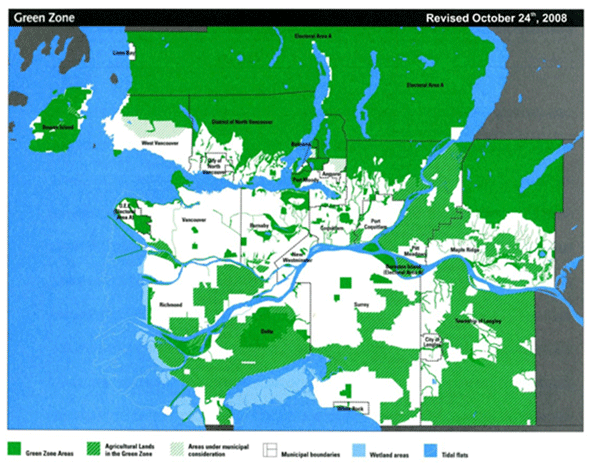
    To be sure, geography deserves much of the blame for Vancouver’s high housing costs. But a large chunk of the blame lies with restrictive municipal and provincial land use policies. Since the introduction of the city’s first comprehensive plan in 1929, Vancouver has used various land use regulations to create dense mixed use development in order to protect green space surrounding the city. In 1972, the provincial government passed legislation aimed at protecting BC farmland. This left less than half of the already scarce land in Greater Vancouver off limits to developers. As a result, the city is circled by undeveloped land, referred to as the Green Zone. The Green Zone acts as a de facto urban growth boundary, largely designed to prevent sprawl.

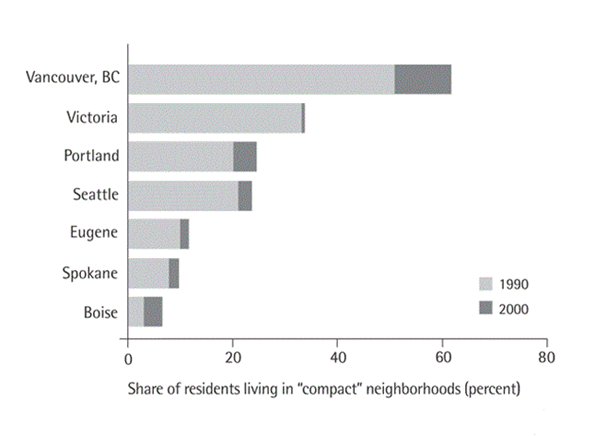
    As a result, Vancouver is one of the few North American cities that have been growing almost exclusively upwards, rather than outwards for the last century. Its narrow streets and lack of a major highway running through the city make it one of the least automobile friendly cities on the continent. Unsurprisingly, Vancouver was ranked the most smart growth oriented city in the Pacific Northwest by the Sightline Institute. Roughly three times more Vancouver residents live in compact neighborhoods as a percentage of the population compared than Portland or Seattle. This arguably makes Vancouver the most smart growth oriented city in North America.

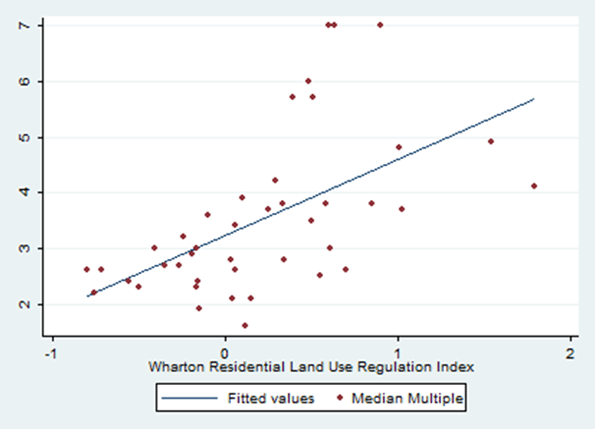
    Smart growth has become a truism for urban planners. Walkable communities with a mix of commercial and residential units combined with strict zoning regulations to encourage transit usage is a formula increasingly prescribed for North American cities. Though many smart growth principles are attractive, there is an strong correlation between heavy land use regulations and housing costs. Using data from the Wharton Residential Land Use Regulation Index (WRLURI), and Demographia’s International Housing Affordability Survey, a simple scatter plot diagram has been included to illustrate this correlation.

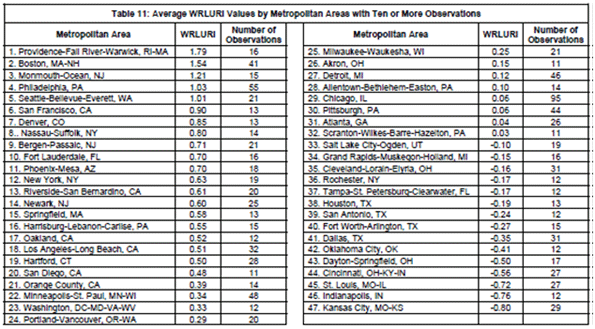
    The WRLURI measures the stringency of land use controls imposed on various US jurisdictions by state and local governments. There is a clear correlation between high regulations, and low housing affordability. Though the index does not include Canadian cities, it does include neighboring Seattle. Seattle ranks fifth of 47 cities on the Wharton Index. According to a recent study in Boston College International & Comparative Law Review by David Fox, Vancouver is decades ahead of Seattle in terms of smart growth policies. This means that Vancouver would rank at least fifth in North America on the index, though it is more realistic to assume it would most certainly top the index.

    In addition to smart growth policies, Vancouver also has very stringent inclusionary zoning laws. Inclusionary zoning requires developers to provide a certain number of affordable housing units in any given development. This policy might seem to make the city more affordable, but it functions exactly like rent control. Those fortunate enough to find spaces in the affordable housing units pay less, but the subsidized rent is made up for by higher rent in adjacent units. In a study of inclusionary zoning in California cities, Benjamin Powell and Edward Stringham from the Department of Economics at San Jose State University found that inclusionary zoning imposes an additional $33,000-$66,000 cost on adjacent market rate units.

    There have been some recent policy initiatives that may reduce the cost of housing marginally. In 2004, the city amended its zoning code to permit secondary suites throughout the city. Secondary suites are subdivided units of owner occupied homes that are used as rental units. This zoning change brought tens of thousands of relatively low cost units into the market. There are currently 120,000 secondary suites in the province. The city recently went one step further to allow homeowners to convert laneway garages into rental units. These units have a maximum of 500 square feet. There are 70,000 homes in Vancouver that are eligible for conversion, though it is unclear how many will take up the offer. This will add to the stock of relatively affordable rental housing in the city, but may not significantly reduce housing costs. In fact, by increasing the revenue generating potential of houses, it may actually increase the cost of purchasing a single dwelling home. After all, if the potential rental income of a single dwelling unit increases, the market price of the unit is likely to do the same. This isn’t necessarily an argument against the policy, though it does underscore the fact that housing costs in Vancouver will never decrease without liberalizing municipal and provincial land use policies.

    In short, the City of Vancouver and Province of British Columbia have chosen to favor compact growth over affordable housing costs. This likely makes the city more attractive to affluents from both the rest of Canada and abroad, but increasingly makes it unaffordable for middle class families. There is certainly some substance to the Economist’s claim that Vancouver is the most livable city on earth. It is a very attractive place for those who can afford it. Nevertheless, creating a city fit only for the wealthiest segments of society and non-families is hardly something to be proud of.

    Downtown Vancouver photo by runningclouds

    Steve Lafleur is a public policy analyst and political consultant based out of Calgary, Alberta. For more detail, see his blog.
  • Ownership Subsidies: Dream Homes or Disasters?

    Home ownership has been considered an integral part of the American Dream for as long as anyone can remember. Now it has come under scrutiny, notably in a June Wall Street Journal piece by Richard Florida, which claims that that home ownership reduces employment opportunities for young adults, since it limits their mobility. To support ownership, others — particularly Wendell Cox — have argued that home ownership levels do not correlate with the economic productivity of cities, and cite the rapid suburban development in the Sunbelt as evidence that home ownership is as valuable as ever.

    My inclination is that the truth lies somewhere in between the two sides of the debate. For the sake of simplicity, I’ll refer to them as New Urbanist supporters versus Smart Growth opponents (I realize these are broad generalizations). While they disagree on the merits of home ownership, there’s an interesting point of agreement: both sides oppose subsidies to homeowners. I’d argue that both sides should focus on getting the issue of discontinuing subsidies onto the national agenda.

    Like many 20-something young professionals, I have no aspirations towards home ownership. I ditched my car when I moved out of the suburbs, and I refuse to sign a lease that lasts more than three months. This affords me the flexibility that my life as a freelancer requires. If I were in a profession that didn’t call for a great deal of mobility, perhaps home ownership would be appealing. When North America was a manufacturing powerhouse, most people were in that situation. But an increasingly dynamic labor market requires an increasingly mobile workforce… to an extent.

    For those of us in the 18-30 demographic who work in fairly mobile industries, home ownership isn’t necessarily as big a hindrance as Florida suggests. There are people like me who work in volatile industries and simply can’t be tied down to one city, but we’re in the minority. For the majority, it really depends on the location. If your home is within commuting range of a major city, it should be possible to find work in your field without uprooting.

    But jobs come before home ownership in order of priority. In a scenario where state and local governments create a fiscal climate inhospitable to economic growth, rather than chase cheap housing, people migrate to the strongest economic region (for example, the Sunbelt).

    While home ownership isn’t going to be obsolete any time soon, in decaying cities like Detroit and Buffalo, and in towns far from urban centers, it can be a major hindrance to finding a job. Home owners invest a large amount of their net worth in their homes, and it becomes difficult to simply abandon unsellable homes and pay rent in a new city, though this does happen. There are roughly 90,000 abandoned homes in Detroit alone. Old manufacturing and resource town centers are especially vulnerable, since their economies typically lack the diversity to attract new employment opportunities. This isn’t a fault of government policy, but an unavoidable economic reality.

    Incentives such as the omnibus of initiatives created by the Bush administration’s Ownership Society led to an increase in home ownership levels. But no good can come of home owner subsidies; they lead to inflated prices and distorted patterns of urban development. A survey of first time homeowners in 2009 by Keller Williams Research found that 10% of first time home buyers were primarily motivated to purchase a home because of the $8000 tax credit. A further 4% were primarily motivated by low interest rates. This may seem trivial, but it should be pointed out that the average age of first time US home buyers has decreased to 26. That is a full 8 years younger than in the UK, where the average age is on the upswing. While higher home costs in the UK (partially due to more stringent land use regulations) are probably a major factor, one cannot help but think that the First Time HomeBuyers Tax Credit and subsidized mortgages contributed.

    Subsidies for home ownership are incongruent with the ideological underpinnings of both New Urbanists and Smart Growth opponents (who are mainly conservatives and libertarians). Some Smart Growth opponents are likely to be in favor of these subsidies, since they buy the rationale behind the Ownership Society model. Namely, they believe that ‘pride of ownership’ leads to flourishing communities. On this point, they are probably correct. But the ‘pride of ownership’ argument is based on the ‘broken window theory’ that blight leads to an increase in crime. Ownership Society partisans argue that since owners have more of an incentive to maintain their homes, high home ownership rates should lead to less crime. There is quite a bit of evidence to support this theory. Then again, apartment renters do not control yards or frontage, so the ‘pride of ownership’ argument seems far less relevant with respect to high density development.

    Both sides should take a time out to get the issue of ending housing subsidies on the national agenda. In the wake of a major recession caused partly by misguided housing and mortgage policies, this is an issue that could gain traction with the electorate. The two sides will have plenty of time — and issues — to fight over later.

    “Mid-Century Suburban Home,” Paradise Palms Home, Las Vegas, Nevada by Roadsidepictures

    Steve Lafleur is a public policy analyst and political consultant based out of Calgary, Alberta. For more detail, see his blog.

  • Revisiting Toronto’s G20 Costs

    In the lead up to the G20 conference, the security costs were projected to approach a billion dollars. As high as this number sounds, sources are now speculating that the total bill could be closer to $2 billion. Shocking as that number is, the costs incurred by local businesses may have exceeded that total.

    In addition to the physical damage to the hundreds of shops that were smashed in, there were major productivity losses during, and in the week before the conference. The most visible opportunity cost was the sharp decline in retail sales. According to Monaris Solutions, businesses within the security barrier saw a 28.08% decline in sales, and a 40.87% decrease in transactions. Businesses outside of the barrier experienced a 10.78% decline in sales, and a 16.43% decrease in transactions. The total city decline in sales was 9.31%, with 14.96% less transactions. This may not seem like that much, until you consider that the city has $47 billion in annual retail sales. A crude calculation puts the total retail losses in the $386 million range for the 25-27th. Given that this is a summer weekend, it is probably a low estimate.

    The implicit costs to the financial sector would be difficult to tabulate. With 223,000 employees, even minor disruptions to the sector are extremely costly. Many of the large banks asked their employees to work from home for several days, which certainly caused some level of productivity costs. Many of them also had to temporarily move their trading floors outside of the downtown core. Moreover, each bank needed to prepare its employees for the inevitable disruptions during the conference. As the security boundaries shifted, and government policies to deal with the conference changed, banks were required to hold multiple meetings in preparation. Assuming each meeting lasted a half hour, and the average employee earns $20/hour (an understatement), the financial sector would have lost roughly over $2 million for every single preparatory meeting.

    Unfortunately, it is impossible to calculate the full cost of the summit to Toronto businesses. The banks have been fairly quiet about their own costs, likely because of the Harper government’s strong stand against implementing a global bank tax, a move that would have devastated the global financial sector. Though there have been no public statements from the banks, there are rumors circulating that the financial sector lost at least as much as retailers. Those same rumors have it that the overall economic losses exceeded the security costs (based on the original security estimates). With nearly $400 million in retail losses alone, this seems realistic. Let’s hope this G20 experience has finally put to death the myth that hosting controversial global political meetings in major cities brings economic benefits.