Excerpts from Steve Lafleur’s personal “View From The Wreckage” diary and photo log from this month’s G20 conference in Toronto:
June 25th
10:51 PM: I arrive in Toronto to a surprisingly vacant parking lot on the Esplanade, in the heart of Toronto’s bustling financial district. Quietest Friday night I’ve ever seen in Toronto. Barely a soul out in the usually packed financial district.
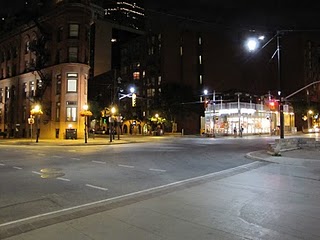 2:12 AM: On the way back to my lodgings, I pass by the French delegation’s bus. The hotel workers had been on strike for the previous few days. The hotel is owned by a French company, so the workers decided to go on strike while the French delegation was there.
2:14 AM: The Esplanade is conspicuously devoid of returning bar goers.
 June 26th
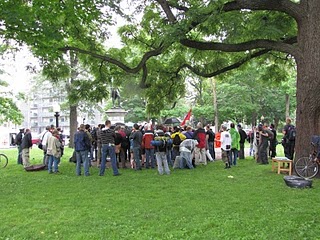
10:39 AM: I arrive a few minutes after a scheduled keynote speaker at Allen Gardens that I heard about on Twitter. The tent town built by protesters has already been broken up, and its occupants have dispersed. The speaker goes on anyways, with a small crowd.
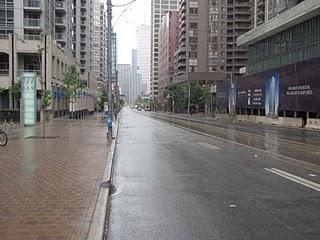 10:56 AM: I head to Bay Street, the heart of Canada’s financial district. I figure if there are pre-rally disruptions, they would be here.
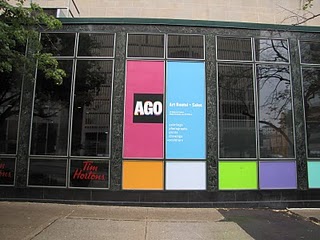 11:11 AM: The Art Gallery of Ontario was one of the many high profile venues that closed for the conference. (Many shows, including the high profile musical, Rock of Ages, were canceled. The Blue Jays were also forced to move three home games to Philadelphia).
11:29 AM: Arrival at the Security barrier. A few officers hanging around, but surprisingly quiet. The police decided to use tightly meshed chain link fences to make climbing the barriers extremely difficult.
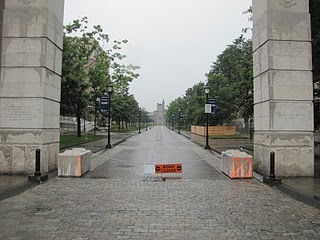 11:55 AM: The University of Toronto, which was also closed for the conference.
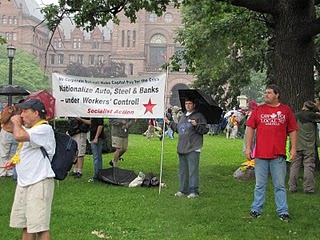 12:10 PM: Queen’s Park begins to fill up with all of the usual suspects. Union activists, environmentalists, and anti-war protesters seem to be the bulk of the crowd.
12:34 PM: When I see Greepeace approaching, I know it won’t be quiet much longer… and then I see people in their midst who appear to be Black Bloc anarchists, notorious for their role in the Seattle WTO protests of 1999, where they caused major property destruction.
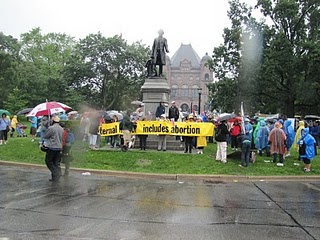 12:43 PM: Things get pretty busy at Queen’s Park. Despite the rain, the crowd is estimated to be 5000.
12:48 PM: A crowd protesting the Ethiopian genocide fills the streets of Queen’s Park. I tell my photographer not to worry about them; that they have nothing to gain from being violent. Spoiler: I am right.
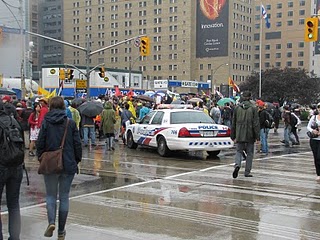 1:41 PM: The demonstrators have now officially shut down University Avenue. The Queen’s Park subway station, and some other stops, are also closed. Frustrated motorists and streetcar passengers are stuck.
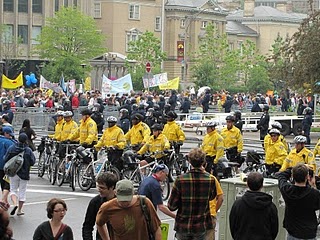 2:26 PM: Rather than contain the crowds (which would lead to immediate confrontation), the police form a human funnel to shunt the protesters west on Queen Street.
2:55 PM: As I reach University, the police are once again blockading. Riot police one street south are putting on gas masks. There appear to be police officers fighting with protesters. Police tell us to head north immediately or risk becoming collateral damage. Rioters breaking every window in sight.
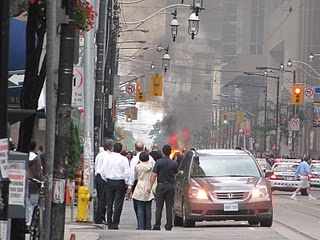 3:48 PM: Smoke is coming from a burning car in the middle of the road. We later find out it was a police car set on fire by protesters with Molotov cocktails (one of at least 3).
11:46 PM: Stop for a quick drink at Duggan’s, a local microbrewery. Downtown is once again eerily quiet. Some business owners had the foresight to board up in anticipation of the riots.
11:52 PM: We are greeted by hundreds of riot police outside of our lodgings and escorted across the street. There doesn’t appear to be anything amiss. From the roof, we are able to discover what the police are up to: resting.
June 27th
2:09 PM: Both the Bank of Montréal and The CIBC across the street from it are smashed in. It is surprising how quickly the vandalized establishments were boarded up. No remaining shattered glass visible from the road.
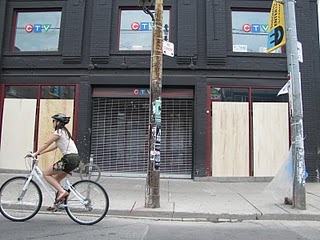 2:11 PM: The Gap is one of the predictable targets for protesters, but dozens of less prominent shops are also vandalized. Starbucks, of course, the absolute favorite target of anti-corporate vandals; also the CTV news building, as well as several media vehicles.
2:15 PM: As I continue along Queen Street, I hear a loud rumble. Yet another protest march coming. I quickly pull a U-turn, and exit the city.
There are plenty of lessons that one might learn from this experience. This was my second G20; my first was last year’s meeting in Pittsburgh. The lesson that I want to impart is simple: Major political meetings should never be held in large cities. They are a magnet for violent protesters, and endanger local residents. The destruction, along with the billion dollar security tab, will hopefully make politicians think twice about foisting these events upon major cities. As I said before the meeting, it should have stayed in Huntsville, a small tourist town outside of the city, where it was initially supposed to take place.
Photos by Andrew Lafleur.
Steve Lafleur is a public policy analyst and political consultant based out of Calgary, Alberta. For more detail, see his blog.