Author: Steven Polzin

  • First Mile-Last Mile, Intermodialism, and Making Public Transit More Attractive

    In the ever-trendy world of transportation planning people seem to be infatuated with discussions of first mile-last mile public transportation connections and intermodalism. Given all the attention, one would think that the traveling public is anxiously awaiting their next opportunity to transfer vehicles to complete their trip. Nothing can be further from the truth. People don’t aspire to transfer; they don’t aspire to experience an intermodal terminal. They almost always want to get door to door in the fastest, simplest, and most reliable fashion. Transferring between vehicles is a necessary inconvenience, not a virtue.

    The concept of using multiple means of travel to complete a given trip is an outgrowth of the reality that different services and technologies offer the optimal means of travel for different contexts, which can result in trips that require transfers for the overall optimal means of travel. The most obvious example is traveling from, say Chicago to New York. Air travel is the time and cost superior means of carrying out the line-haul component of the trip. U.S. airlines, for example, routinely extract less than $.20 per passenger mile from travelers to transport them between airports while also saving them time and perhaps lodging and meal expenses. But jet aircraft will not pick you up at the door or delivered you to the entrance to your destination. Thus, transferring between modes at airports is a necessary and logical interface between air and surface modes. The opportunity to take advantage of the premium performance of air travel more than offsets the onerousness of navigating through airports and transferring between access and egress modes.

    On other kinds of trips, the onerousness of transferring might not be as easily offset by the travel benefits of the line-haul or primary mode of travel. For many shorter urban trips, it becomes very challenging for the onerousness of a transfer to be offset by the benefits of using a combination of modes or vehicles to complete a trip. Travel modeling has long recognized the onerousness of transferring, thus quantitatively penalizing the need to transfer by calculating time spent transferring as two or more times more onerous than in-vehicle travel time. From a practical perspective, transferring introduces uncertainty into a trip. Your arrival at the transfer point is captive to the system schedules and you cannot necessarily minimize the transfer wait. The second vehicle introduces an additional chance to be impacted by unreliable service. For first-time trips, you need to figure out both the location of the destination and how to get to it. You may lose your seat or place and interrupt whatever you are doing during your travel. You might be exposed to weather or other risks, and you can’t use the time as productively as you might have had a transfer not been required.

    If you do have to transfer, you want it to be as quick and convenient as possible. While basic amenities such as restrooms and convenience retail might be appreciated, the local traveler is most often interested in getting quickly to their destination and not turning the transfer experience into a retail opportunity or recreational outing. For longer distance intercity trips where the traveler may be captive to more lengthy waits between travel segments, additional retail and personal service accommodations might be appreciated to the extent that they don’t disadvantage other passengers by excessively increasing walk distances or causing other delays.

    The vehicle travel to and from the transfer location should deviate from the optimal origin-destination travel path as little as possible. If one does have to suffer a transfer, they would much preferred that the point of transfer not dramatically impact the circuity of their travel.

    The growing motivation for providing first mile-last mile connections derives from the logical desire to increase the accessibility to public transportation for more homes and destinations. A multitude of efforts in recent years have been carried out to quantify accessibility of residents and activities to public transit. Early work carried out by CUTR indicated that about half the homes in the America were within a half a mile of a transit route. A slightly higher share of employment locations were similarly within a half a mile of transit. More recently, sophisticated software tools have been developed to evaluate accessibility via transit, such as initiatives by the Brookings Institute and the University of Minnesota Accessibility Observatory, as well as tools such as Transit Score. The collective message of these analyses indicate that, in general, access to transit both geographically and temporally is, on average, limited. Hence, folks are interested in improving first mile-last mile connections with the hopes of making transit more attractive and productive.

    Historically, line-haul premium transit services provided feeder bus, park-and-ride, and kiss and ride (drop off) opportunities so that travelers could access these premium modes, most typically for longer-distance commute travel. More recently, additional means of access, including bikeshare, carshare, and transportation network company (TNC) connections (i.e., Uber, Lyft, etc.), are being deployed. Automated shuttles are being evaluated as yet another means of enhancing the appeal of line-haul premium travel modes. These concepts make sense in contexts where the line-haul mode is sufficiently attractive by virtue of its speed or cost advantages that the traveler is willing to incur the inconvenience, time cost, trip circuity, or other potential negative characteristics of incurring one or more transfers to complete a trip.

    Better first mile-last mile connections work where they work. But where is that and what planning and service investments makes sense to enhance first mile-last mile connections? Individuals who use intermodal connections do it either because there is no viable alternative or because the disutility of transferring is more than made up for by being able to take advantage of the line-haul mode of travel. This is most possible in situations where the line-haul mode is superior to other travel options, typically meaning it is faster by virtue of fewer stops, exclusive guideway, signal priority, utilization of a higher performance travel path (freeway versus arterial), and that the transfer penalty is minimized most typically by having high-frequency service on the line-haul. Faster travel speed is typically only virtuous in instances where the distance of the trip is sufficient to accumulate enough marginal travel time advantage to offset the transfer induced delays. Thus, enhancing first mile-last mile connections has the greatest leverage for longer distance trips and premium services.

    Over 60% of person trips according to the last National Household Travel Survey, are less than 5 miles in length, over 75% less than 10 miles in length. Many of the shorter trips are unlikely to be appealing as trips requiring first mile-last mile connections to travelers who have choices. Absent extremely high quality first mile-last mile connections, the circuity and delays likely to be introduced by a first mile-last mile connection(s), as opposed to a direct door-to-door single vehicle trip, are unlikely to make this arrangement attractive for travelers with choices. Such services could incentivize more trips or increase convenience by shortening walk access for travelers without personal vehicle options.

    So what does this have to do with anything? Numerous communities are striving to leverage their transit investments and increase mobility for their populations by exploring additional first mile-last mile connections. Though well intentioned, first mile-last mile programs will be most successful if fully informed by an understanding of traveler behavior in general and market conditions in particular. Context has implications in terms of the magnitude of ridership response as a result of improved connections based on the geography of deployment and the trip pattern emanating to and from that geography. First mile-last mile connections are most likely to attract new travelers if they offer high-quality connections, support high performance modes, and serve sufficiently long trips such that the circuity and transfer disutility can be amortized over a longer line-haul premium service segments.

    In addition, equity considerations may become an issue. Additional investments in first mile-last mile connections will have to be evaluated in the context of alternative investments in service and facility improvements. Additionally, attention needs to be paid to the question of who will benefit, both geographically and demographically, from various first mile-last mile connections. How much should be spent to coax travelers with personal or private sector mobility options to use public transportation, or should resources be directed to basic service improvements for those dependent on transit?

    Experimentation and a learning curve are to be expected as new technologies, business models, and deployment strategies are deployed and experience accumulates. But it will be important to glean a well-informed sense of the public and user costs, travel impacts, and environmental, safety, and other impacts. The role of new technologies and service models in enhancing connections to public transportation is important, but like everything about public transit, it’s not so easy to make it work.

    This piece first appeared on Planetizen.

    Dr. Polzin is the director of mobility policy research at the Center for Urban Transportation Research at the University of South Florida and is responsible for coordinating the Center’s involvement in the University’s educational program. Dr. Polzin carries out research in mobility analysis, public transportation, travel behavior, planning process development, and transportation decision-making. Dr. Polzin is on the editorial board of the Journal of Public Transportation and serves on several Transportation Research Board and APTA Committees. He recently completed several years of service on the board of directors of the Hillsborough Area Regional Transit Authority (Tampa, Florida) and on the Hillsborough County Metropolitan Planning Organization board of directors. Dr. Polzin worked for transit agencies in Chicago (RTA), Cleveland (GCRTA), and Dallas (DART) before joining the University of South Florida in 1988. Dr. Polzin is a Civil Engineering with a BSCE from the University of Wisconsin-Madison, and master’s and Ph.D. degrees from Northwestern University.

    Photo by Jeremy Brooks, via Flickr, using CC License.

  • Déjà Vu and the Dilemma for Planners

    Some planners may be feeling a little angst. A few months ago, the Federal Highway Administration released 2016 vehicle miles of travel data, indicating robust travel demand growth in 2016, up 2.8%. The increase pushed total vehicle miles of travel (VMT) to a new record and boosted travel per capita to levels not seen since mid-2008. That disappointment was compounded by the recent release of 2016 transit ridership data, indicating a decline of 2.3% in 2016, which compounds last year’s 1.3% decline. The disheartening news continued with the recent release of Census data indicating growth trends that had many highly urbanized counties loosing population while growth flourished in predominately suburban style counties. The top ten shrinking counties had a transit commute mode share over twice as high as the top ten growing counties. Piling on, other data indicates that millennials are morphing toward more traditional characteristics as “Millennials are starting to find jobs and relocating to the suburbs and smaller cities,” according to a recent Bloomberg article. “Everything we thought about millennials not buying cars was wrong,” says the title of a Business Insider news story.

    Meanwhile, in spite of an improving economy and the millennial generation aging, 31% of all 18- to 34-year-olds remain living in their parents’ home in 2016 – 46.9% in New Jersey—a large group that has not yet necessarily expressed their unconstrained preferences with respect to living location and mobility choices.

    Meanwhile, the expectations regarding automated (driverless) vehicles, most probably coupled with shared vehicle ownership and the adoption of electric vehicles, have ramped up. The trickle of public attention is now a firehose of media and policy interest as the public begins to grasp the speculated transformative implications.

    The planner is left in a dilemma. How in the world do we do long-range planning if we have so badly missed the mark about the future of mobility and housing choice?

    Future plans are influenced by four characteristics of interest: planners’ aspirations, revealed phenomenon and behaviors, stated preferences of stakeholders and the engaged public, and innovation and change. Each is discussed briefly below.

    Planners’ Aspirations

    Like in any profession, planners carry their own values and life experiences to work in the morning. These experiences and values influence their work. Historically the implications of varying politics was of subtle and nuanced relevance when there was a strong consensus on the critical role of providing transportation capacity, travel safety and cost effectiveness. However, in an era when everything is political, including transportation planning, different values have more significant implications going forward. As noted in a series of essays on planning theory nearly 40 years ago, the political nature of planning is no secret.

    “One of the planning profession’s most cherished myths – [is] that the planner is an apolitical professional, promoting goals that are widely accepted through the use of professional standards that are objectively correct.” (Burchell and Sternlieb, 1978)

    The recent past has seen the myth of an unbiased media exposed with explicit enumeration of political party registration, voting preferences, political contribution tallies, and measures of coverage bias. Such revelations show a media well out of sync with the public they serve. A consequence has been the polarization of media and audiences, which reinforces the value differences. Is the planning profession at risk of being similarly unmasked, and could political biases be impacting plans and their prospects for implementation? Can decision makers place full confidence in the objectivity of analyses and plans that are provided by planners? With the acknowledgement of the political nature of planning, should more senior planners be political appointees, or are other steps necessary to neutralize or expose planner biases?

    I have always enjoyed the Albert Einstein quote, “The right to search for truth implies also a duty; one must not conceal any part of what one has recognized to be true,” as it alludes to the sin of omission and the subtleties of objectivity. In our ever more politicized world, the politics of planning and planners is more relevant, yet it receives little attention.

    Revealed Phenomenon and Behaviors

    The foundation of planning practice is captured information about the behaviors of individuals and phenomenon and the use of that knowledge to predict how various policies and investments will perform in scenarios of future conditions. Examples include understanding the noise impacts of infrastructure as facilities are built, the emissions of vehicles in operation, and the travel of individuals when faced with various choices. Planners gain knowledge by observing history, discerning relationships, and extrapolating those relationships to reflect current and proposed future conditions—a process that often includes building and calibrating various models. Part of the current challenge of planning is understanding how valid historic relationships are for application to the future. People had, for example, observed changes in travel behavior and location decisions associated with millennials and extrapolated those to various conclusions regarding future transportation needs. Yet, a growing body of evidence suggests that the magnitude of those changes is not what had been expected, or perhaps hoped for. Many aspects of behavior are not fully understood and changes in demographics, economics, and technology are impacting behaviors in ways that are not reliably predicted based on current levels of knowledge. Our data and models are not always keeping up with changes. Thus, caution should be used in presuming significant variance from historic norms in fundamental travel and location behaviors, as the reversion toward historic trends in travel demand and development trends reveal.

    Stated Preferences

    “If I had asked people what they wanted, they would’ve said faster horses.”

    This quote, attributed to Henry Ford, is often used to characterize the fact that people’s aspirations for the future are often constrained by the range of experiences to which they been exposed. While historians debate if this quote originated with Henry Ford, it has stirred discussion about the extent to which people’s current aspirations should be a basis for guiding future actions.

    The good intentions of planners have resulted in outreach and public participation initiatives to support planning efforts. Virtually ubiquitous communications have enabled broad dissemination of sophisticated information. The solicitation of input from the public offers many benefits: creating a sense of ownership of plans, bringing information and ideas to the table that have not previously been articulated, and cueing planners and decision makers to critical issues that may need to be addressed before approvals and successful implementation can occur. But public expressions about future desires or behaviors may not be a sound basis for action.

    Stated preferences often run counter to revealed preferences. Everybody knows a doting parent who years earlier had sworn off having kids or has witnessed the bitter divorce of a couple not long after having seen them vow lifelong commitments. The stated expectations for how people will act in the future often run counter to strong evidence of how people actually behave. The literature is replete with examples of stated preferences varying substantially from actual choices, yet we have little guidance for how to “calibrate” expressions of stated preferences against revealed behaviors such that our plans will more closely address actual future needs.

    Innovation and Change

    The final factor influencing future plans is the impact of innovation and change. As we are beginning to grasp the potentially transformative impacts of technology, it has flummoxed our ability to plan for the future. Many marvel at the transformative impact of smartphones over a single decade, pointing out how everything from retail to media to business to social interactions has been profoundly impacted. Many are anticipating that self-driving vehicles will inevitably have a similar transformative impact on transportation and land-use. Massive financial and intellectual resources are being directed at transportation, and significant change is inevitable. The costs and impacts of transportation merit this attention. Unfortunately, the long lead times, high costs, and constrained flexibility of many traditional transportation investments make them particularly susceptible to risk if driverless, shared, and electric vehicles become dominant.

    So What

    So in summary, planners’ biases might be more relevant than in the past, our foundational knowledge of behaviors and relationships is getting shaky as the world changes in multiple dimensions, we often don’t know how to interpret the public’s aspirations, and the pace of technological change might be undermining our historically infrastructure-intensive strategy for dealing with transportation. So planners have some big challenges and important issues to address to insure scarce resources serve the public well. Responding to that challenge is a noble calling, to be sure. On the other hand, if you are overwhelmed with the challenges planners face, both Uber and Lyft are looking for drivers. Bridj—not so much.

    This piece first appeared on Planetizen.

    Dr. Polzin is the director of mobility policy research at the Center for Urban Transportation Research at the University of South Florida and is responsible for coordinating the Center’s involvement in the University’s educational program. Dr. Polzin carries out research in mobility analysis, public transportation, travel behavior, planning process development, and transportation decision-making. Dr. Polzin is on the editorial board of the Journal of Public Transportation and serves on several Transportation Research Board and APTA Committees. He recently completed several years of service on the board of directors of the Hillsborough Area Regional Transit Authority (Tampa, Florida) and on the Hillsborough County Metropolitan Planning Organization board of directors. Dr. Polzin worked for transit agencies in Chicago (RTA), Cleveland (GCRTA), and Dallas (DART) before joining the University of South Florida in 1988. Dr. Polzin is a Civil Engineering with a BSCE from the University of Wisconsin-Madison, and master’s and Ph.D. degrees from Northwestern University.

    Top photo: Daryl Hutchison, darylhutchison.com

    .

  • So Much for Peak Driving (VMT)

    So much for peak VMT. The planners and analysts who watched vehicle miles traveled (VMT) trends seemingly peak are no doubt anxious as the preliminary 2015 VMT numbers produced by the U.S. Department of Transportation showed new record total VMT well ahead of the 2007 number that many had hoped signaled peak U.S. VMT. Perhaps even more disconcerting was the sharp increase in per capita VMT, up approximately 2.6 percent for 2015. While not surpassing the prior peak per capita travel levels of the past decade of over 10,000 miles per year per person, per capita VMT nonetheless showed substantial growth during a time when the economy was far from robust. Figure 1 shows the upward sloping total and per capita VMT trends.

    While individuals, perhaps someone who bought one of those 17.34 million autos sold in the U.S. 2015 (also a new record) and had a reliable vehicle to travel cross country to visit grandma, celebrate the sub $2.00 gas and the chance to travel more, others, anxious about the congestion, energy use, or emissions of more travel, may be rethinking premature obituaries for auto travel.

    Source: Federal Reserve Bank of St. Louis

    After exhaustive speculation, one can compile a list of causal factors for the upward spike:

    • The millennial who bought many of those new cars and the used ones they replaced must be accumulating mileage as they hunt for affordable homes in the suburbs.
    • That army of Uber drivers must be racking up the miles as their predatory rates attract bike, walk, transit, and taxi travelers to the car—say nothing of the deadhead miles between rides.
    • Amazon Prime shoppers with their quick delivery preferences are filling the roads with delivery vehicles.
    • The flood of illegal immigrants undocumented aliens, many of whom get driver licenses, must be the cause.
    • Google and the myriad of driverless vehicle developers must be tripping traffic counters as they test driverless vehicles.

    Or maybe not. While current data on individual travel behavior changes is not available, even the aggregate data can shed some light on the trends. The change in VMT in rural areas increased 3.86 percent versus 3.37 percent for urban roads suggesting long distance and freight travel growth. Urban travel constitutes 69 percent of total VMT. Truck VMT data will be available later and data on VMT for commercial vehicles, public vehicles, and utility vehicles can only be guesstimated. Freight and these uses of non-household vehicles collectively constitute 24 percent of all roadway travel, hence deserve attention when interpreting trends.

    The reduction in fuel price is reasonably hypothesized as a contributor to VMT growth. Historically travel elasticity to fuel cost has been estimated to be around -0.02 to -0.04 in the short term and considerably larger in the long term. The pronounced decline in fuel prices, with average 2015 prices 30 percent below the 2013 average and with current prices 47 percent below the 2013 average price, could explain part of the VMT increase. 

    Another way to think about the impact of lower fuel prices is to consider that the average household has an estimated $1000-$1500 more in discretionary income annually as a result of the lower gas prices relative to 2013. Data from the National Household Travel Survey show travel goes up approximately 100 miles per capita annually per $1000 in household income for low and moderate income households (see Figure 2). Coupled with 2.5 million additional persons in the workforce and some wage growth, the VMT growth is understandable. 

    Perhaps most important will be understanding how VMT will trend going forward. Many of the considerations that contributed to the slowdown in VMT growth in the early part of this century are still relevant as argued in The Case for Moderate Growth in Vehicle Miles of Travel: A Critical Juncture in U.S. Travel Behavior Trends, Center for Urban Transportation Research, University of South Florida, April 2006). The role of technology in moderating travel demand is still at work with e-commerce, distance learning, telecommuting, and improved travel logistics dampening demand. And those urban millennials may be contributing to moderated demand even if not to the extent hyped by advocates of declining VMT. But the desire to travel to pursue personal opportunity and pleasure remains potent. For a large share of the population, total travel demand is governed by resource constraints, both time and money, not a diminished desire to participate in activities – many that require travel. While few desire to commute farther and may not relish accumulating VMT for routine errands, the always present and growing interest in accumulating life experiences rather than possessions may create more VMT for personal experiences and longer distance social and recreational travel counteracting the savings from greater urbanization, communications substitution for travel, or taking advantage of alternatives to personal vehicles for daily household serving travel. 

    In any case the verdict is still out. It will be interesting to watch as trends in the economy, demographics, technology, culture, values, and maybe even urban and transportation planning and investments influence future vehicle travel demand.

    The opinions are those of the author—or maybe not—but are intended to provoke reflection and do not reflect the policy positions of any associated entities or clients.

    This piece first appeared at Planetizen.

    Dr. Polzin is the director of mobility policy research at the Center for Urban Transportation Research at the University of South Florida and is responsible for coordinating the Center’s involvement in the University’s educational program. Dr. Polzin carries out research in mobility analysis, public transportation, travel behavior, planning process development, and transportation decision-making. Dr. Polzin is on the editorial board of the Journal of Public Transportation and serves on several Transportation Research Board and APTA Committees. The opinions are those of the author—or maybe not—but are intended to provoke reflection and do not reflect the policy positions of any associated entities or clients.

  • Public Transportation Ridership: Three Steps Forward, Two Steps Back?

    The Bureau of Transportation Statistics recently released preliminary data summarizing public transportation ridership in the United States for the calendar year 2015. The preliminary data from the National Transit Data program showed transit ridership in 2015 of 10.4 billion annual riders approximately 2.5% below the 2014 count and also smaller than the 2013 count. The American Public Transit Association using a slightly different methodology released data showing 10.6 billion annual riders versus 10.7 billion in calendar year 2014, a 1.26% year-over-year decline. Such differences between sources are common, resulting from differences in methodology and definitions, and unsurprising, given that data is preliminary and national data is dependent upon reporting from hundreds of different agencies. 

    It is important to recognize that it’s extraordinarily difficult to consistently grow transit ridership. We have had growing population, a rebounding economy, growing total employment, and an aggressively argued hypothesis that the millennial generation is meaningfully different than their forefathers—with urban centric aspirations and indifference toward auto ownership and use. Yet, transit ridership has remained stubbornly modest. 

    Indicator

    2015 versus 2014

    Source

    U.S. Population

    +0.8%

    Census

    Total Employment

    +1.7%

    BLS

    Real GDP

    +2.4%

    BEA (third estimate)

    Gas Price

    -28%

    EIA

    VMT

    +3.5%

    FHWA

    Public Transit Ridership

    -1.3% to -2.5%

    APTA and NTD

    Amtrak Ridership (FY)

    -0.1%

    Amtrak

    Airline Passengers

    +5.0%

    USDOT, BTS

    The rebound in national vehicle miles traveled totals in 2015 (+3.5%) grabbed attention, as many had anticipated continued moderation. Couple that with modest declines in transit and Amtrak use and strong airline traffic growth, and one could argue the new normal for travel trends is looking more like the old normal. 

    When I entered full-time employment with a transit agency in 1980, industry leaders were touting the growth opportunities for public transit in light of the energy shortages in the late ’70s. Throughout the intervening time, there have been myriad seemingly logical events that led to expectations of strong transit growth. Growing congestion, a growing appreciation of the role of transportation in influencing land-use, growing federal support, increasing gasoline prices, expansion of rail systems, sensitivity to the safety benefits of transit travel, potential economic benefits for passengers who reduce auto ownership and use costs, air quality concerns and, subsequently, climate impact concerns, and, more have collectively created almost perpetual expectations of a more promising future for public transportation. Indeed, transit ridership has grown some since its low point in the early ’70s and subsequent dip in the mid-’90s, but the often-expected, sustained, or robust growth has never materialized. 

    More recently, demographic conditions, such as growing urbanization, declining driver’s-license-holding and auto-ownership rates for young people, and evidence that the love affair with the automobile has waned, have renewed expectations. Sprinkle in technology enhancements that enable real-time information, robust trip planning, automated and more convenient fare collection, and integrated first-mile last-mile opportunities; add a dash of heightened concerns about climate change; and there remains a credible argument that transit has a bright future. 

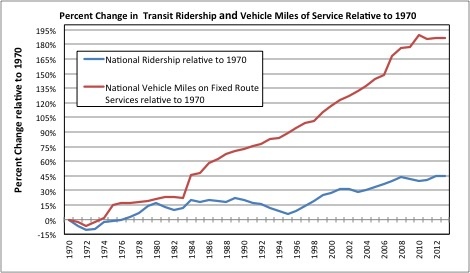
    An often-cited constraint on the growth of public transit has been the assertion of resource constraints for providing the quality of service that would be attractive to more travelers who have other options. While transit supply remains well below the aspirational levels of many transit users and transit advocates, the data in the graph below indicates that supply has grown far more rapidly than demand for the past several decades. This is a report card on productivity that mom and dad would hardly be proud of. And a larger share of the ridership has moved to more capital intensive (and larger vehicle capacity) rail systems.


    Source: 2015 APTA Public Transportation Fact Book, Appendix A, Historical Tables 2 and 8.

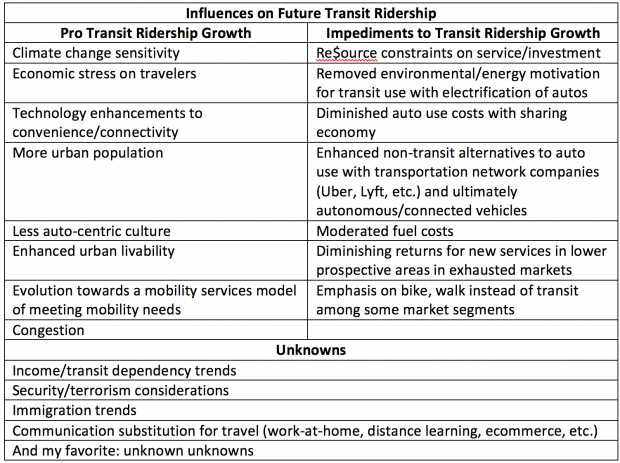
    Gas prices have certainly been a factor in recent trends, but they can’t explain the fact that growing transit ridership seems as tough as getting bipartisan harmony in the nation’s legislative bodies. Some cities are moving headlong into a more transit intensive future with aspirations of big ridership growth, like Seattle, where aggressive, multi-decade plans with big local funding commitment requests promise more transit supply. Other areas like Washington, D.C. are digesting the reality that more resources are required to sustain existing services, maintain infrastructure and meet underfunded pension obligations. The factors supporting or opposing ridership growth are numerous, with uncertainties dominating the lists. 


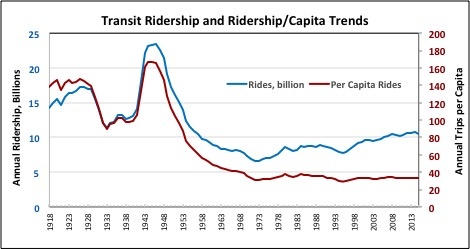
    I generally like to have a theoretically robust basis for speculating on the future, but in light of the complexity of factors involved and the uncertainty in their trends, transit ridership forecasts are speculative. The per capita transit ridership trend in the graph below (red line) is a pretty straight horizontal line since about 1970 and just might be pointing to the future. History tells us to be careful in presuming we understand causal factors governing complex behaviors; if anything the degree of uncertainty is greater than ever. 

    Transit remains very important to each trip maker but how many trips are made in the future remains a guess, one that should be informed by a keen understanding of travel behavior and history and not just aspirations.


    Source: APTA Public Transportation Fact Book, various years, Census.

    This piece first appeared at Planetizen.

    Dr. Polzin is the director of mobility policy research at the Center for Urban Transportation Research at the University of South Florida and is responsible for coordinating the Center’s involvement in the University’s educational program. Dr. Polzin carries out research in mobility analysis, public transportation, travel behavior, planning process development, and transportation decision-making. Dr. Polzin is on the editorial board of the Journal of Public Transportation and serves on several Transportation Research Board and APTA Committees. The opinions are those of the author—or maybe not—but are intended to provoke reflection and do not reflect the policy positions of any associated entities or clients.