Author: Susanne Trimbath

  • McClatchy-Medill: Real $timulating News

    I saw this story in the Omaha World Herald last week: Benefits of stimulus bill spread unevenly over U.S. As I read through it, I became increasingly impressed. The journalists start off by laying out who said what about the benefits of stimulus spending. They provide quotes and facts from the White House, the Congressional Budget Office, and Joe Biden’s spokesperson. They include viewpoints and analysis from professors at Berkeley, Harvard, George Mason and the editor of the Journal of Economic Perspectives. They even talked it over with the National Association of State Auditors, Comptrollers and Treasurers – the people in charge of receiving and accounting for the billions of dollars represented by the American Recovery and Reinvestment Act. What impressed me most, though, was that they did their own research – not just reporting what the Administration or Congress told them was happening or was supposed to be happening.

    Spending the Stimulus” is a website put together by McClatchy Newspapers and the Medill News Service to track what was promised and what was done, how much was actually spent and where and on what the stimulus billions were spent. I was intrigued by their finding that “much of the stimulus money has yet to go out the door” eighteen months after the emergency, gotta-fix-it-now legislation was passed. After Congress approved $750 billion for the Wall Street Bailout in October 2008, I’m pretty sure all that money was out the door before December!

    Even more intriguing is the finding that the money was spread around rather unevenly. Beyond the infantile “Why Did North Dakota got More Than Me?” rhetoric going around among the states (by the way, the McClatchy-Medill per-capita graphic shows that most of New England got more than North Dakota), is the more interesting discussion of where would the spending be most stimulating. Transportation money was directed to the states under the “usual formula” despite the fact that the Great Recession didn’t follow a formula as it spread throughout the economy. The result: “researchers were unable to find any relationship between unemployment in a given area and the amount of stimulus dollars spent there.” If unemployment is lower in some areas than in others, it wasn’t because of the stimulus spending.

    Maybe this is a good thing. Instead of focusing on the political necessity of justifying billions of dollars to pull the country out of the Great Recession (unlike the complete lack of justification for bailing out Wall Street), the McClatchy-Medill report raises more interesting points. Is it “rewarding failure” to send more money to the states that most failed to develop diversified economies that are resilient to downturns? Would we be throwing good money after bad to provide more spending for states that didn’t manage the cash inflow from the rapid rise in property taxes that came with rapidly rising home prices? Finally, did we really want a central government to make every decision – county by county – about where and on what the money would be spent?

    If you missed this story last week, I highly recommend perusing the “Spending the Stimulus” website for more stimulating idea.

  • G-20 Summit: There is No One Size Fits All

    There is one thing you need to remember as you listen to the debate about economic and fiscal policy at the G-20 Summit this weekend in Toronto: There is No One-Size-Fits All. There is not even a “One-Size-Fits Twenty.”

    Back in 2001, I summarized the few things about finance and economics that most scholars agree will support a growing economy and healthy capital markets:

    “Four strategies can be shown to generally promote stable national financial systems: 1) having independent rating agencies; 2) having some safety net; 3) minimizing government ownership and control of national financial assets; and 4) allowing capital market participants to offer a wide-range of services.”

    As of today:

    1) Our rating agencies are independent of government, but not from the financial institutions who buy the ratings (who also buy the government, but I’ll leave that story to Matt Taibbi over at Rolling Stone …); 2) we bankrupted the Federal Deposit Insurance Corporation in late 2009, before the end of the recession (and that doesn’t even count all the bailouts of Wall Street and Main Street); and 3) the government took ownership positions in all US major financial institutions during the bailout.

    I’ll come back to #4 to another time – Congress has vowed to ruin even that one before the 4th of July recess by passing the Wall Street Reform Act.

    The United States delegation to the G20 Summit consists of President Obama, his economic advisor Larry Summers and (your friend and mine) Treasury Secretary Tim Geithner. At least one of them should know better than to go around insisting that every nation at the meeting should have the same policy as the United States: damn the torpedoes, full speed ahead! In other words, just as Federal Reserve Chairman Ben Bernanke is firing up the helicopters, keep dropping dollar bills on the economy until something starts growing. In a letter sent to the G-20 leaders in advance of the Summit in Toronto, they made it clear that the rest of the G-20 countries should do the same. While President Obama writes in the letter that the G-20 should “commit to restore sustainable public finances in the medium term” the underlying context is that there should be more fiscal stimulus in the short term.

    I’m not the only economist to have said this before: When it comes to developing robust capital markets and a vibrant economy, there is no “one size fits all”. This lesson should be familiar to the US delegation. To make it clear, let’s look at the numbers.


    2000

    2001

    2002

    2007

    2008

    2009

    Consumer Inflation Rate

    Canada

    2.7%

    2.5%

    2.3%

    2.1%

    2.4%

    0.2%

    France

    1.7%

    1.7%

    1.9%

    1.5%

    2.8%

    0.4%

    Germany

    1.5%

    2.0%

    1.4%

    2.3%

    2.6%

    0.0%

    United Kingdom

    2.9%

    1.8%

    1.6%

    4.3%

    4.0%

    2.2%

    United States

    3.4%

    2.8%

    1.6%

    2.9%

    3.8%

    -0.4%


    Economic Growth Rate

    Canada

    5.2%

    1.8%

    2.9%

    2.7%

    0.4%

    -2.5%

    France

    3.9%

    1.9%

    1.0%

    2.3%

    0.4%

    -2.2%

    Germany

    3.2%

    1.2%

    0.0%

    2.5%

    1.3%

    -5.0%

    United Kingdom

    3.9%

    2.5%

    2.1%

    3.0%

    0.7%

    -4.8%

    United States

    3.7%

    0.8%

    1.6%

    2.0%

    0.4%

    -2.4%

    The numbers in question are 2007 through 2009, those associated with the current recession. I include 2000-2002 in the table to show what happened in the last recession, for a little perspective. The players in question are US, UK, France and Germany – I include Canada as a courtesy because they are the host country for the summit,. The first thing you’ll notice is that the US is the only one among the group that did not see positive prices increases last year – hence, their continued willingness to employ the cash-dropping helicopters.

    French Finance Minister Christine Lagarde is outspoken this week on the subject of getting the federal budget under control in France instead of expanding economic stimulus programs: she believes what’s best for France is to get the deficits under control, which means reducing the budget and not more spending. On this one, I’m with Minister Lagarde: Vive La Différence!

    There’s one more thing you need to know about economic growth and that is this: It takes more than a 2.4% increase to make up for a 2.4% decrease. Think of this way: if you start at 1,000 and reduce by 50%, you are left with 500. Now, at 500 if you get a 50% increase, you are only back to 750. To get from 500 back to 1,000, you need a 100% increase. As I wrote back in January: “At this rate, it will take 11 quarters (nearly 3 years) to catch up.” More government spending, however, will not provide a healthy long-term solution.

    Susanne Trimbath, Ph.D. is CEO and Chief Economist of STP Advisory Services. She will be participating in an Infrastructure Index Project Workshop Series throughout 2010. Her training in finance and economics began with editing briefing documents for the Economic Research Department of the Federal Reserve Bank of San Francisco. She worked in operations at depository trust and clearing corporations in San Francisco and New York, including Depository Trust Company, a subsidiary of DTCC; formerly, she was a Senior Research Economist studying capital markets at the Milken Institute. Her PhD in economics is from New York University. In addition to teaching economics and finance at New York University and University of Southern California (Marshall School of Business), Trimbath is co-author of Beyond Junk Bonds: Expanding High Yield Markets.

    Photo by carlossg

  • It’s the Jobs, Stupid: Infrastructure Matters

    It may surprise you to know that some policy makers and academics believe that “nothing matters” when it comes to infrastructure — the physical structures that make water, energy, broadband and transportation work — and economic prosperity. The thrust of the idea that infrastructure doesn’t matter may have started with Larry Summers, appointed by President Obama as Director of the National Economic Council in 2009. The New York Times says he is “the only top economic adviser with a West Wing office” – meaning he is very powerful in Washington terms.

    His most vocal critic in the matter of infrastructure is Representative Peter DeFazio (D-Oregon). DeFazio appeared on MSNBC’s Rachel Maddow, criticizing Summers, saying that Obama is “ill-advised by Larry Summers” in regards to using stimulus money to cut taxes for businesses. “Larry Summers hates infrastructure,” says DeFazio, who argues that more of the stimulus should have gone to infrastructure. Summers backed away from any earlier comments when he told the Financial Times last June that there may also be “a case for carefully designed support for infrastructure investment.”

    The question seems obvious. What good is it to stimulate business if they don’t have the tools they need to work with?

    Summers’s attitude could make it difficult to generate major new investments in things like roads, bridges, and the broadband communication access that businesses – small and large – need to get the job done. Companies choose to locate where infrastructure is better. Businesses will leave areas where infrastructure is missing or deteriorated – taking jobs with them.

    Certainly U.S. firms look for good infrastructure when they consider placing offices overseas, and foreign firms must do the same when they consider locating here. The idea that good infrastructure would enable economic specialization and lower costs – making U.S. businesses more efficient, more competitive, and therefore able to create more U.S. jobs – is clearly reflected in the way that businesses behave. Emerging market countries remain economically competitive, and are constantly building and rebuilding their infrastructure as their economies develop. Can the U.S. remain competitive if our infrastructure doesn’t keep up with them? It is becoming increasingly clear that deteriorating infrastructure in the United States may actually be contributing to increased costs (and decreased efficiency) of American businesses.

    Recently, the U. S. Chamber of Commerce initiated a project under the Let’s Rebuild America initiative to find a way to measure the performance of infrastructure and the role it plays in economic prosperity. Over the next year, a team of experts (of which I am a member) led by Michael Gallis & Associates will create an Infrastructure Index that can be used to explore the contribution infrastructure makes in keeping American businesses competitive in an increasingly global economy.

    What is innovative about the project team’s approach is that it measures the performance of infrastructure, and not just the size. Thirty years ago researchers on this subject limited their measurement of “infrastructure” to “government spending on public projects” to analyze the impact on economic growth and productivity. This approach is flawed for several reasons.

    First, not all money designated for infrastructure is spent the same way. Government inefficiencies and political corruption plus purchasing power in local economies contribute to inconsistency in quantity and quality of infrastructure based on money spent. Measuring infrastructure in terms of spending alone doesn’t cover the impact of growth on infrastructure. In other words, that a growing economy can afford more infrastructure is just as likely a cause of positive statistical results as the possibility that more infrastructure helps the economy grow. Further, where spending is used to measure infrastructure, the studies usually consider only public spending, ignoring the contribution of investments from private companies (e.g., the contribution of private satellites to communications infrastructure).

    Less than half of the statistical studies using expenditure-based infrastructure measures find that developing or maintaining infrastructure has significant positive effects on the economy. In contrast, over three-fourths of the studies using physical indicators – the number of phone lines, the miles of high-quality road — find a significant positive contribution from infrastructure to the economy.

    There is no dispute that economic growth is necessary as long as there is an increasing population, which will be the case over the next four decades in America as well as Canada and Australia. We need to address the question: is it possible for the economy to “hit a wall” because it runs out of usable infrastructure? In other words, the question is not if infrastructure helps the economy but rather can a lack of infrastructure impede the economy? Can the economy outgrow its infrastructure?

    As the economy changes, so will the demands for infrastructure. The four components of infrastructure – transportation, energy, water and broadband – need to be made relevant across decades, even as the role of one industry may change within the economy. For example, while it is obvious that information-workers, such as computer programmers and software developers who increasingly work from remote locations, require access to broadband infrastructure, they also alter the way that transportation infrastructure is used. Some knowledge-based activities relying on spatial agglomeration place greater importance on rail/subway and less importance on roads. Yet, that does not mean that a knowledge-based economy will need fewer roads – someone has to service those computers and that technician will likely travel to its customers on roads.

    We need to move away from the “one-size-fits-all” approach to infrastructure development toward better integration with the economic activity that uses it. Each region needs to assess its own needs and base their investment decisions on conditions that exist within their region.

    Susanne Trimbath, Ph.D. is CEO and Chief Economist of STP Advisory Services. She will be participating in an Infrastructure Index Project Workshop Series throughout 2010. Her training in finance and economics began with editing briefing documents for the Economic Research Department of the Federal Reserve Bank of San Francisco. She worked in operations at depository trust and clearing corporations in San Francisco and New York, including Depository Trust Company, a subsidiary of DTCC; formerly, she was a Senior Research Economist studying capital markets at the Milken Institute. Her PhD in economics is from New York University. In addition to teaching economics and finance at New York University and University of Southern California (Marshall School of Business), Trimbath is co-author of Beyond Junk Bonds: Expanding High Yield Markets.

  • What Jobs?

    According to the Bureau of Labor Statistics, there were 290,000 more jobs in the US this month than there were last month. Twenty percent of those jobs were added by the federal government. While the federal government added 69,000 new jobs last month, every other level of government – including the post office – cut an average of 2,250 jobs. State governments were hardest hit last month, cutting 5,000 jobs.

    Since April 2009, the federal government has added 119,000 jobs while state and local governments cut 215,000 jobs.

    Compared to April 2009, more than 500,000 jobs have been added in employment services. Another 329,000 jobs were added in the healthcare industry. These must be the “green shoots” that we were so looking forward to last summer because the overall economy lost 1,380,000 jobs in the last year.

    Eighty percent of the jobs increase last month was added in the private sector. Of the jobs created in the private sector, only 22 percent were in goods producing industries; about half of the goods producing jobs added in the last month can be attributed to the bailout of the auto industry. In the last 12 months, the U.S. civilian population increased by 2.1 million persons. The labor force has remained about constant at 154.7 million. The difference – explained in the details of today’s jobs report – is attributable to discouraged workers, involuntary part-time workers, and marginally attached workers.

  • Goldman Profited from Crisis – Shocking!

    If someone is just finding out last week that Wall Street is profiting from the crisis it created, then I have only one question for them – “what rock have you been living under for the last two years?”

    I’ve been shining a bright light on this since I first joined NewGeography.com to cover finance. From one of my first articles in November 2008, where I explained the nuances of financial innovations – “Who stands to gain? … Citigroup, Goldman Sachs, JP Morgan and Morgan Stanley …. You can do the math from there.” – to recent blogs on the impact of stimulus and bailout spending – “Goldman Sachs … even got transaction fees for managing the Treasury programs that funded the bailouts.” – I hope that it has been more obvious than painful that you have to take personal responsibility for your finances because you can’t rely on Wall Street to do it for you.

    Last week, the SEC charged Goldman Sachs with civil fraud. On Friday, a group of investors filed a lawsuit against Goldman’s executives for behaving in an “unlawful” manner and for “breaches of fiduciary duties” – meaning they were reckless with other people’s money. Goldman is also being sued by the Public Employee’s Retirement System of Mississippi for lying about the real value of $2.6 billion in mortgage-backed securities (MBS). I remind you that there’s a good chance that Goldman (and other Wall Street banks) were and are selling MBS that don’t have mortgages behind them – as I like to put it, there’s no “M” in their “BS”.

    In a nauseating twist to the story, AIG (according to sources for the Business Week article) insures Goldman’s board again investor lawsuits – so AIG may be paying the costs of defending Goldman’s executives in addition to any fines or settlements on the cases. AIG is still on bailout life support from US taxpayers. In December 2009, the Federal Reserve Bank of New York took $25 billion worth of AIG preferred stock as partial payback for the $182.3 billion bailout.

    Even less shocking to readers of NewGeography.com should be the story that the SEC lawyers were busy surfing the internet for pornography when they should have been preventing this stuff from happening in the first place. I wrote an article last February about bailed-out Wall Street bankers spending taxpayer money on prostitutes. Those SEC staffers will need to be up to date on all things unholy when they head for the door that leads them to more lucrative jobs on Wall Street.

    Like the arsonist who gets the insurance payoff after burning down his own house, the Wall Street bankers profited from transaction fees in creating the crisis, profited from the bailout payoffs funded by the U.S. taxpayers and they continue to profit from their credit derivatives as the whatever was left standing begins to collapse around us. Like most Americans, I think I’d get some sense of satisfaction from seeing someone in handcuffs over what has been done to the value of our savings and the global reputation of our capitalist system.

  • Goldman’s Failure to Disclose

    The big news in finance this week is that Goldman Sachs got busted – finally – for fraud related to those mortgage-backed bonds. At the heart of the Securities and Exchange Commission charges is the accusation that Goldman Sachs failed to disclose conflicts of interest it had on some mortgage investments. One of the charges that Michael Milken plead guilty to in the 1980s was the failure to disclose. “This type of non-disclosure has [not since] been the subject of a criminal prosecution,” according to his website. The charges against Goldman are for civil fraud. The difference between civil and criminal cases is that civil cases are usually disagreements between private parties; criminal cases are considered to be harmful to society as a whole. The judge in the Milken case found that his failure to disclose resulted in $318,082 of financial damage. The SEC is charging that Goldman’s failure to disclose resulted in a $1 billion loss to investors. The former resulted in criminal charges, the later in civil. One has to wonder, given Milken’s 10-year sentence for a relatively small dollar-valued infraction, what would be appropriate in this case.

    The only criminal case related to the financial crisis that has been brought against any Wall Street executive so far was against two Bear Stearns hedge fund managers. They were found not guilty in November of “falsely inflating the value of their portfolios.” Theirs was a crime of commission not omission – they were charged with actively lying to investors and not with failing to disclose information. The closest situation that might result in criminal fraud charges for failure to disclose will be if the Justice Department pursues charges against Joseph Cassano, the AIG accountant who failed to disclose information about the magnitude of the losses AIG had insured. Federal prosecutors have been investigating this since at least April 2009 – information about investigations is not made public, including if the investigation has been dropped, so we don’t know for sure that there aren’t charges in the pipeline.

    All this Wall Street activity that resulted in the US taxpayers forking over $3.8 trillion in bailout money – it’s really hard to imagine that some good-guy-with-a- badge somewhere can’t figure out who harmed our society as a whole.

  • Financial Reform or Con Game?

    The news that Goldman Sachs is facing civil fraud charges from the Securities and Exchange Commission came just days before a Washington Examiner story reported that Goldman Sachs, in the company’s annual letter to shareholders, reassured investors that the financial regulatory reform being voted on this week in Congress will “help Goldman’s bottom line.” Yikes!!

    Since the autumn of 2008, all things concerning financial regulation have been moving very rapidly. I often find it impossible to stay in front of it. The legislation is barely made public before it is changed–they even change bills in the days after they are passed. This makes it really hard for the ordinary citizen or even an informed researcher to clearly see where there bill is finally.

    Ultimately, this reminds me of a con game I’ve seen played on the streets in New York called Three-card Monte. It requires very fast hands to effectively manipulate the cards. As the professional con artist rapidly moves three cards – two aces and the queen of hearts – around the table, he challenges you to keep your eye on the queen. You are encouraged by the con and his shill – the co-conspirator among the audience – to place a bet on your ability to keep up with the movements. Of course, you can’t win because the game is fixed. But – and here’s why Goldman’s joy at the financial regulatory reform makes me nervous – you will think that you can win when you see the shill winning.

    Everybody and their brother have gone on record with some argument for or against the current version of financial regulatory reform in Congress this week. The question most often asked is: Will it end “too big to fail?” In my view, it is not the size of the firms but the size of the risks that are the real problem. While I don’t mind losing $5 on a street corner, all Americans mind losing $3.8 trillion in the Bailout.

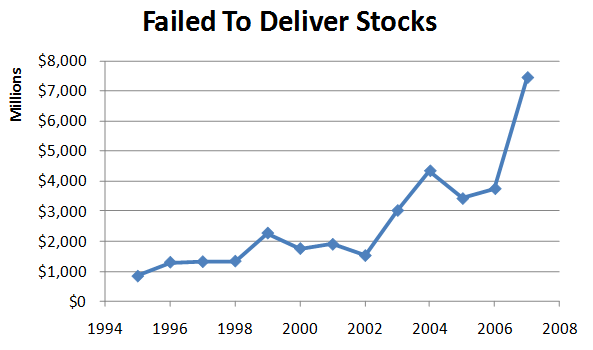
    Here’s the heart of the problem. There is something going on back-stage at Wall Street called the centralized clearing and settlement system. I worked in it in the US and have studied and consulted to the system in the rest of the world. The system we have in the US was exported around the world thanks to the United States Agency for International Development. The system is designed to let all the stocks and bonds traded on the stock exchanges be paid for electronically. To expedite the process – known as settling trades in stocks, bonds and all the other financial instruments – the system accepts an electronic “IOU” for the shares until the real financial papers can be delivered. It requires that the money be paid immediately. The problem is that the system permits dealers to sell more stocks and bonds than exist without any incentive to deliver on time. The centralized settlement system simply holds the “failed to deliver” open indefinitely in the form of an electronic IOU. The value of the IOUs in the system has risen dramatically since 2001.


    Source: Public data, available in annual reports of Depository Trust and Clearing Corporation and its subsidiaries.


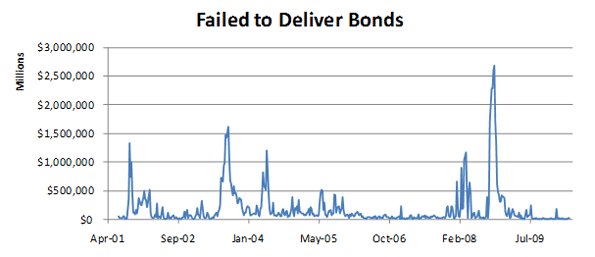
    Source: Public data, available from the Federal Reserve Bank of New York.

    Notice the relationship of the timing of the spike in the bond failures to the financial crisis: the 17 primary dealers reporting to the New York Federal Reserve Bank failed to deliver about $2.5 trillion worth of US Treasury securities for 7 weeks in late 2008 – no fines, no sanctions; worst of all, very little press coverage.

    This is the core of the problem – both in practice and in theory. This means supply is infinite – there is no limit to how many bonds can be sold because no one is enforcing delivery. In reality, no one should be able to sell more US Government bonds than the US Government has issued. That’s a problem in the practices supported by the system. The theoretical problem is that all financial instruments, including the bonds issued by city and state governments,, are being sold without any attachment to the real assets. This damages not only buyers in the stock market, but also the companies and governments who are trying to raise the money needed to keep delivering the services that we depend on them to provide.

    The practice of allowing the delivery of electronic IOUs in place of shares of stock or Treasury bills is a process that rewards financial manipulation instead of allocating resources to productive uses – the activity that capital markets should be doing. All the Congressional and the Administration talk about Wall Street reform is to centralize more trades into the existing settlement system – the one with the trillion-dollar hole in it! Someone has convinced them that the centralized system can easily track and account for positions – the actual statistics present a very different picture.

  • Random Wall Street Walking

    There was a popular book in 1973 – A Random Walk Down Wall Street. (by Burton Malkiel, now in its 9th edition, 2007) – that pooh-pooh’ed the idea that one investor’s stock picks could always be better than another investor’s stock picks. The punch line is that you could randomly throw darts at the Wall Street Journal financial pages and do just as well as anyone else investing in the stock market. I first read it in 1980, while taking Investment 101 in business school at night and editing economic research documents for the Federal Reserve Bank of San Francisco during the day. I had a very memorable argument with John P. Judd, then senior research economist and more recently special advisor to the Bank president and CEO Janet Yellen.

    John thought the Wall Street brokers were crazy for thinking they could make more than average returns on investment. I thought the Federal Reserve was crazy for thinking they could control the money supply. John was already a PhD economist; I was still working on my Bachelor degree in business administration.

    Twenty years later I also have a PhD in economics, but there are still two camps pulling in different directions in their dangerous tug-of-war on the economy. There are the double-dip pessimists led by Yale Economist Bob Shiller and most recently discouraged by Paul Ferrell of MarketWatch. And there are the “Mad Money” optimists who believe that Jim Cramer will tell them everything they need to know to get and stay rich, while Ben Bernanke consoles them with sound bites like “increased optimism among consumers … should aid the recovery.”

    At the heart of the problem is the same, original argument I had with John Judd – “is there a way to beat the averages” – except that this time around Wall Street is in bed with the Federal Reserve. You can no longer tell the crazies apart.

    Which brings me back to the Random Walk. If Wall Street has their way, they will inflate the market just enough to induce you to put your money back in. Don’t forget the Weenie Roast of 2008. If the government – either Congress or Treasury or the Federal Reserve – has their way, they will let it crash again, too. Don’t forget that it was only Wall Street that got bailed out the last time. I think the chances are 50-50 either way.

  • Financial Crisis: Too Late to Change?

    A travelling salesman is driving down a country road when he runs over a cat. Seeing a farmhouse nearby, he approaches to confess this unfortunate situation to the pet’s owner. When a woman answers the door, he says, “I’m sorry, but I think I just ran over your cat.” She asks him, “Well, what did it look like?” “Oh, m’am,” he replies, “I completely ran over it, so it was very awful, just a smear on the road…” “Oh, no,” she interrupts, “I mean, what did it look like before you ran over it.”

    Congress and the Administration are trying to find ways to spend more money in their quest to stimulate the economy. But just like that travelling salesman, they are working with the picture after the wreck – and they can’t seem to focus on what things looked like before it happened. In other words, they are so happy to be spending money without restraint that they have neglected to figure out how we got into this mess in the first place. We all know that the problem started in the financial sector – I don’t know anyone who would disagree with that. In fact, the banks were the first to get money from the federal government – the October 3, 2008 act of Congress that will forever be known as The Bank Bailout.

    Sadly nothing is different than it was on September 17, 2008 – the day that your 401k turned into a 201F. The now officially “to big to fail” banks are no more restrained in their activities today than they were in the days, weeks, months and years leading up to the crisis. If anything, they are a little freer because now they are all “banks” with a federal guarantee for ever more risk-taking behavior without consequences.

    Becoming a bank means that the money they hold can be protected by the Federal Deposit Insurance Corporation (FDIC). The FDIC has been “so depleted by the epidemic of collapsing financial institutions” that analysts thought it would be forced to borrow money from the Treasury before the end of 2009. Since January 1, 2010, another 41 banks have failed. To hold the wolves at bay, the FDIC board eased the rules on buyers of failing banks, opening the door for hedge funds and private investors to gain access to “bank” status – and the protections that go with it. At the end of the third quarter of 2009, the FDIC’s fund was already negative by $8.2 billion, a decrease of 180 percent in just three months (from July to September 2009). According to the Chief Financial Officer’s report, the FDIC projects that the fund “will remain negative over the next several years” as they absorb some $75 billion in failure costs through the end of 2013. Taking their lead from Congress – that is a policy of robbing the future to pay off the past – the FDIC is proposing that banks pre-pay their insurance fees for the next three years.

    There is no relief in sight, either. Just this week, a case of “insider trading” in New York was dismissed because the deal involved credit default swaps which – as I explained here last March – payoff losses “like” insurance but not regulated like insurance and which are bought and sold “like” securities but not regulated like securities. Although they are at the root of the causes of the financial crisis, not one new rule, regulation or law has been implemented to stop this nonsense from continuing. If you look at who’s in charge of figuring out what went wrong – and making recommendations on how to prevent it from happening again – you will find the Financial Crisis Inquiry Commission consists of political appointees who “have consulted for legal firms involved in lawsuits over the crisis.”

    That’s not reassuring. A Commission composed of members who earn their livelihood from financial institutions – including those that precipitated the crisis – is unlikely to solve or have any incentive to discover the mystery of the causes of the greatest financial collapse in the history of the world. This group is part of the problem – not the solution.

    Eighteen months after Wall Street roasted weenies on the bonfire of your 401k, the one noticeable difference is that the stock market is higher than it was on that fateful day in 2008. Unfortunately, this version of “economic recovery” is being driven by the financial services industry instead of the real economy. As rising stock prices encourage more savers and investors into the stock market, they create an increasing supply of investable funds in the hands of the banks – who remain as free to speed down our financial highways today as they were when they ran over the economy like that poor cat on a country road, leaving nothing but a stain on the pavement.

    Susanne Trimbath, Ph.D. is CEO and Chief Economist of STP Advisory Services. Her training in finance and economics began with editing briefing documents for the Economic Research Department of the Federal Reserve Bank of San Francisco. She worked in operations at depository trust and clearing corporations in San Francisco and New York, including Depository Trust Company, a subsidiary of DTCC; formerly, she was a Senior Research Economist studying capital markets at the Milken Institute. Her PhD in economics is from New York University. In addition to teaching economics and finance at New York University and University of Southern California (Marshall School of Business), Trimbath is co-author of Beyond Junk Bonds: Expanding High Yield Markets.

    Photo by David Reber’s Hammer Photography

  • Over-Charged and Under-Stimulated

    As we reported in July of last year, Goldman Sachs and other US bank bailout success stories are reaping big dollar benefits from the “nebulous world of public-private interactions.” Goldman Sachs – somehow always first in line for these things – even got transaction fees for managing the Treasury programs that funded the bailouts.

    Now, the senator in my neighboring state of Iowa is once again trying to wake up Congress to the facts. You may recall that Senator Chuck Grassley (D-IA) admitted almost a year ago that he and the other members of Congress were fooled into voting for the bailout because they thought former-Treasury Secretary Paulson actually knew what the hell he was doing when he asked for $750 billion in the fall of 2008. “When it’s all said and done, you realize he didn’t know anything more about it than you did.

    Late last week, the Huffington Post called our attention to a letter that Senator Grassley sent to Goldman Sachs about the fees they will collect on the next bit of federal stimulus – bonds that are used to underwrite the latest jobs bill. Grassley points to a November 27 report from Bloomberg News for some evidence that Goldman may be over-charging local governments by more than 30 percent above what is normally charged for bond underwritings (i.e., handling the paperwork and rounding up some buyers).

    In Grassley’s letter, he includes a quote in the article to the effect that the local governments don’t care about the fees since there is a “large subsidy.” However, according to The Financial Times of London – and we agree with their assessment – Goldman and others are able to charge excessive fees because the financial crisis reduced their competition. When banks were required to raise more capital before they could pay back their bailout money, they did – and earned record fees for themselves in the process!

    It is eerily similar to the driving forces behind the “subprime crisis” that was repeatedly blamed for the financial crisis. The financial sector gains its profits from fees – issuance fees, trading fees, underwriting fees, etc. – unheeding of the impact on the real economy, taxpayers and the cost to the nation as a whole.