Author: Susanne Trimbath

  • One Homeowner, Two Mortgage Holders, No Lien!

    I’ve been following this for a while and writing about it on NewGeography.com since March – not all mortgage-backed securities (MBS) are actually backed by mortgages. So when the homeowner goes into bankruptcy, there’s no way for the MBS holder to prove a lien on the house and the judge awards the bondholder bupkus. In April, a bankruptcy judge in California wrote that as many as one-third of all MBS didn’t have mortgages. No “M” in the “BS,” as I like to put it!

    Well, this story just gets better and better. It turns out that even when the MBS has an actual mortgage underneath it, the same mortgage is backing more than one security. Last week I talked to Matt Taibbi, who wrote in Rolling Stone magazine (The Great American Bubble Machine) that 58 percent of an MBS issued by Goldman Sachs had nothing but a list of zip codes where the mortgages should have been. He told me about a lawyer in Florida who has a list of cases where two MBS holders showed up at the bankruptcy proceedings, both claiming that they owned the same mortgage. You can expect to read more on that here as the story develops.

    Then it gets worse! Gretchen Morgenson reported in the New York Times on Sunday that there are about 60 million mortgages registered with the Mortgage Electronic Registration System (MERS) to keep track of who owns which loans and which MBS. Problem was that MERS, created by Fannie Mae, Freddie Mac and the mortgage industry, thought they were too good to have to register liens against land at the county level – real estate 101 for any sober realtor. The Kansas Supreme Court has now ruled that changes in mortgage ownership registered with MERS – and not registered with the local land authority – have no legal standing.

    Don’t forget – MBS are the junk that Treasury Secretary Geithner wants purchase with tax-payer dollars; and Federal Reserve Chairman Ben Bernanke committed $1.25 trillion of freshly-printed dollars to buy up out of the marketplace this year. Here’s the math made easy – the median house costs $177,000, figure an 80% mortgage, times 60 million mortgages: it looks like $8.5 trillion worth of mortgages could have no real estate underneath them! If the repo man comes knocking on your door, remember these four words: Show Me The Paper!

  • Perspective on G-20: Don’t Trip on those Green Shoots

    Everywhere you look – from the White House to Wall Street – they are painting a sunny picture of recovery, free from any gloomy ideas. Bernie Madoff is in jail, Goldman Sachs is repaying their bailout money, and everywhere they look they see “green shoots.”

    Yet according to the Congressional Budget Office (CBO), the US economy and federal government are headed for doom. We are on a completely unsustainable path economically and financially. The CBO updated their forecasts after our June piece on the State of the Economy. In their updated Budget and Economic Outlook, CBO clearly concludes that the current rate of high spending and low revenues has the nation on an unsustainable fiscal course. Unemployment won’t drop below 5% until 2014. As a result, according to the latest country risk rankings by Euromoney magazine [http://www.euromoney.com, subscription required for full access] Canada, Australia and most of Scandinavia have passed the US as safer places to invest in business.

    These predictions of doom are, in fact, based on the best-case scenario of 3 percent economic growth next year and 4 percent the year after that; plus the expiration of tax cuts and no new stimulus or bailout packages. Whether we call it a Panic, a Depression, a Recession or a Downturn, it all means the same thing. The nomenclature has been softened over the decades to remove that ever so gloomy feeling folks get when things are bad. If you still have a job, you know someone who has been laid off, had their hours cut, etc. I just received my first new piece of business since February. Things are tough everywhere you look.

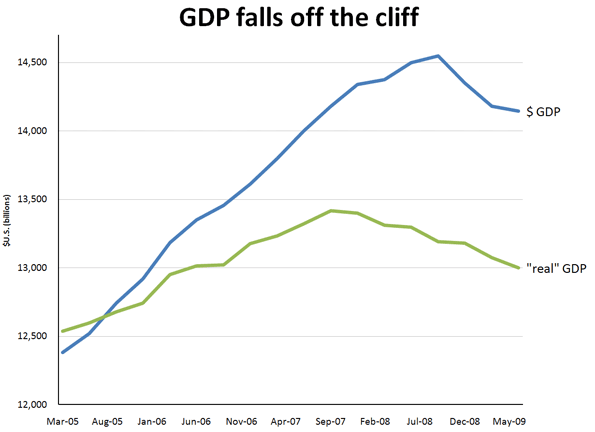
    GDP this year ($14,143 billion) is about where it was two years ago in actual dollar terms ($14,180 billion, third-quarter 2007). Accounting for inflation in consumer prices, our economy is closer to the level it was at the end of March 2006 or even back to the end of 2005. Actual dollar GDP peaked in September 2008 but I prefer the regular “real” GDP, adjusted for changes in what a dollar will buy you, which peaked in the third quarter of 2007 – we live in the real world, using real dollars to pay for real things.

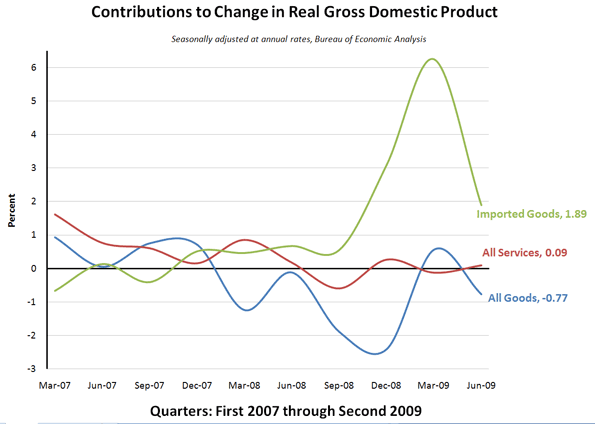
    The importance of changes in the real-dollar economy become most obvious when we consider international trade, which has been on the minds of the leaders of the G-20 nations in Pittsburgh this week. The fact that US consumers sustained and even increased their demand for imported goods until the onset of the global recession and in the face of a declining dollar lends credence to President Obama‘s plan to discuss what the world, not just what the US, can do to “lay the groundwork for balanced and sustainable economic growth.”

    On the one hand, our consumption of imported goods contributed to ours and the world’s economic growth. This fuels concern over whether or not the US can keep the promise to not impose new trade barriers before the end of 2010 and the world’s willingness to continue to buy our debt in the form of US Treasury bonds. At the same time, as Kansas City Federal Reserve Bank President Thomas Hoenig said last week in a speech I attended in Omaha, we need the world’s consumers to continue buying US goods in order to maintain our position as the “industrial leader of the world.” It’s a delicate balance, at best.

    The late 2007 nose dive in the “real” economy exposed the trouble brewing on the housing front, when we became aware of the explosion in credit derivatives, and when many of us started warning people about the insanity taking place in U.S. bond markets. No matter how you measure it, we would need about a 3 percent increase in GDP by next summer just to get back to where we were the last time everyone felt good about their money.

    Data from Bureau of Economic Analysis; author’s calculations

    So, why are we hearing such a positive spin on the economic news? One reason is the lack of understanding among reporters – most of them probably studied literature or journalism in college – not finance or economics. New York Times economics reporter Edmund L. Andrews is a perfect example. He just published a book describing “how he signed away his life for a toxic loan to buy a house in Silver Spring that he couldn’t really afford.” The Washington Post reviewer called the book “bright and breezy.” No gloom there!

    At the same time that he was signing the papers for an outsized mortgage, Andrews was writing articles like this gem from September 1, 2007 – just as the real economy was perched on the edge of the cliff – where he reports on Federal Reserve Bank Chairman Ben Bernanke saying he will “prevent chaos in the mortgage markets from derailing the economy.” The stock market climbed nearly 1 percent that day to close at 13,357.74 – it closed at 9,820.20 last Friday. Yet, Mr. Andrews still has a job with the New York Times – unlike millions of his readers – writing about topics like troubled mortgages.

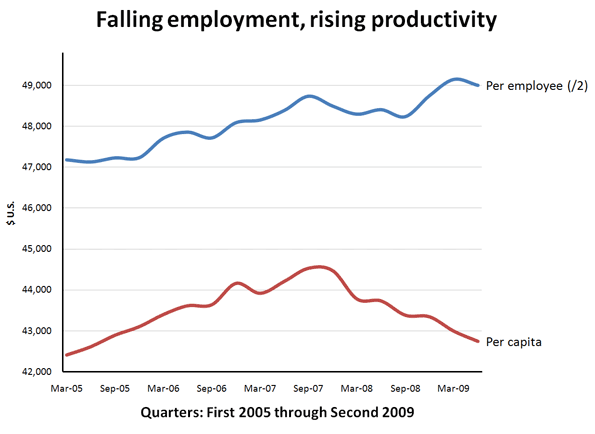
    Data from Bureau of Economic Analysis and Census Bureau. Per employee divided by 2 for scale.

    But what about the recent stock market rise? We should not be surprised if business profits are up: fewer people working means that the output per worker has been increasing since the end of 2008. GDP per capita (per person in the population), on the other hand, has been decreasing since the end of 2007 – an indication of a falling standard of living.

    The next few months are a time to focus, concentrate, plan, and follow-through. We are at a turning point comparable to the beginning of the Industrial Revolution and the system of capitalism that financed it. By frantically printing money and creating credit through bank bail-outs, the Federal Reserve and the Treasury are boosting the stock market by pumping in about $150 billion a month into corporate securities, increased auto sales (with government rebates) and home sales (with government first-time buyer tax credits).

    The problem is that these three pieces – banking, cars and homes – are not the whole economy, and, since they depend on government debt, none of these “green shoots” are sustainable on their own. Keep your eye on the big picture (the Kiplinger Recovery Index is a handy one-stop) – and don’t relax until all the indicators are green.

    Susanne Trimbath, Ph.D. is CEO and Chief Economist of STP Advisory Services. Her training in finance and economics began with editing briefing documents for the Economic Research Department of the Federal Reserve Bank of San Francisco. She worked in operations at depository trust and clearing corporations in San Francisco and New York, including Depository Trust Company, a subsidiary of DTCC; formerly, she was a Senior Research Economist studying capital markets at the Milken Institute. Her PhD in economics is from New York University. In addition to teaching economics and finance at New York University and University of Southern California (Marshall School of Business), Trimbath is co-author of Beyond Junk Bonds: Expanding High Yield Markets.

  • Brother Rabbit’s Bonuses

    New York State Attorney General Andrew Cuomo delivered a report to Congress on the bonuses paid to the employees of nine recipients of the TARP bailout money. He called it “The ‘Heads I Win, Tails You Lose’ Bank Bonus Culture.” (July 30) AG Cuomo concluded that even “in these challenging economic times, compensation for bank employees has become unmoored from the banks’ financial performance.” The report is only about banks, of course, since all the investment banks and brokerage firms changed their status to “bank” to become eligible for TARP bailout money last fall.

    Some of the banks that took the TARP money, like JP Morgan (NYSE: JM), Morgan Stanley (NYSE: MS) and American Express (NYSE: AXP), did what they could to return it as quickly as possible, including buying back the warrants. It will be very hard, indeed, for the financial institutions to change the public perception now that we have seen their willingness to take any risk, to make money at any cost – only to take a handout from the public coffers when things go badly so they can continue to “make money” for themselves. The banks are entities but they are run by people who have jobs and get bonuses and perks. Former-Treasury Secretary Hank Paulson’s plan to plunder the US Treasury on behalf of his former Goldman Sachs (NYSE: GS) mates on Wall Street set these banks up as the target of public scorn.

    Late Friday, July 31, the House of Representatives approved a bill that would allow regulators to limit executive compensation at financial institutions with assets greater than $1 billion if they find that the programs would “induce excessive risk-taking” behavior among bank executives. This comes a full eight months after Bank of America (NYSE: BAC) was first subpoenaed by AG Cuomo about executive bonuses. It is a far cry from anything that would create a sense of justice out of a system where two TARP recipients, Citigroup (NYSE: C) and Merrill Lynch, operated in a way that lost $54 billion in 2008, took $55 billion in TARP bailout money, and then paid $9 billion in employee bonuses.

    Despite the hue and cry of the public, these bonuses have continued. In my view they will continue into the future. Although we may think that sticking labels on the banks behavior, or asking Congress to legislate some discipline, will make a difference, it is unlikely to change anything. After the early 2009 bonuses were revealed, the banks claimed that the bonuses were required by contracts and could not be broken without violating the rule of law. They got away with this claim even as contracts with the United Auto Workers were being revised. It’s like a modern version of a folk story by Joel Chandler Harris. “Bred and born in a briar patch, Brother Fox, bred and born in a briar patch!” And with that Brother Banker skipped out just as lively as a cricket in the embers.

    Thanks to David Friedman for bringing the FT article on the report to our attention.

  • Follow the Money: Special Inspector General for the Bailout

    The House Committee on Oversight and Government Reform held a critically important hearing on July 21 titled “Following the Money: Report of the Special Inspector General for the Troubled Asset Relief Program (SIGTARP).” Sadly the mainstream media under reported the meeting. They focused on Federal Reserve Chairman Ben Bernanke telling the House Financial Services Committee “don’t worry,” but missed Special Inspector General (SIG) Neil Barofsky telling the Oversight Committee all the really sexy stuff: Conflicts of Interest, Collusion, and Money Laundering.

    Bernanke likes to tell us his Federal Reserve could take on a Super-Cop role, but the truth is quite the opposite. Reviewing the SIG report, Oversight Committee Chairman Edolphus Towns (D-NY) described it as “a wake-up call to the Treasury and the Fed that our financial system cannot be run behind closed doors.”

    Back in October 2008, Congress passed a bill to relieve the suffering caused by the Subprime Crisis. The Troubled Asset Relief Program (TARP) gave Treasury the authority to “purchase, manage and sale $700 billion of toxic assets, primarily troubled mortgages and mortgage-backed securities.” Within days, then Treasury Secretary (and former head of Goldman Sachs (NYSE: GS)) Hank Paulson unilaterally decided to take the money but to do something completely different with it – that is bail out his good-old friends on Wall Street.

    Representative John J. Duncan, Jr. (R-TN) noted that the banks that got TARP bailout money didn’t use it to help homeowners but to buy other banks, increase investments in China, improve their balance sheets and, now, report huge profits. This is not merely something that bothers grousing Republicans. Representative Dennis J. Kucinich (D-OH), one of the house’s most radical left members, called the TARP bailout program “one bait-and-switch after another…This is an ongoing fraud and deception on the American people.”

    We are committed to neither political party but agree that TARP has done precious little to help homeowners or the Main Street economy while performing wonders for Wall Street. There should be no surprise now that only 325,000 homeowners have been helped instead of the 4,000,000 we were promised.

    Since the October 2008 switcheroo, our elected officials in Congress have not been trying to stop Treasury or even rein the TARP beneficiaries. Real-Life Super Cop SIG Barofsky told the House Oversight Committee, “Treasury takes the position that it will not even ask TARP recipients what they are doing with the taxpayers’ money.” In some bizarre logic that only a Washington-insider could understand, they seem to think that if they don’t ask, they don’t have to tell.

    Not surprisingly Treasury is left trying to discredit SIG Barofsky’s report. According to Chairman Towns, the Rogue Treasury has “requested legal opinion from the Department of Justice challenging the Special Inspector General’s independence.” Representative Jason Chaffetz (R-UT) discretely pointed out that there is a distinct danger that the Secretary of the Treasury will try to stop Barofsky’s request for additional allocations to keep SIGTARP operations running past mid-2010. Representative Dan Burton (R-IN) called Treasury’s actions “blatant attempts to intimidate Barofsky to keep this information from the public.”

    Early news reports focused on just one number from the report: the potential for the government to spend $23 trillion to fix the financial system. Sadly the media ignored the most sinister – and more obvious to anyone who read even the summary of the report or merely watched SIG Barofsky’s testimony – issues raised in the report. Here are the ones that give me indigestion:

    • Treasury refuses to follow recommendations requiring fund managers to gather the information necessary to screen their investors for organized crime syndicates or terrorists. (page 183). In my 20+ years in financial services, one rule sticks in my mind: “Know Your Customer.” It means that you never do business with anyone you can’t vouch for, because financial intermediaries, like banks and brokers, must stand behind every transaction they put in the system – even if their customer defaults. So why is it that we are now funneling trillions of dollars through financial intermediaries who are not required to gather enough information from their investors so we can be sure we aren’t funding terrorism?
    • SIG Barofsky said that “Blackrock (NYSE: BLK) may have incredible profits under contracts with both Federal Reserve and Treasury.” Representative Marcy Kaptur (D-OH) suggested that SIG Barofsky “look at the people involved, not just companies like Blackrock” because the same people who created the subprime crisis are now working for the Federal Reserve on the bailout. They have the same staff investing government programs and private money without any “separating wall” to prevent conflicts of interest.
    • It appears that Treasury, the New York Federal Reserve and even Presidential Economic Advisor Larry Summers may be passing information to their friends that can be used for financial gain, giving positions in bailout programs to business associates, and engaging in “too cordial relationships” with bailout recipients, according to Representative Darrell Issa (R-CA), Ranking Minority Member of the Oversight Committee.
    • Treasury is “picking winners and losers” in the public/private partnership programs in a completely opaque process. SIG Barofsky calls this potentially “devastating to the public’s view of government.” People are hungry for information, too: The SIG’s website has received 12 million hits by people interested in getting copies of testimony and reports.
    • TARP is no longer a $700 billion bailout. “Treasury has created 12 separate programs involving Government and private funds of up to almost $3 trillion…a program of unprecedented scope, scale, and complexity” according to SIGTARP’s quarterly report to Congress.
    • Treasury and the Federal Reserve have ignored recommendations to stop relying on rating agency determinations. (page 184) They continue to rely on rating agencies – the same ones who made tragic misjudgments over the past two years – in making determinations about the prices we will pay for the purchase of “troubled assets” or “legacy assets” or whatever name they decide to apply to the junk bonds in the hands of private banks. By relying on the rating agencies (who played a role in the crisis by rating junk bonds as triple-A credits), the bailout programs run the risk of being “unduly influenced by improper incentives to overrate.”
    • Representative Dan Burton (R-IN) suggested that Treasury Secretary Geithner is deliberately attempting to keep information from the public. SIG Barofsky has been unable to get more than one meeting with Treasury Secretary Geithner since January 2009 – and then only for a few minutes. This arrogance is not new to the current Administration’s Treasury. Representative Issa says the Oversight Committee was twice promised data on the value of TARP assets from former Treasury employee (and former Goldman Sachs (NYSE: GS) employee) Neel Kashkari. That data was “never forthcoming.”
    • Treasury has “repeatedly failed to adopt recommendations essential to providing basic transparency and accountability.”

    Representative Issa concluded that SIG Barofsky has given us the facts; now it’s up to Congress to take action. In closing Chairman Towns said that if Treasury doesn’t turn over information voluntarily, Secretary Geithner will be brought before the Committee to answer. “I can now understand why the Treasury Department would like to rein in the SIGTARP. But we are not going to let that happen.”

    I can think of 23 trillion reasons why the Treasury Department will fight him all the way. And just as many why we taxpayers should not like Tim Geithner and the rest of the insider crowd getting away with the murder of the American economy.

    Susanne Trimbath, Ph.D. is CEO and Chief Economist of STP Advisory Services. Her training in finance and economics began with editing briefing documents for the Economic Research Department of the Federal Reserve Bank of San Francisco. She worked in operations at depository trust and clearing corporations in San Francisco and New York, including Depository Trust Company, a subsidiary of DTCC; formerly, she was a Senior Research Economist studying capital markets at the Milken Institute. Her PhD in economics is from New York University. In addition to teaching economics and finance at New York University and University of Southern California (Marshall School of Business), Trimbath is co-author of Beyond Junk Bonds: Expanding High Yield Markets.

  • Bailout Success!!

    “I guess the bailouts are working…for Goldman Sachs!” The Daily Show With Jon Stewart

    Goldman Sachs reported $3.4 billion second quarter earnings. Mises Economics Blogger Peter Klein says these earnings are the result of political capitalism – earned in the “nebulous world of public-private interactions.” Klein points to an interesting perspective offered by The Streetwise Professor (Craig Pirrong at University of Houston): Moral Hazard. Goldman Sachs’ status as “too big to fail,” conferred on them by the United States Government, has allowed them to increase the money they put at risk of loss in one day’s trading by 33 percent since last May. Goldman received $10 billion in the TARP bailout on October 28, 2008; they returned the money on June 9, 2009. By April 2009, they had paid about $149 million in dividends on the Treasury’s investment – a negligible return. Goldman Sachs also will be receiving transaction fees for managing Treasury programs under contracts awarded to them during the Bailout and beyond. When Goldman Sachs changed its status to “bank” last year they also gained access to the FDIC safety net, which perversely provides incentives for banks to take risks by absorbing the consequences of losses.

    To underscore the importance of cronies in capitalism, Goldman Sachs is on track to dole out bonuses equal to about $700,000 per employee – a 17 percent increase over 2006, when bonuses were sufficient to “immunize 40,000 impoverished children for a year … throw a birthday party for your daughter and one million of her closest friends … and still have enough left over to buy a different color Rolls Royce for each day of the week.”

    Since employees of Goldman Sachs will one day be in charge of the U.S. Treasury, it only makes sense that the company has to keep them happy now – how else can they be assured of future access to capital? The House Oversight and Government Reform Committee seems to think that former Treasury Secretary Hank Paulson – himself a former Goldman Sachs bonus recipient – gave bailout money to his cronies after telling Congress the money was for Main Street homeowners.

    If it isn’t clear by now that the United States Government is picking the winners and losers in this economy, the experience of CIT Group Inc. – a lender to small businesses that is being allowed to fail – should remove any doubts you may have had until now.

    The United States Government passed an additional $12.1 billion to Goldman Sachs through the AIG bailout – money that won’t be returned unless AIG succeeds. To assure their success, AIG is preparing to pay millions of dollars more in bonuses to their executives this year under the premise that a contract is a contract and must be honored (unless it’s a UAW contract, of course.) JP Morgan Chase reported better than expected earnings; even Bank of America, still reeling from the Merrill Lynch merger and extensive mortgage losses in California, earned $3.2 billion in the second quarter of 2009. Citigroup reported $4.28 billion profit in the second quarter.

    With government money and government protection coming at them from all sides, it’s a wonder all the big banks and big bank employees aren’t rolling in dollar bills by now.

  • No Bailout of Small Businesses

    CIT Group Inc. acknowledged today that “policy makers” turned down their request for aid. It’s always sad when a company fails and goes into bankruptcy – people lose their jobs, all the vendor companies that sell them products suffer from the loss of business, etc. But what makes this one especially sad is that CIT, according to Bloomberg News, “specializes in loans to smaller firms, counting 1 million enterprises, including 300,000 retailers, among its customers.”

    This news comes on the heels of an appearance by former Secretary of Treasury Hank Paulson before the House Committee on Oversight and Government Reform. Summing up after the hearing, Chairman Edolphus Towns (D-NY) admitted that Congress turned over complete authority to Paulson in the Bailout last fall (Troubled Assets Relief Program, TARP): “with no accountability, no checks and balances.” The result is “seemingly arbitrary decision-making.”

    Representatives at the hearing repeatedly accused Paulson of deceiving Congress by telling them (and everyone else) that the bailout money would be used to help homeowners. In the end, it was as if the previous administration pillaged the U. S. Treasury on their way out of town.

    In the third of a series of hearings designed around the Bank of America merger with Merrill Lynch, Paulson told the Committee that he had the authority to remove Ken Lewis as head of the bank if he didn’t go through with the merger.

    Rep. Jim Jordan (R-OH) said there was “a pattern of deception.” He asked specifically, when did Paulson know that he was going to give the money to the banks – which he did on October 13 – after telling Congress on October 3 that he was going to use it to buy up bad mortgages? Paulson’s response was that he believed Congress knew they were giving him flexibility to do whatever he wanted – so he did.

    The question now is this: did Paulson pick and choose among his friends to decide who got a bailout? Special Inspector General Neil Barofsky will report to the House Oversight Committee next week with the release of his quarterly report to Congress on the use of TARP funds. Recall that Barofsky’s office is the only one with the authority to initiate criminal prosecutions. Maybe Paulson is still on his list.

  • The Next Global Financial Crisis: Public Debt

    The cloud of the global financial meltdown has not even cleared, yet another crisis of massive proportions looms on the horizon: global sovereign (public) debt.

    This crisis, like so many others, has its root in the free flow of credit from the preceding economic boom years. The market prices of assets were rising steadily. Rising valuations, especially where they were based on improving revenues from robust economic activity, led to rising income streams for governments. This encouraged governments to borrow more, perhaps often to expand services – and the bureaucracy required to offer services – although sometimes to improve infrastructure.

    At the same time, rising market prices for financial assets encouraged more savers and investors into the market. That led to an increasing supply of investable funds, which drove demand for sovereign and municipal debt (in addition to the mortgage-backed securities). This process, driven by the financial services industry instead of the real economy, is eerily similar to the driving forces behind the “subprime crisis.” The demand for public offerings pulled more debt issuance out of borrowers with seemingly little concern for repayment: the financial sector gains its profits from issuance fees, trading fees, underwriting fees, etc. As in the case of mortgages, it will be those who buy and hold the debt, along with the borrowers, who will suffer the consequences.

    Certainly, emerging nations took advantage of the depth of rich nation capital markets to increase their debt through public offerings. At the end of June 2009, only Italy, Turkey and Brazil were covered by more credit default swap contracts than JP Morgan Chase and Bank of America. In addition to those two global banks, Goldman Sachs, Morgan Stanley, Deutsche Telekom AG, France Telecom and Wells Fargo Bank all have more credit derivate coverage than the Philippines.

    Yet there is clearly a potential default problem here. Gross credit default swaps outstanding for the debt of Iceland are equal to 66 percent of GDP, about 20 percent of GDP for Hungary and the Philippines and around 18 percent for Latvia, Portugal, Panama and Bulgaria. If these countries default on their debt, those global banks who sell credit derivatives will be making enormous payments – whether or not the defaulting countries receive any support or bailouts from international donor organizations (like World Bank or International Monetary Fund).

    The table below shows the GDP for the countries named in the most credit default swap contracts (as most recently reported to Depository Trust and Clearing Corporation). For each sovereign (country, state or city), we show the value of their public debt both as a figure and as a percent of GDP. The telling factor here is that the “financial markets,” if they are to be believed, judge these entities as more likely to experience “a credit event” than others. A credit event, as we learned when the AIG saga unraveled can be anything from a decline in the market price of debt to an outright default on payments.

    Sovereigns named in most credit default protection*
    Sovereign Entity  GDP (2008)  Share World GDP (est) Public Debt (current) Debt % GDP
    JAPAN  $     4,348,000,000,000 8.6%  $  7,408,992,000,000 170.4%
    REPUBLIC OF ITALY  $     1,821,000,000,000 3.4%  $  1,888,377,000,000 103.7%
    HELLENIC REPUBLIC (Greece)  $        343,600,000,000 0.4%  $      309,583,600,000 90.1%
    KINGDOM OF BELGIUM  $        390,500,000,000 0.6%  $      315,524,000,000 80.8%
    STATE OF ISRAEL  $        200,700,000,000 0.4%  $      151,929,900,000 75.7%
    REPUBLIC OF HUNGARY  $        205,700,000,000 0.3%  $      151,806,600,000 73.8%
    FRENCH REPUBLIC  $     2,097,000,000,000 3.8%  $  1,404,990,000,000 67.0%
    PORTUGUESE REPUBLIC  $        237,300,000,000 0.4%  $      152,346,600,000 64.2%
    FEDERAL REPUBLIC OF GERMANY  $     2,863,000,000,000 4.7%  $  1,792,238,000,000 62.6%
    UNITED STATES OF AMERICA  $   14,290,000,000,000 21.4%  $  8,688,320,000,000 60.8%
    REPUBLIC OF AUSTRIA  $        325,000,000,000 0.5%  $      191,100,000,000 58.8%
    REPUBLIC OF THE PHILIPPINES  $        320,600,000,000 0.5%  $      181,139,000,000 56.5%
    KINGDOM OF NORWAY  $        256,500,000,000 0.3%  $      133,380,000,000 52.0%
    ARGENTINE REPUBLIC  $        575,600,000,000 0.8%  $      293,556,000,000 51.0%
    REPUBLIC OF CROATIA  $           73,360,000,000 0.1%  $        35,873,040,000 48.9%
    REPUBLIC OF COLOMBIA  $        399,400,000,000 0.6%  $      191,712,000,000 48.0%
    UNITED KINGDOM OF GREAT BRITAIN AND NORTHERN IRELAND  $     2,231,000,000,000 3.5%  $  1,053,032,000,000 47.2%
    REPUBLIC OF PANAMA  $           38,490,000,000 0.0%  $        17,859,360,000 46.4%
    KINGDOM OF THE NETHERLANDS  $        670,200,000,000 0.3%  $      288,186,000,000 43.0%
    MALAYSIA  $        386,600,000,000 0.3%  $      165,078,200,000 42.7%
    KINGDOM OF THAILAND  $        553,400,000,000 0.9%  $      232,428,000,000 42.0%
    REPUBLIC OF POLAND  $        667,400,000,000 0.7%  $      277,638,400,000 41.6%
    FEDERATIVE REPUBLIC OF BRAZIL  $     1,990,000,000,000 2.7%  $      809,930,000,000 40.7%
    SOCIALIST REPUBLIC OF VIETNAM  $        241,800,000,000 0.5%  $        93,334,800,000 38.6%
    KINGDOM OF SPAIN  $     1,378,000,000,000 1.8%  $      516,750,000,000 37.5%
    REPUBLIC OF TURKEY  $        906,500,000,000 1.1%  $      336,311,500,000 37.1%
    KINGDOM OF SWEDEN  $        348,600,000,000 0.6%  $      127,239,000,000 36.5%
    SLOVAK REPUBLIC  $        119,500,000,000 0.2%  $        41,825,000,000 35.0%
    REPUBLIC OF FINLAND  $        195,200,000,000 0.3%  $        64,416,000,000 33.0%
    REPUBLIC OF KOREA  $     1,278,000,000,000 1.4%  $      417,906,000,000 32.7%
    IRELAND  $        191,900,000,000 0.4%  $        60,448,500,000 31.5%
    REPUBLIC OF INDONESIA  $        915,900,000,000 1.7%  $      275,685,900,000 30.1%
    REPUBLIC OF SOUTH AFRICA  $        489,700,000,000 0.5%  $      146,420,300,000 29.9%
    CZECH REPUBLIC  $        266,300,000,000 0.5%  $        78,292,200,000 29.4%
    REPUBLIC OF PERU  $        238,900,000,000 0.2%  $        57,574,900,000 24.1%
    REPUBLIC OF ICELAND  $           12,150,000,000 0.0%  $          2,794,500,000 23.0%
    REPUBLIC OF SLOVENIA  $           59,140,000,000 0.1%  $        13,010,800,000 22.0%
    KINGDOM OF DENMARK  $        204,900,000,000 0.4%  $        44,668,200,000 21.8%
    UNITED MEXICAN STATES  $     1,559,000,000,000 1.9%  $      316,477,000,000 20.3%
    BOLIVARIAN REPUBLIC OF VENEZUELA  $        357,900,000,000 0.6%  $        62,274,600,000 17.4%
    REPUBLIC OF LATVIA  $           39,980,000,000 0.1%  $          6,796,600,000 17.0%
    REPUBLIC OF BULGARIA  $           93,780,000,000 0.2%  $        15,661,260,000 16.7%
    PEOPLE’S REPUBLIC OF CHINA  $     7,800,000,000,000 7.7%  $  1,224,600,000,000 15.7%
    ROMANIA  $        271,200,000,000 0.3%  $        38,239,200,000 14.1%
    REPUBLIC OF LITHUANIA  $           63,250,000,000 0.1%  $          7,526,750,000 11.9%
    UKRAINE  $        337,000,000,000 0.6%  $        33,700,000,000 10.0%
    REPUBLIC OF KAZAKHSTAN  $        176,900,000,000 0.3%  $        16,097,900,000 9.1%
    RUSSIAN FEDERATION  $     2,225,000,000,000 4.3%  $      151,300,000,000 6.8%
    STATE OF QATAR  $           85,350,000,000 0.2%  $          5,121,000,000 6.0%
    STATE OF NEW YORK  $     1,144,481,000,000 2.1%  $        48,500,000,000 4.2%
    STATE OF CALIFORNIA  $     1,801,762,000,000 3.4%  $        69,400,000,000 3.9%
    REPUBLIC OF CHILE  $        245,300,000,000 0.3%  $          9,321,400,000 3.8%
    REPUBLIC OF ESTONIA  $           27,720,000,000 0.1%  $          1,053,360,000 3.8%
    STATE OF FLORIDA  $        744,120,000,000 1.4%  $        24,100,000,000 3.2%
    THE CITY OF NEW YORK  $     1,123,532,000,000 2.1%  $        55,823,000,000 **
    *List from Depository Trust and Clearing Corporation. [www.dtcc.com] Dubai was also on this list, but debt and GDP data were not available.
    **NYC GDP includes entire NY-NJ-PA metropolitan statistical area; debt is for City of NY only.
    Countries in Italics have never failed to meet their debt repayment schedules (Reinhart and Rogoff 2008); Thailand and Korea received IMF assistance to avoid default in the 1990s.

    The obvious consequence is that a crisis in sovereign debt would cause problems not just within those nations, states or cities – but also among their trading and economic partners, among their lenders (banks, sovereigns or international donor organizations) as well as the global financial institutions who sold default protection through the credit derivatives markets. The financial impact would be more than anything we have seen so far: most global financial institutions received bailouts from their sovereign governments to soften or at least delay the impact of the September 2008 financial crisis. Yet, I believe the more dire consequence of a widespread sovereign debt crisis, if there is one, will be civil unrest fomented by the deterioration in governments’ critical functions that will result from their weakened financial positions.

    Policy makers will have few options available across the globe to combat this crisis. The rich world’s governments have not been able to contain their debt burdens through budgetary discipline alone. Between Federal Reserve Chairman Ben Bernanke and Treasury Secretary Tim Geithner, they’ve done everything except load the helicopter with dollar bills to finance the bailout with freshly-minted U.S. dollars.

    Policymakers are just as likely to precipitate a financial crisis as any other investor or borrower – they seem to have no prescient knowledge of the dangers associated with over-speculation, lack of solid accounting practices, balancing a budget, etc. How else do we explain their dependence on borrowing? Basic accounting principles – not to mention ideas going back at least to the biblical story of Joseph and the Pharoah – would guide users to monitor income and spending; actuarial analysis directs us to save during times of “feast” and spend the surplus during times of “famine.”

    Yet the United States government and others have already decided to monetize their financial problems at levels not seen before. I shudder to even think what sovereign default would mean to a large-country (G8, for example); however, I deem such a scenario as highly unlikely. A quick look at the table indicates the countries that have never defaulted or even rescheduled a debt payment in their history. The defaults will more likely come from spendthrift small countries, or big states like California.

    The world economy has encountered these debt situations before. But in this environment, a sovereign debt crisis would be unlike anything we have experienced in the past. Not only have financial markets become more globally integrated – with countries borrowing and lending across national borders with ease – but the use of credit derivate products has increased the chance of a default turning into a global catastrophe. These derivatives will have a multiplier effect on every sovereign debt default. We know for a fact that credit default swap contracts are written without being limited to the total value of the underlying assets. Therefore, there could be nine to fifteen times as many credit default contracts to be paid by global banks as there is debt in default.

    Today there are outstanding about $2 trillion of credit default swaps contracts on just fifty of the world’s 200 nations. These contracts could come payable under even the most modest credit event, spreading the damage globally even before debt-service payments are missed. For example, it is now known that AIG’s Financial Products Division wrote contracts that became payable when the market price of debt decreased, regardless of whether or not the borrower had missed a payment. These circumstances did not exist during any previous debt crisis, including the most recent default cycle, the emerging market debt crises of the 1980s and the 1990s. If widespread sovereign defaults happen, we can expect to see something new and potentially much more damaging.

    Susanne Trimbath, Ph.D. is CEO and Chief Economist of STP Advisory Services. Her training in finance and economics began with editing briefing documents for the Economic Research Department of the Federal Reserve Bank of San Francisco. She worked in operations at depository trust and clearing corporations in San Francisco and New York, including Depository Trust Company, a subsidiary of DTCC; formerly, she was a Senior Research Economist studying capital markets at the Milken Institute. Her PhD in economics is from New York University. In addition to teaching economics and finance at New York University and University of Southern California (Marshall School of Business), Trimbath is co-author of Beyond Junk Bonds: Expanding High Yield Markets.

  • Why Attitude Matters: How Nebraska is Reaping the Stimulus

    In what are tough times for most states, conditions for business remain surprisingly good in Nebraska. Like other states in the “zone of sanity” Nebraska is especially supportive of small businesses.

    Nebraska is one of a series out of mid-American outliers. In 2008 – a year of a severe national contraction – the state experienced a 3.6 percent growth in gross domestic product. Its current unemployment rate of just 4.4 percent stands at less than half the U.S. rate of 9.4 percent (latest available from Bureau of Labor Statistics).

    The state itself is in good financial shape, with a cash reserve over $500 million (including a $20 million to $30 million operating surplus every year since 2001). I believe there are two important factors fundamental to Nebraska’s health. The first lies in cooperation across levels and borders – which was described in my piece on regional cooperation in the Omaha World-Herald. This positive attitude toward growth and economic development in Nebraska extends through every level – you find it at the state, regional, county and city level. A supportive attitude toward development plays an important role in making things work.

    The second and perhaps more important factor critical to fostering an environment supportive of growth and prosperity lies with a broad acceptance of the benefits of on-going economic development as a source of continued quality of life. This attitude can be described – as opposed to the traditional NIMBYism seen so often in more crowded, coastal states – as “Yes, In My BackYard” or YIMBYism. Nebraska has pockets of pro-development populations, like Sarpy County, on the southern border of the city of Omaha.

    Before moving to Omaha, my business was based in Santa Monica, California. With a population of about 89,000, Santa Monica is a beautiful city consisting of smart people who often make foolish choices. Many residents in Santa Monica, like those in Portland and other NIMBY-areas of the country, oppose development in their neighborhoods.

    Many who live in million-dollar single-family homes in Santa Monica were opposed to building new middle-class jobs and homes in their neighborhood, although they often favor building homes for the poor, albeit somewhere not in their bailiwick. This promotes a “haves versus have-nots” social order, and also doesn’t make sense from a personal point of view. Whenever the growth debate was on the table (which it often is in Santa Monica), I would tell people, “Wouldn’t you like to build jobs and housing so your children can work and live in Santa Monica, too? Do you want your grandchildren to move to Texas? Because I assure you they are building middle-class jobs and housing in Texas.”

    In contrast I’ve found some pro-growth Nebraskans who relentlessly seek making development happen. For the mayors of the United Cities of Sarpy County, the emphasis is on cooperation as a path to success. Recent developments around my adopted hometown of Bellevue, Nebraska – home to Offutt Air Force Base and U.S. Strategic Command – provide a simple, straight-forward example of how YIMBYism works in practice.

    About seven years ago, the City of Bellevue, along with the Bellevue Chamber of Commerce, funded an economic development plan that could be used to set a community agenda for growth. The resulting plan highlighted several locations where development was feasible, desirable and likely to lead to greater growth. One of the initial designated areas is a 6.5 mile corridor along Fort Crook Road. “Fort Crook Road,” says Megan Lucas, President of the Bellevue Chamber of Commerce, “is the spine of Bellevue. Other nodes of economic development will fill-in around Fort Crook when it is ready to move forward.”

    The City and the Chamber then devised a development plan specific for the Fort Crook Road Corridor. The Fort Crook Road Plan was approved as part of a new comprehensive plan for City development – with zoning updated to accommodate retail development along the entire length. The long-range plan is to shift the road west, closer to an existing active railroad line, and to create a linear park along the median strip to connect two existing trail systems – the Lewis & Clark in the north and the Bellevue Loop of the Keystone Trail on south end.

    Two points make this specific example interesting. The foresight in developing the comprehensive plans for the area positioned it perfectly for the current environment. A good chunk of the Fort Crook Road Corridor is currently occupied by an abandoned concrete production facility. These blighted structures need to be demolished to get the property ready for development. But since the City already owns the property and a comprehensive development plan is in place, the project is “shovel ready” – those magic words that qualify any development project for federal stimulus funding under the American Recovery and Reinvestment Act of 2009.

    In contrast, there are hundreds of worthy projects in every state that will not qualify for Stimulus money because they fail to meet the “shovel ready” requirement. Part of the Fort Crook Road Plan made it through the initial review stages for stimulus funding in Nebraska. The project ranked in the top three in the state for eligibility and suitability. According to Mayor Ed Babbitt, some stimulus funding has been allocated to revise traffic signals in the corridor; funding to remove blighted structures will likely come later this year from an environmental clean-up fund.

    The second point that makes the Fort Crook Road Corridor an interesting example is that one of its biggest proponents – Megan Lucas – lives in the Corridor. The development and expansion of Fort Crook Road is in her backyard. She and many other residents in Bellevue are saying, “Yes, In My Backyard.” Even more recently, three cities in Sarpy County vied to be the location of a Triple-A ballpark to be built in cooperation with the Omaha Royals of the Pacific Coast League. YIMBY-ite residents far out-numbered the NIMBY-ites at every public forum on the choice of location. A positive attitude toward economic development has emerged as a major factor in getting ready for the stimulus – something many in the Obama bastions in the blue states might want to consider.

    Susanne Trimbath, Ph.D. is CEO and Chief Economist of STP Advisory Services. Her training in finance and economics began with editing briefing documents for the Economic Research Department of the Federal Reserve Bank of San Francisco. She worked in operations at depository trust and clearing corporations in San Francisco and New York, including Depository Trust Company, a subsidiary of DTCC; formerly, she was a Senior Research Economist studying capital markets at the Milken Institute. Her PhD in economics is from New York University. In addition to teaching economics and finance at New York University and University of Southern California (Marshall School of Business), Trimbath is co-author of Beyond Junk Bonds: Expanding High Yield Markets.

  • Bad Times Getting Worse for Older Americans

    Olivia S. Mitchell, of the Wharton School at the University of Pennsylvania, told ABC News that “roughly $2 trillion has been lost in 401(k)s and pension plans during the recession.” (According to The Economist, worldwide private pension funds lost $5.4 trillion last year. I wonder if/when the media will start calling it a depression?)

    As stock values go down, the value of the company pension plan investments fall with it. In good times, companies can put cash into the plans to make up the short fall. But with all the financial turmoil around us now, companies don’t have the cash and are unable to borrow it. Some companies are capping payouts and some are offering lump-sum payouts instead of, or in combination with, monthly payments. Other companies are abandoning traditional pensions – where the payouts are defined in advance of retirement – for 401(k) plans – where the contributions are defined instead and the payouts are left uncertain. That puts the risk of bad investments and market collapses on the backs of the workers instead of the companies.

    For employees who are in traditional pension plans, the Pension Benefit Guaranty Corporation (PBGC) was created in 1974 to insure pensions. If your employer goes bankrupt, your pension could still be OK if the plan pays insurance premiums to PBGC. However, the coverage is limited to $54,000 a year for workers who retire at age 65, less if you retire early. The PBGC’s investment assets went down 12 percent between September 2007 to September 2008 (latest financial statements available). That’s on top of a large (albeit falling) deficit of $11 billion (their liabilities are greater than their assets). This is the company that is supposed to protect your pension if your company goes into bankruptcy. Technically, they can’t meet today’s obligations…

    If your employer is in financial trouble and you are expecting to earn more than the pension insurance will cover you may need to think about working during retirement to make up the difference. According to an article published by Wharton in 2007, the Senior Citizens Freedom to Work Act “repealed the Social Security earnings limit, allowing workers 65 through 69 to earn income without losing Social Security benefits.” Good thing, too. Looks like they’ll need to keep working to make it through the depression.

  • State of the Economy June 2009

    Nobel Prize-winning economist Paul Krugman was quoted widely for saying that the official recession will end this summer. Before you get overly excited, keep in mind that the recession he’s calling the end of started officially in December 2007. Now ask yourself this: when did you notice that the economy was in recession? Six months after it started? One year? Most people didn’t even realize the financial markets were in crisis until the value of their 401k crashed in September 2008. Count the number of months from December 2007 until you realized the economy was in recession, add that to September 2009 and you’ll have an idea of when you should expect to actually see improvements in the economy.

    Douglas Elmendorf, Director of the Congressional Budget Office (CBO), testified on “The State of the Economy” before the House Committee on the Budget U.S. House of Representatives at the end of May. CBO sees several years before unemployment falls back to around 5 percent, after climbing to about 10 percent later this year. Remember this phrase: Jobless Recovery; it happens every time we have a recession. Employment historically does not increase until 6 to 12 months AFTER GDP starts to improve. Even Krugman admits that unemployment will keep going up for “a long time” after the recession officially ends.

    While some of us are worrying about stagflation – a stagnant economy with rising prices – the CBO report does a good job of describing why deflation is worse than inflation. Deflation would slow the recovery by causing consumers to put off spending in expectation of lower prices in the future. The risk associated with high inflation is primarily that the Federal Reserve would raise interest rates too fast, stalling the economy – similar to what Greenspan did to prolong the recession in the early 1990s. We think the real conundrum is this: how do you deal with an asset bubble without deflating prices? Preventing deflation now simply passes the bubble on to some other asset class at some future time.

    CBO calculates that output in the U.S. is $1 trillion below potential, a shortfall that won’t be corrected until at least 2013. New GDP forecasts are coming in August from CBO. They say the August forecast will likely paint an even gloomier picture than this already gloomy report. Hard to imagine!

    There are plenty of reasons that Krugman and others are seeing encouraging signs in the economy. Social Security recipients received a large cost-of-living adjustment, payroll taxes were lowered so that employees are taking home bigger paychecks, larger tax refunds, lower energy prices – all of these lead to an uptick in consumer spending in the first quarter of 2009. I checked in with Omaha-area Realtor Rod Sadofsky last week. He has seen an improvement in sales in the range of median-priced homes which he attributes to the $8,000 tax credit available to first-time homebuyers (or those who have not owned for at least three years). Along with an up-tick in that segment of the market, those sellers are able to move up to higher priced homes a little further up the range, further improving home sales. However, the tax incentive is scheduled to expire at the end of 2009. When the stimulus winds down…well, there will be no more up-ticks. CBO agrees with Rod and warns of a possible re-slump in 2010 when the effects of the stimulus money begin to wane.

    CBO’s Dr. Elmendorf has a way to solve this problem: to keep up consumer spending, he suggests that people should work more hours and make more money. Duh! We think we hear Harvard calling – they want their PhD back! CBO seems undecided about which came first in the credit markets: problems in supply or problems in demand?

    “Growth in lending has certainly been weak, but a large part of the contraction probably is due to the effect of the recession on the demand for credit, not to the problems experienced by financial institutions.”

    “Indeed, economic recovery may be necessary for the full recovery of the financial system, rather than the other way around.”

    We shouldn’t be so hard on Elmendorf. The report makes it clear just how difficult it has been to figure out 1) what happened 2) why it happened 3) what do we do about it and 4) what happens next. CBO seems to be reaching for answers while to us it is obvious they are missing the point by not even considering that manipulation has wrecked havoc on the markets. Whenever things don’t make sense to someone like the Director of the CBO, experience tells us there’s a rat somewhere.

    Regardless of how overly-complicated financial products may become, the economy really shouldn’t be that hard to figure out. Still, no one seems to know how far down the banks can go – if banks don’t lend to businesses, businesses close, people lose their jobs, unemployed people default on loans, banks have less to lend, and banks can’t lend to businesses…Seems we are damned if we do and damned if we don’t: too much borrowing caused the crisis; too little spending worsens it. Do they want us to keep spending money we don’t have?

    While Krugman is admitting that the world economy will “stay depressed for an extended period” CBO is reporting that “in China, South Korea, and India, manufacturing activity has expanded in recent months.” The other members of the G8, however, aren’t faring any better than we are: GDP is down 10.4 percent in the European Union, 7.4 percent in the UK and 15.2 percent in Japan. Canada – whose banks are doing just fine without a bailout, thank you very much – saw GDP decline by just 3.4 percent in the last quarter of 2008.

    Undaunted by nearly 10 percent unemployment – after predicting it would rise no higher than 8 percent – President Obama announced today that the White House opened a website for Americans to submit their photos and stories about how the stimulus spending is helping them. If they can’t manage the economy, they can still try to manage our expectations about the economy.

    Susanne Trimbath, Ph.D. is CEO and Chief Economist of STP Advisory Services. Her training in finance and economics began with editing briefing documents for the Economic Research Department of the Federal Reserve Bank of San Francisco. She worked in operations at depository trust and clearing corporations in San Francisco and New York, including Depository Trust Company, a subsidiary of DTCC; formerly, she was a Senior Research Economist studying capital markets at the Milken Institute. Her PhD in economics is from New York University. In addition to teaching economics and finance at New York University and University of Southern California (Marshall School of Business), Trimbath is co-author of Beyond Junk Bonds: Expanding High Yield Markets.