Author: The New City Journal

  • A Price on Carbon: the New Greenmail

    Hidden from view during the Australian election, a carbon price is back on the political agenda. This comes as no surprise. Anyone following the debate, however, will see that it has nothing to do with the environment. For some time we have been urged to “act now”, but the grounds keep shifting and changing. Early on it was the drought. Then the Great Barrier Reef. After that the Bali Conference. Then the election of Barack Obama. Next came the Copenhagen Conference. Then being “left behind” in clean technology. Now, apparently, “inaction will cost more in the end”. All have come and gone – including the drought which was supposed to be with us forever.

    Even so, we are assured that a price on carbon is “inevitable”.

    The frantic search for a rationale is driven by the plain fact that there is no environmental reason for Australia to have a carbon price. In tandem with efforts to manufacture urgency, there has been an equally devious campaign to misrepresent the process of climate change, or at least the IPCC’s “consensus” version. Crucial has been the cynical manipulation of words like “pollution” and “clean”. “Carbon pollution” is a scientifically absurd term designed to distort the basic issue. If the “consensus” science is right, the problem is with the concentrations of carbon dioxide, not the natural, clean, life-giving gas itself. Most of the public associate “pollution” with “dirty” emissions such as exhaust fumes and particulate matter. By definition, reducing such pollution is good. Many, if not most, still believe this is what climate action is about, thanks to obscurantist Greens and others. In the same way, “clean” energy is seen as the antidote to “dirty” or “polluting” gases. Who can be against cleanliness? Derivative terms like “the big polluters” are also deceptive.

    Greens, activists and others with a stake in climate action live in mortal dread of the public grasping the truth. Since the concentrations are the issue, rather than carbon dioxide as such, Australia can do nothing about climate change. Our share of global emissions is too small. Nor do the world’s highest emitters show any sign of caring about what we do.

    No Australian Prime Minister did, or could have done, more to push climate onto the world’s agenda than Kevin Rudd. Asked about the Copenhagen fiasco in the dying days of his prime ministership, Rudd delivered this famous outburst: “There was no government in the world like the Australian Government which threw its every energy at bringing about a deal, a global deal, on climate change. Penny Wong and I sat up for three days and three nights with 20 leaders from around the world to try and frame a global agreement.” The UN assigned Rudd a special role drafting the text of the prospective protocol. Ultimately, he was rebuffed by large and small emitters alike. The face-saving accord was cobbled together without him.

    Australia can’t combat climate change directly by reducing its own emissions, or indirectly by encouraging larger emitters to reduce theirs. If we lack the power to prevent adverse climate effects, should they eventuate, we can’t avoid any higher costs of delayed action. Forget the constant bleating about China “doing its part.” Now the world’s largest emitter, China’s official policy is to reduce the “carbon intensity” of its economy (the carbon emitted per unit of GDP), not to cut emissions. This means emissions will continue to rise, although (possibly) at a diminishing rate. The point is this “action” is way short of what the IPCC considers necessary to make a difference. Greens keep asking the wrong question. It’s not whether China does “something” that matters, but whether that something is relevant. India does even less. As for the second largest emitter, opinion polls suggest a carbon price will remain dead in the United States after the November mid-term elections.

    So why must Australia have a carbon price? One thing is for sure: it has nothing to do with climate. In his early interviews as Minister for Climate Change, Greg Combet referred to it, repeatedly, as “a very important economic reform”. Calling it an environmental measure would raise too many awkward questions. Certainly, a carbon price has serious economic impacts, but gracing it with the label “economic reform” is disingenuous. The word “reform” connotes improvement. Economic reform is designed to spur growth by improving productivity and efficiency. In contrast, a carbon price damages productivity, by raising cost inputs, and hampers efficient resource allocation. It isn’t economic reform. It’s an environmental measure, but utterly futile.

    Climate activists were elated when Marius Kloppers, the boss of BHP Billiton, recently declared that a global carbon price is inevitable, so Australia should get in early. His grounds for this belief are a mystery. All the evidence suggests that a global price on carbon will be as elusive as world peace. He would have been on firmer ground to restrict his prediction to Australia. Still, environmental factors were far from Kloppers’s mind. As the arguments for a carbon price fall in succession, one lingers on. Endless speculation is undermining investor confidence, so the argument runs, and producing uncertainty in industries with long investment lead times, like the capital-intensive energy industry. This can only be ended with the swift introduction of a carbon price. Of course the argument is entirely circular. The activists, politicians and journalists who push this line are themselves instrumental in generating the speculation, uncertainty and paralysis, and for obvious reasons.

    Back in the 1980s, “greenmail”, an amalgam of blackmail and greenback, referred to the practice of buying enough shares in a company to threaten a takeover, thereby forcing the company to buy the shares back at a premium. As the practise and word have since faded away, perhaps it’s time to revive the term “greenmail” and invest it with new meaning. Greenmail occurs when officials and activists with media power disrupt stability and certainty in a particular industry, maintaining pressure and an air of crisis, to intimidate business leaders holding out against some senseless green measure.

    If Australia does end up with a carbon price, it will be due to greenmail rather than any rational consideration.

    This article first appeared at The New City Journal.

    Photo by Amit (Sydney)

  • Mr. Rudd’s Unproductive Ideas on Urban Productivity

    For urban planners, the compact city is a central dogma. All else hangs off it. There can be no planning without urban growth boundaries, the iron curtains beyond which urbanisation must cease.
    More to be dreaded than George Orwell’s nightmare vision, in Nineteen Eighty-Four, of “a boot stamping on a human face – forever” is the prospect of “a footprint stamped on a patch of earth – forever”. So much has the concept of “footprint”, in its “ecological”, “carbon”, “human” and other manifestations come to pervade the thinking of activists and planners, that all greenfield
    development is considered a violation of mother earth. They oppose it at any cost, endlessly recycling their stock of arguments.

    If environmental alarmism starts to pall, they will fret over the prospect of social alienation. If this falls flat, they turn to an economic angle. We’re told, increasingly, that compact planning will boost the economy’s productive capacity.

    “To … lift our urban productivity”, proclaimed Kevin Rudd in his famous “BigAustralia” speech, “we must establish new frameworks for how the different levels of government, along with businesses and the community, work together to build better cities and suburbs.”

    The argument runs along familiar lines. Traffic congestion is costing the economy around $10 billion dollars a year in delays and inefficiencies. The answer is to shift as many commuters and as much freight as possible from cars, vans and trucks and onto off-road modes like rail. In the case of commuters, many more of them should be using public transport. But the massive capital costs of constructing rail lines can only be justified if population densities are high enough to underpin acceptable rates of use. So people and firms should be concentrated in more compact centres and corridors serviced by fewer roads and more rail lines. Hey presto! Productivity gets a boost.

    Despite a degree of surface plausibility, the argument it wilts under closer scrutiny.

    Let’s consider the version presented by Mr. Rudd. His starting premises are that “road congestion by 2005 was contributing an avoidable cost of $9.4 billion”, that “if we fail to act, that cost will double in the next decade”, and, citing Sir Rod Eddington’s 2006 UK Transport Study, that “cutting travel time in Britain by just 10 percent could raise national productivity by as much as 1.2 percent.”

    Having noted that “one of the factors driving the increased reliance on road usage is the long-term underinvestment in public transport networks”, Mr. Rudd suggests some remedies. “[I]ncreasing density in cities is part of the solution to urban growth”, he says, and “forms of development need to be fully integrated with current and future transport networks.”

    So far, so typical. But the resort to Eddington’s study raises questions about context. Do his findings translate to Australian conditions? Eddington’s source for the productivity estimate is, in the words of Mr. Rudd, “leading British economist Professor Tony Venables”. More precisely, an analysis by Venables and Patricia Rice of the spatial causes of productivity in “the regions of Great Britain”. Essentially, they set out to measure how distances fro areas of high “economic mass” (or high economic density) interrelat with productivity levels. The analysis is static, and doesn’t addres the productivity impacts of measures to raise densities over time.

    Before coming to the estimate, Eddington is at pains to lay the contextual groundwork. Unlike Mr. Rudd, he concedes, on the role transport can play in lifting productivity, that “the literature has been largely unsuccessful in answering this question”. In a footnote, he says the work of Venables and Rice is “usefully beginning to inform debate”. No more.

    Eddington’s most telling observation, from an Australian perspective, is that “the contribution that transport can make to productivity is dependent on … the existing density of the area”. He says “not al firms and areas are equally agglomerated, and will therefore no benefit equally from a particular transport improvement”. Eddingto explains that “transport alone cannot generate clusters, it can play an important role in facilitating their expansion by reducing travel time and costs …”

    In other words, the extent to which transport infrastructure can boost productivity depends on existing densities, not target densities. This is the crucial point: Australian cities are much less dense than European, including British, cities. According to the City Mayors ranking of 125 cities by population density, London ranks 43rd with 5,100 people per square kilometre, Leeds/Bradford 57th with 4,050, Manchester 58th with 4,000 and Birmingham 64th with 3,800. Sydney ranks 113rd with 2,100 and other Australian cities don’t even make the list. Our cities also have some of the most dispersed commercial and industrial structures in the world, with relatively small CBDs accounting for around 12 to 20 per cent of urban jobs.

    British cities are denser for several reasons: a more compact land mass, a colder climate, a longer history of settlement stretching deep into the era before modern transportation, and, particularly in the case of South-East England and London, an economy dominated by business services and information technology, which thrive on “agglomeration effects”. These do feature prominently in Sydney’s economic mix, but nowhere near the scale of London, the world’s mecca of banking, finance and investment. Until recently, the London Stock Exchange was the largest in the world, accounting for 32 per cent of global turnover.

    The contrasts between British and Australian conditions are manifest, even if Sir Rod has lost sight of them since his appointment as Mr. Rudd’s infrastructure czar in 2008.

    Still, the heralded boosts to national productivity aren’t likely to materialize. In low density environments, transport projects have limited economy-wide impacts. A smaller proportion of individuals and firms are placed to exploit them. This is especially so in the case of rail infrastructure (of course, freight rail lines servicing particular port and production facilities warrant special consideration). At the same time, measures to raise densities could wipe out such productivity gains as there are. Zoning controls and urban growth boundaries, for instance, raise land values and rents, with knock-on effects for prices, the cost of capital, and wage and
    salary expectations.

    It makes little sense to trumpet new efficiencies in transport, if other costs have been jacked up to achieve them. That’s why the key concept in economic thinking about productivity is “total factor productivity” (TFP), the portion of output not explained by all the inputs used in production. Mr. Rudd wrongly isolates transport costs from the myriad other costs bearing on urban productivity, and accords them overblown status.

    The true path to urban productivity lies in empowering firms to choose their optimal location, taking account of their individual mix of costs and benefits. This means watering down regulations which restrict these choices, and improving access to as many points on th urban landscape as possible. Rail infrastructure is the least flexible option. There’s no way that planning bureaucrats, brandishing a few large-scale projects, can make better location decisions for thousands of businesses than the firms themselves.

    Perhaps Mr. Rudd should imitate one of his own team. Out of a soundly-based concern for the impact of planning and zoning laws on competition, particularly in the retail sector, small business minister Craig Emerson has launched an enquiry by the Productivity Commission. They can be expected to know what they’re talking about.

    This article first apeared at The New City Journal

  • Ruining our Cities to Save Them

    Latching onto Kevin Rudd’s call for “a big Australia” and forecasts that our population will grow by 60 per cent to 35 million in 2050, urban planners are ramping up their war against suburbia. In paper after paper, academics across the country have been pushing the same line. Climate change, peak oil and the financial crisis mean we can’t go on driving and borrowing for low-density housing. Choices must be narrowed to buying or renting compact homes in high-density, multi-unit developments along public transport corridors, preferably rail lines.

    Underlying it all is a radical vision of suburban doom. “That is one of my themes”, said Professor Peter Newman, anti-car activist and head of Curtin University‘s Sustainable Policy Institute, “that we stop cities developing into eco enclaves surrounded byMad Max suburbs”.

    The alarming truth is that planners are blasé about prosperity, living standards and choice because they see them as second-rate issues. The point is to save us from eco-apocalypse.

    And their voice grows louder by the day. The mantra of green urbanism has long been heard on ABC radio programs like Background Briefing and Future Tense, but matters reached a crescendo in January when ABC TV’s 7:30 Report rounded up the usual suspects for a four-part series on preparing our cities for the population boom. Framed by scary graphics and a menacing soundtrack, the series delivered a stream of breathless dialogue from talking heads like Newman, who declared that “if we just roll out those suburbs one after the other, making a more and more carbon intensive world in our cities, then we’re stuffed.”

    This current of thought has always lurked beneath the Rudd Government’s “nation building” agenda. But last October it burst open when the prime minister announced his plans to wrest control of urban policy from the states.

    Rattling off tenets of the planning ideology, Mr Rudd said “we must ensure that communities are not separated from jobs and services”, that “increasing density in cities is part of the solution to urban growth”, that “forms of development need to be fully integrated with current and future transport networks”, that “climate change requires a whole of government response”, and that “we must make long-term investments in transport networks that minimise carbon emissions.” It’s all a question of government action, if he is to be believed.

    That too was the message from infrastructure minister Anthony Albanese at the recent launch of State of Australian Cities 2010. Little wonder that he appointed Newman to the board of Infrastructure Australia.

    Defying urban laws of gravity

    “Cities are an immense laboratory of trial and error, failure and success” said the great urbanist Jane Jacobs, but today’s planners seem to think they’re as pliable as dough. Just tweak a couple of variables, say transport modes and population densities, and everything falls into place.

    As a discipline, urban planning never emerged from behind Berlin Wall of command economics, albeit with a green face. Early hopes that the financial crisis would shift public sentiment in this direction have faded, and climate change hasn’t registered as an issue for commuters and home buyers.

    Despite this, planners show no sign of losing confidence in their power to abolish fundamental laws of supply and demand. They’re still apt to dream up grand schemes for zoning, development and infrastructure controls with barely a thought about the impact on land values and bid-rents, two price inputs with far-reaching implications for urban commerce.

    Nor have they managed to repeal the law of unintended consequences. Year after year, the Demographia housing affordability survey confirms the link between “more prescriptive land use regulation” and high median house prices. This is elementary economics. Restricting the supply of land for development, a starting point for all green planning, combined with rising demand from population growth, will ratchet up values, with knock-on effects for the whole economy. The survey continues to rank all of our capital cities, and some of our regional centres, in the “severely unaffordable” category. No amount of “cutting-edge design” or “more imaginative” planning can counter this effect.

    The claim that concentrating development in dense “activity centres”, “urban villages” or “transport corridors” will ease the problem is a sham. Development controls will always drive up the price of land. When planners talk about affordability in this context, they really mean inferior housing in terms of space, amenity and title, even if it’s dressed-up as “design innovation” or “green rated building”.

    But inferior quality may not be enough to compensate for escalating land values, so consumers get less housing for higher prices. And more are stuck renting instead of buying. Large numbers of low to middle income earners will be shut out of the housing market

    Interestingly, Perth appears in Demographia’s “severely unaffordable” category along with Sydney and Melbourne, despite having only around a quarter of the population. Newman neglected this detail while praising the city’s rail network on the 7:30 Report.

    Though Perth can fall back on the resources boom, south-eastern cities aren’t so lucky. They are service-based regions with very dispersed patterns of employment, even by world standards.

    Writing in a publication of the 2008 9th World Congress of Metropolis, Sydney University’s John Black observed that “apart from some noticeable peaks, employment density is quite uniform across the [Sydney metropolitan] region”. According to the NSW Department of Transport, only 12 per cent of Sydney’s jobs are in the CBD and second tier centres like North Sydney, Chatswood, Parramatta, Hurstville and Penrith have less than 2 per cent each. David McCloskey, Bob Birrell and Rose Yip of Monash University (demographers, not urban planners) report the same about Melbourne. The CBD hosts around 20 per cent of jobs and the rest are scattered all over the metropolitan region.

    Platitudes like “we must locate people close to where they work”, or “we must locate jobs close to where people live”, have little basis in reality. They infringe another immovable law of economics, relating to economic rents or bid-rents. This mechanism determines how industries and firms are distributed. Put simply, a parcel of land will go to whichever use delivers the highest profits. Centrally located land (near major transport or infrastructure hubs) commands high prices, and goes to the most profitable uses. Peripheral land goes to less profitable or marginal activities.

    Over the last thirty years, economic deregulation, flexible transport, advanced communications and population growth have raised up a sector in the latter category, extracting value from cheap outer-metropolitan land and low rents. It includes industries like transport and distribution, building and construction, food, consumer products, personal services, wholesale and retail. They depend on favourable location costs and proximity to urban markets and labour pools. According to the Greater Western Sydney Economic Development Board, “prime industrial land with direct access to transport infrastructure is 75% cheaper [in GWS] than other areas of Sydney”.

    Ultimately, green planning will phase out cheap urban land, undermining this sector and destroying jobs in the process. Breakthroughs in automotive and energy technologies offer the prospect of adaptation to a distant future of expensive oil. There’s no way to adapt to rising land values.

    Green rated chaos

    Many are in denial about this, recycling visions of the “concentric ring model” of urban form. This relic of pre-war sociology allocated industry to the core, or cores, and residences to the periphery. Take the Sydney Morning Herald sponsored Long Term Public Transport Plan, recently released with great fanfare. Authored by a committee of green-tinged experts and academics, the plan proclaims, according to a Herald feature, that “Sydney retains a strong centre-based structure, with nearly 40 per cent of the city’s jobs and most of its major retail, educational and entertainment facilities located within 26 key centres”. This is an essential precondition for the proposed network of denser rail infrastructure.

    But the plan’s own figures don’t add up to Sydney having a “strong centre-based structure”. A hefty 60 per cent of jobs aren’t centralised and the plan actually cites 33 “centres” flung all over the Sydney region, from Norwest Business Park in the north, to Penrith in the west and Hurstville in the south. Apart from the CBD with 12 per cent, none of the centres have more than 1.8 per cent of Sydney’s jobs.

    Concentrating housing in a city of dispersed jobs means horrendous traffic congestion, the costs of which loom large in State of Australian Cities 2010. Currently, around 72.3 per cent of Sydney’s people drive to work. No configuration of public transport will be efficient, leaving motorists to converge on dense localities. This is a city projected to explode from today’s 4.2 million people to 7 million in 2050. In Melbourne’s case, McCloskey, Birrell and Yip state plainly that raising densities along tram and train lines will end in chaos. Of the 1.4 million people who work outside central Melbourne, only 4.4 per cent use public transport.

    On the other hand, attempts to concentrate jobs will throw thousands onto the dole queues. At least this is a type of solution: the unemployed don’t commute.

    Ironically, some thriving “centres” in the Herald plan wouldn’t exist without the expansion of Sydney’s arterial road network. Examining the “edge city” phenomenon in Sydney, Peter Murphy and Robert Freestone conceded, way back in 1994, that the jobs-rich “global arc corridor” owed a lot to strategic road junctions like the intersection of Lane Cove Road with Epping Road in North Ryde and with the Pacific Highway in Gordon.

    “The most prestigious development has overwhelmingly favoured the middle-ring northern and north-western parts of Sydney in centres easily accessible by car …” say Murphy and Freestone, having explained that “there are now diversified employment centres in the suburbs which have grown up almost despite, rather than because of, traditional land-use planning policies”. These days the NSW Government bows to green intimidation, failing in its new Metropolitan Transport Plan to complete the highly successful Orbital Motorway Network, leaving M4 West, the F3 link and duplication of the M5 tunnel in limbo.

    Demands that at we reshape our cities to fight climate change are illogical. Let’s assume, for argument’s sake, that there’s a case to cut Australia’s 1.4 per cent contribution to global carbon. Even the Australian Conservation Foundation’s Consumption Atlas ranks urban settlement patterns well below the general level of consumption as a factor in emissions. And general consumption is a function of living standards, not urban form. Since the world is far from putting constraints on consumption, calls for a transformation of settlement patterns are baseless.

    But it’s worse. The Consumption Atlas and an analysis by Demographia’s Wendell Cox disclose that emissions across affluent inner-urban areas exceed those on the fringe. By focusing on settlement patterns rather than consumption levels, green planners engage in a form of class discrimination. The costs of climate change are heaped on outer-suburban working people, who lose jobs, mobility and housing amenity, while the affluent emerge unscathed.

    This article first apeared at The New City Journal

    Photo by Amit (Sydney)

  • Copenhagen: the Fall of Green Statism

    Now we have the Copenhagen deniers. These are people who won’t accept that the UN’s climate change process has been derailed. The highest emitting nations refuse to be bound by an enforceable treaty. Instead of bedding down a replacement for the near-defunct Kyoto Protocol, they asked for a rain check.

    If the grandly named Copenhagen Accord is “a first step”, as President Obama put it, what were Rio (1992), Geneva (1996), Kyoto (1997), Buenos Aires (1998), Lyon (2000), The Hague (2000), Marrakech (2001), New Delhi (2002), Milan (2003), Buenos Aires (2004), Montreal (2005), Nairobi (2006), Vienna (2007), Bali (2007), Bangkok (2008), Ghana (2008), Poznan (2008), Bangkok (2009) and Barcelona (2009)?

    Apparently these earlier meetings of the UN Framework Convention on Climate Change were just for cocktails. And the list doesn’t include the eleven or so gatherings since 1998 of the Convention’s “subsidiary bodies”, all held in Bonn.

    Copenhagen wasn’t meant to be just another UNFCCC meeting. It was the Conference of Participants (the Convention’s supreme body) where member nations were to sign off on a successor to Kyoto, which only covers the period to 2012. Their failure to do so means the process is in disarray. Consisting of twelve short clauses, the Accord is little more than a face-saving device full of vague and unenforceable aspirations. The final clause calls “for an assessment of the implementation of this Accord to be completed by 2015”, so the world won’t have a binding operational treaty for some time, if ever.

    Copenhagen wasn’t a first step; it was the last step. It marked the end point in a long cycle of top-down, bureaucratic, multilateralism launched at the 1992 Rio Earth Summit. This all came unstuck in the very different world of 2009.

    The geo-political rifts on display at Copenhagen can’t be papered over with the diplomatic equivalent of a Hallmark greeting card. Essentially, the UN process is hostage to a standoff between the two largest emitters and their respective camps. On the one hand there’s China (for which read the Communist Party, whose grip on power depends on high rates of carbon-spewing growth) and so-called rapidly industrialising countries like India, Brazil, South Africa and Indonesia. On the other there’s the United States (for which read representatives of energy-producing regions in Congress, which must ratify any treaty negotiated by the President) and most of the developed world.

    Negotiations are rarely successful when both parties can only lose. Climate talks are about the apportionment of pain and blame, with benefits flowing to a third category of poorer countries, so the prospect of a workable compromise between the major camps is remote. Expect emissions to go on rising.

    Australia counts for little in all of this and was rebuffed at Copenhagen. Our 1.4 per cent contribution to global emissions has zero impact on the climate.

    Despite all the guff about Copenhagen being “a first step” or “a good beginning”, the collapse of the UNFCCC process changes everything. Absent a binding multilateral instrument, or the realistic prospect of such an instrument, the rationale for government-level, legislative and tax-funded initiatives disappears. The contention that we must enact a framework complementing the Kyoto Protocol and succeeding protocols, and demonstrate a credible intention to achieve prescribed emission targets, has been swept away.

    Bizarrely, our government persists with the argument that early action is essential to avoid the higher costs of delay. This claim rests on the assumption that acting now will prevent adverse climate effects. But that assumption was demolished at Copenhagen. Assuming the IPCC is right, only action by the major emitters, not Australia, can avoid such effects and they aren’t playing ball.

    If this is really about climate change, the government should call a moratorium on climate-related legislation and spending until the international position is clearer.

    Of course, individuals, firms and organizations in the private sector are always entitled to act on their own initiative, should they feel strongly about the issue. There just isn’t a rationale, or moral justification, for coercive state action.

    As John Humphreys of the Centre for Independent Studies points out, “it is an indication of the sorry state of community groups that when faced with a problem, they spend millions of dollars whingeing and asking other people to do something“. He proposes that “instead of whinging and waiting for politicians to become benevolent, people who are worried about anthropogenic global warming can take immediate action”. Climate activists and concerned citizens should put their money where their mouths are.

    On a practical level, Humphreys estimates that if activists were to organise a system of voluntary “workplace giving”, whereby people could opt to allow 0.5 per cent (or more) of their income to go directly into a “climate fighting fund“, more that $1 billion would be raised if only one third of Australians participated. These funds could be used to buy low-emission energy from alternative energy producers for sale to into the power grid at the going market price. For one thing, this would spur investment in alternative energy technologies without inefficient meddling from government.

    This is one of many courses open to those who profess to be alarmed about the coming cataclysm. We’re often told they’re in the majority. Since the future of the planet is at stake, why should higher contributions matter?

    If green activists and entrepreneurs can generate demand for expensive but clean energy sources, the government should facilitate this market by removing barriers to entry, not by mandating or subsidising particular energy options. If property developers can generate demand for high-density “green” housing, planning officials shouldn’t regulate against this, just as they shouldn’t regulate against low-density housing. The same applies to transport and cars. Let consumers choose. This is the real “market solution” to climate change (assuming a solution is needed), not the fake market represented by a cap-and-trade ETS.

    Surveys and electoral returns show that the affluent tend to be more concerned about green issues, so this approach has an added advantage. It relieves wealthy greens of the moral hypocrisy inherent in demanding state interventions which produce glittering opportunities for them, while shifting the pain disproportionately to the most vulnerable in the community.

    This article first apeared at The New City Journal

    Photo:

  • The Crisis of Academic Urban Planning

    A wide gulf has opened up between mainstream Australian values and the prescriptions of our urban planning academics. So much so that the latter are at risk of degenerating into a cult. While it’s usually unfair to criticise a group in generalised terms, there are ample grounds in this case. Anyone who doubts the existence of an urban planning “establishment” in and around the Australian university system, and that it’s in thrall to ultra-green groupthink, should revisit some recent correspondence to our newspapers.

    A perfect example appeared in the Australian Financial Review of 31 July 2009. On that day, the paper carried a joint missive penned by no less than eight leading-lights from various urban and planning related faculties, along with two others from like-minded institutions.

    Stirred by the perennial bugbear of residential development on the urban fringe, the authors wrote to denounce the Victorian Government’s plans to develop 40,000 hectares of new suburbs.

    The signatories included the Dean and the Chair of Melbourne University’s architecture faculty, leaders of the university’s Nossal Institute for Global Health and Eco-Innovation Lab, the Director of Curtin University’s Sustainability Policy Institute, a Professor of Planning and the Dean of Global Studies at Royal Melbourne Institute of Technology (RMIT), and the Director of Urban Research at Griffith University.

    They were joined by two holders of non-academic posts, one in the City of Melbourne’s Design and Urban Environment Department, the other at the Melbourne Sustainable Society Institute.

    Since they’re all attracted to some variant of the command economy, let’s call them “the ten commandants”.

    Their letter opens with the standard formula of green urbanism. The Victorian Government’s plans are “unsustainable – environmentally, economically and socially”. This highly abstract phrase, a mainstay of the urban planning literature, implies a seamless and mutually reinforcing compatibility amongst the three dimensions of sustainability. In the real world things aren’t so simple.

    The formula conceals far more than it reveals. It’s not at all clear that environmental sustainability, as conceived by the commandants, is compatible with economic sustainability. More than likely, it isn’t. As most prescriptions for environmental sustainability include measures to suppress economic activity, including regulations and cost imposts, the more likely outcome is economic stagnation.

    Economic stagnation may well be compatible with environmental sustainability, at least in the eyes of ultra-green academics, but it’s hardly compatible with social sustainability. A society without economic opportunities will descend into division and conflict.

    In this regard the commandants’ agenda is ominous. “[W]e will have these [new fringe suburbs] to deal with”, they complain, “when we finally commit to a low carbon economy”.

    This paternalistic tone pervades the whole letter, even when the public are offered apparent choices. Having spilt a lot of ink on how, in the sustainable future, “developments will be denser than the surrounding suburbs”, the commandants still claim “we will live with … more choice of housing type”. And the false choices keep coming. Consider this intriguing paragraph: “Not everyone wants or needs to live in an activity centre or on the tramline, but a sustainable city is one where you can get there without a car”. You can live wherever you like, as long as you don’t need a car. Plenty of choice there.

    “This is a future”, they say of their vision, “where we will be fitter rather than fatter”. This is a future, more accurately, where intellectuals treat people like laboratory rats.

    What it all means, of course, is that the public won’t have a say, let alone a choice. “The fear of a suburban backlash is unfounded”, say the commandants, “and attitudes will become more supportive when imaginative design visions and construction projects demonstrate what is possible”. Behind the condescending verbiage lurks a strategy of imposing a fait accompli. Indeed, they end up hoping that the federal government will intervene.

    There’s one good thing about the letter. It concedes that releasing more land does improve housing affordability. Planners have tended to argue that it doesn’t work, since nobody wants to live on the fringe. Still, the commandants question the benefits, arguing these are “short term” and “outweighed by the long-term costs in capital expenditure and car-dependency”. Such criticisms underestimate the substantial and positive ripple effects of affordable housing on disposable incomes, consumer demand, job creation and ultimately state revenues.

    Green platitudes usually get a pass in the media, but on 3 August the AFR published a valiant letter in reply from Alan Moran of the Institute of Public Affairs, aptly titled “Planners’ patrician arrogance”.

    Moran makes two powerful points. First, had the commandants bothered to canvass public opinion, they would have discovered that “consumers around the world overwhelmingly prefer [separate houses to apartments] … One United Kingdom survey showed that only 2 per cent of people prefer to live in apartments”. Second, despite all the guff about the “sustainability” of denser development, the Australian Conservation Foundation found that “emissions from inner city households are a third greater than those on the fringe”.

    Leading up to the global financial crisis, demand for residential property was subdued, especially in Sydney. Buyers baulked at the combination of rising interest rates and developer costs, together with inflated prices linked to stymied land supply. Commentators speculated about a cultural shift away from outer suburbia. But things changed.

    Since the crisis, plummeting interest rates and government incentives have unleashed a new wave of demand. Buyers, including a substantial proportion of first home buyers, have flocked to new fringe suburbs. According to one report “[p]roject-home builders are reporting a boom in new house sales in parts of Sydney that were until recently green pasture.” NSW Department of Planning figures show that in the current financial year building on Sydney’s fringe made up just under 20 per cent of all construction, compared with 10 per cent in 2005-06.

    Things are no different in Melbourne. The city’s fastest growing area is the outer western suburb of Werribee.

    Where does that leave the commandants? They would agree that urban planning should alleviate socio-economic disadvantage. If so, they and the planning establishment need to acknowledge that most low to middle income Australians reject their vision of a compact ecopolis. These Australians cherish their lifestyle, and sense that the social and economic costs of planning fetters will far outweigh the environmental benefits.

    The suburbs have spoken. Unless planners ditch their utopian dreams and integrate academic research with social reality, they face increasing alienation from the policymaking process.

    This article first apeared at The New City Journal

  • The Suburban Economy and its Enemies

    Treasury Secretary Ken Henry’s recent address to business economists was an apt prism through which to survey Sydney’s immediate past and distant future. According to reports, he said ‘the [Chinese] resources boom had produced a “two-speed” economy, with unemployment rising in the south-eastern states but falling in the west and north’. Dr Henry is reported to have told his Sydney audience, ‘I don’t think everybody in this room should be moving to Perth. But let me make this prediction: some of you will’.

    These comments serve as a reminder of how quickly the ground shifts in an open and dynamic economy. It wasn’t so long ago that New South Wales, dominated by Sydney, was dubbed the powerhouse of Australia’s extended boom.

    Even the most elaborate attempts at urban planning can be superseded by events. After all, modern Sydney was itself, until recently, shaped by forces that outpaced the bureaucrats and planners. These forces are assuming a new dynamic in the conditions described by Dr Henry. Competition from the interstate resources boom is a now major factor driving state politics, together with slowing jobs and property markets and nagging infrastructure constraints. All are feeding the momentum for revitalization – for a new phase of urban growth that will push the limits advocated by planners, environmentalists and others campaigning to turn the city’s socio-economic tide.

    The suburban economy

    There is surprisingly little acknowledgement that, overall, the transformation of suburban Sydney in the wake of globalisation has been a success story. Over the last twenty years, the middle to outer suburbs adapted to volatile domestic and international environments, as well as technological change at breakneck speed, with an effective model of economic development. The key point is that this had more to do with the interplay of space and mobility than good planning.

    By no means was this inevitable. Sydney could have succumbed to the downside of what urban theorists call the ‘world city’ phenomenon. According to the research group Globalisation and World Cities (GaWC), world cities are major international hubs with stronger ties to the global economy in terms of capital flows, trade and movement of people and information than to their own hinterlands. GaWC ranks Sydney in the second or ‘beta’ echelon of world cities, along with places like San Francisco and Mexico City (Melbourne is ranked in the third or ‘gamma’ echelon). Hence Sydney’s ‘global arc corridor’, which stretches from Macquarie Park south to the CBD’s gleaming towers and onto Sydney Airport and Port Botany, hosts the cream of the country’s finance, legal and business services, information technology, engineering and marketing industries.
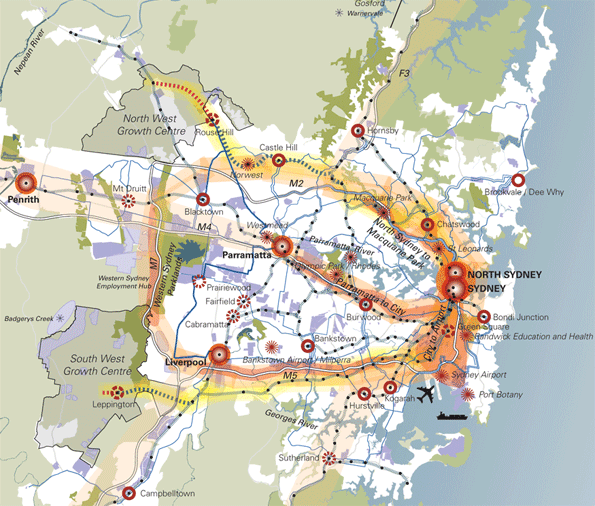
    Some world cities are distinguished by vast disparities in wealth and economic opportunity – between such globally oriented zones, sucking up the region’s capital, infrastructure capacity, skills base and government services, and stagnant hinterlands inhabited by struggling workers in declining, marginal industries or masses of unemployed. But that was not Sydney’s fate.

    Why and how did a viable economy develop in the middle to outer suburbs of the city? To answer this question it is necessary to recall some of the constants of Sydney’s recent history. The gradual emergence of global Sydney generated higher land values throughout the inner-city. Consequently, many inner-city land uses associated with nineteenth century transport nodes, such as the light industrial plants, depots and warehouses clustered near the railway junction south of the CBD or along the harbour foreshores of the inner-west were no longer sustainable in the face of escalating demands for office space and gentrification.

    Combined with the growth of motor vehicle mobility for passenger and freight transport, particularly since the 1950s, this led to the transfer of many industrial, transport and warehousing activities to cheaper land on the western and south-western fringes. At that stage of the city’s evolution, there were relatively few restrictions on the acquisition of space for these and related purposes. And the growth of road transport relative to maritime and rail sealed the necessary links to international gateways on the eastern seaboard, like Sydney Harbour, Port Botany and the airport.

    These trends were intensified by the construction of a road network to service the interstices of Sydney’s nineteenth century ‘hub-and-spokes’ or radial railway lines, culminating in the orbital motorway network (the dreaded ‘tollways’). Not only did motor vehicle mobility facilitate industrial dispersion, but also residential settlement adjacent to the new industrial jobs. The radial railway lines were Sydney’s nineteenth and early twentieth century template; the orbital motorway is the city’s contemporary template.

    As in the case of industrial relocation, there were fewer restrictions on residential development for the workers employed in these dispersed industries (this began to change by the mid-1990s). Inexpensive housing, a mild climate, out-door lifestyles and a preference for detached houses on sizeable blocks were also attractions. Over time western Sydney achieved 75 per cent regional employment self-containment, and key travel patterns are now intra-regional.

    Later phases of globalisation reinforced this spatial pattern. The rise of global Sydney was a major driver, at least since the early 1980s, of economic policies that favoured the liberalisation of economic activity. Naturally, this had repercussions across the rest of the city. One fundamental outcome was the expansion of services – such as retail – relative to manufacturing and commodities as a proportion of the national economy. The appearance of diverse service industries in the outer suburbs was yet another function of space and mobility. In western Sydney, this was closely associated with the region’s booming population growth. From the 1970s to recent times, western Sydney’s population growth outstripped the rest of the city and country.

    By the early 1990s, market oriented reform had ushered in a period of low inflation, interest rates and input costs, the latter having been wrung from difficult reforms to energy and other public utilities. The interaction of steady economic and population growth powered a strong consumer economy linked to settlement of the fringe suburbs. Such areas experienced a boom in residential and commercial construction, and the related demand for household fixtures, appliances and goods.

    These conditions unleashed a thriving small business sector in services, operating in a competitive market characterised by low entry barriers (low costs and overheads) and narrow profit margins. This, too, was a by-product of globalisation, as SGS Economics and Planning explain: ‘The concentration of small business activity in NSW (and Sydney) and the more rapid growth in the share of employment in this sector compared with other parts of Australia may reflect the tendency for heightened fragmentation of supply chains in globally engaged economic regions’. Presumably, this is why Mark Latham harped on about ‘the small business-people, the contractors, franchisees and consultants of the new economy’.

    While market pressures caused the ‘unbundling’ of service providers, advanced information and communications technologies were integrating head office, back office, manufacturing and distribution activities in land extensive facilities like the 50,000 plus square metre Coles Myer and Coca Cola distribution centres at Eastern Creek, and, in a different way, cutting-edge business and technology parks like Norwest and Macquarie Park. These facilities, contiguous with the orbital motorway, are creatures of space and motor vehicle mobility, and always will be.

    That is why the best elements of the NSW government’s City of Cities plan represent responsive rather than prescriptive planning; they reinforce successful trends emerging from the interplay of market forces. Plans for intensive commercial development along orbital motorway corridors, such as the M7 and particularly at its intersection with the M4, dubbed ‘the western Sydney employment hub’, the refocus on important western centres like Parramatta, Liverpool and Penrith as ‘regional cities’, and the series of road-rail transport interchanges (also land extensive) are prime examples.

    Its enemies

    This vibrant though vulnerable web of socio-economic connections is always at the mercy of global conditions – witness the impact of petrol prices – but also increasingly under challenge from domestic political actors, principally environmentalists, urban planners, some property developers and opinion makers. Their determination to freeze urban boundaries and, as far as possible, reduce mobility to public transport capacity, particularly rail, is hurting Sydney. Hopefully, their influence is gradually receding under Morris Iemma’s leadership.

    Environmentalists and planners – two increasingly interchangeable categories – are oblivious to the prospect that their creeping regulations and imposts, and misallocated resources, could unravel the suburban economy. Yet they will always struggle to mobilise public opinion. Their all-purpose pretext, the climate change hypothesis, relies on aggregated data which can’t be used to argue particular cases. Take the NSW government’s recent decision to review the costly ‘energy efficiency building sustainability’ rules. While the Housing Industry Association came to the issue armed with a raft of statistics about price impacts and falling housing starts, green outfits like the Total Environment Centre could do little but sputter the magic words ‘greenhouse’ and ‘global warming’. They were not in a position to show why, how and to what extent this particular decision would exacerbate climate change.

    Their other weapon is the peculiar concept of ecological or urban ‘footprint’. This purports to measure how much productive land and water an individual, a city, a country, or humanity requires to produce all the resources it consumes. On this measure, Sydney has a footprint that covers 49 per cent of NSW or 150 times its actual size, so its expansion must be constrained. The notion that wealth can be equated to an amount of land, however, is a throwback to pre-modern times. In advanced economies, wealth creation has more to do with the elaborate transformation of natural inputs, capital accumulation, forms of business organisation and services. And as one scathing writer points out, the concept fails to acknowledge that a stretch of land can be used for several different purposes simultaneously. Nevertheless, this absurd idea continues to pass unmolested into almost every discussion of urban planning, including City of Cities.

    If environmentalists are taken seriously at all, it is because they ride on the back of vested interests who benefit from artificially inflated land values, since this is the inevitable consequence of restricting new releases. Alan Moran of the Institute of Public Affairs argues that the reluctance of governments to burst the bubble of housing unaffordability by releasing more land for development can be traced to the undue influence of existing property owners, including powerful developers, who stand to suffer a capital loss if the scarcity value of land is diminished. It is a case of the ‘haves’ depriving the ‘have nots’, such as low income earners and young first home buyers.

    Then there are the progressive academics and commentators who insist the suburbs are zones of social alienation, inimical to personal contentment and well-being. Consider the Australian Financial Review’s property writer Tina Perinotto, who opposes sprawl because we can’t afford the ‘psychologists to deal with people who end up in the lonely greenfield sites’, or left-wing writer Natasha Cica, who raves about ‘the aesthetic and ethical slums of McMansion affluenza’, or Sydney Morning Herald planning and architecture writer Elizabeth Farrelly, who calls suburbanisation ‘total-indulgence parenting’, or urban policy academic Brendan Gleeson, who believes ‘shadows of fear and antipathy are spreading across’ the suburbs.

    Progressives clearly feel a need to delegitimise suburban life. This stems from their barely suppressed rage against people they can’t control. Like Kurtz in Joseph Conrad’s Heart of Darkness, suburban people have strayed too far from civilisation, they contend, and will lose their minds. Yet they fail to explain why surveys indicate an overwhelming preference for detached housing on sizeable blocks, or why the latest Australian Unity Wellbeing Index registers higher rates of happiness amongst suburban people than their inner-city counterparts.

    The left’s new poster-boy of urbanism, Gleeson, in particular, leads a tortured existence: he idealises suburbs as the nation’s ‘heartlands’ while hating almost everything about them. Gleeson has latched on to the emergence of so-called ‘gated’ communities as ‘harmful to collective democratic purpose’. This sort of socio-economic segregation is a recognised downside of the ‘world city’ scenario, especially in developing countries. In Sydney, however, it is more likely to mark a transitional stage of historically disadvantaged areas attracting more prosperous residents, eager to replicate the superior amenity of affluent suburbs. To the extent that it heralds the arrival of generally higher living standards in these localities, it is not necessarily the evil denounced by Gleeson.

    Of course, the enemies of growth don’t give a damn about the storm clouds perceived by Dr Henry. Sooner or later, however, they will bow to the inevitable: space and mobility made Sydney’s past; they will make the city’s future, if it is to be a future worth having.

    This article originally appeared at The New City Journal