Author: Tom Rubin

  • Does the Tax Code Favor Homeowners?

    For many years, a common complaint has been that the provisions of the Federal Internal Revenue Code, and most state income tax codes, favor homeownership in the form of major tax deductions for mortgage interest and property taxes. With the exception of those who reside in government housing of some type (subsidized apartments, public college dormitories, military housing, jails and penitentiaries), the homeless, almost all U.S. residents either live in a home they, or their family, owns or is paying off the mortgage, or they rent. Therefore, when looking at tax subsidies for home ownership, the valid analysis is not just to total these subsidies, but to compare home ownership subsidies to the tax benefits to owners of residential rental property – and, more to the point, the renters who live in them.

    Although the widespread conventional wisdom is that homeowners get huge tax benefits, the reality is that renters actually do far better. Typical is this statement by Kenneth Harvey in the LA Times:

    “In all, homeowners will split about $102 billion in direct federal largess (in fiscal 2002). Renters, meanwhile, will receive zero in direct federal transit subsidies.”

    (See also these from the Brookings Institution and Matthew Desmond in the New York Times.)

    The key in the above is the word “direct.”

    Almost every homeowner, and many non-homeowners, is very aware of deductions for home mortgage interest and property taxes from Federal income tax returns. Further, they know that residential renters do not have mortgages, nor do they receive property tax bills, so they have nothing to deduct on their tax returns.

    But it simply never occurs to many people (particularly renters) that their landlords do have these tax deductions, and many more – and that the resulting tax savings to the landlord are largely passed through to the renters through lower rents. There are even CPA’s that get caught up in this error.

    Yes, homeowners can deduct mortgage interest and property taxes – and virtually nothing else in most cases (Note 1). In contrast, landlords can deduct these, plus depreciation on the capital cost of the property and, depending on the details of the rental agreements, insurance, maintenance and repairs, most other taxes and assessments, utilities, and many other valid business expenses.

    I’m going to focus on the third of a recent series by Devon Marisa Zuegel (Note 2), “Exempting Suburbia – How Suburban Sprawl Gets Special Treatment in our Tax Code.” I’m using Ms. Zuegel’s work because she puts so many of the usual flawed arguments in one place.

    This paper has three major headings; the first is: “Homeowners get major tax breaks” – which is, of course, true, but the comparable, even more favorable, tax treatment of residential rental property and rents is absent from her paper.

    The second, “Profits on home sales is not taxed;” is, as Ms. Zuegel acknowledges, not totally correct. Under current law, capital gains on sales of homes where the taxpayers meet the requirements are not taxed on the first $250,000 gain for singles and $500,000 for couples. She also points out that, pre-1997, taxes on sales of homes could be delayed – or, in many cases, even eliminated entirely – by reinvesting in a home of equal or higher value.

    However, for landlords, the art and science of minimizing taxes on disposal of residential rental property is very well developed. For example, a “Section 1031 like-kind exchange” works almost exactly as the pre-1997, buy-a-more-expensive-home-and-don’t-pay-any-taxes provision – except that, it applies to residential rental property. The residential real estate portion of this provision is still very in place and is well utilized.

    Also, if the “active” owner of a residential rental property sells at a loss, that is tax-deductible; if a personal home is sold at a loss; no such benefit is available.

    The third heading is “New construction is a tax shelter.” Again, true, but, the points above clearly make residential rental property a far bigger tax shelter than home ownership.

    Interesting, Ms. Zuegel leads here with a quote from Brookings fellow Steven M. Rosenthal in the New York Times, “There’s probably no special interest that’s more favored by the existing tax doe than real estate.” Somehow, she misses that this article is entirely about the real estate “industry” – such as the likes of the National Multifamily Housing Council – the trade association of apartment owners, managers, developers, and lenders – with only one brief mention of home ownership in the article.

    One very important point to keep in mind is that the value of tax deduction to a taxpayer is directly proportional to the taxpayer’s marginal tax rate and that while there are certainly home owners in the highest tax brackets, there are also many in lower ones. This explains why many owners of residential rental property covet it since they generally are in high tax brackets where the deductions for these rental properties have major value.

    What is even more important is that many renters pay little, if anything, in Federal and state income taxes and, even for those that do, many do not itemize, and/or are in low tax brackets, and would receive little, if any, benefit from tax deductions on their own returns. In contrast, if their high-tax rate landlord gets major benefits from such deductions, the renters get a major share of these benefits passed on to them through lowered rents.

    An interesting comparative perspective can be found in a recent paper by Margaret Morales for the Sightline Institute, “Why Seattle Builds Apartments, But Vancouver, BC, Builds Condos:”

    “When it comes to condominium development, Cascadia’s two largest cities couldn’t be more different. Last year nearly 60 percent of new housing starts in the city of Vancouver, BC, were condominiums; meanwhile, Seattle saw no new condominium buildings open. And that’s not changing anytime soon: less than 10 percent of all building slated for downtown Seattle in the next three years will be condos. What’s the difference—why the blossoming of condominium construction in one city and the almost complete dearth in the other? The short answer is economics. In Vancouver, apartments are saddled with an unfavorable tax code, making condos the more lucrative multi-family housing investment even despite high rental demand. In Seattle’s skyrocketing rental market, one that’s climbed even faster than the condo market in recent years, apartment buildings are much more financially attractive, while condos come with bigger risks and, typically, lower returns.”

    While Ms. Morales discusses other factors that impact the huge difference between home ownership and residential construction offerings in Seattle and Vancouver, it is very clear that she sees the difference between U.S. and Canadian tax treatments of these as the most important factor.

    The conventional wisdom is that the U.S. (and most state) tax codes provide great advantages to U.S. homeowners, advantages that can be seen as subsidies of home ownership. While this is certainly true, it is, unfortunately, very rare that the authors and advocates who make such statements take their analysis any further to the real – the whole – truth: that the U.S. tax code greatly favors almost all owners of real estate – and that, in many cases, there are far greater advantages for owners of residential real estate in the form of many more deductions, of greater value, than the mortgage interest and real estate taxes that a homeowner can utilized.

    Also, because of these greater tax advantages, residential real estate has been a major tax-advantaged investment for high-income taxpayers for decades, often combining positive cash flow, little or no current income tax payments, potential for long-term gains, and, frequently, opportunities to delay, minimize, or even escape taxes on ultimate disposal. Because an effective real estate market demands that the major share of these tax advantages be passed on to tenants in the form of lower rents, much of these residential real estate tax breaks ultimately wind up favoring tenants – who are often in such low income tax brackets, if they pay income taxes at all, that they would receive no significant advantages if they directly paid real estate loan interest, property tax, depreciation, insurance, utilities, or any of the other expenses that are deducted – in a major way, for the tenants’ benefit – by their landlords.

    Yes, homeowners get significant tax breaks – but renters are generally the beneficiaries of far more.

    Note 1: Yes, a fire, earthquake, flood, etc. could produce a major casualty loss for tax purposes, this is hardly a common situation anticipated by homeowners when they entered into home ownership.

    Note 2: Ms. Zuegel indentifies herself as a software engineer at Affirm, a section leader for introductory programming classes at Standard, and Editor Emeritus of The Stanford Review, who blogs on a number of topics:
    http://devonzuegel.com/. This is the third of a three-part series by Ms. Zuegel. The first two, “Subsidizing Suburbia – A Forgotten History of How the Government Created Suburbia” and “Financing Suburbia – How Government Mortgage Policy Determined Where You Live,” are both accessible through the above link. While the primary focus of these is an exposé of U.S. governmental actions which Ms. Zuegel believes have led to the undesirable result of American suburbia, my instant purpose is on the impacts of tax policy on home ownership vs. renting; therefore, the relative pro’s and con’s of suburbia is a topic left for another day.

    Tom Rubin has over 35 years in government surface transportation, including founding the transit industry practice of what is now Deloitte & Touche, LLP, and growing it to the largest of its type. He has served well over 100 transit agencies, MPO’s, State DOT’s, the U.S. DOT, and transit industry suppliers and associations. He was the CFO of the Southern California Rapid Transit District, the third largest transit agency in the U.S. and the predecessor of Los Angeles County Metropolitan Transportation Authority.

    Photo: Andrew Smith, via Flickr, using CC License.
  • Los Angeles Metro Bus System Compares Favorably With its Peer Group

    As the Los Angeles County Metropolitan Transportation Authority (Metro) prepared for its most recent round of major bus operations reductions, Metro CEO Art Leahy has been quoted:

    "(T)oo many bus lines with excessive service has led to regular budget deficits1."

    "How full are Metro buses today? Overall, Metro buses are running at an average of 42 percent capacity. Of course, that doesn’t mean that all Metro buses are less than half full. Another measure to gauge bus usage is called ‘load ratio’ — the ratio of passengers to bus seats at the most crowded part of a bus route. By that count Metro’s average load factor is an average of 1.2. (For example, 48 passengers on a 40 seat bus). Many other large transit agencies are running load factors of 1.5 to 1.72 ."

    The "42 percent" capacity is evidently the average passenger load (APL) divided by the number of seats – in other words, on average for the full year, each 40-seat MTA bus had about 17 passengers on board.

    Forty-two percent might appear to be a low value, particularly in comparison to other modes of transportation like scheduled airlines, where it is common to have a 100% load factor on some flights.  However, Lufthansa doesn’t stop at Wilshire/Vermont to pick up passengers between LAX and JFK – transit service is scheduled for peak load factor; that is, attempting to approach, but not exceed, a maximum load factor at the point on the line where the number of people on board is largest.

    In the second quote, we have a mixture of load factors terms and data.  Almost all transit operators have load factor standards, which they set for each mode of service (bus, light rail), time of day, day of week, and type of service (main line arterial bus service, long-haul commuter, neighborhood circulator).  For Metro, the peak load factor criterion had been 1.20 – the 48 passengers on a 40-seat bus – since this was imposed by the Consent Decree that settled Labor/Community Strategy Center v MTA in late 1996 until very recently.

    In that quote, Metro is comparing services standards to actual performance.  It is certainly true that, until the passage of the new policy a few months ago, Metro’s 1.20 service standard was one of the lowest in the industry for larger city operators.  However, Metro routinely failed to meet this standard, which was a major source of complaints by the plaintiffs in L/CSC v MTA – and MTA’s overall average passenger loads have among the highest in the industry for decades.

    Comparing actual results to actual results is far more meaningful than comparing service standards to service standards.  Is 42 percent low, high, or what?  The standard methodology for determining this is peer group comparison.  The Federal Government makes transit data available though its National Transit Database – which we used for the 2009 reporting year3.

    We then constructed our peer group, the twenty largest U.S. transit operators by annual unlinked passenger trips that operate both bus and rail service4 and developed the data for: 

    APL:  Average Passenger Load
    BHr:   Boardings/Hour
    FRR:   Farebox Recovery Ratio
    SP:       Subsidy/Passenger
    SPM:   Subsidy/Passenger Mile

    The results are:

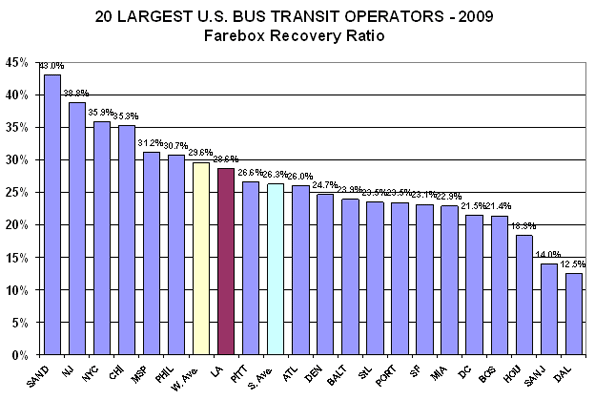
    1.         FRR: Higher is better – but, this statistic can often be misunderstood.  For example, a high cost operator with high fare can have a higher FRR than a low cost operator, but the low cost operator will be providing a better deal, financially, for both the riders and the taxpayers.

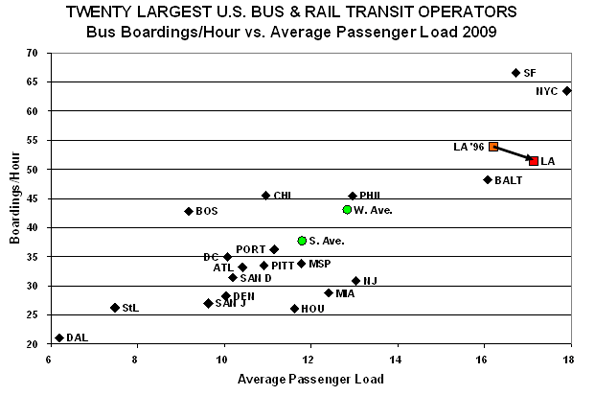
    2.  APL/BHr: Appearing and to the right on the next graph indicates higher load factors.  Higher is better; however, at some point, overcrowding impacts service quality and reliability.

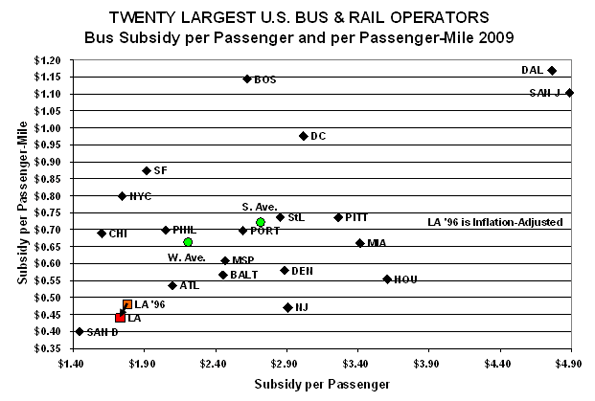
    3.  SP/SPM: On this graph, lower is better, so down and the left is superior – except that, at some point, low cost can indicate concerns about quality of service and safety.

    While Metro is not among the highest in FRR, it has more than twice as many ranked below it (13) than above it (six).  Considered with the subsidy metrics, Metro bus service is a fair deal to the riders and a great deal for the taxpayers.

    On the service utilization graph, Metro is second highest in APL, beaten by NYC, and third on BHr, beaten by NYC and SF.  We added, "LA ’96," for 1996, the year before the Consent Decree went into effect part-way through Metro’s 1997 fiscal year.  BHr has decreased slightly (53.9 to 51.4, or ~4.6%), while APL has increased slightly (16.2 to 17.1, or ~5.6%).  The increase in APL is interesting because Metro’s on-going replacement of primarily 43-seat "hi-floor" with 40-seat "low-floor" buses means that Metro is carrying more people in smaller buses.

    Metro bus service again does well on cost-effectiveness.  San Diego beats Metro on both SP and SPM and Chicago beats Metro on SP.  Metro reduced both of these from 1996 to 2009 after adjusting for inflation5.

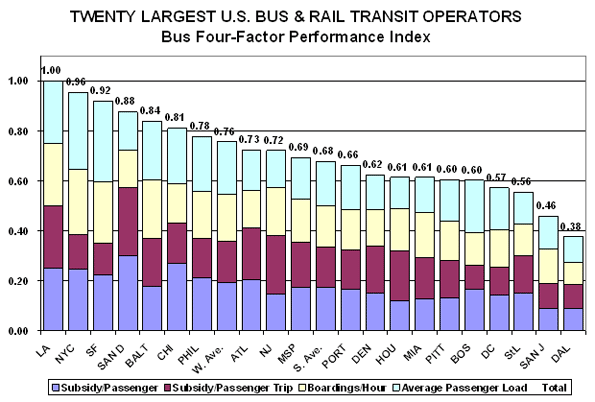
    Finally, we decided to do a combined performance index, based on Metro’s own "Route Performance Index" (RPI), which Metro utilizes to eliminate low performers6:

    We have adapted METRO’s RPI in three ways:

    1.  We use it for bus system performance, rather than route performance.

    2.  The "standard" is Metro’s performance on each individual indicator.  The overall score is set at 1.00 for Metro, broken into four components, each of which Metro scores .25.  Operators scoring better on an indicator receives a score higher than .25; performing poorer, lower than .25, with the specific score a direct ratio against Metro’s score (remember that, for subsidy, lower is better, while for route utilization, higher is better).

    3.  Metro utilizes three metrics in its RPI, SP, BHr, and APL.  We added SPM.

    What we see is Metro rated the highest overall among its peers.  Metro does not win on any single criterion, but its two seconds and two thirds put it ahead of the rest overall.

    Metro’s Transit Service Policy (page 32) states:

    "Lines with an RPI lower than 0.6 are defined as performing poorly and targeted for corrective action.  Lines that been subjected to correction actions and do not meet the 0.60 productivity index after six additional months of operations may be cancelled  …"

    If this .60 cut-off is applied to the 20 bus systems, several would be in major trouble.  Dallas (.38), San Jose (.46), Saint Louis (.56), and Washington, DC, (.57) are below the cut-off.  Boston and Pittsburgh (both at .60) are right on the line, and Miami (.61), Houston (.61), and Denver (.62) only slightly above.

    If one takes the Metro RPI and applies it to the nation’s Top 20, nine of the 20 are either below or very close to the cut-off point. This implies that a high portion of the individual lines, a majority in at several cases, are below the Metro route-by-route cutoff point.

    Circling back to Metro routes, this could mean that many of the routes that Metro would cut, using its RFI procedure, would be average or even above-average routes for many of the nation’s larger bus systems.  Failing to meet the Metro average is actually a very high cut-off point when compared to the national performance.

    This is not to say that no Metro service should ever be cut or eliminated.  What we are saying is, don’t make the cut-off point too high; there is a lot of well-utilized service, by national standards, that does not pass Metro’s methodology.  More important, where there are bus lines with service reduced, put that back on the many, many Metro bus lines that are underserved – which is the usual condition.

    From the above, we see Metro working very hard to cut to reduce the service operated by the most cost-effective and productive major city bus system in the nation – why?  Unlike most other U.S. transit operators, it is not due to lack of funding – but the explanation will have to wait for my next blog entry.

    1           Steve Hymon, "Metro Proposes Bus Service Changes in June, The Source (Metro’s blog), January 3, 2011, access July 9, 2011:
    http://thesource.metro.net/2011/01/03/metro-proposes-bus-service-changes-in-june/

    2               Ibid.

    3               National Transit Database, accessed July 7, 2011:
    http://www.ntdprogram.gov/ntdprogram/data.htm

    4           American Public Transportation Association, 2011 Public Transportation Fact Book, Table 3: 50 Largest Transit Agencies Ranked by Unlinked Passenger Trips and Passenger Miles, Report Year 2009 (Thousands), page 8, accessed July 7, 2011.
    http://www.apta.com/resources/statistics/Documents/FactBook/APTA_2011_Fact_Book.pdf

    5               U.S. Department of Labor, Bureau of Labor Statistics, CPI-U for LA/Riverside-Orange County, accessed July 7, 2011:
    http://data.bls.gov/pdq/SurveyOutputServlet?data_tool=dropmap&series_id=CUURA421SA0,CUUSA421SA0

    6           Metro, 2011 Metro Transit Service Policy, page 31 and Appendix F, accessed July 7, 2011
    http://www.metro.net/board/Items/2011/02_February/20110224RBMItem9.pdf

  • Los Angeles: The MTA’s Bus Stop Strategy

    Those who run the Los Angeles Metropolitan Transportation Authority evidently believe that, since the Consent Decree that forced it to improve service to its bus riders has expired, they are free to rewrite history to justify Metro’s elimination of nine bus lines, its reductions in service on eleven more, and its overall elimination of four percent of its bus service hours by attempting to show that MTA bus service is little utilized and not cost-effective.

    The Consent Decree followed a decade of reductions in bus service and increases in fares while the majority of transit spending by the major LA transit agencies went to rail. As a result of a Federal Title IX (discrimination in utilization of Federal funding) legal action, Labor/Community Strategy Center v MTA, in 1996, Metro agreed to the CD. It was forced to eliminate the effective doubling of fares that it had imposed, to return to offering the monthly passes that had been highly utilized by low-income transit riders, and to commit to a relief of overcrowded bus service. Those of us who fought for the CD, and who fought Metro to make it live up to its commitments, believed the CD to be an incredible success.

    MTA has always felt otherwise.

    To see how MTA characterizes the CD as a failure, and thus justifies bus service reductions, go to the source… literally. The Source is MTA’s blog:

    “After the late 1990’s, Metro increased bus service by more than one million hours. Although overall Metro ridership has increased over time, bus ridership has fallen or been flat in the past two decades.”

    This is a wonderful example of the creative use of statistics.

    The latest National Transit Database data is for 2009, when there were 386 million bus boardings. In 1989, twenty years earlier, there had been 412 million. So, yes, Metro bus ridership fell over this two decade period.

    However, a more relevant way of looking at this is to compare 1996 – the year before the CD went into effect – to 2009. From 1996 to 2009, mostly as a result of the CD, bus vehicle revenue hours were up 20.2%, miles were up 14.6%, and bus boardings were up 14.5%.

    What the CD was intended to correct, more than anything, was Metro’s history of reducing overall ridership, bus and rail, by an average of 12 million a year in the eleven years that followed its start of major rail construction in ’85. The measure of the CD’s success was the turnaround: Once it went into effect, Metro ridership increased 12 million a year for the next eleven years until it expired.

    Metro did increase bus service substantially after the CD, and utilization of this service increased at right about the same level. Again, from The Source:

    “How full are Metro buses today? Overall, Metro buses are running at an average of 42% capacity.”

    The 42% figure is evidently derived by dividing Metro’s FY09 bus average passenger load – passengers-miles/vehicle revenue miles – by the average number of seats on Metro buses. The figure looks low, doesn’t it? Think about all those empty seats.

    However, unlike an airline flight from LAX to JFK, Metro buses make many stops along their routes to pick up and drop off passengers. Bus scheduling is developed around the maximum carrying capacity of a bus at the peak load point of the route during the peak ridership period. This means that, for much of the day, and for most of even the busiest bus trips, there are a lot of empty seats. That’s the nature of the transit business.

    And compare Metro bus service to its 20 largest peers. For 2009, Metro was had the second highest average passenger load of the group, at 17.1, beaten only by MTA-NYCT, at 17.9. The average of the results of the Top 20 was 11.3. That 42% starts looking pretty good . In fact, a ratio this high actually suggests that a lot of Metro bus lines should be examined for overcrowding.

    “At present, Metro subsidizes about 71 percent of the cost of each passenger’s bus ride, an amount higher than most other large transit agencies.”

    More commonly, this ratio is turned around, as in: Metro has a 29% farebox recovery ratio.

    How does Metro bus rank up against its Top 20 peers? Seventh, and the average of the Top 20 is 27%. However,farebox recovery ratio can be a very misleading metric. Direct subsidy ratios are a more significant indicator, particularly taxpayer subsidy per passenger and per passenger-mile. Metro’s subsidy/passenger was $1.74, third in the Top 20, against the average of its peers of $2.49; its subsidy/passenger mile of $.44 was second best, against the average of $.68.

    So, rather than the bus service financial performance being sub-standard, it is actually outstanding, providing good value for the riders and great value for the taxpayers.

    Instead of Metro telling the world what a great job it is doing, and taking pride in what it has accomplished, why is Metro leadership explaining how wasteful it is, and why service must be cut?

    “As to whether [these] will be the final bus service changes, Leahy said that he wasn’t sure. ‘But, if we don’t do these things, the capital program is not sustainable.’”

    For those not familiar with MetroSpeak, “capital program,” when applied to transit, primarily means building more rail.

    This is the central issue: Metro is in the business of construction of transportation infrastructure, and money wasted on actually moving people takes away from what is available to build new guideway transit corridors.

    As of this writing, Metro has Chatsworth Orange Line extension (BRT) and Expo Light Rail Phase I in construction, Expo Phase II approaching construction, and a design/build procurement for Phase 2A of the Pasadena Gold Line is underway.

    Metro is also in various stages of planning and obtaining funding commitments for East San Fernando Valley North-South BRT lines, Sepulveda Pass Transit Corridor, Westside Subway Extension, Downtown Regional Transit Connector, Crenshaw/LAX Transit Corridor, Eastside Transit Corridor, Green Line LAX Extension, South Bay Green Line Extension, and West Santa Ana Transit Corridor. Plus, it’s the majority partner for the seven Metrolink commuter rail lines.

    Clearly, Metro is so short of operating funds that it is cutting service on a bus system that is the best value to the taxpayers and riders in the nation. It cannot afford to operate its current bus system, and it is attempting to get Congress to front-load massive construction funding against the thirty-year half-cent sales tax passed in 2008. Given Metro’s less than stellar record of bringing in capital projects on budget, and considering its failure to provide for the very large capital renewal and replacement costs of the current rail lines as they age, exactly how does it expect to pay the operating costs of the expanded system it is rushing to construct?

    As Will Rogers said, “When you find yourself in a hole, stop digging.”

    Tom Rubin has over 35 years in government surface transportation, including founding the transit industry practice of what is now Deloitte & Touche, LLP, and growing it to the largest of its type. He has served well over 100 transit agencies, MPO’s, State DOT’s, the U.S. DOT, and transit industry suppliers and associations. He was the CFO of the Southern California Rapid Transit District, the third largest transit agency in the U.S. and the predecessor of Los Angeles County Metropolitan Transportation Authority.

    Photo by biofriendly, Metro Bus Campaign, Los Angeles