Author: Tony Recsei

  • Health, Happiness, and Density

    The proponents of currently fashionable planning doctrines favouring density promulgate a variety of baseless assertions to support their beliefs. These doctrines, which they group under the label of “Smart Growth”, claim, among other things, that from a health and sustainability perspective, the need to increase population densities is imperative.

    With regard to health these high-density advocates have seized upon the obesity epidemic as a reason to advocate squeezing the population into high-density. This is based on a supposition that living in higher densities promotes greater physical activity and thus lower levels of obesity.  They quote studies that show associations between suburban living and higher weight with its adverse health implications. But the weight differences found are minor – in the region of 1 to 3 pounds. Nor do the studies show it is suburban living that has caused this.

    The suburbs, after all, have been with us for 70 years and reached its mature development over 40 years ago. Obesity, on the other hand, is a much more recent phenomenon and is primarily due to people eating too much fattening food.

    Less discussed, however, are other facets to human health and it is important to consider the results of research on the association with high-density living of mental illness, children’s health, respiratory disease, heart attacks, cancer and human happiness.

    A significant health issue relates to the scourge of Mental Illness. There is convincing evidence showing adverse mental health consequences from increasing density.

    A monumental Swedish study of over four million Swedes examined whether a high level of urbanisation (which correlates with density) is associated with an increased risk of developing psychosis and depression. Adjustments were made to cater for individual demographic and socio-economic characteristics. It was found that the rates for psychosis (such as the major brain disorder schizophrenia) were 70% greater for the denser areas. There was also a 16% greater risk of developing depression. The paper discusses various reasons for this finding but the conclusion states: "A high level of urbanisation is associated with increased risk of psychosis and depression".

    Another analysis, in the prestigious journal Nature, discusses urban neural social stress. It states that the incidence of schizophrenia is twice as high in cities. Brain area activity differences associated with urbanisation have been found. There is evidence of a dose-response relationship that probably reflects causation.

    There are adverse mental (and other) health consequences resulting from an absence of green space. After allowing for demographic and socio-economic characteristics, a study of three hundred and fifty thousand people in Holland found that the prevalence of depression and anxiety was significantly greater for those living in areas with only 10% green space in their surroundings compared to those with 90% green space.

    High-density advocates seem most oblivious to the needs of children. Living in high-density restricts children’s physical activity, independent mobility and active play. Many studies find that child development, mental health and physical health are affected. They also find a likely association of high-rise living with behavioural problems.

    An Australian study of bringing up young children in apartments emphasizes resulting activities that are sedentary. It notes there is a lack of safe active play space outside the home – many parks and other public open spaces offer poor security. Frustrated young children falling out of apartment windows can be a tragic consequence. Children enter school with poorly developed social and motor skills. Girls living in high-rise buildings are prone to increased levels of overweight and obesity.

    A British study found that 93% of children living in centrally located high-rise flats had behavioural problems and that this percentage was higher than for children living
    in lower density dwellings. Anti-social behaviour often results. An Austrian study showed disturbances in classroom behaviour higher for children living in multiple-dwelling units compared to those living in lower densities. 

    There is also evidence of other potential health impacts on children living in higher density housing. These include short-sightedness due to restricted length of vision, and diminished auditory discrimination and reading ability due to exposure to noise.

    Air pollution increases with density. This results from higher traffic densities together with less volume of air being available for dilution and dispersion. Nitrogen oxides in this pollution have adverse respiratory effects including airway inflammation in healthy people and increased respiratory symptoms in people with asthma. There is consistent evidence that proximity to busy roads, high traffic density and increased exposure to pollution are linked to a range of respiratory conditions. These can range from severe conditions (such as a higher incidence of death) to minor irritations. Moreover, these respiratory health impacts affect all age groups.

    Several studies relate low birth weight to air pollution. A South Korean report, for example, found the pollutants carbon monoxide, nitrogen dioxide, sulfur dioxide, and total suspended particle concentrations in the first trimester of pregnancy pose significant risk factors for low birth weight.

    Air pollution particulates are associated with killing more people than traffic accidents. Pollutants such as those emitted by vehicles are significantly associated with an increase in the risk of heart attacks and early death.

    Cancer is a major health scourge and a relationship between increased colon cancer, breast cancer and total cancer mortality with population density has been found.

    There is an association between overall Human Happiness and density. Professor Cummins’ Australian Unity Wellbeing Index reports that the happiest electorates have a lower population density. A United States study finds the satisfaction of older adults living in higher density social housing reduces as building height increases and as the number of units increases. By contrast, in lower densities there are higher friendship scores, greater housing satisfaction, and more active participation. This does not apply only to single family houses: Residents of garden apartments have a greater sense of community than residents of high-rise dwellings.

    An example of misinformation on this issue can be found in R.D. Putnam’s famous book “Bowling Alone”.  Putnam states that "suburbanisation, commuting and sprawl" have contributed to the decline in social engagement and social capital.  However I have shown that data from charts in his book indicate quite the opposite:
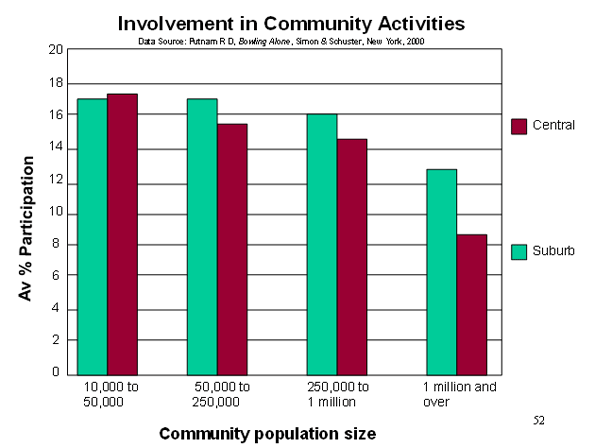
    Adapted from Figure 50, Putnam R D, Bowling Alone, Simon & Schuster, New York, 2000

    This shows that involvement in these social activities are more common in the suburbs than in the denser centres of cities (and that they become more common as the community size and density decreases).

    Community contentment relating to the density of surroundings is revealed by a study in New Zealand that asked people if the type of area they would most prefer to live in is similar to the area they currently live in. The responses are shown in this table.
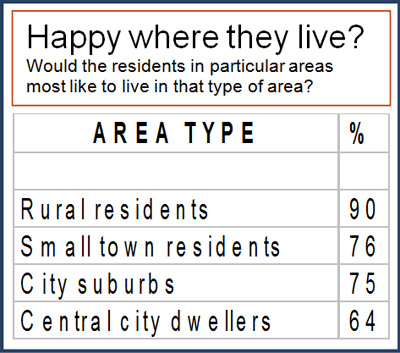

    So 90% of rural residents would prefer an area similar to their current area but only 64% of central city dwellers would prefer an area similar to their current surroundings.  It can be seen that satisfaction decreases as density increases.

    Thus evidence from a variety of sources points to greater human happiness and better health in lower densities — the exact opposite of the theories of the advocates for “cramming” people into ever small places.

    (Dr) Tony Recsei has a background in chemistry and is an environmental consultant. Since retiring he has taken an interest in community affairs and is president of the Save Our Suburbs community group which opposes over-development forced onto communities by the New South Wales State Government.

    Sydney suburb photo by BigStockPhoto.com.
  • Children Falling from High Rises in New South Wales

    Frustrated young children confined in the small apartments proliferating in New South Wales are naturally inquisitive and incapable of judging risks.  They climb onto window sills or balustrades to fall onto concrete many metres below.

    The results have been appalling. In Sydney during the period 1998 to 2008 169 children have fallen to serious injury or death, and, as the proportion of apartments increase, so do these tragic incidents, of which there is now one a week.

    Apartments are especially unsuitable for bringing up very young children. Research  reveals that there are poor health and parenting outcomes. Crawling and walking is stymied due to space problems with children having little access to areas for meaningful activity. There is a lack of safe active play space outside the home. Parks and other public open space offer poor security due to the use of these areas by local youth gangs and the socially dysfunctional.

    Over the past decade, the goal of the New South Wales Government has been that more than half of the population of NSW be squeezed into apartments by the year 2030. These high-density policies have placed a restrictive growth boundary around Sydney, and have been enforced by stripping away the planning powers of those local authorities that dared to offer any resistance.

    This draconian approach is despite the fact that the vast majority of Australians prefer living in free-standing homes rather than in apartments. Half of apartment-dwellers would rather live in a house with a garden.

    The government has been creating a child-hostile city and a child-hostile city is a disaster for the future.

    The Westmead Children’s Hospital in Sydney formed a working party in 2009 in response to the growing number of child tragedies.  As a result the NSW Government has now belatedly announced that window safety locks that restrict the degree to which windows can open will be mandatory for new apartments.

    But is locking children into apartments and restricting fresh air a good solution? Surely a much better resolution is for the high-density policies to be unambiguously abandoned. Housing that the vast majority of people want should be readily available – that is family friendly single-residential housing with a safe backyard for children’s recreation. 

    There is some good news for young children, namely the recent announcement by the New South Wales Government of a proposed modified Metropolitan Strategy with the Minister of Planning saying “We’re trying to be less constrictive and restrictive and what we’re saying is the market place should have far more of a say in what the mix of housing is and where it will be.” Might the long-suffering families in Sydney and their young children hope that the iron grip of the high-density policies of the last two decades could be weakening at last?

    The new Metropolitan Strategy announcement may indicate a faint light at the end of the tunnel. One hopes this will not be a mere will-of-the-wisp, but that this glimmer will brighten into a beam that will consign urban containment policies to the dustbin of history – and prevent the ongoing falling deaths of some of our most vulnerable kids.

  • Predictable Punditry Down Under

    The New South Wales Government has been following an extreme version of currently fashionable planning doctrines based on higher population densities. These policies have resulted in exorbitant housing costs and increasing traffic congestion.  A Liberal/National Coalition Government has come into power in New South Wales, replacing the previous Labor Government. In its election platform it promised to change planning policies for the better. These include fewer additional dwellings to be forced into Sydney suburbs, more fringe land release, decentralisation and giving planning powers back to the community.

    The New South Wales Department of Planning bureaucracy is consequently ostensibly devising a new housing strategy.  As the main feature in a community discussion on this new strategy, the Department organised a presentation by Harvard Professor Edward Glaeser in Sydney entitled “Triumph of the City”, The promotional description read

    recognised as the world’s leading urban economist, Harvard University’s Professor Edward Glaeser, along with four of NSW Government’s planning and infrastructure experts, will discuss fresh approaches to meeting Sydney’s biggest challenge now and into the future — planning for a population that is expected to increase from 4.2 million to more than 5.6 million by 2031”.

    Previous consultation exercises for planning strategies had proved to be tokenistic and mere public relations exercises.  Unfortunately this event proved to be no exception. It promoted the current high-density policies with no discussion of alternatives or fresh approaches.

    Professor Glaeser spoke about how cities evolved as engines of development and wealth creation. He portrayed cities facilitating people getting together, sharing ideas and building on previous innovations. He described how the advent of popular means of transport — from horse drawn transport to cars — allowed cities to spread and maintained that low density areas are associated with longer car journeys and larger homes that consume more energy. To facilitate the person to person contact he considers necessary to sustain innovation and to reduce energy consumption he advocated ever higher-densities closer to the city core.   

    He implied this is especially important so as to set an example to highly populated China and India in order to limit the otherwise huge escalation in energy usage in those countries.

    Throughout the proceedings the conference facilitator promoted the concept of high densities by such statements as “We need to re-examine the suburban model, living more like urban model” and “Go up, not out.  Can we do that? How do we do that?”
    The overwhelming impression given by the consultation proceedings was that high-density is the only possible strategy worth considering and that Glaeser’s USA perspective can be applied to New South Wales.

    Yet the argument that high density means more innovation seems flawed. In the United States of America the greatest innovative activity takes place not in crowded Manhattan but in regions of densities similar to that of Sydney, the urban area of which has 2100 persons per square kilometre (5,500 per square mile).  The San Jose urban area in Silicon Valley, with a similar population density, has a booming world-changing local technology industry including Cisco Systems and IBM. It also is almost totally dependent on automobiles, with only a small share of people taking transit.

    Companies operating in Hillsboro in the Portland urban area (population density of 1400 per square kilometre or 3600 per square mile) include Yahoo!, Credence Systems, Synopsys, Epson and Sun Microsystems.  Seattle, the home of Microsoft and the initiation of Boeing, has a population density of 1,200 per square kilometre, or 3,000 per square mile. The densities in these dynamic areas are equal to or less than that of Sydney and a far cry from the Manhattan or even Hong Kong type of density of 25,000 (67,000 per square mile) or more that Glaeser seems to prefer.

    Although high-density living may not be for everyone, apparently, particularly those with kids. Glaeser, like another prominent advocate of rapid densification, David Owen “copes” with living in suburbia.  I guess dense housing is for other families.

    The claim by Glaeser that high-density is superior environmentally also is not borne out in Australian studies.  A publication of his finds emissions in low-density suburbs in several United States cities to be higher than in high-density suburbs.  Australian data does not show this.

    A study of energy-related emissions at the final point of consumption finds per capita energy usage in a group of low density Sydney suburbs (96 GJ per annum) to be lower than in high-density suburbs (169 GJ).  One of several factors accounting for these differences is there are more people per household in the lower density areas. Glaeser models emissions on a “standard household” of 2.2 people; many, if not most suburban households, have more than that number, although city households frequently don’t.  One wonders whether possible differences in the number of people per dwelling in high-density and low-density areas can be adequately catered for in such models.

    For another thing, the Australian climate is very different and that is probably a significant reason for higher densities to be more energy intensive. If dwellings are too close they are more difficult to cool whereas it is easier to heat them.  Also, cooling technically needs more energy than heating as a much larger volume of air needs to be circulated (NOTE 1).

    Glaeser’s advocacy of high-density to reduce transport emissions needs special consideration.  In Australia such reduction, if any, is trivial.  Transport greenhouse gas emissions account for only a small proportion of household emissions and higher-densities reduce these to a minimal extent. (NOTE 2

    It is not only in Australia where evidence for significant environmental benefits from high-density planning is lacking.  As a result of studies testing the relative performance of spatial options in England, Echenique et al conclude: “The current planning policy strategies for land use and transport have virtually no impact on the major long-term increases in resource and energy consumption. They generally tend to increase costs and reduce economic competitiveness. The relatively small differences between options are over-whelmed by the impacts of socioeconomic change and population growth”.

    The Department of Planning-sponsored Glaeser presentation was not a genuine consultation. It promoted existing government policies with no attempt to consider their downside or to discuss alternatives.  It is extraordinary and downright arrogant to expect Sydney communities to change their preferred mode of life to live in tiny apartments perched in towers (see picture) in the unproven expectation that this will significantly reduce greenhouse gas emissions. It is yet even more extraordinary to presume that such a transformation would influence policies in China and India in any significant way. The days when these great countries looked to the West for models has already passed; and look where many people from these countries settle when they get to the United States or to Australia: the suburbs. Classic cases include the San Gabriel Valley East of Los Angeles, the Santa Clara Valley communities of Silicon Valley, large swaths of northern New Jersey and to Sydney’s North Shore in Australia.

    The proceedings proved to be an attempt to promote a particular point of view, so perpetuating previous approaches of trying to manipulate opinion in the guise of consultation.

    It appears clear that in spite of a change of government there will be no change in planning policies.  The new government looks like having been captured by the bureaucracy and its cult of densification that has no more chance of changing its views than the College of Cardinals is likely to eschew the Papacy. 

    (Dr) Tony Recsei has a background in chemistry and is an environmental consultant. Since retiring he has taken an interest in community affairs and is president of the Save Our Suburbs community group which opposes over-development forced onto communities by the New South Wales State Government.

    Photo: Kowloon, Hong Kong

  • Alternative Growth Paths for Sydney: A New Report and its Implications

    Population growth in Australia is double the world average and the New South Wales Department of Planning has projected that the population of the Sydney region will increase by 57,000 people annually. How will these extra people be housed?  The NSW Government follows the usual doctrines based on higher population densities. Its planning policy, known as The Metropolitan Strategy, works on locating some 70% of new dwellings within existing urban communities (in-fill) and 30% in new greenfield sites. 

    This policy is implemented by orders issued by the New South Wales Minister of Planning and imposed by ministerial fiat which are neither tabled nor debated in parliament.

    To achieve this 70/30 strategy the Department of Planning in effect has placed a restrictive growth boundary around Sydney to force higher-densities into existing residential areas. Greenfield land release has been reduced from an historic 10,000 lots per year to less than 2,000. This has caused a severe land shortage. 

    These policies are undemocratic and widely resented. What is more, the government has not justified them in terms of public good.  Indeed they might find that hard to do. For example, Australian studies show that greenhouse gas emissions per person are higher in high-density living, congestion is worse, human health is compromised, the costs of electricity, gas and water services increase, heritage conservation areas valued by the community are often lost and irreplaceable urban patchwork of greenery and wildlife within the city is decimated.

    The CIE Report

    The previous Labor Government commissioned a report on possible planning alternatives for Sydney. This report, by the Centre for International Economics (CIE) titled The Benefits and Costs of Alternative Growth Paths for Sydney: Economic, Social and Environmental Impacts was delivered back in December 2010. It has only now been released by the current government. 

    The report discusses three different scenarios for Sydney.  These portray alternatives of 90%, 70% and 50% of new housing to be built in existing urban areas (in-fill) – and correspondingly 10%, 30% and 50% in greenfield sites.

    The report compares the costs of the 90/10 and 50/50 scenarios with those of the current Metropolitan Strategy 70/30 ratio over a twenty-five-year period. It finds the cost differences between them are comparatively trivial. When compared to the Metropolitan Strategy 70/30 policy, the annual non-discounted cost saving per new dwelling for the 90/10 scenario is only A$151.  For the 50/50 scenario the additional annual cost per new dwelling is found to be A$950.

    This report contains two significant flaws. The first is an implicit assumption that the price of land will be the same for all three scenarios. It also fails to properly consider additional cost factors.

    Price of Land

    Each scenario examined changes the amount of new land that would be released for development. When compared with the current baseline 70/30 strategy, the 90/10 scenario would require even greater restrictions on the release of new housing land and hence an even greater land shortage. By contrast, the 50/50 scenario would allow for a more generous release of new land and hence more land available for construction.  The immutable laws of supply and demand ensure that the degree of land restriction would significantly affect the cost of housing in each scenario, completely swamping the relatively minor cost differences due to other factors.

    Incredibly, the report appears to fail to take the effect of relative scarcity on costs into consideration. It simply assumes that the price of land will remain the same for each scenario.

    This is significant because the report includes in its calculations factors that are highly dependent on the cost of land. If the report’s findings are to be credible, the variation of these factors caused by land price variation in each scenario examined should also be taken into account.  When land is scarce high-density developers can make greater profits as they have less competition from low-priced houses and landholders can get higher prices for their land than would be the case otherwise. 

    Other Costs

    The report alleges that electricity consumption is greater in houses than it is in apartments. This is incorrect. Studies show that consumption per capita is greater in apartments. It appears that the data the report relies on does not take into account the consumption of electricity common to the whole apartment block such as lifts and lighting common areas such as foyers and car spaces. 

    The report also does not take into account costs to existing residents arising from forcing high-density into communities originally designed for low-density. These include:

    • The impact on a single-residential property that has high-rise built next to it. This can involve theft of amenity: new in-fill residents look over gardens of existing residents while the latter have to look onto unsightly structures, and suffer lack of privacy and overshadowing.
    • Congestion. Existing residents have to suffer from increasingly congested streets and shortage of street parking.
    • Shortage of recreational facilities. As more vacant land is built upon in a community originally designed for low-density, it becomes difficult to secure new open areas to service the needs of the additional population at a reasonable standard.
    • Reduction in housing choice, particularly for families.  Most infill development consists of apartments which are not suitable for bringing up young children.  Indeed the majority of those currently living in apartments do not do so by choice. A survey indicates multi-story apartments are not even acceptable to most people wishing to downsize, if they have other choices such as smaller single residential houses or villas.
    • Reduction in biodiversity. When gardens and open space are replaced with unit blocks this has a severe effect on urban plant and animal life.
    • Heritage items valued by the community such as traditional period architect designed housing are often lost.
    • Atmospheric pollution.  There is a local effect on residents of atmospheric pollution in high-density areas.  This is due to higher traffic densities and to less volume of air being available for the dilution and dispersion of pollutants.

    If these considerations had been quantified into the report’s calculations, they would have changed its overall findings.

    Conclusions

    As is not unusual in reports by density advocates throughout the English-speaking world, the report’s findings are marred by the fact that significant factors are omitted.  If costs and benefits were fully accounted for, including the costs and benefits borne by existing residents, an already weak case for emphasising densification over fringe development would vanish.

    As we have seen, even with the flawed accounting used in the report, the magnitude of the cost differences that it finds between its three scenarios is trivial. These tiny differences make the unpopular Metropolitan Strategy 70/30 policy hard to justify, and any intensification of this strategy to 90/10 impossible to justify.   Cost differences of either A$151 or A$950 are small compared to the price that people have to pay for a house (the median price in Sydney is A$650,000). These insignificant figures need to be considered in the light of providing people with the opportunity of living in the housing style of their choice.

    If costs and benefits were to be fully accounted for, including those borne by existing residents, the case for a policy of enforced densification cannot be supported.   When asked voters want less rather than more densification.

    High land prices due to restrictive land-releases are already making housing unaffordable for the next generation.  Unwanted high-rise development represents theft from the community, reducing the amenity of existing residents and transfers that value to property developers without recompense. This theft is aided and abetted by the policies of the State Government. Moreover, it continues to result in well-publicised favours being granted to developers with connections to government.

    The Metropolitan Strategy needs to be replaced. A good start would be for the New South Wales government to adopt the suggested 50/50 strategy as the first step towards reform.  The provision of more choice will allow people to demonstrate whether they prefer to live in high-density or in lower cost, more spacious housing with a garden in the suburbs.

    (Dr) Tony Recsei has a background in chemistry and is an environmental consultant. Since retiring he has taken an interest in community affairs and is president of the Save Our Suburbs community group which opposes over-development forced onto communities by the New South Wales State Government.

    Sydney suburb photo by BigStockPhoto.com.

  • High-density Housing Reflects Dense Government Thinking

    Citizens in Australia’s major cities are becoming increasingly unhappy about what they perceive as the escalating deterioration in their quality of life – traffic congestion, overloaded public transport, unaffordable housing for young people, increases in the costs of basic services and overcrowding. There is little doubt that recent election results and unfavourable opinion polls are partly an expression of this dissatisfaction.

    ‘Save Our Suburbs’ believe that these adverse trends are the result of high-density policies that have been imposed onto communities by state governments. Due to the misleading misinformation that has accompanied these policies, the public may not fully realise the connection between these policies on the one hand and deteriorating standard of living on the other. It is only when one sweeps the propaganda veil aside that one realises how shallow, trivial and sometimes downright deceptive the spin has been.

    We should start out by making it clear that we have no issue with anyone that prefers living in a high-density area or with the free market construction of buildings to fulfill this preference. The issue we have is with the enforced imposition of high density housing upon the bulk of Australians that don’t want it.

    The premise behind this government totalitarianism is that high-density living is better for the environment. They say that people will use their cars less and that greenhouse gas emissions will be greatly reduced. While these two propositions sound very much like commonsense the unfortunate fact is that the data does not bear them out. An idealised Melbourne study currently being quoted assumes that people, no matter where they live, will drive to the central business district daily. This is a completely unrealistic assumption.  Only 9.9 per cent of employment in Melbourne is in the CBD. The majority of destinations for most people in the suburbs lie close to where they live and they do not in fact make daily trips to the CBD.

    To get a better understanding we should look at the Australian Conservation Association’s Consumption Atlas, which shows greenhouse pollution per person in each postal code. The underlying research shows that the actual travel energy used by dwellers in inner Sydney suburbs is more than those in the outer suburbs, even when air travel is excluded.

    When domestic energy is added to travel energy, the energy total for people in the inner suburbs is 22 per cent more than those living in the outer suburbs.  This is because of energy needed in high-rise buildings for communal lifts, scores of individual clothes driers and ever-present security lighting in foyers and garage spaces.

    While we do concede that private transport generates somewhat higher greenhouse gas emissions than public transport, the difference is not nearly as much as people think. Greenhouse gas emissions per passenger kilometer on Sydney City Rail are 105 gm. The figure for the average car is 155 gm. It is much less for modern hybrid vehicles, being a mere 70 gm.

    Furthermore, a study of Melbourne areas shows that the people squeezed into newly converted dense areas did not use public transport to any greater extent and there was little or no change in their percentage of car use compared to living in the previous low-density.
    In fact, traffic congestion increases whenever high-density policies are imposed wherever you are in the world. Any slight increase that may occur in the proportion of people using public transport is overwhelmed by the greater number of people squeezed into that area. The resulting congestion causes higher fuel consumption and dangerous exhaust emissions. The authorities fail to admit that many people still require their cars for getting to the many workplaces, sporting facilities, and relatives and friends homes not easily reached by public transport and for transporting items that are impractical or illegal aboard public transport such as weekend recreation equipment and the family pet.

    High density advocates claim that high-density saves money. This is palpable nonsense. We are all acutely aware that high-density policies have resulted in a dramatic rise in the price of housing, due to the government enforced infill policy causing land scarcity, thereby locking out an entire generation of young people from the housing market. We are also conscious of substantial rises in the cost of services such as electricity, water and sewerage due to the incredibly inefficient modifications required to increase capacity in areas originally designed for lower densities.

    A tragic and often overlooked failure of high-density policies is the adverse effect on human health, especially mental health. There is a considerable body of peer-reviewed research proving the link between density and ill health. An article published on 23 June 2011 by eleven authors in the prestigious scientific journal, Nature, states that the incidence of schizophrenia in city dwellers is double that of people living in less crowded conditions. This article has received worldwide media attention. In view of the serious mental health situation existing in our society, those forcing high-density onto communities that do not want it, should hang their heads in shame.

    We reiterate that we have no issue with those of us that prefer living in a high-density area or with the free market construction of buildings to fulfill that limited demand. What we object to, is having draconian high density policies based on demonstrably faulty premises forced upon the 83 per cent of people that Australian research shows prefer to live in a free-standing home.

    This is especially so when the result is maddening traffic congestion, more greenhouse gases, a creaking and overloaded infrastructure, the young and disadvantaged unable to afford their own home and poorer health outcomes.

    This piece first appeared in On Line Opinion.

    (Dr) Tony Recsei has a background in chemistry and is an environmental consultant. Since retiring he has taken an interest in community affairs and is president of the Save Our Suburbs community group which opposes over-development forced onto communities by the New South Wales State Government.

    Photo by drewish.

  • Planning Decisions Must be Based on Facts

    While the misreporting of city population density comparisons commented on by  Wendell Cox was probably inadvertent, it is indicative of a general problem relating to contemporary planning – misrepresentation of facts.

    We are repeatedly told of the wonderful results of infill high density policies in locations such as Portland, USA or Vancouver, Canada which on investigation are found to be non-existent or applicable only to a small locality instead of to the city as a whole.

    Quantitative data is frequently misrepresented. To give one example, a 2008 Canadian study is often quoted as proving high-density reduces greenhouse gas emissions. Inspection and interpretation of the data provided reveals this to be negligible.  Without any evidence to the contrary, it seems reasonable to assume that the Canadian fraction of total household emissions that relate to transport is similar to that shown on the Australian Conservation Foundation’s website, being 10.5%. Applying this value to the data in Chart 2 of this Canadian study one finds that for those living within 5 km of the city centre there would be a transport difference attributable to increased density of only 1% in total annual emissions per person. For people living 20 km or more from the city centre the difference would be much less at 0.2%.

    We are told that high-density imposed on areas originally designed for low density is good for the environment; that it provides greater housing choice, that it reduces housing cost, that it encourages people on to public transport; that it leads to a reduction in motor vehicle use and that it saves on infrastructure costs for government. Not only do none of these claims stand up to scrutiny in any significant way, the contrary mostly prevails.

    Movements advocating high-density show characteristics of an ideology, their members’ enthusiasm resulting in a less than objective approach. The desire by these individuals to be socially and environmentally responsible and to identify with a group marketing these imagined benefits is understandable. Some may even benefit professionally. However the result is policies for which no objective favorable justification can be provided and which are not wanted by the greater community who have to live with the consequences.

  • Locals Flee from New South Wales

    A newspaper headline “Fleeing locals ease population pressure on New South Wales” highlights a trend over the last few years. Since 2002 the Australian state of New South Wales, the country’s most populous with over seven million residents, has been losing its residents to other states at some 20,000 per year.

    During the year ended December 2009, 0.2 per cent of the New South Wales population moved to other Australian states. By contrast the State of Queensland, gained 0.3 per cent. Total population growth (consisting of net immigration, natural increase and net interstate movement) in the states of Victoria, Queensland and Western Australia was 2.13, 2.44 and 2.65 per cent respectively. By contrast New South Wales grew a desultory 1.64 per cent.

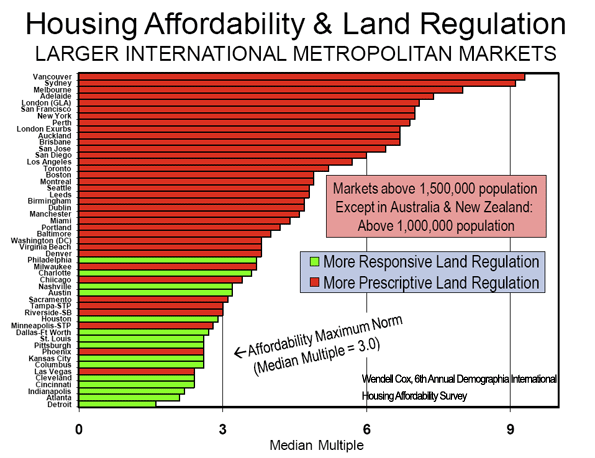
    The main reason ascribed to the exodus from New South Wales is the cost of housing in Sydney. The 6th Annual Demographia Housing Affordability Survey shows that its capital city Sydney has the second highest housing costs of the cities in the six countries surveyed, behind only Vancouver, Canada. For many people, 9.1 years of median family income required to purchase a median family home Sydney is becoming too expensive to live in.

    The Demographia Survey indicates that a price/income ratio of 3.0 can be considered affordable and 9.1 severely unaffordable. As a result many people, especially the young, will never be able to aspire to the Great Australian Dream of owning their own home. For those who can afford a home, the average wait time to save for the required deposit is 6.2 years. The newly appointed Federal Sustainable Population Minister recently is quoted as saying “people have said all I can see for my kids is they’re never going to be able to afford to live in this suburb because of what’s happening with housing prices”.

    The high cost of housing has significant social impacts. The Demographia Survey estimates that in Sydney 57% of median gross family income would be required to make mortgage repayments for a current median priced house. This may be compared with the 20 per cent figure applicable in Atlanta or Dallas-Fort Worth. There are already some 11,000 homeless persons in New South Wales and some 4,000 sleeping rough.

    Why is the cost of housing in Sydney so high? The Demographia Survey portrays a widespread relationship among the cities studied between high housing cost and overly restrictive planning regimes. New South Wales is among the most restrictive. In order to implement a high-density policy it has restricted the release of greenfield housing sites from an historic average of 10,000 lots per year to an average over the last five years of only 2,250. This is in the face of a annual state population increase of some 115,000. It is staggering to consider this constraint in a continent-sized country of which only some 0.3 per cent is urbanised.

    The scarcity resulting from the miserable allocation of greenfield lots has been most notable in land price, whose share of housing costs has increased from 30 per cent to 70 per cent of the total cost. The result has been an increase of overall prices some three times what it was ten years ago.
    Only seven per cent of people, wish to live in apartments. However, in order to implement its high-density policy the State Government intends to force this lifestyle on reluctant consumers. It plans 460,000 extra dwellings within the existing footprint of Sydney by 2031. In practice the production rate of these high density units has fallen well short of that planned.

    These high-density planning policies result in a dwelling scarcity which enables developers to make large profits on apartments. Developers now comprise by far the largest group (29.5 percent) among Australia’s 200 richest people. They have the resources to make sizable donations to both major political parties. Donations help fund election campaigns and in the past have helped keep the politicians who promote these policies in power. Numerous cases have been documented that show a large donation being made to a governing party shortly before permission was granted for a particular development.

    The shortage of land also impacts commerce and industry. Higher housing costs result in higher rentals or mortgage costs. Workers have to make ends meet and so businesses have to pay higher wages. Additionally employers must shell out for higher commercial rentals. The cost of industrial land in Sydney is roughly 70 per cent greater than in the other Australian large cities. Recently there have been a number of well publicised instances of industries closing their factories in Sydney and moving to Victoria, the state located to the south.

    Communities in Sydney are now paying the price for misguided state planning policies. Concrete, bitumen and tiles dominate vast areas where streetscapes of flowers and foliage once reigned supreme. There is a rising consciousness of disasters resulting from the government’s high-density planning policies. as Along with the topic of unaffordable housing, traffic gridlock, disintegrating public transport, frequent power blackouts and a city running out of water hit the headlines with increasing frequency. Dissatisfaction is escalating.

    The latest Newspoll puts the primary vote for New South Wale’s ruling Labor Party at 25 per cent, the lowest ever recorded. It faces a devastating defeat in the forthcoming March 2011 election. There can be little doubt that ill-advised planning policies are a major factor underlying this pending electoral calamity. But will politicians ever learn?

    (Dr) Tony Recsei has a background in chemistry and is an environmental consultant. Since retiring he has taken an interest in community affairs and is president of the Save Our Suburbs community group which opposes over-development forced onto communities by the New South Wales State Government.

    Photo by Nelson Minar

  • Australia: Housing Soars Down Under

    Finally, an important turning point has been reached for Australians in the housing market: on 22 April 2010 the Council of Australian Governments endorsed a new housing supply and affordability agenda.

    The shift in attitude is long overdue. The population of Australia has passed the 22 million mark and is growing at 2.1 per cent per annum. Until now, planning policies based on higher densities have been seen as the solution for this population increase. Such policies are variously euphemistically termed “smart growth”, “urban consolidation” or, more recently, “urban renewal”.

    The deleterious results of high-density policies on both people and the environment are becoming more and more apparent. Australian cities, especially Sydney, are starting to exhibit the downside effects of what might be the most aggressive high-density policies in the world. The general public has not yet comprehended how tight the link is between these restrictive planning policies and the increasing prevalence of community problems.

    The Australian strategy of high-density has had two components. The first has been to artificially strangle the land supply. Residential land release in Sydney has been reduced from a historic average of 10,000 lots per year to less than 2,000, thereby radically reducing the number of dwellings available from greenfield sites.

    The second component of the high-density strategy has required each municipal council to submit a rezoning plan that increases population density to government satisfaction; otherwise, that municipality is adversely impacted. These tactics force high-density onto communities originally designed for low densities.

    Smart-growthers claim a plethora of benefits resulting from high-densities. But any clear-headed examination shows that high-density is detrimental to the public good. Greenhouse gas emissions per person are greater in high-density. The policy overloads infrastructure; choking traffic congestion and longer travel times result. Sewers overflow, electricity supply reaches a breaking point, and there are chronic water shortages. Concrete, tiles and bitumen replace trees, gardens and public open space. Sustainability is adversely affected.

    And, of course, high-density policies create land shortages that result in unaffordable housing. This is the darkest side to the impetus for Smart Growth. The resulting increase in the overall cost of housing is sobering. Even the global financial crisis had very little effect on house prices in Australia. Prices continue to rise, and the Australian Federal Government has become concerned about the impact of increasing housing costs on the economy. The Governor of the Australian Reserve Bank has said that the price of a marginal block of land is too high for a time when interest rates are low and credit is available , and similar sentiments have been expressed by other officials.

    Time series data for Australian cities shows a strong correlation between inadequate land release and excessive housing cost. The land component of the price of a dwelling in Sydney has increased from 30% to 70%. It is apparent that strangling the release of land on the outskirts in order to force high-density has resulted in a shortage and, in the face of ever-increasing demand, the price of land has risen dramatically.

    The 6th Annual Demographia Housing Affordability Survey of six countries portrays a widespread relationship between high housing cost and overly restrictive planning. In the chart below, housing cost is measured as years of family income needed to purchase a house. This year the picture is somewhat complicated by the collapse of the housing bubble in some prescriptive jurisdictions resulting in a substantial reduction of previous high prices.


    Median house price divided by gross annual median household income.

    Only about seven per cent of Australians wish to live in apartments. In spite of this, smart growth policies have resulted in apartments being the only type of housing available to most new entrants to the housing market. These apartments command higher prices than otherwise would be the case, due to an inadequate supply of competing single-residential housing resulting from the scarcity of available sites. This provides the potential for apartment developers to make large profits. Such profits provide the resources for developers to make large donations to the political parties.

    Over the previous five years, the ruling New South Wales Labor Party received donations from the development industry of $9 million, while the Liberal opposition party netted $5 million. These donations exceeded the total contributions to all political parties over the same period from the gambling, tobacco, alcohol, hotel, pharmaceutical and armaments industries combined.

    Numerous documented cases show a large donation being made shortly before permission is granted for a particular development. In response to long-term escalating public anger, the New South Wales Government in December 2009 passed legislation to prohibit donations from property developers. However, the public cynically consider this will not solve the problem and that “donations” will be given in other ways.

    In the face of criticism, state governments maintain that recent land releases have been sufficient. The New South Wales Minister of Housing has stated that land for 131,000 homes has been released in Sydney. Yet the shortage continues to get worse. One reason is the tortoise-like progression of the rezoning process.

    Another is market manipulation. As the Demographia survey points out, governments flag well in advance which greenfield areas will be zoned for developments. Sellers then realise they are cushioned from competition and can command higher prices for their land. Purchasers – developers — know they can pay substantial premiums compared to what would be the case if land release were not so predictable.

    It appears that developers (both government and private) then carefully control the rate at which these greenfield sites are made available to home buyers. It has been reported that the Melbourne government development agency is sitting on a stockpile of 25,000 house blocks that have been zoned for residential approval, but is selling just 700 per year. Private developers and landholders currently hold almost 70,000 house blocks, yet only 1400 of these are available to the market . In the current situation of high demand, it is evident that housing land is being drip fed onto the market, thus keeping prices high.

    The Council of Australian Governments seems to have taken cognisance of this situation, as the review will examine large parcels of land “to assess the scope for increasing competition and bringing land quickly to the market”.

    The Council’s review indicates a welcome change in thinking. Up to now it has not been generally recognised that planning policies are a significant factor in excessive housing cost. Other adverse effects of these policies still need to be acknowledged. One hopes that this review will represent the beginning of a broader appreciation of the downside of high-density policies.

    Photo: A strip of ‘Sydney Lace’in Balmain, Sydney, New South Wales

    (Dr) Tony Recsei has a background in chemistry and is an environmental consultant. Since retiring he has taken an interest in community affairs and is president of the Save Our Suburbs community group which opposes over-development forced onto communities by the New South Wales State Government.

  • Forcing Density in Australia’s Suburbs

    Australia is a continent sized country with total urbanized area of only 0.3%.  As is the case with the USA, the population is increasing as a result of natural growth and immigration. The country is blessed with a sunny climate and enough space to enable its inhabitants to enjoy a relaxed, free lifestyle.

    Given this, one would expect there would be little support for the higher density housing ideology of the Smart Growth advocates. Yet since the early 1990s the Australian Federal Department of Housing has been pushing exactly this approach.

    Sydney, located in the state of New South Wales, has been the forefront for this densification policy. Sydney (population 4.34 million) is subdivided into local municipalities, each run by a popularly elected council. Traditionally these councils have had the responsibility of planning their own areas. Over the years council zoning plans have complied with the expressed preference of over 80% of Australians to live in free-standing homes. In an effort to alter this long-standing pattern the New South Wales Government has resorted to the use of authoritarian processes to force densification, whether areas like it or not.

    High-density regulations from the Planning Minister come about by ministerial fiat without discussion in the State Parliament. These regulations require municipal councils to submit planning strategies to the Planning Minister that increase density, to his/her satisfaction, under threat of removal of a council’s planning powers. In a blatant conflict of interest, half of the members of the minister’s assessment panel are developers who stand to gain from the implementation strategies being assessed and the other half are bureaucrats. There is no community representation.

    Most councils have meekly complied with the coercive demand to submit high-density planning strategies.  As a result previously attractive suburbs with their flowers and foliage are being overcome by the relentless march of grey concrete and bitumen. Bewildered long-time residents find themselves isolated amongst the drab shadows of upward-rising, smothering unit blocks.

    One leafy, mainly single-residential council area in the northern part of Sydney (Ku-ring-gai) insisted that the submission of their residential strategy be delayed until studies could be conducted of the effects of the resulting higher density on infrastructure, traffic, the environment and heritage. This cheekiness was dealt with savagely. Its traditional planning powers have been taken away and given to a planning panel appointed by the Planning Minister.

    This planning panel organised a plan that will increase the population density of the municipality by some 50%. The plan proposes that the traditional village centres and numerous surrounding homes in the area be replaced by massive high-rise tower developments, many spreading deep into surrounding residential streets.

    In a token show of democracy the panel arranged for a public consultation meeting on the draft plan. During the meeting, resident after resident excoriated the high-density plan as grossly excessive, defiant of independent studies and contemptuous of environmental and heritage constraints. Speaker after speaker denounced the panel’s processes – as “failures of transparency and due process”, “patronising and condescending of community concerns”, “pandering to developer interests”, being “part of a process to impose a policy that was not in the greater public interest” and a “sham”. The panel ended the meeting when only half of those who registered to speak had done so. Despite tumultuous scenes of uproar, the planning panel resolved to adopt the high-density plan.

    One would think that such dictatorial impositions on a community could be warranted only by indisputably being in the wider public interest. The Planning Department has attempted to justify its stance by alleging benefits for the greater public good. Chief among these are claims that high density is better for the environment and that the policy saves on infrastructure cost.

    In Australia the evidence points to the contrary. On the question of greenhouse gas emissions, a recent study which allocates greenhouse gas emissions to final consumption at the household level1 shows that on average per person emissions in the high-density inner city areas are nearly twice that in the outer low density areas. Another study shows that there are more greenhouse emissions from domestic energy use in high-density living (5.4t/person/year) than in detached dwellings (2.9t/peson/year)2. This results from lifts, clothes dryers, air-conditioners and common lighted areas such as parking garages and foyers. What is more, the energy required to construct high-rise is nearly five times the energy needed to build single-residential, per resident. 

    In Australia high density hardly reduces travel intensity at all. Research on Melbourne areas shows that the people squeezed into newly converted dense areas did not use public transport to any greater extent than before and there was little or no change in their percentage of car use3.

    There is not nearly enough difference in the greenhouse gas emissions of public versus private transport to counter the increased emissions of high-density dwelling. Greenhouse gas emission per passenger km on the Sydney rail network is 105 gm. The figure for the average car is 155 gm – but for  modern fuel efficient vehicles is as low as 70 gm.

    Adding more people to existing infrastructure results in overload. After 15 years of high-density policies, the quality of Sydney suburban roads, rail service, water supply and electricity has noticeably deteriorated. High-density retrofit is hugely more expensive than laying out new infrastructure on greenfield sites. Infrastructure costs quoted by the authorities almost always omit the cost of restoring the standard of infrastructure back to the level of service people enjoyed before high-density was imposed. One example of these “forgotten” costs – the augmentation of electricity supplies in downtown Sydney, necessitated by 4900 additional apartments, will eventually cost $A429 million ($US340 million) – or $A80,000 per new apartment.4

    The effect of high density policies on the cost of housing has been devastating to the younger generation. In attempting to force people into higher density on existing land, the authorities have drastically cut down the supply of new land for housing. This has resulted in the cost of land now comprising 70% of the cost of a place to stay, instead of the traditional 30%. A new dwelling on Sydney’s outskirts should cost about $A210,000 ($U168,000) but is actually more than $A500,000.

    The cost of commercial land in Sydney has also rocketed out of control. Employers take their business elsewhere. Back in 2000, the New South Wales proportion of the national economy was 35%. This has now plunged to barely 30%.5  The proportion of bankruptcies has increased from 25% to 38%.6

    Besides ostensible “green” ideology, perhaps the powerful driver for high-density policies lies with the resulting opportunities for infill developers to make huge profits. Over the last five years, the ruling New South Wales Labor Party received donations from the development industry of $A9 million while the opposition party netted $A5 million. These donations exceeded the total contributions for all political parties over the same period from the gambling, tobacco, alcohol, hotel, pharmaceutical and armaments industries combined7.

    The political donations gain donors favoured access to government.  This inevitably results in policies sympathetic to them, which in turn result in more profits and more donations.  

    Other Australian states also have implemented high-density policies but not to the degree of New South Wales. Recently in Victoria8 and in Western Australia9 carefully couched announcements have revealed that policies are moving away from excessive high-density.

    Mistaken ideology and financial rewards to a minority have made high-density an enduring feature of New South Wales planning policy. The results are not pretty: more greenhouse gases, high traffic densities, worse health outcomes, a creaking and overloaded infrastructure, a whole generation locked out of owning their own home and business fleeing the state for the greener, less congested pastures elsewhere.

    (Dr) Tony Recsei has a background in chemistry and is an environmental consultant. Since retiring he has taken an interest in community affairs and is president of the Save Our Suburbs community group which opposes over-development forced onto communities by the New South Wales State Government.


    1 Australian Conservation Foundation Consumption Atlas, ,http://www.online.org.au/consumptionatlas/

    2 Myors, P. O’Leary, R. and Helstroom, R.,2005, Multi-Unit Residential Building Energy and Peak Demand Study, Sydney, New South Wales Department of Infrastructure, Planning and Natural Resources

    3 Christopher Hodgetts, 2008,Thesis: Urban Consolidation And Transport, University of Melbourne

    4 EnergyAustralia website accessed October 2008

    5 Sydney Morning Herald 15 November 2008

    6 Sydney Morning Herald 29 March 2009

    7 Sylvia Hale, Member of NSW Legislative Council, 29 April 2009, Speech to the National Trust Breakfast

    8 http://www.theage.com.au/opinion/opposition-to-a-bigger-melbourne-smacks-of-cultural-snobbery-20090624-cwpv.html?page=-1