While the new Memphis Islamic Center in Cordova, TN awaits completion, members meet at a nearby church building that houses Cordova’s Heart Song Church. The Christian congregation has opened its doors to the Muslim community as a gesture of good will.
This kind act is in contrast with other recent activities, like an August arson fire to an Islamic Center’s construction equipment in suburban Murfreesboro just south of Nashville. And to complicate things even more, there’s that tiny little church that had planned to burn the Qur’an on September 11th. While all of this is going on, there is of course the ongoing debate surrounding plans to build a mosque near ground zero.
These stories serve to illustrate the ongoing struggle many Americans have with how to navigate the country’s shifting religious climate.
The United States is the most religiously diverse country in the world. We already noticed that much of America’s religious geography has trended suburban, as indicated in a previous article titled “The Suburbanization of Religious Diversity.” This has put new religions face-to-face with America’s mainstream faiths. The big question remains: how do “mainstream” (Evangelical, Catholic, and Mainline Protestant) Americans view neighbors both culturally distant yet geographically close?
Many Americans say that religious beliefs affect their views on social issues such as abortion, same-sex marriage, and the death penalty. On the other hand, fewer Americans, according to a Pew Research Center report, are inclined to lean on their religious beliefs when it comes to issues like immigration or the environment. Only 7% of Americans say that religion is “the most important influence on their opinions about” immigration but more than one third report that religion influences their opinions on same-sex marriage.
It ends up being a matter of interpretation. Some Christians cite Biblical texts to inform their approach towards new and diverse residents in their communities. “And you shall not wrong a stranger or oppress him, for you were strangers in the land of Egypt.” (Exodus 22:21) Or, “(God) executes justice for the orphan and the widow, and shows His love for the alien by giving him food and clothing.” (Deuteronomy 10:18).
Recalling a role that Christianity played concerning “immigration” in ancient Greco-Roman society, sociologist Rodney Stark wrote, “To cities filled with newcomers and strangers, Christianity offered an immediate basis for attachments.”
So is the same true for the country’s new immigrant populations?
Gwinnett County near Atlanta, for example, has seen an influx of new foreign-born neighbors over the past two decades. Duluth, one of Gwinnett County’s largest communities, epitomizes the cultural diversity of the county.
In 2008, as part of a multi-church research project, several of Duluth’s pastors gathered as a “learning community” on a monthly basis to discuss ways in which Duluth’s churches could better serve their community. The pastors agreed that their churches were not culturally integrated with the many ethnic congregations scattered around the community. The pastors were asked how people would know whether or not churches were making a difference in their community. One of the pastors stated that it would be significant if each person could identify one friend of a different economic sector or different culture and be able to say that they met at church.
It’s no secret that the religious beliefs of America’s new immigrants don’t always mesh with the country’s more traditional, or mainstream, religious groups.
Some believe that America is, traditionally speaking, a “Christian” nation. This is also the perception of others outside the United States. Just ask a student studying in the U.S. from a Middle Eastern country how he or she perceives America’s religious identity . Yet, not all Americans take the position that America is a “Christian” country. Others suggest that North America has always been home to diverse religious ideas.
Some mainstream religious groups and religious adherents, however, feel threatened by the increased religious diversity in this country. They view pluralism as a dangerous thing, something that might impede or compete with the values of those who share a more traditional (traditional-Christian) perspective on faith and life in the United States.
At the same time, sociologists and cultural anthropologists who study religions have stated for years that the even center of “Christian” demography no longer resides in the West . Today, Christianity’s geography looks less European and more Asian, African, and Latin American – cultures that will constitute upwards of half America’s population in the next 30 – 40 years when minorities become the majority.
This is a key issue facing places like Knoxville, which with nearly 700 churches, has more churches per capita than any other city in Tennessee. Religion has shaped Knoxville’s social climate more than any other factor in the city’s history. But even in Knoxville, religious geography is changing.
According to the findings from the Religious Congregations and Membership Study conducted ten years ago by the Association of Statisticians of American Religious Bodies (ASARB), more than 10,000 Knoxvillians claimed adherence to some “other” religious tradition – meaning non-Evangelical, non-Mainline Protestant, non-Orthodox, and non-Catholic.
Today, there is at least one Buddhist center in Knoxville. And according to Brian Long, a writer with the Knoxville News Sentinel, as of 2007 there were 300-500 Hindu families in the area. Knoxville has also had a growing Muslim population since the 1970s and today has roughly 4000 Muslim adherents and three places of worship in the Knoxville region.
Some of America’s more traditional religious groups view new(er) religions in the U.S. such as those in Knoxville to be “compassionate” or “peaceful” religions, while others believe that a religion like Islam is “wicked” or “evil”, even “dangerous,” according to a study produced by the Tennessee-based Lifeway Research group earlier this year.
Then again, it depends on where you live, work, and play.
A few years ago, Deborah Laverty of the Northwest Indiana Times reported that “efforts to establish mosques resulted in controversy and lawsuits” in some of Chicago’s suburbs.
However, in the same article titled “Muslim Mecca in Merrillville,” Laverty wrote about a favorable reception given to Muslims in the region by others. Regarding a willingness of some to invest in the area’s newest Muslim center, Laverty wrote, “One reason the group has chosen to invest in Merrillville is because the community has welcomed those of the Muslim faith with open arms.” Quoting an investment banker, Laverty pointed out, “The Muslim community (in Merrillville) is growing because of a good relationship with members of the law enforcement, government officials and even those of other religions and faiths. We haven’t had any negative incidents and the word is getting around, even in Chicago…”
As the country’s demography continues to change, “mainstream” religious groups in the U.S. will undoubtedly re-calibrate their approaches to the country’s new religious landscape. Already there are some community-based movements that consist of people from diverse religious traditions attempting to figure out how they can serve the common good of their cities without blending together incompatible theological beliefs. Such groups from both “old” (mainstream) and “new” (not-so-mainstream) streams of thought are trying to help communities flourish and dispel fear.
Critical thinking and meaningful dialogue will have to be applied at every level as America grows more – not less – religiously diverse in years to come.
Since 2006, Travis Vaughn has conducted community studies in a number of U.S. cities. He is a visiting instructor at Covenant Theological Seminary and is the catalyst behind cityandcitizen.com.
Photo: Church in Santa Fe by author.
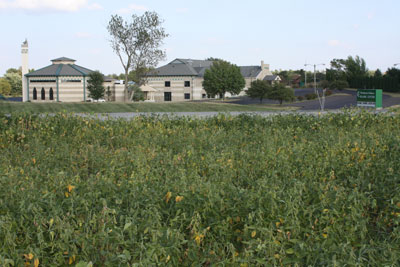 In fact, much has changed. Religion in America is alive and well, but it’s different. Although Christian churches continue to dominate the religious landscape in the United States, there are new religious neighbors. Cultures and religious traditions that once existed “somewhere over there”, have moved beyond the large cities of the U.S. into the suburbs and exurbs, places where evangelical mega-churches have flourished for decades.