Author: Wendell Cox

  • Time Magazine Gets it Wrong on the Suburbs

    Time Magazine’s Sam Frizell imagines that the American Dream has changed, in an article entitled "The New American Dream is Living in a City, Not Owning a House in the Suburbs." Frizell further imagines that "Americans are abandoning their white-picket fences, two-car garages, and neighborhood cookouts in favor of a penthouse view downtown and shorter walk to work." The available population data shows no such trend.

    Frizell’s evidence is the weak showing in single family house building permits last month and a stronger showing in multi-family construction.

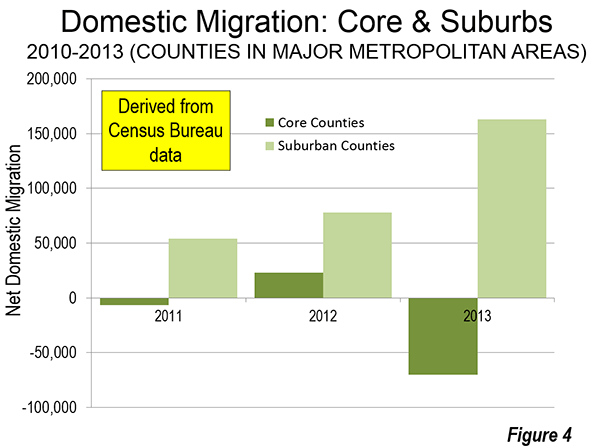
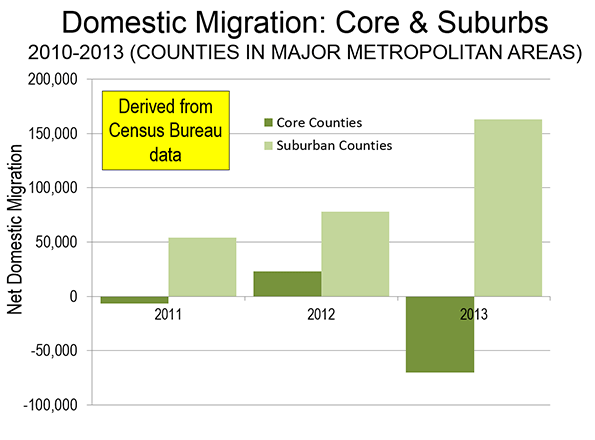
    This is just the latest in the "flocking to the city" mantra that is routinely mouthed without any actual evidence (see: Flocking Elsewhere: The Downtown Growth Story). The latest Census Bureau estimates show that net domestic migration continues to be negative in the core counties (which include the core cities) of the major metropolitan areas (those with more than 1,000,000 residents). The county level is the lowest geographical level for which data is available.

    At the same time, there is net domestic inward migration to the suburban counties. Moreover, much of the net domestic migration to metropolitan areas has been to the South and Mountain West, where core cities typically include considerable development that is suburban in nature (such as in Austin, Houston and Phoenix). As the tepid "recovery" has proceeded, net domestic migration to suburban counties has been strengthened (see: Special Report: 2013 Metropolitan Area Population Estimates), as is indicated in the Figure.

    There is no question but that core cities are doing better than before. It helps that core city crime is down and that the South Bronx doesn’t look like Berlin in 1945 anymore. For decades, many inclined toward a more urban core lifestyle were deterred by environments that were unsafe, to say the least. A principal driving force of this has been millennials in urban core areas. Yet, even this phenomenon is subject to over-hype. Two-thirds of people between the ages of 20 and 30 live in the suburbs, not the core cities, according to American Community Survey data.

    To his credit, Frizell notes that the spurt in multi-family construction is "not aspirational," citing the role of the Great Recession in making it more difficult for people to buy houses. As I pointed out in No Fundamental Shift to Transit: Not Even a Shift, 2013 is the sixth year in a row that total employment, as reported by the Bureau of Labor Statistics was below the peak year of 2007. This is an ignominious development seen only once before in the last 100 years (during the Great Depression).

    In short, urban cores are in recovery. But that does not mean (or require) that suburbs are in decline.

  • Largest World Cities: 2014

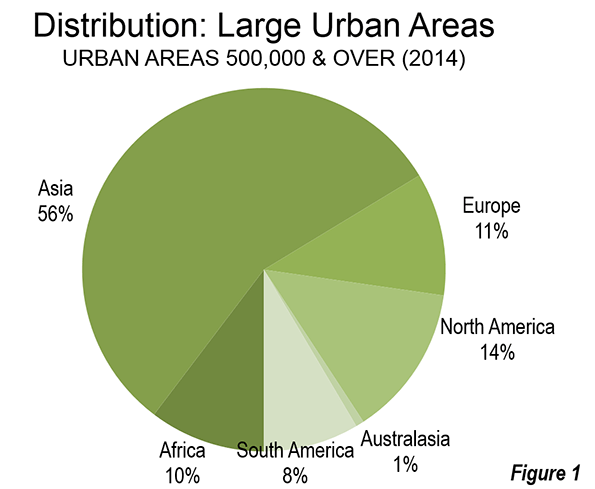
    The recently released 10th edition of Demographia World Urban Areas provides estimated population, land area and population density for the 922 identified urban areas with more than 500,000 population. With a total population of 1.92 billion residents, these cities comprise approximately 51 percent of the world urban population. The world’s largest cities are increasingly concentrated in Asia, where 56 percent are located. North America ranks second to Asia, with only 14 percent of the largest cities (Figure 1). Only three high income world cities are ranked in the top ten (Tokyo, Seoul and New York) and with present growth rates, Tokyo will be the lone high-income representative by the middle 2020s.

    Demographia World Urban Areas is the only regularly published compendium of urban population, land area and density data for cities of more than 500,000 population. Moreover, the populations are matched to the urban land areas where sufficient data is available from national census authorities.

    The City

    The term "city" has two principal meanings. One is the "built-up urban area," which is the city in its physical form, encompassing virtually all of the land area encircled by rural land or bodies of water. Demographia World Urban Areas reports on cities as built-up urban areas, using the following definition (Note 1).

    An urban area is a continuously built up land mass of urban development that is within a labor market (metropolitan area or metropolitan region). As a part of a labor market, an urban area cannot cross customs controlled boundaries unless the virtually free movement of labor is permitted. An urban area contains no rural land (all land in the world is either urban or rural).

    The other principal definition is the labor market, or metropolitan area, which is the city as the functional (economic) entity. The metropolitan area includes economically connected rural land to the outside of the built-up up urban area (and may include smaller urban areas). The third use, to denote a municipal corporation (such as the city of New York or the city of Toronto) does not correspond to the city as a built-up urban area or metropolitan area. This can – all too often does –   cause confusion among analysts and reporters who sometimes compare municipalities to metropolitan areas or to built-up urban areas.

    A Not Particularly Dense Urban World

    Much has been made of the fact that more than one-half of humanity lives in urban areas, for the first time in history. Yet much of that urbanization is not of the high densities associated with cities like Dhaka, New York, or even Atlanta.

    The half of the world’s urban population not included in Demographia World Areas lives in cities ranging in population from the hundreds to the hundreds of thousands (see: What is a Half-Urban World). In the high income world, residents of large urban areas principally live at relatively low densities, with automobile oriented suburbanization accounting for much of the urbanization in Western Europe, North America, Japan and Australasia. This point was well illustrated in research by David L. A. Gordon et al at Queen’s University (Kingston, Ontario), released last year which concluded that the metropolitan areas of Canada are approximately 80 percent suburban.

    Population

    There are now 29 megacities, with the addition in the last year of London. London might be thought of as having been a megacity for decades, however the imposition of its greenbelt forced virtually all growth since 1939 to exurban areas that are not a part of the urban area, keeping its population below the 10 million threshold until this year (Demographia World Urban Areas Table 1).

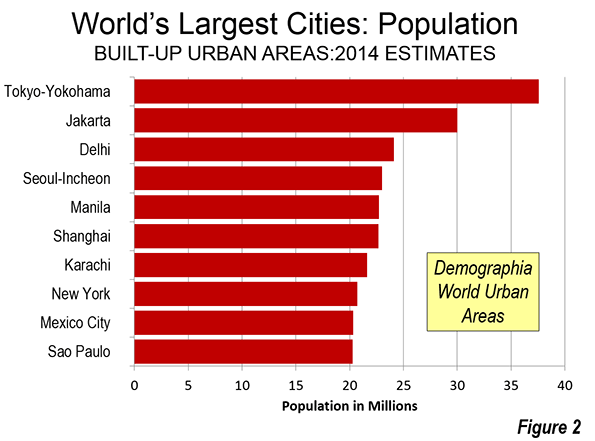
    The largest 10 contain the same cities as last year, though there have been ranking changes. Tokyo, with 37.6 million residents, continues its half century domination, though its margin over growing developing world cities is narrowing, especially Jakarta. Manila became the fifth largest urban area in the world, displacing Shanghai, while Mexico City moved up to 9th, displacing Sao Paulo (Figure 2).

    Land Area

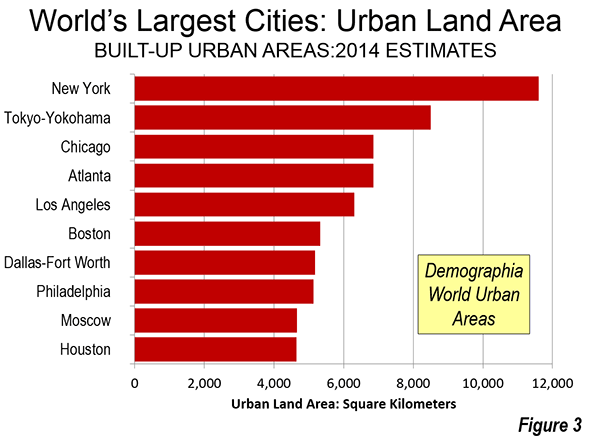
    Often seen as the epitome of urban density, the urban area of New York continues to cover, by far, the most land area of any city in the world. Its land area of nearly 4,500 square miles (11,600 square kilometers) is one-third higher than Tokyo’s 3,300 (8,500 square kilometers). Los Angeles, which is often thought of as defining low-density territorial expansion ranks only fifth, following Chicago and Atlanta, with their substantially smaller populations (Figure 3). Perhaps more surprisingly is the fact that Boston has the sixth largest land area of any city in the world. Boston’s strong downtown (central business district) and relatively dense core can result in a misleading perception of high urban density. In fact, Boston’s post-World War II suburbanization is at urban densities little different than that of Atlanta, which is the world’s least dense built-up urban area with more than 3 million population. Now, 29 cities cover land areas of more than 1,000 square miles or 2,500 square kilometers (Demographia World Urban Areas Table 3).

    Urban Density

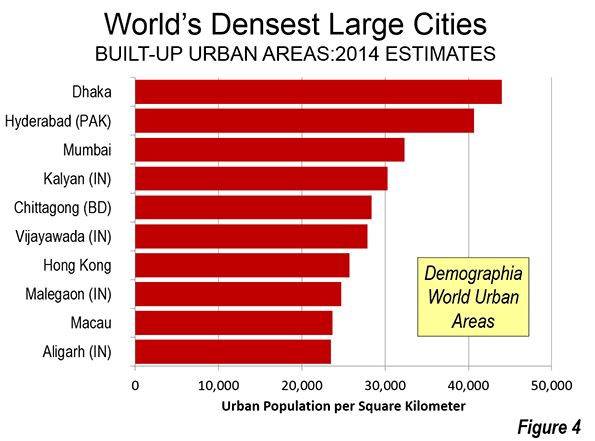
    All but two of the 10 densest cities are on the Indian subcontinent. Dhaka continues to lead in density, with 114,000 residents per square mile (44,000 per square kilometer).  Hyderabad (Pakistan, not India) ranks a close second. Mumbai and nearby Kalyan (Maharashtra) are the third and fourth densest cities. Hong Kong and Macau are the only cities ranking in the densest ten outside the subcontinent (Figure 4). Despite its reputation for high urban densities, the highest ranking city in China (Henyang, Hunan) is only 39th (Demographia World Urban Areas Table 4).

    Smaller Urban Areas

    Demographia World Urban Areas Table 2 includes more than 700 additional cities with fewer than 500,000 residents, mainly in the high income world. Unlike the main listing of urban areas over 500,000 population, the smaller cities do not represent a representative sample, and are shown only for information.

    Density by Geography

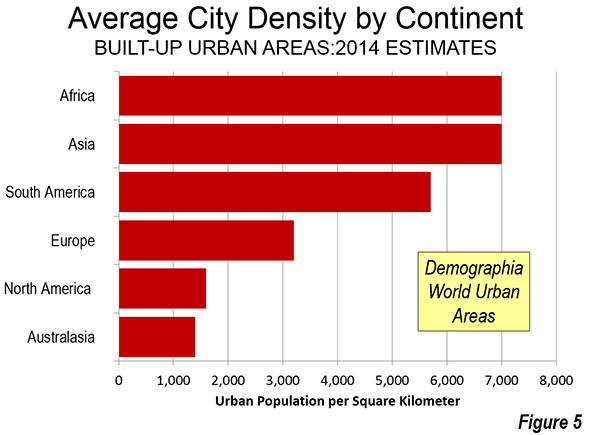
    Demographia World Urban Areas also provides an average built-up urban area density for a number of the geographical areas. Africa and Asia had the highest average city densities, at 18,000 per square mile (7,000 per square kilometer), followed by South America. Europe was in the middle, while North America and Oceania have the lowest average city densities (Figure 5).

    Some geographies, however, had much higher average urban densities. Bangladesh was highest, at 86,800 per square mile (33,000 per square kilometer), nearly five times the Asian average. Other geographies above 30,000 per square mile (11,500 per square kilometer) included Pakistan, the Democratic Republic of the Congo, the Philippines, India and Colombia, the only representative from the Western Hemisphere (Demographia World Urban Areas Table 5).

    Wendell Cox is principal of Demographia, an international public policy and demographics firm. He is co-author of the "Demographia International Housing Affordability Survey" and author of "Demographia World Urban Areas" and "War on the Dream: How Anti-Sprawl Policy Threatens the Quality of Life." He was appointed to three terms on the Los Angeles County Transportation Commission, where he served with the leading city and county leadership as the only non-elected member. He was appointed to the Amtrak Reform Council to fill the unexpired term of Governor Christine Todd Whitman and has served as a visiting professor at the Conservatoire National des Arts et Metiers, a national university in Paris.

    ———————-

    Note 1: Urban areas are called also called "population centres" (Canada), "built-up urban areas" (United Kingdom, "urbanized areas’ (United States), "unités urbaines" (France)  and "urban centres" (Australia). The "urban areas" of New Zealand include rural areas, as do many of the areas designated "urban" in the People’s Republic of China, and, as a result, do not meet the definition of urban areas above.

    Note 2: Demographia World Urban Areas is a continuing project. Revisions are made as more accurate satellite photographs and population estimates become available. As a result, the data in Demographia World Urban Areas is not intended for comparison to prior years, but is intended to be the latest data based upon the best data sources available at publication.

    Photograph: Slum, Valenzuela City, Manila (by Author)

  • The Economist Indicts Urban Containment “Fat Cats”

    "Free Exchange" in The Economist has come down strongly on the side of economics in a review of housing affordability.

    According to The Economist, the unusually high cost of housing in San Francisco (and other places) is principally the result of tight land use regulation, which makes it expensive or impossible to build. If "local regulations did not do much to discourage creation of new housing supply, then the market for San Francisco would be pretty competitive." Add to that Vancouver, Sydney, Melbourne, Toronto, Portland and a host of additional metropolitan areas, where urban containment policy has driven house prices well above the 3.0 median multiple indicated by historic market fundamentals.

    The Economist explains the issue in greater detail: "We therefore get highly restrictive building regulations. Tight supply limits mean that the gap between the marginal cost of a unit of San Francisco and the value to the marginal resident of San Francisco (and the market price of the unit) is enormous. That difference is pocketed by the rent-seeking NIMBYs of San Francisco. However altruistic they perceive their mission to be, the result is similar to what you’d get if fat cat industrialists lobbied the government to drive their competition out of business." (Our emphasis).

    Of course urban planning interests have long denied that that rationing land is associated with higher housing prices (read greater poverty and a lower standard of living). Nonetheless urban containment policies not only drive up the price of land, but do so even as they reduce the amount of land used for each new residence, driving prices per square foot of land up as well.

    The Economist notes that unless the direction is changed, housing policy will continue to be "an instrument of oligarchy. Who knows. But however one imagines this playing out, we should be clear about what is happening, and what its effects have been."

  • The New Downtown Los Angeles

    There was a time when downtown Los Angeles was the commercial center of Southern California. According to Robert Fogelson, writing in his classic Downtown: Its Rise and Fall (1880-1950)"nearly half" of Los Angeles residents went downtown every day in the middle 1920s. A time traveler from 1925 might think that to still be the case, with the concentration of tall buildings, and the frequent press reports about downtown’s resurgence.  

    Downtown LA got a late start with high-rises. Until the middle 1960s, there were few buildings exceeding the 13 story height limit repealed in 1958 by city of Los Angeles. The most important exception is City Hall, opened in 1928, which is 454 feet tall (137 meters). By 1989, the city’s tallest building, Library Tower (First Interstate Tower), had been opened, topping out at 1,018 feet (310 meters). The under-construction Wilshire-Grand Tower will soon rise 80 feet (25 meters) above Library Tower. From the flight path to Los Angeles International Airport (above) and many ground vistas, the vertical profile of downtown Los Angeles will continue to stand tall over the city.

    Yet, far less understood is that downtown has declined in metropolitan importance for decades. Now, downtown has only 2.4 percent of employment the metropolitan area (Los Angeles and Orange Counties).  Between the 2000 Census and the 2006-2010 American Community Survey, employment in the central business district dropped approximately five percent. At least four other employment areas, all freeway oriented with lower employment density, equal or exceed downtown’s employment (these include the Airport-El Segundo area and nameless employment areas straddling the Santa Ana Freeway in Los Angeles County, the Harbor and San Diego Freeways in the South Bay and the Costa Mesa Freeway in Orange County). More important still, approximately two-thirds the metropolitan area’s employment is not in a large employment area at all. This dispersion of employment is one reason why Los Angeles –despite its reputation for horrendous traffic – has the shortest one-way commute time of any world megacity for which there is data.

    Shifting Downtown

    Following World War II, the heart of downtown Los Angeles shifted west from Broadway, Hill and Spring Streets, leaving a large stock of quality commercial buildings vacant. This was well before the end of their useful lives, yet decades of disuse followed. Most of these buildings rose to the 13 floors height limit, though one, the 18 story United California Bank headquarters at 6th and Spring, was completed not long before its competitors hired moving vans to move west. Soon after, the United California Bank built the UCB Tower (now Aon Tower) on Hope Street, with 62 floors (1973), which at the time was the tallest building in the world outside New York and Chicago.

    Adaptive Reuse

    The UCB Building and many more on the now more residential east side of downtown been converted to apartments and condominiums under the city’s creative "adaptive reuse" ordinance, which facilitates conversions from office to residential use. According to the city of Los Angeles, the ordinance has facilitated conversion of downtown commercial space into more than 3,000 residential units. Another 7,000 are either under construction or being considered.  

    The conversion of office buildings to residential has spread to post war structures, such as the Mobil Oil Building (now the Pegasus Apartments). This building, on Flower Street, was one of the earliest examples of the more modern styles that were to proliferate throughout the downtown areas of the nation. The Signal Oil Building, also one of the first to exceed the 13 story limit has also become residential (1010 Wilshire). This building had been the subject of an unusual 1980s remodeling that enlarged the footprint and the floors, while materially changing the outside angles and the decor. Another nearby office building (1100 Wilshire) sat empty for two decades after construction, before being converted to residential use.

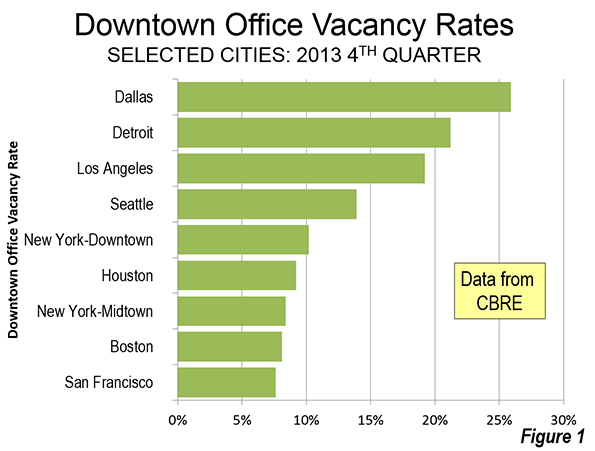
    The shift to residential makes sense given that most downtown office buildings are having difficulty filling their space. Downtown’s glutted office market is indicated by a 19.2 percent vacancy rate in the fourth quarter of 2013. This is better than such market laggards as downtown Detroit or downtown Dallas, both over 20 percent, but higher than the Los Angeles suburban office vacancy rate, at 15.9 percent. Downtown’s vacancy rate is also approximately double or more those of dynamic downtowns such as San Francisco, Boston, New York, and Houston, which are all under 10 percent (Figure 1).

    It appears likely that the Crocker Citizens Plaza, opened as the city’s tallest building in 1969 (42 floors), is slated for conversion to residential. After Crocker Bank moved to its new Crocker Center (now Wells Fargo Center) on Bunker Hill, Crocker Citizens Plaza became the AT&T Building. AT&T vacated the building and moved to the earlier 1960s Transamerica Building, which urban legend indicates was built well south of downtown because consultants convinced the developers that this would be the center of an even larger downtown. The Transamerica, now AT&T, is even more divorced from the commercial core than when it was built. By the time Crocker Citizens Plaza (now "611 Place") is converted to residential, it could be the third tallest mixed use building in downtown.

    The second tallest mixed use tower could well be the prestigious Library Tower, which stands half-empty. There are rumors that the new owners may convert a large part of the structure to condominiums and a hotel. No major office skyscraper has opened in downtown Los Angeles in the last 20 years. Nor will that change when the Wilshire Grand Tower is completed. Wilshire-Grand will only be partially an office tower and will include a hotel. Only 30 of the 73 floors will be offices. This is a climb-down from the original design, which included two buildings – a 60 story office tower and a 40 floor hotel and condominium project. The new building is little of an endorsement of downtown’s office demand.

    Transitioning from Adaptive Reuse?

    This conversions may be the tail end of trend. DT News reports that it has become more economical for many developers to construct new residential buildings, rather than to convert empty commercial buildings. As demand has increased, so have prices of existing buildings, which makes adaptive reuse   less attractive. Further, many of the structures on Broadway, which casual observation might indicate have potential for conversion, but the density of development may make offering enough natural light difficult for residences.

    Ups and Downs of Downtowns

    As employment has dispersed throughout the Los Angeles area, there has been less of a need for a central business district. Among the nation’s larger downtowns, only downtown Los Angeles has undertaken wholesale abandonment of its commercial core and built a new one. Perhaps this is, in part, because the 13-story height limit rendered the older buildings uneconomic for the second half of the 20th century.

    New York (Manhattan), south of 59th Street also has seen its ups and downs. But New York did not abandon large swaths of development, only to move elsewhere. Downtown Chicago expanded northward along Michigan Avenue, but little if any of the Loop was ever abandoned and it has undergone continuous renewal. The West Coast’s premium downtown areas, San Francisco and Seattle, have interspersed new development along with the old, and remain more important to their metropolitan areas than downtown Los Angeles, accounting for from four to six times its employment share (though still less than 15 percent). Even Houston, which most resembles Los Angeles in its post war downtown rebuild, managed its transformation without abandoning the historic core. And, at the same time, all are enjoying increasing residential demand, like downtown Los Angeles.

    Rising Demand

    Downtown interests are rightly proud of the rising residential population. This has occurred in many downtowns across the nation. Between 2000 and 2010, areas within 2 miles of City Hall gained 206,000 residents in the major metropolitan areas (over 1 million population). However, within in the next ring, from 2 to 5 miles from City Hall the decline in population more than compensated for the core gains (minus 272,000).

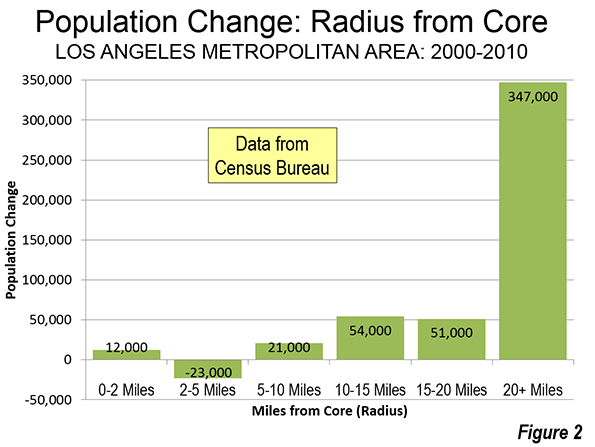
    The situation was the same in Los Angeles, where the Census Bureau reports that population within 2 miles of City Hall rose 12,000, while it declined 23,000 between 2 and 5 miles. The growth of downtown Los Angeles is impressive in part because it was stagnant for so many decades. In context, however, it is no "game-changer." Overall in the last decade all growth in the Los Angeles metropolitan area was outside the 5 mile ring, and 75 percent of that was more than 20 miles from City Hall (Figure 2).

    A New Species is Born

    It would be a mistake to characterize the emerging downtown Los Angeles as reasserting any economic primacy. Its former function is beyond revival. This was indicated by UCLA Anderson Forecast economist David Shulman, who indicated that he was "not bullish on Downtown Los Angeles." The report by public radio station KPCC continued:

    "That view runs counter to the impression that downtown L.A. is staging an urban comeback. But the resurgence is more about sports and entertainment venues, restaurants and bars, loft conversions, and hotels than it is about companies that need a lot of floors in tall buildings. Nightlife and streetscapes trump florescent light and cubicles."

    This refers to the new entertainment venues, such as the Staples Center, the Walt Disney Concert Hall and "LA Live," which may be joined by a new football stadium for a proposed National Football League franchise.

    The transformation of downtown Los Angeles is not so much a renaissance of a business core, but a shift into a new, and different, function. The new downtown serves a function similar to that of Wilshire Boulevard’s more heavily residential high-rise district. But it’s not likely to ever resemble the Upper East Side or Upper West Side in New York, not only because its residential base will remain  small, but because downtown is hardly an ascendant business center. Downtown’s recovery as a residential district – with a population roughly equivalent to the suburb of Diamond Bar – is indeed impressive, but its role as a vital urban economic center remains relatively small. 

    ——-

    Photo: Downtown Los Angeles toward the Hollywood Hills and the San Fernando Valley (by author)

    Wendell Cox is principal of Demographia, an international public policy and demographics firm. He is co-author of the "Demographia International Housing Affordability Survey" and author of "Demographia World Urban Areas" and "War on the Dream: How Anti-Sprawl Policy Threatens the Quality of Life." He was appointed to three terms on the Los Angeles County Transportation Commission, where he served with the leading city and county leadership as the only non-elected member. He was appointed to the Amtrak Reform Council to fill the unexpired term of Governor Christine Todd Whitman and has served as a visiting professor at the Conservatoire National des Arts et Metiers, a national university in Paris.

  • Rio Among the Most Dangerous Cities?

    The travel website escapehere.com has published an article with a list of the world’s "10 most dangerous cities to travel." I was obviously interested, but was soon deterred by advertisements that kept popping up and a web architecture intended to ensure that for every city viewed another ad would be placed in the way.

    At the same time, this could be important information, and is especially untimely for Rio de Janeiro, which will soon host World Cup and Olympics events. So I put up with the inconvenience, with the intention of making the information more readily available (the explanations were very short).

    Here is the list, according to escapehere.com, in order of dangerousness.

    1. San Pedro Sula, Honduras
    2. Karachi
    3. Kabul
    4. Baghdad
    5. Acapulco
    6. Guatemala City
    7. Rio de Janiero
    8. Cape Town
    9. Ciudad Juarez
    10. Caracas

    I was pleased to see that two places I would like to visit, Lagos and Kinshasa were not on the list, two places I have been avoiding. I hope the escapehere.com report is an indication that things have gotten better. As for Rio, to be on a list with Baghdad and Juarez is a real "downer."

    I can attest to having encountered no difficulty during my two week visit to Rio about 10 years ago and I would recommend any to visit.

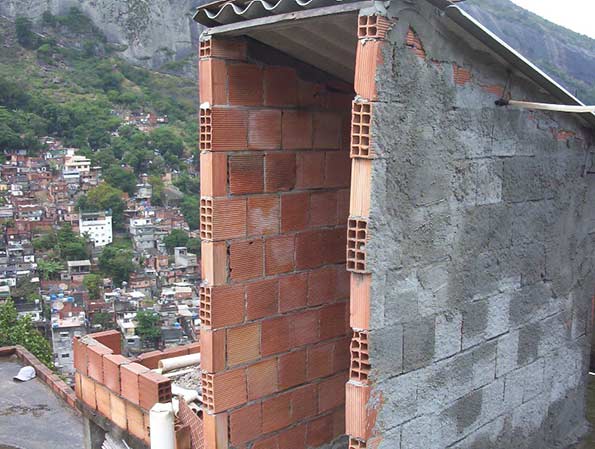
    Photo: Rocinha Favela, Rio de Janiero (by author)

  • Urban Containment: Land Price Up 5 Times Income & Smaller

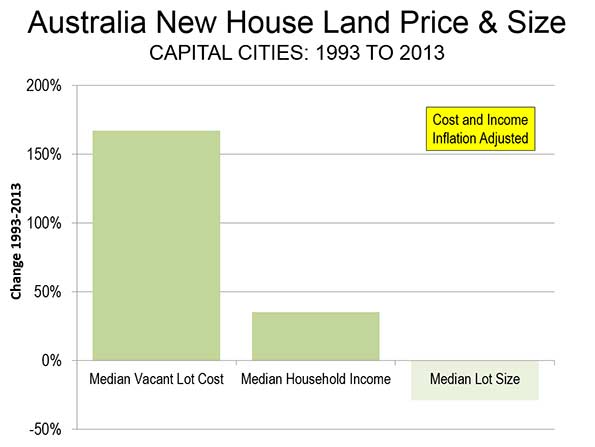
    The shocking extent to which urban containment policy (urban consolidation policy) is associated with higher land (and house) prices is illustrated by a recent press release from RP Data in Australia. The analysis examined the vacant building lot prices for the period of 1993 to 2013.

    During the period, the median price of a vacant lot rose 168 percent after adjustment for inflation. This is nearly 5 times the increase in the median household incomes of the seven largest capital cities (Sydney, Melbourne, Brisbane, Perth, Adelaide, Canberra and Sydney).

    But it gets worse. The median lot size was reduced nearly 30 percent. This should put paid to the myth that urban containment reduces lot prices as it reduces their sizes (Figure). The same dynamic has been indicated in the United States.

    Australia has been plagued by huge house cost increases relative to incomes in association with urban containment policy. Before the adoption of urban containment policy, it was typical for house prices to average three times or less than that of household income. Now, Sydney has the highest median multiple (median house price divided by median household income) of any major metropolitan area in the New World, with the exceptions of Vancouver and San Francisco. Melbourne, the second largest metropolitan area in Australia, has a median multiple of 8.4, making it fifth most costly in the New World, behind San Jose. All of Australia’s major metropolitan areas "severely unaffordable," including slow-growing Adelaide (6.3), as well as most smaller areas.

    For a complete listing of median multiples by major metropolitan area, see the 10th Annual Demographia International Housing Affordability Survey.

    Additional information on the RP Data research is available at Australian Property Through Foreign Eyes

  • Focusing on People, Not Sprawl

    For seven decades urban planners have been seeking to force higher urban population densities through urban containment policies. The object is to combat "urban sprawl," which is the theological (or ideological) term applied to the organic phenomenon of urban expansion. This has come at considerable cost, as house prices have materially increased relative to incomes, which is to be expected from urban containment strategies that ration land (and thus raise its price, all things being equal).

    Smart Growth America is out with its second report that rates urban sprawl, with the highest scores indicating the least sprawl and the lowest scores indicating the most (Measuring Sprawl 2014).

    Metropolitan Areas and Metropolitan Divisions

    For the second time in a decade Smart Growth America has assigned a "sprawl" rating to what it calls metropolitan areas. I say "what it calls," because, as a decade ago, the new report classifies "metropolitan divisions" as metropolitan areas (Note 1). Metropolitan divisions are parts of metropolitan areas. This is not to suggest that a metropolitan division cannot have a sprawl index, but metropolitan divisions have no place in a ranking of metropolitan areas. Worse, metropolitan areas with metropolitan divisions were not rated (New York, Los Angeles, Chicago, Dallas-Fort Worth, Philadelphia, Washington, Miami, San Francisco, Detroit, and Seattle).

    This year’s highest rating among 50 major metropolitan areas (over 1,000,000 population) goes to part of the New York metropolitan area (the New York-White Plains-Wayne metropolitan division) at 203.36. The lowest rating (most sprawling) is in Atlanta, at 40.99. This contrasts with 2000, when the highest rating was in part of the New York metropolitan area (the New York PMSA), at 177.8, compared to the lowest, in the Riverside-San Bernardino PMSA portion of the since redefined Los Angeles metropolitan area, at 14.2. Boston is excluded due to insufficient data (Note 2)

    Rating Sprawl

    The sprawl ratings are interesting, though obviously I would have done them differently.

    Overall urban population density would seem to be a more reliable indicator (called urbanized areas in the United States, built-up urban areas in the United Kingdom, population centres in Canada, and urban areas just about everywhere else). For example, the Los Angeles metropolitan area (combining its two component metropolitan divisions), has an index indicating greater sprawl than Springfield, Illinois. Yet, the Los Angeles urban area population density is about four times that of Springfield (6,999 residents per square mile, compared to 1747 per square mile, approximately the same as bottom ranking Atlanta). The implication is that if Los Angeles were to replicate the individual ratings that make up its index, and covered (sprawled) over four times as much territory, it would be less sprawling than today.

    This case simply illustrates the fact that sprawl has never been well defined. Indeed, the world’s most dense major urban area, Dhaka (Bangladesh), with more than 15 times the urban density of Los Angeles and 65 times the urban density of Springfield, has been referred to in the planning literature as sprawling.

    Housing Affordability

    The principal problem with the report lies with its assertions regarding housing affordability. Measuring Sprawl 2014 notes that less sprawling areas have higher housing costs than more sprawling areas (Note 3). However, it concludes that the lower costs of transportation offset much more all of the difference. This conclusion arises from reliance the US Department of Housing and Urban Development (HUD) and US Department of Transportation (DOT) Location Affordability Index, which bases housing affordability for home owners on median current expenditures, not the current cost of buying the median priced home. Nearly two thirds of the nation’s households are home owners, and most aspire to be.

    HUD-DOT describes its purpose as follows:

    "The goal of the Location Affordability Portal is to provide the public with reliable, user-friendly data and resources on combined housing and transportation costs to help consumers, policymakers, and developers make more informed decisions about where to live, work, and invest." 

    Yet, a consumer relying on the Location Affordability Index could be seriously misled. The HUD-DOT index (Note 4) does not begin to tell the story to people seeking to purchase homes. The costs are simply out of pocket housing costs, regardless of whether the mortgage has been paid off and regardless of when the house was bought (urban containment markets have seen especially strong house price increases).An index including people who have no mortgage and people who have lower mortgage payments as a result of having purchased years ago cannot give reliable information to consumers in the market today.

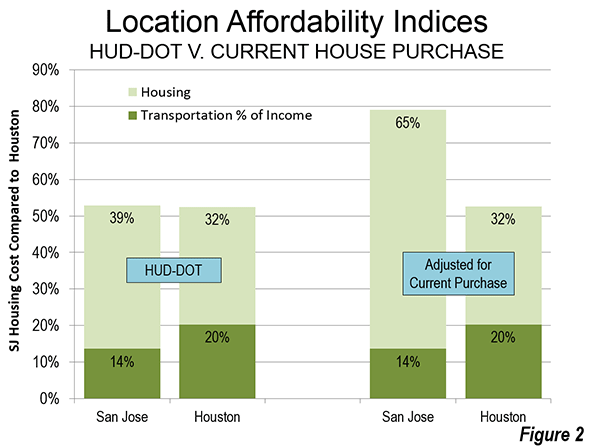
    A household relying on this source of information would be greatly misled. For example, comparing Houston with San Jose, according to HUD-DOT, owned housing and transportation consume virtually the same share of the median household income in each of the two metropolitan areas. In Houston, 52.5 percent of income is required for housing and transportation, while the number is marginally higher than San Jose (52.9 percent).

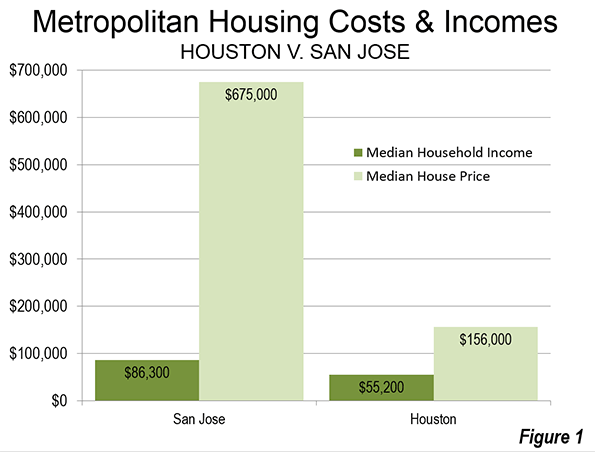
    But the HUD-DOT numbers reflect nothing like the actual costs of housing in San Jose relative to Houston. The median price house in Houston was approximately $155,000, 2.8 times the median household income of $55,200 (this measure is called the median multiple) during the 2006-10 period used in calculating the HUD-DOT index. In San Jose, the median house price was approximately $675,000, 7.8 times the median household income of $86,300 (Figure 1).
    If the Location Affordability Index reflected the real cost for a prospective home owner (HUD-DOT costs including a market rate mortgage for the house), a considerable difference would emerge between San Jose and Houston. The combined San Jose Location Affordability Index for home owners would rise to 85 percent of median household income, a full 60 percent above the Houston figure, rather than the minimal difference of less than one percent indicated by HUD-DOE (Figure 2).
    Under-Estimating the Cost of Urban Containment

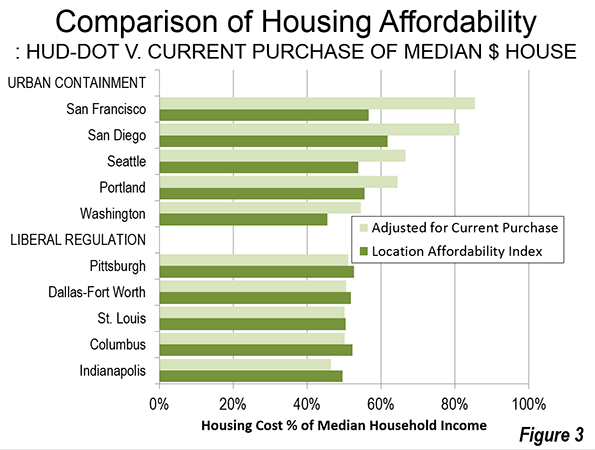
    There is a substantial difference between the HUD–DOT housing and transportation cost and the actual that would be paid by prospective buyers. Five selected urban containment markets indicate a substantially higher actual housing cost than reflected in the HUD–DOT figures. On the other hand, in the selected liberally regulated markets (or traditionally regulated markets), the HUD–DOE figure is much closer to the current cost of home ownership (Figure 3). This is a reflection of the greater stability (less volatility) of house prices in liberally regulated markets. Overall, based on data in the 50 major metropolitan areas, owned housing costs relative to incomes rise approximately 6 percent for each 10 percent increase in the sprawl index – that is, less sprawl is associated with higher house prices relative to incomes (Note 6).
    The increasing impacts of urban containment’s housing cost increases have been limited principally to households who have made recent purchases. The effect will become even more substantial in the years to come as the turnover of the more expensive housing stock continues.

    Granted, the 2006 to 2010 housing data includes part of the housing bubble and its higher house prices. However, house prices relative to incomes have returned to levels at or above that recorded during the period covered by Measuring Sprawl 2014 in "urban containment" markets, such as San Francisco, San Jose, Los Angeles, San Diego, Seattle, Portland, and Washington.

    Economic Mobility and Human Behavior

    Another assertion requires attention: economic mobility is greater in less sprawling metropolitan areas. The basis is research by Raj Chetty and Nathaniel Hendren of Harvard University and Patrick Kline and Emmanuel Saez of the University of California, Berkeley. However, the realities of domestic migration suggest caution with respect to the upward mobility conclusions, as is indicated in Distortions and Reality About Income Mobilityand in commentary by Columbia University urban planner David King.

    Virtually all urban history shows city growth to have occurred as people have moved to areas offering greater opportunity. Jobs, not fountains, theatres and art districts, drive nearly all the growth of cities. This means that there should be a strong relationship between the cities net domestic migration and the economic mobility conclusions of the research. The strongest examples show the opposite relationship.

    Domestic migration is strongly away from some metropolitan areas identified in the research as having the greatest upward income mobility also had substantial net domestic migration losses. For example, despite claims of high economic mobility New York, Los Angeles and the San Francisco Bay area, each lost approximately 10 percent of their population to net domestic migration in the 2000s. On the other hand, some metropolitan areas scoring the lowest in upward economic mobility drew substantial net domestic migration gains. For example, low economic mobility Charlotte and Atlanta gained 17 percent and 10 percent due to net domestic migration in the 2000s. Thus, the results of the economic research appear to be inconsistent with expected human behavior (Note 7).

    Sprawl: An Inappropriate Priority

    The new sprawl report is just another indication that urban planning policy has been elevated to a more prominent place than appropriate among domestic policy priorities. The usual justification for urban containment is a claimed sustainability imperative for its densification and anti-mobility policies. Yet, these policies are hugely expensive and thus ineffective at reducing greenhouse gas emissions, and thus have the potential to unduly retard economic growth (read "the standard of living and job creation"). Far more cost-effective alternatives are available, which principally rely on technology.

    There is a need to reverse this distortion of priorities. Little, if anything is more fundamental than improving the standard of living and reducing poverty (see Toward More Prosperous Cities). Housing is the largest element of household budgets and policies of that raise its relative costs necessarily reduce discretionary incomes (income left over after paying taxes and paying for basic necessities). There is no legitimate place in the public policy panoply for strategies that reduce discretionary incomes.

    London School of Economics Professor Paul Cheshire may have said it best, when he noted that urban containment policy is irreconcilable with housing affordability.

    ———

    Note 1: The previous Smart Growth America report used primarily metropolitan statistical areas (PMSAs), which have been replaced by metropolitan divisions. The primary metropolitan statistical areas were also subsets of metropolitan areas (labor market areas). This is problem is best illustrated by the fact that the Jersey City PMSA, composed only of Hudson County, NJ, is approximately one mile across the Hudson River from Manhattan in New York. Manhattan is the world’s second largest central business district and frequent transit service connects the two. Obviously, Jersey City is a part of the New York metropolitan area (labor market area), not a separate labor market.

    Note 2: Because of incomplete data, Boston is not given a sprawl rating in Measuring Sprawl 2014. A different rating system in the previous edition resulted in a Boston rating among the least sprawling. Yet, the Boston metropolitan area is characterized by low density development. Outside a 10 mile radius from downtown, the population density within the urban area is slightly lower than that of Atlanta (same square miles of land area used).

    Note 3: Higher house prices relative to household incomes are more associated with policies to control urban sprawl (such as urban growth boundaries and other land rationing devices), than with the extent of sprawl. More compact (less sprawling) urban areas do not necessarily have materially higher house prices. For example, in 1970, the Los Angeles urban area was one of the most dense in the United States, yet it was within the historical affordability range (a median multiple of less than 3.0). The emergence of Los Angeles as the nation’s most dense urban area in the succeeding decades (and 30 percent increase in density) is largely the result of a change in urban area criteria. Through 1990, the building blocks of urban areas were municipalities, which meant that many square miles of San Gabriel Mountains wilderness were included, because it was in the city of Los Angeles. Starting in 2000, the building blocks or urban areas became census blocks, which are far smaller and thus exclude the large swaths of rural territory that were included before in some urban areas.

    Note 4: The transport costs from the Location Affordability Index are accepted for the purposes of this article.

    Note 5: The current purchase housing cost is based on the average price to income multiple over the period of 2006 to 2010, relative to the median household income (calculated from quarterly data from the Joint Center for Housing Studies of Harvard University, State of the Nation’s Housing 2011). It is assumed that the buyer would finance 90 percent of the house cost at the average 30 year fixed mortgage rate with points over the period. The 10 percent down payment is allocated annually in equal amounts over the 360 months (30 years). The final annual cost estimate is calculated by adding the monthly mortgage payment and down payment allocation to the median monthly housing cost in each metropolitan area for households without a mortgage.

    HUD-DOT uses the "selected monthly owner cost" from the American Community Survey (ACS) for its cost of home ownership. According to ACS, “Selected monthly owner costs are calculated from the sum of payment for mortgages, real estate taxes, various insurances, utilities, fuels, mobile home costs, and condominium fees."

    Note 6: This is based on a two-variable regression estimation (log-log) with the sprawl index as the independent variable and the substituted housing share of income as the dependent variable for the 50 largest metropolitan areas (excluding Boston), It is posited that most of the variation in housing costs is accounted for by variation in land costs. Other significant factors, such as construction costs and financing costs in this sample vary considerably less. A sprawl index for each metropolitan areas represented by metropolitan divisions (not provided in the sprawl report) is estimated by population weighting.

    Note 7: Another difficulty with that research is that it measured geographic economic mobility at age 30, well before people reach their peak earning level. This is likely to produce less than reliable results, since those who achieve the highest incomes as well as the most educated such as medical doctors and people with advanced degrees) are likely to have larger income increases after age 30 than other workers.

    Wendell Cox is principal of Demographia, an international public policy and demographics firm. He is co-author of the “Demographia International Housing Affordability Survey” and author of “Demographia World Urban Areas” and “War on the Dream: How Anti-Sprawl Policy Threatens the Quality of Life.” He was appointed to three terms on the Los Angeles County Transportation Commission, where he served with the leading city and county leadership as the only non-elected member. He was appointed to the Amtrak Reform Council to fill the unexpired term of Governor Christine Todd Whitman and has served as a visiting professor at the Conservatoire National des Arts et Metiers, a national university in Paris.

    Suburban neighborhood photo by Bigstock.
  • Texas & Oklahoma Dominate Metropolitan Economic Growth

    Texas metropolitan areas continue to dominate economic growth, according to the latest Metro Monitor, produced by the Brookings Institution. The four top metropolitan areas in overall economic growth through the recession and "recovery" (our parentheses) have been:

    1. Austin
    2. Houston
    3. Dallas-Fort Worth
    4. San Antonio

    Oklahoma City took the 5th position. Oklahoma City, located 200 miles north of Dallas-Fort Worth may be experiencing some "overspill" economic growth from nearby Texas.

  • Growing Traffic Threatens Sydney

    In the "letter of the week" in The North Shore Times, Save Our Suburbs President Tony Recsei decries the rising traffic congestion that is occurring in Sydney from the densification policies. Urban planners had misled residents into believing that higher population densities would reduce traffic congestion as more people shifted to mass transit. Recsei notes that "While in higher densities, a slightly higher proportion of people use public transport, this is completely overwhelmed by the greater number now in the area who still have to use their cars for all sorts of reasons." With an understandable pride typical of Sydneysiders, Recsei asks "Why should policies be allowed to transform beautiful Sydney into just another overcrowded city in the world?"

    Why indeed. There are two overwhelming outcomes that are shared by cities that have climbed on the urban containment bandwagon: (1) destruction of housing affordability and (2) severely intensified traffic congestion. Sydney suffers from a particularly acute strain of the disease. The land rationing of urban containment policy has house affordability to a severely unaffordable level. Sydney’s traffic congestion has also become among the worst in the world. Of course things could be worse. Vancouver, with an urban planning regime to which some Sydney leaders and planners aspire, is even worse in both categories.

    Note: Tony Recsei is also a newgeography.com author (an example is Predictable Political Punditry Down Under).

  • Special Report: 2013 Metropolitan Area Population Estimates

    The 2013 annual metropolitan area population estimates by the US Census Bureau indicate a continuing and persistent dominance of population growth and domestic migration by the South. Between 2010 and 2013, 51 percent of the population increase in the 52 major metropolitan areas (over 1 million population) was in the South. The West accounted for 30 percent of the increase, followed by the Northeast at 11 percent and eight percent in the North Central (Midwest).

    Components of Population Change: Major Metropolitan Areas

    The dominance of the South was even greater when we turn to net domestic migration between Census Bureau regions. Nearly 785,000 more people moved to the major metropolitan areas of the South from other parts of the country than left. A much smaller 170,000 net domestic migrants moved to major metropolitan areas in the West. At the same time the Northeast lost 485,000 net domestic migrants and the Midwest lost 280,000.

    Perhaps even more remarkable, the South, long a laggard as an immigrant destination, even led in net international migration (666,000 for a 1.2 percent over three years), though the Northeast added 546,000, for a 1.0 percent rate). Net international migration to the West was about the same, some 454,000 for a 1.0 percent rate. The Midwest had the lowest net international migration in the country and well below any other region (280,000, for a 0.6 percent rate), as is indicated in Table 1.

    There was a substantial gap in the natural increase (births minus deaths) between the regions as well. The West (2.1 percent relative to the 2010 population over the three years) lead the South (2.0 percent) slightly in rate. Both were well ahead of the Midwest at 1.5 percent and especially the Northeast, at 1.2 percent (Table 1).

    Table 1
    Components of Population Change by Region
    Major Metropolitan Areas
      Total Natural Growth (Births Minus Deaths) Net Domestic Migration Net International Migration
    Northeast              546,742              434,872             (434,029)              545,899
    South           2,555,304           1,105,631              783,438              666,235
    North Central              398,536              472,017             (280,022)              206,541
    West           1,543,319              917,852              171,444              454,023
    Change Compared to 2010 Population
    Northeast 1.5% 1.2% -1.2% 1.5%
    South 4.6% 2.0% 1.4% 1.2%
    North Central 1.2% 1.5% -0.9% 0.6%
    West 3.5% 2.1% 0.4% 1.0%
    From Census Bureau Data


    Population Growth

    The New York metropolitan area continues to hold the top position, having added nearly 400,000 residents since 2010 to rise to a population of 19,950,000 residents. At its current rate of growth, New York will exceed a population of 20 million in 2014. There was a time that many expected second-place Los Angeles to overtake New York. However, since 1990 the New York population advantage over Los Angeles has expanded from 6.1 million to 6.8 million, including a further 80,000 advantage built up since 2010 (present geographical definitions). Part of this because much of the growth has been pushed to the more distant Riverside-San Bernardino area.

    Los Angeles and Chicago continued to retain the second and third positions, which they seem likely to maintain for decades. Population projections by the National Conference of Mayors indicates strong growth in Dallas-Fort Worth and Houston over the next three decades could have them by pass Chicago by 2050. The challenge could be even more immediate, since Chicago’s growth rate over the first three years of the decade is approximately one half the annual rate projected by the US Conference of Mayors between 2012 and 2042.

    Late in the last decade, Dallas-Fort Worth passed Philadelphia to become the fourth largest metropolitan area. Then, Philadelphia was passed by Houston in 2011. The result is that, for the first time since the nation’s founding, two of the five largest cities (which are functionally defined as metropolitan areas) are in a single state (Texas).

    Philadelphia seems likely to fall further. The strong growth rate of seventh ranked Washington suggests that this nearby rival may also pass Philadelphia as early as 2015. Eighth ranked Miami is growing fast enough that it also could drop Philadelphia a position, to 8th place the 2020 census.

    But Philadelphia is not the only metropolitan area in relative decline. Detroit started the decade as the nation’s 12th largest metropolitan area, but has since fallen to 14th. Detroit has been passed by both Riverside-San Bernardino and Phoenix. Phoenix rose 14th to 12th, passing Riverside-San Bernardino (which remained in 13th position) in the process.

    Among the 52 major metropolitan areas, Austin has grown at the greatest percentage rate since 2010 with Raleigh was the second fastest growing. Houston was the third fastest growing major metropolitan area over the three year period. Orlando ranked 4th in growth from 2010, while San Antonio was the fifth. The top ten was rounded out by Denver, Washington, Dallas-Fort Worth, Charlotte and Oklahoma City. Thus, among the 10 fastest-growing major metropolitan areas, nine were in the South and one (Denver) was in the West (Table 2).

    Table 2
    Major Metropolitan Area Population: 2010, 2012 & 2013
    Metropolitan Areas 2010 2012 2013 2010-13 2012-13
    Atlanta, GA       5,304,197       5,454,429       5,522,942 4.12% 1.26%
    Austin, TX       1,727,784       1,835,110       1,883,051 8.99% 2.61%
    Baltimore, MD       2,715,312       2,753,922       2,770,738 2.04% 0.61%
    Birmingham, AL       1,129,096       1,134,915       1,140,300 0.99% 0.47%
    Boston, MA-NH       4,564,054       4,642,095       4,684,299 2.63% 0.91%
    Buffalo, NY       1,135,314       1,133,767       1,134,115 -0.11% 0.03%
    Charlotte, NC-SC       2,223,635       2,294,990       2,335,358 5.02% 1.76%
    Chicago, IL-IN-WI       9,470,335       9,514,059       9,537,289 0.71% 0.24%
    Cincinnati, OH-KY-IN       2,117,344       2,129,309       2,137,406 0.95% 0.38%
    Cleveland, OH       2,075,690       2,064,739       2,064,725 -0.53% 0.00%
    Columbus, OH       1,906,243       1,944,937       1,967,066 3.19% 1.14%
    Dallas-Fort Worth, TX       6,452,758       6,702,801       6,810,913 5.55% 1.61%
    Denver, CO       2,553,829       2,646,694       2,697,476 5.62% 1.92%
    Detroit,  MI       4,291,400       4,292,832       4,294,983 0.08% 0.05%
    Grand Rapids, MI          989,196       1,005,493       1,016,603 2.77% 1.10%
    Hartford, CT       1,214,014       1,214,503       1,215,211 0.10% 0.06%
    Houston, TX       5,948,689       6,175,466       6,313,158 6.13% 2.23%
    Indianapolis. IN       1,892,323       1,929,207       1,953,961 3.26% 1.28%
    Jacksonville, FL       1,349,095       1,378,040       1,394,624 3.37% 1.20%
    Kansas City, MO-KS       2,013,691       2,038,690       2,054,473 2.03% 0.77%
    Las Vegas, NV       1,953,106       1,997,659       2,027,868 3.83% 1.51%
    Los Angeles, CA     12,844,070     13,037,045     13,131,431 2.24% 0.72%
    Louisville, KY-IN       1,237,851       1,251,538       1,262,261 1.97% 0.86%
    Memphis, TN-MS-AR       1,326,595       1,340,739       1,341,746 1.14% 0.08%
    Miami, FL       5,581,524       5,763,282       5,828,191 4.42% 1.13%
    Milwaukee,WI       1,556,549       1,566,182       1,569,659 0.84% 0.22%
    Minneapolis-St. Paul, MN-WI       3,355,167       3,422,417       3,459,146 3.10% 1.07%
    Nashville, TN       1,675,945       1,726,759       1,757,912 4.89% 1.80%
    New Orleans. LA       1,195,757       1,227,656       1,240,977 3.78% 1.09%
    New York, NY-NJ-PA     19,596,183     19,837,753     19,949,502 1.80% 0.56%
    Oklahoma City, OK       1,257,883       1,297,397       1,319,677 4.91% 1.72%
    Orlando, FL       2,139,372       2,223,456       2,267,846 6.01% 2.00%
    Philadelphia, PA-NJ-DE-MD       5,971,397       6,019,533       6,034,678 1.06% 0.25%
    Phoenix, AZ       4,208,770       4,327,632       4,398,762 4.51% 1.64%
    Pittsburgh, PA       2,356,658       2,360,989       2,360,867 0.18% -0.01%
    Portland, OR-WA       2,232,177       2,289,038       2,314,554 3.69% 1.11%
    Providence, RI-MA       1,601,798       1,601,160       1,604,291 0.16% 0.20%
    Raleigh, NC       1,137,351       1,188,504       1,214,516 6.78% 2.19%
    Richmond, VA       1,210,015       1,232,954       1,245,764 2.95% 1.04%
    Riverside-San Bernardino, CA       4,244,089       4,342,332       4,380,878 3.22% 0.89%
    Rochester, NY       1,080,081       1,082,375       1,083,278 0.30% 0.08%
    Sacramento, CA       2,154,417       2,193,927       2,215,770 2.85% 1.00%
    St. Louis,, MO-IL       2,789,893       2,796,506       2,801,056 0.40% 0.16%
    Salt Lake City, UT       1,091,452       1,123,943       1,140,483 4.49% 1.47%
    San Antonio, TX       2,153,288       2,234,494       2,277,550 5.77% 1.93%
    San Diego, CA       3,104,182       3,176,138       3,211,252 3.45% 1.11%
    San Francisco-Oakland, CA       4,344,584       4,454,159       4,516,276 3.95% 1.39%
    San Jose, CA       1,842,076       1,892,894       1,919,641 4.21% 1.41%
    Seattle, WA       3,448,425       3,552,591       3,610,105 4.69% 1.62%
    Tampa-St. Petersburg, FL       2,788,961       2,845,178       2,870,569 2.93% 0.89%
    Virginia Beach-Norfolk, VA-NC       1,680,120       1,698,410       1,707,369 1.62% 0.53%
    Washington, DC-VA-MD-WV       5,664,789       5,862,594       5,949,859 5.03% 1.49%
    Major Metropolitan Areas   169,898,524   173,253,232   174,942,425 2.97% 0.97%
    From Census Bureau Data


    Domestic Migration

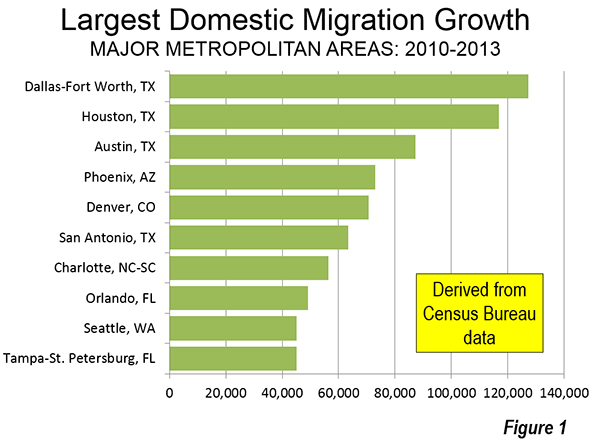
    Net domestic migration is, not surprisingly, dominated by the major metropolitan areas of the South, especially Texas and Florida. Dallas-Fort Worth and Houston led the nation with more than 100,000 net domestic migrants (Figure $$$). Austin placed third in San Antonio was sixth. Charlotte ranked seventh, while the Florida entries Orlando stood at eighth and Tampa-St. Petersburg at 10th. The West had three big domestic migration lures, Phoenix (4th), Denver (5th), and Seattle (9th).

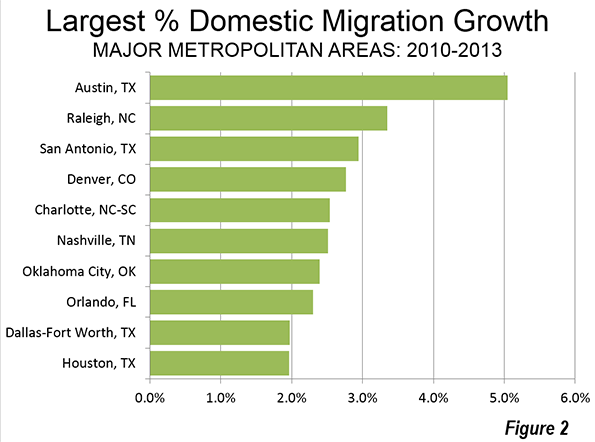
    Austin also led in the percentage of net domestic migration gain relative to its 2010 population. Again, nine of the top gainers were in the South, with one entry from the West, Denver (Figure 2).

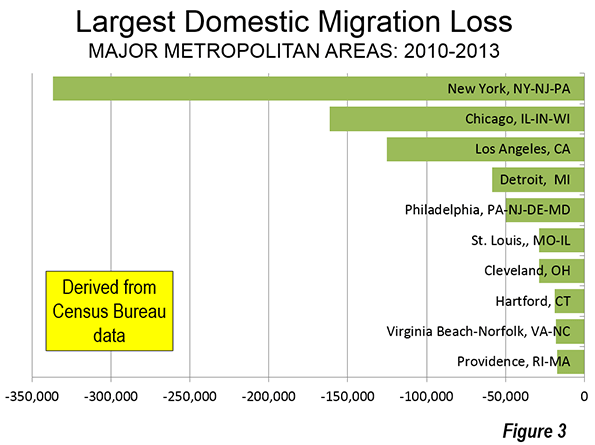
    The largest net domestic migration losses were more dispersed across the country, with metropolitan areas from every region represented. New York lost the most net domestic migrants (more than 300,000) and was joined by Philadelphia, Hartford, and Providence from the East. Chicago lost the second most domestic migrants (more than 150,000) and was joined by Detroit, St. Louis and Cleveland from the Midwest. Los Angeles ranked third in the bottom 10, losing more than 100,000 net domestic migrants, the only western metropolitan area to suffer a significant migration loss. The South’s only representative in the bottom 10 was Virginia Beach-Norfolk (Figure 3).

    Table 3
    Major Metropolitan Area Net Migration: 2010 to 2013
    Metropolitan Areas Net Domestic Migration Change Relative to 2010 Population Net International Migration Change Relative to 2010 Population
    Atlanta, GA      44,433 0.84%         49,375 0.93%
    Austin, TX      87,189 5.05%         15,685 0.91%
    Baltimore, MD          (121) 0.00%         24,366 0.90%
    Birmingham, AL       (2,918) -0.26%           3,585 0.32%
    Boston, MA-NH           101 0.00%         70,356 1.54%
    Buffalo, NY       (7,774) -0.68%           7,341 0.65%
    Charlotte, NC-SC      56,478 2.54%         14,590 0.66%
    Chicago, IL-IN-WI   (161,558) -1.71%         69,041 0.73%
    Cincinnati, OH-KY-IN     (16,893) -0.80%           9,703 0.46%
    Cleveland, OH     (28,780) -1.39%         10,837 0.52%
    Columbus, OH      11,425 0.60%         13,752 0.72%
    Dallas-Fort Worth, TX    127,315 1.97%         57,403 0.89%
    Denver, CO      70,668 2.77%         14,160 0.55%
    Detroit,  MI     (58,343) -1.36%         30,281 0.71%
    Grand Rapids, MI        4,594 0.46%           3,290 0.33%
    Hartford, CT     (18,979) -1.56%         15,206 1.25%
    Houston, TX    116,956 1.97%         74,817 1.26%
    Indianapolis. IN      13,698 0.72%         12,031 0.64%
    Jacksonville, FL      16,932 1.26%           9,760 0.72%
    Kansas City, MO-KS       (3,738) -0.19%           9,162 0.45%
    Las Vegas, NV      17,419 0.89%         19,041 0.97%
    Los Angeles, CA   (125,037) -0.97%       145,101 1.13%
    Louisville, KY-IN        4,874 0.39%           6,530 0.53%
    Memphis, TN-MS-AR     (13,723) -1.03%           4,868 0.37%
    Miami, FL      31,750 0.57%       152,998 2.74%
    Milwaukee,WI     (14,282) -0.92%           6,547 0.42%
    Minneapolis-St. Paul, MN-WI        2,664 0.08%         30,341 0.90%
    Nashville, TN      42,090 2.51%         10,201 0.61%
    New Orleans. LA      20,721 1.73%           8,727 0.73%
    New York, NY-NJ-PA   (336,566) -1.72%       372,651 1.90%
    Oklahoma City, OK      30,086 2.39%           6,759 0.54%
    Orlando, FL      49,244 2.30%         43,230 2.02%
    Philadelphia, PA-NJ-DE-MD     (49,564) -0.83%         51,244 0.86%
    Phoenix, AZ      72,985 1.73%         24,885 0.59%
    Pittsburgh, PA        7,564 0.32%           8,129 0.34%
    Portland, OR-WA      30,244 1.35%         15,350 0.69%
    Providence, RI-MA     (17,253) -1.08%         13,365 0.83%
    Raleigh, NC      38,088 3.35%         10,875 0.96%
    Richmond, VA      10,777 0.89%           9,542 0.79%
    Riverside-San Bernardino, CA      18,321 0.43%         14,997 0.35%
    Rochester, NY     (11,558) -1.07%           7,607 0.70%
    Sacramento, CA        6,922 0.32%         17,662 0.82%
    St. Louis,, MO-IL     (28,809) -1.03%         11,556 0.41%
    Salt Lake City, UT        3,367 0.31%           7,560 0.69%
    San Antonio, TX      63,391 2.94%         10,778 0.50%
    San Diego, CA           455 0.01%         35,199 1.13%
    San Francisco-Oakland, CA      37,157 0.86%         68,510 1.58%
    San Jose, CA       (6,245) -0.34%         41,207 2.24%
    Seattle, WA      45,188 1.31%         50,351 1.46%
    Tampa-St. Petersburg, FL      45,071 1.62%         28,621 1.03%
    Virginia Beach-Norfolk, VA-NC     (17,944) -1.07%         15,650 0.93%
    Washington, DC-VA-MD-WV      32,749 0.58%       107,875 1.90%
    Total    240,831 0.14%    1,872,698 1.10%
    From Census Bureau Data


    Migration Gains in the Suburbs, Losses in the Core

    This year was notable for the virtual absence of the customary "return to the city" stories. In recent years, historical core municipalities have done better in population growth than in the past. In previous decades, some lost large amounts of their population. However, an improving urban environment, not least because of better crime control, has led to something of a residential resurgence, especially in the immediate area of downtowns, though inner core populations (within five miles of City Hall) have continue to decline (see Flocking Elsewhere: The Downtown Growth Story).

    Specious claims of a net suburban movement to the cores have been refuted by the domestic migration data. Net domestic migration is reported by the Census Bureau only at the county level. Thus, any analysis of domestic migration between the cores and the suburbs must be county-based. During the Great Recession, domestic migration declined substantially, as is to be expected when the economy is depressed.

    Yet, in each of the three years of this decade, suburban counties have experienced net domestic migration gains and in each year have substantially led the core counties. In only one year, 2012, was there a net domestic migration gain in the core counties. The most recent 2013 data shows that core counties experienced a 70,000 net domestic migration loss, while the suburban counties gained 163,000 net domestic migrants. This difference of 233,000 was approximately four times the demographic gains made by the suburbs in both of the previous years Figure 4).

    Returning to Normalcy?

    With the economy still depressed, it would be premature to declare that the more typical results of the last year presage a return to normalcy. Any such reliable judgment must await restoration of broad-based, job and salary driven – as opposed to asset-based – economic growth. However, the trends of the last year indicate more than anything that the basic patterns of at least the past quarter century – with higher suburban growth and a shift towards the South – to be reasserting themelves.

    Wendell Cox is principal of Demographia, an international public policy and demographics firm. He is co-author of the "Demographia International Housing Affordability Survey" and author of "Demographia World Urban Areas" and "War on the Dream: How Anti-Sprawl Policy Threatens the Quality of Life." He was appointed to three terms on the Los Angeles County Transportation Commission, where he served with the leading city and county leadership as the only non-elected member. He was appointed to the Amtrak Reform Council to fill the unexpired term of Governor Christine Todd Whitman and has served as a visiting professor at the Conservatoire National des Arts et Metiers, a national university in Paris.

    Photo: Downtown Houston (by author)