Author: Wendell Cox

  • China Freeways: Continuing Expansion

    Beijing’s xinhuanet.com reported on December 30 that 11,000 kilometers (7,000 miles) of new freeways (motorways) were built in 2012. This is equivalent to more than 150 percent of the freeway mileage in California.

    Based on figures reported at the end of 2011, the additional 11,000 kilometers would increase China’s national freeway system (the National Trunk Highway System) to approximately 96,000 kilometers (60,000 miles). This is approximately 20,000 kilometers (12,000 miles) longer than the US interstate highway system, as reported in 2010. As a result, China’s national freeway system is the longest in the world.

    Both China and the United States have additional freeway segments that are not a part of the national systems. In 2010, the United States had approximately 99,000 kilometers (62,000 miles) of freeways, including the interstate system. Data is not readily available for a number of urban and provincial level freeways in China that are not a part of the National Trunk Highway System.

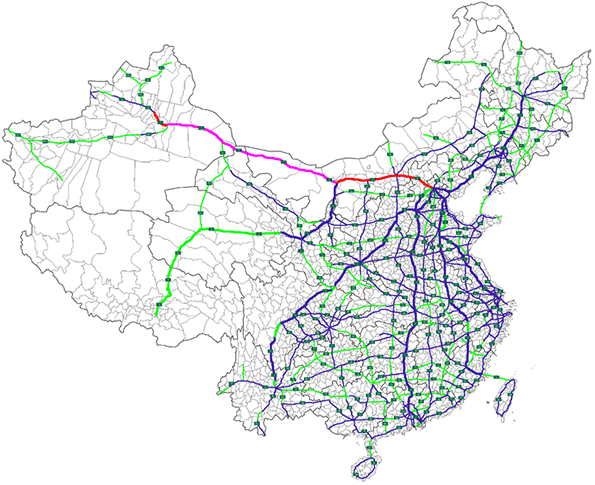
    It seems likely that the US continues to lead, though by only a small margin, in total freeway mileage. However, China is continuing to expand its system at a rapid rate. This is evident in the map below, which uses purple and green to indicate uncompleted freeways, while blue and red indicate open segments. Long stretches remain to be completed to Urumqi, the capital of Xinjiang, and beyond to the border of Kazakhstan in the Pamir Mountains, as well as two long routes to Lhasa, the capital of Tibet. A number of additional routes are also planned in the densely populated eastern third of the nation.


    Map by WikiCommons user Pafun

    Also see:
    China’s Expanding Roadways (February 2012)
    China Expressway System to Exceed US Interstates (January 2011)

  • The Evolving Urban Form: Bangkok

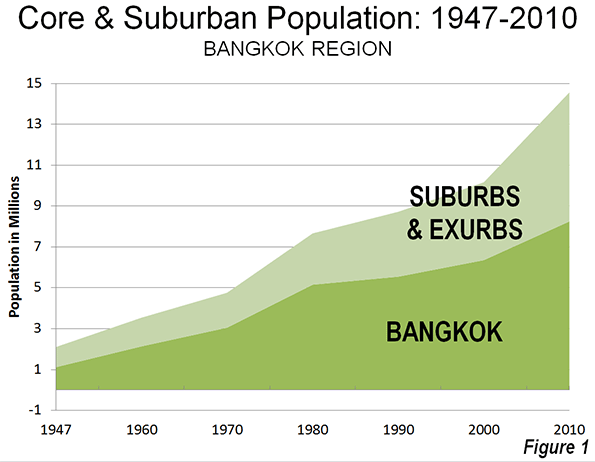
    Since 2000, the Bangkok region has experienced annual population growth 2.5 times the rate of growth from 1980 to 2000. By 2010, the Bangkok region – which includes the provincial level city of Bangkok and the provinces of Samat Prakan, Samut Sakhon, Pathum Thani, Nonthaburi and Nakhon Pathom –  was nearing a population of 15 million (Note 1).

    As is characteristic of urbanization in both developing and developed countries, much of Bangkok’s recent growth has occurred outside the city, in suburban (and exurban) areas. Between 2000 and 2010, the city grew by 30%, while the suburban provinces grew more than twice as quickly, at 66%. The city’s population growth was 1.9 million, while the suburban provinces added 2.5 million population (Figure 1).
    Much of the urban expansion has been on the periphery both within the city of Bangkok and in the provinces of Samut Prakon to the east, Samut Sakhon to the west and Pathum Thani to the north. Unlike most cities in Asia, where new development has taken high-rise form, much of this new development has been townhouses and detached housing. (Photo: Detached housing).


    Photo: Detached Housing in the Bangkok city eastern sector

    The Urban Area

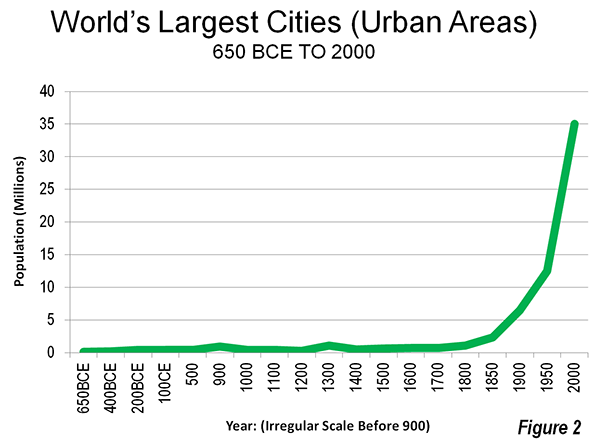
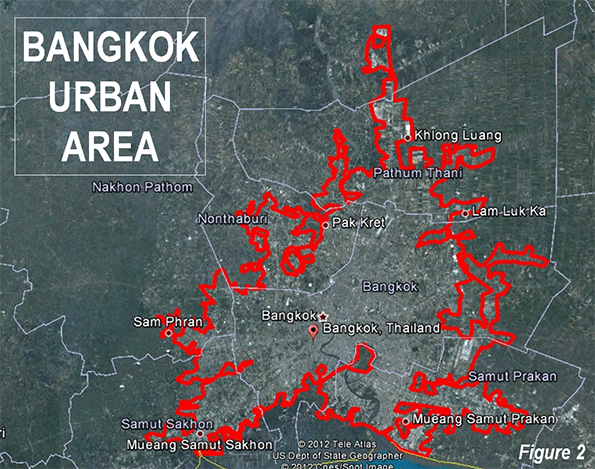
    The urban area, or area of continuous urban (and suburban) development will reach 14.5 million residents in 2013, according to United Nations projections. The urban area (Figure 2) covers approximately 900 square miles (2,330 square kilometers) and has a population density of the urban area is 16,200 per square mile (6,200 per square kilometer). This is 1.5 times the density of the Paris urban areas and more than 2.5 times that of the Los Angeles. However, Dhaka (Bangladesh), the most dense urban area, is at least eight times as dense.
    Bangkok’s high density and inadequate road system combine to make Bangkok’s traffic among the worst in the world. The Bangkok region is well served by freeways but government authorities have failed to provide the necessary arterial road (secondary road) infrastructure, as noted by Shlomo Angel, Stephen C. Sheppard, and Daniel L. Civco in a World Bank report (Note 2). As a consequence, they said that:

    The cost of reducing congestion in Bangkok is now higher—by one or two orders of magnitude—from what it would have been had adequate rights-of-way been secured earlier.  

    Bangkok is not the first urban area to have made this mistake. Atlanta’s traffic congestion is substantially worsened by its failure to provide a proper arterial roadway system.

    Bangkok’s best chance of reducing its traffic congestion lies in the expansion of its underdeveloped arterial roadway system. Nonetheless, the scattered development has preserved opportunities to develop arterial roads cost effectively in some suburban areas. The siting of more commercial and employment growth in these areas would also help.

    Some officials have suggested that expanded rapid transit would reduce traffic congestion. Bangkok has been expanding its small rapid transit system (as can be appropriate in very high density centers). There is little potential, however, for transit to reduce traffic congestion, as the intense traffic congestion and long commutes in cities well served with transit indicates (See photo at top and Note 3)

    Suburban and Exurban Bangkok

    Suburban expansion has been made possible by the increasing affluence of the Bangkok area, inexpensive land and house construction prices and the rising share of households with personal motorized vehicles (automobiles and motorcycles). Suburban dwellers are in the process of obtaining their own "Thai Dream" of home ownership, the popularity of which is demonstrated by the continuing draw of households to these rapidly developing areas.

    Angel, et al noted that the Bangkok area had become “model of a well–functioning land and housing
    market," and that:

    Affordable and minimally–serviced land was brought into the market by the efficient creation of a minimal number of narrow tertiary roads that connected building plots to the existing road system; mortgages became widely available; and private developers went down–market in large numbers, selling land–and–house packages that were affordable for more than half the urban households.

    Data from the Real Estate Information Centre of Thailand indicates that average new house prices remain similar in relation to average household income as a decade ago. By maintaining a competitive land market for new housing, Bangkok has retained housing affordability. 

    However there are difficulties. Some suburban areas, particularly in Pathum Thani, were hard hit by the 2011 floods. There has been controversy on this issue, as governments, national and local have come under criticism for their failures to control the flooding. At a minimum, the failure of the Bangkok region governments to coordinate their efforts contributed to the seriousness of this disaster. Nonetheless, new house construction continues in the suburbs and exurbs.

    The City ("Bangkok Metropolis")

    The core city of Bangkok is a provincial level jurisdiction, referred to popularly as the "Bangkok Metropolis" (Note 4). Bangkok is not a compact city, however, covering 605 square miles (1.570 square kilometers). This is 15 times the land area of the ville de Paris and larger than either Houston or Los Angeles, two of the most geographically expansive municipalities in the United States.  

    Beyond central Bangkok, the north, east and west sectors of the core city have experienced strong growth in detached and attached (row house or townhouse) construction.

    Bangkok’s commercial core is dispersed, like many other Asian cities, in China and elsewhere.  Manila is every bit as polycentric as Los Angeles or Atlanta. Bangkok, however, may be the ultimate core dispersion. There are at least five areas of high-rise commercial concentration, and large office buildings are sprinkled throughout the large central area (Photo: Dispersed core development). The UITP Millennium Cities Database indicated that only 11 percent of employment was in the central business district in the middle 1990s. With the ongoing dispersion, this figure may be lower now.
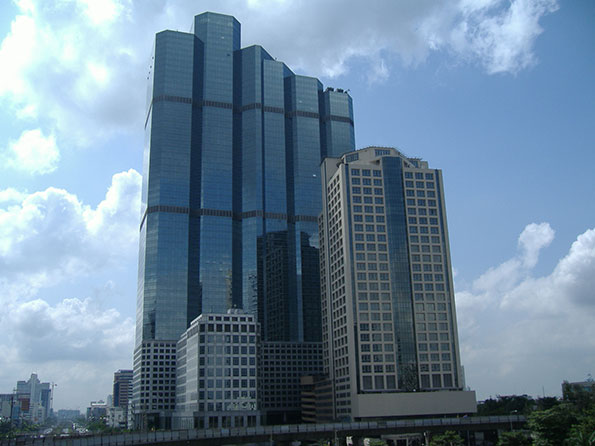

    Photo: Dispersed core development

    An Economic Success

    Bangkok residents live well compared to many living in other East Asian cities. Not only is their housing more affordable, but they have achieved much higher incomes. According to the most recent Brookings Global Metro Monitor, Bangkok has gross domestic product per capita of $23,400 annually (based on purchasing power). This is more than all but four of Latin America’s metropolitan economies (Brasilia, Monterrey, Buenos Aires and Sao Paulo), according to the Brookings the data. If Bangkok were in China, its per capita GDP would rank in the top quarter  of metropolitan economies (Note 5).

    Challenges Facing the Bangkok Region

    Bangkok seems likely to continue to grow rapidly, simply because it is virtually the only "urban draw" in Thailand. None of the world’s megacities (over 10 million population) is larger relative to other urban areas in the nation. Bangkok has more than 20 times the population of the next largest urban area in Thailand (Chon Buri). Strong population growth always presents formidable challenges for governments. The Bangkok region’s principal tasks will be to retain housing affordability by ensuring a competitive land market, and by providing a road system that reduces its exceedingly long travel times.  

    —–

    Note 1: There has been confusion about the Bangkok region’s total population. As late as 2009, the city of Bangkok projected the 2010 regional population, excluding Nakhon Pathom’s fewer than 1 million population at 10.3 million. The population as counted in the 2010 census was 3.3 higher.

    Note 2: Developers (and thus home buyers) pay for building the tertiary road systems that serve the new housing developments, similar to the practice in nations like the United States, Canada, Australia and New Zealand.

    Note 3: This is illustrated by Tokyo and Hong Kong, which each have one-way work trip travel times of 46 minutes — the longest reported in high-income world metropolitan areas. Tokyo has the world’s largest transit system and Hong Kong has the highest average urban density in the high-income world. By contrast, Los Angeles, where transit carries a small share of travel, and which has much lower densities than Tokyo or Hong Kong, has a one-way average work trip travel time of 27 minutes.

    Note 4: The city of Bangkok is a provincial level jurisdiction, formally called the Bangkok Metropolitan Administration. This use of the term "metropolitan" can be confusing, since much of the metropolitan area is outside the city (in between two and four other provinces, depending on the definition. This is similar to Tokyo and the former situation in Toronto. The prefecture of Tokyo is referred to as the "Tokyo Metropolis," which comprises barely one-third of the population of the Tokyo metropolitan area. Before the formation of the present city of Toronto, the regional authority was called the "Municipality of Metropolitan Toronto," however contained barely one half of the metropolitan area population. These semantic issues have been the source of considerable misunderstanding, not only by casual observers, but also by some academics.

    Note 5: The ranking for Chinese metropolitan areas is adjusted in China, using the population figures from the 2010 census (which included the urban migrant population). The issue is described in Endnote 19 in the Brookings Global Metro Monitor.

    Wendell Cox is a Visiting Professor, Conservatoire National des Arts et Metiers, Paris and the author of “War on the Dream: How Anti-Sprawl Policy Threatens the Quality of Life.”

    ——

    Photo: Rapid transit and traffic congestion in Bangkok (all photographs by author)
  • Moving to North Dakota: The New Census Estimates

    The new state (and DC) population estimates indicate a substantial slowdown in growth, from an annual rate of 0.93 percent during the 2000s to 0.75% between 2011 and 2012. This 20 percent slowdown in growth was driven by a reduction in the crude birth rate to the lowest point ever recorded in the United States (12.6 live births per 1000 population).

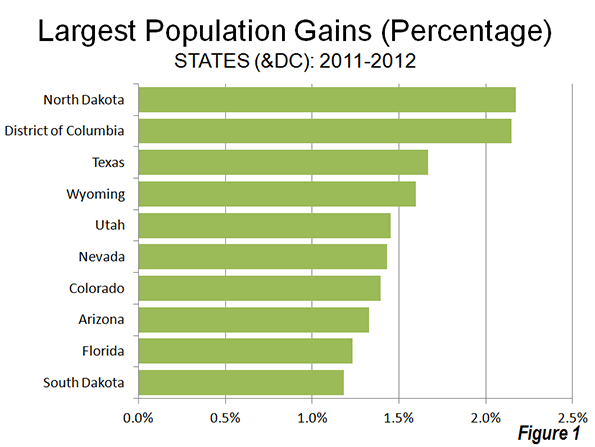
    The big surprise was the population growth leader, North Dakota, which has experienced a strong boom in natural resource extraction. Between 1930 and 2010, North Dakota had lost population. However in the first two years of the new decade, North Dakota has experienced strong growth, and reached its population peak, according to the new estimates, in 2012. North Dakota’s population growth rate between 2011 and 2012 was 2.17%. Nearby South Dakota also grew rapidly, ranking 10th in population growth. The other fastest-growing states were all in the South or the West. The District of Columbia, located in the strongly growing Washington, DC Metropolitan area ranked second in growth rate behind North Dakota (Figure 1).

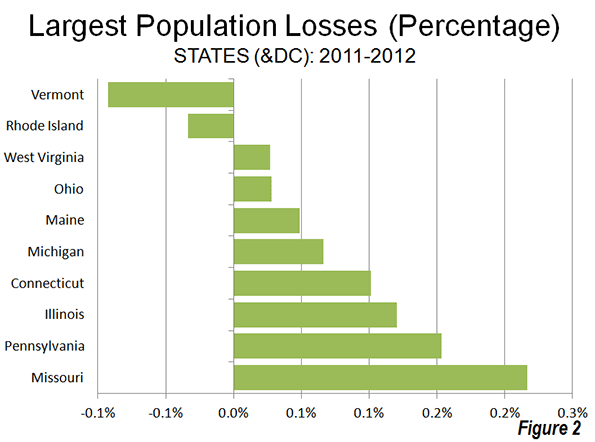
    Two states lost population, Vermont and Rhode Island, as the Northeast and Midwest represented all but one of the 10 slowest growing states. West Virginia, in the South, was also included among the slowest growing states (Figure 2).

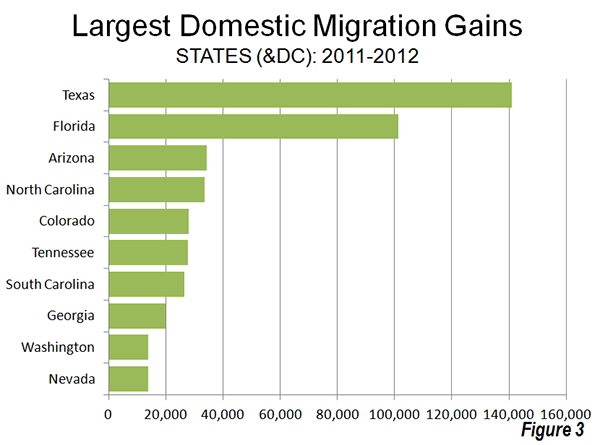
    The domestic migration trends continue to favor the South and West. Texas continues to attract the largest number of domestic migrants (141,000), followed by Florida (101,000). These two states have been the domestic migration leaders in the nation every year since 2000 (Figure 3). Four states gained from 25,000 to 35,000 domestic migrants (Arizona, North Carolina, Tennessee and South Carolina).

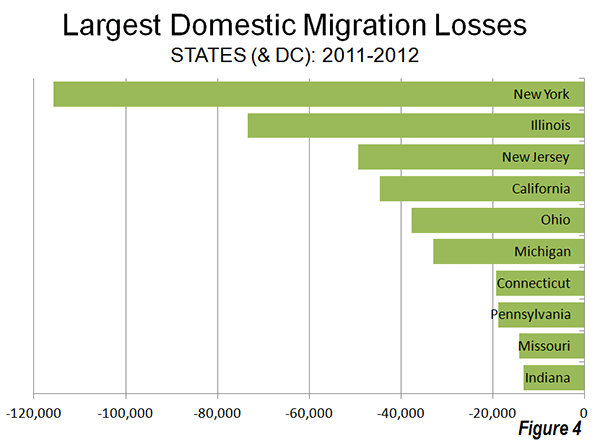
    Generally, the same states continued to dominate domestic migration losses, with New York losing the most migrants, Illinois ranking second, followed by California, Ohio and Michigan. With the exception of California, all of the 10 states losing the largest number of domestic migrants were in the Northeast or the Midwest (Figure 4).

    Overall, domestic migration continues to be dominated by the South, which attracted 354,000 residents from other states. The West added 52,000 domestic migrants, however virtually all of this gain occurred in the Intermountain West. Gains in Oregon and Washington were far more than offset by the large losses in California, as well as losses in Hawaii and Alaska. The Intermountain West gained more than 70,000 domestic migrants. The Northeast lost 221,000 domestic migrants, while the Midwest lost 185,000.

  • IRS to Continue Migration Data

    " The IRS should be applauded" — it is hard to imagine a public statement to this effect, other than from a government insider. But this was the Tax Foundation, improbably and correctly complimenting the Internal Revenue Service in announcing that its annual income tax migration data would continue to be produced. This apparently reverses a decision to discontinue the data. The Tax Foundation noted that there was:

    … outrage when the IRS announced that they were canceling the program. An IRS economist, informed of the decision by higher-ups, told the Daily Caller: "We were just told this morning that the program is indeed going to be discontinued.  It is not our decision at all and we are very disappointed." Jim Pettit, of the activist group Change Maryland, penned a National Review piece noting that the decision came soon after the data put Maryland Governor Martin O’Malley on the defensive (O’Malley has routinely asserted that Maryland has a great tax system and business climate, despite strong evidence to the contrary), and the Washington Examiner followed up with an editorial saying that the data is vital for ascertaining which "model" of states (high-tax, high-service vs. low-tax, low-service) Americans were preferring. Members of Congress also started calling, demanding an explanation.

    We join in the chorus. This data has been valuable for many uses and many will continue to use it in the years to come.

  • Alleviating World Poverty: A Progress Report

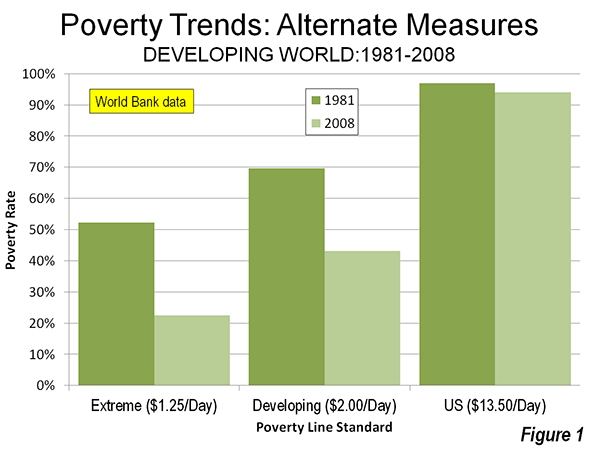
    There has been a substantial reduction in both the extreme poverty rate and the number of people living in extreme poverty since the early 1980s, according to information from the World Bank poverty database. The World Bank maintains data on developing world nations, which include both low income and middle income nations. The analysis below summarizes developing world (low and middle income nations) poverty trends from 1981 to the latest available year, 2008 (Table and Figure 1).

    Evolution of Low and Middle Income World Poverty: 1981-2008
      Poverty Rate Change in Millions % of New Population Not in Poverty
          People in Poverty People Not in Poverty
    POVERTY RATE & Region 1981 2008
    EXTREME POVERTY LINE  ($1.25/Day per capita)      
    East Asia and Pacific 77.2% 14.3%           (812)           1,374 >100.0%
    Europe and Central Asia 1.9% 0.5%                (6)                50 >100.0%
    Latin America and the Caribbean 11.9% 6.5%                (6)              212 >100.0%
    Middle East and North Africa 9.6% 2.7%                (8)              155 >100.0%
    South Asia 61.1% 36.0%                  2              655 99.6%
    Sub-Saharan Africa 51.4% 47.5%             181              233 56.3%
    Total 52.2% 22.4%           (649)           2,679 >100.0%
    DEVELOPING WORLD POVERTY LINE ($2.00/Day per capita)    
    East Asia and Pacific 92.5% 33.4%           (652)           1,214 >100.0%
    Europe and Central Asia 8.4% 2.2%              (26)                70 >100.0%
    Latin America and the Caribbean 23.8% 12.4%              (16)              221 >100.0%
    Middle East and North Africa 30.2% 14.0%                (7)              155 >100.0%
    South Asia 87.3% 71.1%             316              341 51.9%
    Sub-Saharan Africa 72.3% 69.3%             275              139 33.5%
    Total 69.7% 43.1%           (109)           2,140 >100.0%
    US POVERTY LINE: FAMILY OF FOUR ($13.50/Day per capita)    
    East Asia and Pacific 99.8% 96.6%             499                64 11.3%
    Europe and Central Asia 88.3% 72.1%              (38)                82 >100.0%
    Latin America and the Caribbean 86.3% 79.7%             139                66 32.1%
    Middle East and North Africa 96.0% 95.3%             140                   8 5.5%
    South Asia 100.0% 99.7%             652                   5 0.8%
    Sub-Saharan Africa 98.7% 98.6%             408                   6 1.5%
    Total 96.9% 94.0%          1,799              231 11.4%
    Source: World Bank PovcalNet database
    Poverty rates lines in 2005 US$ per capita

    Extreme Poverty Line ($1.25 Daily per Capita)

    Extreme poverty is defined as an income of $1.25 daily per capita, measured in 2005 United States dollars. The extreme poverty line is the average of the poverty rate among the "10 to 20" lowest income nations.

    The World Bank data indicates a nearly 60 percent reduction in the extreme poverty rate between 1981 and 2008, from 52.2 percent to 22.4 percent. By far the largest reduction was in the East Asia and Pacific region (which includes the large nations of China, Indonesia, Viet Nam, the Philippines stretches westerly to Myanmar) where the extreme poverty rate dropped more than 80 percent from 77.2 percent to 14.3 percent. Reductions of more than 70 percent were also experienced in the Middle East and North Africa and Europe and Central Asia, which is by far the most affluent of the developing world regions as designated by the World Bank (generally Eastern Europe, including Russia and Ukraine and the Central Asian nations to the western border of China, such as Kazahkstan).

    In 2008, approximately 650 million fewer people were living in extreme poverty than in 1981. This gain was dominated by East Asia and the Pacific, which experienced a reduction of 812 million people living below the extreme poverty line. Nearly all of the increase (181 million) in people living below the extreme poverty line occurred in Sub – Saharan Africa, a result of surging populations and still insufficient economic growth.

    Even so all six of the regions experienced an increase in the number of people living above the extreme poverty line. Further, in four regions, the increase in people above the extreme poverty line was greater than the overall population increase, and was nearly equal in a fifth. The increase in above extreme poverty population was less than the overall increase only in Sub-Saharan Africa.

    More than one half of the new population living above the extreme poverty line (1.37 billion) are in East Asia and the Pacific. Another quarter (0.65 billion) were in South Asia, which includes India, Pakistan and Bangladesh. Gains of from 155 million to 233 million were made in Sub-Saharan Africa, Latin America and the Caribbean and the Middle East and North Africa (in descending order). The sixth region, Europe and Central Asia had by far the lowest extreme poverty rate among the region, yet still managed a 50 million person improvement.  

    Developing World Poverty Line ($2.00 Daily per Capita)

    The success in reducing poverty was even more skewed to East Asia and the Pacific as measured against a somewhat higher average developing world poverty line of $2.00 daily per capita. The developing world under $2.00 poverty rate declined approximately one-third, from 69.7 percent to 43.1 percent

    The largest reduction was in Europe and Central Asia, where such poverty is rapidly becoming a thing of the past. The poverty rate declined almost three-quarters, to 2.2 percent. The $2.00 poverty rate fell 64 percent in East Asia and the Pacific, from 92.5 percent to 33.4 percent. Each of the other four regions also experienced declines in the $2.00 poverty line.

    There were 109 million fewer people living below the $2.00 poverty line in 2008 than in 1981. The improvement was heavily skewed toward East Asia and the Pacific, where there was a reduction of more than 650 million living below the $2.00 poverty line. There were, however, substantial increases in the number of people living below the $2.00 poverty line in South Asia (275 million) and Sub-Saharan Africa (316 million).

    Nonetheless, more than 2.1 billion additional people lived above the $2.00 poverty line in 2008 than in 1981. All regions experienced gains. East Asia and the Pacific accounted for 1.2 billion of this number, followed by South Asia (341 million) and Latin America and the Caribbean (221 million).

    United States Poverty Line ($13.50 Daily per Capita)

    Despite these gains, the extent of poverty in the developing world is substantial compared to high income world standards. For comparison, the 2008 poverty line for a family of four in the United States is used, which was $13.50 daily per capita. This is more than 10 times the extreme poverty line and nearly 7 times the $2.00 developing world poverty line.

    Between 2001 and 2008, the percentage of people in the developing world living below the US poverty line is estimated to have declined from 96.9 percent to 94.0 percent. Progress was made in each of the six regions, but even in the most affluent developing world region of Europe and Central Asia the poverty rate relative to the US standard remained at 72 percent. Even in largely middle-income Latin America and the Caribbean, the poverty rate, measured by the US standard was 80 percent. All of the other regions were at 95 percent or more. The highest poverty rate relative to the US standard was in South Asia, at 99.7 percent.

    Overall, nearly 1.8 billion additional people lived below the US poverty standard in 2008. The number of people living below the poverty standard declined only in the Europe and Central Asia. The largest increase in people living below the US poverty standard was in South Asia, at 652 million, while both East Asia and the Pacific and Sub – Saharan Africa added between 400 million and 500 million.

    The increase in the number of people living above the US poverty standard was modest, at 231 million. The largest increase was in Europe and Central Africa, at 82 million, while East Asia and the Pacific and Latin America and the Caribbean added approximately 65 million each.

    National Highlights

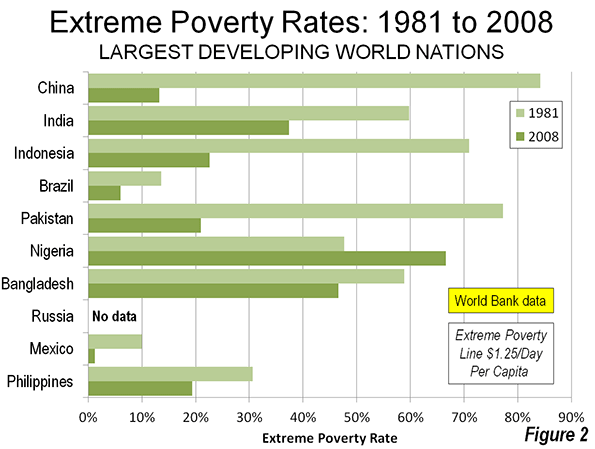
    East Asia and the Pacific have experienced the greatest reduction in poverty rates, as has been shown above. This is largely due to the substantial progress made by its largest nation, China. China experienced the largest reduction in its extreme poverty rate in the world, with a drop from 84.0 percent in 1981 to 13.1 percent in 2008. Among other developing world nations with more than 100 million population, eight experienced significant declines in their extreme poverty rates. One, however, Nigeria, had an increase. There was no data for Russia (Figure 2).

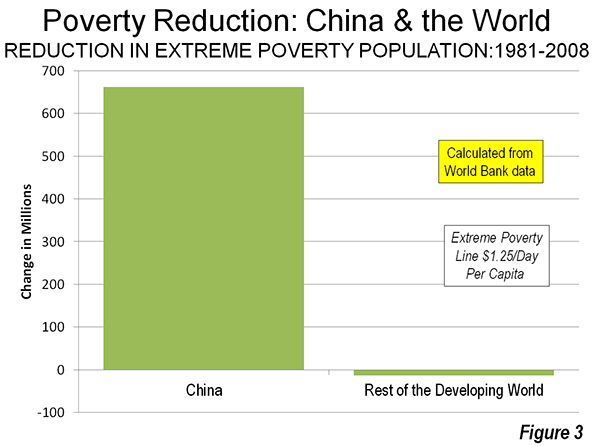
    China’s below extreme poverty line population declined 662 million, more than 10 times the second largest reduction, in Indonesia at 56 million. In fact, China’s reduction in its extreme poverty population exceeded that of the rest of the world (Figure 3).

    The number of people living above the extreme poverty line is increasing across the developing world.
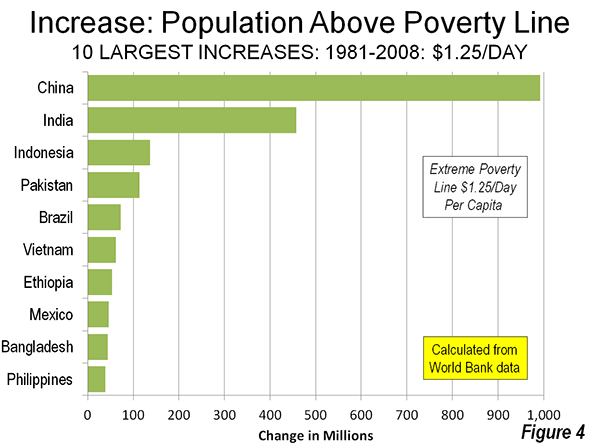
    Nearly 85 percent of China’s 2008 population lived above the extreme poverty line, an increase of nearly one billion from 1981. In India nearly 60 percent of its 2008 population lived above this line, an increase of 450 million. Other large nations experienced large increases in the number of people living above extreme poverty, such as Indonesia (135 million) and Pakistan (115 million) (Figure 4).

    Only a few nations had reductions in their number of people living above the extreme poverty rate. The Democratic Republic of the Congo had the largest increase, at 6 million.

    Eradicating Poverty: The Highest Priority

    The story on world poverty contains both good news to bad news. There is clearly substantial progress is being made in reducing extreme poverty in East Asia and the Pacific but this has not been replicated in other parts of the developing world. The bad news is that, for all the progress, the standards of living for the overwhelming majority of people remain far below first world poverty levels.

    Yet, there are signs of hope. A recent report by the Institute of International Finance indicates that over the last decade, Sub-Saharan Africa, long perceived to be synonymous with the world’s most intense poverty, has ranked second in economic growth only to East Asia for a decade.

    Yet, it can only be hoped that the natural aspiration of the world’s billions for much better lives will be achieved. The highest priority should be placed on eradicating poverty, as the recent Rio +20 Conference declared.

    —–

    Wendell Cox is a Visiting Professor, Conservatoire National des Arts et Metiers, Paris and the author of “War on the Dream: How Anti-Sprawl Policy Threatens the Quality of Life.”

    Photograph: New houses in León (Guanajuato) Mexico (by author)

  • Hong Kong’s Decentralizing Commuting Patterns

    Hong Kong is a city of superlatives. Hong Kong has at least twice the population density of any other urban area in the more developed world, at 67,000 per square mile or 25,900 per square kilometer. The Hong Kong skyline is rated the world’s best by both emporis.com (a building database) and diserio.com, which use substantially different criteria. This is an honor that could not have been bestowed on any city outside New York for most of the 20th century.

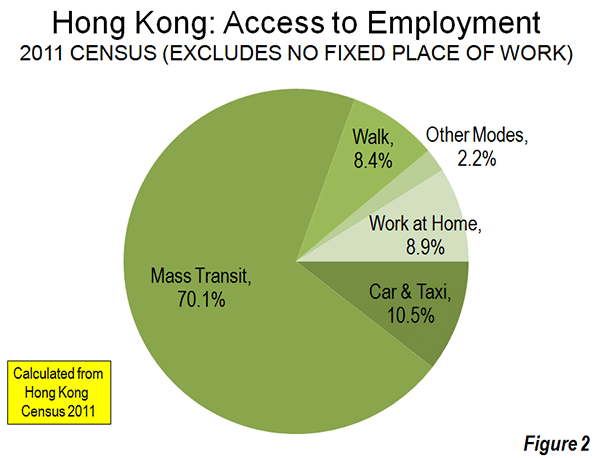
    No world city is better suited to mass transit than Hong Kong. Hong Kong may also be the best served — it has the transit usage levels to prove it. According to Hong Kong 2011 census data, 87 percent of combined transit and car work trip travel in Hong Kong is by transit, though this is a small decline from the 90 percent of 2001. This is the highest transit market share of any high-income world metropolitan area.

    Change in Work Access Patterns

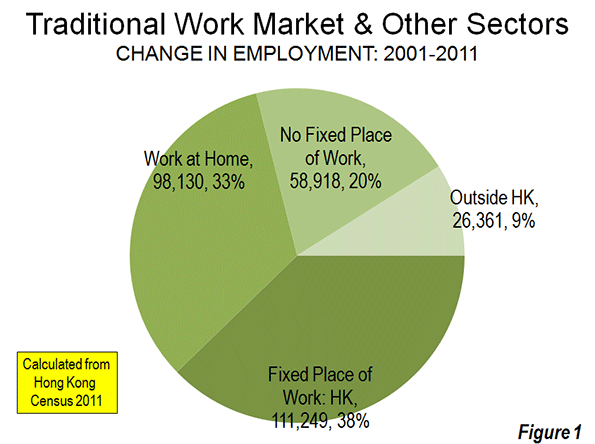
    Between 2001 and 2011 Hong Kong’s employment increased nine percent. Most of these new workers (38 percent), however, did not travel to fixed work locations in Hong Kong. Reflecting continuing decentralization and the impact of information technology, 62 percent of the new workers (1) worked at home, (2) had no fixed place of work or (3) worked outside Hong Kong, especially in Macau and the province of Guangdong, principally in Shenzhen (Figure 1). The 2001 and 2011 census data is summarized in the table below.

    HONG KONG WORK ACCESS: METHODS: 2001 AND 2011
    2001 2011 Change % Change Share: 2001 Share: 2011
    MASS TRANSIT   2,091,552  2,226,818    135,266 6.5% 70.4% 70.1%
    Bus & Coach  1,400,770  1,188,897  (211,873) -15.1% 47.2% 37.4%
       Large Bus   1,118,388     938,467   (179,921) -16.1% 37.7% 29.5%
       Minibus (Public Light)      226,646     217,219      (9,427) -4.2% 7.6% 6.8%
       Residential Coach       55,736       33,211    (22,525) -40.4% 1.9% 1.0%
    Rail     690,782  1,037,921   347,139 50.3% 23.3% 32.7%
       Metro (Original MTR)      495,128     697,475    202,347 40.9% 16.7% 21.9%
       Suburban Rail (Original KCR)      195,654     297,416    101,762 52.0% 6.6% 9.4%
       Light Rail              –         43,030     43,030 NA 0.0% 1.4%
    CAR & TAXI      232,978     333,192    100,214 43.0% 7.8% 10.5%
    WALK      335,859     266,574    (69,285) -20.6% 11.3% 8.4%
    OTHER      123,455       68,509    (54,946) -44.5% 4.2% 2.2%
    TRAVEL TO HK FIXED PLACE OF WORK   2,783,844  2,895,093    111,249 4.0% 93.8% 91.1%
    WORK AT HOME      185,367     283,497     98,130 52.9% 6.2% 8.9%
    FIXED PLACE OF WORK   2,969,211  3,178,590    209,379 7.1% 100.0% 100.0%
    NO FIXED WORK PLACE      188,998     247,916     58,918 31.2%
    WORK IN HONG KONG   3,158,209  3,426,506    268,297 8.5%
    WORK OUTSIDE HONG KONG       94,497     120,858     26,361 27.9%
    WORKING RESIDENTS   3,252,706  3,547,364    294,658 9.1%
    EXHIBIT
    Travel to Work in Hong Kong   2,783,844  2,895,093    111,249 37.8%
    Home, No Fixed Place, Outside HK      468,862     652,271    183,409 62.2%
    TOTAL   3,252,706  3,547,364    294,658 100.0%
    Source: Hong Kong Census, 2001 & 2011
    No Fixed Place of Work: Access method not determined


    The Shift from Bus to Rail: Transit’s overall share of work trip access was 70.1 percent in 2011 (all methods). This is a slight decline from the 70.4 percent in 2001. Over the last decade, Hong Kong has substantially expanded its urban rail system, including major improvements such as a new tunnel under Hong Kong Harbor and the new West rail line (former Kowloon Canton Railway) to Yuen Long and Tuen Mun. I wrote a supporting commentary in the Apple Daily (Hong Kong’s largest newspaper) supporting the rail expansion program in 2000.

    The results are apparent in the ridership data. The rail work access market share rose nearly 10 points to 32.7 percent. At the same time, the bus market share dropped nearly 10 points to 37.4 percent. Overall, in a modestly growing labor market, transit added 135,000 new one away work trips.

    Car Commuting Up: Cars and taxis experienced a much larger percentage gain, largely as a result of starting from a much smaller base. The car and taxi work trip access market share rose from 7.8 percent to 10.5 percent. Overall, approximately 100,000 more people commuted one way by car to work in 2011 than in 2001. The median incomes of car and taxi commuters are the highest, at more than twice that of rail and bus users.

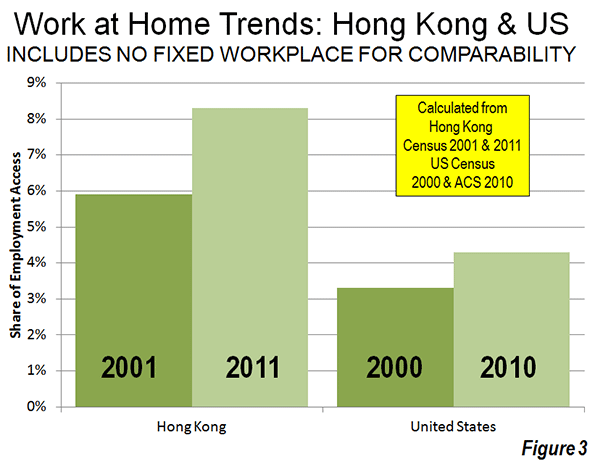
    More Working at Home:Hong Kong’s working at home grew the most of any category, rising 53 percent from 185,000 to 283,000 daily. As a result, working at home now accounts for 8.9 percent of work access, compared to 6.2 percent in 2001. Hong Kong’s reliance on working at home was greater than that of the United States in the early 2000s. Over the last decade Hong Kong’s 53 percent increase in working at home was well above the 41 percent increase in the United States. In Hong Kong, 33 percent of new employment was home-based work between 2001 and 2011. This is greater than in the US, where 20 percent of new jobs involved working at home as the usual mode of access between 2000 and 2010.

    The Decline of Walking: Given Hong Kong’s intensely high densities, it may come as a surprise that there was a huge loss in walking to work. Nearly 70,000 fewer people walked to work in 2011 than in 2001, as the walking market share dropped 21 percent. In 2011, commuters who walked (and those who used light rail) had the lowest incomes. In 2001, more people walked to work than either travelled by car or work at home. By 2011, fewer people walked to work than travel by car or work at home.

    There was also a nearly 55,000 loss in work access by other modes (such as ferries, motorized 2-wheelers and cycling).

    Finally, Hong Kong separately categorizes workers without a fixed place of employment and does not obtain information on how they access work. This category experienced an increase of nearly 60,000 from 2001 to 2011.

    The Decentralization of Hong Kong’s Labor Markets

    The distribution of employment changed little over the 10 years, with Hong Kong Island and Kowloon sectors retaining two-thirds of the jobs. These two areas also have more than one-half of the population.  Even so, the Hong Kong labor market followed the global pattern of decentralization.   More people traveled outside their home areas in 2011 than in 2001. Among resident workers living on Hong Kong Island and in Kowloon, there was an 18 percent increase in working outside these home sectors. Further, the increase in people with no fixed place of work reflects greater mobility and labor force decentralization.

    Jobs-Housing Balance? Not Much

    The high density of jobs and population, its short trip distances, its extraordinary transit system and its high transit market share would seem to make Hong Kong a poster city for the jobs – housing balance ("self containment") that urban planners seem so intent to seek. The data indicates no such thing.

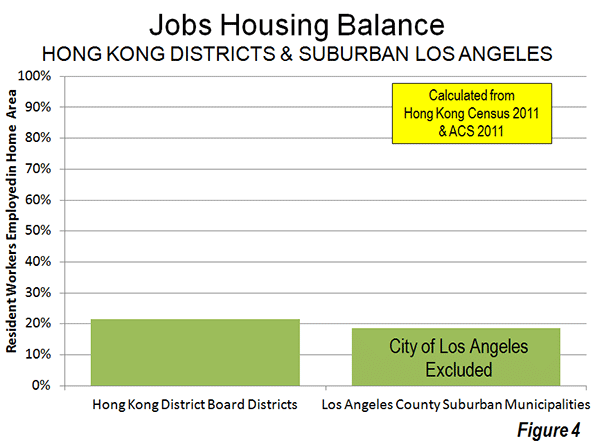
    Hong Kong’s 18 districts illustrate a comparatively low rate of self containment. Only 21.4 percent of working residents are employed in their home districts, including those who work at home. This is only slightly higher than in highly decentralized suburban Los Angeles County, where 18.5 percent of resident workers are employed in their home municipalities. With far lower population and employment densities and a 50 percent smaller geographical size, the suburban municipalities of Los Angeles County (city of Los Angeles excluded, see Note below) nearly equal the local-area jobs-housing balance of the Hong Kong districts (Figure 4).

    This tendency to work away from home districts contributes to Hong Kong’s extraordinarily long average commute times. In 2002, the average work trip was 46 minutes, longer than any high-income world metropolitan area except Tokyo. By comparison, Dallas-Fort Worth, with a similar population and a population density less than 1/20th that of Hong Kong, has an average work trip travel time of 26 minutes. Los Angeles, with its world-class traffic congestion has a work trip travel time of 27 minutes, principally because its automobile dominant commuting is much faster than Hong Kong’s world class, rail based transit system.

    These data, both in Hong Kong and Los Angeles, show that, within a metropolitan area (labor market),  people will tend to seek the employment that best meets their needs, just as employers will hire the people best suited to theirs. Within a labor market, this can be anywhere, subject to the preferences of people and employers, not of planners. This is the basis of former World Bank principal planner Alain Bertaud’s caution that a city’s economic efficiency requires … avoiding any spatial fragmentation of labor markets.

    The Mistake of Trying to Emulate the Unique

    It is a mistake to think that urban planning can emulate Hong Kong. Besides its superlatives, Hong Kong did not become so dense as a result of urban planning or the unfettered preferences of people (market forces). Hong Kong’s uniqueness is the result of unique geo-political influences. This history forced an unprecedented accommodation of millions in a small space, especially in the third quarter of the 20th century when it stood as a capitalist island in the midst of a Communist sea.

    Hong Kong is unique and will be for a long time.

    Note: The city Los Angeles has a very high jobs-housing balance (61 percent). However, this is largely due to its huge geographic size (more than 40 times the average suburban jurisdiction).

    Wendell Cox is a Visiting Professor, Conservatoire National des Arts et Metiers, Paris and the author of “War on the Dream: How Anti-Sprawl Policy Threatens the Quality of Life.”

    —-

    Photo: West Rail Line, Tin Shui Wai Station bus interchange, Yuen Long (by author)

  • Exodus to Suburbs Continues Through 2012

    The latest US Census Bureau migration data shows that people continue to move from principal cities (which include core cities) in metropolitan areas to what the Census Bureau characterizes as "suburbs" (Note). Between 2011 and 2012, a net 1.5 million people moved from principal cities to suburbs (principal cities lost 1.5 million people to the suburbs). The movement to the suburbs was pervasive. In each of the age categories, there was a net migration from the principal cities to the suburbs. There was also net migration to the "suburbs" in all categories of educational attainment.

    These data are in contrast to claims that people are moving from a suburbs to central cities. Virtually none of the migration data has shown any such movement. Moreover, the city population estimates produced for 2011 by the Census Bureau, which indicated stronger central city growth have been shown to be simply allocations of growth within counties, rather than genuine estimates of population increase.

    —-

    Note on Census Bureau "Suburbs:"

    The movement to the suburbs is undoubtedly understated in the Census Bureau estimates, because many jurisdictions included in the "principal city" classification are in fact suburbs. The Real State of Metropolitan America showed that virtually all population growth in principal cities was either in suburban jurisdictions classified as principal cities, or in cities with substantial expenses of post-World War II automobile oriented (or suburban) land-use patterns. The remaining core cities that are largely only urban core in land use accounted for only 2% of principal city growth from 2000 to 2008.

    For a decade, the Census Bureau has used a "principal city" designation instead of the former "central city" term. All former "central cities" are "principal cities." The Census Bureau characterizes all other areas of metropolitan areas as "suburbs." In fact, many of the principal cities are functionally suburbs, having barely existed or not existed at all at the beginning of the great automobile oriented suburban exodus following World War II.

    Examples of such suburban principal cities, with their metropolitan areas in parentheses, are Hoffman Estates (Chicago), Arlington (Dallas-Fort Worth), Aurora (Denver), Fountain Valley (Los Angeles), Eden Prairie (Minneapolis-St. Paul), Mesa (Phoenix), Hillsboro (Portland), San Marcos (San Diego), Pleasanton (San Francisco), Kent (Seattle), Virginia Beach (Virginia Beach-Norfolk) and many others.

  • Separation of Church and Urban Planning

    Recently, the Journal of the American Planning Association (JAPA) published research that directly challenged prevailing views in urban planning. In an article entitled Growing Cities Sustainably, Marcial H. Echenique, and Anthony J. Hargreaves from Cambridge University, Gordon Mitchell (University of Leeds) and Anil Namdeo (University of Newcastle) found that compact development (smart growth) had only a marginal impact on sustainable development and should not "automatically be associated with the preferred spatial growth strategy" (See Questioning The Messianic Conception of Smart Growth). This was particularly unsettling to the powers-that-be in urban planning, who have struggled for years – predating the current greenhouse gas emission (GHG) reduction concerns – to make anything but smart growth virtually illegal.

    The Reaction

    Soon after, the JAPA editor (Randy Crane of UCLA) was criticized by fellow academics in the "PLANET" listserv for permitting publication, at least partly because the research questioned the value of compact development (smart growth) in achieving environmental sustainability.

    In early November, a session was held at the 53rd Annual Association of Collegiate Schools of Planning conference in Cincinnati entitled "Spinning Wheels and Witch Hunts: Debating the Merits of Planning Research," devoted to discussion of what at least some considered the heresy of Echenique, et al. The conference program description of the session included questions such as the following:

    "What are the dangers of applying the “scientific method” in planning?"

    My comment: Any dangers are problems of planners, not the scientific method

    "How do ethics, politics and normative values factor into what gets published?"

    My comment: It is hoped as little as possible, which is why concern is expressed here.

    "On the issue of compact cities, are we spinning our wheels, or are we provocatively challenging conventional wisdom? Is the problem of sprawl still an open question? Do these debates ever end, or, with JAPA’s help, do they keep going indefinitely?"

    My comment: The debates must continue until perfect knowledge has been achieved and all relevant information has been objectively considered (with or without JAPA). Neither condition has been satisfied.

    A Report from the Front

    Professor Lisa Schweitzer of the University of Southern California provided comments on the session in an article entitled ACSP Reflections #1 Should Researchers be Allowed to Question Smart Growth?. Professor Schweitzer describes only the beginning of the session, indicating that she left because the room was too crowded and out of a concern that the authors would not be represented. This is despite the fact that the purpose of the session was, in effect, to discuss whether the researchers were "out of bounds" in raising the issue. Even abbreviated, Professor Schweitzer’s account raises substantial concerns, which are described below.

    The session began with a critique of the Echenique, et al research by Professor Emily Talen of Arizona State University. Professor Schweitzer characterized Talen’s criticism as boiling down to "practitioners have a tough time convincing people to pursue smart growth."

    Censoring Criticisms of Smart Growth?

    Professor Schweitzer continues: "The problem with Talen’s idea is that it suggests researchers ‘owe’ it to practitioners to only inquire within the framework that compact development is unambiguously meritorious and sprawl is ambiguously not." Professor Schweitzer rightly questions how compact development can be considered "unambiguously good" if it is not examined closely.

    In fact, there is no room for icons or the sacred in academic inquiry. The imperative to question is the very justification for publication of the Echenique, et al research.

    Avoided Issues

    Indeed, there is considerable evidence that compact development has not been examined closely enough. For example, urban planning research has usually discounted, ignored or even denied the association of compact development with inordinately higher house prices relative to incomes – despite massive evidence to the contrary. This is because housing is the largest element in the cost of living, higher house prices necessarily reduce discretionary incomes and increase poverty.

    This is an issue not only for high-income cities but also for developing ones. New York University Professor Shlomo Angel expresses concern that: …strict measures to protect the natural environment by blocking urban expansion could "choke the supplies of affordable lands on the fringes of cities and limit the abilities of ordinary people the house themselves." (See: A Planet of People: Angel’s Planet of Cities).

    Similar concern is raised by Brandon Fuller of Charter Cities: … if governments respond by trying to contain urban expansion with greenbelts or urban growth boundaries that artificially restrict the supply of developable land, the result will be prices and rents higher than many arriving families can afford.

    The association between higher densities and more intensive traffic congestion is also avoided in much of the planning press. Echenique, et al are an exception, citing research showing that when density rises, vehicle travel rises almost as much. This is no small matter, since expanding mobility throughout metropolitan areas means more economic growth (read more affluence and less poverty). This is before considering the negative impacts of greater traffic intensity on localized air pollution and health.

    Sanctioning Objective Inquiry?  

    The need for greater openness in academia also caught the attention of Australian transport and urban development consultant Alan Davies (in Will Compact Cities Deliver on the Environment), who wrote:

    There needs to be more consideration of evidence-based research by those interested in cities. One reason why there isn’t is illustrated by the reaction to the Echinique et al paper by some members of the US Association of Collegiate Schools of Planning (ACSA).

    On a similar note, Professor Schweitzer noted that it is common for advocates of compact development to charge skeptics with unethical behavior. This creates an environment that is not conducive to developing objective and reliable strategies that effectively addresses objectives such as environmental sustainability.

    Back to the (17th Century) Future?

    Open minds have always been a threat to dogma and its proponents. Progress comes from the objective application of science, which is the very opposite of dogma.

    Yet, there is a long tradition of sanctioning thought and publication that questions the conventional wisdom. It is not an honorable tradition. In the 17th century, Galileo was bold enough to challenge the doctrines of the Church about the relationship of Earth to the sun. The Church determined that it was inappropriate for him to publish such views and Galileo spent the rest of his life under house arrest. Of course, doctrines change, especially when exposed to the light of new or ignored evidence.

    Researchers like Echenique, et al should not be confined to an ivory tower equivalent of house arrest. Their work and that of researchers disagreeing with them should be roundly debated in an open, academically free environment. All of this requires a separation of church and urban planning.

    Wendell Cox is a Visiting Professor, Conservatoire National des Arts et Metiers, Paris and the author of “War on the Dream: How Anti-Sprawl Policy Threatens the Quality of Life.”

    ——

    Photo: Sather Tower, University of California, Berkeley (by author)

  • Publication Announcement: Urban Travel and Urban Population Density

    Wendell Cox questions the long-held and popular belief that lower density cities have longer average work trip travel times and greater traffic congestion compared to more compact cities.  He puts forward several key evidence, arguments and analyses to show that the opposite is true – that higher urban densities are associated with longer work trip travel times and greater traffic congestion.

    Download the report.

  • The Expanding Economic Pie & Grinding Poverty

    A review of data from the past 200 years indicates not only a huge increase in the world’s population, but an even more significant increase in real incomes. This is illustrated using the data series developed by the late Angus Maddison of the Organization for Economic Cooperation and Development that included historic estimates of economic performance by geographical area (nations and other reported geographies) from 1500 to 2000. The Maddison data is expressed in international dollars adjusted for purchasing power, so that the impact of inflation and differing prices is factored out, to the extent feasible. Caution is required, however, because there are difficulties with longer term purchasing power and inflation time-series, not least because technological advances make it nearly impossible to accurately account for the changed standard of living. For example, there were no telephones of any sort in 1820, yet today, low-income Nigeria has 143 million mobile phones, nearly 90 for every 100 persons.

    I extended the Maddison data for another 10 years, to 2010, using the database of the International Monetary Fund (IMF) and converted all data to 2010 inflation adjusted international dollars.

    Fast Population Growth and Faster Economic Growth

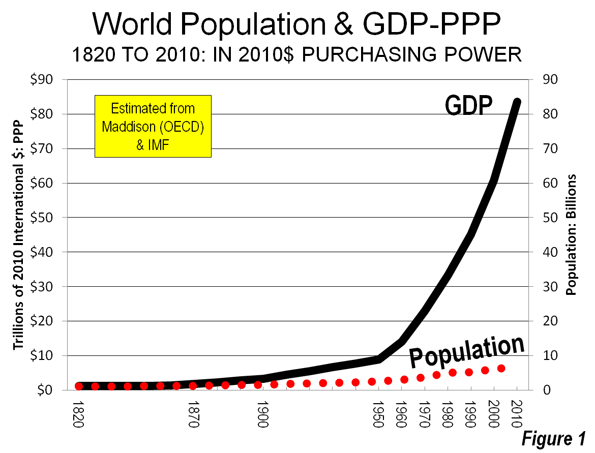
    Between 1820 and 2010, the world population grew from 1.0 billion to 6.8 billion as indicated in the databases. This 550% increase, however, pales by comparison to the increase in the world real gross domestic product (GDP), which grew nearly 13 times as fast as the population (Figure 1). The relationship between rising urbanization and increasing wealth is evident in comparing Figure 1 to Figure 2 from the recent feature What is A Half-Urban World.   Between 1820 and 1900, the real economic growth rate was 1.5 times of that of population growth. This improved to 2.2 times between 1900 and 1950. In each of these succeeding decades, the economic growth rate relative to population growth was even greater, except in the decade of the 1980s when economic growth was 1.9 times population growth. Despite the economic difficulties, particularly in Japan and the West, 2000 to 2010 showed the largest rate of economic growth compared to population growth, at 3.0.

    GDP Per Capita (Purchasing Power)

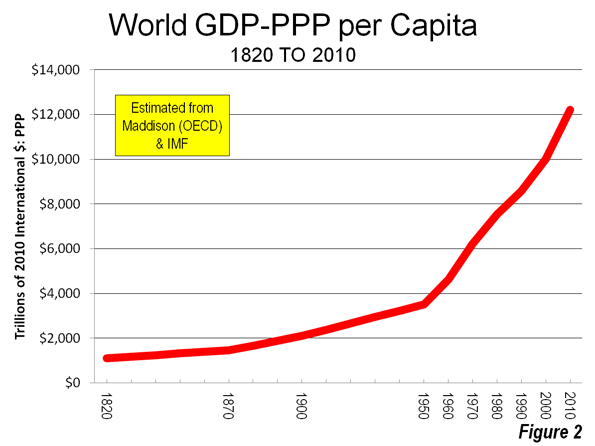
    The real GDP per capita data strongly indicates the expanding economic pie. In 1820, the world GDP per capita was approximately $1100, expressed in 2010$, adjusted for purchasing power. By 1900, this had nearly doubled to $2100. The largest gains came after 1950 when the GDP per capita reached $3500. Since that time the GDP per capita has risen to $12,200 (Figure 2).

    A History of Poverty

    Even so, the history of economics is a history of poverty. University of Rochester (NY) Economist stated the case this way:

    Modern humans first emerged about 100,000 years ago. For the next 99,800 years or so, nothing happened. Well, not quite nothing. There were wars, political intrigue, the invention of agriculture – but none of that stuff had much effect on the quality of people’s lives. Almost everyone lived on the modern equivalent of $400 to $600 a year, just above the subsistence level.

    The $1100 GDP per capita from 1820 would rank among the poorest areas in the world today. The world’s richest area at that time was the Netherlands, which had a GDP per capita of $3100. This is more than Nigeria today, with its 143 million mobile phones and nearly as high as the GDP per capita of India.

    Distribution of Income

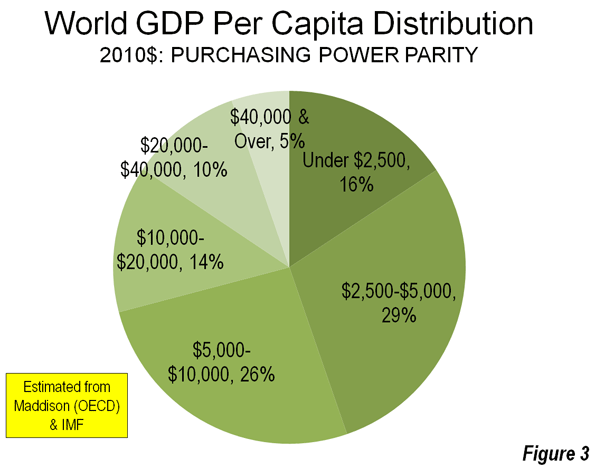
    Today, the large majority of the world’s population lives in lower income areas.

    • 16% of the population lives in areas with a GDP per capita of less than $2500. The largest of these are Bangladesh and Tanzania.
    • 29% of the world’s population is in areas with a GDP per capita of $2500 to $5000. The largest are India, Indonesia, Pakistan, Bangladesh, Nigeria and the Philippines.
    • 26% live in low middle income areas with a GDP per capita of between $5000 and $10,000, such as China and Ukraine.
    • 14% live higher middle income areas (a per capita GDP of $10,000 to $20,000). The largest such areas are Brazil, Mexico and Russia.
    • 10% of the population lives in relatively well off areas (a GDP per capita of $20,000 to $40,000) including France, the United Kingdom, Korea and Japan.
    • Only 5% of the world’s population enjoys a GDP per capita exceeding $40,000, the largest of which are the United States, Germany, Canada and Australia. (Figure 3).

    The Richest Areas

    The very richest countries in the world on a per capita basis are generally small. Oil rich Qatar has the highest GDP per capita at nearly $100,000 annually. Europe’s Luxemburg is the second most affluent, followed by the city-state of Singapore. Resource rich Brunei-Darassalam is the world’s fifth richest area. The United States ranks sixth and is by far the largest of the richest areas. More than 55% of the world’s population in areas with more than $40,000 GDP per capita lives in the United States. The balance of the richest 10 is completed by the United Arab Emirates, another oil rich Gulf state, the world’s other large city-state, Hong Kong,  as well as the Netherlands and Switzerland in Europe (Figure 4).

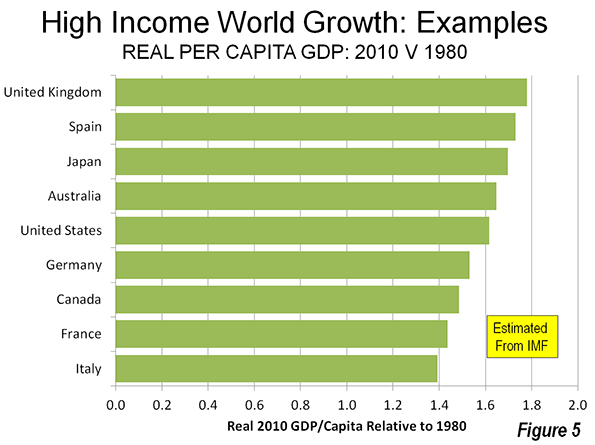
    Generally, IMF data indicates that the largest high-income world economies have experienced real GDP per capita growth of from 40% to 80% since 1980. The UK has grown the most among the examples, while Italy has grown the least (Figure 5). Germany’s lower growth rate is, at least in part, due to the complexity of combining virtually bankrupt East Germany with far healthier West Germany in the early 1990s. The US has been hobbled by its housing bubble-induced economic bust, which hurt other economies as well. Canada’s recent stronger growth could presage an improved ranking in the years to come. Other areas, such Italy, Spain, Japan and France could experience slower growth in the future, due to the seemingly intractable fiscal difficulties and, in some cases, demographic stagnation or even decline.

    Who’s Growing Rich Fastest?

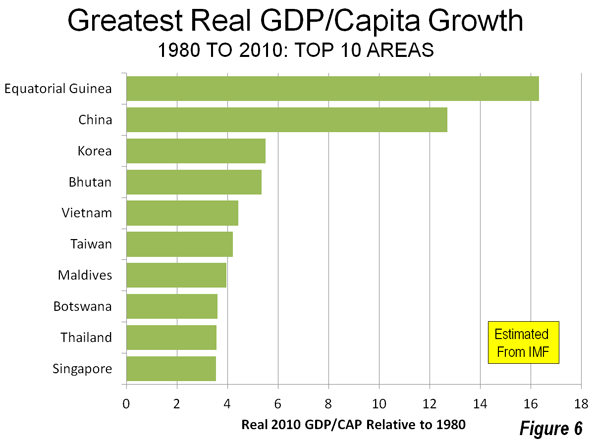
    A number of countries have experienced spectacular growth in their GDP per capita over the past three decades, according to the IMF data (Figure 6). Oil rich Equatorial Guinea experienced the greatest growth, reaching a GDP per capita more than 16 times the 1980s figure. Equatorial Guinea is small, with a population of only 700,000 people (similar to the size of metropolitan areas such as Colorado Springs, Colorado, Hamilton, Ontario or Florence, Italy).

    The broadest and most significant progress has been made by China. According to the IMF data, in 1980 China had the second lowest GDP per capita of any reporting area, ranking above only Mozambique. This was approximately the same time that the economic reforms began, under the leadership of Deng Xiaoping.  By 2010, China’s GDP per capita had reached more than 12 times the 1980 figure. China’s gross GDP-PPP grew more than that of any other area. Once on the low end of the poverty league table    China now has entered the middle rank in terms of wealth.

    Other areas have also done well, especially in Asia. The largest of these include Korea, Vietnam, Taiwan, Thailand and Singapore. One African area is included among the fastest growing per capita economies, Botswana (Figure 6). Each of these areas grew from four to five times in GDP per capita from 1980.

    The Poorest Areas

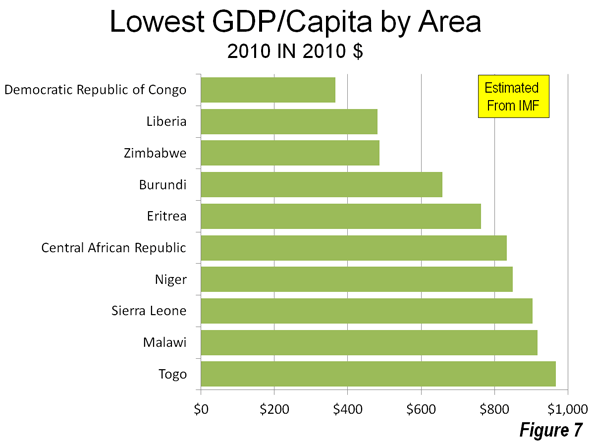
    All 10 of the world’s poorest areas are located in Africa. The poorest is the Democratic Republic of the Congo, with a GDP per capita of less than $400.   Torn by civil war  its GDP per capita would rank it among the poorest areas even in the 1820 listing. The four next poorest areas have also faced severe domestic disruptions, Liberia, Zimbabwe, Burundi and Eritrea (Figure 7).

    Some Areas Getting Poorer

    The severity of the world’s poverty is indicated by the fact that 26 of the 138 areas for which there is data experienced declines in their GDPs per capita from 1980. The population of these declining areas was about 300 million, or approximately four percent of the world’s total. The Democratic Republic of the Congo, the world’s poorest area, experienced a 60% decline in real GDP per capita, which was the largest decline.

    Conclusion

    While the economic pie has expanded much faster than its population, there is still plenty of poverty in the world. It is no surprise that the developing world focused the attention of the recent 2012 Rio +20 conference on poverty, with a declaration that eradicating poverty is the greatest global challenge facing the world today.

    Wendell Cox is a Visiting Professor, Conservatoire National des Arts et Metiers, Paris and the author of “War on the Dream: How Anti-Sprawl Policy Threatens the Quality of Life.”

    Photo: Regency Park, Shanghai (by author)