Author: Wendell Cox

  • The Accelerating Suburbanization of New York

    Some of the best evidence that the tide has not turned against dispersion and suburbanization comes from an unlikely source:  New York’s 2010 census results. If dense urbanism works anywhere in America, it does within this greatest of US traditional urban areas.

    Before the actual count, the Census Bureau estimated, in large part as a result of a successful historical core municipality (city of New York) challenges, that as of Census Day (April 1, 2010), the city would have added 413,000 residents since 2000 and would have accounted for more than one-half of the metropolitan area growth. But the numbers turned out startlingly different. In fact, the city’s census count came in nearly 250,000 below projections and accounted for the lowest share of New York metropolitan area growth since the 1970s.

    Overall the 2010 census figures paint a picture of continuing dispersion in the nation’s largest metropolitan area, New York. The metropolitan area stretches from Manhattan, with the world’s second largest business district (after Tokyo) to the four outer boroughs of the city of New York, more than 100 miles to the eastern end of Long Island, north to Putnam and Rockland counties, completely across northern New Jersey, jumping the Delaware River to include Pike County, Pennsylvania and south to Ocean County (New Jersey), nearly all the way to Atlantic City. In all, this 23 county metropolitan area has the nation’s largest population and actually extended its margin over second place Los Angeles, which has been converted from a growth leader to a laggard giant growing slower than most Midwestern metropolitan areas. New York added 574,000 residents, while Los Angeles added 473,000. If New York continues to add more people than Los Angeles in future censuses, its position as the nation’s largest metropolitan area be secure.

    Major metropolitan areas in general did poorly in terms of growth in the new cesusus. This was particularly true in New York. Between 2000 and 2010, the New York metropolitan area population rose from 18,323,000 to 18,897,000, a modest growth rate of 3.1 percent, one of the slowest among major metropolitan areas in the country. The national growth rate was three times as high

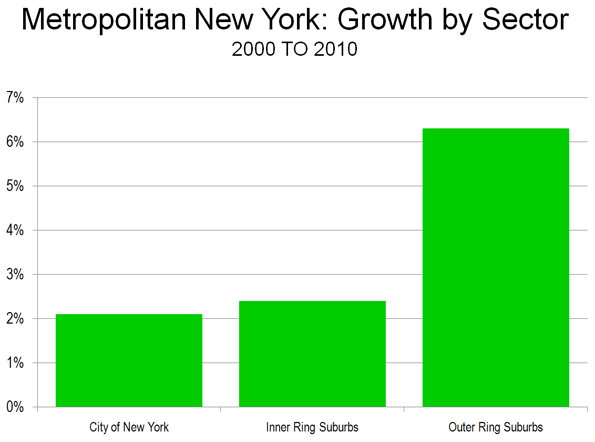
    Suburbanization Accelerating Again: If you had read the New York Times and other Manhattan-based media over the last decade you would have assumed the suburbs were in decline and cities ascendant, particularly in the New York area. Yet in reality over the past decade, the suburban counties captured their largest share of New York metropolitan area growth in three decades. During the 2000s, the suburbs accounted for 71 percent of growth, up from 54 percent during the 1990s and 48 percent in the 1980s. The outer suburbs grew the fastest, while the inner suburbs – some of which are denser than historical core municipalities in other metropolitan areas – grew faster than the historical core municipality, the city of New York (Figure 1 and Table)
     

    NEW YORK METROPOLITAN AREA
    POPULATION TREND BY COUNTY: 2000 TO 2010
    2000 2010 Change %
    HISTORIC CORE MUNICIPALITY (New York)
    Bronx County, NY       1,332,650       1,385,108        52,458 3.9%
    Kings County, NY       2,465,326       2,504,700        39,374 1.6%
    New York County, NY       1,537,195       1,585,873        48,678 3.2%
    Queens County, NY       2,229,379       2,230,722          1,343 0.1%
    Richmond County, NY         443,728         468,730        25,002 5.6%
    Subtotal       8,008,278       8,175,133       166,855 2.1%
    INNER SUBURBAN
    Bergen County, NJ         884,118         905,116        20,998 2.4%
    Essex County, NJ         793,633         783,969         (9,664) -1.2%
    Hudson County, NJ         608,975         634,266        25,291 4.2%
    Middlesex County, NJ         750,162         809,858        59,696 8.0%
    Nassau County, NY       1,334,544       1,339,532          4,988 0.4%
    Passaic County, NJ         489,049         501,226        12,177 2.5%
    Union County, NJ         522,541         536,499        13,958 2.7%
    Westchester County, NY         923,459         949,113        25,654 2.8%
    Subtotal       6,306,481       6,459,579       153,098 2.4%
    OUTER SUBURBAN
    Hunterdon County, NJ         121,989         128,349          6,360 5.2%
    Monmouth County, NJ         615,301         630,380        15,079 2.5%
    Morris County, NJ         470,212         492,276        22,064 4.7%
    Ocean County, NJ         510,916         576,567        65,651 12.8%
    Pike County, PA           46,302           57,369        11,067 23.9%
    Putnam County, NY           95,745           99,710          3,965 4.1%
    Rockland County, NY         286,753         311,687        24,934 8.7%
    Somerset County, NJ         297,490         323,444        25,954 8.7%
    Suffolk County, NY       1,419,369       1,493,350        73,981 5.2%
    Sussex County, NJ         144,166         149,265          5,099 3.5%
    Subtotal       4,008,243       4,262,397       254,154 6.3%
    SUBTOTAL: SUBURBAN     10,314,724     10,721,976       407,252 3.9%
    TOTAL     18,323,002     18,897,109       574,107 3.1%


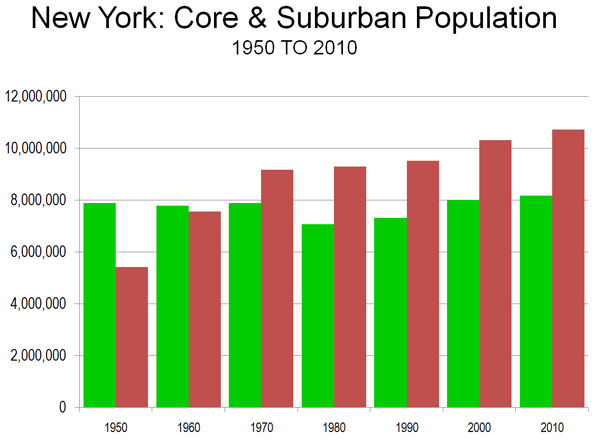
    Critically, the city of New York did worse than at any time since the 800,000 population loss that was sustained in the 1970s, representing all of the loss since 1950. Between 1950 and 1980 the suburbs added 3.9 million residents. The city’s fortunes had improved measurably in the 1980s and 1990s, with approximately one-half of the metropolitan area’s growth. The last decade’s share of metropolitan area growth – only 29 percent – in the historical core municipality indicates a startling acceleration of dispersion, although fortunately not a return to the population decline of the 1970s (Figure 2).
    City of New York: The city of New York grew from 8,008,000 to 8,175,000 between 2000 and 2010, a rate of 2.1 percent.

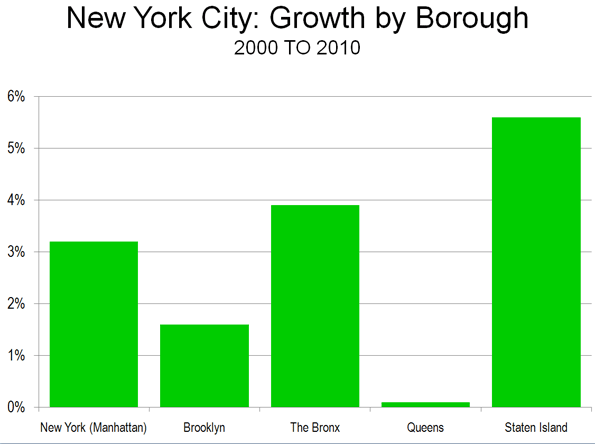
    Staten Island (Richmond County), which is largely suburban in form, was the fastest growing of New York’s boroughs, with a growth rate of 5.6 percent. The Bronx grew the second fastest, at a rate of 3.9 percent. Only Staten Island and Queens (below) reached their population peaks in the 2010 census (Figure 3).
    The Bronx has experienced perhaps the nation’s most successful urban turn-arounds, after a disastrous period in the 1970s and 1980s, when large swaths of the South Bronx were literally leveled. The population fell from 1,472,000 in 1970 to 1,204,000 in 1990. By 2010, the population had recovered nearly two-thirds of the loss, to 1,385,000.

    Manhattan (New York County) added 3.2 percent to its population (49,000) and reached 1,586,000. This is approximately one-third below its population peak of 2,232,000 in 1910.   Manhattan’s population, however, remained approximately 45,000 below the Census Bureau estimates.

    Brooklyn (Kings County) continues to be the largest borough in New York, with 2,505,000 residents, an increase of 39,000 (1.6 percent) between 2000 and 2010. Brooklyn reached its population peak of 2,738,000 in 1950. Brooklyn’s population proved approximately 75,000 below the Census Bureau’s estimates.

    The slowest growing borough was Queens, which added only 2,000 residents (a 0.1 percent population increase), yet reached its population peak of 2,231,000. Queens had added more residents than any other borough since 1950 and added approximately 275,000 residents in the 1990 to 2000 census period.

    Inner Ring Suburbs: The inner ring counties (Nassau, Westchester, Bergen, Passaic, Essex, Hudson, Union and Middlesex) grew 2.4 percent from 6,306,000 to 6,460,000. Growth rates varied significantly, from a loss of 1.2 percent in Essex County (where Newark is located) to 8.0 percent in Middlesex County. Middlesex County includes newer suburban areas further away from the core than in any other inner ring county. Much of the Middlesex County growth occurred in these areas. The inner ring suburbs captured 26.7 percent of the metropolitan area growth.

    Outer Ring Suburbs: By far the e fastest growth was in the outer ring counties, with a population increase of 6.3 percent, from 4,008,000 to 4,262,000. Monmouth County was the slowest growing outer ring county, adding 2.5 percent to its population. Pike County, Pennsylvania, which is the farthest to the west of any county in the metropolitan area, had by far the highest growth rate, at 23.8 percent. Ocean County, New Jersey, had the second fastest growth rate, at 12.8 percent. Ocean County lies at the extreme southern end of the metropolitan area. The outer ring counties captured 44.3 percent of the metropolitan area growth.

    Suburban Growth and Projections: Overall suburban growth was from 10,314,000 to 10,712,000, for a gain of 407,000 (4.0 percent). This was above the Census Bureau estimate of 392,000. The suburbs now contain 57 percent of the metropolitan area population.

    New York’s Continuing Dispersion: The dispersion of the 2000s is an extension of the overall metropolitan area trend since 1950 (Note). The historical core municipality, New York, has added less than 300,000 residents, or 3.6 percent. The suburbs have added 5.3 million residents, nearly doubling their population. Approximately 95 percent of the metropolitan area’s growth was in the suburbs between 1950 and 2010 (Figure 4).
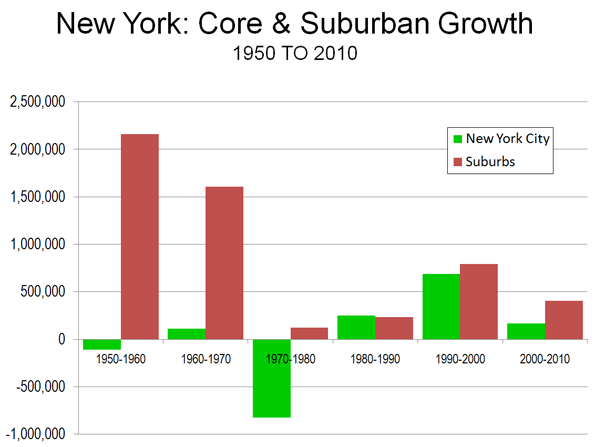
    The dispersion is apparent even in the city of New York. Since 1950, Queens, the outermost of the inner four boroughs, added nearly 700,000 residents, while the more inner boroughs of Manhattan, Brooklyn and the Bronx, lost nearly as many residents. Overall these four inner boroughs gained only 6,000 residents since 1950. Staten Island, which is largely post-war suburban, grew 277,000, while the city overall was growing by 283,000, leaving only a net gain of 6,000 for the four inner boroughs of New York.

    A recent newgeography.com article documents similar patterns in employment dispersion and commuting during the 1990 to 2008 period.

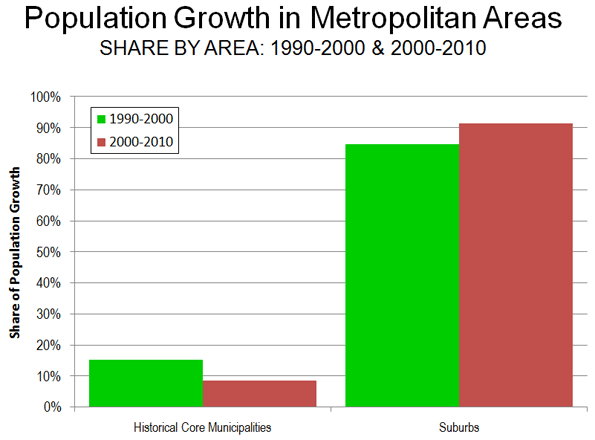
    Consistency with the National Trend: The accelerating suburbanization of New York is consistent with the national trends in major metropolitan areas in the new census data. Between 1990 and 2000, historical core municipalities accounted for 15 percent of metropolitan area growth. Between 2000 and 2010, the share of historical core municipality growth had fallen to 9 percent.

    Note: This analysis is based upon the metropolitan area boundaries as currently defined.

    Wendell Cox is a Visiting Professor, Conservatoire National des Arts et Metiers, Paris and the author of “War on the Dream: How Anti-Sprawl Policy Threatens the Quality of Life

    Photo by Mike Lee

  • Final Census Results: Core Cities Do Worse in 2000s than 1990s

    Based upon complete census counts for 2010, historical core municipalities of the nation’s major metropolitan areas (over 1,000,000 population) captured a smaller share of growth in the 2000s than in the 1990s.

    The results for the 50 metropolitan areas (New Orleans excluded due to Hurricane Katrina and Tucson unexpectedly failed to reach 1,000,000 population) indicate that historical core municipalities accounted for 9 percent of metropolitan area growth between 2000 and 2010, compared to 15 percent in the 1990-2000 period. Overall, suburban areas captured 91 percent of metropolitan area population growth between 2000 and 2010, compared to 85 percent between 1990 and 2000.

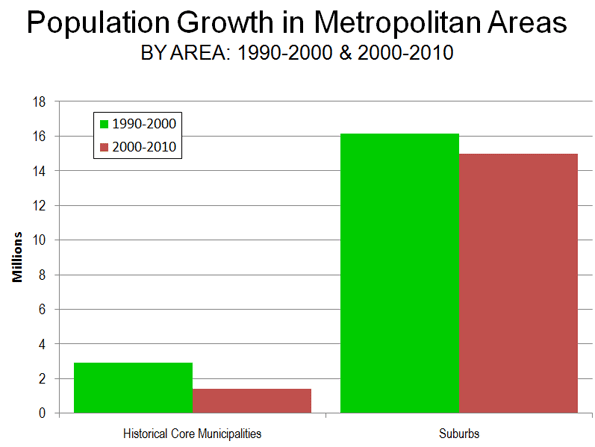
    Total population growth in the historical core municipalities was 1.4 million, nearly all of it in municipalities with a largely suburban form (such as Phoenix, San Antonio and Charlotte). This compares to an increase of 2.9 million during the 1990s.

    Suburban areas (areas in metropolitan areas outside the historical core municipalities) grew 15.0 million, down from 16.1million.

    Overall, the major metropolitan areas added 14 percent to their populations in the 2000s, down from 19 percent growth in the 1990s. The historical core municipalities grew 4 percent, compared to the 1990s rate of 7 percent. Suburban areas grew 18 percent, compared to the 1990s rate of 26 percent (all data unweighted).


  • New York City Population Growth Comes Up Short

    Just released census counts for 2010 show the New York metropolitan area historical core municipality, the city of New York, to have gained in population from 8,009,000 in 2000 to 8,175,000 in 2010, an increase of 2.1 percent. This is the highest census count ever achieved by the city of New York.

    Nonetheless, the figure was 245,000 below the expected level of 8,420,000 (based upon 2010 Census Bureau estimates). The higher population estimate had been the result of challenges by the city to Census Bureau intercensal estimates. The city of New York attracted 29 percent of the metropolitan area growth. Approximately 43 percent of the metropolitan area’s population lives in the city.

    Overall, the New York metropolitan area grew from 18,323,000 to 18,890,000, an increase of 3.1 percent. The suburbs grew approximately twice as rapidly as the city of New York, at 4.0 percent, and attracted 71 percent of the metropolitan area growth.

  • Charlotte Continues Strong Growth

    According to US Census Bureau data, the Charlotte (NC-SC) metropolitan area grew 32 percent, from 1,330,000 to 1,758,000 between 2000 and 2010. The historical core municipality, the city of Charlotte grew from a 2000 base of 568,000 to 731,000 in 2010 (an increase of 29 percent). The city of Charlotte is largely of a post-World War II suburban form. The city of Charlotte attracted 38 percent of the metropolitan area growth.

    The suburbs grew at a 35 percent rate, higher than that of the city of Charlotte. The suburbs captured 62 percent of the metropolitan area growth.

  • Slow Growth in Providence: City Grows

    The Providence (RI) metropolitan area was one of the slowest growing in the 2000 to 2010 period, according to counts just released by the Census Bureau. Providence grew 1.1 percent, from 1,583,000 to 1,601,000. The historical core municipality, the city of Providence gained 2.5 percent, from 174,000 to 178,000 and grew faster than the suburbs, like neighboring Boston. The city of Providence reached its population peak in 1940, at 254,000.

    Even so, the suburbs attracted 75 percent of the metropolitan area growth.

  • Declining Detroit

    The historical core municipality of the Detroit metropolitan area, the city of Detroit, continued its steep population decline between 2000 and 2010. The new census count indicates that the city dropped to 733,000 residents, from 951,000 in 2000. This drop of 25 percent was the largest in any census period since 1950, when the city peaked at a population of 1,850,000. Even so, the percentage decline from 1950 of 61.4 percent remains less than that of city of St. Louis, which has experienced the steepest population decline of any municipality that has reached 500,000 population in modern times (62.7 percent).

    The decline did not extend to the suburbs, which gained a modest 2.3 percent between 2000 and 2010. Suburban growth has also been substantial since 1950, with 2.2 million new residents added.

    However, the suburban growth was not enough to erase the impact of the city of Detroit decline. The Detroit metropolitan area fell from 4,452,000 in 2000 to 4,296,000 in 2010, a loss of 3.6 percent. The loss was the greatest among major metropolitan areas reporting up to this time. Nonetheless, even with the huge city of Detroit loss, the Detroit metropolitan area has grown more than 30 percent and more than 1,000,000 people.

  • Boston: The Outlier

    The new 2010 census results for the Boston metropolitan area show the historical core municipality, the city of Boston, increasing its population at a greater rate than that of its suburbs. Thus far, Boston is the only historical core municipality with essentially the same boundaries as in 1950 that has experienced a growth rate greater than the suburbs in the 2000 to 2010 period. Boston grew from 589,000 to 617,000, an increase of 4.8 percent. Even so, the city remained more than 20 percent below its historic peak of 801,000 in 1950. Further, even with its faster growth, the city of Boston captured only 18 percent of the metropolitan area growth between 2000 and 2010. The city of Boston contains 14 percent of the metropolitan area population.

    By comparison, the suburbs grew 3.5 percent and accounted for 82 percent of the metropolitan area growth.

    Overall, the Boston metropolitan area, which stretches from Massachusetts into New Hampshire grew from 4,391,000 to 4,552,000, for a growth rate of 3.7 percent, approximately one-third of the national growth rate between 2000 and 2010. This growth rate is the same as in Los Angeles and Milwaukee, which were the slowest growing major metropolitan areas (population over 1,000,000) reporting so far, with the exception of Cleveland, Detroit and Pittsburgh, which lost population.

    Boston retains its position as the nation’s 10th largest metropolitan area, having passed losing Detroit and been passed by Atlanta.

  • The High Speed Rail Battle of Britain

    A high speed rail battle is brewing in Great Britain, not unlike the controversies that have lit up the political switchboard in the United States over the past six months.

    The Department for Transport has announced a plan to build a "Y" shaped high speed rail route that would connect Leeds and Manchester, to Birmingham, with a shared line on to London and London’s Heathrow Airport.

    The government places the construction cost at £32 billion and makes familiar claims that the economic benefits would be 2.6 times the cost.

    These apparently impressive benefits relative to costs are not convincing to George Monbiot, the well-known environmental columnist for The Guardian. He points out that much of the purported benefit is a mere conversion of time savings into currency, which hardly produces "investment grade" projections.

    Monbiot further observes that these monetized time savings benefits largely will not be returned to the taxpayers who pay for the system. This raises a fundamental question. If the time savings benefits are so great to the users, why shouldn’t they pay for the whole system instead of the projected (and perhaps unreliable) 60 percent? Why should taxpayers be required to pay 40 percent (or probably more)?

    As in the United States, the critics get little respect. The Financial Times refers to the Taxpayers Alliance, which opposes the high speed rail program as an "anti-public spending group." In fact, like taxpayers organizations around the world, the Taxpayers Alliance does not oppose public spending but rather opposes wasteful public spending. The Transport Secretary himself, Philip Hammond employs a form of populist character assassination, calling opponents of the high speed rail line "truck importers and climate change deniers," echoing similar sentiments from this side of the Atlantic where promoters would have you believe that anyone who questions high speed rail is best described as an enemy of the people. Demonization should not be used as a substitute for debate.

    In the above referenced article, the Financial Times notes that 69 business people signed a letter favoring the project. FT refers specifically to executives of three companies, including Seimens, without mentioning that the firm is among the world’s biggest builders and promoters of high speed trains.

    Meanwhile, as in the United States, the government and much of the British media have accepted cost, ridership and revenue projections as produced by the consultants as if they were holy writ. Given the experience of Britain on this very corridor, this makes "child-like faith" look like ultimate truth.

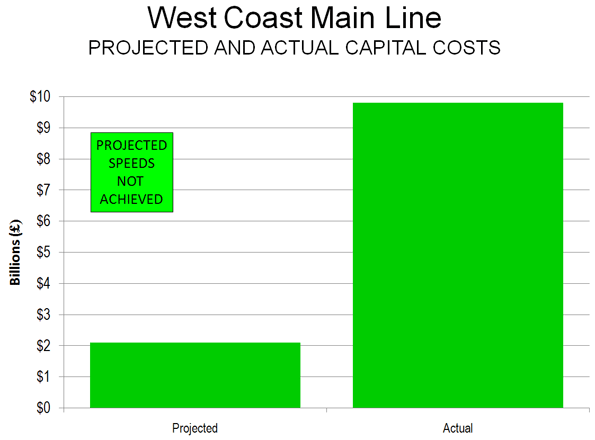
    Much of the proposed high speed rail line would be built parallel to the West Coast Main Line (which runs from London, through Birmingham and Manchester to Glasgow). Nothing short of a dog’s breakfast has been made of West Coast Main Line projects. In the 1980s, the tilting Advanced Passenger Train was developed to increase speeds to 155 miles per hour along the West Coast Main Line. The project was scrapped and all of the expenditure lost. Then there was the West Coast Main Line upgrade in the late 1990s and 2000s, to increase speeds to 140 miles per hour, which was to have cost £2 billion. The trains never exceeded 125 miles per hour, but the costs exceeded projections approached £10 billion instead, a world record cost blowout of Big Dig proportions (Figure).

    This should not be a surprise. The international record of high-speed rail projections is nothing short of horrific.Not only have costs proven far higher, but ridership and revenue have been less than projected. All of this means that taxpayers end up paying more.

    Again, Britain is a prime example. The Eurostar London to Brussels and Paris continues to attract at least 50 percent less ridership originally projected. High speed rail systems in Taiwan and Korea have had similar ridership shortfalls.

    As in Britain, costs have been higher as well. In Korea, the high speed rail line costs rose three times projections. Costs in California have increased 50 percent in two years and doubled over a decade even before the first shovel has been turned (inflation adjusted).  The cost escalation has already equaled the high end of the range predicted by Joe Vranich and me in our Reason Foundation Due Diligence Report on the California system in 2008.  

    If the proposed high speed rail project were simply to miss its cost and revenue targets by the international average (which is far better than the British experience), the benefits to users would fall below £1.00 for each £1.00 of cost. Both the strategic case and the business case for high speed rail would be blown apart. The spectre of cost overruns was a major factor in Governor Scott’s cancellation of the Florida high speed rail project.

    Not surprisingly, there is rising concern about high speed rail in Britain.A group of 21 officials, including former Chancellor of the Exchequer (minister of the treasury, finance and economics) Nigel Lawson, signed a letter to the Daily Telegraph calling the project "an extremely expensive white elephant isn’t what the economy needs. If the government wants to encourage growth there are better ways to get Britain growing and make us more competitive than getting each family to pay over £1,000 for a vanity project we cannot afford." The signatories also included Mark J. Littlewood, Director-General of the Institute of Economic Affairs, one of Great Britain’s leading free-market think tanks.

    Further, as in the United States there is also strong opposition from neighborhood groups concerned about the impact of trains operating at more than 200 miles per hour or faster through their neighborhoods. Eventually, up to 18 trains per hour are projected in each direction. This means that a 1,300 foot long train will pass houses and other adjacent development every one minute and forty seconds.

    There are the usual claims that the high speed rail line will reduce greenhouse gas emissions. However, as in California, the reality dissipates quickly, like steam into the air. Areport prepared for the Department for Transport by Booz Allen Hamilton concluded that the busiest section of the line, from London to Manchester would result in a net increase in greenhouse gas emissions when construction emissions are included (over a 60 year time analysis). Perhaps the intention is to begin reducing greenhouse gas emissions sometime after 2075?

    Monbiot further dismantles the environmental case, looking into the government reports to find that 92% of the passengers would switch to high-speed rail from alternatives that produce lower levels of greenhouse gas emissions (including conventional train, new travel and air).

    In Britain, as opposed to the United States, the proposed high speed rail system would relieve congestion on a passenger rail line. In contrast, US high speed rail lines would be built in corridors where there are few, if any rail passengers, much less passenger rail congestion.

    Even so, there are disagreements in Britain over whether high speed rail is the least costly way to address the problem, or indeed, whether there is a "problem" of sufficient magnitude to justify the public expenditure.

    The huge ridership increases projected may well be "over the top" given Britain’s less than population replacement fertility rate. As in the United States, some question the wisdom of high speed rail subsidies at a time that the government is (or in the case of the United States, should be) committed to an unprecedented austerity program that is falling heavily on middle income people who will not be the principal beneficiaries of high speed rail.

    In the final analysis, the questions will come down to who rides, how far and how fast. Will riders, in this third iteration, ride as fast as promised?  More likely it’s Britain’s beleaguered taxpayers who will be taken for a ride, with costs low-balled and ridership exaggerated as before.

    Revised on 3/22/2011. The original version had inappropritately refered to George Monbiot in the sentence about Transport Secretary Hammond. This was due to an editing error.

    Wendell Cox is a Visiting Professor, Conservatoire National des Arts et Metiers, Paris and the author of “War on the Dream: How Anti-Sprawl Policy Threatens the Quality of Life

    Photo by Jon Curnow

  • Cincinnati: Suburban Counties Gain, Core Losses

    The historical core municipality of the Cincinnati metropolitan area, the city of  Cincinnati, continued its population loss string stretching back to the 1970 census and dropped below 300,000 population for the first time since the 1890 census.  The city peaked at 504,000 in 1950.

    In 2010, the census counted 297,000 residents, down 10 percent from the 2000 figure of 331,000. The city of Cincinnati has essentially the same borders (city limits) as in 1950. Hamilton County, which is the core county and includes the city of Cincinnati lost 43,000 people, with a net loss of 9,000 in the portions outside the city.  

    All growth was in the suburbs, which grew at a rate of 9 percent. The fastest growing counties were Boone in Kentucky at 38 percent and Warren in Ohio at 34 percent. Combined, these two counties captured more than two-thirds of the metropolitan area growth.

    The Cincinnati metropolitan area, which stretches from Ohio into Kentucky and Indiana grew 6 percent, from 2,010,000 to 2,130,000.

  • Mixed Performance in Suburbanized Core Cities of Tennessee and Kentucky

    New 2010 census data for the highly suburbanized historic core municipalities of the major metropolitan areas of Tennessee and Kentucky indicates mixed results. The historic core municipality of Louisville (Louisville/Jefferson County) captured just under one half of the metropolitan area’s growth, yet grew more slowly than the historic core municipality of Nashville/Davidson County, which captured 20 percent of the metropolitan area’s growth. The historic core municipality of Memphis, which annexed substantial suburban areas, experienced a loss.

    The majority of population growth was in the suburbs in all three metropolitan areas.

    Nashville: The Nashville (Tennessee) metropolitan area grew 21 percent, from 1,312,000 in 2000 to 1,590,000 in 2010, according to the recent census count. The historical core municipality (city of Nashville) grew from 570,000 to 627,000, for a growth rate of 10 percent. The city of Nashville is combined with Davidson County and is of a largely suburban form, and includes rural areas. Between 1960 and 1970, the consolidation increased Nashville’s land area nearly 20 fold, from 29 square miles to 508 square miles, while the population less than tripled. Nashville/Davidson County covers 1.6 times the land area of the city of New York, which has more than 10 times the population. Nashville/Davidson County captured 20 percent of the metropolitan area growth, above the average thus far of less than 10 percent.

    Growing at a rate of nearly 30 percent, the suburbs captured 80 percent of the metropolitan area growth. The suburbs account for nearly 40 percent of the metropolitan population. Williamson and Rutherford counties were the fastest growing, at approximately 45 percent. Combined, the two counties represented one-half of the metropolitan area growth.

    Louisville: The Louisville (Kentucky-Indiana) metropolitan area grew 9 percent, from 1,162,000 in 2000 to 1,267,000 in 2010, according to the recent census count. The historical core municipality (the combined city of Louisville and Jefferson County) grew from 693,000 to 741,000, for a growth rate of 7 percent. The city of Louisville is combined with Jefferson County and is of a largely suburban form, and includes rural areas. Between 2000 and 2010, the consolidation increased Louisville’s land area five times, from 62 square miles to 385 square miles, while the population nearly tripled. Louisville/Jefferson County covers nearly three times the land area of the city of Philadelphia, which has a population twice as large. Louisville/Jefferson County captured 45 percent of the metropolitan area growth, well above the average thus far of less than 10 percent.

    The suburbs grew at rate of 12 percent and captured 55 percent of the metropolitan area. Suburban Desoto County, Mississippi grew by 50 percent and accounted for one-half of the metropolitan area’s growth.

    Memphis: Memphis (Tennessee-Mississippi-Arkansas) was alone among the major metropolitan areas with historic core municipalities in Kentucky and Tennessee that lost population between 2000 and 2010.  The 2000 population for the present land area of the historical core municipality, the city of Memphis declined six percent, from 691,000 to 647,000. The city of Memphis has a principally post-World War II urban form, having expanded its land area more than 150 percent, and covers more than five times the land area of the larger city of San Francisco.

    Overall, the Memphis metropolitan area grew from 1,205,000 in 2000 to 1,316,000 in 2010, a growth rate of 9 percent, slightly below the national average. The suburbs grew 21 percent and captured all of the growth.