Author: Wendell Cox

  • Rating the Unaffordable: The Economist and Mercer

    An article by Carl Bialik in The Wall Street Journal questions the value of city livability ratings, such as lists produced by The Economist and Mercer. This issue has been raised on this site by Owen McShane.

    (1) The Wall Street Journal notes a lack of transparency in ratings. In the case of The Economist and Mercer, this starts with the very definition of “city.” They don’t say. In the case of New York, for example, is the city Manhattan?, the city of New York or the New York metropolitan area. The difference? Manhattan has fewer than 2,000,000 residents, the city about 8,000,000 and the metropolitan area about 20,000,000. That makes a difference. The same problem exists, to differing degrees in the other “cities,” whatever they are.

    (2) The first principle of livability is affordability. If you cannot afford to live in a city it cannot, by definition, be affordable.

    The Economist ranks Vancouver, Melbourne, Sydney, Perth, Adelaide and Auckland among its top 10 livable cities. In fact, in our 6th Annual International Housing Affordability Survey, these metropolitan areas rank among the 25 least affordable out of 272 metropolitan areas in six nations (the United States, the United Kingdom, Canada, Australia, Ireland and New Zealand). The Economist’s champion, Vancouver, is most unaffordable, with Sydney second most unaffordable. Mercer’s top 10 list also includes Vancouver, Auckland and Sydney.

    By contrast, the three fastest growing metropolitan areas with more than 5,000,000 population in the developed world, (Atlanta, Dallas-Fort Worth and Houston) have housing that is one-half to one-third as expensive relative to incomes (using the Median Multiple: the median house price divided by the median household income) as all of the “cities” noted above in the two lists.

    Purpose of the Lists: The purpose of these lists, for all their difficulties, is often missed. The Economist and Mercer do not rate livability for average people, but rather for international executives. Thus, the lists are best understood as rating cities for people with a lot of money and a big expense account. The lists may be useful if one is contemplating a move from Manhattan’s Upper East Side to London’s Mayfair.

    Unfortunately, The Economist and Mercer lists are often treated by the press as if they rate the quality of life for average citizens, which they most surely do not.

    The average Vancouverite does not live on English Bay, nor does the average Sydneysider have a view of the Harbour Bridge. Because of escalating house prices, they are far more likely to live in rental units, with the hope of home ownership having made impossibly expensive by rationing, through restrictive land use policies, of an intensity that not even OPEC would dare adopt.

  • State Auditor Says Only Part of California High Speed Rail Line May be Built

    The California State Auditor’s report title says it all: High-Speed Rail Authority: It Risks Delays or an Incomplete System Because of Inadequate Planning, Weak Oversight, and Lax Contract Management.

    The report, which can fairly be characterized as “damning,” criticizes the California High Speed Rail Authority on a wide range of issues, some of which go to the very heart of the project itself.

    For example, the State Auditor says that without additional bond funding from the taxpayers, the state “may have to settle for a plan covering less than a complete corridor.” Given the financial and administrative disarray of the California High Speed Rail Authority, this is a distinct possibility, which was raised by the Reason Foundation California High Speed Rail Due Diligence Report, released in September of 2008 (co-authored by Joseph Vranich and me).

    This could produce a system that spectacularly fails to meet the promises of its promoters, while enriching the income statements mostly offshore firms that build trains and of firms that failed so spectacularly in managing the Big Dig in Boston. Martin Engel, who leads an organization of concerned citizens on the San Francisco peninsula frequently notes that the real driving force behind high speed rail is spending the money. In this regard, the California High Speed Rail Authority will deliver the goods. The vendors and consultants will get their money.

    The State Auditor also raises questions about the potential to attract the substantial private investment necessary to completing the project. This is a legitimate concern, since the California High Speed Rail Authority has raised the possibility of government revenue guarantees for private investors. This could lead to “back door” taxpayer payment of the “private” investment.

    The Authority continues to skirt legal requirements. The State Auditor notes that the “peer review” committee, ordered by state law in 2008, is still not fully constituted. This is not surprising for an agency that delayed its publication of a legally mandated business plan from two months before the 2008 bond election to days after it.

    In its response, the California High Speed Rail Authority was relegated to taking issue with the report’s title, characterizing it as “inflammatory” and “overly aggressive.” It hardly seems inflammatory and overly aggressive to point out that an ill-conceived plan is rushing headlong to failure. The State Auditor rightly dismissed the criticism saying: “We disagree. The title accurately characterizes the risks the Authority faces, given our findings.”

    This potential financial debacle could not have come at a worse time for California. California’s fiscal crisis is of Greek proportions. Economist Bill Watkins has raised the possibility of a default on debt. Former Mayor Richard Riordan has suggested bankruptcy for Los Angeles, the nation’s second largest municipality.

    Unlike many in California, Riverside’s Press-Enterprise in high-speed rail in the context of California’s bleak financial situation: The dearth of answers to basic fiscal questions suggests that taxpayers might end up paying for big financial deficiencies in the rail plans. Deficit-ridden California has better uses for public money; no list of state priorities includes dumping countless billions into faster trains.

  • Governance in Los Angeles: Back to the Basics

    Few would want to be in Los Angeles Mayor Antonio Villaraigosa’s shoes. The Mayor, a tireless ally of public employee unions through his career is in the uncomfortable position of being forced to choose between his allies and the taxpayers. To his credit, as hard as it is, the Mayor seems inclined to favor the interests of the citizens who the city was established to serve in preference to the interests of those who are employed to serve the people. But the circumstances place the Mayor of having to approach the city’s unions with an inappropriateness that lays bare fundamental flaws in the public sector collective bargaining arrangements that have emerged over the past one-half century. Noting that the unions have a choice between layoffs and cutting pay, the Mayor told The Wall Street Journal I was a union leader now. Rather than lay off workers and cut services, I’d agree to a pay cut.

    The Mayor has been relegated to asking the city’s unions to make decisions that should only be made by the city itself. The Mayor has asked the unions to accept pay cuts, so that impending public service cuts can be minimized. In effect, the unions are being asked to make a fundamental policy choice that should be the city’s alone to make. The city of Los Angeles, the Mayor and the city council, are the legal policymaking body for the city of Los Angeles. There is no state statute or provision of the city charter that grants policy making authority to others.

    Yet, under the public sector labor bargaining system that has emerged, the city may have no choice, unless it is willing to file Section 9 bankruptcy to void the union contracts and impose a solution that favors the interests of the citizenry. A predecessor, former Mayor Richard Riordan has called for such a filing. Short of that, perhaps the city should require some sort of a “sovereignty” clause in the next round of negotiation that permits labor contract provisions to be altered during emergency situations, so that public service levels can be preserved.

    Whatever the solution, the union public policy authority is an ill-gotten gain. This is not to suggest that the unions are wrong for having exercised the power; that is only natural. However, they should never have been able to gain such a position.

    It is fundamentally wrong for the city of Los Angeles and countless other municipal jurisdictions around the nation, to have abdicated its policy authority over recent decades. There is a need for a new public employment paradigm in which the incentives of governance favor the interests of the households that make up the cities, towns and counties.

  • Unaffordable Housing in Hong Kong

    For the past six years, Hugh Pavletich of Performance Urban Planning (Christchurch, New Zealand) and I have authored the Demographia International Housing Affordability Survey. The Survey assesses structural housing affordability by the use of the Median Multiple (median house price divided by the median household income). This measure is in wide use and has been recommended by the United Nations and the World Bank.

    Six nations are routinely covered, including the United States, the United Kingdom, Canada, Australia, Ireland and New Zealand. In each of these nations, the Median Multiple has been astonishingly similar, at least until recent years, with all six nations having had a Median Multiple of 3.0 or less until the last decade, or at the worst, the late 1980s. Of course, as Demographia and a world-class collection of economists have shown, house prices have risen substantially relative to incomes as a result of growth management (also called smart growth, urban consolidation) that ration land for development.

    For the first four years of the Survey, California markets were the most unaffordable, with Los Angeles exceeding 11 at one point, while San Francisco, Honolulu and San Diego exceeded 10. That all changed with the US housing bust, which was the most severe in California. As a result, Vancouver has become the most unaffordable major metropolitan area in the six nations, with a Median Multiple of 9.3 in the 2010 Survey. Sydney was a close second at 9.3.

    The South China Morning Post, Hong Kong’s leading English language newspaper, approached Demographia to estimate a Median Multiple for Hong Kong. This we were pleased to comply, given our interest in expanding the scope of the Survey to more than the six nations.

    It took a considerable amount of “digging” to develop the data, and a number of emails back and forth with The South China Morning Post. The result was an estimated Median Multiple for Hong Kong (the entire Special Economic Region) of 10.4. This makes Hong Kong the least affordable metropolitan area of the 273 Demographia has reported upon. The South China Morning Post illustrated this in an attractive graphic.

    At least temporarily, however, home purchasers in Hong Kong have been able to arrange financing packages that mute these high costs. Currently, mortgage interest rates are from 0.8% to 2.1%, which is far below the lowest levels reached in the six nations. As a result, such homeowners find their housing more affordable that some metropolitan areas with higher Median Multiples (such as Vancouver and Sydney).

    However, things could soon change. Professor Chau Kwong-wing of the University of Hong Kong calls the present situation: “… just a short-term illusion,” adding that “People think they can afford an expensive flat with a reasonably cheap mortgage. Their dreams will burst and the flat will become unaffordable when the interest rate rises.” The professor has a point. Variations in interest rates can mask or magnify structural affordability, which is measured by the Median Multiple. This is because interest rates are subject to fluctuation, while buyers and sellers do not renegotiate sales prices after the deal is concluded.

    Professor Chau echoed the land regulation views of the economists, indicating that the need for “increasing land supply for sales.”

    We look forward to routinely reporting on Hong Kong in future editions of the Demographia International Housing Affordability Survey.


    Hong Kong has grown fast in recent decades, not only in population but also in income. International Monetary Fund placed Hong Kong’s 2009 gross domestic product per capita (adjusted for purchasing power) only 10% below that of the United States, and 15% above its former colonial administrator, the United Kingdom. Hong Kong was even further ahead of other major European Union nations and Japan.

  • The Muddled CNT Housing and Transportation Index

    The Center for Neighborhood Technology (CNT) has produced a housing and transportation index (the “H&T Index”), something that has been advocated by Secretary of Housing and Urban Development (HUD) Shaun Donovan and Secretary of Transportation Ray LaHood. The concept is certainly worth support. Affordable housing and mobility are crucial to the well-being of everyone, which translates into a better quality of life, more jobs and economic growth. Surely, much of the internationally comparatively high standard of living enjoyed by so many middle and lower income households in the United States has resulted from inexpensive housing (often on the urban fringe) and the ability to access virtually all of the urban area by quick and affordable personal transportation.

    CNT has developed an impressive website, with “tons” of data and maps that are both impressive and attractive. Maps can be adjusted to look at approximately 40 demographic indictors for “block groups” in the nation’s metropolitan areas. Block groups are neighborhoods (smaller than census tracts) defined by the Bureau of the Census and have an average population of approximately 1,500.

    CNT uses the HUD “housing burden” at 30% of household income as a maximum for affordability and further says that housing and transportation should not exceed 45%. The maps show neighborhoods that CNT finds to be affordable and not affordable by these criteria.

    But for all of its superficial impressiveness, the H&T Index is subject to serious misinterpretation and suffers from methodological flaws that neutralize the usefulness of its affordability indices.

    The H&T Index: Potential for Misinterpretation

    The H&T Index: Not a Neighborhood Index: The H&T Index is particularly susceptible to misinterpretation by ideological interests contemptuous of America’s suburban lifestyle, who would use public policy to force people to live in higher densities. While the H&T Index reports data at the neighborhood level, it is not a neighborhood index. However, the H&T Index does not compare neighborhood housing and transportation costs with neighborhood incomes. Rather, the H&T Index uses the metropolitan median household income.

    As a result, low income neighborhoods appear to be affordable, because their less costly housing is compared to the higher metropolitan area median income. Higher income neighborhoods appear unaffordable, because their higher housing costs are compared to the lower metropolitan area median income.

    Press reports, such as in the Washington Post have failed to clearly describe this issue. Without clear reporting, the H&T Index is could play into the popular fiction that suburbs are filled with households unable to cannot afford their housing and transportation. In fact, the vast majority of suburban homeowners can afford their transportation and housing and an appropriate portrayal of neighborhood data (with the corrections noted below) would illustrate this. The high level of recent foreclosures that have occurred in some suburbs are simply a reflection of the fact that “easy money” enticed some people to take on obligations that were beyond their means (just as central city developers built condominium towers that have been foreclosed upon or offered as rentals, with unit prices discounted 50% and more).

    The potential for misinterpretation is illustrated by examining three neighborhoods in Dallas County (Table 1), one low income, one middle income and one high income (2000 data).

    • The H&T Index indicates that housing costs are 8% of incomes in the low-income West Dallas neighborhood when compared to median metropolitan income. However, when the neighborhood income is used, the share of income required for housing is 57%, nearly twice the HUD maximum standard.

    It might be thought that people should move to West Dallas from the suburbs to take advantage of the low housing prices. However, any such migration would quickly escalate land prices up to eliminate any advantage (and to force the low income residents to move, as happens in “gentrifying” neighborhoods).

    • In the middle income (Garland) neighborhood, housing costs as a share of income are 24%, whether measured by the metropolitan or neighborhood income, both within the HUD 30% maximum
    • In the high income (University Park) neighborhood, CNT finds housing costs to be 102% of median metropolitan incomes. When neighborhood income is used instead, housing costs drop to 25% of incomes, well within the HUD 30% maximum.
    Metropolitan & Neighborhood Housing & Transportation Indices: 2000
    Factor Low Income Neighborhood: West Dallas Middle Income Neighborhood: Garland High Income Neighborhood: University Park
    Median Household Income: Metropolitan (PMSA) $48,364 $48,364 $48,364
    Housing Cost Share 8% 24% 102%
    Median Household Income: Neighborhood $6,989 $48,594 $200,001
    Housing Cost Share 57% 24% 25%
    Base data from H&T Index

    The H&T Index: Criticisms of the Methodology

    (1) Missing the Housing Bubble? CNT places more emphasis on transportation costs than on housing costs. This is evident in the H&T Index attention to rising transportation costs from 2000 to 2008. The housing bubble and its impact on household costs appears nowhere among the 40 indicators (Note).

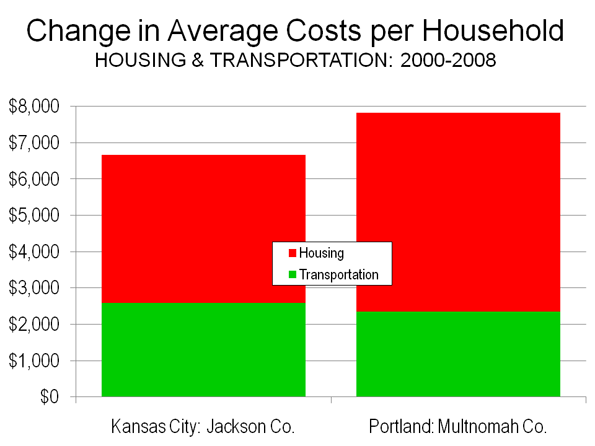
    Yet, there is every indication that housing costs have risen substantially more than transportation costs since 2000. For example, in Kansas City’s core Jackson County, the Census Bureau’s American Community Survey data indicates that the increase in average housing costs was nearly 60% greater than CNT’s transportation cost increase. In Portland’s core Multnomah County, the increase in average housing costs was more 125% greater than CNT’s estimated increase in transportation costs (Figure).

    (2) Exaggerating by Mixing Averages and Medians: The H&T Index compares average housing and transportation costs with the median household income. Averages and means are not the same things. Median income data is “middle” score, with one half of households having incomes above the median and one-half having incomes below the median. On the other hand, “average” housing costs and transportation costs are the total housing and transportation costs divided by the total number of households. High incomes and high priced housing skews averages up. Mixing medians and averages is inherently invalid. For example, in 2008, average housing costs were 19% higher than median housing costs. This means that, on average, where the H&T Index reports a 30% housing affordability figure, it is really substantially lower, at 25% (30% reduced by 19%).

    Thus, the net effect of comparing average housing costs to median incomes makes the housing element of the H&T Index worse than it really is.

    (3) Exaggerating by Leaving Some Households Out: The H&T Index excludes home owning households without a mortgage. The average housing expenditures of households without mortgages are smaller than those of households with mortgages. However, this is a material omission, since housing costs include utility payments. In Multnomah County, excluding households without mortgages raises average housing expenditures by nearly 10% (in 2008). Households without mortgages are households too. The net effect of excluding households without mortgages is to increase housing costs, making the housing portion of the index higher than it would otherwise be.

    (4) Exaggerating by Mixing Data from Different Years: The H&T Index provides 2008 estimates for neighborhood transportation costs, using modeled data. Transportation costs have surely increased since 2000, reaching their peak in 2008 due to the highest ever gasoline prices. CNT again compares these average costs to median household income, but not for 2008. CNT uses 2000 income data. In Jackson County and Multnomah counties, the use of 2000 instead of 2008 data exaggerates transportation’s share of household income between 20% and 25%.

    Each of the above methodological issues is sufficient to render H&T Index outputs to be unreliable.

    Housing’s Role in Housing & Transportation Affordability

    While both transportation and housing costs are important, housing costs have dented household budgets far more than the increase in transportation costs. Even after the house price declines of the last few years, house prices remain well above their historic ratio to household incomes. This will only get worse, if, as many expect, mortgage interest rates rise from their present lows and as rents rise to follow higher house prices.

    In contrast, transportation costs are more susceptible to reduction than housing costs. Once the mortgage is signed, the cost of the house will not be reduced. Once the lease is signed, there is little chance that the rent will be lowered. But transportation costs will be reduced in the future by the far more fuel efficient vehicles being required by Washington. Some people can work at home part of the time. People also change cars more frequently than they change houses. If costs become an issue, perhaps the next car is a compact rather than an SUV.

    CNT’s focus on trends in transportation costs rather than housing costs is consistent with its related study, Penny Wise Pound Fuelish, which advocates expansion of prescriptive land use (smart growth) policies to encourage core urban development and make much suburban development illegal. Yet, these very policies played a dominant role in driving house prices up three times as fast relative to incomes as in metropolitan areas that did not adopt them.

    Genuine advocacy for affordability requires addressing both transportation and housing costs. It also requires recognition of the significant damage done to affordability by prescriptive land use policies. An extra dollar that a household must pay for housing is just as valuable as one spent on transportation.

    All of which leaves us where we started. The nation could still use a reliable housing and transportation index.


    Note: CNT provides no 2008 data for housing costs. Such costs will not be available at the neighborhood level from the American Community Survey until 2012 or 2013. However, it would likely have been no more difficult for CNT to model updated housing data by neighborhood than it was to model 2008 data for transportation costs at the neighborhood level.

    Wendell Cox is a Visiting Professor, Conservatoire National des Arts et Metiers, Paris. He was born in Los Angeles and was appointed to three terms on the Los Angeles County Transportation Commission by Mayor Tom Bradley. He is the author of “War on the Dream: How Anti-Sprawl Policy Threatens the Quality of Life.

    Photograph: Hartford Suburbs

  • The Downtown Seattle Jobs Rush to the Suburbs

    There are few downtown areas in the nation that are more attractive than Seattle. Downtown Seattle is a dream of spontaneous order and a fascinating place well worth exploring. It is one of the nation’s great walkable downtown areas, with a mixture of older and newer buildings, hills, Ivars Acres of Clams and the Chief Seattle fire boat on Elliot Bay, Pioneer Square, the Pike Place Market (itself the home of the first Starbuck’s coffee) and a hyper-dense 100,000 jobs per square mile.

    Downtown boasts the L. C. Smith Tower, which from 1914 to 1966 was the tallest office tower in the west, at 42 floors and nearly 500 feet. Now Smith Tower ranks no better than 35th tallest downtown. Seattle has built so aggressively that a visitor to the observation deck would see more looking up than down. Smith Tower is dwarfed by a skyline containing some of the nation’s most impressive office architecture, such as Columbia Center and the Washington Mutual Building, which was named for the subprime mortgage lending champion.

    Downtown has many more historic landmarks, such as the Olympic Hotel and the Washington Athletic Club. The art-deco Northern Life Tower was the second tallest until the building boom of the 1960s and would have been the pride of more downtown areas than not. The 1970s Henry M. (Scoop) Jackson federal building is a rare gem of its age, while the Rainier Bank Building is perched on a tapered base that begs the question as to whether it will collapse before the Alaskan Way Viaduct in the great Cascadian subduction zone earthquake (which is due to strike sometime between now and the end of time).

    The Condominium Bust: Downtown Seattle has experienced one of the nation’s strongest central city condominium booms, though its success (and that of others) has long been drowned out by the high pitched chorus of the Portland missionary society. As in Portland, Atlanta, San Diego, Los Angeles and other newly resurgent downtown areas, Seattle’s condominium boom is now a bust as resembling that of a subprime-baby remote desert exurb halfway between San Bernardino and Las Vegas. Even so, the condominium neighborhoods of downtown Seattle are more attractive than what they replaced. Eventually, the large inventory of empty units will be sold or converted into rental units.

    The Office Bust: Downtown’s condominium bust has spread to its office market as well. The vacancy rate is now over 20%.

    The Employment Bust: Data from the Puget Sound Regional Council of Governments (PSRG) indicates the depth of the problem. From 2000 to 2009, employment in the downtown core declined more than 12%, with a loss of 20,000 jobs. But it would be a mistake to conclude that downtown Seattle’s employment decline stems from the Great Recession. The losses occurred before. In 2007, the last year before the recession, employment had fallen nearly 18,000 from 2000.

    Downtown Seattle’s employment decline mirrors trends around the nation and around the world. Now, downtown Seattle accounts for only 8.4% of employment in the four county area, something that would surprise an airline passenger looking at its verticalness from above.

    The balance of the city of Seattle has done somewhat better, having lost 3% of its employment since 2000.

    Suburban Job Ascendancy: All of the employment growth in the Seattle area has been in the suburbs. While the city, including downtown, was losing nearly 30,000 jobs, the suburbs of King, Pierce, Snohomish and Kitsap counties added 90,000 jobs (Table). Suburban Redmond, home of Microsoft, added 19,000 jobs all by itself. Even Tacoma, the old second central city and long since defeated challenger to Seattle added a modest number of jobs between 2000 and 2009.

    EMPLOYMENT IN THE SEATTLE AREA: 2000-2009
    Area 2000 2009 Change % Change
    Downtown         164,255         143,952       (20,303) -12.4%
    Balance: Downtown         338,580         329,182        (9,398) -2.8%
    Balance: King County         646,807         662,470        15,663 2.4%
    Kitsap County           70,854           81,617        10,763 15.2%
    Pierce County         234,619         264,402        29,783 12.7%
    Snohomish County         207,764         241,569        33,805 16.3%
    4-County Area       1,662,879       1,723,192        60,313 3.6%
    Compiled from Puget Sound Regional Council of Governments data.

    If You Built it, They Must be Going: With these trends, it might be expected that local transportation agencies would be rushing to provide sufficient infrastructure to the growing suburbs. Not so. Planners are scurrying about to build one of the nation’s most expensive light rail systems with lines converging on downtown, to feed 20,000 fewer jobs today and perhaps 30,000 or 40,000 fewer in the future. Perhaps this is the train “got a whole city moving again” as the television commercials put it?

    What about growing Redmond? It’s on the map. The line is scheduled to reach Redmond sometime between now and the end of time.

  • Queensland: Housing Relief on the Horizon?

    Queensland might be thought of as the Florida of Australia. Like Florida, Queensland is the “Sunshine state.” For years, Queensland has been the fastest growing state in the nation, just as Florida has been the fastest growing large state in the United States. The Gold Coast in Southeast Queensland might be characterized as Miami Beach on steroids.

    Both states have also faced housing difficulties. With its smart growth land rationing policies, house prices escalated wildly in Florida and then collapsed as America’s “drunken sailor” lending policies came home to roost. Queensland has had similar “urban consolidation” land rationing policies and the same house price escalation has occurred. However, the price bust did not follow, because lending standards were more strict. This is because adults were in charge of finance in Australia instead of the cartoon characters that drove policy in the United States. Australian lenders at least asked borrowers if they had a job and checked their pulse.

    But there are still housing problems in Queensland. The Urban Development Institute of Australia Queensland has just released its two Richardson reports that, among other things, suggest that restrictions on housing are increasing household sizes. In recent years, only one new house has been produced for each new resident, which compares to an average household size of 2.5. Presumably younger people are living longer with their parents and perhaps, with the strong foreign immigration to Australia, there is substantial “doubling up,” as houses are shared by people who would not otherwise live together, such as multiple families (internationally, census authorities define a household as all of the people living in a single house).

    Median lot prices and median house prices have risen strongly in Queensland, which has led to a decline in housing construction and a loss of construction jobs. The report recommends allowing more housing development on greenfield sites and developing additional infrastructure on the urban fringe where more housing would be developed. Finally, the report urges that the state establish benchmarks for the time it takes to approve and build greenfield developments.

    The Richardson reports are just another indication that the severity of the housing crisis and its causes is more broadly understood in Australia. Queensland would do well to follow its recommendations.

    Photo: Gold Coast

  • Power in Los Angeles: The High Price of Going Green

    Greece and Los Angeles are up against a financial wall. Los Angeles had its bond rating cut on April 7. Greece managed to hold out until April 9. Greece has endured public employee strikes as it has attempted to reign in bloated public payrolls. Los Angeles Mayor Antonio Villaraigosa drew the ire of the city’s unions and city council opposition in proposing two-day a week furloughs for city employees.

    A Bankrupt Los Angeles?

    Most recently, the context of discussions has been an expected $73 million payment to the city from the Los Angeles Department of Water and Power (DWP). Mayor Villaraigosa raised the possibility of a city bankruptcy if the payment was not received.

    The Mayor attempted to encourage the city council to approve an electricity rate increase, which was sought by DWP. In support of the rate increase, Villaraigosa submitted a report to the city council saying that “Council rejection of the DWP board’s action [to increase rates] would be the most immediate and direct route to bankruptcy the city could pursue.”

    DWP Interim General Manager S. David Freeman added such action would lead the “utility would think twice about sending” the money o to the city. Despite these warning, the city council then rejected the proposed rate increase.

    The Price of Renewable Energy

    For its part, DWP says that that the rate increase is necessary to cover the costs of investing in renewable energy sources, as required by state and federal regulations. They cited a Mayoral directive to increase generation from renewable sources (solar and wind). Right now the bulk of Los Angeles’ power comes from fossil fuels, much of it from coal-fired plants outside the state.

    Switching from this relatively inexpensive energy is proving very expensive. Indeed, the rejected rate increase is just the first of four planned hikes. The result, if all four increases are ultimately granted by the city council, would be to increase residential electricity bills up to 28% and commercial electricity bills up to 22%.

    How Much Will the People Pay?

    There is a much larger story here than the immediate financial difficulties faced by the city of Los Angeles. It is clear that council members are concerned about the impact of rate increases on their constituents. It is a particularly challenging for consumers in the city of Los Angeles. Unemployment is high, with Los Angeles County consistently above the national average The city, with its higher concentration of poverty, is likely to be somewhat higher. Many households are having difficulty paying their inflated mortgages and hardly in the position less more for electricity. The city has more than its share of poverty. And, finally, the city’s lack of business competitiveness is so legendary that it repeatedly ranks near or in the Kosmont “cost of doing business” surveys.

    This larger story is likely to be played out in communities around the nation, as politicians, such as the President, who expect and perhaps even would favor that electricity bills “skyrocket.” One would think rising expenses in any critical sector are a “non-starter” in the presently hobbled economy. It will be interesting to see what eventually gives in Los Angeles those who advocate for consumers (including some on the city council) , or those, including the DWP and its unions, who wish to add additional costs to the budgets of those already in distress. In the longer run, this will not be sustainable, in Los Angeles or anywhere else, because the public appetite for higher prices is not unlimited.

    But the behavior of DWP is a matter of curiosity, regardless of how or why the city of Los Angeles reached its present financial embarrassment.

    What if it Were Southern California Edison?

    As is indicated from its name, DWP is a publicly owned utility, owned by the city of Los Angeles. Its rate increases are subject to approval by the city council. DWP appears intent on withholding payment from the city because its proposed rate increase have not been approved. Imagine, if instead, the city of Los Angeles were served by a private but publicly regulated electricity utility, such as Southern California Edison (SCE). Imagine further that the California Public Utilities Commission denied a rate increase and that, in response, SCE announced that it “would think twice” about sending some or all of its taxes to the state in response. When DWP officials undertake such a strategy, there is apparently no legal sanction. The legal sanctions against SCE would be manifold. It is a paradox that a publicly owned utility can be less subject to restraint than one that is, in essence, owned by the taxpayers.

    Who is in Charge?

    But there is an even more curious situation. The Los Angeles Department of Water and Power is, in fact, an agency completely under the control of the city of Los Angeles. The Mayor and the city council represent the sum total of the policy authority over the city of Los Angeles and all of its commissions, departments and other instrumentalities. The DWP board of directors is appointed by the Mayor and must be confirmed by the city council.

    Regardless of the Mayor’s authority to remove DWP board members, he has considerable persuasive political power, which could be used to encourage a more cooperative attitude on the part of the DWP. This was proven in 1984, when predecessor Mayor Tom Bradley asked for (Note 1), and received, the resignations of all 150 city commissioners, as well as his two appointees to the Southern California Rapid Transit District.

    Mayor Bradley then announced a practice that required new appointees to submit an undated letter of resignation upon appointment, to ease removal should it be necessary. This became a bi-partisan practice, also followed by Bradley’s successor, Mayor Richard Riordan (Note 2).

    The Crisis Passes

    Within the last couple of days, the immediate crisis appears to have passed, but the fundamental problems wil continue to fester. The city has found $30 million, the result of higher property tax collections. The Mayor is now asking DWP to pay $20 million, instead of $73 million. However, as Mayor Bradley showed, the Mayor can do much more than “ask.”

    The Mayor’s two-day furlough plan for city workers now has been shelved. Ray Ciranna, the city’s Acting Administrative Officer told the Los Angeles Times that: “We are still in a budget crisis, but we will end the year paying all of our bills.” Things, however, may not be so rosy for residents facing stiff electricity rate hikes tied to the inordinate costs of renewable energy. Many of them already face financial distress every bit as serious as the city’s was just a few days ago. This is one Hollywood movie that, sad to say, we may see repeated in other locations around the country as cities, localities and citizens try to cope with the high costs of draconian “green” energy policies.


    Note 1: The author was, at the time, a Tom Bradley appointee to the Los Angeles County Transportation Commission. He was not included in the Mayor’s call for resignations.

    Note 2: While elective offices in the city of Los Angeles are non-partisan, Bradley was a Democrat and Riordan was a Republican.

    Photo: John Ferraro Department of Water & Power Building (City Council President Ferraro was the first chairman of the Los Angeles County Transportation Commission, whose meetings were normally held in the DWP board room).

    Wendell Cox is a Visiting Professor, Conservatoire National des Arts et Metiers, Paris. He was born in Los Angeles and was appointed to three terms on the Los Angeles County Transportation Commission by Mayor Tom Bradley. He is the author of “War on the Dream: How Anti-Sprawl Policy Threatens the Quality of Life.

  • Transit in Los Angeles

    Los Angeles officials hope to convince Congress take the unprecedented step of having the US Treasury to front money for building the area’s planned 30 year transit expansions in 10 years instead. The money would be paid back from a one-half cent sales tax (Measure R), passed by the voters in 2008. That referendum required 35% of the new tax money to be spent on building 12 rail and exclusive busway transit lines.

    Measure R was not the first instance of Los Angeles officials committing to spend 35% of a new one-half cent sales tax on new transit lines.

    Proposition a: the Start of it All

    In 1980, County Supervisor and Los Angeles County Transportation Commission (LACTC) chairman Kenneth Hahn, whose district included low-income south Los Angeles, made a last-minute proposal (Note 1) to place a half-cent sales tax on the ballot to lower bus fares to $0.50. No funding would have been provided for rail.

    Chairman Hahn’s proposal was amended twice and adopted by LACTC (Note 2). The first amendment provided funding to municipalities to start or expand their own transit services. The second amendment (which I spontaneously introduced), dedicated 35% of the money to building a rail system (My seconder, Supervisor Baxter Ward, required excluding busways). A 10 corridor map was drawn during the meeting (see Rail Rapid Transit System above). LACTC (Note 2) approved the program, which was adopted by the voters as Proposition A in November of 1980.

    Results: The Proposition A programs met with varying levels of success (and failure):

    Bus Fare Reduction: The bus fare was reduced for three years. As a result, transit ridership at the Southern California Rapid Transit District (SCRTD), the principal bus operator, rose 40%, to its modern peak, in perhaps the largest major system ridership increase in modern history. The program was also cost effective, with a cost per new passenger of $0.56 (2008$), a small fraction of virtually any new rail system built in the United States in recent decades. Fares were raised in 1985 and one-third of the bus ridership disappeared.

    Municipal Transit Services: The more efficient municipal bus operators (such as Santa Monica, Long Beach, Gardena, Montebello and others) used the new money to expand their services and ridership. Other jurisdictions established new local services, usually provided more cost-effectively by private operators under competitive contracts (costs average 40% less per hour).

    Rail Program: As it turned out, LACTC grossly over-promised on the its rail system. By 1990, only four lines were either completed or under construction but there was no money for the rest. Another half cent tax was approved by the voters to finish the job. By 2008, six lines were completed or under construction, still short of the 1980 promise. During the interim, two new exclusive busways had also been added to the system. The 2008 referendum, Measure R, would finish the job, and more, by building 12 new rail or exclusive bus lines.

    Nonetheless, approximately 300,000 people ride the metro and light rail trains of the Los Angeles County Metropolitan Transit Authority (formerly the Southern California Rapid Transit District) every day. Some MTA officials have even suggested that this decade’s modest growth in Los Angeles traffic congestion has resulted from people giving up their cars to ride the rail lines.

    The Results: The reality is quite different. Even when gasoline prices peaked at nearly $5.00 per gallon in 2008, total MTA bus and rail ridership was 5% below 1985 levels, indicating that for each new rail rider; at least one former bus rider had abandoned transit. Daily bus ridership dropped more than 300,000 (Table 1).

    Moreover, traffic congestion growth slowed during this decade Los Angeles not due to a shift to transit (there wasn’t one), but because of its anemic population growth, with Los Angeles County adding only one-quarter the number of new residents during the 2000s as had been forecast. The Los Angeles metropolitan area (including Orange County) also had the highest rate of domestic outmigration in the nation from 2000 to 2009, losing at a rate one-third greater than Detroit. Employment in Los Angeles County was at the same level in 2008 as in 2000.

    Table 1
    MTA/SCRTD Ridership, Costs and Fare Recovery: 1985-2008
      1985 2008 Change
    Unlinked Trips (Millions)             497          474 -5%
    Passenger Miles (Millions)          1,947      1,989 2%
    Operating & Annualized Capital Costs (Millions)  $      1,077  $  1,775 65%
    Cost per Passenger Mile  $        0.55  $    0.89 61%
       Bus: Cost per Passenger Mile  $        0.55  $    0.77 38%
       Light Rail: Cost per Passenger Mile  $    0.85
       Metro: Cost per Passenger Mile  $    1.81
    Fare Ratio 23% 19% -19%
       Bus: Fare Ratio 23% 25% 5%
       Light Rail: Fare Ratio 11%
       Metro: Fare Ratio 8%
    Bus capital costs estimated using national ratio from APTA Transit Fact Book
    Rail capital costs estimated from mid-year of project construction (discounted at 7% over 30 years)

    The Costs: Rail systems are often promoted for their “cost-effectiveness.” However, these claims always exclude the cost of capital (building the system and buying the vehicles). Capital costs are far higher for rail systems than for buses. Los Angeles is no exception. It is estimated that SCRTD/MTA annual capital and operating costs rose 65% from 1985 to 2008, adjusted for inflation, in large measure due to the rail services. Bus riders pay double or triple the fares in relation to costs as rail riders (Table 1).

    With Other Bus Operators: Ridership Up, Market Share Down:

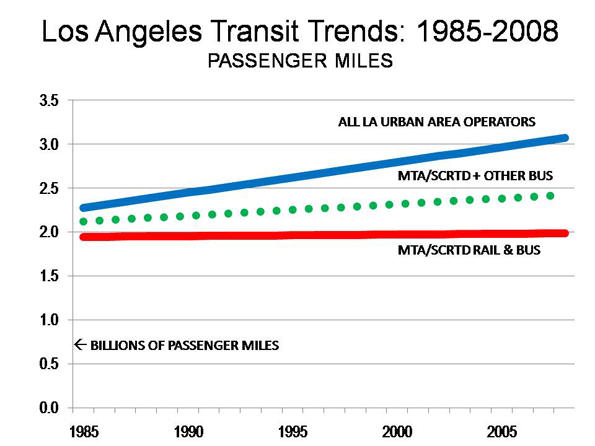
    Los Angeles is somewhat unique as a metropolitan area in having a large number of transit operators. So, even as the MTA/SCRTD system grew, the other bus systems expanded more rapidly. This was made possible by their more cost-effective operation and, especially among the newer systems, the use of competitive contracting (contracts with private operators) to reduce costs even more. In 2008, for example, more than 35% of the county’s bus service was provided by operators other than MTA. Approximately 85% of the added transit usage (passenger miles) from 1985 to 2008 was from the bus services of these other operators.

    Overall transit ridership increased in the Los Angeles urban area, with the new five-county Metrolink commuter rail system contributing substantially to the increase as well. The neighboring Orange County Bus system doubled its ridership, while rejecting rail (Figure). Even so, transit’s market share in the Los Angeles urban area declined nearly 10% from 1985 to 2008 (Table 2).

    Table 2
    LOS ANGELES URBAN AREA ROADWAY & TRANSIT DATA
      1985 2008 Change
    Annual Roadway Passenger Miles    114,590   168,219 47%
    Annual Transit Passenger Miles         2,279       3,071 35%
    Roadway & Transt Passenger Miles    116,869   171,290 47%
    Transit Market Share 2.0% 1.8% -8%
     
    Freeway Lane Miles         5,310       6,992 32%
    Vehicle Miles per Freeway Lane Mile       13,487     15,037 11%
    Average Congestion Delay (Peak Period) 27% 49% 81%
    Los Angeles urban area includes Mission Viejo urban area.
    Metrolink commuter rail system: 75% of passenger miles estimated in Los Angeles urban area.
    Annual passenger miles in millions

    Prospects: The Next 30 Years

    Los Angeles has again committed to a major expansion of transit service, despite the fact that the Metro and light rail lines have done little more than siphon ridership from buses. There is little to suggest that the future will be any more successful than the past.

    • MTA, like LACTC before it appears to have over-promised on transit expansion. 35% of a half-cent sales tax is no more likely to finance a 12 line expansion today than a 35% share could fund an 11 line expansion in the 1980s and 1990s.
    • Nonetheless, new transit lines will be built. These Measure R expansions are likely, however, to be no more successful in reducing traffic congestion than the earlier rail expansions.

    Further, funding the Measure R rail system is likely to be more challenging. The original Proposition A was followed by decades of growth, which generated rising tax revenues. Now, however, both LA’s population and employment growth have ground to a standstill. The rosy revenue forecasts are not likely to be achieved, which should be a matter for concern among not only local officials, but to the federal taxpayers being asked for a hefty advance.


    Notes

    1. LACTC had held hearings on a proposed ballot initiative, but a consensus had developed that no referendum would be placed on the ballot in 1980. Chairman Hahn surprisingly called a special meeting of LACTC just before the deadline for submitting a measure to the ballot.

    2. LACTC was the principal transportation (transit and highways) policy body in Los Angeles County from 1977 to 1993. By state law, the commission included the mayor of Los Angeles, the five county supervisors (county commissioners), the major of Long Beach, two elected officials from smaller cities, and two additional appointments by the mayor of Los Angeles. Mayor Tom Bradley routinely appointed a city council member to LACTC and a private citizen (three times the author of this article). In 1992, LACTC and SCRTD merged into the Los Angeles County Metropolitan Transportation Authority (MTA), which has a similarly composed board of directors.

    Illustration: 1980 Proposition A Rail Map (Los Angeles County Transportation Commission)

    Wendell Cox is a Visiting Professor, Conservatoire National des Arts et Metiers, Paris. He was born in Los Angeles and was appointed to three terms on the Los Angeles County Transportation Commission by Mayor Tom Bradley. He is the author of “War on the Dream: How Anti-Sprawl Policy Threatens the Quality of Life.

  • SPECIAL REPORT: Metropolitan Area Migration Mirrors Housing Affordability

    On schedule, the annual ritual occurred last week in which the Census Bureau releases population and migration estimates and the press announces that people are no longer moving to the Sun Belt. The coverage by The Wall Street Journal was typical of the media bias, with a headline “Sun Belt Loses its Shine.” In fact, the story is more complicated – and more revealing about future trends.

    Domestic Migration Tracks Housing Affordability: There have been changes in domestic migration (people moving from one part of the country to another) trends in the last few years, but the principal association is with housing affordability.

    Severe and Not-Severe Bubble Markets: Overall, the major metropolitan markets with severe housing bubbles (a Median Multiple rising to at least 4.5, see note) lost nearly 3.2 million domestic migrants (all of these markets have restrictive land use regulation, such as smart growth or growth management) from 2000 to 2009. However, not all markets with severe housing bubbles lost domestic migrants. “Safety valve” bubble markets drew migration from the extreme bubble markets of coastal California, Miami and the Northeast. These “safety valve” markets (including Phoenix, Las Vegas, Portland, Seattle, Riverside-San Bernardino, Orlando, Tucson and Tampa-St. Petersburg), gained a net 2.2 million from 2000 to 2009, while the other bubble markets lost 5.3 million domestic migrants from 2000 to 2009 (See Table below, metropolitan area details in Demographia US Metropolitan Areas Table 8). At the same time, the markets that did not experience a severe housing bubble (those in which the Median Multiple did not reach 4.5) gained a net 1.5 million domestic migrants.

    The burst of the housing bubble explains the changes in domestic migration trends. Housing affordability has improved markedly in the extreme bubble markets, so that there was less incentive to move. Then there was the housing bust-induced Great Recession, which also slowed migration since people had more trouble selling their homes or finding anew job. As a result, the migration to the “safety valve” markets and to the smaller markets dropped substantially.

    • During 2009, the “safety valve” markets gained only 51,000 net domestic migrants, one-fifth of the annual average from 2000 to 2008.
    • At the same time, the other severe housing bubble markets lost 236,000 domestic migrants in 2009, compared to the average loss of 638,000 from 2000 to 2008.
    • Areas outside the major metropolitan areas also experienced a significant drop in domestic migration, dropping from an annual average of 203,000 between 2000 and 2008 to 23,000 in 2009.
    • The major metropolitan markets that did not experience a severe housing bubble gained 161,000 domestic migrants in 2009, little changed from the 169,000 average from 2000 to 2008. These markets are concentrated in the South and Midwest. Indianapolis, Kansas City, Nashville, Louisville and Columbus as well as the Texas metropolitan areas continued their positive migration trends.
    Domestic Migration by Severity of the Housing Bubble
    Metropolitan Areas over 1,000,000 Population
    2000-2008
    Metropolitan Areas 2000-2009 2009 2000-2008 Average
    Withouth Severe Housing Bubbles     1,509,870         160,514      168,670
    With Severe Housing Bubbles    (3,161,514)        (184,486)     (372,129)
       Not "Safety Valve" Markets    (5,347,211)        (235,838)     (638,922)
       "Safety Valve" Markets     2,185,697           51,352      266,793
    Outside Largest Metropolitan Areas     1,651,644           23,972      203,459
    Severe housing bubbles: Housing costs rose to a Median Multiple of 4.5 or more (50% above the historic norm of 3.0). 
    Median Multiple: Median House Price/Median Household Income
    "Safety Valve" refers to markets with severe housing bubbles that received substantial migration from more expensive markets (coastal California, Miami and the Northeast). These markets include Las Vegas, Phoenix, Riverside-San Bernardino, Sacramento, Portland, Seattle, Orlando, Tucson and Tampa-St. Petersburg.

    Moreover, the Census Bureau revised its previous domestic migration figures for 2000 to 2008 to add more than 110,000 from the markets without severe housing bubbles, while taking away more than 150,000 domestic migrants from the markets with severe housing bubbles. This adjustment alone rivals the 2009 domestic migration loss of 183,000 in these markets

    Population Growth: The Top 10 Metropolitan Areas: Sun Belt metropolitan areas continued to experience the greatest population growth. Between 2000 and 2009, the fastest growing metropolitan areas were Atlanta, Dallas-Fort Worth and Houston, In 2009, Washington, DC was added to the list (Details in Demographia US Metropolitan Areas, Table 2).

    New York: The New York metropolitan area remains the nation’s largest, now reaching a population of over 19 million. More than 700,000 new residents have been added since 2000. However, New York’s population growth has been the second slowest of the 10 largest metropolitan areas since 2000 (Figure 1). Moreover, New York’s net domestic out-migration has been huge. New York has lost 1,960,000 domestic migrants, which is more people than live in the boroughs of The Bronx and Richmond combined. Overall, 10.7% of the New York metropolitan area’s 2000 population left the metropolitan area between 2000 and 2009. More than 1,200,000 of this domestic migration was from the city of New York. Between 2008 and 2009, New York’s net domestic out-migration slowed from the minus 1.32% 2000-2008 annual rate to minus 0.58%., reflecting the smaller migration figures that have been typical of the Great Recession.
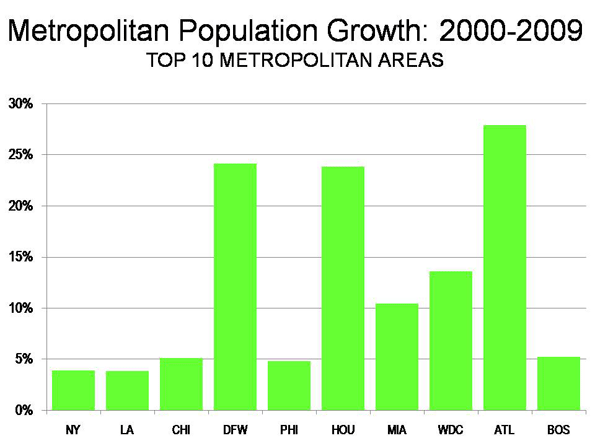
    Los Angeles: For decades, Los Angeles has been one of the world’s fastest growing metropolitan areas. Growth had ebbed somewhat by the 1990s, when Los Angeles added 1.1 million people. The California Department of Finance had projected that Los Angeles would add another 1.35 million people between 2000 and 2010. Yet, the Los Angeles growth rate fell drastically. From 2000 to 2009, Los Angeles added barely one-third the projected amount (476,000) and grew only 3.8%. Unbelievably, fast growing Los Angeles became the slowest growing metropolitan area among the 10 largest. In 2009, Los Angeles had 12.9 million people. Los Angeles lost 1.365 million domestic migrants, which is of 11.0% of its 2000 population, and the most severe outmigration among the top 10 metropolitan areas (Figure 2).
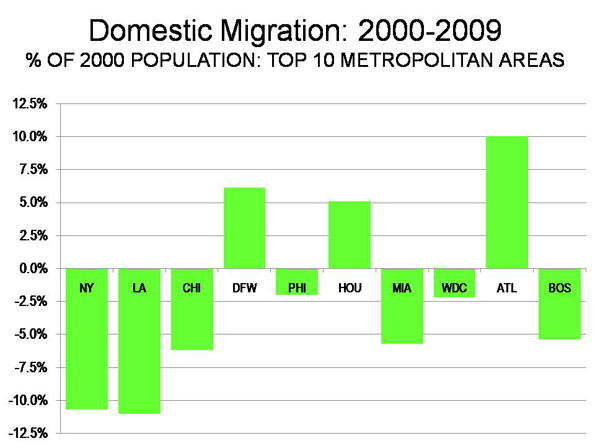
    Chicago: Chicago continues to be the nation’s third largest metropolitan area, at 9.6 million population, a position it has held since being displaced by Los Angeles in 1960. Chicago has experienced decades of slow growth and continues to grow less than the national average, at 5.1% between 2000 and 2009 (the national average was 8.8%). Yet, Chicago grew faster than both New York and Los Angeles. Chicago also lost a large number of domestic migrants (561,000), though at a much lower rate than New York and Chicago (6.2%). Even so, Chicago is growing fast enough that it could exceed 10 million population in little more than a decade, by the 2020 census.

    Dallas-Fort Worth: Dallas-Fort Worth has emerged as the nation’s fourth largest metropolitan area, at 6.4 million, having added 1,250,000 since 2000. In 2000, Dallas-Fort Worth ranked fifth, with 500,000 fewer people than Philadelphia, which it now leads by nearly 500,000. Dallas-Fort Worth added more population than any metropolitan area in the nation between 2008 and 2009 and has been the fastest growing of the 10 top metropolitan areas since 2006. As a result, Dallas-Fort Worth has replaced Atlanta as the high-income world’s fastest growing metropolitan area with more than 5,000,000 population. Dallas-Fort Worth added a net 317,000 domestic migrants between 2000 and 2009.

    Philadelphia: Philadelphia is the nation’s fifth largest metropolitan area, at just below 6,000,000 population. Like Chicago, Philadelphia has had decades of slow growth, yet has grown faster in this decade than both New York and Los Angeles (4.8%). Philadelphia has lost a net 115,000 domestic migrants since 2000, for a loss rate of 2.2%, well below that of New York, Los Angeles and Chicago.

    Houston: Houston ranks sixth, with 5.9 million people and is giving Dallas-Fort Worth a “run for its money.” Like Dallas-Fort Worth, Houston has added more than 1,000,000 people since 2000. Over the same period, Houston has passed Miami and Washington (DC) in population. Houston has added a net 244,000 domestic migrants since 2000, and added 50,000 in 2008-2009, the largest number in the country. Like Dallas-Fort Worth, Houston accelerated its annual domestic migration growth rate in 2008-2009. At the current growth rate, Houston seems likely to pass Philadelphia in population shortly after the 2010 census.

    Miami: Miami (stretching from Miami through Fort Lauderdale to West Palm Beach) is the seventh largest metropolitan area, with 5.6 million people. Miami has added more than 500,000 people, for a growth rate of 10.4%. However, Miami has suffered substantial domestic migration losses, at 287,000, a loss rate of, 5.7% relative to its 2000 population.

    Washington (DC): Washington recaptured 8th place, moving ahead of Atlanta, which had temporarily replaced it. Washington’s population is 5.5 million and added 655,000 between 2000 and 2009, for a growth rate of 13.6%. However, Washington lost a net 110,000 domestic migrants, 2.2% of its 2000 population. That trend was reversed in 2008-2009, when a net 18,000 domestic migrants moved to Washington, perhaps reflecting the increased concentration of economic power in the nation’s capital.

    Atlanta: Atlanta is the real surprise this year. For more than 30 years, Atlanta has had strong growth, however, this year it slowed. Atlanta is the 9th largest metropolitan area in the nation, at 5.5 million. Since 2000, Atlanta has added 1.2 million people, though added only 90,000 last year. Atlanta has added a net 429,000 domestic migrants since 2000, though the rate slowed to only 17,000 in 2008-2009.

    Boston: Boston is the nation’s 10th largest metropolitan area, with 4.6 million people. During the 2000s, Boston has added nearly 200,000, growing by 4.2%. Yet, Boston has also experienced a net domestic migration loss of 236,000, or 5.4% of its 2000 population. In 2008-2009, Boston, like Washington, reversed its domestic migration losses, adding 7,000.

    Trends by Size of Metropolitan Area: As throughout the decade, the slowest growing areas of the nation have been metropolitan areas over 10,000,000 population (New York and Los Angeles), which grew 3.9% and non-metropolitan areas, which grew 2.6% during the decade Metropolitan areas that had between 2.5 and 5.0 million population in 2000 boasted the biggest jump (these include fast growing Houston and Atlanta, which are now more than 5 million), at 13.4% for the decade. All of the other size classifications grew between 8.9% and 11.3% over the decade (see Demographia US Metropolitan Areas, Table 1). Metropolitan areas that began the decade with between 5,000,000 and 10,000,000 population gained 10.0%. Those with 250,000 to 500,000 grew 10.4%, those with 500,000 to 1,000,000 grew 10.2% and the smallest metropolitan areas, those from 50,000 to 250,000 grew 8.9%

    Metropolitan areas over 1,000,000 population lost 2.19 million domestic migrants during the decade, but smaller metropolitan areas added 2.24 million domestic migrants. Non-metropolitan areas lost 50,000 domestic migrants. In 2009, the smaller metropolitan areas gained 125,000 domestic migrants, while the larger metropolitan areas lost 30,000. Non-metropolitan areas lost more than 90,000 domestic migrants. As noted above, these smaller figures for 2009 reflect the more stable housing market and the extent to which the Great Recession has reduced geographic mobility (See Demographia US Metropolitan Areas, Tables 1 and 3).


    Note: The Median Multiple is the median house price divided by the median household income. The historic standard has been 3.0.

    Photograph: Dallas

    Wendell Cox is a Visiting Professor, Conservatoire National des Arts et Metiers, Paris. He was born in Los Angeles and was appointed to three terms on the Los Angeles County Transportation Commission by Mayor Tom Bradley. He is the author of “War on the Dream: How Anti-Sprawl Policy Threatens the Quality of Life.