Author: Wendell Cox

  • PARIS: Urban Museum Amidst a Suburban Sea

    I arrived in Paris on March 1 for my annual visiting professor assignment at the Conservatoire National des Arts et Metiers. Again, I have taken a flat (apartment) in the 1st arrondissement (district) in the heart of the ville de Paris, one of the world’s great pedestrian expanses. It is also one of the great virtual experiences – a place oddly disembodied from its setting.

    The flat is just a couple of doors to the right on the first perpendicular street in the picture below, which was taken at the entrance of the Chatalet-Les Halles Metro-RER station, less than 200 yards away.

    It is 300 yards to the Pompideau Museum, a structure whose hideousness is compensated for only by the fact that because of its dense surroundings it cannot be seen from anywhere more than a block away. The Louvre and the Hotel de Ville (city hall) are each one-half mile away and Notre Dame is less than three-quarters of a mile away. This is probably the ultimate in urbanization outside of Hong Kong.

    Sundays are very relaxing in Paris. There are people on the streets. The atmosphere is informal. Crowds are out examining the art works, books, maps and posters of the vendors that line both banks of the River Seine. I always like to attend Vepres (Vespers) at Notre Dame at 5:45 on Sunday evening. This is bit ecumenical for an Anglican, although not much of an ecumenical stretch to Roman Catholicism. I understand nothing, but the singing and the organ are inspirational nonetheless.

    There are many advantages to living in central Paris. Nearly the entire ville de Paris is an outdoor museum of architecture. There is the dense, irregular urbanization of the ancient Marais, a relic of the pre-Hausmann city, as well as walks along the well planned Champs d’Elysee toward Etoile and the Arc de Triomphe on the newer 19th Century boulevards created by the master-planner.

    Everything is so close that there is no need for either car or transit. The classroom is a 15 minute walk. This small section of Paris is a model for walkability. Yet this does not, however, necessarily translate into the social connections advocates of walkability suggest. I took a survey in Montorgueil, another busy pedestrian quarter, for a few days. Out of more than 5,000 people who had stopped to talk to someone or were on cell phones, 80 percent were on the phone. This illustrates how technology has made it possible for us to interact more with those we have common interest, wherever they are, instead of being limited to those who just happen to be in geographical proximity.

    We also have to understand the ephemeral nature of the Parisian core. It is now more museum and place of “experience” than a thriving residential neighborhood. The center of the area – the 1st arrondissement (there are 20) – is a shadow of its former self in population. Today, the 1st arrondissement has 18,000 people, 80 percent below its 1861 figure of 90,000, and probably lower than the 1836 Paris core peak. The overall city has lost population as well, dropping from 2.95 million in 1921 to less than 2.2 million today, a decline on the order of some US central cities (such as Chicago).

    One reason: living in central Paris has its disadvantages. One of them is shopping. Perhaps no city has more grocery markets per capita than Paris. But they are so small that probably no city has less grocery square footage than Paris. It is quite an adventure. Not all stores carry the same products, which makes it necessary to go to more than one grocery store to fill the larder. Not surprisingly, such small stores prices have much higher prices than the supercenters – Carrefour, Auchan and other Wal-Mart lookalikes (though often larger) – that have located just outside the Boulevard Peripherique, the six to eight lane freeway that surrounds the city.

    Some of the Metro lines extend beyond the Boulevard Peripherique, allowing urban Parisians to take advantage of lower suburban supercenter prices. Suburbanites can also shop at supercenters on the second ring freeway (the A-86) and the third ring freeway (the “Franciliene”). It may not be as famous as Le Metro, but Paris possesses the best freeway system in Europe outside of the Dusseldorf-Essen (Rhine-Ruhr) area. But the stores are not permitted, by law, to be open on Sunday, which makes parking lots and adjacent streets so crowded on Saturdays that both employees and police are used to direct the traffic.

    The biggest surprise to many Americans would be the extent of the Paris suburbs. Many, especially in the urban planning community, have long deluded themselves and others into believing that Europe, unlike America, has no suburbs. The core of Paris is very small, with most of the monuments and museums that are of interest being within a less than five square mile area. The ville de Paris itself covers approximately 40 square miles. The suburbs extend outward for more than another 1,000 square miles, 25 times the area of the ville de Paris.

    So, yes Paris has suburbs, as does every big city in Europe. In fact, virtually all European urban growth in the last 40 years has occurred in the suburbs, while virtually all of the cores have either experience slow growth or lost population, much like the United States. The European suburbs continue to attract residents from the cities, and whatever gains are achieved by some core cities are the result of international migration, not domestic migration from suburbs to the cities.

    Overall more than 80 percent of Parisians live in the suburbs and exurbs. The ville de Paris has less than 2.2 million people, while the rest of the urban area has nearly 8 million people, according to the French national statistical agency (INSEE). Another 2 million people are included in the rural and exurban portions of the metropolitan area (the “aire urbaine”) which are the French equivalent of exurbs.

    There is also a perception – oft reported in the New York Times and other urban-centric media – that the suburbs of Paris are made up of poor people. Certainly, like many American cities, Paris has poor suburbs, particularly in the department of Seine-St. Denis, to the north of the city. This area has high rise public housing blocks that look every bit as decrepit as the mercifully demolished Robert Taylor Homes on the south side of Chicago. But most Paris suburbs are predominately middle class housing, just like in America. There are also some very wealthy areas, as we find in the periphery of our own metropolitan regions.

    For two months, the ville de Paris is an absolutely delightful place to live. But once my Parisian sojourn is over, I, for one, will be very happy to return home to the suburbs of St. Louis which may be duller, less colorful and historic than Paris, but far more comfortable and affordable for the experience of everyday living.

    For additional information, see the Paris Rental Car Tour at http://www.rentalcartours.net/rac-paris.pdf.

    Wendell Cox is a Visiting Professor, Conservatoire National des Arts et Metiers, Paris. He was born in Los Angeles and was appointed to three terms on the Los Angeles County Transportation Commission by Mayor Tom Bradley. He is the author of “War on the Dream: How Anti-Sprawl Policy Threatens the Quality of Life.
  • Transit Captures Little of Driving Decline

    Over the past year, transit ridership has risen and that is a good thing. At the same time, driving has declined, due to both higher gasoline prices and the economic downturn. Some analysts have implied that people are giving up driving and using transit instead. An analysis of just released transit and urban roadway usage indicates no such thing. During the fourth quarter, the transit increase from a year earlier represented just 0.7 percent of the driving decline. This is even lower than the 2 to 3 percent figures registered in the first through third quarters. Of course, the principal reason why people do not substitute transit for driving is that it is not available for the overwhelming majority of urban trips.

    The latest data is available at: http://www.demographia.com/ut-hwytr2008f.pdf.

  • Obama Administration to Repeat Protectionist Errors of 1930s?

    In a potentially ominous development, Television New Zealand reports that the Obama government has postponed free trade agreement discussions under the proposed Trans-Pacific Strategic Economic Partnership (P4) with New Zealand, Singapore, Brunei and Chile. Along with the United States, Australia, Peru and Vietnam were to have been involved in the expanded free trade area. It is reported that the postponement is related to an assessment of trade policy by the Obama administration. An inward turning US trade policy, favored by President Obama’s organized labor allies even before the economic meltdown, could set the nation on a protectionist course not unlike the measures that prolonged the Great Depression.

  • Sunbelt Indianapolis

    For decades, the overwhelming majority of population and economic growth has occurred in the Sun Belt – the nation’s South and West as defined by the United States Bureau of the Census. This broadly-defined area stretches south from the Washington-Baltimore area to the entire West, including anything but sunny Seattle and Portland. Any list of population growth or employment growth among the major metropolitan areas will tend to show the Sun Belt metropolitan areas bunched at the top and the Frost Belt areas (the Northeast and Midwest regions) bunched at the bottom. Since World War II, no state has experienced the growth that has occurred in California.

    However, the trends in the last decade indicate a shift, certainly away from California, which has experienced a net domestic migration (people moving to other parts of the nation). The overall loss reaches over 1.2 million people; the state’s overall population growth rate is now only little more than average. Some metropolitan areas in the Frost Belt have begun to perform better in population and domestic migration, but most continue to experience growth that is well below that of the Sun Belt.

    The exception to this is Indianapolis, which has developed growth rates that would put it right in the middle of Sun Belt metropolitan areas, if it were not in the Frost Belt.

    Indianapolis is a metropolitan area of 1.7 million population. Indianapolis added nearly 11 percent to its population between 2000 and 2007 (latest data available) and ranks 19th in population growth among the 50 metropolitan areas with more than 1,000,000 population (New Orleans has been excluded from this analysis because of the hurricane related population losses). Indianapolis is growing faster than Washington, DC or Seattle and nearly as fast as Portland or Denver. Its population growth rate has been double that of San Diego, triple that of Los Angeles or San Jose and more than six times that of San Francisco, which has seen its growth slow to a rate no better than that of Italy. Overall Indianapolis would rank 18th out of the 32 largest US Sun Belt metropolitan areas in total population growth. It is the fastest growing of the 18 largest Frost Belt metropolitan areas.

    Between 2000 and 2007, the Indianapolis metropolitan area added 55,000 domestic migrants, equal to 3.6 percent of its 2000 population. No other Frost Belt metropolitan area comes close. Columbus and Kansas City had domestic migration gains, at 1.2 percent of their population. All other Frost Belt metropolitan areas lost domestic migrants. Indianapolis, however, would have ranked 17th out of the 32 largest Sun Belt metropolitan areas trailing Portland, but leading Seattle and Denver.

    The distribution of domestic migration within the Indianapolis metropolitan area is also significant. For one-half century various analysts have predicted the decline of the suburbs. Indianapolis, like most metropolitan areas around the country, shows exactly the opposite: the suburbs continue to attract central city residents and have yet to fall into this seemingly inevitable decline.

    While the Indianapolis metropolitan area gained 55,000 domestic migrants from 2000 to 2007, Marion County, the central county which is nearly co-existent with the central city of Indianapolis, lost 46,500 domestic migrants. All of the domestic migration growth was in the suburbs, which attracted 101,800 new residents from Indianapolis/Marion County and the rest of the nation.

    What is it that has allowed Indianapolis to experience Sun Belt growth despite being in the Frost Belt? This is not the place for a full attempt to identify all of the causes, but some observations can be made.

    Perhaps it is most important to understand what is not the cause of the superior growth in Indianapolis. It is not the city’s “unigov” governance structure. In the early 1970s, to the great fanfare of urban planners, Indianapolis merged with most of Marion County, increasing the city’s population by approximately 50 percent. Proponents of local government consolidations often (and speciously) suggest that these consolidations will make metropolitan areas more attractive (this issue is discussed in detail in our Pennsylvania report on local government consolidation). Yet, Indianapolis, one of the nation’s largest consolidated local governments, is losing residents to the suburbs. It is also worthy of note that state taxpayers provided a $1 billion pension bailout to the city last year.

    One factor that clearly makes Indianapolis attractive is its housing affordability, which is the best among metropolitan areas with more than 1,000,000 residents in six nations. According to our 5th Annual Demographia International Housing Affordability Survey, Indianapolis had a Median Multiple (median house price divided by median household income) of 2.2 in the third quarter of 2008, well below the historic norm of 3.0. Indianapolis has been ranked near the top in each of the preceding four editions as well. In recent years, new suburban starter houses of 1,500 square feet have been advertised at less than $110,000, less than the price of land for a house in many metropolitan areas.

    Superior housing affordability constitutes a critical important attractor. At the height of the housing bubble, a household living in the median priced house in Indianapolis would have saved more than $1,000,000 in down payment and mortgage payments over 30 years, compared to San Diego.

    Indianapolis also has the advantage of a comfortable lifestyle. Commuters spend 2 minutes less per day than the national average getting to work, according to the 2007 United States Bureau of the Census American Community Survey. The Texas Transportation Institute indicates that traffic congestion is less severe in Indianapolis than average and that it has become better in the last 10 years. Indicating its usual irrelevance to traffic congestion, Indianapolis has the smallest transit market share of any urban area over 1,000,000 in the nation, at approximately 0.2 percent. This compares to 11 percent in New York, 5 percent in San Francisco and 2 percent in Los Angeles and Portland.

    Where does Indianapolis go from here? So far, Indianapolis has shown resiliency in the current economic crisis. The December 2009 unemployment rate was 6.7 percent, which is below the 7.2 percent national rate. Other parts of Indiana are not doing nearly as well, especially in smaller metropolitan areas that rely to a greater extent on manufacturing. For example, unemployment has reached 15 percent in Elkhart.

    To some extent, the metropolitan area’s huge advantage in housing affordability has been eroded by the collapse of prices in the most expensive Sun Belt metropolitan areas, such as in California and Florida. Yet, Indianapolis remains far more affordable, even after these losses.

    Indianapolis also has an advantages for business. In the State Business Tax Climate Index, Indiana is ranked highly, at 14th in the nation. With the prospect of higher taxes, both at the federal level and in many states, this should help Indianapolis retain an impressive advantage and continue to perform as if it were a Sun Belt metropolitan area, but without the problems associated with the housing bubble, massive congestions and growing social inequality.

    Wendell Cox is a Visiting Professor, Conservatoire National des Arts et Metiers, Paris. He was born in Los Angeles and was appointed to three terms on the Los Angeles County Transportation Commission by Mayor Tom Bradley. He is the author of “War on the Dream: How Anti-Sprawl Policy Threatens the Quality of Life.

  • Paris Mayor Sides with Cars

    Paris Mayor Bertrand Delanoë has spent much of his first term in implementing measures to restrict car use. Delanoë took many lanes of road traffic away from cars and turned them into exclusive bus and taxi lanes. This had virtually no effect on public transport use, according to University of Paris researchers who also found as a result that traffic congestion worsened, greenhouse gas emissions increased and overall cost to the Paris economy of more than $1 billion annually.

    Now the Mayor is establishing a car hire program that will make electric cars available throughout the ville de Paris at electric charging stations. Initially 4,000 cars will be involved in the “Autolib” program. London Mayor Boris Johnson has announced plans for a similar program. These are healthy developments and a further reflection that preferred lifestyles can continue, while still reducing greenhouse gas emissions.

  • Generating Gasoline From CO2 Emissions

    For some time it has been assumed that reducing greenhouse gas (GHG) emissions will require a shift to cars that do not use petroleum and to power plants that do not use coal, because of the emissions from these sources. All of this may be a false alarm.

    Two recent articles indicate that there may be no need to reduce petroleum use in cars to reduce greenhouse gas emissions (GHG). The first story from USA Today describes a new process for producing gasoline from CO2. If implemented, this could materially reduce GHG emissions from coal fired electricity plants – a principal source of GHG emissions in the United States and in many other nations, including China and India. Another story in The New York Times, indicates the potential of technology that could capture CO2 emissions from cars, to be later refined into gasoline. All of this is further evidence that technology is the answer with respect to reducing GHG emissions.

  • The Panic of 2008: How Bad Is It?

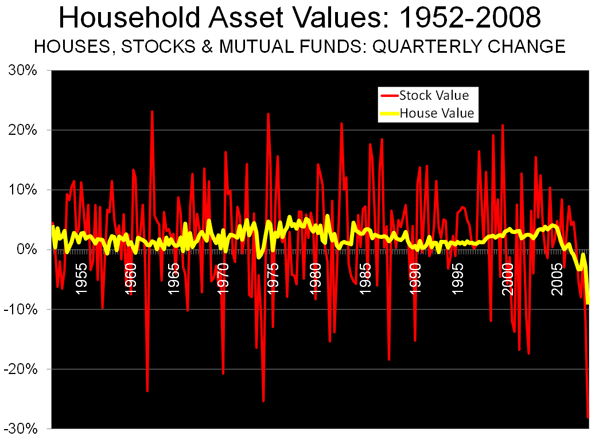
    Just how bad is the current economic downturn? It is frequently claimed that the crash of 2008 is the worst economic downturn since the Great Depression. There is plenty of reason to accept this characterization, though we clearly are not suffering the widespread hardship of the Depression era. Looking principally at historical household wealth data from the Federal Reserve Board’s Flow of Funds Accounts of the United States, summarized in our Value of Household Residences, Stocks & Mutual Funds: 1952-2008, we can conclude it’s pretty bad, but nothing yet like the early 1930s.

    But this Panic of 2008 is no picnic. And in some key areas, notably housing, it could be even worse than what was experienced in the Great Depression.

    Housing: It all started with the housing bubble that saw prices in some markets rise to unheard of levels, principally in California, Florida, Phoenix, Las Vegas and the Washington, DC area. Mortgage lenders, unable to withstand the intensity of losses in these markets caused by declining prices, collapsed like a house of cards. This precipitated the Lehman Brothers bankruptcy on Meltdown Monday (September 15, 2008) and a far broader economic crisis since that time.

    Before the bubble, housing had been a stable store of wealth (equity or savings) for Americans. According to federal data, the value of the US owned housing stock increased in every year since 1935. The bursting of the housing bubble, however, brought declines in both 2007 and 2008, the longest period of housing value decline since between 1929 and 1933. The value of the housing stock was down 20 percent from its peak at the end of 2008. In some markets the losses amounted to more than double this amount. By comparison, the 1929 to 1933 house value decline was 27 percent. However, only one Great Depression year (1932) had a larger single-year decrease than 2008.

    Indeed, between 1952 and 2006, the value of the housing stock never declined for more than a three month period. The bubble changed all that. The value of the housing stock has now fallen eight straight quarters. An investment that has been safe for most middle class Americans – the house in the suburbs – suddenly experienced the price volatility usually associated with the stock market, as is indicated in the chart below.

    The resulting losses have been substantial. By the end of 2008, the value of the housing stock has fallen $4.5 trillion. In Phase I of the housing downturn, before Meltdown Monday, the largest losses were concentrated in the markets with the biggest “bubbles,”. But since that time the market has entered a Phase II decline, while a more general decline has characterized housing markets around the country in the fourth quarter of 2008. The decline continues.

    California, the largest of all the states, has been particularly hard hit. New data for both the San Francisco and Los Angeles areas show price drops of approximately 10 percent in January, 2009 alone, as prices fall like the value of a tin-pot dictatorship’s currency. This decline, it should be noted, has spread from the outer ring of these areas – places like the much maligned Inland Empire region and the Central Valley – into the formerly more stable, and established, areas closer to the larger urban cores, which some imagined would be safe from such declines.

    Sadly, there may well be some time before house price stability can be achieved. To restore the historic relationship between house prices and household incomes to a Median Multiple (median house price divided by median household income) of 3.0 would require another $3 trillion in losses, equating to a more than 15 percent additional loss. Losses are likely to be greater, however, not only in the “ground zero” markets of California and Florida but also other hugely over-valued markets, such as Portland, Seattle, New York and Boston. Of course, these are not normal times, and an intransigent economic downturn could lead to even lower house values than the historical norm would suggest.

    Stocks and Mutual Funds: As noted above, stocks and mutual funds have been inherently more volatile than housing values. According to Federal Reserve data, the value of these holdings fell 24 percent over the year ended September 30. Based upon later data from the World Federation of Exchanges, we estimate that the value declined sharply after September 15, and at December 31 stood at 45 percent below the peak.

    The household value of stocks and mutual funds has declined for five consecutive quarters, as of December 2008. There was a more sustained drop over six quarters in 1969-1970, although the decline in value was less than the present loss, at 37 percent. A larger decline (47 percent) was associated with the four quarter decline of 1973-1974. Comparable data is not available for household stocks and mutual fund holdings before 1952. The less complete data available indicates that the gross value of common and preferred stocks fell 45 percent from 1929 to 1933. As late as 1939, a decade after the crash, the loss had risen to 46 percent, indicating both the depth and length of the Great Depression.

    The present downturn seems on course at a minimum to break the post-depression loss record with an overall decline at 55 percent as of February 20. This would correspond to a household loss of $8 trillion from the peak.

    Consumer Confidence: The Conference Board’s Consumer Confidence Index reached an all time low of 25.0 in February, down a full one-third in a month. Even with its gasoline rationing, the mid-1970s downturn saw a minimum Consumer Confidence Index of 43.2. Normal would be 100; as late as August of 2007, consumer confidence was above 100. Consumer confidence is important. Where it is low, as it is today, there is fear and even people with financial resources are disinclined to spend. Confidence is a major contributor to economic downturns, which is why they used to be called “panics.” Restoring confidence is a requirement for recovery.

    Government Confidence: If there were a federal government index of confidence, it would probably be near zero. This is demonstrated by the trillions that both parties in Washington have or intend to throw at banks, private companies and distressed home owners to stop the downturn. Never since the Great Depression have things become so bad that Washington has opened taxpayer’s checkbooks for massive financial bailouts.

    How Much Wealth has been Lost: The net worth of all US households peaked at $64.6 trillion in the third quarter of 2007, according to the Federal Reserve Board. Since that time, it seems likely that the housing, stock and mutual fund losses by the nation’s households could be as high as $12 trillion – $4 trillion in housing and $8 trillion in stocks and mutual funds. This is a major loss and is unlikely to be recovered soon. Yet it makes sense to consider these losses in context. Unemployment is far lower than in the 1930s, when it reached 25 percent, and the Dust Bowl is not emptying into California (indeed, more than 1,000,000 people have migrated from California to other states this decade).

    Born Yesterday Jeremiahs: It is fashionable to suggest that the current economic crisis is the result of over-consumption and an unsustainable lifestyle. The narrative goes that the supposed excesses of the 1980s and 1990s have finally caught up with us. In fact, however, even with the huge losses, the net worth of the average household is no lower than in 2003 and stands at 70 percent above the 1980 figure (inflation adjusted). This may be a surprise to “born yesterday” economic analysts.

    The reality is that the country achieved astounding economic and social progress since World War II. The reality remains that even after the losses we are not, objectively speaking, experiencing Depression-like conditions. Critically, the answer to the question, “Are you better off today?” in 1950, 1960, 1970, 1980, 1990 and even 2000 is “yes”. This is a critical difference with the situation in the 1930s when the country overall was much poorer, and far less able to withstand such punishing losses.

    Beware the Panglossians: Even so, it seems premature to predict that the economy will turn around soon. Some Panglossian analysts predict recovery later in the year or in 2010 seem likely to miss the mark by years. Remember analysts – particularly those tied to both the real estate and stock sectors – who have discredited themselves with their past cheerleading. In addition, the international breadth and depth of this crisis cannot possibly be fully comprehended at this time. Last week the Federal Reserve predicted a declining economy over the next year.

    And even when the recovery starts, it is likely to be slow because of the public debt run up to stop the bleeding. When the recovery begins, the nation and the world will have to repay the many trillions in bailouts one way or the other. This can take the form of higher taxes, inflation, rising real interest rates or, if you can imagine, all three.

    How Bad Is It? Bad Enough. The present downturn is not as serious as the Great Depression. Nonetheless, the Panic of 2008 is without question, the most serious economic downturn since the Great Depression. The real question is whether the government will react as ineffectively as it did back then, and prolong the downturn well into the next decade.

    Wendell Cox is a Visiting Professor, Conservatoire National des Arts et Metiers, Paris. He was born in Los Angeles and was appointed to three terms on the Los Angeles County Transportation Commission by Mayor Tom Bradley. He is the author of “War on the Dream: How Anti-Sprawl Policy Threatens the Quality of Life.

  • Finally… A Rational Approach to GHG Emissions Reduction

    Nicholas Stern, a former World Bank economist and author of the seminal “Stern Report,” injected a rare bit of reason into the discussions about global climate change in Cape Town recently. Stern said that if nations acted responsibly they would achieve zero-carbon electricity production and zero-carbon road transport by 2050 – by replacing coal power plants with wind, solar or other energy sources that emit no carbon dioxide, and fossil fuel-burning vehicles with cars running on electric or other clean energy.

    What a welcome vision. No hint of social engineering, no litany of activities and lifestyles to be abandoned, but rather a clear implication that technology offers the solution. (And, by the way, it does.). So let’s put an end to all of this talk about behavior modification and instead set about developing the technology that allows people to live as they prefer.

  • Housing Downturn Moves Into Phase II

    The great housing turndown, which started as early as 2007, has entered a second and more difficult phase. We can trace this to Monday, September 15, 2008 just as October 29, 1929 – “Black Tuesday” – marked the start of the Great Depression. September 15 does not yet have a name and the name “Black Monday” has already been taken by the 1987 stock market crash. The 1987 crash looks in historical perspective like a slight downturn compared to what the world faces today.

    On September 15 – let’s call it “Meltdown Monday” – the housing downturn ended its Phase I and burst into financial markets leading to the most serious global recession since the Great Depression. Indeed, International Monetary Fund head Dominique Strauss-Kahn now classifies it a depression.

    Phase I claimed its own share of victims; Phase II seems likely to hit many more.

    Phase I of the Housing Downturn

    Whether in depression or recession, parts of the United States housing market were already in a deep downturn well before September 15. Phase I of the housing downturn started when house prices reached an unprecedented peak in some markets and began fell into decline. By September of 2008, house prices in the “ground zero” markets of California, Florida Las Vegas, Phoenix and Washington, DC had dropped from 25 percent to 45 percent from their peaks. These markets represented 75 percent of the overall lost value among the major metropolitan areas (those with more than 1,000,000 population).

    The Varieties of House Price Escalation Experience: In Phase I, the house price escalation and subsequent losses were far less severe in other major metropolitan areas. This depended in large part to the degree of land use controls – such as land rationing (urban growth boundaries and urban service limits), building moratoria, large lot zoning and other restrictions on building routinely – that helped drive prices up to unsustainable levels. This effect, cited by a number of the world’s most respected economists, was exacerbated by the easy money policies adopted by mortgage lenders.

    On the other hand, in the “responsive” land use regulation areas, the market (people’s preferences) was allowed to determine where and what kind of housing could be built. In these areas housing prices rose far less during the housing bubble and fell far less during Phase I of the housing downturn.

    Leading to the International Financial Crisis: These radically differing house price trends set up world financial markets for ”Meltdown Monday.” The easy money led to a strong increase in foreclosure rates, an inevitable consequence of households having sought or been enticed into mortgage loans that they simply could not afford. Yet it was not foreclosure rates that doomed the market. It was rather the unprecedented intensity of those losses in particular markets.

    Foreclosures were not the problem: Foreclosures happened all over. Foreclosure rates rose drastically in California and the prescriptive markets, but had relatively less impact in the responsive markets of the South and Midwest, where house prices changed little relative to incomes.

    Intensity of the losses was the problem. The problem lay largely in the scale of house value losses in some markets, particularly the most prescriptive ones. Lenders faced foreclosure and short sales losses on houses that had lost an average of $170,000 in value in the ground zero markets. In the responsive markets, on the other hand, average house value losses were less than one-tenth that, at $12,000 per house (http://www.demographia.com/db-hloss.pdf).

    By the end of Phase I of the housing downturn, house value losses in the prescriptive markets had reached nearly $2.3 trillion, accounting for 94 percent of the total losses in major metropolitan markets (those with more than 1,000,000 population). If the market had been allowed to operate in these markets, the losses in the prescriptive markets could easily have been one-fifth this amount. Most likely the mortgage industry and the international economy might have been able to handle such losses, sparing the world the current deep financial crisis.

    True, the housing bust would not have happened without the easy money. Neither easy money nor prescriptive land use regulation were sufficient in themselves to send the world economy into a tailspin. But together they conspired to create the conditions for “Meltdown Monday”.

    Phase II of the Housing Downturn

    The Panic of 2008: By September 15, the “die had been cast.” The holders of mortgage debt could no longer sustain the losses that were occurring in the ground zero markets. This led to the Lehman Brothers bankruptcy and then to a financial sector that seems to be accelerating faster than the taxpayers can pick up the pieces. The ensuing “panic” – a 19th century synonym for a severe economic downturn – has led to millions of layoffs, decreases in demand across the economy and taxpayer financed bailouts around the world. Many have seen their retirement funds wiped out. Others have lost their jobs. American icons, such as General Motors and Bank of America have been relegated to begging on Washington’s K Street.

    Housing Downturn Broadens and Deepens: The panic has now brought about a new phase in the housing downturn – what I label Phase II. In Phase II, a deteriorating economy starts to kick the bottom out of the rest of the housing market. With evaporating confidence in the economy and the drying up of demand, house prices have begun a free-fall in virtually all markets, regardless of the extent to which their prices had bloated.

    Our analysis of National Association of Realtors data shows this. In almost all markets house price declines accelerated during the fourth quarter of 2008 (the first quarter following Meltdown Monday). In just three months, median house prices fell an average of more than 12 percent in the major metropolitan markets. In the ground zero markets, house prices dropped 14 percent, with the average loss from the peak exceeding 40 percent. In the responsive markets, prices fell 11 percent, approximately double the previous reduction from the peak (See Table).

    Thus, the difference is that in Phase I, house price declines were in proportion to the previous price escalation. In Phase II, the percentage declines are generally similar without regard to the house price increases.

    House Price Deflation from Peak
    By Phase of the Housing Downturn
    PRESCRIPTIVE LAND USE MARKETS
    RESPONSIVE LAND USE MARKETS
    Factor
    Ground Zero
    Other
    All
    ALL MARKETS
       
    Prices: To Phase I
    -31.70%
    -11.10%
    -20.80%
    -5.90%
    -17.90%
    Prices: To Phase II
    -41.40%
    -21.40%
    -30.80%
    -16.60%
    -28.00%
     
    Prices in Phase II
    -14.20%
    -11.60%
    -12.60%
    -12.40%
    -14.20%
     
    Loss per House: To Phase I
    ($193,800)
    ($42,400)
    ($96,300)
    ($12,200)
    ($66,900)
    Loss per House: To Phase II
    ($253,000)
    ($81,800)
    ($142,700)
    ($34,200)
    ($104,800)
     
    Loss per House in Phase II
    ($59,200)
    ($39,400)
    ($46,400)
    ($37,900)
    ($59,200)
     
    Gross Losses (Trillions): To Phase I
    ($1.82)
    ($0.46)
    ($2.29)
    ($0.16)
    ($2.44)
    Gross Losses (Trillions): To Phase II
    ($2.40)
    ($0.99)
    ($3.39)
    ($0.44)
    ($3.82)
     
    Gross Losses (Trillions): in Phase II
    ($0.58)
    ($0.52)
    ($1.10)
    ($0.28)
    ($1.38)
       
    Phase I: To September 2008          
    Phase II: To December 2008          
    Major Metropolitan Markets (over 1,000,000 population)      
    For markets by classification see: http://www.demographia.com/db-hloss.pdf    

    Recession or Depression?

    It’s critical to note that the decline is by no means as deep as in the 1930s. On the other hand, there is no indication that conditions are going to improve markedly in the short run. Millions of households who saw their retirement accounts devastated are likely to curb consumption for years to come. The key question is whether we are in the equivalent of 1933, in the pit of the downturn, or in the equivalent of the late 1930s, soon to begin a long, slow climb out.

    For housing though, this is a depression. Never before over the last half-century have house prices fallen as they have in the prescriptive markets during Phase I of the housing downturn. And since the bust, during Phase II, overall price declines are on a par with the worst years of the Great Depression. “Meltdown Monday” has incited a downward spiral whose course will be the topic of future commentaries on this site.

    The classifications of the major metropolitan markets and price declines for each market are shown in http://www.demographia.com/db-hloss.pdf.

    Also see: Mortgage Meltdown Graphic: http://www.demographia.com/db-meltdowngraphic.pdf

    Wendell Cox is a Visiting Professor, Conservatoire National des Arts et Metiers, Paris. He was born in Los Angeles and was appointed to three terms on the Los Angeles County Transportation Commission by Mayor Tom Bradley. He is the author of “War on the Dream: How Anti-Sprawl Policy Threatens the Quality of Life.

  • Don’t Politicize the Census Bureau

    The recent decision by the Obama Administation to place the Census under the control of the White House represents a danger – not only to the integrity of the process but to the underlying assumptions that drive policy in a representative democracy. It is something that smacks of the worst anti-scientific views of the far right, or the casual political manipulation of the facts one expects in places like Russia or Iran.

    Let me be clear: I love the Bureau of the Census. I have been an avid consumer of its data since the second grade. I used to wait with anticipation for the decennial results – the 10 year population counts for states, counties and cities. Anyone who has spent any time on the Demographia websites knows the respect with which I treat Census data.

    The United States established one of the first regular censuses and it has been conducted every 10 years since 1790. The United Kingdom followed in 1801 and France in 1807, though both nations suspended their counts during World War II.

    Over the past couple of decades, the Bureau of the Census has made annual estimates widely available, so it was no longer necessary to wait for the 10 year results. This was an important step in the right direction for people interested in demographics. But, there was a more basic purpose than amusing people who make their living with numbers. As federal programs that allocate money to local jurisdictions based upon their population have become more widespread, interim annual census estimates became a necessity.

    Before the interim estimates, all sorts of “cheerleading” estimates were published, like the more than 1,000,000 population estimate I discovered for Washington, DC in the 1950s (the city never exceeded 800,000 by much). The great thing about the Bureau of the Census was that you could trust the numbers.

    Trust and accuracy were precisely what the framers had in mind when they wrote the regular decennial Census enumeration (count) into the US Constitution. The principal purpose, of course, was to apportion seats in the House of Representatives. A genuine democracy depends on ensuring all are represented equally and thus depends upon the integrity of its census.

    Recently, however, the process has become ever more politicized. The Bureau of the Census has allowed counties, cities and other local jurisdictions to challenge their annual census estimates. The incentive, of course, is that if the challenge results in a higher population estimate (and it can be expected that no jurisdiction challenges an estimate it feels is too high), more federal money is the reward.

    I became aware of the problem in watching the recently developing annual challenge ritual by the nearby city of St. Louis, which has lost more of its population than any city since the Romans sacked Carthage. No large local jurisdiction in the world, not even New Orleans, has lost as much of its population as St. Louis, which has experienced a 60 percent decline since 1950.

    So not surprisingly, the city of St. Louis has become a frequent challenger. St. Louis has successfully challenged the Bureau of the Census estimate of its population five of the seven years from 2001 to 2007 (the most recent estimate). The total of additions from census challenges adds up to 43,000 people. This is a not insubstantial 12.4 percent relative to the approximately 348,000 2000 Census count for the city.

    I began to wonder what the success rate was in census challenges. I asked the appropriate Bureau of the Census officials for a list of rejected challenges. The quick and polite response was “We do not have a list of the rejected challenges.” This seemed a strange answer, since the Bureau of the Census website lists all of the successful challenges. Moreover, my internet search for news stories about rejections of census challenge rejections yielded nothing.

    I performed an analysis of the successful challenges posted on the internet. Approximately 200 general purpose local jurisdictions have filed challenges. Nearly 40,000 have not.

    Many of the upheld challenges are in large urban cores, such as 236,000 in the city of New York and more than 100,000 in Atlanta’s core Fulton County. Among the larger jurisdictions, Fulton County added the largest to its 2000 population by challenges, at 13.5 percent.

    However, the challenges are by no means limited to urban cores. Salt Lake City suburbs West Valley City, West Jordan and Sandy challenged their counts, but not core city Salt Lake City. Nearby Provo, no urban jungle, had the largest addition to its population of any jurisdiction over 100,000 population, at 15.2 percent. The Bureau of the Census missed about 2,000 residents between Skokie and Hoffman Estates, headquarters of Sears Roebuck, but not a one in nearby Chicago, which has 25 times as many people as the two suburban jurisdictions combined.

    Overall, 47 jurisdictions with more than 100,000 population in 2000 have successfully challenged census estimates, many in more than one year. The total population addition from these challenges is 1.24 million, though there may be some duplication in city and county numbers. Overall, the census challenges have added a total of nearly 1,600,000 people, which is likely, with duplications, to exceed the population of two Congressional districts. All of the challenging jurisdictions combined had a population of less than 35 million in 2000, or less than 15 percent of the population.

    All of this raises questions. Beyond the questions about rejected challenges, if there have been any, are fundamental questions about Bureau of the Census methods. How can it be that the Census misses by so many people? Why did it presumably miss 15 percent of the population in Provo, 3 percent in New York City and 30 percent in Bazine City, Kansas, while apparently being so accurate in the remaining 85 percent of the nation that no one was missed?

    Why was the Bureau of the Census estimate so erroneous in New York, Boston and San Francisco, yet so accurate in Los Angeles, Philadelphia and Phoenix, where there were no errors?

    Then there is the more fundamental question – have there been any rejections?

    It is possible that everything is on the “up and up” with respect to the Bureau of the Census challenge program. On the other hand, there appears to be plenty of potential for mischief, as some jurisdictions have become experts at challenging and the Bureau may find rejections difficult, given the pressure that could be received from members of Congress.

    But politicization of the Census is a terrible risk. That’s why the Obama administration’s decision to move authority for the Census to the White House from the Department of Commerce is so concerning. It is hard to imagine a function of government so crucial to the genuine working of democracy becoming subject to the whims of people like White House chief of staff, Rahm Emmanuel – or down the road to a similarly partisan figure in the other party, like a Karl Rove.

    The good news is that a bill introduced by New York Democratic Congresswoman Carolyn B. Maloney would assure the census’s integrity. Last year, she introduced the “Restoring the Integrity of American Statistics Act of 2008,” with co-sponsors Henry Gonzales of Texas, Henry Waxman of California and William Clay of Missouri. Congresswoman Maloney’s bill would remove the Bureau of the Census from the Department of Commerce and establish it as an independent federal agency, insulated from the political process. According to the Congresswoman:

    This action will be a clear signal to Americans that the agency they depend upon for unbiased monthly economic data as well as the important decennial portrait of our nation is independent, fair, and protected from interference

    The bill has been endorsed by all seven living former directors of the Bureau of the Census, appointed by Presidents Nixon, Ford, Carter, Reagan, Clinton and both Bushes.

    This is the direction we need to go. The Administration has made much of its commitment to science and open inquiry. Preserving the sanctity of the census process would seem to confirm that commitment. In contrast, putting it under the control of White House political operatives represents a brazen act of political gamesmanship and a shameful turn in the wrong direction. It is to be hoped that the rising political firestorm and the recent withdrawal of Senator Judd Gregg from consideration for the post of Commerce Secretary might lead to a policy reversal.

    Successful Census Estimate Challenges: 2001 to 2007
    State Jurisdiction
    2000 Census Popuation
    Total Population Added in Census Challenges
    Percentage
    OVER 100,000
    NY New York City                   8,008,278                 236,120 2.9%
    TX Houston                    1,954,848                   84,364 4.3%
    NY Suffolk County                   1,419,369                   58,503 4.1%
    NY Nassau County                   1,334,544                   46,528 3.5%
    TX Dallas                    1,188,580                   25,873 2.2%
    MI Detroit                        951,270                   47,728 5.0%
    NY Westchester County                       923,459                     6,912 0.7%
    MD Montgomery County                       873,341                   10,678 1.2%
    AZ Pima County                       843,746                   29,504 3.5%
    GA Fulton County                       816,006                 109,983 13.5%
    CA San Francisco County                       776,733                   34,209 4.4%
    MD Baltimore                        651,154                   75,410 11.6%
    NJ Monmouth County                       615,301                     5,891 1.0%
    WI Milwaukee                        596,974                   29,424 4.9%
    MA Boston                        589,141                   51,540 8.7%
    DC District of Columbia                       572,059                   31,528 5.5%
    TN Davidson County                       545,524                   32,152 5.9%
    LA Orleans Parish                       484,674                   48,989 10.1%
    LA Jefferson Parish                       455,466                   16,819 3.7%
    GA Atlanta                        416,474                   12,440 3.0%
    UT Utah County                       368,536                   25,814 7.0%
    FL Miami                        362,470                   14,943 4.1%
    MO St. Louis                        348,189                   43,012 12.4%
    OH Cincinnati                        331,285                   22,582 6.8%
    OH Toledo                        313,619                   21,822 7.0%
    NY Rockland County                       286,753                     3,208 1.1%
    TX Lubbock County                       242,628                     1,678 0.7%
    VA Norfolk                        234,403                     9,720 4.1%
    VA Arlington County                       189,453                   15,634 8.3%
    NC Winston-Salem                        185,775                     8,184 4.4%
    TN Knoxville                        173,890                     4,317 2.5%
    MA Worcester                        172,648                     1,555 0.9%
    AL Huntsville                        158,216                         424 0.3%
    TN Chattanooga                        155,554                   13,103 8.4%
    MA Springfield                        152,082                     1,404 0.9%
    VA Alexandria                        128,283                   11,687 9.1%
    SD Sioux Falls                        123,975                     5,848 4.7%
    NY Jefferson County                       111,738                   11,631 10.4%
    IL Springfield                        111,454                     1,020 0.9%
    WA Bellevue                        109,569                     4,442 4.1%
    UT West Valley                        108,896                     6,011 5.5%
    UT Provo                        105,166                   16,003 15.2%
    PA Erie                        103,717                     2,608 2.5%
    Subtotal                 28,595,240             1,241,245 4.3%
    Smaller Jurisdictions                 345,025
    All Jurisdictions             1,586,270

    Wendell Cox is a Visiting Professor, Conservatoire National des Arts et Metiers, Paris. He was born in Los Angeles and was appointed to three terms on the Los Angeles County Transportation Commission by Mayor Tom Bradley. He is the author of “War on the Dream: How Anti-Sprawl Policy Threatens the Quality of Life.