Category: Demographics

  • California: The Republic of Climate

    To some progressives, California’s huge endorsement for the losing side for president reflects our state’s moral superiority. Some even embrace the notion that California should secede so that we don’t have to associate with the “deplorables” who tilted less enlightened places to President-elect Donald Trump. One can imagine our political leaders even inviting President Barack Obama, who reportedly now plans to move to our state, to serve as the California Republic’s first chief executive.

    As a standalone country, California could accelerate its ongoing emergence as what could be called “the Republic of Climate.” This would be true in two ways. Dominated by climate concerns, California’s political leaders will produce policies that discourage blue-collar growth and keep energy and housing prices high. This is ideal for the state’s wealthier, mostly white, coastal ruling classes. Yet, at the same time, the California gentry can enjoy what, for the most part, remains a temperate climate. Due to our open borders policies, they can also enjoy an inexhaustible supply of cheap service workers.

    Of course, most Californians, particularly in the interior, will not do so well. They will continue to experience a climate of declining social mobility due to rising costs, and businesses, particularly those employing blue-collar and middle-income workers, will continue to flee to more hospitable, if less idyllic, climes.

    California in the Trump era

    Barring a rush to independence, Californians now must adapt to a new regime in Washington that does not owe anything to the state, much less its policy agenda. Under the new regime, our high tax rates and ever-intensifying regulatory regime will become even more distinct from national norms.

    President Obama saw California’s regulatory program, particularly its obsession with climate change, as a role model leading the rest of the nation — and even the world. Trump’s victory turns this amicable situation on its head. California now must compete with other states, which can only salivate at the growing gap in costs.

    At the same time, foreign competitors, such as the Chinese, courted by Gov. Jerry Brown and others to follow its climate agenda, will be more than happy to take energy-dependent business off our hands. They will make gestures to impress what Vladimir Lenin labeled “useful idiots” in our ruling circles, but will continue to add coal-fired plants to power their job-sapping export industries.

    Read the entire piece at The Orange County Register.

    Joel Kotkin is executive editor of NewGeography.com. He is the Roger Hobbs Distinguished Fellow in Urban Studies at Chapman University and executive director of the Houston-based Center for Opportunity Urbanism. His newest book, The Human City: Urbanism for the rest of us, was published in April by Agate. He is also author of The New Class ConflictThe City: A Global History, and The Next Hundred Million: America in 2050. He lives in Orange County, CA.

    Photo: By User “Neon Tommy” (https://www.flickr.com/photos/neontommy/8117052872) [CC BY-SA 2.0], via Wikimedia Commons

  • Flight from Urban Cores Accelerates: 2016 Census Metropolitan Area Estimates

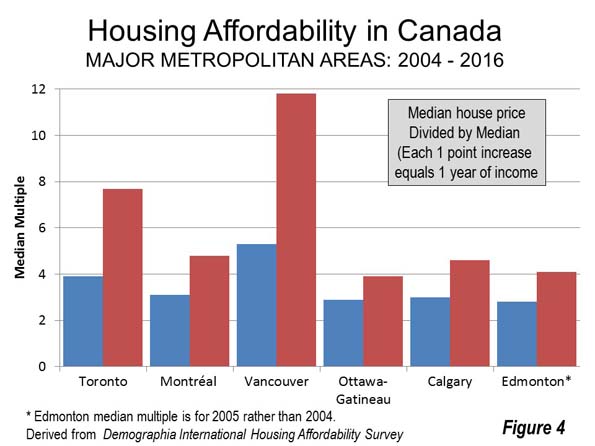
    The flight from the nation’s major metropolitan area core counties increased 60 percent between 2015 and 2016, according to just-released estimates from the US Census Bureau (Note). A total of 321,000 more residents left the core counties than moved in, up from 199,000 in 2015. This is ten times the decade’s smallest domestic migration loss of 32,000 for the same counties which occurred in 2012.

    Suburban counties continued to attract net domestic migrants, at a somewhat higher rate than in recent years and much higher than in the early part of the decade. The suburban counties gained 235,000 domestic migrants in 2016, compared to 224,000 in 2014 and more than double the low point of 113,000 in 2011 (Figure 1).

    The 60 percent rise in net domestic migration out of the core counties converts to a 0.4 percent annual loss relative to last year’s population. This loss is more than one-half the annual growth rate of only 0.7 percent. This is a substantial deterioration from the net domestic migration loss in 2012 of 0. 04 percent, which was only 1/25th of the 1.1 percent growth rate for the core counties.

    At the same time, the suburbs had their best performance of the decade. Their minimum advantage was in 2012, when the suburbs attracted 150,000 new domestic migrations relative to the core counties (118,000 compared to negative 32,000). The 2016 advantage was 556,000 (235,000 compared to negati ve 321,000).

    The suburbs outperformed core county domestic migration in 40 of the 50 major metropolitan cases. The ten exceptions include three with strong urban cores (San Francisco, Boston and Washington) and seven with very small urban cores, indicating that much of the central county population is post-war suburban (see: Growth Concentrated in Most Suburbanized Core Cities).

    Overall Domestic Migration

    The deterioration in core county domestic migration led to overall negative domestic migration for the major metropolitan areas in 2016, the first time this has happened this decade. Overall, the 53 major metropolitan areas had a net domestic migration loss of 64,000, down from 17,000 in 2015 and 98,000 in 2012. Since the 2010 census, the major metropolitan areas have gained 222,000 net domestic migrants. This represents an overall net domestic migration rate of 0.13 percent relative to their 2010 population.

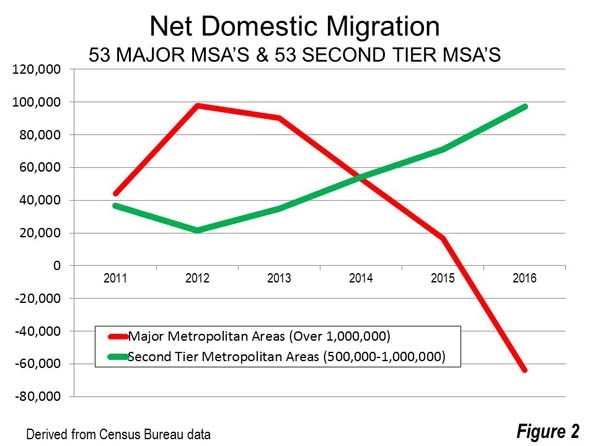
    The big, and perhaps surprising, news here is that the “second tier” of metropolitan areas   (between 500,000 and 1 million population) have begun to perform better than their larger counterparts, a result reminiscent of the last decade. These 53 metropolitan areas gained 97,000 net domestic migrants, topping the major metropolitan areas for the third year in a row (Figure 2). Since the 2010 census, second tier metropolitan areas have gained 334,000 domestic migrants. This is 0.92 percent of the 2010 census population, seven times the major metropolitan area figure of 0.13 percent.

    Where People Are Moving To and Away From

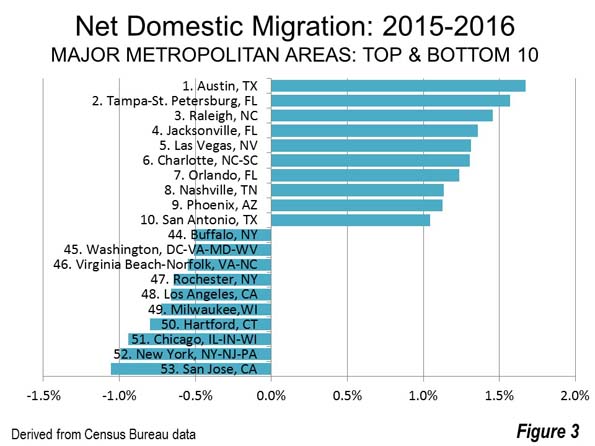
    As has become customary, the greatest rates of domestic migration among the major metropolitan areas are overwhelmingly in the South. Austin is again number one, gaining nearly 1.7 percent from domestic migration. Austin is followed by Tampa St. Petersburg, Raleigh and Jacksonville. Las Vegas is the only non-southern major metropolitan area among the top five in net domestic migration. The second five includes four southern metropolitan areas, Charlotte, Orlando and Nashville, ranking sixth through eighth and San Antonio ranking tenth. Phoenix placed ninth.

    The bottom 10 are a relatively familiar group of metropolitan areas, with San Jose placing last and being alone in having more than one percent (1.1 percent) of its population move away between 2015 and 2016. San Jose was also last in net domestic migration in the decade of the 2000s, if hurricane ravaged New Orleans is excluded. The bottom five also includes New York, Chicago, Hartford and Milwaukee. Los Angeles had the sixth worst net domestic migration, followed by Rochester, Virginia Beach-Norfolk, Washington and Buffalo (Figure 3).

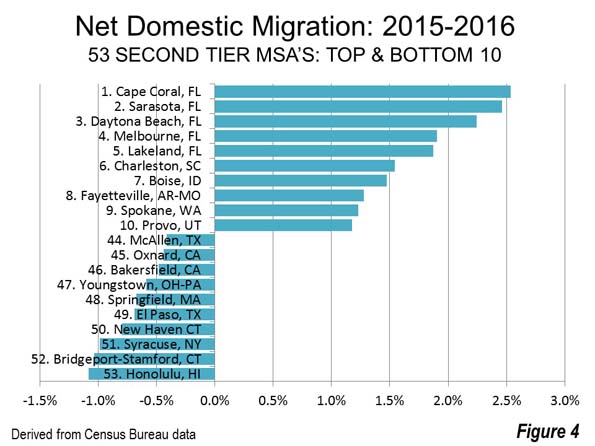
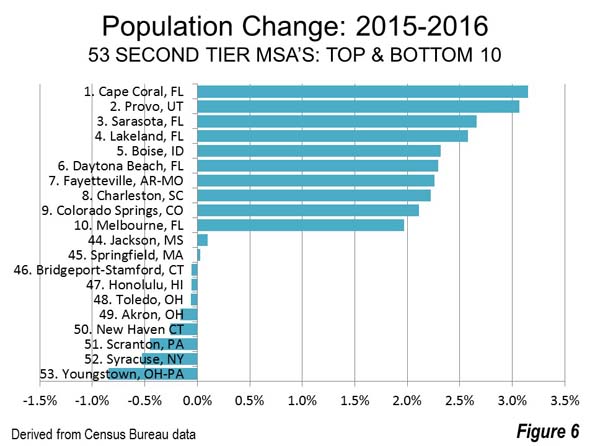
    The net domestic migration leaders among the large metropolitan areas posted even stronger gains than Austin. All of the top five had greater net domestic migration rates, and all are in Florida. Leader Cape Coral added more than 2.5 percent to its population from domestic migration. Nearby Sarasota was near 2.5 percent in Daytona Beach was also over two percent. Melbourne and Lakeland were approximately 1.9 percent. The second five was led by Charleston, South Carolina, followed by Boise, Fayetteville AR-MO, Spokane and Provo, UT.

    The largest domestic migration loss was in Honolulu, at 1.1 percent and slightly worse than San Jose (minus 1.08 percent compared to 1.06 percent in San Jose). Two of New York’s commuter rail exurbs ranked second and fourth worst, Bridgeport-Stamford and New Haven, while Syracuse ranked third. El Paso had the fifth worst net domestic migration. The second five worst in net domestic migration were Springfield, Massachusetts, Youngstown, Bakersfield, Oxnard and McAllen, Texas (Figure 4).

    Population Rankings and Trends

    Again, New York, Los Angeles, Chicago, Dallas-Fort Worth and Houston were the largest. They were followed by Washington (which passed Philadelphia last year), Philadelphia, Miami, Atlanta and Boston. There was no change in the rankings of the top 22 major metropolitan areas. Portland dropped two notches, from 23rd to 25th largest, as both Orlando and San Antonio jumped ahead. Austin jumped 2 positions, passing both Cleveland and Columbus, becoming the 31st largest metropolitan area. Finally, Raleigh passed Louisville to become the 43rd largest metropolitan area. The table at the end of the article includes information on the 106 largest metropolitan areas.

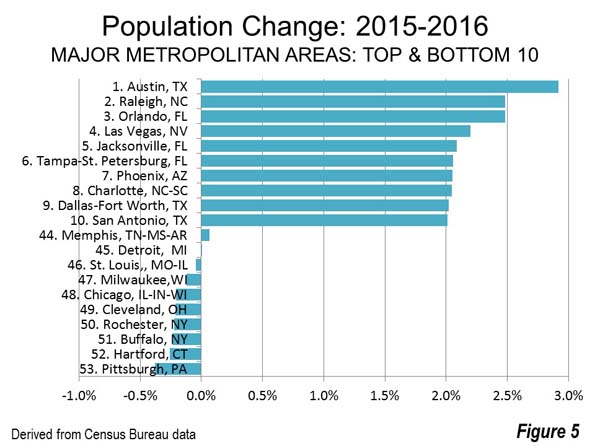
    The population growth rates for both the major and second tier  metropolitan area leaders and trailers looks similar to the domestic migration rankings (Figures 5 and 6). Austin leads the majors and Cape Coral leads the large metropolitan areas. There are greater differences in the bottom ten, where some of the largest domestic migration losers (such as New York, Los Angeles and Chicago) attract strong international migration have been replaced by others that attract fewer, and tend to have lower population growth rates as a result.

    More Major Metropolitan Areas?

    Meanwhile, some metropolitan areas should soon pass the 1,000,000 mark. Honolulu has been at the top of the list for some time. If the annual growth rates from 2010 to 2013, 2014 or 2015 had been sustained, Honolulu would have reached a million by 2016. But, Honolulu’ growth rate has slowed substantially in each of the last years since 2012, culminating in a modest population loss in 2016, leaving Honolulu 7,000 short of a million. Current growth rates suggest that Tulsa and Fresno could get to a million before Honolulu.

    Reason For Concern

    While the domestic migration data has long since disproven any thesis of a general movement of people from the suburbs to the urban core, the escalation in core county domestic migration losses is cause for concern.

    The urban cores are far nicer places than they were before. But their recovery has been all too concentrated ; meanwhile the rings around trendy downtown residential areas continue, as before the micro-core renaissance, to suffer serious poverty levels and other social ills more intensely than elsewhere. We have been down a similar road before, and have never recovered from the serious costs.

    Note: Major metropolitan areas have more than 1,000,000 population. The domestic migration comparison between core and suburban counties is limited to 50 of the 53 metropolitan areas, because four have only one county (Las Vegas, San Diego and Tucson). The lowest geographical level at which domestic migration data is available is counties. The core counties are often so large that they include large suburban components. This makes for a more crude comparison than would be the case if more precise data were available.

    Metropolitan Areas Over 500,000:  Population Estimates: 2016
    Population (Millions) 2015-2016
    Rank Metropolitan Area 2010 2015 2016 Population Change Net Domestic Migration Rank: Domestic Migration
    1 New York, NY-NJ-PA     19.566    20.118    20.154 0.18% -0.99% 103
    2 Los Angeles, CA     12.829    13.269    13.310 0.31% -0.66% 95
    3 Chicago, IL-IN-WI       9.462      9.533      9.513 -0.21% -0.94% 101
    4 Dallas-Fort Worth, TX       6.426      7.090      7.233 2.02% 0.85% 25
    5 Houston, TX       5.920      6.647      6.772 1.88% 0.42% 38
    6 Washington, DC-VA-MD-WV       5.636      6.078      6.132 0.88% -0.51% 91
    7 Philadelphia, PA-NJ-DE-MD       5.966      6.062      6.071 0.14% -0.43% 84
    8 Miami, FL       5.566      6.002      6.066 1.08% -0.28% 72
    9 Atlanta, GA       5.287      5.699      5.790 1.59% 0.64% 30
    10 Boston, MA-NH       4.553      4.767      4.794 0.58% -0.35% 76
    11 San Francisco, CA       4.336      4.642      4.679 0.80% -0.26% 69
    12 Phoenix, AZ       4.193      4.568      4.662 2.05% 1.13% 20
    13 Riverside-San Bernardino, CA       4.225      4.475      4.528 1.17% 0.34% 43
    14 Detroit,  MI       4.296      4.298      4.298 0.00% -0.47% 86
    15 Seattle, WA       3.440      3.727      3.799 1.93% 0.83% 26
    16 Minneapolis-St. Paul, MN-WI       3.349      3.518      3.551 0.93% 0.01% 57
    17 San Diego, CA       3.095      3.290      3.318 0.84% -0.25% 68
    18 Tampa-St. Petersburg, FL       2.784      2.971      3.032 2.06% 1.57% 7
    19 Denver, CO       2.544      2.809      2.853 1.58% 0.72% 28
    20 St. Louis,, MO-IL       2.788      2.808      2.807 -0.05% -0.41% 83
    21 Baltimore, MD       2.711      2.794      2.799 0.18% -0.40% 81
    22 Charlotte, NC-SC       2.217      2.425      2.474 2.05% 1.31% 13
    23 Orlando, FL       2.134        2.38      2.441 2.48% 1.24% 15
    24 San Antonio, TX       2.143        2.38      2.430 2.01% 1.04% 21
    25 Portland, OR-WA       2.226      2.385      2.425 1.68% 1.01% 22
    26 Pittsburgh, PA       2.356      2.351      2.342 -0.38% -0.33% 73
    27 Sacramento, CA       2.149      2.268      2.296 1.27% 0.54% 34
    28 Cincinnati, OH-KY-IN       2.115      2.155      2.165 0.45% -0.06% 61
    29 Las Vegas, NV       1.951      2.109      2.156 2.20% 1.31% 12
    30 Kansas City, MO-KS       2.009      2.084      2.105 0.96% 0.32% 44
    31 Austin, TX       1.716      1.998      2.056 2.92% 1.67% 6
    32 Cleveland, OH       2.077      2.060      2.056 -0.21% -0.49% 89
    33 Columbus, OH       1.902      2.020      2.042 1.06% 0.22% 48
    34 Indianapolis. IN       1.888      1.987      2.004 0.89% 0.13% 51
    35 San Jose, CA       1.837      1.969      1.979 0.52% -1.06% 105
    36 Nashville, TN       1.671      1.829      1.865 1.99% 1.14% 19
    37 Virginia Beach-Norfolk, VA-NC       1.677      1.723      1.727 0.20% -0.55% 92
    38 Providence, RI-MA       1.601      1.613      1.615 0.13% -0.24% 66
    39 Milwaukee,WI       1.556      1.574      1.572 -0.12% -0.72% 98
    40 Jacksonville, FL       1.346      1.448      1.478 2.09% 1.36% 11
    41 Oklahoma City, OK       1.253      1.357      1.373 1.20% 0.40% 39
    42 Memphis, TN-MS-AR       1.325      1.342      1.343 0.07% -0.48% 88
    43 Raleigh, NC       1.130      1.271      1.303 2.48% 1.46% 10
    44 Louisville, KY-IN       1.236      1.278      1.283 0.46% -0.01% 58
    45 Richmond, VA       1.208      1.270      1.282 0.89% 0.26% 46
    46 New Orleans. LA       1.190      1.262      1.269 0.54% -0.07% 62
    47 Hartford, CT       1.212      1.210      1.207 -0.26% -0.80% 100
    48 Salt Lake City, UT       1.088      1.168      1.186 1.60% 0.32% 45
    49 Birmingham, AL       1.128      1.145      1.147 0.22% -0.05% 60
    50 Buffalo, NY       1.136      1.135      1.133 -0.24% -0.51% 90
    51 Rochester, NY       1.080      1.081      1.079 -0.22% -0.64% 94
    52 Grand Rapids, MI       0.989      1.038      1.047 0.84% 0.11% 53
    53 Tucson, AZ       0.980      1.008      1.016 0.79% 0.25% 47
    54 Honolulu, HI       0.953      0.993      0.993 -0.06% -1.08% 106
    55 Tulsa, OK       0.938      0.980      0.987 0.69% 0.17% 50
    56 Fresno, CA       0.930      0.972      0.980 0.80% -0.27% 71
    57 Bridgeport-Stamford, CT       0.917      0.945      0.944 -0.05% -1.04% 104
    58 Worcester, MA-CT       0.917      0.934      0.936 0.17% -0.39% 79
    59 Omaha, NE-IA       0.865      0.914      0.924 1.08% 0.12% 52
    60 Albuquerque, NM       0.887      0.905      0.910 0.52% 0.11% 54
    61 Greenville, SC       0.824      0.873      0.885 1.34% 0.88% 24
    62 Bakersfield, CA       0.840      0.879      0.885 0.60% -0.48% 87
    63 Albany, NY       0.871      0.881      0.882 0.12% -0.25% 67
    64 Knoxville, TN       0.838      0.861      0.869 0.86% 0.73% 27
    65 New Haven CT       0.862      0.859      0.857 -0.26% -0.79% 99
    66 McAllen, TX       0.775      0.839      0.850 1.25% -0.41% 82
    67 Oxnard, CA       0.823      0.848      0.850 0.24% -0.44% 85
    68 El Paso, TX       0.804      0.837      0.842 0.57% -0.69% 97
    69 Allentown, PA-NJ       0.821      0.833      0.836 0.31% -0.08% 63
    70 Baton Rouge, LA       0.803      0.830      0.835 0.65% 0.03% 56
    71 Columbia, SC       0.767      0.810      0.817 0.95% 0.48% 36
    72 Dayton, OH       0.799      0.800      0.801 0.11% -0.17% 65
    73 Sarasota, FL       0.702      0.768      0.788 2.66% 2.46% 2
    74 Charleston, SC       0.665      0.745      0.761 2.22% 1.54% 8
    75 Greensboro, NC       0.724      0.752      0.756 0.58% 0.17% 49
    76 Little Rock, AR       0.700      0.732      0.735 0.42% -0.10% 64
    77 Stockton, CA       0.685      0.723      0.734 1.41% 0.57% 32
    78 Cape Coral, FL       0.619      0.700      0.722 3.15% 2.54% 1
    79 Colorado Springs, CO       0.646      0.698      0.712 2.11% 1.16% 18
    80 Akron, OH       0.703      0.703      0.702 -0.16% -0.35% 75
    81 Boise, ID       0.617      0.676      0.691 2.32% 1.47% 9
    82 Lakeland, FL       0.602      0.649      0.666 2.58% 1.87% 5
    83 Winston-Salem, NC       0.641      0.658      0.662 0.64% 0.45% 37
    84 Syracuse, NY       0.663      0.660      0.657 -0.53% -0.99% 102
    85 Ogden, UT       0.597      0.642      0.654 1.88% 0.69% 29
    86 Madison, WI       0.605      0.641      0.649 1.30% 0.49% 35
    87 Wichita, KS       0.631      0.643      0.645 0.26% -0.35% 74
    88 Daytona Beach, FL       0.590      0.623      0.638 2.29% 2.24% 3
    89 Des Moines, IA       0.570      0.623      0.635 1.95% 0.95% 23
    90 Springfield, MA       0.622      0.630      0.630 0.02% -0.67% 96
    91 Toledo, OH       0.610      0.606      0.605 -0.06% -0.37% 77
    92 Provo, UT       0.527      0.585      0.603 3.07% 1.18% 17
    93 Augusta, GA-SC       0.565      0.590      0.595 0.83% 0.35% 42
    94 Jackson, MS       0.568      0.579      0.579 0.10% -0.37% 78
    95 Melbourne, FL       0.543      0.568      0.579 1.97% 1.91% 4
    96 Harrisburg, PA       0.549      0.565      0.568 0.52% -0.03% 59
    97 Durham, NC       0.507      0.551      0.560 1.51% 0.55% 33
    98 Spokane, WA       0.528      0.547      0.557 1.69% 1.23% 16
    99 Scranton, PA       0.564      0.558      0.555 -0.45% -0.40% 80
    100 Chattanooga, TN-GA       0.528      0.547      0.552 0.85% 0.64% 31
    101 Youngstown, OH-PA       0.566      0.549      0.545 -0.85% -0.59% 93
    102 Modesto, CA       0.514      0.535      0.542 1.15% 0.38% 40
    103 Lancaster, PA       0.519      0.536      0.539 0.40% -0.26% 70
    104 Portland, ME       0.514      0.527      0.530 0.54% 0.37% 41
    105 Fayetteville, AR-MO       0.463      0.513      0.525 2.26% 1.28% 14
    106 Santa Rosa, CA       0.484      0.501      0.503 0.32% 0.06% 55
    From: US Census Bureau Data

    Wendell Cox is principal of Demographia, an international public policy and demographics firm. He is a Senior Fellow of the Center for Opportunity Urbanism (US), Senior Fellow for Housing Affordability and Municipal Policy for the Frontier Centre for Public Policy (Canada), and a member of the Board of Advisors of the Center for Demographics and Policy at Chapman University (California). He is co-author of the "Demographia International Housing Affordability Survey" and author of "Demographia World Urban Areas" and "War on the Dream: How Anti-Sprawl Policy Threatens the Quality of Life." He was appointed to three terms on the Los Angeles County Transportation Commission, where he served with the leading city and county leadership as the only non-elected member. He served as a visiting professor at the Conservatoire National des Arts et Metiers, a national university in Paris.

    Photo: Coral Gables Florida (MSA), largest domestic migration and population gain of any metropolitan area over 500,000 population, 2015-2016 (by author)

  • Hollywood’s Self-Inflicted Wounds

    No industry is more identified with Southern California than entertainment. Yet, in the past, the industry’s appeal has lain in identifying with the always-changing values and mythos of American society. But, today, that connection is being undermined, not just by technology, but also by a seemingly self-conscious decision to sever the industry’s links with roughly half of the population.

    This was painfully obvious during the Oscars — the penultimate event of the seemingly endless award season — when speaker after speaker decided to spend their moments of fame denouncing President Donald Trump. For all his personal failings, and often misguided policies, most Republicans and independents disapprove of the relentless Trump bashing in the media.

    Hollywood’s decision to make itself part of the anti-Trump resistance would make for wonderful satire, if you could get it on film. Imagine feminist icon Emma Watson fighting for “women’s empowerment” while baring her breasts in Vanity Fair. Or a host of social justice warriors, like Meryl Streep, demanding justice for the dispossessed, then returning to their estates where these victims of Trumpism are not likely to be found outside the servants’ quarters.

    The results also have a hard side: dismal ratings, down from a traditional viewership of 40 million to a mere 32 million, following a pattern that has seen it slide badly the last three years. Most Trump voters turned off the political speeches, notes one survey. But the Academy had other ways to show its contempt for its customers: None of the 10 largest grossing movies, notes USA Today’s Mitch Albom, got nominated for best picture, best actor or actress, or for supporting roles.

    The everyman era

    The preference of sophisticated opinion may be quintessential to Europe’s boutique film industry, but the blending of popular tastes with art has long propelled Hollywood’s historical success. This separation between audience and the Academy was not always the case. Films like “Gone with the Wind” (1939), “Around the World in 80 Days” (1956), “Ben-Hur” (1959), “The Sound of Music” (1965), “The Godfather” (1972), “Forest Gump” (1994) and “Titanic” (1997) all managed to be both blockbusters and best picture winners.

    Hollywood, wrote author Leo Rosten in 1940, was “the very embodiment” of “magic success,” allowing a truck driver to dream of being a hero, or a small-town waitress “to compare herself to a movie queen.” Hollywood was Middle American to the core, which appealed not just to our own audiences, but also to those around the world.

    In a political sense, Hollywood connected with Americans across the ideological spectrum. During the contentious 1930s, Hollywood could accommodate both the conservative myth of the loner — Gary Cooper and John Wayne — and also produce powerful dramas that touched on issues of class and inequality, such as “Our Daily Bread” (1934), “How Green Was My Valley” (1941) and “The Grapes of Wrath” (1940).

    Some progressive-leaning films were written by people who were later “blacklisted” during the McCarthy era, a tragedy that deprived the industry of some of its greatest talents. The industry instead favored biblical epochs like “Quo Vadis” (1951) as well as innocuous comedies starring the likes of Doris Day.

    “It was boy meets girl, lives happily ever after,” recalled former Los Angeles and Orange County Republican Congressman Bob Dornan, who grew up during this time. “There were clear-cut heroes and villains. Nazis torturing little old ladies, John Wayne landing on the beaches. … America was the bearer, the hope of the world.”

    Read the entire piece at The Orange County Register.

    Joel Kotkin is executive editor of NewGeography.com. He is the Roger Hobbs Distinguished Fellow in Urban Studies at Chapman University and executive director of the Houston-based Center for Opportunity Urbanism. His newest book, The Human City: Urbanism for the rest of us, was published in April by Agate. He is also author of The New Class ConflictThe City: A Global History, and The Next Hundred Million: America in 2050. He lives in Orange County, CA.

    Photo: BDS2006 [CC BY-SA 3.0 or GFDL], via Wikimedia Commons 

  • Fractions within the Working Class

    This has been a rough year.  After the election, I reposted a few articles on my Facebook wall, as did so many of my friends, about the “working-class vote.”  Did the white working-class just elect Trump?  I didn’t think so, but I also understood that the world can look very different to a working-class person than it does to a middle-class one.  I knew this because I grew up poor, and it is a constant struggle speaking to both sides of my life, my past and my present, my mother and my colleagues.  My mother, let me point out, did not vote for Trump.  She thinks he’s a jackass.  Two of her sisters did, however.  I don’t know anyone else in my extended family who voted for him.  There were lots of Bernie supporters, not many Clinton supporters, and a whole bunch of abstainers.

    A friend of mine from college, someone raised on the less wealthy spectrum of the educated middle class, took issue with even the idea of the “working class.” What was this really?  He knew a lot of blue-collar workers, plumbers, builders, who made a lot more money than he or his mother ever did.  I gave him the quick sociological explanations — it’s about power, not money, but his question remained with me.  Based on power at work, two-thirds of Americans can be classified as “working class” (see Michael Zweig’s excellent The Working-Class Majority).  That is a hell of a lot of people.  They don’t all think alike.  It struck me that sociologists, myself included, have spent untold ink arguing over the distinctions within the middle class (lower-middle, upper-middle, professional-managerial, those with economic capital vs. those with cultural capital, etc.) and where the line is between wherever this middle is and the top, and yet we have spent hardly any time  looking within the largest class of them all.

    So, I pulled out the General Social Survey (GSS), which has been asking thousands of Americans every year or so all about their lives, political identifications, and voting patterns. I decided to see if there were differences within the working class based on type of working-class job, and not on education, race or  income level.  Working-class jobs are those with little autonomy and often involving the use of one’s body – to wield a hammer, carry a baby, deliver a package from Amazon, stand all day greeting customers.  These jobs are held by a very diverse group of people; there are more people of color in the working class than in the middle or upper class.  When I refer to “the working class,” I mean this whole diverse group, not only white male workers.

    Let me give you a snapshot of five fractions of the working class: the Builders, the Makers, the Movers, the Clerks, and those who Serve (I call this category “CookCleanCare” to remind myself of the range of work within this fraction).  Builders most fit the stereotype of “the working class” (three-quarters are men, most are white, and many of them do wear hard hats at work), but it is only one fraction.  A more diverse lot are Makers, including assembly-line workers, tool-and-die makers, sewers, and cabinetmakers.  This is the fraction that has seen the largest influx of women in the past few decades, although still mostly male.  Movers include a wide array of transport jobs, from UPS drivers to ambulance drivers to long-haul truckers, also mostly men.  Most of those in the other two fractions are female. The CookCleanCare group includes those who prepare our food, clean our messes, and care for our children.  The Clerks are our growing retail worker category.  Back in the day being a clerk was seen as a move up, but today’s clerks are generally poorly paid and even less likely to hold a college degree than CookCleanCare workers (the most educated fraction).

    Here are some other interesting differences between the fractions.  Builders are the most likely to be living in the same place where they grew up, Makers the least likely.  Movers are the most likely to identify themselves as “working class.”  Twice as many Builders as Makers think of themselves as “middle class.”  Makers, in contrast, are more likely than the others to think of themselves as “lower class.”  In terms of income, Builders make the most money, Movers the least.   If we looked only at white men in each of the fractions, we would find the most instances of sexism, nativism, and racism among the Makers, perhaps reflecting the fact that this group has seen the biggest changes over the past few decades.  But it is important to note that a greater proportion of rich white men and white male managers express racist views than any working-class fraction does.

    During the past decade or two, ever since Reagan really, we have been hearing a lot about how “the working class” has turned its back on the Democratic Party.   But this is only true if we limit “the working class” to white men without college degrees.  If we include the whole of the working class, this claim is simply wrong.  According to my analysis of GSS data, there has never been a presidential election in which the majority of the working class voted for the Republican candidate.

    If we look at the working class based on broad occupational categories rather than race or education, we get a very different picture from “the working class” that political pundits have been talking about.  We don’t yet have GSS data for the 2016 election, but figures from 2012 suggest the value of analyzing working-class voters based on their jobs rather than income or education.

    This graph of voting patterns in the 2012 Presidential Election, arrayed by largest supporters of Obama from left to right, shows that while all occupational groups gave Obama a majority, two working-class fractions were at the polar ends of the spectrum. The Professional-Managerial Class fell near the middle. 

    Organizing the data by job categories also helps us understand that white working-class men don’t vote as a unified bloc. If we look only at white men, Obama’s lead lessens, with Romney winning slight majorities with Makers, Movers, and Clerks (not to mention lots of PMC support).  Why were white male Movers, Makers, and Clerks swayed by Romney while white male Builders and CookCleanCare were not?  For one thing, the Democratic Party may have forgotten Movers and Makers.  Women and people of color in these fractions may find other aspects of the Democratic party compelling, but white males less so.  All five fractions took an economic hit during the Recession and, unlike the PMC, none of them have recovered, as you can see from the chart below.  Makers even saw their wages decline before the recession hit.

    This points to the second problem with the “working class voting against their class interests” narrative.  Neoliberalism has clearly not been working for many working-class people.  The outrageous vote for Trump may be less an appreciation of his qualities or a heeled response to his dog-whistles and more a giant “Fuck You!” to the establishment.  If we don’t figure out a way to provide security and prosperity for all, we might just get neither for any of us.

    Class is a complicated construct.  Each fraction includes millions of workers, living in different parts of America, with different pasts, different futures, different understandings of how the world works. One way to gain deeper insight into the working class is to consider how major fractions within the working class respond to political appeals.  A call for massive infrastructure building, for example, is more likely to resonate with Builders, while a threat to cut the Department of Education may worry CookCleanCare members most.  It is also true that the nature of work changes, sometimes rapidly, as has been the case for many Makers and Clerks.  We owe the working class the respect of paying attention to which fractions are being mowed down on the front lines of neoliberalism.  It doesn’t seem like either major party has been doing a good job of this lately.

    This piece first appeared at Working Class Perspectives.

    Allison L. Hurst is an Associate Professor of Sociology at Oregon State University and the author of two books on the experiences and identity reformations of working-class college students, The Burden of Academic Success: Loyalists, Renegades, and Double Agents (2010) and College and the Working Class (2012).  She was one of the founders of the Association of Working-Class Academics, an organization composed of college faculty and staff who were the first in their families to graduate from college, for which she also served as president from 2008 to 2014. She is Chairperson of the Working-Class Academics Section of the Working-Class Studies Association.

  • Common Sense on Immigration

    No issue divides the United States more than immigration. Many Americans are resentful of the estimated 11 million undocumented immigrants, worry about their own job security, and fear the arrival of more refugees from Islamic countries could pose the greatest terrorist threat. At the other end of the spectrum are those who believe the welcoming words on the Statue of Liberty represent a national value that supersedes traditional norms of citizenship and national culture.

    What has been largely missing has been a sharp focus on the purpose of immigration. In the past, immigration was critical in meeting the demographic and economic needs of a rapidly growing nation. Simply put, the country required lots of bodies to develop its vast expanses of land and natural resources and to work in its factories.    

    The need for foreign workers remains important, but the conditions have changed. No longer a largely rural, empty country, more than 80 percent of Americans cluster in urban and suburban areas. Many routine jobs have been automated; factories, farms and offices function more efficiently with smaller workforces. Since at least 2000, notes demographer Nicholas Eberstadt, the “Great American Escalator” has stopped working.

    These changes suggest the need to rethink national immigration policies. In a country where wages for the poorest workers have been dropping for decades and incomes have stagnated for the middle class, allowing large numbers of even poorer people into the country seems more burden than balm. They often work hard, but largely in low-income service jobs and in the low end of the health care field. In California, home to an estimated 2.7 million largely Latino undocumented immigrants, approximately three in four Latino non-citizens struggle to make ends meet, as do about half of naturalized Latino citizens, according to a recent United Way study.

    Overall, our current immigrants, legal and illegal, have not advanced as quickly as in previous generations. This, along with the crisis in much of Middle America, should be our primary national concern. This doesn’t necessarily translate to mass deportations or even severe cutbacks in legal immigration, as some, including Attorney General Jeff Sessions and several congressional Republicans, have said. But it certainly does suggest taking a fresh look at how we view immigration.    

    Learning From Abroad

    So, what kind of immigration is best for America?

    Models to consider are those that put premiums on marketable skills and language proficiency rather than family reunification. The Canadian and Australian systems, as President Trump correctly noted, are more attuned to their own national needs, compared with the U.S approach, which emphasizes family re-unification. Canadian authorities allow some 60 to 70 percent of their immigrants to come for economic purposes, notes Carter Labor Secretary Ray Marshall, supporting their system mainly by “filling vacancies that are measured and demonstrated in the Canadian economy.”    

    Such a needs-based program would be a better, and fairer, way of addressing skills shortages than the odious H-IB program, which allows temporary indentured tech workers to replace American citizens. Instead, talented newcomers would be welcomed as future citizens and given the right to negotiate their own labor rates and conditions.

    This emphasis on admitting immigrants with needed skills leaves Canadians and Australians with generally more positive views about immigration than Americans. Australia is one of only three countries in the world where children of migrants do better at school than children of non-migrants. Canadian support for immigration is particularly high in Toronto, which has been transformed from a sleepy Anglo enclave to a vibrant, diverse global capital.

    But such hospitality is not limitless. A former Canadian immigration judge told me recently, in a tone of alarm, that his country’s invitation to 25,000 Syrian refugees could incubate the same sort of disorder that we see across Europe. There, in many heavily immigrant communities, poverty and isolation has persisted, sometimes for generations.    

    I doubt many Americans would want to see the kind of social unrest we see across once peaceful places like Sweden, where women now complain of being perpetually harassed, even as supposedly feminist politicians look the other way. In France, Muslims make up about 7.5 percent of the French population compared to 1 percent in the U.S., but France has been ravaged by Islamic terrorism, Muslim-fueled anti-Semitism, and a widening cultural gap between the immigrants and the indigenous French population. In France and many other European countries, we see the rise of nativist politicians that make Donald Trump seem like Mother Theresa.

    Citizenship and National Culture

    The United States could be headed to a similar devolution. America’s ideals may be universal, but our political community has always been based on U.S. citizenship. You should not have to be an Anglo to admire the Founders, or to embrace the importance of the Constitution. Yet it’s now fashionable among some progressive activists to reject established American political traditions, which constitute a fundamental reason people have come here for the last two centuries.

    Yet the “open borders” lobby on the progressive left increasingly demeans the very idea of citizenship. In some cases, they see immigration as way to achieve their desired end of “white America.” Some advocates for the undocumented, such as Jorge Bonilla of Univision, assert that America is “our county, not theirs” referring to Trump supporters. Others, like New York Mayor Bill di Blasio, refuse to differentiate between legal and illegal immigrants.

    As usual, California leads the lunacy. Gov. Jerry Brown, who famously laid out a “welcome” sign to Mexican illegal and legal immigrants, has also given them drivers’ licenses and provides financial aid for college, even while cutting aid for middle-class residents. Some Sacramento lawmakers are pressing to give undocumented immigrants’ access to state health insurance. Senate President Pro Tem Kevin de Leon recently boasted, “Half of my family would be eligible for deportation under the executive order, because they got a false Social Security card, they got a false identification.”

    The “open borders” ideology has reached its apotheosis in “sanctuary” cities which extend legal protection from deportation to criminal aliens, including those who have committed felonies. Donald Trump opportunistically emphasized this absurd and inappropriate situation—sometimes invoking the names of murdered Americans—during his 2016 campaign. The only mystery is why it would surprise the chattering class that many voters responded to his message.

    Most Americans are more practical about immigration than politicians in either party. The vast majority of us, including Republicans, oppose massive deportations of undocumented individuals with no serious criminal record. Limiting Muslim immigration appeals to barely half of Americans. Only a minority favor Trump’s famous “big beautiful wall” on the Mexico-U.S. border.

    Yet even in California, three-quarters of the population, according to a recent U.C.-Berkeley survey, oppose “sanctuary cities.” Overall, more Americans favor less immigration than more. According to a recent Pew study, most also generally approve tougher border controls and increased deportations. They also want newcomers to come legally and learn English, notes Gallup. This is not just an Anglo issue. In Texas, by some accounts roughly one-third of all Latino voters supported Trump.

    Sadly, immigration as an issue has been totally politicized. Obama deported far more undocumented aliens than his Republican predecessor, or any previous president, for that matter, without inciting mass hysteria. To be sure, Republicans face severe challenges with new generations that are more heavily Latino and Asian and generally more positive about immigration. The undocumented account for roughly one in five Mexicans and upwards of half of those from Central American countries, meaning that overly brutal approaches to their residency would be eventual political suicide for Republicans in many key states, including Arizona, Florida, Nevada, Colorado and even Georgia.

    Any new immigration policy has to be widely acceptable — both where immigrants are common as well as those generally less diverse areas where opposition to immigration is strongest. Unlike many issues, immigration cannot be devolved to local areas to accommodate differing cultural climates; it is, and will remain, a federal issue. A policy that melds a skills-based orientation, compassion, strong border enforcement, expulsion of criminals, and forcing the undocumented to the back of the citizenship line seems eminently fair.

    Economic Growth: The Secret Sauce of Immigration Policy

    Strong, broad-based economic growth remains the key to making immigration work. A weak economy, unemployment, population density, or sudden uncontrolled surges in migration, notes a recent Economic Policy Institute, drives most anti-immigration sentiment. The labor-backed think tank suggests it would be far better to bring in migrants with skills that are in short supply and avoid temporary workers, such as H-1B visa holders, who are paid lower wages, undercutting the employment prospects for Americans.

    Given the demands of competition and changes in technology, it seems foolish to allow many additional lower-skilled people enter our country. This is not elitism: Industry needs machinists, carpenters and nurses as well as computer programmers and biomedical engineers. What we don’t need to do is flood the bottom of the labor market. Again, this reality is race-neutral. Economist George Borjas suggests that the influx of low-skilled, poorly educated immigrants has reduced wages for our indigenous poor, particularly African-Americans, but also for the recent waves of immigrants, including Mexican Americans, over the past three decades.

    Like most high-income countries, America’s fertility rate is below that needed to replace the current generation. This constitutes one rationale for continued legal immigration. But our demographic shortcomings are also entwined with lack of economic opportunity, crippling student debt, and the high cost of family-friendly housing stock. In other words, one reason Millennials are putting off having children is because they can’t afford them.

    Overall immigration is a net benefit, if the economic conditions are right. An overly broad cutback in immigration would deprive the country of the labor of millions of hard-working people, many of whom are highly entrepreneurial. The foreign-born, notes the Kaufmann Foundation, are also twice as likely to start a business as native-born Americans. It’s always been thus—and these aren’t just small, ethnic, family-owned restaurants we’re talking about. More than 40 percent of Fortune 500 companies were founded by immigrants or their offspring.    

    American immigration has succeeded in the past largely due to economic expansion. The historical lesson is clear: a growing economy, more wealth and opportunity, as well as a sensible policy, are the true prerequisites for the successful integration of newcomers into our society.

    Joel Kotkin is executive editor of NewGeography.com. He is the Roger Hobbs Distinguished Fellow in Urban Studies at Chapman University and executive director of the Houston-based Center for Opportunity Urbanism. His newest book, The Human City: Urbanism for the rest of us, was published in April by Agate. He is also author of The New Class ConflictThe City: A Global History, and The Next Hundred Million: America in 2050. He lives in Orange County, CA.

    Photo: Jonathan McIntosh
  • Canada’s Urban Areas: Descent from Affordability

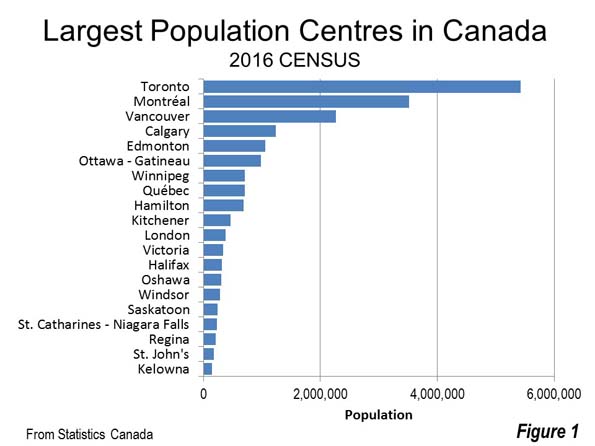
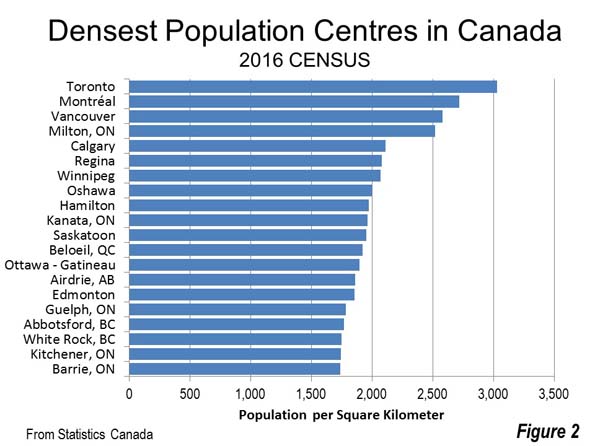
    Canada is a nation of wide open spaces, yet it has high urban area densities recently driven higher by a redefinition of urban area criteria (Note 1). Canada’s largest urban area (population centre) is Toronto, with a population of 5.4 million continues to be the densest of the 59 with more than 50,000 residents. Toronto has a population of 3,028 per square kilometer (7,843 per square mile), approximately five percent above the European Union average. Montréal (population of 3.5 million) has a density of 2,720 per square kilometer (7,045 per square mile), followed by third ranked Vancouver (2,584/6,693), which has a population of 2.2 million.  The top ten is rounded out by Milton, a fast growing Toronto exurb with a density of 2,520 per square kilometer or 6.527 per square mile, Calgary (2,112/5,470), Regina, the capital of Saskatchewan (2,082/5,391) and Winnipeg, which has seen renewed recent growth (2,070/5,360).

    Four other population centres have densities greater than 1,950 per square kilometer (5,000 per square mile , including  Oshawa and Hamilton, which are adjacent to Toronto, as well as Saskatoon, Saskatchewan and Kanata, an exurb of Ottawa (Figure 2).

    Comparisons to the United States

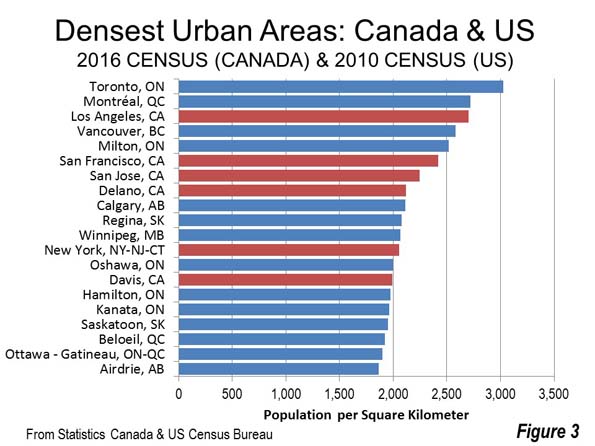
    The new, higher density figures are not surprising considering the especially compact suburbs in view when landing at Pearson Airport in Toronto, or even in Calgary or Edmonton. A combined Canada-US urban area density list illustrates the higher density of Canadian urban areas relative to those in the United States.  Among the five densest urban areas in Canada and the United States, four are in Canada. Los Angeles, the densest large urban area in the United States for the last three censuses, ranks third behind Toronto and Montréal. Vancouver and Milton rank fourth and fifth, just ahead of 6th ranked San Francisco. Immediately behind San Francisco is virtually all post-World War II suburban San Jose. Delano, California, an exurb of Bakersfield in the San Joaquin Valley has about 55,000 residents and ranks 8th on the combined list.

    Residents of Calgary, Regina and Winnipeg, where densification advocates repeatedly condemn their perceived local urban sprawl (a pejorative term for urban dispersion) will doubtless be surprised to know that their population density exceeds that of New York. Only one more US urban area makes the top 20, Sacramento exurb Davis, at 14th, with a population of 73,000 (Figure 3).

    Where’s Portland?

    To those inclined to venerate Portland’s internationally famous densification policies, this list may be disconcerting. Calgarians who bemoan the inferiority of their city in relation to Portland should be heartened to find out that Calgary’s density is more than 50 percent higher than Portland’s (Calgary’s transit market share is more than double Portland’s).

    Portland is not among the densest 20 urban areas , but ranks 72nd, just behind all-suburban Riverside-San Bernardino and a bit ahead of Halifax. If Portland were in Canada, it would rank 38th in population density out of the largest 59 urban areas.

    And Boston?

    Boston has a reputation as one of the densest cities in the United States. Yet, Boston’s huge urban area  is denser than only three of Canada’s urban areas on the list, Belleville, ON, North Bay, ON and Fredericton, NB. Each is smaller than Boston suburb Somerville, which has about 75,000 residents. Among the urban areas of  Canada and the US Boston is 218th in density. (Note 3).

    Urban Containment Not Density Associated with Unaffordability

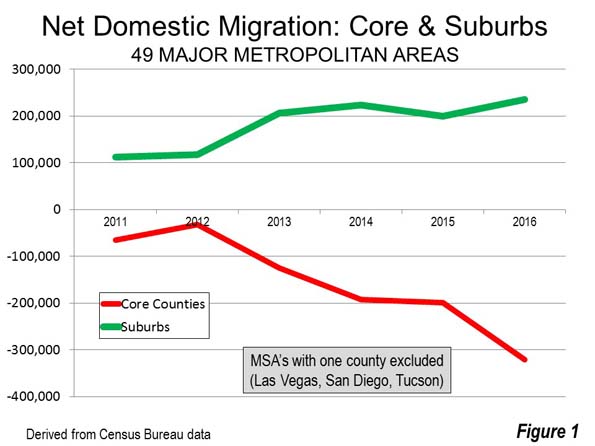
    Canada’s urban areas illustrate that density does not have to mean unaffordable housing. There has been some densification since 2000, but Canada’s urban areas were nearly as dense even then. For example, in the last 15 years, the completely developed city of Toronto, with all its new residential towers, has added only 10 percent to its population. Five of Canada’s six major metropolitan areas Toronto, Montréal, Ottawa-Gatineau, Calgary and Edmonton were affordable at the beginning of the new century, hovering around a median multiple 3.0.

    All that has changed, however, with the imposition of urban growth boundaries and equivalent policies. Ailin He and I showed in a Frontier Centre study (Canada’s Middle Income Housing Affordability Crisis) that house prices had “exploded” relative to household incomes between 2000 and 2015. This cannot be attributed to the modestly higher densities. The big change took place in land use policy, with, for example, Toronto and Calgary adopting urban containment policy that has been strongly associated with the destruction of housing affordability. Residents of Vancouver  — an urban area widely praised among planners —  have been paying the price for urban containment for much longer (Figure 4).

    Canada’s experience up to the end of the 20th century proves that dense and affordable urban areas can be achieved. But since that time, as house prices have risen relative to incomes, Canada’s experience shows that all that can be reversed in an environment of binding urban containment policy.

    Note 1: Between 2011 and 2016, Canada’s urban areas increased more than 40 percent in population density, according to Statistics Canada data. This, however, was not a miracle of urban containment policy or smart growth, it was rather an improved method adopted by Statistics Canada for measuring urbanization. Urban areas are the "physical city," which unlike the metropolitan area has only urban land. Canada now calls its urban areas "population centres," having changed to the new label in 2011, when the United Kingdom labeled them "built up urban areas."

    In 2011 and before, the Census had used municipalities as building blocks for urban areas. Often, those municipalities included large swaths of rural land (as did Los Angeles until well into the 1950s). Now, the building blocks for urban areas in Canada are "blocks", the lowest enumeration geography of the Census (the same revision was implemented by the US Census in 2000). Under the old definition, Canada’s urban areas had a density of 1,180 per square kilometer (3,057 per square mile) in 2011. Now it is 1,698 per square kilometer (4,397 per square mile), a 44 percent increase.

    Note 2: The comparisons are between the 2016 Census of Canada data and the 2010 US Census data, since urban area (population centre) data is only developed in the censuses (the next US census will be in 2020). The list is developed from the 59 urban areas in Canada and the 499 in the United States with 50,000-plus residents in the last censuses.

    Note 3:  A recent article found Boston to be almost five times as dense as Houston. However, this was in municipal (inside the city limits) density. City limits are artificial, political constructs that have nothing to with the organic city (the physical city , also called urban area or the economic city, or the metropolitan area , which is the labor market).  The Houston urban area, with its reputation for "sprawl" is actually one-third denser (1150/2979 ) than Boston’s (856 /2,278). At the physical city level, the urban area is the best indication of urban density. Using metropolitan density as an indicator of urban density is nonsensical, since all metropolitan areas include substantial rural territory.

    Wendell Cox is principal of Demographia, an international public policy and demographics firm. He is a Senior Fellow of the Center for Opportunity Urbanism (US), Senior Fellow for Housing Affordability and Municipal Policy for the Frontier Centre for Public Policy (Canada), and a member of the Board of Advisors of the Center for Demographics and Policy at Chapman University (California). He is co-author of the “Demographia International Housing Affordability Survey” and author of “Demographia World Urban Areas” and “War on the Dream: How Anti-Sprawl Policy Threatens the Quality of Life.” He was appointed to three terms on the Los Angeles County Transportation Commission, where he served with the leading city and county leadership as the only non-elected member. He served as a visiting professor at the Conservatoire National des Arts et Metiers, a national university in Paris.

    Photo: Suburban density in Toronto (Markham) by IDuke – English Wikipedia, CC BY-SA 2.5

  • Detroit’s Recovery? Oh Yeah, It’s Real Alright

    So it seems the debate has begun.  There’s been enough progress in Detroit to discuss whether its rebound is for real, or not.

    Two academics, Laura Reese of Michigan State University and Gary Sands of Wayne State University, wrote a piece for the Atlantic a couple weeks ago to counter the spreading narrative of Detroit’s comeback.  The article notes the Motor City’s rebound has caught the attention of the national media and parts of academia, but they aren’t so certain that the trend is real, or if it is, whether it’s indeed sustainable.  From the article:

    “These rosy descriptions were not consistent with the reality of what we continued to see in many Detroit neighborhoods. To provide perspective on Detroit’s comeback story, we examined trends in a variety of indicators including population, poverty, income disparities, business recovery, unemployment, residential sales prices and vacancies, and crime.

    Two major conclusions emerged from our data. First, by a number of measures Detroit continues to decline, and even when positive change has occurred, growth has been much less robust than many narratives would suggest. Second, within the city recovery has been highly uneven, resulting in increasing inequality.”

    In response to this article, blogger Lyman Stone added his take on Detroit’s recovery.  He seems to agree with Reese and Sands that, whatever is happening in Detroit, it’s not touching growing numbers of city residents, and therefore it’s not exactly a comeback:

    “I tend to be on team “Abandon all hope ye who enter here.” Saving Detroit is likely to be extremely costly while still holding a high risk of failure, in my opinion. But this view is predicated on a certain perspective of what it means to succeed. To some, success means population decline stops. To some, success means fewer empty buildings. To some, success means balanced municipal finances. To some, success means increasing employment. To me, I tend to think success means that huge population outflows will stop, and that population will begin to rise. Others may espouse other views, but I tend to think a locality’s ability to provide prosperity only matters in a general equilibrium framework, so a place that makes locals rich by culling the herd of non-rich locals is not “succeeding.” Success means that you offer prosperity to a rising share of the general population.”

    However, Stone notes that there are some positive demographic trends that are evident in Detroit, and seems to make the case that if Detroit is to get out of its hole, it’s at least stopping digging.

    The City Observatory’s Joe Cortright took a positive spin on Detroit in the Atlantic, going against the grain of both pieces and suggesting that Detroit’s comeback shouldn’t be dismissed:

    “Is Detroit “back?” As best I can tell, no one’s making that argument. The likelihood that the city will restore the industrial heyday of the U.S. auto industry, replete with a profitable oligopoly and powerful unions that negotiate high wages for modestly skilled work, just isn’t in the cards…

    That said, there’s clear evidence that Detroit has stanched the economic hemorrhage. After a decade of year-over-year job losses, Wayne County has chalked up five consecutive years of year-over-year job growth. True, the county is still down more than 150,000 jobs from its peak, but it has gained back 50,000 jobs in the past five years.”

    Honestly, I think each of the pieces — indeed, most people — underestimate the depths of Detroit’s collapse, and therefore underestimate the significance of its current recovery.  Detroit’s collapse was not simply an economic one, but a cultural, social and demographic one as well.  It lost virtually all connections with the networks of wealth and information that drive economic growth, and the city had such a pervasive negative perception that it was effectively erased from the minds of many.  What’s happening now is Detroit is reconnecting itself to the national and international network of cities, slowly returning to life among the living.  This is a necessary step for Detroit before any rebound that improves the lives of the majority its residents. 

    I view things this way.  While Detroit suffered immensely from the restructuring and decline of the auto industry, it likely suffered even more from demographic collapse.  Four years ago, I wrote a piece that showed the strength of the city’s demographic vacuum.  It’s not just that the city lost jobs and people moved.  People soured on Detroit in ways no other major city experienced, and left behind a city of concentrated poverty. I’ve often brought this graphic out, and it still amazes me:


    To his credit, Joe Cortright gets this in his article.  Where Reese and Sands argue that Detroit’s economic boost in the downtown and Midtown areas and some select nearby neighborhoods is raising income inequality, Cortright responds with a comment from the Brooking Institution’s Alan Berube: “Detroit does not have an income inequality problem—it has a poverty problem. It’s hard to imagine that the city will do better over time without more high-income individuals.”

    And that’s indeed the critical first step for Detroit.  It has to once again attract a critical mass of middle income and upper income residents who are ready, willing and able to invest in the city, before it can effectively take on its greater economic challenges. The post Great Recession recovery we’re witnessing now means the city is getting closer to being able to take on greater tasks.

    Pete Saunders is a Detroit native who has worked as a public and private sector urban planner in the Chicago area for more than twenty years.  He is also the author of “The Corner Side Yard,” an urban planning blog that focuses on the redevelopment and revitalization of Rust Belt cities.

    Top photo source tomabouttown.wordpress.com

  • The Economics of Dependency

    This article first appeared at Foreign Affairs.

    How countries hit the demographic sweet spot.

    Demographics are among the most important influences on a country’s overall economic performance, but compared with other contributors, such as the quality of governance or institutions, their impact is underappreciated.

    Demographic factors, such as the age structure of a population, can determine whether a given economy will grow or stagnate to an even greater extent than can more obvious causes such as government policy. One of the most consequential aspects of demographics as they relate to the economy is a phenomenon known as the “demographic dividend,” which refers to the boost to economic growth that occurs when a decline in total fertility, and subsequent entry of women into the work force, increases the number of workers (and thus decreases the number of dependents) relative to the total population. The demographic dividend has contributed to some of the greatest success stories of the twentieth century, and countries’ ability to understand and capture this dividend will continue to shape their economic prospects well into the future. Continue reading at Foreign Affairs >>>

    Sami Karam is the founder and editor of populyst.net and the creator of the populyst index™. populyst is about innovation, demography and society. Before populyst, he was the founder and manager of the Seven Global funds and a fund manager at leading asset managers in Boston and New York. In addition to a finance MBA from the Wharton School, he holds a Master’s in Civil Engineering from Cornell and a Bachelor of Architecture from UT Austin.

    Photo: infradept

  • Is L.A. Back? Don’t Buy the Hype.

    With two football teams moving to Los Angeles, a host of towers rising in a resurgent downtown and an upcoming IPO for L.A.’s signature start-up, Snapchat parent Snap Inc., one can make a credible case that the city that defined growth for a half century is back. According to Mayor Eric Garcetti, the Rams, Chargers and the new mega-stadium that will house them in neighboring Inglewood, show that “that this is a town that nobody can afford to pass up.”

    And to be sure, Los Angeles has become a more compelling place for advocates of dense urbanism. Media accounts praise the city’s vibrant art scene, its increasingly definitive food scene and urbanist sub-culture. Some analysts credit millennials for boosting the population of the region and reviving the city’s appeal. Long disdained by eastern sophisticates, there’s an invasion from places like New York. GQ magazine called downtown L.A. “America’s next great city” last year.

    Downtown has transformed itself into something of an entertainment district, with museums, art galleries, restaurants, and sports and concert venues. Yet it has not become, like San Francisco or New York, a business center of note. In fact, jobs in the region have continued to move out to the periphery; downtown accounts for less than 5% of the region’s employment, one-third to half the share common in older large cities.

    Downtown’s residential growth needs to be placed in perspective. Since 2000 the population of the central core has increased by only 9,500; add the  entire inner ring and the population is up a mere 23,000. Meanwhile over the same span, the L.A. suburbs have added 600,000 residents. Jobs? Between 2000 and 2014, the core and inner ring, as well as older suburbs, lost jobs, U.S. Census data show, while newer suburbs and exurbs added jobs.

    In our most recent ranking of the metro areas creating the most jobs, Los Angeles ranked a mediocre 42nd out of the 70 largest metro areas; San Francisco ranked first. That’s well behind places like Dallas, Seattle, Denver, Orlando, and even New York and Boston, cities that we once assumed would be left in the dust by L.A.

    A New Tech Hub?

    The emergence of Snap has led some enthusiasts to predict L.A.’s emergence as a hotbed of the new economy. And to be sure, there is a growing tech corridor in the Santa Monica-Marina area that may gradually gain critical mass. Talk of a growing confluence between tech and entertainment content — the signature L.A. product — and the proliferation of new entertainment venues, could position the area for future growth. At the same time, the presence of Elon Musk’s Space X in suburban Hawthorne, near LAX, has excited local boosters.

    Yet despite these bright spots, Los Angeles’ current tech scene is almost piteously small. One consistent problem is venture capital. Despite the massive size of its economy, and huge population, Los Angeles garners barely 5% of the nation’s venture capital, compared to 40% for the Bay Area, 10% for New York and Boston. Companies that were born in L.A. often end up moving elsewhere, like virtual reality pioneer Oculus, which was frog marched to the Bay Area after being acquired by Facebook.

    Indeed, despite bright spots like Snap, since 2001 STEM employment in the L.A. metro area has been flat, in sharp contrast to high rates of job growth in the San Francisco Bay Area, Austin, Houston and Dallas, and the 10% national increase. Tech employment per capita in the L.A. area hovers slightly below the national average, according to a recent study I conducted at Chapman University. Los Angeles County, once the prodigious center of American high-tech, is also now slightly below the national average of engineers per capita.

    The Poverty Economy

    The regional economy, notes a recent Los Angeles Development Corporation report, continues to produce largely numbers of low-wage jobs, mostly in fields like health, hospitality and services. Sixty percent of all new jobs in the area over the next five years will require a high school education or less, the report projects.

    At the same time in the year ending last September, employment dropped in three key high-wage blue collar sectors: manufacturing, construction and wholesale trade notes the EDC The largest gains were in lower-wage industries like health care and social assistance, hospitality and food service.  Since 2007 Los Angeles County has 89,000 fewer manufacturing jobs, which pay an average of $54,000, but 89,000 more in food service that pay about $20,000. No surprise more than one out every three L.A. households have an income under $45,000 a year.

    All this works well for the people who are increasingly coming to enjoy L.A.’s great restaurants, hipster enclaves and art venues. The football teams will add to this mixture, offering employment selling peanuts, popcorn and hot dogs to generally affluent fans in the stands.

    Yet low wages could prove catastrophic in a region that lags only the Bay Area in housing costs. Some 45,000 are homeless throughout the metro area, concentrated downtown but spreading throughout the region all the way to Santa Ana, in the south. Housing prices have risen to five times median household income, highest in the nation and more than twice the multiple in New York, Chicago, Houston or Dallas-Ft. Worth. L.A. leads the nation’s big metro areas in a host of other negative indicators, including the percentage of income spent on housing, overcrowding and homelessness. A city which once epitomized middle class upward mobility is increasingly bifurcated between a wealthy elite, mostly Anglo and Asian, and a largely poor Latino and African-American community.

    A recent United Way study, for example, found that 37% of L.A. families can barely make ends meet, well above the 31% average for the state; the core city’s south and east sides have among the largest concentrations of extreme poverty in the state. Once a beacon for migrants from all over America, L.A. now has a similarly high rate of mass out-migration as New York. But unlike New York, where immigrants continue to pour in, newcomers to the U.S. are increasingly avoiding Los Angeles – it had the lowest growth in its immigrant population of any major metropolitan area over the past decade. Perhaps even more revealing, the Los Angeles area has endured among the largest drops in the number of children since 2000,notes demographer Wendell Cox,  more than New York, Chicago and San Francisco.

    Altered DNA

    The writer Scott Timberg notes that L.A.’s middle class, was once “the envy of the world.” L.A. used to be a place where firemen, cops and machinists could own houses in the midst of a great city. Dynamic, large aerospace firms, big banks and giant oil companies sustained the middle class.

    But the city has lost numerous major employers over the years, most recently longtime powerhouse Occidental Petroleum, and the U.S. headquarters of both Toyota and Nestle. The regional aerospace industry, which provided nearly 300,000 generally high-wage jobs in 1990, is now barely a third that size. High housing cost have devastated millennials, whose home ownership rate has dropped 30% since 1990, twice the national average.

    Many urbanists hail the emergence of a transit-oriented, dense city. Since 1990, Los Angeles County has added seven new urban rail lines and two exclusive busways at the cost of some $16 billion. Yet ridership on the Metropolitan Transportation Authority rail and bus services is now less than its predecessor Southern California Rapid Transit District bus services in 1985, before any rail services were opened. The share of work trips on transit in the entire five-county Los Angeles metropolitan region, has also dropped, from 5.1% in 1980 and 4.5% in 1990 to 4.2% in 2015. Meanwhile the city endures the nation’s worst traffic.

    Some longtime Angelenos are mounting a fierce ballot challenge — known as Measure S — to slow down ever more rapid densification. The ballot measure would bar new high-density construction projects for the next two years. “The Coalition to Preserve L.A.,” which is funding the measure, claims to be leading in the polls for the March 7 vote, but faces well-financed opposition from politically connected large developers, Mayor Garcetti, both political parties, virtually the entire city council, and much of the academic establishment. The L.A. Times denounced Proposition S as a “childish middle finger to City Hall” and its architecture critic Christopher Hawthorne, has urged the citizenry “to move past the building blocks of post-war Los Angeles, including the private car, the freeway, the single-family house and the lawn.”

    Proposition S proponents include many neighborhood and environmental groups, as well progressives and conservatives, including former Mayor Richard Riordan. The people controlling Los Angeles may dream of being the “next” New York but many residents, notes longtime activist Joel Fox, “are tired of the congestion and development and feel that more building will only add to congestion.”

    Renewing La La Land

    Of course, slowing or banning development by popular proposition is probably not the ideal  way to get control over the deteriorating situation. Yet it is clear that the current trajectory towards more dense housing is not addressing the city’s basic problems. Los Angeles, as the movie “La La Land so poetically portrays, remains a “city of dreams” but that mythology is clearly being eroded by a delusional desire to be something else.

    In my old middle-class neighborhood in the San Fernando Valley, heavily populated by people from the creative industry, the worsening congestion, the upsurge of ever taller buildings and ever more present homeless did not reflect the giddiness of “La La Land.”

    Yet despite all these problems, Los Angeles has the potential to make a great comeback. It has a dispersed urban form that allows for innovation and diversity, and an unparalleled physical location on the Pacific Rim. Its ethnic diversity can be an asset, if somehow it can generate higher wage employment to stop the race to the bottom. The basics are all there for a real resurgence, if the city fathers ever could recognize that the City of Angels needs less a new genome but  should build on its own inimitable DNA.

    This piece first appeared in Forbes.

    Joel Kotkin is executive editor of NewGeography.com. He is the Roger Hobbs Distinguished Fellow in Urban Studies at Chapman University and executive director of the Houston-based Center for Opportunity Urbanism. His newest book, The Human City: Urbanism for the rest of us, was published in April by Agate. He is also author of The New Class ConflictThe City: A Global History, and The Next Hundred Million: America in 2050. He lives in Orange County, CA.

    Photo: AdamPrzezdziek

  • The Midwest, Redefined

    What if the region we broadly understand as the Midwest, stretching from the foothills of the Alleghenies to the high plains, and from the chilly northern Great Lakes to the Ohio, Mississippi and Missouri river valleys, had been allowed to develop as organically as its eastern and southern — and even western — neighbors?  

    If it had, it would be far better understood, have a much stronger cultural clarity, and more recognized for its contributions to American society and economy.

    Here’s what I mean.  The north central region of the U.S. has been an American paradox since its founding.  Unlike other regions of the country, where a critical mass of settlers established a colony or territory and then pursued legitimacy, the core of the region had its territorial boundaries established long before settlers had a chance to make a major imprint on the land.  That set off a race for control of the region by two already established regions, New England and Appalachia, with vastly different motivations — and cultural mores.  Because they came from different places, they took different paths to the Midwest.  New Englanders came via the Erie Canal and Great Lakes, while Appalachians traveled northward across the Ohio River.  Rather than intermingle and create a new and blended society, the New Englanders and Appalachians tended to maintain their local strongholds, with New Englanders in larger Great Lakes cities, and Appalachians in the upper regions of the Ohio Valley.  And this happened without any reconsideration or adjustment of political boundaries in the Midwest’s early days. 

    This has hampered our understanding of the Midwest ever since.

    Here’s a thought experiment.  Let’s say that instead of New York expanding to the shores of Lake Ontario and Lake Erie because it wanted to control development of the Erie Canal, western New Yorkers fought to establish their own state.  Similarly, let’s say that early settlers of western Pennsylvania recognized their remoteness from Harrisburg and Philadelphia, and decided local control suited them, too.  And let’s further suggest that, instead of becoming part of Ohio, the Connecticut Western Reserve was also allowed to develop as a separate state as well. 

    Ultimately, it’s conceivable that a new map of the Midwest, one that matches more closely to actual American settlement patterns, might look something like this:

    In my mind, as many as six new states could have emerged.  Western New York could’ve become Niagara, with Buffalo and Rochester as its key metropolises.  Western Pennsylvania could’ve become Allegheny, centered on Pittsburgh and Erie.  The Connecticut Western Reserve could’ve become Erie (or Cuyahoga?), greater Chicago could’ve been recognized as its own state, and the upper parts of Michigan, Wisconsin and Minnesota could’ve become Superior.  The southern part of Missouri could’ve become Ozark.

    The benefit of this is that the political environment aligns with the settlement patterns and modern-day networks of the region.  I’ve made similar points before about the cultural geography of the Midwest.  I think that because two different cultural groups inhabited the same space without ever effectively coming together, they’ve never maximized the development potential within either.  Yes, the Midwest was the nation’s manufacturing center for much of the 20th century, but it could be argued that it often did so in spite of rural and agricultural interests that were strong in state capitals like Columbus, Indianapolis and Springfield.  When manufacturing faded, those same interests often promoted the development of cities within their regions that were less tainted by a manufacturing legacy.

    Two years ago, I noted that, irrespective of state boundaries, the Midwest was somewhat aligned like this:

    And yet, the tension that was evident two centuries ago continues today.  For my “Five Midwests’ series, I quoted a passage from James McPherson’s book about the Civil War entitled Battle Cry of Freedom, in which he noted the economic, social and cultural differences between the Hoosiers, Buckeyes and Butternuts of the Ohio Valley, and the Yankees of the Great Lakes.  Today, geographers can track and map broad travel and commuting patterns that illustrate how we’re connected as a nation, and find those patterns still exist:

    “Danville, in central Illinois, is more closely connected to Des Moines, which is hundreds of miles away in Iowa, than it is to Chicago, which is much closer and in the same state.

    That’s not necessarily because there are tons of Danville commuters trekking to Des Moines. Rather, Nelson and Rae’s methodology shows they are both more tightly linked to the necklace of cities in between them—Urbana, Bloomington, Peoria, etc.—than they are to the cities that fall outside the entire zone.”

    Welcome to the characteristic that keeps the Midwest from being well understood as a region.

    Pete Saunders is a Detroit native who has worked as a public and private sector urban planner in the Chicago area for more than twenty years.  He is also the author of “The Corner Side Yard,” an urban planning blog that focuses on the redevelopment and revitalization of Rust Belt cities.