Category: Demographics

  • Fortress Australia: Groundhog Day

    A decade ago, politics in Australia lurched to embrace all things rural, happily demonizing urban interests. This happened in response to a renegade Politician – Pauline Hanson – who for a time captured public sympathy with populist anti-immigration sentiments, threatening to unseat entire governments in the process.

    Now the result of the recent National Election in Australia has seen not only the return of anti immigration sentiments, but the ascendency of anti-growth statements in mainstream politics. For a large country with only 24 million people, it’s a dangerous development.

    Two things are shaping in the aftermath of the 2010 Federal Election as portents of things to come for our economic future. One is the rise of an increasingly orthodox view that Australia at 24 million people is reaching its maximum sustainable population. The second is toward appeasing the agrarian socialism and social conservatism of rural politics. Together, this could mean we are about to usher in an era of low growth, high protection policies. Fortress Australia could easily become a reality no matter which side ultimately claims the keys to the Government benches.

    Prior to the recent Federal Election (August 2010) both major political parties have become shy of the country’s long term population growth patterns. In September 2009, Federal Treasurer Wayne Swan released some early findings of the Intergenerational Report, which predicted Australia could reach 35 million by 2050. Although this rate of growth was pretty much the same as the preceding 40 years, the figure was greeted with alarm by media, the community, and much of the political herd. ‘Australia Explodes’ went the headlines and the lemmings followed over an ideological cliff. (See this blog post from a year ago).

    A month later, then Prime Minister Kevin Rudd was proclaiming that he believed in ‘a big Australia’ but by mid 2010 his later nemesis Deputy Prime Minister Julia Gillard was proclaiming she ‘did not believe in a big Australia.’ Gillard replaced Rudd in a Labor Party coup, and then as Prime Minister declared we shouldn’t ‘hurtle’ toward 36 million but instead plan for a ‘sustainable’ population, renaming the recently created portfolio of ‘Population Minister’ the ‘Sustainable Population Minister’ in the process. The word ‘sustainable’ in this context stands for ‘slow down or stop.’

    Then came the election campaign with Opposition Leader Tony Abbot promising to ‘slash’ the ‘unsustainable’ immigration numbers (that his mentor John Howard had been responsible for as conservative Prime Minister for over a decade) and to ‘turn back the boats’ of illegal immigrants and asylum seekers, mainly from south east Asia or Afghanistan. Population growth was to be cut to 1.4% (a long term trend anyway) and migrants potentially forced to settle in rural areas (some dodgy form of zipcode migration policy).

    The message from both political leaders was clear: support for a ‘big Australia’ (35 million population by 2050 or the same rate of growth we’d seen in the last 40 years) was gone.

    Add to that the quixotic Australian entrepreneur Dick Smith and his population TV documentary ‘The Population Puzzle’ where he alleged Australia was at risk of running out of food, out of space and out of control, comparing us (oddly) with places like tiny Bangladesh (population 160 million). Smith might be mad but you can’t discount the impact he has on Australian popular opinion. People believe him, politicians included.

    Could it get any worse for the prospects of maintaining even modest levels of population growth in Australia? The last election outcome means the answer is yes. The balance of power in the Senate of the Australian Parliament will now be controlled by ‘The Greens’ (a left wing environmental party). The Greens’ view on population growth is clear: they don’t support it (unless oddly if you’ve arrived illegally, by boat). “This population boom is not economic wisdom, it is a recipe for planetary exhaustion and great human tragedy” said Greens leader Bob Brown when the Intergenerational Report was released last year.

    In the House of Representatives, the balance of power is now held by a handful of independents, representing rural seats. Socially conservative but economically protectionist, the independents’ views on population suggest they would lean toward the Abbot view: turn back the boats, and slow the overall rate of growth. They are quite likely to also push for a redistribution of economic riches to a range of projects for rural and regional areas. The irony that the election result hinged on big swings in urban seats but that a handful of rural independents are now trying to call the shots shouldn’t be lost on anyone.

    Joining the growing chorus of slow or no growth chants is municipal government. The Local Government Association of Queensland’s annual conference this year talked of limits on population growth unless bountiful riches are showered on local governments to cope with ‘unsustainable’ rates of growth. Association President Paul Bell says “councils cannot let population growth exceed infrastructure needs.”

    “Where we find water supplies no longer match the size of the community, where we find roads are congested, where we’re seeing other infrastructure whether it be health or education are falling behind,” he said, population growth was by implication to blame.

    The bottom line? Population growth is now a dirty word in politics and for any business which relies on growth for its prosperity, this is not good news. Everything from airports to property to construction to farming to retailers, manufacturers and tourism will be affected by slowing growth.

    Even social services could suffer if growth is deliberately slowed. Why? Because in 50 years time, without migration or natural growth, the ageing bubble of post-war baby boomers may mean there are two working adults for every five retired. You wouldn’t want to be one of those two and paying their tax bill in 50 years’ time or dependent on the kindness of those workers.

    How has this come about? The answer is simple: growth itself has never been the problem. Instead, it’s been a notoriously inefficient planning approach which has misdirected precious infrastructure spending, pushed up housing prices through artificial restraint on supply combined with usurious upfront levies, which now average $50,000 per dwelling in Queensland (often more) and considerably more in NSW.

    In the last decade, can anyone honestly claim that our planning schemes are now more efficient and quicker, or more easily understood, or better targeted, than a decade ago? I doubt it.

    Would it be too much to ask for a sensible, evidence-based approach that ties population growth to urban and regional strategies, which emphasises economic progress while maintaining lifestyle and environmental standards? How about some decent plans to link regional urban centres to major cities, based not on pork barrels to influential independents but based only on the business case and community mutual benefit? Or how about putting the ‘growth’ back into smart growth, with policies that allow our urban areas to expand in line with demand matched to infrastructure spending, rather than policy dogma?

    Those same questions were being asked a decade ago. Welcome to ground hog day.

    For those interested, here’s a couple of yarns from 10 years ago:
    Slicker Cities for City Slickers. October 1999.
    Nation Building and a National Urban Strategy. May 2001.

    Ross Elliott has more than 20 years experience in property and public policy. His past roles have included stints in urban economics, national and state roles with the Property Council, and in destination marketing. He has written extensively on a range of public policy issues centering around urban issues, and continues to maintain his recreational interest in public policy through ongoing contributions such as this or via his monthly blog The Pulse.

    Photo by Linh_rOm

  • The Livable Communities Act: A Report Card

    With much fanfare, the Banking Committee of the United States Senate approved the Livable Communities Act (S. 1619, introduced by Democratic Senator Dodd of Connecticut). A purpose of the act is expressed as:

    …to make the combined costs of housing and transportation more affordable to families.

    The Livable Communities Act would provide financial incentives for metropolitan areas to adopt “livability” policies, which are otherwise known as “smart growth,” “growth management” or “compact city” polices.

    “Livability” is the latest rallying cry for planners who want to draw lines around urban areas and force people out of their cars and into denser housing. Secretary of Transportation Ray LaHood has defined livability as “if you don’t want an automobile, you don’t have to have one.” This meaningless slogan presumes that people are forced to have cars. If you are rich enough, you can live without a car on the Upper East Side of Manhattan or Chicago’s Gold Coast. If you are poor enough, you cannot afford a car, which means fewer job prospects and higher retail prices from merchants serving a captive market.

    Perhaps someday we will be beamed from place to place as in Star Trek. However, in the interim, a serious alternative to the car – hopefully a far cleaner, more efficient version – does not loom on the horizon. For all but a privileged few, cars and the quality of life and cars will remain “joined at the hip”. This is why research shows a strong correlation between the automobile access in an urban area and economic growth.

    The Report Card

    It is not premature to issue a report card on the Livable Communities Act, since the effect of its favored policy prescriptions are already well known. Metropolitan areas more inclined toward the act’s menu of livability policies (such as Los Angeles, San Francisco, Portland, Washington and others) are compared to other metropolitan areas (such as Dallas-Fort Worth, Atlanta, Indianapolis, Kansas City and others). Our analysis shows that, for most people, livability policies produce less livability, in terms of higher costs and a lesser quality of life, especially in greater traffic congestion, longer travel times and more exposure to air pollution (Note 1). They will therefore be referred to as “so-called” livability policies.

    Housing Affordability: The Livable Communities Act seeks to make housing more affordable. Sadly, the record associated with such policies in terms of affordability is nothing short of dismal.


    The Livable Communities Act receives an “F” for home ownership affordability


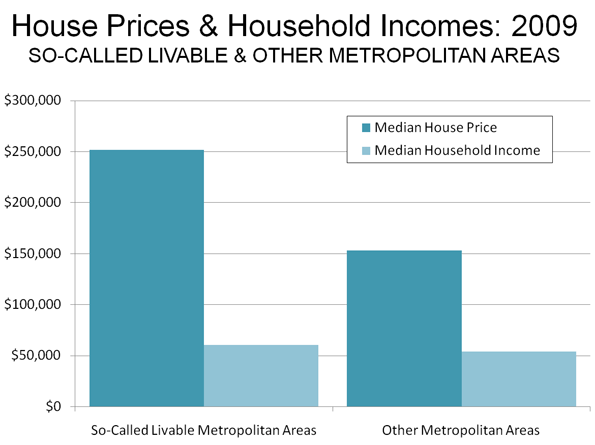
    House prices are considerably higher in the metropolitan areas more inclined toward so-called livability policies. The so-called livable metropolitan areas have nearly 50% higher house prices, after adjustment for incomes (Figure 1). If house prices were at the same level relative to incomes as in the other metropolitan areas, the median price would be $80,000 less. This would mean about $5,000 less in annual mortgage payments. In the least affordable so-called livable metropolitan areas, fewer than 40% of households can afford the median priced house (Los Angeles, New York and San Jose). In all the other metropolitan areas, more than 70% of households can afford the median priced house (Note 2). It takes a lot of gasoline to equal that difference.

    The Livable Communities Act receives an “F” for rental affordability.

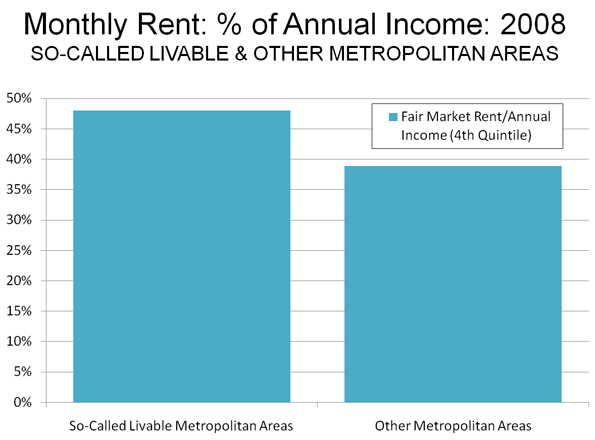
    Rents are also higher in the so-called livable metropolitan areas (Figure 2). The US Department of Housing and Urban Development “fair market rents,” (estimated at the 40th percentile of the rental market, including utilities) for a two bedroom apartment was 25% higher in the so-called livable metropolitan areas in relation to the fourth household income quintile (top of the bottom 25%).

    Why Housing is More Expensive in Livable Metropolitan Areas: The land use regulations typical of the so-called livable metropolitan areas force house prices up by prohibiting development on most available land (urban growth boundaries), imposing building moratoria or, in some cases, by requiring excessively large suburban lot sizes, making it impossible to build housing that is affordable to middle income households. All things being equal, prices increase where supply is restricted, as indicated by a broad economic literature.

    Transportation

    According to the findings in the Livable Communities Act the nation wastes 4.2 billion hours in traffic congestion and loses $87 billion annually from the costs of congestion. The congestion cost is principally the cost of time.

    Transportation Costs: Since commuting by transit nearly always takes longer than commuting by car (twice as long in 2007), any switch to transit is likely to increase costs (lost time is lost time, whether in a train or in a car). The balance of congestion costs are in excess fuel consumption, which would likely also increase under the so-called livability policies, because higher densities produce greater traffic intensities (this from Sierra Club based research), which means more congestion and slower travel speeds, which reduces fuel economy.

    The Livable Communities Act receives an “F” for transportation affordability

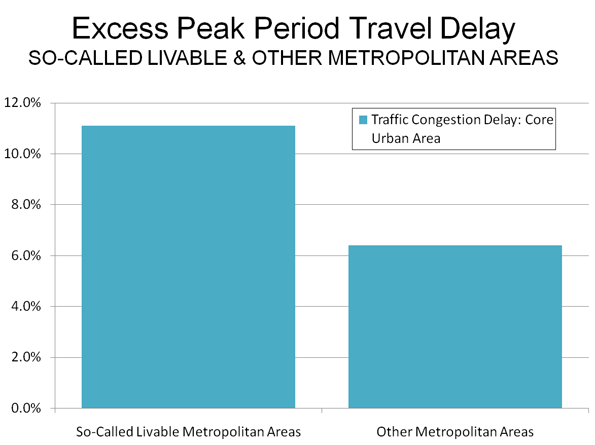
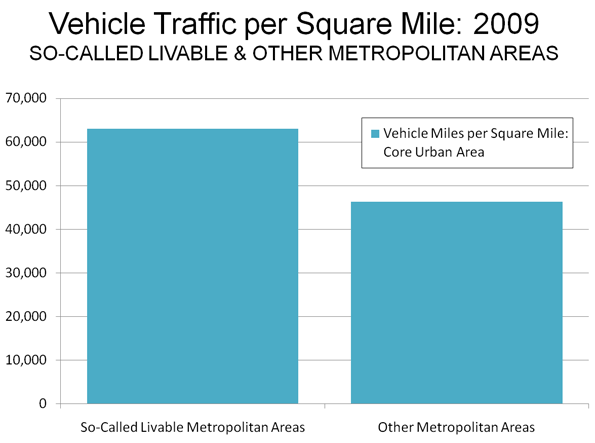
    Transportation Quality of Life: So-called livability policies worsen traffic congestion and air pollution. This is indicated by the latest INRIX traffic scorecard showing that average travel delays during peak travel periods are nearly 75% greater in the so-called livable metropolitan areas (Figure 3). Federal Highway Administration data indicates that the intensity of traffic is more than one-third higher in the so-called livable metropolitan areas (Figure 4)


    The greater traffic intensity also has negative health impacts. The American Heart Association noted that being close to congested roadways increases the likelihood of heart attack and stroke. The American Heart Association cites a study indicating that “a person’s exposure to toxic components of air pollution may vary as much within one city as across different cities.” Obviously, such exposure will be greater where traffic densities are higher.

    The Livable Communities Act receives an “F” on transportation related quality of life issues.

    Consumer Preferences

    In its findings, the Livable Communities Act says that the demand of new housing in dense, walkable (so-called “livable”) areas is 15 times the supply. This misses the extensive overbuilding of dense, walkable communities that ended in the huge condominium bust in Portland, Seattle, Los Angeles, Miami, Atlanta, Chicago and elsewhere. The supply of such housing exceeds the demand, particularly at the current price points.

    Consumer preferences are not revealed by planners’ delusions from surveys people answer in the abstract. For example, most people want shorter commutes, but they vastly prefer single family houses to apartments. In the real context of issues like costs, living space, or schools, people express their priorities.

    The “litmus” test of so-called livability is what people do, not what they say they might do. Households continue to vote with their cars and are moving away from so-called “livable” areas. According to 2009 domestic migration data compiled by the Bureau of the Census:

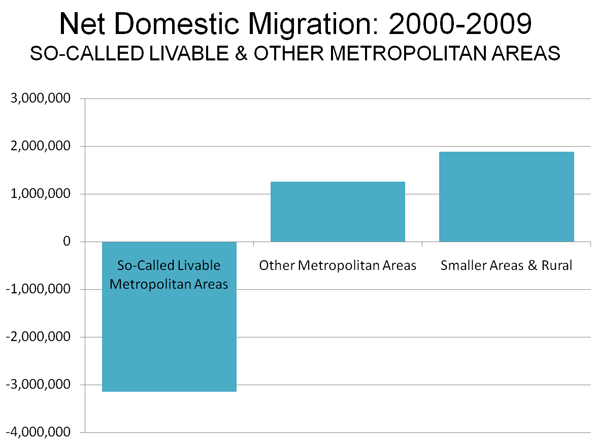
    • The so-called livable metropolitan areas lost more than a net 3,140,000 residents to other areas of the nation, while other metropolitan areas gained more than 1,000,000 and smaller areas gained nearly 2,000,000 (Figure 5).
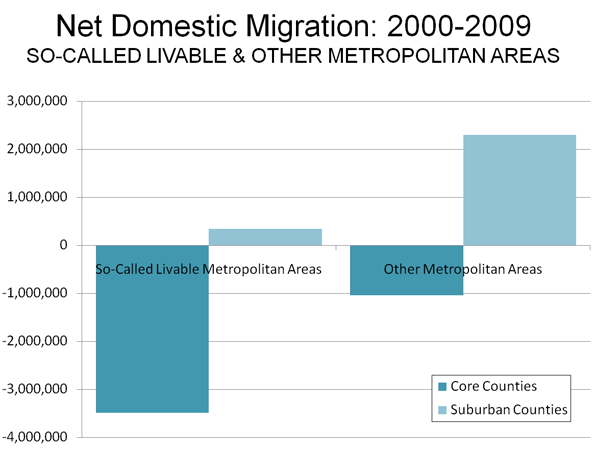
    • Nearly 3,500,000 residents left the core counties of the so-called livable metropolitan areas for other parts of the nation, while the suburbs gained 340,000 residents.
    • In the other metropolitan areas, more than 1,000,000 residents left the denser core counties, while the suburbs gained 2,300,000 (Figure 6).


    The Livable Communities Act receives an “F” for consistency with consumer preferences

    The Report Card: Not Livable at All

    The Livable Communities Act report card is shown below. In other words, if enacted, it is likely to produce a failing grade for families even if it wins straights A’s with planners, academics and inner city developers.

                                     Report Card

    Livable Communities Act

    Subject

    Grade

    Home Ownership Affordability

    F

    Rental Affordability

    F

    Transportation Affordability

    F

    Transportation Quality of Life

    F

    Consistency with Consumer Preferences

    F

    Overall Grade

    F

    Additional Comments: The favored policies would reduce mobility to major parts of the metropolitan area, which would reduce access to potential employment opportunities and retail establishments with lower prices.

    Note 1: The analysis covers metropolitan areas with more than 1,000,000 population. The “so-called” livable metropolitan areas are classified as those with “more restrictive” land use regulation by Demographia. The other metropolitan areas have less restrictive land use regulation. See note 7 of http://www.demographia.com/db-overhang.pdf.

    Note 2: Calculated from the National Association of Homebuilders-Wells Fargo Housing Opportunity Index.

    Wendell Cox is a Visiting Professor, Conservatoire National des Arts et Metiers, Paris and the author of “War on the Dream: How Anti-Sprawl Policy Threatens the Quality of Life

    Photo: Overbuilding Dense Walkability in Miami (photograph by author)

  • The Suburbanization of Religious Diversity

    You can see the changes. A drive through suburban Lake County, IN, an hour from downtown Chicago makes you feel like you are somewhere between the set of Jean Shepherd’s A Christmas Story and the movie Hoosiers. Cultural and religious diversity would probably be the last two things on your mind in a region known more for its steel industry than its sacred space.

    Yet a quick glance to the east side of Colorado Street heading south makes you question your assumptions. Neatly tucked between farm land and homes sitting on lots of an acre or more, you see two structures that cause you to scratch your head and wonder, “Am I really in Indiana?” The Northwest Indiana Islamic Center and the region’s Sikh Temple of the Sikh Religious Society of Indiana sit side by side. They provide a visual reminder that suburban America has changed.

    In fact, much has changed. Religion in America is alive and well, but it’s different. Although Christian churches continue to dominate the religious landscape in the United States, there are new religious neighbors. Cultures and religious traditions that once existed “somewhere over there”, have moved beyond the large cities of the U.S. into the suburbs and exurbs, places where evangelical mega-churches have flourished for decades.

    Today, the United States is arguably the most religiously diverse place on the planet. And if the ethnic makeup of the U.S. stays its course for the next half-century, religious diversity will grow exponentially. The Census Bureau predicts that minorities will become the majority in the U.S. within 40 years. Religion in America could have a more robust Latino-Catholic flavor, with Hispanics numbering one in three U.S. residents by 2050. American religious geography will also include influences from Asian Indian cultural traditions. In Bible Belt states like Georgia, Hinduism is one of the fastest growing religions with more than 40,000 Hindus in the state, according to the New Georgia Encyclopedia. By 2000, Islam had already surpassed Southern Baptists in Chicago, with more than 120,000 adherents. Less than 10 years later, Chicago’s Muslim population is estimated to be around 400,000. The big new thing is that this diversity is increasingly found in suburbs. Throughout the country’s history, the places where religious and cultural diversity have been most concentrated were her cities. In fact, this has been the case around the globe. Immigrants journeyed to urban contexts en masse. The city provided the best place for jobs, people networks, and ethnic and cultural affinities. And, a smorgasbord of religious enclaves in the city made it easy for spiritually-minded people to connect and worship with other adherents in their particular tribe.

    On the other hand, the suburban and rural places were viewed as narrow-minded and ethnically homogenous. They were often seemed – and sometimes were – hostile to different religions and cultures.

    In the not-too-distant past, the suburbs were, for the most part, devoid of religious adherence outside of Catholic, mainline, or evangelical groups. However, demographic shifts have put the suburbs on a different trajectory. And religious traditions have followed suit.

    From an ethnic and religious standpoint, cities and suburbs have changed. Some would say they have changed sides. Of course cities will continue to grow, as more than 50 percent of the world’s population lives in city-regions today. City-regions will undoubtedly become more diverse. However, there are major changes to the way we think about communities and their populations in an area of globalization and urbanization. Demographers like Audrey Singer of the Brookings Institution have pointed out that cities have become more suburban-like, and suburbs have become more city-like, though this transition has been slowed to some degree by the current recession.

    Newer cities like Atlanta and older ones like Baltimore share this same pattern. It does not matter if the city is more suburban-like, or if the city is more like the archetypical city built with an infrastructure suitable for immigrants. Both are regions where foreign-born populations bypass the city altogether. This process was well under way before the turn of the last century, when census data revealed that foreign-born populations preferred suburbs over cities.

    Not surprisingly, this phenomenon also brought changes in the country’s religious landscape. Yes, the city and her urban districts remain a viable context to find places of faith, but things have shifted a bit.

    For example, in the past century, Islam, by design an urban religion, certainly migrated to large cities in the U.S. – notably Detroit, Chicago, and New York. But today the ummah has spread to smaller cities and suburban settings. Many Muslims have moved beyond the urban perimeter. Dearborn, MI and Northwest Indiana’s Lake County are two good examples, but these are by no means the exceptions.

    Suburban-friendly cities with large evangelical populations like Atlanta have also seen an increase in other faith traditions. In 2006 and 2007, the BAPS Shri Swaminarayan Mandir Atlanta, said to be the largest Hindu temple of its kind in the United States, was built in suburban Gwinnett County in Lilburn, GA. Much of Georgia’s Hindu population is centered in the sprawling suburbs around Atlanta. The Daily Beast recently ranked Atlanta #6 on their list of the 30 leading cities for Muslims in America (see America’s Muslim Capitals). Two other smaller cities in Georgia made the list, — Albany and Columbus.

    Not only are other religious traditions navigating the suburbs and smaller cities well, but non-Anglo evangelical populations are trending suburban too. Atlanta’s large Korean population is primarily suburban, as are the city’s Korean churches. In the ethnically diverse Atlanta suburb of Duluth, a city of roughly 26,000, the majority of new churches started since 2000 have been Korean. The Korean Church of Atlanta (UMC) is on the path to become a mega-church with new construction and an estimated 1700 people who regularly attend. Korean churches in Duluth and the surrounding area are very diverse themselves, denominationally speaking. Korean congregations include churches from Methodist, Presbyterian, Baptist, and Independent denominations.

    Back in Northwest Indiana, despite the decline of manufacturing jobs and high unemployment rates, the region continues to grow, albeit incrementally. Perhaps the most intriguing statistic is the number of immigrants who have moved to the region in recent years. Between 1990 and 2000, more than 70 percent of Lake County’s growth was attributed to immigration, according to a Purdue University study on immigration in Indiana. Ethnic changes in Lake County brought shifts to the area’s religious geography, too. In the county’s suburban communities of Merrillville and Crown Point, residents can find the aforementioned Islamic Center, an Islamic school, an Indian Cultural Center, the Sikh Temple, and Serbian, Macedonian, and Croatian congregations.

    Some of these changes to Lake County’s religious community came during a period of rapid decline in church attendance. In 2008, The Northwest Indiana Times reported a drop in church attendance of almost 30 percent between 1990 and 2000. This does not mean that all churches in the county are shrinking. Some, in fact, have become quite large. But their biggest source of growth may not be from less familiar religious traditions.

    Economic and social values will continue to intersect new religious traditions in the suburbs as minorities and immigrant populations grow. The culture of suburbs, with individualist values, will continue to have a varying affect on how religious groups establish and sustain themselves. It will be interesting to see how new religious groups affect the culture around them in the suburban neighborhoods they now call home.

    Religion is not going away as some 20th century scholars presumed. What is changing is the country’s religious complexion. How communities grapple with this change may say much about how they thrive in the future.

    Since 2006, Travis Vaughn has conducted community studies in a number of U.S. cities. He is a visiting instructor at Covenant Theological Seminary and is the catalyst behind cityandcitizen.com, coming in the fall of 2010.

  • America’s 21st-Century Business Model

    Current attitudes aren’t too kind to the old American way of doing business. In our globalized economy, the most enthusiastically touted approaches are those adopted by centralized, state-dominated economies such as China, Brazil and Russia as well as–somewhat less oppressively–those of the major E.U. states.

    Yet the U.S. may well be constructing the best sustainable business model for the 21st Century. It is an approach built on the country’s greatest enduring strength–an innovative business culture driven increasingly by a diverse pool of immigrants.

    This model, of course, lacks the kind of centralized control beloved by many pundits. Yet its virtues are also missing from statist-oriented European or East Asian capitalism. These other regions’ systems may be more disciplined in their thinking, but they do not draw as well on the diversity of human experience and connections that drive America’s post-racial economy.

    This is not to suggest that state-based, national capitalism is inferior, but that it may not apply so well to this vast, highly diversified economy–just look at the stimulus. If the U.S. wants to retain pre-eminence, it needs to go with what makes it a great country: its protean national and increasingly post-racial business culture.

    This evolution is increasingly evident at the very top of our economy. Between 1990 and 2005 immigrants started one quarter of all venture-backed public companies. Large American firms are also increasingly led by people with roots in foreign countries, including 14 of the CEOs of the 2007 Fortune 100. Even the top tier of corporate America–once the almost-exclusive reserve of native-born Anglo-Saxon–increasingly reflects the diversification of the larger society.

    Already, for example, eight Indian American CEOs run U.S. corporations with over $2 billion in sales, including companies like Citicorp, Adobe Systems and Pepsico. Pepsi’s historic rival, Coca Cola, is now run by Muhtar Kent, a native of Turkey. Foreign CEOs also include Kellogg’s Australian-born David Mackay and Ethan Allen’s M. Farooq Kathwari, yet another native of India.

    This process will intensify in the coming decades. Take for instance the case of Li Lu, a former Tiananmen Square activist now widely expected to take the helm of Warren Buffett’s Berkshire-Hathaway when the old billionaire retires. Imagine if a former American radical was placed in charge of one of China’s huge state-supported enterprises. Not likely.

    One critical harbinger can be seen in the current crop of students at top U.S. business schools. Between one-third and one-half all students at Stanford, MIT, University of Pennsylvania, University of Chicago and UC Berkeley come from abroad. These schools are training camps for immigrants transitioning into careers as American entrepreneurs.

    Equally important, immigrant commerce also thrives at the grassroots level. It manifests most visibly in the proliferation of small stores, restaurants, food-processing businesses, garment factories and trucking lines. Overall, immigrants are 60% more likely to start a new business than native-born Americans. The number of self-employed immigrants has grown even in New York City, where the number of self-employed among the native-born has dropped.

    Immigrant businesses have thrived by providing basic services, such as banks, insurance agents, funeral homes and grocery stores. Some of these businesses arose because the mainstream community had failed to identify opportunities in these markets or had consciously decided to exclude them.

    This follows a historical pattern. In the past many immigrants succeeded by focusing on an economic specialty–Jews in the garment industry, Chinese in laundries, Greeks in diners, and Italians in green groceries, barbershops and fish stores. Ultimately, some moved beyond these niches and began to develop whole new business models. One clear example is A. P. Giannini’s Bank of Italy in San Francisco, which eventually became Bank of America, a pioneer in mass market branch banking. Other ethnic businesses, often drawing on ways of doing business brought from abroad, have propelled the growth of whole industries, such as the garment industry in New York and later Los Angeles.

    There is clearly something in the immigrant experience that encourages innovation–one can call it the advantage of non-acceptance. Take the founding generation of the film industry–Samuel Goldwyn, Louis B. Mayer, Harry Cohn, Jesse Lasky, Adolph Zukor. They had their roots in the Jewish enclave economy in the eastern cities. The great historian Irving Howe notes that the immigrant need to find an unoccupied or underserved niche shaped these often “vulgar, crude and overbearing” men. That they became founders of the nation’s premier cultural industry, Howe noted, “was something of a miracle and something of a joke.”

    We are now witnessing a continuation of this process, and on a scale simply not seen in other countries. In 2005 the U.S. swore in more new citizens than the next nine countries put together. The national immigration debate may focus largely on low-skilled newcomers, but more than half of all skilled immigrants in the world also come to the U.S. Even with the continent’s slow-growing population, Europe continues to be a major source of American immigrants, particularly skilled workers, with some 400,000 E.U. science and technology graduates residing in the U.S.

    These newcomers are a prime source of entrepreneurial vitality. In the 21st century Asians, like the Jews and Italians before them, have concentrated in specific niches and expanded outside the boundaries of historic ghettos. Indians from the subcontinent, who arrived in large numbers starting in the 1970s, specialized in hotels and motels across the country. Koreans opened up green groceries in New York and Los Angeles. Vietnamese became well-known for nail parlors, and Cambodians for owning doughnut stores. Overall Asian enterprises expanded roughly twice the national average through the first several years of the new century.

    This pattern can be seen particularly in food-related businesses. In Houston, once dominated by Southern cooking, nearly one in three restaurants serves Mexican or Asian cuisine. Together they account for more establishments than hamburger, BBQ and Italian restaurants put together. Nationwide, as pizza, hamburger and “traditional” fast-food restaurants have stagnated, new chains that sell quick, inexpensive Mexican or Asian food have flourished. Immigrant-founded firms such as El Pollo Loco, Wolfgang Puck and Panda Express, are emerging as the McDonalds of 21st-century America.

    The emerging post-racial economy provides two distinct opportunities for American business. First the newcomers offer a new domestic “emerging” market. Taken together, purchases by African-Americans, Asians and Native Americans, according to the Selig Center for Economic Growth at the University of Georgia, have exploded, growing far more rapidly than the national average. Combined with Latinos, these minorities could account for over $2.5 trillion by 2010, close to $1 in every $4 in total U.S. consumer spending.

    But perhaps even more important may be the uniquely international cast of American business. Heads of corporations and senior executives of many leading American firms will not have to go to graduate school in international training; they will have received theirs at home, talking to parents or grandparents who migrated from Mexico, Cuba, Russia, Iran, China, India, Israel or a host of other countries.

    This diversity will allow Americans to tap the global market, and culture, in ways other countries and their state-based enterprises just can’t match. It is in this model, not in imitating foreign ones, that American business can find the path to greater success in the globalized, dispersed economy of the 21st century.

    This article originally appeared at Forbes.com.

    Joel Kotkin is executive editor of NewGeography.com and is a distinguished presidential fellow in urban futures at Chapman University. He is author of The City: A Global History. His newest book is The Next Hundred Million: America in 2050, released in February, 2010.

    Photo by SEIU International

  • The Housing Bubble: The Economists Should Have Known

    Paul Krugman got it right. But it should not have taken a Nobel Laureate to note that the emperor’s nakedness with respect to the connection between the housing bubble and more restrictive land use regulation.

    A just published piece by the Federal Reserve Bank of Boston, however, shows that much of the economics fraternity still does not “get it.” In Reasonable People Did Disagree: Optimism and Pessimism About the U.S. Housing Market Before the Crash, Kristopher S. Gerardi, Christopher L. Foote and Paul S. Willen conclude that it was reasonable for economists to have missed the bubble.

    Misconstruing Las Vegas and Phoenix: They fault Krugman for making the bubble/land regulation connection by noting that the “places in the United States where the housing market most resembled a bubble were Phoenix and Las Vegas,” noting that both urban areas have “an abundance of surrounding land on which to accommodate new construction” (Note 1).

    An abundance of land is of little use when it cannot be built upon. This is illustrated by Portland, Oregon, which is surrounded by such an “abundance of land.” Yet over a decade planning authorities have been content to preside over a 60 percent increase in house prices relative to incomes, while severely limiting the land that could have been used to maintain housing affordability. The impact is clearly illustrated by the 90 percent drop in unimproved land value that occurs virtually across the street at Portland’s urban growth boundary.

    Building is largely impossible on the “abundance of land” surrounding Las Vegas and Phoenix. Las Vegas and Phoenix have virtual urban growth boundaries, formed by encircling federal and state lands. These are fairly tight boundaries, especially in view of the huge growth these areas have experienced. There are programs to auction off some of this land to developers and the price escalation during the bubble in the two metropolitan areas shows how a scarcity of land from government ownership produces the same higher prices as an urban growth boundary

    Like Paul Krugman, banker Doug French got it right. In a late 2002 article for the Nevada Policy Research Institute, French noted the huge increases auction prices, characterized the federal government as hording its land and suggested that median house prices could reach $280,000 by the end of the decade. Actually, they reached $320,000 well before that (and then collapsed).

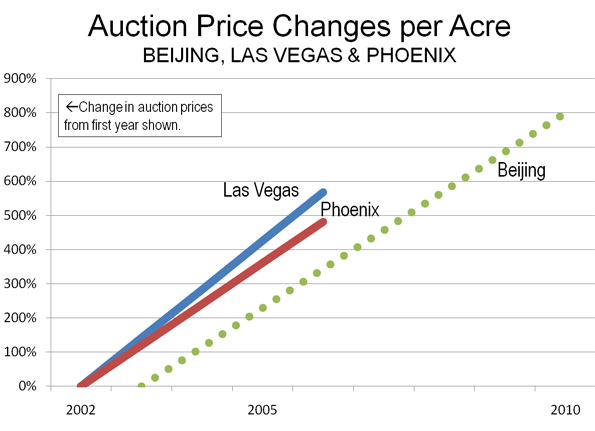
    In Las Vegas, house prices escalated approximately 85% relative to incomes between 2002 and 2006. Coincidentally, over the same period, federal government land auctions prices for urban fringe land rose from a modest $50,000 per acre in 2001-2, to $229,000 in 2003-4 and $284,000 at the peak of the housing bubble (2005-6). Similarly, Phoenix house prices rose nearly as much as Las Vegas, while the rate of increase per acre in Phoenix land auctions rose nearly as much as in Las Vegas.

    In both cases, prices per acre rose at approximately the same annual rate as in Beijing, which some consider to have the world’s largest housing bubble. According to Joseph Gyourko of Wharton, along with Jing Wu and Yongheng Deng Beijing prices rose 800 percent from 2003 to 2008 (Figure). This is true even thought we are not experiencing the epochal shift to big urban areas now going on in China.

    The Issue is Land Supply: The escalation of new house prices during the bubble occurred virtually all in non-construction costs such as the costs of land and any additional regulatory costs. It is not sufficient to look at a large supply of new housing (as the Boston Fed researchers do) and conclude that regulation has not taken its toll. The principal damage done by more restrictive land regulation comes from limiting the supply of land, which drives its price up and thereby the price of houses. In some places where there was substantial building, restrictive land use regulations also skewed the market strongly in favor of sellers. This dampening of supply in the face of demand drove land prices up hugely, even before the speculators descended to drive the prices even higher. Florida and interior California metropolitan areas (such as Sacramento and Riverside-San Bernardino) are examples of this.

    Missing Obvious Signs: There are at least two reasons why much of the economics profession missed the bubble.

    (1) Unlike Paul Krugman, many economists failed to look below the national data. As Krugman showed, there were huge variations in house price trends between the nation’s metropolitan areas. National averages mean little unless there is little variation. Yet most of the economists couldn’t be bothered to look below the national averages.

    (2) Most economists failed to note the huge structural imbalances that had occurred in the distorted housing markets relative to historic norms. Since World War II, the Median Multiple, the median house price divided by the median household income, has been 3.0 or less in most US metropolitan markets. Between 1950 and 2000, the Median Multiple reached as high as 6.1 in a single metropolitan area among today’s 50 largest, in a single year (San Jose in 1990, see Note 2). In 2001, however, two metropolitan areas reached that level, a figure that rose to 9 in 2006 and 2007. The Median Multiple reached unprecedented and stratospheric levels in of 10 or more in Los Angeles, San Francisco, San Diego and San Jose- all of which have very restrictive land use and have had relatively little building. This historical anomaly should have been a very large red flag.

    In contrast, the Median Multiple remained at or below 3.0 in a number of high growth markets, such as Atlanta, Dallas-Fort Worth and Houston and other markets throughout the bubble.. Even with strong housing growth, prices remained affordable where there was less restrictive land use regulation.

    Seeing the Signs: Krugman, for his part, takes a well deserved victory lap in a New York Times blog entitled “Wrong to be Right,” deferring to Yves Smith at nakedcapitalism.com who had this to say about the Federal Reserve Bank of Boston research:

    It is truly astonishing to watch how determined the economics orthodoxy is to defend its inexcusable, economy-wrecking performance in the run up to the financial crisis. Most people who preside over disasters, say from a boating accident or the failure of a venture, spend considerable amounts of time in review of what happened and self-recrimination. Yet policy-making economists have not only seemed constitutionally unable to recognize that their programs resulted in widespread damage, but to add insult to injury, they insist that they really didn’t do anything wrong.

    Maybe we should have known better: beware economists bearing the moment’s conventional wisdom.

    ——

    Note 1: The authors cite work by Albert Saiz of Wharton to suggest an association between geographical constraints and house price increases in metropolitan areas. The Saiz constraint, however, looks at a potential development area 50 kilometers from the metropolitan center (7,850 square kilometers). This seems to be a far too large area to have a material price impact in most metropolitan areas. For example, in Portland, the strongly enforced urban growth boundary (which would have a similar theoretical impact on prices) was associated with virtually no increase in house prices until the developable land inside the boundary fell to less than 100 square kilometers (early 1990s). A far more remote geographical barrier, such as the foothills of Mount Hood, can have no meaningful impact in this environment.

    Note 2: William Fischel of Dartmouth has shown how the implementation of land use controls in California metropolitan areas coincided with the rise of house prices beyond historic national levels. As late as 1970, house prices in California were little different than in the rest of the nation.
    Wendell Cox is a Visiting Professor, Conservatoire National des Arts et Metiers, Paris and the author of “War on the Dream: How Anti-Sprawl Policy Threatens the Quality of Life

    Photograph: $575,000 house in Los Angeles (2006), Photograph by author

  • The China Syndrome

    China’s ascension to the world’s second-largest economy, surpassing Japan, has led to predictions that it will inevitably snatch the No. 1 spot from the United States. Nomura Securities envisions China surpassing the U.S.’ total GDP in little more than a decade. And economist Robert Fogel predicts that by 2050 China’s economy will account for 40% of the world’s GDP, with the U.S.’ share shrinking to a measly 14%.

    Americans indeed should worry about the prospect of slipping status, but the idée fixe about China’s inevitable hegemony–like Japan’s two decades ago–could prove greatly exaggerated. Countries generally do not experience hyper-growth–the starting point for many predictions–for long. Eventually costs rise, internal pressures grow and natural limitations brake and can even throw the economy into reverse.

    Instead the U.S. has a decent chance of remaining the world’s pre-eminent economy not only over the next decade or two and even by mid-century. There are five key reasons for this contrarian conclusion.

    1. If Water is the “new oil,” China faces a thirsty future. China’s freshwater reserves are about one-fifth per capita those of the United States, notes Steve Solomon, author of Water: The Epic Struggle for Wealth, Power and Civilization. Much of that supply has become dangerously polluted; ours , for the most part, has become cleaner.

    More important, the U.S. has become more efficient in its water usage, says Solomon. China, with a far less developed economy, will face increasing demands from industrial and agricultural users as well as hundreds of millions of households that now don’t enjoy easy access to clean drinking water.

    2. China’s energy demands are soaring, but it lacks adequate domestic resources. China impresses journalists and policy-makers with grand “green” projects and heavy investment in renewables, but two-thirds of the country’s energy comes from that dirtiest of sources. China burns more coal than the U.S., Europe and Japan combined, often using very primitive technology. It has now overtaken the U.S. for the dubious honor of the most total energy use and highest greenhouse gas emissions. Since 1995 China’s dependence on foreign oil has grown from near to approaching 60%, and the country, long a coal exporter, is becoming a major importer of that unfashionable fuel.

    The U.S. meanwhile sits on largely untapped fossil fuel resources, including coal, natural gas and oil. Add Canada to the equation and North America ranks second, behind the Middle East, in energy resources. In contrast to China, America’s energy use and greenhouse emissions appear to be dropping while still enjoying enormous, still largely untapped renewable resources, particularly from wind power in the Plains and biomass.

    3. Food remains pressing problem for China. Scarce water, mass pollution and high energy costs all will limit China’s future food production. By some estimates acid rain falls on a third of all agricultural land; some climate experts predict long-term reductions in the country’s vital rice crop.

    Plagued by floods, China now will have to look to U.S. and Canada to meet demand for crucial foodstuffs, particularly corn. And the food deficit may get worse over time: As China becomes wealthier, demand for high-protein foods like beef and pork will increase. The U.S. remains the world’s most reliable supplier of many of those agricultural products.

    4. China’s rapidly aging population and shrinking workforce will slow growth, perhaps dramatically, by the next decade. Like that of the “Asian tigers” in the ’70s and ’80s, China’s rapid growth has been propelled in part by an expanding young workforce. Due to a very low birthrate, however, this trend will reverse within a decade or two. By 2050 31% of China’s population will be older than 60, compared with barely one-quarter in the U.S. There will be over 400 million elderly, with virtually no social security and few children to support them. Also worrisome: The preference for male children has skewed sex demographics dramatically, with roughly 30 million more marriageable boys than girls.

    The logical solution to this dilemma would be immigration, but China’s culture appears far too insular for such an event. Rather than a benevolent “socialist” super power China, whose population is made up over 90% Han Chinese, will bestride the world as a racially homogeneous, and communalistic “Middle Kingdom.” In contrast, the U.S., despite occasional fits of nativism, remains remarkably successful at integrating cultures from around the globe.

    5. Dictatorship thrives sometimes in a “take off” period, but often fails to compete well with more open societies during later stages of growth. Many American intellectuals and journalists celebrate China’s achievements, much as some of their predecessors admired past “successful” economic regimes in fascist Italy, Nazi Germany and the late Soviet Union. The longest lasting of the authoritarian superpowers, the Soviet state massively misallocated its resources in its unsuccessful competition with the more flexible systems of the U.S. and its allies.

    Big Brother economies experience more subtle problems. Chinese entrepreneurs , according to a survey by the Legatum Institute in London, depend far more than their more nimble and self-reliant Indian counterparts. Overweening Chinese state power also might be chasing many foreign businesses–and some developing countries– toward more congenial investment and trade partners.

    For all these problems, the Chinese emergence remains the dominant business event of our epoch. But world-wide dominion seems highly unlikely. One often overlooked factor: political problems stemming from growing inequality in this officially Marxist state. Over the past 20 years China’s income distribution pattern has shifted from the relative egalitarianism of Sweden, Japan or Germany to that of countries like Argentina and Mexico.

    The class divisions will deepen further as growth inevitably slows. Roughly one-third of 2008’s 5.6 million university graduates have been unable to find work. Things are even worse for those less skilled, rural residents and small manufacturers.

    Ironically, the Communist Party appears to further concentrate wealth and power; most of the richest people in China are linked to the party. Policies push growth, but with diminishing rewards to the masses. Over the last decade the share of GDP going to consumption dropped from 46% to less than 36%.

    Of course, a comparatively small number of skilled, with often well-connected professionals and investors flourishing, but opportunities for economic advancement may now be scarcer for most workers compared to the earlier period of China’s remarkable “liftoff” after 1980. Conditions for the working class in China remain more akin to Dickensian England than a Marxian “worker’s paradise.” China’s dismal health care system for example, ranks according to the World Health Organization, among the world’s most inequitable, 188th out of 191 nations.

    Not surprisingly, class anger has reached alarming proportions, with almost 96% of respondents, according to one recent survey, agreeing that they “resent the rich.”

    America also faces its own share of social problems but not to such an extreme degree. Many Americans resent the affluent, but also dream of becoming them. How else to explain the popularity of paeans to bourgeois vulgarity like Housewives of New Jersey?

    In the coming decades China, not the currently depressed U.S., may face greater headwinds. America’s biggest enemy will prove to be not China, but itself. The U.S. needs to move toward a pro-growth course driven by investments in our productive economy, basic infrastructure and skills-based education as well as sustainable immigration and population growth levels. If the country does these things then Americans will someday look back at their current Sinophobia as a delusion dressed up as irresistible conventional wisdom.

    This article originally appeared at Forbes.com.

    Joel Kotkin is executive editor of NewGeography.com and is a distinguished presidential fellow in urban futures at Chapman University. He is author of The City: A Global History. His newest book is The Next Hundred Million: America in 2050, released in February, 2010.

    Photo: Steve Webel

  • China’s Sliver of a Housing Bubble

    Few finance issues have received such a wide range of opinions among financial experts than the “housing bubble” in China. This is an issue of international importance because what happens in what is now the world’s 2nd largest economy affects the rest of the world.

    Differing Views: There are frequent reports of excessively high purchase prices on new housing, which when compared with measures of average household income make it appear that China has the highest house price to income ratios in history. Andy Xie, a Shanghai economist formerly with Morgan Stanley sees a huge housing bubble, which he expects to burst. Stephen Roach, chairman of Morgan Stanley Asia denies there is a bubble, claiming that there is sufficient demand from the continuing migration to the cities for the housing market to be healthy.

    I have been reluctant to weigh in on the debate, simply because there has been insufficient data available to calculate inferior housing affordability measures (such as average price to average income), much less the data that would permit Median Multiples to be calculated. (The Median Multiple is the “middle” house price divided by the “middle” household income and is optimal for measuring middle income housing affordability).

    The problems in assessing China’s housing affordability have been manifold:

    • There has been virtually no median household income data.
    • There appears to be no data available on the median house price

    This means that it is impossible to calculate the Median Multiple.

    Housing Occupancy in Urban China

    Having visited all but two of China’s 20 largest urban areas and traversed them, east to west and north to south from the countryside to the countryside (as I do in obtaining photos and impressions for my “Rental Car Tours“), however, two things are obvious.

    • New high-rise housing is being built at a furious pace in the largest urban areas.
    • Nonetheless, the volume of this new housing pales by comparison to the lower rise, older housing that was built before the present boom (which appears to have started in the 1990s). It is clear that the vast majority of people do not live in the new high rise buildings.

    Nonetheless the press has been filled with absurd reports to the effect that there are 65 million empty housing units in China. The absurdity of this now discredited number is illustrated by the following.

    (1) All of China’s urban areas with more than 500,000 population, where much of the new high rise housing has been built, have less than 300 million people. At the average household size, this means there are no more than 100 million households. In such an environment, 65 million empty units would stick out like a sore thumb. They do not.

    (3) 65 million vacant units is more houses than have been constructed since 1990.

    The New National Economic Research Institute Data: Finally, however, some clarity may be being brought to the issue. Credit Suisse sponsored groundbreaking research by National Economic Research Institute (NERI) of the China Reform Foundation in Beijing, which was led by Deputy Director Dr. Wang Xiaolu. Dr. Wang’s principal contribution is to show that household incomes are considerably higher in China than official statistics indicate. This “grey income” or “hidden income” includes bonuses paid by local governments, payments to public officials, revenues from land development and other sources of income that are not reported in official data and amounts to 90% more than reported figures (report (Analyzing Chinese Grey Income, published by Credit Suisse). In the top decile (top 90-100% of household incomes), grey income added 200% to reported incomes, while in the second decile (80%-90%), grey income more than doubled reported incomes. Buried in the NERI report is median household income data and average multiple housing affordability indicators that are the best information yet made available.

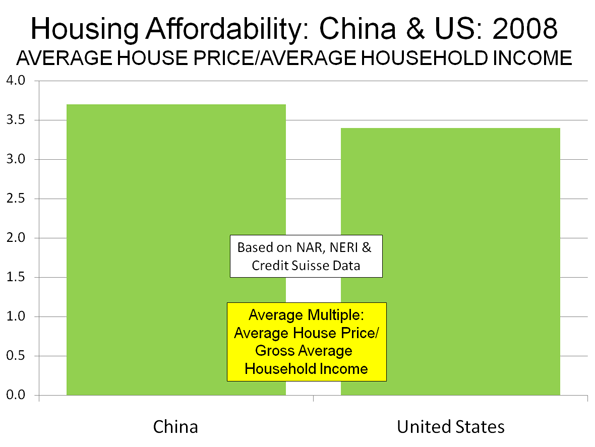
    China’s Average Multiple: Credit Suisse analyst Jinsong Du takes the NERI further to calculate housing affordability indicators that are far below the claims about the Chinese housing bubble. The average (mean) house price was 4.0 times the average disposable household income in 2008, after accounting for “grey income.” Based upon the national ratio of gross income to disposable income (from the China Yearbook), this would indicate an “average multiple” (average house price divided by gross average household income) of 3.7. This is similar to the US average multiple figure of 3.4 (Figure 1) in the same year (2008).

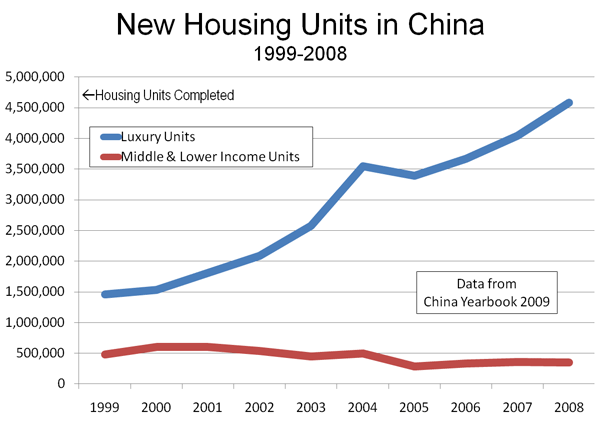
    China’s Median Multiple? This leaves the question of the Median Multiple. There is still no available median house price data. However, it is clear that the new housing is largely irrelevant to median house prices. According to data in the China Yearbook (Table 5-42), only 13% of the 31 million new houses were affordable to lower and middle income people (Figure 2). The new luxury units, with their widely touted prices, remain a minority of the houses, and, as a result, none of these can be the “middle” or median price

    In fact, the median priced house could be of a design similar to a Danwei (live-work unit) type design built before 1990. This is the type of housing that any walk or drive through a Chinese urban area will demonstrate to be dominant (and which is illustrated in the photograph above). There are huge disparities in both house prices and incomes in China. It would not be surprising for China’s Median Multiple to be similar to its average multiple, as is the case in the United States.

    Further, there is a huge difference between the US bubble and the Chinese bubble. In the United States the bubble drove up prices across all income spectrums in the impacted metropolitan areas. It burst largely because middle income households had taken on debt they could not afford. In China, the bubble may be limited to the top of the income scale, the very households that NERI finds are making two to three times as much as the official reports indicate.

    China’s Sliver of a Bubble: None of this is to suggest that house prices at the top of the market are not high. One of America’s leading housing economists, Joseph Gyourko of Wharton, along with Jing Wu and Yongheng Deng found that residential real estate auction prices rose 800% from 2003 to 2008 in Beijing (Note). Recently the government has taken action to cool the high end of the market and to encourage development of more housing for middle and lower income households. At the same time, the Gyourko research team found that new house prices had fallen relative to household incomes in Chengdu, Wuhan, Tianjin and Xi’an, all urban areas with more than 4,000,000 population.

    To accurately assess housing affordability it is necessary to have complete data. Housing affordability cannot be assessed in London using data from Belgravia, nor will Upper East Side data tell an accurate story about New York. The same is true in China. Stephen Roach said that China has a “sliver of a bubble.” That’s what the data seems to show.

    ——————

    Note: This annual rate of increase is approximately the same as was experienced in per acre government land sales in Las Vegas and Phoenix before the peak of the bubble (both urban areas are tightly ringed by “virtual” urban growth boundaries composed of government owned land).

    Wendell Cox is a Visiting Professor, Conservatoire National des Arts et Metiers, Paris and the author of “War on the Dream: How Anti-Sprawl Policy Threatens the Quality of Life

    Photograph: Median priced (?) flats in Fushun, Liaoning (photograph by the author)

  • Can We Socialize Ourselves to Good Health?

    How can we reduce health problems in society? Should we tackle poverty and social problems such as crime and drug abuse, or is the problem inequality in itself? If we reduce the income in a middle class neighborhood, will this in itself improve the health of poor people living in the same city?

    The latter form of reasoning is perhaps not so popular in the US, but quite so amongst European social democrats. A new book highlights how the European left is as concerned with fighting wealth as it is with fighting poverty.

    One year after its publication, the “The Spirit Level: Why More Equal Societies Almost Always Do Better” – by social epidemiologists Richard Wilkinson and Kate Pickett – has been embraced by many European intellectuals and politicians. The Social Democratic Party leader Mona Sahlin relies on the book as one of her main arguments during the current Swedish election campaign.
    Even conservative British Prime Minister David Cameron has praised the book, which claims that income inequality in itself causes more or less every problem in society. The argument goes: if your neighbor’s income increases, so does you chances of catching cancer.

    The authors of the book, Wilkinson and Pickett, seemingly make as strong argument for the notion that social ills are caused not by poverty but rather by inequality itself. Inequality, they say, acts like a “pollutant spread throughout society,” with rich and poor equally susceptible to its toxic effects.

    The book will likely soon appear also on the bookshelves of many US intellectuals, not least amongst the left. It is interesting then to note that its notions are dismissed by current research.

    Last year for example, the “Oxford Handbook of Economic Inequality” was published. There we could clearly read that income inequality in itself is not the cause of health problems or lifespan: “The preponderance of evidence suggests that the relationship between income inequality and health is either non-existent to too fragile to show up in a robustly estimated panel specification.”

    The same conclusion has been drawn in research conducted by Professor Angus Deaton, one of the world’s leading health economists. After a comprehensive survey of the scientific literature he concludes:
    “[I]t is not true that income inequality itself is a major determinant of public health. There is no robust relationship between life expectancy and income inequality among the rich countries, and the correlation across the states and cities of the United States is almost certainly the result of something that is correlated with income inequality, but is not income inequality itself.” (Published in Journal of Economic Literature, 2003).

    One could say that one of the main theses of the European social democracy – that inequality in itself is the problem – has been proven wrong by recent scientific studies. Social problems in themselves do cause inequality.

    If there are problems with drug abuse, racial tensions, unemployment, etc., in one neighborhood for example, this will decrease the income of the citizens. Thus income inequality arises compared to the middle class. Reducing social problems will also reduce inequality. But inequality in itself does not cause social problems.

    The socialist approach – to shrink the income of the middle class instead and hope this will aid the poor – is simply based on a skewed analysis of the correlation between social problems, poverty and inequality.

    A comparison between Sweden and the US is often used to argue that the European social democratic approach will reduce social problems and expand life span. As noted in a previous New Geography article, this reasoning is misleading.

    Sweden was characterized by an even income distribution, low poverty and long life spans already before the introduction of high-tax welfare policies. The difference in lifespan between Swedes and Americans was the same (2.6 years) in 1950 as it is today (2.7 years). And lastly, the 4.4 million Americans with Swedish origin are not only 50% more rich than Swedes living in Sweden, but also have the exact same level of poverty.

    It is simply wrong to assume that high tax welfare state policies automatically improve health. In 1960 Sweden was a low-tax country, with the third highest lifespan in the world. Switzerland was ranked on the sixth position. 45 years later, it was Switzerland that had the second highest lifespan, whilst Sweden was ranked on sixth position. Evidently, retaining a low-tax system did not hinder Switzerland from catching up to and surpassing Sweden.

    Low taxes might however explain why the poorest fifth of Swiss citizens have a considerably higher purchasing power compared to the same group in Sweden (the US figure is slightly, but not much, lower than in Sweden).

    And it is simply not true that socialist policies always lead to low income distribution, whilst free-markets increases inequality. Reforming away from communism to a very free-market oriented approach has for example allowed the Czech Republic, Slovakia and Slovenia from gaining a high living standard. But these nations do not have a low, but rather relatively high level of income equality. Moving away from socialism has benefited not only a small handful of capitalists, but rather the population as a whole.

    History teaches us that one society simply cannot change to another by simply changing its policies. Much can be achieved by focusing on the root of social problems – such as unemployment, crime and drug abuse – but society has little to gain and much to lose from thinking that we should hinder those who strive towards success in the name of social equality.

    Nima Sanandaji is president of the Swedish think tank Captus. He is the author of the book ”Entrepreneurs who go against the stream – what the 90s successful entrepreneurs can teach us” (Swedish title: ¨”Entreprenörer som går mot strömmen – vad 90-talets succéföretagare kan lära om dagens utmaningar”) for Fores.

    Photo by: JavierPsilocybin

  • Vancouver: Planner’s Dream, Middle Class Nightmare

    Vancouver is consistently rated among the most desirable places to live in the Economist’s annual ranking of cities. In fact, this year it topped the list. Of course, it also topped another list. Vancouver was ranked as the city with the most unaffordable housing in the English speaking world by Demographia’s annual survey. According to the survey criteria, housing prices in an affordable market should have an “median multiple” of no higher than 3.0 (meaning that median housing price should cost no more than 3 times the median annual gross household income). Vancouver came in at a staggering 9.3. The second most expensive major Canadian city, Toronto, has an index of only 5.2. Even legendarily unaffordable London and New York were significantly lower, coming in at 7.1 and 7.0 respectively. While there are many factors that make Vancouver a naturally expensive market, there are a number of land use regulations that contribute to the high housing costs.

    Vancouver is a unique real estate market: it’s the only major Canadian city that doesn’t experience frigid winters. This makes it a major draw for high skilled, high salary employees. It is also a major destination for wealthy Canadian retirees, who choose to actually spend their winters in Canada. There is little doubt that it is a naturally expensive real estate market. As with coastal California cities, people pay a premium for (in this case relatively) hospitable weather. The proximity to world class skiing, fishing, and hiking are no doubt another factor in the city’s high real estate costs. There is certainly a premium to be paid for living less than two hours away from the world’s best ski resort.

    Moreover, Vancouver has become an appealing real estate market for overseas investors, particularly Chinese nationals. There has been a good deal of news recently about how many of the nouveau riche in China are now looking to Vancouver, rather than Los Angeles or New York as an immigration destination. In absolute dollar terms, Vancouver is still cheaper than either city. This, combined with the more hospitable Canadian immigration system, has made Vancouver so attractive to overseas investors that real estate agents are now organizing house hunting tours for potential Chinese buyers.

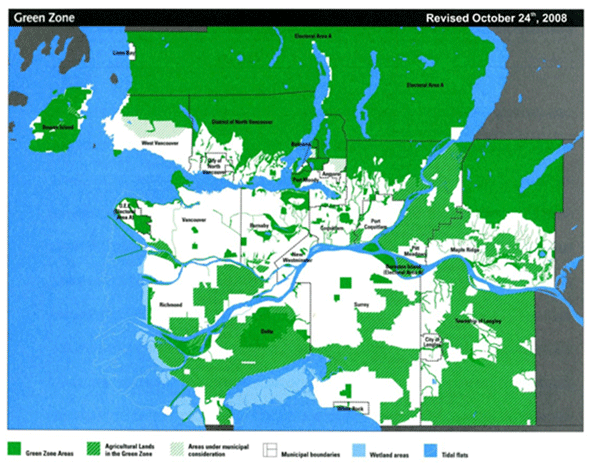
    To be sure, geography deserves much of the blame for Vancouver’s high housing costs. But a large chunk of the blame lies with restrictive municipal and provincial land use policies. Since the introduction of the city’s first comprehensive plan in 1929, Vancouver has used various land use regulations to create dense mixed use development in order to protect green space surrounding the city. In 1972, the provincial government passed legislation aimed at protecting BC farmland. This left less than half of the already scarce land in Greater Vancouver off limits to developers. As a result, the city is circled by undeveloped land, referred to as the Green Zone. The Green Zone acts as a de facto urban growth boundary, largely designed to prevent sprawl.

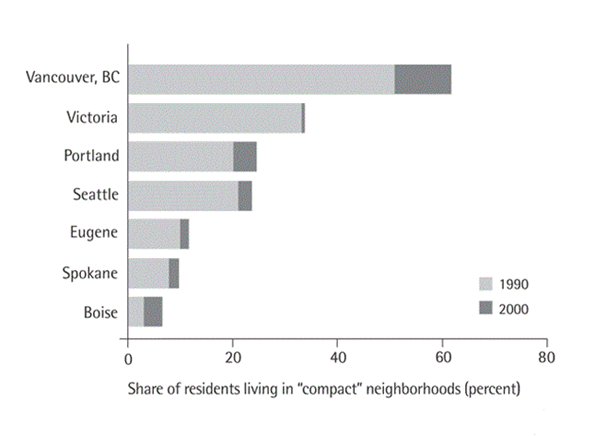
    As a result, Vancouver is one of the few North American cities that have been growing almost exclusively upwards, rather than outwards for the last century. Its narrow streets and lack of a major highway running through the city make it one of the least automobile friendly cities on the continent. Unsurprisingly, Vancouver was ranked the most smart growth oriented city in the Pacific Northwest by the Sightline Institute. Roughly three times more Vancouver residents live in compact neighborhoods as a percentage of the population compared than Portland or Seattle. This arguably makes Vancouver the most smart growth oriented city in North America.

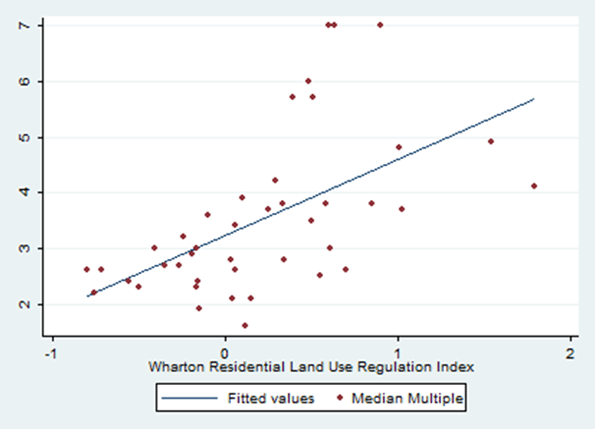
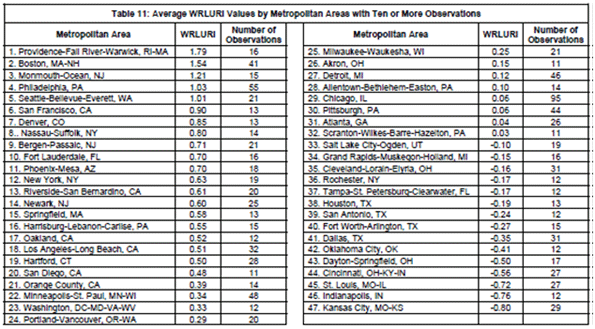
    Smart growth has become a truism for urban planners. Walkable communities with a mix of commercial and residential units combined with strict zoning regulations to encourage transit usage is a formula increasingly prescribed for North American cities. Though many smart growth principles are attractive, there is an strong correlation between heavy land use regulations and housing costs. Using data from the Wharton Residential Land Use Regulation Index (WRLURI), and Demographia’s International Housing Affordability Survey, a simple scatter plot diagram has been included to illustrate this correlation.

    The WRLURI measures the stringency of land use controls imposed on various US jurisdictions by state and local governments. There is a clear correlation between high regulations, and low housing affordability. Though the index does not include Canadian cities, it does include neighboring Seattle. Seattle ranks fifth of 47 cities on the Wharton Index. According to a recent study in Boston College International & Comparative Law Review by David Fox, Vancouver is decades ahead of Seattle in terms of smart growth policies. This means that Vancouver would rank at least fifth in North America on the index, though it is more realistic to assume it would most certainly top the index.

    In addition to smart growth policies, Vancouver also has very stringent inclusionary zoning laws. Inclusionary zoning requires developers to provide a certain number of affordable housing units in any given development. This policy might seem to make the city more affordable, but it functions exactly like rent control. Those fortunate enough to find spaces in the affordable housing units pay less, but the subsidized rent is made up for by higher rent in adjacent units. In a study of inclusionary zoning in California cities, Benjamin Powell and Edward Stringham from the Department of Economics at San Jose State University found that inclusionary zoning imposes an additional $33,000-$66,000 cost on adjacent market rate units.

    There have been some recent policy initiatives that may reduce the cost of housing marginally. In 2004, the city amended its zoning code to permit secondary suites throughout the city. Secondary suites are subdivided units of owner occupied homes that are used as rental units. This zoning change brought tens of thousands of relatively low cost units into the market. There are currently 120,000 secondary suites in the province. The city recently went one step further to allow homeowners to convert laneway garages into rental units. These units have a maximum of 500 square feet. There are 70,000 homes in Vancouver that are eligible for conversion, though it is unclear how many will take up the offer. This will add to the stock of relatively affordable rental housing in the city, but may not significantly reduce housing costs. In fact, by increasing the revenue generating potential of houses, it may actually increase the cost of purchasing a single dwelling home. After all, if the potential rental income of a single dwelling unit increases, the market price of the unit is likely to do the same. This isn’t necessarily an argument against the policy, though it does underscore the fact that housing costs in Vancouver will never decrease without liberalizing municipal and provincial land use policies.

    In short, the City of Vancouver and Province of British Columbia have chosen to favor compact growth over affordable housing costs. This likely makes the city more attractive to affluents from both the rest of Canada and abroad, but increasingly makes it unaffordable for middle class families. There is certainly some substance to the Economist’s claim that Vancouver is the most livable city on earth. It is a very attractive place for those who can afford it. Nevertheless, creating a city fit only for the wealthiest segments of society and non-families is hardly something to be proud of.

    Downtown Vancouver photo by runningclouds

    Steve Lafleur is a public policy analyst and political consultant based out of Calgary, Alberta. For more detail, see his blog.

  • Urban Legends: Why Suburbs, Not Dense Cities, are the Future

    The human world is fast becoming an urban world — and according to many, the faster that happens and the bigger the cities get, the better off we all will be. The old suburban model, with families enjoying their own space in detached houses, is increasingly behind us; we’re heading toward heavier reliance on public transit, greater density, and far less personal space. Global cities, even colossal ones like Mumbai and Mexico City, represent our cosmopolitan future, we’re now told; they will be nerve centers of international commerce and technological innovation just like the great metropolises of the past — only with the Internet and smart phones.

    According to Columbia University’s Saskia Sassen, megacities will inevitably occupy what Vladimir Lenin called the “commanding heights” of the global economy, though instead of making things they’ll apparently be specializing in high-end “producer services” — advertising, law, accounting, and so forth — for worldwide clients. Other scholars, such as Harvard University’s Edward Glaeser, envision universities helping to power the new “skilled city,” where high wages and social amenities attract enough talent to enable even higher-cost urban meccas to compete.

    The theory goes beyond established Western cities. A recent World Bank report on global megacities insists that when it comes to spurring economic growth, denser is better: “To try to spread out economic activity,” the report argues, is to snuff it. Historian Peter Hall seems to be speaking for a whole generation of urbanists when he argues that we are on the cusp of a “coming golden age” of great cities.

    The only problem is, these predictions may not be accurate. Yes, the percentage of people living in cities is clearly growing. In 1975, Tokyo was the largest city in the world, with over 26 million residents, and there were only two other cities worldwide with more than 10 million residents. By 2025, the U.N. projects that there may be 27 cities of that size. The proportion of the world’s population living in cities, which has already shot up from 14 percent in 1900 to about 50 percent in 2008, could be 70 percent by 2050. But here’s what the boosters don’t tell you: It’s far less clear whether the extreme centralization and concentration advocated by these new urban utopians is inevitable — and it’s not at all clear that it’s desirable.

    Not all Global Cities are created equal. We can hope the developing-world metropolises of the future will look a lot like the developed-world cities of today, just much, much larger — but that’s not likely to be the case. Today’s Third World megacities face basic challenges in feeding their people, getting them to and from work, and maintaining a minimum level of health. In some, like Mumbai, life expectancy is now at least seven years less than the country as a whole. And many of the world’s largest advanced cities are nestled in relatively declining economies — London, Los Angeles, New York, Tokyo. All suffer growing income inequality and outward migration of middle-class families. Even in the best of circumstances, the new age of the megacity might well be an era of unparalleled human congestion and gross inequality.

    Perhaps we need to consider another approach. As unfashionable as it might sound, what if we thought less about the benefits of urban density and more about the many possibilities for proliferating more human-scaled urban centers; what if healthy growth turns out to be best achieved through dispersion, not concentration? Instead of overcrowded cities rimmed by hellish new slums, imagine a world filled with vibrant smaller cities, suburbs, and towns: Which do you think is likelier to produce a higher quality of life, a cleaner environment, and a lifestyle conducive to creative thinking?

    So how do we get there? First, we need to dismantle some common urban legends.

    Perhaps the most damaging misconception of all is the idea that concentration by its very nature creates wealth. Many writers, led by popular theorist Richard Florida, argue that centralized urban areas provide broader cultural opportunities and better access to technology, attracting more innovative, plugged-in people (Florida’s “creative class“) who will in the long term produce greater economic vibrancy. The hipper the city, the mantra goes, the richer and more successful it will be — and a number of declining American industrial hubs have tried to rebrand themselves as “creative class” hot spots accordingly.

    But this argument, or at least many applications of it, gets things backward. Arts and culture generally do not fuel economic growth by themselves; rather, economic growth tends to create the preconditions for their development. Ancient Athens and Rome didn’t start out as undiscovered artist neighborhoods. They were metropolises built on imperial wealth — largely collected by force from their colonies — that funded a new class of patrons and consumers of the arts. Renaissance Florence and Amsterdam established themselves as trade centers first and only then began to nurture great artists from their own middle classes and the surrounding regions.

    Even modern Los Angeles owes its initial ascendancy as much to agriculture and oil as to Hollywood. Today, its port and related industries employ far more people than the entertainment business does. (In any case, the men who built Hollywood were hardly cultured aesthetes by middle-class American standards; they were furriers, butchers, and petty traders, mostly from hardscrabble backgrounds in the czarist shtetls and back streets of America’s tough ethnic ghettos.) New York, now arguably the world’s cultural capital, was once dismissed as a boorish, money-obsessed town, much like the contemporary urban critique of Dallas, Houston, or Phoenix.

    Sadly, cities desperate to reverse their slides have been quick to buy into the simplistic idea that by merely branding themselves “creative” they can renew their dying economies; think of Cleveland’s Rock and Roll Hall of Fame, Michigan’s bid to market Detroit as a “cool city,” and similar efforts in the washed-up industrial towns of the British north. Being told you live in a “European Capital of Culture,” as Liverpool was in 2008, means little when your city has no jobs and people are leaving by the busload.

    Even legitimate cultural meccas aren’t insulated from economic turmoil. Berlin — beloved by writers, artists, tourists, and romantic expatriates — has cultural institutions that would put any wannabe European Capital of Culture to shame, as well as a thriving underground art and music scene. Yet for all its bohemian spirit, Berlin is also deeply in debt and suffers from unemployment far higher than Germany’s national average, with rates reaching 14 percent. A full quarter of its workers, many of them living in wretched immigrant ghettos, earn less than 900 euros a month; compare that with Frankfurt, a smaller city more known for its skyscrapers and airport terminals than for any major cultural output, but which boasts one of Germany’s lowest unemployment rates and by some estimates the highest per capita income of any European city. No wonder Berlin Mayor Klaus Wowereit once described his city as “poor but sexy.”

    Culture, media, and other “creative” industries, important as they are for a city’s continued prosperity, simply do not spark an economy on their own. It turns out to be the comparatively boring, old-fashioned industries, such as trade in goods, manufacturing, energy, and agriculture, that drive the world’s fastest-rising cities. In the 1960s and 1970s, the industrial capitals of Seoul and Tokyo developed their economies far faster than Cairo and Jakarta, which never created advanced industrial bases. China’s great coastal urban centers, notably Guangzhou, Shanghai, and Shenzhen, are replicating this pattern with big business in steel, textiles, garments, and electronics, and the country’s vast interior is now poised to repeat it once again. Fossil fuels — not art galleries — have powered the growth of several of the world’s fastest-rising urban areas, including Abu Dhabi, Houston, Moscow, and Perth.

    It’s only after urban centers achieve economic success that they tend to look toward the higher-end amenities the creative-classers love. When Abu Dhabi decided to import its fancy Guggenheim and Louvre satellite museums, it was already, according to Fortune magazine, the world’s richest city. Beijing, Houston, Shanghai, and Singapore are opening or expanding schools for the arts, museums, and gallery districts. But they paid for them the old-fashioned way.

    Nor is the much-vaunted “urban core” the only game in town. Innovators of all kinds seek to avoid the high property prices, overcrowding, and often harsh anti-business climates of the city center. Britain’s recent strides in technology and design-led manufacturing have been concentrated not in London, but along the outer reaches of the Thames Valley and the areas around Cambridge. It’s the same story in continental Europe, from the exurban Grand-Couronne outside of Paris to the “edge cities” that have sprung up around Amsterdam and Rotterdam. In India, the bulk of new tech companies cluster in campus-like developments around — but not necessarily in — Bangalore, Hyderabad, and New Delhi. And let’s not forget that Silicon Valley, the granddaddy of global tech centers and still home to the world’s largest concentration of high-tech workers, remains essentially a vast suburb. Apple, Google, and Intel don’t seem to mind. Those relative few who choose to live in San Francisco can always take the company-provided bus.

    In fact, the suburbs are not as terrible as urban boosters frequently insist.

    Consider the environment. We tend to associate suburbia with carbon dioxide-producing sprawl and urban areas with sustainability and green living. But though it’s true that urban residents use less gas to get to work than their suburban or rural counterparts, when it comes to overall energy use the picture gets more complicated. Studies in Australia and Spain have found that when you factor in apartment common areas, second residences, consumption, and air travel, urban residents can easily use more energy than their less densely packed neighbors. Moreover, studies around the world — from Beijing and Rome to London and Vancouver — have found that packed concentrations of concrete, asphalt, steel, and glass produce what are known as “heat islands,” generating 6 to 10 degrees Celsius more heat than surrounding areas and extending as far as twice a city’s political boundaries.

    When it comes to inequality, cities might even be the problem. In the West, the largest cities today also tend to suffer the most extreme polarization of incomes. In 1980, Manhattan ranked 17th among U.S. counties for income disparity; by 2007 it was first, with the top fifth of wage earners earning 52 times what the bottom fifth earned. In Toronto between 1970 and 2001, according to one recent study, middle-income neighborhoods shrank by half, dropping from two-thirds of the city to one-third, while poor districts more than doubled to 40 percent. By 2020, middle-class neighborhoods could fall to about 10 percent.

    Cities often offer a raw deal for the working class, which ends up squeezed by a lethal combination of chronically high housing costs and chronically low opportunity in economies dominated by finance and other elite industries. Once the cost of living is factored in, more than half the children in inner London live in poverty, the highest level in Britain, according to a Greater London Authority study. More than 1 million Londoners were on public support in 2002, in a city of roughly 8 million.

    The disparities are even starker in Asia. Shenzhen and Hong Kong, for instance, have among the most skewed income distributions in the region. A relatively small number of skilled professionals and investors are doing very well, yet millions are migrating to urban slums in places like Mumbai not because they’ve all suddenly become “knowledge workers,” but because of the changing economics of farming. And by the way, Mumbai’s slums are still expanding as a proportion of the city’s overall population — even as India’s nationwide poverty rate has fallen from one in three Indians to one in five over the last two decades. Forty years ago, slum dwellers accounted for one in six Mumbaikars. Now they are a majority.

    To their credit, talented new urbanists have had moderate success in turning smaller cities like Chattanooga and Hamburg into marginally more pleasant places to live. But grandiose theorists, with their focus on footloose elites and telecommuting technogeniuses, have no practical answers for the real problems that plague places like Mumbai, let alone Cairo, Jakarta, Manila, Nairobi, or any other 21st-century megacity: rampant crime, crushing poverty, choking pollution. It’s time for a completely different approach, one that abandons the long-held assumption that scale and growth go hand in hand.

    Throughout the long history of urban development, the size of a city roughly correlated with its wealth, standard of living, and political strength. The greatest and most powerful cities were almost always the largest in population: Babylon, Rome, Alexandria, Baghdad, Delhi, London, or New York.

    But bigger might no longer mean better. The most advantaged city of the future could well turn out to be a much smaller one. Cities today are expanding at an unparalleled rate when it comes to size, but wealth, power, and general well-being lag behind. With the exception of Los Angeles, New York, and Tokyo, most cities of 10 million or more are relatively poor, with a low standard of living and little strategic influence. The cities that do have influence, modern infrastructure, and relatively high per capita income, by contrast, are often wealthy small cities like Abu Dhabi or hard-charging up-and-comers such as Singapore. Their efficient, agile economies can outpace lumbering megacities financially, while also maintaining a high quality of life. With almost 5 million residents, for example, Singapore isn’t at the top of the list in terms of population. But its GDP is much higher than that of larger cities like Cairo, Lagos, and Manila. Singapore boasts a per capita income of almost $50,000, one of the highest in the world, roughly the same as America’s or Norway’s. With one of the world’s three largest ports, a zippy and safe subway system, and an impressive skyline, Singapore is easily the cleanest, most efficient big city in all of Asia. Other smaller-scaled cities like Austin, Monterrey, and Tel Aviv have enjoyed similar success.

    It turns out that the rise of the megacity is by no means inevitable — and it might not even be happening. Shlomo Angel, an adjunct professor at New York University’s Wagner School, has demonstrated that as the world’s urban population exploded from 1960 to 2000, the percentage living in the 100 largest megacities actually declined from nearly 30 percent to closer to 25 percent. Even the widely cited 2009 World Bank report on megacities, a staunchly pro-urban document, acknowledges that as societies become wealthier, they inevitably begin to deconcentrate, with the middle classes moving to the periphery. Urban population densities have been on the decline since the 19th century, Angel notes, as people have sought out cheaper and more appealing homes beyond city limits. In fact, despite all the “back to the city” hype of the past decade, more than 80 percent of new metropolitan growth in the United States since 2000 has been in suburbs.

    And that’s not such a bad thing. Ultimately, dispersion — both city to suburb and megacity to small city — holds out some intriguing solutions to current urban problems. The idea took hold during the initial golden age of industrial growth — the English 19th century — when suburban “garden cities” were established around London’s borders. The great early 20th-century visionary Ebenezer Howard saw this as a means to create a “new civilization” superior to the crowded, dirty, and congested cities of his day. It was an ideal that attracted a wide range of thinkers, including Friedrich Engels and H.G. Wells.

    More recently, a network of smaller cities in the Netherlands has helped create a smartly distributed national economy. Amsterdam, for example, has low-density areas between its core and its corporate centers. It has kept the great Dutch city both livable and competitive. American urbanists are trying to bring the same thinking to the United States. Delore Zimmerman, of the North Dakota-based Praxis Strategy Group, has helped foster high-tech-oriented development in small towns and cities from the Red River Valley in North Dakota and Minnesota to the Wenatchee region in Washington State. The outcome has been promising: Both areas are reviving from periods of economic and demographic decline.

    But the dispersion model holds out even more hope for the developing world, where an alternative to megacities is an even more urgent necessity. Ashok R. Datar, chairman of the Mumbai Environmental Social Network and a longtime advisor to the Ambani corporate group, suggests that slowing migration to urban slums represents the most practical strategy for relieving Mumbai’s relentless poverty. His plan is similar to Zimmerman’s: By bolstering local industries, you can stanch the flow of job seekers to major city centers, maintaining a greater balance between rural areas and cities and avoiding the severe overcrowding that plagues Mumbai right now.

    Between the 19th century, when Charles Dickens described London as a “sooty spectre” that haunted and deformed its inhabitants, and the present, something has been lost from our discussion of cities: the human element. The goal of urban planners should not be to fulfill their own grandiose visions of megacities on a hill, but to meet the needs of the people living in them, particularly those people suffering from overcrowding, environmental misery, and social inequality. When it comes to exporting our notions to the rest of the globe, we must be aware of our own susceptibility to fashionable theories in urban design — because while the West may be able to live with its mistakes, the developing world doesn’t enjoy that luxury.

    This article originally appeared at Foreign Policy

    Joel Kotkin is executive editor of NewGeography.com and is a distinguished presidential fellow in urban futures at Chapman University. He is author of The City: A Global History. His newest book is The Next Hundred Million: America in 2050, released in February, 2010.

    Photo: Mugley