Category: Demographics

  • Tribes And Trust

    Only Tribes held together by a group feeling can survive in a desert.
    –Ibn Khaldun, 14th century Arab historian

    Time to chuck into the dustbin the cosmopolitan notions so celebrated at global conferences: a world run by wise men of the United Nations, science-driven socialists or their ostensibly more pragmatic twins, global free marketers. We are leaving the age of abstractions and entering one dominated by deep-seated ethnic, religious and cultural loyalties, some with roots from centuries and millennia ago.

    The 14th century Arab historian Ibn Khaldun noted that what most holds people together is biology and shared history. These create the critical bonds of kinship and trust and a sense of common purpose that have animated every ascendant group from the days of the Greeks and Romans through the British empire, America and modern day China.

    You rarely hear such notions discussed by academics, policy wonks and politicians. The well-behaved shy away from the hoary reality that people usually put the interests of their extended family ahead of others.

    Yet the more we struggle to be true cosmopolitans, the more humanity expresses our fundamentally tribal nature. In the two decades since I wrote my book Tribes, in-group loyalties appear to have become stronger and more dominant.

    Take the Arabs, Ibn Khaldun’s own tribe, now blending ethnic nationalism and religion into a powerful, epoch-shaping mixture. Much as in the 7th or 8th centuries.

    Arab Muslim tribalism will remain a powerful force, if for no other reason than their dominance of easily accessible fossil fuel resources. You see signs of a renewed, self-conscious Arab civilization in the new mosques, shining cultural edifices, mega-hotels and office spires sprouting across Kuwait, Dubai, Qatar and Abu Dhabi.

    With Arabs, like others, intense tribal feelings can often get out of control. Racial pride and religious fervor have chased many productive cultural minorities–Armenians, Christians, Jews–from once cosmopolitan cities like Damascus, Cairo and Beirut. The Shiite Iranians have followed a similar unfortunate course. Even some in Israel feel an uncontrollable urge to exclude, as evident in a proposal to allow ultra-orthodox Haredi rabbis to determine who is–and who isn’t–a Jew.

    The power of the new tribalism is particularly evident among the Chinese. Maoism might have been a radical internationalist movement, but today’s Chinese are seeking to revive the great 15th century “middle kingdom” that led the world in industriousness and commerce, and briefly even “ruled the seas.”

    The Han are easily the world’s largest tribe with a common history, language and mythology, and they constitute over 90% of China’s billion-plus population. In contrast, India, the other great rising super power of our time, remains a patchwork of diverse ethnic, linguistic, caste and religious groupings.

    The new Middle Kingdom, as Martin Jacques warns in his influential When China Rules the World, may well prove extraordinarily ethno-centric and self-referential. The newly powerful Han may find little use for other races except as customers and suppliers of raw materials.

    Despite huge internal pressures, the Chinese are increasingly scornful of the Western business model. A good example of this change of mood: the downgrade of American and European debt by the Dagong rating agency earlier this month.

    Other tribes, meanwhile, are waning: Take the Japanese. The Japanese ascendency last century was was built upon imagination, courage and military, followed by a corporate, esprit de corps.

    Nothing speaks to tribal decline more than Japan’s shocking birth dearth. The Japanese are running out of new blood about as quickly as any nation on earth. They also seem constitutionally incapable of making the demographic shortfall with immigrants. By 2050 more than one in three Japanese will be over 60, and the workforce 40% smaller than in 2000. The same fate may await some of their Asian cousins, but Japan’s demographic time bomb will go off first.

    Europeans face similarly bleak demographic prospects. Many traditional linchpins of trust–national pride, family and religion–have weakened. Lacking some sort of “group feeling,” today’s Europeans seem unmotivated about creating a great future, as shown by their unwillingness to start businesses or create offspring.

    The trendy concept of “European” may also need to be dismissed as archaic given the mounting rift between the frugal and productive north and the anarchic south. After all, how can you speak of one Europe when the Belgians themselves remain congenitally divided between their French and Dutch speakers.

    So what other tribes, besides the Chinese, are on the upswing? Best look at the arc of rising countries across Asia–from Turkey and India to Vietnam. All appear to be entering an aggressive, expansive phase.

    The new dynamic has restored one historic aspect in the role of cities as hosts for a gathering of tribes. Singapore, for example, has evolved into a modern-day Venice: a convenient, authoritatively ordered place hosting Chinese, Malays, Indians, Vietnamese and those Westerners who want in on Asia’s action.

    Many well off Indians, Chinese and others scour the globe for the prospect of a better life–easier admission to college or the prospect of owning a large flat or even a single family house in the suburbs. This lures them to London, New York, Los Angeles, the Bay Area or Houston. Chinese yuppies still fork out big bucks to have their babies born in California.

    Tribalism has spread even to that paragon of modernism, Silicon Valley. In the end, technology often fails to trump family and cultural ties. Chinese investors push firms to set up shop with their ethnic compatriots in Taiwan, Singapore or China; the Indians for Bangalore, Chennai or Hyderabad; the Israelis for expanding Tel Aviv.

    In our informational age, of course, not all trust networks are based on ethnic DNA. The Mormons have thrived as a tribe based on theology and their remarkable culture of mutual self-help. More than half of the “Saints” now live outside of America, but still Salt Lake City serves as their own ecclesiastical Mecca.

    Even decidedly secular groups increasingly display tribal characteristics. Green activists are united by a passionate “group feeling” as powerful as that which mobilized Mohammed’s followers; just substitute “sustainable” for holy.

    Smaller tribes like investment bankers, techno-geeks or gays each share their own iconography, rites of passage, tastes in politics and culture. They cluster not only in cyberspace, but in the same neighborhoods, conferences and resorts, and increasingly intermarry.

    These secular tribes often insist they, unlike ethnic groups, are motivated by a more enlightened spirit of science, global consciousness or individual self-awareness. But don’t be taken in by such protestations. Nothing could be more tribal.

    This article originally appeared at Forbes.com.

    Joel Kotkin is executive editor of NewGeography.com and is a distinguished presidential fellow in urban futures at Chapman University. He is author of The City: A Global History. His newest book is The Next Hundred Million: America in 2050, released in February, 2010.

    Photo: TwOsE

  • We Trust Family First

    Americans, with good reason, increasingly distrust the big, impersonal forces that loom over their lives: Wall Street, federal bureaucracy, Congress and big corporations. But the one thing they still trust is that most basic expression of our mammalian essence: the family.

    Family ties dominate our economic life far more than commonly believed. Despite the power of public companies, family businesses control roughly 50% of the country’s gross domestic product, according to the research firm Gaebler.com. Some 35% of the Fortune 500 are family businesses, but so too are the vast majority of smaller firms. Family companies represent 60% of the nation’s employment and almost 80% of all new jobs.

    And despite the glowering about impersonal corporate agriculture and the overall decline in the number of farms since the 1950s, almost 96% of the 2.2 million remaining farms are family-owned. Even among the largest 2% of farms, 84% are family-owned. The recent surge in smaller, specialized farming may actually increase this percentage in the future.

    Family life also often determines the economic success of individuals–something widely understood since the controversial 1965 Moynihan Report linked poverty among African-Americans to the decline of intact family units. Today more than half of black children live in households with a single mother, a number that has doubled since the 1960s, and they are much more likely to live in poverty than non-blacks. When you consider intact African-American families the so-called “racial gap” diminishes markedly.

    The confluence between upward mobility and strong family networks remains extraordinary not only among African-Americans but among all groups. Only 6% of married-couple families live in poverty, and most of them, like previous generations of newcomers, are likely to climb out of that state. “Families,” suggests Nobel Prize-winning economist James Heckman, “are the major source of inequality in American social and economic life.”

    The critical importance of family runs against the mindset of pundits, corporate marketers and planners. Starting with Vance Packard’s 1972 bestseller A Nation of Strangers, Americans have been sold the notion of a more atomized, highly individualized future. Similar alarms have been issued both on the left, from the late Jane Jacobs, and by conservative observers, like Francis Fukuyama and William Bennett.

    Yet despite these predictions, our mammalian instinct to trust family first has remained very strong. Some 90% of Americans, notes social historian Stephanie Coontz, consider their parental relations close.

    This back-to-family trend has been building for at least a decade. For example, over the past 30 years the percentage of households with more than one generation of adults has grown and now stands at the highest levels since the mid-1950s. Meanwhile the once irrepressible growth of single-family households has begun to slow down, and has even dropped among those over 65. Meanwhile the numbers of adults aged 25 to 39 living with their parents jumped 32% between 2000 and 2008, before the full impact of the recession; the increase in single-centric Manhattan, notes The New York Times’ Sam Roberts, was nearly 40%.

    Unlike the typically “nuclear” families of the mid-20th century, the current crop, much like earlier generations of American families, tend to be more “blended.” In its contemporary form this includes same-sex partners, uncles, aunts, grandparents and stepparents.

    Today childrearing extends beyond the biological parents and is often shared by divorced parents, their new spouses and other family members. Grandparents and other relatives help provide care for roughly half of all preschoolers, something that has not changed significantly over time and is unlikely to do so in the future. This is even true in the Obama White House, where Marian Robinson, the First Lady’s mother, has moved in to help raise the couple’s two children.

    Of course, some still celebrate the purported demise of the family unit to support various feminist, green or dense urbanist agendas. They point out with enthusiasm that barely one in five households consists of a married couple with children living at home, even though these households account for more than one-third of the total population ,according to the Census. Yet they miss one critical point: Parents usually continue to care for and be deeply involved with their offspring even after they leave the nest.

    When people move somewhere, for instance, they tend not to do so because it is closer to their favorite jazz club or a Starbucks or even because they would get a better job–instead, their main motivation for moving is to be closer to kin. Family, as one Pew researcher notes, “trumps money when people make decisions about where to live.”

    These nesting patterns are being further buttressed by hard times. People who might have struck out on their own are staying close to home–if not at home.

    Last year Pew reported that some 10% of people under 35 moved back in with their parents. Pressed by the bad economy, the number of adults 18 to 29 who lived alone dropped from nearly 8% in 2007 to 7.3%. People are less likely to form new households in tough times.

    Similarly if people are looking to start a business, they are more likely to do so within the family. In a time of constricted credit from banks, Pew also reports a growing dependence on family members for loan. In bad times, who else can you trust besides your kin?

    Of course, the very affluent can afford to have it all–easy credit, a country house and ease of travel between their “places.” But for the middle and working classes, family ties often trump all other considerations. Real estate agent Judy Markowitz, once explained to me that being close to parents remained the primary motivation for young people staying in neighborhoods like Bayside or Middle Village in Queens, N.Y. “In Manhattan they have nannies,” she explained. “In Queens we have grandparents.”

    These basic trends are not likely to be reversed once the economy recovers. For one thing, our increasingly non-white populations remain very committed to inter-generational living; over 20% of African-Americans, Asians and Latino households–compared with 13% of whites–live in such households. Many minorities, particularly immigrants, also often tend to own small family businesses, which rely on credit and labor from extended family networks.

    And then we have to consider the new generation. The millennials, note researchers Morley Winograd and Michael Hais, are very family-oriented. Indeed three-quarters of 13-to-24-year-olds, according to one 2007 survey, consider time spent with family the greatest source of their own happiness, rating it even higher than time spent with friends or a significant other. More than 80% think getting married will make them happy, and some 77% say they definitely or probably will want children.

    Anyone looking into the future of the country’s economy cannot do so without considering the continued importance of the family. Americans’ most important decisions–where to move, what to buy, whether to have children–will continue to revolve largely around the one institution most can still trust: the family.

    This article originally appeared in Forbes.com.

    Joel Kotkin is executive editor of NewGeography.com and is a distinguished presidential fellow in urban futures at Chapman University. He is author of The City: A Global History. His newest book is The Next Hundred Million: America in 2050, released in February, 2010.

    Photo: driki

  • Distilling China’s Development

    The economic rise of China has created two growth industries pulling in opposite directions. There’s either the school of blind praise of ‘The China Miracle’ or its opposite, apocalyptic predictions about the country’s impending implosion.

    On the surface, it appears as if the fundamentals of China’s modernization are similar to what the Western nations went through in the past, that is, a mass migration of farmers from the countryside to the urban centers to work in factories and construction sites. Taking into account the enormous scale at which this migration is happening, the country seems to be moving toward what some observers are dubbing the ‘Chinese Century’.

    Similarities aside, however, China’s development is uniquely Chinese. Whereas the U.S. was built upon the backs of immigrants from outside of its borders, China’s development owes its current success to its own huge population. China will never become a nation of external immigrants and will remain a homogenous behemoth long into the future.

    China’s current condition and its immediate future remain shrouded in a state of unsettling mystery. Having lived and worked as an architectural designer in China for nearly a year now, my own fervent curiosity has hardly been assuaged. There are a few things I’ve learned though that should be clarified regarding China’s development. Following, I will attempt to belie some common misconceptions.

    Misconception: As China continues develop, it will become more open to outside influence and the government system will reform itself to become more democratic and free.

    To the naive Western observer, China’s continued economic evolution means that the country must allow more democratic freedoms in order to remain competitive in the future. This assumption is extraordinarily dubious. China’s model is top-down, centralized planning and it has proven to be successful. To argue that it will not continue to work for China is a biased Western-projected fantasy.

    A pre-existing culture of collectivism constitutes one reason why state-driven development continues to blaze forward totally unhinged. When it comes to sensitive issues like media censorship or human rights, most Chinese citizens passively shrug their shoulders knowing full well that protesting will ultimately prove futile and self-defeating. Furthermore, most citizens are too busy hustling to make money and pull themselves up the socioeconomic ladder to be concerned with such matters.

    Perhaps the past two centuries of Chinese history will offer some clues into why the status-quo is so apathetically accepted. China’s experience of 19th and 20th Centuries consisted largely of a series of hardships: the Opium Wars to the fall of the Qing Dynasty, the subsequent Japanese Invasions and Chinese Civil War, and concluding with Mao’s Cultural Revolution. It is obvious that China is much better off now than it has been for the past 200 years.

    This might explain why China’s populace is now seizing the unique opportunity of “reform and opening” to make the best out of the current situation. It might also explain why people are reluctant to disrupt the established order. Thought about in this way, China’s current system of rule is not so much a ‘big-brother’ entity as it is an unspoken collective social contract to keep peace.

    Misconception: China’s rise to global prominence is over estimated. The looming real estate bubble in China means that economic collapse is imminent.

    Doomsday predictions about China’s collapse have become something of a growth industry. Commentators like Gordon Chang and hedge fund manager James Chanos are placing their bets on China’s demise. Many of these criticisms stem from what is speculated to be a coming crash in the real estate market.

    To the central government, constructing new buildings is much more than just providing new and modern accommodations for the populace; it stands for social stability. It doesn’t take an economist to acknowledge that city-building is an important part of economic growth. But what is often overlooked is how city-building is a key part of the modernization process, employing rural migrants and giving them opportunity to earn substantially more than they could as farmers.

    In China, real estate development is only one part of economic growth equation. Chinese leaders are well aware that the mad pace of constructing new buildings cannot last forever and already there seems to be an overabundance of supply in the residential and commercial sectors in first-tier cities like Shanghai and Beijing. Yet China is not anywhere near finished with its construction boom as 2nd, 3rd and 4th tier cities race ahead to catch up with their 1st tier counterparts.

    Looking into the future, China’s leaders are preparing to shift the economic growth to more information-based sectors. The city I live in, Chengdu, the capital of Sichuan province, has already recruited American heavy-hitters such as Cisco and Intel. Chengdu has been successful in doing this by investing in new infrastructure and developing a series of high-tech industrial zones that give foreign companies the option of lower operational costs than found in the increasingly pricey coastal cities.

    Misconception: Revaluing China’s currency will help bring manufacturing jobs back to the U.S.

    China’s economy would not be the success it is today without the foreign investment that flooded through the gates since they first opened in 1978. The number of foreign enterprises directly benefitting from the low cost of labor in China has expanded greatly since that time. China’s maintaining a low valuation of its currency, the Renminbi (RMB), has been a key factor in attracting and keeping investment from overseas businesses.

    Yet the talking heads in Washington have taken to pressuring China to revalue the RMB in order to help ‘rebalance the global economy’. Just ahead of the G20 last month, Treasury Secretary Timothy Geithner told Congress that China’s RMB peg to the U.S. dollar is an ‘impediment to sustainable global growth.’ Responding to the pressure, China announced that it would in fact let the RMB appreciate against the dollar.

    Following China’s announcement, the RMB rose a whopping .4% in value leading to what Economist Paul Krugman called the ‘Renminbi Runaround’. Krugman is correct to call out China on its currency manipulation- but it should be no surprise that what China is doing is simply looking out for its own national interests. A rapid rise in RMB value would cause some serious damage to the Chinese economy.

    American politicians know this but will continue to pressure China to raise the RMB value to score brownie points with their constituents. The reality is that both China’s economy and foreign companies using Chinese labor benefit from the low value of the RMB. For instance, companies such as Apple would not be able to sell their much coveted iPads at reasonable prices if it were not for cheap Chinese labor.

    Pressuring China too much could result in a trade war which would in fact not only hurt Chinese exporters but the American consumer as well. Politicians are also deluded into thinking that manufacturing jobs will come back to the U.S. if China’s RMB goes up. On the contrary, companies will move manufacturing operations to some other place where regulations and labor costs remain substantially lower.

    Conclusion: China’s accomplishments over the past two decades are unprecedented and fascinating. The scale at which change is happening means that complexity and uncertainty are unavoidable facts of life. Many challenges lie ahead, both for China’s domestic issues and its relationship with the rest of the world. As far as China has come, there still is a long way to go as millions still aspire to a better life.

    Adam Nathaniel Mayer is a native of California. Raised in Silicon Valley, he developed a keen interest in the importance of place within the framework of a highly globalized economy. Adam attended the University of Southern California in Los Angeles where he earned a Bachelor of Architecture degree. He currently lives in China where he works in the architecture profession. His blog can be read at http://adamnathanielmayer.blogspot.com/

    Photo by DavidM06

  • How Texas Avoided the Great Recession

    Lately, Texas has been noted frequently for its superior economic performance. The most recent example is the CNBC ratings, which designated the Lone Star state as the top state for business in the nation. Moreover, Texas performed far better than its principal competitor states during the Great Recession as is indicated in our How Texas Averted the Great Recession report, authored for Houstonians for Responsible Growth.

    Introduction: How Texas averted the Great Recession:

    One reason that Texas did so well is that it fully escaped the “housing bubble” that did so much damage in California, Florida, Arizona, Nevada and other states. One key factor was the state’s liberal, market oriented land use policies. This served to help keep the price of land low while profligate lending increased demand. More importantly, still sufficient new housing was built, and affordably. By contrast, places with highly restrictive land use policies (California, Florida and other places, saw prices rise to unprecedented heights), making it impossible for builders to supply sufficient new housing at affordable prices (overall, median house prices have been 3.0 times or less median household incomes where there are liberal land use policies).

    The Great Recession: The world-wide Great Recession was the deepest economic decline since the Great Depression: This downturn hit average households very hard. According to Federal Reserve Board “flow of funds” data, gross housing values declined 9 quarters in a row through the first quarter of 2009. The previous modern record is a single quarter. From the peak to the trough, household net worth was reduced a quarter, which is more than 1.5 times the previous record decline.

    Texas Largely Avoided the Great Recession. Texas has largely escaped the economic distress experienced around the nation, and especially that of its principal competitors, California and Florida. By virtually all measures, Texas has performed better in growth of gross domestic product, employment, unemployment, personal income, state tax collections, and consumer spending This is in part due to much less mortgage distress in Texas. At the bottom of the economic trough, the Brookings Institution Metropolitan Monitor ranked the performance of the 6 largest Texas metropolitan areas among the top 10 in the nation. The latest Metropolitan Monitor ranked each of the 6 metropolitan areas in the highest performance category.

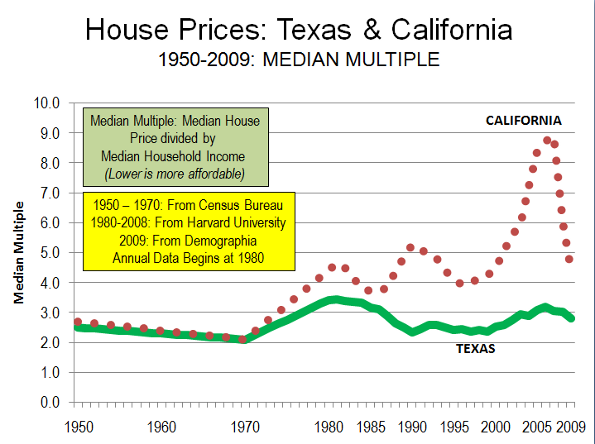
    Throughout the past decade, Texas has experienced far smaller house price increases than in California, Florida and many other states. During the bubble, California house prices increased at a rate 16 times those of Texas, while Florida house prices increased 7 times those of Texas. As a result, after the bubble burst, subsequent house price declines were far less severe or even non-existent in Texas. Texas had experienced its own housing bubble in the 1980s, however even then overall prices did not exceed the Median Multiple of 3.0 (The Median Multiple is the median house price divided by the median household income).

    Unlike Texas, all of the markets with steep house price escalation had more restrictive land use regulations. This association between more restrictive use regulation and higher house prices has been noted by a wide range economists, from left-leaning Nobel Laureate Paul Krugman to the conservative Hoover Institution’s Thomas Sowell. It is even conceded in The Costs of Sprawl —2000, the leading academic advocacy piece on more restrictive land use controls, which indicates the potential for higher house or land prices in 7 of its 10 recommended strategies.

    Comparing Texas and California: Unlike California, housing remained affordable in Texas. California’s housing affordability – in relation to income – largely tracked that of Texas (and the nation) until the early 1970s (Figure). After more restrictive land use regulations were adopted prices started to escalate. This relationship has been well demonstrated by William Fischel of Dartmouth University. Other factors have had little impact. Construction cost increases have been near the national average in California. Other factors, like underlying demand as measured by domestic migration, have been lower in California than in Texas..

    Comparing Texas and Florida: The contrast with Florida is similar. Housing affordability in Florida was comparable to that of Texas as late as the 1990s. However, with strict planning control of land for development in Florida, land prices rose substantially when profligate lending increased demand.

    Comparing Texas and Portland: Further, the Texas housing market avoided the huge price increases that have occurred in Portland (Oregon), which relies on extensive restrictive land use regulation. In 1990, Portland house prices relative to incomes were similar to those of the large Texas metropolitan areas. At the recent peak, the median Portland house price soared to approximately 80% above Texas prices. Portland did not experience the price collapses of California, but due to the greater price volatility associated with smart growth price declines in relation to incomes that were five times those of Texas.

    How the Speculators Missed Texas: Speculation is often blamed as having contributed to the higher house prices that developed in California and Florida. This is correct. Moreover, with some of the strongest demand in the United States, Texas would seem to have been a candidate for rampant speculation. After all, it happened back in the 1970s when a huge oversupply of housing, industrial, retail and office space collapsed in the face of falling energy prices.

    But it did not happen this time, despite solid population growth. During the housing bubble, Dallas-Fort Worth and Houston ranked second and third to Atlanta in population increases among metropolitan areas with more than 5 million population. Austin is the nation’s second fastest growing metropolitan area with more than 1 million population. Each of these metropolitan areas had strong underlying demand, as indicated by domestic migration data.

    Yet the speculators were not drawn to the metropolitan areas of Texas. This is because speculators or “flippers” are not drawn by plenty, but by perceived scarcity. In housing, a sure road to scarcity is to limit the supply of buildable land by outlawing development on much that might otherwise be available.

    However, the speculators did not miss California and Florida. Nor did they miss Las Vegas or Phoenix, where the price of land for new housing rose between five and 10 times as the housing bubble developed. Despite their near limitless expanse of land, much of it was off limits to building, and the exorbitant price increases were thus to be expected.

    The Threat: Yet, despite the success of the less restrictive land use policies in Texas, there are strong efforts there to impose more smart growth policies. The impact could be devastating, especially from strategies that ration land that would raise land and house prices, as has occurred in California and Florida. In 2009, Governor Perry vetoed a bill that would have required the state to promote smart growth. Federal initiatives, under proposed climate change and transportation acts could do much to destroy not only the affordability of Texas metropolitan markets, but could also make Texas less competitive in the decades ahead.

    Photograph: Suburban San Antonio (by the author)

    Wendell Cox is a Visiting Professor, Conservatoire National des Arts et Metiers, Paris. He was born in Los Angeles and was appointed to three terms on the Los Angeles County Transportation Commission by Mayor Tom Bradley. He is the author of “War on the Dream: How Anti-Sprawl Policy Threatens the Quality of Life.

  • Civic Choices: The Quality vs. Quantity Dilemma

    Advocates on opposite sides of urban debates often spend a great deal of time talking past each other. That’s because there’s a certain Mars-Venus split in how they see the world. In effect, there are two very different and competing visions of what an American city should be in the 21st century, the “high quality” model and the “high quantity” model One side has focused on growing vertically, the other horizontally. One group wants to be Neimans or a trendy boutique and ignores the mass market. The other focuses more on the middle class, like a Costco and Target. It should come as no surprise that there’s seldom agreement between the two.

    America’s “High Quality” cities are the traditional large tier-one metro areas, but also include smaller cities like Seattle and Portland. They stress high wage activities such as finance, high tech, and luxury consumption. In this model, traditional growth in areas like population, jobs, or the size of the urban footprint are less important and even seen as a negative. Understandably so. It’s difficult to see, for example, how another million people living in the Bay Area would improve the fortunes of companies like Google or Facebook, or another million Angelenos helping Hollywood.

    Indeed many residents would oppose such growth due to increased traffic, infrastructure spending, and other of the challenges associated with it. In effect, the anti-growth agenda that dominates the culture of many of these places is not based simply on environmental concern, but the economic interests of their dominant regional elites. These places have already achieved the size to support their urban amenities.

    Another reason not to press the growth button: on measures of urban quality such as economic output and income, most are clearly doing very well. Most of these places generate GDP per capita far above the US metro average of $41,737. With the exception of Chicago, they are also growing at a pace that beats the US average. These cities also boast incomes – although often a cost of living – generally well above average, though have been mixed in performance on that metric over the last decade.

    “High Quality” Cities
      Quality Indicators Quantity Indicators
    MSA 2008 Real GDP per Capita Percent Change in GDP per Capita, 2001-2008 2008 Per Capita Income as Pct of US Average PCI Change vs. US Average 2009 Pop. Pop. Pct. Change 2000-2009 2009 Jobs Percent Change in Jobs 2000-2009
    Boston 57916 11.50% 137 -1 4589 4.20% 2408.1 -5.10%
    Chicago 45463 5.50% 113 -4 9581 5.10% 4291 -6.10%
    Los Angeles 47214 16.90% 111 6 12875 3.80% 5200.9 -4.80%
    Miami 40447 15.60% 107 2 5547 10.40% 2201.9 2.10%
    New York 57097 17.60% 137 6 19070 3.90% 8304.5 -1.10%
    Portland 47811 22.40% 99 -9 2242 15.80% 972.4 -0.10%
    San Francisco 60873 10.50% 156 -8 4318 4.40% 1908.8 -10.20%
    San Jose 82880 20.90% 146 -35 1840 5.80% 855.6 -18.10%
    Seattle 55982 11.30% 126 -1 3408 11.60% 1668.7 1.30%
    Washington 61834 15.20% 141 5 5476 13.60% 2950.2 10.10%

    But if these areas are doing well, for those who can afford to live them at least, they tend to do poorly on quantity measures. Many of them have anemic population growth, albeit from a large base. And virtually all of them actually destroyed jobs in the last decade. The ravenous maw of Washington, DC of course, being the great exception.

    This mixed performance isn’t surprising. High end activities are by definition exclusive. The specialized environments they require, and the high value and wealth they create, create expensive places to do business. Unless you have to be in one of these places, such as to take advantage of industry clusters or specialized labor markets, it doesn’t make sense to pay the price to do so. Clearly, mass employers have voted with their feet.

    Four data points from Silicon Valley sum it up. Between 2001 and 2008, the San Jose MSA’s: a) real GDP per capita increased by 20.8% b) total real GDP increased by 25.9%, c) real GDP per job increased by 39.6%, BUT d) total employment declined by 9.4%. That’s the high quality city dynamic in a nutshell.

    America’s “High Quantity” cities follow the opposite pattern. They might have their occasional claims to fame, but few feature the high end business or glamorous lifestyles of America’s premier metros – even though some have spent big bucks on vanity projects to polish their reputations. Rather, what these cities do well is provide quality workaday environments for the middle class. And create jobs – lots of jobs, the Great Recession notwithstanding.

    This is again backed up by the numbers. These cities fare well on quantity measures such as population growth, where they crush the US average of 8.8%, and job growth, where several of them actually managed to post double-digit gains during the generally anemic 2000s.

    “High Quantity” Cities
      Quality Indicators Quantity Indicators
    MSA 2008 Real GDP per Capita Percent Change in GDP per Capita, 2001-2008 2008 Per Capita Income as Pct of US Average PCI Change vs. US Average 2009 Pop. 2009 Jobs Percent Change in Jobs 2000-2009
    Pop. Pct.
      Change
      2000-2009
    Atlanta 43020 -6.00% 95 -16 5475 27.90% 2290.3 0.50%
    Austin 43819 8.50% 93 -16 1705 34.70% 758.2 12.70%
    Charlotte 59191 0.70% 99 -11 1746 30.20% 810.2 5.70%
    Dallas 50067 5.10% 104 -9 6448 24.10% 2864.3 3.70%
    Houston 49182 3.60% 114 1 5867 23.80% 2539 12.60%
    Nashville 43891 9.90% 99 -5 1582 20.10% 723.7 3.30%
    Orlando 42353 13.30% 89 -3 2082 25.70% 1009.5 10.60%
    Phoenix 38009 2.80% 90 -5 4364 33.10% 1719.6 8.90%
    Raleigh 41681 -3.70% 99 -16 1126 40.00% 499.7 14.10%
    Salt Lake City 46453 9.30% 95 0 1130 16.20% 610.8 8.00%

    But all is not well with these cities just because they are adding jobs and people. Their GDP per capita is generally above average, but is growing slowly. Their per capita income may be lower than some, but their cost of living is rock bottom, enabling a high quality of life. But worryingly, those incomes are often not keeping pace with the US average.

    These two dynamics reflect what has happened throughout America, from retail to media, where there has been a great “hour glassing” effect in the marketplace. A small but significant high end is thriving, almost everywhere but particularly in the quality oriented cities. The low end is also doing well, particularly in the quantity oriented cities. Neimans and Wal-Mart, indeed.

    In the future, both models face big challenges. The high quality cities continue to become more exclusive. The problem with getting high end on a smaller base is that your market is asymptotically zero. And as high quality talent gets squeezed out – by being not quite elite enough, for lifestyle, affordability or other reasons – the quantity cities start to poach great people and start stealing even more market share. It’s always easier to climb up the value chain than go down it. At some point, these cities could run out of room to shimmy up the flag pole.

    Some high quantity cities may face even greater risks. America’s great elite metropolises have proven they can stand the test of time. New York, Boston, Chicago, San Francisco – all have made it through many economic cycles, fundamental transformations, and even great physical disasters. Few of the high growth cities have proven they’ve got staying power after exhausting their first great growth phase. Detroit, Cleveland, and other Rust Belt burgs were yesterday’s Sun Belt boomtowns. They serve as a cautionary tale about the risks of not having a quality calling card to fall back on when your allure as a growth story fades

    Partisans of these two models need to learn how to learn from each other. The high quality cities need to learn again the lessons of their youth about the importance of growth. And the high quantity cities need to create environments that will sustain them after they’ve lost greenfield advantages. An hourglass America is not one most of us want to live in for the long term. Maintaining a stable commonwealth for the long term means striving again to restore some new 21st century version of our lost middle ground.

    Data Sources:
    Real GDP per Capita (in 2001 chained dollars) is from the US Bureau of Economic Analysis
    Per Capita Personal Income as a percentage of the US average is from the US Bureau of Economic Analysis.
    Population is the from the annual mid-year estimates from the US Bureau of the Census.
    Total jobs from the US Bureau of Labor Statistics Current Employment Statistics program.
    Data changes are calculated.

    Aaron M. Renn is an independent writer on urban affairs based in the Midwest. His writings appear at The Urbanophile.

    Photo by Werner Kunz (werkunz1)

  • Locals Flee from New South Wales

    A newspaper headline “Fleeing locals ease population pressure on New South Wales” highlights a trend over the last few years. Since 2002 the Australian state of New South Wales, the country’s most populous with over seven million residents, has been losing its residents to other states at some 20,000 per year.

    During the year ended December 2009, 0.2 per cent of the New South Wales population moved to other Australian states. By contrast the State of Queensland, gained 0.3 per cent. Total population growth (consisting of net immigration, natural increase and net interstate movement) in the states of Victoria, Queensland and Western Australia was 2.13, 2.44 and 2.65 per cent respectively. By contrast New South Wales grew a desultory 1.64 per cent.

    The main reason ascribed to the exodus from New South Wales is the cost of housing in Sydney. The 6th Annual Demographia Housing Affordability Survey shows that its capital city Sydney has the second highest housing costs of the cities in the six countries surveyed, behind only Vancouver, Canada. For many people, 9.1 years of median family income required to purchase a median family home Sydney is becoming too expensive to live in.

    The Demographia Survey indicates that a price/income ratio of 3.0 can be considered affordable and 9.1 severely unaffordable. As a result many people, especially the young, will never be able to aspire to the Great Australian Dream of owning their own home. For those who can afford a home, the average wait time to save for the required deposit is 6.2 years. The newly appointed Federal Sustainable Population Minister recently is quoted as saying “people have said all I can see for my kids is they’re never going to be able to afford to live in this suburb because of what’s happening with housing prices”.

    The high cost of housing has significant social impacts. The Demographia Survey estimates that in Sydney 57% of median gross family income would be required to make mortgage repayments for a current median priced house. This may be compared with the 20 per cent figure applicable in Atlanta or Dallas-Fort Worth. There are already some 11,000 homeless persons in New South Wales and some 4,000 sleeping rough.

    Why is the cost of housing in Sydney so high? The Demographia Survey portrays a widespread relationship among the cities studied between high housing cost and overly restrictive planning regimes. New South Wales is among the most restrictive. In order to implement a high-density policy it has restricted the release of greenfield housing sites from an historic average of 10,000 lots per year to an average over the last five years of only 2,250. This is in the face of a annual state population increase of some 115,000. It is staggering to consider this constraint in a continent-sized country of which only some 0.3 per cent is urbanised.

    The scarcity resulting from the miserable allocation of greenfield lots has been most notable in land price, whose share of housing costs has increased from 30 per cent to 70 per cent of the total cost. The result has been an increase of overall prices some three times what it was ten years ago.
    Only seven per cent of people, wish to live in apartments. However, in order to implement its high-density policy the State Government intends to force this lifestyle on reluctant consumers. It plans 460,000 extra dwellings within the existing footprint of Sydney by 2031. In practice the production rate of these high density units has fallen well short of that planned.

    These high-density planning policies result in a dwelling scarcity which enables developers to make large profits on apartments. Developers now comprise by far the largest group (29.5 percent) among Australia’s 200 richest people. They have the resources to make sizable donations to both major political parties. Donations help fund election campaigns and in the past have helped keep the politicians who promote these policies in power. Numerous cases have been documented that show a large donation being made to a governing party shortly before permission was granted for a particular development.

    The shortage of land also impacts commerce and industry. Higher housing costs result in higher rentals or mortgage costs. Workers have to make ends meet and so businesses have to pay higher wages. Additionally employers must shell out for higher commercial rentals. The cost of industrial land in Sydney is roughly 70 per cent greater than in the other Australian large cities. Recently there have been a number of well publicised instances of industries closing their factories in Sydney and moving to Victoria, the state located to the south.

    Communities in Sydney are now paying the price for misguided state planning policies. Concrete, bitumen and tiles dominate vast areas where streetscapes of flowers and foliage once reigned supreme. There is a rising consciousness of disasters resulting from the government’s high-density planning policies. as Along with the topic of unaffordable housing, traffic gridlock, disintegrating public transport, frequent power blackouts and a city running out of water hit the headlines with increasing frequency. Dissatisfaction is escalating.

    The latest Newspoll puts the primary vote for New South Wale’s ruling Labor Party at 25 per cent, the lowest ever recorded. It faces a devastating defeat in the forthcoming March 2011 election. There can be little doubt that ill-advised planning policies are a major factor underlying this pending electoral calamity. But will politicians ever learn?

    (Dr) Tony Recsei has a background in chemistry and is an environmental consultant. Since retiring he has taken an interest in community affairs and is president of the Save Our Suburbs community group which opposes over-development forced onto communities by the New South Wales State Government.

    Photo by Nelson Minar

  • “James Drain” Hits Cleveland

    The ten story of mural of LeBron James is coming down in Cleveland. This one hurts. James wasn’t just the latest embodiment of Cleveland’s hopes, he was a local kid who, unlike so many, had stayed home in Northeast Ohio. His joining of the Cleveland exodus at a time of severe economic distress prompted Cavaliers owner Dan Gilbert to pen a now infamous open letter to fans:

    As you now know, our former hero, who grew up in the very region that he deserted this evening, is no longer a Cleveland Cavalier…..The good news is that the ownership team and the rest of the hard-working, loyal, and driven staff over here at your hometown Cavaliers have not betrayed you nor NEVER will betray you….This shocking act of disloyalty from our home grown “chosen one” sends the exact opposite lesson of what we would want our children to learn. And “who” we would want them to grow-up to become….

    Forty years of frustration boiled over in that letter. Gilbert is from Detroit, but perhaps that’s why he too shares these feelings so viscerally.

    Cleveland’s “Big Thing Theory”

    In a sense though, Cleveland’s disappointment was inevitable. LeBron James was never going to turn around the city. No one person or one thing can. Unfortunately, Cleveland has continually pinned its hopes on a never-ending cycle of “next big things” to reverse decline. This will never work. As local economic development guru Ed Morrison put it, “Overwhelmingly, the strategy is now driven by individual projects….This leads to the ‘Big Thing Theory’ of economic development: Prosperity results from building one more big thing.”

    These have all failed, now even “King James”. The trend lines haven’t changed, even where the individual projects have done well. But often even that hasn’t happened. For example, the Flats, a once-thriving entertainment district in an old warehouse district, now resembles, as one local comedian put it, a “Scooby Doo ghost town.”

    Combating “James Drain”

    James’ departure also fits the narrative of generalized anxiety around “brain drain” and cities losing their best and brightest of each generation. As lots of people really have left Cleveland, this is understandable. But the real story is much more complex. A look at IRS tax return data shows that in reality Cleveland doesn’t have especially high out-migration. Its metro out-migration rate* in 2008 was 28.02. Miami’s was 40.34 and for even the boomtown of Atlanta it was 38.95. Not only is Cleveland not losing an especially high number of people, you can actually argue it is losing too few. A big part of the problem in Cleveland’s economy is that too many people are stuck there.

    Conversely, a real migration problem is that too few people are moving in. As local attorney Richard Herman noted, “New York City and Chicago, like most major cities, see significant out-migration of their existing residents each year. What is atypical is that Cleveland does not enjoy the energy of new people moving in.” The Cleveland metro in-migration rate was only 22.19. Miami’s was 30.36 and Atlanta’s a robust 51.91.

    Cities need new blood. Cleveland isn’t getting it. Its circulatory system is shut down. Cleveland needs more natives to leave and more newcomers to arrive. Both sides win. Those Cleveland departees will move on to be part of the new energy other cities so desperately need. James is going to get to live the high life he wants in South Beach, but somebody else will be fired up to get the opportunity to play in Cleveland.

    Selling Cleveland

    But that begs the question, what’s going to get more people to move to Cleveland? The fact is, James wasn’t getting the job done, and never would. Nor will amenities like the Cleveland Orchestra or the Rock and Roll Hall of Fame Museum.

    The mistake Cleveland and other Rust Belt cities make is that they are too worried about the likes of LeBron James moving to Miami. For people with the means and the desire to choose a place like South Beach, Cleveland simply can’t compete. And let’s not forget, James snubbed Chicago, New York, and Los Angeles too.

    Rather than trying to take on the Chicagos, Miamis, and New Yorks of this world at their strongest points, Cleveland would be far better served ceding that market and fighting where it can best compete. Believe it or not, not everyone wants to live in a huge global city. There are plenty of people who might choose to live in Cleveland, if the city focused on the basic blocking and tackling of city services, quality of life, and business climate instead of splashy grands projets. As Anthony Bourdain said this week:

    I think that troubled cities often tragically misinterpret what’s coolest about themselves. They scramble for cure-alls, something that will “attract business”, always one convention center, one pedestrian mall or restaurant district away from revival. They miss their biggest, best and probably most marketable asset: their unique and slightly off-center character….Cleveland is one of my favorite cities. I don’t arrive there with a smile on my face every time because of the Cleveland Philharmonic.

    In short, Cleveland needs less South Beach, less Chicago Loop, and more American Splendor. Ultimately, my bet is Cleveland will end up missing Harvey Pekar a lot more than it will any multi-millionaire sports star.

    Shooting the Messenger

    Who is going to get that message out about Cleveland? After that sendoff, it sure won’t be LeBron James. That’s a shame. As Jim Russell has richly illustrated, people make migration – and investment – decisions based on knowledge, not just information. Nobody picks a city to live in by entering reams to statistics into a sixteen tab spreadsheet. They’re more likely to move to be near family, friends, or places they know. That knowledge comes from first hand experience – and trusted recommendations.

    Until the switch flips on Cleveland’s brand, it needs to be out earning that trust of prospective residents. The people who’ve left aren’t Judases, they’re your field sales force – or at least they should be. James could have been a missionary “Witness” for Cleveland in a foreign land. Instead, Cleveland blew an enormous opportunity, and left itself with little more than soured memories and a partially demolished mural as an ephemeral reminder of yet another failed Next Big Thing.

    * Tax return exemptions migrating per 1000 overall tax return exemptions in the base year.

    Aaron M. Renn is an independent writer on urban affairs based in the Midwest. His writings appear at The Urbanophile.

    Photo by alexabboud

  • The Democrats’ Middle-Class Problem

    Class, the Industrial Revolution’s great political dividing line, is enjoying Information Age resurgence. It now threatens the political future of presidents, prime ministers and even Politburo chiefs.

    As in the Industrial Age, new technology is displacing whole groups of people — blue- and white-collar workers — as it boosts productivity and creates opportunities for others. Inequality is on the rise — from the developing world to historically egalitarian Scandinavia and Britain.

    Divisions are evident here in the United States. Throughout the 2008 presidential campaign, Barack Obama lagged in appealing to white middle- and working-class voters who supported Hillary — and former President Bill — Clinton.

    Now, these voters, according to recent polls, are increasingly alienated from the Obama administration. Reasons include slow economic growth, high unemployment among blue- and white-collar workers and a persistent credit crunch for small businesses. These factors could cause serious losses for Democrats this fall — and beyond.

    This discontent reflects long-term trends. Since 1973, for example, the rate of growth of the “typical family’s income” in the United States has slowed dramatically. For men, it has actually gone backward when adjusted for inflation.

    The past few years have been particularly rough. About two in five Americans report household incomes between $35,000 and $100,000 a year. Right now, almost three in five are deeply worried about their financial situation, according to an ABC poll from March.

    This should give Democrats an issue, theoretically. But to date, Obama and his party seem incapable of harnessing the growing middle- and working-class unrest.

    In fact, according to recent polls, these have been the voters that Democrats and the president have been losing over the past year as the economic stimulus failed to make a major dent in unemployment.

    Part of this problem lies with the party’s base, which the urban historian Fred Siegel once labeled “the coalition of the overeducated and the undereducated.” Major urban centers like New York, Chicago and San Francisco might advertise themselves as enlightened, but they have lost much of their middle class and suffer the highest levels of income inequality.

    Representatives from these areas now dominate the party and reflect their bifurcated districts. They often stress the concerns of the educated affluent on issues like climate change and gay marriage, while their economic policies focus on the public-sector workers, “green” industries and maintaining the social welfare net.

    Not surprisingly, this agenda does little for the middle-class — mostly suburban — voters.

    Sen. Scott Brown (R-Mass.), for example, won his margin of victory in largely middle- and working-class suburbs, where many voters had backed Obama in 2008, according to demographer Wendell Cox. Brown lost by almost 2-to-1 among poor voters — and also among those earning more than $85,000 a year.

    Given the danger revealed by these numbers, Democrats and other center-left parties around the world should refocus their policies on issues — such as taxes, private-sector job creation and small business — that affect such voters.

    For this growing class divide can be found globally: In China, for example, technological change and globalization have produced a new proletariat that, unlike in the past, is disinterested in warmed-over Maoist ideology.

    Perhaps nothing demonstrates this more clearly than the unrest at the Foxconn Technology Group. Workers produce cool products — for companies like Apple, Dell and Nintendo — but under such oppressive conditions that some have been driven to suicide.

    Mounting protests about Foxconn’s employment practices, and a recent rash of strikes in China’s Honda plants, reveal the disruptive potential of this class conflict.

    Even as China’s corporations and government become richer, inequality is widening. Indeed, over the past 20 years, China has shifted from an income-distribution pattern like that of Sweden or Germany to one closer to Argentina’s or Mexico’s. By 2006, China’s level of inequality was greater than that of the United States or India.

    Not surprisingly, class anger has reached alarming proportions. Almost 96 percent of respondents, according to one recent survey, agreed that they “resent the rich.”

    China’s class divides may be extreme, but similar patterns can be found almost everywhere. From India to Mexico, economic growth has led to a striking increase in the percentage of urbanites living in slum conditions.

    In 1971, for example, slum dwellers accounted for one in six Mumbaikars. Today, they are an absolute majority.

    This almost guarantees greater class conflict in the future, even as India’s economy booms.

    “The boom that is happening is giving more to the wealthy,” said R.N. Sharma of Mumbai’s Tata Institute of Social Sciences. “This is the ‘shining India’ people talk about. But the other part of it is very shocking — all the families where there is not even food security.We must ask: ‘The “shining India” is for whom?’”

    This growing inequality in the developing world is already shaping global politics. The failure of the Copenhagen climate change conference can be largely ascribed to the unwillingness of China, India, Brazil and other developing countries to sacrifice wealth creation opportunities for ecological reasons.

    Like their counterparts in New Delhi and Beijing, politicians in wealthier countries also face class conflict.

    In Britain, for example, even a massive expansion of the welfare state has done little to stop the U.K. from becoming the most unequal among the advanced European democracies.

    Alienation among white working-class voters — particularly those in the public sector or with modest small businesses — may have contributed to the Labour Party’s poor showing in the recent elections, according to Liam Byrne, the former Labour treasury secretary.

    A similar phenomenon appears in Australia. Labor Prime Minister Kevin Rudd, an icon among upper-class liberals, resigned in large part because of a precipitous decline in the polls among middle- and working-class suburban voters.

    What is not clear is whether conservative parties can abandon their often slavish devotion to big corporate interests to take advantage of these new dynamics. For years, these parties have relied on divisive social issues, like immigration, to win working- and middle-class voters. But it’s possible that a focus on profligate government spending might yet increase the right’s appeal among mid-income voters.

    As this current shift to greater inequality continues, the self-styled “popular” parties’ tendency to ignore class issues could prove disastrous.

    Unless they start addressing class issues in effective ways, they may lose not just their historical base but the political future.

    This article originally appeared in Politico.

    Joel Kotkin is executive editor of NewGeography.com and is a distinguished presidential fellow in urban futures at Chapman University. He is author of The City: A Global History. His newest book is The Next Hundred Million: America in 2050, released in Febuary, 2010.

    Official White House Photo by Pete Souza

  • SPECIAL REPORT: Move to Suburbs (and Beyond) Continues

    Anyone who challenges the notion that the long predicted exodus of people from the suburbs to the city has been wildly overstated is sure to generate some backlash from urban boosters. Alan Berube of the Brookings Institution contends in a New Republic column that “head counts” better reveal city trends than property trends or the massive condo bust. He points to a Brookings Institution analysis by Bill Frey, entitled “Texas Gains, Suburbs Lose in 2010 Census Review,” which compares trends in major cities and suburbs, but offers not a sentence demonstrating any actual population “loss” in suburbs (his point is that their growth rates have declined).

    However, Berube has a point. Head counts are the issue. The annual Bureau of the Census “head count” of domestic migration reveals that the suburban to urban core exodus is as elusive as it has ever been. Gross population totals reveal nothing with respect to movements between the suburbs and the core. There is no doubt that core city population trends have improved, and this is a good thing. However, there is not a shred of evidence that suburbanites are picking up and moving to the cores.

    Domestic Migration: This is indicated by a “head count” of migration trends during the decade and during the last year. Each year, the Bureau of the Census estimates the number of people who move between counties (domestic migration) and the number of people who move into metropolitan areas from outside the nation (international migration). The data is estimated at the county (equivalent) level, which means that, except where cities are counties (such as Baltimore, San Francisco and others), individual core city data is not available. Thus, the analysis has to rely on core versus suburban counties in metropolitan areas (Note 1).

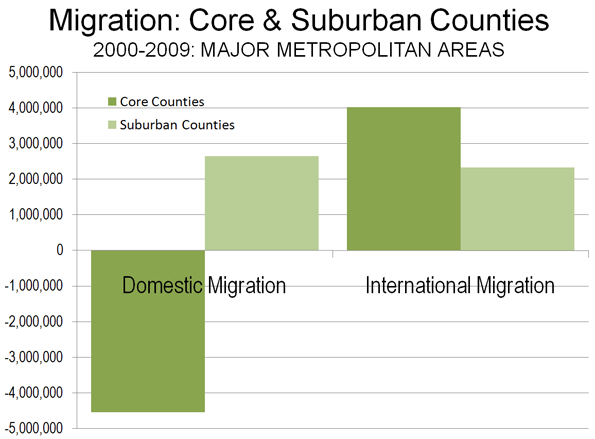
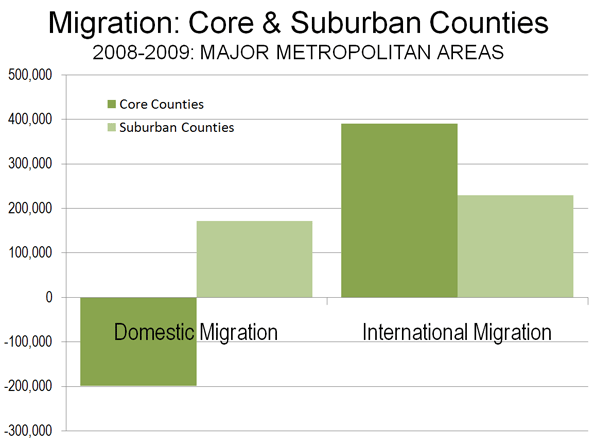
    In short, the nation’s urban cores continue to lose domestic migrants with a vengeance, however are doing quite well at attracting international migration. Thus, core growth is not resulting from migration from suburbs or any other part of the nation, but is driven by international migration.

    The following analysis covers all but four (48) metropolitan areas with more than 1,000,000 population as of 2009. San Diego, Las Vegas and Tucson are excluded because they include only one county, so there is only a core county and no suburban county. New Orleans is excluded due to the special circumstances of the huge population losses from Hurricane Katrina.

    Generally, domestic migrants are leaving the nation’s largest metropolitan areas. Between 2000 and 2009, a net 1,900,000 domestic migrants moved to areas of the nation outside the largest metropolitan areas (Table 1). Domestic migration losses occurred 24 of the 48 metropolitan areas. In the last year (2008-2009), the net domestic out-migration for all 48 regions in total was 22,000, 90% below the 2000-2008 annual rate. A somewhat smaller number of metropolitan areas, 22, experienced domestic migration losses in the last year. Most observers, including Berube, trace this diminishing loss to the recession, which has made movement in any direction more difficult over the past two years.

    Table 1
    Domestic Migration: Major Metropolitan Areas
    2000-2009
    2008-2009
    Core County Classification
    Metropolitan Area
    Metropolitan Area
    Core
    Suburban
    Metropolitan Area
    Core
    Suburban
    1
    New York   (1,920,745)   (1,222,290)     (698,455)       (110,278)     (77,381)    (32,897)
    3
    Los Angeles   (1,337,522)   (1,102,202)     (235,320)         (79,900)     (76,674)      (3,226)
    2
    Chicago       (547,430)      (705,403)      157,973         (40,389)     (31,114)      (9,275)
    4
    Dallas-Fort Worth        307,907      (262,982)      570,889           45,241       (7,494)      52,735
    1
    Philadelphia       (112,071)      (154,338)         42,267           (7,577)       (5,496)      (2,081)
    4
    Houston        242,573        (69,736)      312,309           49,662       19,002      30,660
    4
    Miami-West Palm Beach       (284,860)      (297,637)         12,777         (29,321)     (25,142)      (4,179)
    1
    Washington       (110,775)        (39,814)       (70,961)           18,189         4,454      13,735
    3
    Atlanta        412,832            3,243      409,589           17,479         7,579        9,900
    1
    Boston       (232,984)      (100,485)     (132,499)             6,813             (32)        6,845
    2
    Detroit       (361,632)      (306,467)       (55,165)         (45,488)     (34,794)    (10,694)
    4
    Phoenix        530,579        404,840      125,739           12,441         4,651        7,790
    2
    San Francisco-Oakland       (343,834)      (245,796)       (98,038)             7,977           (207)        8,184
    4
    Riverside-San Bernardino        457,430        375,055         82,375               (616)       13,174    (13,790)
    3
    Seattle           42,424        (27,407)         69,831           17,035       11,053        5,982
    2
    Minneapolis-St. Paul         (22,865)      (138,395)      115,530           (2,503)       (1,989)          (514)
    1
    St. Louis         (42,151)        (62,990)         20,839           (4,532)       (3,197)      (1,335)
    4
    Tampa-St. Petersburg        254,650          89,385      165,265             4,663         2,630        2,033
    1
    Baltimore         (35,938)        (74,328)         38,390           (3,687)       (4,883)        1,196
    2
    Denver           61,108        (44,839)      105,947           19,831         6,369      13,462
    2
    Pittsburgh         (49,438)        (57,532)           8,094             1,144            401           743
    2
    Portland        120,437            3,811      116,626           16,320         7,053        9,267
    2
    Cincinnati         (18,313)        (87,976)         69,663               (384)       (2,833)        2,449
    4
    Sacramento        135,038          32,369      102,669             4,733       (1,185)        5,918
    2
    Cleveland       (133,679)      (151,448)         17,769         (10,191)     (10,875)           684
    4
    Orlando        218,108          46,341      171,767           (4,279)       (6,275)        1,996
    4
    San Antonio        175,552          96,856         78,696           18,984       10,797        8,187
    3
    Kansas City           30,181        (33,910)         64,091             3,929           (417)        4,346
    4
    San Jose       (233,133)      (226,545)         (6,588)           (5,361)       (4,829)          (532)
    3
    Columbus           32,087        (36,024)         68,111             5,018         1,907        3,111
    4
    Charlotte        243,399        104,402      138,997           19,211         8,299      10,912
    3
    Indianapolis           70,271        (53,039)      123,310             7,034       (1,209)        8,243
    4
    Austin        224,227          52,842      171,385           25,654       10,484      15,170
    2
    Norfolk-Virginia Beach         (19,172)        (19,391)              219           (8,052)       (3,559)      (4,493)
    2
    Providence         (50,151)        (38,129)       (12,022)           (6,736)       (4,939)      (1,797)
    3
    Nashville        120,684        (20,101)      140,785           10,826            128      10,698
    2
    Milwaukee         (72,668)        (89,476)         16,808           (2,336)       (3,585)        1,249
    4
    Jacksonville        125,881          17,866      108,015             1,758       (3,415)        5,173
    4
    Memphis           (8,834)        (61,325)         52,491           (5,276)       (7,867)        2,591
    3
    Louisville           33,700           (7,692)         41,392             2,122            262        1,860
    2
    Richmond           74,650           (4,839)         79,489             2,751                 3        2,748
    3
    Oklahoma City           41,523           (8,164)         49,687             8,798         3,236        5,562
    3
    Hartford           (9,385)        (22,089)         12,704           (1,847)       (1,949)           102
    3
    Birmingham           26,420        (26,550)         52,970             2,418       (1,424)        3,842
    3
    Salt Lake City         (32,760)        (43,779)         11,019               (164)           (911)           747
    4
    Raleigh        190,438        150,583         39,855           20,095       16,070        4,025
    2
    Buffalo         (53,191)        (47,780)         (5,411)           (1,711)       (1,806)              95
    2
    Rochester         (42,163)        (35,354)         (6,809)           (1,937)       (1,224)          (713)
    Total   (1,903,595)   (4,548,659)   2,645,064         (22,439)   (199,153)   176,714
    Major metropolitan areas: Population over 1,000,000 in 2009
    Core county classifications: See Table 2

    The core counties lost domestic migrants, often at very high rates. Between 2000 and 2009, more than 4,500,000 people moved out of the core counties. This is more people than live in the cities of Los Angeles and Washington, DC combined. The suburban counties did substantially better gaining more than 2,600,000 domestic migrants (nearly as many people as live in the city of Chicago), but not enough to negate the core losses. Over the past year, the core counties lost 200,000 domestic migrants, an annual rate approximately two-thirds less than the rate from 2000 to 2008. Suburban counties gained 175,000, a more than 40% reduction from the 2000-2008 annual rate. All of these rate changes are consistent with expectations in a recession, as fewer people move.

    If anything, the trends of the past decade indicate a further dispersal of America’s metropolitan population, with an additional 200,000 domestic migrants moving to the exurban counties adjacent to and beyond the major metropolitan areas (Note 2). Reflecting the effects of the recession, exurban areas lost 4,000 domestic migrants in the last year. This one year loss rate is less than 1/10th of the core county domestic migration loss rate over the same period. Another nearly 1.7 million domestic migrants left the major metropolitan areas and their exurbs altogether, moving to smaller metropolitan areas, smaller urban areas and rural areas.

    Between 2000 and 2008, 36 cores experienced domestic migration losses, compared to 10 suburban areas. The cores did better in the last year, with 29 losing domestic migrants, while 13 suburban areas lost domestic migrants. Further, more people moved into (or fewer moved out of) the suburbs from other parts of the country than to the cores in 42 of the 48 metropolitan areas between 2000 and 2009 and in 2008-2009.

    Moreover, not all urban cores are the same. Some, including most of the fast growing areas, are far more suburban than others. This is illustrated by a classification of core counties (Table 2) based upon the share of owner occupant housing built after 1949 (For for statistical purposes the beginning of automobile oriented suburbanization was with the census of 1950).

    Table 2
    Core County Classifications (Extent of Suburbanization)
    Core County Classification
    Share of Owner-Occupied Houses Built After 1949
      Dominant Urban Cores
    Less than 50%
      Moderately Suburban
    50% = <75%
      Substantially Suburban
    70% = <85%
      Predominantly Suburban
    85% & Over
    Data from 2000 US Census

    For example, in the core counties of the St. Louis and Boston metropolitan areas, there is little suburbanization, with more than 70% of houses having been built before 1950. Their growth truly reflects the attractiveness of traditional, relatively dense urban living. On the other hand, in the core county of the Austin metropolitan area, less than 10% of the houses were built before 1950, while in Phoenix, the figure is 3%. In these and other core counties that encompass large suburban areas, the vast majority of “urban” growth follows a highly suburbanized, auto-oriented model.

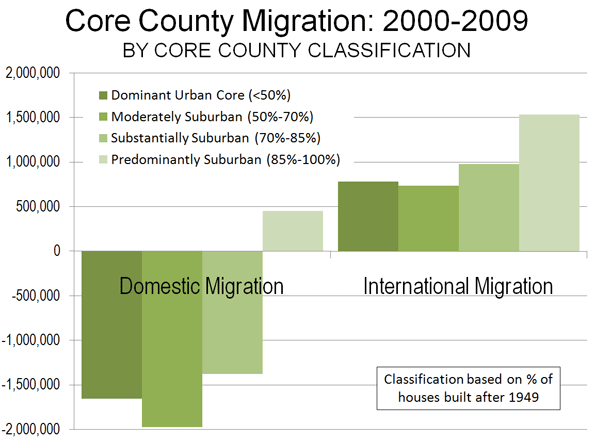
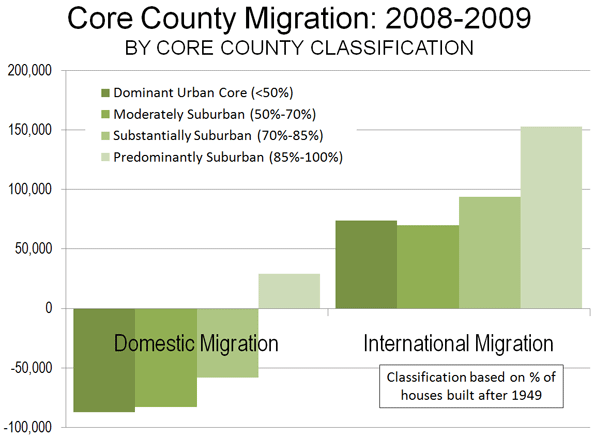
    The domestic migration results by core county classification are as follows:

    • Dominant Urban Core Central Counties (less than 50% of the housing stock built after 1949) lost 1.650 million domestic migrants, or 14.0% of their 2000 population. In the last year, the loss was 87,000.
    • Moderately Suburban Core Central Counties (50% to 69% of the housing stock built after 1949) lost 1.970 million domestic migrants, or 10.0% of their 2000 population. In the last year, the loss was 83,000.
    • Substantially Suburban Core Central Counties (70% to 84% of the housing stock built after 1949) lost 1.380 million domestic migrants, or 7.2% of their 2000 population. In the last year, the loss was 58,000.
    • Predominantly Suburban Core Central Counties (85% and more of the housing stock built after 1949) gained 450 thousand domestic migrants, or 2.0% of their 2000 population. In the last year, the gain was 29,000.

    By no stretch of the imagination, then, can it be validly claimed that the overall trend is people moving from the suburbs to the core. The evidence suggests that the more urban the core county, the greater are the domestic migration losses.


    International Migration: The real story with respect to core growth is international migration. The 48 metropolitan areas gained 6.4 million international migrants from 2000 to 2009 and 620,000 in 2008-2009. International migration, also impacted by recession, dropped by nearly a 15% drop from the 2000-2008 annual rate (Table 3).

    Table 3
    International Migration: Major Metropolitan Areas
    2000-2009
    2008-2009
    Core County Classification
    Metropolitan Area
    Metropolitan Area
    Core
    Suburban
    Metropolitan Area
    Core
    Suburban
    1
    New York     1,075,016      622,538      452,478        100,669     57,674      42,995
    3
    Los Angeles        803,614      628,303      175,311           75,062     58,557      16,505
    2
    Chicago        363,134      265,156         97,978           33,363     24,236        9,127
    4
    Dallas-Fort Worth        323,941      203,732      120,209           31,571     19,785      11,786
    1
    Philadelphia        122,733         50,761         71,972           12,944        5,560        7,384
    4
    Houston        289,648      252,098         37,550           27,996     24,371        3,625
    4
    Miami-West Palm Beach        506,423      318,888      187,535           51,548     32,380      19,168
    1
    Washington        310,222         23,112      287,110           31,904        2,096      29,808
    3
    Atlanta        207,238         42,082      165,156           20,288        4,093      16,195
    1
    Boston        191,014         64,359      126,655           19,250        6,522      12,728
    2
    Detroit           93,625         44,177         49,448             8,723        4,132        4,591
    4
    Phoenix        214,067      209,326           4,741           21,833     21,364           469
    2
    San Francisco-Oakland        257,318      161,324         95,994           24,376     15,373        9,003
    4
    Riverside-San Bernardino           90,652         46,829         43,823             8,464        4,313        4,151
    3
    Seattle        126,973         98,983         27,990           12,919        9,971        2,948
    2
    Minneapolis-St. Paul           84,440         69,262         15,178             8,234        6,756        1,478
    1
    St. Louis           29,782         11,794         17,988             2,928        1,112        1,816
    4
    Tampa-St. Petersburg           74,173         42,568         31,605             8,045        4,762        3,283
    1
    Baltimore           43,949         10,852         33,097             4,604        1,125        3,479
    2
    Denver           93,916         45,338         48,578             8,738        4,251        4,487
    2
    Pittsburgh           19,225         16,326           2,899             1,901        1,596           305
    2
    Portland           70,901         28,755         42,146             6,680        2,677        4,003
    2
    Cincinnati           22,364         12,754           9,610             2,245        1,260           985
    4
    Sacramento           64,275         47,169         17,106             6,056        4,420        1,636
    2
    Cleveland           28,002         20,168           7,834             2,826        1,987           839
    4
    Orlando           95,500         61,171         34,329           11,720        7,381        4,339
    4
    San Antonio           31,595         28,157           3,438             3,303        2,940           363
    3
    Kansas City           34,339         12,613         21,726             3,404        1,262        2,142
    4
    San Jose        170,452      168,009           2,443           16,347     16,116           231
    3
    Columbus           39,755         38,261           1,494             4,063        3,915           148
    4
    Charlotte           48,176         34,522         13,654             4,678        3,332        1,346
    3
    Indianapolis           27,676         22,058           5,618             2,809        2,239           570
    4
    Austin           65,958         56,828           9,130             6,406        5,516           890
    2
    Norfolk-Virginia Beach                421         (1,546)           1,967                867             81           786
    2
    Providence           34,926         25,547           9,379             3,753        2,741        1,012
    3
    Nashville           36,570         26,208         10,362             3,850        2,760        1,090
    2
    Milwaukee           26,814         22,612           4,202             2,706        2,292           414
    4
    Jacksonville           15,066         12,046           3,020             1,760        1,397           363
    4
    Memphis           19,845         17,801           2,044             2,093        1,874           219
    3
    Louisville           16,437         12,778           3,659             1,685        1,291           394
    2
    Richmond           17,061           4,161         12,900             1,805           440        1,365
    3
    Oklahoma City           23,717         18,698           5,019             2,394        1,878           516
    3
    Hartford           30,266         25,871           4,395             3,230        2,784           446
    3
    Birmingham           14,485         10,644           3,841             1,557        1,151           406
    3
    Salt Lake City           41,216         39,416           1,800             3,855        3,684           171
    4
    Raleigh           36,923         32,141           4,782             3,560        3,103           457
    2
    Buffalo             9,671           8,387           1,284                940           814           126
    2
    Rochester           12,796         11,657           1,139             1,243        1,123           120
    Total     6,356,310   4,024,694   2,331,616        621,195   390,487   230,708
    Major metropolitan areas: Population over 1,000,000 in 2009
    Core county classifications: See Table 2

    The core counties gained 4.0 million net international migrants between 2000 and 2009. The international migration gains in the dominant urban and moderately suburban core counties were not sufficient to compensate for the domestic migration losses (Figure 3). Surprisingly, the strongest gain in international migration from 2000 to 2009 was not in the more urban core counties, but rather was in the predominantly suburban core counties, at a 6.8% rate compared to 2000 populations.

    In 2008-2009, the core county gain was 390,000, approximately 15% below the 2000-2008 annual rate (Figure 4). The suburban counties gained international migrants, though fewer than the cores, adding a net 2.3 million between 2000 and 2009. Between 2008 and 2009, the suburbs added a net 230,000 international migrants, a 12% decline from the 2000-2008 annual rate.

    This of course measures only initial international migration. Over time many immigrants likely will head for the suburbs, which now are home to a majority. Core cities may be playing more of a “revolving door” role where they take in immigrants (and young people) for several years, then lose them, but replace the loss with newcomers.

    The Exodus: Elusive as Ever: The much ballyhooed suburban hegira has not begun, despite it having been announced repeatedly (Table 4). There is no doubt that the cores are doing better than in recent decades, particularly since the deep recession began. But the relative better urban performance may have more to do with stagnation than anything endlessly alluring about inner city life.

    Table 4
    Domestic, International & Total Migration: Major Metropolitan Areas
    PERSONS
    Net Domestic Migration: 2000-2009
    Net Domestic Migration: 2008-2009
    Net International Migration: 2000-2009
    Net International Migration: 2008-2009
    Net Total Migration: 2000-2009
    Net Total Migration: 2008-2009
    Core Counties (Share of Post-1949 Housing)   (4,548,659)     (199,153)      4,024,694         390,487        (523,965)     191,334
      Dominant Urban Core (Less than 50%)  (1,654,245)      (86,535)        783,416          74,089       (870,829)     (12,446)
      Moderately Suburban (50%-69%  (1,969,014)      (83,099)        734,078          69,759    (1,234,936)     (13,340)
      Substantially Suburban (70%-84%)  (1,377,714)      (58,419)        975,915          93,585       (401,799)       35,166
      Predominantly Suburban (85% & Over)       452,314        28,900     1,531,285        153,054     1,983,599    181,954
    Suburban Counties     2,645,064       176,714      2,331,616         230,708      4,976,680     407,422
    48 Major Metropolitan Areas   (1,903,595)       (22,439)      6,356,310         621,195      4,452,715     598,756
    Exurban Counties        198,294          (4,053)         364,498           36,740          562,792        32,687
    48 Metropolitan Areas & All Exurban Counties   (1,705,301)       (26,492)      6,720,808         657,935      5,015,507     631,443
    4 Excluded Metropolitan Areas          19,958         14,553         225,767           23,400          245,725        37,953
    All (52) Major Metropolitan Areas & Exurban Counties   (1,685,343)       (11,939)      6,946,575         681,335      5,261,232     669,396
    Smaller Metropolitan & Rural     1,685,343         11,939      1,678,369         173,570      3,363,712     185,509
    United States 0 0      8,624,944         854,905      8,624,944     854,905
    Major metropolitan areas: Population over 1,000,000 in 2009
    Excluded metropolitan areas: San Diego, Las Vegas & Tucson (no suburban county) and New Orleans (due to Hurricane Katrina)
    Exurban counties of excluded metropolitan areas are included (Las Vegas and New Orleans)

    As in Europe, people are moving to the urban cores. But also, as in Europe, they are moving there from across national borders, rather than from the suburbs (Figures 3 & 4). This will surprise urbanites who cannot imagine meaningful lives in the suburbs, but will not shock the many millions more suburban residents content enough not to move. The exodus from the suburbs to the core will not have begun until more moving vans head away from the suburbs than to them. To this point, this is simply not occurring. And when the economy recovers, history suggests that the gap between suburban and core growth rates may begin expanding again.


    Note: There is one core county in each metropolitan area, which is the county containing the first named city, except for in New York, where all five counties (boroughs) are included, in San Francisco-Oakland, where Alameda County (Oakland) is also included and in Minneapolis-St. Paul, where Ramsey County (St. Paul) is also included.

    Note: The exurban counties are those included in combined statistical areas (as designated by the Bureau of the Census), which have major metropolitan areas as their core.

    Photo: Suburban Minneapolis-St. Paul

    Wendell Cox is a Visiting Professor, Conservatoire National des Arts et Metiers, Paris. He was born in Los Angeles and was appointed to three terms on the Los Angeles County Transportation Commission by Mayor Tom Bradley. He is the author of “War on the Dream: How Anti-Sprawl Policy Threatens the Quality of Life.

  • Demographics: The Elderly Dividend

    Some 40 million Americans are now over age 65, and about 6 million are over 85. In the land of Denny’s, anyone over 55 can order the senior platters. Would I be right in guessing that 30 million American children spend part of their time looking after their parents?

    Like many baby boomers, I spend a considerable amount of my time in the company of my ninety-something parents. That involves fixing meals, opening car doors, reading Maureen Dowd aloud from the newspaper, adjusting hearing aids, listening to doctors, cleaning out the garage, and cajoling them to eat more or less food.

    Many care days are a blur of pill administration, shopping, desk sorting, gas-filling, and lunch preparation, to the point that, instead of actually visiting with my parents, I become just another worker on the assembly line of old age.

    Keep in mind, too, that my parents are among the luckier senior citizens, in that they have savings to invest in their quality of life, and the time that I devote to them is, while considerable, part-time. Both are sustained by a devoted network of caregivers who do the heavy lifting into the showers or out of the chairs. .

    In the last four years, my mother has had several bouts of pneumonia, a broken hip, and memories closer to the summer of 1938 than to yesterday’s events. In January of this year she was consigned to hospice, only to “graduate” some weeks later. After the doctors stopped her medications, with only the medicine of love — daily visits from my father, the company of my sisters, and a companion — she willed herself more time, and even now walks to dinners.

    My father does not see, hear, or walk particularly well, yet thanks to his courage and his care group, he still occasionally commutes to his office in New York and leads inspirational seminars for those less fortunate than he is. On a recent visit, I took him to a New York City book party, a Revolutionary War museum, and a high school graduation. On his own, he attended a board meeting.

    In economic terms, my parents’ old age is a cottage industry, providing all sorts of work for aides, nurses, orderlies, doctors, hospital staff, gardeners, and the like. They live in a retirement community, which has many benefits, mostly the company of stimulating friends.

    Across much of the United States, golden years are seen in much the same way that Eskimos look upon a beached whale. It makes sense that the elderly would be easy marks. They have savings from a lifetime of work, are vulnerable and need help, and staying alive is a good use of their time and money.

    In the cost-benefit analysis of old age, is it worth it? This question came up during the recent health care debate, in which the specter of “death panels” was raised as a coded phrase to ask whether the elderly use up too much of society’s assets.

    The projection is that twenty percent of the population will be over age 65 in 2030, when the U.S. will have the same demographics that Florida has today. Like everyone else, I have watched the television reports about ninety-five year old patients, terminally ill with cancer, being given hip replacements.

    No wonder the annual budget of the American Association of Retired People is $5.5 billion, in part to block a rise in the retirement age to 70 or 72. When 65 was chosen, only two to three percent of the population lived beyond that age. Think of 85 today.

    As an investment, old age does not look like much of a deal. Caring for older people is ruinous to public and private balance sheets. Medicare and Social Security, if left unattended, will bankrupt the United States.

    Even if the country picks up some of the $51 trillion in projected medical and retirement benefits, families themselves will still pay billions for private nurses, retirement homes, and uninsured medical costs. Think of how many families lose their life savings in the last years of their parents’ lives. The nursing home “tax” precedes that of inheritance.

    Admirable as is the goal of universal health care, its bottom line is to transfer even more money into the accounts of those in the senior-citizen business. Health care is approaching twenty percent of the domestic economy, and a disproportionate amount of that money goes to profit centers that benefit from the elderly. Does America have crumbling infrastructure because its seniors are living well into their nineties?

    Here is a contrarian view: Rather than looking at old age as a bad investment, I tend to see it as a gift that cannot be measured in economic terms — something closer to Thomas Jefferson’s “life, liberty, and the pursuit of happiness” than to a negative cash flow statement.

    To be sure, looking after elderly parents is an emotional and physical strain. The days start early and end late, and involve sadness and frustration. I can say, however, that I enjoy my parents’ company, in their nineties, as much as I did when I was growing up or when they were in their fifties and sixties.

    For starters, older parents are great listeners, and mine love nothing more than the narrative of their children’s and grandchildren’s lives. I am just back from three weeks in their company, and in many ways all we did was talk—old age as a Viennese café. From friends I got snatches of conversation while they glanced at their iPhones or rushed off to meetings. From my parents I got hours, even days, of their undivided attention.

    Thanks to my parents’ old age, I have also learned a lot about the American Revolutionary War, as on each visit to them I lead an expedition to a New Jersey or Pennsylvania battlefield. In recent years, between all the medical crises, I have driven them to Monmouth, Valley Forge, Brandywine, Trenton, Princeton, Germantown, Morristown, Rockingham, and Somerville, and we have talked endlessly about Washington’s failings as a general, General Charles Lee’s court martial at Monmouth, and the British preoccupation with the spice islands, diverting subjects that we all prefer to dementia’s 36-hour day.

    I like also the laughter of old age. When not too tired, my sisters and I joke about the everyday amusements that we encounter. Ever the gracious hostess, my mother, during an early meeting with the hospice team, whispered to ask me if we had “any cheese and crackers” to serve them. In the hospital, she assumed that two of her doctors, in white lab coats, were hairdressers, and asked them, “How much for a trim?”

    More than the pills, I think it’s the shared company and the laughter that keeps my parents alive. I read Onion headlines to my father (such as “Supreme Court Upholds Freedom of Speech in Obscenity-Filled Ruling” or “Pope Forgives Molested Children”). While we were watching golf, my mother gave me a knowing look when the announcer mentioned Tiger Woods.

    During my mother’s illness this winter, we adult children rushed to her bedside. But then, as we had not been together in a while, we started talking and laughing amongst ourselves, even though the doctor had given her about three days to live. Although we were sitting around a hospital bed, it could have been the patio of our childhood home. Later that day, my mother said to my younger sister, “This is fun. We should do this more often.” She’s still with us.

    Flckr photo by Bensons

    Matthew Stevenson is the author of Remembering the Twentieth Century Limited,winner of Foreword’s bronze award for best travel essays at this year’s BEA. He is also editor of Rules of the Game: The Best Sports Writing from Harper’s Magazine. He lives in Switzerland.