Category: Demographics

  • Singapore’s Demographic Winter

    Over the past half century arguably no place on earth has progressed more than the tiny island state of Singapore. A once impoverished, tropical powder keg packed into 268 square miles at the foot of the Malay Peninsula, the Mandarin-led republic has ascended from its difficult founding in 1965 to one of the richest economies on the planet. Today, in terms of purchasing power, its per capita income stands higher than most European countries’ or Japan’s and is roughly equal to that of the U.S.

    But a catastrophic plunge in the country’s birthrate–a problem plaguing many of the world’s affluent economies–could undermine Singapore’s success. In 1965 Singapore’s leaders feared it could not survive an unsustainable fertility rate above 3.5 and embarked on a campaign encouraging citizens to have smaller families. Today the country’s fertility rate–the number of children per female–has sunk to roughly 1.2 , a rate lower than all but a handful of countries and well below replacement level.

    This pattern poses a threat to the republic’s continued progress over the coming decades. The dependency ratio between retired persons and those 15 to 64–far lower than Europe, America or Japan in the 1970s–will reach the unsustainable levels of places like Japan, Germany and Italy by 2030. By then there could well be more people over 65 than under 15.

    This shift in demographics is a common challenge for almost all advanced countries–even the U.S., which enjoys the healthiest demography of any major wealthy nation. In Europe and particularly Asia, once challenged by overpopulation, there is the looming prospect of what a new documentary calls the “demographic winter.”

    Of course, not everyone finds this “winter” a chilling thought. A growing chorus of environmentalists, particularly in Europe and the U.S., sees the shrinking numbers of “little monsters” a boon for the planet.

    Peter Kareiva, the chief scientist at the Nature Conservancy, one of the more levelheaded environmental organizations, has concluded that not having children is the most effective way of reducing “carbon scenarios” and becoming an “eco hero.” Meanwhile the more extremist Voluntary Human Extinction Movement promotes the lovely notion of terminating the species through voluntary childlessness.

    For their part, Singapore’s leaders have focused on providing parkland, building a functioning subway and recycling city wastes. But these pragmatists show little tolerance for such Western-style species self-hatred. A society proud of its accomplishments, its agglomerated cultures–Chinese, Indian, Malay–continue to value family as the supreme societal unit.

    At the same time, many leaders trace the depth of their demographic problem to their own campaign to limit families back in the 1970s. “We have been very successful in reducing the birthrate,” observes Lui Pao Chuen, adviser to the National Research Foundation and a prime architect of Singapore’s defense systems. “The society will die if it goes on like this. We want our society to live on.”

    In the past decade Singapore’s leaders have tried to change course, attempting to raise the birth rate by offering generous cash incentives and other inducements for baby-making. But so far, they admit, these efforts have had little effect.

    Part of the problem may lie with high densities, an inescapable reality in a city-state with literally no suburban periphery. Singapore’s public housing–80% of citizens live in government flats–is generally better and larger than those in other Asian countries. Still the prospect of raising children in a 1,000-square-foot, two-bedroom flat may seem less appealing than doing so, say, in a suburban housing estate in Australia, New Zealand, California or Texas.

    Equally intractable may be the very competitive spirit at the heart of the republic’s success. Singapore possesses two great natural advantages: a strategic location between the Pacific and Indian Oceans and a motivated population. The city’s leaders have done a brilliant job of capitalizing on both, developing one of the world’s largest ports and one of Asia’s best-educated, hardest-working populations.

    This in turn has created a population that often places education and career advancement over child-raising, marriage and even dating. Some 85% of singles still express a desire to get married, and nearly 80% want two or three children. But the pressure to succeed often prevails. “The pace of life has people putting things on hold,” admits NG Mie Ling, coordinating director for the government’s Family Development Group.

    Despite these challenges, Singapore may not be doomed to follow Europe and other advanced east Asian nations into the demographic dustbin. For one thing, the city’s bureaucracy is cleverer than most and may be able to change some policies–placing more emphasis on leisure time for mate-chasing and child-raising to building larger apartments–to reverse the current birth dearth.

    Singapore’s unique ethnic and national identity may prove an even bigger asset. Unlike its Asian rivals, Singapore–though mainly Chinese–remains a truly multiracial society. Like America, it is a nation of immigrants. Few can trace their local roots there more than two or three generations. This makes the Republic more suited for accommodating newcomers from China, India and Malaysia, as well as from countries like the Philippines or Vietnam.

    Newcomers can find a kindred ethnic or religious community. Many also intermarry with Singaporeans; over 40% of all marriages are between citizens and noncitizens, up from only 30% a decade ago. Interracial marriages are also increasingly common. Whereas it is virtually impossible to become Japanese or Korean, one can become a Singaporean.

    Immigration allows Singapore’s population and skilled workforce to grow at a healthy clip despite the low birth rate. Today barely 3.2 million of the current nearly 5 million Singaporeans are citizens; many others immigrate to enjoy the excellent schools, the high degree of safety and cleanliness and a political stability that is rare in the region. Last year 60,000 people were granted permanent residency and nearly 20,000 became citizens.

    “We are still trying to figure out what it is to be a Singaporean,” observes Calvin Soh, chief creative officer in Asia for the Publicis advertising company. This evolving identity may not be obvious in the city’s impressive but hardly unique office, hotel and condo complexes. It is best illustrated in the city’s remarkable neighborhoods with their open air markets and a strikingly diverse food culture flourishing both in small, family-owned restaurants and hawker stalls.

    The city’s internationally recognized food scene, Soh believes, could serve as a model for other cultural products, from media and fashion to product design. Ideally suited to serve as the crossroads culture of 21st-century Asia , Singapore can emerge like 14th-century Venice, which flourished by connecting Europe with the civilizations further to the east.

    Like their counterparts in other successful countries, Singapore’s executives and administrators face enormous demographic challenges. But if any Asian society can confront, or at least ameliorate, the great fertility crisis, it is this tiny island country with a track record of solving seemingly insurmountable problems.

    This article originally appeared in Forbes.com.

    Joel Kotkin is executive editor of NewGeography.com and is a distinguished presidential fellow in urban futures at Chapman University. He is author of The City: A Global History. His newest book is The Next Hundred Million: America in 2050, released in Febuary, 2010.

    Photo by FeebleOldMan

  • Phantom Exodus Driven by Phony Cost Comparisons

    If Tara Siegel Bernard of The New York Times is right, (city of) New Yorkers must be among the most irrational people in the world. In “High-Rise or House with Yard,” she describes the purported financial advantages of living in a co-op apartment in Brooklyn versus suburban South Orange, New Jersey.

    The irrationality is that, despite the money that households can save by staying in the city, a net more than 350,000 left for the suburbs between 2000 and 2007, as E. J. McMahon and I found in Empire State Exodus, which summarized IRS inter-county migration data. Indeed, each of the city’s five boroughs lost domestic migrants to the suburbs during the period. An analysis by The New York Times itself found that the city had lost net domestic migrants to every suburban county in the metropolitan area as well as to every county in newly exurban northeastern Pennsylvania. This includes Allentown-Bethlehem and Scranton-Wilkes Barre, toward which New Jersey land use regulations have driven new development.

    “High Rise or House with Yard” stands alone in claiming that New York City is less costly than its suburbs. The most recent (and authoritative) ACCRA cost of living index for Brooklyn is a full 40% higher than in the South Orange (the Newark-Elizabeth area). This is before considering the fact that the Brooklyn home is a 1,000 square foot coop apartment with two bedrooms and one bath, while the suburban home is a 2,000 square foot house in South Orange with four bedrooms and 2.5 baths. Smaller apples may well be less expensive than bigger oranges. The Times also assumes that the suburban resident will commute by train to Manhattan, at more than $400 per month. It is also possible that, like 80% of South Orange commuters, the new suburbanite may choose to work in the New Jersey suburbs. Maybe New Yorkers are not all that irrational after all.

    Moreover, people are moving even further than the suburbs and exurbs, with almost as many people moving from New York City even further away. The latest Bureau of the Census data indicates that every borough experienced a net domestic migration loss between 2000 and 2009. More than 1.2 million residents left New York City, nearly as many people as live in the cities of Washington and Boston combined.

    • Manhattan lost more than a 140,000 net domestic migrants, more people than live in the city of Hartford.
    • Brooklyn lost nearly 450,000 net domestic migrants, more people than live in the city of Miami.
    • Queens lost a 420,000 net domestic migrants, nearly as many people as live in the city of Cleveland.
    • The Bronx more than 200,000 net domestic migrants, more people than live in the city of Providence, Rhode Island.
    • Staten Island did much better, losing only 5,000 net domestic migrants. But then, much of Staten Island looks more like suburban New Jersey than New York City

    In the face of these losses of which at least some at The New York Times are aware, the article notes that “Many empty-nesters are giving up the high-maintenance house in the suburbs in exchange for the attractions of city life.” Not that many.

    Photo: New Jersey Suburbs

  • “Little Monsters”? Children and the Environment

    The idea has bubbled around the edges of the environmental pond for a while: choosing to be childfree expressly for the purpose of reducing one’s carbon footprint. An environmental correspondent at Mother Jones, for example, has pointed out that “…Nothing else you can do — driving a more fuel efficient car, driving less, installing energy-efficient windows, replacing light bulbs, replacing refrigerators, recycling — comes even close to simply not having that child… Why are we pretending that because they’re cute they’re harmless? Little monsters.”

    A Planet Green channel segment on the Voluntary Human Extinction Movement, the organization that offers voluntary human extinction as “a solution to involuntary human extinction” (slogan: “May we live long and die out”), cites the group’s 4000 Facebook friends.

    As absurd as it may seem, the concept has picked up supporters, and is actually inching into mainstream environmental thinking. It’s a trend that poses dangers, most of all to the green movement’s own sustainability.

    Attention a couple of years back focused on Australia, where the issue of a tax on (greenhouse gas emitting) newborns was raised. This month, a Princeton bioethicist, in a New York Times opinion blog headlined, Should This Be The Last Generation? eventually concluded, “In my judgment, for most people, life is worth living,” but then tamped down this irrational exuberance by questioning whether “the continuance of our species” really is justifiable.

    Earlier, a blog at the Nature Conservancy — the deservedly well-respected environmental group — made the case that it’s pointless to blame Bangladesh for its high birth rate when our own reproductive decisions have far greater environmental impact. The mixed reader response to author Peter Kareiva ranged from enthused zero population growth supporters — “..ninety percent of us could die without affecting our genetic diversity,” — to the head-scratching “…wonder if it’s perhaps a little short-sighted,” and “..Removing ourselves from the gene pool isn’t necessarily the best idea, no?”

    Notably absent from the commentary is the potential cost to the credibility of the environmental movement. Should we accept childlessness as the ultimate pathway to carbon neutrality? Or that eco-brownie points for sidestepping the egotism and self-indulgence of procreation accrue to future generations (in absentia)? That children are yet another impulse “buy”, thrown into the shopping cart of degenerate conspicuous consumption?

    The resurgence of support for zero population growth — or even negative population growth — as a means of preserving the earth represents a twist on our nation’s spiritual — and very green — heritage. Thoreau, other transcendentalists, and essayists both before and after him recognized America’s wilderness as a spiritual sanctuary. Reverence for our natural bounty and, more broadly, the planet, is now shared by countless Americans.

    But anti-natalism takes the religion of conservation well beyond respect for the natural world, to view the very existence of humans as defilement. It rejects the notion — powerful since the 19th Century — that children are the essence of purity. Now they’re unwitting agents of the sinful pollution of nature. An earlier era’s worry over Youth’s loss of innocence through exposure to the wild world is being replaced by the opposite concern: Youth is now seen as the destroyer of the world by its mere existence.

    We’ve come full circle from the early twentieth century national hysteria over Margaret Sanger, the great birth control pioneer who was condemned by members of the old Anglo-Saxon elite for hastening the extinction of America’s “native stock”. In that era, the impulse of families to restrict their size was seen as a selfish quest for mere personal fulfillment, harmful to the growth of the nation. Today, we see the opposite: An impulse to cast procreation as a personal indulgence at the expense of the larger society.

    The reasoning is, of course, that the choice to be child-free is not merely a personal decision, but rather a laudable contribution to a more sustainable world. But as a response to global population trends — widespread fertility declines, particularly in the West, combined with record high overall global population — it’s very different than offering birth control options to those who want them.

    This particular manifestation of environmentalism — the concept of solving humanity’s problems by eliminating, as much as possible, human beings — while positioning itself as both future-focused and statistically supported, is remarkably oblivious to the worldwide drop in birthrates and its economic implications. The demographic transition, which in Europe began before the mid-1800s, is bringing us both an aging population and more widespread participation, particularly among women, in the wealth of the modern economy.

    Today’s environmental movement has always included strands of Luddites. But, like other ultra-ascetic religions, and as even the anti-natalists themselves ruefully admit, the idea is not about to conquer the world.

    The demon-seed statistical projections on the carbon output of a single infant born today are based on the premise that the world’s energy use and methods will change not one iota during its lifetime. And the calculations usually include a reproductive chain over the next century or two. The assumption that the grandkids of today’s infants will be tucking AAA batteries into their toys or gassing up their Grand Cherokees isn’t — despite the impressive spreadsheets — objective or scientific.

    Of course, religion, guilt, and the quest for purity have a long, shared history, with holiness as the garlic that wards off Armageddon. The urge to condemn anything short of perfection reeks of fundamentalism. The witch-hunt for hypocrisy has been relentless by critics of environmentalism who believe that dangers to the ecosystem have been exaggerated: Does anyone in America not now know that Al Gore has a big house with a lot of light bulbs, and that he flies around on (gasp) planes?

    Now the annoying Puritanical fervor has been taken up those who think environmental dangers have been minimized. With fundamentalist zeal, they’ve one-upped their fellow environmentalists with a soul-purifying — and seemingly bulletproof — sacrifice of the urge to reproduce. This particular fast-track to holiness doesn’t require chastity; sex is allowed for everything except procreation. And, when considering a society where reproduction is denigrated, please imagine the mental health of children raised with the philosophy that the world would be a whole lot better off without them.

    Why has this issue gained such traction right now? The Age of Anxiety morphed into a Prozac Nation, but maybe the depression lingered on, marked by an inability to project positive outcomes, including the potential benefits of today’s infants over the coming years. The phenomenon’s growth can also be at least partly attributed to the unprecedented internet-age ability to connect with masses of like-minded individuals for group reinforcement.

    The choice to have a child or not is a purely personal decision. “Breeders,” as their critics sometimes describe them, shouldn’t need to justify their offspring with cost-benefit analysis’ showing that we need children to balance the national books (with social security payments) or to renew our civilization. Childless men and women still — even in our more-open-than-ever-society — encounter prejudice. To respond by claiming a ‘sacred’ justification as a guardian of the earth might appeal in a moment of self-righteousness. But it stands to reason that the custodian of a precious resource shouldn’t begrudge the very existence of its future inheritors.

    Photo derived from Face_0110

    Zina Klapper is a Los Angeles-based journalist, and Deputy Editor of newgeography.com.

  • Sponge Cities on the Great Plains

    “Sponge cities” is an apt metaphor to describe urban communities in rural states like North Dakota which grow soaking up the residents of surrounding small towns, farms and ranches. North Dakota’s four largest cities, Fargo, Bismarck, Grand Forks and Minot, are growing in large part due to the young adults who for decades gone elsewhere to other regions. In the process, rural North Dakota is facing a protracted population crisis as significant numbers of its small communities are on a slow slide to extinction. This migration pattern is not new, nor is it unique to North Dakota. Historically, one of the most significant demographic trends in the United States has been the movement of people from rural to urban areas. In 1915 sociologist E.A. Ross declared that small Midwestern towns reminded him of “fished out ponds populated chiefly by bullheads and suckers.”

    Beginning in the 1920s, North Dakota and South Dakota youth stopped wanting to step into their parents’ worlds. According to the Department of Rural Sociology, in 1927 more than 87 percent of farmers encouraged their children to go into farming, but by 1938 less than half of Dakota high schoolers were taking that advice.

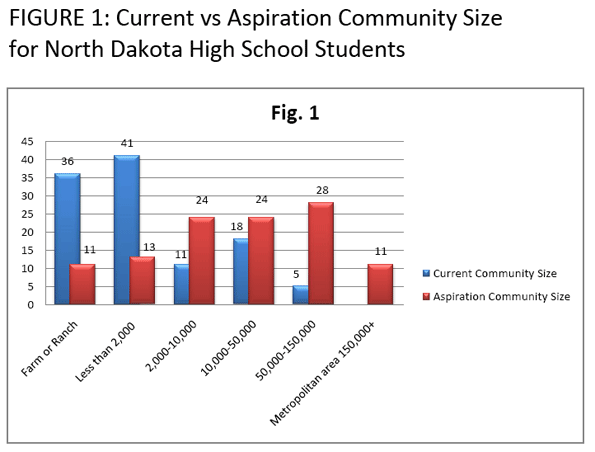
    A June 2010 survey of 111 North Dakota high school juniors and seniors offers a glimpse into the minds of the state’s young adults as they stand on the precipice of adulthood. They were asked to choose the size of community in which they aspire to live and work. Although roughly four in ten were raised in communities of fewer than 2,000 residents, out of the over 100 students surveyed, only six wished to live their adult lives in the a town of fewer than 2,000. Overall, 70 percent aspired to live in larger communities than those of their childhood (see Figure 1).

    Small towns struggle to provide urban amenities that can match the sponge cities’ bustling malls, skateboarding parks, concert venues and Olive Gardens. While the serene, friendly, stable rural communities, farms and ranches reflect the way that “life is supposed to be” in the minds of many outside the region, young adults often view that way of life as dull and sluggish. City life—albiet small scale by national standards—is perceived as fun, fast and fashionable; jobs pay better and there are more of them.

    There has always been a desire among young adults to experience life outside of where they grew up. Experts believe that economics and quality of life are the two dominant motivations people have for moving from rural areas into cities. Mark Stephens, a young college graduate who left his small town of under 400 for Fargo, with a metropolitan population pushing 200,000, the largest city in the state, said “The first thing people throw out as an excuse is increased opportunity, but let’s face it, 18- to 20-something adults are not thinking long term. For the most part, kids in that age group are really pretty shallow. In truth, I think it comes down to one word: Jealousy. They are walking down a gravel road in their tiny town with a link to massive amounts of media right in their back pockets. It’s no different than when they were little kids—they see someone with ice cream and they want some too.”

    Richard Rathke, director of the North Dakota State Dakota Center, notes that aggregate data demonstrate the movement of young adults to larger cities in the Great Plains The young adult population (age 20-30) has been inmigrating to metro areas each decade since 1950 while in the farm dependent rural counties, they are outmigrating in sizeable numbers (see Figure 2).

    A dozen young adults moving from Edgeley, North Dakota (population 637) to Fargo is irrelevant to Fargo as it absorbs the new residents with barely a nod, but to Edgeley, the shift represents significant and chilling loss of young, skilled, educated workers that will have a detrimental impact on the town’s future prosperity or even survival. Some predict that once Fargo has soaked up all the smaller communities, young professionals will then abandon Fargo for the more illustrious Minneapolis. North Dakota is touted in nationwide polls as one of the friendliest states in the nation, but schadenfreude flourishes on the Plains. Mayors of small towns that have lost their young people to growing population hubs have been known to remark, “Just wait until all of their kids move to Minneapolis.”

    Perhaps metropolises like Minneapolis or New York will not be the ultimate sponge cities. Indeed, Minneapolis has experienced a 1.4 percent drop in population since 2000. Demographers are beginning to observe that for many of us there is a point where diseconomy of size becomes real. Traffic, congestion, housing prices, crime and pollution levels may already be curtailing inmigration to the nation’s major metropolitan cities.

    The phenomenon of sponge cities will change the nature of states like North Dakota. At the turn of the twentieth century a mere 7 percent of North Dakotans were urban, by 1980 one out of every three residents was urban and in 2010 the state is projected to be 50 percent urban and 50 percent rural, a loss of nearly 88,000 rural residents in a state whose total population has remained stagnant, hovering between 600,000 to 650,000 for over a century.

    A legitimate reaction to the entrenched loss of people from rural areas of North Dakota might be, “So what?” What does a state or nation have at stake in the health of a small town like Edgeley? After all, one community’s loss is another community’s gain. Migratory patterns are simply indicative of an efficient labor market; employers discover employees and employees find jobs that fit their skills, interests and education. Thus, one might conclude that is does not really matter if a significant percentage of rural Americans move to more urban areas. In fact, what some perceive as a seemingly endless stream of discouraging census data may actually be a positive indicator. Robert E. Lucas, Jr., University of Chicago economist and winner of the 1995 Nobel Prize in Economics, believes that a region’s successful transformation from traditional agriculture to a modern, growing economy depends on talent clustering—an accumulation of human capital that sponge cities are performing. The future may not be rural, but sponge cities could make traditional rural states like North Dakota very viable.

    Wayne Sanstead, North Dakota’s State Superintendent of Public Schools and former lieutenant governor, has for decades watched rural schools close their doors. “We want the small communities to be a part of the state’s economic and social future, but we have to face reality and focus on retaining young adults within the state.” This may be the new reality. In large part due to the state’s booming economy, Sanstead asserts that in his 25 years as a state superintendent he has never seen a better opportunity then today for the state to retain its young people.

    Deb Kantrud, Executive Director of the South Central Regional Council in Jamestown, North Dakota, has spent her entire career as a community developer. She noted that if small town residents stay behind after high school graduation, they aren’t considered as successful as those who relocate. We need to figure out a way to keep some smaller communities viable—turning them into sponge cities—while acknowledging that some smaller communities may not be part of the brighter future that awaits our reviving state.
    Debora Dragseth, Ph.D. is an associate professor of business at Dickinson State University in Dickinson, North Dakota. She trains and develops leadership curriculum for CHS, Inc. a diversified energy, grains and foods company. The Fortune 100 company is the largest cooperative in the United States. Dragseth’s research interests include Generation Y, outmigration and entrepreneurship.

  • Why the Great Plains are Great Once Again

    On a drizzly, warm June night, the bars, galleries, and restaurants along Broadway are packed with young revelers. Traffic moves slowly, as drivers look for parking. The bar at the Donaldson, a boutique hotel, is so packed with stylish patrons that I can’t get a drink. My friend, a local, and I head over to Monte’s, a trendy Italian place down the street. We watch a group of attractive 30-something blondes share a table and gossip. They look like the cast of the latest Housewives series.

    It might sound like an evening in the Big Apple, but this Broadway runs through downtown Fargo, N.D. A decade ago, this same street was just another unremarkable central district in a Midwestern town: bland restaurants, adequate hotels, no decent coffee. After the local stores closed for the day, the street was mostly populated by a few hard-drinking louts.

    That has all changed, part of a transformation that foreshadows the growth of the vast Great Plains region. “I come from a big city, but I like the lifestyle here,” says Marshall Johnson, an African-American who played football for the nearby University of Minnesota, Crookston, and now works for the local Audubon Society. “In a decade this place will be a small Minneapolis. Everyone sees a bright future ahead.”

    Johnson may be an anomaly in this still homogeneous state—the population is more than 90 percent white, and Native Americans constitute the largest minority by far—but he senses something very real. Throughout the good times and, more important, the bad of this new millennium, the cities of the plains—from Dallas in the south through Omaha, Des Moines, and north to Fargo—have enjoyed strong job growth and in-migration from the rest of the country. North Dakota boasts the nation’s lowest unemployment rate—3.6 percent, compared with the national average of 9.7—with South Dakota and Nebraska right behind it.

    The trend has been particularly strong in urban areas. Based on employment growth over the last decade, the North Dakota cities of Bismarck and Fargo rank in the top 10 of nearly 400 metropolitan areas, according to data analyzed by economist Michael Shires for Forbes and NewGeography.com. Much of that growth has come in high-wage jobs. In Bismarck, the number of high-paying energy jobs has increased by 23 percent since 2003, while jobs in professional and business services have shot up 40 percent.

    That’s not bad for a region best known by East Coast pundits for the movie Fargo. It got so bad a decade ago that even local boosters suggested North Dakota jettison the “North” to make the place seem less forbidding. Two Eastern academics, Frank J. Popper and Deborah Popper, predicted that the region would, in a generation, become almost totally depopulated, and proposed that Washington speed things along and create “the ultimate national park.” Their suggestion: restock the buffalo.

    Certainly, many small towns across the plains—such places as Reeder, N.D., which lost its only school, or Mott, N.D., with its struggling downtown—have withered. Others are likely to disappear altogether. But growth has rebounded in larger towns, according to Debora Dragseth, an associate professor of business at Dickinson State University. She describes places like Fargo—with a population approaching 200,000—as “sponge cities,” absorbing population from rural areas. Just a decade ago, those people fled the region entirely.

    The primary drivers of this new growth, says Dragseth, are basic industries like agriculture and energy. Salaries may be low by coastal standards, but so are living costs. And the prices of commodities like beef, soybeans, and grains have generally continued to rise, due in large part to growing demand from China, India, and other developing countries.

    But the biggest play by far is in energy, including coal, natural gas, and oil, which exist in prodigious quantities from Texas to the Canadian border. Besides the vast reserves of oil that have made it the country’s fourth-largest producer, North Dakota possesses significant deposits of natural gas and coal, as well as huge potential for wind power and biofuels. These industries are drawing hundreds of skilled workers from places like California and Michigan, who are moving into Bismarck, the state’s capital, and towns to the west.

    The energy boom has placed states like the Dakotas and Texas in an enviable fiscal situation. Oil and gas revenues are filling up their coffers, allowing them to eschew the painful cutbacks affecting most coastal states. North Dakota has a $500 million surplus, and next year the cash gusher could rise to more than $1 billion, estimates Dragseth. That could go a long way in a state with barely 600,000 people.

    Of course, the people of the plains have seen booms before—commodity prices soared early in the last century, and there was an oil-fired boom back in the 1970s. But growing demand in developing countries could sustain long-term increases of energy and agricultural products. Niles Hushka, CEO of Kadrmas, Lee & Jackson, a growing engineering firm active in Bismarck, sees other factors working for the plains. The public schools are excellent; the Dakotas, Iowa, Minnesota, Nebraska, and Kansas enjoy among the highest graduation rates in the country. North Dakota itself ranks third and Minnesota fourth (after Washington, D.C., and Massachusetts) in the percentage of residents between 25 and 34 with college degrees.

    Nowhere is this potential clearer than in Fargo, which is emerging as a high-tech hub. Doug Burgum, from nearby Arthur, N.D., founded Great Plains Software in the mid-1980s. Burgum says he saw potential in the engineering grads pumped out by North Dakota State University, many of whom worked in Fargo’s large and expanding specialty-farm-equipment industry. “My business strategy is to be close to the source of supply,” says Burgum. “North Dakota gave us access to the raw material of college students.”

    Microsoft bought Great Plains for a reported $1.1 billion in 2001, establishing Fargo as the headquarters for its business-systems division, which now employs more than 1,000 workers. The tech boom started by Burgum has spawned both startups and spin-offs in everything from information technology to biomedicine. Science and engineering employment statewide has grown by 31 percent since 2002, the highest rate of any state.

    These jobs, and the people they attract, shower cash on Broadway’s busy bars and dining establishments. Both Burgum and his ex-wife, Karen, have been driving forces in this restoration. Karen led the effort to convert the once seedy Donaldson into a stylish downtown hotspot, featuring the work of local artists on the walls and bison on the menu. “People thought I should be put in a padded cell for doing this,” she says. Of course, entrepreneurs like the Burgums will continue to face big challenges to lure customers and workers—cold weather, isolation, and competition from more urban places. But for the first time in generations, parts of the Great Plains have a chance to be great again.

    This article originally appeared in Newsweek.

    Joel Kotkin is executive editor of NewGeography.com and is a distinguished presidential fellow in urban futures at Chapman University. He is author of The City: A Global History. His newest book is The Next Hundred Million: America in 2050, released in Febuary, 2010.

    Hotel Donaldson photo By jeffreykreger

  • Surprise, Frisco and Beaumont Among Fastest Growing

    The Bureau of the Census has updated its city (municipality or local government area) population estimates for 2009. Predictably, anti-suburban interests saw more indication of the elusive (read non-existent) exodus from the suburbs to the central cities. One analyst even suggested that a “high quality” of life in one central city (Washington, DC) might have kept people from moving to the suburbs. In fact, since 2000, nearly 40,000 people (domestic migrants) have moved out of the city of Washington and in the last year, the city gained 4,500 residents while the suburbs gained 13,700.

    In contrast, Buffalo News reporter Jack Ray looked at the data and noted that some cities in that metropolitan area were growing rather quickly, while others were losing population. Generally, he found that outer suburban communities were growing more quickly. Ray’s analysis was reflective of trends around the nation.

    There are nearly 20,000 incorporated cities, towns and villages in the United States. Population trends in these cities show that urban areas are growing most strongly on their suburban fringes or even in their exurbs. For example, two-thirds of the fastest growing 100 municipalities in the nation were suburbs or exurbs in the nation’s major metropolitan areas (those with more than 1,000,000 population). The other third were all municipalities in smaller metropolitan areas or outside metropolitan areas.

    The extent of this growth on the edge is illustrated by an examination of the nation’s municipalities of 25,000 or greater population that grew more than 25% between 2000 and 2009.

    • Among the 89 municipalities that grew 50% or more, 59 were in major metropolitan areas and all were suburbs (nearly all near the urban fringe) or exurbs. The total population growth among these suburbs and exurbs was 2.2 million from 2000 to 2009, for an average growth rate of 91%. These major metropolitan suburbs and exurbs grew 1.8 million, while the municipalities outside the major metropolitan areas added 400,000.
    • Among the 119 municipalities that grew between 25% and 50%, 69 were in major metropolitan areas. This included 67 suburbs and exurbs. It also included 2 central cities, Raleigh (39%) and Atlanta (28%). These major metropolitan area suburbs and exurbs gained 1.7 million residents, while the two central cities gained a total of 200,000. The municipalities outside the major metropolitan areas grew 1,000,000.

    Combined, the fastest growing suburbs and exurbs with more than 25,000 population grew more than 3.5 million, while the municipalities outside the major metropolitan areas grew 1.5 million, for a combined growth of more than 5.0 million. The smaller high growth municipalities (under 25,000), nearly 1,200 of them, both major metropolitan and outside, grew another 2.5 million.

    The fastest growing municipalities, excluding the two central cities of Raleigh and Atlanta, accounted for nearly one-third of the nation’s growth between 2000 and 20009.

    Most of the fast growing suburbs and exurbs have names that are simply not recognizable. Yet, a half-dozen added nearly as many or more new residents than all of the 20-plus central cities combined in the major metropolitan areas that do not have large swaths of suburbanization inside their borders. These include such places as Phoenix suburb, Surprise, Dallas-Fort Worth suburb Frisco and Riverside-San Bernardino suburb Beaumont.

    In Crabgrass Frontier: The Suburbanization of the United States, Kenneth Jackson noted that central Philadelphia began losing population in the early 19th century. The dispersion of America continues.

    Photograph: Exurbs of New York: Pike County, Pennsylvania

  • Salt Lake City’s Sacred Space

    Amid a devastating condo crash and high office vacancies across the U.S., one of the country’s largest downtown development projects is taking shape in Salt Lake City. The city’s center displays a landscape of cranes, cement-mixers and hard-hats–something all too rare in these tough times.

    Over the next few years, with an investment estimated locally at $2 billion, developers hope to transform a 20-acre swath of the city’s now-uninspired central core. By 2012 they hope to create a model downtown district with a whole new array of retail shops and residential towers accommodating some 700 units.

    On the surface, Salt Lake City , America’s 38th largest central business district , would seem an unlikely place for such an ambitious development. The city’s population growth–it is home to fewer than 200,000 of the region’s 1.2 million people–has been meager, particularly compared with the surrounding suburbs. The central business district represents less than ten percent of the region’s total employment.

    The driving force here is not economics, but the desire of Salt Lake’s most powerful institution, the Church of Jesus Christ of Latter Day Saints, to salvage its immediate neighborhoods. “The church’s primary notion is to protect the Temple Square and the headquarters of the Church,” explains Mark Gibbons, president of City Creek Reserve, the church’s development arm. “That’s first and foremost. This development would not have been done just on a financial basis, I can tell you that.”

    This motivation deviates from what we see now in most cities. For one thing, this does not reflect rent-seeking by real estate interests–there are no public subsidies, for example. Instead the City Creek project represents the ultimate in back-to-the-future city planning, a reversion to the ancient ideal of building a city around its essential “sacred space.”

    It’s all the more remarkable at a time when churches being converted into yuppie housing, discos or carpet stores is celebrated by the decidedly secular caste of urbanists. Of course, not everyone loves this approach. One former Salt Lake City planning official, a non-Mormon, has expressed fears about the “Vaticanization” of the area.

    Yet to date the traditional urban approach–museums, light rail development, downtown malls–has been far from a shining success. Salt Lake’s greatest remaining asset remains the Church, its great central Temple and the surrounding infrastructure of office, museums and genealogical agencies .

    Mormonism, in a sense, has to be thought of as a growth industry for downtown. Since 1960, church membership has surged from 2 million worldwide to nearly 14 million. Although Utah remains the church’s central base–over 70% of the state population is Mormon–the biggest increase has been outside the U.S., predominately in Latin America and parts of east Asia. This reality is reflected in Salt Lake itself; once overwhelmingly white, its population is now some 30% minority, much of it Latino.

    As an anchor tenant, the Church provides the ultimate raison d’etre for the surrounding area. The Temple Square remains the state’s largest tourist attraction. Church members from around the world come to the city for conferences and to consult with church records and officials.

    Of course, the fundamentally ecclesiastical logic diverges wildly from urbanist conventional wisdom. In most cities, planners embrace the idea of building the city core around singles, or “empty nesters.” The nurturing of a “bohemian” culture–hopefully of the free-spending bourgeois variety–is seen as providing a spur to art galleries, bars, clubs and high-end restaurants.

    Salt Lake’s developers wish to improve the amenity structure too, but in ways that would appeal to the middle-class families who dominate the region. Mormons, who make up half of the city population and the vast majority of those in the surrounding suburbs, average three to four children per family. Overall, the area has one of the youngest populations of any metropolitan region in the country.

    “The idea of having a sacred center is to create a space–like a campus–that’s decent, clean and upscale in a design sense, but accessible to families, ” observes Joe Cannon, editor of the church-owned local paper, The Deseret News. Without drawing in people from the predominately family-oriented suburbs, he says, the downtown would lack the base to rebound from a generation of neglect and decline.

    The church focus also makes sense, Cannon notes, when you take into account the unique history of the place. Unlike most American cities, Salt Lake was born primarily through the religious vision of the Mormon Church and in particular its great visionary leader, Brigham Young.

    The Mormons came to Salt Lake as part of their search for a sacred space. Such ideas led some to regard the Mormon as cult-like sect, dangerous to the nation. They came to Salt Lake only after attempting to settle down in Ohio, Illinois and Missouri–an action that often led. They often were booted out courtesy of bloodshed inflicted on them by more-traditional Christians.

    Although successful in a capitalist sense, Salt Lake’s urban culture reflected what Mormon historian Leonard Arrington describes as “Jacksonian communalism.” For many years, the Church controlled Zion’s Bank, the largest in the region, and promoted commercial development. Critically, Mormon charities and organizations brought in new settlers, mostly from England and Scandinavia.

    By the 1960s the downtown began to decay as Mormons, as well as non-Mormon “Gentiles,” moved en masse to the suburbs. The area around the Temple became increasingly seedy and rundown. This has led to the current effort to revive the city through the efforts of the Church–the institution with the greatest stake in the central core.

    Over the next decade, the Church’s effort could represent something unique in an urban America increasingly obsessed with the ephemeral. “We are not trying to build a ‘faux city,’” notes Mark Gibbons. “We are trying to build something that will last a hundred years or more.”

    In following that strategy, Salt Lake is trying to recover some of the very things that have sustained cities over time. It will be fascinating to see how their approach–based on the most ancient of city-building strategies–fares compared with those applied by their more decidedly secular rivals.

    This article originally appeared in Forbes.com.

    Joel Kotkin is executive editor of NewGeography.com and is a distinguished presidential fellow in urban futures at Chapman University. He is author of The City: A Global History. His newest book is The Next Hundred Million: America in 2050, released in Febuary, 2010.

    Photo by Edgar Zuniga Jr.

  • The Changing Demographics of America

    Estimates of the United states population at the middle of the 21st century vary, from the U.N.’s 404 million to the U.S. Census Bureau’s 422 to 458 million. To develop a snapshot of the nation at 2050, particularly its astonishing diversity and youthfulness, I use the nice round number of 400 million people, or roughly 100 million more than we have today.

    The United States is also expected to grow somewhat older. The portion of the population that is currently at least 65 years old—13 percent—is expected to reach about 20 percent by 2050. This “graying of America” has helped convince some commentators of the nation’s declining eminence. For example, an essay by international relations expert Parag Khanna envisions a “shrunken America” lucky to eke out a meager existence between a “triumphant China” and a “retooled Europe.” Morris Berman, a cultural historian, says America “is running on empty.”

    But even as the baby boomers age, the population of working and young people is also expected to keep rising, in contrast to most other advanced nations. America’s relatively high fertility rate—the number of children a woman is expected to have in her lifetime—hit 2.1 in 2006, with 4.3 million total births, the highest levels in 45 years, thanks largely to recent immigrants, who tend to have more children than residents whose families have been in the United States for several generations. Moreover, the nation is on the verge of a baby boomlet, when the children of the original boomers have children of their own.

    Between 2000 and 2050, census data suggest, the U.S. 15-to-64 age group is expected to grow 42 percent. In contrast, because of falling fertility rates, the number of young and working-age people is expected to decline elsewhere: by 10 percent in China, 25 percent in Europe, 30 percent in South Korea and more than 40 percent in Japan.

    Within the next four decades most of the developed countries in Europe and East Asia will become veritable old-age homes: a third or more of their populations will be over 65. By then, the United States is likely to have more than 350 million people under 65.

    The prospect of an additional 100 million Americans by 2050 worries some environmentalists. A few have joined traditionally conservative xenophobes and anti-immigration activists in calling for a national policy to slow population growth by severely limiting immigration. The U.S. fertility rate—50 percent higher than that of Russia, Germany and Japan and well above that of China, Italy, Singapore, South Korea and virtually all the rest of Europe—has also prompted criticism.

    Colleen Heenan, a feminist author and environmental activist, says Americans who favor larger families are not taking responsibility for “their detrimental contribution” to population growth and “resource shortages.” Similarly, Peter Kareiva, the chief scientist at the Nature Conservancy, compared different conservation measures and concluded that not having a child is the most effective way of reducing carbon emissions and becoming an “eco hero.”

    Such critiques don’t seem to take into account that a falling population and a dearth of young people may pose a greater threat to the nation’s well-being than population growth. A rapidly declining population could create a society that doesn’t have the work force to support the elderly and, overall, is less concerned with the nation’s long-term future.

    The next surge in growth may be delayed if tough economic times continue, but over time the rise in births, producing a generation slightly larger than the boomers, will add to the work force, boost consumer spending and generate new entrepreneurial businesses. And even with 100 million more people, the United States will be only one-sixth as crowded as Germany is today.

    Immigration will continue to be a major force in U.S. life. The United Nations estimates that two million people a year will move from poorer to developed nations over the next 40 years, and more than half of those will come to the United States, the world’s preferred destination for educated, skilled migrants. In 2000, according to the Organisation for Economic Co-operation and Development, an association of 30 democratic, free-market countries, the United States was home to 12.5 million skilled immigrants, equaling the combined total for Germany, France, the United Kingdom, Australia, Canada and Japan.

    If recent trends continue, immigrants will play a leading role in our future economy. Between 1990 and 2005, immigrants started one out of four venture-backed public companies. Large American firms are also increasingly led by people with roots in foreign countries, including 15 of the Fortune 100 CEOs in 2007.

    For all these reasons, the United States of 2050 will look different from that of today: whites will no longer be in the majority. The U.S. minority population, currently 30 percent, is expected to exceed 50 percent before 2050. No other advanced, populous country will see such diversity.

    In fact, most of America’s net population growth will be among its minorities, as well as in a growing mixed-race population. Latino and Asian populations are expected to nearly triple, and the children of immigrants will become more prominent. Today in the United States, 25 percent of children under age 5 are Hispanic; by 2050, that percentage will be almost 40 percent.

    Growth places the United States in a radically different position from that of Russia, Japan and Europe. Russia’s low birth and high mortality rates suggest its overall population will drop by 30 percent by 2050, to less than a third of the United States’. No wonder Prime Minister Vladimir Putin has spoken of “the serious threat of turning into a decaying nation.” While China’s population will continue to grow for a while, it may begin to experience decline as early as 2035, first in work force and then in actual population, mostly because of the government’s one-child mandate, instituted in 1979 and still in effect. By 2050, 31 percent of China’s population will be older than 60. More than 41 percent of Japanese will be that old.

    Political prognosticators say China and India pose the greatest challenges to American predominance. But China, like Russia, lacks the basic environmental protections, reliable legal structures, favorable demographics and social resilience of the United States. India, for its part, still has an overwhelmingly impoverished population and suffers from ethnic, religious and regional divisions. The vast majority of the Indian population remains semiliterate and lives in poor rural villages. The United States still produces far more engineers per capita than India or China.

    Suburbia will continue to be a mainstay of American life. Despite criticisms that suburbs are culturally barren and energy-inefficient, most U.S. metropolitan population growth has taken place in suburbia, confounding oft-repeated predictions of its decline.

    Some aspects of suburban life—notably long-distance commuting and heavy reliance on fossil fuels—will have to change. The new suburbia will be far more environmentally friendly—what I call “greenurbia.” The Internet, wireless phones, video conferencing and other communication technologies will allow more people to work from home: at least one in four or five will do so full time or part time, up from roughly one in six or seven today. Also, the greater use of trees for cooling, more sustainable architecture and less wasteful appliances will make the suburban home of the future far less of a danger to ecological health than in the past. Houses may be smaller—lot sizes are already shrinking as a result of land prices—but they will remain, for the most part, single-family dwellings.

    A new landscape may emerge, one that resembles the network of smaller towns characteristic of 19th-century America. The nation’s landmass is large enough—about 3 percent is currently urbanized—to accommodate this growth, while still husbanding critical farmland and open space.

    In other advanced nations where housing has become both expensive and dense—Japan, Germany, South Korea and Singapore—birthrates have fallen, partly because of the high cost of living, particularly for homes large enough to comfortably raise children. Preserving suburbs may therefore be critical for U.S. demographic vitality.

    A 2009 study by the Brookings Institution found that between 1998 and 2006, jobs shifted away from the center and to the periphery in 95 out of 98 leading metropolitan regions—from Dallas and Los Angeles to Chicago and Seattle. Walter Siembab, a planning consultant, calls the process of creating sustainable work environments on the urban periphery “smart sprawl.” Super-fuel-efficient cars of the future are likely to spur smart sprawl. They may be a more reasonable way to meet environmental needs than shifting back to the mass-transit-based models of the industrial age; just 5 percent of the U.S. population uses mass transit on a daily basis.

    One of the urban legends of the 20th century—espoused by city planners and pundits (and a staple of Hollywood)—is that suburbanites are alienated, autonomous individuals, while city dwellers have a deep connection to their neighborhoods. As the 2001 book Suburban Nation puts it, once suburbanites leave the “refuge” of their homes they are reduced to “motorist[s] competing for asphalt.”

    But suburban residents express a stronger sense of identity and civic involvement than city dwellers. A recent study by Jan Brueckner, a University of California at Irvine economist, found that density does not, as is often assumed, increase social contact between neighbors or raise overall social involvement; compared with residents of high-density urban cores, people in low-density suburbs were 7 percent more likely to talk to their neighbors and 24 percent more likely to belong to a local club.

    Suburbs epitomize much of what constitutes the American dream for many people. Minorities, once largely associated with cities, tend to live in the suburbs; in 2008 they were a majority of residents in Texas, New Mexico, California and Hawaii. Nationwide, about 25 percent of suburbanites are minorities; by 2050 immigrants, their children and native-born minorities will become an even more dominant force in shaping suburbia.

    The baby boom generation is poised for a large-scale “back to the city” movement, according to many news reports. But Sandra Rosenbloom, a University of Arizona gerontology professor, says roughly three-quarters of retirees in the first bloc of boomers appear to be sticking close to the suburbs, where the vast majority reside. “Everybody in this business wants to talk about the odd person who moves downtown,” Rosenbloom observes. “[But] most people retire in place. When they move, they don’t move downtown, they move to the fringes.”

    To be sure, there will be 15 million to 20 million new urban dwellers by 2050. Many will live in what Wharton business professor Joseph Gyourko calls “superstar cities,” such as San Francisco, Boston, Manhattan and western Los Angeles—places adapted to business and recreation for the elite and those who work for them. By 2050, Seattle, Portland and Austin could join their ranks.

    But because these elite cities are becoming too expensive for the middle class, the focus of urban life will shift to cities that are more spread out and, by some standards, less attractive. They’re what I call “cities of aspiration,” such as Phoenix, Houston, Dallas, Atlanta and Charlotte. They’ll facilitate upward mobility, as New York and other great industrial cities once did, and begin to compete with the superstar cities for finance, culture and media industries, and the amenities that typically go along with them. The Wall Street Journal noted that commercial success has already turned Houston, once considered a backwater, into “an art mecca.”

    One of the least anticipated developments in the nation’s 21st-century geography will be the resurgence of the region often dismissed by coastal dwellers as “flyover country.” For the better part of the 20th century, rural and small-town communities declined in percentage of population and in economic importance. In 1940, 43 percent of Americans lived in rural areas; today it’s less than 20 percent. But population and cost pressures are destined to resurrect the hinterlands. The Internet has broken the traditional isolation of rural communities, and as mass communication improves, the migration of technology companies, business services and manufacturing firms to the heartland is likely to accelerate.

    Small Midwestern cities such as Fargo, North Dakota, have experienced higher than average population and job growth over the past decade. These communities, once depopulating, now boast complex economies based on energy, technology and agriculture. (You can even find good restaurants, boutique hotels and coffeehouses in some towns.) Gary Warren heads Hamilton Telecommunications, a call center and telecommunications-services firm that employs 250 people in Aurora, Nebraska. “There is no sense of dying here,” Warren says. “Aurora is all about the future.”

    Concerns about energy sources and hydrocarbon emissions will also bolster America’s interior. The region will be pivotal to the century’s most important environmental challenge: the shift to renewable fuels. Recent estimates suggest the United States has the capacity to produce annually more than 1.3 billion dry tons of biomass, or fuels derived from plant materials—enough to displace 30 percent of the current national demand for petroleum fuels. That amount could be produced with only modest changes in land use, agricultural and forest-management practices.

    Not since the 19th century, when the heartland was a major source of America’s economic, social and cultural supremacy, has the vast continental expanse been set to play so powerful a role in shaping the nation’s future.

    What the United States does with its demographic dividend—its relatively young working-age population—is critical. Simply to keep pace with the growing U.S. population, the nation needs to add 125,000 jobs a month, the New America Foundation estimates. Without robust economic growth but with an expanding population, the country will face a massive decline in living standards.

    Entrepreneurs, small businesses and self-employed workers will become more common. Between 1980 and 2000 the number of self-employed individuals expanded, to about 15 percent of the work force. More workers will live in an economic environment like that of Hollywood or Silicon Valley, with constant job hopping and changes in alliances among companies.

    For much of American history, race has been the greatest barrier to a common vision of community. Race still remains all too synonymous with poverty: considerably higher poverty rates for blacks and Hispanics persist. But the future will most likely see a dimming of economic distinctions based on ethnic origins.

    Since 1960, the proportion of African-American households at or below the poverty line ($22,000 annually for a family of four in 2008 dollars) has dropped from 55 to 25 percent, while the black middle class has grown from 15 to 39 percent. From 1980 to 2008, the proportion who are considered prosperous—households making more than $100,000 a year in 2008 dollars—grew by half, to 10.3 percent. Roughly 50 percent more African-Americans live in suburbs now than in 1980; most of those households are middle class, and some are affluent.

    The most pressing social problem facing mid-21st-century America will be fulfilling the historic promise of upward mobility. In recent decades certain high-end occupation incomes grew rapidly, while wages for lower-income and middle-class workers stagnated. Even after the 2008 economic downturn, largely brought on by Wall Street, it was primarily middle-class homeowners and jobholders who bore the brunt, sometimes losing their residences. Most disturbingly, the rate of upward mobility has stagnated overall, as wages have largely failed to keep up with the cost of living. It is no easier for poor and working-class people to move up the socio-economic ladder today than it was in the 1970s; in some ways, it’s more difficult. The income of college-educated younger people, adjusted for inflation, has been in decline since 2000.

    To reverse these trends, I think Americans will need to attend to the nation’s basic investments and industries, including manufacturing, energy and agriculture. This runs counter to the fashionable assertion that the American future can be built around a handful of high-end creative jobs and will not require reviving the old industrial economy.

    A more competitive and environmentally sustainable America will rely on technology. Fortunately, no nation has been more prodigious in its ability to apply new methods and techniques to solve fundamental problems; the term “technology” was invented in America in 1829. New energy finds, unconventional fuel sources and advanced technology are likely to ameliorate the long-prophesied energy catastrophe. And technology can ease or even reverse the environmental costs of growth. With a population of 300 million, the United States has cleaner air and water now than 40 years ago, when the population was 200 million.

    The America of 2050 will most likely remain the one truly transcendent superpower in terms of society, technology and culture. It will rely on what has been called America’s “civil religion”—its ability to forge a unique common national culture amid great diversity of people and place. We have no reason to lose faith in the possibilities of the future.

    This article originally appeared in Smithsonian Magazine

    Joel Kotkin is executive editor of NewGeography.com and is a distinguished presidential fellow in urban futures at Chapman University. He is author of The City: A Global History. His newest book is The Next Hundred Million: America in 2050, released in Febuary, 2010.

    Photo by clevercupcakes

  • Immigrant Entrepreneurs Can Turbocharge Cleveland’s Flagging Economy

    In seeking to lure a Chinese lightbulb-maker to town, Cleveland leaders revealed both a vision and a blind spot.

    Cleveland Mayor Frank Jackson and his team should be given credit for recognizing the tremendous opportunity in attracting foreign direct investment, or “FDI,” and the new jobs that it provides.

    According to a 2008 report by the U.S. Chamber of Commerce, foreign firms employed more than 5.3 million U.S. workers through their U.S. affiliates and have indirectly created millions of additional jobs. More than 30 percent of direct hires are in manufacturing. In Ohio, 600 foreign-based corporations from 28 countries are operating 1,000 facilities and employing about 180,000 people.

    One exciting new trend is the rise in the annual number of foreign investment projects in the U.S. renewable energy sector, jumping from 4 projects in 2003 to over 40 in 2008.

    In its eagerness to attract a foreign company offering energy-saving light bulbs, however, City Hall fell into traps which may have been avoided if had it tapped the cultural resources at their fingertips.

    When Mayor Jackson’s administration waded into unfamiliar waters to partner with an LED light bulb company in Ningbo, China, no one thought to talk with Chinese-American entrepreneurs and professionals living in Northeast Ohio. These individuals are eager to assist the City in helping identify appropriate partners in China, supporting the due diligence, and generally advising on a culture that dates back to 5,000 B.C. and has only opened-up in recent decades.

    As reported by Crain’s Cleveland Business, local immigrants were not viewed as a resource.

    ‘Why weren’t we informed; we could have helped you?’ asked Hong Kong-born immigration attorney Margaret Wong….

    Ms. Wong made the statement last Thursday evening, May 20, in the Red Room, a conference room attached to Cleveland Mayor Frank Jackson’s office at Cleveland City Hall. She was there with a group of local small business owners, clergy and other civic leaders invited by the mayor to a meeting to enlist their support in his effort to bring Chinese lighting manufacturer Sunpu-Opto Semiconductor Co. to the city.

    Ms. Wong was asking chief of staff Ken Silliman why the Mayor, who was not present, hadn’t sought the assistance of people such as her and the others in the room sooner in his attempt to make Cleveland the U.S. beachhead of Sunpu-Opto, a maker of energy-efficient LED lighting.

    Mr. Silliman didn’t have a ready answer.

    The answer may be that in this region immigrants are often not viewed as a valuable resource to support the region’s business development, or viewed as people with the skills to help Northeast Ohio navigate the language, cultural and market barriers abroad.

    This must change.

    Yes, it is important that the City and the region aggressively pursue FDI, not only with passion, but also with skill, networks, and on-the-ground experience.

    To make these efforts successful, however, leadership should look to leverage the foreign-market experience of our immigrant entrepreneurs and innovators, particularly in relation to China and India, where booming economies, mounting foreign currency reserves, and relationship-based business culture create unique opportunities and challenges.

    Cleveland’s immigrants, some of whom enjoy business and governmental relationships in the homeland that go back generations, are eager to be a partner in revitalizing the city and the region. They are in a unique position to help our region capture our share of the $245 billion of foreign direct investment streaming into the U.S, to ramp-up our exports to global markets where 95% of the world’s consumers live, and to attract the world’s best and brightest innovators, entrepreneurs, and professionals driving a changing economy.

    There is precedent in leveraging ethnic and global networks for local development Northeast Ohio’s Jewish community, which enjoys extensive business, family and social ties in Israel, has helped the region attract tens of Israeli companies in recent years.

    What is needed now is a bold regional plan to take this formula for success to a larger scale, particularly targeting markets such as China where the government is encouraging its businesses to expand into the United States.

    The path to this global journey, however, should begin with a few short steps at home, launching a multi-purpose International Welcome Center which will help the region build a bridge to the world.

    The Welcome Center will not only provide a much-needed platform to coordinate local resources for attracting FDI, but it will also help educate the region on why the development of a global culture is an economic necessity and on what steps we can all take to welcome and partner with international resources, such as the immigrant talent living right now in Northeast Ohio.

    This represents a bit of conundrum. How do we recruit and welcome foreign companies, their executives, and their families, if we do not fully value our existing immigrant entrepreneurs and innovators? How do we attract foreign direct investment when overseas companies are feared as job-takers?

    In responding to the dichotomy of not welcoming immigrants while trying to lure foreign companies to Cleveland, Anne O’Callaghan, founder of the Welcome Center in Philadelphia said in her City Club of Cleveland speech last year:

    Do the region’s leaders think that foreigners should just stay in the homeland but still wire you their money?

    Northeast Ohio’s immigrant community is rich in technology, entrepreneurship, global market knowledge, and new wealth.

    To make a credible push to attract foreign companies which can establish manufacturing, research, and corporate headquarters in Northeast Ohio and in-source thousands of new jobs, the region can take a bold step forward by partnering with immigrants already here and put out the “welcome mat” for those who may arrive tomorrow.

    Richard Herman is a Cleveland lawyer, Co-Chair of TiE Ohio (The International Entrepreneur), and Co-Author of Immigrant, Inc. (Wiley & Sons, 2009).

    Photo by Caveman 92223 — On the 2010 US Tour

  • Millennial Surprise

    The boomer’s long domination of American politics, culture and economics will one day come to an end. A new generation–the so-called millennials–will be shaping the outlines of our society, but the shape of their coming reign could prove more complex than many have imagined.

    Conventional wisdom, particularly among boomer “progressives,” paints millennials–those born after 1983–as the instruments for fulfilling the promise of the 1960s cultural revolt. In 2008 the left-leaning Center for American Progress dubbed them “The Progressive Generation.” The center contrasted them favorably to the Xers, a cohort of 20 million fewer, and their “conservative views.”

    The case for the millennials’ left-leaning views can be traced to when the oldest millennials started to vote, in 2004. That year big loser John Kerry took the 18 to 29 vote by nearly 10 points. In the last election millennials supported Barack Obama over John McCain by a staggering 30 points. He outperformed McCain in every ethnic group, winning 54% of young white voters and a remarkable 76% of young Hispanics. Obama may still have won without millennial support, but only narrowly.

    This vote was shaped by important and perhaps lasting attitudes. Authors Morley Winograd and Michael Hais identified among these young voters a strong communitarian ethos, generally liberal social views and somewhat of a “green” agenda. They wrote that millennials’ embrace of the Democratic Party in 2008 could foreshadow a long-awaited leftward realignment paralleling that which occurred in the 1930s.

    Yet there are signs that millennial voters, if not shifting to the right, may have lost some of their progressive ardor. Recent polls suggest that younger voters are far less likely to vote this year than in 2008. Gallup reports that nearly half of voters ages 18 to 29 are not enthusiastic about turning up at the polls this November, a far higher number than senior or boomer voters.

    One reason for such a dramatic shift is likely the economy. The current recession has been very hard on younger workers–unemployment hits around 20% for workers between 16 and 24. The brunt of the recession has hit blue-collar, high school educated youths, but even the college crowd, the core of the Obama constituency, faces what appears to be dismal prospects in the years ahead.

    Not too surprisingly, a May Allstate-National Journal Heartland Monitor survey of voters 18 to 29 found only 45% of millennials still solidly behind the president’s economic agenda. This could have a depressing impact on the leftward lurch among millennials. Indeed one recent Harvard survey found only half of all young voters planned to vote Democratic for Congress this year, compared with 60% in 2006.

    If the downturn persists, we could see some changes in generational politics. In the 1970s a similarly dismal economy accompanied the boomers as they were entering the workforce in huge numbers. Then, as now, long-term unemployment and underemployment seemed the wave of the future.

    The hard times of the 1970s changed the politics of the boomers. The bungled presidency of Jimmy Carter did not do much for the credit of the Democratic Party. Boomers, who sided with Carter in 1976, ended up voting for Ronald Reagan in large numbers four years later. The relative prosperity of the Reagan years painted a basically conservative tinge to boomer voters, something that benefited both Republicans and more centrist Democrats like Bill Clinton.

    This change could occur again, but other factors may slow a rightward shift among millenials. Republican nativism–exemplified by the Arizona immigration law–may be a boon with boomer voters, who are overwhelmingly white (only one in four are non-white). In contrast, roughly two in five millennials are minority group members. The age group 18 and under is already majority “minority.”

    Another big factor will be social liberalism. On a host of critical issues–from interracial dating to gay marriage–millennials tend to be far more “progressive” than earlier generations. According to a recent Pew study, 63% of millennials believed society should accept homosexuality compared with only 48% of boomers.

    Millennials also tend to disapprove of such things as prayer in school compared with boomers or older generations. Although most express some religious commitment, there are more unaffiliated and basic non-believers than in previous generations. The GOP’s long-term embrace of a hard religious right positions will not pay off among millennial voters.

    Perhaps most troubling for Republicans–and this is a point emphasized by Winograd and Hais–are millennial views on government. Two-thirds, according to Pew, currently favor an expanded government role in the economy compared with roughly 40% of boomers. Not surprisingly, tea partiers, at least for now, are more likely to come from the older set than younger voters.

    Yet there is no lock for the Democrats. For one thing, expansive government is likely to be more attractive to those who are not yet paying taxes. As millenials head into their late 20s and early 30s, they may adopt different somewhat views. If the current public sector expansion proves ineffectual in creating jobs–after all not everyone can work for Uncle Sam–they could, like their boomer forebears, embrace a more private-sector oriented approach.

    More than anything else, both liberals and conservatives need to understand that this emerging generation may prove far less predictable than either side expects. Many “progressive” urbanists, for example, expect that most millenials will be happy to live in dense multifamily housing–largely as renters–as they enter their 30s. This is probably not altogether the case.

    Hais and Winograd argue that millenials may be more attracted to urban settings–as is often the case for younger, unmarried and childless people–than boomers and older generation. Yet their research also shows that more than twice as many–some 43%–identify suburbs as their “ideal place to live.” They embrace suburbs even more than boomers.

    Similarly, this generation also shares with the boomers a strong interest in homeownership–refuting the claim of some urban boosters that renting is the wave of the future. Instead they appear surprisingly traditional in terms of wanting marriage, kids and believing in following the rules. They may change things up, but still very much embrace the desire to achieve the “American dream.”

    In these and many ways, millennials are likely to continue redefining our society in ways that neither currently boomer dominated party will appreciate. Given the mess the boomers have left them, that may prove a difference worth celebrating.

    This article originally appeared in Forbes.com.

    Joel Kotkin is executive editor of NewGeography.com and is a distinguished presidential fellow in urban futures at Chapman University. He is author of The City: A Global History. His newest book is The Next Hundred Million: America in 2050, released in Febuary, 2010.

    Photo by rjason13