Category: Demographics

  • The Screwed Generation Turns Socialist

    Increasingly American politics are driven by generational change. The election of Donald Trump was not just a triumph of whiter, heartland America. It also confirmed the still considerable voting power of the older generation. Yet over time, as those of us who have lived long enough well know, generations decline, and die off, and new ones ascend.

    In this past election, those over 45 strongly favored Trump, while those younger than that cast their ballots for Clinton. Trump’s improbable victory, and the more significant GOP sweep across the country, demonstrated that the much-ballyhooed millennials simply are not yet sufficiently numerous or united enough to overcome the votes of the older generations.

    Yet over time, the millennials—arguably the most progressive generation since the ’30s—could drive our politics not only leftward, but towards an increasingly socialist reality, overturning many of the very things that long have defined American life. This could presage a war of generations over everything from social mores to economics and could well define our politics for the next decade. 

    To best understand the battle lines, you must know the generations and their differences, and where they will leave this increasingly fractured republic.

    The Greatest Generation

    The last “civic generation” before the advent of the millennials—a term coined by generational theorists Neil Howe and William Strauss—was forged in the Depression, fought the Second World War, and managed the ensuing cold conflict with the old USSR. Born between 1901 and 1927, members of the much admired ++“greatest generation” were civic minded, embracing the idea that government provided an ideal mechanism to address the nation’s problems.

    Like the millennials, who also follow this civic impulse, this generation was decisively Democratic. They are also, sadly, dying out, with the last remnants now in their 80s and 90s. According to generational analysts Morley Winograd and Michael Hais, this group was the only generation, besides the then small cadre of voting age millennials, to support John Kerry in 2004.  

    Under two million in 2010, per the Census, their numbers have dwindled to 750,000. Yet even so, as recently as 2014 , the remnants of the “greatest generation,” according to Pew, still favored the Democrats by 7 percentage points. Even fewer will be around in 2020 but those who remain may well remain liberal. It’s no sample, but my 93-year-old mother holds to pattern. Brought up poor in the Brownsville section of Brooklyn, she voted for the oldest and most left leaning major candidate—Bernie Sanders—in the primary and then cast her ballot for Hillary.

    The Silent Generation Slow to fade

    The “silent generation,” born between 1925 and 1942, mostly came of age in the conservative ’50s. These products of the Eisenhower era have been the prime beneficiaries of the sustained boom that took root between the end of the Second World War and the ’70s. As a result, they continue to hold a big share of America’s wealth—roughly 33 percent –even as they enter their seventies and eighties.

    Given their embrace of the normative social values of their era, and their wealth, it’s not surprising that the silents have tended to the right. These older voters went for Trump by a significant margin, and overall, note Winograd and Hais, 53 percent lean to the Republicans, compared to just 40 percent who lean Democratic.

    It would be a mistake to dismiss the silents before their time, as Democratic theorists sometimes seem to do. They still number upward of 29 million, and more than forty members of Congress hail from this generation, including, ironically, much of the  Democratic leadership. Given their extended longevity, particularly among those in the upper middle class, they may remain influential well into the next decade.

    Boomers: For Now, the Power Generation

    The largest generation in American history before the millennials, the Baby Boomers were born between 1943 and 1960 and they remain the power generation. After all, both presidential candidates last year were clearly Boomers, with sufficient evidence of the narcissism that defines this generation. They also predominate in Congress, with 270 members, roughly half the total, in 2016. Hais estimates that they number between 75 and 82 million strong. 

    Ever since the turbulence of the ’60s, the Boomers have been sharply divided. Peace protests, psychedelics, and Woodstock defined only a part of that generation. Indeed, rather than tending to the left, the Boomers over time have slowly moved to the right. In 1992, note Winograd and Hais, they leaned 49 to 42 percent Democratic; last year, they leaned 49 to 45 Republican. Overall, Boomers supported Donald Trump by a narrow margin.

    In the future, economics more than culture may define Boomer politics. Somewhat more socially liberal than the silent generation before them, they control a dominant share of the nation’s wealth—some 50 percent—and according to a recent Deloitte study will still control about 45 percent well into their seventies and eighties. This may make them naturally suspicious of the redistributionist agenda of the left Democrats, since this would naturally come from their wealth. They will also have to resist attempts by GOP reformers like Paul Ryan to meddle with Medicare, social security, and, for some, pensions. One reason Trump won over these voters—both in the primary and the general election—was by promising not to touch these holy of holies.

    Xers: Long-time outsiders but soon the next power generation

    Smaller than the boomers, and generally less privileged, the X generation—born between 1965 and 1981—gets short shrift among advertisers as well in the media, but seem poised to take power by the end of the decade. Numbering more than 65 million, they are a smaller generation than the boomers but they are slowly gaining control of politics, with 117 members in Congress compared to just five for millennials. They already dominate the leadership of the GOP. Paul Ryan is their poster boy.

    Today, the Xers, many already in their fifties, have only 14 percent of the nation’s wealth, a relative pittance compared to the boomers. But by 2030, as the boomers finally start to fade from the picture, Xers should account for 31 percent of the nation’s wealth, twice the percentage for the millennials. Critically, the heads of most companies backed by venture capital come from this generation, according to the Harvard Business Review. Raised largely during the neo-conservative heyday of Reagan, George H.W. Bush, and Bill Clinton, Xers also dominate the ranks of managers at major companies.

    Yet at the same time, they have faced a rockier economic ride than the boomers, suffering particularly in the 2007 housing crash. The percentage of Xers who own their own homes dropped far more precipitously compared to the more entrenched Boomers The impact was particularly tough on younger Xers, who often got into the market around the housing bust.

    Millennials: The Red Generation?

    The long-term hopes of the American left lie with the millennial generation. The roughly 90 million Americans born between 1984 and 2004 seem susceptible to the quasi socialist ideology of the post-Obama Democratic Party. They are also far more liberal on key social issues—gender and gay rights, immigration, marijuana legalization—than any previous generation. They comprise the most diverse adult generation in American history: some 40 percent of millennials come from minority groups, compared to some 30 percent for boomers and less than 20 percent for the silent and the greatest generations.

    Millennials’ defining political trait is their embrace of activist government. Some 54 percent of millennials, notes Pew, favor a larger government, compared to only 39 percent of older generations. One reason: Millennials face the worst economic circumstances of any generation since the Depression, including daunting challenges to home ownership. More than other generations, they have less reason to be enamored with capitalism.

    These economic realities, along with the progressive social views, has affected their voting behavior. Millennials have voted decisively Democratic since they started going to the polls, with 60 percent leaning that direction in 2012 and 55 percent last year. They helped push President Obama over the top, and Hillary Clinton got the bulk of their votes last year. But their clear favorite last year was self-described socialist Bernie Sanders, who drew more far millennial votes in the primaries than Clinton and Trump combined.

    The West is red, too? Maybe, maybe not.

    Roughly half of Millennials  have positive feelings about socialism, twice the rate of the previous generation. Indeed, despite talk about a dictatorial Trump and his deplorables, the Democratic-leaning Millennials are more likely to embrace limits on free speech and are far less committed to constitutional democracy than their elders. Some 40 percent, notes Pew, favor limiting speech deemed offensive to minorities, well above the 27 percent among the Xers, 24 among the boomers, and only 12 percent among silents. They are also far more likely to be dismissive about basic constitutional civil rights, and are even more accepting of a military coup than previous generations.

    Millennials clearly have not been well-schooled by the founders’ vision. This could augur a grim prospect, a kind of voluntary 1984 with cellphones and social media. Potential economic conflicts between millennials and boomers and Xers for scarce resources could accelerate support for a federally mandated agenda of redistribution. After all, if they have little money, own even less and have modest prospects for achieving what their parents did, why not socialism, constitutional norms be damned?

    Yet this future is not guaranteed. Already white Millennials, still 60 percent of the total youth electorate (less than the 73 Anglo share among older voters but still a large bloc), show signs of moving to the right, particularly outside the coasts. Overall, they backed Trump by 48 to 43 percent and, notes one recent Tufts University survey, they were more enthusiastic about their candidate than were the Clinton backers.

    Other factors could slow the lurch to the left. There is a growing interest in third party politics, not so much Green but libertarian; 8 percent of Millennials voted for Third Party candidates, twice the overall rate. Overall, Tufts finds that moderates slightly outpace liberals, although conservatives remain well behind. Millennials, note Winograd and Hais, also dislike “top down” solutions and may favor radical action primarily at the local level and more akin to Scandinavia than Stalinism. 

    As Millennials grow up, start families, look to buy houses, and, worst of all, start paying taxes, they may shift to the center, much as the Boomers did before them. Redistribution, notes a recent Reason survey, becomes less attractive as incomes grow to $60,000 annually and beyond. This process could push them somewhat right-ward, particularly as they move from the leftist hothouses of the urban core to the more contestable suburbs.

    Yet even given these factors, Republicans have their work cut out for them as the generational wheel turns. Certainly, to be remotely competitive, they must abandon socially conservative ideas that offend most Millennials. The GOP’s best chance lies with making capitalism work for this group, sustaining upward mobility and expanding property ownership. If we see the creation of a vast generation of property serfs with little opportunity for advancement, America’s future is almost certain to be redder, a lot less   market-oriented, and perhaps a lot more authoritarian than previous generations have ever contemplated.

    This piece first appeared in The Daily Beast.

    Joel Kotkin is executive editor of NewGeography.com. He is the Roger Hobbs Distinguished Fellow in Urban Studies at Chapman University and executive director of the Houston-based Center for Opportunity Urbanism. His newest book The Human City: Urbanism for the rest of us, was published in April by Agate. He is also author of The New Class ConflictThe City: A Global History, and The Next Hundred Million: America in 2050. He lives in Orange County, CA.
    Unemployed photo by BigStockPhoto.com.

  • The Screwed Generation Turns Socialist

    Increasingly American politics are driven by generational change. The election of Donald Trump was not just a triumph of whiter, heartland America. It also confirmed the still considerable voting power of the older generation. Yet over time, as those of us who have lived long enough well know, generations decline, and die off, and new ones ascend.

    In this past election, those over 45 strongly favored Trump, while those younger than that cast their ballots for Clinton. Trump’s improbable victory, and the more significant GOP sweep across the country, demonstrated that the much-ballyhooed millennials simply are not yet sufficiently numerous or united enough to overcome the votes of the older generations.

    Yet over time, the millennials—arguably the most progressive generation since the ’30s—could drive our politics not only leftward, but towards an increasingly socialist reality, overturning many of the very things that long have defined American life. This could presage a war of generations over everything from social mores to economics and could well define our politics for the next decade. 

    To best understand the battle lines, you must know the generations and their differences, and where they will leave this increasingly fractured republic.

    The Greatest Generation

    The last “civic generation” before the advent of the millennials—a term coined by generational theorists Neil Howe and William Strauss—was forged in the Depression, fought the Second World War, and managed the ensuing cold conflict with the old USSR. Born between 1901 and 1927, members of the much admired ++“greatest generation” were civic minded, embracing the idea that government provided an ideal mechanism to address the nation’s problems.

    Like the millennials, who also follow this civic impulse, this generation was decisively Democratic. They are also, sadly, dying out, with the last remnants now in their 80s and 90s. According to generational analysts Morley Winograd and Michael Hais, this group was the only generation, besides the then small cadre of voting age millennials, to support John Kerry in 2004.  

    Under two million in 2010, per the Census, their numbers have dwindled to 750,000. Yet even so, as recently as 2014 , the remnants of the “greatest generation,” according to Pew, still favored the Democrats by 7 percentage points. Even fewer will be around in 2020 but those who remain may well remain liberal. It’s no sample, but my 93-year-old mother holds to pattern. Brought up poor in the Brownsville section of Brooklyn, she voted for the oldest and most left leaning major candidate—Bernie Sanders—in the primary and then cast her ballot for Hillary.

    The Silent Generation Slow to fade

    The “silent generation,” born between 1925 and 1942, mostly came of age in the conservative ’50s. These products of the Eisenhower era have been the prime beneficiaries of the sustained boom that took root between the end of the Second World War and the ’70s. As a result, they continue to hold a big share of America’s wealth—roughly 33 percent –even as they enter their seventies and eighties.

    Given their embrace of the normative social values of their era, and their wealth, it’s not surprising that the silents have tended to the right. These older voters went for Trump by a significant margin, and overall, note Winograd and Hais, 53 percent lean to the Republicans, compared to just 40 percent who lean Democratic.

    It would be a mistake to dismiss the silents before their time, as Democratic theorists sometimes seem to do. They still number upward of 29 million, and more than forty members of Congress hail from this generation, including, ironically, much of the  Democratic leadership. Given their extended longevity, particularly among those in the upper middle class, they may remain influential well into the next decade.

    Boomers: For Now, the Power Generation

    The largest generation in American history before the millennials, the Baby Boomers were born between 1943 and 1960 and they remain the power generation. After all, both presidential candidates last year were clearly Boomers, with sufficient evidence of the narcissism that defines this generation. They also predominate in Congress, with 270 members, roughly half the total, in 2016. Hais estimates that they number between 75 and 82 million strong. 

    Ever since the turbulence of the ’60s, the Boomers have been sharply divided. Peace protests, psychedelics, and Woodstock defined only a part of that generation. Indeed, rather than tending to the left, the Boomers over time have slowly moved to the right. In 1992, note Winograd and Hais, they leaned 49 to 42 percent Democratic; last year, they leaned 49 to 45 Republican. Overall, Boomers supported Donald Trump by a narrow margin.

    In the future, economics more than culture may define Boomer politics. Somewhat more socially liberal than the silent generation before them, they control a dominant share of the nation’s wealth—some 50 percent—and according to a recent Deloitte study will still control about 45 percent well into their seventies and eighties. This may make them naturally suspicious of the redistributionist agenda of the left Democrats, since this would naturally come from their wealth. They will also have to resist attempts by GOP reformers like Paul Ryan to meddle with Medicare, social security, and, for some, pensions. One reason Trump won over these voters—both in the primary and the general election—was by promising not to touch these holy of holies.

    Xers: Long-time outsiders but soon the next power generation

    Smaller than the boomers, and generally less privileged, the X generation—born between 1965 and 1981—gets short shrift among advertisers as well in the media, but seem poised to take power by the end of the decade. Numbering more than 65 million, they are a smaller generation than the boomers but they are slowly gaining control of politics, with 117 members in Congress compared to just five for millennials. They already dominate the leadership of the GOP. Paul Ryan is their poster boy.

    Today, the Xers, many already in their fifties, have only 14 percent of the nation’s wealth, a relative pittance compared to the boomers. But by 2030, as the boomers finally start to fade from the picture, Xers should account for 31 percent of the nation’s wealth, twice the percentage for the millennials. Critically, the heads of most companies backed by venture capital come from this generation, according to the Harvard Business Review. Raised largely during the neo-conservative heyday of Reagan, George H.W. Bush, and Bill Clinton, Xers also dominate the ranks of managers at major companies.

    Yet at the same time, they have faced a rockier economic ride than the boomers, suffering particularly in the 2007 housing crash. The percentage of Xers who own their own homes dropped far more precipitously compared to the more entrenched Boomers The impact was particularly tough on younger Xers, who often got into the market around the housing bust.

    Millennials: The Red Generation?

    The long-term hopes of the American left lie with the millennial generation. The roughly 90 million Americans born between 1984 and 2004 seem susceptible to the quasi socialist ideology of the post-Obama Democratic Party. They are also far more liberal on key social issues—gender and gay rights, immigration, marijuana legalization—than any previous generation. They comprise the most diverse adult generation in American history: some 40 percent of millennials come from minority groups, compared to some 30 percent for boomers and less than 20 percent for the silent and the greatest generations.

    Millennials’ defining political trait is their embrace of activist government. Some 54 percent of millennials, notes Pew, favor a larger government, compared to only 39 percent of older generations. One reason: Millennials face the worst economic circumstances of any generation since the Depression, including daunting challenges to home ownership. More than other generations, they have less reason to be enamored with capitalism.

    These economic realities, along with the progressive social views, has affected their voting behavior. Millennials have voted decisively Democratic since they started going to the polls, with 60 percent leaning that direction in 2012 and 55 percent last year. They helped push President Obama over the top, and Hillary Clinton got the bulk of their votes last year. But their clear favorite last year was self-described socialist Bernie Sanders, who drew more far millennial votes in the primaries than Clinton and Trump combined.

    The West is red, too? Maybe, maybe not.

    Roughly half of Millennials  have positive feelings about socialism, twice the rate of the previous generation. Indeed, despite talk about a dictatorial Trump and his deplorables, the Democratic-leaning Millennials are more likely to embrace limits on free speech and are far less committed to constitutional democracy than their elders. Some 40 percent, notes Pew, favor limiting speech deemed offensive to minorities, well above the 27 percent among the Xers, 24 among the boomers, and only 12 percent among silents. They are also far more likely to be dismissive about basic constitutional civil rights, and are even more accepting of a military coup than previous generations.

    Millennials clearly have not been well-schooled by the founders’ vision. This could augur a grim prospect, a kind of voluntary 1984 with cellphones and social media. Potential economic conflicts between millennials and boomers and Xers for scarce resources could accelerate support for a federally mandated agenda of redistribution. After all, if they have little money, own even less and have modest prospects for achieving what their parents did, why not socialism, constitutional norms be damned?

    Yet this future is not guaranteed. Already white Millennials, still 60 percent of the total youth electorate (less than the 73 Anglo share among older voters but still a large bloc), show signs of moving to the right, particularly outside the coasts. Overall, they backed Trump by 48 to 43 percent and, notes one recent Tufts University survey, they were more enthusiastic about their candidate than were the Clinton backers.

    Other factors could slow the lurch to the left. There is a growing interest in third party politics, not so much Green but libertarian; 8 percent of Millennials voted for Third Party candidates, twice the overall rate. Overall, Tufts finds that moderates slightly outpace liberals, although conservatives remain well behind. Millennials, note Winograd and Hais, also dislike “top down” solutions and may favor radical action primarily at the local level and more akin to Scandinavia than Stalinism. 

    As Millennials grow up, start families, look to buy houses, and, worst of all, start paying taxes, they may shift to the center, much as the Boomers did before them. Redistribution, notes a recent Reason survey, becomes less attractive as incomes grow to $60,000 annually and beyond. This process could push them somewhat right-ward, particularly as they move from the leftist hothouses of the urban core to the more contestable suburbs.

    Yet even given these factors, Republicans have their work cut out for them as the generational wheel turns. Certainly, to be remotely competitive, they must abandon socially conservative ideas that offend most Millennials. The GOP’s best chance lies with making capitalism work for this group, sustaining upward mobility and expanding property ownership. If we see the creation of a vast generation of property serfs with little opportunity for advancement, America’s future is almost certain to be redder, a lot less   market-oriented, and perhaps a lot more authoritarian than previous generations have ever contemplated.

    This piece first appeared in The Daily Beast.

    Joel Kotkin is executive editor of NewGeography.com. He is the Roger Hobbs Distinguished Fellow in Urban Studies at Chapman University and executive director of the Houston-based Center for Opportunity Urbanism. His newest book The Human City: Urbanism for the rest of us, was published in April by Agate. He is also author of The New Class ConflictThe City: A Global History, and The Next Hundred Million: America in 2050. He lives in Orange County, CA.
    Unemployed photo by BigStockPhoto.com.

  • Vancouverizing Seattle?

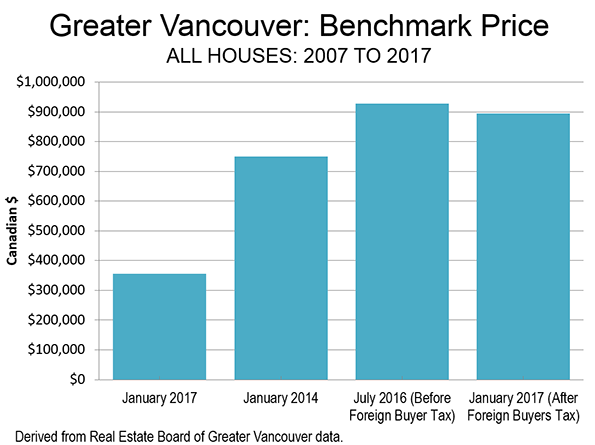
    A recent Wall Street Journal article (“For Chinese buyers, Seattle is the new Vancouver”) reported that Seattle was replacing Vancouver as the most popular destination for Chinese buyers in North America. For years, there has been considerable concern about foreign investment in the Vancouver housing market, especially Chinese investment. This   demand is widely believed to have driven Vancouver house prices “through the roof.” In response, the British Columbia government recently imposed a 15 percent foreign buyers tax that has had the impact of significantly reducing new foreign investment in Vancouver’s housing market.

    Yet the impact of the tax has still been muted. Houses remain just about as unaffordable as before. The Real Estate Board of Greater Vancouver benchmark price has dropped less than four percent from six months ago, before the foreign buyers tax was imposed. This compares to an 80 percent increase over the last 10 years and 47 percent increase over just the last three years (Figure).

    Clearly there is something other than Chinese investment driving up Vancouver house prices. Since 2004, Vancouver’s median multiple (median house price divided by median household income) has risen from 5.3 to 11.8. This means that that the median house has increased in price more than six times the annual median household income.

    The primary cause of Vancouver’s difficulties is a rigged housing market. For decades, Vancouver has had some of the strongest urban containment policy in the world. Regional land-use authorities have prohibited  housing development from being built on a large agricultural reserve. This land is hardly needed for such use in a nation that has increased its gross agricultural output more than 150 percent since 1961, while reducing its land in farms by three times as many acres as is occupied by all urban settlements combined, according to the 2016 Canadian census. Of course, urban containment restrictions on new housing have driven up house prices, just as Middle East oil supply reductions used to drive up gasoline prices, before the recent supply increases from Canadian and US oil production.

    Vancouver has literally become the third most unaffordable city (metropolitan area) in the nine nations covered by the Demographia International Housing Affordability Survey. This makes a mockery of the Vancouver’s frequent citation as one of the most livable cities in the world. The first principle of livability is affordability — you cannot live where you cannot afford. Most young families of normal economic means cannot hope to ever buy a modest detached house with a yard as their parents or grandparents did decades ago in the Vancouver area. Only Hong Kong and Sydney are less affordable.

    In a recent column (“Not much can or will be done to make Vancouver housing more affordable”) by Gordon Clark in The Province (Vancouver newspaper) describes how things have changed, in a story similar to what you will hear in Sydney, San Francisco and others of the world’s most unaffordable cities. In 1941, his postal supervisor grandfather purchased a house on Oak Street (a main central arterial leading toward downtown) for 1.5 years of income. In 1979 his teacher mother purchased a house in the city of Vancouver for 2.5 times her income. Now with houses costing nearly 12 times incomes, Clark regretfully concludes that nothing can be done: “because the solutions are unacceptable to most people.”

    This illustrates what is perhaps the most powerful characteristic of urban containment regulation — that it creates a strong lobby of support among those who have seen their house values irrationally escalate as a result of unwise government policy. In this environment, public officials simply wring their hands, decry the problem and implement nothing of substance to change the essentially flawed policies. 

    With this rigged market, it should not be surprising that people with money from outside Vancouver, and abroad, would seek to buy houses in Vancouver. After all, the policies all but guaranteed strong returns to anyone with enough capital to enter the market.   It is as if a “Speculators Welcome” banner has been hung from Lion’s Gate Bridge. Not so welcome are those middle-income households being driven out of the market

    Lessons for Seattle

    All of this is a cautionary tale for the Seattle metropolitan area, which also has urban containment policy, but of more recent vintage. Just 140 miles or 225 kilometers south of Vancouver, Seattle’s has housing affordability that already as bad as Vancouver’s  only 12 years ago.

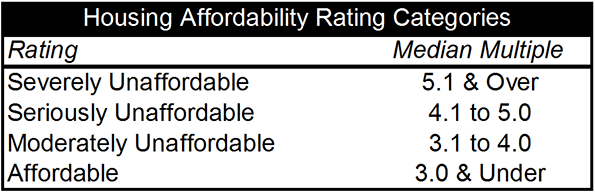
    Seattle has a severely unaffordable median multiple of 5.5, slightly worse than Vancouver’s 5.3 in 2004. In the late 1980s, before Seattle imposed its metropolitan- urban containment policy, the median multiple was as low as 2.4 (Table). Today, a Seattle household with the median income must pay three additional years of income for the median priced house.

    Rising housing demand with severely constricted supply is associated with higher house prices compared to incomes. In this regard, Seattle has multiple risks, from households escaping California to escape from the even higher prices, Seattle is a bargain compared to the “dogs breakfast” of unaffordable housing associated with California where median multiples now exceed 8.0 in all of the major coastal metropolitan areas (Los Angeles, San Francisco, San Diego and San Jose). Prices are so high in California that a seller can buy a comparable house in Seattle for hundreds of thousands less. There may not be as much sun in Seattle, but there’s plenty of money left over for umbrellas and other goods and services.

    Now the pressure is likely to increase as foreign investors who shop the world for rigged housing markets promise quick profits now turn their attention to the Puget Sound. In this environment, it would not be surprising for additional serious house price escalation to be in the offing, and Seattle to indeed become the new Vancouver in the next decade or two.

    Given these forces, we can expect Seattle housing prices   will continue to increase disproportionately to incomes unless there is land use policy reform. Sufficient supply must be allowed on greenfield land to keep house prices from rising farther. And “building to the sky”— which is very expensive and not very family friendly —  is not likely to restore housing affordability in Seattle any more than it has anywhere else. For example, the Manhattanization of central Toronto, with its many new residential towers, has not prevented its median multiple from doubling from 3.9 to 7.7 in the last 12 years. Nor has it prevented a far less obvious (at least to the press) 80 percent share of population growth to be in the suburbs between 2011 and 2016.

    Lost in all of this are ordinary middle and working class people, who routinely take a back seat in public policy to planning obsessions over urban form, and a “sense of place.” Middle-income households are far more in need of a “decent place” to live at a reasonable price. Architectural marvels or sleek streetscapes are no substitute. The issue is not ideological, it is rather practical and human. Nor is it about property rights, or free markets. The issue is that people are being denied the housing they desire by urban containment policy and its distorted priorities. As Paul Cheshire, Max Nathan and Henry G. Overman of the London School of Economics have pointed out, “people rather than places” should be the focus of urban policy.

    It is ironic that progressive metropolitan areas, like Vancouver, where inclusionary zoning drip feeds housing to lower income households, have become, large exclusionary zones where average income households cannot afford houses. Seattle is headed down the same path.  Soon it may be time to hang a “Speculators Welcome” banner from the Space Needle.

    Photograph: Downtown Seattle (by author)            

    Wendell Cox is principal of Demographia, an international public policy and demographics firm. He is a Senior Fellow of the Center for Opportunity Urbanism (US), Senior Fellow for Housing Affordability and Municipal Policy for the Frontier Centre for Public Policy (Canada), and a member of the Board of Advisors of the Center for Demographics and Policy at Chapman University (California). He is co-author of the "Demographia International Housing Affordability Survey" and author of "Demographia World Urban Areas" and "War on the Dream: How Anti-Sprawl Policy Threatens the Quality of Life." He was appointed to three terms on the Los Angeles County Transportation Commission, where he served with the leading city and county leadership as the only non-elected member. He served as a visiting professor at the Conservatoire National des Arts et Metiers, a national university in Paris.

  • Trump Country: Where the Immigrants Aren’t

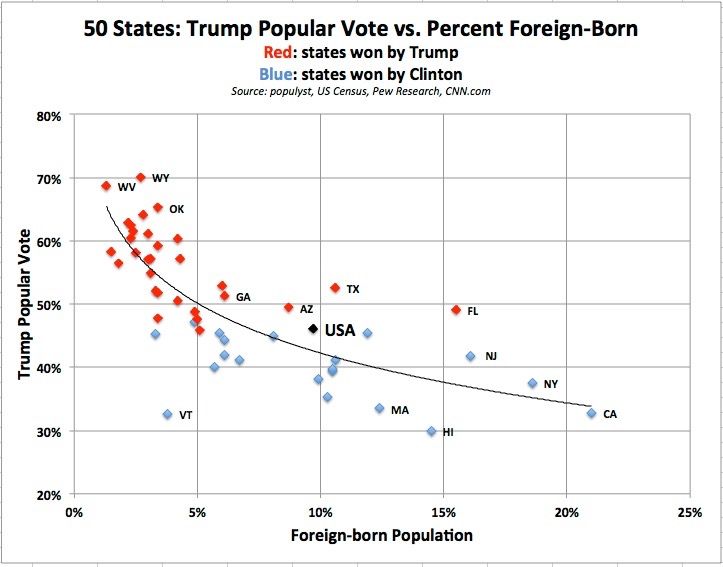
    Trump did best in the states with the lowest percentages of foreign-born residents.

    “I love the poorly-educated”, gushed Donald Trump after winning the Nevada primary in February. But in the end, what happened in the primary, stayed in the primary. Come November, Trump lost the state to Hillary Clinton, a turn that is explained by the fact that there is a higher percentage of foreign-born residents in Nevada than in any state won by Trump, save Florida.

    In fact, Trump won the general election because he carried almost all of the states where there are few foreign-born residents. His anti-immigration message resonated most in the parts of the country that have the fewest immigrants. Of course, he also won immigrant-heavy Arizona, Florida and Texas, but mainly by prevailing in rural counties. He lost in the counties that include the major urban centers of Miami, Orlando, Tampa, Dallas, Houston, Austin and San Antonio. He did win in Maricopa county where Phoenix is located but perhaps not in Phoenix itself. (Maricopa county encompasses a lot more than Phoenix as it is larger by itself than the entire state of New Jersey, and larger than Connecticut and Delaware put together.)

    If the size of the Trump vote can be used as a proxy for a state’s sentiment towards immigration and concern about terrorism, and it probably can, then it seems that the people who are most worried about immigration and terrorism are those who are the least exposed to it and the least at risk from it. This is counter-intuitive from the point of view of probability: why worry about a low probability event? But it could make sense from the point of view of fear: many people can be prone to fear and to misunderstand what they do not know well. Their opinions of others are formed mainly by what they see or read in the media, rather than by their own first-hand experiences.

    Where Trump Won

    In the United States overall, there were in 2015 as many as 42 million people who were born in another country, or 13.2% of the US population. But as shown in the chart, every state won by Trump last November, except for Arizona, Texas and Florida, has a smaller percentage of foreign-born than the national average. In fact, the lower the percentage of foreign-born in a given state, the better Trump has done in that state.

    In Wyoming and West Virginia (3.6% and 1.5% foreign-born), he carried approximately 70% of the popular vote. But in Georgia (9.8% foreign-born), he carried about 50%. This difference in the vote cannot be totally attributed to the fact that a majority of the foreign-born probably went for Clinton, given that the difference between 70% and 50% is far higher than the difference between 9.8% and 3.6% and that the latter variable includes non-voters such as children and undocumented immigrants.

    Meanwhile California, New York, New Jersey, Nevada, Hawaii and Massachusetts all have a higher percentage of foreign-born than the national average and they all voted for Hillary Clinton by wide margins. With Illinois, the District of Columbia, Washington state and a few others, these are the states with the big urban centers that saw the largest protests against the recent executive order banning entry from seven Muslim countries.

    In the above chart, the percent of foreign-born (provided by the US Census) includes unauthorized migrants. Pew Hispanic Research estimated their numbers in every state as of 2014. If we strip the unauthorized figure from the foreign-born figure, we end up with an even better correlation. The resulting chart below reinforces the notion that Trump did well in inverse proportion to the foreign-born presence in any state.

    Texas and Florida are moderate outliers in the sense that Trump did better than one would have expected from the regression. But conversely, he did far worse in the New England states, in particular Vermont, New Hampshire and Maine all of which have fewer than 5% foreign-born in their populations. Vermont is a big outlier, ostensibly because of the number of former New Yorkers living in the state, or the Bernie Sanders factor. Its total population is also very small at around 630,000.

    (click and zoom in to enlarge the table)

    screen-shot-2017-02-03-at-10-37-43-am-2

    With his current policies, the President is not courting any immigrant-heavy states and his solid base elsewhere allows him to ignore the protests. People who live in the rural South or Midwest may feel just as strongly in favor of the visa ban or of other Trump initiatives but their low-density living makes it harder for them to make their numbers visible through outdoor protests. The same is true of the lower density regions of Arizona, Florida and Texas where support for Trump was rock solid.

    Terror Calculus

    It is also worth noting that the Trump states (red in the chart) have not been the targets of terrorist activities or threats to the same extent as New York or Washington DC. So here again, the people more often targeted by terrorism seem less worried about newcomers and Muslims than people who live in a small town or rural setting where the odds of terror attacks are close to nil. Terrorists want to inflict as much damage and as many casualties as possible, a more attainable goal in dense urban centers. Even if they targeted smaller localities, the odds that it would be one’s own small town out of thousands of others are probably no greater than the odds of a mass shooting by a citizen born and raised in the United States.

    Meanwhile, there is only one New York City and only a few cities of the size of Chicago or Washington DC. Even in these cities, the odds of being a victim of terrorism are very small. An attack may well occur but the likelihood that it will be at the exact time T and place P where a resident R may find himself, out of hundreds of millions of other possible daily T-P-R combinations, is indeed minimal. Of course, a scenario involving a WMD attack throws off this tragic and otherwise reassuring calculus. But then this speaks more to the need for detection and prevention of WMDs, rather than to the extreme vetting of individuals originating from certain countries.

    So to sum up, people who have few if any foreign neighbors appear to be more worried about foreigners and terrorism than people who have many foreign neighbors. And from their sparsely populated townships, they could now effect restrictive policies not only for their own localities, but even for the large cities that they rarely visit. This is not so unusual. Historically, decisions made at the center have not always complied with local preferences. However, it should be added that historically, it was more often the preferences of the big cities that were imposed on the great plains.

    President Trump says he loves the poorly-educated but he also relies on the support of voters who are less exposed to immigrants. Which then begs the following question: how deep is these voters’ sentiment towards the foreign-born in places where they are scarce, and for how long can the President tap it to maintain his popularity? A lot hinges on the answer.

    Sami Karam is the founder and editor of populyst.net and the creator of the populyst index™. populyst is about innovation, demography and society. Before populyst, he was the founder and manager of the Seven Global funds and a fund manager at leading asset managers in Boston and New York. In addition to a finance MBA from the Wharton School, he holds a Master’s in Civil Engineering from Cornell and a Bachelor of Architecture from UT Austin.

    Photo: Gage Skidmore, CC License

  • Visualizing Houston’s Population Density

    Population density may sound like the most mundane of metrics, a column heading in a city planner’s spreadsheet, but in cities across the U.S. it’s been a source of cultural controversy, guiding where people move and why.

    To those seeking a more urban lifestyle, “density” implies walkability, car-free transit, and cosmopolitan culture. To others, “density” equates to crowds, cramped quarters, and the inability to find parking. The debate arises around nearly every planning decision under consideration in cities like Charlotte, often devolving into vicious debate.

    Where these debates often breakdown is when it comes to the relative nature of population density: How dense is ‘dense’? Is Houston dense? We should all be able to agree that New York is dense, right? Well, not compared to Paris, let alone Manila.

    In order to put Houston’s density in perspective, we put together a series of visualizations showing how large Houston would be if it were as dense as other cities.

    If Houston’s population lived as close together as New York’s does, how much space would they take up? Compared to cities like Mumbai, or even Los Angeles, Houston is a sprawl, while compared with Jacksonville and Anchorage, Houston is practically Manhattan.

    Note that Houston’s city limits were used for this visualization, not the metro area. While some readers may object to the exclusion of surrounding locales, metro areas are not as well defined as city limits and that is often a matter of debate itself.

    houston-tx-density-sparefoot-houston-storage-units

  • How Richard Longworth Predicted 20 Years Ago That Globalization Would Cause a Social Crisis

    Global Squeeze: The Coming Crisis for First-World Nations
    Richard C. Longworth
    McGraw-Hill 1998

    Whenever we see the reality of momentous shifts in society, it’s always good to go back and take a look at the people who saw it coming far away. Generally speaking, there were usually people who understood what was happening in advance. For example, Daniel Bell wrote his book The Coming of Post-Industrial Society in 1976. There were probably even other earlier books touting the same theme.

    One person who clearly saw the challenges that globalization would bring to the developed countries was Richard C. Longworth. Longworth was a reporter for most of his career, and a long time foreign correspondent at the Chicago Tribune. Most readers here probably know him from his 2008 book Caught in the Middle: America’s Heartland in the Age of Globalism.

    But arguably more important was his 1998 book Global Squeeze: The Coming Crisis for First-World Nations, a book in which Longworth predicted most of the dynamics that would play out in the next two decades, culminating (so far) with Trump’s election. He predicted massive job displacement from China’s entry into the global trading system, describes how developing world countries would move up the value chain, predicts the erosion of middle-class standards of living, the rise of the gig economy, and the deterioration in race relations. He puts his finger on the nationalism vs. globalism debate and anticipated populist revolt. He didn’t predict everything, but he nailed an awful lot of it.

    I don’t know how this book performed in the market, but its timing was certainly inauspicious. It came out right as the dot com boom was going nova. Just as one contemporaneous event, on March 30 of that year James Glassman and Kevin Hassett wrote an op-ed in the Wall Street Journal (which no longer appears to be online) that became the basis of their now infamous 1999 book Dow 36,000.

    I was then in my late 20s and about to leave Andersen Consulting (now known as Accenture) for a telecom startup. I had no inking of how the future would ultimately play out, but I was incredibly, and naively, optimistic. Since coming out of school at the end of the early 90s recession, the tech industry had been booming beyond belief.  The post-mainframe tech transitions of the 90s, plus the nationalization (and early stage globalization of business) drove fantastic demand for consultants and while collar workers. It was truly the golden age for young people with college degrees. Unlike today’s Millennials, who are experiencing downward economic mobility, our salaries were soaring.

    Having a great employer and living in a nascently gentrifying Chicago, I was living in a bubble. I certainly did not see trouble ahead in these boom times. I was aware that manufacturing was in structural decline, but my assumption was that this was transitional and generational. Future generations would enter the exploding white collar workforce as I had and industrial displacement would be as forgotten as agricultural displacement had been.

    I didn’t see it coming. But Longworth did, even in those boom times.

    A Critique of Free Trade

    It’s interesting to see how Longworth, someone you’d certainly place today as in the mainstream of center-left thinking, was at that time sharply critical of what is now considered conventional wisdom by both parties, such as free trade dogmatism. For example, he criticizes the doctrine of comparative advantage:

    World trade is based on the idea that each nation should make what it makes best and most cheaply, and then trade those wares to another nation for what that nation makes best and most cheaply. In the process, both nations will prosper and will have access to better goods than if they tried to do it all themselves. This is the principle of ‘comparative advantage.’ It also has very little to do with trade in the real world of the global economy….Trade as it exists today bears little resemblance to the textbook images dear to the heart of free traders, for several reasons. One reason deals with the ability of giant firms to create comparative advantage and move it around the globe. If world trade used to take place between companies in different countries, it goes on as often now between branches of the same company operating in many different countries…These are not cases of countries taking advantage of their natural competitive advantages to make goods and services that can be sold freely to less-favored countries. They are cases of companies using technology to build enclosed and controlled trading systems.

    This is part of his general disdain for the economics profession:

    [Robert Z.] Lawrence and most of his mainstream colleagues are devoted free traders, literally trained from their undergraduate days to reject the thought that trade can cause more harm than good. Lawrence has even warned against letting such ideas get around, saying, ‘The very perception that a link exists [between trade and labor problems] could put the continuing evolution of trade and investment flows at risk.’ No one actually accuses these economists of faking their evidence to protect the sanctity of free trade. But it’s clear that many economists have carefully limited their research to product the results they wanted. The growing evidence that free trade can indeed cause severe damage, and that this damage may even outweigh the gains is producing nothing less than a religious crisis among the true believers in the economics departments of American universities.

    They may possibly have had a momentary crisis of faith in the 1990s, but if so, they quickly repented of their heresy. If anything, the economics profession today is more militant and more hysterical about any impingement on global trade than they used to be, even as they finally start to admit, belatedly, that just maybe trade with China has had some negative effects on American workers.

    I’ve been wanting to dig more deeply into trade economics because like Longworth I’m not convinced that the studies that are touted regarding trade’s effect on employment tell us what they are marketed as doing. For example, we frequently hear that research shows that relative few jobs were off shored, and that most job losses have been due to automation and other onshore productivity improvements.

    Yet I then read articles saying that just one company, Apple, and its subcontractors employ 700,000 people in China.  And I wonder: were these 700,000 jobs a) lost to trade/off shoring b) lost to automation or c) counted in some third bucket we’re not being told about? If they aren’t in large part doing jobs that would otherwise be done somewhere else, what the heck are all these untold tens of millions of workers in China manufacturing products for export actually doing?

    Longworth points out the hypocrisy inherent in some free trade arguments by pointing to China’s extremely state managed economy and highly protectionist legal system. By the standard arguments, this should have torpedoed them. Yet China has had a three decade run of fabulous growth so far. Even if they crash tomorrow, that’s remarkable. Far from chasing away businesses, even companies they’ve banned like Facebook continue to prostrate themselves before Emperor Xi hoping to get back in, all while delivering sanctimonious lectures to governments back home. And speaking of the tech industry, Longworth saw that China was using its trade discrimination rules to move up the value chain too:

    [China] has every intention of upgrading its exports from clothing and toys to high-end, high-tech, high-profit goods such as cars, electronics, and pharmaceuticals….and it is using its trade and investment policies to force Western companies to help it achieve this mastery, which it clearly intends to employ to compete with these countries in the future. Western and Japanese companies that want to invest in China are forced to bring in modern technology and teach the Chinese how to use it.

    The Primacy of the Nation and Its Social Integrity

    In contrast to the pre-Trumpian mainstream thinking of the Clinton-Bush-Obama years, Longworth argued that even if it’s economically inefficient, some type of protectionism was necessary in order for developed country societies to survive China’s entrance into the global trade system intact:

    If Japan was a problem, China will be a catastrophe. It seems impossible that the world trade system, with all its benefits, can withstand an assault of this sort….The major nations must now begin planning new rules to limit aggressive exports of this sort and to demand strict reciprocity – equal access to the markets of China…This is of course, both protectionism and managed trade, and will be attacked as such by purists who consider anything less than free trade a sin. But trade is an economic issue, not a theological one. The First World nations have civilizations worth protecting. If the price of that protection is some protectionism aimed at global predators, it seems folly not to pay it.

    This was of course rejected, and these civilizations are in fact badly damaged. And the global trade system is in serious jeopardy as a result, as Longworth predicted.

    This passage also gets at the core debate at the heart of contemporary politics: nationalism vs. globalism. Longworth tables this as they key issue in the opening passage of the book: “What is the purpose of an economy? If it is not solely for the well-being of the people who live within it, what is an economy for?”

    Longworth at this point in time clearly sided with the nationalist perspective, though as we’ll see in part two this review, his personal and political background created cognitive dissonance on this point that caused him to ultimately side with the very people he raked over the coals in this book.

    He saw that on the path the country was on, the prognosis for the middle class was grim and threatened our very understanding of a fair society.  Sadly, he was accurate here too:

    This is the proletarianization of the middle class, which once considered itself set for life in cushioned cubicle of big corporations but now finds itself pitched onto the pavement, a loser in the global competition for jobs. If there is a focal point of the growing debate on the global economy, it is here, where people work….The global emphasis on profits, the unrelenting pressure of the capital markets, and the search for best practice preclude comforting answers. The truth is that no one at this stage can give answers with assurance. The logic of global markets leads to more pressure on workers, not less. Millions of new workers appear on the world market every year, all hungry and ready to compete. The power of computer-driven automation makes it at least possible that, for the first time, new technology will be a job destroyer, not a job creator….This is the “race to the bottom,” a process that drives incomes ever lower. It is also straightforward supply-and-demand economics at work…This is the dehumanization of labor. No other major country treats its workers as commodities in this way, as raw materials or components that can be bargained to the lowest price.

    He also correctly foresaw that race relations would degrade with economic stresses. Not only did this cause the white working class to prioritize its own self-interest (the same as every other group), but if the white working class sneezes, the black working class gets a serious case of Spanish flu. As Longworth says:

    Racial progress, if not racial harmony, is real. The past three decades in particular have seen once-closed doors open for the vast majority of blacks. Anyone who can recall the legal segregation of the immediate postwar years must marvel at the changes. But economic problems threaten much of this progress.

    The retrogression of the racial fabric that we’ve seen is part of that social unraveling that he saw unfettered globalization imposing on America.

    And there’s much more he got right, including seeing the rise of the “gig economy” in a section called “A World of Temps.”

    The Moral Bankruptcy of the American Elite

    One of the major themes woven throughout the book is the moral bankruptcy of America’s elite and more broadly those who, like me at that time, were living large and loving life thanks to this new economy.

    He adopts Robert Reich’s “secession of the successful” thesis:

    The upper 20% retreats to its gated communities in the suburbs, withdrawing not only physically but psychologically and socially from the country around it. They are not only the wealthy, the executives and traders, but also the economists, journalists, and others who tout the global economy largely because they are best equipped to cope with it and most insulated from its effects. These fortunate few go by different names. Rohatyn calls them the “technological aristocracy.” Robert Reich, the former secretary of labor, calls them “symbolic analysts”….I prefer to think of them as global citizens, having more in common with the elites of Tokyo and Frankfurt than with the other Americans who live beyond the gates, in the shantytowns on the outskirts of the global village. Any country needs its elites. It needs their money, and more important, it needs their leadership. Now the United States is losing its elites.

    He talks about the dismal ethics and reckless behavior of much of the financial class:

    American traders usually have more formal schooling than their British counterparts, but they have no less ambition and no more real knowledge of the world. Most know the difference between normal risk and betting the bank. But some don’t. Most are honest. But some aren’t. Barely prepared and innocent of ethics, these traders are pitched into stupendous sums of money.

    He describes how major Western corporations came to think of themselves as post-national, and repudiated the social contract:

    Once the social contract expressed a deal between the wealthy and the poor, between businesses and their employees. Economic change has always brought both gain and pain. But in the short run, the wealthy were more likely to get the gain, and the poor more likely to feel the pain. The great stabilizer of postwar industrial society was the recognition by government and business that, if change creates both winners and losers, then the winners have an obligation to help and compensate the losers. This was more than simple fairness. It was good politics. It was the price that the winners paid to pacify the losers, who had the vote. If the pain became too great, the losers would stop supporting the system that caused the pain. So the Western nations created the safety net, a social balm that soothed the pain and kept the losers non-mutinous.

    This social contract has been broken. Footloose global corporations have stopped paying the taxes that financed it. The slack has been taken up, at least partly, by higher taxes on workers. In other words, workers are financing their own social contract. It’s robbing Peter to pay Peter. The losers are comforting the losers, while the winners pay minimal taxes in Indonesia or buy bonds in cyberspace.

    Or set up shell companies in Ireland or Luxembourg. The merits of corporate taxation are debatable. But we’ve all read the stories of how these Silicon Valley firms have racked up gigantic profits while using complex strategies to pay little if any tax.  It’s indisputable these companies have little concept of the social contract as previous generations understood it.

    These global companies have even seceded from national legal systems in favor of private justice.

    Even the functions that the governments used to do are being taken over by the global market. With no global laws or regulations to discipline these global markets, a sort of privatized form of justice has arisen. Around the globe, private arbitrators and arbitration centers are producing a “transnational legal profession and indeed a transnational private judiciary. These arbitrators, being private, compete for business and so depend on the goodwill of the corporations they judge. These corporations, in turn, use this private judicial system largely to escape the jurisdiction of national courts.

    These private courts can even force nominally sovereign nations to submit to them. That’s because these trade treaties set up international arbitration courts that empower businesses to sue countries outside of those countries’ home court systems. This is nothing less than a destruction of sovereignty, and one of the biggest complaints critics have about these “trade” treaties. There’s a reason it takes 5500 pages to print a so-called “free trade pact” – and it’s not free trade.

    As you can see, there’s a ton that Longworth got right 20 years ago – and he put his finger on issues that are if anything more relevant to public debates now than they were then. In fact, a few anachronisms aside, Global Squeeze holds up very well and is still eminently worth reading today. If nothing else, doing so will make clear that anyone who claims “we didn’t see it coming” isn’t telling the truth. Some people did see it coming. But they were ignored.

    That’s not to say Longworth predicted or got everything right. In the second part of this series I’ll highlight the areas he missed, and also how cognitive dissonance on his part and that of others like him who were sharply critical of globalization back then fatally undermined their efforts at reform and led them to ultimately be perceived as champions of globalization.

    Aaron M. Renn is a senior fellow at the Manhattan Institute, a contributing editor of City Journal, and an economic development columnist for Governing magazine. He focuses on ways to help America’s cities thrive in an ever more complex, competitive, globalized, and diverse twenty-first century. During Renn’s 15-year career in management and technology consulting, he was a partner at Accenture and held several technology strategy roles and directed multimillion-dollar global technology implementations. He has contributed to The Guardian, Forbes.com, and numerous other publications. Renn holds a B.S. from Indiana University, where he coauthored an early social-networking platform in 1991.

  • The 2016 Census of Canada: All About the Prairies

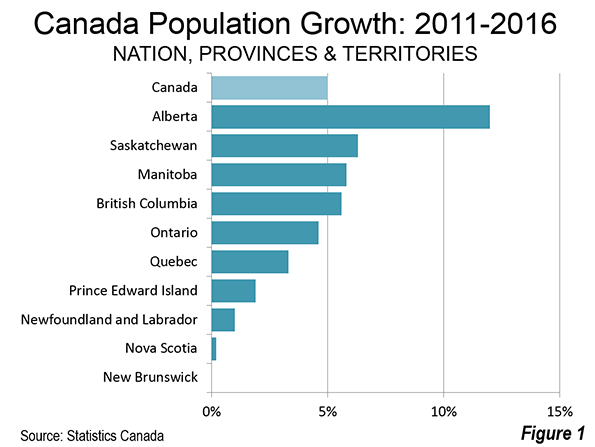
    Statistics Canada has just announced population counts from the 2016 census and the narrative is all about the Prairie Provinces. Alberta, Saskatchewan and Manitoba (yes, Manitoba) were the three fastest growing provinces. Metropolitan area growth was dominated by the Prairies, along with metropolitan areas outside the largest in Ontario and British Columbia.

    Provincial Results

    An analysis in the Globe and Mail indicates that Canada has been the fastest growing among the G7 nations. Since the last census (2011), Canada grew at a rate of 1.0 percent. This is above the 0.8 percent rate of the United States (which fell to 0.7 percent in 2015-2016). Canada’s growth rate was also well above that of the United Kingdom (0.7 percent) and five times the rate of the European Union (0.2 percent) and 10 times that of Germany (0.1 percent).

    Perhaps most astoundingly, British Columbia, which had shared growth leadership with Alberta since 1951 was pushed to fourth place in growth (5.6 percent).

    Leader Alberta grew 11.6 percent, while perennial slow growers Saskatchewan (6.3 percent) and Manitoba (5.8 percent), took the second and third positions. British Columbia grew only 5.6 percent, down from 7.0 percent between 2006 and 2011. The last time that Manitoba grew faster than British Columbia was in the 10 years before 1911, when Sir Wilfred Laurier was Prime Minister, William Howard Taft was President of the United States and eventual war leader H. H. Asquith was British Prime Minister.

    Usually strong growth Ontario, which accounts for nearly 40 percent of the national population, grew slower than Canada (5.0 percent), at 4.6 percent. This repeats the less than stellar performance of 2006 to 2011 and is the first time this has happened since World War II.

    Canada has three territories, all in the far north. Two grew rapidly, including Nunavut (12.7 percent) and Yukon (5.8 percent). Their populations, however, are very small, approximately 35,000 each. Nunavut covers a land area three times that of Texas, while Yukon is larger than California.

    Growth in Metropolitan Areas

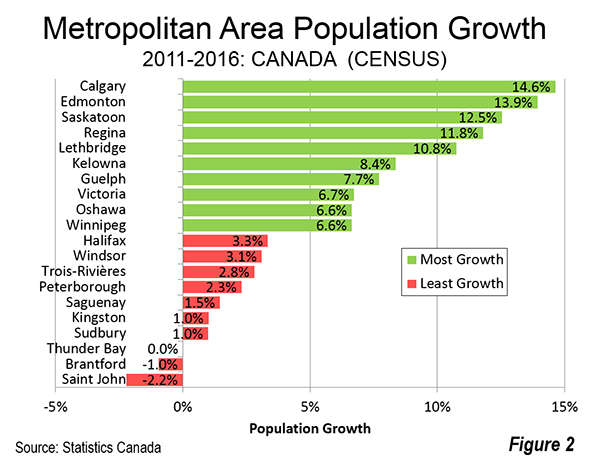
    The same pattern can be seen in metropolitan areas (Table). Fastest growth among the 34 census metropolitan areas (CMA) was centered in the Prairie Provinces. Six of the fastest growing 10 metropolitan areas were in Alberta, Saskatchewan and Manitoba. Calgary grew the fastest, adding 14.6 percent to its population. Edmonton, Calgary’s neighbor to the north, and the capital of Alberta was the second fastest growing, at a 13.9 percent rate over the five years. These two metropolitan areas had seen some stalling of their prodigious growth due to oil industry reverses, however with petroleum prospects improving, could well see even greater growth in the years to come.

    More surprising has been the growth in the historically slow growing plains provinces just to the east. Saskatchewan’s two metropolitan areas were the next fastest growing. Saskatoon grew 12.5 percent. Regina, the provincial capital, grew 11.8 percent. These are strong growth rates for the Saskatchewan metropolitan areas, which until a decade ago had experienced a long period of slow growth.

    Lethbridge, Alberta’s third metropolitan area grew 10.8 percent, rounding out a top five in which all were from the Prairie Provinces.

    The next four positions were occupied by metropolitan areas near the largest (Toronto) and the third largest (Vancouver). Kelowna and Victoria, in British Columbia grew 8.4 percent and 6.7 percent respectively. In Ontario, Guelph and Oshawa grew 7.7 percent and 6.6 percent, respectively. This represented a shift in growth from the two larger metropolitan areas, which experienced an approximately one-third drop in their growth rates from the previous intercensal period (2006-2011), when they ranked in the top 10 in growth. Part of the reason for the greater growth in the metropolitan areas outside Vancouver and Toronto is their lower house prices. Vancouver’s housing affordability was the third worst out of 92 major metropolitan areas in the 2017 Demographia International Housing Affordability Survey, while Toronto was 14th worst.

    Winnipeg, the capital of Manitoba, was the 10th fastest growing, at 6.6 percent, and rounded out the six fast growing Prairie province metropolitan areas. Winnipeg’s growth over the last decade, like that of Saskatoon and Regina, is an important turnaround from its previous slower pace. Winnipeg grew faster than Toronto, Vancouver and Ottawa-Gatineau.

    The slowest growing metropolitan area was Saint John, New Brunswick lost 2.0 percent of its population. Six of the slowest growing (and losing) metropolitan areas were in Ontario. Brantford lost 1.0 percent of its population, while Thunder Bay had virtually no change. The other Ontario metropolitan areas in the bottom ten included Sudbury, Kingston, Peterborough and Windsor (just across the Detroit River from Detroit). Two Québec metropolitan areas were among the slowest growing, Saguenay and Trois-Rivières. Halifax, the capital of Nova Scotia was the 10th slowest growing, at 3.3 percent (Figure 2).

    As has been the case for the 45 years since it displaced Montréal, Toronto was Canada’s largest metropolitan area according to the 2016 Census, with a population of 5.9 million. Montréal held on to second place, with a population of 4.1 million. Vancouver was third, with a population nearing 2.5 million.

    Three metropolitan areas were bunched within a range of little more than 70,000. Calgary had a population of 1,393,000. The federal capital, Ottawa-Gatineau, which stretches across the Ottawa River, located on  the border between Quebec and Ontario, had a population of 1,324,000 and had led Calgary in 2011. Edmonton nearly duplicated the Ottawa-Gatineau number, at 1,321,000. Estimates in 2015 had placed Edmonton higher than Ottawa-Gatineau, but were not confirmed by the new Census numbers.

    The remaining four top ten gainers maintained their 2011 positions. Québec ranked 7th, followed by Winnipeg, Hamilton (in the greater Toronto area) and Kitchener-Waterloo, Canada’s Silicon Valley.

    Canada Metropolitan Areas: Population
    2011 to 2016 Census
    Rank Metropolitan Area 2011 2016 Change % % Rank
    1 Toronto   5,583,064   5,928,040   344,976 6.2% 12
    2 Montréal   3,934,078   4,098,927   164,849 4.2% 20
    3 Vancouver   2,313,328   2,463,431   150,103 6.5% 11
    4 Calgary   1,214,839   1,392,609   177,770 14.6% 1
    5 Ottawa – Gatineau   1,254,919   1,323,783     68,864 5.5% 15
    6 Edmonton   1,159,869   1,321,426   161,557 13.9% 2
    7 Québec      767,310      800,296     32,986 4.3% 19
    8 Winnipeg      730,018      778,489     48,471 6.6% 10
    9 Hamilton      721,053      747,545     26,492 3.7% 23
    10 Kitchener – Waterloo      496,383      523,894     27,511 5.5% 14
    11 London      474,786      494,069     19,283 4.1% 21
    12 St. Catharines – Niagara      392,184      406,074     13,890 3.5% 24
    13 Halifax      390,328      403,390     13,062 3.3% 25
    14 Oshawa      356,177      379,848     23,671 6.6% 9
    15 Victoria      344,580      367,770     23,190 6.7% 8
    16 Windsor      319,246      329,144       9,898 3.1% 26
    17 Saskatoon      262,215      295,095     32,880 12.5% 3
    18 Regina      211,519      236,481     24,962 11.8% 4
    19 Sherbrooke      202,261      212,105       9,844 4.9% 17
    20 St. John’s      196,954      205,955       9,001 4.6% 18
    21 Barrie      187,013      197,059     10,046 5.4% 16
    22 Kelowna      179,839      194,882     15,043 8.4% 6
    23 Abbotsford – Mission      170,191      180,518     10,327 6.1% 13
    24 Sudbury      163,067      164,689       1,622 1.0% 31
    25 Kingston      159,561      161,175       1,614 1.0% 30
    26 Saguenay      158,658      160,980       2,322 1.5% 29
    27 Trois-Rivières      151,773      156,042       4,269 2.8% 27
    28 Guelph      141,097      151,984     10,887 7.7% 7
    29 Moncton      139,287      144,810       5,523 4.0% 22
    30 Brantford      135,501      134,203     (1,298) -1.0% 33
    31 Saint John      129,057      126,202     (2,855) -2.2% 34
    32 Peterborough      118,975      121,721       2,746 2.3% 28
    33 Thunder Bay      121,596      121,621            25 0.0% 32
    34 Lethbridge      105,999      117,394     11,395 10.8% 5
    Source: Statistics Canada

    Photograph: Flag of Canada

    Wendell Cox is principal of Demographia, an international public policy and demographics firm. He is a Senior Fellow of the Center for Opportunity Urbanism (US), Senior Fellow for Housing Affordability and Municipal Policy for the Frontier Centre for Public Policy (Canada), and a member of the Board of Advisors of the Center for Demographics and Policy at Chapman University (California). He is co-author of the “Demographia International Housing Affordability Survey” and author of “Demographia World Urban Areas” and “War on the Dream: How Anti-Sprawl Policy Threatens the Quality of Life.” He was appointed to three terms on the Los Angeles County Transportation Commission, where he served with the leading city and county leadership as the only non-elected member. He served as a visiting professor at the Conservatoire National des Arts et Metiers, a national university in Paris.

  • What the U.S. Thinks About Immigration – and Why it Should Matter When We Attempt Reform

    Americans agree that the country’s policies on handling immigration have long needed reform. However, what kinds of reform and the impact immigration itself has on the United States are matters of great controversy. For both former Presidents Barack Obama and George W. Bush, promising efforts at comprehensive immigration reform were blocked by the unrelenting opposition.

    As Obama’s second term began it seemed that the time for successful comprehensive immigration reform had arrived, especially when the Senate passed its major reform bill in June 2013. However, with the Republican-controlled House refusing to give it consideration, the bill died when the congressional session ended the next year. With both chambers in Republican hands after the November 2014 elections, any executive reforms needing congressional approval were doomed.

    Consequently, President Obama acted unilaterally on immigration, contending that he had the requisite authority to do so. He announced a new policy, the Deferred Action of for Parents of Americans, which deferred deportation of individuals who met the new guidelines. Although this executive action was very popular with Democrats and Hispanics, it was opposed by a slight national majority in the first surveys after its announcement.

    When asked the question of whether they approve or disapprove of the way Obama is handling immigration, 51% of the total population and 85% of Republicans disapproved. The question was asked at more than three dozen points between April 2015 and October 2016.

    More so than any of the other Republican candidates, Donald Trump seized on the issue of immigration with his strong, restrictionist positions which resonated with primary voters. For example, in the crucial South Carolina primary, the Trump vote was 14 percent higher among those who agreed that all illegal immigrants should be deported than his overall vote in the state (which was 33 percent). For the 27 states with exit polls (and a few entrance polls for caucus states), Trump’s advantage among voters agreeing with the deportation of illegal immigrants was 13 percent; for a ban on all Muslim immigration it was 9 percent. By comparison, on his best performing economic question his advantage was only 4 percent.

    One of President Trump’s most defining issues has been his promise to build a wall across the entire U.S. Mexican border. This position proved very popular with his supporters, 87 percent of those who voted for him in the Republican primaries were in agreement. This was 31% higher than the average for Republicans supporting other candidates.

    However, when we turn to the overall population, support for Trump’s position drops substantially. Looking at numerous surveys going back to September 2015, general popular support for the wall has been consistently below 50%, often substantially so, and with that support falling as the country moved into the general election period.

    Until recently, the two major political parties have been evenly matched when it comes to which is more trusted to handle the immigration issue. However, last year, a small advantage opened for the Democrats. When asked on seven different occasions between March and September 2016 which candidate they most trusted to handle immigration issues, Hillary Clinton was preferred over Donald Trump each time by a median margin of 8%. In 2012, in contrast, Mitt Romney had a slim median advantage of 1% over Barack Obama.

    Nonetheless, since Republicans retained control of Congress in the 2016 elections, President Trump should find a strong base of legislative support for his immigration initiatives. This should be especially true in the House of Representatives for restrictionist sentiment prevails in the states with the largest Republican delegations.

    However, when we move from Republicans to the overall population a different story emerges which may complicate action in the Senate where the filibuster gives Democrats important leverage. For some years, the public has been moving toward the expansionist position on immigration-related issues (although notably still preferring a decrease in overall immigration levels). Support for a path to citizenship for illegal immigrants already in the country has been growing and for the past four years it has commanded a slight majority. Despite his best efforts, President Trump has failed in moving the majority of Americans towards his position on this issue.

    President Trump should be able to redirect national immigration policy where he can take unilateral executive action, but not without substantial opposition. The executive order he issued at the end of his first week, banning travel from seven Muslim-majority countries, has sparked protests around the country, raised many legal questions, and prompted international outcry. Trump could very well be stymied, just as his successors were, when it comes to major changes requiring congressional approval.

    Personally, I favor a comprehensive package of reforms that lean in the permissive direction. However, I have some sympathy for those who favor greater immigration restrictions. In my years of studying immigration policy I have taken notice of the gap between what the public says it wants concerning immigration and what it has received instead from public policy. This has been especially true on questions related to illegal immigration, which there has been long-standing, deep, and wide opposition.

    This is not healthy in a democracy. Immigration expansionists have failed to meaningfully address the concerns of pluralities and even majorities of citizens consistently registered in surveys of public opinion. When there is an unwillingness to listen, a restrictionist grassroots backlash should not be a surprise.

    Regardless of one’s preferences on this issue, I believe that we all need to do a better job of paying attention to what the American public says and wants. Until we do, it is likely we will continue to be frustrated by policy stalemate.

    Charles D. Brockett has a PhD in political science and several decades’ experience teaching about immigration in courses both on U.S. and Latin American politics. A professor emeritus at Sewanee: The University of the South, he has written What the U.S. Public Thinks about Immigration—and Why It Should Matter When We Attempt Reform: The Trump Years (Kindle edition) as well as two well-received books on Central America and is the co-editor of two collections concerning immigration and citizenship in the United States—Complex Allegiances: Constellations of Immigration, Citizenship & Belonging and Shifting Balance Sheets: Women’s Stories of Naturalized Citizenship & Cultural Attachment, both published by Wising Up Press.

    Photo: lcars via Flickr Creative Commons

  • The High Cost of a Home Is Turning American Millennials Into the New Serfs

    American greatness was long premised on the common assumption that each generation would do better than the previous one. That is being undermined for the emerging millennial generation.

    The problems facing millennials include an economy where job growth has been largely in service and part-time employment, producing lower incomes; the Census bureau estimates they earn, even with a full-time job, $2,000 less in real dollars than the same age group made in 1980. More millennials, notes a recent White House report, face far longer periods of unemployment and suffer low rates of labor participation. More than 20 percent of people 18 to 34 live in poverty, up from 14 percent in 1980.

    They are also saddled with ever more college debt, with around half of students borrowing for their education during the 2013-14 school year, up from around 30 percent in the mid-1990s. All this at a time when the returns on education seem to be dropping: A millennial with both a college degree and college debt, according to a recent analysis of Federal Reserve data, earns about the same as a boomer without a degree did at the same age.

    Downward mobility, for now at least, is increasingly rife. Stanford economist Raj Chatty finds that someone born in 1940 had a 92 percent chance of earning more than their parents; a boomer born in 1950 had a 79 percent chance of earning more than their parents. Those born in 1980, in contrast, have just a 46 percent chance.

    Since 2004, homeownership rates for people under 35 have dropped by 21 percent, easily outpacing the 15 percent fall among those 35 to 44; the boomers’ rate remained largely unchanged.

    In some markets, high rents and weak millennial incomes make it all but impossible to raise a down payment (PDF). According to Zillow, for workers between 22 and 34, rent costs now claim upward of 45 percent of income in Los Angeles, San Francisco, New York, and Miami, compared to less than 30 percent of income in metropolitan areas like Dallas-Fort Worth and Houston. The costs of purchasing a house are even more lopsided: In Los Angeles and the Bay Area, a monthly mortgage takes, on average, close to 40 percent of income, compared to 15 percent nationally.

    Like medieval serfs in pre-industrial Europe, America’s new generation, particularly in its alpha cities, seems increasingly destined to spend their lives paying off their overlords, and having little to show for it.

    Rather than strike out on their own, many millennials are simply failing to launch, with record numbers hunkering down in their parents’ homes. Since 2000, the numbers of people aged 18 to 34 living at home has shot up by over 5 million.

    One common meme, particularly in the mainstream media, has been that millennials don’t want to buy homes. The new generation, as Fast Company breathlessly reported, is part of “an evolution of consciousness.” Other suggest the young have embraced “the sharing economy,” so that owning a home is simply not to their taste. The well-named site Elite Daily asserts that the vast majority of millennials are headed to “frenetic metropolis” rather than becalmed suburbs.

    And it’s not just ideologues claiming millennials have evolved out of home ownership. Wall Street speculators like Blackstone are betting that the young are committed to some new “rentership society,” with that firm investing $10 billion to scoop up existing small homes to rent, and even building tracks of homes exclusively for rent.

    It’s not a lifestyle choice, but economics—high prices and low incomesthat are keeping millennials from buying homes. In survey after survey the clear majority of millennials—roughly 80 percent, including the vast majority of renters—express interest in acquiring a home of their own. Nor are they allergic, as many suggest, to the idea of raising a family, albeit often at a later age, long a major motivation for home ownership. Roughly 80 percent of millennials say they plan to get married, and most of them are planning to have children.

    Overall, more than 80 percent of millennials already live in suburbs and exurbs, and they are, if anything, moving away from the dense, expensive cities. Since 2010 millennial population trends rank New York, Chicago, Washington, and Portland in the bottom half of major metropolitan areas while the young head out to less expensive, highly suburbanized areas such as Orlando, Austin, and San Antonio.

    Age will accelerate this process. Economist Jed Kolko notes as people enter their thirties they tend to head out of core cities to suburban locations; roughly one in four people in their mid to late twenties lives in an urban location but by the time those people are in their early thirties, that number drops precipitously and continues dropping into their eighties. In fact, younger millennials, notes the website FiveThirtyEight, are moving to the ’burbs at at a faster clip than previous generations. What’s slowing that trend is economics. Many can’t afford to move or transition to a traditional adulthood.

    The millennial housing crisis is reshaping the geography of opportunity. Although millennial rates of homeownership have dropped nationwide, the most precipitous declines have been in such metropolitan areas as New York, Miami, San Francisco, Portland, Seattle, and Los Angeles. In all these areas, public policy has regulatory barriers in the way of suburban and exurban affordability. It is in these markets where such things as “tiny houses” and “micro-apartments”—not exactly a boon to people looking to start families—are being touted as solutions to housing shortages.

    Nowhere is this dynamic more evident than in California, where the state government has all but declared war on single-family homes by banning new peripheral development, driving up house prices throughout metropolitan areas. Regulatory fees typically add upward of $50,000, two-and-a-half times the national average; new demands for “zero emissions” homes promise to boost this by an additional $25,000.

    Due largely to such regulatory restraints, overall California housing construction over the past 10 years has been less than half of that it averaged from 195 to 1989, forcing prices up, particularly on single-family houses. The state ranks second to the last in middle-income housing affordability, trailing only Hawaii. It also accounts for 14 of the nation’s 25 least affordable metropolitan areas.

    Home ownership rates in California are among the nation’s lowest, with Los Angeles-Orange having the lowest rate of the nation’s 75 large metropolitan areas. For every two homebuyers who come to the state, five families leave, notes the research firm Core Logic.

    The irony is that the state’s progressive policies are contributing to a less mobile society and a potential demographic crisis. For one thing, fewer young people can form families—Los Angeles-Orange had one of the biggest drops in the child population of any of the 53 largest metros from 2010 to 2015.

    This also has a racial component, as homeownership rates African American and Latino households—which often lack access to family wealth—have dropped far more precipitously than those of non-Hispanic Whites or Asians. Hispanics, accounting for 42 percent of all California millennials, endure homeownership roughly half that seen in other parts of the country.

    This is not the planners’ happy future of density dwelling, transit-riding millennials but a present of overcrowding, the nation’s highest level of poverty and, inevitably, a continued drop in fertility in comparison to less regulated, and less costly, states such as Utah, Texas, and Tennessee that have been among those with the biggest surges in millennial migration.

    Once identified with youth, California’s urban areas are now experiencing a significant decline in both their millennial and Xer populations. By the 2030s, large swaths of the state—particularly along the coast—could become geriatric belts, with an affluent older boomer population served by a largely minority servant class. How feudal!

    Ownership of land has always  been a critical component of middle-class wealth and power. Those celebrating the retreat from homeownership among millennials are embracing the long-term decline of that middle class, two thirds of whose wealth is in their homes.

    The potential decline in ownership also represents a direct assault on future American prosperity. Jason Furman, who served as chairman of President Obama’s Council of Economic Advisors, calculated that a single-family home contributes 2.5 times as much to the national GDP as an apartment unit. Investment in residential properties has dropped to its lowest share of overall spending since World War II; by some estimates reviving that would be enough to return America to 4 percent growth.

    With so many millenials unable to afford homes, or even to see a path to future ownership, household formation has been far slower than in the recent past. Rather than a surge of middle-class buyers, we are seeing the rise of a largely property-less generation whose members will remain economically marginal into their thirties or forties. Indeed by 2030, according to a recent Deloitte study, millennials will account for barely 16 percent of the nation’s wealth while home-owning boomers, then entering their eighties and nineties, will still control a remarkable 45 percent of the nation’s wealth.

    If this continues, we may have to all but abandon the notion of the United States as a middle-class nation. Instead of having a new generation that strikes out on their own, we may be incubating a culture that focuses on such things as the latest iPhone, binge watching on Netflix, something they do far more than even their Xer counterparts.

    Progressives who embrace these developments are abandoning one of the central tenets of mainstream liberalism. In the past, many traditional liberals embraced the old American ideal of dispersed land ownership. “A nation of homeowners,” President Franklin D. Roosevelt believed, “of people who own a real share in their land, is unconquerable.” Homeownership is not only critical to the economy but provides a critical element of our already fraying civic society; homeowners not only tend to vote more than renters, but they also volunteer more and, as Habitat for Humanity suggests, provide a better environment for raising children.

    On the flip side, high housing prices tend to suppress birthrates. Many of the places with the highest house costs—from Hong Kong to New York, Los Angeles, Boston, and San Francisco—also have very low birthrates. The four U.S. areas ranked among the bottom 10 in birthrates among the 53 major metropolitan areas in 2015. Over time these can have a dampening impact on economic growth, as is clearly seen today in places like Japan and much of Europe, and increasingly here in the U.S.

    It’s time for millennials to demand politicians abandon the policies that have enriched the wealthy and stolen their future. That means removing barriers to lots of new housing in cities and, crucially, embracing Frank Lloyd Wright’s notion of Broadacre Cities, with expansive development along the periphery.

    These new suburbs, like the Levittowns of the past, could improve people’s lives, while using new technology and home-based work  to make them more environmentally sustainable. They could, as some suggest, develop the kind of urban amenities, notably town centers, that may be more important to millennials than earlier generations. One thing that hasn’t changed is the demand for affordable single-family homes and townhomes. But the supply is diminishing—those under $200,000 make up barely one out of five new homes.

    There are some reasons for hope. The soon-to-develop tsunami of redundant retail space will open up millions of square feet for new homes. A move to prefabricated homes, already common in Europe and Japan, could help reduce costs. Certainly there’s potential demand at the right price—ones that young people can reasonably aspire to and then build lives in.

    The alternative is to travel back to serfdom and a society sharply divided between a small owner class and many more permanent rent payers. By then, the American dream will be reduced to a nostalgic throwback in an increasingly feudalized country.

    This piece first appeared in The Daily Beast.

    Joel Kotkin is executive editor of NewGeography.com. He is the Roger Hobbs Distinguished Fellow in Urban Studies at Chapman University and executive director of the Houston-based Center for Opportunity Urbanism. His newest book, The Human City: Urbanism for the rest of us, was published in April by Agate. He is also author of The New Class ConflictThe City: A Global History, and The Next Hundred Million: America in 2050. He lives in Orange County, CA.
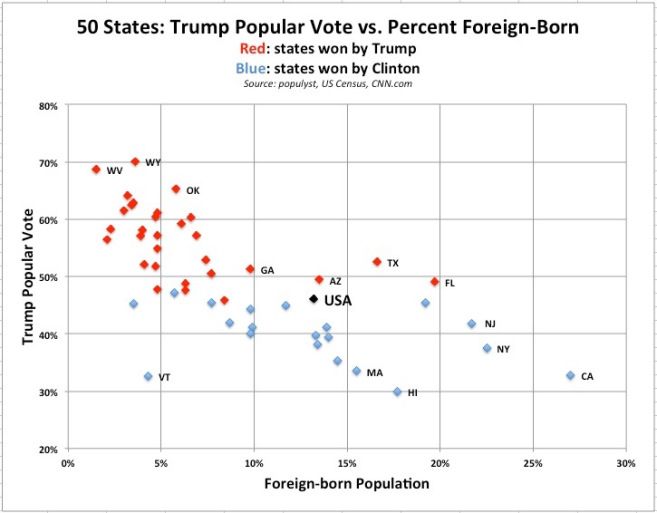
  • Death Spiral Demographics: The Countries Shrinking The Fastest

    For most of recent history, the world has worried about the curse of overpopulation. But in many countries, the problem may soon be too few people, and of those, too many old ones. In 1995 only one country, Italy, had more people over 65 than under 15; today there are 30 and by 2020 that number will hit 35. Demographers estimate that global population growth will end this century.

    Rapid aging is already reshaping the politics and economies of many of the most important high-income countries. The demands of older voters are shifting the political paradigm in many places, including the United States, at least temporarily to the right. More importantly, aging populations, with fewer young workers and families, threaten weaker economic growth, as both labor and consumption begin to decline.

    We took a look at the 56 countries with populations over 20 million people, nine of which are already in demographic decline. The impact of population decline will worsen over time, particularly as the present generation now in their 50s and 60s retires, begins drawing pensions and other government support.

    Europe: Homeland of Demographic Decline

    Heading up our list of slowly dissipating large countries is the Ukraine, a country chewed at its edges by its aggressive Russian neighbor. According to U.N. projections, Ukraine’s population will fall 22% by 2050. Eastern and Southern Europe are home to several important downsizing countries including Poland (off 14% by 2050), the Russian Federation (-10.4%), Italy (-5.5%) and Spain (-2.8%). The population of the EU is expected to peak by 2050 and then gradually decline, suggesting a dim future for that body even if it holds together.

    The most important EU country, Germany, has endured demographic decline for over a generation. Germany’s population is forecast to drop 7.7% by 2050, though this projection has not been adjusted to account for the recent immigration surge. The main problem is the very low fertility rate of the EU’s superpower, which according to United Nations data was 1.4 between 2010 and 2015. It takes a fertility rate of 2.1% to replace your own population so we can expect Germany to shrink as well as get very old.

    Nor can Europe expect much help from its smaller countries. Although too small to reach our 20 million person threshold, many of Europe’s tinier “frontier” countries have abysmal fertility rates. Among the 10 smaller countries with the greatest population declines, all are in Europe, and outside Western Europe, with Bulgaria’s population expected to shrink 27% by 2050 and Romania’s 22%. Each of these have below replacement rate fertility. Things are not that much better in Western Europe, where fertility rates are also below replacement rates, but not quite so low. Long-term, the only option for Europe may be to allow more immigration, particularly from Africa and the Middle East, although this may be impossible due to growing political resistance to immigration.

    Demographic Decline: The Asian Edition

    If this were just a European disease, it would not prove such a challenge to the economic future. Europe is gradually diminishing in global importance. The big story in demographic trends is in Asia, which has driven global economic growth for the past generation. The decline of Japan’s population is perhaps best known; the great island nation, still the world’s third largest economy, is expected to see its population fall 15% by 2050, the second steepest decline after Ukraine, and get much older. By 2030, according to the United Nations, Japan will have more people over 80 than under 15.

    But the biggest hit on the world economy from the new demographics will come from China, the planet’s second largest economy, and the most dynamic.

    Until a generation ago, overpopulation threatened China’s future, as it still does some developing countries. Today the estimates of the country’s fertility rate run from 1.2 to 1.6, both well below the 2.1 replacement rate. By 2050 China’s population will shrink 2.5%, a loss of 28 million people. By then China’s population will have a demographic look similar to ultra-old Japan’s today — but without the affluence of its Asian neighbor.

    Other Asian countries have similar problems. Thailand ranks as the fifth most demographically challenged, with a projected population loss of 8%. The population of Sri Lanka, just across Adam’s Bridge from still fast-growing India, is projected to increase only 0.6%.

    Also going into a demographic stall is South Korea, another country which a generation ago worried about its expanding population. With its fertility rate well below replacement (1.3), the country will essentially stagnate over the next 35 years, and will becoming one of the most elderly nations on earth.

    Full List: The Countries Shrinking The Fastest

    Smaller Singapore is an anomaly. The city-state has a rock-bottom fertility rate of 1.2, but projects a population increase of 20% by 2050 due to its liberal and vigorously debated immigration policies.

    Economic Consequences

    Most world leaders are fixated on the unpredictable new administration in Washington in the short term, but they might do better to look at the more certain long-term impacts of diminishing populations on the world’s most important economies. Economists, including John Maynard Keynes, have connected low birth rates to economic declines. On the “devil” of overpopulation, Keynes wrote, “I only wish to warn you that the chaining up of the one devil may, if we are careless, only serve to loose another still fiercer and more intractable.”

    It is already fairly clear that lower birthrates and increased percentages of aged people have begun to slow economic growth in much of the high-income world, and can be expected to do the same in long ascendant countries such as China and South Korea. Economists estimate that China’s elderly population will increase 60% by 2020, even as the working-age population decreases by nearly 35%. This demographic decline, stems from the one-child policy as well as the higher costs and smaller homes that accompany urbanization, notes the American Enterprise Institute’s Nicholas Eberstadt. China’s annual projected GDP growth rate will likely decline from an official 7.2% in 2013 to a maximum of 6% by 2020.

    There are several reasons these demographic shifts portend economic decline. First, a lack of young labor tends to drive up wages, sparking the movement of jobs to other places. This first happened in northern Europe and Japan will increasingly occur now in Korea, Taiwan, and even China. It also lowers the rate of innovation, notes economist Gary Becker, since change tends to come from younger workers and entrepreneurs. Japan’s long economic slowdown reflects, in part, the fact that its labor force has been declining since the 1990s and will be fully a third smaller by 2035.

    The second problem has to do with the percentage of retirees compared to active working people. In the past growing societies had many more people in the workforce than retirees. But now in societies such as Japan and Germany that ratio has declined. In 1990, there were 4.7 working age Germans per over 65 person. By 2050, this number is projected to decline to 1.7. In Japan the ratios are worse, dropping more than one-half, from 5.8 in 1990 to 2.3 today and 1.4 in 2050. China, Korea and other East Asian countries, many without well-developed retirement systems, face similar challenges.

    Finally, there is the issue of consumer markets. Aging populations tend to buy less than younger ones, particularly families. One reason countries like Japan and Germany can’t reignite economic growth is their slowing consumption of goods. This challenge will become all the more greater as China, the emerging economic superpower, also slows its consumption. The future of demand, critical to developing countries, could be deeply constrained.

    What about the USA?

    To a remarkable extent, the United States has avoided these pressing demographic issues. The U.N. has the U.S. tied with Canada for the fastest projected population growth rate of any developed country: a 21% expansion by 2050. Yet this forecast could prove inaccurate.

    One threat stems from millennials who, even with an improved economy, have not started families and had children at anything close to historical rates. Today the U.S. fertility rate has dropped to 1.9 from 2.0 before the Great Recession; population growth is now lower than at any time since the Depression. This places us below replacement level for the next generation. Projections for the next decade show a stagnant, and then falling number of high school graduates, something that should concern both employers and colleges. The United States’ high projected population growth rate, like that of Singapore, is entirely dependent upon maintaining high rates of immigration.

    But even before the election of Donald Trump, who is hell-bent on cracking down on at least undocumented immigration, total immigration to the United States has been slowing. At the same time the fertility rates of some immigrant groups, notably Latinos, have been dropping rapidly and approaching those of other Americans. This is despite the fact that as many as 40% of women would like to have more children; they simply lack the adequate housing, economic wherewithal and spousal support to make it happen.

    In the coming decades, the countries that can maintain an at least somewhat reasonable population growth rate, and enough younger people, will likely do best. To a large extent, it’s too late for that in much of Europe and East Asia. For countries like the United States, Canada and Australia, with among the most liberal immigration policies and large landmasses, the prospects may be far better. However, we also need native-born youngsters to launch, get married and start creating the next generation of Americans.

    This piece originally appeared at Forbes.

    Joel Kotkin is executive editor of NewGeography.com. He is the Roger Hobbs Distinguished Fellow in Urban Studies at Chapman University and executive director of the Houston-based Center for Opportunity Urbanism. His newest book, The Human City: Urbanism for the rest of us, was published in April by Agate. He is also author of The New Class ConflictThe City: A Global History, and The Next Hundred Million: America in 2050. He lives in Orange County, CA.

    Photo: Ahmet Demirel [Public domain], via Wikimedia Commons