Category: Demographics

  • The Suburbs are Sexy

    The Administration’s Anti-Suburban Agenda: Nearly since inauguration, the Administration has embarked upon a campaign against suburban development, seeking to force most future urban development into far more dense areas. The President set the stage early, telling a Florida town hall meeting that the days of building “sprawl” (pejorative for “suburbanization”) forever were over. Further, a number of bills have been introduced in the Congress that would attempt to discourage suburban development, some under the moniker of “livability,” which promises to improve people’s lives by enforcing planner-preferred density. The war against the suburbs is by no means new, but the Administration and some members of Congress have proposed their own “surge” in hopes of suppressing them permanently.

    The Mythical “Demise” of the Suburbs: Nearly since the pace of suburbanization increased, following World War II, critics have been foretelling the demise of the suburbs. During the 1950s and 1960s, some planning “visionaries” such as Peter Blake were predicting widespread municipal bankruptcies in the suburbs and for residents. This was occurring even as other urban planners were tearing up cities with urban renewal projects and freeways, setting the stage for “block-busting” and an ever-widening racial divide. The early criticisms have been repeated through the years, justifying a paraphrase of the old saw about Brazil (“Brazil is the country of the future and always will be”): “The suburbs are the wasteland of tomorrow and always will be.”

    The Real Decline of the Cities: In fact, it has more generally been the central cities that nearly went bankrupt, not the suburbs. Examples include New York, Philadelphia, Pittsburgh, Cleveland and that jewel of municipal consolidation, Indianapolis, rescued last year by $1 billion in state taxpayer funds. There are hopeful signs of a renaissance in most central cities, however their financial difficulties remain intractable and large swaths of their land area remain desolate. Meanwhile, the lawns were mowed in the suburbs, the houses painted and a strong sense of community developed among residents that was far too subtle for the prophets of suburban doom to perceive.

    Greenhouse Gas Emissions: More recently, the effort to reduce greenhouse gas (GHG) emissions has given suburban critics new ammunition. A simple mantra was dictated by “planning common sense.” Cars produce greenhouse gases, therefore people must get out of cars and live in more dense conditions, where they will not need to drive as much. Further, they will live in smaller, multi-family dwellings, which planning common sense teaches are more GHG friendly than the despised – except by those who choose to live in them – detached housing in the suburbs.

    But a funny thing happened on the way toward GHG inspired desurburbanization. Some academics actually began looking at data. The reality of the suburbs turned out to be rather different from that portrayed by the conventional wisdom of the planners. The most comprehensive research comes from Australia, some of which has been previously covered here.

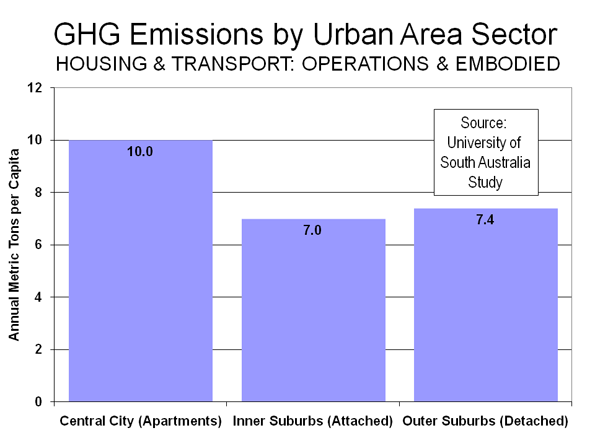
    University of South Australia: The most recent (and new) offering comes from a University of South Australia report thatallocates transportation and residential energy produced GHGs by location and housing type in the Adelaide area. The researchers found that the most GHG friendly sector of the urban area was the inner suburbs, which are dominated by single-family attached housing. GHG emissions per capita from housing and transportation were estimated at 7.0 metric tons of GHG emissions per capita annually.

    However, the outer suburbs, principally with detached housing, were not far behind at 7.4 tons GHG emissions per capita. The highest GHG emissions per capita, by far, were in the central area, with its predominance of multi-unit housing. There the annual GHG emissions were estimated at 10.0 tons per capita (See Figure). The University of South Australia study includes an element missing from virtually all other examinations of transportation and residential GHG emissions: “embodied emissions.” Embodied emissions are the GHGs from construction or manufacturing materials, and from building cars, transit vehicles and buildings. Embodied GHG emissions are ignored by much research, but are a significant factor in GHG emissions. For example, multi-unit housing, with higher use of concrete and more complex construction methods, tends to be substantially more GHG intensive than building detached housing or townhouses.
    GHGs from Common Energy: Previous work by Sydney researchers reached similar results – townhouse development was the most GHG friendly, followed closely by detached housing. Both were substantially less GHG intensive than high-rise condominium development. A principal reason for this conclusion stems in part from the fact that this research included GHGs from common energy, such as the electricity used to power elevators, parking lot and common area lighting, building-provided heating, air conditioning and water heating. American and Canadian research attempting to quantify GHG emissions by residential building type generally has not accounted for common energy and its GHG emission. Yet a gram of GHG from a residential elevator has the same impact as one produced by driving to the local Target store.

    GHG Friendly Suburbs: The most comprehensive research was conducted by the Australian Conservation Foundation. This was not the typical, incomplete or theoretical study of greenhouse gas emissions. The study included virtually every gram of greenhouse gas emissions in Australia and allocated them to consuming households in small residential zones within urban areas and around the nation. Suburban locations, with their greater use of cars and higher percentage of low density detached housing, had lower GHG emissions per capita than the core areas, with their greater use of transit and walking and their high-rise multi-unit housing.

    Compact Development: These findings provided the impetus to review the potential impact of compact development policies. Compact development policies (also called “smart growth” or “growth management”) generally seek to densify urban areas, by drawing urban growth boundaries, outside of which development is prohibited, and by trying to force people to drive less and to use transit more. Again, “planning common sense” clearly indicated to planners that compact development would yield substantial benefits in GHG emissions, principally because people would drive less.

    Yet the more recent research on compact development finds something much different. Densification scenarios from two recent reports, the congressionally mandated Driving and the Built Environment and a smart growth coalition’s Moving Cooler, showed that by 2050, compact development could reduce GHG emissions from driving by only 1% to 9%. At the high end of the range, the most new development would be directed to only a small part of present urban footprints, a policy outcome less believable than a balanced federal budget next year.

    Moreover, these projections have to be considered overly optimistic, because they make no allowance for the higher GHG emissions that occur as traffic slows and stops more in higher density conditions.

    The President Discovers the Suburbs? Meanwhile, on December 15, President Obama took the opportunity to visit a suburban Washington Home Depot, a chain that is a very symbol of American suburbanization. The President could have taken the opportunity to orate further against the suburbs in the insulation aisle, urging households to abandon the suburbs and move to high rise condominiums in the city.

    That was not to be. The President instead proposed providing incentives to people to make their houses more energy efficient, which would reduce greenhouse gas emissions and save money on consumer energy bills. In particular, he cited insulation, saying that “insulation is sexy”. It is worth noting that the Home Depot’s insulation is principally sold to suburban homeowners who can readily arrange for its installation. Residents of high-rise condominiums must rely on their building managers, who tend to purchase their insulation from wholesalers, rather than retailers like Home Depot and Lowes.

    The President explained why insulation was sexy, noting that saving money is sexy. Indeed, saving money is what the suburbs are about. The economic research is clear that housing costs are far less where suburban development is not limited by the compact development strategies that artificially create land scarcity. That’s why places like Dallas-Fort Worth, Atlanta and Houston, without compact development, had little, if any housing bubble, while housing bubbles of economy-wrecking proportions occurred in California and Florida, with their compact development.

    Yes, Mr. President, insulation is sexy. Saving money is sexy. And, the suburbs are sexy.

    Wendell Cox is a Visiting Professor, Conservatoire National des Arts et Metiers, Paris. He was born in Los Angeles and was appointed to three terms on the Los Angeles County Transportation Commission by Mayor Tom Bradley. He is the author of “War on the Dream: How Anti-Sprawl Policy Threatens the Quality of Life.

  • The Urbanophile Plan for Detroit

    If Brookings’ plan for Detroit isn’t enough to get the job done, what is?

    Turning around Detroit means facing head on the core problems that hobble the region, notably:

    • America’s worst big city race relations
    • A population that is too big for current economic reality
    • A management and labor culture rooted in an era that no longer exists and is unsuited to the modern economy
    • A tax, regulatory, and political system toxic to business

    A robust plan for renewal in Detroit will tackle these problems, recognizing that matters like improving race relations and cultural change need indigenous solutions from courageous local leaders. Then mix this with best practices from elsewhere and innovative, unique to Detroit solutions. And be patient, knowing the turnaround won’t be a short journey.

    1. Repair race relations. The city-suburb divide in Detroit, to an extent far greater than elsewhere, is a matter of black and white. Bringing racial rapprochement won’t be easy, but it is an absolute imperative for future regional success. Perhaps a newly shared sense of economic pain can foster this, along with grass roots connections such as white urban gardeners making common cause with black ones seeking better access to fresh foods.

    2. Active shrinkage. Many recognize the need for Detroit to “right size” to its reduced population and for federal help doing so. But beyond adjusting to the city’s decline, the region remains too big. Detroit no longer needs large armies of unskilled and even skilled laborers in its factories. There is simply no economic raison d’etre for a region the size of Detroit in that location today. A lot more people need to leave Detroit. Many already would like to but can’t because they can’t sell their house or afford to move. Serious consideration should be given to a federally assisted voluntary relocation program when the national economy recovers to help Detroiters move to Texas or other places with strong jobs growth if they want to. Detroit should also engage with those who did move away to create an urban alumni network. In a globalized economy, those Michigan expatriates can serve as a sort of field sales force for the city.

    3. Improve the Business Climate. Michigan’s government needs to be downsized to match a downsized state. Dubious programs of all types, from film industry subsidies to “cool cities” initiatives need to be scaled back or eliminated. The criminal justice system should be reformed to stop over-incarcerating non-violent offenders. Streamline or eliminate regulation wherever possible, and make those that remain operate swiftly and predictably. Eliminate or merge overlapping jurisdictions, and especially non-general purpose entities that are too often patronage dumps operating out of the public eye. Reduce taxes on business, especially small business.

    4. Change the culture. Michigan’s social and business approach, its labor and management culture and business practices were designed for a stable industrial age dominated by a limited number of large and vertically integrated corporations. Today’s economy is based around smaller, more innovative, nimble firms, virtual networks of people and collaborative business relationships, rapid change, and a competitive global environment. This sort of change has to come from the inside. No one can just tell Detroit how to do it.

    5. Renew Brand Detroit. How does Detroit want to be known in the world and how can it make itself known? Within a framework of shrinkage, Detroit needs to become attractive to the right new talent and new businesses. It needs an aspirational narrative that is authentically Detroit in a way “cool cities” will never be. Cool, No – but edgy? Definitely. Think of Detroit as the new American frontier, a blank canvas where anything is possible, and the ultimate arena in which to pursue alternative visions of urban life. A place where you can pursue a personal urban vision without getting tortured by a Byzantine blizzard of bureaucracy. This should be nourished – and preserved – by maintaining a “light touch” approach to regulation in the city proper. The region is well positioned to attract new urban pioneers and homesteaders, and to leverage its reputation as both a black city and large Arab population center. Detroit should stand proud as “Detroit”. It shouldn’t hide behind euphemisms like “Southeastern Michigan” or “The Big D” – as if that fools anybody. Detroit is a name with international recognition and resonance. Wear it with pride.

    6. Pursue Targeted Industry Clusters. The auto industry will remain a mainstay in Detroit, particularly management and R&D, though a lot smaller after a federally assisted restructuring. But the city should be wary of overly pursuing “me-too” industries like life sciences without distinctive advantages. Instead, Detroit should look to get its “fair share” of those, then look for where it is positioned to uniquely excel and try to create the environment favorable for investment. Potential targets include:

    • A lead role in international trade with Canada.
    • Dominating and expanding non-energy/non-financial trade and relations with the Middle East and Muslim world. With America’s largest Arab population, Detroit is positioned to be the American gateway to that ever more important part of the globe the way Miami is to Latin America.
    • Music. Detroit has one of America’s richest and most innovative musical legacies, from Motown to electronica to hip hop. But it hasn’t profited from it. Detroit needs to take a page from Nashville and figure out how.
    • Realize the Detroit Aerotropolis plan.
    • Alternative urban visions. The recipe for grass roots neighborhood renewal in the city, and a potential innovation cluster for any new Detroit ideas that gain widespread adoption.

    7. Rationalize Regional Governance and Infrastructure Investment. Detroit should seriously question any expansion of infrastructure when shrinking in regional population. All subsidized infrastructure expansion outside of currently fully urbanized areas should be terminated. It makes no sense to be widening streets on the fringes when you are ripping them out in the city. In this context, the kind of fixed rail investments advocated by Brookings and other “me too” urban boosters should be avoided in this highly decentralized region. Rather, the central city should start with a quality bus network, with rail added later if and only if existing ridership justifies it.

    8. Secure Irreplaceable Assets. Detroit built amazing treasures during its golden age, many of them lost or threatened. Detroit has one of the largest collection of pre-War high rises in America. Yet many of them stand vacant. Another gem, the Lafayette Building, is about to be demolished because it is so badly deteriorated, with trees growing on the roof. Some funds need to be earmarked for securing and and supporting basic maintenance such as roof integrity. While there may not be demand to reuse these structures now, they are irreplaceable and should be saved for future generations. On the cultural side, Detroit needs to ask itself tough questions about institutions like the Detroit Institute of the Arts and the Detroit Symphony Orchestra that are bleeding red ink.

    The road back for Detroit won’t be short or easy. It will certainly not be back as the colossus of its past. But Detroit can grasp a more successful future if it finds the courage and the leadership to change, and to find a unique path forward for a city that is simply not like anyplace else in the world. Conventional wisdom solutions are just not enough. It will take radical change, new attitudes and an ability to think independently about what’s best for the region.


    The Brookings Plan

    The Urbanophile Plan

    Race Relations

    Segregation is acknowledged

    Improving race relations is a top imperative

    Regional Governance

    Strong Regionalism Featuring:
    – Council of Mayors
    – Regional transportation and land use management
    – Potential tax sharing
    – Receivership for failed government entities

    Adopt Brookings Plan

    Brand Positioning

    N/A

    – “The New American Frontier”, the land of possibility, a blank canvas, and the ultimate arena in which to realize alternative and new visions of urban life.
    – “Detroit”, NOT “Southeast Michigan”, “The D”, etc.

    Economic Development Paradigm

    Government industrial policy

    Improve the business climate

    Fiscal Policy

    N/A

    – Downsize all level of government to match a downsized Michigan and Detroit
    – Eliminate dubious programs (e.g., film industry subsidies and “cool cities” initiatives)
    – Merge or eliminate overlapping obsolete jurisdictions
    – Cut taxes on business, especially small businesses

    Regulatory Reform

    N/A

    – Seek out and eliminate rules without a clear rationale and net benefits, esp. ones that negatively affect the business climate
    – Make remaining regulations operate swiftly and predictably
    – Reform a criminal justice system that over-incarcerates for non-violent offenses
    – Maintain “Light Touch” Regulation in the City of Detroit to Sustain Frontier Appeal

    Target Economic Sectors

    – Advanced Manufacturing / Auto-Related R&D
    – Green Industry
    – Life Sciences
    – University Spin-Offs

    – Advanced Manufacturing / Auto-Related R&D
    – International Trade with Canada
    – Non-Energy/Non-Financial Trade with the Arab and Muslim World.
    – Music-Related Development
    – Aerotropolis Industry
    – Alternative Urban Visions (e.g., urban agriculture, urban decay tourism)
    – “Fair Share” of Green Industry, Life Sciences, and University Spin-Offs

    Auto Industry Future

    Federally assisted restructuring

    Adopt Brookings Plan

    Management & Labor Culture; Regional Business Practices

    N/A

    Urgent change is prerequisite to success

    Human Capital Targets

    N/A

    – New Urban Pioneers
    – African Americans
    – People of Middle Eastern or Muslim Origin
    – Musicians and Musical Acts

    Adjusting to Population Loss

    – Government sponsored footprint shrinkage
    – Brownfield remediation

    Adopt Brookings Plan and Supplement With
    – A federally-assisted voluntary relocation program
    – Creation of a “Detroit Alumni Network”

    Transportation

    Rail transit

    – Terminate highway and other infrastructure expansion outside of fully developed areas
    – Build privately funded Woodward light rail, then avoid further rail investments
    – Improve the urban bus network
    – Build new bridge crossings to Canada
    – Support improvements to entire 401/I-75 corridor for freight growth

    Historic Preservation

    N/A

    – Inventory and invest to secure and “mothball” key historic structures, esp. pre-War downtown high rises

    Aaron M. Renn is an independent writer on urban affairs based in the Midwest. His writings appear at The Urbanophile.

  • Detroit Needs a Bolder Plan

    The Brookings Institution recently unveiled “The Detroit Project”, a plan to revive Detroit, in the New Republic. Brookings’ plan has good elements and recognizes some important realities, but also has key gaps. It relies excessively on industrial policy and conventional approaches that are unlikely to drive a real turnaround in America’s most troubled big city.

    On the plus side, Brookings does a great job stating why Detroit’s fortunes will take a long time to reverse, possibly a generation or more. As they note, “Detroit’s leaders must manage expectations. It took half a century for the city to get this low. It won’t turn around in a four-year political cycle.” Authors as prescient as Jane Jacobs and as conventional as Time were talking about Detroit’s decline as far back as the early 60s. Turnaround won’t happen in six months or even six years. Given the political preference for election-cycle results, this means strong and courageous leadership will be needed, a point they also stress. Sadly, that’s a commodity that has long been in short supply in Detroit.

    Brookings is known for their promotion of regionalism, and this plan predictably follows that prescription. Clearly, rationalization of investment policy on a regional basis is needed. The Detroit region is losing population, yet the long range transportation plan calls for huge amounts of spending to widen roads on the fringes. That makes no sense. People and businesses in Detroit keep moving out as the cities and suburbs they once inhabited fall into ruin under a regime of failed stewardship and the endless search for new greenfields to exploit. It’s like prospectors skipping from one clapped out mining town to the next. If they want to do that, they shouldn’t expect the rest of us to pay for it via federal funds – either to build the new or to clean up the mess in the ghost towns they leave behind.

    They also recognize the need for improved governance, including potentially state receivership for failed institutions. (They did not, however, give due credit to new Mayor Bing for the change and new leadership attitude he has already brought to the table). Suggestions like a focus on brownfield remediation and managed shrinkage were on point, as was the recognition that significant federal assistance will be required. Given the depths of the problems in Detroit and Michigan, the city and state are not going to be able to do it alone.

    The plan also rightly notes that “Detroit will have to become a different kind of city, one that challenges our idea of what a city is supposed to look like, and what happens within its boundaries.” Very true. Unfortunately, much of the rest of the Brookings prescription failed to meet that challenge.

    Brookings’ plan relies heavily on analogy to other post-industrial cities, especially in Europe, which makes it difficult to be sure exactly what they are recommending at times. Even to casual observers, these cities are far different from Detroit. For one thing, Detroit is huge. The region, if one includes Ann Arbor and Windsor, Canada, is over five million in population – more than double the size of Brookings comparison areas.

    Places like Turin and Bilbao also have radically different built forms, history, culture, and are virtually racially and ethnically homogeneous compared to Detroit. Even the measurements of European success need to be redone. Neither Italy nor Spain represent role models since both have fared worse than America in the current downturn. These countries (and cities) are aging rapidly, with some of the world’s lowest birthrates.

    Their US examples of Toledo and Akron (i.e., greater Cleveland) are hardly bright and shining lights of economic or demographic success. Since 2000, Akron has lost nearly 10,000 people and Toledo over 20,000. Toledo’s 11.4% unemployment rate exceeds the nation’s. These aren’t even Ohio’s biggest cities, much less dominating the state’s economy the way Detroit does Michigan.

    Brookings also all but ignores a lot of the root issues of Detroit’s problem. Firstly, they fail to make a point about healing America’s most poisoned race relations, arguably the signature issue of Detroit. Racial tensions and inequity have perpetually bedeviled America. Making progress in Detroit won’t be easy, but is an absolute prerequisite to progress. Perhaps shared economic struggles will finally provide a common interest around which to build some form of racial rapprochement.

    Most glaringly, Brookings has nothing at all to say about Detroit and Michigan’s tax and regulatory regime, its failed management and labor cultures, or its dysfunctional state politics. Brookings’ desire to stay on good terms with the establishment might inhibit their ability to speak freely, but these problems must be confronted.

    It is impossible to ignore this witch’s brew of policies and attitudes that is totally toxic to economic development. It’s a classic case of ignoring the elephant in the room. Until these blocking and tackling matters are addressed, Detroit is going to remain kryptonite to business expansion. In Forbes 2009 list of the best states for business, Michigan ranked 49th.

    Instead of improving the terrible business climate, Brookings proposes a top-down industrial policy, explicitly stating “local government (or NGOs, even) can play the role of industrial planner. That is, they can look across the map and find instances where research institutions and manufacturers should collaborate on new ventures.” And they say “public money” is needed to retool old industries and advance new ones. The government in Detroit can’t even manage the delivery of basic city services. None of the region’s levels of government have performed well on their core competency, so why would we believe these entities would be effective venture capitalists or industrial planners? This is a recipe for epic rent seeking and an economic Waterloo on a grand scale.

    Their suggested industries for Detroit are a tired looking roster of the same ones everyplace else is chasing: green industry, life sciences, advanced manufacturing, and university technology spin-offs. With such a crowded playing field – 49 out of 50 states are chasing life sciences, for example – it is hard to discern the Detroit region’s distinctive capabilities in any of these areas apart from automotive related R&D and manufacturing. Sure, they’ll get some slice of the pie in these growing markets, but unlikely enough to turn the ship around or create a true innovation cluster.

    Public-private partnerships do have a strong role to play in Detroit’s economic development. This includes looking for sectors where it can realistically compete and win, and looking to create the infrastructure and conditions necessary for them to flourish in terms of facilities, talent attraction, legal and regulatory frameworks, regional business culture and practices, and more. It’s about creating fertile soil, not picking winners.

    However, assistance to the restructuring auto industry was clearly required. Without federal aid, GM and Chrysler would have been liquidated. They still might, but given the importance of that industry to our economy, it is probably worth doing what we have to do for now. But we should recognize that getting in was a lot easier than getting out will be, and that the end result might still be failure or Soviet style zombie companies that survive only as wards of the state.

    Lastly, the praise of rail transit by Brookings – the cook book solution du jour for cities – is puzzling. Again, Detroit is shrinking and needs to shrink more. Trains work best when people are commuting to a central point, but jobs have been disappearing from the core of Detroit for generations. Today barely 4.5 percent of area employment takes place in the urban core, among the lowest percentages among the nation’s top 50 cities.

    As with fringe highway expansion, the last thing Detroit needs is even more infrastructure. It has too much already that it can’t afford to maintain. Taking on a costly new rail transit system with both high capital expenditures and significant ongoing operations and maintenance costs is a dubious proposition – particularly when the existing bus network is on the verge of a near shutdown. The biggest game changer from an infrastructure perspective – new highway crossings to Canada to strengthen Detroit as the premier gateway to Canadian international trade – is not mentioned.

    So while Brookings gets a few key pieces of the puzzle right, ultimately their solution is too standard issue and lacks the boldness and innovative thinking needed to tackle the core problems and create a realistic prospect for renewal.

    In the next installment tomorrow: a better plan for Detroit.

    Aaron M. Renn is an independent writer on urban affairs based in the Midwest. His writings appear at The Urbanophile.

  • What To Look For In Healthcare Reform: Location, Location, Location

    A Reuters article that was widely picked up around the globe recently raised the question, Are Doctors What Ails US Healthcare? Comparing the New York suburb of White Plains to Bakersfield, California, the article uses the evergreen two-Americas paradigm to discuss disparities in health care. Drawing heavily on the Dartmouth Atlas of Healthcare, it highlights a sad but inescapable fact: doctors want to live in some places and not in others, giving the “have” populations more intensive medical care which they might or might not need, while have-nots, who tend to be older, sicker and poorer, get health care to match. The article asserts that there’s nothing in current health care reform legislation that will do anything to address the disparities.

    I agree. But then, what should we expect? The legislation, which I find marginally more desirable than doing nothing at all, is largely about insurance, not about health care. This is what happens when we emphasize how we pay for something, rather than what we are paying for. Are doctors what ails U.S. health care? Only in the sense that they are operating on the same basis as everyone else in the health care market: every man for himself.

    You don’t have to make bi-coastal comparisons to find the disparities highlighted in the Reuters article. My own Hudson Valley not-for-profit insurance company faces them every day. We cover the Medicaid populations from the aforementioned White Plains, NY, to the South, to the blighted economies of the Catskills to the North and West. The distance involved is only about 150 miles, but day in, day out it might as well be 1500. And socially, it might as well be 150 years. Sullivan County is still organized geographically the way it developed in the eighteenth and nineteenth centuries — farms, woods, and mills, only without the mill jobs.

    There was a brief shining moment (well, half a century) when urban Jews and other vacationers formed the basis of a thriving tourist trade in the “Borscht Belt” resorts of Monticello, Sullivan County’s hot spot. When they closed, they provided ideal settings for residential drug and alcohol rehab for poor people from New York City, but those aren’t exactly the foundation for high-quality community health care. When we initially started offering state-sponsored insurance to the poor of Sullivan County, the historical dearth of specialists made it a laboratory for what a free market looks like when there’s no competition. (Do I hear the words “strong public option”?) Because New York State requires us to have a decent network of contracted doctors for our enrollees, the sole cosmetic surgeon – for example – could extract pretty much any fee he wanted from us in exchange for seeing a patient who needed emergency reconstructive surgery.

    Your tax dollars meet supply and demand and a mandate to pay within a private market.

    I don’t blame the specialists. They are highly trained and skilled, and have paid their dues. If I blame anyone, it’s the system that sets the dues so high, in the form of college and medical school loans and years of fellowships that leave well-meaning doctors feeling that they deserve all that money, just like corporate farmers and hedge fund managers.

    It’s also not the doctors’ fault that they want good schools and cultural amenities. I haven’t seen much of Bakersfield, but I know that schools in and around White Plains have good reputations and are just twenty miles from Broadway and the Metropolitan Museum (and ten miles from my Tarrytown office). Maybe we can fix schools and reinvigorate the National Endowment for the Arts to make every remote locale more like Westchester, but that would be socialism.

    Dartmouth Atlas data is easily available online, and well worth spending some time with. You can use it to create all kinds of two-America scenarios that provide instant object lessons in our health care inequities. My personal favorite is that health care spending in Miami, Florida for Medicare patients in the last two years of life (highest in the nation) is exactly twice that in Portland, Oregon (lowest of the regions studied), with commensurate volumes of appointments, referrals, tests and hospitalizations, and no better outcomes. Here we see the same dynamics that make pawnshops spring up around gambling casinos and candy stores near public schools. Doctors go where the customers are, and once they arrive they maximize their revenues and measure success by volume, not outcomes.

    Why should we expect anything different, when reform legislation is captive to the same kind of have/have not dichotomy that shapes health care delivery itself? Senators Max Baucus of Montana and Kent Conrad of North Dakota are two of the pillars of the anti-public option caucus. They come from states with small populations, and both take barrels of money from the health insurance industry because they can’t raise it locally. If they play their cards right, who knows? They could leave Congress and become haves themselves, like Billy Tauzin, who is now Big Pharma’s man in Washington, having engineered the passage of Medicare Part D, or Tom Daschle, once a champion of single payer, who now plays both sides of the street with special interest money.

    Are Doctors What Ails US Healthcare? quotes David Goodman, Director of Health Policy Research at the Dartmouth Institute for Health Policy and Clinical Practice, who says there’s an “irrational distribution” of the most valuable and expensive U.S. health care resources. I would say that the distribution is entirely rational given the insanity of the larger situation.

    If we’re ever going to find our way out of this mess, we’re going to have to do for these health care backwaters, both rural and urban, what we used to do when private capital wouldn’t do the job. Set goals and build the infrastructure to serve them, because the market won’t do it. Want to electrify Appalachia? You need the TVA. Want to make the desert bloom? Build dams and aqueducts. Want to open up the interior of the country? Build an Interstate Highway system. Want doctors to practice in unattractive markets? Create an MD Bill for doctors like the old GI Bill for veterans, so that doctors emerge from training feeling more like public servants and less like indentured servants.

    I attended a discussion of health care reform not long ago at the Yale School of Public Health. The representative of the private health insurance industry put the issues in a compelling perspective, although not, perhaps, for the reasons he cited.

    His arguments were three: First, we require automobile owners to carry insurance, so requiring everyone to carry health insurance shouldn’t be a problem (I know that President Obama made this point, too, and I hated him for it). Second, do you want a health care system that runs like the Post Office, or one that runs like Federal Express? And third, the health insurance industry is really a jobs program, and do we really want to put all those people out of work?

    These are shallow arguments. Car insurance? There’s no law that says you have to own a car, but everyone needs health care. A health insurance mandate is more like forcing every American to buy a new car and giving them a choice between Ford or GM. Post Office and FedEx? A company that can’t send a package overnight from suburban Tarrytown into New York City without round-trip flights to Memphis and back is no model for health care delivery, and besides, I’d like to see what FedEx can do for the price of first class postage. Jobs? A dynamic economy finds ways of redeploying redundant workers in more significant jobs. Wouldn’t those actuaries make good math teachers?

    The arguments were so hollow that no one bothered to argue, and the insurance rep was undoubtedly relieved. A fellow panelist who practices medicine in Cambridge, Dr. David Himmelstein of Harvard, said simply, “My practice would have no trouble making money on Medicare, single-payer reimbursement rates if we didn’t have to pay so many people to argue with insurance companies.”

    Unfortunately, the larger discussion is still stuck on insurance, and as long as it is, the two health care Americas will never become one.

    Georganne Chapin is President and CEO of Hudson Health Plan, a not-for-profit Medicaid managed care organization, and the Hudson Center for Health Equity & Quality, an independent not-for-profit that promotes universal access and quality in health care through streamlining. Both organizations are based in Tarrytown, New York.

  • Demographics May Be Destiny, but Mind the Assumptions

    Demographic projections have become an essential tool of national, state and local governments, international agencies, and private businesses. The first step in planning for the future is to get a picture of what the terrain is going to look like when you get there. That’s mainly what I do for clients, audiences and subscribers, and demographics provide the frame (like assembling all the straight-edge pieces of a jigsaw puzzle first). But here’s the thing about projections: a small change at an inflection point, or the inclusion (or exclusion) of salient variables, can result in big changes to the future you are trying to describe. So like all treatments of the future, everything depends on the underlying assumptions, and the salience of the variables chosen for inclusion.

    Demographics and Depression?
    For example, a couple of recent essays on demographic trends start with different assumptions, consider different variables, and come to wildly divergent conclusions. David Goldman, associate editor at First Things, says the housing market has collapsed, and will remain in depression, because of the dearth of two-parent families with children.

    Goldman asserts that only a a policy to restore the traditional family to a central position in American life can work to save the housing market. Without this, he says, ”we cannot expect to return to the kind of wealth accumulation that characterized the 1980s and 1990s.“

    Goldman’s argument centers on the idea that the US housing market is driven by one variable: two-parent families with children. And since that variable has not been growing, neither can housing demand. Yet, obviously, other household types besides two-parent families with children desire, can afford, and live in detached houses. Indeed, 55.2% of all single-person households owned homes in 2007, up from 49% in 1990.

    There is also a large population of empty-nest households (people who have already raised their kids), but who choose to continue to live in houses. Other demographic trends that will contribute to the continued preference for detached houses: increased longevity, better health, later childbearing, more home-based businesses, the presence of “delayed launch” kids (or those who boomerang to live at home before “final launch”), or a desire to have room for grandkids to visit. There is also the reality that many people will not want to move because of proximity of neighbors, churches, clubs and work.

    One must also note that foreign immigration and domestic migration, even under lowest-variable projections, will still be substantial in coming decades, fueling housing demand.

    In addition, other demographic trends suggest family and household formations will, once employment and income conditions improve, again provide a demand for houses. For example, there are more people entering their 20s now than in any time since the 1960s and early 1970s. True, we have just passed through a period of slow growth in family-age household formation, but once this Millennial generation start making money in an improving economy, they will start forming families and households, and will start buying houses.

    The World’s New Numbers
    Another recent essay on demographic projections starts with different assumptions, looks at different variables, and comes to different conclusions. Martin Walker, writing in The Wilson Quarterly, notes that something dramatic has happened to the world’s birthrates: they are up in developed countries, and down in developing countries (the opposite of what most dire forecasts project).

    Walker starts by debunking the assumption that mass migration and low birthrates are transforming the ethnic, cultural and religious identity of Europe. He notes the decline of Muslim birthrates across the globe, and rising birth rates in Western Europe – albeit from very low levels – and consistently higher rates in the United States. He then explains that aging populations in Europe and the US will not place intolerable demands on governments’ pension and health systems, if we are willing and able to both raise the retirement age and increase the workforce participation rate.

    These two steps (not easily achieved, but simple in conception) will result in a very manageable dependency ratio, similar to those of the 1960s, writes Walker. In the United States, the most onerous year for dependency was 1965, when there were 95 dependents for every 100 adults between the ages of 20 and 64 (“dependents” include people both younger and older than working age). By 2002, there were only 49 dependents for every 100 working-age Americans. By 2025 there are projected to be 80, still well below the peak of 1965. The difference is that while most dependents in the 1960s were young, most of the dependents of 2009 and beyond are older. But the point is that there is nothing outlandish about having almost as many dependents as working adults.

    The assumption underlying this more favorable scenario is that given freedom and information, that is to say, given the choice, the continuum of progress and development is uniform and universal: people in all places and of all backgrounds desire middle-class lifestyles (which include single-family detached houses, by the way). And while the planet’s population is expected to grow by about one billion people by 2020, the global middle class will swell by as many as 1.8 billion, with a third of this number residing in China. The global economic recession will retard but not halt the expansion of the middle class.

    The economic transition that development brings is accompanied by the demographic transition to lower birth and death rates (social, cultural and political transitions then occur too). Industrialization, urbanization, suburbanization: that is the pattern of how middle-classes grow. First-world countries have traversed this path, and now emerging countries are following.

    Trends can and do change. In fact, it may even be said that every trend sows the seeds of its own reversal. But it has always been my goal to identify the constants across history, as a way to establish a baseline for evaluating the likelihood of future scenarios (again, the straight-edged pieces). I believe the “aspirational model” to be one of these constants.

    Dr. Roger Selbert is a trend analyst, researcher, writer and speaker. Growth Strategies is his newsletter on economic, social and demographic trends. Roger is economic analyst, North American representative and Principal for the US Consumer Demand Index, a monthly survey of American households’ buying intentions.

  • Is Obama Separating from His Scandinavian Muse?

    Barack Obama may be our first African-American president, but he’s first got to stop finding his muse in Scandinavia. With his speech for the Nobel, perhaps he’s showing some sign of losing his northern obsession.

    On the campaign trail, Obama showed a poet’s sensitivity about both America’s exceptionalism and our desire to improve our country. His mantra about having “a father from Kenya and a mother from Kansas” resonated deeply with tens of millions of Americans.

    Obama’s more recent recasting as a politically correct Nordic seemed out of sync. His speech in Oslo – a surprising defense of American values and role in the world – must have shocked an audience that all but the most passionate courtiers suspect he does not deserve.

    But the bigger challenge will come when he rushes off to Copenhagen to push for his politically dubious climate change agenda. This will take a more serious break from his unfortunate tendency to identify first with the global cognitive elite.

    This is a particularly European, and particularly Scandinavian, affliction. In these countries professors, high-level bureaucrats, and corporate chieftains usually dominate the media, policy making and public perceptions. This constitutes an essential part of what is often called the “Scandinavian consensus” model.

    It works pretty well there. Historically homogeneous, affluent and well-educated Scandinavians generally accept working hard and giving up much for people for the poorer members of societies. These admirable attitudes reflect noble Nordic virtues of thrift, study and social trust.

    These values also work reasonably well in Nordic parts of America, such as in North Dakota. When a local economist told Milton Friedman “In Scandinavia we have no poverty”, he replied: “That’s interesting because in America among Scandinavians, we have no poverty, either.”

    As Obama may finally be learning, America is not Scandinavia, outside a handful of places. It is a big, amazingly diverse country with an expanding population. In a country made up of so many crunched together cultures an expansive welfare state faces many problems. (This is one reason northern Europe is having such a difficult time with its immigrants.)

    In a diverse society, you cannot assume that everyone will play by the rules. Coexisting with very different kinds of people, Americans tend to be less than enthusiastic about paying high taxes to support them.

    Demographics are also a major factor. Our relatively youthful and socially diverse population includes a large component of people, particularly males, with limited skills and education. Yet, at least until they were blindsided by falling poll numbers and stubbornly high unemployment, Obama’s administration treated the recession as if it could be cured Euro-style by simply adding more employment in government, education and medical care.

    Similarly the president’s to date dogmatic embrace of an extreme climate change agenda seems one more saleable to Danes or Swedes than people in the Dakotas or South Carolina. After all, they are well-positioned to absorb the costs. Norway and Sweden enjoy huge reserves of hydropower, the largest sources of renewable fuels. Norway also has lots of oil to boot and fellow traveler Netherlands still boasts strong reserves of natural gas.

    The dense land use policies associated with the climate change agenda fit better into small compact cities like Amsterdam, Copenhagen, Stockholm and Oslo than their sprawling American counterparts. In America, the vast majority lives in sprawling suburbs and small towns. With the exception of the Northwest few parts of the U.S. rely on hydropower, with most of the country reliant on coal, oil and natural gas.

    Then there are political risks to Obama’s dogged embrace of the alarmist “climate change” agenda. Recent Gallup, Pew, and Rasmussen surveys show weakening interest in global warming and increasing levels of skepticism. Today we even have considerable disputes over whether the temperature is even warming. Certainly a series of cold winters and mild summers might make some casual citizens a bit skeptical.

    Even one of the scientists whose email was hacked recently at the UK’s University of East Anglia Climate Research Unit wondered, “Where the heck is global warming?” The revelations, now widely known as Climategate, make clear that some of the science – and the scientists – behind the most apocalyptic predictions are suspect, a view now held by a majority of Americans, according to a recent Rasmussen survey.

    Yet so far, Obama appears blissfully unaffected by the swirling controversy. But the man has a full capacity to surprise. Perhaps he will understand that just because the media and his climate advisors have circled the wagons, this may be a case where the “crowds” may be onto something that the self-proclaimed experts would rather ignore.

    Perhaps if President Obama had studied history, rather than law, he might realize that “smart” (i.e. highly credentialed) types often get things terribly wrong. After all, a century ago eugenics – that some races were intrinsically superior to others – stood as the reigning ideology of the scientific community. Back in the 1970s, the scientific consensus embraced by his science advisor, John Holdren, predicted imminent mass starvation, a catastrophic decline in resource availability, and a bleak future for all developing countries, including China and India. This assessment proved widely off the mark.

    Of course, having committed himself to today’s climate orthodoxy, Obama may find it difficult to reverse course. Not only does he seem ill-disposed to challenging the cognitive elites but he also gains support from the well-funded warming lobby – rent-seeking utilities, “green” venture capitalists, investment bankers and urban land speculators – who hope to wrest huge fortunes from a strict carbon regime.

    If he wants to regain his effectiveness, however, the president needs to realize that these groups and the science establishment are just a small fraction of the country that elected him. His speech in Oslo may be the first sign he may be waking up from his Scandinavian slumber to become the assertive, independent American leader that we need.

    Joel Kotkin is executive editor of NewGeography.com and is a distinguished presidential fellow in urban futures at Chapman University. He is author of The City: A Global History. His next book, The Next Hundred Million: America in 2050, will be published by Penguin Press early next year.

  • The World’s Smartest Cities

    In today’s parlance a “smart” city often refers to a place with a “green” sustainable agenda. Yet this narrow definition of intelligence ignores many other factors–notably upward mobility and economic progress–that have characterized successful cities in the past.

    The green-only litmus test dictates cities should emulate either places with less-than-dynamic economies, like Portland, Ore., or Honolulu, or one of the rather homogeneous and staid Scandinavian capitals. In contrast, I have determined my “smartest” cities not only by looking at infrastructure and livability, but also economic fundamentals.

    These criteria unfortunately exclude mega-cities like New York, Mexico City, Tokyo or Sao Paulo, which suffer from congenital congestion, out-of-control real estate prices and expanding income disparities–symptoms of what urban historian Lewis Mumford described as “megalopolitan elephantiasis.”

    Instead, today’s “smart” cities tend to be smaller, compact and more efficient: places like Amsterdam; Seattle; Singapore; Curitiba, Brazil; and Monterrey, Mexico. This is not an entirely new notion: Between the 14th and 18th centuries, modest-sized cities like Venice, Italy; Antwerp, Belgium; and Amsterdam nurtured modern capitalism and created canals and vibrant urban quarters that remain wonders even today.

    In the Pacific-centric modern era, smart commercial cities are increasingly found outside Europe. Indeed, the most likely 21st-century successor to 15th-century Venice is Singapore, a commercially minded island nation that, like its forebear, is run by an often enlightened authoritarian regime.

    When it first achieved independence in 1965, Singapore’s condition was comparable to other developing cities like Bombay, Cairo, Lagos or Calcutta. The island city’s neighbors included unstable countries like Vietnam, Malaysia and Thailand. Its GDP per capita ranked well below those of Argentina, Trinidad, Greece or Mexico.

    The country’s first prime minister and current eminence grise, Lee Kuan Yew, was determined to change reality. Today, Singapore, with a population of less than 5 million, boasts an income level close to the wealthiest Western countries and a per-capita GDP ahead of most of Europe and all of Latin America. Once largely semi-literate, its population is now among the best-educated in Asia.

    To be sure, this enviable achievement was accomplished in an authoritarian fashion, but much of what Singapore has done must be considered “smart” by any reasonable accounting. Strategic investments taking advantage of its location between the Indian and Pacific Oceans have paid off handsomely: Today Singapore Airport is Asia’s fifth largest, and the city’s port ranks as the largest container entrepôt and is the second biggest, after Shanghai, in terms of cargo volume in the world.

    All this has made Singapore a huge lure for foreign companies, with over 6000 multinationals, including 3600 regional headquarters, now located there. For foreign managers, engineers and scientists, largely English-speaking Singapore offers a pleasant and predictable environment, particularly compared with other Asian centers.

    At least one recent survey by the World Bank’s International Finance Corporation rates Singapore No. 1 in the world for ease of doing business. Although its growth has been slowed by the recession, the city’s close ties to the resurging economies of Southeast Asia, China and India lead many forecasters to predict a strong recovery over the next year.

    Hong Kong, yet another outpost of British imperialism, has also performed well. Last year the World Bank ranked the area No. 3 for ease of doing business, compared with No. 89 for the rest of China. As long as Chinese Communists allow wider freedoms in Hong Kong than in the mainland, the area should continue to take advantage of its basic assets, including the world’s third-largest container port, an excellent airport and a highly skilled entrepreneurial population.

    The continuing appeal of Hong Kong was vindicated by the recent decision of Hong Kong Shanghai Bank Chief executive George Geoghegan to relocate there from London. As the center of the world economy continues to shift to Asia while Europe and America struggle, he is likely to find more company.

    Not all the world’s “smart” cities are trading giants like Hong Kong and Singapore. They also include well-run metropolises, such as the city of Curitiba. The south Brazilian city is regarded as an innovator in everything from bus-based rapid transit, used by some 70% of residents, and its balanced, diverse economic development strategy.

    With a population of 3.5 million, Curitiba demonstrates how to achieve the evolving Brazilian dream without the mass violence, transportation dysfunction and ubiquitous grinding poverty that plague many other Latin American metro areas. The city’s program of building “lighthouses”–essentially electronic libraries–for poorer residents has become a model for developing cities world wide. These are among the reasons Reader’s Digest recently named Curitiba the best place to live in Brazil.

    Another similarly “smart” city in the developing world is Monterrey, Mexico, which has emerged from relative obscurity and turned itself into a major industrial and engineering center over the past few decades. The city of 3.5 million sits adjacent to the dynamic U.S.-Mexico border region and has 57 industrial parks specializing in everything from chemicals and cement to telecommunications and industrial machinery.

    Over the last decade, the area has consistently grown at a faster rate than the rest of Mexico–or, for that matter, the United States. Monterrey and its surrounding state, Nuevo Leon, now boast per-capita GDP roughly twice that of the rest of Mexico.

    Although hard-hit by the current recession, Monterrey seems poised for an eventual recovery. Dominated by powerful industrial families, the area has long been business-friendly. It has also become a major education center, with over 82 institutions of higher learning and 125,000 students, led by the Instituto Technologico de Monterey, considered by some Mexico’s equivalent of MIT or Cal Tech.

    Of course, “smart” cities also exist in the advanced industrial world. Amsterdam, a longstanding financial and trading capital, is home to seven of the world’s top 500 companies, including Philips and ING. Relatively low corporate taxes and income taxes on foreign workers attract individuals and companies, one reason why, in 2008, the Netherlands was largest recipient of American investment in Europe. Amsterdam’s advantages include a well-educated, multilingual population and a lack of political corruption.

    Amsterdam’s relatively small size–740,000 in the city and 1.2 million for the entire metropolitan area–belies its strategic location in the heart of Europe and proximity to the continent’s dominant port, Rotterdam. The city’s Schiphol airport, Europe’s third-busiest, is only 20 minutes from the center of Amsterdam, a mere jaunt compared with commutes to the major London or Paris airports. Schipol has also spawned a series of economically vibrant “edge cities” that appear like more transit-friendly versions of Houston or Orange County, Calif.

    North America also has its share of smart cities. Although self-obsessed greens might see their policies as the key to the area’s success, Seattle’s growth really stems more from economic reality. In this sense, Seattle’s boom has a lot to do with luck–it’s the closest major U.S. port to the Asian Pacific, which has allowed it to foster growing trade with Asia.

    Furthermore, Seattle’s proximity to Washington state’s vast hydropower generation resources–ironically the legacy of the pre-green era–assures access to affordable, stable electricity. The area also serves as a conduit for many of the exportable agricultural and industrial products produced both in the Pacific Northwest and in the vast, resource-rich northern Great Plains, linked to the region by highways and freight rails.

    As North America’s economy shifts from import and consumption toward export and production, Seattle’s rise will be a model for other business-savvy cities in the West and South. Houston’s close tie to the Caribbean, as well as its dominant global energy industry, thriving industrial base, huge Texas Medical Center complex and first-rate airport, all work to its long-term advantage. Arguably the healthiest economically of America’s big cities, Houston is also investing in–not just talking about–its green future; last year it was the nation’s largest municipal purchaser of wind energy.

    Another smart town poised to take advantage of an industrial expansion is Charleston, S.C., which has expanded its port and manufacturing base while preserving its lovely historic core. Once an industrial backwater, Charleston now seems set to emerge as a major aerospace center with a new Boeing 787 assembly plant, which will bring upward of 12,000 well-paying jobs to the region.

    Further inland, Huntsville, Ala., has long had a “smart” core to its economy–a legacy of its critical role in the NASA ballistic missile program. Today the area’s traditional emphasis on aerospace has been joined by bold moves into such fields as biotechnology. Kiplinger recently ranked the area’s economy No. 1 in the nation.

    With the likely rise in commodity prices over the next decade, Canada also seems likely to produce several successful cities. Perhaps the best positioned is Calgary, Alberta. Over the past two decades, the city’s share of corporate headquarters has doubled to 15%, the largest percentage of main offices per capita in Canada.

    Although last year’s plunge in oil prices hit hard, rising demand for commodities in Asia should help revive the Albertan economy by next year.

    In their press releases, all these cities make a point of bragging about being green and environmentally conscious. Yet they have demonstrated their “intelligence” in other ways–by exploiting their locations and resources to make savvy business and development decisions. At the end of the day, it will not be their clean air but their commercial prowess–as has been the case in history–that will sustain their success in the decades ahead.

    List of the World’s Smartest Cities

    1. Singapore The 21st-century successor to 15th-century Venice, this once-impoverished island nation now boasts an income level comparable to the wealthiest Western countries, with a per-capita GDP ahead of most of Europe and Latin America. Singapore Airport is Asia’s fifth-largest, and the city’s port ranks as the largest container entrepot in the world. Over 6,000 multinational corporations, including 3,600 regional headquarters, are located there, and it was recently ranked No. 1 for ease of doing business.
    2. Hong Kong As the center of the world economy continues to shift from West to East, Hong Kong is certainly reaping the benefits. Hong Kong Shanghai Bank’s chief executive recently relocated there from London. Its per-capita GDP is ranked 15th in the world. The Heritage Foundation and The Wall Street Journal have ranked Hong Kong the freest economy in the world.
    3. Curitiba, Brazil This well-run metropolis in southern Brazil is famous for its rapid bus-based transit, used by 70% of its residents, and its balanced, diverse economic development strategy. The city’s program of building “lighthouses”–essentially electronic libraries–for poorer residents has become a model for developing cities worldwide. Environmental site Grist recently ranked Curitiba the third “greenest” city in the world.
    4. Monterrey, Mexico Over the past few decades Monterrey has emerged from relative obscurity into a major industrial and engineering center. The city of 3.5 million has 57 industrial parks, specializing in everything from chemicals and cement to telecommunications and industrial machinery. Monterrey and its surrounding state, Nuevo Leon, boast a per-capita GDP roughly twice that of the rest of Mexico.
    5. Amsterdam This longstanding financial and trading capital is home to seven of the world’s top 500 companies, including Philips and ING. Relatively low corporate taxes and income taxes on foreign workers attract companies and individuals. Amsterdam’s advantages include a well-educated, multilingual population and a lack of political corruption, as well as its location–in the heart of Europe, close to a major international airport and a short train trip to Rotterdam, the continent’s dominant port.
    6. Seattle, Wash. Seattle’s location close to the Pacific Ocean has nurtured trade with Asia, and its proximity to Washington state’s vast hydro-power generation station assures access to affordable, stable clean electricity. The area also serves as the conduit for many of the exportable agricultural and industrial products produced both in the Pacific Northwest and in the vast, resource-rich northern Great Plains, closely linked to the region by highways and freight trains.
    7. Houston, Texas Houston’s close tie to the Caribbean, as well as its dominant global energy industry, thriving industrial base, huge Texas Medical Center complex and first-rate airport all work to its long-term advantage. Arguably the big city in the U.S. with the healthiest economy, Houston is also investing in a “green” future; last year it was the nation’s largest municipal purchaser of wind energy.
    8. Charleston, S.C. Charleston has expanded its port and manufacturing base while preserving its lovely historic core. Once an industrial backwater, Charleston now seems poised to emerge as a major aerospace center, with the location of a new Boeing 787 assembly plant there, which will bring upward of 12,000 well-paying jobs to the region.
    9. Huntsville, Ala. This southern city has long had a “smart” core to its economy, a legacy of its critical role in the NASA ballistic missile program. Today the area’s traditional emphasis on aerospace has been joined by bold moves into such fields as biotechnology. Kiplinger recently ranked the area’s economy No. 1 in the nation.
    10. Calgary, Alberta With the likely rise in commodity prices over the next decade, Canada seems likely to produce several successful cities. Over the past two decades, Calgary’s share of corporate headquarters has doubled to 15%, the largest percentage of main offices per capita in Canada. Although the plunge in oil prices hit hard, rising demand for commodities in Asia should help revive the Albertan economy by next year.

    This article originally appeared at Forbes.com.

    Joel Kotkin is executive editor of NewGeography.com and is a distinguished presidential fellow in urban futures at Chapman University. He is author of The City: A Global History. His next book, The Next Hundred Million: America in 2050, will be published by Penguin Press early next year.
  • When Granny Comes Marching Home Again… Multi-Generational Housing

    During the first ten days of October 2008, the Dow Jones dropped 2,399.47 points, losing 22.11% of its value and trillions of investor equity. The Federal Government pushed a $700 billion bail-out through Congress to rescue the beleaguered financial institutions. The collapse of the financial system in the fall of 2008 was likened to an earthquake. In reality, what happened was more like a shift of tectonic plates.

    *******************************************

    The driveway tells the story. The traditional two-story 2,200 square foot suburban home has a two-car attached garage. Today’s multi-generational families fill the garage, the driveway and often also occupy the curb in front of the home. The economic crisis that is transforming America is also changing the way we live. The outcome will change the way America views its housing needs for the balance of the 21st Century.

    As is often the case, we can more clearly see the future by looking into our past. That is because time and time again America has reverted to its roots when confronted with a challenge. The root of the American family is the home. A century ago, America was an agrarian nation. Most Americans grew up on the farm or in a small town often tied to agriculture. A century ago, our census was 92,000,000, less than one-third of today’s population. Los Angeles was a city of 319,000. Cleveland was the fifth largest city with 560,000. The tenth largest city in 1910 was Buffalo NY with 423,000 souls.

    A century ago, parents, children, grown children, and grandparents lived together in America’s homes. In 1910, the vast majority of kids did not go off to college. They stayed home and worked the farm. Mom certainly did not drive and usually she did not work outside the home. Grandma – who then as now usually outlived grandpa – did not go off to an active senior housing project or nursing home at age 55. With the average life expectancy at just 49 years, there was little market for such facilities. A young Grandma lived in the family home and helped with the cooking, the sewing and the child rearing.

    Along the way, we fought in two world wars, America industrialized and the great Middle Class exploded. Our children went off to college and did not return. Our cities exploded. By the end of the century, Los Angeles grew to 3,700,000. The tenth largest city was Detroit with 1,000,000. Children were expected to leave the home shortly after high school and never come back, except to visit.

    Big changes occurred on the other end of the demographic curve. As life expectancy grew to 75. Grandma had her choice of active senior living, congregate care or a skilled nursing facility when she hit 70 and slowed down.

    The expectations of greater family dispersion – with young people leaving home early and grandparents on their own – drove much of real estate thinking at the end of the 20th Century. With empty-nesters and young people both heading back to the city, urban planners were focusing on high-rise apartments and condominiums in dense urban areas. Many eagerly anticipated the death of the suburbs since the number of young families declined. Across the country, and even in suburban areas like the City of Irvine, CA brilliant urban planners began rezoning industrial land into high density housing. The face of America was thought to be changing in predictable ways.

    Then, along came 2008 and the economic crisis. The plates under our feet began to shift. The mass migration to dense urban living evaporated as people stayed put and speculating in condos lost all economic logic. The shiny new urban corridor in Irvine now lined with high rise housing sits empty, with many units vacant and foreclosed. In nearby Santa Ana, twin 25-story residential towers sit eerily vacant with not a single unit sold or occupied. Central Park, a giant new urban project in Irvine that boasted dense high-rise, townhouse and mid-rise units, sits vacant behind green security fences.

    Where did the buyers go? Many young people moved back home with their parents when their high paying jobs in real estate or mortgage brokerage disappeared. With their jobs and income gone, they sought refuge in the safety of their childhood homes. Their parents ended any speculation of selling and down-sizing when their children returned. With job creation non-existent, they do not plan on leaving anytime soon. In one recent Pew study, 13 percent of parents with grown children reported one of their adult offspring had moved back home in the past year. Roughly half of the population 18 to 24 still lives with their parents.

    This stay-at-home trend predates even the recession. According to the U.S. Census Bureau, the national relocation rate in 2008 was the lowest since the agency started tracking the data in 1948. The rate was 11.9 percent in 2008, a decline from 13.2 percent in 2007. The 2008 figure represents 35.2 million people, which is the smallest number of residents to move since 1962. The number was 38.7 million in 2007.

    What about Grandma and, increasingly, even Grandpa? Our parents, thanks to the miracle of modern medicine, are living longer than ever. If she has reached age 65, she can expect to live another 20 years. Unfortunately, her retirement account and savings plan may not. Many Americans are living well into their 90s and we will see the first wave of centurions in our lifetime. No one expected this to happen and we are unprepared for it. Grandma will not be able to afford the $3,000 to $4,000 a month expense of a quality retirement facility – for 20 years.

    This changing dynamic will alter movement of Americans, which has now been slowing down for a generation. In 1970, nearly 20 percent of Americans changed their place of residence every year. But by 2004, that figure had dropped to 14 percent, the lowest level since 1950. The tough economy and aging demographics will slow migration down even more. Mom and Dad will not find it easy to take that new position in another city with the kids at home and now Grandma, and even Grandpa, too.

    This will have profound impact on the kind of housing Americans will want. Homebuilders may find lower demand for single family houses as America doubles up but it will be the much ballyhooed drive to urbanize America with dense high-rise units that is most in danger.

    Extended families will want larger – not smaller – houses. They may not be able to afford McMansions, but conventional suburban houses will be changed to meet the demands of extended families. Granny flats, consisting of self contained ground floor units, will be in demand as the baby boomer generation moves into retirement. Smaller single floor homes called Casitas will need to be mixed into planned developments so that the Grandparents can live closer to the children.

    City staff and urban planners, already grappling with a mandate to accommodate global warming and carbon footprints, will have to rethink existing zoning rules which have not yet responded to the new reality. This reality will be driven by aging demographics, diminished capital and the shifting plates of our economy. The baby boomer “bubble” that is now beginning to retire is a well established fact. Lesser known is the impact of the financial crisis on young workers who simply have been priced out of the housing market. Along the pricier coasts and Northeastern cities, they will need the down payment from their parents – who in exchange will live with their kids – to purchase their own home.

    The kids have already come home. Like the financial downturn, they will not be leaving anytime soon. Grandma is next in line. When she comes home, the circle will be complete, with consequences few in the real estate industry have yet to contemplate seriously.

    **********************************
    This is the sixth in a series on The Changing Landscape of America. Future articles will discuss real estate, politics, and other aspects of our economy and our society.

    Robert J. Cristiano PhD is a successful real estate developer and the Real Estate Professional in Residence at Chapman University in Orange, CA.

    PART ONE – THE AUTOMOBILE INDUSTRY (May 2009)
    PART TWO – THE HOME BUILDING INDUSTRY (June 2009)
    PART THREE – THE ENERGY INDUSTRY (July 2009)
    PART FOUR – THE ROLLER COASTER RECESSION (September 2009)
    PART FIVE – THE STATE OF COMMERCIAL REAL ESTATE (October 2009)

  • A Return to the City or a New Divide in the Nation’s Capital Region?

    Census data continue to suggest that fringe areas still grow faster than cities, but some have continued to argue that the flight to the suburbs has ended, or at least slowed, and that we are experiencing a resurgence of urban living. In a 2005 article for the Journal of the American Planning Association, Robert Fishman predicts a new pattern of migration – a so-called Fifth Migration – that will revitalize inner core neighborhoods that were depopulated through decades of suburbanization. In a 2004 study of the New York region, James W. Hughes and Joseph J. Seneca contemplate the beginning of a “third transformation,” or a post-suburban regional geography, characterized by the end of population dispersion and the beginning of recentralization.

    Anecdotes, rather than hard data, have tended to drive the back to the city case. Data brought to bear on the issue usually shows the suburbs are still going strong. Yet it also appears that all suburbs are not created equal and population data may be missing subtle population shifts within a metropolitan area. The flow of households within a metropolitan area can show early signs of a change in a region.

    This analysis considers the extent to which there is the beginning of a back to the city movement in the Washington DC metropolitan area using county-to-county migration data from the Internal Revenue Service. We must start with the assumption that the Washington area is unique among American metropolitan areas. The presence of the national government largely shapes the structure and geography of the regional economy. A large share of the region’s jobs is concentrated in the core, due to the role of the Federal government in the region. However, in addition to being the seat of the Federal government, the Washington DC metropolitan area also serves a varied set of private sector employers, and is home to a diverse population with growing suburban and city neighborhoods.

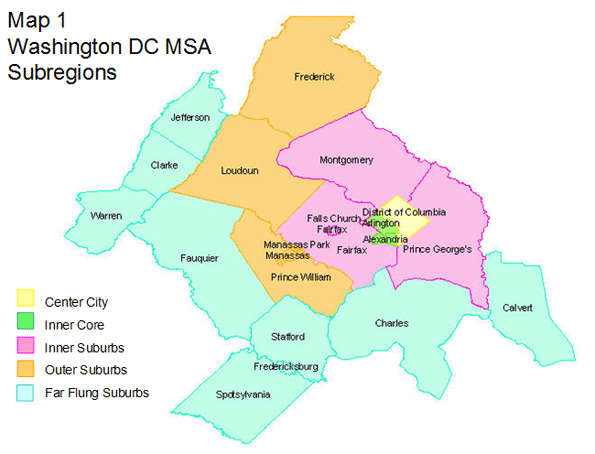
    The metro area is defined by 22 counties and cities in the states of Maryland, Virginia and West Virginia and has at its center city the District of Columbia. For this analysis, the Washington DC metropolitan area is divided into five sub regions: Center City, Inner Core, Inner Suburbs, Outer Suburbs and Far Flung Suburbs (see Map 1). According to Census Bureau population estimates, between 1987 and 2007 the population of the Washington DC metropolitan area grew from 3.92 million to 5.31 million people, an increase of about 35.5 percent. The population growth rates over this period varied considerably within the metropolitan area. The Center City experienced a 7.6 percent population decline between 1987 and 2007 while all of the other subregions in the metropolitan area grew. The fastest growing subregion was the Outer Suburbs, where the population grew by 109.6 percent over the 20-year period, followed by the Far Flung Suburbs (80.0%), Inner Suburbs (27.4%) and Inner Core (23.7%).

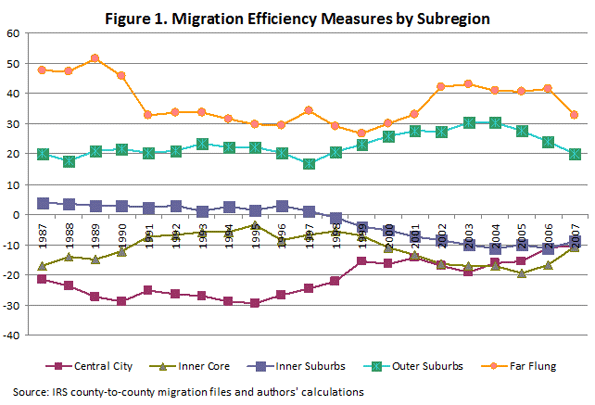
    Figure 1 shows that the subregions furthest from the region’s core, the Outer Suburbs and Far Flung Suburbs, consistently have the highest rates of net migration, which indicate that they have been net gainers of households from other parts of the metropolitan area over the past 20 years. For the Inner Suburbs, net migration is positive (but small) until 1998 when it becomes negative. Both the Inner Core and Center City have negative net migration over the entire period, reflecting losses of households to the rest (i.e. the suburban portions) of the metropolitan area.

    Looking at the entire 20-year period suggests that the suburbs of the Washington DC metropolitan area have gained population at the expense of the closer-in jurisdictions. However, in the last few years, since 2005, the net migration rates for the Outer Suburbs and Far Flung Suburbs have declined while the rates for the Inner Core and Center City have become less negative. These three years of data suggest that the more distant suburbs have started gaining households more slowly while the closer-in jurisdictions have lost households more slowly with net migration rates moving towards zero. While three years do not necessarily constitute a trend, this analysis suggests the possible beginning of a modest back to the city movement in the Washington DC area.

    However, household gains (or a slowdown in losses) in the inner jurisdictions may be coming more at the expense of the Inner Suburbs as opposed to the more distant suburban jurisdictions. The Inner Suburbs subregion is continuing the downward trend in net migration rates that began in the late 1990s, losing households to both the outer suburban and core jurisdictions. If this trend continues, the Washington DC metropolitan area may experience a relative population decline of its Inner Suburbs, while the more far flung suburbs continue to grow (albeit more slowly) and the population of the inner jurisdictions stabilizes or even grows slowly.

    Despite the beginning of a small back to the core movement, the suburbs of the national capital region will continue to gather most future growth, and that suburban growth will be even further out. Over the last three decades, jobs have followed people into suburban communities; a place like Tyson’s Corner in Fairfax County now has almost as many jobs as Washington’s downtown business district. Workers can live in the Outer Suburbs and Far Flung Suburbs, benefiting from the relatively lower housing costs and commute with relative ease to jobs in these suburban employment centers. Some share of the population will choose to move back to the city, but there will always be demand for suburban life.

    The Inner Suburbs are caught in the middle of population moving in and moving out. The Inner Suburbs have become more urban and congested, as well as more racially and ethnically diverse. These changes may cause some households – including both native born persons and upwardly mobile immigrants — to look even further out for a traditional suburban lifestyle. A younger metropolitan area, the result of the large millennial or “echo boom” generation, may lead to more people moving out of the congested Inner Suburbs to a “real” urban neighborhood in the core, which is also crowded, but has public transit and walkable communities. This trend, however, may well be short-lived if, when this generation hits their mid-30s by 2015, it acts like previous generations, starting to raise families and move again to suburbs, most likely in the further periphery.

    All this suggests, for the short run at least, a possibility that this new pattern of household redistribution could create a new divide in the national capital region. Different from the well-documented east-west divide, the emerging divide will be between the “urbanites” and the “far flungs.” The divide will be demographic, economic and political and will characterize the future challenges to forming transportation, housing and other regional policies.

    Lisa Sturtevant is an Assistant Research Professor at George Mason University School of Public Policy, Center for Regional Analysis.

  • For Millennials, It’s the Economy Stupid

    This month’s off year elections sent one message to Washington that has been heard loud and clear. Voters expect Congress to focus on the economy, especially employment, and take decisive and affirmative steps to deal with both the causes and ravages of the greatest economic downturn in the U.S. since the Great Depression. As the Obama administration considers a variety of new proposals to help bring down the unemployment rate, one key constituency is raising its voice and asking for a return on the investment it made in his presidency.

    Members of the Millennial generation, born between 1982-2003, who were eligible to vote in 2008 went for Barack Obama over John McCain by a 2:1 margin and made up over 80% of the President’s winning margin. They continue to support his presidency and identify as Democrats by similar margins. A late October Pew survey indicates that Millennials identify as Democrats over Republicans by almost 20 percentage points (52% vs. 34%), well above the 8-point Democratic advantage among older generations. In the latest Research 2000 weekly tracking survey conducted for Daily Kos, 80% of Millennials had a favorable opinion of the president; only 14% of everyone in this generation viewed him unfavorably. This compares with a 55% vs. 39% favorable/unfavorable ratio among the entire electorate in both the Research 2000 survey and in a series of November surveys conducted by organizations ranging from ABC News and the Washington Post to Fox, although some other polls put the President’s job performance ratings closer to 50%.

    But despite the clearly stronger support the President has among their generation, Millennials are increasingly restive about the lack of action in Congress to address the economic problems they face – both now and in the future.

    Recent Pew research studies underline the major impact that the recession has had on individual Americans and their families. Thirteen percent of parents with grown children told Pew researchers that one of their adult sons or daughters had moved back home in the past year. Pew found that of all grown children living with their parents, 2 in 10 were full-time students, one-quarter were unemployed and about one-third had lived on their own before returning home. According to the census, 56 percent of men 18 to 24 years old and 48 percent of women were either still under the same roof as their parents or had moved back home.

    The lack of jobs was particularly acute among adult members of the Millennial Generation (18-27 year olds), 61% of whom said that they or someone close to them was jobless recently. A clear plurality (46%) says that the “job situation” rather than rising prices (27%), problems in the financial markets (14%) and declining real estate values (7%) is their major economic worry.

    As a result, the number one concern among Millennials is the state of the economy and the need for jobs, but they have a unique perspective on how to deal with this issue.

    Millennials believe there is a clear link between education and employment and are increasingly concerned that the pathway through the educational system into the world of work is becoming increasingly more difficult and expensive to navigate. Last week, about one hundred of the nation’s top private sector and government leaders gathered for the Wall Street Journal’s CEO Council also identified education as the nation’s top economic priority.

    For Millennials, the problem is personal. A smaller share of 16-to-24-year-olds – 46 percent – is currently employed than at any time since the government began collecting that data in 1948. A job market with Depression-level youth unemployment (18.5%) and a wrenching transformation in the types of jobs America needs and produces makes the implicit bargain of education in return for future economic success harder for Millennials to believe in every day.

    Recently Matt Segal, Executive Director of the Student Association for Voter Empowerment (SAVE) and Founder and National Co-Chair of the “80 Million Strong for Young Americans Job Coalition” presented some ideas to the House Education and Labor Committee on what Congress could do to address this challenge. He advocated increased entrepreneurial resources be made available to youth; more access to public service careers through internships and loan forgiveness programs; and the creation of “mission critical” jobs in such fields as health care, cyber-security and the environment that would tap the unique talents of this generation. Since two-thirds of Millennials who graduate from a four-year college do so with over $20,000 in debt, debt, his testimony also urged immediate Senate approval of the student debt reform bill recently passed by the House.

    There is more that can be done beyond these excellent recommendations. This summer, the President’s Council of Economic Advisors released a report outlining the importance of community colleges in making America’s workforce more competitive in the global economy. “We believe it’s time to reform our community colleges so that they provide Americans of all ages a chance to learn the skills and knowledge necessary to compete for the jobs of the future.” The report urged Congress to pass House Democratic Caucus Chairman John Larsen’s bill, The Community College Technology Access Act of 2009, in order to help meet President Obama’s goal of graduating five million more Americans from community colleges by 2020.

    Millennials, like their GI Generation great grandparents in the 1930s, are facing economic challenges that caught them by surprise and for which no one prepared them. But Millennials aren’t looking for a handout or sympathy. Instead, in the “can do” spirit of their generation, they are organizing to overcome the challenges created for them by their elders. It’s time for the Democrats who control Congress to recognize these concerns and to act decisively on their behalf.

    Morley Winograd and Michael D. Hais are fellows of the New Democrat Network and the New Policy Institute and co-authors of Millennial Makeover: MySpace, YouTube, and the Future of American Politics (Rutgers University Press: 2008), named one of the 10 favorite books by the New York Times in 2008.