Category: Demographics

  • Why The ‘Livable Cities’ Rankings Are Wrong

    Few topics stir more controversy between urbanists and civic boosters than city rankings. What truly makes a city “great,” or even “livable”? The answers, and how these surveys determine them, are often subjective, narrow or even misguided. What makes a “great” city on one list can serve as a detriment on another.

    Recent rankings of the “best” cities around the world by the Economist Intelligence Unit, Monocle magazine and the Mercer quality of life surveys settled on a remarkably similar list. For the most part, the top ranks are dominated by well-manicured older European cities such as Zurich, Geneva, Vienna, Copenhagen, Helsinki and Munich, as well as New World metropolises like Vancouver and Toronto; Auckland, New Zealand; and Perth and Melbourne in Australia.

    Only Monocle put a truly cosmopolitan world city – Tokyo – near the top of its list. The Economist rankings largely snubbed American cities – only Pittsburgh made it anywhere near the top, at No. 29 out of 140. The best we can say is most American cities did better than Harare, Zimbabwe, which ran at the bottom. Honolulu got a decent No. 11 on the Monocle list and broke into the top 30 on Mercer’s, as did No. 29 San Francisco. But regarding American urban boosters, that’s all, folks.

    To understand these rather head-scratching results, one must look at the criteria these surveys used. Cultural institutions, public safety, mass transit, “green” policies and other measures of what is called “livability” were weighted heavily, so results skewed heavily toward compact cities in fairly prosperous regions. Most of these regions suffer only a limited underclass and support a relatively small population of children. In fact, most of the cities are in countries with low birthrates – Switzerland’s median fertility rate, for example, is about 1.4, one of the lowest on the planet and a full 50% below that of the U.S.

    These places make ideal locales for groups like traveling corporate executives, academics and researchers targeted by such surveys. With their often lovely facades, ample parks and good infrastructure, they constitute, for the most part, a list of what Wharton’s Joe Gyourko calls “productive resorts,” a sort of business-oriented version of an Aspen or Vail in Colorado or Palm Beach, Fla. Honolulu is an exception, more a vacation destination than a bustling business hub.

    Yet are those the best standards for judging a city? It seems to me what makes for great cities in history are not measurements of safety, sanitation or homogeneity but economic growth, cultural diversity and social dynamism. A great city, as Rene Descartes wrote of 17th century Amsterdam, should be “an inventory of the possible,” a place of imagination that attracts ambitious migrants, families and entrepreneurs.

    Such places are aspirational – they draw people not for a restful visit or elegant repast but to achieve some sort of upward mobility. By nature these places are chaotic and often difficult to navigate. Ambitious people tend to be pushy and competitive. Just think about the great cities of history – ancient Rome, Islamic Baghdad, 19th century London, 20th century New York – or contemporary Los Angeles, Houston, Shanghai and Mumbai.

    These represent a far different urbanism than what one finds in well-organized and groomed Zurich, Vienna and Copenhagen. You would not call these cities and their ilk with metropolitan populations generally less than 2 million, “bustling.” Perhaps a more fitting words would be “staid” and “controlled.”

    Peace and quiet is very nice, but it doesn’t really encourage global culture or commerce. Growth and change come about when newcomers jostle with locals not just as tourists, or orbiting executives, but as migrants. Great cities in their peaks are all about this kind of yeasty confrontation.

    Alas, comfort takes precedence over dynamism in these new cities. Take the immigration issue: Unlike Amsterdam in its heyday or London or New York today, most northern European countries have turned hostile to immigration and many have powerful nativist parties. These are directed not against elite corporate executives or academics, but newcomers from developing countries. In some cases, resentment is stoked by immigrants taking advantage of well-developed welfare systems that worked far better in a homogeneous country with shared attitudes of social rights and obligations.

    Of course, these cities aren’t total deadweights. After all, Switzerland has its banks, Helsinki boasts Nokia and Denmark remains a key center of advanced and green manufacturing technology. For its part, Vancouver gets Americans to shoot cheap movie and TV shows with massive tax breaks and will host the Winter Olympics. But none can be considered major shapers of the modern world economy.

    The one American city favored by The Economist, Pittsburgh, represents a pale – and less attractive – version of these top-ranked European, Canadian or Australian cities. Its formerly impressive array of headquarters has shrunk to a handful. Once the capital of steel, it now pretty much depends on nonprofits, hospitals and universities.

    You will be hearing a lot more about Pittsburgh – the city has a prodigious PR machine funded largely by nonprofit foundations and universities – as it gets ready to host the G-20 meeting next month. Fans claim that the former steel town has developed a stable – if hardly dynamic – economy. Its torpidity is being sold a strength; boom-resistant in the best of times, it’s also proved relatively recession-proof as well.

    In this sense, Pittsburgh represents the American model of the slow-growth European city. This may appeal to those doing quality-of-life rankings, but not to those who have been fleeing the Steel City for other places for generations. Immigrants are hardly coming in droves either – Pittsburgh ranks near last among major metropolitan areas in percentage of foreign-born residents. As longtime local columnist and resident Bill Steigerwald notes, since 1990 more Pittsburghers have been dying than being born. If this represents America’s urban future, perhaps it’s one that takes its inspiration from Alan Weisman’s “A world without us.”

    Yet the future of urbanism, here and abroad, will not be Pittsburgh. Based on current preferences, something like 20 million – or more – people will have moved to U.S. cities by 2050. Most will likely settle in more dynamic places like New York, Los Angeles, Houston, Phoenix, Dallas, Chicago and Miami. These cities have become magnets for restless populations, both domestic and foreign-born. They also contain all the clutter, constant change, discomfort and even grime that characterize great cities through history.

    But it’s economics that drives migrants to these dirtier, busier metropolitan centers. Many of the cities at the top of the livability lists, by contrast, are also among the world’s most expensive. They generally also have high taxes and relatively stagnant job markets.

    Many U.S. cities, however, offer far more materially to their average residents than their elite European counterparts do. American cities, when assessed by purchasing-power parity, notes demographer Wendell Cox, do very well indeed. Viewed this way, the U.S. boasts eight of the top 10 – and 37 of the top 50 – metropolitan regions in terms of per capita income.

    The top city on Cox’s list, San Jose, Calif., epitomizes both the strengths and weaknesses of the American city. The heartland of Silicon Valley, the San Jose region has generated one of the world’s most innovative – and well-paid – economies. On the other hand, its mass transit usage is minuscule, its cultural attributes measly and its downtown hardly a tourist destination.

    Meanwhile, pricey and scenic Zurich, No. 2 on the Mercer list and No. 10 on The Economist rankings, comes in 74th when considering adjusted per capita income. Economist favorite Vancouver, one of the most expensive second-tier cities on the planet, ranks 71st. For the average person seeking to make money and improve his or her economic status, it usually pays not to settle in one of the world’s “most livable” cities.

    This is not to say that rambunctious urban centers like Los Angeles, New York or London couldn’t learn from their more “livable” counterparts. Anyone who has braved the maddening crowds in Venice Beach, Times Square or London’s Piccadily knows a city can have too much of a good thing. Los Angeles could use a more efficient bus system. Better-maintained subways and commuter trains in New York would be welcome by millions as they would in Greater London.

    Ultimately great cities remain, almost by necessity, raw (and at times unpleasant) places. They are filled with the sights and smells of diverse cultures, elbowing streetwise entrepreneurs and the inevitable mafiosi. They all suffer the social tensions that come with rapid change and massive migration. New York, Los Angeles, London, Shanghai, Mumbai or Dubai may not shoot to the top of more elite, refined rankings, but they contain the most likely blueprint of our urban future.

    This article originally appeared at Forbes.

    Joel Kotkin is executive editor of NewGeography.com and is a presidential fellow in urban futures at Chapman University. He is author of The City: A Global History. His next book, The Next Hundred Million: America in 2050, will be published by Penguin early next year.

  • Millennials Think Globally, Act Locally

    The phrase, “Think Globally, Act Locally” has often been used by environmentalists to sum up a strategy devoted to conserving the earth’s scarce natural resources at the local level. More recently, business executives borrowed the idea to emphasize the need for building capabilities at the country or regional level even as they pursue global growth. But now the Millennial Generation, Americans born between 1982 and 2003, are giving the phrase an entirely new meaning as they pursue their efforts to change the world – one local community at a time.

    In contrast to the generational stereotypes many people hold of them, Millennials are very much concerned about and connected to the world around them – more so, in fact, than many older Americans. Responding to questions on foreign policy in a recent Pew Research Center survey, only 9% of Millennials were unable to express an opinion on how President Obama is doing in working with our allies, while almost a quarter of senior citizens had no opinion on the same subject. On the knotty question of Israeli/Palestinian relations, all but 7% of Millennials could tell survey researchers what they thought of American foreign policy in this area. On the other hand, 26% of senior citizens could not (see table below).

    In addition to its high level of concern with international matters, the Millennial Generation’s ability to make virtual friends instantaneously on Facebook or Twitter with Iranian protesters provides a unique perspective on how to deal with America’s foreign policy challenges.

    Perhaps most notable is how the Millennial Generation deals with the concept of “threats”. A majority of Millennials do see Al Qaeda, and the nuclear programs of North Korea and Iran as “major threats” to the United States, but by rates 15 to 20 points less than other generations. Other more intractable but less direct security concerns, such as the drug trade in Mexico, China’s emergence as a world power, or conflicts in the Mideast ranging from Pakistan to Palestine, are not considered a major threat among a majority of Millennials. To be sure, some of these attitudes may reflect the inevitable naiveté of young people, but we believe the underlying beliefs of Millennials suggest an alternative explanation.

    Millennials have been taught since at least high school that the best way to solve a societal problem is act upon it locally and directly. Tired of exalted rhetoric from Boomer leaders that rarely produced results and frustrated by their older Gen-X siblings lack of interest in pursuing any collective action to address broad social problems, Millennials have embraced individual initiative linked to community action. Eighty-five percent of college age Millennials consider voluntary community service an effective way to solve the nation’s problems. Virtually everyone in the generation (94%) believes it’s an effective way to deal with challenges in their local community. No wonder one of Barack Obama’s first legislative initiatives, the Kennedy National Service Act, was in response to the desire to serve of his most loyal constituency, the Millennial Generation.

    And when it comes to public service, Millennials are putting their money where their mouth is, although lack of opportunity in the private sector also could be accelerating this public service trend. Teach for America, which places new graduates in low-income schools, saw a 42% increase in applications over 2008. Around 35,000 students are now competing for about 4,000 slots. U.S. undergraduates ranked Teach for America and the Peace Corps among their top 10 “ideal employers,” ahead of the likes of Nike or General Electric.

    Scotty Fay, a recent University of Massachusetts graduate, typifies the continuing belief of her generation in the importance of collective action to cope with a challenging world. “If we excel and we’re able to keep ourselves working, we’ll be OK, we hope, because we haven’t experienced anything different than that,” says Fay, who worked two jobs on top of her full-time course load, and is now getting ready for her Peace Corps assignment in Guinea.

    First Lady Michelle Obama, in kicking off the administration’s “summer of service” initiative, made it clear that the administration sees this belief as key to America’s future. “This new Administration doesn’t view service as separate from our national priorities, or in addition to our national priorities – we see it as the key to achieving our national priorities.” Given the likelihood of continuing employment challenges for America’s newest workers, more and more Millennials are likely to gain their first work experiences performing some type of voluntary service.

    This penchant for public service shapes the beliefs of Millennials on how the United States should deal with the problems it faces around the world. In last year’s contest for the Democratic presidential nomination, Millennials believed Barack Obama was right and Hillary Clinton was wrong over whether to conduct direct talks with our enemies. And they thought Sarah Palin was completely off base when she declared in her acceptance speech at the convention that “the world is not a community and it doesn’t need an organizer.” In fact, Millennials believe that what the world needs most is thousands of community organizers, working on the ground to solve their own country’s problems, linked electronically, of course, to friends around the world.

    This is a trend that, appropriately, resonates outside our borders as well. Grassroots activism, led largely by young Iranians, produced protests that may yet topple one of the most autocratic regimes in the world. Activism of this type across the Mideast could result in regime changes of far greater consequence than the military conquest strategy the United States employed in Iraq. Given the distinctions Millennials make between the seriousness of direct military threats, such as terrorism and nuclear proliferation, as opposed to squabbles over power or territory, America’s foreign policy is likely to shift towards a more multi-lateral, institution-building focus as this generation assumes our country’s leadership. This will occur even as Millennials continue to express support for our military by word and deed – when that becomes the only available option.

    It may take a decade or two before we know how the Millennial Generation’s belief in the need to “think globally, act locally” will impact our overall foreign policy. But in the interim, the United States will surely benefit from the generation’s focus on rebuilding our country, as well as the world, one community at a time.

    Total Millennials Gen-X Boomers Silent & Older
    Obama favors… (6/09)          
    Israel too much 6% 5% 9% 6% 4%
    Palestinians too much 17% 9% 16% 20% 23%
    Right balance 62% 79% 62% 63% 47%
    DK 14% 7% 13% 11% 26%
    Compared with Bush Administration has Obama Administration made US (6/09)          
    Safer from terrorism 28% 40% 23% 29% 23%
    Less safe from terrorism 21% 16% 20% 23% 24%
    No difference 44% 38% 48% 43% 44%
    DK 7% 6% 9% 5% 9%
     Is each of following a "major threat" to well-being of US (6/09)          
    Islamic extremist groups like Al Qaeda 78% 59% 77% 86% 85%
    North Korea’s nuclear program 72% 51% 74% 75% 81%
    Iran’s nuclear program 69% 55% 67% 75% 76%
    Drug-related violence in Mexico 59% 42% 55% 61% 77%
    China’s emergence as world power 52% 31% 51% 59% 61%
    Political instability in Pakistan 50% 30% 45% 59% 63%
    Israel/Palestine conflict 49% 39% 45% 53% 58%
    In dealing with our allies does Obama…(6/09)          
    Push America’s interests too hard 8% 3% 10% 6% 11%
    Take account of allies’ interests too much 20% 13% 18% 25% 22%
    Strikes right balance 57% 76% 53% 59% 46%
    DK 15% 9% 18% 10% 22%
    Approve how Obama is handling foreign policy (6/09) 57% 59% 61% 52% 55%
    Is Obama’s approach to national security…(6/09)          
    Too tough 2% 1% 2% 5% 2%
    Not tough enough 38% 30% 37% 42% 41%
    About right 51% 64% 53% 46% 48%
    DK 8% 6% 8% 7% 10%
    Approve/Disapprove how Obama is handling North Korea (6/09)          
    Approve 51% 61% 50% 55% 38%
    Disapprove 23% 15% 26% 22% 25%
    DK 26% 24% 24% 23% 36%


    Morley Winograd and Michael D. Hais are fellows of the New Democrat Network and the New Policy Institute and co-authors of Millennial Makeover: MySpace, YouTube, and the Future of American Politics (Rutgers University Press: 2008), named one of the 10 favorite books by the New York Times in 2008.

  • Projecting 30-45 Year Olds in the United States

    We constantly hear the the harping about “brain drain” in our local editorial pages and economic developer’s board rooms. Most of the time, the term is referring to college-age or immediately post college individuals. However this overlooks another slightly less mobile age group that might be more amenable to direct recruitment tactics: 30-45 year olds, or those that may be looking to resettle as their priorities shift more seriously to their career, their family, and more importantly a balance of the two.

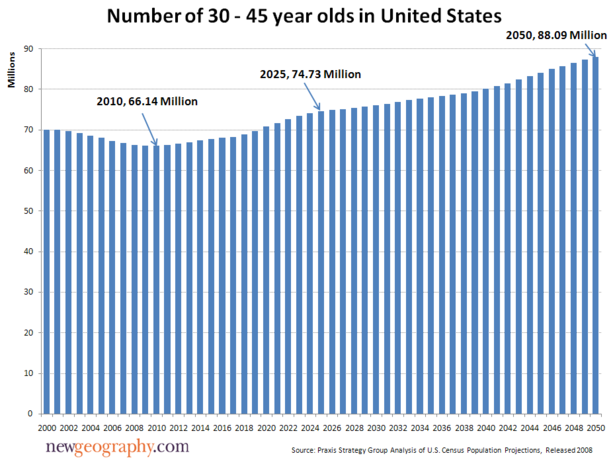
    Now comprised of the smaller Generation X group, we’ll reach a low point in the United States for this age group in 2010:

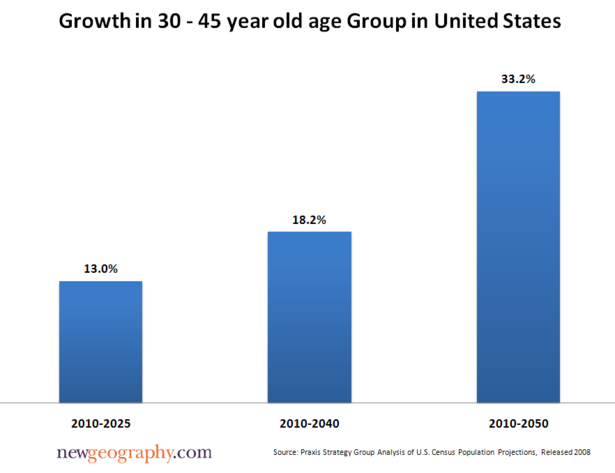
    As the larger group of the Millennial generation ages, we’ll see another 8-10 million 30-45 year olds in the US in the next 15 years, and this group will grow by nearly 1/3 by 2050.

    Census projects very rapid growth of this group between 2040 and 2050, but keep in mind that folks comprising this rapid growth after 2040 are just being born now, so this projection will be refined as birth numbers become concrete in the next few years.

  • Salinas Dispatch: A Silver Lining in the Golden State

    From a distance, a crisis often takes on ideological colorings. This is true in California, where the ongoing fiscal meltdown has devolved into a struggle between anti-tax conservatives and free-spending green leftist liberals.

    Yet more nuances surface when you approach a crisis from the context of a specific place. Over the past two years my North Dakota-based consulting partner, Delore Zimmerman, and I have been working in Salinas, a farm community of 150,000, 10 miles inland from the Monterey coast and an hour’s drive south of San Jose. Our work has been funded by a variety of sources, including the city, local business interests and the Chamber of Commerce.

    Our goal has been to find ways to promote upward mobility in the town, which is almost two-thirds Hispanic. Poverty is widespread, and gang problems rank among the worst in California. Unemployment, devastated by the recent recession, hangs at around 15%.

    These conditions are not at all unusual for inland California, and they are particularly prevalent in farm regions. In the Central Valley, over the next range of mountains, conditions are far worse, with some communities losing thousands of acres in production and unemployment rushing upward of 40%.

    One liberal journalist, Rick Wartzman, recently described the vast agricultural region around Fresno as “California’s Detroit.” As environmentalists push to cut back on water supplies and protect fish populations in the San Francisco Bay Delta, Wartzman notes, its local workers and businesspeople “are fast becoming a more endangered species than Chinook salmon or delta smelt.”

    In Salinas, where water comes from local aquifers, wells and the Salinas River, death seems less imminent, but there is a profound sense that things may be deteriorating. Local growers worry about regulatory constraints that will drive up costs to meet new state greenhouse gas standards. They also fear a possible county initiative, promoted by the well-funded local greens, to ban the growing of genetically modified foods.

    The growers’ response to the pressure – as with other businesses in California – is not to quit but to scale down operations. Some are cutting back thousands of acres of lettuce and other green crops that have been the prime business for the area for nearly a century.

    Yet we also see many reasons for hope. Salinas remains a unique place with an amazing richness in what the French call terroir, a combination of climate and soil. The city’s most famous son, John Steinbeck, wrote of the Valley’s unique topography:

    “The high gray-flannel fog of winter closed off the Salinas Valley from the sky and the rest of the world. On every side it sat like a lid on the mountains and made of the great valley a closed pot.”

    Growing conditions in Salinas cannot be easily duplicated elsewhere. Its richness has created a cornucopia responsible for the predominant part of the area’s private-sector employment.

    But it’s not just physical factors that make Salinas – and California – so productive. People matter too. The area is populated by scores of hard-driving agricultural families, people whose forebears transformed the place into the “salad bowl” of a nation. By 1952, when Steinbeck published East of Eden, Salinas produced 70% of the nation’s lettuce and much of its fresh vegetables.

    Salinas’ growers are not hereditary gentry; talk to local farmers and you find people whose roots lay in Italy, Portugal, Ireland, Japan and, increasingly, Mexico. “People, if given opportunity, can accomplish anything,” notes Lorri Kester, CEO of Mann Packing, a leading broccoli producer. “Many of the firms that lead us now were started by ‘Okies’ who worked the land. Now we see the same things with Latinos who started out as hands and now are foremen or managers.”

    What the Salinas growers do best – like their high-tech counterparts up in the Santa Clara Valley – is innovate. Working with the USDA and University of California-Davis scientists, they have led the way in creating new strains of vegetables and new ways of marketing, including the notion of “salad in a bag.”

    But not all the knowledge that makes Salinas such an economic powerhouse comes from entrepreneurs or PhDs. Like many agricultural communities, Salinas has had a sometime brutal labor history, particularly in the 1930s. The worst of this is now thankfully over, but farm labor remains a tough and often unrewarding profession.

    Yet even the hardest-edged growers acknowledge the importance of their labor force. Although education levels remain relatively low, our research revealed an extraordinarily high concentration of people with practical skills that can be applied to growing the agricultural economy. Future mechanization may reduce the overall employee counts but will make growers even more dependent on skilled workers in the fields.

    This proficiency, acquired in the fields and the processing sheds, has helped create another product for the Valley: expertise. Salinas growers, foreman, irrigation workers and marketers now sell their knowledge in other parts of California, as well as to Arizona, Mexico and, increasingly, East Asia. “I am seeing a lot of product and technical products from Salinas go to China and elsewhere,” notes Frank Pierce, a local agricultural consultant.

    Salinas also teaches you to avoid the great distinction made by many pundits between the “knowledge” industry and the productive type that focuses on tangible goods. A successful economy draws on information but also creates real products. There is a relationship between the two that is dynamic and has long been a critical component of California’s economic vitality.

    This is not just true of Salinas. I learned long ago from the founding fathers of Silicon Valley – people like Intel founder Bob Noyce and venture capitalist Don Valentine – that the practical knowledge from making circuits and chips helped create the Valley’s unique engineering terroir. Similarly, the “magic” of Hollywood does not emerge full-blown from the brain storms of stars and moguls. The entertainment complex’s unique abilities grow from the interplay of practical knowledge of less glamorous camera people, grips, editors, caterers and prop-managers servicing what Angelenos invariably refer to as “the industry.”

    Sadly, this insight largely has been lost on California’s political and business leadership. Among the so-called “progressive” community, production of any kind, outside of small artisanal farms or funky software shops, is disdained.

    This anti-development ethos has gained extra traction by claims that large farms and factories might add to the “carbon footprint” of a given place. Among well-funded foundations and some corporate leaders there remains an implicit sense that California can still mine enough riches in cyberspace to support the vast hoi polloi.

    Yet in reality, Californians need hard jobs, even mundane ones. The farm, sound stage or electronics factory provide the employment essential to broad-based prosperity. And when those jobs leave California they usually migrate to a place – whether over the border or abroad – where wages are lower and environmental controls are far weaker.

    This is not to argue that California’s right has the answers either. Lower taxes are generally preferable to higher ones. But in Salinas – and California – sometimes higher taxes might be preferable to cutting services, like the critical training offered by community colleges, which make the economy work and offer hope to the younger generation.

    In Salinas, Mayor Dennis Donahue, a Democrat of the Pat Brown variety, has embraced a call to raise the sales tax in order to maintain basic services. It’s not an ideal solution, but in the real world of running a city, particularly one with a big gang problem, you don’t want to cut back on police and libraries or add to already surging unemployment.

    What California needs most now is what it’s most missing: common sense and a sense of balance. This is what we learned in Salinas. California cannot be saved by ideologies – it needs to be saved from them.

    To be sure, preserving the land and air quality should remain a priority; it is the basis of California’s riches and unique appeal. But sustainability – the great buzzword of our time – needs to apply not only to the environment but also the economy and society. The right-wing solution of lower taxes even at the price of eviscerating the public sector and letting the infrastructure deteriorate does not constitute a program for long-term prosperity.

    We prefer an approach that focuses on practical steps for private and public sectors to collaborate on restoring economic growth. In Salinas, this means establishing – through cooperation with Hartnell, the local community college – a center for the development of agricultural technology. Salinas could use its combination of intellectual and grassroots knowledge to become the Silicon Valley of the “fresh” economy. It would also serve as a center of practical research on E. coli and other diseases that threaten the entire agricultural industry.

    Another step would be to expand the area’s thriving wine corridor to promote the region’s vintages. And there needs to be a plan to restore the historic central core into a bustling business district and to attract the predominately Latino shoppers, now lured to malls and outlet centers outside the city, back into town.

    These steps will take effort and money, but neither free market ideology nor green zealotry alone will get it done. California’s greatness was created not just by entrepreneurs or through its public sector, but in a clever, pragmatic melding of the two. Blessed with resources of topography, climate and human skill, our state should not allow dueling extremes to turn a global paragon into a planetary laughingstock.

    This article originally appeared at Forbes.

    Joel Kotkin is executive editor of NewGeography.com and is a presidential fellow in urban futures at Chapman University. He is author of The City: A Global History. His next book, The Next Hundred Million: America in 2050, will be published by Penguin early next year.

  • The Blue-State Meltdown and the Collapse of the Chicago Model

    On the surface this should be the moment the Blue Man basks in glory. The most urbane president since John Kennedy sits in the White House. A San Francisco liberal runs the House of Representatives while the key committees are controlled by representatives of Boston, Manhattan, Beverly Hills, and the Bay Area—bastions of the gentry.

    Despite his famous no-blue-states-no-red-states-just-the-United-States statement, more than 90 percent of the top 300 administration officials come from states carried last year by President Obama. The inner cabinet—the key officials—hail almost entirely from a handful of cities, starting with Chicago but also including New York, Los Angeles, and the San Francisco area.

    This administration shares all the basic prejudices of the Blue Man including his instinctive distaste for “sprawl,” cars, and factories. In contrast, policy is tilting to favor all the basic blue-state economic food groups—public employees, university researchers, Silicon Valley, Hollywood, Wall Street, and the major urban land interests.  

    Yet despite all this, the blue states appear to be continuing their decades-long meltdown. “Hope” may still sell among media pundits and café society, but the bad economy, increasingly now Obama’s, is causing serious pain to millions of ordinary people who happen to live in the left-leaning part of America.

    For example, while state and local budget crises have extended to some red states, the most severe fiscal and economic basket cases largely are concentrated in places such as New York, New Jersey, Illinois, Pennsylvania, Michigan, Oregon, and, perhaps most vividly of all, California. The last three have among the highest unemployment rates in the country; all the aforementioned are deeply in debt and have been forced to impose employee cutbacks and higher taxes almost certain to blunt a strong recovery.

    The East Coastdominated media, of course, wants to claim that we have reached “the twilight” of Sunbelt growth. This observation seems a bit premature. Instead, traditional red-state strongholds such as the Dakotas, Idaho, Texas, Utah, and North Carolina, dominated the list of fastest-growing regions recently compiled for Forbes by my colleagues at www.newgeography.com.

    When the recovery comes, job growth also is most likely to resurge first in the red states, while the blue states continue to lag behind. For reasons as diverse as regulatory policy, aging infrastructure, and high levels of taxation, blue states continue to be more susceptible to recessions than their red counterparts.

    This assumption is borne out by an analysis of economic cycles by the website JobBait.com, which has found that since 1990 the states most vulnerable to economic downturns include the Great Lakes states of Michigan, Illinois, Ohio, and New York as well as Connecticut and California. Those most resistant have been generally red bastions such as the Dakotas, Nebraska, and Texas, and resource-rich states such as Alaska, Montana, New Mexico, and Wyoming.

    This suggests that even the hardest-hit red states, notably Florida and Arizona, are likely better positioned in the long term for a recovery. A generation of out-migration may be slowing down temporarily due to the recession, but many people moved to places such as Arizona, Florida, Texas, and Georgia over the first seven years of the decade; in contrast, the high-tax blue states, including New York, New Jersey, and California, lost 1,100 people every day between 1998 and 2007. Most of them headed to the red states.

    “When the economy comes back,” notes veteran California-based economist and forecaster Bill Watkins, “there will be a pent-up demand. People will compare and move to the places that are affordable and don’t have the fundamental tough tax and regulatory structures.”

    Devolution in Blue

    These demographic and economic trends will have a long-term political impact. The net in-migration states—almost all of them red—will gain new representatives in Congress after the next census while New York, Pennsylvania, Michigan, and perhaps even California could see their delegations shrink.

    In fact, amidst the Blue Man’s current political ascendency, the devolutionary process is likely to continue. Its roots are very deep, and will prove more difficult to reverse than media and policy claques suggest. In historic terms, blue states’ relative decline represents one of the greatest shifts of political and economic power since the Civil War.

    In the modern period that starts with the end of the Second World War, the states that are now blue were also, to a large extent, the best. They included the undisputed centers of finance, industry, culture, and education. Blue-state politicians also dominated both parties, either directly or behind the scenes.

    In contrast, the Red Man was disdained. As late as the 1940s, Los Angeles—still then very much in its red period—as well as Houston, Dallas, Charlotte, and Phoenix, were all not listed on the Social Register, the ultimate list of the socialite elite. You might visit Texas or invest in its oil, buy Los Angeles real estate, or winter in Scottsdale, but these were not places of consequence. These cities were not for civilized, serious people.

    Yet demographic forces changed this balance of power forever. In sharp contrast to Europe, often the preferred model for the Blue Man, the United States’ population exploded in the postwar era. This expansion could not be comfortably accommodated in the old cities.

    New demographics and timing shaped America’s urban patterns in largely unforeseen ways. Urban theorist Ali Modarres notes that America’s population over the second half of the 20th century grew by 130 million, essentially doubling, while the populations of France, Germany, and Britain together increased by 40 million, or 25 percent.

    In Europe slower population growth meant that planners could accommodate expansion through gradual expansion of existing cities. In contrast, America’s huge growth could only be accommodated by creating new places and vastly expanding others. This led to the growth of suburbs everywhere, but the bulk of expansion took place in vast emerging metropolitan areas such as Los Angeles, and later Phoenix, Dallas, Houston, Atlanta, Miami, and Las Vegas.

    This trend held up through much of the past decade. Nevada’s s population grew at four times the national increase of 8 percent while Arizona expanded three times as much and Florida twice the average. In contrast, growth in the blue states of the Northeast and Midwest generally stood well behind the national average.

    More important still, the new regions experienced a broad entrepreneurial explosion that reshaped the whole economy. In many cases, this growth came directly at the expense of the blue states. When major companies relocated they tended to leave places like New York, Pittsburgh, Cleveland, and Chicago for the burgeoning red cities.

    In 1950 Atlanta did not rank among America’s most important economic centers; 50 years later it stood among the most popular cities for large corporations and their subsidiaries. The same could be said for places like Houston, Dallas, and Charlotte. It was the quintessential American story, evidence, as Marxist scholar William Domhoff observed, that America’s “open class system is almost the opposite of a caste system.”

    Blue Man Economics

    Today two principles now drive the political economy of the blue states—and so shape the Obama administration today. The first one is the relentless expansion of public sector employment and political power. Although traditional progressives such as Franklin D. Roosevelt, Harry Truman, Fiorello La Guardia, and Pat Brown built up government employment, they never contemplated the growth of public employee unions that have emerged so powerfully since the 1960s.

    Public sector employees initially played a positive role, assuring that the basic infrastructure—schools, roads, subways, sewers, water, and other basic sinews of society and the economy—functioned properly. But as much of the private economy moved out of places such as New York, Illinois, and, more recently, California, public sector employment began to grow as an end to itself.

    Some blue-state theorists, columnist Harold Meyerson among them, have identified this new, highly unionized public sector workforce not so much an adjunct to the middle class but its essence. This has become very much the reality in many core blue regions—particularly big cities like New York, Chicago, and Detroit—as the private-sector middle class has drifted to the suburbs or out to the red states.

    Even before the recession these public-sector unions and their lavish benefits had become a major burden for blue states and cities. In California alone state pensions are now $200 billion underfunded. San Francisco has more than 700 retirees or their survivors earning pensions in excess of $100,000 per year. In New York, despite Mayor Michael Bloomberg’s occasional utterances about the city’s expanding pension system being “out of control,” city contributions to the pension system have grown fivefold under his watch. They now consume roughly one in ten dollars in the city budget.

    The only way to pay for these expenditures rests on the second key blue economic principle—the notion of an ever expanding high-end “creative economy.” This conceit is based on the notion that tangible things matter little and that, as former Wired magazine editor Kevin Kelly put it, “communication is the economy.”

    New York pioneered the idea that the economy could depend totally on the efforts of the talented few, mostly those on Wall Street but also those in the media and other “creative” industries. This formula has been widely accepted since New York Mayors John Lindsay and Ed Koch allowed New York City’s public sector to expand, often with borrowed money.

    Sadly this focus has tended to leave little room for a diverse economy that might employ an expanding, upwardly mobile middle class. Instead, companies and employees in these high-value industries tend to dominate almost all the attention of blue-state policy makers.

    Since this class had less need than traditional industries for basic infrastructure, a confluence of interest has emerged between the post-industrial elites and the public employees. Money raised from the monied post-industrial elite would essentially buy social peace by funneling largesse not into improving the roads, subways, or ports but into the pockets of the public employees.

    The Great Delusion and Its Blue-State Victims

    This elite strategy has served to bifurcate most blue states into an affluent core and a rapidly declining periphery. For example, California, a state whose shift from red to blue has given some heft to “progressives” everywhere, has experienced an increasing gap between a small sliver of wealthy metropolitan residents along the coast and an increasingly marginalized interior populated largely by middle- and working-class Hispanics.

    And then there is the imposition of increasingly stringent environmental regulation. This has hit hardest the essential sectors of the non-“creative class” economy such as manufacturing, warehousing, and agriculture. Basic industries depend more than finance or “creative” ones on reasonably priced energy and land, access to raw materials, and a sane regulatory regime. “In California,” notes economist Watkins, “everything has priority over the economy.”

    You can see the effects clearly in California. Climate change regulations work to constrain new construction of homes, particularly suburban single-family homes. Manufacturing industries, even relatively “clean” ones, make easy targets for carbon-hunting regulators. A recent Milken Institute report found that between 2000 and 2007 California lost nearly 400,000 manufacturing jobs, all this while industrial employment was growing in major competitive rivals such as Texas and Arizona.

    Trucking firms, saddled with harsh new deadlines to shift to cleaner vehicles, also are going out of business. Like manufacturers, many of these have historically been sources of upward mobility for largely Latino entrepreneurs and workers.

    Perhaps the most searing disaster is unfolding in the rich Central Valley. Large areas are about to be returned to desert—due less to a mild drought than to regulations designed to save obscure fish species in the state’s delta. Over 450,000 acres have been allowed to go fallow. Nearly 30,000 agriculture jobs—mostly held by Latinos—were lost just in May. Unemployment, 17 percent across the Central Valley, reaches to more than 40 percent in some towns such as Mendota.

    “We are getting the sense some people want us to die,” notes native son Tim Stearns, a professor of entrepreneurship at California State University at Fresno. “It’s kind of like they like the status quo and what happens in the Central Valley doesn’t matter. These are just a bunch of crummy towns to them.”

    A similar process of secular decline can also be seen in the peripheries of other blue states such as upstate New York, which has ranked near the bottom of job growth nationwide over the past 40 years. But nowhere has this occurred more completely than in Michigan.

    Under the leadership of Governor Jennifer Granholm, Michigan has sought to reinvent itself from an industrial powerhouse to a center of the “creative economy.” For much of her first term, Granholm focused on such inanities as promoting a “cool cities” program, following the notion that creating places for the terminally hip would help turn around her state’s economy.

    Yet in the end, Michigan stands at the worst end of almost every calculator, with the highest unemployment and rates of out-migration, and the worst cities for business. Its per capita income, which was 16th in the nation shortly before Granholm ascended as governor, has now dropped to 33rd, the lowest since the federal government has been keeping records.

    Detroit now suffers a 22 percent unemployment rate, the highest of any major city. Nearly one in three residents is on food stamps. But the pain goes well beyond Motor City. Altogether Michigan communities account for a remarkable six of the nation’s ten worst job markets, according to the most recent ForbesNew Geography survey.

    Waiting for Obama

    Many in the true blue states greeted Barack Obama’s election like the coming of a Messiah who would redress these serious problems. After all, it is widely believed in blue states that the red-state barbarians had looted the Treasury for their clients in the energy, industrial, home-building, pharmaceutical, and defense industries. Now the blue states, and their industries, would get payback. A vast expansion of public infrastructure, more emphasis on basic industry, and incentives for new entrepreneurial ventures could now help rapidly declining areas in the blue states.

    Yet hopes that Obama would emphasize such basic infrastructure now have been dashed. Instead, the stimulus has been largely steered to social service providers, “green” industries, and academic research. One reason, as we now know, is that feminists saw such an approach as too favorable to “burly men” who might not have been among the president’s core fan base.

    Sadly, many of those “burly men,” particularly the unemployed, still reside in the blue states. They might not be in the places inhabited by the post-industrial elites but they do live in the hardscrabble neighborhoods, industrial suburbs, and small towns from Michigan and upstate New York to California’s vast interior.

    Another group that may be unexpectedly hurt by the Obama policies will be the middle and upper middle classes in blue states. Already burdened by high rates of taxation locally and higher costs for everything from housing to education, these hardy souls—making more than $125,000 to $250,000 a year—now are about to find themselves heaped in with the “rich.” Higher federal tax rates, as proposed by the administration, could prove disastrous for many blue-state middle-income families.

    The Chicago Model: Obama’s ‘Closed Circle’

    This skewed allocation of resources reflects the administration’s roots in contemporary Chicago. It derives from a pattern of rewarding core constituencies as opposed to lifting up the whole economy.

    The financial bailout reflects one part of this. Money lavished on bankers and lawyers, most of them in New York and Chicago, represents relief to what is now a core Obama constituency. Indeed the whole Troubled Asset Relief Program mechanism is being run by what Simon Johnson, a former chief economist at the International Monetary Fund, has described as a “wonderfully closed circle.”

    This approach, notes University of Illinois political scientist Dick Simpson, comes naturally for an administration dominated by veterans of the Chicago machine. Politicians in the Windy City do not worry much about opposition—49 out of 50 aldermen are Democrats—and follow policies adopted by the small central cadre.

    Once the message is set upon, notes Simpson, Chicago Mayor Richard M. Daley operatives such as David Axelrod set about spinning things. This system is ideal for cultivating both media skill and political discipline during election season—something so evident in Obama’s brilliant campaigns against first Hillary Clinton and then John McCain, Simpson observes.

    But machine politics do not necessarily work out so well for the rest of the population. “The principle problem is that the machine is not subject to democracy,” notes Simpson, who remains hopeful for the Obama presidency. “There’s massive patronage, a high level of corruption . . . There’s a significant downside to authoritarian rule. The city could do much better.”

    To be sure, there has been considerable gentrification in Chicago, as in many cities. Chicago’s “revival” also has been a classic case of blue-state economics, driven largely by a now fading real estate boom, the financial industry, a growing college and university population, and tourism. But overall, from the point of view of most middle and working class residents, Chicago’s political system has proved inefficient and costly. This can be seen in demographic trends that show Chicago as the only one of few large U.S. cities to lose population. At the same time, the middle class, particularly those with children, continue to flee to the suburbs. Roughly half of all white families (as of 2005) leave when their children reach school age.

    Is There Hope for Blue America?

    Ultimately, waiting for Obama will not revive the blue states. Instead the best prospect lies in blue states healing themselves. Fortunately, there are some tentative signs of unrest. The same regime failure that stuck to Republicans in the wake of the Bush presidency soon may be felt by Democrats burdened with the failed legacy of Illinois Governor Rod Blagojevich, New Jersey Governor Jon Corzine, or New York Governor David Paterson. Even Illinois, the president’s home state, could go Republican, suggests political scientist Simpson, if the Republicans put up a viable, middle-of-the-road candidate.

    Powerful signs of mounting resistance have emerged in the most important state of all, California. The massive rejection of the budget agreement last spring was a blow to not only its architects, Governor Arnold Schwarzenegger and the Democrats in the legislature, but the general conventional wisdom that holds increased taxes as the key to addressing the state’s budget problem.

    Even in deep blue Los Angeles, the public sector machine built around onetime union organizer and current Mayor Antonio Villaraigosa has lost some recent battles, including an attempt to create a public sector union monopoly over the city’s solar industry. There is now greater appreciation of soaring public sector pension obligations as groups like the California Foundation for Fiscal Responsibility expose lists of public employees enjoying mega-pensions.

    Similar efforts have started in other states, and with private-sector pensions being cut around the country, anger over the emerging privileged class of public workers may well gain traction. Ultimately, more people in blue states will begin to realize that their states need to learn again how to compete against both their red counterparts and the rest of the world.

    There is no intrinsic reason blue states should continue to decline. They have created much of the industrial enterprise, technological innovation, and cultural vitality that made the United States the world’s preeminent country. The prospects for these places can certainly be brighter than they are today.

    This article originally appeared at the American.

    Joel Kotkin is executive editor of NewGeography.com and is a presidential fellow in urban futures at Chapman University. He is author of The City: A Global History. His next book, The Next Hundred Million: America in 2050, will be published by Penguin early next year.

    *State map courtesy of Mark Newman: http://www-personal.umich.edu/~mejn/election/2008/

  • Housing the Next Generation with Old Shipping Containers

    If the predictions are accurate, America will have to house some 100 million more people by 2040 to mid-century than is now the case. Despite the current round of foreclosures and rising apartment vacancy, over the long term the demand for humane, affordable, sustainable housing is going to escalate dramatically in the coming years.

    In this recessionary time, it may be tempting to ignore the coming boost in housing demand. Yet eventually growth will pick up and the housing market will become re-invigorated. Nonetheless, the problem of meeting the demand for affordable housing will remain. For now, the federal government is trying to help state and local governments acquire, renovate and sell foreclosed properties, and individual homeowners to reduce their mortgage payments to 31 percent of their income. Federal efforts are also being aimed at increasing funds to redevelop public housing and at giving first-time homebuyers an $8,000 tax credit.

    But these are short-term measures. Others, with more lasting impact, may be more effective. One will be the size of houses. Although some may still choose to build large lot homes and McMansions, the longer-term trend will be for somewhat more compact houses. Contrary to the visions of some urban boosters, Americans will continue to favor single family homes over apartments. But these houses seem likely to trend back to the more traditional, modest scale. Between 2006 and 2007, after years of expanding, the size of a median single-family house actually decreased slightly.

    Another critical element of a housing solution lies in building workforce housing close to the workplace. For years, many moderate income Americans have been forced to “drive ‘til they qualify.” Throughout the nation’s metropolitan areas, teachers, police officers, firefighters, salesclerks, municipal workers, and young people, among others, are being elbowed out of the local housing market. In a recent survey conducted by the Urban Land Institute in cooperation with Harris interactive, of the 110 larger firms (over 100 employees) surveyed, fifty-five percent reported a lack of affordable housing nearby, sixty-seven percent of the workers interviewed (who earned less than $50,000 per year) said they would move closer to work if more housing in their price range were available, and fifty-eight percent of the companies reported having lost employees due in part to long commute times.

    For most Americans, particularly between ages 30 and 70, the demand for affordable homes near workplaces will be paramount. In some areas, there may also be greater demand for apartments, even though these too are suffering due to the recession.

    Many zoning and building codes are obsolete and need to be updated, because as written they restrict the construction of low and moderate income housing and segregate residential, retail, and industrial/commercial land uses. Changing zoning to permit and provide incentives for mixed use development, more intense land uses, and higher density development would make workforce housing more affordable.

    The steps above do not apply only to city living. Through good design, suburban living can be made slightly more compact without sacrificing quality of life. Accessory buildings can often be added on a lot, “granny flats” can be built, large old single family homes can be converted into duplexes, empty spaces could be filled in, and other steps can be taken to meet the need for more housing when that need materializes.

    But perhaps the biggest gains can come by using innovative approaches to expanding housing. One novel idea that has begun to emerge is to use old shipping containers that have been transformed into building blocks for home-building materials. Actually, one can hardly call the idea novel, because shipping crates have been used in construction for thousands of years. But today, the old practice is being revived with entrepreneurial, innovative, outside-the-box thinking.

    These reconfigured containers have the advantages of being more economical and durable than conventional materials, speedier to construct, highly customizable, fire-, termite-, water-, and earthquake/hurricane-resistant, strong, safe and green, with a lower carbon footprint. Hence the name of one of the companies working in this field, one with which I am associated, SG Blocks LLC (SG stands for “safe and green”). As the company puts it, “We are in the business of converting instruments of trade into instruments of construction.”

    Shipping containers are big: each weighs 9,000 pounds and measures 8 feet wide by 40 feet long by 9 feet tall. Hundreds and thousands of them are sitting empty in ports around the country. What possible use could they be, one may wonder, in building a new residential or office complex?

    Consider, therefore, that these steel-on-steel containers, when used as re-fabricated “blocks,” are stronger than conventional house framing. They can be cut, fabricated, re-modeled, and turned into a basic home structure for approximately $25-$27 a square foot. Stevan Armstrong, COO of SG Blocks, has pointed out that multi-family mid-rise units built with containers cost 10 to 15 percent less than typical “stick frame” houses. When appropriate coatings are installed, says Dan Rosenthal, a principal with the Lawrence Group, “we have an envelope that reflects about 95 percent of outside radiation, resists the loss of interior heat, provides an excellent air infiltration barrier and does not allow water to migrate in. Because of the superior roof structure, it is easier to incorporate ‘green’ roof systems.”

    Using shipping containers also saves energy on the front end. It takes 6,481 kilowatt-hours to make a ton of steel from virgin materials, 9,000 kilowatt hours of energy to melt down a container, but only 400 kilowatt-hours of energy to convert shipping containers into SG Blocks.

    The possibilities for utilizing this type of construction – infill housing in urban and suburban communities, new construction for residential, commercial, industrial and retail buildings, single- and multi-family homes – are practically limitless. From a design perspective, SG Blocks claims that their modified containers “can be used to build virtually any style of construction, from traditional to modern and all in between…from traditional Main Street to ultra-contemporary.” In short, they can provide people with an opportunity for ownership and economic mobility in a decent community environment.

    To cite a few examples:

    • A continuing care community for seniors on the historic Mission San Luis Rey grounds in Oceanside, CA, 340,000 square feet with 450 SG Blocks, is going up.
    • In Salt Lake City, the first mid-rise container building is being planned for downtown; it will be called City Center Lofts, with eight units and a ground level art gallery.
    • In Ft. Collins, CO, discussions are being held about creating “block” homes for 500 families as part of the city’s Homeless Shelter Program.
    • John Knott, the guiding light in the Noisette Community in North Charleston, SC, wants to build a six- to eight-story “container” building, retail on the first floor with residential units above, topped with a green roof. He proposes using ninety prison re-entry men to do the construction.
    • Work is in process on a three- to four-story student housing and recreational mixed use facility at Lubbock Christian University in Texas.
    • In Panama, “blocks” are being used to build four buildings that will house community and education centers for the U.S. Southern Command.
    • Attached to the top of this article is a photo of a house built with SGBlocks in St. Petersburg, FL.

    Demography is destiny, as has been said so many times. With 100 million more people in the pipeline, we have to find humane, innovative, affordable ways to house them and provide them with opportunity for advancement. Salvaging empty shipping containers to address this problem is only one step, but a most interesting one that is well worth the trying.

    William H. Hudnut III, former Member of Congress and sixteen-year Mayor of Indianapolis, is the principal in his firm, Bill Hudnut Consultants LLC, and an associate of SG Blocks LLC. His email address is: bhudnut3@gmail.com.

  • Death of the Suburbs: Part Nauseum

    For decades, those who know best have been chronicling the death of the suburbs. In every new announcement of demographic data, they find evidence that people are “moving back” to the core cities, even though they never moved away. The coverage of the latest Bureau of the Census city population estimates set a new standard. “Cities Grow at Suburb’s Expense During Recession” was the headline in The Wall Street Journal. The New York Daily News headlined “Census Shows Cities are Growing More Quickly than Suburbs.”

    Robert E. Lang, co-director of Washington’s Metropolitan Institute at Virginia Tech noted that inner suburbs that have developed transit systems grew more last year and that others will begin to grow faster in the future. Lang specifically cites the Washington, DC suburbs of Alexandria and Arlington. William Frey of the Brookings Institution told Time magazine that the cities are “a lot better” able to withstand the “ups and downs” in the economy.

    This is something for which no evidence was reported, but it was the “inside-the-beltway” (Washington) spin that Time and other media have been eager to adopt. Even the latest government numbers still showed the suburbs with a growth rate more than 20 percent above that of the core cities.

    Premature Death Syndrome?

    Despite the spin, an analysis of the 51 metropolitan areas with more than 1,000,000 population indicates that the nation’s suburbs are in no danger of being displaced as growth leaders by the central city. To start with, suburbs represent nearly 75 percent of the nation’s major metropolitan population. Further, the overwhelming evidence is that people continue to move out of the core cities in far larger numbers than they are moving in (net domestic migration).

    In 2008, the core cities accounted for 23 percent of growth in the largest metropolitan areas. This is up from the decade annual average of 16 percent (Note 1). But this improvement is not the result of more people moving to the core cities but a huge decline in domestic migration, which has driven suburban growth for decades. Thus, the story in the latest census estimates is not that the cities are growing faster. It is rather that people are generally staying put amidst the steepest economic decline since the Great Depression. Stunted hopes, not a sudden enthusiasm for urban living, have driven the relative change.

    Table 1
    Metropolitan Area, Suburban and Core City Population: 2000-2008
    Metropolitan Areas Over 1,000,000
      Metropolitan Area Suburbs Core City
    Metropolitan Area 2000 2008 Change 2000 2008 Change 2000 2008 Change Share of Growth
    Atlanta       4,282       5,376       1,094       3,861       4,838          977          421          538          117 11%
    Austin       1,266       1,653          387          602          895          293          664          758            94 24%
    Baltimore       2,557       2,667          110       1,909       2,030          122          649          637          (12) -11%
    Birmingham       1,053       1,118            64          811          889            77          242          229          (13) -21%
    Boston       4,402       4,523          121       3,813       3,914          101          589          609            20 16%
    Buffalo       1,169       1,124          (45)          877          853          (24)          292          271          (21)
    Charlotte       1,340       1,702          362          770       1,014          244          570          687          117 32%
    Chicago       9,118       9,570          452       6,222       6,717          494       2,896       2,853          (43) -9%
    Cincinnati       2,015       2,155          141       1,683       1,822          138          331          333              2 1%
    Cleveland       2,148       2,088          (60)       1,671       1,655          (17)          477          434          (43)
    Columbus       1,620       1,773          154          904       1,018          114          716          755            39 26%
    Dallas-Fort Worth       5,196       6,300       1,104       4,006       5,020       1,014       1,190       1,280            89 8%
    Denver       2,194       2,507          313       1,638       1,908          270          556          599            43 14%
    Detroit       4,458       4,425          (32)       3,512       3,513              1          945          912          (33)
    Hartford       1,151       1,191            40       1,027       1,066            40          124          124            (0) 0%
    Houston       4,740       5,728          989       2,761       3,486          725       1,978       2,242          264 27%
    Indianapolis       1,531       1,715          184          749          917          168          782          798            16 9%
    Jacksonville       1,126       1,313          187          390          505          116          737          808            71 38%
    Kansas City       1,843       2,002          159       1,442       1,563          122          401          439            38 24%
    Las Vegas       1,393       1,866          473          909       1,307          399          484          558            74 16%
    Los Angeles     12,401     12,873          472       8,697       9,039          342       3,704       3,834          130 28%
    Louisville       1,165       1,245            80          613          687            74          552          557              6 7%
    Memphis       1,208       1,224            16          518          554            36          690          670          (20) -130%
    Miami       5,027       5,415          388       4,663       5,002          338          363          413            50 13%
    Milwaukee       1,502       1,549            47          905          945            40          597          604              8 16%
    Minneapolis-St. Paul       2,982       3,230          248       2,599       2,847          248          383          383              0 0%
    Nashville       1,318       1,551          233          772          954          183          546          596            51 22%
    New Orleans       1,316       1,134        (182)          832          822          (10)          484          312        (172)
    New York     18,353     19,007          653     10,338     10,643          305       8,016       8,364          348 53%
    Oklahoma City       1,098       1,206          108          590          654            64          508          552            44 41%
    Orlando       1,657       2,055          398       1,464       1,824          360          193          231            37 9%
    Philadelphia       5,693       5,838          146       4,179       4,391          212       1,514       1,447          (66) -46%
    Phoenix       3,279       4,282       1,003       1,952       2,714          762       1,326       1,568          242 24%
    Pittsburgh       2,429       2,351          (78)       2,095       2,041          (54)          334          310          (24)
    Portland       1,936       2,207          271       1,406       1,650          244          530          558            28 10%
    Providence       1,587       1,597            10       1,413       1,425            12          174          172            (2) -23%
    Raleigh          804       1,089          284          514          696          182          290          393          102 36%
    Richmond       1,100       1,226          126          902       1,024          121          198          202              4 3%
    Rochester       1,042       1,034            (8)          822          827              5          219          207          (13)
    Riverside-San Bernardino       3,278       4,116          838       3,020       3,821          800          258          295            38 4%
    Sacramento       1,809       2,110          301       1,399       1,646          247          409          464            55 18%
    St. Louis       2,724       2,841          116       2,378       2,486          109          347          354              7 6%
    Salt Lake City          973       1,116          143          791          934          143          182          182            (0) 0%
    San Antonio       1,719       2,031          312          555          680          125       1,164       1,351          187 60%
    San Diego       2,825       3,001          176       1,597       1,722          124       1,228       1,279            51 29%
    San Francisco       4,137       4,275          137       3,360       3,466          106          778          809            31 23%
    San Jose       1,740       1,819            79          841          871            29          899          948            50 63%
    Seattle       3,052       3,345          292       2,489       2,746          258          564          599            35 12%
    Tampa-St. Petersburg       2,404       2,734          329       2,100       2,393          293          304          341            37 11%
    Tucson          849       1,012          163          359          470          111          489          542            52 32%
    Virginia Beach       1,580       1,658            78       1,346       1,424            78          234          234            (0) 0%
    Washington       4,821       5,358          537       4,249       4,766          517          572          592            20 4%
    Total   152,409   166,323     13,914   109,318   121,097     11,778     43,090     45,226       2,136 15%
    Population in 000s                    
    City share column blank where both metropolitan area & city lost population          
    Metropolitan areas are named after their largest city or cities. The first city listed is the core city, except in Virginia Beach where the core city is Norfolk.
    Italization indicates that core city was largely built out in 1960 and has annexed little or no territory.
    Calculated from US Bureau of the Census data for county based metropolitan areas  

    On close examination, the recent better relative performance of the cities stemmed from three factors, none of which involved people moving to them from the suburbs or anywhere else in the nation.

    (1) Decline in Domestic Migration

    Suburban growth has declined because the economic downturn has reduced the number of residents moving from one part of the country to another (domestic migrants). In 2008, net domestic migration fell to 30 percent below the decade average. The suburbs and exurbs were the largest gainers from domestic migration in past and have thus declined the most. This is not surprising, given the fact that a major part of subprime mortgage crisis that precipitated the Panic of 2008 (or the Great Recession) was the granting of mortgages to under-qualified households who stretched their financial resources to move to places where housing was the least expensive. Many of these households defaulted on their mortgages, were forced out of their houses and moved away.

    Nonetheless, as a new Bureau of the Census report indicated, in each of 12 large metropolitan areas analyzed the percentage growth in the exurbs was greater than in the core city. So even in the worst of times, the basic claim by the “inside-the-beltway” analysts and the media were totally off-base.

    The slowdown in net domestic migration also has pushed up city population growth. Fewer people moved away from the core cities than in the past. This, however, is different from people moving into the cities from the suburbs.

    It seems likely that stronger domestic migration gains will be restored to the suburbs when the economy improves. In the meantime, the growth rates of both the core cities and the suburbs have converged toward the natural rate of growth (births minus deaths).

    (2) Net International Migration

    County level data indicates that net international migration was only 9 percent below the decade average in 2008. The core cities have routinely attracted more international migrants than the suburbs. This, combined with a decline in domestic migration among metropolitan areas with more than 1,000,000 population helped to improve the growth rate of the core counties relative to the suburbs.

    (3) Not Adding Up: City Estimates

    Putting it frankly, the births minus deaths, plus domestic migration and international migration fall far short of the increases being reported in the core cities. This can be shown by examining the only core cities for which full “component of population change” data is available (natural increase, net domestic migration and net international migration). The Bureau of the Census does not release component data at any level of government below counties or their equivalents. In five cases, cities are fully consolidated with counties.

    The consolidated city-counties are New York (an amalgamation of five counties, or boroughs), Philadelphia, San Francisco, Baltimore and Washington (DC). Some places referred to as consolidated city-county governments are not genuine amalgamations, because some separate cities remain, such as in Miami, Jacksonville, Louisville and Indianapolis. An examination of the components of population in the five genuinely consolidated city-county jurisdictions reveals huge unallocated discrepancies (the Bureau of the Census term is “residuals”).

    Combining the births, deaths, net domestic migration and net international migration all of the five cities produces a population loss. The difference is the unallocated residual, which is huge in four of the five city-counties and a number of others and is small in most places that are not core cities.

    This unexplained “residual” is largely the result of the Bureau of the Census population “challenge” program. Four of the five consolidated cities have mounted successful challenges to their estimates and have thus added significantly to their populations. In San Francisco and Washington, the challenges added more population than the 2000-2007 gain (2008 challenges are yet to be filed). In New York, the challenges amounted to 80 percent of the 2000-2007 growth (Table 2).

    Table 2
    Unallocated Residuals & Estimates Challenges : 2000-2007
    Fully Consolidated City-County Jurisdictions
      Change in Population: 2000-2007 Unallocated Residual: 2000-2007 Successful Census Challenges: 2000-2007
    With Successful Challenges      
    Baltmore               (8,400)            34,700                 56,400
    New York            294,500          325,000               236,100
    San Francisco              21,700            37,400                 34,200
    Washington              16,100            19,900                 31,500
    Subtotal            323,900          417,000               358,200
    No Successful Challenges      
    Philadelphia             (65,200)             (6,800) 0
    Unallocated Residual: Population Change not accounted for in births, deaths, international migration or domestic migration
    Calculated from US Bureau of the Census data.  

    This is just the beginning of the story. More than one-half of the core city growth in the decade has been attributable to similar challenges. In contrast, only three percent of suburban population growth has been attributable to challenges. It does seem curious that the Bureau of the Census that has produced such erroneous estimates in places like New York (230,000), Atlanta’s Fulton County (110,000) and St. Louis (40,000), missed not a soul Los Angeles, Chicago, Cleveland, Phoenix and a host of other core cities and thousands of counties. The next census (2010) may be a good gauge of the challenge program’s accuracy, although it is not beyond imagining that anti-suburban elements may seek to politicize the results.

    Inner Suburbs

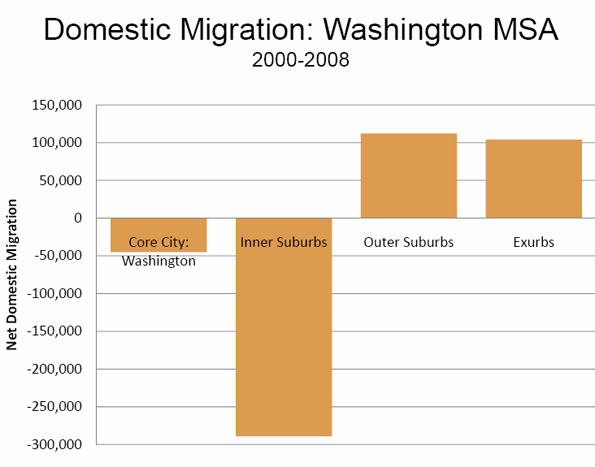
    Further, the theory of inner suburban growth is left wanting, even in the Washington area. Despite their transit improvements, between 2000 and 2008, Arlington and Alexandria lost 45,000 domestic migrants, both losing in every year except 2008 (in both cases, additions due to challenges were greater than the 2000-2007 population increase). Washington’s other inner suburbs, Fairfax County, Montgomery County and Prince Georges County are served by the same transit system (largely paid for by the taxpayers around the country), yet between them have lost another 240,000 domestic migrants between 2000 and 2008. On the other hand, the second ring suburbs have gained 112,000 migrants and the exurbs have gained 104,000 (See Figure). During the last year, the inner suburbs grew at approximately one-third the rate of the outer suburbs. And despite the subprime induced distress in the exurbs, the inner suburbs could achieve no better a rate. Analysts may trade anecdotes at coffee houses about people moving to the city or the inner suburbs from the exurbs or beyond. However, the Bureau of the Census data is clear. For every anecdote that that moves in, more than one moves out.

    The Numbers Tell it All

    When the 2008 county and metropolitan area population estimates were published a few months ago, we showed that the central counties (Note 2) continue to lose residents at a rapid rate. Among the metropolitan areas with more than 1,000,000 population, central counties lost 4.6 million domestic migrants, while suburban counties gained 2.0 million domestic migrants between 2000 and 2008. Over the past year, the core counties lost a net 314,000 domestic migrants while the suburbs gained 197,000 (Table 3).

    Table 3
    Domestic Migration: Core and Suburban Counties: 2000-2008
    Metropolitan Areas over 1,000,000 Population
      Latest Year: 2007-2008 Decade: 2000-2008
    Metropolitan Area Suburban Core Total Suburban Core Total
    Atlanta          32,925          10,126          43,051        395,836          (1,749)        394,087
    Austin          24,216          10,825          35,041        156,890          41,142        198,032
    Baltimore          (6,000)          (6,352)        (12,352)          32,952        (67,923)        (34,971)
    Birmingham            5,658          (2,356)            3,302          48,700        (25,755)          22,945
    Boston          (2,889)          (5,372)          (8,261)      (154,086)        (99,006)      (253,092)
    Buffalo             (358)          (4,127)          (4,485)          (5,933)        (48,232)        (54,165)
    Charlotte          21,327          13,060          34,387        125,223          93,513        218,736
    Chicago               921        (43,031)        (42,110)        160,765      (667,507)      (506,742)
    Cincinnati            3,803          (7,372)          (3,569)          65,905        (85,538)        (19,633)
    Cleveland               861        (15,757)        (14,896)          14,726      (141,445)      (126,719)
    Columbus            3,325             (826)            2,499          64,211        (40,624)          23,587
    Dallas-Fort Worth          62,022        (18,847)          43,175        514,011      (254,016)        259,995
    Denver          13,940            3,932          17,872          86,262        (50,881)          35,381
    Detroit        (17,020)        (45,140)        (62,160)        (53,478)      (273,695)      (327,173)
    Hartford               379          (4,065)          (3,686)          10,789        (21,639)        (10,850)
    Houston          38,559          (1,835)          36,724        279,389        (89,222)        190,167
    Indianapolis          11,747          (5,040)            6,707        113,378        (51,262)          62,116
    Jacksonville            8,723          (3,955)            4,768        101,954          20,185        122,139
    Kansas City            4,908          (3,495)            1,413          57,007        (34,481)          22,526
    Las Vegas (*)
    Los Angeles        (12,033)      (103,004)      (115,037)      (232,281)   (1,006,985)   (1,239,266)
    Louisville            4,281               818            5,099          38,420          (9,798)          28,622
    Memphis            5,986        (10,533)          (4,547)          49,979        (52,412)          (2,433)
    Miami        (18,598)        (28,399)        (46,997)          31,551      (252,098)      (220,547)
    Milwaukee               939          (7,382)          (6,443)          13,987        (86,392)        (72,405)
    Minneapolis-St. Paul            1,179          (4,619)          (3,440)          61,162        (86,920)        (25,758)
    Nashville          17,172             (547)          16,625        128,921        (19,094)        109,827
    New Orleans          (2,520)          22,856          20,336        (72,561)      (233,021)      (305,582)
    New York        (68,081)        (76,018)      (144,099)      (672,435)   (1,118,025)   (1,790,460)
    Oklahoma City            5,707             (226)            5,481          42,399        (10,302)          32,097
    Orlando          10,495          (7,342)            3,153        174,428          55,611        230,039
    Philadelphia          (9,639)        (12,209)        (21,848)          36,553      (144,849)      (108,296)
    Phoenix          22,614          28,463          51,077        117,550        411,697        529,247
    Pittsburgh            1,169          (3,601)          (2,432)            5,221        (60,564)        (55,343)
    Portland          10,641            7,355          17,996        106,163          (4,247)        101,916
    Providence          (3,983)          (6,643)        (10,626)        (13,399)        (34,136)        (47,535)
    Raleigh            6,030          23,238          29,268          35,263        132,769        168,032
    Richmond            5,625               937            6,562          76,608          (4,095)          72,513
    Riverside-San Bernardino (*)
    Rochester             (425)          (3,325)          (3,750)          (7,121)        (36,181)        (43,302)
    Sacramento            8,255          (3,731)            4,524          97,304          34,798        132,102
    St. Louis               561          (6,253)          (5,692)          17,988        (57,090)        (39,102)
    Salt Lake City            1,407          (1,164)               243          10,191        (41,646)        (31,455)
    San Antonio          10,850          11,941          22,791          69,824          84,409        154,233
    San Diego (*)
    San Francisco            4,092            1,414            5,506      (269,093)        (80,543)      (349,636)
    San Jose             (528)          (2,097)          (2,625)          (6,119)      (221,378)      (227,497)
    Seattle            7,894            3,975          11,869          61,244        (38,132)          23,112
    Tampa-St. Petersburg            8,610          (2,100)            6,510        169,346          91,106        260,452
    Tucson (*)
    Virginia Beach        (11,093)          (4,430)        (15,523)            7,486        (15,941)          (8,455)
    Washington        (16,637)          (1,622)        (18,259)        (77,894)        (43,457)      (121,351)
    Total        197,017      (313,875)      (116,858)     2,015,186   (4,645,051)   (2,629,865)
    * Indicates no suburban county(ies)
    Calculated from US Bureau of the Census data for county based metropolitan areas

    There is a simple test that the reporters and the analysts can apply. When the cores experience net domestic migration gains and the suburbs experience net domestic migration losses, only then can it be claimed that people are moving to the cores are gaining at the expense of the suburbs. The reality is that between 2000 and 2008, there was not a single instance out of the 51 metropolitan areas with more than 1,000,000 population where there was suburban net out-migration and core county net in-migration. There was one case in 2008, but it was an anomaly. The suburbs of New Orleans lost a modest number of domestic migrants, while the city gained strongly. This occurred because people moved back to the city in large numbers, after more than half left due to Hurricane Katrina.

    Spin can change perceptions, but not reality. People are not moving from the suburbs to the core cities. The reverse continues to be true, even in the worst of times.


    Note 1: Excludes New Orleans due to significant population variations from Hurricane Katrina.

    Note 2: Counties are the smallest jurisdiction for which the Bureau of the Census publishes migration data.

    Reference: Demographia 2000-2008 Metropolitan Area Population & Migration: http://www.demographia.com/db-metmic2004.pdf

    Wendell Cox is a Visiting Professor, Conservatoire National des Arts et Metiers, Paris. He was born in Los Angeles and was appointed to three terms on the Los Angeles County Transportation Commission by Mayor Tom Bradley. He is the author of “War on the Dream: How Anti-Sprawl Policy Threatens the Quality of Life.

  • Go to Oklahoma, Young Man

    One of the great migrations of Americans was from Dust Bowl Oklahoma to California during the Great Depression. People came from all over the parched plains to California; South Dakotans, Nebraskans, Oklahomans and others. But only one group had a name. No one called them Dakoties, nor Nebies, but they did call them “Okies.” Their legacy was spread by John Steinbeck’s Grapes of Wrath. Indeed, so many came to California that it enacted an “anti-Okie” law, which was duly set aside by the United States Supreme Court (Edwards v. the People of California).

    How things change. A Sacramento Bee article reports on the migration of Californians to, of all places Oklahoma and nearby states. For decades, Oklahoma has been the ultimate of “flyover country,” one of the last places people on the coast would think of moving to. Yet, as I pointed out in 2005, Oklahoma has become more competitive, at least partially because its advantages in housing costs and hassle free commuting. Moreover, it’s more than Californians. Seattle, which lost home-grown Boeing to Chicago some years ago, lost its NBA “Supersonics” to Oklahoma City last year. Having spent most of my life on the coast, I never would have imagined that Oklahoma City would become competitive with California and Seattle. But it has.

  • Did Homeowners Cause The Great Recession?

    The person who caused the current world recession can be found not on Wall Street or the city of London, but instead could be you, and your next-door neighbor–the people who put so much of their savings and credit to buy a house.

    Increasingly, conventional wisdom places the fundamental blame for the worldwide downturn on people’s desire–particularly in places like the U.K., the U.S. and Spain–to own their own home. Acceptance of the long-term serfdom of renting, the logic increasingly goes, could help restore order and the rightful balance of nature.

    Once considered sacrosanct by conservatives and social democrats alike, homeownership is increasingly seen as a form of economic derangement. The critics of the small owner include economists like Paul Krugman and Ed Glaeser, who identify the over-hot pursuit of homes as one critical cause for the recession. Others suggest it would be perhaps nobler to put money into something more consequential, like stocks.

    Homeowners also get spanked by leading new urbanists, like Brookings scholar and urban real estate developer Chris Leinberger. He lays blame for the downturn not on unscrupulous financiers but squarely on aspiring suburban home buyers. “Sprawl,” he intones, “is the root cause of the financial crisis.”

    If only we built more high-density, transit-oriented housing–which, incidentally, is not exactly thriving–the crisis could be happily resolved, he believes. This approach is echoed by big-city theoreticians like Richard Florida, who believes that both homeownership and the single-family house “has outlived its usefulness.” In his “creative age,” we won’t have much room for either single-family homes or owners. Instead, we will be leasing our ever-more-tiny cribs–just like yuppies with their BMWs–as we wander from job to job.

    To be sure, many people who bought homes in the last few years should not have qualified. Weak lending standards, promoted by both unscrupulous industry figures like Countrywide’s Angelo Mozillo as well as Congress–including the many “friends” receiving cut-rate loans from the disgraced mortgage firm–clearly made things worse.

    Yet the recent real estate debacles should not obscure the tremendous positives associated with homeownership. Widespread and diffuse ownership of property has been a critical element in successful republics, from early Rome and the Dutch Republic to the foundation of the United States. Jefferson held that “small land holders are the most precious part of a state.” In the ensuing generation, progressives embraced widespread ownership of property as central to democratic aims. Lincoln’s Homestead Act stands out as a prime example.

    Even by the 1940s, this model was only partially realized. Barely 40% of the population owned their homes. Homeownership remained confined largely to small-town denizens and the urban upper classes. No one in my mother’s family–growing up in the tenements of Brownsville, Brooklyn–even considered homeownership an achievable goal. It was hard enough simply to pay the rent and put food on the table.

    Yet by the 1960s, rising prosperity and government-subsidized loans helped most of my numerous aunts and uncles own their residence.

    Presidents from Roosevelt to Clinton all identified homeownership as a critical social goal. Government loan programs exploded as housing starts doubled in the post-war era. By 2005, the homeownership rate was approaching 70%.

    This trend also took place in other advanced countries, from the U.K. and Australia to Canada and Spain. It reflected what the Italian urbanist Edgardo Contini once referred to as “the universal aspiration.” In some cases, such as Japan, societies that had been divided between landlords and peasants for millennia now boasted a huge, and growing, cadre of small owners.

    In virtually every country, this was largely a suburban phenomenon. People bought houses where land was cheaper, stores and schools newer. Here, too, people could transcend the often confining social limits of the old neighborhood. It was also, as the novelist Ralph G. Martin, noted “a paradise for children.”

    Through all this, the chattering class never lost its contempt for homeowners and their suburban refuges. Old gentry long disliked the idea of dispersed ownership of property–even if many got rich selling their own estates to developers. Aesthetes disliked the seemingly banal housing tracts “rising hideously,” as Robert Caro put it, from the urban periphery. This critique was applied not only to Queens and Long Island but also to places like Milton Keynes or Basildon outside London, and greater Tokyo’s Chiba prefecture.

    Along with the fashion police, the new owners also took criticism from their urban betters, many of them also owners of country homes, for deserting the city. Some on the left feared the homeowners as a bastion of conservative politics. Architects, planners and developers identified them as opponents of their grand plans to refashion suburbia into a denser, more rental-oriented environment.

    Yet, despite the disdain, the dream of homeownership survived. Many boomers, who in their 1960s radical phase denounced suburban tracts as sterile and racist, meekly ended up buying homes there. So, increasingly, did middle-class minorities, whose rates of homeownership rose faster after 1994 than that of whites.

    To be sure, the financial crisis has led to a sharp drop in levels of homeownership, as occurred in the last big recession of the early 1990s. In the future, some suggest that aging boomers will force the home market to collapse even more due both to the current mortgage meltdown and changing demographics.

    Yet there are limits to how far homeownership will drop. Urban boosters, apartment-builders and greens–all advocates of expanding the renter class–tend to ignore several key facts. For one thing, the vast majority of boomers are holding onto their mostly suburban homes far longer than ever suspected. Many will remain there until forced into assisted living, nursing homes or the cemetery.

    Then we have the X generation, who, if anything, has favored large homes and exurbs in large numbers. In addition, behind them lie the large cohorts of millenials, who according to surveys conducted by generational chroniclers Morley Winograd and Mike Hais, prioritize the ownership idea even more than their boomer parents do.

    No doubt, the weak economy will slow this generation’s push into the home market. However, by the next decade, as this generation enters the late 20s and early 30s, they will find their economic footing and be ready to enter the market for houses in a big way.

    The real question then will become which companies and regions will meet the expanding demand. Over the past decade, we saw the demand for housing push middle-class families toward destinations as varied as Las Vegas and Phoenix, Austin, Houston, Dallas and Atlanta. Others have started heading to more affordable markets in the nation’s heartland, to the metropolitan areas like Kansas City, Des Moines and Sioux Falls.

    Rather than a source of economic weakness, this renewed quest for homeownership could underpin a sustainable recovery. As prices fall to reasonable levels, more people will qualify for reasonable loans. First, the empty houses and somewhat later, the condominiums now on the market will find buyers, in most places in a matter of a few years.

    This shift will create huge opportunities for a diverse set of geographies. For urban areas like New York or Los Angeles, there will be a unique–perhaps once in a generation–chance to induce middle-class people to settle down in big-city homes or condominiums. If they become homeowners, they will be more likely to stay than move elsewhere to the suburbs or other regions when the time comes to buy a home.

    Other, more affordable, less regulated and often more economically dynamic places like Texas and the Great Plains may realize even greater gains. Over time, we will likely see a recovery in some now-suffering parts of the Sunbelt. The renewal of home demand could also help revitalize many of our hardest-hit sectors, including construction and manufacturing.

    Sadly, some policymakers in Washington seem less than enthusiastic about this prospect. Many close to President Obama seem to dislike single-family homes and suburbs. Some embrace the policy which the British called “cramming,” essentially forcing people into ever smaller, denser units. Energy Secretary Steven Chu recently praised the notion of small apartments with numerous people. “You know, body heat keeps a lot of the apartment warm,” he suggested. You can’t do this in a big apartment with a few people.”

    My suspicion is that most Americans are not quite ready to become their own heaters, any more than modern farm families like having farm animals live with them–although they, too, generate warmth. Instead, we should explore less unpleasant ways to cut energy use though such things as incentives for decentralizing work, promoting home-based labor, more tree planning and effective insulation.

    An administration that places itself at odds with the “universal aspiration” that has driven growth in the advanced world for over a half-century could delay a full recovery unnecessarily. Advocacy of what amounts to declining living standards and a return to feudalism might also prove a less than successful political strategy.

    This article originally appeared at Forbes.

    Joel Kotkin is executive editor of NewGeography.com and is a presidential fellow in urban futures at Chapman University. He is author of The City: A Global History. His next book, The Next Hundred Million: America in 2050, will be published by Penguin early next year.

  • The Suburban Economy and its Enemies

    Treasury Secretary Ken Henry’s recent address to business economists was an apt prism through which to survey Sydney’s immediate past and distant future. According to reports, he said ‘the [Chinese] resources boom had produced a “two-speed” economy, with unemployment rising in the south-eastern states but falling in the west and north’. Dr Henry is reported to have told his Sydney audience, ‘I don’t think everybody in this room should be moving to Perth. But let me make this prediction: some of you will’.

    These comments serve as a reminder of how quickly the ground shifts in an open and dynamic economy. It wasn’t so long ago that New South Wales, dominated by Sydney, was dubbed the powerhouse of Australia’s extended boom.

    Even the most elaborate attempts at urban planning can be superseded by events. After all, modern Sydney was itself, until recently, shaped by forces that outpaced the bureaucrats and planners. These forces are assuming a new dynamic in the conditions described by Dr Henry. Competition from the interstate resources boom is a now major factor driving state politics, together with slowing jobs and property markets and nagging infrastructure constraints. All are feeding the momentum for revitalization – for a new phase of urban growth that will push the limits advocated by planners, environmentalists and others campaigning to turn the city’s socio-economic tide.

    The suburban economy

    There is surprisingly little acknowledgement that, overall, the transformation of suburban Sydney in the wake of globalisation has been a success story. Over the last twenty years, the middle to outer suburbs adapted to volatile domestic and international environments, as well as technological change at breakneck speed, with an effective model of economic development. The key point is that this had more to do with the interplay of space and mobility than good planning.

    By no means was this inevitable. Sydney could have succumbed to the downside of what urban theorists call the ‘world city’ phenomenon. According to the research group Globalisation and World Cities (GaWC), world cities are major international hubs with stronger ties to the global economy in terms of capital flows, trade and movement of people and information than to their own hinterlands. GaWC ranks Sydney in the second or ‘beta’ echelon of world cities, along with places like San Francisco and Mexico City (Melbourne is ranked in the third or ‘gamma’ echelon). Hence Sydney’s ‘global arc corridor’, which stretches from Macquarie Park south to the CBD’s gleaming towers and onto Sydney Airport and Port Botany, hosts the cream of the country’s finance, legal and business services, information technology, engineering and marketing industries.

    Some world cities are distinguished by vast disparities in wealth and economic opportunity – between such globally oriented zones, sucking up the region’s capital, infrastructure capacity, skills base and government services, and stagnant hinterlands inhabited by struggling workers in declining, marginal industries or masses of unemployed. But that was not Sydney’s fate.

    Why and how did a viable economy develop in the middle to outer suburbs of the city? To answer this question it is necessary to recall some of the constants of Sydney’s recent history. The gradual emergence of global Sydney generated higher land values throughout the inner-city. Consequently, many inner-city land uses associated with nineteenth century transport nodes, such as the light industrial plants, depots and warehouses clustered near the railway junction south of the CBD or along the harbour foreshores of the inner-west were no longer sustainable in the face of escalating demands for office space and gentrification.

    Combined with the growth of motor vehicle mobility for passenger and freight transport, particularly since the 1950s, this led to the transfer of many industrial, transport and warehousing activities to cheaper land on the western and south-western fringes. At that stage of the city’s evolution, there were relatively few restrictions on the acquisition of space for these and related purposes. And the growth of road transport relative to maritime and rail sealed the necessary links to international gateways on the eastern seaboard, like Sydney Harbour, Port Botany and the airport.

    These trends were intensified by the construction of a road network to service the interstices of Sydney’s nineteenth century ‘hub-and-spokes’ or radial railway lines, culminating in the orbital motorway network (the dreaded ‘tollways’). Not only did motor vehicle mobility facilitate industrial dispersion, but also residential settlement adjacent to the new industrial jobs. The radial railway lines were Sydney’s nineteenth and early twentieth century template; the orbital motorway is the city’s contemporary template.

    As in the case of industrial relocation, there were fewer restrictions on residential development for the workers employed in these dispersed industries (this began to change by the mid-1990s). Inexpensive housing, a mild climate, out-door lifestyles and a preference for detached houses on sizeable blocks were also attractions. Over time western Sydney achieved 75 per cent regional employment self-containment, and key travel patterns are now intra-regional.

    Later phases of globalisation reinforced this spatial pattern. The rise of global Sydney was a major driver, at least since the early 1980s, of economic policies that favoured the liberalisation of economic activity. Naturally, this had repercussions across the rest of the city. One fundamental outcome was the expansion of services – such as retail – relative to manufacturing and commodities as a proportion of the national economy. The appearance of diverse service industries in the outer suburbs was yet another function of space and mobility. In western Sydney, this was closely associated with the region’s booming population growth. From the 1970s to recent times, western Sydney’s population growth outstripped the rest of the city and country.

    By the early 1990s, market oriented reform had ushered in a period of low inflation, interest rates and input costs, the latter having been wrung from difficult reforms to energy and other public utilities. The interaction of steady economic and population growth powered a strong consumer economy linked to settlement of the fringe suburbs. Such areas experienced a boom in residential and commercial construction, and the related demand for household fixtures, appliances and goods.

    These conditions unleashed a thriving small business sector in services, operating in a competitive market characterised by low entry barriers (low costs and overheads) and narrow profit margins. This, too, was a by-product of globalisation, as SGS Economics and Planning explain: ‘The concentration of small business activity in NSW (and Sydney) and the more rapid growth in the share of employment in this sector compared with other parts of Australia may reflect the tendency for heightened fragmentation of supply chains in globally engaged economic regions’. Presumably, this is why Mark Latham harped on about ‘the small business-people, the contractors, franchisees and consultants of the new economy’.

    While market pressures caused the ‘unbundling’ of service providers, advanced information and communications technologies were integrating head office, back office, manufacturing and distribution activities in land extensive facilities like the 50,000 plus square metre Coles Myer and Coca Cola distribution centres at Eastern Creek, and, in a different way, cutting-edge business and technology parks like Norwest and Macquarie Park. These facilities, contiguous with the orbital motorway, are creatures of space and motor vehicle mobility, and always will be.

    That is why the best elements of the NSW government’s City of Cities plan represent responsive rather than prescriptive planning; they reinforce successful trends emerging from the interplay of market forces. Plans for intensive commercial development along orbital motorway corridors, such as the M7 and particularly at its intersection with the M4, dubbed ‘the western Sydney employment hub’, the refocus on important western centres like Parramatta, Liverpool and Penrith as ‘regional cities’, and the series of road-rail transport interchanges (also land extensive) are prime examples.

    Its enemies

    This vibrant though vulnerable web of socio-economic connections is always at the mercy of global conditions – witness the impact of petrol prices – but also increasingly under challenge from domestic political actors, principally environmentalists, urban planners, some property developers and opinion makers. Their determination to freeze urban boundaries and, as far as possible, reduce mobility to public transport capacity, particularly rail, is hurting Sydney. Hopefully, their influence is gradually receding under Morris Iemma’s leadership.

    Environmentalists and planners – two increasingly interchangeable categories – are oblivious to the prospect that their creeping regulations and imposts, and misallocated resources, could unravel the suburban economy. Yet they will always struggle to mobilise public opinion. Their all-purpose pretext, the climate change hypothesis, relies on aggregated data which can’t be used to argue particular cases. Take the NSW government’s recent decision to review the costly ‘energy efficiency building sustainability’ rules. While the Housing Industry Association came to the issue armed with a raft of statistics about price impacts and falling housing starts, green outfits like the Total Environment Centre could do little but sputter the magic words ‘greenhouse’ and ‘global warming’. They were not in a position to show why, how and to what extent this particular decision would exacerbate climate change.

    Their other weapon is the peculiar concept of ecological or urban ‘footprint’. This purports to measure how much productive land and water an individual, a city, a country, or humanity requires to produce all the resources it consumes. On this measure, Sydney has a footprint that covers 49 per cent of NSW or 150 times its actual size, so its expansion must be constrained. The notion that wealth can be equated to an amount of land, however, is a throwback to pre-modern times. In advanced economies, wealth creation has more to do with the elaborate transformation of natural inputs, capital accumulation, forms of business organisation and services. And as one scathing writer points out, the concept fails to acknowledge that a stretch of land can be used for several different purposes simultaneously. Nevertheless, this absurd idea continues to pass unmolested into almost every discussion of urban planning, including City of Cities.

    If environmentalists are taken seriously at all, it is because they ride on the back of vested interests who benefit from artificially inflated land values, since this is the inevitable consequence of restricting new releases. Alan Moran of the Institute of Public Affairs argues that the reluctance of governments to burst the bubble of housing unaffordability by releasing more land for development can be traced to the undue influence of existing property owners, including powerful developers, who stand to suffer a capital loss if the scarcity value of land is diminished. It is a case of the ‘haves’ depriving the ‘have nots’, such as low income earners and young first home buyers.

    Then there are the progressive academics and commentators who insist the suburbs are zones of social alienation, inimical to personal contentment and well-being. Consider the Australian Financial Review’s property writer Tina Perinotto, who opposes sprawl because we can’t afford the ‘psychologists to deal with people who end up in the lonely greenfield sites’, or left-wing writer Natasha Cica, who raves about ‘the aesthetic and ethical slums of McMansion affluenza’, or Sydney Morning Herald planning and architecture writer Elizabeth Farrelly, who calls suburbanisation ‘total-indulgence parenting’, or urban policy academic Brendan Gleeson, who believes ‘shadows of fear and antipathy are spreading across’ the suburbs.

    Progressives clearly feel a need to delegitimise suburban life. This stems from their barely suppressed rage against people they can’t control. Like Kurtz in Joseph Conrad’s Heart of Darkness, suburban people have strayed too far from civilisation, they contend, and will lose their minds. Yet they fail to explain why surveys indicate an overwhelming preference for detached housing on sizeable blocks, or why the latest Australian Unity Wellbeing Index registers higher rates of happiness amongst suburban people than their inner-city counterparts.

    The left’s new poster-boy of urbanism, Gleeson, in particular, leads a tortured existence: he idealises suburbs as the nation’s ‘heartlands’ while hating almost everything about them. Gleeson has latched on to the emergence of so-called ‘gated’ communities as ‘harmful to collective democratic purpose’. This sort of socio-economic segregation is a recognised downside of the ‘world city’ scenario, especially in developing countries. In Sydney, however, it is more likely to mark a transitional stage of historically disadvantaged areas attracting more prosperous residents, eager to replicate the superior amenity of affluent suburbs. To the extent that it heralds the arrival of generally higher living standards in these localities, it is not necessarily the evil denounced by Gleeson.

    Of course, the enemies of growth don’t give a damn about the storm clouds perceived by Dr Henry. Sooner or later, however, they will bow to the inevitable: space and mobility made Sydney’s past; they will make the city’s future, if it is to be a future worth having.

    This article originally appeared at The New City Journal