Category: Demographics

  • America’s Four Great Growth Waves and the World Cities They Produced

    There have been four great growth waves in American history. In each case, there was an attractive new frontier, which not only drew migrating waves of people seeking new opportunity, but also developed large new bases of industry, wealth, and power. These waves have also created top-tier world cities in their wake. The first three of these waves were:

    1. The Boston, New York, Philadelphia, Baltimore, Washington DC corridor was America’s original land of opportunity, industry, wealth, and power. New York was the big winner, and DC and Boston still do quite well.
    2. The rise of the agricultural and industrial Midwest, including Chicago, Detroit, Pittsburgh, Cleveland, and St. Louis. The fall here has been a hard one as manufacturing moved abroad, but Chicago still stands as a world-class city produced during the region’s heyday.
    3. The great westward migration, mostly focused on California, but with ancillary growth in adjacent and west coast states. This migration started well before World War 2, but really took off after the war, and produced two top-tier mega-metros – Los Angeles and the San Francisco Bay Area – and several successful second-tiers like Seattle, San Diego, Las Vegas, and Phoenix.

    These waves are not clearly distinct, but overlap each other. As one region matures and starts to level off, the next region starts its growth wave. And that’s the situation now as California shows clear signs of having peaked: gigantic tech and housing crashes plus economic and domestic outmigration as tax, cost-of-living, housing, and regulatory burdens rise and a dysfunctional government teeters towards financial collapse.

    The fourth wave is increasingly clear and follows the same California model of a single focus mega-state and an ancillary region: Texas and the new South.

    Just as California had its pre-war growth surge, Texas had its first real growth waves with the 20th-century post-Spindletop oil boom. California had the dust bowl migration of the 30s, and Texas the oil boom migration of the 70s. But the real super-surge has become clearer in the new century as California hands off the baton to Texas. This growth wave really covers much of the South, but Texas is the 800lb gorilla vs. states like Georgia and North Carolina, just as California dominates over Washington, Nevada, and Arizona. Texas even looms over Florida, which certainly has experienced incredible population growth to become the fourth-largest state, but has had considerably less success with building industry, wealth, and power. Florida’s wealth – like that of Arizona – comes in part from people who built wealth elsewhere but moved or bought a second home there. Neither place is home to many Fortune 500 headquarters, an area where Texas has excelled.

    California had its agriculture and oil barons before WW2, but the real story there was the post-war rise of the entertainment, defense, aerospace, biotech, trade and technology industries. In a similar way, Texas’ oil tycoons are just the tip of the coming surge of wealth and power in industries such as technology, health care, biotech, defense, trade, transportation, aerospace, finance, telecom, and alternative energy in addition to traditional oil and gas (in fact, Texas is the #1 wind power state).

    The great cities emerging from this new wave are Atlanta, Dallas-Ft.Worth, and Houston. They dominate the census growth stats (Houston story), and all indications are that Houston will pass Philadelphia in the 2010 census to join Dallas-Ft.Worth in the top 5 metros along with New York, Los Angeles, and Chicago. DFW and Houston are even approaching the combined San Francisco Bay Area population of 6.1 million, and Texas passed California and New York for the #1 ranking in the Fortune 500 HQ rankings last year.

    Want more evidence? Check out this impressive video on the DFW-Austin-San Antonio-Houston Texas Triangle with an overwhelming list of statistics that make the case. In the video, they refer to the region as the 18m-strong “Texaplex” – a play on the “Metroplex” nickname for Dallas-Ft. Worth. You can also see their Texaplex informational brochure here (pdf).

    When you look at it in this historical context, it’s clear Texas and the new South will be the focal point of America’s growth for at least the next few decades. History also says at least one, and possibly more, truly top-tier world cities will emerge from this wave – and it could be argued that some have already. It’s easy to get caught up in the day-to-day hubub and crisis-of-the-moment, but take a minute to stand back and see the big picture. Those living in or moving to Texas and the new South are part of a great historical wave that’s just starting to really take off, the same as being in Chicago at the turn of the 19th-century or in California after WW2. Pretty cool, eh?

    Tory Gattis is a Social Systems Architect, consultant and entrepreneur with a genuine love of his hometown Houston and its people. He covers a wide range of Houston topics at Houston Strategies – including transportation, transit, quality-of-life, city identity, and development and land-use regulations – and have published numerous Houston Chronicle op-eds on these topics.

  • Millennials’ First Recession

    Each generation has been affected differently by the deepening global recession. Baby boomers have witnessed their retirement savings evaporate into oblivion. Generation X families who finally saved enough for a down payment on their first house find themselves deep underwater without SCUBA gear. And earnest Millennials fresh out of college are wondering where all those high-paying jobs promised by duplicitous corporate recruiters went.

    No doubt the economic collapse is most palpable for the Boomer generation. Closing in on retirement, many are now holding off on purchasing that winter home in Florida. Moreover, many Boomers have no other choice but to delay retirement (provided they have managed to keep a job) in order to maintain current lifestyles.

    Ironically, this may not be too much of a stretch for the ‘forever young’ generation who has come to define themselves by their occupations. Yet this does pose a problem from those who are actually young and currently entering the workforce.

    Over the past few months I have witnessed many of my 20-something peers lose their jobs – not to mention me as well. This contradicts the popular, yet flawed notion that ‘technologically savvy’ Millennials are rendering older workers obsolete. It is clear now that upper management at corporations across the country have opted for a more conservative approach to hunkering down. This includes letting go of those with less experience (low on the company ladder) and closing the door completely to new hires out of college.

    Justin Pope of the Associated Press has confirmed that college graduates face the worst job market in years. As is indicated in Pope’s article, employers plan to hire 22% fewer graduates this spring – an alarming statistic reported from a survey conducted by the National Association of Colleges and Employers.

    Perhaps one of the more unnerving new realities spawned by the recession is what appears to be the diminishing returns to education. Even those graduating with J.D. or M.B.A. degrees find themselves in panic mode. Traditionally, these prestigious degrees meant relatively high salaries right out of grad school. Yet with law firms laying off in droves and corporations slashing entry-level positions, not only do graduates with fresh Master’s degrees find themselves without any job prospects, many are stuck with exorbitantly high student loan bills.

    So what are Millennials doing to ride out the storm? Those who do have jobs are hanging on for dear life. Some are applying to graduate school with the hopes that the economic climate will be better by the time they graduate. Others, like 26 year-old Michael Kaainoni have opted to move back home.

    After graduating from Columbia University with a Masters in Architecture degree last year, Michael landed a job at a large international architecture firm in Manhattan. Only months later, he found himself caught in a wave of corporate downsizing. Rather than scrape by and continue to pay ridiculous New York City rents, Michael opted to move back to his hometown of Kailua, Hawaii. Now living back in Hawaii, he works for a local architecture office that gets steady commissions from the government.

    Michael’s story is not uncommon for young people these days. The Millennial generation does not share the same horror about moving back home as the rabidly ‘independent’ Boomers or Gen Xers. Rather than seeing a retreat back to the nest as taboo, many Millennials will tell you that this is just smart financial planning.

    In many ways the Millennials may be following not the boomers but the experience of immigrants. For decades strong family networks have allowed immigrants to the U.S. to become ‘upwardly mobile’ despite all sorts of disadvantages from lack of English fluency to discrimination. Now that this secret is out into the mainstream consciousness, the ‘going it alone’ mentality is rapidly disappearing. Familial and community support networks are making a strong comeback out of financial necessity – and probably for the better.

    Writer Tamara Draut focuses on the financial plight facing young people today in the book “Strapped: Why America’s 20- and 30-Somethings Can’t Get Ahead”. In her book, Draut explains why young people in the workforce might seem too eager to get ahead:

    “If today’s young adults can be accused of wanting it all too soon, the ‘it’ isn’t riches, gadgets, or luxury cars. The elusive ‘it’ that today’s twenty-somethings are after is financial independence, and then hopefully, financial security.”

    Derided as the ‘everyone gets a medal’ generation by cultural commentators who believe that young people today have a bloated sense of self-esteem, most Millennials just want to live secure, modest lifestyles. This observation goes against everything that civic boosters and urban real estate speculators have hoped for during the recent boom years.

    With the notion that lifestyle trumps employment, urban planners have been deluded into thinking that by turning cities into expensive playgrounds, they will attract the best and the brightest young workers. This was an idea touted by urban theorist Richard Florida in his highly influential book “The Rise of the Creative Class”. Florida claims that, according to his focus groups, young creative people do not want to live in places that “do not afford a variety of ‘scenes’”.

    The idea that young people can choose their city at will based on lifestyle preference does not make much sense given the current economic circumstances. Job opportunity and affordability, not to mention family ties, are more likely to dictate where young people end up settling now and in the immediate future.

    Furthermore, many of the ‘lifestyle amenities’ – such as cool coffee shops, farmer’s markets, and culturally diverse restaurants – desired by these young creatives can now be found in more affordable environments outside of the traditional urban core.

    By the time this recession is over, Millennials may have passed their ‘city phase’. This spells bad news for places that have banked on spurring a renaissance driven by young people who often like urban settings but can no longer afford the luxury. Neighborhoods like San Francisco’s SoMa or downtown Los Angeles could be the losers. Cities completely missed the boat by allowing greedy real estate developers to build expensive condos for a largely ephemeral surge of Boomer empty nesters while ignoring basic issues like quality of life, safety and affordability.

    Millennials will bounce back. As the youngest generation in the workforce, they will be defined by the experience of the current economic slump and take its lessons with them throughout their lives. Instead of greed and selfishness, which is likely to define the Boomer legacy, Millennials will more likely resemble that of their grandparents’ generation – one where family and frugality is valued over individuality and self-interest.

    Adam Nathaniel Mayer is a native of the San Francisco Bay Area. Raised in the town of Los Gatos, on the edge of Silicon Valley, Adam developed a keen interest in the importance of place within the framework of a highly globalized economy. He currently lives in San Francisco where he works in the architecture profession.

  • Is the Census Now a Target for a GOP War On Science?

    The 2010 Census makes a convenient political target since its findings define so much of where federal aid – now the country’s one true growth industry – is apportioned as well as legislative seats in states and nationally. Yet after an abortive attempt to hijack the Census by narrowly focused Democratic groups, cooler heads have now prevailed in the White House.

    President Obama has nominated Dr. Robert M. Groves – who currently leads one of the most prestigious social science research centers in the country, the University of Michigan’s Survey Research Center, Institute for Social Research – to be Director of the U.S. Census Bureau. Dr. Groves epitomizes the values of non-partisan science and was previously appointed by and served under President George H.W. Bush as an Associate Director at the Census Bureau from 1990–1992. President Obama also has made it clear that Dr. Groves will report to the Secretary of Commerce, Gary Locke, as he should, and not to the overtly partisan White House chief of Staff, Rahm Emanuel.

    Now the danger to the integrity of the Census is coming from the other direction: the right-wing of the Republican Party. Rep. John Boehner, the House Republican Leader, expressed “concern” about the selection of Dr. Groves. Boehner said the nominee “reportedly advocated a scheme to use computer analysis to manipulate Census data, rather than simply conducting an accurate count of the American people.” Boehner was referring to Dr. Groves’ membership on an eleven-member expert panel of senior Census Bureau staff that reviewed the results of a post-census survey, the Post Enumeration Survey (PES), which measured the accuracy of the 1990 census at the request of President Bush’s Census Director, Barbara Bryant. All but two of the panel’s members recommended that the PES results be used to adjust (not replace) the initial census count. Based on the panel’s suggestion, in mid-1991 Dr. Bryant recommended a statistical adjustment of the census to Republican Secretary of Commerce Robert Mosbacher, who promptly rejected the recommendation.

    Other Republicans go much further than Boehner in their criticism of the selection of Dr. Groves. They want to prevent the use of scientifically proven statistical sampling techniques that will insure a complete tabulation of those who are hardest to count, primarily minority populations and immigrants. Rep. Patrick McHenry (R-NC), the Ranking Member on the subcommittee with jurisdiction over the census, said Dr. Groves’ nomination signaled that President Obama “intends to employ the political manipulation of census data for partisan gain. Mr. Groves is a leading advocate for partisan data manipulation.”

    In truth, the party seeking most to gain partisan advantage in the 2010 census count is now Rep. McHenry’s GOP. Secretary Locke has already testified during his Senate confirmation hearing that the 2010 census plan did not include consideration of statistical adjustment for purposes of apportioning each state’s seats in Congress. This conforms to the Supreme Court’s 1999 ruling, but leaves open the possibility of using such techniques to gain valuable insights into the demographic details of America’s population.

    In contrast, leading Democratic interest groups that originally intended to take a partisan stance on the census, have largely acquiesced to the President’s decision. At the same time non-partisan research groups, ranging from the Council of Professional Associations on Federal Statistics to the American Association for Public Opinion Research, have endorsed Dr. Groves’ nomination. These groups, whose professional needs require an accurate census, said Dr. Groves “has demonstrated the scientific capacity and leadership to run the 2010 Census and other programs at the Census Bureau.”

    In this age of technology, it is perhaps not surprising that the methodologies by which we conduct the Census have become something of a political football. But politicians in both parties need to understand that it’s in everyone’s interest to make sure that every person is present and accounted for in America’s decennial civic endeavor, the 2010 census.

    Morley Winograd and Michael D. Hais are fellows of the New Democrat Network and the New Policy Institute and co-authors of Millennial Makeover: MySpace, YouTube, and the Future of American Politics (Rutgers University Press: 2008), named one of the 10 favorite books by the New York Times in 2008.

  • Michigration Revisited

    Only a few months ago, I admonished Michigan for its hysteria about brain drain. Given the recent news coverage concerning the exodus from the recession-plagued state, you might expect I’m ready to eat some crow. On the contrary, I’m here to report that Michigan has learned nothing from its past mistakes.

    Richard Herman, an advocate for increasing rates of immigration to the Rust Belt, posts on his blog the same critique I have aired about how Michigan addresses its talent crisis:

    However, the current focus on “brain drain” as the source of the problem misses the real issue.

    While no doubt the Midwest economy is causing college grads who might otherwise want to stay home to leave, in an ever more mobile society, moving out is a natural part of people’s lives. Indeed, if you read the typical account of how the elite global knowledge worker lives, you often hear about people flitting from place to place to place chasing opportunity.

    The real problem is not that too many people are leaving, but rather that too few are coming. It isn’t an outflow problem, it’s an inflow problem.

    The former urban industrial powerhouses of the United States all suffer from the same malaise. Every city is fixated on its local labor pool, asking institutions of education to staff the “factory.” The great irony is that economic growth doesn’t happen without immigration or domestic in-migration. There is no story of a great metropolis that successfully barred its people from leaving.

    The tortured metaphor for brain drain stems from private enterprise. But even in the arena of human resources, the concept of churn isn’t an anathema:

    The purpose of this article is to open your mind about the silliness of measuring only aggregate turnover. I can think of no better indication of a so-called expert’s lack of true understanding of employee turnover than when I read an article or a book on retention and the author invariably expounds on the need to keep everyone.

    The burgeoning narrative is that churn benefits both employee and employer. The same is true for resident and state. Fear of the outsider prevents all parties from making a rational choice and improving human welfare.

    Michigan should embrace its out-migration and aggressively seek new residents. I further recommend any reference to “retention” be abolished from official policy. Where, and how many, graduates go is largely immaterial. Instead of Cool Cities to keep Michigan talent instate; what would it take to get the next generation of engineers from Colorado schools or Asia to move to the Rust Belt?

  • A California Wedding

    My wife and I attended a wedding on a recent past weekend. It was a beautiful event in a beautiful setting: city of Atascadero, county of San Luis Obispo, on California’s central coast. We drove through spectacularly beautiful wine country to get there. The weather was beautiful. A beautiful young couple exchanged vows in the backyard of the groom’s childhood home, where his mom still lives.

    Beautiful setting, wonderful people
    Two beautiful families became one big extended family. It was a beautiful atmosphere: loving, warm and generous of spirit. Every single person I encountered during the weekend impressed me as a beautiful, wonderful individual, and that’s not just the champagne talking. Even the exes got along beautifully, and that was a good thing, because my god, there were a lot of them.

    Demographics rears its head
    As a demographer I was cognizant of several overlapping trends that were manifesting themselves. The bride is an only child. The bride’s mom (let’s call her “Betty”) is an only child. Two of Betty’s exes were present, including the bride’s father (an only child), as was her current husband (a childless only child). Everyone is seemingly on wonderful terms with ex-spouses, ex-spouses’ intervening and current partners, and everyone else.

    The bride’s father (let’s call him “Jack,” because this is going to get complicated), after his marriage to Betty, was then married for a while to a woman (let’s call her “Jane”), who was also present. One of Jane’s previous husbands was a guy (oh hell, let’s call him “Peter”) who is here by dint of multiple connections, having grown close with the bride as a counselor, and as a former business partner of the bride’s father, Jack.

    Jack and Jane not only married with Peter’s blessing, they got married in Peter’s house, the same house in which he (Peter) and Jane had gotten married ten years previously. They all get along wonderfully as well. Jack is here, by the way, with current partner “Louise,” a lovely person who, for my demographically analytical purposes, is divorced and childless (forgive me Louise, that sounds worse than it should). Betty’s other ex in attendance is, we’ll say, “Randy,” who is here with, oh, “Melody,” also previously divorced. They make a really sweet couple, and are both childless.

    Peter and Jane have an only child we’ll call “Helen.” She was the maid of honor. Also in attendance are the bride’s (married and as yet childless) good friends “Mary” and “Andrew” (an only child).

    Peter is a relationship counselor; this must come in handy. We are all staying at Peter’s serene and beautiful vineyard compound, the grounds of the Center for Reuniting Families, a retreat where he offers individuals, couples and families a place to heal themselves and their relationships. This is coastal California, after all.

    So let’s see:
    “Betty” has two exes here (Jack and Randy);
    “Jack” has two exes here (Betty and Jane);
    “Jane” has two exes here (Jack and Peter);
    “Peter” has two exes here (Jane and “Linda”).

    Who is Linda? Linda lives at the compound, as do a few of her exes and current partner. Linda and her only child run a bakery together and made the spectacular, beautiful wedding cake.

    The groom’s divorced parents are also on wonderful terms, and it showed on the day when it all came together.

    I guess my wife and I are the outliers. We are still in a long-lasted first marriage and have four siblings between us who can say the same. We do have an only child, though; each of our four siblings has two each.

    I am not a native Californian, but my wife is, and her mother and grandmother can claim nine marriages between them.

    We do have an only child, but during the 1970s we did belong to the National Organization for Non-Parents, which promoted the notion it was okay to be childless. The founder also eventually had a child and formed a new organization to promote the notion that single children were okay too. God, we baby boomers.

    Implications, Reflections
    What does it all mean? Well, the first thing that occurs to me is that statistics on marriage, divorce and remarriage don’t really capture the whole picture. Many people believe the divorce rate is 50%, but the divorce rate is not even measured or expressed as a percentage figure; it’s the number of divorces per 1,000 of population in any given year. In 2005, the most recent year for which data are available, the US divorce rate was 3.6, the lowest level since 1970. (The peak was 5.3 in 1981.) And California was not the state with the highest divorce rate; that distinction went to Nevada, at 6.4, followed by Arkansas at 6.3 and Wyoming at 5.3.

    The reason so many people think the divorce rate is 50% is because for any given year of the past many decades, the number of divorces (and hence, the divorce rate) has been about half the number of marriages (and thus half the marriage rate). For example, in 2005 there were about 2.2 million marriages in the US (resulting in a marriage rate of 7.5), and about 1 million divorces (and a divorce rate of 3.6).

    It’s hard to state the percentage of marriages that end in divorce, because there are few longitudinal studies done tracking the same married couples over time, and the percentage which divorce will increase the longer the time frame. But I have read a figure of approximately 33%, which if true would mean that two-thirds of first marriages do not end in divorce. On the other hand, the divorce rate is down because the marriage rate is down, and for the first time in our history, the percentage of households comprised of married couples has fallen below 50% (and thus, no longer a majority of households).

    [The exact 2005 numbers: of the nation’s 111.1 million households, 55.2 million, or 49.7%, were made up of married couples, those with or without children. The rest were single households, unrelated cohabitating households, or other non-traditional households.]

    What about the kids?
    The second thing I can tell you is that the statistics reveal nothing about the level of happiness out there. The people I saw this weekend were about as happy, content and well-adjusted a group as I’ve ever seen. Not that they haven’t gone through their share of heartbreak, difficulty, sorrow, challenge and crisis (no small amount of which relating to children!). Our daughter, in her 20s, tells us she does not know of a single contemporary who is not dealing with one or more “issues” (therapy, medication, psychoanalysis, depression, bipolar disorder, drug use, eating disorders, cutting, to name a few). And if you’re going to say these problems are most prevalent in the populations that can afford them, I’ll agree.

    Still, the incidence of single children and childlessness might be a concern. Demographers Ben Wattenberg and Nicholas Eberstadt have written of a future world of declining fertility and birth rates, leading to eventual declines in population. They’re concerned because population growth is the foundation of modern economies and welfare states, and if populations of the rich, advanced, educated, industrialized, developed countries are not growing (and they are not, except for the notable exception of the US), then who will reproduce and replenish? Increasingly, they fear, people at odds with the modern world.

    And what will be the effect on families in a world where the only biological relatives for many people will be their ancestors?

    Demographer Phillip Longman puts it more bluntly in his book The Empty Cradle. Childbearing has become a sucker’s game, he writes: parents are supposed to provide society with a steady new supply of well-bred individuals (educated, moral, balanced, sober, disciplined, productive citizens), in exchange only for the psychic rewards. No wonder the birthrate is falling. Or was, until 2007. In that recent year there were a record 4.3 million births in the US, the most since 1957 (the middle of the Baby Boom). The fertility rate (the average number of children born to each woman over her lifetime) rose to 2.1 (the level needed to maintain current population size), the highest since 1971.

    Of course by 2050 half of the 400 million Americans projected to be alive will be what are now considered ethnic and racial minorities. That doesn’t bother you, does it?

    But none of it was a concern this particular weekend. Everything, and everyone, was beautiful. Even the traffic on the 101 returning to Los Angeles was not that bad. This doesn’t have the look or feel of decline, but if it is, it’s been a beautiful ride.

    Dr. Roger Selbert is a trend analyst, researcher, writer and speaker. Growth Strategies is his newsletter on economic, social and demographic trends; IntegratedRetailing.com is his web site on retail trends. Roger is US economic analyst for the Institute for Business Cycle Analysis in Copenhagen, and North American agent for its US Consumer Demand Index, a monthly survey of American households’ buying intentions.

  • World Urban Areas and Population Projections

    Our colleague and frequent NewGeography contributor Wendell Cox of Demographia.com recently released the latest edition of his World Urban Areas and Population Projections publication.

    This 5th comprehensive edition includes:

    • Ranking of the largest world urban areas (over 2,000,000 population).
    • Population, urban land area and density estimates for all 763 identified urban areas with more than 500,000 population, comprising 49 percent of the world urban population.
    • Population, urban land area and density estimates for 1,370 urban areas of all sizes, comprising 53 percent of the world urban population.
    • Population projections for the world’s largest urban areas in 2025 & 2030 (over 2,000,000 population).
    • Summary of United Nations world population projections and summary by gross domestic product, purchasing power parity (from 4th Edition)
    • Charts on urban density and prosperity (from 2nd Edition)
    • Documentation

    Check it out.

  • The American Suburb Is Bouncing Back

    From the very inception of the current downturn, sprawling places like southeast California’s Inland Empire have been widely portrayed as the heart of darkness. Located on the vast flatlands east of Los Angeles, the region of roughly 3 million people has suffered one of the highest rates of foreclosures and surges in unemployment in the nation.

    Yet now George Guerrero, a top agent at Advantage Real Estate in Chino Hills, says he can see the light, with sales picking up and inventories finally beginning to drop. “There’s been a real surge in sales,” Guerrero says. “The market has come back to where it should be. I think we are ahead of the curve here of the overall recovery.”

    Of course, for the moment, much of this growth is concentrated in foreclosure sales. However, even developers of new properties, such as Brookfield Homes , also report a strong uptick in sales. In his new developments in the Inland Empire, notes Adrian Foley, head of Brookfield’s Los Angeles area office, sales are up 150% since six months ago.

    Although the economy is still hurting, the housing trend has become much more positive. Statewide, existing home sales have jumped 30% over the past year, taking the inventory from an estimated 16.7 months to less than seven months. In Chino Hills, it is down to six months.

    Most encouraging, this activity is taking place exactly where the market was hit hardest in the beginning – in the suburbs and at the lower end of the market, which in the Inland Empire means between $150,00 to $300,000. This could presage the resurgence of the suburbs and the prospects for the middle and working classes once again to purchase their piece of the American dream.

    Nor is this merely a Californian phenomenon. Nationwide, existing home sales – predominately in the suburbs – have been on the rise for the last few months. The strongest growth is occurring in Sunbelt markets in Arizona, Nevada and Florida, as well as in California. These places experienced some of the greatest surges in prices, which forced many buyers to turn to subprime and interest-only loans.

    These loans are largely not available today, Guerrero notes. Instead of financial quackery, lower prices – sometimes as much as 50% below peak – are allowing new buyers to buy affordably. In 2007, Inland Empire median house prices were roughly seven to 10 times the average annual income of potential buyers. Now they are settling close to the historic norm of three times.

    But not everyone will be happy to see life return to the suburban housing tracts. Indeed, for some self-proclaimed urbanists, planners and pundits, this development might seem almost nightmarish.

    Long the Rodney Dangerfield of American geographies, suburbs have never been popular with the country’s intellectuals, academics and planners. The destruction of community, racial segregation, expanding waistlines and a host of environmental sins – from consuming too much gas to helping create global warming – all have been blamed on the suburbs.

    When the mortgage crisis first hit, some urbanists, not surprisingly, were quick to blame the suburbs – instead of Wall Street – for the financial meltdown. With energy prices on the rise, they persuaded themselves and the ever-gullible mainstream media that the long-awaited “back to the city” jubilee was imminent.

    In contrast, the suburbs and exurbs, crowed Brookings’ Chris Leinberger, were soon to become “the new slums.” As the middle classes trudged their way back to Boston and other suitably dense big cities, James Howard Kunstler – the “shock jock” of the new urbanist movement and a leading apostle of the “peak oil” thesis – happily proclaimed, “Let the gloating begin.”

    Yet as George Guerrero could tell them, a dream is not a thing so easily destroyed. The American landscape continues to change, but perhaps not entirely in the ways so eagerly projected by urban boosters and their media claque.

    For one thing, even with the higher energy prices of last year, there seems to be, in fact, no notable shift of population to the urban core. Instead, as demographer Wendell Cox has pointed out, the recession may have slowed migration, but the trend toward the suburbs and sprawling Sunbelt cities has not ended or reversed.

    At the same time, the once-widely ballyhooed market for dense urban living has unraveled. The “gospel of urbanism” may be accepted as such by most of the mainstream press, most notably The New York Times and Atlantic Monthly, but on closer examination the new religion has limited numbers of converts. In many locales – from Massachusetts to Los Angeles – inner-city condominium projects are losing value at least as much or more than suburban single-family houses. In San Diego, for example, condo prices have dropped in some developments by 70% since 2007, twice the decline in the overall market.

    The problem has much to do with timing. In many areas, urban condominium developers continued to build even as the economy soured, largely due to the longer lead times and financing arrangements around such projects. Yet as the prices of houses have dropped many potential condominium dwellers have opted to purchase single-family homes – or are sitting anxiously on the sidelines waiting for prices to drop further.

    As a result, foreclosure rates for condominiums, according to the Federal Deposit Insurace Corp., are on average one-third higher than for single-family residences. You do not have to travel to the outer exurbs to find zones of foreclosures, bankruptcies and the turning of ownership properties to rentals. Towers are either unoccupied or have gone to rental in markets as diverse as Miami, central Atlanta and downtown L.A. Even Chicago, the poster child for urban gentrification, now suffers from abandoned “condo ghost towns.”

    Manhattan, too, which long saw itself as immune to the housing downturn, is now experiencing the most precipitous price decline since 1980. Big urban developers across North America are filing for bankruptcy, including the largest private landowner in downtown Los Angeles, just like suburban builders were last year.

    As someone who lives in – if you consider L.A. a city – and likes cities, I do not greet the urbanization of the housing crisis as an unalloyed positive. Yet one can hope that lower prices and interest rates – as well as the administration’s tax credits for up to $8,000 for first-time buyers – could allow more people to consider an urban option, if that’s what they want.

    However, this will not be where the bulk of the action will take place. Surveys consistently show that between 10% and 20% of people want to live in dense cities. In a country that will gain 100 million people over the next four decades, that’s 20 million, not exactly what you’d call chopped liver.

    But the bulk of growth will continue to be in the ‘burbs. The main reason is simple enough for almost anyone but a planning professor, architect or pundit to comprehend: preference. Virtually every survey reveals that the vast majority of Americans – and around 80% of Californians – prefer single-family homes that generally are affordable only in suburban areas. The fact that jobs have also continued to move inexorably to the periphery – as a newly released Brookings report demonstrates to liberal think tanks’ own undisguised horror – makes living in the ‘burbs even more attractive.

    These trends lead developers like Randall Lewis in Upland, Calif., who has suffered the downturn in the Inland Empire, not to dismiss the suburban future. He takes note of a recent 10% to 20% surge in sales among the 18 projects his company is now working on, all in suburban projects in California and neighboring states.

    “The basics of the suburbs are still there,” Lewis suggests. “Schools are important, but also people like the sense of place. But the basic amenities are children, grandchildren, where people go to church, where their work networks and friends are.”

    Lewis also rightly adds that a somewhat different suburbia will emerge from the crash. It will be a “melting pot,” he suggests, “not just by race, but by ages and lifestyle.” You will see more singles, empty-nesters and retirees as people choose to “age in place” close to where they have settled. There likely will be more smaller-lot, townhouse and other mixed-density developments closer to burgeoning suburban job centers.

    But even as they change, the allure of suburbs – and the single-family house – will not fade and could even grow as they develop more city-like amenities. The fundamental desire to own a place of your own, to possess some private space and a relatively quiet environment has not died. Nor is it likely to without the imposition of a draconian planning regime.

    For right now, it’s all enough to make George Guerrero a born-again optimist. “There’s something healthy just beginning to happen out here,” he says. “This time people with good credit are getting good deals at good prices. It’s a wonderful thing to see.”

    This article originally appeared at Forbes.

    Joel Kotkin is executive editor of NewGeography.com and is a presidential fellow in urban futures at Chapman University. He is author of The City: A Global History and is finishing a book on the American future.
  • Borderline Reality

    For years, economic and social observers have taken to redrawing our borders to better define our situation and to attempt to predict the future. Maybe you thought the global financial meltdown has raised anxiety levels in the United States quite enough. But a Russian professor’s decade old prediction of national disintegration suggests much worse on the way.

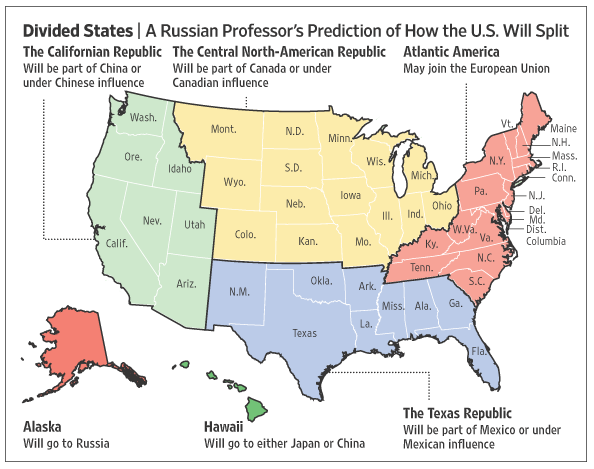
    Prof. Igor Panarin, a 50-year-old former KGB analyst and a dean of the Russian Foreign Ministry’s academy for future diplomats, estimates there’s a 45-55% chance that the United States will disintegrate like the Soviet Union did sometime in 2010. Mass immigration, economic decline and moral degradation will trigger civil war, the collapse of the dollar and massive social unrest. This in turn will lead to the U.S. breaking into six blocs — with Alaska reverting to Russian control – and other foreign powers grabbing other pieces.

    Panarin’s new map of the United States puts the “Californian Republic” under China’s influence, “the Texas region” under Mexico’s. Hawaii will come under Japanese or Chinese rule, East Coast states will join the European Union, while central northern parts of the US will gradually come under Canada’s influence.

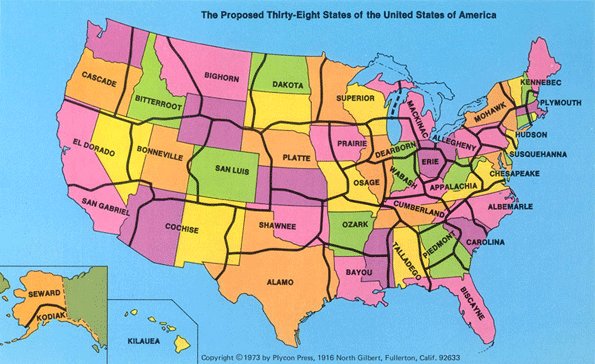
    A less sinister revision of the states that comprise the republic occurred in the 1970s when geography professor C. Etzel Pearcy proposed redrawing the borders of the US states, reducing them from 50 to 38. Pearcy’s framework casts aside the convenience of determining boundaries by using the land’s physical features, such as rivers and mountain ranges, or by the simple usage of latitude and longitude. Instead, his realignment gives high priority to contemporary population density, location of cities, lines of transportation, land relief, and size and shape of individual States.

    In the current fiscal climate some see the new 38 state map as inspired. According to Pearcy, 25% of the expenditures by states can be attributed to the fixed costs associated with the support and maintenance of state governments themselves. For at least some states this kind of savings could be very appealing right now.

    Rethinking, reimagining and then redrawing the borders of maps is by no means a new or even fruitless endeavor. That some if not many borders are where they are for seemingly meaningless or irrational reasons is obvious. Mark Stein’s How the States Got Their Shapes, for example, documents how natural features like rivers come together with the dreams and schemes of people to create today’s jigsaw puzzle of states. Gerrymandering borders for political, economic or religious reasons is both a historical and contemporary reality.

    Any economic planner or strategist worth their salt understands, of course, that borders on a map seldom represent or hold sway over how the real economy operates. Sure there are tangible differences in taxes, regulation and all the things that make up a business environment. But like water, economic activity goes where it wants and finds its own level. This has lead to an increasing amount of policy attention being given to cross-border territories of regions, zones, corridors, clusters, networks and the like.

    North America Re-Imagined
    One of the more reasoned, enduring efforts to make sense of a borderless economic and cultural landscape is Joel Garreau’s landmark work on the The Nine Nations of North America. My 27 year-old copy’s dust jacket asks the reader to forget the traditional map and consider the way North America really works because new realities of power and people are remaking the continent.
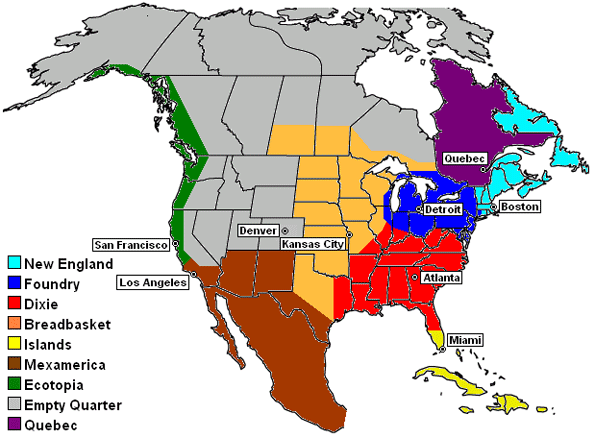

    A recent conference on USA/Canada cross-border economies in the Great Plains confirmed that Garreau’s analysis continues to influence thinking on regionalism. The longevity of his regions lies not only on their basis in actual data but also tied to the distinct “prisms” though which each nation sees the world.

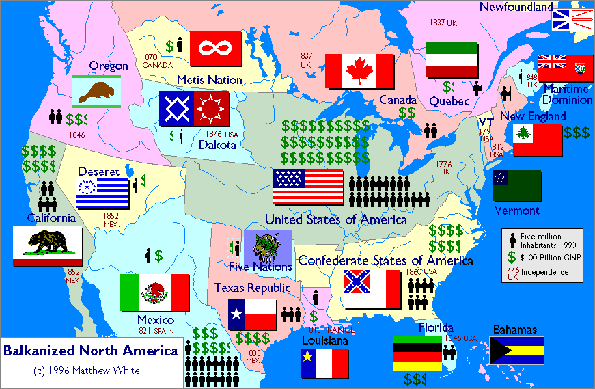
    What could have been in North America, instead of how things really are, is the subject of Matthew White’s 1997 map of a balkanized continent. Here the basic premise is that, in an alternate history beginning in 1787, the westward expansion of the Anglo-American people proceeded pretty much as it did, but the United States government just couldn’t hold the country together against separatists.

    How North America really works and how that is manifested spatially has generated growing interest of late and is reflected in the emergence of cross-border networks and organizations. The government of Canada recently issued an exhaustive report titled The Emergence of Cross-Border Regions Between Canada and the United States: Reaping the Promise and Public Value of Cross-Border Regional Relationships. Here the interest is certainly not on redrawing the borders but on recognizing and building on shared socio-cultural values and furthering relationships between businesses, first and foremost, and universities.

    Mostly a bottom-up phenomenon, these cross-border regional relationships are evidenced by the growth of both informal relationships and formal networks and a rise in cross-border regional co-operative mechanisms. From a policy standpoint the existence of cross-border regions requires new ways of thinking about development, going well beyond our parochial perspective. And this sort of thinking is important because regions – like economic fields of activity – represent the primary theatre in which most activities of international trade and economic integration actually take place.

    Map Forth
    Thematic maps that reconfigure our geography can intrigue and fascinate us. They are really, as some have said, graphic essays that portray spatial variations and interrelationships of geographical distributions. As noted by Norman Joseph William Thrower in Maps and Civilization: Cartography in Culture and Society, thematic maps use the base data of coastlines, boundaries and places, only as point of reference for the phenomenon being explained.
    Sometimes maps can inspire and motivate us by helping to more fully understand the geography of our economic and demographic challenges and opportunities. Perhaps most importantly thematic maps tell a story about places. Some describe the way things really are now while others express a vision of the future. In both cases they can be a graphical point of departure for plans and actions that help us to make the places we inhabit better places to live and work.

    Delore Zimmerman is president and CEO of and publisher of Newgeography.com

  • Move to Suburbs Continues in Western Europe

    Despite the assertions of some planners and urban boosters, urban core population loss has been the rule since mid-century throughout the metropolitan areas of Western Europe (see note below). For example, the ville de Paris lost a quarter of its population from 1954 to 1999, Copenhagen shrank 39 percent from 1950 to 1991, inner London (This includes the 13 inner boroughs and the “city” of London, which are roughly the former London County Council area) declined by a third from 1951 to 1991 while Milan‘s population declined by a quarter from 1971 to 2001.

    At the same time, widely ignored by many American observers, Western Europe has been suburbanizing strongly. Since 1965, virtually all major metropolitan area growth has been in the suburbs. Indeed the share of the metropolitan area population gains in the suburbs has been greater in Western Europe than in the United States.

    It is true, however, that there has been a generally modest turnaround in core population trends, with strong turnarounds in the “ancient” losers of Vienna (which peaked in 1911) and inner London (which peaked in 1901). It might be tempting to suggest – as is often done in the United States – that these reversals indicate that Europeans are moving back to the cities from the suburbs.

    To answer this question, we examined all of the available “components of population change” reported by the census authorities of Western European nations. Seven of the 17 (the European Union-15 plus Norway and Switzerland) produce such data at a geographical level that makes metropolitan analysis possible. A review of this data suggests that the new residents are largely international migrants and that the core cities generally continue to lose domestic migrants, while the suburban areas continue to perform better with respect to attracting domestic migrants. This parallels the experience in the United States.

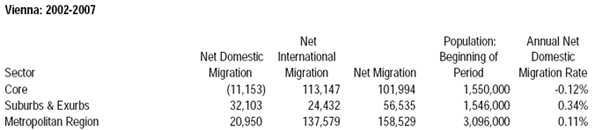
    Vienna: Vienna illustrates the trend. The city of Vienna increased its population from 1,550,000 to 1,656,000 between 2002 and 2007. This 7.3 percent gain is impressive but over the same period, a net 11,000 residents left the city. Virtually all of the population increase was the result of international migration, which accounted for 113,000 new residents. On the other hand, the suburbs of Vienna added 32,000 new domestic migrants and also added 23,000 international migrants. Vienna’s population turnaround can be fully attributed to immigration.

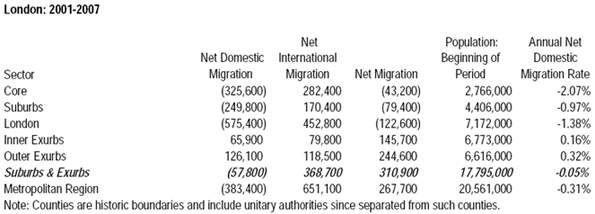
    Inner London and England: Like Vienna, inner London’s gains have not been the result of people moving from the suburbs to the city. Between 2001 and 2007, a net 326,000 people moved from inner London to other parts of England and Wales. The domestic migration losses were even larger than the gain of 282,000 from international migration. The inner suburbs (the outer boroughs added to the city in the 1960s) also lost domestic migrants, but at a rate half that of inner London. The exurbs (the two rings of counties outside the Green Belt) added 126,000 domestic migrants and a somewhat larger number of international migrants.

    Overall, the London metropolitan region experienced a net domestic migration loss of more than 383,000 between 2001 and 2007. However, there were strong international migration gains, in every sector of the metropolitan area.

    Thus, the data indicates that the recent inner London population growth is not the result of suburbanites moving to the city. Inner London’s population growth is being driven by international migration and the natural increase in population (births minus deaths).

    As with inner London, the cores of Birmingham, Manchester, Liverpool, Newcastle and Leeds-Bradford all lost domestic migrants from 2001 to 2007. Thus, despite the improved population performance of the largest metropolitan areas in the United Kingdom, people continue to move out of the cores, while people are generally moving to suburban areas.

    Milan and Italy: The city of Milan, the core of Italy’s largest metropolitan area, has experienced one of Western Europe’s most significant population losses since the early 1970s. Yet, in the early years of the decade, Milan has experienced a turnaround, as the population has begun to grow. The pattern was much the same as seen in London, with a net 40,000 residents leaving Milan province to move to other parts of Italy. At the same time, there was a strong net international migration gain of 168,000. Suburban areas, on the other hand, attracted a net 119,000 domestic migrants as well as a strong component of international migration.

    A shorter data series is available for cities (communes) and shows net domestic migration losses in the central cities of Milan, Rome, Naples, Turin, Genoa, Palermo, Florence and Bologna. The suburbs, however, gained domestic migrants, with the exception of Naples. However, the Naples suburban losses were at a far lower rate than that of the city.

    It is thus evident that the core areas of the largest Italian metropolitan areas are not receiving net migration from their suburbs.

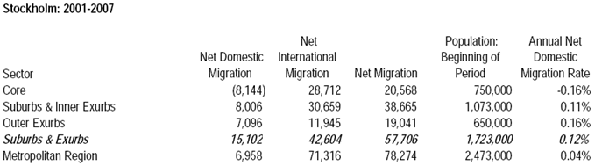
    Stockholm and Sweden: Similarly, the city of Stockholm’s recent gains have not been the result of migration from the suburbs. Between 2001 and 2007, the city lost a net 8,000 domestic migrants. This loss was more than made up by the international net migration of 29,000. At the same time, the suburbs and exurbs gained 15,000 domestic migrants.

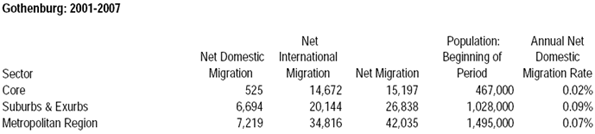
    Sweden’s second largest metropolitan area, Gothenburg, was one of only two of the 19 cases in which there was net domestic migration to the core (which had been enlarged in the 1990s to include many suburban areas). The city gained 500 domestic migrants and 15,000 international migrants. However, the suburbs gained approximately 13 times as many domestic migrants than the city, again indicating no trend of movement from the suburbs to the city.

    Helsinki: Finland’s capital mirrors the general trend. The city of Helsinki lost 6,500 domestic migrants between 2002 and 2007, which was more than compensated for by an 11,800 net international migration gain. As in nearly all of the other cases, the suburbs and exurbs gained domestic migration, illustrating that there is not a movement from the suburbs to the city in Helsinki.

    Oslo: Norway’s capital was, with Gothenburg, the only core experiencing net domestic migration. Oslo County gained 5,400 domestic migrants. However, the suburbs and exurbs gained domestic migrants at a greater rate, adding 16,000. Thus, despite the core domestic migration gains, there is no evidence of a “return” from the suburbs and exurbs to the city in Oslo.

    Conclusion: The available data from national census authorities provides no evidence to suggest any sort of general movement of the population from suburban and exurban areas to the central cities of Western Europe. This mirrors the situation in the United States, where interests that hold the suburbs in contempt continue to declare their death, while the latest data continues to show the opposite – strong domestic migration losses in core areas and gains in the suburbs.

    There is one other key factor in the European case: the enlargement of the European Union in 2004, which increased the national membership from 15 to 25 (and subsequently to 27) and allowed for the mass migration of people from the east to the wealthier west. Whether the international financial crisis may reverse this trend, with many Eastern European residents moving back to their native countries, remains an open question.


    Note on European metropolitan areas: There is no European standard for determining metropolitan areas (which are labor markets). The European Audit’s “Larger Urban Zones” (LUZ) are the closest approximation, but are not consistently defined throughout the European Union. For example, the Naples LUZ includes only the core and inner suburbs, an area far smaller than the functional metropolitan area. Many other larger urban zones include suburban and exurban areas, consistent with the concept of a metropolitan area.

    Wendell Cox is a Visiting Professor, Conservatoire National des Arts et Metiers, Paris. He was born in Los Angeles and was appointed to three terms on the Los Angeles County Transportation Commission by Mayor Tom Bradley. He is the author of “War on the Dream: How Anti-Sprawl Policy Threatens the Quality of Life.

  • Rust Belt Outliers

    What kind of migration patterns will emerge as a result of the current economic downturn? The recession is uneven; some places are much worse off than others. Those differences can give labor cause to move. Economic geographer Edward Glaeser thinks cities with marginal manufacturing legacies should attract a lot of people because the well-educated, living in dense urban environments, should get through the crisis relatively unscathed. If Glaeser is correct, then shrinking Rust Belt cities can expect more of the same even after the recovery begins in earnest. Pittsburgh brains should continue to drain.

    Ironically, the latest US Census data indicate that the population decline in the Rust Belt is slowing as a result of less out-migration. A contracting economy has, according to demographer William Frey, helped to stop the bleeding from cities such as “Buffalo, N.Y., Pittsburgh and Cleveland.” One of the cited factors for decreasing geographic mobility is the collapse of the real estate market. Job seekers are stuck in their current place of residence.

    Another pressure to stay put is the economic climate of typical Sun Belt destinations such as Charlotte, NC or Phoenix. Unemployment there might be much worse than what you are seeing in your current location. There is no reason to move because the situation is bad everywhere. The “pull” factors have all but disappeared.

    Of course, evaporating home equity and massive layoffs throughout the country are not mutually exclusive. These two forces could be working in concert to stem the tide from struggling Rust Belt cities and the explanation of the waning migration is quite reasonable. But I’m not so sure it makes sense in the case of Pittsburgh.

    During the mortgage meltdown, the Pittsburgh real estate market has remained remarkably resilient. While foreclosures have decimated Cleveland, Pittsburgh’s prudent financial industry stayed away from bad loans. Pittsburgh is now rated as one of the most stable real estate markets in the entire country. Home ownership isn’t holding back the out-migration of Pittsburghers.

    As for unemployment, the job market is much better in the Pittsburgh region than it is in Charlotte, NC. That’s why solvent financial institutions in Southwestern Pennsylvania are advertising employment opportunities in Pittsburgh South (a.k.a. Charlotte). For those with the ability to relocate, Pittsburgh has a much better job market than Charlotte.

    But if we are talking about Pittsburgh out-migration, we should mention Washington, DC, the #1 destination for those seeking better opportunities than they can find near home. Charlotte is pretty far down that list. Sun Belt economic distress is causing Pittsburghers not to migrate as much to the sunbelt, thus pinpointing the reason for the dramatically falling (from the 2005 peak) net out-migration. In contrast, DC is still a viable job market, with numbers trending towards population gains.

    Are more people moving to Pittsburgh? Few seem to consider the possibility. Perhaps William Frey has access to out-migration data that aren’t public, which is why he lumped Pittsburgh in with Cleveland and Buffalo. But less out-migration doesn’t mean that there isn’t more in-migration. Pittsburgh attracting more talent from other regions would be news.

    Despite the manufacturing legacy that Glaeser details, there are Rust Belt cities that have bucked the population trends. Chattanooga, historically an industrial river city much like Pittsburgh, has begun to grow again after decades of shrinking. Pittsburgh isn’t necessarily doomed to being a shadow of its former self and may well separate even more than it already has from the Rust Belt pack.

    Staying with Glaeser’s observations, the economic geography of Pittsburgh might help us understand why migration fueled growth is possible. Manufacturing cities tend to lack a critical mass of highly educated talent and economic activity is less concentrated. Among Midwestern cities, Pittsburgh’s gains in college attainment since 1970 “have been the most rapid.” Pittsburgh’s human capital assets are much improved. And despite the obvious sprawl, Pittsburgh also enjoys considerable economic density. Its college corridor is just five-miles long, connecting downtown with the University of Pittsburgh and Carnegie Mellon University. Internationally renowned research universities are located in close proximity to the central business district.

    Might the above assets translate into greater in-migration? Perhaps, but the odds are against it. However, something unusual is going on in Pittsburgh. Whether or not that will inform job growth and economic development remains to be seen.

    Read Jim Russell’s Rust Belt writings at Burgh Diaspora.