Category: Demographics

  • More than Two-thirds of the Nation Still Lives in Their Home State

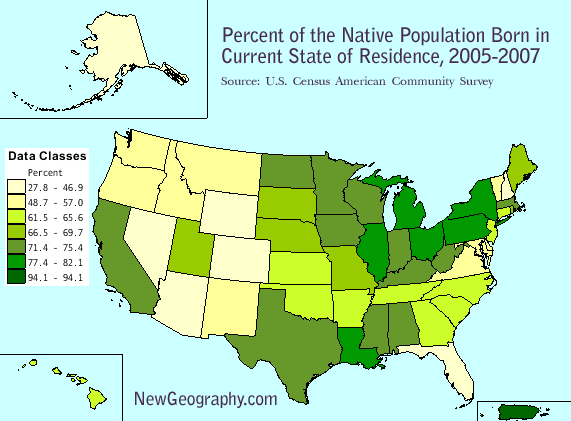
    In which states do folks tend to stay home? Here’s a look at Americans still living in their birth states. New York and Louisiana top the list. Upwards of 82% of the US-born residents living in New York and Louisiana were born there. Looking at the map, you can see that the highest numbers reside in the rust belt and northeast. The most transplants tend to live in natural amenity rich western states, except for California.

    More than 72% of US born Californians were born in the state. That number is over 74% in LA county, but only about 60% in San Diego. Other high transplant areas include New Hampshire and Vermont in the northeast, and not surprisingly the Washington DC area, Florida, and Nevada.

    Only 41.7% of US born Alaskans were born there. I suppose if you are living in Alaska, you’ve come there for good reason.

    Take a look at an extension of this analysis: Does a low number of home staters mean everyone has left?

    Percent of Native Population Born in their Current State of Residence
    Geographic area Percent Margin of Error
    New York 82.1 +/-0.1
    Louisiana 82 +/-0.2
    Michigan 80.6 +/-0.1
    Pennsylvania 79.6 +/-0.1
    Ohio 77.8 +/-0.1
    Illinois 77.4 +/-0.1
    Iowa 75.4 +/-0.3
    Wisconsin 75.3 +/-0.2
    Massachusetts 74.7 +/-0.2
    Minnesota 73.8 +/-0.2
    Kentucky 73.6 +/-0.2
    Mississippi 73.4 +/-0.3
    Alabama 73.2 +/-0.3
    West Virginia 72.9 +/-0.3
    Texas 72.3 +/-0.1
    North Dakota 72.1 +/-0.4
    California 71.8 +/-0.1
    Indiana 71.4 +/-0.2
    Nebraska 69.7 +/-0.3
    Missouri 68.9 +/-0.2
    Utah 68.5 +/-0.3
    Rhode Island 67.9 +/-0.6
    South Dakota 67.5 +/-0.5
    United States 67.3 +/-0.1
    Maine 66.5 +/-0.5
    Hawaii 65.6 +/-0.5
    New Jersey 65.4 +/-0.2
    Tennessee 65 +/-0.2
    Oklahoma 64.8 +/-0.2
    North Carolina 64.1 +/-0.2
    Connecticut 64 +/-0.3
    Arkansas 63.8 +/-0.3
    South Carolina 63.4 +/-0.3
    Kansas 62.7 +/-0.3
    Georgia 61.5 +/-0.2
    New Mexico 57 +/-0.4
    Virginia 56.3 +/-0.2
    Montana 55.3 +/-0.5
    Maryland 54.6 +/-0.3
    Vermont 54.5 +/-0.5
    Washington 53.7 +/-0.2
    Oregon 50.2 +/-0.3
    Delaware 50 +/-0.6
    Idaho 48.7 +/-0.4
    Colorado 46.9 +/-0.3
    District of Columbia 45.5 +/-0.7
    New Hampshire 44.4 +/-0.4
    Wyoming 43.3 +/-0.8
    Alaska 41.7 +/-0.6
    Arizona 41.7 +/-0.3
    Florida 41.4 +/-0.1
    Nevada 27.8 +/-0.4

    Source: U.S. Census Bureau, 2005-2007 American Community Survey

  • Musings on Urban Form: Is Brooklyn the Ultimate City?

    It’s clear we need a new lexicon for emerging urban forms that are neither urban nor suburban in character. Yet when you raise that issue, you elicit some strongly held views — most of them negative — about whether anything other than a “real city” with its bad sections, panhandlers, and industrial areas can qualify as urban.

    I feel it is increasingly difficult to make such distinctions. This is particularly true as we observe the rapidly changing character of inner-ring suburbs in particular, as well as the innumerable “new towns” that have sprouted up in what would otherwise clearly be suburban or even exurban locales.

    One commenter suggested, thusly, that places like my home town, the City of Falls Church, Virginia, lacks the “authenticity” to be a real city:

    Planned and tightly controlled cities are not “real”.

    Real cities have panhandlers.
    Real cities have plenty of Class-D space.
    Real cities have ethnically diverse populations.

    Call me in 30 years and by then the City of Falls Church may be a real city

    Ironically, based on the foregoing litmus test, Falls Church is two-thirds of the way toward being a “real” city. It has both panhandlers and at least some “Class-D” space; however, it admittedly lacks an ethnically diverse population. As to the assertion that “real” cities are neither “planned” nor “tightly controlled,” with the exception of perhaps Houston, Texas, I cannot identify a single city in America that was not planned, and the extent to which growth is “tightly controlled” in these real cities is certainly subject to debate.

    So what makes a real city? On a recent visit to Brooklyn, once largely considered a suburban appendage to New York, I found what is perhaps the standard-bearer of what it means to be a “real” city. And, if anything, Manhattan is arguably becoming an “appendage” to Brooklyn.

    I suspect that the average person knows that the City of New York – comprised of five boroughs including Manhattan and Brooklyn – is the most populous city in the United States (although there are some who mistakenly believe it is the City and County of Los Angeles, confusing Los Angeles County’s population with that of the city by the same name). In fact, if Brooklyn were an independent jurisdiction – which it was until 1898 when it was consolidated with New York City – it would be the country’s fourth largest after New York, L.A. and Chicago, with a residential population exceeding 2.5 million. Interestingly, that number represents an increase of over 275,000 people since 1980 (277,884 to be exact, which is more than the entire population of St. Paul, MN), although it represents an overall decrease in population since Brooklyn reached it residential apex in 1950 at over 2.7 million.

    Moreover, based on population density, with over 35,600 residents per square mile (2,528,050 residents as of 2006, in a 71 square mile area), Brooklyn would be the densest city in America.

    By contrast, the population density of the rest of New York City (which includes somewhat less dense Queens and positively suburban Staten Island), San Francisco (at over 16,000 residents/sq. mi.), Chicago, Boston, Philadelphia, and Washington, D.C. – in that order – are all denser than L.A., which has a population density of less than 8,000 residents/sq. mi. or approximately 22% of the density of Brooklyn. Consider Brooklyn’s Brown-Wood Cemetery: If its “residents” were alive today, it would be the 24th largest city in the U.S., just ahead of Seattle but slightly behind Milwaukee.

    But neither total population nor population density makes the case for my suggestion that Brooklyn is America’s quintessential city, ahead of even Manhattan. First, Brooklyn reflects a much more holistic melding of complimentary land uses, with residential, commercial, institutional, recreational, and retail and entertainment in close proximity of each other in many of its neighborhoods.

    Manhattan, on the other hand, is much more Balkanized, with its various land uses much more clustered together, to the point of edging out other, potentially complimentary uses. That is not to say that there are no residential neighborhoods in Manhattan per se: However, Manhattan, like many of San Francisco’s nicer neighborhoods, is a great place to live only if money is not an obstacle. Finally, Manhattan has a much-more transitory culture, whereas Brooklyn has become a preferred place for “New Yorkers” of modest to moderate means to settle down and raise a family.

    Like a model city, Brooklyn manages to accommodate its density extremely well. First of all, like San Francisco, Brooklyn is a city of neighborhoods. Bedford Stuyvesant, Bensonhurst, Coney Island, Flatbush, Park Slope and Williamsburg are some of the more notable among Brooklyn’s 32 neighborhoods. It is remarkable, given Brooklyn’s density, that much of its housing stock is comprised of three and four-story brownstones, along with mid-rise apartment and coop buildings. For example, Park Slope and Carroll Gardens, with a combined neighborhood population of almost 105,000 (slightly more residents than South Bend, Indiana and just under the population of Clearwater, Florida), have a wonderful scale both to their residential streets and their main commercial thoroughfare, 5th Avenue. They achieve a very walkable and synergistic mix of homes and businesses, as well as public and institutional uses.

    However, it is arguably the incredible diversity of Brooklyn’s residents that define it as a “real” city. Less than 35% of the population of Brooklyn is white/non-Hispanic, over 36% is Black or African-American, and almost 20% is Latino or Hispanic. Almost 38% of Brooklyn’s population was born somewhere other than the U.S., almost 47% speak a language other than English at home, and a total of 110 ethnic origins are represented among its population.

    The median income in Brooklyn is just under $30,000 per year. However, the median price of a home (all types) is $490,000. The median price for co ops is $267,500, representing approximately 25% of the housing market. The median-priced condo is $514,216, representing approximately 28% of the market. Just under half of the Brooklyn for-sale market is comprised of one- to three-family dwellings, with a median sales price of $584,250. Not surprisingly, however, most of Brooklyn’s housing stock is rental housing.

    Without a doubt, Brooklyn is the melting pot of the world, with a tremendous amount of social, ethnic, and economic diversity, all coexisting in a 71 square mile area. So while there may be disagreement about how to best characterize the City of Falls Church in the suburban-to-urban spectrum, Brooklyn establishes the benchmark for a “real city,” even if it is not, in fact, a city in the legal sense of the word.

    Peter Smirniotopoulos, Vice President – Development of UniDev, LLC, is based in the company’s headquarters in Bethesda, Maryland, and works throughout the U.S. He is on the faculty of the Masters in Science in Real Estate program at Johns Hopkins University. The views expressed herein are solely his own.
  • Reviving the City of Aspiration: A Study of the Challenges Facing New York City’s Middle Class

    For much of its history, New York City has thrived as a place that both sustained a large middle class and elevated countless people from poorer backgrounds into the ranks of the middle class. The city was never cheap and parts of Manhattan always remained out of reach, but working people of modest means—from forklift operators and bus drivers to paralegals and museum guides—could enjoy realistic hopes of home ownership and a measure of economic security as they raised their families across the other four boroughs. At the same time, New York long has been the city for strivers—not just the kind associated with the highest echelons of Wall Street, but new immigrants, individuals with little education but big dreams, and aspiring professionals in fields from journalism and law to art and advertising.

    In recent years, however, major changes have greatly diminished the city’s ability to both retain and create a sizable middle class. Even as the inflow of new arrivals to New York has surged to levels not seen since the 1920s, the cost of living has spiraled beyond the reach of many middle class individuals and, particularly, families. Increasingly, only those at the upper end of the middle class, who are affluent enough to afford not only the sharply higher housing prices in every corner of the city but also the steep costs of child care and private schools, can afford to stay—and even among this group, many feel stretched to the limits of their resources. Equally disturbing, even in good times, the city’s economy seems less and less capable of producing jobs that pay enough to support a middle class lifestyle in New York’s high-cost environment.

    The current economic crisis, which has arrested and even somewhat reversed the skyrocketing price of housing, might offer short-term opportunities to some in the market for homes. But the mortgage meltdown and its aftermath will not change the underlying dynamic: over the past three decades, a wide gap has opened between the means of most New Yorkers and the costs of living in the city. We have seen this dynamic play out even during the last 15 years, as the local economy thrived and crime rates plummeted. Despite these advances, large numbers of middle class New Yorkers have been leaving the city for other locales, while many more of those who have stayed seem permanently stuck among the ranks of the working poor, with little apparent hope of upward mobility. This is a serious challenge for New York in both good times and bad. A recent survey found the city to be the worst urban area in the nation for the average citizen to build wealth. For the first time in its storied history, the Big Apple is in jeopardy of permanently losing its status as the great American city of aspiration.

    This report takes an in-depth look at the challenges facing New York City’s middle class. More than a year in the works, the report draws upon an extensive economic and demographic analysis, a historical review, focus groups conducted in every borough and over 100 individual interviews with academics, economists and a wide range of individuals on the ground in the five boroughs. These include homeowners, labor leaders, small business owners, real estate brokers, housing developers, immigrant advocates, and officials from nearly two dozen community boards.

    Throughout the course of our research, the vast majority of New Yorkers—for the most part fierce defenders of the city—were alarmingly pessimistic about the current and future prospects of the local middle class. “What middle class?” was the quip we heard repeatedly after telling people about our study.

    But for all the valid concerns of those we spoke with, our conclusion is that a strong middle class remains in New York, and that there are considerable grounds for optimism about its future. In 2007, the city recorded the second highest total of building permits issued since it started keeping track in 1965, with Brooklyn and Queens hitting records—a clear sign that large numbers of people want to live in these long-time middle class havens. Home ownership rates in the city reached their highest levels ever in 2007, another testament to the city’s desirability—even if a not insignificant share of the recent housing purchases were driven by unfair and deceptive predatory lending practices. And in many communities, there have been long waiting lists for day care centers and private schools. While the economic crisis is already leading to sharp spikes in foreclosures, a precipitous decline in housing sales and, most troubling, a massive number of layoffs, it should not reverse the sense of many middle class families that New York now offers a safe environment to raise their kids—a key factor in the decision to stay in the city rather than decamp for the suburbs.

    “The perception of New York among young people is so phenomenal,” says Alan Bell, a partner with the Hudson Companies, a real estate development company that has built housing from the East Village to the Rockaways. “It used to be that automatically you’d get married and had kids and you were out to Montclair, New Jersey or Westchester. Now they want to stay. The question is how they stay since it’s so expensive.”

    Set against this picture of progress, however, are some alarming trends. Most of the people interviewed for this report told us of middle class friends, relatives or colleagues who had recently given up on the city. “I work with a lot of people who moved to Philadelphia and commute each day,” says Chris Daly, a media director at Macy’s who now lives with his wife and three kids in Tottenville, Staten Island but plans to move to New Jersey. “It’s the cost of living. You’re going to see more people moving to Philadelphia, the Poconos and commuting.”

    Unless we find ways to reverse some of the trends detailed in this report, the New York of the 21st century will continue to develop into a city that is made up increasingly of the rich, the poor, immigrant newcomers and a largely nomadic population of younger people who exit once they enter their 30s and begin establishing families. Although such a population might sustain the current “luxury city”—as Mayor Michael Bloomberg famously described New York—it betrays the city’s aspirational heritage. Further, a New York largely denuded of its middle class will find it nearly impossible to sustain a diversified economy, the importance of which is clearer than ever in light of the current finance-led recession.

    As a final consideration, a large and thriving middle class has always provided the ballast that a great city requires. Throughout modern history, such cities at their height—for example, Venice in the 15th century and Amsterdam in the 17th—have nurtured a large and growing middle class. But no city has had a greater history as a middle class incubator than New York. As the legendary urbanist and long time New York resident Jane Jacobs once noted: “A metropolitan economy, if working well, is constantly transforming many poor people into middle class people, many illiterates into skilled people, many greenhorns into competent citizens… Cities don’t lure the middle class. They create it.”

    Although some may suggest that this is a role New York can no longer play, we believe it is one that the city needs to address if it is to remain a truly great city.

    Released by Center for an Urban Future, this report was written by Jonathan Bowles, Joel Kotkin and David Giles. It was edited by David Jason Fischer and Tara Colton, and designed by Damian Voerg. Mark Schill, an associate with Praxis Strategy Group, provided demographic and economic data analysis for this project. Additional research by Zina Klapper of www.newgeography.com as well as Roy Abir, Ben Blackwood, Nancy Campbell, Pam Corbett, Anne Gleason, Katherine Hand, Kyle Hatzes, May Hui, Farah Rahaman, Qianqi Shen, Linda Torricelli and Miguel Yanez-Barnuevo.

  • Report: Ontario, CA – A Geography for Unsettling Times

    These are unsettling times for almost all geographies. As the global recession deepens, there are signs of economic contraction that extend from the great financial centers of New York and London to the emerging market capitals of China, India and the Middle East. Within the United States as well, pain has been spreading from exurbs and suburbs to the heart of major cities, some of which just months ago saw themselves as immune to the economic contagion.

    Without question, the damage to the economies of suburban regions such as the Inland Empire has been severe. Foreclosures in San Bernardino and Riverside Counties have been among the highest in the country, while drops in real-estate related employment have resulted in the first net job losses in four decades. This has led some critics to suggest that the entire area is itself doomed, destined to devolve along with other suburban regions to “the new slums”.

    Yet our close examination of both short and longer-term trends suggests these perspectives are wildly off-base. For one, it is critical to separate different parts of the Inland region from one another. A place like Ontario retains many characteristics that make it far more able than other locales in the region to resist the negative trends. These advantages include a diversified economy, a powerful local job center, an excellent business climate and, most of all, a location perfectly positioned along the historic growth corridors of Southern California.

    These assets have already allowed Ontario to weather the current storm far better than many other Inland Empire areas. Foreclosure rates, for example, although far too high, have remained considerably below the average for the region, and far below those in communities that lack the same strong diversified economic base and close access to employment.

    More importantly, Ontario remains well-positioned to take advantage of both the eventual recovery of the Inland region and the greater expanse of Southern California. Housing prices – particularly the availability of single family homes – has been a driver of growth for the inland region for decades. As prices fall, the rates of affordability for the region – which had been dropping dangerously – will once again rise.

    Despite the claims of some theorists, the preference of most Californians for single family housing seems likely to be unabated, particularly as immigrants seek a better quality of life and the first generation of millennials enters the home-buying market. These are populations that have been heading east to Ontario, the surrounding “Mt. Baldy region,” and to the Inland Empire as a whole for decades, and there is no reason to suppose the flow will stop.

    As the Inland Empire restarts its growth cycle, Ontario will remain uniquely suited to take advantage. Significantly, despite the current downturn in energy prices, worldwide supply shortages as well as growing political demands for regulation on carbon emissions will lead businesses to look increasingly at procuring goods and services nearby. As the Inland Empire’s premier business and transportation hub, Ontario will be well-positioned to emerge as the epicenter of the entire Inland Region.

    At the same time, Ontario residents generally have short commutes, and the city sits astride the primary transportation routes of the region. Over time, well-planned developments such as the New Model Colony will offer a wide range of residents an opportunity to live, work and spend their spare time within a relatively compact, energy-efficient place.

    Business friendliness is also a key asset. Ontario enjoys a close working relationship with expanding companies in business services, manufacturing, logistics, medical services, and other industries not directly dependent on the housing sector.

    But more than anything, Ontario’s position rests on the city’s fundamental commitment to a balance of jobs and housing, and to a long-standing focus on economic growth. Unlike many communities in the region, Ontario has grown on a solid economic basis. As the fourth largest per capita beneficiary of retail sales in Southern California, the city has a considerable surplus to meet hard times .

    Although the immediate prospects for virtually all communities will be difficult, few places in Southern California can hope to ride out the current tsunami better than Ontario. And even fewer seem as well-endowed to ride the next wave of growth that will sweep through the region – as has occurred throughout the last century – when the economy once again regains its footing and customary vitality.

    See attached .pdf file for full report.

    Primary Authors: Joel Kotkin, Delore Zimmerman
    Research Team: Mark Schill, Ali Modarres, Steve PonTell, Andy Sywak
    Editor: Zina Klapper

    Photo courtesy of Valerita

  • A Sober Look at the New Year for Obama

    Personal experience made me a skeptic about racial progress. When I was 8, I was upset when our Japanese neighbors in Los Angeles were sent off to internment. In 1963, I traveled across the Deep South, awed by the totality of poverty, segregation and discrimination.

    But the election of Barack Obama restored a degree of faith in the American experiment, and hope for an economic and social turnaround. I was inspired by the inauguration and am encouraged by initial and intended actions. I’m reasonably sure that significant reforms will occur.

    But my skepticism about more fundamental change remains strong. The Democratic Party is of the intellectual rich, not of the worker, and not very inclined to deep change. The most critical political story of the election was the 12 to 15 percent shift of the rich, educated and suburban to the Democrats, offsetting the shift of about 6 percent of the less educated or professional, but more religious and rural to the Republicans.

    Karl Rove’s strategy of combining affluent economic conservatives and social conservatives ultimately failed. He thought tax cuts would keep the rich loyal, but they defected. But at the same time, the shift of the affluent has, in my mind, weakened the historic mission of the Democratic Party.

    By far the greatest issue before us, one barely on anyone’s agenda, is the astounding degree of economic inequality, perhaps approaching the levels of 1929 or even 1913. This obscene outcome, an astounding concentration of wealth by the super-rich, is a consequence of market failure – the capacity of those at the top to exercise monopoly power over the economy, and whose tax cuts and deregulation contributed to the current financial crisis and deepening recession.

    Not unrelated to this process are deindustrialization, over-globalization and overdependence on other nations for resources, products, and credit. The story of the rise of the United States to world power was based on production. Our success over Germany and Japan depended on massive production of war materials (yes, from the likes of General Motors, Ford and Chrysler) and our capacity to destroy the productive capacity of the enemy. Now we are willing to bail out the bloated financial and service sectors, and let industry die. Trade is overall beneficial and it is in our interest to aid in the economic development of all countries, but it is irresponsible and false savings to outsource basic production (and increasingly, even services). It is absurd to believe that we can safely prosper by trading, packaging, moving, storing, advertising, insuring, selling, brokering information, but not MAKING STUFF!

    This system of import dependence has accentuated our growing class divide. We create high-end jobs for some, but very few of the middle class opportunities long associated with production. Production also creates a wide range of higher end service-related jobs. When you are selling things made in China, much of the non-production value added is also exported.

    The increased bifurcation of our society can be seen in other fields. While the United States may have the “finest” education at the top, the general level of education is amazingly mediocre with astounding prevalence of ignorance and superstition, especially about science, economics and geography. I do not see even a hint of a turnaround here.

    I suspect the power of the medical insurance and hospital sectors are sufficient to prevent serious reform of the dysfunctional health system. Nor are we close to abandonment of the hopeless war on drugs, or to real reform of criminal justice, and – despite the election of Barack Obama – the integration of millions of Black males into mainstream society. Do the ivory tower economic theorists, Democratic as well as Republican, have a clue about the disaster potential of 100,000 more unemployed workers in Detroit? Does no one remember the race riots in Detroit or Watts, and the long history of labor unrest in America?

    This sad economic and social restructuring began around 1976. Believe it or not, the lowest level of economic inequality in US history was 1974 in the Nixon administration. Those of us at the top surely believe we earned our way there, but are in denial about the immense cost to the majority left behind.

    I just hope I’m as wrong about prospects for real reform as I was about the election!

    P.S.
    A guy (Obama) who could do the Bump with a 9 year old girl at maybe his 10th inaugural ball is so cool that perhaps I’ll raise my optimism level!

    Richard Morrill is Professor Emeritus of Geography and Environmental Studies, University of Washington. His research interests include: political geography (voting behavior, redistricting, local governance), population/demography/settlement/migration, urban geography and planning, urban transportation (i.e., old fashioned generalist)

  • Obama Family Values

    For a generation, conservatives have held a lock on the so-called “values” issue. But Barack Obama is slowly picking that lock, breaking into one of the GOP’s last remaining electoral treasures.

    The change starts with the powerful imagery of the new First Family. The Obamas seem to have it all: charming children; the supremely competent yet also consistently supportive wife, and the dynamo grandma, Marian Robinson, who serves as matriarch, moral arbiter and babysitter in chief.

    The new president’s focus on family reflects an increasing emphasis among African-American leaders on the importance of parental values. Many prominent black activists initially scorned Sen. Daniel Patrick Moynihan’s 1965 report linking poverty among African-Americans to the decline of intact family units. But today, when roughly half of all black children live with single mothers, it is widely accepted that strong families represent the most effective way to reduce “the racial gap” in incomes.

    When it came to family, the last Democratic White House residents – the highly entertaining but also obviously dysfunctional Clintons – embodied persistent conflicts among baby boomers over sex and social roles. Remember Hillary’s resentful comments about “baking cookies”?

    By contrast, the focused and disciplined Obamas epitomize the aspirations most Americans hold for their own personal lives: caring fathers, strong mothers and an involved extended family.

    These ideals may be particularly appealing for Americans under 40, whose support has been instrumental in the president’s rise to power. Younger Americans are proving to be more family-oriented, in part because close to half come from divorced homes.

    Surveys reveal that people born between 1968 and 1979 place a considerably higher value on family, and a lower value on work, than their baby-boomer counterparts. Women in the former age cohort are actually having more children than their predecessors and, particularly among the college-educated, they appear to be working somewhat less.

    And this family-friendly shift is likely to continue throughout the next wave of child-rearers. As Morley Winograd and Michael Hais suggest in their book, Millennial Makeover, the Millennial generation, born after 1983 and twice as numerous as Generation X, also enthusiastically embraces the notion of a strong family.

    Indeed, three-fourths of 13- to 24-year-olds, according to one 2007 survey, consider time spent with family the most important factor in their own happiness, rating it even higher than time spent with friends or a significant other. More than 80% thought getting married would make them happy. Some 77% said they definitely or probably would want children, while less than 12% said they likely wouldn’t.

    What’s more, the current state of the economy is likely to strengthen ties among family members. One-fourth of Generation X-ers, for example, still receive financial help from their parents, as do nearly one-third of Millennials. As many as 40% of Americans between ages 20 and 34 now live at least part-time with their parents, an option that will only become more commonplace in areas where home prices are particularly high and employment opportunities are sharply limited.

    Yet even if family values are in ascendance, how they are expressed sharply diverges from the norms and attitudes typically associated with the Religious Right. In fact, on a host of issues – including gay rights, interracial dating and stem cell research – millennials trend more toward liberal views than earlier generations, Winograd says.

    “They are more tolerant as well as more conventional,” he notes. “They follow the social rules – they don’t want to be rebellious. They want a basically conventional suburban family life.”

    Attitudes concerning religion – the other critical part of the “values” issue – reveal a similar fusion of conventionality and pragmatism. Like other Americans, Millennials are far more religiously oriented than their counterparts in other advanced countries. Fully one-fourth of Americans in their 20s and 30s, observes Princeton sociologist Robert Wurthnow, consider themselves “very spiritual,” even if they rarely attend church. A 2003 UCLA study found roughly three out of four college students deem their spiritual or religious views important, but most see their (older) professors as largely indifferent to such concerns.

    Yet this spiritual orientation does not imply a shift toward any retrograde “moral majority” conservatism. Upward mobility among evangelicals and fundamentalists, as well as the increased racial integration within churches, has lessened the once-glaring gaps between conservative Protestants, particularly in the South, and the rest of American society. This liberalization is particularly acute when it comes to issues like homosexuality and censorship, but also extends to the role of women and the teaching of religion in public schools.

    I’ve observed this shift firsthand teaching at Pepperdine, a school associated with the conservative Church of Christ, and Chapman University, which has a more liberal Christian orientation. Students embracing fundamentalist or evangelical creeds usually oppose both abortion and gay marriage, but they appear remarkably tolerant and accepting of homosexuals, racial minorities and Jews – attitudes that might shock the more insulated liberal landsmen.

    My more religious students also tend to be ecumenical in their views. Like the Obamas, many are seeking the right mix of spirituality and social activism. Wade Clark Roof, the author of Spiritual Marketplace: Baby Boomers and the Remaking of American Religion, describes such people as ‘grazers.’ They often meet their spiritual needs through different channels – online Bible study, meditation and even Buddhism.

    Obama seems to be honing his appeal to precisely this demographic. Tapping Orange County evangelical minister Rick Warren for the inaugural invocation opens an important avenue to a new generation of spiritually oriented young people.

    Warren should concern the increasingly marginal hard-right Christian conservatives, who face potent competition for the political loyalties of their younger congregants. With economic issues pushing the middle class to the left, Democratic progress among the so-called “value” voters could leave the already bedraggled Republican ranks even more seriously diminished.

    Also threatened are those on the cultural left, some of whom expressed outrage about Warren’s appointment. Some Democrats see it as part of a conscious strategy to subordinate their social agenda for a more mainstream, family-centered one that holds broader political appeal. “It’s good for him to let the bed-wetters go,” scoffs one well-connected Southern California labor organizer. “They are the ones who have made it difficult to get a majority for the really important things.”

    In reality, though, Obama’s jettisoning of the cultural left is relatively risk-free. No matter how offended they might be, feminist, gay-rights and ultra-secularist activists are not likely to become Republicans. Even if Obama is not as perfect as they imagined, he will be far more amenable to their causes than George W. Bush.

    Overall, Obama is playing an exceedingly smart game of cultural politics. Most Americans, particularly youth, no longer relate to the vintage 1950s sitcom Ozzie and Harriet, an illustration of the lifestyle embraced by conservatives. Too many women now work outside the home and have friends or relatives who practice “alternative lifestyles.” Demonizing “deviants” is increasingly difficult, after all, when many if not most Americans have loved ones who are gay or otherwise outside the historical mainstream.

    Yet at the same time, there is a growing rejection of the highly secularized, self-absorbed lifestyle many boomers embrace. As a result, when it comes to today’s values, the role models seem to be socially hip and strong families like the Huxtables from The Cosby Show. Or perhaps, just maybe, the Obamas.

    This article originally appeared at Forbes.

    Joel Kotkin is executive editor of NewGeography.com and is a presidential fellow in urban futures at Chapman University. He is author of The City: A Global History and is finishing a book on the American future.

    Image courtesy flickr user Vargas2040

  • Don’t Touch That Dial!

    If this were the 1950s, a buzz would be going through the African American community right about now because, come Tuesday, another small milestone would be reached in our progression from involuntary to voluntary servitude. The milestone? A black man is going to appear on television.

    Sightings of black people on the tube back then were rare. Hence, there was always some excitement when it occurred. You had Beulah and Amos and Andy on regularly – singer Hazel Scott once had her own show as did singer Billy Daniels. Nat King Cole had a very popular show for a while but lack of national sponsorship and the fact that they didn’t give him any money to pay his guests forced him to fold it. But you’ll notice these people were all entertainers. Real black people, those who couldn’t sing, dance, play an instrument or tell jokes, were never seen on television.

    Just as importantly, they were never seen in TV commercials. It seemed at the time we had a surfeit of bumbling white husbands and clueless white wives. But somehow sponsors were reluctant to associate their products with similarly deficient blacks.

    Blacks were also seldom seen in television dramas. Whole towns, let alone neighborhoods, were portrayed as devoid of dark-skinned residents. No one had a black friend in those towns. Workmen, sure. Servants, yes. But not friends.

    Simply put, black people were systematically and summarily excluded from the popular culture. And not just from television. It was radio too, where small skirmishes were fought over whose version of “I’m Walkin’” was to be played: Ricky Nelson’s or Fats Domino’s. Naturally, Ricky usually won. It was also true in movies where Super Sidney and Calypso Harry were our only stars. And even they better watch their step lest they offend with too strident a tone or too familiar a manner. And, of course, the newspapers simply did not cover the black community at all unless to report crime statistics.

    To black children of the time, it meant that except for the people in their immediate geographical area, other blacks did not exist. They could turn on the television and enter a world where they saw no one who looked like them. No one they could look up to; no black role models save the Kingfish.

    This situation gradually changed over time. As we moved into the Sixties, the days of “Civil Rights,” blacks emerged out of their real and virtual ghettos. The panoply of blacks expanded to include new types: protesters, militants and eventually, that curious group known as “tokens.” Those were black people used to dress a set like a table or lamp. Nothing was really expected of them but to stand there and be seen – to prove someone knew about them. The “token” was always a “good” black person, meant to represent and asked to speak for all black people. They were not angry like militant H. “Rap” Brown, or civil rights protesters like that troublesome Martin Luther King, Jr.

    Their pop culture numbers ranged from one-twelfth of the Dirty Dozen to a full 30% of the Mod Squad. These were fully-integrated, completely-assimilated, likeable, sympathetic blacks you could work with and invite to your home for dinner. What more could black people want?

    As it turned out, quite a bit more. Black people wanted to be part of things they had helped create. They wanted to be included in a country where inclusion was guaranteed by the Constitution. And, later, as the Eighties dawned in America, they also wanted to be on MTV.

    The pathways to those goals generally excluded politics. Politicians could never be counted on to improve our lot. It became a kind of game to parse the words of the white candidates to see how much they were on our side. There was always just enough there to get the black vote but not enough to turn away the still racially-averse white vote. And after they were elected, all the courtship promises were forgotten. After all, shouldn’t our Supreme Court Justice Thurgood Marshall be enough? Shouldn’t our UN Ambassador Ralph Bunche suffice for a while? Didn’t Adam Clayton Powell prove you couldn’t trust these people with real political power – and power over white people?

    So the preferred pathway lay elsewhere. Sports and entertainment became the ticket. The pop culture route was most efficient because entry couldn’t be denied. A 400-hitter or hundred-yard rusher was a crowd pleaser, white or black, and therefore an economic winner too. Singers, composers and musicians could set a toe tapping before the race of the performer was noticed. Albums of music could be distributed with no photos of the artists to offend the racially biased.

    In time, the economics of black consumerism was enough to move product – considerable product. By the Seventies, the purveyors of what became known as “blaxploitation” movies figured out that filling a movie cast with black faces might lead to filling movie theaters with black faces. And, once it was realized that blacks bought the same products and services that whites did, even television commercials began to feature one or two in the same inane scripts that once were reserved for whites. Later, new generations of whites weren’t as choosy about who made the music they liked. Thus the MTV barrier was broken. What more could black people want?

    And now, politics has been put back on the front burner. The playing field has changed. Not completely, of course. Regardless of what you hear, we are still far from being a post-racial society, not for another couple of generations, at least.

    But now there is a widening array of black images out there. There is something at last for young black people to shoot for and be proud of. There is another way to go besides being running back or gangsta rapper. There is being part of the making of the future – and not only for ourselves. There is being included in the calculation. There is greater belief in the sincerity of the politician. There is more balance in the popular culture.

    Is that the “more” that blacks wanted? Not really. The truth is blacks never wanted “more” in the first place. All we really wanted was the same.

    So when Tuesday rolls around, that buzz will still permeate the black community. Old, young, and in-between we will all gather around our LCDs, some of us wistful, some of us hopeful, to celebrate our past and watch history being made – as a black man appears on television.

    Bob Carr is a free-lance writer, editor and webmaster living in Los Angeles. He has been an Associate Editor and Senior Staff Writer for Playboy magazine and was born in Charleston, South Carolina shortly after VJ Day.

  • Not Even Gerrymandering Will Save Some Candidates from Ethnic Shifts

    California’s 32nd congressional district, stretching from East Los Angeles to the eastern San Gabriel Valley, would seem like friendly territory for a Hispanic candidate. Labor Secretary-designate Hilda Solis’s district is more than 60 percent Latino, and there is no shortage of Hispanic local and state lawmakers eager to replace her in Congress.

    But rapidly shifting demographics suggest an Asian-American candidate – State Board of Equalization Chairwoman Judy Chu – has a shot at winning the urban-suburban district. Asians make up nearly 20 percent of the district, whom statistics suggest are better-organized politically, wealthier and have generally attained a higher level of citizenship (voting power) than Latino residents.

    The 32nd is one of several congressional districts that could soon trigger new leadership in ways that would have seemed unimaginable just a few years ago. The city where Chu long served as mayor, Monterey Park, is one of the only majority Asian-American municipalities in the nation.

    The increasingly mobile nature of American society means that no district – no matter how carefully gerrymandered – can be considered permanently safe. So while Solis’s district could slip away, Latinos can look west down the I-10 freeway to a swath of potential pick-up opportunities among seats held by African-American lawmakers.

    Consider the South Los Angeles-based 35th Congressional District, long represented by firebrand liberal Maxine Waters. The area won national attention – and infamy – as the epicenter of L.A.’s two postwar riots: in Watts in 1965 and at the corner of Florence and Normandie in 1992.

    But the district is no longer majority black. Inglewood – once all white, later mostly black – is now about 46 percent Hispanic, though city statistics suggest African Americans still vote in higher numbers. Hawthorne now has more Hispanics than blacks. And South Los Angeles, an almost entirely black neighborhood at the time of the Watts riots, now is home to more Hispanics. A small shift in district boundaries in the post-2010 Census redistricting process could provide a Hispanic lawmaker a decent shot at beating Waters in a Democratic primary.

    Rep. Diane Watson faces a similar political predicament in the neighboring 33rd District. Watson was a pioneering African-American lawmaker in her long state Senate career before serving as ambassador to Micronesia in the Clinton administration. She won a 2001 special election to Congress in the demographically diverse district, which begins about one mile inland from Venice Beach, runs through Culver City and ends up in South Los Angeles. The district also includes Koreatown, the Miracle Mile district, and Hollywood – all areas with both an influx of immigrants from various countries and a growing cadre of young professionals.

    Though once solidly African-American, the district is now 35 percent Hispanic, 30 percent black and 12 percent Asian. Lower citizenship rates among Latinos have deflated their political clout. But small shifts in new redistricting could have a considerable impact on Watson, altering the district’s racial and ethnic balance of power and possibly generating serious primary competition from a Latino challenger.

    This drama was already played out in the Long Beach area 37th Congressional District during a 2007 special election. The seat takes in Compton and Carson, which went from predominately black through the 1980s to heavily Latino. When Rep. Juanita Millender-McDonald passed away in early 2007 the open seat special election quickly came down to another African-American Assemblywoman – Laura Richardson – and Hispanic state senator Jenny Oropeza. Richardson edged out Oropeza in the special election primary, a temporary setback for Hispanic political ambitions. But the district could change considerably in redistricting within two years, providing another Hispanic pickup opportunity.

    The story is similar in other demographically shifting districts around the nation. In 2008 once-Republican Virginia, Democrats took over three U.S. House seats. The suburban district of long-time Republican Rep. Tom Davis fell to Democrat Gerry Connolly in an area filled with professional transplants from across the Potomac in Washington, D.C. Though technically part of the South, Northern Virginia votes more like affluent parts of New Jersey.

    Michigan, Pennsylvania and other large states with relatively static populations are projected to lose seats in the post-2010 redistricting process. Meanwhile rapidly growing Sunbelt states like Arizona, Florida and Texas will make big gains. All these states are seeing rapid demographic shifts, particularly from Latinos.

    Members of Congress have grown expert in tailoring district lines to their own political advantage. But given the rapidly shifting demography of the nation, the redistricting process of 2011 could result in even the craftiest lawmakers and political consultants losing control of their electorate.

    David Mark is a senior editor at Politico.com and author of Going Dirty: The Art of Negative Campaigning.

  • Does Growing Inequality Mean the End of Upward Mobility?

    Barack Obama’s ascension to the presidency won’t end racism, but it does mean race is no longer the dominant issue in American politics. Instead, over the coming decades, class will likely constitute the major dividing line in our society—and the greatest threat to America’s historic aspirations. This is a fundamental shift from the last century. Writing in the early 1900s, W.E.B. DuBois observed, “The problem of the 20th century is the problem of the color line.” Developments in the ensuing years bore out this assertion. Indeed, before the 1960s, the decade of Barack Obama’s birth, even the most talented people of color faced often insurmountable barriers to reaching their full potential. Today in a multiracial America, the path to success has opened up to an extent unimaginable in DuBois’s time.

    Obama’s ascent reflects in particular the rise of the black bourgeoisie from tokens to a force at the heart of the meritocracy. Since the late 1960s, the proportion of African-American households living in poverty has shrunk from 70 percent to 46 percent, while the black middle class has grown from 27 percent to 37 percent. Perhaps more remarkable, the percentage who are considered prosperous—earning more than $107,000 a year in 2007 dollars—expanded from 3 percent to 17 percent.

    Yet as racial equity has improved, class disparities between rich and poor, between the ultra-affluent and the middle class, have widened. This gap transcends race. African-Americans and Latinos may tend, on average, to be poorer than whites or Asians, but stagnant or even diminishing incomes affect all ethnic groups. (Most housecleaners are white, for instance—and the same goes for other low-wage professions.) Divisions may not be as visible as during the Gilded Age.

    As Irving Kristol once noted, “Who doesn’t wear blue jeans these days?” You can walk into a film studio or software firm and have trouble distinguishing upper management from midlevel employees.

    But from the 1940s to the 1970s, the American middle class enjoyed steadily increasing incomes that stayed on a par with those in the upper classes. Since then, wages for most workers have lagged behind. As a result, the relatively small number of Americans with incomes seven times or more above the poverty level have achieved almost all the recent gains in wealth. Most disturbingly, the rate of upward mobility has stagnated overall, which means it is no easier for the poor to move up today than it was in the 1970s.

    This disparity is strikingly evident in income data compiled by Citigroup, which shows that the top 1 percent of U.S. households now account for as much of the nation’s total wealth—7 percent—as they did in 1913, when monopolistic business practices were the order of the day. Their net worth is now greater than that of the bottom 90 percent of the nation’s households combined. The top 20 percent of taxpayers realized nearly three quarters of all income gains from 1979 to 2000.

    Even getting a college degree no longer guarantees upward mobility. The implicit American contract has always been that with education and hard work, anyone can get ahead. But since 2000, young people with college educations—except those who go to elite colleges and graduate schools—have seen their wages decline. The deepening recession will make this worse. According to a 2008 survey by the National Association of Colleges and Employers, half of all companies plan to cut the number of new graduates they hire this year, compared with last. But the problem goes well beyond the current crisis. For one thing, the growing number of graduates has flooded the job market at a time when many financially pressed boomers are postponing retirement. And college-educated workers today face unprecedented competition from skilled labor in other countries, particularly in the developing world.

    The greatest challenge for Obama will be to change this trajectory for Americans under 30, who supported him by two to one. The promise that “anyone” can reach the highest levels of society is the basis of both our historic optimism and the stability of our political system. Yet even before the recession, growing inequality was undermining Americans’ optimism about the future. In a 2006 Zogby poll, for example, nearly two thirds of adults did not think life would be better for their children. However inspirational the story of his ascent, Barack Obama will be judged largely by whether he can rebuild a ladder of upward mobility for the rest of America, too.

    This article also appears at Newsweek.

    Joel Kotkin is executive editor of NewGeography.com and is a presidential fellow in urban futures at Chapman University. He is author of The City: A Global History and is finishing a book on the American future.

  • President Obama, Bring Us Together

    The election of Barack Obama signaled the beginning of a “civic” realignment, produced by the political emergence of America’s most recent civic generation, Millennials (born 1982-2003). Civic generations, like the Millennials, react against the efforts of divided idealist generations, like the Baby Boomers (born 1946-1964) to advance their own moral causes. Civic generations instead are unified and focused on reenergizing social, political, and governmental institutions and using those institutions to confront and solve pressing national issues left unattended and unresolved during the previous idealist era. The goal of a transition during such realignments has to be to lessen the ideological splits that have divided America during the preceding idealist era and take steps to unify the country so that the new Administration can more effectively deal with the major issues it faces.

    Reducing ideological divisions and unifying Americans to achieve important common goals has been a focus of Barack Obama since even before he announced his presidency. It is one of the key reasons his campaign had strong appeal to the emerging civic Millennial Generation, which he carried by a margin of more than 2:1. When CBS’s Steve Croft asked the then-candidate in a pre-election interview what qualified him, a junior senator with limited governmental experience, to be president of the United States, Obama led off his reply by citing his desire and ability to bridge differences and bring people together.

    Through Your Actions
    One way a civic era president-elect can demonstrate the importance he places on the need for national unity is to name members of the opposition party to his cabinet. The actions of Abraham Lincoln and Franklin D. Roosevelt, the only two other Presidents to preside over transitions to civic eras, demonstrate how this game should be played.

    For all the media commentary on Lincoln’s first cabinet, deemed a “Team of Rivals” by Doris Kearns Goodwin, it should be noted that it contained no one from the discredited Democratic Party, even though it did have representatives that spanned the breadth of opinion within the relatively new GOP. However, Lincoln did add a Democrat, Secretary of War, Edwin M. Stanton, to his cabinet less than a year after taking office. Stanton, a strongly pro-Union Northern Democrat, had opposed Lincoln’s election and had served as Attorney General in the final months of the Buchanan administration. However, Lincoln’s selection of pro-Union Democrat, Andrew Johnson, as his vice-presidential running mate in his 1864 re-election campaign demonstrates that it’s sometimes possible to take even a good idea too far. FDR appointed two Republicans to his initial cabinet–industrialist William H. Woodin, who as Treasury Secretary helped FDR implement his economic and fiscal program at the outset of the New Deal, and Harold L. Ickes, who served as Interior Secretary throughout the entirety of the Roosevelt administration. Both Woodin and Ickes were progressives who had supported FDR in the 1932 election. While neither was a member of the Republican Old Guard, together they demonstrated Roosevelt’s willingness to reach beyond his own party to enlist what today would be called “moderate Republicans” in a unified effort to overcome major national problems.

    Reflecting America’s changing demographics and social mores, Barack Obama has chosen the most diverse cabinet and set of top advisors of any president in U.S. history. Two members of Obama’s larger number of appointees — Robert Gates and Ray Lahood — are not Democrats, the same number for which FDR found room. This represents a greater number of members of the a different or opposing party than were present in the Cabinets of any of Obama’s idealist era predecessors.

    President-elect Obama’s attempt to include a wide range of political opinion and backgrounds in his Cabinet and White House team has generated criticism from the most ideological members of his party, just as FDR and Lincoln faced such criticism from the extreme partisans of their day. Obama’s appointment of many “centrist” cabinet-level officers who previously served in Congress, the Clinton Administration, or as governors suggests to his critics that he is abandoning his pledge to bring about significant change in economic, foreign, and social policy. But as political scientist Ross Baker points out, “In uncertain times, Americans find it much more comforting that the people who are going to be advising the president are steeped in experience. A Cabinet of outsiders would have been very disquieting.” And civic realignments like the present one have come at the most uncertain and stressful times in America’s history.

    Through Your Words
    Lincoln and FDR are also renowned for their ability to use their words to rally Americans to a common cause. Both did so at the very outset of their terms. Both of these great civic presidents’ first inaugural addresses addressed the fears of a nation in crisis with rhetoric that has continued to ring through the ages.

    Lincoln, in another last-ditch effort to forestall secession, told the South that neither he nor the Republican Party would make any attempt to undo slavery in states where it already existed. But he also reminded the South that, while only its actions could ultimately provoke civil war, his “solemn oath to preserve, protect, and defend” the Constitution would require him to prosecute that war if it came.

    Lincoln concluded his address with an appeal to the secessionists to rejoin the Union:

    We are not enemies, but friends…Though passion may have strained, it must not break, our bonds of affection. The mystic chords of memory, stretching from every battlefield and patriot grave to every living heart and hearthstone all over this broad land, will yet swell the chorus of the Union, when again touched, as surely they will be, by the better angels of our nature.

    Roosevelt used his inaugural speech to rally the country to the task ahead by telling it, “the only thing we have to fear is fear itself.” He reminded his listeners that at previous dark moments in our national history vigorous leadership joined with a supportive public to win ultimate victory in the nation’s trials. Perhaps most important, FDR gave clear recognition that the United States and its people had moved from what we have called an “idealist” era of unrestrained individualism to a “civic” era of unity and common purpose:

    If I read the temper of our people correctly, we now realize as we have never realized before our interdependence on each other; that we can not merely take but we must give as well; that if we are to go forward, we must move as a trained and loyal army willing to sacrifice for the good of a common discipline, because without such discipline no progress is made, no leadership becomes effective.

    Even before President-elect Obama had a chance to utter similarly comforting and inspiring rhetoric, his inaugural plans came under fire for inviting Pastor Rick Warren, a fundamentalist minister and activist in the passage of California’s Proposition 8 outlawing gay marriage, to give the invocation at his inauguration. But the selection of Warren should not have been surprising to careful observers. In his acceptance speech at the Democratic National Convention, Obama signaled his desire to find common ground on divisive social issues such as abortion, gay marriage, and gun control.

    By bookending his inaugural with a benediction from Joseph Lowrey, a minister who favors legalizing gay marriage among other liberal causes, Obama has signaled his determination to put an end to the debates over social issues from an idealist era that is ending and enlist all those willing to join his cause to rebuild America’s civic institutions.

    For in the end, it is the American people that Barack Obama must rally to his side. It is they who will ultimately decide the effectiveness of his transition as a springboard to a civic era Administration. So far their judgment is overwhelmingly positive. A late December 2008 CNN national survey describes “a love affair between Barack Obama and the American people.” That survey indicated that more than eight in 10 Americans (82%) approved of the way Obama was handling his transition, a figure that was up by three percentage points since the beginning of the month. Obama’s approval is well above that of either Bill Clinton (67%) or George W. Bush (65%) at that point in their transitions.

    More specifically, the poll suggests that the public approves of Obama’s Cabinet nominees, with 56 percent saying his appointments have been outstanding or above average. That number is 18 percentage points higher than that given to Bush’s appointments and 26 points above that of Clinton’s nominees. To quote CNN polling director Keating Holland: “Barack Obama is having a better honeymoon with the American public than any incoming president in the past three decades. He’s putting up better numbers, usually by double digits, than Bill Clinton, Ronald Reagan, or either George Bush on every item traditionally measured in transition polls.”

    Of course, the final judgment of the Obama presidency by the American people and history will be based on his performance in office starting on January 20. Still, these polling results clearly suggest that Barack Obama has internalized and put into operation the historical transition lessons provided by Abraham Lincoln and Franklin D. Roosevelt, the presidents who led America’s two previous civic realignments. If his inaugural address comes close to matching their first inaugural speeches, President-elect Obama will begin one of the most important administrations in the nation’s history with an enormous reservoir of political and public support that will serve him well in the crucial early days of his Administration.

    Morley Winograd and Michael D. Hais are fellows of NDN and the New Policy Institute and co-authors of Millennial Makeover: MySpace, YouTube, and the Future of American Politics (Rutgers University Press: 2008).