Category: Demographics

  • The States Gaining And Losing The Most Migrants — And Money

    When comparing the health of state economies, we usually look at employment and incomes. Another critical indicator worth closer attention is where Americans choose to move, and the places they are leaving.

    American history has been shaped by migration, from England to the Eastern seaboard, and later from the Atlantic Coast toward the Midwest, and later to the Pacific.

    Our analysis of Internal Revenue Service data from 2014, the most recent available, give us an important snapshot of where Americans are moving now, and, equally important, a breakdown by income levels and age.

    The Big Winners: The Sunbelt And Texas

    To measure the states that are most attractive to Americans on the move, we developed an “attraction” ratio that measures the number of domestic in-migrants per 100 out-migrants. A state that has a rating of 100 would be perfectly balanced between those leaving and coming.

    Overall, the biggest winner — both in absolute numbers and in our ranking —  is Texas. In 2014 the Lone Star State posted a remarkable 156 attraction ratio, gaining 229,000 more migrants than it lost, roughly twice as many as went to No. 3 Florida, which clocked an impressive 126.7 attraction ratio.

    Most of the top gainers of domestic migrants are low-tax, low-regulation states, including No. 2 South Carolina, with an attraction ratio of 127.3, as well as No. 5 North Dakota, and No. 7 Nevada. These states generally have lower housing costs than the states losing the most migrants.

    But it’s not simply a matter of taxes and regulations. There are three states in our top 10 with mixed reputations for red tape and taxes: Oregon (fourth), Colorado (sixth), and Washington (eighth). These are states that have thriving information  and professional business services sectors, which offer higher wages. And though these states have high housing costs, they are well below California’s. For Californians, the employment opportunities available in Seattle, Denver and Portland, combined with the prospect of huge profits from selling the house, makes moving particularly attractive.

    The Biggest Losers

    High costs go a long way to explain which states are losing the most migrants. At the top, or rather, the bottom of the list is New York State, which had an abysmal 65.4 attraction ratio in 2014 and lost by far the most net migrants, an astounding 126,000 people. Close behind was Illinois, a high tax, high regulation, and low growth disaster area. In 2014 the Land of Lincoln had an abysmal 67.2 attraction ratio, losing a net 82,000 domestic migrants.

    Most of the other top people-exporting states are in the Northeast and Midwest. But the West, traditionally the magnet for newcomers, now also has some major losers, including Alaska (80.1), New Mexico (84.6) and Wyoming (88.6). The outflow for some of these western states may get worse, unless prices for natural resources like coal, oil, gas and minerals do not recover in the near future.

    And then there is the big enchilada, California. For generations, the Golden State developed a reputation as the ultimate destination of choice for millions of Americans. No longer. Since 2000 the state has lost 1.75 million net domestic migrants, according to Census Bureau estimates. And even amid an economic recovery, the pattern of outmigration continued in 2014, with a loss of 57,900 people and an attraction ratio of 88.5, placing the Golden State 13th from the bottom, well behind longtime people exporters Ohio, Indiana, Kentucky and Louisiana. California was a net loser of domestic migrants in all age categories.

    Where’s The Money Going?

    Some analysts have claimed that the people leaving California are mostly poor while the more affluent are still coming. The 2014 IRS data shows something quite different. To be sure the Golden State, with its deindustrializing economy and high costs, is losing many people making under $50,000 a year, but it is also losing people earning over $75,000, with the lowest attractiveness ratios among those making between $100,000 and $200,000 annually, slightly less than those with incomes of $10,000 to $25,000.

    Overall, many of the most affluent states are the ones hemorrhaging high-income earners the most rapidly. As in overall migration, New York sets the standard, with the highest outmigration of high income earners (defined as annual income over $200,000) relative to in-migrants (attraction ratio: 53). New York is followed closely by Illinois, the District of Columbia and New Jersey, which are all losing the over-$200,000-a-year crowd at a faster pace than California.

    The big winners in terms of affluent migration tend to be historically poorer states, mainly in the Sun Belt and the Intermountain West. Florida has an attraction ratio for people earning over $200,000 a year of 223, the highest in the nation, followed by South Carolina, Montana, Idaho and North Carolina. Four of the states with the highest attraction rate among the highest income earners were in the top five in net in–migration of seniors, many of whom are taking nice nest eggs with them. South Carolina scored the highest, followed by Delaware, Idaho, North Carolina and Florida.

    Where Young Adults And Families Are Headed

    Much of the discussion about millennial migration tends to focus on high-cost, dense urban regions such as those that dominate New York, Massachusetts and, of course, California. Yet the IRS data tells us a very different story about migrants aged 26 to 34. Here it’s Texas in the lead, and by a wide margin, followed by Oregon, Colorado, Washington, Nevada, North Dakota, South Carolina, Maine, Florida and New Hampshire. Once again New York and Illinois stand out as the biggest losers in this age category.

    Perhaps more important for the immediate future may be the migration of people at the peak of their careers, those aged 35 to 54. These are also the age cohorts most likely to be raising children. The top four are the same in both cohorts. Among the 35 to 44 age group, it’s Texas, followed by Florida,  South Carolina and North Dakota. Among the 45 to 54 cohort, Texas, followed by South Carolina, Florida and North Dakota.

    Far more than the often anecdote-laden accounts seen in the media, the IRS data provides us with a glimpse of a demographic future dominated by those states that are either retirement havens or lower cost places that can compete with the traditional high-income economies such as Massachusetts, California, New York and New Jersey. As millennials age, along with their boomer parents, the data gives us a vision of a changing America which is likely to see a greater dispersal of population, income and demographic groups to many places that, like Texas, Florida or South Carolina, have been considered backwaters but now seem destined to emerge as shapers of our national future.

    Where Americans Are Moving — View Top 10 and Bottom 10 States

    This piece first appeared at Forbes.

    Joel Kotkin is executive editor of NewGeography.com. He is the Roger Hobbs Distinguished Fellow in Urban Studies at Chapman University and executive director of the Houston-based Center for Opportunity Urbanism. His newest book, The Human City: Urbanism for the rest of us, will be published in April by Agate. He is also author of The New Class ConflictThe City: A Global History, and The Next Hundred Million: America in 2050. He lives in Orange County, CA.

    Wendell Cox is principal of Demographia, an international pubilc policy and demographics firm. He is a Senior Fellow of the Center for Opportunity Urbanism (US), Senior Fellow for Housing Affordability and Municipal Policy for the Frontier Centre for Public Policy (Canada), and a member of the Board of Advisors of the Center for Demographics and Policy at Chapman University (California). He is co-author of the “Demographia International Housing Affordability Survey” and author of “Demographia World Urban Areas” and “War on the Dream: How Anti-Sprawl Policy Threatens the Quality of Life.” He was appointed to three terms on the Los Angeles County Transportation Commission, where he served with the leading city and county leadership as the only non-elected member. He served as a visiting professor at the Conservatoire National des Arts et Metiers, a national university in Paris.

  • Are Baby Boomers Turning Out to be the Worst Generation?

    I have seen the best minds of my generation, to steal a phrase from the late Allen Ginsberg, driven to heights of self-absorption, advocating policies that assure the failure of the next. Nothing so suggests the failure of my generation — the boomers — than its two representatives running for president.

    What Hillary Clinton and Donald Trump reflect are two sides of the same nasty boomer coin.

    On one side, there are aging boomers embracing Trump, an icon of materialistic obsession and a lack of concern for “losers.” On the other is a control-freak determination to tell everyone how to live, with instructions coming from entitled boomer politicians and bureaucrats.

    Boomers benefited from the strongest economy in American history — they account for 44 percent of the population but 70 percent of the wealth, and have enjoyed far better income growth than later generations. Yet, despite their good fortune, many seem determined to pull ever more out of the economy as they age, while those stuck with the bills for their profligacy and indebtedness — the next generation — will have to do with less.

    The ‘I’ve got mine’ crowd

    Trumpian boomerism is easily evidenced in my own neighborhood of Villa Park in Orange County. Our lovely, well-maintained and aging little enclave is friendly, civic-minded and civil. But it also is the center of opposition to such things as school bonds that would improve local schools now in a shocking state of disrepair. Villa Park residents helped defeat the last school bond, and it’s a former (thank heaven) City Council member who seeks to lead the effort to overturn the one on the ballot this year.

    Read the entire piece at The Orange County Register.

    Joel Kotkin is executive editor of NewGeography.com. He is the Roger Hobbs Distinguished Fellow in Urban Studies at Chapman University and executive director of the Houston-based Center for Opportunity Urbanism. His newest book, The Human City: Urbanism for the rest of us, will be published in April by Agate. He is also author of The New Class ConflictThe City: A Global History, and The Next Hundred Million: America in 2050. He lives in Orange County, CA.

  • Culture, Circumstance, and Agency: Reflections on Hillbilly Elegy

    The intractability of poverty has been recognized since at least the time the Deuteronomist wrote, “The poor will never cease to be in the land.” Explanations vary: ill favor of the gods, deficient natural endowments, personal defects, the culture of the poor, external circumstances such as a lack of economic opportunity, some type of oppression—all have been popular options.

    In his bestselling new memoir Hillbilly Elegy, J.D. Vance takes a blended view, recognizing the role of economic and personal circumstances in poverty and life dysfunction but also stressing the way that the culture of his own working-class Appalachian tribe has crippled its response to life’s challenges. He comes down firmly on the side of individual agency and the ability of people to overcome obstacles through hard work and adopting the cultural habits of successful groups. He writes, “This book is about something else: what goes on in the lives of real people when the industrial economy goes south. It’s about reacting to bad circumstances in the worst way possible. It’s about a culture that encourages social decay instead of counteracting it.” And: “The truth is hard, and the hardest truths for hill people are the ones they must tell about themselves.”

    Vance’s book has hit a nerve by providing a compelling lens through which those appalled by the popularity of Donald Trump in working-class circles can understand his improbable rise. Who are these Trump voters? Hillbilly Elegyoffers an answer.

    Vance is a 31-year-old graduate from Yale Law School. Happily married to his wife Usha, whom he met there, he appears to be the perfect embodiment of upper-middle-class success. As it happens, though, he started out in the world of the deeply troubled working class. Vance was raised in Middletown, Ohio, today part of suburban Cincinnati, but his heritage is Appalachian Scots-Irish, and his family originated in Breathitt County, Kentucky—so-called Bloody Breathitt for its history of violent feuds and its military tradition—and is related to the Hatfields of Hatfield-McCoy feud fame. So he really is a legitimate hillbilly, not a pretender.

    It’s ordinarily presumptuous for a 31-year-old to write a memoir, but Hillbilly Elegy justifies the exception. Vance provides an honest and powerful account of his toxic upbringing and the long history of Appalachian dysfunction that produced it. His book also positions Vance, a conservative who has contributed to National Review and describes former Indiana governor Mitch Daniels as his “political hero,” as a potential post-Trumpian political figure. In that respect,Hillbilly Elegy is perhaps an aspirational analogue of Dreams From My Father. Vance’s story forms a bridge between the upper middle class, whose values he fully embraces, and the alienated white working class, with which he still claims tribal identity.

    Papaw and Mamaw, Vance’s maternal grandparents, moved to Ohio as teenagers after a pregnancy and shotgun wedding. Papaw got a good union job at Armco Steel, and the family was in theory financially prosperous and upwardly mobile. But the problems of Appalachia followed them to Ohio. They were poor money managers, with Papaw buying new cars on impulse. He was also a violent drunkard. Mamaw, with her own reputation for violence, once threatened to kill him if he ever came home drunk again, and, after he promptly transgressed, doused him with gasoline and set him on fire (he survived with only minor burns). At times she was a hoarder. Papaw and Mamaw ultimately separated but remained close.

    Their behavior came in part from the values they brought with them and in part from the many Appalachians who followed them along the “Hillbilly Highway” north, looking for work in booming Midwest factories. Though this migration has since radically slowed, cities like Indianapolis retain Appalachian “immigrant” neighborhoods today, some still being restocked with new arrivals.

    Vance’s mother Bev fared much worse than her parents, unable to maintain even the semblance of a steady romantic relationship. Vance barely knew his biological father until he was 12. He was adopted by one of his mother’s many husbands, but that fatherly bond proved no more durable than the biological one. He told conservative writer Rod Dreher that his mother had 15 husbands and boyfriends. None of his many brothers and sisters was full-blooded. Indeed, Vance’s family relationships boggle the mind:

    One of the questions I loathed, and that adults always asked, was whether I had any brothers or sisters. When you’re a kid, you can’t wave your hand, say, “It’s complicated,” and move on. And unless you’re a particularly capable sociopath, dishonesty can only take you so far. So, for a time, I dutifully answered, walking people through the tangled web of familial relationships that I’d grown accustomed to. I had a biological half brother and half sister whom I never saw because my biological father had given me up for adoption. I had many stepbrothers and stepsisters by one measure, but only two if you limited the tally to the offspring of Mom’s husband of the moment. Then there was my biological dad’s wife, and she had at least one kid, so maybe I should count him, too. Sometimes I’d wax philosophical about the meaning of the word “sibling”: Are the children of your mom’s previous husbands still related to you? If so, what about the future children of your mom’s previous husbands? By some metrics, I probably had about a dozen stepsiblings.

    Only his older half-sister Lindsay was a consistent presence. He cried when he learned that she was not his full sister.

    Bev continued to spiral downward, attempting suicide at least once, becoming abusive toward Vance, and ultimately falling into severe drug addiction. Vance shuttled between homes, sometimes with his mother, sometimes with his Mamaw, whom he credits as a positive influence. In an underexplored episode of his life, Vance meets and for a time lives with his biological father, who has embraced Pentecostal Christianity and turned his life around. “Dad had built a home with an almost jarring serenity,” Vance writes. “In some ways, I loved living with Dad. His life was normal in precisely the way I’d always wanted mine to be.” He prefers his Mamaw’s folk theology to his father’s intense religion, but recognizes the role that the latter, extreme though he perceives it to be, played in improving his father’s life.

    Yet he never feels fully comfortable living with his father. When Mamaw calls and asks him to move back, he abandons this healthy home to return to his previous life of chaos. Throughout the book, Vance displays an obvious and strong matriarchal orientation. He’s emotionally bonded to his deeply flawed Mamaw, whose family name he and his wife adopt when they marry. He idealizes his sister Lindsay and his wife Usha. But he seems unwilling to reflect on this female dependency or understand how it shaped decisions like leaving his father.

    Things get better for Vance later in high school, in part because he lives full-time with his Mamaw instead of shuttling back and forth between her and his drug-addicted mother’s various abodes. After graduation, he thinks seriously about going to college. Lacking the funds and recognizing he wasn’t ready, he wisely enlists in the Marines, which proves a transformative experience. Newly fashioned into a stable, functioning adult courtesy of the Corps, Vance enrolls in Ohio State, where he excels while working two or three jobs simultaneously to avoid taking on debt.

    He then applies to and is accepted at Yale Law School, where the cultural gulf between his hillbilly upbringing and the American elite first comes into full relief. He discovers the role that social capital, mentors, and connections play in success. One of his professors at Yale, Amy Chua, of Tiger Mom fame, becomes a key advisor and advocate for him. He struggles in settings upper middle-class students would navigate with ease. He spits out sparkling water in disgust and surprise the first time he drinks it. When a law firm takes him to an upscale restaurant for dinner, he has to call Usha, then his girlfriend, to ask how to use the silverware. At Yale, he discovers that he must not just reject the toxic elements of his old culture but also embrace this new one to get anywhere.

    The social deficiencies of the working class are under-appreciated by those who never suffered them. I also came from a working-class background. After flying to a job interview in Chicago in college, I didn’t know how to take a taxi and was too ashamed to ask. I tried getting in a cab dropping off passengers; the driver was kind enough to tell me where the cabstand was without humiliating me. I didn’t know how to use chopsticks. I didn’t know the way much of the professional world functioned. And a lot of those things I didn’t know that I didn’t know. I estimate that I started out five to ten years behind those who came from upper middle-class homes in important ways. I’ve heard the same from others of similar origins.

    E.D. Hirsch talks about the “core knowledge” every kid must learn. For those with above-average intelligence, knowledge is relatively easy to acquire if you don’t have it. But there’s also a set of core social knowledge and experiences needed to function effectively in educated society. This can be more challenging to obtain, especially without a mentor. Vance illuminates this oft-overlooked aspect of upward mobility.

    Hillbilly Elegy has received nearly universal praise on both the left and right, much of it well-deserved. Though Vance may be a conservative, his book has something for everyone.

    For the Right, Vance questions the efficacy of war-on-poverty solutions, which he sees as enabling the worst aspects of Appalachian culture. Upscale liberals find it difficult to comprehend why the white working class often despises the welfare programs from which their own communities would purportedly benefit. Vance helps them understand this rejection by describing the challenges of working-class life and how working-class communities can be easily undermined by government benefits. He worked for a time in a tile warehouse, earning $13 an hour for physically demanding labor. That’s a viable if modest living in a low-cost town, but it’s hard to motivate oneself to take such a backbreaking but low-wage job if benefits, even if less in cash value, can be had without working at all.

    Another aspect of the book that appeals to non-Trumpian conservatives is also what powerfully attracts it to the Left: its placing of the locus of responsibility for white working-class malaise in its own culture. Intellectuals on the left and right have been aghast at support for Trump from the white working class. Vance tells them what they want to hear: that the travails of this class stem in large part from their dysfunctional and self-destructive culture. Vance acknowledges that the white working class faces legitimate hurdles, such as the decline of union manufacturing jobs, an analysis that resonates with the Left. But ultimately he sees this demographic’s failure to overcome obstacles—as he did, and as President Obama, one of his examples, also did—as stemming from personal and cultural flaws, notably a lack of a sense of agency:

    Too many young men immune to hard work. Good jobs impossible to fill for any length of time. And a young man with every reason to work—a wife-to-be to support and a baby on the way—carelessly tossing aside a good job with excellent health insurance. More troublingly, when it was all over, he thought something had been done to him. There is a lack of agency here—a feeling that you have little control over your life and a willingness to blame everyone but yourself.

    Rather than seeing the working class as victims of, say, current economic policies, which would require addressing underlying structural inequities, Vance says that these people are in large part the authors of their own demise. Their predicament thus requires no fundamental change of course economically—a great relief to those prospering under the current regime. This flattering of audience sensibilities, combined with Vance’s immensely compelling life story, helps explain why Hillbilly Elegy has received so much praise and so little substantive criticism, despite some limitations.

    As someone who came of age 15 years before Vance, in a very different white working-class milieu, I see problems in the book that deserve more attention. The most significant is Vance’s conflating of his Appalachian Scots-Irish hillbilly world with the white working class generally. Appalachia has been a byword for poverty and dysfunction for generations. Vance’s culture has no living memory of anything else, so it’s natural for him to see the culture of his people as overwhelmingly influential in their fate. But this is not the case for the majority of the white working class. For example, sociologist Robert Putnam had a different experience in his hometown of Port Clinton, Ohio. The Port Clinton of his 1950s upbringing, as related in his book Our Kids, certainly had its share of working class poverty, but it was socially intact and functional—a world away from that experienced by Vance’s family.

    I grew up in white, working-class, rural Southern Indiana during the 1970s and 1980s. While it had some Appalachian cultural influence, its demographic and social conditions were different. German was the dominant ethnic background of the area. My family is of mostly German Catholic stock, with one Sicilian grandfather added to the mix. My recently divorced mother, brother, and I moved to Harrison County in 1976, when I was seven. We lived in a trailer on a gravel road. We soon built a house, but our water came from a cistern, we had a party-line telephone, and we burned our trash in a 55-gallon drum. I was a classic case of “poor but didn’t know it.” There was certainly a lot of poverty around. Yet I, too, recall a functional and socially intact, if hardly idyllic, community.

    Today, however, both Putnam’s Port Clinton and my Southern Indiana are a lot more like Vance’s Appalachian world than Putnam or I would have believed possible, even after allowing for nostalgia. We face a different question from the ones that confront Vance. We must ask what changed in only a generation or two to damage communities that once did broadly sustain healthy working-class marriages, families, and community life. It’s harder to blame culture entirely here when that same culture was producing respectable if unglamorous success as recently as 30 years ago.

    Some answers are easy. Hard drugs are available now in a way they weren’t before. Working-class communities were almost always hard-drinking ones. But the potential for destruction has been greatly magnified by meth, heroin, and prescription opioids—dangers that Putnam and I never had to face growing up. These drugs are devastating many working-class communities today.

    Other answers require facing up to unpleasant truths. For the Right, that means acknowledging that the economy has changed in ways that have badly disadvantaged the working class, offering lower pay and less job security than the solid base of union manufacturing jobs that previously anchored these communities. “Creative destruction” is not so great when you’re on the receiving end of the destruction, and when it’s human lives rather than widgets or corporate profits at stake. The scope of this displacement has been far larger than originally anticipated, with the prospect of more to come, thanks to rapidly advancing technology. Trade deals and tax cuts won’t fix the problem.

    For the Left, the unpleasant truth is what Vance makes clear if not explicit: the sexual revolution has been a disaster for the working class. No-fault divorce and the diminishment of the stigmas attached to casual sex and single or divorced motherhood have been a liberating dream—or at least a manageable reality—for educated urbanites. But these changes have been a nightmare for the children growing up in a white working-class world, where broken homes and a string of romantic and sexual partners for Mom is the new normal. “Of all the things that I hated about my childhood,” Vance writes, “nothing compared to the revolving door of father figures.”

    My own childhood was an early harbinger of bad things to come. I was a child of the first generation of no-fault divorce. But both sets of my grandparents were in lifelong marriages, and my community was mostly shaped by a culture of intact homes. My mother’s Pentecostal faith—similar to that of Vance’s father—shaped her conservative behavior with men after her divorce; I was spared the revolving door of boyfriends that Vance had to endure. Without these advantages, who knows where I would have wound up?

    Today, after 40 more years of broken marriages and out-of-wedlock births, far fewer people in my hometown come from intact families. I now see grandmothers, even great-grandmothers, sometimes single and, like Vance’s Mamaw, belatedly trying to make up for major life problems they themselves only recently emerged from, raising children of drug-addicted mothers. There remain some successful, intact families back home, but this new reality exerts a powerful influence on the local culture.

    Vance overcame his domestic instability. Many others don’t. Harvard economist Raj Chetty found that when it comes to explaining the variance in upward social mobility across so-called commuting zones, “the strongest and most robust predictor is the fraction of children with single parents.” That observation is likely to prove about as popular among liberals as the Moynihan Report.

    By Vance’s own account, the confidence, discipline, and work ethic he acquired in the Marine Corps enabled him to overcome a difficult background. But the Marines don’t instill order into the disordered lives of recruits by inspiration or encouragement; they impose it by force. Historically, de facto legal and social controls limited personally and socially destructive choices in many working-class communities (if not Appalachian ones). These norms were undoubtedly repressive and often cruel, but so are drill sergeants. The elimination of these norms—at the behest of the educated, not working, classes—has corrosively undermined the supports that once sustained functional working class communities, particularly when combined with the rise in college attendance that has sucked out the most talented, like Vance, and routed them to metro or neighborhood enclaves of the similarly successful. (Vance currently lives in San Francisco.)  

    The major form of social control that we have retained with full vigor is the criminal justice system. So today, problems previously handled through other means now fall into the lap of police and judges, with predictable challenges. We have continued to use traditional social-control mechanisms for some purposes: promulgating gay rights, reducing the use of the Confederate flag, and so on. Until we’re willing to re-embrace similar means to restore a semblance of family stability in poor and working-class communities—white or otherwise—too many children will never stand a chance.

    Vance also lacks self-awareness in some areas, especially in his rejection of the idea that talent—that is to say, good fortune—played a major role in his success. He instead attributes it to the character and work ethic he developed in the Marines, and explicitly rejects innate talent as a factor. “Today people look at me, at my job and my Ivy League credentials, and assume that I’m some sort of genius, that only a truly extraordinary person could have made it to where I am today,” he writes. “With all due respect to those people, I think that theory is a load of bullshit.”

    But undoubtedly Vance won the genetic lottery for IQ. He got into Yale Law School. Based on the LSAT scores needed for admission there, his IQ is likely north of 140—probably genius-level. No wonder he didn’t think that the people there were any smarter than he was. No amount of hard work can substitute for this. Untold numbers of people have worked extraordinarily hard and yet failed to gain admission to the Ivy League.

    Vance even concedes his good intelligence genes. His mother was also the salutatorian of her high school. “Mom was, everyone told me, the smartest person they knew,” he writes. “And I believed it. She was definitely the smartest person I knew.” He describes his cousin Amber as an “academic star” and tells legends of his Uncle Jimmy’s precociousness. But he doesn’t connect the dots.

    That’s not to say that his hard work was irrelevant or unimportant. I, too, went to a Big Ten state school, in my case Indiana University. Yet unlike Vance, who emerged from the Marine Corps driven and focused, I initially drifted through life, taking what success offered without much effort, though I was valedictorian of my high school and had a successful corporate consulting career. But while it’s purely speculative as to whether I could have gotten into Yale Law, it’s indisputable that I underperformed my potential, because I was lazy. Vance’s hard work was important, then, but the idea that he could have gone to Yale Law without unearned, innate intellectual talents is highly dubious.

    Thus, Vance falls into the trap of too many of today’s winners in a “meritocratic” (his term) system: he believes, in effect, that he morally merits his outsize success because he earned it through hard work. This is the flip side of his cultural condemnation. He understands that he benefitted from encouragement from Mamaw and others, which many kids in his milieu don’t receive: “Whatever talents I have, I almost squandered until a handful of loving people rescued me.” But he fails to recognize the role that unearned merit, in the form of those talent endowments, played in his success. This position is deeply unfair to the half of the population with below-average intelligence—tens of millions of them with significantly below-average intelligence—in a knowledge economy that greatly privileges brainpower over brawn. Someone born into a poor, chaotic community with an IQ below 100 can’t just solve his problems by bootstrapping himself into Yale, not even after a tour in the Marines.

    Hillbilly Elegy nevertheless remains remarkable for its first-person portrayal of Appalachian culture from someone who has affection for its people—indeed, still sees them as his people—but also the courage to admit its flaws. The larger problems come less from the book itself than from the way in which educated readers have seized on it to confirm their own negative impressions of the white working class—and, by extension, to flatter the superiority of their own cultural values and their sense of moral entitlement to the success they enjoy.

    At the heart of the matter, Vance is right. It’s not a question of either circumstances or culture, but “both-and.” The poor and working class do face challenging, sometimes horrific circumstances. They also have agency in choosing how to respond. Too often, their culture produces bad responses, even when the opportunity exists to choose otherwise. This culture itself may be an inheritance that individuals did not choose. But people can have disabilities for which they are not to blame. That doesn’t change their real-world effect. Unless both the external circumstances and the culture of the working class, of all races, are ameliorated, broad-based change is unlikely.

    This piece was originally published by the City Journal.

    Aaron M. Renn is a senior fellow at the Manhattan Institute, a contributing editor of City Journal, and an economic development columnist for Governing magazine. He focuses on ways to help America’s cities thrive in an ever more complex, competitive, globalized, and diverse twenty-first century. During Renn’s 15-year career in management and technology consulting, he was a partner at Accenture and held several technology strategy roles and directed multimillion-dollar global technology implementations. He has contributed to The Guardian, Forbes.com, and numerous other publications. Renn holds a B.S. from Indiana University, where he coauthored an early social-networking platform in 1991.

    Lead photo courtesy of The City Journal.
  • Trump’s Pitch to Blacks

    After Trump made a recent speech in Milwaukee in which he directly asked for black votes, I was asked to write a about it. My piece is now online in City Journal and is called “Trump’s Pitch to Blacks.”

    I personally doubt whether he’s really going after black votes (though of course he wouldn’t mind getting some). Rather, this is designed to polish his image as more inclusive. What’s more, his language of “law and order” seems more designed to appeal to whites, and he mentions nothing about black grievances with the police (in contrast to his previous rhetoric in which he labeled the shootings of Alton Sterling and Philandro Castile “terrible” and “disgusting”).

    He also talked about his economic policies, etc. But the focus of my piece was on his immigration pitch. Large scale immigration seems likely to downgrade black aspirations and social justice claims in the American political sphere over the long term:

    As ethnic groups multiply and grow in America, often borrowing the template of the civil rights movement for their own goals, they dilute the claims of black Americans. A study by sociologists Mary C. Waters, Philip Kasinitz, and Asad L. Asad argued that “the increasing racial diversity of the population owing to immigration means policies that aim to promote racial equality but that are framed in terms of diversity often do not address the needs of native African Americans who, arguably, need such policies the most.” Diversity used to mean “black.” Now it can mean anything from a Mexican small-business owner to a Chinese software developer to a Pakistani doctor. Major Silicon Valley firms actually employ a lower share of whites than the population as a whole—and virtually no blacks.

    Click through to read the whole thing.

    I have generally been a proponent of immigration (or outsiders generally), arguing that a critical mass of outsiders is necessary to civic dynamism, and that we have actually sucked out many of the risk takers and entrepreneurs from Mexico.

    But we can have too much of a good thing. Clearly, we’ve reached the point where the level of immigration is having socially destablizing consequences. Brexit is a perfect example. You can say that’s just racism or whatever. But even if it is, it doesn’t excuse Remainers who refused to make any changes from their share of the blame. Politics exists in the realm of human reality, not utopian ideals.

    One likely consequence of U.S. diversification resulting from the current immigration trend is that the claims of blacks will be downgraded in society. Black Americans are longstanding citizens who have suffered unique historic injustices and have yet to be integrated into the economic and cultural mainstream of the country. I believe that’s an urgent task. But it doesn’t seem likely that immigrants and their children will feel a special debt to black Americans in the way that whites – soon to be a minority themselves – do.

    Indeed, immigration has already shifted demographics in some cities to make the prospect of future black mayors very unlikely. I highlight this in the piece with regards to Chicago:

    Immigration has also badly diluted black voting power and political influence in many cities. In 1980, Chicago was about 40 percent black and 14 percent Hispanic. Blacks and lakefront liberals formed an electoral alliance to elect Harold Washington as the city’s first black mayor in 1983. Today, after black population losses and a doubling of Latino population share, the city’s one-third white, one-third black, and one-third Latino population produces a divide-and-rule dynamic benefiting white mayors like Richard M. Daley and Rahm Emanuel.

    Again, read the whole thing.

    Aaron M. Renn is a senior fellow at the Manhattan Institute, a contributing editor of City Journal, and an economic development columnist for Governing magazine. He focuses on ways to help America’s cities thrive in an ever more complex, competitive, globalized, and diverse twenty-first century. During Renn’s 15-year career in management and technology consulting, he was a partner at Accenture and held several technology strategy roles and directed multimillion-dollar global technology implementations. He has contributed to The Guardian, Forbes.com, and numerous other publications. Renn holds a B.S. from Indiana University, where he coauthored an early social-networking platform in 1991.

    Image at top my photo of an anti-Trump rally in New York. Cover photo by Gage Skidmore. CC BY-SA 3.0

  • Two Views of West’s Decline

    Summer is usually a time for light reading, and for the most part, I indulged the usual array of historical novels, science fiction as well as my passion for ancient history. But two compelling books out this year led me to more somber thoughts about the prospects for the decline and devolution of western society.

    One, “Submission” by the incendiary French writer Michel Houellebecq, traces the life of a rather dissolute French literature professor as he confronts a rapidly Islamifying France. The main character, Francois, drinks heavily, sleeps with his students and focuses on the writing of the now obscure French writer, J.K. Huysmans. Detached from politics, he watches as his native country divides between Muslims and the traditional French right led by the National Front’s Marine Le Pen.

    Ultimately, fear of Le Pen leads the French left into an alliance with the Muslim Brotherhood, handing power over to an attractive, clever Islamist politician. With all teaching posts requiring conversion to Islam, Francois in the end “submits” to Allah. Francois motives for conversion merge opportunism and attraction, including to the notion that, in an Islamic society, high prestige people like himself get to choose not only one wife, but several, including those barely past puberty.

    The other declinist novel, “The Family Mandible” by Lionel Shriver, is, if anything more dystopic. The author covers a once illustrious family through the projected dismal decades from 2029 to 2047. Like the Muslim tide that overwhelms Francois’ France, the Brooklyn-based Mandibles are overwhelmed in an increasingly Latino-dominated America; due to their higher birthrate and an essentially “open border” policy, “Lats” as they call them, now dominate the political system. The president, Dante Alvarado, is himself an immigrant from Mexico, due to a constitutional amendment — initially pushed to place Arnold Schwarzenegger in the White House — that allows non-natives to assume the White House.

    Collapse is from within

    Some critics have lambasted author Shriver as being something of a Fox style right-wing revisionist while others have labeled Houellebecq as an “Islamophobe.”

    But these books are far more nuanced than orthodox Muslims or progressives might assume. For one thing, neither book blames the newcomers for the crisis of their respective societies. The collapse, they suggest, is largely self-inflicted.

    Read the entire piece at The Orange County Register.

    Joel Kotkin is executive editor of NewGeography.com. He is the Roger Hobbs Distinguished Fellow in Urban Studies at Chapman University and executive director of the Houston-based Center for Opportunity Urbanism. His newest book, The Human City: Urbanism for the rest of us, will be published in April by Agate. He is also author of The New Class ConflictThe City: A Global History, and The Next Hundred Million: America in 2050. He lives in Orange County, CA.

  • Why Most Cities Will Never Be All They Used to Be

    Recently I published a piece on my Forbes site that discusses the disparate impact that demographic and social shifts had on larger, older U.S. cities over the second half of the 20th century.  Basically, the smaller American household size, generated by later marriages, rising divorce rates, lower fertility rates and rising life expectancy, among other things, has meant that unless cities were adding housing, they simply weren’t growing.  Yeah, I know I’m quoting myself, but here’s a sample:

    “Most people intuitively understand the economic underpinnings of urban decline, and the economic advantages that have led to their rebound. The loss of manufacturing destroyed the economic base; the spread of globalization and the new economy has created new opportunity in cities. But far less well understood are the far-reaching cultural and social changes that impacted the demographic makeup of cities — and would have caused population loss, even without economic restructuring.”

    I encourage you to check it out.

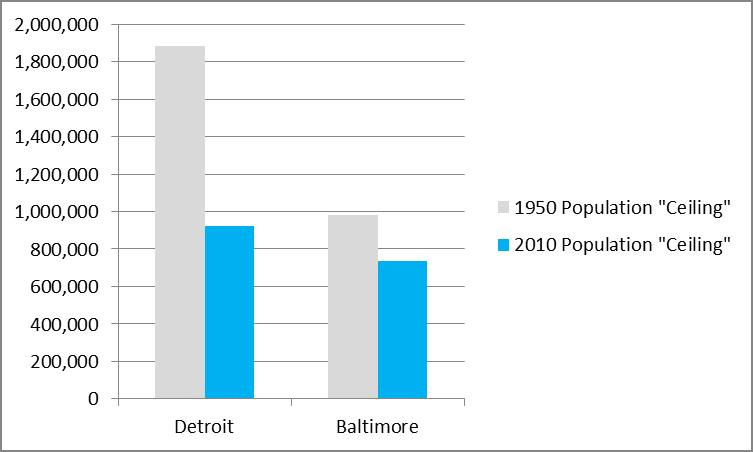
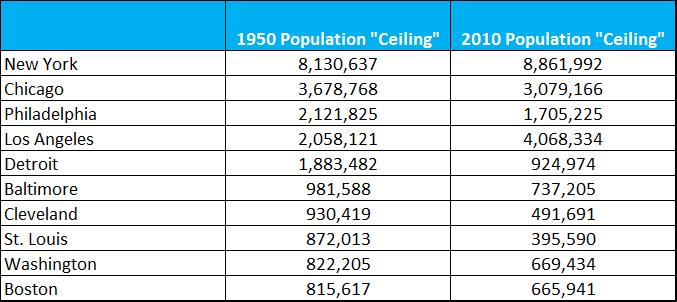
    I go on to suggest that population loss was inevitable for the most of the largest cities of mid-century America, and point out that today’s cities may never reach their previous population peaks.  I put together a cool table that demonstrates this:

    However, in putting this piece together I left quite a bit on the table, both in terms of graphics and additional content.  So consider this an addendum to the Forbes piece.

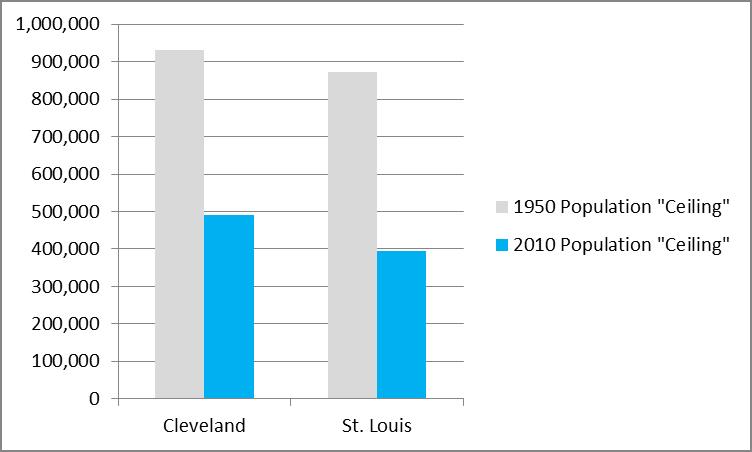
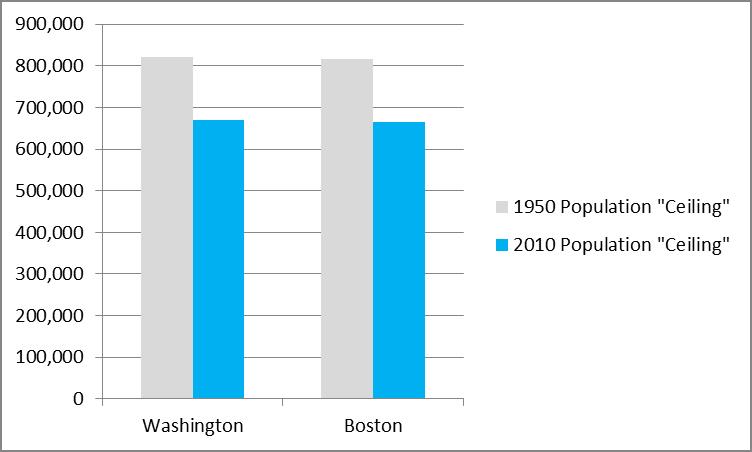
    First, I think it’s stunning to see a visual that illustrates the differences in a 1950 and 2010 population ceiling for the ten cities examined.  Check these out, shown two cities at a time:

    I think it is absolutely stunning to see that cities like Cleveland, Detroit and St. Louis could at best (at least right now) attain maybe half of their population in 1950.  And a case could be made that smaller household size may be the most significant factor in their decline.

    Three points I was unable to expand on in the Forbes piece.  First, now that the pendulum is swinging back in favor of cities, their influence is ascending faster than their population growth.  Cities are leading discussions now the economy, on infrastructure, on energy, on housing.  For the latter third of the 20th century the suburbs led that discussion.  But today, cities have reclaimed that role.  Their actual size, in terms of population, matters less today than it did 60 years ago.  

    Second, the American preference for new over old has nearly as much to do with this shift as shrinking household size.  For nearly 50 years the suburbs (and by extension, the Sun Belt) was new, and that was a main feature of their attraction.  But there’s also that saying, “everything old is new again.”  Cities are the new thing, and while they’re not everyone’s cup of tea, they are doing better than at any time in the last 50 years.

    Third, it’s conceivable that many suburbs and/or Sun Belt cities may find themselves impacted by emerging demographic or social shifts.  Having a huge inventory of single family homes in a world that is asking for multifamily options?  A strong auto-oriented landscape when more people are looking for walkable environments?  

    I’m not suggesting that all older cities are ascendant, and the suburbs and Sun Belt are doomed.  But staying ahead of trends may be the lesson all need to heed.

    Pete Saunders is a Detroit native who has worked as a public and private sector urban planner in the Chicago area for more than twenty years.  He is also the author of “The Corner Side Yard,” an urban planning blog that focuses on the redevelopment and revitalization of Rust Belt cities.

    Top photo: Vacant homes in Philadelphia, awaiting their revitalization.  Source: smartgrowthamerica.org

  • California for Whom?

    “Old in error,” writes historian Kevin Starr, “California remains an American hope.” Historically, our state has been a beacon to outsiders seeking a main chance: from gold miners and former Confederates to Midwesterners displaced by hardship, Jews seeking opportunity denied elsewhere, African Americans escaping southern apartheid, Asians fleeing communism and societal repression, Mexicans looking for a way out of poverty, counter-culture émigrés looking for a place where creation can overcome repression.

    Yet, this notion of California as a land of outsiders is being turned on its head, our state’s dream repackaged — often with the approval of its ruling hegemons — as something more like a medieval city, expelling the poor and the young, while keeping the state’s blessings to the well-educated, well-heeled, and generally older population.

    Some boosters of the current order, such Gov. Jerry Brown, contend that the affluent and the educated are still coming, while the less educated and well-heeled, are leaving. They cite this as evidence that the “declinists” are wrong. Yet, the reality remains that California is losing its allure as a place of opportunity for most.

    COMING AND GOING

    California has been “bleeding” people to other states for more than two decades. Even after the state’s “comeback,” net domestic out-migration since 2010 has exceeded 250,000. Moreover, the latest Internal Revenue Service migration data, for 2013-2014, does not support the view that those who leave are so dominated by the flight of younger and poorer people. Of course, younger people tend to move more than older people, and people seeking better job opportunities are more likely to move than those who have made it. But, according to the IRS, nearly 60,000 more Californians left the state than moved in between 2013 and 2014. In each of the seven income categories and each of the five age categories, the IRS found California lost net domestic migrants.

    Nor, viewed over the long term, is California getting “smarter” than its rivals. Since 2000, California’s cache of 25- to 34-year-olds with college, postgraduate and professional degrees grew by 36 percent, below the national average of 42 percent, and Texas’ 47 percent. If we look at the metropolitan regions, the growth of 25- to 34-year-olds with college degrees since 2000 has been more than 1.5 to nearly 3 times as fast in Houston and Austin as in Silicon Valley, Los Angeles, or San Francisco. Even New York, with its high costs, is doing better.

    In fact, the only large California metropolitan area which has seen anything like Texas growth has been the most unlikely, the Inland Empire. The coastal areas, so alluring to the media and venture capitalists, are losing out in terms of growing their educated workforces, most likely a product of high housing prices and, outside of the Bay Area, weak high-wage job growth.

    The location of migrants tells us something about where the allure of California remains the strongest, and where it has been supplanted. Almost all of the leading states sending net migrants here are also high-tax, high-regulation places that have been losing domestic migrants for years — New York, Illinois, Michigan and New Jersey. In contrast, the net outflow has been largely to lower-cost states, notably Texas, as well as neighboring Western states, all of which have lower housing prices.

    And, finally, there is the issue of age. Historically, California has been a youth magnet, but that appeal is fading. In 2014, according to the IRS data, more than two-thirds of the net domestic out-migrants were reported on returns filed by persons aged from 35 to 64. These are the people who are most likely to be in the workforce and be parents.

    CLASS AND ETHNIC PATTERNS

    Upward mobility has long been a signature of California society. Yet, 22 of the state’s large metro areas have seen a decline in their middle class, according to a recent Pew Research Center study. Los Angeles, in particular, has suffered among the largest hollowing out of the middle-income population in the country. In places like the Bay Area, there’s a growing upper class, while in less glamorous places like Sacramento, it’s the low end that is expanding at the expense of the middle echelons.

    The economy, too, has been tending toward ever more bifurcation, with some growth in tech and business services, largely in the Bay Area. Elsewhere, the overwhelming majority of jobs created since 2007 have come from lower-paying professions, such as health and education and hospitality, or, recently, from real estate-related activities. Overall, traditional, higher-paying, blue-collar jobs – such as construction and durable goods manufacturing – have continued to lose ground. Most California metropolitan areas, most notably Los Angeles, lag most key national competitors — including Texas metro areas, Phoenix, Nashville, Tenn., Charlotte, N.C., and Orlando, Fla. — in higher-paid new jobs in business services and finance.

    But the biggest losers of egalitarian aspirations have been the constituencies most loudly embraced by the state’s progressive establishment: black and brown Californians. Nowhere is this disparity greater than in home ownership, the signature measure of upward mobility and entrance into the middle class. Overall, Latino homeownership in California is 41.9 percent; nationally, it’s 45 percent, and in Texas it’s 55 percent. Similarly, among African Americans, homeownership is down to 34 percent in California, compared to 41 percent nationally and 40.8 percent in Texas. In Los Angeles, which has the lowest overall homeownership percentage among the nation’s largest metro areas, only 37 percent of Hispanics own their own homes, compared to 50 percent in Dallas-Fort Worth.

    CALIFORNIA’S ROAD FORWARD

    One popular progressive theory for how to address the economy lies in trying to emulate places like Massachusetts, a state whose per-capita income ranks among the highest in the country. Yet, this approach fails to confront the huge demographic differences between the states.

    Let’s start with ethnicity. Eighty percent of Massachusetts’ population is comprised of non-Hispanic whites or Asians, who traditionally have higher incomes, while in California whites and Asians constitute only 52 percent. Some 80 percent of the Boston metropolitan area is non-Hispanic white or Asian, compared to only 46 percent the population in the Los Angeles-Orange County area, and 40 percent in the Inland Empire. California has a poverty rate, adjusted for housing costs, of 23.4 percent, while Massachusetts, with its lower share of more heavily disadvantaged minority populations, registers just 13.8 percent.

    California could only resemble Massachusetts if it successfully unloaded much of its disadvantaged minority and working-class population. Although some might celebrate the movement of poorer people out of the state, our poverty rate is unlikely to decrease, since historically disadvantaged ethnicities (African Americans and Hispanics) account for 58 percent of the under-18 population in California, and only 25 percent in Massachusetts.

    Simply put, California faces a gargantuan challenge of generating a better standard of living for a huge proportion of its population. To be sure, both the San Francisco and San Jose metropolitan areas can thrive, like Massachusetts, in a highly education-driven economy. But states like California, Texas and Florida are too diverse, in class and race, to follow the “Massachusetts model.” We need good blue-collar and white-collar, middle-income jobs to keep a more diverse, and somewhat less well-educated, population adequately housed and fed.

    This should be the primary concern of our state. But the governor and legislators seem more interested today in re-engineering our way of life than improving outcomes. True, if you drive up housing and energy prices, some of the poor will leave, but so, too, will young people, the future middle class. Though our largest coastal metropolitan counties — Los Angeles, Orange, San Diego, Alameda, Contra Costa, San Mateo and San Francisco — have long been younger than the rest of country, soon they will be more gray than the nation.

    The demographic future of California seems increasingly at odds with the broad “dream” that Starr and others evoke so powerfully. We are headed ever more toward a state of divided realities, of poorer, downwardly mobile people, largely in the interior and in inner-city Los Angeles or Oakland, and a rapidly aging, wealthier, whiter enclave hugging the coast. For those with the right education, inheritance and a large enough salary, the California dream still shines bright, but for the majority it seems like a dying light.

    This piece first appeared in the Los Angeles Daily News.

    Joel Kotkin is executive editor of NewGeography.com. He is the Roger Hobbs Distinguished Fellow in Urban Studies at Chapman University and executive director of the Houston-based Center for Opportunity Urbanism. His newest book, The Human City: Urbanism for the rest of us, will be published in April by Agate. He is also author of The New Class ConflictThe City: A Global History, and The Next Hundred Million: America in 2050. He lives in Orange County, CA.

    Wendell Cox is principal of Demographia, an international pubilc policy and demographics firm. He is a Senior Fellow of the Center for Opportunity Urbanism (US), Senior Fellow for Housing Affordability and Municipal Policy for the Frontier Centre for Public Policy (Canada), and a member of the Board of Advisors of the Center for Demographics and Policy at Chapman University (California). He is co-author of the “Demographia International Housing Affordability Survey” and author of “Demographia World Urban Areas” and “War on the Dream: How Anti-Sprawl Policy Threatens the Quality of Life.” He was appointed to three terms on the Los Angeles County Transportation Commission, where he served with the leading city and county leadership as the only non-elected member. He served as a visiting professor at the Conservatoire National des Arts et Metiers, a national university in Paris.

    Photograph: Great Seal of the State of California by Zscout370 at en.wikipedia [CC BY-SA 3.0],from Wikimedia Commons

  • Still Migrating to Texas and Florida: 2013-2014 IRS Data

    The Internal Revenue Service (IRS) has released its 2013 to 2014 migration data. This data provides estimates of residential movement between counties and states based on the number of claimed exemptions on IRS income tax forms. According to IRS, this "approximates the number of individuals" who moved between jurisdictions. Of course, not all people are covered by filed income tax returns, yet this covers   approximately 80 percent of the population, and unlike Census Bureau annual data, this is counts of actual people (and incomes). As such, the IRS data is probably the best approximation of domestic migration available. This article outlines data relating to state to state (and District of Columbia) domestic migration.

    Net Domestic Migration: Gainers

    Net domestic migration, calculated by subtracting the number of people moving out of state from the number of people moving into a state, was by far the greatest in Texas and Florida. This is not surprising, since these states have routinely been at the top of the domestic migration league tables for virtually all of the new century. The once exception was for a brief period during the housing bubble when the Florida numbers were depressed. During that period, Florida’s reached levels only exceeded by California but have since been moderated. That, plus a severe local recession, were associated with the drop in net domestic migration.

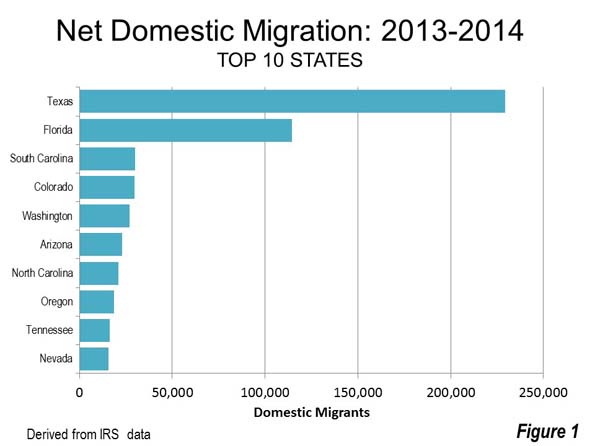
    This year’s champion was Texas. The Lone Star State had net domestic migration of 229,300. This is more than double the net domestic migration of second ranking Florida and exceeds the total net domestic migration of the other 16 states that gained. The District of Columbia and 30 states experienced net domestic losses between 2013 and 2014.

    Florida added 114,400 net domestic migrants, which is nearly 4 times as large as third ranking South Carolina (30,100). Colorado followed closely, at 29,500 net domestic migrants, with Washington placing fifth (Figure 1)

    Net Domestic Migration: Losers

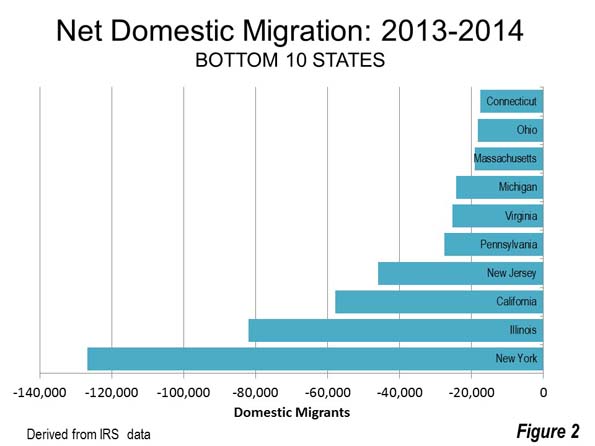
    The states with the largest net domestic migration losses are no surprise. New York, which has led net domestic out-migration in most recent years, did so again, with the loss of 126,800. Illinois lost the second greatest number of domestic migrants at 82,000. California ranked third, with a loss of 57,900. New Jersey had the fourth largest loss at 46,000, followed by Pennsylvania at 27,500 (Figure 2).


    State Attraction Ratio

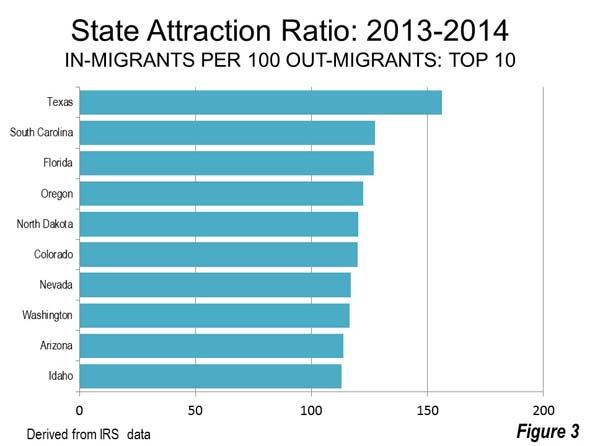
    A state attraction ratio was developed, by dividing out-migration by in-migration (stated in out-migrants per 100 in-migrants). Not surprisingly, the highest state attraction ratio was in Texas, at 156.3, South Carolina ranked second, with 127.3 in-migrants per 100 out-migrants, with Florida close behind at 126.7. The fourth and fifth highest state attraction rates were in Oregon, at 122.3 and North Dakota at 120.2 (Figure 3).

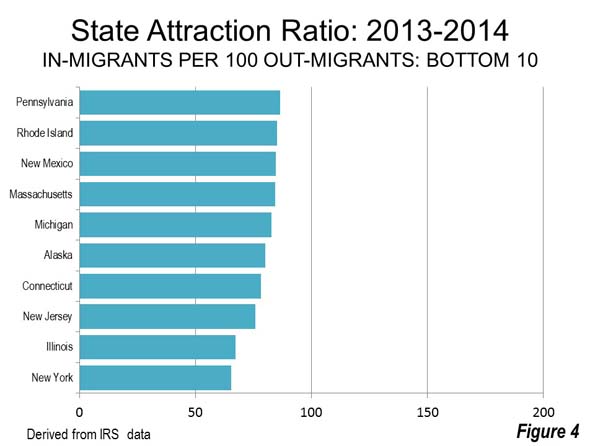
    The lowest state attractions ratio — those places were leavers most outpaced in-migrants — was in New York, where 65.4 people moved into the state for every 100 who moved out. Illinois was close behind at 67.1. In New Jersey, the ratio was 75.9, in Connecticut 78.3 and Alaska had the fifth lowest state attraction ratio at 80.1 (Figure 4)


    Income per Capita: In-migrants

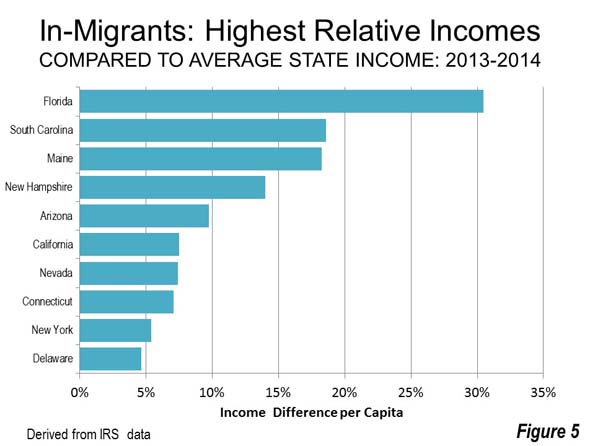
    In 17 states, the per capita income of people moving from other states exceeded that of their new state’s overall average income. The biggest differences was in Florida, where in-migrant incomes were 30.5 percent higher than average. Migrants to South Carolina averaged 18.6 percent more than the state average income, while migrants to Maine had 18.3 percent higher incomes. The top five was rounded out by New Hampshire, where in-migrants had average incomes 14.0 percent greater than average and Arizona where the differential was 9.8 percent (Figure 5)

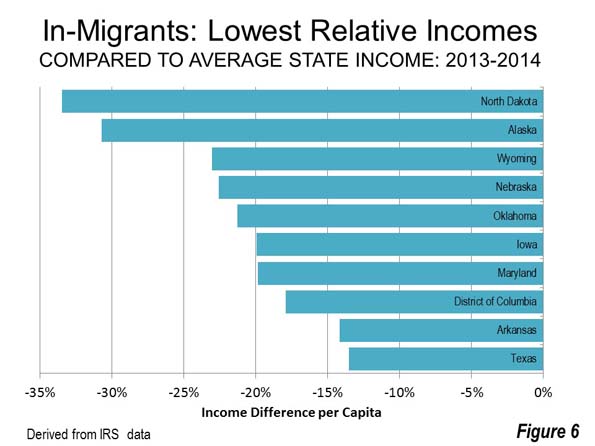
    The lowest in-migrant incomes relative to state averages were in states with large resource industries. The biggest difference was in North Dakota, where the average new resident had an income 33.5 percent below average. In Alaska, the difference was 30.7 percent, while in Wyoming it was 23.0 percent. Newcomers to Nebraska averaged 22.6 percent below the state average, while the fifth lowest figure was registered in Oklahoma at -21.3 percent (Figure 6)


    Income per Capita: Out-migrants

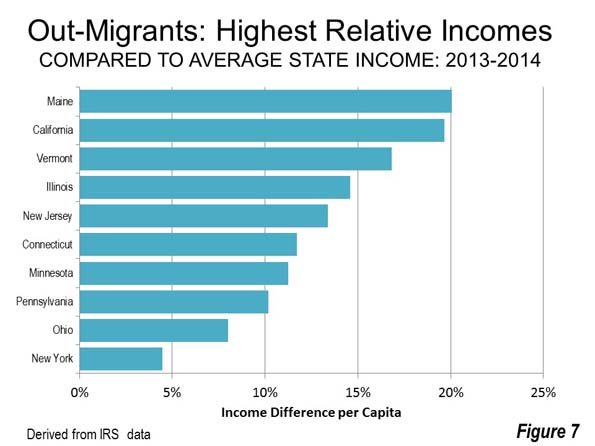
    In 17 states, people heading for other states had higher incomes per capita than the average in their former states. The biggest differential was in Maine, where out-migrants had average incomes 20.1 percent higher than the overall state average. The second largest differential was in California where out-migrants had 19.7 percent higher incomes than California residents who remained, followed by Connecticut at 16.8 percent. The average income of people leaving was 14.6 percent greater than the Illinois average. In New Jersey, the average income of levers was 13.4 percent greater than the state average (Figure 7).

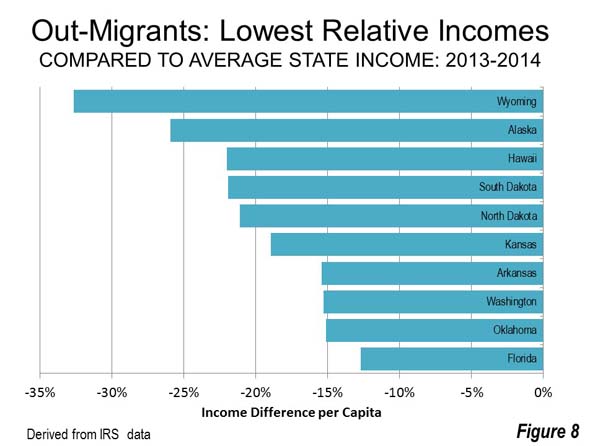
    Wyoming residents had the largest income differential relative to newcomers, at 32.6 percent. In Alaska, new migrants had average incomes 25.9 percent below the state average and in Hawaii, new migrants had average incomes 22.0 percent below the state average. The fourth and fifth lowest newcomer incomes were in South Dakota, 21.9 percent below the state average and North Dakota, 21.1 percent below the state average (Figure 8)


    New Results Track Old

    There is a striking similarity between the domestic migration results for 2013-4 and those reported by the Census Bureau population estimates program from 2000 to 2013 (no data for 2010). Among the top 10 gainers in net domestic migration in 2013 to 2014, nine were also among the top 10 gainers between 2000 and 2013. These included Texas, Florida, South Carolina, Colorado, Washington, Arizona, North Carolina, Oregon and Nevada. Georgia was replaced by Oregon in the IRS 2013 to 2014 list.

    However in the earlier period, Florida was the leading importer of people, while Texas, now number one, ranked second. However, Florida could challenge Texas in the future, if that state’s in-migration numbers suffer substantially from the oil bust. Net domestic migration continues to focus on the South and West, with each region accounting for five of the top 10 states.

    There is also similarity among the largest exporters of people, though somewhat less so. Among the top five domestic migrant exporters, four ranked in the top five between 2000 and 2013. New York, California, Illinois and New Jersey appeared in both lists, while Pennsylvania replaced Texas in the 2013-2014 IRS data.

    Among the 10 greatest losers in net domestic migration, five were in the Northeast, three were in the Midwest, one was in the South and one in the West.

    RESIDENTS & DOMESTIC MIGRANTS: ANNUAL INCOME: 2014
    State  All Out-Migrants In-Migrants Net Domestic Migration State Attraction Ratio (In-migrants per 100 out-migrants)
    Alabama $26.0 $23.3 $23.1           (3,800)                     96.1
    Alaska $35.8 $26.5 $24.8           (7,800)                     80.1
    Arizona $28.7 $28.3 $31.4          22,900                   113.8
    Arkansas $26.0 $22.0 $22.3           (4,400)                     93.2
    California $36.1 $43.2 $38.8         (57,900)                     88.5
    Colorado $36.0 $32.7 $33.3          29,500                   119.9
    Connecticut $50.1 $56.0 $53.7         (17,500)                     78.3
    Delaware $32.9 $33.9 $34.4            1,700                   106.2
    District of Columbia $56.9 $53.9 $46.7           (4,400)                     89.7
    Florida $32.9 $28.7 $42.9        114,400                   126.7
    Georgia $28.0 $25.4 $25.2          13,900                   105.6
    Hawaii $31.0 $24.1 $27.8           (4,000)                     93.0
    Idaho $25.3 $22.1 $25.3            6,000                   112.8
    Illinois $34.8 $39.8 $34.3         (82,000)                     67.2
    Indiana $27.3 $27.1 $25.0           (6,000)                     94.8
    Iowa $30.5 $27.4 $24.4           (2,500)                     95.7
    Kansas $31.1 $25.2 $27.1         (11,000)                     87.3
    Kentucky $26.1 $24.3 $23.2           (7,800)                     91.5
    Louisiana $28.9 $25.8 $25.2           (8,000)                     90.9
    Maine $29.6 $35.5 $35.0            1,500                   106.3
    Maryland $38.9 $38.5 $31.2           (3,000)                     98.0
    Massachusetts $46.3 $45.3 $45.7         (19,200)                     84.3
    Michigan $29.9 $30.8 $30.8         (24,200)                     82.6
    Minnesota $35.8 $39.8 $32.0           (9,000)                     89.9
    Mississippi $23.0 $20.8 $20.3           (8,200)                     87.6
    Missouri $29.4 $27.5 $26.7           (7,200)                     94.2
    Montana $29.5 $26.0 $28.8            3,300                   111.9
    Nebraska $30.6 $28.0 $23.7           (2,400)                     94.2
    Nevada $30.9 $27.6 $33.2          15,700                   117.0
    New Hampshire $38.0 $38.2 $43.3            1,000                   102.9
    New Jersey $42.6 $48.3 $42.0         (46,000)                     75.9
    New Mexico $25.9 $25.4 $25.7           (9,800)                     84.6
    New York $42.7 $44.6 $45.0       (126,800)                     65.4
    North Carolina $28.1 $26.4 $29.3          20,900                   108.9
    North Dakota $38.8 $30.6 $25.8            5,600                   120.2
    Ohio $29.9 $32.3 $28.8         (18,300)                     89.2
    Oklahoma $29.1 $24.7 $22.9            3,300                   104.1
    Oregon $31.2 $28.7 $30.4          18,700                   122.3
    Pennsylvania $33.7 $37.2 $34.1         (27,500)                     86.4
    Rhode Island $34.8 $35.5 $34.5           (3,900)                     85.1
    South Carolina $26.8 $24.9 $31.8          30,100                   127.3
    South Dakota $31.5 $24.6 $28.3              (400)                     98.5
    Tennessee $27.5 $25.0 $27.9          16,400                   111.2
    Texas $31.7 $30.6 $27.4        229,300                   156.3
    Utah $26.4 $23.2 $27.1           (2,800)                     96.1
    Vermont $32.2 $37.6 $33.6           (1,200)                     92.4
    Virginia $37.0 $34.4 $32.5         (25,300)                     90.1
    Washington $36.0 $30.5 $32.6          27,000                   116.4
    West Virginia $25.6 $24.8 $23.7           (3,700)                     90.0
    Wisconsin $31.5 $32.0 $29.8         (10,300)                     88.6
    Wyoming $40.2 $27.1 $30.9           (1,400)                     94.9
    United States $33.4 $33.0 $32.4
    Income in 000s
    Data from IRS Gross Migration File (https://www.irs.gov/uac/soi-tax-stats-migration-data-2013-2014)

    Wendell Cox is principal of Demographia, an international pubilc policy and demographics firm. He is a Senior Fellow of the Center for Opportunity Urbanism (US), Senior Fellow for Housing Affordability and Municipal Policy for the Frontier Centre for Public Policy (Canada), and a member of the Board of Advisors of the Center for Demographics and Policy at Chapman University (California). He is co-author of the “Demographia International Housing Affordability Survey” and author of “Demographia World Urban Areas” and “War on the Dream: How Anti-Sprawl Policy Threatens the Quality of Life.” He was appointed to three terms on the Los Angeles County Transportation Commission, where he served with the leading city and county leadership as the only non-elected member. He served as a visiting professor at the Conservatoire National des Arts et Metiers, a national university in Paris.

  • Notes From An Upzoning Heretic

    I recently got into a discussion on Twitter about the soundness of upzoning, or the increase in the allowance of residential units in cities, as a rational and reasonable response to the lack of affordable housing in our nation’s large cities.  Anyone who’s been reading my writing knows that I’ve disagreed with this for quite some time, and tried many ways to articulate my views and reach some understanding. From the discussion I learned two things: 1) Twitter is a really poor vehicle for debate when nuance is critical (OK, I really knew that already), and 2) the orthodoxy of the upzoners is so strong that my views on this might put me on the pariah end of the urbanism spectrum. 

    It started innocently enough.  Ramsin Canon suggested upzoning major streets in Chicago for more residential units.  That brought several supporters, including City Observatory writer and fellow Chicago blogger Daniel Kay Hertz, who (gracefully, I might add) noted my objections.  I then chimed in, and shortly thereafter I found myself swimming against the tide of upzoners hoping to prove that upzoning helps improve housing affordability. 

    Look, upzoners, I understand the problem and the sentiment.  I understand the desire to find the right policy response to address the issue.  But I remain unconvinced that upzoning will help any more than a handful of American cities.  Here’s why.

    An Abstract Argument

    Surely a big part of the appeal of upzoning is its abstract simplicity.  Increasing the supply of housing units in extremely tight housing markets can unleash market forces that drive home prices and rents downward, making cities more affordable to affluent and poor alike.  And in housing markets that have an almost even distribution of high priced housing within them, like San Francisco or New York, this makes sense.  Allowing more units will have the effect of bringing prices down.  (I’d also add parenthetically that the tightest and most expensive housing markets nationally also tend to be the most geographically constrained, by either water or mountains, and that constraint does not hold for all cities nationwide.  This escapes many people.)

    The reality, however, is that nationally gentrification is just a pittance compared to the expansion of urban poverty.  As Carol Coletta of the Knight Foundation put it in a speech last month at the Congress of the New Urbanism:

    “In 1970, about eleven hundred urban Census tracts were classified as high poverty.

    By 2010—40 years later—the number of high poverty Census tracts in urban America had increased from 1100 to more than 3,000. (3165)

    The number of people living in those high poverty Census tracts had increased from 5 million to almost 11 million. And the number of poor people in high poverty Census tracts had increased from 2 million to more than 4 million.

    So over a 40-year period, the number of high poverty Census tracts in America’s core cities had tripled, their population had doubled, and the number of poor people in those neighborhoods had doubled.

    Given that record, I’ll bet a lot of people are hoping for a little gentrification– if gentrification means new investment, new housing, new shops without displacement.

    The idea that places might benefit from gentrification runs against the popular narrative. But here’s the really startling fact: only 105 of the eleven hundred Census tracts that were high poverty in 1970 had rebounded to below poverty status by 2010. That’s only ten percent! Over 40 years!”

    Most American cities are not like San Francisco or New York, where the high prices and rents cannot be avoided and the return-to-the-city demand remains very high.  Most cities have greater variance in prices and rents, from very high to very low.  This takes away the first layer of abstraction for prices and rents and allows those with money to rationally widen their consideration when choosing to live in cities.  On the surface this sounds great. 

    But — and this is where the second layer of abstraction is shed — people don’t make housing decisions or neighborhood decisions rationally.  They take in all sorts of information and put it to subjective use, and justify its rationality later.  Historical perceptions of neighborhoods linger far longer than their reality.  Media perceptions can distort the reality of neighborhoods.  Egos can get involved and people select neighborhoods that have a certain cache or brand.  For urban neighborhoods in most cities, we find that affluence clusters in certain areas and moves outward slowly.  Poverty expands quickly, as those who have the ability to escape it do so, and further destabilize a neighborhood in the process.  The end result, again for cities that do not have the same strong return-to-the-city demand or the uniformly high home prices and rents, is affluent enclaves surrounded by expansive and increasingly impoverished neighborhoods.

    Upzoning can accelerate this process.  If a major city undergoes an upzoning process and allows a substantial increase in the number of housing units, what do you think the development community’s response to that will be?  My guess is that they will work hard to fulfill the market demand where the demand is strongest — in the most desirable neighborhoods or in the areas immediately adjacent to them.  Only after that demand is tapped out will developers move into other areas, and most will elect to build in areas that are adjacent to the newly saturated neighborhood.  Those who live in the path of development will see prices and rents remain high; those away from the path of development will likely see  prices and rents crater, and lament the lack of investment in their community. 

    The Need for Investment

    TAt one point in the Twitter discussion.  Daniel Kay Hertz asked me, “Would there be more or fewer Latinos in Logan Square if there was more new housing in Lincoln Park?”  For non-Chicagoans, Logan Square is the rapidly gentrifying neighborhood immediately west of the quite-gentrified Lincoln Park neighborhood on the lakefront.  My response was that Logan Square would indeed have more Latinos in that scenario and that it would have no discernible impact on other neighborhoods outside of the “hot zone” as well.  But that sets up the scenario I cite above — an affluent neighborhood next to an eternally poor/working class one, possibly lamenting the lack of investment in their midst.  And the further one’s home or neighborhood is from the “hot zone”, the more that lament turns into angst, frustration and resentment.

    It’s worth bringing back a portion of the quote above from Carol Coletta:

    Given that record, I’ll bet a lot of people are hoping for a little gentrification– if gentrification means new investment, new housing, new shops without displacement.The idea that places might benefit from gentrification runs against the popular narrative.

    Despite the growing problems of affordability in select neighborhoods in major cities across the nation, there are many more neighborhoods that wish they had that problem.  Many people rue the fact that maybe one-quarter or one-third of a city is priced beyond their means.  That leaves two-thirds to three-quarters of a city to explore and find a place worthy of investment.  Upzoning can have the impact of further concentrating development within the “hot zone” and drive a deeper inequality wedge between urban haves and have-nots.

    Upzoners are not doing cities a favor more broadly by addressing an issue that helps them directly.

    Ultimately I see high prices and rents as being demand-driven and not supply-driven.  Prices and rents are high because there are too many people focusing on too few neighborhoods — and squandering the opportunity to take some of that investment to other neighborhoods that could use it.

    Pete Saunders is a Detroit native who has worked as a public and private sector urban planner in the Chicago area for more than twenty years.  He is also the author of “The Corner Side Yard,” an urban planning blog that focuses on the redevelopment and revitalization of Rust Belt cities.

  • America Without Immigration 2015-50

    Be careful what you wish for, if that is what you wish for.

    Except for the oil shocks of the 1970s and a few other recessionary years, the US economy has generally been strong in the postwar era since 1945. Huge advances in technology and trade, a favorable business environment and strong demographics combined to create tens of trillions of dollars of new wealth in the US and around the world.

    The demographic component played an important supporting role. During the baby boom years, the number of Americans grew at an average annualized rate of 1.6% (see chart). In subsequent years starting in the mid 1960s, this growth faded to about 1% where it remained until 2007-08. Since then, it has fallen to 0.7% and, on current UN projections, it will continue to fall through 2050 when it may dip under 0.4%.

    Screen Shot 2016-08-01 at 11.00.53 AM

    Put another way, the population grew 1% per year on average in the years 1950-2015 and is expected to grow at half this rate, or 0.5% per year, from today to 2050. As a result, the US population will be at 356 million in 2030 and 389 million in 2050, equivalent to 18 million and 67 million fewer Americans in those years than if the growth rate had remained on its historic 1% trajectory.

    (In the charts below, ‘At 1% CAGR’ refers to the (not expected) continuation of the historic 1% trend; ‘Medium’ refers to current projections, including continued immigration; ‘Zero Migration’ refers to a scenario with no new immigrants starting in 2005-10.)

    Screen Shot 2016-07-30 at 7.36.15 AM

    Screen Shot 2016-07-30 at 7.37.01 AM

    What accounts for this slowdown? Mainly the boomer phenomenon. First, baby boomers had fewer children than their parents. The Total Fertility Rate (TFR = average children per woman) stood at near 2.0 in the 1980s and 1990s, compared to near 3.5 in the 1950s and early 1960s. Second, the number of US deaths will surge in 2025-45, echoing eighty years later the surge in births in 1945-65. Barring a leap in life expectancy, this death boom will put the brakes on demographic growth.

    So even before we start talking about immigration, the US population will be slowing down and slowing down by a big number, recording a shortfall or “deficit” of 67 million vs. the historic trend by 2050.

    Version 2

    Version 2

    In addition, the aging of the population will create another challenge with a rising dependency ratio (number of dependents per worker) reducing discretionary spending and investing, and straining pensions and entitlements. On current trends, the dependency ratio is expected to rise from 50.9 in 2015 to 65.8 in 2050. This ratio was at 66.5 in 1960 and its subsequent decline in four consecutive decades provided a big boost to the US economy.

    Screen Shot 2016-07-30 at 7.36.23 AM

    Adding immigration to the discussion further complicates the picture. If America had taken in no more immigrants starting in 2005-10, its population would be 48 million smaller (114.9 minus 66.9 in the table above) in 2050 than if it had remained on the present course and 115 million smaller than if it had remained on its historic trajectory. Further, the dependency ratio would climb to 69.6 in 2050. Note how the population would stop growing around 2035 because the number of deaths would roughly equal the number of births. (See also America Heading Towards Zero Population Growth?)

    It is important to highlight the demographic shortfall vs. the historic trajectory because some of today’s more extreme anti-immigration rhetoric is being presented as a promised return to the better economic conditions of the past. These conditions can be recovered through other paths but not through measures that exacerbate the population slowdown. Indeed if we judge by the figures above, it is clear that returning to the past is not in the realm of the possible, at least as far as demographics are concerned.

    In order for the US population to grow at 1% again without immigration, the birth rate would have to jump to levels not seen since the baby boom or higher. Even then, the dependency ratio would climb more steeply for two decades because of the millions of new babies.

    The US economy can and most likely will have a bright future but it cannot count on population growth to fulfill its historic supportive role. The economy benefited for decades from the demographic sweet spot of a rising population and a declining dependency ratio. Neither of these measures will be as supportive in the future. Instead greater gains will have to come from technology and automation and from investments in productivity and education.

    Related:

    This chart shows the number of Americans aged 20-64 and 30-59 under the Medium scenario. The working age population (20-64) is expected to remain flat for fifteen years and then to grow at a lower rate than in the past. This population would decline under a Zero Migration scenario. While it is true that automation will take over a number of functions and would dampen the impact of a stagnant or falling work force, demand for goods and services would certainly take a hit unless new export markets are opened up.

    Screen Shot 2016-03-10 at 2.58.14 PM (1)

    For more on the role of demographics in the economy, we suggest that you listen to this podcast.

    It should also be remembered that world demographics are far from standing still. See here and here or consult the Populyst demography archive.

    Sami Karam is the founder and editor of populyst.net and the creator of the populyst index™. populyst is about innovation, demography and society. Before populyst, he was the founder and manager of the Seven Global funds and a fund manager at leading asset managers in Boston and New York. In addition to a finance MBA from the Wharton School, he holds a Master’s in Civil Engineering from Cornell and a Bachelor of Architecture from UT Austin.

    Statue of Liberty photo, Public Domain via Wikimedia Commons