Category: Demographics

  • Education and Economic Growth

    It is an article of faith among California’s political class that insufficient higher educational opportunities are a constraint on California’s economic and job growth.  Just about every California economic development document includes a discussion of California’s desperate need for more college graduates.

    Unfortunately, the facts disagree with the faith.  California is educating far more people than it is creating jobs for them to take.  In the past 10 years, California’s public higher education system alone issued 2,455,421 degrees.  Over the same period, the state saw a net increase of only 1,136,642 jobs.

    That’s right.  California granted more than twice as many post-high-school degrees as net new jobs.

    We can quibble about the numbers, but the conclusion does not change. The number of degrees includes 871,922 community college degrees, including a conservative estimate of 94,000 in 2015, because data are not yet available.

    If we exclude community college degrees, California’s university and state college systems still granted 1,583,499 degrees, a much greater number than new jobs.  Some of those represent one person earning multiple degrees, but more than 28 percent of students would have to have earned multiple degrees for the number of college graduates to be less than the number of net new jobs.

    These numbers don’t include California’s private colleges and universities, of which there are many.  The University of Southern California, for example, granted 14,633 degrees in June 2015.

    You cannot escape the conclusion that California job growth lags the rate at which the state creates college degrees.  College graduates are a significant California export.

    Of course, not all of California’s new jobs require college degrees.  For example, almost 31 percent (351,926) of California’s net new jobs over the past 10 years were in the Leisure and Hospitality sector.  Very few of those jobs require a college degree.

    So, why is everybody saying that higher education is a constraint on California’s growth?

    Part of the reason is that education ranks with motherhood and “tolerance” on California’s pantheon of virtues, particularly among the highly educated political class, and education — notably the teachers’ unions — has a powerful lobby, perhaps the most powerful in California.

    Part of it is a poor understanding of statistics.  People observe that, on average, college graduates earn far more than non-graduates and conclude that education creates higher income, completely ignoring the self-selection bias: The lowest-ability student in your high school didn’t go to college, because he was the lowest-ability student. The highest-ability student went to college because she would have been bored beyond measure holding up a “slow” sign in a construction zone.  Repeat after me: correlation does not imply causation.

    Then, even after all this pumping out of graduates, there remain persistent shortages of qualified Californians to fill some jobs. Of course there are.  Nobody expects San Jose to produce all the geniuses that drive Silicon Valley’s innovation. Why should we expect them to all come from California?  These are very special jobs requiring very special skills. In this situation, large numbers work to employers’ advantage.  If the entire world is your source of these special workers, you have a much better chance of finding exactly who you need, or pay what you prefer.

    The forecasting industry is a big part of the problem. It is easy to find forecasts such as this Georgetown University report that says by 2020, a whopping 65 percent of all U.S. jobs will require post-secondary education. It is just as easy to find forecasts that robots will take away all of our jobs— including in the so-called “knowledge” sector.

    Long-term forecasts are extraordinarily unreliable. Long-run forecasts of necessary skill sets for future jobs are even more unreliable. They are completely dependent on assumptions that frequently prove wrong. Famously bad long-term forecasts include Time Magazine 1966 statement that “Remote shopping, while entirely feasible, will flop.” and Western Union rejecting the telephone in 1876 as having “… too many shortcomings to be seriously considered as a means of communication.”

    Forecasts of increasing demand for educated workers seems to be contrary to observation. Because of computers, a McDonalds’ worker doesn’t need to know how to make change, or the price of any product. All they need to know is what a product looks like and how to push a button.

    What we appear to be seeing is what my colleague Dan Hamilton calls a “hollowing out of the middle.”  Technology has increased demand for very-high-skilled people, as we see in the Silicon Valley, and it’s increased the demand for low-skilled people, as in the McDonalds example. It’s also reduced demand for many people in between, that is, the middle class.

    Focusing excessively on higher education creates problems while doing no good. It is ridiculous to attempt to give 65 percent of young people a college degree. You cannot achieve that goal without reducing the quality of the graduates, which reduces the value of the degree for the better students.  This would be repeating what California has done with high school diplomas. Graduation requirements have been reduced to the point that the degree is meaningless for almost all purposes. 

    Increasing supply at any educational level will not make new jobs appear; in fact, many of those workers are likely to go to where there are jobs and basic costs, particularly housing, are more reasonable.  A recent study by Cleveland State University documents the ongoing migration of educated Millennials from high-cost places with few opportunities to places with lower costs of living. 

    Yet rather than into look how to create better paying jobs across the board, the education lobby — including many now at universities — have a perfect motivation to support more spending on, well, they and their friends. If we did achieve a 65 percent college graduate rate, we’d hear the policy wonks calling for more advanced degrees.

    So, we ask, why we are creating so many more college graduates than jobs for college graduates?  I think it’s because we’ve promised our young people an education to match their abilities. That’s fair.  Government is providing a service for citizens. If it provides an educated workforce for Arizona and Texas, well that’s an unintended consequence.

    We also need to ask, why is California not creating jobs for our educated young people? That’s another discussion, with lots of reasons. But, creating more college graduates is not among the answers to that question. Focusing on it diverts energy and resources from the real challenges to California’s economic growth.

    Bill Watkins is a professor at California Lutheran University and runs the Center for Economic Research and Forecasting, which can be found at clucerf.org.

  • Millennials Heed the Siren Call of Socialism

    The biggest story this election season is not Donald Trump or the fortunes of the two winners in Iowa, the unattractive tag team of Ted Cruz and Hillary Clinton. For all their attempts to seem current and contemporary, these candidates – and Trump as well – represent older, more established elements in American life, such as evangelicals, nativists and, in Hillary’s case, the ranks of middle-age women, seniors and public-sector unions.

    The biggest and most important development has been the massive support among the new generation of voters for Vermont Sen. Bernie Sanders and his open embrace of socialism. In Iowa’s Democratic caucuses, which ended with Clinton and Sanders in a virtual tie, young people opted for Sanders at an almost inconceivable rate of 84-14. In 2008, Barack Obama won this segment, claiming only a 57 percent majority.

    So we are seeing the embrace of an openly socialist septuagenarian by a generation that, within a decade, will dominate our electorate and outnumber baby boomers as soon as 2020. That should put more conventional politicians, and business, on notice. Whether you are a Republican, a free-marketer or, even a Democratic-leaning crony capitalist, be afraid – be very afraid.

    Timing right?

    For the first time since labor leader and presidential candidate Eugene Debs in the early 20th century, Americans are flocking in big numbers to a politician who rejects the efficacy of capitalism and seeks to create a new, notionally fairer, system. Now, as then, the reason to support socialist ideas – some of which were implemented during the New Deal – lies with the palpable failures of capitalism. Polls of millennials show consistently that economic issues, such as jobs and college debt, are their dominant concerns.

    Read the entire piece at The Orange County Register.

    Joel Kotkin is executive editor of NewGeography.com and Roger Hobbs Distinguished Fellow in Urban Studies at Chapman University, and a member of the editorial board of the Orange County Register. He is also executive director of the Houston-based Center for Opportunity Urbanism. His newest book, The New Class Conflict is now available at Amazon and Telos Press. He is also author of The City: A Global History and The Next Hundred Million: America in 2050. He lives in Orange County, CA.

    Bernie Sanders photo by Michael Vadon [CC BY-SA 2.0], via Wikimedia Commons.


  • Demographics and Commodities Crash Slowing Growth of Poorer Countries

    Changing demographics and the commodities crash have slowed down the development of poorer countries.

    Perhaps it all started with a turn in China’s demographics. Demand growth for commodities has declined sharply from recent years and has resulted in a crash of global prices. Copper is down 54% from its post 2008 peak and down 25% this year alone. Crude oil is down 67% and 39% in the same time spans. In addition to softer demand, prices were negatively impacted by jumps in supply, most notably from shale energy producers in the United States.

    Impact of the 2011-15 Commodities Crash

    If this massive price correction tells us anything, it is that the world is looking more vertical again. Aspiring economic powers of two or five years ago are grappling with the recessionary effects of lower prices for oil, natural gas, copper, iron ore and nearly every other commodity. If, per Warren Buffett’s impeccable quip, “you don’t know who is swimming naked until the tide goes out”, the commodities tide has gone out of the emerging markets boom and many were haplessly exposed in the raw.

    Screen Shot 2015-12-23 at 9.12.52 AM

    Swimming naked in this context means an economy that was overly dependent on one or two drivers of growth. In the case of Russia, it was too dependent on energy. Brazil, too dependent on copper, iron ore and other commodities. And in both cases, not enough effort was made to diversify the economy and to implement needed reforms during the good times. The curse of cyclical wealth is that in good times, there seems to be no compelling reason for reforms. Why tinker with something that appears to be working? And in bad times, it is more difficult to implement those same reforms. Why create even more uncertainty in a time of uncertainty?

    (click table to enlarge)

    Screen Shot 2015-12-23 at 12.27.39 PM

    Leo Abruzzese of the Economist Intelligence Unit writes that “in 2016 rich countries will account for their largest share of global growth in this decade.” The EIU estimates that the eight largest rich economies will contribute 43% of global growth, while the eight largest emerging markets contribute 34%. These are respectively the highest and lowest shares in several years and they represent a big reversal from 2013 when the rich eight contributed 31% of global growth and the emerging eight as much as 47%. See chart in this article.

    Among the flag bearers of emerging markets, Russia has suffered a crisis and a recession caused by the decline of energy prices and some foreign sanctions imposed during the Ukraine conflict. As shown in the table, Russia’s compound average real GDP growth has slowed from 6.1% in 2001-05, to 3.5% in 2006-10 and to 1.4% in 2011-15. The more recent two five-year periods both include a crash in the price of oil from over $100 to less than $40. The economy is expected to contract 2.7% this year. Russia’s problems are partly due to demographics because its population is shrinking and its dependency ratio is rising. But other reasons for the slowdown include a dearth of innovation and a business climate which discourages inward investment.

    Screen Shot 2015-12-22 at 6.19.32 AM

    China’s impressive real GDP growth printed at or near double digit annual rates for the entire decade 2002-11 but this growth has tapered starting in 2012 to an estimated 7.1% in 2015 and probably lower next year. As discussed here, China managed to capture a very large demographic dividend thanks to sound policymaking that encouraged trade and investment. But its dependency ratio has now bottomed and started to climb. In response, China can avoid a prolonged decline by adopting reforms that encourage innovation and investment.

    Brazil is in the midst of a contraction made worse by corruption scandals at leading companies such as Petrobras and BTG Pactual. The demographic picture is mixed but there will be little to cheer about before reforms are enacted to reduce corruption and encourage investment. The alternative is to wait for the next commodity bull market but this could take years to materialize.

    India looks best among the BRIC countries in part due to its more favorable demographics and to the promise of accelerated reforms under prime minister Modi. We discussed India’s demographics and the prospects for investments and legislative reforms in previous posts here and here.

    Outside of the BRIC countries, countries with favorable demographics could over time pick up the torch and lead a revival of emerging markets. These include Pakistan, Indonesia, the Philippines, Nigeria and other countries of sub-Saharan Africa. Because of its booming working-age population, Africa holds the most promise but also presents the biggest challenge. See previous posts on Africa discussing policymakingeducationdemographicstrade and infrastructure.

    “Science is the Cause”

    Meanwhile, the immediate result of the emerging market slowdown is that we are now at some distance from the optimistic visions put forth by, among others, Thomas Friedman in The World is Flat: A Brief History of the Twenty-First Century (2007) and Fareed Zakaria in The Post-American World and the Rise of the Rest (2009), books that trumpeted the rise of emerging markets economies in the 21st century. Zakaria summed it up in a supporting Newsweek article:

    It is an accident of history that for the last several centuries, the richest countries in the world have all been very small in terms of population. Denmark has 5.5 million people, the Netherlands has 16.6 million. The United States is the biggest of the bunch and has dominated the advanced industrial world. But the real giants—China, India, Brazil—have been sleeping, unable or unwilling to join the world of functioning economies. Now they are on the move and naturally, given their size, they will have a large footprint on the map of the future.

    This quote is full of peremptory élan but it deserves to be examined in some detail because in my view, it reveals the main error in the author’s thesis and blurs the corrective factors that now require our attention. After all, how robust was this vision of the “Post-American world” if a very predictable cyclical downturn in commodity prices is sufficient to put it on hold and defer it for years? Contrast Zakaria’s thought with the following excerpt from Winston Churchill’s speech Fifty Years Hence in 1931:

    When we look back beyond a hundred years over the long trails of history, we see immediately why the age we live in differs from all other ages in human annals. Mankind has sometimes travelled forwards and sometimes backwards, or has stood still even for hundreds of years. It remained stationary in India and in China for thousands of years. What is it that has produced this new prodigious speed of man? Science is the cause. Her once feeble vanguards, often trampled down, often perishing in isolation, have now become a vast organized united class-conscious army marching forward upon all the fronts towards objectives none may measure or define. It is a proud, ambitious army which cares nothing for all the laws that men have made; nothing for their most timehonoured customs, or most dearly cherished beliefs, or deepest instincts. It is this power called Science which has laid hold of us, conscripted us into its regiments and batteries, set us to work upon its highways and in its arsenals; rewarded us for our services, healed us when we were wounded, trained us when we were young, pensioned us when we were worn out. None of the generations of men before the last two or three were ever gripped for good or ill and handled like this.

    Zakaria emphasized demographics while Churchill focused on the importance of science and innovation. Both are key components of growth. Some European countries such as Denmark and the Netherlands may not weigh much demographically but their contributions to the advancement of science and philosophy easily exceed those emanating from many populous nations.

    As often discussed on this page, demographics are an important driver of the economy, but they are only one of several important drivers, the others being innovation, productivity, health, governance and institutional strength. Demography is not destiny but it is a part of destiny. It cannot alone deliver sustainable economic growth and it can at times impact the economy adversely. In the present case, a turn in demographics is one of the reasons for China’s slowdown and the resulting fall in commodity prices.

    It is true that China, India and to a lesser extent Brazil are demographic giants. But it does not follow that their economic progress was unnaturally held back for centuries, while diminutive populations raced ahead due to a temporary fluke of history. Those smaller populations had innovation and a conducive context going for them. In order to be sustainable beyond one economic cycle, or even one economic super cycle, strong growth requires innovation, reliable institutions, good governance, political plurality and low corruption.

    It is still early in the century, but for now, the rise of the rest seems to have stalled. The questions going forward are: is this merely a pause in the development of poorer nations or is it the beginning of an unfortunate reversal? What can be done to build upon the past boom and to put these nations and others back on the growth trajectory?

    Sami Karam is the founder and editor of populyst.net and the creator of the populyst index™. populyst is about innovation, demography and society. Before populyst, he was the founder and manager of the Seven Global funds and a fund manager at leading asset managers in Boston and New York. In addition to a finance MBA from the Wharton School, he holds a Master’s in Civil Engineering from Cornell and a Bachelor of Architecture from UT Austin.

    Shanghai photo by flickr user Sprengben.

  • Cleveland Renaissance Fair

    So much talk of the Cleveland comeback with our downtown building boom and Republican National Convention-fueled makeover makes it difficult not to think about our mid-1990s civic renaissance. In 1995, The New York Times headline proclaimed ” ‘Mistake by the Lake’ Wakes Up, Roaring” as downtown’s stadiums and lakefront development created a “new face and new style of a city that for a long time had little panache.”

    But it wasn’t just the media who became enchanted with our freshly minted charms — even the scholars were feeling it. The academics, however, had a Lake Erie-sized caveat. There was a divide in the region’s comeback, noted the authors of the 1997 study “The Rise and Fall and Rise of Cleveland,” with areas separated by characteristics of “capital investment and disinvestment, industrialization and deindustrialization, suburbanization and ghettoization, white flight and a black underclass, the growth of services, and a [high-skill and low-skill] dual economy.”

    Prophetic then, those words serve as a warning now. The paradox of Cleveland’s comeback, if not an urban American comeback, is that the more a city returns, the greater the number who get left behind.

    Rob English splits his time between Baltimore and Cleveland. He has been doing so for nearly three years.

    A former Army infantryman, he serves as supervising organizer for the Greater Cleveland Congregations, a network of local faith and community-based organizations working for social justice. His experience in Baltimore since 1997 gives him a different perspective on his work in Cleveland today. “You have to meet people where they’re at, listen to them, and find ways to act in their mutual interest,” he says.

    English marched with the Cleveland group in late May after the Michael Brelo trial verdict to demand comprehensive criminal justice reform. As the demonstrators from about 40 religious congregations walked arm-in-arm along downtown streets to City Hall and the Justice Center, it was peaceful — unlike what happened in Baltimore a month earlier. There, the death of 25-year-old Freddie Gray in police custody prompted violent social unrest.

    “Baltimore is about seven to 10 years ahead of Cleveland,” says English.

    Odd as it sounds, what English means is that Baltimore’s economic resurgence has been longer in the making — and that may be a good thing for Cleveland.

    Baltimore’s signature project, the cleanup and rehabilitation of Baltimore’s Inner Harbor with its world-class aquarium and science center, began in the 1980s. Oriole Park at Camden Yards, an architectural model for Progressive Field, opened in 1992.

    With the beautification came a change in the city’s demographics. Today, nearly 27 percent of Baltimore residents have college degrees, compared to 16 percent in Cleveland. Baltimore’s median income ($41,385) is $15,000 higher than here. Cleveland’s poverty rate sits at 35 percent, 12 percentage points more than Baltimore.

    But the benefits in Charm City are not evenly distributed. White city residents earn nearly double that of black city residents. Baltimore also had the ninth worst wage disparity between high- and low-income workers in the nation, according to the Martin Prosperity Institute. So, while the physical redevelopment is apparent in the eyes of all Baltimoreans, the effect is uneven in their temperaments.

    English, 46, recalls a talk he had with an African-American woman from East Baltimore several years back. She could see the Inner Harbor off in the distance from her neighborhood.

    “Let me tell you about my anger,” she told him. “Every morning when I wake up and take the kids to the bus stop, every morning I look down and see the harbor, and every morning I get angrier.”

    Her experience is more than an isolated one, says English. In Baltimore, people saw aspects of the city improve year after year. Yet so many weren’t a part of it. Eventually tensions built, and the Freddie Gray incident ignited it.

    “Now, Cleveland is beginning a renaissance,” English says. “But there is room to come together so you’re not two cities.”

    ——–

    Thomas P.M. Barnett’s book The Pentagon’s New Map is more than a decade old. But its message is no less relevant.

    “Disconnectedness defines danger,” he argues.

    For the expert geostrategist, the world is split between two types of geographies: the Core, where “globalization is thick with network connectivity, financial transactions, liberal media flows, and collective security,” and the Gap, or areas disconnected from globalization and defined by poverty, low education rates and “the chronic conflicts that incubate the next generation” of instability.

    “We ignore the Gap’s existence at our own peril,” concludes Barnett.

    It is a useful model in understanding what’s occurring in Northeast Ohio.

    Consider that, according to a Brookings Institution study, Cleveland and Seattle led the nation with the biggest percentage increases in high-income households from 2012 to 2013. Yet, research from Rutgers University revealed Cleveland also has one of the largest increases in neighborhoods with concentrated poverty since 2000.

    This division is further evident when mapping the concentration of Northeast Ohio residents with college degrees. Higher educated areas are centered in downtown, Ohio City, Tremont, Detroit Shoreway and AsiaTown, which have each seen double-digit percentage increases in residents with college degrees since 2000, as well as along the lakeshore, near University Circle and in various suburban and exurban clusters. Meanwhile less educated areas are grouped in the city of Cleveland outside the urban core and in the rural exurbs.

    Simply, areas of Cleveland that are revitalizing are part of the globalizing Core. The isolate neighborhoods, or those experiencing higher levels of violence and poverty, comprise the Gap.

    In fact, for a number of quality of life indicators, outcomes in various East Side neighborhoods are below that of developing nations. A recent PolitiFact article showed that infant mortality rates were worse in select East Cleveland neighborhoods than in North Korea, Uzbekistan, Zimbabwe and the Gaza Strip.

    According to data by Case Western Reserve University, homicide rates for sections of the city are similarly comparable. In 2010, homicide rates in Ward 1, comprising parts of the southeast side, and Ward 9, which entails Glenville, are similar to Guatemala and El Salvador.

    What’s happening here is not unlike cities such as Chicago, Baltimore, Miami and Brooklyn, New York, where the spatial patterns of having and not having mean poverty gets pushed together, not alleviated. When cities evolve as separate and unequal, they create a deepening sense of alienation and marginalization.

    “The economic and social frustration could be expressed in more recourse to violence,” says Mark Joseph, director of the National Initiative on Mixed-Income Communities at Case Western Reserve University.

    Revitalizing neighborhoods have more “eyes on the street,” says Joseph, who examined the effect in the Second City while at the University of Chicago. And more vigilant policing can “push gangs into more constrained areas of the city and into more conflict with each other.”

    In the first nine months of 2015, for example, there was a 40 percent increase in gun homicides compared to 2014.

    “As we are seeing in our city, innocent bystanders suffer the consequences as well as those directly targeted,” Joseph says.

    In a span of a month, a 5-year-old, a 3-year-old and a 5-month-old were all victims of drive by shootings from gang violence that has boiled over in various East Side neighborhoods.

    After the youngest, Aavielle Wakefield, was killed, Cleveland police chief Calvin Williams stood at the crime scene on East 143rd Street in Cleveland’s Mount Pleasant neighborhood. It was night. The street was lit by the television crews. With Mayor Frank Jackson by his side, the chief demurred about the senseless tit for tat, the need to catch the perpetrators.

    Suddenly, his face went from firm to fragile. “To the family … it’s tough … it’s tough,” he said in tears. “This should not be happening to our city. And we got to do something about it.”

    ——–

    “I have looked into the eyes of children soldiers overseas,” says English, who served a platoon leader stationed in Somalia. “I see the same look in Cleveland and Baltimore. That is what decades of disinvestment has created in our urban areas. It’s got to stop.”

    Click to Enlarge

    English was in Baltimore in April when the riots erupted about 20 miles away from the harbor. The city was on needles. English and a few co-workers received alerts about young people near Mondawmin Mall turning violent.

    The message was to go where the rioting was occurring, with the intent to stem the unrest.

    When English arrived, a CVS was being looted and burned. As a community organizer, English attempted to do what organizers do: connect to the disconnected. But he wasn’t succeeding.

    “I looked at the young people in the eyes,” he recalls. “I lost my soul. I couldn’t connect with them.”

    Anthony Body, a 29-year-old Glenville resident and member of the Cleveland Community Police Commission, sees similarities here.

    “There is a sense of hopelessness,” he says.

    Isolation fuels the cycle of disenfranchisement. Without exposure to positive outcomes, there can only be so much progress. Body says due to the lack of role models in his neighborhood people were influenced by the lifestyle of rappers, drug dealers and the garbage man.

    “There is nothing wrong with being a garbage man,” he says. “But in order to choose Option B, you had to be exposed to Option B.”

    The realities of his neighborhood have taken a personal toll. Body has lost at least one family member or friend to violence every year since 2006.

    “All the trauma. The trauma of no job, the trauma of violence — the lack of family or social support — the schools,” he says, “it all drags on you when you try to better your life, so that when difficulty hits, you just go back to what you know.”

    No doubt, the persistence of violence is not just a Cleveland problem, but a national one. Homicides are up sharply in Washington, D.C., Milwaukee, St. Louis and Baltimore.

    On a mid-October trip to Ohio, FBI director James B. Comey wondered aloud: After years of declining violent crime in cities, why the uptick? “I’m not here announcing any big initiative or program,” Comey said, “but we have a lot of smart people who we brought on board after 9/11 who may be able to help look at the issue differently.”

    Cheap heroin from Mexico and the turf battles to supply what has become a nationwide heroin epidemic was one likely scenario, he offered.

    “What we’re in the midst of is a drug war,” says Hough resident and writer Mansfield Frazier, who likens today’s violence to the St. Valentine’s Day Massacre that left seven men dead in Prohibition-era Chicago.

    For Khrystalynn Shefton, a housing development manager at the Famicos Foundation — a community development corporation in Glenville and Hough — this drug war is not just an urban problem, but an everyone problem. It’s limiting the potential for struggling neighborhoods to appreciate.

    Shefton tells the story of a friend who lives off Rockefeller Park in a beautifully renovated home in Glenville. On a recent Sunday, she was enjoying tea in her sunroom. “A guy pulls up, straps up and does heroin in front of her house,” Shefton says. When he was done, the man left down Martin Luther King Jr. Boulevard to head toward Interstate 90 and back to the suburbs.

    “The pain for me in this renaissance is that as a city we have not figured out that ‘I am my brother’s keeper,’ ” she says. “It’s all connected — the ills in the suburbs and the city.”

    The roots of urban violence run deeper than the existence of a drug war. In September, the Cincinnati Enquirer investigated the Queen City’s rise in gun violence. What Cincinnati was witnessing ran counter to conventional wisdom that crime goes up in bad economic times and down in good times, offered Mayor John Cranley.

    “This is the best economy we’ve had since the Great Recession and yet crime is up,” Cranley explained. “So it’s more likely to be linked to social and cultural than economic reasons.”

    Of course, one could argue that the violence is linked to social and cultural issues stemming from economic reasons. Simply, the economy has changed rapidly since so many worked in the plants. Good economic times have been divorced from so many people, if not a generation of so many people.

    The Georgetown Public Policy Institute found that four out of the five jobs lost since the Great Recession required a high school degree or less. “The shift in the workforce from less-educated to more-educated has been a slow and steady process,” notes the authors.

    In the early 20th century, Cleveland was a magnet for European immigrants, Puerto Ricans and African-Americans because industry needed labor to produce economic growth. Manufacturing built our middle class. It enabled people to move up.

    In 1990, for example, more than 50 percent of Cuyahoga County’s African-American residents lived in heavily segregated East Side city neighborhoods, while today that number is down to 30 percent.

    That said, large-scale launchpad industries for formerly blue-collar communities are now nonexistent. Cleveland lost its old magnetism. But the children and grandchildren of the city’s factory-floored forefathers remain.

    And they are idle. Thirty-eight percent of Cleveland’s males are not in the labor force. In black majority neighborhoods such as Union Miles, Central and Glenville, those numbers approach 50 percent.

    When English first began canvassing Rust Belt cities, the Texas native was amazed at the number of black men standing on the corners. In Baltimore, he got to know many of them.

    “We have always been on the corners,” English recalls one of them telling him. “The difference then is that we had lunch pails, and we were waiting for a ride to the steel mills.”

    While English has been making that point for years, corporate and civic leadership in Baltimore are just now coming around to it, he says. “The unrest in Baltimore and the day-to-day violence in Cleveland — it’s a jobs issue.”

    Body, a good neighbor ambassador supervisor with the Northeast Ohio Sewer District, echoes the sentiment. “People where I live just want opportunity,” he says. “They want to work. Every generation up to recently had [opportunities to work] handed down, somewhere in between it stopped being handed down.”

    Body, who earned a business degree from Malone University while on a football scholarship, considers himself blessed. His parents and higher education taught him critical-thinking skills. He became better prepared for today’s economy. He found his place — and Glenville is a part of it.

    “I’m still playing the dozens and breaking bread with my community,” he says. “I’m trying to express to folks there is another way.”

    But too many of them can’t see it, he says. “The feeling in most folks is disappointment for not being able to join with it.”

    ——–

    There is an understanding in geopolitics that everything local is global. What you see happening on the corner is tied together, whether that’s a vacant house and a skeletal factory or a condo development and state-of-the-art medical research facility.

    It is correlated to Cleveland’s relationship with and relevance in the world. One set of aesthetics are birthed by severing from our economic past, and the other birthed from ties to our economic future.

    In between these aesthetics are people.

    Yes, a younger, more educated generation has found aspiration in Cleveland’s core. Yet to think Cleveland can come back by deepening the pattern of isolation versus prosperity is to ignore a basic tenant of modernization: With evolution comes progress — not just economically, but humanly.

    Cleveland’s rebirth is in its infancy. The city is still alive in the shadows of all it has lost, making it possible for a consciousness to be reborn right.

    Part of this entails learning from the lessons of Baltimore. There, like in Cleveland, the city’s economic transformation is largely spearheaded by the education and medical sectors centered around Johns Hopkins University and Johns Hopkins Hospital in East Baltimore.

    Recently, in the face of Baltimore’s social unrest, the two institutions joined in an initiative called HopkinsLocal. The point is simple: Tackle social and health issues in Baltimore by engaging the city’s poorest residents and preparing the unprepared. By 2018, they plan to fill 40 percent of targeted positions by hiring from within the city’s most distressed communities. In all, it is one of the more robust buy local anchor institution policies in the nation.

    Locally, programs to do something similar with anchor institutions have been developed, particularly the Evergreen Cooperatives. The worker-owned co-ops based in Cleveland’s East Side are contracted out to sell local goods and services to global institutions such as the Cleveland Clinic. While innovative, the efforts need scaling. Discussions are happening in Cleveland to do just that.

    For English, the urgency couldn’t have come too soon.

    “It’s a generational moment,” he says. “In the future, people will look back to now and ask, ‘How did we respond?’ “

    This piece first appeared in Cleveland Magazine.

    Richey Piiparinen is a Senior Research Associate who leads the Center for Population Dynamics at the Levin College of Urban Affairs at Cleveland State University. His work focuses on regional economic development and urban revitalization.

  • Best and Worst: 2015 International Housing Affordability

    Housing affordability and its impact on   middle income households around the world is emerging as a major concern throughout the developed world. The largest element in household budgets is housing, and house prices have skyrocketed relative to incomes in many metropolitan areas, especially those that have adopted strict land use regulation (particularly urban containment, as described below).

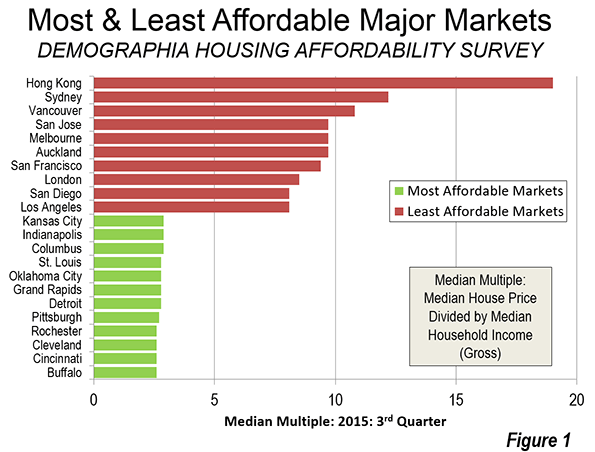
    The 12th Annual Demographia International Housing Affordability Survey reports that, as of the third quarter of 2015, Hong Kong has the least affordable housing among major markets in 9 nations, followed by Sydney, Vancouver, with Auckland, Melbourne, San Jose, San Francisco, London, Los Angeles and San Diego. In each of these markets, housing costs are now triple or more their  levels before restrictive land use regulation (house prices have tripled compared to incomes).

    Ranking Similarities: Demographia and the UBS Real Estate Bubble Index

    The Demographia list of least affordable metropolitan areas is largely echoed by UBS, the international financial services company headquartered in Switzerland. The UBS Global Real Estate Bubble Index ranks London, Hong Kong, Sydney and Vancouver as most vulnerable to risk from a real estate bubble. Demographia rates Hong Kong, Sydney and Vancouver as having the least affordable housing. London is ranked 8th in the Demographia Survey. Overall, the five cities rated by UBS as the most vulnerable are included among the eight least affordable in the Demographia Survey. The three other cities ranked in the least affordable eight by Demographia are not considered in the UBS report.

    Background on Middle-Income Housing Affordability

    In his introduction to the Survey, Senator Bob Day (Australian federal Senate) recalls that: “For more than 100 years the average Australian family was able to buy its first home on one wage. The median house price was around three times the median income allowing young home buyers easy entry into the housing market.”

    Senator Day’s description of the experience in Australia tracks with that of other nations. Following World War II and until the early 1970s, virtually all metropolitan areas in Australia, Canada, Ireland, New Zealand, the United Kingdom and the United States had median multiples around 3.0 or below.

    Since then far more restrictive land use policies have spread beyond the metropolitan areas to many others in other nations. This has often included urban containment policies (called “urban consolidation in Australia”), which severely limit or even prohibit new housing construction on or beyond the urban fringe. The result, as basic economics predicts, is higher land prices and skyrocketing housing costs, (despite expectations to the contrary by planners).

    Rating Housing Affordability

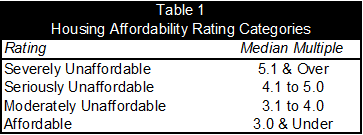
    The Demographia International Housing Affordability Survey uses the "median multiple" price-to-income ratio. The median multiple is calculated by dividing the median house price by the median household income.  Housing affordability ratings are indicated in Table 1.

    Virtually all of the severely unaffordable major markets in this year’s Survey exercise urban containment policy. Meanwhile, no market without strong land use regulation has ever been rated as severely unaffordable in the 12 years of the Survey.

    The Bottom 10: Least Affordable Major Metropolitan Markets

    The kinds of restrictions on development that Senator Day outlines are evident in the most unaffordable metropolitan areas.

    For the fifth straight year, Hong Kong had the least affordable housing.  Its median multiple was 19.0. Sydney became the second least affordable, at 12.2, leaping by 3.2 points, the largest annual increase ever recorded among major markets in the Survey. Sydney displaced Vancouver, which had the third least affordable housing among the major markets, with a median multiple of 10.8. This is up from 10.6 last year. Each of these is the highest median multiple recorded in these markets in the history of the Survey.

    Three metropolitan markets tied in fourth position with a median multiple of 9.7, San Jose, Melbourne and Auckland. San Francisco was the 7th least affordable market, with a median multiple of 9.4, followed by London (8.5). San Diego and Los Angeles, which both had a median multiple of 8.1 (Figure 1).

    Urban containment markets clearly and nearly perennially suffer declines in housing affordability. In 2013, the same ten metropolitan markets were the least affordable and had an average median multiple of 9.1. By 2015, their average median multiple had risen to 10.5. Housing affordability deteriorated in all 10 markets (house prices rose faster than incomes). This loss in housing affordability was at least 14 times the loss in the 10 most affordable markets (below).

    The Top 10: Most Affordable Major Metropolitan Markets

    Again, the United States, with its multiple regulatory variations accounted for all of the top 10 in housing affordability (actually the top 12, because of a four way tie for ninth position). Buffalo, Cincinnati, Cleveland and Rochester had the most affordable housing, with a median multiple of 2.6. Pittsburgh ranked 5th, at 2.7. Detroit, Grand Rapids and St. Louis tied for 6th, at 2.8. The tenth place tie was between Columbus, Indianapolis, Oklahoma City and Kansas City, with a median multiple of 2.9.

    By contrast, the top ten markets experienced relatively little deterioration in housing affordability over the past two years. In 2013, their median multiple averaged 2.6, and rose to 2.7 in 2015 (Figure 1). The housing affordability deterioration in the bottom 10 markets (all urban containment markets) was 14 times as high, as noted above.

    Among the five megacities (over 10 million population) in the Survey, Osaka-Kobe-Kyoto had the best housing affordability, with a moderately unaffordable median multiple of 3.4.

    All Markets

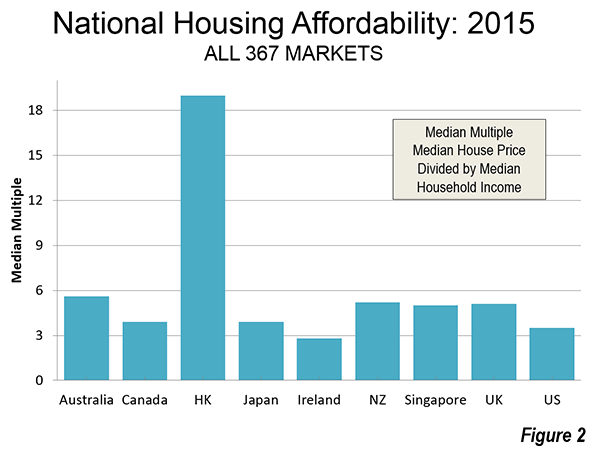
    Overall, the Survey included 368 markets. The most favorable housing affordability was in Ireland, with a median multiple among the markets of 2.8. This was the third year in a row that Ireland had the best housing affordability. In the nine prior years of the Survey, the most affordable housing had always been in either Canada or the United States (Figure 2).

    The United States was the second most affordable in 2015, with a median multiple of 3.5. Canada and Japan tied for third, with median multiples of 3.9. Four geographies with virtually universal urban containment policy were the least affordable, the United Kingdom (5.1), New Zealand (5.2), Australia (5.6) and Hong Kong (19.0).

    Singapore, though seriously unaffordable at 5.0, is far more affordable than its long-time rival,  Hong Kong (19.0). Each has virtually no suburban or rural hinterland and high population density. Yet there is a serious difference in housing policy. In contrast to Hong Kong, Singapore’s e Housing and Development Board, which accounts for approximately 90 percent of housing (which after sale is privately owned) has increased production and reduced new house prices which has led to a lowering of resale house prices as well.

    A Wholly Contrived Crisis

    Senator Day characterizes the housing affordability crisis “wholly contrived,” and “a matter of political choice… the product of restrictions imposed through planning regulation and zoning.” Senator Day calls the economic consequences of present land use policies “devastating.” He argues that governments and central banks have been too hasty to blame unprecedented housing affordability losses on demand factors, while missing the “real culprit,” which is the “refusal of … governments … to provide an adequate and affordable supply of land for new housing stock to meet demand (typically urban containment policy).

    Without reform, prospects for middle income households are grim in the metropolitan areas with urban containment policy. Housing affordability can be expected to deteriorate more, with dire economic and social consequences. According to London School of Economics and Political Science economists Paul C. Cheshire, Max Nathan and Henry G. Overman (see: People Rather than Places, Ends Rather than Means: LSE Economists on Urban Containment).

    "The problem is it is utterly unviable in the long term. With every passing decade the problems would get worse, the wider economic costs would become more penalising, the economy and monetary policy more unmanageable and the outcomes – the divide between the property haves and the property have-nots – more unacceptable."

    Wendell Cox is Chair, Housing Affordability and Municipal Policy for the Frontier Centre for Public Policy (Canada), is a Senior Fellow of the Center for Opportunity Urbanism (US), a member of the Board of Advisors of the Center for Demographics and Policy at Chapman University (California) and principal of Demographia, an international public policy and demographics firm. He is co-author of the “Demographia International Housing Affordability Survey” and author of “Demographia World Urban Areas” and “War on the Dream: How Anti-Sprawl Policy Threatens the Quality of Life.” He was appointed to three terms on the Los Angeles County Transportation Commission, where he served with the leading city and county leadership as the only non-elected member. He served as a visiting professor at the Conservatoire National des Arts et Metiers, a national university in Paris.

    Photo: Sign advertising new house and land packages starting in the $170,000s. Suburban St. Louis, third quarter 2015 (photo by author).

  • Suicide: The New Curse for Boomers?

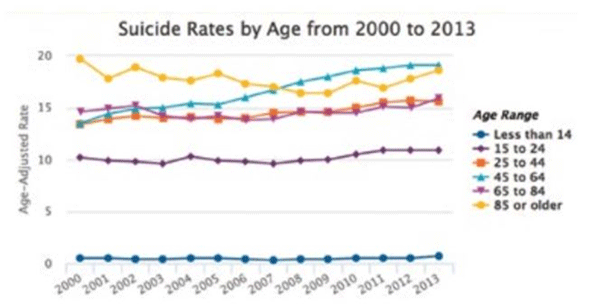
    We often associate suicide with the crises of youth, or the despair of the old. Yet the group that is now experiencing the biggest surge in suicide is in the Baby Boomer Generation; from about 14 percent in the year 2000 to about 19 percent in 2013. Baby boomers rose to 37.5% of all suicides in 2010. That is now the highest suicide rate of any existing age bracket (shown in figure 1). In order to find a way to reduce this percentage, one must understand why this is happening in the first place.  

    Before tackling the issue of suicide, it is important to understand what it means to be a baby boomer. Baby boomers were those born in the United States between the years 1945 and 1964. Total births per year during that period “grew from 2.3 million to 4.3 million and then fell to 3.2 million.”  This surge in births was largely due to the rapid expansion of the job market created by World War II. The subsequent financial comfort produced an overall positive attitude towards childbearing, causing what is known as the baby boom. These baby boomers would live to see a time where women were joining the work force in large numbers, automobiles were becoming popular, and the U.S. was in a war with Vietnam.

    So why would people born in such an exciting time be committing more suicide today? A study done by Katherine A. Hempstead and Julie A. Phillips tries to decipher whether this sharp increase in Boomer suicide rate is due to personal (e.g. mental and physical health), interpersonal (e.g. divorce), or external circumstances (e.g. economic and political). The data for this study was collected from the National Violent Death Reporting System (NVDRS) and from the CDC. In 2010, suicides from personal circumstances decreased to 79.8%, interpersonal circumstances decreased to 40.4%, and external circumstances increased to 37.5% issue lies in the 4.6% increase in suicides due to external circumstances. This pattern suggests that the large increase in suicides among this generation due to changes in their external circumstances.  


    Figure 1: Suicide rates of different age brackets from 2000 to 2013 (afsp)

    Most reports of suicide due to external circumstances were related to job, financial, or legal distress. A possible explanation of this reporting is the correlation between these suicides and the effects of the Great Recession. The Great Recession, triggered by the bursting of the 8 trillion dollar housing bubble in 2007, caused the U.S. labor market to lose 8.4 million jobs and reduce wages all across the board.

    Although every demographic was hit by the Great Recession, the baby boomer generation was hit the hardest in terms of lost property value, household finances, and lost retirement savings. As one researcher discovered, “27 percent of those aged 50 to 64 experienced reduction in salaries. This was higher than any other age group”   

    This downward trajectory was more difficult for baby boomers to deal with for three known reasons. The first is that Boomers were born at a time of economic optimism, so they tend to have had high expectations for their financial futures. Seeing the wealth that they spent their lives accumulating dwindle away because of an economic downturn may have been a large blow to their prides/egos.

    The second reason is the feelings of losing power that many baby boomers must be going through. The daily spending of boomers decreased from 114 million in 2008 to 55 million in 2009. Even with the recent 15 million dollar spike, boomer daily spending was still down to 105 million per day as of December, 2015. (Fleming).

    The third reason is the current age that baby boomers are currently living through. When hitting the age brackets of 50’s and 60’s, people usually begin considering what they will do to afford retirement. Entering a time of financial instability makes these considerations problematical, especially for those in the middle and lower classes. A study done in 2007 called Money Across Generations shows “51% of boomers reporting being ‘very confident’ of their ability to assure a ‘financially secure life’ for themselves and their children. By 2011, that number had fallen to 33%.”   The combination of financial fear as well as possible mid-life crises makes possible suicide completely understandable.

    Fortunately for the baby boomer generation, the economy is slowly growing back to a relatively normal state. At about 2.2 percent GDP growth per year since 2009, America’s financial future seems optimistic. The hope is that this will be enough to reduce the suicide rate of baby boomers.

    That outcome seems doubtful, however. In fact, suicide rates of baby boomers are expected to go up in the coming years. Figure two shows suicide rates of different age groups in the years 1999 and 2007. Until recently, suicide rates among those in their 40s and 50s seemed to level out or even decrease. The common explanation for this is the level of contentment some often feel in their middle ages. They are less likely to commit suicide because they are often focused on their careers, their children, and even sometimes their grandchildren. Many of the stresses of youth are gone yet they still have the vitality necessary to chase after the things they want. On top of that, they often have a much healthier diet than other age groups, so their risk for chemical depression is much lower.

    This makes the current upsurge in boomer suicides all the more distressing.   At a time when traditionally suicide rates are low, those of boomers are now actually higher than those of any other generation. That includes the 15 to 24, 25 to 44, and the 85 (asfp) and older demographics, all of which traditionally suffer higher suicide rates.   

    Baby boomers are headed into a new stage of their lives, which is usually called the golden years. That name is very misleading however, as suicide rates among the elderly are consistently higher than those of other ages. This is because many elderly people live with undiagnosed cases of depression, which are often worsened by the loss of a spouse or the stress of living with a chronic illness. They also tend to lack adequate social interaction, which is important in fighting the loneliness that often exacerbates depression. Lastly, they are much more likely to carefully plan out suicide attempts. That, combined with their more fragile bodies, makes their suicide attempts much more likely to be successful  

    Figure 2: Suicide Rates Among Ages, 1999 and 2007 (afsp)

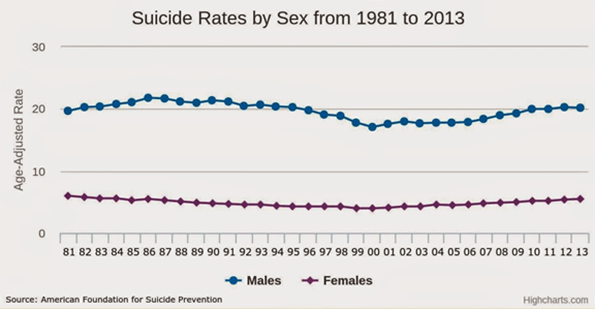
    One theory suggests that depression is not decreasing because men are not getting the emotional help that they so desperately need. Figure 3 shows the separated suicide rates of males and females between 1981 and 2013, inclusive (afsp). In that window, the trend stays relatively the same; males are committing suicide more than twice as much as women. Since women are diagnosed with depression twice as much as men, this disparity is surprising. A study by Lisa A. Martin, Harold W. Neighbors, and Derek M. Griffith explores this disparity and finds that men may be equally depressed, but they seem less equipped to handle it.


    Figure 3: Suicide Rates by Sex from 1981 to 2013 (Milburn)

    Some of this comes from today’s social conditions in which boys have been told that they are not supposed to express sadness, as it can be deemed a “unmasculine.” As a result, they feel less willing to see counselors or get help in dealing with their emotional issues. Instead, they turn to other means of consolation such as bouts of anger or substance abuse. That is why they are less often diagnosed with depression.

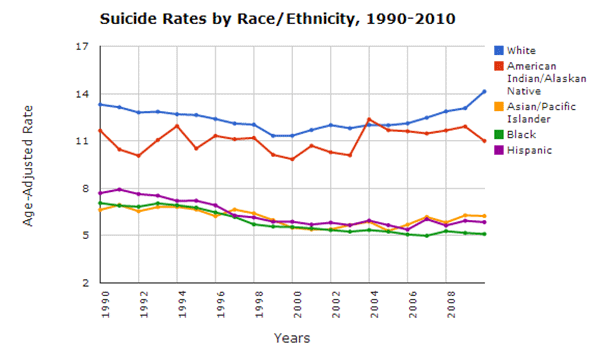
    One surprising finding is that suicide among boomers is not only a largely male phenomenon, but also largely a white one. Figure 4 shows the suicide rates between 1990 and 2010 by race/ethnicity. According to the data, White people have the highest suicide rate of any ethnicity, followed closely by Native Americans. All minorities, other than Native Americans, have a much lower suicide rate. This trend seems counterintuitive since white people are known to have less financial instability. A theory suggests that white people are less used to adversity, which makes it difficult for them to deal with the difficulties of everyday life. They also may have an unrealistic view of how easy life will be as they grow up, making them more often disappointed with the end result. Other ethnicities may also have a more positive outlook or have stricter religious/moral beliefs on suicide.


    Figure 4: Suicide Rates by Race/Ethnicity from 1990 to 2010 (afsp)

    Though there have been a lot of generalizations throughout this paper, it is important to note that every individual is unique. Although race, gender, generation and other demographics may tell a lot about a person, there is also much more that can only be found by getting to know a person individually. Helping baby boomers to be happier and commit less suicide is going to take personal care and compassion instead of a single standard approach.  An improved economy may help as well in preventing a tsunami of boomer depression and suicide in the years ahead.

    Tyler Hishmeh is a senior business student at Chapman University. When not at school he’s usually training in Muay Thai or hitting balls at the golf range.

  • American Extremism is a Product of American Apathy

    Much research has gone into studying the political polarization that has gripped American politics. Why have the two American parties moved to the extremes? One explanation, championed by MIT Professor Noam Chomsky is that the Republicans have ceased to be a functioning party. Chomsky claims that the GOP has wholly given itself over to the rich, and in order to win elections has been forced to appeal to the radical fringes of American society, who he defines as Evangelicals, nativists, racists and gun fanatics.

    Peter Wehner, Senior Fellow at the Ethics and Public Policy Center, argues that rather than the GOP moving to the right, it’s the Democrats who have moved dramatically to the left. Wehner argues that while Bill Clinton revived the Democrats from nearly twenty years of political defeats by abandoning left-wing politics and embracing centrist policies, Obama ran as an unabashed liberal, and today Hillary Clinton and Bernie Sanders have only followed suit. There may be other, less directly political reasons.

    A Princeton study claims that political polarization has been a frequent occurrence as inequality has increased in the United States, and extremism has been a regular response to economic woes. Another study by UC Berkeley places the blame not on the parties or society, but on the voters themselves, who political scientist David Broockman argues have spontaneously become fanaticized, even more so than their representatives.

    These are all interesting ideas, but most lack hard numbers, and what little numbers are offered come from selective results of specific poll questions asked to a few thousand people at most. If we were to look at the total voting practices of the American people, what insight could we draw? I set about to do just that and have concluded that the driving force of political polarization in America is from profound voter apathy. I am not saying that Chomsky, Wehner, Broockman or any other political theorists are necessarily wrong, but while their arguments seek to explain why the two extremes have become ascendant they fail to address or minimize the shocking disappearance of the moderates in both parties. The disappearance of the center, particularly in the primaries, explains political polarization in America, not the rise of the fringes.

    Pundits and political experts have placed far more emphasis on primaries over the past six years due to the rise of the Tea Party. Despite the evident surge in media attention by elites and massive donations by the super-rich on both sides, the presence of voters in the primaries has been collapsing to all-time lows. In 1972, 30.9% of registered voters participated in the primaries. That number has dropped nearly every year, to 21.7% in 1992 at the beginning of the Clinton era, and 19% in 2000. In 2008, in the heavily-contested race between Clinton and Obama, primary turnout hit 30.3%. But that spike proved to be a one-time oddity, as in 2012 the primary voter rate for both parties declined to an all-time low of 15.9%, or nearly half the rate forty years ago.

    What makes this even more striking is an accompanying decline in total voter registration. In 1972, 72.3% of Americans eligible to vote were registered. In 2012 that number dropped to 65.1% (in 2014 this declined further to 64.6%) for a 7.9 percentage point difference. The drop in voter registration combined with a drop in primary voter participation of eligible voters has resulted in an overall decline of 54% in primary voter participation from the last generation to the current one. More than half of voters have ceased to engage in the ideological formation of our two parties in any meaningful way, leaving the most die-hard 46% to dominate politics. To put that in perspective, let us hypothesize that 7 out of 10 Republicans and a similar 7 out of 10 Democrats have moderate, mostly rational views. Now imagine that the most moderate 5 of 10 left each party; this would leave a distribution of 3 fringe voters for every 2 moderates. Even if the center had previously been the supermajority a drastic decline of the sort we have witnessed between 1972 and 2012 could easily explain the sudden extremism of the party. This demographic collapse in primary voters may explain the rise of extremism far better than the supposition that the majority of people on the right and left have substantially changed their ideologies and adopted extremist positions.

    Any serious conversation on the polarization of American politics cannot ignore the drop in primary voters, though up to this point it mostly has. While the general elections decide whether conservatism or liberalism are dominant at the time, the primaries decide what conservatism and liberalism are. In 1972 when twice as many Republicans participated in the primaries, some of the main points in their platform were nuclear arms reduction, increased government protection for the environment, a 7% tax increase on those making $100,000 or more, and the increase of “trade and cultural exchanges as ways of improving understanding between [the U.S. and China].” In 1972 the DNC supported the Drug War and efforts to maximize coal efficiency. These policies would be unthinkable to GOP and DNC primary voters forty years later. This may have more to do with the fact that the most moderate 60% of voters have disappeared from the political landscape, rather than a change in ideology from the majority of voters.

    What effect does the disappearance of the center have on the structure of American politics? To understand this it is necessary to first outline the general election process. Of the 322 million American citizens only 208,012,000 (64.6%) are registered to vote. 32% of Americans identify as Democrats while 23% identify as Republicans or 67 million and 48 million respectively, with the rest identifying as Independent or belonging to third parties. In 2012, Mitt Romney was only able to win 10 million votes out of 19 million primary votes cast on his way to the nomination. Considering that the Republican Party has 48 million members, hardly a third of Republicans showed up to the polls, perhaps fewer due to Independents voting in the twenty-seven open primaries. The Democratic Party appears to have even lower turnout than the Republicans based on the 2004 race, but even if the Democrats exhibit similar voting patterns, one can expect less than 27 million to vote, in a party comprised of 67 million people.

    Furthermore, one only needs around 50% of the primary vote to win the nomination, and the last two primary competitions were near that figure (53% for Romney 2012, 47% for Obama in 2008). In order to win the GOP nomination Trump, Cruz, Carson or whoever takes 2016’s trophy will only need to win in the range of 10 million votes, or 3% of the total US population. Meanwhile, in order to win the DNC nomination, Clinton or Sanders will only need to win roughly 14 million votes, or 4% of the total US population, meaning that the ideologies of America’s two ruling political parties are decided by a mere 7% of the total population. To put this in perspective, in 1972, 22.3% of Americans who were eligible to vote participated in the formation of their party’s ideology.

    Chomsky and Wehner are not necessarily wrong. Perhaps the GOP has become too dependent on rich donors to connect with the average voter, while the Democrats have moved too far to the left for many who constituted Bill Clinton’s former base. But what is clear is that forty years ago nearly a quarter of eligible Americans voted in the primaries, playing a direct hand in the formation of their party’s ideology, while today that number is closer to one in ten. While the near-universal consensus among pundits and political theorists is that politics has become too polarizing, this extremism has emerged not from fanaticized voters, but from an apathetic middle that has almost completely disappeared from the political landscape. The absence of moderate voters has only had a multiplying effect, as extremist candidates drive out even more centrists from the voting pool.

    Gary Girod is currently pursuing a Ph.D in modern Western European labor history at the University of Houston, and graduate of Chapman University.

  • In Southern California, It Takes an Assortment of Villages

    Among urban historians, Southern California has often had a poor reputation, perennially seen as “anti-cities” or “19 suburbs in search of a metropolis.” The great urban thinker Jane Jacobs wrote off our region as “a vast blind-eyed reservation.”

    The Pavlovian response from many local planners, developers and politicians is to respond to this criticism by trying to repeal our own geography. Los Angeles’ leaders, for example, see themselves as creating the new sunbelt role model, built around huge investments Downtown and in an expensive, albeit underused, subway and light-rail network.

    Yet the notion of turning Southern California into a dense, New York hybrid makes very little sense. Nor has it done much for the regional economy, certainly in Los Angeles. The City of Angels thrived during its period of development into a multipolar region; in the 21st century, as Downtown has gained a few thousand hipsters, the rest of the city has lagged economically while population and job growth – including in tech – has been more robust in the surrounding counties of Orange, Riverside and San Bernardino.

    Building off Strength

    Southern California, even before the advent of the freeways, developed along the lines of an “archipelago of villages.” Even Downtown Los Angeles, the one legitimate urban core in the region, lost its central relevance by the 1930s and, despite all its self-promotion, employs close to the smallest share – well short of 3 percent – of the regional workforce of any large region in the country.

    In contrast, the two fastest-growing areas in Southern California – the Inland Empire and Orange County – are arguably the largest regions in the country without a real downtown. Rather than a negation of urbanity, as some suggest, these areas are nurturing an expansive archipelago of smaller hubs, each serving distinct geographies, populations, tastes and purposes, and constitute the building blocks for Southern California’s urban future.

    Read the entire piece at The Orange County Register.

    Joel Kotkin is executive editor of NewGeography.com and Roger Hobbs Distinguished Fellow in Urban Studies at Chapman University, and a member of the editorial board of the Orange County Register. He is also executive director of the Houston-based Center for Opportunity Urbanism. His newest book, The New Class Conflict is now available at Amazon and Telos Press. He is also author of The City: A Global History and The Next Hundred Million: America in 2050. He lives in Orange County, CA.

  • Around The World, The Tide Is Turning Against Megacities

    The massive construction waste collapse last month in Shenzhen reflects a wider phenomenon: the waning of the megacity era. Shenzhen became a megacity (population over 10 million) faster than any other in history, epitomizing the massive movement of Chinese to cities over the past four decades. Now it appears more like a testament to extravagant delusion.

    In 1979, Shenzhen was a small fishing town of roughly 30,000 people when it became a focus of former Chinese leader Deng Xiaoping’s first wave of modernization policies. Now it is a metropolis of 12 million whose population grew 56 percent between 2000 and 2014. For years, it stood as the brash wunderkind of Chinese cities, proud of its gleaming infrastructure that is now increasingly suspect.

    The Shenzhen collapse came four months after a similar deadly public safety disaster in Tianjin, another relatively new megacity, where an explosion at a chemical warehouse killed 173 people. And of course, there is the widespread urban air pollution that is hazardous in Beijing and simply noxious elsewhere. Simply put, the once compelling “economies of scale” offered by increasing the size of cities have broken down in urban agglomerations over 10 million people, where their size has now become encumbrances to further growth, not to mention the happiness and health of their citizens.

    One big problem with megacities, the Chinese are discovering, is their impact on property prices and fertility. Chinese may have been freed last year from the tyranny of the one-child policy, but don’t expect a baby boom in any of the biggest, most glamorous cities. Shanghai has among the lowest fertility rates in the world, one-third of the replacement rate. Beijing and Tianjin suffer a similarly dismal fertility rate.

    This reflects both crowded conditions and insanely high property prices that, on an income-adjusted basis, now are far higher than those in expensive world cities like Vancouver, London, Sydney, San Francisco and New York — two times higher in some cases.

    The population growth rate in Beijing and Shanghai has dropped dramatically since 2010, according to  demographer Wendell Cox. The population of China’s capital expanded 3.9 percent a year from 2000 to 2010; growth slowed to 2.3 percent annually from 2010 to 2014. In Shanghai the population growth rate for the same periods slowed from 3.4 percent annually to 1.3 percent. High degrees of pollution have led at least some affluent urban Chinese to move back toward the countryside, as well as to cleaner, less congested regions in Australia, New Zealand, and North America.

    Nonetheless, the Chinese government remains committed to driving further urbanization to boost economic growth, aiming to turn more rural farmers into city-dwelling, free-spending consumers. In 2014 the government set a goal to increase the ratio of the Chinese population that lives in cities to 60% by 2020 from 53.7% then. But  the urbanization strategy aims to funnel migrants to small and midsize cities with less than 5 million residents, maintaining tight restrictions on legal migration to the megacities.

    To make the smaller cities more attractive Beijing promised to ramp up infrastructure spending, and local governments have rolled out housing subsidies, tax breaks and cheaper mortgages to lure migrants. Whether that will be enough to counteract the pull of the megacities’ bigger job markets is an open question.

    Peak Megacity In Much Of The World

    Until recently the worldwide trend toward megacities — there were 34 in 2014 — has seemed relentless. But in much of the world this trend is slowing down. The populations of Europe and North America are growing slowly, with the exception of London and Moscow. In the last decade the population of New York City grew at roughly one third the relatively low national rate.

    Where megacities can be expected to grow in the future are in the backwaters of the global economy, in Africa and parts of Asia, where the most rapid population growth and urbanization is taking place.

    In an impressive 2011 study, the consultancy McKinsey predicted that through 2025, population growth would shift to 577 “fast-growing middleweight” cities many of them in China and India, while, in contrast, megacities would underperform economically and demographically.

    In India as well, population growth rates have slowed considerably for two of its three largest cities, Mumbai and Kolkata, while New Delhi has become the country’s largest megalopolis. More rapid population growth has taken place in mid-sized cities such as Hyderabad, Pune, Chennai, and Bangalore, as well as in smaller cities like Coimbatore, home to 2.5 million, that have seen much of the industrial and tech growth in the country.

    Urban decentralization has become something of a theme of the government of Prime Minister Narendra Modi, who implemented a program of “rurbanization” as Chief Minister of the state of Gujarat. Villages are still home to the vast majority of Indians and serve as the primary source of new urban migrants. Modi speaks of human settlements with the “heart of a village” and developing “the facilities of the city.”

    Singapore-based scholar Kris Hartley notes a shift of industrial and even service businesses to more rural locales in Southeast Asian countries like Thailand, Vietnam and Indonesia, and parts of China. As megacities become more crowded, congested, and difficult to manage, Hartley suggests, companies in these areas are finding it more convenient, less costly, and better for the families of their employees to locate farther from giant cities.

    Where Megacities Will Grow Fastest

    According to U.N. estimates, 99 percent of all population growth between 2010 and 2100 will take place in developing countries, some 83 percent in Africa alone followed by 13 percent in Asia, particularly the less developed parts.    

    Rather than an indicator of the future, megacity growth in these regions increasingly is something of a lagging indicator of an early phase of urbanization. Growth projections suggest the evolution of two more megacities in Africa: Johannesburg-East Rand (South Africa) and Luanda (Angola).  They will join Lagos in Nigeria, as well as the rapidly growing and poor megacities Cairo and Kinshasa, as well as Karachi in Pakistan

    As is the case in India, these cities will likely be most prolific in producing slums. Worldwide there are now as many as a billion denizens of these depressed areas, threatening the social stability of not only of their countries but also the world, as they tend to generate high levels of both random violence and more organized forms of thuggery, including terrorism.

    One does not have to be a Gandhian idealist to suggest that perhaps dispersion, not concentration, provides a better model for future urban growth in developing countries, offering more space, privacy, and connection to nature, note social scientist Robert Obudho. A focus on large city development, he argues, will exacerbate problems, while shifting toward smaller-scale areas could encourage more “self-reliance, spatial equity, [and] local participation.”

    Ultimately, a shift toward dispersion—both within regions and between them—has been made more feasible in the developing world, as in the West, by new technology. Smaller cities and even villages are no longer as economically isolated and are brought closer to the outside world through the use of cell phones and the Internet. Economic growth in these places could help stem megacity migration by closing the gaps in living standards of rural people relative to their urban counterparts, as has occurred in western countries.

    Such ideas need to be heard more in the discussion about cities in the developing world. We need to confront the urban future with radical new thinking. Rather than foster an urban form that demands heroic survival, we should focus on ways to create cities that offer a more prosperous, healthful and even pleasant life for their citizens.

    Joel Kotkin is executive editor of NewGeography.com and Roger Hobbs Distinguished Fellow in Urban Studies at Chapman University, and a member of the editorial board of the Orange County Register. He is also executive director of the Houston-based Center for Opportunity Urbanism. His newest book, The New Class Conflict is now available at Amazon and Telos Press. He is also author of The City: A Global History and The Next Hundred Million: America in 2050. He lives in Orange County, CA.

    Photo: Shenzhen:  Binhe Avenue from the Shun Hing Tower (by Wendell Cox)

  • America’s Next Boom Towns: Regions to Watch in 2016

    Which cities have the best chance to prosper in the coming decade? The question is a complex one, and as the economy changes, so, too, will the best-positioned cities.

    To identify the cities most likely to boom over the next 10 years, we took the 53 largest metropolitan statistical areas in the country (those with populations exceeding 1 million) and ranked them based on eight metrics indicative of past, present and future vitality. We factored in, equally, the percentage of children in the population, the birth rate, net domestic migration, the percentage of the population aged 25-44 with a bachelor’s degree, income growth, the unemployment rate, and population growth.

    The results show two divergent kinds of ascendant cities. One is driven by the tech industry, the in-migration of educated people and sharply rising incomes; the other type is what we describe as “opportunity cities,” which tend to have a diverse range of industries, lower costs and larger numbers of families. We may be one country, but the future is being shaped by two very different urban archetypes.

    The Lone Star Model

    The most vital parts of urban America can be encapsulated largely in one five-letter word: Texas. All four of Texas’ major metro areas made our top 10. Austin, Houston, Dallas-Ft. Worth and San Antonio are very different places, but they all have enjoyed double-digit job growth from 2010 through 2014, well above the national average of 8.1%. They also all have posted income growth well above the national average.

    But the biggest divergence from the pack may be demographics. The Texas cities have become major people magnets, with huge growth in their populations of young, educated millennials and households with children. The clear star of the show is No. 1-ranked Austin, which has become the nation’s superlative economy over the past decade.

    Austin leads the pack in terms of population growth, up 13.2% between 2010 and 2014, in large part driven by the strongest rate of net domestic in-migration of the 53 largest metropolitan areas over the same span: 16.4 per 1,000 residents. The educated proportion of its population between 25 and 44 is 43.7%, well ahead of the national average of 33.6%, although somewhat below the traditional “brain center” cities of the Northeast and the West Coast.

    The other Texas cities also do well across the board, with strong domestic in-migration, low unemployment and a rising population of young families. The biggest question marks going ahead involve No. 6 Houston, which benefited heavily from the energy boom and now is dealing with the consequences of the oil price collapse. Most economists do not see a total meltdown as occurred in the 1980s, but it would not be a surprise to see Houston fall out of our top 10 until energy prices recover. Economist Patrick Jankowski projects some 9,000 layoffs in the energy sector locally in 2016 but enough growth elsewhere — for example 9,000 new jobs in medical services — to keep employment expanding, although far below the pace of the last few years. The other, less energy-dependent Texas metro areas seem likely to continue their stellar performance.

    The Flyover Superstars

    There are several dynamic, fast-growing metro areas elsewhere in the country that seem likely to increase their status in the coming years, mostly in the Southeast and the Intermountain West. Like the Texas cities, these areas enjoy lower costs than the Northeast or California, notably for housing, and tend to be pro-business. All are experiencing significant population growth.

    No. 2 Salt Lake City and No. 4 Denver have been expanding for years, with significant tech-sector growth. Both are logging population increases, with Denver benefiting from strong domestic in-migration while Salt Lake City has the highest birth rate among major metro areas, 16.9 per 1,000 women from 2010-14, largely due to its fecund Mormon population.

    The Southeast has a number of ascendant cities led by No. 5 Raleigh, which, like Austin, has emerged as a tech hot-spot. Some 49% of all Raleigh residents aged 25 to 44 have a four-year degree, higher than any other metro area in the South. The national average is 33.6%.

    The Glorious Gated Community

    Unlike the rest of our rising cities, the Bay Area’s two major metro areas — No. 3 San Jose and No. 9 San Francisco — do not boast rapid population growth, and have low rates of family formation and births. Yet the area’s technology domination has made it so rich that it blows by most regions in terms of positioning for the future.

    The big divergence here is income growth. Since 2010, the two metro areas have enjoyed the strongest expansion in earnings in the nation – 9.2% in the San Jose area between 2010 and 2015 and 7.8% in San Francisco. Silicon Valley and the Bay Area also boast extraordinarily well-educated young workforces. In San Jose 53.5% of workers aged 25 to 44 have a college degree, the third-highest share in the nation, and San Francisco ranks fourth at 52.4%.

    So why are people not flocking to these areas? San Jose is net negative for domestic migration over the time we examined while San Francisco made modest gains only after years of net out-migration. Much of the problem lies in high housing prices, which, notes Dartmouth College economist William Fischel, have turned the Bay Area and the Valley into an “exclusionary region” inaccessible to all but the wealthy and highly gifted.

    Given the growing importance of the technology industry, it seems likely that this gated region will continue to thrive in the years ahead, albeit with a low level of new family formation, relatively few children and a limited middle class. It’s a model that some cites may wish to duplicate but few will be able to. Perhaps the most promising candidate to join this list is No. 15 Seattle, which also has experienced strong job growth, largely from technology and boasts a large population of college graduates.

    The Fading Big Enchiladas

    Perhaps the most glaring omissions at the top of our list are America’s three largest metropolitan areas: New York, Los Angeles and Chicago. Of the three, New York does best, but only well enough for 36th place, hardly what one would expect for America’s, and arguably the world’s, premier city.

    New York has high costs like San Francisco but a far more bifurcated economy and demographics. Wall Street may be approaching the end of an epic run, but overall incomes in New York have fallen 0.5% since 2010. Employment has expanded a respectable 7.3% over the past five years, roughly the national average, but the metro area has the highest rate of domestic out-migration in the country.

    Similar dynamics have lowered future prospects for Los Angeles and Chicago. Ranked 39th, Los Angeles has posted better job growth than New York at 10.2%, but its income losses were also more severe, down 3.8%. As in Gotham, the elites of Southern California in entertainment, real estate and technology may be thriving, but the vast majority are not doing so well, as manufacturing, construction and business services have lagged. Los Angeles’ population — more heavily Latino and African America — is also less well-educated, with only 34.8% of adults 25 to 44 holding bachelor’s degrees, a good 20 points less than their San Francisco-area competitors.

    Chicago, ranked 40th, appears to have worse prospects. For all its problems, Los Angeles still dominates entertainment, has the largest port in the country, close Pacific Rim connection and enjoys the finest weather on the continent. Chicago has none of those advantages, although it boasts a very attractive downtown. The region around the magnificent mile is not doing well, with low job and population growth, stagnant incomes and strong out-migration. Urban analyst Pete Saunders describes Chicago’s economy as “one-third San Francisco and two-thirds Detroit.” That seems more true than many Windy City boosters would like to admit.

    Future Of The Future

    Of course the future is not completely predicable and many things could change in the coming years. In the short run, as mentioned above, the energy boom towns will take a bit of a hit. Energy slowdowns could impact other cities with a concentration in this industry, notably Denver, Salt Lake and even Columbus, near Ohio’s big natural gas and oil reserves.

    But other factors suggest that these lower-cost cities will do well into the future. Columbus, Ohio, for example, may see its  job growth impacted, but the benefits of strong in-migration will linger, particularly the growing numbers of college-educated millennials who have headed to it and other more affordable Rust Belt metro areas in recent years.

    Ultimately we may see the emergence of two distinct urban futures. One will emerge in elite “gated” regions such as San Francisco, San Jose, and, perhaps in the near term, Seattle. These areas will dominate many key tech sectors, and will continue to leverage their well-educated populations. The other will be more along the Texas model, diversified economies driven by lower costs, particularly for housing, diversified economies and increasingly well-educated populations.

    Rather than being fundamentally incompatible, this enormous country should have room for both models. America needs its elite centers, but there also have to be cities for middle-class families. Each can claim a piece of the future.

    2016 Regions to Watch Index
    Rank Region (MSA) Score Children age 5-14, 2014 Job Growth, 2010-2015 Popltn Change, 2010-2014 Earnings growth, 2010-2015 Domestic Mig rate 2010-2014 Birth rate, 2010-2014 Bachelor’s degrees, Age 25-44, 2014 Unemplymt, Nov 15
    1 Austin 75.6 13.7% 19.1% 13.2% 1.5% 16.4 13.8 43.7% 3.3%
    2 Salt Lake City 66.3 16.2% 14.8% 6.0% 2.1% -0.1 16.9 31.2% 2.9%
    3 San Jose 65.6 13.1% 21.3% 6.3% 9.2% -1.8 13.1 53.5% 3.9%
    4 Denver 63.2 13.6% 15.0% 8.3% 0.8% 9.3 13.1 43.9% 3.2%
    5 Raleigh 63.1 14.7% 15.4% 10.0% -1.6% 11.0 12.9 49.0% 4.6%
    6 Houston 63.0 15.2% 15.2% 9.6% 3.8% 7.4 15.0 32.5% 4.9%
    7 Dallas 61.1 15.2% 15.0% 8.2% 0.7% 6.6 14.4 33.4% 4.0%
    8 San Antonio 58.6 14.5% 12.5% 8.7% 1.1% 9.9 14.1 27.6% 3.8%
    9 San Francisco 56.6 11.4% 15.7% 6.0% 7.8% 2.9 11.7 52.4% 3.9%
    10 Oklahoma City 56.2 13.9% 9.3% 6.7% 3.5% 6.8 14.5 30.4% 3.6%
    11 Nashville 56.1 13.3% 14.8% 7.3% 1.7% 8.9 13.1 37.8% 4.3%
    12 Charlotte 54.3 14.1% 15.4% 7.4% 0.9% 8.8 12.8 37.6% 5.1%
    13 Minneapolis 52.1 13.6% 8.7% 4.4% -0.6% 0.1 13.3 44.9% 2.7%
    14 Columbus 51.2 13.5% 10.8% 4.9% 0.7% 2.6 13.7 40.7% 3.9%
    15 Seattle 50.9 12.2% 13.8% 6.7% 4.0% 4.3 12.8 43.1% 4.9%
    16 Atlanta 50.8 14.6% 11.9% 6.2% 0.8% 3.5 13.3 38.2% 5.0%
    17 Orlando 49.1 12.6% 16.6% 8.8% -1.5% 8.2 12.1 31.0% 4.5%
    18 Grand Rapids 48.2 14.0% 20.0% 3.9% -2.2% 1.7 13.5 37.1% 5.2%
    19 Phoenix 48.1 14.2% 12.9% 7.1% -2.1% 6.5 13.7 29.3% 5.0%
    20 Indianapolis 47.9 14.3% 11.0% 4.4% -2.2% 2.1 13.8 36.4% 4.2%
    21 Washington 47.8 12.9% 5.3% 7.0% -3.4% 0.4 13.8 53.2% 4.1%
    22 Portland 47.5 12.7% 12.2% 5.5% 3.1% 5.1 12.1 38.9% 4.8%
    23 Kansas City 45.8 14.2% 6.9% 3.1% -0.3% -0.3 13.6 39.5% 3.9%
    24 San Diego 44.1 12.1% 9.6% 5.4% 1.9% 0.3 14.0 38.7% 4.8%
    25 Boston 43.1 11.4% 8.4% 3.9% 2.2% -0.5 11.2 54.1% 4.1%
    26 Cincinnati 39.4 13.6% 6.4% 1.6% 0.4% -2.1 12.9 37.0% 4.2%
    27 Louisville 39.3 13.0% 10.2% 2.8% -1.2% 1.5 12.5 31.7% 4.2%
    28 Riverside 39.0 15.0% 13.9% 5.1% -2.7% 1.6 14.1 18.8% 6.1%
    29 Jacksonville 39.0 12.7% 9.0% 5.5% -2.4% 5.4 12.7 28.2% 4.7%
    30 Richmond 38.3 12.7% 5.3% 4.3% -2.4% 3.1 12.0 38.1% 4.2%
    31 Detroit 37.5 12.9% 12.0% 0.0% -1.6% -4.6 11.6 33.9% 3.0%
    32 Sacramento 36.7 13.3% 8.3% 4.4% -0.6% 1.7 12.5 32.2% 5.5%
    33 Tampa 35.8 11.5% 10.2% 4.7% -1.6% 6.4 10.9 31.3% 4.6%
    34 Miami 35.0 11.4% 12.6% 6.5% -1.7% 0.9 11.4 31.3% 5.0%
    35 Milwaukee 35.0 13.3% 4.9% 1.0% -1.0% -3.4 12.8 38.3% 4.4%
    36 New York 35.0 12.1% 7.3% 2.7% -0.5% -6.3 12.7 44.8% 4.7%
    37 Baltimore 34.9 12.4% 6.8% 2.8% -1.2% -0.6 12.3 43.9% 5.3%
    38 Las Vegas 33.8 13.5% 13.6% 6.1% -6.5% 4.7 13.2 22.4% 6.3%
    39 Los Angeles 33.7 12.5% 10.2% 3.4% -1.8% -3.6 13.0 34.8% 5.3%
    40 Chicago 32.9 13.3% 6.5% 1.0% -0.1% -6.0 12.7 41.7% 5.4%
    41 Birmingham 31.9 13.1% 5.5% 1.4% -1.1% -0.6 12.9 32.3% 5.2%
    42 St. Louis 31.8 12.8% 4.2% 0.7% -0.4% -3.3 12.2 38.4% 4.6%
    43 Philadelphia 31.6 12.4% 3.8% 1.4% -1.7% -3.0 12.1 41.7% 4.6%
    44 New Orleans 31.2 12.6% 4.5% 5.2% -6.0% 4.7 12.7 33.4% 5.6%
    45 Cleveland 30.1 12.3% 5.2% -0.7% 0.3% -4.3 11.2 34.5% 3.7%
    46 Memphis 29.5 14.2% 3.6% 1.4% -0.8% -4.0 14.2 28.3% 6.1%
    47 Pittsburgh 28.8 10.8% 3.9% 0.0% 2.6% 0.4 10.1 42.2% 4.5%
    48 Virginia Beach 28.8 12.3% 1.0% 2.4% -1.2% -3.5 13.4 30.1% 4.6%
    49 Tucson 25.3 12.3% 3.7% 2.5% -3.9% 0.1 12.1 29.1% 5.3%
    50 Buffalo 25.0 11.6% 3.7% 0.1% 0.3% -2.3 10.6 36.8% 4.9%
    51 Hartford 24.5 11.9% 5.5% 0.2% -1.6% -5.7 10.0 41.9% 4.8%
    52 Rochester 23.9 11.9% 3.3% 0.3% -2.5% -3.9 10.8 36.6% 4.6%
    53 Providence 23.3 11.5% 5.1% 0.5% -0.4% -3.2 10.4 33.2% 4.9%

    Analysis by Mark Schill, Praxis Straetgy Group (mark@praxissg.com). The index incldues eight equally-weighted measures: share of population age 5-14, 5-year job growth, 5-year population change, 5-year real earnings growth, annual average domestic migration rate, annual average birth rate, share of young population with a bachelor’s degree, and current unemployment rate.

    This piece first appeared in Forbes.

    Joel Kotkin is executive editor of NewGeography.com and Roger Hobbs Distinguished Fellow in Urban Studies at Chapman University, and a member of the editorial board of the Orange County Register. He is also executive director of the Houston-based Center for Opportunity Urbanism. His newest book, The New Class Conflict is now available at Amazon and Telos Press. He is also author of The City: A Global History and The Next Hundred Million: America in 2050. He lives in Orange County, CA.

    Mark Schill is a community process consultant, economic strategist, and public policy researcher with Praxis Strategy Group.

    SaltLake City photo by Skyguy414.