Category: Demographics

  • How Commuters Get Railroaded by Cities

    With more than $10 billion already invested, and much more on the way, some now believe that Los Angeles and Southern California are on the way to becoming, in progressive blogger Matt Yglesias’ term, “the next great transit city.” But there’s also reality, something that rarely impinges on debates about public policy in these ideologically driven times.

    Let’s start with the numbers. If L.A. is supposedly becoming a more transit-oriented city, as boosters already suggest, a higher portion of people should be taking buses and trains. Yet, Los Angeles County – with its dense urbanization and ideal weather for walking and taking transit – has seen its share of transit commuting decline, as has the region overall.

    Since 1980, before the start of subway and light-rail construction, the percentage of Angelenos taking transit has actually dropped, from 7.0 percent to 6.9 percent, while the region (including the Inland Empire and Ventura County) has seen the transit share drop from 5.1 percent to 4.7 percent. These reductions in ridership have been experienced both on the rail and bus lines.

    The simple truth is that this region is just not structured to run largely on rails. We should not prioritize our transit dollars on trying to remake our region into something resembling New York, or even San Francisco, but in serving the needs, first and foremost, of those who remain dependent on public transit.

    Read the entire piece at The Orange County Register.

    Joel Kotkin is executive editor of NewGeography.com and Roger Hobbs Distinguished Fellow in Urban Studies at Chapman University, and a member of the editorial board of the Orange County Register. He is also executive director of the Houston-based Center for Opportunity Urbanism. His newest book, The New Class Conflict is now available at Amazon and Telos Press. He is also author of The City: A Global History and The Next Hundred Million: America in 2050. He lives in Orange County, CA.

  • Auckland Tackles Housing Affordability Crisis

    City of Auckland Chief Economist Chris Parker has called for establishment of a house price to income ratio objective of 5.0, to be achieved by 2030. The recommendation was included in a report commissioned by Auckland Mayor Len Brown and Deputy Mayor Penny Hulse.

    Housing Affordability and Urban Containment Policy

    The recommendation has been brought about in response to Auckland’s severely unaffordable housing. Recent reports indicate a price to income ratio over 9.0, at least triple that of New Zealand to the early 1990s.

    Like a number of metropolitan areas, Auckland has had urban containment land-use policy for some time. Auckland has drawn an urban growth boundary around development, largely banning new greenfield housing outside the boundary. As economics would predict, with a continuation of strong housing demand and the significant supply reduction, house prices have been shot skyward. The latest Demographia International Housing Affordability Survey showed Auckland to have a median multiple of 8.2 (the median multiple is the median house price divided by the median household income), though later data indicates a further deterioration (above).

    Avoiding the Consequences of Urban Containment

    House price volatility has been a growing concern in urban containment markets where house prices have escalated so strongly relative to incomes and economic productivity. The bursting of the US housing bubble in the last decade indicates the damage that can be inflicted on people and their finances when exorbitantly high house prices collapse. This is a fate governments seek to avoid not only in Auckland, but at the national level.

    According to Parker’s report, the city of Auckland is expected to add 1 million additional residents over the next 30 years. Parker indicated that: "If high house prices are sustained or continue to rise relative to incomes then … consequences and risks will become more significant:" He cited:

    "-loss of social cohesion — an increasingly socially divided city with a line drawn between those in the housing market and those outside

    -macroeconomic instability via rapid house price deflation.

    -Increased unemployment as businesses relocate activities to other more competitive cites locally (e.g. Christchurch, Hamilton, Tauranga) and internationally (e.g. Melbourne and Sydney)

    -Increased household crowding and related social ills."

    City Councilor Dick Quad echoed similar concerns in an email: "It’s staggering that Auckland’s homeownership is now down to 50% from 64% just 9 years ago. The social chaos we are creating can be seen on a daily basis with overcrowding, third world diseases (resulting from overcrowding) poor educational outcomes, and a city in which the landed gentry have grabbed all the wealth. We are engaged in a social experiment which is destined to end in disaster.”

    Councilor Quax applauded Parker’s work, but had concerns about implementation, indicating that the policy "flies in the face of what many of our politicians believe."

    According to Parker, reaching that the objective will include a number of both supply and demand side strategies. Most, importantly, Parker’s list includes opening greenfield land for development. Even urban containment (smart growth) theorists agree that the imposition of urban containment boundaries, such as in Auckland, is associated with higher land prices within the urban area. Their hopes that higher density housing would cancel out the housing affordability losses have been dashed, due to the massive increase in land costs. For example, comparable land on either side of Auckland’s urban containment boundary varies by a minimum of 8 times. Without the boundary, the expected difference would be virtually nil. In addition, high density housing is considerably more expensive to build than the detached housing people prefer.

    Yet, only in a few places have policymakers taken the important step from failed intentions to the reforms necessary to reverse the housing affordability losses. Among the major metropolitan areas with the most severe urban containment policies, house prices have risen to two to three times the rate of household incomes.

    The "Good:" Better than an Unattainable "Perfect"

    Even if the 5.0 price to income multiple were achieved by 2030, housing would remain seriously unaffordable in Auckland. Parker argues that a lower target (such as the 3.0 Demographia International Housing Affordability Survey standard) would not likely be achievable:

    "It is doubtful that a 5.0 median price multiple could be achieved considerably earlier than 2030. (Unless there was a substantial bust, which should be avoided, given that so much is now at stake with existing high prices and the macroeconomic risks that would result.) The types of changes needed are structural (and change at a glacial pace), and will take many years to compound."

    His point is well taken. The "perfect" strategy of a 3.0 objective could well be the enemy of the good.
    Reaching a 5.0 price to income multiple by 2030 would be a great improvement. Two decades of housing market distortion cannot be erased overnight.

    The alternative could be continued house price increases in a policy environment that continues to outlaw building the new housing that people prefer.

    As the city continues to examine options for improving housing affordability, it will be important to set interim objectives, such as annual improvements or perhaps improvements on a three year basis. Further, it will be important for the city to continually review its policies and liberalize regulation even further if the targets are not reached.

    Setting an Example

    Auckland could be taking a significant step by seeking to reverse the damage done by out-of-control house prices. Certainly, the prodding it has received from the New Zealand government has helped. Just a couple of weeks ago, Deputy Prime Minister Bill English told a university audience: "… while the justification for planning is to deal with externalities, what has actually happened is that planning in New Zealand has become the externality." Research commissioned by the Productivity Commission of New Zealand may have also been influential.

    The city’s Auckland Development Committee recently endorsed Parker’s proposal and agreed "in principle" to include the objective in the next update of Auckland’s metropolitan plan. By lowering  housing costs, the city  would improve standards of living and reduce poverty. Auckland could also become an example for metropolitan areas as diverse as Vancouver, San Francisco, Portland, and London, where all of the talk about improving housing affordability has remained just that, while prices continue to soar beyond the means of the middle class, particularly young families

    Wendell Cox is Chair, Housing Affordability and Municipal Policy for the Frontier Centre for Public Policy (Canada), is a Senior Fellow of the Center for Opportunity Urbanism (US), a member of the Board of Advisors of the Center for Demographics and Policy at Chapman University (California) and principal of Demographia, an international public policy and demographics firm.He is co-author of the “Demographia International Housing Affordability Survey” and author of “Demographia World Urban Areas” and “War on the Dream: How Anti-Sprawl Policy Threatens the Quality of Life.” He was appointed to three terms on the Los Angeles County Transportation Commission, where he served with the leading city and county leadership as the only non-elected member. He served as a visiting professor at the Conservatoire National des Arts et Metiers, a national university in Paris.

    Lead photo: City of Auckland Coat of Arms by Jayswipe (Heraldry photos) [Public domain], via Wikimedia Commons

  • End Of One-Child Policy Is Unlikely To Solve China’s Looming Aging Crisis

    By finally backing away from its one-child policy, China would seem to be opening the gates again to demographic expansion. But it may prove an opening that few Chinese embrace, for a host of reasons.

    Initially, the one-child policy made great sense. The expansion of China’s power under Mao Zedong was predicated in part on an ever-growing population. Between 1950 and 1990, the country’s Maoist era, the population, roughly doubled to 1.2 billion, according to U.N. figures. Deng Xiaoping’s move to limit population growth turned out to be a wise policy, at least initially, allowing China to focus more on industrialization and less on feeding an ever-growing number of mouths.

    Three decades later, this policy clearly has outlived its usefulness. China’s population growth is now among the slowest in the world, and it is aging rapidly. The U.N. expects the Chinese population to peak around 2020, about when India will pass the Middle Kingdom as the world’s most populous country.

    Perhaps the most troubling impact will be on the workforce. In 2050, the number of children in China under 15 is expected to be 60 million lower than today, approximately the size of Italy’s population. It will gain nearly 190 million people 65 and over, approximately the population of Pakistan, which is the world’s sixth most populous country.

    The same broad pattern will play out in Taiwan, South Korea, Singapore and Japan, but those countries’ much greater per capita wealth gives them a greater ability to cushion the impact than China. Demographer Nicholas Eberstadt envisions a developing of fiscal crisis in China caused by “this coming tsunami of senior citizens,” with a smaller workforce, greater pension obligations and generally slower economic growth.

    These factors were clearly part of the calculus that led to suspending the one-child policy. But if China’s rulers think they can change demographic trends on a dime, they are massively mistaken.

    The birthrates of many other East Asian countries have plummeted as well, despite campaigns to promote fertility. In South Korea, Taiwan, Japan, Singapore birthrates are near one per woman, roughly half the rate needed to sustain the current population. With the exception of Singapore, which accepts many immigrants, none have a reasonable path away from rapid aging of their populations and shrinking workforces.

    So what is causing this plunge? Gavin Jones, a demographer based at the National University of Singapore, identifies primarily rapid urbanization and sky-rocketing house prices. In 1979, China’s population was 80 percent rural; today the proportion is roughly half that.

    This transformation makes reversing the one-child policy largely moot, Jones says. Indeed a 2013 easing of restrictions on family size in certain circumstances elicited far fewer takers than expected. Barely 12 percent of eligible families even applied.

    One critical problem is the high cost of real estate, particularly in China’s most important cities, which makes it difficult for young couples to attain the space to house a larger family, let alone leave them sufficient financial resources to raise the children. China’s main cities have suffered arguably the world’s most rapid growth of property prices relative to income. Last year, The Economistestimated house price to income ratios of nearly 20 in Shenzhen 17 in Hong Kong and over 15 in Beijing, between 50% and 100% higher than ultra-expensive Western places like San Francisco, Vancouver or Sydney.

    This explains in part why prosperous cities like Shanghai and Beijing, now have among the lowest fertility rates ever recorded — down near 0.7 per woman, or one-third the replacement rate. If the experience of densification and high prices spread to other Chinese cities, officials may be lucky if couples even bother to have one child.

    One alternative strategy may be to slow urbanization and disperse population to less congested areas, but policy seems to be headed in the exact opposite direction. In 2013 China announced plans to bring an additional 250 million people from the countryside into the city.

    This could boost the economy, as planners hope, but also reduce the fertility rate. All over the world the displacement of rural populations, accelerate the pattern of low fertility, notes the demographer Jones. For one thing, separation from their relatives in the countryside means there is little in the way of family support for taking care of children.

    Jones suggests that urbanization has also undermined the traditionally family centered religious values of Chinese society. Pew Research identifies China as the least religious major country in the world, making it, even more than Europe, a paragon of atheism. All around the world, the decline of religious sentiments has been associated with low fertility around the world.

    Finally the announcement’s timing may not be fortuitous. When China’s economy was booming and the future looked limitless, more families might have considered a second child. But with the economy slowing, it seems logical to expect that weak economic conditions will reduce fertility rates further, as has been the case in Japan and Taiwan.

    What matters most here is what China’s decision reveals about changing attitudes on population. For the last half century, we have tended to be worried about overpopulation, particularly in Asia. And to be sure some parts of the world, notably sub-Saharan Africa still have birthrates far above their capacity to accommodate newcomers.

    But it is now clear that many parts of the world — notably East Asia and Europe — face a very different demographic challenge rooted in falling fertility, diminishing workforces, and rapid aging. As British author Fred Pearce has put it, “The population ‘bomb’ is being defused over the medium and long term.”

    Eliminating the one-child policy may not much change the current trajectory of China’s demography, but it marks a significant shift in the debate about population that will be with us for decades to come.

    This piece first appeared at Forbes.

    Joel Kotkin is executive editor of NewGeography.com and Roger Hobbs Distinguished Fellow in Urban Studies at Chapman University, and a member of the editorial board of the Orange County Register. He is also executive director of the Houston-based Center for Opportunity Urbanism. His newest book, The New Class Conflict is now available at Amazon and Telos Press. He is also author of The City: A Global History and The Next Hundred Million: America in 2050. He lives in Orange County, CA.

    Photo by Paul Munhoven (Own work) [CC BY-SA 3.0], via Wikimedia Commons

  • The Looming Political Battle of the Ages

    The old issues of class, race and geography may still dominate coverage of our changing political landscape, but perhaps a more compelling divide relates to generations. American politics are being shaped by two gigantic generations – the baby boomers and their offspring, the millennials – as well as smaller cohorts of Generation X, who preceded the millennials, and what has been known as the Silent Generation, who preceded the boomers.

    Both the boomers and the Silents gradually have moved to the right as they have aged. Other factors underpin this trend, such as the fact that boomers are overwhelmingly white – well over 70 percent compared with roughly 58 percent for millennials. People in their 50s and 60s have seen their incomes and net worth rise while millennials have done far worse, at this stage of their lives, than previous generations.

    Although millennials are more numerous than boomers, the elderly are a growing portion of the population, and they tend to vote in bigger numbers. Voters over age 65 turn out at a rate above 70 percent, while barely 40 percent of those under 25 cast ballots. That may be one factor in why this presidential campaign is dominated not by youth, but by aging figures like Donald Trump (69), Hillary Clinton (68) and Bernie Sanders (74).

    The Silent Generation

    Leading generational analysts – Neil Howe, Morley Winograd, Mike Hais – have suggested that the experiences people have growing up shape political beliefs throughout their lives. This does not mean that people do not change as they age, but where they started remains a key factor in determining how far these changes spread within a generation.

    The now-passing Greatest Generation – the group that survived the Depression and the Second World War – were largely shaped by the experiences of the New Deal and the boom of the postwar era. This has made them consistently less conservative than successor generations, and they have retained their Democratic affiliations.

    Read the entire piece at the Orange County Register.

    Joel Kotkin is executive editor of NewGeography.com and Roger Hobbs Distinguished Fellow in Urban Studies at Chapman University, and a member of the editorial board of the Orange County Register. He is also executive director of the Houston-based Center for Opportunity Urbanism. His newest book, The New Class Conflict is now available at Amazon and Telos Press. He is also author of The City: A Global History and The Next Hundred Million: America in 2050. He lives in Orange County, CA.

    Photo: driki

  • The Houses Americans Choose to Buy

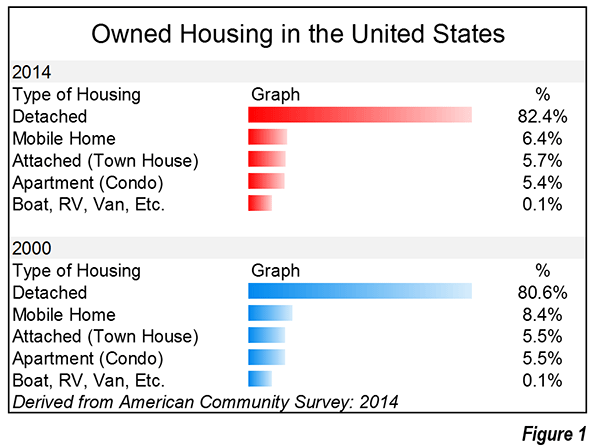
    The US preference for detached housing remains strong, according to the newest data just released in the 2014 American Community Survey, by the United States Census Bureau. In 2014, detached house and represented 82.4 percent of owned housing in the United States. This is   up 1.8 percentage points from the 80.6 percent registered in the 2000 census. The increase may be surprising, given the efforts of planners to steer people into higher density housing, especially apartments.

    The US Situation in 2014

    Among owned housing, mobile homes ranks second only to detached housing. Attached houses, which are ground oriented units with common walls, such as townhomes and semi detached homes (also called duplexes) are the third most popular form of owned housing, accounting for 5.7 percent of units in 2014. Perhaps surprisingly, the apartments planners prefer ranked fourth preference among households buying their own homes. Apartments, which include lower rise, midrise and high-rise condominiums account for 5.5 percent of owned housing. (Figure 1). The fifth, and by far the smallest category of owned housing is "Boats, RVs, Vans, Etc., which represented 0.1 percent of owned housing.

    Trend Since 2000

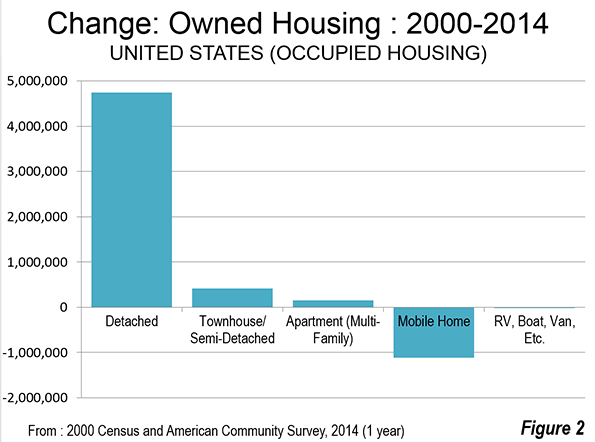
    There were approximately 4.7 million more detached houses in 2014 than in 2000. This means that 114 percent of the new owned housing stock was detached housing. Despite their second ranking among housing types, there were substantial losses in the number of mobile homes. In 2014 there were approximately 1.1 million fewer mobile homes and continuing losses could drop mobile homes below attached homes and apartments over the next decade. Mobile homes are often transitional for households aspiring to afford detached or even attached housing. Attached homes enjoyed a strong increase of approximately 410,000 units. The strong detached and attached housing increase could reflect, in part, the realization of those aspirations.

    Apartments, which were within 15,000 of attached houses in 2000, dropped to approximately 270,000 behind, while adding only 160,000 owned units. In view of the strong condominium construction rates in some cities, this may be surprising. On the other hand, it could be indicative of the "dark and empty" thesis that many of the new units have been purchased for only occasional use and not as primary residences, some rented out by owners (Figure 2).

    There was an 18,000 unit loss in "Boats, RVs, Vans, Etc."

    Owned Housing by Metropolitan Classification

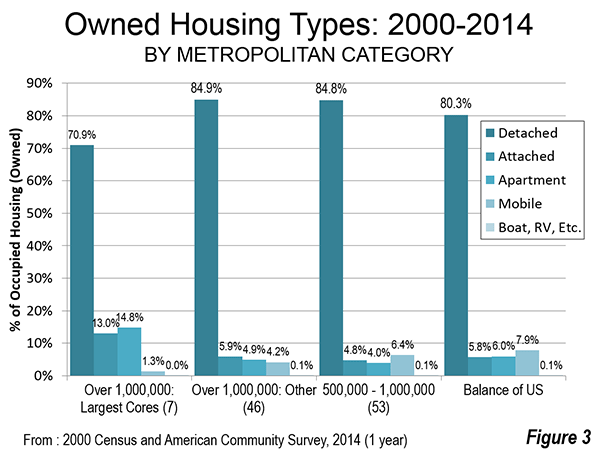
    The preference for detached housing was pervasive, even in the metropolitan areas with the largest pre-World War II urban cores (identified using the City Sector Model). Nearly 71 percent of owned housing is detached in these metropolitan areas, which include New York, Los Angeles, Chicago, Philadelphia, Washington, Boston and San Francisco. The detached housing percentage rises to 85 percent in the other 46 metropolitan areas with more than 1 million population and is similar for the 53 metropolitan areas between 500,000 and 1 million population. Among the 106 metropolitan areas with more than 500,000 population, the percentage of detached housing increased in 86.

    The detached housing share is a smaller 80 percent outside these largest metropolitan areas.

    The defining difference between the metropolitan areas with the largest cores is in owned apartments, which represent 15 percent of owned housing. This is more than three times the rate of owned apartments in the other 46 major metropolitan areas and the 53 metropolitan areas with between 500,000 and 1,000,000 population (Figure 3).

    Housing Types by Metropolitan Areas

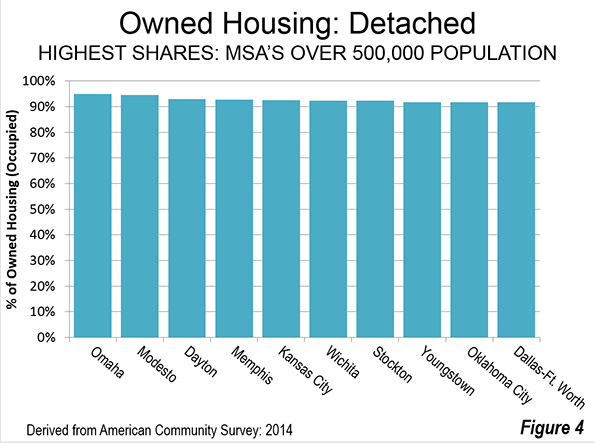
    Among the 106 metropolitan areas, 86 have detached percentages of owned housing of 80 percent or more. The highest detached housing percentage is in Omaha, at 94.8 percent. Modesto trails closely at 94.4 percent. This may not be surprising, since so many households have been driven away from close enough-for-a-long-commute San Francisco Bay Area by its exorbitant house prices and severely constrained housing choices. Detached housing is now a luxury in the Bay Area well beyond the resources of middle income households who did not buy their homes in the past, when prices were lower.

    The gap between second and third is much larger, with Dayton having a detached housing percentage of 92.8 percent, followed closely by Kansas City (92.7 percent), Memphis (92.6 percent) and Wichita (92.4 percent). Stockton, at 92.3 percent has attracted so many San Francisco Bay Area residents that it is now a part of the San Francisco Bay combined statistical area ranks eighth, (Figure 4).

    The lowest rates of detached owned housing are in Miami (63.8 percent), Philadelphia (63.9 percent), New York (65.4 percent), Baltimore (65.4 percent), and Honolulu (66.0 percent).

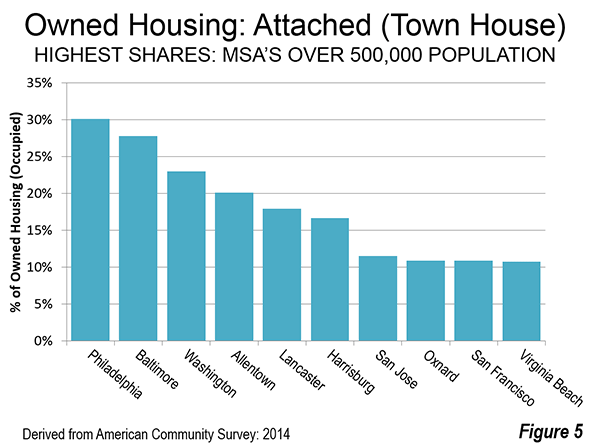
    Philadelphia and Baltimore compensate substantially for their low detached housing percentage by leading in attached housing, which is widely dispersed in both the core municipalities and the suburbs. More than 30 percent of Philadelphia’s owned housing is attached, and 27 percent of Baltimore’s. In Washington and Allentown more than 20 percent of owned housing is also attached (Figure 5).

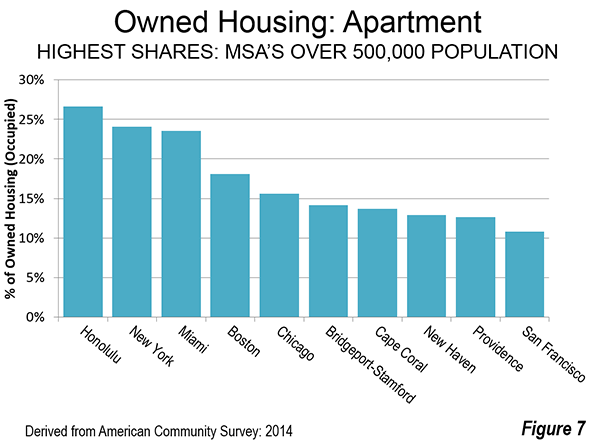
    Honolulu has the largest percentage of owned apartment housing, at 26.6 percent. New York (24.1 percent) and Miami (23.6 percent) follow. Only two other metropolitan areas, have more than 15 percent of their owned housing in apartments, Boston and Chicago (Figure 6).

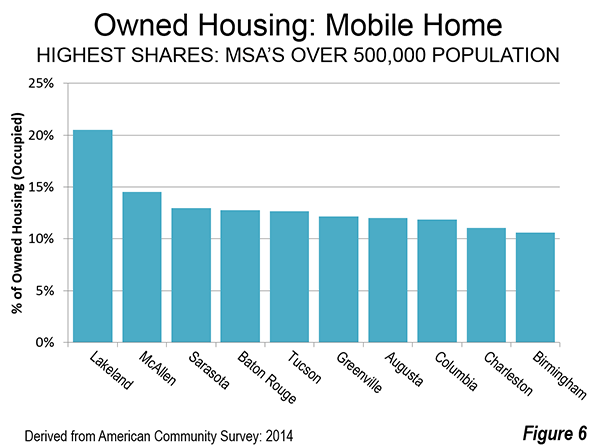
    All of the metropolitan areas with the 10 highest percentages of mobile homes are in the South, with the exception of Tucson. Lakeland, Florida has by far the largest mobile on percentage, and over 20 percent. McAllen, Sarasota, Baton Rouge and Tucson complete the top five, ranging from 12.6 percent to 14.5 percent (Figure 7).

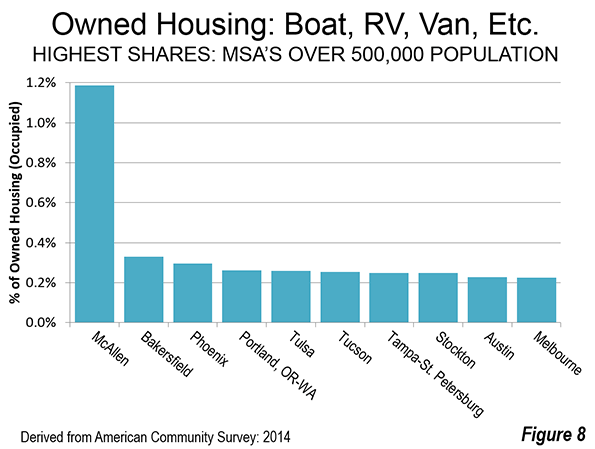
    As noted above, the percentages of owned housing in the "Boats, RVs, Vans, Etc." category are much smaller. McAllen has the largest share at 1.2 percent. The top 5 is rounded out by Bakersfield, Phoenix, Portland (OR-WA) and Tucson (Figure 8).

    The Detached House: Still King

    Three decades ago, historian Robert Fishman wrote: "For the first time in any society, the single-family detached house was brought within the economic grasp of the majority of households" (Note). The US may have been first, but it is not alone. The same observation can be made for other nations, such as Japan, Canada, Australia, New Zealand and Norway. The detached house is alive and well in the United States and may even be increasing its domination.

    Note: This quotation is from Fishman’s "Bourgeois Utopias: The Rise and Fall of Suburbia" (page 183). The subtitle should not be interpreted to suggest that this is another superficial anti-suburban screed. In fact, Fishman’s point can be interpreted as indicating that suburbia has been replaced by a new type of city, even less connected with the former dominant (monocentric) core.

    Photo: Minneapolis-St. Paul suburbs (author)

    Wendell Cox is Chair, Housing Affordability and Municipal Policy for the Frontier Centre for Public Policy (Canada), is a Senior Fellow of the Center for Opportunity Urbanism (US), a member of the Board of Advisors of the Center for Demographics and Policy at Chapman University (California) and principal of Demographia, an international public policy and demographics firm.He is co-author of the "Demographia International Housing Affordability Survey" and author of "Demographia World Urban Areas" and "War on the Dream: How Anti-Sprawl Policy Threatens the Quality of Life." He was appointed to three terms on the Los Angeles County Transportation Commission, where he served with the leading city and county leadership as the only non-elected member. He served as a visiting professor at the Conservatoire National des Arts et Metiers, a national university in Paris.

  • The Candidates’ Other Demographic Challenge

    It is massively larger than 11 million illegals.

    Hans Rosling, co-founder of Gapminder, calls it “the biggest change of our time”. It is Africa’s population growth from 1 billion people today to 2.5 billion by 2050 and 4 billion by 2100.

    You could say that a close “second biggest change of our time” is the aging and stagnation of the population in rich countries. The combined population of North America, Europe, Japan and Australia/New Zealand is now at 1.3 billion and it will remain at 1.3 billion by 2050 and 2100 with small gains in North America and Oceania offset by declines in Europe and Japan.

    This boom and bust present an unprecedented challenge to policy makers in every country of the world. Poor countries in Africa and Asia are ill-prepared for a boom that will last for decades. And rich countries must adapt their economies to a new reality of flat or falling domestic demand. In addition, the West also faces an increased flow of migrants from Africa and the Middle East fleeing poverty or war.

    If a candidate wishes to seriously address the demographic emergency, he might turn his attention to the much larger global picture, not just what happens at the US-Mexico border. Without an improvement in local conditions in Africa and Asia, millions will try to move to the West. The numbers we now see crossing the Mediterranean at great risk will pale in comparison to those of twenty or thirty years from now.

    In the same week that Donald Trump announced his immigration plan, there was news that Germany could accept as many as 750,000 refugees this year. If they end up remaining in Germany, this would amount to 0.9% of the German population, a higher annual rate of immigration than the US has had in over a century. By way of comparison, the current US rate is at 1 million green cards per year, equal to 0.3% of  the US population. The post war average is 0.25% per year.

    The migrant crisis is putting Europe’s openness to the test. Not all countries are as welcoming. Sweden is more open than others and has been accepting the equivalent of 1%+ of its population every year. Other countries only agree to take in very small numbers or reserve the right to be selective.

    Of course, it is not as easy to move from Africa to North America. The Atlantic and Pacific Oceans will deter millions of desperate migrants who will instead try their luck with Europe.

    In fact, barring the unexpected, the Western hemisphere is relatively insulated from this century’s population boom. On current UN projections, the population of North and South America will rise by a relatively modest 225 million between now and 2050, less than 10% of the entire 2.4 billion rise in world population. Nonetheless we can assume that some millions, or perhaps tens of millions, out of a few billions, will find their way across the oceans.

    This chart shows the scale of the expected changes. The first bar on the left, nearly invisible, is the current population of illegal immigrants in the US, estimated at 10 to 15 million. The next one, barely visible, are the future legal immigrants into the US between today and 2050 assuming the current run rate of 1 million per year. The next four bars are the increases in populations for the US, the Western hemisphere, Africa and the world in the next 35 years.

    IllegalsvsPopChg

    So you can see that our domestic concerns are minute in comparison to what is happening elsewhere in the world. It is true that close proximity to a crisis creates a greater sense of urgency. A small problem next door can be more pressing than a large problem a thousand miles away.

    But the rapidly changing demographics of the West, and of Africa and Asia, are already having an impact on our lives. It is right therefore to discuss the following during a political campaign:

    • Developed countries including the US, Canada, Europe, Japan, Australia, New Zealand are having fewer children than in the past. Their total fertility ratios (TFR) are below the replacement level of 2.1 average children per woman. This means that the populations of these countries are shrinking (Japan, Germany, Italy), plateauing (Europe in general) or growing slowly (North America, France, Great Britain).
    • According to the latest UN estimate, the US population will increase from 322 million today to 389 million in 2050. This projection includes future immigrants and is equivalent to an annual growth rate of 0.5%, well below the 1.2% average of the last 100 years. The post war average is also 1.2%.
    • Europe’s population will fall from 738 million to 707 million. Russia, Germany and Italy will shrink while France and the UK grow slowly.
    • Several emerging markets including China and Russia also have TFRs below replacement. China’s population will be peaking then falling. It will be surpassed by India’s within the next ten years.
    • All the above mentioned countries except India have aging populations. The median age in the United States is now 38 years and rising. In nearly all European countries, it is over 40. In Germany and Japan, it is 46. At the other end of the spectrum, in booming Nigeria, Ethiopia and Congo, it is less than 20.
    • Dependency ratios (loosely the number of dependents per worker) are rising everywhere except in Sub-Saharan Africa, India and a few other countries.
    • As noted above, the populations of Sub-Saharan Africa and of the Indian subcontinent (India, Pakistan, Bangladesh) are booming. Sub-Saharan Africa is estimated to grow from 962m today to 2.1 billion in 2050. India from 1.3 billion to 1.7 billion.
    • And the world population is expected to grow by 2.4 billion additional people by 2050. But the Western hemisphere is expected to add only 225 million, less than 10% of the projected increase.

    Screen Shot 2015-08-17 at 4.04.27 PM

    So what is to be done?

    One of Mr. Trump’s proposals is to build a wall along the Mexican border. Beyond the near term, this may or may not prove effective. Certainly, the Southern border as it stands today is one of the softest points of entry for current and future illegal immigrants.

    A more comprehensive and more robust solution is to improve conditions in the migrants’ countries of origin through trade, investments in infrastructure, health care and education, and assistance in building stronger institutions. (Such an effort may fly in the face of Mr. Trump’s other promise to repatriate jobs that have been outsourced to China and other emerging markets, but that is another topic.)

    Contrary to some political discourse, an investment in the economies of poor countries is not just altruism. It is a win-win strategy and an investment in our own future. Bjorn Lomborg, founder of the Copenhagen Consensus, wrote recently about investing in the health and education of children in poor countries:

    It is morally right that every child should be given the best chance to survive, eat well, stay healthy, and receive an education. Now we also know that it is among the best investments we can make. Healthy, well-educated kids grow into productive adults, capable of providing a better future for their own children, creating a virtuous circle that can help build a better, more prosperous world.

    Our own work at populyst centers on the development of the populyst index™ which rates each country on three measures: innovation/productivity, demographics/health care, and institutional strength/governance. In recent years, the deteriorating demographics of the West have eroded their standing in the index. And the booming demographics of poor countries have given them an opportunity to make significant strides if they can implement the needed reforms.

    A symbiotic solution that addresses the challenges of both rich and poor countries would involve the following:

    • Emerging economies would benefit from western capital, technology and institutional expertise.
    • Better health care in Africa and India would lower infant mortality, improve women’s health and accelerate the fall in TFRs, curbing the big population boom.
    • Domestic demand is slackening in rich countries and would benefit from new sources of demand from rising populations. A rising standard of living in poor countries will add to the revenues of Western firms dealing with sluggish home markets.
    • An improvement in emerging economies would relieve the migrant crisis we are now seeing in the Mediterranean and Europe.

    In case of inaction, the political instability and economic dislocation the world may suffer because of the ongoing population boom will touch our own country in more undesirable ways than a few million unwanted immigrants have done so far.

    How do we respond to the twin problem of stagnant demographics in the West and booming demographics in poor countries? This is the question that all candidates should be debating.

    Sami Karam is the founder and editor of populyst.net and the creator of the populyst index™. populyst is about innovation, demography and society. Before populyst, he was the founder and manager of the Seven Global funds and a fund manager at leading asset managers in Boston and New York. In addition to a finance MBA from the Wharton School, he holds a Master’s in Civil Engineering from Cornell and a Bachelor of Architecture from UT Austin.

  • Rural Industrialization: Asia’s 21st Century Growth Frontier

    A World Bank report released earlier this year featured a jarring statistic: 200 million people moved to East Asia’s cities between 2000 and 2010. That figure is greater than the populations of all but five of the world’s countries. Commentators argue that the urbanization of Asia is inevitable, with one calling recent growth “just the beginning.” Considered alongside figures about urban migration, the fact that only 1 percent of Asia’s land is urbanized (a popular statistic) appears to validate predictions about the increasing densification of cities. However, growth in the capacity of cities to accommodate industrial growth seems to be flattening. With a rising middle class and booming demand for automobiles, Asian cities can expect no relief from congestion, and this may be a deterrent for businesses. Rural areas are increasingly prepared to absorb this potential shift in demand.

    Urbanization patterns

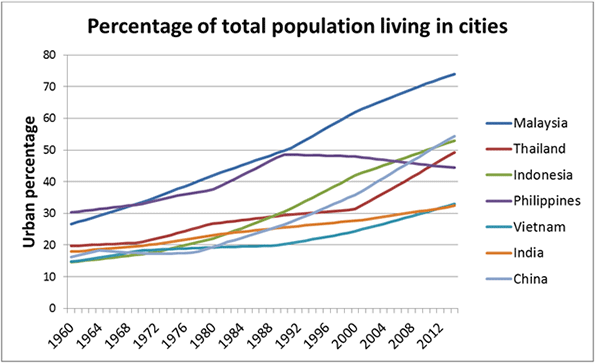
    In examining Asia’s economic growth through urbanization patterns, it is helpful to consider historic data spanning several decades. Figure 1 compares 54 years of urbanization in Southeast Asia’s five largest economies against India and China, both arguably the 21st century’s most dynamic growth stories and frequent subjects of urbanization research and commentary. Urban population share has been rising consistently in most countries of this study. Malaysia has long seen a population majority living in cities, and China and Indonesia both crossed the 50% threshold in 2011. Thailand has also rapidly urbanized since 2000, and will likely pass 50% this year. By contrast, Vietnam, India, and the Philippines have been slower to urbanize, with the latter declining since 1990. Part of this variation reflects differences in definitions and measurements of urbanization across countries and time, but the underlying pattern remains clear: the past several decades have seen an urban migration of historic scale.

    Figure 1 (Data source: World Bank)

    That urbanization correlates with economic growth is a point rarely overlooked. Indeed, the two have supported one another since the emergence of capital- and labor-intensive manufacturing during the industrial revolution. Borne of historic growth patterns, this logic has been used to support predictions of continued industrial urbanization and policies that promote it. However, remote penetration of connective infrastructure – including both transportation and communications – is replacing old growth models with a new rural industrialization. The following data support this claim.

    GDP and urban growth

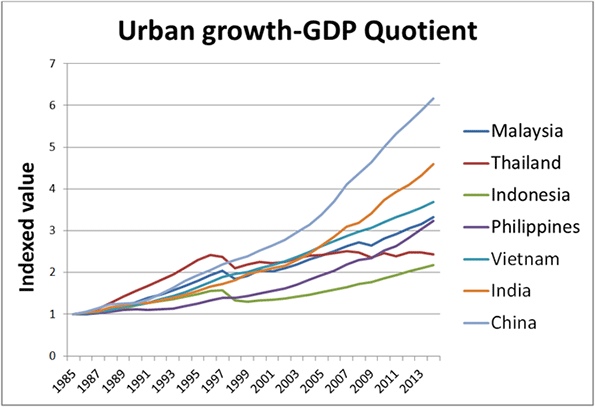
    The urban growth-GDP quotient (Figure 2) represents urban population growth divided by GDP, and is effectively a measure of how much economic activity countries are extracting from their cities. It is not an absolute measure such as GMP (gross metropolitan product). Rather, it is a measure of how changes in GDP track changes in urbanization, providing a broader look at the relative role of cities in national economies. A time horizon of nearly three decades (1985 – 2014) is chosen to capture the high growth period after market reforms in China (1979) and Vietnam (1985). The indexing approach is necessary to normalize the scale of variables for more meaningful graphical visualization, essentially “controlling” for vast differences in numeric values (e.g. the GDPs of China vs. the Philippines). It also creates a common reference point to compare longitudinal performance across countries.

    Figure 2 (Data source: World Bank)

    In this metric, China outperforms comparator countries with a particularly rapid increase in the quotient since 2005; it has evidently been successful deriving GDP value from urban areas. By contrast, Indonesia has seen comparatively less urban-based GDP contribution, and Thailand’s contribution has remained roughly the same since outpacing all countries between 1985 and the Asian financial crisis.

    Manufacturing and urban growth

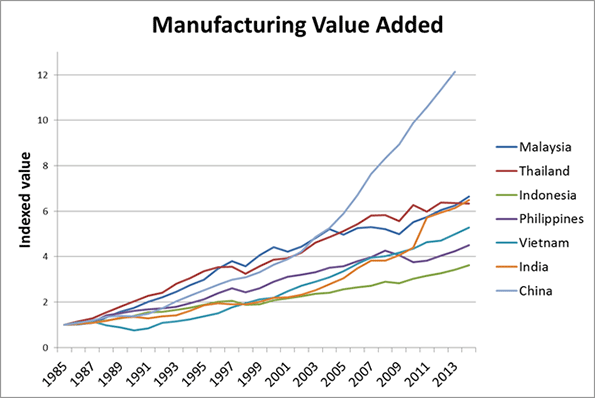
    One factor underlying these differences is the type of industries contributing to GDP growth, and in particular their location patterns (rural vs. urban). An examination of manufacturing value added (MVA) is necessary to sharpen this analysis, as manufacturing is historically an urban-based activity. Cities provide labor, infrastructure, business services, and global connectivity; their importance to manufacturing is undisputed. The raw MVA numbers (Figure 3) indicate that since 2005, China has far outperformed other countries in the study, most of which showed consistent but not transformative growth. Among the latter, India boasts the lone spike in MVA, and that only recently.

    Figure 3 (Data source: World Bank)

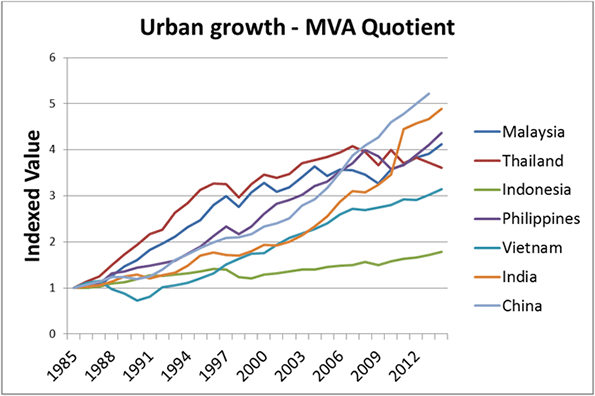
    To complete the analysis, Figure 4 compares historic patterns of manufacturing growth against growth in urbanization. The indexed quotient replaces GDP (Figure 2) with MVA and can be regarded as a measure of the extent to which countries leverage urbanization to support manufacturing growth. China’s statistical dominance in previous measures vastly diminishes here. Further, growth in the ability of many remaining countries to derive MVA from cities slows after initially rapid growth.

    Figure 4 (Data source: World Bank)

    The notable exception is India, and this is the critical point in this analysis. India’s competitive advantage is rooted in the country’s tech sector and other higher-value added activities. From call centers to technology R&D, India has developed a defensible regional position in knowledge-based industries, which are increasingly dependent on the by-products of urbanization: an educated workforce, global talent networks, and lifestyle amenities that appeal to higher-income residents. China maintains its position at the top due in part to its particular urban-based industrialization strategy (special economic zones and decentralization reforms empowering cities). However, China’s conversion of rural agricultural land into industrial facilities is an emerging phenomenon, and the line between urban and rural is fading. For example, in many provinces (e.g. Hebei) factory parcels stand alone, surrounded by farms.

    Towards rural industrialization

    In Southeast Asia, as in parts of China, industrialization is not a fundamentally urban phenomenon. From the industrial estates of Thailand’s Eastern Seaboard to the suburban clusters of Vietnam and Indonesia, companies are now finding most everything they need outside of city centers. The advantages are numerous: cheaper land, lower labor costs, less congestion, and in some cases lucrative business incentives. These suburban and rural industrial clusters are even focusing on quality of life for families, looking beyond hard infrastructure to provide housing, education, and recreation facilities. Such amenities appeal to workers of all skill types, from manufacturing to research and development. As such, rural industrialization need not be only smokestacks and assembly lines; an educated workforce can be recruited if rural living standards match those of cities. This broadens the array and sophistication of industries capable of supporting a new kind of growth.

    Hyper-urbanization visits significant inefficiencies on businesses, potentially making rural regions more attractive for operating. In many of Asia’s major cities, snarled traffic grinds life to a near halt and transit infrastructure has provided only modest relief. Aside from Singapore (a frequent statistical exception), Bangkok and Kuala Lumpur are leaders within Southeast Asia in developing urban rail. However, neither system offers the geographic coverage needed to loosen gridlock. Ho Chi Minh City is currently building its first metro line, but construction is delayed and completion appears to be years away. If hyper-urbanization is re-interpreted as a policy challenge rather than a sign of progress, the decentralization of industrial development can be one solution. Asia’s economic fate is not inextricably linked with the size of its cities, and fresh visions of decentralized growth are already proving their value. The potential is vast; for example, Indian Prime Minister Narendra Modi’s “digital push” and recent commitments to rural broadband represent a development path for the country’s remote regions. Technology, expertise, new funding sources, and emerging economic opportunities are ready to support the rise of rural industrialization across Asia.

    Kris Hartley is a Visiting Lecturer in Economics at Vietnam National University – Ho Chi Minh City, and a PhD Candidate at the Lee Kuan Yew School of Public Policy, National University of Singapore.

    Top Photo: Putrajaya, Malaysia: Seri Gemilang Bridge. Behind the bridge on the right side Ministry of Women, Family and Community and Ministry of Urban Wellbeing, Housing and Local Government © CEphoto, Uwe Aranas / , via Wikimedia Commons

  • Working Age Population Around the World 1960-2050

    A fast growing economy usually requires a growing working-age population.  It is informative in this regard to look at the size of the working-age population (wap) for different regions and countries of the world.

    Screen Shot 2015-09-25 at 1.05.48 PM

    This data, compiled from the UN’s World Population Prospects – the 2015 Revision, tells us the following:

    • The wap of Europe, the US and Japan experienced healthy growth between 1960 and 1990. After 1990, it started to decline in Japan and to stagnate in Europe but it continued to grow in the US.
    • Based on the UN’s ‘medium variant’ forecast, the wap of Europe will decline steadily for the rest of this century, from 492 million in 2015 to 405 million in 2050. Barring a massive inflow of immigrants or a sharp rise in the birth rate, France’s wap will flatline and Germany’s will fall by 23% in 2015-2050.
    • The US wap will grow for the rest of the century, but at a much lower rate than in the years 1960-2015. See this table for average annual growth rates:

    Screen Shot 2015-09-25 at 1.05.26 PM

    • The wap of the BRIC countries experienced strong growth until 2015, but it will be flat from hereon. Only India’s wap will continue to grow. Brazil’s will be flat while China’s and Russia’s fall sharply.
    • Last but certainly not least, the wap of sub-Saharan Africa will continue to boom, adding 800 million people in the next 35 years.
    • Looking at the entire world picture, the wap will grow by 1.27 billion in 2015-2050, which is a slower rate of growth than in the past. The vast bulk of this addition will come from sub-Saharan Africa, India and a few other Asian countries.

    Version 2

    In the 25 year interval 1990-2015, the wap of BRIC countries grew by 650 million, driven by India, China and to a lesser extent Brazil. The question now is whether sub-Saharan Africa and India can translate their own booming wap into rapid and sustainable economic growth. With developed and BRIC countries slowing down, the world economy depends on it.

    This piece first appeared at Populyst.com.

  • Should Older Americans Live in Places Segregated from the Young?

    Demographers frequently remind us that the United States is a rapidly aging country. From 2010 to 2040, we expect that the age-65-and-over population will more than double in size, from about 40 to 82 million. More than one in five residents will be in their later years. Reflecting our higher life expectancy, over 55% of this older group will be at least in their mid-70s.

    While these numbers result in lively debates on issues such as social security or health care spending, they less often provoke discussion on where our aging population should live and why their residential choices matter.

    But this growing share of older Americans will contribute to the proliferation of buildings, neighborhoods and even entire communities occupied predominantly by seniors. It may be difficult to find older and younger populations living side by side together in the same places. Is this residential segregation by age a good or a bad thing?

    As an environmental gerontologist and social geographer, I have long argued that it is easier, less costly, and more beneficial and enjoyable to grow old in some places than others. The happiness of our elders is at stake. In my recent book, Aging in the Right Place, I conclude that when older people live predominantly with others their own age, there are far more benefits than costs.

    Why do seniors tend to live apart from other age groups?

    My focus is on the 93% of Americans age 65 and older who live in ordinary homes and apartments, and not in highly age-segregated long-term care options, such as assisted living properties, board and care, continuing care retirement communities or nursing homes. They are predominantly homeowners (about 79%), and mostly occupy older single-family dwellings.

    Older Americans don’t move as often as people in other age groups. Typically, only about 2% of older homeowners and 12% of older renters move annually. Strong residential inertiaforces are in play. They are understandably reluctant to move from their familiar settings where they have strong emotional attachments and social ties. So they stay put. In the vernacular of academics, they opt to age in place.

    Over time, these residential decisions result in what are referred to as “naturally occurring” age-homogeneous neighborhoods and communities. These residential enclaves of old are now found throughout our cities, suburbs and rural counties. In some locales with economies that have changed for the worse, these older concentrations are further explained by the wholesale exit of younger working populations looking for better job prospects elsewhere – leaving the senior population behind.

    Even when older people decide to move, they often avoid locating near the young. The Fair Housing Amendments Act of 1988 allows certain housing providers to discriminate against families with children. Consequently, significant numbers of older people can move to these “age-qualified” places that purposely exclude younger residents. The best-known examples are those active adult communities offering golf, tennis and recreational activities catering to the hedonistic lifestyles of older Americans.

    Others may opt to move to “age-targeted” subdivisions (many gated) and high-rise condominiums that developers predominantly market to aging consumers who prefer adult neighbors. Close to 25% of age-55-and-older households in the US occupy these types of planned residential settings.

    Finally, another smaller group of relocating elders transition to low-rent senior apartment buildings made possible by various federally and state-funded housing programs. They move to seek relief from the intolerably high housing costs of their previous residences.

    Is this a bad thing?

    Those advocates who bemoan the inadequate social connections between our older and younger generations view these residential concentrations as landscapes of despair.

    In their perhaps idyllic worlds, old and young generations should harmoniously live together in the same buildings and neighborhoods. Older people would care for the children and counsel the youth. The younger groups would feel safer, wiser and respectful of the old. The older group would feel fulfilled and useful in their roles of caregivers, confidants and volunteers. In question is whether these enriched social outcomes merely represent idealized visions of our pasts.

    A less generous interpretation for why critics oppose these congregations of old is that they make the problems faced by an aging population more visible and thus harder to ignore.

    Residents play shuffleboard at Limetree Park in Bonita Springs, Florida. Steve Nesius/Reuters

    A better social life

    But why should we expect older people to live among younger generations? Over the course of our lives, we typically gravitate to others who are at similar stages in life as ourselves. Consider summer camps, university dormitories, rental buildings geared to millennials or neighborhoods with lots of young families. Yet we seldom hear cries to break up and integrate these age-homogeneous residential enclaves.

    In fact, studies show that when older people reside with others their age, they have more fulfilled and enjoyable lives. They do not feel stigmatized when they practice retirement-oriented lifestyles. Even the most introverted or socially inactive older adults feel less alone and isolated when surrounded with friendly, sympathetic, and helpful neighbors with shared lifestyles, experiences, and values – and yes, who offer them opportunities for intimacy and an active sex life.

    Moreover, tomorrow’s technology is especially on the side of these elders. Because of online social media communications, older people can engage with younger people – as family members, friends, or as mentors – but without having to live next to what they sometimes feel are noisy babies, obnoxious adolescents, indifferent younger adults or insensitive career professionals.

    Age-specific enclaves prolong independent living

    Could living in these age-homogeneous places help older people avoid a nursing home stay?

    Studies say yes – because here they have more opportunities to cope with their chronic health problems and impairments. Now their greater visibility as vulnerable consumers becomes a plus because both private businesses and government administrators can more easily identify and respond to their unmet needs.

    These elder concentrations spawn a different mindset. The emphasis shifts from serving troubled individual consumers to serving vulnerable communities or “critical masses” of consumers.

    Consider how many more clients home-care workers can assist when they are spared the traveling time and costs of reaching addresses spread over multiple suburbs or rural counties. Or recognize how much easier it is for a building management or homeowners’ association to justify the purchasing of a van to serve the transportation needs of their older residents or to establish an on-site clinic to address their health needs.

    Consider also the challenges confronted by older people seeking good information about where to get help and assistance. Even in our internet age, they still mostly rely on word of mouth communications from trusted individuals. It becomes more likely that these knowledgeable individuals will be living next to them.

    These enclaves of old have also been the catalyst for highly regarded resident-organizedneighborhoods known as elder villages.

    Their concerned and motivated older leaders hire staff and coordinate a pool of their older residents to serve as volunteers. For an annual membership fee, the predominantly middle-income occupants in these neighborhoods receive help with their grocery shopping, meal delivery, transportation and preventive health needs. Residents also benefit from knowing which providers and vendors (like workers performing home repair) are the most reliable, and they often receive discounted prices for their goods and services. They also enjoy organized educational and recreational events enabling them to enjoy the company of other residents. Today, about such 170 villages are open and 160 are in planning stages.

    A question of preference

    Ageist values and practices are indeed deplorable. However, we should not view the residential separation of the old from the young as necessarily harmful and discriminatory but rather as celebrating the preferences of older Americans and nurturing their ability to live happy, dignified, healthy and autonomous lives. Living with their age-peers helps these older occupants compensate for other downsides in their places of residence and in particular presents opportunities for both private and public sector solutions.

    Tihs piece was first published by The Conversation.

    Stephen M. Golant, Ph.D, a gerontologist and geographer, is now a Professor in the Department of Geography at the University of Florida. Previously, he was a faculty member in the Committee on Human Development and in the Department of Geography at the University of Chicago. Dr. Golant has been conducting research on the housing, mobility, transportation, and long-term care needs of older adult populations for most of his academic career. He is a Fellow of the Gerontological Society of America and a Fulbright Senior Scholar award recipient. He earlier served as a consultant to the Congressionally appointed Commission on Affordable Housing and Health Facility Needs for Seniors in the 21st Century (Seniors Commission). He has written or edited about 140 papers and books. His latest book is Aging in the Right Place (Health Professions Press, 2015).

    Laed photo by Steve Nesius/Reuters.
  • Who Should Pay for the Transportation Infrastructure?

    Urban regions are significantly more important than any one city located within them. Housing, transportation, economy, and politics help produce uneven local geographies that shape the individual identities of places and create the social landscapes we inherit and experience. As such, decisions made within one city can ripple through the entire urban region. When affordable housing is systematically ignored by one city, neighboring cities become destinations for those who cannot afford higher housing costs. Even when the minimum wage is adjusted in one city, others cannot ignore it.

    In fact, a differential wage structure can produce diverse economic and labor geographies. Affordable housing and uneven economic development, in their turn, impact the regional transportation and infrastructure: if the cost of living and wages in one city in a particular region are high (as in San Francisco and Seattle), then low and middle-income workers will move to a more affordable neighboring city and pay a higher price, particularly in time spent, for transportation. They also pay more in fuel, and hence taxes that fund infrastructure maintenance and expansion.

    In other words, while companies and the more affluent population benefit from the agglomeration economies of alpha cities, it is the lower-wage workers and the population at large that pay for these uneven development. Therefore, a company deciding to locate in Seattle or San Francisco, or any location, does not have to bear the cost their decision imposes on urban transportation and the infrastructure needed to support their operation. Instead it’s their employees, particularly those with lower earning power, who do.

    How many LEED certified buildings and downtown redevelopment projects does it take to make up for this inequity?  Should a city be considered green, if a significant portion of its low earners has to commute to neighboring cities to afford a home? Can a city be seen as sustainable, if in a style akin to medieval cities, serfs have to leave every evening and return in the morning to make sure that the ‘creative class’ is adequately served?

    As states such as Washington engage with the old “pay as you go” policy of increasing fuel taxes to pay for the infrastructure, the question of what forces created the emergent commuting patterns remains unanswered. Was it just the commuters, acting as informed participants in the market economy, who sought to optimize their housing and transportation trade offs? Or did the locational choices of employers contribute to the growing commuting problems in the region? If commuters are subjected to “pay as you go” policies, shouldn’t employers who locate in expensive housing markets, irrespective of their employees’ income profile, be subjected to “pay as you locate” policies?

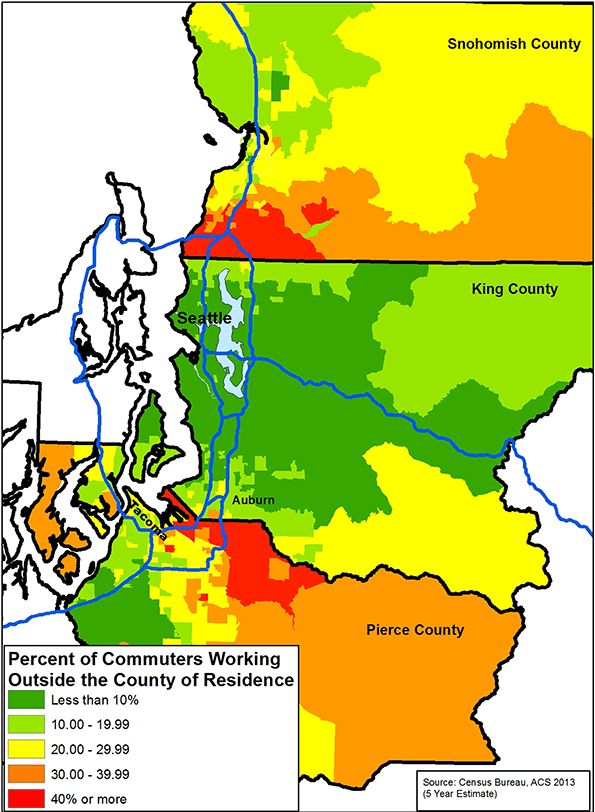
    Perhaps no metro region will make a better case study for this inequity than the area that ‘serves’ Seattle. The Puget Sound Region consists of four counties; however, to make sure that no one county that might have an economic connection with Seattle is left behind, we can look at six counties: Snohomish, King (where Seattle is located), Pierce, Kitsap, Thurston, and Mason.

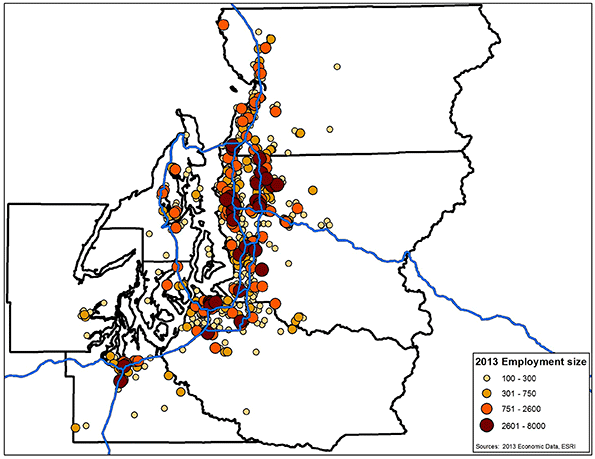
    The entire urban region is served by a small number of highways, including Interstate 5. According to 2013 economic data, these six counties housed nearly 62% of all firms in the state. Furthermore, a quarter of all businesses in these counties were located within half a mile of a freeway. In terms of total employees, the six counties contained 69% of the state employment, and workplaces within half a mile of a freeway employed 37% of all employees in the counties. The inequity in the regional economic distribution is further exacerbated by the fact that the small area in West King county bounded by I-405 houses 30% of workplaces and 47% of employment, and generates a significant portion of the sales/revenue in the six counties. This area relies on I-5, I-405 and I-90 for the delivery of its employees from near and far.   

    The economic calculus of the early days of Interstate construction may have suggested that the trucking industry would benefit from this transportation infrastructure, but 1960s economists might be surprised by the type of companies now located within half a mile of freeways. In the six counties in Western Washington, the economic sectors over-represented in these geographies are: services and finance, real estate, and insurance (FIRE). Anyone driving on I-5 and I-405 (where Microsoft and other corporations are visible) can see this.  None of these workplaces require trucking. While their well-paid employees can afford to live in well-to-do places, including Bellevue and Seattle, many others reside in less expensive places such as Auburn, Tukwila, Tacoma, and Federal Way.

    A map of the region clearly suggests that neighboring counties and cities are housing those who work in West King County. Mobility has been the answer to unaffordability in this and other similar urban regions. If a city is unaffordable, is it fair to ask those who search for affordability in ‘other’ geographies pay for their so-called choices? Is this truly a choice? Are employers, current and future, asked to pay for their locational ‘choices?’ 

    Surely, we can do better than asking employees to bear the burden of a regional economic imbalance. Freeways should not be freer to some than others.  If this nation is about people paying for choices they make, then everyone should do so: employers and employees alike.

    Ali Modarres is the Director of Urban Studies at University of Washington Tacoma.  He is a geographer and landscape architect, specializing in urban planning and policy. He has written extensively about social geography, transportation planning, and urban development issues in American cities.

    Seattle photo courtesy of BigStockPhoto.com.