Category: Demographics

  • Exodus of the School Children

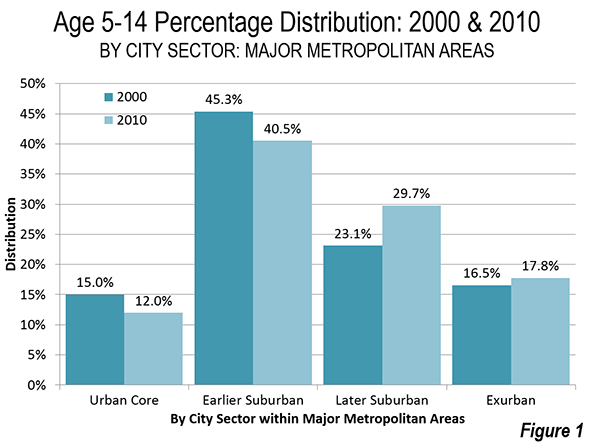
    The urban cores of the nation’s 52 major metropolitan areas (over 1 million population) lost nearly one-fifth of their school age population between 2000 and 2010. This is according an analysis of small area age group data for children aged 5 to 14 from Census Bureau data, using the City Sector Model. Over the period, the share of 5 to 14 age residents living in the functional urban cores declined from 15.0 percent to 12.0 percent (Figure 1).
    The City Sector Model

    The City Sector Model analysis avoids the exaggeration of urban core data that necessarily occurs from reliance on the municipal boundaries of core cities (which are themselves nearly 60 percent suburban or exurban, ranging from as little as three percent to virtually 100 percent). It also avoids the use of the newer "principal cities" designation of larger employment centers within metropolitan areas, nearly all of which are suburbs, but are inappropriately joined with core municipalities in some analyses. The City Sector Model" small area analysis method is described in greater detail in Note 1 below (previous articles are listed in Note 2). The approach is similar to the groundbreaking work of David Gordon, et al at Queen’s University for Canadian metropolitan areas.

    School Age Losses

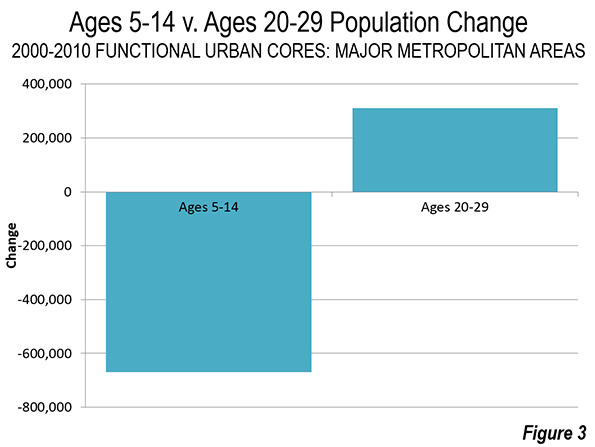
    The urban core school-age population dropped from approximately 3.40 million in 2000 to 2.73 million in 2010, for a loss of 670,000 (Figure 2). Much has been made about the affinity of the Millennial generation for the urban cores. Despite this, our small area analysis indicated that the percentage of 20 to 29 year olds living in the functional urban cores declined between 2000 and 2010, with 88 percent of the growth in suburbs and exurbs (see Dispersing Millennials). Coincidentally, over the period, there was a reduction of two school age children in the urban cores for every additional resident aged 20 to 29 (Figure 3).
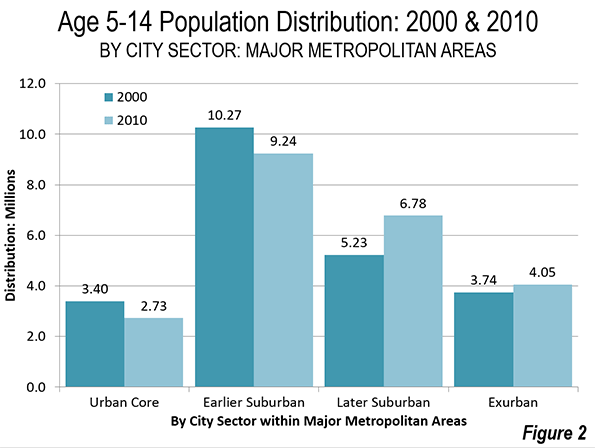
    A loss was also sustained in the earlier suburbs (with median house construction dates between 1946 and 1979). The school-age population declined slightly more than 1 million in the earlier suburban areas. In 2000, 45.3 percent of school age children lived in the earlier suburbs, a figure that declined to 40.5 percent in 2010.

    Virtually all of the gain in 5 to 14 age residents was in the later suburban areas (a median house construction dates of 1980 or later) and exurban areas. Overall, these two city sectors added 1.9 million school-age children, while the urban cores and the earlier suburban areas experienced a reduction of 1.7 million, for a reduction of approximately 10 percent.

    The largest increase was in the newer suburban areas (median house construction dates of 1980 or later), where 1.47 more school-age children lived in 2010 than in 2000. This represented an increase of approximately 30 percent. Exurban areas have a more modest increase of 310,000 school-age children, up 8.3 percent from 2000.

    Losses in the Largest Urban Cores

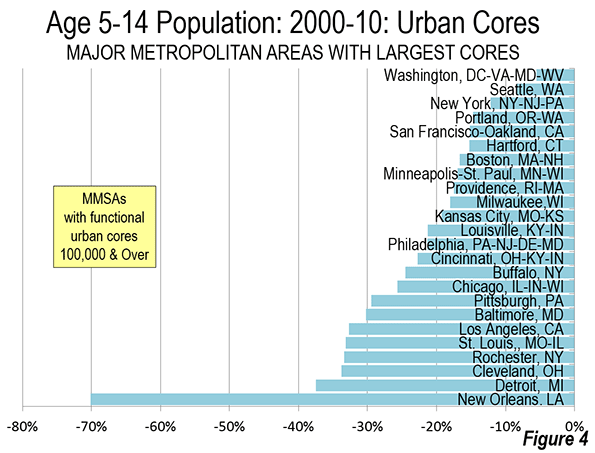
    All of the large urban cores in the metropolitan areas experienced losses in school aged children from 2000 to 2010. Among the 24 urban cores with more than 100,000 residents, Washington (-5.5 percent) and Seattle (-8.4 percent) came the closest to retaining their 2000 school age numbers in 2010.  Seven large urban cores experienced losses of at least 30 percent. Baltimore’s loss was approximately 30 percent. Los Angeles joined rust belt cities St. Louis, Rochester and Cleveland at 33 percent to 34 percent and Detroit at 38 percent. New Orleans had the largest loss (-70.2 percent), owing in part to population loss from the disastrous hurricanes (Figure 4).
    Finally, in all of the 52 metropolitan areas, the later suburban and exurban areas (combined) retained more of their school age children than the urban cores and earlier suburbs. There were gains in 45 of the later suburban and exurban areas.

    Better Schools: The Necessary (But Maybe Not Sufficient) Condition

    One of the issues of most interest among urban analysts has been whether urban cores will be able to retain the share of Millennials that they have attracted. The functional urban cores seem likely to maintain their attraction for younger adults, so long as the cores sustain their improved living environment (such as much lower crime rates than before and continued investment by retailers and other commercial business to support the new populations).

    However, the continuing exodus of people with school-age children described seems to indicate that young adults tend to move to the suburbs and exurbs around the time their children enroll in school. Suburban and exurban schools often provide better educations than urban core schools. The Editorial Projects in Education found that high school graduation rates were 77.3 percent in suburban school districts, compared to 59.3 percent in "urban" school districts (Note 3). There are other difficulties as well, such as having sufficient defensible outdoor space for children to play and for parents to feel secure. But education seems likely to be the most important consideration.

    Of course, in urban areas the highly affluent can enroll their children in private schools. The alternative of private schools can be overly expensive, inducing households to relocate to school districts with higher quality education. According to research by Chief Economist Jed Kolko of Trulia: “Private school enrollment in the lowest-rated school districts is more than four times as high as private school enrollment in the highest-rated school districts after adjusting for neighborhood demographic differences."

    A balanced broad age distribution of households, including those with children of school age, is not likely to be achieved in urban cores unless Millennials are retained in substantial numbers. Once having moved, the chances of their returning are slim, because households move less frequently as they move up the age scale.

    Note 1: The City Sector Model allows a more representative functional analysis of urban core, suburban and exurban areas, by the use of smaller areas, rather than municipal boundaries. The more than 30,000 zip code tabulation areas (ZCTA) of major metropolitan areas and the rest of the nation are categorized by functional characteristics, including urban form, density and travel behavior. There are four functional classifications, the urban core, earlier suburban areas, later suburban areas and exurban areas. The urban cores have higher densities, older housing and substantially greater reliance on transit, similar to the urban cores that preceded the great automobile oriented suburbanization that followed World War II. Exurban areas are beyond the built up urban areas. The suburban areas constitute the balance of the major metropolitan areas. Earlier suburbs include areas with a median house construction date before 1980. Later suburban areas have later median house construction dates. 

    Urban cores are defined as areas (ZCTAs) that have high population densities (7,500 or more per square mile or 2,900 per square kilometer or more) and high transit, walking and cycling work trip market shares (20 percent or more). Urban cores also include non-exurban sectors with median house construction dates of 1945 or before. All of these areas are defined at the zip code tabulation area (ZCTA) level.

    Note 2: The City Sector Model articles are:
    From Jurisdictional to Functional Analyses of Urban Cores & Suburbs
    The Long Term: Metro American Goes from 82 percent to 86 percent Suburban Since 1990
    Beyond Polycentricity: 2000s Job Growth (Continues to) Follow Population
    Urban Cores, Core Cities and Principal Cities
    Large Urban Cores: Products of History
    New York, Legacy Cities Dominate Transit Urban Core Gains
    Boomers: Moving Farther Out and Away
    Seniors Dispersing Away from Urban Cores
    Metropolitan Housing: More Space, Large Lots
    City Sector Model Small Area Criteria

    Note 3: This report (which was prepared with support from the America’s Promise Alliance and the Bill and Melinda Gates Foundation) provides graduation rates using the US Department of Education "local codes." This typology generally defines "urban" school districts as those in core cities as well as other principal cities (such as Arlington, Texas and Mesa, Arizona). Most of the population of core cities and principal cities is classified as functionally suburban (see: Urban Cores, Core Cities and Principal Cities). Further, the typology classifies some districts as suburban that have large urban components (such as Las Vegas, Miami, Louisville and Honolulu), which is necessary because of county level school districts that include both urban cores and suburban areas. As a result the functionally suburban component of urban districts is overstated and the functionally suburban component of suburban districts is understated. Because urban graduation rates tend to be less than suburban rates, both of these factors seem likely to overstate the "urban" graduation rates and understate the "suburban" graduation rates.

    Wendell Cox is principal of Demographia, an international public policy and demographics firm. He is co-author of the "Demographia International Housing Affordability Survey" and author of "Demographia World Urban Areas" and "War on the Dream: How Anti-Sprawl Policy Threatens the Quality of Life." He was appointed to three terms on the Los Angeles County Transportation Commission, where he served with the leading city and county leadership as the only non-elected member. He was appointed to the Amtrak Reform Council to fill the unexpired term of Governor Christine Todd Whitman and has served as a visiting professor at the Conservatoire National des Arts et Metiers, a national university in Paris.

    Photo: School buses in suburban Atlanta (by author)

  • Our Father, Who Art In The Apple Store: The Decline Of Christmas And The Looming Tech Nightmare

    In the past, this season was marked by a greater interest in divinity, the family hearth and the joy of children. Increasingly our society has been turning away from such simple human pleasures, replacing them with those of technology.

    Despite the annual holiday pageantry, in the West religion is on the decline, along with our society’s emphasis on human relationships. Atheism seems to be getting stronger, estimated at around 13 percent worldwide but much higher in such countries as Japan, Germany and China. “The world is going secular,” claims author Nigel Barber. “Nothing short of an ice age can stop it.”

    In contrast, the religion of technology is gaining adherents. In a poll in the U.K., about as many said they believe Google to have their best interests at heart as God. Religious disbelief has been rising particularly among U.S. millennials, a group that, according to Pew, largely eschews traditional religion and embraces technology as a primary value. Some 26 percent profess no religious affiliation, twice the level of their boomer parents; they are twice as irreligious at their age as any previous generation.

    For millennials, religion is increasingly a matter of personalized “self knowledge” that need not be pursued in church, or as part of their community. Computer scientist Allen Downey has done interesting research that shows that Internet use is a primary driver of declining interest in religion.

    Not surprisingly, religious organizations are in a digital panic. In recent months, some have bemoaned how companies like Google or Apple have replaced churches as creators of the ultimate values. Apple, in particular, notes Brett Robinson, author of “Appletopia,” has adherents who back their products with “fanatical fervor.” Tech products feed into “a celebration of the self” that contradicts most religious teachings, he argues. Even the protocols for using our phones or computers emulate those found in religious services, writes Robinson.

    Our growing digital fixation has also impacted human relationships. Social media has some great positives, particularly for helping potentially isolated groups such as the mentally ill  and seniors. And it is an effective way to keep in touch with far-flung friends and relatives. However, as social media consultant Jay Baer notes, avid users of social media tend to have lots of “friends” but the fewest personal ties.

    As a people, we are becoming digitally detached, argues De Paul professor Paul Booth. Many particularly millennials, increasingly prefer “mediated communication” over face-to-face interaction, also preferring to text than talk on the phone. “Friends,” as defined by Facebook, has little to do with friendship as understood down the centuries: people to talk to and spend time with in a social setting.

    Perhaps most disturbing, reliance on social media tends to work against forming intimate ties, which rest on such real-world factors as proximity and shared experiences, says Rachna Jain, a psychologist who specializes in marriage and divorce. Many millennials have delayed marriage and family formation, in part due to the economy, but it’s possible that technology-enabled distancing is also playing a role.

    Technology As Religion

    Technology’s emergence as a secular religion has been with us since the 19th century. Saint Simon and later Marx identified it as capable of replacing God in creating an earthly paradise. Industrial entrepreneurs like Thomas Edison also believed they were laying the foundation for a new millennium; he prophesied electricity would reduce the need for sleep, help improve the senses and promote the equality of women.

    This notion grew after World War II, which launched a period of rapid technological changes — jet aircraft, missile technology and nuclear power. The growing interest in technology, predicted Daniel Bell in his landmark 1973 The Coming of Post-Industrial Society, would foster the “preeminence of the professional and technical class.” This emergent new “priesthood of power” would eventually overturn the traditional hierarchies and industries and, in process, create the rational “ordering of mass society.”

    Despite the threat of thermonuclear war, the 1950s and 1960s were suffused with a spirit of technological optimism. In his classic 1967 book “The Technological Society,” French philosopher Jacques Ellul drew a contemporary picture of the world of 2000, complete with regular shuttle service to the moon, synthetic foods and an end to hunger and poverty.

    Tech Dreams, Tech Nightmares

    Today technological change may be slower, but its effects on society are more profound, and threatening basic social institutions. Like Marx or Saint Simon, the new tech “gods,” epitomized by Steve Jobs, have pointedly dismissed religion and held themselves as the ultimate “disrupters” of the existing civilization. Techno-evangelist Nicholas Negroponte has even suggested that “digital technology” could turn into “a natural force drawing people into greater world harmony.”

    So we continue to make the mistake of conflating technology, which does bring many blessings, with the improvement of society. As computer industry pioneer Willis Ware warned almost four decades ago, new communication technology, rather than simply making information more universally available, could also increase the “intensive and personal surveillance” of individuals. This has resulted not so much in the creation of a surveillance state” as whatDavid Lyons has referred to as a “surveillance society,” where those who control information include not only state players but certain well-positioned private ones.

    Far from being liberating and diffusing wealth, the emerging information economy serves “a new tiny class of people,” the tech visionary Jaron Lanier argues, particularly at companies like Google, Facebook and Apple that are repeatedly accused of abusing private information. As Google’s Eric Schmidt put it: “We know where you are. We know where you’ve been. We can more or less know what you’re thinking about.”

    In the coming years Google and other digital heavyweights hope to involve themselves ever more in our most mundane activities, whether by monitoring our physical functions or figuring out ways to profit from our inner-most thoughts. Yet the vision at places like Google goes well beyond the mundane, aspiring to powers once believed to be the province of divinities.

    Entrepreneur and inventor Ray Kurzweil, now the director of engineering at Google, sees information technology developing to the point that our biological intelligence will be merged, even subsumed, into that of intelligent machines. Freed from the constraints of life and death by imprinting our brain patterns on software, he predicts, “the entire universe will become saturated by our intelligence.”

    This “transhumanist” vision reflects Kurzweil’s almost obsessive concern with aging – he takes around 150 vitamin supplements a day in hopes of delaying his own demise. This cannot be dismissed as the whimsies of a lone inventor – Kurzweil is an enormously influential figure at the pinnacle of one of the world’s most important technology and media companies, one that is exploring “biological computing,” which seeks to duplicate the brain’s functions in machine language.

    Such research could have powerful and positive impacts, but the insistence on seeing information technology as the solution to basic human problems rests on a new vision that we are machines that can be infinitely improved. This suggests the growth of an ever greater chasm, according to Kurzweil, between those who refuse or are incapable of cybernetically augmenting themselves — what he labels MOSHs or Mostly Original Substrate Humans — and those who do. “Humans who do not utilize such implants are unable to meaningfully participate in dialogues with those who do,” writes Kurzweil.

    Bill Joy, a founder of Sun Microsystems, warns that some in Silicon Valley envision a society where human labor is largely replaced by automatons operated by Bell’s “ priests of the machine.” The current decline in labor force participation, particularly among the young, could just be the beginning. All one can hope, Joy suggests, is that they serve as “good shepherds to the rest of the human race.” But under any circumstance, he predicts, the mass of humanity “will have been reduced to the status of domestic animals.”

    Whatever the advantages that we can derive from technology, this vision of the future violates the basic moral principles of both civil society and religious faith. Before we plug ourselves in for eternity, we might consider, this holiday season, to take a non-digital path to reviving our soils, whether by reading your bible, enjoying Shakespeare, tossing a football with your kids, or simply taking a walk in the woods. Technology might help shape what humanity can do, but it cannot make us any more human. That’s up to us.

    This piece first appeared at Forbes.

    Joel Kotkin is executive editor of NewGeography.com and Roger Hobbs Distinguished Fellow in Urban Studies at Chapman University, and a member of the editorial board of the Orange County Register. His newest book, The New Class Conflict is now available at Amazon and Telos Press. He is author of The City: A Global History and The Next Hundred Million: America in 2050. His most recent study, The Rise of Postfamilialism, has been widely discussed and distributed internationally. He lives in Los Angeles, CA.

    Steve Jobs photo by Justdoit709 (Own work) [CC BY-SA 3.0], via Wikimedia Commons

  • What will our Latino Future Look Like?

    President Obama’s amnesty edict, likely to be the first of other such measures, all but guarantees California’s increasingly Latino future. But, sadly, for all the celebration among progressives, the media, Democratic politicans and in the Latino political community, there has been precious little consideration about the future of the newly legalized immigrants, as well as future generations of Latinos, in the state.

    Although some publications, notably the New York Times, regard California as something of a model for the integration of the undocumented, the reality on the ground is far less attractive. Even as Latinos, now the state’s largest ethnic group, gain greater influence culturally and politically, many are falling into a kind of racial caste system.

    California has roughly one-third of the country’s undocumented immigrants and, in some locales – notably, Los Angeles – they constitute roughly one in 10 residents – or some 1 million people – 85 percent of them from either Mexico or Central America. As of now, these residents, longtimers and recent arrivals, pose, among other things, a potential challenge to local governments trying to serve a new base of largely poor, and generally poorly educated, migrants.

    Today, public agencies in Los Angeles County, notes former county supervisor Pete Schabarum, are facing a “an already impossible fiscal dilemma” and now will need to spend an additional $190 million, without hope of federal compensation, on the newly legalized population. The stress on other key institutions, such as schools and hospitals, will also grow, particularly if more foreign nationals, suspecting the likelihood of amnesty, are encouraged to come here.

    In the past, we could have looked with confidence at this new population as a net plus. But that may no longer be so much the case, given the current economic direction of California. It has become increasingly difficult in the state for many industries – such as agriculture, manufacturing, construction and logistics – that traditionally have employed Latino immigrants. In contrast, the one industry favored by Sacramento’s political class – the technology firms synonymous with Silicon Valley – has not engendered much progress for Latinos, whose incomes there have dropped while those of whites and Asians have grown.

    Perhaps most alarming, few among California’s Latino politicians have a strategy to reverse these trends. Rising Latino figures, such as newly elected Senate President Pro Tem Kevin de Leon, have chosen to link themselves with gentry liberals, such as billionaire environmentalist Tom Steyer. They have embraced the gentry’s regulatory and energy agenda – cap and trade, subsidies for “renewable” energy and hostility toward suburban housing – which conflicts directly with the economic interests of Latino voters, particularly those benefiting from President Obama’s immigration directives.

    This stance may make de Leon the toast of the town in San Francisco, Marin County, Malibu and other white gentry havens. He recently celebrated his elevation to the Senate’s top post with an opulent party at the Disney Concert Hall in Downtown Los Angeles, an event derided by the liberal Sacramento Beeas an “ostentatious display” and a “special interests ball.” Not so worthy of celebration are the economic conditions facing many of his constituents. Large swaths of his district, such as East Los Angeles, suffer high rates of unemployment.

    One key here has been the decline of manufacturing – down 34 percent statewide the past 15 years – as Latino politicians seem to barely shrug as employers flee ever-higher taxes, regulatory constraints and higher electricity prices. Manufacturing, which accounts for a larger share than any other sector of the region’s economic output, has lost more than 300,000 jobs in the Los Angeles area since 2001.

    Another key blue-collar sector, construction, is up 12 percent, but is far from recovering the 40 percent of jobs it lost statewide during the recession.

    These losses have taken away many of the traditional avenues for upward mobility. As a result, some predominately Latino communities, from the Central Valley to Compton, suffer double-digit unemployment. Overall, the Latino unemployment in California is above 10 percent while the rate in pro-industry Texas is under 7 percent. Latinos in California are also considerably less likely to own their own business than their Lone Star State counterparts.

    Long-term California Latinos’ prospects are most undermined by the ailing state education system, whose reform is generally opposed by the Latino political class. The new state Senate leader, like many other Latino politicians, spent much of their careers working for, and then reaping rich support from, public-sector unions, notably the all-powerful California Teachers Association. Not surprising, de Leon proudly backed the successful CTA candidate in the recent race for state superintendent of schools.

    The unions and politicians may have gained by this association, but not so a great many Latino youngsters. A recent article in the National Journalnoted Latinos in the same San Jose neighborhood that produced Cesar Chavez still suffer terrible schools, with one-third of third-graders unable even to read. Amazingly, California’s Latinos are even underperforming their Texas counterparts, despite lower school funding in the Lone Star State.

    This belies the common assumption among progressives, here and elsewhere, that the Golden State is an exemplar of social progress while the Lone Star State is a reactionary backwater that is toxic for both immigrants covered by President Obama’s decrees and legal Latino residents. Compared with the Los Angeles Unified School District, the Houston Independent School District, faced with similar demographics, has twice won the Broad Education Prize and, in relative terms, seems a model of flexibility and innovation.

    Equally important, the newcomers face daunting challenges entering the property-owning middle class. Due in part to regulatory restraints, less than two in five Latinos in Los Angeles or San Francisco own their home, compared with large majorities of Latino homeowners in places like Phoenix and Houston.

    It now takes more than 12 times the median Latino household income to buy a home in the Bay Area and more than nine times in the Los Angeles-Orange County area. In contrast, the multiple is roughly three in metropolitan areas such as Dallas-Fort Worth, Houston, Phoenix and Atlanta.

    The rise of housing prices in the state, as well as meager income gains, have managed to reduce the percentage of Latinos getting new mortgages from almost half in 2006 to 22 percent today.

    Given these trends, one would assume that politicians representing California Latinos would favor policies that would spur growth in housing as well as other blue-collar industries. Yet, as these industries have faded, identity politics, instead, have ascended, particularly since the passage of Proposition 187 in 1994, which aimed to limit access to public services by illegal immigrants. Stanford political scientist Gary Segura suggests that upwardly California Latino voters were shifting toward the GOP until Republican Gov. Pete Wilson’s immigrant-bashing Prop. 187 campaign all but obliterated this trajectory.

    This explains how California increasingly diverges both from the experience of other immigrants over the past century, and what is occurring today in some other states. In Georgia, Kansas and Nevada, as well as Texas, upward of 40 percent of Latino voters this year supported GOP candidates, compared with more than 70 percent lockstep support for Democrats in California.

    The problem here is not party per se – traditional Democrats historically combined liberal views with a strong pro-growth economic orientation. But we now see a shift within California Latino politicians away from support for broad-based growth and toward a greater reliance on redistribution and increased dependence on government. This approach may hurt their constituents but conveniently aligns with the preferences of wealthy white liberals in Marin County, San Francisco and other gentry locales, whose interest is to restrain economic growth.

    One has to wonder, in my case as a non-Latino Californian here for over four decades, where this will all lead. One consequence could be to increase the state’s already large population living in poverty and boost California’s share of welfare recipients, roughly a third of the national total. The potential long term for a dangerous cocktail of racial and class resentment is not hard to envision.

    Latino voters, and all Californians, must demand something better. A good start would be a greater emphasis on broad-based economic growth, which could provide a ladder to the middle class for more Latinos, including the undocumented. But this requires political leaders who are focused less on appealing to San Francisco billionaires and more on the interests of ordinary Californians, many of them Latino. This could turn the presidential directive on immigration into something that builds a better future rather than becoming just another measure to institutionalize further poverty and patterns of dependence.

    This piece first appeared at the Orange County Register.

    Joel Kotkin is executive editor of NewGeography.com and Roger Hobbs Distinguished Fellow in Urban Studies at Chapman University, and a member of the editorial board of the Orange County Register. His newest book, The New Class Conflict is now available at Amazon and Telos Press. He is author of The City: A Global History and The Next Hundred Million: America in 2050. His most recent study, The Rise of Postfamilialism, has been widely discussed and distributed internationally. He lives in Los Angeles, CA.

    Photo by chadlewis76

  • Overselling America’s Infrastructure Crisis

    60 Minutes ran a segment recently called “Falling Apart” that was another alarmist take on the state of American infrastructure. I’ll embed here but if it doesn’t display for you, click to CBS News to watch (autoplay link).

    We’ve seen this story before. America’s infrastructure is falling apart and we need to spend many billions on upgrades, but politicians won’t agree because they are too craven.


    There’s some truth to this point of view. The problem is that it’s oversold using the worst examples. It also gives short shrift to the many infrastructure upgrades that we have been making. And it ignores how people and businesses make capital purchase decisions in the real world.

    First, I’m not surprised to see that 60 Minutes spent a lot of time in Pennsylvania. In my experience, Pennsylvania is in a class by itself when it comes to infrastructure. Drive something like I-70 from Washington to the Ohio state line and prepare to be appalled. Pittsburgh legitimately has a massive infrastructure maintenance overhang. Philly too. And much of the infrastructure there was under built to begin with. The Schuylkill Expressway goes down to two lanes each way, for example. Similarly, 60 Minutes is right about some of the obsolete bridges on Amtrak’s Northeast Corridor. They may have easily included other high profile embarrassments like LaGuardia Airport or Penn Station. Or they might have taken a look at state of decay of Rhode Island’s bridges.

    There are clearly some high profile legacy items that need to be addressed. But that neglects the other side of the coin, namely that there’s a ton of major infrastructure that has been upgraded.

    60 Minutes includes some footage of Chicago. Clearly there’s a need for bigtime investment there. But in the last 20 years or so IDOT reconstructed completely many of the major freeways in the area like the Kennedy and Dan Ryan. The Tollway Authority widened virtually the entire system and implemented open road tolling, vastly reducing congestion. Similarly the CTA opened the brand new Orange Line, did major work to renovate the Green and Pink Lines, just did major infrastructure upgrades on the south branch of the Red Line, and expanded capacity on the Ravenswood. They’ve also gone from tokens and cash to electronic fare collection. At least one new commuter rail line was opened (the North Central line). The O’Hare Modernization program is underway with new runways already online and a significant reduction in congestion there. A new terminal was also built and the existing terminals given some refreshes.

    Is there a lot to do in Chicago? Undoubtedly. But let’s give credit for what has already been done.

    It’s the same elsewhere. Nicole Gelinas notes that New York has invested $123 billion in the transit system in the last 30 years. That’s not chump change. The third water tunnel is now online there as well. Indianapolis built an ultra-modern airport terminal complex that’s up to international standards. Many other airports like DTW, SJC, SFO, etc. have built major new terminals or seriously upgraded their acts. There have actually been a lot of investments in port infrastructure to get ready for post-Panamax ships.

    I’m told even Pennsylvania has done a good job of starting to address its infrastructure problems. The Philadelphia airport is actually quite nice these days, for example.

    So we’ve actually done a lot already that 60 Minutes doesn’t give us credit for.

    But what’s more, the presence of infrastructure that’s at or near the end of its useful life isn’t necessarily a bad thing anyway. Would it make sense for every single car on the road to be brand new? Of course not. Most cars ultimately end up getting driven till the wheels fall off. And that makes perfect sense. Why would you junk an asset that still has lots of service life left? We reallocate ownership of a lot of those cars during their lifespan, but we try to get the max out of their useful life.

    It’s similar in our homes. How many of us replace a furnace at the first sign of rust? Yes, sometimes we do a complete upgrade or refresh of a kitchen or bathroom, but most of the time we don’t replace major household systems like furnaces or roofs until they appear to be at a point where paying for repairs when they break appears to be futile in light of the asset age. It makes sense to pay $400 to replace a starter that fails when the car has 125,000 miles. It’s more questionable when the transmission goes out at 175.

    The fact that some issues or incidents with infrastructure can cause temporary closure or disruption is exactly how most personal capital assets work. A part goes out on our car. It needs to be towed and fixed. And it’s out of commission during that period. That’s annoying, disruptive, and costly. But does it mean that we should all go out and buy a brand new car? I don’t think so. And that’s certainly not how people behave in the real world. Obviously you have to build in a margin of safety on items like bridges where a failure would be catastrophic, but the same general principle applies. We shouldn’t wait for them to fail before replacement, but we do and should get the full useful life out of them.

    Why would we expect our government to spend our money on its capital assets in a manner differently from how we spend our money on our own personal possessions? This explains why the public is much more skeptical of spending on infrastructure than the infrastructure lobby would like. It’s to be expected that some percentage of our infrastructure will perpetually be at or near end of life, as that’s the nature of the capital asset life cycle.

    What’s more, when we replace a furnace or car, most of us don’t go out and buy Cadillacs. We buy something that fits the budget. Unfortunately, this mindset doesn’t seem to penetrate the public sector, where a significant amount of infrastructure is gold plated and priced at a level far out of line with international comparisons. The big problem in New York isn’t a lack of investment in transit. It’s the fact that the region has just about the highest transit capital costs in the world. Wonder why Madrid and Calgary have nice train systems? Among other reasons, they were very cost-efficient in their design and construction. Rather than more money, maybe we should first try some reform in our broken system of building stuff that results in lengthy project timelines and out of control costs.

    So there are some things that need to be taken care of and we need to do that. But scaremongering about dangerous bridges isn’t the right answer. And where I see the biggest infrastructure needs are on local streets and bridges, where federal and state dollars are least likely to be applicable. It’s no surprise to me that most of the pothole ridden, bombed out streets we drive on are local city streets, where they are the maintenance responsibility of an entity that lacks the large, dedicated infrastructure revenue streams available to the state and federal governments. But that’s a topic I’ll have to explore in a future post.

    Aaron M. Renn is an independent writer on urban affairs and the founder of Telestrian, a data analysis and mapping tool. He writes at The Urbanophile, where this piece originally appeared.

  • Can Abe Tackle The Real Reason For Japan’s Decline? (Procreation)

    Much has been made of Japan’s latest relapse into recession. For the most part, economists have focused on the efficacy of the once much-ballyhooed “Abenomics,” the stimulus and structural reform program that was seen as the key to turning around the island nation’s torpid economy.

    While Prime Minister Shinzo Abe’s ruling coalition won a sweeping electoral victory this weekend, giving him a mandate to continue his economic policies, it is increasingly clear that the epicenter of Japan’s crisis is not its Parliament, or the factory floor, but in the bedroom. Japan has been on a procreation holiday for almost a generation now, with one of the lowest fertility rates on the planet. The damage may prove impossible to overcome.

    Japan’s working-age population (15-64) peaked in 1995, while the United States’ has grown 21% since then. The projections for Japan are alarming: its working-age population will drop from 79 million today to less than 52 million in 2050, according to the Stanford Institute on Longevity.

    Since hitting a peak of 128 million in 2010, Japan’s overall population has dropped three years in a row.

    These trends all but guarantee the long-term decline of the Japanese economy and its society. In comparison, competitors such as the United States and India are projected to continue to grow their workforces over the long term. China’s workforce, which grew rapidly over the last couple of decades, recently began to decline, as early as 2010 by one estimate, due to its one-child policy.

    Some countries, like Germany or Singapore, have tried to make up for low fertility through immigration, something that remains all but unthinkable in congenitally insular Japan. Short-term importation of workers has occurred through a “foreign trainee” program, but it has stirred controversy, with some immigrant workers claiming they are being cheated and abused.

    Aging is becoming a bigger issue, particularly due to the country’s average lifespan of 83 years, which is among the longest in the world. Perhaps if everyone would have the good sense, as one Japanese official put it, to “hurry up and die,” the shrinkage would be manageable.

    But old Japanese don’t seem to be lining up to commit suicide. So by 2020, adult diapers are projected to outsell the infant kind. By 2040, the country will have more people over 80 than under 15, according to U.N. projections. By 2060, the number of Japanese is expected to fall from 127 million today to about 87 million, of whom almost 40% will be 65 or older.

    The fiscal costs are obvious. Over the past few decades, aging has helped transform once thrifty Japan into the country with the high-income world’s highest level of government debt. The demands for more help for the elderly, notably medical care, combined with a shrinking, increasingly occasional workforce, is one reason why Abe was forced to push for a sales tax increase, one of the things that retarded Japan’s recovery.

    These trends have been developing for decades. Sociologist Muriel Jolivet noted in her 1997 work Japan: The Childless Society that many Japanese women had taken a break from motherhood, in part due to male reluctance to take responsibility for raising children. This trend accelerated in the next decade. By 2010, a third of Japanese women entering their 30s were single, as were roughly one in five of those entering their 40s. That’s roughly eight times the percentage in 1960, and twice that of 2000. By 2030, according to sociologist Mika Toyota, almost one in three Japanese males may be unmarried by age 50.

    Many young Japanese are not only eschewing marriage but a highly publicized sliver now show little sexual interest in each other. The percentage of sexually active female university students, according to the Japanese Association for Sex Education, has fallen from a high of 60% in 2005 to 47% in 2012.

    Much has been made of a subset of young Japanese men labeled as “herbivores,” who appear more interested in comics, computer games and socializing through the Internet than in seeking out the opposite sex.  And since many only work part-time, they tend to stay longer with their parents, further slowing economic growth.

    No society can thrive under such an environment, certainly not in the long run. If “animal spirits” drive entrepreneurial growth — as it did unmistakably in Japan both before and after the Second World War — those are clearly dissipating now. As prices have dropped and opportunities shriveled, fewer Japanese are interested in starting or growing families.

    In the longer run, one has to wonder what kind of country Japan may become over time, something hardly irrelevant not only due to the country’s importance, but also since other key Asian countries appear to be following the demographic path it is blazing, including including South Korea, Taiwan, Singapore and China. In China, the U.S. Census Bureau estimates, the population will peak in 2026, and will then age faster than any country in the world besides Japan.

    Of course, projecting population and fertility rates over the long run is difficult, and there remains a large margin for error. For example, the U.N. projects Japan’s 2100 population at 91 million, while Japan’s National Institute of Population and Social Security Research projects a population of 48 million, nearly one-half lower.

    Japan’s grim demography is also leading to tragic ends for some elderly. With fewer children to take care of elderly parents, there has been a rising incidence of what the Japanese call kodokushi, or “lonely deaths” among the aged, unmarried, and childless. Given the current trends, this can only become more commonplace over time.

    The Japanese “model” of low fertility still has its defenders, including those in the U.S. who point out that it allows, in the short term, for greater per capita wealth and lower carbon emissions. But most Japanese recognize that the profound morbidity of the demographic trends; 87% see an aging population as a major problem, according to a recent Pew study, compared to 57% in China and only 26% in the U.S.

    And to be sure, Japan remains a supremely civilized country, with low crime rates, a brilliant artisanal tradition, and exemplary infrastructure.But none of this can likely survive under these demographic conditions. Not surprisingly, the  Japanese government, like its counterparts in western Europe and Singapore, has attempted tomake child-rearing easier by providing cash payments for families and expanding child care.

    Yet to date, such compensation has been unable to make up for high housing costs and weaker familial bonds. As Toru Suzuki, senior researcher at the National Institute of Population and Society Security Research, put it in The Japan Times, “Under the social and economic systems of developed countries, the cost of a child outweighs the child’s usefulness.”

    Although the United States has not embarked on such a dismal course, in large part due to a greater land mass, lower housing prices and immigration, for us, too, the twin forces of lower fertility and the retirement of baby boomers is slowing our labor force growth rate.

    Ideally American fertility rates will recover with the economy, allowing us to get back to a more sustainable demography that would at least replace older people with a steady supply of young adults. What we don’t want to do is emulate Japan. There’s a price to pay for avoiding the bedroom in favor of video games, not only for individuals but societies as well.

    This piece first appeared at Forbes.com.

    Joel Kotkin is executive editor of NewGeography.com and Roger Hobbs Distinguished Fellow in Urban Studies at Chapman University, and a member of the editorial board of the Orange County Register. His newest book, The New Class Conflict is now available at Amazon and Telos Press. He is author of The City: A Global History and The Next Hundred Million: America in 2050. His most recent study, The Rise of Postfamilialism, has been widely discussed and distributed internationally. He lives in Los Angeles, CA.

    Photo by Kevin Poh: Night Life @ Shinjuku, Tokyo

  • Two Chicagos, Defined

    Years ago, when I first started working as a planner for the City of Chicago, my primary responsibility was working with community organizations that received Community Development Block Grant (CDBG) funding for commercial revitalization activities.  This being CDBG funding, our work was constrained to areas of the city where 51% or more of households earned less than the median household income for the Chicago metro area.  In the early 1990’s, this hardly interfered with our work — outside of the Gold Coast, the Near North Side, Lincoln Park, Lakeview and a few parts of the Northwest and Southwest sides, we were able to grant CDBG funding to virtually the entire city.

    Fast forward twenty years.  Chicago’s transition from Rust Belt Capital to Global City has been unparalleled.  Where there once had been large swaths of middle-class, working-class and impoverished neighborhoods, with high-income enclaves, there are now nearly as many high-income neighborhoods as there are of the other three.  Perhaps someone who moved to Chicago post-1995 and lives in one of the up-and-coming areas is vaguely aware of this, but anyone who was here before then is quite right to be astounded.

    Despite Chicago’s transformation, it’s been pretty well-documented that not all parts of the city have benefited.  The battle over the closing of nearly 50 schools, mostly located in the city’s poorer South and West side neighborhoods, brought this to light, as did Chicago’s high-profile murder and violent crime rates through 2013 (which, to date in 2014, have gone down dramatically).  Inequalities and disparities became evident in both areas; University of Chicago graduate student and blogger Daniel Kay Hertz brought the disparities to light with his analysis of violent crime in Chicago.  As he said in his piece:

    Over the last twenty years, at the same time as overall crime has declined, the inequality of violence in Chicago has skyrocketed. There have always been safer and more dangerous areas here, as there are everywhere; but the gap between them is way, way bigger now than it used to be.

    Over the last two decades a new but undefined paradigm has emerged, the one of “Two Chicagos”.  This is probably best explained once again by Dan Hertz, who recounted an overheard conversation on the L:

    I was on the train earlier this week, and two white men got on and asked their neighbors, who were two black women, how to get to a hotel. The women told them. And then began a sort of stock conversation that Chicagoans have with tourists: How do you like the weather, ha ha? The men, who were from Atlanta, did not like it. Have you been on a subway before? Yes, but not often. Would you come back? Oh, yes. We love Chicago, the men said.

    The men reached their station, and left.

    One woman said to the other: I hate it when people say that – I love Chicago. No, you don’t. You love downtown and the North Side. The other woman said, Uh huh. 

    That is a frequent sentiment of those who live on the other side of the invisible divide in Chicago.  But what, exactly, is that divide?  Where are the boundaries?  Exactly how deep are the difference?

    I took a stab at trying to figure this out.

    I compared some socio-economic statistics for the 56 zip codes in Chicago against medians and averages for the entire Chicago metro area (Indiana and Wisconsin excluded).  The differences are stark.

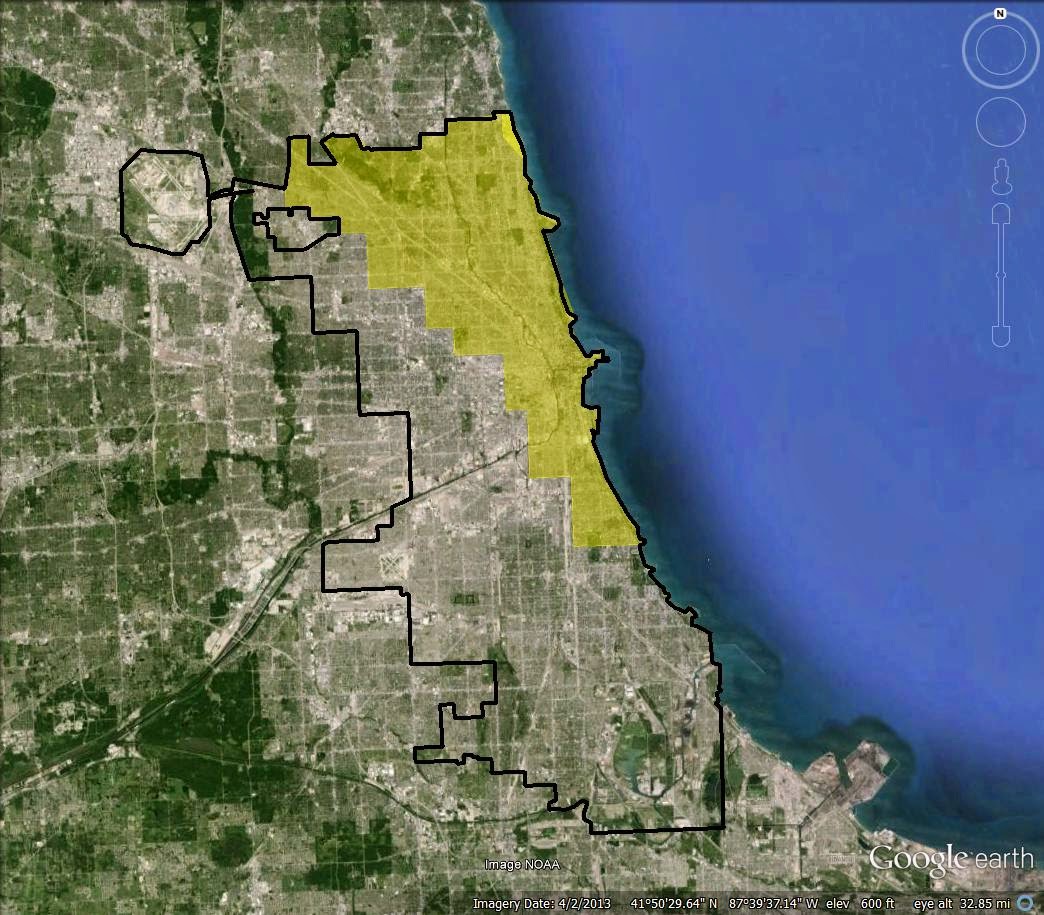
    Let’s start by looking at maps of the areas of examination.  Here is the seven-county Illinois portion of Chicago’s metro area, with Chicago etched in:

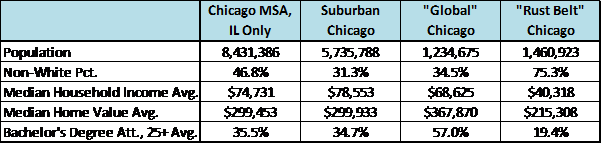
    I gathered data for all suburban municipalities and all City of Chicago zip codes within this area, for five variables — population, non-white population percentage, median household income, and median home value, and bachelor’s degree or more for persons 25+.  The data comes from the 2011 U.S. Census American Community Survey.  After collecting that data, I established an “average of medians” or “average of averages” to get a baseline for the metro area, and an understanding of how jurisdictions or zip codes would compare to one another.  One fairly big caveat — an average of medians or average of averages weighs all jurisdictions equally, skewing the numbers higher due to the number of small but well-to-do suburban municipalities.  So while the 2011 actual median household income for the seven-county area overall was $61,491, the average of medians was $74,731.  But since all data is expressed this way, differences are negated.

    Next, I looked for Chicago zip codes that were above the metro area average in at least one of three categories — median household income, median home value, and bachelor’s degree or more for persons 25+.  These are the higher income neighborhoods that can be called “Global Chicago”.  Within the city, they look like this, in yellow:

    Most Chicagoans would recognize this as the wealthier parts of the city.  It stretches from the far Northwest Side eastward to the lake, south to downtown and continuing south before ending in the Hyde Park neighborhood on the South Side.  Again, I included all zip codes that were above the metro average for at least one of the three categories I examined, so not all communities are the same.  Hyde Park, for example, is here because it has high educational attainment, but is below the average for income and home value.  The same applies to Rogers Park and Edgewater on the city’s northern border with Evanston.  Jefferson Park, Norwood Park and Sauganash, on the other hand, located on the Northwest Side, rank highly in home value but lower for income and educational attainment.

    Taken together, you can see how “Global Chicago” compares with the Illinois portion of the metro area, the metro area excluding Chicago to give you Suburban Chicago, and the balance of the city beyond “Global Chicago” that I’ve called “Rust Belt Chicago”:

    The differences are indeed stark.  “Global Chicago” is on par with the Chicago suburbs and the metro area overall in terms of income, and has a lower percentage of minority residents compared to the metro area.  Interestingly, “Global Chicago” has a much higher home value and educational attainment when compared to the metro area overall or the ‘burbs.  Meanwhile, “Rust Belt Chicago” lags far behind.  “Rust Belt Chicago” has a large majority-minority population, has an income nearly one-half as much as the suburban households, and has only one-third as many college graduates as “Global Chicago”.

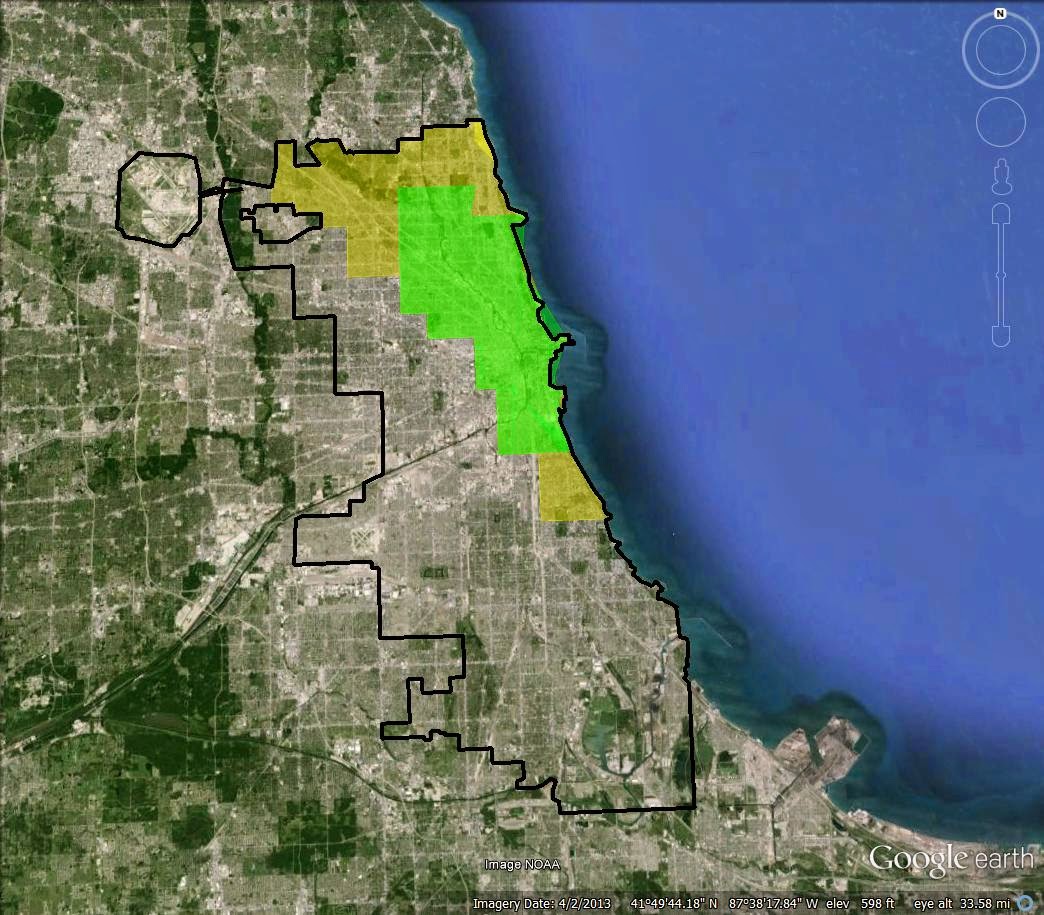
    I decided to take this analysis a little further and determine if there is a core to “Global Chicago”, and how it would compare to the rest of the city.  I collected data for zip codes that exceeded the metro average in two or more of the three categories.  That produced this map:

    And this table:

    Here, a “Super Global Chicago” compares favorably with the ‘burbs in terms of income, but far exceeds it in terms of home value and educational attainment.  Including some of the peripheral areas of the previous “Global Chicago” with the previous “Rust Belt Chicago” to produce an “Average Chicago” leads to some gains, but it still lags far behind the other slices of the metro area.

    Right now, the CNN series “Chicagoland” is doing its best to illustrate the “Two Chicagos” meme, highlighting blues festivals and Stanley Cup championship celebrations on one end of town and school closures and endless crime on another.  However, these maps and tables may do a far better job of demonstrating the impact of past and current practices and policies on the city’s landscape.  In fact, I think Chicago’s example is one that will serve as a model, for better or worse, for other cities across the nation.

    In reality I see the “Two Chicagos” meme as overplayed.  Chicago may be better understood in thirds — one-third San Francisco, two-thirds Detroit.

    This post originally appeared at Corner Side Yard on March 18, 2014.

    Pete Saunders is a Detroit native who has worked as a public and private sector urban planner in the Chicago area for more than twenty years.  He is also the author of “The Corner Side Yard,” an urban planning blog that focuses on the redevelopment and revitalization of Rust Belt cities.

    Chicago photo by Bigstock.

  • Cities: Better for the Great Suburbanization

    Where Cities Grow: The Suburbs

    The massive exodus of people from rural areas to urban areas over the past 200 years has been called the "great urbanization." For more than two centuries, people have been leaving rural areas to live in cities (urban areas). The principal incentive has been economic. But most of this growth has not taken place close to city centers, but rather on or beyond the urban fringe in the suburbs (and exurbs). Appropriately, The Economist magazine refers to the urbanization trend as the "great suburbanization," in its December 6, 2014 issue (PLACES APART: The world is becoming ever more suburban, and the better for it).

    The preponderance of suburban growth is evident in high income world metropolitan areas. For decades, nearly all growth in nearly all cities has been in the suburbs. Some notable examples are London, Toronto, San Francisco, Portland, Tokyo, Zürich, and Seoul. The dominance of suburban growth is also evident in the major cities of the less developed world, from Sao Paulo and Mexico City, to Cairo, Manila, Jakarta, Beijing, and Kolkata (see the Evolving Urban Form series). The Economist describes the substantial spatial expansion of residences and jobs in Chennai (formerly Madras), a soon-to-be megacity in India.

    Growing Cities Become Less Dense

    The Economist quotes New York University geographer Shlomo Angel, whose groundbreaking work (such as in Planet of Cities) indicates that "almost every city is becoming  less dense." Angel also shows that, contrary to the popular perception of increasing densities, cities become less dense as they add more population. This extends even to the lowest income cities, such as Addis Abeba (Ethiopia), where the population has increased more than 250 percent since the middle 1970s, while the urban population density has declined more than 70 percent. The rapidly growing cities of China exhibit the same tendency, where, according to The Economist: "Mr. Angel finds that population densities tend to drop when Chinese cities knock down cheaply built walk-up apartments and replace them with high towers."

    Suburbs in the United States

    In the United States, The Economist says that more than half of Americans live in suburbs. In fact, this is an understatement, owing to the common error of classifying "principal cities" as urban core, when many are, in fact, suburban. The Office of Management and Budget established the "principal cities" designation to replace the former "central city" versus suburb classification. This was in recognition of the fact that employment patterns in US metropolitan areas had become polycentric, with suburban employment centers, which along with central cities were designated as "principal cities."

    The absurdity of using "principal cities" as a synonym for central cities is illustrated by the broad expanses of post-1950 suburbanization now classified, with genuine core cities like New York or Chicago, as principal cities such like Lakewood, New Jersey (New York metropolitan area), Hoffman Estates (Chicago), Mesa (Phoenix), Arlington (Dallas-Fort Worth), Reston (Washington) and Hillsboro (Portland). In fact more than 85 percent of major metropolitan area (over 1 million population) residents live areas that are functionally suburban or exurban according to our small area analysis ("City Sector Model").

    Urban core growth rates have improved since 2010, which is an encouraging sign. Yet, core city jurisdictions account for less than 30 percent of metropolitan area growth, as Richard Morrill has shown. The Economist points out factors that could prevent this long overdue improvement from being sustained in the future.

    • Schools are "still often dire in the middles of cities," according to The Economist. Any hope of keeping most young families as they raise children seems impossible until core cities take on the politically challenging task of school reform.
    • The Economist also notes the huge government employee pension obligations of some large core cities, suggesting the necessity of cutting services or raising taxes. "Both answers were likely to drive residents to nearby suburbs, making the problem worse. No number of trams, coffee shops or urban hipsters will save cities that slip into this whirlpool." The Economist specifically cites Chicago and New York, but could have added many more examples both in this country and outside.

    Limiting Sprawl and Limiting Opportunity

    The Economist is refreshingly direct in its characterization of attempts to stop urban spatial expansion ("urban sprawl"). "Suburbs rarely cease growing of their own accord. The only reliable way to stop them, it turns out, is to stop them forcefully. But the consequences of doing that are severe."  The Economist: chronicles the experience of London, with its "greenbelt" ("urban growth boundary"): "Because of the green belt London has almost no modern suburban houses and very high property prices."

    The social consequences have been massive. "The freezing of London’s suburbs has probably aided the revival of inner-London neighbourhoods like Brixton. It has also forced many people into undignified homes, widened the wealth gap between property owners and everyone else, and enriched rentiers." Housing is typically the largest share of household expenditures and raising its price reduces discretionary incomes, while increasing poverty. In London, The Economist says that "To provide desperately needed cheap housing, garages and sheds there are being converted into tiny houses," quoting historian John Hickman who calls them “shanty towns”.

    Higher house prices and lower discretionary incomes are not limited to London. Among the 85 major metropolitan areas covered in the 10th Annual Demographia International Housing Affordability Survey, all 24 of those with "severely unaffordable" housing have London-style land-use regulation or similar land use restrictions. These financial reverses are not limited to suburban households, since urban containment policies are associated with substantial house price increases in urban cores as much as in suburbs.

    "Doom Mongering" About the Suburbs

    Oblivious to this revealed preference for residential and often commercial suburban location, many retro – urbanists, including many well placed, have viewed the suburbs with "concern and disdain," according to The Economist. Since the Great Financial Crisis, The Economist notes that this has turned to "doom-mongering."

    The Economist summarily dismisses suburban doom doctrine: "Those who argue that suburbia is dying are wrong on the facts; those who say it is doomed by the superiority of higher-density life make a far from convincing case."

    The Future

    In the editorial leader, The Economist, suggests: A wiser policy would be to plan for huge expansion. Acquire strips of land for roads and railways, and chunks for parks, before the city sprawls into them.

    The Economist adds: This is not the dirigisme (government planning) of the new-town planner—that confident soul who believes he knows where people will want to live and work, and how they will get from one to the other. It is the realism needed to manage the inevitable.

    The Economist continues that the suburbs have worked well in the West and are spreading, concluding that: We should all look forward to the time when Chinese and Indian teenagers write sulky songs about the appalling dullness of suburbia.

    Wendell Cox is principal of Demographia, an international public policy and demographics firm. He is co-author of the "Demographia International Housing Affordability Survey" and author of "Demographia World Urban Areas" and "War on the Dream: How Anti-Sprawl Policy Threatens the Quality of Life." He was appointed to three terms on the Los Angeles County Transportation Commission, where he served with the leading city and county leadership as the only non-elected member. He was appointed to the Amtrak Reform Council to fill the unexpired term of Governor Christine Todd Whitman and has served as a visiting professor at the Conservatoire National des Arts et Metiers, a national university in Paris.

    Photo: Suburban Ho Chi Minh (Saigon), by author

  • Gray Shadow Looms Over Home of Youth Culture

    Southern California, like the rest of America and, indeed, the higher-income world, is getting older, rapidly. Even as the region’s population is growing slowly, its ranks of seniors – people age 65 and older – is exploding. Since 2000, the Los Angeles metropolitan area population has grown by 6 percent, but its senior population swelled by 31 percent.

    The trend is stronger in the Inland Empire, where senior growth was almost 50 percent, the 14th-highest among the nation’s 52 largest metropolitan areas and more than three times the national average.

    Figures from the Census Bureau suggest that these trends have continued since 2010. Regionwide – Ventura, Orange, San Bernardino, Riverside and Los Angeles counties – the senior population has surged 9.7 percent, more than the national rate of 8.4 percent. Overall, the senior share of the Los Angeles metropolitan-area population has increased to among the 20 largest in the nation.

    These aging trends reflect in many ways the economic torpor of the region over the past decade. “We could be at the end of the period where Los Angeles thrived as a destination of choice for the working-age population, and it may simply begin to age, much like our counterparts in the Northeast,” suggests Ali Modarres, a former Cal State Los Angeles professor who now heads the urban studies center at the University of Washington, Tacoma. “Is L.A. finally out of its ‘sunbelt’ phase and entering its graying era?”

    Less movement

    Once, Modarres notes, this region was – like Florida and Arizona – a major lure to retirees, due largely to its ideal climate. But as the region has become more expensive and congested, this appeal has diminished considerably. As a result, our graying is likely the result not so much of senior migration into the region – since the L.A. area is the nation’s second-largest, after New York, exporter of people – but a case of people getting older in place.

    In 1980, notes USC demographer Dowell Myers, half of the Los Angeles population ages 55-64 had migrated from another state. By 2010, that inbound segment had dropped to 26 percent and, by 2030, he projects, only 14 percent will be from elsewhere.

    Traditionally a source of youthfulness, immigrants, too, are getting older. In Los Angeles County, the foreign-born share of the 55-64 population has risen from 30 percent in 1990 to 50 percent in 2010. By 2030, some 60 percent of this population will be foreign-born. Given the slowing rate of new immigration, Myers and others suggest that the foreign-born population will drop among the younger cohorts over the next few decades.

    Geographic divide

    Like everything else in this increasingly bifurcated metropolis, the geography of aging is divided into two main segments – high-income growth around the coast and lower-income, more minority-oriented sections further inland. In both groups, evidence suggests that they tend to generally stay close to home. Across the country, baby boomers, who are becoming seniors in ever-larger numbers – notes a recent Fannie Mae report – generally prefer staying in the homes they have occupied for years.

    An examination of data from the 2010 census mirrors these trends. Some of the largest increases in seniors occurred in such heavily Latino and working-class areas as the Coachella Valley, where the 65-plus population soared by 14,700, or 43.2 percent; the Ontario area, where it grew by 30.3 percent; and Santa Ana-Anaheim, where this population expanded by 27.1 percent.

    This pattern seems to be holding up since 2010, at least at the county level. By far the largest increase in seniors has occurred in the Inland Empire, which saw its senior population rise by 63,000 people from 2010-13. Overall, both San Bernardino (15.1 percent growth) and Riverside (13.8 percent) counties expanded their senior populations well above the regional average of 12.6 percent.

    Coastal clusters

    Looking at the 2010 Census, we see another fascinating pattern – the aging of beach communities, long the center of the Southern California youth culture. Indeed, the biggest increase in seniors over the past decade took place in coastal Orange County, where the senior population grew by 25,600, or a remarkable 50 percent. At the same time, the oldest parts of the Southland are also by the ocean, in Santa Monica and the Westside of Los Angeles. In 2010, roughly 14 percent of residents of this generally affluent area were seniors, versus 11 percent for the rest of the region.

    Why are seniors staying in these enclaves? Well, the real question is, why not? Seniors who have stayed put, for the most part, were able to buy their homes for what today would be almost impossibly low costs, even though they were more expensive than average at the time. But, over the past three decades, as house prices have exploded across Southern California, these areas have become proportionally more unaffordable, which accounts for their declining populations of children as well as young families.

    Safely ensconced with little or no mortgage debt, and with their property taxes limited by Proposition 13, many of these lucky seniors get to enjoy the fair climate and gorgeous beachfront for the rest of their active lives. Needless to say, few younger people, particularly families, will be able to join the party for quite a while.

    Southland implications

    Aging is a natural process, and virtually every city in the world, particularly in higher-income countries, now feels its effects. But the key issue is one of relativity. Until recently, this region’s populace was generally much younger than the national average but, since 2000, has seen its median age rise at nearly twice the national rate. Now, it could be on the way to resembling a sun-baked version of a Rust Belt community, as net outmigration continues by younger people, families and even immigrants.

    There arguably are some good aspects of being in an aging region, such as lower demand for schools and, often, lower crime rates. In addition, seniors are an increasingly important source of consumer demand – according to Nielsen, Americans over age 50 by 2017 will control some 70 percent of the nation’s disposable income. Seniors, notes the Kaufmann Foundation, are also the fastest-growing entrepreneurial population, critical for future job creation.

    Of course, there are dangers in taking these trends too far. Over time, young people and families are critical to creating demand for many key products, notably houses, cars and furnishings. They also are more likely to start and staff innovative companies. A declining youth population is not necessarily a good thing in a region that lives off being on, and establishing, the cutting edge of design, entertainment and technology.

    There’s nothing inevitable about the region becoming a giant retirement home. The Southland can again become a magnet for migration. It’s advantages are manifest, with the beaches, mountains and incomparable weather. But the past couple of decades have demonstrated that these inducements alone are not enough to keep millions of people from moving away.

    We need to start addressing the causes for persistent out-migration, and, more importantly, the relative dearth of new people. There are obvious candidates for remediation – one of the nation’s highest costs of living, particularly for housing, too many poor schools, a challenging business climate and a declining infrastructure. These are helping to drive the younger generations and enterprises – who should want to flock here – to Nevada, other mountain states, Texas and elsewhere.

    This piece first appeared at the Orange County Register.

    Joel Kotkin is executive editor of NewGeography.com and Roger Hobbs Distinguished Fellow in Urban Studies at Chapman University, and a member of the editorial board of the Orange County Register. His newest book, The New Class Conflict is now available at Amazon and Telos Press. He is author of The City: A Global History and The Next Hundred Million: America in 2050. His most recent study, The Rise of Postfamilialism, has been widely discussed and distributed internationally. He lives in Los Angeles, CA.

    Wendell Cox is principal of Demographia, an international public policy and demographics firm. He is co-author of the “Demographia International Housing Affordability Survey” and author of “Demographia World Urban Areas” and “War on the Dream: How Anti-Sprawl Policy Threatens the Quality of Life.” He was appointed to three terms on the Los Angeles County Transportation Commission, where he served with the leading city and county leadership as the only non-elected member. He was appointed to the Amtrak Reform Council to fill the unexpired term of Governor Christine Todd Whitman and has served as a visiting professor at the Conservatoire National des Arts et Metiers, a national university in Paris.

    “Senior Citizens Crossing” photo by Flickr user auntjojo.

  • The Rustbelt Roars Back From the Dead

    Urban America is often portrayed as a tale of two kinds of places, those that “have it” and those who do not. For the most part, the cities of the Midwest—with the exception of Chicago and Minneapolis—have been consigned to the second, and inferior, class. Cleveland, Buffalo, Detroit or a host of smaller cities are rarely assessed, except as objects of pity whose only hope is to find a way, through new urbanist alchemy, to mimic the urban patterns of “superstar cities” like New York, San Francisco, Boston, or Portland.

    Yet in reality, the rustbelt could well be on the verge of a major resurgence, one that should be welcomed not only locally but by the rest of the country. Two factors drive this change. One is the steady revival of America as a productive manufacturing country, driven in large part by new technology, rising wages abroad (notably in China), and the development of low-cost, abundant domestic energy, much of it now produced in states such as Ohio and in the western reaches of Pennsylvania.

    The second, and perhaps more surprising, is the wealth of human capital already existent in the region. After decades of decline, this is now expanding as younger educated workers move to the area in part to escape the soaring cost of living, high taxes, and regulations that now weigh so heavily on the super-star cities. In fact, more educated workers now leave Manhattan and Brooklyn for places like Cuyahoga County and Erie County, where Cleveland and Buffalo are located, than the other way around.

    The Psychological Undermining of the Rustbelt

    When attention is paid to the industrial Midwest, it often takes the form of an anthropological curiosity as to how “the other half” lives. “I’ll tell you the relationship between New York and Cleveland,” said Joyce Brabner, wife of the underground comic book legend Harvey Pekar, to a New York City radio host. Brabner talked about the “MTV people” coming to Cleveland to get pictures of Pekar emptying the garbage and going bowling. But they didn’t bowl, Brabner quipped. They went to the library. “So, that’s it,” she continued. “We’re just basically these little pulsating jugular veins waiting for you guys to leech off some of our nice, homey, backwards Cleveland stuff.”

    Urban economists, particularly those on the self-satisfied coasts, tend to envision utter hopelessness for the region. “Can Buffalo Ever Come Back?” reads the headline of a City Journal article by Harvard economist Ed Glaeser. He answers in the subtitle: “Probably not—and government should stop bribing people to stay there.” Glaeser cites Buffalo’s low levels of human capital and low housing costs as reasons to federally jump ship.

    Berkeley-based economist Enrico Moretti is also bearish on the future of the region. Moretti believes that the winners in the knowledge economy, such as Silicon Valley, Boston, and Seattle, will be winning more, and the losers—he cites Cleveland and Detroit—will be winning less. In a recent interview, Moretti hints at the prospect of federal incentives tied to unemployment benefits to motivate people to leave the Rust Belt for high-tech hot spots. “If you are a waiter, you can make twice as much in Austin relative to Flint,” remarked Moretti. Of course what’s missing from this equation is that the median rent in San Francisco is much more than double that of Flint, without considering the higher cost of energy and far higher taxes.

    Often, when national experts imbue hopelessness into the region, rustbelt leaders, no strangers to desperation, often take the bait. Perhaps nothing so illustrates the long-term acceptance of second-class status than the widespread adoption of the creative class model of urban development championed by Richard Florida. This approach—which holds up places like San Francisco and New York as exemplars par excellence—maintains that the key to growth is to develop a hip, cool scene that will attract educated, entrepreneurial people to a city.

    For instance, in a recent interview about how to turn around Detroit, Florida says, “If you want to rebuild a neighborhood, you’re a lot better off starting with stuff people eat and drink.” In other words, cities should develop the microbrewery district, the artisanal culinary scene, etc. to attract the talent; and once the talent clusters, broad economic development will follow.

    This approach was adopted in the ’90s by such politicians as former Michigan governor Jennifer Granholm, who famously proclaimed that the key to turning around rustbelt cities like Detroit lay in becoming “cool” by cultivating the “creative class” and subsidizing the arts. But as the American Prospect has noted, many down-at-the-heels burgs like Cleveland, Toledo, Hartford , Rochester, and Elmira, New York have tried but largely failed to reinvent themselves as hipster-oriented. “You can put mag wheels on a Gremlin,” commented one long time Michigan observer, “but that doesn’t make it a Mustang.”

    The Resurgence of the rustbelt as a productive region

    The rustbelt revival relies not on mimicry but on embracing the regional culture that values production of things over simply their mere consumption. Cities like San Francisco, Portland and Seattle may have started with industrial roots, but their recent success has been tied to such factors as attractive geographies and, to Midwest sensibilities at least, mild climates. These regions have been enriched for decades by the migration of people from the rustbelt—Microsoft’s former President Steve Ballmer (suburban Detroit), venture capitalist John Doerr (St. Louis), and Intel co-founder Robert Noyce (Iowa) are just a few examples.

    The cities of the heartland came into existence, first and foremost, as economic entities. Detroit, for example, grew first from timber and farming, and later autos; its location at the confluence of the Detroit River and the Great Lakes assured that its products could be exported around the nation and the world. Cleveland grew, and thrived, due to its location near such natural resources as oil (which explains Standard Oil’s founding in that city), as well as its strategic lakefront location. Pittsburgh also grew largely due to the nearby availability of cheap energy as well as the confluence of three rivers that made it an ideal place for the evolution of the steel industry.

    Today many in the economics and urban planning professions consider such factors close to irrelevant. With the certainty of old Marxists predicting the inevitable end of capitalism, the clerisy today denies that industry can ever revive. “Construction and manufacturing jobs are not coming back,” intoned Slate, suggesting not much of a future for a wide swath of the country, and millions of Americans.

    Yet a funny thing has happened on the way to oblivion: the rustbelt’s industrial base is reviving. Cheap and abundant natural gas is luring investment from manufacturers from Europe and Asia, who must otherwise depend on often unsecured and more expensive sources of energy. The current energy and industrial boom, according to Siemens President Joe Kaeser, “is a once-in-a-lifetime moment.”

    Indeed, since 2010, jobs have expanded in energy, manufacturing, logistics and, with the return of the housing market in some areas, construction. Although much of the expansion has taken place in the sunbelt, notably Texas, the rustbelt economy has also been a prime beneficiary. Of the top ten states for new plants in 2010, five were in the rustbelt—led by second place (after Texas) Ohio, Pennsylvania, Michigan, Illinois, and Indiana.

     Most impressively, there has been a revival of job growth in these areas. Between 2009 and 2013, rustbelt cities and states dominated the country’s industrial revival. At the top of the list is Michigan, which gained 88,000 industrial jobs, a performance even greater than that of Texas, which came in second. The next three leading beneficiaries are all rustbelt states: Indiana, Ohio, and Wisconsin.

    For much of the past half century, the rustbelt states suffered high levels of unemployment. But today Ohio, Indiana, Minnesota and Wisconsin have considerably lower rates of unemployment than the national average, and considerably less than California, Georgia, Nevada, New Jersey, and New York.

    Human Capital: A critical advantage for the new rustbelt

    Critically, despite generations of out-migration, the region has retained a strong base of skilled, technical workers. The Great Lakes states, for example, boast the largest concentration of engineering jobs (more than 318,000) of any major region. This is 70,000 more than northeast or the west coast. In terms of engineers per capita, both Dayton and Detroit rank among the top 12 regions in the country; they have many more, per capita, than Boston, San Francisco, New York, Los Angeles, and Chicago.

    The rustbelt’s technological strengths differ considerably those of the two leading engineer cities, San Jose/Silicon Valley and Houston. In the Silicon Valley engineers tend to be focused on the high profile digital economy, while those in Houston are generally engaged with oil and gas. In contrast, the rustbelt’s workforce is more involved in the world of production, of practical engineering. Their work conforms closest to French sociologist Marcel Mauss’s description of technology as “a traditional action made effective.”

    The revival of industry makes such engineering talent critical to regional success. It also provides a critical opportunity to expand the ranks of the middle class. The University of Washington’s Richard Morrill has found that areas with large concentrations of manufacturing—including largely non-union southern plants—and other higher-wage blue collar jobs have significantly lower levels of income inequality than areas that rely primarily on service, finance, and tech industries.

    This could create tremendous opportunity for a broad swath of the rustbelt population. There is already, notes a recent Boston Consulting Group (BCG) study, a shortfall of some 100,000 skilled manufacturing positions in the U.S. By 2020, according to BCG and the Bureau of Labor Statistics, the nation could face a shortfall of around 875,000 machinists, welders, industrial-machinery operators, and other highly skilled manufacturing professionals.

     So rather than focus on the “hip cool,” the rustbelt’s new generation, particulary the majority without Bas, needs to become reacquainted with the skills—so often deemed unfashionable and dead-end—that built the region.

    Equally critical has been the growth among younger educated workers in the region. From 2000 to 2012, the Buffalo metro area rose to seventh in the nation in the number of 25- to 34-year-olds with a college degree, a percentage gain of 34 percent. Greater Pittsburgh ranked tenth. Over the last three years, the Cleveland metro has risen to third in the nation in the percentage gain of young adults with a college degree, behind only Nashville and Orlando. Cleveland’s gain of 15,500 college-educated young adults was greater than Silicon Valley’s and seven times that of Portland.

    These young folks aren’t just arriving, but they are also employed. According to the Center for Population Dynamics at Cleveland State University, Pittsburgh and Cleveland are third and eighth in the nation respectively in the percentage of 25- to 34-year olds in the workforce with an advanced or professional degree, ahead of such high-tech hot spots as Seattle, Austin, and San Diego, and well ahead of Portland, which ranks twenty-third. One explanation for this shift lies in job prospects. For example, one recent highly-disseminated report by the Portland-based Value of Jobs Coalition found that Portland’s “brain gain” was more akin to “brain waste.” The region’s educated labor force—which the report found was oversaturated with liberal arts majors—works fewer hours and gets paid less than the national metropolitan average.

    The Comeback is not just coming, it’s already here

    What’s driving the sudden improvement in the rustbelt? Some of it has to do with the region’s legacy. Various industrialists long ago financed the universities and hospitals that pepper the region, and it is these centers of knowledge production that are driving the highly-skilled workforce demand. For example, Carnegie Mellon’s robotics and computer engineering programs are creating a two-way pipeline between Pittsburgh and Silicon Valley. Both Google and Apple are broadening their physical footprint in the Steel City, in part because of the cost advantages the rustbelt offers relative to either coast. In Cleveland, the health care service and technology industry is clustering at a fast pace, particularly along the city’s health-tech corridor. According to Jeff Epstein, director of Cleveland Health-Tech Corridor, the city has raised more than $1 billion in venture capital over the last 12 years. The city’s biotech start-ups have increased by 133 percent, to 700, over the same time period. Global firms are taking notice. “The city has become quite a hub for the healthcare industry,” said Eric Spiegel, CEO of Siemen’s USA, on a recent visit to Cleveland. “We think there’s a good talent base here. It’s a good location for a lot of our businesses.” Bowling and taking out the garbage this isn’t.

    Another major factor lies with costs. Housing prices in most rustbelt cities, adjusted for incomes, are one-third those of the Bay Area and at most one-half those seen in the Los Angeles, New York, or Boston areas. This can be seen not just in distant exurbs or suburbs, but in prime inner-city neighborhoods. Whatever dreams millennials have are likely to center around affordable single-family housing, as they begin to marry and start families. The rustbelt offers this younger generation the kind of choices, and middle class standards, that are increasingly unattainable in the superstar cities.

    These changes are beginning to be seen in hard economic numbers. The region is already experiencing some of the nation’s largest per capita income gains. From 2009 to 2012, Cleveland’s metro income, when adjusted for inflation and cost of living, increased from $44,109 to $47,631—the fifth biggest increase in the nation, behind Silicon Valley, Houston, Oklahoma City, and Nashville. Buffalo ranked tenth in the nation, while Detroit and Pittsburgh ranked twelth and thirteenth, respectively. Conversely, Portland’s metro area ranked thirty-eighth in income gains, going from $39,414 to $40,706, one spot ahead of New York, whose per capita income nudged up by only $1,200.

    Economic development, then, is not simply about adding a cornucopia of talent or cool, then shaking and stirring it like a drink. According to Buffalo native and rustbelt economic expert Sean Safford, a director at the internationally-acclaimed Parisian Sciences Po, creative classification efforts distract from the kind of basic investments that really matter. What is important, Safford found, is investing in infrastructure that will drive the evolution of the rustbelt’s knowledge networks, particularly around the anchor institutions such as industrial research labs, universities, and hospitals that can help produce products for the global market.

    Cleveland, for one, is figuring this out. Along the city’s health-tech corridor, investment is not spent sprinkling the tech corridor with art galleries and microbreweries, but rather with the world’s first commercial 100 gigabit fiber network. Cleveland increasingly knows its bread is buttered by health care expertise, and it is making the requisite infrastructure investments to further the growth of its health care industry.

    Sure, Cleveland has got a microbrew scene as well, just like Portland. But a pricey pint requires a solid paycheck, which means Cleveland has microbreweries whose products are consumed by people who know microbes, and how to fashion steel, or develop new energy resources. Those tasty brews are consumed by producers. As long as that causality stays clear—not only for Cleveland, but for other rustbelt metro areas as well—then the region’s future could be far brighter than most experts suggest. Before long, those who can only envision the rustbelt as a landscape of garbage cans and bowling pins may find that they are the people who are stuck in the past.

    This piece originally appeared in Forbes.

    Joel Kotkin is executive editor of NewGeography.com and Distinguished Presidential Fellow in Urban Futures at Chapman University, and a member of the editorial board of the Orange County Register. His newest book, The New Class Conflict is now available at Amazon and Telos Press. He is author of The City: A Global History and The Next Hundred Million: America in 2050. His most recent study, The Rise of Postfamilialism, has been widely discussed and distributed internationally. He lives in Los Angeles, CA.

    Richey Piiparinen is a Clevelander, writer, and Senior Research Associate heading the Center for Population Dynamics at Cleveland State University.

  • Voting With Your Feet: Aaron Renn’s New Donut

    Growing up I remember the adults talking about the old neighborhood in Brooklyn where my grandparents lived during the Great Depression and World War II. In spite of the hardships of the era it was described as a great place full of life and colorful characters and extended family all on the same block. But by the time I was born no one we knew lived there anymore. My family was part of the great suburban migration away from cities. By 1967 (the year of my birth) New York, like most cities, had begun to fail. There were race riots, rapidly rising crime rates, strikes of every kind, unemployment, terrible public schools, a near bankrupt city hall, declining property values, high taxes, and a general sense that the city wasn’t any place to raise children or grow old. People voted with their feet. The Good Life existed exclusively in clean, quiet, leafy suburbs – many of which like Scottsdale or Orlando weren’t even attached to an historic urban core.

    But today we’re seeing the economic and cultural revival of many of the city centers that had been declared dead. Boerum Hill, Brooklyn where my mom was born is now a million dollar address. Absolutely no one could have imagined that in 1974 or 1987. At the same time race riots and economic decline are now unraveling many poorly aging suburbs – precisely the same suburbs that were insulated middle class enclaves in 1969 or 1985. That’s not to say that all downtowns are bouncing back or that all suburbs are failing. There’s a big difference between Detroit that’s still contracting and San Francisco with an economy that’s actually overheating. And no one would put Short Hills, New Jersey in the same category as Ferguson, Missouri. But the waters are murkier than they used to be. Statistically, there are now more Americans living in poverty in the suburbs than in city centers or rural backwaters. This makes sense since the vast majority of the built environment consists of low density development and that’s where the overwhelming majority of all people of every kind now live. And it’s no longer true that the suburbs are all white. Many of the most ethnically diverse places in the country are now suburban rather than urban. The new Chinatowns, Koreatowns, and Little Indias are much more likely to exist in suburban cul-de-sacs than in city centers.

    The challenge faced by many regions today is described beautifully by Aaron Renn here. The old model of urban poverty and suburban prosperity (the sweet fluffy “donut” with a dead center) has been replaced by what Mr. Renn calls the New Donut with a thriving downtown core, failing older suburbs, and booming new outer ring suburbs. Poverty then reappears out in the rural hinterlands.

    NewDonutUrbanophile.com

    I occasionally get critical comments from readers who dismiss my observations. One of my stories about a declining suburban neighborhood in southern California was re-posted on newgeography.com (a website I respect and enjoy) and it attracted these comments here. They can best be summed up as, “Dude, you’re a busybody from Planet San Francisco who knows nothing about the real lives of real people.” The comments assume that the suburbs are doing just fine and any attempt to tinker with them by pointy-headed urban theorists will only make things worse. In many instances I completely agree. There are examples of infill suburban development all over the country and most of them are pretty crappy. See my post here for specific case studies. But the default setting of the suburban development pattern is designed to actively fail over time. Doing nothing is a sure recipe for continued decline. Let me explain.

    Screen Shot 2014-11-29 at 1.30.16 AM Palmdale, Lancaster 056 (800x600) Lancaster, Palmdale 039 (800x600) Lancaster, Palmdale 078 (800x600)  Screen Shot 2014-11-29 at 2.57.17 AMScreen Shot 2014-11-29 at 2.58.26 AM Screen Shot 2014-11-29 at 2.58.59 AM Screen Shot 2014-11-29 at 2.52.58 AM

    Each new shiny subdivision, shopping center, and office park built out on the edge of town (often in a different school district or municipality) draws more prosperous and mobile residents along with new revenue from fresh growth. Meanwhile smaller older tract homes, aging strip malls, and even churches lose value as they age. Taxes are generally lower in newly built areas since legacy costs for infrastructure and government employees hasn’t yet accumulated. In contrast, older suburban areas are loaded down with maintenance costs, underfunded pensions, rising health care costs, and declining revenues. The public schools wobble, lower income people migrate to the neighborhood, home owners are replaced by renters with slum lords, and the whole thing goes south pretty fast. People, of course, respond by voting with their feet.

    Lancaster, Palmdale 513 (800x600) Screen Shot 2014-11-29 at 1.24.25 AM Screen Shot 2014-11-29 at 1.26.24 AM Lancaster, Palmdale 526 (800x600) Lancaster, Palmdale 529 (800x600) Lancaster, Palmdale 548 (800x600) Screen Shot 2014-11-29 at 2.31.13 AM Screen Shot 2014-11-29 at 2.30.56 AM Screen Shot 2014-11-29 at 2.31.43 AM  Screen Shot 2014-11-29 at 2.27.47 AM

    If you want to see the in-between stage of this process check out the 1980’s and 1990’s retail centers. The strip malls are still freshly painted and the landscaping is well maintained, but most of the storefronts are empty. There’s just too much retail space on offer with too few businesses looking to fill it. This isn’t a result of a temporary economic downturn. It’s a feature of never-ending outward expansion. Some property owners have tried to reinvent their commercial space in creative ways. The old movie theater failed when the new multiplex opened up on the edge of town. The concrete bunker was painted pink and decorated like a Greek temple and turned into a beauty school. The school eventually failed and the building is now empty like so many other older retail properties in town. It’s obvious what these places will be like after another decade or two. These aren’t isolated instances. This is the inevitable result of a particular style of horizontal development. So what exactly do you do with all this stuff to prevent it from falling apart?

    Screen Shot 2014-11-29 at 5.38.19 PM Screen Shot 2014-11-29 at 5.38.50 PM Screen Shot 2014-11-29 at 5.38.58 PM Screen Shot 2014-11-29 at 5.39.14 PM Screen Shot 2014-11-29 at 5.06.23 PM Palmdale, Lancaster 018 (800x600) Palmdale, Lancaster 015 (800x600) Palmdale, Lancaster 017 (800x600) Palmdale, Lancaster 021 (800x600)

    I had previously used the Antelope Valley in California as an example. The typical response by many civic leaders is to encourage new job creation and new retail sales to fill the public coffers. But even when new businesses do open and jobs are created it doesn’t really help the older neighborhoods recover. People looking for good places to raise their children or retire gravitate toward the newer parts of town – or more likely the next town over. People who want urban amenities like street life and culture generally flee the region entirely for a real city. If you drill down on these older neighborhoods on Google Earth you realize that there’s still plenty of undeveloped land, but since it’s in the wrong part of town it isn’t likely to ever see new five bedroom homes with swimming pools or upscale retail. Any suggestion that these districts could be reinvented with a downtown flavor to give people the option of a walkable urban neighborhood is met with stiff resistance from nearly everyone. It’s just not what people in the area want. So these places continue to fester. That’s not the opinion of a pointy headed urban theorist. It’s just an observable fact. This process is brilliantly articulated by the fiscal conservative Chuck Marohn from strongtowns.org here.

    Screen Shot 2014-11-29 at 1.21.08 AM Screen Shot 2014-11-29 at 1.20.45 AM Screen Shot 2014-11-29 at 1.20.25 AM Google Earth

    So let’s get back to that criticism about “busybodies from Planet San Francisco” telling people in the suburbs what to do. I’m observing a fact. The fact is that many suburbs are aging poorly and turning into slums. As city centers gentrify the poor are being displaced and they are finding their way to these failing suburbs because they’re cheap. So what have local governments like Lancaster and Palmdale been doing in response to the decline of their older suburban neighborhoods? Well… as lower income people migrated to the Antelope Valley from other parts of Los Angeles County both cities began an aggressive code enforcement program directed at discouraging poorer people from settling in the area. If you read the local Antelope Valley Times here the mayor of Lancaster, Rex Parris, praised the fraud investigation officials who were wrongly terminated by Los Angeles County bureaucrats. If you read the Los Angeles Times here both Lancaster and Palmdale were systematically raiding the homes of lower income black and latino citizens with SWAT style teams of heavily armed police looking for minor code violations and instances of fraud.

    No one in particular is causing this demographic shift to happen, although liberals like to blame conservatives and conservatives like to blame liberals. Mostly it’s Adam Smith’s Invisible Hand of The Market. Eliminating all state and federal programs wouldn’t change the basic pattern. In fact, these migrations might actually accelerate in an all-out unfettered marketplace. When people can’t sell their homes they turn to renting. When they can’t find solvent renters they turn to Section 8 subsidized renters. If the Section 8 program didn’t exist the homes would eventually become so cheap that the same poorer demographic would ultimately fill the neighborhood anyway and/or the buildings would sit empty and rot. So the question is simple. How do you prevent this cycle of devaluation from happening to your town? Or how do you reverse the process if it’s already begun?

    Palmdale, Lancaster 083 Palmdale, Lancaster 082

    The most recent “solution” was for the city of Lancaster to propose shutting down its MetroLink rail station in order to prevent lower income people from traveling in from other parts of Los Angeles County. That approach plays well with suburban voters, but has no real effect on the larger trend. The idea that low density development and a lack of public transit prevents blight and crime just doesn’t hold up in reality. In the same way, creating a walkable mixed use slightly denser environment is neither a recipe for disaster or a cure-all. Many people assume that limiting growth with artificial boundaries raises costs by squeezing people into a limited amount of space and unnaturally jacking up rents and the cost of home ownership. In order to keep homes affordable new growth out on the edge must constantly be built. The dark side of that theory is that it’s impossible to prop up the value of older subdivisions if there’s an endless supply of new housing coming on the market.

    I don’t expect the good people of the Antelope Valley to make any radical changes to the way they organize their affairs anytime soon. But I do expect many people to continue to vote with their feet and move away, taking their money and civic engagement with them. If these towns are incredibly lucky they will eventually be colonized by a new group of people who reinvest in these tired old neighborhoods. But I might not live long enough to see the pendulum swing back.

    John Sanphillippo lives in San Francisco and blogs about urbanism, adaptation, and resilience at granolashotgun.com. He’s a member of the Congress for New Urbanism, films videos for faircompanies.com, and is a regular contributor to Strongtowns.org. He earns his living by buying, renovating, and renting undervalued properties in places that have good long term prospects. He is a graduate of Rutgers University.

    New and Old Donut graphics courtesy of Urbanophile.com.