Category: Demographics

  • A Look at College Degree Migration

    Net migration of people to or from metro areas is reported annually by the Census Bureau and widely discussed.  Less well known is that their American Community Survey (ACS) provides migration figures broken down by characteristics such as race, age, income, and educational attainment. This lets us drill into finer grained details about who is moving where.

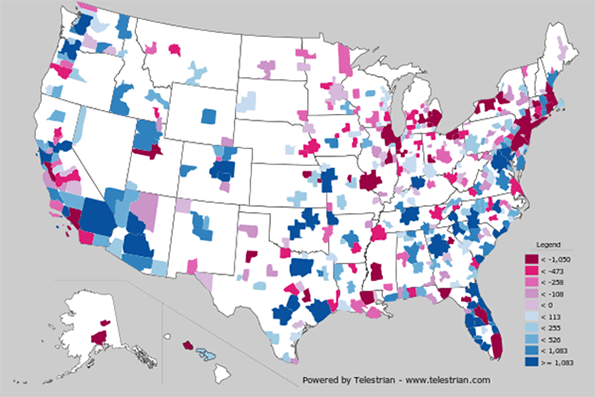
    Here is a map of net migration of people with a bachelor’s degree or higher, based on data from the 2007-2011 ACS, with blue indicating net migration gains and red net migration losses:


    Net domestic migration of adults age 25+ with a bachelor’s degree or higher by metropolitan area. Source: 2007-2011 ACS with rollups and mapping via Telestrian

    Unsurprisingly, this data correlates with overall net migration. For example, at first glance it might seem odd that a metro area like New York would be a net loser of people with college degrees. It lost a net of nearly 29,000 of them, highest net outflow in the country. But the New York metro as a whole lost almost two million people to domestic migration during the 2000s.  Given that, it would be surprising indeed if the region didn’t lose people with degrees. It’s similar for runners-up in the loss department Los Angeles (-11,000) and Chicago (-9,500).

    The list of leaders is unsurprisingly headed by Austin, Texas (+9,500), Dallas (+9,200) and Phoenix (+9,200) and other population boomtowns. But there are some areas that punch above their weight versus overall migration, such as #5 Portland (+7000) and #9 Washington, DC (+5000). These cities are known as talent magnets and this data points in that direction. Their net in-migration is disproportionately highly educated.

    I have rounded the numbers above because this data is based on samples with a margin of area. Keep in mind when reviewing the tables below with detailed statistics not to read into this a false degree of precision.

    Regions like New York, Los Angeles, and Chicago can take heart from the fact that they are still among the top destinations of in-migrants with college degrees.

    Rank

    Metro Area

    In-Migrants

    1

    New York-Newark-Jersey City, NY-NJ-PA

    79,156

    2

    Washington-Arlington-Alexandria, DC-VA-MD-WV

    74,048

    3

    Los Angeles-Long Beach-Anaheim, CA

    66,209

    4

    San Francisco-Oakland-Hayward, CA

    49,980

    5

    Chicago-Naperville-Elgin, IL-IN-WI

    49,016

    6

    Dallas-Fort Worth-Arlington, TX

    47,198

    7

    Atlanta-Sandy Springs-Roswell, GA

    44,892

    8

    Boston-Cambridge-Newton, MA-NH

    42,006

    9

    Houston-The Woodlands-Sugar Land, TX

    37,408

    10

    Phoenix-Mesa-Scottsdale, AZ

    36,349

    Domestic In-Migration, Adults 25+ with a bachelor’s degree or higher. Source: 2007-2011 ACS with rollups and analysis via Telestrian

    Unfortunately for them, even higher numbers of people left.

    Rank

    Metro Area

    Out-Migrants

    1

    New York-Newark-Jersey City, NY-NJ-PA

     108,118

    2

    Los Angeles-Long Beach-Anaheim, CA

     77,190

    3

    Washington-Arlington-Alexandria, DC-VA-MD-WV

     69,179

    4

    Chicago-Naperville-Elgin, IL-IN-WI

     58,680

    5

    San Francisco-Oakland-Hayward, CA

     47,201

    6

    Boston-Cambridge-Newton, MA-NH

     45,407

    7

    Atlanta-Sandy Springs-Roswell, GA

     40,363

    8

    Philadelphia-Camden-Wilmington, PA-NJ-DE-MD

     38,640

    9

    Dallas-Fort Worth-Arlington, TX

     37,958

    10

    Miami-Fort Lauderdale-West Palm Beach, FL

     34,191

    Domestic Out-Migration, Adults 25+ with a bachelor’s degree or higher. Source: 2007-2011 ACS with rollups and analysis via Telestrian

    This in part reflects the status of America’s tier one cities as talent refineries. People move there after school when young, but then leave after they get older and have been upskilled by their experiences – and when their life priorities change.  We should expect cities like New York to have a lot of churn.

    A place like New York can also take solace in the fact that its migration loss of the college degreed was better than for those with lesser educational attainment.  Metro New York has 37% college degree attainment, but college grads only accounted for 28% of net migration losses. This is good news from the standpoint of retaining highly educated people, but raises the question of why New York is not so attractive to those without degrees.

    While each metro area has its own nuanced story to tell in migration, on the whole this report shows that the migration of the educated overall appears to be following that of the population as a whole. This means increasing numbers of people with college degrees moving to lower-cost Sunbelt boomtowns and other metros with rapidly expanding populations.

    Here is a complete ranking of net migration for adults with college degrees for all metro areas greater than one million people.

    Rank

    Metro Area

    Net Migrants

    1

    Austin-Round Rock, TX

     9,384

    2

    Dallas-Fort Worth-Arlington, TX

     9,240

    3

    Phoenix-Mesa-Scottsdale, AZ

     9,208

    4

    Houston-The Woodlands-Sugar Land, TX

     8,015

    5

    Portland-Vancouver-Hillsboro, OR-WA

     6,933

    6

    Denver-Aurora-Lakewood, CO

     6,132

    7

    Seattle-Tacoma-Bellevue, WA

     5,935

    8

    Riverside-San Bernardino-Ontario, CA

     5,308

    9

    Washington-Arlington-Alexandria, DC-VA-MD-WV

     4,869

    10

    Raleigh, NC

     4,674

    11

    Tampa-St. Petersburg-Clearwater, FL

     4,665

    12

    San Antonio-New Braunfels, TX

     4,542

    13

    Atlanta-Sandy Springs-Roswell, GA

     4,529

    14

    Charlotte-Concord-Gastonia, NC-SC

     4,096

    15

    San Francisco-Oakland-Hayward, CA

     2,779

    16

    Jacksonville, FL

     2,113

    17

    Kansas City, MO-KS

     2,072

    18

    Nashville-Davidson–Murfreesboro–Franklin, TN

     2,069

    19

    Sacramento–Roseville–Arden-Arcade, CA

     1,816

    20

    Louisville/Jefferson County, KY-IN

     1,647

    21

    Oklahoma City, OK

     1,189

    22

    Baltimore-Columbia-Towson, MD

     1,157

    23

    New Orleans-Metairie, LA

     985

    24

    Richmond, VA

     931

    25

    Birmingham-Hoover, AL

     905

    26

    Salt Lake City, UT

     844

    27

    Las Vegas-Henderson-Paradise, NV

     745

    28

    Pittsburgh, PA

     179

    29

    Cincinnati, OH-KY-IN

     32

    30

    Indianapolis-Carmel-Anderson, IN

     2

    31

    Minneapolis-St. Paul-Bloomington, MN-WI

     (46)

    32

    Columbus, OH

     (343)

    33

    San Diego-Carlsbad, CA

     (476)

    34

    Virginia Beach-Norfolk-Newport News, VA-NC

     (610)

    35

    Milwaukee-Waukesha-West Allis, WI

     (723)

    36

    Hartford-West Hartford-East Hartford, CT

     (749)

    37

    Memphis, TN-MS-AR

     (928)

    38

    Buffalo-Cheektowaga-Niagara Falls, NY

     (1,139)

    39

    St. Louis, MO-IL

     (1,199)

    40

    Miami-Fort Lauderdale-West Palm Beach, FL

     (1,225)

    41

    Rochester, NY

     (1,295)

    42

    Providence-Warwick, RI-MA

     (1,366)

    43

    Cleveland-Elyria, OH

     (1,563)

    44

    San Jose-Sunnyvale-Santa Clara, CA

     (1,825)

    45

    Orlando-Kissimmee-Sanford, FL

     (2,603)

    46

    Boston-Cambridge-Newton, MA-NH

     (3,401)

    47

    Philadelphia-Camden-Wilmington, PA-NJ-DE-MD

     (4,127)

    48

    Detroit-Warren-Dearborn, MI

     (9,472)

    49

    Chicago-Naperville-Elgin, IL-IN-WI

     (9,664)

    50

    Los Angeles-Long Beach-Anaheim, CA

     (10,981)

    51

    New York-Newark-Jersey City, NY-NJ-PA

     (28,962)


    Aaron M. Renn is an independent writer on urban affairs and the founder of Telestrian, a data analysis and mapping tool. He writes at The Urbanophile.

  • The Problem with Megacities

    This is the introduction to a new report from the Center for Demographics and Policy at Chapman University. The report was authored by Joel Kotkin with contributions from Wendell Cox, Ali Modarres, and Aaron M. Renn. Download the full report here (pdf).

    No phenomenon more reflects the sheer power and appeal of urbanism than the rise of megacities, which we define as an urban area with more than 10 million residents (defined as areas of continuous urban development). Until recent decades there were only three — Tokyo and New York, joined by a third, Mexico City, only in 1975. Now the megacity has become a global phenomenon that has dispersed around the planet. There were 29 such cities in 2014 and now account for roughly 13% of the world’s urban population and 7% of the world’s total population (Figure 1).

    Urban boosters such as Harvard’s Ed Glaeser suggest that megacities grow because “globalization” and “technological change have increased the returns to being smart.” 2 And to be sure, megacities such Jakarta, Kolkata (in India), Mumbai, Manila, Karachi, and Lagos — all among the top 25 most populous cities in the world — present a great opportunity for large corporate development firms who pledge to fix their problems with ultra-expensive hardware. They also provide thrilling features for journalists and a rich trove for academic researchers.

    Like Mr. Glaeser, many Western pundits find much to celebrate about the megacities mushrooming in low-income countries. To them, the growth of megacities is justified because it offers something more than unremitting rural poverty. But surely there’s a better alternative than celebrating slums, as one prominent author did recently in Foreign Policy bizarrely entitled “In Praise of Slums”3.

    As demonstrated in our new paper on global cities developed with the Civil Service College of Singapore, many of these emergent megacities in Africa and elsewhere in the developing world lack of an economic basis sufficient to substantially compete beyond their national or nearby regional markets. As a result, the rise of megacities in the developing world may be laying the foundation for an emerging crisis of urbanity, where people crowd into giant cities that lack of the economic and political infrastructure to improve their lives. At the end of this paper, we try to suggest that they may be better solutions that steer growth to smaller cities and towns, and even seek out ways to improve the life in rural villages.

    Download the full report here (pdf).

    Joel Kotkin is executive editor of NewGeography.com and Distinguished Presidential Fellow in Urban Futures at Chapman University, and a member of the editorial board of the Orange County Register. His newest book, The New Class Conflict is now available for pre-order atAmazon and Telos Press. He is author of The City: A Global History and The Next Hundred Million: America in 2050. His most recent study, The Rise of Postfamilialism, has been widely discussed and distributed internationally. He lives in Los Angeles, CA.
  • Integrating Immigrants: Outcomes Not Attitudes Matter

    Many modern economies struggle with integrating foreign-born into their labor markets. In particular, low-skilled immigrants from poor countries experience high unemployment and a range of related social problems. Much has been written about the extent of the problem. In many Western European cities, entire communities of migrants are living in social and economic exclusion. The state of poverty is often persists among their children.

    But although the problem is widely acknowledged, the cause of it remains an issue of vivid debate. One line of reasoning is that modern job markets are increasingly knowledge-based. Technological changes have reduced the availability of simple jobs. The supply of the low‑skilled workforce often becomes higher than the demand for it. A limited number of jobs exist at the formal or informal minimum wage levels in various modern economies. Foreign‑born individuals, who often have weak social networks and language skills, find it particularly hard to obtain these jobs.

    Another related explanation is that welfare states hinder integration. High taxes and generous public benefit systems reduce the incentives for work. Families with children can experience a situation where their actual incomes are only slightly, if at all, increased when a parent transitions to work. In addition, rigid labor market regulations can make it difficult for outsiders to enter the labor market.

    A third view is that the problem is rooted mainly in discrimination and open racism. Immigrants are simply not given a chance to prove themselves since employers chose not to hire them. Direct and indirect racist structures hinder the success of immigrants and their children.

    It is difficult to conclusively say which explanations are more relevant than the others. But we can look at the relation between discriminatory viewpoints and the labor market success of migrants. This is made possible by the World Value Survey, an ambitious project to map the prevalence of different attitudes around the world.

    Recently the result of latest survey, conducted between the years 2010 and 2014, has been made available. One of the questions included in the survey was how many who would not like to have neighbors which were immigrants or foreign workers. Another was how many who thought that when jobs are scarce, employers should give priority to natives over immigrants.

    As shown below, the prevalence of these answers vary greatly between seven modern economies for which data have been released so far. In Germany and the Netherlands for example a fifth of the population express that they would not like to have foreign-born neighbors. The same view is shared by less than four percent of the Swedish population. Likewise, about half of the public in the US, Australia, New Zealand and Spain believed that employers should give priority to natives over foreign-born when jobs are scarce. In Germany and the Netherlands about four in ten hold the same view, compared to 14 percent in Sweden.

    Would not like foreign-born neighbors

    Employers should give priority to natives

    Unemployment difference low-educated foreign-born versus low-educated natives

    Unemployment difference high-educated foreign-born versus high-educated natives

    Germany

    21

    41

    2.6

    6.1

    Netherlands

    20

    36

    4.5

    3.3

    US

    14

    50

    -8.9

    1.4

    Australia

    11

    51

    -1.0

    2.5

    Spain

    7.5

    53

    11

    9.9

    New Zealand

    5.9

    50

    -0.96

    1.9

    Sweden

    3.5

    14

    10

    8.1

     Data from World Value Survey 2010-2014. Unemployment difference from OECD data over “Indicators of integration of immigrants and their children”, given for the years 2009-2010.  Rounded to two significant digits.


    However, there is no clear link between tolerance for foreign-born as either neighbors or in the labor market on one hand, and actual labor market success on the other. Sweden, where the public expresses the most tolerant viewpoints, could be expected to be characterized by good labor market outcomes for immigrants. However, Sweden is next  to spain is  characterized with the biggest gap in employment between foreign-born and natives. This relation holds regardless if we look at the difference between low-educated or high-educated people with foreign-born and native backgrounds respectively.

    The US on the other hand, has merely 1.4 percentage point higher unemployment amongst high-educated foreign-born compared to natives with similar educational background. Amongst the low-educated in the US the difference is 8.9 percentage points in favor of the foreign-born. At the same time, the share in the US who would not like to have foreign-born neighbors is almost twice as high as in Spain and fully four times as high as in Sweden.

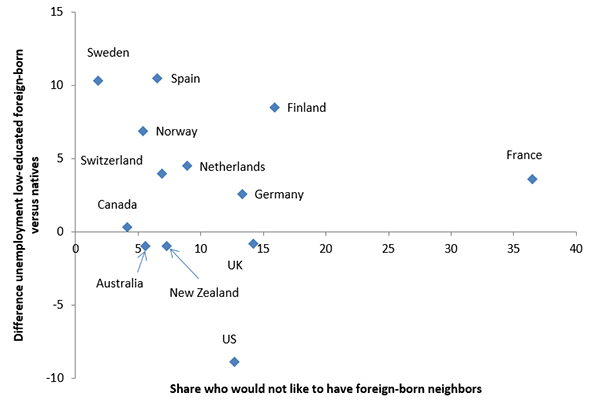
    Perhaps it is difficult to find a strong link since the number of countries included is so small. In order to broaden the sample, we can look at the 2005-2009 edition of the World Value Survey. In that survey the question relating to foreign-born neighbors, but not that of allocation of jobs, was asked. The graph below shows the relation between the share who would not like to have foreign-born neighbors on one hand, and the difference in unemployment on the other. 


    Source for attitudes towards foreign-born neighbors: World Value Survey 2005-2009. Source for difference in unemployment: OECD data over “Indicators of integration of immigrants and their children”, given for the years 2009-2010. 

    The relation between attitudes and employment prospects are not what one would expect. If anything, the countries in which fewest people do not want foreign-born neighbors are also those in which differences in unemployment are the highest. This does not necessarily mean that countries with the different attitude do better. Canada, Australia and New Zealand are nations where a relatively small share has anything against foreign-born neighbors. The same countries have good labor market outcomes for the foreign-born. In Australia and New Zealand, low-skilled individuals with a foreign-born background have slightly lower unemployment than similar natives. In Canada the difference is minute between the two groups.

    Given these outcomes it is difficult to conclusively say what factors that favor integration and what obstacles that stand in the way of integration. It could, for example, be argued that the people in countries such as Sweden are giving politically correct responses. These responses do not necessarily have to translate to the discrimination actually faced by immigrants on a daily basis. At the same time, it is clear that the Anglo-Saxon countries are succeeding in integration. This could be attributed to having English as their main language. It could also be attributed to market-based systems with strong incentives for work and relatively free labor markets. In short, attitudes, at least as reported by the World Value Survey, do not seem to explain the differences in integration. Although all enlightened countries should strive for the tolerant views expressed in countries such as Sweden, this does not guarantee well‑functioning integration.

    Dr. Nima sanandaji is a frequent writer for the New Geography. He is upcoming with the book "Renaissance for Reforms" for the Institute of Economic Affairs and Timbro, co-authored with Professor Stefan Fölster.

    Photo from BigStockPhoto.com.

  • The World’s Most Influential Cities

    In the past century, the greatest global cities were generally the largest and centers of the world’s great empires: London, Paris, New York and Tokyo. Today size is not so important: Of the world’s 10 most populous cities, only Tokyo, New York and Beijing are in the top 10 of our ranking of the world’s most important cities. Instead, what matters today is influence.

    To rank the world’s global cities, I worked with urban geographer Ali Modarres, former Accenture analyst Aaron Renn and demographer Wendell Cox. We have attempted to go beyond some of the standard methods of evaluating the global importance of cities, which include assessing the concentration of support services available for multinationals, such as financial and accounting firms, or the size of the overall economy. Efficiency and access to capital and information, we believe, is more critical to being an important global city than number of jobs, and regional GDP is a false measure, since it doesn’t reflect whether the source is domestic or global economic activity.

    In order to quantify cities’ global influence, we looked at eight factors: the amount of foreign direct investment they have attracted; the concentration of corporate headquarters; how many particular business niches they dominate; air connectivity (ease of travel to other global cities); strength of producer services; financial services; technology and media power; and racial diversity. (Click here for a more detailed description of our methodology.) We found those factors particularly important in identifying rising stars that, someday, might challenge the current hegemony of our two top-ranked global cities, London and New York.

    Inertia and smart use of it is a key theme that emerged in our evaluation of the top global cities. No city better exemplifies this than London, which after more than a century of imperial decline still ranks No. 1 in our survey. The United Kingdom may now be a second-rate power, but the City’s unparalleled legacy as a global financial capital still underpins its pre-eminence.

    Ranked first in the world on the Z/Yen Group’s 2013 Global Financial Centres Index, which we used for our list, London not only has a long history as a dominant global financial hub, but its location outside the United States and the eurozone keeps it away from unfriendly regulators. Compared to New York, it is also time-zone advantaged for doing business in Asia, and has the second best global air connections of any city after Dubai, with nonstop flights at least three times a week to 89% of global cities outside of its home region of Europe.

    A preferred domicile for the global rich, London is not only the historic capital of the English language, which contributes to its status as a powerful media hub and major advertising center, but it’s also the birthplace of the cultural, legal and business practices that define global capitalism.London hosts the headquarters of 68 companies on the 2012 Forbes Global 2000 list and is a popular location for the regional HQs of many multinationals. (Our HQ ranking component, in which London ranks third, is based on GaWC’s 2012 Command and Control Index, which factors in company size and financial performance, as well as total number of Forbes Global 2k HQs).

    Beyond these traditional strengths, London has become Europe’s top technology startup center, according to the Startup Genome project. The city has upward of 3,000 tech startup sas well as Google’s largest office outside Silicon Valley.

    nearly four times that of second place Tokyo New York, which comes in a close second in our study (40 points to London’s 42), is home to most of the world’s top investment banks and hedge funds, and the stock trading volume on the city’s exchanges is and more than 10 times that of London.

    Like London, New York is a global leader in media and advertising, the music industry (home to two of the big three labels), and also one of the most important capitals of the fashion and luxury business. With iconic landmarks galore, international visitors spend more money in New York each year than in any other city in the world.

    The Challengers And Those Slowly Fading

    London and New York are clearly the leaders but they are not the hegemonic powers that they were throughout much of the 20thcentury, and their main competitors are now largely from outside Europe. Paris may rank third in our survey, but it is way below New York and London by virtually every critical measure, and the city’s future is not promising given that France, and much of the EU, are mired in relative economic stagnation.

    Rather than a true indication of global reach, Paris’ high ranking is partly the product of the city’s utter domination of the still sizable French economy and the concentration of virtually all the country’s leading companies there (it ranks fifth on GaWC’s Command and Control Index with 60 HQs of Forbes Global 2K companies).

    Elsewhere, Europe boast a veritable archipelago of globally competitive cities — Munich, Rome, Hamburg — but none is large enough, or unique enough, to break into the top 10 in the future. East Asia is likely to place more cities at the top of the list.

    For most of the last century, Tokyo has been Asia’s leading city. It is still the world’s largest city, with the largest overall GDP. In her seminal work on world cities, Saskia Sassen placed it on the same level as London and New York. Tokyo’s limitations resemble those of Paris — its high ranking stems partly from the extreme concentration of domestic companies — and it will be handicapped in the future by a severe demographic crisis, a lack of ethnic diversity and very determined regional rivals.

    China’s Global Cities

    China’s share of the world economy has grown from 5% in 1994 to 14% in 2012.The combined volume of trading on the Shanghai and Shenzhen stock exchanges already exceeds that of Tokyo, and Shenzhen’s volume is approximately three times that of nearby Hong Kong.

    Hong Kong still enjoys greater freedom than the rest of China and remains the largest financial center in the Asia-Pacific region, ranking third in the world after London and New York. The vast majority of the world’s major investment banks, asset managers, and insurance companies maintain their Asia-Pacific headquarters in the former British colony.

    But its preeminence is being threatened by Shanghai, traditionally Hong Kong’s chief rival, and Beijing. We ranked China’s capital eighth, ahead of Shanghai (19th). With the advantage of being the country’s all-powerful political center, Beijing is the headquarters of most large state-owned companies and is home to the country’s elite educational institutions and its most innovative companies.

    But right now the leading global city in East Asia is Singapore, which ranks fourth on our list. With a relatively small population of just over 5 million, Singapore’s basic infrastructure is among the best on the planet. Like Hong Kong, it also benefits from a tradition of British governance and law, one reason the World Bank ranked its business climate the world’s best; China ranked 96th. Singapore’s justice system is ranked 10th in the world in The Rule of Law Index.

    That is all drawing in international business: Singapore places first among global cities in our ranking of foreign direct investment, with a five-year average of 359 greenfield transactions. It’s a favored location in many industries for Asia-Pacific headquarters; a study by the consultancy Roland Berger named Singapore the leading location for European companies to establish an Asia-Pacific HQs.

    Singapore vies with Hong Kong as the financial center of Asia, ranking fourth in the world in that category.

    Global Capital of the Middle East

    Much of what we see in the media about Middle Eastern cities are scenes of destruction and chaos. Yet in a relatively quiet corner of the Arabian Peninsula, Dubai is ascending, ranked seventh on our list. Its globalization strategy hinges largely on its expanding airport, which includes the world’s largest terminal and an even larger airport under construction. It ranks first in the world in our air connectivity ranking, with nonstop flights at least three times a week to 93% of global cities outside of its home region.Its hub location and business-friendly climate have made it a favorite for companies looking to establish a Middle East headquarters or point of presence. As a crossroads of humanity, Dubai is unparalleled among global cities for its diversity: 86% of its residents are foreign born.

    North America

    Our rankings rewarded cities that are both ethnically diverse and, in some cases, dominate a critical industry. This is what we refer to as a “necessary city,” a place one must go to conduct business in a particular field, or to service a particular region of the world.

    This focus on the “necessary” city led to what will no doubt be a controversial result: a 10th place ranking for the San Francisco Bay Area, on the strength of its central role in the tech industry, tied on our list with Los Angeles and Toronto. The Bay Area did not even make the top 20 in the 2014 A.T. Kearney rankings, which placed both Chicago and Los Angeles in the top 10.

    Not long ago Los Angeles, North America’s second-largest metro area, saw itself as a potential rival to New York and a legitimate world city. Hollywood is nearly synonymous with the American entertainment industry and is by far the world’s largest in terms of revenue and influence. Last year the industry enjoyed exports of almost $15 billion.

    But L.A.’s share of entertainment employment is shrinking and its former second industry, aerospace, has declined significantly, losing over 90,000 jobs since the end of the Cold War. Several key companies have decamped from the metro area in recent years — Nissan, Occidental Petroleum, Toyota — for more business-friendly places.

    The situation is arguably worse in Chicago, which ties for 20th. The Windy City first rose to world prominence after overcoming rival St. Louis in the late 19th century. It boasts one of the world’s most diverse economies, but has not developed strong dominance in any industry. Chicago is an also ran in media and technology and, outside of commodities, is no longer a major global financial center.

    The big winner today is the Bay Area, which overwhelmingly dominates the list of technology leaders; not only is the metro area home to a glittering array of tech standouts, companies based elsewhere in the U.S., and in other countries, feel compelled to site operations there. Even a penny pinching retailer like Wal-Mart is growing its Silicon Valley presence.

    Other North American cities with a growing global footprint include 10th ranked Toronto, tied with Los Angeles and Bay Area. Toronto, as the economic capital of Canada, has becomes a focus for international investment into that stable and resource rich country. It is also among the most diverse cities on the planet — 46 % of its population is foreign born.

    Rising Stars

    In North America up and comers include No. 14 Houston, with its domination of the U.S. energy industry, a huge export sector and an increasingly diverse population. The Washington, D.C., metro area ranks 16th, a testament to the capital’s growth as an aerospace and technology center.

    Overseas, other urban centers that could move up in the future include No. 16 Seoul, Shanghai and No. 20 (tie) Abu Dhabi. But outside of Dubai no other cities in our top 20 come from the developing world. The Indian megacities Delhi and Mumbai rank in the low 30s along with Johannesburg in South Africa. In Latin America, the place to watch is No. 23 Sao Paulo. But until these areas can develop adequate infrastructure — from roads, transit and bridges to relatively non-corrupt judicial systems — none can be expected to crack the top 10, or even 20, for at least a decade.

    For the time being, the future of the global city belongs not to the biggest or fastest growing but the most efficient and savvy, and those with a strong historical pedigree. This raises the bar for all cities that wish to break into this elite club.

    No. 1: London

    FDI Transactions (5-Year Avg.): 328
    Forbes Global 2000 HQs: 68<
    Air Connectivity:  89%*
    Global Financial Centres Index Rank: 1

    * The air connectivity score is the percentage of other global cities outside the city’s region (e.g., for London, cities outside of Europe) that can be reached nonstop a minimum of three times per week.

    No. 2: New York

    FDI Transactions (5-Year Avg.): 143
    Forbes Global 2000 HQs: 82
    Air Connectivity:  70%
    GFCI Rank: 2

    No. 3: Paris

    FDI Transactions (5-Year Avg.): 129
    Forbes Global 2000 HQs: 60
    Air Connectivity:  81%
    GFCI Rank: 29

    No. 4: Singapore

    FDI Transactions (5-Year Avg.): 359
    Forbes Global 2000 HQs: N/A
    Air Connectivity:  46%
    GFCI Rank: 4

    No. 5: Tokyo

    FDI Transactions (5-Year Avg.): 83
    Forbes Global 2000 HQs: 154
    Air Connectivity:  59%
    GFCI Rank: 5

    No. 6: Hong Kong

    FDI Transactions (5-Year Avg.): 234
    Forbes Global 2000 HQs: 48
    Air Connectivity:  57%
    GFCI Rank: 3

    No. 7: Dubai

    FDI Transactions (5-Year Avg.): 245
    Forbes Global 2000 HQs: N/A
    Air Connectivity:  93%
    GFCI Rank: 25

    No. 8 (TIE): Beijing

    FDI Transactions (5-Year Avg.): 142
    Forbes Global 2000 HQs: 45
    Air Connectivity:  65%
    GFCI Rank: 59

    No. 8 (TIE): Sydney

    FDI Transactions (5-Year Avg.): 111
    Forbes Global 2000 HQs: 21
    Air Connectivity:  43%
    GFCI Rank: 15

    No. 10 (TIE): Los Angeles

    FDI Transactions (5-Year Avg.): 35
    Forbes Global 2000 HQs: N/A
    Air Connectivity:  46%
    GFCI Rank: N/A

    No. 10 (TIE): San Francisco Bay Area

    FDI Transactions (5-Year Avg.): 49
    Forbes Global 2000 HQs: 17
    Air Connectivity:  38%
    GFCI Rank: 12

    No. 10 (TIE): Toronto

    FDI Transactions (5-Year Avg.): 60
    Forbes Global 2000 HQs: 23
    Air Connectivity:  49%
    GFCI Rank: 11

    Remaining Cities

    City Region Rank

    Zurich

    Europe

    13

    Frankfurt

    Europe

    14

    Houston

    North America

    14

    Amsterdam/Randstad

    Europe

    16

    Seoul

    Asia-Pacific

    16

    Washington Metropolitan Area

    North America

    16

    Shanghai

    Asia-Pacific

    19

    Abu Dhabi

    Middle East

    20

    Chicago

    North America

    20

    Moscow

    Europe

    20

    Boston

    North America

    23

    Brussels

    Europe

    23

    Dallas-Fort Worth

    North America

    23

    Madrid

    Europe

    23

    Melbourne

    Asia-Pacific

    23

    São Paulo

    South America

    23

    Istanbul

    Middle East

    29

    Miami

    North America

    29

    Johannesburg

    Africa

    31

    Kuala Lumpur

    Asia-Pacific

    31

    Mumbai

    Asia-Pacific

    31

    Bangkok

    Asia-Pacific

    34

    Delhi

    Asia-Pacific

    34

    Geneva

    Europe

    34

    Atlanta

    North America

    37

    Berlin

    Europe

    37

    Seattle

    North America

    37

    Tel Aviv

    Middle East

    37

    Mexico City

    North America

    41

    Milan

    Europe

    41

    Montreal

    North America

    41

    Buenos Aires

    South America

    44

    Jakarta

    Asia-Pacific

    44

    Philadelphia

    North America

    44

    Cairo

    Middle East

    47

    Guangzhou

    Asia-Pacific

    47

    Ho Chi Minh City

    Asia-Pacific

    47

    Lagos

    Africa

    47

    Osaka

    Asia-Pacific

    47


    This piece originally appeared at Forbes.

    Joel Kotkin is executive editor of NewGeography.com and Distinguished Presidential Fellow in Urban Futures at Chapman University, and a member of the editorial board of the Orange County Register. His newest book, The New Class Conflict is now available for pre-order atAmazon and Telos Press. He is author of The City: A Global History and The Next Hundred Million: America in 2050. His most recent study, The Rise of Postfamilialism, has been widely discussed and distributed internationally. He lives in Los Angeles, CA.
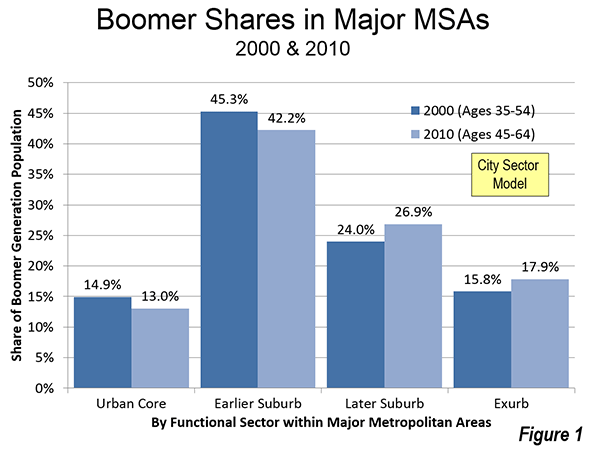
    Photo: "City of London skyline at dusk" by jikatu – Licensed under Creative Commons Attribution-Share Alike 2.0 via Wikimedia Commons

  • Boomers: Moving Further Out and Away

    There have been frequent press reports that baby boomers, those born between 1945 and 1964, are abandoning the suburbs and moving "back" to the urban cores (actually most suburban residents did not move from urban cores). Virtually without exception such stories are based on anecdotes, often gathered by reporters stationed in Manhattan, downtown San Francisco or Washington or elsewhere in urban cores around the nation. Clearly, the anecdotes about boomers who move to suburbs, exurbs, or to outside major metropolitan areas are not readily accessible (and perhaps not as interesting) to the downtown media.

    Yet there is a wide gulf between the perceived reality of the media stories and what is actually occurring on the ground, as is indicated by comprehensive sources. The latest available small area data shows that baby boomers continue to leave the urban cores in large numbers. They have also left the earlier suburbs in such large numbers that their population gains in the later suburbs and exurbs have been insufficient to stem boomer movement out of the major metropolitan areas to smaller cities and rural areas.

    These conclusions are drawn from an analysis of population at the zip code tabulation area (ZCTA) among those 35 to 54 years of age in 2000 and the same cohort in 2010 (then 45 to 64 years of age). This small area analysis avoids the exaggeration of urban core data that necessarily occurs from reliance on the municipal boundaries of core cities (which are themselves nearly 60 percent suburban or exurban, ranging from as little as three percent to virtually 100 percent). This is described in further detail in the "City Sector Model" note below.

    Overall Trend

    The national population of the baby boomer generation declined 1.82 million between 2000 and 2010, a 2.2 percent loss (the result of an inevitably increasing death rate from the aging of cohorts). A small increase of 350,000 (1.0 percent) outside the largest cities was more than offset by a 2.17 million loss in the major metropolitan areas (over 1 million population), where the decline was of 4.7 percent.

    Boomers and the Urban Core

    The largest percentage loss occurred in the functional urban cores, which experienced a decline of 1.15 million baby boomers, a reduction of 16.7 percent. The functional urban cores are defined by the higher population densities that predominated before 1940 and a much higher dependence on transit, walking and cycling for work trips (further details are provided in the "City Sector Model" note below). In 2000, baby boomers accounted for 14.9 percent of the major metropolitan area population, a figure that declined to 13.0 percent by 2010 (Figure 1).

    The losses were pervasive. Among the 24 major metropolitan areas with functional urban core populations above 100,000, all experienced reductions in their baby boomer population shares. The average share reduction was approximately 12 percent.

    Not surprisingly, the leading urban core magnets of New York and San Francisco did the best, losing 4.3 percent and 5.8 percent of their boomer population share between 2000 and 2010. Providence, Los Angeles,and Boston rounded out the best five.

    Among the 24 metropolitan areas with the largest functional urban cores, Detroit experienced the largest proportional boomer loss, at 21.2 percent. Kansas City, Washington, and Minneapolis-St. Paul lost from 17 percent to 19 percent, proportionally, of their boomer urban core populations. Despite its reputation for core renewal, Portland experienced an approximate 15 percent proportional loss of its urban core boomers, along with Milwaukee and Cleveland (Figure 2).

    Boomers and the Earlier Suburbs

    The reduction in baby boomer population was even greater in the earlier suburban areas (those with median house construction dates of 1979 or before). The 2.33 million earlier suburban population loss was double that of the functional urban core loss, but because of this population is much larger than the functional cores, the overall drop was a smaller 11.1 percent. Nonetheless, the earlier suburbs continue to house the largest share of major metropolitan boomers. This fell, however, from 45.3 percent in 2000 to 42.2 percent in 2010.

    Combined, the urban cores and earlier suburbs lost 3.48 million boomers between 2000 and 2010.

    Boomers and the Later Suburbs and Exurbs

    In contrast, the later suburban areas (median house construction date 1980 or later) added approximately 750,000 baby boomers, for an increase of 6.8 percent. The later suburbs also experienced an increase in their share of major metropolitan boomers, rising from 24.0 percent in 2000 to 26.9 percent in 2010.

    The exurban gain was greater than the later suburbs in percentage terms (7.7 percent) but less in population gain (560,000). This was enough to increase the exurban share of boomers from 15.8 percent in 2000 to 17.9 percent in 2010. Indeed, the exurban areas of the 24 major metropolitan areas with urban cores over 100,000 population all did better in attracting or retaining boomer populations than both the urban cores and the earlier suburbs.

    Overall there was a 5.0 percentage point transfer of boomer share from the functional urban cores and earlier suburbs to the later suburbs and exurbs, reflecting their more than 1.3 million gain between 2000 and 2010.

    Boomers and the Nation

    Moreover, the data indicates that boomers are leaving the major metropolitan areas to move to smaller cities or even to rural areas. In contrast with the 2.17 million major metropolitan area loss, areas outside the major metropolitan areas added 350,000 boomers between 2000 and 2010. In 2000, smaller cities and rural areas housed 44.4 percent of the boomer population. By 2010, the smaller city and rural share had risen to 45.8 percent (Figure 3). By contrast, over the same period, the major metropolitan areas increased their proportion of the US population, from 54.5 percent in 2000 to 54.9 percent in 2010.

    America’s downtowns (generally a smaller area than the larger urban cores), have done much better in recent years, as they have become safer and as a "100 year flood" of economic retrenchment has reduced many to renting rather than buying. Yet, overall, urban cores have done less well, with Census Bureau data showing that the population gains within two miles of largest municipality city halls being more than offset by losses in the two to five mile radius between 2000 and 2010. These loses are not limited to the overall population, but extend to share losses among Millennials and population losses among the boomers.

    Wendell Cox is principal of Demographia, an international public policy and demographics firm. He is co-author of the "Demographia International Housing Affordability Survey" and author of "Demographia World Urban Areas" and "War on the Dream: How Anti-Sprawl Policy Threatens the Quality of Life." He was appointed to three terms on the Los Angeles County Transportation Commission, where he served with the leading city and county leadership as the only non-elected member. He was appointed to the Amtrak Reform Council to fill the unexpired term of Governor Christine Todd Whitman and has served as a visiting professor at the Conservatoire National des Arts et Metiers, a national university in Paris.

    ———–

    City Sector Model Note: The City Sector Model allows a more representative functional analysis of urban core, suburban and exurban areas, by the use of smaller areas, rather than municipal boundaries. The more than 30,000 zip code tabulation areas (ZCTA) of major metropolitan areas and the rest of the nation are categorized by functional characteristics, including urban form, density and travel behavior. There are four functional classifications, the urban core, earlier suburban areas, later suburban areas and exurban areas. The urban cores have higher densities, older housing and substantially greater reliance on transit, similar to the urban cores that preceded the great automobile oriented suburbanization that followed World War II. Exurban areas are beyond the built up urban areas. The suburban areas constitute the balance of the major metropolitan areas. Earlier suburbs include areas with a median house construction date before 1980. Later suburban areas have later median house construction dates.

    Urban cores are defined as areas (ZCTAs) that have high population densities (7,500 or more per square mile or 2,900 per square kilometer or more) and high transit, walking and cycling work trip market shares (20 percent or more). Urban cores also include non-exurban sectors with median house construction dates of 1945 or before. All of these areas are defined at the zip code tabulation area (ZCTA) level.

  • In the Future We’ll All Be Renters: America’s Disappearing Middle Class

    An Excerpt from Joel Kotkin’s Forthcoming book The New Class Conflict available for pre-order now from Telos Press and in bookstores September, 2014.

    In ways not seen since the Gilded Age of the late nineteenth century, America is becoming a nation of increasingly sharply divided classes. Joel Kotkin’s The New Class Conflict breaks down these new divisions for the first time, focusing on the ascendency of two classes: the tech Oligarchy, based in Silicon Valley; and the Clerisy, which includes much of the nation’s policy, media, and academic elites.

    The Proleterianization of the Middle Class

    From early in its history, the United States rested on the notion of a large class of small proprietors and owners. “The small landholders,” Jefferson wrote to his fellow Virginian James Madison, “are the most precious part of a state.” To both Jefferson and Madison, both the widespread dispersion of property and limits on its concentration—“the possession of different degrees and kinds of property”—were necessary in a functioning republic.

    Jefferson, admitting that the “equal division of property” was “impractical,” also believed  “the consequences of this enormous inequality producing so much misery to the bulk of mankind” that “legislators cannot invent too many devices for subdividing property.” The notion of a dispersed base of ownership became the central principle which the Republic was, at least ostensibly, built around. As one delegate to the 1821 New York constitutional convention put it, property was “infinitely divided” and even laborers “expect soon to be freeholders” was a bulwark for the democratic order.

    This notion of American opportunity has ebbed and flowed, but generally gained ground well into the 1960s and 1970s.  The very fact that the United States was more demographically dynamic, notes Thomas Piketty, naturally reduced the role of inherited wealth compared to Europe, most notably in France,  where population growth was slower.  Mass prosperity hit a high point in America in the first decades after the Second World War, the period where the country achieved its highest share of world GDP at some forty percent.  By the mid-1950s the percentage of households earning middle incomes doubled to 60 percent compared with the boom years of the 1920s. By 1962 over 60 percent of Americans owned their own homes; the increase in homeownership, notes Stephanie Coontz, between 1946 and 1956 was greater than that achieved in the preceding century and a half.

    But today, after decades of expanding property ownership, the middle orders—what might be seen as the inheritors of Jefferson’s yeoman class—now appear in a secular retreat.  Homeownership, which peaked in 2002 at nearly 70 percent, has dropped, according to the U.S. Census, to 65 percent in 2013, the lowest in almost two decade.  Although some of this may be seen as a correction for the abuses of the housing bubble, rising costs, stagnant incomes and a drop off of younger first time buyers suggest that ownership may continue to fall in years ahead.

    The weakness of the property owning yeomanry comes at a time when other classes, notably the oligarchs and the Clerisy, have gained power and influence. Over twenty years ago Christopher Lasch argued that “the new class” was arising that “begins and ends with the knowledge industry.”  For this group, the rest of society, he suggested, exists only “as images and stereotypes.” Progressive theorists, such as Ruy Texerira, have suggested that, in the evolving class structure, the traditional middle and working class is of little importance compared to the rise of a mass “upper middle class” consisting largely of professionals, tech workers, academics, and high-end government bureaucrats.

    The Economic Decline of the Yeomanry

    All this suggests what could be seen as the proletarianization of the yeoman class. In the four decades since 1971 the percentage of those earning between two thirds and twice the national median income has shrunk, according to Pew, from over sixty to barely fifty percent of the population. While middle class incomes have fallen relative to the upper income groups, house prices and health insurance, utilities and college tuition costs have all soared.

    This reflects some very dramatic changes in the nature of the employment market. For over a decade, job gains have been concentrated largely in the low-wage service sector, such as in retail or hospitality, which alone accounted for nearly sixty percent of job gains; in contrast middle income positions actually have been declining. Meanwhile, taxes on corporate profits, which are at an all time high, have fallen to near historic lows.

    This trend has continued even in the recovery.  Between 2010 and 2012, the middle sixty percent of households, did worse not only than the wealthy, but even the poorest quintile between 2010 and 2012.  In the years of the recovery from the Great Recession the middle quintiles income dropped by 1.2 percent while those of the top five percent grew by over five percent. Overall the middle sixty percent have seen their share of the national pie fall from 53 percent in 1970 to barely 45 percent in 2012. Of roughly one in three people born into middle class households, those earning between the 30th and 70th percent of income now fall out of that status as adults.

    This decline, not surprisingly, has engendered a dour mood among much of the yeomanry. For many, according to a 2013 Bloomberg poll, the American dream seems increasingly out of reach; this opinion was held by a margin of two to one among all Americans, and three to one among those making under $50,000, but also a majority earning over $100,000 annually. By margins of more than two to one, more Americans believed they enjoy fewer economic opportunities than their parents, and will experience far less job security and disposable income. This pessimism is particularly intense among white working class voters, and large sections of the middle class.

    Many people who once had decent incomes, and may have owned or hoped to own a house or start a business have slipped to the lower rungs of the economy. In the past decade, the number of people working part-time and receiving such benefits as food stamps has expanded well beyond inner cities and impoverished rural hamlets.  Many of the long-term unemployed are older, and often somewhat well-educated workers, who have fallen from the middle class over the past decade. The curse of poverty has also expanded more into suburban locations; something widely cited by the urban-centric Clerisy, but further confirms the yeomanry’s stark decline.

    The Assault on Small Business

    Perhaps nothing reflects the descent of the yeomanry than the fading role of the ten million small businesses with under 20 employees, which currently employ upwards of forty million Americans. Long a key source of new jobs, small business start-ups have declined as a portion of all business growth from 50 percent in the early 1980s to 35% in 2010. Indeed, a 2014 Brookings report, revealed that small business “dynamism”,  measured by the growth of new firms compared with the closing of older ones, has declined significantly over the past decade, with more firms closing than starting for the first time in a quarter century.

    Instead of stemming from the grassroots, the recovery after the latest crash was led, unlike in previous expansions, by larger firms while small company hiring remained relatively paltry. Self-employment rose, but increasingly this took the form of sole proprietorships as opposed to expanding smaller companies with employees. By 2013, smaller firms with under one hundred employees added far fewer jobs than in the prior decade. Unlike prior post-war recoveries, since 2007, grassroots companies did not lead the way out of recession and continued to lose ground compared with larger companies that either could afford the costs or avoid the taxes imposed by, the Clerical regime.

    This decline in entrepreneurial activity marks a historic turnaround.  In 1977, SBA figures show, Americans started 563,325 businesses with employees. In 2009, they started barely 400,000 Business start-ups, long a key source of new jobs, have declined as a portion of all businesses from 50 percent in the early 1980s to 35% in 2010.

    There are many explanations for this decline, including the impact of offshoring, globalization and technology.  But some reflects the impact of the ever more powerful Clerical regime, whose expansive regulatory power undermines small firms. Indeed, according to a 2010 report by the Small Business Administration, federal regulations cost firms with less than 20 employees over $10,000 each year per employee, while bigger firms paid roughly $7,500 per employee.  The biggest hit to small business comes in the form of environmental regulations, which cost 364% per employee more for small firms than large ones. Small companies spend $4,101 per employee, compared to $1,294 at medium-sized companies (20 to 499 employees) and $883 at the largest companies, to meet these requirements.

    The nature of federal policy in regards to finance further worsened the situation for the small-scale entrepreneur.  The large “too big to fail” banks received huge bailouts, but have remained reluctant to loan to small business. The rapid decline of community banks, for example, down by half since 1990, particularly hurts small businesspeople that depended on loans from these institutions.

    The Descent of the Yeomanry, with Cheers from the Clerisy

    Despite America’s egalitarian roots, the prospect of mass downward mobility has been embraced widely by some business oligarchs and much of the Clerisy. The future being envisioned is one dominated by automated factories and computer-empowered service industries that will continue to pressure both jobs and wages in the future. In this scenario, productivity will rise, but wages may stagnate or decline. This leads some to propose that the American middle and working classes has become economically passé. Steve Case, founder of America Online, has even suggested that future labor needs can be filled not by current residents but by some thirty million immigrants.

    Arguably the first group to feel the downward pressure has been blue collar workers, whose lot has declined over the past few decades. After World War Two, as the United Autoworkers’ Walter Reuther noted, “the union contract became the passport to a better life” that was creating “a whole new middle class.” But with the shifting of industry overseas and the decline of private sector unions, the path for blue collar workers to enter the middle class has become more difficult.

    Although they often claim to defend the middle class, the political stance adapted by the Clerisy, as well as the tech oligarchs and the investors, tends to worsen this trajectory. Environmental concerns impose themselves most against basic industries such as fossil fuels, agriculture and much of manufacturing. These employ many in highly paid blue-collar fields, with average salaries of close to $100,000. In the last decade, top U.S. firms, notes the liberal Center for American Progress, have cut almost three million domestic jobs.  Automation also leads to the diminution of traditional white collar professions as well as the shift of high-end service jobs offshore.

    Overall, it has become increasingly common to regard the middle class as threatened and even doomed. Indeed, as early as1988 Time magazine featured a cover story on the “declining middle class,” which at that time was considerably more healthy than today. After the great recession, the American blue-collar worker has been pitied, but certainly not helped by the clerisy, which believes that there is no hope for manufacturing or similar outmoded jobs in an information age. Blue collar workers were described in major media as “bitter,” psychologically scarred” and even an “endangered species.” Americans, noted one economist, suffered a “recession” but those with blue collars endured a “depression.”

    This perspective extends across ideological lines.  Libertarian economist Tyler Cowen suggests that an “average” skilled worker can expect to subsist on little but rice and beans in the future U.S. economy. If they choose to live on the East or West Coast, they may never be able to buy a house, and will remain marginal renters for life. Left-leaning Slate in 2012 declared that manufacturing and construction jobs, sectors that powered the yeomanry’s upward mobility in the past, “aren’t coming back. Rather than a republic of yeoman, we could evolve instead, as one left-wing writer put it, living at the sufferance of our “robot overlords,” as well as those who program and manufacture them, likely using other robots to do so.

    Contempt for the middle class is often barely concealed among those most comfortably ensconced in the emerging class order. Financial Times columnist Richard Tomkins declared that the middle class, “after a good run” of some two centuries, now faces “relative decline” and even extinction. This historical shift towards mass downward mobility elicited only derision, not concern: “Classes come and classes go” and that when the middle orders disappears about the only ones that will be sorry to see them go might be the “middle classes themselves. Boo hoo.”

    The Rise of the Yeomanry

    This reversal in class mobility and the slowing diffusion of property ownership in America, if not addressed, threatens to undermine the country’s traditional role as beacon of opportunity. Equally important, the diminution of the middle orders threatens one of the historic sources of economic vitality and innovation.

    The roots of America’s middle class reflects the critical role such small holders have played throughout history.  Dynamic civilizations tend to produce more than their share of “new men.”  But nowhere was this middle class ascendency more dramatic than in Europe, first in Italy and later in northern Europe. 

    Initially, this was a comparatively small, outside group, with much of the activity conducted by outsiders such as Jews and, later, Christian dissenters. They were the driving force of the expanding capitalist  market, the creators of cities and among the primary beneficiaries of economic progress. Peter Hall quotes a historian of 15th Century Florence:

    Apprentices became masters, successful craftsmen
    became entrepreneurs, new men made fortunes in
    commerce and money-lending, merchants and bankers
    enlarged their business. The middle class waxed more
    and more prosperous in a seemingly inexhaustible boom.

    These “new men,” which included some landless peasants, gradually overthrew the old  artisan-like traders, eventually supplanted the aristocracy, and in some instances, the royal families as well. In most cases, their ascendency, although at times exploitative, generally promoted the expansion of both freedom and individual choice. They also were among the first commoners to seek out land, often in the periphery, in part as a business decision, but also to mimic the lifestyles of the traditional aristocracy.

    As occurs in every economic transition some benefited some at the expense of others. Some “new men” from peasant and artisan backgrounds rose, but many others became part of an impoverished proletariat. Many urban artisans lost their jobs to machines, but many others used their expertise to move into the middle class, often through technical innovations that, in the words of the French sociologist Marcel Mauss, constituted “a traditional action made effective, ”notably in agriculture, metallurgy and energy.

    As a colony of Britain, the Americans reflected that island’s rapid ascendancy  of small holders in the 17th and 18th Century, which linked liberation from feudalism with a less hierarchical order and the dispersion of ownership. The rise of the yeoman class in Britain was particularly critical in foreshadowing the evolution of America. These small landowners played a critical role in the overthrow of the monarchy under Cromwell, and consistently pushed for greater power for those outside the gentry. 

    Yet ultimately many paid a great price for liberal reform, allowing for enclosures of what had been communal pasture; in the process productivity rose.  Some benefited, becoming gentry themselves, while many smallholders lost their lands, and flowed into the towns where they joined the swelling proletariat. Others, notably large merchants, bought political influence and marriage into old families. By 1750, according to Marx, the Yeomanry had disappeared, a claim denied by some who believed this class persisted, albeit weakened, well into the 19th Century.

    The American Model

    Many of these displaced yeoman found a more opportune environment in America, where diffusion of ownership, as both Jefferson and Madison noted, remained central to the very concept of the nation.  Small holders served, in the words of economic historian Jonathan Hughes, as  “the seat of Republican government and democratic institutions.”

    America’s focus on dispersed ownership was further enhanced by government actions throughout the country’s history.  In contrast to their counterparts in Britain, the yeomanry in the United States enjoyed access to a greater, and still largely economically underutilized land mass, as well as a persistently growing economy. “In America,” de Tocqueville noted, “land costs little, and anyone can become a landowner.”

    The Homestead Act was signed by President Lincoln in 1862. By granting land to settlers across the Western states, Lincoln was extending the notion of what historian Henry Nash Smith described as a  “agrarian utopia” ever further into the continental frontier. Yet in reality the Homestead Act, which offered for a $.25 registration fee $1 per 160 acres proved more symbolic than effective, impacting perhaps at most two million people in a nation over 30 million. Railways, using their land grants, actually sold more land than the government gave away.

    The westward expansion of the Republic created huge opportunities for expansion of land ownership.  Jefferson wanted the land sold to the public to be a source of one-time revenue and a permanent holding for the buyer.  In many ways, at least until the 1890s, a far higher proportion of Americans owned land—almost 48%—than countries such as Britain where ownership was far more concentrated. These lands, not surprisingly, also became the source of often wild speculative booms and busts, both on the agricultural frontier and the burgeoning cities.

    Many factors ultimately undermined the first old agrarian Jeffersonian dream. Capitalist-led industrial growth shifted the proportion of the population living in cities. Only 5 percent in 1790, it rose to almost 20 percent in 1850, and nearly 40% by 1900. The new order, as in England, also weakened the position of the old artisanal professions, which often made up the ranks of the small scale owners; in many cases they were replaced by women, children and new migrants, from the countryside or from abroad. They became, as the British reformist paper The Morning Star wrote, “our white slaves, who are toiled onto the grave, for the most part silently pine and die.”

    The movement into cities, and the industrial economy, turned many workers from owners to renters. In the new industrial centers, it became far harder to start a business or own property. Even white collar workers often lost out as the instrumental economic rationality of capitalism displaced a more locally focused economy based on tradition, religion and small-scale production.

    In the United States, conditions were generally less gruesome than in Britain or the rest of Europe,  but this did not slow the tendency towards ever great concentration of ownership. The rise of great entrepreneurs like Morgan, Vanderbilt, and Carnegie drove parts of the economy into the hands of  a relative handful of people. This concentration of power and land ownership engendered a powerful protest in both rural and urban areas. Henry George’s influential Progress and Poverty, published in 1879, maintained that “the ownership of land” was the “fundamental fact” determining the social, political and “moral condition of a people.” Land, he asserted, should be owned by the public and government funded by rents.

    George’s approach appealed to a population that was seeing land ownership slipping from their grasp. Even on the land, as farming itself modernized, there was a gradual shift , as  farms mechanized and markets became more global, toward tenancy; by 1900 one in three American farmers were landless tenants. The concentration of property ownership continually grew from the 1870s on well into the 1920s.

    By the early 20th century, as the original rustic yeoman dream was weakening, there was increased pressure for change from the growing urban population. Much of the pressure came from  a middle and upper-middle class who felt threatened by the concentration of ownership and political power in the hands of the industrial and financial oligarchies.

    The Homeownership Revolution

    As the nation moved from its agricultural roots, the yeoman class interest in property would find a new main expression in the form of homeownership. This would represent an opportunity both to escape the crowded city or, for the migrant from rural areas, live in a less dense urban environment. This drive was supported by both conservatives and New Dealers, who promulgated legislation that expanded homeownership to record levels. “A nation of homeowners,” Franklin Roosevelt believed, “of people who own a real share in their land, is unconquerable.”

    The great social uplift that occurred then, coming to full flower after the Second World War, saw a working class—not only in America but in Europe and parts of east Asia—now enjoying benefits before available only to the affluent classes.  In 1966, author and New Yorker reporter John Brooks observed in his The Great Leap: The Past Twenty-Five Years in America, that, “The middle class was enlarging itself and ever encroaching on the two extremes—the very rich and the very poor.” Indeed, in the middle decades of the 20th Century, the share of income held by the middle class expanded while that of the wealthiest actually fell.

    New Deal legislation—the Housing Act of 1934, creation of the Federal Housing Administration (FHA) and the Federal National Mortgage Association, or Fannie Mae—set the stage for the great housing boom of the 1950s. This was further augmented by the GI bill, which also provided low-interest loans to returning veterans.  The success of the private financial and construction interests who benefited from this boom, suggests author Eric John Abrahamson, was largely fostered by what he describes as a “planned” economy that consciously sought to expand ownership both during the New Deal and particularly in ensuing decades. Almost half of suburban housing, notes historian Alan Wolfe, depended on some form of federal financing. This egalitarian impulse was in part driven by people returning from WW II and Korea, many of whom benefited from the GI Bill.

    This resulted in an unprecedented dispersion of property ownership. This process was aided by a strong economy and the expansion of automobile ownership, which greatly expanded the yeomanry’s mobility. Increasing numbers of the middle class and even working class people become homeowners, sparking an enormous surge in home building. By 1953, the number of Americans owning their own homes climbed to twenty-five million, up from eighteen million in 1948. A country of renters was transformed into a nation of owners. Between 1940 and 1960 non-farm homeownership rose from 43 percent to over 58 percent. It was an accomplishment of historic proportions, notes historian Abrahamson, of “a transformed Jeffersonian vision.”

    New Class Conflict Over the form and Nature of Growth

    In recent decades, this vision of widening prosperity and property ownership has become increasingly threatened, as most evidenced by the housing bust of 2007-8. It also has come under increased attack from among the ranks of the clerisy. To be sure, many of those who bought homes in the last decade were not economically prepared, as some analysts suggest. But in the wake of the housing bust, the attack on homeownership expanded to include not only planners and pundits, but even parts of the investment community have seen in the yeomanry’s decline an opportunity to expand the base of renters for their own developments.

    The ideal of homeownership, particularly in the suburbs, have long raised the ire of many  academics and intellectuals in particular . Some have sought to de-emphasize increased wealth and seek instead to embrace what they consider a more moral, even spiritual standard. This movement, not so far from old feudal concepts, had its earliest modern expression in E.F. Schumacher’s 1973 influential Small is Beautiful and the writings of London School of Economics’ E.J. Mishan.

    Both writers rightly criticized the sometimes cruelly mechanistic nature of much technological change, but also revealed a dislike of the very kind of expansive growth that has lifted so many into the yeoman class after the Second World War, not only in America but in Europe and parts of East Asia. “The single minded pursuit for individual advancement, the search for material success,” Mishan wrote, “may be exacting a fearful toll on human happiness.”

    In the search for an alternative, both writers looked not forward, but backwards.  Schumacher described “the good qualities of an earlier civilization”, that is, the old rural English society identified not so much with progressivism, or socialism, but the old Tory class order.

    More recently, many advocates of slow, or no growth are finding inspiration in even less enlightened settings than old England. Some point to the small Himalayan kingdom of  Bhutan, the site of a 2014 pilgrimage by Oregon Gov. John Kitzhaber . This  “happiness”  poster child makes an odd exemplar for the 21st century. In contrast to the praise heaped on the tiny nation by Kitzhaber, one Asian development expert recently described the country  as ”still mired by extreme poverty, chronic unemployment and economic stupor that paints a glaring irony of the ‘happiness’  the government wants to portray.” In this “happiest place on earth” one in four lives in poverty, nearly forty percent of the population is illiterate and the infant mortality rate is five times higher than in the United States. It also has a nasty civil rights record of expelling its Nepalese minority of the country.  

    Bhutan, of course, is a pastoral country, but some urbanists also increasingly apply their “happiness” ideal to cities, particularly poorer ones. Canadian academic Charles Montgomery, for example, celebrates  what he sees as  high levels of happiness in the city slums of developing countries. Montgomery points to impoverished Bogota, for example,  as “a happy city” that shows the way to urban development. If we can’t do a Bhutanese village, maybe we  can be compelled to evacuate suburbia for the pleasures of life in some thing that more reflects life in a crowded favela.  

    Although this emphasis on happiness certainly has its virtues, and should be a consideration in how a society grows, lack of economic growth, and low levels of affluence, seems an unlikely way to make  people more content. Recent research, in fact, finds that, for the most part, wealthier countries are not only richer but happier than those assaulted by poverty. Indeed the happiest countries are not impoverished at all, according to the Earth Institute, but highly affluent countries led by Denmark, Norway, Switzerland, the Netherlands and Sweden; the lowest ranked countries were all very low-income countries in Africa.

    The argument against growth  has  gained currency with the rise of environmentalism, long focused, often with justification, on the negative impacts of economic expansion. This has engendered an understandable search for an alternative standard to measure societal well-being. Climate change campaigners such as The Guardian’s George Monbiot  than “a battle to redefine humanity” , essentially ending the era of “expanders” with that of “restrainers.” Some economists, particularly in Europe, have embraced the  notion of what they call “de-growth,” that is a planned, ratcheting down of mass material prosperity. 

    Winners and Losers in the ‘Happiness’ Game

    In any conflict over the preferred shape of society, there are winners and losers. The shift from a focus on growth to one on what is fashioned as sustainability has proven a boon both for the public sector, particularly those working in regulatory agencies and politicians who now have new ways to elicit contributors, and those parts of the private sector that work most closely with government. Other beneficiaries include connected investors, including many who benefit from “green” energy subsidies that, particularly when measured by their production of energy, are considerably higher than those secured over the past century by oil and gas interests.

    The downsizing of growth, naturally, also appeals to many who already enjoy wealth, such as Ted Turner, who then promote anti-growth policies through their foundations, and, as a bonus,  get to feel very good about themselves. Other winners include the media Clerisy, notably in Hollywood–who propagandize such views while living in unimaginable luxury—as well as academics. The successful and well-compensated producer and director James Cameron complains about “ too many people making money out of the system” and warns that growth must stop to save the planet.

    So who loses in the new anti-growth regime? Certainly these include large parts of the working class—farmworkers, lumberjacks, factory operatives, oil field workers and their families—who work in extractive industries most subject to regulatory constraints and higher energy prices. Particularly hard hit may well be young families who, perhaps forsaking the “slacker” life, now find their aspirations of a house and decent job blocked by the generally older, and better off, advocates for “happiness.”

    Wall Street and “Progressives” find Common Ground

    The rise neo-Feudalism, and the decline of the yeomanry is best understood as the consolidation of ownership in ever fewer hands. This process has been greeted with enthusiasm by financial hegemons, who have stepped in with billions to buy foreclosed homes and then rent them; in some states this has accounted for upwards of twenty percent of all new house purchases. Having undermined the housing market with their “innovations,” notably backing subprime and zero down loans, they now look to profit from the middle orders’ decline by getting them to pay the investment classes’ mortgages through rents.

    In the wake of the housing bust, and the longer than expected weak economy following the Great Recession, many financial analysts have insisted that we were headed towards a “rentership society” as homeownership rates plunged from historic highs in the three years following the crash. Part of this shift has been exacerbated by the movement of large investment groups like Blackstone to buy up single family houses for rent, representing a kind of neo-feudalist landscape, where landlords replace owner occupiers, perhaps for the long-run.

    The impact of the investor move into housing has had a negative effect on middle and working class potential buyers who find themselves frequently outbid by large equity firms.” There is the possibility that Wall Street and the banks and the affluent 1 percent stand to gain the most from this,” said Jack McCabe, a real estate consultant based in Deerfield Beach, Fla. “Meanwhile, lower-income Americans will lose their opportunity for the American Dream of building wealth through owning a home.”

    But, however convenient these developments may prove to investors on Wall Street, for society and the future of the democracy, the concentration of ownership in fewer hands is highly problematical. Rather than the yeoman with his own place, and the social commitment that comes with it, we could be creating a vast, non-property owning lower class permanently forced to tip its hat—and empty its wallet—for the benefit of his economic betters.

    One would expect that this diminution of the middle class would offend those on the left, which historically supported both the expansion of ownership and the creation of a better life for the middle class. Yet some progressives, going back to the period before the Second World War, have disliked the very idea of dispersed ownership; many intellectuals, notes Christopher Lasch, found  a society of “small proprietors” and owners “narrow, provincial and reactionary.”

    Increasingly, the media and many urbanists, who see a new generation of permanent renters as part of their dream of a denser America, also embrace this vision as being more environmentally benign than traditional suburban sprawl.

    The very idea of homeownership is widely ridiculed in the media as a bad investment and many journalists, both left and right, deride the investment in homes as misplaced, and suggest people invest their resources on Wall Street, which, of course, would be of great benefit to the plutocracy. One New York Times writer even suggested that people should buy housing like food, largely ignoring the societal benefits associated with homeownership on children and the stability communities.  Traditional American notion of independence, permanency and identity with neighborhood are given short shrift in this approach.

    This odd alliance between the Clerisy and Wall Street works directly against the interest of the middle and aspiring working class. After all, the house is the primary asset of the middle orders, who have far less in terms of stocks and other financial assets than the highly affluent. Having deemed high-density housing and renting superior, the confluence of Clerical ideals and Wall Street money has the effect on creating an ever greater, and perhaps long-lasting, gap between the investor class and the yeomanry.

    This piece originally appeared at The Daily Beast.

    Joel Kotkin is executive editor of NewGeography.com and Distinguished Presidential Fellow in Urban Futures at Chapman University, and a member of the editorial board of the Orange County Register. His newest book, The New Class Conflict is now available for pre-order at Amazon and Telos Press. He is author of The City: A Global History and The Next Hundred Million: America in 2050. His most recent study, The Rise of Postfamilialism, has been widely discussed and distributed internationally. He lives in Los Angeles, CA.
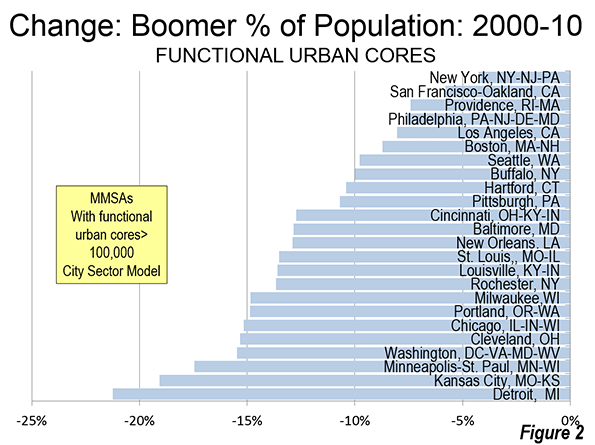
  • UN Projects 2030 US Urban Area Populations

    The United Nations periodically publishes World Urbanization Prospects. One of the highlights is both historic and projected detailed population information for individual cities around the world. The publication provides perhaps the best summary of US urban area population trends since 1950 and also projects their population through 2030. The UN provides data for the 135 urban areas with an estimated population of at least 300,000 residents in 2014. Urban areas are the city in its physical form – the built up area (as opposed to cities in their functional or economic form, the metropolitan area, which includes economically connected territory outside the built up area, from the urban core to the suburbs to the periphery bordering farms and other rural land).

    US Urban Areas Since 1950

    The United States has undergone an urban population revolution since 1950, the first year that urban areas were designated by the US Census Bureau. In 1950, two-thirds of the population of the urban areas in the UN list was located in the urban areas of the Northeast and the Midwest (including Washington & Baltimore). By 1990, the share had dropped to one half. The UN expects this trend to continue, projecting only 40 percent of the urbanized population to be in the Northeast and the Midwest by 2030 (Figure 1).

    Not unexpectedly, this new urban landscape has produced substantial shifts in the rankings of urban areas. The top three cities remain the same, New York, Los Angeles and Chicago; Los Angeles overtook Chicago between 1950 and 1960. This was a stunning achievement, because during the 1950s, Chicago also was experiencing strong growth, adding approximately 1.2 million residents. This is approximately four times the 300,000 added in between 2000 and 2010. Los Angeles passed Chicago by adding 2.5 million residents, the largest 10 year increase of any city since 1950. Los Angeles continued to add more than one million residents per decade through 2000, but has since fallen into the sluggish growth pattern more identified with the Northeast and Midwest, adding less than 400,000 residents between 2000 and 2010.

    From today’s perspective, it may be surprising that New York grew strongly after 1950, adding 1.8 million residents in the 1950s and 2.0 million in the 1960s. After that, however, the population began declining and did not recover until the 1990s. Like Chicago and Los Angeles, despite the clear improvement in many areas, population growth was small in the last decade, at 550,000.

    There has been little stability in the rankings of the rest of the top 10, with only two 1950s entries remaining. Philadelphia, which was ranked 4th in 1950 is now fifth. Boston was ranked 6th, but has fallen to 10th. Detroit was 5th ranked in 1950, and was 12th in 2010. San Francisco has fallen from 7th to 13th. The largest losses in ranking were Pittsburgh which fell 8th to 26th, St. Louis which dropped from 9th to 20th and Cleveland, which fell from 10th to 24th. 

    New entrants Miami, Dallas-Fort Worth, Houston, Washington and Atlanta have replaced these cities in the top 10.

    The Largest Cities in 2030

    The UN’s population projections to 2030 indicate modest rankings changes from the present. The top 10 would remain the same, except that Boston would be replaced by Phoenix. As a result, only four of 1950s top ten remain in 2030 – New York, Los Angeles, Chicago and Philadelphia (Figure 2). The rise of Phoenix is particularly impressive. In 1950, Phoenix had a population little more than 200,000. By 2030, it is projected to have 4.8 million residents.

    Houston is expected to rise from the 7th largest urban area in 2010 to 4th largest in 2030. Houston would thus pass Miami, Philadelphia and in-state rival Dallas-Fort Worth. Miami and Philadelphia would each fall two positions.

    By 2030, there would be 53 urban areas with more than 1,000,000 population, up from 41 in 2010. By comparison, there were only 12 cities with more than 1,000,000 residents in 1950. Seven of the new 1,000,000 cities  are located in major metropolitan areas as of 2010. New Orleans would be restored to the over 1,000,000 list, after having been knocked out by the 2005 Hurricane Katrina and Rita events. Buffalo, however, which is the only other urban area to have fallen below 1,000,000 population (in the 1980s), will not be restored to that level, according to the UN. In addition, Bridgeport, Tucson, Albuquerque, El Paso and McAllen would reach the 1,000,000 level by 2030. The addition of El Paso and McAllen would tie Texas with California, with each having six urban areas with more than 1,000,000 population.

    Greater Growth in Smaller Cities

    The UN anticipates that US growth will be less concentrated in the largest urban areas between 2010 and 2030. Overall, the population of New York, Los Angeles and Chicago is expected to grow less than 9 percent, less than one half their 19 percent 2010 overall share of the urban population reported by the UN. The other cities over 5 million and those between 2.5 million and 5 million would grow slightly less than their overall share of the population, as is indicated in Figure 3

    The smaller population categories would grow faster than their population share. The cities with 1,000,000 to 2.5 million population would grow nearly 15 percent faster than their proportion of the population. Those with from 500,000 to 1,000,000 would grow nearly 20 percent more than their proportion of the population. The cities will fewer than 500,000 residents would capture nearly 50 percent more of their growth than their current population proportion.

    Fastest Growing Cities

    Only four of today’s 50 largest cities would be among the 20 fastest growing from 2010 to 2030. Charlotte and Raleigh would rank 6th and 7th respectively, both growing approximately 72 percent. Austin would rank 11th, growing 59 percent and Las Vegas, at 14th, would grow 51 percent.

    The largest percentage growth would be in smaller urban areas, especially in areas near much larger urban areas. The Woodlands would grow 170 percent, nearly five times that the rate of adjacent Houston, which would itself be the fastest growing urban area of more than 2,000,000 population (35 percent). Murrieta-Temecula and Victorville would grow 100 percent and 75 percent respectively, dwarfing the 36 percent of nearby Riverside San Bernardino. Kissimmee would double adjacent Orlando’s growth rate, at 78 percent. Provo is expected to grow 69 percent, nearly three times the growth rate of nearby Salt Lake City. Santa Clarita and Lancaster would grow 64 percent and 55 percent respectively, much faster than their much larger neighbor, Los Angeles, at 9 percent.

    South Florida cities Cape Coral (80 percent), Bonita Springs-Naples (52 percent) and Port St. Lucie (51 percent) by would grow at three to five times giant Miami.

    The same pattern holds even in the Northeast Corridor. Poughkeepsie, at 32 percent, would grow nearly four times the rate of nearby New York, while Worcester would more than double the growth of Boston.

    Fayetteville, Arkansas, an urban area that includes Bentonville, with the Wal-Mart headquarters, is the only urban area that is far from larger urban areas and projected to be among the fastest growing (80 percent). Fayetteville is more than 200 miles from both Kansas City and Oklahoma City.         

    Continuing Dispersal

    Of course, projections are no more than educated guesses. The emerging reality could be similar or radically different than the projections, as is always the case. Nonetheless, from the present vantage point, UN projections show continuing dispersal, as greater growth occurs in smaller urban areas, and continues to move outside the Northeast and Midwest.

    Wendell Cox is principal of Demographia, an international public policy and demographics firm. He is co-author of the "Demographia International Housing Affordability Survey" and author of "Demographia World Urban Areas" and "War on the Dream: How Anti-Sprawl Policy Threatens the Quality of Life." He was appointed to three terms on the Los Angeles County Transportation Commission, where he served with the leading city and county leadership as the only non-elected member. He was appointed to the Amtrak Reform Council to fill the unexpired term of Governor Christine Todd Whitman and has served as a visiting professor at the Conservatoire National des Arts et Metiers, a national university in Paris.

    Note on additional resources: The United States Conference of Mayors has published metropolitan area projections to 2042. Demographia World Urban Areasprovides urban land area and density estimates for all indentified urban areas of 500,000 population or more, with population data provided by the United Nations, national census authorities and other sources.

    Photo by Mike Lee

  • Size is not the Answer: The Changing Face of the Global City

    This is an exerpt from a new report published by Civil Service College of Singapore, authored by Joel Kotkin with contributions from Wendell Cox, Ali Modarres, and Aaron M. Renn.
    Download the full report.

    As the world urbanises and more megacities are created, some smaller, focused urban regions are becoming truly critical global hubs, unlike most larger cities, which are simply tied to their national economies. In a new ranking of global cities, CSC Senior Visiting Fellow Joel Kotkin argues that the truly global city is one that is uniquely situated to navigate the global transition to an information-based economy since the influence of industries such as media, culture or technology are the ones that will determine economic power in future. Kotkin also examines the fundamental challenge faced by cities as they achieve global status: the need to balance two identities, a global and a local one. "The world beckons, and must be accommodated, but a city must be more than a fancy theme park, or a collection of elite headquarters and expensive residential towers", he asserts.

    In this urban age, much has been written and discussed about global cities.1 Yet, as the world urbanises and with more megacities (with populations of ten million or more) created, there is a growing need to re-evaluate which are truly significant global players and which are simply large places that are more tied to their national economies than critical global hubs. Similarly, it becomes more critical to consider the unique challenges faced by cities as they achieve world-wide status.

    The term “world city” has been in use since the time of Patrick Geddes in 1915. In 1966, Peter Hall published his seminal work “The World Cities”. Hall’s world cities were all predominant cities in existing key nation-states. Later, the concept of “global cities”, based largely on concentrations of business service firms, emerged as the primary terminology describing such international centres.

    Be it “world” or “global” cities, such cities have long based their pre-eminence on things such as cultural power, housing the world’s great universities, research laboratories, financial institutions, corporate headquarters, and existence of vast empires and their extended legacy. They also disproportionately attracted the rich, and served as centres of luxury shopping, dining, and entertainment. These world cities have exercised outsized global influence in a system dominated by nation-states.2

    As a result, the discussion of global cities has focused primarily on megacities such as New York, Paris, Los Angeles, and Tokyo. This is not surprising, since the population of the world’s largest city has grown nearly six-fold since 1900 (London, in 1900, compared to Tokyo, in 2014). Smaller cities, such as Dubai, Houston, or the San Francisco Bay Area, have not been ranked as highly as they may have deserved.

    Rethinking the Urban Hierarchy

    We believe the traditional approach has underestimated the overarching importance of a region’s role in technology, media or its dominance over a key global industry.

    This new appraisal also stems from the declining power of nation-states in a globalised economy. In 1900, the capitals of empire—London, Paris, Tokyo, Berlin and St. Petersburg—were also the largest cities, the predominant centres of world trade and the exchange of ideas. The exception was non-government anomaly, New York, which has remained North America’s premier city; in contrast, at least until recently, Washington was a relatively minor city.

    Today, we are in a period like that of the Renaissance and early modern Europe, where global activity gravitates towards small, more trade-oriented cities, for example, Tyre, early Carthage, Athens, Venice, Antwerp, and Amsterdam and the cities of the Hanseatic League (each home to less than 175,000 people). These cities, for which trade was a necessity, were tiny compared not only to Constantinople (700,000 people), but also London and Paris (more than twice as the trading cities). Similarly, the early trade hubs of Asia were often not larger imperial capitals—such as Kaifeng and later Beijing in China— but smaller cities such as Cambay (India), Melaka (Malaysia) and Zaitun (now Quanzhou in China).

    We are seeing smaller, focused urban regions that are achieving more than most larger cities. Compared to many of their larger counterparts, new and dynamic global cities, such as Singapore, Dubai, Houston and the San Francisco Bay Area, have become more influential in the world economy, as measured by critical factors like technology, media, culture, diversity, transportation access and degree of economic integration in the world economy. This “archipelago of technologically high developed city regions”, notes urban geographer Paul Knox, are replacing nation-states as emerging avenues of economic power and influence.

    These new global hubs thrive not primarily due to their size, but as a result of their greater efficiencies. This can be seen in the location of foreign subsidiaries. For example, compared to Tokyo, Singapore now has more than twice as many regional headquarters; Singapore and Hong Kong also perform far better in this respect than Asia’s numerous, much larger but less affluent megacities. Global hubs are helped by their facility with English—the world’s primary language of finance, culture, and, most critically, technology. English dominates the global economic system from New York and London to Hong Kong, Singapore and Dubai. This linguistic, digital and cultural2 congruence poses concerns for major competing cities, including those Russia and mainland China.

    Download the full report.

    Joel Kotkin is executive editor of NewGeography.com and Distinguished Presidential Fellow in Urban Futures at Chapman University, and a member of the editorial board of the Orange County Register. He is author of The City: A Global History and The Next Hundred Million: America in 2050. His most recent study, The Rise of Postfamilialism, has been widely discussed and distributed internationally. He lives in Los Angeles, CA.
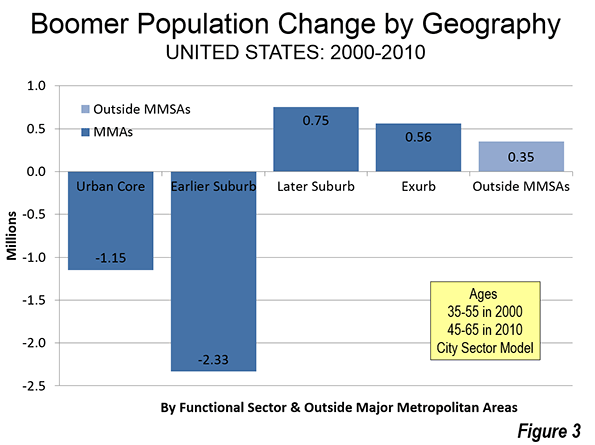
  • Millennial Boomtowns: Where The Generation Is Clustering (It’s Not Downtown)

    Much has been written about the supposed preference of millennials to live in hip urban settings where cars are not necessary. Surveys of best cities for millennials invariably feature places like New York, San Francisco, Chicago and Boston, cities that often are also favorites of the authors.

    Yet there has been precious little support for such assertions. I asked demographer Wendell Cox to do a precise, up-to-date analysis of where this huge generation born between 1983 and 2003 actually resides. Using Census American Community Survey data, Cox has drawn an intriguing picture of millennial America, one that is often at odds with the conventional wisdom of many of their elders.

    The Hidden Millennials

    We focused on individuals aged 20 to 29, which represents most of the millennial generation that is finishing post-secondary education and getting established in the workforce. Much of the writing about millennials focuses on their impact on downtowns and urban cores. And to be sure, the numbers of millennials living in urban cores has grown, as downtowns and inner-city neighborhoods have gentrified, particularly in cities such as Boston, Seattle, San Francisco, New York and Chicago. Overall, from 2010 to 2013, the population of 20- to 29-year-olds in core counties (which in most cases are identical to the core city of the metropolitan area) rose by 407,400, or 3.2%.

    However, that must be put in the context of the overall increase nationwide of that age group in that time span: 4%. Despite the growth in raw numbers of 20- to 29-year-olds living in core counties, the share of the age group living in these areas actually declined slightly, by 0.78%, compared to 2010. Meanwhile, the share of the age group living in the less dense portions of metropolitan and micropolitan statistical areas  increased. Overall roughly 30% of all millennials live in core counties, which means 70% live somewhere else. In the last three years, the number of millennials outside core counties increased by 1.28 million. In 2010, the functional urban cores, characterized by higher density and higher reliance on transit, were home to 19% of the 20-29s in major metropolitan areas, down from 20% in 2000.

    In contrast to the constantly reported on urban hipsters, the vast majority of this generation, who get precious little attention from the media or marketing gurus, might be best described as “hidden millennials.” We have to assume some of these young people are still living, primarily in suburbia, with their parents; a recent Pew study put the percentage of people 18 to 31 living at home at 36%, up from 32% before the recession, as well as the 34% level registered in 2009.

    This constitutes a population of over 20 million and not all are hopeless slackers — the vast majority have at least some college education. But they are also disproportionately unemployed or out of the workforce, and, living in their parents’ homes, they are pretty much ignored by everyone except perhaps their friends and relatives. Other millennials may well be living in suburban apartments, which tend to be somewhat less expensive, and others, perhaps the oldest of the group, have begun to “launch” starting families and buying houses, which would tend to put them in the suburbs and smaller cities as well.

    Millennial Boomtowns

    Equally surprising are those cities that have seen the largest increases in their millennial population. It is dogma among greens, urban pundits, planners and developers that the under 30 crowd doesn’t like what Grist called “sprawling car dependent cities.” Too bad no one told most millennials. For the most part, looking at America’s largest metro areas (the 52 metropolitan statistical areas with populations over a million) the fastest growth in millennial populations tend to be in the Sun Belt and Intermountain West. Leading the way is, San Antonio, Texas, where the 20 to 29 population grew 9.2% from 2010-13, an increase of 28,600.

    Right behind it, also in the Sun Belt, are Riverside-San Bernardino, Calif. (8.3%); Orlando, Fla. (8.1%); and Miami (7.7%).

    Surprisingly Detroit, long considered a demographic basket case, comes in it at No. 5 in our study, with an impressive 6.8% increase. Given the implosion in the population in the city of Detroit, this growth is likely to have taken place almost entirely in the region’s suburbs, which have done far better both economically and demographically than the core.

    The Hipster Capitals Lag

    For the most part the “capitals of cool” allegedly so irresistible to millennials rank further down the list. The only two arguable hipster magnets to make the top ten were the Denver metro area (seventh) and  Seattle (ninth). The New York metro area ranks 39th with a 3.2% increase, lagging the national expansion in this age group of 4%. The San Francisco-Oakland region, despite the tech boom, places 37th, while the Portland area, renowned as a place where millennials supposedly “go to retire,” ranks 44th. The Chicago metro area’s 20-29 population was essentially unchanged, putting it 49th on our list.

    One reason may be that core urban areas are not experiencing the surge in millennials widely asserted. Indeed the millennial populations of the five core counties (or boroughs) of New York grew only 2%, half the national rate of increase and below that of the metro area as a whole.

    The same pattern can be seen in the cores of such attractive hipster magnets as San Francisco and Boston, both of which have seen negligible growth among millennials. It appears these areas always attract young people, but also lose them over time. Even more shocking, the 20-29 populations have actually declined since 2010 in the core areas of such much celebrated youth magnets as Chicago (-0.6%) and Portland(-2.5%). Besides Seattle and Denver, the only hip core city showing expanding appeal to millennials is the anomaly of resurgent New Orleans, where the ranks of 20-29 old has grown over 5% since 2010.

    The Future of Millennial America

    What emerges from this survey is a  picture of a millennial America that does not much mirror the one suggested in most media and pundit accounts. The metro areas with the highest percentages of millennials tend, for the most part, to be not dense big cities but either college towns — Austin, Texas; Columbus, Ohio, for example — or Sun Belt cities. Virginia Beach leads the pack, with 17% of its population aged 20 to 29, compared to 14% nationwide.

    But overall  the towns with the biggest share of millennials today are also those growing this population the fastest:  Southern or Intermountain West cities. One big contributing factor is their large Hispanic communities, which for the last three decades have had a far higher birthrate than whites. Latinos constitute 20% of all millennials. This may help explain the large presence of millennials in places like Orlando, Riverside-San Bernardino, and Los Angeles. Other factors may be places where there tend to be high numbers of children, such as Mormon-dominated Salt Lake City.

    What these results suggest is that marketers, homebuilders and politicians seeking to target the increasingly important millennial population need to look beyond urban cores. The vast majority of millennials do not live in dense inner city neighborhoods — in fact less than 12% of the nation’s 20-29s did in 2010. Rather than white hipsters, many millennials are working class and minority;  in 2012, Hispanics and African-Americans represented 34% of the 20-29 population. Presumably many of them are more concerned with making a living than looking out for “fair trade” coffee or urban authenticity.

    Like most of America, the millennials are far more suburban, more dispersed and less privileged than what one sees on shows such as “Girls” or read about in accounts in theNew York Times and the Wall Street Journal. Reality is often more complex, and less immediately compelling, than the preferred media narrative. But understanding the actual geography of this generation may provide a first step to gaining wisdom how to approach and understand this critically important generation.

    20-29 Population Change: Major Metropolitan Areas: 2010-2013
    Rank Major Metropolitan Area (MMSA) 2010 2013 Change
    1 San Antonio, TX         311        340 9.2%
    2 Riverside-San Bernardino, CA         605        655 8.3%
    3 Orlando, FL         322        348 8.1%
    4 Miami, FL         716        771 7.7%
    5 Detroit,  MI         506        541 6.8%
    6 Houston, TX         856        909 6.2%
    7 Denver, CO         357        378 6.0%
    8 Charlotte, NC-SC         288        304 5.8%
    9 Seattle, WA         499        528 5.7%
    10 Virginia Beach-Norfolk, VA-NC         274        290 5.6%
    11 Buffalo, NY         153        162 5.4%
    12 Jacksonville, FL         187        197 5.3%
    13 Grand Rapids, MI         141        148 5.2%
    14 Tampa-St. Petersburg, FL         341        359 5.1%
    15 Rochester, NY         146        153 4.8%
    16 Dallas-Fort Worth, TX         911        954 4.7%
    17 Raleigh, NC         154        161 4.7%
    18 Los Angeles, CA      1,941     2,032 4.7%
    19 Richmond, VA         167        174 4.6%
    20 Nashville, TN         242        253 4.6%
    21 Indianapolis. IN         253        264 4.5%
    22 Phoenix, AZ         592        618 4.3%
    23 Sacramento, CA         307        321 4.3%
    24 Cleveland, OH         242        252 4.3%
    25 Austin, TX         295        307 4.2%
    26 Boston, MA-NH         663        690 4.1%
    27 Memphis, TN-MS-AR         182        189 4.1%
    28 Oklahoma City, OK         195        203 4.0%
    29 Atlanta, GA         719        747 4.0%
    30 Hartford, CT         154        160 3.9%
    31 San Jose, CA         254        263 3.9%
    32 Pittsburgh, PA         293        305 3.8%
    33 Providence, RI-MA         217        224 3.6%
    34 San Diego, CA         521        540 3.5%
    35 Baltimore, MD         381        394 3.5%
    36 Washington, DC-VA-MD-WV         818        846 3.4%
    37 San Francisco-Oakland, CA         605        625 3.4%
    38 New Orleans. LA         176        181 3.3%
    39 New York, NY-NJ-PA      2,740     2,828 3.2%
    40 Columbus, OH         283        291 3.0%
    41 Louisville, KY-IN         159        164 3.0%
    42 Philadelphia, PA-NJ-DE-MD         823        848 3.0%
    43 Las Vegas, NV         277        285 2.9%
    44 Portland, OR-WA         306        311 1.8%
    45 Cincinnati, OH-KY-IN         280        285 1.7%
    46 Kansas City, MO-KS         263        267 1.3%
    47 St. Louis,, MO-IL         371        372 0.2%
    48 Chicago, IL-IN-WI      1,326     1,328 0.2%
    49 Minneapolis-St. Paul, MN-WI         470        471 0.2%
    50 Birmingham, AL         151        151 -0.4%
    51 Milwaukee,WI         216        215 -0.4%
    52 Salt Lake City, UT         178        177 -0.5%
    MMSAs    23,827   24,780 4.0%
    Outside MMSAs    18,862   19,595 3.9%
    United States    42,688   44,376 4.0%
    In thousands

    Analysis by Wendell Cox.

    This story originally appeared at Forbes.

    Joel Kotkin is executive editor of NewGeography.com and Distinguished Presidential Fellow in Urban Futures at Chapman University, and a member of the editorial board of the Orange County Register. He is author of The City: A Global History and The Next Hundred Million: America in 2050. His most recent study, The Rise of Postfamilialism, has been widely discussed and distributed internationally. He lives in Los Angeles, CA.
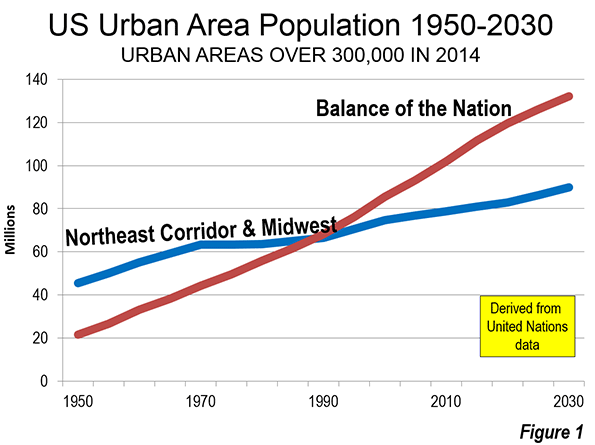
  • Urban Cores, Core Cities and Principal Cities

    Many American cities, described commonly as urban cores, are functionally more suburban and exurban, based on urban form, density, and travel behavior characteristics. Data from the 2010 census shows that 42.3 percent of the population of the historical core municipalities was functionally urban core (Figure 1). By comparison, 56.3 of the population lived in functional suburbs and another 1.3 percent in functionally exurban areas (generally outside the urban areas). Urban cores are defined as areas that have high population densities (7,500 or per square mile or 2,900 per square kilometer or more) and high transit, walking and cycling work trip market shares (20 percent or more). Urban cores also include non-exurban sectors with median house construction dates of 1945 or before. All of these areas are defined at the zip code tabulation area (ZCTA) level, rather than by municipal jurisdiction. This is described in further detail in the "City Sector Model" note below.

    The Varieties of Central Cities

    Of course the “urbaneness” of central cities vary greatly. Some, like New York, Boston, Chicago, and San Francisco experienced much of their growth before the 20th century, well before the great automobile oriented suburbanization that occurred after World War II. Others, that experienced early growth, such as Milwaukee and Seattle, annexed substantial areas of suburbanization after World War II, so that their comparatively large functional urban cores have been overwhelmed by suburbs within the city limits. Los Angeles, with a large functional urban core, annexed huge swaths of agricultural land that later became suburban. Finally, a number of other central cities, such as Phoenix and San Jose, have developed since World War II and are virtually all suburban,

    Moreover, central cities comprise very different proportions of their respective metropolitan areas (the functional or economic definition of "city"). For example, the central city of San Antonio comprises 62 percent of the San Antonio metropolitan area population. Conversely, the city of Atlanta comprises only 8 percent of the Atlanta metropolitan area population. Obviously, with such a large differential, the term central city describes jurisdictions that are radically different.

    This difference is caught by examining the functional urban cores by historical core municipality classifications. The Pre-World War II Core & Non-Suburban central cities have functional urban cores comprising 72 percent of their population. The Pre-World War II Core & Suburban central cities have functional urban cores that are only 14 percent of their populations. The Post-World War II Suburban central cities have very small urban cores, representing only 2 percent of their population (Figure 2).

    Among the 54 historical core municipalities, the share of central city population in the functional urban cores varies from a high of more than 97 percent (New York) to virtually zero (Birmingham, Charlotte, Dallas, Jacksonville, Orlando, Phoenix, Raleigh, San Bernardino, San Jose, and Tampa).

    Core Cities with the Strongest Urban Cores

    It is not surprising that the central cities with the largest share of their populations in the functional urban cores are in the older, established are concentrated in the Northeast Corridor (Washington to Boston) and the Midwest. Only one of the 14 central cities with the highest population share in functional urban cores is outside these areas is San Francisco, the first large city to be built on the American West Coast Among the 25 central cities with the highest functional urban core share, only seven are outside the Northeast Corridor or the Midwest (San Francisco, Oakland, Seattle, New Orleans, Portland, Los Angeles and Salt Lake City).

    It is not surprising that the city of New York has the largest function urban core population share, at 97.3 percent. Nearly one-third of the total urban core population in the 52 major metropolitan areas lives in the city of New York (nearly 8,000,000 residents).

    Two other central cities have functional urban core population percentages above 90 percent. Buffalo ranks second, at 94.5 percent. San Francisco is third at 94.0 percent.

    The next three highest ranking cities are in New England. Boston has an 89.7 percent functional urban core population, followed by Hartford (87.4 percent), and Providence (86.5 percent). These are all of the major metropolitan areas in New England.

    Three Midwestern central cities have more than 80 percent of their populations in functional urban cores, including St. Louis (84.1 percent), Minneapolis (83.5 percent), and Cleveland (80.1 percent). Washington (83.4 percent) and Philadelphia (83.4 percent), in the Northeast Corridor also have greater than 80 percent functional urban core shares.

    Pittsburgh (76.9 percent) and Chicago (76.6 percent) have functional urban core population shares between 70 percent and 80 percent. At 67.7 percent, Baltimore (67.7 percent) is the only central city in the Northeast Corridor that with less than 70 percent of its population in the functional urban core.

    Oakland (54.7 percent), at 15th, is the highest ranking central city outside the Northeast Corridor and the Midwest other than San Francisco. Cincinnati, Rochester, and Milwaukee also have more than 50 percent of their population in functional urban cores.

    The top 25 is rounded out by Seattle (37.5 percent), New Orleans (36.8 percent), St. Paul (36.7 percent), Portland (35.2 percent), Detroit (31.3 percent), Los Angeles (29.9 percent) and, somewhat unexpectedly, Salt Lake City (27.1 percent).

    The central cities with the largest functional urban core percentages have overwhelmingly suffered large population losses. Among the 25 with the largest urban core shares, only seven were at their peak populations at the 2010 census, and only two of the top 18 (New York and San Francisco). Overall the cities with large functional cores lost more than 35 percent of their population and 8 million residents.

    "Other" Principal Cities

    Starting in 2003, the Office of Management and Budget (OMB) retired the term "central city" and replaced it with "principal city," which includes the 54 former historical core municipalities and approximately 160 additional cities. The adoption of principal city terminology recognized as OMB described it, that metropolitan areas were no longer monocentric, but had become polycentric. OMB specifically rejected the use of geographical terms other than "principal city" within metropolitan areas, including "suburb." Indeed, the very employment of polycentricity that justified abandonment of the central city designation was the suburbanization of employment. Yet some popular usage (even in some Census Bureau documents), considers any area that is not a principal city as suburban. The more appropriate term would be "not principal city."

    Some principal cities that are not historical core municipalities ("other" principal cities) have strong urban cores, especially in metropolitan areas where the urban core stretches well beyond the core municipality’s city limits, especially in New York and Boston. Four such principal cities have urban cores larger than 100,000 and urban core population shares exceeding 90 percent, including Cambridge in the Boston area (97.0 percent, and the New York area’s Newark (94.7 percent) and Jersey City (100.0 percent), which is higher even than New York City itself. None of these cities was at its population peak in 2010.

    Even so the vast majority of the "other" principal cities are overwhelmingly suburban, comprising less of the functional urban core population than areas that are not principal cities (1.5 million compared to 4.1 million outside the principal cities). Overall, the other principal cities are 7.9 percent urban core (compared to 42.3 percent for the historical core municipalities). If the 11 municipalities with cores larger than 50,000 are excluded, the share living in functional urban cores for the remaining more than 150 cities is 1.5 percent. (Figure 4).

    Crude Measurement

    The perhaps stunning conclusion is that the average difference between the historical core municipality population and the functional urban core population is 73 percent. Core cities — themselves 57 percent suburban and exurban — are a crude basis for classifying urban cores and suburbs. Principal cities — 92 percent functionally suburban or exurban — are even worse. The bottom line: America is fundamentally more suburban in nature than commonly believed.

    —–

    City Sector Model Note: The City Sector Model allows a more representative functional analysis of urban core, suburban and exurban areas, by the use of smaller areas, rather than municipal boundaries. The nearly 9,000 zip code tabulation areas (ZCTA) of major metropolitan areas are categorized by functional characteristics, including urban form, density and travel behavior. There are four functional classifications, the urban core, earlier suburban areas, later suburban areas and exurban areas. The urban cores have higher densities, older housing and substantially greater reliance on transit, similar to the urban cores that preceded the great automobile oriented suburbanization that followed World War II. Exurban areas are beyond the built up urban areas. The suburban areas constitute the balance of the major metropolitan areas. Earlier suburbs include areas with a median house construction date before 1980. Later suburban areas have later median house construction dates.

    —–

    Wendell Cox is principal of Demographia, an international public policy and demographics firm. He is co-author of the "Demographia International Housing Affordability Survey" and author of "Demographia World Urban Areas" and "War on the Dream: How Anti-Sprawl Policy Threatens the Quality of Life." He was appointed to three terms on the Los Angeles County Transportation Commission, where he served with the leading city and county leadership as the only non-elected member. He was appointed to the Amtrak Reform Council to fill the unexpired term of Governor Christine Todd Whitman and has served as a visiting professor at the Conservatoire National des Arts et Metiers, a national university in Paris.

    Photo: Downtown Houston (by author)