Category: Demographics

  • The Evolving Urban Form: Chongqing

    No city in the world is so misunderstood by analysts and the press. It is commonly asserted Chongqing is the largest city in the world. In reality it barely makes the top 50, ranking 47th.

    Cities (Shi) in China are Regions and Mostly Rural

    It is fundamentally a problem of semantics and a failure to comprehend the nuances of urban geography in China. The country is divided into provinces and their equivalents, which are in turn, divided into prefectures, most of which are "shi," "Shi" translates into English as "city." However, shi are completely different from any English conception of a city as "an inhabited place of greater size, population, or importance than or village" (per Merriam Webster).

    There approximately 300 shis and other prefectures (sub-provincial jurisdictions) in China. In contrast, there are approximately 10 times as many sub-state jurisdictions (counties) in United States, which has a land area slightly larger than that of China. China’s shi and other prefectures are thus very large. They are really more like regions in English. Virtually all shi are predominantly rural, rather than urban in their land use.

    Reporters often marvel at the many cities in China of more than 1,000,000 population. Yet many of these are nothing more than broad expanses of rural areas without large urban settlements. Take, for example, Bazhong, a "shi" of 3.3 million residents in Sichuan province. The largest urban settlement occupies just 5 square miles (13 square kilometers), roughly the same land area as Goodland, Kansas (a city of fewer than 5,000 residents). Bazhong shi’s population is spread across a virtually 100 percent rural landscape of 4,700 square miles (12,300 square kilometers).

    Chongqing in Context

    Chongqing is a shi, and is administered as a province by the national government, as also are Shanghai, Beijing and Tianjin. The province of Chongqing covers 32,000 square miles (82,500 square kilometers). This is nearly equal to the land area of Austria and more than the area of the state of Maine. No city in the world is as large as Austria.. The New York urban area comes the closest to Chongqing’s size at 4,500 square miles (11,600 square kilometers), one-seventh the land area of Chongqing.

    Not a Metropolitan Area

    Nor is it appropriate to consider the province of Chongqing as a metropolitan area (labor market). It is simply too large for that. Commuters from the Chongqing’s "Southeast Wing" would have to travel up to 5 hours, mainly on the China’s 75 mile per hour (120 kilometer per hour) freeway system to reach work in the Chongqing urban area. From the outer reaches of Chongqing’s "Northeast Wing," travel times could exceed 8 hours, again largely by 75 mile per hour freeway.

    A Largely Rural, Not Urban Province

    The province of Chongqing is predominantly rural yet The Guardian persists in telling us that "Chongqing is the fastest-growing urban centre on the planet. Its population is already bigger than that of Peru or Iraq." Not so. The 2010 Census of China placed the province of Chongqing’s population at 28.8 million, smaller than both Peru and Iraq and with fewer people than in 1990. The urban center (genuine city) of Chongqing does not reach a quarter the size of either Peru or Iraq.

    The Guardian is by no means alone. Time magazine cluelessly fawned "Virtually overnight, Chongqing has become the largest city not only in China, but in the world," Wired similarly misfired with indicating in a 2008 article that Chongqing (at 32 million population) was the "fastest-growing urban center on Earth." For all the supposed growth, not a soul was added to Chongqing province during the 2000s, as is described below.

    Not all media outlets, however, have been captured by the same fallacy as The Guardian, Time, Wired and many others. To its credit, the BBC went to considerable lengths to correct this and similar errors about the population of Chongqing. An Atlanticarticle also parsed the issue well.

    Losing Population

    In reality Chongqing lost 1.7 million people between 2000 and 2010, 5.5 percent of its population. This is significant. By contrast, the municipality of Chicago lost 6.9 percent over the same period, a loss that was considered devastating. It is not surprising that Chongqing is losing population, given its principally rural nature. Much of rural China is emptying out, as people migrate to the cities for economic opportunity (which is the very purpose of cities), just as they have done in previous decades and the last two century throughout higher income nations. Every year over the past decade, the province experienced an annual decline of 170,000, not the half-million increase reported by The Guardian. The actual urban center (not the imaginary urban center reported on by The Guardian) is gaining in population, but nothing like "half a million" per year.

    The Genuine City of Chongqing

    There is, however, a genuine city of Chongqing. Surprisingly reminiscent of Pittsburgh, Chongqing is it nestled among elongated folded mountains that are near duplicates of those near the Pennsylvania city. The city is at the confluence to two rivers, the Yangtze and the Jialing. Like the Pittsburgh’s Golden Triangle where the Allegheny and Monongahela Rivers meet, Chongqing’s has an attractive open space at Chaotianmin where the two rivers meet. Finally, as in Pittsburgh, there is an impressive, high rise central business district behind the open space. This is the best example in China of a monocentric central business district typical of many US cities (downtown Shanghai and Nanjing are similar, but more spread out).

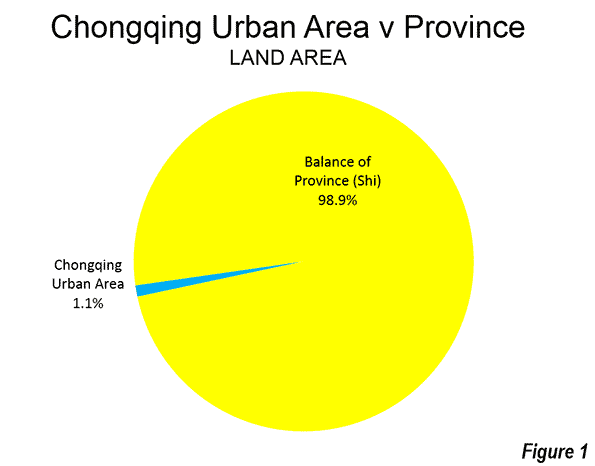
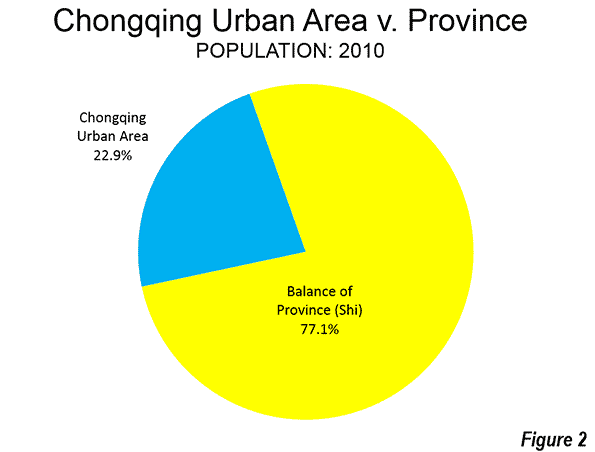
    The Chongqing urban area covers little more than 1/100th of the province’s land area (Figure 1) and contains less than one-quarter of the population (Figure 2). Yet the Chongqing urban area is still large. According to the 10th Annual Edition of Demographia Urban Areas, Chongqing has a 2014 population of 6.8 million living in a land area of 340 square miles (890 square kilometers). The urban population density is 19,600 per square mile (7,700 per square kilometer), which is about one third higher than the larger urban area average of 14,900 per square mile (5.700 per square kilometer) found across China. This is more than double the density of the Paris urban area, triple the density of the Los Angeles urban area and six times that of Portland.
    The "One Hour Economic Circle:" The Future Metropolitan Area

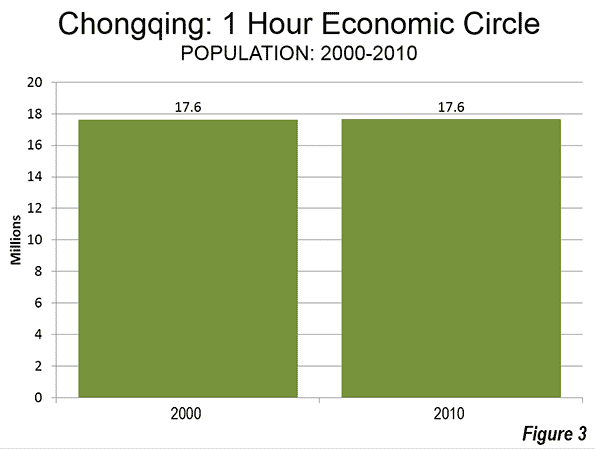
    Chongqing’s administration has a vision of a much larger city. The urban plan is concentrated on the "One Hour Economic Circle," defined as within "one hour’s driving distance." This area includes 23 of Chongqing’s 40 divisions (counties and urban districts, or qu’s), with a land area of 11,000 square miles (28,600 square kilometers), more than 1.5 times the size of the Paris metropolitan area (aire urbaine) and slightly larger than New York. The 2010 census counted a population of 17.6 million in the One Hour Economic Circle, but most of it still rural. Outside the One Hour Economic Circle, in what is called the "Northeast Wing" and the "Southeast Wing," the rural influence is even greater.

    The intent of the urban plan is to broaden the economic influence of the urban area. This would involve substantial increases in economic interchange (principally commuting) with the balance of the One Hour Economic Circle, now decidedly rural.

    Within the One Hour Economic Circle, the large rural population suggests the potential for in-situ urbanization could also contribute to economic growth as migration, as rural residents are afforded opportunities to adopt urban lifestyles (as has occurred in Quanzhou and other urban areas, especially in the province of Fuzhou).

    Population Trends 2000-2010

    The divisions (qu) that encompass the urban area are growing, even though the core is losing (Yuzhong qu). In contrast, the metropolitan area had a population of 8.0 million in 2010, up 19 percent from 2000. This is not particularly rapid growth for China. Nearly 20 metropolitan areas grew twice as fast from 2000 to 2010. Nearby Chengdu, the capital of Sichuan, grew 2.5 times as fast as Chongqing.

    Outside the metropolitan area, the One Hour Economic Circle experienced a population loss of 12 percent. As a result of this loss, the One Hour Economic Circle had only a negligible population increase of 0.1 percent between 2000 and 2010 (Figure 3).
    The Future

    At the presently projected United Nations growth rate, the Chongqing urban area would add nearly one quarter to its population by 2025. But under this pattern Chongqing will barely hold its own, but remain in the top 50 world urban areas. Yet, the city has grand plans. There are nationally and locally designated economic zones, and lower business costs encouraging commerce to move west in China. As a province and urban area directly administered by Beijing, Chongqing could be positioned for both strong population and economic growth. Yet, it remains an open question whether Chongqing will emerge as one of China’s major growth centers.

    —————-

    Note: Shi are divided into county level jurisdictions, such as qu (urban districts), counties (rural districts) and count level shi.

    ——-

    Wendell Cox is principal of Demographia, an international public policy and demographics firm. He is co-author of the “Demographia International Housing Affordability Survey” and author of “Demographia World Urban Areas” and “War on the Dream: How Anti-Sprawl Policy Threatens the Quality of Life.” He was appointed to three terms on the Los Angeles County Transportation Commission, where he served with the leading city and county leadership as the only non-elected member. He was appointed to the Amtrak Reform Council to fill the unexpired term of Governor Christine Todd Whitman and has served as a visiting professor at the Conservatoire National des Arts et Metiers, a national university in Paris.

    Photo: Downtown Chongqing (by author)

  • Dallas: A City in Transition

    I was in Dallas this recently for the New Cities Summit, so it’s a good time to post an update on the city.

    I don’t think many of us realize the scale to which Sunbelt mega-boomtowns like Dallas have grown. The Dallas-Ft. Worth metro area is now the fourth largest in the United States with 6.8 million people, and it continues to pile on people and jobs at a fiendish clip.

    Many urbanists are not fans of DFW, and it’s easy to understand why. But I think it’s unfair to judge the quality of a city without considering where it is at in its lifecycle. Dallas has been around since the 1800s, but the metroplex is only just now starting to come into its own as a region. It is still in the hypergrowth and wealth building stage, similar to where a place like Chicago was back in the late 19th century. Unsurprisingly, filthy, crass, money-grubbing, unsophisticated Chicago did not appeal to the sophisticates of its day either. But once Chicago got rich, it decided to get classy. Its business booster class endowed first rate cultural institutions like the Art Institute, and tremendous efforts were made to upgrade the quality of the city and deal with the congestion, pollution, substandard housing, and fallout from rapid growth, which threatened to choke off the city’s future success. At some point in its journey, Chicago reached an inflection point where it transitioned to a more mature state. One can perhaps see the 1909 Burnham Plan as the best symbol of this. In addition to addressing practical concerns like street congestion, the Burnham Plan also sought to create a city that could hold its own among the world’s elite. And you’d have to argue the city largely succeeded in that vision.

    The DFW area is now at that transition point. They realize that as a city they need to be about more than just growth and money making. They need to have quality and they need to address issues in the system. Much like Burnham Plan era Chicago, this perhaps makes DFW a potentially very exciting place to be. It’s not everyday when you can be part of building a new aspirational future for a city that’s already been a successful boomtown. The locals I talked to were pretty pumped about their city and where it’s going.

    How true this is I don’t know, but some people have attributed a change in mindset to the loss in the competition to land Boeing’s headquarters. Boeing ended up choosing Chicago over Dallas. In part this was because Chicago bought the business with lavish subsidies that far outclassed what Dallas put on the table. But it was also because Boeing saw Chicago as a more congenial environment for global company C-suite and other top executives to be, both from a lifestyle perspective and that of access to other globally elite firms and workers available in Chicago.

    Meanwhile, the cracks in the DFW growth model were becoming apparent, especially in the core city of Dallas. Ten years ago the Dallas Morning News ran a series called “Dallas at a Tipping Point: A Roadmap For Renewal.” This series was underpinned by a report prepared by the consulting firm Booz Allen. This report is well worth reading by almost anyone today as it is a rare example of a city that was able to get insight and recommendations from the type of tier one strategy firm used by major corporations. Booz Allen was direct in their findings, though perhaps with a bit of hyperbole in the Detroit comparison:

    Dallas stands at the verge of entering a cycle of decline…On its current path, Dallas will, in the next 20 years, go the way of declining cities like Detroit – a hollow core abandoned by the middle class and surrounded by suburbs that outperform the city but inevitably are dragged down by it.
    ….
    If the City of Dallas were a corporate client, we would note that it has fallen significantly behind its competitors. We would warn that its product offering is becoming less and less compelling to its core group of target customers…We would further caution the management that they are in an especially dangerous position because overall growth in the market…is masking the depth of its underlying problems. We would explain that in our experience, companies in fast growing markets are often those most at risk because they frequently do not realize they are falling behind until the situation is irreversible.

    Put into the language of business, we would note that Dallas is under-investing in its core product, has not embraced best practices throughout its management or operations, and is fast becoming burdened by long term liabilities that could bankrupt the company if the market takes a downturn.

    The city responded in a number of ways, some of which were similar to Chicago at its inflection point. Many of these involve various urbanist “best practices” or conventional wisdom type trends.

    By far the most important of these was adopting modern statistically driven policing approaches. As crime plummeted in places like New York during the 1990s, Dallas did not see a decline of its own. But with the expansion of police headcount and adoption of new strategies by new police chief David Kunkle in 2004 – and no doubt some help from national trends – crime fell steeply during the 2000s. The Dallas Morning News says that the city’s violent and property crime rates fell by a greater percentage than any other city with over one million residents over the last decade. In 2013, Dallas had its overall lowest crime rate in 47 years.

    This is critical because nothing else matters without safe streets. I’ve had many a jousting match with other urbanists on discussion boards about where crime falls on the list of priorities. In my view it’s clearly #1 – even more so than education. It’s simply a prerequisite to almost any other systemic good happening in your cities. Students can’t learn effectively if they live and attend school in dangerous environments, for example. NYU economist Paul Romer made this point forcefully in his New Cities keynote, saying that fighting crime is the most important function of government and that if you don’t deliver on crime control your city will go into decline. Fortunately, Dallas seems to have gotten the message.

    But there’s been attention to physical infrastructure as well. The area has built America’s largest light rail system (which was in the works since the early 1980s).


    Dallas Area Rapid Transit (DART) light rail train. Source: Wikipedia

    Both the city and region remain fundamentally auto-centric, however, and this is unlikely to change.

    There’s been a significant investment in quality green spaces. A major initiative called theTrinity River Project is designed to reclaim the Trinity River corridor through the city as a recreational amenity. This is underway but proceeding slowing. Among the aspects of the project is a series of three planned signature bridges designed by Santiago Calatrava. The only one completed is the Margaret Hunt Hill Bridge.


    The Margaret Hunt Hill Bridge in Downtown Dallas. Designed by Santiago Calatrava. Source: Wikipedia

    The single bridge tower is quite an imposing presence on the skyline. However, the size of the bridge creates an awkward contrast with the glorified creek that is the Trinity River. It looks to me like they significantly over-engineered what should have been a fairly straightforward flood plain to span just so they could create a major structure.

    Another green space project – and the best thing I saw in my trip to Dallas – is Klyde Warren Park, which is built on a freeway cap. About half the cost came from $50 million donations. I’ll be going into more detail on this in my next installment, but here’s a teaser photo:


    Klyde Warren Park. Source: Wikipedia

    The Calatrava bridge shows that Dallas has embraced the starchitect trend. This was also on display in the creation of the Dallas Arts District. Complementing the Dallas Museum of Art are a billion dollars worth of starchitect designed facilities including Renzo Piano’s Nasher Sculpture Center, IM Pei’s symphony center, Norman Foster’s Winspear Opera House, and OMA’s Wyly Theatre.


    Dee and Charles Wyly Theatre. Designed by OMA’s Joshua Prince-Ramus (partner in charge) and Rem Koolhaas

    This arts district – which naturally Dallas boasts is the world’s largest – along with the other major investments that were funded with significant private contributions show a major advantage Texas metros like DFW and Houston have: philanthropy. These are new money towns on their way up and local billionaires are willing to open their wallets bigtime in an attempt to realize world class ambitions, exactly the way Chicago’s did all those decades back.

    By contrast many northern tier cities are dependent on legacy philanthropy, such as foundations set up in an era when they were industrial power houses. This is a dwindling inheritance. What’s more, what wealthy residents they do have are as likely to be taking money out of their cities through cash for cronies projects than they are to be putting it in. Thus they can be a negative not positive influence.

    This shows the importance of wealth building in cities. Commercial endeavors can appear crass or greedy at times, and deservedly so. But without wealth, you can’t afford to do anything. There’s a reason Dallas could build America’s largest light rail system – it had the money to do so. Similarly with this performing arts district. To be a city of ambition requires that a place also be an engine of wealth generation.

    I’m sure that Dallas’ moneyed elite are well taken care of locally and exert outsized influence on decision making. I don’t want to make them out to be puristic altruists. But they’ve shown they are willing to open their wallets in a serious way, something that’s not true everywhere.

    This is a flavor of what Dallas has been up to. It’s too early to say whether the city will make the same transition Chicago did. Its greatest challenge also awaits some time in the future. When DFW’s hypergrowth phase ends and the city must, like New York and Chicago before it, reinvent itself for a new age, that’s when we will find out if DFW has what it takes to join the world’s elite, or whether it will fade like a flower as Detroit and so many other places did.

    Toyota did just announce it’s moving 3,500 jobs to north suburban Plano. But corporations have long seen Dallas a place for large white collar operations. Boeing was what I call an “executive headquarters” – a fairly small operation consisting of only the most senior people. I haven’t seen Dallas win any of these as of yet.

    The Dallas Morning News takes a somewhat mixed view on the city itself. They just did a special section called “Future Dallas: Making Strides, Facing Challenges,” the title of which sums it up. Dallas has put a lot of pieces on the board and made major progress on areas like crime, but it’s failed to make a dent in others, such as Booz Allen’s call to make the city more attractive to middle class families. Poverty is actually up since then, and the city is increasingly unequal in its income distribution. Dallas is not unique in that, but that’s cold comfort.

    Despite gigantic regional growth, the city’s population has been nearly flat. Despite the vaunted Texas and DFW jobs engine, Dallas County has lost about 100,000 jobs since 2000. The core is clearly continuing in relative decline, and the Dallas County job losses are particularly troubling. I’m no believer in this idea that everybody is going to abandon the suburbs and head back to the city. But as former Indianapolis Mayor Bill Hudnut put it, you can’t be a suburb of nowhere. If the core loses economic vitality, the entire DFW regional will take a hit to its growth.

    Aaron M. Renn is an independent writer on urban affairs and the founder of Telestrian, a data analysis and mapping tool. He writes at The Urbanophile, where this piece originally appeared.

    Dallas photo by Bigstock.

  • New York, Legacy Cities Dominate Transit Urban Core Gains

    Much attention has been given the increase in transit use in America. In context, the gains have been small, and very concentrated (see: No Fundamental Shift to Transit, Not Even a Shift). Much of the gain has been in the urban cores, which house only 14 percent of metropolitan area population. Virtually all of the urban core gain (99 percent) has been in the six metropolitan areas with transit legacy cities (New York, Chicago, Philadelphia, San Francisco, Boston, and Washington).

    In recent articles, I have detailed a finer grained, more representative picture of urban cores, suburbs and exurbs than is possible with conventional jurisdictional (core city versus suburban) analysis. The articles published so far are indicated in the "City Sector Articles Note," below.

    Transit Commuting in the Urban Core

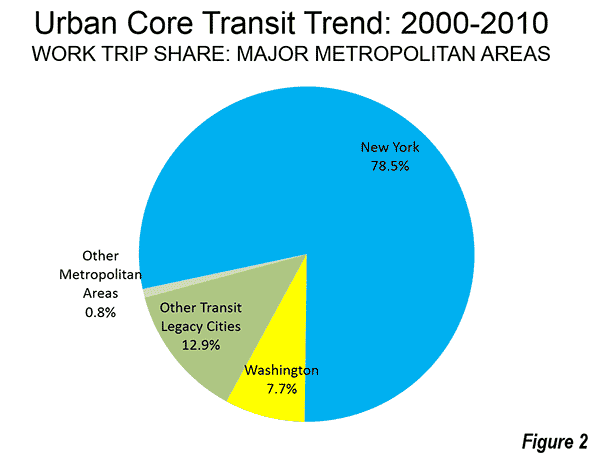
    As is so often the case with transit statistics, recent urban cores trends are largely a New York story. New York accounted for nearly 80 percent of the increase in urban core transit commuting. New York and the other five metropolitan areas with "transit legacy cities" represented more than 99 percent of the increase in urban core transit commuting (Figure 1). This is not surprising, because the urban cores of these metropolitan areas developed during the heyday of transit dominance, and before broad automobile availability. Indeed, urban core transit commuting became even more concentrated over the past decade. The 99 percent of new commuting (600,000 one-way trips) by transit in the legacy city metropolitan areas was as well above their 88 percent of urban core transit commuting in 2000.

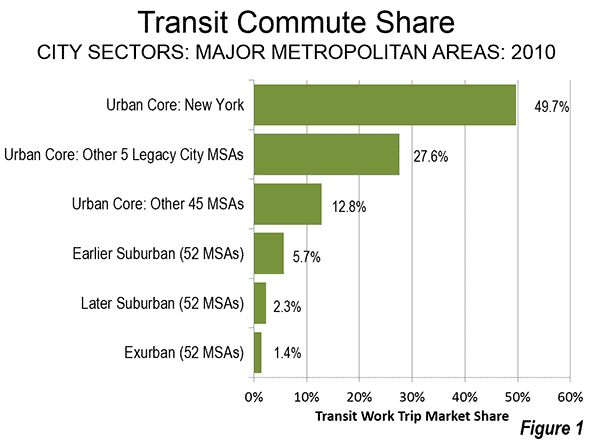
    New York’s transit commute share was 49.7 percent in 2010, well above the 27.6 percent posted by the other five metropolitan areas with transit legacy cities. The urban cores of the remaining 45 major metropolitan areas (those over 1,000,000 population) had a much lower combined transit work trip market share, at 12.8 percent.

    The suburban and exurban areas, with 86 percent of the major metropolitan area population, had much lower transit commute shares. The Earlier Suburban areas (generally median house construction dates of 1946 to 1979, with significant automobile orientation) had a transit market share of 5.7 percent, the Later Suburban areas 2.3 percent and the Exurban areas 1.4 percent (Figure 2).

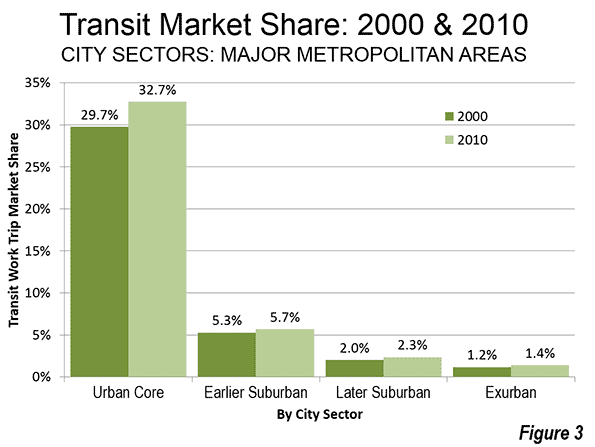
    The 2000s were indeed a relatively good decade for transit, after nearly 50 years that saw its ridership (passenger miles) drop by nearly three-quarters to its 1992 nadir. Since that time, transit has recovered 20 percent of its loss. Transit commuting has always been the strongest in urban cores, because the intense concentration of destinations in the larger downtown areas (central business districts) that can be effectively served by transit, unlike the dispersed patterns that exist in the much larger parts of metropolitan areas that are suburban or exurban. Transit’s share of work trips by urban core residents rose a full 10 percent, from 29.7 percent to 32.7 percent (Figure 3).

    There were also transit commuting gains in the suburbs and exurbs. However, similar gains over the next quarter century would leave transit’s share at below 5 percent in the suburbs and exurbs, because of its small base or ridership in these areas.

    Walking and Cycling

    The share of commuters walking and cycling (referred to as "active transportation" in the Queen’s University research on Canada’s metropolitan areas) rose 12 percent in the urban core (from 9.2 percent to 10.3 percent), even more than transit. This is considerably higher than in suburban and exurban areas, where walking and cycling remained at a 1.9 percent market share from 2000 to 2010.

    Working at Home

    Working at home (including telecommuting) continues to grow faster than any work access mode, though like transit, from a small base. Working at home experienced strong increases in each of the four metropolitan sectors, rising a full percentage point or more in each. At the beginning of the decade, working at home accounted for less work commutes than walking and cycling, and by 2010 was nearly 30 percent larger.

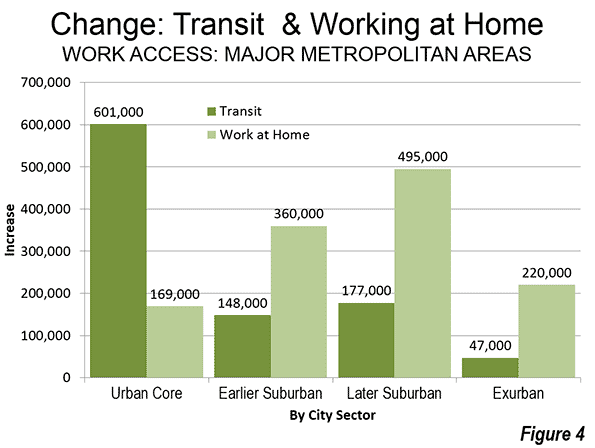
    The working at home largest gain was in the Earlier Suburban Areas, with a nearly 500,000 person increase. Unlike transit, working at home does not require concentrated destinations, effectively accessing employment throughout the metropolitan area, the nation and the world. As a result, working at home’s growth is fairly constant across the urban core, suburbs and exurbs (Figure 4). Working at home has a number of advantages. For example, working at home (1) eliminates the work trip, freeing additional leisure or work time for the employee, (2) eliminates greenhouse gas emissions from the work trip, (3) expands the geographical area and the efficiency of the labor market (important because larger labor markets tend to have greater economic growth and job creation, and it does all this without (4) requiring government expenditure.

    Driving Alone

    Despite empty premises about transit’s potential, driving remains the only mode of transport capable of comprehensively serving the modern metropolitan area. Driving alone has continued its domination, rising from 73.4 percent to 73.5 percent of major metropolitan area commuting and accounting for three quarters of new work trips. In the past decade, driving alone added 6.1 million commuters, nearly equal to the total of 6.3 million major metropolitan area transit commuters and more than the working at home figure of 3.5 million. To be sure, driving alone added commuters in the urban core, but lost share to transit, dropping from 45.2 percent to 43.4 percent. In suburban and exurban areas, driving alone continued to increase, from 78.2 percent to 78.5 percent of all commuting.).

    Density of Cars

    The urban cores have by far the highest car densities, despite their strong transit market shares. With a 4,200 household vehicles available per square mile (1,600 per square kilometer), the concentration of cars in urban cores was nearly three times that of the Earlier Suburban areas (1,550 per square mile or  600 per square kilometer) and five times that of the Later Suburban areas (950 per square kilometer). Exurban areas, with their largely rural densities had a car density of 100 per square mile (40 per square kilometer).

    Work Trip Travel Times

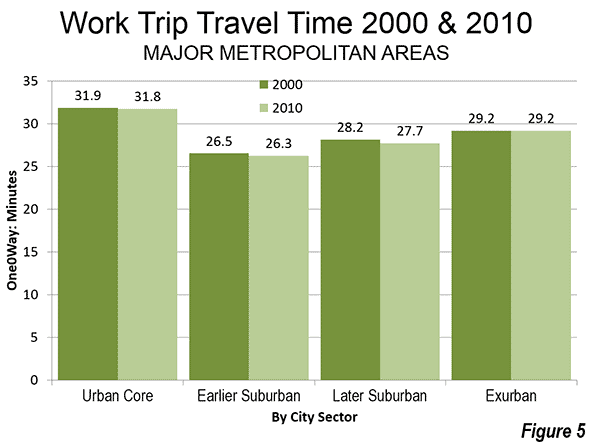
    Despite largely anecdotal stories about the super-long commutes of those living in suburbs and exurbs, the longest work trip travel times were in the urban cores, at 31.8 minutes one-way. The shortest travel times were in the Earlier Suburbs (26.3 minutes) and slightly longer in the Later Suburbs (27.7 minutes). Exurban travel times were 29.2 minutes. Work trip travel times declined slightly between 2000 and 2010, except in exurban areas, where they stayed the same. The shorter travel times are to be expected with the continuing evolution from monocentric to polycentric and even "non-centric" employment patterns and a stagnant job market (Figure 5).

    Contrasting Transportation in the City Sectors

    The examination of metropolitan transportation data by city sector highlights the huge differences that exist between urban cores and the much more extensive suburbs and exurbs. Overall the transit market share in the urban core approaches nine times the share in the suburbs and exurbs. The walking and cycling commute share in the urban core is more than five times that of the suburbs and exurbs. Moreover, the trends of the past 10 years indicate virtually no retrenchment in automobile orientation, as major metropolitan areas rose from 84 percent suburban and exurban in 2000 to 86 percent in 2010. This is despite unprecedented increases is gasoline prices and the disruption of the housing market during worst economic downturn since the Great Depression.

    —————————-

    Wendell Cox is principal of Demographia, an international public policy and demographics firm. He is co-author of the "Demographia International Housing Affordability Survey" and author of "Demographia World Urban Areas" and "War on the Dream: How Anti-Sprawl Policy Threatens the Quality of Life." He was appointed to three terms on the Los Angeles County Transportation Commission, where he served with the leading city and county leadership as the only non-elected member. He was appointed to the Amtrak Reform Council to fill the unexpired term of Governor Christine Todd Whitman and has served as a visiting professor at the Conservatoire National des Arts et Metiers, a national university in Paris.

    Photograph: DART light rail train in downtown Dallas (by author)

    —————————-

    City Sector Note: Previous articles in this series are listed below:
    From Jurisdictional to Functional Analyses of Urban Cores & Suburbs
    The Long Term: Metro American Goes from 82 percent to 86 percent Suburban Since 1990
    Functional v. Jurisdictional Analysis of Metropolitan Areas
    City Sector Model Small Area Criteria

  • Enterprising States 2014: Re-creating Equality of Opportunity

    This is the executive summary for the U.S. Chamber of Commerce Foundation’s 5th Annual Enterprising States report, authored annually by Praxis Strategy Group. View the interactive map with state-by-state data and download the full report here.

    The growing skills gap is one of the most persistent challenges affecting thriving and lagging state economies—the disparity between the skills companies need to drive growth and innovation versus the skills that actually exist within their organizations and in the labor market. This disconnect, expected to grow substantially as the boomer generation retires, causes workers and companies to miss out on realizing their full potential. A sizable skills gap impacts virtually every aspect of the economy, thereby affecting our national competitiveness and, in turn, causing the economy to fall short of its potential.

    The nature of the skills gap that employers face varies by geography. Each state has its own economic DNA with varying levels of growth and specialization for each industry. The energy-related skills gap in Texas or North Dakota, for example, is different from a manufacturing-driven gap in Michigan, aerospace in Washington, information technology in Utah, or the chemical industry in Louisiana.

    Businesses and the public sector must work side by side to identify where there is a deficit of talent, reskill incumbent workers, and skill new entrants into the workforce to close the gaps within their communities. This is not a problem that can be solved quickly, but it can be solved. Strengthening America’s science, technology, engineering, and mathematics (STEM) and middle-skills pipeline will require public-private partnerships as well as collaborations across federal, state, and local governments.

    States as a Focal Point for Action

    States and their governors play a pivotal role in filling the talent pipeline, providing critical leadership to link businesses with the education, workforce, and economic development systems. Solutions will vary by state of course, but there is an emerging framework built on a foundation of both basic education and an employer-responsive workforce pipeline.

    Economic development starts with strong schools focused on 21st century skills. For the past three decades, efforts by U.S. businesses, government, and educational organizations focused on retooling K–12 science, mathematics, and reading education and on addressing persistently high dropout rates in inner cities. Progress has been slow to remedy the looming skills shortage, but there is a growing sense of optimism that industry sector partnerships, greater attention to career pathways, and the implementation of integrated education and training will help to close the gap.

    An employer-responsive talent pipeline requires aligning education, workforce development, and economic development. Postsecondary education institutions now get a considerably lower percentage of their funding from state sources than just a decade ago, but states continue to make significant financial investments in higher education. Yet, a common refrain is that postsecondary offerings—at both two- and four-year institutions—are not sufficiently aligned with the skills needed in the workforce. For years, knowledge creation, research and development, and technology transfer have dominated higher education’s economic development role. However, higher education’s most important contribution to state economic competitiveness in the future might be teaching and talent production because states with the most high-level talent will have a leg up in the future economy of decentralized global networks.

    Investing in people is perhaps the most effective long-term economic growth strategy. Training and education offer the best chance for workers to find well-paying long-term employment, while providing businesses and employers in every sector with the talent they need to grow.

    Coordinating education, workforce development, and economic development has proven to be challenging among the states because the three fields are historically separate systems, with separate cultures and perspectives. States that are successful in navigating program integration and facilitating collaboration between these traditionally separate institutions will put themselves in the forefront of meeting one of the primary challenges to building a 21st century economy.

    Because of these complexities, a governor serves the issue best by playing a leadership role in forming partnerships – particularly between business and education – and creating the structure to ensure effectiveness and efficiency in a demand-driven education to workforce pipeline. Often this involves a decentralized approach so that more decisions can be made at the local level.

    Enterprising States 2014

    Now in its fifth edition, the Enterprising States study measures state performance overall and across five policy areas important for job growth and economic prosperity. Those five areas include:

    • Talent Pipeline
    • Exports and International Trade
    • Technology and Entrepreneurship
    • Business Climate
    • Infrastructure

    The 2014 report relates these policies and practices to the need for collaboration between education, workforce development, and economic development to positively combat the nation’s growing skills gap.  

    Top Performers

    Utah lands in the top 6 in each of the five policy categories and 3rd in overall economic performance. It is the only state to finish in the top 10 on all six lists.

    Colorado appears on 5 top 10 lists, Texas on 4, and Washington is in the top 15 of five lists.

    North Dakota is another strong performer, leading by a large margin in economic performance and ranking 1st in talent metrics and 9th in business climate.

    Florida and Nevada rank well on many policy measures, a sign that the economies of those states may be ripe for a turnaround.

    Virginia ranks 5th in technology and entrepreneurship, and talent metrics, helping it land just outside the top 10 in economic performance.

    Minnesota ranks 10th in economic performance, partly due to its second place in talent pipeline. 

    See how your state ranks by viewing our interactive map. Or view a PDF of the full report.

    Enterprising States is authored by Praxis Strategy Group along with Joel Kotkin. Praxis Strategy Group is an economic research, analysis, and strategic planning firmJoel Kotkin is executive editor of NewGeography.com and author of the forthcoming The New Class Conflict.

  • Is Brazil Still the Country of the Future?

    Not long ago, Brazil was riding high. It was feted as one of the “BRIC” nations destined to be the next world economic powers. The commodities boom had its natural resources and agricultural sectors humming. The press – for example, Monocle magazine’s swooning over Brazil’s push to boost its diplomatic presence – was adoring. And Rio was awarded the 2014 World Cup and the 2016 Olympics, two events that were intended to both serve as a catalyst for further development, and also as a coming out party of sorts for the country.

    The World Cup is underway, but otherwise things haven’t quite worked out as Brazil thought they would. The average citizen of the country is upset at the vast sums being spent on international events that don’t benefit them. The last two years have featured riots, strikes, and various other expressions of unrest. Economic growth in the country has collapsed. In a special section last September, the Economist asked, “Has Brazil Blown It?

    Late last month the McKinsey Global Institute issued a major report on the country called “Connecting Brazil to the World: A Path to Inclusive Growth.” At 104 pages, it’s massive, but a must read for anybody interested in South America’s giant.

    And it’s a somewhat depressing read as well. Though there are immense strengths and opportunities for the future, Brazil has big problems too, most of them longstanding, and which hobble its aspirations.

    Brazil is the 7th largest economy in the world and the 7th leading destination for foreign direct investment. But it’s 95th in per capita GDP, 114th in the quality of its infrastructure, and 124th in its level of ease in trading across borders. Its export sector is also heavily commodity dependent, particularly oil. Ranked only 43rd in global connectedness on McKinsey’s index, they estimate a potential boost of 1.25% (presumably percentage points) to annual GDP growth from improvements on that measure alone.

    Three particular items jumped out at me from the study. One is the “custo Brasil” – the Brazil cost, so notorious it gets its own Wikipedia entry. A variety of factors from bureaucracy to the tax regime to an uncertain legal climate, poor infrastructure, crime, and corruption make the cost of doing business in Brazil very pricey indeed.

    The second is the very low rate of investment in the economy. Brazil’s gross investment rate as a percentage of GDP is 18%, compared with 26% in Chile, 29% in Mexico, 40% in India, and 49% in China. Conversely, government consumption is at 22% in Brazil vs. 12% in Chile and Mexico, 13% in India, and 14% in China. Private consumption is similar in the countries except for China, which is notably lower. This probably helps explain the poor state of the infrastructure in the country.

    The third is something I have personal experience with, namely protectionist trade barriers designed to create and sustain domestic industries in sectors like autos and computers. I suspect these rules were modeled on Japan, and more lately China, which used rules and business practices to build successful local champions. But in Brazil this has rendered its industry sclerotic. In effect, cars sold in Brazil have to be made in Brazil, ditto for computers, etc. This is where my personal experience comes in. When we were doing global PC procurement, Brazil was always a special case and our vendors had to have special Brazil made PCs for domestic use. This may not be an actual rule, but tariffs produce a de facto barrier. While this technique may have worked in Japan, it’s clear that it failed in Brazil. As the exception that proves the rule, McKinsey uses the example of regional jet manufacturer Embraer as a counterfactual. That company was privatized and opened to global competition. The result is that its got tough itself and is now an industrial champion for Brazil.

    There are tons of statistics in the study that are worth scanning just to see. Brazil is consistently benchmarked against Chile and Mexico in Latin America, as well as fellow BRICs India and China. The comparisons aren’t pretty.

    Reading a lot about the country in the last year, I put its problems into three categories: poor governance, geographic disadvantage, and scale disadvantage.

    1. Poor Governance
    Most of the issues pointed out by McKinsey fall squarely under the heading of poor governance. The contrast with nearby Chile could not be more plain across every dimension: corruption, the rule of law, investment, public sector debt, tax burden, infrastructure, regulation, etc.

    Latin America seems to prefer two sorts of governments these days. One is a right wing nationalist heir to the military juntas of the past, best exemplified by the Kirchner regime in Argentina. The other are left wing populist-nationalist movements like Venezuela that tend to feature a streak of anti-Americanism. Both of these have produced pitiful results.

    Brazil is a sort of lite version of the latter. Lula da Silva was a charismatic labor activist who led strikes and was jailed by the previous military dictatorship in his youth. Post-democratization, he went into politics. After moderating some of his more radical views, he was elected president on a reform agenda. While he had some success and was arguably and improvement on his predecessors, he ultimately failed to deliver on material changes in governance. His hand picked successor Dilma Rousseff has not been as effective and is in an electoral struggle for another term.

    In line with the nationalist streak of this governing type, one of Da Silva’s primary concerns was Brazil’s amour-propre. As one of the world’s largest countries, he found it self-evident that Brazil should be treated as a great power. He lobbied for Brazil to have a permanent seat on the UN Security Council. He and others responded in kind to any affront to the nation’s pride, such as requiring American and only American visitors to be finger printed after the US imposed a fingerprinting requirement on foreign visitors. He sought out diplomatic coups where ever he could find them, which included cozying up to unsavory characters like Mahmoud Ahmadinejad who thinks Israel should be destroyed and that Iran has no gays (presumably because he has them executed when he can find them).

    Da Silva forgot that there’s more to being a great power than being a big country – you’ve got to earn it. And as a very popular politician he did not seize his moment of opportunity to truly grasp the nettle of reform.

    Meanwhile nearby Chile is one of the Latin American governments that’s followed a different model. It’s been run by center-left governments more or less the entire time since the restoration of democracy, and they’ve delivered on a good governance model that has taken them to effectively developed country status. Chile is now even a member of the OECD. Chile is basically the Minnesota of Latin America, and the results demonstrate it. This should show Brazil the size of the prize if the get their act together.

    2. Geographic Disadvantage
    Brazil is simply a long way from major developed markets. This puts it at a geographic disadvantage versus many other countries. Current airplanes cannot make a non-stop flight from Brazil to East Asia, arguably the most important emerging part of the world. It’s even a long haul from the United States, with relatively few gateway cities vs. say major European capitals. Brazil is time-zone advantaged with the US, however. It also speaks Portuguese instead of Spanish, which imposes a linguistic handicap.

    3. Scale Disadvantage
    Brazil is a big country, geographically and in population. Size can be an advantage, but it also makes reform difficult as it’s hard to turn a battleship. Brazil’s population of 200 million is more than ten times that of Chile.

    Brazil’s two principal cities, São Paulo and Rio de Janeiro, are also megacities. São Paulo in particular is huge, and at north of 20 million people (more than the entire country of Chile) is the 10th largest city in the world. I recently wrote that it’s unlikely the world’s emerging megacities will turn the corner in eliminating dysfunction. Their problems are just too huge and their national growth rate too low. Though I’d consider this more hypothesis than conclusion at this point, my rule of thumb is that a megacity can only achieve escape velocity from pervasive dysfunction if they are a major city in a country that is the world’s current rising economic (or historically imperial) power.

    Brazil is not that country, and two mega cities will be a drag on growth. Although São Paulo is an important emerging global city – 23rd in the world in a forthcoming report I helped create – I’m told that both São Paulo and Rio are growing more slowly than secondary cities in the country. A previous McKinsey study threw cold water on the idea that megacities are an advantage, noting their under performance by saying:

    It is a common misperception that megacities have been driving global growth for the past 15 years. In fact, most have not grown faster than their host economies, and MGI expects this trend to continue. Today’s 23 megacities—with populations of 10 million or more—will contribute about 10 percent of global growth to 2025, below their 14 percent share of global GDP.

    In contrast, 577 middleweights—cities with populations of between 150,000 and 10 million, are seen contributing more than half of global growth to 2025, gaining share from today’s megacities.

    So I’m not surprised that it’s Curitiba, not one of the megacities, that’s where the innovative BRT revolution was begun. If I were looking to invest in Brazil, I’d be looking at this next tier of cities. Nor is it surprising that Santiago, Chile (population 5.4 million) has had great success in modernizing given its more moderate size.

    Plain and simple the degree of difficulty is higher in Brazil because of the size.

    Brazil is also a very racially diverse country with a number of challenges resulting from its history of oppression. Brazil had more slaves than any other country in the world and was the last New World colony/nation to abolish it. If slave reparations are on the agenda in the United States, how much more so similar issues in Brazil? Again, contrast with Chile, which never had very many slaves and abolished slavery in 1818. With the exception of a relatively few indigenous peoples on reservations, Chileans largely perceive themselves as ethnically homogenous, though with some skin tone based status (moderately sized…historically racially homogenous…Minnesota?)

    Which is to say that it’s tough to entirely fault Brazil for not living up to the example of Chile. Its degree of difficulty is much higher. And its geography hamstrings its global interaction.

    Nevertheless, solving the governance challenges to address the real issues Brazil faces remains the top agenda item. McKinsey has laid out a number of good suggestions, the real question is whether or not Brazil’s socio-political system can produce the ability to implement them.

    Aaron M. Renn is an independent writer on urban affairs and the founder of Telestrian, a data analysis and mapping tool. He writes at The Urbanophile, where this piece originally appeared.

    Photo: Ponte estaiada Octavio Frias – Sao Paulo by Marcosleal

  • Let’s Make Kalamazoo’s Promise America’s Promise

    In 2005, in order to boost their city’s economy, a small group of donors in the city Glenn Miller made famous created the Kalamazoo Promise. It  offered any graduate of the city’s public schools a four-year scholarship covering all tuition and mandatory fees at any of Michigan’s public colleges or universities, provided those students maintained a 2.0 grade average in college and made regular progress toward a degree.

    The offer had an immediate and noticeable effect on public school enrollments and home construction within the city as families moved back in to take advantage of the chance to boost their children’s higher education opportunity. Enrollments in the public schools rose initially by 17.6% even as high school dropout rates fell by half. Residential construction permits within the district rose from 30% within the overall metropolitan area to 50%.  The program’s success caused other cities across the country as disparate as El Dorado, Arkansas and Tulsa, Oklahoma to adopt similar programs.

    Now a recent national study of the results of such initiative has documented the positive impact such promise programs can have on increasing educational attainment, while encouraging more students to attend a wide range of colleges.  University of Pittsburgh professors, LeGower and Walsh found that programs offering scholarships to all students regardless of merit, and to the widest range of two and four year colleges and universities, saw the biggest gains in enrollment. Their research published in a National Bureau of Economic Research working paper, documented enrollment gains in Kalamazoo and other identical programs.

    With these compelling results in hand, it’s time to make Kalamazoo’s promise America’s promise. A bi-partisan proposal from the non-profit Redeeming America’s Promise seeks to do just that by creating a federal American Promise Scholarship program that would pay the cost of tuition for every academically capable and personally determined high school student in America from families earning $180,000 or less. The plan would offer two year scholarships for high school graduates of $2500 per year, and four year scholarships worth on average $8500 per year to students graduating with a 2.75 GPA. These rates represent the current average cost of in state resident tuition at our public community colleges and universities. States would need to agree to accept such scholarships in lieu of any tuition payments from the families of APS students and at a minimum maintain their current level of support for their institutions. Additional incentives would be provided to encourage them to do even more to make sure a college education is both accessible and affordable for their residents. According to the Bipartisan Policy Center, there is $52 billion in current expenditures which can be used to fund the American Promise Scholarships by redirecting the money the federal government currently spends on tuition tax credits as well as by integrating the Pell Grant program into this new form of support.

    Other parts of the plan, which can be downloaded in its entirety at redeemingamericaspromise.org, would provide additional support for students who are the first in their family to attend college and reward college completion as well as post-graduation service to community or country. Money for these programs can be found by reducing the level of profits the government currently makes on student loans and ending other college support programs which have not proven their effectiveness.  

    The current system of financing higher education is unsustainable.  Student loan debt, which is not dischargeable in bankruptcy, now exceeds one trillion dollars—more than all the credit card debt in the country. The burden is felt disproportionately by lower and middle income families and is a severe drag on the desire of members of the Millennial Generation (born 1982-2003) to start a family, buy a house and have children. Furthermore, there is no historical precedent for placing such a burden on our youngest citizens.

    Since the country’s founding, education has been a key component of the promise of upward economic mobility. This has been true in every era, beginning with the Northwest Ordinance setting aside land for one room schoolhouses to the institution of mandatory, free primary education in all states at the time of the Civil War. The expansion of educational opportunities continued in the 20th Century as our growing Industrial Age economy required workers with a high school education for our factories and offices. Government funds in every state and community were set aside to provide a free, public high school education for boys and girls to respond to these new demands. Later in the century, after WWII, the GI Bill of Rights and then the Higher Education Act 0f 1965 were enacted to further encourage college enrollment, thereby establishing the educational foundation for our rapidly expanding middle class. It is only in this century that we have asked a generation, Millennials, to self-finance the education they need, and our country needs, to be economically successful.

    This wrong-headed inter-generational and economically disastrous policy needs to end before America loses its global competitive edge for good. The current system is creating a skills gap.

    America needs to make Kalamazoo’s Promise a promise every American can count on and that can address the growing skills gap in many parts of the occupational spectrum.  By joining with the Democrats and Republicans, young and old, who are already supporting Redeeming America’s Promise’s plan to make college tuition free we can ensure that day arrives sooner rather than later.

    Morley Winograd is co-author of the newly published Millennial Momentum: How a New Generation is Remaking America and Millennial Makeover: MySpace, YouTube, and the Future of American Politics and fellow of NDN and the New Policy Institute.

    Graduation photo by Bigstock.

  • The Ugly City Beautiful: A Policy Analysis

    When it comes to the future, Detroit and San Francisco act as poles in the continuum of American consciousness. Detroit is dead and will continue dying. San Francisco is the region sipping heartily from the fountain of youth. Such trajectories, according to experts, will go on indefinitely.

    Harvard economist Ed Glaeser has a grim outlook for the Rust Belt. “[P]eople and firms are leaving Buffalo for the Sunbelt because the Sunbelt is a warmer, more pleasant, and more productive area to live,” he writes in City Journal.

    Glaeser echoes this sentiment in a recent interview with International Business Times, saying “[s]mart people want to be around other smart people”, and the Rust Belt has a long slog ahead given that “post-industrial city migration is dominated by people moving to warmer climes”.

    But is this true? Is there a “brain drain” from the Rust Belt to the Sun Belt and Coasts? In a word: no. But Rust Belt leaders have bought this narrative hook line and sinker, and the subsequent hand-wringing has led to wasteful public investment.

    “Michigan’s cities must retain and attract more people, including young knowledge workers, to its cities by making them attractive, vibrant, and diverse places,” reads a 2003 memo from the National Governor’s Association about Michigan’s “Cool Cities” campaign.

    But the campaign struggled. “Government can’t mandate cool,” reflected Karen Gagnon, the former Cool Cities director. “As soon as government says something is cool, it’s not.”

    What’s worse, “cooling you city” with talent attraction expenditures can exacerbate economic disparities on the ground. Cities, like Chicago, are increasingly becoming bifurcated cities based on faulty assumptions that “trickle down urbanism” works. That said, the challenge of the day—for not only Rust Belt cities, but all cities—is not “brain drain”, but “brain waste”. Those cities who can best rebuild middle class communities tied to emerging markets will be the future of investment, like they were in the past.

    Through Rust-Colored Glasses

    When a people fall from grace, the sentiment of decline tends to stick. The Rust Belt’s demise is cemented. Meanwhile, the future is elsewhere. Like toward the sun. For instance, from 2000 to 2010, the Sun Belt metros of Houston, Dallas, Atlanta, Riverside, Las Vegas, Miami, Orlando, and Phoenix experienced the largest population growth. The biggest losers? It’s a “who’s who” of Rust Belt metros, led by Detroit, Cleveland, Pittsburgh, and Buffalo.

    America is a country governed by growth: big cars, big belt buckles, big houses, and big populations. Shrinkage is weakness. It is a sign of place failure. The problem here is that population growth is an ineffective, broad-brush measure when trying to understand regional underlying dynamics. A new study by Jessie Poon and Wei Yin in the journal Geography Compass called “Human Capital: A Comparison of Rustbelt and Sunbelt Cities” details exactly that.

    In it, the authors compare human capital levels between the Sunbelt metros in California (including San Francisco and L.A.), Nevada, New Mexico, and Arizona with Rust Belt metros in Michigan, Ohio, Indiana, Pennsylvania, and upstate New York. When it comes to share of population with a college degree, the authors find that the Rust Belt is experiencing a brain gain equal to their Sun Belt peers from 1980 to 2010. Poon and Wei also found that skill ratios of immigrants is higher in the Rust Belt than Sunbelt. The authors note that despite population decline, the Rust Belt continues “to be important sites of human capital accumulation”.

    The study coincides with recent work out of the Center for Population Dynamics that shows Greater Cleveland’s number of 25- to 34-year olds with a bachelor’s or higher increased by 23% from 2006 to 2012, as well as Pittsburgh economist Chris Briem’s work that shows the metros of Pittsburgh, Detroit, and Cleveland rank 1st,, 6th, 7th in the country respectively when it comes to the number of young adults in the labor force with a graduate or professional degree.

    Beyond human capital, the Rust Belt continues to produce and export wealth at a massive pace. The “Chi-Pitts” mega-region, which mirrors the Rust Belt boundaries with the addition of Minneapolis, generates $2.3 billion in economic output, second only to the “Bos-Wash” mega-region that makes up the Northeast Corridor.

    Also, using IRS migration data from the 2009-2010 period, a team of researchers led by Michal Migurski showed that Los Angeles County, New York County, and Cook County sent the most people and money to the rest of the United States. Detroit’s Wayne County was fourth. Cleveland’s Cuyahoga County was 9th, one spot ahead of San Francisco County. Speaking to Esquire, which published the work in a visual called “Where Does the Money Go”, Migurski explains the findings:

    "We realized that if you look at the biggest ‘losers,’ essentially what you’re looking at are the biggest cities in the U.S.," Migurski says. One of those losers: New York County, which lost $1,306,548,000 and 15,100 people. "But does that actually mean New York is a big loser?" Migurski asks. "One of our ideas was that, you’re not a loser if you’re losing money. You’re an exporter." The sort of exporter, he says, that boosts the rest of the U.S. economy. Traditional Sun Belt retirement areas comprise the gainers; areas like South Florida and Southern California in particular, create what Migurski calls "money sinks."

    Still, the notion of “loser” for Wayne and Cuyahoga County sticks, despite evidence to the contrary. But why? Why the constant “poor post-industrial people” sentiment, if not a low-grade captivation that comes with “ruin porn” rubbernecking?

    Well, if an ideal exists—you know, the experts beckon: be the “new” city, the “hot” city, the “creative” city—then a study in contrasts is necessary. The Rust Belt, with its connotations of smoke stacks and demographic decline, fits the bill.

    “[Richard] Florida suggests that Rustbelt cities’ high concentration of less creative blue-collar workers also produces unhappy residents,”Poon and Wei conclude in their Rust Belt/Sun Belt study. “We suggest that such a doom and gloom picture of urban and regional development for the uncool industrial Rustbelt needs to be tempered with a trend of brain gain that is growing across cities in the region.”

    But for this tempering to happen a clearer understanding of the importance of accumulating human capital needs to be ascertained. More exactly: Is it to put your city to work, or to “live-work-play”?

    Build it and they will…what?

    In his 1921 work Economy and Society, social scientist Max Weber details a city’s raison d’etre. Cities can be producer cities, wherein importance is derived from industries that demand national and international trade. Think Detroit and cars. Additionally, cities are consumer cities, in which growth is tied to how much is spent consuming goods and services in the local economy. Think eating, drinking, and buying houses.

    The cities that are the most economically robust have wealth generated from global production, which in turn enables local consumption. San Francisco’s tech economy drives it real estate market and artisanal toast scene. That is, if the question was “What came first, the farm-to-table chicken or the egghead?” The answer is “the egghead”, hands down.

    But this logic—i.e., in order to go to a restaurant, you need a job, and your job prospects are tied to the viability of your region’s global industries—is often turned on its head in economic development. Here, the goal is growth, no matter the rhyme or reason.

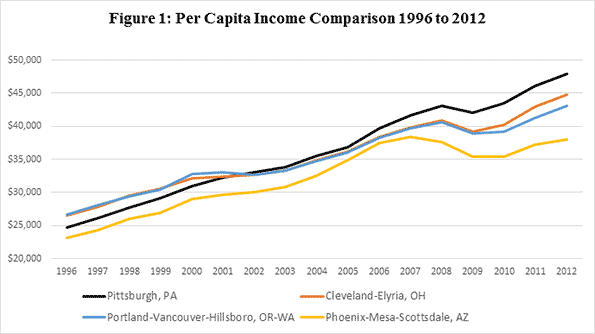
    “Like in many Sun Belt cities,” writes a Seattle Times columnist and Sun Belt expat, “Phoenix’s economic plan devolved into merely adding people, no matter the enormous long-term costs”. The columnist goes on to note that while the population has boomed, the city lags on most measures, such as per capita income (see Figure 1 below).

    Moreover, the Phoenixes of the world exist partly because of retired Baby Boomers and the disposable income that comes with it. The Sun Belt feeds off the legacy of production in the Northeast and Midwest. Other cities, like Portland, are fed by a not dissimilar dynamic. But it’s not the retired who come, rather the pre-retired.

    “The Portland metro area’s young college-educated white men are slackers when it comes to logging hours on the job,” lead’s a piece in the Oregonian about a study conducted last year, “and that’s one reason people here collectively earn $2.8 billion less a year than the national average.” Figure 1 demonstrates Portland’s sluggish income gains compared to Rust Belt peers Pittsburgh and Cleveland.

    Similarly, in a paper circulated by the Federal Reserve Bank of Atlanta, the author analyzed the top 86 “brain gain” metros in the nation to determine whether or not a region’s increase in human capital was paying off in terms of per capita income, labor force participation, poverty rate, and unemployment. The author found Portland was one of twelve metros that experienced zero economic outcomes. Pittsburgh scored 4 for 4. The authors suggest that talent attraction and retention—when untethered to production capacity—“may be largely inefficient, a kind of traditional economic development ‘buffalo hunting’”.

    Portland is perhaps America’s consummate lifestyle city. No doubt, the city has experienced a significant brain gain over the last decade. Portland is a talent attraction model. But it is not a talent producing or refining model. Rather, Portland is producing a scene that is run by the consumption of the scene’s aesthetic. Writes one young worker who left:

    “I can’t stay too long because I know if I stayed a day too long in Portland, I’d suddenly be happy to embrace the slow pace of the city and stop working… I’d end up getting sleeping real late every day, drink some coffee, maybe write some poetry on my porch (or not), and then find a part time job selling cigars like I had in college.”

    The lesson is that accumulating talent is not enough. There has to be something for the talent to do, or a context that fosters “doing”. It is also a warning for cities investing in the lifestyle game. Spending on creative class amenities ensures nothing. Creating a field of dreams won’t pay the bills. But it will run up the tab.

    The Ugly City Beautiful

    In 1998, the Chicago Sun-Times ran a piece called “Building the City Beautiful”. “The mayor of the city of Chicago, Richard M. Daley, is a big admirer of Martha Stewart,” it begins, before describing Daley’s plans to begin the "Martha Stewart-izing" of Chicago. The article goes on to quote a University of Illinois at Chicago professor who said Chicago is turning from a producer city to a consumer city. "The producer city was the industrial city — the smoke and the noise and the industrial jobs,” noted the professor. “The consumer city is the city of Starbucks, boutiques and so forth.”

    The professor was only partly right. By the 1990s, Chicago was indeed becoming brainier. But its emerging knowledge economy was an outgrowth of its “big shouldered” manufacturing base. Columbia University professor Saskia Sassen recently noted that pundits overlook this when examining the city’s transformation, with the bias being that “Chicago had to overcome its agro-industrial past, [and] that its economic history put it at a disadvantage”. Notes Sassen:

    [I]n my research I found that its past was not a disadvantage. In fact, it was one key source of its competitive advantage. The particular specialized corporate services that had to be developed to handle the needs of its agro-industrial regional economy gave Chicago a key component of its current specialized advantage in the global economy.

    Similar economic transformations from legacy cost to legacy asset are found throughout the whole of the Rust Belt. Pittsburgh, for instance, no longer provides the muscle for steel making, but it does act as the “brain center” for the world’s steel frame. How this came about is detailed in the article “Pittsburgh’s evolving steel legacy and the steel technology cluster”.

    With the arrival of the new economy also came “new economy” tastes. Sassen noted that when she arrived in to study in Chicago in the 90s she was greeted by “old lofts transformed into beautiful restaurants catering to a whole new type of high-income worker—hip, excited, alive.”

    In other words, local consumption patterns began setting up around the emergent worker demand. Going was the Italian Beef and arriving was pickled beets. This demand also impacted housing, with the attraction to urban living setting the stage for gentrification. This, in a nutshell, is the dynamic driving the transformation of urban neighborhoods nationwide: a new economy demands new workers which in turn demand a new kind of lifestyle. The problem, though, is that leaders have the causality backward, or that creating a new lifestyle will incur new worker supply and then poof: new industries. But as we see with Portland, it is not that easy. The industrial DNA and social history of your city matters more than the cosmetics atop the topography.

    Still, from a policy and strategy standpoint, it is easier just to make your city “cool”. And that’s exactly what Chicago has been doing at a significant pace. In a recent piece entitled “Well-healed in the Windy City”, author Aaron Renn details Mayor Rahm Emanuel’s policy of using tax-increment financing (TIF) to create geographic “winners” and “losers” across Chicagoland. “The true purpose of Chicago’s TIF districts—which now take in about $500 million per year,” writes Renn, “appears to be tending to high-end residents, businesses, and tourists, while insulating them from the poorer segments of the city.”

    The strategy was spelled out explicitly by Mayor Emanuel during a recent ribbon cutting for a bike path in Chicago’s Loop. Said Emanuel: “I expect not only to take all of their [Seattle and Portland’s] bikers but I also want all the jobs that come with this, all the economic growth that comes with this, all the opportunities of the future that come with this.”

    Notwithstanding the faulty logic in the strategy—e.g., if Portland lacks the jobs for its residents, how can it supply jobs for Chicagoans—the real problem is the costs associated with such bifurcated investment. In West and South Chicago, the byproducts of the City Beautiful approach are downright ugly. But they are not unexpected. They are the long-documented economic and social effects of concentrated poverty and segregation. Continues Renn:

    Safety levels in Chicago can no longer be plotted on a single bell-shaped curve for the entire city. Today, that curve is split into two—one distribution for the wealthy neighborhoods and one for the poor ones. A lack of resources is part of the problem: the police department is understaffed… While the city budget is tight, failing to increase police strength during a murder epidemic is a profound statement of civic priorities.

    Urban priorities flow from a perception of what is at stake. For long, the push for human capital accumulation has pitted city versus city amidst the backdrop of an urban popularity contest in which the “winner” is assured nothing outside of popularity. But victory in the vanity game is fleeting. The young and the restless are exactly that, and many people who come to New York or San Francisco, or for that matter Portland, leave as they get older and seek out affordable places to raise a family. What remains on the ground is the reality of brain waste. Without the prioritization of equitable, integrated middle-class neighborhoods a city’s progress will be always be disparate, if not illusory. Talent attraction is but part of a redevelopment process. So is talent refinement for those arriving and talent production for those in place. After all, neighborhoods are factories of human capital. Building people, not places, is what a successful city is all about.

    But to know this is to “know thyself”. The Rust Belt has been dying for some time now, so say the experts. The region has absorbed the projections, and given that desperate times call for desperate measures investment has been wasted. “[Creative class theory] is bad because it distracts from what’s important,” says Sean Stafford, author of Why the Garden Club Couldn’t Save Youngstown.

    Regaining focus entails removing the rust-colored glasses. Rust Belt leaders will see there are assets to work with, not to mention feel the freedom that comes with no longer being a study in contrast for those touting a future that really isn’t.

    Richey Piiparinen is Senior Research Associate at the Center for Population Dynamics at the Maxine Goodman Levin College of Urban Affairs at Cleveland State University. The Center for Population Dynamics at Cleveland State University’s Maxine Goodman Levin College of Urban Affairs aims to help partner organizations competitively position the region for economic and community development. It will do so through the lens of migration, applied demography, and culture.

    Lead photo courtesy of bctz Cleveland

  • The Long Term: Metro America Goes From 82% to 86% Suburban Since 1990

    The major metropolitan areas of the United States experienced virtually all of their overall growth in suburban and exurban areas between 2000 and 2010. This is the conclusion of an analysis of the functional Pre-Auto Urban Cores and functional suburban and exurban areas using the Demographia City Sector Model.

    The City Sector Model
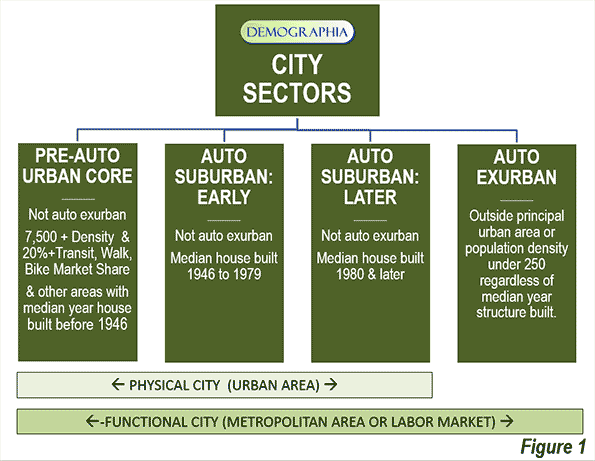
    The City Sector Model classifies zip code areas in the major metropolitan areas based on urban form (Note 1). These include four classifications, one of which replicates the urban form and travel behavior typical of the pre-World War II urban cores. These areas were typically higher density and dependent on transit and walking. The City Sector Model has three other classifications, Pre-Auto Urban Core, Auto-Suburban: Earlier, Auto-Suburban: Later and Auto-Exurban.

    For simplicity the City Sector categories are referred to as urban core, earlier suburban, later suburban and exurban. The City Sector Model is described in a previous article, and illustrated in Figure 1, which is also posted to the internet.

    The model makes it possible to analyze metropolitan areas based on smaller area functional classifications, rather than on jurisdictional (historical core municipality) borders, which among other things, mask as core large areas of suburbanization.

    Suburbanized Core Municipality Examples: San Jose and Charlotte

    This suburbanization in the historical core municipalities is illustrated by examples like San Jose and Charlotte. The City Sector Model indicates that neither of these metropolitan areas has a pre-auto urban core. This is because neither metropolitan area has a large enough concentration of houses with a median construction date of 1945 or before or sufficient area of 7,500 population density per square mile (2,900 per square kilometer) with a transit, walking and cycling work trip market share of at least 20 percent. As a result, virtually all of both metropolitan areas is automobile oriented suburban, including virtually all of the core municipalities.

    This is true in Charlotte despite its development of one of the most impressive new central business districts in the nation, with high employment densities. Yet at the same time the  core city of Charlotte itself is very low density (2010), at 2,500 per square mile (950 per square kilometer), less than the suburban area average for large US urban areas (2,600 per square mile or 1,000 per square kilometer). Charlotte, however, could develop the equivalent of a pre-auto urban core if its central population density rises enough and enough commuters use transit, walking and cycling.

    The core city of San Jose is far more dense than Charlotte, at 5,800 per square mile (2,200 per square kilometer). However, it is less dense than the suburbs of Los Angeles (6,400 per square mile or 2,500 per square mile). Like Charlotte, the core city of San Jose is virtually all automobile oriented suburban and has a transit work trip market share a full third below the major metropolitan area average.

    Overall Population Trend: 2000-2010

    These phenomena reflect national trends, All major metropolitan area growth between 2000 and 2010 (100.9 percent) was in the functional suburbs and exurbs.

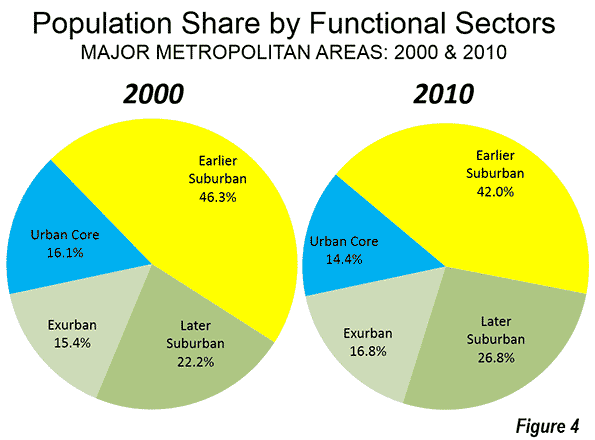
    Between 2000 and 2010, the percentage of major metropolitan area population in the urban cores declined from 16.1 percent to 14.4 percent. The urban cores lost approximately 140,000 residents (a loss of 0.6 percent), despite strong gains very close to the centers of the historical core municipalities. Consistent with these findings, Census Bureau analysis showed that the focused gains in the cores of the urban cores were more than negated by losses in surrounding urban core areas (described in: Flocking Elsewhere: The Downtown Growth Story).

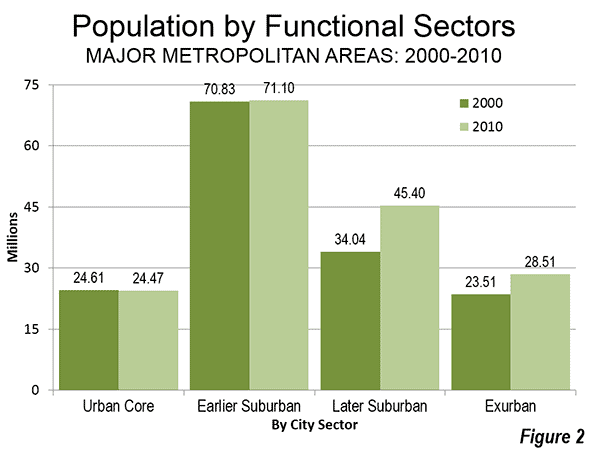
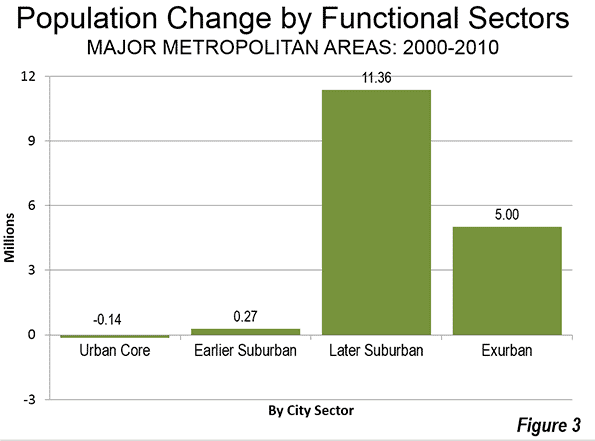
    The earlier suburban areas gained only modestly, adding 280,000 new residents, for a 0.4 percent increase. These areas have median house construction dates between 1946 and 1979. The largest increase was in the later suburban areas, which added the most new residents, 11.4 million, for a gain of 33.4 percent. The later suburban areas have median house constructions of 1980 or later. Exurban areas added 5.0 million residents, for a gain of 21.3 percent. Exurban areas are located outside the principal urban areas (Figure 2).

    Overall, the later suburban and exurban areas gained 16.4 million residents, compared to the combined gain of 130,000 in the urban cores and earlier suburban areas. Thus, more than 99 percent of the population growth in the major metropolitan areas was in the later suburban and exurban areas (Figure 3).

    During the decade, the exurban areas overtook the urban cores in population, rising from 15.4 percent of the major metropolitan area population to 16.8 percent (Figure 4).

    Contrast with 1990-2000 Population Trend

    Despite all of the talk of an urban core renaissance, the 2000 to 2010 decade was less favorable for urban cores than the 1990 to 2000 decade. In the earlier decade, the urban cores (as defined in 2010) added 960,000 residents, for a growth rate of 4.0 percent. This compares to the 140,000 urban core loss between 2000 and 2010 (Note 2).

    Virtually all of the difference was attributable to urban core population trend reversals in New York, Boston and Chicago, which combined experienced a drop in growth of 1.1 million. Between 1990 and 2000, the urban core of New York added 779,000 residents, far more than the 190,000 added between 2000 and 2010. Boston’s 1990-2000 urban core growth was 296,000, but fell to 27,000 in the last decade. Chicago’s urban core dropped from a gain of 139,000 to a loss of 175,000.

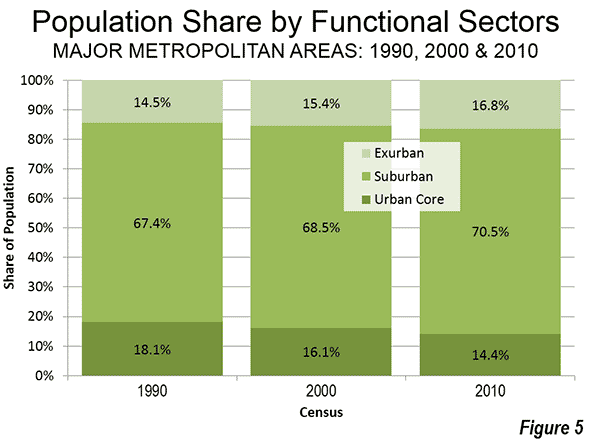
    Over the past twenty years, the population of urban cores has diminished relative to that of major metropolitan areas. In 1990, the urban cores represented 18.1 percent of the population, but fell to 14.1 percent in 2010. Auto-oriented areas (suburban and exurban) have increased their combined share from 81.9 percent of the major metropolitan area population in 1990 to 85.6 percent in 2010 (Figure $$$).

    Summary of Individual Metropolitan areas

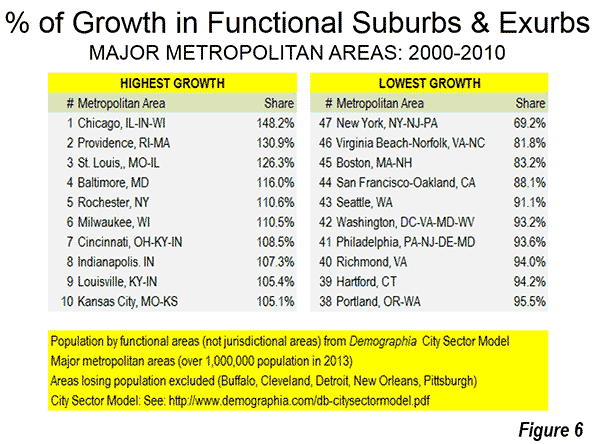
    In 30 of the 52 major metropolitan areas, all or more of the population growth was in suburban and exurban areas between 2000 and 2010. This includes the metropolitan areas that do not have Pre-Auto Urban Cores.

    Chicago had the largest share of suburban and exurban population growth, at 148 percent. This occurred because of the substantial urban core population losses. The suburbs and exurbs of Providence captured 131 percent of its growth, slightly more than the 126 percent suburban and exurban share in St. Louis. Baltimore, Rochester and Milwaukee had more than 110 percent of their growth in the suburbs and exurbs. Cincinnati, Indianapolis, Louisville, and Kansas City rounded out the largest suburban and exurban growth shares, all over 105 percent.

    Despite the substantial decline in its urban core growth in the last decade, New York had the lowest share of population growth in the suburbs and exurbs (meaning that it had the highest share of population growth in the urban core). The suburbs and exurbs of New York captured only 69 percent of the metropolitan area growth, well below second place, Virginia Beach – Norfolk (81 percent). Boston was next at 83 percent, followed by San Francisco – Oakland, at 88 percent. The bottom 10 in suburban and exurban growth share also included Seattle, Washington, Philadelphia, Richmond, Hartford and Portland. Even so, each of these six metropolitan areas had more than 90 percent of their growth in suburban and exurban areas (Figure 6).

    Jurisdictional Analyses: Suburbs Masquerading in Cities

    The functional analysis based on urban form and behavior reveals substantially different trends compared to the conventional jurisdictional analysis that compares historical core municipalities, principal cities or primary cities to the balance of metropolitan areas. For example a jurisdictional analysis shows that core municipalities added 1,290,000 residents between 2000 and 2010. In contrast, the urban cores, as indicated in the functional analysis, lost 140,000 residents. This indicates the extent of to which municipal boundaries can mislead in the analysis of urban form within metropolitan areas. The expansive city limits of most core cities masks the substantial automobile oriented suburbanization within their own borders.

    —-

    Note 1: The City Sector Model is generally similar to the groundbreaking research published by David L. A. Gordon and Mark Janzen at Queen’s University in Kingston Ontario (Suburban Nation: Estimating the Size of Canada’s Suburban Population) with regard to the metropolitan areas of Canada. Gordon and Janzen concluded that the metropolitan areas of Canada are largely suburban. Among the major metropolitan areas of Canada, the Auto Suburbs and Exurbs combined contain 76 percent of the population, somewhat less than the 86 percent found in the United States.

    Note 2: Changes in zip code definitions and boundaries could result in minor differences in comparability between the three censuses.

    —-

    Wendell Cox is principal of Demographia, an international public policy and demographics firm. He is co-author of the "Demographia International Housing Affordability Survey" and author of "Demographia World Urban Areas" and "War on the Dream: How Anti-Sprawl Policy Threatens the Quality of Life." He was appointed to three terms on the Los Angeles County Transportation Commission, where he served with the leading city and county leadership as the only non-elected member. He was appointed to the Amtrak Reform Council to fill the unexpired term of Governor Christine Todd Whitman and has served as a visiting professor at the Conservatoire National des Arts et Metiers, a national university in Paris.

    Photo:  Later Suburbs in New York Urban Area (Morris County, New Jersey), by author

  • Shaking Off The Rust: Cleveland Workforce Gets Younger And Smarter

    In virtually every regional economic or demographic analysis that I conduct for Forbes, Rust Belt metro areas tend to do very poorly. But there’s a way that they could improve, based in large part on the soaring cost of living in the elite regions of California and the Northeast. And one of the rustiest of them appears to be capitalizing on the opportunity already: that perpetual media punching bag, Cleveland.

    Between 2000 and 2012, the Cleveland metro area logged a net gain of about 60,000 people 25 and over with a college degree while losing a net 70,000 of those without a bachelor’s, according to a recent report from Cleveland State University. The number of newcomers aged 25 to 34 increased by 23 percent from 2006 to 2012, with an 11 percent increase from 2011 to 2012 alone. Most revealingly, half of these people came from other states. When it comes to net migration, Atlanta, Detroit, and Pittsburgh were the biggest feeders for those arriving with a bachelor’s degree, while Chicago, Manhattan, Brooklyn and Pittsburgh sent the most net migrants with a graduate or professional degree.

    The picture of Cleveland that emerges from the Cleveland State University study is a very different one from that to which we are accustomed. Rather than a metro area left behind by the information revolution, Cleveland boasts an increasingly youthful workforce that is among the better educated in the nation. In 2009. notes University of Pittsburgh economist Chris Briem, some 15% of Cleveland’s workforce between 25 and 34 has a graduate degree, ranking the area seventh in the nation, ahead of such “brain centers” as Chicago, Austin and Seattle. Old Clevelanders as a whole will remain undereducated, but likely not the next generation.

    What is driving this migration? Some of it has to do with a 25% expansion of STEM employment from 2003-13, much of it in health care tied to the region’s prestigious hospitals. This has helped spark a healthy increase in per capita income, from $33,359 in 2003 to $44,775 in 2012, a gain of 34%.

    This growth has animated many neighborhoods, not only in the “cool” central cores but in a host of inner and outer ring neighborhoods. This process, note researchers Richey Piiparinen and Jim Russell, is even more evolved in a Rust Belt city that has been on the rise for some time now, Pittsburgh. Migration trends there first turned favorable in 2007 after decades of decline, and have remained positive.

    The cost of living in Cleveland is considerably below the national average, not to mention that of the ultra-expensive coastal regions. Indeed, when cost of living is taken into account, per capita income in both Cleveland and Pittsburgh are now well above the national average.

    Piiparinen and Russell also see a gradual movement of educated young people to other lower-cost, family-friendly places in the Rust Belt, including Indianapolis, St. Louis and Minneapolis.

    These phenomena suggest that Rust Belt cities need to adopt new approaches to economic development. For years, civic boosters in places such as Cleveland fixed hopes on attracting the much ballyhooed “creative class” by building such things as the Rock and Roll Hall of Fame, art galleries, trendy restaurant and even a massive downtown chandelier. This tactic recalls the old lite beer commercials: everything you want in a city, but less.

    Yet, as Piiparinen and Russell point out, this approach simply expands consumption opportunities, and when it comes to consumption, Cleveland, Detroit and Pittsburgh can never top the U.S. capitals of excess: Manhattan, San Francisco, Los Angeles, or even Seattle. It’s hard to see hipsters moving en masse to any of these places without some degree of economic opportunity.

    Piiparinen sees the current migration trends as reflecting “the Rust Belt’s productive economy versus its consumptive economy.” He proposes the focus should be to accelerate talent migration based on economic advantages natural to the region, such as medical services, advanced manufacturing and logistics.

    These industries have high economic impact. Manufacturing, he traditional core of the local economy, adds 50 cents of GDP for every dollar in output, considerably more than information employment and almost three times the multiplier for retail jobs.

    Despite the hopes to emulate post-industrial Boston, New York or San Francisco, Rust Belt states remain dependent on manufacturing; it accounts for 18 percent of Ohio’s GDP and 14 percent of Pennsylvania’s, more than twice as much as in New York and well above that in California. Increasingly, manufacturing will not provide many jobs for unskilled workers, but rather for trained technicians, certified crafts workers as well as highly educated college graduates. Ohio has established an extensive network of skilled training facilities to fill this need.

    Critical to the process are the current manufacturing rebound, in which Ohio has added 50,000 industrial jobs since 2009, and the energy boom tied to the development of shale in both Ohio and Pennsylvania. Since 2001, energy employment in Pennsylvania has more than doubled, with much of the action in western part of the state abutting Pittsburgh.

    Does that mean that Cleveland, or Pittsburgh, are about to experience Houston-like growth? Don’t hold your breath. The weather is too harsh, and the cities too small to compete with the vast opportunities presented by the burgeoning Sun Belt economies. Nor do they rank high as destinations for foreign immigrants, who have provided a boost to many larger local economies but as of yet have not “discovered” the Rust Belt in large numbers.

    Yet not achieving hyper-growth does not mean continued decline. As older, less educated workers retire or leave the region, often for warmer climes, there is an opportunity for the Rust Belt to replace its current labor pool with one more attuned to the emerging economy and enjoy strong boosts in GDP growth.

    The key here is melding the “legacy” strengths of these regions with shifting demographic and economic forces. The region is not only home to abandoned steel mills, but also six of the country’s top top 20 graduate engineering programs, according to U.S. News & World Report. The intellectual capital is there.

    And economic forces could soon make these cities more attractive to newcomers from the rest of the country and abroad. The “spiky” cities embraced by urban boosters such as Richard Florida – who famously dissed Pittsburgh on his way out of town — increasingly are too expensive for even the educated middle class. This is why we are seeing young people who flocked to the Bay Area leave in their 30s or 40s. Places like San Francisco and Manhattan are great to the well-educated (and well-heeled), but as you get older, and look to buy a house or start a family, they are not ideal, unless you are extraordinary successful or have the right parents.

    In contrast, the Rust Belt offers a vastly better value proposition. Housing in Cleveland is about one-fourth the cost, based on income, as in San Francisco. Not only that, but the choices are fairly broad, from new and old suburban to charming, single-family dominated urban neighborhoods.

    These choices are encapsulated by the turn of phrase “Pittsburgh rich,” which essentially means that people settling there simply have better options than in places like New York or San Francisco. “We have an old housing stock that is very affordable,” notes University of Pittsburgh’s Briem. “Places like Pittsburgh and Cleveland offer a lot of areas that are very attractive at a low cost.”

    Of course, such a transition will require some major rethinking among regional leaders and the abandonment of their traditional wannabe approach. Rather than apologizing for not being San Francisco, they should look at the prospects for a revival of energy and manufacturing. It’s working out for Pennsylvania and Ohio, which were among the largest recipients of new investment in 2012, ranking third and fourth among U.S. states. They were behind Texas and Louisiana, but well ahead of both California and New York.

    Over time, this transition in the Rust Belt could prove a boon for the entire country. It does little good for either the resurgent Sun Belt or the sophisto havens on the coasts to have to subsidize a region along the Great Lakes in permanent decline. The Rust Belt retains many natural resources — oil, gas and, perhaps most importantly, water — that position it to be a major contributor to national growth. If the opportunity is recognized by a new generation, the future could prove surprising bright in what has long been seen as a fading region.

    This article first appeared at Forbes.com.

    Joel Kotkin is executive editor of NewGeography.com and Distinguished Presidential Fellow in Urban Futures at Chapman University, and a member of the editorial board of the Orange County Register. He is author of The City: A Global History and The Next Hundred Million: America in 2050. His most recent study, The Rise of Postfamilialism, has been widely discussed and distributed internationally. He lives in Los Angeles, CA.

    Creative Commons photo “Cleveland Skyline from the Flats” by Flickr.com user Erik Drost.

  • Will the World’s Emerging Megacities Turn the Corner? For Most of Them, Probably Not

    Two distinct expressions of urbanism, the global city and the mega city, are often conflated in the public’s mind. This can lead people to implicitly link the future fortunes of megacities (urban regions of more than 10 million people) with the success of global cities (defined roughly as a very important node at the high end of the global economy), especially as there’s overlap between the two types. They can then assume that the world’s emerging megacities will ultimately be successful, maybe even very successful. Places like São Paulo and Istanbul are held up as global cities in the making. Even more clearly struggling megacities like Jakarta and Lagos are sometimes portrayed as up and coming hip.

    But in reality most emerging megacities likely will never turn the corner to developed status and achieve a decent standard of living and quality of life for their residents. They may be important national centers of aspiration, but most of them will never become influential global cities.  Their huge size and vast problems will leave them with perpetual entrenched poverty, poor infrastructure and public services, and low quality of life by global standards.

    The general rule seems to be that a megacity can only achieve escape pervasive dysfunction if they are a major city in a country that is the world’s current rising economic (or historically imperial) power.

    Rank

    City

    Population

    1

    Tokyo-Yokohama, Japan

    37,555,000

    2

    Jakarta, Indonesia

    29,959,000

    3

    Delhi, India

    24,134,000

    4

    Seoul-Incheon, South Korea

    22,992,000

    5

    Manila, Philippines

    22,710,000

    6

    Shanghai, China

    22,650,000

    7

    Karachi, Pakistan

    21,585,000

    8

    New York, USA

    20,661,000

    9

    Mexico City, Mexico

    20,300,000

    10

    São Paulo, Brazil

    20,273,000

    11

    Beijing, China

    19,277,000

    12

    Guangzhou, China

    18,316,000

    13

    Mumbai, India

    17,672,000

    14

    Osaka-Kobe-Kyoto, Japan

    17,234,000

    15

    Moscow, Russia

    15,885,000

    16

    Los Angeles, USA

    15,250,000

    17

    Cairo, Egypt

    15,206,000

    18

    Bangkok, Thailand

    14,910,000

    19

    Kolkata, India

    14,896,000

    20

    Dhaka, Bangladesh

    14,816,000

    21

    Buenos Aires, Argentina

    13,913,000

    22

    Tehran, Iran

    13,429,000

    23

    Istanbul, Turkey

    13,187,000

    24

    Shenzhen, China

    12,860,000

    25

    Lagos, Nigeria

    12,549,000

    26

    Rio de Janeiro, Brazil

    11,723,000

    27

    Paris, France

    10,975,000

    28

    Nagoya, Japan

    10,238,000

    29

    London, United Kingdom

    10,149,000

    Table 1: World’s Megacities, 2010, based on urban agglomeration size. Source: Demographia World Urban Areas, 10th Edition (May 2014)

    This is the case with most developed world megacities. Moscow was the capital of the Soviet Empire. New York and Los Angeles came of age when America was the rising, and ultimately dominant, economic colossus. It’s the same for Paris and London, two borderline megacities, which rose as imperial capitals. London remains arguably the premier global city in the world.

    But it’s also true of other megacities you might not consider. Tokyo only achieved its fully developed state when Japan was the rising power. Until fairly recently, much of Japan’s capital was backwards by developed world standards. For example, despite Japan’s famously high tech toilets, even in the inner 23 wards of Tokyo it was only in 1995 that 100% sewer service was achieved. In the second edition of Peter Hall’s landmark book The World Cities, he describes a 1970s Tokyo in which the night soil pickup industry was alive and well.  Only in an era of national economic hyper growth – culminating in the 1980s – was Japan able to fully modernize its urban infrastructure and clean up the massive environmental problems resulting from its rapid industrialization and urbanization. This was the time when Japan seemed destined to become the world’s leading economic power, and America was fretting as Japanese investors bought trophy assets ranging from Columbia Pictures to Rockefeller Center.


    Image from 2011 presentation by Takatoshi Wako, “Night Soil Management and Decentralized Wastewater Treatment Systems in Japan”

    We are witnessing the same today in China. It’s no accident that cities like Beijing and Shanghai are becoming fully modernized at the same time that China is the world’s rising economic power.  Even there, serious problems with social integration, pollution, and low quality development remain. China had best hope its economic growth continues until such time as it’s rich enough to solve those problems too.

    Apart from the developed West, Japan, and China, only one world megacity has ever pulled off the transition to full modernity is Seoul. Seoul, however, followed a similar trajectory to Tokyo. Destroyed in the Korean War, it was rebuilt with the help of massive foreign aid. As dictatorship gave way to democracy, South Korea emerged as the leading “Asian Tiger” economy, a sort of mini-Japan. Yet it’s only recently that Seoul has begun to transcend its soulless apartment towers and focus on building a quality of life to match its advanced subways and broadband networks, for example, by uncovering a stream previously channeled underground into storm sewers to create an attractive greenway.


    Cheonggyecheon stream in Seoul, daylighted in 2005. Image: Wikipedia

    The world’s other megacities, sadly, are located in countries on a less positive trajectory.  Many of them are in impoverished developing countries in South and Southeast Asia and Africa. Others are in economies like the BRICs once touted as emerging powers, but many of which , have badly stumbled.  India and Brazil are not following the path of Japan and South Korea – not even that of China. Their economies are large and in a sense important, but face massive structural challenges.


    Pavãozinho favela, Rio de Janeiro. Photo: Wikipedia

    Brazil is planning a coming out party with the World Cup and Olympics. The city of São Paulo has even established its own foreign ministry to develop direct diplomatic and other ties with countries overseas to flex its global muscles.  Yet the social reality is less impressive: Paulistanos rioted last year in response to transit fare increases. Income inequality in São Paulo is stark, and public safety very questionable.  Rio has numerous favelas where military style units are trying to establish basic security, albeit with heavy handed tactics.  Rowers training for the Olympics have described Rio’s waterways as the most polluted they’ve ever seen, with one of them telling the New York Times, “I’ve never seen anything like this before.” In next door Argentina, once wealthy Buenos Aires continues to decay along with the nation, the consequences of lengthy misrule.


    Dharavi slum, Mumbia. Photo: Wikipedia

    But problems in Latin America’s megacities pale next to those elsewhere. In India’s financial and commercial capita of Mumbai, over half the population lives in slums. Delhi was recently noted as having the world’s worst air pollution. Dhaka, Bangladesh is both impoverished and has extreme flooding problems. Karachi, Manila, and Jakarta suffer severe poverty and infrastructure problems.  Large African cities like Lagos can’t overcome the basic development problems of the continent.


    Shantytown in Manila. Photo: Wikipedia

    Some argue that these megacities are actually opportunities zones for their country and even that their slums should be praised – or might eventually, as one article claimed, save the planet. After all, people are voting with their feet to move there. Perhaps that’s true in some sense, though some of the advantage of cities stems from a decline in the viability of rural life. 

    But the problem is that there’s no clear path to prosperous maturity for these megacities.  They are so huge, and their problems so immense that they are difficult to even conceptualize, much less do something about.  The amount of needed infrastructure provision alone – water, sanitation, drainage, transport, telecom, electricity, parks, schools, etc. – is staggering. And that doesn’t even touch arguably more difficult problems like corruption and good governance. Absent national hyper growth – a la Japan or Korea – of a level that creates a plausible claim to being the world’s rising economic power, or the proceeds of empire, it seems unlikely any of these cities will ever succeed. By contrast, smaller cities have a much more addressable problem space.

    Megacities may have their virtues and short term advantages, but unlike yesterday’s imperial or economic capitals like New York and Tokyo, today’s emerging world megacities will have a hard time even achieving the basics of urban quality of life, much less succeed in rising to join the world’s elite.

    Aaron M. Renn is an independent writer on urban affairs and the founder of Telestrian, a data analysis and mapping tool. He writes at The Urbanophile.

    Lead Photo: São Paulo City by Julio Boaro