Category: Demographics

  • America’s Glass Half-empty, or Half-full?

    The stock market is high, real estate prices have resurged, even the unemployment rate is dropping, yet Americans still feel pretty down about the future. A survey released in January by the AP-NORC Center for Public Affairs Research had 54 percent of respondents expecting American life to go downhill over the coming decades. In a December survey, 23 percent of respondents said things will improve over time.

    Yet, in reality, there are several huge trends – economic, environmental, demographic – working in favor of the United States. Despite 13 straight years of underwhelming leadership, the U.S. can emerge extraordinarily blessed from the Great Recession and lackluster recovery, if Americans take advantage of our current situation.

    Why, then, so glum? One explanation clearly is the shape of the economic recovery, which, due in part to Federal Reserve monetary policy, has favored the rich by primarily promoting stock market and other asset growth. “Qualitative easing,” notes one former high-level Fed official, essentially constituted a “too big to fail” windfall for the largest Wall Street firms. Executives at these same firms set new compensation records in 2011, just three years after the financial “wizards” left the world economy on the brink of economic catastrophe.

    As people on Wall Street, and their hipper counterparts in Silicon Valley, celebrate their good fortune, most people are not doing well, and they know it. Unemployment may have dropped officially, but the percentage of Americans in the workforce is now at the lowest level since December 1977. Huge parts of our society now face long-term unemployment or, at best, a marginal existence at the low end of the job market.

    This trend is most disturbing because it has been going on for a long time and, generally, has been getting worse. Since 1973, for example, the rate of growth of the “typical family’s income” in the United States has slowed dramatically; for males, it has actually gone backward when adjusted for inflation, at least until the early 1980s. In contrast, in 2012, the top 1 percent of earners accounted for one-quarter of all American income, the highest percentage in the past century.

    So, given these problems, why should anyone be optimistic? After all, by 2020, the CIA suggested in 2005, the U.S. world position will have eroded because of the rise, most notably, of India and China; many business leaders share this assessment.

    Nevertheless, here are five reasons for optimism.

    Everyone else is in worse shape

    Looking for a global hot spot that’s doing better? Look again. Virtually all America’s much-vaunted competitors of yesterday – notably, Japan and the European Union – have suffered slow economic and demographic growth. The much-ballyhooed winner of tomorrow, China, also appears to be slowing. Political corruption, soaring local debt and massive levels of pollution are creating a crisis of confidence, reflected by the growing exodus of the educated and affluent from China and Hong Kong , with many ending up in the United States.

    The other members of the so-called BRIC countries – a term coined by one of the geniuses at Goldman Sachs – also are stagnating. Brazil’s successful bids to host the 2016 Summer Olympics and this summer’s soccer World Cup have made ever more obvious the country’s massive poverty and political incompetence, made all the worse by a slowing economy. India, too, is experiencing weak growth and increased political instability. Russia’s uncrowned czar, Vladimir Putin, may be outmaneuvering our gullible, indecisive president but the country Putin controls is going nowhere, with the population stagnating and its weakening economy utterly dependent on extractive resources. Turkey, another favorite of the investment banks, is also showing signs of distress and instability.

    Energy revolution

    Barack Obama has tried to take credit for America’s huge shift toward self-sufficiency in oil and gas, a movement driven largely by wildcatters and independents. Of course, it would have never happened if he had his druthers; under his administration, energy production on federal lands has dropped steadily. Nevertheless, the president seems smart enough not to shut off this amazing development on private and state lands, despite incessant pressure from his environmentalist supporters.

    The energy revolution, notably in natural gas, changes everything. It allows us to tell many of the world’s leading malefactors – Russia, Venezuela, Iran and Saudi Arabia – to keep their oil. It also is driving continued improvement in air quality and reduced levels of greenhouse gases. American natural gas, rapidly replacing coal as an energy source, has turned this country into what one green think tank, the Breakthrough Institute, called “the global climate leader.” We are lowering our emissions far more rapidly than are the Europeans, people widely praised by some U.S. greens for having superior policies.

    Manufacturing resurgence

    For all the concern expressed about the “end of the car era,” the U.S. auto industry is doing pretty well, in fact, selling vehicles at about the levels experienced before the Great Recession. General Motors, nearly dead five years ago, is now investing $1.3 billion to upgrade five Midwest factories. New auto plants, particularly those of European and Asian carmakers, are being erected across the South. But the resurgence of U.S. manufacturing is about more than cars; there also is huge investment in other industries, notably in pharmaceuticals and refining, notably tied to the energy revolution.

    Critically, the vast supplies of oil and, most importantly, natural gas, are pushing down manufacturing costs well below those imposed on Asian and European firms. This is where industrial jobs have been growing the fastest, and are likely to expand in years ahead. In fact, U.S. industrial and energy production has driven U.S. exports to a record level, one clear sign that the nation’s competitiveness is beginning to move beyond our traditional strengths in entertainment, services and agriculture.

    Demographic advantages

    As in other countries, The U.S. birth rate fell during the recession, but this decline has now stopped as the economy has crawled back. Over the past decade, the U.S., through somewhat high birth rates and immigration, has avoided the kind of demographic implosions that afflict most of our key competitors. In the next few decades, the working population of Americans is expected to grow substantially, while those in Japan, Korea, Europe and China all taper off.

    America’s relative youth helps not only fiscally – with more young people to carry the burden of a swelling retiree population – but also culturally. Despite the rise of entertainment and media in other countries (for example, Bollywood films or Korean pop music), the domination of new culture remains overwhelmingly American. Critically, this applies not only to Hollywood but even more so to digital media, where U.S. domination is both overwhelming and terrifying our competitors, particularly the autocrats in Moscow and Beijing.

    Blessings of federalism

    Perhaps America’s greatest strength lies in its constitutional order. Unlike other countries, the U.S. was defined by a separation of powers that accommodates regional differences. The calls from Washington by both Left and Right for more national solutions is misplaced; whether used to promote conservative or liberal policies, one size does not fit nearly all in a country as diverse and differentiated as the United States.

    Instead, we need to let our states and regions seek out the approaches that work best for them. If Ohio and Pennsylvania allow fracking, and it creates significantly better results than those in anti-fossil-fuel states like New York and California, that would send a message to other states, but does not have to reflect a national policy.

    America’s regions have enormous assets and advantages in the global economy. If we allow them to exploit what they have, there may be more hope for the future than many now believe.

    This story originally appeared at The Orange County Register.

    Joel Kotkin is executive editor of NewGeography.com and Distinguished Presidential Fellow in Urban Futures at Chapman University, and a member of the editorial board of the Orange County Register. He is author of The City: A Global History and The Next Hundred Million: America in 2050. His most recent study, The Rise of Postfamilialism, has been widely discussed and distributed internationally. He lives in Los Angeles, CA.

    USA map image by BigStockPhoto.

  • Rich, Poor, and Unequal Zip Codes

    Income inequality is an increasingly dominant theme in American culture and politics. Data from the IRS covering mean and median income of filing households for 2012 by zipcode allow us to map and interpret the fascinating geography of income differences. Where are the richest areas, the poorest and the most unequal?

    The IRS data do not give us the distributions of incomes, so this report does not tell us where the largest numbers of rich or poor populations will be found; this can be done from the American Community Survey for large enough units of geography. With the IRS data, the median is the income of the household halfway between poorest to richest after all are ranked by income. The mean, or average income, is the aggregate income of all households divided by the number of households filing a return. 

    Most of the over 44,000 US zip codes have a sufficient mix of lower to higher income households that they do not stand out as extremely rich or poor. Even many zips with very low mean or median incomes are not so extreme since most of the poor population actually lives in more mixed income areas. Very unequal areas are defined here as having a far higher mean than median income, indicating an imbalance of incomes, e.g. a few very high income households inflate the average over the more typical, median income.

    The Richest Zip Codes

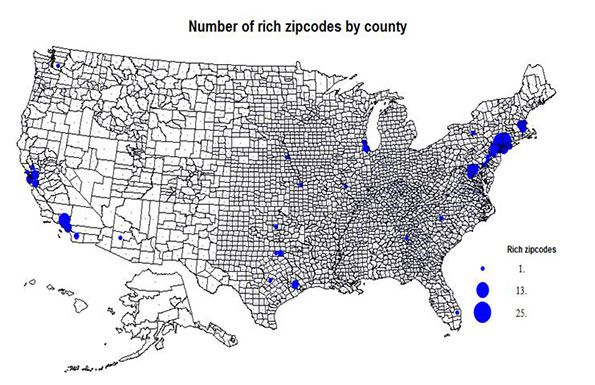
    Figure 1 maps the 170 zip codes with more than 1000 people and median incomes over $150,000 or mean incomes over $200,000. The most astounding thing about the map (which shows the number of rich zip codes by the county they are part of) is their  concentration  in a few areas, led by the country’s premier global city, greater New York city, with 75 of the 170. New York is followed by Washington DC with 23, another sign of the growing wealth of the national capital.  Boston follows with 10, Los Angeles, 18, San Francisco (14), and Chicago (6) and then a scattering in other leading metropolitan areas. There is no such concentration of the super-rich in any rural or small town area. But many are quasi-rural suburban and exurban.

    Richest Zip Codes
    State County Place Zipcode Mean (thousands)
    NY Westchester Purchase 10577 363
    NY Nassau Westbury 11568 351
    IL Cook Kenilworth 60043 342
    NY Westchester Pound Ridge 10576 338
    CA San Mateo Atherton 94027 337
    PA Montgomery Gladwyne 19035 333
    CA Los Angeles Bel Air 90077 327
    NJ Essex Short Hills 07078 322
    NY Nassau Glen Head 11548 316
    CT Fairfield Weston 06883 286
    CT Fairfield New Canaan 06840 308
    IL Cook Glencoe 60022 297


    But, the reader will protest, there are huge numbers of rich folk in Texas, Florida, Ohio, Pennsylvania, and other states. The reason is that these many rich households are “diluted” in impact because the zip codes are more variable in income. There really is something remarkable about the overwhelming affluence of the key suburban areas of Westchester and Nassau, New York; Fairfield, CT; Fairfax, VA; and Howard and Montgomery, MD. But I believe the map is telling and accurate at highlighting the utter dominance of the economic power of New York and then Washington. Boston retains power beyond its size, while Los Angeles, Chicago, San Francisco, and upstarts in the South scramble for a place.

    The Richest Areas

    The zip code with the highest and the 4th highest incomes are in Westchester County, close to the Connecticut border. The second richest, Westbury, is in Nassau county, New York, which also has the 9th richest. Also in the NYC suburbs are the 8th, in New Jersey just 20 miles west of New York, while 10th and 11th richest are both located  in Fairfield County, CT.

    Chicago’s north Cook county has the 3rd (Kenilworth) and 12th (Glencoe) richest areas.  Los Angeles is home to the 7th richest, Bel Air (northwest of Beverly Hills), Atherton, in San Mateo county, is the 5th richest, and Gladwyne in Montgomery County, PA is the 6th richest.  Greater New York then is home to 7 of the 12 richest, followed by Chicago with 2.  Quite a concentration. 

    The Poorest Zip Codes

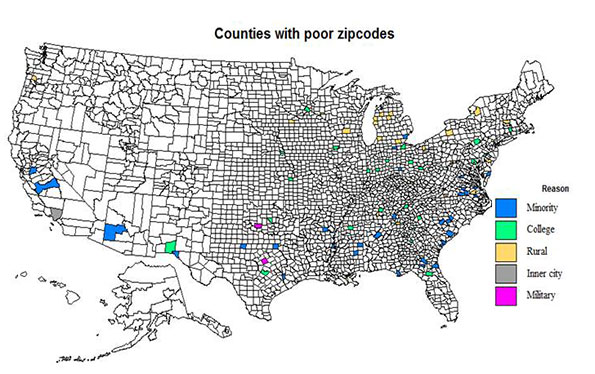
    The list and map (Figure 2) of counties with poor zip codes may surprise the reader more. I divide the 94 poorest areas into five types:

    • minority population domination, 35 areas,
    • college or university student majorities, with 25 places,
    • rural (in the sense of small communities in these counties having been left behind or declined) some 25 areas,
    • five inner city areas dominated by single men, 5, and
    • two areas dominated by a large military base.

    The poor college areas are zip codes for student dormitory housing, people who are temporarily poor; some military base areas are similarly poor because of barrack housing of single people.

    The poorest minority dominated areas are mainly Black and in the rural to small city South, except for a few Hispanic dominated areas in the west. The college poor areas are scattered across the country, especially in the East, the military base communities in Texas and Oklahoma. The rural set is surprisingly concentrated mainly in the north, especially in Michigan. The few inner city poor areas are in Los Angeles, Waterbury, CT: Portland, OR; Youngstown and Canton, OH; an odd set. A few of the rural areas also have correctional institutions.

    Poorest Zip Codes
    State County Place Zipcode Median
    NE Douglas Omaha 68178 $2,499
    KY Elliott Burke 41171 $3,494
    GA Clinch Cogdell 31634 $3,886
    FL Gulf Wawahitchka 32465 $4,481
    CT Tolland Storrs 06269 $6,124
    WI Dane Madison 53706 $6,359
    VA Nottoway Blackstone 23824 $6,421
    MI Clare LeRoy 49665 $6,639
    TN Rutherford Murfreesboro 37132 $7,125
    IN Delaware Muncie 47306 $6,750
    NY Cattaraugus Salamanca 14779 $7,395


    If I had relaxed limit by including more smaller population areas, or not quite such low incomes, many more college, military base, minority majority counties would appear on the map. But as noted up front, virtually none of these poorest zip codes are in big cities or their metropolitan areas, where millions of poor households live, simply because these metro zip codes tend to be large and more heterogeneous. This also does not factor in the cost of living, which can be high in some regions, particularly on the east and west coasts.

    The Poorest Areas

    The 12 poorest zip codes are different and quite varied in character. Five of the zip codes are essentially college or university student housing, and thus not indicative of an adult working population. Three areas are in part poor because of the presence of correctional institutions or adult care institutions. Two of these also have a significant minority (Black) population. Two rural areas, in GA and VA have high Black shares. This leaves two northern rural areas in Michigan (high seasonal dependency) and in New York, Salamanca, also a seasonal resort, as well as an Indian reservation.

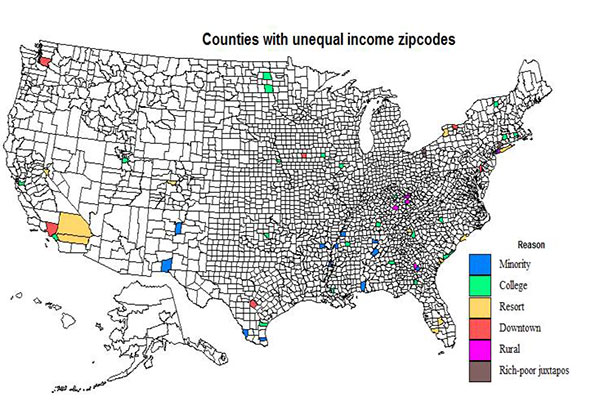
    Unequal Zip Code

    The unequal zip codes (67) are mainly areas where the mean is at least twice the median, showing the disproportionate effect of a few very wealthy households. One critical area for high inequality are primarily beach or mountain communities with richer retirees serviced by lower-paid workers; these include 13 areas in California, South Carolina, Florida, New York, Nevada, North Carolina, and Colorado. Downtowns (8 areas) include a few actual downtown CBD zip codes with an older poor population and newer rich folk. Rural here identifies mainly small Kentucky zip codes with a very imbalanced income pattern (7 areas). Finally I note a few zip codes in exurban areas where there appears to be a juxtaposition of an older resident population, and newer wealthier households (3 areas). This pattern may become more common in both exurban and rural small-town environmental amenity areas.

    Most Unequal Zip Codes
    State County Place Zipcode Median Mean
    CA Alameda Berkeley 94720 $16,192 $79,238
    SC Pickens Clemson 29634 $12,159 $51,444
    LA E Carroll Transylvania 71286 $28,961 $96,377
    TX Starr 3 zips 78536etc $29,722 $98,048
    KY Elliott Ezel 41425 $29,980 $65,676
    TN Rutherford Murfreesboro 37132 $7,125 $21,863
    MA Suffolk Boston 02111 $31,442 $62,087
    VA Radford Radford 24142 $15,931 $46,860
    ND Cass Fargo 58105 $24,750 $70,633
    DC DC WashingtonDC 20006 $12,103 $32,155
    TX Bexar San Antonio 78205 $25,779 $69,628
    NC New Hanover WrightsvilleBch 28480 $70,375 $184,658
    NV Douglas Glenbrook 89413 $68,512 $172,004


    The Most Unequal Areas

    Of the 13 most unequal areas, 6 are college or university zip codes, areas with poor students and much higher income professionals. Two are downtown zip codes, Boston and San Antonio, two are minority population areas, Louisiana and Texas. Two are resort areas, in Nevada and North Carolina, but several similar areas are not far down on the list. One Kentucky area is classed as just rural, but again other similar counties are on the fuller list.

    Several zip codes are on both the poorest and the unequal zip code lists, most commonly the college and the minority-dominated areas. Rich suburban and exurban areas tend to be fairly consistently rich, resort areas tend to be more unequal.

    Conclusion

    The zip code data provide a partial, highly localized look at the geography of inequality. If American society continues to accept extreme income, the geography of inequality will only become not only more extreme, but more pronounced in a diverse set of locations.

    Richard Morrill is Professor Emeritus of Geography and Environmental Studies, University of Washington. His research interests include: political geography (voting behavior, redistricting, local governance), population/demography/settlement/migration, urban geography and planning, urban transportation (i.e., old fashioned generalist).

  • Moving South and West? Metropolitan America in 2042

    The United States could have three more megacities (metropolitan areas over 10 million) by 2042, according to population projections released by the United States Conference of Mayors (USCM). Chicago, Dallas-Fort Worth, and Houston  are projected to join megacities New York and Los Angeles as their metropolitan area populations rise above 10 million. At the projected growth rates, Atlanta, Miami, Phoenix, and Riverside-San Bernardino could pass the threshold by 2060. The population projections were prepared for USCM by Global Insight IHS.

    USCM anticipates that the number of major metropolitan areas – those over 1,000,000 population –- will rise from 51 in 2012 to 70 in 2042 (Note). The additional 19 major metropolitan areas range from Honolulu, which should exceed the million threshold next year, to Colorado Springs. California would add four new major metropolitan areas, including Fresno, Bakersfield, and Stockton from the San Joaquin Valley and Oxnard, which is adjacent to Los Angeles. Texas would add two, McAllen and El Paso, as would Florida (Cape Coral and Sarasota) and South Carolina (Columbia and Charleston).

    The Top 10 in 2042

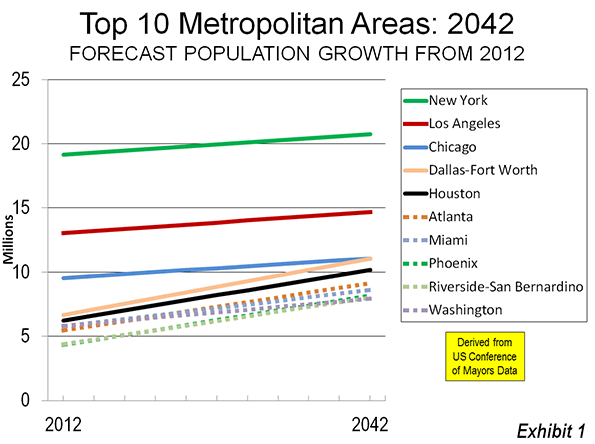
    The top ten rankings would change relatively little. The top five would continue to be (in order), New York, Los Angeles, Chicago, Dallas-Fort Worth, and Houston. But the relationships would change materially. Dallas-Fort Worth would trail Chicago by only 30,000, much reduced from the 2012 gap of 2.9 million. If the annual projected growth rate were to continue another year (to 2043), Dallas-Fort Worth would take third position from Chicago, ending more than eight decades in that position. Houston also is forecast to gain substantially on Chicago, from a deficit of 3.3 million in 2012 to only 900,000 in 2042. If the respective annual growth rates were to continue, Houston would bump Chicago to fifth place by 2050.

    Atlanta would move up three positions to number 6, and could be the nation’s 6th megacity before 2050. Miami would move from 8th to 7th. There would be two new entrants to the top ten: Phoenix and Riverside-San Bernardino, ranked 8th and 9th. These two, along with Miami could become megacities before 2060. The tenth position would be held by fast growing Washington, which would remain the only non megacity in the top ten.

    Seven of the top ten metropolitan areas in 2042 are forecast to grow very rapidly. Phoenix and Riverside-San Bernardino are projected to grow at annual rates of 2.1 percent and 2.0 percent respectively, approximately three times the 2012-2042 national growth rate projected by the US Census Bureau (0.7 percent). Atlanta, Dallas-Fort Worth and Houston would grow at 2.5 times the national rate (1.7 percent), Miami nearly double (1.3 percent) and Washington at 1.5 times the national rate (1.0 percent).

    Washington is technically in the South, which according to the US Census Bureau begins at the Mason-Dixon line, or the Pennsylvania-Maryland border. This means that all of the fast growing top 10 metropolitan areas are in the South or West, a pervasive trend discussed later in this article.

    Meanwhile, the three largest metropolitan areas would have well below average growth. New York would grow the slowest, at 0.3 percent. Chicago would grow at 0.5 percent annually, faster than Los Angeles, a national growth leader for a century, which would grow at only a 0.4 percent annual rate (Figure 1).

    Fastest Growth Major Metropolitan Areas

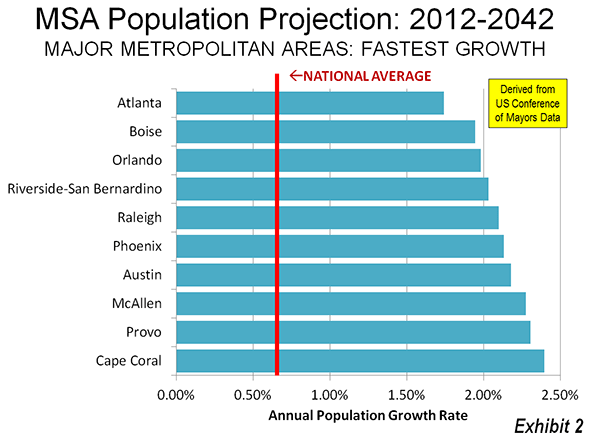
    Among the 70 major metropolitan areas, the fastest growing would be Cape Coral, Florida, with an annual growth rate of 2.4 percent. Provo, Utah and McAllen, Texas would grow at 2.3 percent. Six of the ten fastest growing metropolitan areas already have more than 1,000,000 population, including Austin, Phoenix, Raleigh, Riverside-San Bernardino, and Atlanta (10th). Boise would be the 9th fastest growing (Figure 2)

    Slowest Growth Major Metropolitan Areas

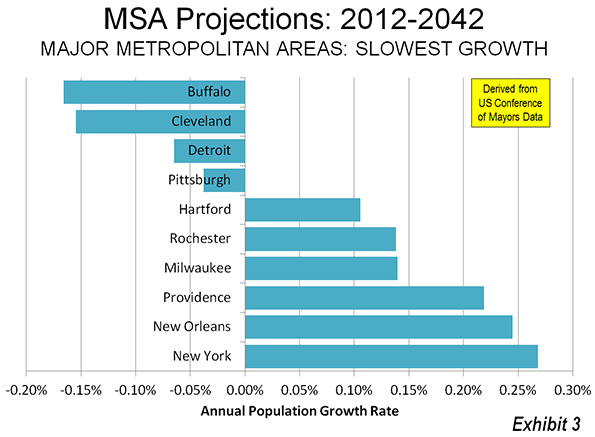
    Four of 2042’s major metropolitan areas would lose population from 2012, including Buffalo, Cleveland, Detroit, and Pittsburgh. Hartford, Rochester, Milwaukee, and Providence would grow at less than one-third the national population growth rate. New Orleans and New York would round out the bottom ten, growing at an annual rate of approximately 0.25 percent (Figure 3).

    Though Los Angeles is not among the bottom ten (it would #13), it is notable that its growth rate is projected to be slightly less than St. Louis, long a laggard, and only slightly better than Philadelphia. Philadelphia has been losing position regularly since it was the nation’s largest city, before the first US census (1790).

    Regional Distribution of Growth

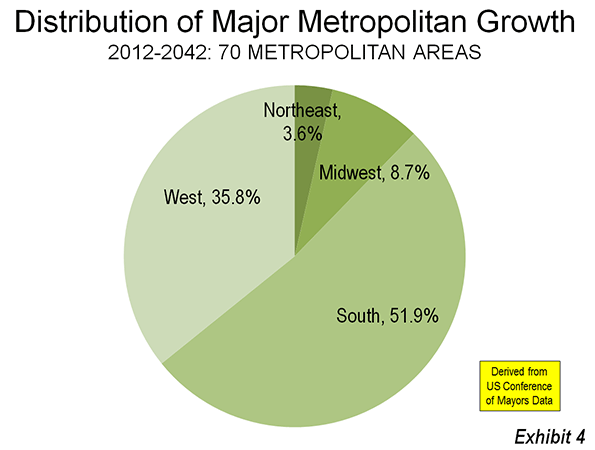
    According to the USCM projections, the overwhelming majority of major metropolitan area population growth (70 areas) will occur in the South and West. Approximately 51 percent of the major metropolitan growth is expected in the South, which would add 33 million residents. The West would capture 36 percent of the growth, while adding 22 million residents. The Midwest would capture only 9 percent of the growth, adding 8 million residents, while the Northeast would take 4 percent of the growth, while adding only 2 million residents (Figure 4).

    The South would grow at an annual rate double that of the national 0.7 percent rate (1.4 percent). The West would be close behind (1.2 percent). However, if the major metropolitan areas of coastal California were excluded from the West (Los Angeles, San Francisco, San Diego, and San Jose), the West would grow even faster than the South (1.6 percent). Coastal California’s annual growth rate is projected at 0.6 percent, below the national average of 0.7 percent.

    The Northeast and the Midwest would both grow at less than the national growth rate (0.2 percent and 0.5 percent respectively). The fastest growing metropolitan area in the Midwest is projected to be Indianapolis, at a respectable 1.2 percent growth rate (ranking 32 out of 70). Midwestern Omaha, Kansas City, and Columbus would also grow faster than the nation.

    The fastest growing major metropolitan area in the Northeast would be Philadelphia, which would add only 0.3 percent to its population annually (ranking 59th). Philadelphia would add only slightly more residents than Provo, Utah, despite being more than 10 times as large in 2012.

    Projections are Projections

    Projecting anything can be risky. Unforeseen circumstances could result in a materially different future than forecasts suggest. No reputable forecaster, for example would have predicted during the 20th century that North Dakota would become the nation’s fastest growing state in the early 2010s. Upstate New York, for example, could experience an economic turnaround if state allows them to take advantage of hydraulic fracking. The long-suffering Buffalo and Rochester metropolitan areas could rise well above current expectations. It is probably far too much to expect any major material progress in California, with a business climate so colorfully dismissed by The Economist in its current edition (see The Not So Golden State).

    The USCM projections to 2042 indicate a continuation of geographical trends that have been strengthening virtually every decade since the middle of the last century. Barring any sea-changes, they are more likely to be more right than wrong.

    ————————

    Note: The USCM projections were prepared before the revision of metropolitan area boundaries in 2013. This revision added Grand Rapids as the 52nd major metropolitan area. Had the new definitions been available, Grand Rapids would have been the 71st major metropolitan area. Generally, there were only minor changes in the major metropolitan area definitions, the most significant being New York, Charlotte, Grand Rapids, and Indianapolis.

    ————–

    Wendell Cox is a Visiting Professor, Conservatoire National des Arts et Metiers, Paris and the author of “War on the Dream: How Anti-Sprawl Policy Threatens the Quality of Life.

    Photo: Cape Coral, Florida: Projected Fastest Growing Major Metropolitan Area: 2012-2042 (by author)

  • Why State Economic Development Strategies Should Be Metro-Centric

    Globalization, technology, productivity improvements, and the resulting restructuring of the world economy have led to fundamental changes that have destroyed the old paradigms of doing business. Whether these changes are on the whole good or bad, or who or what is responsible for bringing them into being, they simply are. Most cities, regions, and US states have extremely limited leverage in this marketplace and thus to a great extent are market takers more than market makers. They have to adapt to new realities, but a lack of willingness to face up to the truth, combined with geo-political conditions, mean this has seldom been done.

    Three of those new realities are:

    1. The primacy of metropolitan regions as economic units, and the associated requirement of minimum competitive scale. It is mostly major metropolitan areas, those with 1-1.5 million or more people, that have best adapted to the new economy. Outside of the sparsely populated Great Plains, smaller areas have tended to struggle unless they have a unique asset such as a major state university. Even the worst performing large metros like Detroit and Cleveland have a lot of economic strength and assets behind them (e.g., the Cleveland Clinic) while smaller places like Youngstown and Flint have also gotten pounded yet have far fewer reasons for optimism. Many new economy industries require more skills than the old. People with these skills are most attracted to bigger cities where there are dense labor markets and enough scale to support items ranging from a major airport to amenities that are needed to compete.

    2. States are not singular economic units. This follows straightforwardly from the first point. As a mix of various sized urban and rural areas, regions of states have widely varying degrees of economic success and potential for the future. Their policy needs are radically different so the one size fit all nature of government rules make state policy a difficult instrument to get right. Additionally, many major metropolitan areas that are economic units cross state borders.

    3. Many communities may never come back, and many laid-off workers may never be employed again. Realistically, many smaller post-industrial cities are unlikely to ever again by economically dynamic no matter what we do. And lost in the debate over the n-th extension of emergency unemployment benefits is the painful reality that for some workers, especially older workers laid off from manufacturing jobs, there’s no realistic prospect of employment at more than near minimum wage if that. As Richard Longworth put it in Caught in the Middle, “The dirty little secret of Midwest manufacturing is that many workers are high school dropouts, uneducated, some virtually illiterate. They could build refrigerators, sure. But they are totally unqualified for any job other than the ones they just lost.” This doesn’t even get to the big drug problems in many of these places. This isn’t everybody, but there are too many people who fall into that bucket.

    I want to explore these truths and potential state policy responses using the case study of Indiana. An article in last week’s Indianapolis Business Journal sets the stage. Called “State lags city with science, tech jobs” it notes how metropolitan Indianapolis has been booming when it comes to so-called STEM jobs (Science, Technology, Engineering, Math). Its growth rate ranked 9th in the country in study of large metro areas. However, the rest of Indiana has lagged badly:

    Indiana for more than a decade has blown away the national average when it comes to adding high-tech jobs. But outside the Indianapolis metro area, there isn’t much cause for celebration.

    Careers in science, technology, engineering and math—typically referred to as STEM fields—have surged in growth compared to other careers in Marion and Hamilton counties. It’s a boon for economic development, considering the workers earn average wages almost twice as high as all others, and employers sorely need the skills. Dozens of initiatives focus on building STEM jobs in the state.

    A recent report ranked the Indianapolis-Carmel metro area ninth in the country in STEM jobs growth since the tech bubble burst in 2001. But while the metro area has grown, the rest of Indiana has barely budged from the early 2000s, an IBJ analysis of U.S. Bureau of Labor Statistics found.

    Indianapolis grew its STEM job base by 39% since 2001 while the rest of the state grew by only 10% (only 6% if you exclude healthcare jobs). Much of the state actually lost STEM jobs.

    This divergence between metropolitan Indianapolis (along with those smaller regions blessed with a unique asset like Bloomington (Indiana University), Lafayette (Purdue University) and Columbus (Cummins Engine)) and the rest of the state is a well-worn story by now. Here are a few baseline statistics that tell the tale.


    Item Metro Indianapolis Rest of Indiana
    Population Growth (2000-2012) 15.9% 4.1%
    Job Growth (2000-2012) 5.9% -7.2%
    GDP Per Capita (2012) $50,981 $34,076
    College Degree Attainment (2012) 32.1% 20.1%

    Additionally, there does appear to be something of a brain drain phenomenon, only it’s not brains leaving the state, it’s people with degrees moving from outstate Indiana to Indianapolis. From 2000-2010 a net of about 51,000 moved from elsewhere in Indiana to metro Indianapolis. As Mark Schill put it in the IBJ:

    “Indianapolis is somewhat of a sponge city for the whole region,” said Mark Schill, vice president of research at Praxis Strategy Group, an economic development consultant in North Dakota.

    The situation in Indiana, Schill said, is common throughout the United States: States with one large city typically see their engineers, scientists and other high-tech workers flock to the urban areas from smaller towns.

    Even I find it very surprising that of my high school classmates with college degrees, half of them live in Indianapolis – this from a tiny rural school along the Ohio River in far Southern Indiana near Louisville, KY.

    What has Indiana’s policy response been to this to date? I would suggest that the response has been to a) adjust statewide policy levers to do everything possible to reflate the economy of the “rest of Indiana” while b) making subtle tweaks attempt to rebalance economic growth away from Indianapolis.

    On the statewide policy levers, the state government has moved to imposed a one size fits all, least common denominator approach to services. The state centralized many functions in a recent tax reform. It also has aggressively downsized government, which now has the fewest employees since the 1970s. Tax caps, a comparative lack of home rule powers, and an aggressive state Department of Local Government Finance have combined to severely curtail local spending as well. Gov. Pence took office seeking to cut the state’s income tax rate by 10% (he got 5%), and now wants to eliminate the personal property tax on business. Indiana also passed right to work legislation.

    I call this “the best house on a bad block strategy.” I think Mitch Daniels looked around at Illinois, Ohio, and Michigan and said, “I know how to beat these guys.” Indiana is not as business friendly as places like Texas or Tennessee, but the idea was to position itself to capture a disproportionate share of inbound Midwest investment by being the cheapest. (I’ll get to Pence later).

    The subtle tweaks have been income redistribution from metro Indianapolis (documented by the Indiana Fiscal Policy Institute) and using the above techniques and others to apply the brakes to efforts by metro Indy to further improve its quality of life advantage over many other parts of the state (see my column in Governing magazine for more). One obvious example is a recent move by the Indiana University School of Medicine to build full four year regional medical school campuses and residency programs around the state with the explicit aim of keeping students local instead of having them come to Indianapolis for medical training.

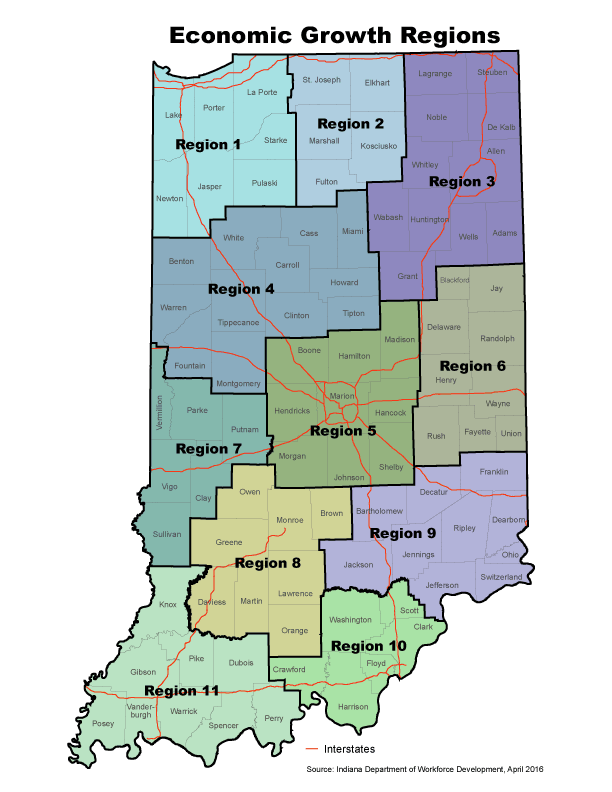
    What there’s been next to nothing of is any sense of metropolitan level or even regional thinking. The state does administer programs on a regional level, but the strategy is not regionally oriented and the administrative borders don’t even line up. Here are the boundaries of the various workforce development boards:
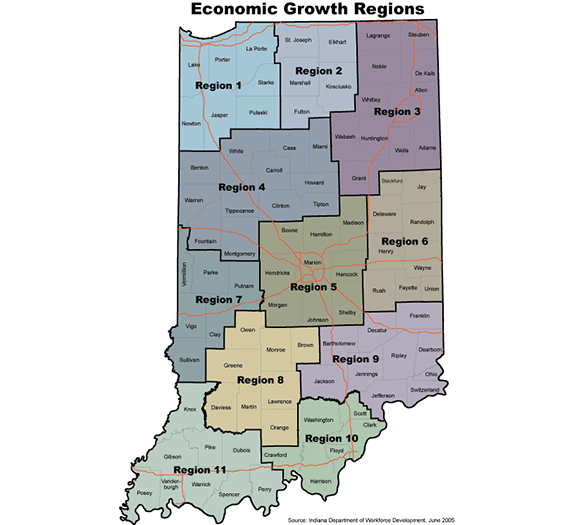

    There’s a semi-metropolitan overlay, but as I’ve long noted places like Region 6 are economic decline regions, not economic growth regions. Here’s how the Indiana Economic Development Corp. sees the world:
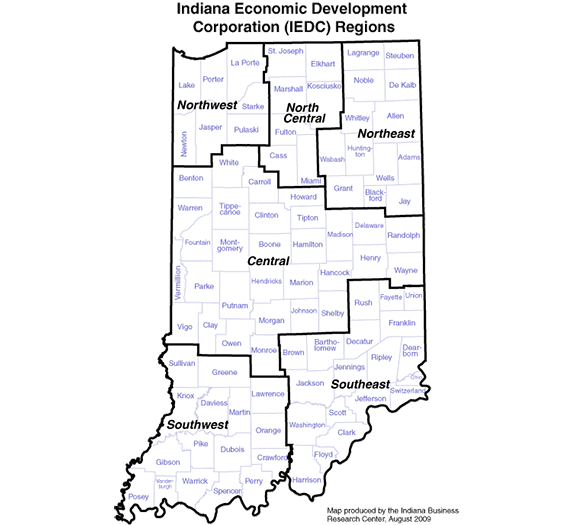


    These are not just agglomerations of the workforce districts, there are numerous differences between them. The point is that clearly the organization is driven by administrative convenience and the political need for field offices, not a metro-centric view of the world or strategy.

    Add it all up and it appears that Indiana has decided to fight against all three new realities above rather than adapting to them. It rejects metro-centricity, imposes a uniform policy set, and is oriented towards trying to reflate the most struggling communities. I don’t think this was necessarily a conscious decision, but ultimately that’s what it amounts to.

    When you fight the tape, you shouldn’t expect great results and clearly they haven’t been stellar. Since 2000, Indiana comfortably outperformed perennial losers Michigan and Ohio on job growth (well, less job declines), but trailed Kentucky, Wisconsin, Minnesota, Iowa, and Missouri. But notably, Indiana only outpaced Illinois by a couple percentage points. That’s a state with higher income taxes (and that actually raised them) that’s nearly bankrupt and where the previous two governors ended up in prison. Yet Indiana’s job performance is very similar. What’s more, Hoosier per capita incomes have been in free fall versus the national average, likely because it has only become more attractive to low wage employers.

    Fiscal discipline, low taxes, and business friendly regulations are important. But they aren’t the only pages in the book. Workforce quality counts for a lot, and this has been Indiana’s Achilles heel. (My dad, who used to run an Indiana stone quarry, had trouble finding workers with a high school diploma who could pass a drug test and would show up on time every day – hardly tough requirements one would think). Also aligning with, not against market forces is key.

    I will sketch out a somewhat different approach. Firstly, regarding the chronically unemployed, clearly they cannot be written off or ignored. However, I see this as largely a federal issue. We need to come to terms with the reality that America now has a population of some million who will have extreme difficulty finding employment in the new economy (see: latest jobs report). We’ve shifted about two million into disability rolls, but clearly we’ve to date mostly been pretending that things are going to re-normalize.

    For Indiana, the temptation can be to reorient the entire economy to attract ultra low-wage employers, then cut benefits so that people are forced to take the jobs. I’ve personally heard Indiana businessmen bemoaning the state’s unemployment benefits that mean workers won’t take the jobs their company has open – jobs paying $9/hr. Possibly the 250,000 or so chronically unemployed Hoosiers may be technically put back to work through such a scheme – eventually. But it would come at the cost of impoverishing the entire state. Creating a state of $9/hr jobs is not making a home for human flourishing, it’s building a plantation.

    Instead of creating a subsistence economy, the focus should instead be on creating the best wage economy possible, one that offers upward mobility, for the most people possible, and using redistribution for the chronically unemployed. You may say this is welfare – and you’re right. But I would submit to you that the state is already in effect a gigantic welfare engine. In addition to direct benefits, the taxation and education systems are redistributionist, and the state’s entire economic policy, transport policy, etc. are targeted at left-behind areas (i.e., welfare). Even corrections is in a sense warehousing the mostly poor at ruinous expense. So Indiana is already a massive welfare state; we are just arguing about what the best form is. I think sending checks is much better than distorting the entire economy in order to employ a small minority at $9/hr jobs – but that’s just me. Again, we are in uncharted territory as a country and this is ultimately going to require a national response, even if it’s just swelling the disability rolls even more. I do believe people deserve the dignity of a job, but we have to deal with the unfortunate realities of our new world order.

    With that in mind, the right strategy would be metro-centric, focusing on building on the competitively advantaged areas of the state – what Drew Klacik has called place-based cluster – and competitively advantaged middle class or better paying industries.

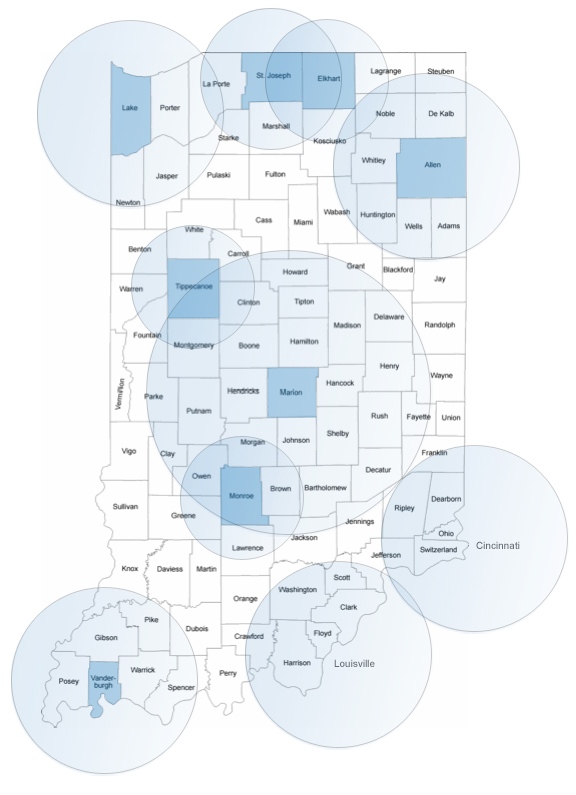
    Contrary to some of the stats above, this is not purely an Indianapolis story. Indiana has a number of areas that are well-positioned to compete. Here’s a map with key metro regions highlighted:
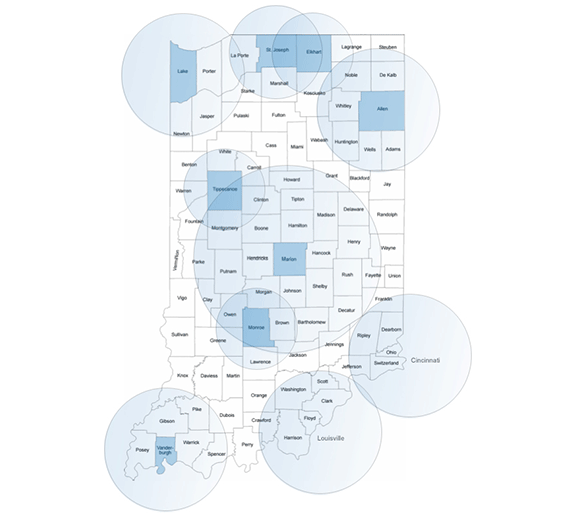


    This may look superficially like the maps above, but it is explicitly oriented around metro-centric thinking. Metro Indy has been doing reasonably well as noted. But Bloomington, Lafayette, and Columbus (sort of small satellite metros to Indy) have also done very well. In fact, all three actually outperformed Indy on STEM job growth.

    Additionally, three other large, competitively advantaged metro areas take in Indiana territory: Chicago, Cincinnati, and Louisville. These are all, like Indy, places with the scale and talent concentrations to win. True, none of the Indiana counties that are part of those metros is in the favored quarter. But they still have plenty of opportunities. I’ve written about Northwest Indiana before, for example, which should do well if it gets its act together.

    This covers a broad swath of the state from the Northwest to the Southeast. It comes as no surprise to me that Honda chose to locate its plant half way between Indianapolis and Cincinnati, for example.

    The state should align its resources, policies, and investments to enable these metro regions to thrive. This doesn’t mean jacking up tax rates. Indiana should retain its competitively advantaged tax structure. But it should mean no further erosion in Indiana’s already parsimonious services. The state is already well-positioned fiscally, and in a situation with diminishing marginal returns to further contraction.

    Next, empower localities and regions to better themselves in accordance with their own strategies. This means an end to one size fits all, least common denominator thinking. These regions need to be let out from under the thumb of the General Assembly. That means more, not less flexibility for localities. Places like Indianapolis, Bloomington, and Lafayette would dearly love to undertake further self-improvement initiatives, but the state thinks that’s a bad idea. (I believe this is part of the subtle re-balancing attempt I mentioned).

    It also means using the state’s power to encourage metro and extended region thinking. For example, last year within a few months of each other the mayors of Indianapolis, Anderson, and Muncie all made overseas trade trips – separately and to different places. That’s nuts. The state should be encouraging them to do more joint development.

    This also means recognizing the symbiotic relationship that exists between the core and periphery in the extended Central Indiana region, clearly the state’s most important. The outlying smaller cities, towns, and rural areas watch Indianapolis TV stations, largely cheer for its sports teams, get taken to its hospitals for trauma or specialist care, fly out of its airport, etc. Metro Indianapolis and its leadership have also basically created and funded much of the state’s economic development efforts (e.g., Biocrossroads) and many community development initiatives (the Lilly Endowment). Many statewide organizations are in effect Indianapolis ones that do double duty in serving the state. For example, the Indiana Historical Society. (There is no Indianapolis Historical Society).

    On the other side of the equation, Indianapolis would not have the Colts and a lot of other things without the heft added from the outer rings out counties that are customers for these amenities. It benefits massively from that, particularly since it’s a marginal scale city. One of the biggest differences between Indy and Louisville is that Indy was fortunate enough to have a highly populated ring of counties within an hour’s drive.

    So in addition to aligning economic development strategies around metros, and freeing localities to pursue differentiated strategies, the state should encourage the next ring or two of counties that are in the sphere of influence of major metros to align with their nearest larger neighbor.

    Contrary to popular belief, this is a win-win. When I was in Warsaw, Indiana, people were concerned that many highly paid employees of the local orthopedics companies lived in Ft. Wayne. From a local perspective, that’s understandable and obviously they want to be competitive for that talent and should be all means go for it. On the other hand, what if Ft. Wayne wasn’t there for those people to live in? Would those orthopedics companies be able to recruit the talent they need to stay located in small town Indiana?

    It’s similar for other places. Michael Hicks, and economist at Ball State in Muncie, said, “Almost all our local economic policies target business investment and masquerade as job creation efforts. We abate taxes, apply TIFs and woo businesses all over the state, but then the employees who receive middle-class wages (say $18 an hour or more) choose the nicest place to live within a 40-mile radius. So, we bring a nice factory to Muncie, and the employees all commute from Noblesville.” Maybe Muncie isn’t completely happy about this, understandably. But would they have been able to recruit those plants at all (and the associated taxes they pay and the jobs for anybody who does stay local) if higher paid workers didn’t have the option to live in suburban Noblesville? Would the labor force be there?

    I saw a similar dynamic in Columbus. Younger workers recruited by Cummins Engine chose to live in Greenwood (near south suburban Indy). Columbus wants to keep upgrading itself to be more attractive – a good idea. But the ability to reverse commute from Indy is an advantage for them.

    Louisville, Kentucky has one of the highest rates of exurban commuting the country because so many Hoosiers in rural communities drive in for good paying work.

    This is the sort of thinking and planning that needs to be going on. Realistically, most of these small industrial cities and rural areas are not positioned to go it alone and they shouldn’t be supported by the state in attempting to do so. They need to a align with a winning team.

    There are two groups of places that require special attention. One is the mid-sized metro regions of Ft. Wayne, Evansville, and South Bend-Elkhart. These places are too far from larger metros and aren’t large enough themselves to have fully competitive economies. No surprise two of the three lost STEM jobs. Evansville has done better recently on the backs of Toyota, but has a vast rural hinterland it cannot carry with its small size. The region has done ok of late, but it has also received gigantic subsidies in the form of multiple massive highway investments, and now a massive coal gasification plant subsidy. I don’t believe this is sustainable. These places need special assistance from the state to devise and implement strategies.

    The other grouping consists of rural and small industrial areas that are too far outside the orbit of a major metro to effectively align with it. This would includes places like Richmond or Blackford County. They might get lucky and land a major plant, but realistically they are going to require state aid for some time to maintain critical services.

    For the last two groups especially, there also needs to be a commitment by the state’s top brain hubs – Indy and the two university towns – to applying their intellectual and other resources to the difficult problem at hand. Part of that involves helping them be the best place of their genre that they can. While cities are competitively advantaged today, not everybody wants to live in one. So there is still an addressable market, if not as large, for other places.

    Put it together and here’s the map that needs to be changed. It’s percentage change in jobs, 2000-2012:
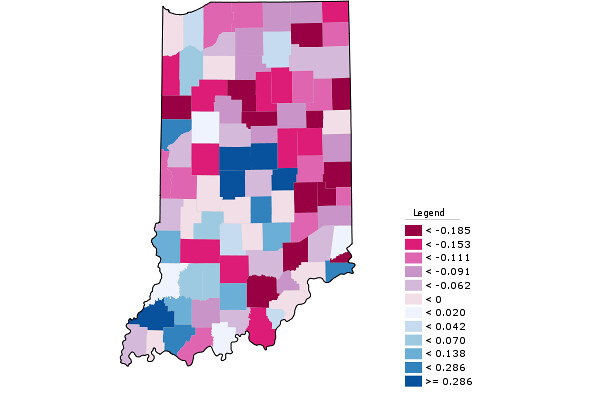


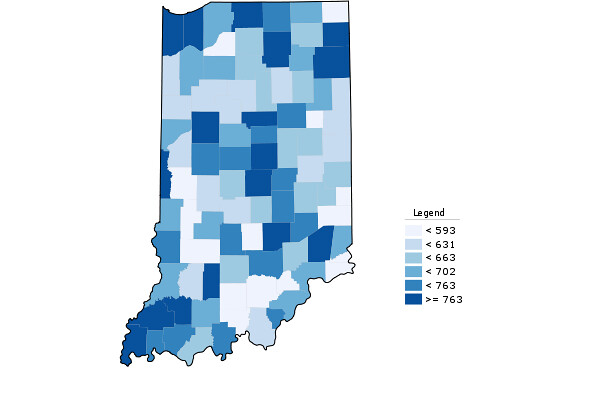
    Pretty depressing. Urban core counties had some losses, but suburban Indy, Chicago, and Cincy did decently (Louisville’s less well), plus Bloomington area, Lafayette, and Columbus. You see also the strong performance of Southwest Indiana which is fantastic, but the sustainability of which I think is in question. Wages are higher in metro areas too, by the way. Here’s the average weekly wage in 2012, which shows most of the state’s metros doing comparatively well:


    In short, I suggest:

    – Retain lean fiscal structure but limit further contractions
    – Goal is to build middle class or better economy, not bottom feeding
    – Align economic development efforts to metro areas, particularly larger, competitively advantages locations. Align capital investment in this direction as well.
    – Greater local autonomy to pursue differentiated strategies for the variegated areas of the state
    – Special attention/help to strategically disadvantaged communities, but not entire state policy directed to servicing their needs.
    – Utilization of transfers for the chronically unemployed pending a federal answer, but again, not redirection of state policy to attract $9/hr jobs.

    This requires a lot of fleshing out to be sure, but I think is broadly the direction.

    Back to Gov. Mike Pence, would he be on board with this? He’s Tea Party friendly to be sure and interested in fiscal contraction. But he’s not a one-trick pony. He’s actually taken some interesting steps in this regard. He is subsidizing non-stop flights from Indianapolis to San Francisco for the benefit of the local tech community. He also wants to establish another life sciences research institute in Indy. And he’s talked about more regionally focused economic development efforts. It’s a welcome start. I think he groks the situation more than people might credit him for. Keep in mind that he did not establish the state’s current approach, which arguably even pre-dated Mitch Daniels, and he has to deal with political realities. And if as they say only Nixon could go to China, then although a reorienting of strategy is not about writing big checks, still perhaps only someone with conservative bona fides like Pence can push the state towards a metro-centric rethink.

    Aaron M. Renn is an independent writer on urban affairs and the founder of Telestrian, a data analysis and mapping tool. He writes at The Urbanophile, where this piece originally appeared.
  • Correcting Priorities: The 10th Annual Demographia Housing Affordability Survey

    Alain Bertaud of the Stern School of Business at New York University and former principal planner of the World Bank introduces the 10th Annual  Demographia International Housing Affordability Survey by urging planners to abandon:

    "…abstract objectives and to focus their efforts on two measurable outcomes that have always mattered since the growth of large cities during the 19th century’s industrial revolution: workers’ spatial mobility and housing affordability".

    This year’s edition has been expanded to nine geographies, including Australia, Canada, Hong Kong, Ireland, Japan, New Zealand, Singapore, the United Kingdom, and the United States. A total of 85 major metropolitan areas (of over 1,000,000 population) are covered, including five of the six largest metropolitan areas in the high income world (Tokyo-Yokohama, New York, Osaka-Kobe-Kyoto, London, and Los Angeles). Overall, 360 metropolitan markets are included.

    View the map with housing data for all markets created by the New Zealand Herald.

    The Affordability Standard

    The Demographia International Housing Affordability Survey uses a price-to-income ratio called the "median multiple," calculated by dividing the median house price by the median household income. Following World War II, virtually all metropolitan areas in Australia, Canada, Ireland, New Zealand, the United Kingdom, and the United States had median multiples of 3.0 or below. However, as urban containment policies have been implemented in some metropolitan areas, house prices have escalated well above the increase in household incomes. This is exactly the effect that economics predicts to occur where the supply of a good or service is rationed, all things being equal.

    Even a decade ago, there was considerable evidence of the rapidly deteriorating housing affordability in markets with urban containment policy. Yet, governments implementing these policies were largely ignoring not only the trends, but also any reference to the extent of the losses in historic context. Co-author Hugh Pavletich of Performance Urban Planning and I established the Demographia International Housing Affordability Survey to draw attention to this policy driven attack on the standard of living.

    The Demographia Survey rates housing affordability as follows:

    Demographia Housing Affordability Rating Categories

    Rating

    Median Multiple

    Severely Unaffordable

    5.1 & Over

    Seriously Unaffordable

    4.1 to 5.0

    Moderately Unaffordable

    3.1 to 4.0

    Affordable

    3.0 & Under

    Affordability in the 9 Geographies

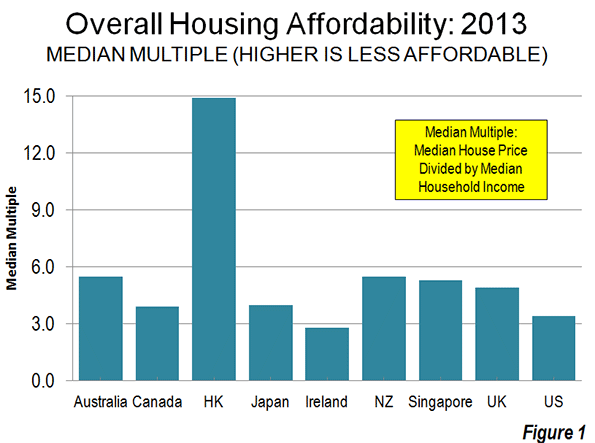
    Among the nine geographies and all 360 markets, Ireland emerges has the most affordable, with a median market multiple of 2.8. The United States follows at 3.4, and Canada at 3.9. Japan’s median market multiple is 4.0, while the United Kingdom is at 4.9 and Singapore at 5.1 The other geographies are all well into the severely unaffordable category, including Australia and New Zealand, at 5.5, and far worse Hong Kong, at 14.9 (Figure 1).

    Costly Hong Kong & Vancouver, Affordable Pittsburgh and Atlanta

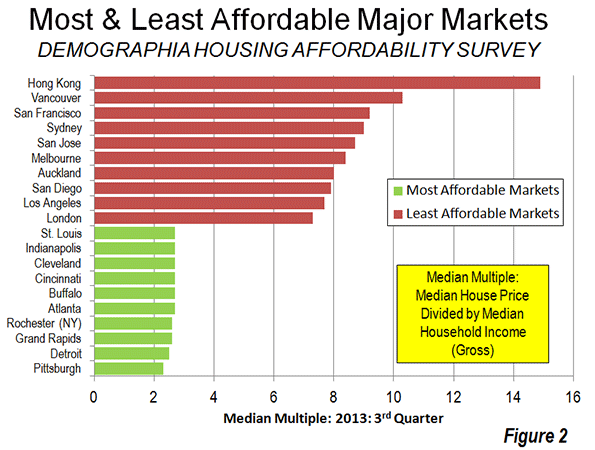
    For the fourth year in a row, Hong Kong is the least affordable major metropolitan area, with a median multiple of 14.9, three times its early 2000s ratio. Vancouver is again the second most unaffordable major market, with a median multiple of 10.3, three times its pre-urban containment level. Housing affordability in coastal California is well on the way to the stress of the 2000s. San Francisco ranks third most unaffordable at 9.2 and nearby San Jose is at 8.7, with San Diego (7.9) and Los Angeles (7.7) following closely. Sydney, at 9.0, ranks fourth with Melbourne at 8.4 and Auckland at 8.0.All of these metropolitan areas have had serious deterioration of housing affordability since adopting urban containment policy.

    All of the affordable major metropolitan areas are all in the United States. Pittsburgh is the most affordable, at 2.3. There are 13 additional major affordable housing markets, which include growing and over-5 million Atlanta as well as Indianapolis and Columbus, with their strong economies (Figure 2).

    Japan

    Notably, Japan’s two largest metropolitan areas, Tokyo-Yokohama and Osaka-Kobe-Kyoto have avoided the severely unaffordable territory occupied by the other three megacities (New York, Los Angeles, and London). Osaka-Kobe-Kyoto has the best housing affordability of any megacity, at 3.5 (moderately unaffordable) and Tokyo-Yokohama is at 4.4 (seriously unaffordable).

    House Size

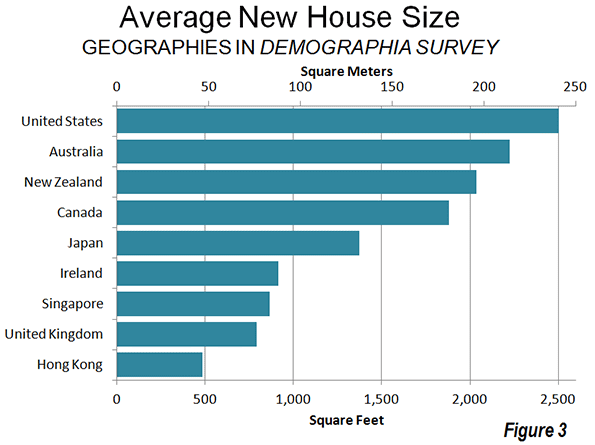
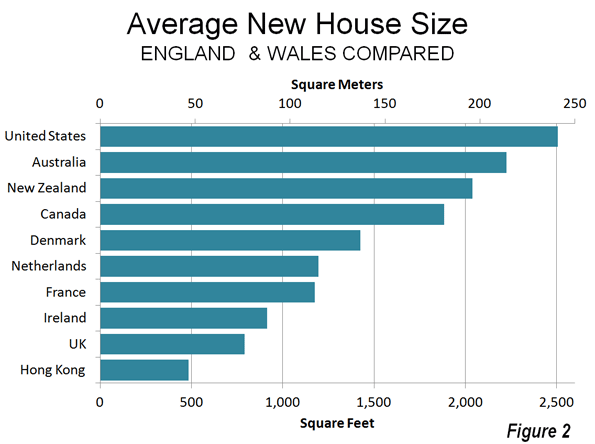
    This year’s Demographia Survey also provides information on average new house size in the nine geographies (Figure 3). The largest houses are in the United States, which is second only to Ireland in affordability. The smallest houses are in Hong Kong, which also has the least affordable housing. In living space those who pay the most get the least, while those who pay the least get the most.

    The Imperative for Reform

    Housing is the largest element of household budgets, and its cost varies the most between metropolitan areas. Where households pay more than necessary for housing, they have less dicsretionary income and lower standards of living and there is more poverty. This is a natural consequence of planning policies that place the urban form above the well-being of people. One of the principal justifications is environmental, but the gains from urban containment policy are scant and exorbitantly expensive.

    Virtually all of the geographies covered in the Demographia Survey are facing more uncertain economic futures than in the past. As is always the case in such situations, lower income households tend to be at greatest risk, while younger households have much less chance of living as well as their parents (except those fortunate enough to inherit their wealth or housing).

    There is no more imperative domestic policy imperative than improving the standard of living and minimizing poverty. Planning must facilitate that, not get in the way. Bertaud is hopeful:

    "But if planners abandoned abstracts and unmeasurable objectives like smart growth, liveability and sustainability to focus on what really matters –  mobility and affordability – we could see a rapidly improving situation in many cities.  I am not implying that planners should not be concerned with urban environmental issues.  To the contrary, those issues are extremely important, but they should be considered a constraint to be solved not an end in itself."

    Download the full report (pdf):  10th Annual  Demographia International Housing Affordability Survey

    Photo: Suburban Tokyo (by author)

  • The Divisions In The One Percent And The Class Warfare That Will Shape Election 2014

    There’s general agreement that inequality will be the big issue of this election year. But to understand how this will play out you have to go well beyond the simplistic “one percent” against everyone else mantra that has to date defined discussion of inequality.

    Instead our politics increasingly are being shaped by a complex interplay of class interests across the electorate; class, not merely inequality, is emerging as the driving force of our politics. As Marx among others recognized, class structures can be complicated and contain many separate tendencies. For example, even the much-discussed “one percent” is hardly a cohesive group, but one deeply divided in ideology, geography and industry.

    For example, out of the 20 richest Americans on the 2013 Forbes 400 list, six have a record of favoring the Democrats in political donations, including the top two, Bill Gates and Warren Buffett. Eleven reliably back Republican candidates and causes, while Google founder Larry Page has only donated to his company’s PAC, Larry Ellison has funded both sides and Michael Bloomberg defies easy categorization.

    All three of the top individual political contributors last year — the Soros family, Jets owner Fred Wilpon and Facebook co-founder Sean Parker — also lean to the “party of the people.”

    The Democrats’ new and ascendant oligarchy, based in Silicon Valley, Hollywood, Wall Street and the media, are generally concentrated in the country’s most unaffordable cities, places with high degrees of inequality.

    This alliance is based not solely on attitude, but also sometimes self-interest. Hedge funds siphon up money from public pension funds desperate for the large gains necessary to meet the extravagant, unfunded benefits increases of Democratic politicians. Venture capitalists and companies and core Democratic supporters invest in “green” technology, made profitable largely by mandates, subsidies and government-backed loans.

    These oligarchs represent very different interests than the more traditional plutocracy, based largely in such mainstream endeavors as fossil fuel energy, agribusiness, manufacturing and suburban home development. These worthies, too, are obviously not slum-dwellers, but also live in more dispersed locations such as Houston, Dallas-Fort Worth, Atlanta, Oklahoma City and a host of much more obscure places, at least part of the time. They reflect the somewhat more conservative, fiscally particularly, world view of the broader 1% than their more left-leaning counterparts.

    With the power of money and access to media (particularly the new oligarchs), the two competing factions of the “one percent” will pour millions into trying to win over the other classes. The two key ones are what I call the yeomanry — the small property-owning, private-sector middle class — and America’s modern-day “clerisy”: university professors and administrators, government bureaucrats and those business interests tied closest to the governmental teat.

    One can expect with fair assurance that the clerisy will strongly support the president and the progressive wing of the Democratic Party. There are few groups as lock-step liberal as the universities, particularly the most important and influential ones. In 2012, A remarkable 96 percent of all donations from Ivy League employees went to the president, something more reminiscent of Soviet Russia than a properly functioning pluralistic academy. Public employee unions, charter members of the clerisy, have been among the biggest contributors to federal candidates, overwhelmingly Democrats over the past decade.

    Less certain are the political leanings of the yeomanry. These are not the people who generally benefit from the expansion of government; they are basically stuck being taxpayers. Their distaste for regulation varies, but is most strongly felt when it impacts their businesses or their communities. In 2008, rightfully disgusted by the failures of the Bush administration, they were divided, but in 2012 small business shifted decisively to the right — not enough to save the awful Romney campaign, but they still helped maintain the GOP majority in the House.

    The political calculus of the yeomanry, however, is very complex. Those who are older, and those who already own property, are likely to keep shifting toward the right, as long as the Republican lunatic fringe is kept under control. Obamacare taxes and the cancellations of individual insurance plans hit this group directly in the bottom line, and may do so even more in the future. But for younger members of this group, struggling to buy property or launch proper careers, may look to Washington to provide their health care and provide breaks on their student loans.

    Arguably the yeomanry will determine the winners in 2014. The big issue here may be over expectations for the future. Today there are many, on both right and left, who are telling the yeomanry that their day in the sun is over. Tyler Cowen suggests in the future “the average” skilled worker can expect to subsist on rice and beans. If they stay on the East or West Coast, they also may never be able to buy a house. On the left, particularly among greens and urban aesthetes, the message is not so different except they tend to think abandoning property ownership is a good thing, since multi-unit rental housing is more environmental friendly and communal.

    Sadly many member of the yeoman class — the vast majority of Americans today — believe that the pessimists are correct, and expect their children, will fare worse in the future. If they accept this conclusion, they may be tempted to join the third of Americans who consider themselves “lower” class. With increasingly little prospect of upward mobility, these voters understandably look to Washington and state capitals to redistribute wealth up to them.

    How this class politics plays out this year will determine the 2014 results, and likely politics for the generation to come. Oligarchs favoring Republicans will focus on how redistribution takes from the yeomanry to give to the poor and associated crony capitalists. The failings of Obamacare, the rise in taxes and regulations all play to their advantage. This will play well with the income categories – $50,000 to $200,000 annually — that now constitute the class base of the GOP.

    In opposition, the new oligarchs, and their allies in the clerisy, will seek to convince enough of the yeoman class that they need the government to enjoy anything like a middle-class life. The Obama cartoon The Life of Julia, with its emphasis on the helping hand of government , is not directed at the poor but what used to be an upwardly mobile class. Julia implicitly rejects traditional American middle-class values such as property ownership, marriage and family and embraces a new vision tied to growing dependency to both the Democratic Party and the state.

    Sadly, neither of these approaches addresses the key issue: weak economic growth and a decline in upward mobility. Republicans, in particular, do not tend to associate these things. They seem to believe that faster GDP growth will rebalance our inequality, or at least make it palatable. This misses the fact that we have just gone through one of the most unequal recoveries in history, accelerating the concentration of wealth in ever fewer hands. Growth, clearly, is not enough; what kind of growth must be part of the discussion.

    This perspective is critical if we are to address our class divide. Simply put we need to go beyond both “trickle down” economics — which both sets of oligarchs are understandably fine with — and a redistributionist approach, something that strengthens the hand of the clerisy and the politically connected at the expense of the yeomanry. What we need is something that combines largely free-market, libertarian economics with something like the traditional goal of social democracy.

    “We can have democracy in this country, or we can have great wealth concentrated in the hands of a few,” noted Justice Louis Brandeis,“but we can’t have both.” Over time, even conservatives and libertarians have to recognize that a republic irrevocably divided between the rich and the dependent poor can not turn out well. And for their part, progressives need to realize that the middle class can not be expected to serve as a piggy bank to assuage their delicate consciousness.

    The real issue before us is not inequality per se, but how to spread the ownership of property and improve opportunity; without this America devolves from the world’s exemplar into a second-rate Europe, with less charm, more division, and a national dream finally extinguished.

    This story originally appeared at Forbes.com.

    Joel Kotkin is executive editor of NewGeography.com and Distinguished Presidential Fellow in Urban Futures at Chapman University, and a member of the editorial board of the Orange County Register. He is author of The City: A Global History and The Next Hundred Million: America in 2050. His most recent study, The Rise of Postfamilialism, has been widely discussed and distributed internationally. He lives in Los Angeles, CA.

    Creative Commons photo “Income Inequality” by Flickr user mSeattle.

  • Female Executives Across the European Union

    A great divide exists between European countries when it comes to the issues of women’s career opportunities. Some countries have high female work participation and values that promote gender equality, while others lag behind. But a closer look shows that the share of women in managerial positions is in odds with other indicators of equality. Scandinavia, where we might expect to find most female directors and chief executives, has in fact the lowest share. Many more women have reached the top of the business sector in countries with relatively low female labor participation, and far from gender equal attitudes. Other factors, such as the scope of welfare state monopolies and hours invested in work, seem to crucially affect women’s chances to reaching the top of the business world.

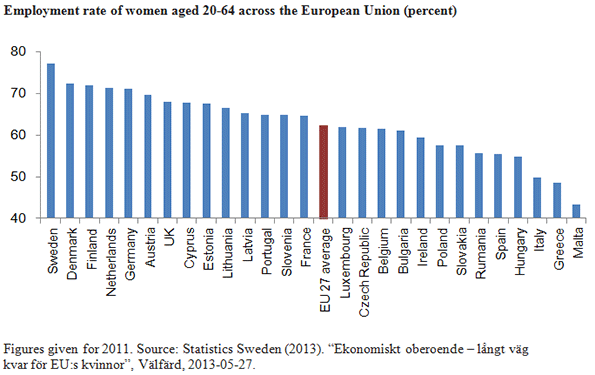
    The European Union has set the goal to achieve an employment level of 75 percent amongst women. So far, only Sweden exceeds this ambition with an employment level of fully 77 percent. Denmark, Finland, the Netherlands, Germany and Austria follow closely behind. In these five countries seven out of ten women working age are employed. It doesn’t seem a coincidence that these northern European nations share similar cultural and political attributes. The expansion of welfare states has historically encouraged womens’ entry into the workforce. Still today public childcare encourages women to invest time at work, whilst high taxes make it difficult to live on only one salary.

    Overall, the Eastern- and Central European countries have a lower share of women working, since it is more common with housewives. The three former Soviet states Estonia, Lithuania and Latvia are in particular interesting to look at. Not only are they Eastern European, and strongly committed to low taxes and free markets, but they also share Nordic cultural attributes. The three Baltic states have a respectably high level of two thirds of women in employment. This is somewhat higher than the European average, and considerably more so than in parts of Southern Europe. In Malta and Greece, fewer than half of the women work. In Italy exactly half of them do.

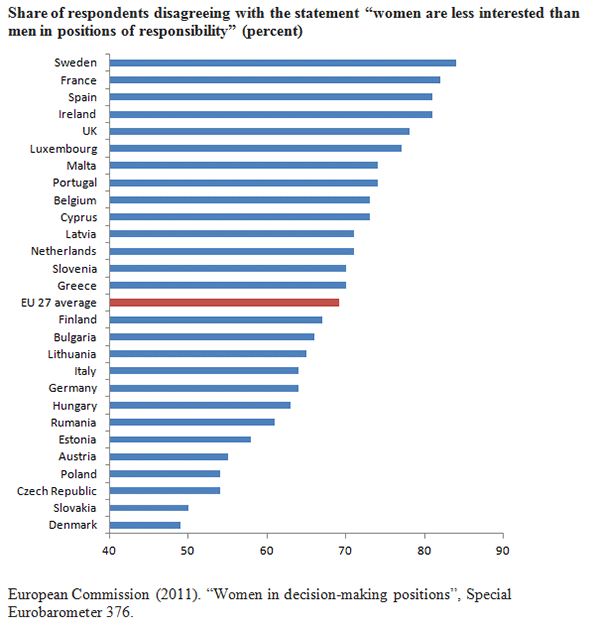
    Northern and Western European countries also tend to have more equal gender attitudes. A special edition of the Eurobarometer has focused on the issue of women in decision-making positions. One key indicator is how many disagree with the statement “women are less interested than men in positions of responsibility”. Sweden again stands out, with 84 percent of the public disagreeing with this notion. Although culturally and politically similar Denmark is found at the other end, with only 49 percent disagreeing with this idea, the overall trend is clear. The general publics in Nordic and Western European countries more strongly reject the notion that women are less interested in reaching positions of responsibility while Southern-, Eastern-, and Central European countries are found at the opposite end of the spectrum.

    We would expect to find many more women in top positions in the egalitarian Nordic nations, as well as Germany, the Netherlands and other similar countries. And indeed we do. At least when it comes to politics, the public sector and company boards. All too often the analysis stops here. But it is important to realize that representation on boards is a poor measure of women’s progress in the private sector of many European countries. Many boards in Nordic nations for example have relatively formal roles, meeting a few times a year to supervise the work of the management. The select few who end up on the boards – many of whom reach this position after careers in politics, academics and other non-business sectors – enjoy prestigious jobs.  They are however not representative of those taking the main decisions in the business sector. The latter role falls on executives and directors. Public sector managers tend to have less overall power, working within the scope of large bureaucratic structures.

    Chief executives and directors in the private sector are responsible for taking much of the crucial decisions in the business world. One typically only reaches a high managerial position after having worked hard in a certain sector, or successfully started or expanded a firm as an entrepreneur. The share of women reaching this position is a good proxy of women’s opportunities in the business world as a whole.

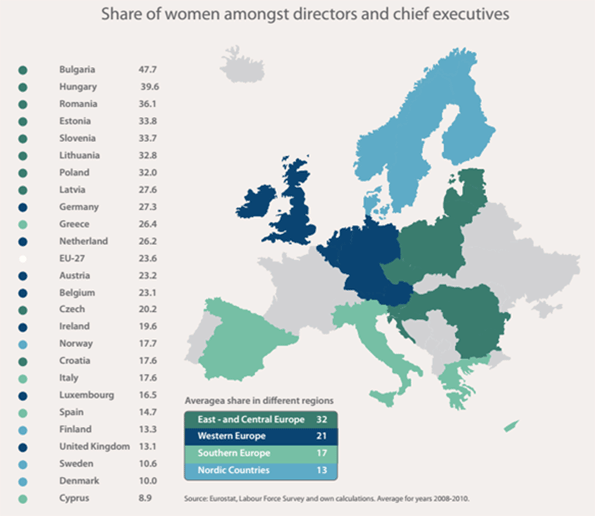
    Astonishingly, the data show that the gender equal Nordic nations all have lower levels of women at the top of businesses than their less progressive counterparts. In Sweden and Denmark, only one out of ten directors and chief executives in the business world are women. Finland and the UK, two other nations with large public sector monopolies, fare only slightly better.

    In contrast, in the average Eastern- and Central European country fully 32 percent of the directors and chief executives are women. This can be compared to 21 percent in Western European countries, 17 percent in Southern European nations and merely 13 percent in the otherwise egalitarian Nordic nations. In Bulgaria, with lower than EU-average levels of female work participation, and not a bastion of egalitarian attitudes, women fill almost half the positions.

    It should be noted that other measures of the share of women at top of businesses supports this general trend. Eurostat for example also publishes a broader measure of business leaders, including also middle-managers. In the Baltics Estonia has the lowest share of women in these positions, 36 percent. Lithuania and Latvia fare better with 39 and 45 percent respectively. In Sweden the share is 35 percent and in Denmark 28 percent. Based on interviews with 6 500 companies around the world, the firm Grant Thornton estimates that around four out of ten managers in the three Baltic nations are female, compared with around a quarter in the Nordic nations. The overall picture is clear: fewer women in the Nordic nations reach the position of business leaders, and even fewer manage to climb to the very top positions of directors and chief executives.

    How can egalitarian Nordic countries, in most regards world leaders in gender equality, have the lowest rates of female directors and chief executives, whilst the nations in Eastern- and Central Europe are leaders in the same regard? I have previously touched upon this perhaps unexpected relation in the Swedish book “Att Spräcka Glastaken” (Breaking the glass window), a short report in English co-authored with Elina Lepomäki for Finnish think tank Libera and also in a column for the New Geography.

    Key here is the nature of the welfare state. In Scandinavia  female dominated sectors such as health care and education are mainly run by the public sector. The lack of competition has not only reduced the overall pay, but also lead to a situation where individual hard work is not rewarded significantly (wages are flat and wage rises follow seniority, according to labour union contracts, rather than individual achievement). Some opportunities for entrepreneurship do exist, as private competition has been allowed in particularly the Swedish welfare sector in recent years. But overall, the Nordic political systems still create a situation for many women where their job prospects are mainly   limited to the public sector . Women in Scandinavia can of course become managers within the public sector, but their wages and influence in these positions are typically more limited compared to in private enterprises.

    The former planned economies in Eastern- and Central Europe are well behind in terms of female employment and attitudes. But they have also since the times of socialist economies had systems where women who are employed work almost as many hours as the men. During recent years the nations have transitioned to market economies, in many regards more free-market systems than in other European countries. Employed women have continued to invest heavily in their workplaces in the former planned economies.

    The situation is quite different in the Nordic welfare states, where high taxes and public benefits create incentives for women to work, but often to work relatively few hours. For example 10 percent of the employed women in Latvia and Lithuania, and 14 percent in Estonia, work part time. In Sweden, the share is fully 41 percent. To put it differently, the average employed man in the Scandinavia works between 16 percent (Finland) and 27 percent (Norway) hours more than the average woman. In Lithuania the same gap is 13 percent, and in Latvia and Estonia merely 7 percent. Bulgaria is unique as the only European Union nation where women actually work more (1 percent more) hours than men. Women in Eastern- and Central Europe reach managerial positions by working hard and, contrary to the men, staying away from alcohol and other social ills.

    To reach the top of the business world, high employment and gender equal values are not enough. These factors must be complemented with political structures that allow for competition and entrepreneurship, as well as systems where women in their careers are encouraged to invest the time needed to climb the career ladder. It is quite telling that the Baltic nations, as well as other Eastern- and Central European countries, manage to outperform the rest of Europe in their share of female directors and chief executives. They do so by having systems with limited public monopolies and smaller differences between hours worked by men and women. It is equally telling that the Nordic nations underperform in the same regard, as their Social Democratic systems encourage many women to work, but hinder them from reaching the top of the business world. The map of gender equality in Europe is more complex than it might appear at a first glance.

    Dr. Nima Sanandaji has written two books about women’s carreer opportunities in Sweden, and has recently published the report “The Equality Dilemma” for Finnish think-tank Libera.

  • Britain’s Planning Laws: Of Houses, Chickens and Poverty

    Perhaps for the first time in nearly seven decades a serious debate on housing affordability appears to be developing in the United Kingdom. There is no more appropriate location for such an exchange, given that it was the urban containment policies of the Town and Country Planning Act of 1947 that helped drive Britain’s prices through the roof. Further, massive damage has been done in countries where these polices were adopted, such as in Australia and New Zealand (now scurrying to reverse things) as well as metropolitan areas from Vancouver to San Francisco, Dublin, and Seoul.

    A healthy competition has developed between the Conservative-Liberal Democrat coalition and the Labour Party to finally address the problem of the resulting land and housing shortage that has driven prices up so much relative to incomes.

    It probably helps that public opinion seems to be changing. A recent MORI poll found that 57 percent of respondents considered rising house prices to be a bad thing for Britain, compared to only 20 percent who though it a good thing.

    It has been more than a decade since Kate Barker, then a member of the Monetary Policy Committee of the Bank of England (the central bank) was commissioned by the Blair Labor government to examine the issues. Her conclusions were clear. Britain has a serious housing affordability problem and its restrictive land use policies were the cause. These higher housing costs, the largest element or household expenditure have reduced the standard of living and increased poverty beyond what would have occurred if urban containment regulation had not destabilized house prices. The Economist notes that home ownership is falling and that the number of couples with children who are renting has tripled since the late 1990s.

    Planning and Chickens

    This week, The Economist weighed into the debate (Britain’s planning laws: An Englishman’s home):

    "Now that the economy is at last growing again, the burning issue in Britain is the cost of living. Prices have outstripped wages for the past six years. Politicians have duly harried energy companies to cut their bills, and flirted with raising the minimum wage. But the thing that is really out of control is the cost of housing. In the past year wages have risen by 1%; property prices are up by 8.4%. This is merely the latest in a long surge. If since 1971 the price of groceries had risen as steeply as the cost of housing, a chicken would cost £51 ($83)."

    For those of us unfamiliar with the cost of chicken in British hypermarkets, The Daily Mail says it is about £2 ($3). Indeed, even the chicken industry suffers, as planning restrictions  are getting in the way of adding the chicken farms Britain requires.

    Moreover, the high costs cited by The Economist are after the house prices increases that had already occurred by 1970. Even then, before such inflationary pressures were seen elsewhere, Sir Peter Hall characterized soaring land and house prices as the biggest failure of the 1947 Act. Hall had led a major research effort on the subject, which produced a two-volume work, The  Containment of Urban England (See The Costs of Smart Growth Revisited: A 40 Year Perspective).

    From Affordable to Unaffordable

    While the historic relationship between household incomes and house prices (the "median multiple") was under 3.0 across the United Kingdom as late as the 1990s, it has now deteriorated to more than 7.0 inside the London Greenbelt. Unbelievably it has risen to elevated levels even in the less prosperous the north of England. For example, depressed Liverpool has a median multiple over 5.0, which is 60 percent above the maximum historic range and making the metropolitan area "severely unaffordable." Liverpool is probably best compared to Cleveland in the United States for its economic distress.

    The shortage of housing in Britain has become acute. There are additional concerns that the globalization of housing markets has hit London particularly hard and is driving households out of the housing market.

    More Money, Less House

    Through all of this, Briton’s are getting less for their money. Since 1920, the average size of a new large family house has been reduced 30 percent. Semi-detached houses are 44 percent smaller and townhouses (terrace housing) is 37 percent smaller (Figure 1). Britain now has some of the smallest new housing in the world. The average new house in continental Europe is 50% or more larger than in England and Wales. New houses are two to three times as large in Canada, New Zealand, Australia and the United States (Note 1). In some US cities, residents can build "granny flats" which are larger than new houses in Britain. For example, San Diego’s limit for granny flats of 850 square feet exceeds Britain’s average new house size of 818 square feet.

    Paving Over Ohio?

    Of course, those who see urban expansion (the theological term is "sprawl") as ultimate evil imagine an England and Wales being literally paved over by allowing people to live as they prefer. They need not worry.

    For example, England and Wales is less crowded than spacious Ohio, with its rolling hills and extensive farmland. According to the 2011 census, only 9.6% of the land in England and Wales is urban, the other 90.4% is rural. In Ohio, on the other hand, 10.8% of the land is urban and only 89.2% of the land is rural. Even the state of Georgia, with the least dense large urban area in the world, Atlanta, has roughly as much rural land (91.7 percent) as England and Wales (Figure 3).

    Every Gram is Sacred?

    Originally, urban containment was justified on social and aesthetic grounds. However, curbing greenhouse gases is now used as the raison d’etre for highly restrictive housing policies. Urban policy in England and Wales and elsewhere has been hijacked by a philosophy that any gram of greenhouse gas that can be reduced must be, regardless of its impact on society, the economy, the standard of living or poverty.

    One of the worst conceivable strategies for reducing greenhouse gas emissions is to waste money on costly and ineffective measures. The Intergovernmental Panel on Climate Change (IPCC) has indicated that sufficient reductions in greenhouse gas emissions can be achieved for a range of from $20 to $50 per ton. Urban containment policy cannot deliver for this price. In contrast, improving automobile fuel efficiency is forecast improve greenhouse gas emissions, even as driving continues to rise with a growing population (see Urban Planning for People). In addition, the higher house prices associated with urban containment policy are well beyond the IPCC range.

    No program can produce substantial greenhouse gas emission reductions that does not focus on higher value strategies. Urban containment has no high value strategies.

    Planning, People and Poverty

    Britain’s land policy competition between the political parties is long overdue. Coalition Communities Secretary Eric Pickles, decries "the way families are trapped in ‘rabbit hutch homes’." The Labour Party opposition has promised that, if elected in 2015, steps will be taken to increase land supply and housing affordability, so that "working people and their children" have the "decent homes they deserve."

    The Economist states the issue squarely:

    "Building on fields in a country that is as crowded as England will always rile some people, however well-designed the system. But the alternative is worse: a nation of renters and rentiers, where only the rich own houses."

    —————–

    Note 1: As Figure 2 indicates, Hong Kong housing is considerably smaller than that of England and Wales. Hong Kong really is the ultimate smart growth or urban containment city. It has the highest urban population density in the high income world. It has the highest share of its commuters using mass transit to get to work. Its traffic congestion is intense. And, predictably, it has the highest house prices relative to incomes yet documented in the high income world.

    We need to be spared the "sun rises in the west" economic studies claiming that somehow the laws of economics, that work so relentlessly to drive up prices where supplies are constrained in other industries (such as petroleum, corn, etc.) have no effect on land and housing.

    Wendell Cox is a Visiting Professor, Conservatoire National des Arts et Metiers, Paris and the author of “War on the Dream: How Anti-Sprawl Policy Threatens the Quality of Life.

    Photo: St. Pancras Station (London), by author

  • Build It, Even Though They Won’t Come

    The recent decision by Los Angeles County Superior Court Judge Allan J. Goodman to reject as “fatally flawed” the densification plans for downtown Hollywood could shake the foundations of California’s “smart growth” planning clerisy. By dismissing Los Angeles’ Hollywood plan, the judge also assaulted the logic behind plans throughout the region to construct substantial high-rise development in “transit-oriented developments” adjacent to rail stations.

    In particular, the judge excoriated the buoyant population-growth projections used to justify the plan, a rationalization for major densification elsewhere in the state. The mythology is that people are still flocking to Los Angeles, and particularly, to dense urban areas, creating a demand for high-end, high-rise housing.

    The Hollywood plan rested on city estimates provided by the Southern California Association of Governments, which estimated that Hollywood’s population was 200,000 in 2000 and 224,000 in 2005, and would thus rise to 250,000 by 2030. All this despite the fact that, according to the census, Hollywood’s population over the past decade has actually declined, from 213,000 in 1990 to 198,000 today. Not one to mince words, Judge Goodman described SCAG’s estimates as “entirely discredited.”

    This discrepancy is not just a problem in the case of Hollywood; SCAG has been producing fanciful figures for years. In 1993, SCAG projected that the city of Los Angeles would reach a population of 4.3 million by 2010. SCAG’s predicted increase of more than 800,000 residents materialized as a little more than 300,000. For the entire region, the 2008 estimates were off by an astounding 1.4 million people.

    Similar erroneous estimates run through the state planning process. In 2007, California’s official population projection agency, the Department of Finance, forecast that Los Angeles County would reach 10.5 million residents in just three years. But the 2010 U.S. Census counted 9.8 million residents.

    Such inflated estimates, however, do serve as the basis for pushing through densification strategies favored by planners and their developer allies. In fact, SCAG’s brethren at the Association of Bay Area Governments, seeking to justify their ultradense development plan, recently went beyond even population estimates issued by the Department of Finance.

    The problem here is not that some developers may lose money on projects for which there is inadequate demand, but that this densification approach has replaced business development as an economic strategy. Equally bad, these policies often threaten the character of classic, already-dense urban neighborhoods, like Hollywood. Indeed, the Los Angeles urban area is already the densest in the United States, and a major increase in density is sure to further worsen congestion.

    Not surprisingly, some 40 neighborhood associations and six neighborhood councils organized against the city’s Hollywood plan. Their case against the preoccupation with “transit-oriented development” rests solidly on historical patterns. Unlike in New York City, much of which was built primarily before the automobile age, Los Angeles has remained a car-dominated city, with roughly one-fifth Gotham’s level of mass-transit use. Despite $8 billion invested in rail lines the past two decades, there has been no significant increase in L.A.’s transit ridership share since before the rail expansion began.

    The Hollywood plan is part of yet another effort to reshape Los Angeles into a West Coast version of New York, replacing a largely low-rise environment with something former Mayor Antonio Villaraigosa liked to call “elegant density.” As a councilman, new Mayor Eric Garcetti proclaimed a high-rise Hollywood as “a template for a new Los Angeles,” even if many Angelenos, as evidenced by the opposition of the neighborhood councils, seem less than thrilled with the prospect.

    If the “smart growth” advocates get their way, Hollywood’s predicament will become a citywide, even regional, norm. The city has unveiled plans to strip many single-family districts of their present zoning status, as part of “a wholesale revision” of the city’s planning code. Newly proposed regulations may allow construction of rental units in what are now back yards and high-density housing close to what are now quiet residential neighborhoods.

    “They want to turn this into something like East Germany; it has nothing to do with the market,” suggests Richard Abrams, a 40-year resident of Hollywood and a leader of Savehollywood.org. “This is all part of an attempt to worsen the quality of life – to leave us without back yards and with monumental traffic.”

    Of course, it is easy to dismiss community groups as NIMBYs, particularly when it’s not your neighborhood being affected. But here, the economics, too, make little sense. New, massive “luxury” high-rise residential buildings were not a material factor in the huge density increases that made the Los Angeles urban area more dense than anywhere else in the nation during the second half of the 20th century. Even in New York City, the high-rise residential buildings where the most affluent live are concentrated in the lower half of Manhattan; they house not even 20 percent of the city’s population.

    Under any circumstances, the era of rapid growth is well behind us. In the 1980s, the population of Los Angeles grew by 18 percent; in the past decade, growth was only one-fifth as high. Growth in the core areas, including downtown, overall was barely 0.7 percent, while the population continued to expand more rapidly on the city’s periphery. Overall, the city of Los Angeles grew during the past decade at one-third the national rate. This stems both from sustained domestic outmigration losses of 1.1 million in Los Angeles County and immigration rates that have fallen from roughly 70,000 annually in the previous decade to 40,000 a year at present.

    Nor can L.A. expect much of a huge infusion of the urban young talent, a cohort said to prefer high-density locales. In a recent study of demographic trends since 2007, L.A. ranked 31st as a place for people aged 20-34, behind such hot spots as Milwaukee, Oklahoma City and Philadelphia. It does even worse, 47th among metro areas, with people ages 35-49, the group with the highest earnings.

    In reality, there is no crying need for more ultradense luxury housing – what this area needs more is housing for its huge poor and working-class populations. More important, we should look, instead, at why our demographics are sagging so badly. The answer here, to borrow the famous Clinton campaign slogan: It’s the economy, stupid. In contrast with areas like Houston, where dense development is flourishing along with that on the city’s periphery, Southern California consistently lands near the bottom of the list for GDP, income and job growth, barely above places like Detroit, Cleveland or, for that matter, Las Vegas.

    Despite many assertions to the contrary, densification alone does not solve these fundamental problems. The heavily subsidized resurgence of downtown Los Angeles, for example, has hardly stemmed the region’s relative decline.

    Instead of pushing dense housing as an economic panacea, perhaps Mayor Garcetti should focus on why the regional economy is steadily falling so far behind other parts of the nation. One place to start that examination would be with removing the regulatory restraints that chase potential jobs and businesses – particularly better-paying, middle class ones – out of the region. It should also reconsider how the “smart growth” planning policies have helped increase the price of housing, particularly for single-family homes, preferred by most families.

    At the same time, the mayor and other regional leaders should realize that L.A.’s revival depends on retaining the very attributes – trees, low-rise density, sunshine, as well as entrepreneurial opportunity – that long have attracted people. People generally do not migrate to Los Angeles to live as they would in New York or Chicago. Indeed, Illinois’ Cook County (Chicago) and three New York City boroughs – Manhattan, Queens and Brooklyn – are among the few areas from which L.A. County is gaining population. Where are Angelinos headed? To relatively lower-density places, such as Riverside-San Bernardino, Phoenix and Houston.

    Under these circumstances, pushing for more luxury high-rises seems akin to creating structures for which there is little discernible market. Once demographic and economic growth has been restored broadly, it is possible that a stronger demand for higher-density housing may emerge naturally. Until then, the higher density associated with “smart growth” neither addresses our fundamental problems, nor turns out to be very smart at all.

    This story originally appeared at The Orange County Register.

    Joel Kotkin is executive editor of NewGeography.com and Distinguished Presidential Fellow in Urban Futures at Chapman University, and a member of the editorial board of the Orange County Register. He is author of The City: A Global History and The Next Hundred Million: America in 2050. His most recent study, The Rise of Postfamilialism, has been widely discussed and distributed internationally. He lives in Los Angeles, CA.

  • How Silicon Valley Could Destabilize The Democratic Party

    Much has been written, often with considerable glee, about the worsening divide in the Republican Party between its corporate and Tea Party wings. Yet Democrats may soon face their own schism as a result of the growing power in the party of high-tech business interests.

    Gaining the support of tech moguls is a huge win for the Democrats — at least initially. They are not only a huge source of money, they also can provide critical expertise that the Republicans have been far slower to employ. There have always been affluent individuals who backed liberal or Democratic causes, either out of conviction or self-interest, but the tech moguls may be the first large capitalist constituency outside Hollywood to identify almost entirely with the progressives.

    This alliance of high tech and Democrats is relatively new. In the 1970s and 1980s the politics of Silicon Valley’s leaders tended more to middle-of-the-road Republican. But the new generation oligarchs are very different from the traditional “propeller heads” who once populated the Valley. More media savvy and less dependent on manufacturing, the new leaders have less interest in the kind of infrastructure and business policies generally favored by more traditional businesses. They also tend to have progressive views on gay marriage and climate change that align with the gospel of the Obama Democratic Party.

    In the process, the Bay Area, particularly the Silicon Valley – San Francisco corridor, has become one of the most solidly liberal regions in the country. The leading tech companies, mostly based in the area, send over four-fifths of their contributions to Democratic candidates.

    This tech alliance is creating a pool of potential business-tested candidates for the party, including Twitter co-founder Jack Dorsey, who has said he wants to run for mayor of New York someday, even if he now resides in San Francisco.

    The tech oligarchs are also poised to reinforce the media dominance enjoyed by the Democrats. Over the past two years we have seen one tech entrepreneur and Obama ally, Chris Hughes, take over the venerable New Republic, while another, Amazon’s Jeff Bezos, bought the Washington Post.More important, pro-Democratic tech firms such as Microsoft, Yahoo and Google now dominate the online news business, while others, such as Netflix and Amazon, are moving aggressively into music, film and television.

    Yet for all the advantages of this burgeoning alliance with tech interests, it threatens to create tensions with the party’s traditional base — minorities, labor unions and the public sector — as the party tries accommodate a constituency that combines social liberalism and environmentalist sentiments withvaguely libertarian instincts. The fact that this industry has a pretty awful record on labor and equity issues is something that could prove inconvenient to Democrats seeking to adopt class warfare as their primary tactic.

    Indeed, despite its counter-cultural trappings and fashionably progressive leanings, Silicon Valley has turned out to be every bit as cutthroat and greedy as any gaggle of capitalists. Leftist journalists like John Judis may rethink their support for the Valley agenda once they realize that they have become poster children for overweening elite power and outrageous inequality.

    Privacy is one issue that should divide liberals from the tech oligarchs. Historically liberals have been on the front line of the battle to protect personal information. But now tech interests have worked hard, with considerable Democratic support, to block privacy protections that would damage their profits in Europe, and closer to home.

    Another inevitable flashpoint regards unions, a core progressive constituency. Venture capitalist Mark Andreesen recently declared that “there doesn’t seem to be a role” for unions in the modern economy because people are “marketing themselves and their skills.” Amazon has battled unions not only in the United States, but in more union-friendly Europe as well.

    Avatars of equality? Valley boosters speak of the “glorious cocktail of prosperity” they have concocted, but have been very slow to address, or even seek to ameliorate, the vast social chasm that exists under their feet.

    Many core employees at firms like Facebook and Google enjoy gourmet meals, childcare services, even complimentary house-cleaning in an effort to create, as one Google executive put it, “the happiest most productive workplace in the world.”  Yet the reality is less pleasant for other workers in customer support or retail, like the Apple stores, and even more so for contracted laborers in security, maintenance and food service jobs.

    Indeed over the past decade the Valley itself has grown almost entirely in ways that have benefited the affluent, largely white and Asian professional population. Large tech firms are notoriously skittish about revealing their diversity data, but one recent report found the share of Hispanics and African-Americans, already far below their percentage in the population, declined in the last decade; Hispanics, roughly one quarter of the local workforce, held 5.2% of the jobs at 10 of the Valley’s largest companies in 2008, down from 6.8% in 1999, according to the San Jose Mercury News. The share of women in management also has declined, despite the headlines generated by the rise of high-profile figures like Yahoo’s Marissa Mayer and Facebook’s Sheryl Sandberg.

    The mostly male white and Asian top geeks in Palo Alto or San Francisco should celebrate their IPO windfalls, but wages for the region’s African-Americans and Latinos, roughly a third of the local population, have dropped, down 18% for blacks and 5% for Latinos between 2009 and 2011, according to a 2013 Joint Venture Silicon Valley report. Indeed as the Valley has de-industrialized, losing over 80,000 jobs in manufacturing since 2000, some parts of the Valley, notably San Jose, where manufacturing firms were clustered, look more like a Rust Belt city than an exemplar of tech prosperity.

    Overall, most new jobs in the Valley pay less than $50,000 annually, according to an analysis by the liberal Center for American Progress, far below what is needed to live a decent life in this ultra-high cost area. Part-time security workers often have no health or retirement benefits, no paid sick leave and no vacation. Much the same applies to janitors, who clean up behind the tech elites.

    The poverty rate in Santa Clara County has climbed from 8% in 2001 to 14%, despite the current tech boom; today one out of four people in the San Jose area is underemployed, up from 5% a decade ago. The food stamp population in Santa Clara County has mushroomed from 25,000 a decade ago to almost 125,000. San Jose is also home to the largest homeless camp in the continental U.S., known as “the Jungle.” As Russell Hancock, president of Joint Venture Silicon Valley, admitted: “Silicon Valley is two valleys. There is a valley of haves, and a valley of have-nots.”

    These realities suggest that the tech oligarchs, despite their liberal social views, are creating an environment for the “one percent” every bit as stratified as that associated with Wall Street. Google maintains a fleet of private jets at San Jose airport, making enough of a racket to become a nuisance to their working-class neighbors. Google executives tout its green agenda but have burned the equivalent of upwards of tens of millions of gallons of crude oil, which seems somewhat less than consistent.

    At the same time, the moguls have a record of tax evasion — a persistent progressive issue — that would turn castigated plutocrats like Mitt Romney green with envy. Individuals like Bill Gates have voiced public support for higher taxes on the rich, yet Microsoft, Facebook and Apple have all saved billions by exploiting the tax code to shelter profits offshoreTwitter’s founders creatively exploited various arcane loopholes to avoid paying taxes on some of the proceeds of their IPO that they set aside for heirs.

    The set of differing rules for oligarchs and everyone else extends even to the most personal issues. Yahoo’s Mayer, a former Google executive, banned telecommuting for employees — particularly critical for those unable to house their families anywhere close to ultra-pricey Palo Alto. Yet Mayer, herself pregnant at the time, saw no contradiction in building a nursery in her own office.

    This model of economic development seems it would be more appealing to those who believe in “the survival of the fittest” than people with more traditional liberal values. The alliance with tech may well be a critical boon to the progressive cause and its champions for the time being, but at some time even the most deluded progressives will begin to realize with whom they have chosen to share their bed.

    This story originally appeared at Forbes.

    Joel Kotkin is executive editor of NewGeography.com and Distinguished Presidential Fellow in Urban Futures at Chapman University, and a member of the editorial board of the Orange County Register. He is author of The City: A Global History and The Next Hundred Million: America in 2050. His most recent study, The Rise of Postfamilialism, has been widely discussed and distributed internationally. He lives in Los Angeles, CA.

    Official White House Photo by Pete Souza.