Category: Demographics

  • Downsizing the American Dream

    At this time of year, with Thanksgiving, Hanukkah and Christmas, there’s a tendency to look back at our lives and those of our families. We should be thankful for the blessings of living in an America where small dreams could be fulfilled.

    For many, this promise has been epitomized by owning a house, with a touch of green in the back and a taste of private paradise. Those most grateful for this opportunity were my mother’s generation, which grew up in the Great Depression. In her life, she was able to make the move from the tenements of Brownsville, Brooklyn, first to the garden apartments of Coney Island and Sheepshead Bay, and, eventually, to a mass-produced suburban house on Long Island.

    This basic American dream of upward mobility may not, according to the pundit class, planners and many developers, be readily available for my children. Indeed, in the years since the 2007 housing bust, there’s been a steady stream of commentary suggesting a future that resembles the past, where most people were renters and, in urban centers, lived chock-a-block in crowded apartment buildings.

    The advocates for a return to this not-so-great past are a diverse lot, spanning the ideological spectrum from the free-market Right to the green, regulation-loving Left. Many on the right, such as economist Tyler Cowen, suggest that the era of the “average” American is now past, and that most of us will have to dial down our expectations about how we live, particularly in costly places such as California. The blessed 15 percent might aspire to live high on the hog, and even in luxury, but for the rest of us it’s eating rice and beans, and living small. Goodbye, Levittown, and back to Brownsville.

    Some in the financial community also salivate at the possibilities contained in downgrading the American dream. The very people who rode the mortgage boom and left millions of homeowners to deal with the consequences, now hail the ushering of what Morgan Stanley’s Oliver Chang has dubbed a “rentership society.” Rather than purchasing a home, the middle class is now being downgraded into either renting a foreclosed home snatched by the Wall Street sharpies or being stuffed into small, multifamily housing.

    In either case, the financial hegemons win, since they, essentially, get to have someone else to pay their mortgages. As for society, it’s a losing proposition. Rather than the yeoman with his own place, and the social commitment that comes with it, we now have the prospect of a vast lower class permanently forced to tip its hat to – and empty its wallet for – its economic betters. This is the fate ardently hoped for by many urbanists, who see a generation of permanent renters as part of their dream of a denser America.

    One would expect that this diminution of the middle class would offend liberals, who historically supported both the expansion of ownership and the creation of a better life for the middle class. But today’s liberals – or progressives – share Wall Street’s enthusiasm, albeit for different reasons, for renting and ever-greater densities.

    This reverses the policies of the New Deal and its successors. Half of postwar suburban housing, notes historian Alan Wolfe, depended on some form of federal financing. In fact, the progressive position increasingly is worse than that of free-market conservatives and their Wall Street allies. The Right sees profit in densification and renting, but would likely support other options if they seemed advantageous. In contrast, the progressive Left increasingly sees the single-family home and ownership – what made middle-class people like my mother lifelong Democrats – as outdated, even destructive.

    This can be seen in the writings of progressive thinkers like Richard Florida, who, in the midst of the mortgage crisis, proclaimed homeownership as “overrated” and urged Americans to give up the dream of owning their own digs, particularly in the much-disrespected suburbs. In Florida’s “creative age,” the proper aspiration is to live in a dense, expensive city, such as San Francisco or Manhattan, where only a fraction of the population can conceivably own their residence.

    To accommodate this vision, we inevitably get back to a world that looks similar to that of the tenement era. Already, in part due to regulatory policies making new construction prohibitively expensive, there is severe overcrowding in New York, the Bay Area and throughout Southern California. According to the Center for Housing Policy and National Housing Conference, 39 percent of working households in the Los Angeles metropolitan area spend more than half their incomes on housing, along with 35 percent in the San Francisco metro area and 31 percent in the New York City area. The national rate is 24 percent, itself far from tolerable.

    What we are witnessing today is oddly reminiscent of the Brooklyn of my mother’s childhood. She and her four siblings generally lived in three or fewer rooms, sharing her bed with her sisters until she got married. Yet, over time my mother’s generation did well, and all my relatives were able to ascend into the middle class, or even better, by the late 1950s. Most bought homes on Long Island, although one purchased a co-op in Brooklyn.

    Today, our cognitive betters embrace a more déclassé vision, with fewer families, more singles and less focus on upward mobility. Indeed, some, particularly among the environmental community, actually embrace downward mobility. Millennials, by not buying homes and cars, and perhaps also not growing into family life, are portrayed by the green magazine Grist as “a hero generation” – one that will march willingly, even enthusiastically, to a downscale future.

    How will we live in this brave new America? It won’t be exactly a return to the tenements that housed Depression era families, but will involve much smaller, less-communal arrangements. To serve the hip and cool youthful urban crowd, planners embrace microunits of 200-300 square feet. These are either being built or planned in such cities as Seattle, New York, San Francisco, Santa Monica and Portland. Soon, they will become something every second-tier wannabe burg will want to duplicate in their often madcap drive to ape cool cities’ hip urbanism.

    Such units may make developers’ mouths water with anticipation of ever more profitable cramming. But in the process, they will be further encouraging the shift away from housing for married couples, not to mention, children. Families do not make up the prime market for dense housing; married couples with children constitute barely 10 percent of apartment residents, less than half the percentage for the overall population.

    And what if you can’t afford a trendy “pad” in a hip downtown? The urban advocates embrace another dismal back-to-the-future solution: the boarding house. It’s time, argues the Atlantic recently, to jettison our “middle-class norms of decency” governing housing and bring back the boarding house of the 19th and early 20th centuries.

    All said, this is a dismal future being dialed up for the next generation, largely by boomer ideologues and their developer allies. It’s not clear, fortunately, that the millennials will willingly go along. This gives us hope that, when families celebrate the holidays decades from now, they still will have as much to be thankful for as did my mother’s generation, or for that matter, my own.

    This story originally appeared at The Orange County Register.

    Joel Kotkin is executive editor of NewGeography.com and Distinguished Presidential Fellow in Urban Futures at Chapman University, and a member of the editorial board of the Orange County Register. He is author of The City: A Global History and The Next Hundred Million: America in 2050. His most recent study, The Rise of Postfamilialism, has been widely discussed and distributed internationally. He lives in Los Angeles, CA.

  • Suburban End Games

    Are America’s suburbs facing end times? That’s what a host of recent authors would have you believe.  The declaration comes in variety of guises, from Alan Ehrenhalt’s The Great Inversion (2012), to “the peaking of sprawl” pronounced by urban planner  Christopher Leinberger to, most recently, to Leigh Gallagher’s The End of Suburbs(2013).  Suburbs and sprawl have joined the ranks of “history” and “nature” as fixtures of our lives that teeter on the verge of demise—if we’re to lend credence to this latest clamor from journalists, planners, and academics. 

    When you declare the “ending” of a place where you acknowledge over half of Americans now live, just what does that mean?  One sure bet is that their demise won’t prove nearly as definitive or thorough-going as advertised. Looking around the Long Island neighborhood and town where I’ve lived for the last twenty years, I don’t see them vanishing any time soon. Moreover, from my own perspective as a long-time resident as well as historian of such places, the particulars grounding this narrative point to something very different: the rise of conditions, as yet only starting to be realized, for a new suburban progressivism. 

    This media wave of talk about suburbs or sprawl “ending” mirrors an earlier one in the decades after World War II, which fleshed out a rise of “mass suburbia.” That earlier wave turned out to be well-nigh mythological in its selectivity, its choice of emphases and its silences.  Embellishing the idea of suburbs as more than just a place, as an entire, distinctive way of life, it built upon age-old notions of suburbs as simply the edges of cities, also a change commencing over two hundred years ago among cities in the industrial West.  Cities began to grow less through the spread of a discrete and distinct rim than via a widening transition zone between city and countryside.  But only after World War II did the idea of “suburbia” congeal into a solid stereotype: those subdivisions of lawns and single family homes occupied by a white middle class.    

    Among the earliest discoverers was 1950s Fortune correspondent William Whyte, who found in the suburbs an entire generation of upwardly mobile, affluent, younger families, in search of the American dream.  Journalists concentrated mainly on places that fit this story line, the very largest and newest housing developments around the very largest of cities.   Early coverage celebrating these suburbs classless-ness was quickly followed by more critical accounts.  Commentators such as Whyte and Frederick L. Allen distinguished this “new suburbia” from an older one they preferred, quieter and smaller and more securely elitist.  Sociologists taking a more even-handed approach, such as Herbert Gans and Bennett Berger, also questioned the “myth” of these places’ classlessness, by highlighting more working class homeowners and communities.  The great majority of those moving into such places had also been white, and as the racial imagery of a white “donut” surrounding a black core consolidated with the urban and busing crises over the 1960s and 70s, an ambivalent imagery of postwar “suburbia” stuck.  At once affluent, middle class, and white, but also vaguely declassé, suburbs were self-satisfied and reactionary places that deserved the progressive city-dweller’s disdain. 

    As current-day Fortune correspondent and professed “city girl” Leigh Gallagher, makes clear, such attitudes are alive and well, for instance, at cocktail parties where those hearing her book title offer “high fives and hurrahs.”   Today’s literature on suburbia’s end has the distinct ring of wish fulfillment for a long tradition of city-bound suburb-bashers, of a piece with their eagerness finally to declare downtowns “resurgent [as] centers of wealth and culture.”  But just as most characterizations of “suburbia” in the 1950s ignored the pockets of poverty and minority enclaves in its midst, so even the most balanced of today’s expositors of suburbs’ end can be quite selective.  For instance, even though the Charlotte metro area’s 42% growth between 2000 and 2013 came through a momentous build-out of subdivisions and malls, even though the city itself has eagerly annexed nearly 25% more suburban land since 2000, Ehrenhalt dwells solely upon its reconstruction of the downtown.  We hear nothing about how, even with its expanded limits, this city still contains only 31% of the population of this urban region.

    While these authors do leaven their arguments with a lot more demographic yeast than their 1950s predecessors, they still leap to generalizations that, in an era of soaring income inequality, bear more scrutiny than they get.   When Gallagher refers to how “we rebuild once or twice a century in this country,” just who is this “we” she means? It is not hard to draw some unsettling answers. As an editor at Fortune, as avowed resident of Greenwich Village, whose one-bedroom rentals are the most expensive in Manhattan, she seems heavily identified with affluent, especially the movers and shakers in the development community.  Whether singling out recent failures of building projects in outer suburbs or exurbs, concentrating on suburban malls that have been abandoned or are being retrofitted, or homing in on downtown reconstructions, “end of suburbs” authors often tacitly adopt a financial standard for future promise: where the most real-estate money is to be made. 

    By the same token, this literature of suburbia’s end offers astonishing little reflection on the implications of its favored trends for the ways in which our cities divide the wealthy from the rest.   Today’s declarations of an “end of suburbs” come just as rents in places like Manhattan are hiking out of reach of the merely middle class, generating anxieties tilled, most recently, by Bill de Blasio’s successful campaign for mayor. Yet when Gallagher sweepingly contends that “millenials hate the suburbs,” she doesn’t even ask how many young people are actually going to be able to afford living in cities. And at this point, as well, her definition of “suburbs” itself suddenly narrows: just the subdivisions and malls, not the new “planned community” or the “urbanized small town or suburb” that may lie nearby.

    The trend of urbanizing suburbs offers the most compelling angle of this reputed “end” for us actual suburbanites. For a good while in suburbs like my own Long Island, proponents of smart growth and the New Urbanism have pushed for multiuse, for bringing apartments into old town centers, for recreating walkability there.  Having watched and participated in the political rows stirred by such projects, like Avalon Bay’s plan to build an apartment complex near the Huntington train station, I can say this: those people most likely to see these projects as an “end of suburbs” are their opponents.  For the rest of us, their supporters, they look more like diversifying: taking us away from the old “suburbia” stereotypes, but not by leaving subdivisions behind.  All those stores, restaurants, and events available in walkable downtowns have the virtue of enhancing the suburban experience for those of us who remain homeowners, even as they furnish living quarters for renters who might otherwise leave: twenty-somethings, singles, and the elderly.  

    That suburbs are also becoming societal repositories for newly arriving immigrants, blacks and other minorities, as well as poverty, does undermine that old “suburbia” imagery, but in ways that stir hopes for suburbs’ future. Largely because of these trends, indexes measuring metropolitan segregation have been gradually declining—and that’s a good thing.  Of course, suburbanites’ reputation for racial animosity is still plenty justified:  just look at Atlanta’s Gwinnett County as depicted by Ehrenhalt, or the hostility found on Long Island to undocumented immigrants. But there’s an as yet little-told story of how suburban opposition to these attitudes has also emerged. When a homeless camp of mostly immigrant workers was discovered in Huntington Station in the early 2000s, a remarkable coalition of social service agencies and churches cobbled together a program for housing and feeding them over the winter that involved over a thousand volunteers. This outpouring crossed lines of class and race, drawing many from the suburban church I attend, which itself is pretty evenly split between blacks and whites.  I don’t think my fellow travelers there, or in pro-immigrant groups like Long Island Wins, would surmise as Gallagher does that ours is some “suburban experiment” that has “failed.”

    “The end of suburbs”—it’s a dramatic claim, and as mythological as that old “myth of suburbia,” especially for those of us living in the places that are supposed to be ending. I prefer another narrative, with a more positive spin. The demographic and other changes underway in our suburbs may well wind up breaking the old stereotype in another way, by building the basis for a newly inclusive and forward-looking politics in the suburbs. 

    Christopher Sellers is a Professor of History at Stony Brook University and author of Crabgrass Crucible; Suburban Nature and the Rise of Environmentalism in Twentieth-Century America (2012), He is now writing on, among other things, the historical relationship between suburbanizing, race, and environmentalism around Atlanta. 

    Home illustration by Bigstock.

  • Rural Character in America’s Metropolitan Areas

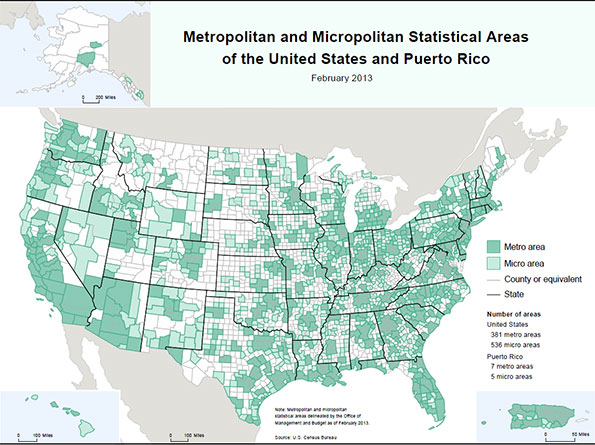
    Looking at a map of the metropolitan areas of the United States, it would be easy to get the impression that “urban sprawl” had consumed most of the nation. Indeed, as Figure 1 indicates, one could drive from Santa Rosa, north of San Francisco to the Arizona-New Mexico border without ever leaving a metropolitan area. This more than 1,000 mile trip (1,600 kilometers) would take nearly 15 hours, according to Google Maps. New Jersey is shown as all-metropolitan, as well as Delaware. But looks can be deceiving. According to US Census data from 2010, the land area of New Jersey is 60 percent rural, while Delaware is 80 percent rural.

    Given the multiple terms used to describe urban and rural geography, confusion is not uncommon. It begins with the fundamental matter of terms. For starters, “metropolitan” is not the same thing as “urban,” and “rural” does not mean non-metropolitan. In fact, most rural residents in the United States live in metropolitan areas. 

    Urban Areas

    All land within the United States is either urban or rural, without respect to whether it is in metropolitan areas. The Census Bureau defines urban areas using “census blocks” to which minimum population density criteria are applied. Census blocks are very small neighborhood units, which are far smaller than virtually all municipalities. This approach produces an urban area defined by land use characteristics, without regard to jurisdictional (city or county) boundaries. Urban areas contain no rural land.

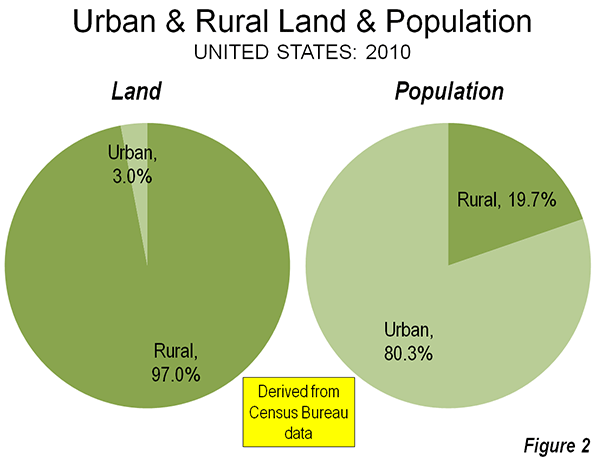
    In 2010, 19.3 percent of the US population was in rural areas, which covered 97.0 percent of all land. The other 80.7 percent of the population was urban and lived in only 3.0 percent of land area (Figure 2)

    Rural Population of Metropolitan Areas

    Metropolitan areas always have large areas of rural land. This is due to the very nature of metropolitan areas, which are designated by the US Office of Management and Budget (OMB). Metropolitan areas are labor markets, defined by commuting patterns. People commute to jobs in metropolitan areas both from within the core urban area (such as the New York urban area) and from areas outside the core urban area that remain in the metropolitan area, such as the non-urban parts of the New York metropolitan area (examples are much of Orange and Dutchess counties in New York as well as Sussex and Hunterdon counties in New Jersey).  

    Each metropolitan area is organized around “central counties” that include a core urban area (area of continuous urban development). The core urban area must have at least 50,000 residents for an area to qualify as metropolitan. “Outlying counties” are also included in metropolitan areas if 25 percent or more of their resident workers commute to the central counties. This central counties and core urban area approach reflects the evolution of US metropolitan areas to the more dispersed employment and residential patters that have materially reduced the influence of the historical core municipalities (sometimes called “central cities”). On average, only about 10 percent of employment in the 50 largest urban areas was in the formerly more dominant downtowns in 2000 (central business districts).

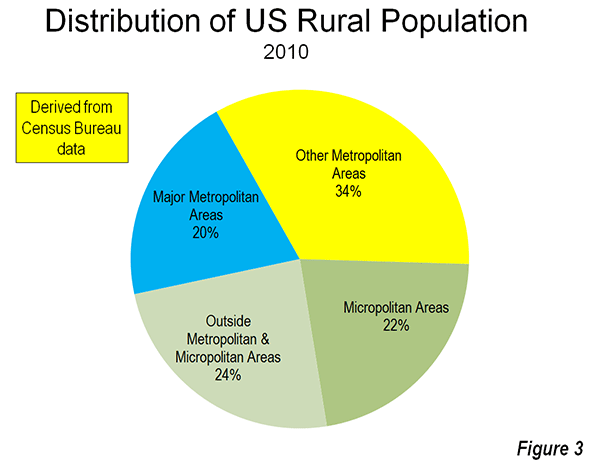
    The land area in America’s metropolitan areas is much more rural than urban. More than 90 percent of metropolitan area land is rural. In 2010, 28 percent of the nation’s land area was metropolitan, but the urbanization in metropolitan areas accounted for only 2.6 percent of US land area. In 2010, 32 million of the nation’s 60 million rural residents lived in metropolitan areas (Figure 3).

    Major Metropolitan Areas

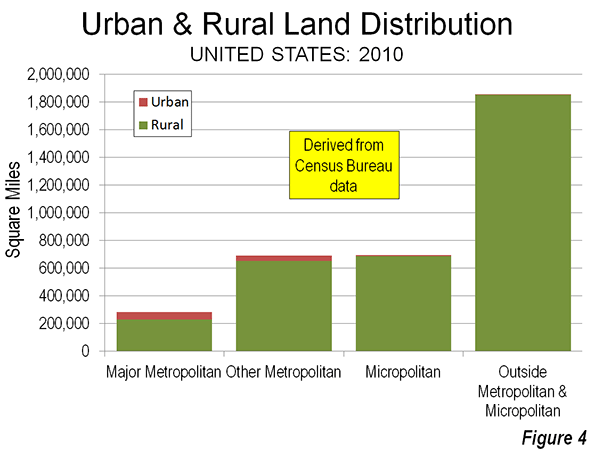
    On average, 81 percent of the land area in major metropolitan areas (0ver 1,000,000 population) is rural, not urban (Figure 4). There is a wide variation among the major metropolitan areas. All but one of the major metropolitan areas has more rural land than urban land. Boston has smallest rural land area share at 43 percent. The New York metropolitan area clocks in at 52 percent rural, Philadelphia at 54 percent rural and Tampa-St. Petersburg stands at 55 percent rural. At the other end of the scale, the Salt Lake City metropolitan area is 96 percent rural, followed by Riverside-San Bernardino at 95 percent, Las Vegas 94 percent and Denver 92 percent (Table).

    Table
    Rural Population & Land Area in Metropolitan Areas
      2010 Rural Population 2010 Rural Land Area # of Counties
    Atlanta, GA 11.1% 67.4% 29
    Austin, TX 12.8% 85.6% 5
    Baltimore, MD 9.0% 64.8% 7
    Birmingham, AL 28.8% 88.7% 7
    Boston, MA-NH 5.5% 42.6% 7
    Buffalo, NY 11.9% 73.0% 2
    Charlotte, NC-SC 18.5% 75.8% 10
    Chicago, IL-IN-WI 2.6% 61.9% 14
    Cincinnati, OH-KY-IN 14.1% 78.2% 15
    Cleveland, OH 8.1% 58.7% 5
    Columbus, OH 16.5% 86.9% 10
    Dallas-Fort Worth, TX 7.4% 76.1% 13
    Denver, CO 5.7% 91.8% 10
    Detroit,  MI 6.8% 60.0% 6
    Grand Rapids, MI 25.0% 85.4% 4
    Hartford, CT 12.2% 56.8% 3
    Houston, TX 6.5% 75.5% 9
    Indianapolis. IN 12.4% 81.2% 11
    Jacksonville, FL 11.2% 80.1% 5
    Kansas City, MO-KS 12.3% 88.9% 14
    Las Vegas, NV 1.3% 94.4% 1
    Los Angeles, CA 0.5% 59.8% 2
    Louisville, KY-IN 17.1% 85.8% 12
    Memphis, TN-MS-AR 15.3% 89.0% 9
    Miami, FL 0.4% 75.2% 3
    Milwaukee,WI 6.6% 59.2% 4
    Minneapolis-St. Paul, MN-WI 12.4% 84.4% 16
    Nashville, TN 24.1% 87.6% 14
    New Orleans. LA 7.2% 87.3% 8
    New York, NY-NJ-PA 2.7% 52.4% 25
    Oklahoma City, OK 18.3% 91.0% 7
    Orlando, FL 5.4% 74.4% 4
    Philadelphia, PA-NJ-DE-MD 5.1% 53.7% 11
    Phoenix, AZ 4.1% 91.0% 2
    Pittsburgh, PA 17.8% 80.1% 7
    Portland, OR-WA 9.9% 91.1% 7
    Providence, RI-MA 9.5% 56.9% 6
    Raleigh, NC 17.2% 73.1% 3
    Richmond, VA 20.3% 89.1% 17
    Riverside-San Bernardino, CA 4.7% 95.1% 2
    Rochester, NY 21.9% 87.8% 6
    Sacramento, CA 7.2% 88.3% 4
    St. Louis,, MO-IL 13.2% 86.0% 15
    Salt Lake City, UT 1.8% 96.1% 2
    San Antonio, TX 13.8% 91.0% 8
    San Diego, CA 3.3% 81.9% 1
    San Francisco-Oakland, CA 1.0% 65.8% 5
    San Jose, CA 1.8% 87.2% 2
    Seattle, WA 5.6% 81.0% 3
    Tampa-St. Petersburg, FL 4.4% 55.5% 4
    Virginia Beach-Norfolk, VA-NC 8.7% 78.2% 16
    Washington, DC-VA-MD-WV 7.8% 73.1% 24
    Major Metropolitan Areas 7.1% 81.0% 436


    The most important reason for the difference in rural area size within the major metropolitan areas is the differing sizes of counties. In the East, Midwest and South, counties tend to be much smaller than in the West. For example, the New York metropolitan area has nearly 20 million residents, distributed among 25 counties. In contrast, the Los Angeles metropolitan area, with 13 million residents, is composed of only two counties.

    The metropolitan areas with the most rural area are largely desert and mountains (see top illustration of the Riverside-San Bernardino metropolitan area). Large counties in Utah extend the Salt Lake City metropolitan area 100 miles westward to the Nevada border. Riverside-San Bernardino’s two large counties include a land area nearly equal to that of Ireland, stretching more than 200 miles to the Nevada and Arizona borders and including part of Death Valley National Park. In both cases (and a number of others), large counties require metropolitan areas to be far larger than any reasonable commuting shed. This size variation renders population density figures for metropolitan areas nonsensical (building blocks would need to be small, such as the census blocks used by the Census Bureau to define urban areas).

    The major metropolitan areas of over 1 million contain nearly 12 million rural residents, or 20 percent of the nation’s rural population. While this is a large number, their urban populations are much greater, at 158 million, or 63 percent of the US urban population of nearly 250 million. These urban residents live in a smaller proportional area, constituting of only one-half of all urban land area (and 1.5 percent of all US land area).

    Other Metropolitan Areas

    The rural portions of metropolitan areas with fewer than 1,000,000 residents cover 94 percent of their land areas. These areas include approximately 20 million residents, or 34 percent of the nation’s rural population. Only six percent of the land area in these metropolitan areas is urban.

    Outside Metropolitan Areas

    This leaves a minority of 27.5 million rural residents living outside the metropolitan areas.

    Micropolitan areas are defined by OMB as labor markets with core urban areas between 10,000 and 50,000, and are not considered metropolitan. Approximately 98.5 percent of the land in micropolitan areas is rural. The rural population of micropolitan areas is 13 million.

    The other 14 million rural residents live outside the micropolitan areas. However, there are still 4.7 million urban residents outside both metropolitan and micropolitan areas, with each of these urban areas having fewer than 10,000 residents.

    Rural Land in Metropolitan America

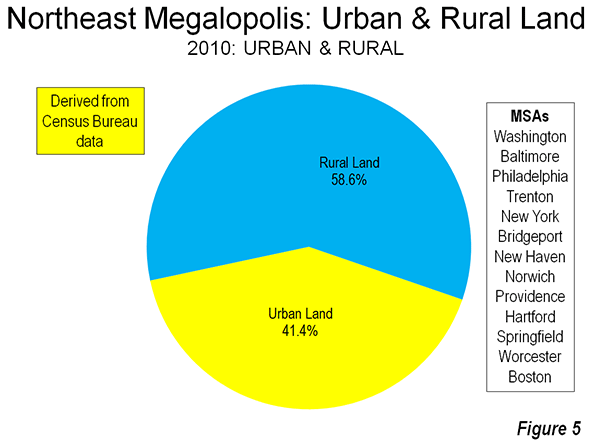
    Even where America is most urban, a strong rural element remains. This is illustrated in the Northeast Corridor, the “megalopolis” defined by Jean Gottman more than a half-century ago. The urbanization he identified is still short of continuous along the corridor. Rural areas interfere with urbanization in parts of Maryland, New Jersey, Connecticut and Massachusetts. Nearly 60 percent of the land area in these adjacent metropolitan areas remains rural (Figure 5). The numbers are even smaller elsewhere. Between Dallas-Fort Worth and Houston, 80 percent of the corridor is rural. Between Seattle and Portland nearly 90 percent of the corridor is rural. These are among the busiest corridors in the United States, and many more are far more rural. Up close and in context, the spatial urbanization of America, including its metropolitan areas is not pervasive.

    Wendell Cox is a Visiting Professor, Conservatoire National des Arts et Metiers, Paris and the author of “War on the Dream: How Anti-Sprawl Policy Threatens the Quality of Life.

    Illustration: San Bernardino Mountains and Mojave Desert in the Riverside-San Bernardino metropolitan area (by author)

  • The Geography Of Aging: Why Millennials Are Headed To The Suburbs

    One supposed trend, much celebrated in the media, is that younger people are moving back to the city, and plan to stay there for the rest of their lives. Retirees are reportedly following suit.

    Urban theorists such as Peter Katz have maintained that millennials (the generation born after 1983) show little interest in “returning to the cul-de-sacs of their teenage years.” Manhattanite Leigh Gallagher, author of the dismally predictable book The Death of Suburbs, asserts with certitude that “millennials hate the suburbs” and prefer more eco-friendly, singleton-dominated urban environments.

    Green activists hope this parting of the ways between the new generation and the preferences of their parents will prove permanent. The environmental magazine Grist even envisions “a hero generation” that will escape the material trap of suburban living and work that engulfed their parents.

    Less idealistic types, notably on Wall Street, see profit in this new order, hoping to capitalize on what Morgan Stanley’s Oliver Chang dubs a “rentership society”; in this scenario millennials remain serfs paying rent permanently to the investor class.

    But a close look at migration data reveals that the reality is much more complex. The millennial “flight” from suburbia has not only been vastly overexaggerated, it fails to deal with what may best be seen as differences in preferences correlated with life stages.

    We can tell this because we can follow the first group of millennials who are now entering their 30s, and it turns out that they are beginning, like preceding generations, to move to the suburbs.

    We asked demographer Wendell Cox to crunch the latest demographic data for us to determine where people have moved by age cohort from 2007 to 2012. The data reveals the obvious: People do not maintain the same preferences all their lives; their needs change as they get older, have children and, finally, retire. Each stage leads them toward somewhat different geographies.

    As it turns out, the vast majority of young people in their late teens and 20s – over 80 percent — live outside core cities. Roughly 38 percent of young Americans live in suburban areas, while another 45 percent live outside the largest metropolitan areas, mostly in smaller metro areas.

    To be sure, core urban areas do attract the young more than other age cohorts. Among people aged 15 to 29 in 2007, there is a clear movement to the core cities five years later in 2012 — roughly a net gain of 2 million. However, that’s only 3 percent of the more than 60 million people in this age group.

    Surprisingly, most of this movement to the urban centers comes not from suburbs, but from outside the largest metro areas, reflecting the movement of people from areas with perhaps lower economic opportunity. It also is likely reflective of the intrinsic appeal of metro areas to younger, single people, as well as the presence of many major universities and colleges in older “legacy cities.”

    Here’s how the geography of aging works. People are most likely to move to the core cities in their early 20s, but this migration peters out as people enter the end of that often tumultuous decade. By their 30s, they move increasingly to the suburbs, as well as outside the major metropolitan areas (the 52 metropolitan areas with a population over 1,000,000 in 2010).

    This pattern breaks with the conventional wisdom but dovetails with research conducted by Frank Magid and Associates that finds that millennials prefer suburbs long-term as “their ideal place to live” by a margin of 2 to 1 over cities.

    Based on past patterns, by the time people enter their 50s, the entire gain to the core cities that builds up in the 20s all but dissipates, as more people move to suburbs and to outside the largest metropolitan areas.

    Similarly millennials have not, as some hope, given up on home ownership, something closely associated with suburbia. Magid’s surveys of older, married millennials found their desire to own a home was actually stronger than in previous generations. Another survey by the online banking company TD Bank found that 84 percent of renters aged 18 to 34 intend to purchase a home in the future, while another, by Better Homes and Gardens, found that three in four identified homeownership as “a key indicator of success.”

    These attitudes, particularly among the older edge of the millennials, is particularly critical, as these are the first of this largest generation in American history to enter full adulthood. Indeed the peak of the millennial generation is already in their mid-20s, and by the end of the decade, the vast majority of the roughly 42 million millennials will be entering their 30s, with some approaching their 40s. This group of mature millennials (adding in the 20-24 cohort) is expected to expand by 22.5 million in the next 10 years. They are likely to prove wrong the argument that, with boomers entering their sunset years, there will be no one to buy their houses.

    In contrast, the next wave of young people — now under 10 — will be about 1.7 million less numerous. These “plurals” are likely to stay in the suburbs for the next five to 10 years, and some wil start moving into core cities as they enter their 20s, but in decidedly fewer numbers.

    Perhaps the most salient fact driving these migratory patterns is family formation. Our analyses of cities around the world have shown definitively that people with children tend to avoid urban cores, even in the most gentrified environments. Manhattan, Washington, D.C., San Francisco and Seattle tend to have the lowest numbers of children per capita.

    These trends can be seen on a nationwide basis. Among the cohort of children under 10 in 2007, the number who lived in core cities as of 2012, when they were 5 to 14 years of age, was down by 550,000. Families are the group most likely to move either to the suburbs or smaller towns. This movement, plus the high degree of childlessness in large urban cores, suggests that many of those who are leaving the core cities in their early 30s are parents with young children.

    And what about the older cohorts, notably the baby boomers, who, along with millennials, dominate the nation’s demography? The shift out to the suburbs and to outside the larger metropolitan areas does not stop with the child-bearing years but gains more traction with age, peaking in the early 60s. At this stage, only half as many seniors, on a percentage basis, live in core cities compared to people in their early 20s. Overall, the core cities are home to approximately 15% of the U.S. population, but that falls to under 12% of the population in the 64- to 79-year-old demographic.

    This is not to say that most older people leave the suburbs. Almost 40 percent of seniors remain in suburban areas. Nevertheless there is some movement among the senior population, and among aging boomers, not “back to the city” as common alleged but actually towards the non-metropolitan areas, where costs are often lower and the pace of life slower. Among those now in their 60s, nearly half live outside the major metropolitan areas, four times as many as live in the urban core.

    What do these finding suggest about the geography of aging? First, it makes clear that many people’s preferences change as they age: In aggregate there is a slight tendency toward core cities in the late teens and 20s, and then, to suburbs and outside the major metropolitan after that. Second, it seems clear that older Americans leave core cities all the way to their 70s rather than cluster there, as is often maintained in the media.

    The demographic picture that emerges is complex, but suggests the best way for metropolitan areas to “lure” people — and companies — may be to encourage a wide range of housing lifestyles, ranging from inner city to suburban and exurban/rural. The urban pundit class may never change their preferences or abandon their claims of a secular “back to the city” trend, but in aggregate, people, it appears, do tend to change preferences as they age, something rarely acknowledged but certain to shape our geography for decades to come.

    This story originally appeared at The Orange County Register.

    Joel Kotkin is executive editor of NewGeography.com and Distinguished Presidential Fellow in Urban Futures at Chapman University, and a member of the editorial board of the Orange County Register. He is author of The City: A Global History and The Next Hundred Million: America in 2050. His most recent study, The Rise of Postfamilialism, has been widely discussed and distributed internationally. He lives in Los Angeles, CA.

  • China Failing its Families

    China’s recent decision to reverse – at least in part – its policy limiting most couples to one child marks a watershed in thinking about demographics. Yet, this reversal of the 30-year policy may prove unavailing due to reasons – notably dense urbanization and high property prices – that work against people having more children.

    China already faces a demographic crisis unprecedented for a still-poor country. By 2050, China will have 60 million fewer people under 15 years of age, while the over-65 population grows by 190 million, approximately the population of Pakistan, the world’s sixth-most populous country. The U.S. Census Bureau estimates that China’s population will peak in 2026, and then will age faster than any country besides Japan; most of the world’s decline in children and workers ages 15-19 over the next two decades will take place in China.

    The shift in family-size policy acknowledges these looming demographic changes but may not be sufficient to address them. After all, similar problems have cropped up in other Asian countries, including such successful nations as Japan, Singapore, Taiwan and South Korea. All face tremendous fiscal crises from the prospect of a diminishing workforce insufficient to support swelling numbers of seniors. This “burden of support” crisis applies even in rich, thrifty countries like Singapore or Japan, but is potentially far more destabilizing in much poorer China.

    Perhaps the biggest force undermining both marriage and family – the core institutions of all Confucian societies – can be traced, at least in part, to changes in attitudes associated with urban life. Gavin Jones, a demographer at the National University of Singapore, estimates that up to a quarter of all East Asian women, following the example of women in Japan, will remain single by age 50, and up to a third will remain childless.

    “People’s lifestyles are more important, and their personal networks mean more than family,” notes Japanese sociologist Mika Toyota. “It’s now a choice. You can be single, self-satisfied and well. So why have kids? It’s better to go on great holidays, eat good food and have your hobbies. A family is no longer the key to the city life.”

    Urbanization threat

    Nowhere are these effects more profound, or important, as in China, where 270 million migrants, mostly from the countryside, have moved to the cities – nearly as many people as lived in the United States a decade ago. But once they arrive, many newcomers often live in poor, crowded conditions, that, along with lacking access to schooling, discourage child-rearing.

    The detrimental impact of dense urbanization on family formation is not limited to China, but is especially prevalent in East Asia, where Gavin Jones, Paulin Tay Straughan and Angelique Chan of the National University of Singapore report that “a housing and urban environment unfriendly to children” was a chief reason for women’s reluctance to have children (or more children).

    As China has urbanized, its fertility rate – the average number of births for each woman of childbearing age – has fallen to 1.55, considerably below the 2.1 “replacement rate” required to maintain the population level. But in the rest of East Asia, fertility rates are even lower. For example, Singapore’s fertility rate is 0.79, Taiwan’s is 1.11, and South Korea’s is 1.24 – even without one-child policies. Moreover, China’s fertility rate is elevated because of its higher share of rural population and can be expected to fall as rapid urbanization continues. The depressed urban fertility rates are epitomized by Beijing, at less than 1, and Shanghai, 0.70.

    Reforming the one-child policy alone won’t much change this reality. A host of pro-natalist policies in countries, including Japan and Singapore, have failed to boost birthrates. China-controlled Hong Kong, which now suffers one of the lowest fertility rates on the planet, was never subject to the one-child policy and has tried to encourage procreation, raising tax breaks to $100,000 per child. Yet these steps hardly off-set the high costs of raising childrenin this dense, bustling and expensive city. A recent Hang Seng Bank study estimates the cost of raising a child in Hong Kong at $515,000 U.S. dollars.

    Most damaging, East Asian cities have adopted an urban form almost guaranteed to suppress fertility. Most are usually dominated by skyscraping tower residential blocks and lower-rise residential buildings in which most units have no direct ground access. A 20th-floor balcony is not a substitute for a private yard to play in. Even in Western countries, where cities are usually less-dense, fertility rates are far lower in the urban cores than in the suburbs. Similarly, the birthrates in the urban core of Tokyo are well below those in the suburbs, where yards, though small by Western standards, often are available.

    Then there is the problem of affordability. Housing units in the tall residential blocks cost much more to build than ground-oriented dwellings. High costs, particularly for housing, are one reason nearly two in five Chinese, according to Weibo Sina, the country’s top social media site, feel the law change will not encourage them to consider having more children.

    Child-friendly zones?

    The Chinese government could take steps making it easier for people to have children. One would be to drive growth to less-expensive areas in the country’s vast interior. New government policy reforms have reinforced the commitment for development outside the East Coast, to the center, West and Northeast. Already, interior cities have been made more competitive for manufacturing by connection to the world’s longest interstate-type highway system, as well as the highest-volume trucking and freight rail systems.

    Spreading out development may help, but only if the form of the new housing shifts to a more family-friendly pattern. Building high-density areas, even in second-tier cities – a major source of wealth for local governments as well as developers – essentially exports Shanghai’s child-unfriendly environment to the interior. Instead, a new housing policy that stresses lower densities, more space and greater affordability is a prerequisite for encouraging new families.

    The solution could draw on some of China’s own marked policy successes. Under Deng Xiaoping, China established special economic zones, such as Shenzhen, to test liberal economic policies. Shenzhen’s reforms spread around China and have, literally, transformed the country . More recently, China embarked on a similar program to test financial liberalization, with the establishment of its first financial-services trade zone in Shanghai, and a recent announcement indicates that there will be more.

    These innovative policies could be adapted to address China’s demographic crisis. It could take the form of a few “special child-friendly zones,” established around midsize and large cities. These zones would allow for development of ground-oriented dwellings with yards and could include housing from single-family detached to multistory townhomes. New residents and existing residents could move to these dwellings, attracted by the improved environment for raising the second child.

    For its pilot program, the government could designate suburbs of Chongqing, an interior municipality directly governed from Beijing, as special child-friendly zones. Other interior cities such as Zhengzhou (Henan), Changsha (Hunan), or Xi’an (Shaanxi) could also accommodate similarly designated areas. In the West, including the United States and Northern Europe, birth rates are considerably higher – sometimes by as much as 50 percent – in the suburban periphery than in the city core.

    Some in the West may denounce this as a plan for sprawl, but these more humane, ground-oriented residences would not require substantial additional land. Well-designed neighborhoods of single-family houses on small lots and townhouses can be built at high densities. Further, these residential units are usually less-costly. In the United States, high-rise residential construction can cost more than double per square foot as ground-oriented housing.

    After initial success, child-friendly zones could be extended to other cities, just as the successful Shenzhen economic reforms gradually swept the nation. Of course, such an approach violates current Western doctrine on urban planning, which is obsessively focused on encouraging people to live in ever-higher densities. Yet these doctrines turn out to be expensive and unwise, and undermine the prospects for families. Reforming the one-child policy is a good first step, but China’s best chance to solve its demographic problem lies in developing policies that put families and children first.

    This story originally appeared at The Orange County Register.

    Joel Kotkin is executive editor of NewGeography.com and Distinguished Presidential Fellow in Urban Futures at Chapman University, and a member of the editorial board of the Orange County Register. He is author of The City: A Global History and The Next Hundred Million: America in 2050. His most recent study, The Rise of Postfamilialism, has been widely discussed and distributed internationally. He lives in Los Angeles, CA.

    Wendell Cox is a Visiting Professor, Conservatoire National des Arts et Metiers, Paris and the author of “War on the Dream: How Anti-Sprawl Policy Threatens the Quality of Life.

    Photo: Steve Webel

  • The Revolt Against Urban Gentry

    The imminent departure of New York’s Mayor Michael Bloomberg, and his replacement by leftist Bill DeBlasio, represents an urban uprising against the Bloombergian  “luxury city” and the growing income inequality it represents. Bloomberg epitomized an approach that sought to cater  to the rich—most prominently Wall Street—as a means to both finance development growth and collect enough shekels to pay for services needed by the poor.

    This approach to urbanism draws some of its inspiration from the likes of Richard Florida, whose “creative class” theories posit the brightest future for “spiky” high cost cities like New York.  But even Florida now admits that what he calls  “America’s new economic geography” provides “ little in the way of trickle-down benefits” to the middle and working classes.    

    Some other urbanists don’t even really see this as a problem. Harvard’s Ed Glaeser, a favorite of urban developers, believes De Blasio should celebrate the huge gaps between New York residents as evidence of the city’s appeal; a similar argument was made recently about California by an urban Liberal (and former Oakland Mayor) Jerry Brown, who claimed the state’s highest in the nation poverty rate reflected its “incredible attractiveness”.

    Couched in progressive rhetoric, the gentry urbanists embrace an essentially neo-feudalist view that society is divided between “the creative class” and the rest of us. Liberal analyst Thomas Frank suggests that  Florida’s “creative class” is numerically small, unrepresentative and self—referential; he describes them as  “members of the professional-managerial class—each of whom harbors a powerful suspicion that he or she is pretty brilliant as well.”

    The Voters rebel.

    The revolt against this mentality surfaced first in New York perhaps because the gaps there are so extreme. Wall Streeters partied under Bloomberg, but not everyone fared so well. The once proudly egalitarian city has become the most unequal place in the country, worse even than the most racially divided, backward regions of the southeast.  In New York, the top 1 percent earn roughly twice as much of the local GDP than is earned in the rest of country. The middle class in the city is rapidly becoming vestigial; according to Brookings its share of the city’s population has fallen from 25 percent in 1970s to barely sixteen percent today.   

    De Blasio rode this chasm between “the two cities” to Gracie Mansion, but his triumph represents just part of a growing urban lurch to the left. Voters in Seattle, for example, just elected an outright Socialist who promptly called on Boeing workers to take over their factory. More reasonably, she is also campaigning for a $15 an hour minimum wage, a reaction against the surging inequalities in that   historically egalitarian Northwest city.

    Similarly  San Franciscans turned down a new luxury condo development along their waterfront, in large part because it was perceived as yet another intrusion of the ultra-rich. Even as the city enjoys its most recent tech bubble, resentment grows between the tech elites, including those traveling on private buses to Silicon Valley, and ordinary San Franciscans, struggling to cope with soaring housing costs.

    The New Urban Demography

    Bloomberg’s “luxury city” was ultimately undermined by its own demographic logic. Bloomberg’s gentry urbanist policies have undermined New York’s private sector middle class, a group that was critical to his own early rise to power and even more decisive in electing his predecessor, Rudy Giuliani. This same group of middle class voters, largely clustered in the San Fernando Valley, also drove the election of Richard Riordan in Los Angeles in 1993 and his comfortable re-election four years later. But the private sector middle class

    The fading of the old middle class came with the rapid decline of industries, like manufacturing and logistics that once employed them.  Since 2000, the New York metropolitan region has lost some 1.9 million net domestic migrants, the most of any  in the country. $50 billion in lost revenue has bled out of the city along with the people departing. Florida alone, the largest destination has gained almost $15 billion in income. Other major cities, notably Los Angeles and Chicago, have suffered similar losses since the 1970s, notes Brookings, as middle income neighborhoods have declined while both poor and very affluent areas have grown.    

    Becoming the ultimate playground to the rich made things worse for most middle class New Yorkers by imposing higher costs, particularly for rents. In fact, controlling for costs the average New York paycheck (costs) is among the lowest in the nation’s 51 largest metro areas, behind not only San Jose, but Houston, Raleigh, and a host of less celebrated burgs. A big part of this is the cost of rents. According to the Center for Housing Policy and National Housing Conference , 31 percent of New York’s working families pay over 50% of their income in rent, well above   the national rate of 24 percent, which itself is far from tolerable.

    Conditions for those further down the economic scale, of course, are even worse. The urban poor in New York, Chicago, Los Angeles or Philadelphia , notes analyst Sam Hersh, find their meager resources strained by high prices not  common in less fashionable cities like Buffalo or Dallas. “In some ways,” he notes, “ the low cost of living in “unsuccessful” legacy cities means that quality of life is in many cases better than in those cities widely regarded as a success.”

    The dirty little secret here is the persistence of urban poverty. Despite the hype over gentrification, urban economies—including that of New York—still underperform their periphery. Nearly half of New York’s residents, notes the Nation are either below the poverty line or just above it. Just look at the penultimate symbol of urban renaissance, Brooklyn. The county (home to most of my family till the 1950s) suffers a median per capita income in 2009 of just under $23,000, almost $10,000 below the national average (PDF).

    Marquee cities haven’t “cured poverty” or exported it largely to the suburbs, as is regularly claimed. Cities still suffer a poverty rate twice as high as in the suburbs. Demographer Wendell Cox notes that  some 80% of the population growth over the past decade in the nation’s 51 largest cities came from the ranks of those with lower incomes, most likely the children of the entrenched poor as well as immigrants.

    The resilience of poor populations has occurred even as there has been a much ballyhooed surge into some cities of younger people, primarily single, often well-educated, childless and less traditional in their values. This demographic shift has further pushed urban politics to the left as singles, particularly women, have become, next to African-Americans, the most reliable Democratic constituency.

    By the time these young people get older and develop more interest in issues like schools, parks and public safety, Census data suggest they leave in cities large numbers, depriving them of a critical source of political, social and economic stability. By the age of 40, according to the most recent data, going up to 2012, more desert the core city than ever came there in the first place.   

    Urban Politics Left Turn

    This new demography—essentially a marriage of rich, young singles and the poor—has created an urban electorate increasingly one-dimensional, and less middle class, not only in economic status, but also, perhaps more importantly, in attitude. This can be seen in the very low participation rates in de Blasio’s victory in New York, where under one quarter of the electorate voted in the election compared to some 57 percent in the 1993 Giuliani vs Dinkins race. Historically, middle class voters were the most reliable voters and their decline has led to record low participation not only in New York, but also in Los Angeles, where new Mayor Eric Garcetti was elected with the lowest turnout, barely twenty percent, in a contested election in recent memory.

    The decline in voter participation occurs as cities are becoming ever more one-party constituencies. Two decades ago a large chunk of the top twelve cities were run by Republicans, but today none are. America’s cities have evolved into a political monoculture, with the Democratic share growing by 20 percent or more in most of the largest urban counties.

    Under such circumstances the worst miscues by liberals are largely ignored or excused as politics and media take place in a kind of left-wing echo chamber. Even the meltdown of the healthcare law, which has hurt the president’s approval rating in national polls, seems to have not impacted his popularity in urban areas.  

    In New York and other cities this shift leftward, ironically, has been enabled by the successes of Bloomberg and other pro-business pragmatists whose successful policies on issues like crime have shifted the political agenda to other matters. “This election is not going to be about crime, as some previous elections were,” de Blasio told National Journal last month. “It used to be in New York you worried about getting mugged. But today’s mugging is economic. Can you afford your rent?”

    Policy Directions.

    With crime a less urgent issue and no sizable right or even centrist voting blocs, urban leaders can now push a set of initiatives—for example on policing—that would have been unthinkable in the New York of Rudy Giuliani or Los Angeles under Riordan. There are also likely to be fewer pushes for education reform, a critical issue for retaining the middle class, since most left-wingers, like de Blasio, largely follow the union party line.

    This is not to suggest that we should long for a return to the Bloombergian  “luxury city.” The gentrification-oriented policies did indeed foster the evolution of  two cities, one preserved by tax increment funding and donations by wealthy and businesses and another, heavily minority city, notes analyst Aaron Renn facing budget constraints, the closing of schools, parks and other facilities  

    But revoking these policies alone does little to expand the middle class and diminish social inequality. A more direct step would be to boost the minimum wage in cities—as suggested by Seattle’s firebrand socialist council member and endorsed by the new Mayor— for the vast numbers of working poor who labor in hotels, fast food restaurants and other service businesses.  This, to his credit, is what Richard Florida suggests as part of his proposed “creative compact” to boost the pay workers who work in service jobs for his dominant “creatives.”

    This policy does address inequities but it may also have the effect of reducing overall employment as companies seek to downsize and automate their operations. Although conceived to help the working poor, it could further reduce job opportunities for those most in need of work.

    Can Social Media Save New York?

    The key issue is how to expand high wage jobs in cities with high rents and costs of living. One approach, embraced by many urban boosters, is to lure social media firms. Tech companies tend to concentrate in denser urban areas and are also a good fit with urban left-wing politics as they tend to be dominated by young, alternative lifestyle types.

    However, this is a risky proposition, given the historic volatility of these companies. After the last bubble, Silicon Alley suffered a downward trajectory, losing 15,000 of its 50,000 information jobs in the first five years of the decade.

    Although some claim, in a fit of delusion, that the city is now second to the Silicon Valley in tech this ignores the long-term trends. In fact, since, since 2001, Gotham’s overall tech industry growth has been a paltry 6% while the number of science, technology, engineering, and math related jobs has fallen 4%. This performance pales compared not only to  the Bay Area, but a host of other cities ranging from Austin and Houston to Raleigh, Salt Lake and Nashville.

    The chances of Gotham becoming a major tech center are further handicapped   by a severe lack of engineering talent. On a per capita basis, the New York area ranks 78th out of the nation’s 85 largest metro areas, with a miniscule 6.1 engineers per 1,000 workers, one seventh the concentration in the Valley and well below that of many other regions, including both Houston and Los Angeles.

    Finally for most cities, and particularly in New York, Los Angeles and Chicago, the rise of social media has been a mixed blessing. Whatever employment is gained in social media has been more than lost by declines in book publishing, videos, magazines and newspapers—all industries historically concentrated in big cities. Since 2001 newspaper publishing has lost almost 200,000 jobs nationwide, or 45% of its total, while employment at periodicals has dropped 51,000,or 30%, and book publishing, an industry overwhelmingly concentrated in New York, lost 17,000 jobs, or 20% of its total.

    Restoring the Aspirational City

    Instead of waiting for the social media Mr. Goodbars to save the day, or try to force up wages by edict, cities may do better to focus on preserving and even bolstering existing middle-income jobs. In New York, for example, more emphasis needs to be placed on retaining mid-tier white collar jobs, which have been fleeing the city for more affordable regions, including the much dissed suburbs.    

    New York’s middle class has been a primary victim of the wholesale desertion of the city by large firms.  In 1960 New York City boasted one out of every four Fortune 500  firms; today it hovers around 46. And even among those keeping their headquarters in Gotham,  many have shipped most of their back office operations elsewhere. Amidst a record run on Wall Street, the financial sector’s employment has fallen by 7.4 percent since 2007. The city’s big employment gains have been mostly concentrated in low-wage hospitality and retail sectors—service jobs that often don’t provide benefits and are vulnerable to fluctuations in the market.

    Other potential sources of higher wage jobs include those tied to   international trade, logistics and, in some areas, manufacturing. Many progressive theorists denigrate these very industries, which tend to pay higher than average wages across the board. Traditional employment sectors like these  have   bolstered urban economies in Houston, Oklahoma City, Dallas-Ft. Worth and Charlotte.  

    Equally important, cities need to shift away from the gentry urbanist fixation on the dense urban core and focus on more diverse neighborhoods. As more workers labor from home, and make their locational decisions based on factors like flexible hours and time with family, cities need to stop viewing neighborhoods as bedrooms for downtown, and begin to envision them as their own generators of wealth and value. The era of the office building has already peaked, and increasingly employment, even in cities, will become dispersed away from the cores.

    Sadly, it’s doubtful the new left-wing urban leaders will embrace these ideas, in some part due to pressure from the “green” lobby. Though he was elected based on a message that assailed the city’s structural inequality, ulitimately de Blasio   may end up more dependent on Wall Street than even his predecessor since his plans to fund expanded social and educational programs depend squarely on extractions from the hated “one percent.”

    What our cities need is not a return to theatrical leftism or hard left redistributive policies, but a new focus on improving the long-term economic prospects of the middle and aspirational working class. Without this shift, the new leftist approach will fail our cities as much, if not more so, than the rightfully discredited gentry urbanism it seeks to supplant.

    This story originally appeared at The Daily Beast.

    Joel Kotkin is executive editor of NewGeography.com and Distinguished Presidential Fellow in Urban Futures at Chapman University, and a member of the editorial board of the Orange County Register. He is author of The City: A Global History and The Next Hundred Million: America in 2050. His most recent study, The Rise of Postfamilialism, has been widely discussed and distributed internationally. He lives in Los Angeles, CA.

    Photo by Mike Lee
  • Moving to the Heart of Europe

    Europe’s demographic dilemma is well known. Like East Asia and to a lesser degree most of the Western Hemisphere, Europe’s birth rates have fallen so far that the population is becoming unable to replenish itself. At the same time, longer  life spans have undermined the poulation’s ability to withstand a growing  old age dependency ratio, challenging the financial ability (and perhaps even willingness) of a smaller relative workforce in the decades to come. The EU-27 (excluding Croatia) over 65 population is projected by Eurostat to increase 75 percent relative to its working age population (15-64) between 2015 and 2050, more than either the 60 percent increase the UN projects in the United States and Japan (though Japan’s current ratio is much higher than the EU or the US).

    This problem could be partially addressed by international migration, which could increase the size of labor force required to support expensive social welfare commitments. Our analysis of available Eurostat data (European Commission) data indicates that international migration to the European Union (EU) is strong. Further, migration has been shifting with the changing economic fortunes of EU nations, led by strong growth in the “heart of Europe” but slowing growth along much of the periphery of the former EU-15.This suggests that strong economic growth may be the key to solving, or at least ameliorating,  Europe’s looming demographic crisis.

    All EU-15 Nations have Attracted Migrants

    Since the 2004 enlargement of the European Union, now at 28, with the recent addition of Croatia, the former EU-15 has attracted millions of international migrants, including many from the newer entrants to the original fifteen memnbers. Eurostat data indicates that nearly 11 million people more people moved to these nations between 2005 and 2012 than moved away.

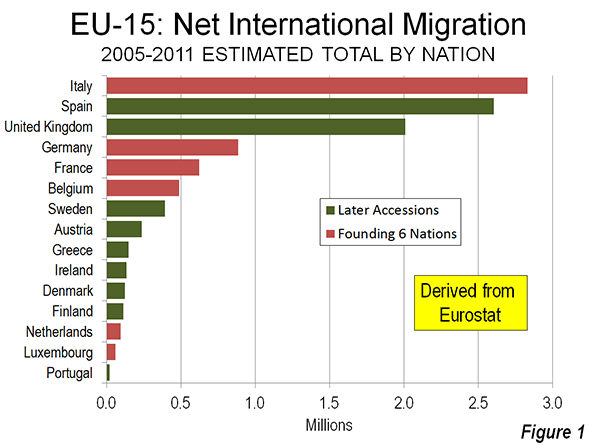
    The changes are stunning. All 15 nations have had net international migration gains since 2005. The leader is Italy, which has added a net 2.8 million international migrants, the equivalent of 4.7 percent of its population. This is more than Italy’s total population gain between 1975 and 2000. Spain has added 2.6 million net international migrants, the equivalent of 5.6 percent of its population. The United Kingdom added 2.0 million international migrants, the equivalent of 3.2 percent of its population.  

    Deep in the Heart of Europe

    Perhaps most surprising are that gains the heart of Europe, six nations that established the European Coal and Steel Community in the early 1950s, which was to become today’s European Union (Belgium, France, Germany, Luxembourg, Italy, and the Netherlands) (Figure 1).

    Germany and France had net international migration of 885,000 and 625,000 respectively. In both countries this was equal to one percent of the population. However, Belgium had the largest relative addition of international migrants. Its 490,000 net increase was equal to four percent of its population.

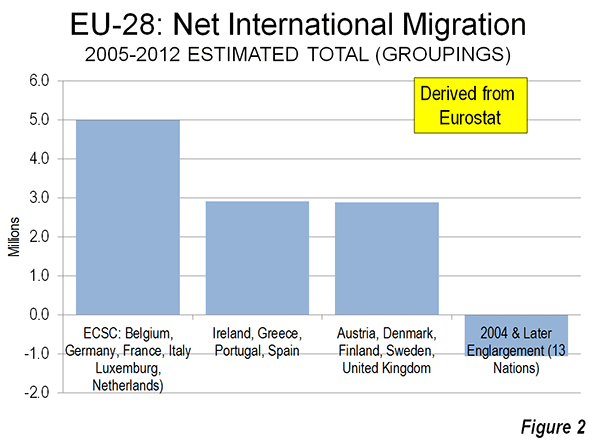
    Overall, the six founding nations of the European Union attracted a net 5.0 million international migrants 2005 to 2012. This is more than the population of all urban areas in the six nations except for Paris, Milan and the Rhine-Ruhr.

    Five additional economies, the United Kingdom, Austria, Sweden, Denmark and Finland added a net 2.8 million international migrants. Even Portugal, Ireland, Greece and Spain, despite their fragile economies, posted substantial gains, adding 2.8 net international migrants (Figure 2).

    The PIIGS Minus Italy

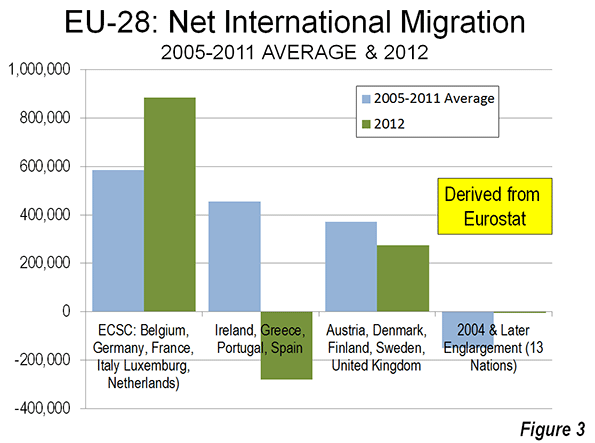
    Five nations have been designated the PIIGS by the international financial community, due to their financial reverses. These include Portugal, Ireland, Italy, Greece and Spain. All, except Italy, have seen their international migration rates fall precipitously. Between 2005 and 2011, these four nations combined added an average of 450,000 net international migrants. By 2012, they lost more than 275,000 net international migrants. In contrast, Italy, one of the EU founders, continued its strong trend, adding approximately 365,000 net international migrants in 2012, up from its 2005 to 2011 average of 350,000.

    The six founding members picked up some of the “PIIGS minus Italy” losses. In 2012, these nations added nearly 885,000 net international migrants, which is well above their 585,000 average for 2005 to 2011. The other five nations (United Kingdom, Austria, Sweden, Denmark and Finland) fell to a 275,000 net international migration gain in 2012, compared to their 2005-2011 average of 370,000.

    The new 13 members did much better than before, losing only 5,000 net international migrants in 2012. Their average from 2005 to 2011 was a 150,000 loss (Figure 3).

    Ireland and Spain

    Spain and Ireland illustrate the connection between declining economies and declining international migration.

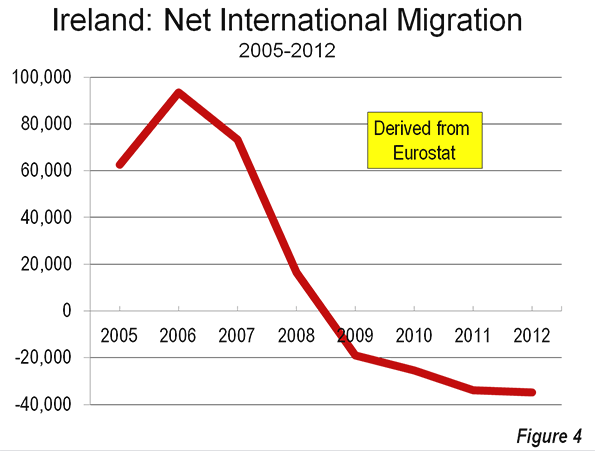
    The Irish Times noted in a recent article that the latest data from the European commission indicates that Ireland now has the worst net international outmigration rate in the European Union. Just six years ago, the Times reports, Ireland’s net international in migration rate was the highest in Europe. Over the past four years (Figure 4), Ireland has lost approximately 35,000 net international migrants annually (Ireland’s housing bubble and the resulting national financial crisis are described in Urban Containment and the Housing Bubble in Ireland).

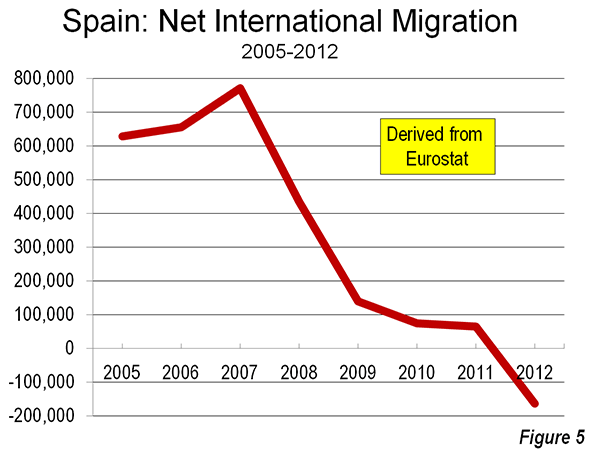
    Spain’s decline in net international migration has been every bit as spectacular. At its peak, Spain was attracting a net international migration approaching 800,000. Last year, Spain lost 165,000 international migrants (Figure 5).

    The 13 New Members

    The net international migration gains in Europe’s heart have not been good news for Eastern Europe, where the newer European Union members are located. Overall, these nations lost approximately 1,050,000 international migrants between 2005 and 2012, though as noted above, the loss was minimal in 2012. This more recent improvement may be the result of weak economic conditions in many western and southern European countries.

    Romania and Lithuania were the biggest losers. Romania lost nearly a net 1,000,000 international migrants, equal to nearly five percent of its population. Lithuania did even more poorly, losing 300,000 international migrants, nearly 10 percent of its population. Both nations lost overall population.

    Migration and Economic Growth

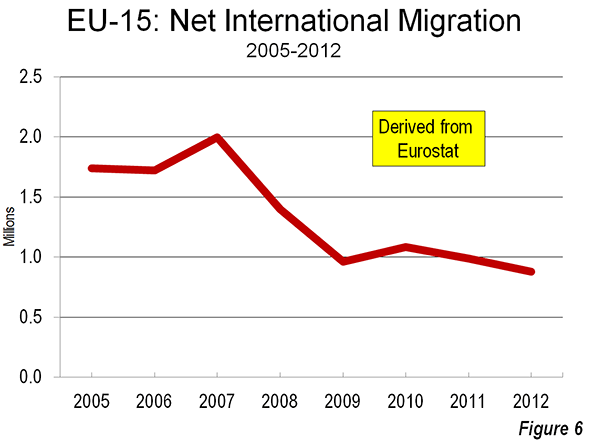
    Despite the resurgence of growth in the heart of Europe, the financial crisis has taken a toll. As in the United States, migration has fallen significantly, as many of the economic opportunities have dried up. By 2012, the net international migration to the EU-15 had been reduced to 900,000 from approximately 2 million in 2007. As throughout history, the demand for international migration is driven principally by the aspirations for a better quality of life. As a result, migration will tend to be greater where there is a wider gulf between the employment and economic opportunities in receiving countries than in countries that lose migrants.

    Wendell Cox is a Visiting Professor, Conservatoire National des Arts et Metiers, Paris and the author of “War on the Dream: How Anti-Sprawl Policy Threatens the Quality of Life.

    Photo: Genoa, Italy (by author)

  • From Balkanized Cleveland to Global Cleveland: A Theory of Change for Legacy Cities

    Legacy cities have legacy costs, including disinvestment from the inner city, as well as regional economic decline. The spiral has been ongoing for decades. The new white paper by consultants Richey Piiparinen and Jim Russell entitled “From Balkanized Cleveland to Global Cleveland”, funded by the Cleveland-based neighborhood non-profit Ohio City Inc., examines the systemic reasons behind legacy city decline, all the while charting a path to possible solutions.

    Shrinking city theorists say the problem with the legacy city is that people leave. But urban powerhouses such as New York lose more people in a day than the Clevelands of the world do in a month. The real problem with legacy cities is an absence of newcomers, as it is this lack of “demographic dynamism”, or “churn,” which has inhibited economic evolution.

    To arrest economic decline, cities commonly undertake a patchwork of strategies. These include retention strategies that supposedly “plug” the brain drain; attraction strategies that emphasize placemaking, residential density, and urban amenities; or “big ticket” developments such as convention centers and casinos. The authors take another stance, theorizing that migration is the key to economic development. Cities that lack churn need churn. Without it, legacy cities can act as echo chambers of patronage and provincial thinking.

    But churn in itself is not enough. Often, the importance of inmigrants equates to filling condos or restaurant booths. Take the case of Ohio City, an inner city neighborhood bordering Cleveland’s central business district. The neighborhood, home to the iconic West Side Market, has made strides in its recovery. Investment is coming in. Condos are being built. Restaurants are opening. But this is not enough.

    In fact the mistake cities make when it comes to reinvestment is to settle with the low-hanging fruit of gentrification. Here, the neighborhood is seen as a center of consumption, with trickle-down effects from increased commerce said to reach low-income residents living in gentrifying, or potentially gentrifying, neighborhoods. This does not happen.

    This does not mean the reinvestment going on in neighborhoods such as Ohio City is unwelcome. It is only to say something else is needed. Ohio City needs to be made into a neighborhood that produces, not simply one that consumes.

    One way to do this is to ensure that the diversity of race, class, and businesses that currently exist in the neighborhood continue in the face of increasing market demand. For instance, Ohio City is 36% Black, 20% Hispanic, and 54% White. The neighborhood’s race and class mixing has increased over the last decade. Ensuring such heterogeneity can remain in the face of market demand is the challenge of the day. To date, no city has systematically ensured a process of policies that prioritizes the long-term benefits of integrated communities over the short-term benefits of consumer-driven gentrification.

    The benefits include increased economic mobility for individuals who grow up in integrated neighborhoods. For instance, a new study called “The Equality of Opportunity Project” found that Cleveland ranked 45th out of 50 metro areas in terms of upward mobility. A child in Cleveland raised in the bottom fifth of an income class only has a five percent chance of rising to the top fifth in her lifetime. The study, however, concludes that “upward mobility tended to be higher in metropolitan areas where poor families were more dispersed among mixed-income neighborhoods”.

    Cleveland is at a threshold. The re-investment is coming, and the importance of this infill as a means to arrest its economic and demographic decline cannot be overstated. Yet this will only occur if re-investment is leveraged so as to develop real economic growth. In other words, simply developing “creative class” enclaves in the likes of Ohio City and Tremont will do nothing to transition Cleveland from a segregated, siloed city with high rates of poverty into a globalized, integrated city comprised of neighborhoods that produce human capacity.

    Where people live informs them no less than where they work or go to school. Neighborhoods are factories of human capital. Equitable, integrated environments maximize potential. America needs to go past the gentrification model of revitalization. The cities that still have a fighting chance, like Cleveland, should lead.

    Read the white paper here.

  • Progressive Policies Burden the Yeoman Class

    Obamacare’s first set of victims was predictable: the self-employed and owners of small businesses. Since the bungled launch of the health insurance enrollment system, hundreds of thousands of self-insured people have either had their policies revoked or may find themselves in that situation in the coming months. More than 10 million self-insured people, many of them self-employed, could meet a similar fate.

    Unlike large companies or labor unions, which have sought to delay or duck implementing the Affordable Care Act, what could be called the yeoman class lacks the political might to make much of a dent in Washington policies. Indeed, in the Obama era, with its emphasis on top-down solutions and Chicago-style brokering, Americans who work for themselves probably are more marginalized today than at any time in recent memory.

    Virtually every major initiative of this administration – from taxation and regulation to monetary policy and Obamacare – has been promulgated with little concern for the self-employed. Many feel themselves subject to an apparent attempt to transfer middle class incomes to the poor just as ever more wealth concentrates in the “1 percent.” Not surprisingly, 60 percent of business owners surveyed by Gallup expressed opposition to the administration.

    The divide between the yeoman and the political community marks a major departure from the norms of American history. After all, people came to America in large part to secure “a piece of the pie,” whether through owning a small business or a farm, goals often unattainable in Europe. Thomas Jefferson, notes historian Kenneth Jackson, “dreamed of the U.S. as a nation of small yeoman farmers who would own their own land and cultivate it.”

    The rural yeoman ascendency lasted well into the late 19th century, when the populist movement fell to triumphant industrial capitalism. Yet the drive to disperse property did not end there, but resurfaced in the expansion of urban homeownership, something strongly supported by the New Deal administration. “A nation of homeowners,” President Franklin Roosevelt believed, “of people who own a real share in their land, is unconquerable.” From 1940-60, nonfarm homeownership rose from 43 percent of Americans to more than 58 percent.

    Early on, some progressives, particularly among intellectuals, recoiled against the rise of a class of petty landowners. Some of them, historian Christopher Lasch observed, saw “a republic of producers” as necessarily “narrow, provincial and reactionary.” This view is echoed today by Democrats such as former Clinton administration adviser Bill Galston, who dismisses small business as “a building block of the Republican base.” Democrats, he suggests, should instead seek a reconciliation with Big Business and its powerful cadre of lobbyists.

    An expanding cohort

    Yet, Democrats someday may rue tossing off the yeoman class. Unlike such groups as white racists, defense hawks and social conservatives, all of whose ranks are thinning, the numbers of the self-employed are growing. Independent contractors, according to Jeffrey Eisenach, an economist at George Mason University, have increased by 1 million since 2005; one in five works in such fields as management, business services or finance, where the percentage of people working for themselves rose from 28 percent to 40 percent from 2005-10. Many others work in fields like energy, mining, real estate or construction. Altogether, there are as many as 10 million such independent workers, constituting upward of 7.6 percent of the U.S. labor force and earning more than $626 billion.

    This shift to self-employment is occurring even in heavily regulated states like California. Since 2001, the number of self-employed people in the Golden State grew by 15.6 percent, versus a gain of 9.4 percent for the nation. In terms of states’ share of self-employed in the workplace, California ranks in the top five; three of the others, Vermont, Maine and Oregon also are blue states.

    Why is this the case? Ironically, this may be a reaction to expansive regulatory regimes that tend to both reduce corporate employment and also encourage some individuals “to take their talents” solo into the marketplace without having to deal with, for example, labor laws and environmental regulations.

    At the same time, technology allows people to work in an increasingly dispersed manor. The number of telecommuters has soared by 1.7 million workers over the past decade, a 31 percent increase in market share, and now accounts for 4.3 percent of all employment.

    Obamacare is only one aspect of government’s assault on the yeoman class. Attempts to regulate housing and encourage denser, usually rental, units ultimately works against the interests of home-based small businesses by raising house prices. The extra bedroom that becomes the home office now can be seen as “wasteful” even if – in terms of generating greenhouse gases – working at home is far more efficient than commuting, even by mass transit.

    Alienating allies

    Over time, these conflicts could threaten the interests of some groups that now reside firmly in the Obama majority coalition. This reflects the changing demographics of small enterprise; the yeomanry is slowly becoming far more diverse. From 1982-2007, for example, African American-owned businesses increased by 523 percent; Asian American-owned businesses grew by 545 percent; Hispanic American-owned businesses by 696 percent; businesses owned by whites increased by 81 percent. Today, minority-owned firms make up 21 percent of the nation’s 27 million small businesses.

    Immigrants, a largely Democratic-leaning constituency, constitute a growing part of the entrepreneurial landscape. The immigrant share of all new businesses, notes the Kauffman Foundation, grew from 13.4 percent in 1996 to 29.5 percent in 2010. They also constitute roughly a quarter of founders of high-tech start ups, and have done so for most of the past generation.

    Women, another Obama-leaning group, have also expanded their footprint; over the past 15 years, the number of women-owned firms has grown by one and a half times the rate of other small enterprises. These companies account for almost 30 percent of all enterprises; from 1997-2012, the number of women-owned U.S. firms increased by 54 percent, versus an overall growth rate for all firms of 37 percent.

    Eventually, the potential yeoman backlash may also spill over to millennials, another key Obama constituency. As a generation, their desire for homeownership and economic self-reliance runs headlong into both the tepid economic recovery and regulatory policies. Over time, as they age, their interests could diverge from the expanding welfare state, whose primary mission appears to be to transfer wealth not only from the middle class to the poor but from younger to older Americans.

    As millennials age, many will seek to buy homes, start businesses and families. In contrast to their common, often-naïve embrace of the idea of bigger government, developed in their student years, experiences as potential homeowners and parents, as well as business owners, might make them skeptical of “top down” solutions imposed by largely baby boomer ideologues.

    Reply from the Right?

    Yet, this will be no cakewalk for conservatives. It is not enough to simply dismiss Obamacare, or other regulations, without endorsing some of the measures’ positive attributes, such as assuring one’s children or protecting the rights of those with “pre-existing conditions.” The yeomanry may want less-Draconian legislation, but they may not be so anxious to leave their health care utterly exposed to unfettered market forces.

    Democrats, in fact, could make a run at this constituency, particularly if the Republicans continue a political approach that alienates, in particular, a more diverse yeomanry – gays, many women and ethnic minorities, immigrants and creative professionals. Here, in fact, it might be better to be more radical than less, proposing something more like a Canadian “single payer” health system that would separate employment status from health care. Democrats also could also support some form of minimum coverage designed for the growing numbers of Americans who work for themselves.

    Ultimately, over time, the yeoman constituency, although poorly organized and without a programmatic agenda, is one that needs to be addressed, if for no other reason than they constitute a growing portion of the workforce. The party, or movement, that successfully does this will have a great opportunity to seize the political future.

    This story originally appeared at The Orange County Register.

    Joel Kotkin is executive editor of NewGeography.com and Distinguished Presidential Fellow in Urban Futures at Chapman University, and a member of the editorial board of the Orange County Register. He is author of The City: A Global History and The Next Hundred Million: America in 2050. His most recent study, The Rise of Postfamilialism, has been widely discussed and distributed internationally. He lives in Los Angeles, CA.

    Official White House Photo

  • Jerry Brown and California’s “Attractive” Poverty

    Jerry Brown is supposed to be a different kind of politician: well informed, smart, slick, and skilled.  While he has had some missteps, he’s always bounced back.  His savvy smarts have allowed him to have a fantastically successful career while generally avoiding the egregious dishonesty that characterizes so many political practitioners.

    So, I was shocked to read that he said that California’s poverty is a result of the State’s booming economy.  Here’s part of the Sacramento Bee report:

    Gov. Jerry Brown, whose pronouncements of California’s economic recovery have been criticized by Republicans who point out the state’s high poverty rate, said in a radio interview Wednesday that poverty and the large number of people looking for work are "really the flip side of California’s incredible attractiveness and prosperity."

    The Democratic governor’s remarks aired the same day the U.S. Census Bureau reported that 23.8 percent of Californians live in poverty under an alternative calculation that includes the cost of living. Asked on National Public Radio’s "All Things Considered" about two negative indicators — the state’s nation-high poverty rate and the large number of Californians who are unemployed or marginally employed and looking for work — Brown said, "Well, that’s true, because California is a magnet.

    "People come here from all over in the world, close by from Mexico and Central America and farther out from Asia and the Middle East. So, California beckons, and people come. And then, of course, a lot of people who arrive are not that skilled, and they take lower paying jobs. And that reflects itself in the economic distribution."

    This is so incredibly wrong that I’m worried that Brown has lost his head and ability to reason.   If he really believes what he said, he’s living in the past and he’s so ill informed as to be delusional.  If he doesn’t believe what he said, I’m worried that his political skills have slipped.  To my knowledge, he’s never said anything so clearly at odds with the truth in his career.

    Here are the facts:

    • California’s poverty is not where the jobs are, which is what we’d expect if what Brown said was true.  Most of California’s jobs are being created in the Bay Area, a region of fabulous wealth. By contrast, California’s poverty is mostly inland. San Bernardino, for example, has the second highest poverty rate for American cities over 200,000 population, and no, it’s not because it’s a magnet. Most of California’s Great Central Valley is a jobs desert, but the region is characterized by persistent grinding poverty and unemployment.  No one in recent years is moving to Kings County to look for a job.
    • States with opportunity have low poverty rates.  North Dakota may have America’s most booming economy.  According to the Census Bureau, North Dakota’s Supplemental Poverty Measure is 9.2 percent.  That is, after adjustments for cost of living, 9.2 percent of North Dakotans live in poverty.  The rate in Texas – a state with a very diverse population, and higher percentages of Latinos and African-Americans – is 16.4 percent.  California leads the nation with 23.8 percent of Californians living in poverty.
    • According to the U.S. Census, domestic migration (migration between California and other states) has been negative for 20 consecutive years. That is, for 20 years more people have left California for other states than have come to California from other states. Wake up, Jerry, this is no longer your Dad’s state – or that of his successor, Ronald Reagan. This is a big change from when Brown was elected governor the first time.  At that time, California was a magnet.  It had a vibrant economy, one with opportunity.  California was a place where you could have a career, afford a home, raise a family.  It was where the American Dream was realized.
    • How about the magnetic attraction for immigrants from all over the world? According to the Census Bureau, international migration to California is way down.  The number of California international immigrants has been declining for a decade at least.  Indeed, in recent years there have been about half as many international immigrants to California than we saw in the 1990s.  Over the past decade, the number of foreign born increased more in Houston than the Bay Area and Los Angeles put together. Opportunity, not  “attractiveness”, drives people to move.
    • The result of negative domestic migration and falling international migration is the total migration to California has been negative in each of the past eight years.  More people have left California than have come to California for eight consecutive years. 
    • California’s migration trends combined with falling birth rates has resulted in the lowest sustained population growth rates that California has seen.

    The data are clear: Brown’s assertions have no basis in fact.  California – with the exception only recently of the Bay Area – is not a magnet. California is not "incredibly attractive and prosperous."  People are not coming from all over the world. California may beckon, but more are leaving, and those here are having fewer children. California’s seductive charms go only so far.

    I don’t know if I’d prefer that Brown was delusional or lying. On the one hand, policy made from a delusional analysis of the world is sure to be bad policy. Brown, for example, may convince himself that Twitter, Google, and Facebook are the future of the California economy, without recognizing how few people, particularly from the working class or historically disadvantaged minorities, they employ. On the other hand, Brown is very skilled in the political arts. If someone as skilled as he has to resort to such outright misdirection, we may be in worse shape than I think.

    Bill Watkins is a professor at California Lutheran University. and runs the Center for Economic Research and Forecasting, which can be found at clucerf.org.

    Jerry Brown photo by Bigstock.