Category: Demographics

  • Are Millennials Turning Their Backs on the American Dream?

    In his classic 1893 essay, “The Significance of the Frontier in American History,” historian Frederick Jackson Turner spoke of “the expansive character of American life.” Even though the frontier was closing, Turner argued, the fundamental nature of Americans was still defined by their incessant probing for “a new field of opportunity.” Turner’s claim held true for at least a century—during that time, the American spirit generated relentless technological improvement, the gradual creation of a mass middle class, and the integration of ever more diverse immigrants into the national narrative.

    Yet today, many consider this modern period of “expansiveness” to be as doomed as the prairie frontier culture whose denouement Turner portrayed. Nothing makes this clearer than the perception of a majority of middle class Americans that their children will not do better than them, with as many as pessimistic about the future as are optimistic. Almost one-third of the public, according to Pew, consider themselves “lower” class , as opposed to middle class, up from barely one quarter in 2008.

    Are Young Americans Becoming Herbivores?

    To some, this dismal outlook is either inevitable, or even positive, as Americans shift from their historically “expansive” view and embrace a more modest déclassé future. Rather than seek new worlds to conquer, or even hope to retain the accomplishments of prior generations, contemporary young Americans seem destined to confront a world stamped by ever narrowing opportunity, class distinction, and societal stagnation. Once a nation of competitive omnivores and carnivores, America could be turning more docile—a country of content, grazing herbivores.

    Just such a diminished world view has already taken root in Japan, particularly among that country’s younger males. Growing up in a period of tepid economic growth, a declining labor market, and a loss of overall competitiveness, Japan’s male “herbivores” are more interested in comics, computer games, and Internet socializing than building a career or even the opposite sex. Marriage and family have increasingly little appeal to them, sentiments they share with most women their age.

    This devolved future is widely embraced by both left and right. Libertarian-leaning economist Tyler Cowen identifies a permanent upper class, essentially those who command machines and particularly the software that runs them, while the masses, something like 85 percent of the population, need to adjust to lower living standards, and a diet made up largely of beans and rice.

    This approach has appeal to the grandees of finance, who see in a diminishing American dream not only higher relative status for themselves but an opportunity to turn prospective property owners into rental serfs. Large equity funds have been particularly aggressive about buying foreclosed homes and renting them out, often at high rates, to economically distressed families.

    This “rentership” society, as first suggested by Morgan Stanley’s Oliver Chang, reflects, in this sense, an almost Marxian dialectic that sees ownership of property concentrating in ever fewer hands. Conservative theorists have little problem with this, since they naturally defend class privileges and are less committed to upward mobility than assuring the relentless triumph of market capitalism.

    But the most potent apologists for shrinking the American dream come from the very left which, in the past, once championed broad-based economic growth and upward mobility. Instead, progressives increasingly favor their own version of a “rentership society,” albeit one more regulated than the conservative version, but also accepting , and even encouraging, the proletarianization of the American middle class. (Turning them, in the process, into good, reliable clients of the Democratic Party). Goodbye Levittown, with its promise of property ownership and privacy, and back to the tenements of Brownsville, now dressed up as “hip and cool.”

    Some even have suggested getting rid of “middle class norms of decency” governing housing and bringing back the boarding house of the 19th and early 20th Century. The goal, of course, is to facilitate ever more densification of urban areas and to rein in the dreaded suburban “sprawl.”

    This tendency to force densification and downgrade ownership is deeply pronounced among urbanists and the green lobby, two groups with ample power in most blue states and regions. “Progressive” theorists such as Richard Florida see wealth transferring to a handful of “spiky” American cities, places such as San Francisco and Manhattan, where even the prospect of home ownership is inconceivable to the vast majority of the population.

    There are many others, farther out on the green urbanist track, who believe that the entire notion of middle class upward mobility is too consumption-oriented and, well, sort of in bad taste. They maintain that millennials will not only eschew home ownership but the ownership of automobiles and practically anything else bigger than their beloved electronic gadgets.

    Indeed, this transformation would be greeted with enthusiasm by many greens and traditional urbanists. The environmental magazine Grist even envisions “a hero generation” that will escape the material trap of suburban living and work that engulfed their parents. “We know the financial odds are stacked against us, and instead of trying to beat them, we’d rather give the finger to the whole rigged system,” the millennial author concludes.

    Are Americans Millennials Victims of Circumstance?

    Are young Americans ready to move off the competitive playing field and onto the herbivore pastureland? The economic stagnation certainly seems to have had a negative effect on everything from marriage to fertility rates, which are at their lowest levels in a quarter century. Much like their Japanese counterparts, young Americans increasingly avoid both marriage and having children, according to a recent Pew Foundation study. Despite a total rise in population of 27 million (PDF), there were actually fewer births in 2010 than there were ten years earlier.

    Is this a matter of preference or a reaction to hard times?  Hemmed in by college debt and a persistently weak economy, almost 40 percent of the unemployed are between 20 and 34. A smaller percentage of American males between 25 and 34—the key age for prospective families—are in the workforce than at any time since 1948.

    One reason some celebrate the rejection of marriage and family is that it undermines the suburban environments that overwhelmingly attract most families. Urban theorists such as Peter Katz maintain that millennials (the generation born after 1983) show little interest in “returning to the cul-de-sacs of their teenage years.” Manhattanite Leigh Gallagher, author of the predictable anti-burbs broadside The Death of Suburbs, asserts with certitude that that “millennials hate the suburbs” and prefer more eco-friendly, singleton-dominated urban environments.

    Another apparent casualty here may be entrepreneurship, the very thing that characterized both boomers and their successors, Generation X.  Entrepreneurship rates remain strong among older Americans , but start-up rates among young people look far weaker. Millennials’ experience with the economy makes them, according to generational chroniclers Morley Winograd and Mike Hais, “very risk averse,” particularly in comparison with previous generations.

    Can millennials recreate the “Expansive” culture in their own image?

    Winograd and Hais see millennial timidity as a mostly temporary phenomena. Far from rejecting suburbia, homeownership, and the American dream, millennials are simply seeking to recreate it in their own image. Contrary to the notions promoted by the Wall Street financiers, urban land speculators, and greens, most millennials, particularly those entering their 30s, express a strong desire to own a home, with three times as many eyeing the suburbs as the inner core.

    The recession, according to a recent Wilson Center study (PDF), did not kill the desire to own a home among younger people: more than 90 percent of those under 45 said they wanted to own their own residence.    Another survey by TD Bank found that 84 percent of renters aged 18 to 34 intend to purchase a home in the future. And a Better Homes and Gardenssurvey found that three in four sawhomeownership as “a key indicator of success.”

    Survey data also suggests that millennials are highly focused on getting married and being good parents. Nearly four in five millennials express a desire to have children. This will become more significant as millennials reach their 30s and early 40s, the prime age for family formation. Over the next decade, at least six million people will be entering their 30s, and that number is expected to keep expanding through 2050.

    None of this suggests that, as some social conservatives might hope, that the Ozzie and Harriet family is about to make a major comeback. For one thing, millennials will likely get hitched and have children later than previous generations. Their marriages also will probably be less traditional and male-centered. Hais and Winograd assert that millennials are a “female dominated” generation and have a less traditional view of sex roles—or for that matter, what constitutes a family, since they tend to be highly supportive of same sex marriage.

    But if they differ from past generations, most millennials clearly do not aspire to the ideal of singleness and childlessness embraced by more radical boomer enthusiasts. That said, they will not recreate the family or their residence in their parents’ image. They may, for example, be more willing to customize their residences for their own unique needs or for greater energy efficiency, and place greater emphasis on “technology capabilities” than on a larger kitchen, or some more traditional suburbanaccoutrements.

    As they get on with life, they will also make new demands on their bosses, warn Hais and Winograd. Companies will need to accommodate as well the new familial arrangements that Millennials are likely to seek out. This means firms will need to adopt policies that favor telecommuting, flexible hours, and maternity and paternity leave that will allow for a better balance between work and personal life.

    But in the long run, millennials, if given a chance, are likely to maintain the national ethos of aspiration despite the powerful headwinds they now face. As Turner suggested at the end of his famous essay, it would be “a rash prophet who would assert that the expansive character of American life has now entirely ceased.”

    The real issue here is not the declining validity of American aspiration, but overcoming the economic, political and social factors that threaten to suffocate it. Similar challenges—the concentration of wealth of the Gilded Age, the Great Depression, war, and environmental angst—have periodically appeared and were eventually addressed through technological innovation, and critical political and social changes. Rather than accept the shrinkage of the American prospect, we should seek ways to restore it for those who will inherit this republic.

    This story originally appeared at The Daily Beast.

    Joel Kotkin is executive editor of NewGeography.com and Distinguished Presidential Fellow in Urban Futures at Chapman University, and a member of the editorial board of the Orange County Register. He is author of The City: A Global History and The Next Hundred Million: America in 2050. His most recent study, The Rise of Postfamilialism, has been widely discussed and distributed internationally. He lives in Los Angeles, CA.


  • Density, Unpacked: Is Creative Class Theory a Front for Real Estate Greed?

    “The heresy of heresies was common sense”—George Orwell

    The stories we tell affect the lives we lead. I do not mean to be abstract here. I mean, literally, the stories that are told make up a kind of meta-reality that soaks in us to form a “truth”. This “truth” affects policy, which affects investment, which affects bricks and mortar, pocketbooks, and power. Eventually, the “truth” trickles down into a more real reality that defines the lives of the powerless.

    The story du jour in urban policy is one of density. The arc of the story is that cities are places where “ideas come to have sex”. The lovechild is innovation. The mood lighting is creative placemaking.

    The Kama Sutra of density reads this way: creative people cluster in cities that are good at lifestyle manufacturing. The more people that are sardined the higher likelihood there will be “serendipitous” encounters. The more serendipity in a city the better chance the next “big thing” will occur. The next “big thing” will lead to a good start-up, which will lead to an agglomeration of start-ups, termed an “Innovation District”. Detroit becomes Detroit 2.0 then.

    The story of density is a seductive story. Society-making is sobering and full of harsh realities. The story of density is seamless, velvety. It is no wonder the story gets sold, implemented, and then told and re-told, despite the validity and logic of the story being pretty awful.

    Take the recent New York Times piece entitled “What It Takes to Create a Start-up Community”. In it, the writer interviews urbanist Richard Florida. “Population density, [Florida] said, allows for the serendipitous encounters that inspire creativity, innovation and collaboration,” reads one key passage in the piece.

    The story goes on to highlight the emerging tech hub of Boulder as the exemplar of the story of density. One problem: Boulder, a city of less than 100,000, isn’t dense, with a population per square mile of 3,948. The writer moves the goal posts a bit and says the city “is an unusual case of density”, before going on to question whether a start-up community can be created in a city like Detroit that “lacks density”. Yet Detroit, despite being a land mass comprised of one-third vacant land, is denser than Boulder, at 5,144 people per square mile. In all, Aristotle would have a field day with the piece.

    Such illogic peppers the story of density, particularly as it relates to the correlation—to say nothing of the causation—between household clustering and tech growth. For instance, in a recent analysis of America’s top “high tech hot spots” by the Progressive Policy Institute, the top 25 counties experiencing the highest percentage of tech job growth reads like a “Where’s Waldo” list, if Waldo was Thoreau-like. There’s Madison County in Alabama (417 people per sq. mile). Utah County in Utah (258 people per sq. mile). Denton County in Texas (754 people per sq. mile). Fayette County in Kentucky (1,043 people per sq. mile). Snohomish County in Washington (342 people per sq. mile).

    To be fair, also on the list are San Francisco, Boston, and New York. In the case of Boston and San Fran, the tech clustering is a legacy asset—including large venture capital funds — from decades prior, not the result of the story of density. New York, under Mayor Bloomberg, has supposedly gone whole hog on the “idea-sex in the city” script, yet tech is but a speck on the universe that is New York City’s economy.

    For example, Kings County, home to Brooklyn, numbers 25 on the list of places with highest percent of tech job growth, yet Brooklyn’s Job Index—calculated as new tech/information jobs between 2007 and 2012, as a share of 2007 total private sector employment—is just 0.4, meaning the number of new tech jobs in Brooklyn represents less than half a percent of total private employment. Given the information sector as a whole is hemorrhaging jobs according to a recent Harvard Business Review, the scaling of fledgling tech towns is unlikely. This is especially true for cities like New York that—while enriched with the chattering class buzz stoking the story of density—simply lacks the engineering talent of Boston, Silicon Valley, Houston and yes, Detroit , to make the “scene” something than just that: a scene.

    But let’s play along anyway, as that’s the power of the story of density: reality doesn’t bite. So, say Brooklyn can become the next Silicon Valley. This likelihood depends on two assumptions that define the story of density: “cooling” a city will draw top tech talent, and then packing them in to luxury condo towers and mixed use districts will form creativity incubators.

    First, the idea that manufacturing cool spurs a start-up scene is spurious at best. I mean, has this ever worked? Please don’t say Austin, or any number of college towns or state capitals or places with boutique streets that depend largely on transfers from taxpayers — and parents! — to their privileged burgs. Many of these place, like Austin and Raleigh, are themselves far from dense urban nodes, but are exceptionally spread out.

    What about Boulder? In the piece “How Boulder Grew Into a Hub for Start-Ups”, the writer questions venture capitalist Brad Feld, a huge player in the Boulder tech scene, about what brings entrepreneurs to communities like Boulder. Feld throws his hands in the air:

    “People want to live where they want to live. You should figure out where you want to be and build a life around it. Different geographies attract different people.”

    Why did Feld move to Boulder?

    Actually, I moved here in 1995 because Amy said "I’m moving to Boulder – you can come with me if you want." And I did.

    There are things that do appeal to innovators, however. Affordability is an appeal, so says a recent survey of London techies who are decamping from the capital, if only because outrageous rents prevent a “start-up” of anything.

    Over in Berlin, the tech scene is struggling despite the “Berlin geek chic” culture that unfolded. The city’s tech leaders think Berlin needs to be more conventional than cool. “[T]he jury is still out on whether [Berlin’s] a great place to truly grow that company into a mature startup," notes Marc Strigel, head of SoundCloud. "Both the authorities and startups could do much more in promoting Berlin for families, for these world-class talents we definitely need."

    The second assumption relates to the idea that sardining people will ultimately lead to serendipity and innovation. I smell underpants gnomes. Specifically, in an episode of South Park, creators Trey Parker and Matt Stone expose the blind loyalty attached to the façade of “expertise”. The episode goes like this: the characters need a presentation for class. One of the boys talks about a group of gnomes that inexplicably sneak into his house to steal underpants. There’s got to be a reason, right? They confront the gnomes who, claiming to be business experts, explain their business plan as thus: Step 1: Collect Underpants. Step 2: ?. Step 3: Profit.

    The story of density has the same logic gap. Step 1: Population density. Step 2: ?. Step 3: Innovation. Density gurus will claim Step 2 relates to serendipity. But serendipity is chance. How do you plan for chance? Even if you could, creative classification is largely a process of homogenization by class, age, and profession, which, according Rita King of Science House, erodes the possibility of meaningful chance encounters. “Artists bumping into other artists or business people bumping into other business people or Mormons bumping into other Mormons, etc., isn’t real serendipity,” notes King. San Francisco in many ways is more a monoculture than the highly diverse suburbs that surround it.

    Okay, so if the story of density really isn’t about innovation then what is it about? The answer can be found in a recent article entitled “Urban Prophet” in the real estate trade mag Property Week. The piece quotes Albert Ratner, chairman of US real estate firm Forest City Enterprises, on his reading of Florida’s The Rise of the Creative Classes, the first book in the story of density. “You have given real estate developers the playbook,” notes Ratner.

    Put simply, the point of sardining is to make as much money as possible for those who already  have the most . This is the raw truth that fuels the hype, and of course pays for it as well. But it’s a tough sell to neighborhoods and cities increasingly experiencing the negative effects of real estate wealth jamming, and more broadly wealth inequality. Enter the story of density to make another “truth”.

    In reality, the story of density is a fiction and it’s high time we start rewriting the book.

    Richey Piiparinen is a writer and policy researcher based in Cleveland. He is co-editor of Rust Belt Chic: The Cleveland Anthology. Read more from him at his blog and at Rust Belt Chic.

  • To Rebuild, the Midwest Must Face Its Real and Severe Problems

    Despite well-publicized problems that earned it the nickname of the “Rust Belt”, on paper the Midwest possesses some formidable strengths. These include the largest concentration of engineers in America, world class educational institutions, a plethora of headquarters of global champions ranging from Proctor and Gamble to Caterpillar to the Chicago Mercantile Exchange, the world’s greatest reserves of fresh water, and an expanding immigrant population.

    Yet with limited exceptions, these have been around for a while, but haven’t produced much growth across the region. Instead, outside of an archipelago of successful outliers (mostly select parts of major metros or college towns), the region has seen its population, job, and income growth badly trail the nation.  During the 2000s US population grew by 9.7%, the Midwest* 3.8%. For jobs, the US lost 1.5% but the Midwest 7.8%.

    Reversing this requires not just leveraging strengths and building on assets, but facing the very real and severe structural challenges that plague the region. However, most of the strategies out there remain outside the region’s essential DNA:

    • Economic clusters like high tech startups or water industries are in effect attempts to build new success enclaves outside the system.
    • Rebuilding downtowns into urban playgrounds for the upscale often takes place against a backdrop of vacant lots, abandoned structures, and depopulation – in other words, empty space.
    • The Rust Belt Chic movement suggests that many of the problems are actually the solution.  But while there are intriguing and important elements to this, it bypasses core issues.

    These are all good as far as they go, but they require little broad-based reform (as opposed to district or enclave based solutions) to structural problems and thus are limited in what they can achieve.

    What are these structural problems? Among the key ones are:

    1. Racism. The modern history of Midwest cities is enmeshed in the history of race relations, particularly between black and white. Places like Chicago and Milwaukee remain among the absolutely most segregated in America. Race riots have been defining feature of cities ranging from Detroit to Cincinnati (which had a race-influenced riot as recently as 2001). In all of these places, a large population of black residents live in segregated neighborhoods plagued with problems ranging from poor schools to low quality housing to a lack of jobs.  Significant social distress has resulted. 

    There are signs the Great Migration that brought blacks north in search of factory work is reversing, with black residents actually seeing more welcoming environments and better economic opportunities in Southern metro areas like Atlanta, Houston, and Charlotte. As well, historically it’s been the more ambitious who leave, not such a good thing for the people and places left behind.

    2. Corruption.  Midwest cities ranging from Chicago to Detroit to Cleveland are famous as cesspools of corruption and cronyism. Systems like Chicago’s “aldermanic privilege” tradition that gives city council members almost dictatorial control over their districts produce environments of almost required tacit corruption even if no laws are violated. In other cities, it’s well known that your approvals will go much faster if you hire the right wired-up subcontractors, lawyers, or lobbyists. While this type of environment exists at some level everywhere, it’s very bad in many Midwest cities and badly degrades an already challenged business climate.

    3. Closed Societies. Contrary to the assertions of Robert Putnam and Bowling Alone, a lot of Midwest places suffer from an excess of social capital. As Sean Safford noted in Why the Garden Club Couldn’t Save Youngstown, excessively dense social networks can create a hermetically sealed environment into which new ideas can’t penetrate or get a hearing.  There are many reports of newcomers to Midwest cities saying that they have difficult making friends and penetrating the social networks in places as diverse as Minneapolis and Cleveland. In Cincinnati and St. Louis expect that the first question you’ll be asked is “Where did you go to high school?” which tells you everything you need to know about those cities.  Immigration has ticked up in recent years, but overall the Midwest has done a poor job of attracting outsiders.

    4. Two-Tier Environment and Resulting Paralysis.  Despite the plethora of high end companies, educated workers, and top quality universities, the Midwest economy was traditionally based on moderately skilled labor in agriculture and industry. This forged a work force that places too low value on education and which can even be suspicious of people with too much of it. Today’s agriculture and manufacturing concerns, at least the ones with jobs that pay more than subsistence wages, require much higher levels of skills and education than in the past. What’s more, with the global macro-economy favorable to larger cities and talent based industries, larger metros have comparatively done well while most smaller towns have struggled. As a result, their quality of life and services have so badly degraded they are no longer attractive to “discretionary residents” (those with the means and opportunity to leave), which perpetuates a downward spiral as the educated flock to bigger cities. That’s why manufacturers complain they can’t find workers with skills, even if those skills are just passing and drug test and showing up to work everyday. This produces massive inequities, resentment, and policy confusion. What’s more, realistically many very poorly performing communities may never recover.

    Beyond these core issues, many places have aging infrastructure, massive blight issues, a regulatory environment not suited to the 21st century, and severe fiscal problems. All of these are extremely difficult problems to resolve, but that does not mean they don’t need to be faced, and overcome.

    Unsurprisingly, the Midwest has not been a particularly competitive region.  There will continue to be bright spots ranging Des Moines to Madison to the greater Chicago Loop to the fracking fields of western Pennsylvania, but until the region faces up to its problems don’t expect a major turnaround anytime soon.

    Aaron M. Renn is an independent writer on urban affairs and the founder of Telestrian, a data analysis and mapping tool. He writes at The Urbanophile.

  • Cities and Sustainability: Is Intensification Good Policy?

    This post examines the idea that we can promote sustainability by increasing the densities of large cities around their centres.  This compact city paradigm presumes that we can reshape the consumption of citizens in environmentally benign ways by reshaping the cities they live in.  

    The sustainability challenge is the challenge of consumption: how much and what we consume drives our impact on the planet.  But presuming that by enforcing urban intensification we will transform ingrained patterns of consumption in favour of the environment may be a step too far.  Will obliging more citizens to live at higher densities in smaller dwellings around city centres really pave the way to environmental salvation?

    Some evidence of urban impacts

    The Australian Conservation Foundation is committed to ecological sustainability, tackling the social and economic causes of environmental problems.  Among other things, the Foundation publishes the onlineAustralian Consumption Atlas. This is a useful source for addressing the role of urbanisation and urban form.

    The Atlas is based on methodology which traces the direct and indirect demands on the environment of different goods and services.  Consumption patterns from Household Expenditure Surveys are related to household size and type, members’ age structure, incomes and education, and the statistical areas they live in. Using this information the environmental impacts of individuals living in different areas can be mapped. 

    Three indicators of impact are displayed in the atlas: tonnes of greenhouse gas emitted, litres of water consumed, and ecological footprint.  The latter estimates the area of resources required to support a person’s lifestyle.  You can read more about the methodology here.

    The data underlying the atlas is dated – based on the 2001 Census and 1999 Household Expenditure Survey, among other things.  But I do not expect the relativities it demonstrates, or the conclusions it supports, to have changed much.

    Cities don’t consume; people do

    Here is the authors’ key conclusion. Our urban planners, designers, and politicians should consider carefully:

    despite the lower environmental impacts associated with less car use, inner city households outstrip the rest of Australia in every other category of consumption. Even in the area of housing, the opportunities for relatively efficient, compact living appear to be overwhelmed by the energy and water demands of modern urban living, such as air conditioning, spa baths, down lighting and luxury electronics and appliances, as well as by a higher proportion of individuals living alone or in small households.

    In each state and territory, the centre of the capital city is the area with the highest environmental impacts, followed by the inner suburban areas. Rural and regional areas tend to have noticeably lower levels of consumption.

    (Consuming Australia: Main Findings, 2007, Australian Conservation Foundation, p.10)

    Looking inside Sydney

    I explored the indicators for different parts of Sydney.  Here are some results.

    Indicators of Environmental Impacts: Sydney Centre and Suburbs

    People in Inner Sydney generate 92% more greenhouse gas than the New South Wales Average, and well over twice as much as people in the lower income western suburbs, like Penrith and Blacktown. The levels are a bit higher for people in the more prosperous northern suburbs. Despite proximity to major employment centres, and an efficient commuter rail service, the consumption patterns of Willoughby and Ku-ring-gai residents generate high levels of air pollution. 

    Looking East to Sydney CBD
    (Source: www:freeaussiestock.com)

    A similar pattern is evident for water consumption – residents of the hot, dry, western suburbs account for the least consumption, Inner and North Sydney residents the most.  They also have the biggest ecological footprint.

    So what does this tell us?

    The lesson is not necessarily that location in the CBD is less sustainable; but that the lifestyle associated with it is. 

    I have discussed the potential inefficiency of small, multi-unit dwellings elsewhere.  Over and above that, the high cost of redevelopment in central locations calls for housing construction strategies that add little to sustainability.  

    One strategy is to build to modest standards.  This keeps the price down and rental yield up for investors; or creates opportunities for ownership by low income earners.  Another strategy is to adopt high standards of fit-out and install luxury appliances in favoured locations to make multi-unit dwellings attractive to wealthier households. 

    Neither option is particularly environmentally sympathetic.  

    Smaller is still better

    I also reviewed the indicators for smaller cities and towns in New South Wales.  (In some cases these included surrounding rural settlement).  

    Indicators of Environmental Impacts: New South Wales Towns and Small Cities

    This suggests that smaller towns hold the key to environmentally sustainable lifestyles, even more than city suburbs.  For example,  Coffs Harbour’s 73,000 residents generate greenhouse emissions at 88% of the state average, and just 46% of inner Sydney residents.  They consume water at 81% of the State rate (and 60% of North Sydney), and have an ecological footprint just 60% of their inner Sydney counterparts.  Similar patterns are evident in coastal settlements like Byron Bay (33,000 residents), Ballina (42,000), and Port Macquarie (77,000) and inland towns such as Griffith (26,000), Tamworth (60,000), and Wagga Wagga (64,000).

    What does it all add up to?

    A simple overview can be derived by summing the percentage deviations of each area from the New South Wales average across the three measures. Admittedly this is a course approach: it weights each indicator equally, and ignores differences in how much centres vary across each individually.  Nevertheless, it provides a sufficiently meaningful overview to confirm that towns and small cities are generally more sustainable than a large city, and that the suburbs perform better than the inner city. 

    Summary Index of the Environmental Impact of Urbanisation

    Explaining the sustainability dividend of small towns

    There can be any number of explanations for this, the obvious one being that it is all about income.  Perhaps the advantages of lifestyles outside Sydney simply reflect lower average incomes in smaller cities and towns.  As people become more affluent or seek more income, they migrate into the main cities taking their high consumption expectations with them; or by living in large cities they are more likely to earn – and consume – more. 

    Conversely, living in smaller cities and settlements may reflect lifestyle preferences which are intrinsically less environmentally intrusive.  At the same time. small settlements make less travel demands given the greater proximity to work, shopping, service, and recreation opportunities.  In addition, lower density housing may provide more opportunities for passive energy efficiency, directly reducing resource consumption for comparable activities.  

    Flawed policy

    Until we know more, however, we need to avoid the trap of determinism.  It would be short-sighted simply to invert the current paradigm, for example, and decide that policies to encourage people to live outside large cities and city centres will somehow enhance sustainability. 

    Ultimately, how we live is more important than where we live.  What the evidence here confirms, though, is that under current patterns of consumption promoting large scale urban consolidation is flawed as environmental as well as urban policy. 

    Phil McDermott is a Director of CityScope Consultants in Auckland, New Zealand, and Adjunct Professor of Regional and Urban Development at Auckland University of Technology.  He works in urban, economic and transport development throughout New Zealand and in Australia, Asia, and the Pacific.  He was formerly Head of the School of Resource and Environmental Planning at Massey University and General Manager of the Centre for Asia Pacific Aviation in Sydney. This piece originally appeared at is blog: Cities Matter.

    Aukland harbour photo by Bigstockphoto.com.

  • Suburban & Urban Core Poverty: 2012: Special Report

    The US Census Bureau recently released poverty rate data by state, county and metropolitan area for 2012. As has been the case for decades, urban core poverty rates dwarf those of suburban areas in the nation’s 52 major metropolitan areas (those with more than 1 million population).

    Urban Core & Suburban Poverty Rates

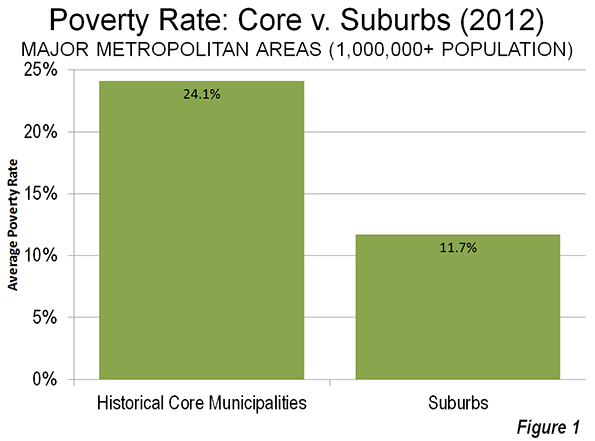
    The average poverty rate in the 52 urban cores – the historical core municipalities – was 24.1 percent, more than double the 11.7 percent rate in suburban areas (Figure 1). These high poverty rates have continued despite the best decade in more than one-half century for the urban cores which have experienced net population increases in the neighborhoods within two miles of downtown. The heavy urban core losses of the 1960s through the 1980s are generally no longer occurring. Yet, between 2000 and 2010, more than 80 percent of the population growth in the urban cores was below the poverty line (See City Growth Mainly Below Poverty Line). By contrast, less than one third of the suburban population increase was below the poverty line.

    Table 1
    Major Metropolitan Areas: Summary of Poverty Status: 2012
      Historical Core Municipalities (HCM) Suburbs Metropolitan Area
    Population (Poverty Status Determined)     44,730,920    123,763,495   168,494,415
    Above Poverty Level     34,613,515    108,917,367   143,530,882
    Below Poverty Level     10,117,405      14,846,128     24,963,533
    Major Metropolitan Areas 22.6% 12.0% 14.8%
    Data from American Community Survey, 2012


    Detailed Metropolitan Data

    The lowest historical core municipality poverty rate was in San Jose, at 13.0 percent. Seattle, San Diego, Raleigh and San Francisco rounded out the five urban cores with the lowest poverty rates. The highest urban core poverty rate was in Detroit, at 42.8 percent, followed by Hartford, Cleveland, Cincinnati and Miami.

    The lowest suburban poverty rate was in the Washington metropolitan area at 7.2 percent. Milwaukee, Baltimore, Indianapolis and Minneapolis-St. Paul followed. The highest suburban poverty rate was in the Riverside San Bernardino, 18.4 percent, followed by Orlando, Miami, Las Vegas and Atlanta. Only 15 of the major metropolitan areas had suburban poverty rates that were higher than the best historical core municipality rate of 13.0 percent (San Jose).

    Taking a look over the regions of the country, the five lowest major metropolitan poverty rates were in Washington (8.4 percent), Boston, Minneapolis-St. Paul, San Jose, and Hartford. The highest major metropolitan area poverty rates were in Memphis (19.9 percent), New Orleans, Riverside San Bernardino, Los Angeles, and Miami (Table 2).

    A caveat is in order, however. The official poverty rate does not take into consideration the cost of living differences between states and metropolitan areas. These differences can be large. According to the latest Bureau of Economic Analysis (US Department of Commerce) data, there can be an up to 35 percent difference in the cost of living between major metropolitan areas (the high being San Francisco and the lowest being St. Louis). The new Census Bureau supplemental poverty measure takes housing costs into consideration, but provides only state data. The differences can be substantial. For example, California’s supplemental poverty rate is the highest in the nation, and nearly one-half higher than its unadjusted poverty rate. California’s housing adjusted poverty rate is approximately double that of West Virginia, which is normally considered to be one of the nation’s highest poverty states.

    Table 2
    Major Metropolitan Areas: Poverty Status: 2012
    Metropolitan Area Historical Core Municipalities (HCM) Rank Suburbs Rank Metropolitan Area Rank Core Rate/ Suburban Ratio Rank
    Atlanta, GA 25.8%          35 15.8%        48 16.6%        41 1.63         14
    Austin, TX 20.3%          14 11.5%        28 15.5%        31 1.77         19
    Baltimore, MD 24.8%          34 7.4%          3 11.3%          6 3.34         49
    Birmingham, AL 31.2%          46 13.5%        41 16.8%        42 2.31         34
    Boston, MA-NH 21.6%          21 9.0%          9 10.7%          2 2.40         38
    Buffalo, NY 30.9%          44 9.4%        11 14.2%        19 3.30         47
    Charlotte, NC-SC 21.8%          23 9.9%        14 15.1%        30 2.22         33
    Chicago, IL-IN-WI 23.9%          30 10.8%        22 14.5%        24 2.20         32
    Cincinnati, OH-KY-IN 34.1%          49 11.9%        32 14.9%        26 2.86         41
    Cleveland, OH 36.1%          50 10.8%        21 15.6%        32 3.33         48
    Columbus, OH 21.8%          23 9.9%        15 15.1%        29 2.20         31
    Dallas-Fort Worth, TX 23.9%          31 13.0%        38 15.0%        27 1.85         22
    Denver, CO 19.2%          10 10.7%        19 12.7%        12 1.80         21
    Detroit,  MI 42.3%          52 12.6%        35 17.4%        47 3.36         50
    Grand Rapids 29.4%          42 12.4%        34 16.5%        40 2.37         36
    Hartford, CT 38.0%          51 7.9%          6 10.9%          5 4.83         52
    Houston, TX 23.5%          29 12.6%        36 16.4%        39 1.87         24
    Indianapolis. IN 22.2%          25 7.6%          4 14.4%        22 2.92         43
    Jacksonville, FL 18.5%            9 11.4%        27 15.7%        33 1.61         13
    Kansas City, MO-KS 20.7%          15 10.6%        18 12.9%        14 1.94         28
    Las Vegas, NV 17.6%            6 15.8%        49 16.4%        37 1.11           2
    Los Angeles, CA 23.3%          27 15.3%        45 17.6%        49 1.53           9
    Louisville, KY-IN 19.5%          12 13.1%        40 16.1%        35 1.49           6
    Memphis, TN-MS-AR 28.3%          38 11.8%        31 19.9%        52 2.39         37
    Miami, FL 31.7%          48 16.4%        50 17.5%        48 1.94         27
    Milwaukee,WI 29.9%          43 7.3%          2 15.9%        34 4.08         51
    Minneapolis-St. Paul, MN-WI 22.6%          26 7.7%          5 10.7%          3 2.94         44
    Nashville, TN 19.4%          11 11.2%        25 14.3%        20 1.73         16
    New Orleans. LA 28.7%          40 15.4%        47 19.4%        51 1.87         23
    New York, NY-NJ-PA 21.2%          19 9.8%        12 14.8%        25 2.17         30
    Oklahoma City, OK 19.7%          13 13.1%        39 16.2%        36 1.50           7
    Orlando, FL 21.2%          20 16.4%        51 16.9%        44 1.30           4
    Philadelphia, PA-NJ-DE-MD 26.9%          37 8.7%          8 13.4%        16 3.08         45
    Phoenix, AZ 24.1%          32 13.9%        42 17.4%        46 1.74         17
    Pittsburgh, PA 21.1%          16 10.9%        23 12.1%        10 1.94         26
    Portland, OR-WA 17.7%            7 12.7%        37 14.0%        18 1.39           5
    Providence, RI-MA 28.7%          39 11.7%        29 13.6%        17 2.44         39
    Raleigh, NC 16.4%            4 10.7%        20 12.7%        11 1.53         10
    Richmond, VA 26.3%          36 9.1%        10 11.9%          9 2.88         42
    Riverside-San Bernardino, CA 31.1%          45 18.4%        52 19.0%        50 1.68         15
    Rochester, NY 31.6%          47 10.2%        17 14.4%        23 3.10         46
    Sacramento, CA 23.4%          28 15.1%        44 16.9%        43 1.55         11
    St. Louis,, MO-IL 29.2%          41 12.4%        33 14.3%        21 2.35         35
    Salt Lake City, UT 21.2%          17 11.1%        24 12.7%        13 1.91         25
    San Antonio, TX 21.7%          22 10.0%        16 17.3%        45 2.17         29
    San Diego, CA 15.5%            3 14.7%        43 15.0%        28 1.05           1
    San Francisco-Oakland, CA 17.3%            5 9.8%        13 11.9%          8 1.75         18
    San Jose, CA 13.0%            1 8.5%          7 10.8%          4 1.52           8
    Seattle, WA 13.6%            2 11.3%        26 11.7%          7 1.20           3
    Tampa-St. Petersburg, FL 24.5%          33 15.3%        46 16.4%        38 1.61         12
    Virginia Beach-Norfolk, VA-NC 21.2%          18 11.8%        30 13.1%        15 1.80         20
    Washington, DC-VA-MD-WV 18.2%            8 7.2%          1 8.4%          1 2.52         40
    Average of Metropolitan Areas 24.1% 11.7% 14.7% 2.07


    Suburban Poverty

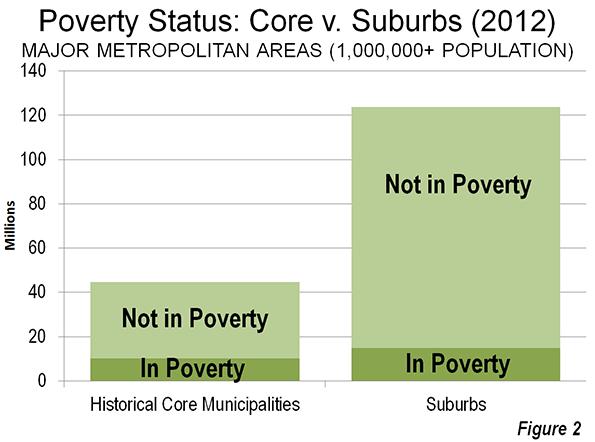
    The majority of the major metropolitan area poverty population now lives in the suburbs, by virtue of their population dominance; overall suburban populations are now 2.7 times as large as those of all core cities. In fact, rather than being a new phenomenon, suburban areas passed the urban cores in poverty population before 2000. The 2000 Census indicated that approximately 53 percent of the poverty population was in suburban areas of the 52 metropolitan areas. The share of poverty rose to 59 percent in the suburbs, largely as a consequence of their having dominated growth between 2000 and 2012. While there were nearly 5 million more people below the poverty line in the suburbs than in the historical core municipalities, the suburbs contained more than three times the above-poverty line population – some 109 million – as the urban cores (Figure 2).

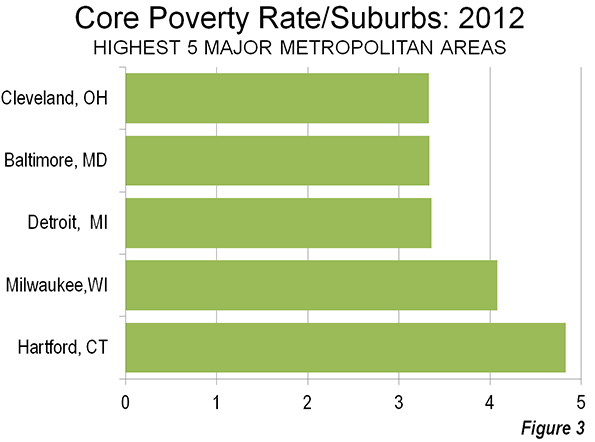
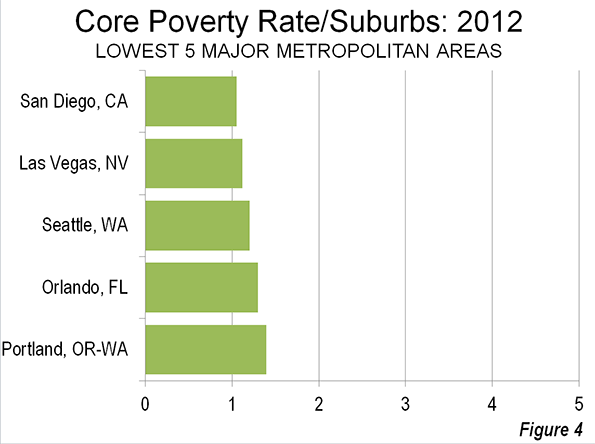
    In 2012, suburban poverty rates were below those of the urban cores in all 52 major metropolitan areas (Table 2). The urban core poverty rates ranged from 5 percent above the suburban rates, in San Diego to nearly 5 times the suburban rate in Hartford. San Diego, Las Vegas, Seattle, Orlando and Portland had the lowest urban poverty rates relative to the suburbs of the same metropolitan areas (Figure 3). The urban cores of Hartford, Milwaukee, Detroit, Baltimore and Cleveland had the highest poverty rates relative to the suburbs of the same metropolitan areas (Figure 4).

    Poverty by Historical Core Municipality Category

    When the new poverty data was announced, Milwaukee Mayor Tom Barrett bemoaned the fact that the city’s poverty rate was the highest in the nation relative to that of the suburbs. The Milwaukee Journal-Sentinel’s “Politifact” pointed out that the mayors’ contention was based on 2010 data rather than the new 2012 data. As is noted above, Hartford had displaced Milwaukee with the highest urban core poverty rate relative to the suburbs by 2012.

    However, Mayor Barrett’s concern is well founded. The city of Milwaukee’s high poverty rate relative to the suburbs is surprising. Among the five urban cores with the highest poverty rates relative to the corresponding suburbs, only Milwaukee includes substantial areas of suburban land use development. The city of Milwaukee is categorized as a Pre-World War II core with substantial suburbanization, by virtue of having more than doubled its land area by annexing lower density (suburban) areas. Each of the four other urban cores with the highest ratios relative to suburban poverty rates are classified as pre-World War II cores with little suburbanization. None of these municipalities (Hartford, Detroit, Baltimore, and Cleveland) has annexed significant suburban territory since before World War II.

    Since poverty tends to be more concentrated in urban cores in the United States, it is to be expected that pre-World War II historical core municipalities would have higher poverty rates relative to the suburbs.

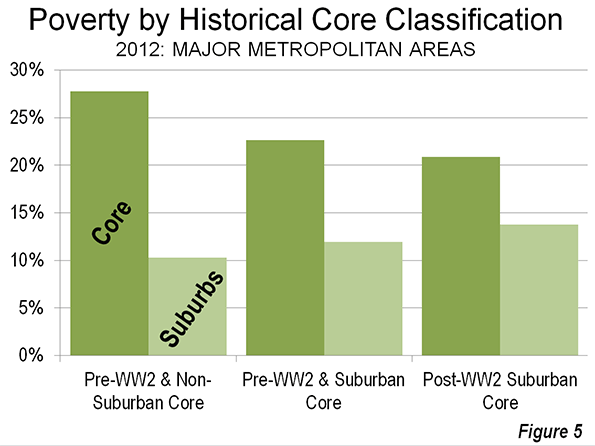
    The smallest differences between urban core and suburban poverty rates are found in the metropolitan areas with heavily suburban core cities and lack major pre-World War II cores (Figure 5). San Jose, Phoenix, Orlando, and Las Vegas are examples of metropolitan areas in this category.

    From Poverty to Prosperity

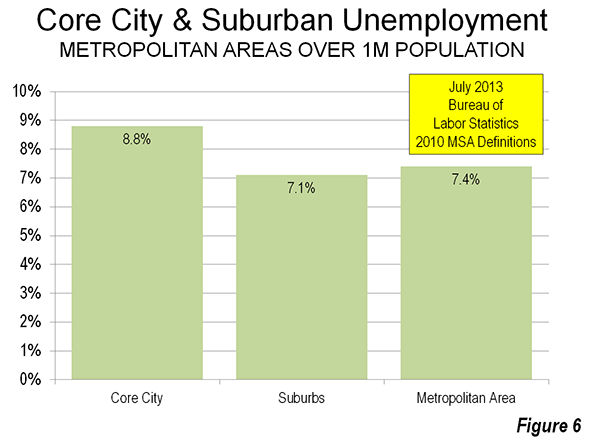
    The continuing high rates of poverty in the urban cores and the higher than previous poverty rates in suburban areas is cause for primary concern. At the heart of the problem is the lingering high unemployment rate, which averages nearly a quarter higher in the urban cores than in the suburbs (Figure 6).

    The principal purpose of cities (from the urban core to the exurban periphery) is to facilitate a better standard of living for all income segments. This has, of course, been made difficult by the Great Recession and could be lengthened should grudging growth nurture a long-term Great Malaise. Obviously, the answer is stronger economic growth, which will require a better investment climate

    Wendell Cox is a Visiting Professor, Conservatoire National des Arts et Metiers, Paris and the author of “War on the Dream: How Anti-Sprawl Policy Threatens the Quality of Life.

    —–

    Note: These data vary from those reported by the Brookings Institution, which classifies “cities” and “suburbs” differently. For example, the Brookings Institution classifies suburbs such as Arlington, Texas in the Dallas-Fort Worth metropolitan area, Aurora, Colorado in Denver (see photo above),  Mesa, Arizona in Phoenix, Bellevue , Washington in Seattle and  Paradise, Nevada in Las Vegas as “cities.” The net effect is generally higher suburban poverty rate in the Brookings Institution analysis than in this “urban core” versus suburban analysis.

    —–

    Photo: Suburban Denver (Aurora), by author

  • Taking Flight from Asia

    Viewed from a 50-year perspective, the rise of East Asia has been the most significant economic achievement of the past half century. But in many ways, this upward trajectory is slowing, and could even reverse. Simply put, affluence has led many Asians to question its cost, in terms of family and personal life, and is sparking a largely high-end hegira to slower-growing but, perhaps, more pleasant, locales.

    The Asian Century may have arrived, but many Asians – disproportionately entrepreneurial, well-educated and familial – are heading elsewhere. In the United States, they have surged past Hispanics as the largest source of immigrants and now account for well over a third of all newcomers. But that’s just the tip of this wave: Recent Gallup surveys reveal that tens of millions more – 40 million from the Indian subcontinent and China alone – would come if they could. This is far more than the 5 million in Mexico who would still like to move here.

    For the most part, these highly urbanized Asians are headed to places that may not be exactly pastoral, but are decidedly less-crowded places, either in the suburbs of great cities or, increasing, to sprawling low-density regions such as Houston, Dallas, Charlotte and Phoenix. In large swaths of Los Angeles County’s San Gabriel Valley, parts of the southeastern Orange County as well as the Santa Clara Valley, six cities, including tony San Marino, already are majority Asian, and many, including several in Orange County, are either there or well on the way.

    For the most part, these primarily suburban places, widely disdained by the dominant media and academic classes, appear to seem awfully nice to Asian immigrants. Nationwide over the past decade, the Asian population in suburbs grew by almost 2.8 million, or 53 percent, while their numbers expanded in core cities by 770,000, or 28 percent. In Southern California, the shift is even more pronounced: In Los Angeles and Orange counties – the nation’s largest Asian region, the suburbs added roughly five times as many Asians as did the core city. There are now roughly three Asian suburbanites for every core city dweller in our region.

    This is not just an American phenomenon. Asians, by far the fastest-growing large ethnic group in Canada, constitute a majority in many Toronto suburbs, like Markham, Brampton, Mississauga and Richmond Hill. The same pattern is seen in areas around Vancouver, such as Richmond, Greater Vancouver, Burnaby and Surrey. Asians, who, following New Zealanders, constitute a majority of newcomers in Australia, also tend to settle in suburbs, particularly newer ones.

    It’s most important to understand the reasons these people leave their homelands. Historically, people immigrate from places where there is a perceived lack of opportunity. Yet, many of the Asian countries seeing people leave – places like Singapore, Taiwan and China – have enjoyed consistently higher economic growth rates than any of the destination countries. What these immigrants increasingly understand is that, as their country’s GDP has surged, their quality of life has not and, in many ways, has deteriorated.

    These are the sometimes subtle but important things that tend to be ignored by geopoliticians and urban ideologues, attracted by the density and transit-richness of the Asian cities. “Everyday life,” observed the great French historian Fernand Braudel, “consists of the little things one hardly notices in time and space.” And, by these measurements, life in the United States, Canada or Australia is simply better than that in most Asian countries.

    In contrast, urban Asia, although rich and often colorful, has become an increasingly difficult place both for everyday life and for families. A nice salary might be satisfying, but is unlikely to be large enough to buy a house or apartment in places like Taipei or Hong Kong, where the cost of even a tiny apartment equals more than twice – adjusted for income – what would be sufficient to purchase a house in Irvine, and four times as much as an even larger residence in Houston, Dallas or Phoenix. Not surprisingly, most Asians in America feel they are living better than their parents, compared with their counterparts at home. Only 12 percent would choose to move back to their home country.

    Beyond housing, life in hyperurbanized Asia does not buy much happiness. Prosperous Singapore, for example, is one of the most pessimistic places on the planet, while ultradense South Korea has been ranked as among the least-happy nations in the Organization for Economic Cooperation and Development, ranking 32nd of 34 members. The country also suffers from among the highest suicide rates in the higher-income world.

    This reflects the often-ignored impacts of dense urbanization, including rising obesity, particularly among the young, who get less exercise and spend more time desk-bound. The air is foul, particularly in Beijing, no matter how much money you have. A healthy bank account does not exempt one from emphysema.

    Others complain about the dangers of a political system where wealth can always be confiscated by the state; no surprise, then, that a new survey shows roughly half of China’s millionaires are looking to move, primarily to the U.S. or Canada. During 2010-11, the number of Chinese applying for a U.S. investor visa, which requires a $1 million investment in the country, more than tripled, to more than 3,000. Repression of political thought and, particularly, against religion, also ranks as a major cause for leaving the homeland.

    The family – the historic centerpiece of cultures from India to Korea – may constitute the biggest victim of the hypercompetitive, ultradense Asian lifestyle. Hong Kong, Singapore and Seoul suffer among the world’s lowest fertility rates, with rates around 1. Meanwhile, Shanghai’s fertility rate has fallen to 0.7, among the lowest ever reported, well below China’s “one child” mandate and barely one-third the rate required simply to replace the current population. Due largely to crowding and high housing prices, 45 percent of couples in Hong Kong say they have given up having children.

    For those who do want to start a family, it increasingly makes sense to immigrate. This is evident in rising emigration from China’s cities, Hong Kong and Singapore, where roughly one in 10 citizens now lives abroad, often in lower-density communities in Australia, Canada and the United States.

    The nature of those immigrating is critically important. We are long past the days when the average Asian migrant is a physical laborer or a small-scale merchant. Now, the more typical newcomer is a student or a highly qualified professional. In Australia, Asians, notably from India, China and Taiwan, make up the vast majority of immigrants who qualify for entry under skills-oriented criteria.

    This pattern also can be seen in the United States. Asians now constitute a majority of workers in Silicon Valley. They also tend to concentrate in what may be best described as the country’s largely suburban nerdistans – magnets for high-tech workers – places like Plano, Texas, Bellevue, Wash., Irvine and large swaths of Santa Clara County.

    Does all this mean Asia is about to experience a precipitous decline? Not at all. But it is also increasingly clear that the dense model of development adopted on much of that continent – exacerbated by a mass movement to cities – is not, in a larger social sense, truly sustainable. Societies that become difficult for families, and exact too much stress on their residents, are destined to suffer maladies from ultrarapid aging, shrinking workforces and a host of psychological maladies.

    These strains will become more evident over time. Already, most Asian societies, from Japan and China to Singapore and Taiwan, are experiencing less growth, linked in part to financial pressures from a rapidly aging society. The economic motivations for staying in Asia will likely decline, accelerating the flight both of financial and, more importantly, human capital.

    Every society relies on the resourcefulness of its people, particularly the young. The loss of skilled individuals and, especially, families suggests we may have already witnessed the peak of the half-century-long Asian ascendency, well before the American era has even come to its oft-predicted demise.

    Joel Kotkin is executive editor of NewGeography.com and Distinguished Presidential Fellow in Urban Futures at Chapman University, and a member of the editorial board of the Orange County Register. He is author of The City: A Global History and The Next Hundred Million: America in 2050. His most recent study, The Rise of Postfamilialism, has been widely discussed and distributed internationally. He lives in Los Angeles, CA.

    This piece originally appeared at The Orange County Register.

    Singapore skyline photo by Bigstockphoto.com.

  • There’s Real Economic Development Gold in El Dorado—Arkansas

    For centuries, explorers searched for the legendary golden city of El Dorado, seeking instant wealth in the jungles of South America. But today’s treasure trove may be found much closer to home; cities like El Dorado, Arkansas, for example, that have successfully linked their economic development strategy to improving the educational attainment of their residents.

    El Dorado, a city of about 20,000 people that was at the heart of Arkansas’s oil boom in the 1920s has been hard pressed to reprise that economic growth experience in this century.  Instead of chasing after the fool’s gold of becoming cool, it has found a way to attract new residents and increase its economic vitality by promising its public school students a free college education if they graduate from high school with good grades. That promise has the potential to provide the critical glue in holding together a broad based economic recovery not just for cities such as El Dorado but for entire states or even the country.

    The El Dorado Promise is a scholarship program established and funded by Murphy Oil Corporation, the town’s largest employer. Modeled after a similar program in Kalamazoo, MI, It provides graduates of the city’s high school a scholarship covering tuition and mandatory fees that can be used at any accredited two- or four-year, public or private, educational institution in the US up to an amount equal to the highest annual resident tuition at an Arkansas public university.

    Since its inception in 2007, 1239 students have taken advantage of the offer. Over 90% of them have completed at least one year of college. The first high school class to enjoy this benefit has graduated after five years from college at a rate almost 40% greater than the state’s higher education student population. These gains in acquiring the skills necessary to be competitive in today’s global economy have been achieved by virtually all of the city’s high school students, over 90% of whom graduated from high school last year.

    Furthermore the culture of a college-bound student population is now permeating throughout the school district, with a recent study finding that students in grades three through eight in the city scored significantly higher than their matched peers in nearby school districts in both math and literacy. The greatest gains have come from those who were the youngest when the Promise was announced.

    The goal of the El Dorado Promise was not just greater educational attainment, however. The visionaries who established the program also wanted to use this program to improve the community’s economic vitality and quality of life. They have clearly done that.  Enrollment in the city’s schools was up 5% in just the first four years of the program’s existence. As the Promise website says, “the prospect of an increasingly educated workforce gives economic development leaders new tools to attract businesses to the region.”

    The first such Promise was made in Kalamazoo, Michigan in 2005 by still anonymous benefactors seeking to restore the reputation of a city made famous in 1942 by the Glenn Miller Orchestra’s hit tune about a “gal” who lived there. Rather than raise taxes to balance the city’s budget, those who established the Kalamazoo Promise offered a fully paid four-year scholarship to any public institution of higher education in Michigan to any student who went to the city’s high schools for all four years. Under the terms of the Kalamazoo Promise, students have no obligation to repay the money or even to reside in Kalamazoo after they graduate from college.

    The results are very similar to those of El Dorado. Kalamazoo’s student population is up 17.6% and dropout rates have been cut in half. Ninety percent of the city’s female African-American high school graduates have gone on to college. On the economic front, the proportion of residential construction in the city rose sharply from around 30% to nearly 50% of all permits issued in the greater Kalamazoo area. The community’s careful tracking of the results has identified 1600 families who say they are living in the city because of the Promise.

    The economic challenges that caused El Dorado and Kalamazoo to up their game in getting local residents to graduate from high school and go on to college are no different than the challenge facing the country as a whole  in trying to create a competitive workforce in today’s increasingly global and technology driven economy.  For example, the Georgetown University’s Center on Education and the Workforce estimates that 62% of the jobs in the United States by the year 2018 will require at least some college education – for example a certificate for a specific skill – and that more than half of those jobs will require a bachelor’s degree. Unless the nation wants to fill those jobs with immigrants from other countries, it will have to do a much better job of giving each American who graduates from high school a chance to pursue a two year skill certificate or a baccalaureate degree. 

    A promise that rewards good academic performance in high school with a scholarship that pays for four years of college tuition has demonstrated it can make a major difference in achieving our educational and economic goals. Now it’s time for the rest of the country to find the gold that Kalamazoo and El Dorado have already discovered. Just as the country, as part of its overall economic development strategy, once expanded access to a universal free education first for primary schools and later for high schools, it must now find ways to make these two pioneering cities’ promise to their young people America’s Promise to all of its youth.

    Morley Winograd and Michael D. Hais are co-authors of the newly published Millennial Momentum: How a New Generation is Remaking America and Millennial Makeover: MySpace, YouTube, and the Future of American Politics and fellows of NDN and the New Policy Institute.

    Graduation photo by Bigstock.

  • Where Are The Boomers Headed? Not Back To The City

    Perhaps no urban legend has played as long and loudly as the notion that “empty nesters” are abandoning their dull lives in the suburbs for the excitement of inner city living. This meme has been most recently celebrated in the Washington Post and the Wall Street Journal.

    Both stories, citing research by the real estate brokerage Redfin, maintained that over the last decade a net 1 million boomers (born born between 1945 and 1964) have moved into the city core from the surrounding area. “Aging boomers,” the Post gushed, now “opt for the city life.” It’s enough to warm the cockles of a downtown realestate speculator’s heart, and perhaps nudge some subsidies from city officials anxious to secure their downtown dreams.

    But there’s a problem here: a look at Census data shows the story is based on flawed analysis, something that the Journal subsequently acknowledged. Indeed, our number-crunching shows that rather than flocking into cities, there were roughly a million fewer boomers in 2010 within a five-mile radius of the centers of the nation’s 51 largest metro areas compared to a decade earlier.

    If boomers change residences, they tend to move further from the core, and particularly to less dense places outside metropolitan areas. Looking at the 51 metropolitan areas with more than a million residents, areas within five miles of the center lost 17% of their boomers over the past decade, while the balance of the metropolitan areas, predominately suburbs, only lost 2%. In contrast places outside the 51 metro areas actually gained boomers.

    Only one city, Miami, recorded a net gain in the boomer population within five miles of the center, roughly 1%. Much ballyhooed back to city markets including Chicago, New York, Washington, D.C., and San Francisco suffered double-digit percentage losses within the five-mile zone.

    Where the boomers move is critical to the real estate industry, as well as other businesses. This is a large and relatively wealthy generation. Boomers account for some 70% of the country’s disposable income, and their spending decisions will shake markets around the country.

    Given the importance of this market, why has the analysis of it proved so wrong? One factor may well be that most boomers generally do not really want to move if they can help it. Three out of four boomers want to “age in place,” according to a recent AARP  study.

    Part of the problem is one found commonly in press reporting on demographic trends; reporters only tend to know what they see, and mostly they work almost exclusively in urban cores. They encounter empty nester who moves to Manhattan or even downtown St. Louis, but not the ones who moves to the desert, lake, the mountains, the woods or into an adult-oriented community on the urban fringe. Out of the core, these people often fade into media oblivion.

    However, as people age, they turn out to be not, as one developer suggests, “more hip hop and happening” than more likely to seek remaining not only close to home, but attached to the workforce and the neighborhood. A recent series in the Dallas Morning News tracked where local empty nesters were moving — largely to low-crime, well-maintained suburbs and exurbs. What were they looking for? The paper found the biggest concern by far to be safety, followed by affordability and quiet.

    So if boomers aren’t flocking to inner cities, which of the 51 biggest metro areas are gaining the largest share of them? The top gainers are all relatively low-cost, low-density Sun Belt metropolises, led by Las Vegas. Its boomer population expanded 20.2% from 2000 to 2010, with a 12.2% decline in the five-mile inner ring and 36.3% growth outside it. In second place, Tampa-St. Petersburg, Fla., up 11.5% (-8.3% in the five-mile zone, +13.5% outside); followed by Phoenix, whose boomer population rose 11.3% (-22.8%, +15.0%). In contrast, more expensive, denser cities like New York, San Francisco, Los Angeles and San Jose, Calif., saw the worst boomer flight, suffering double-digit percentage losses.

    What are the implications of these findings? For cities, time to forget the long-anticipated “back to the city” trend among seniors as something that can save their downtowns. To be sure, there may be some ultra-affluent urban districts that may attract wealthy older investors and buyers, many of them part-time residents, such as Chicago’s Gold Coast and parts of Manhattan. In some elite Manhattan buildings, full-time residents constitute as little as 10% of the total.

    A  little further out from these hot spots, boomers are fleeing. The five-mile zone around the City Hall of New York lost about 20% of its boomer population in the past decade, while in Chicago the corresponding area lost 26%.

    Ultimately, some downtown places might be a “wonderland,” as The New York Times puts it,for a small group of highly affluent residents. But for most they are outrageously expensive. At an age when capital preservation if often paramount, in New York, the senior best positioned is one living a long time in a rent-controlled apartment.

    Cities need to understand that, for the most part, their appeal remains primarily to young, largely single people, students and couples before they have children; cities’ real challenge, and opportunity, lies in trying to keep more of this youthful cohort in the city as they age and expand their households. Boomers and seniors may be able to support luxury apartment developers in parts of Manhattan, but not in most cities.

    The boomer population in the five-mile radius of the 51 largest U.S. metropolitan areas fell by roughly a million from 2000 to 2010, out of a 2000 population of nearly 6 million, or 17%. The boomer population outside the five-mile zone in these metro areas also fell, but at a much lower rate: 2%, or 800,000 people out of a population of 39.5 million in 2000.  Away from the major metros, smaller metropolitan areas and rural areas gained nearly 450,000 boomers. However, there was an overall loss of about 1.3 million boomers, principally due to deaths.

    Given the trends, suburbs will likely persist as a primary arena for aging populations. This suggests these communities will have to ramp up services to accommodate them, such as shuttle buses and hospitals. They should cultivate  downshifting boomers as new consumers for local stores, and particularly on Main Streets, and as sources for capital and expertise.

    Perhaps the biggest impact, however, may be on smaller metropolitan areas and the less expensive Sun Belt communities. As more boomers achieve “empty nester” status they could bring investment capital, and broader connections to smaller cities that could much use them.

    One early sign of this trend may be the recent rise in migration to Florida. After a brief recession-driven hiatus a net 200,000 people have moved to Florida in the last two years. New Census numbers also suggest a  large number of people continue to leave the Northeast, the Midwest and California.  Also likely to benefit will be some emerging boomer magnet communities in Idaho, Arizona, Uta­h, the Carolinas and Colorado.

    For real estate developers and investors, the ones often most entranced by the “back to the city” story, the lessons are very clear. It makes more sense to follow the numbers, and understand the logic of senior migration, than swallow the snake oil so many have been carelessly imbibing. There are great opportunities in the expanding senior market, including in some uniquely attractive urban districts— but the bigger plays are in outlying areas, and, increasingly, smaller towns.

    Baby Boomer Population (35-54 in 2000/45-64 in 2010)
    Comparison: 5 Mile Radius of City Hall v. Balance of Metropolitan Area          
    51 Major Metropolitan Areas (2010 Popultion over 1,000,000)            
    In thousands (000)                
                       
        POPULATION   % OF POPULATION
        2000 2010 Change %   2000 2010  % Change
                       
    5-MILE RADIUS     5,895     4,890   (1,005) -17.1%   7.1% 6.0% -15.7%
    BALANCE     39,352   38,575      (777) -2.0%   47.5% 47.3% -0.4%
    MAJOR METROPOLITAN AREAS (MMAS)   45,247   43,464   (1,783) -3.9%   54.6% 53.3% -2.4%
                       
    OUTSIDE MMAS   37,579   38,025        446 1.2%   45.4% 46.7% 2.8%
                       
    UNITED STATES   82,826   81,489   (1,337) -1.6%   100.0% 100.0% 0.0%
                       
    Calculated from Census Burea data


    This story originally appeared at Forbes.

    Joel Kotkin is executive editor of NewGeography.com and Distinguished Presidential Fellow in Urban Futures at Chapman University, and a member of the editorial board of the Orange County Register. He is author of The City: A Global History and The Next Hundred Million: America in 2050. His most recent study, The Rise of Postfamilialism, has been widely discussed and distributed internationally. He lives in Los Angeles, CA.

  • Driving Alone Dominates 2007-2012 Commuting Trend

    New data from the American Community Survey makes it possible to review the trend in mode of access to employment in the United States over the past five years. This year, 2012, represents the fifth annual installment of complete American Community Survey data. This is also a significant period, because the 2007 was a year before the Lehman Brothers collapse that triggered the Great Financial crisis, while gasoline prices increased about a third between 2007 and 2012.

    National Trends

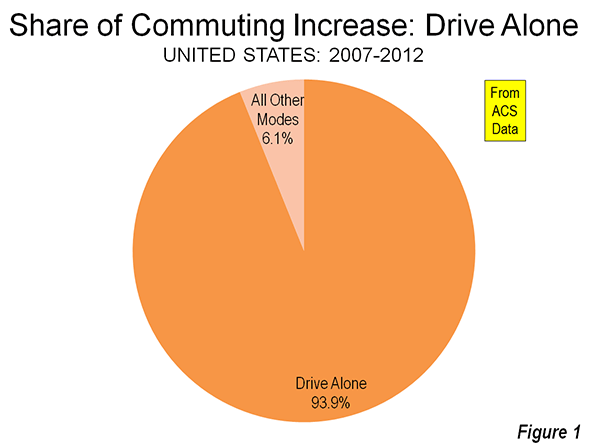
    The work trip access data is shown in Tables 1 and 2. Driving alone continued to dominate commuting, as it has since data was first reported in the 1960 census. In 2007, 76.1 percent of employment access was by driving alone, a figure that rose to 76.3 percent in 2012. Between 2007 and 2012, driving alone accounted for 94 percent of the employment access increase, capturing 1.55 million out of the additional 1.60 million daily one-way trips (Figure 1). The other 50,000 new transit commutes were the final result of increases in working at home, transit and bicycles, minus losses in car pooling and other modes.

    Carpools continued to their long decline, losing share in 43 of the 52 major metropolitan areas. Approximately 810,000 fewer people travel to work by carpools in 2012, which reduced its share from 10.7 percent to 9.7 percent.

    Transit did better, rising from 4.9 percent of work access in 2007 to 5.0 percent in 2012. There was an overall increase of approximately 250,000 transit riders. This increase, however, may be less than might have anticipated in view of the much higher gasoline prices and the imperative for commuters to save money in a more difficult economy.

    Bicycling also did well, rising from a 0.5 percent share in 2007 to a 0.6 percent share in 2012. Approximately 200,000 more people commuted by bicycle by 2012.

    Walking retained its 2.8 percent share, with only a modest 15,000 increase over the period. The largest increase in employment access outside single occupant driving was working at home, which rose from 4.1 percent to 4.4 percent. This translated into an increase of approximately 470,000.

    Metropolitan Area Highlights

    Among the 52 metropolitan areas with more than 1 million population (major metropolitan areas), 47 had drive alone market shares of 70 percent or more. Birmingham was the highest, at 85.6 percent. Surprisingly, this grouping included metropolitan areas with reputations for strong transit ridership, such as Chicago, Philadelphia, and Portland. Four metropolitan areas had drive alone shares of between 60 percent and 70 percent: Seattle, Washington, Boston, and San Francisco, which had the second lowest in the nation at 60.8 percent. As would be expected, New York had by far the lowest drive alone market share at 50.0 percent.

    Consistent with its low drive alone market share, New York led by a large margin the other metropolitan areas in its transit work trip market share. Transit carried 31.1 percent of New York commuters, up nearly a full percentage point from the 30.2 percent in 2007. New York alone accounted for nearly one-half of the growth in transit commuting over the period.

    San Francisco continued to hold onto second place, with a 15.1 percent transit market share, up a full percentage point from 2007. Washington rose to 14.0 percent, up from 13.2 percent in 2007. Boston (11.9 percent) and Chicago (11.0 percent) were the only other major metropolitan areas to achieve a transit work trip market share of more than 10 percent, and were little changed from 2007.

    Working at home continued to increase at a larger percentage rate than any other mode of work access. Four metropolitan areas were tied for the top position in 2012, at 6.4 percent. These included Raleigh, Austin, San Diego, and Portland, all metropolitan areas with a strong high-tech orientation. In San Diego and Portland, where large light rail systems have been developed, working at home is now more popular as a mode of access to work than transit.

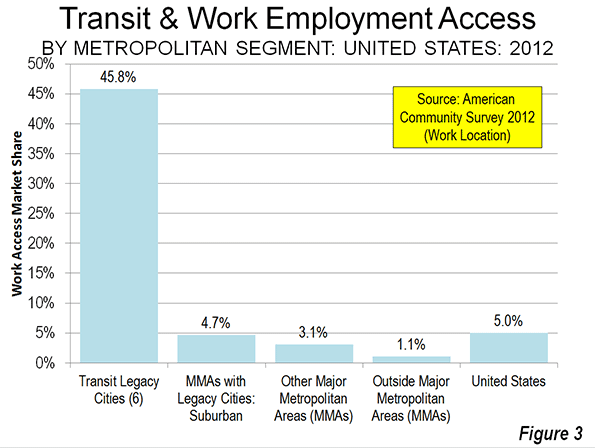
    According to 2012 US Census Bureau estimates, the major metropolitan areas comprised 55.2 percent of the national population. These metropolitan areas represented a slightly larger share of total employment, at 57.3 percent. The combined major metropolitan areas also had similar shares to their national population share in each of the employment access modes, ranging from a low of 55.3 percent of communters driving alone to 59.9 percent of walkers. The one exception was transit, where the major metropolitan areas constituted nearly all of commuters, at 90.7 percent, well above their 55.2 percent share of US population (Table 1).

    Table 1
    Distribution of Employment Access (Commuting) by Employment Location: 2012
    SHARE OF WORK ACCESS BY MODE (2012)
      All Employment Drive Alone Car Pool Transit Bike Walk Other Work at Home
    MAJOR METROPOLITAN AREAS 57.3% 55.3% 55.4% 90.7% 59.9% 56.0% 55.6% 59.3%
    Metropolitan Areas with Legacy Cities 17.1% 13.8% 14.4% 65.4% 21.5% 27.8% 18.3% 17.1%
      6 Legacy Cities (see below) 6.0% 2.7% 4.1% 55.1% 12.7% 16.3% 7.8% 4.6%
      Suburban 11.1% 11.1% 10.3% 10.3% 8.8% 11.5% 10.5% 12.6%
      New York Metropolitan Area 6.4% 4.2% 4.5% 39.6% 5.8% 13.6% 8.5% 5.9%
        Legacy City: New York 3.1% 1.0% 1.5% 35.4% 4.2% 9.5% 4.2% 2.5%
        Suburban 3.3% 3.2% 3.0% 4.2% 1.7% 4.1% 4.3% 3.5%
      5 Other Metropolitan Areas with Legacy Cities 10.7% 9.6% 9.9% 25.8% 15.7% 14.2% 9.8% 11.2%
        5 Legacy Cities (CHI, PHI, SF, BOS, WDC) 2.9% 1.7% 2.6% 19.7% 8.5% 6.8% 3.6% 2.1%
        Suburban 7.8% 7.9% 7.3% 6.1% 7.1% 7.5% 6.2% 9.1%
    46 Other Major Metropolitan Areas 40.2% 41.5% 41.0% 25.3% 38.4% 28.2% 37.3% 42.2%
    OUTSIDE MAJOR METROPOLITAN AREAS 42.7% 44.7% 44.6% 9.3% 40.1% 44.0% 44.4% 40.7%
    United States 100% 100% 100% 100% 100% 100% 100% 100%
    Calculated from American Community Survey: 2012 (one year)

    Follow this link to a table containing data for the nation’s major metropolitan areas.

    Commuting Becomes More Concentrated in Legacy Cities

    This concentration of transit commuting was most evident to the six large "transit legacy cities," (the core cities of New York, Chicago, Philadelphia, San Francisco, Boston, and Washington), which still exhibit sufficient remnants of their pre-automobile urban cores that support extraordinarily high transit market shares. The transit legacy cities accounted for 55 percent of all transit commuting destinations in the United States, yet have only six percent of the nation’s jobs. Between 2007 and 2012, the concentration increased, with transit legacy cities accounting 68 percent of the additional transit commutes were between 2007 and 2012. Outside the legacy cities, there was relatively little difference in the share of transit commutes within metropolitan areas with legacy cities and in the other major metropolitan areas (Figure 2)

    The key to the intensive use of transit in the legacy cities is the small pockets of development that are particularly amenable to high transit market shares – the six largest downtown areas (central business districts) in the United States. Most of the commuting to transit legacy cities is to these downtown areas, Yet, the geographical areas of these downtowns is very small. Combined, the six downtown areas are only one-half larger than the land area of Chicago’s O’Hare International Airport. This yields employment per square mile densities of from 40 to 150 times densities of employee residences throughout their respective urban areas.  

    Not surprisingly, transit has very strong market shares to work locations in the transit legacy cities, at 45.8 percent. At the same time, transit commuting to locations outside the transit legacy cities is generally well below the national average. The exception is New York, where transit commuting to suburban locations is 6.4 percent, above the overall national average of 5.0 percent. In the five other metropolitan areas with transit legacy cities, transit commuting to suburban locations is 3.9 percent. This drops to 3.1 percent, overall, in the 46 other major metropolitan areas and 1.1 percent in the rest of the nation (Table 2 and Figure).

    Table 2
    Employment Access (Commuting) by Employment Location: 2012
      Drive Alone Car Pool Transit Bike Walk Other Work at Home
    MAJOR METROPOLITAN AREAS 73.6% 9.4% 7.9% 0.6% 2.8% 1.2% 4.5%
    Metropolitan Areas with Legacy Cities 61.7% 8.2% 19.2% 0.8% 4.6% 1.3% 4.4%
      6 Legacy Cities (see below) 33.9% 6.5% 45.8% 1.3% 7.6% 1.6% 3.3%
      Suburban 76.8% 9.1% 4.7% 0.5% 2.9% 1.1% 5.0%
      New York Metropolitan Area 50.0% 6.8% 31.1% 0.6% 6.0% 1.6% 4.1%
        Legacy City: New York 23.7% 4.6% 57.1% 0.8% 8.6% 1.6% 3.5%
        Suburban 74.8% 8.9% 6.4% 0.3% 3.5% 1.6% 4.6%
      5 Other Metropolitan Areas with Legacy Cities 68.6% 9.0% 12.1% 0.9% 3.7% 1.1% 4.6%
        5 Legacy Cities (CHI, PHI, SF, BOS, WDC) 44.8% 8.6% 33.7% 1.8% 6.5% 1.5% 3.1%
        Suburban 77.6% 9.1% 3.9% 0.6% 2.7% 1.0% 5.1%
    46 Other Major Metropolitan Areas 78.7% 9.9% 3.1% 0.6% 2.0% 1.1% 4.6%
    OUTSIDE MAJOR METROPOLITAN AREAS 79.9% 10.1% 1.1% 0.6% 2.9% 1.3% 4.2%
    United States 76.3% 9.7% 5.0% 0.6% 2.8% 1.2% 4.4%
    Transit legacy cities include the municipalities of New York, Chicago, Philadelphia, San Francisco, Boston & Washington

    Staying the Same

    The big news in the last five years of commuting data is that virtually nothing has changed. This is remarkable, given the greatest economic reversal in 75 years and continuing gasoline price increases that might have been expected to discourage driving alone. Yet, driving alone continues to increase, while the most cost effective mode of car pooling continued to suffer huge losses, while working at home continued to increase strongly.

    Wendell Cox is a Visiting Professor, Conservatoire National des Arts et Metiers, Paris and the author of “War on the Dream: How Anti-Sprawl Policy Threatens the Quality of Life.

    Photograph: DART light rail train in downtown Dallas (by author)

  • California’s New Feudalism Benefits a Few at the Expense of the Multitude

    California has been the source of much innovation, from agribusiness and oil to fashion and the digital world. Historically much richer than the rest of the country, it was also the birthplace, along with Levittown, of the mass-produced suburb, freeways, much of our modern entrepreneurial culture, and of course mass entertainment. For most of a century, for both better and worse, California has defined progress, not only for America but for the world.

    As late as the 80s, California was democratic in a fundamental sense, a place for outsiders and, increasingly, immigrants—roughly 60 percent of the population was considered middle class. Now, instead of a land of opportunity, California has become increasingly feudal. According to recent census estimates,  the state suffers some of the highest levels of inequality in the country. By some estimates, the state’s level of inequality compares with that of such global models as  the Dominican Republic, Gambia, and the Republic of the Congo.

    At the same time, the Golden State now suffers the highest level of poverty in the country—23.5 percent compared to 16 percent nationally—worse than long-term hard luck cases like Mississippi. It is also now home to roughly one-third of the nation’s welfare recipients, almost three times its proportion of the nation’s population.

    Like medieval serfs, increasing numbers of Californians are downwardly mobile, and doing worse than their parents: native born Latinos actually have shorter lifespans than their parents, according to one recent report. Nor are things expected to get better any time soon. According to a recent Hoover Institution survey, most Californians expect their incomes to stagnate in the coming six months, a sense widely shared among the young, whites, Latinos, females, and the less educated.

    Some of these trends can be found nationwide, but they have become pronounced and are metastasizing more quickly in the Golden State. As late as the 80s, the state was about as egalitarian as the rest of the country. Now, for the first time in decades, the middle class is a minority, according to the Public Policy Institute of California.

    The Role of the Tech Oligarchs.

    California produces more new billionaires than any place this side of oligarchic Russia or crony capitalist China. By some estimates the Golden State is home to one out of every nine of the world’s billionaires. In 2011 the state was home to 90 billionaires, 20 more than second place New York and more than twice as many as booming Texas.

    The state’s digital oligarchy, surely without intention, is increasingly driving the state’s lurch towards feudalism. Silicon Valley’s wealth reflects the fortunes of a handful of companies that dominate an information economy that itself is increasingly oligopolistic.  In contrast to the traditionally conservative or libertarian ethos of the entrepreneurial class, the oligarchy is increasingly allied with the nominally populist Democratic Party and its regulatory agenda. Along with the public sector, Hollywood, and their media claque, they present California as “the spiritual inspiration” for modern “progressives” across the country.

    Through their embrace of and financial support for the state’s regulatory regime, the oligarchs have made job creation in non tech-businesses—manufacturing, energy, agriculture—increasingly difficult through “green energy” initiatives that are also sure to boost already high utility costs. One critic, state Democratic Senator Roderick Wright from heavily minority Inglewood, compares the state’s regulatory regime to the “vig” or high interest charged by the Mafia, calling it a major reason for disinvestment in many industries.

    Yet even in Silicon Valley, the expansion of prosperity has been extraordinarily limited. Due to enormous losses suffered in the current tech bubble, tech job creation in Silicon Valley has barely reached its 2000 level. In contrast, previous tech booms, such as the one in the 90s, doubled the ranks of the tech community. Some, like UC Berkeley economist Enrico Moretti, advance the dubious claim that those jobs are more stable than those created in Texas. But even if we concede that point for the moment,  the Valley’s growth primarily benefits its denizens but not most Californians. Since the recession, California remains down something like 500,000 jobs, a 3.5 percent loss, while its Lone Star rival has boosted its employment by a remarkable 931,000, a gain of more than 9 percent.

    Much of this has to do with the changing nature of California’s increasingly elite-driven economy. Back in the 80s and even the 90s, the state’s tech sector produced industrial jobs that sparked prosperity not only in places like Palo Alto, but also in the more hardscrabble areas in San Jose and even inland cities such as Sacramento. The once huge California aerospace industry, centered in Los Angeles, employed hundreds of thousands, not only engineers but skilled technicians, assemblers, and administrators.

    This picture has changed over the past decade. California’s tech manufacturing sector has shrunk, and those employed in Silicon Valley are increasingly well-compensated programmers, engineers and marketers. There has been little growth in good-paying blue collar or even middle management jobs. Since 2001 state production of “middle skill” jobs—those that generally require two years of training after high-school—have grown roughly half as quickly as the national average and one-tenth as fast as similar jobs in arch-rival Texas.

    “The job creation has changed,” says Leslie Parks, a long-time San Jose economic development official. “We used to be the whole food chain and create all sorts of middle class jobs. Now, increasingly, we don’t design the future—we just think about it. That makes some people rich, but not many.”

    In the midst of the current Silicon Valley boom, incomes for local Hispanics and African-Americans, who together account for one third of the population, have actually declined—18 percent for blacks and 5 percent for Latinos between 2009 and 2011, prompting one local booster to admit that “Silicon Valley is two valleys. There is a valley of haves, and a valley of have-nots.”

    The Geography of Inequality

    Geography, caste, and land ownership increasingly distinguish California’s classes from one another. As Silicon Valley, San Francisco, and the wealthier suburbs in the Bay Area have enjoyed steady income growth during the current bubble, much of the state, notes economist Bill Watkins, endures Depression-like conditions, with stretches of poverty more reminiscent of a developing country than the epicenter of advanced capitalism.

    Once you get outside the Bay Area, unemployment in many of the state’s largest counties—Sacramento, Los Angeles, Riverside, San Bernardino, Fresno, and Oakland—soars into the double digits. Indeed, among the 20 American cities with the highest unemployment rates, a remarkable 11 are in California, led by Merced’s mind-boggling 22 percent rate.

    This amounts to what conservative commentator Victor Davis Hanson has labeled “liberal apartheid,” a sharp divide between a well-heeled, mostly white and Asian population located along the California coast, and a largely poor, heavily Latino working class in the interior. But the class divide is also evident within  the large metro areas, despite their huge concentrations of affluent individuals. Los Angeles, for example, has the third highest rate of inequality of the nation’s 51 largest metropolitan areas, and the Bay Area ranks seventh.

    The current surge of California triumphalism, trumpeted mostly by the ruling Democrats and their eastern media allies, seems to ignore the reality faced by residents in many parts of the state. The current surge of wealth among the coastal elites, boosted by rises in property, stock, and other assets, has staved off a much feared state bankruptcy. Yet the the state’s more intractible problems cannot be addressed if growth remains restricted to a handful of favored areas and industries. This will become increasingly clear when, as is inevitable, the current tech and property boom fades, depriving the state of the taxes paid by high income individuals.

    The gap between the oligarchic class and everyone else seems increasingly permanent. A critical component of assuring class mobility, California’s once widely admired public schools were recently ranked near the absolute bottom in the country. Think about this: despite the state’s huge tech sector, California eighth graders scored 47th out of the 51 states in science testing. No wonder Mark Zuckerberg and other oligarchs are so anxious to import “techno coolies” from abroad.

    As in medieval times, land ownership, particularly along the coast, has become increasingly difficult for those not in the upper class. In 2012, four California markets—San Jose, San Francisco, San Diego, and Los Angeles—ranked as the most unaffordable relative to income in the nation. The impact of these prices falls particularly on the poor. According to the Center for Housing Policy and National Housing Conference, 39 percent of working households in the Los Angeles metropolitan area spend more than half their income on housing, as do 35 percent in the San Francisco metro area—both higher than 31 percent in the New York area and well above the national rate of 24 percent. This is likely to get much worse given that California median housing prices rose 31 percent in the year ending May 2013. In the Bay Area the increase was an amazing 43 percent.

    Even skilled workers are affected by these prices. An analysis done for National Core, a major developer of low income housing, found that prices in such areas as Orange County are so high that even a biomedical engineer earning more than $100,000 a year could not afford to buy a home there. This, as well as the unbalanced economy, has weakened California’s hold on aspirational families, something that threatens the very dream that has attracted  millions to the state.

    This is a far cry from the 50s and 60s, when California abounded in new owner-occupied single family homes. Historian Sam Bass Warner suggested that this constituted “the glory of Los Angeles and an expression of its design for living.” Yet today the L.A. home ownership rate, like that of New York, stands at about half the national average of 65 percent. This is particularly true among working class and minority households. Atlanta’s African-American home ownership rate is approximately 40 percent above that of San Jose or Los Angeles, and approximately 50 percent higher than San Francisco.

    This feudalizing trend is likely to worsen due to draconian land regulations that will put the remaining stock of single family houses ever further out of reach, something that seems related to a reduction in child-bearing in the state. As the “Ozzie and Harriet” model erodes, many Californians end up as modern day land serfs, renting and paying someone else’s mortgage. If they seek to start a family, their tendency is to look elsewhere, ironically even in places such as Oklahoma and Texas, places that once sent eager migrants to the Golden State.

    Breaking Down the New Feudalism: The Emerging Class Structure

    The emerging class structure of neo-feudalism, like its European and Asian antecedents, is far more complex than simply a matter of the gilded “them” and the broad “us.” To work as a system, as we can now see in California, we need to understand the broader, more divergent class structure that is emerging.

    The Oligarchs: The swelling number of billionaires in the state, particularly in Silicon Valley, has enhanced power that is emerging into something like the old aristocratic French second estate. Through public advocacy and philanthropy, the oligarchs have tended to embrace California’s “green” agenda, with a very negative impact on traditional industries such as manufacturing, agriculture, energy, and construction. Like the aristocrats who saw all value in land, and dismissed other commerce as unworthy, they believe all value belongs to those who own the increasingly abstracted information revolution that has made them so fabulously rich.

    The  Clerisy: The Oligarchs may have the money, but by themselves they cannot control a huge state like California, much less America. Gentry domination requires allies with a broader social base and their own political power. In the Middle Ages, this role was played largely by the church; in today’s hyper-secular America, the job of shaping the masses has fallen to the government apparat, the professoriat, and the media, which together constitute our new Clerisy. The Clerisy generally defines societal priorities, defends “right-thinking” oligarchs, and chastises those, like traditional energy companies, that deviate from their theology.

    The New Serfs: If current trends continue, the fastest growing class will be the permanently property-less. This group includes welfare recipients and other government dependents but also the far more numerous working poor. In the past, the working poor had reasonable aspirations for a better life, epitomized by property ownership or better prospects for their children. Now, with increasingly little prospect of advancement, California’s serfs depend on the Clerisy to produce benefits making their permanent impoverishment less gruesome. This sad result remains inevitable as long as the state’s economy bifurcates between a small high-wage, tech-oriented sector, and an expanding number of lower wage jobs in hospitality, health services, and personal service jobs. As a result, the working class, stunted in their drive to achieve the California dream, now represents the largest portion of domestic migrants out of the state.

    The Yeomanry: In neo-feudalist California, the biggest losers tend to be the old private sector middle class. This includes largely small business owners, professionals, and skilled workers in traditional industries most targeted by regulatory shifts and higher taxes. Once catered to by both parties, the yeomanry have become increasingly irrelevant as California has evolved into a one-party state where the ruling Democrats have achieved a potentially permanent, sizable majority consisting largely of the clerisy and the serf class, and funded by the oligarchs. Unable to influence government and largely disdained by the clerisy, these middle income Californians are becoming a permanent outsider group, much like the old Third Estate in early medieval times, forced to pay ever higher taxes as well as soaring utility bills and required to follow regulations imposed by people who often have little use for their “middle class” suburban values.

    The Political Implications of Neo-Feudalism

    As Marx, among others, has suggested, class structures contain within them the seeds of their dissolution. In New York, a city that is arguably as feudal as anything in California, the  emergence of mayoral candidate Bill de Blasio reflected growing  antagonism—particularly among the remaining yeoman and serf class— towards the gentry urbanism epitomized by Mayor Michael “Luxury City” Bloomberg.

    Yet except for occasional rumbling from the left, neo-feudalism likely represents the future. Certainly in California, Gov. Jerry Brown, a former Jesuit with the intellectual and political skills needed to oversee a neo-feudal society, remains all but unassailable politically. If Brown, or his policies, are to be contested, the challenge will likely come from left-wing activists who find his policies insufficiently supportive of the spending demanded by the clerisy and the serfs or insufficiently zealous in their pursuit of environmental purity.

    The economy in California and elsewhere likely will determine the viability of neo-feudalism. If a weaker economy forces state and local government budget cutbacks, there could be a bruising conflict as the various classes fight over diminishing spoils. But it’s perhaps more likely that we will see enough slow growth so that Brown will be able to keep both the clerisy and the serfs sufficiently satisfied. If that is the case, the new feudal system could shape the evolution of the American class structure for decades to come.

    Joel Kotkin is executive editor of NewGeography.com and Distinguished Presidential Fellow in Urban Futures at Chapman University, and a member of the editorial board of the Orange County Register. He is author of The City: A Global History and The Next Hundred Million: America in 2050. His most recent study, The Rise of Postfamilialism, has been widely discussed and distributed internationally. He lives in Los Angeles, CA.

    This piece originally appeared at The Daily Beast.