Category: Demographics

  • Class Warfare for Republicans

    As a Truman-style Democrat left politically homeless, I am often asked about the future of the Republican Party. Some Republicans want to push racial buttons on issues like immigration, or try to stop their political slide on gay marriage, which will steepen as younger people replace older people in the voting booth. Others think pure market-oriented principles will, somehow, win the day. Ron Paul did best among younger Republican voters in the primaries.

    Yes, ideas do matter, but a simple defense of free markets is not likely to have broad-enough appeal. What Republicans need is a transformative issue that can attract a mass base – and that issue is class.

    Of course, the whole idea of appealing to class may be repellant to most libertarian-conservative or country-club remnants of the Republican Party. Yet, it’s the issue of the day, as President Obama recognized when he went after patrician Mitt Romney. It also may be the issue Obama now most wants to avoid, which explains his current focus on secondary issues like gun control and gay marriage.

    For their part, Republicans need to make Obama own the class issue since his record is fairly indefensible. The fortunes of the middle quintiles of Americans have been eroding pretty much since Obama took office in 2009.

    There’s nothing fundamentally unRepublican about class warfare. After all, the party – led by what was then called Radical Republicans – waged a very successful war against the old slave-holding aristocracy; there’s nothing to be ashamed of in that conquest. Republicans under Abraham Lincoln also pushed for greater landownership through such things as the Homestead Act, which supplied 160 acres of federal land to aspiring settlers.

    No one expects the Republicans to turn socialist, but they can reap benefits from anger over the crony capitalism that has become emblematic of the Obama era. Wall Street and its more popular West Coast counterparts, the venture capital "community," consistently game the political system and, usually, succeed. They win, but everyone else pretty much has to content themselves with keeping up with the IRS.

    This is where the opportunity lies. Republican opposition to Wall Street is already evident in the rise of Texas Republican Rep. Jeb Hensarling to the chairmanship of the House Banking Committee. He and Iowa GOP Sen. Charles Grassley’s attack on "too big to fail" banks are a stark contrast to the likes of New York Democratic Sen. Charles Schumer, the Capitol consigliere of the Wall Street oligarchs, or the prince of gentry liberals and defender of billionaires everywhere, New York City Mayor Michael "luxury city" Bloomberg.

    Who’s angry and ready to raise their raise their pitchforks? Try the self-employed, who are now, according to Gallup, the large constituency most alienated from the present regime. Even the hapless Romney picked up their support against Obama.

    The new core constituency of the GOP can best be identified as the enterprise base. They include small property owners, mainly in the suburbs, those who are married or aspiring to be so. They are more suburban than urban, and likely to work for someone else or themselves as opposed to working for the state. Combine the top half of private employees, over 50 million people, add some 10 million self-employed and you get to a serious economic, and political, base.

    This group also includes many immigrants, particularly Asians, a constituency that should be tilting GOP but still isn’t. They, too, increasingly live in the suburbs, own homes as well as business. And rarely do they benefit from the prevailing crony capitalism.

    The enterprise base is by nature not ideologically rigid. Most, if you talk to them, would generally support sensible infrastructure improvement as well as repairs; they also tilt towards restrained taxation and a lighter regulatory hold. It’s a movement for "Let’s get this fixed and get on with our lives."

    This new orientation would define the Republicans where they are strongest and the administration weakest – on the economy. The new wedge issues must be for a "level playing field" for entrepreneurs and the middle class and definitely not social issues, like opposition to gay rights, or support for old and new unwise wars.

    An enterprise approach, and a focus on restarting real growth, could put the Democrats on their heels and worrying about their own base. Minorities, for example, have done far worse under this administration than virtually any in recent history, including that of George W. Bush. For many, this has been what the Fiscal Times has called "a food stamp recovery."

    Among Obama’s loyalist core, African Americans, unemployment now stands at the highest level in decades; blacks, while 12 percent of the nation’s population, account for 21 percent of the nation’s jobless. The picture is particularly dire in Los Angeles and Las Vegas, where black unemployment is nearly 20 percent, and Detroit, where’s it’s over 25 percent.

    Of course, Republicans have their work cut out for them among African-Americans. But remember that Barack Obama will not be on any future ballots. A return to what Ishmael Reed has called "neo-classical" Republicanism – the same spirit that freed the slaves and fought for equal rights – could make some inroads.

    Latinos, the other major part of the party’s "downstairs" coalition, also have fared badly under Obama and could be even more amenable to a smarter GOP message. They have seen their incomes drop 4 percent over the past three years, and suffer unemployment two full points above the national average. Overall, the gap in net worth of minority households compared with whites is greater today than in 2005. White households lost 16 percent in recent years, but African-Americans dropped 53 percent and Latinos a staggering 66 percent of their precrash wealth.

    But the most critical potential constituency may prove the millennial generation, who hitherto have been a strong constituency for both the president and his party. They continue to suffer the most of any age cohort in this persistently weak economy. Already, the first wave of millennials are hitting their thirties and may be getting restless about being permanent members of "Generation Rent."

    Let’s say, in two or four years, they are still finding opportunity lagging? Cliff Zukin at Rutgers John J. Heidrich Center for Workforce Development, predicts that many will "be permanently depressed and will be on a lower path of income for probably all their [lives]." One has to wonder if even the college-educated may want to see an economy where their educations count for more than a job at Starbucks. Remember: Baby boomers, too, once tilted to the left, but moved to the center-right starting with Ronald Reagan and have remained that way.

    Yet, despite these threats, Democrats may still be rescued by perennially misfiring Republicans. There’s no Stu Spencer, Michael Deaver or Peter Hannaford on the blue team to plot strategy. Missteps remain endemic: A group of North Carolina Republicans recently proposed a measure to establish Christianity as the state religion, only to blocked by the state’s leadership.

    Others think opposing gay marriage is the ticket to revival, even though public opinion, particularly among the young, is swinging in the other direction. Some 70 percent of millennials – people in their early thirties and younger – support gay marriage, twice the rate of those over 50. Social conservatives are also gearing up on the abortion issue even though three in five Americans, according to the latest Pew survey, oppose overturning Roe v. Wade. North Dakota could be showing that America can work, literally and figuratively, but instead the state passes abortion laws that are among the strictest in the country.

    Yet, there’s still hope that some Republicans will recognize this opportunity. I would like to see this, in part, because I have seen one-party politics in action here in California, and it doesn’t work. Even more so, I’d like to see Republicans wage class warfare on behalf of the "enterprise" constituency because Democrats then would have to offer something in response, which could only have good consequences for the rest of us.

    Joel Kotkin is executive editor of NewGeography.com and a distinguished presidential fellow in urban futures at Chapman University, and a member of the editorial board of the Orange County Register. He is author of The City: A Global History and The Next Hundred Million: America in 2050. His most recent study, The Rise of Postfamilialism, has been widely discussed and distributed internationally. He lives in Los Angeles, CA.

    This piece originally appeared in the Orange County Register.

    Lincoln Memorial photo by Bigstock.
  • Visions of the Rust Belt Future (Part 1)

    “Men often applaud an imitation and hiss the real thing”–Aesop

    There are interesting developments being played out in the Rust Belt. Some cities, like Detroit, seem to be embarking whole hog down the creative class path. Others, like Pittsburgh, have their own thing going on, a thing Economic Geographer Jim Russell has delineated as the “Rust Belt Chic” model of economic development, with no modest amount of success. How a given Rust Belt city reinvests will have a large say in its future.

    Part 1 of this series, below, examines the nascent creative classification of Detroit. Part 2 analyzes whether or not there is a new way forward for post-industrial cities, using the lessons from Pittsburgh and Cleveland as the building blocks to developing an alternative set of strategies for struggling cities.

    Detroit Rock (Ventures) City

    In Detroit, the scene is playing out as such: rampant disinvestment in the core and extreme poverty around it. To help fix this, ties between Rock Ventures head and real estate billionaire Dan Gilbert, urbanist Richard Florida, and the non-profit Project for Public Spaces have been initiated. The goal, laudable enough, is to reinvest in downtown. And while the renewal formula planned is not new, the extent that the milieu is a controlled environment for an urban experiment is perhaps ahistorical, if only because Detroit’s level of disinvestment has created a vacuum that, naturally, power abhors.

    To wit, a recent New York Time’s article entitled “A Missionary’s Quest to Remake Motor City” hints at the level Dan Gilbert—who  has bought $1 billion in downtown property in what has been called a “skyscraper sale”—and his advisors have been handed the keys:

    “My job,” said Dave Bing, the Detroit mayor and former National Basketball Association star, “is to knock down as many barriers as possible and get out of the way.”

    And:

    “Mr. Gilbert met in a conference room for his twice-a-month Detroit real estate meeting, with about a dozen people who work for him, plus a lawyer and leasing agent. If Detroit 2.0, as this group often calls the effort, has a planning committee, this is it.”

    And:

    “[H]e and his staff will apparently have a largely free hand.”

    Now, the plan, and how the plan for Detroit’s future came about.

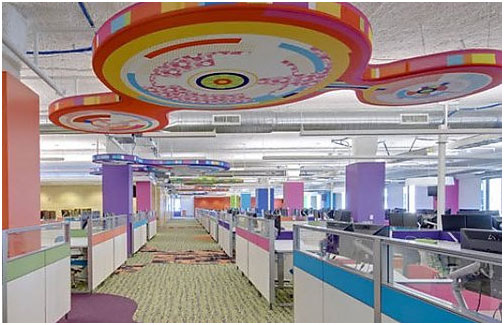
    A wealthy investor, Dan Gilbert, buys downtown properties. That investor goes on the record as to the importance of reinvesting into the urban core. That investor moves his mortgage company’s employees from suburban office parks into his own downtown real estate. Then, the investor, taking cues from his consultants, throws in something about innovation, which, at its lowest common denominator, means designing your way to a “culture of innovation”. Thus, the investor encourages that Romper Room-style office setting complete with what some would say is tacky décor wholly out of line with the soul of “the D”, but yet which is said to fun-birth inspiration—i.e., “[A] karaoke machine sat in an aisle. Guys threw footballs to one another; one employee shot at colleagues with a Nerf gun”; and “A Quicken promotional video solidifies the company’s attempts at over-the-top marketing, prominently featuring the space’s inexplicable Pac-Man theme”—despite the fact that your primary product line, i.e., mortgages,  needs far less innovation than it does a modicum of conventionality and ethics. Nonetheless, the sentiment of creative destruction is there.


    This basic process, then, is multiplied out from the office setting into strategic urban space, particularly around Gilbert’s real estate. The idea here is to design space so as to create vibrancy so as to galvanize commerce so as to ignite broad economic growth.

    Enter the partnership with the Project for Public Spaces, who is working with Gilbert’s group to do a set of “Lighter, Quicker, Cheaper” placemaking interventions, including pop-up shops. The conceptual girth behind the plan, according to a recent article “Detroit Leads the Way on Place-Centered Revitalization”, is described as such:

    “We proposed developing a Placemaking vision for the major public spaces, and refining the plan through the Power of 10 concept,” says Meg Walker, a Vice President at PPS who worked on the project. “…A lot of developers aren’t as enlightened as Dan Gilbert…they wouldn’t necessarily think about the glue that’s holding this all together.”

    “The Power of 10 framework suggests that a great city needs at least ten great districts, each with at least ten great places, which in turn each have at least ten things to do. Great public spaces produce an energy and enthusiasm that spills over into surrounding areas…

    With the conceptual description as a guide, this is a classic case of the urbanists’ version of trickled-down economics, in which an influx of capital into finite corridors is meant to attract wealth that “spills over” into surrounding areas. Unfortunately, there is little by way of evidence that this works, as was recently admitted by Richard Florida himself. What it may do, however, is fill real estate supply by pursuing a select target market, as placemaking can act as a grease to create pockets of creative class demand to support condos or retail and office space. And while one can certainly argue it beats rampant core disinvestment, it’s not the path of a bold new way that will measurably change the trajectory of Detroit, so says U of M Professor Michael Gordon. In effect, it’s simply shifting people from one set of real estate to another, with nothing undertaken on a systemic level to tackle Detroit’s real problem: poverty and disenfranchisement in its neighborhoods. Worse, re-urbanization as such is likely to exacerbate class and race divides that have plagued Detroit for decades, thus worsening Detroit’s real problem: poverty and disenfranchisement in its neighborhoods.

    Besides, we have been here before. Michigan via its Cool Cities campaign had a plan based off the same Detroit 2.0 premise, switch out the window dressing. Design place, accrue vibrancy, growth wealth. Obviously, the multi-million dollar economic development initiative didn’t work. Neither have similar initiatives across the whole of the Rust Belt.

    So, where’s the beef? What makes Detroit 2.0 different?  

    Naturally, this is where the economic development buzzwords “start-up” and “tech district enter into the Detroit 2.0 lexicon; that is, creating dense city areas will nurture spontaneous interactions that will foster Detroit’s innovation community, putting it firmly on the path to be the “Silicon Valley of the Midwest”. But every city wants this (or at least they are informed they do)—e.g., “Miami Wants to Be the Next Big Start-Up City”—and so the effort ultimately comes off as anything but visionary, rather visionless, trying.

    Cue the Onion. From an article entitled “St. Louis Mayor Has Sad Little Plan For Turning City Into High-Tech Hub”:

    In what appears to be a completely earnest attempt to revitalize a sluggish local economy, St. Louis mayor Francis G. Slay unveiled Thursday a detailed, ambitious, and truly depressing plan to turn his city into a major technology hub. “We’re going to show America, and the rest of world, just how innovative and cutting-edge St. Louis can be,” said the mayor, who displayed genuine optimism as he outlined a desperate strategy to woo major players in the high-tech sector with a sad little series of subsidies and tax incentives his city cannot afford… The mayor ended his presentation by pleading with reporters to dub the hopelessly untenable project “St. Louis 2.0.”

    In all, the current Detroit economic development approach is copycat urbanism at its finest, as there is nothing inherently “Detroit” about it. Nothing that intrinsically builds off its only true competitive advantage: itself.

    For instance, Motor City is Motor City for a reason: it builds things. It designs things. Like, for instance, cars, which, by last count, are still being used, with over 254 million registered passenger vehicles in the US in 2009 alone. And while technology-based automation is increasing manufacturing output at the expense of jobs, production is still huge business in the Rust Belt, with automotive-related STEM jobs (i.e., science, technology, engineering and mathematics-related employment)—i.e., the creative class before the “creative class” became the “creative class”)—aiding Detroit’s regional resurgence, with its 10.5% STEM job growth leading the country from 2010 to 2012. And no, this is not to say Detroit will recoup manufacturing jobs lost from its heyday. But it’s absurd for Detroit to neglect training and flexing its muscle—or its legacy of concept, design, and production—for a future with no middle between start-ups and baristas. I mean, advanced manufacturing isn’t nostalgia. It exists.


    So, why this path? Why pretty Detroit? Why make it culturally less distinct? Why embark on a plan of hyper-modern ephemerality when your distinction is resilience, making things, and hard work? Why? Where is the evidence that this even works? What in the hell is even going on here?

    To get to the bottom of this you need to be aware of parallel events in Cleveland. There, Dan Gilbert has hands in that city’s Downtown redevelopment as well. But it is not what you think. And therein lies the problem.

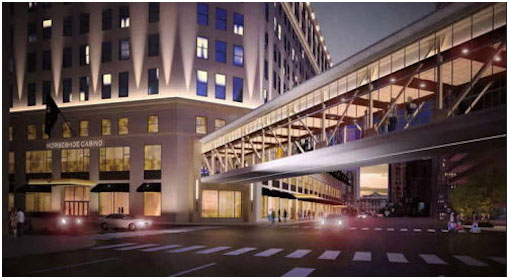
    You see, if the Detroit Dan Gilbert is the urbanists’ Dr. Jekyll than in Cleveland he becomes the anti-urban Mr. Hyde. In fact, the Cleveland Dan literally embarks on nearly all the urbanists’ seven deadly sins, including owning and running a casino placed right beside the city’s iconic Public Square, demolishing historic buildings for the creation of a VIP valet center, planning to ruin the iconic Terminal Tower by connecting an enclosed pedestrian tunnel from a parking garage into its face—the Plain Dealer architecture critic stated it was akin to “poking a straw in Mona Lisa’s nose”—and, more generally, pissing off Millennials.

    From a recent Atlantic Cities piece entitled “If Other Cities Are Demolishing Skywalks, Why Does Cleveland Want a New One?”, the author, who omits Dan Gilbert’s name, writes:

    “In the last decades of the 20th century, many American cities built skywalks in a desperate attempt to seem modern, hoping to create a sanitized urban experience that would compete with the sanitized suburban experience of indoor malls.

    For the most part, it didn’t work, and now cities…are tearing down the skywalks…in an effort to return pedestrian life and vitality to the street.

    Meanwhile, in Cleveland, the owners of the year-old Horseshoe Casino downtown are planning to build a brand-new skywalk…For many of the young people moving to Cleveland in search of a 21st-century urban experience – pedestrian-friendly, with lots of people out and about – it seems like a step backward in time.”


    Why is Gilbert going all anti-urban in Cleveland, then? In a word: money, as Moody’s just issued a report saying a walkway would help the casino reach predicted income streams, as it has been underperforming. Obviously casino ownership is a no frills money-making operation, as is real estate. With each: immediate financial return trumps the nurturing of human and community capital to support a vision of long-term economic growth.

    But Detroit Dan is different, right? He is a walkability guru’s guru. One of the “enlightened developers” as was stated above.

    Well, you be the judge. Here’s a blog post excerpt covering the recent Placemaking Leadership Council hosted in Detroit, with Detroit 2.0 taking center stage.

    Dan Gilbert, head of Rock Ventures and Quicken Loans, genuinely seemed to defer to Kent [the Project for Public Spaces head] when it came to his part of the presentation Thursday. Gilbert, who has millions of hours of public-speaking practice behind him, often turned to Kent to fill in the details on the upcoming renovations to Campus Martius, Cadillac Square, Capitol Park, Grand Circus Park and Paradise Valley.

    “Genuinely seemed to defer” is right. Or just bored as hell.

    And then there is this. This. Courtesy of a Curbed Detroit blog post called “Development In Downtown Detroit Is Playing Out Like A Huff Po Blog Post From 2009”. The referenced Huffington Post piece is by Detroiter Toby Barlow that is called “How a Billionaire Can Make a Billion Dollars”. The strategy? Buy Detroit, not “metaphorically” but “literally”, yet do it “very quietly, so as not to inflate any prices”. Then, according to Barlow, since a billionaire owns thing, he moves his employees to his buildings and gives them “incentives to live down near their work so that they’ll buy your residential property”. Barlow concludes:

    So, I don’t have to spell out the rest, do I? Real estate values will quickly soar as other companies, encouraged by your brazen move, make similar leaps into what will still be an incredibly affordable market. The momentum will build as the ever-frenzied media piles on.

    Yes, Detroit’s plan for the future pre-dated by a Huff Po blog entry from 2009.

    The big revelation here?

    Look, in the end, the Dan Gilbert’s of the world are in their line of work for one reason and one reason only: to make money. They will don whatever mask they need to play the part, be it the urban-loving Jekyll or the anti-urban Hyde. That’s the problem with creative class urbanism. It is dependent on developers who could care less. It is a means to an end for those who implement it.

    Too bad this end is not the beginning of a true path forward for a real Rust Belt recovery.

    Detroiters, like most Rust Belters, have been through enough. They deserve better.

    Richey Piiparinen is a writer and policy researcher based in Cleveland. He is co-editor of Rust Belt Chic: The Cleveland Anthology. Read more from him at his blog and at Rust Belt Chic.

  • The Evolving Urban Form: Nanjing

    Nanjing is one of China’s most historic cities. It is one of the four great ancient capitals of the nation, along with Beijing, Chang’an (Xi’an) and Luoyang. Its name means southern capital (Nan=south, Jing=capital), while the name of the current capital, Beijing means Northern capital. Nanjing was the national capital at various times, however generally for periods of no more than a few decades. Upon the establishment of the People’s Republic of China, the national capital was moved permanently to Beijing, where it had been for most of the previous five centuries.

    Nanjing is the capital of Jiangsu, which is China’s fifth most populous province. It has twice as many people as California (80 million) and a land area the size of Virginia. Nanjing is also one of the "four furnaces" of China, a title derived from its humid summers. The others include Wuhan (Hubei), Chongqing and sometimes Changsha (Hunan) or Nanchang (Jiangxi).

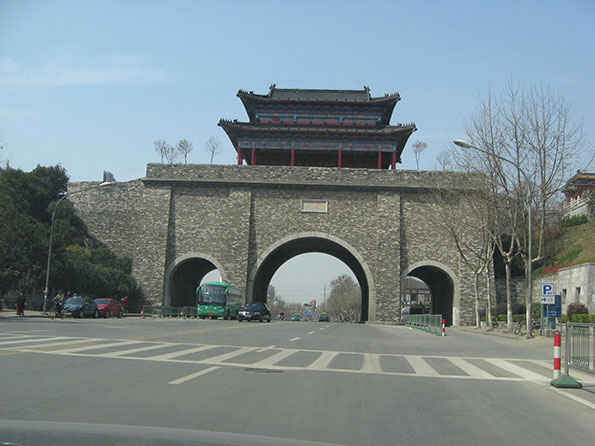
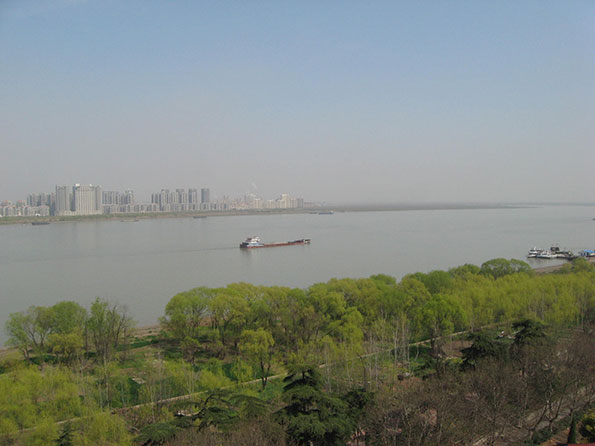
    Nanjing is reputed to have the world’s longest, though not the oldest surviving city wall, which was built in the 14th century (Photo).  The city is also the site of the second bridge ever built over the lower Yangtze River (Photo), opened in 1968 (the first was at Wuhan). The bridge carries both automobiles and trains. There are now five Yangtze River crossings in Nanjing.


    Nanjing City Wall


    Yangtze River (toward suburban Pukou qu)

    Yangtze Delta Megalopolis

    Nanjing is a big city in one of the world’s great urban mega-regions. It serves as the Western anchor of the Yangtze Delta region, a megalopolis (string of metropolitan areas) which consists of a string of sometimes adjacent urban areas, stretching through Suzhou to Shanghai and Hangzhou to Ningbo, with a population of approximately 60 million (plus additional millions in rural areas, outside the urban areas). This is at least a third more than live in the longer Washington-New York-Boston corridor, the original megalopolis.

    A trip through the Yangtze Delta corridor demonstrates only comparatively short sections that are not urbanized. One of the longest is the 10 mile (16 kilometer) section from the eastern urban fringe of Nanjing to the western fringe of Zhenjiang (location of the Pearl S. Buck Museum). Further, Nanjing’s southern fringe now meets that of Maanshan, in Anhui province (not a part of the Yangzte Delta).

    The Nanjing Urban Area

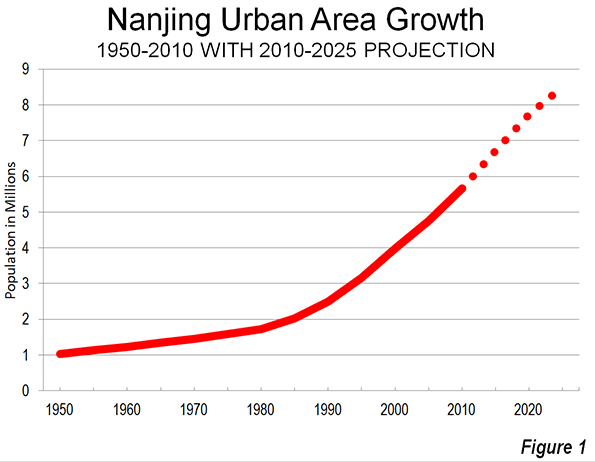
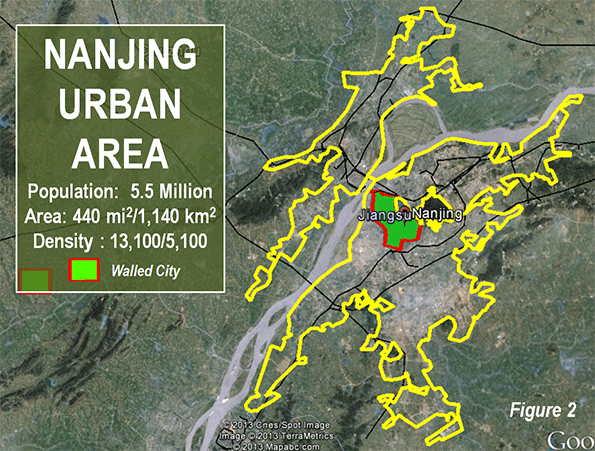
    Nanjing has grown rapidly. In 1950, the urban area population was approximately 1.0 million (see "Definition of Terms Used in the Evolving Urban Form Series"), a population some sources say was exceeded in the 15th century. The urban area has now reached 5.8 million. Nanjing is the world’s 59th largest urban area and the 13th largest in China. It is projected to have a population of more than 8 million by 2025 (Figure 1). The Nanjing urban area (Figure 2) covers approximately 440 square miles (1,140 square kilometers). This results in a population density of approximately 13,100 per square mile (5,100 per square kilometer).

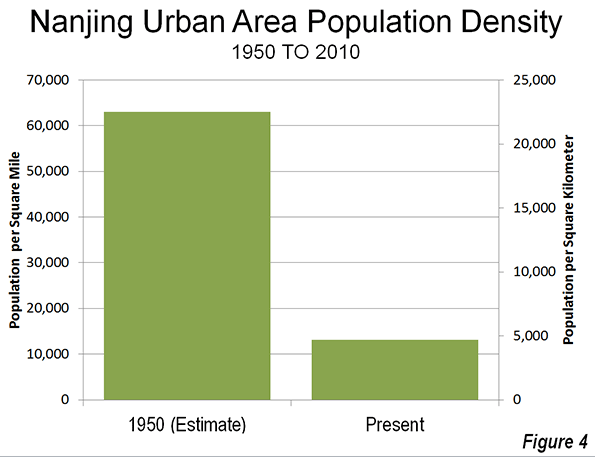
    Consistent with the general principle that cities become less dense as they get larger, Nanjing’s population density has fallen significantly over the last 60 years, even as its geographical size has more than quintupled (Figure 3). Older historic land area data is not readily available, but if it is assumed that virtually all of Nanjing’s United Nations reported 1,000,000 population in 1950 lived within the 17 square mile (44 square kilometer) periphery of the city walls, the population density would have been more than 60,000 per square mile (more than 23,000 per square kilometer). The area within the city walls is indicated by green shading in the urban area representation (Figure 2).

    By 1970, the population had increased to over 1.4 million and if this population was contained inside the city walls, the population density would have approached 90,000 per square mile (35,000 per square kilometer).Indicating a similar density, the 2010 population of the most densely populated district (Golou qu), much of which is located inside the Wall 86,000 per square mile (33,000 per square kilometer).

    The Nanjing Metropolitan Area

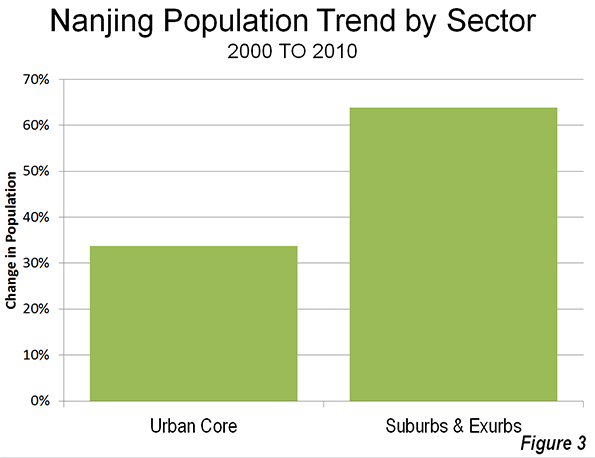
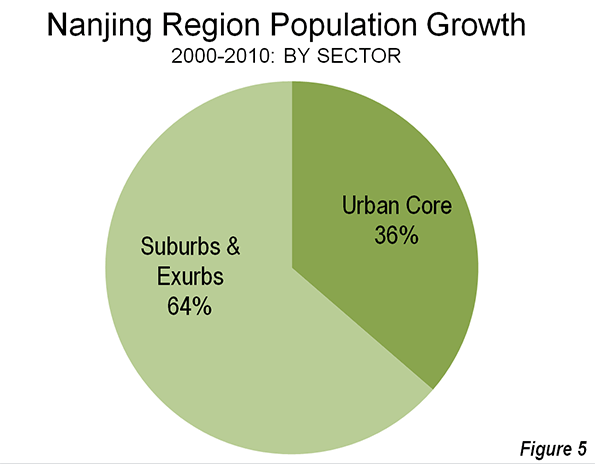
    Nanjing is a prefecture (regional municipality) with 11 districts, of which nine are in the metropolitan area (Note 1). The core of Nanjing continues to grow, from 2.5 million in 2000 to 3.4 million in 2010, an increase of 34 percent (Note 2). But in comparison, the suburban districts grew from 2.3 million to 3.8 million, an increase of 64 percent (Figure 4). For the first time, suburban Nanjing has a larger population than the urban core. The suburbs accounted for 64 percent of the metropolitan area’s growth over the past decade, compared to 36 percent in the urban core (Figure 5).

    Pukou, a suburban district across the Yangtze River from the historic location of Nanjing, was by far the fastest growing part of the metropolitan over the past decade. By 2010, the population had risen to 710,000 from 225,000 in 2000, when it was largely rural. Two metro lines are planned to connect Pukou to the rest of the urban area, which is likely to encourage further suburban development.

    The Nanjing Economy

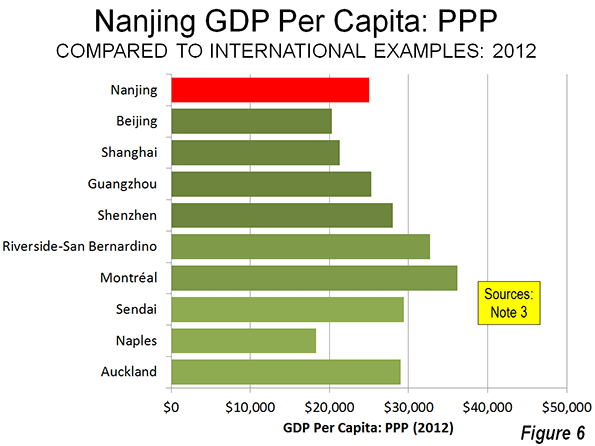
    Nanjing, like other cities in China, has been a beneficiary of China’s unprecedented poverty reduction, first launched by the economic reforms started by Deng Xiao Ping in the early 1980s. It is estimated that in 2012, Nanjing’s gross domestic product per capita (purchasing power parity adjusted) was approximately $25,000 annually. Nanjing’s GDP per capita is compared to that of other Chinese metropolitan areas and examples from the developed world in Table 6 (Note 3).

    A Strong Future

    Nanjing seems likely to continue its strong growth. This and Nanjing’s geographic location in one of the most vibrant mega-regions in the world should guarantee a continuing and strong contribution not only to the development of the Yangtze Delta megalopolis, but also to economic progress of China as a whole.

    Wendell Cox is a Visiting Professor, Conservatoire National des Arts et Metiers, Paris and the author of “War on the Dream: How Anti-Sprawl Policy Threatens the Quality of Life.

    —-

    Note 1: The districts (qu and counties) designated as urban by Nanjing prefecture (regional municipality) authorities Entire peripheral districts are designated when they begin to receive urban development. The "urban" designation in China, however, does not indicate continuous urbanization and is thus not an urban area in the internationally defined sense. The Chinese urban definition is thus similar to a metropolitan area (labor market).

    Note 2: The urban core includes the following districts (qu): Xuanwu, Biaxia, Qinhaui and Gulou.

    Note 3:  Estimated the Brookings Institution Global Metro Monitor, and other sources. See "World’s Most Affluent Metropolitan Areas: 2012" including the "Note."

    Top Photo: Zifeng Tower (all photos by author)

  • Megacities And The Density Delusion: Why More People Doesn’t Equal More Wealth

    Perhaps no idea is more widely accepted among urban core theorists than the notion that higher population densities lead to more productivity and sustainable economic growth. Yet upon examination, there are less than compelling moorings for the beliefs of what Pittsburgh blogger Jim Russell calls “the density cult,” whose adherents include many planners and urban land speculators.

    Let’s start at the top of the urban food chain, the world’s 28 megacities of over 10 million people (which we are defining as areas of continuous urban development, incorporating suburbs and satellite communities). Is greater density the key to great prosperity? For the most part, the world’s densest megacities are the poorest. Take the densest, the Bangladeshi capital of Dhaka. Its 14 million residents are squeezed into an area of 125 square miles, making for a population density of 115,000 per square mile, as reported in the latest edition of Demographia World Urban Areas (which includes estimates for all known urban areas in the world with at least 500,000 residents). Dhaka’s per capita gross domestic product, $3,100, is the lowest of all the world’s megacities.

    Three other megacities — Mumbai, Karachi, Delhi — have population densities that are between three to seven times as high as the biggest megacity, Tokyo-Yokohama, which has a density of 11,000 per square mile. Tokyo is also much richer; the region’s per capita GDP tops $41,100, while the three ultra-crowded metropolises on the subcontinent have GDPs under $10,000 per capita. In contrast the two most spread out megacities, Los Angeles and New York, have population densities about half or less of Tokyo’s, but their per capita GDPs rank number rank first and third ($63,100 in New York and $54,400 in Los Angeles).

    Do any dense metropolitan areas boast higher GDPs? Seoul-Incheon, South Korea, packs more than 20 million people into an area roughly a quarter of Tokyo’s and at a density four times that of Los Angeles. Its per capita GDP, at $32,200, is the highest among the 10 most dense megacities. Paris, which is twice as dense as New York and 50% more dense than Los Angeles, stands at $53,900. (Yes, Los Angeles is denser than New York — despite its small central core, L.A. lacks the wide stretches of bucolic suburbia common in eastern cities).

    This imperfect, if not inverse, relationship between density and wealth is widely ignored by most urban core boosters, many of whom argue that packing people together is the true key to economic growth. But more often than not, notes Russell, the objective is aggrandizing the “creative class” — those who tend to settle in dense urban cores and also work in industries that do best there, but with little positive for everyone else.

    Many retro-urban theorists maintain that high density is the key to urban prosperity. These theorists often point for justification to Santa Fe Institute research that, they claim, links productivity with density. Yet in reality it does nothing of the kind. Instead the study emphasizes that population size, not compactness, is the decisive factor.

    Size does matter. A region is helped by the infrastructure that generally comes only with a large population, for example airports. But being big does not mean being dense. In fact the U.S. cities that made the largest gains in GDP  in 2011 — Houston, Dallas-Fort Worth and greater Detroit — are not dense cities at all.

    Some of the metropolitan regions that have the highest per capita GDPs in the world based on purchasing power are not particularly dense. The two regions at the top — Hartford, Conn. and San Jose, Calif., — are if anything largely suburban in character. Neither has a strong central core, and most of the jobs in the areas are on the periphery.

    These areas are marked by everything that density advocates detest: They have very low levels of transit ridership and are largely dominated by single-family homes. The most affluent, Hartford, has among the lowest urban population densities in the world. It turns out that our low-density, “sprawling” metropolitan areas do very well in terms of wealth creation. Of the top 10 urban regions in the world in terms of GDP per capita all but one — Abu Dhabi in the United Arab Emirates — are located inside the United States.

    There are many thriving American urban areas with densities below the U.S. average for large urban areas.This includes not only Hartford, but also Boston, Durham, Seattle and Houston. Indeed, smaller, low-density Des Moines nearly broke into the top 10 (13th), reflective of the economic gains being made in the Great Plains.

    We may think, for example, of Boston, which ranks fifth in the world in per capita GDP, as a tightly packed urban area. But once one gets behind the relatively small urban core, the overall density is barely 2,200 per square mile, less than half San Jose or Los Angeles, hardly a fifth that of Tokyo and not much more than Atlanta, the least dense major city in the world with more than 2.5 million residents.

    Why is this the case? One key reason is that cities, as they evolve, naturally spread out. As New York University’s Shlomo Angel has pointed out, virtually all major cities in the world are growing more outward than inward, and becoming less dense in the process. This is not only true in the United States, but also in Europe and, even more surprisingly developing countries as well. For example, over the past four decades, everyone’s favorite dense core city, Paris, has seen its urban land area expand 55%, while its population has risen only 21%. Today, the geographical extent of urban Paris is more than 25 times that of the ville de Paris, home to most of the familiar tourist attractions.

    In some ascendant countries, notably China, American-style suburbs are being duplicated; and when Chinese and other Asians immigrate, they tend to move to lower-density suburban areas. The only exceptions have been cities where development has been distorted by ideology, such as Moscow before the fall of the Soviet Union, notes Alain Bertaud, a former principal planner World Bank.

    The reason for moving outward may be lost on theorists and their real estate backers, but they remain compelling for many people, particularly families. A national association of realtors survey in 2011 found that roughly 8o% of adults prefer to live in detached single-family houses while only 8% preferred an apartment. It is thus not surprising that the suburbs, which abound in detached housing, contain nearly three-quarters of America’s major metropolitan population or that areas outside the urban core accounted for 99% of growth between 2000 and 2010.

    For the most part, this suggest the population, for the most part, will continue to seek out the periphery. This is not only true, as NYU’s Angel points out, in the United States or in similar countries such as Australia or Canada. As people seek out more affordable and larger housing, they tend to spread out from their historic cores. It happens most decisively in wealthy areas that are also land-rich.

    This is not to say that the higher-density enclaves of urban areas do not have an important place. In terms of culture, finance, media and certain other transaction-based industries, a number of dense urban cores remain unassailable in their efficiency and appeal. But in the United States, and much of the rest of the high-income world, this is accomplished by bringing residents from the periphery to the core — by car, train, bus and increasingly through telecommunications, even as most jobs are located elsewhere in the urban area.

    The future shape of the city is likely to continue expanding, even as some urban cores grow. Visit any burgeoning city in the developing world from Shanghai to Mexico City and the same reality emerges: as cities get larger, they spread out, as people begin to aspire, as best they can, for the quality of life that most North Americans and Europeans already take for granted.

    Joel Kotkin is executive editor of NewGeography.com and a distinguished presidential fellow in urban futures at Chapman University, and a member of the editorial board of the Orange County Register. He is author of The City: A Global History and The Next Hundred Million: America in 2050. His most recent study, The Rise of Postfamilialism, has been widely discussed and distributed internationally. He lives in Los Angeles, CA.

    This piece originally appeared at Forbes.com.

    Dhaka photo by wiki commons user BL2593.

  • US Suburbs Approaching Jobs-Housing Balance

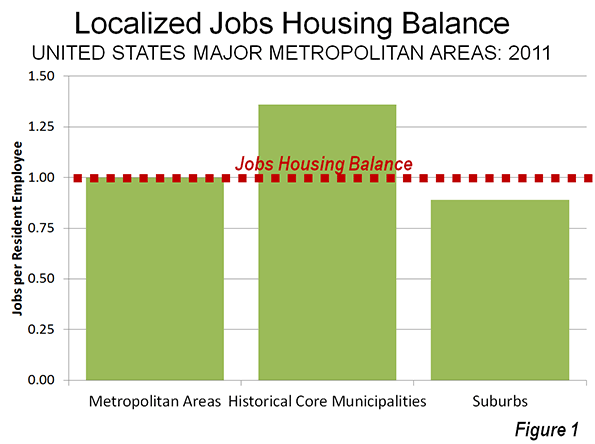
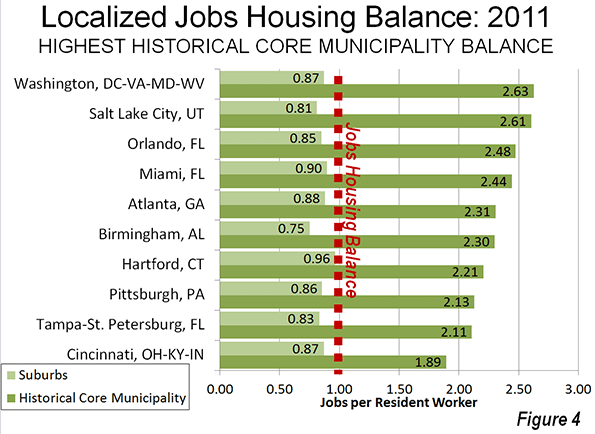
    Suburban areas in the US metropolitan areas with more than 1 million total regional population, once largely seen as bedroom communities, are nearing parity between jobs and resident employees. The jobs housing balance, which measures the number of jobs per resident employee in a geographical area has reached 0.89 (jobs per resident workers) in these 51 major metropolitan areas, according to data in the 2011 one-year American Community Survey. This is well below the 1.39 ratio of jobs to resident employees in the historical core municipalities (Figure 1).

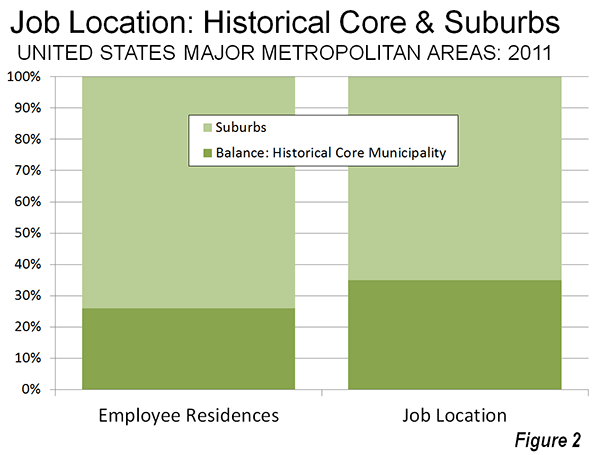
    The historical core municipalities still have a larger share of metropolitan employment than they have of resident workers. However, 65 percent of major metropolitan area jobs are now in the suburbs, where 74 percent of workers live (Figure 2). The 0.89 jobs housing balance index indicates that there are only 11 percent fewer jobs in the suburbs than resident workers. Overall, the jobs housing balance of metropolitan areas (a synonym for labor markets) is at or near 1.00.

    From Monocentric to Polycentric to Dispersed Cities
    The data indicates the extent to which the classical monocentric city has been left behind by the evolution of the modern metropolitan area. Before the near universal extension of automobile ownership, cities were necessarily much more monocentric. Transit lines tended to converge on downtown, which made downtowns far more dominant in their share of metropolitan employment than they are today.

    For example, in 1926, according to historian Robert M. Fogelson writing in Downtown: Its Rise and Fall: 1880-1950, in 1926 41 percent of Los Angeles residents went to downtown every day, a figure that had dropped to 15 percent by 1953, principally for work and shopping. Today, in a much larger metropolitan area that also includes Orange County, 3 to 5 percent of jobs are located downtown (depending on the geographical definition). The area not only lost a significant share of metropolitan employment, but saw its share of retail sales drop as regional shopping centers were built throughout the area. Similar trends occurred in virtually every metropolitan area of the United States.

    All of this occured as the automobile facilitated access to virtually everywhere in the metropolitan area, not just downtown.

    The emerging polycentricity of the city long was obvious to many analysts, but it was Joel Garreau who brought the issue to popular attention in his classic Edge City: Life on the New Frontier. Garreau documented the development of large suburban employment centers throughout the major metropolitan areas and provided a list. Later, Robert Lang of the University of Nevada Las Vegas took the issue further in his Edgeless Cities: Exploring the Elusive Metropolis, which examined office space outside downtown areas and edge cities in 1999. Gross office space was greatest outside both the downtowns and edge cities, according to Lang’s data (Note 1).

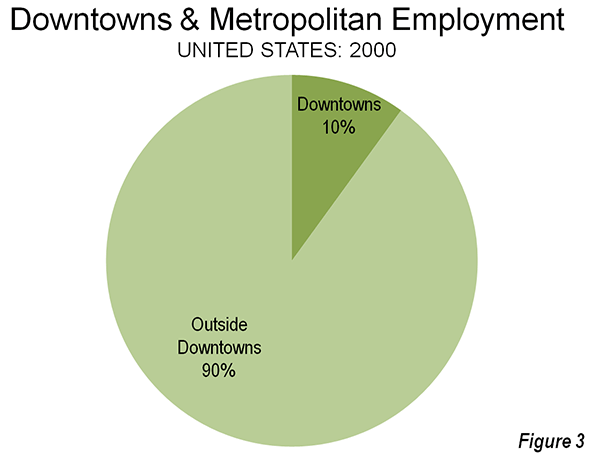
    Lang’s analysis is limited to office space, which is more concentrated in downtown areas than employment. On average, 2000 data indicates that downtown areas had approximately 10 percent of employment, well below downtown’s 36 percent share of office space (Figure 3).

    Even so, there remains a misconception today that cities remain monocentric. Yet as the figures show we are progressing toward a distribution of jobs that nearly matches its distribution of housing, with the exception of downtown (where there is the greatest imbalance, see below).

    Historical Core Municipalities: Where the Jobs-Housing Imbalance is the Greatest

    The excess of jobs in relation to residential workers is greatest in the historical core municipalities. It is driven by the downtown areas (central business districts or CBDs), which have by far the highest employment densities in the metropolitan areas. For example, in 2000, the downtown areas of the nation’s 50 largest urban areas had an average job density 92,000 per square mile. This is approximately 70 times the average non-downtown urban area employment densities (1,300 per square mile). Downtown residential densities, if they were readily available, would doubtless be a small fraction of the downtown employment figures.

    Largest Historical Core Municipality Jobs-Housing Imbalances

    The imbalance between jobs and housing is highest among the historical core municipalities of Washington (2.63), Salt Lake City (2.61), Orlando (2.48), Miami (2.44) and Atlanta (2.31). Yet, these large historical core municipality imbalances co-exist with generally near average suburban jobs housing balances. For example, in Washington there are 0.87 jobs per resident worker in the suburbs, or only 13 percent fewer jobs than workers who reside in the suburbs. In the other four metropolitan areas, the suburban jobs housing balance is above 0.80 (Figure 4).

    Smallest Historical Core Municipality Jobs-Housing Imbalances

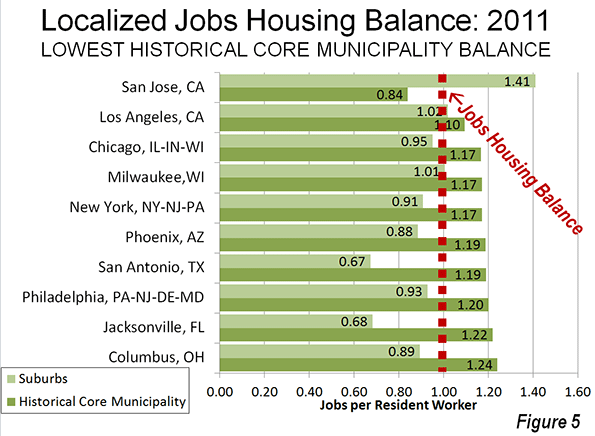
    The smallest historical core municipality jobs housing imbalance is in San Jose (0.84), which is the only major metropolitan area in which has fewer jobs than resident workers (Figure 5). However, the municipality of San Jose is a "Post War Suburban" core municipality, having experienced virtually all of its growth since 1940. This is despite the fact that San Jose’s corresponding urban area is the third most dense (following Los Angeles and San Francisco). Generally higher suburban housing densities were built in San Jose compared to less dense urban areas – which extend over vast distances – such as New York, Philadelphia and Boston. San Jose is also the only metropolitan area in which there are more suburban jobs than suburban resident workers (1.41 jobs per worker).

    The other historical core municipalities with the least imbalance between employment and resident workers are Los Angeles (1.10), Chicago (1.17), Milwaukee (1.17) and New York (1.17). The surprising inclusion of New York is discussed below.

    Each of the historical core municipalities with the fewest jobs per resident worker has a higher than average jobs housing balance in its suburban areas. Los Angeles has 1.02 jobs per suburban resident worker, principally the result of importing workers from the adjacent Riverside-San Bernardino metropolitan area. Milwaukee also has more suburban jobs than suburban resident workers (1.01).

    New York

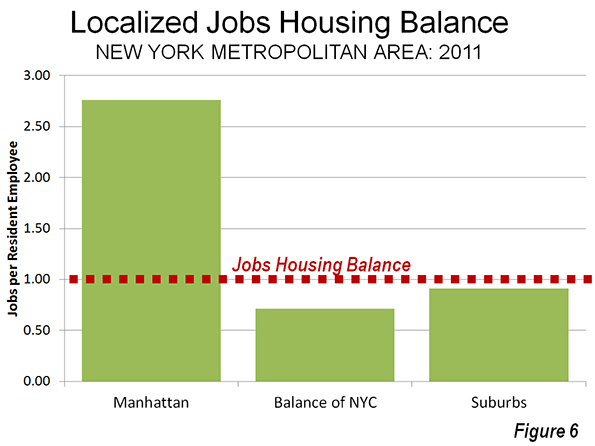
    New York has the second largest central business district in the world, following Tokyo. It therefore seems odd that the municipality of New York should have such a low ratio of jobs per resident worker. The borough of Manhattan, where the central business district is located, has 2.76 jobs per resident workers, higher than that of top ranked Washington, DC (above). There are 1,450,000 more jobs than resident workers in Manhattan.

    New York’s low ratio is the result of a huge shortage of jobs relative to workers the outer boroughs (the Bronx, Brooklyn, Queens and Staten Island). There are 830,000 fewer jobs than resident workers in the four outer boroughs. Their ratio of jobs per resident, at 0.71 is lower than all but five suburban areas in the other 50 major metropolitan areas (Figure 6).

    The suburbs of New York, ironically, are more job-rich than the outer boroughs. They boast an 0.91 jobs per resident worker, ranking 17th out of the 51 metropolitan areas.

    The New Normal

    The former assumption that "everyone works downtown" is a thing of the past. Dispersion of jobs throughout the metropolitan area has become the rule. The "old normal" was that of the bedroom community – people living in the suburbs and working in the core cities. The "new normal" is about downtown and the core city. To the extent that there is a distortion in the jobs housing balance throughout the modern metropolitan area, it is the result of a larger number of jobs than residents in the core cities (and especially downtown).

    Wendell Cox is a Visiting Professor, Conservatoire National des Arts et Metiers, Paris and the author of “War on the Dream: How Anti-Sprawl Policy Threatens the Quality of Life.

    ———————-

    Photo: Houston downtown (to the left), edge city (Texas Medical Center in the middle) and dispersed employment (rest of photo). Photo by author.

    Note 1: The total office space outside the primary downtowns, secondary downtowns and edge cities was 37.0 percent in reviewed 13 metropolitan areas. Primary downtowns accounted for 36.5 percent, secondary downtown for 6.5 percent and edge cities for 19.8 percent (this analysis classifies Beverly Hills, Mid-Wilshire and Santa Monica in Los Angeles  as secondary downtowns, rather than as primary as in the book. See tables 4-2 and 4-10).

    Note 2: The historical core municipalities are the largest municipalities in each metropolitan area, with the following exceptions.
    (a) Oakland and St. Paul are also historical core municipalities.
    (b) Norfolk is the historical core municipality in the Virginia Beach metropolitan area.
    (c) San Bernardino is the historical core municipality in Riverside San Bernardino
    (see Classification of Historical Core Municipalities)

  • Density Boondoggles

    Is it density or migration? Venture capitalist Brad Feld weighs in:

    The cities that have the most movement in and out of them are the most vibrant.

    The densest city in the world won’t be as vibrant as the city with the most talent churn. Yet planners and urbanists tout the former over the latter. We’ve reached the point of density for the sake of density. It is an end instead of a means to an end. The art of the density boondoggle:

    The following is the conversation held at every regional summit on Long Island:

    Advocate: Let’s keep our young people from leaving! There’s a…brain drain!

    Public: How do we stop it?

    Developer: Build denser housing! Let’s make it…affordable! Walkable! Let’s make it…mixed-use sustainable smart growth…with a downtown, pedestrian-friendly feel.

    Municipality: Development approved!

    What’s the question? Greater density is the answer. It will plug the brain drain. I promise. But plugging the brain drain will reduce talent churn. Long Island will be less vibrant.

    There is a name for the Cult of Density. It now has its very own -ism. All hail Vancouverism:

    Vancouverism is, at the root, a movement to go from low density, to higher density, to make Canadian and North American cities about people once again.

    Making cities all about people sounds great. All I hear is the chant of the Underpants Gnomes:

    Phase 1: Create a cool city.
    Phase 2: ?
    Phase 3: Retain talent.

    That will be $500,000. Thank you for your patronage, Memphis. Consulting is fun!

    Development approved. That’s the story line playing out in downtown Las Vegas with Zappos. Density is king. Don’t listen to Brad Feld. Talent churn doesn’t matter.

    If Vancouverism were harmless, then I wouldn’t blog about it. The misplaced emphasis on density has negative impacts. Vancouver is more about people, those who are young, single and college-educated:

    ‘Revitalizing,’ but leaving seniors behind

    Last July, Vancouver city council unanimously approved a three-year Chinatown Neighbourhood Plan and Economic Revitalization Strategy. More than a decade in the making, the plan focused on economic revitalization, after two-thirds of businesses surveyed in Vancouver’s original Chinatown reported declining revenues between 2008 and 2011 — blamed mainly on losses to newer Chinese-language communities in suburbs like Richmond.

    The revitalization plan envisions new residential development, "to connect with younger generations and reach out to people of all backgrounds to ensure Chinatown is increasingly relevant to a more multi-cultural Vancouver." At the same time, it acknowledged that in a neighborhood where 67 per cent of households are low-income — more than twice the City of Vancouver average — such redevelopment "can displace low-income residents." What is good for old Chinatown’s businesses, in short, may be less so for its poor and isolated elderly.

    S.U.C.C.E.S.S., Vancouver’s primary provider of culturally- and linguistically-supportive housing and services for Chinese seniors, is providing a partial answer. It operates a single multi-level care facility in old Chinatown for people with cognitive impairments or who require round-the-clock nursing. But its 103 beds, soon to be 113, are about one-tenth of what the UBC Centre for Urban Economics anticipates will be needed over the next 15 years to house Chinese seniors.

    Meanwhile, the support it offers seem a world away from Rosesari and her neighbours living in privately operated SROs like the May Wah Hotel. Yet the women are spirited and resilient. "I’m happy and I’m healthy," Rosesari told me through Pang’s interpretation. Both she and Lin say they like living in Chinatown. They feel at home here, where the language spoken is the one they know.

    They are also in their 90s. As time goes on, they and others may no longer be able to manage the May Wah’s staircases, its lack of mobility aids, and its communal bathing facilities. The alternatives available to them then are in terribly short supply.

    Welcome to the dark side of the obsession with wants and needs of the Creative Class. Vancouverism is boutique urbanism, catering to a specific demographic at the exclusion of all others. People are either displaced or fall into the cracks. Bike lanes and food trucks trump the needs of seniors.

    Jim Russell is a talent geographer with particular interest in the Rust Belt. Read his blog at Burgh Diaspora, where this piece originally appeared.

    Downtown Vancouver photo by runningclouds

  • The World’s Fastest-Growing Megacities

    The modern megacity may have been largely an invention of the West, but it’s increasingly to be found largely in the East. The seven largest megacities (defined as areas of continuous urban development of over 10 million people) are located in Asia, based on a roundup of the latest population data released last month by Wendell Cox’s Demographia. The largest megacity remains the Tokyo-Yokohama area, home to 37 million, followed by the Indonesian capital of Jakarta, Seoul-Incheon, Delhi, Shanghai and Manila.

    With roughly 20 million inhabitants, the New York metro area, the world’s largest urban agglomeration from early in the 20th century till Tokyo surpassed it in the 1950s, ranks eighth. The only other western urban areas among the 28 biggest megacities now are Moscow (15th), Los Angeles (17th), and Paris (28th). London, which was the first modern city of a million people, is not on the list at all, with expansion long ago stopped by its green belt. In 1990, New York ranked second and Los Angeles ranked eighth.

    This de-Westernizing trend seems likely to continue. The fastest-growing megacities over the past decade have been primarily in the developing world. Karachi, Pakistan, has led the growth charge, with a remarkable 80% expansion in its population from 2000 to 2010. The growth economies of China and India dominate the rest of the list of most rapidly growing megacities.

    China, not surprisingly, has the most megacities of any country, four. The second fastest growing megacity over the past decade, Shenzhen, was a small fishing village not long ago that became a focus of Deng Xiaoping’s first wave of modernization policies. In 1979 it had roughly 30,000 people; now it is a thriving metropolis of over 12 million whose population in the past decade grew 56%. Its rise has been so quick that the Asia Society has labeled it “a city without a history.”

    Older Chinese cities are also growing rapidly. Shanghai, a cosmopolitan world city decades  before the Communist takeover of the country, expanded almost 50% since 2000. The ancient capital Beijing and the southern commerce and industrial hub of Guangzhou grew nearly as rapidly.

    India matches Japan with three megacities, but they are all growing much faster. The population of Delhi, the world’s fourth-largest city, expanded 40% over the past decade; Mumbai, almost 20%; and Kolkata, roughly 10%, a relatively low rate for a city in a developing country.

    Other rapidly growing megacities are scattered throughout the developing world. In Nigeria, Lagos saw its population swell by over 48%; The Thai capital of Bangkok and Dhaka, Bangladesh, both grew some 45%. The world’s second-largest megacity, Jakarta, expanded 34% to almost 27 million.

    One caveat: Estimating population for comparably defined urban areas, particularly in the developing world, can be difficult. For example, there is considerable disagreement about the population of Lagos, where local officials claimed there were twice as many people in 2005 as were counted in the 2006 Nigerian census. Add the “missing” 8 or more million people and the population would be 22 million this year. The higher local count, however, has not been broadly accepted. There population of Karachi is also disputed, with some claiming a somewhat lower population than reported.

    In contrast, high-income countries in Europe and the U.S., where population tracking is more reliable, grew relatively slowly. The only city with a purchasing power adjusted GDP of over $40,000 that registered population growth over 10% was Moscow, which has expanded rapidly as the center of Russia’s resource-led boom. The population of Paris grew 8%; Los Angeles, 6%; and New York, barely 3%.

    Japan, one of the world’s most urbanized major countries, has also logged slower growth. Tokyo, the great outlier in that country’s stagnant population profile, expanded 7%, Nagoya grew 5.7% and Osaka-Kobe a weak 2.4%. The rapid population depletion in the rest of the country and a lack of immigrants suggest that Japan’s great cities will grow even slower in the years ahead, as the country runs short on migrants from rural areas and young people in general.

    So what do the numbers tell us about the future of megacities? For one thing, it’s clear that the most rapid growth is taking place in countries that still have large rural hinterlands and relatively young populations. These mostly poor places — most with median incomes between Dhaka at $3,100 per capita and Bangkok at $23,000 — will continue to grow, at least until their populations begin to see the results of decreasing birthrates.

    U.N. projections to 2025 suggest that the future list of megacities will be dominated by such lower-income cities, with growth primarily in places like Africa and central Asia. Among the likely new entrants are Lima (Peru) , Kinshasa (Democratic Republic of the Congo) and Tianjin (China). At least seven others (Chennai, Bangalore, Bogota, Ho Chi Minh City, Dongguan, Chengdu and Hyderabad) are now above 8 million, making it likely they could reach megacity status by 2030. Among high-income world cities, London might finally reach 10 million while the only other high-income world candidate, Chicago, with more than 9 million residents, could take until 2040.

    At the same time, some megacities in the low and middle-income world already seem to have reached a point of saturation. A generation ago, it was widely predicted that Mexico City would become the world’s largest city. Yet its growth has slowed to a modest 11% over the past decade. Lower Mexican birthrates and the development of other urban alternatives have made La Capital far less a growth hub than once imagined.

    Similar processes can be seen elsewhere in Latin America, where fertility rates have been dropping to levels closer to American and northern European norm, but not yet those of the ultra-low Japan or southern European countries. Over the past decade population growth was 13% in Buenos Aires, 15%  in Sao Paulo and 10%  in Rio de Janeiro. These cities will likely continue to grow, but at a reduced rate.

    The real winners in the coming decades are likely to be Chinese megacities, and to a lesser extent those in India. China’s megacities all enjoy per capita incomes above $20,000 and the vast scale of the country’s rural population suggests there is still room for growth. It will be perhaps another decade or so before the country’s low birthrate catches up with it, and slows growth down to western or Japanese levels.

    India’s cities, notably Mumbai and Delhi, are not as wealthy as China’s, but are clearly getting richer, with Delhi getting close to the $10,000 per capita income level. With a somewhat higher birthrate than its Chinese or South American counterparts, Indian cities can be expected to continue expanding at least for the next decade or so.

    These trends, of course, may be altered by any number of developments, including the possible threats to  cities from wars, environmental challenges or other large-scale disruptions. But we can say, with some confidence, that the world’s megacities will continue to become increasing Asian and African, reflecting the protean nature of an urban growth pattern that continues to de-emphasize slower expanding regions in the Americas, Japan and, of course, Europe.

    FASTEST GROWING MEGACITIES IN THE WORLD
    (Urban Areas with more than 10 million residents)
    Rank Geography Urban Area Population Estimate GROWTH (Decade)
    1 Pakistan Karachi 20,877,000 80.5%
    2 China Shenzhen 12,506,000 56.1%
    3 Nigeria Lagos 12,090,000 48.2%
    4 China Beijing, BJ 18,241,000 47.6%
    5 Thailand Bangkok 14,544,000 45.2%
    6 Bangladesh Dhaka 14,399,000 45.2%
    7 China Guangzhou-Foshan 17,681,000 43.0%
    8 China Shanghai 21,766,000 40.1%
    9 India Delhi 22,826,000 39.2%
    10 Indonesia Jakarta 26,746,000 34.6%
    11 Turkey Istanbul 12,919,000 25.3%
    Source: Demographia World Urban Areas (2013): http://demographia.com/db-worldua.pdf

    Joel Kotkin is executive editor of NewGeography.com and a distinguished presidential fellow in urban futures at Chapman University, and a member of the editorial board of the Orange County Register. He is author of The City: A Global History and The Next Hundred Million: America in 2050. His most recent study, The Rise of Postfamilialism, has been widely discussed and distributed internationally. He lives in Los Angeles, CA.

    Wendell Cox is a Visiting Professor, Conservatoire National des Arts et Metiers, Paris and the author of “War on the Dream: How Anti-Sprawl Policy Threatens the Quality of Life.

    This piece originally appeared at Forbes.com.

  • The Evolving Urban Form: Athens

    Around the fifth century BCE, Athens may have been the most important city in the West. Like China’s Chang’an (modern Xi’an), the "on and off" capital of China, Athens has experienced many severe "ups and downs" throughout its remarkable history. At its ancient peak, Athens is estimated to have had more than 300,000 residents (historic population estimates vary greatly). At least one estimate indicates that Athens may have fallen to a population of under 5,000 by the middle 19th century. The city, now having evolved into the modern manifestation of the metropolitan area (Attica region), peaked at 3.9 million in the early 2000s, but its population has begun to drop again.

    Athens is the capital of Greece and located at the south end of the Attica peninsula, on the Aegean Sea. The core municipality of Athens is located approximately 5 miles (8 kilometers) from the historic port of Piraeus, from which ferries operate to the Greek Islands.

    Metropolitan Dispersion

    Like virtually all of the world’s metropolitan areas, population growth has been concentrated in the suburbs and exurbs for decades.

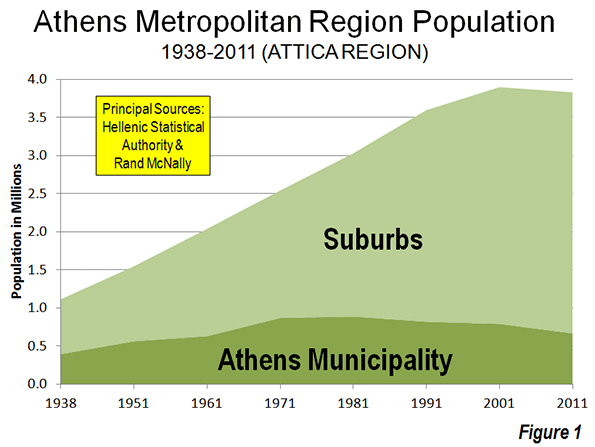
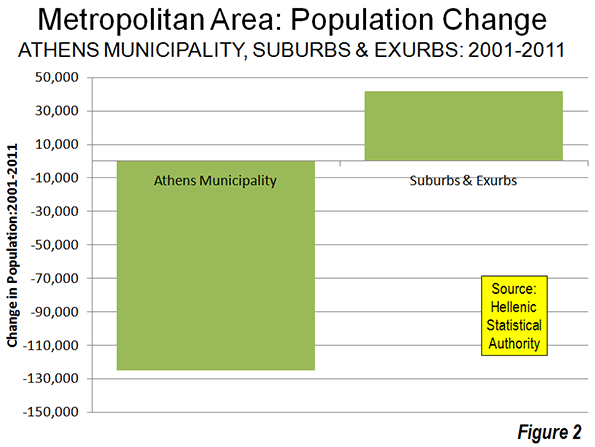
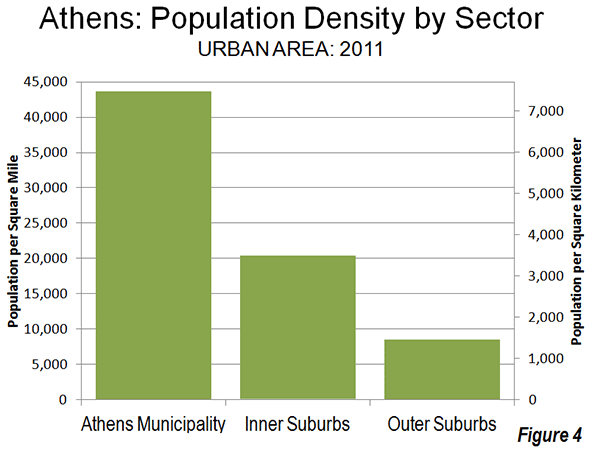
    The Athens municipality (the historic core city) peaked at 885,000 in 1981. At a population density of nearly 60,000 per square mile (23,000 per square kilometer), Athens once stood among the most dense municipalities in the world. However, the Athens municipality since has declined, with population losses in each of the three subsequent decades. Between 2001 and 2011, the population fell 125,000 to 664,000, a decline of 16%. The Athens municipality is still dense, however, at 44,000 per square mile (17,000 per square kilometer). The rest of the urban organism, as is usually the case, is considerably less so.


    Photo: Athens Core Density

    Since 1951, suburban and exurban Athens (see The Evolving Urban Form Series Definitions) has accounted for 95% of the growth in the metropolitan region, adding 2.2 million new residents, compared to approximately 100,000 for the Athens municipality. Since 1971, all of the population growth has been in the suburbs and exurbs (Figure 1).

    However, over the last decade, population growth has dropped across the entire Athens metropolitan region. Certainly, the low Greek fertility rate is a factor (see The Rise of Post-Familialism: Humanity’s Future?). Greece’s total fertility rate (average number of children per women of child bearing age) is approximately 1.5, according to Eurostat, well below the replacement rate of 2.1 not to mention the 2.3 Greek figure in the late 1970s. More recently, it is likely that the Greek fiscal crisis has contributed to an even lower rate of increase by reducing the previously flow of international migration as well as discouraging family formation among native Greeks.

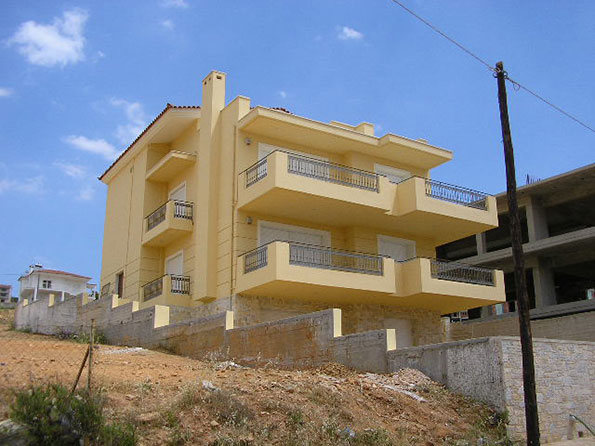
    Athens growth slowed dramatically well before the financial crisis. Between 1991 and 2001, the Athens metropolitan region added approximately 300,000 new residents. But  between 2001 and 2011, the metropolitan region lost 67,000 residents. However, the suburbs and exurbs gained marginally, adding 58,000 residents, partially offsetting the loss in the Athens municipality (Figure 2). Even so, the suburban population increase was miniscule compared to the 330,000 gain of the previous decade (photo: North Suburban Athens).


    Photo: North Suburban Athens

    The Urban Area

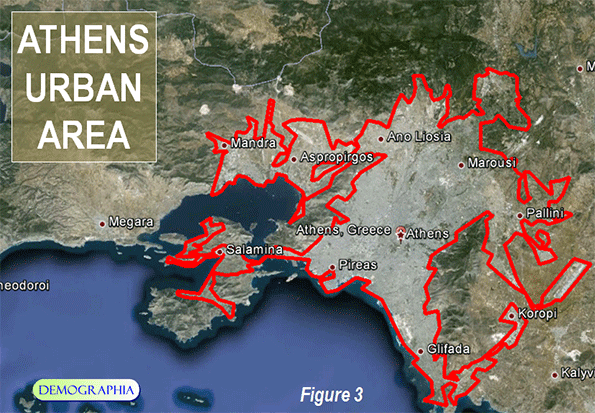
    Even with its slow and even negative growth, the  Athens urban area remains  among the most dense in the developed world (Figure 3). No major urban area in Western Europe, Japan or the New World (Australia, Canada, New Zealand and the United States) is as dense. The 2013 edition of Demographia World Urban Areasindicates that the Athens urban area has a population of 3.5 million (Note), living in a land area of 225 square miles (580 square kilometers), for a density of 15,600 per square mile (6,000 per square kilometer). This places Athens slightly ahead of London (15,300 per square mile or 5,900 per square kilometer), about double the density of Toronto or Los Angeles and more than four times that of Portland.

    As is typical around the world, the urban area of Athens exhibits a generally declining density from the core to the urban fringe. From the 44,000 per square mile (17,000 per square kilometer) Athens municipality density, the inner suburbs drop to approximately 20,000 per square mile (7,700 per square kilometer). This is still a high population density for inner suburbs, reflecting the fact that much of the area was developed before the broad achievement of automobile ownership (a similar situation is obvious in the inner ring suburbs of Paris). The outer ring suburbs have been more shaped by the automobile, yet have a density of 8,500 per square mile (3,300 per square kilometer), which still  is high by Western European standards (Figure 4).

    Affluence

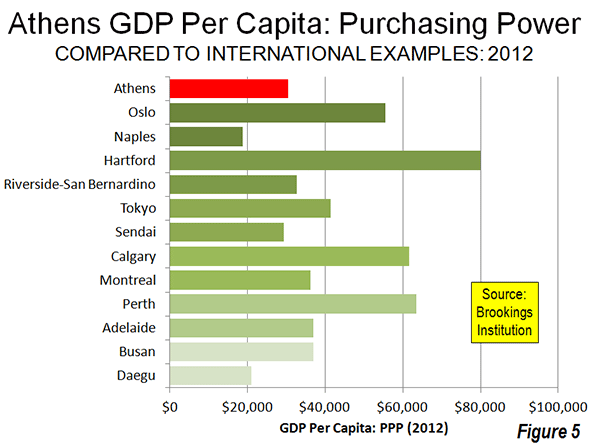
    Athens has below average affluence among the metropolitan regions of the developed world. According to data in the Brookings Institution Global Metro-Monitor, Athens had a gross domestic product, purchasing power parity adjusted (GDP-PPP) per capita of $30,500 in 2012. This trails the most affluent metropolitan regions around the more developed world. It is less than one-half the gross domestic product per capita of Hartford (US), the world’s most affluent major urban area ($79,900). The Athens GDP-PPP is approximately one-half that of regional leaders Perth (Australia) at $63,400, Calgary ($61,100), Tokyo ($41,400) and Busan (South Korea) at $36.900. Athens also ranks well below Western Europe’s most affluent metropolitan region, Oslo, at $55,500. Athens is also less affluent than the least major metropolitan areas with the lowest GDP-PPPs per capita in Australia (Adelaide), Canada (Montréal), and the United States (Riverside-San Bernardino). However, Athens has a higher GDP-PPP per capita than Sendai (Japan), Daegu (South Korea) and Naples (Figure 5), the least affluent major metropolitan areas in their respective geographies.

    Low Fertility, Declining Migration and An Uncertain Future

    Even as the national fertility rate dropped in the late 20th century, Athens continued to grow strongly due largely to international migration, especially from Albania. During the 1990s, virtually all of the population growth in Greece was the result of immigration, as the natural components of growth (births minus deaths) fell into decline. During the 2000s, immigration declined so severely that the nation lost population, most of it in the Athens metropolitan region (with the Athens municipality’s loss exceeding the nation’s) where the foreign born population has concentrated. Much of the decline in international migration resulted from the severe economic crisis.

    Athens typically exhibits the principal function of cities in civilization. When cities compete well by facilitating economic aspiration, they grow. When they do not, cities stagnate or fall into decline. For Athens, stagnation or decline seems the likely scenario in the foreseeable future.   

    Wendell Cox is a Visiting Professor, Conservatoire National des Arts et Metiers, Paris and the author of “War on the Dream: How Anti-Sprawl Policy Threatens the Quality of Life.

    —–

    Note: The difference between the metropolitan area and urban area population is the residents living in exurban areas (outside the urban area, but within the metropolitan area).

    Photo: The Acropolis (all photos by author)

  • Why Inmigration Really Matters, Particularly to the Rust Belt

    Cleveland Mayor Frank Jackson’s recent comment about immigration has drawn some local ire. At his annual remarks on the state of the city, the Mayor—in response to a question of how Cleveland can end its population decline by attracting immigrants—stated: “I believe in taking care of your own”.

    To be fair, the Mayor contextualized the statement by inferring that the best attraction strategy is to build a city that works for those who reside in it. In some respects I agree. In fact America attracts immigrants not because of “attraction strategies”, but because it offers the prospects of a better quality of life. So, if a city can nail that down, well, that is a hell of a pull.

    The problem, though, is that historically inward-facing legacy cities such as Cleveland have had a hard time moving the needle toward progress because fresh blood is lacking, and so a “taking care of your own” strategy often devolves into policies that simply further fossilize the status quo.

    Why?

    Because such cities—with low rates of inmigration, and a long lineage of social capital that can tip to the side of insularity and territorial encampment—have too much inertia, which is defined as “the resistance of an object to change its state of motion or rest”.

    Inertia is real, not simply in physics, but in organizational behavior, such as city politics and policy. And the more historical it is, the thicker the status quo, and thus the harder it is for a city to change—meaning the future, or the momentum of the city, can be like a train chugging to constant stops of stagnation unless a “force outside the system…act[s] upon the system for a long enough period of time to have any effect on changing the momentum.”

    Enter the importance of outsiders, be they immigrants, returning expats, or just new people from other parts of the country. Without them cities get stuck. People see the same things, talk the same things over. Bullshit territorial divides like East- versus West-side of the Cuyahoga River reign, effectively cutting a city’s “brain” in half. Business is business as usual, then. Hence the post-industrial-sixty-year decline.

    Writes Aaron Renn over at Urbanophile:

    I previously noted how it generally takes a critical mass of outsiders, enough to create a constituency for change in its own right, to drive real disruptive change in a community. These are the people who aren’t invested in the status quo. Absent that, getting reform that works will be a difficult challenge.

    Echoes migration expert and blogger Jim Russell:

    Without migration, there are no cities. An urban landscape is more than a draw for talent. Metros thrive on churn, both the influx and egress of people…

    … The very act of moving, particularly to the top tier of global cities, is entrepreneurial. You are surrounded by risk-takers and innovation. The competition is fierce. The cream of the crop is seeking any edge, looking for any opening.

    I am learning about the power of migration first hand. You see, I am a lifelong Clevelander, a West Sider, one well-versed in the how things are customarily done around here, and what thoughts and words are commonly produced if only through a Rust Belt inertia that can be cloaked in “tradition”. My partner, Andiara Lima, is a relative newcomer from Vale do Aço, or the “Steel Valley” of Brazil. Before I met her I was ignorant to the presence of the Brazilian community in Cleveland. Now, I no longer am, and the experience provides me with on-the-ground lessons as to the importance of migration in evolving the Rust Belt “way”.

    brazil house party


    For instance, individually speaking, my panorama is being broadened, with the dominant cultural connotations of Cleveland defined primarily by whiteness or blackness taking a needed hit. For instance, I was at a Brazilian-hosted house party not long back, and it was like nothing I ever experienced. The dining room was cleared, bodies moved, sweat poured, people screamed and shook ass. A band was set up to play bossa nova along a window seat. And it was happening all in the neighborhood of my childhood, but way beyond my childhood. Rather a feeling of something forward.  Not just past. Not identity politics, but a freshness needed so that crusty legacy and power can be dampened if only to bust identity politics up.

    No doubt, these identity politics hurt the region’s ability to welcome and catalyze emerging groups. For instance, I am reminded of a recent Facebook comment on a local politician’s page that discussed a community forum about how Cuyahoga County government reform would affect race relations. The commenter notes:

    The whole panel was black or white people. The Asians and Latinos were in the back of the room wondering “what about us?”

    “What about us?”

    It’s a good question, and one local leaders shouldn’t underestimate given the region’s need for fresh blood. And we aren’t just talking bodies, but talent, as migrants are “economic ass-kickers”, particularly due the fact that migration is in itself an act of entrepreneurialism.

    For instance, my partner Andiara studies the Brazilian trade market for a local investment company. Her informational network into the country, both professionally and informally, is deep. For me, she is a link between two Rust Belt worlds, shattering my sense of restrictive locality for a borderless view that gets me thinking about how to position Cleveland not just regionally, but globally.

    For Cleveland, she is a reserve for local industry that should be both cultivated and tapped, especially since—as the US Ambassador to Brazil recently said at Cleveland’s Union Club—“Brazil is an economic and democratic power the United States needs as a partner”.


    And there is Luca Mondaca and Moises Borges, both acclaimed Brazilian musicians who are plugging (into) and broadening (out) Cleveland’s musical legacy. Yet there is frustration, particularly for Luca, as she feels isolated, untapped, and sometimes lost in the culture of a city that—while desperate for freshness—has difficulty getting beyond the inertia that comes with being comfortably stale. And while I am hopeful that the city is in fact becoming more welcoming—and that the opportunity afforded by the region’s affordability and legacy assets can further open the inmigrant sluicegates—passive optimism is not an option.

    Neither is parochial playmaking.

    In fact, Andiara Lima, Luca Mondaca, and Moises Borges are Cleveland’s “own”. But without that recognition, they may not be for very much longer.

    Richey Piiparinen is a writer and policy researcher based in Cleveland. He is co-editor of Rust Belt Chic: The Cleveland Anthology. Read more from him at his blog and at Rust Belt Chic.

  • Annual Update on World Urbanization: 2013

    Tokyo continues to be the world’s largest urban area with more than 37 million people, according to the recently released 9th Annual edition of Demographia World Urban Areas. Tokyo has held the top position for nearly 60 years, since it displaced New York. There have been only modest changes in the ranking of the world’s largest urban areas over the past year. The top four urban areas remain the same, with Jakarta (Jabotabek) second, Seoul third and Delhi fourth. Fast-growing Shanghai, however, assumed fifth place, displacing Manila where the latest census data showed less population growth than had been expected (Table 1).

    Table 1          
    LARGEST URBAN AREAS IN THE WORLD          
    Rank Geography Urban Area Population Estimate Land Area: Square Miles Density Land Area: Square Kilometers Density
    1 Japan Tokyo-Yokohama 37,239,000 3,300 11,300 8,547 4,400
    2 Indonesia Jakarta (Jabotabek) 26,746,000 1,075 24,900 2,784 9,600
    3 South Korea Seoul-Incheon 22,868,000 835 27,400 2,163 10,600
    4 India Delhi, DL-HR-UP 22,826,000 750 30,400 1,943 11,800
    5 China Shanghai, SHG 21,766,000 1,350 16,100 3,497 6,200
    6 Philippines Manila 21,241,000 555 38,300 1,437 14,800
    7 Pakistan Karachi 20,877,000 310 67,300 803 26,000
    8 United States New York, NY-NJ-CT 20,673,000 4,495 4,600 11,642 1,800
    9 Brazil Sao Paulo 20,568,000 1,225 16,800 3,173 6,500
    10 Mexico Mexico City 20,032,000 790 25,400 2,046 9,800
    11 China Beijing, BJ 18,241,000 1,350 13,500 3,497 5,200
    12 China Guangzhou-Foshan, GD 17,681,000 1,225 14,400 3,173 5,600
    13 India Mumbai, MAH 17,307,000 211 82,000 546 31,700
    14 Japan Osaka-Kobe-Kyoto 17,175,000 1,240 13,900 3,212 5,300
    15 Russia Moscow 15,788,000 1,700 9,300 4,403 3,600
    16 Egypt Cairo 15,071,000 640 23,500 1,658 9,100
    17 United States Los Angeles, CA 15,067,000 2,432 6,200 6,299 2,400
    18 India Kolkota, WB 14,630,000 465 31,500 1,204 12,100
    19 Thailand Bangkok 14,544,000 900 16,200 2,331 6,200
    20 Bangladesh Dhaka 14,399,000 125 115,200 324 44,500
    21 Argentina Buenos Aires 13,776,000 1,020 13,500 2,642 5,200
    22 Iran Tehran 13,309,000 525 25,400 1,360 9,800
    23 Turkey Istanbul 12,919,000 520 24,800 1,347 9,600
    24 China Shenzhen, GD 12,506,000 675 18,500 1,748 7,200
    25 Nigeria Lagos 12,090,000 350 34,500 907 13,300
    26 Brazil Rio de Janeiro 11,616,000 780 14,900 2,020 5,700
    27 France Paris 10,869,000 1,098 9,900 2,845 3,800
    28 Japan Nagoya 10,183,000 1,475 6,900 3,820 2,700
    Source: Demographia World Urban Areas (2013)


    Provisional census results moved Karachi into the top 10 for the first time, while two urban areas, Bangkok and Tehran, reached megacities status (over 10 million population), reflecting strong growth and the availability of more precise data for estimation.

    As before, the most dense megacity was Dhaka, Bangladesh, at 115,000 per square mile (45,000 per square kilometer). New York continues to have the largest urban footprint, covering nearly 4,500 square miles (more than 11,500 square kilometers) and the least dense megacity in the world.

    Coverage

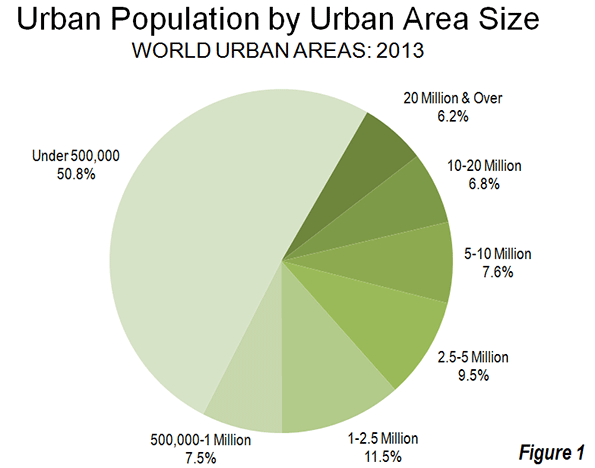
    This year’s Demographia World Urban Areas report provides current and coordinated population, urban land area and density data for all 875 identified urban areas with 500,000 population or more as well as estimates for 650 smaller urban areas. The report includes a total population of approximately 1.86 billion in urban areas with 500,000 or more population and an overall population for urban areas of all sizes of 2.0 billion. These urban areas account for approximately 53% of the world’s urban population.

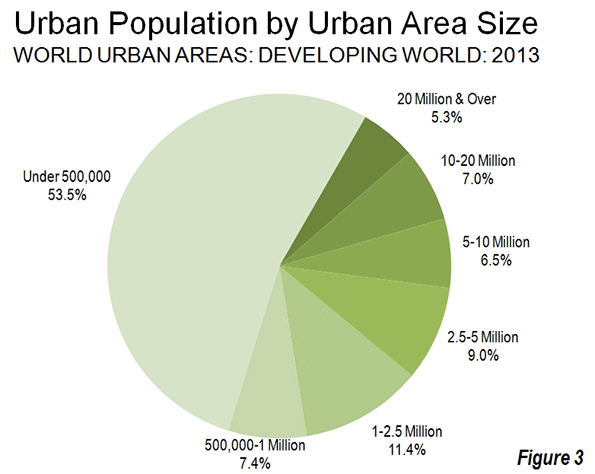
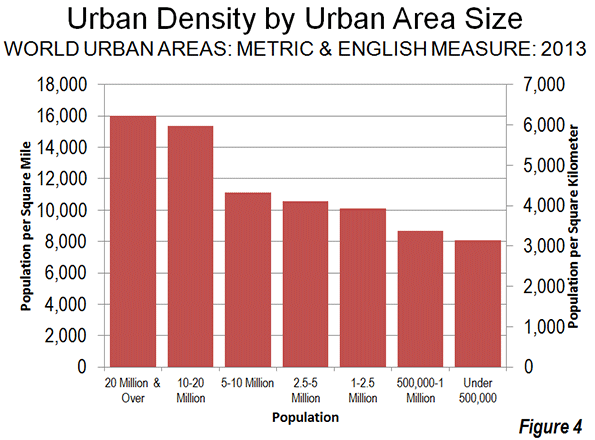
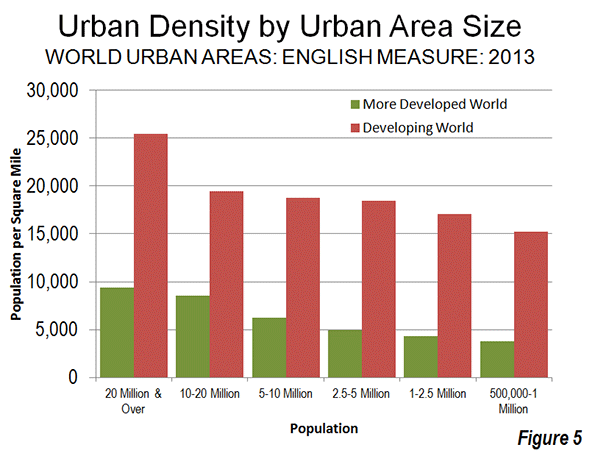
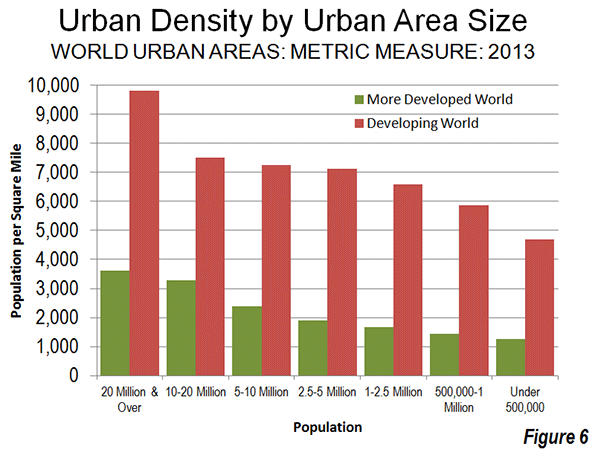
    Distribution of Population by Urban Area Size

    As was noted in What is a Half Urban World? a considerable share of the world’s urban population lives in smaller urban areas (as small as 200 population). In 2013 is estimated that 51% of the world’s urban population lives in urban areas with less than 500,000 population, based on the data in Demographia World Urban Areas. The 10 largest urban areas, each with over 20 million population, account for approximately 6% of the urban population while the 28 megacities, each with more than 10 million population, account for 13% of the population. Approximately 21% of the urban population is in the more than 375 urban areas with between 1 million and 5 million population (Figure 1).

    The share of the population in larger urban areas is greater in the more developed world than in the developing world. Only 42% of the population lives in urban areas with less than 500,000 population in the more developed world. The share of the population in megacities is greater than the world figure, at approximately 16% (Figure 2).

    A larger share of the population is in smaller urban areas in the developing world, at 54%. Combined, 13% of the developing world population is in the megacities and 20% of the population is in urban areas with between 1 million and 5 million population (Figure 3).

    Distribution of Population by Urban Area Size

    Generally, the larger urban areas have higher average population densities than smaller urban areas (Figure 4). Overall, the urban areas with more than 20 million population have a density of approximately 16,000 per square mile (6,200 per square kilometer), while urban areas between 10 million and 20 million population are nearly as dense at 15,400 per square mile (6,000 per square kilometer). The urban areas with from 5 million to 10 million population are considerably less dense, at 11,100 per square mile (4300 per square kilometer). The smallest urban areas (Note), below 500,000 population are estimated to have a density of approximately 8,100 per square mile (3,100 per square kilometer).

    A similar relationship exists in both the more developed and developing world, with the largest urban areas being considerably more dense than smaller urban areas. The megacities in the  more developed world have an average population density of approximately 9,000 per square mile (3,600 per square kilometer), compared to 3,700 per square mile (1,400 per square kilometer) for urban areas in the 500,000 to one million population range.

    However, urban areas in the developing world are considerably more dense in the less developed world, to be expected given the relationship between lower incomes and higher population densities. Developing world megacities are approximately 2.5 times as dense as megacities in the more developed world. The differences are even greater in smaller urban areas. Developing world urban with less than 5 million population are approximately four times as dense as those in the more developed world (Figures 5 and 6).

    However, megacities in both the more developed and developing world have both population growth and decreasing densities in common. This is illustrated in an examination of megacity trends, which indicates that in recent decades, all 23 examined experienced falling densities. The same is also true of the other five megacities (Karachi, Teheran, Lagos and Paris), which will be described in greater detail in future articles. (see Dispersion in the World’s Urban Areas). Cities everywhere are continuing to expand organically, with nearly all growth on the periphery.

    Distribution of Large Urban Areas

    The world’s largest urban areas are increasingly located in the developing world. Only three of the 10 urban areas with more than 20 million are located in the more developed world, Tokyo, Seoul and New York. Among the 28 megacities, only seven are in the more developed world. More than three quarters of the urban areas with 500,000 or more population are located in the developing world (658 of 875). There is a similar ratio with respect to population, with developing world urban areas having approximately 2.9 million population, while the urban population in the more developed world is approximately 850 million (Table 2).

    Table 2
    DISTRIBUTION OF WORLD URBAN AREAS BY SIZE
    Population More Developed World Developing World World Share in Developing World
    20 Million & Over 3 7 10 70.0%
    10-20 Million 4 14 18 77.8%
    5-10 Million 15 26 41 63.4%
    2.5-5 Million 28 76 104 73.1%
    1-2.5 Million 65 217 282 77.0%
    500,000-1 Million 102 318 420 75.7%
    Total 217 658 875 75.2%
    Source: Demographia World Urban Areas (2013)


    The Future of Urbanization

    This concentration of urbanization in the developing world is likely to become much greater in the decades to come. According to the United Nations, urban population will increase more than 2.5 billion between 2010 and 2050 in less developed regions, compared to less than 150 million in its more developed regions. By 2050, more than  85 percent of the world’s urbanization is expected to be in today’s less developed regions.

    Wendell Cox is a Visiting Professor, Conservatoire National des Arts et Metiers, Paris and the author of “War on the Dream: How Anti-Sprawl Policy Threatens the Quality of Life.

    ——–

    Note: The population density of urban areas under 500,000 is estimated by applying ratios from, Making Room for a Planet of Cities(Shlomo Angel, with Jason Parent, Daniel L. Civco, and Alejandro M. Blei) to the Demographia data.

    Photo: Travel by bajaj in Jakarta (by author)