Category: Demographics

  • Marissa Mayer’s Misstep And The Unstoppable Rise Of Telecommuting

    Marissa Mayer’s pronunciamento banning home-based work at Yahoo reflects a great dilemma facing companies and our country over the coming decade. Forget for a minute the amazing hubris of a rich, glamorous CEO, with a nursery specially built next to her office, ordering less well-compensated parents to trudge back to the office, leaving their less important offspring in daycare or in the hands of nannies.

    The real issue is how we deal with three concerns: the promotion of families; humane methods to reduce greenhouse gases; and, finally, how to expand the geography of work and opportunity.

    For parents, particularly women, telecommuting provides a golden opportunity to balance the challenges of child-raising with those of work. Working at home, full or part-time, shrinks the number of hours wasted commuting and allows greater flexibility that is often critical to maintaining a family. In a country with a deteriorating fertility rate, and ever greater strains on those trying to raise children, telecommuting offers, at least for some, a way to remain in the labor force without cheating the next generation.

    Equally important, as the online universe expands, telecommuting allows us to reduce carbon emissions and energy use without forcing people to live in dense communities that most Americans, particularly in their adult years, clearly do not prefer. Greens, planners and many pundits seem anxious to force people to live in crowded housing close to buses and trains, yet rarely mention that it’s infinitely more eco-friendly to not commute at all.

    Finally there’s the often ignored issue of geography. If you force people to work in daily commuting distance from Yahoo’s Palo Alto headquarters, you are essentially telling them to live in a region where housing is among the most expensive in the nation. For anyone under 40 who does not have wealthy parents, a large amount of dot-com stock or recently robbed a bank, it’s almost impossible to buy a single-family home or spacious townhouse in the Valley, even in the only modestly attractive parts.

    So what’s the beef with the expansion of telecommuting? The conventional explanation usually revolves around the notion that putting employees together every day together generates greater innovation. See the New Yorker’s James Surowiecki for a good summary of this argument.

    That’s really not too surprising, since one of the last rationales for many without large financial resources to put up with big city home prices and taxes lies in the idea that, as the great economic royalist Michael Bloomberg maintains, you have to be located in “the intellectual capital of the world” to be successful. Natural allies of the anti-telecommuting crowd include urban land speculators and developers, who prefer that the “talent” remain chained to their particular locations and not wander off to the awful periphery.

    There are clearly advantages in face-to-face contact, particularly for younger people and top-echelon executives, who may be more effective minding the store if they hang around the office. But for most employees productivity actually rises with telecommuting.

    This is confirmed by broad studies such as one by the consultancy Workshifting that found, on average, a 27 percent rise in productivity among telecommuting employees. Over two thirds of the employers surveyed reported higher productivity among home-based employees, including British Telecom, Dow Chemical, American Express and Compaq.

    One of the best examples of telecommuting advantages can be seen at the high-tech company Cisco, which in contrast to Mayer’s assertion, has found telecommuters are effective at communicating and collaborating. It has also improved employee retention and also saved $277 million by allowing its employees to telecommute.

    Other companies reporting positive results, particularly in terms of retaining employees, from telecommuting, include IBM and Best Buy.

    Equally critical, notes a study by Global Workplace Analytics, are the tremendous environmental savings. Half-time telecommuting could reduce carbon emissions by over 51 million metric tons a year — the equivalent of taking all of greater New York’s commuters off the road. Additional carbon footprint savings will come from reduced office energy consumption, roadway repairs, urban heating, office construction, business travel and paper usage (as electronic documents replace paper). Traffic jams idle away almost 3 billion gallons of gas a year and accounts for 26 million extra tons of greenhouse gases.

    But perhaps most relevant, whatever its merits, telecommuting and home-based work seems to be the inevitable wave of the future, whether corporate managers like it or not. Working at home grew faster percentage-wise than any other mode of work access in the United States between 2000 and 2010. In that decade, the country added some 1.7 million telecommuters, almost twice the much ballyhooed increase of 900,000 transit riders.

    This tends to be more true in places like Silicon Valley, where workers are computer savvy and housing costs are onerous. Between 2005 and 2009, the Valley workforce grew by less than 10 percent but the telecommuting population increased by almost 130 percent. Tech-oriented places like Austin, Portland, Denver, San Diego, San Francisco and Seattle all rank among the cities with the highest percentage of people working at home.

    As workers become more familiar with technology, these trends should accelerate. A survey by the Information Technology Association of America found that 36 percent of respondents would choose telecommuting over a pay raise. These preferences appear to be even greater among millennial generation workers, who, according to a Pew study, tend to seek a “balance” between work and life. Global Workplace Analytics suggests this means they will be more attracted to flexible work throughout their careers , particularly as they start families.

    Other trends, including the huge expansion in self employment in the U.S., promise to accelerate telecommuting in years ahead. The ranks of independent contractors have grown by 1 million since 2005, according to George Mason University economist Jeffrey Eisenach. One in five work in such fields as management, business services or finance, where the percentage of people working for themselves rose from 28 percent to 40 percent between 2005 and 2010. Many others work in fields like energy, mining, real estate or construction. Altogether there are now as many as 10 million such independent workers, constituting upwards of 7.6 percent of the national labor force and over $626 billion in income.

    This trend will be further accelerated not only by millennials but increasingly by the other big growth demographic, aging boomers. The self-employment rate for adults 55 and older is 16.4 percent, according to the Bureau of Labor Statistics, well above the 10.4 percent rate of self-employment for the total labor force. From 2007 to 2008, the latest data available, new businesses launched by 55- to 64-year-olds grew 16 percent, an increase that was faster than that of any other group, according to the Kauffman Foundation. All told, Boomers in that age group started approximately 10,000 new businesses a month.

    Many of these older entrepreneurs are likely to work out of their homes, which many now own outright. In fact, over time, according to Workplace Analytics, upward of half the American workforce could eventually telecommute. Ultimately the issue of whether managers of office developers like this trend is beside the point. Smart managers who learn how to adjust to this path will flourish. Those who do not, like Marissa Mayer, are standing against a historical wave that is likely to prove too powerful for any company or CEO to overcome.

    Joel Kotkin is executive editor of NewGeography.com and a distinguished presidential fellow in urban futures at Chapman University, and a member of the editorial board of the Orange County Register. He is author of The City: A Global History and The Next Hundred Million: America in 2050. His most recent study, The Rise of Postfamilialism, has been widely discussed and distributed internationally. He lives in Los Angeles, CA.

    This piece originally appeared at Forbes.com.

    Photo by By Rae Allen, "My portable home office on the back deck"
  • U.S. Could be Courting Trouble in Europe

    One of the most fascinating aspects of Barack Obama’s presidency stems not so much from his racial background, but his status as America’s first clearly post-European, anti-colonialist leader. Yet, after announcing his historic "pivot" to vibrant Asia, the president, the son of an anti-British Kenyan activist, recently announced as his latest foreign policy initiative an economic alliance with, of all places, a declining, and increasingly decadent, Europe.

    Some analysts, such as Walter Russell Mead, suggest the possible "ratting out" of the new Asia focus could constitute "a mistake of historic proportions." In East Asia, leaders, from Vietnam and Singapore to Japan, have been counting on a strong U.S. presence to ward off Chinese hegemony in the region. The idea of a reduced naval presence and a weakening commitment to allies would undermine our influence in this increasingly critical economic region.

    At the same time, the president’s desire to integrate our economies more closely to that of Europe reflects a longtime prejudice within the Democratic Party favorable to the old Continent. The notion of a new trade tie to the European Union set longtime Eastern policy types, such as former Bill Clinton aide and onetime Woodrow Wilson School head Anne-Marie Slaughter into rhapsodies about an emerging new "Atlantic Century." Vice President Joe Biden, for his part, told a recent Munich security conference that Europe represents "the cornerstone of our engagement with the rest of the world."

    This is delusional, to say the least. Republicans have their faults, but at least they know how to tell historic time. In contrast, largely Democratic Europhiles simply want to relive the glorious past, and consume a legacy of affluence. And to be sure, generally it’s more pleasant to attend – as long as someone is paying the bill – a conference in London, Paris or Zurich than Beijing, Mumbai or Mexico City. Europe, as we know from the debates over compensation of EU bureaucrats, knows how to treat functionaries with the comfort to which they easily can become accustomed.

    Pumping for greater Euro-ties seems almost insane under current conditions. The Continent’s unemployment rate, nearly 12 percent among the 17 EU member countries, is already at record levels, and its younger generation suffers unemployment approaching 30 percent or higher in at least five EU countries, including Greece, Spain and France. In Portugal, 2 percent of the population has migrated just in the past two years, not only to Northern Europe but, amazingly, also to Portugal’s booming former African colonies.

    This does not seem to be setting up the prime conditions for Ms. Slaughter’s imagined new "Atlantic Century." Although North America retains the resources, demographics and innovative culture to compete with Asia and other rising powers, Europe is in a notably downward trajectory. Its share of the world economy has plummeted from nearly 40 percent in 1900 to 27 percent today and continues to shrink rapidly. By 2050, not only the United States, but China and the rest of the developing world, according to the European Commission, will have surpassed the total of the 27 countries in the EU.

    One has to be a cockeyed optimist not to see that the long-term prognosis, even without the current euro crisis, is not good. Manufacturing, long a Continental bastion, is weak and falling behind that of the U.S. as well as Asia. German engineering may still be first-class, but much of the production and design will be moving to Mexico, the U.S., Latin America and Asia.

    Energy may prove a particular vulnerability. Although the region has shale and other energy resources, greens are far more powerful in Europe than in America and hostile to the hydraulic fracking that has created the current U.S. boom in oil and gas. The combination of radical green policies favoring expensive, often unreliable renewables, as well the shuttering of the Continent’s once-strong nuclear industries, are creating both high prices and wobbly reliability of electricity supplies. (Ironically, the reluctance to maintain nuclear power and oppose fracking for natural gas has led to a rise in greenhouse gas emissions and even some increased use of coal.) Tulane’s Eric Smith suggests many of Germany’s manufacturing powers are intensifying efforts to shift operations, notably to the southern United States, for cheap electricity and lower overall costs.

    Demographics, however, may be Europe’s weakest suit. Although East Asia is now experiencing low fertility, Europe has been demographically stagnant for at least a generation longer. By 2050, Europe’s workforce is expected to decline by 25 percent from 2000 levels; the U.S. is expected to see expansion of upward of 40 percent.

    This phenomenon threatens Europe’s lone serious economic power, Germany. The country now produces fewer children than in 1900. Given the expansive welfare state, the fiscal burdens being faced in Germany and other EU countries will dwarf those of the United States; by 2050 Germany will have nearly twice as many retirees per active worker as America.

    Yet remarkably, for all its manifest failings, Europe remains a Mecca and role model for many American progressives, like Ms. Slaughter. The past decade has seen the publication of a spate of books, such as Jeremy Rifkin’s "The European Dream" and Steven Hill’s "Europe’s Promise," that see Europe’s regulation state and "soft power" an alluring alternative to America. Some hail the EU as the prototype of a benign "new kind of empire" based on culture and pacifism.

    If so, it’s an empire rapidly hurtling into its dotage. The great European historian Walter Lacquer has pointed out that such optimism about the Continent becoming "united and prosperous" is likely "misplaced." In policy terms, for the U.S. to follow Europe’s model is an almost sure recipe for our own decline. Even the usually pro-free-trade Wall Street Journal is concerned that any attempt to "harmonize" American policies with those of the "European model" will simply expand government power and bureaucratic hegemony.

    To be sure, there remain parts of Europe, particularly in the Northern rim, that are doing better. These countries – the Netherlands, Scandinavia and Germany – have enacted significant labor market reforms, retain some strong industries and have tried to be responsible fiscally. If they broke off from the EU and set up a modern-day Hanseatic League, it may make sense for us to embrace stronger ties with them. But that can’t be said of an alliance with the weak sisters of the EU’s southern and eastern fringes, or even dirigiste state-dominated France.

    In reality, the EU will never become a giant Sweden. Scandinavia possesses a unique history, shaped by massive outmigration in the past century and a largely homogeneous population; many of these countries possess great natural resources, such as oil, iron ore or hydroelectricity. In contrast, the eastern edge of the zone contains some of the most depopulating parts of the planet, as people seek opportunities in the more economically viable North. The comic political economy of Italy, the political violence of Greece and the mass disenchantment of Spain presage a European future that contrasts greatly with the relative prosperity and order of the North.

    None of this suggests that, if the political strings are not wound too tight, that a free-trading arrangement with Europe may prove useful. But if an agreement becomes a wedge for accelerating the adoption of Euro-style policies, it could allow us to squander an opportunity to maintain our pre-eminence in the post-colonial, and post-European-centered, world.

    Joel Kotkin is executive editor of NewGeography.com and a distinguished presidential fellow in urban futures at Chapman University, and a member of the editorial board of the Orange County Register. He is author of The City: A Global History and The Next Hundred Million: America in 2050. His most recent study, The Rise of Postfamilialism, has been widely discussed and distributed internationally. He lives in Los Angeles, CA.

    This piece originally appeared in the Orange County Register.

  • Commuting in Australia

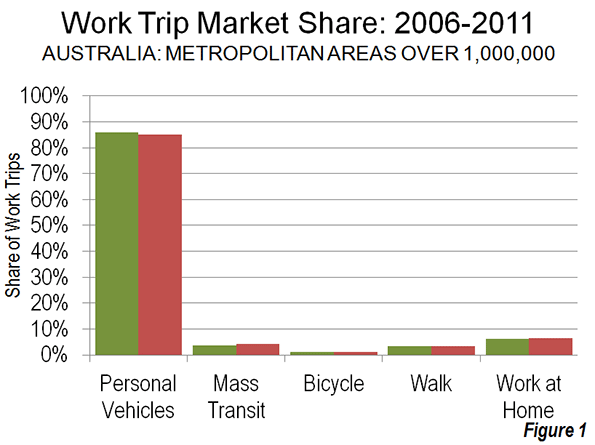
    Data from the 2011 censuses indicates that mass transit is gaining market share in all of but one of Australia’s major metropolitan areas. The greatest increase as in Perth, at 21% , aided by the new Mandurah rail line to the southern urban fringe. On average, mass transit’s market share increased by 10.8% in the five metropolitan areas with more than 1 million population. This increase seems likely to be in response to both mass transit service improvements (such as in Perth) and higher petrol (gasoline) prices. The highest mass transit market share is in Sydney, at 22%, approximately equal to that of Toronto and greater than all major US metropolitan areas except New York (31%). Adelaide has the smallest transit market share, at 9.5%, which is nonetheless 50% above that of Portland, to which Adelaide officials have often looked as a model (Figure 1).

    At the same time, there was a personal vehicle (automobiles, motorcycles, taxis and trucks) market share in all 5 metropolitan areas, averaging 2.2% (Table). However, the much larger base of personal vehicle use prevented mass transit from materially reducing the share of the automobile in any of the metropolitan areas.

    Work Trip Market Share 2006-2011
    Major Metropolitan Areas in Australia
    2000 Personal Vehicles Mass Transit Bicycle Walk (Only) Work at Home Other
    Adelaide 81.2% 9.6% 1.5% 3.1% 3.5% 1.2%
    Brisbane 76.5% 13.2% 1.1% 3.5% 4.5% 1.2%
    Melbourne 76.7% 13.3% 1.3% 3.4% 4.2% 1.1%
    Perth 80.8% 10.0% 1.1% 2.5% 4.1% 1.5%
    Sydney 69.0% 20.3% 0.6% 4.7% 4.4% 1.0%
    Average 76.8% 13.3% 1.1% 3.5% 4.1% 1.2%
    2010
    Adelaide 81.1% 9.5% 1.3% 2.8% 3.7% 1.6%
    Brisbane 75.1% 14.3% 1.2% 3.5% 4.6% 1.4%
    Melbourne 74.5% 15.4% 1.5% 3.3% 4.1% 1.2%
    Perth 78.1% 12.1% 1.2% 2.6% 3.9% 2.0%
    Sydney 66.9% 22.2% 0.8% 4.6% 4.4% 1.1%
    Average 75.2% 14.7% 1.2% 3.4% 4.1% 1.4%
    Change in Market Share
    Adelaide -0.1% -0.6% -12.2% -7.4% 4.6% 32.1%
    Brisbane -1.8% 8.3% 10.5% 0.3% 0.5% 14.4%
    Melbourne -2.9% 15.6% 17.2% -4.4% -1.0% 10.8%
    Perth -3.3% 21.0% 11.3% 4.0% -3.9% 30.2%
    Sydney -2.9% 9.4% 30.3% -3.6% -0.4% 11.1%
    Average -2.2% 10.8% 11.4% -2.2% 0.0% 19.7%
    Source: Calculated from Australian Bureau of Statistics data


    Unlike the United States, where working at home is the fastest growing method of work access (and likely to pass mass transit in this decade), Australia’s working at home share has stayed constant. Working at home is also increasing in Canada.  

    Mass Transit: About Downtown

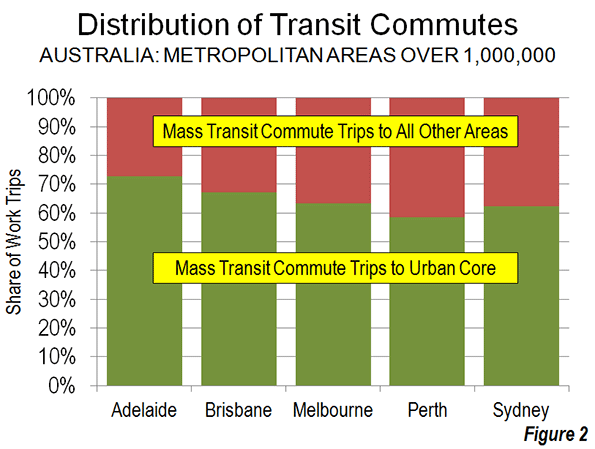
    In Australia, as in Canada and the United States, mass transit is dominated by commuting to the central business district (downtown). On average, 65% of mass transit commuters had a work trip destination in the urban core, which includes the central business district (downtown). This ranges from a low of 59% in Perth to a high of 73% in Adelaide (Figure 2). This concentration of mass transit destinations in the central business district is epitomized by Sydney, where there was a core share of all trips of nearly 60%. By contrast, in Parramatta, which includes one of the largest suburban business centers, is well served by not only the region’s rail system but also by an exclusive busway, the mass transit market share was 15%, one-fourth that of Sydney’s core.

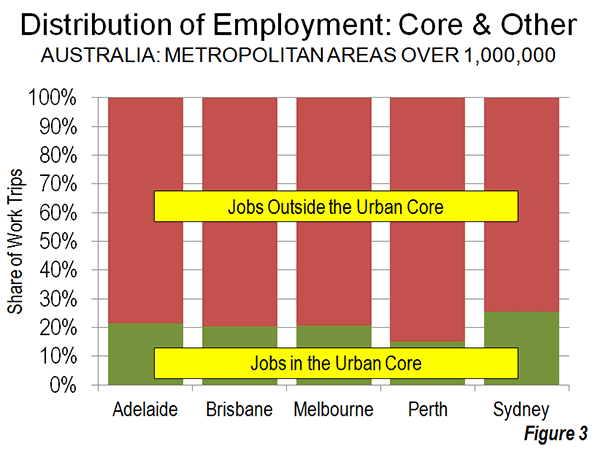
    In the five large Australian metropolitan areas, nearly 21% of jobs are located in these urban core areas that include the central business district (Figure 3). The difficulty for transit in serving the nearly 80% of work trip destinations outside the urban core lies with far lower employment densities and mass transit travel times not remotely competitive with the automobile (on the assumption that services even available). On average, mass transit carries 200 times as many commuter to each square kilometer of core land area for each commuter carried per square kilometer in the rest of the urban area (urban centre).

    It is not surprising that the central business districts dominate mass transit commuting. They are the only locations in virtually any urban area that have a sufficient employment densities and a comprehensive enough radial rapid transit system to provide no-transfer service to a large number of riders.

    Australia’s Long Work Trip Travel Times

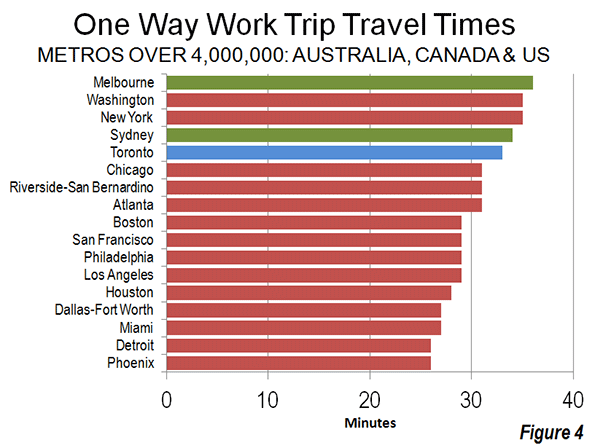
    The growth of transit has not reduced travel times but may have boosted it. In fact Australia’s workers already are traveling for longer times to work than in nearly all similar- or larger-sized metropolitan areas in Canada and the United States (Figure 4). For example, the average one-way work trip travel time in Melbourne is 36 minutes, which is longer than that of any major metropolitan area in the US or Canada.  Sydney’s one-way work trip travel time is 34 minutes. This exceeds that of all similarly sized or larger metropolitan areas in the three countries with the exceptions of New York and Washington, which are larger. In Improving the Competitiveness of Metropolitan Areas, I cited Statistics Canada data showing that mass transit work trip travel is much longer than by car and that transferring demand to transit would not improve average travel times.

    Both Melbourne and Sydney have slightly longer one-way travel times than larger Toronto, which is also larger, at 33 minutes. The Toronto Board of Trade, the Federation of Canadian Municipalities, and the Canadian Urban Transit Association have all expressed serious concern about Toronto’s long journey to work time, noting that it places is a competitive disadvantage relative to other metropolitan areas.

    Melbourne and Sydney also have longer one-way travel times than all of the other 12 US metropolitan areas with more than 4 million population. Perhaps the starkest comparison is with Los Angeles, often cited as having some of the worst traffic congestion in the high income world. Yet, despite having a urban population density higher than that of either Melbourne or Sydney and a far lower transit work trip market share, Los Angeles has a one-way work trip travel time of 28 minutes The secret in Los Angeles, is more dispersed work locations and a more comprehensive freeway system (though major parts of the planned freeway system were not built).

    Far starker is the comparison with Dallas-Fort Worth, which has a population density well below that of both Melbourne and Sydney and a much lower transit work trip market share (2%, compared to 22% in Sydney and 15% in Melbourne). Yet, in Dallas-Fort Worth, the average work trip travel time is 26 minutes, a full quarter less than in Melbourne and 8 minutes less than in Sydney.

    Where Should Planners "Put" People?

    A recent Infrastructure Australia report (The State of Australia’s Cities: 2012) cites "Marchetti’s Constant," which it characterizes as holding that "people will devote on average 90 minutes a day to travel and no more." (In fact, 90 minutes represents is a full 30 minutes greater than Marchetti indicates: See Note on Marchetti’s Constant).

    Infrastructure Australia continues "This suggests that improving the efficiency of urban transport systems by putting people in their economically optimal location within a total travel time of 90 minutes may be the key to improving the productivity of cities."

    "Putting people" where they have total travel time of 90 minutes seems a pessimistic goal; Sydney’s average daily travel time is now nearing 80 minutes. This justifies policy makers to further increase its already non-competitive work trip travel times. Economic research associates maximizing the number of jobs that can be reached by people in a metropolitan area in a specified time (such as 30 minutes) is critical to improving city productivity  (see The Need to Expand Personal Mobility.)

    The issue is not where to "put" people, but rather to facilitate more rapid access for commuters throughout the metropolitan area.

    Things are Likely to Get Worse

    In the end, there is only so much mass transit can do. Already the Australian metropolitan areas have high transit commute market shares to the cores, which leaves only modest room for improvement. At the same time there is little potential for material increases elsewhere in the metropolitan areas. Automobile competitive transit to these locations would be cost prohibitive, perhaps requiring annual expenditures rivaling the total income of the metropolitan area each year for operations, capital costs and debt service (see Megacities and Affluence: Transport and Land Use Considerations).

    Australian urban areas are generally underserved by freeways, despite their overwhelming reliance on personal vehicle travel. At the same time, urban consolidation, “smart growth” land use policies are increasing population densities without accommodating the inevitable associated additional personal vehicle demand (see Urban Travel and Urban Population Density). Things could get worse.

    Wendell Cox is a Visiting Professor, Conservatoire National des Arts et Metiers, Paris and the author of “War on the Dream: How Anti-Sprawl Policy Threatens the Quality of Life.

    —–

    Methodology: The analysis is based upon Australian Bureau of Statistics (ABS) data for capital city statistical divisions. The urban core was defined as the following local government areas: Sydney, North Sydney, Melbourne, Perth and Adelaide. In Brisbane, where the local government area is far larger, the inner Brisbane census division was used. Consistent data is limited to the central business district is not readily available. All trips which include transit as a mode are counted as transit. Workers who did not work on census day or who did not provide information were excluded from the analysis.

    Note on "Marchetti’s Constant:" Not only does Marchetti find a 60 minute, rather than a 90 minute average, but he also credits Zahavi of the World Bank with the concept, noting that with respect to travel:  "The empirical conclusion reached by Zahavi is that all over the world, the mean exposure time for man is around one hour per day.” While there are few references to Marchetti’s Constant in the academic literature, it might be more appropriately named "Zahavi’s Constant." In a further irony, Professor Peter Newman, a member of the board of Infrastructure Australia, cited 60 minutes (echoing Marchetti), rather than the 90 minute average in describing the "Zahavi/Marchetti Constant" in a Sydney Morning Herald commentary ("Why We’re in Reaching Our Limits as a One-Hour City" ).

    Photo: Downtown Brisbane (by author)

  • California is in for a World of Hurt

    California’s political class, led by Governor Brown, has been patting itself on the back for solving California’s problems. This celebration is ludicrous.  What they’ve done amounts to a mere slowing down in a long-term political, fiscal, and demographic decline. 

    Demographic trends themselves are creating a crisis brought about by a population that is simultaneously losing its children and getting older, and to a frightening extent poorer. From 2000 to 2010, the percentage of Los Angeles’ population under 15 years old fell by 15.6 percent. This was the greatest decline of any U.S. major metropolitan area, and about double the U.S. average of 7.4 percent.

    California’s poverty statistics are just as depressing.  The state now is home to one-third of all US welfare recipients. According to a Census Bureau report, The Research SUPPLEMENTAL POVERTY REPORT: 2011 California has the nation’s highest poverty rate of any state. By its Supplemental Poverty Measure, 23.5 percent of California’s population is poor, while only 15.8 percent of the nation’s population is poor.  No other state is above 20 percent.

    Because of its aging and increasingly poor population, its dearth of young people and migratory trends, demand for government services in California will be increasing as the number of people available to pay for those services will be decreasing.  Financing concurrent expenses will be hard enough.  Paying for today’s excesses may prove impossible.

    Let’s go through the evidence:

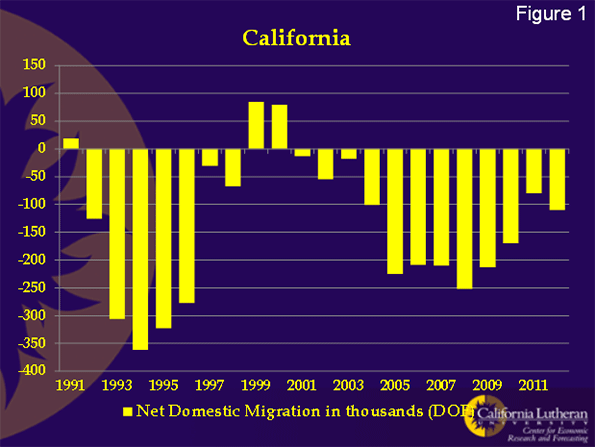
    Figure 1 shows California’s Department of Finance’s (DOF) estimate of domestic migration, migration between California and other states.  According to the DOF, California’s domestic migration has been negative in 18 of the past 20 years.  This is less dismal than the U.S. Census’ estimate that California’s domestic migration has been negative for 20 consecutive years.  This is the longest sustained period of negative domestic migration in California’s history.  We’ve seen this before, in the rust belt.  It leads to decay, poverty, increased crime, and unlivable cities.

    Domestic migration is important because it should be seen as an early warning signal of eventual decline.  Migrants are the proverbial “canaries in the coal mine”.  When domestic migration is negative, people are voting with their feet.  They are saying that California doesn’t provide enough opportunity to stay, particularly given its high cost of living.  Given how comfortable it is to live in California, I think they make that decision reluctantly.

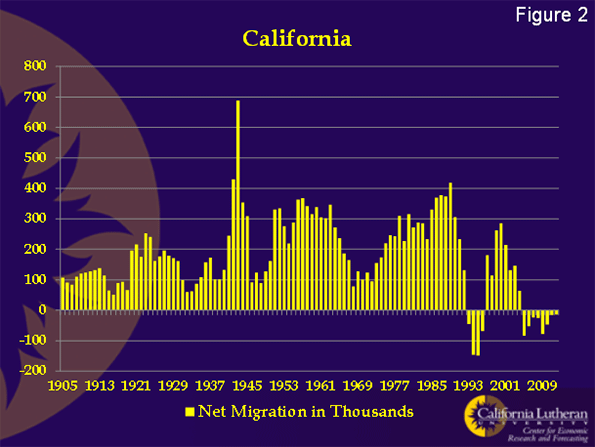
    Over most of California’s recent history, international migration has been strong enough that total migration remained positive.  That’s no longer true.

    Figure 2 shows California’s total net migration for the past 107 years.  Prior to 1993, California had never seen a year where total migration was negative.  Now, we’ve have negative migration for eight consecutive years.

    More critically, the rate of foreign migration in the state’s cities is falling behind many competitor cities. For example, over the last decade, New York had almost six times the increase in foreign born than Los Angeles. Houston, which has barely one third the population of LA-Orange County, increased its foreign born nearly four times as fast. Overall, LA-Orange had the lowest percentage increase of any major US metro. Given that the Southland has been the state’s immigration magnet for a generation, this is not good news.

    Weak, negative migration is likely to continue.  We used to characterize domestic migration as pull migration; rapidly growing economies attract migrants looking for opportunity. International migration, especially from other countries in this hemisphere, was thought to be push migration; conditions were so bad in the country of origin that migrants would come to California even in a recession.

    Apparently, that’s no longer true.  Mexico, for example, has an unemployment rate of about half of California’s today.  When you add the increased cost imposed by coyotes on illegal immigrants (a price increase from about $3,000 a few years ago to about $6,000 today plus the requirement to carry drugs), it’s no mystery why California’s growers are having a hard time finding an adequate workforce.

    Negative migration is important because migrants have been a critical part of California’s growth and creativity.  Not only is California losing the services of the migrants who choose, say, Texas instead of California, California is suffering a drain of some of its talent pool, particularly among those about to have children.

    For a long time, many people thought that California’s Hispanic population would cause its population growth rate to increase.  That turns out to not be true.

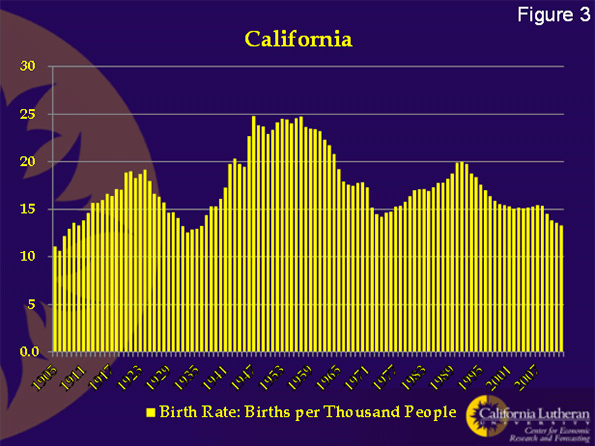
    Figure 3 shows California’s birthrate.  Our births per thousand population is the lowest it’s been since the worst part of the depression.  What’s scary though, is the rate of decline.  Births have fallen below 15 per thousand and seem destined to hit 10 per thousand.  This is a national trend and a key reason to create national policies that encourage increased international immigration.

    If a population is growing, it’s possible to have increasing births (new people) even when the birth rate is declining. Unfortunately, California isn’t there.

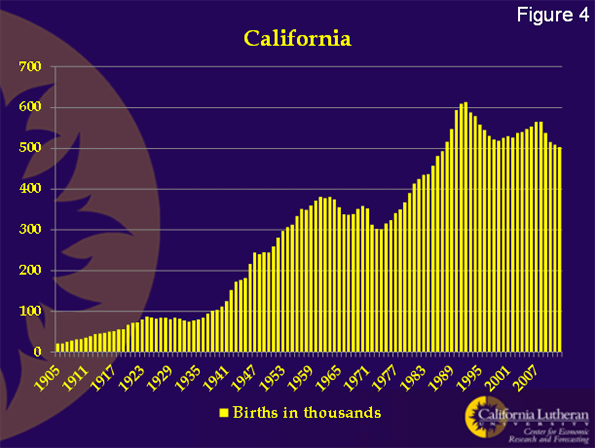
    Figure 4 shows the total number of births in California.  It’s fallen to 500,000 per year from 600,000 per year about 20 years ago.  If California’s birth rate falls to 10 percent, we can expect the number of births to decline to about 350,000.  At that point, the math starts to get to be a problem.  Is a decline to 10 per thousand possible?  You bet.

    According to the CIA, as of 2012, 29 out of 221 countries (13 percent) had birth rates below 10 per thousand.  Those 29 countries included Japan, Germany, Switzerland, South Korea, and Singapore.

    Unfortunately, California — as opposed to states such as Texas — could reach a 10 per thousand birth rate within 10 years if existing birth rate trends continue.  Even more disturbing, there is no reason to believe that 10 per thousand is a lower bound.  Germany, for example, has a birth rate of 8.33, while Hong Kong and Singapore have rates of only 7.54 and 7.72 respectively.

    For California’s population to continue to grow, births have to outnumber the losses to migration and deaths.  We’ve already discussed migration.  What about deaths?

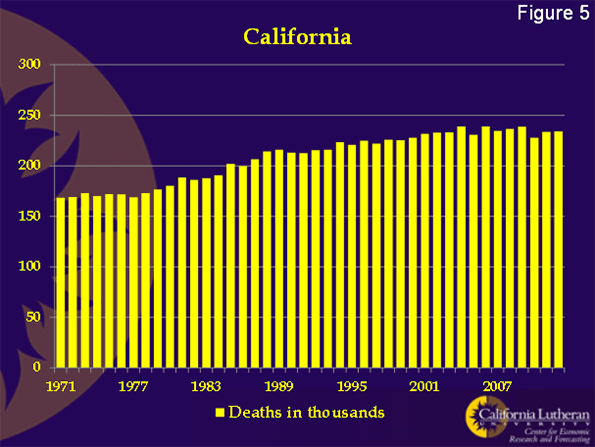
    Figure 5 shows annual California deaths from 1971 through 2012.  While recently flat, the trend is up, and an aging population implies more increases. For our calculations, we’ll assume California deaths at 250,000 per year.  This is a conservative assumption. As the Baby Boomers age, California deaths will increase.

    When California’s birth rate falls to 10 per thousand, we can expect 350,000 births.  Deaths will be about 250,000. Apparently, as long as outmigration doesn’t exceed 100,000 California’s population won’t decline overall.

    The good news is that outmigration in excess of 100,000 has only happened once.  California’s net outmigration exceeded 100,000 for two consecutive years in the 1990s, when California was undergoing a dramatic economic realignment brought about by the end of the Cold War. 

    The bad news is that we’ve come very close to losing 100,000 twice in the past eight years, particularly during the housing boom. Many people believe that low home prices are restraining domestic outmigration, because people are waiting for equity to return before making the move. Higher home prices and increased tax rates could drive big increases in the numbers of people leaving California.

    Unless there is some dramatic change, it is almost inevitable that California will suffer a declining population within a generation. The way to avoid this calamity is create an economic environment that encourages job growth and economic activity. 

    At the same time, it appears prudent to begin planning now for an aging and possibly smaller population.  Increased government revenues through more robust and varied economic activity would help here, but more probably needs to be done. California needs to reform its business climate, reduce its debt and unfunded liabilities, and do so quickly.

    Bill Watkins is a professor at California Lutheran University and runs the Center for Economic Research and Forecasting, which can be found at clucerf.org.

  • New Metropolitan Area Definition Winners: New York, Charlotte, Grand Rapids, and Indianapolis

    Metropolitan America continues to expand. The new Office of Management and Budget metropolitan area definitions, based upon the 2010 census indicate that the counties composing the 52 metropolitan areas with more than 1 million population increased by 1.65 million from the previous definition. This includes more than 1.4 million new residents in the previous 51 major metropolitan areas and more than 200,000 in Grand Rapids, which has become the nation’s 52nd metropolitan area with more than 1 million population.

    The fastest growers due to the addition of counties were New York, Charlotte, Grand Rapids, and Indianapolis. New York had a 670,000 increase in its metropolitan population, resulting from the addition of Dutchess and Orange counties. New counties also increased the population of the Charlotte metropolitan area by 459,000, the Grand Rapids metropolitan area by 215,000 and Indianapolis by 132,000. The largest percentage gains were in Grand Rapids (28%) and Charlotte (26%).

    Ten metropolitan areas had population increases under 100,000 from expansion of the metropolitan area definitions.

    For the most part, the major metropolitan area county components were unchanged, with 31 having the same boundaries as under the previous definition. Six metropolitan areas were reduced in geographic size.

    The changes in population for 2000 based upon the new metropolitan area definitions are indicated in the table. The components of metropolitan areas are determined by commuting patterns to urban areas (not to the historical core municipalities).

    Effect of New Metropolitan Area Geographic Definition on Population: 2010
    Population Change Rank Metropolitan Area Old Definition New Definition (2013) Change % Change
    12 Atlanta, GA        5,268,860        5,286,728 17,868 0.3%
    15 Austin, TX        1,716,289        1,716,289 0 0.0%
    15 Baltimore, MD        2,710,489        2,710,489 0 0.0%
    15 Birmingham, AL        1,128,047        1,128,047 0 0.0%
    15 Boston, MA-NH        4,552,402        4,552,402 0 0.0%
    15 Buffalo, NY        1,135,509        1,135,509 0 0.0%
    2 Charlotte, NC-SC        1,758,038        2,217,012 458,974 26.1%
    15 Chicago, IL-IN-WI        9,461,105        9,461,105 0 0.0%
    46 Cincinnati, OH-KY-IN        2,130,151        2,114,580 (15,571) -0.7%
    15 Cleveland, OH        2,077,240        2,077,240 0 0.0%
    7 Columbus, OH        1,836,536        1,901,974 65,438 3.6%
    8 Dallas-Fort Worth, TX        6,371,773        6,426,214 54,441 0.9%
    15 Denver, CO        2,543,482        2,543,482 0 0.0%
    15 Detroit,  MI        4,296,250        4,296,250 0 0.0%
    3 Grand Rapids, MI           774,160           988,938 214,778 27.7%
    15 Hartford, CT        1,212,381        1,212,381 0 0.0%
    49 Houston, TX        5,946,800        5,920,416 (26,384) -0.4%
    4 Indianapolis. IN        1,756,241        1,887,877 131,636 7.5%
    15 Jacksonville, FL        1,345,596        1,345,596 0 0.0%
    48 Kansas City, MO-KS        2,035,334        2,009,342 (25,992) -1.3%
    15 Las Vegas, NV        1,951,269        1,951,269 0 0.0%
    15 Los Angeles, CA     12,828,837     12,828,837 0 0.0%
    51 Louisville, KY-IN        1,283,566        1,235,708 (47,858) -3.7%
    13 Memphis, TN-MS-AR        1,316,100        1,324,829 8,729 0.7%
    15 Miami, FL        5,564,635        5,564,635 0 0.0%
    15 Milwaukee,WI        1,555,908        1,555,908 0 0.0%
    6 Minneapolis-St. Paul, MN-WI        3,279,833        3,348,859 69,026 2.1%
    5 Nashville, TN        1,589,934        1,670,890 80,956 5.1%
    11 New Orleans. LA        1,167,764        1,189,866 22,102 1.9%
    1 New York, NY-NJ-PA     18,897,109     19,567,410 670,301 3.5%
    15 Oklahoma City, OK        1,252,987        1,252,987 0 0.0%
    15 Orlando, FL        2,134,411        2,134,411 0 0.0%
    15 Philadelphia, PA-NJ-DE-MD        5,965,343        5,965,343 0 0.0%
    15 Phoenix, AZ        4,192,887        4,192,887 0 0.0%
    15 Pittsburgh, PA        2,356,285        2,356,285 0 0.0%
    15 Portland, OR-WA        2,226,009        2,226,009 0 0.0%
    15 Providence, RI-MA        1,600,852        1,600,852 0 0.0%
    15 Raleigh, NC        1,130,490        1,130,490 0 0.0%
    52 Richmond, VA        1,258,251        1,208,101 (50,150) -4.0%
    15 Riverside-San Bernardino, CA        4,224,851        4,224,851 0 0.0%
    10 Rochester, NY        1,054,323        1,079,671 25,348 2.4%
    15 Sacramento, CA        2,149,127        2,149,127 0 0.0%
    47 St. Louis,, MO-IL        2,812,896        2,787,701 (25,195) -0.9%
    50 Salt Lake City, UT        1,124,197        1,087,873 (36,324) -3.2%
    15 San Antonio, TX        2,142,508        2,142,508 0 0.0%
    15 San Diego, CA        3,095,313        3,095,313 0 0.0%
    15 San Francisco-Oakland, CA        4,335,391        4,335,391 0 0.0%
    15 San Jose, CA        1,836,911        1,836,911 0 0.0%
    15 Seattle, WA        3,439,809        3,439,809 0 0.0%
    15 Tampa-St. Petersburg, FL        2,783,243        2,783,243 0 0.0%
    14 Virginia Beach-Norfolk, VA-NC        1,671,683        1,676,822 5,139 0.3%
    9 Washington, DC-VA-MD-WV        5,582,170        5,636,232 54,062 1.0%
    Total   167,861,575   169,512,899    1,651,324 1.0%


  • Richard Florida Concedes the Limits of the Creative Class

    Among the most pervasive, and arguably pernicious, notions of the past decade has been that the “creative class” of the skilled, educated and hip would remake and revive American cities. The idea, packaged and peddled by consultant Richard Florida, had been that unlike spending public money to court Wall Street fat cats, corporate executives or other traditional elites, paying to appeal to the creative would truly trickle down, generating a widespread urban revival.

    Urbanists, journalists, and academics—not to mention big-city developers— were easily persuaded that shelling out to court “the hip and cool” would benefit everyone else, too. And Florida himself has prospered through books, articles, lectures, and university positions that have helped promote his ideas and brand and grow his Creative Class Group’s impressive client list, which in addition to big corporations and developers has included cities as diverse as Detroit and El Paso, Cleveland and Seattle.

    Well, oops.

    Florida himself, in his role as an editor at The Atlantic, admitted last month what his critics, including myself, have said for a decade: that the benefits of appealing to the creative class accrue largely to its members—and do little to make anyone else any better off. The rewards of the “creative class” strategy, he notes, “flow disproportionately to more highly-skilled knowledge, professional and creative workers,” since the wage increases that blue-collar and lower-skilled workers see “disappear when their higher housing costs are taken into account.” His reasonable and fairly brave, if belated, takeaway: “On close inspection, talent clustering provides little in the way of trickle-down benefits.”

    One group certain to be flustered by this new perspective will be many of the cities who have signed up and spent hard cash over the years to follow Florida’s prescription of focusing on those things—encouraging the arts and entertainment, building bike paths, welcoming minorities and gays—that would attract young college-educated workers. In his thesis, the model cities of the future are precisely those, such as San Francisco and Seattle, that have become hubs of highly educated migrants, technology, and high-end business services.

    That plan, though, has been less than successful in many of the old rust belt cities that once made up much of his client base. Perhaps even more galling to these cities, Florida has turned decidedly negative in his outlook on many of those cities—now looking remarkably gullible—that once made up much of his client base.

    The most risible example of this may have been former Michigan Jennifer Granholm’s “cool cities” campaign of the mid-oughts, that sought to cultivate the “creative class” by subsidizing the arts in Detroit and across the state. It didn’t exactly work. “You can put mag wheels on a Gremlin,” comments one long-time Michigan observer. “but that doesn’t make it a Mustang.”

    Alec MacGillis, writing at The American Prospect in 2009, noted that after collecting large fees from down-at-the-heels burgs like Cleveland, Toledo, Hartford, Rochester, and Elmira, New York over the years, Florida himself asserted that we can’t “stop the decline of some places” and urged the country to focus instead on his high-ranked “creative” enclaves. “So, got that, Rust Belt denizens?” MacGillis noted wryly in a follow-up story last year at the New Republic. Pack your bags for Boulder and Raleigh-Durham and Fairfax County. Oh, and thanks again for the check.”

    One key constituency advocating “creative class” oriented development has been the grandees of urban real estate. Albert Ratner of Cleveland-based Forest City Enterprises, a major urban developer with a taste for subsidies, in New York and elsewhere, suggests Florida’s ideas provides the “playbook for developers.”

    For Rust Belt cities, notes Cleveland’s Richey Piiparinen, following the “creative class” meme has not only meant wasted money, but wasted effort and misdirection. Burning money trying to become “cooler” ends up looking something like the metropolitan equivalent to a midlife crisis.

    It would have been far more sensible, Piiparinen suggests, for such areas to emphasize their intrinsic advantages, such as affordable housing, a deep historic legacy tied to a concentration of specific skills as well as a strategic location. He urges them to cultivate their essentially Rust-Belt authenticity rather than chase standard issue coolness promoted by big developers like Forest City. Focusing on attracting the “hip cool” single set, Piiparinen maintains, simply sets places like Cleveland up for failure.

    Geography of Hip Coolness

    Perhaps the best that can be said about the creative-class idea is that it follows a real, if overhyped, phenomenon: the movement of young, largely single, childless and sometimes gay people into urban neighborhoods. This Soho-ization—the transformation of older, often industrial urban areas into hip enclaves—is evident in scores of cities. It can legitimately can be credited for boosting real estate values from Williamsburg, Brooklyn, Wicker Park in Chicago and Belltown in Seattle to Portland’s Pearl District as well as much of San Francisco.

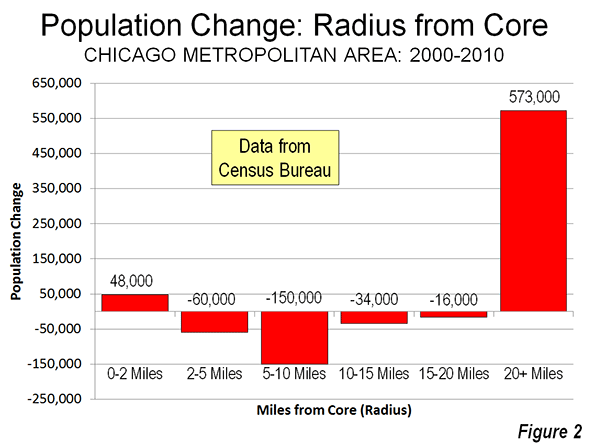
    Yet this footprint of such “cool” districts that appeal to largely childless, young urbanistas in the core is far smaller in most cities than commonly reported. Between 2000 and 2010, notes demographer Wendell Cox, the urban core areas of the 51 largest metropolitan areas—within two miles of the city’s center—added a total of 206,000 residents. But the surrounding rings, between two and five miles from the core, actually lost 272,000. In contrast to those small gains and losses, the suburban areas—between 10 and 20 miles from the center —experienced a growth of roughly 15 million people.

    The smallness of the potentially “hip” core is particularly pronounced in Rust Belt cities such as Cleveland and St. Louis, where these core districts are rarely home to more than 1 or 2 percent of the city’s shrinking population. Yet the subsidy money for developers is often justified in the name of “reviving” the entire city, most of which has continued to deteriorate.

    Nor has this dynamic changed since the onset of the Great Recession, as urban boosters such as Aaron Ehrenhalt have suggested. Ehrenhalt, citing the perceived preferences of millennials, envisions an urban future where more reject the suburban life, in part as a reaction to the wreckage of the last housing bust. To Ehrenhalt, places like downtown Chicago are emerging as the modern-day version of early-20th-century Vienna, central cores that attracted the elites while the working class and middle class dullards regress to the suburbs. Yet in reality, an examination of data between 2011 and 2012 by Jed Kolko at Trulia found despite a spike in downtown residents, population losses continue in surrounding close-in urban neighborhoods, while the fastest growth has continued to be located further out in the periphery.

    Class Politics in the “Creative Age”

    Investments in “cool” districts may well appeal to some young professionals, particularly before they get married and have children. But overall, as Florida himself now admits, it has done little overall for the urban middle class, much less the working class or the poor.

    Indeed in many ways the Floridian focus on industries like entertainment, software, and social media creates a distorted set of economic priorities. The creatives, after all, generally don’t work in factories or warehouses. So why assist these industries? Instead the trend is to declare good-paying blue collar professions a product of the past. If you can’t find work in deindustrialized Michigan, suggests Salon’s Ray Fisman, one can collect “ more than a few crumbs” by joining the service class and serving food, cutting hair or grass in creative capitals like San Francisco or Austin.

    These limitations of the “hip cool” strategy to drive broad-based economic growth have been evident for years. Conservative critics, such as the Manhattan Institute’s Steve Malanga have pointed out that many creative-class havens often underperform economically compared to their less hip counterparts. More liberal academic analysts have denounced the idea as “ exacerbating inequality and exclusion.” One particularly sharp critic, the University of British Columbia’s Jamie Peck see it as little more than a neo-liberal recipe of “biscotti and circuses.”

    Urban thinker Aaron Renn puts it in political terms: “the creative class doesn’t have much in the way of coattails.”

    Why Hipness Can’t Save New York

    The sad truth is that even in the more plausible “creative class” cities such as New York and San Francisco, the emphasis on “hip cool” and high-end service industries has corresponded with a decline in their middle class and a growing gap between rich and poor. Washington D.C. and San Francisco, perennial poster children for “cool cities,” also have among the highest percentages of poverty of any major urban center—roughly 20 percent—once cost of living is figured in.

    Nowhere are the limitations of coolness more evident than in New York, our country’s cultural capital and now one of Florida’s three residences, along with Toronto and Miami Beach. Manhattan suffers by far the highest level of inequality among the country’s 25 most populous counties, a gap between rich and poor that’s the widest it’s been in a decade. New York’s wealthiest one percent earns a third of the entire city’s personal income—almost twice the proportion for the rest of the country.

    This geography of inequality is now extending to the outer boroughs. In nouveau hipster and increasingly expensive Brooklyn, nearly a quarter of people live below the poverty line. While artisanal cheese shops and bars that double as flower shops serve the hipsters, one in four Brooklynites receives food stamps. New York has seen the nation’s biggest rise in homelessness; the number of children sleeping in the shelters of Mike Bloomberg’s “luxury city” has risen 22 percent in the past year.

    The Issue of Race

    On paper, the “creative class” theory worships at the altar of diversity. “The great thing about cities,” Florida told NPR last year, “is they’re diverse. There’s diverse people in them.” Yet even leaving aside their lack of economic diversity, the exemplars of “hip cool” world, notes urban analyst Renn, tend to be vanilla cities with relatively small minority populations. San Francisco, Portland and Seattle are becoming whiter and less ethnically diverse as the rest of the country, and particularly the suburbs, rapidly diversify.

    Creatives may espouse politically correct views, but the effect of Florida’s policy approach, notes Tulane sociologist Richard Campanella, often undermine ethnic communities. As they enter the city, creatives push up rents, displacing local stores and residents. In his own neighborhood of Bywater, in New Orleans, the black population declined by 64 percent between 2000 and 2010, while the white population increased by 22 percent.

    In the process, Campanella notes, much of what made the neighborhood unique has been lost as the creatives replace the local culture with the increasingly predictable, and portable, “hip cool” trendy restaurants, offering beet-filled ravioli instead of fried okra, and organic markets. The “unique” amenities you find now, even in New Orleans, he reports, are much what you’d expect in any other hipster paradise, be it Portland, Seattle, Burlington, Vermont or Williamsburg.

    Families and the Future

    Campanella also suggests another byproduct of hipster gentrification: a dearth of families. Ten years ago his increasingly “creative class” neighborhood of Bywater was family oriented. Now, it’s “a kiddie wilderness.” In 2000, 968 youngsters lived in the district. Just 10 years later, the number had dropped by 70 percent, to 285. When his son was born in 2012, it was the first post-Katrina birth on his street, the sole child on a block that had 11 when he first arrived from Mississippi in 2000.

    Unsurprisingly, there’s not much emphasis about families in Florida’s work, in part because his basic theory puts focuses largely on groups like singles, childless young professionals and gays. He largely discounts suburbs, generally the nation’s nurseries, as outdated for the “creative age” and considers homeownership and single family houses, also vastly preferred by families, as fundamentally passé.

    Indeed, the places that most attract “the creative class” are also the ones with the fewest families and children, led by San Francisco, Seattle, Manhattan, and rapidly gentrifying Washington, D.C. The very high prices per square foot, understandably celebrated by urban real estate boosters, have made it hard not only on the poor but on middle- and even upper-middle-class families. When you have children, you often have to let go of your bohemian fantasies; it’s hard to imagine being a parent in a place like San Francisco where there are a raging debates about the right of people to walk around naked.

    The Real Geography of Opportunity

    To be sure, the leading “creative class” cities have much to recommend them, and some of them, such as Portland and Boston, have registered impressive rises in their per capita income in recent years. But over the past decade, most “cool cities” have not been enjoying particularly strong employment or population growth; in the last decade, the populations of cities like Charlotte, Houston, Atlanta, and Nashville grew by 20 percent or more, at least four times as rapidly as New York, Los Angeles, San Francisco, or Chicago. This trend toward less dense, more affordable cities is as evident in the most recent census numbers than a decade.

    One reason for this: the fastest job growth has taken place in regions—Houston, Dallas, Oklahoma City, Omaha—whose economies are based not on “creative” industries but on less fashionable pursuits such as oil and gas, agriculture and manufacturing. Energy mecca Houston, for example, last year enjoyed the largest GDP growth of any major American city, easily outpacing “creative” urbanist favorites like Chicago, New York, San Francisco, or Boston. The other two top GDP gainers were Dallas-Fort Worth and, surprisingly, Detroit, largely as a result of the auto industry’s comeback.

    Of course, some these ascendant cities now are sprouting their own “hip” neighborhoods. But these regions also accommodate far faster growth in rapidly expanding, family-friendly suburbs and exurbs. Equally important, none, including “creative class” hotspots Raleigh and Austin, are dense, transit-centered places of the kind urbanists suggest create economic vibrancy and attract the largest number of migrations.

    In fact both Raleigh and Austin are both very low-density regions with only compact urban pockets surrounded by vast suburban communities. Take a walk in downtown Raleigh sometime; about five minutes from the densest central areas and you find yourself on tree-lined streets with nice single-family houses, essentially, older suburbs. Austin, too, is a relatively low-density place surrounded by the kind of suburban sprawl detested by Floridians; this is also the case with Charlotte, Atlanta, and other fast-growing cities.

    These facts, of course, are unlikely to interfere with the self-interested lobbying by large developers for subsidies for downtown development much less the defined prejudices of the urban-centric media. But contrary to the narrative espoused by Florida and other proponents of high-density cities, the predominant future urban form in America is emerging  (largely unrecognized to the media) elsewhere, in places less dense, economically diverse and, perhaps, just a bit less hip and cool.

    Joel Kotkin is executive editor of NewGeography.com and a distinguished presidential fellow in urban futures at Chapman University, and a member of the editorial board of the Orange County Register. He is author of The City: A Global History and The Next Hundred Million: America in 2050. His most recent study, The Rise of Postfamilialism, has been widely discussed and distributed internationally. He lives in Los Angeles, CA.

    This piece originally appeared in the The Daily Beast.

    Seattle photo by Bigstock.

  • America’s Fastest- and Slowest-Growing Cities

    Since the housing crash of 2007, the decline of the Sun Belt and dispersed, low-density cities has been trumpeted by the national media and by pundits who believe America’s future lies in compact, crowded, mostly coastal and northern, cities. But apparently, most Americans have not gotten the memo — they seem to be accelerating their push into less dense regions of the Sun Belt.

    An analysis of population data by demographer Wendell Cox, including the Census report for the most recent year released late last week, shows that since 2000, virtually all the 10 fastest-growing metropolitan areas in the United States are located in Sun Belt states. The population of the Raleigh, N.C., metropolitan statistical area has expanded a remarkable 47.8% since 2000, tops among the nation’s 52 metro areas with over 1 million residents. That is more than three times the overall 12.7% growth of those 52 metro areas.

    Austin, Texas, and Las Vegas also expanded more than 40%, putting them second and third on our list. The populations of the other metro areas in the top 10 all expanded by at least 25%, or twice the national average. This jibes nicely with domestic migration trends and growth in the foreign-born population, both of which have been strongest in many of these same cities.

    The most recent numbers, covering July 2011 to July 2012, also reveal some subtle changes in the Sun Belt pecking order. Over the 2000-2012 period, the growth winners   included places like Las Vegas, Riverside-San Bernardino and Phoenix, all of which suffered grievously in the housing bust. Although they all clocked population growth better than the national average over the past year, none, besides Phoenix, ranked in the updated top 10.

    Growth momentum has shifted decidedly toward Texas. Austin’s population expanded a remarkable 3% last year, tops among the nation’s 52 largest metro areas. Three other Lone Star metropolitan areas — Houston, San Antonio and Dallas-Ft. Worth — ranked in the top six and all expanded at roughly twice the national average. The other fastest-growing metros over the past year include Raleigh, Orlando, Phoenix, Charlotte and Nashville. One unexpected fast-growth area has been Oklahoma City, which ranked 20th between 2000 and 2012, but notched the 12th spot last year, with a growth rate 60% above the national average.

    What explains these subtle shifts? Some of it can be traced, of course, to the stronger growth in energy-rich areas such as Texas as well as Oklahoma City. The differences are particularly striking when looking at varying economic growth rates among the country’s largest regions. In 2011 the Houston metro area, whose population is up by 1.4 million since 2000, also enjoyed the fastest GDP growth, at 3.7%, of any of the nation’s top 20 regions. Dallas-Fort Worth clocked a respectable 3.1%.

    In contrast, the GDP growth rates for the hip, dense metro areas lagged behind. Among the elite cities, the tech hubs of San Francisco , Seattle and Boston have done the best, posting GDP growth around 2.5%. But the economies of New York, Los Angeles, Philadelphia and, surprisingly, Washington D.C., grew at roughly half the rate of Houston.

    But it’s not just economic factors at play. One remarkable similarity in all the fastest-growing areas is their relatively low population densities. Although Raleigh and Austin are held out as “hip” cities, they have very low-density urban cores. Not one of the top 10 growth cities for 2010 to the present, or last year, had urban core densities more than a half of those of places like Boston (40th for 2000 to the present), New York (41st),  Los Angeles (42nd) or Chicago (43rd).

    At the same time, we have to consider the issue of housing affordability, something that rarely comes up among proponents of “cool” cities. In contrast to slower-growing San Francisco, New York and Los Angeles, most of the fastest-growing cities have lower housing prices relative to income. Particularly notable are the low prices in areas such as Austin, Raleigh, Houston and Dallas-Fort Worth, where housing costs are half or less than in the more highly regulated “cool” cities.

    Lower housing costs also seem to impact another critical growth component: family formation. Immigrants and domestic in-migrants are important to population growth but equally critical is whether longtime residents in a region choose to have children. Virtually all the top 10 metro areas, both last year and since 2000, have also ranked among the fastest growing in terms of the population under 15; Raleigh’s child population alone has expanded by almost 45% since 2000, compared to 2% nationally;  Austin’s toddler population surged a remarkable, 38%. The child populations of Houston, Dallas-Fort Worth, Atlanta, Phoenix, Las Vegas and Orlando all  increased by 20% or more.

    In contrast, none of the hip cities posted under 15 population growth better than 5%. The number of children has actually declined in many, including New York, Los Angeles, Boston, San Francisco and Chicago. Even with substantial influxes from abroad, particularly in New York, it’s difficult for these areas to sustain population increases when the number of children keeps dropping.

    The problem may be even more intense in Los Angeles and Chicago, whose economies continue to lag further behind. But the demographic challenges of the Big Orange and the Windy City pale compared to those faced by many cities in the old industrial Rust Belt, which have either lost population or posted only weak increases.

    Cleveland’s population is down 3.9% since 2000, the worst performance among the nation’s biggest metro areas apart from disaster-struck New Orleans. Cleveland lags in both family formation and has seen strong outmigration, but also attracts few foreign-born residents. Much the same can be said of Providence, R.I., Pittsburgh, Buffalo and Detroit. Nor do things seem to be improving with time; these areas continued to inhabit the nether regions in the most recent Census reports.

    So what do these trends tell us about the demographic evolution of our major metropolitan areas? Certainly sustained economic growth, low density and more affordable housing all clearly continue to push the center of population gravity toward certain Sun Belt cities, primarily in the Southeast and Texas. It turns out that neither the Great Recession, the housing bust or a much hyped preference for dense urbanity is turning this around.

    Major Metropolitan Areas (Over 1,000,000) Population
    Ranked by Population Change Percentage: 2000-2012 (2013 Geography)
    Rank Metropolitan Area 2000 2012 2000-2012 Growth 2000-2012 % 2011-2012 %
    1 Raleigh, NC           804,436        1,188,564        384,128 47.8% 3.3%
    2 Austin, TX        1,265,715        1,834,303        568,588 44.9% 3.1%
    3 Las Vegas, NV        1,393,370        2,000,759        607,389 43.6% 3.1%
    4 Orlando, FL        1,656,835        2,223,674        566,839 34.2% 2.5%
    5 Charlotte, NC-SC        1,729,023        2,296,569        567,546 32.8% 2.4%
    6 Riverside-San Bernardino, CA        3,277,578        4,350,096     1,072,518 32.7% 2.4%
    7 Phoenix, AZ        3,278,661        4,329,534     1,050,873 32.1% 2.3%
    8 Houston, TX        4,716,964        6,177,035     1,460,071 31.0% 2.3%
    9 San Antonio, TX        1,719,262        2,234,003        514,741 29.9% 2.2%
    10 Dallas-Fort Worth, TX        5,239,149        6,700,991     1,461,842 27.9% 2.1%
    11 Atlanta, GA        4,297,419        5,457,831     1,160,412 27.0% 2.0%
    12 Nashville, TN        1,387,274        1,726,693        339,419 24.5% 1.8%
    13 Jacksonville, FL        1,126,224        1,377,850        251,626 22.3% 1.7%
    14 Sacramento, CA        1,808,442        2,196,482        388,040 21.5% 1.6%
    15 Denver, CO        2,194,022        2,645,209        451,187 20.6% 1.6%
    16 Washington, DC-VA-MD-WV        4,862,582        5,860,342        997,760 20.5% 1.6%
    17 Salt Lake City, UT           942,666        1,123,712        181,046 19.2% 1.5%
    18 Portland, OR-WA        1,936,108        2,289,800        353,692 18.3% 1.4%
    19 Tampa-St. Petersburg, FL        2,404,273        2,842,878        438,605 18.2% 1.4%
    20 Oklahoma City, OK        1,097,874        1,296,565        198,691 18.1% 1.4%
    21 Seattle, WA        3,052,379        3,552,157        499,778 16.4% 1.3%
    22 Richmond, VA        1,058,816        1,231,980        173,164 16.4% 1.3%
    23 Indianapolis. IN        1,664,431        1,928,982        264,551 15.9% 1.2%
    24 Columbus, OH        1,681,865        1,944,002        262,137 15.6% 1.2%
    25 Miami, FL        5,025,806        5,762,717        736,911 14.7% 1.1%
    26 San Diego, CA        2,824,987        3,177,063        352,076 12.5% 1.0%
    27 Minneapolis-St. Paul, MN-WI        3,044,901        3,422,264        377,363 12.4% 1.0%
    28 Kansas City, MO-KS        1,818,073        2,038,724        220,651 12.1% 1.0%
    29 Louisville, KY-IN        1,123,966        1,251,351        127,385 11.3% 0.9%
    30 Memphis, TN-MS-AR        1,216,293        1,341,690        125,397 10.3% 0.8%
    31 San Jose, CA        1,739,669        1,894,388        154,719 8.9% 0.7%
    32 Birmingham, AL        1,053,394        1,136,650          83,256 7.9% 0.6%
    33 San Francisco-Oakland, CA        4,136,658        4,455,560        318,902 7.7% 0.6%
    34 Baltimore, MD        2,557,501        2,753,149        195,648 7.6% 0.6%
    35 Grand Rapids, MI           934,388        1,005,648          71,260 7.6% 0.6%
    36 Virginia Beach-Norfolk, VA-NC        1,584,042        1,699,925        115,883 7.3% 0.6%
    37 Cincinnati, OH-KY-IN        1,999,787        2,128,603        128,816 6.4% 0.5%
    38 Philadelphia, PA-NJ-DE-MD        5,693,275        6,018,800        325,525 5.7% 0.5%
    39 Hartford, CT        1,150,915        1,214,400          63,485 5.5% 0.4%
    40 Boston, MA-NH        4,402,611        4,640,802        238,191 5.4% 0.4%
    41 Los Angeles, CA      12,398,950      13,052,921        653,971 5.3% 0.4%
    42 New York, NY-NJ-PA      18,976,899      19,831,858        854,959 4.5% 0.4%
    43 Chicago, IL-IN-WI        9,117,732        9,522,434        404,702 4.4% 0.4%
    44 St. Louis,, MO-IL        2,678,224        2,795,794        117,570 4.4% 0.4%
    45 Milwaukee,WI        1,502,305        1,566,981          64,676 4.3% 0.4%
    46 Rochester, NY        1,066,335        1,082,284          15,949 1.5% 0.1%
    47 Providence, RI-MA        1,586,744        1,601,374          14,630 0.9% 0.1%
    48 Pittsburgh, PA        2,429,023        2,360,733        (68,290) -2.8% -0.2%
    49 Buffalo, NY        1,169,159        1,134,210        (34,949) -3.0% -0.3%
    50 Detroit,  MI        4,457,471        4,292,060      (165,411) -3.7% -0.3%
    51 Cleveland, OH        2,147,948        2,063,535        (84,413) -3.9% -0.3%
    52 New Orleans. LA        1,336,795        1,227,096      (109,699) -8.2% -0.7%

    Analysis by Wendell Cox, Demographia

    Joel Kotkin is executive editor of NewGeography.com and a distinguished presidential fellow in urban futures at Chapman University, and a member of the editorial board of the Orange County Register. He is author of The City: A Global History and The Next Hundred Million: America in 2050. His most recent study, The Rise of Postfamilialism, has been widely discussed and distributed internationally. He lives in Los Angeles, CA.

    This piece originally appeared at Forbes.com.

  • California Needs More Immigrants

    Southern California, just a few decades ago the fastest-growing region in the high-income world, is hitting a demographic tipping point. With a decade or more of domestic out-migration and a sharp fall in immigration, the region is morphing from a destination that attracts dreamers and builders into a place increasingly dominated by those born or bred here.

    To some demographers, this transition from a magnet for migrants to a more native-born population represents something of a boon. As for migrants, one USC demographer wrote that California acts like "a gold pan that sifts through aspiring talent and keeps the best." Our new steady state is a good thing, the argument goes, since it offers a respite from the travails of rapid growth. All we need to focus on is spending more money on schools, and, not surprisingly, universities, and everything will turn out alright.

    There may be some truth to all these points, but, historically, a decline in new migration also suggests something else: a picture oddly reminiscent of the kind of demographic stagnation long associated with places like Cleveland, Buffalo, N.Y., Pittsburgh and Detroit. A more native-dominated region may be both more socially stable but increasingly hidebound and lacking innovation.

    For cities, demographic stagnation is not a recipe for success. Over the past decade, notes demographer Wendell Cox, the Los Angeles-Orange County area has seen the fifth-highest growth in the percentage of locally born people in its population, among nation’s 51 largest metropolitan areas. The concern is not so much that people are leaving these places in droves; the real issue is that not enough new people, with new ideas and great ambition, are coming in.

    Already, notes economist Bill Watkins, large parts of the state, particularly along the coast, are evolving into "geriatric ghettos" populated by aging, often-affluent baby boomers. And, as for keeping the "best," the steady decline in California’s relative educational ranking, particularly in the younger cohorts, should convince us that we cannot reasonably rely on native-born residents to meet the challenges of the future.

    Domestic Outmigration

    Watkins also points out that California has been losing domestic migrants for 10 of the past 15 years. It’s been worse in this region; over the past decade the Los Angeles-Orange County area suffered the third-highest rate in the country of net outmigration, slightly above New York’s. Amazingly, on a per capita basis, people are leaving our sun-drenched metropolis more rapidly than from Rust Belt disaster areas such as Cleveland and Detroit.

    In recent decades, this shortfall has been more than made up by foreign immigration. But in a stunning reversal of the trends in past decades, the number of foreign-born in our region has started to stagnate. Indeed, over the most-recent decade, the Southland has experienced the slowest rate of growth in its foreign-born population of any major region in the country. Los Angeles-Orange County gained 110,000 immigrants over the decade, one-sixth as many as New York City and only a quarter as many as Houston. Our immigrant population has grown less than that of much smaller regions such as Minneapolis-St. Paul, Austin, Texas, Atlanta and Dallas-Fort Worth.

    These patterns suggest a dangerous shift in our demographic DNA and a decline in our historic archetype as one of the world’s most culturally and economically innovative regions. Throughout history, the movement of newcomers has accented the rise of great cities at their peak, from ancient Athens, Rome and Baghdad to early 20th century London, Berlin, New York and Chicago. Similarly, the ascendency of the great cities of modern Asia – from Tokyo to Shanghai to Hong Kong and Singapore – resulted from mass migration, usually from the countryside to the urban centers.

    Pioneering Migrants

    Southern California’s evolution into one of the world’s premier urban regions has been, for the most part, propelled by outsiders, people who came to this place in search of a better life. Starting in the 1880s, these tended to be other Americans, including Los Angeles Times publisher Harrison Gray Otis (Marietta, Ohio), and railway magnate Henry Huntington (Oneonta, N.Y.), and, later, Walt Disney (Kansas City, Mo.), Howard Ahmanson Sr. (Omaha, Neb.) and Dr. Jerry Buss (Kemmerer, Wyo.).

    For such newcomers – including James Irvine, a native of Ireland – Southern California provided an opportunity to create new things of every type. Everything distinctive developed in Southern California was created largely by outsiders. The creators of the movie business were mostly Jews from Eastern Europe, while the aerospace industry was largely populated by Midwestern emigres. Even the people who built our cities came from elsewhere. Consider Ahmanson, who funded much of it. Developers like Eli Broad, a native of Detroit, or Nathan Shapell, a holocaust survivor from Poland, built many of the region’s suburban communities.

    In recent decades, L.A.’s outsiders have come increasingly from abroad. Most have come from Mexico and Asia, but also from the Middle East, the former Soviet Union and, increasingly, Africa. Their influence is everywhere, from the food trucks to the ethnic malls, at the universities and in the music scene. A large number of the smaller banks in the region are tied to immigrant communities.

    Nowhere is the influence greater than in the entrepreneurial arena. In the 1980s and 1990s, when Los Angeles-Long Beach frequently led in new immigration, newcomers from abroad fueled the rise of industries from garments to international trade and food processing. They are the primary creators of our food truck culture and often the chefs and owners of our finest restaurants.

    Business Starters

    Simply put, immigrants provided the critical oxygen for our economy, which, as a group, they are still doing. Even in the midst of the recession, newcomers continued to form businesses at a record rate, while the start-up rate for native-born entrepreneurs declined. The immigrant share of new businesses, notes a Kauffman Foundation survey, more than doubled, from 13.4 percent in 1996 to 29.5 percent, in 2010.

    Nationally, immigrants are responsible for roughly a quarter of all high-tech start-ups. Asians, who constitute more than 40 percent of newcomers, now account for roughly 20 percent of tech workers, four times their percentage of the population.

    How much is this dynamism, which once blessed the Southland, is now heading to Houston, Dallas-Fort Worth or even Charlotte, N.C.? It seems likely that, without the economic push from the immigrants and their countries, the reinvention of our economy will be far slower. Southern California natives seem far less likely to take the risks, and create the new industries, the region desperately needs.

    Regaining our allure to newcomers is now arguably our biggest challenge. We have some fine assets, such as great weather, universities and a strong entrepreneurial legacy. Critically, despite the stagnant past decade, the Los Angeles-Orange County region still remains the second-largest repository of immigrants, at 4.4 million, behind only the greater New York area’s 5.5 million. Virtually any ethnic group can find schools, shops and banks tied to their home countries; for some, like Chinese, Vietnamese, Mexicans and Iranians, Southern California remains a critical ethnic bastion and beacon.

    Shift Focus

    In this process, immigration reform could prove helpful, although most attention has been paid to legalizing undocumented immigrants already in the country. This may well be justified on moral ground but, in some ways, that debate is fighting the last war, as the flow of illegal immigration from Mexico has slowed, and may even be reversing. Legal immigration from Mexico also has declined markedly in recent years.

    A far more strategic concern would be easing the flow of Asian immigrants, who, according to a recent Pew study, are generally better educated and affluent than other newcomers. Asian immigrants are also more likely to start business; a 2012 Kauffman study notes that close to 40 percent of immigrant entrepreneurs come from India or China. We should be looking to capture all such skilled and entrepreneurial newcomers, from any country and, hopefully, also from within this country.

    To accomplish this we need to convince prospective migrants that this region, for all its faults, deserves to become, once again, a preferred destination for ambitious outsiders. It’s a task that our local leaders, both in the business world and government, need to take seriously, rather than take comfort in the prospect of a more stable, and fundamentally stagnant, demographic future.

    Joel Kotkin is executive editor of NewGeography.com and a distinguished presidential fellow in urban futures at Chapman University, and a member of the editorial board of the Orange County Register. He is author of The City: A Global History and The Next Hundred Million: America in 2050. His most recent study, The Rise of Postfamilialism, has been widely discussed and distributed internationally. He lives in Los Angeles, CA.

    This piece originally appeared in the Orange County Register.

    Photo by telwink

  • Is Hawaii the Bellwether for California?

    California used to consider itself the leading state and the bellwether for the entire country. Now that the entrepreneurial initiative has mostly switched to Texas and other such places, and Texas’s infrastructure has pulled ahead of California’s in its quality (I lived in Texas in the 1970s, and it was not so then!), California is, at the very least, still thought of as a bellwether for the whole country, if perhaps a dystopian one. But there is a state that even Californians look to for popular cultural leadership, visit frequently, and admire. And, while it is often said that California became the first “majority-minority” state, it is not true. This other state, which lies far to the southwest of California, has always been “majority-minority.” It is, of course, Hawai’i. (The apostrophe is a letter in Hawaiian, and it is pronounced.) It has wrestled with “multicultural” issues for longer than it has been part of the United States. And one born in Hawai’i is now President of the United States.

    The majority of the residents of Hawaii are Asian, the largest number being of Japanese descent with some Chinese and Filipinos and a few Koreans, though Koreans have mostly preferred California. President Obama is exceptional; people of African descent have never been numerous in Hawai’i. Five to ten percent of the people have some percentage of native Hawaiian blood, though there are almost no pure-blood Hawaiians.

    On the mainland, whites and blacks are moving out of areas flooded by immigration; in Hawaii, whites (including retirees) and even a few minimum-wage Mexicans, are moving in on a net basis. It is important to note, however, that Hawaii’s Asians are not mostly recent immigrants; they are descended from people who came over in the late nineteenth and early twentieth centuries. Today’s immigrants have generally preferred California, which had a more vibrant entrepreneurial economy, and on some fronts still does. (The maker of computer chips is probably itching to move to Texas; less so the programmer.) The reason for all this is that Hawaii was so long dominated by the “Big Five” corporations.

    The historical reasons for the Big Five, and for Hawaii’s other oddities, are interesting. In the 19th century, a large percentage of Hawaii’s land and economy fell into the hands of a few white (haole) families, like Bishop, Dillingham, Baldwin, and Parker, who sometimes did marry into the local noble (ali’i) caste. The corporations they founded were eventually known as the Big Five. (Some of this heritage is chronicled in the recent film The Descendants.) They brought large numbers of Asians in as contract labor to work the vast fields of pineapple and sugar cane. California had its counterparts, the Irvines, O’Neills, Bixbys, Millers, Hearsts, and more, but they only controlled part of the land and exercised little control of the commercial economy. The rest of the Mexican grants were broken up into smaller farms and ranches soon after the American conquest. (It is where the grants remained intact until recently, such as south Orange County, that you have the notorious “planned communities.”)

    Japan was the first main source of Asian labor, but the Japanese came largely from the Ryukyus, Kyushu, and the less developed south of Japan, and were often part of the Eta undercaste that in Japan had butchered animals and cleaned toilets. China, the Azores, and later the Philippines were also sources of labor, but the majority of Hawaiian Asians are of Japanese descent.

    In the 1940s and 1950s, culminating in 1954, there was a labor and political movement by which the predominantly Asian workers took control of the territory from the Big Five. They could regulate the Big Five, they could unionize the Big Five, but they did not have legal authority to break up the Big Five (only the federal government could have done that); so both right and left in Hawai’i retained a corporatist rather than an entrepreneurial mentality. The establishment had been Republican, so the workers were Democrats, and Hawai’i entered a long era of Democratic dominance, which continues to this day. The plantation experience is one major reason why most of Hawai’i’s Asians, unlike Asian Californians until recently, have been Democrats.

    An interesting fact about Hawai’i is that there are only four functioning local governments, the counties.  There had been a fifth, the Hansen’s Disease (Leper) colony on Kalaupapa Peninsula, which was the lifework of Saint Damien, canonized in 2009. While the counties are divided into “judicial districts” that are marked on some maps, the judicial districts do not have governments. Each county has a “mayor,” but there are no incorporated cities as they are known in other states.

    Another force influencing the Hawaiian culture and worldview is the Native Hawaiians. There are almost no pure blooded Native Hawaiians (other than on Ni’ihau), but up to ten percent of the population has some Hawaiian blood. The old pre-Christian culture had some brutal elements. While on the one hand there was premarital sexual freedom, on the other a woman could be killed instantly for eating a banana or a coconut, and a commoner could be killed instantly for letting his shadow fall on a chief. Infanticide was employed in population control and human sacrifices were offered to Madame Pele, the volcano goddess. They had no system of writing. In the days before it became unfashionable to distinguish between “civilized” and “uncivilized,” they were therefore considered “uncivilized.” However they did build permanent stone structures as temples and as “cities of refuge,” places where people who had broken, or were accused of breaking, a kapu (taboo) could go to save their lives. Also there was a vast lore of herbal healing, which survives.

    Between 1790 and 1810, Kamehameha the Great united the islands into a single kingdom, and established a monarchy that lasted until 1893, long after Hawai’i had been modernized, Westernized, and largely Christianized, and had already received large numbers of immigrants. It was not any crowned head of Europe that was the first monarch to have his voice recorded, and to travel around the world, but King David Kalaka’ua of Hawai’i. All this is far different from how it was for American Indians of the mainland! Another uniqueness is that the Hawaiian language, spoken daily by hardly a thousand people, a tiny fraction of those who speak, say, Navajo, has nonetheless become part of the culture; a language which has left a long list of words in Hawaiian English, a language in which much locally popular music is recorded, and a tourist attraction in its own right. Its status is in some way similar to that of Irish Gaelic in Ireland. (By comparison, in Palm Springs I have never heard music sung in Cahuilla.)

    What, then, of Hawai’i today? There is an active Christian minority, but Pele, the goddess who supposedly lives at Kilauea Crater, regularly gets offerings of flowers and gin. “Haoles” are wary of getting into fights with “locals.” The culture values the ohana, or extended family, but it is hardly Confucian. One might mention at this point Will Durant on later ancient Rome:

    “But most of the inflowing peoples had literally been de-moralized by uprootage from their native surroundings, cultures, and codes; … and daily friction with groups of different customs had worn away still more of their custom-made morality.” (Caesar and Christ, p. 366.)

    This sort of multiculturalism, however, had nothing to do with the fact that Hawai’i was the first state where same-sex marriage was seriously proposed? No, it was, I believe, a case of imperial judiciary, and same-sex marriage was voted down two to one in November of 1998. If democratic processes continue and are not overridden by judicial fiat, Hawai’i will be one of the last states outside the South to adopt same-sex marriage. And in California, it was the votes of people of color, who would never think of becoming Republicans, that won Proposition 8 and delayed same-sex marriage for some years. It makes me think that the Republican party should be replaced by two new ones; one socially conservative, pro-voucher, fiscally moderate to liberal, and led by people of color; the other, a more semi-libertarian party. Neither, preferably, should bear the name Republican Party.

    Howard Ahmanson of Fieldstead and Company, a private management firm, has been interested in these issues for many years.

  • Chicago: Outer Suburban and Exurban Growth Leader

    Greg Hinz at Crain’s Chicago Business congratulates Chicago for its nation-leading population growth. Heinz also notes that the far suburbs also gained population strongly, but there had been losses in the areas between the two. He asks: "the question now is whether the area can prosper with a thriving core but sinking neighborhoods and inner-ring suburbs around it."

    The area within 2 miles of downtown gained nearly 50,000 people between 2000 and 2010. No other US metropolitan area equaled this urban core population increase.

    The article cites a number of factors beyond population growth to indicate that the city of Chicago is outperforming the suburbs. Retail sales tax collections have increased faster in the city. However, Hinz also notes that there has also been a sizable proliferation of big-box stores (Target and Wal-Mart), which is made it possible for residents to shop in the city instead of the suburbs.

    Empty Nesters Not Flocking to Downtown

    Hinz notes that "empty nesters" are moving to the urban core. Yet this is not confirmed by the data. Between 2000 and 2010, the age cohort that was from 55 to 64 years old in 2000 dropped by 55 percent as a share of the population in the fast growing core census tracts of central Chicago. In contrast, in the city of Chicago overall, the loss was 25%, and the reduction was 24% in the entire metropolitan area (Figure 1). Our previous national research showed that the population losses in this cohort were the greatest in the core cities among the 51 major metropolitan areas.

    The article goes on to quote Alan Ehrenhalt to the effect that an "inversion" of the city to suburban movement pattern is occurring, and "it’s happening more in metropolitan Chicago than just about any other city in the country."

    "Inversion" implies "turning upside down." For an inversion to have occurred, there would need to have been a reversal of the trend in movement from the core cities to the suburbs. The most important indicator of any such inversion would be that domestic migration would show a flow from a suburbs to cities. It does not. Domestic migration from Cook County, in which Chicago is located, was minus 740,000 between 2000 and 2011 (Note). Domestic migration in the suburban counties was a plus 139,000. Thus, there was no net migration from the suburbs to Cook County (Figure 2).  

    The City of Chicago Outside Downtown

    The story was much different outside the core area. The balance of the city, where 93 percent of the people live, lost 250,000 residents – a loss greater than that of any municipality in the nation over the period – including Detroit. The losses were pervasive. More than 80 percent of the city’s 77 community areas located outside the core lost population.

    Thus, the core area boom is far more than negated by the losses in the balance of the city. The losses that were sustained in the area between the urban core and the outer suburbs and exurbs were virtually all in the city itself.

    Inner Suburbs

    At the same time, the inner ring suburbs (between the city and 20 miles from the core for this analysis) grew only modestly, gaining less than 20,000 between 2000 and 2010. This is not unexpected, especially in a metropolitan area with slow growth, like Chicago. Urban areas tend to grow organically, with the greatest growth on the urban fringe. As the urban fringe moves further from the core, growth will be less in the established developed areas. 

    An important exception is the small pockets of growth developing and occupying previously disused warehouse and commercial and even railroad yard areas. The core of Chicago is among these, along with Portland’s Pearl District, the Washington Avenue corridor in St. Louis, the Third Ward in Milwaukee, and others. The exit of commercial activities permitted conversion to residential uses, often decades after the abandonment of previous uses.

    Outer Suburban and Exurban Growth

    The overwhelming reality of metropolitan growth in Chicago, however, is that the outer suburbs and exurbs continue to capture virtually all growth. Overall, areas outside 20 miles from the core of Chicago gained 573,000 residents between 2000 and 2010. By contrast, the entire metropolitan area gained only 362,000 residents. As a result, these outer suburbs and exurbs accounted for 158% of the Chicago metropolitan area’s population growth between 2000 and 2010. The core gains, city and inner suburban losses are illustrated in Figure 3.

    Approximately 52 percent of the metropolitan area population is now in the outer suburbs and exurbs. If Chicago’s outer suburbs and exurbs were a separate metropolitan area, they would rank as the 10th largest in the nation, with a population of nearly 5 million, between Atlanta and Boston.

    Chicago: Outer Suburban and Exurban Growth Leader

    As significant as Chicago’s core population growth has been over the last decade, it has been substantially overshadowed by outer suburban and exurban growth. Approximately 12 residents were added in the outer suburbs and exurbs for each new resident in the urban core. Like its urban core growth, Chicago’s growth in the urban core led the nation. Only one other metropolitan area, St. Louis, exceeded 100 percent in its population growth outside a 20 mile radius from downtown (Figure 4).

    Wendell Cox is a Visiting Professor, Conservatoire National des Arts et Metiers, Paris and the author of “War on the Dream: How Anti-Sprawl Policy Threatens the Quality of Life.

    Photograph: Outer suburbs of Chicago (by author)

    Note: Domestic migration data is not available below the county level.