Category: Demographics

  • Canada at 150: Perspectives

    Canada and the United States have lived together in peace for more than two centuries, since the War of 1812. Yet, it has not always been easy.

    Elephants provided one of the most graphic descriptions of the two nations living together. There are no elephants in Canada, at least not in the wild. But according to Canada’s third longest serving prime minister, Pierre Elliot Trudeau, there is a big one close by. The Prime Minister characterized Canada’s relationship with the United States in his March 25, 1969 speech to the Washington Press Club (at 1:40 in this Canadian Broadcasting Corporation video clip):

    “Living next to you is in some ways like sleeping with an elephant. No matter how friendly and even-tempered is the beast, if I can call it that, one is affected by every twitch and grunt.”

    Trudeau was the late father of Justin Trudeau, who today is Canada’s 23rd Prime Minister.

    I have always had great admiration for Canada. Perhaps that is because I lived there three years in my formative youth. This article contains some perspectives on Canada that may not be familiar to non-Canadians and perhaps to even some Canadians.

    Canada 150

    Canada is celebrating its 150th anniversary. Canada Day is July 1. On that day in 1867, the British North America Act came into effect. The Act created the Dominion of Canada, a union (confederation) between the province of Canada (which was divided into the provinces of Ontario and Québec) and the colonies of Nova Scotia and New Brunswick, which became provinces. All of this could be traced back to a 1864 conference in Charlottetown, now the capital of Prince Edward Island, which itself did not join the confederation until 1873.

    Like the United States, Canada is a former British colonial holding. Yet there are significant differences. For example, the manner of its separation from the “mother country” could not be more different.

    For the United States, the break was complete and relatively quick. After the July 4, 1776 Declaration of Independence and a war that lasted from 1775 to 1783, the separation was complete.

    When Did Canada Become Sovereignty?

    There is no question today of Canada’s sovereignty — it is a sovereign nation like the United States, China or Japan. Yet Canada seems to have evolved into sovereignty, over many years. Just when did Canada become independent? Opinions vary by 115 years.

    A poll by the Ottawa Citizen found considerable disagreement among Canadians. The majority, 74 percent said that it was 150 years ago, the effective date of the British North America Act (1867). The signing of the Canada Act by Prime Minister Pierre Trudeau and Queen Elizabeth in 1982 got the second most mentions, at 14 percent. And, other dates were mentioned.

    But both dates are unconvincing, according to Professor Jack Jebwab, formerly at one of Canada’s most prestigious universities (McGill University in Montréal) and now president of the Association for Canadian Studies, cites a 1967 Supreme Court decision of Canada, which stated that “sovereignty was acquired in the period between its separate signature of the Treaty of Versailles in 1919 and the Statute of Westminster” (1931).

    Jebwab says that Canada became neither independent nor sovereign in 1867, noting that the meaning of “dominion” was a British Empire term for “semi-independent entities.” The British Parliament, he says, could legislate on Canadian affairs and “override” any local legislation.

    He says that “Identifying the precise date when Canada achieved its independence is not easy.” Jebwab cites a leading constitutional expert Frank Scott to the effect that “at no time prior to the Second World War was the full international personality of the Dominion, as distinct from Great Britain, established beyond equivocation.”

    The Statute of Westminster (1931), which was a “British law clarifying the powers of Canada’s Parliament and those of the other Commonwealth Dominions. It granted these former colonies full legal freedom except in those areas where they chose to remain subordinate to Britain,” according to The Canadian Encyclopedia. This certainly seems to suggest that Canada could have been independent in 1931 if it chose to be. The Statute covered not only the Dominion of Canada, but also the Dominions of Australia, New Zealand, the Irish Free State, South Africa and Newfoundland (now Newfoundland and Labrador, one of Canada’s provinces).

    With respect to the 1982 act, Professor Jebwab notes: “Only with that act was a process introduced that permitted the amending of Canada’s basic constitutional laws without action by the British Parliament, and it declared that no British law passed thereafter would apply to Canada.”

    The Expansion of Canada

    From its beginnings with four provinces (Ontario, Quebec, New Brunswick and Nova Scotia), Canada expanded to 10 provinces and three territories. Manitoba joined as a province in 1870. British Columbia, on the Pacific Coast, joined in 1871, with the promise of a transcontinental railway, which was completed in 1885 (the Canadian Pacific). Prince Edward Island, home to the founding Charlottetown conference, did not join until 1873. Saskatchewan and Alberta became provinces in 1905, bringing the count to nine.

    The province of Newfoundland and Labrador is a special case. Never before a part of Canada, Newfoundland became a dominion of the British Empire in 1907, with equal status with Canada and the other dominions. It, like the other dominions, received a substantial push toward sovereignty with the 1931 Statute of Westminster. Yet, by 1933, the Dominion of Newfoundland found itself in considerable financial difficulty and its legislature disbanded. This may have been the only instance of a former colony voluntarily returning to colonial status. Newfoundland was governed for a decade and a half directly from London. After referendums, Newfoundland became a province of Canada in 1949.

    Canada also assumed the huge territories of the North, now the Yukon, Northwest Territories and Nunavut.

    Prince Albert, Saskatchewan

    Then there is the city of Prince Albert, Saskatchewan, which is not among Canada’s largest, with only 36,000 residents. No one from Prince Albert was at Charlottetown in 1864. Yet Prince Albert has been, in some ways, a cradle of Canadian leadership. The House of Commons (lower house of parliament) constituency of Prince Albert has been represented by a disproportionately large three of Canada’s 23 prime ministers. John A. Diefenbaker (1957-1963) grew up in the area and served Prince Albert during his premiership. William Lyon MacKenzie King, Canada’s longest serving prime minister (1921-1926, 1926-1930 and 1935-1948) represented Prince Albert through four of his six governments. Before he became Canada’s seventh prime minister, Wilfred Laurier held its provisional seat before Saskatchewan became a province in 1905 (when it was a part of the Northwest Territories). St. Albert has been represented by Prime Ministers for 30 of Canada’s 150 years, quite an accomplishment for such a small place.

    Celebrating Canada

    On the complex issue of sovereignty, Professor Jebwab concludes: “We’ve evolved enormously since 1867 and there is much to commemorate in the sovereign nation that we’ve become and that is today widely respected in so many parts of the world.”

    Indeed. Canada has emerged as one of the world’s most successful nations. According to the New York Times, Canada now has the richest middle class in the world. There is much in Canada to be celebrated, and enthusiastically.

    Wendell Cox is principal of Demographia, an international public policy and demographics firm. He is a Senior Fellow of the Center for Opportunity Urbanism (US), Senior Fellow for Housing Affordability and Municipal Policy for the Frontier Centre for Public Policy (Canada), and a member of the Board of Advisors of the Center for Demographics and Policy at Chapman University (California). He is co-author of the "Demographia International Housing Affordability Survey" and author of "Demographia World Urban Areas" and "War on the Dream: How Anti-Sprawl Policy Threatens the Quality of Life." He was appointed to three terms on the Los Angeles County Transportation Commission, where he served with the leading city and county leadership as the only non-elected member. He served as a visiting professor at the Conservatoire National des Arts et Metiers, a national university in Paris.

    Photograph: Centre Block, Parliament of Canada (by author)

  • The Cities Creating The Most High-Wage Jobs

    As the country moves toward full employment, at least as economists define it, the quality of jobs has replaced joblessness as the primary concern. With wages still stagnant, rising an anemic 2.5% in the year to May, the biggest challenge for most parts of the U.S. is not getting more people into the workforce but rather driving the creation of the types of jobs that can sustain a middle-class quality of life.

    To that end, the key sector to watch is business and professional services. By far the nation’s largest high-wage sector — including such fields as law, accounting, architecture, advertising, engineering, scientific research and development, and computer systems design – it employs 20.5 million Americans, roughly the same as the finance and manufacturing industries combined. Over the past decade, the number of people working in business and professional services has expanded by nearly 2.5 million, including an increase of more than half a million jobs in the last year.

    We decided to take a look at which metropolitan areas are gaining the most professional and business services jobs and the trends that are driving some to pull ahead while others fade. Our rankings look at employment in the sector over time— assessing short, medium and long-term job trends and adding in variables for persistence and momentum as well. The results of these trends, based on three-month averages, are normalized and each metropolitan statistical area is assigned a score based on its relative position in each area. The rankings this year produced some surprising results, as well as some familiar stories.

    The shift to affordable places

    Looking at the 70 largest labor markets in the country, the clear winners are affordable, business-friendly locales – and their momentum is growing. These span an array of regions, from the Midwest heartland to the Deep South, Texas and the Intermountain West.

    Our number one metro area for professional and business service jobs, Nashville, Tenn., epitomizes many of the characteristics that drive high-end employment today. Since 2011, Nashville’s job count in professional and business services has expanded a remarkable 42.6% to 160,300, easily the highest growth rate of any major metropolitan area. Management and technical consulting, architecture and related services have led this growth.

    The very forces that lead companies to Nashville — low taxes and a pro-business regulatory environment — also apply to several of our other top 10 places. These include No. 2 Kansas City, Mo., which has logged 28.4% growth since 2011. KC, better known in the rest of the country for barbecue and its music scene (though not quite Nashville), has grown a vibrant economy based in good part on service businesses in architecture and innovative administrative support models (especially for health care providers), accounting for some 100,000 jobs in professional and business services.

    But for the most part of the fastest-growing areas for business services are also the same areas that did best on our overall list. These include the Texas powerhouses of Austin-Round Rock (third), Dallas-Plano-Irving (fifth), and San Antonio-Braunfels (sixth), all of which logged 25% job growth or more since 2011. Salt Lake City, ranked ninth, has become a major magnet for business service, outpacing such hot spots as 21st-ranked Seattle and No. 28 Denver. Charlotte, another consistent performer, ranked eighth.

    The last big region for fast-growing high-wage service jobs is Florida, led by 10th-ranked Orlando, 11th-place Tampa-St. Petersburg-Clearwater and No. 14 Ft. Lauderdale-Pompano Beach-Deerfield Beach. Better known for its huge hospitality industry, Florida cities like Orlando have become major lures to large companies seeking lower costs and taxes. Orlando is home to corporate or regional headquarters of Darden Restaurants, Tupperware, AAA, Deloitte, and the fast-growing auto service firm, Greenway Automotive. Over the last two years, the business services sector grew more than tourism, adding almost 24,000 jobs compared to 21,300 for tourism.

    Places Where Value Still Outpaces Costs

    Yet not all of the economies creating the most high-wage jobs are in the lower-cost states. There remains a handful of places with high taxes and strict regulation that are attractive to businesspeople. Perhaps the best example is San Francisco-San Mateo-Redwood City, which is down two notches from last year to fourth place, but remains on a tear, with over 34% growth since 2011. This growth is driven in large part by the tech industry, which is increasingly integrated into business services.

    One prime example is Salesforce.com, a firm with strong tech assets, but whose customer relationship management tools are firmly in the business service space. The company has quadrupled its sales to $8 billion since 2012 and now employs 6,600 people at its San Francisco headquarters, making it the second largest private employer in the city after the venerable Wells Fargo.

    Seventh-ranked San Jose-Sunnyvale-Santa Clara, the capital of Silicon Valley, has also been able to dodge the cost bullet, enjoying 34% business services job growth since 2011. Other high cost areas that have seen impressive growth in business services include No. 20 New York, with 21.2% growth since 2011 to 735,300 jobS

    the most of any metro area in the nation, as well as No. 24 Boston, with 17.1% growth over the same period. As competitive pressure in these tech-heavy metro areas has surged, it has driven up the local demand for professional services.

    Many other high-cost metro areas have not done so well. In Southern California, 32nd-ranked Anaheim-Santa Ana-Irvine, with a job growth rate of 19.3%, is the pick of the litter. Other parts of this heavily populated area do worse, including San Diego 49th ) and Los Angeles (53rd), where growth was 11.6%, way below the average of 16.5% for large MSAs. Riverside-San Bernardino, which did respectably in our overall job growth survey, ranked a poor 67th in business services, with a 6.9% drop last year.

    What the future may bring

    The future of business services presents a mixed picture. Areas with particularly strong technical expertise, such as the Bay Area and Boston, and financial talent, notably New York, continue to do well. Yet job growth is slowing in all three; San Jose and San Francisco posted the lowest growth among the top 10 metro areas in 2016, well below such places as Nashville, San Antonio and Kansas City.

    Does this suggest a developing trend? Certainly the ease of online communication may grease the skids for firms to locate people in less expensive regions. Although salaries for business professionals are higher in places like San Francisco or New York, the cost of living, particularly housing, cuts into the value of their salaries. Estimated median home prices in the City by the Bay hit $1.5 million in May, more than six times the national median price of $244,800.

    Further down the road, we may also see the shift of some business to small and mid-sized cities, which constituted 10 of the top 12 fastest growing areas for business service jobs, led by such diverse places as Wausau, Wisc., Monroe, Mich., and College Station, Texas. As companies look to cut costs and still offer a middle-class standard of living to their employees, such shifts could be in hand. If so, the much dismissed prospects for small cities may prove far brighter than many may expect.

    This piece originally appeared on Forbes.

    Joel Kotkin is executive editor of NewGeography.com. He is the Roger Hobbs Distinguished Fellow in Urban Studies at Chapman University and executive director of the Houston-based Center for Opportunity Urbanism. His newest book is The Human City: Urbanism for the rest of us. He is also author of The New Class ConflictThe City: A Global History, and The Next Hundred Million: America in 2050. He lives in Orange County, CA.

    Dr. Michael Shires primary areas of teaching and research include state, regional and local policy; technology and democracy; higher education policy; strategic, political and organizational issues in public policy; and quantitative analysis. He often serves as a consultant to local and state government on issues related to finance, education policy and governance. Dr. Shires has been quoted as an expert in various publications including USA TodayNewsweekThe EconomistThe Sacramento Bee, San Francisco Chronicle, and LA Times. He has also appeared as a guest commentator on CNN, KTLA and KCAL to name a few.

    Photo by Peter Miller, via Flickr, using CC License.

  • New Infrastructure in Sub-Saharan Africa

    This post will be continuously updated as we learn about new projects.

    On the three main vectors of wealth creation, African countries have lagged other developing nations for several decades. Sub-Saharan Africa is the poorest region of the world and suffers from poor infrastructure, uneven literacy, endemic corruption, political instability and war. While this is problematic for the present, improving conditions are pointing to a more promising future.

    In particular, sub-Saharan Africa could have a unique opportunity to realize a demographic dividend if its elevated fertility rate and dependency ratio decline in the same way as have those of other countries in the past.

    The experience of China shows that a significant dividend can be reaped if other conducive factors are also present. Most important among them are a growing workforce that is more literate and productive, and an institutional framework that is supportive of economic development.

    Innovation-based productivity gains as we understand them in the West can be scarce in the poorest developing countries. But productivity can be improved quickly through educational programs and through well targeted infrastructure projects.

    There is much to do given that Africa has a large infrastructure deficit. A World Bank Fact Sheet provides the following numbers:

      • Electricity: The 48 countries of Sub-Saharan Africa (with a combined population of 800 million) generate roughly the same amount of power as Spain (with a population of 45 million).

      • Roads: Only one-third of Africans living in rural areas are within two kilometers of an all-season road, compared with two-thirds of the population in other developing regions.

      • Water: Water storage capacity is currently 200 cubic meters per capita and needs to increase to at least 750 cubic meters per capita, a level currently found only in South Africa. Only six million hectares, concentrated in a handful of countries, are equipped for irrigation. Though less than five percent of Africa’s cultivated area, the irrigation-equipped area represents 20 percent of the value of agricultural production.

      • The cost of redressing Africa’s infrastructure deficit is estimated at US$38 billion of investment per year, and a further US$37 billion per year in operations and maintenance; an overall price tag of US$75 billion. The total required spending translates into some 12 percent of Africa’s GDP. There is currently a funding gap of US$35 billion per year.

      Below are some recently announced projects in sub-Saharan Africa that will likely have a large impact on nearby populations. (Some of the links are behind a paywall).

      Uganda-Tanzania pipeline

      Tanzania and Uganda signed on May 26 an intergovernmental agreement for the construction of the world’s longest electrically heated crude-oil export pipeline, which is being designed by Houston-based Gulf Interstate Engineering Co.


      The 1,445-kilometer East Africa Crude Oil Pipeline (EACOP) project, which is being developed by France’s Total SA, China’s CNOOC and UK’s Tullow Oil, would enable the commercialization of the estimated 6.5 billion barrels of crude-oil reserves in Uganda’s Albertine basin. (link)

      Tanzania rail project

      A joint venture of Portuguese and Turkish construction firms has been awarded a $1.2-billion contract for a new 202-kilometer, single-track, 1,435-millimeter-gauge railway line, in Tanzania. The segment is part of the 1631-km Dar es Salaam-Isaka-Kigali and Keza-Musongati railway project connecting the country to neighboring Burundi and Rwanda. (link)

      Landlocked Ethiopia seeking stake in Somali port

      Ethiopia is in talks to acquire shares in a joint venture involving DP World Ltd. that will manage a port in northern Somalia, a Somali official said, a move that could give the fast-growing yet landlocked Horn of Africa economy its first stake in foreign docks. (link)

      Mozambique suspension bridge

      Chinese crews, with the help of German supervisors, are building what will be Africa’s largest suspension bridge, in Mozambique. Slated for completion in the third quarter of this year, the 3,003-meter-long, $725-million Maputo Bridge and Link Roads project will strengthen north-south connections and provide a new road link to South Africa and Swaziland. (link)

      East African Power Plant

      Two foreign-led consortiums have been awarded contracts to build the East Africa-sited, 80-MW Rusumo hydropower project, which is intended to reduce electricity costs and promote renewable power in Tanzania, Rwanda and Burundi. (link)

      Rwanda Airport

      The South African subsidiary of a Portuguese civil construction company has won a two-phase, $818-million contract to construct Bugesera International Airport in Rwanda under a build-own-operate-transfer model, with a view to turning it into central Africa’s premier air transport hub by 2018. (link)

      Tallest Building in Africa

      Kenyan President Uhuru Kenyatta recently laid the foundation stone for what will be the tallest building in Africa in the Upper Hill neighborhood of Nairobi. Construction is underway at the development site, and slated for completion by December 2019.


      The ambitious project will see twin glass-facade towers rise above the city, the larger standing at 300 meters tall, far surpassing the continent’s current leader — Johannesburg’s 223-meter Carlton Centre. (link)

      Zimbabwe Road Expansion

      Zimbabwe has signed an agreement with a Chinese-Austrian consortium to resume the delayed $2.7-billion rehabilitation and expansion of the 971-kilometer Beitbridge-Harare-Chirundu highway, which links landlocked Zimbabwe and Zambia to the ports of Durban and Richards Bay in South Africa. (link)

      Dams in Ethiopia

      Italy’s Milan-based industrial group Salini Impregilo has been awarded a $2.8-billion hydropower project by the Ethiopian Electric Power Corp., a state-controlled company that produces, transmits, distributes and sells electricity in Ethiopia.


      The contract involves the construction, with financing from Italy’s credit agency Servizi Assicuative de Commerce Estero, of the 2,200-MW Koysha Dam on the Omo River in the southern part of the country.


      Salini currently is constructing Ethiopia’s 6,000-MW Grand Ethiopian Renaissance Dam, which, when commissioned in 2017, will be Africa’s largest and the world’s No. 11 largest hydropower project. The Italian construction firm last year completed the 1,870-MW Gibe III hydroelectric power project at a cost of $1.6 billion. (link)

      These are only a few examples of the new infrastructure in Africa. The need for new roads, power plants, rail connections, harbors, water and wastewater facilities, telecommunications etc. is very large and presents a significant opportunity for investors, under the proper governance preconditions.

      This piece originally appeared on Populyst.

      Sami Karam is the founder and editor of populyst.net and the creator of the populyst index™. populyst is about innovation, demography and society. Before populyst, he was the founder and manager of the Seven Global funds and a fund manager at leading asset managers in Boston and New York. In addition to a finance MBA from the Wharton School, he holds a Master’s in Civil Engineering from Cornell and a Bachelor of Architecture from UT Austin.

      Photo: Al Gesh Road, Sahara. (Photo by KaiAbuSir via Wikimedia Commons)

  • Want to be Green? Forget Mass Transit. Work at Home.

    Expanding mass-transit systems is a pillar of green and “new urbanist” thinking, but with few exceptions, the idea of ever-larger numbers of people commuting into an urban core ignores a major shift in the labor economy: More people are working from home.

    True, in a handful of large metropolitan regions — what we might call “legacy cities” — trains and buses remain essential. This is particularly true of New York, which accounts for a remarkable 43% of the nation’s mass-transit commuters, and of other venerable cities, such as San Francisco, Washington, Boston, Philadelphia and Chicago. Together, these metros account for 56% of all mass-transit commuting. But for most of the rest of the country, transit use — despite often-massive infrastructure investment — has either stagnated or declined. Among the 21 metropolitan areas that have opened substantially new urban-rail systems since 1970, mass transit’s share of work trips has declined, on average, from 5.3% to 5%. During the same period, the drive-alone share of work trips, notes demographer Wendell Cox, has gone up from 71.9% to 76.1%.

    Meantime, the proportion of the labor force working from home continues to grow. In 1980, 2.3% of workers performed their duties primarily at home; by 2015, this figure had doubled to 4.6%, only slightly behind the proportion of people who commute via mass transit. In legacy core-metropolitan statistical areas (MSAs), the number of people working from home is not quite half that of those commuting by transit. In the 47 MSAs without legacy cores, according to the American Community Survey, the number of people working from home was nearly 250% higher than people going to work on trains or buses.

    In the greater Los Angeles area, roughly 1.5% of people worked from home in 1980; today about 5% do. Meanwhile, despite significant expenditures, the share of people using mass transit went from slightly over 5% to slightly less than 5%.

    The areas with the thickest presence of telecommuters — including cities such as Austin, Raleigh-Durham, San Diego, Denver, and Seattle — tend to have the greatest concentration of tech-related industries, which function well with off-site workers. In San Jose, the epicenter of the nation’s tech industry, 4.6% of people work from home, exceeding the 3.4% who take mass transit. Other telecommuting hot spots include college towns like Boulder, where over 11.6% of workers work from home, and Berkeley, where the share is 10.6%.

    Leading telecommuting centers tend to be home to many well-educated, older and wealthy residents. Communities such as San Clemente, Newport Beach and Encinitas in Southern California, as well as Boca Raton in Florida, all have telecommuting shares over 10%. Perhaps older, well-connected people are more inclined to avoid miserable commutes, given the chance to do so. As the American population skews older, the economy will likely see more workers making such choices.

    Another important demographic force contributing to the work-from-home inclination is Americans’ continuing move to lower-density cities, which usually lack effective transit, and to the suburbs and exurbs — where 81% of job growth occurred between 2010 and 2014. While most metropolitan regions can be called “polycentric,” they are actually better described as “dispersed,” with central business districts (CBDs) and suburban centers (subcenters) now accounting for only a minority of employment. By 2000, more than three-quarters of all employment in metropolitan areas with populations higher than 1 million was outside CBDs and subcenters.

    Home-based work could be the logical extension of this dispersal — and modern technologies, from ride-sharing services to automated cars, will probably accelerate the trend. A recent report by the global consulting firm Bain suggested that greater decentralization is likely in the coming decades. A 2015 National League of Cities report observes that traditional nine-to-five jobs are on the decline and that many white-collar jobs will involve office-sharing and telecommuting in the future. The report also predicts that more workers will act as “contractors,” taking on multiple positions at once.

    Some see these developments as ominous, but greens and urbanists shouldn’t: Telecommuting will, among other things, reduce pollution. It may be that the shift to home-based work will prove the ultimate in mixed use — albeit for workers in their pajamas.

    This piece originally appeared on the Los Angeles Times.

    Joel Kotkin is executive editor of NewGeography.com. He is the Roger Hobbs Distinguished Fellow in Urban Studies at Chapman University and executive director of the Houston-based Center for Opportunity Urbanism. His newest book is The Human City: Urbanism for the rest of us. He is also author of The New Class ConflictThe City: A Global History, and The Next Hundred Million: America in 2050. He lives in Orange County, CA.

    Photo from Picjumbo.

  • Urban Talent Sheds Say a Lot About Cities

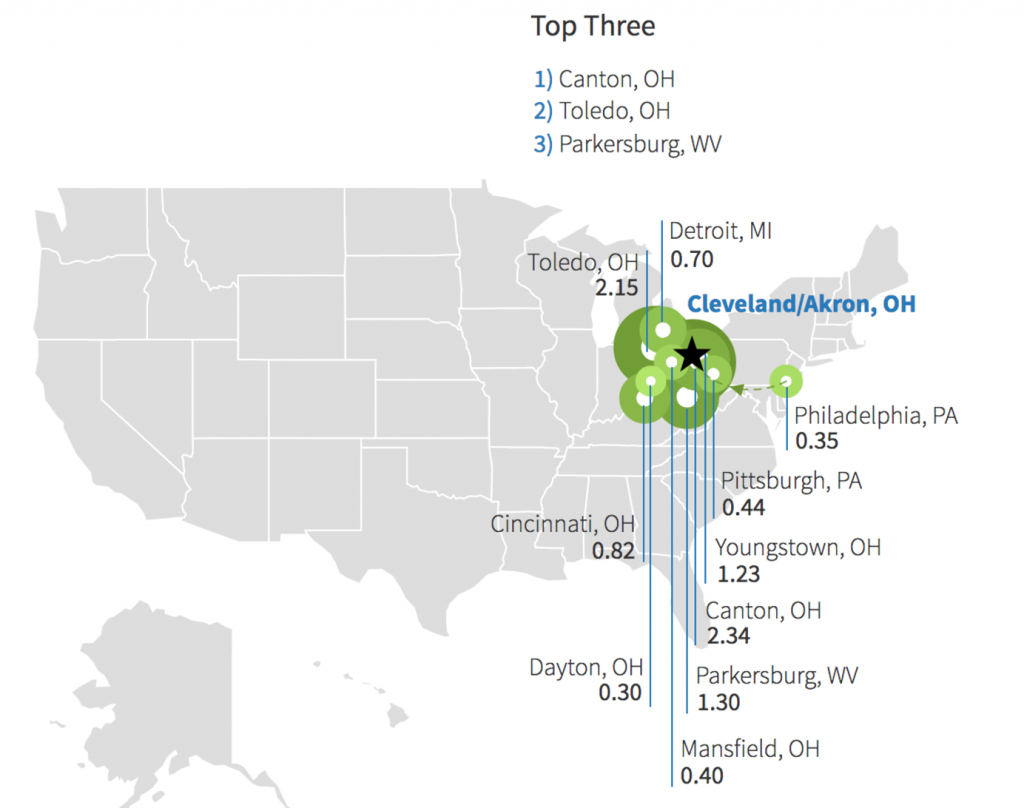
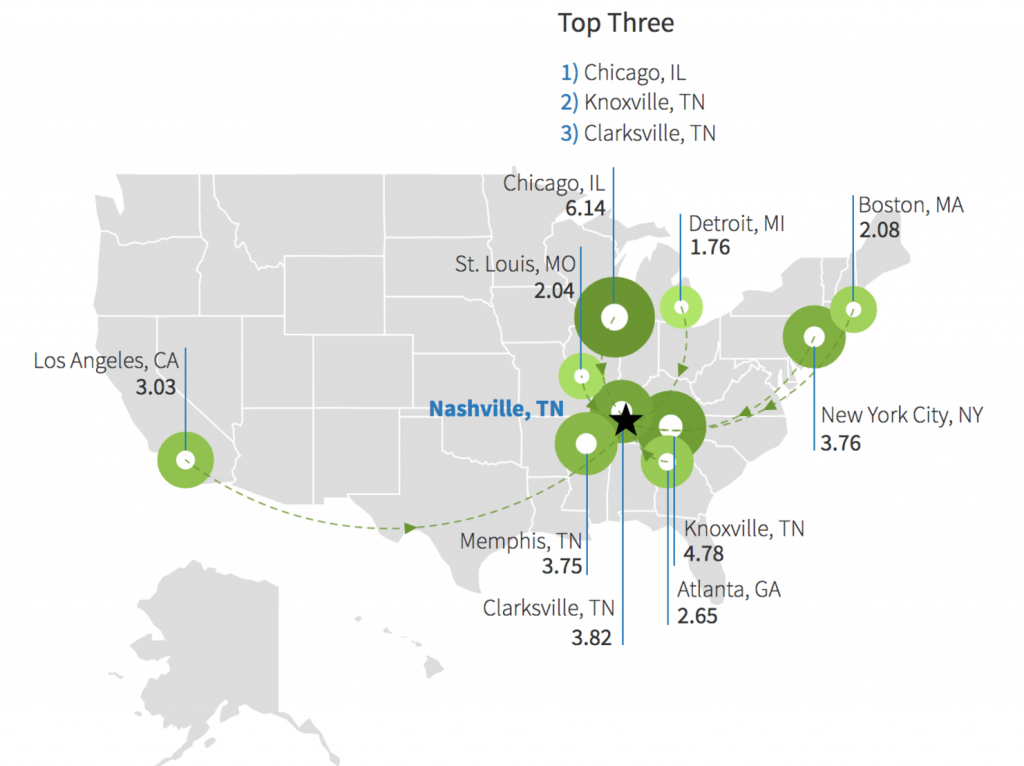
    Jim Russell pointed me as the workforce report program that LinkedIn runs.  They use their data to show trends in 20 major job markets.

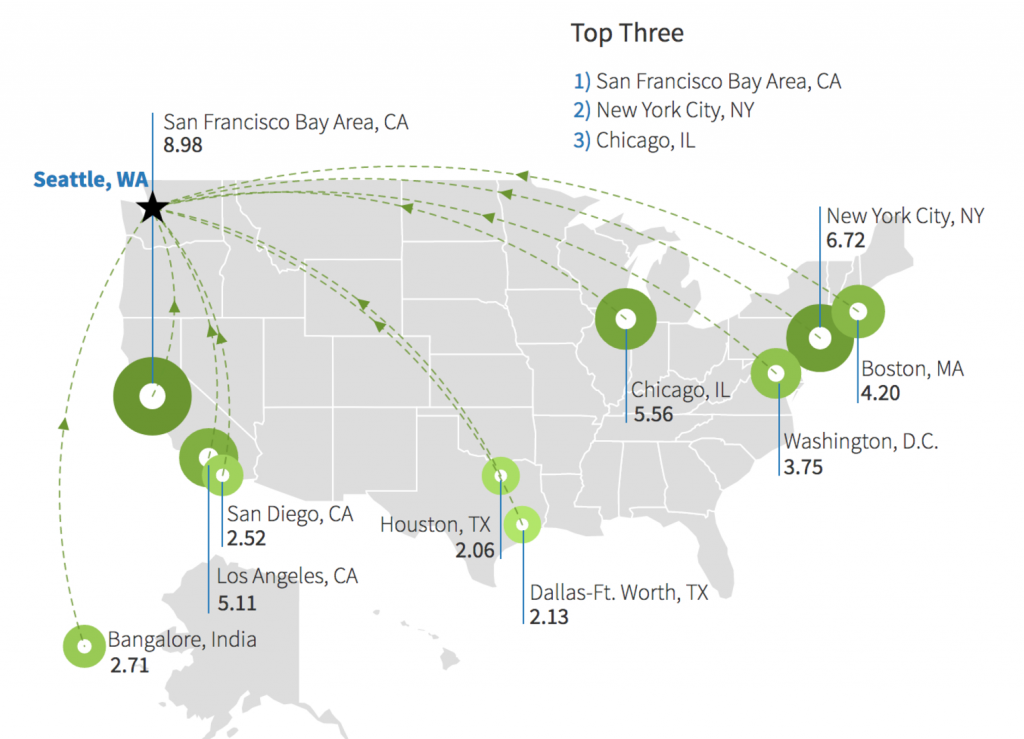
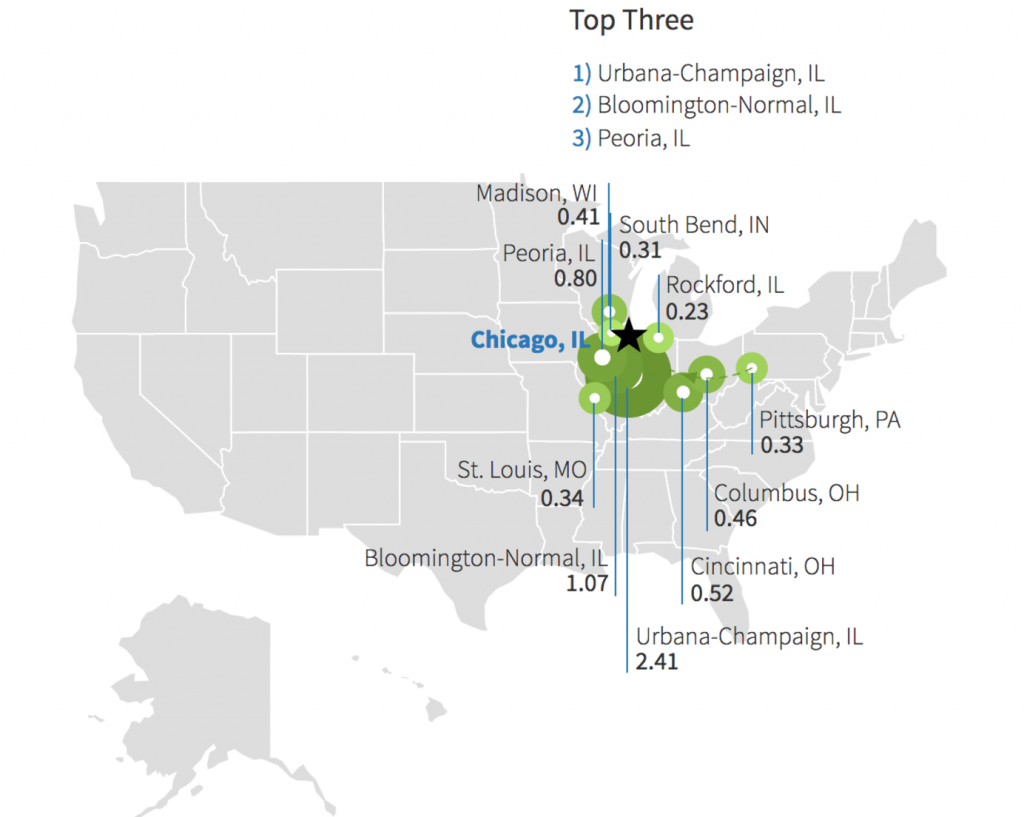
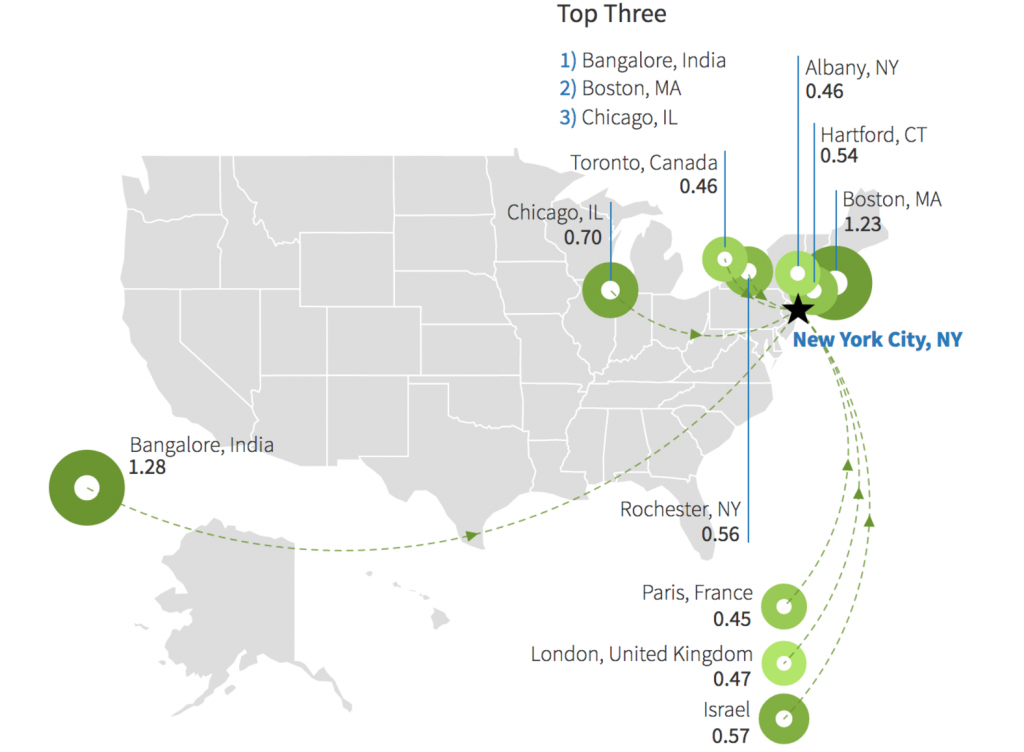
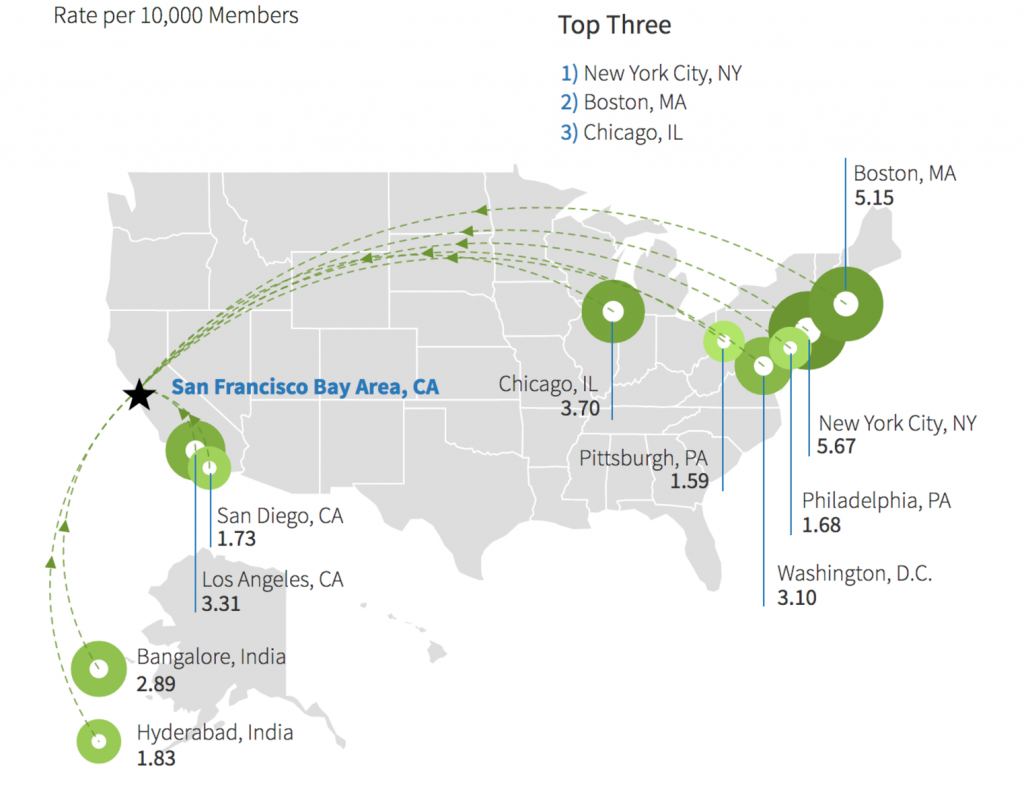
    For each market they track, they put together a map of the 10 cities that market gains the most workers from and the ten in loses the most workers too.

    These are interesting maps in their own right. They also highlight the extremely parochial nature of the talent flows into Midwestern cities. It’s pretty stark, actually. Here’s a set of comparisons, looking strictly at inflows. There are also outflow and gross migration charts and more information that’s interesting too, but I’ll leave you to dig into that yourself.

    Minneapolis vs. Denver vs. Seattle

    Let’s take a look at these three roughly peer cities. First, the top ten cities for Minneapolis.

    Despite the Twin Cities enjoying a high reputation withing the Midwest region, their draw remains highly regional. Their top draws are from adjacent states plus Chicago.

    By contrast, here’s Denver.

    And here’s Seattle:

    The difference is stark.

    Chicago vs. New York vs. San Francisco

    Living up to its reputation as the capital of the Midwest, Chicago’s draw is from a tightly focused region.

    Now, here’s New York:

    Four of New York’s top ten draws are actually from outside the country. That’s pretty amazing.

    And here’s San Francisco.

    You see the flows in mostly from other major tech hubs and big cities.

    Again, a pretty start difference.

    Cleveland vs. Nashville

    We see the same thing in smaller tier cities. Here’s Cleveland.

    And here’s Nashville.

    Again, I’d encourage you to spend some time over at LinkedIn. You can tell a lot about these cities and their economies just by their migration maps. You can also instantly see another dimension of the challenge facing Midwestern cities.

    This piece originally appeared on Urbanophile.

    Aaron M. Renn is a senior fellow at the Manhattan Institute, a contributing editor of City Journal, and an economic development columnist for Governing magazine. He focuses on ways to help America’s cities thrive in an ever more complex, competitive, globalized, and diverse twenty-first century. During Renn’s 15-year career in management and technology consulting, he was a partner at Accenture and held several technology strategy roles and directed multimillion-dollar global technology implementations. He has contributed to The Guardian, Forbes.com, and numerous other publications. Renn holds a B.S. from Indiana University, where he coauthored an early social-networking platform in 1991.

  • Las Vegas Lessons, Part II

    A couple weeks ago I wrote some thoughts after a recent visit to Las Vegas. Most of what I wrote about concerned the Strip and downtown areas of the city, without question the two most recognizable and most frequently visited parts of the region. But in a rapidly growing region of nearly 2.2 million people (the Las Vegas Valley held only 273,000 residents in 1970, meaning it has increased its population by 8 times since then), clearly there’s much more to the region than its most iconic and visible parts. Here I’ll offer some thoughts on the broader region, its built environment, its economy, and thoughts on its future.

    First, for those tl;dr readers who won’t click through to read Part I, here’s a quick summary of it:

    • The Strip and Las Vegas are two entirely different entities.
    • Strip is a great pedestrian experience.
    • The Strip is an exclusively private space.
    • Downtown Las Vegas is quite different from the Strip.
    • There are poor linkages between Downtown Las Vegas and the Strip.
    • The north end of the Strip is plagued with high-profile failed projects.

    Again, as someone who’s “part urbanist, part sociologist, and part economist,” I offer some observations and thoughts on the rest of the city and region.

    The balance of the city and region consists of unremarkable suburbia. This is probably evident to anyone who puts any amount of thought into it, but it does bear repeating. Step away from the Strip and downtown, and Las Vegas’s built environment is amazingly consistent: according to the U.S. Census Bureau American Community Survey in 2015, the metro area is about 60% single family detached homes, with about 4,000-6,000 people per square mile throughout. There’s no sudden or even slight gradation in density as one commonly finds in many eastern cities; the city quickly establishes its suburban character and spits it out relentlessly. And, I’ve been struck on this visit and previous ones at how similar Vegas looks to suburbia in other places. Yes, there are newer, upscale areas that stand out (Summerlin comes to mind), but if you replace Vegas’s palm trees with oaks and elms, it looks a lot like suburbia anywhere else in America, except with Spanish tile roofs. Similarly…

    Nothing in the region is old; the region will have to learn the art and skills of redevelopment. Fifteen years ago when I did some consulting work in Las Vegas, I thought it was weird when city officials referred to West Las Vegas, just northwest of downtown, as “historic”. Most of the homes and businesses there were built in the ’50s and through the ’70s, and in my mind they were the kind of structures that were just beginning to establish some character. But when the median year of structure built in the region is 1995 (the same for Chicago’s metro is 1967), you simply won’t find the pre-WWII type of development that is called historic in other places. There will come a time when the structures of the Las Vegas Valley will be viewed as obsolete and inconsistent with modern living (whatever that is), and the region will have to undergo one of the more difficult transitions for municipalities — shifting from easy greenfield development to complex redevelopment.

    Low wage and low skill jobs proliferate in the region. Like the unremarkable nature of the suburban pattern, here’s another conventional observation that bears repeating. As one would expect, the accommodations/food services employment sector dominates in Las Vegas — nearly one-third of all Las Vegas workers work in hospitality. Those have traditionally been low-paying jobs, and that’s true of the region today. Overall, 44% of Vegas workers earn less than $40,000 a year. Contrast that with Austin, a similarly-sized and similarly-fast-growth metro, where only 9% of workers are employed in accommodations/food services, and just 34% of workers earn less than $40,000 a year (and consider that Austin is a college town that has many recent grads, possibly pushing incomes downward). My concern for Vegas in this regard is that there is growing research that suggests that the kind of work automation that decimated much of the Rust Belt’s manufacturing jobs may now enter a phase that targets food services, administration and office support, sales and even retail jobs — precisely the kinds of jobs that many new Las Vegas residents moved there to occupy. Las Vegas workers could be quite vulnerable to the kinds of challenges that reshaped the Rust Belt.

    The Las Vegas Valley is nearing its physical limits. According to Wikipedia, the Las Vegas Valley is a 600 sq. mi. basin surrounded on all sides by mountains. I don’t know the precise delineations between flat and inclined topography, but a look at Google Earth tells me the region is near its limit:

    I could be wrong, but it looks as if Vegas has available land to the north and southwest, and the Valley might be approaching 90% developed. It could be that the region hits the wall (literally) within the next 10 years. What will that mean for a region that is as low-density suburban as this one? Will the Valley’s communities have the ability to shift their focus inward? Time will tell.

    What happens to the region if tourism… changes? Wikipedia’s Atlantic City page has a good explanation for the decline of tourism there after World War II. It connects its decline with the car; prior to the war, people generally traveled to Atlantic City by train and stayed for a week or two. Cars made people more mobile and they made shorter visits. Suburbanization and its creature comforts, like backyards and air conditioning, also took visitors away from AC. The final nail in the coffin was affordable jet service, opening up vacation spots like Miami, Havana, and the Bahamas (and Vegas) in the 50’s and onward. I don’t know what challenge is out there for Vegas now, but what will be crucial to the region’s survival is how it responds.

    What impact will climate change have on a desert resort city? When flying into Las Vegas I couldn’t help but notice the low level of Lake Mead, just southeast of the city. It was clear from the air; bleached rock that had once been under water now exposed. Las Vegas is blessed to have one of the largest reservoirs in the nation at its back door, but could continued drought and increased demand for water undermine everything? The Strip’s casinos tout themselves as leaders in water conservation, but whether their efforts will be enough as conditions worsen is an open question.

    Las Vegas is truly a unique place. It’s a place that seems to serve a certain time and space, and is concerned about now more than its future. But I’m sure if the region squints its eyes and looks, it will see the future is getting closer. It will need to figure out how it will be sustainable as that future approaches.

    This piece originally appeared on The Corner Side Yard.

    Pete Saunders is a Detroit native who has worked as a public and private sector urban planner in the Chicago area for more than twenty years.  He is also the author of “The Corner Side Yard,” an urban planning blog that focuses on the redevelopment and revitalization of Rust Belt cities.

    Photo by Stan Shebs [GFDL, CC BY-SA 3.0 or CC BY-SA 2.5], via Wikimedia Commons

  • Amazon Eats Up Whole Foods as the New Masters of the Universe Plunder America

    “We must make our choice. We may have democracy, or we may have wealth concentrated in the hands of a few, but we can’t have both.” —Justice Louis Brandeis

    With his $13.7 billion acquisition of Whole Foods, Amazon’s Jeff Bezos has made clear his determination to dominate every facet of mass retailing, likely at the cost of massive layoffs in the $800 billion supermarket sector.

    But this, if anything, understates the ambitions of America’s new ruling class, almost entirely based in San Francisco and Seattle, as it moves to take over industries from entertainment and transportation to energy and space exploration that once thrived and competed outside the reach of the oligarchy.

    Brandeis posed his choice at a time when industrial moguls and allied Wall Street financiers dominated the American economy. Like the oligarchs of the past, today’s new Masters of the Universe are reshaping our society in ways that could, if unchallenged, undermine the foundations of our middle-class republic. This new oligarchy has amassed wealth that would impress the likes of J.P. Morgan. Bezos’ net worth is a remarkable $84.7 billion; the Whole Foods acquisition makes him the world’s second richest man, up from the third richest last year. His $600 million gain in Amazon stock from the purchase is more than the combined winnings of Whole Foods’ 10 top shareholders.

    The Emergence of Oligarchic America

    Founded two decades ago, Amazon revenue has grown eightfold in the last decade. Bezos now wants to “reorganize the world,” as one tech writer put it, “as an Amazon storefront.” He has done this by convincing investors that despite scant profits, the ample rewards of monopoly await. Kroger, or the corner-food store, enjoys no such luxury. With a seemingly endless supply of capital and the prospect of never-ending expansion, the Silicon Valley-Puget Sound oligarchy now accounts for six of the world’s 13 richest people, and virtually all billionaires who are not either very old or merely inheritors.

    Apple, even as it it evades American taxes, enjoys a $250 billion cash reserve that surpass that of the United Kingdom and Canada combined. Their new $5 billion headquarters in Cupertino—like those of firms such as Facebook, Alphabet, and Salesforce.com—reflect the kind of heady excess that earlier generations of moguls might have admired. The peculiar nature of the tech economy rewards even to failures, like Yahoo’s Marissa Mayer, who earned $239 million, almost a million a week, as she drove one of the net’s earliest stars toward oblivion.

    The tech booms of the 1980s and 1990s rode on a wave of entrepreneurialism that provided enormous opportunities for millions of Americans, the current wave is characterized by stagnant productivity, consolidation, and disparities in wealth not seen since the mogul era. As one recent paper demonstrates, the “super platforms” of the so-called Big Five depress competition, squeeze suppliers, and drive down earnings, much as the monopolists of the late 19th century did.

    Indeed for most Americans the once-promising new economy has meant a descent, as one MIT economist recently put it, toward a precarious position usually associated with Third World countries. Even Silicon Valley, the epicenter of the oligarch universe, has gone from one of the most egalitarian places in America to a highly unequal one where the working and middle class have, if anything, done worse, in terms of income, than before the boom.

    The Oligarchs Outsmart the Political Class

    In the past, progressive political thinkers like Brandeis sought to curb over-concentrated wealth and power. In contrast, today’s Democratic establishment rarely addresses such issues. That’s no wonder given that the party is now financed in large part by the tech giants, which have backed in almost lock-step the environmental, social, and cultural agenda that dominates today’s left. In exchange, they have bought political cover for things such as misogyny, lack of ethnic diversity, and of unions and fair labor practices that old-line companies like Walmart, Exxon, or General Motors could never enjoy.

    Hillary Clinton made clear that she would, at best, tinker at the edges of the so-called sharing economy. That after President Obama’s Justice Department did virtually nothing to employ antitrust to block the tech oligarchs’ domination of key markets like search, social media, computer, and smartphone operating systems. Nor did they pressure them to stop avoiding taxes that burden most other businesses.

    Nor can we expect the Republicans, with their instinctive worship of great wealth, to stand up against monopoly and abuse of power. A White House run by Donald Trump, whose true religion seems to be that of the Golden Calf, and his Goldman Sachs economic henchmen are inherently unable to oppose ever greater concentration of money in the hands of a select few. It’s no surprise that so far, in terms of stocks, the tech giants have been among the biggest winners under Trump.

    Controlling the Means of Information

    The Masters’ ascendency has been enhanced by their growing control of the means of communications. Facebook is already the largest source of news for Americans, particularly the young. They, along with Google, seem capable of shaping information flows to suit their particular world view, one increasingly hostile to any dissenting opinions from the right. (One key to understanding post-election concerns about “fake news” is to realize that a staggering 99 percent of growth in digital advertising in 2016 went to Google and Facebook.) At the same time, those two, along with Apple and Amazon, increasingly shape the national culture, essentially turning Hollywood into glitzy contract laborers.

    But no one practices the politics of oligarchy better than Bezos. Under his ownership The Washington Post has been transformed into the Pravda of the gentry left. Last year, for example, they worked overtime to undermine Bernie Sanders’ campaign, whose victory might have led to stronger antitrust enforcement and the confiscation of some of their unprecedented wealth. Once Sanders was dispatched, Bezos, fearing the rise of uncontrollable Trumpian populism, sank his editorial resources into supporting the big money favorite, Hillary Clinton.

    The New Political Agenda

    Populism, left or right, represents the only viable threat to oligarchic ambitions. Bank of America’s Michael Harnett recently warned that if the growth of stock market wealth continues to be concentrated in a handful of tech stocks, that “could ultimately lead to populist calls for redistribution of the increasingly concentrated wealth of Silicon Valley.”

    Deflecting populism is the central imperative of an oligarchy. They feel their dominance as evidence of their superior intellect and foresight, not the result of such things as political influence, or easy access to capital. They embrace, as former TechCrunch reporter Greg Ferenstein put it, the notion of “a two-class society of extremely wealthy workaholics who create technologies that allow the rest of society to enjoy leisurely prosperity. The cost for this prosperity will be inequality of influence.”

    What Google’s Eric Schmidt calls the Valley’s “religion in-of-itself” has little in common with resuscitating grassroots Democratic capitalism, the old dream of libertarians, or empowering the working class, that of old leftists. The founders of the big tech firms may embrace progressive ideas on the environment, free trade, and immigration, but have little use for unions or raising capital gains rates.

    Overall, notes Ferenstein, they eschew nationalism, favoring global governance, want more immigration and embrace the notion of a government nanny state to tell the masses how to live. They also prefer highly unequal conditions of urban density over the more traditionally egalitarian suburbs. Largely childless San Francisco, impossibly expensive and deeply divided by class, is the preferred model of the future.

    The Problem is People

    People, little or otherwise, now constitute the Masters’ biggest problem. Unlike the old moguls like Andrew Carnegie or Henry Ford, the new Masters do not promise greater prosperity, or even decent jobs for the middle or working class. Their vision, increasingly, seems to be a world where most people’s labor is largely superfluous, and will need to be satiated with regular basic income from the state, a position now widely embraced by such luminaries as Mark Zuckerberg and Elon Musk, supplemented by occasional “gig” work.

    They imagine a future where few will ever own homes or control any real assets. Rather than being parts of a geography or even a country, the increasingly socially isolated masses can be part of Zuckerberg’s “global community” while ordering food from Amazon, delivered by a drone from an automated warehouse, employing social media and virtual reality to fill their long periods of idleness.

    As Brandeis warned, this vision—dominated by the interests and influence of the few who possess the bulk of the wealth—is incompatible with the democracy that we have known.

    This piece originally appeared on The Daily Beast.

    Joel Kotkin is executive editor of NewGeography.com. He is the Roger Hobbs Distinguished Fellow in Urban Studies at Chapman University and executive director of the Houston-based Center for Opportunity Urbanism. His newest book is The Human City: Urbanism for the rest of us. He is also author of The New Class ConflictThe City: A Global History, and The Next Hundred Million: America in 2050. He lives in Orange County, CA.

    Photo by National Museum of American History, via Flickr, using CC License.

  • Is America Now Second-Rate?

    President Donald Trump’s recent renunciation of the Paris climate change accords has spurred “the international community” to pronounce America’s sudden exit from global leadership. Now you read in the media aspirations to look instead to Europe, Canada, or even China, to dominate the world. Some American intellectuals, viewing Trump, even wish we had lost our struggle for independence.

    Yet, perhaps it’s time to unpack these claims, which turn out to be based largely on inaccurate assumptions or simply wishful thinking. In reality, these countries are hardly exemplars, as suggested by the American intellectual and pundit class, but rather are flawed places unlikely to displace America’s global leadership, even under the artless Trump.

    We’ll always have Paris, or is it Beijing?

    California Gov. Jerry Brown’s recent trip to China reflects the massive disconnect inherent in the progressive establishment worldview. The notion that the country that is the world’s largest emitter of carbon dioxide, emitting nearly twice as much as the United States, and is generating coal energy at record levels, should lead the climate jihad is so laughable as to make its critics, including Trump, seem reasonable. All this, despite the fact that the U.S., largely due to the shift from coal to natural gas, is clearly leading the world in greenhouse gas reductions.

    Paris is good for China in that it gets it off the hook for reducing its emissions until 2030, while the gullible West allows its economies to be buried by ever-cascading regulations. The accords could have cost U.S. manufacturers as many as 6.5 million industrial jobs, while China gets a basically free pass. President Xi Jinping also appeals to the increasingly popular notion among progressives that an autocracy like China is better suited to address climate change than our sometimes chaotic democratic system.

    Xi has played the gullible West with a skill that would have delighted his fellow autocrat, Joseph Stalin, who did much the same in the 1930s. (“Purges? What purges?”) Of course, Xi does not have to worry much about criticism from the media — or anywhere else. Trump may tweet insanely and seek needless fights with the media, but critics of the Chinese Communist Party end up in prison — or worse. To accuse Trump of loving dictators and then embrace Xi seems a trifle dishonest.

    Ultimately, the Paris accords are much ado about nothing. The goals will have such little impact, according to both rational skeptics like Bjorn Lomborg and true believers like NASA’s James Hanson, as to make no discernible difference in the climate catastrophe predicted by many greens. In reality, Paris is all about positioning and posturing, a game at which both Brown and Xi are far more adept than the ham-handed Trump.

    Read the entire piece at The Orange County Register.

    Joel Kotkin is executive editor of NewGeography.com. He is the Roger Hobbs Distinguished Fellow in Urban Studies at Chapman University and executive director of the Houston-based Center for Opportunity Urbanism. His newest book is The Human City: Urbanism for the rest of us. He is also author of The New Class ConflictThe City: A Global History, and The Next Hundred Million: America in 2050. He lives in Orange County, CA.

    Photo by Michael Temer via Flickr, using CC License.

  • Connecticut’s Future is Suburban, Not Urban

    Connecticut is now grappling with a fiscal and economic crisis that, according to some leading Democrats, has been caused by ineffective urban policy. In late May, Hartford-based insurer Aetna confirmed long-discussed rumors that it will be moving its headquarters from Connecticut. General Electric announced plans to move from Fairfield, Connecticut to Boston in January 2016. Though the Great Recession officially ended eight years ago, state budget forecasters are projecting a $2 billion deficit for next fiscal year, or 11 percent of the budget. One policy report published in March, when rosier estimates pegged Connecticut’s deficit at only 9 percent, ranked Connecticut as having the 8th largest shortfall among American states. Hartford, the state capital, is on the verge of bankruptcy.

    What course should Connecticut take to stabilize government budgets and stimulate the economy? Gov. Dannel Malloy and Hartford mayor Luke Bronin believe that stronger cities are the answer. As Malloy said recently, explaining why his budget increases state aid for cities, “I think there is a body of people who don’t understand urban environments, and I think Connecticut has too long pursued a public policy of insufficient support for our urban environments.”

    But there are many questions to raise about just how vital urban Connecticut is to the state’s future. Connecticut’s major cities have their charms, especially Hartford and New Haven. But in terms of meeting the enormous fiscal and economic challenges with which the state is now faced, they are and will remain less important than its suburban regions.

    With all due respect to Gov. Malloy and Mayor Bronin, there’s a certain glibness in how they presume that Connecticut’s poor urban areas can be revitalized. It’s not as if their predecessors haven’t been trying. Any visitor to downtown Hartford and New Haven will be struck by several imposing works of mid-20th century modern architecture. Examples include Constitution and Bushnell plazas in Hartford and New Haven’s Temple Street Garage. These projects date back to the “urban renewal” era of the 1950s and 1960s, when massive government resources were devoted towards breathing new life into tired central cities.

    New Haven was nationally-renowned for its urban renewal efforts, both because it focused just as much on rehabbing old buildings as demolishing them . Mayor Richard Lee’s “human renewal” social service programs anticipated criticisms that poverty can’t be cured through real estate development alone. But the widely celebrated Mayor Lee failed to hit the mark. New Haven, the “Model City,” was rocked by a race riot in 1967, as was Hartford in 1969.

    Despite growing evidence that Connecticut cities were not coming back, urban renewal in modified forms would continue throughout the decades. In 1974, Hartford gained the “Hartford Civic Center,” (now known as the XL Center), a sports and entertainment venue where the NHL’s Hartford Whalers played from 1980 to 1997. The state’s convention center opened in Hartford in 2005, and a minor league baseball park just came online in April. And yet, among American cities with a population above 100,000, Hartford’s poverty rate is 8th highest in the nation. Mayor Bronin himself describes the current fiscal state of affairs in Hartford as “the largest budget crisis in our city’s history.”

    State government is not much better off. Connecticut’s budget deficit is driven by escalating costs for public pensions, which powerful government unions have balked at reforming, and weak tax receipts despite—or perhaps because of—a series of recent income tax hikes. Gov. Malloy, a progressive Democrat, has recently taken the position that trying to further increase the tax burden on the state’s 1 percent would be counterproductive.

    Urban revitalization is an unsound strategy for addressing budget deficits because creating strong cities is the work of generations. The secret of Boston’s success is reflected in a famous saying attributed to Daniel Patrick Moynihan: “If you want to build a world-class city, build a great university and wait 200 years.” Cities like New York that are now envied as talent magnets have had that reputation going back many years. Even in the 1970s, when New York was plagued by high crime and the threat of insolvency, it was still a national leader in finance, media and the arts.

    Bronin and Malloy have said that they understand Hartford can’t become New York or Boston. But among Hartford’s true peers—formerly industrial small and mid-sized cities throughout the northeast and Midwest—it is very difficult to find any examples of an authentic comeback city. In an analysis I recently wrote about Hartford, New Haven, Waterbury and Bridgeport, I found that, since 1970, the number of poor people living in these cities had increased by 56.1%, 40.8%, 153.6% and 86.3%, respectively. Over the same span, all have seen their total populations decline with the exception of Waterbury, which has grown by 1.7%.

    Despite all the hype over America’s urban renaissance, cities remain a tough sell for the middle class. However magnetic a city may be in attracting young millennials, as studies by William Sander of DePaul University and William Testa of the Chicago Fed have demonstrated, the more educated you are, the more likely you are to opt for suburbs when you settle down. If, 20 years ago, a given city had an underperforming school system that was unattractive to middle class families, it most likely remains unattractive to them now. According to the most up-to-date Census data we have, within most major metros, suburban areas are growing more rapidly than central cities.

    Connecticut is often associated with suburban blandness. But it happens to boast one of the most talented labor forces in the nation. A 2016 McKinsey report ranked Connecticut second among states in productivity (GDP per worker). Statewide, 16.6 percent of adults have advanced degrees, a rate which trails only Massachusetts and Maryland. (Only 6.7 percent of adults in Hartford have advanced degrees.) In coming years, the high levels of productivity and educational attainment among Connecticut’s suburban residents will be essential to any growth the state manages to achieve. Fairfield County Connecticut boasts some of the strongest public schools in the nation, whereas the state’s urban school districts remain troubled.

    As Connecticut officials contemplate a policy response to Aetna’s exit, it is crucial that they not lose sight of the following. We don’t know how to revitalize poor old industrial cities, especially small and mid-sized ones. Middle class families with children are opting for the suburbs just as reliably as in prior generations. One of the soundest economic development strategies is for a state to offer potential employers a productive and educated workforce, which Connecticut plainly does. State officials should build on current virtues, avoid chasing fads, focus more on budget discipline, and by all means stop trying to make Connecticut into something it’s not.

    Stephen Eide is a Senior Fellow at the Manhattan Institute.

    Photo by Doug Kerr, via Flickr, using CC License.

  • The Superstar Gap

    The biggest challenge facing many cities in transitioning to the knowledge economy is a shortage of “A” talent, especially true superstars.

    All “talent” isn’t created equal. Crude measures such as the percentage of a region with college degrees, or even graduate degrees, don’t fully capture this. It is disproporationately the top performers, the “A” players and superstars that make things happen.

    Sections of the knowledge economy have long been geared to superstars. Economist Enrico Moretti cites research on biotech hubs, in which he notes that it is not just having a top university nearby that mattered in establishing biotech clusters, but having the true handful of academic superstars researchers. In The New Geography of Jobs, he writes:

    In a fascinating and now classic article and in a series of subsequent studies, they argued that what really explains the location and success of biotech companies is the presence of academic stars – researchers who have published the most articles reporting specific gene sequencing discoveries. Among top universities, some institutions happened to have on their faculties stars in the particular subfield of biology that matters for biotech; others had comparable research but did not have stars in that specific subfield. The former group created a local cluster of biotech firms while the latter did not.

    Richard Florida devotes a significant amount of his latest book The New Urban Crisis discussing the rise of the superstar phenomenon, which he also links to specific superstar cities.

    Superstars are important in tech because of the 10x principle I mentioned in my recent post on the Silicon Valley mindset. The best coders are 10x as productive as the merely very good coder. The top entrepreneurs are probably 100x or or more. The presence of superstars, along with some amount of good fortune, can transform the economy of a city or region.

    Jeff Bezos is a superstar. Mark Zuckerberg is a superstar. Michael Bloomberg is a superstar.

    These superstars are disproporationately located in only a handful of regions.

    To see this effect, just look at Austin vs. Seattle. Austin is a booming, prosperous city with a major tech industry. Yet Seattle is generating significantly greater value. Seattle’s real per capita GDP is $75,960 vs. only $55,323 in Austin. Seattle’s per capita income is $61,021 vs. $51,014 in Austin.

    Austin had some good entrepreneurs like Michael Dell, but not superstars in industries that would create massive platforms like Microsoft and Amazon. Austin has a lot of quantity, but it looks to me like there’s a big quality gap vs. Seattle.

    And it’s not just that superstars create things, they act like a magnet attracting others. As economic development consultant Kevin Hively once told me, “When you’re the best in the world, people beat a path to your door.”

    To see this in action, just look at Carnegie Mellon University in Pittsburgh. CMU has the #1 ranked computer science program in the country. And companies like Google (600 employees), Uber (500 employees), Apple (500 employees), Intel, and Amazon been drawn there and set up shops around it. Ford is investing a billion dollars into autonomous vehicle ventures there. And GM also has a presence.

    It’s interesting to contrast with the University of Illinois’ program. U of I is ranked 5th in computer science. My impression is that from a commercial impact, they used to be bigger time than they are now. The web browser as we know it was invented there, but that was a long time ago. They have a research park designed for companies wanting to take advantage of proxmity of U of I. There are a lot of companies there, but the tech roster isn’t as marquee as Pittsburgh’s and my impression is that the scale is smaller.

    There’s a big differnce between being number one and number five, particularly when something like ownership of the driverless car market is at stake. Maybe that’s why former GE CEO Jack Welch said he only wanted to be in a business if he could be number one or number two.

    Cities and states in the Midwest and elsewhere in the interior like to boast of their assets, which include many great schools, but very few world dominating number ones in important fields. This is a big challenge for them.

    Superstars aren’t the entire world. The presence of superstar businesses also creates problems as well as wealth. But if these places want to not only thrive but perhaps for some of them even just survive in the knowledge economy world, they need to look at their attractiveness to the truly top tier talent (I will address “A” caliber but not superstar talent in a future post). I don’t often see this talked about.

    For example, one thing I don’t see in most discussion of Chicago is its lack of superstar talent. Chicago is very good but not the best in a lot of things. Where they do have arguably world beating talent, such as in their culinary industry, they shine. (I know people in New York who happily admit Chicago has better restaurants).

    If I were that city, I’d be looking to see how to create a world’s best talent pool in additional particular high impact industries. Maybe the state should consider some radical type action, such as relocating U of I’s entire computer science and select engineering programs to Chicago as part of UI Labs, and putting serious muscle behind getting at least some critical subspecialities with high commerical potential to be clear #1’s in the world.

    This is actually a scenario I plan to study in the future. Right now I’m not sure it’s necessary and some of my initial thoughts are impressionistic. So this post is in part a honeypot to try to lure in those who might react to this or even help flesh out the facts (which might augur against it).

    Regardless, this lack of superstar/number one type talent in the interior is a big handicap in the world we live in now. For example, just look back at a 2010 analysis Carl Wohlt did of where the people on Fast Company’s “100 Most Creative People in Business” list lived. Only six in the Midwest and seven in the South vs. 35 in the West and 32 in the Northeast (with 20 international). This isn’t a scientific survey but illustrates the scope of the problem.

    Cities and states need to take a more finer grained view of talent, and understand the criticality of having at least some of the absolute best talent to kicking a region’s knowledge economy into high gear. Too many places have a superstar gap.

    This piece originally appeared on Urbanophile.

    Aaron M. Renn is a senior fellow at the Manhattan Institute, a contributing editor of City Journal, and an economic development columnist for Governing magazine. He focuses on ways to help America’s cities thrive in an ever more complex, competitive, globalized, and diverse twenty-first century. During Renn’s 15-year career in management and technology consulting, he was a partner at Accenture and held several technology strategy roles and directed multimillion-dollar global technology implementations. He has contributed to The Guardian, Forbes.com, and numerous other publications. Renn holds a B.S. from Indiana University, where he coauthored an early social-networking platform in 1991.

    Photo by John Picken (Flickr: Chicago River ferry) [CC BY 2.0], via Wikimedia Commons