Category: Demographics

  • Should California Governor Jerry Brown Take a Victory Lap?

    "Memento Mori" – "Remember your mortality" – was whispered into the ears of Roman generals as they celebrated their great military triumphs. Someone should be whispering something similar in the ear of Gov. Jerry Brown, who has been quick to celebrate his tax and budget "triumph" and to denounce as "declinists" those who threaten to rain on the gubernatorial parade.

    Brown speaks about California’s "rendezvous with destiny" and the state’s "special destiny… more vibrant and more stunning in its boldness." His pitch certainly has persuaded much of the mainstream media to add their horns to the triumph.

    Yet right now, despite its many blessings, our state remains more on a collision course with mediocrity – at best– than with any such manifest destiny. California may not be a "death-spiral state" as some conservatives suggest, but Brown’s triumphs – the Proposition 30 tax increases, the marginalization of the GOP as well as his Democratic rivals – have been more political than substantial and have done little to address the state’s major long-term challenges.

    Let’s check this out. Unemployment remains the third-highest among the states; we still have one-third of the nation’s welfare recipients; the highest poverty rate in the country, with one in five of California’s diminishing ranks of children living in poverty, including more than a third of children in Fresno. Our education system, with new dollars or not, continues to fail young people and our economy.

    Critically, the three key elements typically invoked to promote the comeback meme – budget relief, the genius of Silicon Valley alchemists and "green" jobs – are themselves suspect. Even Brown, who suggested that we could create 500,000 jobs from his climate change agenda, isn’t speaking much about it. In California, and across the nation, "green jobs" have failed to materialize enough to offset the higher costs imposed on the rest of the economy, the high public subsidies and parade of failed ventures associated with these policies.

    Yet, Brown is so dogmatically loyal to this agenda that he remains committed to massive regulation of the economy, which is slowing growth. And he shows – despite his occasional bouts of fiscal sanity – no signs of backing away from his financially troubled bullet-train fantasy.

    If green economics are failing, can Silicon Valley bail out the state? Reporters anxious to celebrate our deep-blue state’s comeback almost always genuflect to the tech industry. They rarely bother to look at the fact that, even with considerable growth in the tech sector over the past two years, the valley has not even recovered the job levels of a decade ago.

    More troubling still, Silicon Valley is becoming less an exemplar of capitalism than the beneficiary of an insider game that relies on access to capital and contacts more than on innovation. It is also becoming increasingly dependent on government largesse: No one bet more on subsidized "green" companies than the venture-capital elite. Prospects are also dimming for social media, the valley’s latest signature industry. User interest in Facebook is slipping, notes Pew, and the industry now sees its next great opportunity, of all socially worthless things, in online gambling.

    Even under the best of circumstances, Silicon Valley is neither robust enough nor predisposed to help solve the state’s long-term fiscal challenges. In fact, the high-tech darlings of the progressives, such as Google and Apple, are turning out to be as adept in not paying taxes as are Mitt Romney or General Electric. For its part, Facebook now appears to have paid no income taxes at all last year.

    In fact, the only thing bailing out California is not growing tech firms, but the enormous legacy of wealth, including inherited wealth, that has built up in our state over the past 30 years. California is still rich in rich people, whose stock and real estate holdings are gaining value. As long as Uncle Ben’s printing press hands out free money, California could collect enough in state income taxes to perhaps balance its annual budget for a spell.

    None of this places, to say the least, California on a firm footing. So at the risk of engendering some gubernatorial ire, here’s my memento mori suggestions for restoring California’s promise. This starts with the assumption that the elements of a true revival exist and that, if Brown would shed some of his dogma, he may end up deserving his current plaudits.

    Get real on the budget.Asset bubbles may rescue the state from annual budget woes, but the state’s long-term prospects remain cloudy, due largely to mounting government employee pension costs. Attempts to revise the game for new employees are not sufficient to scale the state’s mounting "wall of debt"; Californians per capita now owe almost five times as much to Wall Street as residents of our chief rival, Texas. Analyst Joe Matthews suggests we need more drastic fixes, such as cutting off retirees’ health benefits after they reach Medicare age.

    Redirect the climate-change jihad. California can keep leading in conservation but needs to adopt a more pragmatic people-friendly approach, such as by encouraging telecommuting and energy-saving technologies. In contrast, the current high-density housing diktats and ultra-expensive "green" energy will force up prices for housing and electricity rates way out of proportion to national norms. This damages the middle and working class even if it won’t impinge on the lifestyles of Brown’s rich and famous friends.

    Focus on basic industry. Tech and entertainment can never drive enough jobs or wealth to support this huge state. But California is blessed with the country’s richest soil and huge fossil-fuel reserves. These could bring in new revenue to the state and create new jobs for a broad number of Californians, particularly in the hard-pressed interior. Particularly critical is the state of the water system, which once again faces large cutbacks because of pressure from environmentalists. Brown has spoken in favor of a peripheral canal; solving the water problem may leave him with a greater legacy than the dodgy bullet train.

    Reform the education system. More money alone won’t save the schools, but may be used only to prop up the pensions of teachers and administrators. Some kind of radical reform – perhaps school choice, vouchers, mass use of charters – must be the price of any increase in money to education. Brown has made some reformist noises with the University of California, but he remains tethered to the teachers unions on K-12 schools.

    Invest in economically needed infrastructure. Besides the peripheral canal, Brown should look at expanding the state’s energy supply by permitting the construction of low-polluting, economically efficient gas-fired power plants. Rather than waste money on a "train to nowhere," he should be looking at fixing roads, bridges, ports – the sinews of a modern economy – and improving existing inter-city trains (and buses), particularly in high-volume corridors in the Bay Area/Sacramento and across Southern California.

    Prioritize blue-collar opportunities. California’s greatest challenges lie with a widening class divide. Bolstering manufacturing, which is in a secular decline here, and restarting construction could create new opportunities for blue-collar workers. Port expansion would create lots of jobs in everything from warehousing to assembly and business services. This can be meshed with revitalized training programs for the skilled trades. In simple terms: California needs more skilled machinists, electricians and irrigation technicians and likely fewer marginally employable ethnic-studies or humanities grads from second- and third-tier schools.

    One can understand why our governor, at age 74, wants to enjoy his triumph. But to deserve the laurel wreath, he first needs to make the major changes that can bring this greatest of states back to its historic potential.

    Joel Kotkin is executive editor of NewGeography.com and a distinguished presidential fellow in urban futures at Chapman University, and a member of the editorial board of the Orange County Register. He is author of The City: A Global History and The Next Hundred Million: America in 2050. His most recent study, The Rise of Postfamilialism, has been widely discussed and distributed internationally. He lives in Los Angeles, CA.

    This piece originally appeared in the Orange County Register.

    Jerry Brown photo by Bigstock.

  • Communities Need to Build Better Millennial Connections

    A remarkable, but mostly unnoticed, 2012 study found a powerful correlation between a community’s civic health and its economic well being. The analysis by the National Conference on Citizenship (NCoC) and its partners found that the density of non-profits whose purpose was to encourage their members’ participation within the community   correlated strongly with the ability of a locality to withstand the effects of the Great Recession. The same analysis revealed that those municipalities having the greatest amount of “social cohesion,” defined as “interacting frequently with friends, family members, and neighbors,” also showed greater resilience in ameliorating job losses during economic downturns, independent of the density of their non-profit sector.

    The numbers are startling. States with high social cohesion had unemployment rates two percentage points lower than their less connected counterparts, even controlling for demographics and economic factors. A county with just one additional nonprofit per 1,000 people in 2005 had half a percentage point less unemployment in 2009. And for individuals who held jobs in 2008, the odds of becoming unemployed were cut in half if they lived in a community with many nonprofit organizations rather than one with only a few, even if  the two communities were otherwise similar. Given these results, every community interested in improving its economic vitality should be devising strategies to increase the civic health of their locality.

    One way to accomplish this goal is to attract members of the hyper-connected but locally-focused Millennial Generation (born 1982-2003).  People in their thirties – a group millennials are just entering but will soon dominate – and early forties, the age when people are building families and careers, constitute the essential social ballast for any community, city or suburb. For the rest of this decade as well as the next, Millennials will comprise the cohort entering this key phase of life, contributing both economic stimulus and a new sense of community wherever they choose to live. Fortuitously, the same organization (NCoC) that produced the original report has just released a new study suggesting several strategies cities could use to attract America’s most community-oriented generation.

    According to this year’s study, more densely populated communities face a major challenge in attracting civic-oriented Millennials. This is contrary to much of the conventional wisdom about both millennials and “community”.  It found that members of the generation who reside in denser urban communities are less likely to engage in the type of service activities that nonprofits are designed to encourage. Except in the South, Millennials living in suburbia or more rural settings were more likely to engage in service activities with their peers than their urban counterparts. In fact, the worst community participation rates by far were found among Millennials in the country’s Northeastern cities.

    A recent analysis by demographer Wendell Cox of Millennial living patterns validated these findings. He found that those major metropolitan areas with the least density gained the lion’s share of increases in populations of 25 to 34 year olds in the first decade of this century. Another, as yet unpublished study by Cox, has found that the same holds true for 20-24 year olds. 

    To fix that problem and increase their economic resiliency, more densely populated communities should actively encourage the formation of military veteran’s groups and other nonprofits that foster citizen participation and leadership skills. Other types of nonprofits that the earlier NCoC study suggested would help improve a city’s civic and economic vitality are sports clubs, labor unions and those that offer job-training opportunities. By providing such nonprofits with the space and resources to attract and engage America’s largest and most diverse generation, communities can gain the economic benefits that service organizations, such as Kiwanis and the Elks, brought to their communities in the past.

    A recent review of the seven best cities for Millennials to obtain an initial foothold for their economic future placed greater Seattle at the top of the list. It was followed by Dallas; Minneapolis; Athens, Georgia; Ithaca, New York; Oklahoma City; and Phoenix.  () Most of these communities combine relatively lower levels of density with lower rates of unemployment making them especially attractive to Millennials.  

    One way for denser urban centers to compete with such localities is to gain a broad mix of educational attainment among their younger populations, thereby increasing their social cohesion and, ultimately, economic resiliency. This is because Millennials without a high school diploma are least likely to trust their neighbors but most likely to help those very same neighbors on a regular basis. Meanwhile, Millennials who attend college become more trusting of their neighbors wherever they end up settling, but less likely to help them out. In order to build both a trusting community and one where friends and neighbors help each other out, communities need to provide a broad range of jobs requiring various levels of education and encourage Millennials to stay in the place where they grew up or return there upon graduation.

    Communities interested in enhancing their social cohesion should take a close look at the example set by the civic leaders of Kalamazoo, Michigan. Under its Kalamazoo Promise program, families that enroll their children in the local school district get help with college tuition on a sliding scale based on how many grades of education the child completes in the city’s schools. The strategy, which has led to greater demand for housing within the school district’s boundaries as well, encourages the development of a community with a wide range of educational success among its residents.  

    The most recent study also found that once Millennials complete their schooling and begin to settle down their civic engagement increases. In fact, those 29 and under who are married and have children are more likely than those over thirty who do not have a family to participate in activities, such as helping neighbors, that in turn lead to greater social cohesion.

    One strategy for encouraging college educated Millennials to settle in the community where they grew up, may lie with making the cost of college locally more affordable. For example, in contrast to many states that are shortsightedly reducing their subsidies of in state tuition, North Dakota is using some of its increased tax revenue from the state’s explosion in energy production to limit tuition increases for their residents and increasing the amount of needs-based tuition aid and scholarships for those who decide to attend any college in the state.

    Building better communities requires encouraging the human interaction and connectivity that make a municipality more resilient in times of economic difficulty. Building this type of social capital comes naturally to Millennials, the nation’s most connected generation.   Non-profits that attract younger people should be actively encouraged to set up shop in cities and localities across the country. Programs that support educational attainment and employment opportunities for Millennials should be viewed as another essential element of economic strategy.  Today, community’s economic health is inextricably intertwined with the type of civic vitality that local Millennials can generate.  

    Morley Winograd and Michael D. Hais are co-authors of the newly published Millennial Momentum: How a New Generation is Remaking America and Millennial Makeover: MySpace, YouTube, and the Future of American Politics and fellows of NDN and the New Policy Institute.

    Homes image by BigStock.

  • Gentrification and its Discontents: Notes from New Orleans

    Readers of this forum have probably heard rumors of gentrification in post-Katrina New Orleans. Residential shifts playing out in the Crescent City share many commonalities with those elsewhere, but also bear some distinctions and paradoxes. I offer these observations from the so-called Williamsburg of the South, a neighborhood called Bywater.

    Gentrification arrived rather early to New Orleans, a generation before the term was coined. Writers and artists settled in the French Quarter in the 1920s and 1930s, drawn by the appeal of its expatriated Mediterranean atmosphere, not to mention its cheap rent, good food, and abundant alcohol despite Prohibition. Initial restorations of historic structures ensued, although it was not until after World War II that wealthier, educated newcomers began steadily supplanting working-class Sicilian and black Creole natives.

    By the 1970s, the French Quarter was largely gentrified, and the process continued downriver into the adjacent Faubourg Marigny (a historical moniker revived by Francophile preservationists and savvy real estate agents) and upriver into the Lower Garden District (also a new toponym: gentrification has a vocabulary as well as a geography). It progressed through the 1980s-2000s but only modestly, slowed by the city’s abundant social problems and limited economic opportunity. New Orleans in this era ranked as the Sun Belt’s premier shrinking city, losing 170,000 residents between 1960 and 2005. The relatively few newcomers tended to be gentrifiers, and gentrifiers today are overwhelmingly transplants. I, for example, am both, and I use the terms interchangeably in this piece.

    One Storm, Two Waves

    Everything changed after August-September 2005, when the Hurricane Katrina deluge, amid all the tragedy, unexpectedly positioned New Orleans as a cause célèbre for a generation of idealistic millennials. A few thousand urbanists, environmentalists, and social workers—we called them “the brain gain;” they called themselves YURPS, or Young Urban Rebuilding Professionals—took leave from their graduate studies and nascent careers and headed South to be a part of something important.

    Many landed positions in planning and recovery efforts, or in an alphabet soup of new nonprofits; some parlayed their experiences into Ph.D. dissertations, many of which are coming out now in book form. This cohort, which I estimate in the low- to mid-four digits, largely moved on around 2008-2009, as recovery moneys petered out. Then a second wave began arriving, enticed by the relatively robust regional economy compared to the rest of the nation. These newcomers were greater in number (I estimate 15,000-20,000 and continuing), more specially skilled, and serious about planting domestic and economic roots here. Some today are new-media entrepreneurs; others work with Teach for America or within the highly charter-ized public school system (infused recently with a billion federal dollars), or in the booming tax-incentivized Louisiana film industry and other cultural-economy niches.

    Brushing shoulders with them are a fair number of newly arrived artists, musicians, and creative types who turned their backs on the Great Recession woes and resettled in what they perceived to be an undiscovered bohemia in the lower faubourgs of New Orleans—just as their predecessors did in the French Quarter 80 years prior. It is primarily these second-wave transplants who have accelerated gentrification patterns.

    Spatial and Social Structure of New Orleans Gentrification

    Gentrification in New Orleans is spatially regularized and predictable. Two underlying geographies must be in place before better-educated, more-moneyed transplants start to move into neighborhoods of working-class natives. First, the area must be historic. Most people who opt to move to New Orleans envision living in Creole quaintness or Classical splendor amidst nineteen-century cityscapes; they are not seeking mundane ranch houses or split-levels in subdivisions. That distinctive housing stock exists only in about half of New Orleans proper and one-quarter of the conurbation, mostly upon the higher terrain closer to the Mississippi River. The second factor is physical proximity to a neighborhood that has already gentrified, or that never economically declined in the first place, like the Garden District.

    Gentrification hot-spots today may be found along the fringes of what I have (somewhat jokingly) dubbed the “white teapot,” a relatively wealthy and well-educated majority-white area shaped like a kettle (see Figure 1) in uptown New Orleans, around Audubon Park and Tulane and Loyola universities, with a curving spout along the St. Charles Avenue/Magazine Street corridor through the French Quarter and into the Faubourg Marigny and Bywater. Comparing 2000 to 2010 census data, the teapot has broadened and internally whitened, and the changes mostly involve gentrification. The process has also progressed into the Faubourg Tremé (not coincidentally the subject of the HBO drama Tremé) and up Esplanade Avenue into Mid-City, which ranks just behind Bywater as a favored spot for post-Katrina transplants. All these areas were originally urbanized on higher terrain before 1900, all have historic housing stock, and all are coterminous to some degree.


    Figure 1. Hot spots (marked with red stars) of post-Katrina gentrification in New Orleans, shown with circa-2000 demographic data and a delineation of the “white teapot.” Bywater appears at right. Map and analysis by Richard Campanella.

    The frontiers of gentrification are “pioneered” by certain social cohorts who settle sequentially, usually over a period of five to twenty years. The four-phase cycle often begins with—forgive my tongue-in-cheek use of vernacular stereotypes: (1) “gutter punks” (their term), young transients with troubled backgrounds who bitterly reject societal norms and settle, squatter-like, in the roughest neighborhoods bordering bohemian or tourist districts, where they busk or beg in tattered attire.

    On their unshod heels come (2) hipsters, who, also fixated upon dissing the mainstream but better educated and obsessively self-aware, see these punk-infused neighborhoods as bastions of coolness.

    Their presence generates a certain funky vibe that appeals to the third phase of the gentrification sequence: (3) “bourgeois bohemians,” to use David Brooks’ term. Free-spirited but well-educated and willing to strike a bargain with middle-class normalcy, this group is skillfully employed, buys old houses and lovingly restores them, engages tirelessly in civic affairs, and can reliably be found at the Saturday morning farmers’ market. Usually childless, they often convert doubles to singles, which removes rentable housing stock from the neighborhood even as property values rise and lower-class renters find themselves priced out their own neighborhoods. (Gentrification in New Orleans tends to be more house-based than in northeastern cities, where renovated industrial or commercial buildings dominate the transformation).

    After the area attains full-blown “revived” status, the final cohort arrives: (4) bona fide gentry, including lawyers, doctors, moneyed retirees, and alpha-professionals from places like Manhattan or San Francisco. Real estate agents and developers are involved at every phase transition, sometimes leading, sometimes following, always profiting.

    Native tenants fare the worst in the process, often finding themselves unable to afford the rising rent and facing eviction. Those who own, however, might experience a windfall, their abodes now worth ten to fifty times more than their grandparents paid. Of the four-phase process, a neighborhood like St. Roch is currently between phases 1 and 2; the Irish Channel is 3-to-4 in the blocks closer to Magazine and 2-to-3 closer to Tchoupitoulas; Bywater is swiftly moving from 2 to 3 to 4; Marigny is nearing 4; and the French Quarter is post-4.

    Locavores in a Kiddie Wilderness

    Tensions abound among the four cohorts. The phase-1 and -2 folks openly regret their role in paving the way for phases 3 and 4, and see themselves as sharing the victimhood of their mostly black working-class renter neighbors. Skeptical of proposed amenities such as riverfront parks or the removal of an elevated expressway, they fear such “improvements” may foretell further rent hikes and threaten their claim to edgy urban authenticity. They decry phase-3 and -4 folks through “Die Yuppie Scum” graffiti, or via pasted denunciations of Pres Kabacoff (see Figure 2), a local developer specializing in historic restoration and mixed-income public housing.

    Phase-3 and -4 folks, meanwhile, look askance at the hipsters and the gutter punks, but otherwise wax ambivalent about gentrification and its effect on deep-rooted mostly African-American natives. They lament their role in ousting the very vessels of localism they came to savor, but also take pride in their spirited civic engagement and rescue of architectural treasures.

    Gentrifiers seem to stew in irreconcilable philosophical disequilibrium. Fortunately, they’ve created plenty of nice spaces to stew in. Bywater in the past few years has seen the opening of nearly ten retro-chic foodie/locavore-type restaurants, two new art-loft colonies, guerrilla galleries and performance spaces on grungy St. Claude Avenue, a “healing center” affiliated with Kabacoff and his Maine-born voodoo-priestess partner, yoga studios, a vinyl records store, and a smattering of coffee shops where one can overhear conversations about bioswales, tactical urbanism, the klezmer music scene, and every conceivable permutation of “sustainability” and “resilience.”

    It’s increasingly like living in a city of graduate students. Nothing wrong with that—except, what happens when they, well, graduate? Will a subsequent wave take their place? Or will the neighborhood be too pricey by then?

    Bywater’s elders, families, and inter-generational households, meanwhile, have gone from the norm to the exception. Racially, the black population, which tended to be highly family-based, declined by 64 percent between 2000 and 2010, while the white population increased by 22 percent, regaining the majority status it had prior to the white flight of the 1960s-1970s. It was the Katrina disruption and the accompanying closure of schools that initially drove out the mostly black households with children, more so than gentrification per se.1  Bywater ever since has become a kiddie wilderness; the 968 youngsters who lived here in 2000 numbered only 285 in 2010. When our son was born in 2012, he was the very first post-Katrina birth on our street, the sole child on a block that had eleven when we first arrived (as category-3 types, I suppose, sans the “bohemian”) from Mississippi in 2000.2

    Impact on New Orleans Culture

    Many predicted that the 2005 deluge would wash away New Orleans’ sui generis character. Paradoxically, post-Katrina gentrifiers are simultaneously distinguishing and homogenizing local culture vis-à-vis American norms, depending on how one defines culture. By the humanist’s notion, the newcomers are actually breathing new life into local customs and traditions. Transplants arrive endeavoring to be a part of the epic adventure of living here; thus, through the process of self-selection, they tend to be Orleaneophilic “super-natives.” They embrace Mardi Gras enthusiastically, going so far as to form their own krewes and walking clubs (though always with irony, winking in gentle mockery at old-line uptown krewes). They celebrate the city’s culinary legacy, though their tastes generally run away from fried okra and toward “house-made beet ravioli w/ goat cheese ricotta mint stuffing” (I’m citing a chalkboard menu at a new Bywater restaurant, revealingly named Suis Generis, “Fine Dining for the People;” see Figure 2). And they are universally enamored with local music and public festivity, to the point of enrolling in second-line dancing classes and taking it upon themselves to organize jazz funerals whenever a local icon dies.

    By the anthropologist’s notion, however, transplants are definitely changing New Orleans culture. They are much more secular, less fertile, more liberal, and less parochial than native-born New Orleanians. They see local conservatism as a problem calling for enlightenment rather than an opinion to be respected, and view the importation of national and global values as imperative to a sustainable and equitable recovery. Indeed, the entire scene in the new Bywater eateries—from the artisanal food on the menus to the statement art on the walls to the progressive worldview of the patrons—can be picked up and dropped seamlessly into Austin, Burlington, Portland, or Brooklyn.


    Figure 2. “Fine Dining for the People:” streetscapes of gentrification in Bywater. Montage by Richard Campanella.

    A Precedent and a Hobgoblin

    How will this all play out? History offers a precedent. After the Louisiana Purchase in 1803, better-educated English-speaking Anglos moved in large numbers into the parochial, mostly Catholic and Francophone Creole society of New Orleans. “The Americans [are] swarming in from the northern states,” lamented one departing French official, “invading Louisiana as the holy tribes invaded the land of Canaan, [each turning] over in his mind a little plan of speculation”—sentiments that might echo those of displaced natives today.3 What resulted from the Creole/Anglo intermingling was not gentrification—the two groups lived separately—but rather a complex, gradual cultural hybridization. Native Creoles and Anglo transplants intermarried, blended their legal systems, their architectural tastes and surveying methods, their civic traditions and foodways, and to some degree their languages. What resulted was the fascinating mélange that is modern-day Louisiana.

    Gentrifier culture is already hybridizing with native ways; post-Katrina transplants are opening restaurants, writing books, starting businesses and hiring natives, organizing festivals, and even running for public office, all the while introducing external ideas into local canon. What differs in the analogy is the fact that the nineteenth-century newcomers planted familial roots here and spawned multiple subsequent generations, each bringing new vitality to the city. Gentrifiers, on the other hand, usually have very low birth rates, and those few that do become parents oftentimes find themselves reluctantly departing the very inner-city neighborhoods they helped revive, for want of playmates and decent schools. By that time, exorbitant real estate precludes the next wave of dynamic twenty-somethings from moving in, and the same neighborhood that once flourished gradually grows gray, empty, and frozen in historically renovated time. Unless gentrified neighborhoods make themselves into affordable and agreeable places to raise and educate the next generation, they will morph into dour historical theme parks with price tags only aging one-percenters can afford.

    Lack of age diversity and a paucity of “kiddie capital”—good local schools, playmates next door, child-friendly services—are the hobgoblins of gentrification in a historically familial city like New Orleans. Yet their impacts seem to be lost on many gentrifiers. Some earthy contingents even expresses mock disgust at the sight of baby carriages—the height of uncool—not realizing that the infant inside might represent the neighborhood’s best hope of remaining down-to-earth.

    Need evidence of those impacts? Take a walk on a sunny Saturday through the lower French Quarter, the residential section of New Orleans’ original gentrified neighborhood. You will see spectacular architecture, dazzling cast-iron filigree, flowering gardens—and hardly a resident in sight, much less the next generation playing in the streets. Many of the antebellum townhouses have been subdivided into pied-à-terre condominiums vacant most of the year; others are home to peripatetic professionals or aging couples living in guarded privacy behind bolted-shut French doors. The historic streetscapes bear a museum-like stillness that would be eerie if they weren’t so beautiful.

    Richard Campanella, a geographer with the Tulane School of Architecture, is the author of Bienville’s Dilemma, Geographies of New Orleans, Delta Urbanism, Lincoln in New Orleans, and other books. He may be reached through richcampanella.com, rcampane@tulane.edu, and nolacampanella on Twitter.

    ——–

    1 The years-long displacement opened up time and space for the ensuing racial and socio-economic transformations to gain momentum, which thence increased housing prices and impeded working-class households with families from resettling, or settling anew.

    2 These Census Bureau race and age figures are drawn from what most residents perceive to be the main section of Bywater, from St. Claude Avenue to the Mississippi River, and from Press Street to the Industrial Canal. Other definitions of neighborhood boundaries exist, and needless to say, each would yield differing statistics.

    3 Pierre Clément de Laussat, Memoirs of My Life (Louisiana State University Press: Baton Rouge and New Orleans, 1978 translation of 1831 memoir), 103.

  • America’s Growth Corridors: The Key to a National Revival – A New Report

    In the wake of the 2012 presidential election, some political commentators have written political obituaries of the "red" or conservative-leaning states, envisioning a brave new world dominated by fashionably blue bastions in the Northeast or California. But political fortunes are notoriously fickle, while economic trends tend to be more enduring.

    These trends point to a U.S. economic future dominated by four growth corridors that are generally less dense, more affordable, and markedly more conservative and pro-business: the Great Plains, the Intermountain West, the Third Coast (spanning the Gulf states from Texas to Florida), and the Southeastern industrial belt.

    Read or download the full report from the Manhattan Institute.

    Overall, these corridors account for 45% of the nation’s land mass and 30% of its population. Between 2001 and 2011, job growth in the Great Plains, the Intermountain West and the Third Coast was between 7% and 8%—nearly 10 times the job growth rate for the rest of the country. Only the Southeastern industrial belt tracked close to the national average.

    Historically, these regions were little more than resource colonies or low-wage labor sites for richer, more technically advanced areas. By promoting policies that encourage enterprise and spark economic growth, they’re catching up.

    Such policies have been pursued not only by Republicans but also by Democrats who don’t share their national party’s notion that business should serve as a cash cow to fund ever more expensive social-welfare, cultural or environmental programs. While California, Illinois, New York, Massachusetts and Minnesota have either enacted or pursued higher income taxes, many corridor states have no income taxes or are planning, like Kansas and Louisiana, to lower or even eliminate them.

    The result is that corridor states took 11 of the top 15 spots in Chief Executive magazine’s 2012 review of best state business climates. California, New York, Illinois and Massachusetts were at the bottom. The states of the old Confederacy boast 10 of the top 12 places for locating new plants, according to a recent 2012 study by Site Selection magazine.

    Energy, manufacturing and agriculture are playing a major role in the corridor states’ revival. The resurgence of fossil fuel–based energy, notably shale oil and natural gas, is especially important. Over the past decade, Texas alone has added 180,000 mostly high-paying energy-related jobs, Oklahoma another 40,000, and the Intermountain West well over 30,000. Energy-rich California, despite the nation’s third-highest unemployment rate, has created a mere 20,000 such jobs. In New York, meanwhile, Gov. Andrew Cuomo is still delaying a decision on hydraulic fracturing.

    Cheap U.S. natural gas has some envisioning the Mississippi River between New Orleans and Baton Rouge as an "American Ruhr." Much of this growth, notes Eric Smith, associate director of the Tulane Energy Institute, will be financed by German and other European firms that are reeling from electricity costs now three times higher than in places like Louisiana.

    Korean and Japanese firms are already swarming into South Carolina, Alabama and Tennessee. What the Boston Consulting Group calls a "reallocation of global manufacturing" is shifting production away from expensive East Asia and Europe and toward these lower-cost locales. The arrival of auto, steel and petrochemical plants—and, increasingly, the aerospace industry—reflects a critical shift for the Southeast, which historically depended on lower-wage industries such as textiles and furniture.

    Since 2000, the Intermountain West’s population has grown by 20%, the Third Coast’s by 14%, the long-depopulating Great Plains by over 14%, and the Southeast by 13%. Population in the rest of the U.S. has grown barely 7%. Last year, the largest net recipients of domestic migrants were Texas and Florida, which between them gained 150,000. The biggest losers? New York, New Jersey, Illinois and California.

    As a result, the corridors are home to most of America’s fastest-growing big cities, including Charlotte, Raleigh, Atlanta, Houston, Dallas, Salt Lake City, Oklahoma City and Denver. Critically for the economic and political future, the growth corridor seems particularly appealing to young families with children.

    Cities such as Raleigh, Charlotte, Austin, Dallas and Houston enjoy among the country’s fastest growth rates in the under-15 population. That demographic is on the wane in New York, Los Angeles, Chicago and San Francisco. Immigrants, too, flock to once-unfamiliar places like Nashville, Charlotte and Oklahoma City. Houston and Dallas already have more new immigrants per capita than Boston, Philadelphia, Seattle and Chicago.

    Coastal-city boosters suggest that what they lose in numbers they make up for in "quality" migration. "The Feet are moving south and west while the Brains are moving toward coastal cities," Derek Thompson wrote a few years ago in The Atlantic. Yet over the past decade, the number of people with bachelor’s degrees grew by a remarkable 50% in Austin and Charlotte and by over 30% in Tampa, Houston, Dallas and Atlanta—a far greater percentage growth rate than in San Francisco, Los Angeles, Chicago or New York.

    Raleigh, Austin, Denver and Salt Lake City have all become high-tech hubs. Charlotte is now the country’s second-largest financial center. Houston isn’t only the world’s energy capital but also boasts the world’s largest medical center and, along with Dallas, has become a major corporate and global transportation hub.

    The corridors’ growing success is a testament to the resiliency and adaptability of the American economy. It also challenges the established coastal states and cities to reconsider their current high-tax, high-regulation climates if they would like to join the growth party.

    Read or download the full report from the Manhattan Institute.

    Joel Kotkin is executive editor of NewGeography.com and a distinguished presidential fellow in urban futures at Chapman University, and a member of the editorial board of the Orange County Register. He is author of The City: A Global History and The Next Hundred Million: America in 2050. His most recent study, The Rise of Postfamilialism, has been widely discussed and distributed internationally. He lives in Los Angeles, CA.

    This piece first appeared in the Wall Street Journal.

  • In California, Don’t Bash the ‘Burbs

    For the past century, California, particularly Southern California, nurtured and invented the suburban dream. The sun-drenched single-family house, often with a pool, on a tree-lined street was an image lovingly projected by television and the movies. Places like the San Fernando Valley – actual home to the "Brady Bunch" and scores of other TV family sitcoms – became, in author Kevin Roderick’s phrase, "America’s suburb."

    This dream, even a modernized, multicultural version of it, now is passé to California’s governing class. Even in his first administration, 1975-83, Gov. Jerry Brown disdained suburbs, promoting a city-first, pro-density policy. His feelings hardened during eight years (1999-2007) as mayor of Oakland, a city that, since he left, has fallen on hard times, although it has been treated with some love recently in the blue media.

    As state attorney general (2007-11) Brown took advantage of the state’s 2006 climate change legislation to move against suburban growth everywhere from Pleasanton to San Bernardino. Now back as governor, he can give full rein to his determination to limit access to the old California dream, curbing suburbia and forcing more of us and, even more so our successors, into small apartments nearby bus and rail stops. His successor as attorney general, former San Francisco D.A. Kamala Harris, is, if anything, more theologically committed to curbing suburban growth.

    Sadly, much of the state’s development "community" has enlisted itself into the densification jihad. An influential recent report from the Urban Land Institute, for example, sees a "new California dream," which predicts huge growth in high-density development based on underlying demographic trends – like shifts in housing tastes among millennials or empty-nesters rushing to downtown condos.

    Yet it’s not enough for the planners, and their developer allies, to watch the market shift and take advantage of it. That would be both logical and justified. But the planning clerisy are not content to leave suburbia die; it must, instead, be cauterized and prevented, like some plague, from spreading.

    Ironically, it turns out that the "new California dream" is more widely shared by planners and rent-seeking developers than by the consuming public. During the past decade, when pro-density sentiment has supposedly building, some 80 percent of the new construction in the state was single-family, a rate slightly above the national average. Over time, Californians continue to buy single-family houses, mostly in the suburban and exurban periphery. They do it because they are like most Americans, roughly four of five of whom prefer single-family houses, preferably closer to work but, if that proves unaffordable, further out.

    This includes both working-class and upper middle-class markets. The more-affluent, including many largely Asian immigrants, have been willing to buy high-priced homes closer to employment centers in places like Irvine or Cupertino, near San Jose. Meanwhile, the less-affluent of all ethnicities continue to move further out, to places like the Inland Empire or the further reaches of the Bay Area. These peripheral areas have continued to represent the vast majority of growth in both greater Los Angeles and around the Bay Area.

    Meanwhile, some of the urban-centric residential construction now being put up will, as occurred in the housing bust, may be fashionable but, in some cases, not so profitable over time. Construction is being driven mostly by tax breaks, Uncle Ben’s essentially ultralow-interest money for wealthy investors and, in some cases, subsidies. Overall, the Wall Street Journal notes, the rental market is beginning to "lose steam," as people again start looking into buying homes. This may suggest that new speculative building in places like downtown Los Angeles – where there’s good evidence that rents and occupancy levels are, if anything, getting weaker – may end up in tears.

    To date, the anti-suburb jihad has been somewhat constrained by the recession and the collapse of the housing bubble about five years ago. But now that there’s an incipient housing recovery in parts of the state, including Orange County, the constraints could be problematical, particularly for younger buyers about to start a family or for people migrating into the state.

    The impact may be felt first in Silicon Valley and its environs. The planners now dominating the Bay Area want only highly dense bus-stop- or train-oriented development in the valley. Yet, notes real estate consultant John Burns, this does not reflect market realities marked by what they describe "as a resilient and ongoing preference for single-family homes."

    Even more fanciful, they are promoting high density in areas, far distant from current employment centers, in dreary locales like Newark, south of Oakland, claiming workers there will take public transit to jobs in the Valley. The belief among planners and some gullible developers that aging millennials will choose to live in high density, far from costly San Francisco or Palo Alto, and commute to work by transit is somewhat north of absurd; today, a bare 3 percent of workers in Silicon Valley get to work by transit, and downtown San Jose, the logical terminus of any transit strategy, is home to barely 26,000 of the region’s 860,000 workers.

    Some tech workers may put up with a few years of high rents and shared apartments in San Francisco or Palo Alto, but not many will want to live in expensive towers far from both Silicon Valley’s primary employers and the amenities of the big city. Apple’s plans for a new headquarters in Cupertino has drawn criticism from green-minded urbanists precisely because they rest on the sensible presumption that Apple’s workforce will remain largely suburban and car-oriented. One can also wonder the effect on the start-up culture when workers have been forced to live in places lacking the proverbial garage or extra bedroom that historically have nurtured new firms.

    More important still, forced densification, by denying single-family alternatives, is likely, and in some places, already is, spiking prices, which are up $85,000 in Silicon Valley in a year. This, over time, will force millennials, as they age, to look for other locales to meet their longtime aspirations. Generational chroniclers Morley Winograd and Mike Hais, in their surveys, have found more than twice as many millennials prefer suburbs over dense cities as their "ideal place to live." The vast majority of 18-to-34-year-olds do not want to spend their lives as apartment renters; a study by TD Bank found that 84 percent of them hope to own a home.

    Much the same can be said of Asian immigrants, who are now driving much of the new-home sales, particularly in desirable places like Orange County or Silicon Valley. Nationwide, over the past decade, the Asian population in suburbs grew by almost 2.8 million, or 53 percent, while the Asian population of core cities grew 770,000, 28 percent. In greater Los Angeles, there are now three times as many Asian suburbanites as their inner-city counterparts.

    If California is not willing to meet the needs of its own emerging middle class, there’s no doubt that other states, from Arizona and Texas to Tennessee – although not as fundamentally alluring – will be, and are already, more than happy to oblige.

    Rather than seeking to destroy our suburbs, California leaders should expend their energy figuring out how to make them better. Rather than some retro-1900s urbanist vision, they need to embrace the multipolarity of our urban agglomerations. They could look to preserve open space nearby, when possible, or cultivate natural areas, parks, walking and biking trails that would appeal to families as well as to singles.

    Instead of attempting to force employment into the center city, it would make more sense to expand home-based and dispersed work in order to cut down or eliminate commuting times. These moves would create both healthier suburbs and reduce carbon emissions without devastating the natural aspirations of most California families.

    Joel Kotkin is executive editor of NewGeography.com and a distinguished presidential fellow in urban futures at Chapman University, and a member of the editorial board of the Orange County Register. He is author of The City: A Global History and The Next Hundred Million: America in 2050. His most recent study, The Rise of Postfamilialism, has been widely discussed and distributed internationally. He lives in Los Angeles, CA.

    This piece originally appeared in the Orange County Register.

    Suburb photo by BigStockPhoto.com.

  • Why The Red States Will Profit Most From More U.S. Immigration

    In recent years, the debate over immigration has been portrayed in large part as a battle between immigrant-tolerant blue states and regions and their less welcoming red counterparts. Yet increasingly, it appears that red states in the interior and the south may actually have more to gain from liberalized immigration than many blue state bastions.

    Indeed an analysis of foreign born population by demographer Wendell Cox reveals that the fastest growth in the numbers of newcomers are actually in cities (metropolitan areas) not usually seen as immigrant hubs. The fastest growth in population of foreign born residents–more than doubling over the decade was #1 Nashville, a place more traditionally linked to country music than ethnic diversity. Today besides the Grand Old Opry, the city also boasts the nation’s largest Kurdish population, and a thriving “Little Kurdistan,” as well as growing Mexican, Somali and other immigrant enclaves.

    Other cities are equally surprising, including #2 Birmingham, AL; #3 Indianapolis, IN; #4 Louisville, KY and#5 Charlotte, NC, all of which doubled their foreign born population between 2000 and 2011. Right behind them are #6 Richmond,VA, #7 Raleigh,NC , #8 Orlando, Fl, #9 Jacksonville,Fl and #10 Columbus, OH. All these states either voted for Mitt Romney last year or have state governments under Republican control. None easily fit the impression of liberally minded immigrant attracting bastions from only a decade ago.

    Although the New York metropolitan area still has the greatest numeric growth in immigrants since 2000, a net gain of more than 600,000, there’s no question that the momentum lies with these fast growing immigrant hubs.The reasons are not too difficult to fathom. In the modern global economy, migrants represent the veritable “canaries in the coalmine”. They go to economic opportunities are often the greatest, which often means thriving places like Nashville, Raleigh, Charlotte, Columbus or #11 Austin, TX. Housing prices and business climate also seem to be a factor here; all these areas have lower home prices relative to income than many traditional immigrant hubs.

    As a result, many immigrants are moving from their traditional “comfort zone” cities with historical larger immigrant populations — New York, Los Angeles, San Francisco and Chicago — to generally faster growing, more affordable cities.

    This is drastically reshaping the demographic future of the country. Over the past decade the increase in foreign born residents accounted for 44% of the nation’s overall population growth rate. With the U.S. birthrate heading downwards, at least for now, immigration represents perhaps the one way regions can boost their populations and energize their economies. It may be America’s biggest hope  as well in keeping Social Security and Medicare from collapse.

    Ironically, even as they migrate elsewhere, immigrants also may prove particularly critical in some of our older cities. Newcomers have been vital to maintaining population growth or at least fending off stagnation. Los Angeles, Miami, New York, Chicago and San Francisco metros have maintained enough growth among the foreign born to keep going negative due to significant losses in net domestic migration. Yet even among biggest metros the biggest growth has been among lower-cost, until fairly recently largely native-born, regions such as Houston, Dallas-Fort Worth and Atlanta.

    The impact on these areas is likely to be profound over time. Urbanists like to speak about the “great inversion” of upper-class professionals to cities, but it’s really the immigrants who provide the demographic and economic momentum for our largest metros. This point may be missed because many times immigrants — unlike the much cherished (and much publicized) hip, cool, largely white professionals — often do not choose to live in the overpriced, crowded urban core (although some may have businesses there).

    Instead immigrants tend to cluster in the less dense, more affordable and spacious periphery, where their “American dream” of a single family house is often far more achievable. In Southern California, for example, decidedly exurban #25 San Bernardino Riverside added three times as many foreign born than long-time immigrant hub Los Angeles, despite having only one-third the total popoulation. Los Angeles actually recorded the smallest percentage growth in foreign born of any major U.S. metro.

    Over time, the immigrant impact may prove greatest in terms of economics. Immigrants, in a word, tend to be resilient, and opportunistic by nature. Although many immigrants and their offspring still lag behind economically, over time they appear to be integrating. Overall their rate of home ownership still lags that of native born Americans, but appears to have held up better since the recession.

    Nowhere is the impact greater than in the entrepreneurial sector. Between 1982 and 2007, the number of businesses owned by the primary immigrant groups, Asian Americans and Hispanics grew by 545% and 696% respectfully. In contrast businesses owned by whites grew by only 81%.

    Perhaps more important still, even in the midst of the recession, newcomers continued to form businesses at a record rate, even as those by native-born entrepreneurs declined. The immigrant share of all new businesses, notes Kauffman, more than doubled from from 13.4% in 1996 to 29.5% in 2010.

    Some emerging tech centers are particularly dependent on foreign born migration as evidenced by rapid growth in Raleigh, Austin and Columbus. Established tech centers like San Jose, San Francisco and Seattle also all have large foreign born populations. Overall immigrants are responsible for roughly a quarter of all high-tech start ups .

    Much of this can be attributed to Asians, who constitute over 40%of all newcomers andnow stand as the fastest growing immigrant group. They now account for roughly twenty percent of all tech workers, four times their percentage of the population.

    Yet these impacts will be felt well beyond the tech community. Professionals of all kinds are moving in record numbers from the riskier political environment and pollution of China, seeking places where they can use their skills most effectively. Immigrants also play an increasingly important role in such less tech oriented industries, from the garment, carpet and furniture industries as well as small scale retail enterprise.

    Newcomers also are playing a major role in the reviving housing market, particularly in places such as New York, Los Angeles, Miami, Phoenix and the Bay Area. A house that might seem outrageously overpriced to the average American family might seem rather a bargain if you are coming from Hong Kong, Beijing or Shanghai.

    It is likely that, if sensible reform is passed, these impacts will begin to extend to other parts of country — such as Cleveland, Milwaukee and Memphis — that still get very little new foreign immigration. Like Houston in the 1990s, these areas have affordable housing to attract newcomers and, with any resurgence of economic growth, could provide opportunities for up and coming immigrants. A decade ago, after all, who would have seen Nashville, the ultimate symbol of our country heritage, as a rising immigrant hub?

    Joel Kotkin is executive editor of NewGeography.com and a distinguished presidential fellow in urban futures at Chapman University, and a member of the editorial board of the Orange County Register. He is author of The City: A Global History and The Next Hundred Million: America in 2050. His most recent study, The Rise of Postfamilialism, has been widely discussed and distributed internationally. He lives in Los Angeles, CA.

    This piece originally appeared in Forbes.

    Photo by telwink

  • Failing Economies Shorten Lives

    A recent study has come up with some shocking news: life expectancy of the least educated white Americans, both men and women, is going down. White women without a high school diploma now live five years less on the average than they did 20 years ago: for white male dropouts, the decline is three years.

    This is a calamity matched only by the six-year decline in longevity among Russian men in the waning years of Communism there. But that decline, blamed on rampant alcoholism, has been mostly reversed.

    What’s going on here? No one really knows, but my bet is that the cause is economic — the collapse of the industrial, steady, low-wage jobs that once supported even the least-educated Americans. These people once were lower middle-class. Now they’re just poor, the losers in the global economy, increasingly cut off from jobs, a steady income and, not incidentally, decent health care.

    In a sense, we’ve been here before. What’s happening to this new white underclass is a repeat of what happened to the black American underclass in the wake of the collapse of urban industry. That destroyed economy hit inner-city blacks 30 years ago, with results that echo today. Now, it’s hitting whites, with results that mostly are yet to come.

    So far as I can see, blacks never experienced the severe dip in longevity afflicting low-income whites today. According to the Center for Disease Control, average life expectancy for black men dipped by a year or two between 1984 and 1989, largely due to HIV and homicides. But black life expectancy is still shockingly low — an average of 67.6 years for black men, as opposed to nearly 75 years for white men, according to a UCLA study. Black women live nearly 75 years on the average, but this is still five years less than the 80-year average for white women.  

    I wrote about this in my book, Caught in the Middle, on the impact of globalization on the Midwest. In a chapter entitled "Left Behind," I described the plight of urban blacks, the descendants of Southerners who came north in the Great Migration between 1915 and 1970, to escape Jim Crow laws down south and to find jobs in the booming factories of Chicago, Detroit and other cities. Since the ’60s, the departure of this industry destroyed jobs, mostly held by men, and stranded families in a familiar cycle of unemployment, bad schools, crime, drugs, single-parent households and, increasingly low life expectancy.

    More recently, this industrial collapse swept through the Midwest, hitting white workers and their communities as hard as black workers and towns. Most of all, the Midwesterners now being "left behind" are rural whites, a clan about as far from urban blacks as one can imagine but now sharing the same pathology  — poverty, bad health, reliance on government handouts, high dropout rates, drugs, down-home religions, broken families, empty futures.

    Charles Murray and other writers have remarked on this growing gap between rich and poor white Americans. Murray called them virtually separate nations, with radically different patterns of marriage, work habits, education, religion, politics, even diet and TV watching. Some of Murray’s past work is suspect — he once found whites genetically superior to blacks. But his latest book, Coming Apart,  argues that "our nation is coming apart at the seams — not ethnic seams, but the seams of class." My own reporting in the left-behind stretches of the industrial Midwest supports much of this.

    Murray doesn’t think economic distress has much to do with this. He’s wrong. The economic disasters that struck inner-city African Americans 30 years ago is happening again to whites, in both cause and effect. There’s no reason to think these effects will stop with the decline in longevity among the first-hit and the worst-hit.

    The latest longevity findings were in a study led by S. Jay Olshansky, a public health professor at the University of Illinois at Chicago. They showed that white female high school dropouts lived only 73.5 years on the average in 2008, down exactly five years from the 78.5 years they could expect in 1990. For white male dropouts, the drop was three years, from 70.5 years in 1990 to 67.5 years in 2008.

    In the same period, both black and Latino life expectancy rose at all levels of education.

    Other studies have shown vast differences in life expectancy between education levels, incomes, race and other factors. If the average white male dropout can expect to live only 67.5 years, white men with a college degree have an expectancy of 80.4 years, a 13-year gap. Those white women dropouts, with an expectancy of 73.5 years, are ten years behind white women with a college degree.

    It gets worse. A National Institutes of Health study reported that black men live on the average eighteen years less than Asian females. Some geographical differences take this to even greater extremes: Native American men in one impoverished area of South Dakota live only 58 years on the average, fully 33 years less than the 91 years expected by Asian females in Bergen County, N.J., a high-rent district just across the Hudson River from Manhattan.

    Genetics may have something to do with it. But not as much as economics and the fallout from economic differences. Poor people get less schooling, which leads to worse jobs, which leads to poorer lifestyles, which leads to stress, which leads to more smoking and drinking, which increases the chances of joblessness, which means no health insurance, all of which adds up to the kind of debilitating despair that never lengthened anyone’s life.

    Will life expectancy figures for whites begin to dip toward those of blacks? Possibly. The relatively short life expectancy for black men, for instance, is the result of two centuries of reduced life chances, in which the average man moved from slavery to sharecropping to a hard but relatively secure life on assembly lines, to unemployment when those lines closed, followed by several decades now of insecure employment, no health insurance, a vanishing role as the family breadwinner, bad diet and, increasingly, heavy drug use. White men in the Midwestern industrial belt enjoyed decades of economic stability, but for many of them, that’s gone now. The least educated were hit first, and the longevity statistics illustrate the result.

    Richard Longworth is a Senior Fellow at The Chicago Council on Global Affairs. He is the author of Caught in the Middle: America’s Heartland in the Age of Globalism, now out in paperback (Bloomsbury USA). He writes at The Midwesterner: Blogging the Global Midwest, where this piece originally appeared.

  • Is the Family Finished?

    Sitting around a table at a hookah bar in New York’s East Village with three women and a gay man, all of them in their 20s and 30s and all resolved to remain childless, a few things quickly became clear: First, for many younger Americans and especially those in cities, having children is no longer an obvious or inevitable choice. Second, many of those opting for childlessness have legitimate, if perhaps selfish, reasons for their decision.

    “I like seeing people with their children, because they have their special bond, and that’s really sweet, but it’s not something I look at for myself,” says Tiffany Jordan, a lively 30-year-old freelance wardrobe stylist who lives in Queens in a rent-stabilized apartment and dates a man who “practically lives there.”

    Jordan and her friends are part of a rising tide. Postfamilial America is in ascendancy as the fertility rate among women has plummeted, since the 2008 economic crisis and the Great Recession that followed, to its lowest level since reliable numbers were first kept in 1920. That downturn has put the U.S. fertility rate increasingly in line with those in other developed economies—suggesting that even if the economy rebounds, the birthrate may not. For many individual women considering their own lives and careers, children have become a choice, rather than an inevitable milestone—and one that comes with more costs than benefits.

    “I don’t know if that’s selfish,” says Jordan, the daughter of an Ecuadoran and an Ohioan who grew up in the South Bronx, explaining her reasons for a decision increasingly common among women across the developed world, where more than half of the world’s population is now reproducing at below the replacement rate. “I feel like my life is not stable enough, and I don’t think I necessarily want it to be … Kids, they change your entire life. That’s the name of the game. And that’s not something I’m interested in doing.”

    The global causes of postfamilialism are diverse, and many, on their own, are socially favorable or at least benign. The rush of people worldwide into cities, for example, has ushered in prosperity for hundreds of millions, allowing families to be both smaller and more prosperous. Improvements in contraception and increased access to it have given women far greater control of their reproductive options, which has coincided with a decline in religion in most advanced countries. With women’s rights largely secured in the First World and their seats in the classroom, the statehouse, and the boardroom no longer tokens or novelties, children have ceased being an economic or cultural necessity for many or an eventual outcome of sex.

    But those changes happened quickly enough—within a lifetime—that they’ve created rapidly graying national populations in developed, and even some developing, countries worldwide, as boomers hold on to life and on to the pension and health benefits promised by the state while relatively few new children arrive to balance their numbers and to pay for those promises.

    Until recently that decrepitude has seemed oceans away, as America’s open spaces, sprawling suburbs, openness to immigrants, and relatively religious culture helped keep our population young and growing. But attitudes are changing here as well. A plurality of Americans—46 percent—told Pew in 2009 that the rising number of women without children “makes no difference one way or the other” for our society.

    These changes are not theoretical or inconsequential. Europe and East Asia, trailblazers in population decline, have spent decades trying to push up their birthrates and revitalize aging populations while confronting the political, economic, and social consequences of them. It’s time for us to consider what an aging, increasingly child-free population, growing more slowly, would mean here. As younger Americans individually eschew families of their own, they are contributing to the ever-growing imbalance between older retirees—basically their parents—and working-age Americans, potentially propelling both into a spiral of soaring entitlement costs and diminished economic vigor and creating a culture marked by hyperindividualism and dependence on the state as the family unit erodes.

    Crudely put, the lack of productive screwing could further be screwing the screwed generation.

    Consider contemporary Japan, which after decades of economic stagnation has become the most aged big country on the planet. Since 1990 the world’s third-largest economy has had more people over 65 than under 15; by 2050 it’s projected there will be more people over 80 than under 15. More than one in three Japanese women, predicts sociologist Mika Toyota, will never marry or have children (childbearing outside of marriage is still relatively rare in Japan and other wealthy Asian countries).

    The results haven’t been pretty. In some places in Japan, particularly in the countryside, there are already too few working adults remaining to take care of the elderly, and kodokushi, or “lonely death,” among the aged, the unmarried, and the childless, is on the rise. Long a model of frugality, the demographically declining nation now has by far the high-income world’s highest rate of public indebtedness as spending on the elderly has shot past what the state can extract from its remaining productive workers. Last month, the nation’s new finance minister, Taro Aso, outright said that the elderly should be given grace to “hurry up and die.” This situation will not be made better by a desexualized younger Japanese generation: one in three young men ages 16 to 19 express “no interest” in sex—and that may be a good thing, given that 60 percent of young women of the same age share their indifference.

    Europe may lag in sexual indifference, but its fertility rate—or births per woman—is around 1.5, also well below the replacement rate of 2.1. In Germany, the fertility rate has stagnated at around 1.4 for 40 years, despite vastly expensive attempts by the state to bribe potential mothers and reverse the problem of schrumpfnation Deutschland, or “shrinking” Germany. Thirty percent of German women say they do not intend to have children, and 48 percent of German middle-aged men now contend that they could have a happy life without children—three times as many as among their fathers.

    While postfamilialism isn’t nearly as far along in the U.S., American marriage is faltering—and the baby is being thrown out with the bath water. Forty-four percent of millennials agree that marriage is becoming “obsolete.” And even among those who support tying the knot (including many of those who say it’s obsolete), just 41 percent say children are important for a marriage—down from 65 percent in 1990. It was the only factor to show a significant decline. (Others, such as sharing chores, sexual relationship, and sharing politics, either held steady or were seen as increasingly important.) On the flip side of the coin, the percentage of adults who disagreed with the contention that people without children “lead empty lives” has shot up, to 59 percent in 2002 from 39 percent in 1988.

    Even before the 2008 crash, childlessness among American women ages 40 to 44 of all races and ethnicities had steadily increased for a decade, with the proportion of childless women doubling from 10 percent in 1980 to 20 percent today. But the negative trend has accelerated since the Great Recession began. In 2007 the fertility rate in America was 2.12 and had been holding nearly steady for decades at about replacement rate—the highest level of any advanced country. In just half a decade since, the rate has dropped to 1.9, the lowest since 1920 (when reliable records began being kept) and just half of the peak rate in 1957, in the midst of the baby boom, according to the Pew Research Center. Now projections of future U.S. population growth are diving, with the census estimate for 2050 down almost 10 percent from the mark predicted in 2008.

    Making the trend even more worrisome, the sharpest drop in fertility and birthrates came from immigrants, particularly Hispanics, who hitherto have been responsible for much of our continued population growth. But that unique advantage seems to have ended, with net migration from Mexico to the U.S. having stopped or possibly even reversed since 2008, according to Pew. Mexico’s own fertility rate has plunged, from 7.3 in 1960 to 2.4 today; among immigrants, the rate drops to the American norm in just a generation.

    In the short run, the falling birthrate has coincided with the emergence, for the first time, of the single and childless as a self-aware, powerful, and left-leaning political constituency. Yet what’s proven good for the Democratic Party may not be so good for the country in the long term. Even using the more optimistic 2008 projections, the proportion of retirees to working Americans—sometimes called the “dependency ratio”—is likely to rise to 35 retirees for every 100 workers in 2050, twice today’s ratio. That sets the stage for a fight over debt, austerity, benefits, and government spending that will make the vicious battles of the last four years seem more like, well, a tea party.

    Of course, the women making reasonable decisions about their own lives aren’t spending much time considering the age breakdown of voters in future elections or the nation’s fiscal health in 2050. “I kind of like to have my own time,” Elizabeth Deegan, a 33-year-old living in Jersey City, told Newsweek in a phone interview. Even as a child, she says with a laugh, baby dolls “were not appealing. I always wanted the Barbies with the boyfriend and the job, not these helpless things.”

    Deegan—who clerked years ago with Jordan at the Enchanted Forest, a toy store in Manhattan, and now works as a part-time delivery person for FedEx, a pet-sitter, and the founder of a community-based arts program called Project Greenville—said that for herself and other women, having a child had become an affirmative decision rather than a passive or accidental one. She was the only woman Newsweek spoke with who said she had ever been pregnant. She was 18—she can’t remember if it was just before or after graduating high school—and had an abortion.

    Deegan and Jordan both stressed that they always tell prospective beaus very early on that they don’t intend to have children and cut off any budding relationships with men who feel otherwise. “You can’t be that interested in the beginning,” says Jordan, explaining why she won’t date the natally inclined. “Like what, you’re really hot or you’re really cool? There’s tons of those people out there—this is New York City.” (The man with them, on the other hand, asked after the interview that his name not be used, after realizing that his desire not to have children might not be appreciated by his partner of five years; they’d never directly discussed the topic.)

    At the hookah bar, Jordan and Emily Wernet, a 25-year-old freelance illustrator of comics and tattoos, joked about the grotesqueness of a hand appearing inside a belly and about “parasites,” “popping one out,” and “horrible little grubs” in the midst of more serious conversation about their fears of relinquishing sole ownership of one’s own body.

    While they bemoaned the expense and the physical and emotional effects of their birth-control regimens, they agreed it was a price worth paying to control their own fertility. “There’s a feeling like we’re basically like wombs on legs,” said another of Jordan’s former toy-store colleagues, Janet Rivera, a soft-spoken 30-year-old office manager from Brooklyn. “I feel like as a teen part of my reaction to having kids was definitely … just wanting to be seen as more than a baby factory. And then as I got older, I feel like the responsibility of having a child is a really huge deal and the expense is out of control.”

    Along with kids, the group also recoiled at the domestic, often suburban lifestyle that comes with them.“Certain groups of friends have all gotten married and gone ahead and had kids and moved to Long Island because that seems to be the benchmark of success in Queens—the schools, and the pool and things that I like for weekends,” says Deegan. “It’s very orderly, like if you put them in different clothes, it could be the 1950s.”

    The strong correlation between childlessness and high-density city living has created essentially two Americas: child-oriented and affordable areas, and urban centers that have become increasingly expensive and child-free over the last 30 years—not coincidentally the same span over which middle-class incomes have stagnated. In Manhattan now, nearly half of all households are singletons. Over the past decade, the San Francisco, Boston, New York, Los Angeles, and Philadelphia metropolitan areas all lost children, even as lower-density and more affordable metropolitan areas such as Raleigh, North Carolina; Austin, Texas; Houston; Atlanta; Dallas–Fort Worth; and Salt Lake City registered significant gains. Seattle, once known as a strong family town, is now home to significantly more dogs than children.

    Amid this shift, the childless and even the partnerless life has gained something of a cultural cachet, with some suggesting they represent not just a legitimate choice but a superior one. It’s a burgeoning movement that’s joined cultural tastemakers, academics, neo-Malthusians, greens, feminists, Democratic politicians, urban planners, and big developers. Unlike families, whose members, after all, are often stuck with one another, University of Santa Barbara psychology professor Bella De Paulo praises singles as enjoying “intentional communities” and being more likely “to think about human connectedness in a way that is far-reaching and less predictable.”

    In his provocative 2012 book Going Solo: The Extraordinary Rise and Surprising Appeal of Living Alone, Eric Klinenberg writes that for the hip urban professionals who make up the so-called creative class, living alone represents a “more desirable state,” even “a sign of success and a mark of distinction, a way to gain freedom and experience the anonymity that can make city life so exhilarating.” Certainly, the number of singletons has skyrocketed: more than half of all adults today are single (a group that includes divorcées and widows and widowers), up from about one in five in 1950.

    Many urban developers are placing big bets on this postfamilial demographic, while governments put money into bikeways, transit systems, art palaces, and cool residential developments that cost considerably less than schools and roads. “Singles and childless couples are the emerging household type of the future,” notes developer and urban booster Chris Leinberger. This has led to calls for creating ever-smaller apartments intended for single professionals, notes demographer Wendell Cox, an impulse that has gained the support of mayors including New York’s Michael Bloomberg.

    Seeking support for their plans to build taller and smaller, urbanists like Peter Calthorpe also link their density agenda with environmentalism; he’s deemed dense urbanism “a climate-change antibiotic.” Decades after dire predictions of mass starvation and rising population growth lost credibility, the environmental mantra against children remains reflexive. Now greens are pushing for fewer high-income children, since they generate more carbon than offspring in poorer countries. Jonathon Porritt, an adviser to Prince Charles, has called for Britain to halve its population, arguing that having even two children is “irresponsible.” Lisa Hymas, senior editor at Grist, has signed up for what she calls a “fledgling child-free movement” to stand up against the “pro-natal bias that runs deep.” Her self-designation: “GINK, green inclinations, no kids.”

    This trend is likely to reshape American politics in the coming decades. As the number of single women swelled by 18 percent in the last decade, they have emerged as a core constituency of the Democratic Party, a group pollster Stan Greenberg has identified as “the largest progressive voting bloc in the country” and a key part of demographer Ruy Teixeira’s “emerging Democratic majority.” That majority emerged with a vengeance in the 2012 presidential contest, as married women narrowly favored Mitt Romney, according to exit polls, while two out of three single women backed Barack Obama—and their overwhelming support accounted for the president’s margin of victory in the popular vote.

    That helps explain the Obama’s campaign’s much-discussed “The Life of Julia,” a flash animation of a woman’s life over the years as marked solely by what government benefits and services she would receive from an Obama administration or be deprived of by a Romney one. This was a none-too-subtle suggestion that government can fill many of the roles, from child care to old-age care, traditionally covered by family. Conservatives assailed the pocketbook appeal (and sometimes the women who found it appealing), noting that no husband or life partner appears and that Julia’s child is referenced only twice in the span of her life, when she’s pregnant and receives free health services under health-care reform and when he later goes to a public kindergarten. After that, the child disappears.

    But if singletons are swelling as a voting bloc and interest group now, the demographics of childlessness mean that they’re likely to lose out in the long term. Already, retirees have bent government to their will, with people 65 and older receiving $3 in total government spending for every dollar spent on children younger than 18 as of 2004. At the federal level (which excluded most education spending) the gap widens to 7 to 1. With an aging population, that spread will continue to expand, placing an ever-greater burden on the remaining workers and creating a disincentive for the young to have children.

    In the long run, notes Eric Kaufmann, the author of Shall the Religious Inherit the Earth?, high birthrates among such conservative, religious populations as Mormons and evangelical Christians will slant our politics against the secular young, childless voting bloc as well. Even among generally liberal groups like Jews, the most religious are vastly out-birthing their secular counterparts; by some estimates roughly two in five New York Jews are Orthodox—as are three in four of the city’s Jewish children. If these trends continue, and if these children share their parents’ politics—two big ifs, to be sure—even the Democratic stronghold of Gotham will be pulled rightward.

    This prospect would pose dangers to our society as a whole, and singletons in particular, including a potential reversion to a more rigidly traditionalist worldview. But perhaps most damaging would be declining markets and a hobbled economy in which governments are forced to tax the shrinking workforce to pay for the soaring retirement and health expenses of an increasingly doddering population; this is already occurring in Germany and Japan. Almost 14 million Americans are projected to have Alzheimer’s disease by 2050, according to the journal Neurology, with a cost of care that experts say could exceed $1 trillion. Less tangible may be the cultural and innovative torpidity of a country dominated by the elderly.

    Of course neither outcome—the breeders multiplying their way into political power or a shrinking population, with all that would imply economically and culturally—is inevitable. There are several steps our government could take that might mitigate postfamilialism without aspiring to return to some imagined “golden age” of traditional marriage and family. These include such things as reforming the tax code to encourage marriage and children; allowing continued single-family home construction on the urban periphery and renovation of more child-friendly and moderate-density urban neighborhoods; creating extended-leave policies that encourage fathers to take more time with family, as has been modestly successfully in Scandinavia; and other actions to make having children as economically viable, and pleasant, as possible. Men, in particular, will also have to embrace a greater role in sharing child-related chores with women who, increasingly, have careers and interests of their own.

    But as things stand now, the group at the hookah bar suggests where we’re going if we don’t collectively change course. “I was talking to my dad about how I don’t want to have kids,” says Jordan. “At this point, he’s resigned himself to the fact that I don’t. He’s like, ‘Tiffany, people don’t plan to have children, they just have them.’ Which is funny, because now people do plan and decide.”

    We should listen carefully. In the coming decades, success will accrue to those cultures that preserve the family’s place, not as the exclusive social unit but as one that is truly indispensable. It’s a case we need to make as a society, rather than counting on nature to take its course.

    This piece first appeared in The Daily Beast.

    Joel Kotkin is executive editor of NewGeography.com and a distinguished presidential fellow in urban futures at Chapman University, and a member of the editorial board of the Orange County Register. He is author of The City: A Global History and The Next Hundred Million: America in 2050. His most recent study, The Rise of Postfamilialism, has been widely discussed and distributed internationally. He lives in Los Angeles, CA.

    Harry Siegel is a senior politics editor for Newsweek and The Daily Beast. A former editor for The New York Sun, New York Press, and Politico and a 2010–11 Knight-Wallace Fellow at the University of Michigan, his journalism has been published in outlets including The New Republic, The New York Daily News, The New York Observer, The New York Post, The Public Interest, The Village Voice and the Weekly Standard. Email: harrysiegel@gmail.com.

    Baby photo by Bigstock.
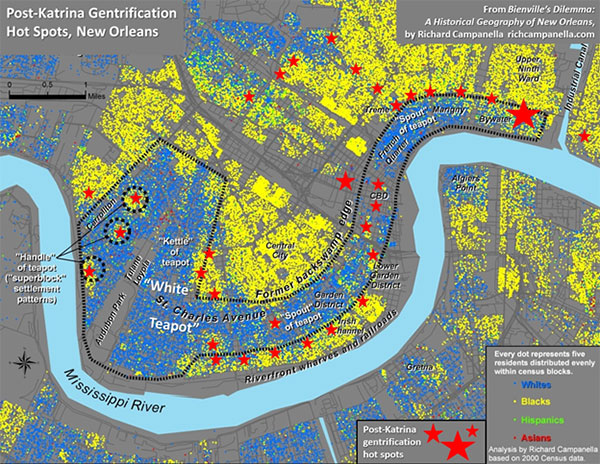
  • America’s Oldest Cities

    One of the most important turning points in the social history of the United States occurred at the beginning of the 1940s. This is not about Pearl Harbor or the Second World War, but  rather about the economic, housing and transportation advances that have produced more affluence for more people than ever before in the world.

    After being delayed by World War II, people began moving from the overcrowded cities to spacious (for that time) houses in the suburbs. They increasingly traveled to work and other destinations by car. These trends were at least two decades old at the time, but had been put on hold by the Great Depression. The prewar city (metropolitan area) was considerably denser, more oriented to mass transit and largely monocentric. By 2010, all major metropolitan areas had developed an urban form that was overwhelmingly suburban and polycentric, with the rise of edge cities and the even greater dispersion of edgeless cities. On average, areas outside the traditional downtowns (central business districts) accounted for 90 percent of metropolitan employment in 2000, ranging from a high of more than 95 percent in metropolitan areas like Phoenix, San Jose and Tampa-St. Petersburg to a low of 80 percent in New York.

    Rating Metropolitan Areas by Pre-War Residential Development

    Although dense urban cores persist in most metropolitan areas, their size and significance varies greatly. This can be illustrated by data from the 2007- 2011 American Community Survey, which makes it possible to rank metropolitan areas by their shares of pre-World War II residential development.

    This article uses the percentage of dwelling units, both owner and renter occupied constructed before 1940 to rate the ages of the nation’s 51 major metropolitan areas (those with more than 1 million population in 2010).  Overall, America’s major metropolitan areas are overwhelmingly postwar in their urban development, with approximately 14% of residences built before 1940. By comparison the 1940 populations of today’s major metropolitan counties were just 35 percent of their 2010 populations.

    Oldest Metropolitan Areas

    The nation’s oldest metropolitan areas, not surprisingly, are concentrated in the Northeast and the upper Midwest. Overall population growth has been modest in these regions compared especially to the South and the West.

    • Boston is the oldest with 35.7% of its residences built before 1940. This varies from 55.6% in the historical core city of Boston to roughly 32 percent in the suburbs, which are the oldest themselves in the country.   
    • Nearby Providence is the second oldest metropolitan area, with 33.1% of its dwellings built before 1940. The city of Providence is also the second oldest among historical core municipalities, at 58.8%. Providence overall share of pre-1940 housing stands at 30.2%. It is notable that the Office of Management and Budget now considers Boston and Providence to be in the same combined statistical area (consolidated metropolitan area).
    • Buffalo is the nation’s third oldest metropolitan area with 30.5% of its residences preceding 1940. The core city of Buffalo is the oldest historical core municipality, with 62.8% of its housing predating 1940. Buffalo suburbs, however, are considerably newer, with only 20.1% older than 1940.
    • New York is the nation’s fourth oldest metropolitan area, with 28.9% of its dwellings having been built before 1940. The city of New York has a much lower prewar housing percentage than the top four, largely because of the substantial amount of green field housing built in the more distant sections of Queens and especially in Staten Island during the 1950s and 1960s. New York’s suburbs, which have accounted for nearly all of the growth in the metropolitan area have a pre-1940 housing share of 18.9%.
    • Rochester is the nation’s fifth-oldest metropolitan area, with 28.8% of its housing prewar. The historical core municipality of Rochester has a high 58.1% of its housing in prewar stock, while the suburbs have a 21.1% share.

    The next five oldest metropolitan areas are Pittsburgh, at 27.2%, Milwaukee and 23.3%, Cleveland 22.7% Chicago and 21.3% and Philadelphia at 21.2%. Among these, the oldest historical core municipalities are Cleveland, at 51.9% and Pittsburgh at 50.3%. Pittsburgh has the highest suburban pre-1940 housing stock, at 23.5%, the third highest in the nation after Boston and Providence (Figure 1).

    Youngest Metropolitan Areas

    The nation’s youngest major metropolitan areas are concentrated in the South and West, comprising 28 of the 51.

    • Las Vegas is the youngest major metropolitan area.  "Sin City" has had the greatest percentage population growth since 1940, and is now approaching a population of 2 million, compared to less than 20,000 in 1940. Only 0.3% of the housing stock in Las Vegas was built pre-war.
    • Phoenix, which is grown from little more than 200,000 people in 1940 to more than 4 million people today, has a pre-1940 housing stock of only 1.0%. The city of Phoenix has a miniscule pre-1940 housing stock of 1.9%.
    • The third youngest major metropolitan area is Orlando with 1.7% of its housing stock having been built before 1940.
    • Perhaps surprisingly, Miami is the fourth youngest major metropolitan area with only 2.2% predating 1940. The historical core municipality of Miami, however, has one of the highest densities in the United States and a comparatively strong 10.6% of its housing is prewar.
    • Austin is the fifth youngest major metropolitan area, with 2.5% of its housing predating the war.


    Tampa St. Petersburg, Houston, Riverside-San Bernardino, Raleigh and Dallas-Fort Worth round out the 10 youngest major metropolitan areas. Each of these has a pre-1940 housing stock between 2.7% and 3.1% (Figure 2).

    Data for all metropolitan areas is provided in the table.

    Table
    Share of Housing Units Constructed Before 1940
    US Metropolitan Areas Over 1,000,000 Population in 2010
    Rank Metropolitan Area Metropolitan Area Historical Core Municipality(s) Rank Suburbs Rank HCM
    1 Boston, MA-NH 35.7% 55.6% 4 32.4% 1 1
    2 Providence, RI-MA 33.1% 58.8% 2 30.2% 2 1
    3 Buffalo, NY 30.5% 62.8% 1 20.1% 5 1
    4 New York, NY-NJ-PA 28.9% 41.3% 12 18.9% 6 1
    5 Rochester, NY 28.8% 58.1% 3 21.1% 4 1
    6 Pittsburgh, PA 27.2% 50.3% 7 23.5% 3 1
    7 Milwaukee,WI 23.3% 38.9% 16 14.0% 10 1
    8 Cleveland, OH 22.7% 51.9% 6 15.4% 8 1
    9 Chicago, IL-IN-WI 21.3% 43.8% 10 11.6% 13 1
    10 Philadelphia, PA-NJ-DE-MD 21.2% 39.1% 14 14.9% 9 1
    11 San Francisco-Oakland, CA 20.4% 45.5% 9 9.2% 15 1
    12 Hartford, CT 19.3% 43.1% 11 16.7% 7 1
    13 Cincinnati, OH-KY-IN 17.2% 41.3% 13 12.6% 11 1
    14 St. Louis,, MO-IL 15.8% 54.4% 5 10.3% 14 1
    15 Minneapolis-St. Paul, MN-WI 15.0% 46.7% 8 6.1% 24 1
    16 Baltimore, MD 14.4% 39.0% 15 6.8% 22 1
    17 Portland, OR-WA 13.1% 31.8% 19 5.5% 25 2
    18 Columbus, OH 12.5% 12.6% 31 12.4% 12 2
    19 Louisville, KY-IN 12.3% 16.9% 27 8.1% 20 2
    20 Indianapolis. IN 12.1% 15.6% 28 8.8% 16 2
    21 Los Angeles, CA 12.0% 20.2% 26 8.3% 18 2
    22 Detroit,  MI 12.0% 31.7% 22 8.2% 19 1
    23 Kansas City, MO-KS 11.9% 21.5% 24 8.8% 17 2
    24 New Orleans. LA 11.7% 31.7% 21 3.0% 35 1
    25 Seattle, WA 11.1% 29.9% 23 6.1% 23 2
    26 Richmond, VA 9.0% 32.0% 18 4.1% 31 2
    27 Salt Lake City, UT 8.9% 31.8% 20 3.1% 34 2
    28 Washington, DC-VA-MD-WV 8.6% 36.1% 17 4.6% 29 1
    29 Denver, CO 7.1% 21.4% 25 2.1% 43 2
    30 Birmingham, AL 6.8% 15.6% 29 4.5% 30 2
    31 Oklahoma City, OK 6.7% 8.8% 34 4.9% 27 2
    32 Memphis, TN-MS-AR 5.6% 8.8% 35 2.3% 41 2
    33 Virginia Beach-Norfolk, VA-NC 5.4% 1.1% 50 7.0% 21 2
    34 San Jose, CA 5.3% 5.5% 42 5.1% 26 3
    35 Nashville, TN 5.1% 6.9% 39 3.9% 33 2
    36 San Antonio, TX 5.1% 5.7% 40 4.1% 32 2
    37 Sacramento, CA 4.6% 11.5% 32 2.7% 36 3
    38 San Diego, CA 4.3% 7.0% 38 2.1% 42 2
    39 Charlotte, NC-SC 4.0% 3.3% 46 4.6% 28 2
    40 Jacksonville, FL 3.8% 4.7% 43 2.3% 40 2
    41 Atlanta, GA 3.2% 14.5% 30 2.0% 45 2
    42 Dallas-Fort Worth, TX 3.1% 5.7% 41 2.5% 38 2
    43 Raleigh, NC 2.8% 3.1% 47 2.6% 37 3
    44 Riverside-San Bernardino, CA 2.7% 7.9% 37 2.5% 39 3
    45 Houston, TX 2.7% 4.6% 45 1.6% 47 2
    46 Tampa-St. Petersburg, FL 2.7% 8.4% 36 1.9% 46 2
    47 Austin, TX 2.5% 3.0% 48 2.0% 44 3
    48 Miami, FL 2.2% 10.6% 33 1.5% 48 2
    49 Orlando, FL 1.7% 4.7% 44 1.3% 49 3
    50 Phoenix, AZ 1.0% 1.9% 49 0.6% 50 3
    51 Las Vegas, NV 0.3% 0.3% 51 0.3% 51 3
    Total 13.6% 25.5% 9.0%

    Notes:
    Calculated from American Community Survey 2007-2011
    HCM: Historical core municipality category: (1) Pre-War & Non-Suburban, (2) Pre-War & Suburban, (3) Post-War Suburban. There is one HCM per metropolitan area, except in in San Francisco-Oakland (San Francisco and Oakland) and Minneapolis-St. Paul (Minneapolis & St. Paul). Otherwise, the HCM is the first named municipality in the metropolitan area name, except in Virginia Beach-Norfolk, where it is Norfolk and Riverside-San Bernardino, where it is San Bernardino.

    Not All Core Cities are the Same

    This analysis indicates the substantial differences between not only the nation’s metropolitan areas, but even more the differences between the core municipalities. For example, the core cities of Phoenix and Philadelphia have approximately the same population. Yet they could not be more different. Philadelphia has a long history, including a time as the nation’s largest city around the period of the Revolutionary War. Phoenix, in contrast, is a product of the post-World War II boom. By 2010, Phoenix had become the nation’s 6th largest municipality. Its 65,000 population in 1940 would rank it around 600th today. Figure 3 shows the average, maximum and minimum pre-war housing stock percentages by metropolitan area, historical core municipality and suburbs.

    Categorizing Core Municipalities

    In Suburbanized Core Cities, we classified the nation’s core municipalities into three categories, based upon the extent of their pre-automobile development (This was described further in a paper co-authored with Peter Gordon of the University of California, Cities in Western Europe and America: Do Policy Differences Matter?).

    The categories included "Pre-War Non-Suburban," which are core municipalities that were of high density in 1940 and have expanded their boundaries little since that time. Philadelphia, Baltimore and Providence are examples of these. The second category was "Post-War and Suburban," which includes municipalities that had a dense core of more than 100,000 residents in 1940, but contain large swaths of post-War suburban development (such as Los Angeles, Milwaukee and Atlanta). The third category was Post-War Suburban, which includes core cities that had little or no dense urban core in 1940 (such as Phoenix, Austin and San Jose).

    Figure 4 illustrates the huge differentials in the pre-1940 housing stock between the metropolitan areas as classified by their historical core municipalities.

    Commonalities

    Even so, metropolitan areas are much more similar than their historical core municipalities. The bottom line is one different than one tends to hear in the urban-core-oriented press. In most of America the detached house predominates and virtually all development since 1940 has been suburban, both inside and outside the historical core municipalities.

    Wendell Cox is a Visiting Professor, Conservatoire National des Arts et Metiers, Paris and the author of “War on the Dream: How Anti-Sprawl Policy Threatens the Quality of Life.”

    —-

    Photograph: Boston (by author)

  • California Becoming Less Family-Friendly

    For all of human history, family has underpinned the rise, and decline, of nations. This may also prove true for the United States, as demographics, economics and policies divide the nation into what may be seen as child-friendly and increasingly child-free zones.

    Where California falls in this division also may tell us much about our state’s future. Indeed, in his semi-triumphalist budget statement, our 74-year-old governor acknowledged California’s rapid aging as one of the more looming threats for our still fiscally challenged state.

    Gov. Jerry Brown, unsurprisingly, did not acknowledge or address the many factors driving the aging trend that include his own favored policy prescriptions. Whatever their intent, the usual "progressive" basket of policies have had regressive results: a tougher time for both the poor and middle class, and a set of density-oriented policies that are likely to drive up housing prices, particularly for the single-family houses largely preferred by people with children.

    These policies have helped turn California into a state that looks less Sunbelt and more like the long-aging centers of the Northeast and the Midwest. It also mirrors declines in fertility and marriage rates in the most-rapidly aging parts of Europe and east Asia. These regions are shifting toward what Chapman University’s recent report, in cooperation with the Civil Service College of Singapore, characterized as post-familialism. Released this past fall in Singapore, the report will be presented in Orange County this week.

    We believe that the rapid decline of marriage and fertility rates in many advanced countries inevitably leads to economic decline, reduced workforces and, likely, an inevitable fiscal disaster. This may be becoming now more true in the United States, a country which once boasted the most vibrant demographics in the high-income world but since the 2007-09 recession has seen a rapid drop in both its marriage rate and fertility rates to well below 2.1 children per female, what is generally referred to as "the replacement rate."

    Just as it differs by country, the degree of post-familialism varies among countries, but it also does among states and regions. Some states, notes a recent Packard Foundation study, such as Texas, Utah and North Carolina, have seen double-digit gains in their child populations over the past decade while California’s has dropped by over 3 percent. Some urban regions like Raleigh, Austin, Houston, Charlotte, Dallas-Fort Worth and Atlanta have also seen rises in their number of children, with population between ages 5 and 17 growing by 20 percent or more over the past decade.

    Historically, California and its regions stood among these family magnets, but no more. Like the states of the Northeast and upper Midwest, the Golden State is becoming rapidly geriatric, as families opt out, and immigration, the primary source of our growth in younger people, declines in an economy ill-suited to migrants with aspirations for a better life.

    Southern California, where immigration has dropped by roughly a third over the past decade, has shared in this decline.

    All three major regions of greater Los Angeles – the San Bernardino-Riverside area, Orange and Los Angeles counties – have seen a sharp drop in their percentages of children. Only the Inland Empire remains still relatively youthful overall, with some 26 percent of its population under 15, well above the national average. In contrast, Los Angeles and Orange counties experienced a 15.6 decline in under-15 population, highest among the nation’s metropolitan areas. Meanwhile, the over 60 population grew by 21 percent.

    One clear indicator can be seen in our declining school populations. Despite massive expenditures for new construction, over the past decade the Los Angeles Unified School District has seen enrollment drop by 7.5 percent. In that period, the student count fell by over 50,000, the largest numerical drop in the nation.

    What is leading to this exodus of families? Sacramento politicians and their media enablers blame insufficient investment in education or simply national aging trends as the root causes. But then, why are other states, including our key competitors, gaining families and children?

    Sacramento lawmakers of both parties share some responsibility. The dominant progressives’ regulatory and tax agenda continues to reduce economic prospects for younger Californians, leading many young families to exit the state. In contrast, older Anglos, the bulwark of the now largely irrelevant GOP, are committed to massive property tax breaks because of Proposition 13. Add good weather and the general inertia of age, and it’s not surprising that families might flee as seniors stay.

    Other factors work against parents, prospective or otherwise. The knee-jerk progressive response to our demographic problems usually entails more money be sent to the schools.

    But they rarely include the student-oriented reform measures such as those enacted in New Orleans (where I am working as a consultant). The poor performance of public education, clear from miserable test results and dropout rates, makes raising children in California either highly problematic or, factoring the cost of private education, extremely expensive.

    If you think Proposition 30’s higher sales and income taxes will change anything, think again.

    Much of that money will end up, almost inevitably, going toward pensions of teachers and other state workers. The hegemonic teacher unions have as their primary goal protecting the system at all costs and resisting change.

    Equally critical, the state’s "enlightened" planning policies also work to discourage families. California’s new climate-change-mandated housing regime – preferring apartments over houses – does not specifically target families, but the case for greater density is often predicated on an ever-declining number of families and an undemonstrated growing preference for density. "Singles and childless couples are the emerging household type of the future," suggests developer and smart growth guru Chris Leinberger.

    These post-familial trends have been incorporated into the influential report, "The New California Dream," widely accepted as gospel by many in our state’s development community.

    The author, the University of Utah’s Chris Nelson, interpreted early 2000s public opinion surveys to suggest a growing preference for smaller lot sizes and apartments, though the data indicate no change over the past 10 years. Developers assume that as singles, empty-nesters and childless couples become as the state’s primary market, this likely misperceived preference will gain even greater strength

    So what would a post-familial future mean for California? You don’t need a crystal ball to figure this one out. Just look at what is happening in other rapidly aging economies, especially Japan, but also much of Europe.

    Dense housing, high taxes and lack of space (such as back yards) tend to discourage family formation. Slower population and labor-force growth then slows the economic engine, which, in turn, creates a greater imbalance between workers and pensioners. The result, ultimately, could be a kind of fiscal Armageddon.

    Fortunately, none of this is inevitable. States such as Utah, Texas and North Carolina continue to attract families, bringing with them new workers, companies and customers. As their economies grow, they can generate broadly based revenue, unlike California, which is increasingly reliant on housing or stock-price bubbles that benefit the already affluent and older populations.

    It is not our karma, Gov. Brown, to submit to a Japanese-like demographic demise. But revitalizing California will require a radical reevaluation of priorities and reconsideration of policy impacts on families.

    Joel Kotkin is executive editor of NewGeography.com and a distinguished presidential fellow in urban futures at Chapman University, and a member of the editorial board of the Orange County Register. He is author of The City: A Global History and The Next Hundred Million: America in 2050. His most recent study, The Rise of Postfamilialism, has been widely discussed and distributed internationally. He lives in Los Angeles, CA.

    This piece originally appeared in the Orange County Register.

    Childhood kids photo by BigStockPhoto.com.