Category: Demographics

  • Is America’s Future Progressive?

    Progressives may be a lot less religious  than conservatives, but these days they have reason to think that Providence– or Gaia — has taken on a bluish hue.

    From the solid re-election of President Obama, to a host of demographic and social trends, the progressives seem poised to achieve what Ruy Texeira predicted a decade ago:  an “emerging Democratic majority”.

    Virtually all the groups that backed Obama — singles, millennials, Hispanics, Asians — are all growing bigger while many of the core Republican groups, such as evangelicals  and intact families, appear in secular decline.

    And then, the Republicans, ham handed themselves, are virtually voiceless (outside of the Murdoch empire) in the mainstream national media.

    Whatever the issue that comes up — from Hurricane Sandy to the Newtown shootings or the “fiscal cliffs” — the Republicans, congenitally inept to start with, end up being portrayed as even more oafish.

    Not surprising then that progressive boosters feel the wind of inexorability to their backs. Red states, and cities, suggests Richard Florida are simply immature versions of blue state ones; progress means density, urbanity, apartment living and the decline of suburbs. Republicans, he argues, are “at odds with the very logic of urbanism and economic development.”

    Yet I am not sure all trends are irredeemingly progressive. For one thing, there’s this little matter of economics. What Florida and the urban boosters often predict means something less progressive than feudalist. The Holy Places of urbanism such as NewYork, San Francisco, Washington DC also suffer some of the worst income inequality, and poverty, of any places in the country.

    The now triumphant urban gentry have their townhouses and high-rise lofts, but the service workers who do their dirty work have to log their way by bus or car from the vast American banlieues, either in peripheral parts of the city (think of Brooklyn’s impoverished fringes) or the poorer close-in suburbs. This progressive economy works from the well-placed academics, the trustfunders and hedge funders, but produces little opportunity for a better life for the vast majority of the middle and working class.

    The gentry progressives don’t see much hope for the recovery of blue collar manufacturing or construction jobs, and they are adamant in making sure that the potential gusher of energy jobs in the resurgent fossil fuel never materializes, at least in such places as New York and California. The best they can offer the hoi polloi is the prospect of becoming haircutters and dog walkers in cognitively favored places like Silicon Valley. Presumably, given the cost of living there, they will have to get there from the Central Valley or sleep on the streets.

    Not surprisingly, this prospect is not exciting many Americans. So instead of heading for the blue paradises, but to lower-cost, those who move now tend towards low-cost, lower-density regions like Dallas-Fort Worth, Houston, Atlanta, Austin, Charlotte and Raleigh. Even while voting blue, they seem to be migrating to red places. Once there, one has to doubt whether they are simply biding their time for Oklahoma City to morph into San Francisco.

    In this respect, the class issue so cleverly exploited by the President in the election could prove the potential Achilles heel of today’s gentry progressivism. The Obama-Bernanke-Geithner economy has done little to reverse the relative decline of the middle and working class, whose their share of national income have fallen to record lows. If you don’t work for venture-backed tech firms, coddled, money-for-nearly-free Wall Street or for the government, your income and standard of living has probably declined since the middle of the last decade.

    If the main focus of progressives was to promote upward mobility, they would deserve their predicted political hegemony. But current-day leftism is more about style, culture and green consciousness than jobs and opportunity. It’s more Vogue’s Anne Wintour than Harry Truman. Often times the gentry agenda — for example favoring higher housing and energy prices — directly conflicts with the interests of middle and working class families.

    The progressive coalition also has little to offer to the private sector small business community, which should be producing jobs as they have in the wake of previous recessions but have failed to do so this time. A recent McKinsey study  finds that small business confidence is at a 20 year low, entrepreneurial start-ups have slowed, and with it, the innovation that drives an economy from the ground up.

    These economic shortcomings are unlikely to reverse themselves under the Obama progressives. An old Democrat of the Truman and Pat Brown, perhaps even Bill Clinton, genre would be pushing our natural gas revolution, a key to blue-collar rejuvenation, instead of seeking to slow it down. They would be looking to raise revenues from Wall Street plutocrats rather than raise taxes on modestly successful Main Street businesses. A HUD interested in upward mobility and families would be pressing for more detached housing and dispersal of work, not forcing the masses to live in ever smaller, cramped and expensive lodgings.

    Over time, the cultural identity and lifestyle politics practiced so brilliantly by the President and his team could begin to wear thin even with their core constituencies.  Hispanics, for example, have suffered grievously in the recession — some 28%  now live in poverty, the highest of any ethnic group.

    It’s possible that the unnatural cohesion between gentry progressives and Latinos will tear asunder. For one thing Hispanics seek out life in suburbs with homes and backyards, and often drive more energy-consuming cars that fit the needs of family and work, notably construction and labor blue collar industries — all targets of the gentry and green agenda.

    Arguably the biggest challenge for the blue supremacists may prove the millennials, a group I have called the screwed generation. They have been vulnerable in a torpid recovery following a deep recession since they depend on new jobs or having their elders move to better ones; more than half of those under 25 with college degrees are either looking for work or doing something that doesn’t require tertiary education.

    For now, millennials — socially liberal, ethnically diverse and concerned with economic inequality — naturally tilt strongly to the President. Their voting power continue to swell as they enter the electorate. As Morley Winograd and Mike Hais have demonstrated, if they remain, as they predict, solidly Democratic, the future will certainly be colored blue.

    But this result is not entirely assured. Now that the first wave of millennials are hitting their thirties, they may not want to remain urban Peter Pans, riding their bikes to their barista jobs, as they age. A growing number will start getting married, looking to buy homes to raise children. The urban developers and gentry progressives may not favor this, preferring instead they remain part of “generation rent”  who remain chained to leasing apartments in dense districts.

    And then there’s the economy. What happens if in two or four years, millennials find opportunity still lagging?  Cliff Zukin, at Rutger’s John J. Heidrich Center for Workforce Development, predicts the young generation will “be permanently depressed and will be on a lower path of income for probably all their life”. One has to wonder if, at some point, they might rebel against that dismal fate. Remember the boomers too once tilted to the left, but moved to the center-right starting with Reagan and have remained that way.

    Of course, the blues have one inestimable advantage: a perennially stupid Republican party and a largely clueless, ideologically hidebound conservative movement. Constant missteps on issues like immigration and gay rights could keep even disappointed minority or younger votes in the President’s pocket. You can’t win new adherents by being the party of no and know-nothing. You also have to acknowledge that inequality is real and develop a program to promote upward mobility.

    Unless that is done, the new generation and new Americans likely will continue to bow to the blue idols, irrespective to the failures that gentry progressivism all but guarantees.

    Joel Kotkin is executive editor of NewGeography.com and is a distinguished presidential fellow in urban futures at Chapman University, and contributing editor to the City Journal in New York. He is author of The City: A Global History. His newest book is The Next Hundred Million: America in 2050, released in February, 2010.

    This piece originally appeared at Forbes.com.

    Barack Obama photo by Bigstock.

  • America the Mostly Beautiful

    In the fall of 2010, as part of a book project, ex-newspaperman Bill Steigerwald retraced the route John Steinbeck took in 1960 and turned into his classic “Travels With Charley.” Steigerwald drove 11,276 miles in 43 days from Long Island to the top of Maine to Seattle to San Francisco to New Orleans before heading back to his home in Pittsburgh.  In “Dogging Steinbeck,” his new e-book about how he discovered “Charley” was not nonfiction but a highly fictionalized and dishonest account of Steinbeck’s real trip, Steigerwald describes the America he saw.

    "Big."

    "Empty."

    "Rich."

    "No change since 1960."

    Long after the old farms and new forests of New England disappeared in my rearview mirror, I was still scrawling those words in the reporter’s notebook on my knee. Big, empty, rich and unchanged – that’s a pretty boring scouting report for the America I “discovered” along the Steinbeck Highway. You can add a bunch of other boring but fitting words – “beautiful,” “safe,” “friendly,” “clean,” and “quiet.”

    Like Steinbeck, I didn’t see the Real America or even a representative cross-section of America, neither of which exist anyway. Because I went almost exactly where Steinbeck went and stopped where he stopped, I saw a mostly White Anglo Saxon Protestant Republican America, not a “diverse and politically correct” Obama one. Mostly rural or open country, it included few impoverished or crime-tortured inner cities and no over-developed/underwater suburbs.

    America the Beautiful was hurting in the fall of 2010, thanks to the bums and crooks in Washington and on Wall Street who co-produced the Great Recession.  It still had the usual ills that make libertarians crazy and may never be cured: too many government wars overseas and at home, too many laws, politicians, cops, lawyers, do-gooders and preachers.

    But America was not dead, dying or decaying. There were no signs of becoming a liberal or conservative dystopia. The U.S. of A., as always, was blessed with a diverse population of productive, affluent, generous, decent people and a continent of gorgeous natural resources.

    Everyday of my trip I was surrounded by undeniable evidence of America’s underlying health and incredible prosperity. Everywhere I went people were living in good homes, driving new cars and monster pickup trucks and playing with powerboats, motorcycles and snowmobiles. Roads and bridges and parks and main streets were well maintained. Litter and trash were scarce. Specific towns and regions were hurting, and too many people were out of work, but it was still the same country I knew.

    I didn’t seek out poverty or misery or pollution on my journey, and I encountered little of it. The destitute and jobless, not to mention the increasing millions on food stamps, on welfare or buried in debt, were especially hard to spot in a generous country where taking care of the less fortunate is a huge public-private industry – where even the poor have homes, cars, wide-screen TVs and smart phones.

    I saw the familiar permanent American socioeconomic eyesores – homeless men sleeping on the sidewalks of downtown San Francisco at noon, the sun-bleached ruins of abandoned gas-stations on Route 66, ratty trailer homes parked in beautiful locations surrounded by decades of family junk. I saw Butte’s post-industrial carcass, New Orleans’ struggling Upper Ninth Ward and towns that could desperately use a Japanese car plant.

    But the country as a whole was not crippled or even limping. In the fall of 2010, nine in 10 Americans who said they wanted jobs still had them. The one in 10 who were jobless had 99 weeks of extended unemployment benefits and more than 90 percent of homeowners were still making their mortgage payments.

    Most of the states I shot through – including Maine, northern New Hampshire and Vermont, upstate New York, Wisconsin, Minnesota, North Dakota, Montana – had unemployment and foreclosure rates well below the national averages.

    I didn’t visit the abandoned neighborhoods of poor Detroit. I didn’t see battered Las Vegas, where 14.5 percent of the people were unemployed and one in nine houses – five times the national average – had received some kind of default notice in 2010. But I spent almost two weeks in the Great Train Wreck State of California, where jobless and foreclosure rates were higher than the national average and municipal bankruptcies loomed.

    America had 140 million more people than it did in 1960, but from coast to coast it was noticeably quiet – as if half the population had disappeared. Despite perfect fall weather, public and private golf courses were deserted. Ball fields were vacant. Parks and highway rest stops and ocean beaches were barely populated. Except for metropolises like Manhattan and San Francisco and jumping college towns like Missoula and Northampton, people in throngs simply did not exist. I went through lots of 30-mph towns that looked like they’d been evacuated a year earlier.

    As I drove what’s left of the Old Steinbeck Highway – U.S. routes 5, 2, 1, 11, 20, 12, 10, 101 and 66 – it was obvious many important changes had occurred along it since 1960. Industrial Age powerhouses like Rochester, Buffalo and Gary had seen their founding industries and the humans they employed swept away by the destructive winds of technology and global capitalism. Small towns like Calais in northeastern Maine had lost people and jobs, and vice versa.

    New Orleans had shrunk by half, and not just because of Katrina. The metro areas of Seattle, San Francisco and Albuquerque had exploded and prospered in the digital age. The populations of the West Coast and the Sunbelt had expanded since 1960. The South had shed its shameful system of apartheid and its overt racism, as well as much of its deep-rooted poverty and ignorance. The Northeast had bled people, manufacturing industries and its once overweening role in determining the nation’s political and cultural life.

    Change is inevitable, un-stoppable, pervasive. Nevertheless, it was clear that a great deal of what I saw out my car windows had hardly changed at all since Steinbeck and his French poodle Charley raced by.

    He saw more farmland and fewer forests than I did, especially in the East. But in many places I passed through almost nothing was newly built. Many farms and crossroads and small towns and churches were frozen in the same place and time they were eons ago, particularly in the East and Midwest.

    In Maine the busy fishing village of Stonington was as picturesque as the day Steinbeck left it. He’d recognize the tidy farms of the Corn Belt and the raw beauty of Redwood Country and the buildings if not the people of the Upper Ninth Ward. And at 70 mph whole states – North Dakota and Montana – would look the same to him except for the cell towers and Pilot signs staked out at the interstate exits.

    Steinbeck didn’t like a lot of things about Eisenhower America – sprawl, pollution, the rings of junked cars and rubbish he saw around cities. And he lamented – not in “Charley” but in letters to pals like Adlai Stevenson – that he thought America was a rotting corpse and its people had become too soft and contented to keep their country great and strong.

    But Steinbeck had America’s future wrong by 178 degrees. Fifty years later, despite being stuck in an economic ditch, the country was far wealthier, healthier, smarter and more globally powerful and influential than he could have imagined. Its air, water and landscapes were far less polluted. And, most important, despite the exponential growth of the federal government’s size and scope and its nanny reach, America in 2010 was also a much freer place for most of its 310 million citizens, especially for women, blacks, Latinos and gays.

    You don’t have to be a libertarian to know America is not as free as it should be. But there’s no denying that today our society is freer and more open than ever to entrepreneurs, new forms of media, alternative lifestyles and ordinary people who want to school their own kids, medicate their own bodies or simply choose Fed Ex instead of the U.S. Post Office.

    As for the stereotypical complaints about America being despoiled by overpopulation, overdevelopment and commercial homogenization, forget it. Anyone who drives 50 miles in any direction in an empty state like Maine or North Dakota – or even in north-central Ohio or Upstate New York – can see America’s problem is not overpopulation. More often it’s under-population. Cities like Butte and Buffalo and Gary have been virtually abandoned. Huge hunks of America on both sides of the Mississippi have never been settled.

    From Calais, Me., to Pelahatchie, Miss., I passed down the main streets of comatose small towns whose mayors would have been thrilled to have to deal with the problems of population growth and sprawl.  If anyone thinks rural Minnesota, northwestern Montana, the Oregon Coast, the Texas Panhandle or New Orleans’s Upper Ninth Ward have been homogenized, taken over by chains or destroyed by too much commercial development, it’s because they haven’t been there.

    The America I traveled was unchained from sea to sea. I had no problem eating breakfast, sleeping or shopping for road snacks at mom & pop establishments in every state. The motels along the Oregon and Maine coasts are virtually all independents that have been there for decades. You can go the length of old Route 66 and never sleep or eat in a chain unless you choose to.

    Steinbeck, like many others have since, lamented the loss of regional customs. (I don’t think he meant the local “customs” of the Jim Crow South or the marital mores of the Jerry Lee Lewis clan.)  I didn’t go looking for Native Americans, Amish, Iraqis in Detroit, Peruvians in northern New Jersey or the French-Canadians who have colonized the top edge of Maine.  But I had no trouble spotting local flavor in Wisconsin’s dairy lands, in fishing towns along Oregon’s coast, in the redwood-marijuana belt of Northern California, in San Francisco’s Chinatown or the cattle country of Texas.

    Not to generalize, but the New York-Hollywood elites believe the average Flyover Person lives in a double-wide or a Plasticville suburb, eats only at McDonald’s, votes only Republican, shops only at Wal-Mart and the Dollar Store, hates anyone not whiter than they are, speaks in tongues on Sunday and worships pickup trucks, guns and NASCAR the rest of the week.

    Those stereotypes and caricatures are alive and well in Flyover Country. But though I held radical beliefs about government, immigration and drugs that could have gotten me lynched in many places, I never felt I was in a country I didn’t like or didn’t belong in. Maybe I just didn’t go to enough sports bars, churches and political rallies, but for 11,276 miles I always felt at home.

    Bill Steigerwald, born and raised in Pittsburgh, is a former L.A. Times copy editor and free-lancer who also worked as a docudrama researcher for CBS-TV in Hollywood before becoming a reporter for The Pittsburgh Post-Gazette and a columnist for The Pittsburgh Tribune-Review. He recently retired from daily newspaper journalism.

  • America’s Baby Boom And Baby Bust Cities

    At this most familial time of the year, as recent events make us hold our children even closer, we might want to consider what kinds of environments are most conducive to having offspring. Alarm bells are beginning to ring in policy circles over the decline of the U.S. birth rate to a record low. If unaddressed, this could pose a vital threat the nation’s economic and demographic vitality over the next few decades.

    In contrast to last week, when we examined the nearly uniform aging of America’s biggest cities over the last decade, the decline in the country’s youth population has been in relative terms. In 2000, roughly 21.4% of Americans were under 15; in 2010, that percentage had dropped to 19.8%. However, unlike in parts of Europe and East Asia, the number of American children did not decline – there were over a million more in 2010, a 1.7% increase.

    Yet since children are by definition the bearers of the future, knowing where new families and households are forming should be of critical interest not only to demographers, but to investors, businesses and, over time, even politicians. Demographer Wendell Cox crunched Census data for Forbes on the youth populations of the 51 largest U.S. metropolitan statistical areas. His analysis reveals sharp differences between various regions of the country, and suggests where future growth in the country may be the strongest.

    The youth population expanded in 31 of the 51 metro areas from 2000 to 2010. The 10 regions that posted the strongest growth were in Texas, the Southeast and the Intermountain West. Leading the nation is Raleigh, N.C., where the number of children under 15 rose a whopping 45%, or 77,421. Texas is experiencing something of a baby boom, paced by Austin, second among America’s largest metro areas with a youth population expansion of 38%; Dallas-Ft. Worth (sixth); Houston (eighth); and San Antonio (11th).

    Out west, Las Vegas (third place) and Phoenix (fifth) may be better known as retirement destinations, but also have become increasingly attractive to families. Other western cities with a strong increase in children include Riverside-San Bernardino, Calif. (12th), Salt Lake City (13th) and Oklahoma City (15th). Surprisingly some Midwestern cities also perform relatively well, led by Indianapolis (16th) and Columbus, Ohio (18th).

    If these regions are attractive to young families, which ones are not? Outside of last place New Orleans, whose demographic data was distorted by the massive outflow of population due to the Katrina disaster, the sad sacks on this list include many of the usual suspects: aging industrial centers. Buffalo’s youth population declined 16%, Detroit’s, 15%; and Cleveland’s 14%. In these cities, notes Cleveland policy researcher Richey Piiparinen, pessimism about the future, for you and your children, naturally results from “being born into post-industry.”

    Not having kids in what may seem to be a ruined economy is understandable. But many metro areas that are usually associated with youthfulness and aspiration are producing fewer children, including Los Angeles (sixth place on our list of baby bust cities with a decline of 12.4%), New York, NY-NJ-PA (eighth, down 7%) and San Francisco-Oakland (16th, -2.7%). Over the past decade these metro areas have lost hundreds of thousands from their under 15 population; Los Angeles has an astounding 360,000 fewer 15 year olds than in 2000 while New York has almost 270,000 fewer and Boston some 62,000 less.

    What do these trends mean for the future? New York has lost about as many children as Dallas-Ft. Worth has gained — a difference of a half million. The gap between increasingly childless Los Angeles and Houston is even wider, and approaches 600,000. These numbers suggest a tremendous shift in the future locations of new American households, with all that implies for retail sales, workforce growth and residential construction demand.

    Indeed a recent Pitney-Bowes study projects that the largest absolute growth in households in the next five years will be in Houston, with a gain of 140,000, or 6.7%,  while Atlanta is projected to add slightly over 100,000 households, 5.4% more.

    In contrast the largest metropolitan area in the country, the New York region, will grow by a mere 75,000 households, a paltry 1.7% clip, while Los Angeles will add only 46,000. Chicago, the third largest metro area, is only expected to add 33,000 households, a growth rate of barely 1.2%.

    Why is household formation and child-rearing so anemic in these places, which are often celebrated for being attractive to the young and dominate so many key industries? One key reason, suspects demographer Cox, is housing prices relative to incomes. This is largely due to high regulatory costs that discourage new housing supply, particularly the single-family homes preferred by most families. Housing costs relative to incomes are more than two times higher in New York or Los Angeles than in Houston, Dallas-Fort Worth, Atlanta or, for that matter, virtually all the metropolitan areas most attractive to families.

    Another factor may be the impact of density, which, Cox demonstrates, tends to depress fertility rates not only here in the United States, but through much of the world. The fastest-growing youth populations tend to be in lower-density regions such as Austin, Raleigh and Atlanta; the slower growth, outside of the old industrial belt tends to be in the high-density regions.

    These differences also exist on the metro level. Within regions, certain areas attract more families than others. For the most part, despite the media hype about families returning to the city, the biggest declines in the under 15 population tend to be in the core urban areas.

    Take New York, our greatest city and one that has experienced considerable improvement in quality of life over the last two decades. Yet despite this, the under 15 population of New York County (Manhattan) dropped nearly 10% over the past decade, a net loss of 21,000. Barely 12% of Manhattanites are under 15, far below the national rate of 19.8%. Similar declines have occurred as well in Brooklyn, a borough that many priced-out Manhattan couples have seen as a refuge for young families.

    So where are the kids being born in the New York area? The only gainers were in the much-despised, lower-density exurbs such as Rockland County, N.Y., and New Jersey’s Ocean County. A similar, if even more marked pattern can be seen in the greater Chicago area, where Cook County, which contains the Windy City, suffered a 160,000 net drop over the decade in its under 15 population; with an 18% decrease in its student body, it’s not surprising that half of Chicago’s public schools are considered underutilized. Meanwhile exurban Will and Kane counties together have gained some 56,000 children under 15, up over 20%.

    Similar phenomena can be observed in most metropolitan areas, including San Francisco, which increasingly resembles a child-free zone. With just 11.2% of the population under 15, the City by the Bay now has the lowest percentage of children of any large county in the nation.

    These numbers tell us some intriguing things about our demographic future, and perhaps suggest how to address a potential “birth death.” As the percentage of children relative to adults, and particularly seniors, declines, it’s imperative to identify environments attractive to young families. For the most part, this means areas that offer the best mix of job opportunities, reasonable housing costs and, for the most part, lower density living. If developers and investors can transcend the incessant urban hype and look at the numbers, they may want to look more closely at these places as most likely to enjoy future growth.

    Change in Population of Children Under Age 15, 2000-2010
    Rank by % Change Geography Population Under 15, 2000 Population Under 15, 2010 Percent Change
    1 Raleigh-Cary, NC 171,779 249,712 45.4%
    2 Austin-Round Rock-San Marcos, TX 266,816 368,852 38.2%
    3 Las Vegas-Paradise, NV 300,700 408,053 35.7%
    4 Charlotte-Gastonia-Rock Hill, NC-SC 287,728 382,071 32.8%
    5 Phoenix-Mesa-Glendale, AZ 739,916 928,284 25.5%
    6 Dallas-Fort Worth-Arlington, TX 1,222,705 1,488,383 21.7%
    7 Atlanta-Sandy Springs-Marietta, GA 955,906 1,162,405 21.6%
    8 Houston-Sugar Land-Baytown, TX 1,145,997 1,389,377 21.2%
    9 Orlando-Kissimmee-Sanford, FL 341,258 409,103 19.9%
    10 Nashville-Davidson–Murfreesboro–Franklin, TN 272,777 324,763 19.1%
    11 San Antonio-New Braunfels, TX 404,441 478,769 18.4%
    12 Riverside-San Bernardino-Ontario, CA 860,121 992,097 15.3%
    13 Salt Lake City, UT 245,938 280,656 14.1%
    14 Denver-Aurora-Broomfield, CO 467,812 533,326 14.0%
    15 Oklahoma City, OK 231,567 263,717 13.9%
    16 Indianapolis-Carmel, IN 343,176 384,015 11.9%
    17 Tampa-St. Petersburg-Clearwater, FL 438,834 484,416 10.4%
    18 Columbus, OH 347,692 379,627 9.2%
    19 Jacksonville, FL 244,723 265,118 8.3%
    20 Sacramento–Arden-Arcade–Roseville, CA 406,444 439,086 8.0%
    21 Washington-Arlington-Alexandria, DC-VA-MD-WV 1,023,931 1,104,688 7.9%
    22 Kansas City, MO-KS 407,217 435,884 7.0%
    23 Portland-Vancouver-Hillsboro, OR-WA 411,430 438,944 6.7%
    24 Louisville/Jefferson County, KY-IN 242,945 255,445 5.1%
    25 Richmond, VA 229,341 240,779 5.0%
    26 Seattle-Tacoma-Bellevue, WA 624,007 651,605 4.4%
    27 Minneapolis-St. Paul-Bloomington, MN-WI 663,817 680,322 2.5%
    28 Birmingham-Hoover, AL 219,064 223,621 2.1%
    29 San Jose-Sunnyvale-Santa Clara, CA 366,072 373,089 1.9%
    30 Memphis, TN-MS-AR 285,823 287,894 0.7%
    31 Miami-Fort Lauderdale-Pompano Beach, FL 988,407 987,881 -0.1%
    32 Cincinnati-Middletown, OH-KY-IN 443,771 441,086 -0.6%
    33 San Diego-Carlsbad-San Marcos, CA 611,119 596,168 -2.4%
    34 San Francisco-Oakland-Fremont, CA 783,554 764,185 -2.5%
    35 Milwaukee-Waukesha-West Allis, WI 329,359 315,745 -4.1%
    36 Chicago-Joliet-Naperville, IL-IN-WI 2,055,882 1,956,235 -4.8%
    37 Baltimore-Towson, MD 540,894 511,503 -5.4%
    38 Philadelphia-Camden-Wilmington, PA-NJ-DE-MD 1,205,561 1,136,468 -5.7%
    39 Hartford-West Hartford-East Hartford, CT 233,267 219,315 -6.0%
    40 St. Louis, MO-IL 585,403 549,544 -6.1%
    41 Virginia Beach-Norfolk-Newport News, VA-NC 348,293 324,478 -6.8%
    42 New York-Northern New Jersey-Long Island, NY-NJ-PA 3,808,773 3,537,709 -7.1%
    43 Boston-Cambridge-Quincy, MA-NH 868,251 805,699 -7.2%
    44 Providence-New Bedford-Fall River, RI-MA 317,329 281,422 -11.3%
    45 Los Angeles-Long Beach-Santa Ana, CA 2,915,391 2,558,983 -12.2%
    46 Rochester, NY 221,349 192,407 -13.1%
    47 Pittsburgh, PA 447,278 384,818 -14.0%
    48 Cleveland-Elyria-Mentor, OH 455,074 390,730 -14.1%
    49 Detroit-Warren-Livonia, MI 996,019 845,894 -15.1%
    50 Buffalo-Niagara Falls, NY 236,269 198,371 -16.0%
    51 New Orleans-Metairie-Kenner, LA 289,988 225,512 -22.2%
    Source: U.S. Decennial Census 2010 and 2000


    Joel Kotkin is executive editor of NewGeography.com and is a distinguished presidential fellow in urban futures at Chapman University, and contributing editor to the City Journal in New York. He is author of The City: A Global History. His newest book is The Next Hundred Million: America in 2050, released in February, 2010.

    This piece originally appeared at Forbes.com.

    Crossing the street photo by Bigstock.

  • Alleviating World Poverty: A Progress Report

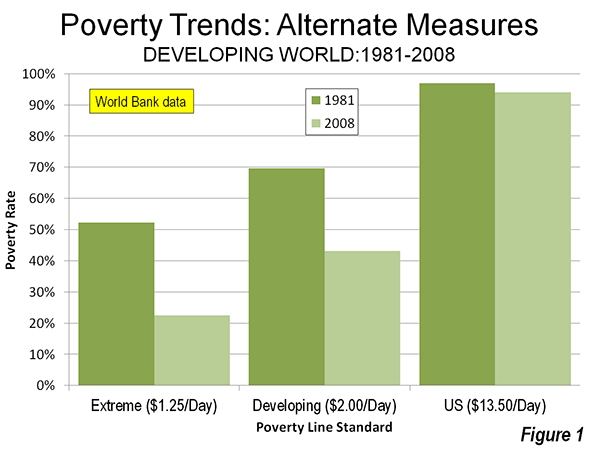
    There has been a substantial reduction in both the extreme poverty rate and the number of people living in extreme poverty since the early 1980s, according to information from the World Bank poverty database. The World Bank maintains data on developing world nations, which include both low income and middle income nations. The analysis below summarizes developing world (low and middle income nations) poverty trends from 1981 to the latest available year, 2008 (Table and Figure 1).

    Evolution of Low and Middle Income World Poverty: 1981-2008
      Poverty Rate Change in Millions % of New Population Not in Poverty
          People in Poverty People Not in Poverty
    POVERTY RATE & Region 1981 2008
    EXTREME POVERTY LINE  ($1.25/Day per capita)      
    East Asia and Pacific 77.2% 14.3%           (812)           1,374 >100.0%
    Europe and Central Asia 1.9% 0.5%                (6)                50 >100.0%
    Latin America and the Caribbean 11.9% 6.5%                (6)              212 >100.0%
    Middle East and North Africa 9.6% 2.7%                (8)              155 >100.0%
    South Asia 61.1% 36.0%                  2              655 99.6%
    Sub-Saharan Africa 51.4% 47.5%             181              233 56.3%
    Total 52.2% 22.4%           (649)           2,679 >100.0%
    DEVELOPING WORLD POVERTY LINE ($2.00/Day per capita)    
    East Asia and Pacific 92.5% 33.4%           (652)           1,214 >100.0%
    Europe and Central Asia 8.4% 2.2%              (26)                70 >100.0%
    Latin America and the Caribbean 23.8% 12.4%              (16)              221 >100.0%
    Middle East and North Africa 30.2% 14.0%                (7)              155 >100.0%
    South Asia 87.3% 71.1%             316              341 51.9%
    Sub-Saharan Africa 72.3% 69.3%             275              139 33.5%
    Total 69.7% 43.1%           (109)           2,140 >100.0%
    US POVERTY LINE: FAMILY OF FOUR ($13.50/Day per capita)    
    East Asia and Pacific 99.8% 96.6%             499                64 11.3%
    Europe and Central Asia 88.3% 72.1%              (38)                82 >100.0%
    Latin America and the Caribbean 86.3% 79.7%             139                66 32.1%
    Middle East and North Africa 96.0% 95.3%             140                   8 5.5%
    South Asia 100.0% 99.7%             652                   5 0.8%
    Sub-Saharan Africa 98.7% 98.6%             408                   6 1.5%
    Total 96.9% 94.0%          1,799              231 11.4%
    Source: World Bank PovcalNet database
    Poverty rates lines in 2005 US$ per capita

    Extreme Poverty Line ($1.25 Daily per Capita)

    Extreme poverty is defined as an income of $1.25 daily per capita, measured in 2005 United States dollars. The extreme poverty line is the average of the poverty rate among the "10 to 20" lowest income nations.

    The World Bank data indicates a nearly 60 percent reduction in the extreme poverty rate between 1981 and 2008, from 52.2 percent to 22.4 percent. By far the largest reduction was in the East Asia and Pacific region (which includes the large nations of China, Indonesia, Viet Nam, the Philippines stretches westerly to Myanmar) where the extreme poverty rate dropped more than 80 percent from 77.2 percent to 14.3 percent. Reductions of more than 70 percent were also experienced in the Middle East and North Africa and Europe and Central Asia, which is by far the most affluent of the developing world regions as designated by the World Bank (generally Eastern Europe, including Russia and Ukraine and the Central Asian nations to the western border of China, such as Kazahkstan).

    In 2008, approximately 650 million fewer people were living in extreme poverty than in 1981. This gain was dominated by East Asia and the Pacific, which experienced a reduction of 812 million people living below the extreme poverty line. Nearly all of the increase (181 million) in people living below the extreme poverty line occurred in Sub – Saharan Africa, a result of surging populations and still insufficient economic growth.

    Even so all six of the regions experienced an increase in the number of people living above the extreme poverty line. Further, in four regions, the increase in people above the extreme poverty line was greater than the overall population increase, and was nearly equal in a fifth. The increase in above extreme poverty population was less than the overall increase only in Sub-Saharan Africa.

    More than one half of the new population living above the extreme poverty line (1.37 billion) are in East Asia and the Pacific. Another quarter (0.65 billion) were in South Asia, which includes India, Pakistan and Bangladesh. Gains of from 155 million to 233 million were made in Sub-Saharan Africa, Latin America and the Caribbean and the Middle East and North Africa (in descending order). The sixth region, Europe and Central Asia had by far the lowest extreme poverty rate among the region, yet still managed a 50 million person improvement.  

    Developing World Poverty Line ($2.00 Daily per Capita)

    The success in reducing poverty was even more skewed to East Asia and the Pacific as measured against a somewhat higher average developing world poverty line of $2.00 daily per capita. The developing world under $2.00 poverty rate declined approximately one-third, from 69.7 percent to 43.1 percent

    The largest reduction was in Europe and Central Asia, where such poverty is rapidly becoming a thing of the past. The poverty rate declined almost three-quarters, to 2.2 percent. The $2.00 poverty rate fell 64 percent in East Asia and the Pacific, from 92.5 percent to 33.4 percent. Each of the other four regions also experienced declines in the $2.00 poverty line.

    There were 109 million fewer people living below the $2.00 poverty line in 2008 than in 1981. The improvement was heavily skewed toward East Asia and the Pacific, where there was a reduction of more than 650 million living below the $2.00 poverty line. There were, however, substantial increases in the number of people living below the $2.00 poverty line in South Asia (275 million) and Sub-Saharan Africa (316 million).

    Nonetheless, more than 2.1 billion additional people lived above the $2.00 poverty line in 2008 than in 1981. All regions experienced gains. East Asia and the Pacific accounted for 1.2 billion of this number, followed by South Asia (341 million) and Latin America and the Caribbean (221 million).

    United States Poverty Line ($13.50 Daily per Capita)

    Despite these gains, the extent of poverty in the developing world is substantial compared to high income world standards. For comparison, the 2008 poverty line for a family of four in the United States is used, which was $13.50 daily per capita. This is more than 10 times the extreme poverty line and nearly 7 times the $2.00 developing world poverty line.

    Between 2001 and 2008, the percentage of people in the developing world living below the US poverty line is estimated to have declined from 96.9 percent to 94.0 percent. Progress was made in each of the six regions, but even in the most affluent developing world region of Europe and Central Asia the poverty rate relative to the US standard remained at 72 percent. Even in largely middle-income Latin America and the Caribbean, the poverty rate, measured by the US standard was 80 percent. All of the other regions were at 95 percent or more. The highest poverty rate relative to the US standard was in South Asia, at 99.7 percent.

    Overall, nearly 1.8 billion additional people lived below the US poverty standard in 2008. The number of people living below the poverty standard declined only in the Europe and Central Asia. The largest increase in people living below the US poverty standard was in South Asia, at 652 million, while both East Asia and the Pacific and Sub – Saharan Africa added between 400 million and 500 million.

    The increase in the number of people living above the US poverty standard was modest, at 231 million. The largest increase was in Europe and Central Africa, at 82 million, while East Asia and the Pacific and Latin America and the Caribbean added approximately 65 million each.

    National Highlights

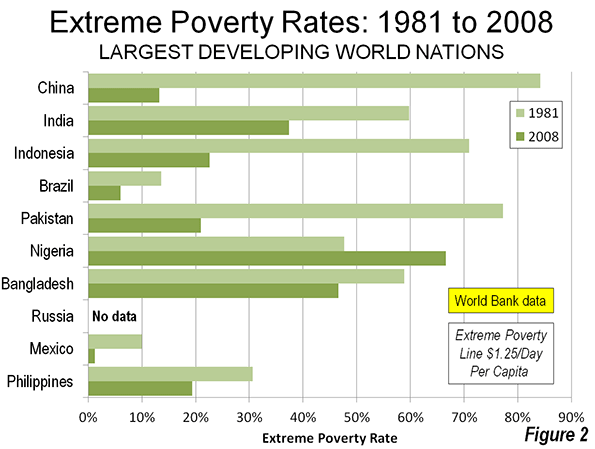
    East Asia and the Pacific have experienced the greatest reduction in poverty rates, as has been shown above. This is largely due to the substantial progress made by its largest nation, China. China experienced the largest reduction in its extreme poverty rate in the world, with a drop from 84.0 percent in 1981 to 13.1 percent in 2008. Among other developing world nations with more than 100 million population, eight experienced significant declines in their extreme poverty rates. One, however, Nigeria, had an increase. There was no data for Russia (Figure 2).

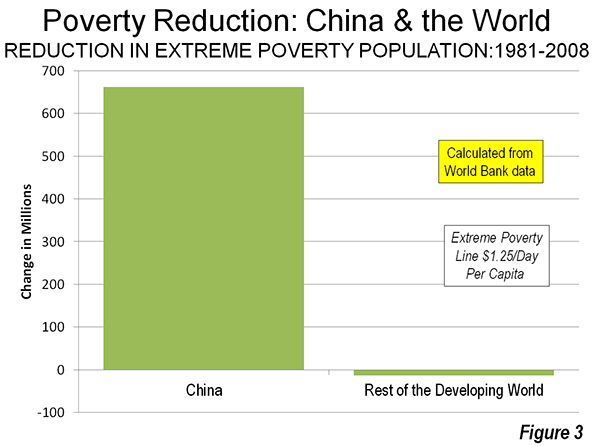
    China’s below extreme poverty line population declined 662 million, more than 10 times the second largest reduction, in Indonesia at 56 million. In fact, China’s reduction in its extreme poverty population exceeded that of the rest of the world (Figure 3).

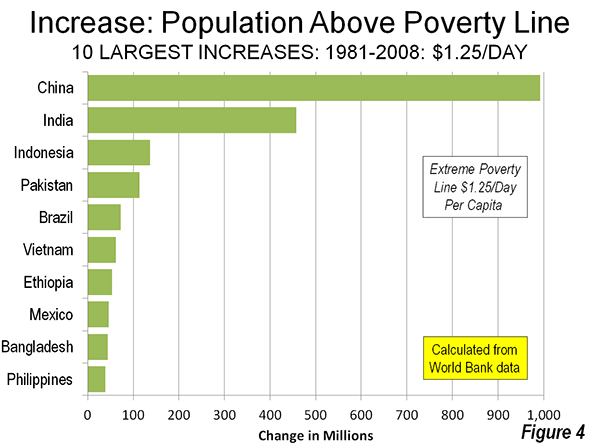
    The number of people living above the extreme poverty line is increasing across the developing world.
    Nearly 85 percent of China’s 2008 population lived above the extreme poverty line, an increase of nearly one billion from 1981. In India nearly 60 percent of its 2008 population lived above this line, an increase of 450 million. Other large nations experienced large increases in the number of people living above extreme poverty, such as Indonesia (135 million) and Pakistan (115 million) (Figure 4).

    Only a few nations had reductions in their number of people living above the extreme poverty rate. The Democratic Republic of the Congo had the largest increase, at 6 million.

    Eradicating Poverty: The Highest Priority

    The story on world poverty contains both good news to bad news. There is clearly substantial progress is being made in reducing extreme poverty in East Asia and the Pacific but this has not been replicated in other parts of the developing world. The bad news is that, for all the progress, the standards of living for the overwhelming majority of people remain far below first world poverty levels.

    Yet, there are signs of hope. A recent report by the Institute of International Finance indicates that over the last decade, Sub-Saharan Africa, long perceived to be synonymous with the world’s most intense poverty, has ranked second in economic growth only to East Asia for a decade.

    Yet, it can only be hoped that the natural aspiration of the world’s billions for much better lives will be achieved. The highest priority should be placed on eradicating poverty, as the recent Rio +20 Conference declared.

    —–

    Wendell Cox is a Visiting Professor, Conservatoire National des Arts et Metiers, Paris and the author of “War on the Dream: How Anti-Sprawl Policy Threatens the Quality of Life.”

    Photograph: New houses in León (Guanajuato) Mexico (by author)

  • Want to See Better US-Chinese Relations? American and Chinese Millennials Could Be Key

    While it is still fashionable for politicians in both China and the United States to prove their domestic leadership credentials by taking tough stances against their nation’s chief economic rival, the results of recent Pew surveys conducted in the two countries suggest that this type of rhetoric is a holdover from an earlier era. An examination of the beliefs among the youngest generational cohorts in each country shows a distinct lack of the ideological vitriol so common in the 1960s and 1970s. As a result, we might see a far more congenial relationship between the world’s two great powers — at least once the older generations fade away.  

    Let’s hope so, because older generations sometimes seem  more committed to discord  than accord. During the 2012 US presidential campaign both President Barack Obama and Governor Mitt Romney took full advantage of opportunities to criticize their opponent for the softness of his approach to China.  Xi Jinping, who was named the General Secretary of the Chinese Communist Party about a week after Obama was reelected and will become China’s Premier early next year, has been no less willing to rhetorically censure the United States.

    Yet the Pew research indicates that the youngest generational cohort in both the US and China holds positive attitudes toward and favors contact with the other country.   In the United States that youthful cohort is the Millennial Generation (born 1982-2003), America’s largest and most ethnically diverse and tolerant generation to date. Of the 95 million US Millennials, about four in ten are nonwhite and one in twenty is of Asian descent, with Chinese-Americans comprising the largest portion of that segment. By contrast, among U.S. seniors and Boomers, only about one in five is nonwhite and about two-percent of Asian heritage.

    Generational theorists have not definitively named the Millennials’ Chinese counterparts. Some observers, however, have called at least their urban segment “Little Emperors.” Similar to American Millennials, this generation was often reared by their own hovering “helicopter parents” in a highly protected, hyper-attentive manner that reflected the importance of these special children—the  product of China’s  “one child” policy—and the  great expectations their parents had and continue to have for their offspring. The result of this  upbringing are cohorts of civic-minded, pressured, conventional, patriotic American and Chinese young people who revere their parents, are optimistic about their nation’s future, and  open to the world.

    In China, the Pew research, conducted in March and April, 2012, contained a battery of questions probing attitudes toward the United States, its interactions with China, and its influence on Chinese society. Across all of these questions, the youngest cohort (18-29 year olds) held significantly more favorable opinions about America than older Chinese. Given that Chinese who are 50 or older include generations that established the Communist regime in 1949, fought American troops in Korea, and were part of the ideological Red Guards of the 1960s, this is not altogether surprising.   

    Overall, a majority (51%) of China’s youthful cohort held a positive view of the U.S. as compared with only 38% of older Chinese. More specifically, majorities of 18-29 year olds said they admired American technological and scientific advances (77%), American ideas about democracy (59%), U.S. music, movies, and television (56%), and agree that it is good that American ideas and customs are spreading to China (50%). Across all of these dimensions favorable attitudes toward the United States and its influence were at least 15 percentage points higher among the youngest Chinese cohort than the oldest. In only one area, the American way of doing business, did less than a majority of 18-29 year old Chinese (48%) indicate admiration of the United States; even on this dimension there was a 12-point gap between the positive opinions of younger and older Chinese respondents.

    Pew did not ask the same questions in its American surveys that it did in the Chinese study. However, it did examine many of the same dimensions permitting valid comparison of survey results in the two countries. In a November 2011 survey examining the large generation gap in U.S. politics Pew asked if it was better for the United States to build a stronger economic relationship with China or to get tough with China on economic issues. American Millennials, a generation corresponding to Chinese 18-29 year olds, overwhelmingly favored a policy focusing on building stronger trade relations with China rather than one based on toughness (69% to 24%). By contrast, a plurality of the two oldest American generations—Boomers and seniors—believed that a tougher approach instead of closer economic ties with China was best (48% to 45%). These results reflect the far greater support of Millennials than older generations for free trade agreements overall (63% to 42%).

    In its April 2012 Values survey, Pew examined the openness of Americans to “foreign,” if not specifically Chinese, influences. In one question, respondents were asked to agree or disagree with the statement: “It bothers me when I come in contact with immigrants who speak little or no English.” Only 32% of American Millennials compared to 44% of all older generations agreed. In another item Pew asked for agreement or disagreement with this statement: “the growing number of newcomers from other countries threatens traditional American customs and values.” Only four in ten Millennials (41%) as compared with a majority (53%) of Boomers and seniors agreed.

    American Millennials are a generation that seeks to resolve disputes and conflicts by searching for win-win solutions rather than absolute victories over their opponents. Recent research suggests that their Chinese counterparts share many of the same attitudes. This bodes well for relations between their two countries in coming decades. The big question for the more immediate future is whether older generations in America and China will be able and willing to set aside the attitudes based on the ideologies and policies of the past long enough for Millennials on both sides of the Pacific to forge a new, less contentious relationship.  

    Morley Winograd and Michael D. Hais are co-authors of the newly published Millennial Momentum: How a New Generation is Remaking America and Millennial Makeover: MySpace, YouTube, and the Future of American Politics and fellows of NDN and the New Policy Institute.

    Shanghai photo by Bigstock.

  • Aging America: The Cities That Are Graying The Fastest

    Notwithstanding plastic surgery, health improvements and other modern biological enhancements, we are all getting older, and the country is too. Today roughly 18.5% of the U.S. population is over 60, compared to 16.3% a decade ago; by 2020 that percentage is expected to rise to 22.2%, and by 2050 to a full 25%.

    Yet the graying of America is not uniform across the country — some places are considerably older than others. The oldest metropolitan areas, according to an analysis of the 2010 census by demographer Wendell Cox, have twice as high a concentration of residents over the age of 60 as the youngest. In these areas, it’s already 2020, and some may get to 2050 aging levels decades early.

    For the most part, the oldest metropolitan areas — with the exception of longtime Florida retirement havens Tampa-St. Petersburg and Miami — tend to be clustered in the old industrial regions of the country. These are regions that have suffered mightily from deindustrialization and the movement of people toward the South and West. These metro areas now make up eight of the 10 oldest among the nation’s 51 largest metropolitan statistical areas.

    The oldest city in America is Pittsburgh, where 23.6% of the metro area’s population is over 60 (see the full list in the table below). The old steel capital is followed by such former robust manufacturing hubs as Buffalo (No. 3 on our list), Cleveland (fifth), and Detroit (ninth).

    How did these places get so old? The biggest factor: migration deficits. More Americans have been leaving these cities than moving there, and people who move tend to be younger. Meanwhile these graying cities attract relatively few immigrants from abroad. Pittsburgh, for example, ranks 34th among the 51 biggest metro areas in net domestic migration, losing some 2% of its population to other places over the past decade. It also stands 50th in foreign immigration over the same period. Buffalo has fared even worse: it’s 40th in domestic migration and 49th in new foreign-born residents.

    Another factor is low birth rates. An aging population, not surprisingly, does not produce many children. In 2000 only three U.S. metro areas had more elderly than children under the age of 15 (Pittsburgh, Miami and Tampa-St. Petersburg, Fla.). The 2010 Census showed we now have 10, with the addition of Buffalo, Boston, Cleveland, Hartford, Providence, Rochester and San Francisco to the first three. Thus the elderly population is overtaking the younger population not only in Florida’s retirement havens, but in a number of Rust Belt and Northeastern cities — and the West Coast may not be far behind.

    The graying trend, like aging itself, is pervasive. The number of children relative to elderly declined over the past decade in every one of the 51 largest major metropolitan areas.

    But not all of America’s most rapidly aging cities are in Florida and the Rust Belt. Even the New York metro area, usually associated with the “young and restless,” is also getting senescent, with an elderly population nearly equal to that of the young. It ranks 15th on our list of the grayest cities. This is surprising, since like more-old-than-young San Francisco (17th place), immigration from abroad has been strong.

    Other metropolitan areas widely celebrated as magnets for the young and hip are also aging rapidly. For example, while Portland remains younger than average, it rose from 36th oldest in 2000 to 29th oldest in 2010. Even Seattle got older, rising from 39th place in 2000 to 34th in 2010.

    This pattern is surprisingly prevalent even in the urban cores that are at the heart of these regions. In New York County, better known as Manhattan, roughly 19% of the population is over 60, well above the national average. In San Francisco the percentage of elderly is a tad higher at 19.2%. These choice places are expensive to move into, so getting there some decades ago is a big plus. As the entrenched populations age, these places may become far more geriatric than commonly assumed.

    But it’s not just the core cities that are getting older. In fact, in terms of rate of aging, some of the places going gray the fastest include suburbs of these cities that used to be the primary destinations of young families. Among the most rapidly aging places within the country’s largest metro areas are New York City’s bedroom communities of Nassau County, N.Y., and Bergen County, N.J.; Middlesex outside of Boston; and suburban St. Louis County.

    What does this mean to employers, investors, and, most importantly, residents of these regions? In some cases there are positives in the near-term economic picture. Some aging metro areas like Pittsburgh and Boston have done relatively well over the course of the recent long recession. This may be in part because older homeowners were less impacted by the housing bubble than younger ones, who tend to cluster in Sun Belt cities such as Atlanta.

    In some cases, inertia from a large employed base of older skilled workers may have also insulated local economies. Older workers have tended to weather the recession better than younger ones and a surprising number have managed to stay in the workforce. Indeed, senior employment has jumped 27% in the last five years while that of younger and middle aged workers has fallen notably.

    Seniors may also become something of an entrepreneurial engine for local economies, notes one recent Kauffman Foundation Study. In fact, the share of new entrepreneurs who are 55 to 64 year old has risen from 14.3% in 1996 to 20.9% in 2011.

    Yet there are also long-term problems implicit in too rapid graying, chiefly in the prospect of a deficient future workforce. In Massachusetts, known among some demographers as “the granny state,” the population under 18 fell 5% over the past decade and there was a slightly larger drop in the 18 to 44 demographic. As the population of those 45 and older grows, there may not be sufficient new income to cover the rising costs for elder care.

    More troublesome may be the labor force impacts of rapid aging, as there is a shortage of some skilled workers, both in the Rust Belt and tech centers, particularly younger ones. This reality is already causing problems in Europe, particularly in the economically devastated south, and also more prosperous East Asia, particularly Japan.

    An older population, and fewer families, tend to depress economic growth, consumer demand and entrepreneurial creativity. Japan today is not only much older, but also more financially hard-pressed than in its ’80s heyday, heavily in debt and losing its once dominant position in several critical industries.

    It is conceivable that some now rapidly aging metropolitan areas will be able to shrug off these effects, by attracting immigrants and newcomers from other parts of the country. But to do so, they will have to become more attractive to families, by creating more affordable, lower density housing and growing the local economy.

    This, however, may prove difficult to achieve, especially in cities that seeking to severely limit or even outlaw “family friendly” detached housing (such as in California and the Northwest). Economic growth could also be hampered as the electorate ages and political pressure builds to increase support for the elderly (a dynamic already evident in Europe and Japan), even at the expense of future generations.

    Major Metropolitan Areas Ranked by 60 & Over Share of Population
    Metropolitan Area 2000 Rank 2010 Change
    1 Pittsburgh, PA 22.1% 2 23.6% 6.8%
    2 Tampa-St. Petersburg, FL 23.8% 1 23.5% -0.9%
    3 Buffalo, NY 19.9% 4 21.6% 8.6%
    4 Miami, FL 20.6% 3 21.3% 3.5%
    5 Cleveland, OH 18.6% 5 21.2% 14.0%
    6 Hartford, CT 17.9% 7 20.0% 11.7%
    7 Providence, RI-MA 18.1% 6 19.9% 9.8%
    8 Rochester, NY 16.5% 12 19.8% 20.0%
    9 Detroit,  MI 15.6% 18 18.9% 21.5%
    10 St. Louis,, MO-IL 16.8% 9 18.9% 12.2%
    11 Birmingham, AL 16.8% 10 18.8% 11.8%
    12 Philadelphia, PA-NJ-DE-MD 17.2% 8 18.7% 8.7%
    13 Louisville, KY-IN 16.2% 14 18.7% 14.9%
    14 Boston, MA-NH 16.3% 13 18.6% 13.9%
    15 New York, NY-NJ-PA 16.6% 11 18.4% 11.1%
    16 Baltimore, MD 15.9% 17 18.2% 14.9%
    17 San Francisco-Oakland, CA 15.4% 20 18.1% 17.6%
    18 New Orleans. LA 15.0% 25 18.0% 19.4%
    19 Jacksonville, FL 14.7% 28 17.9% 21.6%
    20 Richmond, VA 15.1% 23 17.9% 18.2%
    21 Milwaukee,WI 16.1% 16 17.8% 10.4%
    22 Cincinnati, OH-KY-IN 15.4% 21 17.7% 15.0%
    23 Orlando, FL 16.2% 15 17.6% 8.8%
    24 Phoenix, AZ 15.5% 19 17.5% 12.6%
    25 Sacramento, CA 14.9% 27 17.3% 16.2%
    26 Kansas City, MO-KS 15.2% 22 17.2% 13.8%
    27 Oklahoma City, OK 15.1% 24 17.0% 12.7%
    28 Las Vegas, NV 14.9% 26 16.9% 13.1%
    29 Portland, OR-WA 13.6% 36 16.8% 22.9%
    30 Virginia Beach-Norfolk, VA-NC 13.8% 34 16.7% 21.2%
    31 Chicago, IL-IN-WI 14.4% 29 16.4% 14.0%
    32 San Diego, CA 14.3% 30 16.1% 12.7%
    33 San Antonio, TX 14.3% 31 16.0% 12.4%
    34 Seattle, WA 13.4% 39 15.9% 18.6%
    35 Nashville, TN 13.9% 33 15.9% 14.4%
    36 Indianapolis. IN 14.1% 32 15.8% 12.0%
    37 Memphis, TN-MS-AR 13.5% 38 15.8% 17.4%
    38 Los Angeles, CA 13.0% 41 15.7% 21.0%
    39 Columbus, OH 13.5% 37 15.7% 16.3%
    40 San Jose, CA 12.9% 42 15.7% 21.6%
    41 Minneapolis-St. Paul, MN-WI 12.8% 43 15.6% 22.1%
    42 Denver, CO 12.1% 45 15.2% 25.6%
    43 Washington, DC-VA-MD-WV 12.4% 44 15.0% 21.2%
    44 Charlotte, NC-SC 13.2% 40 15.0% 13.6%
    45 Riverside-San Bernardino, CA 13.7% 35 15.0% 9.5%
    46 Atlanta, GA 10.8% 48 13.8% 28.2%
    47 Raleigh, NC 11.0% 46 13.6% 23.7%
    48 Dallas-Fort Worth, TX 10.8% 47 13.3% 23.2%
    49 Houston, TX 10.8% 49 13.2% 23.0%
    50 Salt Lake City, UT 10.7% 50 12.7% 19.3%
    51 Austin, TX 9.8% 51 12.4% 26.4%
    Data from US Census


    Joel Kotkin is executive editor of NewGeography.com and is a distinguished presidential fellow in urban futures at Chapman University, and contributing editor to the City Journal in New York. He is author of The City: A Global History. His newest book is The Next Hundred Million: America in 2050, released in February, 2010.

    This piece originally appeared at Forbes.com.

    “Senior Citizens Crossing” photo by Flickr user auntjojo.

  • Hong Kong’s Decentralizing Commuting Patterns

    Hong Kong is a city of superlatives. Hong Kong has at least twice the population density of any other urban area in the more developed world, at 67,000 per square mile or 25,900 per square kilometer. The Hong Kong skyline is rated the world’s best by both emporis.com (a building database) and diserio.com, which use substantially different criteria. This is an honor that could not have been bestowed on any city outside New York for most of the 20th century.

    No world city is better suited to mass transit than Hong Kong. Hong Kong may also be the best served — it has the transit usage levels to prove it. According to Hong Kong 2011 census data, 87 percent of combined transit and car work trip travel in Hong Kong is by transit, though this is a small decline from the 90 percent of 2001. This is the highest transit market share of any high-income world metropolitan area.

    Change in Work Access Patterns

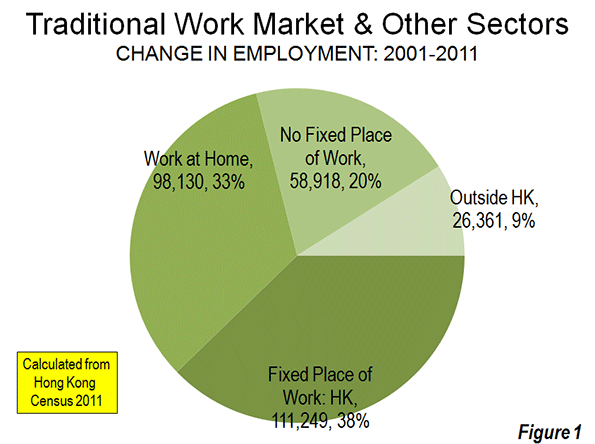
    Between 2001 and 2011 Hong Kong’s employment increased nine percent. Most of these new workers (38 percent), however, did not travel to fixed work locations in Hong Kong. Reflecting continuing decentralization and the impact of information technology, 62 percent of the new workers (1) worked at home, (2) had no fixed place of work or (3) worked outside Hong Kong, especially in Macau and the province of Guangdong, principally in Shenzhen (Figure 1). The 2001 and 2011 census data is summarized in the table below.

    HONG KONG WORK ACCESS: METHODS: 2001 AND 2011
    2001 2011 Change % Change Share: 2001 Share: 2011
    MASS TRANSIT   2,091,552  2,226,818    135,266 6.5% 70.4% 70.1%
    Bus & Coach  1,400,770  1,188,897  (211,873) -15.1% 47.2% 37.4%
       Large Bus   1,118,388     938,467   (179,921) -16.1% 37.7% 29.5%
       Minibus (Public Light)      226,646     217,219      (9,427) -4.2% 7.6% 6.8%
       Residential Coach       55,736       33,211    (22,525) -40.4% 1.9% 1.0%
    Rail     690,782  1,037,921   347,139 50.3% 23.3% 32.7%
       Metro (Original MTR)      495,128     697,475    202,347 40.9% 16.7% 21.9%
       Suburban Rail (Original KCR)      195,654     297,416    101,762 52.0% 6.6% 9.4%
       Light Rail              –         43,030     43,030 NA 0.0% 1.4%
    CAR & TAXI      232,978     333,192    100,214 43.0% 7.8% 10.5%
    WALK      335,859     266,574    (69,285) -20.6% 11.3% 8.4%
    OTHER      123,455       68,509    (54,946) -44.5% 4.2% 2.2%
    TRAVEL TO HK FIXED PLACE OF WORK   2,783,844  2,895,093    111,249 4.0% 93.8% 91.1%
    WORK AT HOME      185,367     283,497     98,130 52.9% 6.2% 8.9%
    FIXED PLACE OF WORK   2,969,211  3,178,590    209,379 7.1% 100.0% 100.0%
    NO FIXED WORK PLACE      188,998     247,916     58,918 31.2%
    WORK IN HONG KONG   3,158,209  3,426,506    268,297 8.5%
    WORK OUTSIDE HONG KONG       94,497     120,858     26,361 27.9%
    WORKING RESIDENTS   3,252,706  3,547,364    294,658 9.1%
    EXHIBIT
    Travel to Work in Hong Kong   2,783,844  2,895,093    111,249 37.8%
    Home, No Fixed Place, Outside HK      468,862     652,271    183,409 62.2%
    TOTAL   3,252,706  3,547,364    294,658 100.0%
    Source: Hong Kong Census, 2001 & 2011
    No Fixed Place of Work: Access method not determined


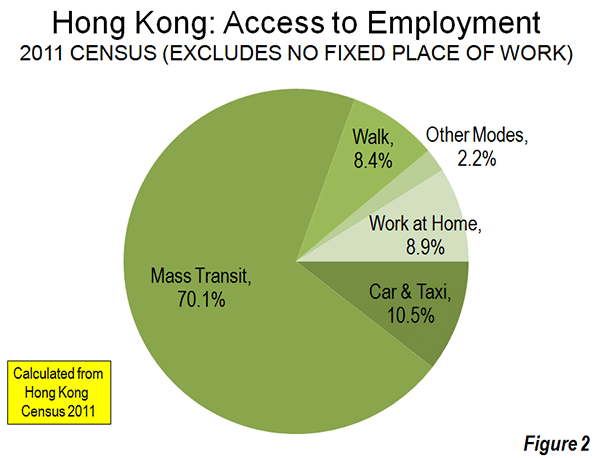
    The Shift from Bus to Rail: Transit’s overall share of work trip access was 70.1 percent in 2011 (all methods). This is a slight decline from the 70.4 percent in 2001. Over the last decade, Hong Kong has substantially expanded its urban rail system, including major improvements such as a new tunnel under Hong Kong Harbor and the new West rail line (former Kowloon Canton Railway) to Yuen Long and Tuen Mun. I wrote a supporting commentary in the Apple Daily (Hong Kong’s largest newspaper) supporting the rail expansion program in 2000.

    The results are apparent in the ridership data. The rail work access market share rose nearly 10 points to 32.7 percent. At the same time, the bus market share dropped nearly 10 points to 37.4 percent. Overall, in a modestly growing labor market, transit added 135,000 new one away work trips.

    Car Commuting Up: Cars and taxis experienced a much larger percentage gain, largely as a result of starting from a much smaller base. The car and taxi work trip access market share rose from 7.8 percent to 10.5 percent. Overall, approximately 100,000 more people commuted one way by car to work in 2011 than in 2001. The median incomes of car and taxi commuters are the highest, at more than twice that of rail and bus users.

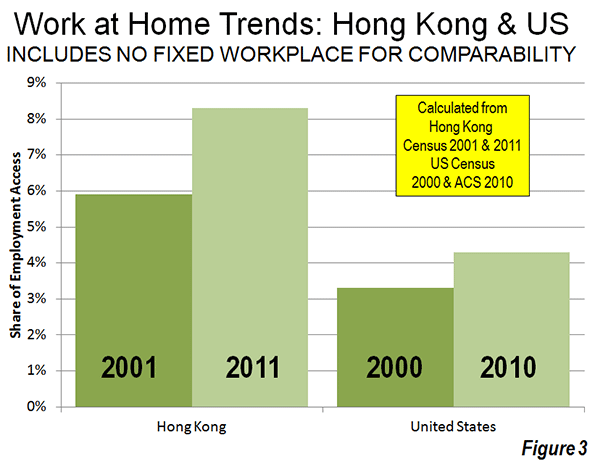
    More Working at Home:Hong Kong’s working at home grew the most of any category, rising 53 percent from 185,000 to 283,000 daily. As a result, working at home now accounts for 8.9 percent of work access, compared to 6.2 percent in 2001. Hong Kong’s reliance on working at home was greater than that of the United States in the early 2000s. Over the last decade Hong Kong’s 53 percent increase in working at home was well above the 41 percent increase in the United States. In Hong Kong, 33 percent of new employment was home-based work between 2001 and 2011. This is greater than in the US, where 20 percent of new jobs involved working at home as the usual mode of access between 2000 and 2010.

    The Decline of Walking: Given Hong Kong’s intensely high densities, it may come as a surprise that there was a huge loss in walking to work. Nearly 70,000 fewer people walked to work in 2011 than in 2001, as the walking market share dropped 21 percent. In 2011, commuters who walked (and those who used light rail) had the lowest incomes. In 2001, more people walked to work than either travelled by car or work at home. By 2011, fewer people walked to work than travel by car or work at home.

    There was also a nearly 55,000 loss in work access by other modes (such as ferries, motorized 2-wheelers and cycling).

    Finally, Hong Kong separately categorizes workers without a fixed place of employment and does not obtain information on how they access work. This category experienced an increase of nearly 60,000 from 2001 to 2011.

    The Decentralization of Hong Kong’s Labor Markets

    The distribution of employment changed little over the 10 years, with Hong Kong Island and Kowloon sectors retaining two-thirds of the jobs. These two areas also have more than one-half of the population.  Even so, the Hong Kong labor market followed the global pattern of decentralization.   More people traveled outside their home areas in 2011 than in 2001. Among resident workers living on Hong Kong Island and in Kowloon, there was an 18 percent increase in working outside these home sectors. Further, the increase in people with no fixed place of work reflects greater mobility and labor force decentralization.

    Jobs-Housing Balance? Not Much

    The high density of jobs and population, its short trip distances, its extraordinary transit system and its high transit market share would seem to make Hong Kong a poster city for the jobs – housing balance ("self containment") that urban planners seem so intent to seek. The data indicates no such thing.

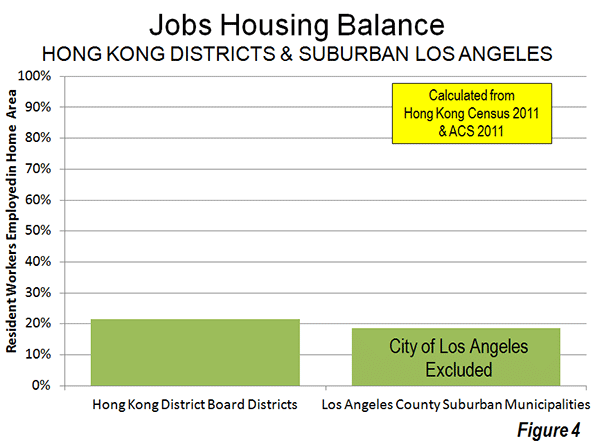
    Hong Kong’s 18 districts illustrate a comparatively low rate of self containment. Only 21.4 percent of working residents are employed in their home districts, including those who work at home. This is only slightly higher than in highly decentralized suburban Los Angeles County, where 18.5 percent of resident workers are employed in their home municipalities. With far lower population and employment densities and a 50 percent smaller geographical size, the suburban municipalities of Los Angeles County (city of Los Angeles excluded, see Note below) nearly equal the local-area jobs-housing balance of the Hong Kong districts (Figure 4).

    This tendency to work away from home districts contributes to Hong Kong’s extraordinarily long average commute times. In 2002, the average work trip was 46 minutes, longer than any high-income world metropolitan area except Tokyo. By comparison, Dallas-Fort Worth, with a similar population and a population density less than 1/20th that of Hong Kong, has an average work trip travel time of 26 minutes. Los Angeles, with its world-class traffic congestion has a work trip travel time of 27 minutes, principally because its automobile dominant commuting is much faster than Hong Kong’s world class, rail based transit system.

    These data, both in Hong Kong and Los Angeles, show that, within a metropolitan area (labor market),  people will tend to seek the employment that best meets their needs, just as employers will hire the people best suited to theirs. Within a labor market, this can be anywhere, subject to the preferences of people and employers, not of planners. This is the basis of former World Bank principal planner Alain Bertaud’s caution that a city’s economic efficiency requires … avoiding any spatial fragmentation of labor markets.

    The Mistake of Trying to Emulate the Unique

    It is a mistake to think that urban planning can emulate Hong Kong. Besides its superlatives, Hong Kong did not become so dense as a result of urban planning or the unfettered preferences of people (market forces). Hong Kong’s uniqueness is the result of unique geo-political influences. This history forced an unprecedented accommodation of millions in a small space, especially in the third quarter of the 20th century when it stood as a capitalist island in the midst of a Communist sea.

    Hong Kong is unique and will be for a long time.

    Note: The city Los Angeles has a very high jobs-housing balance (61 percent). However, this is largely due to its huge geographic size (more than 40 times the average suburban jurisdiction).

    Wendell Cox is a Visiting Professor, Conservatoire National des Arts et Metiers, Paris and the author of “War on the Dream: How Anti-Sprawl Policy Threatens the Quality of Life.”

    —-

    Photo: West Rail Line, Tin Shui Wai Station bus interchange, Yuen Long (by author)

  • Exodus to Suburbs Continues Through 2012

    The latest US Census Bureau migration data shows that people continue to move from principal cities (which include core cities) in metropolitan areas to what the Census Bureau characterizes as "suburbs" (Note). Between 2011 and 2012, a net 1.5 million people moved from principal cities to suburbs (principal cities lost 1.5 million people to the suburbs). The movement to the suburbs was pervasive. In each of the age categories, there was a net migration from the principal cities to the suburbs. There was also net migration to the "suburbs" in all categories of educational attainment.

    These data are in contrast to claims that people are moving from a suburbs to central cities. Virtually none of the migration data has shown any such movement. Moreover, the city population estimates produced for 2011 by the Census Bureau, which indicated stronger central city growth have been shown to be simply allocations of growth within counties, rather than genuine estimates of population increase.

    —-

    Note on Census Bureau "Suburbs:"

    The movement to the suburbs is undoubtedly understated in the Census Bureau estimates, because many jurisdictions included in the "principal city" classification are in fact suburbs. The Real State of Metropolitan America showed that virtually all population growth in principal cities was either in suburban jurisdictions classified as principal cities, or in cities with substantial expenses of post-World War II automobile oriented (or suburban) land-use patterns. The remaining core cities that are largely only urban core in land use accounted for only 2% of principal city growth from 2000 to 2008.

    For a decade, the Census Bureau has used a "principal city" designation instead of the former "central city" term. All former "central cities" are "principal cities." The Census Bureau characterizes all other areas of metropolitan areas as "suburbs." In fact, many of the principal cities are functionally suburbs, having barely existed or not existed at all at the beginning of the great automobile oriented suburban exodus following World War II.

    Examples of such suburban principal cities, with their metropolitan areas in parentheses, are Hoffman Estates (Chicago), Arlington (Dallas-Fort Worth), Aurora (Denver), Fountain Valley (Los Angeles), Eden Prairie (Minneapolis-St. Paul), Mesa (Phoenix), Hillsboro (Portland), San Marcos (San Diego), Pleasanton (San Francisco), Kent (Seattle), Virginia Beach (Virginia Beach-Norfolk) and many others.

  • What Is a Global City?

    We hear a lot of talk these days about so-called “global cities.” But what is a global city?

    Saskia Sassen literally wrote the book on global cities back in 2001 (though her global cities work dates back well over a decade prior to that book). She gave a definition that has long struck with me. In short form, in the age of globalization, the activities of production are scattered on a global basis. These complex, globalized production networks require new forms of financial and producer services to manage them. These services are often complex and require highly specialized skills. Thus they are subject to agglomeration economics, and tend to cluster in a limited number of cities. Because specialized talent and firms related to different specialties can cluster in different cities, this means that there are actually a quite a few of these specialized production nodes, because they don’t necessarily directly compete with each other, having different groupings of specialties.

    In this world then, a global city is a significant production point of specialized financial and producer services that make the globalized economy run. Sassen covered specifically New York, London, and Tokyo in her book, but there are many more global cities than this.

    The question then becomes how to identify these cities, and perhaps to determine to what extent they function as global cities specifically, beyond all of the other things that they do simply as cities. Naturally this lends itself to our modern desire to develop league tables.

    A number of studies were undertaken to produce various rankings. However, when you look at them, you see that the definition of global city used is far broader than Sassen’s core version. Wikipedia lists some of the general characteristics people tend to refer to when talking about global cities. It cites a very lengthy list, but some of them are:

    • Home to major stock exchanges and indexes
    • Influential in international political affairs
    • Home to world-renowned cultural institutions
    • Service a major media hub
    • Large mass transit networks
    • Home to a large international airport
    • Having a prominent skyline

    As you can see, this is quite a hodge-podge of items, many of which are only tangentially related to globalization per se. In effect, many of them seek to define cities only in term of global prominence rather than functionally as related to the global economy. That’s certainly a valid way to look at it, but it raises the point that we should probably clarify what we are talking about when we talk about global cities.

    To clarify our thinking, let’s look at how various ranking studies have defined global city for their purposes.

    One oft-cited such ranking was a 1999 research paper called A Roster of World Cities. The authors, Jon Beaverstock, Richard G. Smith and Peter J. Taylor, explicitly reference Sassen’s work, seeking to define global cities in terms of advanced producer services.

    Taking our cue from Sassen (1991, 126), we treat world cities as particular ‘postindustrial production sites’ where innovations in corporate services and finance have been integral to the recent restructuring of the world-economy now widely known as globalization. Services, both directly for consumers and for firms producing other goods for consumers, are common to all cities of course, what we are dealing with here are generally referred to as advanced producer services or corporate services. The key point is that many of these services are by no means so ubiquitous; for Sassen they provide a limited number of leading cities with ‘a specific role in the current phase of the world economy’ (p. 126).

    They took lists of firms in four specific service industries – accounting, advertising, banking, and law – and determined where those firms maintained branches and such around the world in order to determine the importance of various cities as production nodes of these services. This has some weaknesses in that it doesn’t necessarily distinguish whether say a particular accounting firm is doing routine type work of the sort accountants have always been doing, or performing advanced work of a type specific to globalization, but it at least tries to derive lists related to the production of services.

    As the global city concept grew in popularity, various other organizations entered the fray. Most of these newer lists take a very different a much broader approach closer to the Wikipedia type lists of characteristics rather than a Sassen-like definition.

    One example is AT Kearney’s list, developed in conjunction with the Chicago Council on Global Affairs. Their most recent version is the 2012 Global Cities Index. This study uses criteria across five dimensions:

    • Business Activity (headquarters, services firms, capital markets value, number of international conferences, value of goods through ports and airports)
    • Human Capital (size of foreign born population, quality of universities, number of international schools, international student population, number of residents with college degrees)
    • Information Exchange (accessibility of major TV news channels, Internet presence (basically number of search hits), number of international news bureaus, censorship, and broadband subscriber rate)
    • Cultural Experience (number of sporting event, museums, performing arts venues, culinary establishments, international visitors, and sister city relationships).
    • Political Engagement (number of embassies and consulates, think tanks, international organizations, political conferences)

    The Institute for Urban Strategies at The Mori Memorial Foundation in Tokyo published another study called “The Global Power City Index 2011.” This report examined cities in terms of functions demanded by several “actor” types: Manager, Researcher, Artist, Visitor, and Resident. The functional areas were:

    • Economy (Market Attractiveness, Economic Vitality, Business Environment, Regulations and Risk)
    • Research and Development (Research Background, Readiness for Accepting and Supporting Researchers, Research Achievement)
    • Cultural Interaction (Trendsetting Potential, Accommodation Environment, Resources of Attracting Visitors, Dining and Shopping, Volume of Interaction)
    • Livability (Working Environment, Cost of Living, Security and Safety, Life Support Functions)
    • Environment (Ecology, Pollution, Natural Environment)
    • Accessibility (International Transportation Infrastructure, Inner City Transportation Infrastructure)

    Another popular ranking is the Economist Intelligence Unit’s Global City Competitiveness Index. They rank cities on a number of domains:

    • Economic Strength (Nominal GDP, per capita GDP, % of households with economic consumption > $14,000/yr, real GDP growth rate, regional market integration)
    • Human Capital (population growth, working age population, entrepreneurship and risk taking mindset, quality of education, quality of healthcare, hiring of foreign nationals)
    • Institutional Effectiveness (electoral process and pluralism, local government fiscal autonomy, taxation, rule of law, government effectiveness)
    • Financial Maturity (breadth and depth of financial cluster)
    • Global Appeal (Fortune 500 companies, frequency of international flights, international conferences and conventions, leadership in higher education, renowned think tanks)
    • Physical Capital (physical nfrastructure quality, public transport quality, telecom quality)
    • Environment and Natural Hazards (risk of natural disaster, environmental governance)
    • Social and Cultural Character (freedom of expression and human rights, openness and diversity, crime, cultural vibrancy)

    Note that these were not all equal weighted. Economic strength is paramount.

    Yet another ranking comes from the Knight Frank/Citibank Wealth Report. This ranking is purely subjective and was based on surveying wealth advisors as to which cities they felt would be most important to their clients today and in the future based on four areas: economic activity, political power, knowledge and influence, and quality of life.

    It’s worth noting that Sassen contributed to various of these surveys.

    Looking at the newer surveys versus the Roster of World Cities, it’s clear that the game has changed. Rather than attempting to look at specific global economic functions, the global city game has become effectively a balanced scorecard attempt to determine, as I like to put it, the world’s “biggest and baddest” cities.

    There are quite a few differences in methodologies, which is inevitable. But a few things jump out at me. First the focus on aggregate measures in these surveys. For example: total GDP, total foreign population, number of headquarters. There is a remarkable lack of attention to dynamism variables such as growth in various metrics, though the Economist survey includes a couple.

    The focus on static totals versus dynamism tends to reward large, developed world cities versus rapidly growing or emerging market cities. (The AT Kearney survey has a separate emerging cities list). In a sense, these rankings are biased in favor of important legacy cities.

    It’s also interesting to see what was included vs. not included in quality of life type ratings. For example, items like censorship, media access, the rule of law, and the environment are listed. But measures of upward social-economic mobility or income inequality or not.

    Lastly, a number of the rankings suggest a self-consciously elite mindset, such as shopping and dining options. As with many quality of life surveys, these seem to orient them towards expatriate executive types rather than normal folks.

    Looking at these, I can’t help but think that the criteria were the product of an iterative process where the results were refined over time. Thus in a sense the outcomes were likely somewhat pre-determined. That’s not to say that the game was rigged necessarily. But I suspect if anyone were doing a global city survey and London and New York did not rank at the top, the developers would question whether they got the criteria right. In a sense, a global city is like obscenity: we know one when we see it, but we don’t necessarily have a widely agreed upon objective set of criteria to measure it by.

    I sense that these rankings attempt to look at global cities in four basic ways:

    1. Advanced producer services production node. This is basically Sassen’s original definition. I think this one remains particularly important. Because the skills are specialized and subject to clustering economics, the cities that concentrate in these functions have a Buffett-like “wide moat” sustainable competitive advantage in particular very high value activities. For cities with large concentrations of these, those cities can generate significantly above average economic output and incomes per worker.
    2. Economic giants. Namely, this is a fairly simple but important view of that simply measures how big cities are on some metrics like GDP.
    3. International Gateway. Measures of the importance of a city in the international flows of people and goods. Examples would be the airport and cargo gateway figures.
    4. Political and Cultural Hub. An important distinction should perhaps be made here between hubs that may be large but of primarily national or regional importance, and those of truly international significance. For example, there are many media hubs around the world, but few of them are home to outlets like the BBC that drive the global conversation.

    There may potentially be other ways to slice it as well. The fact that these various ways of viewing cities can often overlap can confuse things I think. For example, New York and London score highly on all of these. And there are surely underlying reasons why they do. Yet trying to sum it all up into one overall ranking or score, while making it easy to get press, can end up obscuring important nuance.

    So when thinking about global cities, I think we need to do a couple of things:

    1. Clarify what it is we are talking about at the time.
    2. Relative to the definition we are using, seek to identify the specific parts of the city in question that generate real above average value at the global level.

    Aaron M. Renn is an independent writer on urban affairs and the founder of Telestrian, a data analysis and mapping tool. He writes at The Urbanophile, where this piece first appeared.

    Chicago photo by Bigstock.

  • Angry Gran: Mobile Game or Demographic Game-Change?

    “Angry Gran” was one of the top mobile app games of 2012 globally. In it, the gamer assumes the persona of a grandmother gone rogue: Angry Gran is angry and needs money! Whack your enemies like piñatas until the cash comes flying out… The objective? Support Gran’s ‘active’ and ‘financially savvy’ retirement by assaulting unsuspecting passers-by with various weapons. If the assault succeeds, Gran steals their money and the gamer’s score rises; if the assault fails, Gran sprains her back and the gamer’s progress is delayed. Given the aging global demographic, one wonders if this sense of humour is best categorized as fiction, or as paradoxical truth?

    Gran gone rogue – an emerging trend? – In Japan, there’s more truth than fiction to angry Gran (and, presumably, Gramps). Its elderly population is 23% of the total; that’s the highest in the world. The National Policy Agency notes that the overall crime rate has fallen steadily, with the exception of offenses committed by the elderly. Theft offenses by the elderly increased 98% in the past eight years, from about 17,000 to more than 34,000. Previously, it was suggested that elderly offenders committed non-violent offenses due to loneliness, social isolation and poverty. But a more brutal streak is emerging, too: Elderly offenders of assault-related crimes increased a startling 570%, from 348 to 2,337.

    In 2008, Japan’s Ministry of Justice dedicated an entire section to elderly offenders in its annual white paper on crime, that is now a regular feature. In recognising the need for additional analysis, the Ministry cited an increase in the proportion of elderly offenders in each stage of the criminal justice system, which was disproportionately higher than the increase in the elderly within the total population.

    While the numbers are low, the rate of increase in elderly offenders raises a chilling prospect. Will an aging demographic result in a “geriatric crime wave”? It does not seem to be the case in the US: the national increase in elder arrests has not been disproportionate to increases in the national crime rate. Contribution to the national crime rate by the elderly remains low, with swings in, for example, the US murder rate largely accounted for by the percentage of young adults 15 – 29 years old.

    But Japan’s situation is not isolated. Other countries also show divergences from the usual age-crime assumptions. In Korea, the number of elderly sex offenders aged 61 or older increased by more than 50% in three years, beginning in 2008.

    In a 1990s report from Canada’s correctional services, 72.8% of older offenders were first time offenders admitted late in life; their rate of sexual crimes, homicide and manslaughter was double that of young offenders. In the Netherlands, older age groups were also over-represented in organized crime offenses, where 33% were over 40, and 76% over 30.

    Health and a swinging hatchet: Declining elderly disability – Florida, which is demographically similar to Japan, offers other insights. Between 1980 and 1998, there was a marked increase in elderly offenders committing forcible sex offenses, robbery and aggravated assault. The nature of such crimes indicates that these elderly offenders are not frail, but rather, somewhat able-bodied.

    Data remains scarce, but within a similar time frame across the US, severe disability among those 65 years and older declined approximately 25%. Studies also show that better childhood health reduces the risk factors for old-age disability and other serious illnesses. The future Gran who was born in the 1970s may eventually be quite sprightly in comparison to the one born in the 1920s.

    So the likelihood that Gran is healthy enough to grab the hatchet and swing it with full force has increased. It was recently reaffirmed that personality characteristics which predict criminal activity in young people may apply to older people, as well. Late-life stressors such as loneliness and caregiving situations gone bad are specific to older offenders, and, equally worrying are the onset of age-related mental illness, and the lack of early detection and management. For instance, family members have almost no recourse against an elderly relative who owns a firearm. Yet in a study of elderly charged with violent offenses and referred for psychiatric evaluation in South Carolina, 78.3% used guns and 40.7% of victims were family members – and nearly half of the perpetrators presented with dementia.

    We’re not Japan – In 2011, Wendell Cox and I wrote about aging global demographics. The differences between the US and Japan were notable. Currently, Japan’s old age dependency ratio (the ratio of those aged over 65 to those from 20 – 64) is 76% higher than that of the US. But the US median age continues to rise: At 36.9 years it is currently only 8 years lower than Japan’s 44.7 years. Given the aging global demographic, migration is unlikely to offset these rises indefinitely. In the coming years, will age-crime assumptions be challenged in the US too?

    The Future: An Aging Criminal Class? – Sixteen percent (246,600) of the US prison population is age 50 and older. The burgeoning elderly prison population has been attributed to longer prison sentences, brought on by more punitive sentencing principles during the 1970s and onwards. Yet there appear to be few studies on elderly or older prisoner release, rehabilitation and recidivism.

    And stemming the inflow of older offenders into prisons is also necessary. In Florida, admissions of offenders over 50 increased 205%, from 1,130 in 2000 to 3,452 in 2010 – from just 4.4% to almost 10% of total admissions. Despite an increased need to dedicated research on the behaviour and characteristics of older groups, a proportion of whom will reoffend in their golden years, the current work focuses largely on juveniles. In Japan, 25% of offenders in their late 40s become repeat offenders within 10 years of their first conviction, almost five times more frequently than those who are first convicted in their early 20s.

    Little is understood about what motivates the Colt-wielding Granny or Gramps. Older offenders present new challenges for justice systems, and for society as a whole. The opportunity now is to prevent criminal acts by the elderly. Discussion and analysis of geriatric crime is very much warranted.

    Emma Chen was a Senior Strategist at the Centre for Strategic Futures, Singapore. She is currently pursuing postgraduate studies.