Category: Demographics

  • The Expanding Economic Pie & Grinding Poverty

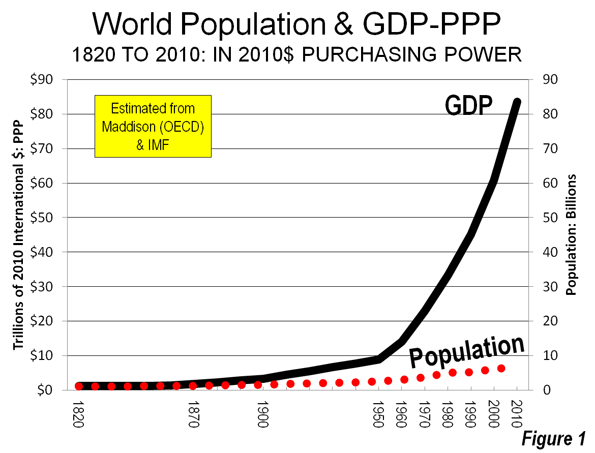
    A review of data from the past 200 years indicates not only a huge increase in the world’s population, but an even more significant increase in real incomes. This is illustrated using the data series developed by the late Angus Maddison of the Organization for Economic Cooperation and Development that included historic estimates of economic performance by geographical area (nations and other reported geographies) from 1500 to 2000. The Maddison data is expressed in international dollars adjusted for purchasing power, so that the impact of inflation and differing prices is factored out, to the extent feasible. Caution is required, however, because there are difficulties with longer term purchasing power and inflation time-series, not least because technological advances make it nearly impossible to accurately account for the changed standard of living. For example, there were no telephones of any sort in 1820, yet today, low-income Nigeria has 143 million mobile phones, nearly 90 for every 100 persons.

    I extended the Maddison data for another 10 years, to 2010, using the database of the International Monetary Fund (IMF) and converted all data to 2010 inflation adjusted international dollars.

    Fast Population Growth and Faster Economic Growth

    Between 1820 and 2010, the world population grew from 1.0 billion to 6.8 billion as indicated in the databases. This 550% increase, however, pales by comparison to the increase in the world real gross domestic product (GDP), which grew nearly 13 times as fast as the population (Figure 1). The relationship between rising urbanization and increasing wealth is evident in comparing Figure 1 to Figure 2 from the recent feature What is A Half-Urban World.   Between 1820 and 1900, the real economic growth rate was 1.5 times of that of population growth. This improved to 2.2 times between 1900 and 1950. In each of these succeeding decades, the economic growth rate relative to population growth was even greater, except in the decade of the 1980s when economic growth was 1.9 times population growth. Despite the economic difficulties, particularly in Japan and the West, 2000 to 2010 showed the largest rate of economic growth compared to population growth, at 3.0.

    GDP Per Capita (Purchasing Power)

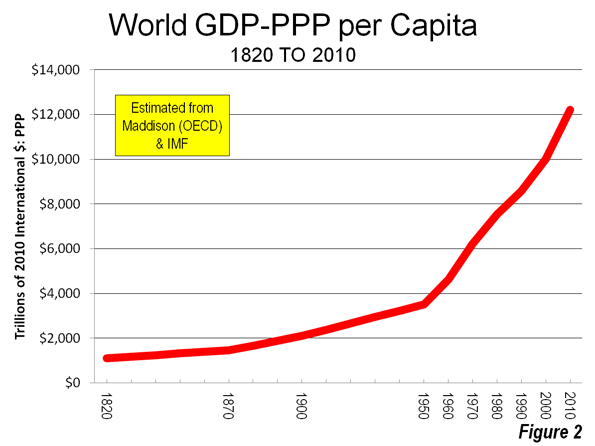
    The real GDP per capita data strongly indicates the expanding economic pie. In 1820, the world GDP per capita was approximately $1100, expressed in 2010$, adjusted for purchasing power. By 1900, this had nearly doubled to $2100. The largest gains came after 1950 when the GDP per capita reached $3500. Since that time the GDP per capita has risen to $12,200 (Figure 2).

    A History of Poverty

    Even so, the history of economics is a history of poverty. University of Rochester (NY) Economist stated the case this way:

    Modern humans first emerged about 100,000 years ago. For the next 99,800 years or so, nothing happened. Well, not quite nothing. There were wars, political intrigue, the invention of agriculture – but none of that stuff had much effect on the quality of people’s lives. Almost everyone lived on the modern equivalent of $400 to $600 a year, just above the subsistence level.

    The $1100 GDP per capita from 1820 would rank among the poorest areas in the world today. The world’s richest area at that time was the Netherlands, which had a GDP per capita of $3100. This is more than Nigeria today, with its 143 million mobile phones and nearly as high as the GDP per capita of India.

    Distribution of Income

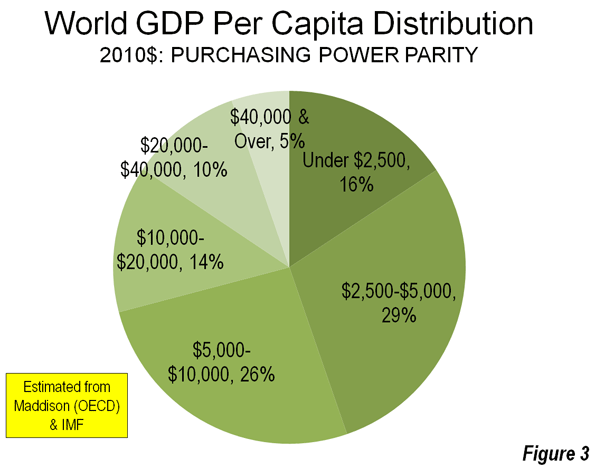
    Today, the large majority of the world’s population lives in lower income areas.

    • 16% of the population lives in areas with a GDP per capita of less than $2500. The largest of these are Bangladesh and Tanzania.
    • 29% of the world’s population is in areas with a GDP per capita of $2500 to $5000. The largest are India, Indonesia, Pakistan, Bangladesh, Nigeria and the Philippines.
    • 26% live in low middle income areas with a GDP per capita of between $5000 and $10,000, such as China and Ukraine.
    • 14% live higher middle income areas (a per capita GDP of $10,000 to $20,000). The largest such areas are Brazil, Mexico and Russia.
    • 10% of the population lives in relatively well off areas (a GDP per capita of $20,000 to $40,000) including France, the United Kingdom, Korea and Japan.
    • Only 5% of the world’s population enjoys a GDP per capita exceeding $40,000, the largest of which are the United States, Germany, Canada and Australia. (Figure 3).

    The Richest Areas

    The very richest countries in the world on a per capita basis are generally small. Oil rich Qatar has the highest GDP per capita at nearly $100,000 annually. Europe’s Luxemburg is the second most affluent, followed by the city-state of Singapore. Resource rich Brunei-Darassalam is the world’s fifth richest area. The United States ranks sixth and is by far the largest of the richest areas. More than 55% of the world’s population in areas with more than $40,000 GDP per capita lives in the United States. The balance of the richest 10 is completed by the United Arab Emirates, another oil rich Gulf state, the world’s other large city-state, Hong Kong,  as well as the Netherlands and Switzerland in Europe (Figure 4).

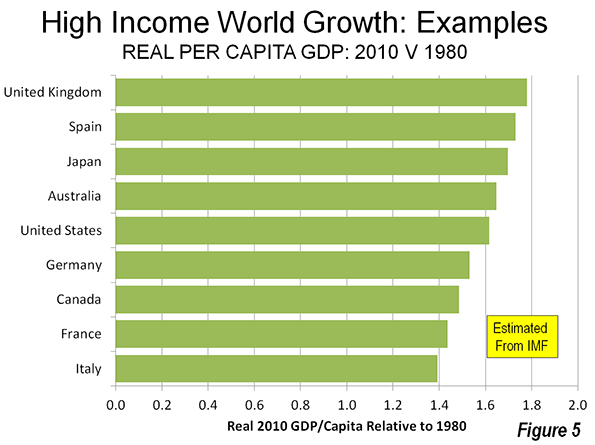
    Generally, IMF data indicates that the largest high-income world economies have experienced real GDP per capita growth of from 40% to 80% since 1980. The UK has grown the most among the examples, while Italy has grown the least (Figure 5). Germany’s lower growth rate is, at least in part, due to the complexity of combining virtually bankrupt East Germany with far healthier West Germany in the early 1990s. The US has been hobbled by its housing bubble-induced economic bust, which hurt other economies as well. Canada’s recent stronger growth could presage an improved ranking in the years to come. Other areas, such Italy, Spain, Japan and France could experience slower growth in the future, due to the seemingly intractable fiscal difficulties and, in some cases, demographic stagnation or even decline.

    Who’s Growing Rich Fastest?

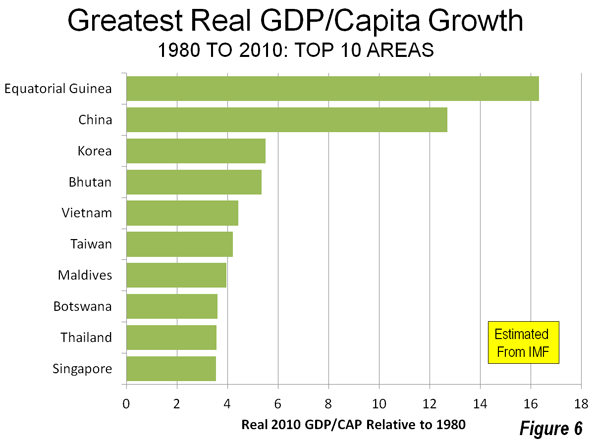
    A number of countries have experienced spectacular growth in their GDP per capita over the past three decades, according to the IMF data (Figure 6). Oil rich Equatorial Guinea experienced the greatest growth, reaching a GDP per capita more than 16 times the 1980s figure. Equatorial Guinea is small, with a population of only 700,000 people (similar to the size of metropolitan areas such as Colorado Springs, Colorado, Hamilton, Ontario or Florence, Italy).

    The broadest and most significant progress has been made by China. According to the IMF data, in 1980 China had the second lowest GDP per capita of any reporting area, ranking above only Mozambique. This was approximately the same time that the economic reforms began, under the leadership of Deng Xiaoping.  By 2010, China’s GDP per capita had reached more than 12 times the 1980 figure. China’s gross GDP-PPP grew more than that of any other area. Once on the low end of the poverty league table    China now has entered the middle rank in terms of wealth.

    Other areas have also done well, especially in Asia. The largest of these include Korea, Vietnam, Taiwan, Thailand and Singapore. One African area is included among the fastest growing per capita economies, Botswana (Figure 6). Each of these areas grew from four to five times in GDP per capita from 1980.

    The Poorest Areas

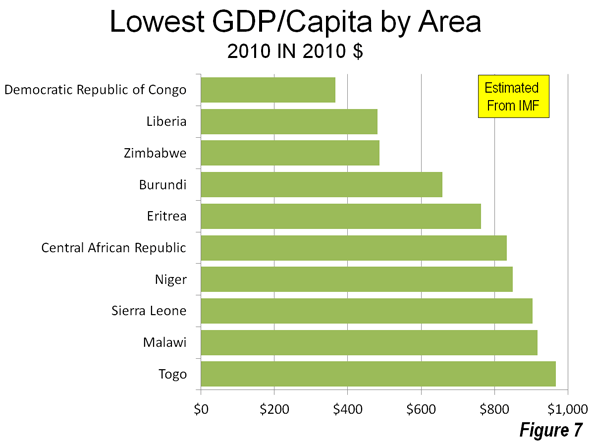
    All 10 of the world’s poorest areas are located in Africa. The poorest is the Democratic Republic of the Congo, with a GDP per capita of less than $400.   Torn by civil war  its GDP per capita would rank it among the poorest areas even in the 1820 listing. The four next poorest areas have also faced severe domestic disruptions, Liberia, Zimbabwe, Burundi and Eritrea (Figure 7).

    Some Areas Getting Poorer

    The severity of the world’s poverty is indicated by the fact that 26 of the 138 areas for which there is data experienced declines in their GDPs per capita from 1980. The population of these declining areas was about 300 million, or approximately four percent of the world’s total. The Democratic Republic of the Congo, the world’s poorest area, experienced a 60% decline in real GDP per capita, which was the largest decline.

    Conclusion

    While the economic pie has expanded much faster than its population, there is still plenty of poverty in the world. It is no surprise that the developing world focused the attention of the recent 2012 Rio +20 conference on poverty, with a declaration that eradicating poverty is the greatest global challenge facing the world today.

    Wendell Cox is a Visiting Professor, Conservatoire National des Arts et Metiers, Paris and the author of “War on the Dream: How Anti-Sprawl Policy Threatens the Quality of Life.”

    Photo: Regency Park, Shanghai (by author)

  • Where Americans Are Moving

    The red states may have lost the presidential election, but they are winning new residents, largely at the expense of their politically successful blue counterparts. For all the talk of how the Great Recession has driven people — particularly the “footloose young” — toward dense urban centers, Census data reveal that Americans are still drawn to the same sprawling Sun Belt regions as before.

    An analysis of domestic migration for the nation’s 51 largest metropolitan statistical areas by demographer Wendell Cox shows that the 10 metropolises with the largest net gains from 2000 through 2009 are in the Sun Belt, led by Phoenix, and followed by Riverside-San Bernardino, Calif.; Atlanta; Dallas-Ft. Worth; and Las Vegas.

    Migration has slowed from a high of nearly 2 million annually in 2006 to less than 800,000 last year, but the most recent numbers show that the Sun Belt states, though chastened by the recession, are far from dead, as often alleged. This part of America, widely consigned to what the Bolshevik firebrand Leon Trotsky called the “dustbin of history” by Eastern pundits, somehow manages to continue to draw Americans seeking opportunities, in particular from the large coastal metropolitan regions.

    Migration data for the most recent one-year period available, July 2010 t0 July 2011, show the Great Recession has shaken the rankings up quite a bit within the circle of fast-growth regions. The biggest winner has been Texas. The Lone Star state boasts four of the 10 metro areas with the largest net migration gains for the past two years.  Dallas ranks first, followed by Austin in third place, Houston in fifth and San Antonio in eighth. In contrast, some of the growth leaders over the 2000-09 period, notably Las Vegas, and to a lesser extent Phoenix, have tumbled considerably in the rankings. The lesson here: a strong economy has to be based on something more than gaming, tourism and home construction. Energy, technology, manufacturing and trade are far preferable as an economic base.

    Also posting strong net migration gains for 2010-11 were Miami (second place), Washington, D.C. (sixth), and Seattle (ninth). In each of these areas, economic conditions appear to have improved. The once disastrous condo glut in the Miami area, which includes Dade, Broward and Palm Beach counties, has begun to clear up as foreign buyers pour into the region. Taxpayer-funded Washington is surging with new jobs and the highest incomes in the land. Seattle continues a long-term evolution toward the healthiest of the blue-state private economies. San Francisco, a consistent big loser for the last decade, jumped to 19th, presumably as a result of the current dot.com bubble.

    Another huge turnaround can be seen in New Orleans, which ranked a dismal 43rd for 2000-09 as residents fled not only Katrina but a stagnant, low-wage, corruption-plagued economy. But in our 2010-11 ranking, the Crescent City surged to a respectable 16th, one of the biggest migration turnarounds in the country.

    How about the biggest losers? From 2000-09, the metropolitan areas that suffered the biggest net domestic migration losses resemble something of an urbanist dream team: New York, which saw a net outflow of a whopping 1.9 million citizens, followed by the Los Angeles metro area (-1,337,522), Chicago, Detroit, and, despite recent improvements, San Francisco-Oakland. The raw numbers make it clear that California has lost its appeal for migrants from other parts of the U.S., and has become an exporter of people and talent (and income).

    And despite the cheap money Bernanke-Geithner policies of the past few years that have benefited giant banks centered in the bluest big cities, people continue to leave these areas.  The 2010-11 numbers show the deck chairs on the migratory titanic have stayed remarkably similar, with New York still ranking first among the 51 biggest metro areas for net migration losses, followed by Chicago, Los Angeles, Detroit and Philadelphia. In most of these cases only immigration from abroad, and children of immigrants, have prevented a wholesale demographic decline.

    What can we expect now? It seems clear that the urban-centric policies of the Obama administration have not changed Americans’ migration patterns. The weak recovery has slowed migration, but expensive, overregulated and dense metropolitan areas continue to lose population to lower-cost, less regulated and generally less dense regions. This may speed up as recent tax hikes squeeze the hard-pressed middle class and if, as appears likely, the social media bubble continues to deflate.

    If the economy somehow gains strength, it may only serve to further accelerate these trends. The incipient recovery in housing prices seems likely, at least in places like California and the Northeast, to create yet another bubble. This will give people more incentive to move to less expensive areas, particularly those who can cash in by selling a house in a pricier city and moving to a less expensive one. The differential in housing costs between New York and Tampa-St. Petersburg now stands at historic highs, and near peak bubble highs between Los Angeles and Phoenix; the traditional growth states are looking more attractive all the time for people looking to make quick money in an economy with shrinking opportunities elsewhere. This includes the massive wave of aging boomers, many of whom may see selling a house in California or the Northeast as a way to make up for less than adequate IRAs. The combination of low prices and warmer weather in the past has proven an irresistible one for those retiring or simply down-shifting their careers. This appeal is likely to grow as the senior population expands.

    Other demographic factors could further drive this trend. As the millennial generation ages and starts looking for places to buy homes and raise families, many will seek out places that are both affordable and offer better economic opportunities. These will tend to be in the South and Southwest, particularly Texas, and Plains States metro areas such as Oklahoma City.

    Finally we can expect immigrants, particularly from Asia, to continue to seek out housing bargains and new opportunities primarily in the Sun Belt states, as our recent study of changing Asian settlement patterns revealed. More will be shifting from the high-priced, low-growth big metros for opportunity cities such as Houston, Dallas-Fort Worth, Raleigh and Charlotte.

    Overall we can  expect domestic migration to pick up, and to follow the well-trodden path from the great cities of the Northeast and California to the Sun Belt’s  resurgent boom towns. This may be bad news to many urban pundits and big city speculators, but it also should create new opportunities for more perceptive, and less jaded, investors.

    2010-2011 Net Domestic Migration for the Nation’s 51 Largest Regions
    Rank by Net Flow Metropolitan Area Net Flow Rate Per 1,000 Residents Rank by Rate
    1 Dallas-Fort Worth-Arlington, TX 39,021 6.04 10
    2 Miami-Fort Lauderdale-Pompano Beach, FL 36,191 6.43 9
    3 Austin-Round Rock-San Marcos, TX 30,669 17.47 1
    4 Tampa-St. Petersburg-Clearwater, FL 27,157 9.68 3
    5 Houston-Sugar Land-Baytown, TX 21,580 3.58 16
    6 Washington-Arlington-Alexandria, DC-VA-MD-WV 21,517 3.80 15
    7 Denver-Aurora-Broomfield, CO 19,565 7.59 7
    8 San Antonio-New Braunfels, TX 19,515 8.97 4
    9 Seattle-Tacoma-Bellevue, WA 17,598 5.07 13
    10 Riverside-San Bernardino-Ontario, CA 15,131 3.54 17
    11 Charlotte-Gastonia-Rock Hill, NC-SC 13,778 7.74 6
    12 Raleigh-Cary, NC 13,262 11.53 2
    13 Atlanta-Sandy Springs-Marietta, GA 12,419 2.33 18
    14 Portland-Vancouver-Hillsboro, OR-WA 11,388 5.07 12
    15 Orlando-Kissimmee-Sanford, FL 10,394 4.82 14
    16 New Orleans-Metairie-Kenner, LA 10,153 8.59 5
    17 Nashville-Davidson–Murfreesboro–Franklin, TN 9,323 5.81 11
    18 Oklahoma City, OK 8,746 6.90 8
    19 San Francisco-Oakland-Fremont, CA 5,880 1.35 22
    20 Phoenix-Mesa-Glendale, AZ 5,585 1.32 24
    21 Pittsburgh, PA 3,740 1.59 20
    22 Jacksonville, FL 2,911 2.15 19
    23 Sacramento–Arden-Arcade–Roseville, CA 2,856 1.32 23
    24 Columbus, OH 2,219 1.20 26
    25 Indianapolis-Carmel, IN 1,940 1.10 27
    26 Louisville/Jefferson County, KY-IN 1,886 1.46 21
    27 Richmond, VA 1,546 1.22 25
    28 Salt Lake City, UT 915 0.80 28
    29 San Diego-Carlsbad-San Marcos, CA 816 0.26 29
    30 Minneapolis-St. Paul-Bloomington, MN-WI 536 0.16 30
    31 Baltimore-Towson, MD -1,341 -0.49 32
    32 Boston-Cambridge-Quincy, MA-NH -1,627 -0.36 31
    33 Birmingham-Hoover, AL -2,452 -2.17 35
    34 Buffalo-Niagara Falls, NY -2,558 -2.25 38
    35 San Jose-Sunnyvale-Santa Clara, CA -2,704 -1.46 34
    36 Kansas City, MO-KS -2,820 -1.38 33
    37 Memphis, TN-MS-AR -2,933 -2.22 37
    38 Rochester, NY -3,320 -3.15 40
    39 Hartford-West Hartford-East Hartford, CT -4,749 -3.92 45
    40 Milwaukee-Waukesha-West Allis, WI -4,862 -3.12 39
    41 Providence-New Bedford-Fall River, RI-MA -6,254 -3.91 44
    42 Las Vegas-Paradise, NV -6,353 -3.24 41
    43 Virginia Beach-Norfolk-Newport News, VA-NC -7,086 -4.22 47
    44 Cincinnati-Middletown, OH-KY-IN -7,149 -3.35 42
    45 St. Louis, MO-IL -10,260 -3.64 43
    46 Cleveland-Elyria-Mentor, OH -12,521 -6.04 51
    47 Philadelphia-Camden-Wilmington, PA-NJ-DE-MD -13,133 -2.20 36
    48 Detroit-Warren-Livonia, MI -24,170 -5.64 49
    49 Los Angeles-Long Beach-Santa Ana, CA -50,549 -3.92 46
    50 Chicago-Joliet-Naperville, IL-IN-WI -53,908 -5.68 50
    51 New York-Northern New Jersey-Long Island, NY-NJ-PA -98,975 -5.22 48


    Joel Kotkin is executive editor of NewGeography.com and is a distinguished presidential fellow in urban futures at Chapman University, and contributing editor to the City Journal in New York. He is author of The City: A Global History. His newest book is The Next Hundred Million: America in 2050, released in February, 2010.

    This piece originally appeared at Forbes.

    Dallas photo by Bigstock.

  • Millennials Ready to Play Key Role in Housing Market Recovery

    Recent data from a survey commissioned by Better Homes and Garden Real Estate (BHGRE) suggests a pent up desire among 18-35 year olds to own a home of their own that could easily fuel a real estate boom for at least the rest of this decade. 

    In contrast to predictions from some futurists that the Millennial generation, born 1982-2003, will be content to be lifelong renters, BHGRE’s survey found home ownership still ranked as young Americans’ most important definition of personal success.  Overall, three-fourths of those surveyed named home ownership as an indicator of having succeeded financially, more than seven times the number who named other major expenditures such as taking extravagant vacations, buying an expensive car, or owning designer clothing. Even among those living in the Northeast or in cities, seventy percent identified home ownership as the best indicator of having made it financially. This is fully in line with earlier studies by Pew Research that found home ownership was among the top three priorities in life for members of the Millennial generation.

    Unlike comments often made about this generation by some of their elders, most Millennials didn’t express sentiments suggesting that they feel entitled to be simply handed this badge of success.  Seventy percent of those in BHGRE’s survey said they needed to possess the skills to own a home; only thirty percent said they “deserved it.” Respondents also made it clear they were prepared to sacrifice to achieve their dream of home ownership.  About sixty percent were willing to eat out less and/or only spend on necessities to save the money needed to buy a home. These sentiments were most strongly expressed by those who had grown up in a home  owned by their parents.  In addition, forty percent were willing to take a second job. And, almost a quarter  of the generation accused of  “failing  to launch”  were prepared to live with their parents for a couple of years to save the money they would need to own a piece of the American Dream.  

    The collapse of the housing market that triggered the Great Recession also has made Millennials sophisticated, knowledgeable consumers when making decisions about how and when to purchase a home.  Rather than thinking they should buy a home as soon as they get married or qualify for a mortgage, seventy percent of BHGRE’s respondents said the time to buy a house is when a person can “afford it and maintain their lifestyle.” 

    Millennials are careful consumers, as befits a group shaped by the most lengthy economic downturn in decades. Sixty-one percent suggested they would want to have a secure job before buying a house and more than half said people should wait until they had saved enough for the down payment before making such a purchase.  When asked to indicate the factors they would research in determining whether to buy a home, financial considerations were cited by a majority of the respondents.

    They understand the power of money. Interest rates, home prices and how those two factors impacted their ability to secure a mortgage, all ranked much higher in importance than the type of neighborhood a house was in, school district ratings or foreclosure rates.  With the median sales price of both new and existing homes up almost five percent this year, Millennials are likely to jump into the market soon before it becomes too expensive for them to do so.      

    These findings suggest the current policies of the Federal Reserve and its Chairman, Ben Bernanke to keep interest rates low in order to stimulate this key part of the U.S. economy are right on target. If home builders and sellers can tailor their offerings to these technologically sophisticated, family-oriented potential buyers, Millennials could well play an important role in reinvigorating the nation’s housing market, further spurring the nation’s recovery from the Great Recession.

    Morley Winograd and Michael D. Hais are co-authors of the newly published Millennial Momentum: How a New Generation is Remaking America and Millennial Makeover: MySpace, YouTube, and the Future of American Politics and fellows of NDN and the New Policy Institute.

    Homes image by BigStock.

  • Off the Rails: How the Party of Lincoln Became the Party of Plutocrats

    For a century now, Republicans have confused being the party of plutocrats with being the party of prosperity. Thus Mitt Romney.

    To win back the so-called 47 percent—an insulting description Romney doubled down after the election when he blamed his loss on Obama’s “gifts”—Republican might look farther back, past Calvin Coolidge and Herbert Hoover to their first president, Abraham Lincoln.

    Not only did he spring from the ranks of the plebeian, not the preps, but—as Michael Lind points out in What Lincoln Believed—he aimed to both increase opportunity and expand national power. A corporate attorney, he backed railroad interests and their expansion, which paced the nation’s economic ascendancy, but saw this as part of creating greater opportunity, particularly in the West, for the country’s middle and working classes. He also enacted the Homestead Act, which supplied aspiring settlers with a gift: 160 acres of federal land.

    Whether or not these acts were populist in their intent, their effects helped people achieve their aspirations. Expansion westward was nothing less than the basis of the American dream, allowing millions, many from land-poor and feudalized Europe, an opportunity to strike out on their own.

    This aspirational element should be the centerpiece of the Republican message in this age of growing class bifurcation. The loss of upward mobility long predates President Obama, though it has accelerated under him—with median household incomes down by more than $4,000 since he took office. Even the tepid economy has not done much to improve middle-class fortunes since nearly three-fifths of new jobs are in lower-wage positions.

    Without some unforeseen economic rebound, class issues will dominate our politics in the future even more than they do today. To recover, Republicans, now losing consistently (and often deservedly) on cultural issues, need to outmaneuver the Democrats on their ability to provide opportunity and upward mobility to a broad range of Americans.

    In his time, Lincoln understood the usefulness of class warfare. Tied to industrial interests, he waged a bloody class war on the slave-owning gentry of the South, a group so detestable it makes today’s Wall Street elites seem almost saintly by comparison. Financiers and industrialists may have supported this brutal war between the states, but it was largely aspiring yeoman farmers, skilled workers, and small merchants—all beneficiaries of Lincoln’s expansive economic vision—who fought it.

    In recent decades, Republicans—conscious of their patrician backers—have suppressed thinking about class, often criticizing Democrats for having no such scruples.

    This made them unable to turn issues such as the bank bailouts to their favor; Romney, himself an economic royalist, could not bring himself to denounce the administration’s policies that have worked out wonderfully for large banks now enjoying record profits while pummeling the middle class.

    In the past, Republican deflected class concerns by focusing on cultural issues, national defense, or ideology—but these tactics have worn themselves out. Of course, some conservatives will blame their defeat on a candidate of uncertain convictions and without commitment to the social regressive policies. Yet evangelicals mounted a record effort to get out the vote; it’s hard to see how Romney would have done better trying to sound more like Todd Akin and Richard Mourdock.

    What should concern Republicans was declining turnout in traditionally GOP-leaning suburbs, the very places where middle-class professionals and business owners reside. These voters were not energized by Romney. So even though he improved the GOP’s 2008 vote among the middle class and independents, Romney’s total was about 1,000,000 below that of John McCain. Had Romney equaled McCain’s performance in four states (Florida, Ohio, Virginia, and Colorado), he would have won, rather than losing to a president who received 7 million fewer votes than in the previous election.

    Let’s take a measurement of base stagnation: the nation’s population has grown 20 million since George Bush was elected in 2004, but the GOP vote has actually shrunk. This correlates as well with a stunning decline of roughly 8 million white voters compared to 2008. The white population may be getting old, but it’s not dying off that rapidly.

    This low turnout is remarkable given how unfavorably Obama is viewed by much of the yeoman class. In fact, as Gallup notes, nearly 60 percent of small-business owners disapprove of Obama. The problem was many simply did not see Romney as a viable—let alone an attractive—alternative. In contrast, the Obama team did a far better job of turning out their base of minority, youth, single and childless women, and union members—an effort that delivered their margin of victory in swing states including Ohio, Nevada, and Colorado.

    To change the political dynamic, Republicans need to address class concerns, particularly those of small property owners and aspirant small entrepreneurs. Yet the GOP has no program for this group other than lower taxes and hollow promises to cut the budget (which, of course, they have not done, even when holding both houses of Congress and the presidency). The party’s hodgepodge of corporate managerialism, social regressiveness, and, above all, protection of the plutocratic class is demonstrably not compelling to most Americans.

    It’s hard for a Main Street business owner, or sole proprietor working from home, to relate to a plutocrat, like Romney, who pays lower effective tax rates than they do. Outrage against looming tax hikes would be justifiable, if the true motivation were not so plainly to preserve the privileges of the haute bourgeoisie. This is a politically doomed approach; while small business is widely revered by Americans, big business and banks are among the least well-regarded.

    Class also would provide a means to define negatively the current regime. Instead of making silly attacks on President Obama as a “socialist,” he would be more accurately portrayed as the tribune of both the crony capitalists on Wall Street or Silicon Valley and of big labor, particularly public-employee unions. Obama should also be toxic to grassroots entrepreneurs, who will bear the brunt of the new regulatory regime, health-care system, higher energy prices, as well as rising income taxes.

    Rather than label him as a radical, Republicans should identify him as an avatar of those who are doing best in our concussed economy, and presumably want things to stay that way. His most ardent backers include many of our richest, most celebrated citizens—fabulously wealthy Hollywood types, the Silicon Valley elite as well as those controlling our major media and universities. There’s a reason Obama bested Romney in eight of America’s 10 richest counties.

    In Marin County, Calif.—where Obama claimed nearly 75 percent of the vote—expensive energy and higher housing prices represent not a burden but an environmental good, and, when it comes to housing, an economic opportunity for some to benefit from artificial, government-imposed scarcity. Ban new single-family homes, and the value of the existing stock goes up; for the elite investing class, incentives for “green energy” developments offer insider opportunities to enjoy windfall profits at the expense of middle-class-rate payers.

    If Wall Street wants to join the “progressive” gentry parade again, as it did in 2008, Republican should encourage them. Being the candidate of the phenomenally unpopular financial overclass may have bought Romney the nomination, but it sealed his fate in the general election.

    To reclaim its Lincolnesque transformation, the GOP needs to fundamentally pivot on the role of government. Laissez-faire ideology has its merits, but cannot compete successfully with a population weaned on the welfare state, whose members are keenly attuned to their vulnerability in our volatile era.

    By admitting that government is sometimes a necessary partner in nurturing and sometimes financing infrastructure critical for economic expansion, Republicans can offer their own vision of what growth-inducing services such as new roads—as opposed to the increased regulation and transfer payments and pension bloat peddled by Democrats—government can and should provide. This could appeal to Hispanics, Asians, and younger people who would be the prime beneficiaries of tangible investments.

    As generational chroniclers Morley Winograd and Mike Hais have suggested, most younger people support government action to solve problems but generally dislike the kind of top-down solutions often supported by Democrats. As these voters age, seek to buy homes and start businesses, they might listen to a sensible alternative that does not seek to enhance the left-wing clerisy’s ambition to control all aspects of their lives.

    It’s time for Republicans to break with the traditions of Goldwater, Reagan, and, particularly, Bush and shift to something more akin to the party’s roots in the mid-19th century. This party needs less preaching and libertarian manifestos that essentially defend plutocracy. Instead it’s time to embrace class warfare on today’s gentry, and embrace the aspirations of today’s middle-class. Honest Abe in 2016?

    Joel Kotkin is executive editor of NewGeography.com and is a distinguished presidential fellow in urban futures at Chapman University, and contributing editor to the City Journal in New York. He is author of The City: A Global History. His newest book is The Next Hundred Million: America in 2050, released in February, 2010.

    This piece originally appeared at The Daily Beast.

    Lincoln Memorial photo by Bigstock.

  • What is a Half-Urban World?

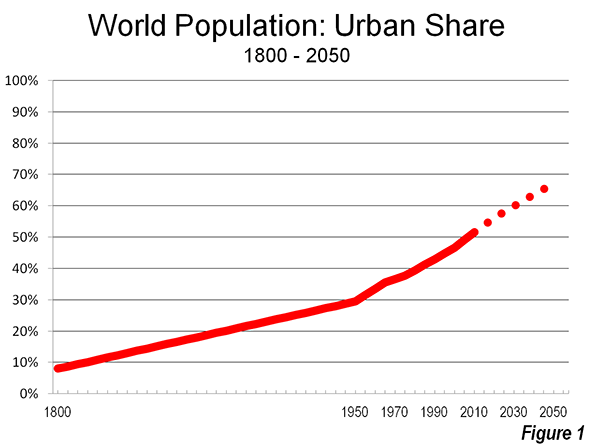
    Within the last couple of years, the population of the world has become more than one half urban for the first time in history. By 2025, the world’s urban areas are expected to account for 58% of the world population, rising further to two-thirds in 2050. This represents a huge increase from the 29% that was urban in 1950, or estimates of approximately 10% (or less) in 1800. (Figure 1).

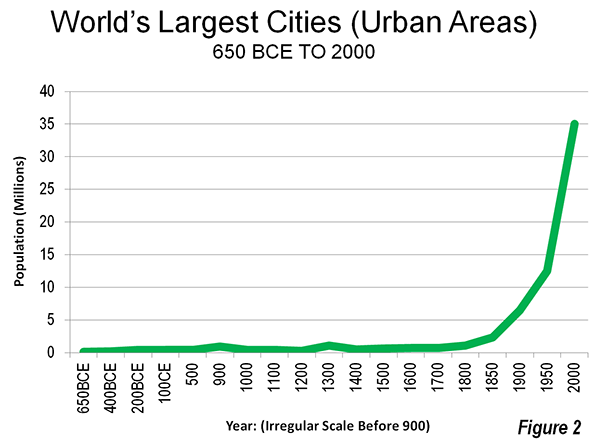
    Urban areas have also gotten much bigger. In 1800, only Beijing had a population over 1,000,000. A number of others, such as Baghdad, Rome, Xi’an, Hanghzhou and Ayutthaya (Thailand) are reported to have reached between 1.0 and 1.5 million in the more distant past, but all had fallen back below the 1.0 million threshold by 1800 (Note 1). These population declines occurred for a variety of reasons, such as military losses, disease, as well as political and economic instability. In short, before the 19th century, large urban populations were largely unsustainable (Figure 2).

    Over the intervening two centuries there has been an exponential increase in the number of large urban areas. By 1900, there were at least 15 urban areas over 1,000,000 population. By 2010, the figure had grown to approximately 450. New York had become the world’s first megacity (over 10 million population) by 1950, now there are at least 25 over 10 million.

    What is Urban?

    However, it would be a mistake to imagine that "half urban" means a world of large cities, or that the world is highly urbanized. The principal source for urban population data is the United Nations, which relies upon individual countries to provide the urban versus rural data. These nations each have their own definitions, which can vary markedly.

    For example, in the United States, a settlement must reach 2,500 population before it is considered urban. Thus, Van, Texas, with a population of 2,502 in the 2010 census is urban, like New York with its 18 million. Canada requires settlements to have 1,000 residents. This means that Nobleford, Alberta, with a population of 1,000 in the 2011 census is urban, along with Toronto with its 6 million population. It seems curious that, with their similarities, United States and Canada have such different urban definitions.

    However, as the UN indicates, differing definitions make sense in some cases. For example, agricultural villages in China can be larger than small urban areas in the United States, Canada or Western Europe. However, given the common view that agricultural dependence is an important difference between rural and urban, a Western urban definition would be inappropriate in China.

    The differences in urban definitions can be substantial. According to the UN, urban definitions can require a population of as much as 50,000, and as little as 200, as in Sweden. With thresholds so low as 200, 1,000 or 2,500 population, the world urbanization data includes not only "cities," but also smaller settlements like small towns and villages (though there is no standard definition to differentiate between cities, towns and villages and the definitional problem is made worse by the sometimes use of these terms for administrative boundaries).

    It is generally recognized that the world’s largest urban area is Tokyo, with a population of more than 35 million. However, there is no consensus about the smallest urban area in the world. Our candidate is Godegård, located in the Motala municipality (Östergötland County) in Sweden. The 2010 census indicated that Godegård had a population of 200 residents, at the urban definition threshold for Sweden.  Godegårdians live in an urban area of 0.10 square miles or 0.26 square kilometers (see Google Earth image above).

    Distribution of the World Urban Population

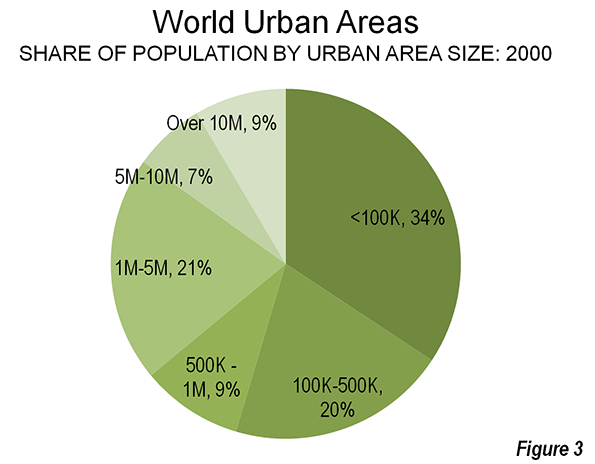
    Urban areas are becoming physically larger and that a larger share of the urbanization is moving to the larger urban areas (areas of continuous urban development, including both urban cores and surrounding areas, generally called suburbs). However, a majority of the world’s urban population lives in smaller urban areas. In 2000, 30% of the world urban population lived in urban areas of less than 100,000 population (Note 2). Another 20% of the population lived in urban areas with between 100,000 and 500,000 population. Thus, nearly 55% of the world’s urban population lived in small and medium-sized urban areas in 2000 (Figure 3).

    Historical and Projected Distribution of World Urban Population

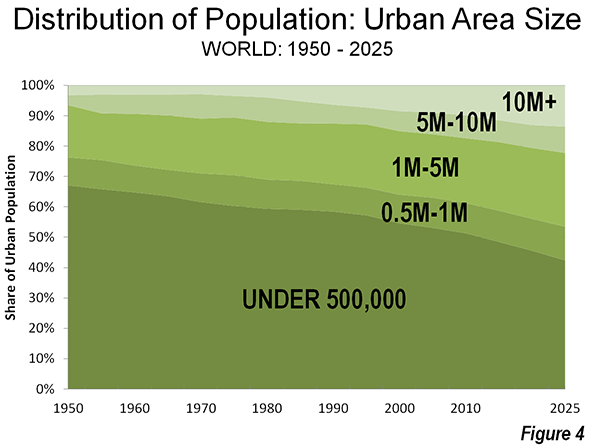
    The United Nations data is available back to 1950 and includes projections to 2025, based upon the size of urban areas in each year in five-year increments. The data is specific to the population categories, so that as an urban area changes categories (generally moving to a higher category), its population is reflected in the higher category and subtracted from the lower category.

    Despite all of the attention given to the world’s megacities, only 10% of the world’s urban residents are in urban areas with more than 10 million population. However, both the number and share of people living in megacities has increased substantially. From 1950 to 2010, the share of world urban population living in megacities more than tripled, from 3% to 10%. By 2025, the United Nations projects that the megacities will have nearly 14% of the urban population.

    Strong growth has also emerged among the urban areas with from 5,000,000 to 10,000,000 population. Their share of the population has more than doubled since 1950 and is expected to rise further by 2025.
    The share of the population in urban areas with from 1,000,000 to 5,000,000 population has grown more slowly, but accounted for 20% of world urbanization in 2010 and is expected to rise to nearly 25% by 2025. These urban areas are projected to add more people than the world’s megacities by 2025.

    Urban areas from 500,000 to 1,000,000 population have increased their share even less, rising from 9% of the world urban population in 1950, to 10% in 2010 and a projected 11% by 2025.

    Virtually all of the loss in urban population share has been in the urban areas with populations below 500,000. In 1950, these urban areas represented more than two thirds of the world urban population. This has since fallen to one-half and is expected to drop to 42% by 2025. (Figure 4)

    Share of Growth

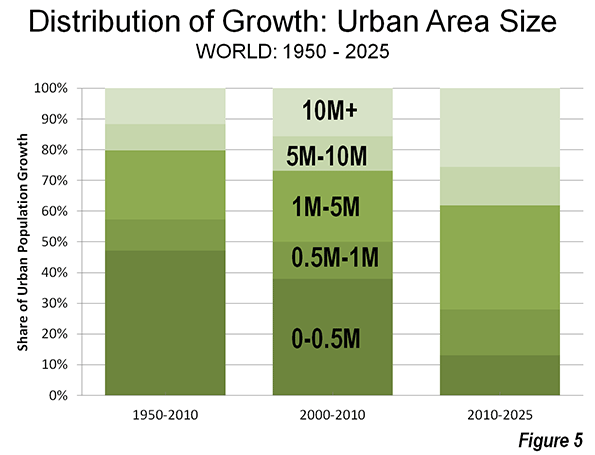
    This does not mean the smaller urban areas are losing population. Between 1950 and 2010, these urban areas added more than 1.3 billion residents, and are expected to add nearly 150 million more between 2010 and 2025. However, urban population growth has been increasingly to the larger urban areas. Between 1950 and 2010, 47% of the urban population growth was in areas with less than 500,000 people. This dominance continued from 2000 and 2010, with a 38% share of the growth. However, it is expected that between 2010 and 2025 the greatest growth will be among urban areas with from 1,000,000 to 10,000,000 population (47%) and in the megacities (26%), while the smaller urban areas are expected to account for less than 13% of growth (Figure 5). Even so, the smaller urban areas will still have nearly three times as many residents as the megacities.

    An Urbanizing, But Not Heavily Urbanized World

    A half urban world is a world of settlements that includes villages, small towns, larger urban areas and megacities. Even as the population becomes more concentrated in the larger urban areas, smaller urban areas will continue to account for a large share of the world urban population for the foreseeable future. Thus, a half (or more) urban world will continue to include the likes of Godegård, Nobleford and Van as well as megacities that could approach 50 million.

    Wendell Cox is a Visiting Professor, Conservatoire National des Arts et Metiers, Paris and the author of “War on the Dream: How Anti-Sprawl Policy Threatens the Quality of Life.”

    —-

    Photo: Google Earth image of Godegård, Sweden, which may be the smallest urban area in the world (see text above).

    Note 1: There is a considerable range of research on the size of the largest urban areas throughout history. The authoritative source is Tertius Chandler (Four Thousand Years of Urban Growth: An Historical Census).

    Note 2: This estimate is developed from data in Angel, Parent, Civco, Blei and Potere (2010) and United Nations data. Angel, et al (also see A Planet of People: Angel’s "Planet of Cities") provide estimates for urban areas from 100,000 to 500,000 population in 2000, which makes it possible to estimate the population of urban areas below 100,000 population, using UN data for 2000. Estimates for urban areas under 100,000 population is not available for other years.

  • Review: Driving Detroit, The Quest for Respect in the Motor City

    For more than a century, the city of Detroit has been an ideological and at times actual battleground for decidedly different views about the economy, labor and the role of government.  At one time it was the center of a can-do entrepreneurialism that helped launch the American automobile industry.  By 1914, for example, no fewer than 43 start-up companies were manufacturing automobiles in the city and surrounding region.  Following a wave of sit-down strikes that began almost immediately after FDR’s landslide victory in 1936, the economic character of the city changed dramatically.  Detroit soon became the quintessential union town, producing in the first decades after World War II the closest facsimile of Social Democracy that the United States has ever seen and in all likelihood will ever see again.    

    Detroit also specialized in race riots.  In 1943, for example, a brawl that broke out at a popular getaway on a Sunday evening in June quickly escalated into mob attacks that resulted in the death of nine whites and 25 blacks.  Because the white police force could not or would not restrain the violence, the mayor asked the governor to call in federal troops.  Twenty four years and one month later in 1967, another Sunday riot broke out.  This time most of the violence occurred between black residents and the police and National Guard.  The death toll was similar, 10 whites and 33 blacks.  Property damage, on the other hand, was far more extensive.  Before the week was out, President Johnson appointed the Kerner Commission to make sense of the conflict and the growing unrest that was afflicting numerous cities all across America. 

    The next major event in the history of Detroit occurred in 1973, when Coleman Young was elected as the city’s first African-American mayor.   He would go on to serve five terms.  While clearly a reflection of the changing demographics in Detroit, Young also personified the city’s long history of union activism, having first gained prominence in the early 1950’s as the leader of the National Negro Labor Council.  In the early 1980’s, in response to persistent economic decline, Young also led the fight to increase the city’s income tax, which included a tax on commuters.  This signaled an important shift in progressive politics in Detroit and elsewhere.  Rather than trying to wring additional revenue from private sector shareholders, labor and its political allies would now focus on the public sector as the preferred vehicle for income redistribution.

    In Driving Detroit: The Quest for Respect in the Motor City, George Galster employs a multi-layered technique to bring the history of the city to life and help explain its current economic predicament.  The title, for example, invokes the R&B classic “Respect” released by Aretha Franklin in 1967.  Lyrics from other popular songs are also quoted, as well as a steady stream of poems by local Detroit poets.  In addition, Galster weaves the stories of select individuals and families into the broader narrative that he constructs.  At the very end, we learn that among the people we have gotten to know are his German-American parents and their forebears.   And finally, Galster, who is the Clarence Hilberry Professor of Urban Affairs at Wayne State University, tries to explain the development of the city and region through what he calls geology, but in urban economics would more commonly be called geography.  This may be the book’s most interesting contribution.

    Galster emphasizes respect, which he defines as a combination of physical, social and psychological needs, because he argues that for many people in Detroit, for a long period of time, these needs were not adequately met.  This was true for blacks, who faced racial prejudice.  It was also true for factory workers, who historically had to endure dangerous working conditions, the monotony of the assembly line, and cyclical unemployment.  The labor movement helped soften the sharper edges of factory work, but Galster shows that it was far less successful at promoting racial harmony.  In part, this was a function of history.  The largest boom in Detroit occurred during World War II, when the city was dubbed the Arsenal of Democracy.  Because immigration had been stopped in the 1920’s, many of the new transplants came from the old South, often bearing well practiced well animosities.  Solidarity in this context was difficult to achieve.   

    Along with the burden of history, another major challenge that Detroit faces today, surprisingly enough, is geography.  In traditional terms, Detroit was an excellent place to build a city, located on a river that has never flooded and soon reaches Lake Erie.  But in modern times, the local topography has proven something of a curse in disguise.  Galster calls this topography a “featureless plain.”   From the beginning, the city and region grew in a land extensive way.   Assembly line manufacturing contributed to lower land use density, because efficiency required large, one story buildings.   Typically, these factory buildings were interspersed among residential communities.  This arrangement made for an attractive and prosperous lifestyle, but with de-industrialization, Detroit has not been able to fall back on a vibrant “old city” that could attract new and creative businesses.

    So what kind of future can Detroit expect?  Galster does not address this question directly, but clearly he appreciates the magnitude of the challenges at hand.  The phenomena that characterize the metropolitan region are not unique, he says, but “Greater Detroit is distinguished by the intense degrees of all these phenomena and their special origins.”  So perhaps the best take-away of Galster’s analysis is that the experience of Detroit should not be used to reach broad conclusions about the prospects of older industrial cities in general.  Rather, it should be used as a cautionary case study.  Detroit cannot alter its topography, but it can address problems like political chauvinism and sub-standard governance that Galster demonstrates have clearly had a negative impact on the business climate.  Progress here in combination with a low cost-of-living and the revolution in natural gas production might then make it possible to attract the investment that the economy needs to re-invent itself.   Certainly that would be the best case scenario.

    Eamon Moynihan is Managing Director for Public Policy at EcoMax Holdings, a specialty finance company that focuses on the redevelopment of previously used properties. 

  • The Rise of the Third Coast

    In the wilds of Louisiana’s St. James Parish, amid the alligators and sugar plantations, Lester Hart is building the $750 million steel plant of his dreams. Over the past decade, Hart has constructed plants for steel producer Nucor everywhere from Trinidad to North Carolina. Today, he says, Nucor sees its big opportunities here, along the banks of the Mississippi River, roughly an hour west of New Orleans by car.

    “The political climate here is conducive to growth,” Hart explains as he steers his truck up to the edge of a steep levee. “We are here because so much is going on in this state and this region. With the growth of the petrochemical and industrial sectors, this is the place to be.” Already, some 500 people are working on the project. When completed in 2013, the plant—which is expected to process more than 3.75 million tons of iron ore a year—will create about 150 permanent jobs immediately. Another 150 are expected after a second development phase.

    Nucor isn’t alone in coming to Louisiana, or to the vast, emerging region along the Gulf Coast. The American economy, long dominated by the East and West Coasts, is undergoing a dramatic geographic shift toward this area. The country’s next great megacity, Houston, is here; so is a resurgent New Orleans, as well as other growing port cities that serve as gateways to Latin America and beyond. While the other two coasts struggle with economic stagnation and dysfunctional politics, the Third Coast—the urbanized, broadly coastal region spanning the Gulf from Brownsville, Texas, to greater Tampa—is emerging as a center of industry, innovation, and economic growth.

    The Gulf area long lacked industry. Even when the Spaniards and the French ruled it, the Gulf was a planters’ region, and its economy was largely dependent on exports of indigo, sugar, and cotton. The economy also relied on the slave labor that made such exports possible, a state of affairs that continued until the Civil War. After the war, the region therefore lost much of its economic influence as growth shifted to the rail-dominated east-west axis, though the construction of the Panama Canal eventually helped New Orleans and Mobile, Alabama, again become busy ports. Developing slowly, the Third Coast’s agricultural economy was dominated largely by tenant farmers, who in 1930 constituted more than 60 percent of the agricultural producers in an arc from Texas to Georgia.

    The Gulf region also suffered from vulnerability to natural disasters. In 1900, more than a century before Katrina, the deadliest hurricane in American history all but destroyed Galveston, Texas. In 1927, the Great Mississippi Flood inundated a 27,000-square-mile area, much of it in Texas, Mississippi, and Louisiana. And then there was the hot and humid climate, especially miserable in those pre-air-conditioning days.

    What Joel Garreau, in his landmark book The Nine Nations of North America, writes about the South as a whole—that it became a “region identified with stagnation—backward, rural, poor and racist, a colony of the industrialized north, enamored of an allegedly glorious past of dubious authenticity”—applied with particular force to the Gulf Coast, whose major cities, especially New Orleans, were seen as hopelessly corrupt and decadent. It’s no surprise that for much of the last century, the region exported people, particularly those with skills, to other parts of the United States.

    So it’s particularly striking that the region’s steady economic growth is now attracting so many people. Over the past decade, Texas and Florida have ranked first and second among the states in net domestic immigration, combining for a gain of roughly 2 million people. Together, Houston and Tampa have gained more than 1.5 million people over the course of the decade; in fact, in 2008 and 2009, net domestic migration to Houston was the highest of any major metropolitan area. An examination of migration flows to Houston, New Orleans, and Tampa by Praxis Strategy Group, where I work as a senior consultant, shows that many of their new citizens are coming from the East and West Coasts, especially New York and California. Also over the past decade, Houston has attracted as many foreign immigrants, relative to its population, as New York has—a considerably higher rate than in such historical immigration hubs as Chicago, Seattle, and Boston, though still lower than in San Francisco, Los Angeles, and Miami.

    What’s more, the Third Coast is winning the battle of the brains. Over the past decade, according to the Census Bureau, 300,000 people with bachelor’s degrees have relocated to Houston. Between 2007 and 2009, as demographer Wendell Cox has chronicled, New Orleans—which had hemorrhaged educated people for the previous few decades—enjoyed the largest-percentage gain of educated people of any metropolitan area with a population of over 1 million. The New York Times reported in 2010 that Tulane University, the city’s premier higher-education establishment, had received nearly 44,000 applications, more than any other private school in the country. The largest group of applicants came not from Louisiana but from California, with New York and Texas not far behind.

    Thanks to all this immigration, the population of the Third Coast has grown 14 percent over the past decade, more than twice the national average. The growth continued even when the Great Recession struck in 2008. Between 2008 and 2011, Houston grew by 6.7 percent, according to census estimates, while New Orleans expanded by 6.9 percent; over the same period, the nation’s population increased by only 2.5 percent. New Orleans, the biggest population loser in the first half of the last decade, is now the fastest-growing U.S. metropolitan region. Many smaller cities in the region—Brownsville, Gulfport, Lafayette, and Baton Rouge, for example—have also grown faster than the national average. Overall, the Gulf region is expected to be home to 61.4 million people by 2025, according to the Census Bureau.

    Many of the region’s new arrivals are attracted by the low cost of living. The median home-price-to-income ratio in Houston, Tampa, and New Orleans is roughly one-half that of New York, Los Angeles, San Francisco, or San Jose. Over the last decade, Houston boasted the highest growth in personal income of any of the country’s 75 largest metropolitan areas.

    The region’s most dramatic appeal, however, is its remarkable employment growth. Between 2001 and 2012, the number of jobs along the Third Coast, according to Economic Modeling Specialists International (EMSI), increased by 7.6 percent, well over three times the national growth rate. The vitality of the Third Coast persisted even during a brutal recession, with four metropolitan areas—Houston, Corpus Christi, Brownsville, and New Orleans—gaining jobs between 2008 and 2012, even as the nation’s job rolls shrank by 3.6 percent. Of the three states that have recovered all the jobs lost during the recession, two—Texas and Louisiana—are on the Third Coast.

    The region’s job-creation engine is powered by the growth of basic industries: manufacturing, energy, and agricultural commodities. The region from south Texas to Florida now bristles with scores of new steel plants, petrochemical facilities, and factories producing everything from airplanes to canned food. Along with the Great Plains and the Intermountain West, the Gulf Coast has enjoyed a huge boost from energy and other commodity growth. Over the past decade, Texas alone has added nearly 200,000 oil- and gas-sector jobs, with an average salary of about $75,000. Thanks largely to expansion in energy, manufacturing, and engineering services, Houston now boasts a considerably higher per-capita concentration of STEM jobs—those relating to science, technology, engineering, or mathematics—than Chicago, Los Angeles, or New York, according to an analysis by EMSI.

    The magazine Site Selection says that four of the Gulf states are among the nation’s 12 most attractive states to investors: Texas topped the list, with Louisiana ranking seventh, Florida tenth, and Alabama 12th. Texas and Louisiana also ranked first and third among the 50 states in terms of new plants built or being constructed. “There’s been a drastic change in the business climate here,” says Chris McCarty, director of the University of Florida’s Bureau of Economic and Business Research. “A lot of regulations have been moved aside, and there’s a big push by the state to get out of the way.”

    Energy is the key driver. The Third Coast already accounts for roughly 28 percent of the nation’s oil and gas employment, despite the federal crackdown on offshore drilling after the 2010 Deepwater Horizon disaster. The region boasts new shale plays, such as those now being developed in northern Louisiana, and massive crude reserves, which follow the arc of the Gulf Coast from Brownsville to New Orleans.

    The future for American energy is bright. According to the consultancy PFC Energy, the United States is on course to surpass Russia and Saudi Arabia as the world’s leading oil and gas producer sometime during this decade. With the Atlantic and Pacific coasts either banning or sharply curtailing energy production, the Gulf’s pro-business, right-to-work states have emerged as the likely staging ground for this energy resurgence. Here, unlike in California or New York, support for energy development tends to be highly bipartisan. Third Coast Democrats—such as Louisiana U.S. senator Mary Landrieu, New Orleans mayor Mitch Landrieu (her brother), and Houston mayor Annise Parker—can be as ferocious in their defense of the industry as any Republican. “Texas and Louisiana understand the oil business,” says Ralph Phillip, vice president of a Valero oil refinery located just a few miles from the rising Nucor steel plant. “They understand what this industry is all about and expect you to manage the risks. If you want to do a permit in California, they won’t return your call. But here they want everything to work.”

    Not only does the energy industry employ people and pay them well; the effect works in reverse, too, with a growing pool of skilled workers offering companies like Nucor and Valero a compelling reason to expand into the Third Coast. “When you are building a petrochemical facility, you have a great need for skills in such things as maintenance and construction,” Phillip points out. “If you open up in another part of the country, you have to bring in people to run things. Here, the skills are all over the Gulf.”

    Another important part of the region’s economy is exports, since trade patterns are shifting away from the Atlantic and Pacific coasts and toward the Gulf. Since 2003, the Third Coast’s total exports have tripled in value, and its share of total American exports has grown from roughly 10 percent to nearly 16 percent. Last year, trade reached record levels at the Port of New Orleans, says Donald van de Werken, director of the U.S. Export Assistance Center in that city. Louisiana has become a dominant player in the agricultural-export industry, with half of the nation’s grain exports going through the state’s ports. Houston now ranks as the top port in the United States in terms of total value of exports; New Orleans ranks fifth.

    The trends favoring the Third Coast will accelerate further once the $5.25 billion Panama Canal expansion is completed in 2014, as I pointed out in Forbes last year. The wider canal will be able to accommodate Asian megaships, which are currently forced to dock in California. That will open the Gulf to more Pacific trade, since most northeastern and West Coast ports have been reluctant to make the necessary capital investments to capture it. China’s abandonment of the Maoist ideal of self-sufficiency and its growing willingness to rely on imports of food and other items represent a huge opportunity for the region.

    When Garreau published Nine Nations 30-some years ago, he predicted that as growth kicked in, the Gulf region would “clot” into an archipelago of cities similar to the Boston–New York–Washington megalopolis, or to the band stretching from San Diego through Los Angeles and San Francisco to Portland and Seattle. If he proves right, Houston will be the hub of this new system, much as New York anchors the East Coast and Los Angeles the West.

    The greater Houston metropolitan area is one of the fastest-growing in the country; its population, now 6 million, is expected to double over the next 20 years. Houston is also the nation’s third-largest manufacturing city, behind New York and Chicago. Over the past decade, the city and its surrounding communities have added almost 20,000 heavy-manufacturing jobs, the most of any metropolitan area in the United States. Further, Houston has the third-largest representation of consular offices, after Los Angeles and New York, and it hosts more Fortune 500 companies—22, as of 2011—than any city other than Gotham. Over the past half-century, says Federal Reserve economist Bill Gilmer, Houston has consolidated its position as the center of the global fossil-fuel industry. In 1960, Houston was home to just one of the nation’s large energy firms, ranking well behind New York, Los Angeles, and even Tulsa; by 2007, 16 such companies were headquartered in Houston, more than in those three cities combined.

    The burgeoning health-care industry is also finding a home in Houston, especially at the Texas Medical Center—“the largest medical complex in the world,” its website boasts. Like so many things in Houston, this cluster of 48 nonprofit hospitals, colleges, and universities owes its existence largely to the energy industry. According to its chief executive, Richard Wainerdi, the center benefits from “probably the biggest confluence of philanthropy in the world, and a lot of it is oil money.” Every day, 160,000 people enter the vast campus, equal in size to Chicago’s downtown Loop; its office space, now over 28.3 million square feet, exceeds not only that of downtown Houston but also that of downtown Los Angeles. The figure is expected to surpass 41 million square feet by the end of 2014, making the center the seventh-largest business district in the nation.

    Houston’s solid business climate empowers entrepreneurs. Between 2008 and 2011, according to a study by EMSI, the number of self-employed workers grew more quickly in Houston than in any other large metropolitan area. Greater numbers of educated workers are coming, too: Houston’s total increase in people with bachelor’s degrees over the past decade bested Philadelphia’s, was three times that of San Jose, and was twice that of San Diego. “I don’t get the pushback I used to get” from potential recruits, says Chris Schoettelkotte, who founded Manhattan Resources, a Houston-based executive-recruiting firm, 13 years ago. “You try to find a city with a better economy and better job prospects than us!”

    Though Houston has always been a good place to do business, it continues to suffer from a bad cultural image. In 1946, journalist John Gunther described Houston as a place “where few people think about anything but money.” It was, he added, “the noisiest city” in the nation, “with a residential section mostly ugly and barren, a city without a single good restaurant and of hotels with cockroaches.” The miserable city that Gunther described no longer exists, but residents on the other two coasts have been slow to acknowledge that development, despite Houston’s first-class museums and lively restaurant scene. “Let’s face it, we have a bad reputation,” says L. E. Simmons, a legendary Houston energy investor. “But the good news is, it keeps the stylish opportunists out. It makes us kind of an urban secret.”

    Houston’s cultural weakness—more perceived than real these days—has long been New Orleans’s strong suit. Yet the Big Easy’s long-standing appeal to artists, musicians, and writers did little to dispel the city’s image as merely a tourist haven, and a poor one at that. The problem, as Hurricane Katrina made all too plain, was a corrupt city plagued by enormous class and racial divisions and one of the lowest average wages in the country. The city’s urban core continues to endure one of the highest violent-crime rates in the nation.

    Though energy is responsible for much of New Orleans’s recent economic growth, the city has also begun attracting the information industry. Since 2005, New Orleans’s tech employment has surged by 19 percent, more than six times the national average. And at a time when movie production has dropped nationally, Louisiana has nearly tripled its production of motion pictures, from 33 per year in 2002–07 to 92 per year in 2008–10.

    East of New Orleans, Mobile has a different strength: manufacturing. Nearly 1.5 million cars and trucks are made within four hours of the city. In fact, the Third Coast, together with the adjacent southeastern manufacturing belt, is now competing with the Great Lakes as the center of the automotive industry. And Tampa, with robust population growth and Florida’s largest port—including a container terminal expanding from 40 acres to 160 acres—is poised perfectly to take advantage of any opening of Cuba, a country with which the city has had a long economic relationship.

    The region’s ascendancy, however, faces significant impediments. Gilmer says that the greatest risk to growth comes from Washington, especially if a second-term Obama administration cracks down even more aggressively on offshore oil development. Federal regulators’ reluctance to let drilling resume in the wake of the BP oil spill ruined hundreds of New Orleans–area businesses. Potentially strict new controls on extracting gas by means of hydraulic fracturing could slow the energy boom further, which in turn would derail the expansion of petrochemical and other manufacturing facilities.

    Perhaps more troubling are social problems, some the legacy of centuries of underdevelopment. Despite the influx of skilled and college-educated workers, Third Coast states continue to lag in college graduation rates and the percentage of their adult populations with college degrees. Of the 18 metropolitan areas across the Third Coast, only two—Tallahassee and Houston—have a higher percentage of college grads than the national average of 30 percent. When you rank states by their students’ proficiency in math and science, only one Third Coast state—Texas—sits near the middle of the list. Efforts to reform public education—notably, Louisiana’s new statewide voucher program and aggressive expansion of charter schools—offer some hope of addressing these weaknesses. In a new report, government efficiency expert David Osborne describes New Orleans’s reforms as a “breakthrough.” The results, he says, are “spectacular: test scores, graduation rates, college-going rates, and public approval have more than doubled in five years.” He adds, “I believe this is the single most important experiment in American education today.”

    And the obstacles facing the Third Coast today aren’t so different from those that once confronted other American economic dynamos. In the nineteenth century, New York was seen as a hopelessly corrupt sewer. In the early twentieth century, Los Angeles was dismissed as superficial and equally corrupt, with only one industry: fantasy. Few would make those claims today.

    It is much the same with the Third Coast. Weather, education, and, in some places, a legacy of corruption still present considerable challenges to its ascendancy. But if the region can surmount these challenges—and it appears to be succeeding at this—the Third Coast could become one of the major forces in twenty-first-century America.

    Joel Kotkin is executive editor of NewGeography.com and is a distinguished presidential fellow in urban futures at Chapman University, and contributing editor to the City Journal in New York. He is author of The City: A Global History. His newest book is The Next Hundred Million: America in 2050, released in February, 2010.

    This piece originally appeared at The City Journal.

    New Orleans photo by Bigstock.

    Joel Kotkin is a City Journal contributing editor and the Distinguished Presidential Fellow in Urban Futures at Chapman University.
  • A Housing Preference Sea Change? Not in California

    For some time, many in the urban planning community have been proclaiming a “sea-change” in household preferences away from suburban housing in the United States.

    Perhaps no one is more identified with the "sea-change" thesis than Arthur C. Nelson, Presidential Professor, City & Metropolitan Planning, University of Utah. Professor Nelson has provided detailed modeled market estimates for California in a paper published by the Urban Land Institute, entitled The New California Dream: How Demographic and Economic Trends May Shape the Housing Market: A Land Use Scenario for 2020 and 2035 (He had made generally similar points in a Journal of the American Planning Association article in 2006).

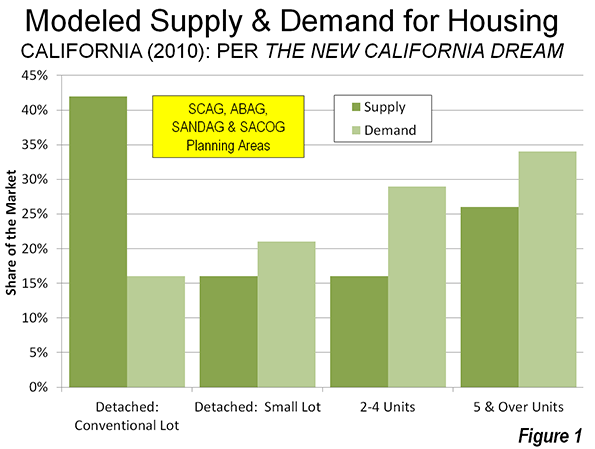
    Professor Nelson says that the supply of detached housing on what he defines as conventional sized lots (more than 1/8 acre) is far greater than the demand in California (Note 1). He further finds that the demand of detached housing on smaller lots is far greater than the supply. Professor Nelson’s conclusions are principally modeled from stated preference surveys, which can mislead if people act differently when they make choices in the real world.

    The Modeled Demand Estimates

    Nelson models the demand for housing types in California’s largest four planning regions (Southern California Association of Governments for the Los Angeles area, and the Bay Area Association of Governments for the San Francisco-San Jose area, the San Diego Association of Governments and the Sacramento Area Council of Governments). He estimates 2010 both supply and demand. His demand estimates rely strongly on data from three early 2000s stated preference surveys conducted by the Public Policy Institute of California (PPIC).

    • Nelson’s data indicates a strong preference for multi-family housing, which he places at 62% of demand in 2010, compared to the 2000 supply of 42%. Thus, the demand for multi-family housing is suggested to be one half above the supply.
    • The most stunning conclusion, however, is an over-supply of detached housing on conventional lots that Nelson estimates. Compared to a 2000 supply of 42% of the market, Nelson estimates the demand to be only 16%. This would indicate the supply of such housing to be more than 2.5 times the demand as is indicated in Figure 1.

    Nelson’s findings on conventional lot detached housing have obtained the most attention. He surmises that virtually all of the demand over the next 25 years can be met by the existing stock of conventional lot detached housing. This is music to the ears of many urban planners, who have for decades demonized  the suburbanization that has been preferred by the overwhelming majority of Californians (and Americans, and people elsewhere in the world where they can afford them).

    Actual Demand: Revealed Preferences: 2000-2008

    To perform a similar analysis, we used revealed preference data: the actual change in housing by type from the 2000 Census data to the latest American Community Survey (ACS) 2006-2010 data at the census tract level (Note 2).  

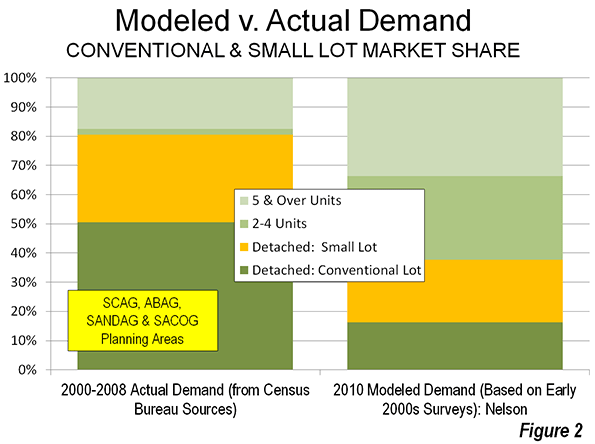
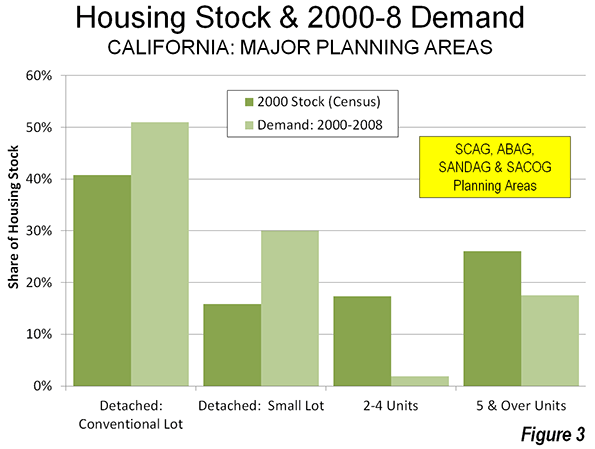
    In contrast to Professor Nelson’s estimates, the demand data indicates a strong continuing preference among Californians for detached housing on conventional lots. From 2000 to 2008 (the middle year for the 2006-2010 data), 51 percent of the new occupied housing in the four planning areas is estimated to have been detached on conventional lots (Figure 2). This is more than three times the 16% demand estimate in Professor Nelson’s data. In fact, the actual demand was higher than the 2000 supply (42%), indicating that the demand for detached houses on conventional lots has increased.

    If there is a sea change, it would appear to be in multi-family housing. In contrast with the 62% share for multi-family dwellings modeled by Nelson, the actual demand indicated in the census tract data was two-thirds less, at 19% (Figure 3), well below the supply of 43 percent in 2000. This suggests a tanking of demand for multi-family housing, even as builders, in California and elsewhere, put more product on the market.

    Why Accounts for the Difference

    Various factors appear likely to contribute to the difference between the modeled demand and the actual demand.

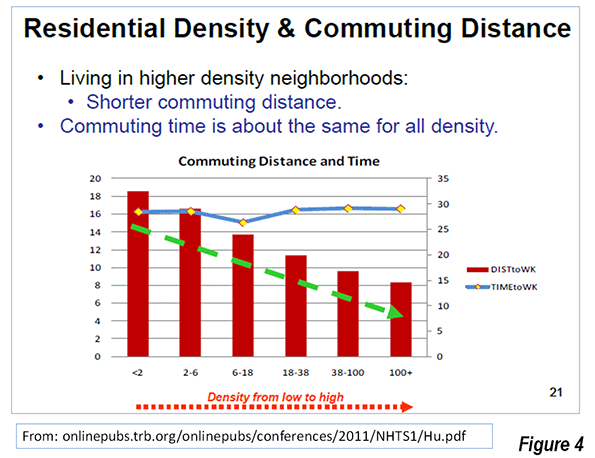
    Smaller Lots and Higher Density Do Not Mean Shorter Commutes: The PPIC survey questions implied a connection between larger lots (lower density) and longer commutes. This is the broadly shared perception, but in reality houses on smaller lots (necessarily in higher density neighborhoods) do not mean shorter commutes. This is illustrated in a chart by Southern California Association of Governments (SCAG) researchers on page 62 of The New California Dream. In the original SCAG document, the authors note that "commuting time is about the same for all density" (Figure 4).  This is not surprising, since higher densities are associated with more intense traffic congestion and with greater transit use, both of which lengthen commutes (Note 3).

    The "higher density means shorter commute" myth is rooted in the obsolete mono-centric conception of the city. Almost all US urban areas have become poly-centric with job locations highly-dispersed, as jobs have followed people to the suburbs. Gordon and Lee (Note 4) have shown that work trip travel times in the United States are shorter to dispersed employment locations than to central business districts or secondary business centers (such as "Edge Cities").  

    Invalid Perceptions of Transit Mobility: Professor Nelson also stresses stated preference responses showing that many people would prefer to live near transit service. All things being equal, who wouldn’t?

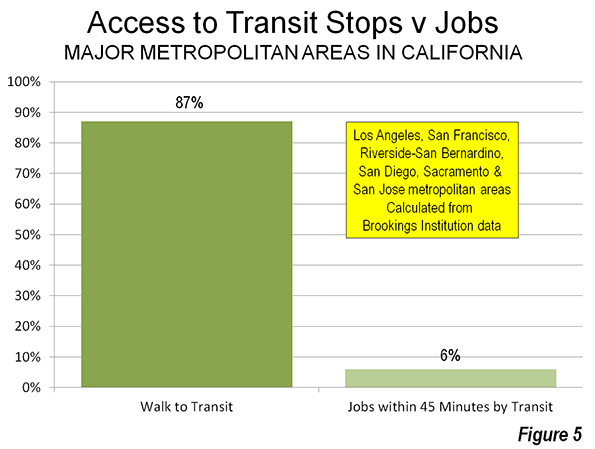
    But all things are not equal. Living near transit does not mean practical transit access to most of the urban area. In most cases, only a car can provide that. Transit systems are necessarily focused on downtown areas (central business districts), which contain, on average, only 8% of employment in the four planning regions. , Travel to other destinations is usually inconvenient, because of time-consuming transfers, or   not available at all.

    A Brookings Institution report indicated that 87 percent of people in California’s major metropolitan areas (Los Angeles, San Francisco, Riverside-San Bernardino, San Diego and Sacramento) live within walking distance of transit. Yet, the average employee can reach only 6% of the jobs in their respective metropolitan area in 45 minutes (Figure 5). By contrast, the average work trip travel time ranges from 25 minutes to under 30 minutes in the four planning regions .

    Households thinking about a move to higher density could have been, upon more serious examination, deterred by transit’s severe mobility limitations. 

    Data Insufficiently Robust for the Modeling: There is also the potential that the PPIC surveys, with their general questions, were not of sufficient robustness to support Professor Nelson’s assertions. For example, PPIC did not define the size of small lots.

    Planning and Reality

    If households were so eager to move from detached houses on conventional lots to smaller lots, 2000 to 2008 would have been the ideal time. The mortgage industry was literally falling over itself to fund home purchases. Urban core wannabes could have flooded the market pursuing their smaller lot "stated preferences." The actual, revealed preference data says they did not, which is also indicated by the continuing strength of suburban growth relative to central city growth (Note 5).

    Thus, the modeled demand estimates in The New California Dream appear to be at substantial odds with the actual demand.This is much more than an academic issue. The conclusions of The New California Dream have achieved the status of sacred text in the canon of urban planning and are mouthed unquestioningly by organizations like the Urban Land Institute.

    Worse, demand estimates from The New California Dream are being relied upon in regional transportation plans being developed by California’s metropolitan planning organizations (MPOs). This is particularly risky because these same MPOs have been granted greater power over housing under California’s Senate Bill 375, goaded on by a sue-happy state Attorney General’s office. The attempt by MPOs to impose their housing plans and regulations on consumers could well backfire, for investors in condominium and multifamily housing.  This would not be a first time that   developers followed urban planning illusions like lemmings over a cliff, to which huge losses in the last decade attest. The more destructive effects, however, are likely to be paid by households and the economies of California’s metropolitan areas.

    ———

    Note 1: More than 70% of the detached housing stock was on conventional lots in 2000.

    Note 2: There is no census tract data on detached house lot size. We scaled the detached housing data from the 2000 census to match Professor Nelson’s distribution of detached housing supply by lot size, using population density. Nelson’s method and ours were sufficiently similar that the results should have been roughly comparable. As the text indicates, they were not.

    Note 3: In each of the three PPIC surveys, respondents are asked to choose between housing alternatives that are high in the questions to commute "lengths." From the description and survey instruments in the PPIC reports, there is no indication that respondents were given any idea what commute "length" means. There are two way to judge commute "length." One is distance or miles, while the other is time. Based upon the PPIC survey instrument, it cannot be known which definition was perceived by the respondents.

    Even so, it seems more likely that the term "commute length" was perceived by respondents in time rather than in distance by respondents. Each day, people have only so many hours and minutes available. However, distance is not so constrained, depending upon the speed of the commute. Further, the extensive research on commuting often refers to "travel budgets," which are expressed in time, not distance.

    Note 4: Reference: Gordon, P. and B. Lee (2012), "Spatial Structure and Travel: Trends in Commuting and Non-Commuting Travels in US Metropolitan Areas," draft chapter for the International Handbook on Transport and Development edited by Robin Hickman, David Bonilla, Moshe Givoni and David Banister.

    Note 5: The most recent year (2010-2011), for which the Census Bureau had issued invalid municipal population estimates, indicated a continued the trend toward suburban rather than urban core growth, as has been shown by Trulia Chief Economist Jed Kolko (see: Even After the Housing Bust, Americans Still Love the Suburbs).

    =======

    Photograph: Suburban San Diego

    Wendell Cox is a Visiting Professor, Conservatoire National des Arts et Metiers, Paris and the author of “War on the Dream: How Anti-Sprawl Policy Threatens the Quality of Life.”

  • Why it’s All About Ohio: The Five Nations of American Politics

    Looking at Tuesday’s election results, it’s clear the United States has morphed into five distinct political nations. This marks a sharp consolidation of the nine cultural and economic regions that sociologist Joel Garreau laid out 30 years ago in his landmark book “The Nine Nations of North America.”

    In political terms there are two solid blue nations, perched on opposite coasts, that have formed a large and powerful bloc. Opposing them are two almost equally red countries, which include the historic Confederacy as well as the vast open reaches between the Texas panhandle and the Canadian border.

    Between these two largely immovable blocs stands the fifth nation – essentially the Great Lakes industrial heartland. By winning this territory – which could be called “Bailout Nation” – President Barack Obama built a winning coalition. Though this part of the country has suffered economic decline and demographic stagnation for decades, it is now emerging, as former President George W. Bush would put it, as “the decider” of America’s political fate.

    It’s no surprise that the coastal nations voted totally blue, reelecting the president, usually by margins of 10 points or more. The first of these nations can be dubbed “the Old Country,” the most European part of America.

    It stretches along the coast, from Maine to Maryland, and is essentially the Democratic Party’s base. It’s where the intellectual heirs to the traditions of Progressivism, the New Deal and New Frontier are most entrenched.

    Republican presidential nominee Mitt Romney lost by five percentage points or more in every state from this nation. In New York and Massachusetts, Obama won with 60 percent; in Washington, D.C., he received an astronomical 91 percent. Talk about home court advantage.

    This area is heavily urbanized and its economy – except for parts of western Pennsylvania – has become largely de-industrialized. Good jobs here are in the professions and financial services. Unemployment is high in some states, particularly New York and Rhode Island, but low – below 7 percent – in Maryland and Massachusetts.

    In the Old Country, natural resource extraction industries represent a small part of the economy and populations are concentrated in large metropolitan areas, with strong minority communities. It’s ideal territory for today’s Democratic Party, which is devotedly multicultural, strongly supportive of green energy and hostile to fossil fuels, large-scale agriculture and suburban sprawl.

    The region is essentially solid blue – as even the appealing Senator Scott Brown (R-Mass.) found out Tuesday. In the Old Country, things remain more of the same. The election numbers were nearly identical to 2008. States like Rhode Island, for example, didn’t even shift a point, despite lower national polling for Obama and the Dems.

    The Old Country’s coalition partner is Ecotopia, named after the science-fiction best-seller by Ernest Callenbach. “Ecotopia” tells the story of a successful breakaway “green” republic, which embraced most of the totems of West Coast progressivism, everything from renewable energy to militant feminism. This nation includes the states of California, Washington and Oregon. To these you can add Obama’s green-oriented, multicultural home state of Hawaii.

    In political terms, coastal Ecotopians share their states with less progressive regions on the other side of the mountains. Eastern Washington, Oregon and California all tend to be conservative – but are usually outnumbered, as they were this year, by the more densely populated coastal areas.

    Together, these two nations represent 186 electoral votes, almost equal to Romney’s total. They overwhelmingly send Democrats to Congress. And they have outsized influence. Ecotopia is home to Silicon Valley, while the Old Country, along with Hollywood, has turned the culture industry into an adjunct of the Democratic Party.

    For their part, the Republicans increasingly control two nations. One is the former Confederacy, which supported the former Massachusetts governor – only Virginia and possibly Florida slipped over to the Obama. This region has some of the nation’s strongest population growth and a strong allegiance to the military, one key GOP voting bloc.

    Energy defines much of the southern rim of the Confederacy. Texas and Louisiana have seen strong growth from oil and gas. Even the remaining Democrats in this region fear federal energy regulation under Obama will slow their economic growth. President Bill Clinton won Louisiana in 1996; this year the state went for Romney by an astounding 20 points.

    The other nation in the GOP camp is the Empty Quarter, the vast region stretching from the Great Plains and the Inter-mountain West to Alaska. This is where much of America’s food is grown and minerals extracted. Like the Gulf Coast, many in these states feel they have much to lose from a Democratic victory.

    Despite losing Nevada and Colorado and possibly Florida to Obama on Tuesday, these regions have seen expanding shares of Republican vote. Across these two nations, Romney’s margin was considerably better than Senator John McCain’s in 2008. In some states, his margins expanded by 10 points or more. From 2008 to 2012, Obama lost by 10 percentage points in Utah; 7 points in North Dakota and 5 points in Montana, South Dakota, Wyoming and Idaho.

    Yet these Republican nations may not be as stable as their Democratic counterparts. Conservative politics is almost extinct in places like California and New York. But Great Plains voters, however unhappy with Obama, still send some Democrats to the Senate, particularly when the GOP nominates extreme-right candidates.

    Ultimately, the decision comes down to the Great Lakes industrial region – which we can call the Bailout Belt. For these areas, which have high concentrations of manufacturing, the auto bailout was a godsend. And the region is now even more prosperous by the discovery of vast amounts of oil and gas.

    The benefits of the bailouts in this election – communities revived, families uplifted – outweighed those from fossil fuel producers, which now operate under threat of a possible Environmental Protection Agency-ordered shutdown. These states, outside of Indiana, stayed with Obama – by a handsome seven-point margin in Michigan. In virtually all these states, however, Romney did better than McCain.

    The president was quiet about fracking during the election. Now eyes turn to the EPA, since the House of Representatives would likely oppose a ban of any kind. The Bailout Belt may have to decide its energy future before it sides with either party.

    And where this region decides to go, so goes the nation – the entire nation.

    Joel Kotkin is executive editor of NewGeography.com and is a distinguished presidential fellow in urban futures at Chapman University, and contributing editor to the City Journal in New York. He is author of The City: A Global History. His newest book is The Next Hundred Million: America in 2050, released in February, 2010.

    This piece originally appeared at Reuters.

    Barack Obama photo by Bigstock.

  • A Racially Polarized Election Augurs Ill for Barack Obama’s Second Term

    President Obama, the man many saw as curing the country’s “scar of race,” won a second term in the most racially polarized election in decades. Overall, the Romney campaign relied almost entirely on white voters, particularly in the South and among the working class. Exit polls showed that almost 60 percent of whites voted for Romney. The former Massachusetts governor even won the majority of whites in California and New York.

    In previous elections, including 2008, such a performance would have been enough to assure a GOP victory. But America’s demographics are shifting, with racial minorities constituting upwards of one quarter or more of the vote, and growing.

    Essentially, Obama’s margin of victory was made up not only by a strong base of African-Americans but also Latinos, who appear to have voted for him more than two to one, a slight improvement from his 2008 performance. And for the first time, Latinos accounted for one in ten voters, up from 8 percent four years ago.

    But—despite his poetic, inclusive victory speech—this alliance of people of color could create a potential tragedy for our democracy. This is not because of the final result, but because it suggests that, unless there is some massive change in GOP politics, we may see a re-hardening of politics along racial lines.

    The election showed the efficacy of the new racial politics. Appeals to Latinos paid off massively, even though it may have cost the president some white votes. If Latinos remain solidly Democratic, the new racial outcasts will increasingly be middle- and working-class whites.

    The Democrats will continue to press race, as some Republicans did in the past (remember Willie Horton?), because it  works. The president’s race-conscious campaigning this year was assisted in part because the media did not stress his ties to abrasive reverends like Al Sharpton and Joseph Lowery. He also did well with his Latino gambit since, once again, the media, including many conservatives, were sympathetic to amnesty.

    So where does this go from here? Political revolutions—particularly successful ones—tend to shift rapidly into excess. With the recalcitrant white vote seemingly neutralized, the Obama team can now ever more openly embrace a multicultural politics of the kind Bill Clinton was careful to avoid. One sure voice pushing for race-centered politics will come from Attorney General Eric Holder, who largely embraces the idea that affirmative-action policies should be continued until Latinos and African-Americans achieve social and economic parity with whites.

    Affirmative action and other race-sensitive policies—promoted even by ersatz minorities like new senator Elizabeth Warren—could characterize our politics for the next decade or more. These divisions are already evident among millennials, where whites, particularly evangelicals, have become increasingly alienated from the president. White millennials, who backed Obama in 2008, went with Romney this year 52-44, according to an exit poll—a particularly troubling shift. The gap between white and minority millennials this year appears to be as high as 30 points—a bad augur.

    And racial divisions may become worse if the economy continues to sputter. President Obama may be beloved among Latinos and African-Americans, but his economic policies have not been friendly to them. This is particularly true, ironically, for blacks, who, as Walter Russell Mead among others have pointed out, have fared worst of all in the recession. This situation could be exacerbated by growing financial stress in cities and states, whose governments have traditionally been major employers of black white-collar workers.

    Unless growth comes back, this means minorities, particularly African-Americans, could become ever more strident in their demands. Their appeal to an administration—particularly now that it faces no new elections—that at times seems sympathetic to a racialized agenda could be stronger than could be imagined just a few years ago. This could end badly. In the long run, history has shown, groups that look too much to government (the Irish, for example) do not fare as well as those, such as yesterday’s Jews and today’s Asians, who look more to education and entrepreneurship.

    Alienation among whites is also likely to increase. Like its minority counterpart, the white working class—including millennials—has also suffered in the recession, and suffers double-digit unemployment.  Although this entire generation can be considered screwed, young whites—and young white males—are particularly so. Not only have many been left behind by the economy, but they have been deemed less worthy of assistance by the emerging new ruling class.

    In many ways, this has ominous implications. To date America’s white working and middle classes have not drifted toward the kind of nativist movements that have risen in France, Germany, and, most recently, Greece. Yet a group that feels ignored by the establishment, and feels increasingly like second-class citizens in their own country, can drift in that direction.

    The great tragedy here: the major challenges facing America are not primarily racial. They include stimulating economic growth for the broadest portion of our population. We need better jobs, roads, and bridges and less symbolism or redress for past sins. If politicians think the way to success is to open the scar of race, we will create the kind of politics that will undermine hope for our future success.

    Joel Kotkin is executive editor of NewGeography.com and is a distinguished presidential fellow in urban futures at Chapman University, and contributing editor to the City Journal in New York. He is author of The City: A Global History. His newest book is The Next Hundred Million: America in 2050, released in February, 2010.

    This piece originally appeared at The Daily Beast.

    Voter sign photo by Bigstock.