Category: Demographics

  • China and the Future of Hong Kong

    Last week Hong Kong’s new leader Leung Chun-ying was sworn into office by Chinese President Hu Jintao. The ceremony coincided with the 15th anniversary of the British handover of Hong Kong to China so there was plenty of rhetoric about ‘strengthening ties with the motherland’. Yet not far from the ceremony, tens of thousands of Hong Kong citizens marched in protest showing discontent with growing inequality and what they perceive as Beijing’s increasing assault on the territory.

    The relationship between Hong Kong and mainland China is complex. Beijing for the most part has kept its promise to uphold the ‘one country, two systems’ mandate. Officially, Hong Kong is considered a ‘Special Administrative Region’ (SAR), which means that it is treated as a separate country from an immigration standpoint and continues to circulate its own currency, the Hong Kong dollar. Hong Kong also retains an independent legal and judicial system inherited from the previous British rulers.

    Most importantly, Hong Kong has avoided the draconian media censorship common on the mainland. A free press is consistent with its reputation as a global center of banking and commerce. Hong Kong’s ease of trade and doing business frequently leads it to being named one of the world’s freest economies.

    So if Beijing continues to hold up its end of the deal, why do so many Hong Kong residents march in protest? The relationship is more nuanced than it appears on the surface. Politically, Hong Kong residents do not have the freedom to elect their leader (CY Leung was appointed by a 1,200-person electoral college made up primarily of pro-China business leaders), although democratic elections are set to commence in the next five years. Underlying this frustration is what Hong Kong residents see as an infiltration of growing mainland influence on the city.

    On the ground, Hong Kong experienced a huge increase in mainland tourists to the city since the handover. Hong Kong doesn’t have the same high tax rate on imported goods that mainland China does, so mainlanders flock to the city primarily for shopping, hunting for bargains on electronics and luxury fashion brands. It is not uncommon to see long queues of mainland tourists in front of shops of famous fashion brands like Gucci, D&G or Prada. The droves of mainland shoppers spending money in Hong Kong are great for the local economy, but many locals decry the constant flow of tourists as invading ‘locusts’.

    Yet more significant than what is happening on the ground is what is taking place high above in the sky. The phenomenon of wealthy mainlanders purchasing real estate in the city has driven   housing prices to astronomical levels, approaching the market just before the Asian Financial Crisis of 1997. For well-off Chinese mainlanders, Hong Kong real estate is seen as a safer long-term investment than China’s still somewhat risky real estate market and unpredictable stock market. A severely limited land supply coupled with the fact that a handful of powerful real estate oligarchs control the market for new development means that prices will probably stay high barring another economic crisis.

    Land-use policy is perhaps the most critical factor in determining both the future of Hong Kong and the mainland. As anyone who has been to the city can attest to, Hong Kong has some of the best infrastructure in the world, including a first-class international airport, extensive rail system and a booming seaport. Much of that infrastructure comes from the city’s land-auctioning system, which is the government’s primary source of revenue. This is also what helps keeps taxes low.

    Furthermore, unlike in the U.S., where infrastructure is traditionally financed publicly, Hong Kong’s infrastructure is increasingly built with private funds. For instance, the city’s Mass Transit Railway (MTR) Corporation, founded as a public entity, went fully private in 2000 and is traded on the Hong Kong’s stock exchange. In addition to operating and maintaining the city’s existing rail system, MTR Corporation is responsible for building new lines. What makes MTR Corporation different from most other transit authorities is that its primary earnings do not come from passenger ticket sales but from developing the land on top of and around its metro stations.

    Cheung Kong Holdings, led by Hong Kong’s richest man Li Ka-shing, is not only one of the city’s largest property developers, its business interests also include Hutchinson Port Holdings (a port operator that handles 13% of the world’s container traffic) and Hutchinson Telecommunications Limited (which builds and operates mobile phone networks). Sun Hung Kai, another powerful Hong Kong property developer also owns stakes in logistics and telecommunications businesses (although its founders, the Kwok brothers, were recently arrested on corruption charges).

    The mode of urban development in mainland Chinese cities is heavily influenced by Hong Kong. Yet instead of powerful corporations, State-Owned Enterprises (SOE), large entities owned by the government, dominate urban development related businesses. China’s land auctioning system is far from perfect, with well-documented instances of corrupt land seizures and the unfair advantages government backed SOEs have in the bidding process over private developers. But with virtually no property taxes in mainland cities, land sales remain the primary source of revenues for local governments to support infrastructure development.

    There is growing evidence that suggests China plans to alter the direction of its development model in the coming years by consolidating and privatizing its SOEs. Already, Hong Kong property developers are active in the mainland real estate market with Chinese companies eager to learn from their expertise. The cozy relationship between Hong Kong developers and mainland SOEs is a cause for concern by Hong Kong citizens, as they see their local developers as more interested in appeasing Beijing authorities than providing affordable housing for its own citizens.

    Yet this is inevitable. The city of 7 million cannot expect to forever be completely independent of a country of 1.3 billion to which it is now irrevocably attached. This is true even in spite of Hong Kong’s role as an international center of trade.

    Throughout history, Chinese culture survived through its sheer mass and cultural osmosis. When CY Leung gave his inaugural speech last week, it was in Standard Mandarin, the official language of China. Although the citizens of Hong Kong are also Chinese, their official language is Cantonese, a completely different and not mutually intelligible dialect. Leung’s move was seen as a slight to the people he was chosen to serve, yet given who he has to report to in Beijing, it made perfect sense.

    Adam Nathaniel Mayer is an architectural design professional from California. In addition to his job designing buildings he writes the China Urban Development Blog.

    Follow him on Twitter: AdamNMayer

    Hong Kong photo by BighStockphoto.com
  • Modern Families: Fact from Fiction

    I sometimes struggle with our willingness to look straight through evidence to see only what we want to see, or what we believe we should be seeing. Some recent interpretations of the Australian census and conclusions about housing form and consumer choice regrettably fall into this category.

    Early results from the Australian census may have disappointed some boosters who have actively promoted the view that the typical family household is a thing of the past. The argument has had many forms but usually includes one or more of the following:

    • that single person households are the fastest growing household type; that lifestyle choices mean that more people want to live closer to city centres;
    • that the suburban housing block is an environmental calamity and is no longer even suited to what households want;
    • that high density, multi-level housing with high reliance on public transport is a preferred housing model for the ‘new’ generation of family types.

    And so it goes.

    Sadly for the promoters of rapid social change, the census reveals that the facts aren’t on their side. Indeed, in terms of housing form and family type, nothing much has really changed. There have been movements at the margin and movements in both directions, but nothing I would interpret as conclusive evidence of fundamental social change.

    Housing form

    Across Australia, 73.8% of us live in a detached house. In the last census, it was 74.3%. That’s hardly a seismic shift. In 2011, 14.6% of us lived in apartments compared to 14.7% five years earlier. Townhouses account for 9.9% of households versus 9.3%.  Don’t hold the front page, nothing much has changed.

    There are regional differences. In Sydney, detached housing is at 58.9% from 60.9% while apartments represent 27.6% of households against 26.4% five years earlier. This higher proportion in apartments comes as little surprise given the highly restrictive planning policies of NSW in that period and prior (which included a virtual prohibition on suburban expansion), combined with the long established tendency of Sydney to accommodate more people in apartments than other capitals. But for all the hype about Bob Carr’s ‘brawl against sprawl’ and subsequent planning regimes, the actual change in housing has been minimal. (Instead, what happened is that the industry stopped supplying much of either).

    In Melbourne by contrast, detached housing represents 71.1% of housing from 71.6% five years earlier. Apartments are 16.6% versus 16.4%. Melbourne, and Victoria generally, has had a less deterministic approach to planning whereby detached suburban expansion hasn’t been as vigorously opposed, so the higher dominance of the detached house is no surprise. But it also shows little change over recent times, which doesn’t support the view that a majority of consumers would prefer higher density over lower.

    In Brisbane, detached housing is at 77.6% versus 78.7% five years earlier, which is a very small change and also one of the highest proportions of households in detached housing in the country. Once again, the evidence isn’t pointing to massive social change. It isn’t even pointing to modest change.

    Family type

    Also regrettable for the promoters of widespread social change has been the fact that family types have remained largely unchanged. There are 43% of people living as a couple with children (it was 43.3% five years earlier) and there are 39.5% living as couples without children.  Remember also that ‘couples without children’ includes couples in the pre-family formation stage (young, and starting out in life in the main) and also ‘empty nesters’ (parents whose children have left the family home). A further 16% are single parent families. 

    The Census this time also went into some detail about same sex couples. But set aside the media and political hype and the facts show that the proportion of same sex couples across the country is 0.7%. There’s been a lot of media comment and public policy attention recently about that 0.7%.

    The inevitable conclusion from this evidence is simply that the overwhelming majority of people in Australia remain families who either have children, who plan to have children, or who have had children who have left home, and that this proportion hasn’t changed to anywhere near the extent promoters of social change might have wished.

    This also has implications for housing choice and style. There will be a market for higher density, inner city housing but our policy makers need to keep in mind that the detached home remains the overwhelming preference for families as a place to raise children. That also includes couples planning to raise children (not all of whom live in apartments until the first child comes along – many prefer to plan ahead) and it also includes couples with children who have left home but for whom a third or fourth bedroom is needed for grandparent child minding or children returning to the family home.

    However, the evidence hasn’t stopped some sections of the media or social commentators from reaching entirely different conclusions. “Up not out for housing” declared one writer who wrote: “Australia is increasingly favouring higher density living, according to the 2011 census.” Really? Based on the same evidence above? You’d be seriously pushed to draw that conclusion. Add to this that supply side policies have restricted the choice of detached housing in preference to the promotion of higher density, which means that increasingly housing choice has been restricted, and what there is of it, much more expensive. To conclude anything about ‘favouring’ one type of housing or another, without assessing the supply side policy constraints which limit choice, is a bit like saying more people prefer mangoes in summer than in winter. Duh.

    The Grattan Institute is another that seems committed to turning the evidence on its side to support pre-determined points of view. In this opinion piece, Grattan Institute cities program fellow Peter Mares concluded that: “that despite paying significantly more to put a roof over their head than they were five years ago, many are not ending up in the kind of housing that best matches their preferences.”  Describing the “popular view that we are wedded to the suburban block” as a mismatch, the conclusion is that ‘we’ (being, I presume, the unelected policy makers)  need to have “a serious, if difficult, conversation about what type of housing we should build and where it should be built.”

    Well, that would be difficult if it means imposing a form of housing on a population that might prefer to make its own choices about what type of housing it ‘should’ have and where they ‘should’ be living. 

    These aren’t the only examples and as more Census data becomes available, plenty more commentators will seek to extrapolate minor changes at the margin into claims this represents evidence of fundamental social change. It doesn’t and we can only hope our policy makers know the difference between evidence and a sitcom.

    Ross Elliott has more than 20 years experience in property and public policy. His past roles have included stints in urban economics, national and state roles with the Property Council, and in destination marketing. He has written extensively on a range of public policy issues centering around urban issues, and continues to maintain his recreational interest in public policy through ongoing contributions such as this or via his monthly blog The Pulse.

    Family illustration by BigStockPhoto.com.

  • Misreferencing Misoverestimated Population

    I know the media confusion story of the past week is all about the momentary misreporting that got the story of the Supreme Court ruling backwards. Yet there was some real misoverestimating across the nation over the latest census numbers that were released recently on municipal population estimates for 2011.

    Here are some recent headlines:

    LATimes: U.S. population in cities growing faster than in suburbs

    Chicago Tribune: Census sees Chicago’s population inching up

    Boston Herald: U.S. population in cities growing faster than in suburbs, figures show

    AP: Big US cities boom as young adults shun suburbs, census estimates show

    Lots more just like those. Guess what… Pretty much all of those stories are wrong, or at the very least baseless when you really look at the data.

    The census data reported was the 2011 population estimates for incorporated places across the US. So basically cities, towns, boroughs, and townships. We went through this yesterday, but if one read the actual census methodology for this particular data they were quite clear. The subcounty (i.e. municipal) population estimates are mostly based on an estimate of the change in housing units at the municipal level. The census changed their methodology on how they computed housing unit change for this particular data and as they explain:

    “To produce subcounty housing unit estimates, we distributed the extrapolated county estimates down to each subcounty area within a county based on 2010 Census proportions.” (emphasis added)

    Which means basically that there was very little 2011 data that went into these numbers. Without using new information it begs the question of how much the results should be interpreted. They basically took the estimated county level population data and allocated it to smaller municipalities based on the 2010 Census. They also just assumed that all the growth was even within counties. That assumption, that center cities grew the same as their immediate suburbs, produced the results being reported on everywhere. There appears to be no other supporting analysis for the assumption, it is just an assumption. Other than that, there is no new information here to lead to the conclusions making their way into the headlines. It may have even tripped up the experts out there because the Census folks explain they changed their methodology just for this particular data release, and are likely to change it again before next year’s update. But you have to read into their methodology notes to realize the changes for just this year. This is all probably an example of why some of us have the bad habit of reading footnotes first.

    Was there any new growth in cities? Not at all. Or at least there is no data in any of this to tell us one way or another. The Census basically took the growth that likely continued to be mostly in the suburbs and just assumed it was spread evenly between center cities and suburbs within counties across the nation. The result was that it all of a sudden appeared cities were growing faster (or in some cases shrinking less) than they have been in other data. In reality, the new patterns were no more than an artifact of the temporary change in the Census Bureau’s methodology for this data. If they had ever used the same methodology in the past, namely taking county-wide population changes and distributed growth evenly across municipalities the results would have come out the same. If these municipal estimates had been calculated this way over the last decade, they would have wound up being very much different from the eventual decennial census enumeration.

    So the headlines may be ok if there is data on ‘cities’ that are in themselves counties, but those areas are few; or in the case of New York City, multiple counties. For most cities are only parts of larger counties. Other than Allegheny County I looked at Cook County which includes Chicago and indeed both the city of Chicago and most all of its Cook County suburbs are being reported as having nearly identical growth rates since 2010. I bet that is no more true there than it isn’t here.

    The only caveat to any of that is that the data reported does seem to have some new 2011 data on group quarters population incorporated into it, as their methodology says it should. So where there was a recent change in the population of college dorms, military barracks, prisoners are related types of institutions then you are seeing population changes different from the county-wide averages. That appears to me the main source of the disproportionate growth the 2011 data is showing for the City of Pittsburgh. So real growth for sure, but I would be careful in explaining its causes.

    So this all may not be as egregious an error as the news cycle we once had in 2000 when population ‘growth’ Downtown was attributed to a big new influx of young people living in the Golden Triangle in the 1990’s. The truth was that the Allegheny County Jail was rebuilt and expanded in the 1990’s and that expansion more than accounted for a nominal reported increase in Downtown’s residential population. The eventual increase in Downtown’s population would come mostly a decade and several hundred million dollars in subsidies later. Nonetheless, this misuse of Census data is certainly more widespread and likely be misreferenced for years to come.

    Chris Briem works at the Program in Urban and Regional Analysis at the University of Pittsburgh’s University Center for Social and Urban Research. This article originally appeared at Nullspace on June 29, 2012 and The Urbanophile on June 30, 2012.

    Photo by Flickr user quinn.anya, accessible online.

  • Pakistan: Where the Population Bomb is Exploding

    In much the developed, as well as developing world, population growth is slowing. Not so in Pakistan according to reported preliminary results of the 2011 Pakistan census. Here population is growing much faster than had been projected. Pakistan’s population stood at 197.4 million in 2011, an increase of 62.7 million from the last census in 1998 (Note 1). The new population is 20 million more than had been forecast in United Nations documents. Some of the additional growth is due to refugees fleeing Afghanistan, but this would not be enough to account for the majority of the under-projection error.  

    Pakistan: Moving Up the League Tables

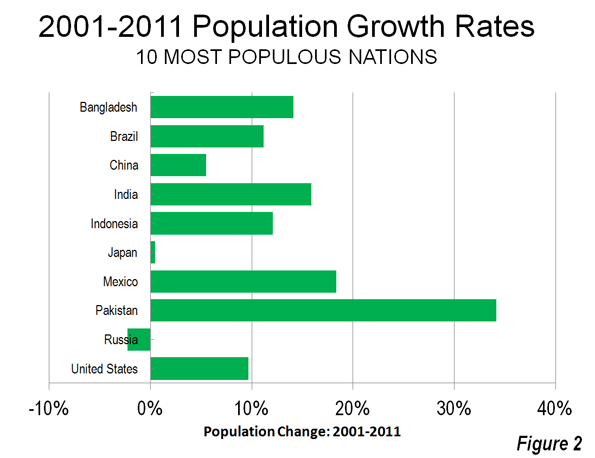
    As a result, Pakistan has passed Brazil and become the world’s 5th most populous nation, following China, India, the United States and Indonesia. Pakistan’s 11 year growth rate is estimated at 34.2 percent, nearly double that of second ranking Mexico, at 18.2 percent, where the birth rate (as indicated by the total fertility rate) is projected to drop to under replacement rate by the end of the decade. Perhaps most significantly, Pakistan’s growth rate is more than double the rates of India (15.9 percent) and Bangladesh (14.1 percent),which have long had reputations for strong growth (Table and Figure 1). At this growth rate, Pakistan could become the world’s fourth most populous nation by 2030, passing Indonesia.

    Table
    10 Most Populous Nations: 2000-2011: Population Trends
    Rank Nation 2000 2011 Change % Change
    1 China    1,278.0    1,348.0        70.0 5.5%
    2 India    1,071.0    1,241.0       170.0 15.9%
    3 United States       285.5       313.1        27.6 9.7%
    4 Indonesia       216.2       242.3        26.1 12.1%
    5 Pakistan       147.1       197.4        50.2 34.2%
    6 Brazil       176.9       196.7        19.8 11.2%
    7 Bangladesh       131.9       150.5        18.6 14.1%
    8 Russia       146.1       142.8         (3.3) -2.3%
    9 Japan       125.9       126.5          0.6 0.5%
    10 Mexico         97.0       114.8        17.8 18.4%
    Population in Millions
    Population data from UN, except for Pakistan (from Pakistan census)
    2000 Pakistan population estimated from 1998-2011 growth rate.

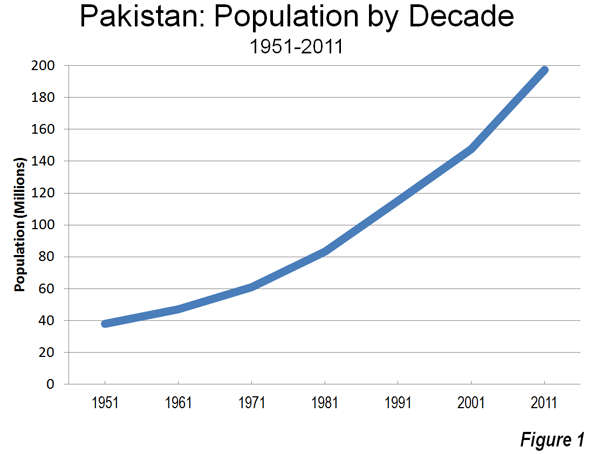
    Remarkably, while much of the world has seen a reduction in fertility rates and population growth, Pakistan’s growth rate has increased. Between 1991 and 2001, Pakistan grew 25 percent, a rate that increased by more than one third (to 34 percent) between 2001 and 2011 (Figure 2). Pakistan’s total fertility rate (TFR — the number of live births the average woman has in her lifetime) is reported by the UN to be 3.2. This is well above India’s rate of 2.6 and far above the Bangladesh rate of 2.2 (which is only barely above the generally accepted replacement rate of 2.1). Pakistan’s fertility rate is the highest of any of the largest countries and one of the highest in the world outside sub-Saharan Africa.

    Not surprisingly, the average household size is very high, at 6.8. This is a slight decline from the rate of 6.9 in 1998. By comparison, more developed countries, such as in Europe and North America, tend to have average household sizes of from 2.2 to 2.6.

    Karachi: World’s Leading Urban Area by 2030?

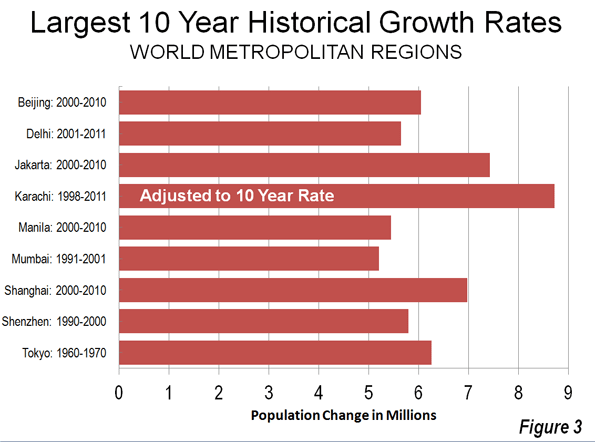
    Pakistan’s largest metropolitan region and capital of Sindh province, Karachi, grew even faster. Between 1998 to 2011, Karachi grew from 9.8 million to 21.2 million, adding more than 11 million people (115 percent). No metropolitan region in the world has ever grown so much in so little a period. This 13 year growth rate, adjusted to 10 years, is 8.7 million. Until the last decade, only Tokyo, among the larger world metropolitan regions, had ever grown more than 6 million in 10 years (6.2 million from 1960 to 1970). Between 2000 and 2010, Jakarta grew 7.4 million, Shanghai grew 7.0 million and Beijing added 6.0 million people.  (See Figure 3.)

    Mexico City and Sao Paulo, with their reputations for explosive growth rates, are now expanding at only 3 million (or less) per decade, and their growth is slowing. The fastest growing metropolitan regions in regions in Europe and North America peaked at similar numbers. New York’s greatest growth was 3.4 million between 1920 and 1930, while Los Angeles grew 3.1 million from 1980 to 1990.

    The early census results indicate an urban area (area of continuous urban development, a part of a metropolitan area) population of approximately 19.5 million, which would rank Karachi as the 7th largest in the world. With an urban land area of approximately 310 square miles (800 square kilometers),  Karachi has an average population density of approximately 63,000 per square mile (24,000 per square kilometer), making it more dense than any "megacity" (urban area over 10 million population) except for Dhaka (Bangladesh) at 115,000 per square mile (44,000 per square kilometer) and  Mumbai (80,000 per square kilometer and 31,000 per square mile)

    Karachi’s strong growth now places it among a group of large and rapidly growing urban areas that could challenge Tokyo to become the world’s largest urban area in 20 years. Indeed, should Karachi’s now 6.0 percent growth rate fall to 4.0 percent, Karachi would still be the world’s largest urban area in 2030, followed by Jakarta, given its present growth rate. With Tokyo likely to begin losing population by that time, Delhi may pass Tokyo by 2030 as well.

    At the same time, Karachi is densifying in an unusual way: it is increasing its average household size. While the average household size is dropping modestly in the nation as a whole, Karachi’s average household size rose from 6.7 to 7.3 between 1998 and 2011, meaning that nearly 10 percent of any recent density increase is within housing units (it is not known whether this is due to higher local fertility rates or "doubling up" of family units in housing units).

    As the largest metropolitan area of one of the world’s largest nations, Karachi draws residents from the rest of the nation (and outside) to take advantage of its economic opportunities. Pakistan is not a rich country, with a gross domestic product (purchasing power parity) of less than $3,000 per capita in 2011. This compares generally to rates of $30,000 to $40,000 in the larger European Union economies, $40,000 to $50,000 in Australia, Canada, United States and Hong Kong and $60,000 in Singapore. However, incomes are higher in Karachi than in the rest of the country.

    As huge numbers of people have migrated to Karachi, many have been forced to live in informal settlements (slums), as squatters. In 2000, it was estimated that approximately 5 million of Karachi’s residents (nearly 50 percent) at the time lived in slums.

    Hyderabad

    Hyderabad (Pakistan, not India) is the second largest metropolitan region in the province of Sindh. Hyderabad’s claim to fame is that it is growing even faster than Karachi. Between 1998 and 2011, Hyderabad grew from 1.4 million to 3.4 million, or 129 percent.

    Other Areas

    So far, the reported census results are limited to the provincial data and local data in the province of Sindh. However, in view of the strong growth rates around the nation, it seems likely that the count in the nation’s second largest urban area, Lahore, will surpass 10 million.

    Urban Growth in Pakistan

    Finally, any review of suburban and exurban land use on Google Earth suggests that Pakistan is taking the advice of the United Nations in its State of the World Population Report 2007: Unleashing the Potential of Urban Growth, which said (Note 2):

    (a) expanding their city limits; (b) planning for road grids in the areas of expansion; (c) locating
    the required 25- to 30-metre-wide right-of-way for the infrastructure grid on the ground

    Radiating both from Karachi and Hyderabad, there are new grids of streets for housing and other development of a type that will allow the burgeoning cities of Pakistan to grow and perhaps even breathe at the same time.

    Wendell Cox is a Visiting Professor, Conservatoire National des Arts et Metiers, Paris and the author of “War on the Dream: How Anti-Sprawl Policy Threatens the Quality of Life.”

    ——————

    Photo: Map of Karachi by Wikipedia user Nomi887

    Note 1: This population includes the areas of Kashmir administered by Pakistan (and claimed by India) and excludes the areas of Kashmir administered by India (and claimed by Pakistan).

    Note 2: This concept was pioneered by Professor Schlomo (Solly) Angel of New York University and Princeton University, who proposed that developing world urban areas provide grids of dirt roads to accommodate their rapidly growing populations. This would ensure a better planned urban area and lead to more healthful living conditions (and avoid the necessity of high-density slums or shantytowns).

  • U.S. Desperately Needs a Strategy to Attract the Right Skilled Immigrants

    President Obama’s recent “do it myself” immigration reform plan, predictably dissed by conservatives and nativists, reveals just how clueless the nation’s leaders are about demographics. Monday’s Supreme Court ruling on Arizona’s immigration crackdown also broke down along predictable lines, with both parties claiming ideological victories.

    Yet the heated debates are missing the reality of immigration and its role in America’s future. In reality America needs more immigrants, but with a somewhat different mix.

    Rather than an issue of “values” or political sentiment, we need to look at immigration as a matter of arbitrage, a process by which rapidly aging countries bid for the skills and energies of newcomers to keep their economies afloat.

    Nowhere is this immigration arbitrage clearer than in the world’s most rapidly aging region, Europe. By 2050 the workforce there is expected to decline by as much as 25%. Yet this diminishing resource is now increasingly on the march as young Greeks, Italians and Portuguese flee to stronger economies in Europe’s Nordic belt and elsewhere. An estimated half million left Spain last year alone. Ireland, which in recent decades actually attracted new migrants, was exporting a thousand people a week last year. In recession-wracked Britain, a 2010 poll found nearly half of the population would like to move elsewhere.

    Germany, with its ultra-low birthrate and rapidly aging population, has emerged as a primary migration beacon. Germany needs about 200,000 new migrants ever year to keep its economic engine humming. For decades, newcomers from Turkey and other Islamic countries have flocked there, but this migration has failed to deliver much added value due to their general lack of skills and divergent cultural values. So the Germans — as they did back in the 1960s — look to harvest the diminishing pool of skilled workers from equally aging states on the EU’s southern periphery.

    But it’s not simply a matter of a one-way south to north flow. Other EU countries, such as Italy, are playing the immigration arbitrage game by importing young workers from rapidly depopulating southeastern Europe. Milan, for example, added 634,000 foreign residents in just eight years (2000 to 2008), the largest share from Romania, followed by Albania. Over the period, more than 80% of Lombardy’s growth has come as a result of international immigration.

    But immigration arbitrage is more than a simple numbers game. As Europe learned through its bitter experience with immigration from North Africa and the Middle East, importing populations without necessary skills and attitudes useful for the modern economy can produce unhappy results. The key issue is how to attract and select immigrants likely to contribute to the national well-being and economic competitiveness.

    Almost everywhere in the world, there are shortages of skills ranging from construction to advanced engineering. Much of contemporary immigration to East Asia reflects the need for workers — largely from India, Bangladesh, Indonesia and Sri Lanka — to perform tasks considered “dirty, dangerous and difficult” (or 3-D).  Singapore and Hong Kong also have a bull market for high-end workers in order to maintain their increasingly financial and technology-oriented economies.

    But skills should not be conflated merely with university degrees. Education is no longer a guarantor of productivity; the degree, once a sign of distinction, has become a commodity. Many disciplines have little net positive economic impact. Few countries likely suffer shortages of post-modernist literature graduates, performance artists or lawyers.

    Opening the doors to undocumented high school graduates, many with no real marketable skills, as President Obama just did, may not have a great positive long-term effect on the economy. Perhaps it would be better if our immigration policies were less about politics, and ethnic constituencies, and more about gaining specific skills and abilities from other countries, including from Mexico’s growing ranks of educated and skilled workers.

    Some countries, such as Canada, Australia and Singapore, already have made major accommodations favoring skilled or entrepreneurial immigrants. The United States, to its great disadvantage, has been slow in this regard. In 2011 barely 13% of all American immigrants came as a result of employment-based preferences, down from 18% 20 years ago. Family reunification should remain a cornerstone of immigration but needs to give way substantially to a more skills-oriented policy.

    America’s approach is particularly baffling given our looming skills shortages. The reviving auto industry is already running short of craftspeople such as numerical machine tool operators. In fact, David Cole, chairman of the Center for Automotive Research, predicts that as the industry tries to hire upwards of 100,000 workers, they will start running out of people with the proper skills as early as next year.

    This shortage is also intense in many engineering and technically oriented fields. The Pittsburgh area alone has 1,500 engineering job openings. The Great Lakes Metro Coalition, covering 12 states, is advocating for a federal immigration policy focused on attracting highly skilled talent. Government and business leaders in economically healthy parts of the Great Plains, Texas and Utah now consider persistent skilled labor shortfalls — particularly in science and technical fields — as the greatest barrier to continued growth.

    Immigration policy should also look to bring in more entrepreneurs. As business start-ups overall have slowed, immigrants continue to launch new businesses. Today fully one-fifth of all American businesses are owned by immigrants, up from 12% two decade ago. Many of these are located in suburbs and small towns, where together a majority of immigrants see opportunities and a better quality of life.

    These qualitative distinctions may be lost on many in the pundit class. As a decline in Mexican immigration has driven overall immigration down below 2009 levels, the number of Asian newcomers is once again growing. Their share of annual new arrivals has risen over the past two years from 36% to 42%.

    Asians increasingly do not come for just economic opportunity — there’s often more of that at home — but to attain things almost impossible in their native countries  such as a single-family homes with a backyard and less congested, tree-shaded neighborhoods. For some, like migrants from China, political and religious freedom also is often a major attraction.

    This is good news for the future. As a Pew report recently pointed out, Asian immigrants tend to possess many of the characteristics this country sorely needs: a commitment to education, family and entrepreneurship. McKinsey suggests China and India will produce 184 million new college graduates over the next 10 years; this provides a vast pool of which the U.S. has only to pick up a small portion to boost its economy.

    This is not to argue for a policy based on ethnicity or geography. There are hard-working, skilled immigrants to be had from the poorest countries in Latin America or Africa. If you want to see this, go to any strip mall around Houston, Los Angeles or northern New Jersey.

    We need to target immigrants most likely to help our advanced industries, start businesses and families, and whose descendants will provide critical demographic vibrancy. There may soon be many such people looking to move from places like the Middle East, particularly Christians or liberal Muslims threatened by rising Islamism. There also should be policies to welcome restless young Europeans who may be seeking more opportunity elsewhere.

    The age of immigration arbitrage will require critical shifts in all advanced countries to provide many more openings for skilled immigrants and entrepreneurs. But ultimately the best way to attract these people lies in boosting the kind of economic growth and opportunity that can attract this most valuable resource to a country.

    Joel Kotkin is executive editor of NewGeography.com and is a distinguished presidential fellow in urban futures at Chapman University, and contributing editor to the City Journal in New York. He is author of The City: A Global History. His newest book is The Next Hundred Million: America in 2050, released in February, 2010.

    This piece originally appeared in Forbes.

    Immigration rally photo by BigStockPhoto.com.

  • Thunder On The Great Plains: A Written-Off Region Enjoys Revival

    They may not win their first championship against Miami’s evil empire, but the Oklahoma City Thunder have helped to put a spotlight on what may well be the most surprising success story of 21st century America: the revival of the Great Plains. Once widely dismissed as the ultimate in flyover country, the Plains states have outperformed the national average for the past decade by virtually every key measure of vitality — from population, income and GDP growth to unemployment — and show no sign of slowing down.

    It’s a historic turnaround. For decades, the East Coast media has portrayed the vast region between Texas and the Dakotas as a desiccated landscape of emptying towns, meth labs and right-wing “clingers.” Just five years ago, The New York Times described the Plains as “not far from forsaken.”

    Many in the media and academia embraced Deborah and Frank Popper’s notion that the whole region should be abandoned for “a Buffalo commons.” The Great Plains, the East Coast academics concluded, represents “the largest, longest-running agricultural and environmental miscalculation in American history” and boldly predicted the area would “become almost totally depopulated.”

    Yet a funny thing happened on the way to oblivion. Rising commodity prices, the tapping of shale gas and oil formations and an unheralded shift of industry and people into the interior has propelled the Plains economy through the Great Recession.

    Since 2000, the Plains’ population has grown 14%, well above the national rate of 9%. This has been driven by migration from the coasts, particularly Southern California, to the region’s cities and towns. Contrary to perceptions of the area as a wind-swept old-age home, demographer Ali Modarres has found that the vast majority of the newcomers are between 20 and 35.

    Oklahoma City epitomizes these trends. Over the last decade, the city’s population expanded 14%, roughly three times as fast as the San Francisco area and more than four times the rate of growth of New York or Los Angeles. Between 2010 and 2011 OKC ranked 10th out of the nation’s 51 largest metropolitan areas in terms of rate of net growth.

    Nothing more reflects the changing fortunes of Oklahoma City than the strong net migration from many coastal communities, notably Los Angeles and Riverside, a historic reversal of the great “Okie” migration of the 1920s and 1930s. In the past decade, over 20,000 more Californians have migrated to Oklahoma than the other way around. OKC has even experienced a small net migration from the Heat’s South Florida stomping grounds.

    The city’s transformation from a cow town into an attractive, modern metropolis has been fueled by some $2 billion in public investment and over $5 billion in private investment, says Roy Williams, president of the Oklahoma City Chamber of Commerce. Besides the arena for the Thunder, the city has engineered a successful riverfront development known as Bricktown, fostered a growing arts scene and become more ethnically diverse, largely as a result of immigration from Mexico.

    This pattern of revived urbanization can be seen in other Plains cities. World-class art museums grace Ft. Worth’s Cultural District, and downtown in Omaha, Neb., has become a lively venue bristling with revelers on weekends. Even downtown Fargo, N.D., now boasts a boutique hotel, youth-oriented bars, interesting restaurants and a small, but vibrant arts scene.

    Great Plains cities are doing well, however, predominantly due to their strong record of economic growth. Over a decade in which most large metropolitan areas lost jobs, Ft. Worth, Dallas, Oklahoma City and Omaha have created employment. Unlike many Bush-era boom towns, such as Las Vegas, Riverside-San Bernardino, Calif., or the major Florida cities, the Plains did not hemorrhage jobs during the Great Recession.

    The Plains states enjoy some of the lowest unemployment rates in the country. There were seven states with unemployment of 5% or less in April; four are on the Plains: North Dakota, with the nation’s lowest jobless rate at 3%, South Dakota, Nebraska, Iowa and Oklahoma.

    This is partly due to a booming energy industry. As U.S. oil and gas production has surged over the past decade, the Plains’ share has grown from roughly a third to nearly 45%. The biggest two gainers, Texas and Oklahoma, together boosted their energy employment by 220,000.

    But the Great Plains’ economic dynamism extends well beyond energy. The region’s farms and ranches cover an area exceeding 500 million acres,or over 790,000 square miles — larger than Mexico — and account for roughly a quarter of the nation’s agricultural production. These farms have benefited from the long-term increase in food commodity prices — notably wheat, corn, soybeans — and record exports. Since 2007 the Plains share of food shipments abroad has surged from 20% to nearly 25%.

    At the same time, the region’s industrial sector, notes research by Praxis Strategy Group’s Mark Schill, has withstood the recession better than the rest of the nation. Never a center of unionized mass manufacturing, the region has become a location of choice for expanding industries, in part due to low costs, cheap energy and a favorable regulatory environment.

    They know all about this in Oklahoma . Last year the Sooner State led the nation in industrial growth. One major coup: a large Boeing facility moved last year from California to OKC. The Dakotas and Nebraska also sit in the top ranks of producers of new industrial jobs. Since 2007, the Plains states have boosted their share of U.S. manufactured good from 19% to 21%.

    More surprising still has been the region’s surge in employment in jobs related to science, technology, engineering and math. This has been spearheaded, of course, by Texas, but most other Plains states — North Dakota, South Dakota, Oklahoma — also have enjoyed well above average tech job growth. North Dakota, remarkably, now boasts the second-highest percentage of people 25 to 44 with a post-secondary education, behind only Massachusetts; it also has one of the highest rates of high-tech startups in the nation.

    Given their generally strong state budgets, the Plains states have continued to pour more resources per capita into university-related research than their counterparts elsewhere. North Dakota ranks number one here, but South Dakota, Oklahoma, Kansas, Montana and Texas all rank in the top 10.

    None of this suggests that the Plains are ready to bid for primacy as high-tech centers with California or Massachusetts, or Ohio and Michigan as the country’s industrial bastions. For all their improved amenities, Omaha, Ft. Worth or Oklahoma City seem unlikely to surpass New York City as the nation’s cultural, restaurant or financial capital in our lifetimes.

    Yet it seems clear that the region, long dismissed as irrelevant, will play a much larger role in the nation’s economic future. Like the young Thunder, the people of the Plains now have a prairie wind at their back.

    Joel Kotkin is executive editor of NewGeography.com and is a distinguished presidential fellow in urban futures at Chapman University, and contributing editor to the City Journal in New York. He is author of The City: A Global History. His newest book is The Next Hundred Million: America in 2050, released in February, 2010.

    This piece originally appeared in Forbes.

    Oklahoma City photo by BigStockPhoto.com.

  • The Evolving Urban Form: Tokyo

    Tokyo is the ultimate in urbanization, being nearly one-half larger than any other urban area in the world. Further, Tokyo has retained its position as the largest urban area in the world for longer than any period since London’s approximately 100 year run from the early 1800s to the early 1900s. During the 1920s, New York became the largest, but was displaced by Tokyo in 1955.

    Tokyo became the world’s largest urban area by adding more than 20 million people between 1955 and 2000, adding more people than lived in any other urban area in the world during that period. Even with its now slow growth, Tokyo seems likely to remain number one for two decades or more. However, if the breakneck growth of urban areas like Jakarta, Delhi and Manila continues, Tokyo could relinquish its position by 2030, especially if Tokyo begins losing population, joining Japan in that country’s accelerating rate of population decline as is projected (below). 

    The Tokyo region is much more than Tokyo proper (the "ku-area"). It includes Yokohama, which with 3.7 million people is larger than any suburb in the world except for Howrah in the Calcutta area. Kawasaki, between Tokyo and Yokohama has a population of 1.4 million, while Saitama, to the north has 1.2 million. Chiba, on the way to Narita International Airport, is home to nearly 1,000,000. There are multiple possible definitions of the Tokyo region. This article defines the Tokyo metropolitan area as Chiba, Kanagawa, Saitama and Tokyo prefectures (Note 1).

    Suburban Areas: Tokyo also has the largest suburban population of any metropolitan region in the world. Approximately 26.7 million, or 75 percent of the Tokyo region’s 35.4 million population lives in suburban areas. This is the largest expanse of suburbanization in the world. The suburban population increase since 1950 exceeds that of New York, Los Angeles, and Paris combined (Note 2).

    The Core

    Tokyo is unique in having abolished its core municipality. In 1943, the former city of Tokyo was combined with the prefecture of Tokyo. This area was also labeled the Tokyo "metropolis." (Note 3) The prefecture of Tokyo contained a number of additional municipalities, which were not impacted by the merger, while the former area of the city of Tokyo was directly administered by the prefecture. In the intervening decades, the former city has been reorganized into 23 wards (ku), which have obtained considerable self-government authority, emerging as the near equivalent of cities themselves.

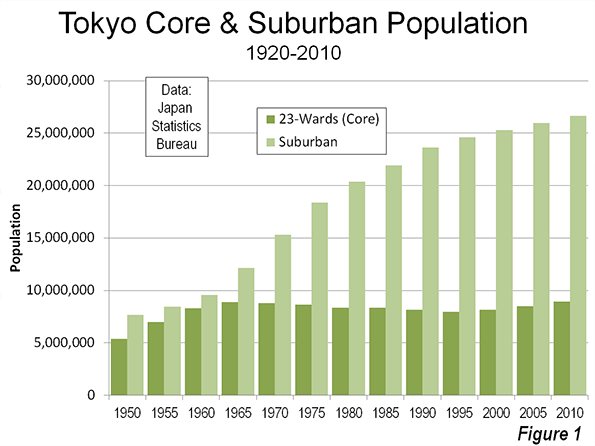
    This "ku" area can be considered the historical core municipality. The 23 ku reached a peak population in 1965 of 8.893 million in 1965. In the next 30 years, the 23 ku sustained a population loss of more than 900,000, while the suburban areas were adding more than 20 million. The ku area exceeded its previous peak in the 2010 census, reaching 8.946 million, approximately 50,000 more than in 1965.

    Growth Trends:

    Census data indicates that in 1940, the core accounted for 53 percent of the region’s population. This dropped to 41 percent in 1950, with the largest share of war-time population losses in the ku area. The core gained back to 47 percent of the population in 1960. After that, nearly all growth was in the suburbs. Between 1950 and 2000, 87 percent of the population gain was in the suburbs. In the last decade, the suburbs share of growth dropped to 63 percent (Figure 1 and Table)

    Tokyo Metropolitan Region
    Population by Sector: 1920-2010
    Year Tokyo Region Former City of Tokyo Balance of Tokyo Prefecture Tokyo Prefecture Kanagawa Prefecture Saitama Prefecture Chiba Prefecture
    1920    7,678,000  2,173,000     1,526,000     3,699,000   1,323,000   1,320,000   1,336,000
    1930    9,958,000  1,995,000     3,414,000     5,409,000   1,620,000   1,459,000   1,470,000
    1940  12,740,000  6,779,000        576,000     7,355,000   2,189,000   1,608,000   1,588,000
    1950  13,051,000  5,385,000        893,000     6,278,000   2,488,000   2,146,000   2,139,000
    1955  15,424,000  6,969,000     1,068,000     8,037,000   2,919,000   2,263,000   2,205,000
    1960  17,864,000  8,310,000     1,374,000     9,684,000   3,443,000   2,431,000   2,306,000
    1965  21,017,000  8,893,000     1,976,000   10,869,000   4,431,000   3,015,000   2,702,000
    1970  24,113,000  8,787,000     2,621,000   11,408,000   5,472,000   3,866,000   3,367,000
    1975  27,042,000  8,647,000     3,027,000   11,674,000   6,398,000   4,821,000   4,149,000
    1980  28,697,000  8,349,000     3,269,000   11,618,000   6,924,000   5,420,000   4,735,000
    1985  30,273,000  8,354,000     3,475,000   11,829,000   7,432,000   5,864,000   5,148,000
    1990  31,796,000  8,164,000     3,692,000   11,856,000   7,980,000   6,405,000   5,555,000
    1995  32,577,000  7,968,000     3,806,000   11,774,000   8,246,000   6,759,000   5,798,000
    2000  33,413,000  8,130,408     3,928,592   12,059,000   8,490,000   6,938,000   5,926,000
    2005  34,472,000  8,490,000     4,081,000   12,571,000   8,791,000   7,054,000   6,056,000
    2010  35,618,000  8,946,000     4,213,000   13,159,000   9,048,000   7,195,000   6,216,000
    Data from Census of Japan


    Generally, however the last decade has been far better for the core than in any period since 1960. Over each of the last two five year census periods, the percentage growth in the core has been greater than that of the suburbs, which, examining data from Europe, United States, Canada, and elsewhere is quite unusual.

    Density Comparisons

    Tokyo is often portrayed as one of the world’s highest density urban areas. It is not. At a density of 11,300 per square mile (4,300 per square kilometer), Tokyo is less dense than London (13,700 & 5,300), one-sixth the density of Hong Kong (67,000 & 25,900) and one-tenth the density of Dhaka (115,000 & 44,400). There are two reasons for this:

    1. Tokyo does not have intensely dense central areas. The ku area has a density of 37,300 per square kilometer (14,400 per square kilometer). This is well below the densities of Manhattan (69,000 & 27,000) and the ville de Paris (51,000 & 21,000). Only one of the ku (Toshima) exceeds the density of Paris.
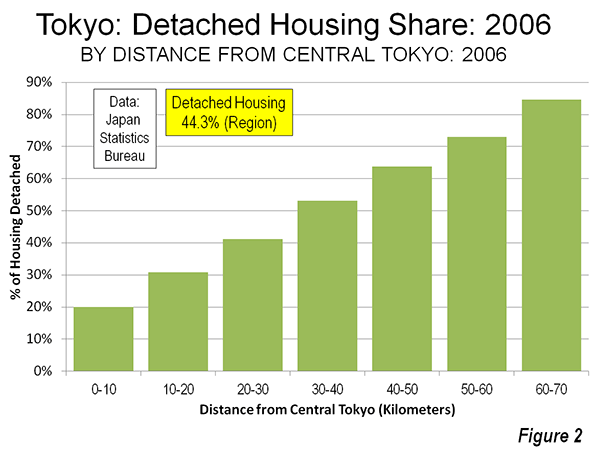
    2. Further, according to the Japan House and Land Survey of 2008, Tokyo has a large stock of detached houses, by definition lower density. Nearly 45 percent of the Tokyo region’s housing is detached. One-third of the dwellings within 30 kilometers (18 miles) of the core are detached. This figure rises to more than 60 percent outside 30 kilometers from the core and 85 percent between 60 and 70 kilometers (37-43 kilometers) from the core (Figure 2).

    Transport

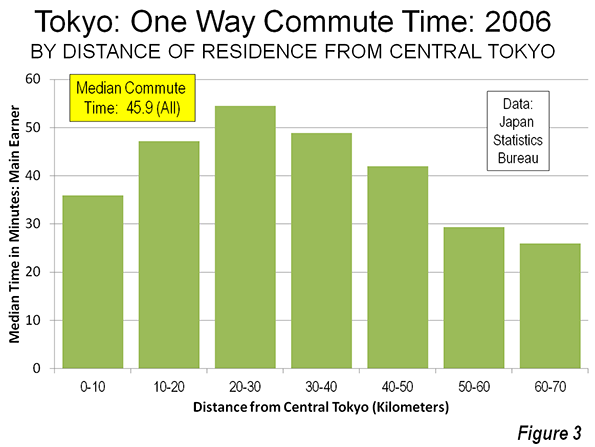
    Tokyo is a transit oriented metropolis, with by far the highest transit usage in the world. In 2007, 65 percent of trips within a 50 mile radius were by mass transit. Overall transit usage is (passenger miles or kilometers) in the Tokyo region is approximately double that of all combined usage in the United States and nearly 10 times that of Paris, according to the Millennium Cities Data base. At the same time, one-way work trip travel times are reported to be the highest in the high income world, at a median of 45.9 minutes (Note 4) for main earners. Work trip travel times from residences are the shortest from the most remote residential locations (60-70 kilometers from the core) at a median of 26 minutes and at 29 minutes from residences between 50 and 60 kilometers from the core. Median travel times are 36 minutes one way within 10 kilometers of the core (Figure 3). The longest commutes are from residences located between 10 and 50 kilometers from the core (6 to 31 miles), which peak at 54.5 minutes each way between 20 and 30 kilometers (12 and 18 kilometers) from the core.

    Toward a City State?

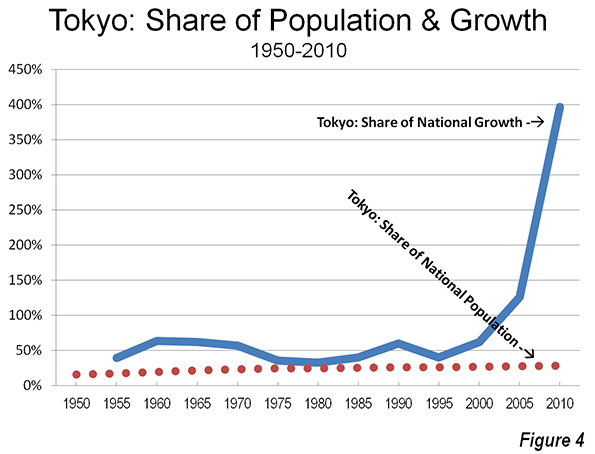
    Japan has been centralizing for decades, principally as rural citizens have moved to the largest metropolitan areas. Since 1950, Tokyo has routinely attracted much more than its proportionate share of population growth. In the last two census periods, all Japan’s growth has been in the Tokyo metropolitan area as national population growth has stagnated. Between 2000 and 2005, the Tokyo region added 1.1 million new residents, while the rest of the nation lost 200,000 residents. The imbalance became even starker between 2005 and 2010, as Tokyo added 1.1 million new residents, while the rest of the nation lost 900,000. (Figure 4)

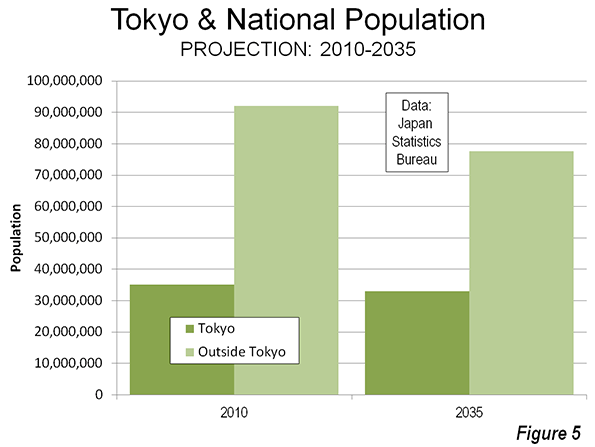
    Eventually, Japan’s imploding population will finally impact Tokyo. Population projections indicate that between 2010 and 2035, Tokyo will start losing population. But Tokyo’s loss, at 2.1 million, would be a small fraction of the 16.5 million loss projected for the rest of the nation (Figure 5). If that occurs, Tokyo will account for 30 percent of Japan’s population, compared to 16 percent in 1950. With Japan’s rock-bottom fertility rate, a declining Tokyo will dominate an even larger share of the country’s declining    population and economy in the coming decades.

    Wendell Cox is a Visiting Professor, Conservatoire National des Arts et Metiers, Paris and the author of “War on the Dream: How Anti-Sprawl Policy Threatens the Quality of Life.”

    Photo: Yamanote Loop Train, Tokyo Station (by author)

    Note 1: The government defines a Tokyo major metropolitan area, using smaller area data. However, insufficient data is readily available for this article.

    Note 2: These three urban areas have the largest suburban populations in the high income world outside Tokyo and Osaka-Kobe Kyoto.

    Note 3: The term "Tokyo metropolis," has misled any number of analysts to believe that it means the Tokyo metropolitan area. In fact, it means only the prefecture of Tokyo, which is only one of the from one of the from four to eight prefectures (part or all) that can be considered a part of the metropolitan area, depending on the definition. Thus any comparison of the "Tokyo metropolis" with anything else in metropolitan in the world is best dismissed out of hand.

    Note 4: Based on an analysis of the detailed data, it is estimated that the one-way average work trip travel time is more than 48 minutes.

  • Millennials’ Home Ownership Dreams Delayed, Not Abandoned

    Eighty percent of Americans buy their first house between the ages of 18-34. While the Millennial Generation’s (born 1982-2003) delayed entry into all aspects of young adulthood has sometimes been characterized as a “failure to launch,” the generation’s  preference for single tract, suburban housing should become the fuel to ignite the nation’s next housing boom as Millennials  fully occupy this crucial age bracket over the next few years.

    According to a study by Frank N. Magid Associates, 43 percent of Millennials describe suburbs as their “ideal place to live,” compared to just 31 percent of older generations. Even though big cities are often thought of as the place where young people prefer to live and work, only 17 percent of Millennials say they want to settle  in one. This was the same percentage of members of this generation that  expressed a preference for living in either rural or small town America. Nor are Millennials particularly anxious to spend their lives as renters. A full 64 percent of Millennials surveyed, said it was “very important” to have an opportunity to own their own home.

    That hasn’t stopped a number of commentators from arguing that Millennials ought to prefer renting a loft apartment to buying a house and that   they would be better off doing so. For example, sociologist Katherine Newman, is “hoping that the Millennial Generation doesn’t set its sights on homeownership as a benchmark of economic stability, because it’s going to be out of reach for so many of them that it will just be a recipe for frustration."

    But survey research suggests it may be her hopes that will be dashed as the Millennial Generation matures. Eighty-four percent of 18-34 year olds who are currently renting say that they intend to buy a home even if they can’t  currently afford to do so. As Neal Coleman, a married Millennial in his mid-twenties, put it, "You’re freer when you own your own home, your own land. You’re not beholden to a renter’s contract, or lease. My feeling is that homeownership is an investment in being able to control your surroundings, to build a life for you and your family."

    Glenn E. Crenlin from the Runstad Center for Real Estate Studies at the University of Washington believes that “what we’re looking at in terms of the Millennial Generation is likely only a delay in homeownership of three to five years, not a long-term trend away from homeownership itself." He cites census data from the American Community Survey that shows a significant increase in homeownership among Millennials as compared to Baby Boomers when they were at the same age that Millennials are now.  “While 900,000 households in the Millennial Generation [now] own their own home, only 500,000 Baby Boomer households owned their own homes at the same point in their lives.”

    This data suggests the key to a resounding revival of America’s housing market may be the availability of affordable homes in neighborhoods with amenities that would appeal to Millennials and their young families. As always, safe streets and good schools are key components of such an environment. But so too are short commutes to work and nearby shops featuring the local products that appeal to younger customers.

    Such neighborhoods already exist in many close-in suburbs whose housing stock is in need of some renovation, or “gentrification,” from energetic owners committed to improving their local community. These attributes describe Millennials precisely. Their willingness to invest sweat equity in rehabilitating their first home should be rewarded in the financing process either by counting its value toward a down payment or using it to wipe out some of the outstanding student debt with which many of the members of this generation are burdened. Alternatively, homes could be offered to Millennials as rentals with an option to buy and with the cost of any renovations performed by the renter deducted from the down payment required to make the conversion from rental to ownership.

    Recently, National Association of Realtors President Moe Veissi announced that "Realtors are committed to ensuring that the dream of homeownership can become a reality for generations of Americans to come." To start making that dream come true for Millennials, realtors and those who finance home purchases need to create innovative new offerings tailored to the needs and wants of Millennials. Policies and programs that will  enable America’s most populous generation to own a  piece of the American Dream offer the best hope for igniting the home construction boom critical to boosting country’s still sagging economy.

    Morley Winograd and Michael D. Hais are co-authors of the newly published Millennial Momentum: How a New Generation is Remaking America and Millennial Makeover: MySpace, YouTube, and the Future of American Politics and fellows of NDN and the New Policy Institute. Full disclosure: Michael D. Hais retired in 2006 as Vice-President of Entertainment Research from Frank N. Magid Associates after a 22 year career with Magid and continues to do occasional work for the firm.

    New home photo by BigStockPhoto.com.

  • Cities, Cars, People: Is Changing Car Use a Function of New Urbanism?

    One cornerstone for urban designers and planners seeking to transform the polycentric or suburban city of the 20th Century into something resembling the high density city of the 19th was a cross-city comparison by Newman and Kenworthy and successors. [1]   They argued that this proved automobile dependence is a function of city density.  It followed that regulating for greater residential densities and increasing the capacity of public transport systems to avoid the congestion that would follow if people continued to drive themselves would improve the sustainability of cities.

    Of course, any comparison with the overcrowded and unhealthy cities of an earlier century is unfair: today’s density is achieved with higher standards of private and public space, and much enhanced transit and sanitation.  And many, probably the majority, of 21st century citizens in high income nations can escape the confines of the urban environment on occasional sojourns to country or coast (or beyond), unlike their 19th Century or developing world counterparts.  They can even find repose in the midst of 24/7 city hubbub in their own in-house media centres.

    But can we really build urban policy on the Newman and Kenworthy analysis?  Especially given evidence that car use is declining anyway?

    Questionable correlation
    There are still questions over the original analysis and it successors.  Cross-cultural effects, physical geography, differences in economic structure, incomes, wealth, and growth all intervene in the relationship between city density and car dependence.  And cause and effect are hard to pin down. 

    Perhaps more critical: the leap from observing relationships across cities at a point in time to regulating travel behaviour, housing ,and consumption choices into the future assumes that individual behaviour is a microcosm of collective behaviour. This fallacy of inference has long been recognised by the biological and sociological sciences.  And the likelihood of getting policy wrong by making such an assumption is far greater when dealing with populations of people, with their diverse circumstances, beliefs, values, and means, compared with, say, populations of penguins. 

    Is it this blind spot that has made it so much more difficult to get people out of their cars or their low density houses than anticipated by urban reformists?

    The city as a time warp
    One problem is that analyses of city density and car dependence are usually static.  Plotting urban form and transport consumption at a particular point in time – the mid/late 20th century in the Newman and Kenworthy case – embodies particular patterns of technology, wealth, and behaviour.  Consequently, their urban prescription is based implicitly on the 9 to 5 work day; single city centres that focus urban employment, exchange, and consumption; and the nuclear family with its distinctive housing and service demands. These are all urban artifacts that have been breaking down since the 1960s.

    But the times they are a-changing
    In a 2011 paper the authors acknowledge that things are changing as international evidence shows rates of car use beginning to decline in parts of the world.  A partial view of what they are changing from, though, sustains a deterministic explanation of the why and what they are changing to:

    “technological limits set by the inability of cars to continue causing urban sprawl within travel time budgets; the rapid growth in transit and re-urbanization which combine to cause exponential declines in car use; the reduction of car use by older people in cities and among younger people due to the emerging culture of urbanism and the growth in the price of fuel which underlies all the above factors”.[2]

    The view remains time-bound; even the reference to exponential decline is a simplistic inference of the relationship between public transport and car use taken from a cross section of cities in 1995. 

    Individual agency barely gets a mention.  Any description of an “emerging culture of urbanism” needs to be embedded in the reality of evolving patterns of wealth, income, and consumption and even in simple demographics to determine just how real and significant it is.

    Growing old and driving more
    What are the grounds for the claim that older people are reducing their car use, for example? I took a quick look at the evidence for New Zealand.  It is certainly not the case here.  The rate of growth in driving has been higher among older age groups than among younger – with decline most evident among the under 45s.  

    Is it so different in the other ageing societies from which Newman and Kenworthy draw their examples?

    Figure 1: Changes in Annual Driving Distance by Age, New Zealand 1990-2008


    Fewer kilometres doesn’t mean less dependence
    What does go a long way to explaining declining car travel in the aggregate is the fact that older people don’t drive as much younger people, and populations in western cities are simply getting older.  It’s simple maths – as the population ages car usage will go down, despite a greater propensity to drive among older cohorts. Again, look at the evidence from New Zealand:

    Figure 2: Automobile Dependence by Age Group, New Zealand 2004-2008


    Car usage appears to decline after age 44, rapidly after retirement age, 65. 

    Why does car use fall with age?
    There are a number of reasons why this may be so.  From 45 years on households have fewer transport-dependent children.  Mature families may have more localised social networks.  A greater share of recreation may be neighbourhood based.

    On retirement work trips disappear and incomes, discretionary dollars and consumption fall.  The capacity for more shared travel and trip planning increases as households age.  Diminished car use doesn’t necessarily mean that households are less automobile dependent.  They just doesn’t generate as much travel demand.

    These explanations don’t depend on particular urban designs.  Yet Newman and Kenworthy claim that diminished driving happens because “older people move back into cities from the suburbs”.  This is not consistent with the common observation of people’s preference to age in place.[3]  (For the New Zealand evidence, see my posting Ageing in the City).

    Moving into the centre – a one-way street?
    And their notion “the children growing up in the suburbs would begin flocking back into the cities rather than continuing the life of car dependence” rather simplifies a historically specific event: the transition of sons and daughters of the baby boomers from young adulthood, advanced education, and job seeking to the career and housing paths associated with their movement into more stable relationships.  As they age, it is highly likely that suburban preferences re-emerge, sustained by the capacity to purchase and operate a private vehicle.

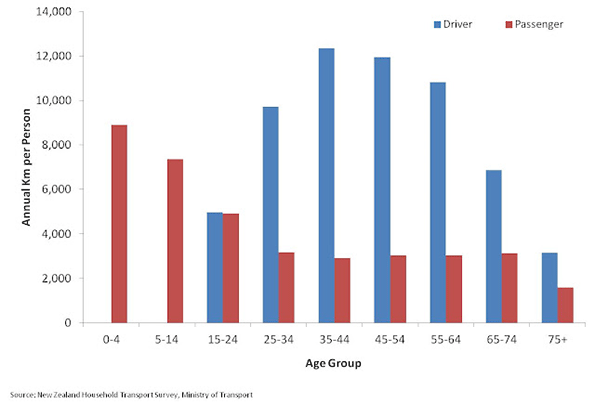
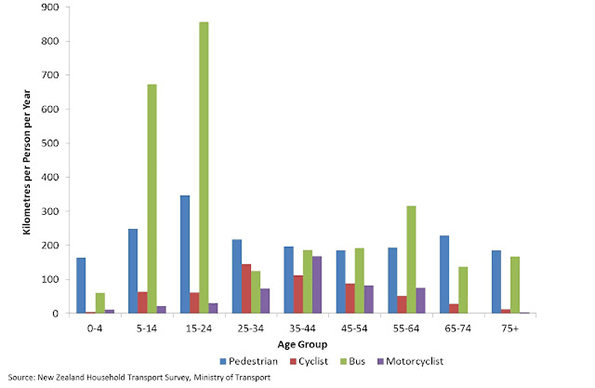
    Generation X boosted inner city dwelling over the past two decades, and Generation Y will do so, to a lesser extent, for another decade.  The 15 to 24 year age group also coincides with the age of greatest automobile independence (illustrated for New Zealand in Figure 3).  But don’t expect this historically-specific phenomenon to sustain some sort of indefinite culture of city consolidation, and I wouldn’t bet the fiscal bank on expensive transit systems designed around the assumption that it will. 

    These are passing generations: their successors will be that much smaller and facing a somewhat different world.[4]

    Figure 3: Use of non-Automotive Modes by Age Group, New Zealand 2004-2008


    Who are we planning for?
    Of course, there are plenty of exceptions to prove the rule: but that is the point.  Diverse communities have diverse expectations and behaviours. And they are continuously changing, in composition, in form, and in behaviour. 

    The failure of modernity lay in its assumption of conformity and convergence, compounded by the conceit that we could regulate for it.  And planning for what is little more than a statistical construct – the auto-independent city – risks blinding us to the richness and opportunity of alternatives, of lifestyle, of environmental stewardship, of urban design, and of mobility.

    If we start with the behaviour of individuals and households our designs for sustainable cities may be less deterministic and our planning less didactic, better informed, lighter in touch, and a lot more effective in meeting the long-term needs of evolving urban communities.

    Phil McDermott is a Director of CityScope Consultants in Auckland, New Zealand, and Adjunct Professor of Regional and Urban Development at Auckland University of Technology.  He works in urban, economic and transport development throughout New Zealand and in Australia, Asia, and the Pacific.  He was formerly Head of the School of Resource and Environmental Planning at Massey University and General Manager of the Centre for Asia Pacific Aviation in Sydney. This piece originally appeared at is blog: Cities Matter.

    Aukland photo by Bigstockphoto.com.


    [1]            Newman, P and Kenworthy J (1989) Cities and Auto Dependency: A Sourcebook. Gower, Aldershot
                         Newman, P and Kenworthy, J Sustainability and Cities: Overcoming Automobile Dependence, Island Press, Washington, D.C.
    [2]        Newman P and Kenworthy J (2011) “‘Peak Car Use’: Understanding the Demise of Automobile Dependence”, World Policy Transport and Practice, 17, 2, 31-42
    [3]        Pynoos R, Caraviello R, and Cicero C (2009) “Lifelong Housing: The Anchor in Aging-Friendly Communities”, Journal of the America Society on Aging, 33, 2, 26-32
    [4]         For New Zealand, check the numbers

  • Enterprising States 2012: Beating the New Normal and Policies that Produce

    The following is an exerpt form a new report, Enterprising States, released this week by the U.S. Chamber of Commerce and National Chamber Foundation and written by Praxis Strategy Group and Joel Kotkin. Visit this site to download the full pdf version of the report, or check the interactive map to see how your state ranks in economic performance and in the five policy areas studied in the report. The full report include a case for the nation beating the "new normal" and lists of best-performing states by policy area, and an index to select the top 10 states likely to continue to grow.

    Troubled by economic stagnancy and high unemployment, many pundits and policy makers are referring to the U.S. economic malaise as the “new normal,” claiming that we have reached both technological and economic plateaus. To be sure, the relative weakness of the current recovery – arguably the weakest in contemporary history – does support the “new normal” thesis.

    Not everyone, or every state, accepts the notion of inevitable, slow growth and gradual decline. From the onset of the recession, some states have largely avoided the downturn. By the end of 2011, six states – North Dakota, Wyoming, Alaska, Utah, Texas, and Montana – showed more than 8% job growth over the past decade. Another 22 had shown some, although less robust, employment increases compared to 2001.

    More important still, nearly every state enjoyed some overall private-sector job growth between January 2011 and January 2012. Most critically, growth has spread to many states hardest hit by the recession, including Michigan, California, and Florida. The strongest job growth continued to take place in other states, notably Louisiana, Oklahoma, Texas, Utah, and North Dakota.

    The new geography of growth reflects many of the intrinsic strengths of the U.S. economy often missed by many policymakers and commentators. After a brief lapse, the country is already outperforming all its traditional high-income rivals in Europe, as well as Japan, as it has done for most of the past two decades. Key U.S. assets include surging agricultural and energy production, the general rebound in U.S.-based manufacturing, and unparalleled technological supremacy. The country remains attractive to both foreign investors and skilled immigrants.

    For the U.S. to be successful, this new geography of growth needs to extend across the 50 states and expand for long enough to significantly lower the high rate of unemployment. This will require something more than a single-sector focus. Attention must be paid to both basic and advanced industries since innovation and technology growth alone cannot turn around most regions and states. 

    More than anything, governments and business leaders need to appreciate how these sectors interact with each other. To be effective across all geographies, innovation must be applied to a broad array of industries, including but not limited to computers, media, and the Internet. Innovation and new technologies are also a means to unlock the productive potential of both mundane traditional industries and the service sector.

    States striving to do well in this environment face many barriers to fostering economic growth and creating jobs. These barriers include the high level of debt in many states; a growing skills mismatch between the workforce and the jobs available within a state; and outdated regulations and taxes that serve as barriers to free enterprise.

    Policies that Produce

    In the ebb and flow of the global economy, states can no longer rely solely on strategies of keeping costs low and providing incentives to attract footloose, commodity-based branch plants or offices. Instead, states must create the right business climate that allows companies and entrepreneurs to create 21st century jobs. 

    Dramatic changes in the scope and scale of the global economy have significantly altered the nature of foreign competition. Jobs are the new currency for leaders across the globe, and those who can create good jobs will own the future. With 95% of the world’s customers now living outside our borders, trade with other countries is a key part of our economy that will continue to be important long into the future. 

    Businesses need a highly skilled workforce – which includes many workers with certificates or two-year degrees – that is able to perform the jobs of a 21st century economy. States that are able to get students involved in the STEM fields – science, technology, engineering, and math – will be the most competitive. 

    Innovation, now the essential driving force for creating and sustaining economic opportunities, is much more multidisciplinary and global in scope than ever before. Innovation and market cycle times are much shorter and continue to accelerate. This makes it more important than ever that states provide the tools, support, and tax and regulatory environments for companies to continuously innovate without onerous delays and burdensome costs that put their entrepreneurs and businesses at a competitive disadvantage.

    Enterprising States 2012 takes an in-depth look at the specific priorities, policies and programs of the 50 states. Generally, the states fostering economic growth and creating jobs today – and those most likely to grow in the next decade – are defined by the following broad policy approaches:

    • Parlaying their natural resources and historically competitive industry sectors into 21st century job-creating opportunities
    • Paying attention to and addressing their competitive weaknesses
    • Supporting their companies’ business development efforts to reach an expanding global marketplace
    • Creating a fertile environment and workforce for a technology-based and innovation-driven economy
    • Investing in infrastructure – digitally and physically engineered – that meets the operating requirements of business and connects businesses to markets and customers
    • Getting government, academia, and the private sector to collaborate effectively to make sure that more new ideas developed by companies and in research labs scale up into industries
    • Taking steps to make existing firms more productive and innovative, creating an environment in which new firms can emerge and thrive
    • Maintaining an affordable cost of living for middle-skilled and middle-class employees
    • Promoting education, workforce development and entrepreneurial mentoring to continually fill the talent pipeline
    • Fostering an enterprise-friendly business environment by cleaning up the DURT (delays, uncertainty, regulations, and taxes), modernizing government, and fixing deficiencies in the market that inhibit private-sector investment and entrepreneurial activity.

    State policies and programs that most effectively promote job creation are rooted in market reality. This means building on the existing core industries and technological advantages of a state while pursuing opportunities in growing and emerging sectors. Building on and sustaining existing economic momentum remains a key means of guaranteeing success in the future.

    Huge increases in food exports, domestic energy investment, a revived manufacturing sector, a burgeoning tech sector, vital demographics, and increased investment from abroad create a strong base for long-term secular recovery of the U.S. economy. Rather than facing a dismal future of the new normal, we may actually be on the cusp of a recovery that could become one of America’s finest moments. The key to making this work, for the states and the nation, lies in policies that promote broad-based, long-term economic growth.

    Download the full report, or read the Enterprising States 2012 coverage at the National Chamber Foundation blog.

    Praxis Strategy Group is an economic research, analysis, and strategic planning firm. Joel Kotkin is executive editor of NewGeography.com and author of The Next Hundred Million: America in 2050.