Category: Demographics

  • The Evolving Urban Form: Cairo

    Cairo, Egypt’s capital, has long had some of the highest neighborhood population densities in the world. In the 1960s it was reported that one neighborhood had a density of 353,000 people per square mile (136,000 per square kilometer). The most recent data from the Egypt’s statistical authority (the Central Agency for Public Mobilisation and Statistics or CAPMAS) indicates that within the Cairo governate (the province in which the municipality of Cairo is located), the overall urban population density is 117,000 per square mile, or 45,000 per square kilometer. This means that urbanization in the Cairo governate is more than 1.5 times the population density of Manhattan (in New York city) and the ville de Paris.

    In recent decades, government officials have undertaken a program to encourage people to decentralize their living and work arrangements, and to move to several new towns in the area.

    Overall, the governates that comprise the Cairo metropolitan area have a population of approximately 20.5 million, according to a CAPMAS 2012 estimate. This is approximately the same size of metropolitan areas such as New York and Mexico City. The Cairo metropolitan area is comprised of three governates, which are principally urban, but which also contain millions living in rural areas:

    The governate of Cairo (Al Qāhirah) is the largest of these jurisdictions. Parts of the Cairo governate and the Giza government would be considered in the urban core, but the political jurisdictions in Cairo do not lend themselves well to conventional core versus suburban designations (Note 1). The Cairo governate is located on the east bank of the Nile River, and spreads many kilometers, especially to the East and South. This area includes the Cairo international airport and Heliopolis, one of the most affluent areas in the Cairo metropolitan area. The governate of Cairo also includes "New Cairo," an attractive new town located in the southeastern quadrant. This area includes a number of university campuses, multi-story condominium buildings and detached housing. Eventually, New Cairo is expected to have 4,000,000 residents, though the new town is little more than a decade old and still has a modest population of approximately 125,000.
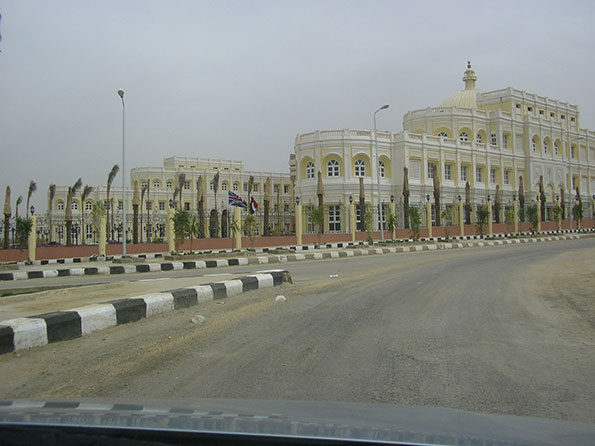

    New Cairo: University

    The governate of Giza (Al Jīzah) is located on the west bank of the Nile River and, in reality, constitutes a continuation of the urban core. Giza is home the Great Pyramids, which rise on a hill from the western urban fringe. Giza is also home to considerable informal housing development   much different than generally found in other megacities. Much of the development is high rise, with concrete block buildings rising seven and more stories from the streets. Generally, the streets are so narrow and irregular that they are not shown on local maps. The governate of Giza also includes the "6th of October" new town, located on the west side of the hills on which the Great Pyramids stand. Eventually, 6th of October is expected to have a population of 3,000,000, though it appears to be less than 500,000 today. The governate of Giza also includes the Sheihk Zayed new town. These new towns have commercial activities, multi-story condominiums and detached housing.
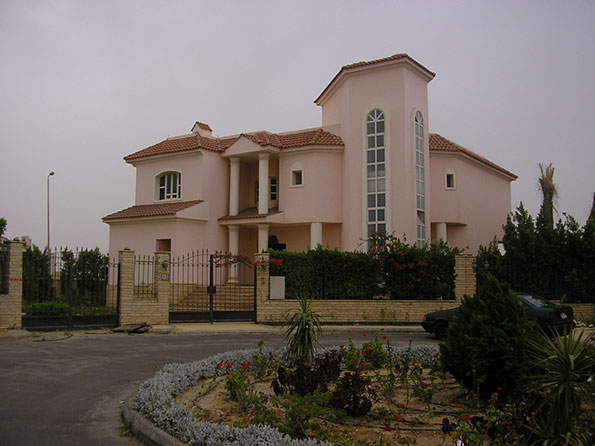

    Sheikh Zayed: Detached Housing
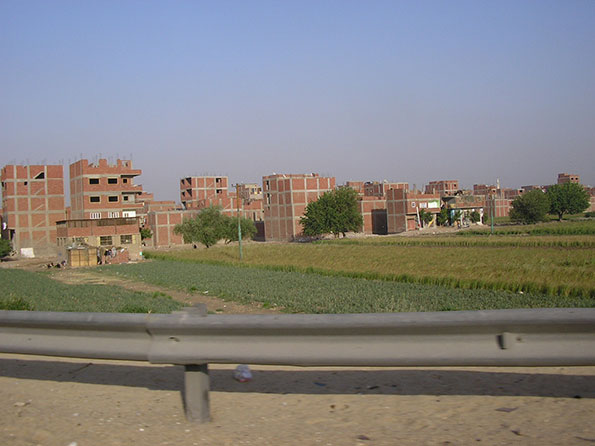

    Giza: Informal Housing

    The governate of Kalyoubia (Al Qalyūbīyah) is located to the north of the Cairo and Giza governates. Unlike Cairo and Giza, Kalyoubia has a majority of its population living in rural areas. However, the continuous urbanization of Cairo stretches into the governate and includes more than 1.5 million people, much of it in the municipality of Shubrā al-Khaymah.

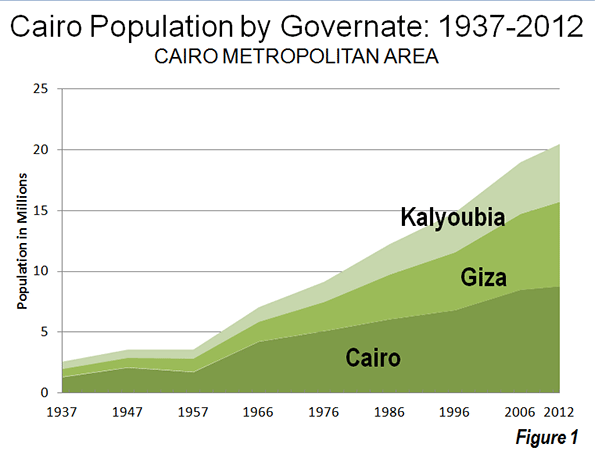
    Slowing Growth: Like many of the developing world’s megacities, Cairo has experienced its strongest growth in the half century after World War II. In 1937, the metropolitan area had a population of under 3 million. This more than doubled to 7 million by 1966, and again to 14 million by 1996.  From 1996 to 2012, the metropolitan area added 5.5 million people (Note 2). However, more recently, the growth rate has slowed considerably. Between 1996 and 2006, metropolitan Cairo added 28 percent to its population (an increase of more than 4,000,000). However the 2006 to 2012 rate would indicate that by 2016, Cairo is likely to add only 13 percent to its population (approximately 2,000,000 people).

    While the governates of the Cairo metropolitan area do not lend themselves well to urban versus suburban population analysis, Cairo clearly has expanded geographically as it has added population. The more central governates of Cairo and Giza have continued to grow, however much of the growth has been in peripheral areas, such as New Cairo, 6th of October and the Helwan area, south of Cairo on the Nile (in the Cairo governate).

    Where the Growth is Occurring: Even so, the governate of Cairo accounted for only 19 percent of the metropolitan area’s growth from 2006 to 2012, down from 34 percent in the 1996 to 2006 period. The governate of Giza had the greatest growth between 2006 and 2012, at 47 percent of metropolitan growth, an increase from the 39 percent of 1996 to 2016. The governate of Kalyoubia accounted for 34 percent of the growth from 2006 to 2012, an increase from 26 percent between 1996 and 2016 (Figure 1).
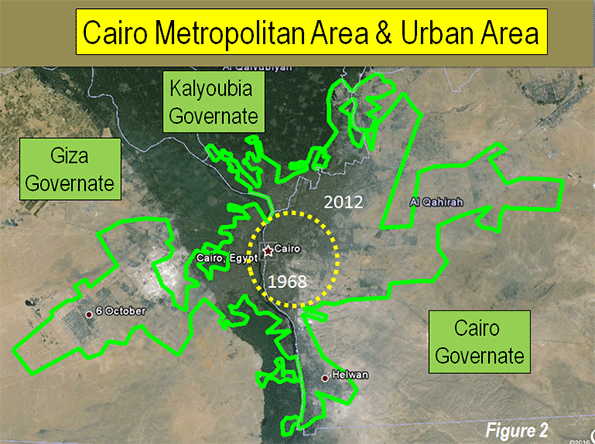
    Cairo’s Physical Expansion: Even though the suburban versus core analysis is difficult to gauge from governate data, a paper by Mootaz Farid and Hatam Al Shafie of Cairo University contains depictions of the urban footprint from 1943 to 1982. In each of the depicted years, the continuous urbanization of Cairo covers only a miniscule share of the present urban footprint. Figure 2 provides an estimate of the urban footprint in 1968 compared to the 2012 urban footprint, indicating that much of the growth was on the periphery.
    The Key to Decentralization: The key to making the new towns successful in attracting more residents lies with the dispersion of employment. There is a wealth of international experience to indicate that "self-sufficient" new towns really cannot be self sufficient if they are within commuting distance of the rest of the urban area. In the case of Cairo (as elsewhere) it will prove critical to ensure that there are substantial local employment opportunities for new town residents, although it is likely that a serious degree of self sufficiency may prove difficult to achieve.

    Wendell Cox is a Visiting Professor, Conservatoire National des Arts et Metiers, Paris and the author of “War on the Dream: How Anti-Sprawl Policy Threatens the Quality of Life.”

    Top Photograph: The Great Pyramid (Giza). All photos by author

    ——

    Note 1: In the past decade there  have been reorganizations of governates in the Cairo metropolitan area. This article uses three present governates for all years.

    Note 2: Earlier population data is from http://statoids.com/ueg.html.
  • America’s Two Economies

    Surely you’ve seen it in your own neck of the woods: great contrasts between prosperity and wealth on the one hand, and hardship and despair on the other. I have certainly seen it in every place I have been over the last four years. FDR described the Great Depression as “one-third of a nation ill-housed, ill-clad, ill-nourished.” Yet do we not today have one-third of a nation either unemployed, underemployed, underwater on their one greatest asset (their homes), in crushing debt (which I define as unserviceable from current income), insolvent/bankrupt, on food stamps, unemployment or disability payments, or otherwise dependent on government? The diminishing of the middle class is daunting, but most disturbing is the diminishing of its prospects.

    Perhaps you attribute this state of affairs to the “rich get richer, poor get poorer” meme. But there’s something else, something more going on. I have written about this before (unraveling, stagnation, middle America, middle class is the future), but here bring a fuller picture.

    In the years since the Great Recession started (and ended?) in 2008-2009, the US has been characterized by two economies. One of these American economies is thriving, as are the economic actors part of it. The other economy is miserable, as are its inhabitants. The divergence between these two economies is growing more pronounced. Why is this so, how did it happen, and what does it portend?

    I have been debunking the “rich get richer, poor get poorer” theme for 30 years, maintaining that the relative income gap did not matter as long as absolute income growth was widespread, and economic growth was providing opportunities to all (which was the case). But now those caveats have come into play: middle-income, middle-class earnings, wealth and opportunities are under immense pressure. This is not because the rich get richer, or that redistribution is the answer (I find the debate over austerity vs. growth pretty stupid, when growth too often just means growth of government). It is because of fundamental, structural economic trends which may be with us for a long time to come.

    Divergent Sectors, Divergent Fortunes
    Perhaps you have heard of the manufacturing “renaissance” in America and the exporting “boom.” Both are true. American exports are booming, measuring in at about $180 billion each month (up from $140 per month two years ago). Exports account for about 14% of GDP, and are growing about 16% a year. American manufacturing employment has been hurt by globalization, but manufacturing output continues to grow and exporters are thriving.

    American manufacturing and export prowess are likely to continue into the foreseeable future, as large American companies use innovation and technology to become more productive, and as the growing global middle class demands more American goods (including energy in the form of oil and natural gas).

    The bad news is that exports and manufacturing do not translate into more jobs or even higher wages. Our new job growth has been in health care, education, services and government, areas that do not produce great income and wealth. This holds down the potential income gains of all wage-earning Americans.

    But the income and potential of those in management, finance, high technology and the professions are not adversely affected. The benefits of productivity, manufacturing, exports and economic dynamism generally, therefore, accrue to the already well-situated capitalists, managers and properly skilled. Sure, the internet will continue to make it easier for many small businesses to survive (and some even to thrive), but they cannot be great founts of sustainable jobs.

    Two-tiered economies are well-known and expected in developing countries – an export/manufacturing or raw material sector and a weak domestic service sector – but we’re not used to seeing it in an advanced, technologically sophisticated country like the United States. It actually could mean that the rich will get richer, but the economy will be missing its traditional ladder for those in the middle and below to climb.

    Where will enough employment growth come from to maintain the middle class? Many analysts tell us it will come from the innovation sector, or the innovation economy. But again, the benefits of innovation seem now to accrue to the companies and individuals   already in a position to exploit it, increasing productivity and profitability without a concomitant increase in employees.

    Dystopian Economics
    This is getting perverse, isn’t it? We have high unemployment and underemployment, huge debts and deficits, but companies are profitable and share prices continue to rise. There seems to have been a breakdown in the correlation between employment and GDP, between the housing market and overall economic strength, and between GDP growth and stock market valuations.

    Statistics say we are in a low-inflation environment, but living expenses seem to be rising for food, energy, healthcare and education (the things on which the middle class must spend). Those with jobs and income in sectors that are doing well don’t seem to be as affected. That would certainly help explain the contrasts of wealth and hardship that one sees around the country.

    In other words, what we seem to have created is a winners-take-all economy. Large companies with global exposure, highly skilled workers, and high net worth individuals are the main beneficiaries of current economic policy. Job creation, most small businesses, and low- and medium-end housing are not.

    What if a rising tide no longer lifts all boats?
    We now have the lowest percentage of Americans working or looking for work in 30 years. That really is devastating because the only way out of our fiscal and entitlement nightmare is to have more people working more hours and more years. Is the opposite our future?

    The trends that are creating and sustaining two economies in the US have been building for years and seem to me to be so strong as perhaps impervious to amelioration. The “two economies model” meets my test of sustainability: being supported and reinforced by other fundamental social, demographic, political and technological trends (or at least not being incompatible with them). It is hard to foresee how the “two economies model” can be reversed or even tempered, though it is a path that will leave tens of millions of Americans behind even as the “working” economy improves.

    I have been analyzing, writing and speaking on trends for 30 years. My audiences are often businesses or organizations looking for a picture of the future environment. I usually get a laugh from the observation that the future will be bright for some, dismal for others, and therefore recommend being in the first group. I don’t think I’ll make that joke anymore; somehow it’s no longer funny.

    Dr. Roger Selbert is a trend analyst, researcher, writer and speaker. Growth Strategies is his newsletter on economic, social and demographic trends. Roger is economic analyst, North American representative and Principal for the US Consumer Demand Index, a monthly survey of American households’ buying intentions.

    Finding a job photo by Bigstockphoto.com.

  • It Can Happen Here: The Screwed Generation in Europe and America

    In Madrid you see them on the streets, jobless, aimless, often bearing college degrees but working as cabbies, baristas, street performers, or—more often—not at all. In Spain as in Greece, nearly half of the adults under 25 don’t work.

    Call them the screwed generation, the victims of expansive welfare states and the massive structural debt charged by their parents. In virtually every developed country, and increasingly in developing ones, they include not only the usual victims, the undereducated and recent immigrants, but also the college-educated.

    Nowhere is this clearer than in the European Union’s Club Med of Spain, Greece, Portugal, and Italy, the focal point of the emerging new economic crisis. There’s a growing sense of hopelessness in these places, where debt is turning politics into an ugly choice between austerity, which reduces present opportunities, or renewed emphasis on public spending, which all but guarantees major problems in the bond market, and spending promises that can’t be kept.

    “We don’t know what to do now,” Jaime, a Madrid waiter in his late 20s told me last week. “My wife lost her auditor’s job, and I can’t support the whole family. Maybe we have to move somewhere like Dubai or maybe Miami.”

    Many young Greeks, Italians, Portuguese, and Spaniards already have made their moves, with a half million leaving Spain alone last year. But it’s not just Club Med youths who are contemplating greener pastures. Ireland, which in recent decades actually attracted new migrants, is exporting a thousand people a week. In recession-wracked Britain, nearly half of the population say they would like to move elsewhere.

    Driving this exodus is a growing perception that this collapse is not cyclical but secular. Increasingly, young Europeans are deciding not to start families—the key to future growth—in reaction to the recession. The stories about divorced Spanish or Italian young fathers sleeping on the streets or in their cars are not exactly a strong advertising for parenthood.

    Even in once-rigidly Catholic Spain, marriage and fertility rates have been falling for decades, and family structure weakening. Spaniards are having fewer children now than they did during the brutal civil war of the late 1930s. Alejandro Macarrón Larumbe, a Madrid-based management consultant, in his 2011 book, El Suicidio Demográfico de España, points out that the actual number of Spanish newborns has declined to an 18th-century level.

    This demographic implosion makes sense given the legacy left behind by the boomers, who have held on to generous jobs and benefits but left little opportunity for their children, not to mention a high tax burden on what opportunities they do find. For a generation academics have sold higher education—the more the better—as the cure for unemployment and the great guarantor of success. Yet rising education rates in places like Spain have not created jobs for the rising generation, but only expanded unemployment and falling wages among the ranks of the educated.

    Even America, traditionally a beneficiary of European woes, seems to have turned on its young. College debt is crushing many young people with degrees—particularly those outside the sciences and engineering—that are not easily marketable. The spiking number of people in their 30s working as unpaid interns reflects this erosion of opportunity. This has happened even as the price tag for college has shot up; 94 percent of students who earn a bachelor’s degree now owe money for their educations, compared to 45 percent two decades ago. Here’s a tribute to futility: today a majority of unemployed Americans age 25 and older attended college, something never before seen.

    Governmental priorities here continue to favor boomers and seniors over the young. For a generation, transfer payments have favored the elderly, a trend likely to accelerate as the boomers continue retiring and demand their due. According to Brookings, America spends 2.4 times as much on the elderly as on children. 

    Forced to take lower wages if they can find work at all and facing still-expensive housing in those markets where many of the jobs are, roughly one in five American adults 25 to 34 now live with their parents—almost double the percentage from 30 years ago. Increasingly both Wall Street and green “progressives” urge young people to abandon homeownership for a poorer, more crowded life in expensive, high-density apartment blocks.

    Across the developed world, wages are being cut for young Americans, Europeans, and Japanese as politicians prefer to offer less to the young than to take anything away from those already ensconced in employment, particularly if organized into unions. In the U.S., everything from government jobs to employment in auto factories and even supermarkets is now on a two-tier track, with older workers’ guaranteed pensions and higher salaries not shared by newer hires.

    Pensions represent a bigger generational issue than salaries do. The European welfare state makes America’s seem Scrooge-ish. Their lifetime guarantees are so extensive, and unsustainable, that even the über-frugal Germans are calling for a special tax on younger workers to fund their parents’ pensions.

    This generational transfer will likely be accelerated by an aging electorate. In Spain, notes Larumbe, voters over 60 now make up more than 30 percent of the electorate, up from 22 percent in 1977; in 2050 they will constitute close to a majority. The same patterns can be seen in other European countries and, although less dramatically, in the U.S. as well.

    As a result, boomer- and senior-dominated parties, both right and left, generally end up screwing young people. This occurs even as they proclaim their fulsome concern for “future generations.”

    Politicians on the right, in Europe and elsewhere, scapegoat immigrants in part to hold on to their share of older votes. Left-wing analysts rightly point out that the boomer- and senior-dominated Tea Party here is not likely to cut their own entitlements, preferring instead to push cutbacks in education and other disbursements that aid the young while fighting spending on job creation and productive forms of infrastructure investment.

    Politicians on the left, meanwhile, tend to favor redistribution and “sustainability” over the new wealth creation critical for youthful advancement. Many boomers seem to suspect economic growth itself, as when John Holdren, now President Obama’s senior science adviser, back in the 1970s called for the “de-development” of high-income countries. A cynic might conclude that since the progressive boomers already got theirs, it’s fine for the young to live in an era of limits.

    With the kind of tax and regulatory regime advocated by today’s regressive progressives—already largely adopted in my home state of California—greens and their allies many not have to worry about too much new growth. Only those connected with the government, or able to ride asset inflation, will do well in the new “progressive” order.

    In Europe, east Asia, and America alike, the left and the right have both proven unprepared or unwilling to address the fundamental growth crisis facing the next generation. Neither austerity nor a “progressive” focus on greater government spending and “sustainability” can create the jobs and new opportunities so sorely lacking on the streets of Athens and Madrid and increasingly in American cities as well.

    The developed world’s youth shouldn’t expect much help from an older generation that has preserved its generous arrangements at the cost of increasingly stark prospects for its own progeny. Instead the emerging generation needs to push its own new agenda for economic growth and expanded opportunity.

    Joel Kotkin is executive editor of NewGeography.com and is a distinguished presidential fellow in urban futures at Chapman University, and contributing editor to the City Journal in New York. He is author of The City: A Global History. His newest book is The Next Hundred Million: America in 2050, released in February, 2010.

    This piece originally appeared in The Daily Beast.

    Unemployed woman photo by BigStockPhoto.com.

  • Latin America’s Demographic Divergence

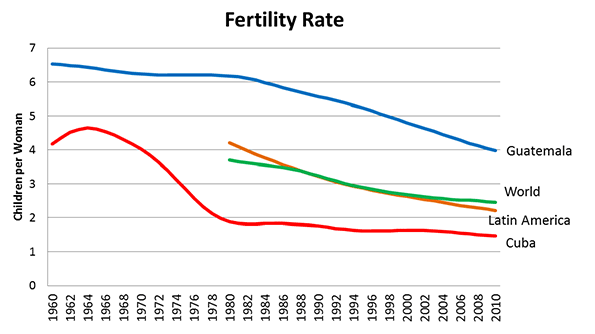
    Increasingly, the debate over plummeting world birth rates is shifting to the developing world. This includes Latin America where on the whole rates are dropping quickly from 5.98 children per woman in 1960 to 2.20 children per woman in 2010.

    Yet these aggregate numbers do not reflect the variation in birthrates between various Latin American countries. Even as countries such as Brazil, Argentina, and Mexico head to rates at or even below replacement rates, there remain extreme examples of both higher and lower rates throughout the region. The most extreme variation can be found in Cuba and Guatemala which respectively have the lowest and highest fertility rates in Latin America.

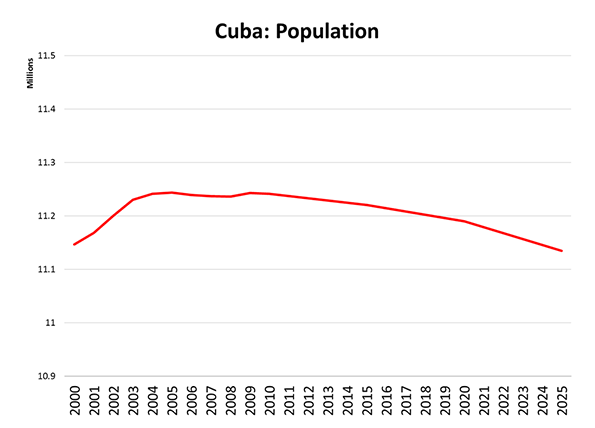
    Cuba is estimated to have a current fertility rate of 1.47 children per woman, well below replacement level of 2.1 children per woman. This extremely low rate is not new to Cuba; rather, it reflects changing population dynamics that have been developing since the rise of communism on the island. The effects of low fertility have already begun to manifest themselves in the population of Cuba. For example, between 2005 and 2008, Cuba’s population actually decreased. Although it did increase slightly again from 2008 to 2011, the trend of decreasing population is projected to continue as time goes on.

    Source: Oficina Nacional Estadística de Cuba

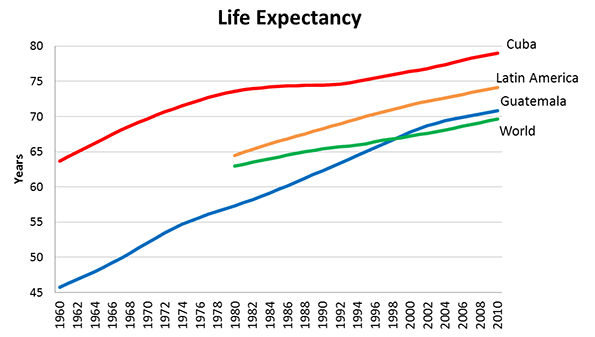
    Cuba’s population by 2025 is supposed to be lower than its population 25 years earlier in 2000 (11,146,203 people in 2000 and only 11,134685 people 2025). Although this decrease of 110,000 people does not seem to be too much of an issue, it will have a severe effect on the country’s workforce and rapid aging. This rapid aging may also reflect the ubiquity of Cuba’s medical care system, which may allow for much of its population to live longer and healthier lives. Cuba’s life expectancy, 78.96 years at the time of birth, is much greater than other countries such as Guatemala and Bolivia, whose life expectancies are 70.83 and 66.27 respectively.

    Source: Oficina Nacional Estadística de Cuba

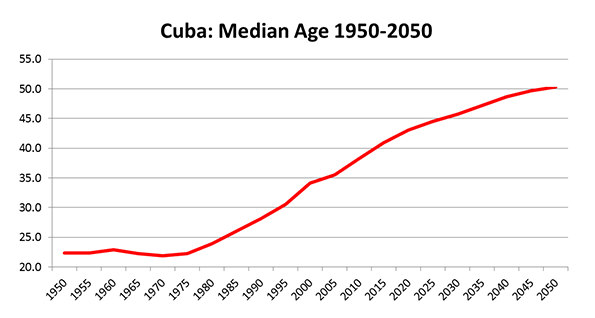
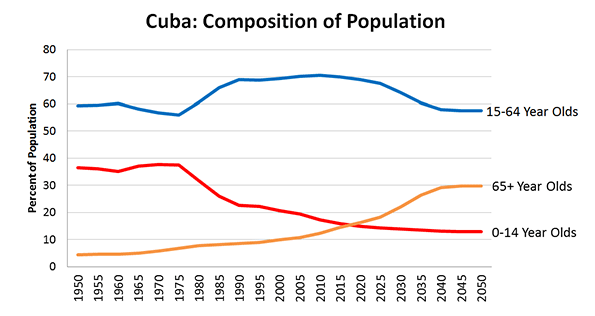
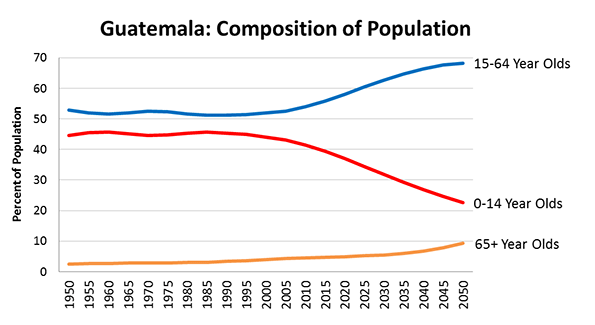
    In 100 years, the median age of the population of Cuba is predicted to more than double from its 1950 rate. Children compose a smaller and smaller proportion of the population while the adult population continues to grow.

    Source: Comisión Económica para América Latina y el Caribe (CEPAL) División de Población (CELADE)

    In this sense Cuba, although a relatively poor country with a Gross National Income per capita of $5,460 in 2008 has demographics more widely associated with far more affluent countries such as Japan, Germany, Italy and Spain. Sometime between 2015 and 2020, Cuban men and women aged 65 and older will outnumber the amount of children in the country, something that has never happened before. The mid 1960s to 1980s saw a major decrease in fertility rates in Cuba, which is shown in the graph above. From 1960 to about 1975 the percentage of children in the population was steady, but then it plummeted dramatically until the mid-1990s, which also saw a massive rise in the share of adults.

    At the other Latin extreme stands  Guatemala, estimated to nearly double its population by 2050, from 14,740,000 in 2011 to 27,444,000 in 2050 (a growth of 86.2%). This is a staggering statistic considering the many issues already facing Guatemala. Guatemala has the highest fertility rate of any Latin American, beating out some of the poorest countries in the region. Its current fertility rate is 3.98 children per woman. This is nearly double the replacement level, which is quite divergent from Cuba’s fertility rate.  

    Source: World Bank
    Guatemala’s fertility rate has been steadily declining since 1960; it still has an extremely high fertility rate that is nearly double replacement level. This means that its population will continue to increase due to a large number of births; however, that is not the only reason for population growth in Guatemala. Like the general trend the world is experiencing, life expectancy in Guatemala is continuing to increase and will only increase more as time goes on.

    As women have on average 3.98 children during their lifetime and the entire population begins to live longer and longer, a major increase in population will occur. Like Cubans, Guatemalans now have longer life expectancies than the world average.

    Source: World Bank

    Guatemala reflects a strange mix of underdevelopment and modernism, which together could drive the major population increase over the next 40 years. The underdevelopment keeps the fertility rate high, while the modernism is driving life expectancy upwards. While the fertility rate is decreasing, it will take a very long time for it drop below replacement level. Similarly, life expectancy will continue to increase until it begins to level off many decades into the future. Not only will its population be affected, but the structure of the population will change with time too.

    Source: Comisión Económica para América Latina y el Caribe (CEPAL) División de Población (CELADE)

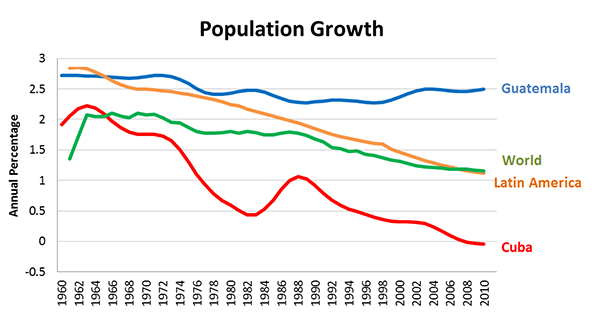
    Ultimately, Guatemala has the healthier population trend. Cuba’s decreasing population will begin to pose major problems. Not only will the population continue to decrease, but the population will also continue to age. Causing significant strain on a government that already has some of the highest rates of social safety net spending. Looking at the average growth rates for Cuba and Guatemala, it seems that Guatemala may be on a healthier trajectory when it comes to population.

    Source: World Bank

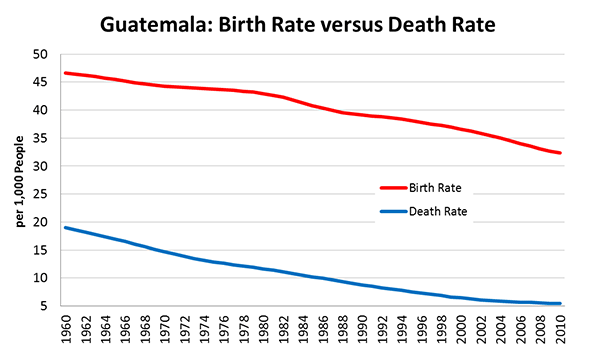
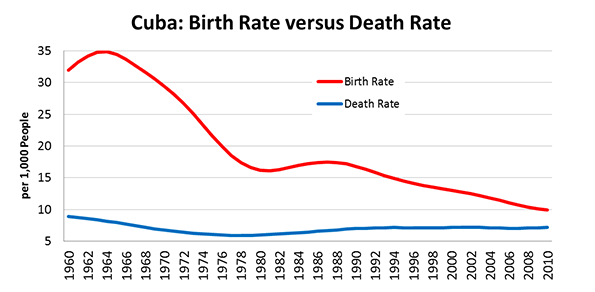
    This is also expressed in the representation of birth and death rates per 1,000 people in the country. Guatemala has a general decrease of both factors over time, which is a fairly common trend in developing countries; however, Cuba has quite erratic behavior in its population’s manifestation of birth and death rates per 1,000 people.

    Source: World Bank

    Source: World Bank

    The 1959 revolution in Cuba caused major shocks to the population both in terms of births and deaths. Immediately following the revolution in 1959, the death rate decreased, while the birth rate actually increased for a few years, only to drop drastically over the next 15 years or so. Cuba’s exceptional government structure – with its welfare state and poor economy – has caused a strange population phenomenon that does not occur in Latin Countries. Guatemala, in contrast, reflects a strange confluence of underdevelopment and modernism. It seems likely that Cuba will soon face a major fiscal and economic fallout from too low fertility while Guatemala will have a population explosion, with a whole different set of challenges.

    Population and its dynamics fuel a constant policy debate in every country throughout the world. In Latin America, these divergent fertility rates will not only affect the region but also the world as a whole. Guatemala’s population trajectory could mean increased emigration from the country to the Northern Hemisphere, while Cuba’s population trajectory could mean a collapse of the system and a restructuring of the entire Cuban life. Overall, Latin America has many significant challenges that other regions in the world do not face, and it seems that the divergent population trajectories of different countries in Latin America will ultimately drive major social, political, and economic changes in the region.

    Sam Schleier is a senior Peace Studies major and Latin American Studies minor at Chapman University in Orange, CA. He is originally from Phoenix, AZ.

    Central America map by Bigstockphoto.com.

  • China’s Top Growth Centers

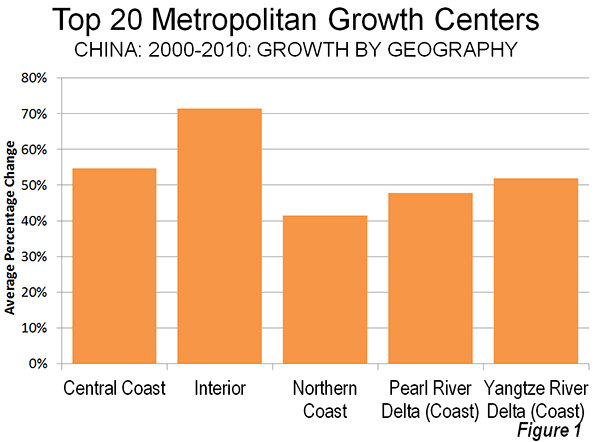
    Hefei, the capital of historically poor Anhui province emerged as China’s top growth center among major metropolitan areas over the past 10 years. Metropolitan areas from the interior, the Yangtze Delta and the central and northern coast were the fastest growing, displacing Guangdong’s Pearl River Delta, long the growth center for the country.   (Figure 1).

    China’s Trends in Context: China’s growth rate has fallen substantially and the United Nations has projected that the nation will experience population decline starting between 2030 and 2035. However, China’s urban areas have grown strongly as people have continued to move to cities for better opportunities. According to World Bank research, China’s economic progress since 1981 has lifted more people out of poverty than ever before in the world.

    Never before in history have so many people moved to urban areas in such a short period of time.

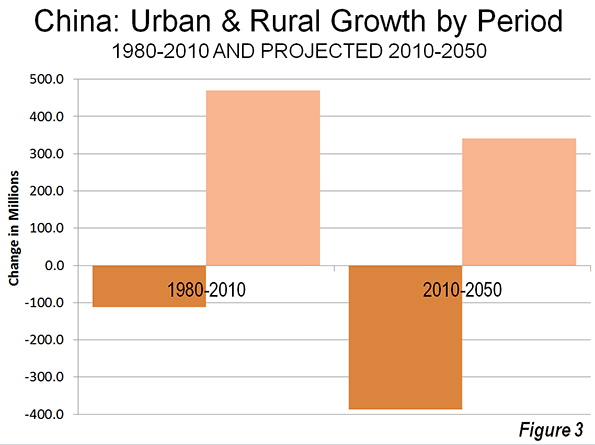
    Since the reforms began in approximately 1980, all of China’s population growth has been urban. Rural areas lost approximately 110 million people between 1980 and 2010. That is approximately equal to the population of Mexico and more than each of the nations in the world except for 11. Over the same three decades, 470 million people were added to the urban areas. That is more than 1.5 times the population of the United States.

    China’s Metropolitan Areas: This article provides an analysis of the urban districts (qu) of Chinas urban regions (routinely mislabeled "cities"). These districts are designated by regional officials as urban for urban development. Since the peripheral urban districts are principally rural, the combination of urban districts (Shi Shixiaqu)in a region are akin to a metropolitan area (labor market area).

    Among the metropolitan areas that began the decade (2000) with more than 1,000,000 inhabitants, the slowest 10 year growth rate was 36 percent. In comparison, among the 51 US metropolitan areas with more than 1,000,000 population, only three (Las Vegas, Raleigh and Austin) would have placed in China’s top 20, and not higher than 14th (Table). As in the US, the most rapid urban growth is taking place in smaller metropolitan areas with less than 5 million in 2010.  

    Top 20 Metropolitan Growth Centers in China: 2000-2010
    Rank Metropolitan Area 2000 Population 2010 Population Change % Geography
    1  Hefei, AN        1,659,000    3,352,000       1,693,000 102.0%  I 
    2  Xiamen, FJ        2,053,000     3,531,000       1,478,000 72.0%  C 
    3  Zhengzhou, HEN        2,560,000     4,254,000       1,694,000 66.2%  I 
    4  Suzhou, JS        2,473,000     4,074,000       1,601,000 64.7%  Y 
    5  Wenzhou, ZJ        1,916,000     3,040,000       1,124,000 58.7%  Y 
    6  Ningbo, ZJ        2,201,000     3,492,000       1,291,000 58.7%  Y 
    7  Urumqi, XJ        1,753,000     2,744,000          991,000 56.5%  I 
    8  Weifang, SD        1,380,000     2,044,000          664,000 48.1%  N 
    9  Shenzhen, GD        7,009,000   10,358,000       3,349,000 47.8%  P 
    10  Hangzhou, ZJ        4,243,000     6,242,000       1,999,000 47.1%  Y 
    11  Beijing, BJ      12,874,000   18,827,000       5,953,000 46.2%  N 
    12  Changsha, HUN        2,123,000     3,094,000          971,000 45.7%  I 
    13  Chengdu, SC        5,268,000     7,677,000       2,409,000 45.7%  I 
    14  Shanghai, SH      15,758,000   22,315,000       6,557,000 41.6%  Y 
    15  Hohhot, NM        1,407,000     1,981,000          574,000 40.8%  I 
    16  Nanjing, JS        5,098,000     7,166,000       2,068,000 40.6%  Y 
    17  Shijiazhuang, HEB        1,970,000     2,767,000          797,000 40.5%  N 
    18  Fuzhou, FJ        2,124,000     2,922,000          798,000 37.6%  C 
    19  Qingdao, SD        2,721,000     3,719,000          998,000 36.7%  N 
    20  Tianjin, TJ        8,146,000   11,090,000       2,944,000 36.1%  N 
     Metropolitan areas with more than 1,000,000 population in 2000.  
     Metropolitan areas consist of urban districts (qu) 
    Geographical Codes
     C   Central Coast 
     I   Interior 
     N   Northern Coast 
     P   Pearl River Delta (Coast) 
     Y   Yangtze River Delta (Coast) 
     Data from National Bureau of Statistics of China 


    The Interior: Six of the top 20 gainers were in the interior, including fastest growing Hefei. This reflects the appeal of   lower labor costs and perhaps also that rural migrants often prefer to work in regions   closer to their homes and families in agricultural regions. These six metropolitan areas had an average growth rate of 71 percent, the largest rate of any geographical grouping.

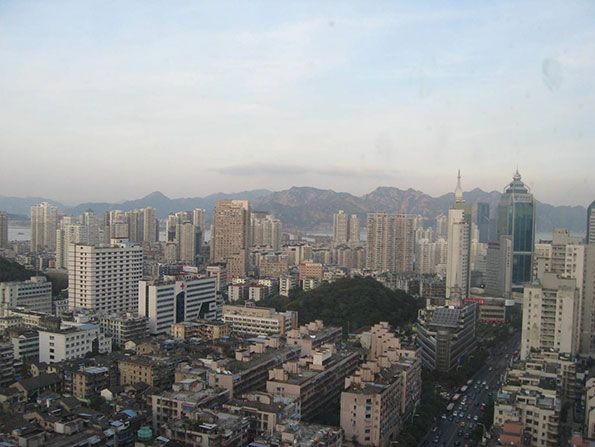
    • The capital of Anhui province, Hefei (photo), had the largest gain, at 102 percent. Hefei grew from 1.659 million to 3.352 million. Hefei is developing one of the most dispersed urban forms among China’s metropolitan area and there continues to be considerable construction. Hefei’s population growth rate was nearly one-half more than of second place Xiamen. Anhui is one province removed from the coast and Hefei is only 115 miles (185 kilometers) from the Yangtze Delta’s Nanjing.
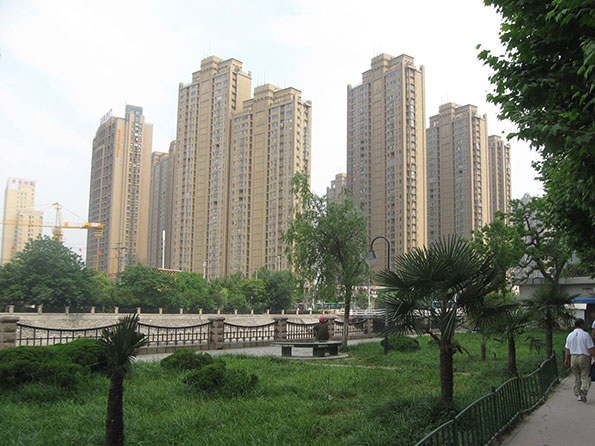
    • The third ranked metropolitan area was Zhengzhou (photo), the capital of Henan province (also separated from the coast by one province), which experienced a 66 percent population gain.
    • Urumqi, the capital of China’s large northwestern province of Xinjiang ranked 7th with a gain of 57 percent. Urumqi is by far the most remote from the East Coast of the large gainers (2,000 miles or 3,250 kilometers from Tianjin, near Beijing).
    • Other interior fast growers were Changsha, capital of Hunan (12th, with 46 percent growth), Chengdu, the capital of Sichuan ranked 13th, with 46 percent growth and Hohhot, capital of Nei Mongol (Inner Mongolia), ranked 15th, with a growth rate of 41 percent.


    Hefei


    Zhengzhou

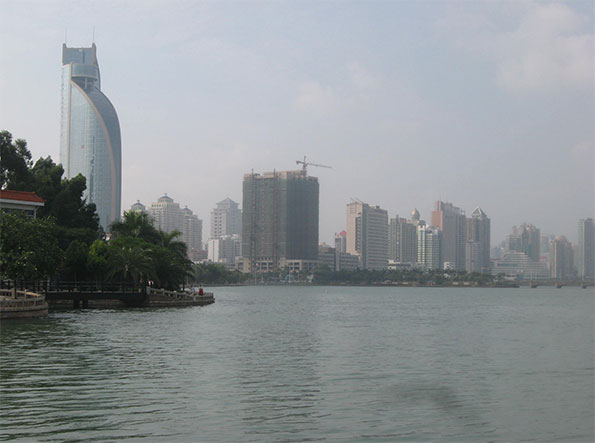
    Central Coast: Xiamen (photo), one of the first special economic zones designated after Shenzhen and placing 2nd in growth, added 72 percent to its population. This metropolitan area is centered on an island in Fujian province on China’s central coast, less than 10 miles from to Jinmen (Quemoy), an island controlled by Taiwan. Fuzhou, the capital of Fujian province was another central coastal metropolitan area among the top 20 growth centers (18th, at 38 percent). The average growth rate of these metropolitan areas on the central coast was 55 percent.


    Xiamen

    Yangtze River Delta: Like the interior, the Yangtze River (Changjiang) Delta also placed six metropolitan areas among the top 20 growth centers. The average growth rate was 52 percent. The Yangtze River Delta is a large area with a population greater than that of the Pearl River Delta, but with urban regions that are separated from one another by considerable rural territory (unlike the Pearl River Delta). The exception is the Shanghai-Suzhou-Wuxi corridor (Note), where the urbanization is continuous in limited corridors.

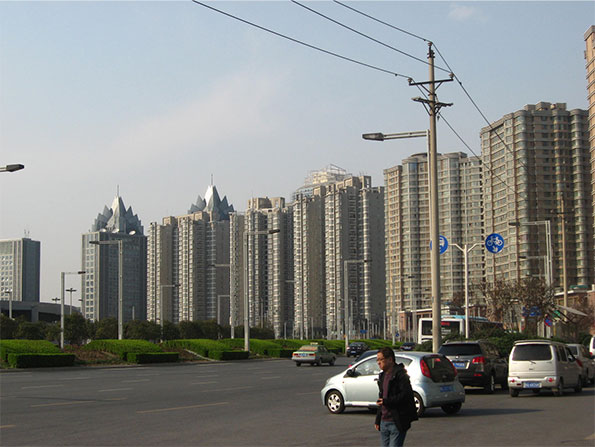
    • Suzhou (Photo), part of which (Kunshan qu) abuts Shanghai ranked as the third fastest growing metropolitan area, with a growth rate of 65 percent. Suzhou added 1.6 million people and is nearing 4.1 million. As the growth of Shanghai continues to spill westward and northward, Suzhou is likely to continue its strong growth.
    • The other three top 10 metropolitan growth areas in the Yangtze River Delta were in the province of Zhejiang, including Wenzhou at 5th, growing 59 percent (Photo), Ningbo, one of the nation’s largest ports was 6th, at 59 percent and Hangzhou, the provincial capital, which Marco Polo claimed was the largest city in the world in his Travels was 10th, at 47 percent.
    • Shanghai, the nation’s largest metropolitan area, placed 14th in growth, at 42 percent. Shanghai had the largest numeric growth, adding 6.6 million to its population, more people than live in Toronto.
    • Nanjing, the capital of Jiangsu province ranked 16th in growth, at 41 percent.


    Suzhou


    Wenzhou

    Northern Coast: Five northern coastal metropolitan areas were among the top 20 metropolitan gainers, with an average growth rate of 42 percent.

    • Weifang, in the province of Shandong ranked 8th in growth, the highest rating among metropolitan areas in the northern coastal area. Weifang added 48 percent to its population.
    • Beijing ranked 12th in growth, at a 46 percent rate. Beijing’s numeric growth was second only to Shanghai, at 6 million.
    • The other northern coastal growth centers were Shijiazhuang, the capital of Hebei (17th, at 41 percent) and 175 miles (280 kilometers), south of Beijing. Qingdao, of brewing fame ("Tsingtao" beer) ranked 19th, with a growth rate of 37 percent, while Tianjin, which is close enough to be Beijing’s port, ranked 20th, with a growth rate of 36 percent.

    Pearl River Delta: In contrast the Pearl River Delta, the home of so much urban growth over the past 30 years, placed only one metropolitan area among the top 20 growth centers, Shenzhen. Shenzhen placed 9th, with a growth rate of 48 percent. This is in stark contrast to 1990 to, when Shenzhen and adjacent Dongguan both more than doubled in population.

    Missing Giants: Chongqing was not among the top growth centers. Chongqing has been routinely mischaracterized as China’s largest metropolitan area (because of semantic confusion over the word "city"). Chongqing’s metropolitan districts grew only 22 percent and the region (a provincial equivalent) lost population. Neighborhood rival Chengdu, capital of Sichuan province from which Chongqing was separated in 1996 more than doubled its growth rate. Manchuria, China’s "Dongbei" (Northeast) also failed to place any areas among the fastest growing. Shenyang, the center of China’s Rust Belt, grew less than 10 percent, though Harbin, capital of Helonjiang grew nearly 30 percent.

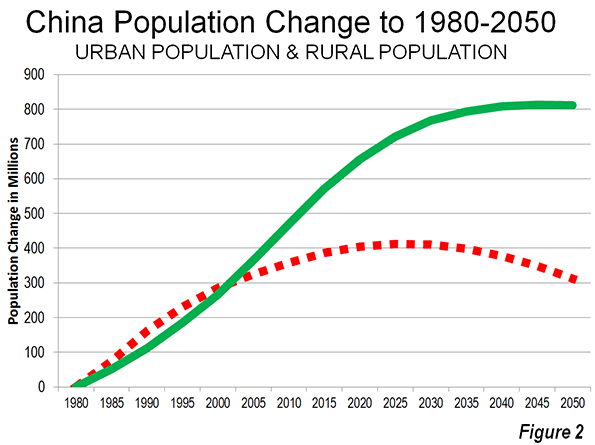
    More Growth to Come: Despite an overall population that is just peaking, urban population growth is expected to be substantial. In addition to the 470 million people that have moved to urban areas since 1980, the United Nations projects that another 340 million people will be added to the urban areas by 2045 (after which a modest decline is expected). Over the same 35 years, China’s rural population is expected to fall by 387 million (Figures 2 and 3). Where these new migrants move and how they make do will be among the most important urban stories of the next decade.


    Wendell Cox is a Visiting Professor, Conservatoire National des Arts et Metiers, Paris and the author of “War on the Dream: How Anti-Sprawl Policy Threatens the Quality of Life”.

    ——-

    Note: Includes Kunshan, part of the Suzhou metropolitan area, but a separate urban area (between the Suzhou urban area and the Shanghai urban area).

    Note: Corrected Hefei data on 6/3/2012.

    Top photo: Hefei: All photos by author.

  • Declining Birthrates Key to Europe’s Decline

    The labor demonstrators, now an almost-daily occurrence in Madrid and other economically-devastated southern European cities, lambast austerity and budget cuts as the primary  cause for their current national crisis. But longer-term, the biggest threat to the European Union has less to do with government policy than what is–or is not–happening in the bedroom.

    In particular, southern Europe’s economic disaster is both reflected — and is largely caused by — a demographic decline that, if not soon reversed, all but guarantees the continent’s continued slide. For decades, the wealthier countries of the northern countries — notably Germany — have offset very low fertility rates and declining domestic demand by attracting migrants from other countries, notably from eastern and southern Europe, and building highly productive export oriented economies.

    In contrast, the so-called Club Med Countries– Greece, Italy, Portugal and Spain–have not developed strong economies to compensate for their fading demographics outside pockets of relative prosperity such as Milan. Spain was once one of Europe’s star performers, buoyed largely by real estate speculation and growing integration with the rest of the EU.  Six years ago the country was building upwards of 50% as many houses as the US while having 85% less population. Roughly six million immigrants came to work in the boom, even as roughly seven to eight percent of Spaniards preferred to remain unemployed.

    When the real estate bubble broke, there was only limited productive industry to step into the breach. In Spain, private sector credit has dropped for a remarkable eighteen straight months while industrial production has fallen precipitously–7.5 percent in March alone. Spain’s unemployment rate has scaled over 23%, more than twice the EU average. Unemployment among those under 25 in both Spain and Greece now reaches over fifty percent.

    After decades of expansion, even fashionable Madrid is littered with store vacancies and  ubiquitous graffiti; many young people can be seen on the street in the middle of the week, either doing nothing or trying to pick up an odd Euro or two performing for tourists.

    ‘A Change In Values’

    Economists tend to explain this decline in terms of budget deficits and failed competitiveness, but some Spaniards believe the main cause lies elsewhere. Alejandro MacarrónLarumbe, a Madrid-based management consultant and author of the 2011 book, Elsuicidiodemográfico de España, says today’s decline is “almost all about a change in values.”

    A generation ago Spain was just coming out of its Francoist era,  a strongly Catholic country with among the highest birth rates in Europe, with the average woman producing almost four children in 1960 and nearly three as late as 1975-1976. There was, he notes, “no divorce, no contraception allowed.” By the 1980s many things changed much for the better better, as young Spaniards became educated, economic opportunities opened for women expanded and political liberty became entrenched.

    Yet modernization exacted its social cost. The institution of the family, once dominant in Spain, lost its primacy. “Priorities for most young and middle-aged women (and men) are career, building wealth, buying a house, having fun, travelling, not incurring in the burden of many children,” observes Macarron. Many, like their northern European counterparts, dismissed marriage altogether; although the population is higher than it was in 1975, the number of marriages has declined from 270,000 to 170,000 annually.

    Falling Births, Falling Fortunes

    Now Spain, like much of the EU, faces the demographic consequences. The results have been transformative. In a half century Spain’s fertility rate has fallen more than 50% to 1.4 children per female, one of the lowest not only in Europe, but also the world and well below the 2.1 rate necessary simply to replace the current population. More recently the rate has dropped further at least 5 percent.

    Essentially, Spain and other Mediterranean countries bought into northern Europe’s liberal values, and low birthrates, but did so without the economic wherewithal to pay for it. You can afford a Nordic welfare state, albeit increasingly precariously, if your companies and labor force are highly skilled or productive. But Spain, Italy, Greece and Portugal lack that kind of productive industry; much of the growth stemmed from real estate and tourism. Infrastructure development was underwritten by the EU, and the country has become increasingly dependent on foreign investors.

    Unlike Sweden or Germany, Spain cannot count now on immigrants to stem their demographic decline and generate new economic energy. Although 450,000 people, largely from Muslim countries, still arrive annually, over 580,000 Spaniards are heading elsewhere — many of them to northern Europe and some to traditional places of immigration such as Latin America. Germany, which needs 200,000 immigrants a year to keep its factories humming, has emerged as a preferred destination.

    Declining Population

    As a result Spain could prove among the first of the major EU countries to see an actual drop in population. The National Institute for Statistics (INE) predicts the country will lose one million residents in the coming decade, a trend that will worsen as the baby boom generation begins to die off. The population of 47 million will drop an additional two million by 2021. By 2060, according to Macarron, Spain will be home to barely 35 million people.

    This decline in population and mounting out-migration of young people means Spain will experience ever-higher proportions of retired people relative to those working. This “dependency rate”, according to INE, will grow by 57 % by 2021; there will be six people either retired or in school for every person working.

    If Spain, and other Mediterranean countries, cannot pay their bills now, these trends suggest that in the future they will become increasingly unable or even unwilling to do so.  As Macarron notes, an aging electorate is likely to make it increasingly difficult for Spanish politicians to tamper with pensions, cut taxes and otherwise drive private sector growth. Voters over 60 are already thirty percent of the electorate up from 22 percent in 1977; in 2050, they will constitute close to a majority.

    Without a major shift in policies that favor families in housing or tax policies, and an unexpected resurgence of interest in marriage and children, Spain and the rest of Mediterranean face prospects of a immediate decline every bit as profound as that experienced in the 17th and 18th Century when these great nations lost their status as global powers and instead devolved into quaint locales for vacationers, romantic poets and history buffs.

    Long before that happens, today’s Mediterranean folly could drive the rest of Europe, and maybe even the world, into yet another catastrophic recession.

    Joel Kotkin is executive editor of NewGeography.com and is a distinguished presidential fellow in urban futures at Chapman University, and contributing editor to the City Journal in New York. He is author of The City: A Global History. His newest book is The Next Hundred Million: America in 2050, released in February, 2010.

    Girl with Spanish flag photo by BigStockPhoto.com.

  • Here Come the Plurals!

    This month America’s destiny as a pluralistic democracy took a new and unprecedented turn. First, early in May, USA Today asked Americans what name they thought would be appropriate for the country’s newest generation now moving into grade school classrooms with its unique behavior and perspectives. Plurals is the name suggested by communications research and consulting firm, Frank N. Magid Associates, with only the Apple product related notion of an iGeneration getting more votes. 
     
    Plurals will be different from Millenials. For one thing they will be the first generation in America that will be majority “minority”, as evidenced by the recent U.S. Census Bureau announcement  that more babies born in America in the 12 months between July 2010 and July 2011, were non-white than white. The event occurred about eight years earlier than demographers had predicted it would just a few years ago. The 21st Century pluralistic American society that had often been talked about has arrived. But the question remains whether or not the country’s institutions, and its leadership, will be up to the challenge such a polyglot democracy presents.
     
    The Census Bureau predicts that by 2042 the entire population will be less than 50% Caucasian and America will literally be a pluralistic society.

    This prediction is based upon the current trends for births among different minority groups compared to whites. Racial and ethnic minorities accounted for 91.75% of the nation’s population growth in this century, with Hispanics comprising a majority of this increase. Rather than immigration flows, which are dropping, this growth will be driven largely by higher rates of fertility among non-whites. Based upon the American Community Survey results in 2010, Hispanics have a fertility rate of 2.4 live births per woman compared to only 1.8 among whites. The only other ethnic group to be having babies at a rate greater than what is needed to replace its current numbers is African-Americans with a 2.1 fertility rate.

    This difference is likely to persist and the gap could easily become wider because of the differences in the age of each population. Twenty-five percent of Hispanic women are in the prime child bearing ages of 20-34, compared to only 19% of non-Hispanic whites. (For both African-Americans and Asians, the percentage is twenty-two). The increasing diversity of both of America’s youngest generations is also reflected in the average age of each population. The average age of America’s white population is 42.3, a full five years older than the overall age of the country’s population. The average age of Hispanics is almost fifteen years younger, 27.6, with the other two population groups closer to the average age of the entire population—blacks at 32.9 and Asians at 35.9.

    Magid’s research indicated that a majority of Americans were “hopeful and proud” of the country’s increasing diversity, but it was the younger generations, most markedly Plurals, who were more likely to say they were “pleased and energized” by this development. Many older Americans, particularly Baby Boomers and senior citizens, are resisting the changes this dramatic shift is bringing to American society. Already states, such as Arizona, with populations that have the widest disparity between the racial and ethnic makeup of their oldest and youngest generations have experienced bitter political battles over issues such as immigration and education that reflect these divides. The good news is that both Plurals and members of the Millennial generation, born 1982-2003, are positive about this inevitable trend toward a pluralistic society, reflecting their comfort with the diversity in the social circles in which they have grown up.

    But that doesn’t mean that Plurals look forward to the nation’s future with equanimity. Most Plurals have been raised by parents from the often cynical and consistently skeptical Generation X. This may explain why Magid found a much greater degree of pessimism about living out the American Dream among them than among their older Millennial Generation siblings, a generation that, despite their current challenges, was brought up in the prosperous Reagan-Clinton era and remains characteristically optimistic. The attitudes of Plurals may also reflect the polarized, bitter politics that have characterized the period of Fear, Uncertainty and Doubt (FUD) that has dominated the news during their young life.

    Whatever the reason, the pessimism of the Plurals must be answered by the nation’s leaders in ways which improve prospects for the nation’s future. One way for this to happen quickly would be for those currently holding power to begin to turn the reins of leadership over to those generations more in tune with the nation’s demographic future. If Plurals’ Xer parents and their Millennial siblings are given the opportunity to shape America’s destiny sooner rather than later, the country just might deliver on the promise of the American Dream for its newest generation.  

    Morley Winograd and Michael D. Hais are co-authors of the newly published Millennial Momentum: How a New Generation is Remaking America and Millennial Makeover: MySpace, YouTube, and the Future of American Politics, named by the New York Times as one of their ten favorite books of 2008.

  • Midcentury Modern

    Midcentury modern tours now are taking place in cities all over the country. Renewed interest in this era capitalizes on the millennials’ interest in design from a time that seems almost impossibly optimistic compared to today’s zeitgeist. Most cities around the country boast a healthy building stock from this postwar period, nicknamed “the suburbs,” although these are ritually condemned – and designated for annihilation – by academics, urban land speculators and the urban clerisy.

    Yet the new interest in the mid-century modern form reflects its basic and enduring appeal. As the curious and the trendy take bus tours of these inner-ring neighborhoods, the forms of this era evoke a sense of great confidence and faith in the future, both of which seem to be lost in the obsession with neo-traditional forms that hearken to the pre-car era or to the cartoonlike, sculpture-as-architecture one sees in many urban centers.

    Suburban expansion after World War II reached out beyond the streetcar systems that created the traditional neighborhoods of the late 19thand early 20th Century. The returning GIs wanted something simple and affordable to begin their lives after serving their country. Confidence surged in America’s know-how and ability to solve even the deepest social problems. The triumph of science and technology was a palpable presence. The dark side, of course, was the atomic threat, restraining our enthusiasm but only a little.

    In this midcentury era, planning and design began to be car-based. Residences were designed to show off the car, putting it out front for display – and some home plans even had tailfinned beauties in the living room


    Living Garage, photo from Populuxe by Thomas Hine

    Consumer goods were no longer accessed on foot; a new form of luxury consisted of driving up to the front door of a shop with parking in front. Front-loading houses and stores became unquestionably more efficient as a means to accommodate the new American lifestyle.

    Yet despite the auto-orientation, the architecture of this era retained the pedestrian scale and intimate feel that marked Main Street before World War 2. This both/and aesthetic marks the form of the 1940s and 1950s, with streamlined design styles like Art Deco Revival and materials like glass and stainless steel. Gentle angles suggested motion, and the theme of mobility was everywhere in the architecture.  Wider streets and lower, longer horizontal lines accommodated this theme and even today the architecture reinforces a feel of motion when driving past these structures.

    Modernism also formed a certain ethic. To be modern was more than a lifestyle choice; it was an acceptance of science, knowledge, and technology, free from preconceptions.  At the time, modernism elevated architecture above the style debate, and was considered even a shedding of styles. The politics of the time was similarly marked by Truman’s “straight talk”, and there was a shedding of rhetoric and posturing that lasted up until Joe McCarthy began once again a divide-and-conquer campaign against people.

    Translated to the suburbs, modernism meant practical homes, without the adornment that marked Victorian architecture. Instead, modernist residences were marked by deep horizontals and large picture windows, providing a sense of openness that was a hallmark of modernist thought. Floor plans also were open, allowing free movement through space, rather than cutting the house up into cluttered little parlors, dining rooms, or nooks. 

    Today, midcentury modern design is fetishized for mass consumption in magazines like Dwell that emphasize acquisitiveness over ethics. But back then, the design meant something else, something cleaner and more powerful. In the 1950s, modernism meant consumption, but even more, the modernism defined the quest for the inner self and a new, forward looking outlook.

    By reducing modernism to a sofa style or wallpaper pattern, we risk losing all that this era stood for.  Buildings from the 1950s have sustained themselves through multiple recessions, the rise of the internet, cultural acceleration, massive city growth, and globalism. So perhaps they point towards a real definition of sustainability by having good bones and adapting through all these changes.

    The current millennial generation seeks a practical domestic situation, much like returning GIs. Most would prefer to reduce car-trips, but are realistic about this goal, given the range of their travel. Most in this generation see right through car-free living claims; more than one of my students, when discussing walkability, stated that “I’m not gonna lug my groceries even a block in this heat.” The battle with the car is chiefly about making the car more efficient, and less ubiquitous through the use of telecommuting and on-line shopping. It is not about removing it from the scene entirely.

    So as McMansions have swollen to represent a kind of architectural obesity, they have made many midcentury neighborhoods unfashionable, for typically these older homes have one parking space, often in a carport, not a true garage. They also are front-loaded, a much more efficient planning concept than alleys, but then the car becomes part of the front façade. Millennials have a hard time understanding what’s wrong with that. Again, as one 28-year-old student put it to me, “It’s just a house, after all…what’s the big deal?”

    Developers seeking first-time homebuyers, however, respond to the regulatory climate, which favors solutions like garages on alleys, big homes on tight lots, and neotraditional styling.  Bonus density and other zoning incentives rig the game in favor of this highly regulated development pattern, even in the exurbs.  Here in Central Florida, the development zone nicknamed Horizon West has been codified to enforce these form-based principles, with stiff permitting fees and a highly participatory government staff to keep things on the straight-and-narrow.

    Keeping prices low with all this overburden requires developers to cut the cost of the home drastically, likely reducing lifespan of components and systems. Ironically, the house meeting these tortured standards of today is less sustainable than the house built in 1953, with better bones and an adaptable floor plan.

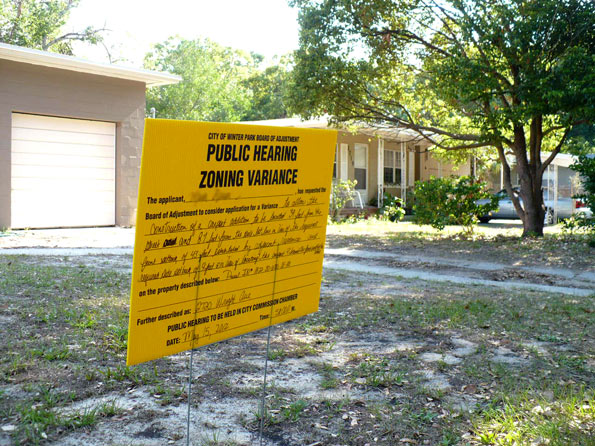
    Meanwhile, these 1950s neighborhoods are under attack for their very form. Cities, persuaded by planners to heal the effects of the car, cannot do so in a granular manner, so ordinances are passed  forbidding front-facing garages, or garages set back arbitrarily from the house front. These 1950s homes, with their carports, couldn’t be built today, and so are reduced to the status of heritage sites from a bygone era. In Winter Park, garages are banished to the rear on new homes, and if you are adding a garage to your midcentury home, it must be arbitrarily set back at least four feet from your front wall whether or not your lot can accommodate this arbitrary, and seemingly pointless, ordinance.

    Of course mid modern tours allow people to rediscover the essence of the 1950s, and these overlooked neighborhoods could be the springboard for a new era in modern planning.  Front-loaded neighborhoods can be successful when the architecture is designed at a human scale, and fine-grained integration of residential and commercial uses point to a future of home-office, cottage-industry, people-based industry once again.

    The Victorian era ended rather abruptly in the 1890s with a series of economic catastrophes that changed America’s middle class. Architecture switched to a more streamlined, Edwardian style – simple, flexible, and utilitarian forms that quickly gave rise to modernist design.  This current economic transition may well bode a similar outcome – design styles, often labeled “contemporary,” reduce the amount of architectural gingerbread and fussiness, reducing cost and maintenance, and may be favored by the coming generation for its cleanliness and utility.

    A new era that manages the car at a human scale, forgives people for wanting mobility and efficiency, and allows for contemporary exploration of style and design can and should inform new neighborhood planning. Midcentury suburbs, rediscovered by popular interest, can point the way to a middle ground between mcmansion-style subdivisions and neotraditional fussiness, and maybe even help us rediscover our confidence and faith once again.

    This essay is a summary of Richard Reep’s talk “Populuxe and the Atomic Bungalow” given at the 3rd annual Colloquium on Historic Preservation, hosted by Friends of Casa Feliz, Winter Park, Florida in April 2012.  Richard and his wife, Kim Mathis, hosted a midcentury modern tour in their own 1950s home for the colloquium.

  • The Evolving Urban Form: Shenzhen

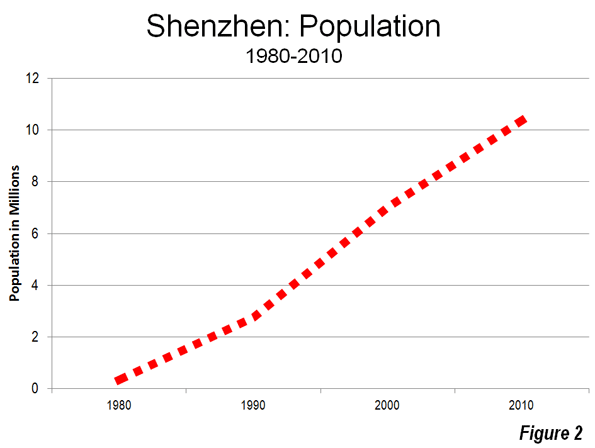
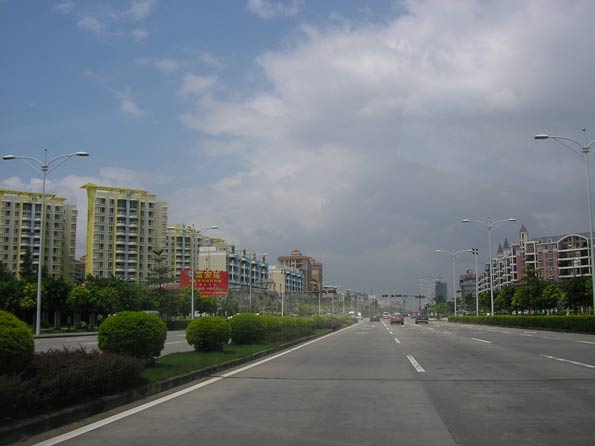
    No urban area in history has become so large so quickly than Shenzhen (Note 1). A little more than a fishing village in 1979, by the 2010 census Shenzhen registered 10.4 million inhabitants. It is easily the youngest urban area to have become one of the world’s 26 megacities (Figure 1). Most other megacities were the largest urban areas in their nations for centuries (such as London and Paris) and a few for more than a millennium (such as Istanbul and Beijing). Shenzhen’s primitiveness can be seen in this 1980 internet photo, and shows the beginnings of construction. A 2006 photograph of one of Shenzhen’s principal streets (Binhe Avenue) is above.

    Pearl River Delta Location: Shenzhen is located in Guangdong Province adjacent to Hong Kong’s northern border. Shenzhen is China’s fourth largest urban area, following Shanghai, Beijing, and Guangzou-Foshan.

    Along with Dongguan, Guanzhou, Foshan and smaller neighbors, Shenzhen forms the Pearl River Delta,   the world’s largest manufacturing center. The Pearl River Delta, along with Hong Kong and Macau, constitutes the world’s largest populated extent of urbanization, with nearly 50 million people. They live in a land area of just over 3,000 square kilometers (7,800 square kilometers. By comparison the world’s largest urban area, Tokyo-Yokohama, has a population of 37 million and covers 3,300 square miles (8,500 square kilometers). I recall from a Hong Kong to Guangzhou trip on the Canton-Kowloon Railway in 1999 that there was plenty of rural territory on the 100 mile (170 kilometers) route. Today,   development takes place along virtually the entire route (Note 2).

    The Special Economic Zone: Shenzhen was established as China’s first special economic zone by Deng Xiaoping in the period of liberalization after the death of Mao Zedong. The special economic zones allowed for alternative, generally market oriented reforms, with the end of improving economic growth. The result was economic progress far greater than anyone expected. The special economic zone program was eventually extended to several other urban areas in the nation.

    Some governmental officials preferred the previous state dominated approach, despite its greater poverty and sought to roll back the reforms. This threat reached its peak in the early 1990s, after Deng Xiaoping had retired from his government positions. In response, Deng undertook his renown "southern tour" to Shenzhen, Guangzhou and other parts of Guangdong province to promote the new economic approach and the progress that had been made. During the southern tour, Deng is reputed to have said that "to be rich is glorious." Three decades before he had said “I don’t care if it’s a white cat or a black cat. It’s a good cat as long as it catches mice." He committed to results rather than to ideology, in a sense Shenzen and its environs are the engines of non-state owned prosperity. Eventually, the publicity from Deng’s southern tour overwhelmed the opposition and China accelerated its move toward a more open economy.

    Shenzhen’s Core: Unlike the fast growing, but much smaller new urban areas of the United States (for example Phoenix, which is largely a low rise, dispersed expanse of suburbanization), Shenzhen has developed a dense central business district. Even though Shenzhen started the decade of the 1990s with little more than 1,000,000 residents, by 1996 it had the fourth tallest building in the world, the Shun Hing Tower. Only the Sears Tower in Chicago and the two World Trade Center Towers in New York were taller.

    In 2011, the Shun Hing Tower lost its local tallest building title to the Kingkey Financial Tower, at 1,449 feet (447 meters) is the 10th tallest building in the world. Now, the world’s second tallest building is under construction in Shenzhen, the Ping An International Financial Center, which is reported to reach 2,125 feet or 655 meters, with 116 floors. Only the Burj Khalifa (2,717 feet, 828 meters, 163 floors) in Dubai would be higher. Like Shanghai and Chongqing (and unlike most Chinese urban areas), Shenzhen has a highly concentrated central business district. As a result deserio.com rates Shenzhen’s skyline as 9th in the world (Note 3).

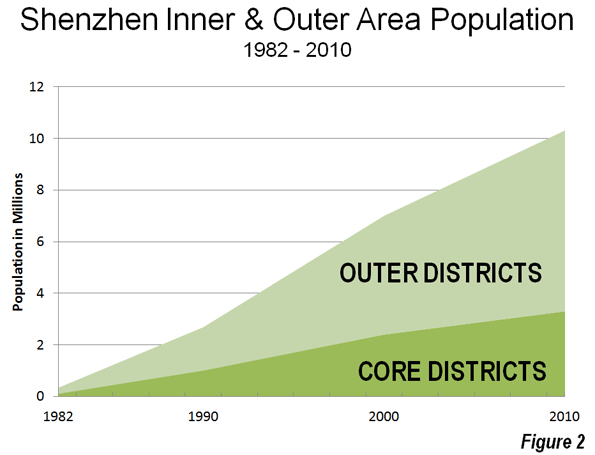
    Outer Areas Growing Faster: The three central districts (the qu of Futian, Luohu and Nanshan) grew from 2.4 million to 3.3 million population between 2000 and 2010, a rate of 38 percent. However, as is natural for a growing urban area, most of the growth was in the outer districts (Photo: Suburban Shenzhen), which grew from 4.6 million to 7.0 million, a growth rate of 52 percent. Thus, nearly three-quarters of the growth was on the periphery (Figure 2). Population growth in the earlier 1990 and 2000 period was slightly less concentrated in the outer area (68 percent). But overall  population growth has begun to slow down, with Shenzhen added 3.3 million new residents, compared to 4.3 million between 1990 and 2000.  


    Photo: Suburban Shenzhen (Longgang)

    The Urban Area: Overall, it is estimated that the Shenzhen urban area (area of continuous development) has a 2012 population of 11.9 million, with a land area of 675 square miles (1,745 square kilometers). The urban area has now crossed the border into the Huiyang district of the Huizhou region, to the east. The population density is estimated at 17,600 per square mile, or 6,800 per square kilometer,  approximately 10 percent less dense than the average urban area in China. Shenzhen is about one quarter the density of Hong Kong and double the density of Paris.

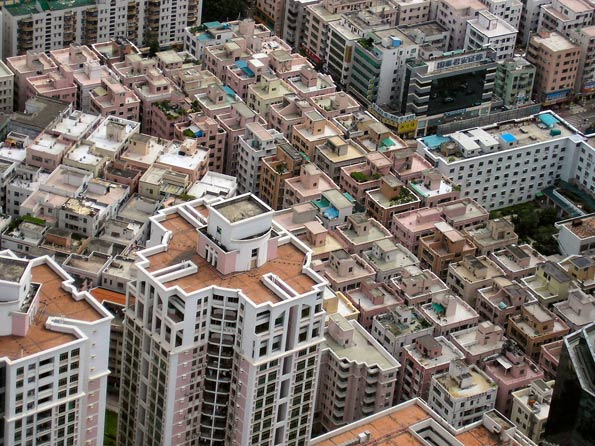
    Rich and Poor in Shenzhen: Like all urban areas, Shenzhen is a mixture of rich and poor. Shenzhen is generally considered one of the most affluent urban areas in China, yet it also has a very large low income population. Approximately one-sixth of China’s residents are considered to be temporary migrants; many work in boomtowns like Shenzhen. Seven million of these 220 million migrants live in Shenzhen,  considered the largest migrant population of any region in the nation. Migrants are attracted to Shenzhen for the same reasons people have moved to cities from early on: to get ahead. At the same time, their remittances sent back home are contributing to improved living conditions far beyond Shenzhen. It is expected that reforms to the "hukou" system of residence permits will allow many of the temporary migrants in Shenzhen and elsewhere obtain permanent residence status. Many of the migrants live in factory housing, or older, very densely packed buildings. At the same time, Shenzhen has a large number of world-class condominium buildings.


    Photo: Older Housing: Central Business District


    Photo: Newer Housing: Central Business District

    The Future of Shenzhen: Much of Shenzhen’s future will depend upon the economy of the Pearl River Delta and the extent to which migrants are able to obtain permanent residency status. There is still land enough in the region for substantial population growth. The longer term integration of the Hong Kong and Shenzhen economies could produce an even larger economic dynamo than the two that are currently separate. One thing is certain, however. Shenzhen has led China into a new economic and urban reality.

    Wendell Cox is a Visiting Professor, Conservatoire National des Arts et Metiers, Paris and the author of “War on the Dream: How Anti-Sprawl Policy Threatens the Quality of Life”.

    —–

    Note 1: Shenzhen is one of China’s regions, often called "cities," as translated from "shi."  "Shi" more resemble regions than "cities" in the non-Chinese sense, this article refers to "shi" as regions. "Shi" were formerly referred to in English as prefectures. A province is usually composed of "shis" and other "shi" level jurisdictions.

    Note 2: These combined regions are not a metropolitan area, for two reasons. First; there is little daily commuting between them and thus they are not a single labor market, which is the definition of a metropolitan area. Second, one of the regions, Hong Kong, has a border with Shenzhen that has international style customs and immigrant controls, which further precludes the two adjacent regions from being a single metropolitan area. In the longer run, greater affluence, greater mobility between the regions and relaxation of border controls could merge some or all of the now separate metropolitan areas.

    Note 3: Desiro.com, unlike some other skyline rating systems, places a premium on the density of buildings, rather than simply amalgamating building heights from throughout an urban area.

    Photo: Shenzhen:  Binhe Avenue from the Shun Hing Tower (by author)

  • Populate or Perish?

    Many global population projections point to the current world population of roughly seven billion people peaking at around nine to ten billion in 2050, after which numbers will slowly decline. In the midst of this growth, Australia’s current population of 23 million is predicted to rise to around 30 or 35 million in the same period. This low growth outlook has been called ‘big Australia.’ We are kidding ourselves, aren’t we?

    ‘Populate or perish’ was a rallying cry of post-World War II Labor Immigration Minister Arthur Calwell as he sought to overcome domestic resistance to immigration. For Calwell, immigration was the key to quickly boosting Australia’s population numbers in the interests of economic and military security. An avowed supporter of the ‘white Australia policy’ he sought immigrants from European backgrounds. Asia was, back then, regarded as the enemy.


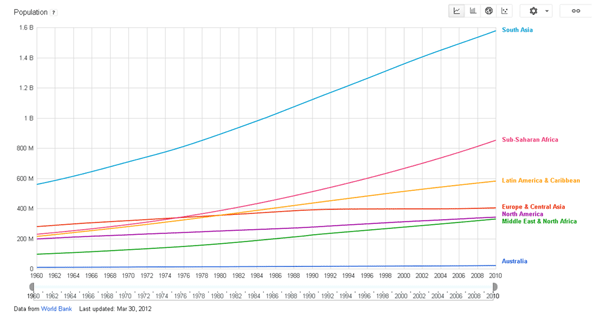
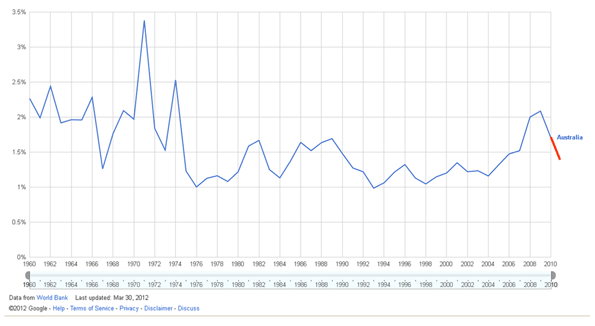
    Above: world populations since 1960. Below: Australia’s rate of population growth since 1960. Source: World Bank.

    How things change, yet stay the same. In 2012, it’s arguably just as much in Australia’s interests to boost its population numbers, in the interests of economic security and (according to some) military security also. And again, immigration – not an accelerated breeding program of naturalised Australians – is the only way this can realistically occur. As domestic industries increasingly surrender to global competition and as energy, agriculture and services industries increasingly depend on foreign markets for their long term survival, the issue of Australia’s relatively small population – despite its huge continental mass – raises little by way of public debate. A larger domestic population might provide markets for domestic industries, for local employment and for community wide infrastructure.

    In contrast the planning fraternity’s dreams of Parisian, London, or New York standards of public transport, for example, will never succeed. Our cities are simply too small to make this work.

    But talk of a ‘big Australia’ has become ‘persona non grata’ in public policy circles. We have a Federal Population Minister, but he hasn’t issued a single statement on population policy this year.  Our Prime Minister has other things on her mind, but even if her government was on more solid ground her antipathy to a ‘big Australia’ is well known and a matter of public record. And such is the apparent public hostility to the notion of a bigger population, intermixed as it is with a blend of doomsday environmentalism and references to failed Malthusian or Paul Ehlrich ‘Population Bomb’ scenarios and  myths (suggesting that Australia is running out of room and resources), that few political or public policy leaders want to take up the debate in favour of growth.

    With that in mind, I thought some very simple reality checks might prove helpful to stimulate your thinking about Australia’s population capacity relative to the rest of the world. Wendell Cox, author of the global housing affordability study ‘Demographia’ recently published his Demographia World Urban Areasreport with this summary on New Geography. I want to take just two examples and interpose them into the Australian context.

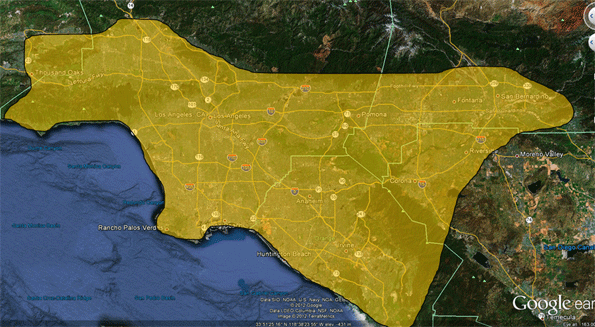
    First, let’s look at Los Angeles, California.  Often cited as a region with similarities to the Australian urban context (both in a positive and negative sense), this city popularly known for its ‘sprawl’ actually has a very high level of population density. The total population of the Greater Los Angeles area is around 15 million people. Put into context, that’s roughly two thirds of the entire population of Australia living in the Greater Los Angeles ‘sprawl.’


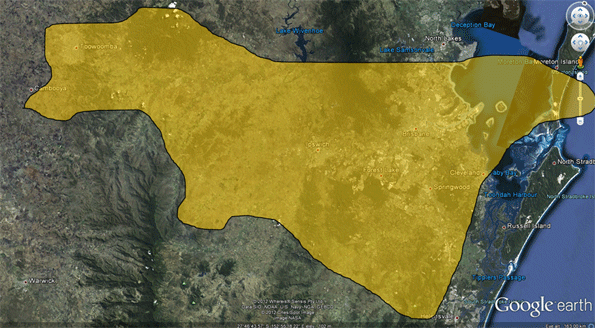
    Above: The greater Los Angeles area and below, the same area superimposed in south east Queensland.

    Put into a visual context, the contrast is even more apparent. At LA levels of population density, roughly the area we know of as south east Queensland could accommodate some 15 million people comfortably. Yet the conventional “wisdom” is that with just 3 million people it’s bursting at the seams and can’t possibly take any more

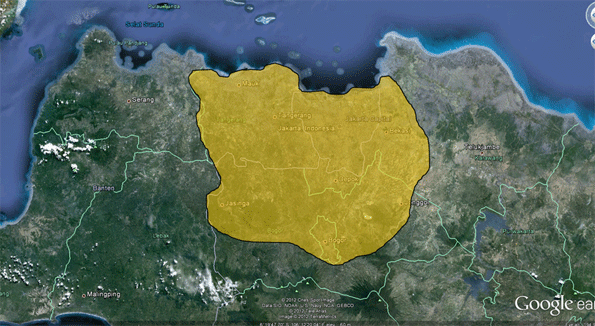
    A more extreme example, just to stretch the imagination further, is worth thinking about. Jakarta, Indonesia (our nearest large foreign neighbour) has a population of 26 million people. That’s more than the entire population of Australia, living in one (very crowded) city – at the rate of 9,400 people per square kilometre.

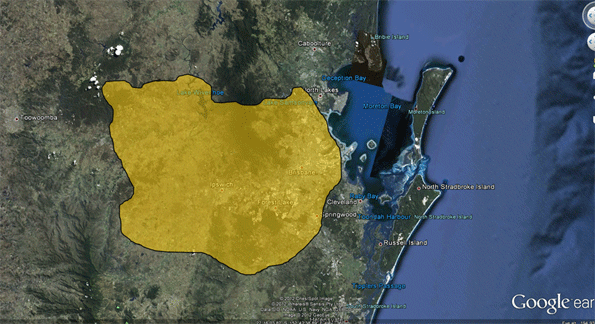
    Now, I’m not wishing that sort of urban density (and in large part, misery) on anyone in Australia, but the hypothetical comparison still applies, for the sake of discussion only. The footprint of greater urban Jakarta, home to 26 million people, easily fits within the boundary of south east Queensland.  In fact, it doesn’t even require the Gold or Sunshine Coasts to do it. Imagine this: the entire population of Australia, crammed as it would be into this super-compact urban footprint, and not a single soul living anywhere else on the entire continent?


    Above: Jakarta’s footprint and below, the same footprint – home to 26 million people – superimposed on south east Queensland.

    The argument that Australia is somehow incapable of supporting substantially larger population relies on a myth that we short of room. Nor can it rely on suggestions that we would exhaust our energy stocks (we are a net exporter and would remain so at much larger population numbers), nor our food production capacity (again, we are a net exporter and would remain so even with much higher levels of population). In fact, in terms of food production, a lack of domestic market scale poses a significant problem for producers. The efficiency gains of primary production (livestock to cropping) have outpaced the growth in population.

    There is an argument regularly raised that Australia has insufficient water supply to support much larger population numbers but this argument doesn’t hold water (sorry, couldn’t help that) either. What we do lack is water storage by way of dams, but the environmental lobby has vigorously opposed almost every proposed dam in the last 30 years whether for domestic supply, agriculture or hydro energy. The lack of water storage has been a policy decision made by successive governments for varying political reasons.   

    Think also for a moment how cities like Mexico City (population nearly 20 million people) or Cairo (population 18 million) or even countries like Morocco (population 32 million in 500,000 square kilometres on the edge of the Sahara compared with Australia’s 7.6 million square kilometres) manage for water? For Australia to claim it cannot support more people due to water limitations is a bit of joke.

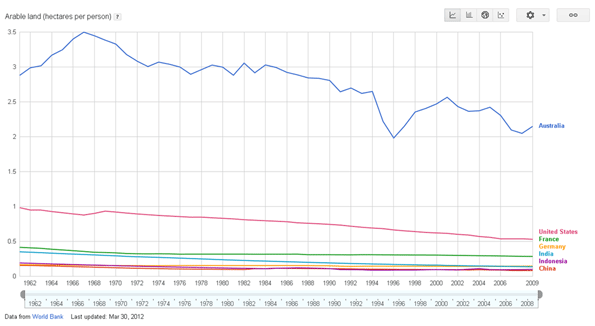
    Above: arable land area in hectares per person. Australia is well ahead of the field.

    Infrastructure deficits are the other vexed issue raised by by those concerned with population growth. They have pointed out that infrastructure investment has not kept pace with population, and they’re right. The problem though is largely that strategic infrastructure investment in this country is something really only talked about. Instead, what typically happens is that billions are doled out on pet projects in marginal seats or designed to win over particular interest groups that some focus group or other suggests could hold the key to winning the next election. Politically motivated rail projects (especially in NSW), home insulation schemes, TV set box boxes, green energy schemes… the list of our nation’s capacity to waste vast sums quickly is pretty impressive. Our deficient national road network, our inadequate domestic water storage (in many areas), our looming potential energy problems (not just in price thanks to a carbon tax but also in terms of power generation shortages according to some experts) – the bigger and more strategic infrastructure priorities which would support growth seem to get the least attention. Witness the latest Federal Government budget. (Read what Infrastructure Partnerships Australia, among others critical of the budget, had to say here).

    So the capacity to fund and deliver strategic infrastructure isn’t the issue. Inept public policy is.

    Instead, do we have some other more deep seated aversion to a bigger population? And is this race based? Despite being a successful nation of immigrants (  are we fearful for our culture if we had more immigration? Environmental impacts are often publicly cited as the reason to oppose more people, but if the examples of Los Angeles or Jakarta are remembered, we could in theory house a great deal more people without encroaching on vast areas of natural terrain.

    Another big reason to reconsider objections to a ‘big Australia’ is the ticking clock on Australia’s ageing population. Even the Federal Government’s own ‘Tax Reform Roadmap’ released with the May budget warned that:  “The proportion of working age people is projected to fall markedly over the coming decades. Today there are about 4.8 people of traditional working age for every person aged 65 and over. This is expected to fall to around 4 people within the next 10 years and to around 2.7 people by 2050.”

    Australia’s current rate of population growth is hovering around 1.4%. We are just shy of 23 million people. We say we’re concerned about getting to 35 million by 2050, by which time the world population will have increased by 2 billion people. We know that our ageing population will struggle to be supported by a diminished workforce  and that we lack sufficient critical mass to sustain a variety of industries in the face of global competition. Yet we consistently refuse to confront the question of a larger population and the consequences of failing to have one.

    Ultimately even if we agree collectively to prefer to remain a small nation of less than 30 million, it’s a discussion we need to be having. Pretending the issue isn’t there won’t do anyone any good.

    Ross Elliott has more than 20 years experience in property and public policy. His past roles have included stints in urban economics, national and state roles with the Property Council, and in destination marketing. He has written extensively on a range of public policy issues centering around urban issues, and continues to maintain his recreational interest in public policy through ongoing contributions such as this or via his monthly blog The Pulse.

    Australia graphic by Bigstockphoto.com.