Category: Demographics

  • The Myth of the Republican Party’s Inevitable Decline

    The map is shifting, and Democrats see the nation’s rapidly changing demography putting ever more states in play—Barack Obama is hoping to compete in Arizona this year, to go along with his map-changing North Carolina and Indiana wins in 2008—and eventually ensure the party’s dominance in a more diverse America, as Republicans quite literally die out.

    Ruy Teixeira and others have pointed to the growing number of voters in key groups that have tilted Democratic: Hispanics, single-member households, and well-educated millennials. Speaking privately at a closed-door Palm Beach fundraiser Sunday, Mitt Romney said that polls showing Obama with a huge lead among Hispanic voters “spell doom for us.”

    But, as the fine print says, past results do not guarantee future performance—and there are some surprising countervailing factors that could upset the conventional wisdom of Republican decline.

    Let’s start with Hispanics. Straight-line projections suggest an ever-increasing base, as the Latino population shot up (PDF) from 35 million in 2000 to more than 50 million in 2010, accounting for half of all national population growth over the decade. Exit polls showed Democrats winning the vote in each election cycle over that stretch, with Republicans never gaining more than 40 percent of the vote. And the problem is getting worse: a recent Fox News Latino poll showed Obama trouncing Romney, 70–14, among Hispanic voters—even leading among Latinos who backed John McCain in 2008.

    But longer term, Hispanic population growth is likely to slow or even recede, and Republicans are likely to do better with the group (in part because it would be hard to do much worse), as assimilation increases and immigration becomes less volatile an issue.

    Rates of Hispanic immigration, particularly from Mexico, are down and are likely to continue declining. In the 1990s, 2.76 million Mexicans obtained legal permanent-resident status. That number fell by more than a million in the 2000s, to 1.7 million, according to the Department of Homeland Security. A key reason, little acknowledged by either nativists or multiculturalists, lies in the plummeting birth rate in Mexico, which is mirrored in other Latin American countries. Mexico’s birth rate has declined from 6.8 children per woman in 1970 to about 2 children per woman in 2011.

    Plummeting birth rates suggest there will be fewer economic migrants from south of the border in coming decades. In the 1990s Mexico was adding about a million people annually to its labor force. By 2007 this number declined to about 800,000 annually, and it is projected to drop to 300,000 by 2030.

    These changes impacted immigration well before the 2008 financial crisis. The number of Mexicans legally coming to the United States plunged from more than 1 million in 2006 to just over 400,000 in 2010, in part because of the 2008 financial crisis here. Illegal immigration has also been falling. Between 2000 and 2004, an estimated 3 million undocumented immigrants entered the country; that number fell by more than two thirds over the next five years, to under 1 million between 2005 and 2009.

    Increasingly, our Latino population—almost one in five Americans between 18 and 29—will be made up of people from second- and third-generation families. Between 2000 and 2010, 7.2 million Mexican-Americans were born in the U.S., while just 4.2 million immigrated here.

    This shift could spur the faster integration of Latinos into mainstream society, leaving them less distinct from other groups of voters, like the Germans or the Irish, whose ethnicity once seemed politically determinative. A solid majority of Latinos, 54 percent, consider themselves white, according to a recent Pew study, while 40 percent do not identify with any race. Most reject the umbrella term “Latino.” Equally important, those born here tend to use English as their primary language (while just 23 percent of immigrants are fluent in English, that number shoots up to 90 percent among their children).

    To be sure, most Latinos these days vote Democratic. But they also tend to be somewhat culturally conservative. Almost all are at least nominally Christian, and roughly one in four is a member of an evangelical church. They also have been moving to the suburbs for the past decade or more—a trend that is of great concern to city-centric Democratic planners.

    A more integrated, suburban, and predominantly English-speaking Latino community could benefit a GOP (assuming it eschews stridently nativist platform). After all, it wasn’t so long ago that upward of 40 percent of Latinos voted for the likes of George W. Bush, who won a majority of Latino Protestants.

    More than race, family orientation may prove the real dividing line in American politics. Single, never-married women have emerged as one of the groups most devoted to the Democratic party, trailing only black voters, according to Gallup. Some 70 percent of single women voted Democratic in 2008, including 60 percent of white single women.

    While the gender gap has been exaggerated, a chasm is emerging between traditional families, on the one hand, and singles and nontraditional families on the other. Married women, for example, still lean Republican. But Democrats dominate in places like Manhattan, where the majority of households are single, along with Washington, D.C., San Francisco, and Seattle.

    In recent years Republican gains, according to Gallup, have taken place primarily among white families. Not surprisingly, Republicans generally do best where the traditional nuclear family is most common, such as in the largely suburban (and fairly affordable) expanses around Houston, Dallas, and Salt Lake City.

    To be sure, Democrats can take some solace, at least in the short run, from the rise in the number of singletons. Over the past 30 years the proportion of women in their 40s who have never had children has doubled, to nearly one in five. Singles now number more than 31 million, up from 27 million in 2000—a growth rate nearly twice that of the overall population. And only one in five millennials is married, half that of their parents’ generation.

    Yet as with Latino immigration, the trend toward singlehood is unlikely to continue unabated. Demographic analyst Neil Howe notes that living alone has been more pronounced among boomers (born 46–64) than millennials (born after 1980) at similar ages. Assuming marriage is delayed rather than dropped, it remains to be seen if the former singletons will maintain their liberal allegiance.

    Varying birth rates also suggest that the Democrat-dominated future may be a pipe dream. Since progressives and secularists tend to have fewer children than more religiously oriented voters, who tend to vote Republican, the future America will see a greater share of people raised from fecund groups such as Mormons and Orthodox Jews. Needless to say, there won’t be as many offspring from the hip, urban singles crowd so critical to Democratic calculations.

    And millennials are already more nuanced in their politics than is widely appreciated. They favor social progressivism, according to Pew, but not when it contradicts community values. Diversity is largely accepted and encouraged, but lacks the totemic significance assigned to it by boomer activists. They are environmentally sensitive but, contrary to new urbanist assertions, are more likely than their boomer parents to aspire to suburbia as their “ideal place” to live.

    Some economic trends favor Republicans. Households, for example, are increasingly more dependent on self-employment, and the number relying on a government job is dropping as deficits and ballooning pension obligations force cuts in government payrolls. Republicans would do well to focus on these predominately suburban, private-sector-dependent families.

    All this suggests that if they can achieve sentience, Republicans could still compete in a changing America continues changing. But first the party must move away from the hard-core nativist, authoritarian conservatism so evident in the primaries. Rather than looking backward to the 1950s, the GOP needs to reinvent itself as the party of contemporary families, including minority, mixed-race, gay, and blended ones.

    This piece originally appeared in The Daily Beast.

    Joel Kotkin is executive editor of NewGeography.com and is a distinguished presidential fellow in urban futures at Chapman University, and contributing editor to the City Journal in New York. He is author of The City: A Global History. His newest book is The Next Hundred Million: America in 2050, released in February, 2010.

    Voter sign photo by BigStockPhoto.com.
  • Millennial Generation Safe at Home

    Each emerging American generation of adolescents and young adults tends to have a distinctive relationship with its parents. For the Baby Boomers of the 1960s and 1970s, that relationship was often conflicted, even adversarial. For Generation X in the 1980s and 1990s it was frequently distant and disrespectful. By contrast, the interactions with their parents of most of today’s Millennial Generation (born 1982-2003) are close, loving, and friendly. That’s a very good thing because, to a far greater extent than for the previous two or three generations, Millennials in their twenties live with their parents, and even grandparents, in multigenerational households.  To the surprise of many members of older generations, most Millennials—and their parents—believe the experience is beneficial and even enjoyable. It may even help America in the years ahead.

    A Pew survey conducted last December indicated that nearly two-thirds (63%) of young adults 25-34 knew someone who had recently moved back in with their parents.   Almost three in ten (29%) said that they were currently living with their parents. That is nearly three times the percentage of those of that age who lived with their parents in 1980 (11%). Multigenerational households, once seen as a lagging trend, have been growing as a share of households since 1980, rising from 12 to 16 percent over the past three decades.

    More recently, the powerful and disproportionately large impact of the Great Recession on young Americans appears to have further accelerated this trend toward multigenerational households. According to Pew, in 2011, the unemployment rate for 18-24 year olds (16.3%) and 25-29 year olds (10.3%) was well above that of those 35-64 (7%).

    But the growth in multigenerational households represents more than simply the result of economic stress. It also reflects how Millennials were raised and the value both they and their parents place on family life.  According to Pew, the large majority of young adults who now live with their parents are both satisfied with this arrangement (78%) and optimistic about their future (77%). In fact, more than a third (34%) of them actually believe that living with their parents at this stage of life has been good for their relationship with their parents, about twice the number who say it has been bad (18%). From the parents’ perspective, those who say an adult child of theirs has moved back home recently are just as satisfied with their family life and housing situation as are those parents whose adult children have not returned home. In this regard, these upbeat parents resemble Cliff and Clair Huxtable, the original TV role models for the proper rearing of Millennials on “The Bill Cosby Show,” who outwardly complained, but inwardly seemed pleased, every time one of their children (and sometimes grandchildren) “boomeranged” back to the family’s home.

    Furthermore, both the adult Millennials who are living with their parents as well as their parents seem to be benefitting from this arrangement. This contradicts the notion, popular among Boomers, that living with parents after one becomes an adult represents some sort of personal failure or lack of initiative. Nearly three-fourths (72%) of the adult children say that living with their parents has had a positive impact on their own personal finances. Young adults who live with their parents also contribute to the household in a variety of ways. Nearly all (96%) say they do chores around the house. Three-quarters contribute to paying household expenses such as groceries or utility bills. More than a third (35%) pay rent to their parents. Given all this, it is not surprising that multigenerational households have become increasingly common with so little complaint from any of the generations involved.

    However, many pundits have expressed a concern about what this trend means for America in the decades ahead. For example, in a recent New York Times article Todd and Victoria Buchholz wrote disparagingly of the “go-nowhere generation” that refuses to take risks, bestir itself from the insulation of home and “go on the road” to seek a better future. Along the way, the Buchholzes praise the Greatest Generation [which] “signed up to ship out to fight Nazis in Germany or the Japanese imperial forces in the Pacific,”  almost seeming to imply that the GI’s fought the battles of Normandy and Iwo Jima  simply to demonstrate their rugged individualism by leaving the parental home.

    History tells a different story. Like Millennials, the GI Generation (born 1901-1924) was of a type labeled “civic” by those who study generational change. Like the Millennial Generation, the GI Generation was raised in a protected manner by its parents and even tended to stay with their parents well into adulthood; multi-generational households according to Pew, after all, were far more common—nearly one in four in 1940—than today. This led to complaints about the generation that later became known as the Greatest Generation which sound strikingly like what is said about Millennials today. According to William Strauss and Neil Howe, the creators of generational theory, early in World War II, Army psychiatrists even fretted about “how badly Army recruits had been over-mothered in the years before the war.”

    Perhaps as a result of this protected upbringing, the GI Generation also was a “stay-at-home” cohort when its members were young adults. A Pew analysis of US Census data from 1940 indicates that when this generation were all 25-34 year olds about 28% of them lived in multigenerational households, a number almost identical to that of Millennials today. As a result, members of the GI Generation married and had children later than previous or subsequent generations, just as Millennials are doing today. However, once the pressures of depression and war were behind them, the GI Generation more than caught up. It parented the Baby Boom Generation, the largest in American history before Millennials came along. Aided by favorable governmental policies such as the GI Bill and the Federal Housing Administration, it grew the American economy to unprecedented heights, and expanded the American middle class, homeownership, and enjoyed en masse the chance to escape crowded cities for more bucolic suburbs.   

    There is every reason to expect achievements from America’s newest civic generation, just as we have seen from previous cohorts of this kind. As was the case with their GI Generation great-grandparents before them, almost all negative social indicators—youthful crime, substance abuse, and out of wedlock teen pregnancy—have fallen to some of the lowest levels in modern history. Meanwhile, positive indicators, such as school test scores and educational achievement, have risen to the highest levels in decades. No less than other generations, Millennials value being good parents, home ownership, having a successful marriage, and helping others in need.  Perhaps the alarmists are wrong. Maybe being “safe at home” especially during times of adversity, is a good thing for young adults, their parents, and the nation.

    Morley Winograd and Michael D. Hais are co-authors of the newly published Millennial Momentum: How a New Generation is Remaking America and Millennial Makeover: MySpace, YouTube, and the Future of American Politics and are fellows of NDN and the New Policy Institute.

    Mother and son photo by Bigstockphoto.com.

  • The Urban US: Growth and Decline

    The urban population of the United States is now 249 million, according to the 2010 Census, 81 percent of the total. This is impressive, and not all surprising for a large developed economy. Yet the urban population — meaning cities, suburbs and exurbs — is not everything. And in many ways for everything from food, resources and recreation, the urban areas still depend on the nearly sixty million who live in rural America

    It is fascinating to review how American demography has changed over the last decade. So I will briefly look at some obvious points, such as the largest, most important, places, those that grew the most absolutely and relatively, and those that, on the contrary, declined.

    Our Giant Metropolises 

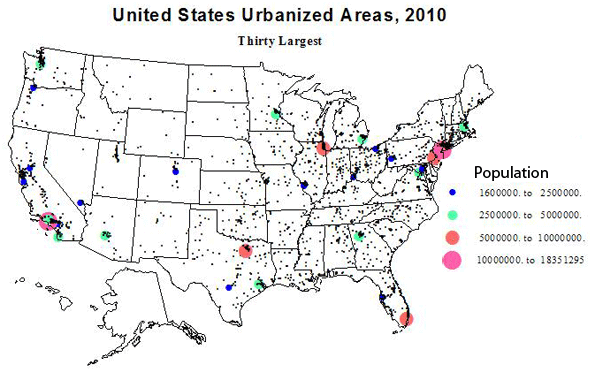
    The Census is very generous, probably way too generous, in their defining the outer limits of our urbanized areas (agglomerations with over 50,000 people). They tend to respect the independence of historically separate places, which from a satellite view would appear to be part of a united larger agglomeration. For example, New York, as defined, is huge enough but dense settlement goes far beyond its census limits. (I’ll take a look at conurbations, like Megalopolis, in a separate discussion). The 30 giants are shown in Table 1. The top three, New York, Los Angeles and Chicago have kept their positions for decades, but  story of more recent times has been the upsurge of Southern giants of Houston, Dallas, Miami, Atlanta, and of course, Washington, DC. Detroit is still in the top 15, but its position has fallen to 11th, while other historic places like Cleveland, St. Louis and Pittsburgh have dropped into the second set of 15.

    Table 1: Largest US Urbanized Areas
    Urbanized Area Name  2010 Population 2000 Population Change % Change
    1 New York–Newark, NY–NJ–CT 18,351,295 17,799,861 551,434 3.10
    2 Los Angeles–Long Beach–Anaheim, CA 12,150,996 11,789,487 361,509 3.07
    3 Chicago, IL–IN 8,608,208 8,307,904 300,304 3.61
    4 Miami, FL 5,502,379 4,919,036 583,343 11.86
    5 Philadelphia, PA–NJ–DE–MD 5,441,567 5,149,079 292,488 5.68
    6 Dallas–Fort Worth–Arlington, TX 5,121,892 4,145,659 976,233 23.55
    7 Houston, TX 4,944,332 3,822,509 1,121,823 29.35
    8 Washington, DC–VA–MD 4,586,770 3,933,920 652,850 16.60
    9 Atlanta, GA 4,515,419 3,499,840 1,015,579 29.02
    10 Boston, MA–NH–RI 4,181,019 4,032,484 148,535 3.68
    11 Detroit, MI 3,734,090 3,903,377 -169,287 -4.34
    12 Phoenix–Mesa, AZ 3,629,114 2,907,049 722,065 24.84
    13 San Francisco–Oakland, CA 3,281,212 3,228,605 52,607 1.63
    14 Seattle, WA 3,059,393 2,712,205 347,188 12.80
    15 San Diego, CA 2,956,746 2,674,436 282,310 10.56
    90,064,432 82,825,451
    16 Minneapolis–St. Paul, MN–WI 2,650,890 2,388,593 262,297 10.98
    17 Tampa–St. Petersburg, FL 2,441,770 2,062,339 379,431 18.40
    18 Denver–Aurora, CO 2,374,203 1,984,889 389,314 19.61
    19 Baltimore, MD 2,203,663 2,076,354 127,309 6.13
    20 St. Louis, MO–IL 2,150,706 2,077,662 73,044 3.52
    21 San Juan, PR 2,148,346 2,216,616 -68,270 -3.08
    22 Riverside–San Bernardino, CA 1,932,666 1,506,816 425,850 28.26
    23 Las Vegas–Henderson, NV 1,886,011 1,314,357 571,654 43.49
    24 Portland, OR–WA 1,849,898 1,583,138 266,760 16.85
    25 Cleveland, OH 1,780,673 1,786,647 -5,974 -0.33
    26 San Antonio, TX 1,758,210 1,327,554 430,656 32.44
    27 Pittsburgh, PA 1,733,853 1,753,136 -19,283 -1.10
    28 Sacramento, CA 1,723,634 1,393,498 330,136 23.69
    29 San Jose, CA 1,664,496 1,538,312 126,184 8.20
    30 Cincinnati, OH–KY–IN 1,624,827 1,503,262 121,565 8.09
    29,923,846 26,513,173

    Cities with the Largest Gains  

    Urbanized areas which gained the most population over the last decade are listed in Table 2. These numbers are truly large; these are clear leaders in “population power”. I’ll first draw our attention to the five cities which are in the top 35 in both absolute growth and in percent growth. These include Temecula-Murrieta, CA (most folks will never have even heard of it: think inland sunshine of Riverside county); Charlotte and Raleigh, NC; Cape Coral, FL (again, huh?); and Austin, TX (you were thinking Dallas or Houston? See below).

    Temecula-Murietta : 25th absolute growth, 6th % growth               
    Charlotte : 9th and 19th
    Raleigh : 18th and 21st               
    Cape Coral : 30th and 27th  
    Austin : 10th and 34th

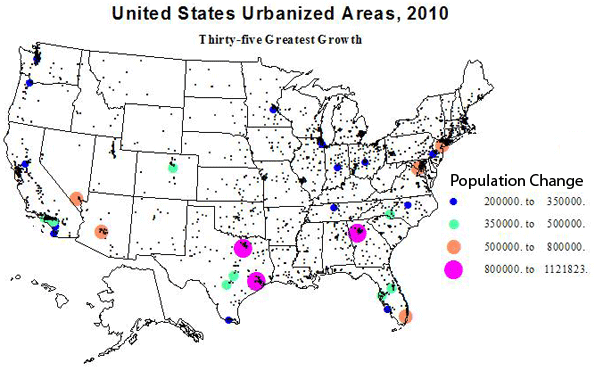
    North Carolina wins the race for the fastest growing areas.  But in sheer growth in people, the winners are (Table 2) Houston, Atlanta, Dallas, Phoenix, Washington, Miami, Las Vegas (despite the recession), New York, Charlotte and Austin. Giant New York is the only non-sunbelt place in the elite, and it had a quite slow rate of growth (3%). The next places outside the southern tier are Denver (13th) and Seattle (18th).  The total absolute growth in these top 15 cities was a phenomenal 7.24 million, a rate of growth of 8.7 %. For the top 30 urbanized areas, the growth was 10.3 million, with a percent growth of 9.7 – the same as the rate of growth of the nation. This includes slow growing but still very big places like Los Angeles (growth displaced to its satellites), Philadelphia, Chicago, Indianapolis, Portland and Minneapolis.

    Table 2: Largest Absolute Change in US Urbanized Areas
    Urbanized Area Name  2010 Population 2000 Population Change % Change
    1 Houston, TX 4,944,332 3,822,509 1,121,823 29.35
    2 Atlanta, GA 4,515,419 3,499,840 1,015,579 29.02
    3 Dallas–Fort Worth–Arlington, TX 5,121,892 4,145,659 976,233 23.55
    4 Phoenix–Mesa, AZ 3,629,114 2,907,049 722,065 24.84
    5 Washington, DC–VA–MD 4,586,770 3,933,920 652,850 16.60
    6 Miami, FL 5,502,379 4,919,036 583,343 11.86
    7 Las Vegas–Henderson, NV 1,886,011 1,314,357 571,654 43.49
    8 New York–Newark, NY–NJ–CT 18,351,295 17,799,861 551,434 3.10
    9 Charlotte, NC–SC 1,249,442 758,927 490,515 64.63
    10 Austin, TX 1,362,416 901,920 460,496 51.06
    11 San Antonio, TX 1,758,210 1,327,554 430,656 32.44
    12 Riverside–San Bernardino, CA 1,932,666 1,506,816 425,850 28.26
    13 Denver–Aurora, CO 2,374,203 1,984,889 389,314 19.61
    14 Tampa–St. Petersburg, FL 2,441,770 2,062,339 379,431 18.40
    15 Los Angeles–Long Beach–Anaheim, CA 12,150,996 11,789,487 361,509 3.07
    16 Orlando, FL 1,510,516 1,157,431 353,085 30.51
    17 Seattle, WA 3,059,393 2,712,205 347,188 12.80
    18 Raleigh, NC 884,891 541,527 343,364 63.41
    19 Sacramento, CA 1,723,634 1,393,498 330,136 23.69
    20 Chicago, IL–IN 8,608,208 8,307,904 300,304 3.61
    21 Philadelphia, PA–NJ–DE–MD 5,441,567 5,149,079 292,488 5.68
    22 San Diego, CA 2,956,746 2,674,436 282,310 10.56
    23 Indianapolis, IN 1,487,483 1,218,919 268,564 22.03
    24 Portland, OR–WA 1,849,898 1,583,138 266,760 16.85
    25 Minneapolis–St. Paul, MN–WI 2,650,890 2,388,593 262,297 10.98
    26 Columbus, OH 1,368,035 1,133,193 234,842 20.72
    27 Nashville-Davidson, TN 969,587 749,935 219,652 29.29
    28 Murrieta–Temecula–Menifee, CA 441,546 229,810 211,736 92.14
    29 McAllen, TX 728,825 523,144 205,681 39.32
    30 Cape Coral, FL 530,290 329,757 200,533 60.81

    Rate of Population Growth

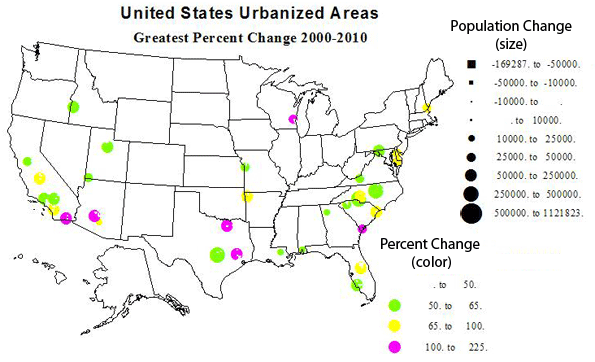
    Thirty six cities had a growth rate of more than 50 percent between 2000 and 2010, a decade not that fabulous in economic growth!  Only three of these are independent metropolises of over a half-million: Charlotte and Raleigh, NC, and Austin, TX. With growth numbers and rates of 491000 (65%), 343000 (63%), and 460000 (51%)—clearly places on the move up. The others fall more or less into these categories: (please see table 3 for a list of all 35).

    Satellite places to larger urban areas: 21 places
    Smaller regional capitals or centers: 10 place

    The superstars in rate of growth were McKinney, TX (Dallas satellite), 212% growth; Avondale, AZ (Phoenix suburb), 190%; The Woodlands, TX (Houston satellite), 168%; Lady Lake, FL (Orlando satellite), 123%; West Bend, WI (Milwaukee satellite, 106%); El Centro , CA (Imperial Valley center), 103%; and  Hilton Head, SC (retirement, etc.), 101%.

    Table 3: Greatest Percent Gains
    Urbanized Area Name  2010 Population 2000 Population Change % Change
    1 McKinney, TX 170,030 54,525 115,505 211.84
    2 Avondale, AZ 197,041 67,875 129,166 190.30
    3 The Woodlands, TX 239,938 89,445 150,493 168.25
    4 Lady Lake, FL 112,991 50,721 62,270 122.77
    5 West Bend, WI 68,444 33,288 35,156 105.61
    6 El Centro, CA 107,672 52,954 54,718 103.33
    7 Hilton Head Island, SC 68,998 34,400 34,598 100.58
    8 Temecula–Murrieta, CA 441,546 229,810 211,736 92.14
    9 Concord, NC 214,881 115,057 99,824 86.76
    10 Visalia, CA 219,454 120,044 99,410 82.81
    11 Los Lunas, NM 63,758 36,101 27,657 76.61
    12 Myrtle Beach, SC 215,304 122,984 92,320 75.07
    13 Portsmouth, NH–ME 88,200 50,912 37,288 73.24
    14 Casa Grande, AZ 51,331 29,815 21,516 72.17
    15 Fayetteville–Springdale, AR 295,083 172,585 122,498 70.98
    16 Dover, DE 110,769 65,044 45,725 70.30
    17 Kissimmee, FL 314,071 186,667 127,404 68.25
    18 Salisbury, MD–DE 98,081 59,426 38,655 65.05
    19 Charlotte, NC–SC 1,249,442 758,927 490,515 64.63
    20 Victorville–Hesperia–Apple Valley, CA 328,454 200,436 128,018 63.87
    21 Raleigh, NC 884,891 541,527 343,364 63.41
    22 Manteca, CA 83,578 51,176 32,402 63.31
    23 Cape Coral, FL 530,290 329,757 200,533 60.81
    24 Provo–Orem, UT 482,819 303,680 179,139 58.99
    25 Nampa, ID 151,499 95,909 55,590 57.96
    26 St. George, UT 98,370 62,630 35,740 57.07
    27 Cartersville, GA 52,477 33,685 18,792 55.79
    28 Hammond, LA 67,629 43,458 24,171 55.62
    29 Mauldin–Simpsonville, SC 120,577 77,831 42,746 54.92
    30 Blacksburg, VA 88,542 57,236 31,306 54.70
    31 Lee’s Summit, MO 85,081 55,285 29,796 53.90
    32 Hagerstown, MD–WV–PA 182,696 120,326 62,370 51.83
    33 Santa Clarita, CA 258,653 170,481 88,172 51.72
    34 Austin, TX 1,362,416 901,920 460,496 51.06
    35 Daphne–Fairhope, AL 57,383 38,110 19,273 50.57

    Losers

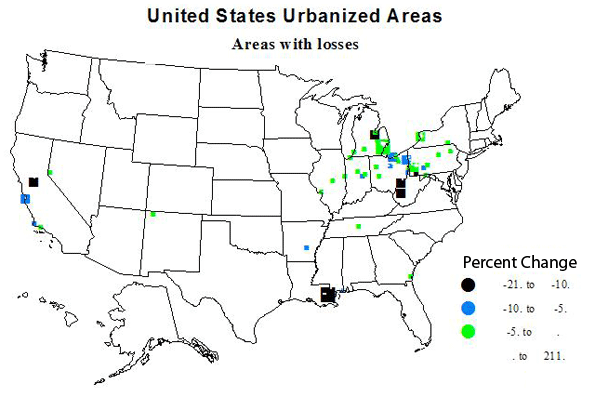
    Urban growth is the expected norm, but not all areas of the country prospered 2000-2010. What kinds of place lost population and why? See Table 4 for a list of larger absolute and percent losses. Despite the comeback of the automobile industry, Detroit experienced the greatest loss, arguably because much of the industry has moved to the non-union and lower wage South. New Orleans had the second biggest loss, with almost an 11 percent loss, recovering only gradually from hurricane Katrina. Partly race or perhaps more a legacy of poverty and inept governance?  Other large numerical losses were in rust belt industrial and mining cities, such as Buffalo, Youngstown and Pittsburgh and Charleston, WV.  At least one was quite different: Seaside-Monterey CA, with losses due to reduced military operations as well as a generally weak California economy.

    High rates of losses were mostly in the same places, but included several smaller industrial towns in Ohio, Indiana and Pennsylvania.

    Table 4: Greatest Percent Losses  and Greatest Absolute Losses
    Relative posses
    Urbanized Area Name  2010 Population 2000 Population Change % Change
    1 Mansfield, OH 75,250 79,698 -4,448 -5.58
    2 Lorain–Elyria, OH 180,956 193,586 -12,630 -6.52
    3 Pascagoula, MS 50,428 54,190 -3,762 -6.94
    4 Youngstown, OH–PA 387,550 417,437 -29,887 -7.16
    5 Wheeling, WV–OH 81,249 87,613 -6,364 -7.26
    6 Lompoc, CA 51,509 55,667 -4,158 -7.47
    7 Mayagüez, PR 109,572 119,350 -9,778 -8.19
    8 Hightstown, NJ 64,037 69,977 -5,940 -8.49
    9 Pine Bluff, AR 53,495 58,584 -5,089 -8.69
    10 Seaside–Monterey–Marina, CA 114,237 125,503 -11,266 -8.98
    11 Anderson, IN 88,133 97,038 -8,905 -9.18
    12 Johnstown, PA 69,014 76,113 -7,099 -9.33
    13 Saginaw, MI 126,265 140,985 -14,720 -10.44
    14 New Orleans, LA 899,703 1,009,283 -109,580 -10.86
    15 Uniontown–Connellsville, PA 51,370 58,442 -7,072 -12.10
    16 Yauco, PR 90,899 108,024 -17,125 -15.85
    17 Charleston, WV 153,199 182,991 -29,792 -16.28
    18 Lodi, CA 68,738 83,735 -14,997 -17.91
    19 Parkersburg, WV–OH 67,229 85,605 -18,376 -21.47
    20 Ponce, PR 149,539 195,037 -45,498 -23.33
    Absolute Losses
    Urbanized Area Name  2010 Population 2000 Population Change % Change
    1 Seaside–Monterey–Marina, CA 114,237 125,503 -11,266 -8.98
    2 Lorain–Elyria, OH 180,956 193,586 -12,630 -6.52
    3 Saginaw, MI 126,265 140,985 -14,720 -10.44
    4 Lodi, CA 68,738 83,735 -14,997 -17.91
    5 Yauco, PR 90,899 108,024 -17,125 -15.85
    6 Parkersburg, WV–OH 67,229 85,605 -18,376 -21.47
    7 Pittsburgh, PA 1,733,853 1,753,136 -19,283 -1.10
    8 Charleston, WV 153,199 182,991 -29,792 -16.28
    9 Youngstown, OH–PA 387,550 417,437 -29,887 -7.16
    10 Buffalo, NY 935,906 976,703 -40,797 -4.18
    11 Ponce, PR 149,539 195,037 -45,498 -23.33
    12 San Juan, PR 2,148,346 2,216,616 -68,270 -3.08
    13 New Orleans, LA 899,703 1,009,283 -109,580 -10.86
    14 Detroit, MI 3,734,090 3,903,377 -169,287 -4.34

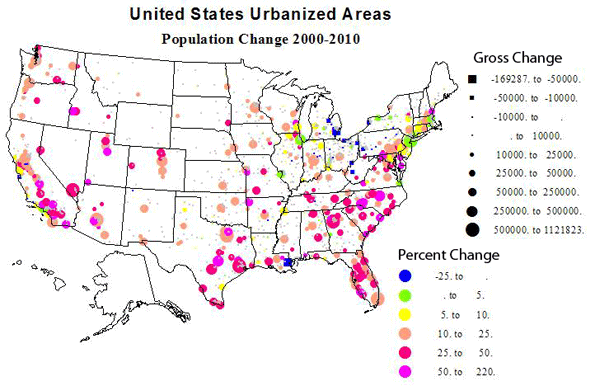
    These statistics are also summarized in 5 maps – one showing the size and rate of growth of all urbanized areas, followed by maps of the largest 30 places, the 35 places with the highest absolute and highest relative growth, then a map of the largest absolute and percent losses.

    Density, Size and Location

    People are often surprised by the fact that the highest urban densities are not in the historic eastern cities but in newer western cities. Los Angeles, often called the epitome of sprawl, is in fact the densest urbanized area in the US, for the third straight census! Table 5 lists the densest urbanized areas and the densities of the largest areas.

    Table 5: Highest and lowest urban densisties
    Highest urbanzed area densities
    Place State Population (Thousands) Density
    Los Angeles CA 12,151 6,999
    San Francisco CA 3,281 6,266
    San Jose CA 1,664 5,820
    Delano CA 54 5,483
    New York NY 18,351 5,319
    Davis CA 73 5,157
    Lompoc CA 52 4,816
    Honolulu HI 802 4,716
    Woodland CA 56 4,551
    L:as Vegas NV 1,886 4,525
    Densities of largest places (not on above list)
    Chicago IL 8,608 3,524
    Miami FL 5,502 4,442
    Philladelphia PA 5,442 2,746
    Dallas TX 5,122 2,879
    Houston TX 4,944 2,979
    Washington DC DC 4,586 3,470
    Atlanta GA 4,515 1,707
    Boston MA 4,182 2,232
    Detroit MI 3,734 2,793
    Phoenix AZ 3,629 3,165
    Seattle WA 3,059 3,028
    Lowest density places
    Hickory NC 212 811
    Hammond LA 68 883
    Barnstable MA 247 890
    Gadsden AL 64 892
    Homosassa Spgs FL 81 895
    Anniston AL 80 920
    Los Lunas NM 64 921
    Spartanburg SC 181 952
    Hilton Head SC 69 1,020
    Anderson SC 76 1,022

    The remarkable story is that of the 10 densest areas, 9 are in the west, and 7 in the Golden State. Four of these are fairly small, another surprise. The only eastern city in the top 10 is New York, which is fairly sharply limited by the census. Los Angeles, San Francisco and San Jose are the three most densely settled areas. The main underlying reason is not just planning regulations, although these probably play a role, but the issue of providing water to developable land. Both are restricted. This is one reason why growth in the southwest tends to be relatively dense. These drier areas lack the local water supplies that enable the kind of low density sprawl typical of the historic eastern cities like, yes, Boston with a density of only 2231, less than one-third that of Los Angeles!!  Other large urban areas with lower densities include Chicago, Philadelphia, Detroit, Houston, Dallas and Atlanta, a mere 1707!

    The winners for low density are an interesting mix of satellite places, such as Hammond, Barnstable, Los Lunas, and independent places like Hickory, Gadsden and Anniston, AL, and Spartanburg and Anderson, SC, many in hilly Appalachian environments, with settlement limited to valley floors. This is why the density could be below 1000 per square mile, the usual demarcation point of urban densities. Several are rather resort-like, e.g., Barnstable, Hilton Head and Homosassa Springs.

    Even if our urban definition is a little generous, 80 percent of the population or 250 million persons is an impressive total. Most of us cannot escape the city, where most jobs and opportunities are. We need to live in cities and perhaps most of us love the city. So the settlement issue in our lives becomes what city to live in and where to live within that place.

    Richard Morrill is Professor Emeritus of Geography and Environmental Studies, University of Washington. His research interests include: political geography (voting behavior, redistricting, local governance), population/demography/settlement/migration, urban geography and planning, urban transportation (i.e., old fashioned generalist).

    Next: Megalopolis and its rivals.

    Los Angeles skyline photo by Bigstockphoto.com.

  • Still Moving to the Suburbs and Exurbs: The 2011 Census Estimates

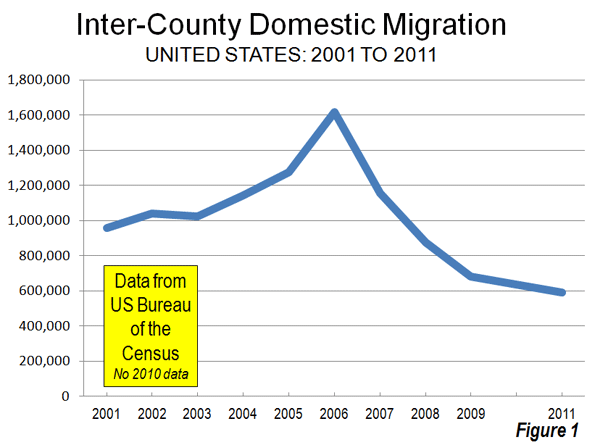
    The new 2011 Census Bureau county and metropolitan area population estimates indicate that Americans are staying put. Over the past year, 590,000 people moved between the nation’s counties. This domestic migration (people moving within the nation) compares to an annual rate of 1,080,000 between the 2000 and 2009. Inter-county domestic migration peaked in 2006 at nearly 1,620,000 and has been falling since that time (Figure 1). The continuing low rate of domestic migration has been reinforced by the economic malaise that has kept job and income growth well below levels that would be expected in a more genuine recovery.

    Yet the nation has continued to grow. With less domestic migration, natural growth (births minus deaths) and considerable, but slower international migration, growth over the past year has been more in proportion to total population. The movement between counties within major metropolitan areas has become less of a factor. Predictably, there the usual doom and gloom reports  about suburbs and exurbs and how poorly they are doing compared to before, and how people are returning to the cities (Note 1). As usual, the data shows no such thing, as people continue to move from core counties in greater numbers than others move in (See Note 2 on county classifications).

    Domestic Migration: Despite the higher gasoline prices and the illusions of a press that is often anti-suburban, both the suburbs and the exurbs continued to attract people from elsewhere in the nation. The core counties, which contain the core cities, continued to lose domestic migrants to other parts of the country, principally to the suburbs and the exurbs of the large metropolitan areas.

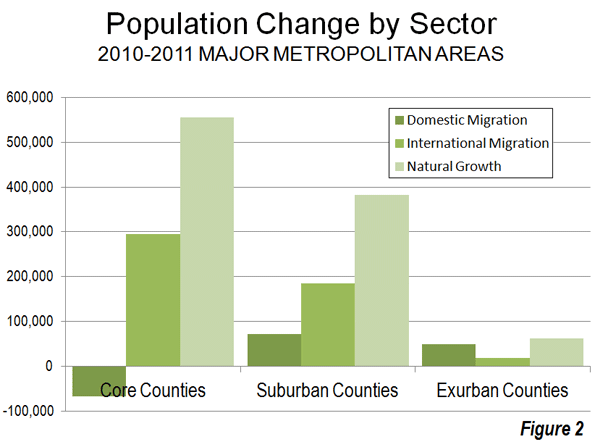
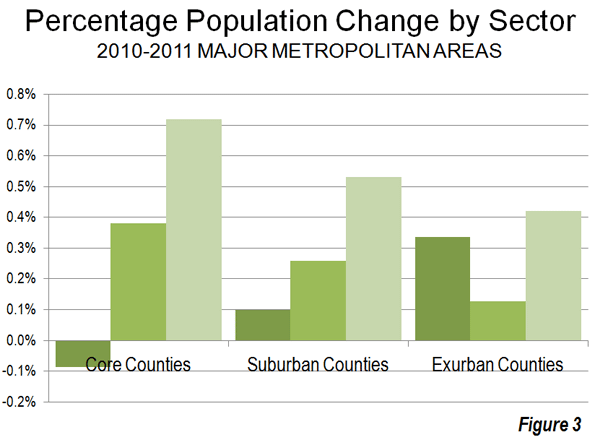
    Over the past year, the core counties of major metropolitan areas lost 67,000 domestic migrants (people move between a metropolitan area and somewhere else in the nation). Suburban counties gained approximately 72,000 domestic migrants, while exurban counties gained 49,000 domestic migrants (Figure 2). Because of their lower population base, exurban counties had the highest relative rate of net domestic migration, at 0.34% of their 2010 population. This is more than three times the rate of the suburban counties (0.11%) and far higher than the minus 0.09% of the core counties (Figure 3). Thus, the overall slower rate of growth among exurban counties was due to a lower natural growth rate and less international migration, not the result of any losses to the core. The same is true, to a lesser extent, of the suburban counties.


    Overall, the major metropolitan areas gained 48,500 domestic migrants between 2010 and 2011. By contrast, between 2000 and 2009, the major metropolitan areas lost, on average, nearly 200,000 domestic migrants to the rest of the nation each year. The huge domestic out migration in the last decade has been associated with the housing bubble. Less affordable housing markets lost 3.2 million domestic migrants between 2000 and 2009. More affordable markets gained 1.7 million domestic migrants. This was not enough to negate the losses in the higher cost markets, and major metropolitan markets lost 1.5 million domestic migrants overall.

    Natural Growth: As the grim economic times induced people to stay put, core counties grew marginally faster than suburban and exurban counties principally because of higher natural growth rates, which is the net of births minus deaths. More than 70% of the higher population in core counties was from natural growth. Natural growth was less of a factor in the suburban counties, at 60%. In the exurban counties, natural growth accounted for only 47% of the population growth (Table 1). The higher core county natural growth rates are especially evident where there are large foreign born populations, due to their generally higher birth rates (such as Los Angeles, Dallas-Fort Worth, Houston, Austin and Riverside-San Bernardino, as well as Raleigh and Salt Lake City).

    International Migration: The other component of growth was international migration, which contributed 38% of the growth in core counties and 29% of the growth in suburban counties. International migration was much less important in the exurban counties, contributing only 15% of the growth (Table 1)

    Table 1
    Major Metropolitan Areas
    Components of Population Change: 2010-2011: Summary by Sector
     Net Domestic Migration   Net International Migration   Natural Increase (Births Minus Deaths) 
    Core Counties -8.5% 37.6% 70.8%
    Suburban Counties 11.2% 29.0% 59.8%
    Exurban Counties 37.9% 14.5% 47.4%
    Multi-County Major Metropolitan Areas 3.5% 32.1% 64.3%
    Single County Major Metropolitan Areas -10.9% 34.5% 76.7%
    Major Metropolitan Areas with More Than 1 County 3.0% 32.2% 64.7%
    Single County Major Metropolitan Areas: San Diego and Las Vegas


    The Gainers: The fastest growing major metropolitan areas were dominated by the four largest Texas metropolitan areas. Austin (3.2%), Dallas-Fort Worth (2.0%), Houston (1.9%) and San Antonio (1.9%) were all among the five fastest growing. Raleigh placed second, with a one-year growth rate of 2.3%. The top five numeric gainers in domestic migration were in all in Texas or Florida — Dallas-Fort Worth (39,000), Miami (36,000), Austin (31,000), Tampa-St. Petersburg (27,000) and Houston (21,000). The much improved housing affordability in Florida seems likely to be a factor in the recovery of Miami and Tampa-St. Petersburg. Further, Houston became the second Texas metropolitan area to exceed Philadelphia in population, following Dallas-Fort Worth in the last decade. Texas thus becomes the first state to place two metropolitan areas in the five largest in the nation (Table 2).

    Table 2
    Major Metropolitan Areas: Population
    Population: 2010-2011
    Metropolitan Area 2010 2011 Change % Change
    New York, NY-NJ-PA        18,919,649        19,015,900                  96,251 0.51%
    Los Angeles, CA        12,844,371        12,944,801                100,430 0.78%
    Chicago, IL-IN-WI          9,472,584          9,504,753                  32,169 0.34%
    Dallas-Fort Worth, TX          6,400,511          6,526,548                126,037 1.97%
    Houston. TX          5,976,470          6,086,538                110,068 1.84%
    Philadelphia, PA-NJ-DE-MD          5,971,589          5,992,414                  20,825 0.35%
    Washington, DC-VA-MD-WV          5,609,150          5,703,948                  94,798 1.69%
    Miami, FL          5,578,080          5,670,125                  92,045 1.65%
    Atlanta, GA          5,286,296          5,359,205                  72,909 1.38%
    Boston, MA-NH          4,559,372          4,591,112                  31,740 0.70%
    San Francisco-Oakland, CA          4,343,381          4,391,037                  47,656 1.10%
    Riverside-San Bernardino, CA          4,245,005          4,304,997                  59,992 1.41%
    Detroit. MI          4,290,722          4,285,832                   (4,890) -0.11%
    Phoenix, AZ          4,209,070          4,263,236                  54,166 1.29%
    Seattle, WA          3,447,886          3,500,026                  52,140 1.51%
    Minneapolis-St. Paul, MN-WI          3,285,913          3,318,486                  32,573 0.99%
    San Diego, CA          3,105,115          3,140,069                  34,954 1.13%
    Tampa-St. Petersburg, FL          2,788,151          2,824,724                  36,573 1.31%
    St. Louis, MO-IL          2,814,722          2,817,355                     2,633 0.09%
    Baltimore, MD          2,714,546          2,729,110                  14,564 0.54%
    Denver, CO          2,554,569          2,599,504                  44,935 1.76%
    Pittsburgh, PA          2,357,951          2,359,746                     1,795 0.08%
    Portland, OR-WA          2,232,896          2,262,605                  29,709 1.33%
    San Antonio, TX          2,153,891          2,194,927                  41,036 1.91%
    Sacramento, CA          2,154,583          2,176,235                  21,652 1.00%
    Orlando, FL          2,139,615          2,171,360                  31,745 1.48%
    Cincinnati, OH-KY-IN          2,132,415          2,138,038                     5,623 0.26%
    Cleveland, OH          2,075,540          2,068,283                   (7,257) -0.35%
    Kansas City,  MO-KS          2,039,766          2,052,676                  12,910 0.63%
    Las Vegas, NV          1,953,927          1,969,975                  16,048 0.82%
    San Jose, CA          1,841,787          1,865,450                  23,663 1.28%
    Columbus, OH          1,840,584          1,858,464                  17,880 0.97%
    Charlotte, NC-SC          1,763,969          1,795,472                  31,503 1.79%
    Austin, TX          1,728,247          1,783,519                  55,272 3.20%
    Indianapolis, IN          1,760,826          1,778,568                  17,742 1.01%
    Virginia Beach (Norfolk), VA-NC          1,674,502          1,679,894                     5,392 0.32%
    Nashville, TN          1,594,885          1,617,142                  22,257 1.40%
    Providence, RI-MA          1,601,065          1,600,224                      (841) -0.05%
    Milwaukee, WI          1,556,953          1,562,216                     5,263 0.34%
    Jacksonville, FL          1,348,702          1,360,251                  11,549 0.86%
    Memphis, TN-MS-AR          1,318,089          1,325,605                     7,516 0.57%
    Louisville, KY-IN          1,285,891          1,294,849                     8,958 0.70%
    Oklahoma City, OK          1,258,111          1,278,053                  19,942 1.59%
    Richmond, VA          1,260,396          1,269,380                     8,984 0.71%
    Hartford, CT          1,212,491          1,213,255                        764 0.06%
    New Orleans, LA          1,173,572          1,191,089                  17,517 1.49%
    Raleigh, NC          1,137,297          1,163,515                  26,218 2.31%
    Salt Lake City, UT          1,128,269          1,145,905                  17,636 1.56%
    Buffalo, NY          1,135,293          1,134,039                   (1,254) -0.11%
    Birmingham, AL          1,129,068          1,132,264                     3,196 0.28%
    Rochester, NY          1,054,723          1,055,278                        555 0.05%
    Total      167,462,456      169,067,997             1,605,541 0.96%
    Data derived from US Bureau of the Census
    Major Metropolitan Areas: Over 1,000,000 Population


    The Losers: Four metropolitan areas, Detroit, Cleveland, Providence and Buffalo suffered small population losses. Pittsburgh had a small gain, but was alone in having an excess of deaths over births. New York again led the nation in its net domestic migration loss, at 99,000. Chicago lost 54,000 and Los Angeles lost 51,000 residents to other areas of the country between 2010 and 2011, while Detroit lost 24,000. Domestic migration data is available for New York City because it is composed of five counties. New York City lost 57,000 domestic migrants (Table 3).

    Table 3
    Major Metropolitan Areas
    Components of Population Change: 2010-2011
     Net Domestic Migration   Net International Migration   Natural Increase (Births Minus Deaths)  Total Components of Change (Note)
    New York, NY-NJ-PA              (98,975)                83,322                112,336               96,683
    Los Angeles, CA              (50,549)                54,725                  96,150             100,326
    Chicago, IL-IN-WI              (53,908)                24,422                  61,483               31,997
    Dallas-Fort Worth, TX                39,021                23,291                  63,504             125,816
    Houston. TX                21,580                24,105                  64,363             110,048
    Philadelphia, PA-NJ-DE-MD              (13,133)                11,413                  22,769               21,049
    Washington, DC-VA-MD-WV                21,517                24,872                  48,235               94,624
    Miami, FL                36,191                35,215                  20,440               91,846
    Atlanta, GA                12,419                17,370                  42,908               72,697
    Boston, MA-NH                 (1,627)                15,494                  18,143               32,010
    San Francisco-Oakland, CA                  5,880                17,996                  23,939               47,815
    Riverside-San Bernardino, CA                15,131                  9,065                  35,826               60,022
    Detroit. MI              (24,170)                  7,468                  11,734                (4,968)
    Phoenix, AZ                  5,585                15,866                  32,847               54,298
    Seattle, WA                17,598                12,228                  22,280               52,106
    Minneapolis-St. Paul, MN-WI                      536                  7,832                  24,296               32,664
    San Diego, CA                      816                  9,591                  24,703               35,110
    Tampa-St. Petersburg, FL                27,157                  6,857                     2,318               36,332
    St. Louis, MO-IL              (10,260)                  2,671                  10,256                 2,667
    Baltimore, MD                 (1,341)                  5,004                  10,941               14,604
    Denver, CO                19,565                  5,204                  19,997               44,766
    Pittsburgh, PA                  3,740                  1,426                   (3,260)                 1,906
    Portland, OR-WA                11,388                  4,806                  13,511               29,705
    San Antonio, TX                19,515                  3,841                  17,486               40,842
    Sacramento, CA                  2,856                  6,173                  12,659               21,688
    Orlando, FL                10,394                  9,767                  11,557               31,718
    Cincinnati, OH-KY-IN                 (7,149)                  2,152                  10,624                 5,627
    Cleveland, OH              (12,521)                  1,896                     3,344                (7,281)
    Kansas City,  MO-KS                 (2,820)                  3,009                  12,705               12,894
    Las Vegas, NV                 (6,353)                  8,007                  14,395               16,049
    San Jose, CA                 (2,704)                11,072                  15,376               23,744
    Columbus, OH                  2,219                  3,329                  12,390               17,938
    Charlotte, NC-SC                13,778                  4,581                  13,038               31,397
    Austin, TX                30,669                  6,134                  18,085               54,888
    Indianapolis, IN                  1,940                  2,953                  12,827               17,720
    Virginia Beach (Norfolk), VA-NC                 (7,086)                  2,382                  10,044                 5,340
    Nashville, TN                  9,323                  3,015                     9,867               22,205
    Providence, RI-MA                 (6,254)                  2,487                     2,940                   (827)
    Milwaukee, WI                 (4,862)                  1,796                     8,384                 5,318
    Jacksonville, FL                  2,911                  1,935                     6,691               11,537
    Memphis, TN-MS-AR                 (2,933)                  1,841                     8,615                 7,523
    Louisville, KY-IN                  1,886                  1,711                     5,400                 8,997
    Oklahoma City, OK                  8,746                  2,228                     8,904               19,878
    Richmond, VA                  1,546                  1,965                     5,519                 9,030
    Hartford, CT                 (4,749)                  3,066                     2,493                     810
    New Orleans, LA                10,153                  1,563                     5,630               17,346
    Raleigh, NC                13,262                  3,228                     9,608               26,098
    Salt Lake City, UT                      915                  3,090                  13,674               17,679
    Buffalo, NY                 (2,558)                  1,185                        176                (1,197)
    Birmingham, AL                 (2,452)                  1,245                     4,421                 3,214
    Rochester, NY                 (3,320)                  1,235                     2,650                     565
    Total                48,513              517,129             1,039,221         1,604,863
    3.0% 32.2% 64.8% 100.0%
    Data derived from US Bureau of the Census
    Major Metropolitan Areas: Over 1,000,000 Population
    Excludes San Diego and Las Vegas, which have only a single county


    Captive v. Discretionary Markets? One year’s data does not make a trend, especially in unusual times. Until the nation returns to normal economic growth, many young who would otherwise move are staying put, as well as young families that would be looking for larger houses. The driving factor in the more modest domestic migration trends observed today could well be necessity rather than desire.

    Wendell Cox is a Visiting Professor, Conservatoire National des Arts et Metiers, Paris and the author of “War on the Dream: How Anti-Sprawl Policy Threatens the Quality of Life

    —-

    Note 1: It is a misconception that suburbs and exurbs have grown principally because people have moved from cities. In fact, most suburban and exurban growth has been from smaller towns and rural areas. See Cities and Suburbs: The Unexpected Truth. Components of change data (domestic migration, international migration and natural growth) is available only at the county level. Thus, city or municipality data is only available where a municipality and a county are combined.

    Note 2: The core county contains all or most of the largest historical core municipality (see Suburbanized Core Cities) in the metropolitan area, except in New York, where all five counties that comprise the city of New York are classified as core counties. The suburban counties are those designated by the Bureau of the Census as central counties, but exclude the core counties. The exurban counties are as classified by the Bureau of the Census.

    Note 3: The largest historical core municipalities comprise slightly more than 55 percent of the core county population (both figures combined).

    Photo: Chicago (West Wacker Drive) By Author

  • ‘Protestant Ethic’ 2.0: The New Ways Religion Is Driving Economic Outperformance

    In this season when most Americans are more concerned than usual with spiritual matters, it may be time to ask whether religion still matters. Certainly religiosity’s worst side has been amply on display in recent years, from the fanaticism of Islamic terrorists to the annoying sanctimoniousness of Rick Santorum.

    On the surface, religion appears to be losing some of its historic influence. For the first time in a decade, according to a survey by the Pew Research Center, more Americans — excepting the Santorum base — want their politicians to talk less about faith as opposed to more.

    Organized religion in particular may be losing its appeal, particularly among the young. According to recent surveys, religious affiliation in the United States appears to be declining somewhat and secularism is on the rise; over the past 40 years the percentage professing no religious affiliation has grown over 140 percent while the percentage of the deeply faithful dropped 15%. The share of the population who claim “no religion” has risen to 15% overall and 22% of those between 18 and 29, notes a 2009 study by researchers at Trinity College. If these trends continue, the non-affiliated could represent a larger part of our population than the largest denomination, the Catholic Church.

    In large parts of the high-income world, notably Europe and parts of East Asia, the decline of religion is even more pronounced. Half of all Europeans, for example, have never attended a religious service, compared to just 20% of Americans. Roughly 60% of Americans, notes the Pew survey, consider religion important, twice the rate of Koreans, Japanese, Britons or even Canadians.

    Given that some of these countries have performed about as well or better than the U.S. in recent years, one might conclude that the historic link between religious faith and material progress — so central to the work of Max Weber – has been irretrievably broken. Yet in reality, the religious connection with economic growth may be still far more important than is commonly supposed.

    Many in the pundit class identify religion as something of a regressive tendency, embraced by the less enlightened, the less skilled, intelligent and educated. Yet some scholars, such as Charles Murray, point out that religious affiliation is weakening most not among the middle and upper classes but among the poorer and less educated who traditionally looked to churches for succor and moral instruction. Secularism may have not hurt the uber-rich or the academic overclass so far, but it appears to have helped expand our lumpenproleteriat.

    Some might be surprised to learn that religious affiliation grows with education levels. A new University of Nebraska study finds that with each additional year of education, the odds of attending religious services increased by 15%. The educated, the study found, may not be eschewing religion, as social science has long maintained, even if their spiritual views tend to be less narrow, and less overtly tied to politics, than among the less schooled.

    Overall the most cohesive religious groups — such as Mormons and Jews — still outperform their religious counterparts both in educational achievement and income. Both Jews and Mormons focus on helping their co-religionists, providing a leg up on those who depend solely on the charity of others or the state. In countries with a substantial historical Protestant influence such as Germany, Denmark, Sweden and the Netherlands continue to outperform economic the heavily Catholic nations like Italy, Ireland and Spain, according to a recent European study. The difference, they speculate, may be in Protestant traditions of self-help, frugality and emphasis on education. None of this, of course, would have been surprising to Max Weber.

    Religious people also tend to live longer and suffer less disabilities with old age, as author Murray notes. Researchers at Harvard, looking at dozens of countries over the past 40 years, demonstrated that religion reinforces the patterns of personal virtue, social trust and willingness to defer gratification long associated with business success.

    But perhaps the most important difference over time may be the impact of religion on family formation, with weighty fiscal implications. In virtually every part of the world, religious people tend to have more children than those who are unaffiliated. In Europe, this often means Islamic families as opposed to increasingly post-Christian natives. Decline in religious affiliation — not just Christian but also Buddhist and Confucian — seems to correlate with the perilously low birthrates in both Europe and many East Asian countries.

    Singapore-based pastor Andrew Ong sees a direct connection between low birthrates and weakened religious ties in advanced Asian countries. As religious ideas about the primacy of family fade, including those rooted in Confucianism, they are generally supplanted by more materialist, individualistic values. “People don’t value family like they used to,” he suggests. “The values are not there. The old values suggested that you grow up. The media today encourages people not to grow up and take responsibility. They don’t want to stop being cool. When you have kids, you usually are less cool.”

    Religious people, prepared to be seen as uncool, are more likely to seek to produce more offspring. In the United States 47% of people who attend church regularly see the ideal family size as three or more children compared to barely one quarter of the less observant. Mormons have many more children than non-Mormons; observant Jews more than secular. “Faith,” the demographer Phil Longman concludes, “is increasingly necessary as a motive to have children.”

    This pattern is reflected in the geography of childbearing. Where churches are closing down, most particularly in core urban areas such as Boston or Manhattan, as well as their metropolitan regions, singletons and childless couples are increasing. In more religiously oriented metropolitan areas like Houston, Dallas-Fort Worth, Salt Lake City and Phoenix, the propensity to have children is 15% to nearly 30% higher (as measured by the number of children under the age of 5 per woman of child bearing age– 15-49).

    In the future, many high-income societies, whether in East Asia, Europe or North America, may find that religious people’s fecundity is a necessary counterforce to rapid aging and eventual depopulation of the more secular population . The increasingly perilous shape of public finance in almost all advanced countries — largely the result of rapid aging and diminished workforces — can be ascribed at least in part to secularization’s role in falling birthrates.

    There may be other positive fiscal effects of religiosity. Religious people donate on average far more to charities than their secular counterparts, including those unaffiliated with a religion. Nearly 15% of the religious volunteer every week compared to just 10% among the secular.

    Social networks, much celebrated among the single, might provide people with voices, but religious organizations actually do something about meeting real human needs. Organized religion provides a counterweight to the European notion that we must rely on government for everything. Poor people educated or fed by the charities of mosques, churches, and synagogues relieves some of the burden faced by our variously tottering states and shredding social welfare nets. Aging baby boomers, notes author Ted Fishman, may be forced to rely more on the “kindness of strangers” from religious backgrounds to take care of them in their old age.

    Sadly few prominent religious leaders deliver this message effectively, often preferring to scold non-believers. This is unfortunate since what the faithful do in the real world, at home and in their communities, may prove ever more crucial to the viability of our societies in the future.

    This piece originally appeared in Forbes.com.

    Joel Kotkin is executive editor of NewGeography.com and is a distinguished presidential fellow in urban futures at Chapman University, and contributing editor to the City Journal in New York. He is author of The City: A Global History. His newest book is The Next Hundred Million: America in 2050, released in February, 2010.

    Church near Wall Street photo by Flickr user Roger Schultz.

  • Buffalo, You Are Not Alone

    It hurts. When a bigtime Harvard economist writes off your city as a loss, and says America should turn its back on you, it hurts. But Ed Glaeser’s dart tossing is but the smallest taste of what it’s like to live in place like Buffalo. To choose to live in the Rust Belt is to commit to enduring a continuous stream of bad press and mockery.

    I write mostly about the Midwest, but whether we think Midwest or Rust Belt or something else altogether, the story is the same. From Detroit to Cleveland, Buffalo to Birmingham, there are cities across this country that are struggling for a host of historic and contemporary reasons. We’ve moved from the industrial to the global age, and many cities truly have lost their original economic raison d’etre. Reviving them requires the hard work of rebuilding and repositioning them for a new era, a daunting task to be sure.

    But beyond their legitimate challenges, these cities also face the double burden that they are unloved by much of America, and all too often by their own residents. They are forlorn and largely forgotten, except as cautionary tales or as the butt of jokes.

    These cities aren’t sexy. They aren’t hip. They don’t have the cachet of a Portland or Seattle. The creative class isn’t flocking. They are behind in the new economy, in the green economy. Look at any survey of the “best” cities and find the usual suspects of New York, Austin, San Francisco. Look at yet another Forbes “ten worst” list and see Cleveland and Toledo kicked again when they are down. They are portrayed as hopeless basket cases with no hope and no future.

    But I reject that notion. I do not believe in the idea that these cities are beyond repair and unworthy of attention—or affection.

    Someone asked me once why I bother. Why does it matter that these cities come back? Why not just let nature take its course? Why not let Buffalo die, and its people scatter to the winds?

    It’s because it doesn’t just matter to a few proud people in Buffalo, it matters to America. The idea of disposable cities is one that is incompatible with a prosperous and sustainable future for our country. Fleeing Rust Belt cities for neo-Southern boomtowns is nothing more than sprawl writ large. Rather than just abandoning our cores, we’ll now abandon entire regions in the quest for new greenfields to despoil. We can’t have a truly prosperous and sustainable America with only a dozen or so superstar cities that renew themselves from age to age while others bloom like a flower for a season, then wither away. An America littered with an ever increasing number of carcasses of once great cities is not one most of us want to contemplate.

    But beyond that, it’s because I believe we can make it happen. Look closely and the change is already in the air. Globalization taketh away—but it also giveth. Cities like Buffalo or St. Louis now have access to things that even people in Chicago didn’t not that long ago. Amazon, iTunes, and a host of specialty online retailers put the best of the world within reach. Where once you couldn’t get a good cup of coffee, there are now micro-roasters aplenty. Where once your choices were Bud, Miller, or Coors, an array of specialty brews are on tap, often brewed locally. Restaurants are better, with food grown locally and responsibly. Slowly but surely the ship is turning on sustainability, with nascent bike cultures in almost every city, LEED certified buildings, recycling programs, and more. House by house, rehab by rehab, neighborhoods in these cities are starting to come to life.

    Where once moving to one of these cities would have been likened to getting exiled to Siberia, it’s now shocking how little you actually give up. And for every high-end boutique or black tie gala you miss, you get something back in low-cost and easy living. The talent pool may be shallower, but it’s a lot more connected.

    Let’s not get ahead of ourselves. There’s still a long and hard journey ahead. And not every place is going to make it, particularly among cities without the minimum scale. We have to face that reality. But more of them will revive than people think.

    That’s because a new generation of urbanists believes in these cities again. These people aren’t bitter, burdened by the memories of yesteryear and all the goodness that was lost. The city to them isn’t the place with the downtown department store their mother used to take them to in white gloves for tea. It isn’t the place full of good manufacturing jobs with lifetime middle class employment for those without college degrees. The city isn’t a faded nostalgia or a longing for an imagined past. Most of them are young and never knew that world.

    No, this new generation of urbanists sees these cities with fresh eyes. They see the decay, yes, but also the opportunity—and the possibilities for the present and future. To them this is Rust Belt Chic. It’s the place artists can dream of owning a house. Where they can live in a place with a bit of an authentic edge and real character. Where people can indulge their passion for renovating old architecture without a seven-figure budget. Where they have a chance to make a difference—to be a producer, not just a consumer of urban life, and a new urban future. Above all, these people, natives or newcomers, have a deep and abiding passion and love for the place they’ve chosen—yes, chosen—to live.

    Still, it can get lonely, and often depressing. It so often seems like one step forward, two steps back. Making change happen can seem like pushing a rock uphill, like you are up there on some far frontier of the country alone, fighting a quixotic battle. Every historic building demolished, every quality infill project sabotaged by NIMBY’s, every massively subsidized business-as-usual boondoggle, every DOT-scarred transport project is a discouragement.

    But Buffalo, you are not alone. It’s not just you, it’s cities and people across across this country, from St. Louis to Pittsburgh to Milwaukee to Cincinnati to New Orleans to Birmingham, fighting to build a better future. There’s a new movement in all these cities, made up of passionate urbanists committed to a different and better path. Sometimes they are few in number, but they are mighty in spirit— and they are making a difference. Together, they and you can win the battle and make the change happen.

    It won’t be easy. The road will be long. Some, like the great cathedral builders of Europe, may never see completely the fruit of their labors. But the long-ago pioneers who founded these great cities never got to see them in their first glory either. We’ve come full circle. We are present again at the re-founding of our cities. This is the task, the duty, the calling that a new generation has chosen as its own, to write the history of their city anew.

    Go make history again, Buffalo.

    This article originally appeared in Buffalo Rising on June 14, 2010.

    Aaron M. Renn is an independent writer on urban affairs based in the Midwest. His writings appear at The Urbanophile.

    Taste of Buffalo photo by Bigstockphoto.com.

  • How A Baby Bust Will Turn Asia’s Tigers Toothless

    For the last two decades, America’s pundit class has been looking for models to correct our numerous national deficiencies. Some of the more deluded have settled on Europe, which, given its persistent low economic growth over the past 20 years and minuscule birth rates, amounts to something like looking for love in all the wrong places.

    More rational and understandable have been those who have looked for role models instead in East Asia. After all, East Asia has been the world’s ascendant power for the better part of past 30 years. It is home to both China and Japan, the world’s second and third largest economies, as well as the dynamic “tiger” economies of Korea, Taiwan, Hong Kong and Singapore.

    Thomas Friedman, long enamored by authoritarian leviathan China, recently praised the tiger countries as exemplars of forward thinking. He traces their strong emphasis on “highly effective teachers, involved parents and committed students” as keys to turning their resource-poor countries into first world successes.

    Yet for all their laudably good school test scores, these tigers could turn somewhat toothless in the future. Already Japan, which fashioned the first great Asian model, is beset by a series of massive challenges including a lack of technological competitiveness and disastrously declining demographics. They also face competition from places like China and India, behemoths which may not equal the Tigers’ spectacular per-capita education numbers, but which can marshal overwhelming numbers of ambitious, educated and skilled people.

    Many in the tiger nations recognize this competitive plight far more than their western cheerleaders. Some even wonder if they may even have been too rational and credential-obsessed for their own good. Like Japan after the Second World War, they invested heavily in educating their young people to excel on tests and work long hours . But this also fostered high levels of stress and hyper-competition that discourages both family formation and child bearing .

    Singapore (where I serve as Senior Visiting Fellow at the Civil Service College) is arguably the best planned and most cleverly conceived of all the Tigers. Singaporeans live well — their per-capita incomes surpass those of Americans — but this edge is largely blunted by extremely high costs. As in all the Tiger countries, consumer goods like cars are extraordinarily expensive (a modest Korean model can run upwards of $75,000 or more in Singapore) and housing costs far higher than experienced by most Americans. In Hong Kong, notes researcher Wendell Cox, an average apartment, usually quite small, costs roughly twice as much as one  in New York or San Francisco, two most elite metro U.S. markets, relative to income.

    These conditions, observes Vatsala Pant, a former Nielsen executive and long-time Singapore resident, create what amounts to an accounting-like mentality about their lives. “Singaporeans seem to be born with a calculator in their heads,” she notes. “Every decision seems to weighed in a cost and benefit analysis, including such things as family. If it’s not perfect, they don’t want it.”

    This turn from family represents a sharp break in these countries. All the “tiger” economies flourished based on a Confucian culture that places kinship at the top of the value pyramid. Parents are still widely revered, but Li Lin Chang, an associate director of the Lee Kuan Yew School of Public Policy, suggests that Singapore’s “Confucian roots may not be as evident and some may argue that it may have disappeared.”

    Certainly increasing number of Singaporeans and others from Tiger countries are opting out of marriage. In 2000, 14% of women between age 30-39 chose to remain childless, according to demographer Gavin Jones of the National University of Singapore. By 2009, this figure has gone up to 20%. Jones estimates in some east Asian societies up to a third of all women will remain childless.

    Japan, the original model for all these countries, is now leading the way off the demographic cliff. In Japan, notes researcher Mika Toyota, 20% of 50-year-old males have never married, up from 12 percent just a decade ago. By 2030, she estimates nearly 30% of 50-year-old males will have never wedded. And unlike the U.S. and Europe, very few people have children out of wedlock in East Asia, so no marriage means no children.

    This plunge in marriage and family formation is not entirely voluntary. Few of the 40 or more Singaporean younger adults I have interviewed in recent months celebrated singleness like some of their Western counterparts. Most still wanted children and linked their reluctance to wed or to have babies on the high cost of living, intense competition in their workplace and even increasingly crowded mass transit.

    “Most of my friends are not married,” one 35-year-old female civil servant told me. “They don’t want to be single but they are too busy with their work commitment. My friends are consumed by work. Money, status, prestige, climbing the ladder. You expect things to change when you get older but it doesn’t. The calculation just doesn’t work out”

    For many of these people, not having offspring makes sense in terms of concentrating on career goals and reducing financial pressure. But it could prove a social disaster in the long run. All Tiger nations now suffer fertility rates roughly half the 2.1 children per household needed to replace the current population. By 2030 these countries could have fewer people under 15 than over 60.

    Not surprisingly, many Tiger country policymakers place a priority on producing more cubs. Most offer highly generous packages of support offered to those willing to take the nativity plunge. Some who have children cope with entrenched male reluctance to share in child-raising by relying on low-cost maids, often from the Philippines and other poorer countries. A recent move by the Singapore government to require giving maids the day off elicited howls of protests from female professionals, who, as authors Teo You Yenn and Vivienne Wee put it, regard “care of one’s own offspring as tedious, beneath oneself and rightfully the responsibility of a hired woman.”

    Some professionals who desire children consider taking their finely honed skills elsewhere. A recent survey by the MRI China Group showed that a majority of professionals surveyed in Taiwan and some forty percent in Singapore, as well as roughly one-third of those in Hong Kong, were actively looking to relocate to another city. Most covet a move to less high-pressure, lower-density Australia or New Zealand. Others, particularly from Taiwan, are attracted to greater opportunities in China.

    There may not be too much the bureaucracies can do immediately to address these problems. Clearly adding more degrees per capita or bringing in more foreign expertise, as is common in Singapore and Hong Kong, has not addressed looming baby shortage. Instead, as one one young University researcher put it, “we need a new mindset.”

    Most particularly, these countries need to change the incentives that, albeit unintentionally, create unsustainable levels of singleness, childlessness and the prospect of massive, rapid aging of their societies. They may have to consider more flexible work-styles, the promotion of home based business and better use of their limited space. Individual entrepreneurship, more rooted in each country and able to meld with family life, could be stressed as a counterbalance to employment in often fickle multinational corporations who can always move to greener, or at least cheaper, locales.

    More difficult still will be shaping attitudes that restore the primacy of family that propelled these societies in the first place. This is an existential challenge that would have seemed unimaginable 40 years ago when these countries fretted about overpopulation and widespread poverty. But success in the future can not be purchased by simply continuing what has worked so well for a generation. To avoid a toothless future, the Tigers need to unlearn some of the secrets of their past success.

    This piece originally appeared in Forbes.com.

    Joel Kotkin is executive editor of NewGeography.com and is a distinguished presidential fellow in urban futures at Chapman University, and contributing editor to the City Journal in New York. He is author of The City: A Global History. His newest book is The Next Hundred Million: America in 2050, released in February, 2010.

    Singapore skyline photo by Bigstockphoto.com.

  • The Evolving Urban Form: Osaka-Kobe-Kyoto

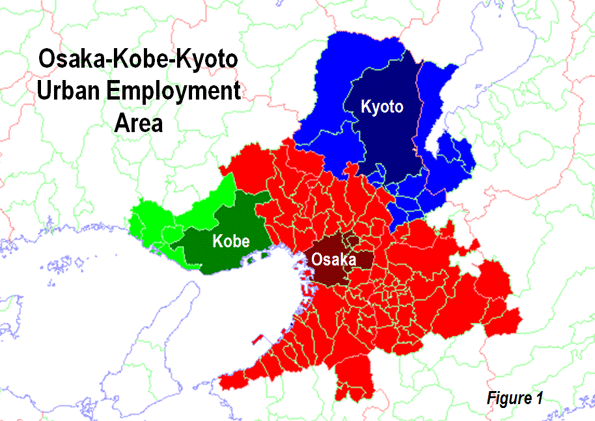
    Osaka-Kobe-Kyoto is Japan’s second largest urban area and ranks as the 12th largest urban area in the world. With a population of approximately 17,000,000 and a land area of 1240 square miles (3200 square kilometers), Osaka-Kobe-Kyoto has a population density of 13,700 per square mile (5,200 per square kilometer), making it the most dense major urban area in Japan and among the denser urban areas in the high income world. The larger metropolitan region includes four prefectures, Osaka, Kyoto, Kyoto and Nara (Figure 1).


    Adapted from WikiCommons user Kzaral

    World’s Largest Conurbation

    Osaka-Kobe-Kyoto is a conurbation, an urban area that has grown together from multiple cores (here, the urban areas of Osaka, Kobe and Kyoto). Most urban areas grow concentrically from a single core. In the process their suburban growth can engulf and incorporate smaller urban areas (such as Gifu in Nagoya, Bogor in Jakarta or Newark in New York), However, conurbations — such as  Rhine-Ruhr region in Germany (Essen, Dortmund, Duisburg, and Bochum), Katowice-Gliwice-Tychy (upper Silesia) in Poland, Dallas-Fort Worth and Minneapolis-St. Paul in the United States — develop when major urban areas grow together (or merge), forming a larger urban area.  

    The municipality of Osaka, the largest in the region, long had been Japan’s second municipality exceeded by Yokohama (in the Tokyo region) in 1980; in the 17th century it was the country’s commercial capital. Kobe, across Osaka Bay (20 miles or 32 kilometers), was one of the most cosmopolitan cities and was the site of the devastating 1995 earthquake, from which it has recovered remarkably. Kyoto is the former, historic, imperial capital as is 35 miles (55 kilometers) north of Osaka. The previous imperial capital, the historic municipality of Nara is also located in the region. Both cities are well known for its historic temples.

    Post-War Growth

    Between 1950 and 1970, the Osaka-Kobe-Kyoto region experienced extraordinary growth, adding nearly 5.7 million residents. The increase from 9.8 million to 15.5 million exceed that of all urban areas in the world except Mexico City (approximately 6 million) and Tokyo (11 million). Tokyo’s 20 year increase was the largest numerically in history for a metropolitan region. By comparison, Los Angeles, the Western world’s fastest growing metropolitan region between 1950 and 1970, added 5.0 million new residents. In 1970, only the Tokyo and New York urban areas were larger than Osaka-Kobe-Kyoto.

    The region grew quickly after the Second World War but experienced an even higher growth rate — well in excess of two percent during Japan’s great economic takeoff in the 1960s. During the 1970s, the annual growth rate dropped to 1.5%, still well above the current experience of most high income urban areas.

    Stagnating Growth, Presaging Decline

    As it turned out, the 1970s represented the conclusion of Osaka’s strong growth. From then on, growth fell quickly and   has since virtually stopped. It  appears likely that Osaka-Kobe-Kyoto will become the world’s first megacity (over 10 million population) to fall into population decline (see  end note).

    According to the 2010 census, the metropolitan region’s population of approximately 18,500,000 barely grew, adding only 13,000 residents from 2005. This represents  an annual growth rate of 0.014%, a decline of 60% from its anemic  0.036% growth rate between 2000 and 2005 (Figure 2).

    Osaka-Kobe-Kyoto’s is falling behind even Japan’s slow growth pace, being 2005 to 2010 expanding by  less than one third of the national rate. One reason for this lies in continued concentration in the Tokyo metropolitan region (Figure 3). The Tokyo area captured 56% of the growth between 1970 and at 2010. Over the past five years Tokyo has added 1.1 million people, while the balance of the nation lost 1.4 million people. Japan’s population has stabilized and is expected to fall into decline in the years to come.

    Suburban Expansion

    As is typical of major metropolitan regions in the world virtually all of the growth in Osaka-Kobe-Kyoto since 1950 has been outside the historically core municipalities. Only 150,000 of the 6,250,000 population increase from 1950 to 2010 was in the municipalities of Osaka, Kobe or Kyoto. The suburbs accounted for nearly 98% of the region’s growth.

    As growth came to a virtual stop, however, the historical core municipalities have done better. Between 2000 and 2010, the municipalities of Osaka, Kobe and Kyoto had added 125,000 people, while suburban areas lost 79,000. The net result was a 46,000 population increase between 2000 and 2010 (Table).

    Osaka-Kobe-Kyoto Metropolitan Region
    Population Trend: 1920-2010
    Historical Core Municipalities
    Year Osaka Kobe Kyoto Total Suburban Region
    1920 1,253 609 591 2,453 4,289 6,742
    1930 2,114 765 788 3,667 4,668 8,335
    1940 3,252 1,090 967 5,309 5,056 10,365
    1950 1,956 765 1,102 3,823 5,941 9,764
    1960 3,012 1,114 1,285 5,411 6,774 12,185
    1970 2,980 1,289 1,419 5,688 9,780 15,468
    1980 2,648 1,367 1,473 5,488 11,866 17,354
    1990 2,623 1,477 1,461 5,561 12,556 18,117
    2000 2,599 1,494 1,468 5,560 12,883 18,443
    2005 2,629 1,525 1,475 5,629 12,847 18,476
    2010 2,666 1,545 1,474 5,685 12,804 18,489
    In 000s
    Data from Census of Japan


    Transport in Osaka-Kobe-Kyoto

    With its high density, Osaka-Kobe-Kyoto has a high level of traffic congestion. Osaka-Kobe-Kyoto ranks 19th highest road traffic density out of more than 90 urban areas for which data is available in the Millennium Cities database. This traffic density is despite the fact that Osaka-Kobe-Kyoto has the highest mass transit market share of any high-income world megacity outside Tokyo. In 2007, 57 percent of trips in the metropolitan region were by mass transit, compared to Tokyo’s 65 percent. By comparison, mass transit’s market share is approximately 30 percent in the Paris region and 10 percent in greater New York. The annual number of transit trips in Osaka-Kobe-Kyoto alone is more than one-half the total US ridership, despite having a population only 6% of the US.

    However, lest any conclude that Osaka-Kobe-Kyoto (or Tokyo) might be a model for US or European metropolitan areas, it must be noted that transit’s market share has dropped from 80 percent in the late 1980s.   Osaka-Kobe-Kyoto (as well as Tokyo and Nagoya) also demonstrate the "mass transit cannot be profitable" claim is a myth. In each of these three metropolitan areas, the vast majority of transit travel is on profitable private suburban railways.

    Osaka-Kobe-Kyoto: The Future?

    Very few large metropolitan areas have experienced population declines, and none with the vast scale and historic importance of Osaka-Kobe-Kyoto. Smaller metropolitan areas like Pittsburgh, Cleveland, Liverpool, Manchester and Genoa have stagnated and even experienced periods of population decline. But none have faced a future bleaker  than likely for Osaka-Kobe-Kyoto. United Nations population projections indicate that Japan will decline in population by 20 percent between 2010 and 2050. As the nation’s economic activity continues to centralize in Tokyo, this could be particularly be ominous for Osaka-Kobe-Kyoto. The trains could get less crowded.

    Wendell Cox is a Visiting Professor, Conservatoire National des Arts et Metiers, Paris and the author of “War on the Dream: How Anti-Sprawl Policy Threatens the Quality of Life

    —–

    Note: New York is reputed to have become the first megacity in the world in the 1920s. As late as 1980, there were only five urban areas in the world with more than 10 million residents. In 2010 there were 25 megacities.


    Photo: Himeji Castle, Kobe Prefecture. By Jean Love

  • Addressing Workforce Shortages in the Dakotas

    While not immune to the recession, the upper Great Plains is in a different economic situation from the rest of the nation. Growth coupled with low unemployment means more strain on the region’s workforce, making it tougher for employers to find the workers they need. It’s not so much about jobs anymore, but about finding the right workers.

    Since 2008, the region covered by Prairie Business Magazine – North Dakota, South Dakota and western Minnesota – has grown its employment by 1.8 percent, compared to a loss of 2.5 percent across the country. In addition to that growth, North Dakota alone has 21,000 unfilled jobs.

    To determine some of the toughest jobs to fill in the region in the past year we used data compiled by EMSI, Inc., a model that includes a combination of over 90 state and federal sources and includes estimates of independent contractors and others. We looked at a number of metrics, including the number of openings in the region due to growth, retirements, and turnover; the number of openings compared to the total jobs in an occupation; and the regional concentration of a job here compared to the rest of the nation.

    The occupations are separated into five groups: construction, extraction, transportation and material moving; business, finance and office; heath care; science, mathematics, engineering and computer; and manufacturing occupations.

    The construction, resource extraction and transportation category is not surprisingly dominated by the ongoing energy boom in western North Dakota. Roustabouts lead the way with 917 new jobs and 979 total openings in the past year. Other oil-related jobs such as service unit operators (781 openings), derrick operators (511), rotary drill operators (479), extraction helpers (335) and wellhead pumpers (295) all have openings above 40 percent of its 2010 employment level. We read a lot about the stress on the labor force in that region, but the numbers are astounding.

    The overall leader in total job openings across the region is heavy truck drivers, with 1,973 openings from 2010-2011. The need is most acute in oil country, but the entire region has a 70 percent higher concentration of heavy truck drivers than the national average. Of the 152 counties in our analysis, 138 have a higher concentration of heavy truck drivers than the national average.

    The national media has credited the oil boom for the economic growth. The economic benefits of the energy boom have spread across the region, but there is more to the story. While the entire region trailed the nation in job growth until 2007, the region’s five largest metropolitan areas – Bismarck, Grand Forks, Fargo, Sioux Falls and Rapid City – were well ahead of the nation through the entire decade. Now containing 39 percent of the regional jobs, these five metropolitan areas beat the nation in job growth over the decade by 10 points, 15.8 to 5.8 percent.

    It’s not just growth in retail and food service jobs. Over the past decade the five metropolitan areas added 8,000 jobs in professional, technical, and scientific services, nearly 18,000 in health care, and 8,000 in finance, with each sector paying roughly $50,000 per year. The region also added 1,500 jobs at management offices and corporate headquarters making an average of $80,000 per year. It’s time that parents in our region stop telling their kids, “you need to leave the state to find a good job.” We need to improve efforts to help students and displaced workers understand the emerging options available in the region.

    The Prairie Business region has also become a growth center for science, math, engineering and computer occupations, adding nearly 18 percent to its technical workforce in the past decade, compared to just 3.6 percent growth in the rest of the nation. The growth rate in the five metropolitan areas was more than 27 percent. Some of the most in-demand jobs include industrial engineers (91 openings), mechanical engineers (87), geological engineers (52), petroleum engineers (50) and geoscientists (45). A new program for petroleum engineers at the University of North Dakota School of Engineering and Mines may help address the shortages in these fields.

    This strong growth in engineering and technical jobs is tempered somewhat because the region still lags the nation in these occupations. The biggest gaps are in bachelor’s degree level information technology and software fields, where the region trails the nation by 25 to 40 percent in many occupations. While the region’s high growth rates are encouraging, there is still plenty of ground to make up. At the same time the region is highly concentrated in many two year level technical jobs, creating a solid foundation for technical industries to build on.

    The region’s manufacturing economy was hit hardest by the recent recession, but was booming in the six years prior and is now recovering. In demand production occupations include welders (677 openings), assemblers (604), supervisors (194), machinists (156), computer-controlled machine tool operators (107), and engine assemblers (88).

    Across the region, 52 of the 152 counties hold an above average number of production jobs. Hot spots in the region include Jerauld, Yankton and Brookings counties in South Dakota; Roseau, Nobles and Kandiyohi in Minnesota; and Sargent and Richland in North Dakota.

    Workforce and economic development agencies, educators and trainers, and the business community need to continue to actively collaborate to share information and create partnerships across state lines. Private businesses must be open to working with training and placement agencies to communicate their needs, and regional governments must be open to creating more flexible funding sources for specialized training. Educational institutions are beginning to use the ample labor market data available to tailor programs to fit the need of the region’s economy.

    Ultimately, the talent narrative in the region needs to shift away from “retaining our young people” towards recruitment of young families. Demographic data confirms the greatest shortage across the region is those age 35 – 44, and employers are reporting troubles recruiting mid-career professionals. Migration data shows that the net loss from North and South Dakota to the Minneapolis region has stopped in the past two years. The Prairie Business region is showing signs of turning the economic and demographic corner. It is now time to act to sustain the region’s long-term future.

    This piece originally appeared in Prairie Business Magazine.

    Mark Schill is Vice President of Research at Praxis Strategy Group, an economic development and research firm working with communities and states to improve their economies. He is Managing Editor of NewGeography.

    Fargo photo by David Kohlmeyer.

  • The Evolving Urban Form: Ho Chi Minh City (Saigon)

    Vietnam may be the next China. With a nominally communist government, Vietnam has liberalized its markets and is prospering from an increased reliance on exports. Vietnam’s gross domestic product per capita is still only about $3000, but has been among the faster growing economies over the past 10 years. Vietnam is well positioned to capture any growth that might be diverted from China’s east coast urban areas as labor costs there rise and concerns increase about the influence of that country’s powerful state-owned corporations.

    Political power in Vietnam may lie in Hanoi, but the economic heart of Vietnam is Ho Chi Minh City, the former Saigon. Ho Chi Minh City is the core of Viet Nam’s largest urban area, which is headed toward a population of 9 million, including exurban areas beyond the municipal boundaries.

    For planning purposes, the area has been divided into five subregions. The urban development trends in the Ho Chi Minh City area are similar to those of high income world urban areas. The core is experiencing little or no population growth, while peripheral areas are growing much more strongly (Photo: Core and Saigon River).


    Core and Saigon River

    Suburbanizing Ho Chi Minh City: Historical data for the districts of Ho Chi Minh City are difficult to obtain. However, the last five years provide a representative view of urban development trends, especially when combined with population projections through 2025 as reported in transportation planning documentation from the Ho Chi Minh City master plan.

    The inner core area has a population of approximately 1.4 million, with little growth expected, and is expected to decline in population by 2025. At the same time, the inner core is particularly dense, with more than 100,000 residents per square mile or 40,000 residents per square kilometer. This is approximately 1.5 times as dense as Manhattan or the ville de Paris. By 2025, the inner core will decline further to a population of 1.3 million. One unusual distinguishing characteristic of the core is very thin buildings, the result of taxation based upon building width (Photo: Tax induced thin buildings)


    Tax induced thin buildings

    Growth is stronger, but still limited in the outer core area (adjacent to the core, but differentiated because of its lower density). Over the past five years, the outer core grew from approximately 2.2 million to 2.5 million, which is strong growth in most high income world urban areas but not as notable for a rapidly growing urban area in the developing world. This growth is expected to moderate even further by 2025, when the population is expected to reach only 2.6 million. The population density in the outer core area is 60,000 per square mile or 23,000 per square kilometer.

    In contrast, almost all  the growth is expected outside the core, with both less formal development and very attractive housing (Photo: New suburban housing).


    New suburban housing

    The urban fringe areas, or the second ring of development beyond the inner core grew from 1.5 million in 2004 to 2.0 million in 2009, a 31% growth rate. By 2025, the urban fringe is projected in transportation planning documentation to grow to 3.0 million. The population density of the urban fringe is 14,500 per square mile or 5,500 per square kilometer, nearly as dense as the city (municipality) of San Francisco.

    The suburban areas within the municipality of Ho Chi Minh City grew from 1.0 million in 2004 to 1.3 million in 2009, again approximately a 30% growth rate. By 2025, the suburban areas are expected to experience the greatest growth, adding 1.6 million population, rising to 2.9 million residents.

    Comparable data for the exurban areas outside the Ho Chi Minh City municipality are not as readily available. However, it is projected that from 2007 to 2025 the population in these areas will rise from 2.6 million to 4.1 million.

    Overall, the municipality grew from 6.1 million population in 2004 7.2 million in 2009, for an 18% growth rate. Including the municipality and the exurbs, it is expected that there will be an increase from 9.1 million population in 2007 to 13.9 million in 2025. At least 95% of this growth is expected to be outside two core areas (Figure 1).

    Employment growth is also projected to be dominated by areas outside the two core areas. Between 2007 and 2025, it is expected that 80% of the new employment will be in peripheral areas.

    Building a Metro: Ho Chi Minh City may have the highest personal transportation market share outside North America. The personal vehicle (motorcycle and car) share of travel is 92%, leaving just 8% for transit (one estimate indicates an even lower 5%). Most of this travel by motorcycle, which sometimes carry three or more people.  As Ho Chi Minh City becomes more prosperous, the share of travel by automobile will likely increase. Automobile ownership is rising at 20 percent annually, more than twice the rate for motorcycle ownership.

    The government would like to change this pattern and has embarked on building a Metro in hopes of increasing transit’s market share to between 40% and 50% by 2025. This huge capital investment will be largely limited to feed and serve the core areas that will account for virtually none of the population increase and little of the new employment.

    There is no precedent for an increase in transit usage remotely of the magnitude that is sought in Ho Chi Minh City. In fact, consultants for the Asian Development Bank were so concerned that they provided an alternative projection for the system, indicating a 2025 transit market share of 22%, instead of the official goal of 40% to 50%. The consultants indicated:

    As noted earlier, the above demand models were adjusted to reflect the Government “policy” objective of achieving 40-50% PT mode share by 2025. This will entail a massive shift in travel behaviour and introduction of some very strong transport and policy initiatives. Clearly there is a risk that this may not happen as quickly or to the extent targeted. Therefore forecasts were developed for a “trend” scenario – still based on major PT transport improvements and strong policy initiatives, but with parameter values based on the consultants’ experience of what has been achieved in other cities.

    However, virtually tripling transit’s market share to 22% seems little less doubtful than increasing it to 40% to 50%. The consultant provided no examples to indicate that such an increase had "been achieved in other cities."

    Personal Mobility in Ho Chi Minh City: One of the challenges for a pedestrians in Ho Chi Minh City – like Hanoi – is dodging the swarm of motorcycles in crossing streets. Even with the Metro, more and more will buy motorcycles and cars. Traffic congestion is likely to worsen. This is principally because, even in congested urban areas, door to door travel tends to be more rapid by personal modes than by transit.

    Fortunately, the authorities are allowing the urbanization to expand, which will limit the growth of traffic congestion. They would do well to follow the advice of urban planners like Shlomo Angel (of New York University and Princeton University), who recommends building a grid of arterials streets to accommodate the growth on lower cost peripheral lands.   Strategies such as these provide Ho Chi Minh City the potential to suburbanize gracefully, maintain its high level of personal mobility and contribute substantially to its continued economic progress.

    Wendell Cox is a Visiting Professor, Conservatoire National des Arts et Metiers, Paris and the author of “War on the Dream: How Anti-Sprawl Policy Threatens the Quality of Life

    Top photo: Typical transport in Ho Chi Minh City

    All photos by author