Category: Demographics

  • Floribec : Quebec in the Tropics

    Floribec has been part of the collective imagination of the Quebecois for nearly 50 years. Over time, a movie, a novel, advertisements and news reports played an important part in establishing the greater Miami region as the destination of choice for Quebec tourists. Floribec began as a result of tourism and it later evolved into a transnational community. After visiting southeast Florida, some Quebec tourists decided to take up permanent residence there and to make their living providing services in French to other French-speakers. Motels, restaurants, convenience stores, lawyers, and other services for winter residents appeared, creating a Floribecois community, where the lifestyle and economy were largely based on the ever-present Quebecois tourists, visiting for a week or for several months. The result was a French-speaking community outside Quebec, distinct from other French-speaking communities in North America. However, the survival of the declining community is now in jeopardy.

    The Origins of Floribec 
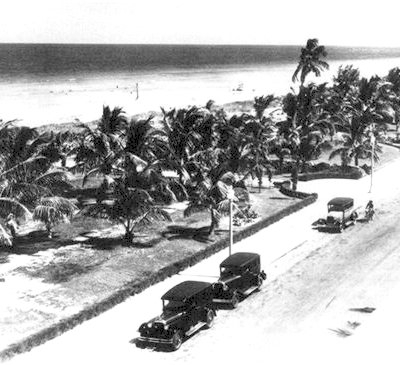
    Ocean Drive (Miami) sometime in the 1940's

    Ocean Drive (Miami) sometime in the 1940’s

    It is hard to pinpoint the origin of the word "Floribec" but it appears to have been adopted in the 1970s by Quebec residents wintering in Florida and made official in a study by Louis Dupont in the 1980s. According to him, French Canadians began immigrating to Florida in the 1930s. This immigration came in the wake of spending by the United States government, which, in an effort to resolve the 1929 economic crisis, undertook to build a network of canals through the marshland in southeast Florida and, notably, to open the Intercoastal Waterway, a navigable canal hundreds of kilometres long. At the same time, the government was also attempting to develop the infrastructure for tourism. Thousands of Americans travelled to the "Sunshine State" to work on this vast construction site. Among them were Franco-Americans from New England, some accompanied by their French-Canadian cousins. Once the construction work was completed, rather than going home, many of the French-Canadian workers took up permanent residence in the Miami region, particularly in Surfside, on the Atlantic coast, and in North Miami. After the Second World War, there were 67,000 French-Canadian and Franco-American families living in the State of Florida. These new permanent residents of Surfside and North Miami and of Sunny Isles generally found work in the tourist industry because Florida, especially Miami, was the holiday destination of a growing number of wealthy French-Canadians. This initial wave of Quebecois mass migration to Florida began at the end of the war and continued until 1960.

    Establishment of the Floribecois Community 
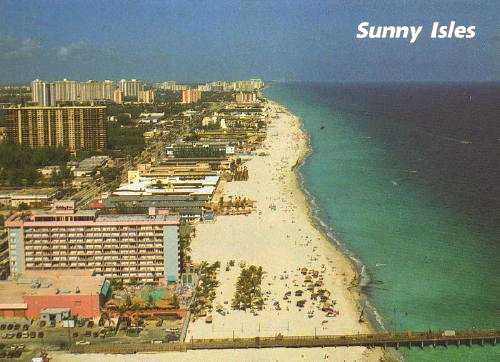
    Postcard of Sunny Isles, before the arrival of the giant hotels

    Postcard of Sunny Isles, before the arrival of the giant hotels

    The period from 1960 to 1970 saw a second wave of French-Canadian, mainly Quebecois, migration to the Miami region, with the appearance of a new type of immigrant: the investor. Two of the factors contributing to increased immigration were the liberating effect of the Quiet Revolution and the growth of wealth in Quebec. The fact that these two phenomena occurred simultaneously appears to have encouraged the people of Quebec to look beyond their borders. Expo 67 and a number of other Quebec cultural events made the rest of the world more aware of the province and, as well, the people of Quebec used this period of cultural vitality to increase their travel to foreign destinations. 

    At the same time, the tourist industry was experiencing rapid development in Florida with the arrival of the major airlines, the construction of the United States freeway system, and the north-south shift of economic and political power, which sparked phenomenal growth in the cities of the Sun Belt, including Miami. Miami Beach and its suburbs of Surfside and Sunny Isles became the favourite seaside destinations of the Quebecois. Recognizing the opportunity the situation presented, the Floribecois set up businesses in the area to cater mainly to Quebecois tourists, building French-language motels, restaurants, bars, convenience stores, and various other services to meet their needs. 

    Gemma Cossette with popular singer Michel Louvain

    Gemma Cossette with popular singer Michel Louvain

    From the 1970s onward, most businesses were established in Surfside and Sunny Isles, especially along Collins Avenue, whose location less than a kilometre from the beach offered increased customer traffic. The favourite tourist destination of the Quebecois was now affordable and there was no longer any language barrier. During this period, the Thunderbird, Suez, Waikiki and Colonial hotels were familiar to any Quebecois who travelled regularly to Florida, and even to those who were merely thinking of going there. Cultural life was vibrant because of the continued presence of such artists as Gilles Latulippe and other popular Quebec comedians and singers, who performed to sold-out audiences in the most popular hotels. The localization of these cultural activities in the gathering places of Quebecois tourists would serve to establish the physical boundaries of Floribec as a transnational tourist community.

    Floribec’s Shift Northward 
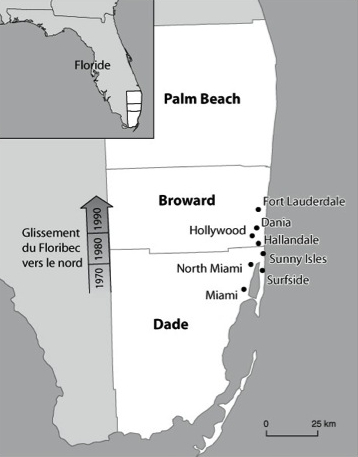
    Map showing location of concentrations of Quebec residents in Florida


    Map showing location of concentrations of
    Quebec residents in Florida

    The Floribecois communities in Surfside and Sunny Isles moved in the 1980s because, as had been the case in the Mafia era of 1920-1930, Miami once again became an international money-laundering centre for the drug trade, as well as being the scene of major racial conflicts. The city gained the status of unofficial capital of Latin America, not only because it had become a hub of the Latin-American banking system, but also because its downtown attracted hundreds of thousands of Cubans, Nicaraguans, Columbians and others. This continual influx of migrants led to a major exodus of WASP’s (White Anglo-Saxon Protestants), who moved north to the neighbouring counties of Broward and Palm Beach, leaving Dade County to the Hispanic population. Many Quebecois tourists and immigrants also left Dade County at that time.

    Floribec’s Glory Years 
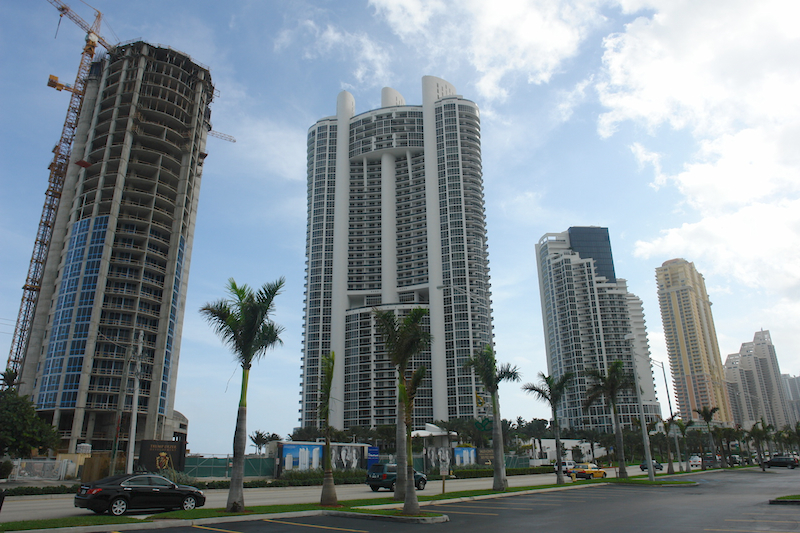
    Giant hotels replaced small motels

    Giant hotels replaced small motels

    For all intents and purposes, the Floribecois areas in Surfside and Sunny Isles disappeared in the early 1990s. The small, modest hotels, motels, and apartment buildings, where many Quebecois lived, were torn down and replaced by luxury high-rise condominiums up to 30 storeys high, some of them owned by Donald Trump. 

    The changes to that area explain why the neighbouring cities of Hallandale, Hollywood and Dania experienced such considerable growth during this period. They had not suffered from the demolition associated with urban sprawl and, for this reason, they became the southernmost destinations to which Quebecois tourists could travel affordably. The small, reasonable motels so popular with the majority of Quebecois tourists remained. It was here, in a well-defined area, that the Floribecois community really took root again and where it continued to be possible to carry on everyday life in French.

    Floribec’s Current Configuration
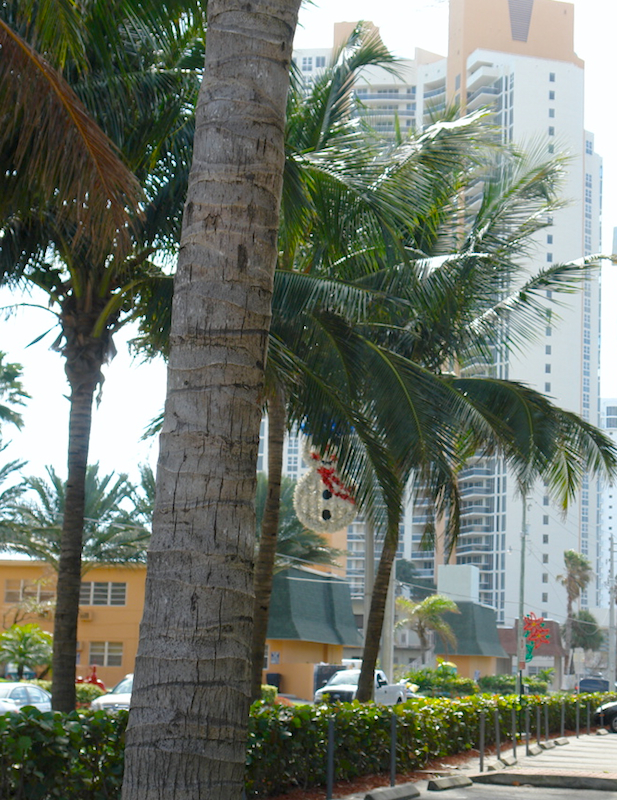
    Christmas decoration hanging discreetly from a palm tree

    Christmas decoration hanging discreetly from a palm tree

    Like numerous other seaside resorts, Floribec has a recreational business district (RBD) where the main tourist services are located. In the Floribecois RBD, there is a pedestrian walkway along the beach, the Broadwalk, and perpendicular to it, a main artery, Johnson Street. Depending on the season, restaurants, specialty food stands, candy shops and souvenir shops line these two streets in the RBD. The beach is the location of the sites most vital to Floribec life, namely the Broadwalk itself and the Johnson Street stage, as well as social institutions like the famous Frenchie’s Café.  Only a few kilometres from the RBD, other very popular Floribecois motels, including Richard’s Motel, branches of the Caisse populaire Desjardins and the National Bank of Canada, Lacroix Real Estate AgencyAu Coq restaurant, and other services are grouped together along U.S. Highway 1. Beyond the Hollywood-Dania-Hallandale corridor, the Floribecois population and its landmarks are soon swallowed up by the greater community. 

    It is important to note that Quebec is an integral part of the Floribecois community. The ongoing relationship with Quebec is sustained by the seasonal influx of thousands of tourists, often called "snowbirds", and the ready access in Florida to Quebec newspapers and radio, the main Quebec television programs, and the Internet, which also makes on-line banking possible. All of the regular and ongoing media and tourist contact between Quebec and Floribec make the latter a "transnational community" whose existence is largely dependent on the many connections it maintains with Quebec.

    Floribec in Decline? 
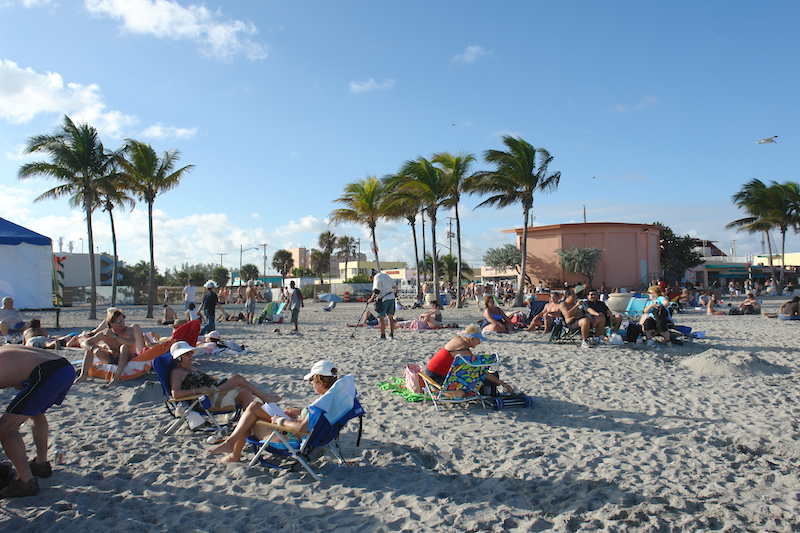
    Enjoying the beach...

    Enjoying the beach…

    Floribec has changed considerably since 2000. While Quebecois tourists continue to travel to southeast Florida, and the Quebecois culture and everyday living in French no longer dominate the scene around Johnson Street, as they did in the 1990s. People still gather on the beach but the tourists and immigrants live elsewhere, often at some distance from the ocean. Three factors may explain this erosion: 1) pressure from Miami’s continuing urban sprawl; 2) the negative image local political authorities have of the Floribecois; 3) competition from numerous tourist destinations that are as affordable as Florida, such as the Dominican Republic, Mexico and Cuba, which attract an increasing number of Quebecois.

    Miami‘s urban sprawl

    The purchase and demolition of Floribecois motels by rich local and Latin-American land developers has expanded beyond the cities of Surfside and Sunny Isles. Due to the shortage of available land, the trend has now reached Hollywood. For example, a huge luxury hotel complex was built only a few kilometres from the Broadwalk, which is also being rebuilt, and Floribecois motels located on Hollywood Beach have been demolished to build luxury condominiums. It is Hollywood’s turn to face the phenomenon of urban high-rise construction and tourist gentrification; it may be fighting a losing battle. 
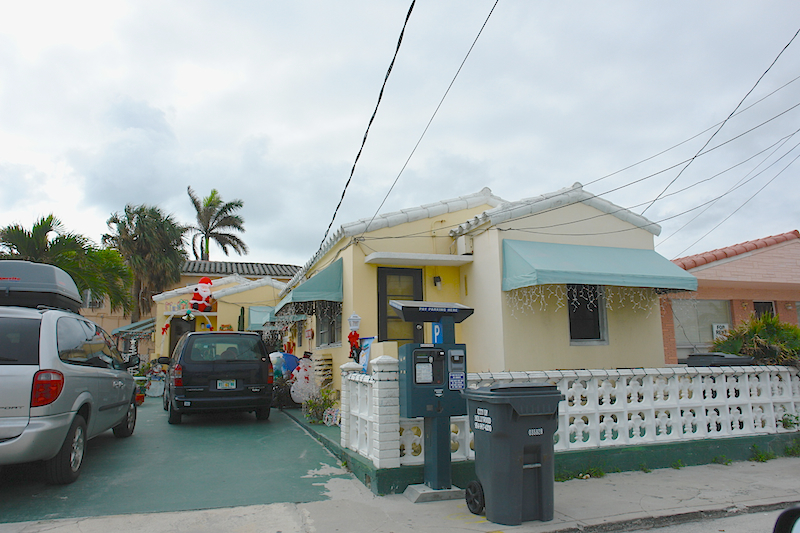
    A veritable Quebecois


    A veritable Quebecois

    Negative image of the Floribecois

    The socio-economic class to which the Floribecois belong troubles Hollywood City Hall. In strictly economic terms (daily spending, property taxes, etc.), it is not in the municipality’s interest to encourage the Floribecois to remain in the area. Nor does the caricature of the Floribecois presented in Quebec films and the local media help to reassure the city councillors. While the City of Hollywood welcomed the economic benefits associated with French-speaking residents in the 1980s, it now fears that these same people may tarnish the city’s image and it feels that Hollywood should follow the example of neighbouring municipalities who are moving to attract a higher class of tourist. The city has already taken the first step by demolishing one of Floribec’s most significant institutions, Frenchie’s Café, at the corner of the Broadwalk and Johnson Street, along with the adjacent small businesses. Since the demolition, the Floribec atmosphere, so appreciated by tourists, is much less vibrant than it was in the 1990s. Although there are still many Quebec tourists on the beach, fewer services are available to them in French, quite a different situation that in Floribec’s glory days. The only time that the Floribecois now flock to this subtropical area of the country is in January, when the annual festival, Canada Fest, brings together Floribec businesses and Quebec singers. Annual attendance at this cultural event is about 100,000 visitors. However, it is increasingly difficult to find signs of Floribec’s existence. While some insist that all is well, it would appear that Floribec’s days are numbered. At the very least, it seems that Floribec has lost its heart and soul.

    Competition in the tourist trade

    The increased number of affordable tourist destinations adds to the pressure on Floribec. Because those who love Florida enjoy temperatures of 25º C or above, the West Indies, the Caribbean and Mexico are harming the Floribecois economy. Le Soleil de la Floride, a monthly newspaper established in 1983, has reason to continually boast the merits of the Sunshine State, pointing out how familiar and safe a destination it is. However, there is no doubt that sun-seekers, especially those who do not travel south by car (single people or couples), are being lured away by the Dominican Republic, Cuba or Mexico. Direct flights from Montreal and Quebec to Cancun, Acapulco, Punta Cana, Varadero, and many other destinations are rapidly growing in number to meet demand, making vacations in these tropical and exotic areas accessible, often at a lower cost than an extended stay in Florida.

    Heritage in Danger? 
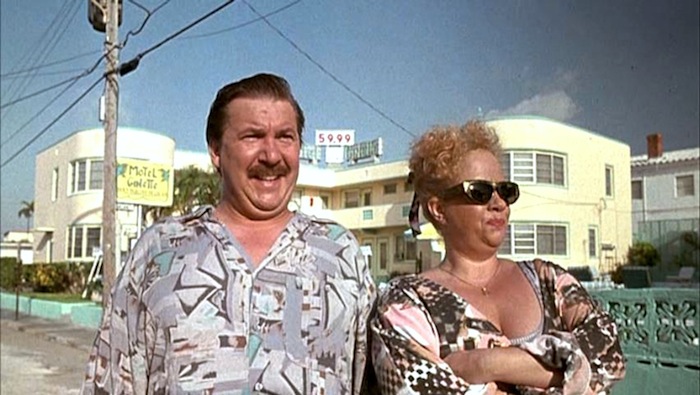
    Image from the movie «La Florida» (George Mihalka, 1993) starring Rémy Girard and Pauline Lapointe

    Image from the movie «La Florida» (George Mihalka, 1993) starring
    Rémy Girard and Pauline Lapointe

    Floribec constitutes an interesting chapter in the history of modern Quebec and it represents an intriguing and unique pocket of French-speaking America. This transnational community came into being as a result of people patronizing numerous businesses and other community-building venues situated in a relatively small geographical area on the Atlantic coast. These sites played an essential role as centres of community life for French-speakers who were living in or visiting the greater Miami area. Today, certain community practices formerly associated with Floribec can still be found; however, they are dispersed over a much wider area and signs of any Quebecois presence in the Florida landscape are increasingly difficult to discern.

    Rémy Tremblay is Canada Research Chair on Knowledge Cities, Université du Québec à Montréal

    ——–

    This piece is courtesy of the Encyclopedia of French Cultural Heritage in North America.

    ——–

    Bibliography

    CORTÈS, G. E FARET, L. (dir) (2009) Les circulations transnationales. Paris, Armand Colin, 244 p.

    DUPONT, L. (1982). Le déplacement et l’implantation de Québécois en Floride. Vie française, 36 (10-11-12), p. 23-33.

    GILBERT, A., LANGLOIS, A. et R. TREMBLAY (à paraître) Habiter Floribec. Voisinage et communauté. Revue internationale d’études canadiennes.

    LEVITT, P. (2001). The Transnational Villagers, Berkeley et Los Angeles, University of California Press.

    MORISSONNEAU, C. (1983). « Le peuple dit ingouvernable du pays sans bornes: mobilité et identité québécoise », dans Dean Louder et Éric Waddell (dir.), Du continent perdu à l’archipel retrouvé: le Québec et l’Amérique française, Sainte-Foy, Presses de l’Université Laval.

    TREMBLAY, R. (2003) « Le déclin de Floribec », Téoros, 22 (2).

    TREMBLAY, R. (2006). Floribec. Espace et communauté, Ottawa, Presses de l’Université d’Ottawa.

    TREMBLAY, R. (2008) Le Floribec éphémère, dans Dean Louder et Éric Waddell (dir.), La Franco-Amérique : traces et enracinement, Québec, Septentrion.

    TREMBLAY, R et O’REILLY, K (2004) « Les communautés touristiques transnationales. » Revue de Tourisme/Tourism Review, 59 (3).
  • The Use and Misuse of Glaeser’s Triumph of the City

    Appeals to authority are now the stock-in-trade of progressive pundits across a range of public controversies. In the face of popular discontent bubbling up from forums on the net and elsewhere, their fall-back posture is heavy-handed ‘expertism’. Policymaking is the prerogative of those with the right qualifications and credentials. Ordinary citizens should butt-out, no matter how self-interested the experts may seem. So too in the field of urban policy, encumbered as it is with a green-compact-city orthodoxy, do appeals to authority hold sway.

    Over the course of 2011 a book title kept cropping up in some of the media coverage of urban issues – Triumph of the City by Harvard economist and New York Times blogger Edward Glaeser. Arguing that successful cities should be “urban theme parks” or “playgrounds” for the benefit of “smart inhabitants” – as progressives like to conceive themselves – while the energy-wasting populace must be brought to heel, Glaeser is, for the pundits, an authority figure from central casting.   

    The Sydney Morning Herald’s urban critic, Elizabeth Farrelly, claimed the book “instantly became flavour of the month amongst the cognoscenti”. Proceeding to deliver another full-throated hymn in praise of density, she abridged Glaeser’s argument in typically hyperbolic terms. If only we lived in “dense urban centres”, miracles would abound: cheaper housing, better transport, protected wildernesses, no climate change, decent coffee and “a choice of walk-to tapas”. 

    Her colleague Ross Gittins, the paper’s economics editor, was equally impressed. “Glaeser’s observations seem of obvious relevance to Sydney”, he wrote.  “Our sky-high house and unit prices are partly the product of … excessive government restrictions on development”, wrote Gittins, before adding, without a hint of irony, “there are limits to how far Sydney can be allowed to sprawl”. He resolves this contradiction with the phrase “Sydney needs to go up”, echoing a warning of Glaeser’s which serves as the new slogan of green urbanism: “If cities can’t build up, then they will build out”.  

    This is sweet music to the green-tinged intelligentsia, for whom there is no worse crime against the planet than a bulging ‘human footprint’. Before weighing-up the merits of Glaeser’s build-up-not-out pitch, though, it should be said that many of his Australian fans either misrepresent or misunderstand his position. Farrelly’s diatribes against developers and suburbs are commonplace. She is all in favour of rigid ‘urban growth boundaries’, prescriptive urban consolidation and other features of the anti-sprawl agenda adopted by state and local governments over recent decades. So apparently is Gittins.

    Glaeser’s views are more complex. “The government should not be in the business of enforcing lifestyles that we happen to find appealing”, writes Glaeser, “[t]he government’s job is to allow people to choose the life they want …” He takes care to explain that this perspective accords with sound economic thinking:

    “[A]t the heart of economics is the belief that businesses work best by competing furiously in a market that the government oversees as impartial umpire. The same is true for cities. Competition among local governments for people and firms is healthy … The national government does no good by propping up particular places, just as it does no good by propping up particular firms or industries.”

    Identifying this principle as ‘spatial neutrality’, Glaeser is indifferent to the type of ‘growth boundaries’ so popular with Australian town planners and their green theorists, commenting at one point that “greenbelts may serve to check urban growth – which may or may not be desirable”. Indeed, it’s hard to see how any form of coercive zoning can be consistent with his position.

    Glaeser’s core argument is that the principle of neutrality has been systematically violated in the United States. “Cities [by which he means inner-cities] can compete on a level playing field”, he says, “but over the past sixty years, America’s policies have slanted the field steeply against them”. These policies include inner-city development controls, especially height restrictions, the home mortgage interest deduction, the Interstate Highway system, inferior inner-city schools administered by local school boards and inadequate gasoline (petrol) taxes. Remove such “artificial barriers” and “everybody, not just the privileged few, can enjoy the pleasures of Manhattan or Paris or Hong Kong”.

    Lurking behind Glaeser’s sedate prose, but never quite breaking out, is some kind of ultra-centripetal theory of human settlement. Human beings maximise their satisfaction by living in the centre of the world’s leading city, measured by size, wealth and amenity. It’s just that economic and legal barriers fix most of them in various grades of less desirable places. If the whole world could, in other words, they would pack up and move to Manhattan (“New York is still a paradigm of urbanity”, says Glaeser). In the years between 1880 and 1920, when millions of people from all over Europe swarmed into the crowded tenements of New York’s lower east side, such a theory might have had some plausibility. But the world changed. Since at least the middle of the twentieth century, the statistical and historical evidence points in the opposite direction. Countries like the US and Australia saw massive population shifts to the suburbs and attracted millions of immigrants hoping for their own suburban lot and house.

    However much Glaeser’s “artificial barriers” may have contributed to suburbanisation in the United States, the key issue is how important they were relative to one of the great transformations of the twentieth century: the unremitting growth of motor vehicle ownership and motorised commercial transportation. Even Glaeser concedes that “transportation technologies shape our communities, and modern sprawl is the child of the automobile”, though he insists the convenience of car ownership can be diminished.  

    The problem is that the trend towards urban dispersion started well before Glaeser’s so-called barriers came into existence. In his book  Downtown: Its Rise and Fall 1880-1950, Robert Fogelson writes that “by the mid and late 1920s, however, some Americans had come to the conclusion that the centrifugal forces were beginning to overpower the centripetal forces – or, in other words, that the dispersal of residences might well lead in time to the decentralization of business”. And the trend shows no sign of abating. Having analysed the 2010 US census, Joel Kotkin and Wendell Cox find that during the 2000s, just 8.6 per cent of the population growth in metropolitan areas with more than a million people took place in the core cities, the rest took place in the suburbs. “America continues to suburbanize”, they say. This is despite the financial crash, which would have blunted some of Glaeser’s pro-suburban incentives. Could it be that most people just prefer space over density?

    As for Australia, Glaeser’s core argument simply doesn’t hold. Most of his “artificial barriers” have no direct equivalents here. Our advanced motorways are intra-urban rather than interstate networks, and attract significant toll charges, our schools are subject to state rather than local board control and home mortgage interest is not tax deductible. No reasonable person would claim that our governments have “slanted the field” in favour of suburbs over recent decades. The very notion of spatial neutrality has been anathema. Urban consolidation is all the rage, suppressing land releases while driving up values to the point that Australian houses are consistently ranked ‘severely unaffordable’ in the annual Demographia survey, due in no small measure to a crushing mix of developer and infrastructure contributions and utility levies.  

    Still, Australian Bureau of Statistics figures show that four of the five strongest growing Sydney Local Government Areas (LGAs) in the year to 30 June 2009 were in the outer west: Blacktown, Parramatta, The Hills Shire and Liverpool, which offer home buyers the best prospect of owning a detached house and provide many industries with the cheap land, low rents, extensive space and proximity to major road junctions they need to thrive. According to the Department of Finance, 90 per cent of the containers passing through Sydney’s Port Botany originate in or are destined for the city’s outer western region. In its recent decision to abandon some of the previous state government’s residential zoning restrictions on Sydney’s fringe, the current government is just coming to terms with reality.

    Following Glaeser’s logic, if, in conditions of “a level playing field”, or even a “field slanted” against outer suburbs, residents and businesses still “choose” to locate on the periphery, government officials have no right to interfere, and will cause economic damage if they attempt to restrain these choices. Contrary to the impressions of his green-tinged admirers, Glaeser offers, in the Australian context, a powerful argument in favour of hands-off planning, decentralisation, suburbanisation and urban growth. 

    John Muscat is a co-editor of The New City, where this piece first appeared.

    Chicago photo by Storm Crypt / Flickr

  • Rick Santorum’s Ugly Appeal to Rural Voters

    Not all of them are “clinging to guns and religion,” as Barack Obama famously said in 2008, but Rick Santorum has catapulted to the top of the Republican field by connecting with a bitter streak among rural voters. This is bad news for the Republican party and for rural America, which in fact has some pretty good reasons to be optimistic.

    Urbanites, Santorum told South Carolinians in January, have “a whole different value structure…They’re not going to be participating in small-town life. They’re not going to be connected to mainstream America or to God and his creation.”

    Those voters have returned the contempt, with Mitt Romney consistently winning in larger metropolitan areas. Rick Santorum, by contrast, has from his campaign’s modest beginnings in the small towns of Iowa drawn the bulk of his support from the least-populated counties.

    “I kept saying, you just stick with us, you go out and vote for your values and trust what you know,” Santorum said after his victory in the Kansas caucuses in March. “Because you don’t live in New York City. You don’t live in Los Angeles. You live like most Americans in between those two cities, and you know the values you believe in.”

    Santorum—who last I checked lived in swank, suburban Washington—has become the candidate of rural and small-town inertia, representing the isolated, aging, often modestly educated and overwhelming white residents nostalgic for a fading past. The Santorum worldview, following a tradition that well precedes Sarah Palin, portrays a wholesome, small-town middle America fighting a desperate battle against corrupt coastal big-city “elites.”

    The problem for the party if he somehow emerges as the Republican nominee is that most voters live in metropolitan areas. Just 16 percent of Americans live on farms, small hamlets, and villages. The problem for those rural Americans is that Santorum’s campaign of complaint appeals to and reinforces the worst stereotypes of rural life, while overlooking the brighter future already emerging in much of the hinterland.

    Rural America, particularly the vast region known as the Great Plains, appears to be on the verge of an economic and cultural renaissance. I live in Los Angeles, but have witnessed a remarkable change in both on the ground reality and mood during numerous visits to and studies of rural areas over the past decade. When I first starting going to Fargo, North Dakota, it seemed just a listless prairie town; today it is full of high-tech firms and boasts a downtown bustling with a vibrant, youthful population of attractive, largely Nordic revelers.

    To be sure, many small towns in the Plains and elsewhere are shrinking and some will disappear entirely in the coming decades. But larger towns like Fargo, Bismarck, Sioux Falls, Omaha, as well as many smaller ones, now boast the strongest economies in the country—with low unemployment and strong job and income growth. Most of these cities enjoy positive in-migration not only from the rural hinterland, but from the densely packed coastal areas. The Plains’ population growth is already outpacing the national average, and is even further ahead of the urban core cities so celebrated in the media.

    Santorum seems to have missed something in his travels back in time. He may appeal to an imagined, largely self-contained rural Eden—but he’s mostly ignored the global economics that have fueled the rural resurgence.

    Start with the basics: the production of food and fiber, which is fundamental not only to the Plains but to the Midwest, central California and the cotton-growing regions of the Southeast, Arizona, and west Texas. It’s the global demand for these products that has created good times in small towns. In 2011, the U.S. exported a record $135 billion in food and fiber, with a net positive balance of $47 billion, the highest in nominal dollars since the 1980s. Santorum as a senator opposed NAFTA and now talks about engaging in a trade “war” with China. Yet developing countries constitute rural America’s fastest-growing market. Many nations lack the water and land resources to feed themselves at a higher per-capita level of consumption; Beijing has acknowledged this by effectively dropping the old Maoist goal of self-sufficiency.

    Foreign investment flows have also benefited rural communities, particularly in the Southeast and the Plains. Firms are investing in critical sectors such as manufacturing and energy that benefit rural communities. Industrial investment rose $30 billion just between 2009 and 2010, while investment in the energy sector more than tripled to $20 billion.

    Japanese, German, and Korean manufacturers are primary players laying the foundation for a rural and small-town resurgence across the long-suffering rural Southeast.  Last year, Mercedes, whose largest U.S. plant is in Tuscaloosa, Ala., invested $350 million in the facility. Arch competitor Volkswagen last year announced it will build a new assembly plant in Chattanooga, Tenn. Nissan, Toyota and Kia have all announced major new plant openings or expansions in the region, mostly in small rural towns (and, it’s worth mentioning, in “right-to-work” states that don’t allow closed union shops). When Toyota recently announced plans to establish a plant for the Prius near Tupelo, Mississippi (the birthplace of Elvis), they received 35,000 applications for 1,300 positions.

    At the same time, increased fossil-fuel demand in global markets has sparked energy giants from China, France, and Spain to take up stakes in fields in Ohio, Mississippi, Colorado, and Michigan. A smart, globally minded Republican would be pushing these investments, which are already creating boom from North Dakota to south Texas. President Obama’s urbane academician’s obsession with subsidizing renewable energy and barely disguised disdain for fossil fuels represents a threat to the continued prosperity of many rural communities and small towns.

    Critically, Santorum’s regressive social views—his tone of resentment as much as the particulars—belies the kind of openness needed for a full-scale rural revival. In the real world, rural America is becoming increasing diverse and dependent on immigrant labor.

    Plains towns like Grand Island, Nebraska, are filling up with Mexican or Honduran restaurants. The percentage of foreign-born Nebraskans has more than tripled since 1990. The GOP electorate in the Cornhusker State may be overwhelmingly white, but the demographic trends suggest this won’t always be the case—so long as the party can avoid alienating these new arrivals.

    In many places Hispanics constitute the major counterforce to wholesale depopulation. Every county except one in the western half of Kansas suffered depopulation of non-Hispanic whites during the past decade, while Hispanics have offset or even exceeded the decline in white population—filling schools and opening businesses in the process. Hispanic residents have pushed from hubs like nearby Dodge City, Garden City, and Liberal into ever smaller communities, buying property on the cheap, enticed, many say, by the opportunity to live quiet lives in communities more similar to those in which they were raised. 

    Of course many people—notably some of the older white voters flocking to Santorum—are hostile to these realities.  And in the short run, appealing to anti-immigrant sentiments may pay off in the Republican primary. But over time, if they are to survive, many rural communities will either adjust to diversity or simply disappear.

    But perhaps the worst betrayal of rural America lies in denying the aspirations of these places to shed off the historic isolation and overdependence on natural resources that have long dogged them. Santorum may consider a college education “elitist,” and see public schools as akin to “factories,” but in many parts of the Great Plains and elsewhere excellent public schools are cherished by Republicans and Democrats alike. A core competitive advantage of many rural states lies in their surplus of  highly educated young people. Students in Nebraska, the Dakotas, Montana, and Idaho tend to perform better in school than those in more metropolitan ones (as measured by graduation rates, college attendance, and enrollment in upper-level science and education programs).

    These educational advantages are being bolstered by in-migration now tilted toward younger families seeking opportunity, affordable housing, greater social cohesion and better schools. And with generally stronger fiscal balance sheets, due largely to the booming agriculture and energy sectors fueled by international demand, many rural states are expanding their public university systems even as states like California are cutting theirs.

    By appealing to perceived deficiencies in rural communities, Rick Santorum downplays all these positive forces. Much of rural America is already booming, and, connected by the Internet, investment, and trade, can play an important role in the American future. Appealing to nostalgia about a past fading into history is not the way to get there.

    This piece originally appeared in The Daily Beast.

    Joel Kotkin is executive editor of NewGeography.com and is a distinguished presidential fellow in urban futures at Chapman University, and contributing editor to the City Journal in New York. He is author of The City: A Global History. His newest book is The Next Hundred Million: America in 2050, released in February, 2010.

    Rick Santorum Image by Bigstockphoto.com.

  • The Republican Party’s Fatal Attraction To Rural America

    Rick Santorum’s big wins in Alabama and Mississippi place the Republican Party in ever greater danger of becoming hostage to what has become its predominate geographic base: rural and small town America. This base, not so much conservatives per se, has kept Santorum’s unlikely campaign alive, from his early win in Iowa to triumphs in predominately rural and small-town dominated Kansas, Mississippi, North Dakota and Oklahoma. The small towns and rural communities of states such as Michigan and Ohio also sheltered the former Pennsylvania senator from total wipeouts in races he would otherwise have lost in a blowout.

    If America was an exclusively urban or metropolitan country, Mitt Romney would be already ensconced as the GOP nominee and perhaps on his way towards a real shot at the White House. In virtually every major urban region — which means predominately suburbs — Romney has generally won easily. Mike Barone, arguably America’s most knowledgeable political analyst, observes that the cool, collected, educated Mitt does very well in affluent suburbs, confronting President Obama with a serious challenge in one of his electoral sweet spots.

    Outside the Mormon belt from Arizona to Wyoming, however, sophisticated Mitt has been a consistent loser in the countryside. This divergence between rural and suburban/metro America, poses a fundamental challenge to the modern Republican Party. Rural America constitutes barely 16 percent of the country, down from 72 percent a century ago, but still constitutes the party’s most reliable geographic base. It resembles the small-town America of the 19th century, particularly in the South and West, that propelled Democratic Party of Nebraska’s William Jennings Bryan to three presidential nominations.

    Yet like Bryan, who also lost all three times, what makes Santorum so appealing in the hinterlands may prove disastrous in the metropolitan regions which now dominate the country. Much of this is not so much particular positions beyond abortion, gay rights, women’s issues, now de rigueur in the GOP, but a kind of generalized sanctimoniousness that does not play well with the national electorate.

    We can see this in the extraordinary difference in the religiosity between more rural states, particularly in the South, and the rest of country. Roughly half of all Protestants in Mississippi, Alabama and Oklahoma, according to the Pew Center on Religion and Public Life, are evangelicals, not including historically black churches. In contrast, evangelicals make up a quarter or less of Protestants nationally and less still in key upcoming primary states such as Pennsylvania, New York, California and Connecticut, where the percentages average closer to 10 percent.

    Let me be clear: Urbanity is not the key issue here. Cities have become so lock-step Democratic as to be essentially irrelevant to the Republican Party. Instead it’s the suburbs — home to a record 51 percent of the population and growing overall more than 10 times as fast as urban areas — that matter the most. Much of the recent suburban growth has taken place in exurbs, where many formerly rural counties have been swallowed, essentially metropolitanizing the countryside.

    What accounts for the divergence between the suburban areas and rural areas? A lot may turn on culture. Small towns and villages may be far from the isolated “idiocy of rural life” that Marx referred to, but rural areas still remain someone more isolated and still somewhat less “wired” in terms of broadband use than the rest of the country.

    Despite the popularity of country music, rural residents do not have much influence on mainstream culture. Most Hollywood executives and many in New York still commute from leafy ‘burbs. Few of our cultural shapers and pundits actually live predominately in the countryside, even if they spend time in bucolic retreats such as Napa, Aspen or Jackson Hole.

    Until the recent commodity boom, much of rural America was suffering. And even today, poverty tends to be higher overall in rural areas than in urban and especially suburban countries. Some areas, notably in North Dakota and much of the Plains, are doing very well, but rural poverty remains entrenched in a belt from Appalachia and the deep South to parts of west Texas, New Mexico and California’s Central Valley.

    Rural areas generally do not have strong ties to the high-tech economy now leading much of metro growth. This remains a largely suburban phenomenon, urban only if you allow core cities to include their hinterlands. All the nation’s strongest tech clusters — Silicon Valley, Route 128, Austin, north Dallas, Redmond/Bellevue in Washington, Raleigh-Durham — are primarily suburban in form. High tech tends to nurture a consciousness among conservatives more libertarian than socially conservative and populist. Not surprisingly, libertarian Ron Paul often does best in these areas and among younger Republican voters.

    Another key difference: a lack of ethnic diversity. There are now many Hispanics living in rural areas, but they are largely not citizens and most are recent arrivals, attracted by jobs in the oil fields, slaughterhouses and farms. Many small towns, unlike suburbs, remain more homogeneous than suburbs, emerging as the most heterogeneous of all American geographies. Ethnic cultural cross-pollination occurs regularly in metropolitan suburbs; this is not so common in rural America.

    Equally important, environmental issues spin differently in rural areas than in suburbs. Energy development and agriculture drive many rural economies. In some areas, like Ohio and western Pennsylvania, shale oil and gas is bringing long moribund regions back to life. In the Dakotas, parts of Louisiana, Texas and Wyoming, it is ushering in a potentially long-term boom. In contrast, there aren’t many oil and gas wells located next to malls and big housing tracks.

    This does not mean that suburban voters share the anti-fossil fuel green faith of the urban core. But for them “drill baby drill” represents more a matter of price at the pump than a life and death issue for the local economy. Suburbanites feel the energy issue, but do not live it the way more rural communities do. One of the great ironies of American life is that those who live closest to nature are often less ideologically “green” than those, particularly urbanites, residing in an environment of concrete, glass and steel.

    Rural America, of course, is changing, with many areas, particularly in the Plains, getting richer and better educated. These areas are growing faster than the national average and attracting immigrants from abroad and people from other U.S. regions. Yet the influence of newcomers, new wealth and new technology is still nascent. The political pace in rural America today still is being set by an aging, overwhelmingly white and modestly educated demographic.

    Until the Republican nomination fight is settled, the party’s pandering to the sensibilities of such conservatives in rural areas could prove fatal to its long-term prospects. A Santorum nomination almost guarantees a replay of the Bryan phenomena; no matter how many times he runs, he will prove unlikely to win, even against a vulnerable opponent. Even in losing, his preachy, divisive tone — on contraception, prayer, the separation of church and state — has opened a gap among suburban voters that Obama will no doubt exploit.

    The suburbs, with its preponderance of white, middle income independent voters, gave the 2008 election to Obama, and that’s where the next contest will be decided. The countryside will rally to a GOP standard bearer like Romney, albeit somewhat reluctantly, for both economic and social reasons. The battle will then shift to the suburbs, including those urban areas, common in the vast cities of the South and West, that are predominately suburban in form.

    Most of the urban core, meanwhile, will vote lockstep for Obama. But the president, as thoroughly a creature of urban tastes and prejudice as to ever sit in the White House, could prove vulnerable in the suburbs, if the Republicans can deliver a message that is palatable to that geography’s denizens.

    This piece originally appeared in Forbes.com.

    Joel Kotkin is executive editor of NewGeography.com and is a distinguished presidential fellow in urban futures at Chapman University, and contributing editor to the City Journal in New York. He is author of The City: A Global History. His newest book is The Next Hundred Million: America in 2050, released in February, 2010.

    Rick Santorum Image by Bigstockphoto.com.

  • The Evolving Urban Form: Hong Kong

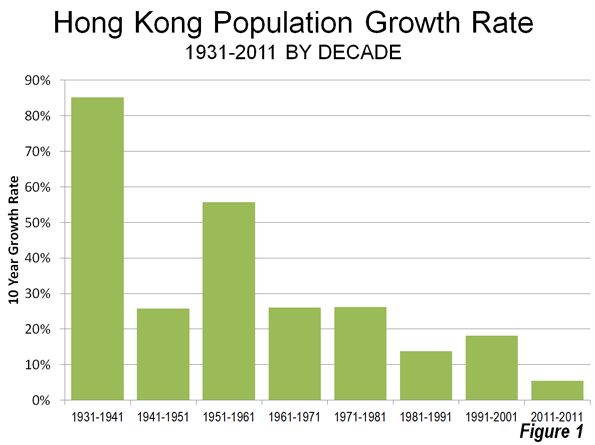
    Hong Kong has experienced its slowest decadal growth in at least 70 years, according to the results of the recently released 2011 census. Between 2001 and 2011, Hong Kong added only 5.4 percent to its population, a decline of more than two-thirds from its 1991-2001 rate. Hong Kong’s slowest growth rate since 1921-1931 was between 1981 and 1991, when 13.8 percent was added to its population. In previous decades growth had been much greater (Figure 1).

    Further, despite Hong Kong’s much larger population base today, the numeric growth from 2001 to 2011 was also the smallest since the 1921-1931 decade. Hong Kong added 363,000 residents for a total of 7,072,000 in 2011. The increase is barely one-third of the 1,034,000 residents added between 1991 and 2001. Much of Hong Kong’s population growth in the last 60 years had been driven by its better standard of living relative to mainland China. It seems likely that the growing prosperity of the past decade on the mainland has made Hong Kong less attractive for migrants.

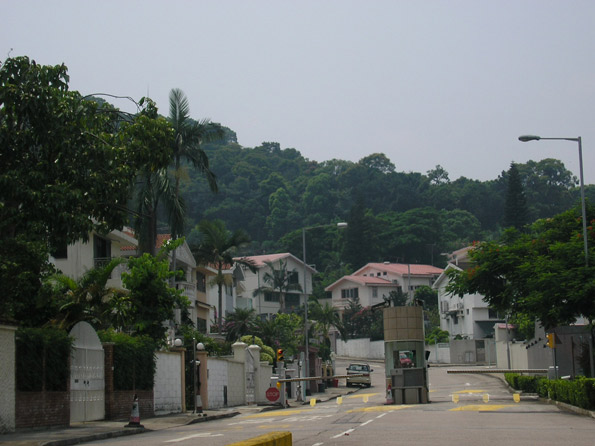
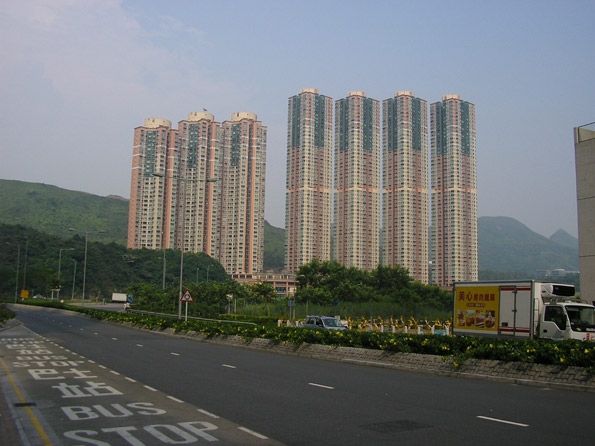
    High Income World’s Most Dense Urban Area: Hong Kong continues to be the densest major urban area in the high-income world. The present density is estimated at 67,000 per square mile (26,000 per square kilometer). At least one small area of Hong Kong has a population density exceeding 1 million per square mile (400,000 per square kilometer), though the much more dense Kowloon Walled City (estimated at up to 5,000,000 per square mile or 2,000,000 per square kilometer) was demolished in the 1990s. Even so, there are now detached housing developments, as Hong Kongers who can afford it choose these much more expensive accommodations, as Witold Rybczynski relates in a recent commentary (detached housing photo).

    Detached Housing

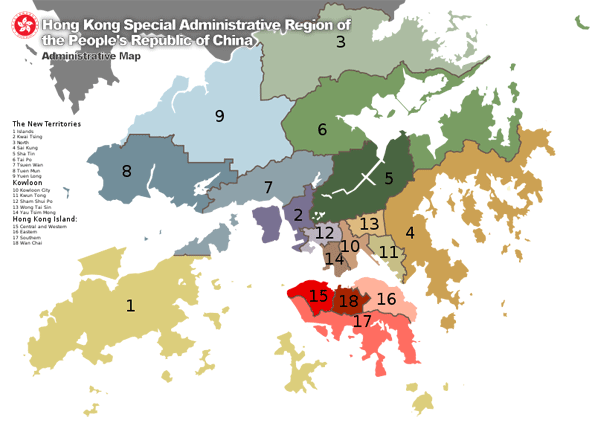
    Subdivisions of Hong Kong: The Hong Kong Special Administrative Region (HKSAR) is a unified government, with no local jurisdictions (such as cities or towns).  However, there are four broad regions and within each there are districts, are designated for statistical purposes.

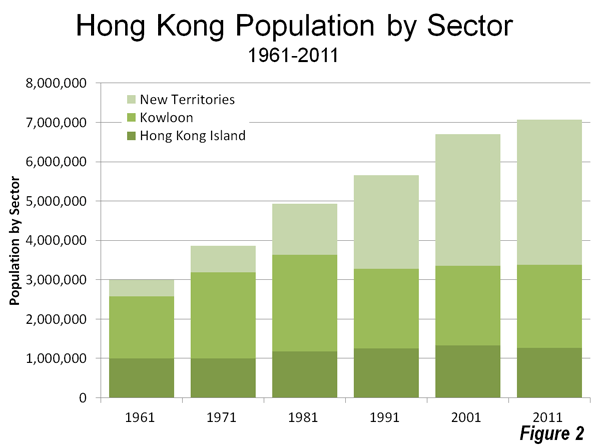
    Hong Kong’s growth — like that of most major metropolitan areas — has been shifting to the periphery for decades (Table 1). Between 1981 and 2011, all of the population growth was in the New Territories, the new (greenfield and high density) suburban areas beyond the Hong Kong Island-Kowloon core. While all of Hong Kong was adding 2.1 million residents in total between 1981 and 2011, the New Territories added 2.4 million (Table 2). This suburban dominance continued in the last census period, with 96 percent of growth in the New Territories. Before that, the bulk of the growth was in the outer areas of Kowloon, which were then the suburbs (Figure 2).

    Table 1
    Hong Kong Population by District: 1911-2011
    Year Total Hong Kong Kowloon New Territories Marine
    1911 456,700 244,300 69,400 81,200 61,800
    1921 625,200 347,400 123,400 83,200 71,200
    1931 840,500 409,200 263,000 98,200 70,100
    1941 1,600,000 Estimate: No complete census
    1951 2,013,000 Estimate: Census cancelled
    1961 3,129,600 1,004,900 1,578,000 409,900 136,800
    1971 3,936,600 996,200 2,194,800 665,700 79,900
    1981 4,986,600 1,183,600 2,449,100 1,304,100 49,700
    1991 5,674,100 1,251,000 2,030,700 2,374,800 17,600
    2001 6,708,400 1,335,500 2,024,000 3,343,000 5,900
    2011 7,071,600 1,270,900 2,108,400 3,691,100 1,200
    Sources:
    Government of Hong Kong
    www.cicred.org/Eng/Publications/pdf/c-c21.pdf
    Table 2
    Hong Kong Population by District: 1991-2011
    Region & District Population: 1991 Population: 2001 Population: 2011 % 2001-2011 Land Area KM2 Land Area MI2 Density KM2 Density MI2
    HONG KONG 5,674,114 6,708,389 7,071,576 5.4% 1,098 424 6,440 16,680
    HONG KONG ISLAND 1,250,993 1,335,469 1,270,876 -4.8% 80 31 15,827 40,991
      Central and Western 253,383 261,884 251,519 -4.0% 13 5 20,089 52,031
      Wan Chai 180,309 167,146 152,608 -8.7% 10 4 15,230 39,447
      Eastern 560,200 616,199 588,094 -4.6% 19 7 31,265 80,976
      Southern 257,101 290,240 278,655 -4.0% 39 15 7,154 18,529
    KOWLOON 2,030,683 2,023,979 2,108,419 4.2% 47 18 45,138 116,909
      Yau Tsim Mong 282,060 282,020 307,878 9.2% 7 3 44,946 116,409
      Sham Shui Po 380,615 353,550 380,855 7.7% 9 4 40,175 104,052
      Kowloon City 402,934 381,352 377,351 -1.0% 10 4 37,849 98,028
      Wong Tai Sin 386,572 444,630 420,183 -5.5% 9 4 44,891 116,268
      Kwun Tong 578,502 562,427 622,152 10.6% 11 4 56,303 145,826
    NEW TERRITORIES 2,374,818 3,343,046 3,691,093 10.4% 971 375 3,801 9,845
      Kwai Tsing 440,807 477,092 511,167 7.1% 22 8 23,427 60,675
      Tsuen Wan 271,576 275,527 304,637 10.6% 61 23 5,019 12,999
      Tuen Mun 380,683 488,831 487,546 -0.3% 84 33 5,773 14,953
      Yuen Long 229,724 449,070 578,529 28.8% 138 53 4,179 10,824
      North 165,666 298,657 304,134 1.8% 137 53 2,215 5,737
      Tai Po 202,117 310,879 296,853 -4.5% 147 57 2,014 5,215
      Sha Tin 506,368 628,634 630,273 0.3% 69 27 9,074 23,501
      Sai Kung 130,418 327,689 436,627 33.2% 136 53 3,201 8,291
      Islands 47,459 86,667 141,327 63.1% 175 68 807 2,091
    MARINE 17,620 5,895 1,188 -79.8% 0 0 0 0
    Data from Government of Hong Kong Special Administrative Region


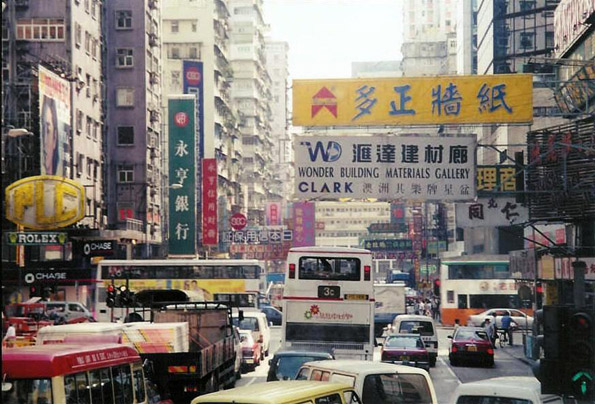
    The Core: Hong Kong Island: Hong Kong Island, home to one of the world’s most dense central business districts (Central, Western and Wan Chai districts) lost 4.8 percent of its population. All five of the districts on Hong Kong Island lost population, with Wan Chi (of "The World of Suzy Wong" movie fame) suffering the greatest loss, at 8.7 percent).

    The Core: Kowloon: Across Hong Kong harbor (see Star Ferry photograph, top), Kowloon, also a part of the core, gained 4.2 percent, adding nearly 75,000 residents (photo). Even so, Kowloon’s population remains more than 10 percent below its 1981 population. Three of Kowloon’s  five districts gained population, including Yau Sim Mong and Sham Shui Po, which along with the north shore districts of Hong Kong Island are the most intensely developed in the HKSAR.

    Suburban: The New Territories: The New Territories added 10.4 percent to their population (348,000), with seven of the nine districts gaining. The largest gain (63 percent) was in the Islands district, which includes Hong Kong International Airport. Sia Kung, also grew strongly, at 33 percent (see photo). Sia Kung, like nearly built-out Sha-Tin, is conveniently located just over a narrow mountain range from Kowloon and contains considerable amounts of greenfield land for development.

    Kowloon

    Sia Kung

    Yuen Long, home of the new Shenzhen Bridge had the third highest growth rate, at 29 percent. The Islands, Sia Kung and Yuen Long all have all experienced much improved access from extensions to the Mass Transit Railway (MTR) and the former Kowloon-Canton Railway (KCR), which have now merged into the MTR.

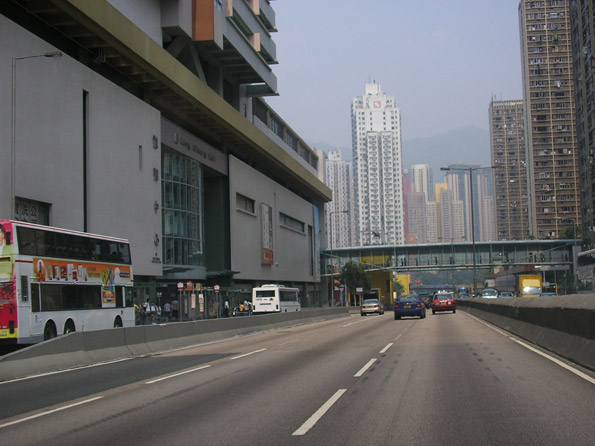
    Transportation in Hong Kong: Hong Kong is the most transit dependent major metropolitan area in the high-income world. Mass transit carries 72 percent of motorized trips. Even with the high residential and employment density, the average work trip is approximately five miles each way. Moreover, despite having one of the most effective mass transit systems in the world and extraordinarily high densities, the average one-way work trip travel time is 46 minutes, 18 minutes longer than Los Angeles or Houston. With the highest transit market share in the world and an automobile market share only 1/70th that of Houston, Hong Kong’s density still  produces among the highest levels of traffic congestion in the world — 1.5 times the traffic density of Los Angeles and three times that of Houston (photo).

    Hong Kong Traffic Congestion

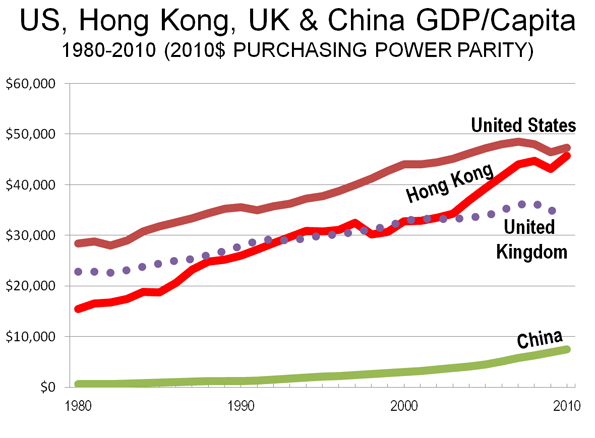
    Economic Growth: Hong Kong has experienced strong economic growth for  the last three decades. In 1981, Hong Kong’s gross domestic product (GDP) per capita was one-third below that of the United Kingdom, its then colonial master. Even by this time, Chinese leader Deng Xiao Ping had been so impressed by Hong Kong’s market based economic advance, that he had designated adjacent Shenzhen as a special economic zone. That area has since grown from a fishing village to a population exceeding 10 million, according to the 2010 census. In the intervening years, the Pearl River Delta has emerged as the most populous extent of urbanization in the world, stretching from Hong Kong, through Shenzhen, Dongguan, Guangzhou, Jiangmen, Zhongshan and Zhuhai to Macao. However, because of border controls and the low level of commuting, these remain separate metropolitan areas and  urban areas.

    Hong Kong’s economic growth continued strongly in the middle 1990s, when its GDP per capita exceeded that of the United Kingdom. Hong Kong fell behind in the late 1990s Asian economic crisis, but soon recovered. By 2010, Hong Kong’s GDP per capita had risen to 27 percent above that of the United Kingdom.

    Hong Kong’s economic performance relative to the United States may be even more impressive. In 1980, Hong Kong’s GDP per capital trailed that of the United States by 45 percent. As of 2010, Hong Kong trailed the US by only three percent and according to International Monetary Fund data should pass the United States early in the present decade. Between 2000 and 2010, Hong Kong’s per capita GDP (PPP-2010$) rose more than one-third — only South Korea and Singapore did better among high-income areas, according to International Monetary Fund data. China’s percentage growth rate was  nearly five times Hong Kong’s but in actual dollars Hong Kong’s GDP per capita rose at triple China’s rate. However, should China’s economy slow down, as some analysts suggest, it could be difficult for Hong Kong to sustain this strong growth rate (Figure 3).

    The People’s Republic of China has maintained Hong Kong’s free market economic system, helping assure strong growth. It seems unlikely that either Deng Xiao Ping or Margaret Thatcher imagined that such economic progress would be made when they signed the historic agreement to restore Hong Kong to China in 1984. Nor is it likely they imagined China’s meteoric rise.

    Unique Hong Kong: Hong Kong is the living model of compact development and transit dependence toward which urban planning wisdom strives. However, Hong Kong itself is the outlier of outliers. Hong Kong’s population density — double that of any other high-income world urban area of similar size or larger — would never have approached this level if it had not been separated from China itself by colonization and then the historical complexities of the post-World War II period. Even in its prosperity, the growing urban areas of mainland China are being built at densities averaging no more than one-quarter that of Hong Kong. Hong Kong may be more an accident of history than an exemplar.

    Wendell Cox is a Visiting Professor, Conservatoire National des Arts et Metiers, Paris and the author of “War on the Dream: How Anti-Sprawl Policy Threatens the Quality of Life

    —-

    Photo: Star Ferry, operating between Hong Kong Island (Central) and Kowloon (Yau Tsim Mong). All photos by author.

    Hong Kong district map by Wikipedia user Moddlyg.

  • Is The United States Population Heading to Long-term Deceleration?

    It’s been clear since the census 2011 estimates were released on December 21, 2011, that we are experiencing something of a demographic change, at least in the short run. Clearly growth is slowing down in part, many believe, due to economic reasons, as was the case during the 1930s as well as the 1970s.

    But there may be a series of other of causes of recent population change which suggest it is quite possible the United States population is simply heading towards zero population growth far quicker than the Census had previously estimated. One key reason may be the slowdown in immigration. Whatever the cause, if these patterns are not reversed, we could start observing European like slow rates of population growth spreading in the next couple of decades.

    The 2011 numbers estimated 4,008,000 total births in the United States, while a just released report by the Centers for Disease Control and Prevention (CDC) shows a provisional estimate of 3,978,000 births from June, 2010 to June, 2011—the first time this number has been under four million since 1999. This   certainly may be attributed to the effects of the economic recession, but may be part of much larger demographic trends — such as falling fertility rates of Hispanic women — that eclipse economic fluctuations.

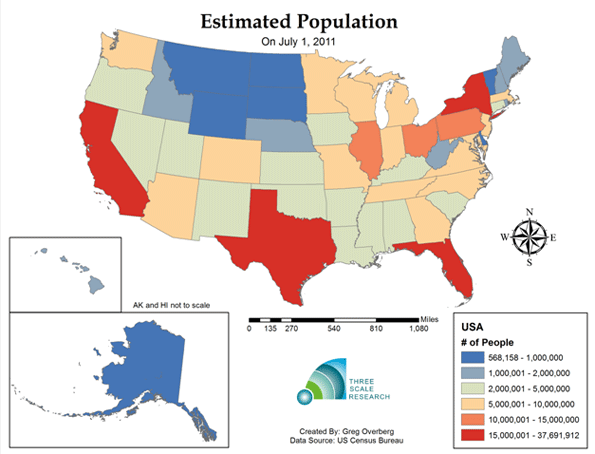
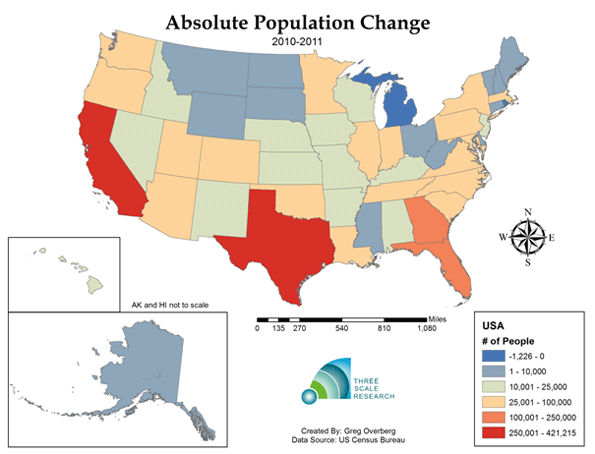
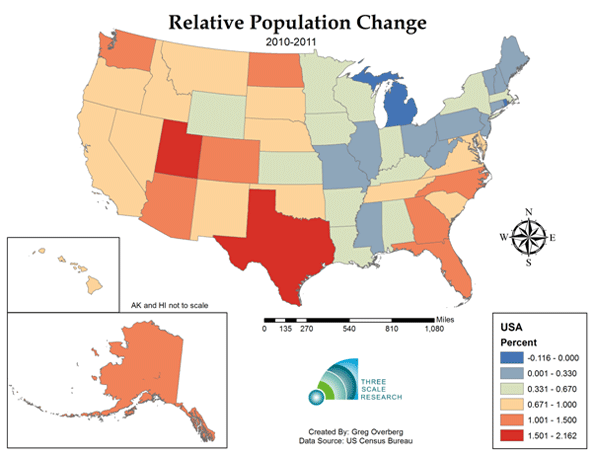
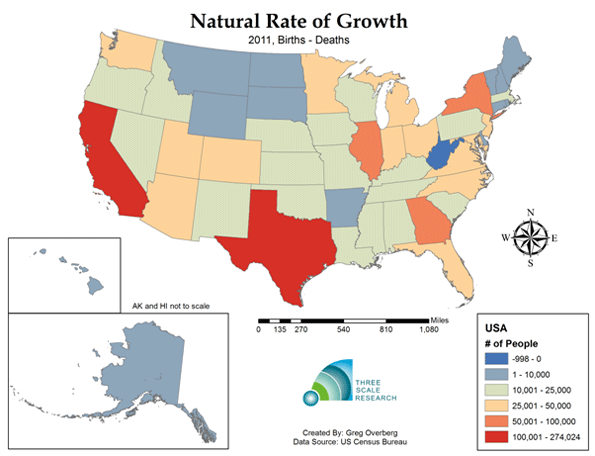
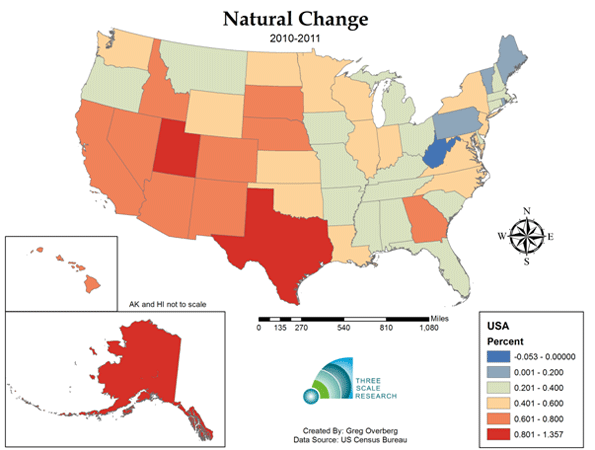
    Here is a series of maps that highlight recent population changes for the 50 states. The District of Columbia is too small to be seen at this scale, but DC did have the fastest population growth rate from 2010 to 2011, at 2.16%.  There are a variety of ways to present the same data, classifying and color coding, but it is always good to look at total numbers, and both absolute and relative change.

    Map Figure One: Estimated Population by State as of July 1, 2011

    The United States now has a population of about 311 million persons, and four states (California, Texas, New York and Florida) exceed fifteen million persons.  Combined, these top four states combined have 101.9 million people.

    Map Figure Two: Estimated Absolute Change in Population from July 1, 2010 to July 1, 2011

    The second map shows the absolute change in population from July 1, 2010 to July 1, 2011 in six categories. Only one state, Michigan, lost population, but fourteen states added less than ten thousand persons. A total of twenty seven states added fewer than 25,000 persons. Four states added over 100,000 persons; Florida added 218,929 persons, while Georgia added 103,053 persons.  California, although its population growth is slowing down, added 353,714 persons. Texas grew by the most people—421,215 persons—a rate that, if maintained, might result in the state surpassing 30 million people in the 2020 census.  It still has a long way to go to catch up with California, which in 2011 has an estimated population of 37,691,912.

    Map Figure Three: Estimated Relative Change in Population from July 1, 2010 to July 1, 2011

    The third map shows relative percentage change. Although Michigan remains the only state to shrink, thirteen states are now growing less than a third of a percent a year, similar to many European Countries with very slow population growth. Overall, the United States population increased by 0.73 percent—a noticeable difference from 1970 through the 2000s, when population was consistently growing at about one percent per year. The highest rate of growth was Texas at 1.67 percent. Texas in 2011 is similar to Arizona and Nevada a few years back—states with both high absolute and relative population growth, and both positive domestic migration from other states and international migration from around the world. Texas is, for now, the most dynamic place for demographic change.

    Map Figure Four: Estimated Relative Births minus Deaths (Natural Rate of Absolute Population Change) from July 1, 2010 to July 1, 2011

    The natural rate of population growth (births minus deaths), was estimated at 1,557,874 persons from July 1, 2010 to July 1, 2011. A third of this growth occurred in two states, California and Texas, and Texas had the highest natural rate of absolute growth at 274,024 persons compared with 230,798 for California.

    West Virginia is the first state to record more deaths than births, but a number of states are only a few years away from attaining this status that occurs at the end of the demographic transition process. In Ohio   the natural rate of population growth is higher than the total rate, due to negative net migration, suggesting it is one of a number of states that could have modest population increase if it could cease losing people to other places.

    Map Figure Five: Estimated Relative Births minus Deaths (Natural Rate of Relative Population Growth) from July 1, 2010 to July 1, 2011

    The fifth map shows what appears to be an East-West split.  In the eastern thirty-one states, with the exception of Georgia, states have a natural rate of growth that is similar to other parts of the world with slowing or negative populations, including most of Europe, Russia, and East Asia. On the other hand, twelve out of nineteen western states have a natural rate of population growth exceeding 0.6 percent.

    The highest rate of natural growth is in Utah, with an annual change of 1.36 percent, similar to the current population growth rate of India. Alaska also has a natural rate of increase above one percent, at 1.1 percent, and Texas, at 0.91 percent, has a similar rate of natural increase as the United States had for total population growth rate only a few years ago.  The overall natural rate of increase for the United State is 0.5 percent per year, similar to China and France.

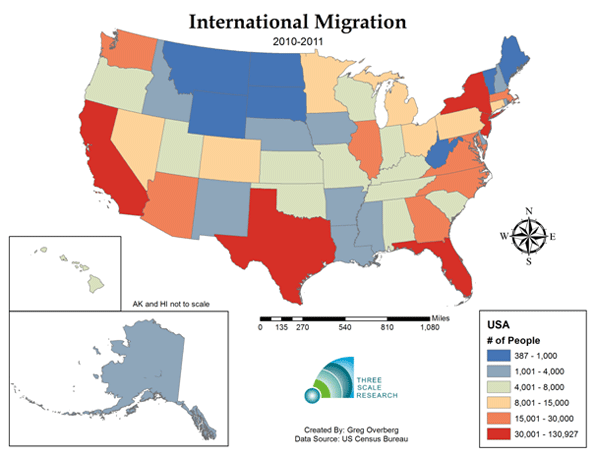
    Map Figure Six: Estimated International Migration from July 1, 2010 to July 1, 2011

    The sixth map shows that every state had international migration during 2010-2011.  Most states number in the thousands, but five states, California, Texas, Florida, New York and New Jersey, have over thirty thousand migrants arriving.

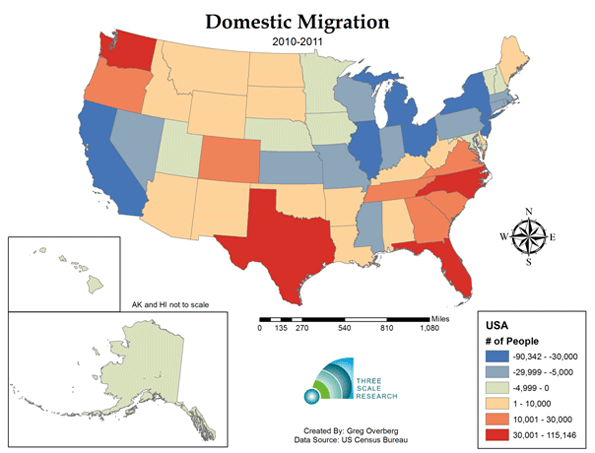
    Map Figure Seven: Estimated Domestic Migration from July 1, 2010 to July 1, 2011

    In contrast to the map of international migration, the seventh map shows domestic migration; the net effect of millions of Americans moving to different states during the course of a year.  Twenty-four states show negative domestic migration, including all of the Midwest states except North and South Dakota.  Texas and Florida experience both strong international and domestic migration, while California, New York and New Jersey have negative domestic migration and positive international migration.

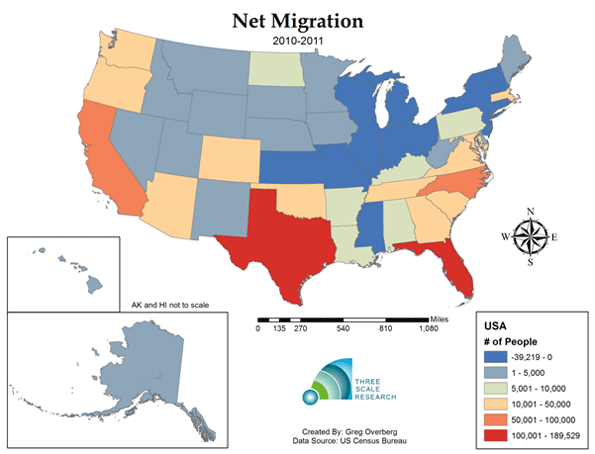
    Map Figure Eight: Estimated Net Migration (Combined International and Domestic) from July 1, 2010 to July 1, 2011

    The eighth and final map shows the effects of net migration. States along the West Coast, the State of Texas, and the South Atlantic Region have all experienced net positive migration.  A band of states mostly in the Midwest and Northeast have negative net migration, as their residents leave for other places.  Migration patterns have been occurring for a long time, but what will be new is how migration occurs in the face of slowing overall natural rates of population change.

    These numbers are, of course, just one year and it is entirely possible that growth will rise as the economy improves and as the current large millennial generation enters their prime child bearing years. But if the current one-year trend becomes a longer term phenomena, we could see a possible leveling off of population much sooner and at a lower rate than forecasted, say around 360 million by mid-century instead of 478 million by the year 2100 as forecast by the United Nations Population Division. These, will have implications for government fiscal policy, and will generate debate about government policy in encouraging births as we observe in Europe, Russia and Japan.  Population growth has been a relative advantage for the United States and remains so, but we may have to consider whether this trend is inexorable.

    Ron McChesney is a Geographer with Three Scale Strategy and Research in Columbus, Ohio. Ron received a PhD in Geography at The Ohio State University in 2008.

    Greg Overberg is a City and Regional Planner with Three Scale Strategy and Research in Columbus Ohio.  Greg received a MA in City and Regional Planning at The Ohio State University in 2011.

  • Will Millennials Still be Liberal When They’re Old and Gray?

    The Millennial Generation (born 1982-2003) is the cohort most in favor of using the federal government to promote economic stability and equality since the GI Generation of the 1930s and 1940s. The attitudes of Millennials were heavily shaped by the protected and group-oriented way in which they were reared and their experience of feeling the full brunt of the Great Recession as they emerged into adulthood.  

    As a result, the biggest political story of the first half of the 21st century may well be the extent to which the largest American generation ever retains its economic liberalism and thereby shapes the direction of public policy in coming decades. If history is any guide, much of that story’s plot will be written during the next four or five years.

    Millennials deserve America’s sympathies for the disproportionate impact the Great Recession has had on their generation. According to a recent Pew Research Center survey, a clear plurality (41%) of Americans think that young, rather than middle-aged (29%) or older  (24%) adults are having the toughest time in today’s economy. And they are right.  Last year, the unemployment rate for 18-24 year olds (16.3%) and 25-29 year olds (10.3%) was well above that of those 35-64 (7%). Even among those 18-24 year olds fortunate enough to find full-time employment, real median weekly earnings were down by six percent over the previous four years. Not surprisingly, the weak economy has had a profound impact on the personal lives of Millennials. Nearly half (49%) say they have taken a job (often part time) just to pay the bills. A third (35%) have returned to school, something that may pay benefits in the long term, but is at the expense of current earnings. About a quarter have taken an unpaid job and/or moved back in with their parents (24% each). About one in five have postponed having a baby (22%) and/or getting married (20%). Less than a third (31%) say that they earn or have enough money to lead the kind of life they want.

    Their experiences with the Great Recession have only reinforced Millennials’ support for economically activist government. Last November, when Pew asked whether Americans preferred a larger government that provided more services or a smaller government that provided fewer services, Millennials opted for a bigger government over a smaller one by a large 54% to 35% margin. By contrast, 54% of Boomers (born 1946-1964) and 59% of Silents (born 1925-1945) favor a smaller government. .

    In addition, a majority of (55% to 41%) Millennials favored a greater level of federal spending to help the economy recover from the recession rather than reducing the federal budget deficit. Millennials also continue to support governmental efforts to lessen economic inequality; 63% agreed that government should guarantee every citizen enough to eat and a place to sleep. Consistent with their overall attitudes toward the size of government, the two oldest generations—Boomers and Silents—favored reduced spending and a more limited government role in promoting economic equality.

    The tendency of people to retain their political viewpoints and preferences throughout their lives suggests that once they are set, Millennial Generation attitudes toward government’s proper role in the economy will persist for decades. This conclusion was recently confirmed by   economists Paola Giuliano and Antonio Spilimbergo. In a longitudinal analysis of survey data collected annually since 1972, they found that experiencing an economic recession during one’s “formative” years (18-25 years old) led Americans to favor “leftist” governmental policies that would “help poor people” and lessen “income inequality.” These attitudes were not influenced by experiencing a recession either before or after the formative years and remained in place even when controlled for demographic variables such as sex, race, and social class. However, the same data suggested that the deeper and more sustained the recession, the lower the level of confidence survey respondents had in governmental institutions such as Congress and the presidency.  

    The success of governmental action in dealing with the Great Depression in the 1930s and World War II in the 1940s put the GI or Greatest Generation on the path of lifelong support for governmental activism. After the nation’s victory over the Axis and the economic boom that followed, positive perceptions of government and political efficacy were virtually universal among Americans. Today, although America has begun to shake off the worst aspects of the Great Recession, unemployment remains stubbornly high and growth rates remain below the level needed to make dramatic dents in unemployment rates, especially among Millennials.

    So far Millennial beliefs in activist, egalitarian government policies have not been shaken by the slow pace of the recovery or what  some may perceive as an inadequate federal response. The extent to which those attitudes persist in future decades, when Millennials will represent over one out of every three adult Americans, could depend on how well the government deals with the economic challenges the nation faces in the years just ahead.

    Morley Winograd and Michael D. Hais are co-authors of the newly published Millennial Momentum: How a New Generation is Remaking America and Millennial Makeover: MySpace, YouTube, and the Future of American Politics, named by the New York Times as one of their ten favorite books of 2008.

  • Don’t Bet Against The (Single-Family) House

    Nothing more characterizes the current conventional wisdom than the demise of the single-family house. From pundits like Richard Florida to Wall Street investors, the thinking is that the future of America will be characterized increasingly by renters huddling together in small apartments, living the lifestyle of the hip and cool — just like they do in New York, San Francisco and other enlightened places.

    Many advising the housing industry now envisage a “radically different and high-rise” future, even though the volume of new multi-unit construction permits remains less than half the level of 2006. Yet with new permits at historically low levels as well for single-family houses, real estate investors, like the lemmings they so often resemble, are traipsing into the multi-family market with sometimes reckless abandon.

    Today the argument about the future of housing reminds me of the immortal line from Groucho Marx:Who are you going to believe, me or your lyin’ eyes? Start with the strong preference of the vast majority of Americans to live in detached houses rather than crowd into apartments. “Many things — government policies, tax structures, financing methods, home-ownership patterns, and availability of land — account for how people choose to live, but the most important factor is culture,” notes urban historian Witold Rybczynski.

    Homeownership and the single-family house, Rybczynski notes, rests on many fairly mundane things — desire for privacy, need to accommodate children and increasingly the needs of aging parents and underemployed adult children. Such considerations rarely enter the consciousness of urban planning professors, “smart growth” advocates and architectural aesthetes swooning over a high-density rental future.

    Just look at the numbers. Over the last decade— even as urban density has been embraced breathlessly by a largely uncritical media — close to 80% of all new households, according to the American Community Survey, chose to settle in single-family houses.

    Now, of course, we are told, it’s different. Yet over the past decade, vacancy rates rose the most in multi-unit housing, with an increase of 61%, rising from 10.7% in 2000 to 17.1% in 2010. The vacancy rate in detached housing also rose but at a slower rate, from 7.3% in 2000 to 10.7% in 2010, an increase of 48%. Attached housing  – such as townhouses –  posted the slightest increase in vacancies, from 8.4% in 2000 to 11.0% in 2010, an increase of 32%.

    The attractiveness of rental apartments may soon be peaking just in time for late investors to take a nice haircut. Rising rents, a byproduct of speculative buying of apartments, already are making mortgage payments a more affordable option in such key markets as Atlanta, Chicago, Miami, Phoenix and Las Vegas.

    Urbanist pundits often insist the rush to rental apartments will be sustained by demographic trends. One tired cliché suggest that empty nesters are chafing to leave their suburban homes to move into urban apartments. Yet, notes longtime senior housing consultant Joe Verdoon, both market analysis and the Census tells us the opposite: most older folks are either staying put, or, if they relocate, are moving further out from the urban core.

    The two other major drivers of demographic change — the millennial generation and immigrants — also seem to prefer suburban, single-family houses. Immigrants have been heading to the suburbs for a generation, so much so that the most diverse neighborhoods in the country now tend to be not in the urban core but the periphery. This is particularly true in Sunbelt cities, where immigrant enclaves tend to be in suburban areas away from the core.

    Millennials, the generation born between 1983 and 2003, are often described by urban boosters as unwilling to live in their parent’s suburban “McMansions.” Yet according to a survey by Frank Magid and Associates, a large plurality define their “ideal place to live” when they get older to be in the suburbs, even more than their boomer parents.

    Ninety-five million millennials will be entering the housing market in the next decade, and they will do much to shape the contours of the future housing market. Right now many millennials lack the wherewithal to either buy a house or pay the rent. But that doesn’t mean they will be anxious to stay tenants in small places as they gain some income, marry, start a family and simply begin to yearn for a somewhat more private, less harried life.

    In the meantime, many across the demographic spectrum are moving not away from but back to the house. One driver here is the shifting nature of households, which, for the first time in a century are actually getting larger. This is reflected in part by the growth of multi-generational households.

    This is widely believed to be a temporary blip caused by the recession, which clearly is contributing to the trend. But the move toward multigenerational housing has been going on for almost three decades. After having fallen from 24 percent in 1940 to barely 12 percent in 1980, the percentage topped over 16 percent before the 2008 recession took hold. In 2009, according to Pew Research Center, a record 51.4 million Americans live in this kind of household.

    Instead of fading into irrelevance, the single-family house seems to be accommodating more people than before. It is becoming, if you will, the modern equivalent of the farm homestead for the extended family, particularly in expensive markets such as California. This may be one of the reasons why suburbs — where more than half of owner-occupied homes are locatedactually increased their share of growth in almost all American metropolitan areas through the last decade.

    Some companies, such as Pulte Homes and Lennar, are betting that the multi-generational home — not the rental apartment — may well be the next big thing in housing. These firms report that demand for this kind of product is particularly strong among immigrants and their children.

    Lennar  has already developed models — complete with separate entrances and kitchens for kids or grandparents — in Phoenix, Bakersfield, the Inland Empire area east of Los Angeles and San Diego, and is planning to extend the concept to other markets. “This kind of housing solves a lot of problems,” suggests Jeff Roos, Lennar’s regional president for the western U.S. “People are looking at ways to pool their resources, provide independent living for seniors and keeping the family together.”

    But much of the growth for multigenerational homes will come from an already aging base of over 130 million existing homes. An increasing number of these appear to being expanded to accommodate additional family members as well as home offices. Home improvement companies like Lowe’s and Home Depot already report a surge of sales servicing this market.

    A top Home Depot manager in California traced the rising sales in part to the decision of people to invest their money in an asset that at least they and their family members can live in. “We are having a great year ,” said the executive, who didn’t have permission to speak for attribution. “ I think people have decided that they cannot move so let’s fix up what we have.”

    These trends suggest that the widely predicted demise of the American single family home may be widely overstated. Instead, particularly as the economy improves, we may be witnessing its resurgence, albeit in a somewhat different form. Rather than listen to the pundits, perhaps it would be better to follow what’s before your eyes. Don’t give up the house.

    This piece originally appeared in Forbes.com.

    Joel Kotkin is executive editor of NewGeography.com and is a distinguished presidential fellow in urban futures at Chapman University, and contributing editor to the City Journal in New York. He is author of The City: A Global History. His newest book is The Next Hundred Million: America in 2050, released in February, 2010.

    Photo by Bigstockphoto.com.

  • Housing Affordability: St. Louis’ Competitive Advantage

    Things are looking better in St. Louis. For decades, St. Louis has been one of the slowest-growing metropolitan areas of the United States. Its historical core city has lost more than 60 percent of its population since 1950, a greater loss than any other major core municipality in the modern era.  Nonetheless, the metropolitan area, including the city, added nearly 50 percent to its population from 1950. The fate of St. Louis has been similar to that of Rust Belt metropolitan areas in the Midwest and East, as the nation has moved steadily West and South since World War II (Note).

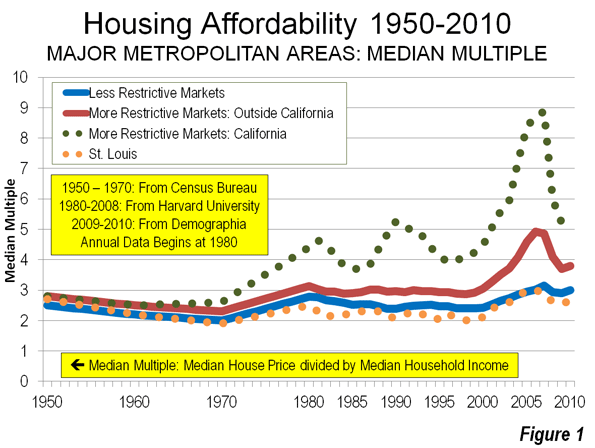
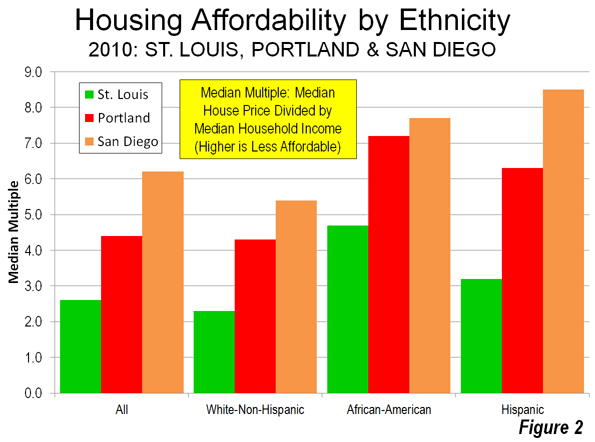
    Expensive Housing and Driving People Away: During the past decade, high house prices have driven residents away from areas with better amenities, especially California’s coastal metropolitan areas and metropolitan New York. Between 2000 and 2009, Los Angeles exported 1.4 million domestic migrants, the San Francisco Bay Area 600,000 (San Francisco and San Jose) and San Diego 125,000. New York lost nearly 2,000,000. St. Louis did much better, losing less than 45,000 domestic migrants. On a per capita basis, St. Louis also performed better, losing 1.6 domestic residents per capita to migration, compared to 4.5 in San Diego, 10 in the San Francisco Bay Area and 11 in New York.   This may not sound like an accomplishment, but the St. Louis area has probably not outperformed California in terms of migration since it entered the Union in 1850.

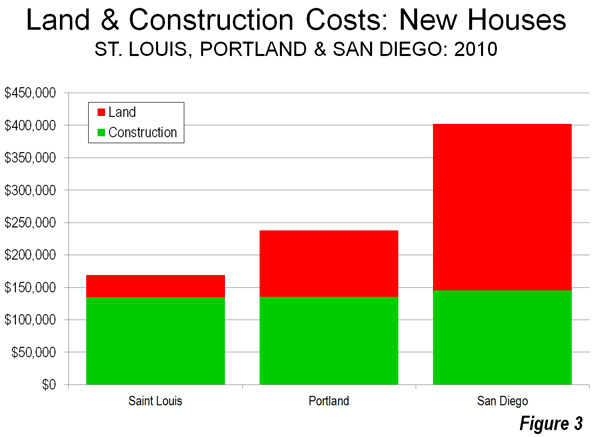
    The big change between the 2000s and previous decades lies in housing price. It is in this period that America became effectively two nations in housing affordability. The major metropolitan areas that experienced that largest housing bubble lost 3.2 million domestic migrants, while those with lesser or no bubble gained 1.5 million. Demonstrating the preference of people for more dispersed surroundings, even more (1.7 million) moved to smaller metropolitan areas. Housing affordability has emerged as a principal competitive factor among metropolitan areas.

    Superior Housing Affordability: This is where St. Louis excels. As of the third quarter of 2011, the median house price was 2.6 times the median household income in St. Louis, according to the 8th Annual Demographia International Housing Affordability Survey, which covered seven nations (the United States, United Kingdom, Canada, Australia, Ireland, New Zealand and Hong Kong, in China). Dividing the median house price by the median household income gives St. Louis an affordability rating (Median Multiple) of 2.6. By comparison the Median Multiple was 4.2 in Portland (60 percent more expensive ), 4.5 in Seattle (75 percent more),  6.1 in San Diego (135 percent more) and 6.9 in San Jose (175 percent more. While other metropolitan areas were reeling from house price increases that still have not returned to normal, St. Louis (and other metropolitan areas, like Dallas-Fort Worth, Houston and Indianapolis) have continued to experience affordable and far more steady house prices (Figure 1).

    Lowest Cost of Living: Affordable house prices are associated with a lower cost of living. St. Louis does very well here. According to the latest data from the US Bureau of Economic Analysis regional price parity program, the cost of living in St. Louis is the lowest among major metropolitan areas (those with more than 1,000,000 population). In St. Louis, the cost of living is:

    • 29 percent less than in New York.
    • 31 percent less than in San Jose.
    • 23 percent less than in San Diego.
    • 19 percent less than in Seattle.
    • 12 percent less than in Portland.

    Things Could Get Better for St. Louis: Moreover, the gap could become larger, especially as governments in California try to outlaw new detached housing, under Senate Bill 375. None of this is good for young households or less affluent households who will have to leave to find housing that meets their desires. Many will need to leave to fulfill their dreams.

    Inevitably, the higher housing costs associated with these policies (called by various names, such as "livability," "smart growth" and "growth management") fall hardest on lower income households (often minorities), who have less to spend, are forced to move away or cannot afford to move in. The consequences were articulated by California’s Hispanic oriented Tomas Rivera Policy Institute (Figure 2):

    While there is little agreement on the magnitude of the effect of growth controls on home prices, an increase is always the result.

    The Secret: Just what did the St. Louis leadership do to improve its competitiveness so much? Nothing. They just stayed out of the way. Unlike their counterparts where house prices exploded, St. Louis officials did not prohibit people from living where they wanted on the urban fringe and they did not force new houses to be built on postage stamp lots. Nor did they adopt land use regulations that drive up the price of land (Figure 3) and, in consequence housing), just as an OPEC embargo would raise the price of gasoline. When the easy money came and lenders were begging households with insufficient resources to take mortgages, the planning embargoes drove up house prices and invited undue participation by speculators who know the difference between a competitive and a rigged market.

    There are positive signs as a result of this affordability advantage. St. Louis has been attracting more young residents. Recent data indicates that St. Louis ranked 15th in high tech job growth out of the 51 metropolitan areas with more than 1,000,000 over the past decade. It would be expected that St. Louis would trail fast growing Seattle, Raleigh and Charlotte and perennial tax consumer Washington. However, St. Louis can be placed better than perennial leaders San Jose, Boston, Portland, Austin and New York. Budding local efforts are aimed at encouraging entrepreneurship, even as California and New York search for new ways to say "no."

    Succeeding by Being St. Louis: The improving prospects of St. Louis are not the result of a taxpayer financed marketing campaign or a payoff from the usual "let’s copy Portland" strategies (or even Cleveland, as one analyst put it a couple of decades ago). St. Louis cannot compete with the weather in the Bay Area, does not have San Diego’s beaches, the mountains near Denver nor the natural beauty surrounding Seattle. But it does have an affordable life style.

    St. Louis can succeed only by being St. Louis. It is a metropolitan area with a great past, and many fine civic institutions, including great parks, sports teams and a world class orchestra. This long laggard Midwestern metropolitan area may face its best competitive prospects since Chicago passed it in population in 1870. Local and state leaders need to stay away from the policies that would dilute St. Louis’ principal competitive advantage, a low cost of living, due to a housing market left to operate without destructive distortion.

    Wendell Cox is a Visiting Professor, Conservatoire National des Arts et Metiers, Paris and the author of “War on the Dream: How Anti-Sprawl Policy Threatens the Quality of Life

    —-

    Photo: Cathedral Basilica of St. Louis (by author)

    Note: This is adapted from a policy study by the author for the Show Me Institute: Housing Affordability The St. Louis Competitive Advantage

  • Commuting in New York City, 2000-2010

    New York City is infamous for congestion and long commutes. At 34.6 minutes, it has the longest average commute time in the United State. The region is also America’s top user of public transportation, with 30.7% of all metro area commutes made by transit. Nearly 40% of all transit commuters in the United States are in the metro New York. As transit commutes generally take longer than driving, one might be tempted to link these facts. But commute times also seem to correlate with city size, and bedevil big cities with limited public transit too.

    New York’s commutes improved a bit over the 2000s, however. The average commute time declined in every borough, in the city as a whole, and in the region. Overall US commute times fell as well, but less than New York’s:


    Source: Census 2000, American Community Survey 2010 1-yr

    In addition to showing the decline, this chart also highlights disparity in commute times between the subareas of New York. Manhattanites have far shorter commutes than those who live in the outer boroughs. In fact, the outer boroughs actually have longer commutes than far-flung outer suburban areas. The areas just outside the urban core of New York are some of the most disadvantaged for regional commuting

    The commute time decline is particularly noticeable when looking at ultra-long commutes, those that are 90 minutes are longer:


    Source: Census 2000, American Community Survey 2010 1-yr

    Here again we see both a decline in long commutes and a higher concentration in the outer boroughs.

    New York also managed to finish out the decade with no increase in traffic congestion. According to the Texas Transportation Institute, the region ended the decade with the same Travel Time Index it had when it started, 1.28:


    Source: Texas Transportation Institute, Urban Mobility Report 2011

    What has caused this?  Firstly, given that the data is collected in surveys with a margin of error, one shouldn’t read too much into any given year’s value. However, the decline was fairly consistently reflected in the later decade surveys and doesn’t appear to be an anomaly of just 2010.

    Assuming some legitimate improvement, one obvious potential explanation is the economy. Metro New York did lose 99,000 jobs in the 2000s. This was only a decline of 1.2% however, which actually bettered the US as a whole. But given the extreme congestion in the region, it clearly could have played a role. Also not to be dismissed are toll increases in the regions, and even potentially changes resulting from 9/11.

    Given the focus of the Bloomberg administration on non-auto forms of transportation, it is also worth looking at changes there.  Public transit usage grew strongly in New York over the decade, with regional trips increasing by 23%.


    Source: Texas Transportation Institute Urban Mobility Report 2011

    This increase is also reflected  an increase in public transportation commuting mode share over the past decade.


    Source: Census 2000, American Community Survey 2010 1-yr

    So should increased public transit ridership get the credit for commute time reductions? To some extent perhaps. But remember that New York has both the nation’s longest commutes and highest public transit ridership. Also keep in mind that public transit commutes are longer than driving commutes. The average commute time in metro New York for those driving alone is 30 minutes. For those riding public transportation it is 51.2 minutes. But transit riders affect drivers too. Public transit saves drivers in the New York area nearly $8 billion per year in congestion costs.  So while public transit can’t be necessarily given the credit for commute time improvements, it’s certainly possible it contributed to them .

    The same is not true, however, for other alternative transport modes. Here is the change in bicycle commuting over the decade:


    Source: Census 2000, American Community Survey 2010 1-yr

    Bicycling gets a lot of press in New York, and while the increases look impressive on a chart like the one above, the reality is that this is a trend that enjoys only a bit more than half a percentage point gain in mode share. Bicycling may be on an upswing, and may be of great help recreationally and for non-commute trips, but it is not yet a major force in commuting.

    Walking is actually far more prevalent than bicycling for commuting in New York. But the mode share for walking actually declined over the decade:


    Source: Census 2000, American Community Survey 2010 1-yr

    While walking is generally seen as a good thing in urbanist circles, some people can end up walking to work simply because they have no other alternatives. People who obtain access to a car, or who are able to use transit to get a job outside of their neighborhood, may in fact be improving their economic prospects. Some people who previously walked may be riding transit or biking to work today. Also, some walkers may have switched to driving. Interestingly, the number of households without a vehicle declined in metro New York, though some boroughs saw increases. The changes are very small, however.


    Source: Census 2000, American Community Survey 2010 1-yr

    Lastly, as you might expect with transit going up, the percentage of commuters driving alone declined nearly across the board in New York, though it increased nationally:


    Source: Census 2000, American Community Survey 2010 1-yr

    In short, New York retains America’s longest commutes and highest public transport usage. But in the last decade there have been increases in public transport commuting and declines in people driving alone, while overall commute times have improved, fewer people with ultra-long commutes, and road congestion has stayed flat. The 2000s were perhaps an unusual decade in America and New York. And the changes are fairly small so far.  The future will tell whether this is the start of a long term trend or merely a short term reversal.

    Aaron M. Renn is an independent writer on urban affairs based in the Midwest. His writings appear at The Urbanophile. Telestrian was used to analyze data and to create maps for this piece.