Category: Demographics

  • The State of the Anglosphere

    The world financial crisis has provoked a stark feeling of decline among many in the West, particularly citizens of what some call the Anglosphere: the United States, Canada, the United Kingdom, Ireland, Australia, and New Zealand. In the United States, for example, roughly 73 percent see the country as on the wrong track, according to an Ipsos MORI poll—a level of dissatisfaction unseen for a generation.

    Commentators across the political spectrum have described the Anglosphere as decadent, especially compared with the rising power of China. New York Times columnist Thomas Friedman praises the “reasonably enlightened group of people” who make up China’s one-party autocracy, which, he feels, provides more effective governance than the dysfunctional democracy of Washington, a point echoed in a recent Wall Street Journal op-ed by former Service Employees International Union boss Andy Stern. On the conservative side, author Mark Steyn sees the U.S. and its cultural mother in England as “facing nothing so amiable and genteel as Continental-style ‘decline,’ but something more like sliding off a cliff.” Even Australia, arguably the strongest economy in the Anglosphere, is increasingly troubled, with local declinists decrying the country’s growing dependence on commodity exports to developing nations—above all, to China. “We are to be attendants to an emerging empire: providers of food, energy, resources, commodities and suppliers of services such as education, tourism, gambling/gaming, health (perhaps), and lifestyle property,” frets the Australian’s Bernard Salt.

    It’s indisputable that the Anglosphere no longer enjoys the overwhelming global dominance that it once had. What was once a globe-spanning empire is now best understood as a union of language, culture, and shared values. Yet what declinists overlook is that despite its current economic problems, the Anglosphere’s fundamental assets—economic, political, demographic, and cultural—are likely to drive its continued global leadership. The Anglosphere future is brighter than commonly believed.

    Start with economics. Like Germany in the 1930s or Japan in the 1970s, China has found that centrally directed economic systems can achieve rapid, short-term economic growth—and China’s has indeed been impressive. But over time, the growth record and economic power achieved by the free-market-oriented English-speaking nations remain peerless. A little-noted fact these days is that the Anglosphere is still far and away the world’s largest economic bloc. Overall, it accounts for more than one-quarter of the world’s GDP—more than $18 trillion. In contrast, what we can refer to as the Sinosphere—China, Hong Kong, Taiwan, and Macau—accounts for only 15.1 percent of global GDP, while India generates 5.4 percent (see Chart 1). The Anglosphere’s per-capita GDP of nearly $45,000 is more than five times that of the Sinosphere and 13 times that of India (see Chart 2). This condition is unlikely to change radically any time soon, since the Anglosphere retains important advantages in virtually every critical economic sector, along with abundant natural resources and a robust food supply.

    Graph by Robert Pizzo

    Graph by Robert Pizzo

    Not surprisingly, Anglosphere countries retain close cultural and economic ties with one another. In making foreign direct investments, the United States shows a strong preference for Anglosphere countries, especially the United Kingdom and Canada (see Chart 3). The same is true for Australia, a nation whose economic future might seem to lie with Asia’s budding economic superpowers. Notwithstanding its worries about becoming a mere attendant to a rising China, Australia tilts its overseas investment heavily toward the United Kingdom, the United States, Canada, and New Zealand.

    Graph by Robert Pizzo

    Anglosphere countries possess overwhelming military superiority to protect their economic interests. While the United States dominates military technology and hardware, Britain ranks fourth in military spending, with both Australia and Canada ranking in the top 15. The U.S. is headquarters to the world’s three largest defense companies: Lockheed, Northrop Grumman, and Boeing. America’s Anglosphere ally Australia has joined informally with Singapore and the Philippines (both are nations where English is spoken widely) to provide a potential regional military counterweight to China.

    Anglosphere economic and military leadership is reflected in, and grows out of, the English-speaking world’s remarkable technological leadership. The vast majority of the world’s leading software, biotechnology, and aerospace firms are concentrated in English-speaking countries. Three-fifths of global pharmaceutical-research spending comes from Britain and America; more than 450 of the top 500 software companies in the world are based in the Anglosphere, mainly in the U.S., which hosts nine of the top ten. Out of the ten fastest-growing software firms, six are American and one is British. Internet giants like Apple, Google, Facebook, Microsoft, and Amazon have no foreign equivalents remotely close in size and influence.

    Graph by Robert Pizzo

    English is an ascendant language, the primary global language of business and science and the prevailing tongue in a host of key developing countries, including India, Nigeria, Pakistan, South Africa, Kenya, Malaysia, and Bangladesh. Over 40 percent of Europeans speak English, while only 19 percent are Francophone. When German, Swedish, and Swiss businesspeople venture overseas, they speak not their home language but English.

    Long-run trends in the developing world also point to the expansion of the English language. French schools have been closing even in former French colonies, such as Algeria, Rwanda, and Vietnam, where students have resisted learning the old colonial tongue. English is becoming widely adopted in America’s biggest competitor, China, and it dominates the Gulf economy, where it serves as the language of business in hubs such as Dubai. The Queen’s tongue is, of course, broadly spoken in that other emerging global economic superpower, India, where it has become a vehicle for members of the middle and upper classes to communicate across regional boundaries. In Malaysia, too, English is the language of business, technology, and politics.

    With linguistic ascendancy comes cultural power, and the Anglosphere’s remains uncontested. In total global sales of media, movies, television, and music, it has no major competitor. Its exports of movies and TV programs dwarf those of established European powers like France and Germany and upstarts such as China, Brazil, and India (see Chart 5). Exports from Hollywood and the cultural capitals of other Anglosphere countries are growing enormously in developing countries: Hollywood box-office revenues grew 25 percent in Latin America and 21 percent in the Asia-Pacific region (with China accounting for 40 percent of that region’s box office). The hit movie Avatar made over $2 billion outside North America; in Russia, Hollywood films earn twice as much as their domestic counterparts. Anglophone preeminence extends to pop music, with Americans Eminem, Lady Gaga, and Taylor Swift, along with the U.K.’s Susan Boyle, ruling global charts. Japanese, Korean, and Chinese pop artists do have large followings in Asia, but the biggest global stars continue to originate in the Anglosphere. This is true of fashion trends, too: Los Angeles, New York, and London dominate fashion for everything from sportswear to lingerie in the increasingly global “mall world.”

    Graph by Robert Pizzo

    Much has been made of the aging of the West, but the English-speaking countries are not graying as rapidly as their historical European rivals are—notably, Germany and Italy—or as Russia and many East Asian countries are. Between 1980 and 2010, the U.S., Canada, and Australia saw big population surges: the U.S.’s expanded by 75 million, to more than 300 million; Canada’s nearly doubled, from 18 million to 34 million; and Australia’s increased from 13 million to 22 million. By contrast, in some European countries, such as Germany, population has remained stagnant, while Russia and Japan have watched their populations begin to shrink.

    The U.S. now has 20 people aged 65 or older for every 100 of working age—only a slight change from 1985, when there were 18 for every 100. By 2030, the U.S. will have 33 seniors per 100 working Americans. But consider the numbers elsewhere. In the world’s fourth-largest economy, Germany already has 33 elderly people for every 100 of working age—up from only 21 in 1985. By 2030, this figure will rise to 48, meaning that there will be barely two working Germans per retiree. The numbers are even worse in Japan, which currently has 35 seniors per 100 working-age people, a dramatic change from 1985, when the country had just 15. By 2030, the ratio is expected to rise to 53 per 100.

    Meanwhile, the nation that so many point to as the twenty-first-century superpower—China—now has a fertility rate of 1.6, even lower than that of Western Europe. Over the next two decades, its ratio of workers to retirees is projected to rise from 11 to 23. Other countries, such as Brazil and Iran, face similar scenarios. These countries, without social safety nets of the kinds developed in Europe or Japan, may get old before they can get rich.

    These figures will have an impact on the growth of the global workforce. Between 2000 and 2050, for example, the U.S. workforce is projected to grow by 37 percent, while China’s shrinks by 10 percent, the EU’s decreases by 21 percent, and, most strikingly, Japan’s falls by as much as 40 percent.

    In this respect, immigration presents the most important long-term advantage for the Anglosphere, which has excelled at incorporating citizens from other cultures. A remarkable 14 million people immigrated to Anglosphere countries over the last decade. The United States, in particular, remains a powerful magnet: in 2005, it swore in more new citizens—the vast majority from outside the Anglosphere—than the next nine countries put together. The U.K. last year also experienced the strongest immigration in its history.

    In sum, post-financial-crisis reports of the Anglosphere’s imminent irrelevance have been exaggerated—wildly.

    This piece originally appeared in The City Journal.

    Joel Kotkin is executive editor of NewGeography.com and is a distinguished presidential fellow in urban futures at Chapman University, and contributing editor to the City Journal in New York. He is author of The City: A Global History. His newest book is The Next Hundred Million: America in 2050, released in February, 2010.

    Shashi Parulekar is the director of global sales and marketing and chief technology officer for Zemarc Corporation.

    Graphs by Robert Pizzo

  • Clues from the Past: The Midwest as an Aspirational Region

    This piece is an except from a new report on the Great Lakes Region for the Sagamore Institue. Download the pdf version for the full report including charts and maps on the region.

    The American Great Lakes region has long been a region defined by the forces of production, both agricultural and industrial. From the 1840s on, the region forged a legacy of productive power, easily surpassing the old northeast as the primary center of American industrial and agricultural might.

    The Rise of the Great Lakes

    Natural forces shaped the region, from its waterways and mineral resources, which made it ideal for industrial development. The lakes themselves are the largest sources of freshwater on the planet; the five lakes together are twice the size of England. This “fresh water Mediterranean” provided an essential pathway for transport between the various regions of the Great Lakes, as well as a connection to the northeast and, through the Saint Lawrence and the Erie Canal, to New York and the Atlantic.

    But more than anything, it has been the people of the Great Lakes that proved its greatest resource. In the early 19th Century, the region’s development was paced by migrants from New England, who brought with them their values of thrift, hard work and a passion for education and self-improvement. Later others, notably Germans and Scandinavians, injected a similar culture of self-improvement to the area.

    Like New England, the Great Lakes, noted author John Gunther, was possessed with a “gadget mind” that sparked the innovations that gave America command of the industrial revolution. Much of the brawn for this came from the poorer parts of Europe — Russia, Italy, and most particularly Poland, which led one observer to call Chicago “a mushroom and a suburb of Warsaw.” By 1920 one third of third of the population of Chicago, Cleveland and Detroit was foreign born.

    Initially based largely on agricultural exports, by 1860 the region had blossomed into an urbanized industrial powerhouse. “All over the Middle West,” wrote historians Charles and Mary Beard, “crossroads hamlets grew into trading towns, villages spread into cities, cities became railway and industrial centers.” The area’s rapid growth sparked great optimism; in 1841 journalist and land speculator predicted that by 1940 Cincinnati would be the largest city in North America and by 2000 “the greatest city in the world.” Cleveland, Cincinnati, Toledo, Milwaukee and most of all Chicago stood at the center of a “web of steel” that marked the region as the world’s preeminent industrial center. It also sparked other innovations, from the auto assembly line and the high-rise building to the mail order catalog.

    This growth cascaded in the early years of the last century. It became the nation’s primary growth engine. Between 1900 and 1920 Chicago added a million people while Cleveland doubled its population and Detroit, epicenter of the emerging “automobile revolution”, grew three fold. In everything from architecture and city planning to literature, the Great Lakes stood at the national, even global, cutting edge.

    A Half Century of Decline

    By the 1970s, the Great Lakes region, including Ontario, accounted for two-thirds of the North America’s automobile production, 70 percent of pig iron and three quarters of its steel. Yet by that time, this close tie to industry was seen not as an advantage but as a curse, driving the region towards precipitous decline.

    By then America was widely seen as entering a “post-industrial era,” and the Great Lakes, the former bastion of the manufacturing economy, seemed the odd region out. Defined as the “foundry” in Joel Garreau’s Nine Nations of North America, it was the only one he identified as in decline. He described the region’s inner cities as “North America’s Gulag Archipelago.”

    Once a magnet for newcomers, the region now took a back seat as a place that attracted domestic or foreign migrants.10 With the exception of Chicago, the Lakes region have continues to lag both in domestic migration and foreign immigrants. Newcomers were reinventing places like Los Angeles, Houston, Miami and New York, but relatively few were coming to Cleveland, Detroit or Cincinnati.

    The Great Lakes cities, also with the sometimes exception of Chicago, also found themselves increasingly regarded as cultural backwaters. Occasional stories of restoration and renaissance made the rounds in the media, but the trend was to greater obsolescence, to becoming permanently “a cultural colony” of the coasts. “To a Californian or a New Yorker,” noted Indiana-based historian Jon Teaford, “Cleveland, Detroit, Indianapolis and Saint Louis were down-at-the-heel, doughty matrons, sporting last year’s cultural fashions.”

    Until recently there has been ample reason to believe this decline would continue. Only nine of the Midwest’s 40 largest metropolitan areas have a higher per capita GDP than the national average. This reflected a deep seated loss of jobs paced by industrial decline but not made up for by gains in other fields.

    During this period the region not only lost many of its industrial jobs but, more pointedly, failed to replace them with the technology and service jobs that grew rapidly elsewhere. As a result, the region’s percentage of the national workforce dropped steadily over the past half century. In 1966, the Great Lakes region possessed one in four jobs in the country; by 2010 that percentage had fallen to less than one in five.

    As a response to the perception of industry-led decline, some Great Lakes leaders sought out other sources of employment and growth. In Detroit, for example, much emphasis was placed on casino development. Michigan’s former Governor Jennifer Granholm, sought to reverse decline by targeting the so-called “creative class” by turning its hard-hit towns into “cool cities.” Across the region, others focused on convention centers, arts attractions such as museums and other entertainment venues as the way to improve their sagging fortunes.

    Seeds of Resurgence
    None of these efforts – although much heralded throughout the 1980s and 1990s – did much to reverse the region’s decline. Notes Jim Russell, author of the widely read Burgh Diaspora website:

    Should Akron start putting more money in skateparks or global warming?

    There are huge problems in spending money in order to attract the geographically fickle. Fads fade and the mobile – largely people under 30 – will move again…Tying up the urban budget with projects aimed at retaining the creative class has its own perils. There is little, if any, evidence indicating that this policy will decrease the geographic mobility of the well-educated. Many cities stuffed with cultural amenities also sport high rates of out-migration. Furthermore, tastes change. “Best places to live” lists change quite a bit from one year to the next.

    Instead, the region’s current rebound is occurring in surprising fashion. The real lure of the Great Lakes lies in its own fundamental advantages: lower housing prices, business climate and perhaps, more importantly, a nascent industrial rebound.

    This can be seen, most importantly, in employment numbers. Starting in the last few years, the area’s share of jobs has remained steady. The highest unemployment rates in the country are no longer concentrated in the Great Lakes region, but in states such as California and Nevada. In many Great Lakes states, unemployment rates have been dropping more rapidly than the national average.

    Critically this resurgence has not resulted in a shift away from industrial growth. Instead, we are witnessing the early stages of what could be a profound increase in both the economic heft and job creation tied to the industrial sector. But the Great Lakes rebound is not merely a cyclical, one dimensional rise; it also includes growth in a host of other sectors, including in the information area and, perhaps even more remarkably, in energy, particularly shale gas.

    At the same time the rise in non-industrial jobs also should testify to the growing attractiveness of the region, particularly for young families. After decades of mass outmigration, the region has begun to achieve a more favorable balance with the rest of country. Outmigration rates for states in the region are at or below national levels.

    Migration in the Midwest, as Russell and others have pointed out, should be regarded more from the vantage point of recruitment, not retention. By promoting its affordability and improving economy, the region could improve its trailing inmigration rates. As people vote with their feet for the region, they are laying down the foundation for the area’s resurgence in the coming decades.

    The Rise of New Growth Nodes

    The Great Lakes demographic and economic turnaround does not mean that growth has occurred in the pattern of the early 20th Century. Instead we see the emergence of a new set of leadership cities. If Akron, Detroit, Cleveland and Chicago paced the region’s early 20th century ascendency, the new “winners” appear to include affordable, attractive cities, many of whom are home to major universities, state capitals and key research institutions.

    These areas have done well in attracting many people from the less successful metropolitan areas of the region. Columbus, for example, evidenced strong growth from the rest of Ohio and other parts of the Midwest, notably Michigan and Illinois. But perhaps more importantly, the area enjoys strong in-migration from those parts of country — notably the Northeast and California — that have traditionally dominated knowledge-intensive industries.

    A similar pattern can be seen in Indianapolis. In recent years, as urban analyst Aaron Renn notes, the Indiana capital has enjoyed “a profile closer to the Sun Belt than the Rust Belt.” It grew its population at a rate 50 percent greater than the national average, and also had strong net inmigration, with almost 65,000 net people deciding to pack up and move to the Indiana capital.

    Already a center of regional culture and services, the area has succeeded as well in attracting new migrants not only from big Midwestern cities such as Chicago, but also from the two coasts.

    By way of contrast, Chicago’s migration patterns look much different than those in Columbus and Indianapolis. Many other regions around the country benefited from people leaving the Windy City than Chicago gained from them. Chicago’s biggest gains have come from other, more troubled Great Lakes regions, while Indianapolis, for instance, has taken advantage of Chicagoans looking for more opportunity elsewhere.

    Behind this shift in migration from the coasts lie many factors, such as taxes and regulations.
    But perhaps most important may be the region’s greater affordability. Even after the bubble, for example, many key eastern and west coast regions suffer a ratio housing prices to annual incomes of five, six or even seven to one. For the most part, virtually all parts of the Great Lakes have ratios of three or less.

    Over time, this could prove a critical advantage to the Great Lakes. As the current millennial generation – the largest generation in American history – enters their 30s, it is likely that they will seek out places where they can afford to buy a home and enjoy a middle class quality of life. The Great Lakes will be one place that can offer that opportunity.

    Key to recovery: Both Brain and Brawn

    The future of the Great Lakes region lies neither in simply the “information” economy nor in the brute force of manufacturing. Instead it is as a result of a combination both of the industrial sector and the high-value service sectors that feed into it.

    Critically, the region boasts many areas where the information and service economies are particularly strong. Of the nine Midwestern metropolitan areas with per capita GDP growth above the national average, four are capital cities and six are home to major universities. Given governmental involvement in two of the fastest-growing sectors of the economy, health care and education, it is no surprise that seats of government and large state-funded research universities – which also double as the hotbeds of medical services – are growing ahead of other regions with a more traditional, and perhaps outdated, economic base.

    Indeed, some Midwestern areas are outperforming the coastal economies even in the realm of high-tech. In a recent ranking by Forbes magazine of best areas for tech growth among the nation’s 51 largest metropolitan areas, the region boasted three of the top fifteen areas, led by #3 Columbus, followed by Indianapolis and St. Louis.

    However, it would be inaccurate to portray the Midwest as depending purely on a service or information economy. Producing things for sale and export is still alive and well, and the Midwestern regions that have blended their traditional capacity for manufacturing with newer fast-growing sectors of the economy.

    Cedar Rapids, Iowa enjoyed the highest rate of GDP growth from 2001-2010 of any metropolitan area in the Midwest. Between Cedar Rapids and Iowa City, home to the University of Iowa, a new high-tech corridor has grown up that takes advantage of the area’s historical manufacturing capacity and the new technology driven through the university.

    Terre Haute, Indiana, fifth on the list of GDP leaders, reflects even more completely the blending of the “old” Midwest with the emerging one. Manufacturing has held steady as a share of the local economy at about 15.5 percent since 1991, but health and education have jumped from 14 to 17 percent, while wholesale services and agriculture have dropped. Terre Haute is home to Indiana State University and Rose-Hulman Institute of Technology, a regional leader in engineering, science, and mathematics education.

    Peoria, Illinois is second behind Cedar Rapids in GDP growth the past ten years. It is home to more than 200 manufacturing firms, two of the world’s largest earth-moving equipment makers, and coal fields. Peoria is also a leader in college degree attainment in the Great Lakes. While its absolute attainment levels are still low, its college educated population is growing faster than nearly every community in the Midwest. Peoria is one example of how brains + brawn, and not just brains, is the key to Midwestern growth going forward.

    Consider what we might call the dynamic of the Badgers and the Wolverines. In Wisconsin, home of the Badgers, there exists an east-west corridor between Madison, home to the state university and state capital, and Milwaukee, the state’s historical center of industry and commerce. In Michigan, home of the Wolverines, an east-west corridor stretches between Ann Arbor, home to the University of Michigan, and Detroit, the state’s historical center of industry and commerce.

    In Figure 14 we see that both Ann Arbor and Madison have high levels of bachelor degrees compared to the national average. But Madison is leading the Midwest in bachelor degree growth while Ann Arbor rate remains fairly static. Meanwhile, even though Detroit surprises with a fairly high rate of bachelor degree growth, Milwaukee stays in front of the national average in both growth and absolute numbers of college-educated workers.

    Some might say that the Badgers are beating the Wolverines in the knowledge-intensive sectors of the economy, but that the lead manufacturing is up for grabs. But the truth is that the Wisconsin corridor also enjoys positive marks in manufacturing.

    Milwaukee, for example, leads Detroit in the growth of manufacturing jobs. And Madison is emerging as a manufacturing center while Ann Arbor lags far behind. The knowledge economy and the old-time manufacturing economy can work happily together, in the case of Madison Milwaukee, or so far less so in the case of Ann Arbor-Detroit.

    The New Industrial Paradigm

    Despite the attempts to write it off as a spent force, manufacturing will remain a key driver of Midwestern and national growth. Despite the many job losses that impacted this sector over the past generation, American manufacturing remains remarkably resilient, with a global market share similar to that of the 1970s.

    More recently, however, American industrial base has begun to expand and begin to gain on its competitors. This places the Great Lakes in an advantageous position. American manufacturing after a decade of decline has outpaced the overall recovery over the two years, in part due to soaring exports. In 2011 American manufacturing continued to expand even as Germany, Japan and Brazil all weakened in this vital sector.

    Many factors are driving this change. One is a tie to the growing domestic energy industry, which has already sparked growth in the shale areas of eastern Ohio and other parts of the Great Lakes region. The United States together now boast the largest natural gas reserves in the world. In Ohio alone, new finds in the Utica shale could be worth as much as $500 billion; one energy executive called it “the biggest thing to hit Ohio since the plow.”

    The boom in natural gas has already sparked a considerable industrial rebound including the building of a new $650 million steel plant for gas pipes in the Youngstown area.18 Karen Wright, whose Ariel Corporation sells compressors used in gas plants, has added more than 300 positions over the past two years. “There’s a huge amount of drilling throughout the Midwest,” Wright says. “This is a game changer.”

    It also leads to the prospect that as coal-fired plants become more expensive to operate due to concerns over greenhouse gas emissions, the region will have a new, cleaner and potentially less expensive power source.

    Another critical factor has been the rise of wage rates in both Europe and East Asia. Increasingly, American-based manufacturing is in a favored position as a lower cost producer. Concerns over “knock offs” and lack of patent protection in China may also be sparking a “back to USA” trend, something particularly favorable to the Great Lakes region.

    Yet the new industrial base will not resemble old one. We are seeing both an industrial renaissance in the country and one that is heavily concentrated in the Great Lakes region. But it is a resurgence that is as much brain as brawn; an industry increasingly dependent not just on hard work, but skilled labor.

    This pattern cuts across industry lines. Indeed even as the share of the workforce employed in manufacturing has dropped from 20 percent to roughly half that, high skilled jobs in industry have soared 37 percent. Even after years of declining employment, manufacturers in heavy industry, such as automobiles, are running short on skilled workers. Industry expert David Cole predicts there could be demand for 100,000 new workers by 2013. Overall, 83 percent of all manufacturers, according to Deloitte Touche, suffer a moderate or severe shortage of skilled production workers.

    This remains a fundamental strength of the region. Much of the skilled labor base in the nation remains in the Midwest. The region is also home to four of the highest ranked, according to US News, industrial engineering schools in the nation: the University of Michigan at Ann Arbor, Northwestern, the University of Wisconsin at Madison and Purdue.

    Equally important for the region will be replacing the large cadre of skilled workers, many of whom are entering the late 50s and early 60s. “We have a very skilled workforce, but they are getting older,” says Ariel Wright, who employs 1,200 people at three Ohio factories. “I don’t know where we are going to find replacements.”

    For now the very culture of production – often seen as a liability in the past – could prove a key to the Great Lakes’ future resurgence. These advantages are already redounding to the region. Indeed a recent Forbes survey of “heavy metal” industries – that is those involved heavy industry, metals, vehicles and complex machinery – found the region in surprisingly good shape.

    The Milwaukee area, for example, ranked number 2 among the 50 metropolitan areas on the list, while Detroit clocked in with a respectable 6 placed finish. Cincinnati, Kansas City and Cleveland all ranked well within the top 20. In all, the 40 Great Lakes metropolitan areas added 50,000 heavy metal industry jobs since 2009.

    Looking Forward

    For the first time in a generation, the Great Lakes are experiencing demographic and economic trends in their favor. Yet in everything from migration to industrial growth, the region can expect to face strong competition from other areas, most notably Texas, the Southeast, the Great Plains and the Intermountain West for new jobs and production.

    To meet this challenge, and truly take advantage of improved conditions, the region must develop a strategy that is suited to its particular advantages. There is no need to try to compete with Manhattan on urban chic, with Silicon Valley in high-tech startups or with Hollywood in entertainment – as some growth theorists would likely recommend.

    The Great Lakes needs to focus primarily on those very values of production and community that sparked its original ascendance. Once these are identified and strengthened, the region can once again not only rebound, but define its own space in the national and global economy.

    Perhaps the first priority has to do with education. The Great Lakes has an enormous edge in terms of first-class engineering schools, and needs to become more focused on these programs and those associated with them, including the information sciences. It needs to supplement this focus on the top echelon with a greater effort — as we can now see in Ohio — in training more of the skilled workforce desperately needed for the region’s resurgent manufacturers.

    By 2018, 63 percent of the nation’s jobs will require some type of post-high school training credential. Increasingly successful education programs have to focus on aligning with jobs available within a state or region. This can only occur with explicit cooperation between education, government, and the business community.

    Likewise, business collaboration with universities can boost the amount and the impact of industry R&D investments that fosters innovation. University-based research and technology development can yield fast-growing, high-technology firms that create higher-paying middle skill and professional, scientific and technical jobs.

    The second priority lies in developing critical infrastructure to keep the region’s economy humming. This includes a greater emphasis on developing energy resources, rebuilding and modernizing the freight rail, waterways and ports, as well as highways that connect the Great Lakes to the rest of the country and the world.

    In the modern economy, creating economic advantage also includes paying attention to specialized infrastructure such as university and lab facilities, technology and training centers, multi-modal shipping and logistics facilities, and research parks. These infrasystems – integrated fusions of facilities, technology and advanced socio-technical capabilities – can drive innovation, particularly for future higher-value industries and higher-paying jobs. The full range of today’s infrastructure assets is shown in the figure below.

    Third, and perhaps most important, the region needs to maintain the housing affordability and other quality of life attributes critical to attracting both immigrants and domestic migrants. As Millennials enter their 30s in large numbers over the next decade, the region needs to improve its public schools, parks and other amenities to attract them.

    Ultimately, this represents a distinctly common-sense means to overcome a legacy of failure and create a new paradigm of success for the region. The Great Lakes, rather than trying to arrest its decline by completely running away from its past, can now recover the great sense of potential so evident in its heroic history.

    Download the full pdf version of the report, including charts and maps about the Great Lakes Region. The report was authored for the Sagamore Institute with support from the Lynde and Harry Bradley Foundation.

    Joel Kotkin is executive editor of NewGeography.com and is a distinguished presidential fellow in urban futures at Chapman University, and contributing editor to the City Journal in New York. He is author of The City: A Global History. His newest book is The Next Hundred Million: America in 2050, released in February, 2010.

    Mark Schill is Vice President of Research at Praxis Strategy Group, an economic development and research firm working with communities and states to improve their economies.

    Ryan Streeter is Distinguished Fellow for Economic and Fiscal Policy at the Sagamore Institute. You can follow his work at RyanStreeter.com and Sagamoreinstitute.org.

    Photo courtesy of BigStockPhoto.com.

  • The Evolving Urban Form: Moscow’s Auto-Oriented Expansion

    Moscow is bursting at the seams. The core city covers more than 420 square miles (1,090 kilometers), and has a population of approximately 11.5 million people. With 27,300 residents per square mile (10,500 per square kilometer), Moscow is one percent more dense than the city of New York, though Moscow covers 30 percent more land. The 23 ward area of Tokyo (see Note) is at least a third more dense, though Moscow’s land area is at least half again as large as Tokyo.

    All three core areas rely significantly on transit. Muscovites use the Metro at about the same rate as New Yorkers use the subway, taking about 200 trips each year. Tokyo citizens use their two Metro systems at nearly 1.5 times the rate used in Moscow.

    But there are important differences. Moscow officials indicate that approximately two-thirds of Moscow’s employment is in the central area. This is a much higher figure than in the world’s two largest central business districts — Tokyo’s Yamanote Loop and Manhattan — each with quarter or less of their metropolitan employment. Both New York City and Tokyo’s 23 wards have extensive freeway lengths in their cores, which help to make their traffic congestion more tolerable.

    Moscow’s arterial street pattern was clearly designed with the assumption that the dominant travel pattern would be into the core. Major streets either radiate from the core, or form circles or partial circles at varying distances from it. In New York City and Tokyo’s  23 wards there are radial arterials, but,the major streets generally form a grid, which is more conducive to the cross-town traffic and the more random trip patterns that have emerged in the automobile age.

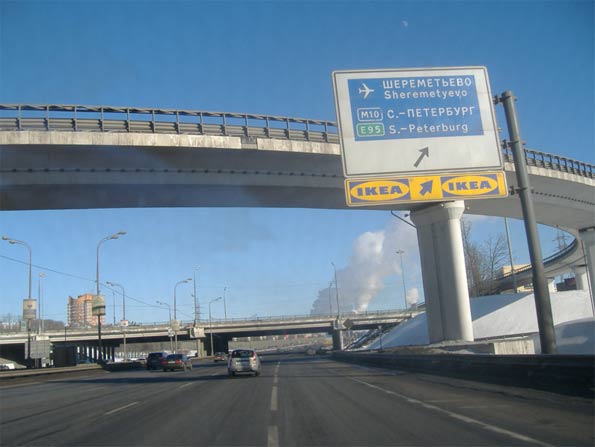
    Moscow has become much, more reliant on cars,  following the examples of metropolitan areas across Europe. The old outer circular road, which encloses nearly all of the central municipality, was long ago upgraded to the MKAD, a 10 lane freeway as long as Washington’s I-495 Capital Beltway (65 miles or 110 kilometers). The MKAD has become a primary commercial corridor, with large shopping centers and three nearby IKEAs.

    It is not surprising, therefore, that traffic congestion and air pollution became serious problems in Moscow. The road system that had been adequate when only the rich had cars was no longer sufficient. The "cookie-cutter" apartment blocks, which had served Iron Curtain poverty, had become obsolete. The continued densification of an already very dense core city led to an inevitable intensification of intensification of traffic congestion and air pollution.

    Transit-oriented Moscow was not working, nor could "walkability" make much difference. In such a large urban area, it is inevitable that average travel distances, especially to work, will be long. Geographically large employment markets are the very foundation of major metropolitan areas. If too many jobs are concentrated in one area, then the traffic becomes unbearable, as many become able to afford cars and use them. Traffic congestion was poised to make Moscow dysfunctional.

    Expanding Moscow

    The leadership of both the Russian Federation and the city of Moscow chose an unusual path, in light of currently fashionable urban planning dogma. Rather than making promises they could not keep about how higher densities or more transit could make the unworkable city more livable, they chose the practical, though in urban planning circles, the "politically incorrect" solution:  deconcentrating the city and its traffic.

    Last year, Russian President Dmitry Medvedev proposed that Moscow be expanded to a land area 2.3 times as large. Local officials and parliament were quickly brought on board. The expanded land area is nearly double that of New York’s suburban Nassau County, and is largely rural (Note 2). Virtually all of the expansion will be south of the MKAD.

    The plan is to create a much larger, automobile-oriented municipality, with large portions of the Russian government to be moved to the expanded area. Employment will be decentralized, given the hardening of the transport arterials that makes the monocentric employment pattern unsustainable. Early plans call for commercial construction more than four times that of Chicago’s loop.

    At the same time, the leadership does not intend to abandon the older, transit-oriented part of the municipality. Mayor Sergei Sobyanin has voiced plans to convert central area government buildings into residences and hotels, adding that there will be the opportunity to build underground parking facilities as refurbishments proceed. Moscow appears to be preparing to offer its citizens both an automobile-oriented lifestyle and a transit-oriented one. The reduced commercial traffic should also make central Moscow a more attractive environment for tourists, who spend too much time traveling between their hotels and historic sites, such as the Kremlin and St. Basil’s.

    Expanding the Family?

    As Moscow expands, the national leadership also wants the Russian family to expand. Russia has been losing population for more than 20 years. Since 1989, the population of the Russian Federation has dropped by 4.5 million residents. When the increase of 3.0 million in the Moscow area is considered, the rest of the nation has lost approximately 7.5 million since 1989. Between the 2002 and the 2010 censuses, Russia lost 2.2 million people and dropped into a population of 142.9 million. Russia’s population losses are pervasive. Out of the 83 federal regions, 66 lost population during the last census.

    Continued population losses could significantly impair national economic growth. The projected smaller number of working age residents will produce less income, while a growing elderly population will need more financial support. This is not just a Russian problem, but Russia is the first of the world’s largest nations to face the issue while undergoing a significant population loss.

    The government is planning strong measures to counter the demographic decline, increase the birth rate, and create a home ownership-based "Russian Dream". Families having three or more children will be granted land for building single-family houses across the nation., including plots of up to nearly one-third of an acre (1,500 square meters).  Many of these houses could be built in Moscow’s new automobile- oriented two-thirds, as well as in the extensive suburbs on the other three sides of the core municipality.

    Expanding Outside the Core

    While population decline is the rule across the Russian Federation, the Moscow urban area has experienced strong growth. Between 2002 and 2010, the Moscow urban area grew from 14.6 million to 16.1 million residents (Note 3). This 1.3 percent annual rate of increase  exceeds the recently the recently announced growth in Canada (1.2 percent). This rate of increase exceeds that of all but 8 of the 51 major metropolitan areas (Note 4) in the United States between 2000 and 2010.

    While the core district grew 6 percent  and added 41,000 residents, growth was strongest outside the core, which accommodated 97 percent of the new residents (See Table). Moscow’s outer districts grew by nearly 1.1 million residents, an 11 percent increase, and its suburbs continued to expand, adding 400,000 residents, an increase of 10  percent. These areas have much lower densities than the city, with many single-family houses.

    Table
    Moscow Urban Area Population
    2002 2010 Change % Change Share of Growth
    Inner Moscow 701,000 743,000 41,000 5.9% 2.7%
    Outer Moscow 9,681,000 10,772,000 1,090,000 11.3% 70.3%
    Suburban 4,198,000 4,617,000 420,000 10.0% 27.0%
    Total 14,581,000 16,132,000 1,551,000 10.6% 100.0%
    Note: Suburban population includes the total population of each district and city that is at least partially in the urban area.


    Moscow, like other international urban areas, is decentralizing, despite considerable barriers. The expansion will lead to even more decentralization, which is likely to lead to less time "stuck in traffic" and more comfortable lifestyles. Let’s hope that Russia’s urban development policies, along with its plans to restore population growth, will lead to higher household incomes and much improved economic performance.

    Wendell Cox is a Visiting Professor, Conservatoire National des Arts et Metiers, Paris and the author of “War on the Dream: How Anti-Sprawl Policy Threatens the Quality of Life

    —–

    Note 1: The 23 ward (ku) area of Tokyo is the geography of the former city of Tokyo, which was abolished in the 1940s. There is considerable confusion about the geography of Tokyo. For example, the 23 ward area is a part of the prefecture of Tokyo, which is also called the Tokyo Metropolis, which has led some analysts to think of it as the Tokyo metropolitan area (labor market area). In fact, the Tokyo metropolitan area, variously defined, includes, at a minimum the prefectures of Tokyo, Kanagawa, Chiba and Saitama with some municipalities in Gunma, Ibaraki and Tochigi. The metropolitan area contains nearly three times the population of the "Tokyo Metropolis."

    Note 2: The expansion area (556 square miles or 1,440 square kilometers) has a current population of 250,000.

    Note 3: Includes all residents in suburban districts with at least part of their population in the urban area.

    Note 4: Urban area data not yet available.

    Photo: St. Basil’s Cathedral (all photos by author)

  • Orléans, Ontario: A Franco-Ontarian Suburb

    In a mere forty years Orléans has gone from an overwhelmingly French-speaking village to a suburb of Ottawa where scarcely one-third of the population has French as its mother tongue. Nonetheless, the French presence remains vibrant and local francophones are exceptionally dedicated to preserving their language and culture and building on their achievements. No other place in Ontario boasts cultural programs and facilities like those that serve Orléans’ francophone community. The fight twenty years ago to have the provincial government spell “Orléans” with the accent on the “e” is an eloquent example of the community’s determination to stand up for its rights with regional and provincial authorities. 

    Orléans Today 

    Orléans has never been a municipality. Originally a village whose loosely defined limits overlapped Cumberland County and the town of Gloucester, it joined Ottawa in 2001. Today Orléans’ three neighbourhoods together form Ottawa’s largest eastern suburb. While not the only Franco-Ontarian suburb, Orléans is certainly the one where tradition and modernity are the most closely melded. The result is a very rich culture that has opened the doors of opportunity to the francophone minority at a time of profound change to the identities and sense of belonging of Franco-Ontarians.

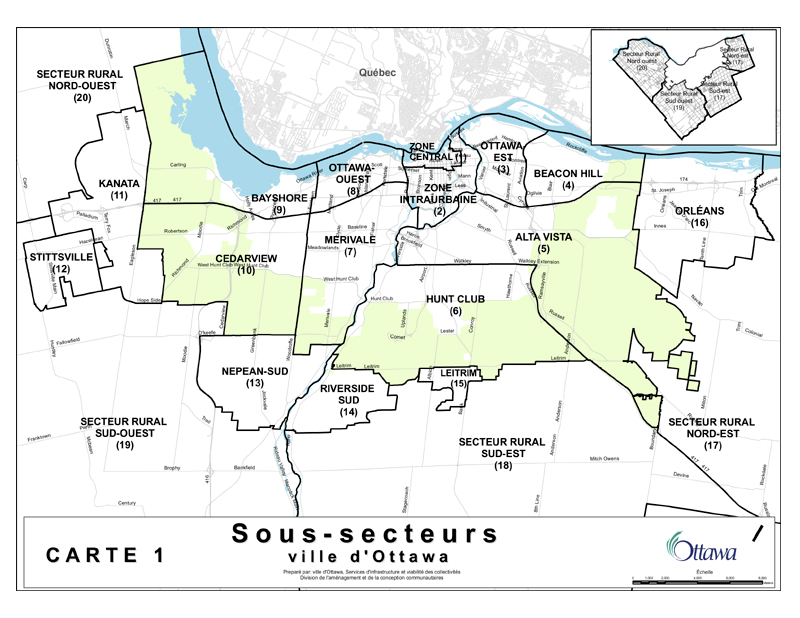
    Sub-areas of Ottawa

    Sub-areas of Ottawa

    From Village to Suburb 

    Since the 1970s, Orléans’ population has exploded: from 6,000 in 1971 it rose to 24,000 ten years later, and by July 1, 2010, the number exceeded 106,000. This dramatic growth transformed land use. Large tracts of farmland were snapped up by developers. They sold new houses to Ottawa residents who dreamed of having a home with a yard offering access to both their city­ workplaces and to a piece of nature on the outskirts of town. A highway link to downtown Ottawa and the sense of security that came with suburban life added to Orléans’ appeal.

    Orleans Fruit Farm, Ottawa, Ontario

    Orleans Fruit Farm, Ottawa, Ontario

    The small town of Orléans thus became a bedroom community much like the ones surrounding every major city in the country. The once varied townscape gave way to a suburban sameness: apart from the old village centre and a few taller buildings in the suburb’s outer reaches the same street design, housing style, and landscaping predominate. Despite developers’ best efforts to build “communities,” Orléans’ highly unified landscape reflects the socioeconomic homogeneity of its residents. This suburb is a paradise for middle and upper-middle class families who have found an environment in keeping with their aspirations. In 2005 the average household income in Orléans was $103,792 compared to $85,136 in Ottawa. 

    Francophones Lose their Majority Status 

    The recent population explosion altered Orléans’ linguistic makeup. Franco-Ontarians came from both nearby and further afield, drawn by the appeal of a French-speaking suburb. Orléans’ location midway between downtown Ottawa and the French-speaking outskirts of Prescott-Russell only made the area more attractive. Yet Orléans has also drawn anglophones in large numbers. Data from the 2006 census reveal the extent of the anglophone influx, with just 32.4% of the population reporting French as their mother tongue. Francophones and anglophones are spread evenly throughout Orléans: only the area around the former village centre, where institutions catering to francophones are concentrated, is noticeably more francophone than the rest. In a survey by University of Ottawa researchers in the 1990s, francophones stressed that their neighbourhoods were bilingual. In the eyes of its Franco-Ontarian residents, Orléans is a place where francophones and anglophones live side by side. There is no real evidence to suggest that this view has changed.

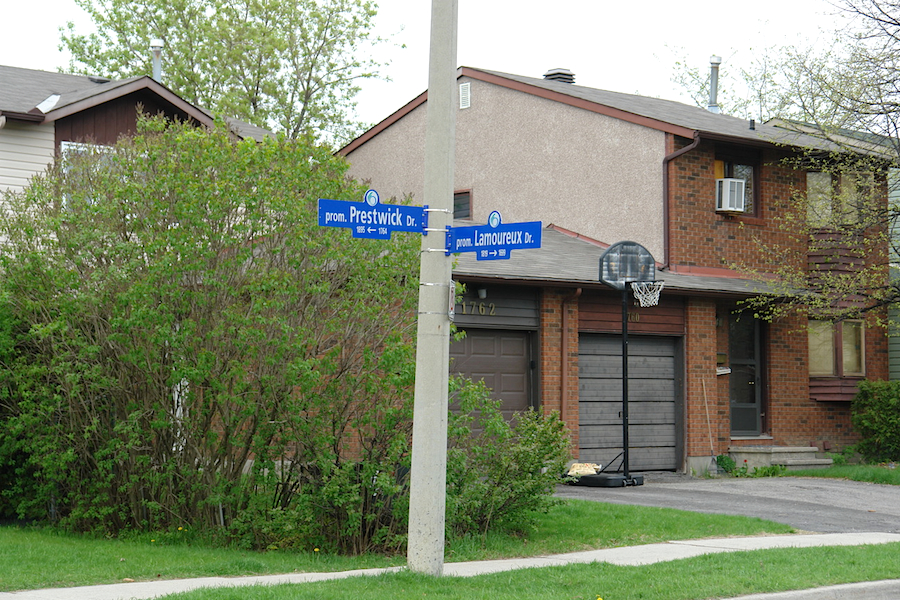
    Francophones and anglophones in peaceful coexistence: Prestwick and Lamoureux in the Fallingbrook neighbourhood

    Francophones and anglophones in peaceful coexistence: Prestwick and Lamoureux in the Fallingbrook neighbourhood

    New Institutions 

    In Orléans residents can live in French. The francophone community has established numerous institutions over the years to serve a wide range of community needs. Today Orléans is home to 12 French-language elementary schools, three high schools and a vocational institute that opened in September 2010, as well as many French-language daycare centres. Montfort Hospital will soon open the brand-new Orléans Family Health Hub offering a full range of primary and community healthcare services in both languages. Orléans’ francophones also enjoy access to a wide array of sports, leisure, culture or just plain fun activities en français. For example, around 150 francophone families register their children for soccer with Étoiles d’Orléans, either for the winter season (indoors in the gyms at Étoiles de l’Est and Béatrice Desloges schools) or for the summer (on the field at École les sentiers). This nonprofit organization expressly targets young francophones and offers them a complete team sports experience—including practices, games, tournaments and social gatherings for parents and volunteers—in their own language. Orléans also offers many French-language events at the new Shenkman Arts Centre, programmed by Mouvement d’implication francophone d’Orléans (MIFO). 

    Artist’s rendition of the Lower Lobby Reception Space of the Shenkman Arts Centre
    Artist’s rendition of the Lower Lobby Reception Space of the Shenkman Arts Centre

    MIFO was created in 1979 by a handful of francophone residents concerned by the influx of anglophones into the suburb. Since then the organization has become the focal point for the francophone community. The cultural centre founded on Carrière Street in 1983 remains MIFO’s nerve centre and home to most activities in addition to a theatre (Théâtre du Village), seniors’ centre (Centre Séraphin-Marion d’Orléans), and bookstore (Librairie du Vermillon). The organization also operates a music school: in 2011 it welcomed over 300 students of all ages and abilities for singing, piano, guitar, bass and recorder lessons. Throughout its existence MIFO has been unflagging in its commitment to promoting French-language culture and its expression in Orléans.

    Institutions both old and new—including a new parish of Sainte-Marie d’Orléans which was founded in 1987 and opened a new church in 1998—help shape the francophone social milieu. These institutions are critical to the survival of the francophone community as their surroundings and way of life undergo a fundamental shift. 

    A Divided Landscape 

    Saint-Joseph Church, the Chevaliers de Colomb, Caisse populaire Desjardins, and Orléans’ other francophone institutions line Saint-Joseph Boulevard. A good number of francophone professionals (lawyers, accountants, doctors, insurance brokers) also operate in “the village,” as do many francophone-owned businesses, some of which have served customers in French for generations. These businesses help maintain the “village” feel, a living bridge to the rich history of the local francophone community. 

    The future for bilingual signs in Orléans looks bright: an example at Lapointe Seafood Grill

    The future for bilingual signs in Orléans looks bright: an example at Lapointe Seafood Grill

    Further south, though, a whole other Orléans can be found. Here the traditional and varied face of the older neighbourhoods gives way to the big box stores typical of North-American suburbs. New development is concentrated along Innes Road, a kingdom of mega malls stretching several kilometers from east to west. All the big name stores that have risen to national prominence in the last few years are there, from HomeSense to Rona, Winners to Future Shop. In contrast with the “old village,” the French language is much less visible in this “new Orléans.” Street names, parks and public buildings offer no hint of the French presence, an issue that concerns the newly minted Société franco-ontarienne du patrimoine et de l’histoire d’Orléans. Still, there is life in French on Innes Road, as shown by Caisse populaire Orléans’ decision to open a branch. Lapointe Fish, an Ottawa institution, has also opened a shop in the new Orléans. The Ste Marie Health Centre, home to a number of francophone doctors and pharmacists hailing from other countries, advertises itself as a bilingual facility. Finally, Empire Theatres, a major national chain, hosts the Festival du film francophone d’Orléans, while Objectif cinéma shows two French-language films per month year-round to large audiences.

    French Language Signage: An Ongoing Challenge 

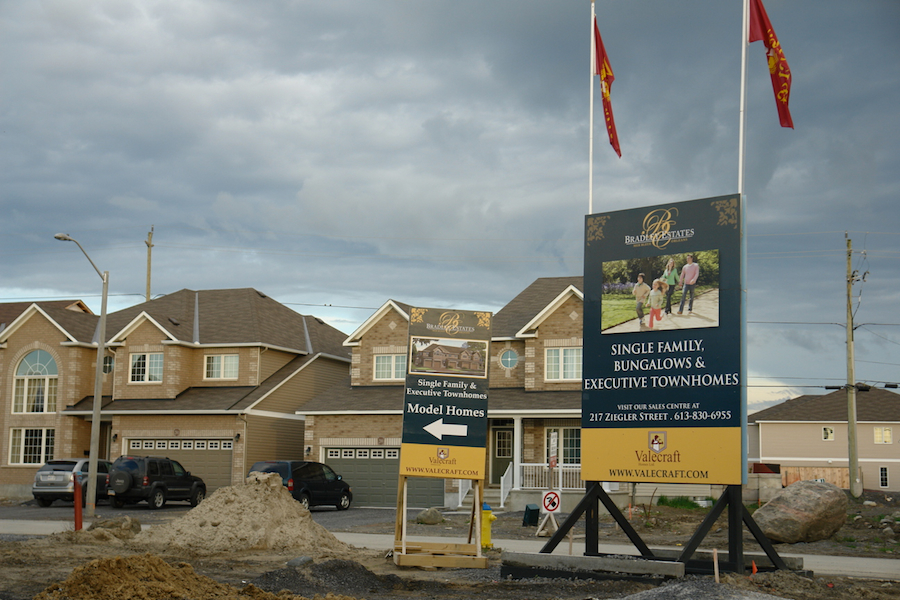
    New development

    New development

    Those who go looking for French-language signs in Orléans face disappointment. The studies are unanimous: French is largely absent from the face of this bedroom community. With the exception of the bilingual signs at federal, provincial and municipal institutions (in the last case, the result of the City of Ottawa’s bilingualism policy), and at various businesses in the old village, unilingual English signage predominates throughout Orléans. No sector is immune, from automotive services to furniture stores to interior decorators to sports and leisure centres—even personal services. The same goes for the stores at Place d’Orléans, a major mall adjacent to the village. Throughout the commercial landscape, only a few businesses (like oil companies) persist in showing a French face to the public.

    Not even the Orléans Chamber of Commerce or the developers who so avidly court new residents bother to include French on their signs. Their websites are also in English only, with the notable exception of Brigil, a well-known Gatineau contractor and developer. No one seems interested in promoting the concept of living en français. While many boast of Orléans “quality of life,” it appears that culture is not part of the equation—though some Franco-Ontarians may beg to differ.

    Poster promoting MIFO’s 2011–2012 programming
    Poster promoting MIFO’s 2011–2012 programming

    Living Together, Getting Along 

    Orléans’ francophones seem unphased by this linguistic imbalance in commercial signage. They have by and large adopted the same behaviours as Franco-Ontarians elsewhere, using French or English depending on the circumstances. Most are so bilingual that they can effortlessly and comfortably pass from one language to another in the course of a conversation. This behaviour attests to a veritable “bilingual identity” that has been described by studies on this community.

    While language may be an issue for a number of Franco-Ontarian organizations in Orléans, it is not a bone of contention for them, any more than it is for individual citizens. Orléans is a place where francophones and anglophones live, work and play together in harmony. MIFO, among other groups, has become much less confrontational since 2010 when its new status as a charitable organization forced it to sideline political actions. Orléans exemplifies a new way to live in French in Ontario, one characterized more by a desire to work together with the anglophone majority than to make demands and fight to achieve them.

    A Promising Future for a Thriving Franco-Ontarian Community 

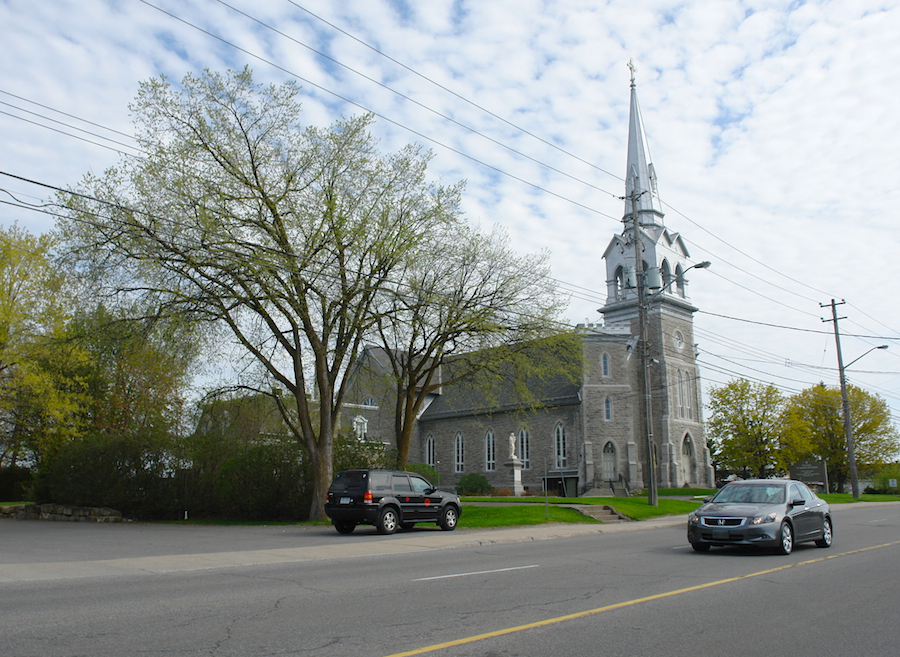
    St-Joseph Church in Orléans, a suburb of Ottawa

    St-Joseph Church in Orléans, a suburb of Ottawa

    Orléans is unusual for the diversity of opportunities and elements it makes available to the francophone community, like so many threads that can be woven into a new cultural fabric and identity. On the one hand the suburb abounds in geographical markers reminding francophones of the more traditional side of their identity: their French origins and Catholic past, as well as the sometimes epic battles their parents fought to establish the French-language institutions vital to living their everyday lives in their own language. On the other hand Orléans’ public spaces show the signs of a resolutely contemporary francophone culture and community characterized by openness to others (both francophone and francophile alike) and intercultural exchange. Orléans is attracting an increasing number of francophone immigrants, who in turn are transforming the culture from within. Today, the suburb that was once a village reconciles both sides of this identity, fuelling diverse manifestations of the Franco-Ontarian imagination. In this way Orléans plays an integral role in the renewal of the Franco-Ontarian community and constitutes a clear sign of its bright future.

    ——–

    This piece is courtesy of the Encyclopedia of French Cultural Heritage in North America.

    ——–

    Bibliography

    Farmer, Diane (1996) Artisans de la modernité : les centres culturels en Ontario français. Ottawa, Les Presses de l’Université d’Ottawa. Le chapitre 7 porte sur le MIFO, « entre francité et urbanité ».

    Gilbert, Anne (1999) Espaces franco-ontariens. Ottawa, Le Nordir.  Le chapitre 5, intitulé « Ville et banlieue » est consacré à une comparaison entre Vanier et Orléans.

    Gilbert, Anne, sous la direction de (2010) Territoires francophones. Études géographiques sur la vitalité des communautés francophones du Canada. Québec, Septentrion. Le chapitre 5 porte sur le paysage linguistique en Ontario français, avec des allusions à celui d’Orléans. Le chapitre 13 porte sur un éventail de communautés franco-ontariennes, dont Ottawa.

    Orléans, 150 ans d’histoire. 1860-2010. Comité du livre du 150e anniversaire d’Orléans, 2010.

    Orléans, Publi-reportage Le Droit, 24 novembre 2010

    Secteur Orléans, Cahier publicitaire Le Droit, 5 avril 2011

  • Special Report: Census 2011: Urban Dispersion in Canada

    Canada now has fastest-growing population in the G-8 (Note 1), according to the results of the 2011 census, released last week. Canada’s growth rate from 2006 to 2011 exceeded that of the United States by nearly one-third and is nearly one half greater than just a decade ago. The population rose from 31.6 million in 2006 to 33.5 million in 2011.

    The move west continues. For the first time in history, the provinces west of Ontario (Manitoba, Saskatchewan, Alberta and British Columbia) account for more population than the provinces east of Ontario (Quebec, New Brunswick, Nova Scotia, Prince Edward Island and Newfoundland). Two-thirds of the growth was due to immigration, a development cited in a census editorial by the Toronto Star as a solution to the nation’s fertility deficit.

    … we need to make more babies. But we are not, to the extent we need to. Canada’s birth rate of 1.67 children per woman is well below the minimum of 2.0 required. Therefore, we need to get more immigrants, which we are.

    The Major Metropolitan Areas

    Canada’s six major metropolitan areas (over 1,000,000 population) grew even half again as quickly as the nation — 9.3% over five years. Within these metropolitan areas, the pattern of urban dispersion continued, with 83% of the population increase in the largest metropolitan areas (Toronto, Montréal and Vancouver) occurring outside the central municipalities. For the first time, the population in the suburbs of "905" (so-called for its area code), exceeded the population of the amalgamated municipality of Toronto. Similarly, for the first time, the island of Montréal (this includes the ville de Montréal and other municipalities) had a smaller population than the rest of the metropolitan area. According to the The Gazette:

    Most of the people who leave the 514-area (the island -ed) for the 450 (off the island -ed) do so reluctantly. They are often young people with children (or who hope to have children). They enjoy the city’s stimulation and its proximity to workplaces, shopping and entertainment. But they leave because there’s not enough suitable housing in their price range. The taxes are also high and services spotty. Not the greatest place to to raise a family.

    Dispersion continued in Ottawa- Gatineau, Calgary and Edmonton, though not as obvious because most suburban areas are inside these proportionately larger central municipalities. Even so, 56% of the growth in the six major metropolitan areas was outside the central municipalities (Table 1).

    Table 1
    Metropolitan Area Population Trend:
    Central Municipalities & Peripheral Municipalities
    Population (000) Change (000)
    Central Muncipality Surrounding Muncipalities Metropolitan Area Central Muncipality Surrounding Muncipalities Metropolitan Area
    Toronto         2,615            2,968          5,583            112               358             470
    Montreal         1,650            2,175          3,824               29               160             189
    Vancouver            604            1,710          2,313               25               171             197
    Ottawa-Gatineau            883               353          1,236               71                 31             103
    Calgary         1,079               136          1,215               90                 28             118
    Edmonton            812               348          1,160               82                 43             125
    Total         7,643            7,689       15,332            410               791          1,201
    Change in Population Share of Growth
    Central Muncipality Surrounding Muncipalities Metropolitan Area Central Muncipality Surrounding Muncipalities Metropolitan Area
    Toronto 4.5% 13.7% 9.2% 23.8% 76.2% 100.0%
    Montreal 1.8% 7.9% 5.2% 15.3% 84.7% 100.0%
    Vancouver 4.4% 11.1% 9.3% 12.9% 87.1% 100.0%
    Ottawa-Gatineau 8.8% 9.8% 9.1% 69.4% 30.6% 100.0%
    Calgary 9.2% 25.5% 10.8% 76.7% 23.3% 100.0%
    Edmonton 11.2% 14.1% 12.1% 65.5% 34.5% 100.0%
    Average 6.6% 13.7% 9.3% 43.9% 56.1% 100.0%


    Urban Core Analysis

    Recent amalgamations and aggressive annexation policies make more difficult an analysis of the growth between urban cores and more suburban areas. Only one of the six central municipalities retains boundaries that reflect the core urbanization that preceded the explosive automobile-oriented suburban expansion (Table 2). The same situation exists in US metropolitan areas, where only 19 of the 51 largest metropolitan areas have central municipalities with boundaries that have remained relatively constant over the past 60 years (see Suburbanized Core Cities).

    Table 2
    Metropolitan Area Population Trend:
    Urban Core & Outside
    Change in Population Change (000)
    Urban Core Outside Metropolitan Area Urban Core Outside Metropolitan Area
    Toronto            703            4,880          5,583               45               425             470
    Montreal            930            2,894          3,824                 9               180             189
    Vancouver            604            1,710          2,313               25               171             197
    Ottawa-Gatineau            218            1,019          1,236                 7                 96             103
    Calgary            128            1,087          1,215                 4               114             118
    Edmonton            123            1,037          1,160                 2               123             125
    Total         2,705          12,626       15,332               92           1,109          1,201
    Change in Population Share of Growth
    Urban Core Outside Metropolitan Area Urban Core Outside Metropolitan Area
    Toronto 6.8% 9.5% 9.2% 9.5% 90.5% 100.0%
    Montreal 0.9% 6.6% 5.2% 4.6% 95.4% 100.0%
    Vancouver 4.4% 11.1% 9.3% 12.9% 87.1% 100.0%
    Ottawa-Gatineau 3.2% 10.4% 9.1% 6.6% 93.4% 100.0%
    Calgary 3.0% 11.8% 10.8% 3.1% 96.9% 100.0%
    Edmonton 2.0% 13.4% 12.1% 1.9% 98.1% 100.0%
    Average 3.4% 10.5% 9.3% 6.5% 93.5% 100.0%
    Urban core based upon federal electoral districts (see text)


    The core versus suburban trends are better illustrated by examining areas more representative of the historic cores. This following analysis uses federal electoral districts that roughly conform to the urban cores as they existed in the early 1950s, at the beginning of the automobile oriented expansion. Federal electoral districts generally had a population of approximately 100,000 in 2006.

    Toronto: The Toronto metropolitan area grew 9.5%, adding 470,000 new residents.

    The central municipality of Toronto contains considerable post World War II suburban development, as a result of a late 1990s municipal amalgamation imposed by the provincial government. Federal electoral districts (Note 2) that roughly match to the former municipality of Toronto’s early 1950s boundaries grew 45,000, from a population of 658,000 in 2006 to 703,000 in 2011. This 6.8% increase represents some of the strongest growth in 80 years, though the population of the former municipality tended to hover between 600,000 to 700,000. The core growth between 2006 and 2011 was concentrated in the Trinity-Spadina and Toronto Centre electoral districts, where the population rose 38,000 (16%). These two districts have grown strongly as a result of Toronto’s high rise condominium boom. The balance of the urban core grew only 2%.

    Areas outside the core added 425,000 population, nearly 10 times the increase of the core. The percentage increase was also stronger, at 9.5%. Approximately 85% of this region’s growth was outside the municipality of Toronto, which The National Post characterized as explosive.

    Montréal: Montréal was the slowest growing major metropolitan area, at 5.9%, adding 189,000 new residents.

    Like Toronto, expansion of Montréal’s municipality boundaries include considerable amounts of post-war development. Yet the core of the ville de Montréal has become considerably less dense. In 1951, the ville de Montréal had a population of 1,022,000 people in 131 square kilometers. By1996 (before an amalgamation), the population had dropped to 1,017,000 in 186 square kilometers. This represents a 30% loss in density. Between 2006 and 2011, nine federal electoral districts (Note 3) in the urban core experienced 0.9% population growth from 922,000 in 2006 to 930,000 2011. No significant densification was evident in these districts.

    The areas outside the core added 180,000 people, 95% of the population growth. Nearly 90% of this growth was outside the ville de Montréal.

    Vancouver: The Vancouver metropolitan area grew 9.3% between 2006 and 2011 and, despite all the popular literature about the city’s “smart growth” policies, most growth was dispersed. "The population of the City of Vancouver, the urban core, is flat-lining or even declining notes the Globe and Mail. In contrast, "Surrey, Coquitlam and … Port Moody are growing fast — shifting Metro Vancouver’s centre of gravity east." The Vancouver Sun reported that suburban Surrey would surpass the population of the municipality of Vancouver in the next decade (Note 4).

    The municipality of Vancouver has retained virtually its early 1950s boundaries. The municipality grew 4.4% from 2006 to 2011, adding 25,000 residents. One -half the growth was in the densifying Vancouver-Centre electoral district, which includes downtown and English Bay. The rest of the core municipality grew at only one-fourth the rate of downtown. Despite the downtown gains, the suburbs accounted for 87% of the metropolitan area growth. Seven new suburban residents were added for every new resident in the municipality of Vancouver.

    Ottawa-Gatineau:  The Ottawa-Gatineau metropolitan area straddles the Ontario-Québec border, with the national capital in Ottawa. Ottawa-Gatineau added 9.1% to its population between 2006 and 2011, rising to 1,236,000.

    A 1990s amalgamation brought much of the former suburban area into the central municipality. Two federal electoral districts (Note 5) that are representative of the urban core grew 3.2%, from 211,000 to 217,000. Areas outside this core grew 10.4%, from a population of 923,000 to 1,019,000. Non-core area growth accounted for 94% of the metropolitan area’s population growth.

    Calgary: The Calgary metropolitan area grew 12.6%, to a population of 1,215,000 (Note 6). Calgary is one of the world’s most successful post World War II metropolitan areas. Like Edmonton, Phoenix and San Jose, Calgary has virtually no pre-automobile core. However, uncharacteristic for a new metropolitan area, Calgary has developed one of the strongest central business districts – largely due to the oil industry – in North America, and Emporis ranks Calgary’s skyline as 57th in the world, just ahead of Seattle.

    The core federal electoral district (Calgary-Centre), the most dense in the Calgary metropolitan area, experienced growth of 3.0% from 2006 to 2011. This district is comparatively large in land area, but has a   population density one-third that of Vancouver-Centre. All of the electoral districts surrounding Calgary-Centre have much lower densities.

    Most of the growth occurred the northern and western portion of the municipality of Calgary and beyond. Overall, the population growth rate outside the core electoral district was 11.8%. Non-core areas of the Calgary metropolitan area accounted for 97% of the growth.

    Edmonton: Like Calgary, Edmonton is a post-World War II metropolitan area. The Edmonton metropolitan area added 12.1%, to its population, growing to 1,160,000. The core Edmonton-Centre electoral district, the most dense in the metropolitan area, grew only 2.0%, from 121,000 to 123,000. This district has less than one-quarter the density of Vancouver-Centre. Areas outside the core grew 13.4% from 914,000 to 1,037,000. The non-core areas accounted for 98% of the area’s growth. Some of the greatest growth was in the western half of the municipality of Edmonton.

    Suburban Gains Dwarf Core Densification

    Toronto and Vancouver are experiencing significant increases in downtown populations. But the base is so small that these gains are dwarfed by the scale of suburban population increases. At the same time, central municipality areas outside downtown have lagged. Thus, the 2011 census shows that across Canada, urban dispersion continues, results similar to recent results from the United States as well as a number of major metropolitan areas in the both the developed and the developing world. More than 93% of growth was outside the urban cores.

    Wendell Cox is a Visiting Professor, Conservatoire National des Arts et Metiers, Paris and the author of “War on the Dream: How Anti-Sprawl Policy Threatens the Quality of Life

    ————

    Note 1: The G-9 includes Canada, France, Germany, Italy, Japan, the Russian Federation, the United Kingdom, and the United States.

    Note 2: Toronto Centre, Toronto-Danforth, Trinity-Spadina, Parkdale-High Park, Davenport and St. Paul’s.

    Note 3: Westmount-Ville Marie, Mount Royal, Notre-Dame-de-Grâce – Lachine, Outremont, Papineau, Ahutsic, Jeanne-Le Ber, Laurier-Sainte-Marie and Rosemont-La Petite-Patrie

    Note 4: If Surrey exceeds Vancouver in population, it is to be wondered if Canada’s third largest metropolitan area will be called Surrey instead of Vancouver. A similar displacement of the historic core municipality occurred in the United States when the population of Norfolk was exceeded by suburban Virginia Beach, with the first name of the metropolitan area changing accordingly.

    Note 5: Ottawa-Centre and Ottawa Vanier

    Note 6: This 12.6% figure differs from the 10.8% in Tables 1 & 2, which is calculated using actual data reported by Statistics Canada. Statistics Canada indicates that the data "excludes census data for one or more incompletely enumerated Indian reserves or Indian settlements."

    Photo: Condominium buildings and the CN Tower, Downtown Toronto (by author)

  • Sex, Singles And The Presidency

    By all accounts both President Barack Obama and his likely challenger, former Massachusetts Gov. Mitt Romney, are ideal family men, devoted to their spouses and their children. But support for the two men could not be more different in terms of the electorate’s marriage and family status.

    An analysis comparing the results of the 2008 election and the most recent Gallup surveys with data by demographer Wendell Cox   shows a remarkable correlation between the states and regions with the highest proportion of childless women under 45 –  the best indicator of offspring-free households — and the propensity to vote Democratic. Overall, the most child-free regions were nearly 85% more likely to vote for Obama in 2008. And according to the most recent Gallup survey, they are  similarly inclined to vote Democratic today.

    At the top of the list, with 80% of its women under 45 without children, stands the rock-solid blue District of Columbia. Just behind that taxpayer-financed paradise the six states with the highest percentages — Massachusetts, New York, Rhode Island, Hawaii, Vermont and California — also skew Democratic.  In each of these states the percentage of childless women exceeds 55%.

    The highest percentage of offspring-free women under 45 can be seen as well  in such Democratic metropolitan areas as Boston, San Francisco, Los Angeles, San Diego and New York In each of these metropolitan areas  the percentage of childless woman reached a minimum of 60%  well above the national average of 53%. In the urban cores of these regions the percentage can approach Washington’s 80% figure. To a large extent, childlessness correlates with high density and a less affordable housing stock.

    The top child-bearing regions are almost all deep-red Republican, both in 2008 as well as today. The top five child-bearing states — Mississippi, Idaho, Wyoming , Oklahoma and Arkansas — all generally tilt toward the GOP. So do the metropolitan areas that have the lowest percentages of childless women:  the Texas metros of Dallas-Fort Worth, San Antonio and Houston, Mormon stronghold Salt Lake City and Memphis.  The next five include right-leaning Indianapolis, Charlotte, Louisville, Riverside-San Bernardino and Oklahoma City.

    These numbers would be more striking if not for the somewhat higher propensity for child-bearing among African-Americans and Latinos, two core Democratic constituencies. As other surveys have shown, Republicans gains in recent years have come largely  from married white families. In contrast, Democrats have lost the support of married people overall  since 2008, even while gaining among the unmarried. If Republicans can lose their obsession with opposing homosexual families, they might even garner additional support.

    A growing part of the Democratic base — aside from ethnic minorities — consists of white, childless couples and, in particular, single women. There’s much good news for Democrats here. According to the pro-Democratic advocacy group Women’s Voices, Women Vote, almost two-thirds of this demographic group voted for John Kerrey in 2004; in 2008 they went for Obama by nearly 70%. In 2010, a generally unfavorable political climate for Democrats, unmarried women helped power Democratic victories, particularly in Colorado and California, in the latter case against female Republican candidates.

    Demographically, at least in the short and even medium term, betting of singles and the childless couples seems like a no-brainer. In the past 30 years the percentage of women aged 40 to 44 who have never had children nearly doubled to 19%. At the same time singletons of both sexes are on the rise, numbering over 31 million strong today, up from 27 million in 2000,a growth rate nearly double that of the overall population.

    The increasing role of the childless may already be shifting the Democratic Party toward the kind of post-familalistic secularism generally associated with Europe or parts of East Asia.  This could partly explain why the Obama Administration has been so willing to challenge the Catholic Church — a traditional home to many working class Democrats — on the issue of offering contraception to its employees. Simply put, in Democratic calculations, secular singletons may now outweigh religious Catholic Democrats.

    The importance of singlehood and childlessness is amplified by location. The greatest bastions of non-families are found in the centers of the country’s media, cultural and intellectual life. Single households already constitute a majority in Manhattan and Washington, and they are heading in that direction in Denver, Seattle and San Francisco.

    The growing self-confidence of these post-familial constituencies is evident  in recent articles and books hailing not only the legitimacy but even the preference of this lifestyle option. Kate Bollick’s much celebrated and well-argued portrayal in the Atlantic of attractive matchless, and childless, 40-something females celebrates the coming of age of this new perspective on family life.

    Bollick , citing the degraded condition of today’s males, openly embraces “the end of traditional marriage as an ideal.”  One of her heroines, California psychologist Bella DePaulo, dismisses the traditional family unit as a kind of mental malady she labels “matrimania.” Oh well, there goes the primary basis for four thousand years of civilization.

    The Atlantic piece serves as a kind manifesto for this key emerging  Democratic constituency. But it’s not just single women now swarming into the Democratic Party. NYU Professor Eric Klineberg’s recent ode to singleness in the New York Times follows a similar narrative, but has room for left-leaning male singletons as well. This  trend is even more pronounced in demographically disintegrating  Europe, a fact that only increases its appeal to the sophisticated denizens of the single zone.

    Are there any risks to Democrats — and advantages to Republicans — in this new post-familial tilt? Author and New America fellow Phil Longman argues that in the long run  the  “greater fertility of conservative segments of society” could allow the palpably brain-dead GOP to inherit the country. Childless singletons may be riding high now, he writes, but as non-breeders their influence ends with their own lifespans.

    To win the future, according Democratic activists and millennial chroniclers Morley Winograd and Mike Hais, Democrats must all appeal to the next generation of families. Many of today’s childless millennials are still under 30 and plan to have kids, according to Hais and Winograd’s survey research. Reflecting their own experience with divorce as children, 50% consider being a good parent their highest priority in life. A strong plurality also see themselves ending up in the suburbs.

    That means Democrats could pay a big price for disdaining homemakers, the often unaesthetic chores of child-raising and particularly suburbia, because that’s precisely the place where many of today’s urban millennials will likely end up in the next decade.

    To address the future millennials, Democrats don’t need to adopt the often Medievalist views of their Republican rivals. But they will have to craft a message that appeals to  a demographic that looks, at least somewhat, like the current First Family.

    This piece originally appeared in Forbes.com.

    Joel Kotkin is executive editor of NewGeography.com and is a distinguished presidential fellow in urban futures at Chapman University, and contributing editor to the City Journal in New York. He is author of The City: A Global History. His newest book is The Next Hundred Million: America in 2050, released in February, 2010.

    Official White House Photo by Lawrence Jackson.

  • 2011 Canada Census: Strong Growth & Suburbanization Continues

    Statistics Canada has just released the first results of the 2011 census. The nation’s population rose to 33.5 million, from 31.6 million in 2006. This is a 5.9 percent growth rate, up from a 5.4 percent rate between 2001 and 2006 and nearly one-half above the 4.0 percent growth rate from 1996 to 2001.

    Suburbanization continued apace in Canada’s largest metropolitan areas. Overall, the suburbs accounted for 83 percent of the population growth in Toronto, Montreal and Vancouver, with 17 percent of the growth in the central municipalities. In the other major metropolitan areas (Ottawa-Gatineau, Calgary and Edmonton), the central municipalities themselves encompass nearly all of the suburban development, so that the core-suburban population increase proportion is masked.

  • Debating Higher Ed: STEMs, Skills, Humanities, and Hiring

    Forget about all the perceived problems with the American higher education system, and ponder these two numbers: 12.8 million and 3.4 million.
    The first is the estimate of Americans actively looking for work and unemployed. The second is the number of job openings in the U.S. as of the end of December, according to the Labor Department.

    There are jobs to be had, and plenty of people to fill them – if only they had the right skills. But this is not yet another article on the nation’s well-documented skills mismatch (at least not directly). Rather, it’s on the educational component of this debate, which was recently brought to the surface in a new Georgetown study on the unemployment rates analyzed by students’ major field of study in college, and by columnist Virginia Postrel’s response to it for Bloomberg.

    Georgetown’s Center on Education and the Workforce, analyzing 2009-10 data on graduates from the Census Bureau’s American Community Survey, showed that the worst job prospects are for students coming out of architecture programs (13.9% unemployment), followed by arts (11.1%), humanities and liberal arts (9.4%), social science (8.9%), and law and public policy (8.1).

    Postrel acknowledges some of Georgetown’s findings but goes right at those who think the US needs students to be more career-minded. Looking at national education stats, she argues most Americans are already choosing a college major based on the prospects of landing a job upon graduation. And if the supply of "practical" workers increases, Postrel warns, the quality of the workforce will deteriorate and wages will be lower.

    “Contrary to what critics imagine,” she writes, “most Americans in fact go to college for what they believe to be ‘skill-based education.’ A quarter of them study business, by far the most popular field, and 16 percent major in one of the so-called Stem (science, technology, engineering and math) fields. Throw in economics, and you have nearly half of all graduates studying the only subjects such contemptuous pundits recognize as respectable.” Further, Postrel says those who argue for initiatives to push students in STEM fields – or away from liberal arts – disregard “the diversity and dynamism of the economy, in good times as well as bad.”

    So what’s better? Would the U.S. be better off if more students took a broad-based liberal arts approach to their education, or should more be concerned with learning a specific trade or set of skills?

    Postrel cited the National Center for Education Statistics’ report entitled "2008-09 Baccalaureate and Beyond Longitudinal Study" (PDF here), which looked at graduates from the 2007-08 academic year. Two points should be made on this study: 1) the economy and employment prospects related to certain programs have changed drastically since 2007-08, and 2) the report includes only bachelor’s degree recipients.

    With this in mind, EMSI tapped into the NCES database to get a more recent and thorough picture of the most popular programs areas for recent US grads. We looked at the total number of degrees given out in 2010 (the most recent year available from NCES) at the associate’s, bachelor’s, master’s, and doctorate level among major program categories.

    Our analysis includes degrees at the four main postsecondary levels mentioned above, not certificates or postsecondary awards. We did this to better reflect graduates who have made a more-than-one-year investment in education and have therefore given their decision serious thought.
    A few noteworthy items (see the full data here):

    • Humanities majors account for 12% of graduates in the study Postrel used; according NCES’ latest data, which uses slightly different program classifications, 9.6% of all degrees came in liberal arts and sciences, general studies and humanities. One reason for the lower percentage could be that we included associate’s degrees (as well as bachelor’s, master, and doctorate degrees) in our analysis and the NCES study looked only at bachelor’s degree holders.
    • Business, management, marketing and related programs make up the largest percentage of 2003 and 2010 degree recipients, just under 20% in both years. Postrel said a quarter of all degrees came in business (per the NCES study, it’s 23%).
    • Health professions and related programs made the biggest jump among major program categories — from 9.2% of all degree recipients in 2003 to 12.7% in 2010–and now stands No. 2 overall. The biggest reason for this has been the dramatic increase in registered nursing/LPN and medical assistant degrees (see more on the supply of RNs).
    • As a proportion of all degrees, computer and information sciences took the biggest hit — from 4.6% (127,088) in 2003 to 2.7% (94,730) in 2010.

    These stats point to a few telling short-term shifts. Yes, a significant number of all degree recipients have moved toward skill-based education. But more striking is the decline in students choosing STEM majors as a share of all graduates. In 2003, 21% of degrees awarded in the U.S. were from STEM-related programs. In 2010, that percentage dipped to 19%.

    Postrel would prefer students not be pigeonholed into going the skill-based route, even when it’s STEM-related. Yet it’s hard to ignore the illuminating data from Georgetown’s report: Recent grads in humanities and liberal arts have a 9.4% unemployment rate – lower than architecture, which has taken a beating with the construction downturn, but considerably higher than engineering (7.5%), business (7.4%), and especially health (5.4%).

    So, to go back to the question posed earlier, our economy would seem to be better off – or, to put it another way, unemployment would most improve — if more students earned a skills-based education over a liberal arts degree. At least in the short term, that appears to be the best solution to get people back to work. But outside training for a few fields, there’s no automatic path to a job. Even some new registered nursing grads – with nursing once seen as a lock to find a job – are having a hard time finding employment. And EMSI and others have written about the souring job prospects for lawyers.

    The Great Recession affected every industry in one way or another. Nonetheless, it’s worth repeating: There are 3.4 million jobs openings out there – 39% more than in June 2009. But in a sure sign that something is out of whack, hiring is only up 12% over that same time. 

    Flickr Photo by Jason Morrison: Ann Morrison gets her Masters of Science in Nursing, Pepper Pike, Ohio.

    Joshua Wright is an editor at EMSI, an Idaho-based economics firm that provides data and analysis to workforce boards, economic development agencies, higher education institutions, and the private sector. He manages the EMSI blog and is a freelance journalist. Contact him here.

  • How Lower Income Citizens Commute

    One of the most frequently recurring justifications for densification policies (smart growth, growth management, livability, etc.) lies with the assumption that the automobile-based mobility system (Note 1) disadvantages lower income citizens. Much of the solution, according to advocates of densification is to discourage driving and orient both urbanization and the urban transportation system toward transit as well as walking and cycling.

    Of course, there is no question but that lower income citizens are disadvantaged with respect to just about everything economic. However, there are few ways in which lower income citizens are more disadvantaged than in their practical access to work and to amenities by means of transit, walking and cycling. Indeed, the impression that lower income citizens rely on transit to a significantly greater degree than everyone else is just that – an impression.

    The Data: This is illustrated by a compilation of work trip data from the five-year American Community Survey for 2006 to 2010. In the nation’s 51 major metropolitan areas (more than 1,000,000 population), 76.3% of lower income employees use cars to get to work, three times that of all other modes combined (Figure 1).

    Admittedly, this is less than the 83.3% of all employees who use cars for the work trip, but a lot more than would be expected, especially among those who believe that transit is the principal means of mobility for low income citizens. Overall, 8 times as many lower income citizens commuted by car as by transit. In this analysis, lower income citizens are defined as employees who earn less than $15,000 per year, which is approximately one-half of the median earnings per employee of $29,701. .

    Perhaps most surprising is the fact that only 9.6% of lower income citizens used transit to get to work. This is not very much higher than the 7.9% of all workers in the metropolitan areas who use transit. (Table 1).  

    Table 1
    Work Trip Market Share: 2006-2010
    Lower Income Employees and All Employees
    Metropolitan Areas Over 1,000,000 Population
      Lower Income Employees
    All Employees Market Share Employees Earning Under $15,000 Annually Market Share
    Car, Truck & Van: Alone 56.72 73.4% 9.56 63.1%
    Car, Truck & Van: Carpool 7.67 9.9% 2.00 13.2%
    Car, Truck & Van: Total 64.38 83.3% 11.56 76.3%
    Transit 6.14 7.9% 1.46 9.6%
    Walk 2.19 2.8% 0.89 5.9%
    Other (Taxi, Motorcyle, Bicycle & Other) 1.34 1.7% 0.39 2.6%
    Work At Home 3.24 4.2% 0.85 5.6%
    Total 77.29 100.0% 15.16 100.0%
    In Millions
    Note: Median Earnings: $29,701
    Source: American Community Survey: 2006-2010


    Transit’s small market share has to do with its inherent impracticality as a means of getting to most employment. According to ground-breaking research by the Brookings Institution, low-income citizens could reach only 35 percent of jobs in the major metropolitan areas by transit in 90 minutes. In other words, you cannot get from here to there, at least for most trips. It is no more reasonable for lower income citizens to spend three hours per day commuting than it is for anyone else. A theoretical 90 minute one-way standard is no indicator of usable mobility. It is likely that only about 8 percent of jobs are accessible by lower income citizens in 45 minutes (Note 2) and 4 percent in 30 minutes.

    Automobility: Among the major metropolitan areas, lower income citizens use automobiles to get to work most in Birmingham (90.6%). Fourteen other metropolitan areas have lower income automobile market shares of 85% or more, including Charlotte, Detroit, Dallas-Fort Worth, Indianapolis, Jacksonville, Kansas City, Louisville, Memphis, Nashville, Oklahoma City, Raleigh, San Antonio, St. Louis and Tampa-St. Petersburg. As in all things having to do with urban transportation, there are two Americas: New York and outside New York. By far the lowest automobile market share for low income citizens is in New York, at 49.3%. The second lowest lower income automobile market share is in San Francisco-Oakland, at 63.1%. Washington and Boston are also below 70% (Table 2).

    Table 2
    Work Trip Market Share: Car, Truck or Van: 2006-2010
    Lower Income Employees and All Employees
    Metropolitan Areas Over 1,000,000 Population
      Lower Income Employees
    Metropolitan Area All Employees Employees Earning Under $10,000 Employees Earning $10,000-$14,999 All Under $15,000 (Combined)
    Atlanta, GA 88.3% 82.1% 83.8% 82.8%
    Austin, TX 87.2% 77.8% 82.3% 79.5%
    Baltimore, MD 85.9% 73.8% 77.7% 75.1%
    Birmingham, AL 94.6% 89.3% 92.6% 90.6%
    Boston, MA-NH 77.2% 66.4% 73.4% 68.5%
    Buffalo, NY 89.7% 79.8% 84.3% 81.3%
    Charlotte, NC-SC 90.9% 85.3% 88.5% 86.4%
    Chicago, IL-IN-WI 80.0% 73.0% 77.0% 74.4%
    Cincinnati, OH-KY-IN 91.2% 82.7% 87.9% 84.4%
    Cleveland, OH 87.3% 78.1% 84.3% 80.3%
    Columbus, OH 90.8% 80.3% 87.1% 82.6%
    Denver, CO 85.3% 76.9% 82.1% 78.9%
    Detroit. MI 93.1% 85.8% 89.9% 87.2%
    Dallas-Fort Worth, TX 91.5% 85.4% 88.7% 86.7%
    Hartford, CT 89.7% 76.8% 83.1% 78.8%
    Houston. TX 90.7% 83.6% 86.4% 84.7%
    Indianapolis, IN 92.6% 85.1% 90.2% 86.9%
    Jacksonville, FL 91.6% 85.4% 88.3% 86.5%
    Kansas City,  MO-KS 90.6% 85.2% 87.6% 86.2%
    Los Angeles, CA 84.7% 70.8% 74.1% 72.2%
    Las Vegas, NV 89.7% 80.0% 82.4% 81.0%
    Louisville, KY-IN 92.4% 85.6% 87.6% 86.3%
    Memphis, TN-MS-AR 93.3% 85.0% 89.6% 86.7%
    Miami, FL 88.3% 79.0% 80.9% 79.9%
    Milwaukee, WI 89.3% 78.0% 83.5% 79.8%
    Minneapolis-St. Paul, MN-WI 86.8% 76.9% 81.1% 78.2%
    Nashville, TN 92.0% 86.8% 89.5% 87.8%
    New Orleans, LA 90.0% 80.9% 83.8% 82.0%
    New York, NY-NJ-PA 57.6% 50.0% 48.1% 49.3%
    Oklahoma City, OK 93.1% 86.8% 90.8% 88.2%
    Orlando, FL 89.6% 79.7% 86.1% 81.8%
    Pittsburgh, PA 86.2% 77.9% 81.8% 79.2%
    Philadelphia, PA-NJ-DE-MD 82.1% 70.6% 76.2% 72.4%
    Phoenix, AZ 88.6% 80.5% 83.9% 81.8%
    Portland, OR-WA 81.6% 69.3% 75.1% 71.3%
    Providence, RI-MA 89.9% 79.9% 87.1% 82.3%
    Raleigh, NC 90.8% 84.0% 88.0% 85.4%
    Rochester, NY 89.9% 76.7% 87.0% 80.0%
    Riverside-San Bernardino, CA 90.6% 83.4% 87.1% 84.8%
    Richmond, VA 91.3% 83.2% 86.2% 84.2%
    Sacramento, CA 90.7% 80.8% 86.3% 82.9%
    San Antonio, TX 92.1% 85.7% 88.2% 86.6%
    San Diego, CA 85.9% 73.6% 79.9% 76.0%
    Seattle, WA 81.3% 72.4% 76.1% 73.7%
    San Francisco-Oakland, CA 72.4% 63.3% 63.4% 63.3%
    San Jose, CA 87.1% 74.3% 80.2% 76.4%
    Salt Lake City, UT 88.1% 79.6% 83.4% 81.0%
    St. Louis, MO-IL 91.1% 83.8% 88.6% 85.4%
    Tampa-St. Petersburg, FL 90.1% 84.1% 87.6% 85.5%
    Virginia Beach-Norfolk, VA-NC 89.8% 81.9% 81.8% 81.9%
    Washington, DC-VA-MD-WV 77.1% 67.8% 71.4% 69.0%
    Total: 51 Metropolitan Areas 83.3% 75.1% 78.3% 76.3%
           New York 57.6% 50.0% 48.1% 49.3%
          Outside New York 86.5% 77.8% 81.8% 79.3%
    Average of Metropolitan Areas 87.7% 78.9% 83.0% 80.4%
    Median 89.7% 80.0% 84.3% 81.8%
    Maximum 94.6% 89.3% 92.6% 90.6%
    Minimum 57.6% 50.0% 48.1% 49.3%
    Note: Median Earnings: $29,701
    Source: American Community Survey: 2006-2010


    Transit: It’s not surprising that New York has by far the highest transit market share among lower income commuters. However, New York’s lower income transit market share is only marginally higher than its market share among all commuters, at 31.5%, compared to 30.0% for the entire workforce. San Francisco-Oakland had the second highest lower income transit market share at 16.8%. Boston, Chicago, Philadelphia and Washington were also above 10%. The lowest transit market share among lower income citizens was 1.1% in Oklahoma City. Six other metropolitan areas had lower income transit market shares under 2.5%, including Birmingham, Indianapolis, Jacksonville, Nashville, Raleigh and San Antonio (Table 3).

    Table 3
    Work Trip Market Share: Transit: 2006-2010
    Lower Income Employees and All Employees
    Metropolitan Areas Over 1,000,000 Population
      Lower Income Employees
    Metropolitan Area All Employees Employees Earning Under $10,000 Employees Earning $10,000-$14,999 All Under $15,000 (Combined)
    Atlanta, GA 3.4% 5.6% 6.2% 5.8%
    Austin, TX 2.6% 5.9% 5.3% 5.6%
    Baltimore, MD 6.3% 9.8% 9.3% 9.6%
    Birmingham, AL 0.7% 1.8% 1.8% 1.8%
    Boston, MA-NH 11.9% 12.3% 13.3% 12.6%
    Buffalo, NY 3.7% 6.9% 5.8% 6.6%
    Charlotte, NC-SC 2.0% 3.5% 3.1% 3.3%
    Chicago, IL-IN-WI 11.4% 11.9% 12.5% 12.1%
    Cincinnati, OH-KY-IN 2.4% 4.3% 3.8% 4.1%
    Cleveland, OH 2.7% 5.3% 3.1% 4.5%
    Columbus, OH 1.7% 3.5% 3.8% 3.6%
    Denver, CO 4.6% 7.2% 7.2% 7.2%
    Detroit. MI 1.5% 3.5% 3.1% 3.3%
    Dallas-Fort Worth, TX 1.6% 2.6% 2.9% 2.7%
    Hartford, CT 2.8% 5.4% 5.0% 5.3%
    Houston. TX 2.6% 4.1% 4.3% 4.1%
    Indianapolis, IN 1.0% 2.6% 1.6% 2.2%
    Jacksonville, FL 1.1% 2.5% 2.4% 2.5%
    Kansas City,  MO-KS 1.7% 3.8% 3.4% 3.6%
    Los Angeles, CA 6.1% 11.7% 13.9% 12.6%
    Las Vegas, NV 3.6% 7.4% 7.6% 7.5%
    Louisville, KY-IN 2.2% 4.7% 3.7% 4.3%
    Memphis, TN-MS-AR 1.3% 3.3% 3.1% 3.3%
    Miami, FL 3.7% 7.9% 8.3% 8.1%
    Milwaukee, WI 3.7% 7.7% 7.4% 7.6%
    Minneapolis-St. Paul, MN-WI 4.6% 6.4% 6.4% 6.4%
    Nashville, TN 1.0% 1.8% 2.0% 1.9%
    New Orleans, LA 2.5% 5.0% 5.3% 5.1%
    New York, NY-NJ-PA 30.5% 30.0% 34.0% 31.5%
    Oklahoma City, OK 0.5% 1.3% 0.8% 1.1%
    Orlando, FL 3.9% 7.4% 5.9% 6.9%
    Pittsburgh, PA 5.8% 6.2% 6.4% 6.3%
    Philadelphia, PA-NJ-DE-MD 9.3% 12.2% 11.8% 12.1%
    Phoenix, AZ 2.2% 4.2% 4.9% 4.5%
    Portland, OR-WA 6.2% 9.3% 8.3% 8.9%
    Providence, RI-MA 2.6% 3.3% 3.2% 3.3%
    Raleigh, NC 0.9% 1.9% 2.1% 2.0%
    Rochester, NY 2.0% 4.8% 3.0% 4.2%
    Riverside-San Bernardino, CA 1.6% 2.7% 2.3% 2.6%
    Richmond, VA 1.9% 3.8% 4.4% 4.0%
    Sacramento, CA 2.2% 5.1% 4.6% 4.9%
    San Antonio, TX 1.3% 2.3% 2.8% 2.5%
    San Diego, CA 3.3% 6.9% 6.1% 6.6%
    Seattle, WA 8.2% 9.9% 10.5% 10.1%
    San Francisco-Oakland, CA 14.6% 15.8% 18.4% 16.8%
    San Jose, CA 3.3% 6.1% 6.0% 6.1%
    Salt Lake City, UT 3.2% 5.2% 4.5% 5.0%
    St. Louis, MO-IL 2.6% 4.8% 3.4% 4.4%
    Tampa-St. Petersburg, FL 1.4% 2.9% 2.3% 2.7%
    Virginia Beach-Norfolk, VA-NC 1.7% 3.8% 4.7% 4.1%
    Washington, DC-VA-MD-WV 13.9% 14.3% 15.8% 14.8%
    Total: 51 Metropolitan Areas 7.9% 9.4% 10.1% 9.7%
           New York 30.5% 30.0% 34.0% 31.5%
          Outside New York 5.1% 7.1% 7.4% 7.2%
    Average of Metropolitan Areas 4.3% 6.3% 6.3% 6.3%
    Median 2.6% 5.1% 4.7% 4.9%
    Maximum 30.5% 30.0% 34.0% 31.5%
    Minimum 0.5% 1.3% 0.8% 1.1%
    Note: Median Earnings: $29,701
    Source: American Community Survey: 2006-2010


    Automobile and Transit Metrics: The difference in automobile commuting between all employees and lower income employees turns out to be surprisingly small. The least variation is in Birmingham, where the automobile market share among lower income commuters is 4.3% below that of all commuters. Charlotte, Kansas City and Nashville also have lower income market share variations of less than 5%. The greatest variation is in Los Angeles, where the automobile market share among lower income commuters is 14.7% less than for all commuters. The lower income automobile market share is also at least 12.5% below that of all commuters in Baltimore, New York and Portland.

    Oklahoma City has the most lower income automobile commuters in relation to transit commuters, with 81.3 times as many lower income commuters using automobiles as opposed to transit. In Birmingham, Nashville and Raleigh, there are more than 40 lower income automobile commuters per transit commuter.  In contrast, the number of low-income automobile commuters in New York is 1.6 times that of lower income transit commuters. Again, New York is in a class by itself (Figure 2). Outside New York, there are 11.0 times as many lower income automobile commuters as transit commuters. San Francisco-Oakland (3.8) and Washington (4.7) are the only other metropolitan areas with fewer than five lower income automobile commuters per transit commuter (Table 4).

    Table 4
    Work Trip Market Share: 2006-2010
    Lower Income Employees and All Employees
    Metrics: Car, Truck or Van & Transit
    Metropolitan Areas Over 1,000,000 Population
    Lower Income Car, Truck or Van Market Share Compared to All Car Truck or Van Market Share Times Transit
    Metropolitan Area Employees Earning Under $10,000 Employees Earning $10,000-$14,999 All Under $15,000 (Combined)
    Atlanta, GA -7.0% -5.0% -6.3% 14.2
    Austin, TX -10.8% -5.5% -8.8% 14.1
    Baltimore, MD -14.1% -9.6% -12.6% 7.8
    Birmingham, AL -5.6% -2.1% -4.3% 50.7
    Boston, MA-NH -14.1% -5.0% -11.2% 5.4
    Buffalo, NY -11.1% -6.0% -9.4% 12.4
    Charlotte, NC-SC -6.1% -2.6% -4.9% 25.9
    Chicago, IL-IN-WI -8.8% -3.8% -7.0% 6.1
    Cincinnati, OH-KY-IN -9.3% -3.6% -7.4% 20.4
    Cleveland, OH -10.5% -3.3% -8.0% 17.7
    Columbus, OH -11.5% -4.0% -9.0% 23.1
    Denver, CO -9.8% -3.8% -7.5% 10.9
    Detroit. MI -7.8% -3.5% -6.4% 26.2
    Dallas-Fort Worth, TX -6.7% -3.0% -5.2% 31.7
    Hartford, CT -14.4% -7.4% -12.2% 15.0
    Houston. TX -7.9% -4.8% -6.6% 20.5
    Indianapolis, IN -8.1% -2.5% -6.2% 39.1
    Jacksonville, FL -6.8% -3.6% -5.6% 35.1
    Kansas City,  MO-KS -5.9% -3.4% -4.9% 23.7
    Los Angeles, CA -16.4% -12.4% -14.7% 5.7
    Las Vegas, NV -10.8% -8.1% -9.8% 10.8
    Louisville, KY-IN -7.4% -5.3% -6.6% 19.9
    Memphis, TN-MS-AR -9.0% -4.0% -7.1% 26.7
    Miami, FL -10.5% -8.4% -9.6% 9.9
    Milwaukee, WI -12.6% -6.5% -10.6% 10.5
    Minneapolis-St. Paul, MN-WI -11.4% -6.5% -9.8% 12.2
    Nashville, TN -5.7% -2.7% -4.6% 46.1
    New Orleans, LA -10.2% -6.9% -8.9% 15.9
    New York, NY-NJ-PA -13.1% -16.5% -14.4% 1.6
    Oklahoma City, OK -6.8% -2.5% -5.3% 81.3
    Orlando, FL -11.1% -3.9% -8.7% 11.8
    Pittsburgh, PA -9.7% -5.2% -8.2% 12.7
    Philadelphia, PA-NJ-DE-MD -14.0% -7.2% -11.8% 6.0
    Phoenix, AZ -9.1% -5.3% -7.6% 18.1
    Portland, OR-WA -15.1% -7.9% -12.5% 8.0
    Providence, RI-MA -11.1% -3.1% -8.4% 25.3
    Raleigh, NC -7.4% -3.1% -5.9% 42.8
    Rochester, NY -14.7% -3.3% -11.0% 19.1
    Riverside-San Bernardino, CA -8.0% -3.9% -6.5% 32.7
    Richmond, VA -8.9% -5.6% -7.7% 20.9
    Sacramento, CA -10.9% -4.8% -8.6% 17.0
    San Antonio, TX -7.0% -4.2% -6.1% 35.1
    San Diego, CA -14.3% -7.0% -11.5% 11.5
    Seattle, WA -10.9% -6.4% -9.3% 7.3
    San Francisco-Oakland, CA -12.5% -12.4% -12.5% 3.8
    San Jose, CA -14.7% -8.0% -12.3% 12.6
    Salt Lake City, UT -9.6% -5.3% -8.1% 16.3
    St. Louis, MO-IL -8.0% -2.8% -6.3% 19.6
    Tampa-St. Petersburg, FL -6.6% -2.7% -5.1% 31.8
    Virginia Beach-Norfolk, VA-NC -8.7% -8.9% -8.8% 19.8
    Washington, DC-VA-MD-WV -12.0% -7.3% -10.4% 4.7
    Total: 51 Metropolitan Areas -9.8% -6.0% -8.4% 7.9
           New York -13.1% -16.5% -14.4%                   1.6
          Outside New York -10.1% -5.5% -8.4% 11.0
    Average of Metropolitan Areas -10.1% -5.5% -8.5% 12.7
    Median -9.8% -5.0% -8.2%                17.0
    Maximum -5.6% -2.1% -4.3%                81.3
    Minimum -16.4% -16.5% -14.7%                   1.6
    Note: Median Earnings: $29,701
    Source: American Community Survey: 2006-2010


    A Line Driven in a Car: Why is this the case?  The "bottom line" has been perhaps best characterized by Marge Waller and Mark Allen Hughes in a research paper for the Progressive Policy Institute of the Democratic Leadership Council.

    In most cases, the shortest distance between a poor person and a job is along a line driven in a car. Prosperity in America has always been strongly related to mobility and poor people work hard for access to opportunities. For both the rural and inner-city poor, access means being able to reach the prosperous suburbs of our booming metropolitan economies, and mobility means having the private automobile necessary for the trip. The most important response to the policy challenge of job access for those leaving welfare is the continued and expanded use of cars by low-income workers

    Concerns about the automobile based urban transportation system excluding lower income citizens are misplaced. Despite all the hand-wringing, America’s lower income population has considerable access to cars and far greater mobility as a result. It is no more than a figment of planner’s imaginations that lower income citizens would be best served by constraining car use and trying to force them into transit service that more often than not gives circuitous, slower and often impossible for access to work opportunities.

    Wendell Cox is a Visiting Professor, Conservatoire National des Arts et Metiers, Paris and the author of “War on the Dream: How Anti-Sprawl Policy Threatens the Quality of Life

    —–

    Note 1: As used in this article, automobile includes cars, trucks and vans.

    Note 2: This estimate estimates lower income 45 minute access using the ration between 90 minute and 45 minute for all employees (as reported in the Brookings Institution report)

    Photograph: Classic early 1950s Buick, Sinsheim Auto & Technik Museum, Sinsheim, Baden-Württemberg, Germany (by author).

  • New Urbanism vs. Dispersionism

    The Florida real estate developer, unburdened of state regulatory agencies, may now focus his efforts on pleasing the investment community and the local market.  I recently played the role of real estate developer interviewing two consultant teams vying to help me create a new fictional community.  Fortified with readings in both the New Urbanist camp and the Dispersionist camp, each team of students pitched their method of community building to me. 

    The actual debate was very lively, with many rebuttals and some serious emotional engagement.  The premise:  I have a multi-acre greenfield property.   I have shortlisted my planning candidates down to two:  a New Urbanist team, and a Dispersionist team.  Each team must pitch their philosophy, and I will select one team to design it.

    Question 1:  Since I am only able to afford Phase 1, future phases will be left to future developers.  In your approach, can future generations be trusted to keep focus on high-quality development?  How would you guarantee that the property rises in value?  I asked the New Urbanists to go first.

    The New Urbanist team was ready:  As Master Planners, they will create the entire form-based vision for the property and design it around a smart code so that the future developers will obey a plan to keep property values rising.  No future developer will get to ‘cheap out’.  For this team, the Master Plan will guarantee a quality of life for all residents.

    The Dispersionists will plan Phase 1, not as a rigid image of a town, but rather as a response to the natural landscape.  This team said the community would grow organically, from its functional needs, guaranteeing  the freedom of future generations to plan their own destiny. They  scoffed at a Master Plan that determined the urban form.  What good is a guarantee of a quality of life, they asked, if future generations want something different than the Master Planner intended?

    This round, in my mind, went to the Dispersionists.  Their argument that future generations should have the freedom to plan based on their functional needs outweighed the seductive beauty of a Master Plan.  Too many Master Plans are implemented poorly, or abandoned due to their disutility based on changing needs and markets.

    Question 2:  How does your viewpoint deal with the car?  How will residents and visitors get around your community?  I asked the Dispersionists to go first this time.

    “Well,” replied the Dispersionists, “Americans love their cars, and we love the car too.  We’ll plan for sidewalks and bikes, but we know that the car is a necessity.  We know that a 5-minute walk isn’t so realistic in Florida’s hot, humid climate.”  The Dispersionists have a hearty regard for cars, and they spoke of long, sweeping curves and scenic drives.  They pointed out that most residents will need to drive to other parts of the city as well.

    The New Urbanists shuddered.  “We will plan for car-free living,” they stated.  With very clever planning, they intended to keep driving to a minimum, and will design walking trails.  One New Urbanist ventured 4-story parking garages, crowing that their proposal would not be littered with gas stations.  The New Urbanists pointed out the ugly commercial strips dominating our current city, and how little they want that to intrude into the new development.

    I liked this, and challenged the Dispersionists.  Isn’t it better health, and less use of oil, to reduce vehicle dependency?  The Dispersionists asked me why, in this ten-acre community, I thought I could attract residents with 4-story parking garages?  Good point, I thought.

    Both sides had good answers, and the question did not fully go to one side or the other.  Cars do tend to  generate a lot of aesthetic horror.  On the other hand, they are not going away anytime soon, so learning how to deal with them seems like an important task for a developer looking to the future.

    Question 3:  How would you distribute density in your development?  One center, multiple centers, and centered around what?  This time the New Urbanists went first.

    The core, they stated, will be in the center of town, and could go to 8-10 stories, leaving the perimeter a green zone.  In the center will be the government and institutional buildings, carefully matched with proper style.  The point, they said, is predictability. They pledged to learn from the failures of the past, and their Master Plan will account for the full scope of development.

    The Dispersionists suggested multiple centers.  “Phase 1 will be our first density cluster,” they said, “and we’ll see how it goes.”  Unlike the New Urbanists, they didn’t want to introduce all their product at once, in case the market changes.  “We believe in New England-style green space,” they said, and wanted to evolve the community around these.  They saw the vitality of the community coming from diversity.

    I asked the New Urbanists what they would do if the market changes .  When pressed, they insisted their Master Plan had plenty of contingency plans in case the original plan wasn’t workable, but it sounded like they were winging it.

    This is what  the Dispersionists saw as their own strong suit.  “We don’t have all the answers,” they said.  Their first phase would gently nudge the community in a certain direction, but it would leave future developers the choice whether to reinforce the first phase, or strike out and build another phase better suited to a unique need.

    I felt that this round went to the Dispersionists. 

    Question 4:  Do you think your development scheme can promote or discourage social values?  Why or why not?  This time the Dispersionists went first.

    The Dispersionists believed that one cannot engineer social values through urban design.  However, they can be influenced.  Conservation, for example, is a value that they would promote in their plan to conserve open space and not overtake the land with development.  A sense of community, they said, was another, giving people a loyalty to their community out of good design.  These, they felt, led to a sustainable plan.

    The New Urbanists guaranteed that conservation land would always be there, and pointed out the Dispersionists’ flexibility as a negative . The New Urbanists insisted that their sense of place would be stronger, because it would be designed.  People want predictability.  New Urbanists would engage people by walking and having front porches.

    The Dispersionists speculated that neighbors will get to know one another in a cul-de-sac just as well as they would if they all had front porches.  They also felt that the shared experiences of a community would transcend the particular style or form that community took.

    Although I gave this one to the New Urbanists, I was skeptical about  the New Urbanists’ implication that well-behaved buildings produce well-behaved people.  The Dispersionists’ view that a cul-de-sac breeds any neighborly closeness also seemed a bit disingenuous.  It was near the end of class.

    Question 5:  Give me your arguments why your strategy is sustainable.  I let the New Urbanists go first.

    For one thing, they said, they will have more efficient transportation. Vertical buildings save land, they argued, and people who choose this community will value open space more highly and be willing to live densely.  They believed that they will have less gridlock by de-emphasizing the car and will be more stable and socially cohesive.  All this will come from a well-designed Master Plan.

    The Dispersionists said  their community would start small and then grow.  Failures won’t cause dead zones, they claimed, because they are not sentimental about form and want a community that works.  So if a building in their development begets a failed business, the building will need to be reinvented to make it successful.

    “Yes, but,” countered the New Urbanists, “for every successful community like yours, there are 10 that have failed and ultimately decline in value.  What guarantee do you give that you will be the one out of ten?”  They went on to cite their successes – Seaside, Celebration, and so on.

    The Dispersionists noted that Seaside was a resort town and Celebration was heavily subsidized by a local employer, so those weren’t exactly good models.  In any case, they said, their community will appeal to a much broader segment of the population than the New Urbanists, and therefore more likely to sustain growth in the future.

    With that, the debate was concluded.  What lingers, however, are some truths that show both sides need to do some more work.

    The New Urbanists, fresh on the scene, seem overly evangelical in their approach, and demand a great deal of faith in the Master (Planner).  The slow, organically grown towns of which they are so fond were largely planned before the car.  While many of these towns, like Charleston, South Carolina, are sentimental favorites, their practical replication in today’s transportation-intensive, constantly changing real estate market is questionable.

    The Dispersionists, on the other hand, have been around for quite a long time, and are the modus operandi for much of the earth’s population.  They seem uninvolved in the aesthetics of the built environment, preferring to leave this up to individual taste, and the result is a rather shabby, cluttered contemporary American scene.  Some cleaning up is certainly in order.

    While the New Urbanists have a hopeful approach in this regard, they are overreacting to the vast consumer-oriented real estate development world that operated up until 2007, and are missing the fundamentals of how a real community works.  None are built around employers or economic producers in any significant way. None admit the lowest socioeconomic groups.  Content, perhaps, to dabble with shopping districts and farmer’s markets, New Urbanists have yet to offer what contemporary employers need – space, flexibility, and room to grow.  They therefore seem doomed to create peripheral urban designs rather than communities integrated with 21st century employers.

    Dispersionists would do well to pay a bit more attention to the natural environment, for the general public is quite aware of the toll that this strategy has taken.  Developers, having overbuilt in so many markets recently, will face tough opposition to bulldozing another woodland, given the empty real estate that exists in our cities today.

    It seems inevitable that dispersionist strategies will continue; they largely dominate our real estate development world and will continue to do so.  They make the most economic sense, they leave the future choices to the future generations, and they respond to people’s natural density tendencies.  One hopes that the New Urbanists will nudge the market a bit more towards aesthetic continuity and environmental stewardship as the next wave of growth inevitably begins again, and that the debate remains healthy, productive, and positive as citizens get re-engaged about the future of their cities.

    Richard Reep is an Architect and artist living in Winter Park, Florida. His practice has centered around hospitality-driven mixed use, and has contributed in various capacities to urban mixed-use projects, both nationally and internationally, for the last 25 years.

    Photo courtesy of BigStockPhoto.com.