Category: Demographics

  • Families: The New Demographic Mash-Up

    Look back a few weeks to the surprise success in Iowa for Republican presidential primary contender Rick Santorum. Today, there is increased scrutiny of the conservative values the hard-line social conservative so enthusiastically endorsed. Political discourse on both sides of the Atlantic has become more vocal about whether or not there is a need for a restoration of the ‘nuclear family’ as a platform for a successful society. And the questioning of the nuclear family is not just a debate about whether hardline conservatism is good for society. It has expanded to include another question: is it even possible for a society with relatively static demographics to be based around households of a mother, a father and children? Do long-term demographic forces allow for a nuclear family, or will the future hold a new set of family geographies?

    The Pre-Transitional Family

    Rewind demographic models back a few stages to the pre-transitional era, and it’s apparent that the lifespan, the important decisions, and the experience of the family resembles little of what we see or even imagine today. The overwhelming demographic force of the era was mortality. Death was never far away. It was the social norm for children to be lost in childbirth or infancy. Disease was prevalent, and life expectancy was short. The speed of the human life cycle ensured that it was rare for inter-generational relationships to exist. Child /grandparent relationships were rare, and even child/parent relationships were short, whereas horizontal relationships (between cousins, for example) were far more common. It has been argued that these high mortality rates caused emotional detachment from the immediate social networks, allowing phenomena such as the social acceptance of infanticide to prevail, sowing the seeds for the emerging gender crises in Asia.

    The Transitional Family

    The 20th century marked rapid changes in family structure. In demographic terms, each generation was less like the last. The subsequent fertility decline resulting from the gradual liberation of woman in society meant that there were a decreasing number of children in the household. In the United States, average household size fell from 5.6 in 1850 to 2.6 in 2000. Neil Howe’s interview with Social Intelligence outlined the consequences of this in countries with below replacement fertility:

    “…in two generations you end up with a society in which the typical young adult not only has no siblings, but also has no cousins, no aunts, no uncles. Most young people will have two living parents, and four grandparents, but no other blood relations. In China, they call it the 4-2-1 problem, where one child is meant to support all of them.”

    Of course, 4-2-1 is only a problem because of the unevenness of too many elderly and too few young. For many 21st century children with little extended family, the absence of siblings is a blessing in many ways. Greater emotional attachment from parents has given children access to a greater share of their parent’s resources, allowing them to enjoy healthier food and education compared with a family where parental resources were divided among several siblings. The net result of a society with a larger proportion of both adults and of children that have received relatively high levels of social capital investment is staggering in economic terms. South Korea is a testament to that, with fertility falling from 6.1 in 1960 to 1.2 in 2005. In those 45 years the South Koreans have managed to benefit from a greater per capita educational investment by building one of the most successful economies in the world.

    The Post-Transitional Family

    What defines a 21st century family? The Italian demographer Massimo Livi-Bacci describes the child as “the centre of family life”, referring to low fertility levels prevailing in the developed world, as well as the child being a bank of investment. However, in these austere times, a well-groomed child is becoming a less preferred option. Many couples have decided that no child is better than a poorly groomed child, and thus rates of childlessness have steadily been rising in the developed nations.

    Where does this society with fewer children leave marriage? The institution of marriage has been undergoing erosion from many angles. Urbanisation has widened social networks to a point where the family makes up only a small fraction of that network. Relationships of every kind are becoming shorter lived, with increased mobility and opportunities to contact more people. The rise in life expectancy has meant that married years extend for far longer, leading many people to become bored of the relationship or to simply end up regretting choosing the wrong partner.

    This has substantially boosted divorce rates. Indeed, the lure of a highflying career has either postponed or cancelled the ever-brittle marriage relationship, and informal relationships are becoming the preferred option. Men are recognising that the roles of father and household head are diminishing, with ever smaller and more informal households that network with friends, not family. Even in the Islamic theocracies there is evidence that pre-marital sex and informal unions are on the rise, giving increased weight to the question: Does marriage decline with development?

    The Politics of the New Family

    In Eastern Europe, declining marriage rates have been blamed on the collapse of Communism. The American Christian Right to this day blames marriage decline on ‘a lack of faith in God’. Needless to say, if the Christian Right were not opposed to homosexual marriage, the rate of marriage would increase significantly. In fairness however, increasingly secular attitudes are a strong argument for understanding marriage decline.

    Social attitude polls indicate a greater acceptance of gay marriage, abortion and equal rights towards women throughout the world, not to mention the explosion of secular attitudes among younger people. The gradual conservative to liberal attitude shift (that seems to be inline with demographic, social and economic forces) and its effect on marriage and demographics poses intriguing questions that have yet to be answered.

    My personal conviction is that it is the powerful underlying demographic forces that are breaking apart the cherished union, rather than any conscious tidal shift towards liberal attitudes. These are forces that cannot be pushed back in a free country. The more we urbanise and network, and the longer we live, the more marriage and the traditional notions of the nuclear family will erode. What will be left is a greater mix of smaller ‘traditional’ families, informal one child or childless unions where friends are more important than a formal family, and increasingly common polyamorous relationships. This leaves the family-centred ideal in disarray. It is something that will become less feasible with time, despite Rick Santorum’s best efforts to retain it.

    Photo from Bigstock

    Edward Morgan is a 3rd Year Human Geography student at the University of St Andrews, Scotland.

  • The Evolving Urban Form: Guangzhou-Foshan

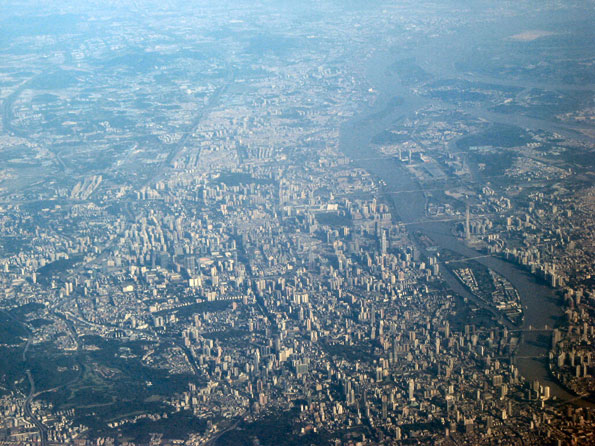
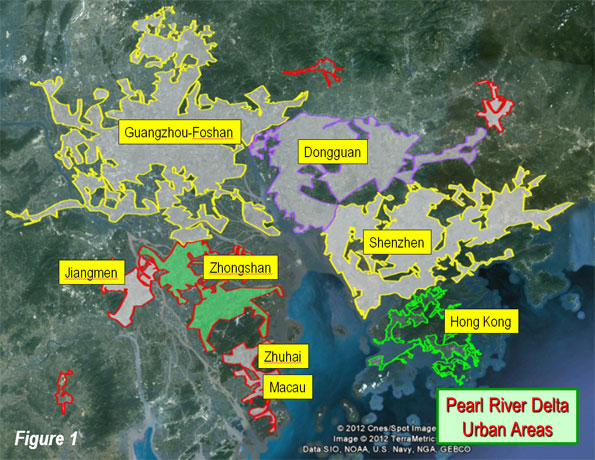
    The Pearl River Delta of China is home to the largest extent of continuous urbanization in the world. The Pearl River Delta has 55 million people in the jurisdictions of Hong Kong, Shenzhen, Dongguan, Guangzhou, Foshan, Zhongshan, Jiangmen, Zhuhai and Macau. Moreover, the urban population is confined to barely 10 percent of the land area. These urban areas are the largest export engine of China and reflect the successful legacy of Deng Xiaoping’s reforms which had their start with the special economic zone in Shenzhen and spread to the rest of the Delta and then much of the nation.

    Adjacent Metropolitan Areas: However, the Pearl River Delta today is not a metropolitan area, as is often asserted. Instead it is rather a collection of adjacent metropolitan areas or labor markets (Figure 1). Metropolitan areas are not created by a large number of people living close to one another. Metropolitan areas are labor markets, crudely delineating the geography of the jobs-housing balance. There is little commuting between the Pearl River jurisdictions. Moreover, as labor markets, metropolitan areas cannot be international unless there is virtual free movement of labor (Note). In the case of Hong Kong and Macau, commuting between the neighboring jurisdictions of Shenzhen and Zhuhai requires crossing the equivalent of an international border.


    Integrating Guangzhou and Foshan: Transportation integration has already come to two of the jurisdictions, Guangzhou and Foshan. The adjacent prefectures (confusingly interpreted into English as "cities") are now linked by a subway and unlike the other Pearl River Delta jurisdictions, the continuous urbanization does not narrow at the border (Figure 1). There are even proposals to merge the adjacent prefectures.

    Guangzhou and Foshan are separated by a tributary of the Pearl River, with a number of bridges that provide similar crossing capacity as exists in cross-river metropolitan areas like Portland (Willamette River), Cincinnati (Ohio River) and St. Louis (Mississippi River).

    Guangzhou itself is the capital of Guangdong, the largest province of China, with approximately 105 million people. Guangdong is the third largest state or province (sub-national jurisdiction) in the world, trailing the states of Uttar Pradesh (contains the eastern suburbs of Delhi) and Maharashtra (capital Mumbai) in India.

    Guangzhou is larger than Foshan. It is better known to many Westerners as Canton, and for many years served as China’s “window” on the west. Even in China, the alternative name is still used, for example in the annual Canton Fair, one of the largest trade fairs in the world.

    Canton was also a principal flashpoint of 19th century hostilities between the British and Chinese. The First Opium War (1839-42) began at Canton and led to the cession of Hong Kong to Great Britain and the establishment of British treaty ports at Fuzhou, Xiamen, Ningbo, Shanghai and Canton (Guangzhou). After the Second Opium War (1856-60), other treat ports were established and France, the United States, Russia, Germany, Japan and others gained similar rights to the British from a weakened Chinese government.

    In 2010, the metropolitan area county and district level jurisdictions of Guangzhou-Foshan had 18.3 million people. This is an increase of 4.4 million from 2000 and 11.6 million from 1982. This is surely a rapid rate of growth, but Shanghai and Beijing grew even faster over the last decade, each adding more than 6 million people.

    Distribution of Population Growth: In contrast to Shanghai and Beijing, where virtually all of the growth has been outside the core, the Guangzhou-Foshan core is growing robustly. From 2000 to 2010, the core districts increased from a population of 4,040,000 to 5,050,000. With a land area of 107 square miles (279 square kilometers), the core is similar in size to the city (municipality) of Sacramento, which has less than one-tenth the population. The core density is 46,800 per square mile (18,100 per square kilometer), up from 37,500 per square mile (14,500 per square kilometer) in 2000. This is about one-third less dense than Manhattan or the ville de Paris (the central city).

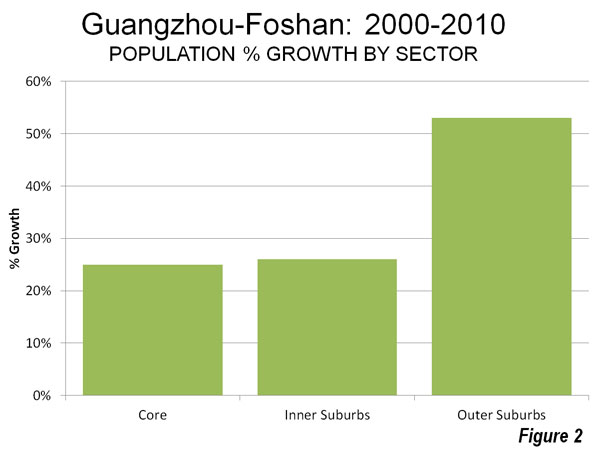
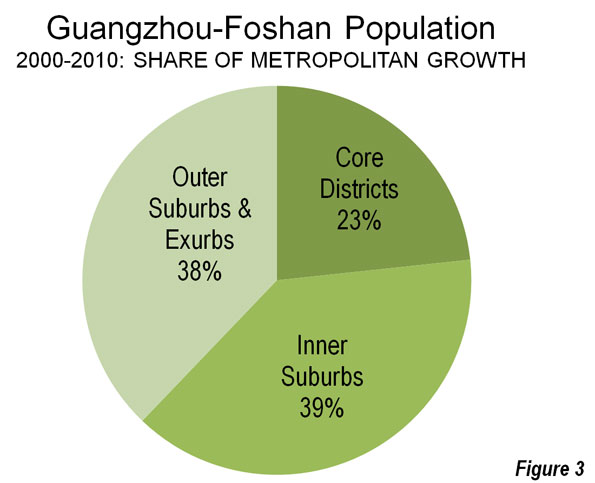
    However, as is typical for metropolitan areas around the world, Guangzhou-Foshan’s growth has been most concentrated in suburban areas. The core accounted for 23% of the population growth over the past decade, while the suburbs accounted for 77%.

    The inner suburbs grew from a population of 6,670,000 to 8,400,000. The density rose from 5,000 to 6,300 per square mile (1,900 to 2,500 per square kilometer), similar to that of the San Francisco urban area. The inner suburbs accounted for 39% of the growth and grew 26%.

    The outer suburbs grew from a population of 3,150,000 to 8,200,000 over the past decade. The population density rose from 2,000 to 3,100 per square mile (800 to 1,200 per square kilometer), slightly more dense than the Philadelphia urban area and slightly less dense than the Portland urban area. The outer suburbs accounted for 38% of the growth and grew at the greatest rate, 53% (Figures 2 & 3, Table).


    Guangzhou-Foshan Metropolitan Area & Urban Area
    2000 & 2010 Census
    Metropolitan Area Core Inner Suburbs Outer Suburbs Total
    2000         4,040,000        6,670,000            3,150,000         13,860,000
    2010         5,050,000        8,400,000            4,820,000         18,270,000
    Change         1,010,000        1,730,000            1,670,000           4,410,000
    % 25% 26% 53% 32%
    Share of Growth 23% 39% 38% 100%
    Area (KM2)                   279               3,429                   4,003                  7,711
    Area (Square Miles)                   108               1,324                   1,546                  2,977
    Density (KM2)              18,100               2,400                   1,200                  2,400
    Density (Square Miles)              46,800               6,300                   3,100                  6,100
    Urban Area  Core   Suburbs   Total 
    2010         5,050,000          11,225,000         16,275,000
    Area (KM2)                   279                   2,894                  3,173
    Area (Square Miles)                   108                   1,117                  1,225
    Density (KM2)              18,100                   3,900                  5,100
    Density (Square Miles)              46,800                 10,000                13,300
    Notes
    Boundary changes render district area data incomplete.
    Core: Yuexiu, Liwan, Haizhu, Tianhe 
    Inner Suburbs: Baiyun, Huangpu, Panyu, Nansha, Nanhai, Changcheng
    Outer Suburbs: Huadu, Luogang, Gaoming, Shunde, Shanshi 
    Nansha is in the inner suburbs because 2000 data is combined with Panyu (should be in the outer suburbs)

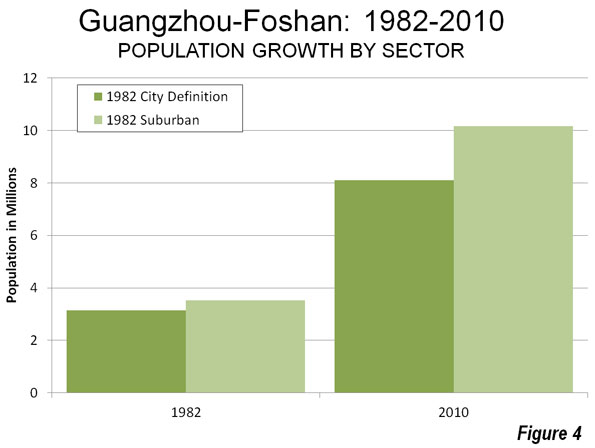
    Earlier data shows this suburban pattern has been a long term trend.  Between 1982 and 2010, the suburbs accounted for 57% of the growth outside the city of Guangzhou as then defined (Figure 4). District boundary changes limit a more precise analysis based upon a core that did not include large areas without development.

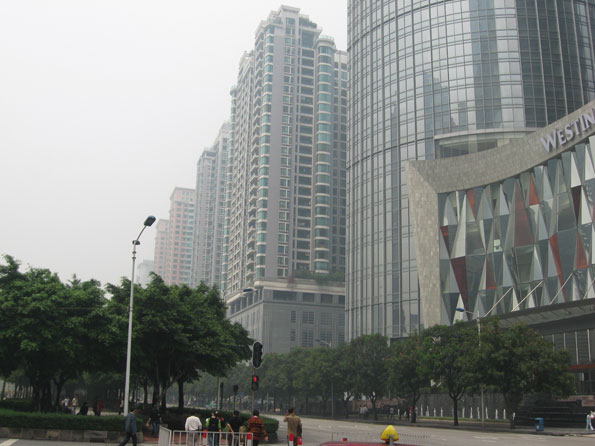
    The Guangzhou-Foshan Urban Area: The soon to be released 8th Annual Demographia World Urban Areas will show the Guangzhou urban area (area of continuous development within the metropolitan area) to have a population of approximately 16.275 million, with a land area of approximately 1,225 square miles (3,173 square kilometers). Barring later data from the multiple national censuses that will soon be reporting data, Guangzhou-Foshan is likely to be ranked the 14th largest urban area in the world. The population density is approximately 13,300 per square mile (5,100 per square kilometer), roughly comparable to the London or Barcelona urban areas. The suburbs of the urban area have a density of approximately 10,000 per square mile (3,900 per square kilometer). Most of the new residential development is multi-unit, such as high rise condominium buildings and work related housing, including dormitories. However, there is some detached housing, which is very expensive.

    A Larger Metropolitan Area: In the longer run a much larger metropolitan (and urban) area could result, if Chinese residents begin traveling to work over much longer distances between these jurisdictions and should the border restrictions at Hong Kong and Macau be eliminated. To achieve this end, there will need to be important local transportation improvements between the jurisdictions, such as more urban railways (which are planned) and wider automobile ownership, to use the already comprehensive (toll) freeway system.

    Wendell Cox is a Visiting Professor, Conservatoire National des Arts et Metiers, Paris and the author of “War on the Dream: How Anti-Sprawl Policy Threatens the Quality of Life

    ——

    Note: International metropolitan areas can now exist in the European Union, where there is free movement of labor across national borders. For example, the Lille metropolitan area is located in both France and Belgium. France and Switzerland (not a member of the European Union) provide another example, where treaty provisions permit international movement of labor with little difficulty in the resulting international metropolitan areas of Geneva (Switzerland-France) and Basel (Switzerland-France).

    Photo (top): Pagoda: Temple of the Six Banyan Trees, Guangzhou (all photos by author)

  • On The Move

    Overall migration rates in America appear to be down in the wake of the Great Recession, reaching the lowest levels recorded since the 1940’s. While some statisticians argue that changes in data collection over time have led to an overstatement of such changes, there seems little doubt that “interstate migration has been trending downward for many years,” regardless of recent recessionary effects. That said, Americans remain a mobile people. Each year, millions of Americans make an interstate move. While overall migration rates may be down, “the commonly held belief that Americans are more mobile than their European counterparts still appears to hold true.” In good times and bad, the draw of opportunity in a new state still remains a siren call for many Americans.

    Adding a bit of information on current American migration patterns, Atlas Van Lines, a major American moving company, recently released it’s annual data on interstate moves. A plurality of states (24) had a balance between inbound and outbound moves. Magnet states included the upper south (TN and NC), the capital region (DC, VA, and MD), and hubs of energy production, including North Dakota, Texas, and Alaska. Many Midwest and Great Lakes states had more outbound movers than inbound. While the Atlas numbers don’t mesh completely with Census migration estimates, they may lend some support to Wendell Cox’s argument that domestic migration may be returning to some sort of normalcy. Simply put, people continue to go where they can find work, economic opportunity, reasonable costs of living, and good weather.

  • Preserving the “Ideal of a Property Owning Democracy:” Annual Demographia International Housing Affordability Survey

    Demographia and Performanceurbanplanning.org  have just released the 8th Annual Demographia International Housing Affordability Survey, with an introduction by Professor Robert Bruegmann of the University of Illinois at Chicago and author of Sprawl: A Compact History. The Survey is unique in providing cross-national housing affordability comparisons using the median house price data from leading indexes in Australia, Canada, Hong Kong, Ireland, New Zealand, the United Kingdom and the United States.

    The Demographia International Housing Affordability Survey employs the “Median Multiple” (median house price divided by gross annual median household income, before taxes) to rate housing affordability (Table 1). The Median Multiple is widely used for evaluating urban markets, and has been recommended by the World Bank and the United Nations and is used by the Harvard University Joint Center on Housing.

    Table 1

    Demographia Housing Affordability Rating Categories

    Rating

    Median Multiple

    Affordable

    3.0 & Under

    Moderately Unaffordable

    3.1 to 4.0

    Seriously Unaffordable

    4.1 to 5.0

    Severely Unaffordable

    5.1 & Over

    Historically, the Median Multiple has been remarkably similar in Australia, Canada, Ireland, New Zealand, the United Kingdom and the United States, with median house prices having generally been from 2.0 to 3.0 times median household incomes (historical data has not been identified for Hong Kong). This affordability relationship continues in many housing markets of the United States and Canada. However, the Median Multiple has escalated sharply in the past decade in Australia, Ireland, New Zealand, and the United Kingdom and in some markets of Canada and the United States. There has also been a substantial loss in affordability in recent years in Hong Kong.

    Housing Affordability in 2011

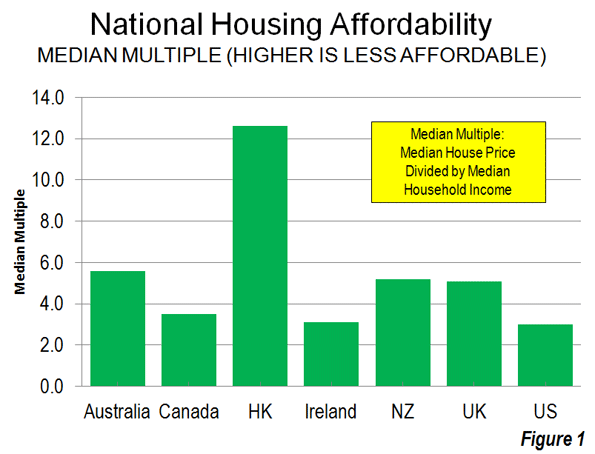
    Housing affordability was little changed in 2011, with the most affordable markets being in the United States, Canada and Ireland. The United Kingdom, Australia, New Zealand and Hong Kong continue to experience pervasive unaffordability (Figure 1).

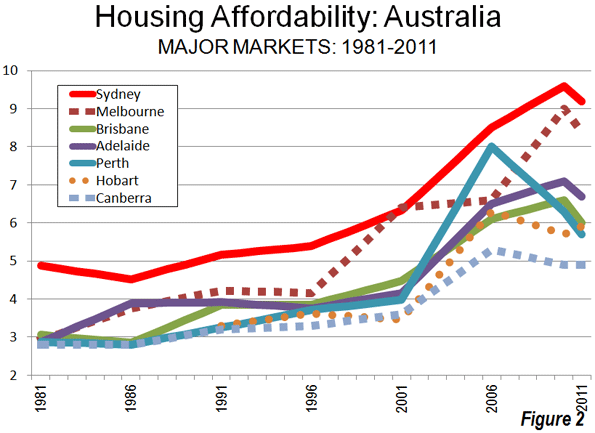
    The Survey covers325 metropolitan markets, including the 81 major markets with more than 1,000,000 population (Table and Chart Attached). There were 24 affordable major markets, 20 moderately unaffordable major markets, 13 seriously unaffordable major markets and 24 severely unaffordable major markets (Table 2). The severely unaffordable major markets were principally in the United Kingdom (8), the United States (6), and Australia (5). Hong Kong was severely unaffordable and there were three severely unaffordable major markets in Canada and one in New Zealand (Table 2). Australia had the highest major market Median Multiple outside Hong Kong (Figure 2).


    Table 2

    Housing Affordability Ratings by Nation: Major Markets (Over 1,000,000 Population)

     Nation

    Affordable (3.0 & Under) 

    Moderately Unaffordable (3.1-4.0)

    Seriously Unaffordable (4.1-5.0)

    Severely Unaffordable (5.1 & Over)

    Total

    National Median

     Australia

    0

    0

    0

    5

    5

    6.7

     Canada

    0

    3

    0

    3

    6

    4.5

     China (Hong Kong)

    0

    0

    0

    1

    1

    12.6

     Ireland

    0

    1

    0

    0

    1

    3.4

     New Zealand

    0

    0

    0

    1

    1

    6.4

     United Kingdom

    0

    0

    8

    8

    16

    5.0

     United States

    24

    16

    5

    6

    51

    3.1

     TOTAL

    24

    20

    13

    24

    81


    The most affordable major market was Detroit, with a Median Multiple of 1.4. This Median Multiple is artificially low, arising from the collapse of housing demand in the most severely depressed major market in the United States. There were another 22 affordable major markets, the most affordable of which were Atlanta, Phoenix, Rochester, Cincinnati, Cleveland and Las Vegas. The strong growth markets of Dallas-Fort Worth, Houston, Orlando, Jacksonville, Nashville, Oklahoma City, Sacramento and Indianapolis also achieved affordable ratings.

    All major markets in Australia and New Zealand, as well as Hong Kong were severely unaffordable.
    Hong Kong was the least affordable major market (ranked 81st), with a median multiple of 12.6. Vancouver was second most unaffordable, at 10.6 (ranked 80th). Sydney was the third most unaffordable, at 9.2 (ranked 79th).  Melbourne and Plymouth & Devon all had Median Multiples above 7.0.

    Among all 325 markets surveyed, there were 128 affordable markets, 117 in the United States, 9 in Canada and 2 in Ireland. There were 71 severely unaffordable markets, principally concentrated in Australia and the United Kingdom (Table 3). Honolulu and Bournemouth & Dorsett (8.7) were the least affordable outside the major markets.

    Table 3

    Housing Affordability Ratings by Nation: All Markets

     Nation

    Affordable (3.0 & Under) 

    Moderately Unaffordable (3.1-4.0)

    Seriously Unaffordable (4.1-5.0)

    Severely Unaffordable (5.1 & Over)

    Total

    National Median

     Australia

    0

    0

    7

    25

    32

    5.6

     Canada

    9

    19

    1

    6

    35

    3.5

     China (Hong Kong)

    0

    0

    0

    1

    1

    12.6

     Ireland

    2

    3

    0

    0

    5

    3.3

     New Zealand

    0

    0

    3

    5

    8

    5.2

     United Kingdom

    0

    1

    12

    20

    33

    5.1

     United States

    117

    64

    16

    14

    211

    3.0

     TOTAL

    128

    87

    39

    71

    325


    Preserving the "Ideal of a Property Owning Democracy"

    One of the principal accomplishments of high-income world societies has been the expansion of property ownership and home ownership to the majority of the population. At the same time, there are dark economic clouds on the horizon. Governments in high income nations are faced with some of the most challenging times in their history. In this environment, the property owning middle class is likely to face significant challenges in the longer run. Since housing is largest element in household budgets, unaffordable housing is a serious threat to the standard of living.

    At the same time, the economic evidence shows that more restrictive land use regulations, such as urban growth boundaries, have been an important factor in the deterioration of housing affordability. On this point, economist Anthony Downs of The Brookings Institution stressed the importance of maintaining the "principle of competitive land supply." The escalation of house prices relative to incomes, from Sydney and Vancouver to London and across California testify to the failure of planning to maintain that principle. The record shows that smart growth (urban consolidation and compact cities policies) is incompatible with housing affordability.

    But there are signs of hope. Florida repealed its growth management law ("smart growth") in 2011. Further, a recent New Zealand government report outlined the importance of a competitive land supply in restoring housing affordability to that nation.

    Four decades ago, urbanologist Peter Hall expressed concern about the threat of such policies to the "ideal of a property owning democracy." The Demographia International Housing Affordability Survey is dedicated to younger generations who have right to expect they will live as well or better than their parents. In large measure due to land use planning that has made housing unaffordable, they may not.

    Wendell Cox is a Visiting Professor, Conservatoire National des Arts et Metiers, Paris and the author of “War on the Dream: How Anti-Sprawl Policy Threatens the Quality of Life

    —-

    Note: The 8th Annual Demographia International Housing Affordability Survey is sponsored in Canada by the Frontier Centre for Public Policy.

    Photo: Suburban Montréal (by author)

  • This Is America’s Moment, If Washington Doesn’t Blow It

    The vast majority of Americans believe the country is heading in the wrong direction, and, according to a 2011 Pew Survey, close to a majority feel that China has already surpassed the U.S. as an economic power.

    These views echo those of the punditry, right and left, who see the U.S. on the road to inevitable decline.  Yet the reality is quite different. A confluence of largely unnoticed economic, demographic and political trends has put the U.S. in a far more favorable position than its rivals. Rather than the end of preeminence, America may well be entering  a renaissance.

    Just survey the globe. The European Union’s prolonged crisis will likely end in further decline. Aging Japan has long passed its prime, its market share receding in everything from autos to high tech.  China’s impressive economic juggernaut has slowed down, and the Middle Kingdom faces increased social instability, environmental degradation and a creaky one-party dictatorship.

    While the U.S. has its challenges, it is positioned to achieve a more solid long-term   trajectory than its European and Asian rivals. What it lacks, however, is a strong political leadership capable of seizing this opportunity.

    Resources

    Energy constitutes the biggest ace in the hole for the U.S. For almost half a century, an enormous fossil fuel bill that still accounts for 40% of the nation’s trade deficit has hampered economic growth. Now that situation is changing rapidly.

    Due to vast new finds and improved technology to exploit them, the U.S. is now the world’s largest producer of natural gas and could emerge as the leading oil producer by 2017. Reserves of natural gas — a clean-burning fuel — are estimated at 100 years supply and could generate more than 1.5 million new jobs over the next two decades.

    The U.S. agricultural sector is also booming, with exports reaching a record $135.5 billion in 2011. With global demand increasing, sustained growth  will continue across America’s fertile agricultural regions.

    Manufacturing

    The other big game changer is manufacturing. As President Barack Obama recently acknowledged, this is America’s “moment” to seize the industrial initiative. U.S. manufacturers have expanded their payrolls for two straight years, and they have increased production while Japan, Germany, China and Brazil have scaled back.

    A recent survey of manufacturing CEOs revealed that 85% believed production could shift soon from overseas. Both foreign and domestic manufacturers are alarmed about rising wages and labor unrest in China. Some important Japanese, German and Korean companies also have concerns about China’s policies that favor local firms and abscond with investor’s technology.

    Foreign Investment

    Rising foreign investment reflects the new American competitiveness. Since 2008 foreign direct investment to Germany, France, Japan and Korea has stagnated; in 2009 overall investment in the E.U. dropped 36%.

    In contrast, in 2010 foreign investment in the U.S. rose 49%, mostly coming from Canada, Europe, and Japan. Industrial investment rose $30 billion just between 2009 and 2010, while investment in the energy sector more than tripled to $20 billion.

    The Information Sector

    In the information sector, American domination continues to mount, contrary to predictions of decline over the past two decades. Although high-tech manufacturing has shifted largely to Asia, Americans rule the increasingly strategic software sector.   American-based companies, who constitute more than two-thirds of the world’s 500 largest software companies, including  nine of the top ten.

    Outside the U.S., there are no significant equivalents of Apple, Google, Microsoft, Amazon and Facebook. Hollywood, for its part, rules the entertainment world, producing 40% of world’s audiovisual exports, a dominion that troubles China’s President Hu Jintao, who recently complained  that the “cultural fields” represent “the focal area” for Western “infiltration”.

    Demographics

    The Great Recessionhas slowed population growth everywhere, but the U.S. maintains the   youngest and most vibrant demographic profile of any advanced country. Between 1980 and 2010, the U.S population expanded by 75 million to over 300 million. In contrast many European countries, including Germany, have suffered stagnant growth, while in Russia and Japan populations have already started declining.

    The disastrous fiscal implications of slow or negative population growth are evident in Greece, Spain and Italy, all of which suffer among the world’s lowest fertility rates. Rapid aging also will soon catch up with Germany. By 2030, Germany will have 48 retirees for every 100 workers — that’s barely two workers per retiree. The numbers are even worse in Japan: 53 retirees for every 100 workers by 2030.

    Political Factors

    Given the ineptitude of the last two administrations, enthusiasm about America’s political system is hard to justify. But our constitutional systems of laws and checks on central power remain a critical advantage. Immigration has declined with the recession, but the U.S. can expect to welcome religious and political exiles — such as Middle Eastern Christians displaced by   the “Arab Spring” — as well as Greeks and Irish fleeing Europe’s economic decline.

    Many from Russia and China are seeking to immigrate to the United States, Canada or Australia in order to protect property or just live a freer life. Indeed, among the 20,000 Chinese with incomes over 100 million Yuan ($15 million), 27% have already emigrated and another 47% have said they were considering it, according to a report by China Merchants Bank and U.S. consultants Bain & Co. published in April.

    Needed from Washington: A New American Strategy

    Sadly no leading politician or political party seems ready to   embrace the country’s new strategic advantages.  Many on the left may find the very notion distasteful, having    swallowed declinism with their academic mother’s milk. The president himself dislikes the notion of American “exceptionalism.” Many key Obama backers like SEIU boss Andy Stern and former auto czar Steven Rattner, embrace the superiority of China’s authoritarian system. Others embrace Europe and even Japan as models for an aging superpower.

    Worse still: Some Obama policies work against the well springs of national resurgence.   Threats to raise income taxes on families making over $250,000 directly threatens the aspiring entrepreneurial class more than the real “rich” whose fortunes are protected by low capital gains taxes and family trusts. Most critical: The administration’s hostility to fossil fuel represents a direct threat to the country’s greatest new source of advantage and threatens to strangle America’s recovery in its infancy.

    Not that the Republicans are any less clueless. Many reject the infrastructure needed by an expanding economy — ports, roads, bridges as well as worker training and support for basic research — as mere “pork.” Budget restraint and fiscal discipline are important, but preparing the country for more rapid economic growth requires an active, supportive government.

    Republicans also tend to view immigration as something akin to a hostile invasion. Yet many key industries — notably manufacturing and high tech — rely heavily on immigrant entrepreneurship, intelligence and work values. Running against immigration constitutes an assault on the nation’s increasingly diverse demographics.

    So this is where we now sit.  With all the essential elements for a strong, sustained recovery place, the big question is whether we will find political leaders capable of tapping this country’s phenomenal potential.

    This piece originally appeared at Forbes.com.

    Joel Kotkin is executive editor of NewGeography.com and is a distinguished presidential fellow in urban futures at Chapman University, and contributing editor to the City Journal in New York. He is author of The City: A Global History. His newest book is The Next Hundred Million: America in 2050, released in February, 2010.

    Photo from BigStockPhoto.com.

  • Mistaking an Aberration for the End of Home Ownership

    It is well known that home ownership has declined in the United States from the peak of the housing bubble. According to Current Population Survey data, the national home ownership rate fell 2.9 percentage points from the peak of the bubble (4th quarter 2004) to the third quarter of 2011.

    It is less well understood, however, that the spurt in home ownership was, like the housing bubble, an aberration. Looking over the data from the 2010 census, it seems clear that since 2000 the actual decline was a much smaller: 0.8 percentage points from the 2000 census. In fact the current home ownership rate tracks fairly well with that of the post 1960 and the entire pre-bubble period.

    The End of Home Ownership? Analysts such as Richard Florida suggest an end to the preference for home ownership, citing the losses from the bubble, which were, in fact, an aberration. Most recently, Xavier University’s Michael F. Ford wrote in the Washington Postabout home ownership having been driven to 69% by "guarantees" and "tax breaks," such as the mortgage interest deduction. He notes that this "spending spree" led to a loss of $6 trillion in US real estate value.

    Ford does not mention the fact that home ownership had hovered between 60% and 65% for more than three decades before the bubble, without suffering any such losses. Nor does he mention the roles played by Fannie, Freddie and Frank (D-Massachusetts), along with others in Washington, or the related "drunken sailor" mortgage policies concocted by lenders and Wall Street that anyone familiar with credit should have known could only lead to disaster. This was obvious to many observers, although shockingly not to the Federal Reserve Board, as recent reports indicate .

    There is no doubt that the "spending spree" led to the housing bust and triggered the Great Financial Crisis. However it was not the long-standing ownership support programs of the federal government that were primarily to blame. As late as the beginning of the decade, there was no bubble and the median multiple in major metropolitan areas averaged 2.9, within the maximum affordability rating of 3.0. The "spending spree" itself was a rational response to policies that turned housing into the equivalent of a speculative commodities market, with destructive results, in certain large markets. Critically the bubble did not appear in many others.

    Speculation and the "Bubble States:" The extent to which speculation fueled house price increases is the subject of a recent Federal Reserve Bank of New York paper by Andrew Haughwout, Donghoon Lee, Joseph Tracy and Wilbert van der Klaauw. The researchers examine investment, or speculation in real estate markets, during the housing bubble. Investors buy houses that they do not intend to live in for the purpose of making money. In normal times, this investment is principally for rental income or long term capital gains. However, in the highly charged housing markets that developed in some metropolitan areas, prices rose so rapidly, that "flipping" (short term ownership) became very profitable, at least for some.

    Pointing out that "The recent financial crisis—the worst in eighty years—had its origins in the enormous increase and subsequent collapse in housing prices during the 2000s," the New York Fed researchers show that speculative activity was much greater in California, Florida, Arizona and Nevada (which they label the "bubble states") than elsewhere. My analysis indicates that two-thirds of the house value drop in the nation before the Lehman Brothers collapse (September 15, 2008) occurred in the four "bubble states." According to the researchers, this greater speculative activity in these markets made the market more instable because unlike owner-occupiers, investors are far more likely to default on mortgage loans.

    Missing the Geography of Speculation (the Geography of "Smart Growth"): The New York Fed research, however, ignores the geography of speculation. Why was speculation was so much more rampant in the bubble states? There is no reason to believe that residents of California, Florida, Arizona or Nevada are any less interested in making money or, in general, any more greedy. Yet speculators largely stayed out of markets in high demand areas, such as Dallas-Fort Worth, Houston and Indianapolis. In fact, in large parts of the nation, there was little speculative activity. In these markets prices were not rising inordinately so speculators did not bother with them. Instead they focused on more volatile markets where prices were already rising strongly, further swelling local price increases.

    The geography of speculation corresponds largely to the geography of excessive land use restrictions, which created the shortage of land for housing that drove the prices up in the four bubble states (Note). It is a fundamental principle of economics that prices tend to rise where desired goods are in short supply.

    In California and Florida, restrictive land use policies (smart growth or growth management) created a shortage of land for new housing relative to demand. The largest metropolitan areas of Nevada (Las Vegas) and Arizona (Phoenix) are surrounded by government owned land that was auctioned for development at such a slow rate that prices rose by more than five times during the bubble.

    Astonishingly, having missed the geography of speculation, the New York Fed researchers suggest that a solution is to regulate speculation. There is a much simpler answer, which Florida has already implemented which is to repeal the restrictive land use regulations, without which inordinately speculative profits cannot occur.

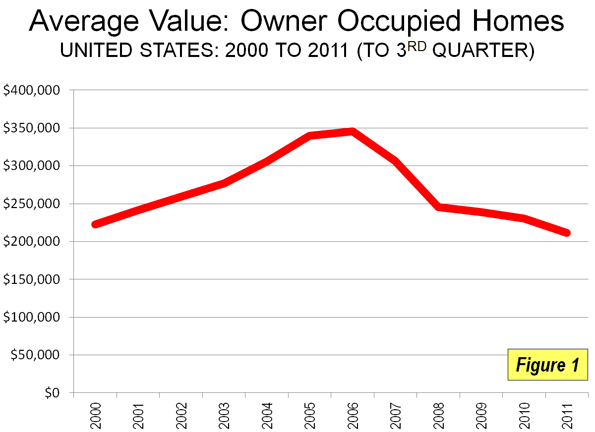
    Meanwhile, as the speculators have been driven out of the market, and despite federal government efforts to prop-up the artificially high house prices, values have fallen to below 2000 levels for the first time (Figure 1). Based upon Federal Reserve Board and Census Bureau data, it is estimated that the average owner-occupied house value in 2011 (three quarters) has fallen to $211,000, which is down from a peak of approximately $345,000 in 2006 and $222,000 in 2000 (adjusted for inflation).

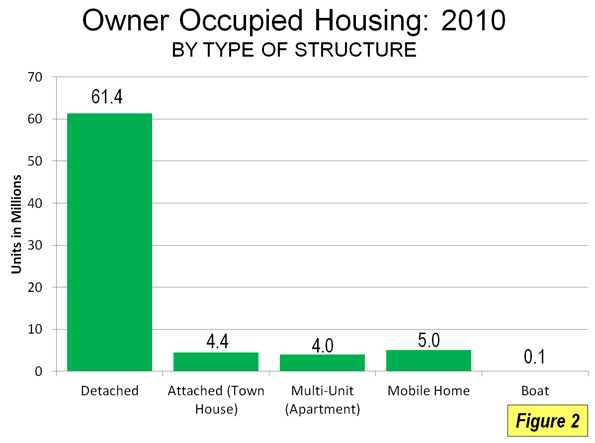
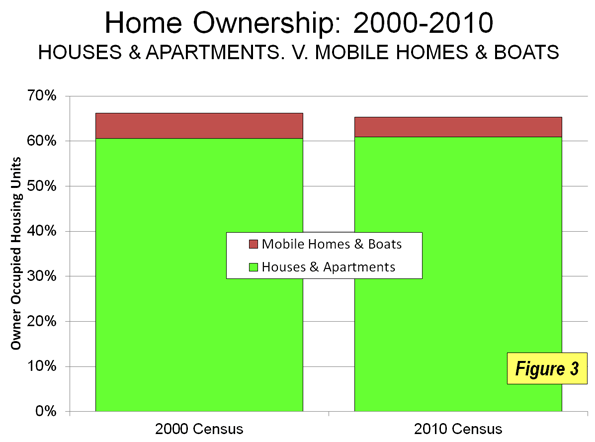
    So is Ownership now doomed? Yet the home ownership naysayers have little to cheer. Yes, home ownership dropped in the last decade. However, all of the loss was in mobile homes and boats. Even so, the number of mobile home owners remained greater than home owners living in apartments, including condominiums (Figure 2). In fact there was a slight increase in the share of households owning their own homes, if mobile homes and boats are excluded (Figure 3), with a rise from 60.6% in 2000 to 60.9% in 2010.

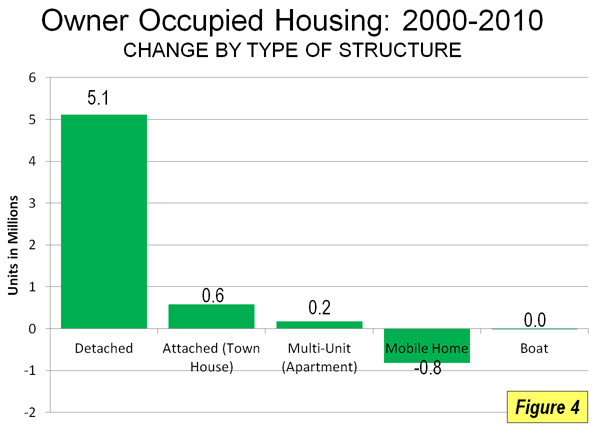
    There were 5,057,000 more home owners in 2010 than in 2000, and perhaps more surprisingly, 5,119,000 more home owners occupying detached housing. Detached, attached (town house) and apartment ownership each increased over the past decade (Figure 4). Contrary to new urbanist theoreticians, detached housing – not urban condos – overall accounted for the most housing growth, both owner-occupied and rentals.

    Xavier’s Ford calls the American Dream of home ownership a myth and even goes so far as to suggest that home ownership is "more important to special interests than it is to most Americans." In fact, Ford’s interpretation is delusional. That home ownership continued its advance, however modestly, in the face of the worst economic downturn in 80 years, reveals the durability and, indeed the reality of home ownership as an American Dream.

    Photo:  Preventing speculation (New Development, Dallas-Fort Worth suburbs)

    Note: Overall, the bubble states and other restrictively regulated metropolitan areas accounted for more than 90% of the pre-Lehman Brothers loss.

    Wendell Cox is a Visiting Professor, Conservatoire National des Arts et Metiers, Paris and the author of “War on the Dream: How Anti-Sprawl Policy Threatens the Quality of Life

  • Florida’s Quick Rebound

    Adding nearly 119,000 people in 2011, Florida has capped a decade of steady population increase  to see the state grow 19% since 2000.  Despite 2009, an historic year where more people left than arrived, the overall net growth of Florida has yielded two additional congressional seats, moving the state well on its way towards the becoming third most populous state in the nation.  This ascendancy brings new responsibility to the shoulders of the state’s leaders, and the direction this state takes in the coming years will depend upon how Florida reacts to this influx of new population.  It is time for true leadership to find appropriate voice for our state on the national scene.

    Contrary to the predictions of many within the urbanist intelligentsia, Florida’s farm counties grew the fastest. Osceola County, just south of bustling Orlando, grew by 55%; sleepy Sumter County, northwest of Orlando, grew by 75%; and Flagler County, home to historic St. Augustine, nearly doubled in population. Tampa, Orlando, and Miami have each seen their healthy share of immigration, but Florida’s rural areas have dramatically increased their appeal over a decade ago.

    At first this trend might be puzzling.  Lacking urban amenities such as museums, transit, and Starbucks, parts of rural Florida seem almost timeless.  Wildwood and Leesburg, nestled in the center of Florida, lack both beaches and theme parks.  They have one thing, however, that the urban areas do not have:  affordable housing.  And this is the elusive reality that must be turned around by Florida’s leadership if the state is to grow in a responsible manner.

    The Miami-Dade market has plenty of supply, but the average home lists for $509,000 .  Up in Wildwood, the home lists for $175,000, and you get a lot more house for your money.  People are voting with their feet for affordability.

    It’s not the price alone that seems to be putting people off, however.  Naples, which lists homes even higher than Miami, saw growth over the past ten years at a pace two and a half times that of Miami, and is expected to continue to grow at the same pace through 2015.  Anecdotally, it seems that newcomers have relocated to their vacation homes after selling off their other high-priced property, usually in the north. They sometimes reduced their expectations of what they can receive for their old houses and then permanently located where they prefer to live. If the buyers are older, they still likely made a nice profit over the past few decades.

    In Orange County, meanwhile, relieved realtors are finally starting to say goodbye to distressed properties.  Appraiser Lee Barnes commented that “foreclosures and short sales are 40% fewer, compared to this time last year,” and in an economy fueled by growth, the welcome sight of occupied rooftops means that commercial real estate is beginning to come back.  In fact, Orlando is near the top of the list in expected home price gains for 2012, a dramatic turnaround for the region.

    Florida’s comeback is timed with some key changes in regulating real estate development.  With state oversight all but vanquished by the governor, starving local counties welcome the property tax dollars associated with new growth.  No other revenue, apart from a sales tax, provides much cash to operate government in the Sunshine State. This makes growth a priority.

    But economic activity occurs in two forms:  growth (making more stuff) and development (making stuff better).  Quietly, in the past decade, Florida has added biomedical research clusters to its twin engines of growth and tourism, and this promises to increase greater resilience to the state economy.

    Some signs, however, point to Florida abandoning this strategy and continuing its boom-bust mentality.  The Governor, already warning the legislature of budget cuts in 2012, has expressed disappointment that the job creation return is poor on the State’s venture capital invested in bringing Scripps, Nemours, and other cutting-edge research organizations. He claims that are simply not adding jobs fast enough for his taste.  Abandoning these investments could mean that the organizations reduce their presence or even abandon the state.

    At the same time, Florida’s cities seem to be uncertain about how to tackle the problem of adding density without reducing affordability.  Land prices haven’t wavered much in the recession, with stubborn property owners holding on to assets that won’t sell, and they may benefit from this land-banking strategy in the long run.  Many who escape the Rust Belt and come to Florida express shock at the cost of living in the Sunshine State and are further dismayed over the quality of schools and surprising amount of congestion.  This mismatch between cost of living and quality of life may be part of the reason why Florida’s five largest cities were listed among the nation’s “saddest” in a recent Time poll .

    Casino gambling, a typical 1990s way to boost revenue, is being entertained by the Legislature, but other ideas should be considered as well.  For one thing, investment in the future means a better education system, perhaps a higher priority than ostrich food subsidies (currently exempt from state sales tax ).  Closing tax loopholes and fixing some long-broken parts of Florida’s tax code will help gain some badly-needed revenue.

    Very large infrastructure projects are also important to make Florida competitive.  On the east coast, NASA’s 60-year-old facilities need a major overhaul to continue providing America a spaceport for the 21st century and to pave the way for private space exploration.  This will maintain the deep investment in human capital of which Floridians were once justly proud.  The spaceport has a great deal of synergy with the National Simulation Center, located in Orlando, which is currently the country’s premier provider of military simulation and training.

    In more than one region, the Florida Venture Capital Act has brought world-class biomedical research laboratories, making dramatic advancements in cancer, diabetes, children’s health, and other key areas.  Already surging ahead and competing with area like Boston’s Research Center and the Silicon Valley, Florida must keep its edge in this field by continuing investment in the Venture Capital Fund.

    On the west coast, the Tampa Port Authority is already preparing for the widening of the Panama Canal, working in collaboration with ports of Mobile and Houston to partner with ocean carriers.  Continuing this investment and modernizing the logistics of truck and railroad traffic into the port is critical to make this economic engine prevail in the 21st century.

    Such infrastructure investment will improve Florida’s already existing assets, allowing for prosperity and upward mobility to occur within the state.  Competing with Texas will be difficult, given Florida’s lack of petrochemical resources, but the state’s native industry, tourism, has already made it a world-class destination. Florida’s leadership has already entered the national stage by saying “no” to high speed rail, but it has yet to define what it will say “yes” to.  Without intelligent citizen input, the state will likely fall back on its traditional pattern of being a passive receiver of investment and people, but not a creator of great new enterprises. 

    In contrast to states like California and Texas, Florida has been willing to be eternally passive; Disney World is a classic example.  Florida, a grateful recipient of this California enterprise, has benefitted secondarily, but the real power of this company still resides in Burbank.  This story is played out over and over again, with real estate developers from Dallas and Atlanta continuing to define the face of the state, aided and abetted by Wall Street investors who see Florida primarily as a waterfront real estate asset with some moderate margins available in between coasts.

    It is time for Florida to start doing, instead of being done to.  With investment in real infrastructure, good education and intelligent leadership, Florida can assume its responsibility as one of America’s new high-profile states, capable of exporting science, technology, and culture.  Our population growth contains within it the seeds of a bright future once we fix what is broken about our beautiful state.

    Richard Reep is an Architect and artist living in Winter Park, Florida. His practice has centered around hospitality-driven mixed use, and has contributed in various capacities to urban mixed-use projects, both nationally and internationally, for the last 25 years.

    Photo courtesy of BigStockPhoto.com.

  • After Seven Billion

    An interview in Social Intelligence with Neil Howe on the changing nature of human population growth and its implications for politics, culture, and business.

    Headlines around the world are trumpeting the United Nations’ announcement that the world population is now hitting seven billion and may reach eight billion in another 14 years. Yet lost in much of the commentary is any understanding of how the dynamics of population growth are fundamentally changing and what this means for the composition of the workforce, consumption patterns, and the general direction of society. To glean insight into these questions, SI interviewed LifeCourse founder and president Neil Howe, who has spoken and published widely on these topics over the last three decades.

    SI: Neil, before we talk about the population outlook today, can you give us a brief primer on the demographic trends that got us here?
    NH: Sure. The first 500,000 years or so can be summarized in a sentence. Women generally had six or more kids, but many if not most of them died young, so human population hardly grew. For most people, life may not have been solitary—but it was poor, nasty, brutish, and short. Then, about 300 years ago, there arrived the so-called “first demographic transition,” an era when mortality rates began to decline. That sparked a great population surge, particularly in Europe, North America, and China, beginning in the 1700s. This population explosion gave rise, particularly by the time of the French Revolution, to thinkers like Thomas Malthus. He famously theorized that human population growth would inevitably lead to more and more competition for food and other natural resources so that mankind would always be gripped in a struggle for subsistence.

    SI: But it didn’t turn out that way…
    NH: No, it didn’t. Eventually people began to realize that they didn’t need to have so many children just to ensure that two or three survived. Thus began the so-called “second demographic revolution.” Birthrates began to decline in the late nineteenth and twentieth centuries, initially only in western societies. Meanwhile, markets and science and new notions of progress brought us the Industrial Revolution and dramatic improvements in the productivity of agriculture. Bottom line? Because the rate of population growth decelerated and per-capita living standards rose, the Malthusian nightmare never happened. Our higher living standards produced public health measures and medicines that drastically cut child mortality, which has kept the rate of population growth from falling as fast as it otherwise might have. Even so, even as the numbers of people on the planet continued to rise, global living standards have continued to rise even faster.

    SI: Then why did we hear so much alarm in the late 1960s and ‘70s about the coming “Population Bomb?”
    NH: You are referring to Paul Ehrlich’s bestseller, which back then achieved enormous influence throughout the world. Everyone pointed to the book-cover image of hordes of people being crowded off the edge of continents. Many who came of age reading Ehrlich simply assumed that this was our future. At that time, world population growth, having slumped in the 1930s and ‘40s, was again growing rapidly. Not only did it seem like the American postwar “baby boom” would go on forever, but dramatic declines in child and infant mortality in places like India and China were triggering an explosive acceleration in population growth throughout what was then known as the “Third World.”

    SI: So what happened?
    NH: Well, all these trends turned out to be temporary. What Ehrlich and many others missed was the dramatic further decline in birthrates that would soon come. The American baby boom turned into the baby bust, resulting in today’s smallish Generation X—whose much smaller numbers of native-born U.S. births per year were later hidden, to some extent, by higher rates of immigration. Birthrates fell even more dramatically in Europe, Asia, and the former Soviet Union, and unlike in the United States, those birthrates stayed low. In fact, they fell well below the level needed to sustain their populations over time. Russia is now experiencing the steepest sustained population decline of any society since the bubonic plague. Japan is now in its fourth year of depopulation. And in recent years, the phenomenon demographers call “sub-replacement fertility” has even spread to many developing countries, including Brazil and parts of the Middle East, including Iran.

    SI: But then why is the United Nations telling us that world population will grow from seven to eight billion in just the next 14 years?
    NH: Partly it’s because there are some regions where the birthrates are still comparatively high, such as sub-Saharan Africa. The U.N. believes these rates are sustainable. I believe they aren’t. Do you really think that Nigeria in 2050 will have twice the population of Western Europe? It’s also because we are still facing a population explosion of seniors around the world. As my LifeCourse colleague, Phil Longman, recently noted in an article for Foreign Policy magazine, the U.N. now projects that over the next 40 years more than half of the world’s projected population growth will come from increases in the number of people over 60, while only 6 percent will come from people under 30. In fact, the U.N. projects that, by 2025, the population of children under 5, already in steep decline in most developed countries, will actually start falling globally. And that’s even after assuming a substantial rebound in birth rates in the developed world.

    SI: So if remaining population growth doesn’t come from more children, that must mean we are all living much longer?
    NH: That’s part of the explanation. But it’s mostly because yesterday’s youth bulges, like a pig moving through a python, are now or soon will be swelling the ranks of the old, just as they once swelled the ranks of youth and later of the middle-aged. So population grows even without any increase in the number of children. After these aging Boomers pass on, however, we face the very real prospect that world population will begin to decline. It is easy to imagine that we may never get to that eight billionth person on earth.

    SI: What’s behind this global “birth dearth?”
    NH: There are a lot of theories. The main one is that the traditional motivations for childbearing are no longer as strong in modernizing societies. Children used to be an economic asset to their parents. They helped on the farm. Now, with more than half the world’s population living in urban areas, children are no longer an economic asset for most people, but an avoidable and increasingly expensive liability. Having lots of children also used to be a smart strategy to provide for one’s security in old age. The advent of Social Security and private pension plans has lessened that motive.

    SI: Yes, but we hear constantly these days about how pension plans are going broke.
    NH: That’s not a coincidence. Population aging means there are fewer workers to support each retiree, and that has all kinds of implications, not just for pension finance, but for the economy as a whole. In places like Greece, Spain, and Italy, we are looking at societies in which, by the mid-2030s, half the population will be over 50—and in which more people will be celebrating their 80th birthdays each year than will be born. How are things going to work out politically when a decisive majority of the voting age population will be retired or near retirement? Already, the inversion of the age pyramid is the underlying story behind most of the economic turmoil facing Europe today. Slow growing or shrinking workforces diminish consumer demand, forcing capital to take evermore risks in search of reasonable returns. While demography is not destiny, it’s the tide in which we all must swim.

    SI: How does this affect the family life?
    NH: If you have a society where fertility is half the replacement rate (like in Italy, Bulgaria, or South Korea), in two generations you end up with a society in which the typical young adult not only has no siblings, but also has no cousins, no aunts, no uncles. Most young people will have two living parents, and four grandparents, but no other blood relations. In China, they call it the 4-2-1 problem, where one child is meant to support all of them.

    SI: That raises interesting questions of what a society of single children will be like.
    NH: Extended families are one of the basic institutions that individuals rely on as a social safety net in times of trouble—unemployment, hunger, sickness, disease. It’s the basic institution for socialization. It’s interesting to think about a world where these nuclear families are incredibly small and often fatherless, and the extended family doesn’t exist at all. In America, our extended families remain strong—and are getting stronger, due to generational forces. But what about extreme low-fertility societies, where only-children are the established norm? By definition, the extended family will evaporate. Who will fill the void? Will government rush in to provide benefits the extended family can no longer provide? If so, how can government afford to step in when the supply of taxpayers is shrinking compared to the supply of dependent elders? In these societies, we may have to look for the evolution of new, informal institutions that will take the place of both the extended family and the welfare state.

    SI: In China, there’s the stereotype of the “Little Emperor.” What will be the dominant personality traits of a generation of only children?
    NH: Social science finds only-children and first-borns do tend to have specific personality traits. Some are positive. For example, only-children and first-borns are associated with higher achievement, higher measured IQ, and a higher sense of overall planning and drive. But there are negatives as well. Research on only-children shows they tend to be less attuned to the need to please others, and less willing to be team players. You can draw a portrait of a society made up mainly of only-children and first-borns as being a bit more self-absorbed and a bit less accustomed to reaching out to strangers.

    SI: Can we also expect that with fewer young people we’ll have fewer entrepreneurs?
    NH: Entrepreneurship is negatively correlated with age. New businesses and new ideas generally come from young adults. But that’s not the only aspect of economic behavior that will be affected. When you’re in your 20s and 30s, it’s easier to change jobs and move to new places, lowering what economists call “frictional unemployment.” Today, I have no doubt that unemployment in the U.S. would be lower if we didn’t have such a high percentage of the population that is middle-aged or older, and thus unwilling or unable to assume risks, move to a new location, and acquire the skills needed to adjust to a rapidly changing workplace.

    SI: What does that say for the overall picture, globally?
    NH: In some of Western Europe’s societies, the working-age population may be declining by a percent or a percent and a half a year by the 2030s and ‘40s. That may wipe out any gains from productivity growth, so you might find that real GDP stays flat even with robust innovation. The declining number of workers will cancel out whatever growth might come from automation, for example. So even at full employment, GDP no longer grows. We already see this prospect dawning in all the worries over the Euro, as EU leaders suddenly realize it’s very hard for nations like Italy to bring down their debt-to-GDP ratios if their projected GDPs are no longer expected to grow—even after the recession ends. But that’s not all. Economic historians often point to a broader dysfunction that typically overtakes zero-growth economies.

    SI: Are you talking about the 1930s, for example?
    NH: Yes. Or much longer eras, like the fifteenth century in Western Europe. Historians observe that in a world in which businesses are no longer carving out new markets and industry is no longer growing, leaders gravitate toward a psychology of risk aversion. Companies just want to protect their current revenue, and industries just want to protect their “given” customer base against encroachment. It’s a world that favors monopolies, guilds, cartels, sweetheart deals with political rulers, and protection against imports. This trend may be further reinforced by the predominance of single children and by the emergence of an older workforce. Of course, voters will also be older, leading policy makers to take fewer chances and be less enterprising with changes in public policies. The biggest challenge will be in very low-fertility societies—Japan, China, Southern Europe, and across the former Soviet Union.

    SI: You are painting a pretty gloomy picture here.
    NH: Yes and no. There are real challenges presented by global aging, particularly in the areas of pension and health care finance. And we’ll have to get used to lower rates of GDP growth. In the U.S., we’ll probably also see lower rates of immigration, both because of the sharp falloff in birthrates in Mexico and throughout Latin America, and because aging societies tend towards xenophobia. But there are real opportunities as well, not only for society, but also for firms and individuals who see these trends coming and know how to offer appropriate products and services. That means, for example, not just tapping into the exploding demand from older consumers, but understanding how tomorrow’s generation of seniors will have different needs, means, and preferences than seniors in the past.

    SI: So, you’re saying that just because we’ll have more old people, we shouldn’t expect an explosion in Oldsmobile sales?
    NH: That’s one way to think of it. Concretely, one needs to understand not just that the 65+ population will be the fastest-growing demographic group in most countries for decades to come. One also needs to understand that members of this older population belong to a particular generation. In the U.S., we call them Baby Boomers, and they have very particular ideas about the roles they want to play in later life, while their children and grandchildren also have particular ideas about the roles this generation of elders should play. People who understand how global aging and generational change intersect will do quite well in the world that’s coming, whether they are politicians, inventors of new technology, or creators of culture.  So when we discuss Boomers in SI, readers should keep in mind the larger context of global aging, which lends even greater weight to these generational trends.

    Social Intelligence v1, n6 (LifeCourse Associates, 2011).
  • Martin Luther King, Economic Equality And The 2012 Election

    In the last years of his life Dr. Martin Luther King expanded his focus from political and civil rights to include economic justice. Noting that the majority of America’s poor were white King decried the already huge gaps between rich and poor, calling for “radical changes in the structure of our society,” including a massive urban jobs program.

    If King were alive today, he would have plenty of reason to take pride in the success of his struggle for human rights. Yet he would surely be disheartened at the economic situation among African-Americans and other racial minorities. African-American unemployment, for example, is at its worst level in more than three decades. While African-Americans make up 12% of the nation’s population, they account for 21% of the nation’s unemployed. Unemployment for black men stands at a staggeringly high 19.1%, and the Economic Policy Institute estimates that overall black unemployment will remain well above 10% till at least 2014.

    The black middle class is also under siege. The gap in net worth of minority households compared with whites is greater today than in 2005. White households may have lost 16% of their net worth in recent years, but African-Americans have lost 53%, and Latinos 66%. The recent decline in public sector jobs across the country could deepen these negative trends; blacks are 30% more likely to be government employees.

    Some of these problems stem from the larger economic crisis. The collapse of the real estate bubble, for example, has disproportionally affected minority groups, particularly Hispanics. Yet many of them are tied to shifts in government policy. The Obama administration could help ameliorate some of the pain minorities are feeling in the jobs sector, but its focus on white-collar information jobs, academia and the green economy has done little to help this already underserved community.

    But will these failures have political consequences in 2012? It’s hard to say.

    Despite the poor economic news, approval of the current administration — headed by an African-American President, Barack Obama –  stands at 84% among African-Americans even as it has weakened among whites.

    The situation among Latinos, the nation’s largest ethnic minority, is somewhat more complex. Throughout the ’90s and the first seven years of the new millennium, Latinos enjoyed steady advances in everything from business formation to home ownership.  But the real estate collapse disproportionately devastated Latinos, whose net worth tended be tied to their houses as opposed to stocks and bonds. Latinos also were over-represented in the hard-hit construction and manufacturing sectors.

    Conceivably, hard times could help the GOP a bit with Latinos. In 2004 George W. Bush — a Texan with a seemingly simpatico attitude — captured more than 40% of their votes. But in 2008, Latinos strongly lined up behind Obama, who won roughly two-thirds of their vote. In 2010, Latinos shifted somewhat to the right, remaining strongly Democratic at 60% but significantly down from 69% in 2006. Recent polls have shown presidential approval levels barely above 50% among Latino voters.

    Perhaps a bigger problem, particularly with Latinos, will be getting them to vote in anything like the numbers seen in 2008. The Obama administration might recapture their support by pointing out that their economic calamities originated during the Bush administration. It can also make the point that in the short run ameliorative steps taken by the president and Congressional Democrats — such as extending unemployment benefits — have aided minorities disproportionately.

    But the biggest question is whether the current progressive agenda supports minority upward mobility. From its inception the Obama administration’s focus has been on the largely white information economy, notably boosting universities and the green-industrial complex based in places like Silicon Valley. The Obama team’s decision to surrender working class whites to appeal to what Democratic strategists call the “mass upper middle class” makes political sense but could lead to problems for an American working class that is itself increasingly minority.

    An emphasis on green industries and strong across-the-board regulation often works against traditional industries like heavy manufacturing, warehousing and fossil fuel development that historically have employed many minorities. Opposing development of new petrochemical plants and such things as the XL Pipeline — opposed by many greens and their allies in the Obama Administration — could reduce new opportunities for minority workers, many of them unionized, particularly in the heavily African-American, and increasingly Latino, Gulf region.

    Modern-day progressivism’s primary laboratory, California, tells a cautionary tale. The draconian green legislation enacted under former Republican Gov. Arnold Schwarzenegger has hit the state’s manufacturing and construction industries far more than the national average. Even more troubling: a new report from the Public Policy Institute of California found that this region’s affluent, largely white population has expanded far more quickly than the national average.

    More important is the dissatisfaction among some Latino and African American Democrats that the current progressive regime. Writing recently in the Los Angeles Business Journal, Roderick Wright, a Democratic state senator from south Los Angeles argues draconian environmental laws have seriously undermined job creation in his heavily minority, working-class districts.

    Congressman Dennis Cardoza, a Portuguese-American who represents a heavily Latino district in the San Joaquin Valley, also recently lambasted President Obama for neglecting the concerns of “real people.” Cardoza claimed that the president has been particularly deaf in addressing “the environmental, resources, housing and employment areas.” This frustration is understandable given that Cardoza’s Central Valley district suffers from among the nation’s highest unemployment rates.

    Sadly the GOP has done little to address these failings. Republican pandering to nativist constituencies will contain Latino willingness to hear the party’s message. Old links to racist groups (in the case of Ron Paul) or possession of a tin ear (Newt Gingrich) does neither the GOP nor the more important cause of political competition a great service.

    A hard focus on economic growth and opportunity by minorities might not win accolades from the mainstream press, academia or top party cadres. Yet if we wish to see Dr. King’s real dream extended beyond a relatively small number of the gifted few, minority voters should start challenging Obama’s and the other candidates’ economic agenda — or they can expect their support and their futures to again be taken for granted.

    This piece originally appeared at Forbes.com.

    Joel Kotkin is executive editor of NewGeography.com and is a distinguished presidential fellow in urban futures at Chapman University, and contributing editor to the City Journal in New York. He is author of The City: A Global History. His newest book is The Next Hundred Million: America in 2050, released in February, 2010.

    Photo from U.S. National Archives and Records Administration.

  • The Evolving Urban Form: Kolkata: 50 Mile City

    More than a decade ago, the Sierra Club and I crossed keyboards over urban density. The Sierra Club had just posted a new "neighborhood consumption calculator," that gave visitors the opportunity to look at the purported impacts of various density levels. The Sierra Club designated 500 dwelling units per acre as "efficient urban." Independently, Randal O’Toole and I quickly were on the Internet pointing out the absurdity of such high density. I noted that the so-called "efficient urban" density was far higher than that of the "black hole" of Calcutta, and high enough for all US residents to live in the Portland urban area.

    Within 24 hours of our responses, the "neighborhood consumption calendar" had been taken off the Internet. It was later to reappear with "efficient urban" density being discounted a full 80 percent, to 100 housing units per acre. This is still far more dense than nearly all of the world except for low income world shantytowns.

    The Kolkata Municipal Corporation (KMC): The central city of Calcutta, now called Kolkata, remains one of the densest on earth. Its population density is 63,000 per square mile (24,000 per square kilometer)  is nearly the same density as in Manhattan or the Ville de Paris. More accurately, it resembles the entire urban area densities of Mumbai and Hong Kong. The expanding suburbs of Kolkata have a population density of 25,000 per square mile (9,000 per square kilometer). The next edition of Demographia World Urban Areas (due out in the spring) will estimate the population density of the Kolkata urban area at 30,000 per square mile (12,000 per square kilometer).

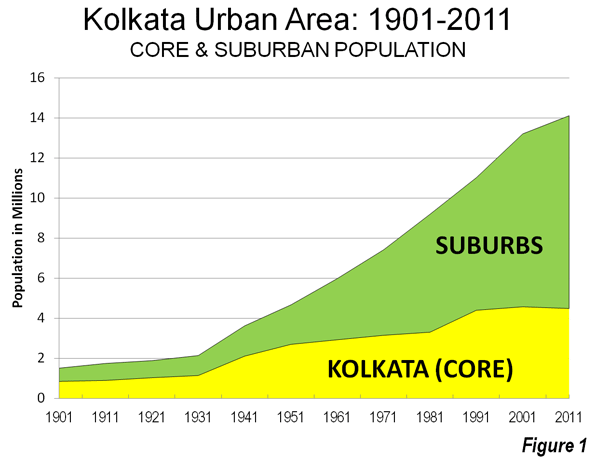
    Kolkata’s spreading urbanization, however, has been going on for at least a half century. Since the 1951 Census, the central city of Kolkata has accounted for only 19% of the urban area population growth. The central city has added nearly 1,800,000 people while the suburbs have added approximately 7,650,000 (Figure 1).

    Over the past two decades, the central city’s growth has been minimal, adding 87,000 people from 1991 to 2011, while the suburbs added more than 3 million new residents. This intensifies the pattern of the last half-century where most growth clustered close to the city core.

    Between 1901 and 1951, 59% of the growth in the Kolkata urban area was in the central city (Kolkata lost the British capital to Delhi in 1911).


    Photo: Victoria Memorial, KMC

    Slower Growth in the Urban Area: Kolkata is an unusually shaped urban area, nearly 50 miles (80 kilometers) long and stretched along the Hooghly River, one of the many mouths of the Ganges. Dhaka, the megacity capital of Bangladesh used to be on a mouth, until the river’s course changed. The urban area averages little more than 10 miles (16 kilometers) in width. The municipality of Kolkata is in the south, on the east bank of the Hooghly, with most of the suburbs to the north or just across the river.

    Like a number of major urban areas around the world, Kolkata has seen its population growth slow markedly. The peak population growth decade was the 1930s, when there was an increase of 69%. Growth dropped to 29% during the 1940s but continued at 20% or more until 2001. However, between 2001 and 2011, the urban area growth rate dropped to 7%, as the area added only 900,000 new residents. Despite its earlier, smaller size, the Kolkata urban area had not added this few people since the 1921 to 1931 decade.

    In reality, Kolkata is getting less dense by the day. The results of the 2011 Census of India showed that every new resident of the Kolkata urban area was added in the suburbs (Note 1). Yes, the central city of Kolkata remains very dense but its population fell from 4,573,000 people in 2001 to 4,487,000 people in 2011. At the same time, the population of suburban Kolkata grew by nearly 1,000,000 people, and accounted for 110% of the population growth.


    Photo: Howra Bridge, Hooghly River (Howra)

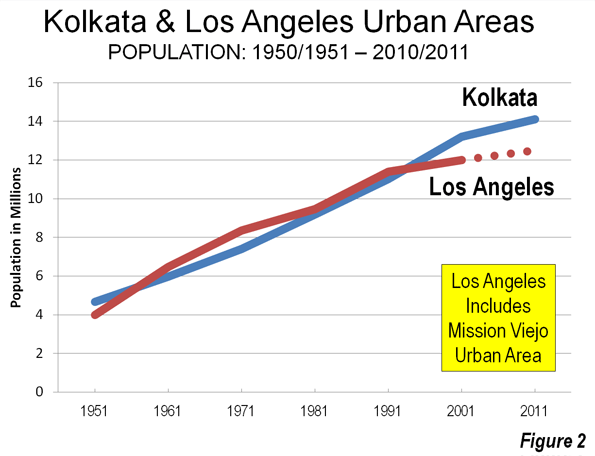
    Kolkata, Los Angeles and China: It also may seem strange that despite its huge typically third world growth since 1951, the Kolkata urban area grew at a rate similar to that of the Los Angeles urban area (Note 2). Los Angeles was larger from the 1960s to 1990, while Kolkata was larger in the 1950s and has been larger the last two decades (Figure 2). Still, Kolkata’s growth has fallen to high income world rates. Other Asian megacities (over ten million)  including Delhi, Shanghai, Beijing, Mumbai, Shenzhen, Manila, Jakarta, Dhaka and Guangzhou) have all experienced much faster growth over the past decade (Note 2). Shanghai and Beijing combined added nearly the same number of people as live in Kolkata.

    Hyper-Densities: Nonetheless, Kolkata continues to have some of the highest densities in the world. In 2001, one third of the central city population (1.49 million) live in slums and shantytowns (photo). They are crammed into just 2 square miles (5 square miles). This would be like all the population of the San Fernando Valley living within a radius 0.6 miles (1 kilometer) of Los Angeles City Hall or all the population of the city of Dallas in the space covered by the passenger terminals at Dallas-Fort Worth International Airport. This is more than 725,000 people per square mile (280,000 per square kilometer), and would nearly equal the "efficient density" definition that the Sierra Club wisely discarded. It can only be hoped that when the 2011 Census slum data is available, it will show that all of the city of Kolkata’s  population loss will have been from the slums.

    Kolkata, like that of other large urban areas around the world described in The Evolving Urban Form series, shows that, given a chance, people reveal their preferences by moving to more space, to construct a better life for themselves and their households.


    Photo: KMC Slum

    Wendell Cox is a Visiting Professor, Conservatoire National des Arts et Metiers, Paris and the author of “War on the Dream: How Anti-Sprawl Policy Threatens the Quality of Life

    Kolkata Urban Area: Population 1901-2011
    Year Kolkata Municipal Corporation (KMC) Suburbs Kolkata Urban Area (Urban Aggolmeration) KMC Share of Growth KMC Growth Suburban Growth
    1901         848,000         662,000          1,510,000 56.2%
    1911         896,000         849,000          1,745,000 51.3% 5.7% 28.2%
    1921      1,031,000         854,000          1,885,000 54.7% 15.1% 0.6%
    1931      1,141,000         998,000          2,139,000 53.3% 10.7% 16.9%
    1941      2,109,000      1,512,000          3,621,000 58.2% 84.8% 51.5%
    1951      2,698,000      1,972,000          4,670,000 57.8% 27.9% 30.4%
    1961      2,927,000      3,057,000          5,984,000 48.9% 8.5% 55.0%
    1971      3,149,000      4,271,000          7,420,000 42.4% 7.6% 39.7%
    1981      3,305,006      5,888,994          9,194,000 35.9% 5.0% 37.9%
    1991      4,400,000      6,622,000        11,022,000 39.9% 33.1% 12.4%
    2001      4,573,000      8,633,000        13,206,000 34.6% 3.9% 30.4%
    2011      4,487,000      9,626,000        14,113,000 31.8% -1.9% 11.5%


    —–

    (Lead Photo: Mahatma Gandhi Road, KMC.

    —–

    Note 1: This is the Kolkata "urban agglomeration," which is the term the Census of India uses to denote urban areas, or areas of continuous urban development. The Census of India, however, applies to criteria to its urban area definitions that make them difficult to compare to urban areas in other parts of the world. The Census of India does not, for example, allow an urban agglomeration to be defined across state lines. Thus, the Delhi urban area continues to be shown as smaller then the Mumbai urban area. This is despite the fact that the immediately adjacent urbanization of Delhi includes millions of additional people in the states of Haryana and Uttar Pradesh and is by international definition by far the largest urban areas in India. The other difficulty is that the Census of India includes the entire land area of any municipality in the urban area. Thus, where municipalities are particularly large in area, as in the case of Mumbai, considerably more land area is reported that he is truly urban. This can lower urban area densities by the inclusion of large areas that are rural. In the case of the call, urban area, the municipalities are generally much smaller, and the geographical definition of the Census of India is much closer to a genuine definition of an urban area or urban agglomeration.

    Note 2: The Mission Viejo urban area is included in the 2000 Los Angeles urban area population in this comparison. Much of this urban area was included in Los Angeles before the 2000 census and it seems likely that it will be reunited with Los Angeles in 2010. The 2010 US urban area geographical definitions have not yet been released. Based upon the change in the Los Angeles metropolitan area population, it is assumed that the Census Bureau’s urban area will show a population of approximately 12.5 million.

    Note 3: Chongqing is sometimes incorrectly characterized as a megacity, because of its status of a "provincial level municipality" in China. However, the Chongqing provincial municipality is largely rural, and covers a land area similar to that of Austria or Indiana. The Chongqing urban area has a population of approximately 7 million.