Category: Demographics

  • The Evolving Urban Form: Budapest

    The Budapest area has lost population overall since 1980, having fallen from 3.03 million to 2.99 million in 2016, according to Hungarian Central Statistical Office data as reported by citypopulation.de (Graphic 1). This 1.3 percent loss is smaller than the national population loss over the same period of 8.2 percent. Moreover, during the last five years, the Budapest area is estimated to have gained 1.7 percent, even as Hungary lost 1.1 percent. In this regard, the trend in Budapest has been similar to that of Warsaw, with stronger population growth than in the nation as a whole, but at the same time greater population growth outside the urban core.

    The Budapest area described in this article includes two of Hungary’s county level jurisdictions (megyék), the core municipality of Budapest and Pest, which surrounds Budapest with inner and outer suburbs. Each of the county level jurisdictions is further divided into districts.

    Urban Core Districts

    Budapest’s center spans the Danube River and includes District I (former Pest) and District V (former Buda). These districts largely encompassed the “walking city” that existed before the coming of transit in the 18th century. Walking cities have especially high densities, and were subject to huge population losses when after transit and the automobile arrive. For example, from 1860 to 2010, core walking arrondissements (I through IV) of the ville de Paris have lost nearly 75 percent of their population (earlier comparisons are not readily available because new arrondissement boundaries were adopted in 1860).

    Similarly, since 1980, the former walking center of Budapest has lost 44 percent of its population. The largest loss occurred in the decade following the exit of Soviet influence, between 1990 and 2001. Over the past five years, these two districts have experienced a small population reversal, having increased approximately four percent.

    On the east side of the Danube, there are a number of high density districts adjacent to District V (Districts VI, VII, VIII, IX, X and XIII). These largely developed in the mass transit era and have suffered less serious losses. Since 1980, these districts have loss 29 percent of their population. Again, the greatest declines were between 1990 and 2001. However, modest losses continue and the most recent five year loss more than offset the gains noted above in the inner core districts.

    Budapest’s urban core is renowned for its magnificent buildings, largely from the 19th century. Its core is a feast of architecture rivaling such urban showpieces as Paris, Barcelona and Buenos Aires.

    The urban core of Budapest includes the Royal Palace (Graphic 2) on the west side of the river and Parliament on the east side. There is the notable ‘Chain Bridge,” which opened in 1848 and still handles pedestrian, transit and highway traffic (Graphic 3).

    Parliament was completed in 1904, when Budapest was one of the two capitals of the Austrian-Hungarian Empire, under the dual monarchy (top photograph and Graphics 4 and 5). It is, in my view, one of the most distinctive seats of government in the world, having features that resemble those of the Palace of Westminster in London and a dome resembling that of the U.S. Capitol. Its distinctive reddish roofs are seen in current river cruise PBS television commercials.

    The Parliament is in Kussuth Square (Graphics 6 and 7), which was at the heart of the 1956 rebellion against Soviet rule, which resulted in a death toll of 2,500, followed by the loss of 200,000 refugees. There is now a memorial to the event below Kussuth Square, with exhibits tied together by a lighted red line symbolizing the bloody event (Graphic 8).

    The urban core also includes the Opera House that reminds one of the Garnier Opera in Paris. There are many more examples of ornate architecture, principally from the 19th century (Graphics 9 to 17), extending to “Heroes Square,” where Imre Nagy, Chairman of the Council of Ministers of the Hungarian People’s Republic (the national leader) was reburied, after having been executed for leadership of the 1956 rebellion.

    Other City Districts

    The other 15 districts of Budapest have lost six percent of their population since 1980. These districts are newer, have lower population densities and are more automobile oriented (Graphic 18). However, since 2011, these districts experienced a three percent increase. The other districts have more than 70 percent of Budapest’s population, and this increase was enough to produce an overall two percent increase for Budapest county between 2011 and 2016. Even so, Budapest county has lost 15 percent of its population since 1980.

    The Suburbs (Pest County)

    The only part of the Budapest area that has grown since 1980 is Pest County, with its inner and outer suburbs (Graphics 19 and 20). Overall, Pest County has grown 27 percent. The eight inner suburban counties experienced the bulk of the growth, adding 50 percent, while the 10 outer suburban counties added four percent to their population.

    In the Soviet era, high rise apartment blocks were the rule, while there was little construction of detached housing. Following the Soviet exit, suburbanization developed rapidly, with considerable single family detached housing construction (Graphics 21 to 22). Houses continue to be under construction, both in existing suburban areas and in greenfield areas (Graphics 23 to 28), some in the Buda Hills, with stunning views of the city. This greenfield development appears to have stronger infrastructure regulations, illustrated by unusually wide (for Europe) suburban roadways and complete sidewalk development, even before house construction begins (Graphic 29).

    Progress in Budapest

    Hungary faces serious challenges, particularly due to its substantial population losses. Yet, as in the case of Tokyo-Yokohama, a national capital in a nation losing population can prosper by capturing nearly all of the nation’s growth. This is also the reality in the Budapest region, where recent modest population gains have been achieved, even as the nation continued to lose population. Over the last three decades, Budapest has moved quickly from the excessive political and economic controls to a new future of people-centered modernity that the more fortunate cities in North America, Europe and Oceania were able to embrace much earlier.

    Wendell Cox is principal of Demographia, an international public policy and demographics firm. He is a Senior Fellow of the Center for Opportunity Urbanism (US), Senior Fellow for Housing Affordability and Municipal Policy for the Frontier Centre for Public Policy (Canada), and a member of the Board of Advisors of the Center for Demographics and Policy at Chapman University (California). He is co-author of the “Demographia International Housing Affordability Survey” and author of “Demographia World Urban Areas” and “War on the Dream: How Anti-Sprawl Policy Threatens the Quality of Life.” He was appointed to three terms on the Los Angeles County Transportation Commission, where he served with the leading city and county leadership as the only non-elected member. He served as a visiting professor at the Conservatoire National des Arts et Metiers, a national university in Paris.

    Top photograph: Parliament from across the Danube (by author).
  • America’s Heartland is Critical to Our Future

    The results of the 2016 presidential election have been ascribed — by the winner’s critics — to racism, hysteria, stupidity, or nostalgia. But what the results most reflected was a looming economic divide. Essentially, Donald Trump won in the parts of the country that grow most of the food, drill for oil and gas, and produce palpable things. The places that went for Hillary Clinton are where intangibles such as media, software, and financial transactions drive the economy.

    Blue America elites denigrate, and even pity, the vast American heartland for its lack of hipness and  dependence on more traditional industries. Inconveniently, however, the vast region located between the Appalachians and the Rockies — and from the Gulf of Mexico to the Canadian border — is also home to roughly half the country’s population and electoral votes.

    Not content merely to attack Trump at every turn, frustrated liberal elites compete with each other to heap scorn on those who voted for him. “These are the folks who think intellectualism is a sign of weakness,” scolds  Gentleman’s Quarterly in a recent piece that calls Trump voters “bigoted morons … who stay willfully ignorant as a point of cultural pride.” Trump voters, adds Salon, should not hope for an industrial revival, since these jobs “are never coming back.” Rather than hope that jobs created by industry will return, one Berkeley economist suggests these voters pack up and move to San Francisco — notwithstanding median housing price approaching $1.2 million.

    Stuff Still Matters

    Yet despite these attitudes, the heartland may yet prove the key to restoring a prosperous and more egalitarian future. As Michael Lind and I show in our new report for the Center for Opportunity Urbanism, heartland-centered industries provide far wider and better-paid work for those without a four-year degree. They also provide more opportunities to blacks and Hispanics, who account for  less than 5 percent of workers in Silicon Valley’s top firms while accounting for 25 percent of those in manufacturing and over 20 percent in the energy sector.   

    Nor are these opportunities disappearing as rapidly as either blue state pundits (or Trump himself) would have us believe. Since 2011, all but 18 of the country’s 70 largest regions, according to Pepperdine University economist Michael Shires, have seen an uptick in industrial jobs. Nor does this trend seem to be fading; openings for new industrial jobs are at the highest level since the onset of the Great Recession.

    Since 2011, nine of the fastest growing industrial areas in the U.S. are in red states, notes Shires. Between 2010 and 2016, the top four – Michigan, Indiana, Ohio, and Tennessee – have accounted for nearly 40 percent of the nation’s new manufacturing jobs.  

    These regions once were fertile ground for Democrats, and could again with a shift in attitude. Allied with trade unions, Democratic candidates took tough stands on international trade and openly promoted expanding manufacturing and energy jobs. Yet, increasingly, the Democratic Party has abandoned these concerns, preferring to talk about putting “coal miners out work,” imposing strict regulation of oil and gas industry growth, and curbing the auto sector. This explains, at least in part, why such states voted against Hillary Clinton in 2016 (while supporting the more populist-themed candidacy of her husband two decades earlier).

    Why the Heartland Matters to the Economy

    Although the industrial workforce has fallen from 10.5 percent to 8.5 percent of all nonfarm employment since 2005, manufacturing contributes to the economy far out of proportion to its shrinking share of employment. In 2013, notes economic historian Lind, the manufacturing sector employed 12 million workers, but generated an additional 17.1 million indirect jobs.  

    Far from being technically regressive, manufacturers also employ most of the nation’s scientists and engineers. Regions in Trump states associated with basic industries — Houston, Dallas-Fort Worth, Detroit, Salt Lake City, Dayton — enjoy among the heaviest concentrations of STEM workers and engineers in the country, far above New York, Chicago and Los Angeles.

    For many communities, manufacturing matters because it creates so much additional output in the rest of the country. Overall, according to the Bureau of Economic Analysis, the multiplier effect for manufactured goods is more than twice that generated by retail, trade, or the professional and business services sector. 

    The contribution of manufacturing to U.S. productivity growth is also disproportionate. From 1997-2012, labor productivity growth in manufacturing — 3.3 percent per year — was a third higher than productivity growth in the private economy as a whole. Manufactured goods also accounted for 50 percent of all exports. By way of contrast, intellectual property payments for services such as royalties to Silicon Valley tech companies and entrepreneurs amounted to $126.5 billion in 2015, which represents less than 6 percent of the $2.23 trillion in total exports that year.

    Finally, there are the natural resource industries, to which the blue state punditry — and unfortunately much of the political class — are largely indifferent, if not openly hostile.

    The Mississippi Basin produces 92 percent of the nation’s agricultural exports by value, as well as most of the feed grains, soybeans, and livestock and hogs produced nationally. Sixty percent of all grain exported from the U.S. is shipped via the Mississippi River through the Port of New Orleans and the Port of South Louisiana.

    The most rapid gains, however, stem from the upsurge in American-produced energy. Now that fracking appears to have turned the corner, the U.S. is on its way to becoming a major exporter of natural gas and petroleum-refined products. And energy jobs pay as well or better than those in the heralded occupations, such as finance, business services and information. Although down from its peak, energy sector employment remains at 2.2 million, well above 2010 levels. Low energy prices and stable sources of supply are among the reasons that industrial firms, including those from abroad, have flocked to large parts of the heartland, notably Texas and Ohio, where energy is a primary generator of high-paying manufacturing employment.

    Last Hope for America’s Middle Class?

    The heartland’s most important contribution may be in providing a new opportunity for the country’s diminishing middle class. An array of scholarship, including a recent study by James Galbraith, a progressive University of Texas economist, has shown that the coastal states have the dubious honor of leading the way in increasing income inequality over the past 15 years. For all their progressive fulminations, cities such as San Francisco, New York and Los Angeles are now the most economically imbalanced in the nation.

    Increasingly, people seeking opportunity are leaving in large numbers from New York or California and heading to places such as Tennessee or Texas. Even traditional large losers of domestic migrants, such as Michigan and Ohio, have seen their out-migration rates drop since 2000. The migration trend has now tipped in favor of the region’s resurgent cities, including Midwestern cities such Des Moines, Indianapolis, Louisville (pictured), and Columbus.

    A critical factor here is the cost of living, particularly housing. In most cities, the price-to-income ratio, called the “median multiple,” is around 3 to 1. This ratio is two or three times higher in the prime regions of California or the Northeast.   

    Perhaps most revealing of the future are changes in youth migration, notably those with college degrees. Research conducted by Cleveland State University suggests a sea change since 2010 in the migration patterns of educated millennials towards heartland cities. In earlier periods the strongest growth did indeed go to hip locals such as San Francisco, San Jose, Washington D.C., Los Angeles and New York. More recently, the big growth has been in such Rustbelt redoubts like Pittsburgh and Cleveland, as well as Sunbelt standouts San Antonio, Houston, and Austin. These trends foreshadow likely migration patterns, and may become more pronounced when the younger cohort begins to start families and seek out homes.  

    These trends suggest that, rather than remaining a hopeless backwater, the heartland could increasingly provide a major contribution to the country’s economic future. These regions may not replace Silicon Valley or Manhattan as generators of hyper-wealth, but seem more likely to offer opportunities for the next American middle class. So, don’t cry for the heartland, or hold it in contempt. Rather than detritus of a fading economy, the middle of America may well hold the key to the future prosperity and American opportunity for the coming decades.

    This piece originally appeared on Real Clear Politics.

    Joel Kotkin is executive editor of NewGeography.com. He is the Roger Hobbs Distinguished Fellow in Urban Studies at Chapman University and executive director of the Houston-based Center for Opportunity Urbanism. His newest book is The Human City: Urbanism for the rest of us. He is also author of The New Class ConflictThe City: A Global History, and The Next Hundred Million: America in 2050. He lives in Orange County, CA.

    Photo by David Grant, obtained via Flickr, using the CC License.

  • Move Over, San Francisco: Dallas Tops Our List Of The Best Cities For Jobs 2017

    Dallas is called the Big D for a reason. Bigger, better, best: that’s the Dallas mindset. From the gigantic Cowboys stadium in Arlington to the burgeoning northern suburbs to the posh arts district downtown, Dallasites are reinventing their metropolis almost daily. The proposed urban park along the Trinity River, my Dallas friends remind me, will be 11 times bigger than New York’s Central Park.

    Here’s something else for them to boast about: the Dallas-Plano-Irving metropolitan area ranks first this year on our list of the Best Cities For Jobs.

    2017 Best Cities Rankings Lists

    It’s a region that in many ways is the polar opposite of the San Francisco and San Jose metropolitan areas, which have dominated our ranking for the last few years. (They still place second and eighth this year, respectively, among the largest 70 metropolitan areas, though San Jose is down sharply from second place last year.)

    Unlike the tech-driven Bay Area, Dallas’ economy has multiple points of strength, including aerospace and defense, insurance, financial services, life sciences, data processing and transportation. Employment in the metro area has expanded 20.3% over the past five years and 4.2% last year, with robust job creation in professional and business services, as well as in a host of lower-paid sectors like retail, wholesale trade and hospitality.

    According to Southern Methodist University’s Klaus Desmet and Collin Clark, Dallas’s success stems in part from the fact that it isn’t looking to appeal to the elite “creative class,” but to middle-class workers and the companies and executives who employ them. Dallas attracts both foreign and domestic migrants, particularly from places like California, where housing is, on an income-adjusted basis, often three times as expensive. This has had much to do with the relocation to the area of such companies as Jacobs Engineering, Toyota, Liberty Mutual and State Farm.

    Methodology

    Our rankings are based on short-, medium- and long-term job creation, going back to 2005, and factor in momentum — whether growth is slowing or accelerating. We have compiled separate rankings for America’s 70 largest metropolitan statistical areas (those with nonfarm employment over 450,000), which are our focus this week, as well as medium-size metro areas (between 150,000 and 450,000 nonfarm jobs) and small ones (less than 150,000 nonfarm jobs) in order to make the comparisons more relevant to each category. (For a detailed description of our methodology, click here.)

    The Rise of Low-Cost Meccas

    Dallas is far bigger (particularly if you add the neighboring 28th-ranked Ft. Worth-Arlington area to the mix) than any of the other metro areas that have prospered by offering cheaper alternatives to coastal cities, with lower taxes and generally more friendly business climates. Among them is No. 3 Nashville-Davidson-Murfreesboro-Franklin, Tenn.

    The metro area has seen rapid job growth, nearly 20.6% since 2011. Last year job growth was across the board, including a 4.1% expansion in manufacturing employment, 5.2% in business professional services, and 2.9% in the information sector.

    Like Dallas, Nashville has become a mecca for companies looking to relocate operations. Some, like UBS, are fleeing the high cost of places like New York or London. Others, like Lyft, are escaping high costs in coastal California. CKE Restaurants, owner of Carl’s Junior and Hardees, is moving operations from coastal California and St. Louis to set up shop in Nashville. All are bringing a diverse new range of jobs to the Music City.

    Other low-cost migration meccas include fourth-place Charlotte-Concord, Gastonia, No. 5 Orlando-Kissimmee-Sanford, and No. 6 Salt Lake City. All boast growing tech centers with rapidly expanding STEM employment, as well as business and professional service growth.

    Boom Towns Get Pricier

    Some thriving metro areas on our list are becoming increasingly expensive, but they still don’t pack the tax and housing punch associated with blue state economies. No. 7 Austin-Round Rock, No. 9 Seattle-Bellevue-Everett and No. 11 Denver-Aurora-Lakewood have been big beneficiaries of the tech boom, and continue to attract migrants from areas like the Bay Area, where housing prices are still twice as high.

    It’s possible for older large cities with strongholds in key industries to generate strong job growth. New York’s population growth in 2016 may be half of what was in 2010, but financial sector job growth and associated professional service firms enable the Big Apple to rank a respectable 25th. Another high-cost area, Boston-Cambridge-Quincy, with its unparalleled concentration of elite colleges, ranks 30th.

    The picture is not so pretty in Los Angeles-Long Beach-Glendale, a region whose housing costs are almost as high as the Bay Area, with the same onerous state regulatory and tax burdens. It ranks 40th this year, with anemic 1.2% job growth in professional and business services over the past three years and 4% in financial services. The L.A. area continues to bleed manufacturing jobs, down 2.1% in the last year and 4.6% since 2013. Even retail and wholesale trade showed weakness in 2016, growing at a lowly 0.7% and 1.7% rate, respectively. The Information sector, highlighted by Snapchat’s splashy IPO, made the best showing for Tinseltown, with employment rising 4.2% in the last year. The sector, which includes entertainment, has seen employment expand an impressive 20.9% since the bottom of the recession in 2011.

    As has been the case almost every year in this millennium, the super-sized metro area doing worst is Chicago. It ranks 51st this year, down four places. Since the Great Recession, Chicago has managed modest job growth of 8.3%, and only a weak 0.7% expansion in 2016. Despite an uptick in financial services jobs over the past two years, and some ballyhooed relocations of corporate headquarters, the metro area has been losing jobs in information, manufacturing, and wholesale trade. Business services was up a scant 0.5% in the last year.

    Demographic Change and Changing Momentum

    The resurgence of expensive areas — notably New York and the San Francisco area — has been propelled largely by demographic trends, notably the movement of highly educated millennials to these areas. Yet as millennials begin to enter their 30s, and seek to buy homes and raise families, the momentum may be turning decisively to regions that are both less expensive but still have considerable appeal to educated workers. Most of the big gainers this year – Dallas, Orlando, Salt Lake, Raleigh, and No. 24 Indianapolis – have developed better inner-city amenities in recent years while keeping housing costs low.

    This shift is being driven in large part by unsustainable housing costs. In the Bay Area, techies are increasingly looking for jobs outside the tech hub, and some companies are even offering cash bonuses for those willing to leave. A recent poll indicated that 46% of Millennials want to leave the San Francisco Bay Area.

    It seems that some areas located in pro-business, low-tax states are increasingly attracting the educated millennials that we usually associate with places like San Francisco, Brooklyn or West L.A. Since 2010, among educated millennials, the fastest growth in migration has been to such lower-cost regions as Atlanta, Orlando, New Orleans, Houston, Dallas-Fort Worth.

    Over time, this migration could restructure the geography of job growth. As the middle class, particularly those of child-bearing age, continue moving out of states like California and into states like Texas. Utah or The Carolinas, the geography of skills changes. New families, a critical engine of job growth, are far more likely to form in Salt Lake City, the four large Texas metropolitan areas, or Atlanta, than in the bluest metropolitan areas like New York, Seattle, Los Angeles or San Francisco, where the number of school-age children trend well below the national average.

    Ultimately, we may be on the cusp of a new economic era in which the cost of housing and living becomes once again a key determinant in regional growth. This trend has been developing for years, but both demographics, notably the aging of millennials, and out of control costs could accelerate it. Many areas may wish to somehow emerge as “the new Silicon Valley,” just as they wished once to be the next “Wall Street” or “Hollywood.” Yet these iconic economies are difficult, to impossible, to duplicate. It might make more sense instead to look the success of places like Dallas — where lower costs are luring companies and talent at a level unrivaled in the nation.

    This piece originally appeared on Forbes.

    Joel Kotkin is executive editor of NewGeography.com. He is the Roger Hobbs Distinguished Fellow in Urban Studies at Chapman University and executive director of the Houston-based Center for Opportunity Urbanism. His newest book is The Human City: Urbanism for the rest of us. He is also author of The New Class ConflictThe City: A Global History, and The Next Hundred Million: America in 2050. He lives in Orange County, CA.

    Dr. Michael Shires primary areas of teaching and research include state, regional and local policy; technology and democracy; higher education policy; strategic, political and organizational issues in public policy; and quantitative analysis. He often serves as a consultant to local and state government on issues related to finance, education policy and governance. Dr. Shires has been quoted as an expert in various publications including USA TodayNewsweekThe EconomistThe Sacramento Bee, San Francisco Chronicle, and LA Times. He has also appeared as a guest commentator on CNN, KTLA and KCAL to name a few.

    Photo by Diann Bayes, obtained via Flickr using a CC License.

  • The New American Heartland: Renewing the Middle Class by Revitalizing the Heartland

    This is the introduction to a new report written by Joel Kotkin and Michael Lind with a team of contributors. Download the full report (pdf) here.

    The greatest test America faces is whether it can foster the kind of growth that benefits and expands the middle class. To do so, the United States will need to meet three challenges: recover from the Great Recession, rebalance the American and international economies, and gain access to the global middle class for the future of American goods and services.

    The fulcrum for meeting these challenges is the combination of industries and resources concentrated in the New American Heartland, the center of the country’s productive economy. Traditionally, the Heartland has been defined as the agriculturally and industrially strong Midwest, alone or perhaps together with the Upper Plains. However, the geographic distribution of US manufacturing and energy extraction has expanded through the growth of new manufacturing zones, largely in Texas, the South and the Gulf Coast.

    Our map of the New American Heartland includes not only the Midwest and Upper Plains, but portions of all the Gulf States — Texas, Louisiana, Mississippi, Alabama, Florida — and the non-coastal southern states of Georgia, Tennessee, and Arkansas.

    It comprises most of the US between the Rocky Mountains and the Appalachians.

    The New Heartland incorporates the old Midwest and much of the South. Alongside it, the new continental periphery consists of the mountain and desert spine of North America from Mexico through to Canada, a region that is likely to remain thinly populated and devoted to resource extraction, tourism and wilderness preservation.

    While every region contributes to American prosperity, the New American Heartland has the potential to play an outsized role in powering economic growth in the twenty-first century.

    Download the full report (pdf) here.

  • The globalization debate is just beginning

    The decisive victory of Emmanuel Macron for president of France over Marine Le Pen is being widely hailed as a victory of good over evil, and an affirmation of open migration flows and globalization. Certainly, the defeat of the odious National Front should be considered good news, but the global conflict over trade and immigration has barely begun.

    On both sides of the Atlantic, there are now two distinct, utterly hostile, opposing views about globalization and multiculturalism. The world-wise policies of the former investment banker Macron play well in the Paris “bubble” — and its doppelgangers in New York, San Francisco, Tokyo and London — but not so much in the struggling industrial and rural hinterlands.

    The trade dilemma

    For much of the past half-century, the capitalist powers, led by the United States, favored free trade, even with terms often vastly unbalanced. Now President Donald Trump has undermined this orthodoxy. But anti-globalism transcends conservatism. Besides the National Front, which won over a third of the vote, doubling its support from 2002, the other rising political force in the country, far-left socialist Jean-Luc Melenchon, is at least as hostile to free trade. Much the same can be said of the ascendant Bernie Sanders wing of the Democratic Party.

    Globalists argue that the free trade regime, primarily promoted by the United States, has been a boon to the world economy. Certainly, the last half-century has seen enormous progress in some countries, most notably in East Asia, and led to a general decline in global poverty. It has also produced lower prices for consumers in America and elsewhere.

    Yet, there has been a price to pay, perhaps not in Newport Beach or Beverly Hills, but definitely in areas such as Lille, France, or Rust Belt Ohio, where workers and communities suffered for free trade “principles.” The trade deficit with China alone, notes the labor backer Economic Policy Institute, has cost the country some 3.4 million jobs between 2001 and 2015.

    Read the entire piece at the Orange County Register.

    Joel Kotkin is executive editor of NewGeography.com. He is the Roger Hobbs Distinguished Fellow in Urban Studies at Chapman University and executive director of the Houston-based Center for Opportunity Urbanism. His newest book is The Human City: Urbanism for the rest of us. He is also author of The New Class ConflictThe City: A Global History, and The Next Hundred Million: America in 2050. He lives in Orange County, CA.

    Photo: By Lorie Shaull from Washington, United States (French Election: Celebrations at The Louvre, Paris) [CC BY-SA 2.0], via Wikimedia Commons

  • California’s War on the Emerging Generation

    It should be the obligation of older citizens to try to improve the prospects for their successors. But, here in California, as seen in a new report issued by the Chapman Center for Demographics and Policy, we seem to have adopted an agenda designed to make things tougher for them.

    Millennials everywhere face many challenges. The U.S. Census Bureau estimates that, even when working full-time, they earn $2,000 less than the same age group made in 1980. Nationwide, a millennial with a college degree and college debt, according to a recent analysis of Federal Reserve data, earns about the same as someone of the baby boomer generation did at the same age without a degree.

    Generational crisis

    But California millennials face an even greater challenge than most. Despite the anecdotes of youthful fortunes emanating from Silicon Valley, California’s millennials, on average, do not earn more than their counterparts elsewhere. Yet, they confront the highest housing prices in the nation, now 230 percent of the national average.

    These prices hit the newest and youngest buyers hardest. California boomers have rates of homeownership close to the national average, but people aged 25 to 34 suffered the third-worst homeownership rate (25.3 percent) among the 50 states. In San Francisco, Los Angeles and San Diego, the 25-34 homeownership rates range from 19.6 percent to 22.6 percent — approximately 40 percent or more below the national average. That is no surprise here, given that in Los Angeles and the Bay Area a monthly mortgage takes, on average, are close to 40 percent of income, compared to 15 percent nationally.

    California’s young people are also staying with their parents more than their counterparts elsewhere. Overall, approximately 47 percent of 18-34s lived with parents or other relatives in 2015, according to the American Community Survey. In California, the figure was 54 percent.

    Long-term implications

    These soaring prices could have severe demographic consequences. For every two homebuyers who have come to the state, five homeowners left, the research firm Core Logic has found. If millennials continue their current rate of savings, notes one study, it would take them 28 years to qualify for a median-priced house in the San Francisco area, but only five years in Charlotte, N.C., or three years in Atlanta. A recent ULI report found that 74 percent of all Bay Area millennials are considering a move out of the region in the next five years.

    This exodus could accelerate over the next decade, as most millennials reach their 30s, marry, settle down, start families and consider a home purchase. We have already passed, in the words of USC demographer Dowell Myers, “peak urban millennial.”

    The future market demand for affordable single-family homes seems likely to continue expanding. Nationally, among home purchases made by those under 35, four-fifths choose single-family detached houses, a form that is increasingly out of reach. This is not due to preference. Indeed, according to a California Association of Realtors survey, 82 percent of millennial renters in the state believe that purchasing a home is a clever idea and a safe investment.

    Some assume that building more high-density housing will solve California’s severe housing affordability crisis. Unfortunately, construction costs for higher-density housing range up to 7.5 times the cost of building detached housing. Equally important, the clear majority of new households generally prefer single-family residences by a wide margin.

    Read the entire piece at The Orange County Register.

    Click here to see the video on millennial prospects in California.

    Joel Kotkin is executive editor of NewGeography.com. He is the Roger Hobbs Distinguished Fellow in Urban Studies at Chapman University and executive director of the Houston-based Center for Opportunity Urbanism. His newest book is The Human City: Urbanism for the rest of us. He is also author of The New Class ConflictThe City: A Global History, and The Next Hundred Million: America in 2050. He lives in Orange County, CA.

    Photo by American Advisors Group, obtained via flickr using a CC License

  • The Evolving Urban Form: Warsaw

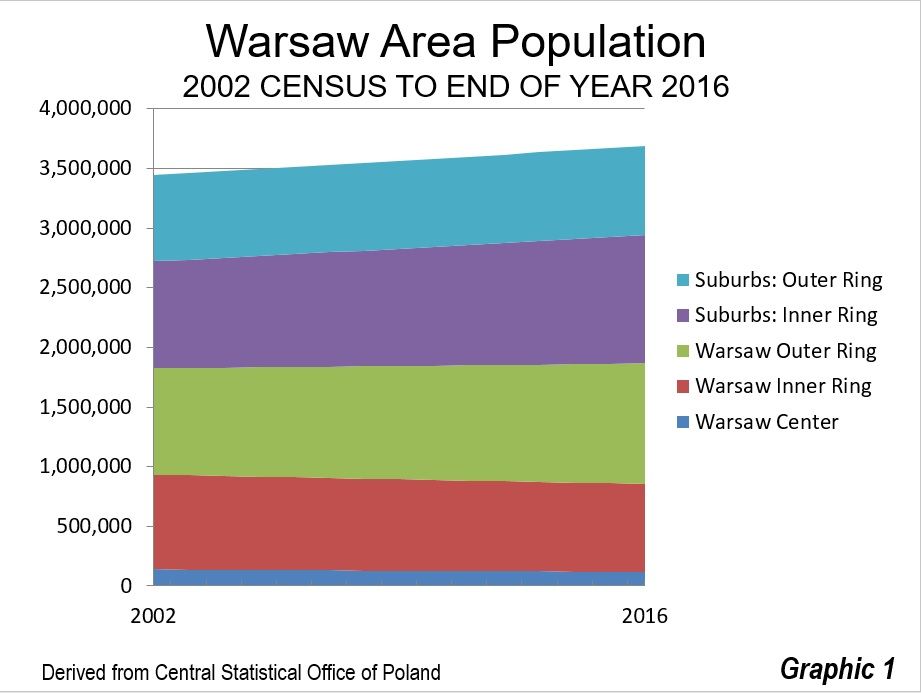
    Like other major cities in the high income world, Warsaw has seen central area population losses, with all of the population growth taking place outside the urban core, principally in the suburbs and exurbs (Graphic 1). The city’s districts were reconfigured so that direct comparisons cannot be made before the 2002 census.

    The Warsaw region consists of the city of Warsaw, a county-level national jurisdiction (powiat) and seven powiats in the suburbs and nine in the exurbs. The Warsaw region grew from 3.31 million residents in 2002 to 3.58 million in 2016, a 0.5 percent annual growth rate. Warsaw’s slow growth is substantially faster than that of the nation, which has not gained in population since 2002, both as a result of a below-replacement fertility rate and migration to other parts of Europe.

    The Central District

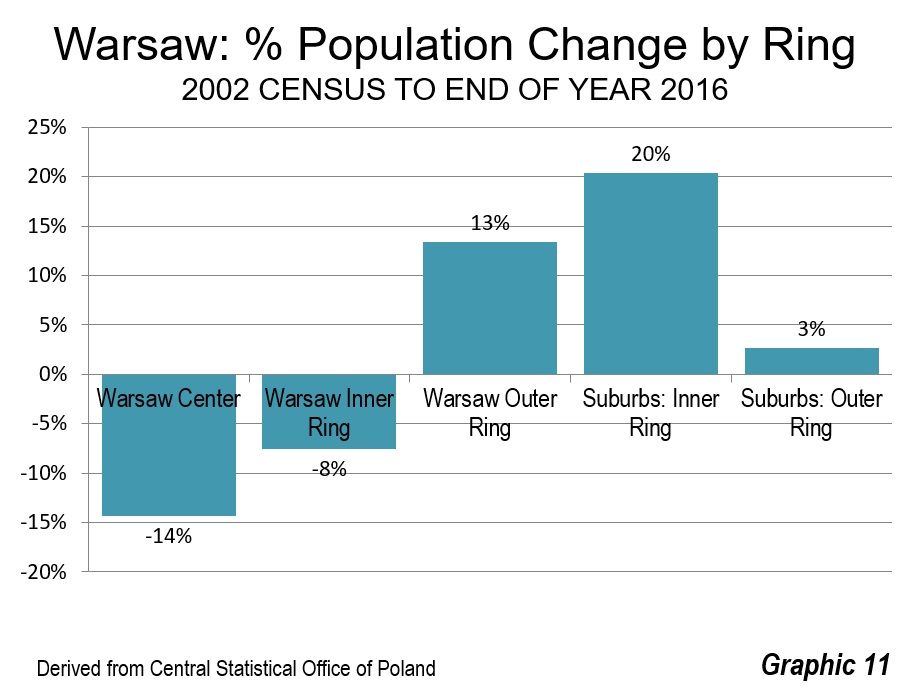
    The central district (Śródmieście), which includes the central business district (CBD) and the central railway station (Warszawa Centralna) experienced a loss in population of 14 percent from the 2002 census to 2016, according to the Central Statistical Office of Poland.

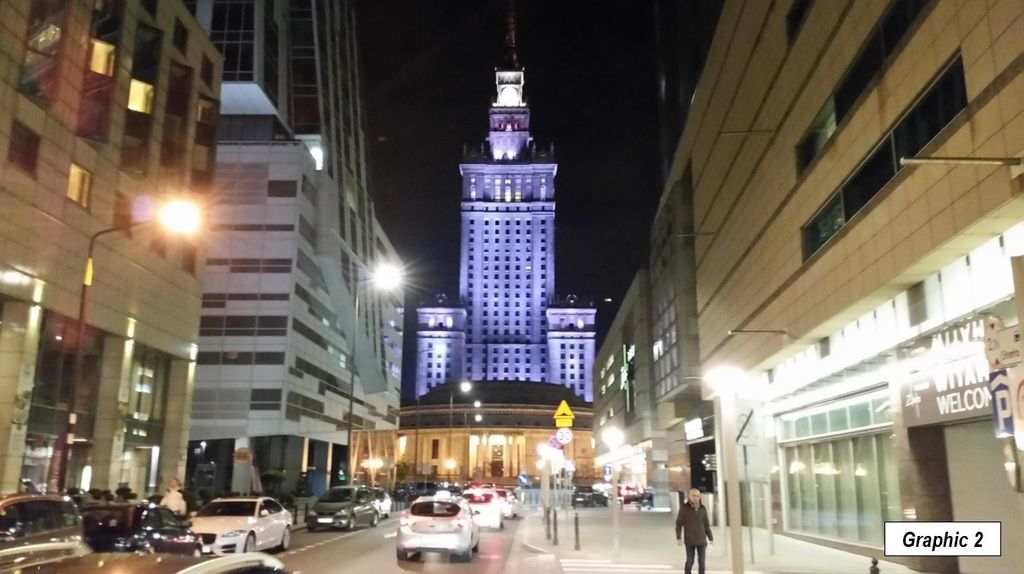
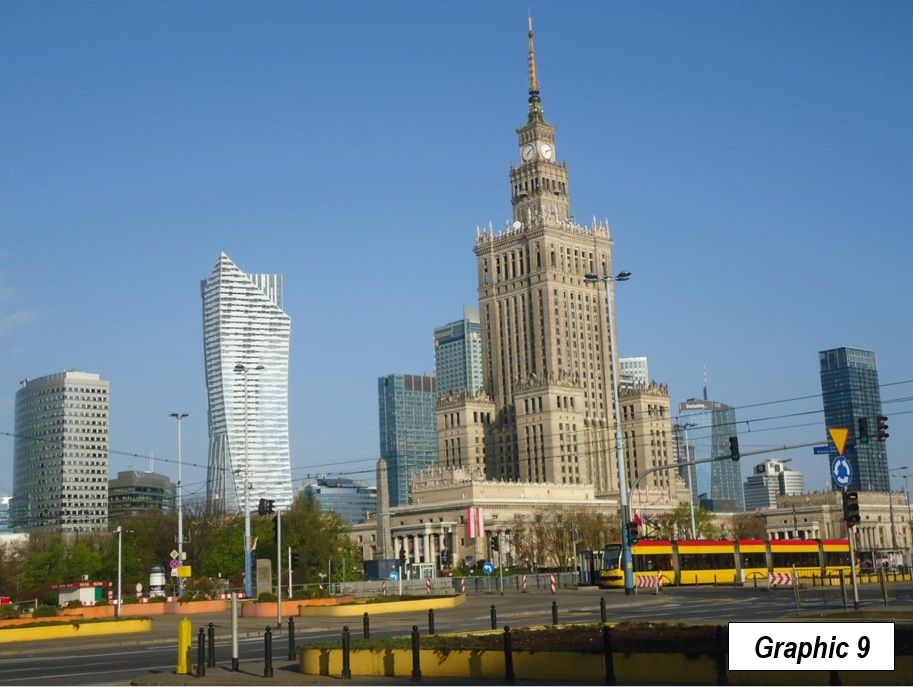
    The skyline of Warsaw (Graphic 2) used to be dominated by the Palace of Culture and Science, which was constructed as a “gift” to the Polish people from Soviet leader Josef Stalin in the early 1950s (though completed after his death). It is sometimes called the “Eighth Sister,” referring to its similarity to the “seven sisters” in Moscow that share a very similar “wedding cake” design. Like Moscow State University and Ukraina Hotel buildings in the Russian capital, the Palace of Culture and Science is fully symmetric from the base up. The Palace is located at the very center of Warsaw, adjacent to Warszawa Centralna and even has suburban rail entry structures in the surrounding green area.

    The building spent decades as a reviled reminder of Soviet domination and the restrictions imposed under Soviet communism. When the Poles took control of their own destiny about 28 years ago, there was considerable pressure to dismantle the Palace as many felt it was a symbol of oppression. The parliament defeated a measure to demolish the building, despite significant public pressure. Today, the Palace seems to have been, at least reluctantly accepted. It is now impressively lighted at night.

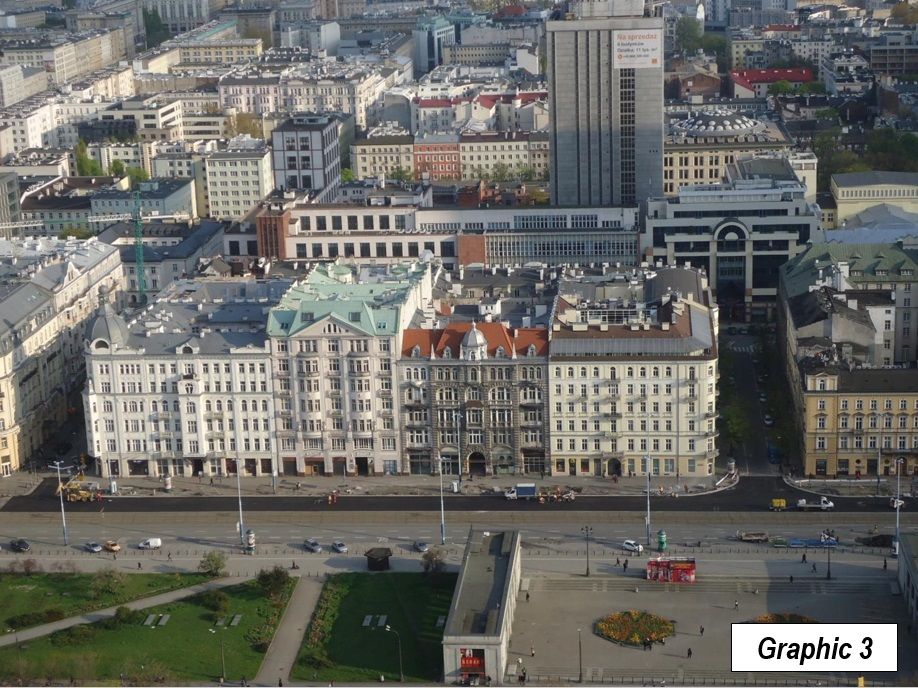
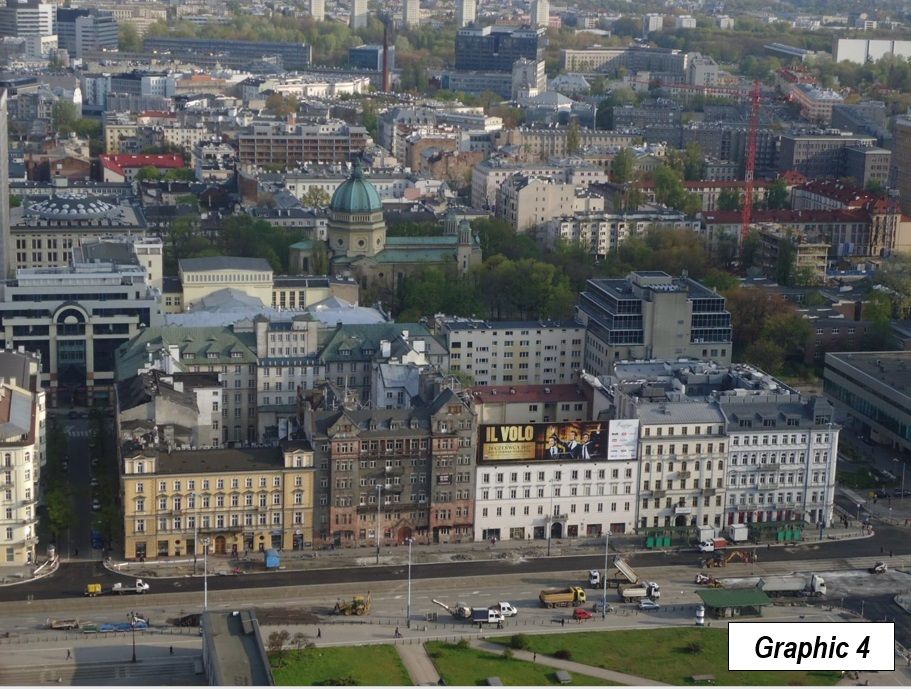
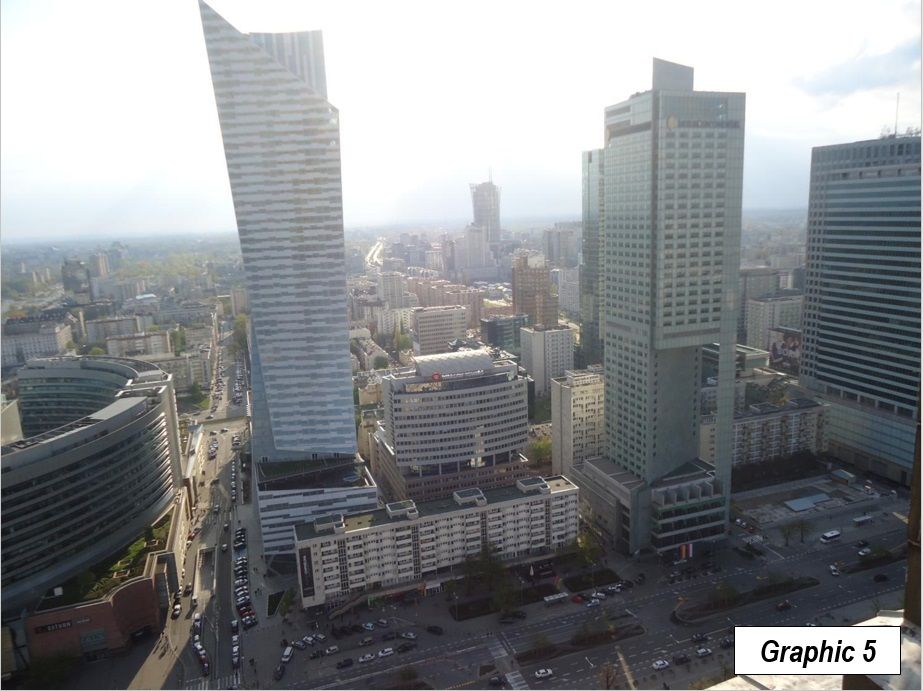
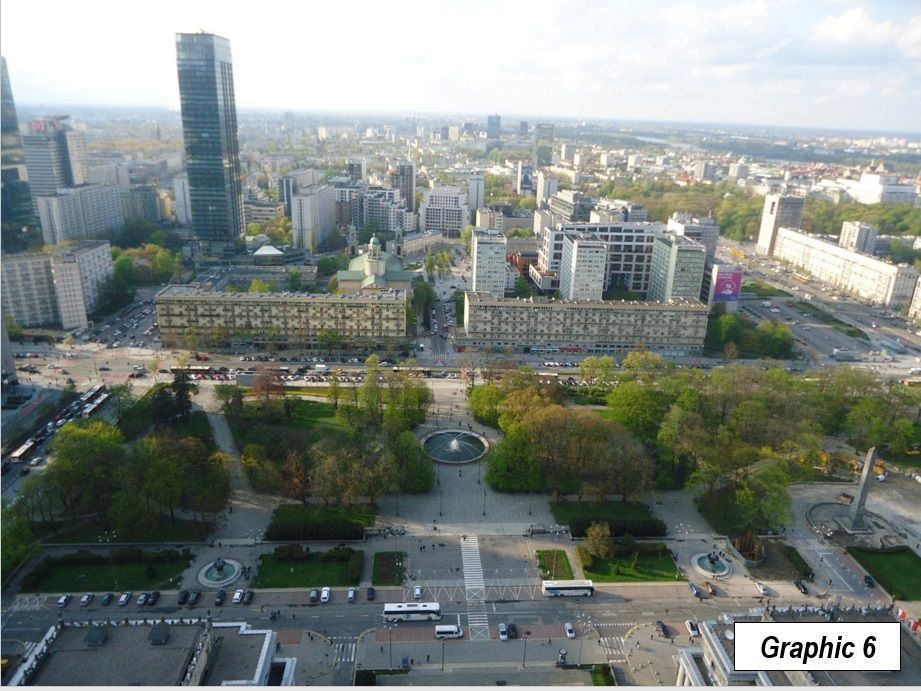
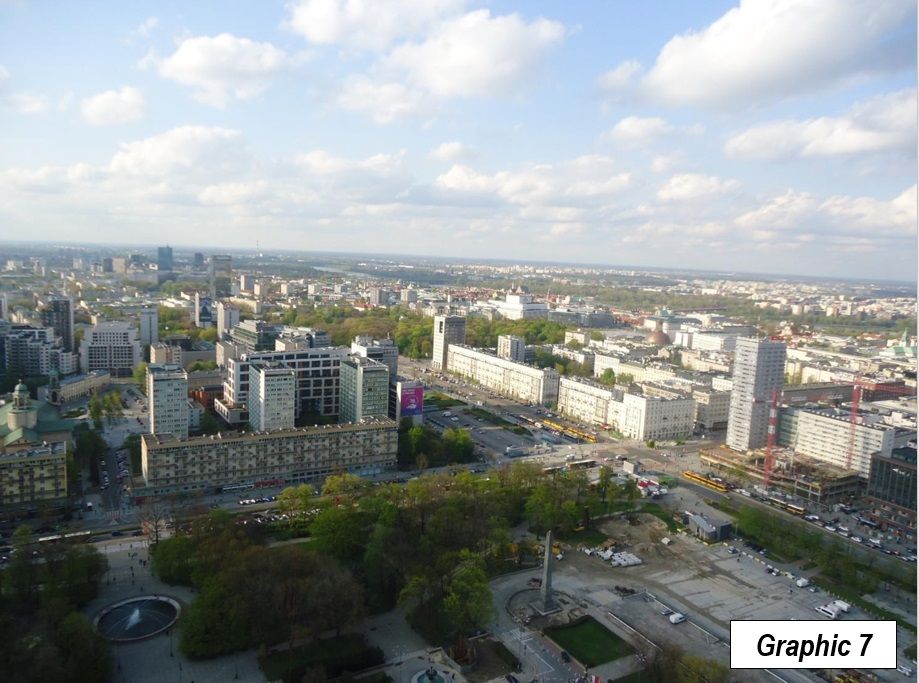
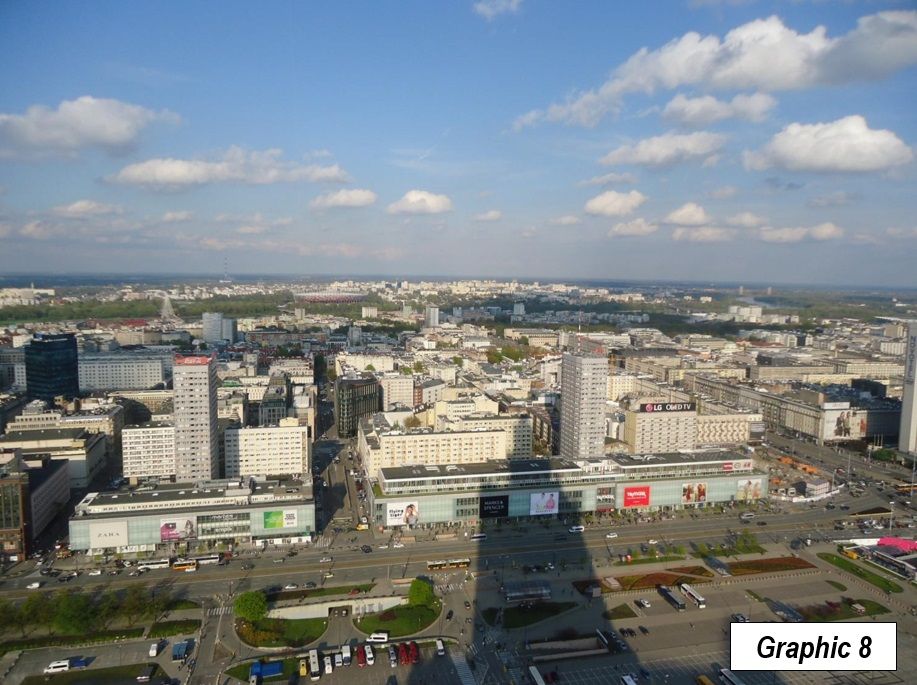
    Since that time, the building has had a significant change in function. The building now houses offices, a museum, university facilities, the Polish Academy of Sciences, a fitness center and other functions. Even so, some people will still tell you that the best place to see Warsaw from is the Palace of Culture and Science, because it is the one place from which you cannot see the building. However, the view from the top is certainly worthwhile (Graphics 3-8).

    A number of new, modern skyscrapers have been built, principally to the west. The buildings, however, are not closely packed, as would be expected in an American, Canadian, or Australian central business district. Graphic 9 shows the skyline, with the Palace of Culture and Science in the center and other large buildings around it. The distribution of Warsaw’s post-Soviet commercial high rises is similar throughout both the central districts and the inner districts, widely spaced and reflecting a modern metropolitan area that has become much more automobile oriented.

    The central district also includes the intersection of (Pope) Jana Pawla II and Solidarity (the trade union led by Poland’s first post-Soviet president, Lech Walesa), boulevards named for two of the strongest forces responsible for separation from control by the Soviet Union and restoration of Polish independence (photograph at the top). Significantly, one of the corners of the intersection is occupied by a McDonald’s, one of the most obvious symbols of the market economy that Poland has embraced.

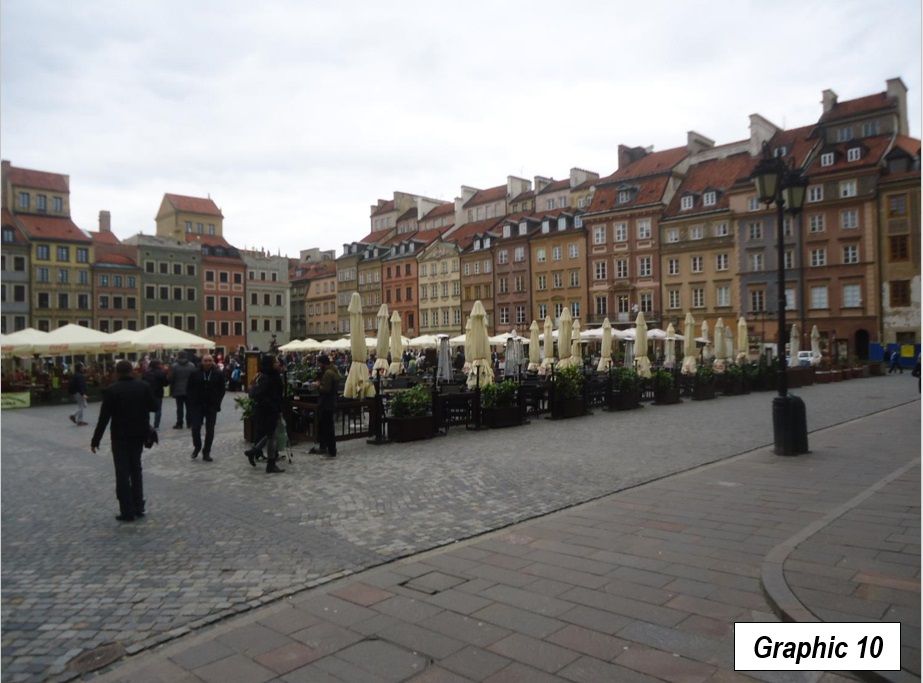
    The central district also includes the “old town,” which like most of Warsaw was reduced to rubble by the bombing and street battles of World War II, including the premeditated destruction of the city by retreating German forces. It has been painstakingly rebuilt as it was before (Graphic 10).

    Other Districts of Warsaw

    The inner ring of districts, each of which borders on Śródmieście, lost eight percent of its population between 2002 and 2016. These six districts include Mokotów, Ochota, Praga Północ, Praga Południe, Wola and Żoliborz.

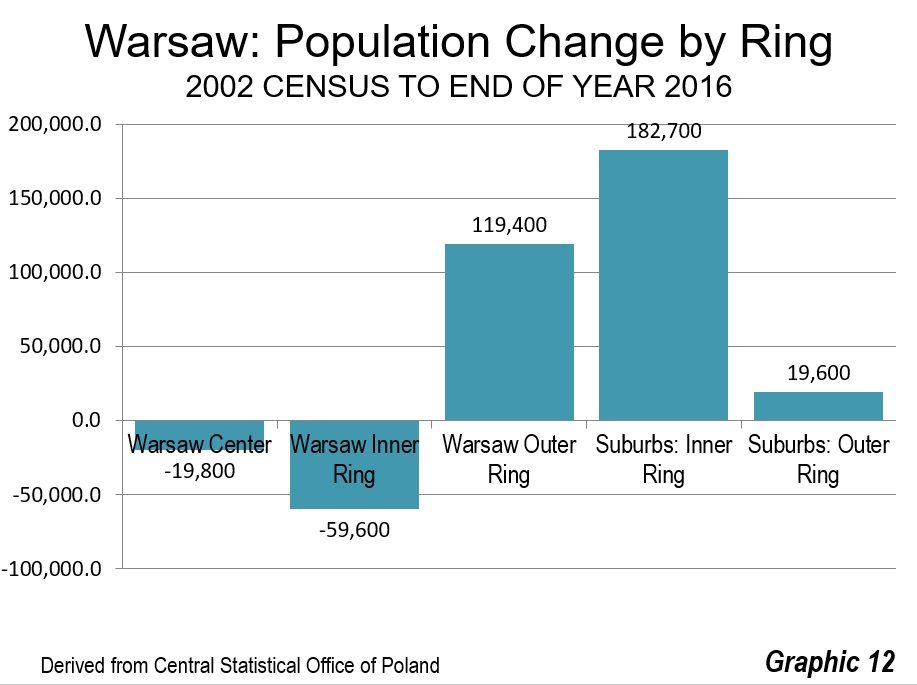
    The outer city districts gained 13 percent in population. Their nearly 120,000 gain more than offset the 60,000 loss in the inner ring districts and the 20,000 loss in the central district.

    Suburbs and Exurbs

    The inner suburban powiats captured most of the growth, growing 20 percent, and adding 182,000 residents. Growth in the outer nine counties was much less, at three percent and 20,000. Nearly 85 percent of the Warsaw area’s population growth occurred in these suburban and exurban areas (Graphics 11 and 12).

    The suburban and exurban residential areas are comparatively sparsely developed. Development is more contiguous in the inner ring of suburbs and much less dense exurbs of the outer ring (Graphics 13-16). Many suburban and exurban residential streets are far narrower and often without sidewalks and curbs. The suburban infrastructure generally appears to be of a lower standard than is found in the suburban areas of Australia, Canada and the United States, where larger individual developments have been required to install wide streets, sidewalks and usually sewers, as opposed to the generally smaller or even individually developed parcels that are more evident in suburban Warsaw.

    Nevertheless, Warsaw, and Poland, are developing rapidly. Real gross domestic product per capita in the nation has increased by at least three times since 1990. The shopping centers of Warsaw look very much like others in the core of western Europe, and even similar to those in Canada and the United States. The nation is constructing a high-speed motorway system, which has among the highest posted speeds in the world, at 140 kilometers per hour (87 miles per hour), though a number of important segments remain to be built. After many difficult decades, Warsaw and Poland are truly a part of modern Europe.

    Wendell Cox is principal of Demographia, an international public policy and demographics firm. He is a Senior Fellow of the Center for Opportunity Urbanism (US), Senior Fellow for Housing Affordability and Municipal Policy for the Frontier Centre for Public Policy (Canada), and a member of the Board of Advisors of the Center for Demographics and Policy at Chapman University (California). He is co-author of the “Demographia International Housing Affordability Survey” and author of “Demographia World Urban Areas” and “War on the Dream: How Anti-Sprawl Policy Threatens the Quality of Life.” He was appointed to three terms on the Los Angeles County Transportation Commission, where he served with the leading city and county leadership as the only non-elected member. He served as a visiting professor at the Conservatoire National des Arts et Metiers, a national university in Paris.

    Top Photograph: Street signs at the intersection of Jana Pawla II and Solidarity, named respectively for their roles in securing independence from the Soviet bloc (Pope John Paul II and the Solidarity Trade Union, led by eventual President Lech Walesa). By author.

  • The news media are losing their search for truth

    To someone who has spent most of his career in the news business, it’s distressing to confront the current state of the media. Rather than a source of information and varied opinion, the media increasingly act not so such as disseminators of information but as a privileged and separate caste, determined to shape opinion to a certain set of conclusions.

    When you pick up a great newspaper like the New York Times, it is sometimes shocking how openly partisan the coverage tends to be. For example, when President Donald Trump unveiled his new tax plan, the headline was not about the proposal per se, but rather how it would serve the wealthy. This may indeed be the case, but such an approach would traditionally be the role of the editorial pages — not the Page 1 headline writers.

    This approach oddly actually plays exactly into the president’s hands at a time when, according to a September Gallup poll, confidence in the media stands at a historic low of 32 percent, down from 55 percent in 1999. Even if they don’t like Trump, most Americans are turned off by the relentless negativity.

    The unique challenge of Trump

    Alienating customers is not good business, especially for an industry that has seen close to 40 percent of its jobs disappear over the past 20 years. Some of the problems, of course, reflect other issues, most notably the rise of online media and the fact that barely 5 percent of Americans aged 18 to 29 get their news from print newspapers. Cable and network news are not doing much better; their audience, notes a March 2014 Pew Research Center report, is now smaller than it was in 2007.

    The public’s growing disdain allows Trump to give the media a “big, fat, failing grade” as one of his essential talking points. His no-show at the White House Correspondents’ Dinner plays well with a large part of the population that feels alienated from the mainstream media.

    Conservatives have long railed against media bias. But under Ronald Reagan, media experts like Michael Deaver and Pete Hannaford flanked the press by using television and radio to go “over their heads.” The Trump approach, spurred by bully-in-chief Steve Bannon, decries the media as “enemies of the people,” an approach more Stalinesque than Reaganesque.

    Trump’s often dubious relationship with the facts remains fair game, but does not excuse the media becoming so obvious and willing a tool of progressive Democrats. Under President Obama, the media simply ignored, or buried, stories such as the Internal Revenue Service’s targeting of conservatives, the expulsion of 2 million immigrants, Obama’s repeated foreign policy failures or his blatant misdirection over health care.

    In contrast, some issues, like transgender issues, anything relating to immigration, particularly undocumented aliens, or climate change, are covered with a one-sided stridency characteristic of Vladimir Putin’s Russia. As a cub reporter, I was told by my editor at the Washington Post, “Nobody gives a crap about your opinion,” and we were obliged to look for dissenting opinions. Informing the public was our job, leaving analysis and opinion to the pundits on the inside pages.

    Read the entire piece at The Orange County Register.

    Joel Kotkin is executive editor of NewGeography.com. He is the Roger Hobbs Distinguished Fellow in Urban Studies at Chapman University and executive director of the Houston-based Center for Opportunity Urbanism. His newest book is The Human City: Urbanism for the rest of us. He is also author of The New Class ConflictThe City: A Global History, and The Next Hundred Million: America in 2050. He lives in Orange County, CA.

    Photo: Steve Jurvetson [CC BY 2.0], via Wikimedia Commons

  • Father of the Bernie Sanders Presidency

    President Trump’s elite-managed populism opens a path for a more genuine version.

    On the usual political spectrum, there are left and right, people who call themselves progressive or conservative, socialist/social democrat or capitalist. But these labels seem to mean less today than in the past. The Trump phenomenon highlighted another divide that has little to do with the historic left and right. Crudely speaking, we can call it coastal vs. non-coastal, urban vs. rural, ethnically diverse vs. more homogeneous, elitist vs. populist. This at least is the way the dominant media sees it.

    (click chart to enlarge)

    At the same time, the old labels are not completely dead. So if we try to overlay the new on the old and to categorize the Trump following, we could say that some of the old guard conservatives joined forces with the new rural populists. This is a little complicated and barely makes sense given that the former include some of the elites, in other words the very same people who have angered the populists for the past decade. Many people who want lower taxes and free trade and globalization voted for the same person, Donald Trump, as did people who want import tariffs and restrictions on the flows of people, capital and goods. Some of the same people who survived in 2008 thanks to Wall Street bailouts voted for the same candidate as did people who are still seething over the bailouts.

    donald_trump_official_portraitWhen a human construct no longer makes sense because it is the product of decades of layering of one strain over another, it may be better to restart with a clean slate and to find new models to explain the present.

    Our own favorite model is to hypothesize that the country has drifted away from laissez-faire for several decades and that it has been moving towards socialism. The current interregnum is the time when cronies rule the land. Starting around 1990, cronyism corrupted laissez-faire, an unsurprising evolution since laissez-faire is never pure anyway. And later cronyism heralded its own final mutation into socialism. The case we made in The Bridge from Laissez-faire to Socialism is that socialism is not the system that replaces capitalism, but the system that replaces one form of cronyism with another. The sequence therefore is laissez-faire to the first form of cronyism to the second form of cronyism.

    The older form of cronyism claims to be capitalistic (thus the oft-seen oxymoron “crony capitalism”) and the newer form claims to be egalitarian but they are essentially the same, except for the identities of the cronies at the top who extract the most wealth for themselves and their friends. Because egalitarianism is usually less efficient at managing wealth, there may also be a smaller number of cronies under socialism, which makes the infighting among its leaders that much more bitter and savage.

    Feel the Bern 2020

    On this theory and on current trends then, Bernie Sanders would be elected President of the United States in 2020.

    This may look like a bold assertion, mitigated only by the fact that Senator Sanders is already aged 75 today. If he were elected in 2020, could he remain in office until the age of 83? Very possible, given the medical profession’s ability to keep us alive and functioning well into our eighties. For example, another socialist, Robert Mugabe of Zimbabwe, is now 93 and intends to run for another five-year term in 2018.

    At any rate, voters will not care about the Senator’s age, just as they did not care about candidate Trump’s own shortcomings. What will matter to them is that candidate Sanders will be the flag bearer leading in his wake a younger Vice-President and a slew of new generation Democrats who will be just as eager to undo four years of Trump/Pence as Trump/Pence have been to undo eight years of Obama/Biden.

    To every action, there is an equal or, in the case of politics, a greater reaction. When President Obama alienated half of the electorate by passing the Affordable Care Act through unorthodox procedures, the seed for the Tea Party and then for the rise of Trump was planted. And Trump has already planted the seed for Sanders or of his young charismatic political heir, whoever he or she may be. Or, if that seed was already planted thanks to Senator Sanders’ own strong showing during the campaign, the President’s recent actions have provided a truckload of nutritious fertilizer. The anti-Trump blowback so far does not look like a slow growing plant.

    The President’s Barbell Strategy

    Although he has styled himself a populist, Mr. Trump is mainly a populist when he fires messages on Twitter or when he holds rallies in rural settings, places where he would otherwise rarely venture except perhaps to play golf. But when he goes back to New York, Washington or Mar-a-Lago, he is once again surrounded through his own choice by the same usual East Coast elites who for three decades have thrived at the courts of the Bushes, the Clintons and the Obamas.

    President Trump’s entourage is more elitist than populistic. Even the unconventional Steve Bannon graduated from Harvard Business School and was a one-time banker, and cannot therefore claim the life story of an authentic populist. Team Trump’s populism is not truly organic, but looks instead like posturing and voyeurism, like that of investment bankers occupying the most expensive seats at a Bruce Springsteen concert. It can be very enjoyable for the elite to glimpse the world of the working class, so long as they are never at risk of becoming a part of it.

    The President’s barbell strategy of on the one hand giving lip service to blue-collar populism while on the road, and on the other hand appointing some of the same people that a dyed in the wool elitist would have also appointed, has paid off very nicely so far. It is however inherently unstable and unsustainable except under the scenario of a thriving economy. To his credit, Mr. Trump knows this, which is why he will be holding a rally for his base every so often as a way to tell them that he has not forgotten them, even though finance and energy billionaires happen to be among his favorite people in the world. Normally, only a casuist would attempt to square this circle but the President’s distinct genius has enabled him to pull if off so far.

    It will be interesting to see for how long this magical balancing act can be maintained. An easy answer would be: until the next economic slowdown. It is fine to play both sides as long as things are improving, or expected to be improving soon. People believe what they want to believe. But failure to deliver for the thriving elite or for the suffering working class will turn either or both into potent Trump adversaries. And this is how an opening would be created for Senator Sanders.

    TRiUMPh of the Cronies

    Sanders-021507-18335- 0004But why Sanders?

    Instead of attacking cronyism, the endemic problem of our age, as a true populist might do, President Trump has instead given it a strong new lease on life. In truth, whether Hillary Clinton or Donald Trump prevailed last November, the die had been cast that the winner would represent the culmination of cronyism in its ultimate triumph. Both Mrs. Clinton and Mr. Trump have crony credentials that exceed those of former presidents. Therefore, the election of POTUS 45 probably signaled the end of something and not the beginning of something, notwithstanding Mr. Trump’s new-dawn declarations to the contrary.

    For evidence of cronyism’s final ascent to the seat of power, consider again Mr. Trump’s selections for cabinet and advisory positions. Several are successful operators in business activities that are often associated with cronyism, in this case narrow sub-sectors of energy, finance, law and real estate. What differentiates them is not their success, which by itself would be admirable, but their success in cracks of the laissez-faire economy that are extractive or rent-seeking and largely reliant on government dealing and connections, which is less admirable.

    The New York Times reported the following on 15 April 2017:

    President Trump is populating the White House and federal agencies with former lobbyists, lawyers and consultants who in many cases are helping to craft new policies for the same industries in which they recently earned a paycheck.

    Socialism’s day would come in four years because Mr. Trump has misread the economic tea leaves and has ascribed the moribund economy to an excess of taxes and regulations instead of to the true culprit, which is deteriorating demographics. As a consequence his efforts to ignite another Reagan style boom and to create 25 million new jobs are unlikely to succeed. Mr. Sanders is one of the most vocal critics of cronyism and his speech will be rich with I-told-you-sos if President Trump’s impending deregulation of Wall Street leads to another financial crisis on top of a weaker economy.

    After being disappointed by both Obama and Trump, the struggling working class and shrinking middle class will be ready to try yet another new thing. Electing a socialist will be the boomers’ last hurrah and the millennials rose-tinted dream of a new paradise finally blanketing the earth. Joel Kotkin recently noted:

    The millennials —arguably the most progressive generation since the ’30s—could drive our politics not only leftward, but towards an increasingly socialist reality, overturning many of the very things that long have defined American life.

    and further:

    The long-term hopes of the American left lie with the millennial generation. The roughly 90 million Americans born between 1984 and 2004 seem susceptible to the quasi socialist ideology of the post-Obama Democratic Party. They are also far more liberal on key social issues—gender and gay rights, immigration, marijuana legalization—than any previous generation. They comprise the most diverse adult generation in American history: some 40 percent of millennials come from minority groups, compared to some 30 percent for boomers and less than 20 percent for the silent and the greatest generations.

    Millennials’ defining political trait is their embrace of activist government. Some 54 percent of millennials, notes Pew, favor a larger government, compared to only 39 percent of older generations. One reason: Millennials face the worst economic circumstances of any generation since the Depression, including daunting challenges to home ownership. More than other generations, they have less reason to be enamored with capitalism.

    Sanders’ Math

    As to Senator Sanders’ math in 2020, it should be remembered that Mr. Trump carried two pivotal states, Michigan and Wisconsin, by very narrow margins in the general election and that Mr. Sanders won both of these states in the primaries. It would not take a lot for both to tip to Mr. Sanders in a possible Sanders-Trump showdown in 2020.

    screen-shot-2017-02-27-at-12-34-45-pm

    The addition of Ohio or Pennsylvania, both of which were won by Trump in 2016 and by Obama in 2008 and 2012, would be sufficient to secure Mr. Sanders victory if no other states changed sides in 2020 vs. 2016.

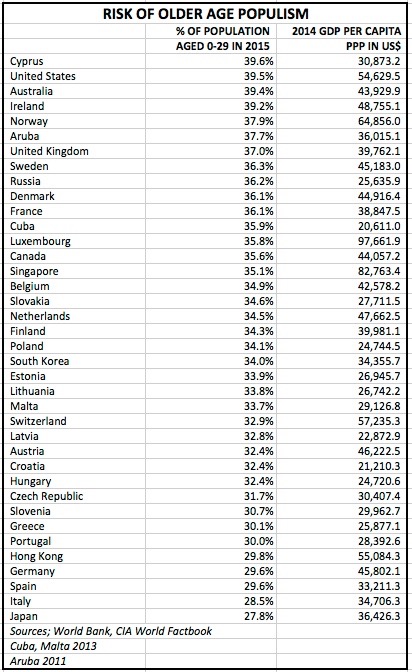
    As noted in So You Want a Revolution, the United States is one of many richer countries at risk of older age populism. These countries have relatively older populations (only 40% or less of the population aged 0-29) and higher GDP per capita ($20,000+).


    Demographics, combined with breakthrough innovations and strong institutions, have made America very wealthy in recent decades. We are now at a critical juncture and at risk of squandering our prosperity by focusing on a wrong set of problems and by empowering the wrong leaders, Trump and stage 1 cronyism that will lead to Sanders and stage 2 cronyism, or socialism.

    Sami Karam is the founder and editor of populyst.net and the creator of the populyst index™. populyst is about innovation, demography and society. Before populyst, he was the founder and manager of the Seven Global funds and a fund manager at leading asset managers in Boston and New York. In addition to a finance MBA from the Wharton School, he holds a Master’s in Civil Engineering from Cornell and a Bachelor of Architecture from UT Austin.

    Bernie Sanders photo by Michael Vadon [CC BY-SA 2.0], via Wikimedia Commons.

  • California Squashes Its Young

    In this era of anti-Trump resistance, many progressives see California as a model of enlightenment. The Golden State’s post-2010 recovery has won plaudits in the progressive press from the New York Times’s Paul Krugman, among others. Yet if one looks at the effects of the state’s policies on key Democratic constituencies— millennials, minorities, and the poor—the picture is dismal. A recent United Way study found that close to one-third of state residents can barely pay their bills, largely due to housing costs. When adjusted for these costs, California leads all states—even historically poor Mississippi—in the percentage of its people living in poverty.

    California is home to 77 of the country’s 297 most “economically challenged” cities, based on poverty and unemployment levels. The population of these cities totals more than 12 million. In his new book on the nation’s urban crisis, author Richard Florida ranks three California metropolitan areas—Los Angeles, San Francisco, and San Diego— among the five most unequal in the nation. California, with housing prices 230 percent above the national average, is home to many of the nation’s most unaffordable urban areas, including not only the predictably expensive large metros but also smaller cities such as Santa Cruz, Santa Barbara, and San Luis Obispo. Unsurprisingly, the state’s middle class is disappearing the fastest of any state.

    California’s young population is particularly challenged. As we spell out in our new report from Chapman University and the California Association of Realtors, California has the third-lowest percentage of people aged 25 to 34 who own their own homes—only New York and Hawaii’s are lower. In San Francisco, Los Angeles, and San Diego, the 25-to-34 homeownership rates range from 19.6 percent to 22.6 percent—40 percent or more below the national average.

    Read the entire piece at City Journal.

    Joel Kotkin is executive editor of NewGeography.com. He is the Roger Hobbs Distinguished Fellow in Urban Studies at Chapman University and executive director of the Houston-based Center for Opportunity Urbanism. His newest book, The Human City: Urbanism for the rest of us, will be published in April by Agate. He is also author of The New Class ConflictThe City: A Global History, and The Next Hundred Million: America in 2050. He lives in Orange County, CA.

    Wendell Cox is principal of Demographia, an international public policy and demographics firm. He is a Senior Fellow of the Center for Opportunity Urbanism (US), Senior Fellow for Housing Affordability and Municipal Policy for the Frontier Centre for Public Policy (Canada), and a member of the Board of Advisors of the Center for Demographics and Policy at Chapman University (California). He is co-author of the “Demographia International Housing Affordability Survey” and author of “Demographia World Urban Areas” and “War on the Dream: How Anti-Sprawl Policy Threatens the Quality of Life.” He was appointed to three terms on the Los Angeles County Transportation Commission, where he served with the leading city and county leadership as the only non-elected member. He served as a visiting professor at the Conservatoire National des Arts et Metiers, a national university in Paris.

    Photo: Dirk Beyer (Own work) [GFDL, CC-BY-SA-3.0 or CC BY-SA 2.5], via Wikimedia Commons