Category: Demographics

  • The Best Cities for Jobs 2011

    These may be far from the best of times, but they are no longer the worst. Last year’s annual “Best Cities for Jobs” list was by far the most dismal since we began compiling our rankings almost five years ago. Between 2009 and 2010, only 13 of 397 metropolitan areas experienced any growth at all. For this year’s list, which measured job growth in the period between January 2010 and January 2011, most of the best-performing areas experienced actual employment increases — even if they were modest.

    For Forbes’ list of the best cities for jobs, we ranked all 398 current metropolitan statistical areas, based on employment data from the Bureau of Labor Statistics reported from November 1999 to January 2011. Rankings are based on recent growth trends, mid-term growth and long-term growth and momentum. We also broke down rankings by size — small, medium and large — since regional economies differ markedly due to their scale.

    Reflecting the importance of the war effort in stimulating local economies, command of this year’s best place for jobs was handed to the Army from the Marines. Killeen-Temple-Fort Hood, Texas, shot up to No. 1 from No. 4, while Jacksonville, N.C., last year’s first-place winner and home to Camp Lejeune, dropped to 19th place.

    Read about how we selected the 2011 Best Cities for Job Growth

    Once again the best places for jobs tended to be smaller communities where incremental improvements can have a relatively large impact. Eighteen of the top 20 cities on our list were either small (under 150,000 nonfarm jobs) or mid-sized areas (less than 450,000 jobs).

    But no place displayed more vibrancy than Texas. The Lone Star State dominated the three size categories, with the No. 1 mid-sized city, El Paso (No. 3 overall, up 22 places from last year) and No.1 large metropolitan area Austin (No. 6 overall), joining Killeen-Temple-Fort Hood (the No. 1 small city) atop their respective lists.

    Texas also produced three other of the top 10 smallest regions, including energy-dominated No. 4 Midland, which gained 41 places overall, and No. 10 Odessa, whose economy jumped a remarkable 57 places. It also added two other mid-size cities to its belt: No. 2 Corpus Christi and No. 4 McAllen-Edinburgh-Mission.

    Whatever they are drinking in Texas, other states may want to imbibe. California–which boasted zero regions in the top 150–is a prime example. Indeed, a group of California officials, led by Lt. Gov. Gavin Newsom, recently trekked to the Lone Star State to learn possible lessons about what drives job creation. Gov. Jerry Brown and others in California’s hierarchy may not be ready to listen, despite the fact that the city Brown formerly ran, Oakland, ranked absolute last, No. 65, among the big metros in our survey, two places behind perennial also-ran No. 63 Detroit-Livonia-Dearborn, Mich.

    One lesson that green-centric California may have trouble learning is that, however attractive the long-term promise of alternative energy, fossil fuels pay the bills and create strong economies, at least for now. Even outside of Texas, oil capitals did well across the board, not surprising given the surging price of gas. Our No. 2 small metro, Bismarck, N.D., which also No. 2 overall, is the emerging capital of the expanding Dakota energy belt. Also faring well are Alaska’s two oil-fire cities, Fairbanks (No. 10 on our small list) and Anchorage (No. 3 on the medium-sized list).

    There were some intriguing surprises as well. Most welcome are signs of revival from New Orleans-Metarie, La., which moved up a stunning 46 places to capture the No. 2 slot among our large metros. The region lost 11% of its population and nearly 16% of its jobs during the last decade. But now the Big Easy seems to be finding its place again among America’s great cities. Jobs, up 3.5% since 2006, have been created by rebuilding, a resurgence of tourism and a growing immigrant population – the region’s Hispanic population grew by 35,000 over the past decade.

    There were other inspirational improvements this year. Sparked by a revival in manufacturing, a host of former sad sacks in parts of the Midwest are showing signs of definite improvement. Niles-Benton Harbor, Mich., a long-time denizen at the bottom of our list, shot up a remarkable 242 places this year to a respectable No. 121. Another old industrial city, Kokomo, Ind., ascended 177 places to No. 215, while Holland-Grand Haven, Mich. improved by 172 places to No. 221 and Grand Rapids, Mich., rose 167 places to No. 183. Milwaukee, a long-time loser among our largest metros, moved up by a healthy 163 places overall to a better-than-average No. 143.

    The Northeast Corridor has also made strong progress. Here the likely explanation can be found in the fruits of Obamanomics. The stimulus has been particularly good for the vibrant economies surrounding the ever-expanding federal leviathan. Among the large metros, Washington-Arlington-Alexandria, Va., did best of all the cities outside the South, repeating its No. 6 ranking among large metro areas. Right behind, at No. 7 on the large city list, sits the primarily suburban Northern Virginia metro area, while Bethesda-Rockville-Frederick, Md., ranks 12th.

    The other big East Coast winners are the financial and university-oriented economies, which have reaped huge benefits from the TARP bailout and the Obama Administration’s college-centric stimulus plan. After the Texas cities and the imperial center, most of the best performing big metros are located in financial and university centers, including No. 9 New York City, No. 10 Philadelphia, No. 11 Pittsburgh, No. 13 Boston and No. 15 Raleigh-Cary, N.C.

    So who’s losing? Outside of Oakland and the big Southern California metros — including No. 60 Los Angeles, No. 59 Sacramento, No. 58 Riverside-San Bernardino and No. 50 Santa Ana-Anaheim- Irvine — the bottom tier consisted of a motley crew of mid-South cities like Memphis (#64 on the big city list) and still-struggling, former big Sunbelt boomtowns Las Vegas (No. 62), West Palm Beach-Boynton Beach-Boca Raton, Fla. (No. 56), Ft. Lauderdale-Pompano Beach-Boynton Beach, Fla. (No. 54), Phoenix-Mesa-Glendale, Ariz. (No. 53), Atlanta-Sandy Springs-Marietta Ga. (No. 52) and Tampa-St. Petersburg-Clearwater, Fla. (No. 51).

    For the most part, these areas rose with the housing bubble and will not fully recover until the economy diversifies beyond real estate speculation. Already some of the bubble victims are showing signs of life, including No. 155 Merced, Calif., up 134 places, and No. 167 Orlando, Fla., which rode a revived interest in tourism to jump 89 places since last year.

    While energy, America’s three wars, the recovering financial markets and real estate problems have played the lead role in setting the stage for the best places to do business, the Intermountain West has shown resilience with Salt Lake City, at No. 20 among large cities; Provo-Orem, Utah, Ogden-Clearfield, Utah, and Boulder, Colo. at Nos. 10, 25 and 26, respectively, among mid-sized cities; and Logan, Utah, and Fort Collins, Colo. at Nos. 9 and 38 among small cities.

    As America struggles with a weak economic recovery, opportunities abound across the geography of the states—even in places where it seems bleakest like California, Nevada and Florida. If old industrial areas can stage the glimmers of a comeback, along with over-taxed and over-regulated Gotham, and greater New Orleans can rise from the near dead, these areas, with generally newer infrastructure and attractive climates, might be next to experience a resurgence of their own.

    Read about how we selected the 2011 Best Cities for Job Growth

    This piece originally appeared in Forbes.com

    Joel Kotkin is executive editor of NewGeography.com and is a distinguished presidential fellow in urban futures at Chapman University, and an adjunct fellow of the Legatum Institute in London. He is author of The City: A Global History. His newest book is The Next Hundred Million: America in 2050, released in February, 2010.

    Michael Shires, Ph.D. is a professor at Pepperdine University School of Public Policy.

    Photo by Bas Lammers
  • How China’s Megacities Have Avoided Problems of Other Developing Cities

    Urbanist media can’t seem to get enough of the megacity these days. Much of the commentary surrounding this topic is disconcertingly celebratory about these leviathans despite such phenomena as overcrowding, high levels of congestion and sprawling slums.

    Yet absent from most of the commentary is any mention of cities in China. This is perhaps due in large part to the lack of serious social problems in comparison to its developing city counterparts in other countries. If a megacity is defined as a city with a population of more than 10 million, then China is home to 5 megacities: Shanghai, Beijing, Shenzhen, Guangzhou and Dongguan. As the country continues to urbanize, more Chinese cities are bound to join the ranks of these megacities.

    How has China been able to avoid the pitfalls facing other developing megacities? No one is denying that Chinese cities don’t have problems including unequal income distribution, pollution and growing traffic congestion. Yet China’s megacities seem to have largely avoided social dangers such as violent crime, disease and slum proliferation that plague urban areas of other developing countries.

    How have China’s cities avoided these issues?

    1. Construction of New Housing Units

    Western media continues to bawl over the amount of new residential construction in China, calling it the ”biggest bubble ever.” I have pointed out before how this might be an overestimation of the problem and that the housing market is actually more stable than many think. One thing is clear: the ample construction of new housing units in cities across China remains the essential component leading the way in the country’s development. The ability to provide modern accommodations for millions of aspiring urban dwellers has also directly prevented the proliferation of slums and large-scale shantytowns.

    2. Development of Public Transportation

    The ability to move efficiently through an urban area is paramount to opportunity and quality of life. When one thinks of megacities such as Jakarta or Mexico City, automobile gridlock often comes to mind. Beijing might have its traffic problems as well, but China’s development of public transportation, including extensive underground subway networks, ensures citizens will have other options to move around besides motor vehicles. The more connected by different forms of a transportation a city is, the more opportunity people have to live where they want and have access to a wider geographic range of job options.

    3. Land-Use and Zoning Flexibility

    The often-overlooked reality of zoning and land-use regulations plays a much greater role in the shaping the character of megacities then it is given credit for. Mumbai’s draconian 1.33 floor-to-area ratio (FAR) throughout most of the city means that it is limited to construction of low-rise buildings,leading to the growth of overcrowded sprawling slums. Chinese cities, in contrast, allow for high FAR, promoting construction of high-rise buildings that leave room for ample green space.

    Furthermore, Chinese cities are not limited by ”urban growth boundaries” and allow development to occur on newly annexed land outside of traditional urban cores. Even traditionally ”dense” cities like Shanghai and Hong Kong allow for new development outside of their traditional centers: the Pudong New Area in Shanghai and the New Territories in Hong Kong are huge areas that are still largely underdeveloped when compared to their respective downtown areas.

    Critically, these nominally suburban or even “exurban” expansions are not mere bedroom community; they are frequently attached to areas of intense commercial, industrial and technical development. In many cities, including Chengdu, where I reside, most of the new economic growth takes place in such communities.

    4. Providing Economic Incentives with Special Trade Zones

    As China enters its third decade of rapid development, competition is heating up between its cities for domestic and foreign investment. The winners will ultimately be cities that are most business friendly and offer incentives like tax breaks to companies looking to set up operations. Many of China’s cities have gone about this by establishing special ‘economic and trade zones’, usually outside of traditional urban cores. As a matter of fact, one of new China’s most economically successful cities, Shenzhen, largely started as a ‘Special Economic Zone’ (SEZ). Special economic and trade zones that are not actual cities, but part of a larger city, thrive because they usually built on more affordable land on urban peripheries, opening up more investment for construction of state-of-the-art manufacturing and R&D facilities.

    5. Willingness to Learn from Outside Experts

    When it comes to political issues at the Central Government level, it is clear that China does not want to be told how to run its country by outside diplomats and foreign policy experts. Yet at the municipal level, Chinese government and business leaders are earnestly open to listening to experts in planning and development from outside its borders. One only needs to take a look at the countless architecture and urban planning practices from the West, Singapore and even Taiwan who currently work in China. This open exchange of ideas taking place is what allows best practices to come to fruition.

    Adam Nathaniel Mayer is an American architectural design professional currently living in China. In addition to his job designing buildings he writes the China Urban Development Blog, where a version of this piece originally appeared.

    Photo by xiquinhosilva

  • Divorce and Demographics by State

    While everyone seems to know someone who has been divorced, rates can vary widely by state.  Why?  Do high divorce states have anything in common?  We took a look at some visualizations of state divorce rates against a few other demographic characteristics.

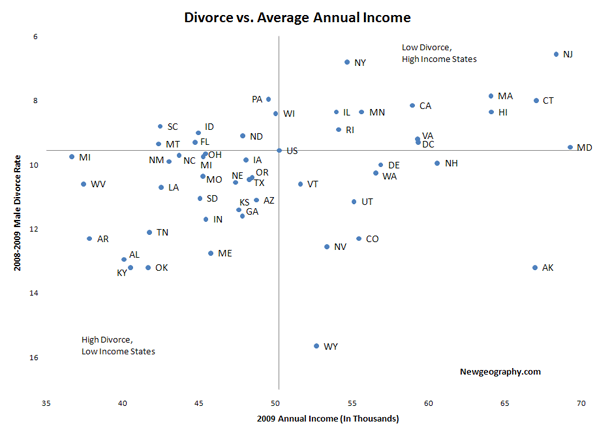
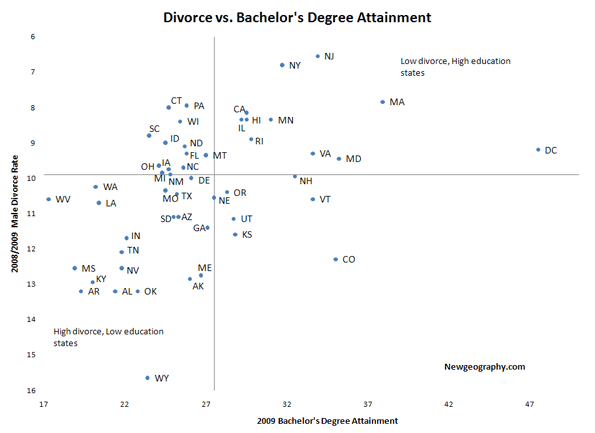
    The latest Census data offers up some observations of how divorce varies regionally. The first graph shows 2008/2009 divorce rate against 2009 bachelor’s degree educational attainment.   We average two years of Census divorce rate data to help even out the variance caused by small sample sizes.

    The chart produces interesting find: states with a high level of bachelor degree attainment (27.5% of the population or higher) also have relatively low divorce rates (lower than 9.9%). States such as California, Hawaii, Minnesota, Illinois, and much of the Northeast fit this profile. Meanwhile, Southeastern and mostly rural states fall in the territory dominated by high divorce rates and low bachelor’s degree attainment.

    This relationship is an alluring one that has been touched on previously. A New York Times article seems to suggest that education does have an impact on divorce rates, especially in rural areas. As married partners become more educated, perhaps this leads to a stronger sense of individualism, or the education of one partner may make them more employable and geographically mobile. The article cites Sioux County, IA as a premier example of this. Heralding from the area myself, I can attest to the strong religious ideologies in that region.

    Orange City in Sioux County is an especially strong example, where a deeply-rooted religious presence mixed with a strong conservative disposition helps to feed a socially conservative society. For example, during the city’s regionally renowned Tulip Festival that occurs every year in mid-May, defacing a precious tulip results in a police citation. On top of this, many storefronts are closed on Sundays, grass must be cut a certain length on a certain day with no exceptions, and taking an absence from the church can lead to adverse social consequences within the community.

    Having such a tight grasp on values leaves little room for anything other than heritage by the city’s residents, especially when these traditions are held in high merit amongst the city dwellers. A strong commitment to a pre-ordained structure seems to have kept women in a certain place — one with less agency and more conformity. Not that this is against any person’s will, quite the contrary: the social structure is geared towards these values and it has stuck since inception.

    Divorce may not work the same in much more populated areas. Regions such as California and the Northeast have low divorce rates while their populations are some of the largest and most concentrated in the nation. Add to this equation the states that contain within them top tier schools (the Ivy League, Stanford, and University of Chicago come to mind) are also more likely to have low divorce rates. Perhaps the emphasis on education in these mostly urban areas has allowed for a more stable social structure. One in which secularism prevails and the choice of marriage between two people suddenly becomes a pragmatic decision rather than one made out of need or what “should be”.

    The chart pitting divorce against average income also reveals a disparity between regions—the higher the household makes annually, the less likely the couple inhabiting it is to be divorced. States such as New Jersey, Hawaii, Connecticut and Massachusetts can all be located here. Meanwhile, households in states with lower incomes (such as states in the South) seem to possess higher rates of divorce. The trend seems to put the Northeast in opposition to the Southeast and the Rust Belt.

    Many of the states settled first with more well-established economies (and perhaps older money) seem to have a lower amount of divorce. Meanwhile, hard-struck regions (Michigan, the Southeast) have below-average rates in general. The more money that households accumulate in these regions, the seemingly lower the rates are. Combine this with less volatile housing markets and economies established in technology and education and much of the Northeast and Midwest seem to be more stable.  Of course, education and income levels are highly interrelated themselves.

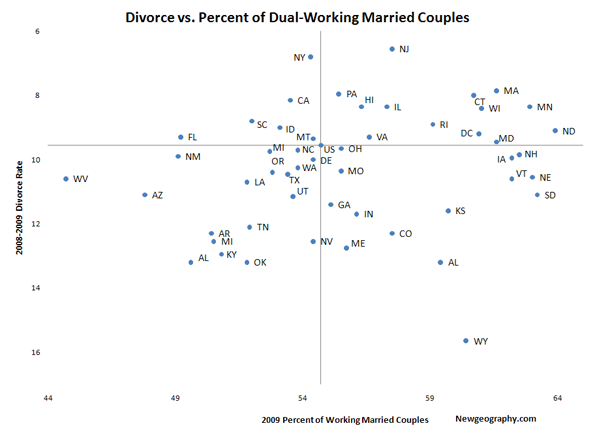
    The last graph displayed here gives the relationship between divorce rates and the percentage of married couples in which both partners work. As in the previous graphs, Northeastern states dominate the first quadrant as well as some Midwestern states.  Meanwhile, the Sun Belt and Southeastern states seem to lag on both measures, much like in the other charts.  Interestingly, in general the northern tier of the U.S. – especially the northeast and northern plains – seems to have a much higher rate of dual income couples than the south.

    The data here may suggest that hard-working couples stick together naturally, or at least persevere more effectively. Perhaps the work ethic amongst couples in these states translates to sound marriage values as well, however correlation to divorce rate seems weaker here than with education and income.

    An outlier for divorce seems to be Wyoming whose high divorce rate (a 2008-2009 average of 16%) places it outside of the bunch in many of the graphs. This may be because of the state’s “quickie” divorces. An article by Wyoming News discusses the reality of Wyoming’s label as “Splitsville” where many couples unhappy with their marriages travel to call it quits. The state lacks laws that force a couple to separate for some time prior to the official divorce, making the state more appealing for those who don’t wish to remain together. With all of the proper paper work in line, a couple could easily end it in Wyoming. Where Las Vegas is the home for a fast espousal, Cheyenne may be the new destination for a speedy separation. 

    Jacob Langenfeld is an undergraduate at the University of Iowa studying economics and entrepreneurship. He aspires to pursue graduate work in one of his many interests, including economics, public policy, and urban issues.

    Photo by DrJohnBullas

  • Rethinking Urban Dynamics: Lessons from the Census

    Much has been made of the vaunted “back to the city” movement by “the young and restless,” young professionals, the creative class, empty nesters and others were voting with their feet in favor of cities over suburbs.  Although there were bright spots, the Census 2010 results show that the trend was very overblown, affecting mostly downtown and near downtown areas, while outlying ones bled population.  One culprit for this discrepancy seems to be that the intra-census estimates supplied by the Census Bureau were inflated – in some cases very inflated.

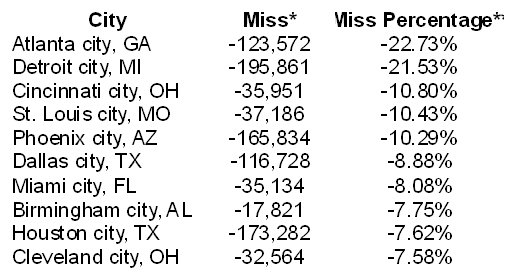
    Looking at selected core cities for major US metropolitan areas, many of them were materially over-estimated:


    One particularly egregious case relates to Atlanta. Its huge projected population increase in the 2000s led me to describe it as “one of America’s top urban success stories.”  The reality proved to be quite different. Rather than strong population growth in the city, the population growth turned out to be basically flat, quite a different story.  Other declines might be more predictable, such as Detroit, or those who had previously challenged estimates like Cincinnati and St. Louis.  Still, even urban cores in rapidly growing regions like Dallas and Houston were not immune from this trend.

    There were some exceptions. Cities like Indianapolis, Columbus, and Oklahoma City came in slightly ahead of expectations, but the number of cities with misses and the sizes of the positive and negative misses tilted towards the down direction.

    It seems clear now that the justification for much of the “back to the city” story reflected bad estimates. People can’t be faulted for relying on the official government numbers – I did. But the reality of the 2010 Census, as demonstrated by Wendell Cox and others, is that the 1990s were actually better for urban population growth in America than the 2000s in many respects.

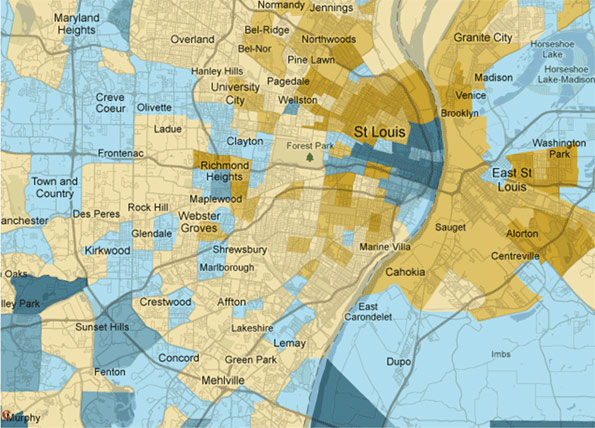
    One legitimate bright spot for cities lay in the growth of downtown and near downtown areas.  Though often starting from low bases, these areas often showed impressive increases.  For example, St. Louis showed good growth downtown despite a very disappointing decline in total city population:

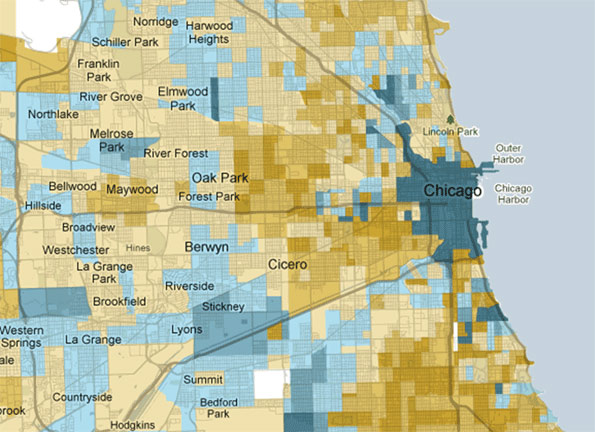
    The poster child for this phenomenon was Chicago, where a fairly expansive area in the greater core showed large population growth.  Areas that were formerly almost all commercial, such as the Loop, added significant residential population, while areas that were nearly derelict like the near South Side have blossomed into thriving upscale neighborhoods.


    The problem, from places ranging from Chicago to Cleveland, is that the gains in the “core of the core” have been more than offset by losses elsewhere, especially the flight of blacks and other minorities – many of them immigrants – to the increasingly diverse suburbs.

    Cities across America have invested enormous sums into downtown redevelopment and major projects in selected districts.  The good news: these investments have shown some ability to move the needle in terms of attracting young professionals downtown.  The bad news lies with the fact that these developments have been extremely costly, and have not transformed the overall demographic or economic climates of the cities that tried them.  This demonstrates the limits of the policies.  Those who aren’t in the young professional, empty nester, or creative class demographic have rightly figured out that they are no longer the target market of city leadership. No surprise then that many of them    have decided to vote with their feet.

    Given the resulting overall negative swings, cities may want to revisit their strategy of putting all their chips in the downtown redevelopment basket in favor of less glamorous improvements in basic neighborhood safety, services, schools and other critical elements.  A handful of elite enclaves and talent hubs may be able to thrive on a “favored demographic quarter” strategy, but for most places there just aren’t enough young professionals and artists to go around.

    Aaron M. Renn is an independent writer on urban affairs based in the Midwest. His writings appear at The Urbanophile.

    * Actual population minus projected population as of 4/1/2010 using a run rate projection based on the 2008-2009 estimated population growth.
    ** Base is the projected 4/1/2010 population above.

    Photo by Ian Freimuth

  • Diverging Demographics Leads to Fewer Babies in Singapore

    Two interesting statistics were recently released in the same week. Singapore clocked in a population of just over 5 million and a sex ratio of 974 males per 1000 females.  Its neighbour and ally India inched closer to beating China in the population game by notching up 1,210 million people as its head count, along with the more news-worthy sex ratio of 940 females to every 1000 males.

    If you happen to be a Singaporean female who belongs to the Club of 26 (1000 less 974) you can forget about ever finding a mate amongst your countrymen.  Even with its low girl child ratio, India’s large population base will ensure that the overall country continues to grow at a healthy pace for some decades with or without policy interruptions.  If Singapore’s declining birth ratio continues to favour women, at some stage there will be a shortage of men.

    This is part of a larger demographic dilemma. Singapore is increasingly worried about not having enough babies to replace its residents. In the past the government has tried to counter the declining numbers by attracting a work force of immigrants. Most believe that that this has led to over-crowding of an already small country and driven up prices of everything that is already in short supply. Meanwhile the Singaporean birth rate has continued its southward march.

    The leading explanation for the low birth rate centers around the high and rising cost of living. Life in one of the world’s ten richest countries can be a struggle even with a home ownership rate of more than 80%. Tax rates are low but everything else that contributes to living, i.e. a car, food items, apparel most of the time are imported and hence quite expensive.

    Here are some observations that I hope can explain people’s concern about the “affordability” of having children.

    The entire vibe of Singapore is progress. The government pumps in millions of dollars to ensure the country doesn’t fall behind in the ”world-class” game. Casinos, malls, theatres, world famous artists, and Formula 1 car racing all have been here, underlining Singapore’s ambitions to play cosmopolitan.  No private building is allowed to stand for more than 30-40 years. It is torn down to make room for swankier apartments with an appropriately swankier name.  Escalating property prices drive down the size of new apartments. The name of the game is upgradation. A Singaporean living in an HDB (housing development board) flat dreams of upgrading to an ”executive condominium” and from there to a ”luxury condominium with full facilities”. Adding fuel to the fire are comparisons with the foreigners many of whom live a better life than the native residents.

    It is this constant comparison and hence the drive for a ”better” life that discourages the Singaporean from taking a break. Competition at work is fierce, work schedules are gruelling and flexi-hours not really an option without seriously compromising either money making or a chance at a promotion.

    The policy of attracting talented foreigners has consequences on the birth rate of the nation. While foreign talent fuels the nation, the presence of upper end mobile foreigners ensures that Singaporeans do not assume that “the good life,” especially compared to their peers in the region. It also keeps them slogging away for more at the cost of parenthood.

    Every Singaporean male has to serve in the Army compulsorily for a couple of years. That means for anyone aspiring for a regular career in the corporate or government world, a female colleague can get ahead of her male counterpart by two years. Over a period of a lifetime, two years do not matter much but in the early years of life, a two year lead time can put a woman in her 20s significantly financially ahead of her male counterpart. When it comes to choosing a life partner, she has the choice of a slightly older but financially compatible colleague or a younger but not yet established in his career co-worker.

    Like most sensible women would, she chooses to push the marriage age away, and marry someone older than her. The median age for women at marriage is 27.5 years and for men 29.8 years (2009 data).  At that age, most people are at mid-level management, hence taking a career break for parenthood necessarily compromises not only earnings but also their future career options in a increasingly competitive job world.

    In comparison, Singapore is a great place for foreigners to live as outsiders. By definition, foreign talent comes here in search of a better life than the one they can afford back home. To a large extent, that desire is fulfilled. To retain and continue to attract this talent, the country will have to maintain the distinct treatment of locals and foreigners.

    However unlike most immigrant-attracting societies llike the US, Canada and Australia, there is precious little planned assimilation of these foreigners within the Singaporean society.  Most foreigners live, seek and mix with those of their own kind or closest to their own kind. Beyond familiarising themselves with food, there is very little ‘local flavor” in their life.   Tolerance and racial harmony are well-nurtured values, but integration is largely missing. 

    Even as children, there is little mixing.  There are two distinct sets of students, those educated byt the international school system Vs. the competitive and compulsory local education system. Cross admission into either type is tightly controlled, by purse size, policy or peer pressure

    If you do not study in the same school or do not live in the same area you are unlikely to hang-out together or assimilate anything from each other, neither in your formative growing up, “open-minded” years or later.

    It is possible for a permanent resident to live for decades in Singapore as a guest, oblivious to the problems of the native Singaporeans, even unaware that there is a world outside of luxury condos and wall-to-wall shopping. Amongst the foreigners there is likely to be little empathy for the real issues facing their borrowed “workland” and its people. Yet it is not possible as a native of the country to ignore the people who come into their country, live a better life than them and do not seem to go through similar life pains.

    The children of these semi-residents ,even those  born here, often view  the country as a stepping stone to migrate to larger, more developed economies or in tighter times like these, receive their higher education abroad and come back to a life not dissimilar from their parents. Their parents often then choose to go back to their much more affordable native countries than stay on and watch the cost of living overwhelm their diminishing retirement funds.

    Barring a few exceptions, natives would live and retire in and inexpensive country leaving it to their children to fulfil dreams of an upgraded life.

    Isn’t it time the two sets got together to create a better future, one for their land of birth and the other for their land of work? Perhaps balancing these two groups, and working towards their integration, is critical to maintaining Singapore’s progress in the future.

    Vatsala Pant is a management graduate with several years of business leadership experience and a connoisseur of people, places and cultures. She currently lives in Singapore.

    Photo by Lip Jin Lee

  • Washington State’s Evolving Demography

    Population change in the state of Washington has relevance to the nation and to other states because it tells us something about market preferences of households versus the orientation of planners (e.g., “smart growth”). It tells us much about gentrification and America’s changing racial and ethnic diversity.

    The summary will be in two parts. This piece will look at population growth and redistribution. A second article will review the growth of the minority population and its (surprising to some) redistribution and its relation to the gentrification of the city of Seattle, plus a look at the implications of ethnic change to Washington’s new 10th congressional district.

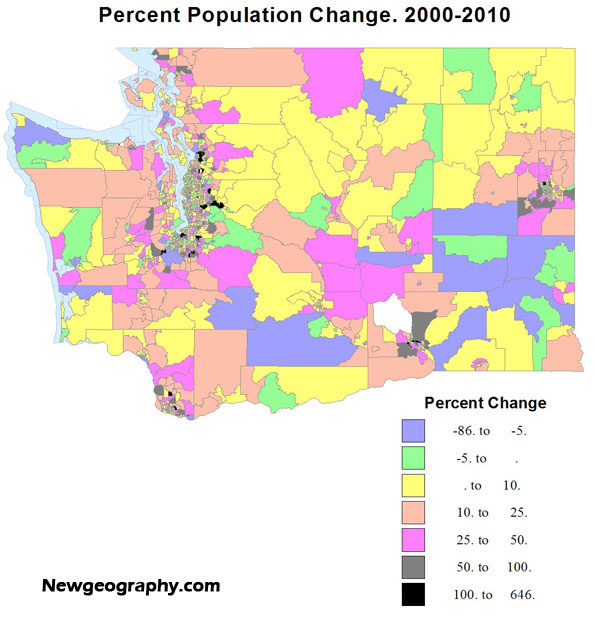
    Washington state and the greater Seattle region grew fairly vigorously 14% (838,000 new residents) in the decade, as they have most decades for over a century. This growth is unusually high for a “non Sunbelt” state. This growth is due not just the engine of Seattle, as eastern and western Washington also experienced substantial growth.

    Most smaller metropolitan areas across the state grew faster than the Seattle metropolitan core. Fast-growing counties are found in the east (Franklin 50%, the easy winner, Benton 23; Kittitas, 22; and Grant 20); all associated with Latino in-migration, as well as in the west (Clark, 23 %; suburban Portland, Mason, 23 percent; suburban Olympia, Thurston (Olympia) 22; Whatcom (Bellingham), 20; and Snohomish, finally, suburban Seattle, 18.

    There are two Washingtons: greater Seattle and the rest of the state, marked by a love and hate relationship. But the balance of power – and demography – is clearly changing in both. There were a few areas of slow growth or decline, as in the heart of the wheat country, but significant growth took place in other metropolitan areas, most notably the Tri-Cities, Vancouver (suburban Portland), Bellingham, Olympia (the state capitol) as well as Spokane, Yakima, and Wenatchee.

    There has been considerable population growth associated with the Columbia Basin project, fueled by heavy Latino in-migration and high birth rates. At the same time there has been population expansion in selected environmental amenity areas – often with retiree in-migration – in many counties across the state. Amenity fueled growth was dramatic in all directions beyond the metropolitan central Puget Sound core, but was also impressive in several areas in eastern Washington, as in Okanogan, Pend Oreille, and Stevens, the far north and northeast, and in Kittitas. Some of this growth comes from migration east from Seattle. Fourth, despite a growth management plan, metropolitan exurbs continue to expand, especially around Vancouver, Spokane, Bellingham and the Tri-Cities (black on the map, over 100% growth).

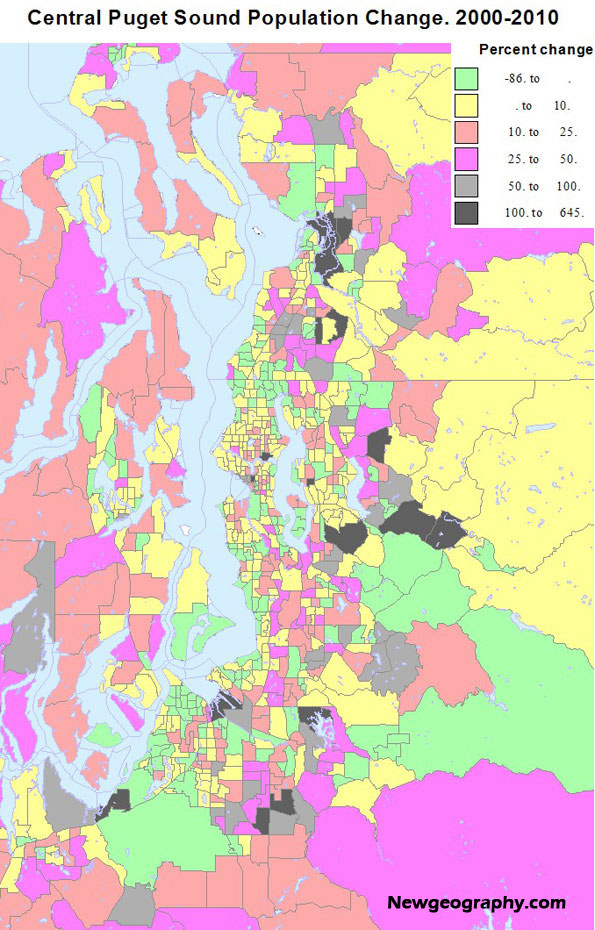
    Turning to central Puget Sound, the most dramatic growth (often over 100 percent), occurred at the far edge of the urban growth areas, and just beyond as exurban growth. This is true in absolute numbers as well as rates. Growth management and upzoning have been unable to stem this tide, for two main reasons rarely acknowledged by planners: the preference of families with children for single family houses and greater housing affordability, at least in some areas (for example, King county south and east of Seattle, and south into Pierce county). Growth was also impressive in most rural and exurban areas, especially in Pierce, Snohomish and Kitsap counties, but far less in King county, which has by far the strictest growth controls

    At the same time, there was concentrated growth in already urban areas, city and suburban, as higher density apartment sprang up across much of Seattle, Tacoma, south King county, in some Eastside cities, and in the SR 99 corridor of Snohomish county north from Seattle.

    In Pierce, Snohomish and south King, some single family and small apartment growth occurred in less affluent areas, attracting many people, including young families who cannot afford to live closer to Seattle. Areas of slower growth tended to be military areas, some urban non-residential tracts, and some more affluent, older settled single family home areas, with an aging population. Growth in downtown Seattle and Bellevue, even Tacoma, was substantial, if not quite as great as planners envisioned. The current shift from home ownership to renting is leading some to project a projected apartment boom in or near downtown Seattle.

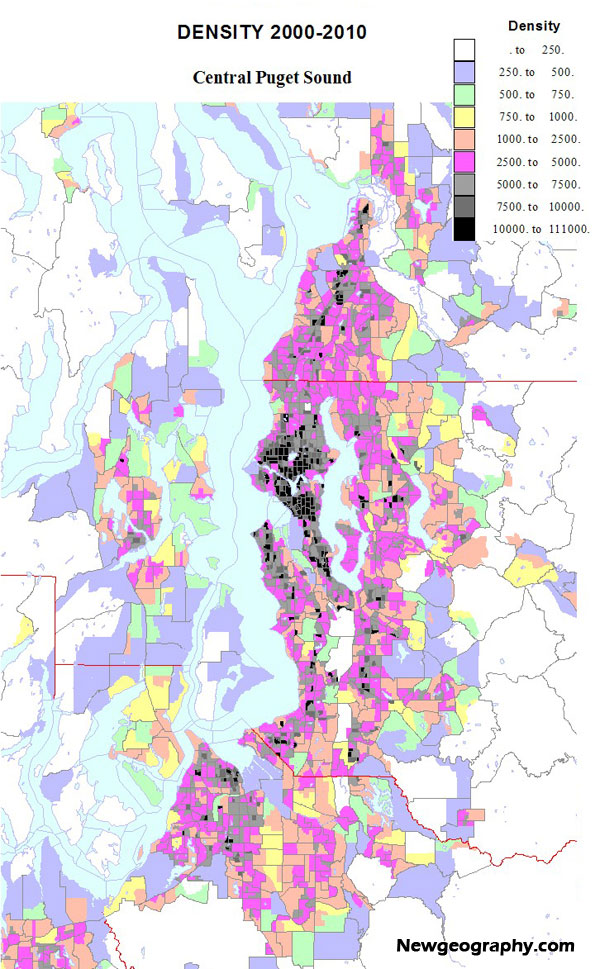
    It’s also interesting to look at density as a measure of “urban-ness”. The third map for density is at a finer block group level. Moderate urban densities from 1000 to 5000 per square mile are dominated by single family homes, areas between 5000 and 7000, by a mix of single family homes and apartments, and over 7000 by apartments, essentially the density goal of urbanist smart growth planning. Seattle really has achieved a substantial degree of such urbanness, dominating central Seattle, but spreading to all corners of the city. Other areas of higher density include the SR99 corridor in Snohomish county, especially south Everett, high tech suburbs to the east, and in south King county the SR 99 corridor again, in some less affluent suburbs, and in Pierce county, downtown Tacoma, and some of South Tacoma toward Ft. Lewis.

    But still more than half the urban footprint resists the officially preferred urban densities. Even with densification, redevelopment and the opening of the first light rail line, these higher density areas housed only 34 percent of the population of King county (up from 32 % in 2000), and only 10 % of the population of the people of the three suburban counties. The city of Seattle is exceptional, containing 52 percent of the high density tracts on the metropolitan area, although it has only one-sixth of the population.

    As the late great UW economist Charlie Tiebout told a seminar 50 years ago, “People vote with their feet” This is certainly true about residential choices. While perhaps twenty percent at most of Americans may prefer higher density living, for reasons of age, family status or ideology, the large majority does not and likely will not.

    To a leftist like me, the tragedy is how smart growth transfers wealth and the vaunted “quality of life” to the rich and the professionals, at the expense of the poor and of minorities. Sadly the Democratic party seems totally blind to the fact that the fixation on new urbanism contributes to the rightward backlash. Folks do not want to be told how to live, especially, dare I assert, when those hectoring them have already cornered the nicest parts of the region for themselves. Middle and working class families are not likely to embrace policies – beloved by affluent professionals – that would deny them a chance to own their preferred kind of residence at a reasonable price.

    Richard Morrill is Professor Emeritus of Geography and Environmental Studies, University of Washington. His research interests include: political geography (voting behavior, redistricting, local governance), population/demography/settlement/migration, urban geography and planning, urban transportation (i.e., old fashioned generalist).

  • The Evolving Urban Form: Manila

    The Urban Area: The Manila urban area ranks as the world’s fifth largest urban area (area of continuous urban development) with a population of approximately 21,000,000 (Note 1) covering a land area of 550 square miles (1,425 square kilometers). The urban population density sits at approximately 38,000 people per square mile (14,500 per square kilometer).

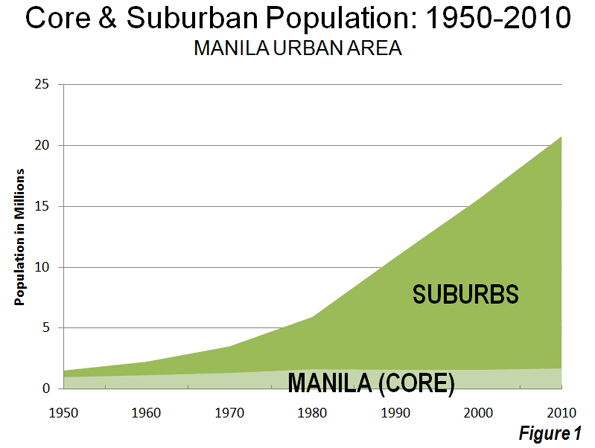
    Like nearly all major urban areas of the world, Manila has experienced substantial suburbanization over recent decades and substantially falling urban population densities. In 1950, the core municipality of Manila had a population of under 1 million people, and it represented approximately 60 percent of the urban area population. Over the intervening years, the core of Manila grew by approximately 700,000 people, while the balance of the urban area added nearly 20,000,000 people (Figure 1).

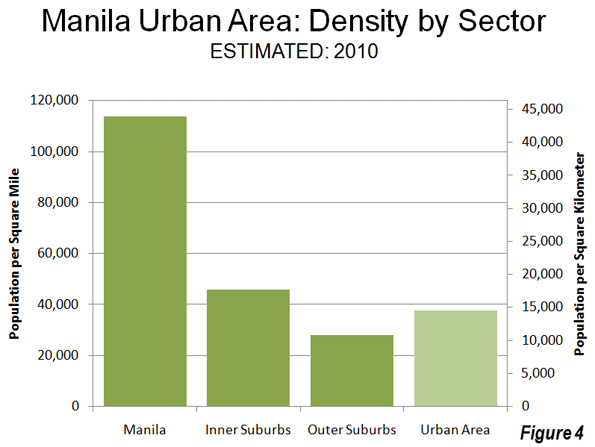
    A Forbes article indicates that Manila is the highest density major municipality in the world with a population density of nearly 115,000 per square mile (45,000 per square kilometer). This is more than double the population density of ville de Paris. The core has a population of approximately 1.7 million in a land area of 15 square miles (39 square kilometers).

    The densest district reaches nearly 180,000 people per square mile (70,000 per square kilometer). Even so, this is far less dense than some parts of Hong Kong (more than 1.1 million per square mile and more than 400,000 per square kilometer). Even higher densities existed in the early 20th century Lower East Side in New York (according Jacob Riis, author of A Ten Years’ War: An Account of the Battle with the Slum in New York). Even higher densities were reached during the late 1980s in Hong Kong’s now demolished Kowloon Walled City, variously estimated at up to 5 million per square mile (2 million per square kilometer).

    The inner suburbs, the balance of the National Capital Region now have approximately 10,600,000 residents. The population density drops substantially from the core to the inner suburbs to approximately 45,000 per square mile (18,000 per square kilometer).  The outer suburbs, which are composed of the portions of the urban area outside the National Capital Region, have a population of more nearly 8.5 million and a considerably lower density at 28,000 per square mile or 11,000 per square kilometer (Figure 2).

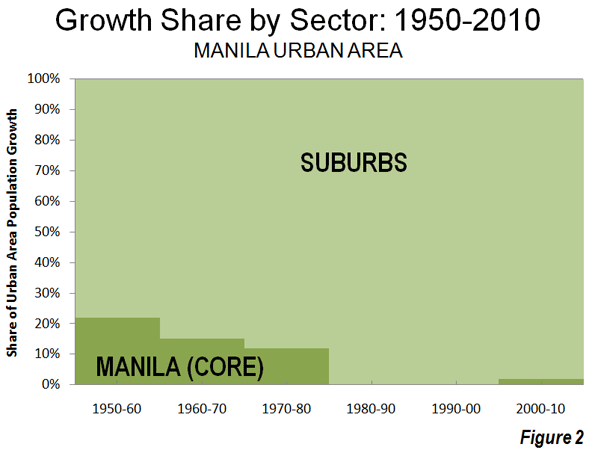
    As early as the 1950s, the suburbs have captured most of the urban areas growth. Between 1950 and 1980, the core municipality attracted between 10 percent and 20 percent of the urban area growth. The core municipality of Manila reached a population peak of nearly 1.6 million in 1980, which it has only been recently exceeded. From 1980 to 2000, virtually none of the urban growth took place in the core of Manila, though it captured roughly 2 percent of the growth from 2000 to 2010 (Figure 3).

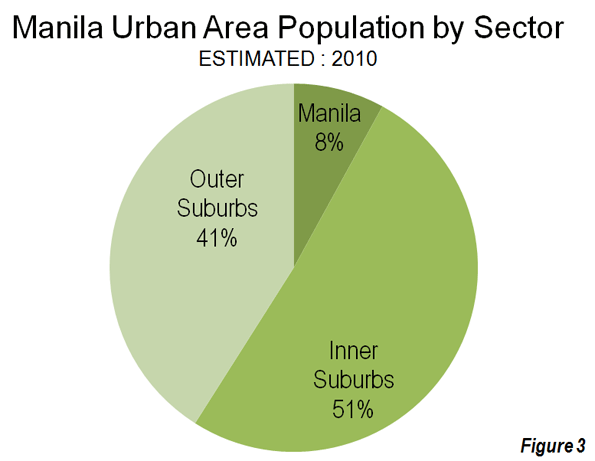
    As of 2010, it is estimated that eight percent of the population lives in the core municipality of Manila, 51 percent in the inner suburbs and 40 percent in the outer suburbs (Figure 4).

    The Metropolitan Area: Unlike urban areas, there are no international standards for the delineation of metropolitan areas (labor markets including extensions beyond urban areas). Serious attempts to compare international metropolitan area data have been rare (Note 2). Nonetheless, the evolution of Manila as a metropolitan area can be independently reviewed based upon a provincial level analysis.

    The Manila urban area occupies all or part of six provincial level jurisdictions. The largest population is in the National Capital Region, which is somewhat misleadingly referred to as "Metro Manila", despite being only a part of the metropolitan area. This is similar to Tokyo, where the prefecture of Tokyo is referred to as the "Tokyo Metropolis," yet represents only one third of the metropolitan area population. The metropolitan area also extends into the provinces of Rizal (from which the National Capital Region was carved in 1976), Cavite, Laguna, Bulucan and Batangas. The total population was estimated at 26.5 million in 2010 (Note 3).

    The metropolitan area’s population growth is strongly moving toward the outer suburbs (the five provinces outside the National Capital Region). Between 1970 and 1990, the inner suburbs captured 61 percent of the metropolitan area growth, compared to 36 percent in the outer suburbs. Between 1990 and 2010, the outer suburbs accommodated 64 percent of the metropolitan areas population growth, compared to 34 percent for the inner suburbs.

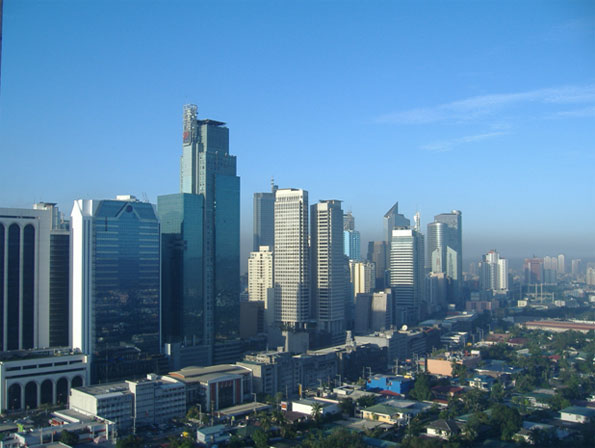
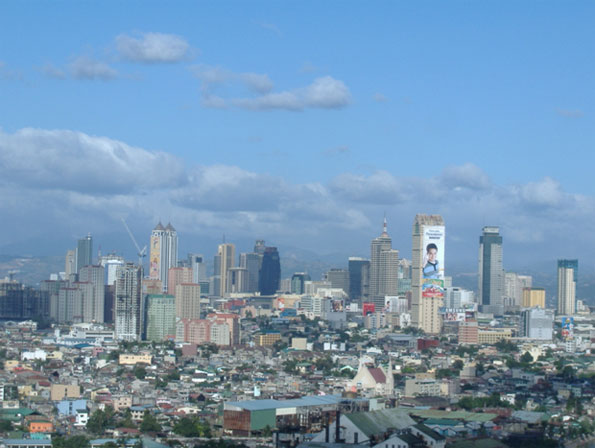
    Commercial Development: The suburbanization of Manila has not been limited to residences. New, world class commercial cores have been developed that have displaced many of the traditional functions of the older commercial core of Manila. Makati, a municipality to the east of Manila and within the National Capital Region now has the largest business district (photo), while a nearly as large commercial core has developed in Ortigas, just to the north (photo). There are other developing office centers such as the somewhat more distant commercial center near the southern border of the National Capital Region in Muntinlupa. This is similar to the kinds of newer commercial developments that have supplanted traditional business districts in urban areas such Mexico City (Reforma and Santa Fe) Sao Paulo (Paulista and Luis Carlos Berrini) and Istanbul (Levant).These developing country cities have experienced an economic decentralization of business that surpasses that of American edge cities.


    Makati


    Ortigas


    Manila’s Ominous Future? Manila faces an especially difficult future. The Philippines is projected to have one of the strongest urban growth rates in the world over the period to 2050. Since 1950, the Manila urban area has captured nearly 50 percent of the urban population growth of the nation. If this rate were to continue, the Manila urban area would reach a population of between 45 and 50 million by 2050. This is approximately 10,000,000 more than live in Tokyo, the world’s largest urban area today.

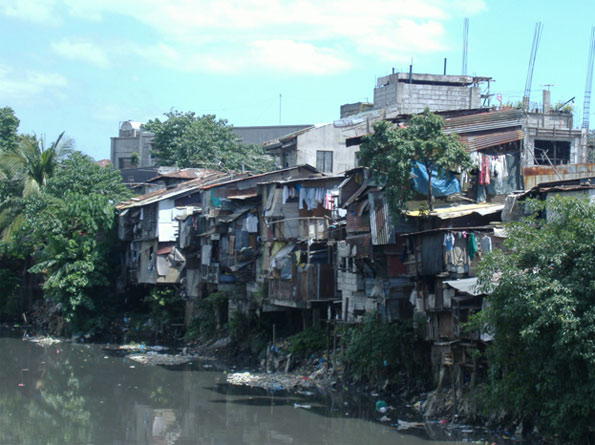
    But Manila faces even greater problems, related to the intense poverty of much of the population migrating to the urban area from the countryside. The Philippine Institute for Development Studies (PIDS) estimated that 4 million of the 11.5 million residents in the National Capital Region lived in slums (shantytowns or informal settlements) in 2010 (Photo).  PIDS indicates that this population is increasing at a rate of eight percent annually and is expected to reach 9 million by 2050. This would be nearly 60 percent of the projected population at that time, and does not include slum populations in the extensive suburbs beyond the limits of the National Capital Region.

    As if the poverty were not enough, Manila has been plagued by disastrous slum fires, the most recent within the past week. According to the Manila Times up to 10,000 people were left homeless by this most recent fire, which was in Makati, home of the metropolitan area’s largest and most prestigious business district.

    Manila also experiences some of the world’s worst traffic congestion, as people increasingly travel by car on its largely substandard road system. Perhaps even more surprisingly, a substantial number of detached housing communities have been developed, especially on the urban fringe.

    Manila’s challenge will be to accommodate the millions more who will seek a better life in the urban area and to do so while materially improving the standard of living as urgently as possible.

    ———

    Note 1: This urban area population is considerably above the figure reported by United Nations (11.6 million). United Nations figure is for the National Capital Region, which is also referred to as Metro Manila. In fact, the urban area stretches well beyond Metro Manila. This population estimate is based upon a build-up of smaller area population totals within the continuously develop urban area.

    Note 2: By far the most comprehensive attempt to apply consistent criteria to international metropolitan areas, was by urban expert Richard L. Forstall (who ran the Rand McNally "Ranally" international metropolitan area program), Richard P. Green and James B. Pick. The complexity of the research is indicated by the fact that their list is limited to the top 15 in the world. 

    Note 3: The metropolitan population is estimated by applying the 2000 to 2007 annual growth rate to from 2007.

    Wendell Cox is a Visiting Professor, Conservatoire National des Arts et Metiers, Paris and the author of “War on the Dream: How Anti-Sprawl Policy Threatens the Quality of Life

    Lead Photograph: Urban fringe development: Laguna province (outer suburbs). All photographs by author.

  • Tests, Lies and The Race to the Top

    Obama had his “Sputnik Moment,“ when standardized test scores around the world pointed to the mediocrity of American students in reading, math and sciences. There is now a major mantra coming from Washington to all state capitals: the “race to the top” is on, and it doesn’t include a continuation of the downward spiral of test scores. The new modus operandi: Leave aside achievement throughout the years in high school, the stream of G.P.As., the difficulty of courses taken during the years in 9 to 12, and any creative projects done by students. Base everything on standardized tests.

    When career prospects, prestige, and job security are connected to one and only one criteria — score on a standardized test — human nature is bound to creep in. Baseball players start taking steroids; Olympic athletes try every means to beat the system. Will it happen to dedicated teachers who are working hard to educate our next generation? Will temptation overtake honesty, integrity and ethical behavior?

    The jury is out regarding schools in Washington DC, which was considered a shining star of improvement in math, sciences and reading. Many teachers were given bonuses exceeding $8,000; higher-ups were also rewarded.

    However, the statistical analysis of erased incorrect answers — replaced with correct answers —on standardized tests have created serious doubts in the minds of the general public and of educators. Acting School Chancellor Kaya Henderson has asked the D.C. Inspector General to investigate reports that a sharp gain in some standardized tests scores may be the result of cheating, and members of the press have asked for subpoenas to be issued to get at the truth. Obviously, a thorough investigation is needed.

    Similarly, in Georgia, test scores improved in Atlanta while several officials were indicted and a few resigned. In Indiana, a Department of Education official believes that a test coordinator from the school system copied a test question and distributed it on Facebook. And Texas Education Agency Commissioner Shirley Neeley has launched an effort to catch cheating on standardized tests, not by students, but by teachers.

    The all powerful teachers unions, as well as budget-cutting tea party-influenced elected legislators are all pushing their own agendas. The forgotten question: How will an extreme emphasis on standardized tests affect students?

    India may offer a possible clue. A country of over 1 billion in population, with several million graduating from high school per year (with average class sizes at 50 or larger), the competition to get into most prestigious institutions is extreme: consider 455,000 students attempting to land a seat in the prestigious Indian Institute of Technology, the globally recognized English language Engineering College, with less than few thousand seats. The competition for good medical and, business schools throughout the country is equally fierce. And remember— all that matters is your score on the standardized test.

    A Mumbai publication recently highlighted the human cost of Indian education “successes”. The statistics draw a bleak picture of elite students in India. About 19 students commit suicide per day, with six of these attributed to the “fear of failure on standardized test,” the sole school selection criteria. Student suicides in India were 6,060 in the year 2008, and increased to 6,761 by 2009. The states with above average literacy, with extreme competition for prestigious education institutes, are number one and two in suicides. Psychologists and education professionals are attributing this to “excessive emphasis” on standardized tests, parental expectations, and social pressure to succeed. Think Tiger Mom!

    The suicide rate is so alarming that the Minster of Law (comparable to an Attorney General) has suggested “decriminalizing” suicide (currently, anyone who survives a suicide is subject to prosecution). The local English language columnist, Gitanjali Maria, observes that “Childhood should be the days of fun, not memorizing equations.” Hone your talents and discover your hidden strengths, Maria recommends, instead of spending every waking moment preparing for the next standardized test.

    The system of standardized tests rarely allows a student to enjoy any subject or to discover the beauty of math or physics. All the knowledge, fun, desire and ability to enjoy and excel is filtered down to one scantron that will decide the zip code you will live in, your bank balance, and whether you will have a good job or just get by. We all need to recognize the difference between a ‘race to the top’, and a race to memorize formula with the sole objective of “fill the correct blank with a Number 2 pencil”.

    Shashi Parulekar is an engineer by training. He holds an MBA, and served as Asia Pacific M.D. with Parker Hannifin Co in Michigan for over ten years. He is a global business executive by profession and a demographer by passion.

    Photo by By Shannan Muskopf, biologycorner: Standardized Test

  • Downtown China

    In Downtown: It’s Rise and Fall, 1880-1950, Robert M Fogelson says that downtowns are a uniquely American phenomenon. He refers to downtown as the commercial cores with high building densities that form "canyons" that, in some smaller urban areas, might be only a block long to a mile or more long.  Fogelson demonstrates that downtowns in the United States are largely a creation of rail transit (subways or metros, street cars and their predecessor horse cars). American urban areas grew at the same time that this mode of transport was reached its zenith.    

    This pattern was also evident in the pre-automobile cores of large urban areas in Canada, Australia and New Zealand.

    Since then, the downtown has been losing its preeminence. As late as 1950 virtually all of the nearly 50 US urban areas with more than 250,000 people had concentrated downtown areas of varying sizes. The unifying factor was the access to this one point in the urban area by transit from most or all of the rest of the urban area.   Smaller urban areas, after transit’s golden age, never developed downtowns as well-developed as those which grew during the transit oriented urban areas of the pre-World War II era.

    China’s emerging commercial cores bear little resemblance to these older American downtowns. Generally, what might be termed as downtown in the urban areas of China is far more dispersed. The tallest buildings do not stand across narrow streets from one another. You see little of the often spectacular high-rise canyons seen in great American downtowns such as Chicago and New York or even smaller ones, such as Pittsburgh and Seattle and many others.   

    Dominant Pattern: The Dispersed Central Business District: The most pervasive form of downtown China is a larger central business district consisting of dispersed high-rise buildings superimposed on lower rise residential buildings, the latter often being five floors or less.

    Perhaps the best example is Guangzhou, capital of Guangdong (12 million population) that now engulfs adjacent Foshan. The skyscrapers of central Guangzhou, some among the tallest in the world, are spread around an area of between 10 and 15 square miles (26 to 39 square kilometers). The largest concentration is near the Guangzhou East Railway Station, where the trains of the former Kowloon – Canton Railway terminate. Even so, this concentration is more sparse than would be expected in even a smaller US Pre-World War II transit oriented downtown.   Other, smaller concentrations of tall commercial buildings or skyscrapers are virtually isolated. The Guangzhou International Finance Center, the tallest building in Guangzhou and 10th tallest in the world dominates its generally low rise surroundings, soon to be joined by an even taller 116 floor building that is under construction.

    The pattern of dispersed and large central area development is also obvious in nearby Shenzhen, Guangdong (population 15 million, see Note), which rose from being fishing village to megacity status in less than 30 years. The central core occupies at least as much space as central Guangzhou. However, unlike Guangzhou, part of the Shenzhen central area has relatively dense high-rise buildings. This eastern section has a number of very tall buildings, and of the world’s second tallest skyscraper (and China’s tallest) is now under construction in this area (the Pingan International Financial Center).

    Other Chinese urban areas with generally dispersed core commercial development include Chengdu, the capital of Sichuan (5 million), Changsha, capital of Hunan (2.5 million), Taiyuan, capital of Shanxi (3 million), Kunming, capital of Yunan (3.2 million) Guiyang, capital of Guizhou (2.3 million), Ningbo, Zhejiang (3.2 million) and Tianjin (7 million), a provincial level municipality.

    Changsha and Taiyuan are near duplicates, with the core development in a wide area extending from the main railway station over a mile westerly to north-south rivers that dissect each urban area.

    Dongguan, Guangdong (12 million, see Note), like Shenzhen became a megacity (from a rural area) in less than two decades. Dongguan is located between Guangzhou and Shenzhen, and may have the most dispersed central business district in China, with little concentration except for an "edge city" development with comparatively large distances between buildings. Dongguan is unique for being the largest urban area in the world without an international airport (Dongguan is served by the nearby Shenzhen and Guangzhou international airports).

    Dual Cores Superimposed on Dispersed Central Areas: There is also a variation on this dispersed pattern in which the core commercial area includes two unusually high concentrations of buildings.

    The best example of this is Beijing (14 million) where an older concentration of high-rise buildings is to the west of Tiananmen Square and the Forbidden City in a corridor along the Second Ring Road (one of Beijing’s five freeway rings or beltways), and a sixth is under discussion. The newer concentration is to the east, in a corridor along the Third Ring Road. This area includes the CCTV Headquarters and the tallest building in Beijing, the 74th floor China World Trade Center III, on the other side of the Third Ring Road. These concentrations along the ring roads resemble more the post-World War II corridor form of Central Avenue in Phoenix than Manhattan, Seattle or Pittsburgh.

    Shenyang, in Manchuria, capital of Liaoning (5 million) also has two cores in the midst of a less concentrated central area.  The larger and newer core is adjacent to Shenyang North Railway Station, while the smaller and older core is near Shenyang Railway Station.

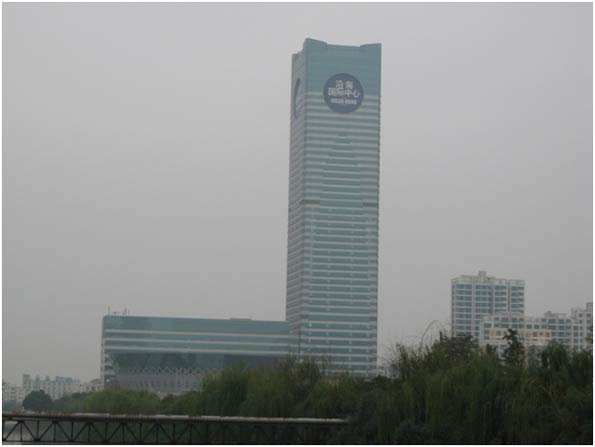
    Suzhou, in Jiangsu (3.3 million) is well known for its canals, as the Venice of the Orient. Suzhou too has two comparatively concentrated cores on either side of the older smaller low rise core. The largest concentration is to the west, adjacent to the Grand Canal, built between 1,500 and 2,500 years ago to connect Hangzhou with Beijing (1,100 miles or 1,700 kilometers), The smaller concentration is to the east. Even so the pattern of dispersion is dominant. The urban area’s tallest building, the Henghe Tower (photo) is well away from any other buildings of significant height.

    In Xi’an (5 million), capital of Shaanxi (and a historic capital of China known as Chang’an), the two more concentrated areas sit along a north-south spine on either side of the historic walled city, which includes an older, even less concentrated business district.

    Wuhan, capital of Hubei (5 million) also fits the dual model, but this is partially due to the post-war amalgamation of three cities (Hankow, Wuchang and Hanyang), the first two of which have large and dispersed core areas, with some concentration.

    Hanghzou (capital of Zhejiang, 5 million) and Zhengzhou (capital of Henan, 2.3 million) exhibit a somewhat different pattern of the dual core superimposed upon the typical commercial dispersion. In Hangzhou, a new central business district is under development, well to the east of the older core area. A new central business district is also being developed, with major parts completed, on the periphery of Zhengzhou (the Zhengzhou "New Area"). This area was inaccurately characterized as China’s largest Ghost City by The Daily Mail (London).

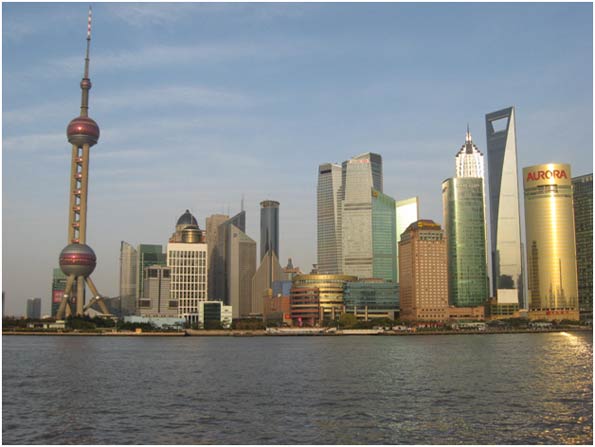
    Shanghai: Shanghai (19 million) deserves special mention. A business center since the 1920s, Shanghai boasts one of China’s more concentrated central business districts, west of the Pu River (Puxi) as well as perhaps the world’s largest edge city development, across the river in Pudong. Puxi includes the famous Bund area along the river with its classic western architecture. The central business district continues westerly and to the south to beyond the north-south elevated freeway. This district has tall buildings widely dispersed throughout. Some of Shanghai’s tallest buildings are here, though few are close to one another. Pudong includes the Pearl of the Orient Tower (either loved or hated by architectural critics), the 101 story Shanghai International Financial Center and a number of other tall and unique skyscrapers (photo). This concentration, however, is separated by large streets and plazas and does not resemble the concentrated central business districts of the United States. Soon, this area will add a 128 story building, which will be the third tallest in the world (measured in feet or meters).

    Nanjing: Nanjing, the capital of Jiangsu (4 million) has a more American looking central business district, by virtue of a number of tall buildings located close together at or near the Xinjieko intersection. Yet, Nanjing’s tallest building and seventh the tallest in the world (Nanjing Greenland Financial Center) sits well to the north of Xinjieko, while the other tallest buildings are a subway stop to the east.

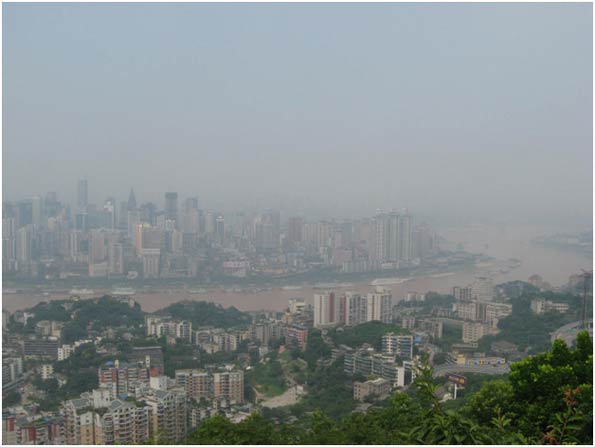
    Chongqing: Chongqing, a provincial level municipality, has an urban area population of 7 million. Chongqing breaks the mold, with a central business district that would be familiar to urbanites in the United States (photo). The core of Chongqing sits on a peninsula formed by the confluence of the Yangtze River and the Jailing River. It bears a resemblance to Pittsburgh, down to a plaza similar to the Golden Triangle. Close by and up a hill may be China’s only US style-central business district. Here, the streets are narrow, the buildings are tall, and there are canyons like those of pre-World War II Pittsburgh, Seattle or even Manhattan. Much of this anomaly is probably due to the constrained geography of the central area. At the same time, commercial development is crossing the Yangtze River and spread to formerly rural areas west, such as Daping and Shapingba . These areas are up to forty-five minutes from the core.

    None of this, of course, is surprising, since China, like America and elsewhere, is like nowhere else in the world.

    ———

    Note: The population figures shown for Shenzhen and Dongguan are based upon unofficial estimates that include the non-permanent (migrant) population. Official figures in these two prefectures generally include only permanent residents, who may represent 50 percent or less of the population.

    Wendell Cox is a Visiting Professor, Conservatoire National des Arts et Metiers, Paris and the author of “War on the Dream: How Anti-Sprawl Policy Threatens the Quality of Life

    Lead photo: Second Ring Road Corridor, Beijing (by Author)

    All photos by author.

  • Malthusian Delusions Grip Australia

    Entrepreneur Dick Smith wants Australian families to be subject to China-like population doctrine. Families should be limited to just two children, the father of two and grandfather of six says, because our population growth is something like ‘a plague of locusts.’

    Yet in reality, as in many other advanced countries, our population crisis may have more to do with having too few — specifically younger — people than too many.

    The anti-population jihad is nothing new. Thomas Malthus was an 18th century economist and Anglican clergyman, whose ‘Essay on the Principles of Population’ (published 1798) popularised the notion that vice, plague and famine were natural forms of population control. In short, overpopulation would be subject to control by food scarcity.   

    Maulthusians almost 200 years later, in 1968, Paul Ehrlich wrote the blockbuster ‘The Population Bomb’ which warned of imminent mass starvations and famine due to overpopulation.  

    Now joining the fray is our very own Dick Smith, former super-nerd and founder of Dick Smith Electronics stores, aviator, publisher (of Australian Geographic), entrepreneur and 1986 ‘Australian of the Year.’  

    Dick’s a popular figure in Australia, and when he speaks people (and the media) listen. But Dick’s suggestion that Australia is overpopulated, and thus requires we need to limit our growth through a two child policy borders on the hysterical.

    First, let’s start with some global perspective. Overall, world population growth rates are slowing according to the United Nations and the US Census Bureau. Further, based on United Nations forecasts, populations by 2050 will be smaller than they are today in 50 countries – leading economies included. Here’s a useful article from The Economist which explains. And in this article from Bloomberg’s Businessweek, titled ‘Shrinking Societies: the other Population Crisis’, the massive economic and social problems of countries with falling populations are highlighted.

    Australia’s ageing population is not as severe as that looming in Europe and much of east Asia, but this country also faces a demographic implosion that, in the absence of more young people, will place unprecedented demands on a welfare system largely unfunded by the present tax system and those who fund it (namely, workers in the private sector).

    But strangely, discussions about our ageing population and how to fund it and concerns about the overpopulation of Australia take place largely without a logical connection drawn between the two. If we are to avoid a horrendous tax burden on the future generation of workers, in order to maintain our standard of living and support the needs of the boomers, we will need more workers. It’s either that or higher taxes. And the problem with higher taxes, as other countries with similar problems have found, is that they can lead to an exodus of the workforce seeking better opportunities elsewhere. This in turn reduces the tax base. No ‘win-win’ there.

    Doug Saunders is the author of ‘Arrival City,’ a book about the conflicts and change brought on by massive urban migrations. And in this article he explains, “by 2050, most Western countries will have to devote between 27 and 30 per cent of their GDP to spending on retirees and their needs”. This he adds, will produce fiscal deficits in most advanced countries of almost 25 per cent of GDP, making the current crisis seem minuscule by comparison.

    This is not a remote or abstract crisis. Countries like Canada will soon be fighting to attract anyone we can get to work – and squeezing as much as we can from the remaining few.

    Australia has been fond of comparing itself to Canada. We are both western democracies, operating under similar governance systems. We both have relatively small populations given our geographic size (Canada has 34 million people, we have 23 million) and abundant natural resources. The resource we both lack is people. If Saunders is right about Canada fearing the same demographic problems as Japan (population 127 million), Australia might want to take note.

    Dick Smith’s concerns for Australia rely on a second, also false, argument:

    "We are putting our kids into high-rise because we are running out of land, because people want and need to live close to the city. We pay $50 million a year for free range eggs for our bloody chooks to be free range – what about our kids? I was a free range kid. I had a backyard. We are starting to lose that now, and it’s only driven by the huge population increases." (full article here)

    But Dick, we aren’t running out of land. This argument is preposterous, on any valid domestic or global comparison. The reason we are denying future generations a backyard in preference over high density dwelling is not a land shortage brought on by population growth, but a planning philosophy which insists on growth boundaries and high density. This policy is embraced by most planners. Developers and land economists could explain this to Dick, if he were prepared to listen. Plenty of people, given the choice, would happily occupy suburban blocks far from CBDs because their work (which for 9 out of 10 Australians is not in the CBDs) and their lifestyle preferences (typically raising a family) are that way inclined. Those people though are not planners, and neither are they part of the current oligarchy which delivers decisions allegedly in their interests via the confines of inner city coffee shops.

    Even in the United Kingdom (population 62 million, in an area slightly larger than Victoria) there are those proposing the establishment of new urban centres to provide housing choice and to accommodate growth. Ian Abley’s Audacity.org has proposed a ‘250 New Towns’ movement, which seeks to do precisely that.

    If there are those prepared to venture such audacious ideas in a small place like the UK, one wonders why Australia has allowed itself to become preoccupied with the notion that we are somehow running out of land.

    Australia’s growth rate is currently a dizzying 1.6% per annum. It’s fallen from a high of 2%, as international migration was reduced. Neither rates of growth, on a global scale, are remarkable. By 2050, when global population growth is predicted to stop, our total population will reach an estimated 35 million people, of whom 23% – or nearly one in four – will be aged over 65.

    It reads not like a recipe for over population, but one of under population.  Perhaps it’s time the tiny thought bubbles of Dick Smith and his cohorts in this discussion were well and truly pricked by the sharp end of reality?

    Ross Elliott has more than 20 years experience in property and public policy. His past roles have included stints in urban economics, national and state roles with the Property Council, and in destination marketing. He has written extensively on a range of public policy issues centering around urban issues, and continues to maintain his recreational interest in public policy through ongoing contributions such as this or via his monthly blog The Pulse.