Category: Demographics

  • Anchorage Spreading Out

    Alaska’s largest metropolitan area, Anchorage, is spreading out like its major metropolitan area counterparts in the Lower 48. The historical core municipality of Anchorage grew from 262,000 in 2000 to 291,000 in 2010, a growth rate of 12 percent. Anchorage is largely post-World War II suburban.

    Suburban Matanuska-Susitna Borough, to the north nearly equaled Anchorage’s 31,000 population growth, adding 30,000 residents, though on a much smaller base. Matanuska-Susitna grew from 59,000 to 89,000, for a growth rate of 51 percent..

  • Florida Metropolitan Areas Disperse; City of Miami Continues to Densify

    Miami: The Miami metropolitan area grew 11 percent between 2000 and 2010 according to the recently released census count. The population growth was from 5,008,000 in 2000 to 5,575,000 in 2010. This growth, only modestly above the national average, caused Miami to slip behind Dallas-Fort Worth and Houston, to become the nation’s 7th largest metropolitan area. The Miami metropolitan area was expanded after the 2000 census to include not only the core county of Miami-Dade, but also Broward (Fort Lauderdale) and Palm Beach (West Palm Beach) counties.

    The historical core municipality, the city of Miami, grew from 362,000 to 399,000 and accounted for 7 percent of the metropolitan area growth. Miami is unique among the nation’s historic core municipalities in having densified in every census period since 1960, despite not annexing new territory and not having substantial greenfield space for development.

    The suburbs captured 93 percent of the growth. Growth was modest in all counties, but was the greatest in the most outlying, Palm Beach, at 17 percent.

    Orlando: The Orlando metropolitan area grew nearly 30 percent between 2000 and 2010 according to the recently released census count. Orlando grew from 1,645,000 in 2000 to 2,134,000 in 2010. The historical core municipality, the city of Orlando, grew from 194,000 to 238,000 and accounted for 9 percent of the metropolitan area growth. The suburbs captured 91 percent of the metropolitan area growth, expanding their population by 31 percent. Outlying (Osceola 55 percent) and Lake (41 percent) counties grew the fastest.

    Tampa-St. Petersburg: The Tampa-St Petersburg metropolitan area grew 16 percent between 2000 and 2010 according to the recently released census count. The population growth was from 2,396,000 in 2000 to 2,448,000 in 2010. The historical core municipality, the city of Tampa grew from 303,000 to 336,000 and accounted for 8 percent of the metropolitan area growth. The suburbs captured 92 percent of the growth. The fastest growing counties were both outlying, Pasco (35 percent) and Hernando (32 percent).

    Jacksonville: The Jacksonville metropolitan area grew nearly 20 percent between 2000 and 2010 according to the recently released census count. Jacksonville grew from 1,123,000 in 2000 to 1,346,000 in 2010. The historical core municipality, the city of Jacksonville, grew from 736,000 to 822,000 and accounted for 39 percent of the metropolitan area growth. The city of Jacksonville is essentially combined with Duval County has a largely suburban form and includes rural areas. The consolidation occurred between the 1960 and 1970 censuses, with the new jurisdiction covering nearly 25 times that of the old (768 square miles as opposed to 32 square miles), while the population of the new jurisdiction was somewhat more than 2.5 times that of the old. Jacksonville covers more than twice the land area than New York City and has approximately one-tenth the population.

    The suburbs captured 61 percent of the growth. The fastest growing counties were both outlying, St. John’s (54 percent) and Clay (36 percent), which captured more than one-half of the metropolitan area growth.

  • Twin Cities Growth All in Suburbs

    The historical core municipalities of the Twin Cities area, Minneapolis and St. Paul experienced modest population declines between 2000 and 2010, according to the latest census count. All of the growth in the metropolitan area was in the suburbs.

    The Minneapolis-St. Paul metropolitan (Minnesota-Wisconsin) area grew from 2,969,000 in 2000 to 3,280,000 in 2010, an increase of 10.5 percent. The city of Minneapolis lost 40 residents, with a population of 382,618 in 2000 and 382,578 in 2010. The city of St. Paul lost 2,000 residents, from 287,000 to 285,000. Both historic core cities reached their population peaks in 1950, at 522,000 in Minneapolis and 311,000 in St. Paul. Each of the core cities have maintained essentially the same boundaries (city limits) as in 1950.

    The suburbs grew 13.6 percent. The strongest growth was in Scott County (MN) at 45 percent, Wright County (MN) at 38 percent,  Sherburne County (MN) at 37 percent, St. Croix County (WI) at 34 percent, Chisago County (MN) at 31 percent and Carver County (MN) at 30 percent. These counties combined to attract nearly one-half of the population growth, despite accounting for less than 15 percent of the population in 2000, indicating the continuing dispersion of the Twin Cities.

  • Minneapolis, St. Paul & Memphis Core City Losses

    Census results released today show again show losses, though small, in historical core municipalities. The city of Minneapolis lost 40 people, between 2000 and 2010, falling from 382,618 to 382,578. The city of St. Paul, also a historical core city of the Minneapolis-St. Paul metropolitan area fell from 287,000 to 285,000.

    The historical core municipality of Memphis dropped from 650,000 to 647,000, despite the fact that much of the city is of a post-World War II suburban form.

  • Why North Dakota Is Booming

    Living on the harsh, wind-swept northern Great Plains, North Dakotans lean towards the practical in economic development. Finding themselves sitting on prodigious pools of oil—estimated by the state’s Department of Mineral Resources at least 4.3 billion barrels—they are out drilling like mad. And the state is booming.

    Unemployment is 3.8%, and according to a Gallup survey last month, North Dakota has the best job market in the country. Its economy “sticks out like a diamond in a bowl of cherry pits,” says Ron Wirtz, editor of the Minneapolis Fed’s newspaper, fedgazette. The state’s population, slightly more than 672,000, is up nearly 5% since 2000.

    The biggest impetus for the good times lies with energy development. Around 650 wells were drilled last year in North Dakota, and the state Department of Mineral Resources envisions another 5,500 new wells over the next two decades. Between 2005 and 2009, oil industry revenues have tripled to $12.7 billion from $4.2 billion, creating more than 13,000 jobs.

    Already fourth in oil production behind Texas, Alaska and California, the state is positioned to advance on its competitors. Drilling in both Alaska and the Gulf, for example, is currently being restrained by Washington-imposed regulations. And progressives in California—which sits on its own prodigious oil supplies—abhor drilling, promising green jobs while suffering double-digit unemployment, higher utility rates and the prospect of mind-numbing new regulations that are designed to combat global warming and are all but certain to depress future growth. In North Dakota, by contrast, even the state’s Democrats—such as Sen. Kent Conrad and former Sen. Byron Dorgan—tend to be pro-oil. The industry services the old-fashioned liberal goal of making middle-class constituents wealthier.

    Oil also is the principal reason North Dakota enjoys arguably the best fiscal situation in all the states. With a severance tax on locally produced oil, there’s a growing state surplus. Recent estimates put an extra $1 billion in the state’s coffers this year, and that’s based on a now-low price of $70 a barrel.

    North Dakota, however, is no one-note Prairie sheikdom. The state enjoys prodigious coal supplies and has—yes—even moved heavily into wind-generated electricity, now ranking ninth in the country. Thanks to global demand, North Dakota’s crop sales are strong, but they are no longer the dominant economic driver—agriculture employs only 7.2% of the state’s work force.

    Perhaps more surprising, North Dakota is also attracting high-tech. For years many of the state’s talented graduates left home, but that brain drain is beginning to reverse. This has been critical to the success of many companies, such as Great Plains Software, which was founded in the 1980s and sold to Microsoft in 2001 for $1.1 billion. The firm has well over 1,000 employees.

    The corridor between Grand Forks and Fargo along the Red River (the border between North Dakota and Minnesota) has grown rapidly in the past decade. It now boasts the headquarters of Microsoft Business Systems and firms such as PacketDigital, which makes microelectronics for portable electronic devices and systems. There are also biotech firms such as Aldevron, which manufactures proteins for biomedical research. Between 2002 and 2009, state employment in science, technology, engineering and math-related professions grew over 30%, according to EMSI, an economic modeling firm. This is five times the national average.

    While the overall numbers are still small compared to those of bigger states, North Dakota now outperforms the nation in everything from the percentage of college graduates under the age of 45 to per-capita numbers of engineering and science graduates. Median household income in 2009 was $49,450, up from $42,235 in 2000. That 17% increase over the last decade was three times the rate of Massachussetts and more than 10 times that of California.

    Some cities, notably Fargo (population 95,000), have emerged as magnets. “Our parking lot has 20 license plates in it,” notes Niles Hushka, co-founder of Kadrmas, Lee and Jackson, an engineering firm active in Great Plains energy development. Broadway Drive in Fargo’s downtown boasts art galleries, good restaurants and young urban professionals hanging out in an array of bars. This urban revival is a source of great pride in Fargo.

    What accounts for the state’s success? Dakotans didn’t bet the farm, so to speak, on solar cells, high-density housing or high-speed rail. Taxes are moderate—the state ranks near the middle in terms of tax per capita, according to the Tax Foundation—and North Dakota is a right-to-work state, which makes it attractive to new employers, especially in manufacturing. But the state’s real key to success is doing the first things first—such as producing energy, food and specialized manufactured goods for which there is a growing, world-wide market. This is what creates the employment and wealth that can support environmental protection and higher education.

    Thankfully, this kind of sensible thinking is making a comeback in some other states, such as Ohio and Pennsylvania. These hard-pressed states realize that attending to basic needs—in their case, shale natural gas—could be just the elixir to resuscitate their economies.

    This piece originally appeared in the Wall Street Journal.

    Joel Kotkin is executive editor of NewGeography.com and is a distinguished presidential fellow in urban futures at Chapman University, and an adjunct fellow of the Legatum Institute in London. He is author of The City: A Global History. His newest book is The Next Hundred Million: America in 2050, released in February, 2010.

    Photo by SnoShuu

  • Perspectives on Urban Cores and Suburbs

    Our virtually instant analysis of 2000 census trends in metropolitan areas has the generated wide interest. The principal purpose is to chronicle the change in metropolitan area population and the extent to which that change occurred in the urban core as opposed to suburban areas.

    From a policy perspective, this is especially timely because of the recurring report that suburbanites have been moving to the urban core over the last decade. We have dealt with this issue extensively, noting the lack of data for any such interpretation. As of this writing, with data for more than half of the major metropolitan areas (over 1,000,000 population) in, there remains virtually no evidence that people are "moving back to the city" (actually, most suburban growth came from outside metropolitan areas, not from the "cities").

    The Policy Context: Urban Cores and Suburbs

    This discussion is not new, and generally pits anti-automobile interests – including much of the urban planning community – who favor the urban development patterns of prewar America (generally the urban planning community) against those who would prefer allowing people to make their own choices about where they live or work..

    Over the past 60 or more years, the data indicates that consumers have nearly exclusively chosen less dense and more suburban areas. This is not to suggest, however that many of us, including this author, automatically favor suburbs over urban cores. Indeed, I have enjoyed years of alternating between living in suburban America and the urban core of the (inner) ville de Paris (arrondissements I, II, V, VII and XI). But if you have a taste for urban living, that does not mean high-density cities are inherently superior to suburban living. People, after all, have different preferences.

    Urban areas include both urban cores and suburbs. The delineation of urban cores and suburbs is subjective. There was for example a time – say around 1820 – when development to the north of New York’s Houston Street would have been considered suburban. More than two thirds of the present ville de Paris was suburban before the city limits were expanded in the 1860s. Now, no one would consider, for example, Washington Square or Herald Square to be suburban and the suburbs of Paris now extended to more than 80 times the land area of the 1860s ville de Paris.

    One overlooked way to approach the current debate would be to look not at municipal boundaries but forms of development. Around 1950 we began the breakneck expansion of automobile oriented suburbanization which had proceeded more modestly for two or more decades before.

    The Urban Core:

    This analysis defines the urban core consistent with the criteria of the US Bureau of the Census in 1950. Metropolitan areas are organized around urban areas (urbanized areas). We use the "central cities" of the core urban areas in 1950 as the urban core in the analysis. Those portions outside the 1950 urban core are thus considered suburban. Where an urban area did not exist in 1950 (such as in Las Vegas and Tucson), the urban core is the central city of the urban area when it was first established.

    No existing specification of the urban core is ideal, though the present one is appropriate for the policy purpose stated above. Clearly, the urban core would be far better defined at the census tract or even census block level based upon the characteristics of an urban core. This would include factors such as high residential population density, high transit usage, walkability and a high percentage of multiple unit residential buildings.

    Such an ideal definition of the urban core cannot be measured with municipal boundaries. Yet, municipal boundaries have routinely been used by researchers to delineate the urban core, not least because the data is readily available. However there three notable difficulties with the use of municipal boundaries to define the urban core.

    First; some areas with urban core characteristics are outside the core municipalities. As The Infrastructurist notes, municipalities like Jersey City or Hoboken have the characteristics of urban cores. However, since they are not a part of the core municipality (city of New York), they are classified as suburbs in our analysis. It is well to remember that both Hoboken and Jersey City represented suburban development, during their period of greatest growth, before 1930.

    Second, other areas with postwar suburban characteristics are inside the core municipalities. For example, Richmond County (Staten Island), a part of the city of New York is principally suburban. Much of it was developed well after 1950 and consists largely of single family homes. The median construction date of owner occupied housing in Staten Island is 1970, which compares to 1965 in adjacent Middlesex County, New Jersey. It is newer than in Morris County New Jersey (1965), much of which is outside the urban area (all median house construction years from the 2000 census). Major portions of core municipalities such as Los Angeles, Houston, Dallas, Portland, Seattle, Denver and others are also postwar suburban.

    Third, in a number of core municipalities, there is little, if any urban core, at least from a residential perspective. For example, one would be hard-pressed to identify an urban core in municipalities such as Phoenix or San Jose (despite the fact that the San Jose urban area is more dense than New York urban area). In metropolitan areas such as these, it might be preferable to define virtually all growth as suburban, though our analysis still defines these municipalities as the urban core.

    Based upon the early results from the census it seems that if the more ideal census tract-based urban core definition were used, the urban cores would be shown to be capturing an even smaller share of growth, while suburban areas would be capturing more. But this analysis will have to wait until all the numbers are in.

    Historical Core Municipality

    The term "historical core municipality" is used to denote the urban cores using municipal boundaries.  The term "city" is avoided because of its multiple definitions. Cities can be municipalities (such as in the city of New York), urban areas (such as the New York urban area), metropolitan areas (such as the New York metropolitan area) or multi-county regions or prefectures of countries like China (such as Wuhan or Shenyang).

    This lack of clarity can be routinely seen in media reports that indiscriminately (and without comprehension) make comparisons between cities, using differing definitions. This can even extend even to more technical literature (see pages 12-14 of Urban Transportation Policy Requires Factual Foundations).

    Principal Cities: Starting in 2003, the Census Bureau substituted the term "principal city" for the previous "central city" term. The use of principal city designations and the largest municipality as the principal name of a metropolitan area are appropriate for the purposes intended by the Census Bureau.

    In its State of Metropolitan America, the Brookings Institution uses up to the three largest principal cities (which it calls "primary cities") and consider other parts of metropolitan areas as suburbs.

    Neither approach, however, is appropriate in analyzing postwar suburbanization. Any municipality in a metropolitan area with more than 250,000 population is considered a principal city, regardless of its urban form. Any municipality with more than 50,000 population but which also has more jobs than resident workers is also a principal city, regardless of its actual on the ground reality.

    This leads to a situation in which, for example, Los Angeles has 26 principal cities. Any postwar urban form definition would classify nearly all as suburban (and much of the historical core municipality of Los Angeles, notably the San Fernando Valley, itself is suburban). For example, the suburban city of Cerritos is a principal city, yet was largely filled by dairy farms well into the 1950s and was called Dairy Valley.

    Other principal cities hardly existed in 1950. Virginia Beach has become the largest municipality in its metropolitan area, having displaced Norfolk. Yet, in 1950 Virginia Beach had a population of only 5,400, well below the 50,000 threshold that was required of central cities (smaller than Ponchatoula, Louisiana, doubtless an unfamiliar municipality to most readers). Arlington, Texas, the third municipality in the Dallas-Fort Worth-Arlington metropolitan area, had a population of 7,700 in 1950, again well below the central city threshold. Arlington is not an urban core, it is a suburban jurisdiction.

    Virginia Beach is a good example of a suburban area that has become the largest municipality in a metropolitan area. Its greater size, however, does not make Virginia Beach the urban core. Otherwise, Contra Costa County in California could, by consolidating with its constituent municipalities (God forbid), replace San Francisco as the metropolitan area’s urban core.

    Perhaps the ultimate example of the problem of principal cities being confused with urban cores is Hemet, California, a principal city of the Riverside-San Bernardino metropolitan area that is, in fact an exurb and not in the primary urban area.

    Toward the Future

    An eventual more precise analysis of urban cores and suburban trends will be welcome. Yet, as our analysis of trends in New Jersey indicated, even the growth in more urban core oriented municipalities was minuscule compared to the state’s suburban growth. Further, much of the urban core growth in the nation came from areas that, although formally located within “city limits” actually were on the suburban fringe. This was true, for example, in Kansas City, Oklahoma City and even Portland.  This suggests that the small share of growth reported in urban cores would be even less if it were based on census tract data; and suburbanization, as a way of life, may indeed be even more prevalent than this year’s numbers suggest. 

    Wendell Cox is a Visiting Professor, Conservatoire National des Arts et Metiers, Paris and the author of “War on the Dream: How Anti-Sprawl Policy Threatens the Quality of Life

    Photo by urbanfeel

  • Are Chinese Ready to Rent?

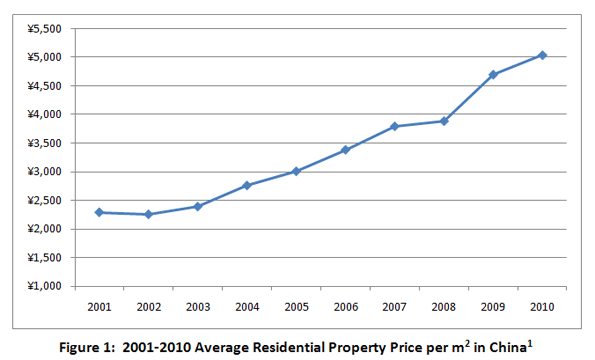
    In 2010 “House price” ranked third on the list of the top 10 most popular phrases used by Chinese netizens. It came to no one’s surprise. In most Chinese cities housing prices have increased significantly over the past decade, with an especially sharp rise over the past three years.

    “House Price” is a term used loosely, due to the fact that the vast majority of Chinese real estate is made up of apartments or condominiums, while only a small few are town houses or fully detached homes. However, terminology aside, owning a property is the greatest life-goal for most Chinese citizens.

    It is worth mentioning that in China property ownership does not mean land ownership as it does in the West. According to Chinese law, what people are buying is similar to a land-use right, which in the case of residential property, expires after 70 years (40 years for commercial property). The countdown begins on the date that the real estate developer signs for the land, and not on the homeowner’s date of purchase.

    So why do Chinese people have such zest for real estate?

    Different from the western mentality: “Home is where your heart is” or “home is where you hang your hat;” the traditional Chinese concept is: “home is where your house is.”

    Prior to the 1980s, people still followed the custom of living with their parents after getting married. It was not uncommon to see a three-generation family living together in a single home. At that time renting was unheard of, as most apartments, if needed, were provided for free to a person or family by their employer, typically a state-owned entity.

    With China’s transformation from a strictly planned economy to a market economy, many state-owned companies became limited companies which restricted    free housing provision. However, employees were given the option of buying their current residences at a very low price, and most people did.

    Increasingly today, when a young couple gets married , both sets of parents make their utmost effort to help their children purchase a home. For many young people who do not live in their original hometown, it is  essential that they buy a property in the city where they work, as that is the easiest way for them to obtain a local hukou (urban residence permit). Without this, they cannot enjoy the same rights and social benefits as the locals. 

    People in China refer to the demand from young couples as “rigid demand,” meaning they must bear the social pressure to purchase a house before they can get married.

    For middle-aged Chinese, buying a house is seen as a relatively simple and secure investment, because as indicated in Figure 1, housing prices have increased steadily over the past decade.

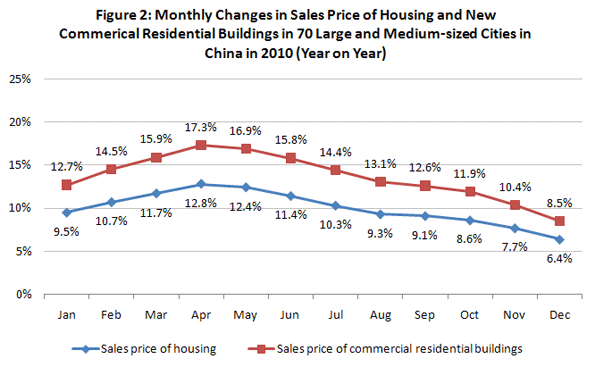
    This may now be getting out hand and the Chinese government has identified housing prices as a serious national issue. Some macro restrictive policies on home buying were issued in April 2010. Figures issued by the National Statistical Bureau, Figure 2, prove these restrictive policies did relieve somewhat the rate of house price increase.

    Immediately following the New Year, the Chinese central government announced that its top priority for 2011 would be controlling inflation. Shortly afterwards, a more stringent policy designed to limit speculation was issued on January 26th, 2011. Subsequently, each city issued its own policies based on this, with Shanghai and Chongqing, two Zhixiashi (provincial level municipalities administrated directly under the central government) taking the lead.

    Shanghai issued the following policies on February 1st, 2011.

    1. Any household purchasing a second home must provide a 60% down payment on a mortgage; and the interest rate on the mortgage will be 110% of the benchmark rate.
    2. From the publication date of this policy, households who already own one house will only be allowed to purchase one additional home.
    3. From the publication date of this policy, households who already own two or more houses will not be allowed to purchase any additional homes.
    4. Individuals selling a home less than five years since the date of purchase will be charged an additional sales tax of 5.5% of the full sales price.

    Many more cities followed in step, and announced their own sets of policies in the following weeks.

    Only one month after these policies came into effect, it is difficult to determine their effectiveness as house prices are still increasing compared with last year, although rate of change has dropped.

    The steady price has led to a renewal of interest in rented public housing. Chongqing became the first city to respond to the central government’s call with plans to build 40 million square meters  in public-rent housing units, which will provide accommodation to 1-2 million people within the next three years and to 800,000 families by 2015. In total, Chongqing will invest 120 billion RMB (18.3 billion USD) on public-rent housing construction.

    By 2012, Chongqing will also grant the urban hukou to 3 million farmers (10 million by 2020) with rural Hukou. In exchange, these farmers will give up their agricultural land, most of which will be developed into public-rent apartments.

    Who will be eligible to apply for public-rent housing?

    Chongqing’s criteria are as follows:

    1. Applicants must be over 18 years of age.
    2. Applicants must have a job which provides steady income.
    3. Monthly income must be under 2000 RMB (305 USD) for individuals and 3000 RMB (457 USD) for families. (These two numbers will fluctuate according to other economic index changes.)
    4. Families must not already have housing or have housing in which the average space per family member is lower than 13m2.

    One thing worth pointing out is that there is no hukou limit for public-rent housing applications, which means that citizens from other cities are equally qualified. All eligible applications will be placed into a lottery and public-rent apartment allocations will go to the lottery winners.

    These public-rent apartments range from 39m2 or 420 square feet (1 bedroom, 1 living room) to 53 m2 or 570 square feet (2 bedrooms, 1 living room) with the corresponding monthly rent around 390 to 530 RMB (59 to 81 USD). When you consider that the current average price of residential property per square meter in Chongqing is 5700 RMB (868 USD), that means a person could rent a 53 m2 apartment for 47.5 years before paying the equivalent cost of purchasing an apartment of the same size.

    Following suit, many other cities in China have also started to construct public-rent apartments.

    Are all the problems solved?

    Certainly this can help most lower-income citizens to find a place to live, but there are other problems. Tenants in China are not protected by laws that uphold renter’s rights as in the west. This is largely due to the fact that there are few apartment buildings owned by a single company or person. Citizens can only rent directly from home-owners with virtually no regulatory controls over the personal renting market.  Long-term leasing contracts are nearly impossible to negotiate, and landlords are able to demand large increases in rent, or even eviction at a whim. This means that renters have no stability, and usually have to face the difficulty of moving frequently.

    More buildings designed specifically for renting, and regulations protecting both tenants and home-owners are desperately needed.

    China has a long way to go when it comes to providing accommodation for its 1.3 billion citizens. Although one clear problem lies with the resources to construct the ”hardware”, this country’s development cannot continue without also upgrading its “software”: people’s way of thinking. In this case, that means convincing people to accept the idea of renting, reversing centuries of preference for ownership.

    Lisa Gu is a 26-year old Chinese national. She grew up in Yangzhou (Jiangsu) and lives and works in Nanjing (Jiangsu).

    Photo by Charles Ryan

  • Tucson: Missing A Million

    Census Bureau estimates in 2008 indicated that the Tucson metropolitan area had become the nation’s 52nd with more than 1,000,000 population. A Bureau of the Census estimate released earlier this week placed the population in 2010 at 1,027,000.

    However, the 2010 census count showed the Tucson metropolitan area to have only 980,000 residents, a 16.1 percent increase from the 844,000 population in 2010. The historical core municipality of Tucson gained 6.9 percent from 487,000 to 520,000. This is the slowest growth rate since the 1850-1860 census period. The city accounted for 24 percent of the metropolitan area growth.

    The suburbs grew at a rate of 29.1 percent and accounted for 76 percent of the population growth over the period.

    This is the second time in history and the second time in five years that the nation has “lost” a metropolitan area with more than 1,000,000 population. The first instance was New Orleans, which was ravaged by Hurricane Katrina and dropped below 1,000,000 in 2006 and then recovered to above that figure in 2007. At the current growth rate, it appears likely that Tucson will be restored to major metropolitan area status by 2012.

  • Milwaukee: Slow Growth, But Still Dispersing

    The new 2010 census figures for Milwaukee reveal one of the nation’s slowest growing metropolitan areas. From 2000 to 2010, Milwaukee grew 3.7 percent, from 1,501,000 to 1,556,000. Milwaukee’s growth rate places it in a third place tie with Los Angeles (Cleveland and Pittsburgh lost population).

    The historical core municipality of Milwaukee fell 0.4 percent, from 597,000 to 595,000. This is the lowest population count since the 1940 census and it is possible that the population living in the 1940 boundaries could be substantially lower. Since that time the land area of the city has more than doubled (from 43 square miles to 97 square miles), which is likely to have masked severe losses in the older urban core of the city (such losses have occurred in nearly all historical core municipalities in the nation).  The city reached its population peak in 1960, with 741,000 residents in the expanded boundaries.

    The suburbs gained 6.4 percent and attracted more than 100 percent of the population growth in the 2000s. The largest growth, at 12.1 percent, was in Washington County, which is further from the urban core than the other two suburban counties. Waukesha added 29,000 residents, growing 8.1 percent, from 361,000 to 390,000, while Ozuakee County grew from 82,000 to 87,000, for a growth rate of 5.6 percent. The core county of Milwaukee, which includes the city of Milwaukee, grew 0.8 percent, from 940,000 to 948,000.

  • Phoenix Population Counts Lower than Expected

    The 2009 Census Bureau estimates indicated that Phoenix had become the nation’s 12th largest metropolitan area, passing San Francisco and Riverside-San Bernardino since 2000. The census count for 2010 indicates that Phoenix remains the 14th largest metropolitan area and failed to pass either San Francisco or Riverside-San Bernardino during the decade.

    Nonetheless, Phoenix grew rapidly, adding 28.9 percent to its population. The metropolitan area had 4,193,000 residents in 2010, up from 3,252,000 in 2000.

    The historical core municipality of Phoenix also grew less than expected. The 2009 Census Bureau estimates placed the population at 1,570,000, having passed Philadelphia to become the nation’s fifth largest municipality. The city of Phoenix has a near universal suburban form, with a land area 520 square miles, four times that of Philadelphia. The 2010 census count was far smaller than expected, at 1,446,000, up from 1,332,000 in 2000, but still well below Philadelphia’s 1,526,000. The 124,000 gain was the smallest of any census period since 1940-1950, at the end of which the city had 107,000 residents. The population growth rate was 9.3 percent, the lowest percentage increase rate since the 1880-1890 census period. The city of Phoenix captured 13 percent of the metropolitan growth, down from 33 percent in the 1990-2000 census period.

    Suburban population growth was much stronger, at 42.4 percent. Suburban Pima County doubled in size and its exurban municipalities experienced strong growth. The city of Maricopa grew by 4,000 percent, from 1,000 to 43,000. Casa Grande nearly doubled in size. Suburbs within the core county of Maricopa also grew quickly. Buckeye, the last urbanization for 100 miles west on Interstate 10 grew from 7,000 to 51,000. Other urban fringe or near-urban fringe municipalities also grew quickly, such as Gilbert (109,000 to 209,000), Surprise (31,000 to 117,000) and Goodyear (19,000 to 65,000). The suburbs captured 87 percent of the metropolitan area growth, up from 67 percent in the 1990s.