Category: Demographics

  • The Protean Future Of American Cities

    The ongoing Census reveals the continuing evolution of America’s cities from small urban cores to dispersed, multi-polar regions that includes the city’s surrounding areas and suburbs. This is not exactly what most urban pundits, and journalists covering cities, would like to see, but the reality is there for anyone who reads the numbers.

    To date the Census shows that  growth in America’s large core cities has slowed, and in some cases even reversed. This has happened both in great urban centers such as Chicago and in the long-distressed inner cities of St. Louis, Baltimore, Wilmington, Del., and Birmingham, Ala.

    This would surely come as a surprise to many reporters infatuated with growth in downtown districts, notably in Chicago, Los Angeles, Denver and elsewhere. For them, good restaurants, bars and clubs trump everything. A recent Newsweek article, for example, recently acknowledged Chicago’s demographic and fiscal decline but then lavishly praised the city, and its inner city for becoming “finally hip.”

    Sure, being cool is nice, but the obsession with hipness often means missing a bigger story: the gradual diminution of the urban core as engines for job creation. For example, while Chicago’s Loop has doubled its population to 20,000, it has also experienced a large drop in private-sector employment, which now constitutes a considerably smaller share of regional employment than a decade ago. The same goes for the new urbanist mecca of Portland as well as the heavily hyped Los Angeles downtown area.

    None of this suggests, however, that the American urban core is in a state of permanent decline. The urban option will continue to appeal to small but growing segment of the population, and certain highly paid professionals, notably in finance, will continue to cluster there.

    But the bigger story — all but ignored by the mainstream media — is the continued evolution of urban regions toward a more dispersed, multi-centered form. Brookings’ Robert Lang has gone even further, using the term “edgeless cities” to describe what he calls an increasingly “elusive metropolis” with highly dispersed employment.

    Rather than a cause for alarm, this form of  development  simply reflects  the protean vitality of American urban forms.  Two regions, whose results were released last week, reveal these changing patterns. One is the Raleigh region, which has experienced a growth rate of 42%, likely the highest of the nation’s regions with a population over 1 million. This metropolitan area, anchored by universities and technology-oriented industries, is among the lowest-density regions in the country, with under 1,700 persons per square mile, slightly less than Charlotte, Nashville and Atlanta.

    Unlike the geographically constrained older urban areas, Raleigh’s historical core municipality experienced strong growth, from 288,000 to 404,000, a gain of 40%. This gain was aided by annexations that added nearly 30% to the area of the municipality (from 113 to 143 square miles). The annexations of recent decades have left the city of Raleigh with an overwhelmingly suburban urban form. In 1950, at the beginning of the post-World War II suburban boom, the city of Raleigh had a population of 66,000, living in a land area of only 11 square miles.

    Even here, however, the suburbs (the area outside the city of Raleigh) gained nearly two-thirds of the metropolitan area growth (65%) and now have 64% of the region’s population. Over the last ten years, the suburbs have grown 43%. It is here that much of the economic growth of the Research Triangle has taken place, as companies concentrate in predominately suburban communities such as Cary.

    Yet in most demographically healthy urban regions, the growth continues to be primarily in the suburban centers. One particularly relevant example is the Kansas City area, a dynamic region anchoring what we have identified as “the zone of sanity.” Like most American regions, the Kansas City area is growing, but in ways that often do not resemble the fantasies of urban density boosters.

    KC’s growth pattern is important and could be a harbinger of what’s to come in this decade. Along with Indianapolis, this resurgent Heartland region is expanding faster than the national average. It is also attracting many talented people, ranking in our top ten list of the country’s “brain magnets,” a performance better than such long-standing talent attractors as Seattle, Portland, San Francisco, and Boston. Between 2007 and 2009, the Kansas City region’s growth in college-educated residents was more than twice the rate of our putative intellectual meccas of New York, Chicago or Los Angeles.

    But despite the wishes of some  in Kansas City’s traditional establishment, this cannot be interpreted as meaning that  the “hip and cool” are being lured en masse to the city’s inner core. Over the past decade, as in most American regions, Kansas City has expanded far more outward than inward. Despite a modest increase in the city’s population of some 18,000 — much of it in the city’s furthest urban boundaries — the city’s population remains below its 1950 high. On the other hand, some 91% of its 200,000 population increase occurred in the suburban periphery.

    Critically, it is important to note that this expansion reflects not so much the growth of “bedroom” communities, but a dramatic shift of employment to the periphery. By far the most important center for this new suburban growth in jobs and people lies across the river in Johnson County, Kan.. Over the past decade, Johnson County has accounted for roughly half of the region’s total growth.

    Johnson County  – which boasts among the highest levels of educated people in the country — also has become the primary locale for many technology and business service firms, with more people commuting into the area than out. This reflects an increasingly suburbanized economic base. Over the past decade the urban core of Jackson County has lost 42,000 jobs, while the surrounding suburbs have grown by 20,000, with the biggest growth in largely exurban Platte County.

    So what does this tell us about the future of the American urban region?  Certainly the expansion of relatively low-density peripheral areas negates the notion of a  ”triumphant” urban core. Dispersion is continuing virtually everywhere, and with it, a movement of the economic center of gravity away from the city centers in most regions.

    But in another way these patterns augur a bright future for an expansive American metropolis that, while not hostile to the urban center, recognizes that most businesses and families continue to prefer lower-density, decentralized settings.  The sooner urbanists and planners can accommodate themselves to this fact, the sooner we can work on making these new dynamic patterns of residence and employment more sustainable and livable for the people and companies who will continue to gravitate there.

    This piece originally appeared at Forbes.com

    Joel Kotkin is executive editor of NewGeography.com and is a distinguished presidential fellow in urban futures at Chapman University, and an adjunct fellow of the Legatum Institute in London. He is author of The City: A Global History. His newest book is The Next Hundred Million: America in 2050, released in February, 2010.

    Kansas City skyline photo by Tim Samoff

  • What India Hands to the World

    Yoga. Mantras. Bollywood. Henna tattoos. Once unique to India, each of these has now become commonplace in households across the globe. As a first generation East Indian American, I’ve had an opportunity to contrast the world my parents experienced with the one I inhabit. When my parents first settled here in the 1980s Indian cultural influences were not this prominent, but the increases in America and around the globe have been dramatic.

    Any gym is bound to teach a yoga class. Popular exercise regimens such as Pilates have been influenced by ancient Indian spiritual exercises. During a recent study abroad trip to Goiania, a medium sized city in the Brazilian countryside, I was surprised to encounter yoga classes, and many of my Brazilian classmates wanted to learn Yoga from me.

    Bhangra, a North Indian folk dance, has been incorporated into gym workouts. Sarina Jain, the Indian American creator of The Masala Bhangra Workout, says she’s “the first to bring Indian dance to the U.S. fitness industry at a global level.” The DVD has been named one of the five hottest workouts by America Online.

    Meditation, similarly, has become widely popular. This ancient Vedantic technique to reach inner peace has been popularized by Indian gurus who have spread the practice throughout the West; one transcendental meditation organization claims to have taught more than 50,000 students across the United States, Latin America and Africa during the past two years alone. The bestselling book (and then film) “Eat, Pray, Love” has further popularized the use of meditation to tame the mind. Julia Roberts, who plays the protagonist in the film, even identifies herself as a Hindu who regularly meditates.

    Other Vedantic influences on daily life include reciting mantras, and the popularization of words such as “guru” and “pundit” to describe people with expertise. The idea that all of your actions, whether good or bad, produce consequences that shape your future is a common theme in many cultural value systems, but the term “karma” captures that concept in one word and has become used throughout the English-speaking world, as well as elsewhere.

    Billions of people around the world also value the concept of ahimsa — non-violence — as popularized by Mahatma Gandhi. His ideas strongly influenced Martin Luther King Jr. Ahmisa also explains why many Hindus and Jains are vegetarians The belief that what you eat affects your behavior, and that a vegetarian diet can help tame the mind, has been popularized worldwide by Indians, who are known for their exquisite vegetarian cuisine.

    Worldwide, flavorful Indian spices and seasonings have increased the appeal of vegetarian food. India produces over four million tons of spice, and exports around 180 spice products to over 150 nations. The Indian Spice Board is currently planning to set up three promotional centers in, respectively, Dubai, Chicago and Europe.

    Spices are also of special interest in the alternative health community, where they are viewed as anti-inflammatory agents, that can help the aging brain and play a role in cancer prevention. Turmeric and several other spices are part of the Indian Ayurvedic system. Ancient Indian epics like The Ramayana reference Ayurveda, a holistic approach to health that fuses the forces of mind, body, senses and spirit. Today, about thirty companies are leading the way, with a million dollars or more per year in business to meet the growing demand for Ayurvedic medicine. The larger Ayurvedic medicine suppliers have also moved into the businesses of toiletries —soap, toothpaste, shampoo — which use traditional herbal ingredients.. For example, L’Oreal has been reported to be looking into purchasing an Indian Ayurvedic skin care brand, and companies like Estée Lauder have created their own Ayurvedic spa treatments.

    But even more wide-spread is India’s music and dance scene. The sitar, first popularized in the US by Ravi Shankar, has been used by artists from the Beatles to Janet Jackson. The most powerful Indian cultural export, though, has long been its film industry, nicknamed Bollywood, which is generally believed to produce the largest number of feature films in the world. Bollywood makes more ticket sales than Hollywood does, though revenue figures are much higher for the latter Sometimes dubbed in local languages, these films, filled with colorful costumes, dances, music, and love stories are watched in Kuwait, Nigeria, Russia, Scandinavia, the Caribbean and even Fiji.

    Through television, Brazil has been particularly touched by India. Brazil’s 2009 Emmy Award-winning telenovela (soap opera), Passage to India, introduced Indian culture there on a broad scale. As an Indian traveling through Brazil, almost every person I met asked whether I watched the show. Even in Cavalcante, a remote area, a truck driver knew that the cow is considered sacred in India, and was newly aware of the Indian custom of arranged-marriage.

    Another result of the show’s popularity has been that Brazilians are now fascinated by Indian clothing. I noticed malls consistently had at least one Indian themed store selling kurti tops – Indian style blouses which are popularly worn over skinny jeans or tights. I also saw men wearing t-shirts with pictures of Indian Gods and Goddesses, and saw them printed on swim suit cover ups. Of course, you rarely see Indians wearing this kind of garment, since, many consider these displays on clothing to be somewhat offensive.

    There are many other aspects of Indian culture that have spread on a global scale. From curries to computer programs, self-realization to the arts, and well beyond, we are seeing its influence. The popular Indian art of using henna to create beautiful body designs and patterns only temporarily affects the surface of the skin. But the influence of India is likely to leave a permanent — and positive —impact on the world.

    Photo from Travelscope

    Sheela Bhongir is an undergraduate student at California State University, Northridge studying Urban Studies and GIS. She is working as an intern on Legatum’s new map of the world project.

  • Kansas City MO-KS: Moving Toward Kansas?

    Results just announced for the 2010 Census show that the Kansas City metropolitan area grew 10.8 percent from 2010, from 1,836,000 to 2,035,000 persons. As in all of the major metropolitan areas (over 1,000,000 population) for which data has been reported, the bulk of the growth was in the suburbs, rather than in the historical core municipality (Kansas City).

    The suburbs captured 91 percent of the metropolitan area growth, with a growth rate of 13.0 percent. Nearly one-half of the metropolitan area growth was in Johnson County, Kansas. The Kansas City metropolitan area is unusual among bi-state metropolitan areas, because the population is relatively evenly split between Missouri (location of the historical core municipality) and Kansas, with 58 percent in Missouri and 42 percent in Kansas.

    The historical core municipality of Kansas City gained 4.1 percent, from 442,000 to 460,000. Based upon the 2009 Census estimates, this population was approximately 24,000 lower than expected. The 2010 population remains below the 1970 peak of 507,000 and is only marginally above the 1950 figure (457,000). However, in 1950, the density of the city was substantially higher, contained in a land area of 81 square miles. Kansas City now covers nearly four times as much land area, at 314 square miles. A large portion of Kansas City is actually rural and thus outside the urban area (See 2000 urban area map). This open land provides the city of Kansas City with greenfield land for new suburban development. The suburban development within Kansas City, however, has been substantially less than in other suburban areas of the metropolitan area.

    Kansas City, Kansas, which was also developed around a pre-World War II core, had a population decline from 147,000 to 146,000.

    The continuing dispersion of the Kansas City metropolitan area is indicated by the employment trends from 2001 to 2010 (June). Employment was down 22,000 in the metropolitan area. However, employment was down 42,000 in Jackson County, which includes the urban core of the region (the non-suburban portion of Kansas City). All employment growth has been in the suburbs (20,000).

  • From the Great Moderation to the Great Stagnation

    For much of the past decade, I was a proponent of the thesis that that the American economy had entered a “great moderation,” where expansions lasted longer and recessions were fewer, shorter and milder. Productivity had seemingly reached a permanently high plateau; inflation seemed tamed. The spreading of financial risk, across institutions and around the world, seemed to have reduced the odds of a crisis.

    Events of the past 30 months have put that thesis to rest.  I gave my mea culpa in Growth Strategies #1039 (October 2009), and also explained why we would instead be experiencing slow growth, high unemployment, low productivity growth, and higher taxes for the foreseeable future. That future has come to pass, and will continue to play out for years to come.

    Where does the economy go from here? Profits are up, the markets are up. Inflation and interest rates are still tame. How to reconcile rising profits, a robust stock market, and other positive indicators with unprecedented bankruptcies, foreclosures, underwater mortgages, business failures, unemployment and underemployment? The “working” economy has decided to move ahead and do fine and just leave millions behind. The future would be bright for many, okay for some and dark for many, and recommend being in the first group. 

    What about the overhang of debt and toxic assets? We seem to have opted for a long and slow process of rationalization, rather than a short, sharp and fast one. That means years of mixed messages and mixed trends: the good, bad and ugly.

    The Shattered American Dream

    A national survey of workers who lost their jobs during the Great Recession, conducted by two professors at Rutgers University, paints a gloomy view of the economic prospects for ordinary Americans.

    More than 15 million Americans are officially classified as jobless. The professors at the John J. Heldrich Center for Workforce Development at Rutgers have been following their representative sample of workers since the summer of 2009. The report on their latest survey, just out this month, is titled: “The Shattered American Dream: Unemployed Workers Lose Ground, Hope, and Faith in Their Futures.”

    Over the 15 months that the surveys have been conducted, just one-quarter of the workers have found full-time jobs, nearly all of them for less pay and with fewer or no benefits. As the report states: “The recession has been a cataclysm that will have an enduring effect. It is hard to overstate the dire shape of the unemployed.”

    Nearly two-thirds of the unemployed workers who were surveyed have been out of work for a year or more. More than a third have been jobless for two years. With their savings exhausted, many have borrowed money from relatives or friends, sold possessions to make ends meet and decided against medical examinations or treatments they previously would have considered essential.

    Older workers who are jobless are caught in a particularly precarious state of affairs. As the report put it:

    We are witnessing the birth of a new class — the involuntarily retired. Many of those over age 50 believe they will not work again at a full-time “real” job commensurate with their education and training. More than one-quarter say they expect to retire earlier than they want, which has long-term consequences for themselves and society. Many will file for Social Security as soon as they are eligible, despite the fact that they would receive greater benefits if they were able to delay retiring for a few years.

    There is a fundamental disconnect between economic indicators pointing in a positive direction and the experience of millions of American families fighting desperately to fend off destitution. Some three out of every four Americans have been personally touched by the recession — either they’ve lost a job or a relative or close friend has. And the outlook, despite the spin being put on the latest data, is not promising.

    No one is forecasting a substantial reduction in unemployment rates next year.
    Carl Van Horn, the director of the Heldrich Center and one of the two professors (the other is Cliff Zukin) conducting the survey, said he was struck by how pessimistic some of the respondents have become — not just about their own situation but about the nation’s future. The survey found that workers in general are increasingly accepting the notion that the effects of the recession will be permanent, that they are the result of fundamental changes in the national economy.

    Fundamental Changes

    Fundamental changes in the American workforce are taking place, and they hold tremendous implications for employers and employees alike. According to an Annual Workforce Trends Study commissioned by Yoh, a human resources firm, 80% of employers expect the size of their non-employee workforce (defined as consultants, independent contractors, temporary employees, and project teams) to stay the same or increase within the next year, even as the economy regains its footing.

    This new, temporary workforce presents issues for employers who will need to manage, compensate, and motivate workers who no longer view themselves as employees committed to a single employer. At the same time, for employees, this new workforce ushers in a new era of free agency, and holds vast implications for how they will build careers in a flexible work environment, where knowledge and skill trump seniority and security.

    Employers’ protracted reliance on a non-employee workforce as the US emerges from a severe recession represents a marked change from past economic recoveries when employers would add temporary talent before transitioning to full-time employees. Historically, temporary employment has served as a bellwether for permanent hiring, but these findings suggest that something much more substantial is occurring to overall workforce composition. Employers are saying that the recent recession has fundamentally changed their employment strategies and led to a “just-in-time” hiring strategy that will make temporary employees an even greater pillar of the American economy.

    The transformation of the workforce composition will have significant implications for both employers and employees. Employers now have the flexibility to quickly adjust the size of their workforce depending on project load.

    Employees, meanwhile, will have to overcome the stigma associated with “temporary talent.” Now that it’s here to stay, “temporary” workers might find themselves engaged in projects for longer periods of time, frequently transitioning into new opportunities and gaining access to jobs that were perhaps previously filled with full-time employees.

    The Great Stagnation

    Tyler Cowen of George Mason University is author of the e-book The Great Stagnation: How America Ate All The Low-Hanging Fruit of Modern History, Got Sick, and Will (Eventually) Feel Better. Cowen argues that in the last four decades, the growth in prosperity for the average family has slowed dramatically in the United States relative to earlier decades and time periods. Cowen argues that this is the result of a natural slowing in innovation, and does not expect a return to prosperity until new areas of research dramatically improve productivity growth.
    Part of Cowen’s core point is that up until sometime around 1974, the American economy was able to experience rapid growth by harvesting low-hanging fruit. There was cheap land to be exploited. There was the tremendous increase in education levels during the postwar world. There were technological revolutions occasioned by the spread of electricity, plastics and the car.

    But that low-hanging fruit is exhausted, Cowen continues, and since 1974, the United States has experienced slower growth, slower increases in median income, slower job creation, slower productivity gains, slower life-expectancy improvements and slower rates of technological change. Cowen argues that our society, for the moment, has hit a technological plateau.

    Is Cowen right? In my view he overlooks the growth of government over the last 40 years as an economic drag. Creative individuals and companies would be a lot more innovative if taxes were lower, regulations fewer, and the system of patents more reasonable.

    If stagnation is to be the new normal, we just can’t afford it. We are a nation, an economy, a society, based on growth. America needs to grow   We must therefore constantly replace, replenish, invent, create, innovate.

    For a long time I have been worried that the US was going the way of Europe: slow growth, high taxes, overregulation, high unemployment and underemployment, debt, deficits and little prospect of change. But perhaps we may have to worry instead is going the way of South America: an oligarchy of prosperous elites, and a great mass of the undereducated, under-skilled and underemployed, with little prospect of hope, change or opportunity.

    If you think I overstate the case, consider the disconnect between the people and governing classes. Only a minority of Americans express confidence in major institutions, according to Gallup. Only a minority of Americans believe that the federal government has the consent of the governed (Rasmussen).  In my view this disconnect may be an even bigger issue than stagnation.

    Dr. Roger Selbert is a trend analyst, researcher, writer and speaker. Growth Strategies is his newsletter on economic, social and demographic trends. Roger is economic analyst, North American representative and Principal for the US Consumer Demand Index, a monthly survey of American households’ buying intentions.

    Photo by Martin Deutsch

  • Virginia Metropolitan Areas Dispersing

    Population data from the 2010 Census has been made available for Richmond and Virginia Beach- Norfolk. In both cases, the bulk of the population growth is in the suburbs.

    Virginia Beach-Norfolk: The Virginia Beach-Norfolk metropolitan area grew from 1,576,000 in 2000 to 1,672,000 in 2010, a gain of 6.0 percent, which is a decline from 8.8 percent in the 1990s. The municipal core municipality of Norfolk gained from 234,000 to 243,000, an increase of 3.6 percent.

    Suburban growth was 6.5 percent and the suburbs accounted for 91 percent of the population growth. The suburbs include Virginia Beach, which is largely a post-World War II suburban municipality. The metropolitan area is principally named for Virginia Beach because it is the largest municipality.

    Richmond: The Richmond metropolitan area grew from 1,097,000 in 2000 to 1,258,000 in 2010, a gain of 14.7 percent. The historical core municipality of Richmond grew from 198,000 to 204,000, for an increase of 3.2 percent. Richmond remains below its population peak of 249,000, reached in 1970. In both the 2010 and 1970 censuses, Richmond’s land area was 60 square miles. In 1950, the population (237,000) was higher than in 2010, despite a land area of only 37 square miles.

    The suburbs added 17.2 percent to their population and accounted for 96 percent of the metropolitan area growth.

  • Is Nashville the Next Boomtown of the New South?

    I traveled to Nashville for the first time in 2007, spending most of my time in the downtown area. I posted my impressions here, noting the high growth and high ambition level as well as the fantastic freeways, but also the generally unimpressive development and built environment.

    I did another fly-by in April 2008. I made a conscious effort to try to get out and see different areas this time around. My tour guide was an Indy native who had spent the last decade or so in the northeast. He’d moved to the city about a year previously, so was seeing some of this for the first time himself. But it worked well, I thought.

    I believe Nashville is an extremely important case study for metros in the Midwest to examine. Here is a city that was a sleepy state capital for many years while other southern towns such as Atlanta and Charlotte took off. Then it began heading on an upwards trajectory. It is not yet at such a high growth rate that it appears to be a completely different sort of place than the Midwest. Its population growth is only 1.9% per year, for example, not much higher than Midwest growth champion Indianapolis at 1.5%. But all the trend lines are accelerating. Corporate headquarters are flocking, in city development is booming, transplants from the north are arriving. It would not surprise me to see this city pop into a higher gear when the economy turns upwards again.

    Nashville is a great case study because we can observe the inflection point in growth more or less as it happens. And also try to make sense of what is driving it. And to understand why Midwestern cities aren’t seeing it. I look at Nashville and ask myself: what does this place have on the Midwest? Compare it to Columbus, Cincinnati, Indianapolis, Louisville, Kansas City, and Milwaukee and see if anything jumps out that would explain it. Some unique factor of Nashville. Consider:

    • Nashville is smaller than most of those places today, so it isn’t size
    • It can’t be just because Nashville is in the south or a no income tax right to work state. Memphis in the exact same state and is hurting. Birmingham and Montgomery haven’t done much in right to work Alabama.
    • Its college degree attainment of 31% is below many comparable Midwest cities, though it should be noted that Nashville is moving up the league tables fast. It was recently ranked the 4th biggest “brain magnet” in the United States.
    • It has no particular unique industry or assets. It can cite its Music City USA image, which certainly drives tourism and money. But Midwestern cities have other equivalent things they can counter with. Plus, it was Music City USA all the time it was a sleepy state capital as well.
    • Just being the state capital doesn’t explain it. Indy and Columbus are both in that role and are getting out paced by Nashville.
    • Having a consolidated city-county government is not unique. Indy and Louisville are both consolidated, and Columbus is quasi-consolidated because of the ability of that city to annex most of Franklin County and even parts of several adjacent counties.
    • There are mountains, but the geography does not appear to be particularly compelling.
    • There are not fabulous historic districts in every region. In fact, while there are some nicer neighborhoods, much of the city is built out exactly like most Midwestern burgs of equivalent size. A lot of it is outright dumpy.
    • Its cultural institutions are not as advanced as Midwestern ones. The Nashville Symphony isn’t going to take on the Cincinnati Symphony any time soon, that’s for sure.
    • It doesn’t have some fortress home grown companies that are driving it.
    • It has Vanderbilt University, but most Midwestern cities have a good school in them too.

    I compare Nashville to the top performing Midwest metros and just scratch my head. Nashville’s arguably got nothing on the Midwest and in many ways is playing from an inferior position. So what is going on?

    I’ll take a shot at explaining a few things I’ve noticed. I’m not saying these are necessarily the answers. But they are things to consider. If I were head of strategy for a Midwestern metro, I’d be conducting an extensive peer city comparison of Nashville to try to figure it out in more detail. But here are some thoughts:

    • First, as I previously noted, is the extremely high ambition level. These guys are clearly looking at places like Atlanta, Dallas, Charlotte, etc. and saying “Why not us?” Their mission is to become one of America’s great cities. There’s no “era of limits” in Nashville. You see this come through, for example, in their convention center plans, which call for 1.2 million square feet. It comes through in their highways, which are being built 8-10 lanes with HOV lanes, as if getting ready to become the much bigger city they plan to be. It shows in the numerous residential high rise and midrise projects. It shows in how Nashville, unlike every comparable Midwest metro, already has a commuter rail line in service. Midwesterners recoil from change, and would view becoming the next Charlotte or Atlanta with horror. But Nashville is eager to move up to the premier league, so to speak.
    • Second is the unabashedly pro-growth and pro-business stance. Every development in the Midwest is opposed by some group of NIMBY’s. Densification, even in downtown areas, is often anathema to influential neighbors. Not in Nashville. Huge tracts of inner city are being rebuilt from vacant lots or single family homes into multi-story town houses or condos. There are midrises all over the place. It does not appear that development has any problem getting approved there.
    • Third is low taxes and costs. Tennessee does not have a state income tax. Electricity from the TVA is dirt cheap. Property taxes cannot be increased without a public vote. It remains to be seen if this environment can be sustained, but for right now, cost appears to be an advantage.
    • Fourth is that they’ve embraced instead of rejecting their heritage. Rather than saying that country music is for hillbillies and an embarrassment to their new ambitions as a big league city, they’ve proudly embraced it. They updated the image with a glitzy, “Nashvegas” spin and made it the core of what Nashville is all about. Most Midwestern elites seem to view their existing heritage negatively. But great cities have to spring from the native soil in which they are born. Their character has to be organic. Import all the fancy stores, restaurants, sports teams, transit lines, etc. you want, but it won’t distinguish your city. Nashville learned this lesson well, probably from Atlanta. The southern boomtowns took their existing Southern heritage, dropped the negative items that needed to be changed, updated the core positive elements, and created the vision of the “New South”. This is something that can be embraced by the masses, unlike the elitist transformations that are often promulgated.
    • Fifth is that, again, they appear to have studied the lessons of places like Dallas, Atlanta, Charlotte, etc. They’ve seen the need for freeways. They’ve looked at the style of development and the neo-traditional urban form. I was very impressed to see that there while most condo developments and such were fairly undistinctive, I did not note any that exhibited poor urban design form. When I consider the poorly designed projects that are frequently implemented in, say, downtown Indianapolis, it is easy to see who gets out more. Nashville has done its homework.
    • Sixth, Nashville is realistic and open to self-criticism without being self-flagellating. I posted my previous take on the city on a discussion forum dedicated to that city. Given the modestly negative tone contained in much of it, I expected to get crucified. Surprisingly, most of them basically agreed with it. Too many cities in the Midwest either engage in naive boosterism or wallow in woe-is-us. Perhaps because of the large number of newcomers, there’s a more realistic assessment of where Nashville stands. And this enables rational decisions about where it needs to go.

    If anyone else has observations to share, I would love to hear them.

    Here are some photographs I took while there. First, a view of the Tennessee capitol building across a green space I believe is called the Bicentennial Mall.


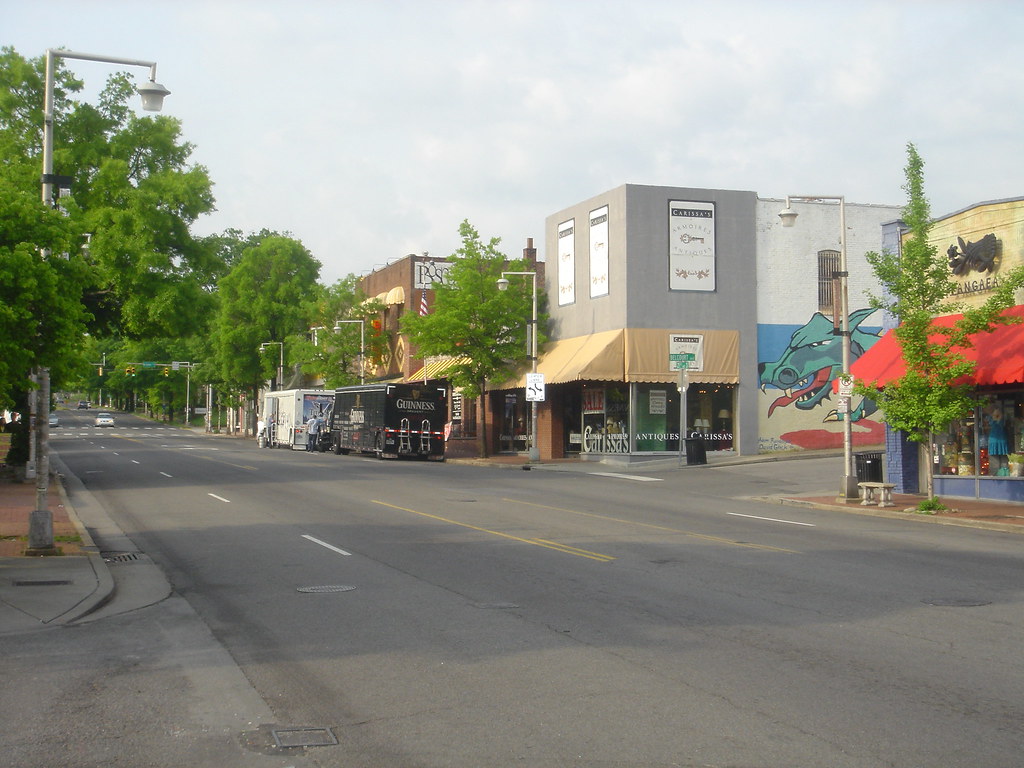
    A street scape in Hillsboro Village, a small commercial district near Vanderbilt University.


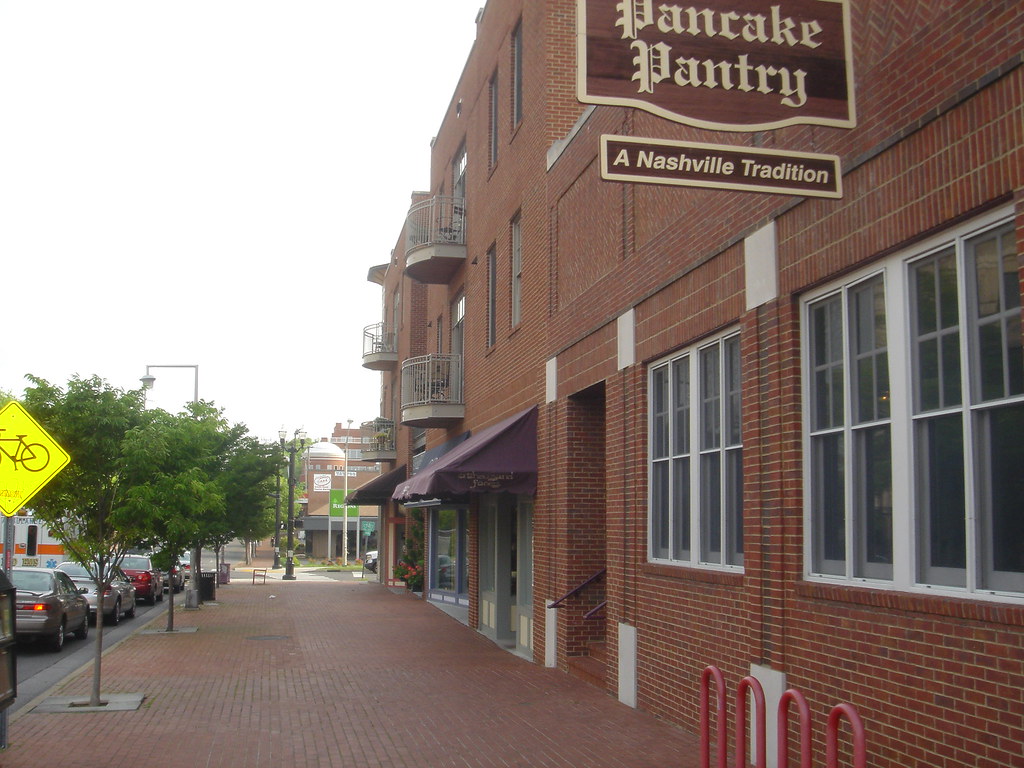
    The Pancake Pantry in Hillsboro Village, a breakfast place of high local repute. I was initially skeptical but the food was actually pretty darn good. This place is huge and there was still a line out the door at 10am on a Friday morning. Pretty crazy.


    The storefronts are a nice urban touch, but if you look behind this building you see a gigantic parking lot. This is perhaps an example of faux-urbanism. Putting the parking lot in the back doesn’t make it any less a strip mall. It is a difference in form, not function.


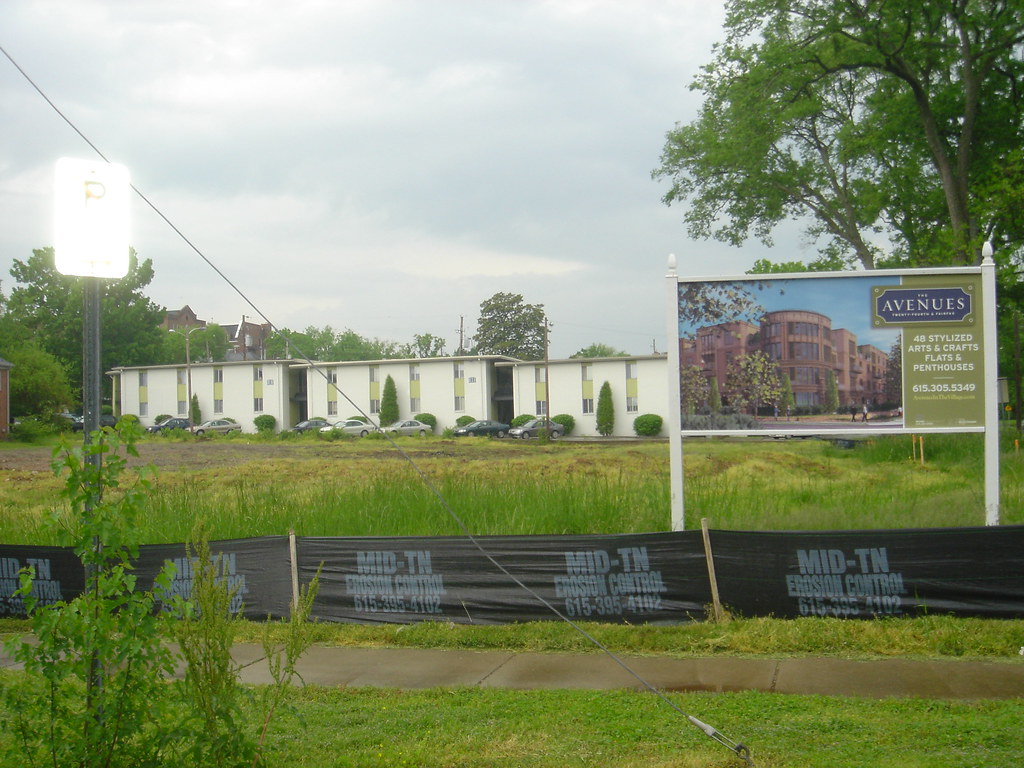
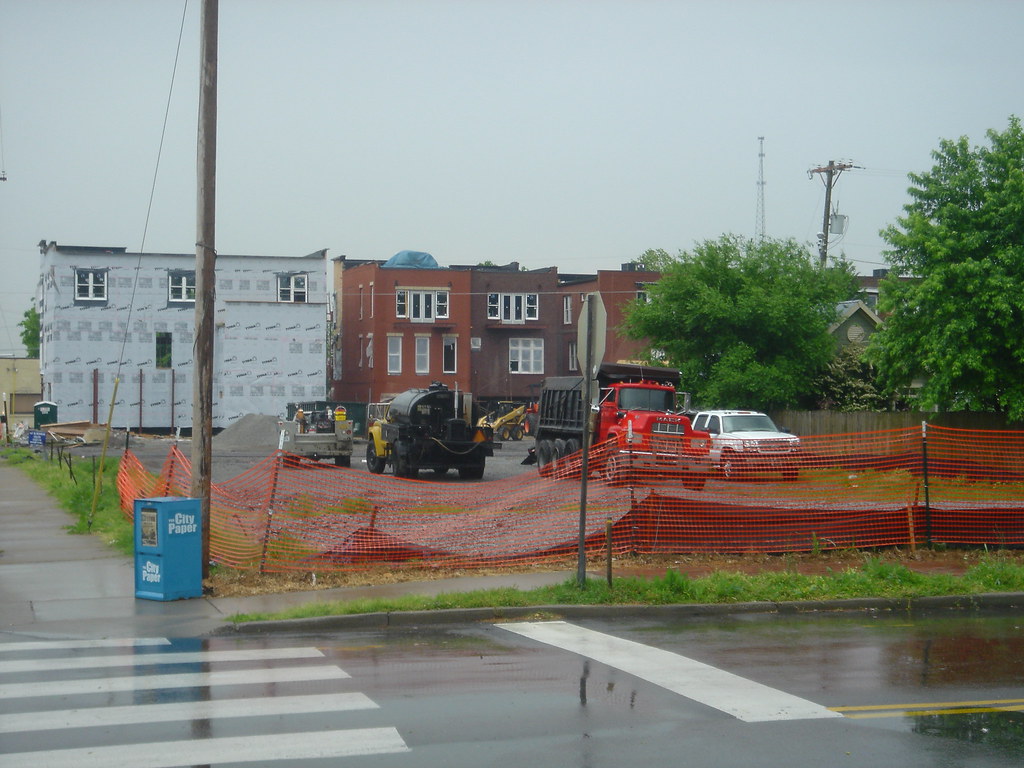
    One of the many vacant lots with a “condos coming soon” sign.


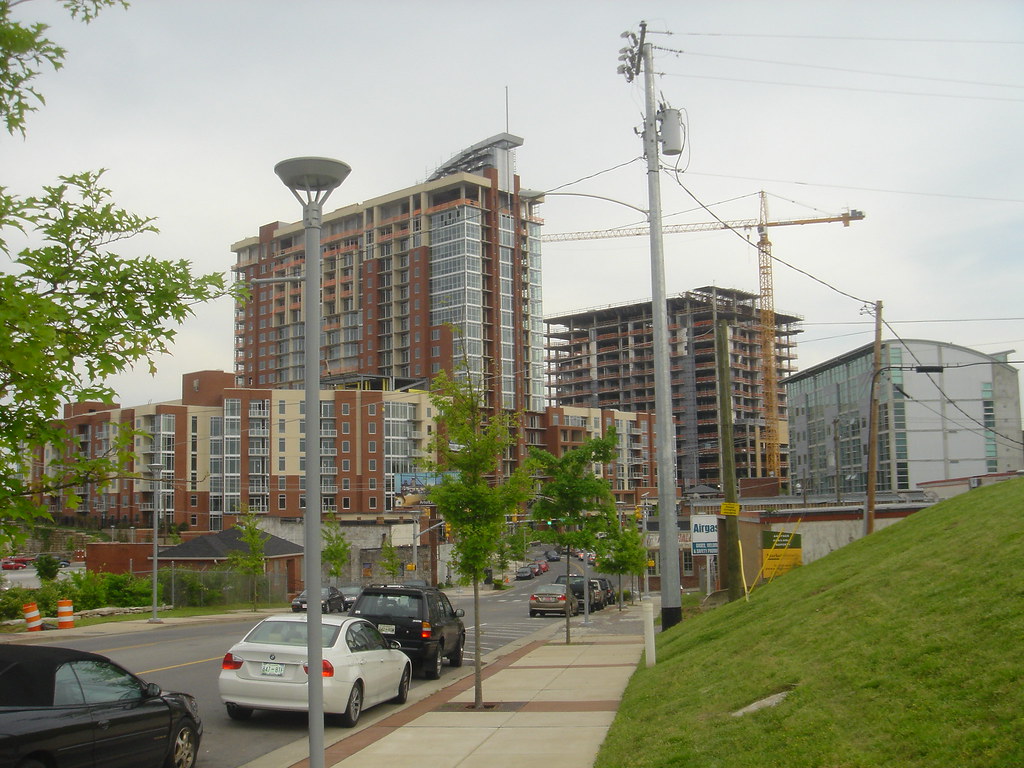
    The main road heading west of out downtown, West End Avenue, is developed at very high densities. I haven’t seen much in the way of this in most Midwestern cities. Midrises line both sides of the road basically from downtown to the interstate loop. It’s a six lane mega-street that moves tons of cars, but appears to have great bus service as well.


    Here is another one under construction.


    A proposed, but I believe not yet funded, high rise development. Indianapolis readers will no doubt recognize one of the towers as a clone of the proposed Intercontinental hotel for Pan Am Plaza that lost out as the convention center anchor hotel.


    If you continue out to the west from here, you run into neighborhoods like Green Hills, which is where the most premier shopping in the area is found, and the suburb of Belle Meade, which serves as Nashville’s mansion district. Unlike traditional Midwestern mansion districts, this one is more rural in nature, with large estates that wouldn’t be out of place in a plantation. I did not take pictures of these areas, however.

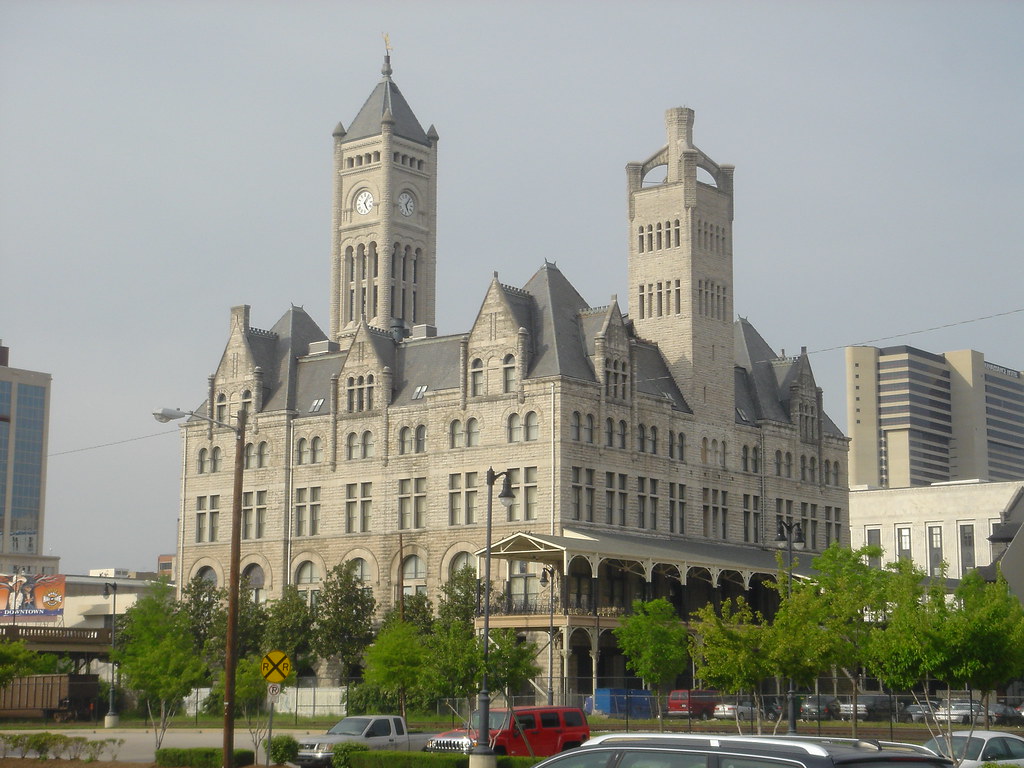
    Back closer to downtown is a nearby area known as the “Gulch”. It is not too far from Nashville’s Union Station.


    This appears to be some seedy industrial district that is being transformed all at once by a series of large developments. It also has several clubs and restaurants. I ate at a seafood place called Watermark that was surprisingly good. I believe most of the places are upscale chains, though I’m not sure if Watermark is or not. Here’s a picture of some of the development.


    More development


    North of downtown is a small historic district called Germantown. This was rather unimpressive if you ask me. I didn’t see much that was German about it. It sure isn’t Columbus’ German Village, that’s for sure. There were some restaurants there. I had lunch at one of them which, fortunately for them, I can’t remember the name of because it was terrible. This area is mostly older single family homes.


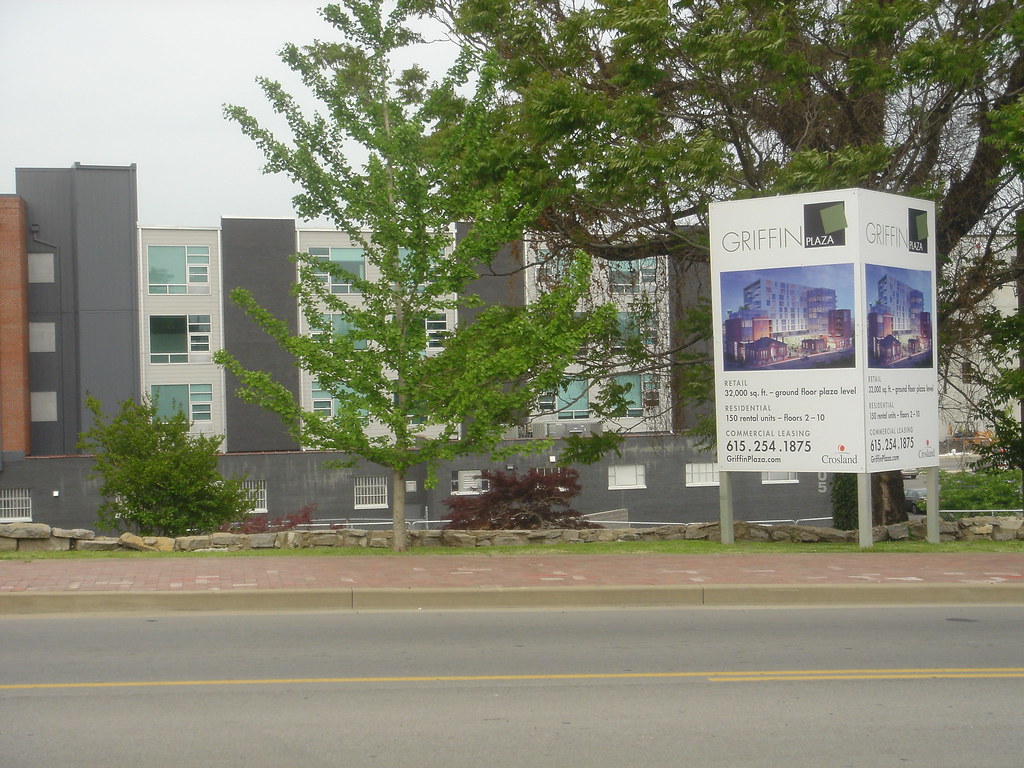
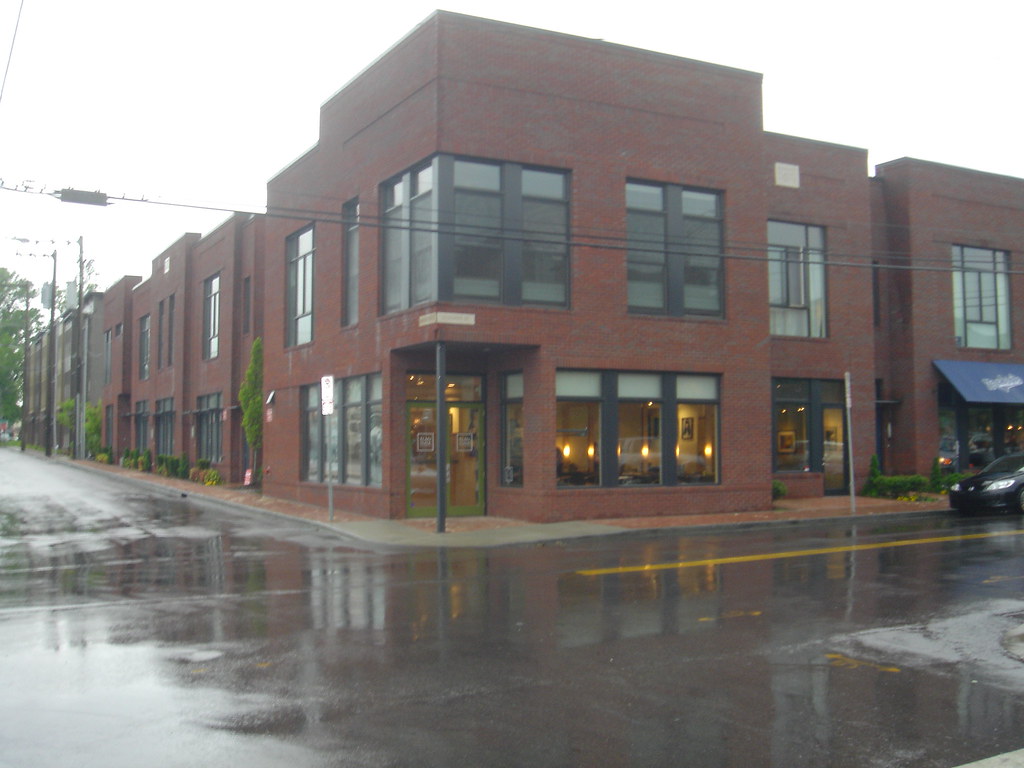
    The amazing thing about this area is that almost every vacant or industrial parcel was being redeveloped as condos. This really brought home to me the difference between Nashville and the Midwest. Were this, say, the Cottage Home area in Indianapolis, the local neighborhood association would use their historic district status to keep developments like these out. In Nashville, they are seen as a positive. Here are some examples.


    More condos


    More condos with retail space. Sorry for the very blurry pic but it was raining as you can see.


    More condos being built, and still more proposed.


    You get the picture. Also, note from all these photos the lack of design disasters. These are all workmanlike structures. The challenge for Nashville is that while there is a ton of new development, all of it is in a relatively generic, undistinguished style that could be in the downtown of almost any city. I did not get a strong sense of any type of vernacular style emerging. That is something I’d be looking for if I were them.

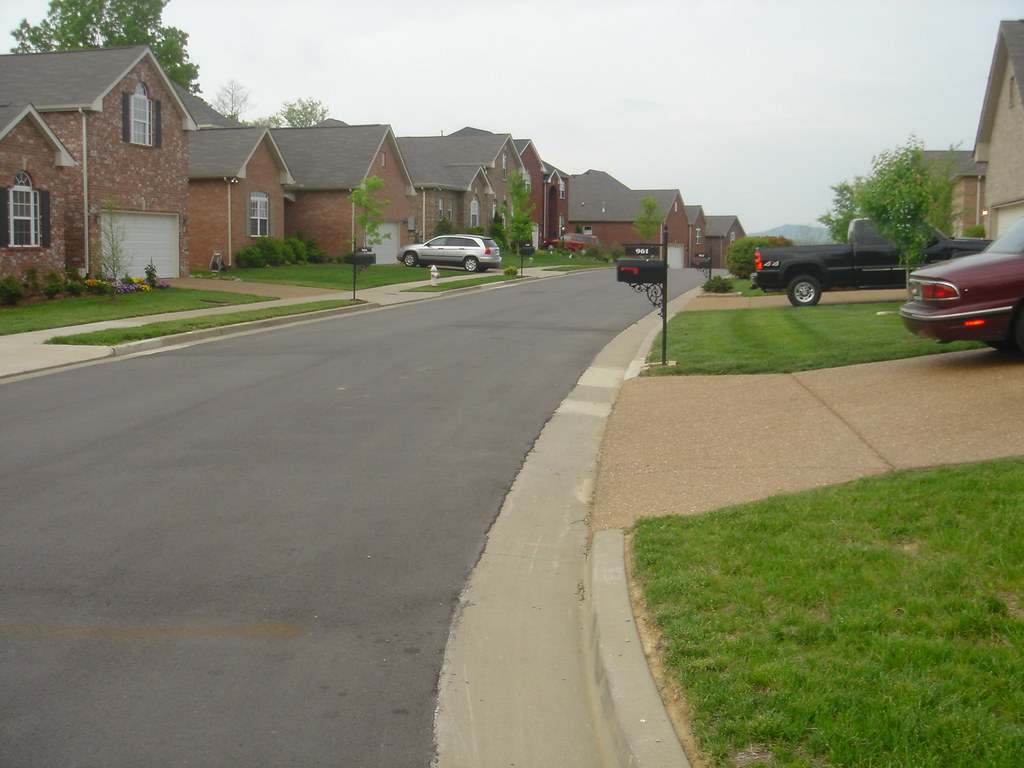
    Lastly, here’s one suburban example that shows something I pointed out last time. Namely that even in brand new, upscale subdivisions they aren’t putting in sidewalks on both sides of the street. I find this very odd. While I noticed some bike lanes this time around, Nashville’s definitely got a long ways to go when it comes to pedestrian and bicycle friendliness.


    Nashville is definitely a city that is on an upward trajectory. The volume of urban development and the business attraction success are impressive. It is exceeding even the best performing Midwest metros in that regard. However, it still lags the top southern and western metros. The current rate is very healthy, but probably isn’t sufficient to realize the civic ambitions. It remains to be seen whether Nashville can put it in another gear and take its place among the boomtowns, or whether it will merely stay on its current growth path. Either path is possible or a valid civic choice. While always possible, the likelihood that Nashville is going to take a major downtown does not appear high in the short term.


    Aaron M. Renn is an independent writer on urban affairs based in the Midwest. His writings appear at The Urbanophile, where this piece originally appeared.

  • Dispersion in Delaware

    The 2010 census data, just released, shows a strong trend toward dispersal in Delaware. The state’s largest county, New Castle, added eight percent to its population, rising from 500,000 to 538,000. All of that gain in the county was outside the city of Wilmington, which lost three percent of its population (from 73,000 to 71,000). Wilmington and New Castle County is a former metropolitan area that has been engulfed by the growth of the larger Philadelphia metropolitan area. Philadelphia has spread from its Pennsylvania base, with a large share of the metropolitan area now in New Jersey, along with New Castle County in Delaware and Cecil County in Maryland.

    Delaware’s other two counties, both to the south of New Castle County, are growing rapidly as the population moves outside metropolitan areas. Kent County, with the state capital in Dover, gained 28 percent from 127,000 to 162,000. Southern most Sussex County added 26 percent to its population, rising from 157,000 to 197,000. Thus, much smaller Sussex County added more people than New Castle County, which began the decade of the 2000s with three times the population.

  • Raleigh: Suburbanizing the City and Suburbs

    New 2010 Census results indicate that the Raleigh metropolitan area (Raleigh-Cary) grew 42 percent from 2000 to 2010. This growth rate is projected to be the highest of any metropolitan area in the nation for the 2000 to 2010 period.

    The historical core municipality of Raleigh grew strongly, from 288,000 to 404,000, a gain of 40 percent. This gain was aided by annexations that added nearly 30 percent to the area of the municipality (from 113 to 143 square miles). The annexations of recent decades have left the city of Raleigh with an overwhelmingly suburban urban form. In 1950, at the beginning of the post-World War II suburban boom, the city of Raleigh had a population of 66,000, living in a land area of only 11 square miles.

    The suburbs (area outside the city of Raleigh) gained nearly two-thirds of the metropolitan area growth (65 percent) and now have 64 percent of the population. Over the last ten years, the suburbs have grown 43 percent.

    The core urban area of Raleigh was one of the least densely populated in a major metropolitan areas in 2000, with under 1,700 persons per square mile, at slightly less than Charlotte, Nashville and Atlanta.

  • The Evolving Urban Form: The Valley of Mexico

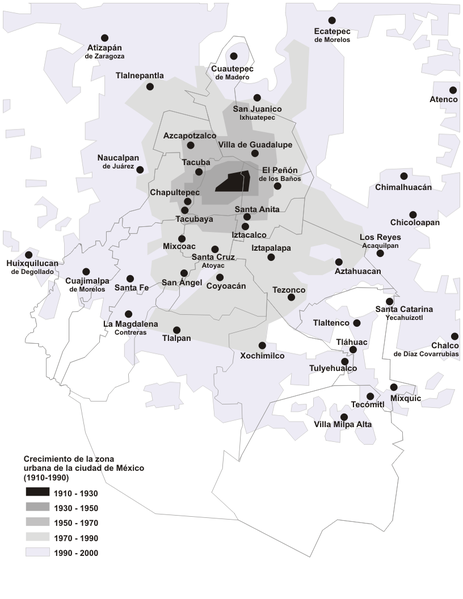
    The last 60 years of urban growth in the Mexico City area should dispel any belief that suburban dispersion is principally an American phenomenon or even limited to the high income world. Over the last 60 years, all of the population growth in what is now called the Valley of Mexico metropolitan area and urban area has occurred outside the urban core (See Map). In this regard, the declining population in Mexico City urban core mirrors that of other urban cores, such as the city of Chicago, the city of Copenhagen, the city of Paris and nearly all other urban cores in the high income world.


    Map: Valley of Mexico Urban Area: Northernmost Urbanization Excluded

    A New Name: the Mexico City metropolitan area is one of only two out of the world’s more than 25 megacities (10 million or more population) that has adopted a name more reflective of geographical reality, shedding reference to the urban core, which is declining in influence virtually everywhere. The other name-changing metropolitan area is Jakarta where the name Jabotabek is an acronym composed of the beginning of four large municipality names.  Mexico’s national statistics bureau, the Instituto Nacional de Estadística y Geografía (INEGI) has designated the Mexico City metropolitan area as the "Zona Metropolitana del Valle de México," which translates to the Valley of Mexico metropolitan area.

    According to the broadest definition, the Valley of Mexico metropolitan area had a population of 21.4 million according to the 2010 census. The Valley of Mexico joins a lengthening list of metropolitan areas with more than 20 million people. No reliable world ranking of metropolitan areas is feasible, because of varying definitions by nations and other population estimating sources (Note: Metropolitan Ranking). It can be said with assurance that the world’s largest metropolitan area is Tokyo – Yokohama, with approximately 40 million people and perhaps even that Jabotabek ranks second at nearly 30 million people. Other metropolitan areas making legitimate claims to having more than 20 million people include Seoul, Sao Paulo, Mumbai, Delhi, Manila and New York (Note: New York).

    The Valley of Mexico Urban Area

    In the early 1980s, the Valley of Mexico was expected to become the world’s largest urban area. A number of factors worked to keep that from happening, such as a falling birthrate and the devastating earthquake of 1985, which slowed growth and the simple problems created by the unmanageable scale of the region. This led to greater decentralization both to peripheral parts of the Valley of Mexico as well to other Mexican states.   

    In 2010, the Valley of Mexico urban area had a population of 19.4 million people. The urban area is estimated to cover 780 square miles (2,020 square kilometers), for a population density of 25,000 per square mile (9,700 per square kilometer). This makes the Valley of Mexico urban area approximately one-fourth the density of Dhaka (Bangladesh), the densest urban area in the world and similar in density to the Cairo urban area. The Valley of Mexico is less than three times as dense as the Paris urban area and less than four times the density of North America’s most dense urban areas, Los Angeles and Toronto. The next edition of Demographia World Urban Areas: Population & Projections (current edition) will show the Valley of Mexico to be the world’s ninth largest urban area.  

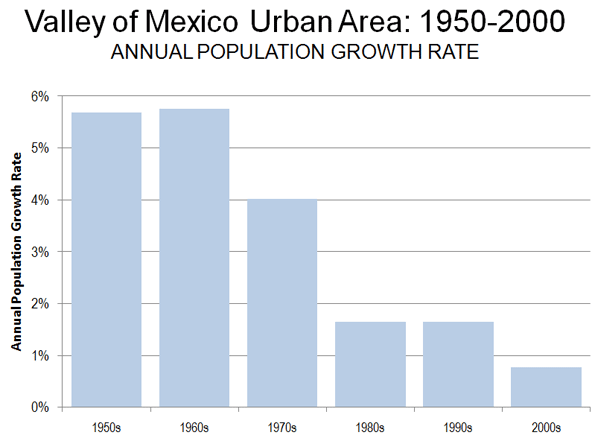
    The key issue here is a population growth rate that has plummeted since 1950. In the 1950s and the 1960s, the Valley’s population growth exceeded 5.5% annually. The rate fell to 4.0% during the 1970s, and dropped to 1.6% in the 1980s and 1990s. By the 2000s, the annual population growth rate had fallen to 0.8% (Figure 1).

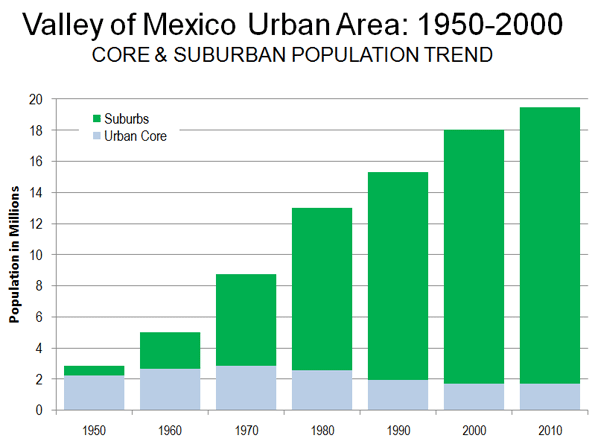
    Urban Core: Former Mexico City:  In 1950, the core “delegations” constituted Mexico City – Cuahtemoc, Miguel Higalgo, Venustiano Carranza and Benito Juarez had 2.23 million people out of the urban area’s 2.88 million. Mexico City covered a land area of 54 square miles (139 square kilometers). In 1970 the population rose to a peak of 2.85 million with a peak population density of 53,000 persons per square mile (20,500 per square kilometer). At this point a severe population decline began, with a drop of more than 1.1 million people to 1.68 million by 2005. This represented a 41 percent drop in population density, two 31,000 persons per square mile (12,000 persons per square kilometer). A modest increase to 1.73 million people occurred between 2005 and 2000 in the urban core.

    In 1950, the urban core accounted for 78 percent of the urban area population. By 2010 this figure had fallen to under nine percent (Figure 2).


    The Suburbs: As of the 2010 census, more than 90 percent of the urban area population lives in what has historically been the suburbs.  Since 1950, the urban core has lost 500,000 residents; while suburban areas have added more than 17 million. Thus, the suburbs have accounted for more than 100 percent of the growth in the urban area over the past 60 years (Figure 1). During the 1950s, the suburbs accounted for more than 80 percent of the growth and in each decade since that time the suburbs have been 95 percent or more of the growth.

    In the earlier decades, the suburbs inside the Distrito Federal (but still outside the urban core) accounted for most of the growth, 93 percent during the 1950s and 53 percent during the 1960s. However from the 1970s to the present the growth has shifted to the more distant suburbs outside the Distrito Federal. These suburbs have captured at least 70 percent of the growth, including between 80 percent to 90 percent over the past two decades.

    Valley of Mexico Metropolitan Area

    The trend of continuing dispersion is evident in the metropolitan area trends. As defined in 2005, the Valley of Mexico metropolitan area included the 16 "delegations" (boroughs) of Mexico City (the Distrito Federal), and 60 municipalities (municipios), 59 of which are in the adjacent state of Mexico and the last of which is in the more northerly state of Hidalgo. In the late 2000s, another 28 municipalities in the state of Hidalgo were proposed for addition to the metropolitan area (and are included in this analysis).

    The metropolitan area is divided into five parts, the urban core (pre-1994 Mexico City), the urban balance of the Distrito Federal, inner ring municipalities, which are adjacent to the Distrito Federal, the outer municipalities before the proposed expansion and the 28 municipalities in the state of Hidalgo.

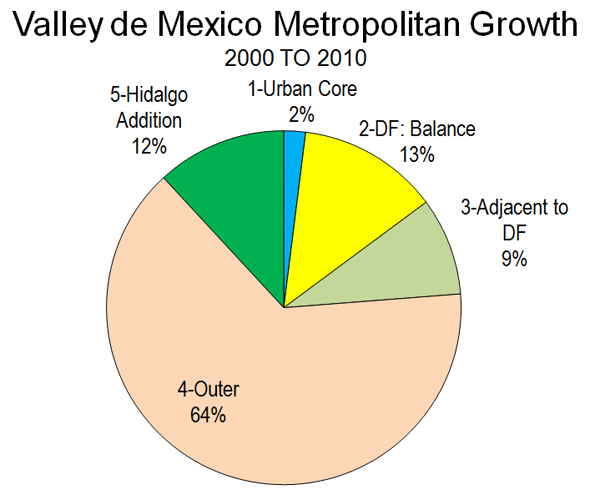
    Between 2000 and 2010, the urban core of the former Mexico City added 38,000 people or two percent to its population but accounted for only two percent of total metropolitan area population growth. Thus, during the 2000s, suburbs (areas in the urban area outside the urban core) gained 98 percent of the population growth (Figure 3).

    The vast majority of the growth took place either in the outer delegations – some 12 percent of growth –while the inner suburbs of the state of Mexico captured 9 percent of the growth. The "lion’s share" of the growth was in the outer suburbs of the states of Mexico and Hidalgo, at more than 75 percent.

    Clearly, the Valley of Mexico metropolitan area is prime example of the suburbanization and reduced urban densities that have occurred virtually around the world.

    Valley del Mexico Population: 2000 to 2010
    Geographical Sector 2000 2010 Increase Rate Share
    Urban Core (Former Mexico City) 1.692 1.730 0.038 2% 2%
    Balance of Distrito Federal 6.913 7.143 0.230 3% 13%
    Distrito Federal 8.605 8.873 0.268 3% 15%
    Inner Muncipalities 6.061 6.232 0.171 3% 10%
    Outer Municipalities 3.730 5.032 1.302 35% 75%
    Hidalgo Expansion 0.993 1.240 0.248 25% 14%
    Total 19.390 21.378 1.740 9% 100%
    In millions

    ——

    Note: New York: according to US Census Bureau estimates from 2009, the New York metropolitan area had slightly less than 20 million people. However the Combined Statistical area (which includes the Connecticut suburbs) had a population of 22 million people. Because metropolitan areas are labor market areas, the extent of their transport systems is an important factor in delineation. In the case of New York, the extent of the highway and transit systems is sufficient to suggest the combined statistical area as more appropriate for international comparisons.

    Note: Metropolitan Area Ranking: There is only one known research effort to consistently define and rank the world’s metropolitan areas. Richard L. Forstall (who ran the Rand McNally "Ranally" international metropolitan area program), Richard P. Green and James B. Pick, produced that list, which was limited to the top 15 in the world. This small number, in relation to more than 750 metropolitan areas in the world with more than 500,000 people illustrates both the difficulty of obtaining sufficient data and the complexity of the research.

    Note: Pachuca de Sota: the entire urban area is within the Valley of Mexico metropolitan area.

    Photo:  Cathedral, Mexico City (by author)

    Wendell Cox is a Visiting Professor, Conservatoire National des Arts et Metiers, Paris and the author of “War on the Dream: How Anti-Sprawl Policy Threatens the Quality of Life

  • Las Vegas, Birmingham & Salt Lake City Show Continuing Dispersion to Suburbs

    Census data released in the last week indicates confirms the continuing dispersion of population away from the historical core municipalities (central cities) to the suburbs in the 2000 to 2010 decade. The new figures, for Las Vegas, Birmingham and Salt Lake City indicate that a majority of growth occurred in the suburbs in each metropolitan area and that the dispersion of population to the suburbs was greater in the 2000s in each case than in the 1990s.

    Las Vegas: The Las Vegas metropolitan area continued to grow strongly, adding 41 percent to its population between 2000 and 2010. This, however, represents a more than halving of the growth rate from the 1990s (86 percent). The metropolitan area population in 2010 was 1,951,000, up from 1,376,000 in 2000.

    The core municipality of Las Vegas of grew 22 percent between 2000 and 2010 (from 478,000 to 584,000). The core city of Las Vegas has an overwhelming suburban urban form, having experienced virtually all of its growth in the modern, car oriented era of suburbanization. During the 2000s, the land area of Las Vegas was expanded from 113 square miles to 131.

    The suburbs grew 52 percent between 2000 and 2010. The suburbs attracted 82 percent of the metropolitan population growth, up from 65 percent in the 1990s. The suburbs now account for 70 percent of the Las Vegas metropolitan area population.

    Birmingham: The Birmingham metropolitan area experienced a decline in growth rate from 10 percent in the 1990s to seven percent in the 2000s. The population increased from 1,052,000 to 1,128,000.

    The historical core municipality of Birmingham declined eight percent, from 243,000 to 212,000. This loss of 13 percent is the largest yet recorded for a historical core municipality in a major metropolitan area. Birmingham’s population peaked at 341,000 in 1960. This loss of more than one-third in population between 1960 and 2010 is despite annexations that doubled the size of the city (from 75 to 150 square miles).

    The suburbs gained 13 percent between 2000 and 2010 and captured 140 percent of the metropolitan area’s growth (up from 124 percent in the 1990s). The suburbs now account for 81 percent of the metropolitan population.

    Salt Lake City: In the Salt Lake City metropolitan area growth declined to 16 percent in the 2000s from 26 percent in the 1990s. The population rose from 969,000 to 1,124,000.

    The historical core municipality of Salt Lake City grew three percent (from 182,000 to 186,000). Salt Lake City reached its population peak at 189,000 in 1960. This modest loss occurred while the land area of the city nearly doubled (from 56 square miles to 109).

    The suburbs gained 19 percent between 2000 and 2010. The suburbs attracted 97 percent of the metropolitan population growth, which is up from 89 percent in the 1990s.