Category: Demographics

  • The Heartland Rises

    The change in congressional power this week is more than an ideological shift. It ushers in a revival in the political influence of the nation’s heartland, as well as the South.

    This contrasts dramatically with the last Congress. Virtually its entire leadership — from former House Speaker Nancy Pelosi (D-Calif.) on down — represented either the urban core or affluent, close-in suburbs of large metropolitan areas. Powerful old lions like Reps. Charles Rangel (D-N.Y.) of Harlem, Henry Waxman (D-Calif.) of Los Angeles and Barney Frank (D-Mass.) of Newton, an affluent, close-in Boston suburb, roamed. The Senate was led by Sen. Harry Reid (D-Nev.), who loyally services Las Vegas casino interests while his lieutenant, Sen. Chuck Schumer (D-N.Y.), is now the top Democratic satrap of Wall Street.

    The old Senate tandem remains in place — but with greatly reduced influence. Many remaining Democrats, particularly those from the heartland, now live in justifiable fear for their political lives. But the most radical shifts in political geography are in the House.

    The new House leaders are, for the most part, from small towns, suburbs and interior cities. Most GOP pickups came from precisely these regions — particularly in the South and Midwest.

    The new speaker, Rep. John Boehner (R-Ohio), for example, represents a southern Ohio district that includes some Cincinnati suburbs. Rep. Eric Cantor (R-Va.), the majority leader, comes from suburbs west of Richmond. Rep. Paul Ryan (R-Wis.), chairman of the Budget Committee, hails from Janesville (population: 63,000).

    Power is moving within state delegations. Before the elections, California’s most influential House members hailed from coastal districts. In contrast, Rep. Kevin McCarthy, the new majority whip, represents Bakersfield, an oil-rich, largely agricultural area known as “Little Texas” — a far cry from the urbanity of Pelosi’s San Francisco.

    This change in geography also suggests a shift in the economic balance of power. The old Congress owed its allegiance largely to the “social-industrial” complex around Washington, Wall Street, public-sector unions, large universities and the emergent, highly subsidized alternative-energy industry. In contrast, the new House leaders largely represent districts tied to more traditional energy development, manufacturing and agriculture.

    The urban-centered environmental movement’s much-hyped talk of “green jobs,” so popular in Obama-dominated Washington, is now likely to be supplanted by a concern with the more than 700,000 jobs directly related to fossil fuel production. Greater emphasis may be placed on ensuring that electric power rates are low enough to keep U.S. industry competitive.

    The Obama administration’s land-use policies will also be forced to shift. Sums lavished on “smart growth” grants to regions, high-speed rail and new light-rail transit are likely to face tough obstacles in this Congress.

    Ken Orski, a former senior Transportation Department official and longtime observer of Washington land-use and transportation policy, said that no member of the GOP majority on the House Transportation and Infrastructure Committee comes from a big-city, transit-oriented district. The new committee, dominated by members from rural, suburban and interior smaller cities, represents areas that rely little on mass transit. These members are expected to steer money back to the roads and bridges their constituents rely on.

    Even more important are pending changes in energy policy. Many conservatives disdain what they consider “green pork” — subsidies for renewable fuels like solar and wind as well as the electric car and battery industry. Many firms involved in renewable fuels, already struggling to compete with cheap natural gas, could be driven out of business without continued federal nurturing.

    Another top priority for GOP leaders — and perhaps some energy-state Democrats — may be to choke off funding for the Environmental Protection Agency’s announced new regulations for greenhouse gases. Three out of four jobs in the oil and gas extraction industry are in GOP-dominated Texas, Oklahoma and Louisiana. California’s still-large oil industry includes many who work in the state’s increasingly Republican-leaning interior.

    Similarly, more than two-thirds of the nation’s coal mines, a prime EPA target, are in just three, increasingly red-leaning states — Kentucky, Pennsylvania and West Virginia, according to the Energy Information Administration.

    Yet urban areas can expect some benefits from this Congress. The recent extension of the Bush tax cuts largely benefits wealthy professionals, who cluster in a handful of expensive, liberal-oriented cities and their leafy, affluent suburbs. San Francisco, Boston and Manhattan liberals may groan about “breaks” for the rich, but many may be cursing the GOP all the way to the bank.

    Over time, the new emphasis on fiscal austerity could also play to Wall Street’s advantage — probably the last intention of most tea party activists. Reductions in public borrowing should drive more money into the private economy. This approach, adopted by Conservative British Prime Minister David Cameron, has helped create a smart recovery for London — even as the rest of Britain suffers from government cutbacks.

    The drive for austerity could also threaten traditional heartland staples like agricultural price supports and military spending. Major defense budget reductions, a necessity for any credible cut, could prove painful for military-oriented, red states like Virginia, Arizona, Alabama and Texas.

    This new regional balance of power poses a profound existential question for Democrats in states like California, New York and Illinois. The unlikely possibility of any future bailout for states or cities should help concentrate their minds on things like cutting spending and restoring their ability to create new jobs.

    Overall, it may be better for all regions to have a divided government. With President Barack Obama still in charge of the executive branch, we are not likely to see a repeat of the Bush-era excesses that favored traditional energy companies, suburban housing speculation and agribusiness.

    Optimistically, we may now see a canceling out of both parties’ regional tilts, spurring greater competition among localities for both investment and human talent. This could ultimately benefit the entire economy — taxpayers and communities — shedding an enlightened pragmatism on the current dreary landscape that is U.S. politics.

    This article first appeared at Politico.

    Joel Kotkin is executive editor of NewGeography.com and is a distinguished presidential fellow in urban futures at Chapman University, and an adjunct fellow of the Legatum Institute in London. He is author of The City: A Global History. His newest book is The Next Hundred Million: America in 2050, released in February, 2010.

    Photo by Smaku

  • Yes, We Do Need to Build More Roads

    Road are clearly out of fashion in urban planning circles. Conventional wisdom now decries roads in favor of public transit, walking or biking in developments designed to mimic traditional 19th century urbanism. Common refrains are “we can’t build our way out of congestion” or “widening roads to cure congestion is like loosening your belt to cure obesity.” Also frequently noted is the vehicle miles traveled has – at least until recently – outpaced population growth.

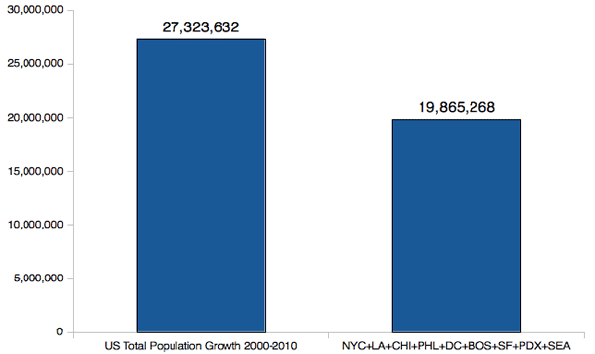
    But this piece of conventional wisdom is also deeply flawed. It obscures the bigger point that in a growing country we need to expand infrastructure to keep pace. The recent 2010 Census results put this in stark relief. The rate of growth from 2000 to 2010 slowed considerably from the previous decade, but still at a robust 9.7%, or 27.3 million new Americans. It would have been physically impossible to house all those people in traditional urban communities well-served by transit. The 27.3 million number is more than the combined 2009 population of the cities of New York, Los Angeles, Chicago, Philadelphia, Washington, Boston, San Francisco, Portland, and Seattle.

    In fact, this national growth is greater than the combined population of the 12 largest municipalities in the country.

    That’s just one decade’s worth of growth. America’s traditional urban areas couldn’t contain this, even if they were emptied of all their current residents. And the United States is projected to add an additional 90 million people by 2050. Where are all those people going to go? And how would they get to work even if they could live in these cities, given that much of America’s job growth has been suburban?

    Keep in mind also that much of this urban and transit infrastructure must be seen as more legacy than a reflection of modern choices. It was largely compete 50 or more years ago. Only Portland and Washington, DC have really managed to build new transit friendly urban core cities in the modern era. And despite their growing populations, these two places can only absorb a relatively small amount of new population every year. In Washington, it’s less population growth than gentrification – the replacement of largely poor African Americans with more affluent whites – that is the most outstanding demographic trend.

    That’s not to say America can’t invest more in transit or build more transit friendly cities. It can and it should. In particular, large, already dense urban areas like New York, Chicago, and Washington with large core area employment require major investment to upgrade their systems.

    Even smaller cities need better transit options and more urban neighborhoods. They are simply not well positioned to compete head on with newer suburban areas built from the ground up to support an auto-oriented lifestyle. But this will be difficult since they will have to build transit largely from scratch, and given anticipated cutbacks in new federal transit funding. this suggests they would be well-advised to avoid costly boondoggle mega-projects in favor of unglamorous but basic activities like running a quality urban bus system.

    But even if we achieve our potential in transit, America still needs to build more roads. We’ve got an interstate system originally designed for a 1960 population of 180 million and we are now well over 300 million and going up. By 2050 we’ll have more than double the 1960 population. This will require a major expansion of infrastructure, and that includes highway infrastructure.

    Just as one example, consider a moderate growth area like the Indianapolis-Carmel MSA. Its interstate system was mostly designed and completed circa 1970. The region had a population of a bit over 1.1 million then. Today it is over 1.7 million, an increase of 52%, or 596,000 people. A county the size of that increase would be the second largest county in the state of Indiana, well exceeding that of today’s #2, Lake County, a heavily urbanized county in Northwest Indiana.

    Yet until recently there had been almost no expansion of the Indianapolis freeway system. Fortunately, it was over-designed when built, but that is no longer the case. Thanks to a fortuitous lease of the Indiana Toll Road however, over 50 miles of freeway in the region are now being widened. Without this, the region would have faced decades of commuting misery.

    Unfortunately, that’s the bind where most cities now find themselves: managing growth with funding for roadway expansion and even maintenance running dry nationally.

    Keep in mind that tomorrow’s roads need not resemble yesterday’s monstrosities. The days of simplistically adding lanes while neglecting basics like enclosed drainage, sidewalks and paths, bus shelters, and aesthetics are likely over in many parts of the country. We need to provide room for the traffic we need to accommodate without excessive over-designs for a 15 minute peak of the peak, or dehumanizing roadway design approaches. Reform of our civil engineering educational system is eminently doable as plenty of great examples of suburban roadway design already exist. Federal standards need a revamp as well. We need to build not just more, but also better roads.

    With a botched stimulus, huge deficits at the federal and state level, and a public that has decisively turned against those deficits, a major construction program seems unlikely at this time. But in a couple years the economy should be back and a plan for fiscal recovery put in place and under execution. If not, we’ll have much bigger problems than roads.

    But assuming we get past this moment, we need to be laying the groundwork for a major continuation of the long history of American investment in infrastructure, from the Erie Canal to the interstate highway system. This includes not only a significant boost in urban transit spending where appropriate, but also a major program of both roadway repair and quality expansion, particularly in our growing metro regions. And as the Indiana example of a Toll Road lease shows, this doesn’t all have to come from tax dollars. Without this investment, our critical transport networks will ultimately seize up and America cannot hope to be competitive globally over the long haul.

    Aaron M. Renn is an independent writer on urban affairs based in the Midwest. His writings appear at The Urbanophile.

    Photo of a suburban road in Carmel, IN by author.

  • The Poverty Of Ambition: Why The West Is Losing To China And India – The New World Order

    The last 10 years have been the worst for Western civilization since the 1930s. At the onset of the new millennium North America, Europe and Oceania stood at the cutting edge of the future, with new technologies and a lion’s share of the world’s GDP.  At its end, most of these economies limped, while economic power – and all the influence it can buy politically – had shifted to China, India and other developing countries.

    This past decade China’s economic growth rate, at 10% per annum, grew to five times that U.S.; the gap was even more disparate between China and the slower-growing  E.U.,  Yet periods of slow economic growth occur throughout history — recall the 1970s — and economies recover. The bigger problem facing Western countries, then, is a metaphysical one — a malady that the British writer Austin Williams has dubbed “the poverty of ambition.”

    This lack of ambition plagues virtually every Western country. The ability to act has become shackled by a profound pessimism that according to a recent Gallup survey contrasts with the optimism found not only in rising states like China, India and Brazil, but also deeply impoverished places like Bangladesh.

    Attitudes have consequences. The rising stars of the non-Western world — from the United Arab Emirates to Singapore and China — are building cities with startling new architecture and bold infrastructure. Their entrepreneurs are expanding their operations across the planet.

    Of course, you can chortle at the outrageous overbuilding in places like Dubai, but the Western world might do better to appreciate the scope of their ambition. Indeed, for years New York’s Empire State building, erected  during the Depression, was derided as  ”the empty state building.” Today it’s visionary developers like Iraqi-born Istabraq Janabi who are planning unlikely  new structures even  in  troubled places like Ramadi, Iraq.

    The difference in ambition can be seen clearly at airports, which now serve as the entry halls of the global economy. A traveler to John F. Kennedy Airport, Heathrow, Charles De Gualle LAX or Dulles passes through decayed remnants of fading late 20th century buildings and technology. In contrast, airports in Dubai, Hong Kong and Singapore offer clean, ultra-modern facilities with often impressive design.

    The West’s retreat from space exploration further underscores its metaphysical poverty. Today, Europe and the U.S., the world’s historic leader in the field, are cutting back on plans to explore the cosmos, which has included a manned operation to the moon. President Obama wants NASA to focus more on issues regarding climate change instead. In contrast, the rising countries of Asia, notably China and India, have begun plans for manned flights to the moon and beyond.

    This divergence is not about resources; it is about the growing conviction in the West that moving forward is an illusion or, as the British academic John Gray’s puts it, “progress is a myth.”  Victorian empire-makers and intellectuals, like their republican American successors, believed perhaps naively in the potential of humanity, economic and technological progress. Today our intellectual and political classes have gone to the other extreme.

    The West’s politics are in the grips of two profoundly retrograde mentalities. One, a small-minded conservatism, harks back to the “golden” age of the 1950s when Western power faced only a flawed Soviet challenge. The idealistic but flawed commitment to imposing democracy by force of the Bush years has faded; it has been replaced by an obsession with taming a bloated public sector. While this focus may be justified, it is fundamentally more reactive than proscriptive.

    The Left, which once portrayed itself as the bastion of scientific rationalism, increasingly embraces neo-druidism, a secular form of nature worship. This tendency’s roots can be traced back to the “Limits to Growth” ideology of the early 1970s which projected, mostly mistakenly, that the planet was about to run out of everything from food to oil. Concerns over climate change have transformed this dismal sentiment into a theology, with carbon emissions treated as a form of original sin.

    The anti-progress nature of the new Left is unmistakable. Rather than seek ways to control climate change, suggests The Guardian’s George Monbiot, environmentalism is engaged in “a battle to redefine humanity.” Monbiot believes the era of economic growth needs to come to an inevitable denouement; that “the age of heroism” will be followed by the decline of the “expanders” and the rise of the “restrainers.”

    Europe, particularly the U.K., suffers acutely from metaphysical angst.  Once touted as the new great power by its leaders and their American claque, the E.U. is quickly dissolving along cultural and historical lines; this is especially evident in the division between the  resilient countries of the north (something like the Hansa trading states of the late Middle Ages) and the weaker countries along the periphery. For the most part, Europe no longer seems capable of doing much more than finding ways to control an unaffordable welfare state without tearing about its social net. The once cherished notion of a multi-racial “new” Europe largely has dissolved as immigration has devolved from a source of demographic and cultural salvation to a widely perceived threat to the E.U.’s economic and social health as well as security.

    Such defeatism usually has less success in the United States. But America’s “progressive” left increasingly resembles its European cousins.  Obama’s science advisor, John Holdren, has been a long-time advocate of the idea of “de-development,” the purposeful slowing of growth in advanced countries in order to protect the environment. The critical infrastructure needed to accommodate upward of another  100 million Americans — new dams in the west, intelligent development of our vast natural gas reserves and building new cities, airports and ports  – are not at the center of either party’s platforms. These could be financed largely with private sources, given the right incentives.

    Fortunately the West’s decline is not at inevitable. China, India, Vietnam, Brazil, South Africa all deserve their day in the sun, but this does not mean that Americans or Europeans should cower in the shadows. Western countries still possess much of the world’s cutting-edge technology and leading companies; the combined GDP for the E.U., North America and Oceania stands at over $33 trillion, almost five times that of India and China together.

    More important still, the political and cultural institutions of the West — with their liberal values — represent the best hope for a stable world of self-governing peoples. Does anyone in the West, particularly the progressives in the media and academia, really want a world run by Chinese despotism?

    The current financial crisis should serve as both a warning and a spur for a new focus on economic expansion. But this can only occur if the West can restore its belief in its future. This does not necessitate a return to the colonial attitudes of the past, but rather a keener appreciation of our unique human, physical and political advantages.

    Only the United States – by far the richest, largest and most populous Western nation — can lead such a revival. For one thing, the U.S. remains the world’s leading immigrant magnet and most diverse large country, all of which makes it the natural center of an evolving global society. Although immigrants pose some serious issues, University of Chicago scholar Tito Sananji notes that the U.S., along with Canada and Australia, seems to be doing a better job educating their newcomers than the continental European states.

    The U.S., Canada and Australia also possess resources, most critically food, that could benefit from growing demand in developing countries. Both North America and some European nations — notably the new Hansa of the Netherlands, Germany and Scandinavia – remain world leaders in scores of industrial endeavors, as well as technology- and culture-based industries.

    Together these Western countries can do much more to shape the global future than is commonly understood. But to do so this century they will need how to recover the animal spirits that drove their remarkable rise in the last.

    Joel Kotkin is executive editor of NewGeography.com and is a distinguished presidential fellow in urban futures at Chapman University, and an adjunct fellow of the Legatum Institute in London. He is author of The City: A Global History. His newest book is The Next Hundred Million: America in 2050, released in February, 2010.

    Photo by Wally Gobetz

  • Toronto: Three Cities in More than One Way

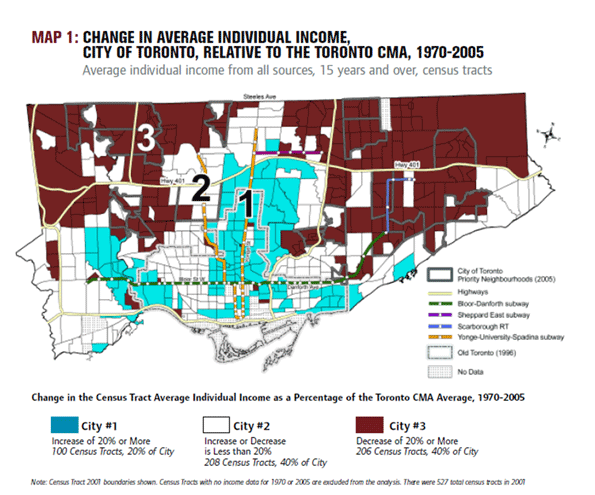
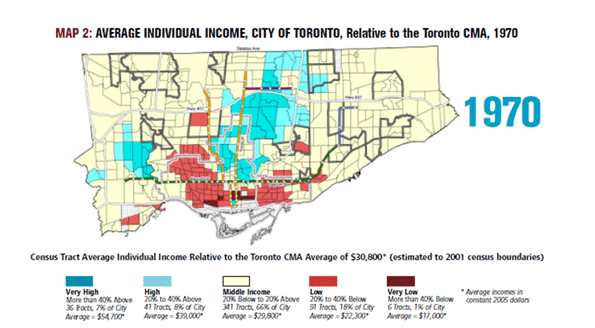
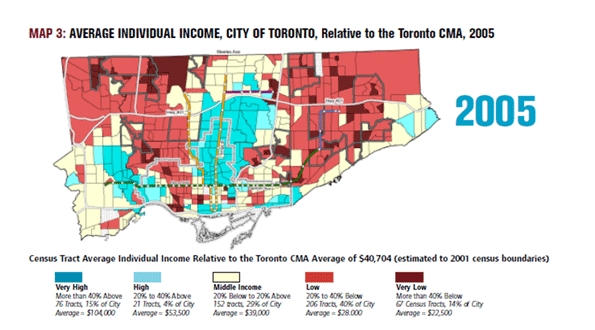
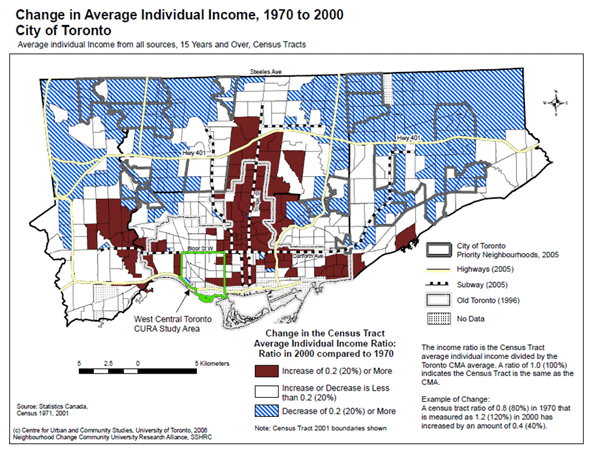
    The issue of income disparity in Toronto has once again been brought into the public eye by a December 15th report by University of Toronto Professor David Hulchanski. The report, “The Three Cities Within Toronto,” points to a growing disparity in incomes between Downtown Toronto, the inner suburbs, and the outer suburbs of the city. The report demonstrates that between 1970 and 2005 the residents of the once prosperous outer suburbs have been losing ground compared to the now wealthy downtown core. The results for the inner suburbs have been mixed.

    In 1970, 66% of city neighbourhoods were considered middle income. Only 15% were considered high or very high, and 19% were low or very low. In 2005, only 29% of neighbourhoods were considered middle income. The number of high or very high income neighbourhoods rose to 19%, while low and very low income neighbourhoods made up a staggering 54% of neighbourhoods.


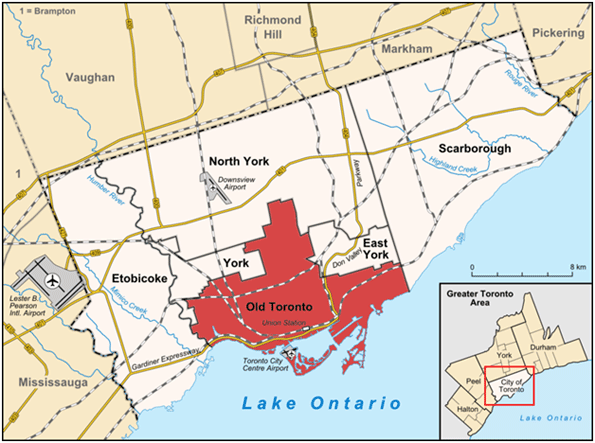
    The news isn’t all bad. After all, the downtown core is now one of the most desirable places to live in North America, and many of the formerly low income neighbourhoods have gentrified, or are in the process of doing so. However, many of the city’s traditional suburbs have been decimated. The former cities of Etobicoke and Scarborough used to be middle class. Not so much anymore.

    In real dollar terms, even the majority of the very low income areas have become wealthier. The trouble with poverty statistics is that they focus on relative poverty, rather than absolute poverty. This means that if Etobicoke’s average income doubled tomorrow, the downtown core would all of a sudden be considered poor. This is a major limitation. Toronto isn’t exactly turning into a Canadian Detroit.

    The report rightly points to the need for greater mobility in the outer suburbs. Given that the most lucrative jobs are typically downtown, many young professionals and recent graduates living outside of the core need to be able to get downtown cheaply and quickly in order to build their careers. Where the report goes wrong is that it recommends stricter land use regulations, stronger rent controls, and the revival of the flawed Transit City plan that Mayor Ford vigorously campaigned against in the recent election.

    It is easy for academics to blame a lack of social welfare spending, or suburbanization for the problem. The real problem is the loss of local policy making power resulting from amalgamation. For the most part, the areas losing ground the fastest are the formerly middle class suburbs amalgamated into the city. In contrast the “exurbs” just outside of city boundaries have thrived. This is no coincidence. The real takeaway from this study is that the suburbs have different needs than the central core. By attempting to accommodate the needs of both, the megacity has benefitted neither. Short of de-amalgamation, the only hope for the city is to substantially decentralize policy making. No amount of spending can make up for the loss of local autonomy.

    Policies have different effects in different types of cities. Take the treatment of automobiles. It might make sense to discourage automobile usage in downtown Toronto, but the benefits of doing so in Vaughan or Pickering would be questionable at best. Similarly, mandating that every commercial establishment have a public washroom probably makes sense as a public health measure in downtown, where public urination is an issue, but not so much in suburban Markham, or Richmond Hill.

    Making sensible regulations for a small, relatively homogenous area isn’t all that difficult. Applying these regulations to a large, demographically diverse area can help some areas and hurt others. It’s not that regulations need to be a zero sum game. People in Etobicoke wouldn’t be affected if, say, maximum parking allotments were tightened in the downtown core. They would be affected if they were tightened throughout the entire megacity. Similarly, increasing maximum parking allotments might hurt the core and help the suburbs. The current one size fits all approach sometimes benefits the core and sometimes benefits the suburbs, but ever both.

    Perhaps more important than city wide regulations is the centralization of taxing power. Since the merger, the city now sets tax rates across the entire megacity. This also allows the city to control the ratio of residential to non-residential taxes. The city of Toronto has the highest ratio of non-residential to residential taxes in Ontario. This means that businesses carry a higher share of the tax load in the city than anywhere else in the province. The combination of tax and regulatory policies in the city have lead the Canadian Federation of Independent Businesses to rank Toronto as the second least business friendly city in Canada. On a scale of 1-100, Toronto came in at 33, slightly ahead of Vancouver’s 31. Meanwhile, the rest of the (Greater Toronto Area) GTA is near the top, at 61. Neighbouring Oshawa took the top spot in Ontario with 69.

    GTA Area Cities by CFIB Entrepreneurial Cities Policy Score

    Rank (Ontario)

    City

    Score

    Driving Distance to Yonge and Bloor

    1

    Oshawa

    69

    0:45

    6

    GTA (Excluding Toronto)

    61


        Mississauga

    61

    0:27


        Brampton

    61

    0:41


        Richmond Hill

    61

    0:32


        Markham

    61

    0:32


        Vaughan

    61

    0:32

    16

    Hamilton

    55

    0:58

    19

    Guelph

    54

    1:15

    24

    Barrie

    52

    1:16

    27

    Brantford

    51

    1:20

    30

    Kitchener

    48

    1:23

    33

    Toronto

    33


        Etobicoke

    33

    0:20


        Scarborough

    33

    0:21

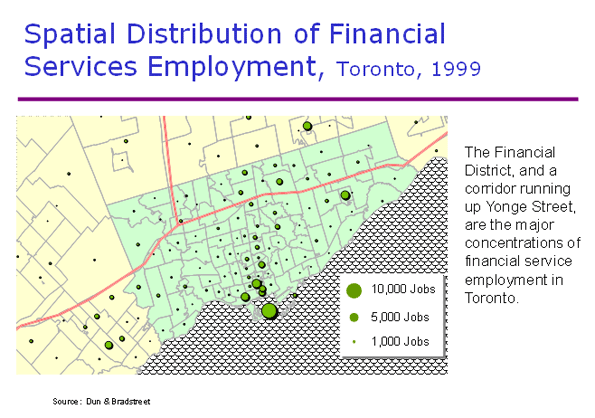
    Now the share of non-residential to residential taxes in Toronto may actually make sense downtown. The core is home to the third biggest financial sector in North America. These jobs are heavily concentrated in the downtown core.

    Downtown Toronto isn’t competing with low tax Vaughan or Barrie for these jobs. They are competing with high tax cities like New York and Chicago. This means that employment in the core is not as easily chased off by taxes and regulations than in the suburbs. But in industries like wholesale and manufacturing, which are far more important outside of the core, employment can easily relocate to Barrie, Mississauga, Oshawa, and so forth. Indeed, jobs have been leaving the city since before the recession hit.

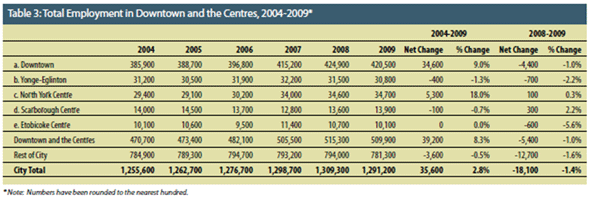
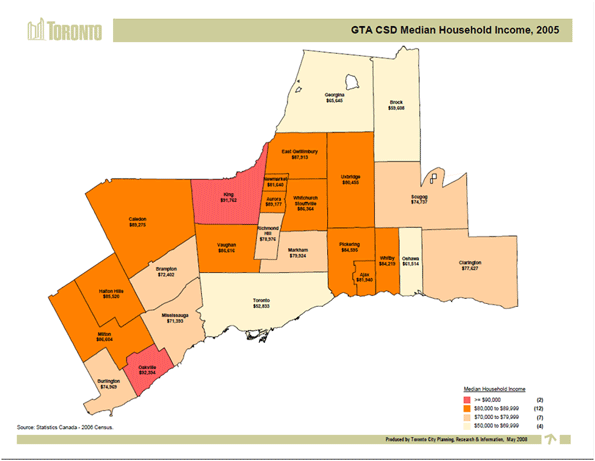
    Since 2004 Downtown and North York have prospered but the rest of the city has lost jobs. This should make the results of the Professor Hulchanski’s report unsurprising. The financial sector isn’t enough to keep the entire city employed or lift wages in the city-controlled suburban rings. As a a result despite the thriving financial sector, Toronto was dead last in the GTA in terms of median incomes.

    To turn this around, the city must decentralize decision making power so the suburban communities can come up with their own economic development strategies. No matter how much the city improves transit to the outer suburbs, they will not be able to significantly increase median incomes without creating more jobs. The financial sector will continue to grow, but many of jobs created in this sector require specialized training, and thus go to people from outside of the city. This doesn’t do much for former manufacturing workers in Scarborough and Etobicoke. Growth of the financial sector combined with the dispearance of blue collar jobs together guarantee continuing income disparities in the city.

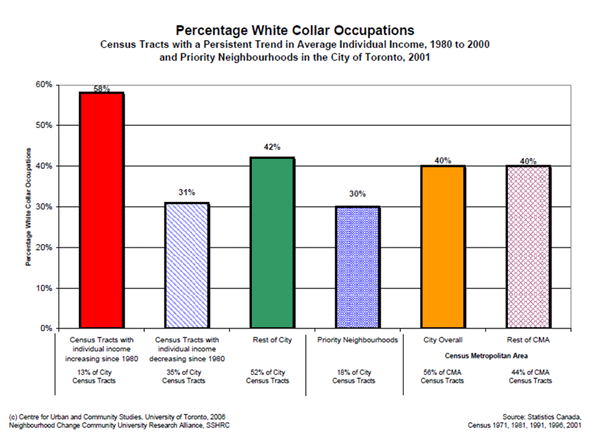
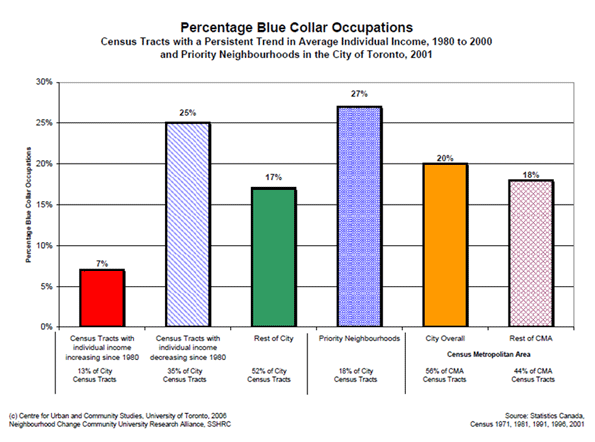
    Below is previously published data from Professor Hulchanski that highlights how badly blue collar sections of the city have been hit.


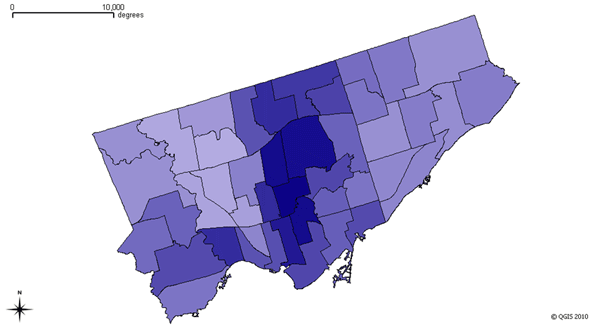
    Fundamentally, a strong focus on financial and other so-called “creative class” jobs will do little for these areas. The above map was created by Richard Florida’s Martin Prosperity Institute. It shows that most creative class jobs are clustered around the subway, but this doesn’t mean that expanding rail transit will expand creative class employment. Building a light rail line through a neighbourhood doesn’t suddenly transform the residents into artists and physicians. It may attract more artists and physicians, but this could actually hurt local residents by driving up rent and property values without creating jobs for them. Below is a map of educational attainment by ward. The darker the colour, the higher the number of residents with a bachelor’s degree or higher.

    The real problem is that a focus on elite jobs creates exactly the kind of bifurcation that progressive complain about. Given that city wide business policies are tailored towards creative class type occupations, it is unlikely that price sensitive manufacturers will find any reason to locate within city boundaries, rather than setting up shop in Mississauga or Barrie.

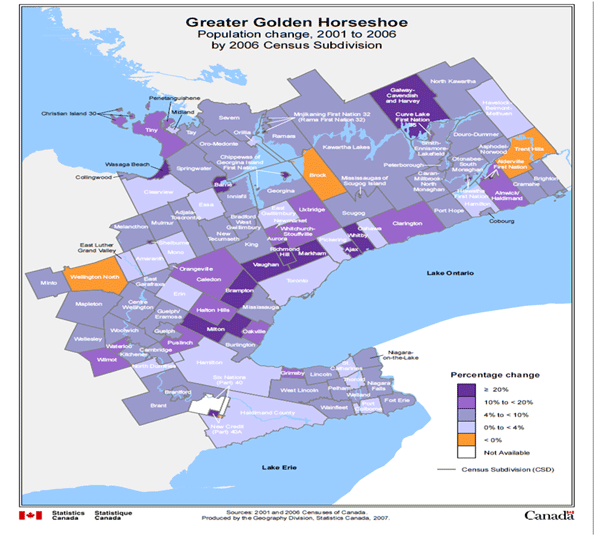
    Indeed, for all the temptation by urbanists to point to Toronto’s suburban ring as an example of the decline of suburbia, the peripheral suburban areas outside of city limits have been booming. Here is a map of growth in the GTA between 2001-2006. While Toronto grew modestly, suburban cities Milton, Brampton, Vaughan, Richmond Hill, Markham, Ajax, and Whitby all grew by at least 20%. Even Oshawa, which was hit hard by the decline of the auto sector, has managed to survive, and indeed maintained a higher median income than Toronto during this period. Regional rival Mississauga eclipsed Toronto’s growth rate, and emerging regional player Barrie grew by over 20%.

    In short, despite its strong financial core, Toronto is losing its standing as the go-to destination in the GTA. And it could get worse. Mississauga is working hard to lure financial services and advanced manufacturing jobs from Toronto. Several other cities, such as Guelph and Waterloo are actually competing for the very creative types that Toronto’s policies are tailored to attract. Other cities, such as Barrie are working hard to cannibalize what is left of Toronto’s manufacturing and distribution sectors. Were it not for amalgamation, Etobicoke or Scarborough could just as easily have undertaken a similar strategy to attract blue collar jobs.

    The Three Cities report identifies serious regional disparities in Toronto. Unfortunately, it doesn’t provide much insight into how to fix the problem. Expanding transit options will only go so far towards this. Building more light rail may raise median incomes by attracting wealthier people to these neighbourhoods. Ironically, this will only widen the income gap. The real challenge is finding out how to create opportunities for blue collar jobs in suburban Toronto. Unfortunately, amalgamation has imposed one size fits all policies that may work downtown, but utterly fail in the suburbs and continue to drive people to the periphery outside the city limits. Ironically, the very policies that seek to halt “sprawl” may well end up exacerbating it.

    Toronto Skyline photo by Smaku

    Steve Lafleur is a public policy analyst and political consultant based out of Calgary, Alberta. For more detail, see his blog.

  • Demography vs. Geography: Understanding the Political Future

    Demography favors Democrats, as the influence of Latinos and millennials grows. Geography favors the GOP, as the fastest-growing states are solid red. A look at America’s political horizon.

    In the crushing wave that flattened much of the Democratic Party last month, two left-leaning states survived not only intact but in some ways bluer than before. New York and California, long-time rivals for supremacy, may both have seen better days; but for Democrats, at least, the prospects there seem better than ever.

    That these two states became such outliers from the rest of the United States reflects both changing economics and demographics. Over the past decade, New York and California underperformed in terms of job creation across a broad array of industries. Although still great repositories of wealth, their dominant metropolitan areas increasingly bifurcated between the affluent and poor. The middle class continues to ebb away for more opportune climes.

    Each state has also developed a large and politically effective public sector. In both states, no candidate opposed to its demands won statewide office in 2010. At the same time, the traditional, broad-based business interest has become increasingly ineffective; instead, some powerful groups such as big developers, Wall Street, Silicon Valley, and Hollywood, became part of the “progressive” coalition, willing and able to cut their own deals with the ruling Democratic elite.

    In New York, Republicans did capture a handful of seats in rural areas that have historically been friendly to the GOP, but in California the Republicans made no headway at all, even in rural areas. The difference here can be explained by demographics. In New York, the rural population is overwhelmingly Anglo; in California, much of it is Hispanic, a group that is both growing and, for the most part, tilting increasingly to the left.

    Can the New York and California models be replicated in other states and yield political gold for Democrats? The answer depends on how these two economies perform over the coming decades.

    Another state model competes for supremacy. It can be found in Texas, the Southeast, and parts of the intermountain West. The hallmarks are fiscal restraint and an emphasis on private-sector growth. If these free market-oriented states can produce better results than the coastal megastates, with their emphasis on government they could own the political future.

    Demographics: The Democrats’ Best Hope

    Right now, demography is the best friend Democrats have. Over the next four decades, the two groups that will increasingly dominate the political landscape are Hispanics and millennials (the generation born between 1983 and the millennium). Both groups tilted leftwards in recent elections. This trend should concern even the most jaded conservatives.

    The Latinization of America, even if immigration slows, is now inevitable. Only 12 percent of the U.S. population in 2000, Hispanics will become almost 25 percent by 2050. As more Latinos integrate into society and become citizens, they are gradually forming a political force. Since 1990, the number of registered Latino voters swelled from 4.4 million to nearly 10 million today.

    Anglos—60 percent of whom supported Republican congressional candidates in 2010—are beginning to experience an inexorable decline. In 1960, whites accounted for more than 90 percent of the electorate; today, that number is down to 75 percent. It will drop even more rapidly in the coming decades, with white non-Hispanics expected to account for barely half the nation’s population by 2050.

    California and New York are laboratories of the new ethnic politics. In New York, Latinos represent roughly 12 percent of the voters, while the overall “minority” vote has risen to well over 30 percent. California has, by far, the nation’s largest Hispanic population and Latinos are now roughly 24 percent of eligible voters. Overall, non-whites constitute well over a third of the electorate.

    The growth of the Latino vote works to Democrats’ advantage. Until the GOP-sponsored passage in 1994 of the anti-illegal alien Proposition 187, Latinos in California routinely voted upwards of 40 percent Republican (and even did so for Governor Arnold Schwarzenegger in 2006). This year, barely one-third of California Latinos supported Republican candidates Meg Whitman and Carly Fiorina.

    The Republican embrace of what is perceived by Hispanics as nativism has clearly alienated Latinos. This applies not only to California but also in Arizona, where Latino voters are now 18 percent of the total; in Nevada, they represent 14 percent and played a critical role in re-electing Majority Leader Harry Reid.

    This shift is all the more remarkable given the fact that many Democratic policies, on both social issues and regulations squashing economic opportunity, are at odds with Latino social conservatism and aspirational instincts.

    Of course, Latino voters are not the same in every corner of the country, and Republicans can do well with Hispanic voters if conditions are right. For example, Latinos in Florida and New Mexico support Republican candidates far more than in California or New York. Texas Republicans picked up two predominately Latino house districts along the Mexican border this year. And several recently elected high-profile Latinos—Florida Senator Marco Rubio and Governors Brian Sandoval in Nevada and Susan Martinez in New Mexico—earned strong Hispanic support (Rubio won more than 45 percent of Latino voters in a three-way race). Latino Republican candidates also won in Washington State and, of all places, Wyoming.

    The elevation of such emerging leaders could eventually turn the Latinos into a successfully contested group. But there is also a distinct possibility that emboldened nativist-oriented Republicans (backed largely by their older, Anglo base) could embrace policies, such as abolishing birthright citizenship, that seem almost calculated to alienate Latino and other immigrant voters.

    Millennials: Growing Up, Staying Left?

    Latinos and minorities are not even the GOP’s biggest demographic challenge. Millennials, the so called “echo boomers,” constitute a growing percentage of the electorate. They also tilted heavily Democrat. In 2008, millennials accounted for 17 percent of the nation’s voting-age population; by 2012, that share will grow to 24 percent. By 2020, they will account for more than one-third of the total population eligible to vote. Their power will wax while the seniors’, who broke decisively for the GOP this year, will inevitably fade.

    Millennials and generation X, their older brothers and sisters, constitute the majority of self-professed Democrats, note Mike Hais and Morley Winograd, authors of the forthcoming Millennial Momentum: America in the 21st Century. Last November, they supported Democratic candidates 55 percent to 42 percent, although their turnout flagged compared to what it was in 2008. They can be expected to turn out in bigger numbers in the 2012 presidential election.

    A connection exists between the Latinization trend and millennial voters. Boomers were 80 percent white; among millennials, at least the younger cohorts, the majority are from minority households.

    More critically, on a host of issues—from the environment to gay rights and economic re-distribution—this generation appears well to the left of older ones. One hopeful note for libertarian-minded Republicans: almost half believe that government is too involved in Americans’ lives (in this sense, their views are similar to those of older generations).

    Can millennials and generation X-ers be turned toward the center? History suggests this is at least possible. Boomers started off relatively left of the mainstream, notes political scientist Larry Sabato (although as Hais and Winograd suggest, Boomers were never as “left” as their louder, and often better-educated, generation “spokespeople”). In 1972, their first appearance at the ballot box, they split between Richard Nixon and George McGovern while older voters went overwhelmingly with President Nixon. In 1976, they helped put Jimmy Carter in office.

    But, over time, Boomers clearly shifted to the center-right, and eventually tracked close to the national averages. They supported Ronald Reagan in 1984, Democratic Leadership Council standard-bearer Bill Clinton, and George W. Bush. Politically, Sabato notes, “the boomers have become their parents.”

    Will today’s younger voters follow a similar arc? The key lies with how Republicans deal with critical issues, such as gay rights and the environment. It should be sobering for Republicans that a popular conservative like Senator Jim DeMint—the putative godfather of the Tea Party—lost overwhelmingly among South Carolina millennials by 54 to 46 percent against a marginal Democratic candidate.

    “This doesn’t say that the millennials will necessarily be Democrats forever and could never vote for Republicans,” notes Hais, who surveyed generational dynamics for Frank N. Magid Associates, an Iowa- and Los Angeles-based market research firm. “Obviously, the Democrats will have to produce, especially in the economy. But, I think that for millennials to begin to vote for Republicans, it is the Republicans and not millennials who will have to do most of the changing. The Republicans will have to come up with a way to appeal to an ethnically diverse, tolerant, civic generation—something they haven’t done very well to date.”

    Geography: The Great Republican Advantage

    Demographics may seem a long-term boon for Democrats, but geographic trends tilt in the opposite direction. Actually, Republicans did exceptionally well in the country’s fastest-growing places, both within metropolitan areas and by state. Democrats won the urban core, winning it by almost two-to-one in an otherwise disastrous year for them. But this is not where population growth is concentrated. Out of the 48 metropolitan areas, notes demographer Wendell Cox, suburban counties gained more migrants than core counties in 42 cases over the past decade. Overall suburbs and exurbs accounted for roughly 80 percent or more of all metropolitan growth.

    Suburbs and exurbs, where a clear majority of the country lives, are where American elections are determined. Dominated by the automobile single family houses, these areas shifted heavily to the Republicans this year, voting 54 to 43 percent for the GOP. Unless there is a startling economic development or the unlikely imposition of density-promoting national planning policy, the periphery is likely to remain the ultimate “decider” in American politics for the foreseeable future. The next generation of homebuyers, the millennials, note Hais and Winograd, also identify suburbs as their “ideal” place to live—even more than their boomer parents.

    Immigrants also are demonstrating a strong preference for the suburbs. Since 1980, the percentage of immigrants who live in the suburbs has grown from roughly 40 percent to above 52 percent. They also remained the preferred home for most boomers as they age.

    Republicans also dominate the fastest-growing states: Virginia, Utah, Florida, North Carolina, and, most importantly, Texas. Over the past decade, more than 800,000 more people moved to Texas than left the Lone Star State. In contrast, New York suffered a net migration loss of over 1.6 million, while California, once the nation’s leading destination, lost almost as many. Texas, Florida, and Virginia will gain congressional seats while New York will lose seats and California, for the first time in its history, will add none.

    More important still are the reasons driving this migration: job growth, cost structure, taxes, and regulation. While the highest earners in Hollywood, Silicon Valley, or Wall Street may still flourish in the two big blue states, jobs are evaporating for many middle- and working-class residents.

    For the vast majority of middle- and working-class people, the growth states are increasingly attractive places for relocation. Over the past decade, states like Texas, Virginia, North Carolina, and Utah, according to a Praxis Strategy Group analysis, enjoyed faster growth in middle-income jobs than in the deep blue strongholds. Texas, for instance, has increased middle-income jobs at seven times the rate of California over the past decade.

    This job growth extends beyond low-wage jobs at places like Walmart. Over the past decade, Texas has increased its number of so-called STEM jobs (science, technology, engineering, and mathematics related jobs) by 14 percent, well over twice the national average. Virginia and Utah performed even better. In contrast, New York and Massachusetts grew high-tech jobs by a paltry 2.4 percent, while California lagged with a tiny 1.7 percent increase.

    Jockeying for the Future

    In its first two years, the Obama administration tried to reverse these geographic trends by steering funds into universities, mainly those located in big cities and along the Northeast and California coasts. This tilt was natural for an administration which one Democratic mayor from central California described as “Moveon.org run by the Chicago machine.”

    The Obama administration’s “green” policies are also designed to favor major dense urban areas, with large increases in transit funding, high-speed rail projects, and grants for pro-density “smart growth” policies. But with the resounding defeat in November, the drive to force the population into dense and normally democratically inclined cities seems certain to ebb. The demise of the fiscal stimulus will put increased pressure on states like New York and California to cut down their public-sector growth, further threatening their weak recoveries.

    In the coming years, budget-constrained states will have to focus on private-sector jobs and growth. Given the likely tight job market over the next decade, particularly for minorities and millennials, Republicans could do well to demonstrate the superiority of their pro-enterprise model.

    Currently, red-leaning states top the list of states with the “best” business climates. Texas, North Carolina, Tennessee, and Virginia topped a recent survey by Chief Executive Officer magazine. In contrast, the bottom rungs are dominated by New York and California, as well as by longstanding Democratic bastions Michigan, New Jersey, and Massachusetts.

    To succeed, Democrats will need to prove capable of something other than a reverse Midas touch. They will need to develop a pro-growth, job-oriented program, something that they have not done well since the Clinton era. The decline in the numbers of pragmatic, business-oriented Democrats at the state and federal levels could make that job tougher than ever.

    It is still possible that, as millennials and Latinos flock to the suburbs, blue state demographics could overwhelm red state geography. In a decade, for example, Texas will likely be more far Latino than Asian; by 2040, according to demographer Steven Murdoch, the overall minority population, could be three times that of Anglos. At the same time, surging high-end employment will bring more educated, socially liberal people to the state. If these groups continue to favor the Democrats, Texas and other deeply red states could turn purple if not blue.

    In the long run, each party has strong cards to play. Demographic shifts favor Democrats, while geography tilts to the Republicans. Ultimately, the winner will be the party that offers a successful strategy for economic growth—but without culturally alienating the demographic groups destined to hold the balance in the political future.

    This article originally appeared at The American.

    Joel Kotkin is executive editor of NewGeography.com and is a distinguished presidential fellow in urban futures at Chapman University. He is author of The City: A Global History. His newest book is The Next Hundred Million: America in 2050, released in February, 2010.

    Photo by Eric Langhorst
  • Holiday Greetings from New Geography

    Here’s to the end of our 31st month publishing NewGeography.com. It’s been another good year of steady growth. Thanks for reading, for the good natured arguments, and your submissions. We hope your holiday season is relaxing and safe (for me it’s a 350 mile drive across the frozen tundra.)

    Here’s a look at of some of our most popular pieces over the past year.

    January
    The War Against Suburbia
    Reducing Travel Congestion and Improving Travel Options in Los Angeles
    Housing Affordability as Public Policy: The New Demographia International Housing Affordability Survey
    Beyond Neo-Victorianism: A Call for Design Diversity

    February
    America on the Rise
    A Race of Races

    March
    What American Demographics Will Look Like in 2050
    Midwest Success Stories
    New Traffic Scorecard Reinforces Density-Traffic Congestion Nexus
    Let’s Not Fool Ourselves On Urban Growth

    April
    Best Cities Rankings
    Finding Good in this Bad Time

    May
    Is it Game Over for Atlanta?
    Bungled Parliament: The Price of Pursuing Safe Society Over Growth and Opportunity
    Shanghai: The Rise of the Global City

    June
    The Future of America’s Working Class
    Time to Dismantle the American Dream?
    The Suburban Exodous, Are We There Yet?

    July
    How Texas Avoided the Great Recession
    ”James Drain” Hits Cleveland
    Civic Choices: The Quality Vs. Quantity Dilemma

    August
    The Golden State’s War on Itself
    The Beginning of the Great Deconstruction
    Urban Legends, Why Suburbs Not Dense Cities are the Future
    City Thinking is Stuck in the 90s
    Can the Suburban Fringe be Downtown-Adjacent?

    September
    The New World Order
    City Size Does Not Matter Much Anymore

    October
    The Smackdown of the Creative Class
    Greetings from Recoveryland, Ten Places to Watch Coming out of the Great Recession
    The World’s Fastest Growing Cities
    The Privitization-Industrial Complex

    November
    I Opt Out of California
    The Rise of the Efficient City
    The Other Chambers of Commerce

    December
    Hasta La Vista, Failure
    If California is so Great, Why are So Many Leaving?
    Cities that Prosper, Cool or Not

    Photo by Fusionpanda

  • The California Cheerleaders Are at it Again

    State Treasurer Bill Lockyer and economist Stephen Levy published a piece in the Los Angeles Times that argues that California doesn’t really have any fundamental problems. In their piece, Lockyer and Levy don their rose-colored glasses and give us the same tired old excuses, twisted logic, and factual inaccuracies.

    I’ll begin with the factual inaccuracies:

    Lockyer and Levy claim that California is the state with the youngest population. That is just incorrect. The U.S. Census website has a map. California is not even the same color as that used to identify the lowest-aged states.

    The authors’ claim that California’s high unemployment rate is due to the loss of 600,000 construction jobs is also wrong. Since November 2007, the month before the recession started, California’s construction industry has lost 334.7 thousand jobs. This represents less than 25 percent of California’s 1.36 million job losses since the recession’s inception. The story is still wrong if we choose the starting date for calculating job losses as the date that most supports L&L’s argument. California’s construction jobs peaked at 948.3 thousand in February 2006. It appears to have bottomed out at 529.2 thousand in September 2010. This is a huge number of job losses, over 400,000, but it is only two-thirds of the 600,000 claimed, and it certainly does not explain all of California’s high unemployment or California’s million plus non-construction recession job losses.

    Lockyer and Levy claim that California’s budget crisis stems strictly due to revenue shortfalls, saying,

    “Our critics say we are addicted to spending. But the numbers show that isn’t true….California’s current budget woes have been caused by the devastation visited on our revenue base by the recession, not a failure to curb spending. In the three fiscal years preceding this one, general fund expenditures fell by $16 billion.”

    This is just disingenuous. Lockyer knows as well as anyone that the general fund comprises less than half of California’s spending, and while the general fund expenditures have indeed reflected a decline in taxes, total State spending has increased from $194.3 billion in fiscal year 2007/08 to $216 billion in the 2010/11 year. Furthermore, when the composition of State spending is evaluated, we see that virtually all of the cuts in the general fund have been in local assistance. State operations have been almost completely spared.

    Besides, California’s budget problems didn’t begin with the recession. Do Lockyer and Levy think that our memories are so short that we forgot that Gray Davis was thrown from office because of budget problems, and that Arnold came in office pledging to fix California’s persistent budget deficits?

    We are also again treated to Lockyer’s mantra that California has a constitutional requirement that it not default on bonds, adding,

    “During the current fiscal year, general fund revenues are expected to total $89.4 billion. Education spending under Proposition 98 will total $36 billion. That leaves $53.4 billion available to pay debt service on bonds — more than eight times the $6.6 billion the state will need.”

    That’s wonderful, but constitutional requirements and revenues don’t pay debt. Cash pays debt, and California does run out of cash. When California runs out of cash it issues vouchers. Already some banks have refused to accept California vouchers. What will the State do if all banks refuse to honor vouchers?

    I’m sure the Treasury sets aside funds for debt repayment before they issue vouchers. Whatever they set aside will probably not be enough if California finds itself in a situation where vouchers are not accepted. Do we think the unions will let their people work if they are not being paid? Would the workers want to work if they are not being paid? Would contractors work? Will there be anybody around to write a check, even if the reserves are there?

    The fact is that if vouchers are not accepted, California will be plunged into a very serious crisis, a crisis in which case California’s constitutional requirement to pay would have no more meaning than its constitutional requirement that it have a balanced budget by June.

    Lockyer and Levy ludicrously claim that California’s business environment is good. But disinterested groups that issue reports that consistently rank California as among the least attractive states are wrong, groups like the Tax Foundation and Chief Executive Magazine. Lockyer and Levy cite Public Policy Institute of California (PPIC) research that business relocations cause smaller percentage job losses in California, but the PPIC can’t measure jobs that aren’t created when businesses that could reasonably be expected to expand in or move to California don’t.

    Lockyer and Levy also repeat Brett Arends’s claim that California’s share of the World’s venture capital has increased to 50 percent, but they neglect to note that the amount is declining, a lot, as Tim Cavanaugh showed here. California is getting a larger share of a rapidly declining pie. The net result is a huge decrease in California’s venture capital.

    Finally, I’ll conclude with my favorite Lockyer and Levy quote:

    “California no doubt faces serious challenges. But our obstacles are not insurmountable.”

    That’s exactly right, but the problems are not insurmountable until you confront California’s real, fundamental, problems.

    Bill Watkins is a professor at California Lutheran University and runs the Center for Economic Research and Forecasting, which can be found at clucerf.org.

    Photo by Kevin Cole

  • A New Era For The City-state? The New World Order

    The city-state, a relic dating back to Classical or Renaissance times, is making a comeback. Driven by massive growth in global trade, shifts in economic power and the rise of emerging ethnic groups, today’s new independent cities have witnessed rapid, often startling, economic growth over the past decade.

    The contemporary city-state has flourished primarily in two regions: the Persian Gulf and Southeast Asia. The development of Hong Kong and Singapore provided a critical stage for Southeast Asia, which has been home to the world’s the greatest economic expansion. Hong Kong, now a quasi-independent part of China, competes with London’s West End as the world’s most expensive office market. By one account, it is experiencing the fastest growth in rents of major office markets in the past year. Once known for their poverty and destitution, these Asian city-states now boast incomes comparable to many European and North American cities.

    The Persian (or, as some like to call it, Arabian) Gulf constitutes the other hot bed for 21st Century city-states. Over the past decade, a string of once obscure cities from Dubai and Abu Dhabi to Qatar and Bahrain have risen to positions of global significance. Qatar, a tiny emirate with roughly 1.7 million people, will host the 2022 World Cup–an announcement that surprised nearly everyone. Abu Dhabi, a desert metropolis of some 2 million people, is undergoing the largest cultural development project on the planet, financed by the emirate’s huge oil wealth. This includes three massive museums: an outpost of the Louvre, a branch of the Guggenheim 12 times the size of the New York original, and a museum on maritime history.

    These city-states may share religious and political affiliations, but like their Phoenician, Greek and Renaissance forebears, they compete ferociously with one another. Today Dubai, which like Abu Dhabi is part of the United Arab Emirates, easily represents the most evolved expression of the modern Gulf city-state. Not much more than a tiny fishing and pirate haven until modern times, the city had less than 400,000 residents in 1985; it now has close to 2 million. In the past decade Dubai has become a city of superlatives: the world’s largest office tower; the Middle East’s largest port, airport and financial center.

    In many ways Dubai’s strengths are those of traditional city-states. Unlike other Gulf Arabs, the Dubai Emiratis have depended more on trade than oil for their wealth. Highly anxious to seize one of the most critical corridors of world trade, they have built the Middle East’s largest port at Jeber Ali and the massive Dubai International Airport, one of the largest and best-run on the planet.

    And to an extent largely unmatched in the Arab world, Dubai and its ruler, Mohammed bin Rashid Al Maktoum, have fostered an environment well-suited for global trade. Muslim cultural tendencies (like Friday holidays and largely halal food) are gently followed, but there’s room for a great deal of flexibility for expatriates.

    Inside the financial towers, it’s not unusual to see people dressed as they would in London or Wall Street–men in smart suits and women in knee-length skirts. Alcohol is readily available in the hotel restaurants, and the cab drivers are as likely to be Hindus from India as Muslims from an Arab country. Restaurants tend to be Lebanese, Persian or Western; there are karaoke clubs, bars and pubs across the city. Business in Dubai is conducted in many languages among a plethora of ethnic groups ranging from Americans and Brits to Indians, Russians, Pakistanis, Koreans and Lebanese, among others.

    “Funny” business, as in most trading cities, also fuels the Dubai’s dynamism. The city-state has been a convenient laudromat for money out of sanctioned Iran. Indeed, the Dubai Creek area near the souk is crowded with dhows being packed with crates ready to ship across the Gulf to the Islamic Republic. These can include some relatively harmless consumer goods like televisions, but some allege that some of the cargo includes materials for Iran’s nuclear program.

    Then there are the corrupt south Asian politicians, Russian Mafiosi or Southeast Asian drug dealers, who reside part time in the city and also deposit their cash there. Included in this cash in-flow, according to Wikileaks, are many millions of U.S. and other NATO aid dollars skimmed off by our wonderful Afghan allies. (Your tax dollars at work!)

    Both the predominate legitimate business and, probably, the thieves see much benefit in Dubai’s largely efficient authoritarian order. There are incidents of violence on occasion, but nothing on the scale of Karachi or Juarez, Mexico, gang wars. A safe place attracts all kinds of business, as was true back in the days when the Doges ran Venice.  Backed both by social order and monumental  infrastructure investments and high social order, Dubai now boasts the fourth most office space per capita of any large city on the planet–behind only New York, Paris and London.

    Since the 2008 financial crisis the office market has become severely overbuilt, transforming Dubai from one of the world’s hottest commercial markets to one of the sickest. Estimates of actual office vacancy rates start at 15% but could rise to 25% or even 50%, according to a recent Jones Lang estimate. However, a walk through the massive new “Business Bay” development–planned as 64 million square feet of office, commercial and residential space–resembles a walk through the real estate landscape left from a neutron bomb. You don’t see much in the way of people except   security guards and occasional day laborer. Even optimists, counting on a renewal of global economic growth, do not expect a major improvement in the overall property market until 2013 or 2014.

    A more serious and long-term problem may prove political. Unlike Singapore and Hong Kong, where most work is done by citizens, Dubai and the other gulf city-states rely almost completely on imported labor. Expatriates seem to do almost everything from city planning and administration work to running the hotels and basic infrastructure maintenance. This is not surprising as less than 1 in 5 residents is an Emirati.

    Some foreign residents live luxuriously, in communities like the Palm that look more like Newport Beach, Calif., than parts of the developing world. Many others inhabit dismal labor camps that are collections of cinderblocks in the desert. These camps, notes Kevin Phillips, a local evangelical missionary who works in Dubai, are plagued with problems typical of any settlement made up of young, temporary males workers: crime, drugs, fist-fights and prostitution.

    But arguably the biggest danger to Dubai–and to other Gulf city states–lies in the numbers of Arabic speaking workers and professionals who, despite sharing a language and religion with the Emiratis,  often feel only a tenuous stake in the city’s success. Unlike their counterparts in Singapore, they have virtually no chance to become citizens. Commitment to the long-term health of the city is not always evident among people who consider themselves mere sojourners.

    Yet for all these problems, one should not rule out Dubai or other Gulf urban areas like Abu Dhabi and Qatar as potential future great city-states. In a world where cross-cultural trade remains an ascendant phenomenon, we are likely to see the emergence of an expanding number of city-states over the coming years. Athens, Carthage or Venice may have constituted the great city-states of the past, but the 21st century is likely to  create its own batch  of luxuriant successors.

    This article originally appeared at Forbes.com

    Joel Kotkin is executive editor of NewGeography.com and is a distinguished presidential fellow in urban futures at Chapman University, and an adjunct fellow of the Legatum Institute in London. He is author of The City: A Global History. His newest book is The Next Hundred Million: America in 2050, released in February, 2010.

    Photo by *Crazy Diamond*

  • 2010 Census: South and West Advance (Without California)

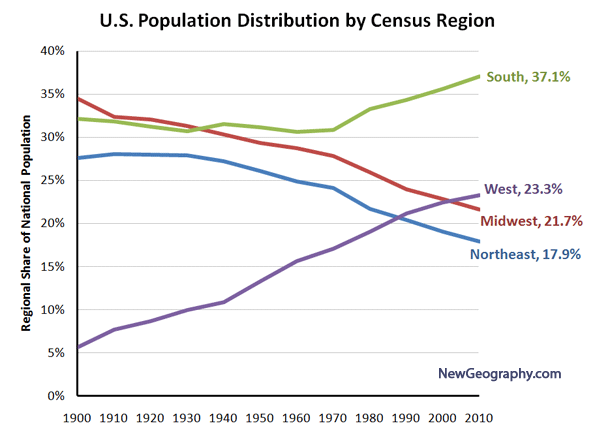
    For a hundred years, Americans have been moving south and west. This, with an occasional hiccup, has continued, according to the 2010 Census.

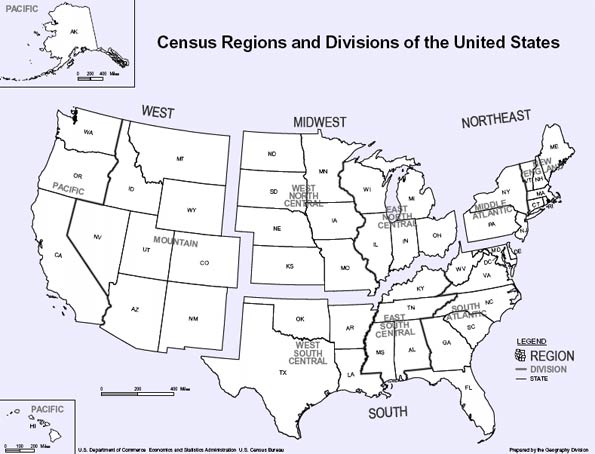
    During the 2000s, 84 percent of the nation’s population growth was in the states of the South and West (see Census region and division map below), while growth has been far slower in the Northeast and Midwest. This follows a pattern now four decades old, in which more than 75 percent of the nation’s population growth has been in the South and West. Indeed in every census period since the 1920s the South and West attracted a majority of the population growth.

    In the first census after World War II, in 1950, the East and the Midwest accounted for 58 percent of the nation’s population, with the South and West making up 42 percent. Since that time, the East and the Midwest have added less than 40 million people, while the South and West added nearly 120 million. Today, the ratios are nearly reversed, with 60 percent of the population living in the South and West and only 40 percent in the East and Midwest.

    The dominance of the South and West was overwhelming. The 24 fastest growing states were all in the South and West. The fastest growing state outside the West and South, surprisingly, was South Dakota, which added a second decade of unprecedented growth, after having gained almost no population between 1930 and 1990.

    Fastest and Slowest Growing States: The fastest growing states were the adjacent Mountain states of Nevada (35.1%), Arizona (24.6%), Utah (23.8%) and Idaho (21.1%). The only large state among the top five growing states was Texas, at 20.1%. These all greatly exceeded the national average growth rate of 9.7%

    Michigan was the only state to lose population (-0.6%) and became the first state in American history to ever exceed 10 million population (earlier in the decade) and then to fall back below that figure. Rhode Island grew only 0.4%. Louisiana grew only 1.4%, which in itself is an accomplishment given the 5 % loss that occurred between 2005 and 2006 after Hurricanes Katrina and Rita. Ohio ranked fourth lowest, gaining only 1.6%. New York continued its laggard performance, gaining only 2.1%. Since the late 1960s, New York (long the largest state) has added little more than one million people, while California added 19 million and has nearly doubled New York’s population.

    California: But all was not well in California. In every 10 year period after the 1920s, California added more people than any other state, until now. Between 2000 and 2010, Texas added 4.1 million people, nearly one million more than California.

    In no decade following the Depression (1930s) has California added so few new residents as in the 2000s. In the 1940s, California’s population rose by 3.7 million, starting from a 1940 base of 6.9 million. During the 2000s, the population increase was 3.4 million, on a 2000 base of 33.8 million.

    California still grew little faster than the national rate (10.0 percent compared to 9.7 percent). Yet this remains the lowest population growth rate for the state since its first Census, in 1850.

    Regional Analysis: The data, both state and regional, that is the basis of the regional analysis below is shown in Tables 1 and 2.

    The South: The South has had the largest share of the nation’s population since the 1940 census and it is now home to nearly 115 million people. The growth has been substantial, with 73 million new residents from 1950 to 2010, expanding 143%, more than twice the national growth rate of 104%. Overall, the South led national growth in the last decade, with a 14.3% rate and adding 14.2 million people. After Texas, the fastest growing states were North Carolina (18.5%), Georgia (18.3%) and Florida (17.6%), which had seen its growth reduced during the housing collapse. South Carolina (15.3%) also grew strongly. Outside of Louisiana, the slowest growth was in West Virginia (2.5%) and Mississippi (4.3%).

    The West: Since 1950, the West has added 58 million people, growing 256%. The West grew the second fastest among the regions, at 13.8% and added 8.7 million residents. As noted above, four of the five fastest growing states were in the Mountain West. In addition, Colorado grew 16.9%.

    The Midwest: Until the emergence of the South in 1940, the Midwest had been the nation’s largest region. Growth has been very slow. Since 1950, the Midwest has added 22.5 million people, but grown only 50 percent, or one-half the national rate of 104 percent. The Midwest had no states that grew above the national rate and had two of the states with the least growth (Michigan and Ohio). Perhaps signaling the rise of the upper Midwest, both North and South Dakota are growing faster than many Eastern or Midwestern states. After decades of population loss, South Dakota experienced unusual growth for the second decade in a row, while North Dakota, grew enough this decade to recover from decades of population loss dating to 1930.

    The Northeast: The nation’s former commercial heartland, the Northeast, has for its third census placed as the nation’s least populated region. A prediction in 1950 that the region housing New York, Philadelphia and Boston would fall so much in relative terms would have been considered absurd. Yet, from 1950 to 2010, the region added 16 million people, for the lowest regional growth rate (40%). The region added less than 2,000,000 population between 2000 and 2010, for a growth rate of 3.2%. The fastest growing state was New Hampshire, at 6.5%, reflecting the growth of its Boston suburbs and exurbs. All other states had growth rates less than one-half of the national rate.

    “Kudos” to the Bureau of the Census: Finally, congratulations are due the Bureau of the Census. In 2000, the Bureau was embarrassed by its under-estimation of the population during the previous decade. At the 1990 to 1999 estimation rate, the 2000 population would have been nearly 7,000,000 below the number of people actually counted in the census. The improvement during the decade of the 2000s was substantial. At the 2000 to 2009 estimate rate, the nation would have had 500,000 more people than were counted in 2010. Missing by less than 0.2 percent is pretty impressive.

    Table 1
    Regional Population: 1950-2010 (Census)
    Division/REGION 1950 1960 1970 1980 1990 2000 2010
    New England 9,314,453 10,509,367 11,841,663 12,348,493 13,206,943 13,922,517 14,444,865
    Middle Atlantic 30,163,533 34,168,452 37,199,040 36,786,790 37,602,286 39,671,861 40,872,375
    NORTHEAST 39,477,986 44,677,819 49,040,703 49,135,283 50,809,229 53,594,378 55,317,240
    East North Central 30,399,368 36,225,024 40,252,476 41,682,217 42,008,942 45,155,037 46,421,564
    West North Central 14,061,394 15,394,115 16,319,187 17,183,453 17,659,690 19,237,739 20,505,437
    MIDWEST 44,460,762 51,619,139 56,571,663 58,865,670 59,668,632 64,392,776 66,927,001
    NORTHEAST & MIDWEST 83,938,748 96,296,958 105,612,366 108,000,953 110,477,861 117,987,154 122,244,241
    Southeast 21,182,335 25,971,732 30,671,337 36,959,123 43,566,853 51,769,160 59,777,037
    East South Central 11,477,181 12,050,126 12,803,470 14,666,423 15,176,284 17,022,810 18,432,505
    West South Central 14,537,572 16,951,255 19,320,560 23,746,816 26,702,793 31,444,850 36,346,202
    SOUTH 47,197,088 54,973,113 62,795,367 75,372,362 85,445,930 100,236,820 114,555,744
    Mountain 5,074,998 6,855,060 8,281,562 11,372,785 13,658,776 18,172,295 22,065,451
    Pacific 15,114,964 21,198,044 26,522,631 31,799,705 39,127,306 45,025,637 49,880,102
    WEST 20,189,962 28,053,104 34,804,193 43,172,490 52,786,082 63,197,932 71,945,553
    SOUTH & WEST 67,387,050 83,026,217 97,599,560 118,544,852 138,232,012 163,434,752 186,501,297
    UNITED STATES 151,325,798 179,323,175 203,211,926 226,545,805 248,709,873 281,421,906 308,745,538


    Table 2              
    States and DC: Population 1950-2010 (Census)  
       
    State 1950 1960 1970 1980 1990 2000 2010
                   
    Alabama 3,061,743 3,266,740 3,444,165 3,893,888 4,040,587 4,447,100 4,779,736
    Alaska 128,643 226,167 300,382 401,851 550,043 626,932 710,231
    Arizona 749,587 1,302,161 1,770,900 2,718,215 3,665,228 5,130,632 6,392,017
    Arkansas 1,909,511 1,786,272 1,923,295 2,286,435 2,350,725 2,673,400 2,915,918
    California 10,586,223 15,717,204 19,953,134 23,667,902 29,760,021 33,871,648 37,253,956
    Colorado 1,325,089 1,753,947 2,207,259 2,889,964 3,294,394 4,301,261 5,029,196
    Connecticut 2,007,280 2,535,234 3,031,709 3,107,576 3,287,116 3,405,565 3,574,097
    Delaware 318,085 446,292 548,104 594,338 666,168 783,600 897,934
    District of Columbia 802,178 763,956 756,510 638,333 606,900 572,059 601,723
    Florida 2,771,305 4,951,560 6,789,443 9,746,324 12,937,926 15,982,378 18,801,310
    Georgia 3,444,578 3,943,116 4,589,575 5,463,105 6,478,216 8,186,453 9,687,653
    Hawaii 499,794 632,772 768,561 964,691 1,108,229 1,211,537 1,360,301
    Idaho 588,637 667,191 712,567 943,935 1,006,749 1,293,953 1,567,582
    Illinois 8,712,176 10,081,158 11,113,976 11,426,518 11,430,602 12,419,293 12,830,632
    Indiana 3,934,224 4,662,498 5,193,669 5,490,224 5,544,159 6,080,485 6,483,802
    Iowa 2,621,073 2,757,537 2,824,376 2,913,808 2,776,755 2,926,324 3,046,355
    Kansas 1,905,299 2,178,611 2,246,578 2,363,679 2,477,574 2,688,418 2,853,118
    Kentucky 2,944,806 3,038,156 3,218,706 3,660,777 3,685,296 4,041,769 4,339,367
    Louisiana 2,683,516 3,257,022 3,641,306 4,205,900 4,219,973 4,468,976 4,533,372
    Maine 913,774 969,265 992,048 1,124,660 1,227,928 1,274,923 1,328,361
    Maryland 2,343,001 3,100,689 3,922,399 4,216,975 4,781,468 5,296,486 5,773,552
    Massachusetts 4,690,514 5,148,578 5,689,170 5,737,037 6,016,425 6,349,097 6,547,629
    Michigan 6,371,766 7,823,194 8,875,083 9,262,078 9,295,297 9,938,444 9,883,640
    Minnesota 2,982,483 3,413,864 3,804,971 4,075,970 4,375,099 4,919,479 5,303,925
    Mississippi 2,178,914 2,178,141 2,216,912 2,520,638 2,573,216 2,844,658 2,967,297
    Missouri 3,954,653 4,319,813 4,676,501 4,916,686 5,117,073 5,595,211 5,988,927
    Montana 591,024 674,767 694,409 786,690 799,065 902,195 989,415
    Nebraska 1,325,510 1,411,330 1,483,493 1,569,825 1,578,385 1,711,263 1,826,341
    Nevada 160,083 285,278 488,738 800,493 1,201,833 1,998,257 2,700,551
    New Hampshire 533,242 606,921 737,681 920,610 1,109,252 1,235,786 1,316,470
    New Jersey 4,835,329 6,066,782 7,168,164 7,364,823 7,730,188 8,414,350 8,791,894
    New Mexico 681,187 951,023 1,016,000 1,302,894 1,515,069 1,819,046 2,059,179
    New York 14,830,192 16,782,304 18,236,967 17,558,072 17,990,455 18,976,457 19,378,102
    North Carolina 4,061,929 4,556,155 5,082,059 5,881,766 6,628,637 8,049,313 9,535,483
    North Dakota 619,636 632,446 617,761 652,717 638,800 642,200 672,591
    Ohio 7,946,627 9,706,397 10,652,017 10,797,630 10,847,115 11,353,140 11,536,504
    Oklahoma 2,233,351 2,328,284 2,559,229 3,025,290 3,145,585 3,450,654 3,751,351
    Oregon 1,521,341 1,768,687 2,091,385 2,633,105 2,842,321 3,421,399 3,831,074
    Pennsylvania 10,498,012 11,319,366 11,793,909 11,863,895 11,881,643 12,281,054 12,702,379
    Rhode Island 791,896 859,488 946,725 947,154 1,003,464 1,048,319 1,052,567
    South Carolina 2,117,027 2,382,594 2,590,516 3,121,820 3,486,703 4,012,012 4,625,364
    South Dakota 652,740 680,514 665,507 690,768 696,004 754,844 814,180
    Tennessee 3,291,718 3,567,089 3,923,687 4,591,120 4,877,185 5,689,283 6,346,105
    Texas 7,711,194 9,579,677 11,196,730 14,229,191 16,986,510 20,851,820 25,145,561
    Utah 688,862 890,627 1,059,273 1,461,037 1,722,850 2,233,169 2,763,885
    Vermont 377,747 389,881 444,330 511,456 562,758 608,827 625,741
    Virginia 3,318,680 3,966,949 4,648,494 5,346,818 6,187,358 7,078,515 8,001,024
    Washington 2,378,963 2,853,214 3,409,169 4,132,156 4,866,692 5,894,121 6,724,540
    West Virginia 2,005,552 1,860,421 1,744,237 1,949,644 1,793,477 1,808,344 1,852,994
    Wisconsin 3,434,575 3,951,777 4,417,731 4,705,767 4,891,769 5,363,675 5,686,986
    Wyoming 290,529 330,066 332,416 469,557 453,588 493,782 563,626
                   
    United States 151,325,798 179,323,175 203,211,926 226,545,805 248,709,873 281,421,906 308,745,538

    Wendell Cox is a Visiting Professor, Conservatoire National des Arts et Metiers, Paris and the author of “War on the Dream: How Anti-Sprawl Policy Threatens the Quality of Life

    Photo by Travelin’ Librarian – Michael Sauers

  • Smart Growth and the Quality of Life

    The idea of “smart growth” should be like mom and apple pie. But take a closer look and you find, for the most part, that smart growth policies often have unintended consequences that are anything but smart.

    If housing is unaffordable, the cost of living is high and people are leaving, it probably means that a state rates higher in smart growth policies. That’s the story from an analysis of the new Smart Growth America state ratings on transportation policies the organization believes would reduce greenhouse gas emissions. The new ratings are based upon strategies recommended in Moving Cooler, a smart growth oriented report authored by Cambridge Systematics in 2009 (Note 1).

    The new Smart Growth America ratings and the Moving Cooler strategies relied, in large measure, on strategies that would force higher population densities, virtually stop development on and beyond the urban fringe, and seek to, in the immortal words of Transportation Secretary Ray Lahood, “coerce” people out of cars.

    Yet when the new ratings are arrayed alongside measures of the quality of life, such as housing affordability and the cost of living, smart growth shows its less attractive side. You can see this, for example, in patterns of domestic migration states with the highest Smart Growth America scores also suffer the highest net domestic out-migration. .

    Quality of Life Indicators: The following analysis compares the Smart Growth America ratings of the states with quality of life indicators, which include lower house prices, a lower cost of living and a greater net domestic migration (Note 2).

    • Housing Affordability: Housing affordability is measured using a median value multiple (Note 3), which is the median house value by the median household income (from the 2009 American Community Survey). Economic research generally indicates that smart growth land use policies lead to higher house prices and lower levels of housing affordability. A lower housing affordability score means that housing is more affordable, and is an indication of a better quality of life. Generally, the median value multiple was 3.0 or below until the housing bubble and remains at that level in some states.
    • Cost of Living: The overall cost of living was examined using regional price parities developed by the Bureau of Economic Analysis (US Department of Commerce) in the form of “regional price parities.” Regional price parities are the domestic equivalent of “purchasing power parities,” which are used to adjust personal income and gross domestic product data between nations. A lower score means that the cost of living is lower and is an indication of a better quality of life.
    • Net Domestic Migration: Net domestic migration rates are for the period of 2000 to 2009 and based upon Bureau of the Census data and is calculated as a percentage of the 2000 population. A higher score means that more people are moving in than moving out. A state with a higher score is more attractive to movers than states with lower scores, which is also an indication of a better quality of life.

    The Top (Mostly Bottom) Ten

    Generally, the states with the highest Smart Growth America ratings perform the worst by these quality of life indicators.

    California is first in Smart Growth America score, at 82 (out of a possible 100). Yet, California ranks 49th in housing affordability, 48th in cost of living and 45th in net domestic migration, having lost 4.4 percent of its population (1.5 million) to other states since 2009. California’s average rank among the quality of life indicators is 47, essentially a mirror image of its Smart Growth America rating. Only New York has a worse average ranking (49th).

    Maryland is second in Smart Growth America score, at 77. However, Maryland ranks 42nd in housing affordability, 41st in the cost of living and 36th in net domestic migration, having lost 1.8 percent of its residents (nearly 100,000) to other states since 2000. Maryland’s average rank is 40th on the quality of life indicators.

    New Jersey ranks third, with a Smart Growth America score of 75. New Jersey ranks 45th in housing affordability, 47th in the cost of living and 47th in domestic migration, having lost 4.5 percent of its population (450,000) to other states during the decade. Among the top ten, only California has a worse average ranking than New Jersey’s, at 46th on the quality of life indicators.

    Connecticut ranks fourth, with a Smart Growth America score of 70. Connecticut ranks 40th in housing affordability, 46th in cost of living and 40th in domestic migration, having lost 2.8 percent (nearly 100,000) of its population. Connecticut’s average rank is 42th in the quality of life indicators.

    Washington is fifth in Smart Growth America score, at 68. Washington ranks 44th in housing affordability and 40th in cost of living. Washington ranked much higher, however, in domestic migration at 14th, with a gain of 4.0 percent (240,000). Washington, like other western states, has been the recipient of strong migration from even more expensive coastal California. Washington’s average rank is 33rd in the quality of life indicators.

    Oregon ranks sixth, with a Smart Growth America score of 65. The state ranks 47th in housing affordability (trailing Hawaii, California and New York), but has a higher average cost of living ranking (31st) and in domestic migration, principally because it, like Washington is a favored destination by people fleeing California.

    Seventh ranked Massachusetts (64) scores much more consistently in the quality of life indicators, at 46th in housing affordability, 45th in the cost of living, 44th in net domestic migration and 45th overall.

    Neighboring Rhode Island (61) ranks eighth and is also a consistent performer, ranking 43rd in housing affordability and net domestic migration, 44th in the cost of living and 43rd overall.

    Delaware and Minnesota share 9th place with a Smart Growth America score of 59. Delaware’s average ranking is 28th, and Minnesota’s average ranking is 29th. Delaware’s ranking, near the top of the bottom 25 is driven by a high net domestic migration rate. Minnesota scores similarly in all quality of life indicators.

    Two states scoring the worst in the quality of life indicators were notably absent in the Top (Mostly Bottom) Ten. New York’s average rank was 49, compared to its Smart Growth America rank of 21. Hawaii’s average quality of life indicator rank was 46 and its Smart Growth America rank was 15. Some of the worst housing affordability and highest costs of living drove their low quality of life scores.

    States with Higher Quality of life Indicators

    The five states with the lowest Smart Growth America scores are Nebraska, North Dakota, West Virginia, Mississippi and Arkansas. These states surely qualify as “flyover” country, being well removed from the more elite coasts. Yet, each of these states scores considerably better than Smart Growth America’s top ten states, with some of the nation’s best housing affordability and lowest costs of living. Slightly more people moved out of these states than moved in. However, bottom ranked Arkansas (Smart Growth America score of 2) attracted 75,000 net domestic residents, almost 1.6 million more than Smart Growth America’s top ranked California and 170,000 more than second ranked Maryland.

    Texas (15th), North Carolina (16th) and Georgia (17th) were among the higher scoring large states in the quality of life indicators. The high Texas ranking resulted from higher rankings in housing affordability and net domestic migration. Georgia and North Carolina had among the highest rankings in net domestic migration.

    Statistical Analyses

    For fun, I did a quick statistical analysis, which indicated that inferior housing affordability and a higher cost of living are associated with a higher Smart Growth America score, at a 99 percent level of confidence (Note 4).

    This relationship is evident in Table 1, which is a summary by Smart Growth America scores. Housing affordability and the cost of living all improve as the Smart Growth America score declines. At this level, a similar relationship is evident in the net domestic migration rate, with the exception of states with a Smart Growth America score of under 20. The states with the highest Smart Growth America ratings (60 and over) lost 2.5 million domestic migrants, while the states with scores from 40 to 60 lost 500,000. States with Smart Growth America ratings under 40 gained 2.5 million domestic migrants, more people than live in all of the nation’s municipalities except for New York, Los Angeles and Chicago. Table 2 provides detailed data for all states.

    Table 1
    Quality of Life Indicator Summary by Smart Growth Score
    Smart Growth America Score
    Housing Affordability
    Cost of Living
    Net Domestic Migration Rate
    Net Domestic Migration
    60 & Over             

    5.1
          

    114.5
    -1.7%
         

    (2,035,132)
    40 to 60             

    4.3
          

    102.2
    1.8%
            

    (501,121)
    20 to 40             

    3.3
            

    87.7
    2.2%
          

    2,576,584
    Under 20             

    2.6
            

    79.2
    -0.5%
                  

    (517)
    Table 2
    Smart Growth America Transportation Ratings & Quality of Life Indicator Summary by State
    Smart Growth America Rating
    Quality of Life Indicators
    State
    Housing Affordability
    Cost of Living
    Net Domestic Migration Rate
    Average Rank
    Value
    Rank
    Value
    Rank
    Value
    Rank
    Value
    Rank
    California
    82
    1
         

    6.5
    49
    129.1
    48
    -4.4%
    45
    47
    Maryland
    77
    2
         

    4.6
    42
    106.5
    41
    -1.8%
    36
    40
    New Jersey
    75
    3
         

    5.1
    45
    125.6
    47
    -5.4%
    47
    46
    Connecticut
    70
    4
         

    4.3
    40
    121.6
    46
    -2.8%
    40
    42
    Washington
    68
    5
         

    5.1
    44
    102.9
    40
    4.0%
    14
    33
    Oregon
    65
    6
         

    5.3
    47
    95.4
    31
    5.2%
    9
    29
    Massachusetts
    64
    7
         

    5.3
    46
    120.8
    45
    -4.3%
    44
    45
    Rhode Island
    61
    8
         

    4.9
    43
    113.7
    44
    -4.3%
    43
    43
    Delaware
    59
    9
         

    4.4
    41
    97.7
    34
    5.8%
    8
    28
    Minnesota
    59
    9
         

    3.6
    26
    92.6
    28
    -0.9%
    32
    29
    Vermont
    57
    11
         

    4.2
    37
    99.5
    36
    -0.2%
    29
    34
    Illinois
    53
    12
         

    3.7
    28
    99.2
    35
    -4.9%
    46
    36
    Virginia
    51
    13
         

    4.3
    38
    102.1
    39
    2.3%
    19
    32
    Wisconsin
    51
    13
         

    3.4
    21
    91.5
    24
    -0.2%
    28
    24
    Hawaii
    50
    15
         

    8.1
    50
    133.4
    50
    -2.4%
    38
    46
    Pennsylvania
    50
    15
         

    3.3
    20
    94.2
    29
    -0.3%
    30
    26
    Arizona
    45
    17
         

    3.9
    30
    94.4
    30
    13.5%
    2
    21
    Florida
    45
    17
         

    4.1
    34
    99.9
    37
    7.2%
    6
    26
    Michigan
    45
    17
         

    2.9
    12
    92.5
    27
    -5.4%
    48
    29
    Nevada
    42
    20
         

    3.9
    32
    100.4
    38
    17.9%
    1
    24
    New York
    41
    21
         

    5.6
    48
    131.8
    49
    -8.7%
    50
    49
    New Mexico
    37
    22
         

    3.7
    27
    83.5
    14
    1.4%
    23
    21
    Colorado
    36
    23
         

    4.3
    39
    97.1
    32
    4.7%
    10
    27
    Utah
    36
    23
         

    4.1
    33
    86.5
    19
    2.4%
    18
    23
    Kentucky
    35
    25
         

    2.9
    13
    80.8
    4
    2.0%
    21
    13
    Tennessee
    35
    25
         

    3.3
    19
    84.7
    18
    4.6%
    12
    16
    Alaska
    34
    27
         

    3.5
    23
    106.7
    42
    -1.2%
    33
    33
    Maine
    33
    28
         

    3.9
    31
    92.2
    26
    2.3%
    20
    26
    South Carolina
    33
    28
         

    3.2
    18
    83.2
    13
    7.6%
    5
    12
    New Hampshire
    32
    30
         

    4.1
    35
    113
    43
    2.6%
    17
    32
    Georgia
    31
    31
         

    3.4
    22
    87.9
    23
    6.7%
    7
    17
    Kansas
    31
    31
         

    2.6
    7
    83.6
    16
    -2.5%
    39
    21
    Idaho
    30
    33
         

    3.8
    29
    82.7
    10
    8.5%
    3
    14
    Iowa
    28
    34
         

    2.5
    3
    82.9
    11
    -1.7%
    35
    16
    Ohio
    28
    34
         

    3.0
    15
    87.2
    21
    -3.2%
    42
    26
    Texas
    27
    36
         

    2.6
    6
    91.7
    25
    4.0%
    15
    15
    North Carolina
    26
    37
         

    3.6
    25
    86.9
    20
    8.2%
    4
    16
    Missouri
    25
    38
         

    3.1
    16
    81.3
    7
    0.7%
    27
    17
    Oklahoma
    24
    39
         

    2.6
    4
    81.6
    8
    1.2%
    24
    12
    Alabama
    23
    40
         

    3.0
    14
    80.8
    4
    2.0%
    22
    13
    Louisiana
    23
    40
         

    3.2
    17
    83.6
    16
    -7.0%
    49
    27
    Montana
    23
    40
         

    4.2
    36
    83.1
    12
    4.4%
    13
    20
    South Dakota
    23
    40
         

    2.8
    11
    82.3
    9
    1.0%
    26
    15
    Wyoming
    21
    44
         

    3.5
    24
    97.4
    33
    4.6%
    11
    23
    Indiana
    20
    45
         

    2.7
    9
    83.5
    14
    -0.4%
    31
    18
    Nebraska
    18
    46
         

    2.6
    5
    87.3
    22
    -2.3%
    37
    21
    North Dakota
    18
    46
         

    2.4
    1
    79.5
    3
    -2.8%
    41
    15
    West Virginia
    13
    48
         

    2.5
    2
    70.3
    1
    1.0%
    25
    9
    Mississippi
    12
    49
         

    2.7
    8
    80.8
    4
    -1.3%
    34
    15
    Arkansas
    2
    50
         

    2.7
    10
    78.2
    2
    2.8%
    16
    9
    Housing Affordability: Median House Value/Median Household Income, 2009
    Cost of Living: Regional Price Parities, 2006
    Net Domestic Migration: 2000-2009 Migration/2000 Population

    ——————-
    Note 1: Moving Cooler has been criticized by Alan Pisarksi (ULI Moving Cooler Report: Exaggerations and Misconceptions) and this author (Reducing Vehicle Miles Traveled Produces Meager Greenhouse Gas Emissions Returns) in previous newgeography.com articles.

    Note 2: There are additional quality of life indicators, such as shorter work trip travel times, less intense traffic congestion, less intense air pollution, more living space, etc.

    Note 3: This measure is based upon median house value, which is the only data available at the state level. The median value multiple is different from the Median Multiple (median house price divided by median household income), which is widely used in metropolitan area analysis (such as in the Demographia International Housing Affordability Survey).

    Note 4: Details of the regression analysis: The dependent variable was the Smart Growth America score. The independent variables were the cost of living indicator and the domestic migration rate. The coefficient of determination (R2) was 0.55. (The positive relationship to the cost of living was strong, with a probability of only 1 in 10,000 that the result could have occurred by chance. The indicated association with the net migration rate was weak; the chance association cannot be ruled out).

    Wendell Cox is a Visiting Professor, Conservatoire National des Arts et Metiers, Paris and the author of “War on the Dream: How Anti-Sprawl Policy Threatens the Quality of Life