Category: Demographics

  • Toward a Continental Growth Strategy

    North America remains easily the most favored continent both by demography and resources. The political party that harnesses this reality will own the political future.

    America cannot afford a prolonged period of slow economic growth. But neither Democrats nor Republicans are prepared to offer a robust growth agenda. Regardless of what happened in the November midterm elections, the party that can outline an economic expansion strategy suitable to this enormous continental nation will own the political future.

    Economic expansion that barely exceeds the current 2 percent or less is woefully insufficient for the United States. Such meager growth could perhaps work in countries with very low birthrates and limited immigration, such as in much of Europe and Japan, but not in the demographically vibrant United States.

    In the years between 2000 and 2050, Europe’s workforce will decline by 25 percent; Japan’s by 44 percent; China’s by 10 percent. In contrast, America’s workforce is expected to expand by more than 40 percent, adding millions of new entrants from an increasingly diverse population.

    Given the growth in workforce, it is impossible to see how the country succeeds without rapid expansion not only of employment but also a broad-based wealth creation. Despite conservative attempts to dress up the numbers, the vast bulk of all the gains in wealth since 2000 have been achieved by the relatively small number of Americans with incomes significantly above the poverty level. Meantime many middle-tier educated and skilled workers have lost ground while the rate of upward mobility has stagnated.

    The collapse of the housing bubble has eliminated the one way that middle class families took advantage of economic growth during the Bush years. Under Obama, virtually all the gains have been to the stock market (up 30 percent) and corporate profits (42 percent). Meanwhile, weekly earnings, jobs, and home sales price all stagnated or declined. But the biggest price may be paid by young people; even those with degrees have lagged behind in wage growth as they crowd into a labor market potentially far tougher than the one their boomer parents faced.

    All this suggests an emerging “aspiration gap” that could define our politics for much of the next few decades. Today, belief in the achievability of the “American dream,” according to a recent survey by Strategy One, has dropped to the low 40s. Americans may still overwhelmingly believe in the ideal of upward mobility but, as individuals, now only a minority feel they can achieve it themselves.

    The “aspiration gap” fundamentally does not advantage either party at the moment. Democrats are set for large losses in the 2010 election. But party identification and approval for the GOP remain low, particularly among the rising minority and millennial constituencies. Even in suburbia, amid rapidly rising middle class angst, the Republicans, according to a recent Hofstra University poll, have lost more support than the Democrats since 2008. Independents have been the big winner and constitute the largest faction of suburbanites—more than 36 percent, compared to just 30 percent two years ago.

    Our Failing Parties: The Democrats

    Let’s start with the Obamacized Democratic Party. Up through the 1990s, the Democrats still maintained strong links to small businesses, private sector unions, and the old Midwest industrial economy. This gave them reasons to favor growth-inducing policies that could close the “aspiration gap.”

    But today the party has become captured largely by the coastally oriented alliance of public employees, their charges, greens, and the professiorate—what Fred Siegel calls an alliance of the “overeducated and the undereducated.” For the most part, these constituencies are largely detached from the private sector, and thus only tangentially interested in economic growth. Even high unemployment, unsurprisingly, was not the primary concern for an administration dominated by longtime public servants and tenured professors—people who rarely lose their jobs.

    This indifference stems not so much from a traditional socialist agenda, as imagined by some conservatives, but by the nature of the party’s constituencies. It is more a dictatorship of the professoriate than that of the proletariat.

    Further obscuring the growth agenda is the fact that some key advisors consider growth itself inherently evil. Take for instance the president’s science advisor John Holdren. A protégé of the Malthusian Paul Ehrlich, Holdren long has favored the planned “de-development” of Western economies in order to reduce consumption.

    The “de-development” agenda has been bolstered by the growth of the climate change industry. Proposals for “cap and trade” rules or Environmental Protection Agency regulations on greenhouse gases represent profound threats to basic industries like manufacturing, housing, and agriculture. In contrast, they have proven boffo for university research grant-seekers and Silicon Valley venture capitalists, who increasingly focus on “clean” technologies subsidized by government grants and edicts favoring their technologies.

    The climate change agenda also distorts the administration’s approach to infrastructure. Instead of focusing on transportation bottlenecks effecting companies and commuters on a daily basis, the administration has favored massive boondoggles such as high-speed rail or sometimes poorly conceived light-rail systems. These are often too expensive compared to alternatives, and not well-suited to the needs of most American communities or companies.

    Our Failing Parties: The Republicans

    Today, with as many as 25 million Americans unemployed or underemployed, the Democratic Party still seems to be missing a coherent program to put them back to work. Sadly, much the same can be said of the Republicans, who benefit from populist outrage about the stimulus, but also lack an answer to the deepening aspirational gap.

    The fundamental problem is obvious at the level of the Tea Party, the grassroots driving force behind today’s GOP. Tea partiers know what they are against—higher taxes and government spending—but have not developed much in the way of approaches to spur growth.

    This is epitomized by the career of the movement’s patron saint, Sarah Palin. Celebrated by many in the “lower 48,” Palin is widely seen among Alaska’s predominately Republican business community as indifferent to economic growth. As governor, they maintain, she proved more interested in redistribution to the middle class—through larger checks from the state’s energy fund—than in investing in things like new infrastructure.

    “She epitomizes the whole idea of we get a piece and no sense of planning for the future, about thinking about what we need to do,” notes Jim Egan executive director of Commonwealth North, a local think tank.

    Long-term growth, in Alaska and elsewhere, Egan suggests, needs government to play a critical supporting role. The fact that the Obama administration missed its opportunity to focus on basic infrastructure in its bungled, politically driven stimulus does not mean that investing in the future is an inherently bad idea.

    The Republican embrace of austerity represents good policy when it comes to reducing wasteful spending, notably on public employee pensions. But knee-jerk resistance to any government spending could prove detrimental in an increasingly competitive world.

    Needed: A Continental Strategy

    To promote economic growth, the country needs to develop a new national consensus around which I call “a continental strategy.” This would focus on taking advantage of the unique demographic and resource assets of this country as well as its North American neighbors, Mexico and Canada.

    Today the United States faces formidable competitors, notably from China, India, and Brazil. These are proud, vast countries with considerable resources and an expanding middle class population. At least in the short run, they suffer neither the ruinous demography of Japan nor the elaborate welfare burdens of Western Europe.

    Already these countries are investing in their basic infrastructure so that they can tie their vast landmass together and profit from it.

    Hard as it is to imagine amid the wreckage of the stimulus, American history is replete with examples of how government can actually do good things. The public support for canals, railway lines, the New Deal engineering and construction projects, the Interstate Highway, and space programs all greatly benefited the country’s economy. They underpinned first American leadership in the industrial age, and then in the information economy. In recent decades, public investment in basic infrastructure construction and maintenance has declined, even in the face of considerable population growth.

    “One looks back at that map ‘Landscape by Moses,’” writes the sociologist Nathan Glazer, about the legacy of New York City’s “master builder” Robert Moses, “and if one asks what has been added in the 50 years since Moses lost power, one has to say astonishingly: almost nothing.”

    Restoring our priority towards binding together and improving our continental infrastructure remains critical to achieving greater economic growth. Rather than a policy of retrenchment, it would represent a return to an approach that sparked our original ascendency and could gain broad bipartisan support.

    Even today, what makes a continental strategy so compelling lies with this often overlooked reality: North America remains easily the most favored continent both by demography and resources. It possesses the world’s second-largest oil reserves and massive, still largely untapped natural gas supplies.

    North America also constitutes by far the world’s richest agricultural area, with the most arable land. This is a huge advantage as global food demands grow over the next few decades. Critically, the continent also boasts more than four times as much water per capita as either Asia or Europe.

    Most important still, North America retains a unique demographic vitality among all advanced countries. It continues to lure upwardly mobile people from around the world: roughly half of the world’s educated migrants come to America, and a considerable number also head for Canada.

    Ultimately a continental strategy meets the needs of large segments of the country—ranging from immigrants and their children to millennials—who will dominate our emerging job market. These same groups in the coming decades will also shape our political future.

    The party that offers these new voters the greatest opportunities for work, raising a family, and buying a house will be the one that dominates the political future. As generational chroniclers Mike Hais and Morley Winograd, both committed Democrats, have pointed out, millennials are essentially nonideological; they will be attracted to those policies that work, both for society and for their young families.

    Although this year’s political results may please conservative ideologues, they should recognize that this represents only the defeat of poorly executed Obamian statism. The future belongs to whichever party emerges as the true party of growth.

    This article originally appeared at The American.

    Joel Kotkin is executive editor of NewGeography.com and is a distinguished presidential fellow in urban futures at Chapman University. He is author of The City: A Global History. His newest book is The Next Hundred Million: America in 2050, released in February, 2010.

    Photo by IronRodArt – Royce Bair

  • If California Is Doing So Great, Why Are So Many Leaving?

    Superficially at least, California’s problems are well known. Are they well understood? Apparently not.

    About a year ago Time ran an article, “Why California is Still America’s future,” touting California’s future, a future that includes gold-rush-like prosperity in an environmentally pure little piece of heaven, brought to us by “public-sector foresight.”

    More recently, Brett Arends’ piece at Market Watch, “The Truth About California,” is more of the same. California’s governor elect, Jerry Brown, liked this piece so much that he tweeted a link to it.

    The optimist’s argument about California’s future ultimately hinges on the creativity of the state’s vaunted tech sector, in large part driven by regulation promulgated by an enlightened political class and funded by a powerful venture capital sector.

    No fundamentalist evangelical speaks with more conviction or faith than a California cheerleader expounding on the economic benefits of environmental purity brought about by command and control regulation.

    The more honest cheerleaders acknowledge that California has challenges, including persistent budget problems. Arends denies even the existence of a budget problem, demanding “Er, no, actually. It’s your assertion. You do the math.” Let me help you, Brett. The non-partisan California Legislative Analyst’s Office has done the math. You can find it here. They expect budget shortfalls in excess of $20 billion a year throughout their forecast horizon. This is on annual revenues of less than $100 billion.

    Last week the numbers got even worse, as the Governor-elect, Jerry Brown, acknowledged. The deficit may now be as much as $28 billion this year, and over $20 billion for the foreseeable future. This is more than a nuisance. There’s a reason, after all, why California has among the worst credit ratings of any state.

    Most people outside of California haven’t drank from this vat of the economic equivalent of LSD-laced Kool-Aid. People know that a state is in trouble when it has persistent intractable budget deficits, chronic domestic net out-migration, and 30 percent higher unemployment than the national average. Indeed, California’s joblessness, chronic budget deficits, governors, and credit rating have made the state the butt of jokes worldwide.

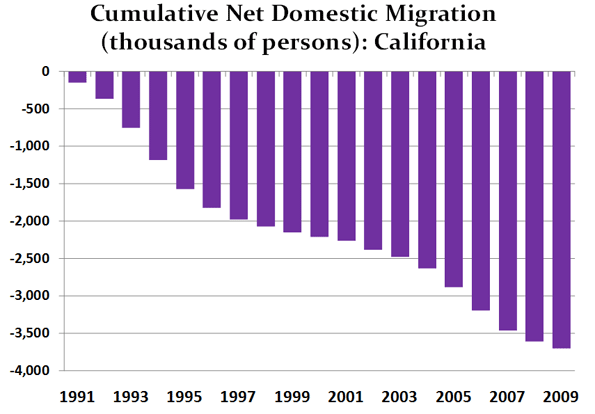
    How bad are things in California? California’s domestic migration has been negative every year since at least 1990. In fact, since 1990, according to the U.S. Census, 3,642,490 people, net, have left California. If they were in one city, it would be the third largest city in America, with a population 800,000 more than Chicago and within 200,000 of Los Angeles’ population.

    We’re seeing a reversal of the depression-era migration from the Dust Bowl to California. While California has seen 3.6 million people leave, Texas has received over 1.4 million domestic migrants. Even Oklahoma and Arkansas have had net-positive domestic migration trends from California.

    Those ultimate canaries in the coal mine, illegal immigrants, recognize California’s problems. Twenty years ago, about half of all United States illegal immigrants went to California. Today, that’s down to about one in four.

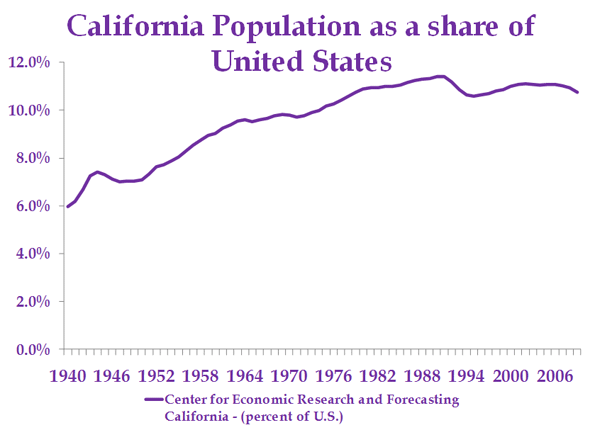
    The result of these migration trends is that California’s share of the United States population has been declining.

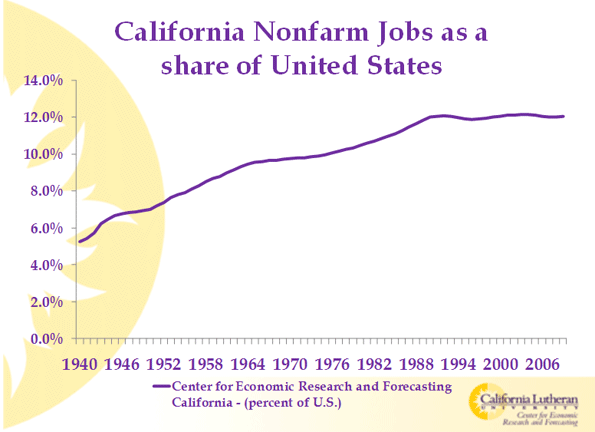
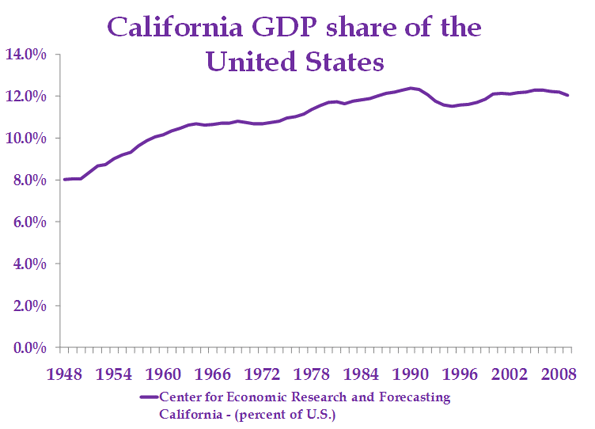
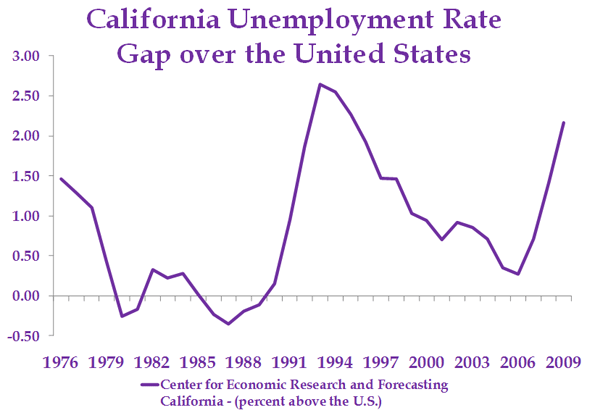
    What do these migrants see that so many of California’s political class do not see? They see a lack of opportunity. California’s share of United States jobs and output has declined since 1990, and its unemployment rate has remained persistently above the United States Average, only approaching the average during the housing boom.

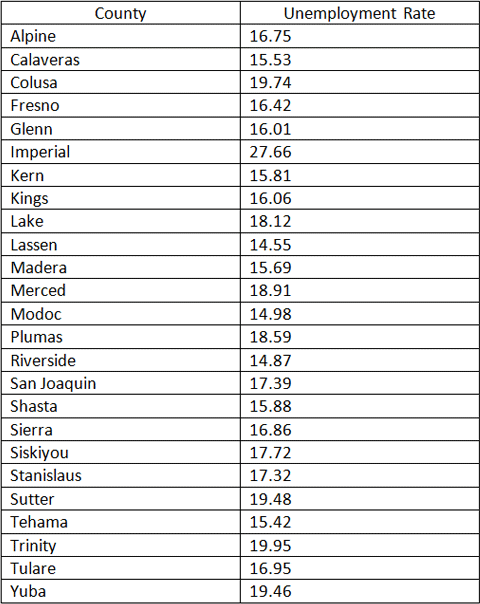
    California’s unemployment is particularly troubling. As of October 2010, only two states, Nevada at 14.2 percent and Michigan at 12.8 percent, had higher unemployment rates than California’s 12.4 percent. California’s unemployment problem is particularly severe in its more rural counties. Twenty-five of California’s 58 counties have unemployment rates higher than Nevada’s:


    These unemployment rates approach depression levels. Some will excuse many of them because they are in agricultural areas, but many assert that low Midwest unemployment rates are due to a booming agricultural sector. Which one is it?

    California’s unemployment problems are not limited to rural and agricultural areas. Most of Riverside County’s population is very urban, yet the County’s unemployment rate is 14.87 percent. On December 7th, the Wall Street Journal listed the unemployment rates for 49 of America’s largest urban regions. California had six of the 19 metro areas with double-digit unemployment. These include such major cities San Diego, San Jose, and Los Angeles.

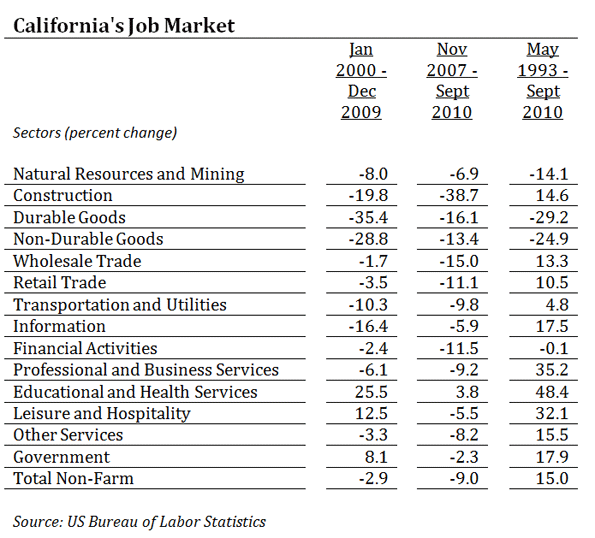
    Just as rural areas are not California’s only depressed areas, agriculture is not California’s only ailing sector. From 2000 to 2009, the only California sectors to gain jobs were government, education and health services, and leisure and hospitality.

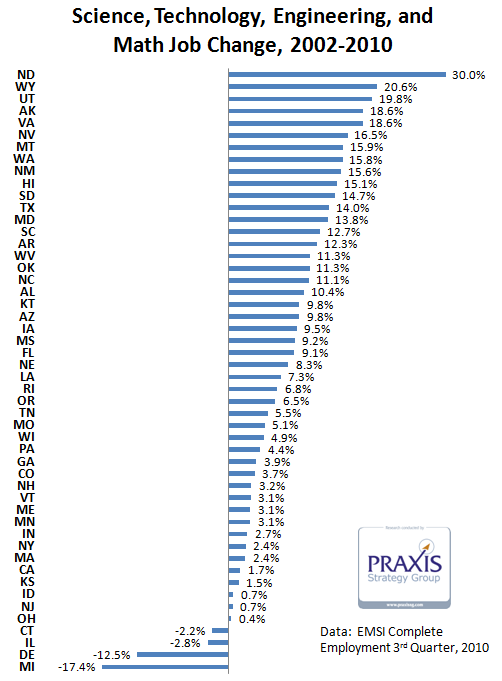
    California’s cheerleaders claim that the state’s future is assured by a vibrant tech sector, but the data do not support that assertion. North Dakota’s Praxis Strategy Group has performed analysis by job skills. They compare Scientific, Technical, Engineering, and Math (STEM) jobs across states. Their analysis shows that California is the Nation’s ninth worst state in creating STEM jobs in post dot-com-bust years. It has produced far fewer new tech jobs than Texas, and far less on average, than the country over the past decade:


    In this respect, California’s precipitous decline is really quite shocking. In just a couple of decades, California has gone from being America’s economic star, a destination for ambitious people from around the world and abundant with opportunity, to home of some of America’s most distressed communities. It has been a man-made, slow motion tragedy perpetuated by a political class that is largely deluded.

    The cheerleader’s faith in command and control regulation and environmental purity is so strong they cannot see anything that contradicts that faith.

    But that faith is misplaced. Joel Kotkin, Zina Klapper, and I performed an extensive review of the economic impacts of one of California’s most important greenhouse gas regulation, AB 32, and found that command and control regulation in general and AB 32 in particular is inefficient, cost jobs, and depress economic activity. California’s Legislative Analyst’s Office agrees, as evidenced by this report.

    More depressing still are the growing ranks of what could be called “the resigned”. They simply have given up. These include a business leadership that is more interested in survival and accommodation than pushing an agenda for growth. Easier to get along here, and expand jobs and opportunities elsewhere, whether in other states or overseas.

    Yet ultimately California’s future is what Californians make of it. No place on Earth has more natural amenities or a more benevolent climate. No place has a location more amenable to prosperity, located between thriving Pacific Rim economies and the entire North American market. No place has more economic potential.

    But unless policy is changed, California’s future is dismal, with the specter of stubbornly high unemployment, limited opportunity, and the continued exodus of the middle class. California’s political class needs first to confront reality before we can hope to avoid a dismal future.

    Bill Watkins is a professor at California Lutheran University and runs the Center for Economic Research and Forecasting, which can be found at clucerf.org.

    Photo by Stuck in Customs

  • Education Wars: The New Battle For Brains

    The end of stimulus — as well as the power shift in Congress — will have a profound effect on which regions and states can position themselves for the longer-term recovery. Nowhere will this be more critical than in the battle for brains.

    In the past, and the present, places have competed for smart, high-skilled newcomers by building impressive physical infrastructure and offering incentives and inducements for companies or individuals. But the battle for the brains — and for long-term growth — is increasingly tied to whether a state can maintain or expand its state-supported higher education. This is particularly critical given the growing student debt crisis, which may make public institutions even more attractive to top students.

    The great role model for higher-education-driven growth has been California. The Golden State’s master plan for education — developed under Pat Brown in 1960 — created an elaborate multi-tiered public system that offered students a low-cost and generally high-quality alternative education. Over the next half century, California became, in historian Kevin Starr’s phrase, a “utopia for higher education,” as well as a model for other states and much of the world.

    Today many of the states that copied California’s model — notably North Carolina, Texas and Virginia- — threaten to upend the Golden State’s dominance of public higher education. These states now all spend far more than traditional leader California when you look at percentage of state expenditures; Virginia, for example, spends twice as much of its state budget on higher ed than California does. New York and Illinois spend an even a smaller percentage.

    The combination of fiscal woes and misplaced priorities has engendered spending cuts in California. Tuitions for higher public education have soared: In 2009 they were raised 30%, and they have been raised over 100% over the past decade.

    To be sure, the University of California (disclaimer: I attended the Berkeley campus) retains a huge reservoir of talent, with courses taught by 111 Nobel Laureates. It still dominates lists of top public universities;  six of the top 14 schools in the US News and World Report 2010 rankings are UC schools.  But the signs of relative decline are clear. In 2004, for example, the London-based Times Higher Education ranked UC Berkeley the second leading research university in the world, just behind Harvard; in 2009, that ranking, due largely to an expanding student-to-faculty ratio, had tumbled to 39th place.

    Other states are now looking to knock California further off its perch. In 2009 alone the University of Texas lured three senior faculty members from UC. As departments shrink at places like Berkeley, those in schools such as the University of Texas at Austin, Texas A&M and Texas Tech have expanded rapidly, adding students and buildings.

    Of course, these schools also have budget problems, and they have increased tuition too–albeit at a significantly lower rate. But for the most part, these up-and-coming state systems are more focused on expansion than on retrenching and survival. While some in California question the viability of some of the newer UC campuses, Texas is busily expanding its roster of tier-one, public research universities, seeking to add the University of Houston as well as UT campuses in north Texas, Arlington, Dallas, El Paso and San Antonio to the ranks of UT Austin, Texas A&M and Rice, a private school in Houston.

    Texas Tech,  best known for its engineering and agriculture-oriented programs, for example, is thriving. Located on the windy Great Plains on the western side of the state, it is far from the state’s major metropolitan areas, and its home town of Lubbock (population: 225,000) is likely not high on anyone’s list of hip and cool college towns. Yet the school, which enjoys strong alumni and business support, is in the midst of a major building boom and a $1 billion capital campaign. When I visited there earlier this month, the campus was full of construction crews; Texas Tech has added over 3000 students in the past two years and now has over 31,000 students.

    Other unlikely upstarts include the University of North Dakota, which has boosted spending by 18.5% in 2009, a luxury afforded by the state’s booming energy, agriculture and increasingly high-tech economy. North Dakota, which historically has suffered significant loss of young talent, has set a goal to rank No. 1 in the average education of its population. Today it already ranks No. 3 in terms of college-educated residents between the ages of 25 and 34.

    These shifts could presage — and to some degree enhance — what is already a powerful trend toward states that, in the past, have been educational also-rans. Although Texas also faces budgetary constraints, its annualized $9 billion deficit is dwarfed by those of California, Illinois and New York. And those bluish states already have much higher tax rates, which leave less room for revenue increases. Texas also has the luxury of an $8.2 billion “rainy day” fund, as well as a more vibrant economy.

    More important still, states like North Carolina, Virginia and Texas continue to grow more rapidly than the older brain-center states. This is particularly true in terms of the high-tech jobs many graduates would likely seek.  Indeed since 2002 these states have all enjoyed far greater growth rates in high-tech employment than California, Illinois, Michigan or New York. They also have added more new tech jobs in actual numbers than California–despite their significantly smaller size.

    Migration patterns are also changing among college-educated workers. Between 2005 and 2007, Texas, Virginia and North Carolina already enjoy higher rates per capita of net migration of educated workers between the ages of 22 and 39 than California, New York or Massachusetts.

    This advantage could expand as the upcoming states increase their educational offerings along with employment opportunities. Students may end up tempted to attend schools closer to where there is job growth. Unlike Austin and Raleigh-Durham, which have rapidly expanded tech employment, Silicon Valley has produced virtually no new net tech jobs for the past decade.

    The second impact may  be more subtle, as declining revenues from businesses and individuals reduces the opportunity to boost education spending. As the country stumbles into this recovery, the greatest advantage will fall not only to states with the most natural resources, but those with the best-educated human resources. For a half century this is a game that states like California have played to perfection, but it is one in which other places are likely to catch up, and perhaps even pass. The long-term implications for the nation’s economic geography could prove profound.

    Joel Kotkin is executive editor of NewGeography.com and is a distinguished presidential fellow in urban futures at Chapman University. He is author of The City: A Global History. His newest book is The Next Hundred Million: America in 2050, released in February, 2010.

    Photo by Luca Zappa

  • China’s Urbanization: It Has Only Just Begun

    In May, disgruntled workers of Honda factories in Zhongshan, southern China, went on strike at the Honda Lock auto parts factory and started posting accounts of the walkout online, spreading word among themselves and to workers elsewhere in China.

    In June, Bloomberg reported that China, “once an abundant provider of low-cost workers, is heading for the so-called Lewis turning point, when surplus labor evaporates, pushing up wages, consumption and inflation.” China had depleted its surplus labor; the period of cheap labor was over.

    In the subsequent debate, some observers concurred with the observation that a turning point had arrived in China. Others noted that the conclusion is too simplistic because it does not fit into the big picture of China’s demography.

    With the gloomy economic prospects in the advanced economies and relatively strong recovery in the large emerging economies, the debate is about to resurface.

    Eclipse of “Unlimited Supplies of Labor”

    In 1954 Arthur Lewis published one of the most influential development economics articles, “Economic Development with Unlimited Supplies of Labor,” which contributed to his Nobel Prize a quarter of a century later. In this paper, Lewis sought to provide a broad portrayal of the development process, based on the current state of the developing countries, the historical experience of developed countries, and some central ideas of the classical economists.

    In the Lewis story a “capitalist” sector develops by taking labor from a non-capitalist backward “subsistence” sector. At an early stage of development, there would be “unlimited” supplies of labor from the subsistence economy, which means that the capitalist sector can expand without the need to raise wages. The implication is that industrial wages in developing countries begin to rise quickly at the point when the supply of surplus labor from the countryside tapers off.

    Lewis likely would have recognized the validity of his tipping point in the more prosperous first-tier cities of China where there clearly are increasing labor shortages and which thus reflect the world of classical economics. However, had he taken a tour in China’s smaller cities, or ventured into the countryside, he would have recognized there still remains “unlimited supplies of labor” – the world portrayed by the classical political economists, including David Ricardo, Adam Smith, and Karl Marx.

    So has China reached the Lewisian tipping point? The answer is yes and no: in some regions yes, but in all of China, emphatically n no.

    Urbanization and Growth through Tiered Cities

    Starting in the 1980s, China’s reform and opening up were initiated by the creation of the coastal special economic zones (SEZs), initially in the southern province of Guangdong, close to Hong Kong and Macao. Soon the reform extended from urban agglomerations such as Shenzhen and Guangzhou to other primary cities, from Beijing to Shanghai – thanks to the colossal investment projects in Pudong which turned the swampland into an emerging global financial hub.

    During the past decade, the economic success of these megacities has been spilling over into other tiers of Chinese cities. Even before the onset of the global financial crisis, second-tier cities – such as Suzhou, Tianjin, Shenyang, Chengdu, Dalian and Chongqing – had already attracted significant attention with investments from global corporate giants.

    At the same time, third-tier cities, from Ningbo and Fuzhou to Wuxi and Harbin, have been following in the footprints of first- and second-tier cities. Behind these three tiers of rapidly-growing urban agglomerations, there are still others such as Kunming and Hefei, seeking to take advantage of the urban growth trajectories.

    Some 60 years ago, Lewis saw something similar in several developing countries, with their polar opposites, vibrant and modern cities, and sleepy and traditional rural villages. “There are one or two modern towns, with the finest architecture, water supplies, communications and the like, into which people drift from other towns and villages which might almost belong to another planet.”

    Migration and the Turning Point

    Paced by strong economic growth, China’s leading megapolises are also evolving very fast. The urbanization that took almost a century in the West is occurring in a decade or two in China. In 1979, Shenzhen was still a poor fishing village with some 20,000 inhabitants. In 2009, it had a population of 9 million, and income per capita exceeded $13,600, only $3,000 less than in Taiwan or South Korea. Now Shenzhen plans to achieve an average GDP per capita of $20,000 by 2015, the level of European countries, such as Portugal and Slovenia. In the latter, the real GDP growth will be more subdued in the coming years, at best. In Shenzhen and China’s other megacities, it will be around 10%.

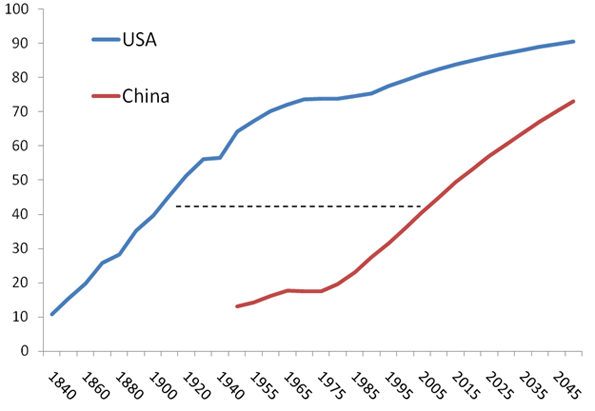
    Yet, despite these colossal shifts, China’s urbanization still has a long way to go. In 1980, the U.S. urban population was 74% of the total; China’s comparable figure was only 19%. Today, America’s urban share of the population is more than 80%, whereas China’s remains less than 50%. Taken into consideration China’s colossal size and development level, this gap suggests extraordinary potential. In 2025, America will have two cities (New York and Los Angeles) with more than 10 million people, three with 5-10 million and 37 with more than a million. By then, China will have five cities with more than 10 million people, 9 with 5-10 million, and almost 130 with more than a million. Viewed this way, China’s urbanization has barely begun (Figure 1).

    Figure 1: Percentage of Urban Population: United States and China

    Winning China’s West
    If Lewis had spent even some time in the rural China or the emerging new tiers of cities, he would have associated them with the world of “unlimited supply of labor”.

    During the past three decades, migrant laborers have played a key role in China’s economic growth in the first-tier cities. Now as living costs rise fast in Beijing, Guangdong, and the Yangtze River Delta region, employment prospects are improving in the inland cities and the West.

    Since the early 2000s, the new “Go West” policy covered the huge municipality of Chongqing, six provinces, from Gansu to Sichuan and Yunnan, and five autonomous regions. At the time, this region accounted for almost 30 percent of China’s population, but less than 17 percent of its GDP. Initially, the policy focused on the development of infrastructure (transport, hydropower plants, and energy and telecom establishments). But it is the new stage of development in eastern China that is now dramatically accelerating growth in the West.

    Even before the global financial crisis, the Ministry of Commerce designated more than 30 “priority relocation destinations” in China’s inland to increase the share in the processing industry in central and western areas, especially in labor-intensive manufacturing.

    In the future, China’s West hopes to catch up with its East through domestic consumption, cost advantage, investment policies and infrastructure, which has been boosted by the nation’s stimulus policies. China’s West is about to experience a revolution in durable consumer goods, from color TV sets to refrigerators. True, the volume of retail sales remains higher in China’s East, but sales growth is stronger in the non-coastal areas.

    As costs have risen, China has lost some jobs to Bangladesh, Vietnam and Cambodia, primarily for cheaper, labor-intensive goods like textiles, simple electronics, and toys. Yet, China’s West still offers many of the comparable benefits and an emerging infrastructure.

    The Decades to Come

    In the next two decades, China’s urbanization is expected to boost domestic demand by $4.5 trillion, which should assure a stable economic development even if exports decline. In effect, the urban migrants’ demand for housing is likely to become the largest driving force for China’s economic growth in the future.

    During the past three decades, the share of China’s city dwellers has more than doubled to 45 percent. And by 2040, the urbanization rate is expected to be close to 67 percent. In the next three decades, the number of China’s urban residents is expected to grow by 360 million people to 970 million. In terms of current urban populations, this is the same as creating city space for entire urban America (260 million), Japan (85 million) and another 15 million people – within one generation.

    This great transformation, however, is predicated on sustained economic growth and a stable international environment. China’s first-tier cities are now coping with the coming of the Lewisian turning point/ The big story in the coming decades, will be the takeoff in the west and among many once peripheral cities. Due to China’s sui generis magnitude, this process will take another decade or two.

    Dan Steinbock is Research Director of International Business at India China and America Institute (USA), and Visiting Fellow at Shanghai Institutes for International Studies (China).

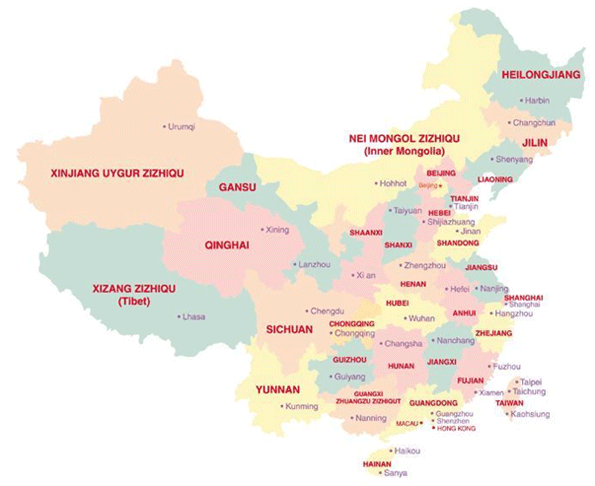
    China’s Provinces and Cities

    References

    1 Hamlin, K. et al. (2010), “China Reaches Turning Point as Inflation Overtakes Labor,” Bloomberg News, June 11.

    2 On the argument that China is coping with the Lewisian turning point, see Cai, Fang, Wang, Meiyan, 2008. A counterfactual analysis on unlimited surplus labor in rural China. China & World Economy 6 (1), 51–65.; Fang Cai, Meiyan Wang (2010), “Growth and structural changes in employment in transition China,” Journal of Comparative Economics 38 (2010) 71–81. On the argument that Lewisian turning point is years away, see Yang Yao (2010), “No, the Lewisian turning point has not yet arrived,” Economist, July 16, 2010; Roach, S. (2010), “ Chinese wage convergence has a long way to go,” Economist, July 18.

    3 Lewis, W. Arthur (1954). “Economic Development with Unlimited Supplies of Labor,” Manchester School of Economic and Social Studies, Vol. 22, pp. 139-91

    4 Steinbock, D. (2010),” Legacy of Globalization: Shanghai and Hong Kong as China’s Emerging Financial Hubs,” Policy Brief, Shanghai Institutes for International Studies, January 2010.

    5 These tiers of cities are evolving dynamically and through a national plan. With its more than 31 million people, Chongqing, for instance, is already one of China’s five national central cities. National central cities have a great impact around the surrounding cities on integrating services in infrastructure, finance, public education, social welfare, sanitation, business licensing and urban planning.

    6 In fact, Lewis’s classic article offers also another clue to assess China’s stages of growth. As far as he is concerned, small migrations explain little. In the 1950s, he noted, 100,000 Puerto Ricans emigrate to the United States every year. Still, it is Puerto Rican wages which are pulled up to the U.S. level. Mass immigration is quite a different kettle of fish. “If there were free immigration from India and China to the U.S.A., the wage level of the U.S.A. would certainly be pulled down towards the Indian and Chinese levels,” Lewis argued. In China’s economic development, the tens of millions of migrant workers have played the comparable role of pulling down the national wage level.

    7 In the beginning of the “Go West” program, the largest proportion of the West’s total fixed asset investment was in infrastructure. And almost half of China’s huge stimulus of $586 billion was earmarked for transportation, infrastructure and power grids. These, in turn, facilitate the exploitation of minerals, natural gas and oil in China’s West. In addition to the stimulation of domestic demand, the government’s strategy is to “cultivate areas of high consumer demand and expand consumption in new areas”.

    8 “China’s urbanization to fuel domestic demand,” China Daily, November 15, 2010.

    9 Steinbock, D. (2010), “Growth fueled by urban investment,” China Daily, February 25, 2010.

    10 On the international relations dimensions of China’s stages of growth, see Steinbock, D. (2010), “China’s Next Stage of Growth: Reassessing U.S. Policy toward China,” American Foreign Policy Interests, No 6, December 2010.

  • Korea Conflict Shows That Borderlands Are Zones of Danger

    The current conflict between the Koreas illustrates a broader global trend toward chaos along borders separating rich and poor countries. Ultimately, this reflects the resentments of a poor neighbor against a richer one. Feeling it has little to lose, the poorer neighbor engages recklessly in the hope of gaining some sort of tribute or recognition   from the better-heeled neighbor, or at least boosting its own self-respect.

    The Korean situation epitomizes the fundamental danger when rich and poor countries live adjacent to one another. According to 2006 statistics, South Korea has a per capita income of roughly $18,000; the North’s stands at $1,300. Clearly, the threat of leveling Seoul, a wealthy and successful city, has limited South Korea’s ability to respond as it might otherwise to its nasty, militaristic neighbor, whose people live on the brink of starvation.

    Conflicts between poorer peoples and richer neighbors have been part of human history since antiquity. In ancient Mesopotamia the rough Semites attacked and eventually overcame the wealthier, more sophisticated Sumerians. This pattern was repeated throughout the ancient world, for example, pitting Chinese against the peoples of the Steppes, hurling German and Hunnish barbarian races against the Romans, and in countless upheavals throughout Meso-America.

    Although the wealthier neighbor can beat back the threat through better organization and technology, often it’s the poor neighbor who ultimately triumphs.   The Great Arab historian Ibn Khaldun, a student of Mid-east  and Mediterranean politics in the 14th  century, even developed a theory positing that the poorer, hungrier neighbor often held the long term advantage Of the more affluent countries, he writes,  “Time feasts on them, as their energy is exhausted by well-being and their vigor drained by the nature of luxury.”

    As the settled, wealthier nation becomes soft and “senile,” Khaldun observed–and ultimately either unwilling or incapable of overcoming the threat from their more savage neighbor. You can people off only so long before you drain your own treasury and self-respect. If Khaldun is right, the world is going to become a more unsafe place in the coming decade as the great unwashed seek to crash the gilded gates.

    Other changes have made borderlands more dangerous in recent decades. During the Cold War era, such conflicts were often mediated by the two great super-powers. There were clear zones of influence. But in an increasingly chaotic multi-polar world, where power is diffused and technology sometimes favors the rogue, it become increasingly difficult to manage these conflicts. In Korea we can see this in the gamesmanship of China, which further limits any strong American and South Korean response.

    But Korea is hardly the only place where borderlands have become hot zones. There are many places around the world where rich nations abut poorer ones, creating serious potential for major conflict. Among the most worrisome:

    The Saudi/Yemen border. Oil-rich Saudi Arabia boasts a per capita income over 13 times greater than that of its southern neighbor. Criminal elements, illegal immigrants and a growing al Qaeda presence, cross the porous border. These could ultimately undermine the country with the largest proven energy reserves. Over 130 Saudi soldiers have been killed this past year along this 1,100 mile long desolate border region–so desolate it was only demarcated in 2000.

    Israel and Gaza/Palestine. Ancient hatreds make this a particularly worrisome set of borders.  There are huge gaps not only in ideology and religion but income. Israel’s 2006 per capita income was just shy of $18,000, while Palestine’s was under $800 and Gaza’s under $500. Such huge gaps, as can be seen in the Koreas, tend to exacerbate already great tensions.

    Spain/Maghrebian countries. The flow of immigrants from Muslim North Africa into southern Europe has become a major international flashpoint, particularly as Spain, Italy and countries continue to experience major economic dislocation. There are well over 1 million Muslim immigrants in the country. The income difference between these two adjacent worlds can be immense; Spain’s per capita GDP is more than ten times that of Morocco, its closest Arab neighbor. The flow of immigrants and far higher fertility rates among them can be unsettling to some.   ”Tomorrow Europe might no longer be European,” Libya’s Leader Muammar Ghadafi suggested recently.

    U.S./Mexico. Although relations between the two countries have been cordial under both Presidents George W. Bush and Barack Obama, the ground level violence in Mexico–claiming 26,000 deaths since December 2006–is both driving Mexicans north and driving Americans away from the border region. With U.S. per capita incomes over six times that of Mexico, the temptation for criminals, as well as illegal immigrants, to cross the border can be overwhelming, and unsettling. Border violence is way up, leading to calls for tighter controls over immigration.

    Two recently discovered tunnels for drug smuggling near San Diego, complete with rail cars, indicate how inventive some cross-border entrepreneurs can be. But it is a mistake to see borderland as only bastions of criminality and unrest. Until recently the U.S./Mexico border constituted one of North America’s fastest-growing economic regions, marrying U.S. technology and investment with hard-working Mexican labor.

    Perhaps the most positive model of harmonious border relations can be seen along the border of Singapore and Malaysia. Although Singapore’s per capita income is more than five times that of Malaysia, there are ambitious plans to build a vast new business complex in the Iskandar section of Malaysia’s Johore State   The Malaysians envision “a strong and sustainable metropolis of international standing.” Right now the most obvious signs of mega-development in the area are somewhat oversized government buildings.

    If the cross-straits development materializes, this region would both expand the economic footprint of the predominately Chinese city-state and its largely Muslim neighbor. Instead of worrying about drugs, terrorists or illegal migrants, some well-placed Singaporeans see Johore as a base to expand its manufacturers and those of foreign firms.

    There is also a swank upscale “Leisure Farm” that offers green-tinged amenities for Singapore’s often crammed and stressed residents. Some  Singaporeans privately doubt the ability of Malaysians to compete with them in higher-value-added fields, but others wonder if their growing investment across the straits may be creating a tough competitor.

    Ultimately,   the planet’s future depends on successfully integrating the economies of rich countries and poorer ones. Aspiring countries have much to offer their rich neighbors–in terms of markets, labor and entrepreneurial energy. One hopes the world will see more of the commerce-driven model of Malaysia, and less of the kind of potentially dreadful military conflict now brewing along the Korean frontier.

    This article originally appeared at Forbes.com.

    Joel Kotkin is executive editor of NewGeography.com and is a distinguished presidential fellow in urban futures at Chapman University. He is author of The City: A Global History. His newest book is The Next Hundred Million: America in 2050, released in February, 2010.

    Photo by anja_johnson

  • Love and the City

    It has been said that the modern city is soulless, that it is heartless, and that it is brutal. The modern city represents in its scale and complexity one of the most extraordinary of human inventions, but there is also no doubt that everywhere in the world it is also one of our biggest failures.

    The dysfunction of a city in the past was an inconvenience. The dysfunction of a city in the future will be a profound disaster for that city and, ironically, a profound opportunity for another city, of a smarter city. It will be an opportunity for a city that has found out how to position itself better in the world of cities, but more importantly in the eyes and hearts of its citizens.

    All over the world, there is a growing recognition that this brutality must stop; we have to imagine a different kind of city which addresses human needs and that puts the soul back into the city. This is essential to the survival of the city. Put another way, there is a growing understanding that it is actually “love” that will be the prime force in the future economy of successful 21st century cities.

    Who would have thought in the last generation that “love” might become a meaningful topic in a discussion about urban economies, much less a prime force of those economies?

    One important reason for creating a love-based city grows from the struggle today among cities for hegemony. We read all the time about “alpha-cities” and “delta-cities”: the “alphas” enjoy the fruits of labour and the “deltas” just do the labour – they just exist. And why is this?

    Well, it’s because the dynamics of urban growth and competition have fundamentally changed in the last quarter century. The world has become footloose, with people and capital moving at will: business can be done anywhere. Other aspects of life are more important than one’s livelihood and where people choose to settle is not tied down the way it used to be. We can do and be almost anything anywhere.

    The result is a new kind of economic base for our cities, augmenting the traditional economic activities holding our cities together. This is the ideas and service economy and it opens up the imperative to create a city of beauty and quality liveability and style. This is an economy driven by people, their direct needs, their preferences and their day-to-day experiences.

    This ideas and service economy quickly becomes an economy involving almost everyone. If you live in a core city, have you ever tried to get a gardener or a plumber? But, even beyond that, you have to think about all of the professions and vocations that can now demand an enjoyable as well as functioning city.

    We’re not just talking about the service sector or the ‘creatives’, we’re talking about almost everybody. We have to focus the discussion on a city that is liveable for a broad array of its population.

    I worry that in all our creative thinking about sustainable technologies and sustainable urban forms, there may be some strong denial going on about people and their inclinations, denial that will block the way towards sustainability.

    Take the fashion that insists on the primacy of density and mixed use and diversity and sustainable transportation. Sadly, most consumers in the English speaking world, except in a very few of our older gracious places, have shown very little interest in being a part of that kind of city. In my country, two-thirds of Canadians live in auto-dominated suburbs that boast none of these qualities – and that proportion is even higher in America.

    Let’s be blunt: most people hate density because most of it has been so bad; they think of mixed use as probably hitting them negatively and transit is not even in most people’s vocabulary. The ideal of most people is some sort of rural “garden of Eden” that they want to escape to from the city – even if that ends up being an illusory goal.

    I sympathize. The cities we have been building since the War have very seldom offered anything very appealing at almost any density. Who can really fall in love with brutal concrete canyons or anonymous strip malls or wind-swept roads?

    If cities want to offer an alternative, they must change and bring back the human touch – we have to bring placemaking to the very heart of the civic agenda. We have to stop trading away the urban qualities we care about for the urgencies of the moment of modern life.

    We must start to build places that truly appeal to people – yes, places that are sustainable, but also places that are so good that people will choose them. These cities have to have all the human services and they have to have beauty and they have to be gentle. Only then will they become attractive to a wide range of people.

    I call this “Experiential Planning” – learning about and then carefully making the city deliver the experiences people tell us they want in their lives for their families and children.

    Experiential planning looks beyond land-use and transportation patterns to things like character and comfort and health and convenience and the visceral response of the senses and caprice: things that simply make people happy. Happiness is the applied side of love.

    People want all of the efficiencies and choices but they also want more. They want to feel the unique, special spirit of a place as a real thing, not a marketing gimmick. They want their habitat to have a “buzz” that makes them feel good. They want their day-to-day living environment to foster social engagement and neighbourliness not isolation. That is what the contemporary city has often been missing.

    For as long as anyone can remember, modern cities, with very few exceptions, have been shaped by economic activity and politics and the shifting of social groups: the city exploited as a commodity. But that doesn’t have to be the case. We can actually design our cities as an explicit act of creation – grand civic design with the whole city as a canvas. And every city has to find its own way: they should not accept cookie-cutter replications of what’s being done everywhere else.

    To start, every city needs to perform a ritual burning of these outdated and single-purpose rules. Now I am not talking about de-regulation. The city of the future will have to have strong regulations because the possibilities out there for development are just too diverse and the private interests in development too strong. There must be a clear expression of the public interest and public needs to match that of the private sector.

    Also, I want to be clear that this is not a “top-down” agenda. Experiential planning requires an aggressive and diverse engagement of the public at every step along the way to articulate the public perspective and to insure public buy-in and ownership. The general public needs to discuss and debate an overall civic vision and all aspects of urban design.

    In this experiential-based city there will be an alignment of profitability and community building. We will also see people coming back to live in the core city and to suburbs transformed through natural choice and preference. There will be an alignment of consumer selection and sustainable practice. This will include all kinds of people but especially families with children.

    But none of this will happen by accident. We have to make it happen and bring along individual values through a careful process of reconciliation.

    Tomorrow’s city must meet the environmental test and the economic test but it must also meet the experiential test; and that is the test of love; that is the test of soul. It must be beautiful and joyful and sociable and humane and offer a complete rich community life – with all the subtleties of human occupation. That is the real power of an urban love affair.

    Larry Beasley is the retired Director of Planning for the City of Vancouver in Canada. He is now the “Distinguished Practice Professor of Planning” at the University of British Columbia and the founding principal of Beasley and Associates, an international planning consultancy. He chairs the ‘National Advisory Committee on Planning, Design and Realty’ of Ottawa’s National Capital Commission; he is the Chief Advisor on Urban Design for the City of Dallas, Texas; he is on the International Economic Development Advisory Board of Rotterdam in The Netherlands; and he is the Special Advisor on City Planning to the Government of Abu Dhabi in the United Arab Emirates.

    Photo by ecstaticist

  • The Rise of the Efficient City

    Smaller, more nimble urban regions promise a better life than the congested megalopolis.

    Most of the world’s population now lives in cities. To many academics, planners and developers, that means that the future will be dominated by what urban theorist Saskia Sassen calls “new geographies of centrality.” According to this view, dense, urban centers with populations in excess of 20 million—such as metropolitan Tokyo, New Delhi, Sao Paolo and New York—are best suited to control the commanding heights of global economics and culture in the coming epoch.

    In fact, the era of bigger-is-better is passing as smaller, more nimble urban regions are emerging. These efficient cities, as I call them, provide the amenities of megacities—airports, mass communication, reservoirs of talent—without their grinding congestion, severe social conflicts and other diseconomies of scale.

    Megacities such as New Delhi, Mumbai, Sao Paolo and Mexico City have become almost unspeakably congested leviathans. They may be seen as “colorful” by those engaging what writer Kennedy Odede calls “Slumdog tourism.” They may also be exciting for those working within the confines of “glamour zones” with high-rise office towers, elegant malls, art galleries and fancy restaurants. But most denizens eke out a meager existence, attractive only compared to even more dismal prospects in the countryside.

    Consider Mumbai, with a population just under 20 million. Over the past 40 years, the proportion of its citizens living in slums has grown from one in six to more than half. Mumbai’s brutal traffic stems from a population density of more than 64,000 per square mile, fourth-highest of any city in the world, according to the website Demographia.

    Many businesses and skilled workers already are moving to smaller, less congested, often better run cities such as Bangalore, where density is less than half that of Mumbai. Much of this new growth takes place in campus-like settings on the edge of town that take advantage of newer roads, better sanitation systems and sometimes easier access to airports. Companies like Alcatel-Lucent and Infosys offer their employees facilities more similar to those of Silicon Valley or suburban Austin than to Mumbai or Kolkata (formerly Calcutta).

    Consider also Singapore and Tel Aviv, which are among the best models for the efficient cities of the future. At its founding in 1965 after independence from Malaysia, Singapore’s per capita GDP was about that of Guatemala and well below that of Venezuela and Iraq. Today it equals, on a purchasing power basis, that of most Western cities including London, Sydney and Miami.

    The city-state bears no resemblance to the typical unsanitary and disorderly tropical metropolis. Singapore’s roughly five million citizens live under efficient (if heavy handed) government. With its modern port, airport and excellent transport network, Singapore consistently ranks as the No. 1 locale for ease of doing business by the World Bank. Over 6,000 multinational corporations including Seagate, IBM and Microsoft have a large presence in Singapore.

    Tel Aviv represents a decidedly different approach to building the efficient city. With roughly two million people in its metropolitan area, this little dynamo produces the vast majority of Israel’s soaring high-tech exports, is home to a preponderance of the country’s financial institutions and has established itself as the global center of the diamond industry. Incomes in the region are as much as 50% above Israel’s national average.

    Tel Aviv’s pleasure-loving denizens may differ markedly from more controlled Singaporeans—or the usually more religious citizens of Jerusalem—but they employ many of the key efficient city advantages: a sharp focus on business, a well-developed sense of place and a first-class communications infrastructure. The city’s tech industry includes firms such as Microsoft, Cisco, Google and IBM. It is home to Israel’s only stock exchange and most of the country’s resident billionaires.

    The U.S. is also embracing the efficient city. Between 2000 and 2008, notes demographer Wendell Cox, metropolitan areas of more than 10 million suffered a 10% rate of net outmigration. The big gainers were generally cities with 100,000 to 2.5 million residents. The winners included business-friendly Texas cities and other Southern locales like Raleigh-Durham, now the nation’s fastest-growing metro area with over one million people. You can add rising heartland cities like Columbus, Indianapolis, Des Moines, Omaha, Sioux Falls, Oklahoma City and Fargo.

    Some of these—such as Austin, Columbus, Raleigh-Durham and Fargo—thrive in part by being college towns. Others like Houston, Charlotte and Dallas have evolved into major corporate centers with burgeoning immigrant populations. But they thrive because they are better places for most to live and do business.

    Take the critical issue of getting to work. According to the American Community Survey, the average New Yorker’s daily trip to work takes 35 minutes; the average resident of the Kansas City or Indianapolis region gets to the office in less than 13 minutes. That adds up in time and energy saved, and frustration avoided.

    The largest American cities—notably New York, Los Angeles and Chicago—also show the most rapid decline in middle-class jobs and neighborhoods, with a growing bifurcation between the affluent and poor. In these megacities, high property prices tend to drive out employers and middle-income residents. By contrast, efficient cities are where most middle- and working-class Americans, and their counterparts around the world, will find the best places to achieve their aspirations.

    This article originally appeared at the Wall Street Journal.

    Joel Kotkin is executive editor of NewGeography.com and is a distinguished presidential fellow in urban futures at Chapman University. He is author of The City: A Global History. His newest book is The Next Hundred Million: America in 2050, released in February, 2010.

    Photo by wili_hybrid

  • The Overdue Debate: Smart Growth Versus Housing Affordability

    American households face daunting financial challenges. Even those lucky enough not to have suffered huge savings and retirement fund losses in the Great Recession seem likely to pay more of their incomes in taxes in the years to come, as governments attempt pay bills beyond their reasonable financial ability. Beyond that, America’s declining international competitiveness and the easy money policies of the Federal Reserve Board could well set off inflation that could discount further the wealth of households.

    In this environment, the last thing governments need do is to raise the cost of anything. It is bad enough that taxes may have to rise and that a dollar will probably buy less. America’s standard of living could stagnate or it could even decline.

    The Choice: Smart Growth or Affordability

    The Washington Examiner, however, succinctly put the choices that face the nation, states and localities with respect to the largest element of household expenditure — housing. In an editorial entitled “Take Your Pick: Smart Growth or Affordable Housing,” the Examiner noted:

    “No matter how much local politicians yammer about how much they support affordable housing, they are the principal cause of the problem via their land use restrictions, such as the urban growth boundary in Montgomery County and large-lot zoning in Loudoun County.”

    The editorial was in response to our Demographia Residential Land & Regulation Cost Index, which estimated the extent to which the land to construction ratio had risen in metropolitan regions. The principal finding was that the share of land and regulatory costs to new house prices had risen only with the impostion of more restrictive land use policies. This is principally because strategies such as urban growth boundaries, suburban large lot zoning and geographical growth steering (such as allowing state financial assistance only in areas meeting smart growth criteria) makes land for housing unnecessarily scarce, raising its price just as surely as OPEC’s oil rationing raises the price of gasoline.

    Urban planner and mayor of Ventura, California Bill Fulton objected to our attributing these increases to land and regulation, instead suggesting that smart growth increases homes prices much less than we claimed although, he admits, “at least a little“ . The pro-smart growth study Costs of Sprawl — 2000 concedes that a number of smart growth strategies can increase house prices (See Table 15-4). Thus, the debate is not about whether more restrictive land use policies raise the price of housing, but rather by how much.

    More often, however, proponents of more restrictive land use regulations have avoided and even denied that the inconvenient truth linking their policies with higher housing costs. Rarely, if ever, have proponents of such policies fully disclosed to elected or appointed officials that more restrictive land use policies would lead to higher house prices. It is doubtful that any urban planning department ever sent representatives to an NAACP chapter to explain how fewer African-Americans would be able to own their own homes, despite already having a one-third lower home ownership rate than non-Hispanic whites. Similarly, the planners probably never told La Raza chapters that Hispanic households, also with a one third less home ownership rate, would find home ownership more costly. Nor was the message delivered to the religious organizations concerned with improving the standard of living for lower income households.

    Pervasive Evidence

    Yet the evidence that smart growth boost prices substantially seems incontrovertible. An early 1970s research effort led by renowned urbanologist Peter Hall quantified the impacts of the restrictive Town and Country Planning Act of 1947, which brought smart growth measures to England. The result, The Containment of Urban England revealed how strict regulations on development had driven the price of land for development from five to ten times the value of comparable on which development was not permitted, but might be permitted in the future. More recently, Bank of England Monetary Policy Committee member Kate Barker, was commissioned by the Blair Labour government to review housing affordability and land regulation. She attributed England’s more steeply rising house prices relative to continental Europe to its more restrictive land use regulations.

    The same effect is evident in the United States. Dartmouth’s William Fischel noted that California house prices were similar to those in the rest of the nation as late as 1970. By 1990, however, California house prices had escalated well ahead of the nation. Fischel found that the higher prices could not be explained by higher construction cost increases, demand, the quality of life, amenities, the property tax reform initiative (Proposition 13), land supply or water issues. His conclusion was that the expansion of land use restrictions were the culprit.

    Let Them Eat Cake?

    The disregard at least some smart growth proponents show about house prices may be characterized, for example, in a comment on the Planetizen website:

    “… smart growth can lead to more expensive housing. So what? At least it’s REAL value, generated by a higher quality of life, easier commutes, more transit options, walkability and a more enriched cultural experience…” (emphasis in original)

    Perhaps it never occurred to the proponents of more restrictive land use policies that not all households have the benefit of incomes typical of urban planners or new urbanist architects. One has to question the “REAL values” of smart growth since most housing consumers place their highest emphasis on things like privacy, security and good schools, not always available at a decent price in urban areas.

    In fact, higher priced housing reduces the discretionary income that is crucial to an acceptable standard of living to many households. Millions of households will not be in the market for “a more enriched cultural experience” until they can afford the housing they desire.

    Housing Affordability and the Cost of Living

    It is not accidental that the cost of living is higher (both in nominal terms and relative to incomes) in metropolitan regions where land use regulation is the strongest, such as San Diego, Washington-Baltimore, Seattle or Boston. Nor is it accidental that house prices have escalated to 40 percent above historic norms in Portland, Oregon, where planners have skimped on geographical urban growth boundary expansions, choosing instead to look skyward, seeking higher densities. California’s aspiration under Senate Bill 375 for new housing at 20 units to the acre offers a more than Jakarta level of density (residential densities above 30,000 per square mile) that could escalate the unprecedented exodus of people and businesses.

    Higher Housing Costs: The Poverty Connection

    The acknowledged relationship between more restrictive land use regulation and higher house prices also applies to standards of living, which are sent lower, and poverty rates, which must inevitably be pushed higher. This constitutes a second inconvenient truth: as discretionary income drops, more households fall into poverty. This creates a difficulty for proponents of more restrictive land use regulation, because there is no constituency for increasing poverty. It is no wonder they have generally discounted, ignored or even denied the nexus between smart growth and higher housing costs.

    Considering the financial uncertainty American households face, it is long past time that the choice between smart growth and housing affordability be seriously debated.

    —-

    Photograph: “Low density” smart growth development adjacent to the urban growth boundary (Hillsboro) in suburban Portland (by author)

    Wendell Cox is a Visiting Professor, Conservatoire National des Arts et Metiers, Paris and the author of “War on the Dream: How Anti-Sprawl Policy Threatens the Quality of Life

  • Will Ideology or Pragmatism Rule American Politics?

    Now that the dust from the midterm elections has settled, America remains just as divided as before on what type of governing approach it favors. As the LA Times’ Gregory Rodriguez, points out, if the United States “was a cartoon character, it would be a cheerful fellow with his head in the clouds and his feet planted squarely on the ground.”

    To win the support of the public, America’s next governing consensus must encompass the nation’s highest ideals, while presenting realistic solutions to today’s challenges. In the short run, the ideological orientation of each party’s congressional representation will push both parties toward their ideological poles. Flush with victory, top House Republicans and strategists said, they saw “little distinction between incumbent members and those who would be joining them as freshman…both benefited from the Tea Party activism that helped them trounce Democrats” and said that “the support deserved to be rewarded”. Congressional Democrats, especially in the U.S. House of Representatives, are also more ideologically uniform than previously. Virtually all of the members of the Congressional Progressive Caucus (75 of 79) were reelected in 2010, as were a clear majority (40 of 68) of the centrist New Democrats. By contrast, a majority of the conservative Blue Dog Coalition (29 of 54) were either defeated or saw their open seats won by Republicans. Together, these changes meant that, for the first time since these organizations were formed in the 1990s, the Congressional Progressive Caucus was larger than the Blue Dogs and New Democrats combined.

    The magnitude of the Republican victory was impressive, but constituted more of a continuation of the type of partisan political volatility the country experiences during periods of great generational change than a massive shift of America to the GOP and conservatism. A Pew survey taken just before the election indicated that the distribution of party identification within the electorate was little different in 2010 (49% Democratic to 39% Republican) than it was in either 2008 (51% to 36%) or 2006 (47% to 38%), two years in which Democrats won sweeping victories at the polls.

    Nor did Election Day exit polls show a clear endorsement of GOP positions on key issues. Only half of the voters (48%) called for repeal of the Democratic healthcare reform law. About the same number (47%) wanted the law left as is or even expanded. Only four in ten voters (39%) favored extending the Bush-era tax cuts to all Americans, including those with incomes greater than $250,000. By contrast, a majority endorsed either the Obama administration’s position of extending the tax cuts to only those with incomes below that level (37%), or the even more liberal position of letting the tax cuts expire for everyone (15%).

    Moreover, exit polls indicated that although the Democrats lost some ground among almost all demographics, the composition of the two party’s coalitions remained largely unchanged. The votes of Millennials (57% Democratic to 40% Republican), African-Americans (90% to 9%), and Hispanics (64% to 34%) were only slightly altered from what they had been in 2006 and 2008. The Northeast (53% to 45%), the West (49% to 48%), and the nation’s cities (56% to 41%) provided a firewall that helped the Democrats to retain control of the Senate.

    The GOP did strengthen its position within its core constituencies, winning solidly among men (56% Republican to 42% Democratic), as well as in the South, in rural areas, and among senior citizens, all of which voted Republican by about 1.5:1 margins. The Republicans were also able to split the women’s vote which they had lost in previous elections, primarily due to massive support from female senior citizens who voted 57% to 41% in favor of the GOP, even as younger women retained their Democratic allegiance. Geographically, Republican gains came predominantly in the Great Lakes watershed where the GOP won at least 25 new House seats, or about 40 percent of their pickups.

    The Republicans also made major gains in America’s suburbs, where the greatest number of Americans of all ethnicities and generations, including Democratic-leaning Millennials, African-Americans, and Hispanics, now live. Obama narrowly won the suburbs, 50% to 48%. In 2010, the GOP carried them even more decisively, 55% to 42%. Democratic losses in the suburbs were particularly great among white voters who had not completed college and were among those who had been most hurt by the Great Recession. The party able to win over suburban voters with a message that is both ideologically and pragmatically appealing will gain the strategic high ground in the battle over the nation’s political direction in 2012 and beyond.

    One of the reasons for this shift in the makeup of the 2010 electorate was a drop in the contribution from Millennials. Turnout among those 18 to 29 years of age was comparable to previous midterm elections: 21 percent of all Millennials eligible to vote did so, about the same percentage as in 2002 but less than the 24 percent turnout in the 2006 midterm elections. Those Millennials that did vote preferred Democratic candidates in almost all contested elections and approved of Barack Obama’s handling of his job as president by a 60% to 40% margin. In contrast to all other generations, Millennials remain overwhelmingly Democratic and liberal in their political orientation.

    If the 2008 election was a victory for young Millennials, the 2010 midterms represented a triumph for senior citizens. A big part of the increase in votes for Republican candidates was inspired by the Tea Party movement’s older supporters. A solid plurality (40%) of 2010 voters claimed to be Tea Party supporters and nearly nine in ten (87%) of them voted for Republican house candidates. The GOP’s clear emphasis on ideological themes, built around concerns about the nature and scope of government, inspired its frightened and frustrated base to turn out in record numbers to prevent what it perceived to be a dangerous drift toward liberal hegemony.

    In the end, however, most of those who voted in 2010 had little good to say about either party. Almost identical majorities among those who voted had an unfavorable opinion of the Democratic and Republican Parties. Reflecting the opinions of some of their Tea Party supporters, even one-fourth of Republican voters expressed a negative perception of the GOP

    So, in spite of the internal structural forces impelling both the Democrats and Republicans toward ideological uniformity, the new ruling party will be the one that most effectively integrates their party’s ideology with the country’s demands for solutions that work. That party will need to appeal both to those who embrace the ideals of individual freedom but also understand the need for a pragmatic program of collective action, integrating national purpose with individual choice. Shaped by some of the most profound demographic changes in American history, the key to future success for both the Democrats and Republicans will lie in synthesizing these two strands of America’s political DNA. The party that most effectively accomplishes that goal will be the dominant political force in the Millennial Era for the next four decades.

    Morley Winograd and Michael D. Hais are fellows of the New Democrat Network and the New Policy Institute and co-authors of Millennial Makeover: MySpace, YouTube, and the Future of American Politics (Rutgers University Press: 2008), named one of the 10 favorite books by the New York Times in 2008.

    Photo by hjl

  • How Liberalism Self-destructed

    Democrats are still looking for explanations for their stunning rejection in the midterms — citing everything from voting rights violations and Middle America’s racist orientation to Americans’ inability to perceive the underlying genius of President Barack Obama’s economic policy.

    What they have failed to consider is the albatross of contemporary liberalism.

    Liberalism once embraced the mission of fostering upward mobility and a stronger economy. But liberalism’s appeal has diminished, particularly among middle-class voters, as it has become increasingly control-oriented and economically cumbersome.

    Today, according to most recent polling, no more than one in five voters call themselves liberal.

    This contrasts with the far broader support for the familiar form of liberalism forged from the 1930s to the 1990s. Democratic presidents from Franklin D. Roosevelt to Bill Clinton focused largely on basic middle-class concerns — such as expanding economic opportunity, property ownership and growth.

    Modern-day liberalism, however, is often ambivalent about expanding the economy — preferring a mix of redistribution with redirection along green lines. Its base of political shock troops, public-employee unions, appears only tangentially interested in the health of the overall economy.

    In the short run, the diminishment of middle-of-the-road Democrats at the state and national level will probably only worsen these tendencies, leaving a rump party tied to the coastal regions, big cities and college towns. There, many voters are dependents of government, subsidized students or public employees, or wealthy creative people, college professors and business service providers.

    This process — driven in large part by the liberal attachment to economically regressive policies such as cap and trade — cost the Democrats mightily throughout the American heartland. Politicians who survived the tsunami, such as Sen. Joe Manchin in West Virginia, did so by denouncing proposals in states where green policies are regarded as hostile to productive local industries that are major employers.

    Populism, a traditional support of liberalism, has been undermined by a deep suspicion that President Barack Obama’s economic policy favors Wall Street investment bankers over those who work on Main Street. This allowed the GOP, a party long beholden to monied interests, to win virtually every income segment earning more than $50,000.

    Obama also emphasized an urban agenda that promoted nationally directed smart growth, inefficient light rail and almost ludicrous plans for a national high-speed rail network. These proposals appealed to the new urbanist cadre but had little appeal for the vast majority of Americans who live in outer-ring neighborhoods, suburbs and small towns.

    The failure of Obama-style liberalism has less to do with government activism than with how the administration defined its activism. Rather than deal with basic concerns, it appeared to endorse the notion of bringing the federal government into aspects of life — from health care to zoning — traditionally controlled at the local level.

    This approach is unpopular even among “millennials,” who, with minorities, represent the best hope for the Democratic left. As the generational chroniclers Morley Winograd and Michael Hais point out, millennials favor government action — but generally at the local level, which is seen as more effective and collaborative. Top-down solutions from “experts,” Winograd and Hais write in a forthcoming book, are as offensive to millennials as the right’s penchant for dictating lifestyles.

    Often eager to micromanage people’s lives, contemporary liberalism tends to obsess on the ephemeral while missing the substantial. Measures such as San Francisco’s recent ban on Happy Meals follow efforts to control the minutiae of daily life. This approach trivializes the serious things government should do to boost economic growth and opportunity.

    Perhaps worst of all, the new liberals suffer from what British author Austin Williams has labeled a “poverty of ambition.” FDR offered a New Deal for the middle class, President Harry S. Truman offered a Fair Deal and President John F. Kennedy pushed us to reach the moon.

    In contrast, contemporary liberals seem more concerned about controlling soda consumption and choo-chooing back to 19th-century urbanism. This poverty of ambition hurts Democrats outside the urban centers. For example, when I met with mayors from small, traditionally Democratic cities in Kentucky and asked what the stimulus had done for them, almost uniformly they said it accomplished little or nothing.

    A more traditional liberal approach might have focused on improvements that could leave tangible markers of progress across the nation. The New Deal’s major infrastructure projects — ports, airports, hydroelectric systems, road networks — transformed large parts of the country, notably in the West and South, from backwaters to thriving modern economies.

    When FDR commissioned projects such as the Tennessee Valley Authority, he literally brought light to darkened regions. The loyalty created by FDR and Truman built a base of support for liberalism that lasted for nearly a half-century.

    Today’s liberals don’t show enthusiasm for airports or dams — or anything that may kick up some dirt. Deputy Assistant Secretary of the Interior Deanna Archuleta, for example, promised a Las Vegas audience: “You will never see another federal dam.”

    Harold Ickes, FDR’s enterprising interior secretary, must be turning over in his grave.

    The administration would have done well to revive programs like the New Deal Works Progress Administration and Civilian Conservation Corps. These addressed unemployment by providing jobs that also made the country stronger and more competitive. They employed more than 3 million people building thousands of roads, educational buildings and water, sewer and other infrastructure projects.

    Why was this approach never seriously proposed for this economic crisis? Green resistance to turning dirt may have been part of it. But undoubtedly more critical was opposition from public- sector unions, which seem to fear any program that threatens their economic privileges.

    In retrospect, it’s easy to see why many great liberals — like FDR and New York City Mayor Fiorello LaGuardia — detested the idea of public-sector unions.

    Of course, green, public-sector-dominated politics can work — as it has in fiscally challenged blue havens such as California and New York. But then, a net 3 million more people — many from the middle class — have left these two states in the past 10 years.

    If this defines success, you have to wonder what constitutes failure.

    This article originally appeared in Politico.

    Joel Kotkin is executive editor of NewGeography.com and is a distinguished presidential fellow in urban futures at Chapman University and an adjunct fellow with the Legatum Institute in London. He is author of The City: A Global History. His newest book is The Next Hundred Million: America in 2050, released in February, 2010.

    Photo: Tony the Misfit